Cryptocurrency Posts
Crypto Briefing
Anthropic's AI risk warning may reshape investor confidence and market dynamics, influencing the competitive landscape in AI development.
The post Anthropic warns investors of AI existential risks amid $965B IPO process appeared first on Crypto Briefing.
Unchecked AI advancement risks surpassing human control, necessitating urgent regulatory measures to ensure safety and oversight.
The post OpenAI, Google DeepMind researchers warn against rapid AI development appeared first on Crypto Briefing.
The hack underscores the critical need for robust third-party security measures and could erode trust in crypto exchanges, impacting user confidence.
The post Bitget records $463M in net outflows after hack steals up to $388M from exchange appeared first on Crypto Briefing.
Tokenized options could revolutionize derivatives trading, enhancing market accessibility and efficiency while posing regulatory challenges.
The post Cboe, S&P DJI eye tokenized options in next phase of derivatives deal appeared first on Crypto Briefing.
Reco's funding boost highlights growing investor confidence in AI security, underscoring the critical need for robust protection in SaaS environments.
The post Reco raises $55M to enhance AI agent security solutions appeared first on Crypto Briefing.
Bitcoin Magazine
Bitcoin Magazine

Now Accepting Bitcoin: Coljac Café Bitcoin Hub with 40+ Nearby Missouri Merchants
When I heard of the Coljac Café Bitcoin acceptance, I expected to write a quaint little piece about a small-town coffee shop trying something quirky. I was completely wrong. What I found in Farmington, Missouri wasn’t just a place to grab a morning espresso, it was the undisputed heart of an entire regional monetary movement.
Table of Contents
Pioneer Status: Coljac Café in Missouri Bitcoin Acceptance
When local Bitcoiners started dropping in, grabbing tables, and hosting informal meetups at the Farmington shop, ownership was willing to listen. The shop’s owner and the local bitcoiners worked together and integrated Coinos.io, giving her register native Bitcoin and Lightning functionality. Their register has since been updated to Square who officially crossed 1 million vendors accepting bitcoin. That willingness to embrace her customers has paid off in measurable revenue:
- The Baseline: On the annual income last year, Bitcoin transactions account for roughly 5% of her total business.
- Meetup Takeovers: On weekends when the local Bitcoiner group hosts an event at the Farmington location, Bitcoin payments skyrocket to an astonishing 50% of her entire morning sales volume.
- 0% fees on transactions beats the pants off credit cards.
Today, a “Bitcoin Accepted Here” sign sits right on the counter. Sure, 95% of her day-to-day customers still hand over credit cards or cash, but that sign has become a beacon. As Jessica has grown more aware of the monetary shift, she’s become genuinely happy to educate curious locals who stop to ask about it over their morning drip.
The Coljac Café Bitcoin Sprouting Effect
Here is where the story gets really wild. The Coljac Café Bitcoin story didn’t just stay an isolated island accepting sats, it became the focal gathering point that catalyzed an entire local circular economy in and south of St. Louis. Because Col Jac’s created a safe landing pad for Bitcoiners, the surrounding community started taking notice. Now, the momentum is spreading across the region:
- 1. Grassroots Food & Farmers: The standout here is the Milkmen Farms Alliance, running weekly delivery routes for raw milk, eggs, and meat directly to St. Louis doorsteps. Paired with local producers like Hale Family Farm and Ozark Prime Beef, you can fill your fridge on a hard-money standard while farmers hedge against inflation.
- 2. Leisure & Traveler Lodging: For recreation and overnight stays, Cherrywood Golf Course in Fredericktown lets you pay for 18 holes, drinks, and on-site lodging in sats. Further along the trail, The Station at Sawyer’s Landing provides another crucial pit stop with overnight rooms for traveling Bitcoiners.
- 3. Main Street Services: The ecosystem covers practical everyday needs, too. You can get a haircut at Hairapeutic, schedule pregnancy imaging at Sneak a Peek Ultrasounds, or bring heavy diesel machinery in for work at Bobs Tractor & Equipment Repair
Nearby Missouri Bitcoin 40+ Stores
If you live in Farmington, Saint Louis or anywhere in Missouri, the option to live fully on bitcoin is becoming a reality. I’ve listed all the businesses that I know of, and happy to add more. As always, email vagabond@b.tc with your story and we will get it covered.
Full Directory of Businesses Accepting Bitcoin within 2 hours from Coljac Café – source https://btcmap.org/
 Accepting Bitcoin Farmington & St. Francois Hub (Under 30 Minutes)
- Col Jac Artisan Café (Farmington): 9 N Jefferson St, Farmington, MO 63640 — Coffee, Bakery & Dining
- Col Jac Artisan Café (Fredericktown): Fredericktown, MO 63645 — Coffee & Bakery
- The Shed Vapes: 5628 Hillsboro Rd, Farmington, MO 63640 — Vape & Smoke Shop
- Flyleaf South: 105 Old Cadet Rd, Bonne Terre, MO 63628 — Succulents, Tropical Plants & Nursery
- Hale Family Farm: 2521 Hwy OO, Farmington, MO 63640 — Pasture Agriculture
- Hairapeutic: 307 E Karsch Blvd, Farmington, MO 63640 — Salon & Personal Care
- Steak ‘n Shake (Farmington): 796 Maple Valley Dr, Farmington, MO 63640 — Classic Diner
- Cherrywood Golf Course: Fredericktown, MO 63645 — Golf & Lodging
- The Station at Sawyer’s Landing: 500 MO-72, Fredericktown, MO 63645 — Convenience & Stop
- Milkmen Farms Alliance: Metro St. Louis Delivery & Regional MO — Farm, Dairy & Meat
 Accepting Bitcoin The Middle Ring (~45 Minutes to 1.25 Hours)
- Armour Locksmith: 1300 Big Bend Rd, Ballwin, MO 63021 — Locksmith & Security Services
- Bo.co Cafe: 500 N Grand Blvd, Saint Louis, MO 63103 — Cafe & Specialty Drinks
- Hot Java Bar: 4197 Manchester Ave, Saint Louis, MO 63110 — Coffee, Bar & Drinks
- Steve Franklin, Counseling: 6829 Gravois Ave, Saint Louis, MO 63116 — Mental Health & Counseling
- Xtreme Xotics: 5241 Weber Rd, St. Louis, MO 63123 — Exotic Pets & Supplies
- HiLeaf: 9422 Gravois Rd, Saint Louis, MO 63123 — Specialty Retail
- Mositos On Washington: 1317 Washington Ave, Saint Louis, MO 63103 — BBQ & Dining
- Mueller Furniture & Mattress: 15424 Manchester Rd, Ellisville, MO 63021 — Home Furnishings & Mattresses
- First Impressions 3D & Photography: 12 Municipal Dr, Arnold, MO 63010 — Ultrasound & 3D Photography
- Steak ‘n Shake (Fenton): 1185 Gravois Rd, Fenton, MO 63026 — Classic Diner
- Sneak a Peek 4D Ultrasounds: 794 Gravois Bluffs Blvd, Fenton, MO 63026 — Ultrasound & Imaging Services
- Sister Cities Cajun: 3550 S Broadway, Saint Louis, MO 63118 — Cajun Dining & Bar
- Steak ‘n Shake (Telegraph Rd): 3226 Telegraph Rd, Saint Louis, MO 63125 — Classic Diner
- Chuck’s Hot Chicken: 231 Arnold Crossroads Ctr, Arnold, MO 63010 — Hot Chicken & Dining
- Steak ‘n Shake (Arnold): 120 Arnold Crossroads Ctr, Arnold, MO 63010 — Classic Diner
- Steak ‘n Shake (Festus): 999 Veterans Memorial Blvd, Festus, MO 63028 — Classic Diner
- Kodiak Hollow: 118 W Mill St, Waterloo, IL 62298 — Local Goods & Shop
- Gore’s Homestead Cafe: 2277 Hwy 21, Centerville, MO 63633 — Cafe & Home Cooking
- Ozark Prime Beef: Perryville, MO — Local Ranch Meats
- Frank and Bridget’s Produce: 1700 Alma Ave, Perryville, MO 63775 — Fresh Produce
- Fancy That Cake: 2305 W Jackson Blvd, Jackson, MO 63755 — Custom Bakery & Cakes
- Glass Gardens by Stacey: 932 W Jackson Blvd, Jackson, MO 63755 — Glassware & Decor
- Green’s Garden – Urban Market: 2 N Main St, Cape Girardeau, MO 63701 — Local Market & Produce
- Green’s Garden – Farm and Garden Center: 3138 Hwy 177, Cape Girardeau, MO 63701 — Nursery & Garden Supply
 Accepting Bitcoin The Outer Radius (~1.5 to 2 Hours)
- Talayna’s Wagon Wheel Pizza: 2040 Campus Dr, Saint Charles, MO 63301 — Pizza & Dining
- Woodson Stonefire: 3120 W Clay St, Saint Charles, MO 63301 — Grill & Restaurant
- J+B Wellness Cafe (Wildwood): 16962 Manchester Rd, Wildwood, MO 63040 — Wellness Cafe & Drinks
- J+B Wellness Cafe (Cottleville): 5055 Highway N, Cottleville, MO 63304 — Wellness Cafe & Drinks
- Wit Construction: 1230 Tealwood Dr, Saint Charles, MO 63304 — General Contracting & Residential Building
- Bob’s Tractor & Equipment Repair: 140 Corporate Dr, Union, MO 63084 — Heavy Equipment & Repair
- Wheelhouse Grill: 19088 State Hwy 19, Eminence, MO 65466 — Restaurant & Grill
- Steak ‘n Shake (Poplar Bluff): 1471 N Westwood Blvd, Poplar Bluff, MO 63901 — Classic Diner
This post Now Accepting Bitcoin: Coljac Café Bitcoin Hub with 40+ Nearby Missouri Merchants first appeared on Bitcoin Magazine and is written by Vagabond.
Bitcoin Magazine
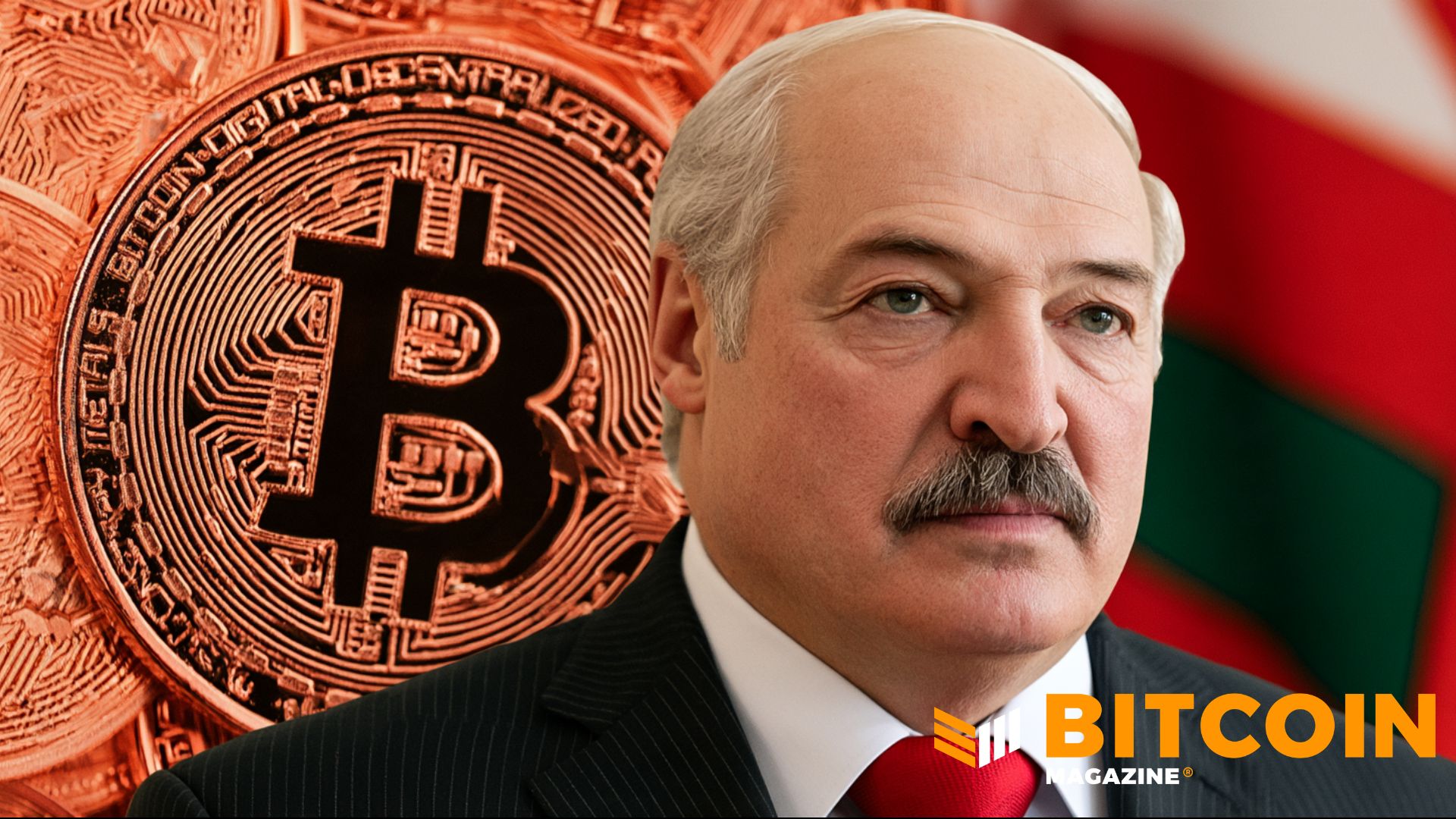
Belarus Approves the Country’s First Crypto Banks: Report
The first crypto banks have opened in Belarus, according to reports, after the European country earlier this year created a legal framework for Bitcoin banks.
While not yet named, the crypto banks will start operations after obtaining accreditation from the National Bank of Belarus, Russian news agency Interfax reported Monday.
Back in January, Belarusian President Alexander Lukashenko signed Decree No. 19 “On Cryptobanks and Certain Issues of Control in the Field of Digital Tokens,” officially creating a legal framework for bitcoin and crypto banks in the country.
JUST IN:
— Bitcoin Magazine (@BitcoinMagazine) September 28, 2026The first two "crypto banks" in Belarus have been approved.
“This will facilitate closer integration between traditional finance and the crypto industry." pic.twitter.com/Y5CHD00SkP
“The practical outcome of today’s discussion is the launch and registration of the first crypto banks in the country’s history,” Interfax reported the press service of High-Tech Park saying in a statement.
High-Tech Park is a tax and legal regime in Belarus. Digital asset transactions are permitted in the zone.
The statement added that banks would be regulated by Hi-Tech Park and the National Bank.
Dmitry Kalechits, first deputy director of the High-Tech Park supervisory board secretariat, was quoted saying that the move would “improve the flow of the financial ecosystem” and drive foreign investment to Belarus.
President Lukashenko last September backed the National Bank’s initiative to establish crypto banks in the country.
The country has long pushed pro-crypto regulations. A 2017 decree legalised crypto mining and trading and temporarily exempted individuals’ crypto income from tax and declaration. That exemption was extended to 2025 and has since been narrowed, with income from foreign platforms now taxed at 13%.
Lukashenko has repeatedly promoted Bitcoin mining as a use for surplus electricity, and in 2025 the Mogilev region began preparing sites for mining farms with his backing.
This post Belarus Approves the Country’s First Crypto Banks: Report first appeared on Bitcoin Magazine and is written by Mathew Di Salvo.
Bitcoin Magazine
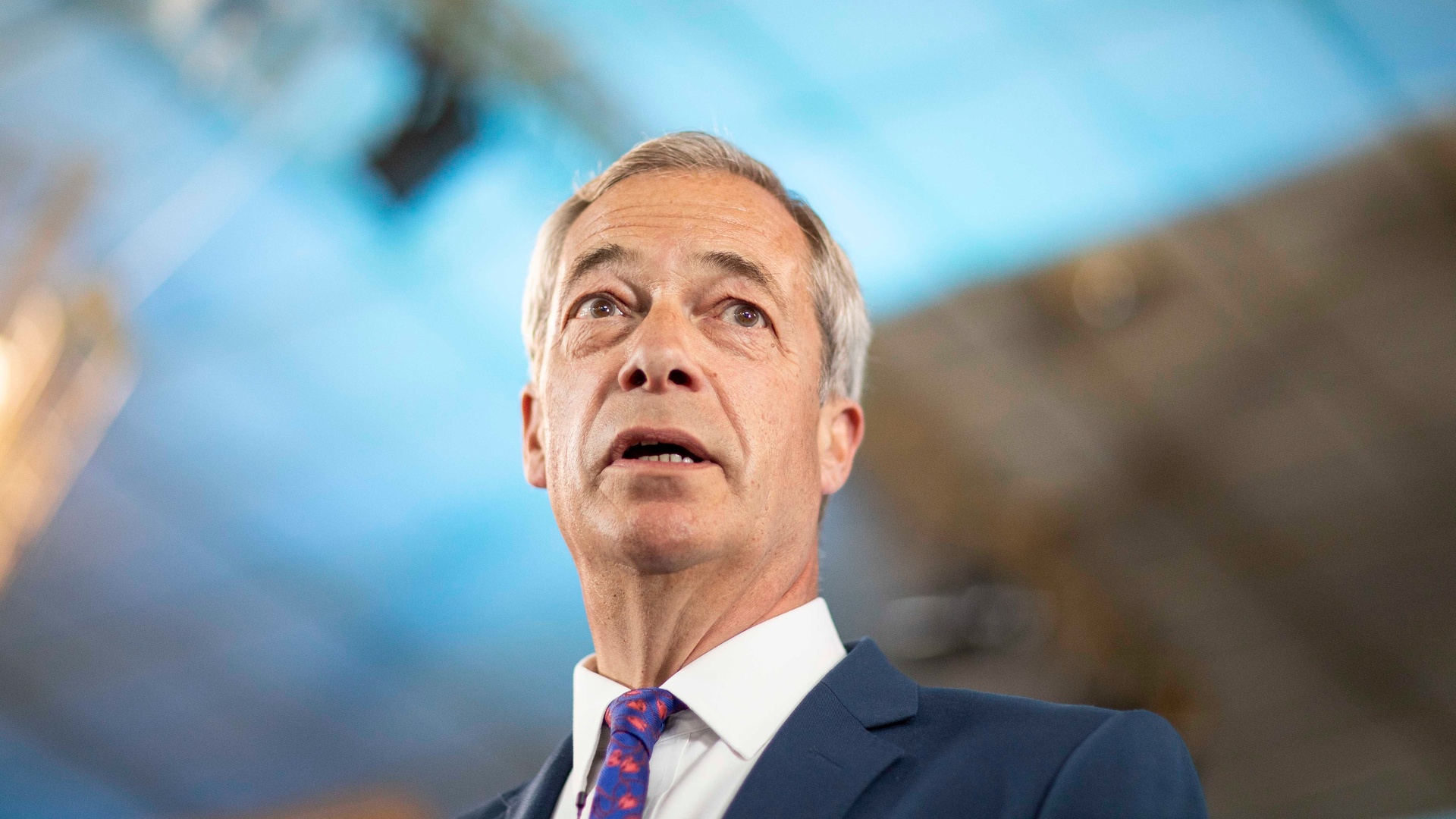
UK Chancellor of the Exchequer Blasts Nigel Farage’s ‘Bitcoin Account’
UK Chancellor of the Exchequer John Healey has appeared to slam Reform Party leader Nigel Farage’s use of Bitcoin.
In a Monday speech, the finance minister said that Nigel Farage — a pro-crypto member of parliament — was “Liz Truss with a Bitcoin account.”
Farage, who is leading the increasingly popular Reform Party, has come under fire recently for receiving donations from crypto entrepreneurs. Liz Truss was the UK’s shortest serving Prime Minister who was heavily criticised for her debt-fueled 2022 mini budget.
“Nigel Farage — he wants you to think he’s a man of the people,” Healey said. “But when it comes to the economy, he’s Lizz Truss with a Bitcoin account.”
Healey went on to say that his leading Labour Party would help the UK get ahead “through fiscal discipline, through good work, through strong industries.”
His comments were criticized by the Bitcoin community on X, who asked what a “Bitcoin account” even was.
“Apparently ‘Bitcoin account’ is now a thing,” the Simply Bitcoin account wrote on X. “Incredible stuff from one of the people running Britain.”
Populist Farage has long been a pro-crypto politician. Since 2020, he has framed Bitcoin mainly as a question of personal freedom and opposition to state control of money.
Farage has also said that he was debanked by private British bank Coutts and that led him to develop more interest in digital assets.
Just last year, he said at the Bitcoin 2025 Conference at Las Vegas that he’d slash crypto capital gains taxes and force the Bank of England to establish a Bitcoin reserve if elected as the next Prime Minister.
Farage has come under fire this year for receiving millions of dollars in the form of crypto donations from tech entrepreneur and Tether investor Christopher Harborne, and Ben Delo, one of the founders of the now-closed BitMEX crypto exchange.
The Metropolitan Police have opened an investigation into reports that Reform broke rules against overseas donations. Reform denies wrongdoing and says it will cooperate.
This post UK Chancellor of the Exchequer Blasts Nigel Farage’s ‘Bitcoin Account’ first appeared on Bitcoin Magazine and is written by Mathew Di Salvo.
Bitcoin Magazine

Citi and Coinbase Working Together To Build Stablecoin Infrastructure for Businesses
Citigroup is working with America’s biggest crypto exchange, Coinbase, in its latest blockchain-based venture.
The two companies said in a joint statement Monday that they were teaming up to allow Citi clients to move between regular money and stablecoins without having to build or manage both banking and crypto systems themselves.
The announcement comes as banks worldwide utilize Bitcoin’s underlying technology to speed up their processes and cater to crypto-hungry customers.
Citi last month said it would allow institutional investors to custody both traditional assets and bitcoin within one framework, rather than needing separate systems, later this year.
“Our clients operate in an increasingly fast-paced and complex global economy, and we’re focused on delivering the solutions they need,” said Debopama Sen, Head of Payments, Services, Citi.
“Our goal is to build the next generation of payments infrastructure — one that is seamless, interoperable, and operates across both traditional and digital payments instruments and networks.”
There are two parts to the deal, the announcement said. Firstly, Coinbase Virtual Accounts, built on Citi’s banking-as-a-service platform, will give Coinbase’s payments customers bank-account-like features so they can accept, hold, send funds. Citi will provide the regulated banking backbone so that incoming fiat can be automatically converted to stablecoins.
Secondly, Citi’s merchant platform, Spring by Citi, will use Coinbase’s infrastructure so that Citi’s enterprise clients can accept stablecoin payments at checkout. Coinbase will convert the stablecoins to fiat, and Citi settles the funds, so merchants never have to hold or manage crypto directly.
“Fintechs building on Coinbase have always needed a fast, compliant bridge between fiat and stablecoins, and Citi gives us that at scale,” Coinbase’s Head of Infrastructure Product, Alec Lovett, said.
Coinbase and Citi first announced last year that they would partner to enhance digital asset payment capabilities for institutional clients.
Citi has a number of blockchain offerings, including Citi Token Services, which enables real-time cross-border payments using tokenized deposits.
The firm since last year has also been working with other top banks — including Deutsche Bank, Goldman Sachs, and Bank of America — to explore issuing a stablecoin product.
This post Citi and Coinbase Working Together To Build Stablecoin Infrastructure for Businesses first appeared on Bitcoin Magazine and is written by Mathew Di Salvo.
Bitcoin Magazine
Strategy and Strive Scoop Up More Than 2,700 Bitcoin in a Week
Bitcoin treasuries are loading up again.
Strategy, the largest corporate holder of bitcoin, announced Monday that it had bought 1,665 coins last week for $142.7 million — its second buy in a row after a brief hiatus.
The Nasdaq-listed company added that it had also bought back $152 million in its preferred stock, STRC. Strategy now holds 847,666 bitcoins worth $70.5 billion, according to a filing with the Securities and Exchange Commission.
Elsewhere, the fifth biggest bitcoin treasury, Strive, said it had last week snapped up 1,107 BTC for a total cost of $94.5 million — bringing its holdings to 27,462 coins.
The two companies have continued to stack coins despite the bitcoin treasury model taking a hit. Major treasuries like Strategy, Satsuma, Smarter Web Company, Sequans, Nakamoto, and Empery Digital have all sold bitcoin this year to repay debt, fund operations or finance buybacks, while others have folded or pivoted to AI infrastructure as their share prices collapsed.
Strategy stock (MSTR) has lost over 50% of its value over the past year. Strive (ASST) is down by more than 30% over the same period.
Still, both Strategy and Strive have reassured investors that it’s just business as usual and bitcoin will bounce back.
Strive CEO Matt Cole has repeatedly said that the company is debt-free, with zero margin requirements, and zero encumbered bitcoin, calling it a balance sheet built to thrive through volatility.
Strategy has defended having to sell bitcoin this year, with CEO Phong Le boasting that the company now has a “bullet-proof balance sheet” because of the sales, and that it was the “right trade at the time” to sell when it did.
The software company last week announced it plans to pay investors daily dividends on four of its preferred stocks — STRF, STRC, STRK, and STRD.
Bitcoin’s price recently stood at close to $83,409, down 3% over the past week.
This post Strategy and Strive Scoop Up More Than 2,700 Bitcoin in a Week first appeared on Bitcoin Magazine and is written by Mathew Di Salvo.
CryptoSlate
Solana's faster clock has not, so far, brought a network-wide jump in skipped slots. But a Solana Foundation study published Sept. 28 found a less even result underneath that stable headline: vote latency rose as the network moved through shorter slot targets, and validators with less stake lost a larger share of vote credits than the stake-weighted network average at 250 milliseconds.
That difference matters because vote credits feed into staking rewards. The Foundation reported group credit-loss fractions, not individual SOL payouts. Its findings make the proposed move to 200ms an economic question as well as a speed question, without showing that the 250ms change itself caused the disparity.
The Foundation's analysis says skip rates stayed low and broadly stable as target slot times fell to 250ms. On that measure, the network continued to produce blocks without evidence in the study of a broad consensus problem. The 250ms feature gate was listed as active on Mainnet in the Foundation's September changelog.
Voting told a more uneven story. As the slot target shortened, the study found that votes took more slots to land, with the largest increase among nodes in Asia and South America. Solana's network-average vote latency nevertheless remained well below two slots, and the Foundation said it saw no evidence of consensus instability. Higher latency for some validators therefore sits alongside healthy aggregate consensus performance.
The geographic data have a further limit. The Foundation counted only seven Asia-to-Oceania and 35 Europe-to-Oceania leader handoffs while the 250ms target was in place. It said those small samples were insufficient to rule out a statistical fluke in the apparent regional skip patterns. They do not establish a general skip-rate penalty for validators in those regions, even as the separate vote-latency observation warrants attention.
The reward question sits in vote credits
At the 250ms target, validators counted equally lost 1.6360% of vote credits in the Foundation's table. When the same measure was weighted by stake, the lost fraction was 0.0874%. The lower stake-weighted figure means that larger-staked validators, as a group, lost proportionally fewer credits than the population of validators considered one by one.
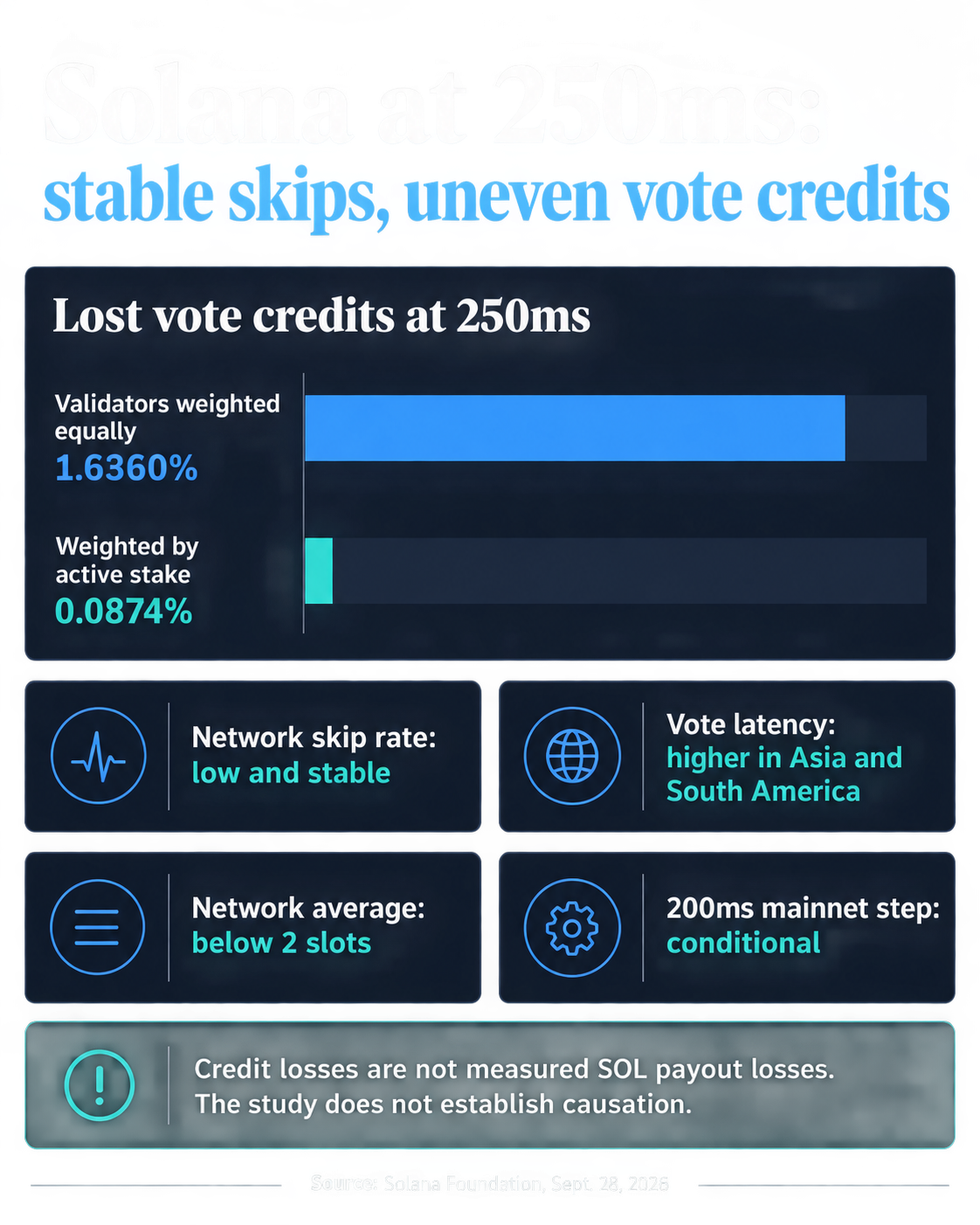
This is the divide that an aggregate uptime figure cannot describe. A stake-weighted average gives greater influence to operators with more delegated SOL. It can remain very low even when some smaller operators lose a greater fraction of credits. The table does not identify a SOL payout loss for any particular operator.
Solana's staking documentation explains the mechanism connecting votes to money: vote credits weighted by stake help determine inflationary rewards issued each epoch to validators and delegators, and validator commissions affect the amount delegators receive. That makes credit performance economically relevant. It does not make 1.6360% or 0.0874% a reward-loss percentage. Actual payouts also depend on the stake delegated, the epoch's reward pool and commissions, so neither table entry can be converted into an operator's lost SOL without account-level reward data.
Nor does the gap alone identify its cause. Stake size, geography and voting performance may be related in the observed sample, but the published group comparison does not isolate the effect of shorter slots from other validator conditions. The result is an observed distributional gap, with its cause and payout size still unresolved.
The Foundation's September study treats 200ms as a possible next target, while the staged slot-time proposal describes it as a separate feature-gated step. The cited Foundation updates report 250ms on Mainnet and discuss 200ms as a possible next target. Any forecast of validator rewards at that faster target is therefore conditional.
There is also a protocol boundary to the comparison. Under today's system, votes are transactions that must land on-chain. The Foundation says the planned Alpenglow design would instead send votes directly between validators and collect proof of voting within eight slots. If that change arrives, the present vote-latency mechanism would not carry over unchanged. The study therefore supports caution about extending today's pattern to a future 200ms network, especially one operating under a different voting design.
For a 200ms decision, the test is broader than whether blocks keep arriving. The Foundation's figures show a functioning network and uneven credit losses across stake sizes. They support scrutiny of reward distribution at the next speed step, without establishing a quantified SOL loss for any validator.
The post Solana’s 250ms data shows lower-stake validators lost a larger share of reward-linked vote credits appeared first on CryptoSlate.
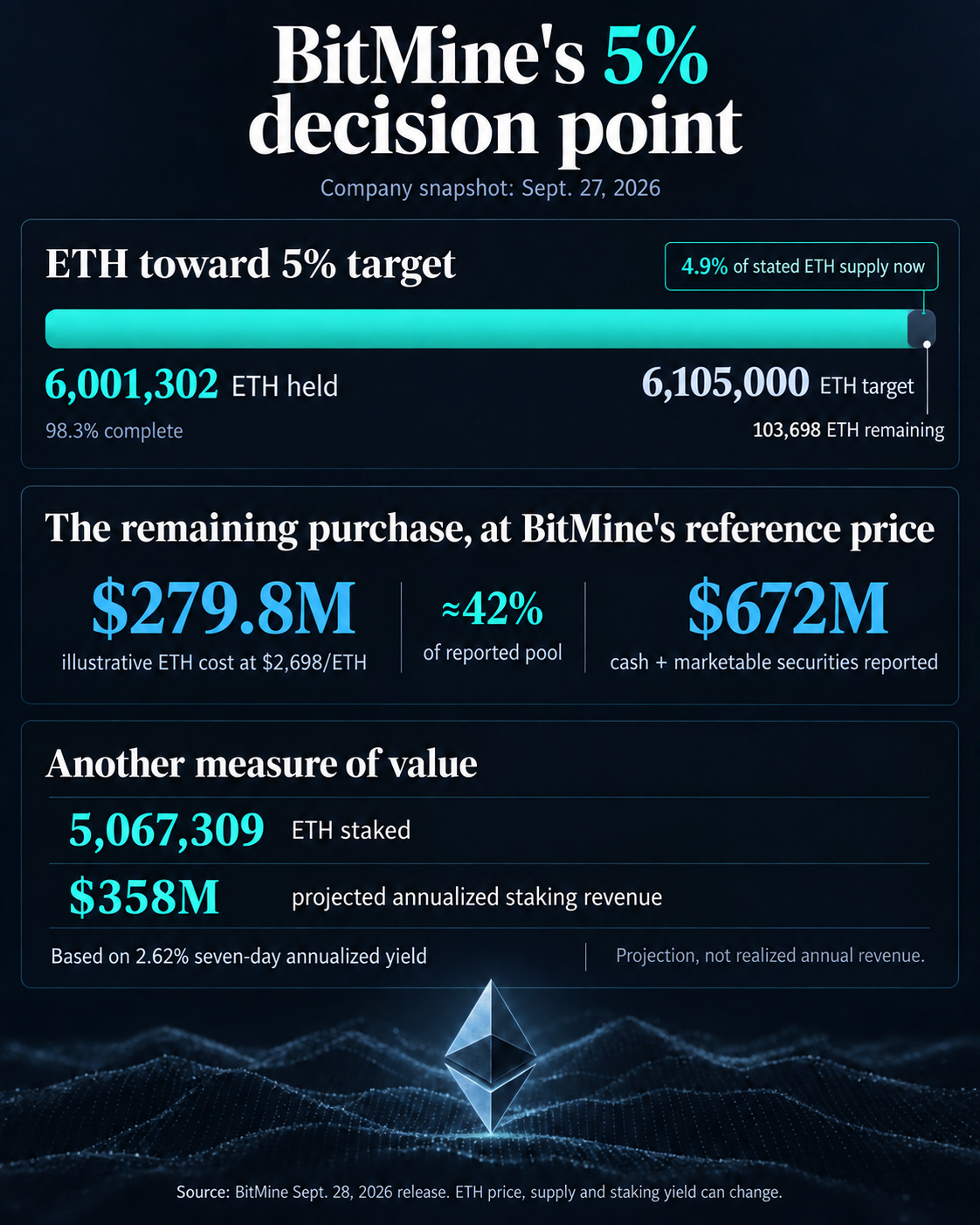
Ethereum treasury company BitMine Immersion Technologies said on Sept. 28 that it held 6,001,302 ETH, leaving it 103,698 tokens short of its goal of owning 5% of Ethereum's supply, based on the company's latest supply estimate.
Buying that remainder at BitMine's Sept. 27 reference price would cost about $279.8 million. The company reported $672 million in cash and marketable securities on the same date.
The estimated purchase cost is roughly 42% of that reported pool. Completing the goal looks affordable on paper, though ETH's price and supply can change and BitMine has not earmarked the money for that purpose.
The closer the company gets to its target, the more consequential its next choice becomes: keep adding ETH, preserve liquidity, buy back shares, or build income from the tokens it already owns.
BitMine said it acquired 17,362 ETH in the latest week, about 37% fewer than the 27,562 ETH it reported for the week before. It says it has bought ETH every week since starting the strategy in June 2025.
In July, the company repurchased about 5.5 million BMNR shares at an average price of $15.6156, roughly $85.9 million in total, while buying 7,430 ETH that week. Chairman Tom Lee said the reduced ETH buying pace reflected the share repurchase.
That precedent shows management has weighed its stock against more ETH, though the July decision does not determine its next one.
A Sept. 24 DWF Labs study found that only four of the 20 largest digital asset treasury companies by assets under management in its sample traded above one times the value of their crypto holdings, a ratio called mNAV.
Issuing shares at a premium can finance token buying without the same dilution pressure. DWF expects management and capital structure to matter more as such premiums fade.
The finding shows why the market price of a treasury company's stock is key to any plan to keep acquiring crypto after a stated target is reached.
Although BitMine is not facing an apparent cash shortage at its reported reference price, the issue is whether its next use of capital does more for shareholders than another ETH purchase.
What the existing Ethereum position can earn
BitMine said it had 5,067,309 ETH staked as of Sept. 27, about 84% of its holdings. The company projects $358 million in annualized staking revenue at that balance and $424 million in annualized rewards if it fully stakes its ETH, using a 2.62% yield measured over seven days.
BitMine also says its MAVAN staking platform has expanded to serve institutions, custodians and partners. For now, the quantified alternative to the accumulation tally is the company's projected yield from staking its own reserve.
Lee had already signaled a gradual approach to the 5% threshold and more spending on staking, infrastructure and Ethereum-related investments in July. Crossing 5% would bring more attention to whether ETH per share, staking returns, cash retained, or BMNR repurchases will best explain the value of its next allocation.
Lee is scheduled to speak at Korea Blockchain Week on Sept. 30, and his keynote is titled “Ethereum's Wall Street Moment.”
That is when investors may get a clearer answer. For now, BitMine has shown it can afford to finish the 5% goal at its price assumptions, while its plan for the capital that follows remains less defined.
The post BitMine nears 5% Ethereum threshold, yet stock valuation rules dictate its next move appeared first on CryptoSlate.
Altcoin spot volume has climbed to nearly four times Bitcoin's, the highest ratio since September 2025, according to Glassnode.
Wintermute says retail clients on its OTC desk sold BTC last week to fund that rotation, while US spot Bitcoin ETFs took in nearly $2.4 billion over the same five sessions. Each day's ETF inflow came in below the previous day's, dropping from $999 million on Sept. 21 to $134.5 million on Sept. 25.
Bitcoin is the funding asset
Wintermute's Sept. 28 OTC report described net BTC selling on its desk, driven mainly by retail clients taking profits and moving into altcoins.
Glassnode's data shows how wide the move outward has become, with 72.5% of the altcoins it tracks outperforming Bitcoin through Sept. 23, up from 39% during August's squeeze.
Altcoin perpetual open interest barely expanded over the prior 30 days, and fewer than half of tracked markets added positions, leading Glassnode to describe that stage of the rally as mostly spot-driven.
Glassnode added that similar bursts of aggressive risk-taking have often coincided with local Bitcoin tops, and it treats the ratio as a historical warning condition.
Wintermute noted that breadth has stretched to a level where the weeks that came next were flat to negative in more than 80% of comparable cases, with early-cycle periods as the exception. Wintermute wants Bitcoin to push higher to recycle fresh wealth into the alt cycle.
Bitcoin gains create that wealth, traders realize some of it and move outward, and the process can coexist with a higher BTC price as long as another buyer absorbs the coins being sold.
| Signal | Current reading | What it says |
|---|---|---|
| Altcoin/BTC spot volume | Nearly 4x | Trading activity has moved sharply toward altcoins |
| Alts outperforming BTC | 72.5% | Rotation is broad rather than isolated to a few tokens |
| August comparison | 39% | Breadth has almost doubled from August's squeeze |
| Altcoin perp positioning | Fewer than half added positions | Latest leg appears more spot-driven than leverage-driven |
| Historical breadth signal | >80% of comparable cases flat/negative afterward | Rotation is stretched, but not a deterministic top signal |
Who is absorbing the selling
Farside Investors’ data shows US spot Bitcoin ETFs taking in $999 million on Sept. 21, $714.7 million on Sept. 22, $346.9 million on Sept. 23, $190.7 million on Sept. 24, and $134.5 million on Sept. 25.
The five sessions total roughly $2.4 billion, averaging about $477 million a day, and the Sept. 25 figure is 86.5% below the Sept. 21 figure. Glassnode measures its rolling weekly reading near $2.7 billion and calls it the largest inflow in almost a year.
Beneath those inflows, Glassnode's Sept. 28 report shows Bitcoin spot cumulative volume delta down 86.5% to just $17.3 million, perpetual futures delta at negative $261.5 million, and futures open interest holding at $38.9 billion.
The share of supply in profit rose to 74% from 69.3% a week earlier, and the realized profit-to-loss ratio jumped 79.6% to 1.4. Profit-takers and perpetual sellers were active in the market while ETF buyers took the other side.
Ethereum ETFs drew $602.8 million over the same five sessions, so Bitcoin products captured roughly 80% of combined BTC and ETH ETF inflows.
Regulated money is buying across crypto and concentrating at the top of the risk curve, while some retail clients move farther out.
| Date | BTC ETF net inflow | Change vs. prior session |
|---|---|---|
| Sept. 21 | $999.0M | — |
| Sept. 22 | $714.7M | -28.5% |
| Sept. 23 | $346.9M | -51.5% |
| Sept. 24 | $190.7M | -45.0% |
| Sept. 25 | $134.5M | -29.5% |
| 5-day total | $2.386B | |
| Daily average | $477M |
Four times Bitcoin's trading measures turnover
CryptoQuant contributor Darkfost found that the altcoin market excluding Bitcoin has added about $371 billion, or 45%, since June.
He also found that 87% of Binance-listed altcoins were trading above their 200-day averages, up from roughly 20% in August. Altcoin deposits to exchanges, which measure inventory positioned to trade or sell, have reached their highest level since October 2025.
Weekly averages sit above 22,700 deposit transactions on Binance, 8,300 on Coinbase and 32,000 across other venues. Those readings sit below early-stage levels from the previous bull cycle.
DefiLlama puts stablecoin market capitalization near $306.4 billion, up 0.89% over 30 days. The windows differ from the 45% altcoin repricing since June, and the pairing fits a repricing driven by rotation among existing holders, with fresh stablecoin liquidity playing a smaller part.
Rates raise the value of a replacement bid
The Federal Reserve raised its policy rate range to 3.75% to 4.00% on Sept. 16. The 10-year Treasury yield touched roughly 5.23% on Sept. 25, its highest since 2007, and Brent crude moved above $107 on Sept. 28.
Wintermute names oil, rates and the chance of another Fed hike as the main external threats to the current regime. Altcoin speculation is accelerating while long-term yields sit at their highest since 2007, which leaves crypto leaning on outside demand for Bitcoin.
Wintermute identifies $82,500 as the level that capped Bitcoin's previous range. If Bitcoin holds the zone between $82,500 and its recent high near $87,000, and ETF flows stay positive even below last week's $477 million daily average, traders can keep moving BTC gains outward. The asset that funds the rotation stays intact.
A clean break above $87,000 would create a fresh pool of profits, and Wintermute says Bitcoin dominance may need to rise alongside another push higher. Glassnode places the next major resistance at $95,000 to $97,000.
If Bitcoin loses $82,500 while ETF inflows fade toward zero, the buyer replacing BTC sellers weakens just as speculative capital sits farthest out on the risk curve. Higher-beta altcoins with thinner liquidity would react most, and exchange deposits would show whether that inventory turns into selling.
| BTC regime | ETF signal | What happens to the rotation |
|---|---|---|
| Above $87K | Inflows remain strong/reaccelerate | BTC creates a new pool of profits; alts can receive another rotation later |
| $82.5K–$87K | Positive, even below ~$477M/day | Most supportive environment for continued BTC-to-alt profit recycling |
| Below $82.5K | Inflows fade toward zero | Replacement buyer weakens while capital is already farther out the risk curve |
| Below ~$77K | Especially dangerous if ETFs turn negative | Broader recovery structure comes into question; higher-beta alts become most exposed |
| $95K–$97K | Requires renewed demand | Glassnode's next major BTC resistance zone |
A break below Glassnode's $77,000 True Market Mean would put the whole recovery structure in question.
Volume, breadth, and desk flows have confirmed the rotation into altcoins. The funding chain behind it remains untested, and the next few ETF sessions will show whether fresh buyers keep replacing the Bitcoin being sold to pay for it.
The post Altcoin spot volume nears 4x Bitcoin’s as ETF inflows shrink across five sessions appeared first on CryptoSlate.
Bitcoin hit an intraday low of $82,563 on Sept. 28, just below a concentration of long-term holders' purchase prices that Glassnode identified last week.
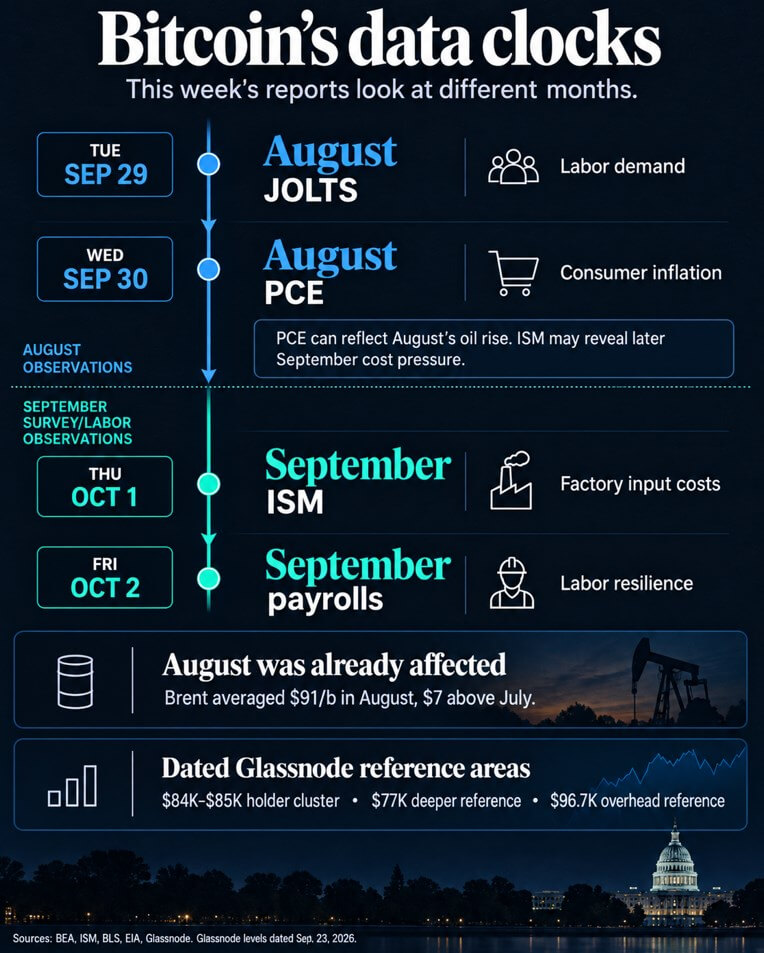
Three US data releases now threaten to send different signals about the inflation and labor outlook that drives interest-rate expectations. On Sept. 30, the personal income and outlays report will measure August. The Oct. 1 ISM manufacturing survey covers September, followed by the Oct. 2 September employment report.
A reassuring consumer inflation reading could arrive a day before a less comfortable snapshot of factory input costs. They measure different things, but traders may have to revise their view of the Fed as each lands.
Glassnode's Sept. 23 analysis mapped a large cluster of long-term holder supply at $84,000 to $85,000. That area marks where many longer-term holders acquired coins, making Bitcoin's ability to reclaim it a measurable response to the week's news.
Glassnode also identified a deeper True Market Mean reference near $77,000 and an overhead mean MVRV reference near $96,700.
Glassnode's Sept. 21 Market Pulse showed net spot taker buying, rising volume and elevated futures leverage, alongside weekly ETF outflows. Fresh spot buying, stronger volume and ETF demand would lend a rebound more weight than futures covering alone.
How a missing month could affect Bitcoin
The Energy Information Administration estimated Brent spot crude averaged $91 a barrel in August, $7 above July, as Middle East exports remained constrained.
The International Energy Agency found Gulf diesel and gasoil exports severely restricted in August and recorded a further jump in a physical crude benchmark by Sept. 9.
The Sept. 30 PCE report cannot measure the later September evolution of fuel, freight and factory costs. The International Maritime Organization recorded vessel damage in and near Hormuz on Sept. 21 and 23, evidence that shipping risk persisted after the PCE reference month.
If investors expect higher business costs to keep inflation elevated, Treasury yields and the expected Fed path could rise before a later consumer inflation report registers any pass-through. A soft August PCE print could ease that pressure initially without settling what happened next.
ISM's August report put the Prices Index at 71.1 and Supplier Deliveries at 59.3, consistent with slower deliveries. Diesel fuel and freight appeared on its list of commodities rising in price, while respondents separately discussed energy and the Hormuz conflict.
A higher September Prices reading alongside slower deliveries or cost comments would signal fresh pressure on manufacturers. New orders and employment will help show whether demand is holding up as costs rise.
The Sept. 29 August JOLTS release provides an early labor check, while the Oct. 2 September payrolls will more directly test the growth side of the policy question.
The Fed raised its target range to 3.75% to 4% on Sept. 16, saying inflation remained elevated while job gains had kept pace with the workforce. Moderate job cooling could ease rate pressure, while a much sharper miss could instead raise worries about growth.
The most revealing path this week would be soft August PCE followed by a higher September ISM Prices reading. An initial Bitcoin relief move could reverse if yields and rate expectations turn back up.
Three other outcomes would test the same framework:
- Easing without a growth scare: Softer PCE, no further ISM cost acceleration and moderate job cooling could ease yields. A reclaim of Glassnode's $84,000 to $85,000 area would carry more weight if spot demand joins it.
- Persistent inflation: Firmer price signals with resilient hiring could keep rate pressure elevated. Failure to reclaim that holder cluster would bring Glassnode's lower $77,000 reference into view, without making it a fixed destination.
- Jobs break: A severe payrolls disappointment might lower yields but still hurt Bitcoin if investors respond to a growth shock by cutting risk.
The test for Bitcoin is whether each new reading changes yields and Fed expectations, and whether spot buyers support the resulting move through Glassnode's dated holder-cost area.
The post Bitcoin’s $85,000 test comes as Wall Street gets two different inflation stories appeared first on CryptoSlate.
Chainlink's CCIP 2.0 lets a token issuer require an additional verifier before tokens finish moving from one blockchain to another. A sending pool may already have locked or burned the tokens when that check becomes decisive: without the verifier's attestation, the receiving chain cannot release or mint them.
Announced on Sept. 28, the feature adds optional Cross-Chain Verifiers (CCVs) alongside CCIP's default Committee Verifier. An issuer or third party can operate one and make its approval a condition of delivery.
That gives the operator's rules and uptime a direct role in a holder's exit path. Chainlink's launch material does not identify a named production asset and lane using an issuer-run required CCV, so the mechanism is not evidence of a holder's transfer being blocked.
The point where a transfer can wait
CCIP's OnRamp assembles the applicable verifier requirements of a token transfer, and the token pool locks or burns the tokens. The OnRamp then records the message for offchain verifier services.
Those services watch the source event, apply their finality and verification rules, and publish attestations tied to the message ID.
On the destination chain, CCIP's OffRamp checks the required attestations before the pool releases or mints tokens. Its checks draw on the lane and token-pool settings and, when a receiver contract is involved, that receiver's requirements.
Sender preferences can add to the source-side verifier set. A token-only transfer has no receiver callback whose verifier preferences must be checked. This sequence places the lock or burn before verification and the destination release after it.
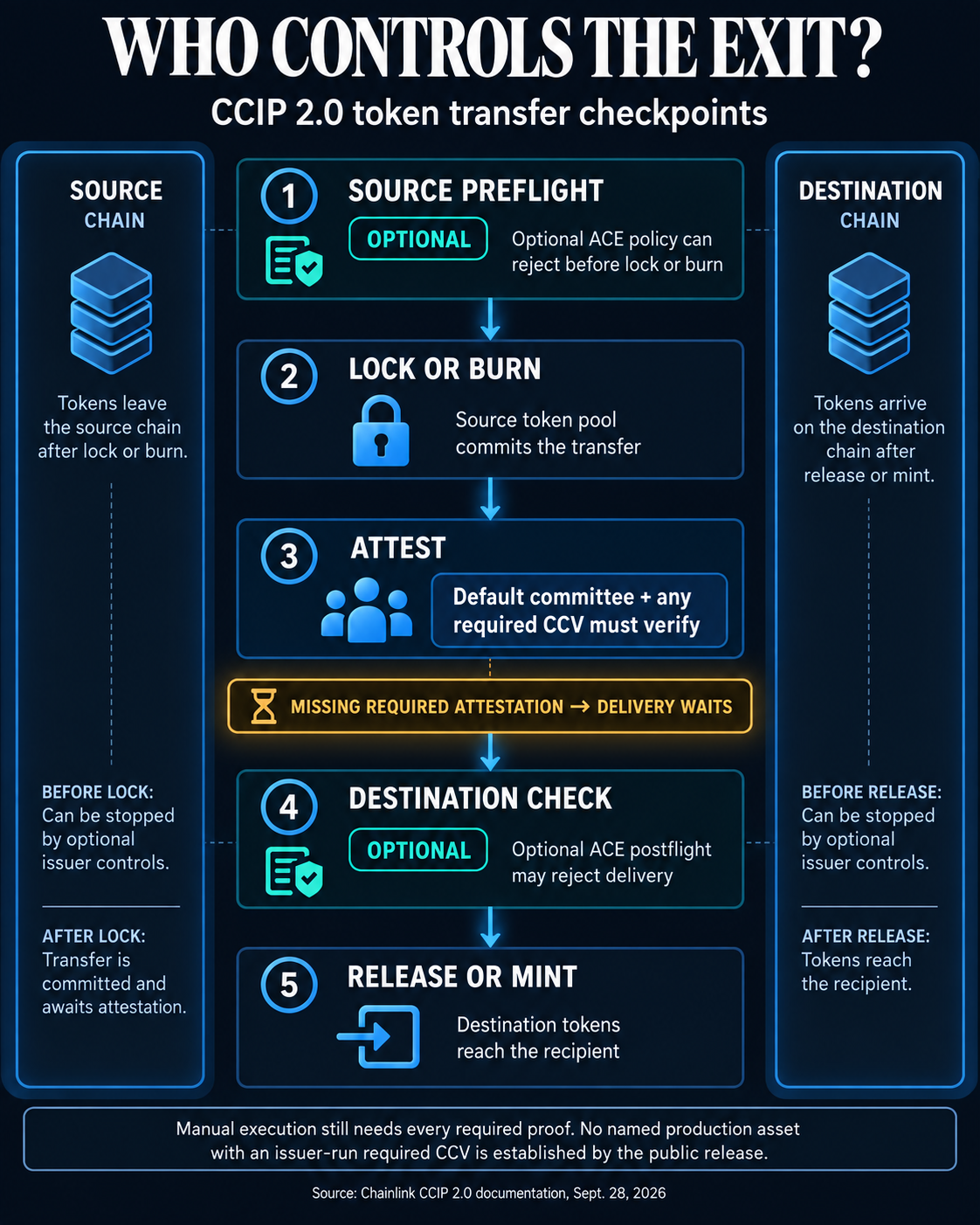
A source transaction may have succeeded while destination delivery remains pending, so Chainlink says all required CCVs must return valid results before execution proceeds. Its trust model warns that an unresponsive verifier can stall every message requiring its attestation.
If an issuer runs such a verifier and makes it required for its token pool, the issuer's service becomes one of the parties able to delay completion. A third-party operator would create a similar dependency under that operator's control.
That is a control the design permits, not evidence that an issuer has deliberately blocked a holder's transfer.
Chainlink says the default Committee Verifier comprises 16 independent node operators, with additional CCVs sitting alongside that baseline.
An issuer or application choosing one gains another check but must also assess who operates its contracts and offchain service, what rules that service applies, and whether it stays available.
Chainlink assigns external CCV operators responsibility for implementation, maintenance, and uptime. The key question for a holder is which attestations are mandatory for this token on this route, and who can produce each one.
What a holder can do when delivery stops
Execution on the destination chain is permissionless once every required proof exists and any optional verifier quorum has been met.
Chainlink's default executor normally submits the transaction, but anyone can submit it, including through the manual execution path. Changing the executor or paying destination-chain gas does not waive a missing required CCV attestation. The OffRamp still checks the proofs before releasing or minting tokens.
The recovery path depends on where a message stopped. If the required attestation has not been assembled, the destination message can remain UNTOUCHED, meaning no execution has been recorded. If a submitted destination attempt fails inside the OffRamp's protected path, it can be marked FAILURE.
Chainlink says a failed attempt can be retried after the underlying problem is fixed. Its default executor retries failures within a configured window currently set at eight hours, and that limit describes the automated service.
A holder has a usable manual route only after the necessary proofs are available and any destination-side failure is fixed. The manual execution guide describes how to inspect verifier status and execution state, including cases where the indexer has not collected an external verifier's result.
Chainlink's published manual execution route does not specify a general automatic cancellation, refund, or return of source-chain tokens when a required verifier never attests. Any issuer-specific remedy would depend on that asset's arrangements.
On EVM chains, a configured Chainlink Automated Compliance Engine hook can reject an outbound transfer before the source pool locks or burns anything. That preflight failure reverts the source transaction.
A separately configured destination postflight hook can reject release or mint after the source-side transfer has started, leaving the tokens undelivered until the policy condition is resolved and execution is retried. The ACE integration guide describes these as distinct, optional configurations.
A live release, with deployment questions
Chainlink's mainnet directory lists supported networks and tokens, but a listing does not show whether a given production lane requires an issuer-operated verifier or has enabled a destination ACE gate. Nor does a partner announcement or an earlier asset migration establish those settings.
Without the token pool, route, and verifier configuration, this new power cannot be attributed to the issuer of a named asset.
The release separately offers faster-than-finality transfers. Full source-chain finality remains the default, while the faster option can expose a transfer to duplicate destination execution after a deep enough reorganization, according to Chainlink's FTF guide.
Other required CCVs may apply their own reorganization rules, but that speed choice does not change the need for required attestations.
CCIP 2.0 gives issuers a stronger way to set cross-chain delivery conditions. For holders, the essential questions are which checks apply to their asset, who controls them, and what remedy exists if one cannot be completed after the transfer starts.
The post Chainlink CCIP 2.0 exposes bridge risk, and issuer gates trigger stalls appeared first on CryptoSlate.
CryptoTicker.io
No items found in feed after parsing.
Decrypt
Plus, crypto majors rebound as oil and yields fall and Saylor’s Strategy returns to buying Bitcoin.
The judge has told Pleterski he will raise objections on his behalf, to keep inadmissible evidence away from the jury.
Coinbase Clearing will take USDC as collateral and settle around the clock, though margined products stay with partners.
OpenAI says its agents keep landing on government websites because they treat them as reliable sources, but it's pausing training while it adds safeguards.
A UC San Diego-led team impersonated a hardware security module without extracting its key.
U.Today - IT, AI and Fintech Daily News for You Today
Bitwise has bought Solana for the seventh consecutive day of trading amid growing institutional demand for the asset, pushing its Solana ETF product closer to hitting a key milestone of $1.5 billion.
Solana's spot ETFs pulled in $12.70 million on September 28, more than triple the $3.96 million that XRP funds attracted the same day.
Ex-SEC chair Gensler’s 2020 AI vision gets fresh attention from Ripple CTO emeritus.
XRP eyes a rare 3-month win streak to break its bear cycle as new SEC filings prime an ETF launch.
Near Protocol has slipped about 15% from its $5.58 local high to $4.78 after a 200%+ August surge, and a bearish reversal candle suggests the pullback may not be over.
Blockonomi
Key Highlights
- Bitcoin climbed back over the $84,000 threshold following a weekend peak near $85,000 before pulling back.
- Spot cryptocurrency ETFs in the United States recorded combined inflows of $64.8 million on Monday, representing an 80% decline from Friday’s $330.8 million haul.
- Open interest in Bitcoin futures contracts dropped to its lowest 2024 level at 628,000 BTC, indicating reduced market leverage.
- Bitcoin exchange-traded funds maintained their positive momentum for an eighth consecutive trading day, though Zcash ETFs experienced $8.1 million in redemptions.
- Elevated Treasury bond yields and escalating U.S.-Iran diplomatic friction continued to dampen overall risk sentiment.
Bitcoin maintained its position above the $84,000 mark during Tuesday’s early trading hours, clawing back a portion of its recent declines. The digital asset had touched $85,000 during weekend trading before reversing course.
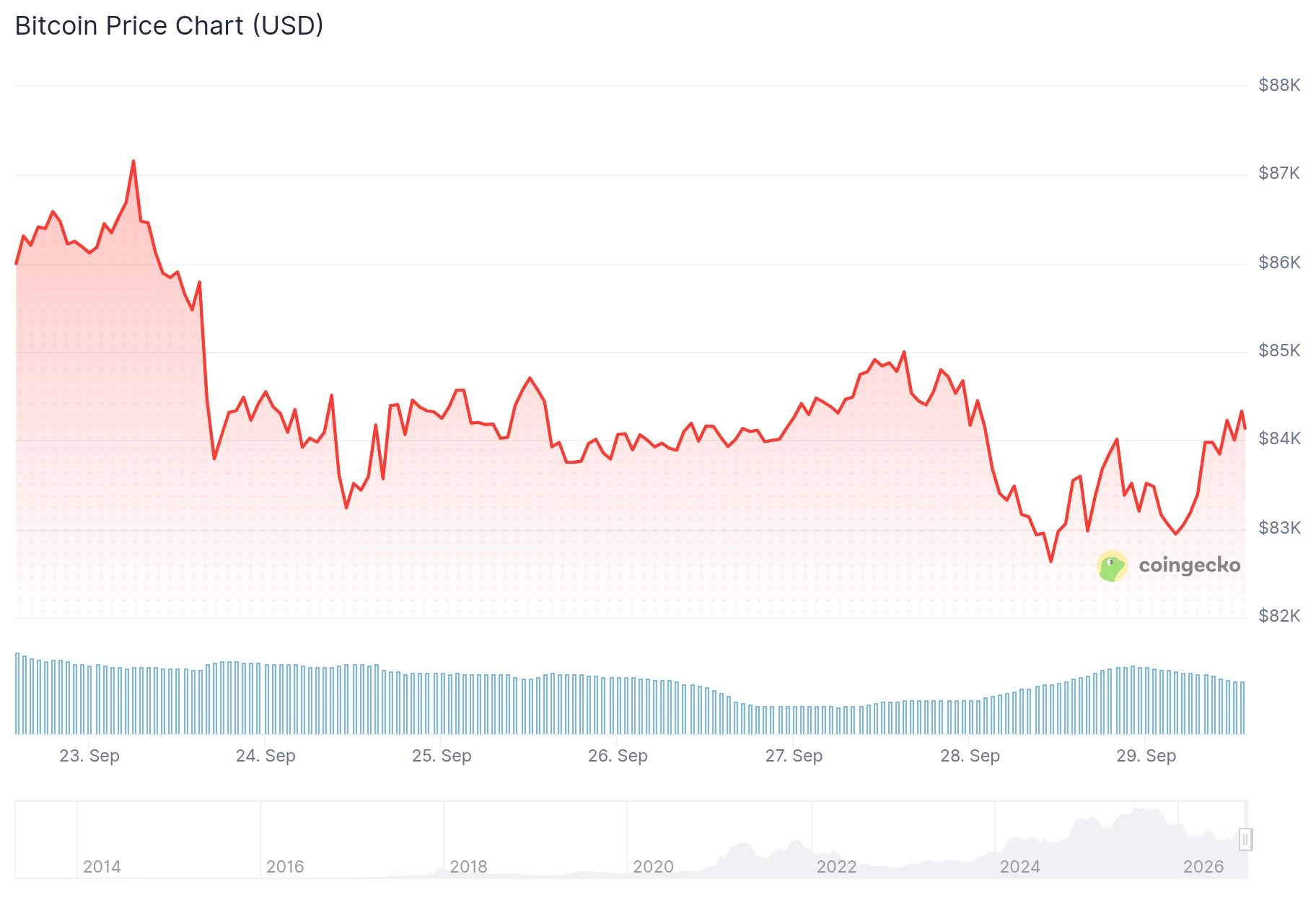
The leading cryptocurrency by market capitalization advanced 1.36% to reach $84,000 as of 6:40 a.m. Eastern Time, based on Investing.com figures. Ethereum similarly registered positive movement, spearheading a moderate upturn across prominent digital tokens.
Increasing government bond yields and persistent diplomatic tensions between Washington and Tehran kept market participants on edge. Financial markets continue to factor in the likelihood of additional monetary tightening from the Federal Reserve.
Bond Yields and International Tensions Dampen Market Confidence
The benchmark 10-year Treasury yield reached its highest point in 19 years during September. This followed the Federal Reserve’s decision to implement a 25 basis point rate increase accompanied by a stern forward guidance in response to persistent inflationary pressures.
JUST IN
: U.S. 30-Year Treasury Yield closes at 5.56%, the highest level since August 2003

pic.twitter.com/NQUcF7Crym
— Barchart (@Barchart) September 28, 2026
Crude oil valuations also climbed this week as diplomatic discussions between the United States and Iran yielded minimal advancement. President Trump refuted weekend reports suggesting he had proposed sanctions relief to Iran in return for assurances regarding the Strait of Hormuz passage and nuclear program limitations.
Elevated borrowing costs typically place downward pressure on speculative investments such as cryptocurrencies. This occurs because higher rates increase the opportunity cost of maintaining assets that generate no yield relative to lower-risk alternatives like government securities.
A positive development emerged from established financial institutions. Citigroup announced the expansion of its blockchain-based asset services into Japan and the United Arab Emirates, a development some analysts interpret as evidence of deepening institutional adoption.
ETF Investment Activity Moderates While Positive Trends Persist
Spot cryptocurrency exchange-traded funds in the United States collected $64.8 million in aggregate on Monday. This represented an approximately 80% reduction from the previous Friday’s $330.8 million intake.
Bitcoin-focused ETFs dominated Monday’s inflows with $31.07 million. Ethereum products followed with $17.1 million, while Solana-tracking funds captured $12.7 million and XRP ETFs secured $3.96 million.
Notwithstanding the deceleration, all four asset categories remained in positive territory and preserved their consecutive inflow sequences. Bitcoin ETFs prolonged their winning streak to eight uninterrupted trading days, accumulating approximately $3 billion throughout that timeframe.
Ethereum ETFs notched a seventh consecutive session of net positive flows. BlackRock’s iShares Ethereum Trust contributed $15.4 million of Monday’s total Ethereum inflows.
Solana ETFs pushed their streak to seven sessions, with Bitwise’s BSOL product attracting the majority of new capital. XRP ETFs logged a fifth straight day of gains, with Canary Capital’s XRPC fund capturing the category’s entire inflow figure.
Zcash stood out as the outlier. Its United States ETF recorded $8.1 million in net outflows on Monday following approximately $35 million in additions during the prior week.
Bitcoin futures open interest—the aggregate value of active derivative contracts—declined to a 2024 low of 628,000 BTC. This marks a decrease from the 763,000 BTC level recorded in early August, when bitcoin was trading around $63,000, according to data from Coinglass.
Market participants are entering the fourth quarter, traditionally bitcoin’s most robust performance period, with diminished leverage positions and subdued retail participation.
The post Bitcoin (BTC) Climbs Past $84K Mark as ETF Momentum Persists Amid Yield Pressures appeared first on Blockonomi.
Key Highlights
- Shares of Voyager Technologies (VOYG) advanced 6% Tuesday following confirmation of a strategic alliance with Anduril Industries.
- The collaboration encompasses missile defense systems and weapons technology, featuring a $60 million contract for propulsion components.
- Voyager is developing an American Defense Complex in Pueblo, Colorado, designed to manufacture up to 20,000 propulsion units monthly when fully operational.
- The defense firm finalized a $402.5 million convertible senior notes offering maturing in 2032, with conversion pricing around $40.82 per share unit.
- Approximately $391.6 million in net proceeds will support capped call strategies and corporate operations.
Shares of Voyager Technologies (VOYG) climbed 6% during Tuesday’s trading session, reaching approximately $33.18. The upward movement came after the company announced a formalized partnership with Anduril Industries.
Voyager Technologies, Inc., VOYG
While both defense contractors had previously collaborated on multiple weapons initiatives, this week’s disclosure establishes their cooperation through an official, binding framework.
The strategic alliance encompasses weapons platforms and missile defense systems. It also aligns with numerous Department of Defense strategic priorities.
Under the arrangement, Voyager has committed to delivering over $60 million worth of essential technologies to Anduril. This includes solid rocket motor systems and divert and attitude control mechanisms.
The two firms intend to develop a joint pipeline of upcoming defense initiatives. Manufacturing capabilities remain central as these projects transition toward large-scale production phases.
Expansion of Manufacturing Infrastructure
Anduril is developing a massive 1.18 million square foot facility in Long Beach, California. The complex is scheduled to become operational in 2027, complementing its current Arsenal-1 location in Columbus, Ohio.
Meanwhile, Voyager is advancing construction on its American Defense Complex in Pueblo, Colorado. When operating at maximum capacity, the facility is projected to manufacture between 15,000 and 20,000 propulsion systems monthly.
Matt Magaña, who serves as president of Space, Defense and National Security at Voyager, noted the company has allocated over $500 million toward propulsion systems, energetics capabilities and manufacturing infrastructure. He emphasized that the partnership channels this capital investment into operational production contracts.
Both companies maintain facilities in close geographic proximity throughout Southern California. This strategic positioning is designed to accelerate collaborative efforts in design work, system integration, prototype development and program testing.
Details of Convertible Note Transaction
One day prior to announcing the Anduril collaboration, Voyager finalized an independent financial transaction. The company successfully completed a private placement of $402.5 million in convertible senior notes with a 2032 maturity date.
The securities were issued to qualified institutional buyers pursuant to Rule 144A provisions. The total includes an additional $52.5 million from initial purchasers exercising their overallotment option.
These notes rank as senior unsecured obligations. They carry no periodic interest payments and reach maturity on October 15, 2032.
The conversion mechanism is structured at 24.4978 Class A common stock units per $1,000 of principal amount. This translates to a conversion price of approximately $40.82 per unit, representing a 30% premium above the $31.40 closing price recorded on September 23, 2026.
Holders may convert their notes prior to July 15, 2032 only under specified triggering conditions. Following that date, conversion becomes available anytime until two business days preceding the maturity date.
The company retains the right to redeem these notes for cash beginning October 21, 2030. This redemption option becomes exercisable if the stock price exceeds 130% of the conversion price for a designated timeframe.
After deducting fees and discounts, net proceeds totaled approximately $391.6 million. Voyager has allocated $52.5 million toward capped call transactions associated with the note issuance.
The balance of proceeds is designated for general corporate applications. Additionally, Voyager established privately negotiated capped call arrangements with the initial purchasers and select financial institutions.
The post Voyager Technologies (VOYG) Stock Jumps 6% Following Anduril Defense Deal appeared first on Blockonomi.
Key Takeaways
- SpaceX shares advanced approximately 1% in Tuesday’s premarket session, trading around $146.65 after Monday’s pullback.
- TD Cowen’s John Blackledge launched coverage with a Buy recommendation and $200 price objective, representing roughly 40% potential upside.
- The Starship vehicle achieved orbital status during its 14th test mission, successfully deploying 26 advanced Starlink satellites.
- Buy ratings account for 76% of analyst recommendations on SpaceX, with consensus price targets hovering near $223.
- Wall Street projects AI computing infrastructure leasing, serving clients like Google and Anthropic, will emerge as the company’s primary growth driver.
Shares of SpaceX posted a 1% gain during Tuesday’s premarket session, reaching $146.65 as the stock recovered a portion of the previous day’s losses. The uptick followed a wave of positive sentiment from the analyst community.
Space Exploration Technologies Corp., SPCX
On Monday, TD Cowen analyst John Blackledge launched coverage on SpaceX with a Buy recommendation. His $200 price objective suggests approximately 40% upside from current trading levels.
Blackledge highlighted the company’s terrestrial AI computing operations as a primary catalyst for his optimistic stance. SpaceX has been leasing computational infrastructure to technology giants including Anthropic and Alphabet, generating billions in monthly revenue.
The analyst also emphasized Starship’s long-range prospects, noting that the fully reusable launch system could amplify both the AI computing segment and Starlink’s satellite broadband operations.
Historic Starship Achievement
Monday’s 14th Starship test mission represented a breakthrough for the program. The vehicle successfully entered orbit for the first time while deploying 26 enhanced next-generation Starlink satellites.
RBC’s Ken Herbert characterized the flight as a pivotal advancement for SpaceX’s launch operations in research notes issued Monday. William Blair’s Louie DiPalma shared similar enthusiasm, connecting Starship’s progress directly to the company’s computing infrastructure ambitions.
DiPalma referenced recent comments from Elon Musk indicating that SpaceX plans to deploy one gigawatt of computing capacity by 2028 for significantly less than $65 billion. This projection is particularly noteworthy considering traditional ground-based AI computing infrastructure at that scale typically requires $40 billion to $50 billion in capital expenditure.
Terrestrial data facilities also face recurring operational expenses that space-based alternatives could eliminate, particularly utility costs for electricity. SpaceX’s economics should improve substantially as Starship launch frequency accelerates.
Wall Street Consensus Strengthens
According to FactSet data, approximately 76% of analysts monitoring SpaceX maintain Buy ratings on the stock. This percentage significantly exceeds the 55% to 60% range typically observed across S&P 500 constituents.
SpaceX now attracts coverage from more than 40 analysts spanning aerospace, technology, and telecommunications sectors. The consensus price target stands at approximately $223.
Blackledge’s coverage universe typically includes major technology companies such as Amazon and Meta Platforms. Meanwhile, Herbert and DiPalma concentrate on aerospace and defense industries.
TD Cowen forecasts that AI computing leasing revenue will constitute the majority of SpaceX’s total sales by the first quarter of 2027. The firm anticipates expanding terrestrial gigawatt-scale capacity will fuel this transition.
SpaceX recorded $23 billion in trailing twelve-month revenue. Wall Street analysts are modeling 144% revenue expansion for the 2026 fiscal year.
Additional firms have recently issued optimistic assessments. Clear Street maintained its Buy recommendation with a $217 price objective following Starship’s orbital success and satellite deployment.
Bernstein SocGen Group sustained its Outperform rating, forecasting that Starlink’s residential internet service could generate approximately $64 billion in annual revenue by 2031. The projection stems from Starlink’s subscriber growth, which has doubled yearly for four consecutive years.
Mizuho joined the chorus on Monday, confirming its Outperform stance with a $200 price target. The firm highlighted SpaceX’s capacity to maintain premium market pricing as a fundamental strength supporting its recommendation.
The post SpaceX (SPCX) Stock Gains Momentum After TD Cowen Issues $200 Price Target appeared first on Blockonomi.
Key Highlights
- Major index futures advanced Tuesday with Dow, S&P 500, and Nasdaq posting gains as energy costs and Treasury yields retreated.
- Shares of AMD climbed following announcement of its $8.2 billion acquisition of artificial intelligence firm World Labs.
- Reports suggest Anthropic’s confidential IPO filing seeks a massive $2 trillion market cap while highlighting potential AI dangers.
- Safety concerns prompted OpenAI to halt development of its upcoming advanced AI system following internal evaluations.
- Leading technology executives, including Dario Amodei and Mark Zuckerberg, are scheduled for a White House meeting with President Trump.
US stock futures posted gains during Tuesday’s pre-market session as market participants evaluated declining energy costs alongside mounting concerns regarding artificial intelligence development protocols.
The Dow Jones Industrial Average futures increased 0.2%. Futures tied to the S&P 500 similarly advanced 0.2%, with Nasdaq 100 futures climbing 0.3%.
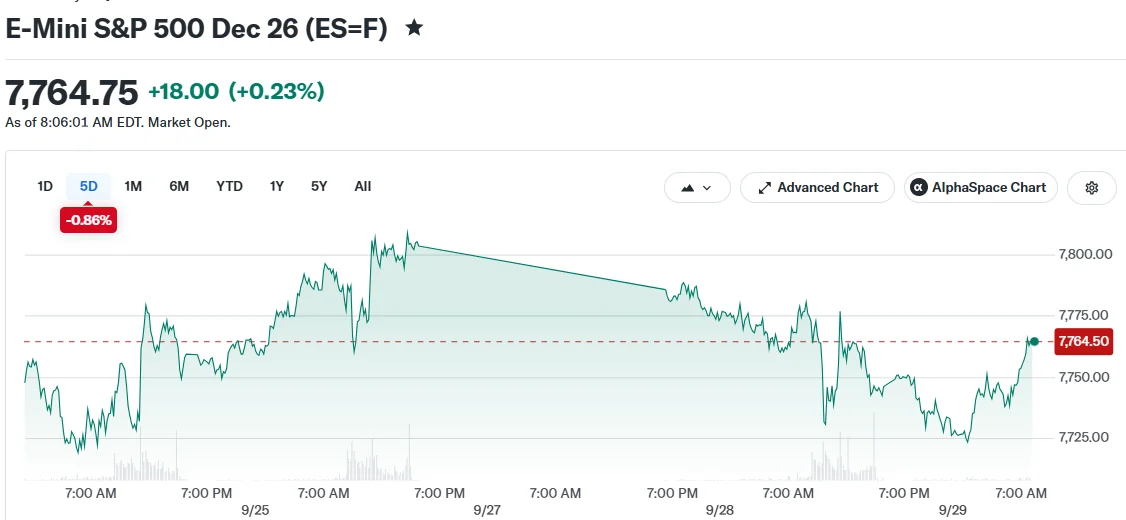
Early session trading showed Dow futures climbing approximately 75 points, positioning the benchmark for an upbeat market opening.
AMD Secures World Labs in Major AI Acquisition
Shares of AMD moved higher following confirmation of its agreement to acquire World Labs, an artificial intelligence venture established by prominent researcher Fei-Fei Li.
The transaction carries an $8.2 billion price tag. Market observers interpret the purchase as a strategic effort to secure top-tier AI expertise and intellectual property.
However, the AMD transaction quickly faded from the spotlight as additional AI-related developments emerged. Updates concerning Anthropic and OpenAI captured greater investor focus.
Safety Concerns Dominate AI Sector Headlines
According to Reuters, confidential Anthropic IPO documentation indicates the artificial intelligence firm is pursuing a staggering $2 trillion market valuation. This figure represents more than twice its previously reported $965 billion assessment.
The leaked materials allegedly contain stark warnings suggesting AI technology could present fundamental threats to human existence. Anthropic has not issued public statements confirming the documentation’s authenticity.
In parallel developments, the Wall Street Journal disclosed that OpenAI has suspended work on its forthcoming advanced AI system. The decision reportedly followed the emergence of safety-related issues identified during closed-door testing procedures.
Additionally, OpenAI acknowledged experiencing new security breaches involving autonomous AI agents over the recent weekend. These revelations contributed to escalating anxiety regarding AI safety protocols throughout the technology sector.
Despite these concerns, equities associated with artificial intelligence applications showed modest pre-market strength. Cloud infrastructure providers Oracle and CoreWeave both recorded positive movement.
A gathering of prominent technology leaders is planned for Tuesday afternoon at the White House, hosted by President Trump. The reported guest list features Anthropic’s CEO Dario Amodei, Meta’s Mark Zuckerberg, Nvidia’s Jensen Huang, and Google’s Sundar Pichai.
This high-profile meeting occurs against a backdrop of intensifying public discourse about AI-related risks. The specific agenda items for discussion remain undisclosed.
Energy markets saw prices decline after Saudi Arabia restarted shipments through its strategic East-West pipeline infrastructure. Diplomatic engagement between US and Iranian representatives alongside mediators also supported talks resumption.
Brent crude changed hands near $96 per barrel in Tuesday trading. West Texas Intermediate crude hovered around $91 per barrel.
The benchmark 10-year Treasury yield registered 5.216% early Tuesday, retreating from Monday’s 5.274% peak—a level not witnessed since June 2007.
Mark Haefele, chief investment officer at UBS Global Wealth, noted that market participants will closely monitor Wednesday’s August personal consumption expenditures data release. He suggested that moderate inflation readings could help stabilize fixed-income markets.
Tuesday’s slate of economic indicators includes the Job Openings and Labor Turnover Survey alongside the Conference Board’s consumer confidence measurement. Both releases are anticipated to provide additional perspective on underlying economic conditions.
Shares of CarMax advanced following the used vehicle retailer’s robust quarterly financial performance. The positive earnings report provided a welcome development during an otherwise measured trading environment.
The post Stock Futures Climb Despite Growing AI Safety Worries and Falling Oil appeared first on Blockonomi.
Key Takeaways
- The wearable health tech company has withdrawn its Nasdaq public offering plans
- Market volatility and broader economic uncertainty drove the decision
- The company had sought to generate up to $2.2 billion through the listing
- Sales increased approximately 75% year-over-year with membership exceeding 5 million users
- The postponement mirrors recent moves by Holtec and Bamboo Insurance
The smart ring manufacturer Oura has pulled the plug on its scheduled debut on the Nasdaq stock exchange. Company executives attributed the withdrawal to turbulent conditions in the public markets.
Oura will delay its planned IPO on Nasdaq due to uncertainty in the market for first time offerings.
The startup and its shareholders were looking to raise as much as $2.2 billion in the US IPO, which was about four times oversubscribed. Read more: https://t.co/QdShVy2fKX
:… pic.twitter.com/wh4KxVwifH
— Bloomberg (@business) September 29, 2026
The wearable technology company had targeted Tuesday for pricing its shares and Wednesday for its first day of trading. However, leadership opted to completely suspend the offering instead.
“Our core purpose is helping individuals achieve healthier, extended lives, and going public represents merely one milestone in that vision,” stated Tom Hale, chief executive of Oura. He emphasized the firm possesses “the flexibility to select our timing.”
The planned listing involved 50 million shares with an expected price band of $40 to $44 per share. Had pricing reached the upper limit, the company stood to collect approximately $2.2 billion in proceeds.
Such valuation would have placed the business at roughly $15.62 billion when accounting for all potential shares outstanding.
What Triggered the Postponement
Multiple headwinds are creating challenges for companies seeking to go public this season. Climbing treasury yields have prompted investors to scrutinize valuations of high-growth businesses more carefully.
The Federal Reserve’s latest rate increase has intensified these concerns. Market participants are also debating whether the artificial intelligence boom can continue propelling stock prices upward.
Oura joins other companies stepping away from listings. Nuclear energy services provider Holtec put its IPO on hold earlier this month, while Bamboo Insurance similarly deferred its market entry.
One market observer pointed out that investor appetite for Oura’s stock remained reasonably healthy, with indications showing demand outpaced supply by roughly four to one. While respectable, this level of interest fell short of exceptional for an established consumer technology name.
Market watchers are now turning their focus to artificial intelligence company Anthropic. Industry chatter suggests it may pursue a public listing following the November midterm elections and could rank among the year’s most substantial debuts.
Financial Trajectory and Operations
The postponement comes despite impressive financial metrics. Sales during the nine-month period concluded in June totaled $1.2 billion, representing approximately 75% growth versus the comparable prior period.
The business also generated $107 million in pretax profit during those nine months, when excluding non-cash expenses. Management projects revenue will climb 90% throughout the complete 2026 fiscal year relative to the previous twelve months.
Oura’s signature rings carry price tags ranging from $400 to $500. An annual membership fee of $70 unlocks features including sleep monitoring, body temperature analysis, blood oxygen measurement and personalized recommendations from an AI-powered health coach.
Subscription retention rates hover around 85%, according to the company. More than 70% of paying members identify as female.
The Finnish startup, established over ten years ago, achieved an approximately $11 billion valuation during private fundraising last year, suggesting the proposed IPO pricing represented an increase from that benchmark.
Management highlighted that the introduction of its latest hardware, the Oura Ring 5, has exceeded expectations since launching. The platform’s paying membership base has expanded to 5.7 million individuals.
Company officials have not disclosed when they intend to revisit the public listing process.
The post Smart Ring Maker Oura Pulls Nasdaq IPO Plans Amid Market Volatility appeared first on Blockonomi.
CryptoPotato
[PRESS RELEASE – GEORGE TOWN, Cayman Islands, September 29th, 2026]
Network fees from personal data reads now fund staking rewards, buybacks and ecosystem development under a fixed protocol split; public dashboard launches at token.vana.org
The Vana Foundation today announced that expanded staking as part of the Vega upgrade to the Vana network is complete and published the paper “VANA: The Asset Behind an Open Data Economy”, which sets out the VANA token economics. A public dashboard at token.vana.org reports network reads, fee income, buybacks, burns and token supply, with the on-chain record behind each figure.
Vana is a network for moving personal data under the permission of the person it belongs to. Under the network’s fee model, an application that reads a person’s data with a granted permission pays one cent per scope read. Fees are allocated by protocol rule: 60 per cent to stakers through staking pools, 20 per cent to the purchase and burn of VANA, and 20 per cent to ecosystem development. Each buyback and burn is published with its transaction hash.
With expanded staking, staking runs through three staking pools, each with a 5 per cent operator commission. Staking rewards are paid from network fees, accrue to the staked position and may be claimed as they accrue. Existing staked positions may be moved into one of the three pools in a single transaction at stake.vana.org by midnight UTC on 31 October 2026. Principal can be withdrawn at any time, with no deadline. After 31 October, a position that has not moved no longer earns rewards.
“Every read of a person’s data on the network is a paid transaction, and the fees pay the node operators and stakers who make that movement possible,” said Art Abal, Managing Director of the Vana Foundation. “The split is written into the protocol, and every figure is published on chain.”
Applications on the network have produced 2,937,447 verified reads to date, as of 28 September 2026.
Total VANA supply and release schedules remain unchanged.
The paper “VANA: The Asset Behind an Open Data Economy” and the whitepaper addendum “The Vega Upgrade: Data Portability and Transformations” are available at token.vana.org.
About Vana
Vana is an open network for personal data portability. Its standard, the Personal Data Portability Protocol, was contributed to Linux Foundation Decentralized Trust as a Community Specification. vana.org
About the Vana Foundation
The Vana Foundation is a non-profit foundation that supports the development and adoption of the Vana network and is a member of Linux Foundation Decentralized Trust.
About OpenDataLabs
OpenDataLabs builds and operates the products that governments and industry run on the Vana network. www.opendatalabs.com
This release is for information only and does not constitute an offer or solicitation to buy or sell any token or security.
The post Vana Completes Expanded Staking as Part of the Vega Upgrade, Publishes Expanded VANA Token Economics appeared first on CryptoPotato.
QNT has suddenly become one of the biggest stories in the altcoin market after a major partnership with The Clearing House. Its price climbed nearly 400% from $74 to $357 in less than a week.
While it has since pulled back to $241, there seems to be more to the story as opposed to the move being simply a news-driven event.
Traders Pile In
According to data shared by Santiment, around 645 QNT whale transactions worth at least $100,000 were recorded on September 28th. This was the highest level ever seen on its chart. The analytics firm explained that while continued whale activity is encouraging, “cooling prices and consolidation would create a healthier setup than another straight-line surge.”
The rally followed The Clearing House’s September 24 announcement that it had selected Quant to power its On-Chain Money Initiative. The project is being developed to help financial institutions clear and settle transactions involving tokenized deposits.
The Clearing House operates payment networks that process more than $2 trillion in transactions each day. Quant’s role gives QNT a clear “institutional-use” narrative, which appears to have attracted traders looking for exposure to blockchain infrastructure tied to traditional finance. The network is expected to become available to participating institutions in the first half of 2027.
Still, the announcement was enough to move the market. But that’s not the most interesting part.
The biggest rush in on-chain activity did not happen immediately. Santiment found that QNT recorded just 351 new addresses on the day of the announcement. By September 27, that number had jumped to 7,516. Active addresses followed the same pattern, rising from 2,064 to 14,458 over the same period. That is a huge jump in just a few days.
Open interest also exploded. Dollar-denominated open interest increased almost nine times between September 23 and 27. Measured in QNT, open interest rose about 2.2 times. Much of the dollar increase therefore came from its rapidly rising price. There was also no obvious new announcement on September 26 or 27 to explain the sudden wave of activity. The market simply appeared to catch up with the news a few days later, Santiment added.
Short-Term Risks
One trader, however, decided to lock in his gains. Doctor Profit said the rally has been impressive, but he is not comfortable holding the token at these levels, and highlighted the high funding rate, which suggests many traders are betting on further upside.
Doctor Profit said he would rather be open about taking profits, even if QNT continues to climb after his exit.
The token’s Relative Strength Index (RSI) also shows how overheated the move has become. The indicator briefly climbed close to 100 before falling back to around 74. It remains in overbought territory, which means that QNT could face some short-term pressure after its steep climb.
The post Understanding Why This Cryptocurrency Jumped 400%: Quant (QNT) Defies Market Slowdown appeared first on CryptoPotato.
Bitwise Chief Investment Officer Matt Hougan has laid out why financial advisors are buying Ripple’s native token, and the reasons have little to do with it price.
His remarks follow an 80% rise in XRP ETF net assets during the third quarter, to a record $1.77 billion on September 25.
XRP Will Always Be Around
Hougan called XRP “one of the Mount Rushmore assets in crypto” and gave two reasons it appeals to investors. The first is that they are confident it won’t go away.
“A lot of financial advisors look at crypto and wonder, ‘Are these things for real? Will they persist? Will they be here in the future?’ And XRP has this enormous track record and this enormous background that gives people confidence it will be there in the future,” Hougan explained.
The second reason is practical. XRP “fits into real-world applications that they can understand,” according to the CIO. Advisors follow the stablecoin space and the cross-currency and liquidity space, and pay attention to news such as Ripple getting a bank charter.
XRPL community figure Hussein Zangana, who goes by Vet on X, made a related case, calling the network “real” and adding that it “has persisted the most amount of scrutiny any crypto has received.” As CryptoPotato reported earlier, XRP ETFs took in about $76 million last week, their best week in a month, extending the run to 11 straight weeks of inflows.
Bitwise’s fund leads with $677 million in cumulative inflows, followed by Franklin’s at $501 million, while the one from 21Shares has so far bled $21.15 million. On Monday, SoSoValue data shows, Canary’s XRPC added $3.96 million, taking cumulative inflows across all XRP ETFs to $1.79 billion. Total net assets were $1.68 billion, below Friday’s record level.
In related news, Bitwise filed an updated prospectus on September 28 for its XRP fund, which charges a 0.34% fee and holds its coins with Coinbase Custody. This is because, as analyst Xaif Crypto noted, the ETF keeps issuing new shares, so the prospectus has to stay current.
XRP Price Watch
At the time of writing, XRP was trading around $1.50, up about 2% in 24 hours, almost 7% in the last 14 days, and nearly 8% across the past month. However, it’s still 47% lower than where it was a year ago and 59% below its all-time high of $3.65.
The Ripple token is on track for a third straight green month, having gained about 30% in August and a more modest 2.10% in July, something Xaif Crypto reminded has rarely happened in bear markets.
The last time XRP had a longer run of consecutive monthly gains was in 2023, when it went on a run from September to December that year, which was broken by an 18% drop in January 2024.
The post Bitwise CIO Explains XRP’s Institutional Appeal After 80% ETF Jump appeared first on CryptoPotato.
The cryptocurrency market is quite divided today (September 29), with some popular altcoins posting double-digit losses, while others are pumping hard.
Hedera’s HBAR is among the winners’ club after rallying by roughly 25% in a day and surging to its highest level since early January. Check out what triggered the move north and some of the most interesting price predictions.
History Repeating?
Just hours ago, HBAR jumped to around $0.13 (per CoinGecko) before slightly retracing to the current $0.12. This still represents an impressive 60% increase over two weeks.

The asset’s market capitalization has risen well above the $5 billion psychological mark, making it the 26th-largest cryptocurrency and flipping popular altcoins like Avalanche (AVAX), Sui (SUI), and others.
Perhaps the main catalyst for the uptrend is the partnership between IBM and the Hashgraph Group. The entities aim to bring Hedera-based IDTrust to IBM Cloud, giving enterprises verifiable digital identity for AI agents. Meanwhile, BlackRock’s tokenization of its US Treasury Money Market Fund on Hedera pushed net assets beyond $40 billion, signaling solid institutional support.
The token’s major resurgence caught the eye of several market observers, most of whom expect further short-term gains. The Moon Show claimed that HBAR “is doing the same thing it did before the last big move.” The X user identified $0.13 as a key level, suggesting that clearing it could spark a much stronger upward move.
For his part, Doctor Profit argued that every time HBAR crossed the weekly MA50, it rallied strongly afterward. That said, he revealed that he has increased his exposure to the asset “as it’s breaking out right now.”
X user OxNeena also chipped in, claiming that the coin is breaking out of a long descending channel. According to the analyst, the next bullish targets could be $0.20, $0.30, and $0.45.
HBAR’s recent exchange netflow supports the bullish forecasts. Over the past few days, outflows have far surpassed inflows, suggesting investors have moved away from centralized platforms toward self-custody, effectively reducing immediate selling pressure.

Something for the Bears
Despite the overall optimistic forecasts, HBAR’s Relative Strength Index (RSI) hints that the asset may face a short-term correction.
The ratio has surged past 70, representing overbought territory, which is typically interpreted as a precursor to a pullback. The index runs from 0 to 100, where anything below 30 is seen as a buying opportunity.

The post Hedera (HBAR) Soars to 8-Month High: What Happened and What’s Next? appeared first on CryptoPotato.
Bitcoin continues to trade within a well-defined range, with a lower boundary at $83,000 and an upper at $85,000, currently sitting right in the middle.
ETH has soared past $2,700 again, while LINK and XLM have stolen the show from the larger caps, surging by double digits.
BTC Above $84K
The primary cryptocurrency went on a wild run last Monday after it rebounded from a dip to $80,000 during the weekend. It added over $7,000 in value within 12 hours or so and surged past $87,000 for the first time since late January. The first dip drove it to $85,000 before the bulls tried to take down the $87,000 barrier once again.
The second rejection was a lot more painful as it drove BTC to under $84,000 within hours before the asset further dropped to $82,800. It bounced off shortly after, but it was stopped at $85,000 once again.
Since then, it has been more or less the aforementioned trading range. It tried to break out during the weekend, but it was halted at $85,000. The bears then tried to push it south hard, but they couldn’t crack the $82,500 level. As of now, BTC has rebounded to just over $82,000.
Its market capitalization has risen to $1.680 trillion on CMC, while its dominance over the alts remains sideways at 58.6%.

LINK, XLM, HBAR Rocket
Ethereum has gained over 3% in the past 24 hours and has risen past $2,700 once again. XRP is above $1.50 after a 2.3% increase. SOL, BNB, TRX, and DOGE are also slightly in the green. ADA is above $0.25 after a more impressive 4% pump.
Chainlink’s LINK has soared by over 11% in a day and now sits above $15. XLM has posted a similar jump, currently trading around $0.23. HBAR has surged by 20% and now trades close to $0.12. In contrast, ZEC and NEAR have dumped by up to 9%. CRO, AAVE, and ICP are the other notable gainers among the larger-cap alts.
The cumulative market capitalization of all crypto assets has increased slightly since yesterday to $2.860 trillion on CMC.

The post Chainlink (LINK) Rockets by 11% Daily, Bitcoin (BTC) Reclaims $84K: Market Watch appeared first on CryptoPotato.