Cryptocurrency Posts
Crypto Briefing
Raydium's success with tokenized equities highlights potential growth for decentralized exchanges but raises regulatory scrutiny concerns.
The post Raydium records highest weekly revenue since mid-2025 as tokenized equities reshape Solana’s biggest DEX appeared first on Crypto Briefing.
QuickSwap's rapid growth on Base highlights the potential for Layer 2 networks to significantly boost decentralized exchange volumes and innovation.
The post QuickSwap exceeds $700M in lifetime volume on Base appeared first on Crypto Briefing.
The Parti Qubcois' resurgence could reshape Quebec's political landscape, influencing Canadian unity and economic stability.
The post Parti Québécois poised for comeback, challenging PM Mark Carney appeared first on Crypto Briefing.
Meta's shift to enterprise AI tools could diversify its revenue, challenging tech giants but requiring new expertise in enterprise sales.
The post Meta targets new revenue stream with Meta Enterprise Platform appeared first on Crypto Briefing.
Morgan Stanley's blockchain focus could redefine financial operations, enhancing efficiency and broadening access to digital assets globally.
The post Morgan Stanley tests DeFi and tokenization in new digital asset lab: Report appeared first on Crypto Briefing.
Bitcoin Magazine
Bitcoin Magazine
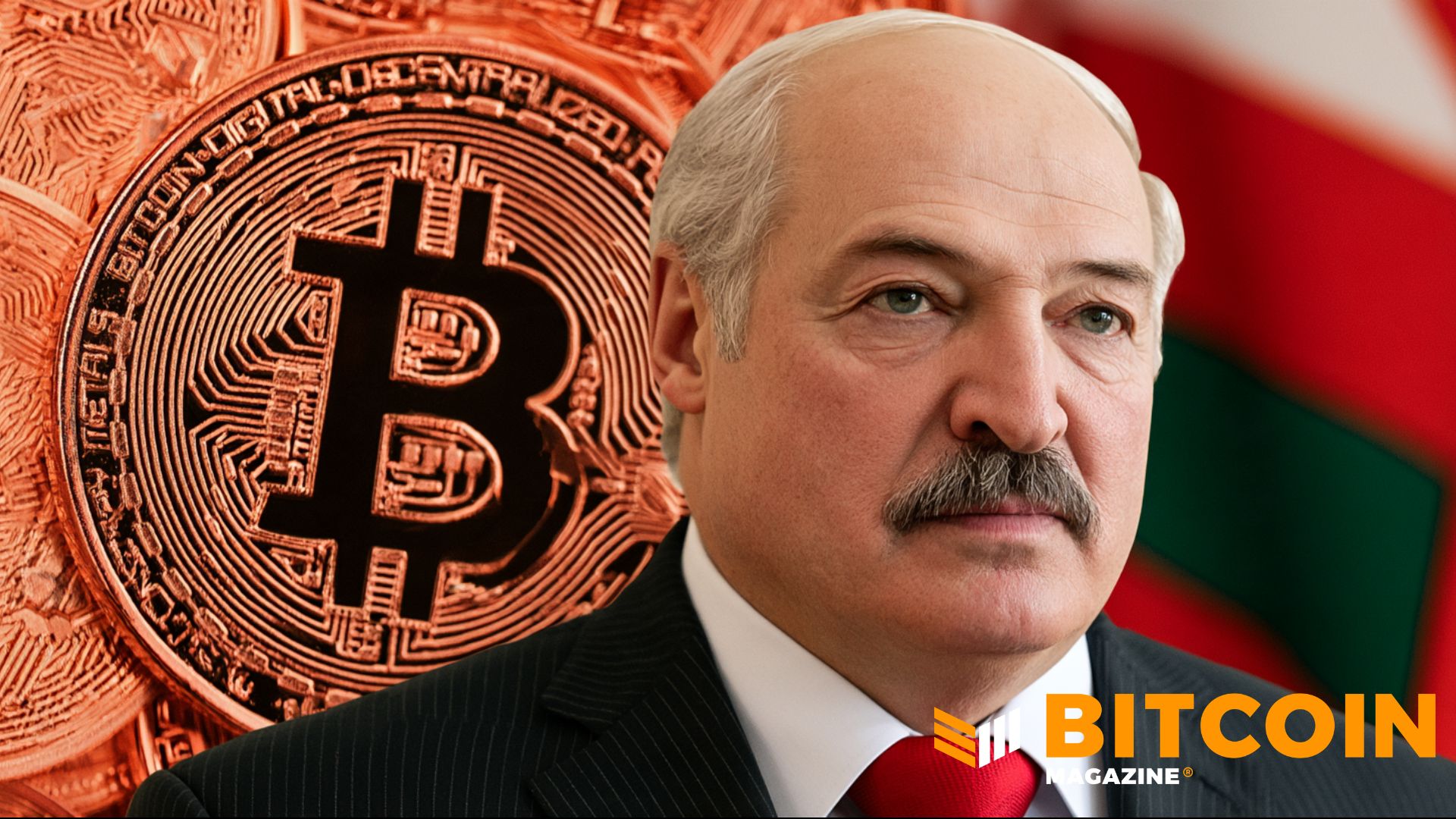
Belarus Approves the Country’s First Crypto Banks: Report
The first crypto banks have opened in Belarus, according to reports, after the European country earlier this year created a legal framework for Bitcoin banks.
While not yet named, the crypto banks will start operations after obtaining accreditation from the National Bank of Belarus, Russian news agency Interfax reported Monday.
Back in January, Belarusian President Alexander Lukashenko signed Decree No. 19 “On Cryptobanks and Certain Issues of Control in the Field of Digital Tokens,” officially creating a legal framework for bitcoin and crypto banks in the country.
JUST IN:
— Bitcoin Magazine (@BitcoinMagazine) September 28, 2026The first two "crypto banks" in Belarus have been approved.
“This will facilitate closer integration between traditional finance and the crypto industry." pic.twitter.com/Y5CHD00SkP

“The practical outcome of today’s discussion is the launch and registration of the first crypto banks in the country’s history,” Interfax reported the press service of High-Tech Park saying in a statement.
High-Tech Park is a tax and legal regime in Belarus. Digital asset transactions are permitted in the zone.
The statement added that banks would be regulated by Hi-Tech Park and the National Bank.
Dmitry Kalechits, first deputy director of the High-Tech Park supervisory board secretariat, was quoted saying that the move would “improve the flow of the financial ecosystem” and drive foreign investment to Belarus.
President Lukashenko last September backed the National Bank’s initiative to establish crypto banks in the country.
The country has long pushed pro-crypto regulations. A 2017 decree legalised crypto mining and trading and temporarily exempted individuals’ crypto income from tax and declaration. That exemption was extended to 2025 and has since been narrowed, with income from foreign platforms now taxed at 13%.
Lukashenko has repeatedly promoted Bitcoin mining as a use for surplus electricity, and in 2025 the Mogilev region began preparing sites for mining farms with his backing.
This post Belarus Approves the Country’s First Crypto Banks: Report first appeared on Bitcoin Magazine and is written by Mathew Di Salvo.
Bitcoin Magazine
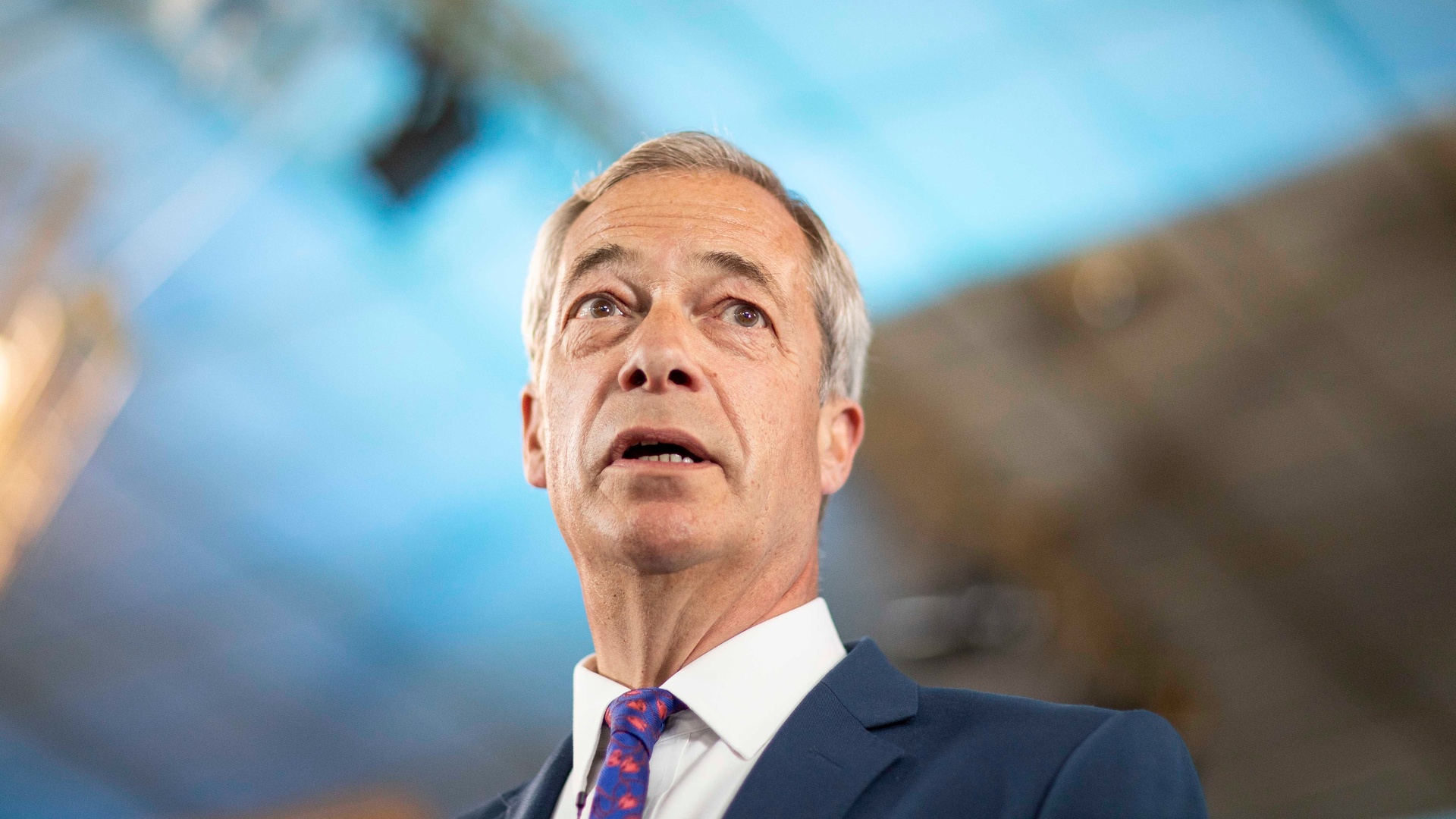
UK Chancellor of the Exchequer Blasts Nigel Farage’s ‘Bitcoin Account’
UK Chancellor of the Exchequer John Healey has appeared to slam Reform Party leader Nigel Farage’s use of Bitcoin.
In a Monday speech, the finance minister said that Nigel Farage — a pro-crypto member of parliament — was “Liz Truss with a Bitcoin account.”
Farage, who is leading the increasingly popular Reform Party, has come under fire recently for receiving donations from crypto entrepreneurs. Liz Truss was the UK’s shortest serving Prime Minister who was heavily criticised for her debt-fueled 2022 mini budget.
“Nigel Farage — he wants you to think he’s a man of the people,” Healey said. “But when it comes to the economy, he’s Lizz Truss with a Bitcoin account.”
Healey went on to say that his leading Labour Party would help the UK get ahead “through fiscal discipline, through good work, through strong industries.”
His comments were criticized by the Bitcoin community on X, who asked what a “Bitcoin account” even was.
“Apparently ‘Bitcoin account’ is now a thing,” the Simply Bitcoin account wrote on X. “Incredible stuff from one of the people running Britain.”
Populist Farage has long been a pro-crypto politician. Since 2020, he has framed Bitcoin mainly as a question of personal freedom and opposition to state control of money.
Farage has also said that he was debanked by private British bank Coutts and that led him to develop more interest in digital assets.
Just last year, he said at the Bitcoin 2025 Conference at Las Vegas that he’d slash crypto capital gains taxes and force the Bank of England to establish a Bitcoin reserve if elected as the next Prime Minister.
Farage has come under fire this year for receiving millions of dollars in the form of crypto donations from tech entrepreneur and Tether investor Christopher Harborne, and Ben Delo, one of the founders of the now-closed BitMEX crypto exchange.
The Metropolitan Police have opened an investigation into reports that Reform broke rules against overseas donations. Reform denies wrongdoing and says it will cooperate.
This post UK Chancellor of the Exchequer Blasts Nigel Farage’s ‘Bitcoin Account’ first appeared on Bitcoin Magazine and is written by Mathew Di Salvo.
Bitcoin Magazine

Citi and Coinbase Working Together To Build Stablecoin Infrastructure for Businesses
Citigroup is working with America’s biggest crypto exchange, Coinbase, in its latest blockchain-based venture.
The two companies said in a joint statement Monday that they were teaming up to allow Citi clients to move between regular money and stablecoins without having to build or manage both banking and crypto systems themselves.
The announcement comes as banks worldwide utilize Bitcoin’s underlying technology to speed up their processes and cater to crypto-hungry customers.
Citi last month said it would allow institutional investors to custody both traditional assets and bitcoin within one framework, rather than needing separate systems, later this year.
“Our clients operate in an increasingly fast-paced and complex global economy, and we’re focused on delivering the solutions they need,” said Debopama Sen, Head of Payments, Services, Citi.
“Our goal is to build the next generation of payments infrastructure — one that is seamless, interoperable, and operates across both traditional and digital payments instruments and networks.”
There are two parts to the deal, the announcement said. Firstly, Coinbase Virtual Accounts, built on Citi’s banking-as-a-service platform, will give Coinbase’s payments customers bank-account-like features so they can accept, hold, send funds. Citi will provide the regulated banking backbone so that incoming fiat can be automatically converted to stablecoins.
Secondly, Citi’s merchant platform, Spring by Citi, will use Coinbase’s infrastructure so that Citi’s enterprise clients can accept stablecoin payments at checkout. Coinbase will convert the stablecoins to fiat, and Citi settles the funds, so merchants never have to hold or manage crypto directly.
“Fintechs building on Coinbase have always needed a fast, compliant bridge between fiat and stablecoins, and Citi gives us that at scale,” Coinbase’s Head of Infrastructure Product, Alec Lovett, said.
Coinbase and Citi first announced last year that they would partner to enhance digital asset payment capabilities for institutional clients.
Citi has a number of blockchain offerings, including Citi Token Services, which enables real-time cross-border payments using tokenized deposits.
The firm since last year has also been working with other top banks — including Deutsche Bank, Goldman Sachs, and Bank of America — to explore issuing a stablecoin product.
This post Citi and Coinbase Working Together To Build Stablecoin Infrastructure for Businesses first appeared on Bitcoin Magazine and is written by Mathew Di Salvo.
Bitcoin Magazine
Strategy and Strive Scoop Up More Than 2,700 Bitcoin in a Week
Bitcoin treasuries are loading up again.
Strategy, the largest corporate holder of bitcoin, announced Monday that it had bought 1,665 coins last week for $142.7 million — its second buy in a row after a brief hiatus.
The Nasdaq-listed company added that it had also bought back $152 million in its preferred stock, STRC. Strategy now holds 847,666 bitcoins worth $70.5 billion, according to a filing with the Securities and Exchange Commission.
Elsewhere, the fifth biggest bitcoin treasury, Strive, said it had last week snapped up 1,107 BTC for a total cost of $94.5 million — bringing its holdings to 27,462 coins.
The two companies have continued to stack coins despite the bitcoin treasury model taking a hit. Major treasuries like Strategy, Satsuma, Smarter Web Company, Sequans, Nakamoto, and Empery Digital have all sold bitcoin this year to repay debt, fund operations or finance buybacks, while others have folded or pivoted to AI infrastructure as their share prices collapsed.
Strategy stock (MSTR) has lost over 50% of its value over the past year. Strive (ASST) is down by more than 30% over the same period.
Still, both Strategy and Strive have reassured investors that it’s just business as usual and bitcoin will bounce back.
Strive CEO Matt Cole has repeatedly said that the company is debt-free, with zero margin requirements, and zero encumbered bitcoin, calling it a balance sheet built to thrive through volatility.
Strategy has defended having to sell bitcoin this year, with CEO Phong Le boasting that the company now has a “bullet-proof balance sheet” because of the sales, and that it was the “right trade at the time” to sell when it did.
The software company last week announced it plans to pay investors daily dividends on four of its preferred stocks — STRF, STRC, STRK, and STRD.
Bitcoin’s price recently stood at close to $83,409, down 3% over the past week.
This post Strategy and Strive Scoop Up More Than 2,700 Bitcoin in a Week first appeared on Bitcoin Magazine and is written by Mathew Di Salvo.
Bitcoin Magazine

Dollars In, Bitcoin Out: Breez SDK Debuts New Stablecoin Feature
Despite being so-called digital dollars, stablecoins aren’t always simple to use. They run on various crypto networks that need different digital wallets — the type of thing that can put crypto newbies and seasoned bitcoiners alike off.
But Bitcoin software provider Breez has come up with a solution: Apps built on its Breez SDK can now let users with a bitcoin balance accept stablecoin payments from over 30 networks.
Receive USDT/USDC is LIVE in the Breez SDK
— Breez
Get paid in dollars, straight to your bitcoin or dollar balance.
Users can now receive @USDC or USDT from 30+ networks, including Ethereum, Base, Solana, and Tron.
One balance. No new chain to integrate. Value moving like… https://t.co/hCGUopkdgn pic.twitter.com/TRLASy9gq6(@Breez_Tech) September 28, 2026

Breez’s SDK is a developer toolkit that lets apps add bitcoin payments without building the payment infrastructure themselves. It handles wallet creation, sending and receiving and Lightning Network payments. Developers can offer bitcoin features with a few lines of code instead of running nodes or managing liquidity.
Breez said Monday that with the new feature, the receiver picks the sender’s network and an amount. The SDK generates a deposit address and shows what will arrive, and the sender pays from their usual wallet as normal.
Flashnet converts the payment in the background, and the funds land in the receiver’s non-custodial wallet as bitcoin, or as dollars if they use the stable balance feature.
Breez released its send USDT/USDC feature in June, allowing a single Breez-powered balance to now move stablecoins in both directions across nearly any network.
It’s the latest in a series of usability upgrades, after Passkey Login, instant Cash App onboarding, and Stable Balance.
Breez has been layering on features to make bitcoin apps feel more like regular fintech apps: passkey login instead of seed phrases, instant onboarding, dollar-denominated balances, and now cross-chain stablecoin payments. Breez’s Glow, which debuted in August, is its reference app for showing what the SDK can do.
Breez in July announced it was working with Turnkey in a deal letting developers add non-custodial Bitcoin to apps running wallets from their own servers — solving a custody problem that has kept many of the largest consumer platforms from integrating Bitcoin at all.
This post Dollars In, Bitcoin Out: Breez SDK Debuts New Stablecoin Feature first appeared on Bitcoin Magazine and is written by Mathew Di Salvo.
CryptoSlate
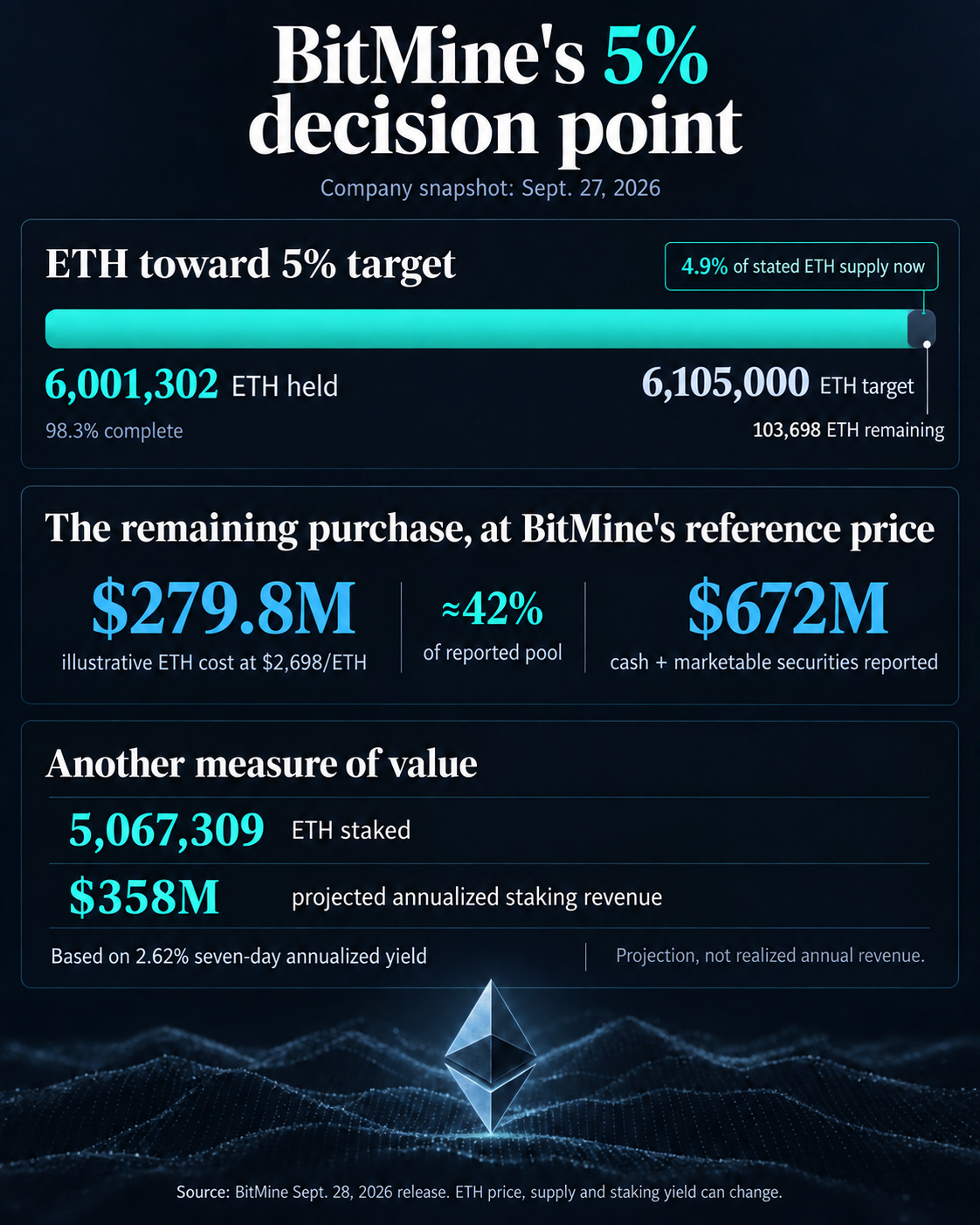
Ethereum treasury company BitMine Immersion Technologies said on Sept. 28 that it held 6,001,302 ETH, leaving it 103,698 tokens short of its goal of owning 5% of Ethereum's supply, based on the company's latest supply estimate.
Buying that remainder at BitMine's Sept. 27 reference price would cost about $279.8 million. The company reported $672 million in cash and marketable securities on the same date.
The estimated purchase cost is roughly 42% of that reported pool. Completing the goal looks affordable on paper, though ETH's price and supply can change and BitMine has not earmarked the money for that purpose.
The closer the company gets to its target, the more consequential its next choice becomes: keep adding ETH, preserve liquidity, buy back shares, or build income from the tokens it already owns.
BitMine said it acquired 17,362 ETH in the latest week, about 37% fewer than the 27,562 ETH it reported for the week before. It says it has bought ETH every week since starting the strategy in June 2025.
In July, the company repurchased about 5.5 million BMNR shares at an average price of $15.6156, roughly $85.9 million in total, while buying 7,430 ETH that week. Chairman Tom Lee said the reduced ETH buying pace reflected the share repurchase.
That precedent shows management has weighed its stock against more ETH, though the July decision does not determine its next one.
A Sept. 24 DWF Labs study found that only four of the 20 largest digital asset treasury companies by assets under management in its sample traded above one times the value of their crypto holdings, a ratio called mNAV.
Issuing shares at a premium can finance token buying without the same dilution pressure. DWF expects management and capital structure to matter more as such premiums fade.
The finding shows why the market price of a treasury company's stock is key to any plan to keep acquiring crypto after a stated target is reached.
Although BitMine is not facing an apparent cash shortage at its reported reference price, the issue is whether its next use of capital does more for shareholders than another ETH purchase.
What the existing Ethereum position can earn
BitMine said it had 5,067,309 ETH staked as of Sept. 27, about 84% of its holdings. The company projects $358 million in annualized staking revenue at that balance and $424 million in annualized rewards if it fully stakes its ETH, using a 2.62% yield measured over seven days.
BitMine also says its MAVAN staking platform has expanded to serve institutions, custodians and partners. For now, the quantified alternative to the accumulation tally is the company's projected yield from staking its own reserve.
Lee had already signaled a gradual approach to the 5% threshold and more spending on staking, infrastructure and Ethereum-related investments in July. Crossing 5% would bring more attention to whether ETH per share, staking returns, cash retained, or BMNR repurchases will best explain the value of its next allocation.
Lee is scheduled to speak at Korea Blockchain Week on Sept. 30, and his keynote is titled “Ethereum's Wall Street Moment.”
That is when investors may get a clearer answer. For now, BitMine has shown it can afford to finish the 5% goal at its price assumptions, while its plan for the capital that follows remains less defined.
The post BitMine nears 5% Ethereum threshold, yet stock valuation rules dictate its next move appeared first on CryptoSlate.
Altcoin spot volume has climbed to nearly four times Bitcoin's, the highest ratio since September 2025, according to Glassnode.
Wintermute says retail clients on its OTC desk sold BTC last week to fund that rotation, while US spot Bitcoin ETFs took in nearly $2.4 billion over the same five sessions. Each day's ETF inflow came in below the previous day's, dropping from $999 million on Sept. 21 to $134.5 million on Sept. 25.
Bitcoin is the funding asset
Wintermute's Sept. 28 OTC report described net BTC selling on its desk, driven mainly by retail clients taking profits and moving into altcoins.
Glassnode's data shows how wide the move outward has become, with 72.5% of the altcoins it tracks outperforming Bitcoin through Sept. 23, up from 39% during August's squeeze.
Altcoin perpetual open interest barely expanded over the prior 30 days, and fewer than half of tracked markets added positions, leading Glassnode to describe that stage of the rally as mostly spot-driven.
Glassnode added that similar bursts of aggressive risk-taking have often coincided with local Bitcoin tops, and it treats the ratio as a historical warning condition.
Wintermute noted that breadth has stretched to a level where the weeks that came next were flat to negative in more than 80% of comparable cases, with early-cycle periods as the exception. Wintermute wants Bitcoin to push higher to recycle fresh wealth into the alt cycle.
Bitcoin gains create that wealth, traders realize some of it and move outward, and the process can coexist with a higher BTC price as long as another buyer absorbs the coins being sold.
| Signal | Current reading | What it says |
|---|---|---|
| Altcoin/BTC spot volume | Nearly 4x | Trading activity has moved sharply toward altcoins |
| Alts outperforming BTC | 72.5% | Rotation is broad rather than isolated to a few tokens |
| August comparison | 39% | Breadth has almost doubled from August's squeeze |
| Altcoin perp positioning | Fewer than half added positions | Latest leg appears more spot-driven than leverage-driven |
| Historical breadth signal | >80% of comparable cases flat/negative afterward | Rotation is stretched, but not a deterministic top signal |
Who is absorbing the selling
Farside Investors’ data shows US spot Bitcoin ETFs taking in $999 million on Sept. 21, $714.7 million on Sept. 22, $346.9 million on Sept. 23, $190.7 million on Sept. 24, and $134.5 million on Sept. 25.
The five sessions total roughly $2.4 billion, averaging about $477 million a day, and the Sept. 25 figure is 86.5% below the Sept. 21 figure. Glassnode measures its rolling weekly reading near $2.7 billion and calls it the largest inflow in almost a year.
Beneath those inflows, Glassnode's Sept. 28 report shows Bitcoin spot cumulative volume delta down 86.5% to just $17.3 million, perpetual futures delta at negative $261.5 million, and futures open interest holding at $38.9 billion.
The share of supply in profit rose to 74% from 69.3% a week earlier, and the realized profit-to-loss ratio jumped 79.6% to 1.4. Profit-takers and perpetual sellers were active in the market while ETF buyers took the other side.
Ethereum ETFs drew $602.8 million over the same five sessions, so Bitcoin products captured roughly 80% of combined BTC and ETH ETF inflows.
Regulated money is buying across crypto and concentrating at the top of the risk curve, while some retail clients move farther out.
| Date | BTC ETF net inflow | Change vs. prior session |
|---|---|---|
| Sept. 21 | $999.0M | — |
| Sept. 22 | $714.7M | -28.5% |
| Sept. 23 | $346.9M | -51.5% |
| Sept. 24 | $190.7M | -45.0% |
| Sept. 25 | $134.5M | -29.5% |
| 5-day total | $2.386B | |
| Daily average | $477M |
Four times Bitcoin's trading measures turnover
CryptoQuant contributor Darkfost found that the altcoin market excluding Bitcoin has added about $371 billion, or 45%, since June.
He also found that 87% of Binance-listed altcoins were trading above their 200-day averages, up from roughly 20% in August. Altcoin deposits to exchanges, which measure inventory positioned to trade or sell, have reached their highest level since October 2025.
Weekly averages sit above 22,700 deposit transactions on Binance, 8,300 on Coinbase and 32,000 across other venues. Those readings sit below early-stage levels from the previous bull cycle.
DefiLlama puts stablecoin market capitalization near $306.4 billion, up 0.89% over 30 days. The windows differ from the 45% altcoin repricing since June, and the pairing fits a repricing driven by rotation among existing holders, with fresh stablecoin liquidity playing a smaller part.
Rates raise the value of a replacement bid
The Federal Reserve raised its policy rate range to 3.75% to 4.00% on Sept. 16. The 10-year Treasury yield touched roughly 5.23% on Sept. 25, its highest since 2007, and Brent crude moved above $107 on Sept. 28.
Wintermute names oil, rates and the chance of another Fed hike as the main external threats to the current regime. Altcoin speculation is accelerating while long-term yields sit at their highest since 2007, which leaves crypto leaning on outside demand for Bitcoin.
Wintermute identifies $82,500 as the level that capped Bitcoin's previous range. If Bitcoin holds the zone between $82,500 and its recent high near $87,000, and ETF flows stay positive even below last week's $477 million daily average, traders can keep moving BTC gains outward. The asset that funds the rotation stays intact.
A clean break above $87,000 would create a fresh pool of profits, and Wintermute says Bitcoin dominance may need to rise alongside another push higher. Glassnode places the next major resistance at $95,000 to $97,000.
If Bitcoin loses $82,500 while ETF inflows fade toward zero, the buyer replacing BTC sellers weakens just as speculative capital sits farthest out on the risk curve. Higher-beta altcoins with thinner liquidity would react most, and exchange deposits would show whether that inventory turns into selling.
| BTC regime | ETF signal | What happens to the rotation |
|---|---|---|
| Above $87K | Inflows remain strong/reaccelerate | BTC creates a new pool of profits; alts can receive another rotation later |
| $82.5K–$87K | Positive, even below ~$477M/day | Most supportive environment for continued BTC-to-alt profit recycling |
| Below $82.5K | Inflows fade toward zero | Replacement buyer weakens while capital is already farther out the risk curve |
| Below ~$77K | Especially dangerous if ETFs turn negative | Broader recovery structure comes into question; higher-beta alts become most exposed |
| $95K–$97K | Requires renewed demand | Glassnode's next major BTC resistance zone |
A break below Glassnode's $77,000 True Market Mean would put the whole recovery structure in question.
Volume, breadth, and desk flows have confirmed the rotation into altcoins. The funding chain behind it remains untested, and the next few ETF sessions will show whether fresh buyers keep replacing the Bitcoin being sold to pay for it.
The post Altcoin spot volume nears 4x Bitcoin’s as ETF inflows shrink across five sessions appeared first on CryptoSlate.
Bitcoin hit an intraday low of $82,563 on Sept. 28, just below a concentration of long-term holders' purchase prices that Glassnode identified last week.
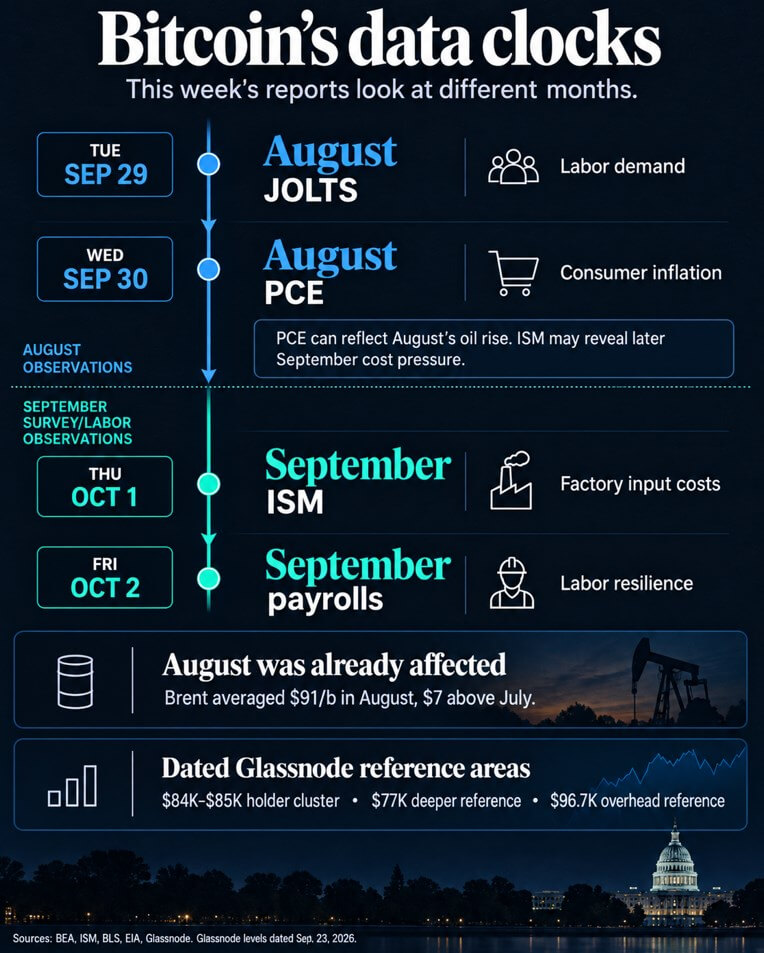
Three US data releases now threaten to send different signals about the inflation and labor outlook that drives interest-rate expectations. On Sept. 30, the personal income and outlays report will measure August. The Oct. 1 ISM manufacturing survey covers September, followed by the Oct. 2 September employment report.
A reassuring consumer inflation reading could arrive a day before a less comfortable snapshot of factory input costs. They measure different things, but traders may have to revise their view of the Fed as each lands.
Glassnode's Sept. 23 analysis mapped a large cluster of long-term holder supply at $84,000 to $85,000. That area marks where many longer-term holders acquired coins, making Bitcoin's ability to reclaim it a measurable response to the week's news.
Glassnode also identified a deeper True Market Mean reference near $77,000 and an overhead mean MVRV reference near $96,700.
Glassnode's Sept. 21 Market Pulse showed net spot taker buying, rising volume and elevated futures leverage, alongside weekly ETF outflows. Fresh spot buying, stronger volume and ETF demand would lend a rebound more weight than futures covering alone.
How a missing month could affect Bitcoin
The Energy Information Administration estimated Brent spot crude averaged $91 a barrel in August, $7 above July, as Middle East exports remained constrained.
The International Energy Agency found Gulf diesel and gasoil exports severely restricted in August and recorded a further jump in a physical crude benchmark by Sept. 9.
The Sept. 30 PCE report cannot measure the later September evolution of fuel, freight and factory costs. The International Maritime Organization recorded vessel damage in and near Hormuz on Sept. 21 and 23, evidence that shipping risk persisted after the PCE reference month.
If investors expect higher business costs to keep inflation elevated, Treasury yields and the expected Fed path could rise before a later consumer inflation report registers any pass-through. A soft August PCE print could ease that pressure initially without settling what happened next.
ISM's August report put the Prices Index at 71.1 and Supplier Deliveries at 59.3, consistent with slower deliveries. Diesel fuel and freight appeared on its list of commodities rising in price, while respondents separately discussed energy and the Hormuz conflict.
A higher September Prices reading alongside slower deliveries or cost comments would signal fresh pressure on manufacturers. New orders and employment will help show whether demand is holding up as costs rise.
The Sept. 29 August JOLTS release provides an early labor check, while the Oct. 2 September payrolls will more directly test the growth side of the policy question.
The Fed raised its target range to 3.75% to 4% on Sept. 16, saying inflation remained elevated while job gains had kept pace with the workforce. Moderate job cooling could ease rate pressure, while a much sharper miss could instead raise worries about growth.
The most revealing path this week would be soft August PCE followed by a higher September ISM Prices reading. An initial Bitcoin relief move could reverse if yields and rate expectations turn back up.
Three other outcomes would test the same framework:
- Easing without a growth scare: Softer PCE, no further ISM cost acceleration and moderate job cooling could ease yields. A reclaim of Glassnode's $84,000 to $85,000 area would carry more weight if spot demand joins it.
- Persistent inflation: Firmer price signals with resilient hiring could keep rate pressure elevated. Failure to reclaim that holder cluster would bring Glassnode's lower $77,000 reference into view, without making it a fixed destination.
- Jobs break: A severe payrolls disappointment might lower yields but still hurt Bitcoin if investors respond to a growth shock by cutting risk.
The test for Bitcoin is whether each new reading changes yields and Fed expectations, and whether spot buyers support the resulting move through Glassnode's dated holder-cost area.
The post Bitcoin’s $85,000 test comes as Wall Street gets two different inflation stories appeared first on CryptoSlate.
Chainlink's CCIP 2.0 lets a token issuer require an additional verifier before tokens finish moving from one blockchain to another. A sending pool may already have locked or burned the tokens when that check becomes decisive: without the verifier's attestation, the receiving chain cannot release or mint them.
Announced on Sept. 28, the feature adds optional Cross-Chain Verifiers (CCVs) alongside CCIP's default Committee Verifier. An issuer or third party can operate one and make its approval a condition of delivery.
That gives the operator's rules and uptime a direct role in a holder's exit path. Chainlink's launch material does not identify a named production asset and lane using an issuer-run required CCV, so the mechanism is not evidence of a holder's transfer being blocked.
The point where a transfer can wait
CCIP's OnRamp assembles the applicable verifier requirements of a token transfer, and the token pool locks or burns the tokens. The OnRamp then records the message for offchain verifier services.
Those services watch the source event, apply their finality and verification rules, and publish attestations tied to the message ID.
On the destination chain, CCIP's OffRamp checks the required attestations before the pool releases or mints tokens. Its checks draw on the lane and token-pool settings and, when a receiver contract is involved, that receiver's requirements.
Sender preferences can add to the source-side verifier set. A token-only transfer has no receiver callback whose verifier preferences must be checked. This sequence places the lock or burn before verification and the destination release after it.
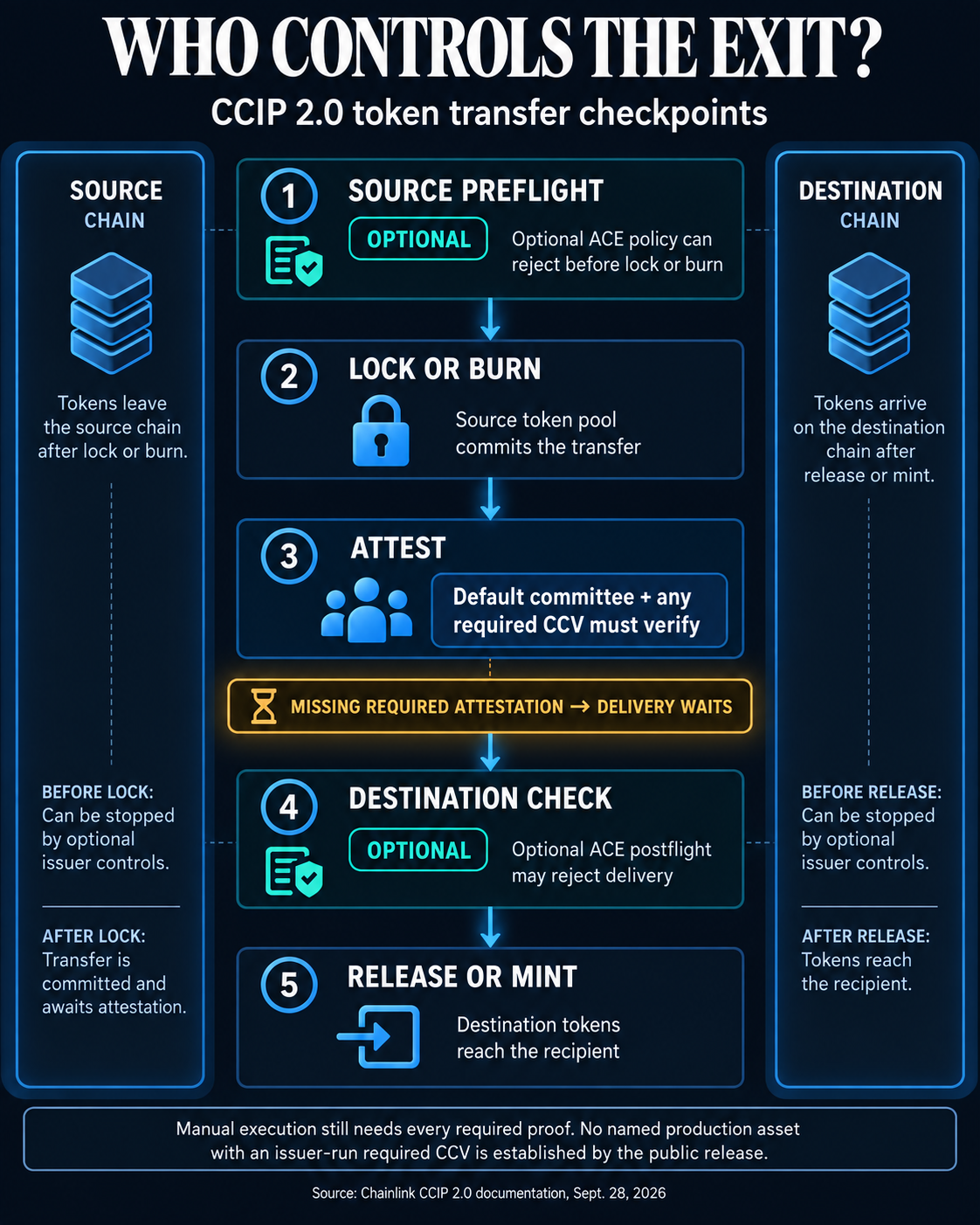
A source transaction may have succeeded while destination delivery remains pending, so Chainlink says all required CCVs must return valid results before execution proceeds. Its trust model warns that an unresponsive verifier can stall every message requiring its attestation.
If an issuer runs such a verifier and makes it required for its token pool, the issuer's service becomes one of the parties able to delay completion. A third-party operator would create a similar dependency under that operator's control.
That is a control the design permits, not evidence that an issuer has deliberately blocked a holder's transfer.
Chainlink says the default Committee Verifier comprises 16 independent node operators, with additional CCVs sitting alongside that baseline.
An issuer or application choosing one gains another check but must also assess who operates its contracts and offchain service, what rules that service applies, and whether it stays available.
Chainlink assigns external CCV operators responsibility for implementation, maintenance, and uptime. The key question for a holder is which attestations are mandatory for this token on this route, and who can produce each one.
What a holder can do when delivery stops
Execution on the destination chain is permissionless once every required proof exists and any optional verifier quorum has been met.
Chainlink's default executor normally submits the transaction, but anyone can submit it, including through the manual execution path. Changing the executor or paying destination-chain gas does not waive a missing required CCV attestation. The OffRamp still checks the proofs before releasing or minting tokens.
The recovery path depends on where a message stopped. If the required attestation has not been assembled, the destination message can remain UNTOUCHED, meaning no execution has been recorded. If a submitted destination attempt fails inside the OffRamp's protected path, it can be marked FAILURE.
Chainlink says a failed attempt can be retried after the underlying problem is fixed. Its default executor retries failures within a configured window currently set at eight hours, and that limit describes the automated service.
A holder has a usable manual route only after the necessary proofs are available and any destination-side failure is fixed. The manual execution guide describes how to inspect verifier status and execution state, including cases where the indexer has not collected an external verifier's result.
Chainlink's published manual execution route does not specify a general automatic cancellation, refund, or return of source-chain tokens when a required verifier never attests. Any issuer-specific remedy would depend on that asset's arrangements.
On EVM chains, a configured Chainlink Automated Compliance Engine hook can reject an outbound transfer before the source pool locks or burns anything. That preflight failure reverts the source transaction.
A separately configured destination postflight hook can reject release or mint after the source-side transfer has started, leaving the tokens undelivered until the policy condition is resolved and execution is retried. The ACE integration guide describes these as distinct, optional configurations.
A live release, with deployment questions
Chainlink's mainnet directory lists supported networks and tokens, but a listing does not show whether a given production lane requires an issuer-operated verifier or has enabled a destination ACE gate. Nor does a partner announcement or an earlier asset migration establish those settings.
Without the token pool, route, and verifier configuration, this new power cannot be attributed to the issuer of a named asset.
The release separately offers faster-than-finality transfers. Full source-chain finality remains the default, while the faster option can expose a transfer to duplicate destination execution after a deep enough reorganization, according to Chainlink's FTF guide.
Other required CCVs may apply their own reorganization rules, but that speed choice does not change the need for required attestations.
CCIP 2.0 gives issuers a stronger way to set cross-chain delivery conditions. For holders, the essential questions are which checks apply to their asset, who controls them, and what remedy exists if one cannot be completed after the transfer starts.
The post Chainlink CCIP 2.0 exposes bridge risk, and issuer gates trigger stalls appeared first on CryptoSlate.
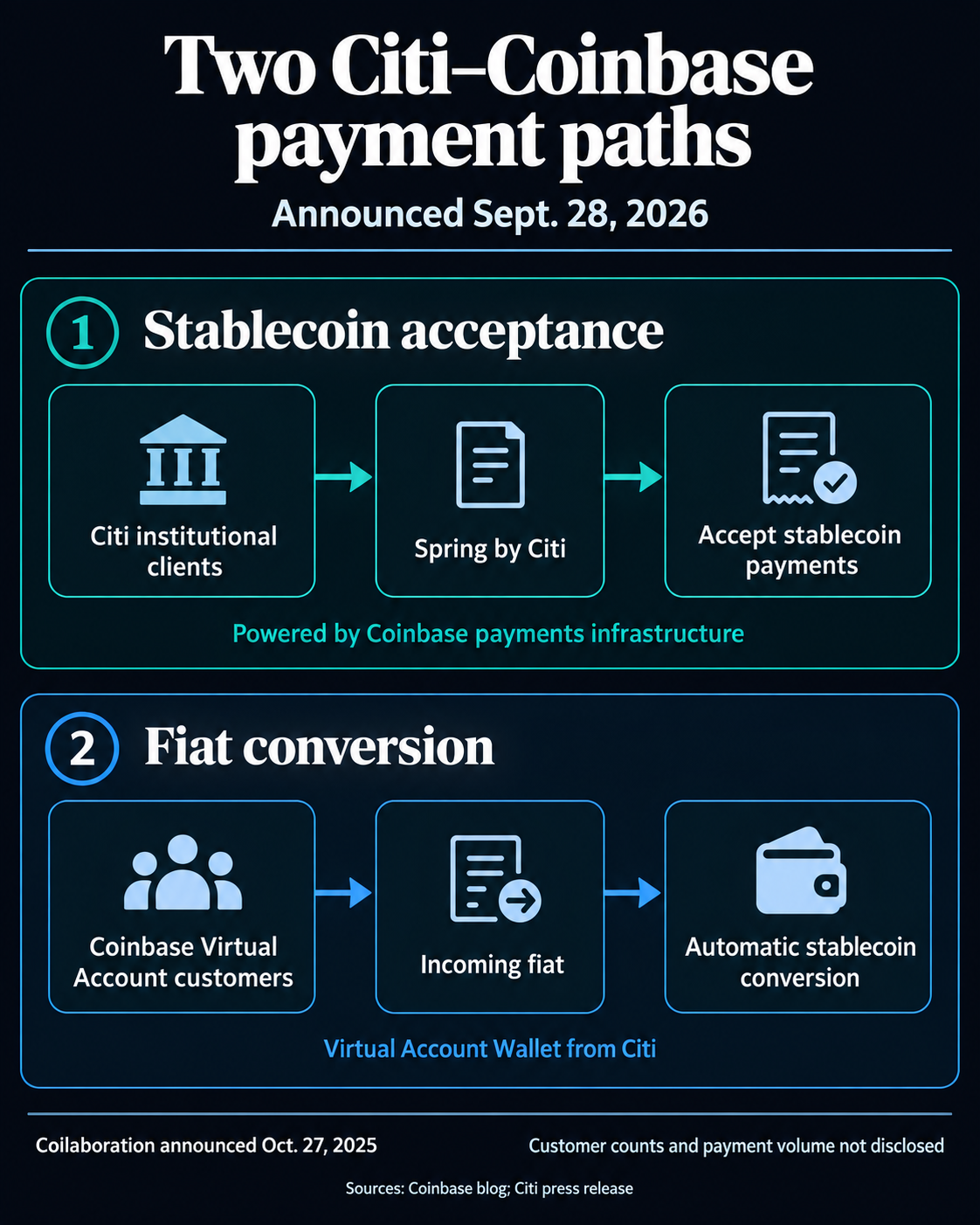
Citi institutional clients can now accept stablecoin payments through Spring by Citi using Coinbase's payments infrastructure, Coinbase said on Sept. 28.
The exchange also said its Virtual Accounts can automatically convert incoming fiat into stablecoins using Citi's Virtual Account Wallet. The announcement gives the companies' earlier digital asset payments partnership two defined uses, one for receiving stablecoins and the other for moving money received in a conventional currency into them.
For Citi's institutional clients, the relevant service is Spring by Citi, as Coinbase supplies the infrastructure that enables stablecoin acceptance through it. A business using that route would begin with a stablecoin payment.
Coinbase describes the capability as available now, but its announcement does not identify a client that has processed a payment through Spring or disclose how much has been transacted.
Coinbase Virtual Accounts address the other side of the exchange between traditional money and stablecoins. Citi's Virtual Account Wallet powers the accounts, which Coinbase says give customers fiat wallets that automatically convert incoming fiat.
The described flow starts with a traditional currency payment and ends with stablecoins in the customer's account. The company has not specified the eligible currencies or stablecoins in the public summary, so the precise conversion choices remain unclear.
The two routes serve different customers and begin with different forms of money. Citi's institutional payment clients gain a stablecoin acceptance option, while Coinbase Virtual Account customers gain an automated route from fiat receipts into stablecoins.
Coinbase has not outlined market-specific eligibility or prices for either Citi-linked path in its blog summary. The functions may be complementary, but the announcement does not establish that a single customer can use both.
The partnership predates these named services. In October 2025, Citi said it and Coinbase intended to develop institutional digital asset payment capabilities, initially focused on fiat pay-ins and pay-outs for Coinbase's on- and off-ramps and payment orchestration.
Citi said specific initiatives would follow, and the Sept. 28 description sets out two of those initiatives as customer-facing payment paths.
The stated availability leaves open whether institutions are using either path and at what scale. Coinbase's summary gives no customer count, payment volume, or named live merchant for the Citi integration.
Those missing operating details limit any assessment of the partnership's reach, even as the companies have moved from an exploratory plan to specified payment capabilities.
The post Coinbase powers Citi’s new stablecoin rails, and corporate banking faces a major shift appeared first on CryptoSlate.
CryptoTicker.io
No items found in feed after parsing.
Decrypt
The judge has told Pleterski he will raise objections on his behalf, to keep inadmissible evidence away from the jury.
Coinbase Clearing will take USDC as collateral and settle around the clock, though margined products stay with partners.
OpenAI says its agents keep landing on government websites because they treat them as reliable sources, but it's pausing training while it adds safeguards.
A UC San Diego-led team impersonated a hardware security module without extracting its key.
Coinbase and Citi expanded an existing deal so Citi's institutional clients can accept stablecoin payments, while Coinbase business accounts run on Citi's banking rails.
U.Today - IT, AI and Fintech Daily News for You Today
XRP eyes a rare 3-month win streak to break its bear cycle as new SEC filings prime an ETF launch.
Near Protocol has slipped about 15% from its $5.58 local high to $4.78 after a 200%+ August surge, and a bearish reversal candle suggests the pullback may not be over.
An early Ethereum whale nets 15,600% profit, selling coins bought at $18.80 as ETH locks in its best Q3 rally on record.
Apple has patched a critical iPhone vulnerability that may already have been exploited in sophisticated attacks.
XRP's strong technical signal might be too late for the price to react positvely.
Blockonomi
Key Highlights
- AstraZeneca plans to pour $2 billion into Summit Therapeutics via convertible preferred stock acquisition.
- Shares of Summit Therapeutics (SMMT) surged approximately 15% during Monday’s after-hours session.
- Both pharmaceutical companies will collaborate on clinical studies merging Summit’s ivonescimab with AstraZeneca’s sonesitatug vedotin.
- Goldman Sachs maintained its Buy recommendation on Summit shares with a price objective of $41.
- A crucial FDA ruling on ivonescimab approval for lung cancer treatment is scheduled for November 14.
Shares of Summit Therapeutics (SMMT) experienced a substantial 15% climb in Monday’s extended trading session. The rally followed AstraZeneca’s (AZN) disclosure of a $2 billion capital injection into the oncology-focused biotech firm.
Summit Therapeutics Inc., SMMT
During Monday’s standard trading hours, shares finished at $15.48, reflecting a modest decline of nearly 1%. Prior to the announcement, the stock had shed roughly 10% throughout the preceding week.
AstraZeneca’s acquisition involves convertible preferred shares priced at $18.36 per common share equivalent of Summit. This pricing structure represents a 10% markup over Summit’s volume-weighted average share price calculated across the previous five trading sessions.
Transaction completion is anticipated before week’s end. The strategic investment provides AstraZeneca with significant exposure to an innovative cancer therapy while avoiding a complete acquisition of Summit.
Partnership Details and Clinical Trials
The pharmaceutical giants will jointly pursue clinical trials that merge Summit’s lead candidate ivonescimab with AstraZeneca’s investigational therapy sonesitatug vedotin. Gastrointestinal malignancies will serve as the primary therapeutic target initially.
Trial expenses will be divided equally between the partners. Crucially, each company retains exclusive commercial rights to market its respective therapeutic compound.
Ivonescimab originated from Chinese biotechnology company Akeso’s research programs. Summit secured licensing rights through an agreement potentially valued at $5 billion, granting market authorization for the United States and European territories.
Chinese regulatory authorities have already granted approval for the medication. Market observers are keenly monitoring its performance trajectory in international markets.
Upcoming FDA Milestone
Regulatory officials at the FDA face a November 14 deadline to render judgment on ivonescimab approval, administered alongside chemotherapy, for treating specific lung cancer variants. This regulatory determination could significantly impact share valuation.
Summit’s ongoing Phase 3 HARMONi-3 clinical investigation continues advancing. This pivotal trial evaluates ivonescimab combined with chemotherapy as first-line therapy for non-small cell lung cancer patients.
Definitive progression-free survival metrics and preliminary overall survival figures from the squamous cell cohort are projected before year-end. Market participants are eagerly anticipating these clinical readouts.
Goldman Sachs reaffirmed its Buy stance on Summit shares Tuesday, maintaining its $41 price objective.
Goldman analyst Satoru Ogawa highlighted that this non-exclusive arrangement provides Summit entry into AstraZeneca’s antibody drug conjugate portfolio. This collaboration may facilitate identification of optimal therapeutic combinations tailored to specific cancer types.
Summit maintains existing partnerships with Revolution Medicines, GSK, and Arcus Biosciences. These collaborations encompass additional investigational oncology compounds within its development pipeline.
AstraZeneca’s American depositary receipts advanced roughly 1% in after-hours activity following the partnership disclosure. The capital infusion substantially bolsters Summit’s financial position, which reported $690.7 million in cash holdings at the conclusion of the most recent quarter.
The post Summit Therapeutics (SMMT) Shares Surge 15% on AstraZeneca’s $2B Deal appeared first on Blockonomi.
Key Takeaways
- SpaceX (SPCX) shares ended Monday’s session at $145.47, declining 3% despite a historic achievement.
- The company’s 14th Starship test successfully achieved orbit and released 26 next-generation Starlink satellites.
- An engine malfunction on the upper stage occurred during ascent, resulting in a truncated mission duration.
- TD Cowen initiated analyst coverage with a buy recommendation and $200 price objective, highlighting AI computing leasing expansion.
- Approximately 76% of Wall Street analysts recommend purchasing SpaceX shares, significantly exceeding the S&P 500 benchmark.
Shares of SpaceX (SPCX) finished Monday’s trading at $145.47, registering a 3% decline. The drop occurred immediately following the company’s successful first orbital insertion with its Starship launch vehicle.
Space Exploration Technologies Corp., SPCX
This fourteenth test mission represented a pivotal achievement for the reusable launch system. The flight successfully delivered 26 advanced Version 3 Starlink satellites to their designated orbit.
Previous Starship attempts failed to attain the velocity required for orbital insertion. During this flight, the spacecraft maintained altitude sufficiently to complete satellite deployment operations.
A single engine on the spacecraft’s upper section malfunctioned during the ascent phase. Engineers continued the mission trajectory despite the anomaly, although mission duration was reduced from original projections.
SpaceX shares climbed to an intraday peak of $150.80 immediately following launch initiation. The gains evaporated by mid-morning as the stock reversed course and traded lower through the closing bell.
Market Reaction To Orbital Milestone
Financial markets had already incorporated expectations of a successful test outcome into current valuations. The abbreviated mission timeline provided justification for some market participants to realize gains.
Both the S&P 500 and Dow Jones Industrial Average declined approximately 1% during the same trading session. SpaceX shares demonstrated weaker performance relative to both major indices.
SpaceX continues to dominate global commercial launch operations. The organization conducted 165 Falcon 9 missions throughout 2025 and anticipates maintaining comparable launch frequency this year.
Chief Executive Elon Musk indicated via social media that achieving hourly Starship launch frequency remains two to three years in the future. Such operational tempo would provide SpaceX with substantial cost advantages compared to terrestrial data center infrastructure.
Analyst Community Focuses On AI Revenue Stream
TD Cowen launched analyst coverage of SpaceX shares Monday, assigning a buy recommendation alongside a $200 valuation target. The investment bank emphasized SpaceX’s ground-based artificial intelligence computing rental operations as the company’s most rapidly expanding revenue category.
Technology companies including Google and Anthropic currently utilize this leasing platform. TD Cowen projects AI computing rentals will constitute the majority of SpaceX’s total revenues by the opening quarter of 2027.
SpaceX generated $23 billion in total revenue during the trailing twelve-month period. Wall Street analysts project 144% revenue expansion for fiscal year 2026.
TD Cowen’s bullish stance aligns with other research firms. CLSA similarly initiated coverage Monday with a buy rating and $250 price objective.
Additional investment banks have expressed comparable enthusiasm in recent weeks. Bernstein SocGen forecasts Starlink’s internet connectivity division will generate approximately $64 billion annually by 2031.
Mizuho maintained its outperform recommendation as well, emphasizing SpaceX’s competitive pricing advantages. William Blair and Clear Street similarly sustained positive outlooks following the Starship orbital test.
SpaceX shares command among the strongest analyst support on Wall Street. Roughly 76% of covering analysts assign buy-equivalent ratings, substantially higher than the 55% to 60% range typical for S&P 500 constituents.
The consensus analyst price target for SpaceX stock stands at approximately $224. This represents significant upside potential from Monday’s closing price.
The post SpaceX (SPCX) Stock Slides 3% Despite Historic Starship Orbital Achievement appeared first on Blockonomi.
Key Highlights
- Third-quarter net income reached $261 million, reflecting a 16% year-over-year increase.
- Earnings per share of $1.08 surpassed analyst consensus of $1.00.
- Investment banking division generated all-time high revenue of $1.3 billion, marking a 17% jump.
- Equities trading posted record results at $626 million in revenue.
- Shares declined approximately 4% during extended trading hours following the earnings release.
Shares of Jefferies (JEF) tumbled by as much as 4% during after-hours trading on Monday, despite the investment banking firm delivering third-quarter results that exceeded analyst expectations. The post-market selloff occurred even as the company achieved record-breaking performance in multiple business segments.
Jefferies Financial Group Inc., JEF
The Manhattan-based financial institution disclosed net earnings of $261 million for the period, representing a 16% improvement compared to the same quarter last year. Earnings per share registered at $1.08, comfortably exceeding the $1.00 consensus forecast from Wall Street analysts.
Overall revenue for the quarter totaled $2.2 billion, aligning precisely with analyst expectations. However, market participants appeared more concerned with the composition of revenue and performance disparities across different business lines.
Jefferies, $JEF, Q3-26.
Record banking and equities powered the quarter, while fixed income stayed soft.
Revenue: $2.22B | vs. $2.20B est.
Investment Banking: $1.33B | +17% YoY, record
Equities: $626M | +29% YoY, record pic.twitter.com/VtP0oHMvoa
— EarningsTime (@Earnings_Time) September 28, 2026
The investment banking segment emerged as the clear winner. This division posted all-time high revenue of $1.3 billion, representing a 17% year-over-year improvement.
Both advisory services and equity underwriting activities fueled this expansion. The firm attributed the robust performance to favorable market conditions and ongoing success in capturing additional market share.
Capital Markets Division Reaches New Heights
Jefferies‘ capital markets operations also delivered impressive results. Equities trading revenue surged approximately 33% to reach a record $626 million.
The entire capital markets segment, encompassing various trading operations, expanded 11% to $802 million. Global trading activity has been accelerating throughout the current year.
The fixed income business presented a contrasting picture. Revenue in this area decreased 26% compared to the prior year, which the company explained was due to reduced market activity levels.
Asset Management Division Drags Performance
Asset management revenue and investment income plummeted 60% to just $34 million, down from $84 million in the comparable period. The firm cited underperformance across multiple investment fund strategies.
Among these struggling areas was Point Bonita, which held positions in First Brands, the automotive parts supplier currently in bankruptcy proceedings. This investment negatively impacted the division’s quarterly performance.
Chief Executive Officer Richard Handler and President Brian Friedman commented on the quarterly performance through a prepared statement. They expressed continued confidence in the asset management business’s long-term prospects as the company works through a strategic repositioning of this platform.
Handler and Friedman maintain their practice of not conducting live analyst conference calls following earnings announcements. The executives instead provide detailed written commentary accompanying the quarterly financial releases.
Monday’s earnings beat notwithstanding, JEF shares have experienced a challenging year. The stock has declined approximately 24% to 25% year-to-date in 2026, contrasting sharply with the S&P 500’s roughly 12% gain during the identical timeframe.
Market observers frequently view Jefferies’ quarterly performance as a bellwether for the broader investment banking sector, as its results typically precede those of larger financial institutions. This early reporting position makes the firm’s numbers particularly significant for industry watchers.
Handler and Friedman conveyed optimism regarding the remainder of 2026 and the outlook for 2027. They cited the firm’s pipeline of pending transactions and emerging business opportunities as the foundation for their positive perspective.
The post Jefferies (JEF) Stock Falls 4% in After-Hours Trade Despite Strong Q3 Earnings Beat appeared first on Blockonomi.
TLDR
- Nokia rebounds as Zain KSA expands Deepfield across more than 100 Saudi cities.
- Deepfield gives Zain KSA real-time visibility into network traffic and services.
- The system helps detect congestion, latency and service issues much faster.
- Deployment supports stronger cloud, gaming and streaming performance nationwide.
- The project aligns with Saudi Arabia’s Vision 2030 digital infrastructure push.
Nokia (NOK) rose 0.79% to $10.18 in pre-market trading after closing 2.60% lower at $10.12. The move followed a major network intelligence deployment with Saudi Arabia’s Zain KSA. The project expands advanced network monitoring across more than 100 cities throughout the Kingdom.
Nokia Oyj, NOK
Zain KSA Expands Network Intelligence Deployment
Zain KSA has deployed Deepfield Cloud Intelligence across its national network to improve service monitoring and performance. The technology provides real-time visibility into network traffic, cloud services, applications, and changing internet activity. Consequently, engineering teams can identify network problems faster and reduce service disruptions affecting customers.
Saudi Arabia continues recording rising data demand from streaming, cloud services, gaming, and expanding digital applications. Therefore, telecom operators require stronger monitoring systems to manage growing traffic while maintaining stable network performance. The system combines internet intelligence with network telemetry to provide clearer information about traffic behavior.
The deployment also supports Zain KSA’s broader effort to build a more automated and software-driven network. Meanwhile, the project expands the technology provider’s network intelligence footprint across the Middle East. The agreement also strengthens its position in Saudi Arabia’s growing telecommunications and digital infrastructure sector.
Deepfield Improves Visibility Across Saudi Arabia
Deepfield allows Zain KSA to monitor major cloud and online services throughout its network. The system identifies congestion, latency, and unusual traffic patterns before those problems create broader service disruptions. As a result, Zain KSA can maintain stronger performance across streaming, gaming, cloud platforms, and other digital services.
Deepfield Cloud Genome provides detailed information about internet applications, networks, and online services moving through telecom infrastructure. The system organizes services across more than 30 categories and applies over 100 machine-learning rules. This structure helps network teams understand traffic sources and how individual applications affect network performance.
The platform also converts large amounts of network data into structured information for operational and analytical use. Zain KSA can use that information to guide network optimization and future infrastructure investments. The deployment may also support new services requiring faster response times and dependable network connections.
Deployment Supports Saudi Digital Infrastructure Growth
Saudi Arabia continues expanding telecommunications infrastructure under its wider Vision 2030 digital transformation strategy. The national program supports cloud adoption, digital services, advanced connectivity, technology development, and broader economic diversification. Zain KSA has positioned network modernization as an important part of supporting these growing digital requirements.
The deployment also expands the role of advanced software and traffic analytics within large telecommunications networks. Deepfield focuses on network intelligence, traffic analysis, service assurance, and operational visibility. These functions help operators respond faster as data consumption and application complexity increase.
Zain KSA now gains wider visibility across services operating throughout more than 100 Saudi cities. The expanded monitoring capability supports network reliability while helping teams manage growing digital traffic. The project also aligns with Saudi Arabia’s continued push toward more connected and data-driven infrastructure.
The post Nokia (NOK) Stock: Rebounds as Zain KSA Deploys Deepfield AI Network Intelligence Across 100 Saudi Cities appeared first on Blockonomi.
TLDR
- The precious metal gained 0.6% to reach $4,139.91 per ounce on Tuesday, bouncing back modestly following Monday’s 4% plunge.
- Crude oil prices continue climbing amid the ongoing US-Iran dispute over Strait of Hormuz access, heightening inflation concerns.
- Treasury yields on 10-year bonds reached a 19-year peak, diminishing gold’s appeal as an investment vehicle.
- The yellow metal has declined roughly 7% in the last month following Fed rate increases and hawkish policy signals.
- Market participants are closely monitoring Wednesday’s inflation figures and Friday’s employment data for Federal Reserve policy direction.
Gold prices posted gains on Tuesday following a challenging session to kick off the week. The precious metal experienced a 4% plunge on Monday, marking one of its sharpest single-day losses in several months.
Spot gold advanced 0.6% to settle at $4,139.91 per ounce as of 05:33 ET. Meanwhile, gold futures edged up 0.1% to $4,171.90 per ounce.
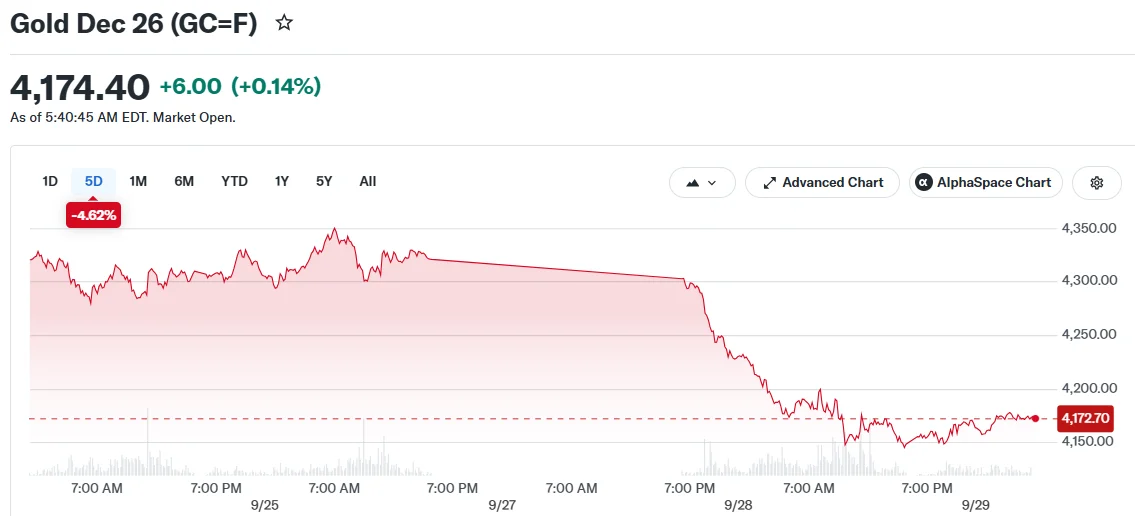
Even with Tuesday’s modest recovery, the metal continues trading near its lowest point in seven weeks. Gold faces headwinds from climbing bond yields and US dollar strength.
US-Iran Tensions Sustain Elevated Energy Prices and Inflation Worries
Oil prices maintained their upward trajectory as Iranian authorities remained firm on their terms for reopening the Strait of Hormuz. This critical shipping channel handles a substantial portion of worldwide energy transport.
President Trump turned down Iran’s most recent proposal, which included a commitment to reopen the strait within one week. Sources indicate Iranian leadership believes reaching an agreement before November’s US midterm elections appears increasingly unlikely.
The standoff between Washington and Tehran has now stretched into its eighth month, persistently disrupting global energy distribution and amplifying inflation anxieties.
Elevated crude oil costs typically drive broader price increases throughout the economy. This dynamic encourages central banks to implement tighter monetary policy through rate hikes, creating a challenging environment for gold given the metal produces no yield.
Bond Yields Surge to Nearly Two-Decade Highs
The continued rally in crude oil prices intensified selling pressure across US Treasury markets on Monday. Yields on 10-year government bonds climbed to levels not witnessed in 19 years.
Elevated bond yields diminish gold’s relative attractiveness to investors. This occurs because fixed-income securities offer tangible returns, unlike the non-yielding precious metal.
Throughout the last 30 days, the yellow metal has surrendered approximately 7% of its value. This pullback emerged after the Federal Reserve implemented its first rate hike since 2023.
Central bank policymakers maintained a hawkish stance, signaling additional rate adjustments remain possible this year. Current market pricing suggests approximately 70% probability of another increase coming in October.
Researchers at ANZ noted the near-term trajectory for gold appears challenging. They identified elevated yields and persistent inflation risks as primary obstacles confronting the precious metal.
A previous analysis from the prior week documented gold futures declining across three consecutive trading sessions. That selloff coincided with US dollar appreciation and the 10-year Treasury yield climbing to its highest reading since July 2007.
Silver experienced similar downward pressure during this period, closing 2.4% lower at $64.382 per troy ounce.
Market attention now shifts to two significant economic releases this week. Wednesday’s personal consumption expenditures index will provide the Federal Reserve’s preferred inflation measurement.
Friday’s nonfarm payrolls data will deliver fresh insights into labor market conditions. These reports are expected to influence market expectations surrounding the Fed’s upcoming monetary policy decisions.
Currently, gold finds itself navigating competing market dynamics. Geopolitical instability and rising energy costs bolster safe-haven demand, while strengthening bond yields and dollar momentum continue applying downward pressure on precious metals valuations.
The post Gold Rebounds Modestly as Markets Brace for Critical US Inflation Numbers appeared first on Blockonomi.
CryptoPotato
Bitwise Chief Investment Officer Matt Hougan has laid out why financial advisors are buying Ripple’s native token, and the reasons have little to do with it price.
His remarks follow an 80% rise in XRP ETF net assets during the third quarter, to a record $1.77 billion on September 25.
XRP Will Always Be Around
Hougan called XRP “one of the Mount Rushmore assets in crypto” and gave two reasons it appeals to investors. The first is that they are confident it won’t go away.
“A lot of financial advisors look at crypto and wonder, ‘Are these things for real? Will they persist? Will they be here in the future?’ And XRP has this enormous track record and this enormous background that gives people confidence it will be there in the future,” Hougan explained.
The second reason is practical. XRP “fits into real-world applications that they can understand,” according to the CIO. Advisors follow the stablecoin space and the cross-currency and liquidity space, and pay attention to news such as Ripple getting a bank charter.
XRPL community figure Hussein Zangana, who goes by Vet on X, made a related case, calling the network “real” and adding that it “has persisted the most amount of scrutiny any crypto has received.” As CryptoPotato reported earlier, XRP ETFs took in about $76 million last week, their best week in a month, extending the run to 11 straight weeks of inflows.
Bitwise’s fund leads with $677 million in cumulative inflows, followed by Franklin’s at $501 million, while the one from 21Shares has so far bled $21.15 million. On Monday, SoSoValue data shows, Canary’s XRPC added $3.96 million, taking cumulative inflows across all XRP ETFs to $1.79 billion. Total net assets were $1.68 billion, below Friday’s record level.
In related news, Bitwise filed an updated prospectus on September 28 for its XRP fund, which charges a 0.34% fee and holds its coins with Coinbase Custody. This is because, as analyst Xaif Crypto noted, the ETF keeps issuing new shares, so the prospectus has to stay current.
XRP Price Watch
At the time of writing, XRP was trading around $1.50, up about 2% in 24 hours, almost 7% in the last 14 days, and nearly 8% across the past month. However, it’s still 47% lower than where it was a year ago and 59% below its all-time high of $3.65.
The Ripple token is on track for a third straight green month, having gained about 30% in August and a more modest 2.10% in July, something Xaif Crypto reminded has rarely happened in bear markets.
The last time XRP had a longer run of consecutive monthly gains was in 2023, when it went on a run from September to December that year, which was broken by an 18% drop in January 2024.
The post Bitwise CIO Explains XRP’s Institutional Appeal After 80% ETF Jump appeared first on CryptoPotato.
The cryptocurrency market is quite divided today (September 29), with some popular altcoins posting double-digit losses, while others are pumping hard.
Hedera’s HBAR is among the winners’ club after rallying by roughly 25% in a day and surging to its highest level since early January. Check out what triggered the move north and some of the most interesting price predictions.
History Repeating?
Just hours ago, HBAR jumped to around $0.13 (per CoinGecko) before slightly retracing to the current $0.12. This still represents an impressive 60% increase over two weeks.

The asset’s market capitalization has risen well above the $5 billion psychological mark, making it the 26th-largest cryptocurrency and flipping popular altcoins like Avalanche (AVAX), Sui (SUI), and others.
Perhaps the main catalyst for the uptrend is the partnership between IBM and the Hashgraph Group. The entities aim to bring Hedera-based IDTrust to IBM Cloud, giving enterprises verifiable digital identity for AI agents. Meanwhile, BlackRock’s tokenization of its US Treasury Money Market Fund on Hedera pushed net assets beyond $40 billion, signaling solid institutional support.
The token’s major resurgence caught the eye of several market observers, most of whom expect further short-term gains. The Moon Show claimed that HBAR “is doing the same thing it did before the last big move.” The X user identified $0.13 as a key level, suggesting that clearing it could spark a much stronger upward move.
For his part, Doctor Profit argued that every time HBAR crossed the weekly MA50, it rallied strongly afterward. That said, he revealed that he has increased his exposure to the asset “as it’s breaking out right now.”
X user OxNeena also chipped in, claiming that the coin is breaking out of a long descending channel. According to the analyst, the next bullish targets could be $0.20, $0.30, and $0.45.
HBAR’s recent exchange netflow supports the bullish forecasts. Over the past few days, outflows have far surpassed inflows, suggesting investors have moved away from centralized platforms toward self-custody, effectively reducing immediate selling pressure.

Something for the Bears
Despite the overall optimistic forecasts, HBAR’s Relative Strength Index (RSI) hints that the asset may face a short-term correction.
The ratio has surged past 70, representing overbought territory, which is typically interpreted as a precursor to a pullback. The index runs from 0 to 100, where anything below 30 is seen as a buying opportunity.

The post Hedera (HBAR) Soars to 8-Month High: What Happened and What’s Next? appeared first on CryptoPotato.
Bitcoin continues to trade within a well-defined range, with a lower boundary at $83,000 and an upper at $85,000, currently sitting right in the middle.
ETH has soared past $2,700 again, while LINK and XLM have stolen the show from the larger caps, surging by double digits.
BTC Above $84K
The primary cryptocurrency went on a wild run last Monday after it rebounded from a dip to $80,000 during the weekend. It added over $7,000 in value within 12 hours or so and surged past $87,000 for the first time since late January. The first dip drove it to $85,000 before the bulls tried to take down the $87,000 barrier once again.
The second rejection was a lot more painful as it drove BTC to under $84,000 within hours before the asset further dropped to $82,800. It bounced off shortly after, but it was stopped at $85,000 once again.
Since then, it has been more or less the aforementioned trading range. It tried to break out during the weekend, but it was halted at $85,000. The bears then tried to push it south hard, but they couldn’t crack the $82,500 level. As of now, BTC has rebounded to just over $82,000.
Its market capitalization has risen to $1.680 trillion on CMC, while its dominance over the alts remains sideways at 58.6%.

LINK, XLM, HBAR Rocket
Ethereum has gained over 3% in the past 24 hours and has risen past $2,700 once again. XRP is above $1.50 after a 2.3% increase. SOL, BNB, TRX, and DOGE are also slightly in the green. ADA is above $0.25 after a more impressive 4% pump.
Chainlink’s LINK has soared by over 11% in a day and now sits above $15. XLM has posted a similar jump, currently trading around $0.23. HBAR has surged by 20% and now trades close to $0.12. In contrast, ZEC and NEAR have dumped by up to 9%. CRO, AAVE, and ICP are the other notable gainers among the larger-cap alts.
The cumulative market capitalization of all crypto assets has increased slightly since yesterday to $2.860 trillion on CMC.

The post Chainlink (LINK) Rockets by 11% Daily, Bitcoin (BTC) Reclaims $84K: Market Watch appeared first on CryptoPotato.
ICP has surged by double digits over the past 30 days, exceeding $3.30 on Monday and Tuesday, according to data from CoinGecko.
Despite the revival, it remains far below its all-time high, yet many market observers believe this could be the start of a major rally.
The Bulls’ Voices
X user CW recently maintained that the cryptocurrency continues to show accumulation signals, claiming a pattern that preceded previous gains is repeating.
“The next phase following this accumulation will be an upward move,” they added.
Shortly after, the analyst suggested that ICP has reached a specific buy wall zone and has a high probability of rebounding from current price levels.
JAVON MARKS and Nehal have also touched on Internet Computer, making much more optimistic bets. The former argued that the altcoin has shown “consistent strength,” which is something to monitor as the valuation broke out of a key Falling Wedge pattern.
“This pattern suggests an over 208% move back to the $10 areas, and they could even extend much higher,” the analyst said.
Nehal said he has spent the last few weeks digging deep into the ICP code, claiming it feels like “alien technology.” After his research, the X user made a bold forecast that the asset’s price could explode to $60, representing roughly a 1,560% increase from the current zone.
ICP’s recent exchange netflow reinforces the optimistic forecasts. Outflows have mainly dominated inflows over the past several weeks, meaning investors have shifted from centralized platforms to self-custody, easing short-term selling pressure.

The Bearish Outlook
Of course, not everyone thinks that ICP is on the verge of posting additional gains in the near future. X user Crypto With Gopal, for instance, suggested that the asset is forming a rising wedge pattern.
Based on the structure, the price is pulling back after a strong rally, with sellers pressuring wedge support and momentum fading as bulls struggle to hold the $3 mark.
“A breakdown below support could trigger further downside, while reclaiming resistance may revive bullish momentum. Bears watching for confirmation,” he concluded.
The post Internet Computer (ICP) Soars 35% Monthly as Analysts Eye a Pump Above $10: Details appeared first on CryptoPotato.
Stablecoin giant Tether said on Monday it has helped US authorities freeze nearly $550 million in Iran-linked USDT so far this year.
The company detailed two of those developments. The first, in April, locked more than $344 million in USDT across two TRON addresses. The company acted on information from the Treasury’s Office of Foreign Assets Control (OFAC) and US law enforcement. OFAC added both addresses to its sanctions entry for the Central Bank of Iran on April 24.
Treasury Names Crypto a Sanctions Target
That entry links the central bank to the Islamic Revolutionary Guard Corps (IRGC) Qods Force and Hezbollah. OFAC added four more TRON addresses to the same entry on July 14. Tether froze more than $130 million in USDT across those four wallets. Together, the two freezes come to more than $474 million. Tether’s release does not itemize the remaining ones.
“Public blockchains provide authorities with a level of visibility into the movement of funds that simply does not exist with cash, and Tether can act when credible information is provided by law enforcement,” said Tether CEO Paolo Ardoino.
In June, the US Treasury sanctioned Nobitex, Iran’s largest crypto exchange. It said the platform helped the central bank obtain stablecoins used to support the falling rial.
Treasury Secretary Scott Bessent then launched Operation Economic Outcast on August 24 against the Iranian regime’s financial networks. Its sectoral sanctions determinations name five sectors, starting with digital assets, technology, gold, aviation, and shipping. The Treasury said Iran increasingly uses cryptocurrency to evade sanctions, including for transactions linked to the IRGC.
On September 17, OFAC sanctioned Iranian crypto exchange BitBank, which it said is controlled by sanctioned financier Babak Zanjani. The Treasury alleged that BitBank moved hundreds of millions of dollars’ worth of Bitcoin (BTC) to the IRGC in June and July.
Tether Also Acts on Israeli Referrals
Tether said it has worked with Israel’s National Bureau for Counter Terror Financing (NBCTF) for several years. It has frozen more than 22 million USDT across over 40 cases the bureau referred to the company.
In September 2025, the NBCTF published 187 crypto addresses it tied to the IRGC. Blockchain analytics firm Elliptic reported that those addresses had received $1.5 billion in USDT, and Tether blacklisted 39 of them, freezing the roughly $1.5 million they still held. Though Elliptic noted that some of the addresses may belong to crypto services handling funds for many customers.
Across all its cases, Tether said it has helped freeze more than $4.9 billion, including more than $2.4 billion tied to US authorities.
The post Tether Freezes Nearly $550M in Iran-Linked USDT in 2026 as US Crackdown Expands appeared first on CryptoPotato.