Cryptocurrency Posts
Crypto Briefing
Moca Chain's launch could revolutionize digital identity by enhancing privacy, interoperability, and user control, impacting AI and blockchain sectors.
The post Moca Network launches Moca Chain mainnet for digital identity infrastructure appeared first on Crypto Briefing.
Solana's growth in active programs and wallets highlights its expanding ecosystem, attracting diverse applications and increasing transaction activity.
The post Solana reaches 7,699 monthly active programs in September as wallet growth surges appeared first on Crypto Briefing.
The semiconductor rally highlights the sector's pivotal role in market dynamics, underscoring its influence on broader tech stock valuations.
The post NASDAQ opens higher as chip stocks drive gains after brutal selloff appeared first on Crypto Briefing.
Heightened scrutiny on U.S. actions could strain diplomatic ties and influence global perceptions of electoral integrity and foreign policy.
The post Senate Democrats warn Trump against interference in Brazil election appeared first on Crypto Briefing.
OpenAI's decision highlights the growing industry emphasis on prioritizing AI safety and alignment over rapid technological advancement.
The post OpenAI scraps debut of latest Astra model over safety risks appeared first on Crypto Briefing.
Bitcoin Magazine
Bitcoin Magazine

André Dragosch: Why Bitcoin’s Fair Value is $197,000
The 10-year Treasury yield is spiking, and Bitwise’s André Dragosch has a rule of thumb for when that becomes dangerous: 80 basis points in 20 trading days. He explains why the speed of the move matters more than the level, how a stock market correction could force a Fed pivot, and why that pivot could be the last domino before a genuine Bitcoin bull market.
Chapters:
0:00 Operation Choke Point 2.0 and Crypto’s Shift to Republicans
0:37 Will Democrats Stop Fighting Bitcoin and Crypto?
1:53 Hunter Biden on Elizabeth Warren’s Crypto Stance
2:44 Blockchain in the Age of AI and Bitcoin Going to Zero
3:34 Why Hunter Biden Launched a Meme Token
4:57 Bitcoin for the Unbanked and Cross-Border Payments
5:52 Hunter Biden on Michael Saylor and Strategy
7:50 Crypto Payments for His Art and the Blockchain Art Economy
9:02 Global Bitcoin Adoption and the Meme Economy
11:20 Is Fiat a Sham? Banks, Argentina, and Wall Street
DISCLAIMER: The views and opinions expressed in this show are those of the participants and do not necessarily reflect the official policy or position of BTC Inc., Bitcoin Magazine, or any affiliated entities. This content is provided for informational and educational purposes only and should not be construed as investment, legal, tax, or accounting advice. Nothing contained in this show constitutes a solicitation, recommendation, endorsement, or offer to buy or sell any securities or financial instruments. Viewers should consult their own advisors before making financial or business decisions.
This post André Dragosch: Why Bitcoin’s Fair Value is $197,000 first appeared on Bitcoin Magazine and is written by Patrick Green.
Bitcoin Magazine
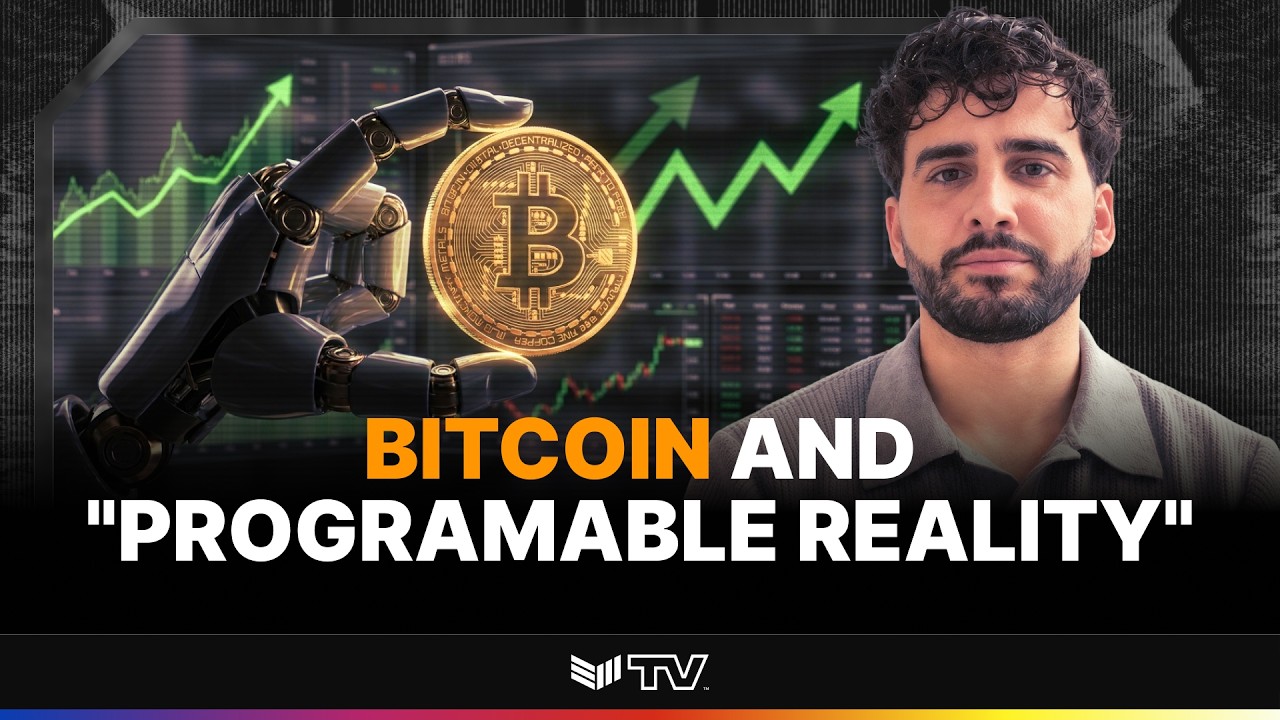
Solari Capital Founder Scaramucci: Betting on Bitcoin & Exponential Technology
Solari Capital just came out of stealth with $350 million deployed across AI, biotech, and Bitcoin. Founder AJ Scaramucci explains his “programmable reality” thesis: exponential computing power is turning biology, matter, intelligence, and finance into programmable systems. He also covers why Bitcoin is a core bet against monetary debasement.
Chapters:
0:00 AJ Scaramucci and Solari Capital’s Programmable Reality Thesis
1:22 Programmable Matter: Robotics, Alchemy, and Embodied AI
2:56 Physical Superintelligence and the Next Paradigm in Physics
4:16 How Close Are Humanoid Robots? Lessons From Waymo
5:27 Bitcoin and Monetary Debasement in Solari’s Framework
6:56 Scarcity vs. Abundance: Gold and Bitcoin vs. the Mag 7
8:23 Frontier AI Labs, Open Source, and the Application Layer
9:12 Treasure Trove and Collectibles as a Cultural Store of Value
11:39 The Dinosaur Fossil Market: T-Rex as an Asset Class
13:26 Fission Labs, Tokenized Private Shares, and the Future of IPOs
DISCLAIMER: The views and opinions expressed in this show are those of the participants and do not necessarily reflect the official policy or position of BTC Inc., Bitcoin Magazine, or any affiliated entities. This content is provided for informational and educational purposes only and should not be construed as investment, legal, tax, or accounting advice. Nothing contained in this show constitutes a solicitation, recommendation, endorsement, or offer to buy or sell any securities or financial instruments. Viewers should consult their own advisors before making financial or business decisions.
This post Solari Capital Founder Scaramucci: Betting on Bitcoin & Exponential Technology first appeared on Bitcoin Magazine and is written by Patrick Green.
Bitcoin Magazine

Hunter Biden on Bitcoin, Operation Chokepoint 2.0, and $LAPTOP
Hunter Biden’s $LAPTOP token dropped more than 98% within minutes of launch, and now he’s explaining what happened. In this interview, he walks through the plan to list on a centralized exchange, the switch to a decentralized exchange, and the market maker liquidity miss he blames for the crash. He also shares his 2028 Bitcoin price prediction.
Chapters:
0:00 Why Hunter Biden Named His Token $LAPTOP
1:36 What Went Wrong With the $LAPTOP Launch
7:07 $LAPTOP vs. the Trump Token: Tokenomics and Transparency
10:46 Operation Choke Point 2.0 and Lobbying His Father
13:30 Will Democrats Ever Get Behind Bitcoin and Crypto?
19:24 Hunter Biden on Michael Saylor and Strategy
21:22 Bitcoin Payments for Art and Global Bitcoin Adoption
24:52 Is Fiat a Sham? Banks, Wall Street, and Bitcoin
28:32 Silk Road, Bad Actors, and Crypto’s Partisan Shift
31:34 Hunter Biden’s 2028 Bitcoin Price Prediction
DISCLAIMER: The views and opinions expressed in this show are those of the participants and do not necessarily reflect the official policy or position of BTC Inc., Bitcoin Magazine, or any affiliated entities. This content is provided for informational and educational purposes only and should not be construed as investment, legal, tax, or accounting advice. Nothing contained in this show constitutes a solicitation, recommendation, endorsement, or offer to buy or sell any securities or financial instruments. Viewers should consult their own advisors before making financial or business decisions.
This post Hunter Biden on Bitcoin, Operation Chokepoint 2.0, and $LAPTOP first appeared on Bitcoin Magazine and is written by Patrick Green.
Bitcoin Magazine
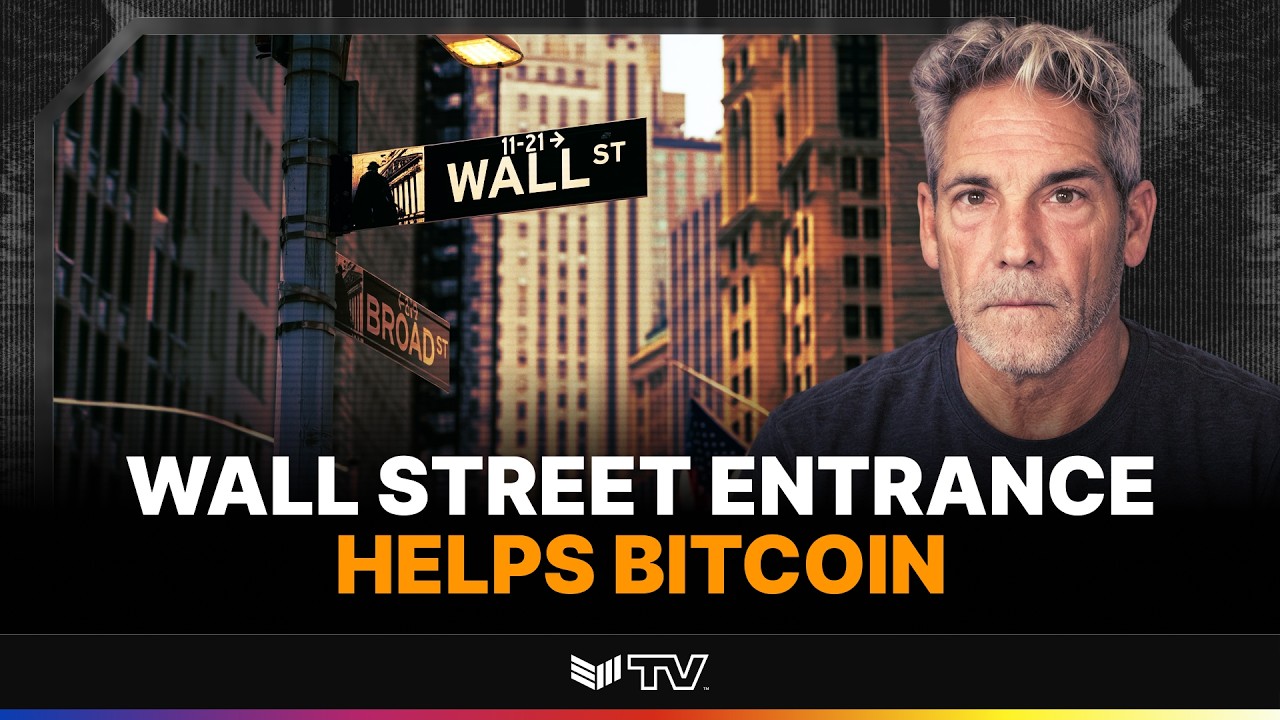
Gary Cardone: Wall Street Is Taking Over Bitcoin — For Good
The Clarity Act cloture vote failed, and Bitcoin rallied anyway. Gary Cardone, co-founder of Chargebacks911, explains why bad news has been bullish, why he thinks $75K will hold, and why he still has bids set at $66K and $68K. He also shares why he’d welcome one more retest of the low $70s.
Chapters:
0:00 Gary Cardone on Bitcoin’s Rally After the Clarity Act Vote Failed
1:38 Capital Rotation to AI and Bitcoin’s Weak Push to $126K
2:23 Why Gary Cardone Parked His Money in STRC
3:13 Collecting 10–12 Bitcoin From STRC Dividends
3:55 Why You Don’t Need to Chase Bitcoin — His $66K and $68K Bids
4:51 STRC vs. Other Preferreds: Liquidity, Yield, and Tax Treatment
6:21 Why $1M–$5M Bitcoin Price Targets Are a Bad Pitch
8:05 Bitcoin’s Real Supply and a Realistic Market Cap Target
10:05 Wall Street, the New Guard, and Bitcoin–Fiat Arbitrage
11:05 What Real Bitcoin Mass Adoption Looks Like
DISCLAIMER: The views and opinions expressed in this show are those of the participants and do not necessarily reflect the official policy or position of BTC Inc., Bitcoin Magazine, or any affiliated entities. This content is provided for informational and educational purposes only and should not be construed as investment, legal, tax, or accounting advice. Nothing contained in this show constitutes a solicitation, recommendation, endorsement, or offer to buy or sell any securities or financial instruments. Viewers should consult their own advisors before making financial or business decisions.
This post Gary Cardone: Wall Street Is Taking Over Bitcoin — For Good first appeared on Bitcoin Magazine and is written by Patrick Green.
Bitcoin Magazine

Dr. Pippa Malmgren: Investing in Bitcoin in the Age of Abundance
The US–Greenland security deal isn’t really about ice or minerals. Dr. Pippa Malmgren says it’s about the space race. The former White House economic advisor and founder of the Geopolitica Institute explains why missile tracking and satellite ground stations make the Arctic critical, and why Diego Garcia and the Chagos Islands are next. She then connects geopolitics to markets, from US debt to China’s Treasury selling to the future of Bitcoin.
Chapters:
0:00 Dr. Pippa Malmgren on Greenland, the Arctic, and the Space Race
2:04 Diego Garcia, the Chagos Islands, and America’s Strategic Bases
2:51 100% Debt-to-GDP: The Administration’s Plan to Grow Out of Debt
4:18 Why China Is Selling US Treasuries
6:31 Frontier AI Labs, Nationalization, and AI Safety
8:01 From Fiat to Digital Money: Why Money Is Becoming Intelligent
9:51 Bitcoin, Dollars, and Stablecoins: “DeFi to Refi”
10:52 Austin as the New Shenzhen and the Genesis Mission
12:39 AI Agents, Abundance, and Whether We Still Need Inflation
14:39 Stablecoins or Bitcoin for AI Agents — and the Trillion-Dollar Political Risk
DISCLAIMER: The views and opinions expressed in this show are those of the participants and do not necessarily reflect the official policy or position of BTC Inc., Bitcoin Magazine, or any affiliated entities. This content is provided for informational and educational purposes only and should not be construed as investment, legal, tax, or accounting advice. Nothing contained in this show constitutes a solicitation, recommendation, endorsement, or offer to buy or sell any securities or financial instruments. Viewers should consult their own advisors before making financial or business decisions.
This post Dr. Pippa Malmgren: Investing in Bitcoin in the Age of Abundance first appeared on Bitcoin Magazine and is written by Patrick Green.
CryptoSlate
Zano’s team says it will draw on the blockchain network’s developer fund, team members’ personal funds and committed contributors to finance recovery from an emergency rollback. The rollback removed roughly a month of previously confirmed transactions from the recovered Zano chain. The team update gives no funding amount or timetable for payments.
The team says the network is stable and it is working with partners to verify affected activity. ZANO supply and emission will remain unchanged, it said. The named sources are a funding plan, not a published guarantee that every loss will be covered. Eligibility rules and a claims process have yet to be released.
Zano’s emergency release, published Sept. 27, restarted the chain from block 3,833,000, which the release dates to Aug. 26 at 15:50 UTC. Transactions recorded on the previous chain after that point are absent from the recovered chain.
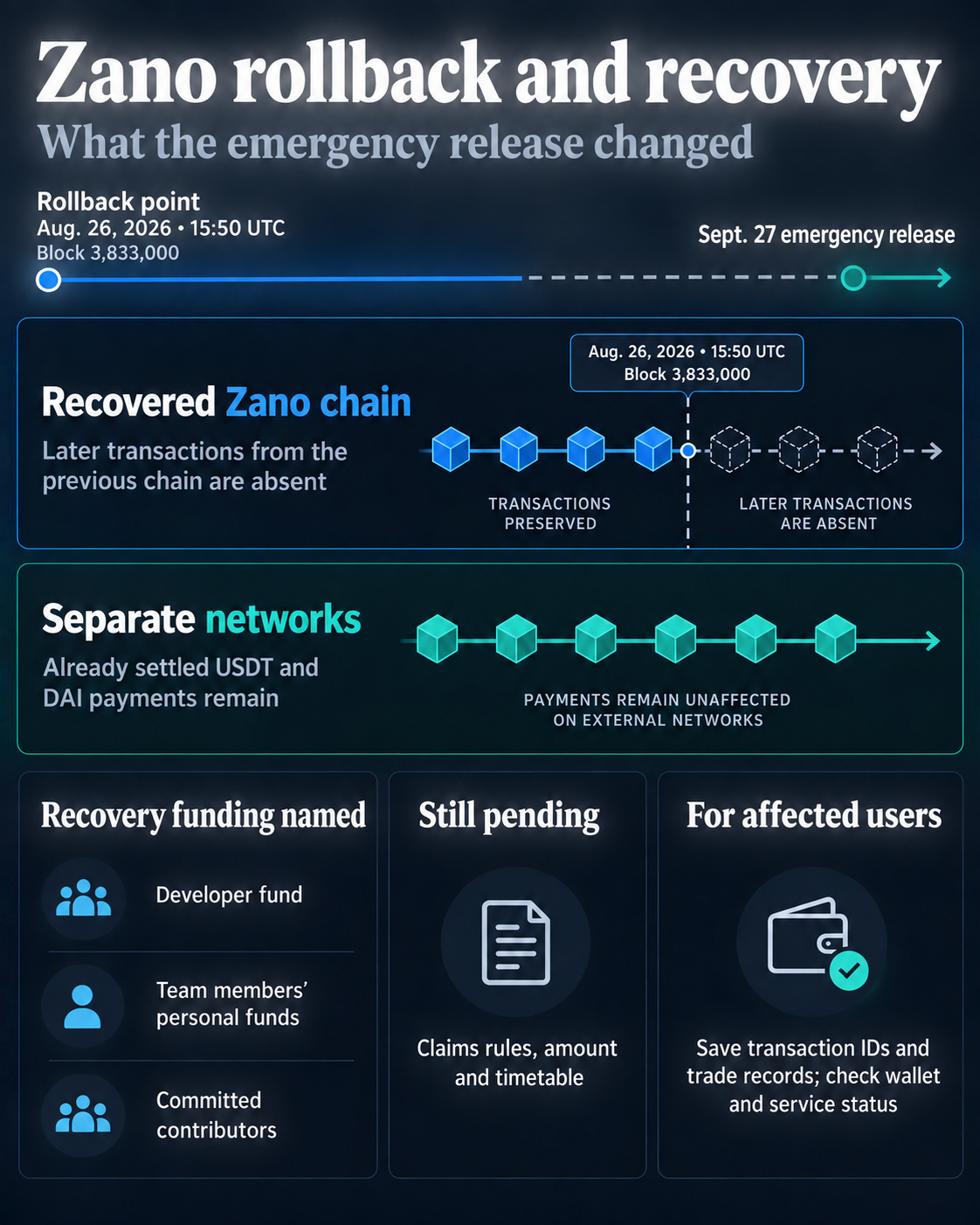
The core team said a Gateway Address vulnerability had allowed unauthorized ZANO and Freedom Dollar, or fUSD, to enter circulation. It reported no compromise of wallet spend keys or ordinary transaction privacy, while a full post-mortem remains pending. The team also said the rollback cannot undo payments already settled in USDT, DAI or other assets on separate networks. That distinction matters for a swap or trade with a Zano transaction on one side and an external payment on the other.
What affected users can do
Zano says affected users need take no claims action yet; it will publish instructions after working with partners and counterparties. Zano’s verified forum account said no claims process was live in its recent reply and advised users to save transaction IDs plus trade and exchange records. It said users can open a support ticket to put a case on record, but nobody can preapprove a claim before the rules are published.
The core team has told users to update their wallets and check a payment’s final status on the recovered chain before resending it. It is supporting exchanges, wallets and payment services as they move over, but each operator must make its own update and announce when ready. Users should confirm a service has adopted the recovered chain before sending funds to or from it.
Zano has promised a further update on wallets, services and exchanges and a post-mortem of the Gateway Address flaw. Affected users still need the separate claims instructions to know what records will count and whether the stated funding can cover their losses.
The post Zano rolls back a month of transactions as team plans to use personal funds for recovery appeared first on CryptoSlate.
Solana's faster clock has not, so far, brought a network-wide jump in skipped slots. But a Solana Foundation study published Sept. 28 found a less even result underneath that stable headline: vote latency rose as the network moved through shorter slot targets, and validators with less stake lost a larger share of vote credits than the stake-weighted network average at 250 milliseconds.
That difference matters because vote credits feed into staking rewards. The Foundation reported group credit-loss fractions, not individual SOL payouts. Its findings make the proposed move to 200ms an economic question as well as a speed question, without showing that the 250ms change itself caused the disparity.
The Foundation's analysis says skip rates stayed low and broadly stable as target slot times fell to 250ms. On that measure, the network continued to produce blocks without evidence in the study of a broad consensus problem. The 250ms feature gate was listed as active on Mainnet in the Foundation's September changelog.
Voting told a more uneven story. As the slot target shortened, the study found that votes took more slots to land, with the largest increase among nodes in Asia and South America. Solana's network-average vote latency nevertheless remained well below two slots, and the Foundation said it saw no evidence of consensus instability. Higher latency for some validators therefore sits alongside healthy aggregate consensus performance.
The geographic data have a further limit. The Foundation counted only seven Asia-to-Oceania and 35 Europe-to-Oceania leader handoffs while the 250ms target was in place. It said those small samples were insufficient to rule out a statistical fluke in the apparent regional skip patterns. They do not establish a general skip-rate penalty for validators in those regions, even as the separate vote-latency observation warrants attention.
The reward question sits in vote credits
At the 250ms target, validators counted equally lost 1.6360% of vote credits in the Foundation's table. When the same measure was weighted by stake, the lost fraction was 0.0874%. The lower stake-weighted figure means that larger-staked validators, as a group, lost proportionally fewer credits than the population of validators considered one by one.
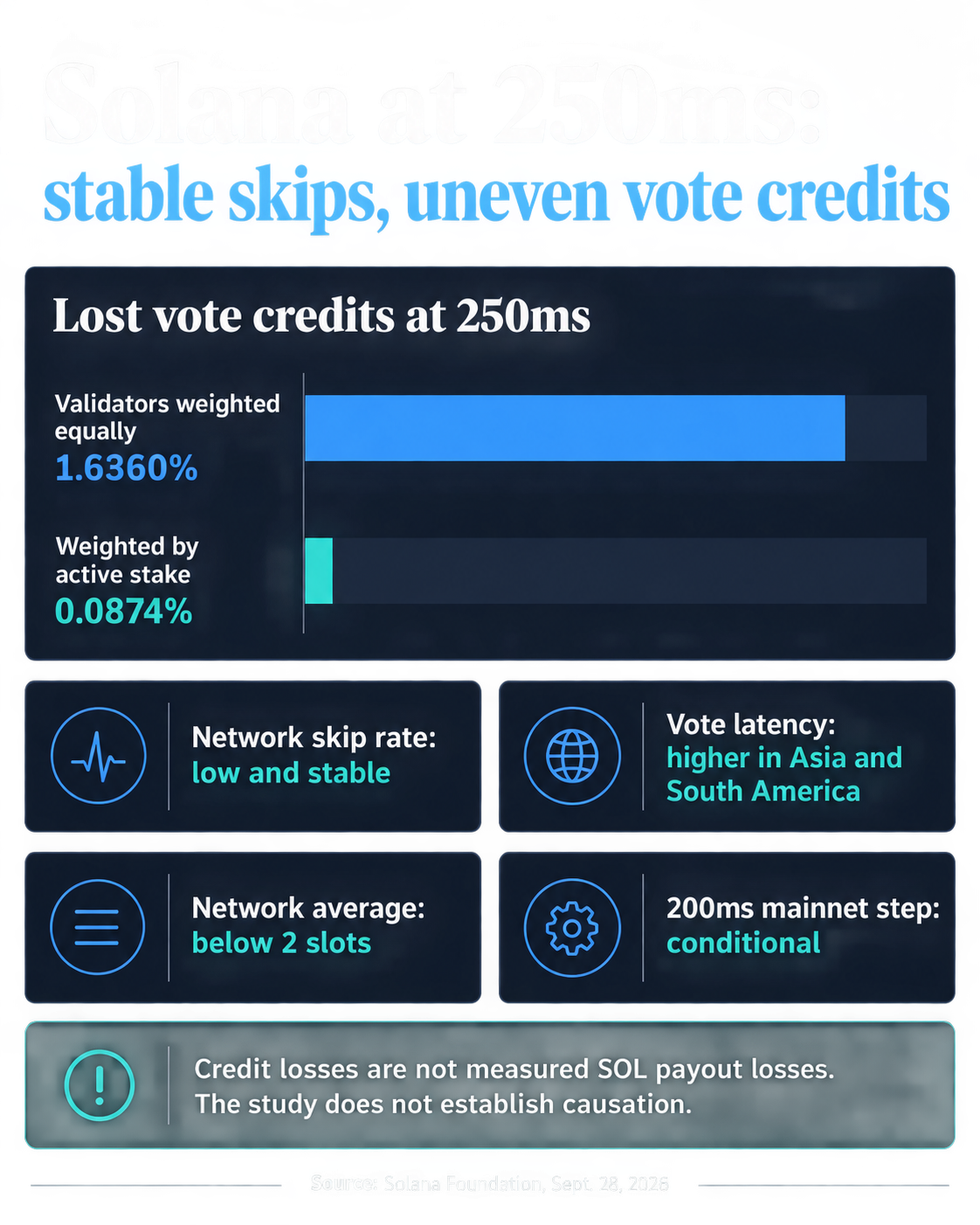
This is the divide that an aggregate uptime figure cannot describe. A stake-weighted average gives greater influence to operators with more delegated SOL. It can remain very low even when some smaller operators lose a greater fraction of credits. The table does not identify a SOL payout loss for any particular operator.
Solana's staking documentation explains the mechanism connecting votes to money: vote credits weighted by stake help determine inflationary rewards issued each epoch to validators and delegators, and validator commissions affect the amount delegators receive. That makes credit performance economically relevant. It does not make 1.6360% or 0.0874% a reward-loss percentage. Actual payouts also depend on the stake delegated, the epoch's reward pool and commissions, so neither table entry can be converted into an operator's lost SOL without account-level reward data.
Nor does the gap alone identify its cause. Stake size, geography and voting performance may be related in the observed sample, but the published group comparison does not isolate the effect of shorter slots from other validator conditions. The result is an observed distributional gap, with its cause and payout size still unresolved.
The Foundation's September study treats 200ms as a possible next target, while the staged slot-time proposal describes it as a separate feature-gated step. The cited Foundation updates report 250ms on Mainnet and discuss 200ms as a possible next target. Any forecast of validator rewards at that faster target is therefore conditional.
There is also a protocol boundary to the comparison. Under today's system, votes are transactions that must land on-chain. The Foundation says the planned Alpenglow design would instead send votes directly between validators and collect proof of voting within eight slots. If that change arrives, the present vote-latency mechanism would not carry over unchanged. The study therefore supports caution about extending today's pattern to a future 200ms network, especially one operating under a different voting design.
For a 200ms decision, the test is broader than whether blocks keep arriving. The Foundation's figures show a functioning network and uneven credit losses across stake sizes. They support scrutiny of reward distribution at the next speed step, without establishing a quantified SOL loss for any validator.
The post Solana’s 250ms data shows lower-stake validators lost a larger share of reward-linked vote credits appeared first on CryptoSlate.
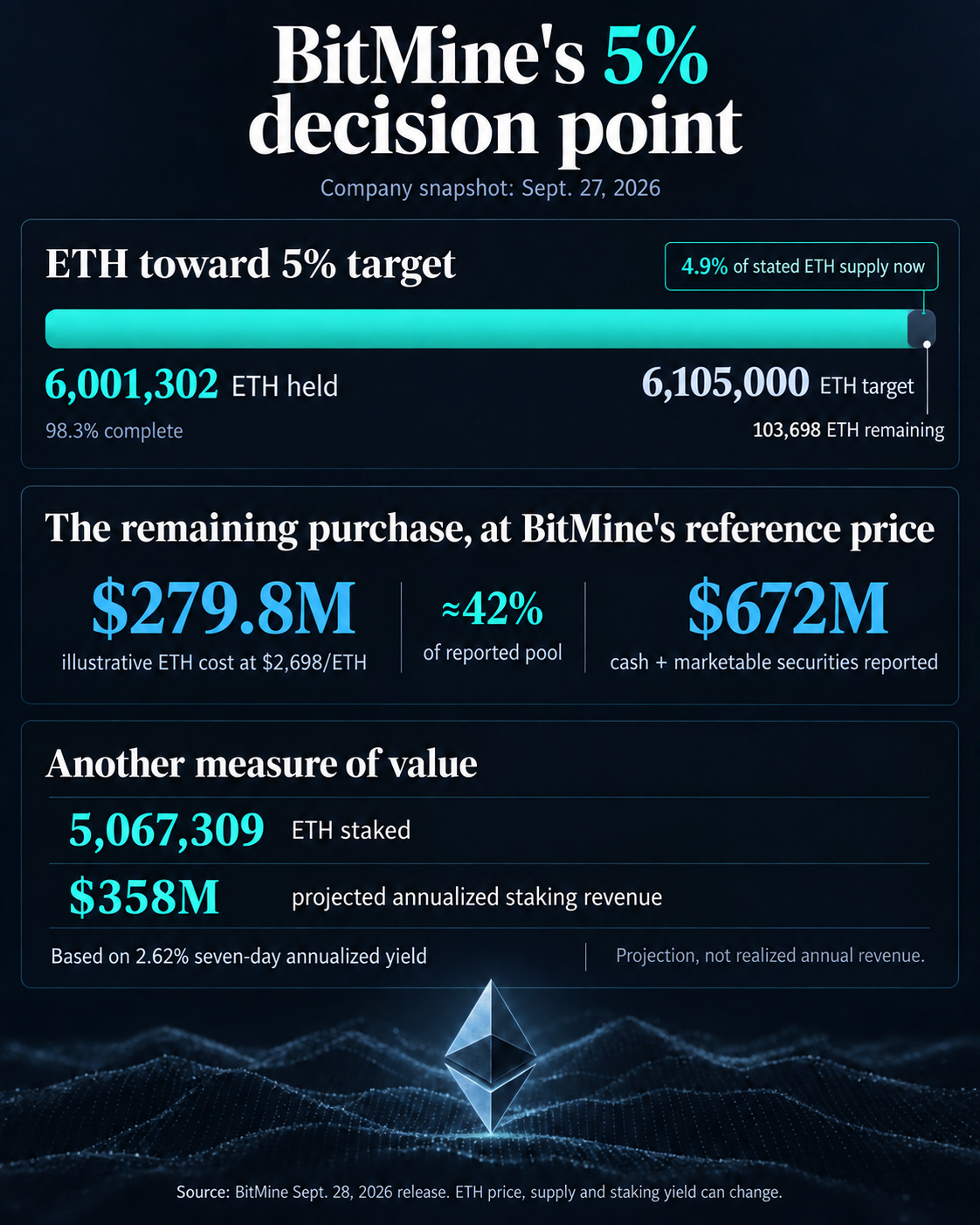
Ethereum treasury company BitMine Immersion Technologies said on Sept. 28 that it held 6,001,302 ETH, leaving it 103,698 tokens short of its goal of owning 5% of Ethereum's supply, based on the company's latest supply estimate.
Buying that remainder at BitMine's Sept. 27 reference price would cost about $279.8 million. The company reported $672 million in cash and marketable securities on the same date.
The estimated purchase cost is roughly 42% of that reported pool. Completing the goal looks affordable on paper, though ETH's price and supply can change and BitMine has not earmarked the money for that purpose.
The closer the company gets to its target, the more consequential its next choice becomes: keep adding ETH, preserve liquidity, buy back shares, or build income from the tokens it already owns.
BitMine said it acquired 17,362 ETH in the latest week, about 37% fewer than the 27,562 ETH it reported for the week before. It says it has bought ETH every week since starting the strategy in June 2025.
In July, the company repurchased about 5.5 million BMNR shares at an average price of $15.6156, roughly $85.9 million in total, while buying 7,430 ETH that week. Chairman Tom Lee said the reduced ETH buying pace reflected the share repurchase.
That precedent shows management has weighed its stock against more ETH, though the July decision does not determine its next one.
A Sept. 24 DWF Labs study found that only four of the 20 largest digital asset treasury companies by assets under management in its sample traded above one times the value of their crypto holdings, a ratio called mNAV.
Issuing shares at a premium can finance token buying without the same dilution pressure. DWF expects management and capital structure to matter more as such premiums fade.
The finding shows why the market price of a treasury company's stock is key to any plan to keep acquiring crypto after a stated target is reached.
Although BitMine is not facing an apparent cash shortage at its reported reference price, the issue is whether its next use of capital does more for shareholders than another ETH purchase.
What the existing Ethereum position can earn
BitMine said it had 5,067,309 ETH staked as of Sept. 27, about 84% of its holdings. The company projects $358 million in annualized staking revenue at that balance and $424 million in annualized rewards if it fully stakes its ETH, using a 2.62% yield measured over seven days.
BitMine also says its MAVAN staking platform has expanded to serve institutions, custodians and partners. For now, the quantified alternative to the accumulation tally is the company's projected yield from staking its own reserve.
Lee had already signaled a gradual approach to the 5% threshold and more spending on staking, infrastructure and Ethereum-related investments in July. Crossing 5% would bring more attention to whether ETH per share, staking returns, cash retained, or BMNR repurchases will best explain the value of its next allocation.
Lee is scheduled to speak at Korea Blockchain Week on Sept. 30, and his keynote is titled “Ethereum's Wall Street Moment.”
That is when investors may get a clearer answer. For now, BitMine has shown it can afford to finish the 5% goal at its price assumptions, while its plan for the capital that follows remains less defined.
The post BitMine nears 5% Ethereum threshold, yet stock valuation rules dictate its next move appeared first on CryptoSlate.
Altcoin spot volume has climbed to nearly four times Bitcoin's, the highest ratio since September 2025, according to Glassnode.
Wintermute says retail clients on its OTC desk sold BTC last week to fund that rotation, while US spot Bitcoin ETFs took in nearly $2.4 billion over the same five sessions. Each day's ETF inflow came in below the previous day's, dropping from $999 million on Sept. 21 to $134.5 million on Sept. 25.
Bitcoin is the funding asset
Wintermute's Sept. 28 OTC report described net BTC selling on its desk, driven mainly by retail clients taking profits and moving into altcoins.
Glassnode's data shows how wide the move outward has become, with 72.5% of the altcoins it tracks outperforming Bitcoin through Sept. 23, up from 39% during August's squeeze.
Altcoin perpetual open interest barely expanded over the prior 30 days, and fewer than half of tracked markets added positions, leading Glassnode to describe that stage of the rally as mostly spot-driven.
Glassnode added that similar bursts of aggressive risk-taking have often coincided with local Bitcoin tops, and it treats the ratio as a historical warning condition.
Wintermute noted that breadth has stretched to a level where the weeks that came next were flat to negative in more than 80% of comparable cases, with early-cycle periods as the exception. Wintermute wants Bitcoin to push higher to recycle fresh wealth into the alt cycle.
Bitcoin gains create that wealth, traders realize some of it and move outward, and the process can coexist with a higher BTC price as long as another buyer absorbs the coins being sold.
| Signal | Current reading | What it says |
|---|---|---|
| Altcoin/BTC spot volume | Nearly 4x | Trading activity has moved sharply toward altcoins |
| Alts outperforming BTC | 72.5% | Rotation is broad rather than isolated to a few tokens |
| August comparison | 39% | Breadth has almost doubled from August's squeeze |
| Altcoin perp positioning | Fewer than half added positions | Latest leg appears more spot-driven than leverage-driven |
| Historical breadth signal | >80% of comparable cases flat/negative afterward | Rotation is stretched, but not a deterministic top signal |
Who is absorbing the selling
Farside Investors’ data shows US spot Bitcoin ETFs taking in $999 million on Sept. 21, $714.7 million on Sept. 22, $346.9 million on Sept. 23, $190.7 million on Sept. 24, and $134.5 million on Sept. 25.
The five sessions total roughly $2.4 billion, averaging about $477 million a day, and the Sept. 25 figure is 86.5% below the Sept. 21 figure. Glassnode measures its rolling weekly reading near $2.7 billion and calls it the largest inflow in almost a year.
Beneath those inflows, Glassnode's Sept. 28 report shows Bitcoin spot cumulative volume delta down 86.5% to just $17.3 million, perpetual futures delta at negative $261.5 million, and futures open interest holding at $38.9 billion.
The share of supply in profit rose to 74% from 69.3% a week earlier, and the realized profit-to-loss ratio jumped 79.6% to 1.4. Profit-takers and perpetual sellers were active in the market while ETF buyers took the other side.
Ethereum ETFs drew $602.8 million over the same five sessions, so Bitcoin products captured roughly 80% of combined BTC and ETH ETF inflows.
Regulated money is buying across crypto and concentrating at the top of the risk curve, while some retail clients move farther out.
| Date | BTC ETF net inflow | Change vs. prior session |
|---|---|---|
| Sept. 21 | $999.0M | — |
| Sept. 22 | $714.7M | -28.5% |
| Sept. 23 | $346.9M | -51.5% |
| Sept. 24 | $190.7M | -45.0% |
| Sept. 25 | $134.5M | -29.5% |
| 5-day total | $2.386B | |
| Daily average | $477M |
Four times Bitcoin's trading measures turnover
CryptoQuant contributor Darkfost found that the altcoin market excluding Bitcoin has added about $371 billion, or 45%, since June.
He also found that 87% of Binance-listed altcoins were trading above their 200-day averages, up from roughly 20% in August. Altcoin deposits to exchanges, which measure inventory positioned to trade or sell, have reached their highest level since October 2025.
Weekly averages sit above 22,700 deposit transactions on Binance, 8,300 on Coinbase and 32,000 across other venues. Those readings sit below early-stage levels from the previous bull cycle.
DefiLlama puts stablecoin market capitalization near $306.4 billion, up 0.89% over 30 days. The windows differ from the 45% altcoin repricing since June, and the pairing fits a repricing driven by rotation among existing holders, with fresh stablecoin liquidity playing a smaller part.
Rates raise the value of a replacement bid
The Federal Reserve raised its policy rate range to 3.75% to 4.00% on Sept. 16. The 10-year Treasury yield touched roughly 5.23% on Sept. 25, its highest since 2007, and Brent crude moved above $107 on Sept. 28.
Wintermute names oil, rates and the chance of another Fed hike as the main external threats to the current regime. Altcoin speculation is accelerating while long-term yields sit at their highest since 2007, which leaves crypto leaning on outside demand for Bitcoin.
Wintermute identifies $82,500 as the level that capped Bitcoin's previous range. If Bitcoin holds the zone between $82,500 and its recent high near $87,000, and ETF flows stay positive even below last week's $477 million daily average, traders can keep moving BTC gains outward. The asset that funds the rotation stays intact.
A clean break above $87,000 would create a fresh pool of profits, and Wintermute says Bitcoin dominance may need to rise alongside another push higher. Glassnode places the next major resistance at $95,000 to $97,000.
If Bitcoin loses $82,500 while ETF inflows fade toward zero, the buyer replacing BTC sellers weakens just as speculative capital sits farthest out on the risk curve. Higher-beta altcoins with thinner liquidity would react most, and exchange deposits would show whether that inventory turns into selling.
| BTC regime | ETF signal | What happens to the rotation |
|---|---|---|
| Above $87K | Inflows remain strong/reaccelerate | BTC creates a new pool of profits; alts can receive another rotation later |
| $82.5K–$87K | Positive, even below ~$477M/day | Most supportive environment for continued BTC-to-alt profit recycling |
| Below $82.5K | Inflows fade toward zero | Replacement buyer weakens while capital is already farther out the risk curve |
| Below ~$77K | Especially dangerous if ETFs turn negative | Broader recovery structure comes into question; higher-beta alts become most exposed |
| $95K–$97K | Requires renewed demand | Glassnode's next major BTC resistance zone |
A break below Glassnode's $77,000 True Market Mean would put the whole recovery structure in question.
Volume, breadth, and desk flows have confirmed the rotation into altcoins. The funding chain behind it remains untested, and the next few ETF sessions will show whether fresh buyers keep replacing the Bitcoin being sold to pay for it.
The post Altcoin spot volume nears 4x Bitcoin’s as ETF inflows shrink across five sessions appeared first on CryptoSlate.
Bitcoin hit an intraday low of $82,563 on Sept. 28, just below a concentration of long-term holders' purchase prices that Glassnode identified last week.
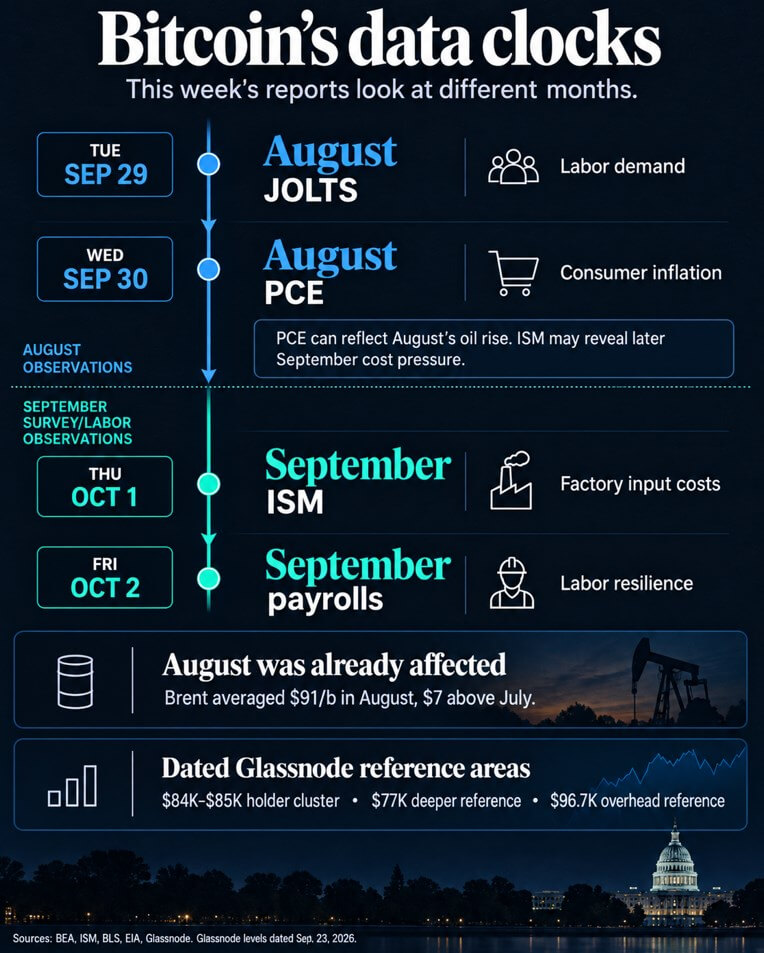
Three US data releases now threaten to send different signals about the inflation and labor outlook that drives interest-rate expectations. On Sept. 30, the personal income and outlays report will measure August. The Oct. 1 ISM manufacturing survey covers September, followed by the Oct. 2 September employment report.
A reassuring consumer inflation reading could arrive a day before a less comfortable snapshot of factory input costs. They measure different things, but traders may have to revise their view of the Fed as each lands.
Glassnode's Sept. 23 analysis mapped a large cluster of long-term holder supply at $84,000 to $85,000. That area marks where many longer-term holders acquired coins, making Bitcoin's ability to reclaim it a measurable response to the week's news.
Glassnode also identified a deeper True Market Mean reference near $77,000 and an overhead mean MVRV reference near $96,700.
Glassnode's Sept. 21 Market Pulse showed net spot taker buying, rising volume and elevated futures leverage, alongside weekly ETF outflows. Fresh spot buying, stronger volume and ETF demand would lend a rebound more weight than futures covering alone.
How a missing month could affect Bitcoin
The Energy Information Administration estimated Brent spot crude averaged $91 a barrel in August, $7 above July, as Middle East exports remained constrained.
The International Energy Agency found Gulf diesel and gasoil exports severely restricted in August and recorded a further jump in a physical crude benchmark by Sept. 9.
The Sept. 30 PCE report cannot measure the later September evolution of fuel, freight and factory costs. The International Maritime Organization recorded vessel damage in and near Hormuz on Sept. 21 and 23, evidence that shipping risk persisted after the PCE reference month.
If investors expect higher business costs to keep inflation elevated, Treasury yields and the expected Fed path could rise before a later consumer inflation report registers any pass-through. A soft August PCE print could ease that pressure initially without settling what happened next.
ISM's August report put the Prices Index at 71.1 and Supplier Deliveries at 59.3, consistent with slower deliveries. Diesel fuel and freight appeared on its list of commodities rising in price, while respondents separately discussed energy and the Hormuz conflict.
A higher September Prices reading alongside slower deliveries or cost comments would signal fresh pressure on manufacturers. New orders and employment will help show whether demand is holding up as costs rise.
The Sept. 29 August JOLTS release provides an early labor check, while the Oct. 2 September payrolls will more directly test the growth side of the policy question.
The Fed raised its target range to 3.75% to 4% on Sept. 16, saying inflation remained elevated while job gains had kept pace with the workforce. Moderate job cooling could ease rate pressure, while a much sharper miss could instead raise worries about growth.
The most revealing path this week would be soft August PCE followed by a higher September ISM Prices reading. An initial Bitcoin relief move could reverse if yields and rate expectations turn back up.
Three other outcomes would test the same framework:
- Easing without a growth scare: Softer PCE, no further ISM cost acceleration and moderate job cooling could ease yields. A reclaim of Glassnode's $84,000 to $85,000 area would carry more weight if spot demand joins it.
- Persistent inflation: Firmer price signals with resilient hiring could keep rate pressure elevated. Failure to reclaim that holder cluster would bring Glassnode's lower $77,000 reference into view, without making it a fixed destination.
- Jobs break: A severe payrolls disappointment might lower yields but still hurt Bitcoin if investors respond to a growth shock by cutting risk.
The test for Bitcoin is whether each new reading changes yields and Fed expectations, and whether spot buyers support the resulting move through Glassnode's dated holder-cost area.
The post Bitcoin’s $85,000 test comes as Wall Street gets two different inflation stories appeared first on CryptoSlate.
CryptoTicker.io
ether.fi has taken restaking out of its liquid staking token weETH and is dissolving the last technical ties to EigenLayer by the end of the year. For you as a holder that means weETH has since been an ordinary liquid staking token. It earns the rewards of the Ethereum network but no restaking premium any more, and in return it carries no slashing risk from outside services.
The occasion is a CoinDesk report of September 28, 2026, in which chief executive Mike Silagadze sets out his reasoning at length for the first time. The ether.fi documentation supplies the timetable. Together they describe a retreat from a business that two years ago counted as the big bet of the Ethereum ecosystem.
How large that retreat is takes one figure to show: weETH was the largest liquid restaking token of all. When that product of all products throws off restaking, it is not a detail of product maintenance. Ethereum traded at around $2,716 on the morning of September 29; anyone holding ether through such a certificate feels the change in the make-up of their yield, hardly at all in the price.
Restaking out of weETH: the August 2026 rebuild
Restaking means that already staked ether is pledged a second time as collateral, this time for outside services that attach themselves to the security of the Ethereum network. EigenLayer invented the procedure and made it big. Liquid restaking tokens such as weETH bundled both into one tradeable instrument: the normal staking reward and the additional premium from restaking.
In August 2026 ether.fi cleared that second layer away. Since then weETH represents ordinary Ethereum staking alone. The provider's documentation puts it soberly: rewards come from Ethereum's consensus and execution layers, they are variable and not guaranteed, and they contain neither restaking income nor slashing exposure to EigenLayer services.
Silagadze commented on the rebuild in four words: "End of an era. Sad." To CoinDesk he was more specific. There had been no yield worth mentioning in restaking, and stakers had perceived a certain risk, so an exit had seemed sensible. Users had been notified several times and had consented to the change.
What separates weETH from eETH
Both tokens stand for the same staked ether; they only book the proceeds differently. eETH is a rebasing token: your number of units grows as rewards accrue. weETH is the wrapped, non-rebasing variant. The number of units stays the same, while the value of one weETH measured in eETH rises. The distinction is no quibble, because it later decides how a gain becomes visible for tax at all.
EigenPod withdrawal credentials: the timetable to the fourth quarter
The exit runs in stages, and ether.fi puts numbers on them in its own documentation. In August 2026, it says, less than one percent of protocol funds were still in restaking. That remainder was to disappear by the end of the third quarter of 2026, that is by September 30. The withdrawal credentials of the EigenPods, the technical bracket between ether.fi's validators and EigenLayer, are to follow by the fourth quarter of 2026.
By the end of the year, then, nothing is left of the connection that could still bite in an emergency. For you the second date is the interesting one. As long as the withdrawal credentials exist, part of the path by which your ether leaves the network again still runs over outside code. After that it does not.

$10 billion secured, $99,977 in fees: why restaking no longer pays
The chief executive's reasoning can be checked against the numbers, and they are merciless. CoinDesk sets two values side by side for the week to September 8. The restaking sector as a whole secured $10.02 billion at that point and took $99,977 in fees for it. That is the turnover of a mid-sized trade business, spread across assets in the tens of billions.
Provider profits follow the same curve. The five largest liquid restaking protocols, namely Renzo, Kelp, Swell, Puffer and Bedrock, together earned $953,350 in gross profit in the second quarter of 2026. Three quarters earlier the figure had been $2.18 million. Taken individually the picture gets starker still: $21,590 fell to Puffer, $22,370 to Swell.
EigenLayer itself has felt the collapse most sharply. The protocol's secured assets stood at $22.06 billion in August 2025 and stand at $5.10 billion today. The peak is put at between $19.7 billion and $22.1 billion depending on the count; the direction is the same either way. The project now trades as EigenCloud and puts verifiable computation to the fore, with deposited capital serving only as the underlay.
Liquid staking versus restaking: 53 times the revenue per dollar
The comparison that matters is in the same CoinDesk analysis. Ordinary liquid staking secured $51.87 billion in the week to September 8 and earned $27.35 million in fees on it. Per dollar secured, plain staking therefore earns roughly 53 times what restaking brings in.
That explains why the exit was commercially unavoidable. A provider that carries an additional default risk for the second security layer while receiving practically nothing for it is subsidising somebody else's business model with its customers' capital. Anyone letting their ether work through a service provider should therefore check regularly which sources of income their provider still taps at all and how much of it arrives with them; our overview of staking providers shows how far the terms diverge.
A side effect concerns commissions. When a source of income falls away, the share the provider retains of the remaining proceeds does not change arithmetically. But it weighs more heavily, because the base has become smaller.
weETHs on Symbiotic: what the second token means for holders
ether.fi has not abolished restaking but outsourced it. Anyone who still wants a restaking premium can switch into weETHs, a separate token built on Symbiotic instead of EigenLayer. Restaking is thus no longer an extra that every weETH holder carries automatically, but a decision you have to take actively.
For most holders that is precisely the good news. The risks are separated again and can be named one by one. Those who do not want them need do nothing; those who do know what they are taking on.
Symbiotic in one sentence
Symbiotic is a competing restaking platform that lends deposited capital to outside networks and says it has more than fifty of them connected. The procedure solves the same problem as EigenLayer but with a different risk architecture, and it faces the same thin market for fees.

Yield, risk, slashing: the three quantities behind the weETH return
Slashing is the penalty a validator pays for breaking the rules of the network: part of the deposited ether is confiscated. With ordinary staking there is exactly one source for that penalty, namely the Ethereum network itself. With restaking a further one is added for every connected service, with its own rules and its own points of failure.
The yield you get for it remains variable. ether.fi expressly does not guarantee it, because it depends on how busy the network is and on the fees users happen to be paying. What the rebuild changed is the composition: the fluctuating but manageable network yield stays, the additional premium falls away, and with it a bundle of risks few people could take in fully.
How much the provider's commission eats into that yield was shown by our analysis of fourteen staking providers on September 13, 2026. The finding holds unchanged after the rebuild; it simply weighs more heavily now.
Buying and custody: weETH through MiCA-regulated providers in Europe
This is the biggest hurdle for European investors, and it has nothing to do with the rebuild. weETH is a DeFi token. A regulated European exchange will not as a rule put it in your account. You buy ether from a provider with MiCA authorisation, pull it into a wallet of your own and deposit it there yourself.
That shifts responsibility entirely to you. There is no deposit guarantee, no provider to restore lost access, and no European supervisor to step in over a flaw in the contract code. Anyone taking this route needs a hardware wallet, a securely stored recovery phrase and the patience to test both once before the first larger amount.
Holding period and accrual: how the tax office treats staking income from weETH
This is where the technical distinction made above comes back. With a rebasing token such as eETH the number of units grows, and every credit can be read as an accrual taxable in the year it accrues. With weETH the number of units stays constant, the gain sits in the exchange ratio and only becomes visible on sale, which argues rather for treatment as a disposal gain.
The question is not conclusively settled, and it is why in our piece on restaking, liquid staking and tax of July 22, 2026 we counselled caution: new products meet old rules that were never written for them. The disappearance of the restaking premium at least simplifies matters, because one type of income, and with it one question of demarcation, falls away.
In practice that means documenting every inflow and outflow with date, quantity and price, from day one. Anyone who has to reconstruct that afterwards ends up paying for gaps that two clicks could have closed at the moment of booking. Only a tax adviser can give a dependable statement about your own liability in any case.
Unstaking at ether.fi: queue, liquidity and the way back into ETH
The way back runs through a redemption in the provider's interface. There is no fixed deadline for it. In its documentation ether.fi names three quantities on which the duration depends: the liquidity available in the protocol, the withdrawal queue of the Ethereum validators and general network load.
Anyone wanting to sell towards a fixed date should allow for that uncertainty and not assume the exit will succeed on the same day. The second route runs through the market: weETH can be traded, and in quiet phases the market price sits close to the calculated value. In hectic phases it does not, and that is exactly when many want out at once.
ETHFI, ETH and the neobank rebuild: the second-quarter numbers
The exit from restaking is also the consequence of a rebuild inside the company. ether.fi's gross profit fell from $18.71 million in the third quarter of 2025 to $9.99 million in the second quarter of 2026, a drop of 47 percent. At the same time the card business has grown: its share of monthly revenue rose from 17 percent in January to 46 percent in July.
Silagadze describes that as a successful swap. Income from the banking business had entirely replaced the loss of restaking revenue and the lower ether price; the annual run rate of total revenue would rise by about 38 percent, while income from staking and restaking had fallen by 70 percent. These figures come from the company itself and are not supported by audited accounts.
For you as a holder that is no footnote. A provider drawing half its revenue from a card business is a different company from a pure staking service, with different dependencies and different supervisory questions.
weETH and restaking: how to proceed now
- Check what you actually hold. Look in your wallet to see whether weETH, eETH or weETHs is sitting there. Only weETHs still carries restaking risk after the rebuild. Which returns are available from other providers and on what terms is shown by our comparison of staking platforms.
- Bring your records up to date. Record the date, quantity and price of every movement, including a switch between the token variants. A tax and portfolio tracker takes the reconstruction off your hands, as long as you set it up early enough.
- Choose your exit route deliberately. Redemption with the provider and a sale on the market lead to different waiting times and different prices. Anyone selling through an exchange anyway should compare the fees first; which houses are authorised under MiCA is in our exchange comparison.
(As of September 29, 2026. This article is not investment advice. Prices and fee structures change; check the terms with the provider before you buy.)
The information provided in this article is for informational purposes only and does not constitute financial advice. Cryptocurrency investments carry a high degree of risk.
Crypto paper trading means trading at real prices with money that does not exist. Every order is booked and every profit and loss is calculated, but nothing ever reaches an exchange. It is the cheapest way to watch a strategy fail, which is exactly the point. What paper trading cannot do matters just as much: it simulates the market, not you. This guide explains how paper trading works for crypto, how to start without an account, and the three places where the simulation is kinder than reality.
Crypto Paper Trading: Key Points at a Glance
- Paper trading is trading at real prices with simulated execution. No money moves, so you cannot win any either.
- Free and without signing up, you can practise in the CryptoTicker trading simulator: $10,000 in play money, 50 coins, unlimited trades, as of September 28, 2026.
- Fees belong in the simulation. At 0.05% per execution, 20 round trips a day at full position size cost 2% of the account in a single day.
- Losses weigh double: in Tversky and Kahneman's 1992 study, a loss weighed about 2.25 times as much as an equal gain. Paper trading barely trains that part.
- Risking 1% per trade on $10,000 means losing no more than $100 before your stop.
- Move to real money only after four weeks without breaking a rule, and then with less money than you practised with.
What is paper trading?
The term dates from before trading software: anyone who wanted to test an idea wrote the purchase, price and quantity on paper and later worked out what would have happened. Today software does the job. It reads real prices, fills your orders against them and turns that into an account balance, open positions and a result.
A paper trade is a single simulated trade: entry, stop, target and exit, booked at market prices without an order ever reaching the order book.
Paper trading and a demo account mean almost the same thing in practice. The difference is the provider: a demo account is usually a broker's practice account, designed to lead you into a funded one. Paper trading is the method, and it works without a broker. What to look for in a demo account is covered in our guide to the trading demo account without signing up. If you want to trade for real afterwards, you need a regulated exchange; our exchange comparison sets out fees and licences.
How does crypto paper trading work?
Every paper trading platform does three things at its core:
- Read prices. It pulls prices continuously from an exchange or data provider. The closer they are to real time, the more honest the result.
- Simulate orders. Market, limit, stop loss and take profit orders are checked against the current price and filled once the condition is met.
- Keep the books. Balance, position size, fees, liquidation for leveraged positions, and the result in dollars and percent.
The sentence that matters: the prices are real, the execution is not. Your simulated order moves no price, always finds a counterparty and never waits in a queue. Why that matters is explained below under the three gaps.
Crypto paper trading for free, without signing up
Crypto differs from stocks in three ways: the market never closes, leverage of up to 100x is common on perpetual futures, and daily moves of ten percent are no exception for smaller coins. A crypto simulator should therefore run around the clock, allow long and short positions and calculate liquidation.
The trading simulator in the CryptoTicker Trading Hub works like this, as of September 28, 2026:
- No signup, no credit card. You open the page and trade. Your progress is saved in the browser; you only need an account to continue on a second device.
- $10,000 in play money, unlimited trades. Nothing is ranked, and you can reset at any time.
- 50 coins at real prices. You can trade the 50 largest coins with more than $50 million in daily volume.
- Long, short and leverage. Choose between leverage of up to 10x or up to 100x and watch how quickly liquidation approaches.
- Three levels. Beginner, Standard and Pro; the beginner mode keeps leverage and short selling out of the way at first.
Other ways to paper trade crypto:
| Route | Signup | Starting balance | Crypto | As of |
|---|---|---|---|---|
| CryptoTicker trading simulator | none | $10,000 | 50 coins, long and short, up to 100x | 28.09.2026 |
| Paper trading on a charting platform, such as TradingView | free account | $100,000 by default, adjustable on reset | yes, alongside stocks, forex and futures | 28.09.2026 |
| A crypto broker's demo account | usually email, often a phone number | depends on the provider | the broker's products | 28.09.2026 |
A charting platform is strong if you already do your analysis there. A broker's demo account makes sense once you have chosen that broker. A simulator without an account is the shortest route to your first paper trade.
The three gaps between paper trading and real trading
Gap 1: execution
A simulated market order is filled at the displayed price. A real one hits the order book, and with large orders or thin markets the price moves before everything is filled. That difference is called slippage. For bitcoin and ether at retail position sizes it is usually small; for small coins in hectic minutes it is not. That is why the CryptoTicker simulator only lists coins with high daily volume.
Gap 2: costs
A paper account without fees makes every strategy look better than it is. A worked example using the fee the CryptoTicker simulator charges, 0.05% per execution:
| Assumption | Value |
|---|---|
| Account balance | $10,000 |
| Position size per trade | $10,000 |
| Fee per execution | 0.05% = $5 |
| Cost per round trip | $10 |
| 20 round trips a day | $200 = 2% of the account |
| 20 trading days | $4,000 = 40% of starting capital |
The calculation is deliberately simple and ignores compounding, but it shows the mechanism: if you trade a lot, you have to earn the fees first. On perpetual futures the funding rate comes on top, settled between longs and shorts several times a day depending on the exchange. How perpetuals work is explained in our comparison of the best perp DEXs.
Gap 3: you
The biggest gap is psychological. In 1992, Amos Tversky and Daniel Kahneman measured that people weigh a loss about 2.25 times as heavily as an equal gain. With play money the effect is weak: a 20% drawdown is a number on a screen. With your own money it is the moment people move their stop lower instead of letting it trigger.
Paper trading trains your rules, not your nerves. That is not a reason to skip it but a reason to do it properly: with fixed rules that you write down in advance and actually follow in the simulation.
How to paper trade properly: four weeks with rules
- Week 1: write your rules. Risk no more than 1% per trade, which is $100 on $10,000. Set the stop before you enter. No more than three losing trades a day, then stop.
- Week 2: size your positions. Position size equals risk divided by stop distance. With a stop 5% below entry, the position may be $100 ÷ 0.05 = $2,000. At 10x leverage that ties up $200 of margin, but the risk is still $100.
- Week 3: keep a journal. For every trade, note the reason, entry, stop, target and result. After 20 trades you will see which setups work and which only generate fees.
- Week 4: count rule breaks. Every moved stop and every exceeded limit is a rule break. The goal is zero, not a high balance.
Order types, charts and risk basics are explained in our crypto trading guide for beginners.
From paper trading to real money
The switch only makes sense once three things hold for several weeks: no rule breaks, a known maximum drawdown that you sat through, and a result after fees. Then one simple rule applies: your first real stake is smaller than your play money, not larger. If you practised with $10,000 and deposit $1,000, recalculate every position with the same formula rather than simply scaling down.
Real money also means tax. In many countries, selling or swapping crypto is a taxable event. Our guide on how to file crypto tax covers the basics; for your own situation, ask a tax adviser.
Where to go after your first paper trade, from order types and position sizing to a four-week practice plan, is set out in our guide to learning to trade online for free. If you then want to start with real money, our exchange comparison lists fees, licences and deposit methods.
Sources
- Amos Tversky, Daniel Kahneman: Advances in Prospect Theory: Cumulative Representation of Uncertainty. Journal of Risk and Uncertainty 5 (1992), pp. 297 to 323.
- TradingView Help Center: Paper Trading, functionality and initial capital, as of 28.09.2026.
- CryptoTicker Trading Hub, trading simulator, as of 28.09.2026.
Anyone moving funds onto Base for the first time notices quickly that the network is very fast in one direction and very slow in the other. The trip from an exchange to Base takes minutes and costs fractions of a cent. The official way back to Ethereum takes seven days. That is neither a fault nor congestion; it is built into the design of the network. This piece explains both directions, shows what a transfer really costs, and walks through Basescan, the block explorer you use to see what happened to your money.
Base is the Ethereum extension built by the American exchange Coinbase. According to DefiLlama data, the decentralised exchanges on this network handled swap volume of around $1.2 billion in a single day at the end of September. Even so, it remains largely unfamiliar ground for European users: search for the explorer or the bridge in your own language and you will find almost nothing but the providers' own English guides.
What Base is: an optimistic rollup from Coinbase on the OP Stack
Base is a layer 2. The term means a blockchain of its own that draws its security from a larger network instead of producing it itself. Base bundles its users' transactions, processes them cheaply on its own chain and then writes the result to Ethereum. The data on which a dispute would be settled therefore sits on Ethereum, while the computing work happens on Base.
Technically Base belongs to the family of optimistic rollups. Optimistic here means that the network first assumes the results reported to Ethereum are correct and gives everyone a window in which to challenge a false entry. The verification procedure behind it is called a fault proof. The independent monitor L2Beat lists Base as an optimistic rollup at maturity "Stage 1", the middle of three stages, at which some of the emergency powers still sit with a security council.
Base is built on the OP Stack, an open construction kit for layer-2 networks. That is why every tool you know from Ethereum works on Base without modification: the same wallet formats, the same addresses, the same kind of smart contracts. Convenient, and at the same time the most common source of error, because the same address exists on both networks while funds still land on only one of them.
Base network details: chain ID 8453, ETH for gas and no token of its own
Three pieces of information are enough to enter Base into any wallet. The chain ID is 8453, the number by which wallets and applications tell networks apart. The standard endpoint is mainnet.base.org. And the currency for fees is Ether, the same ETH you know from Ethereum. All three values appear exactly like that in the network overview in the Base documentation.
From that follows the most important sentence for anyone starting out: Base has no network token of its own. You need ETH on Base to be able to send a transaction at all. Anyone who moves only stablecoins onto the network without a cent of ETH is left with a visible balance that cannot be moved. What trades under the name Base are projects running on the network, not the network itself; we have written up the look at the Coinbase chain's ecosystem separately.
Setting up a wallet: Base App, MetaMask and the manual entry
Coinbase now runs its own wallet under the name Base App. The network is already configured there, so there is nothing for you to enter. If you use a wallet from another provider, you will in most cases find Base in a list of prepared networks and simply select it.
If only the manual route is left, you enter the three values from the previous section: chain ID, endpoint and ETH as the currency. After that the wallet shows Base as a network of its own alongside Ethereum, and your balance appears differently depending on which network is selected. Which type of wallet suits which amount is broken down in our software wallet comparison; the general procedure for any network is in our overview of adding networks, bridges and explorers.
One note that saves a lot of trouble: a wallet address is valid on Base and on Ethereum alike. You do not have two addresses but one address on two networks. That is exactly why copying the right address is not enough — you also have to select the right network.
Base fees: what a transfer really costs at the end of September
A fee on Base is made up of two parts. The first pays for the computing work on Base itself. The second pays for the space on Ethereum where the data is later stored. Together they make up the amount your wallet displays, and both are settled in ETH.
At the end of September we recalculated several real transactions from a live Base block. The result: a simple transfer cost around 0.13 cents, an elaborate interaction with a smart contract around 3.6 cents. The share accounted for by the space on Ethereum came to a few hundredths of a cent in each case and barely registered against the computing work.
For comparison: the same transfer directly on Ethereum costs a multiple of that, depending on load. That gap is precisely why Base exists. It comes at a price, though, and the price only becomes visible when you want your money back.

The way in: an exchange withdrawal straight onto Base instead of a detour via Ethereum
There are two routes onto the network, and the cheaper one is the one most people overlook. At many trading venues you can send your funds straight onto the Base network when you withdraw. You simply pick Base rather than Ethereum as the destination network. The exchange handles the transfer internally and you pay only its withdrawal fee, often a matter of a few cents or nothing at all.
The second route runs over the official bridge from Ethereum to Base. You send ETH from your own wallet to a contract on Ethereum, and a few minutes later the same amount appears on Base. This route costs you a full Ethereum transaction, so considerably more than the exchange withdrawal. It is worth taking above all when your money already sits in your own wallet on Ethereum.
A third factor often decides the cost question more than the transfer itself: what you paid when you bought on the exchange. How those fees are put together we worked through, using Coinbase as the example, in our breakdown of Coinbase's fees.
One caveat belongs here: maintenance windows and network upgrades halt deposits and withdrawals for a time. For the hard fork at the end of September several trading venues suspended Base transfers for a few hours, as we described in our piece on the Cobalt switch on September 30. If you are transferring on a day like that, it is better to plan in some slack.
The way back takes seven days: fault proofs and the challenge period
The official route from Base back to Ethereum runs in three steps, and the Base documentation describes them expressly. First you send the withdrawal on Base. Then a proof is submitted on Ethereum that this withdrawal actually took place on Base. Only after that does the real waiting time begin.
That waiting time is called the challenge period, and at Base it lasts seven days. The official documentation on bridging and withdrawals puts it unambiguously: standard withdrawals to Ethereum must wait seven days before they can be completed. Only once that period has elapsed can the withdrawal be finalised on Ethereum.
The reason lies in the word "optimistic". Because the network initially accepts its results unverified, it needs a window in which someone can challenge a false entry. Seven days is that window. It protects you personally from an error rather less than it protects the entire balance held on Base from a falsified report to Ethereum.
In practice that means anyone who needs their money at short notice should not treat the official way back as an emergency exit. And once the seven days are running, the process cannot be sped up — the period expires regardless of how urgent the matter is.
Intent bridges: a faster way back over liquidity providers, with a risk of its own
There are providers at which a withdrawal from Base arrives in minutes rather than days. What matters is understanding what actually happens, and the Base documentation is clear on the point: these services do not shorten the challenge period at any stage; instead they front you the money.
The mechanism is called an intent bridge. You declare which amount you want on which network. A liquidity provider pays you that amount on the destination network immediately and takes your funds on Base in return. It then sits through the seven days itself. Your waiting time has been taken over by somebody else, and they charge a discount for it.
From that follows a risk the official bridge does not carry: for the duration of the process you are trusting a contract and an operator, not only the network. Bridges have for years been among the most frequently attacked components in crypto. For small amounts and a quick switch that is often acceptable; for the bulk of a portfolio, rather less so.
Reading Basescan: status, token transfers and granted approvals
The block explorer for Base is called Basescan and sits at basescan.org. A block explorer is a window into the blockchain: you enter an address or the identifier of a transaction and see what actually happened, regardless of what your wallet displays.
Four items matter day to day. The status tells you whether the transaction went through or was aborted with an error; an aborted transaction still costs a fee. Under token transfers you see which tokens actually changed hands in the operation, which in swaps often differs from the display in the wallet. The transaction fee field shows the fee really paid, in ETH. And the token approvals tab lists every approval your address has ever granted.
That last tab is the most valuable and the least used. Anyone who swaps regularly on a network accumulates a long list of open permissions there over time. Tools that pull such overviews together across several networks are in our comparison of analytics platforms.

Typical mishaps: wrong network, missing gas, counterfeit tokens
Three mistakes catch out nearly every newcomer, and all three can be headed off in advance.
The withdrawal to the wrong network. You withdraw from an exchange, pick Ethereum instead of Base by accident, and the funds end up at the right address on the wrong network. That is not a total loss, because the address belongs to you on both networks. But you have to move the money over a bridge and pay Ethereum fees for it. The same applies in reverse. So check the destination network in the withdrawal dialogue before you confirm.
The missing fee token. You hold stablecoins on Base but no ETH. Every transaction fails, including sending on the stablecoins themselves. The remedy is a small amount of ETH placed on the network in advance; the equivalent of a few euros covers a great many transactions.
The token that sits in the wallet but is worthless. On open networks anyone can create a token with any name they like and send it to other people's addresses. A familiar name appearing in your wallet means nothing. What counts is the contract address alone, and you check that in the explorer against the project's own figure. An unsolicited token that invites you to swap it on an unfamiliar site is the entry point to an attempted fraud.
Revoking approvals and spotting phishing on Base
An approval is the permission you grant a smart contract to move a particular token from your address. Without it no swap on a decentralised exchange works. The problem is its duration: many applications ask by default for an unlimited approval, and it stays in place until you actively withdraw it.
Revoking is a simple operation. You call up the list of your approvals, select the entries you no longer need and send a transaction that sets them to zero. On Base, thanks to the low fees, that costs fractions of a cent. Such a sweep makes sense whenever you have not used an application for a longer stretch.
With phishing, things run on Base as on any other network. The most dangerous thing is rarely the fake input mask for a recovery phrase. The heavier risk is the signature you give for something you have not read. Before every confirmation your wallet shows you which contract receives which permission. Anyone holding larger amounts is better off keeping them separate from the wallet they use day to day.
Tax in Germany: what bridging and swapping trigger
For investors in Germany the principle in section 23 of the Income Tax Act applies: selling or swapping a cryptocurrency is a private disposal transaction. If the purchase is more than a year in the past, a gain remains tax-free. Below that it counts as taxable income as soon as the sum of all private disposal transactions in a year exceeds the exemption threshold.
On Base two operations have to be kept apart. When you move ETH over the official bridge between Ethereum and Base, it stays the same asset under your own control; the holding period keeps running. When you swap one token for another on Base, by contrast, that is a disposal transaction like any on an exchange, with everything that entails. With an intent bridge you should look closely at what was actually booked, because in some cases a swap happens there rather than a transfer.
Because many small transactions pile up on Base, the documentation quickly becomes hard to follow. It is best kept as you go rather than reconstructed in the spring. This information does not replace tax advice; assessing a specific case belongs in expert hands.
Market depth on Base: one provider carries half the swap volume
Daily volume on the decentralised exchanges on Base stood at around $1.2 billion at the end of September, according to DefiLlama figures, and roughly half of that fell to a single provider, the Base-native exchange Aerodrome. That is a high concentration and worth knowing about: a large part of the market depth hangs on one project.
For small and medium amounts, Base is therefore one of the cheapest ways to move and swap funds. For large holdings the calculation shifts. There the one-off Ethereum fee barely registers, while the seven days to final withdrawal and the risk of fast bridges weigh more heavily. The honest answer is therefore that Base suits what you move well, and what you leave sitting rather less well.
Base in daily use: your next three steps
- Set the network up properly and put gas aside. Enter Base with chain ID 8453 into your wallet or pick it from the list, and send yourself a small amount of ETH on the network before you transfer anything else. Which wallet suits which amount is set out in our hardware wallet comparison.
- Try the way in with a small amount. Withdraw a two-figure euro amount from your trading venue straight onto the Base network and then look the operation up in the explorer. That way you learn how the network behaves on a sum whose loss would not hurt. Which trading venues are authorised in the EU and what their withdrawals cost is shown in our comparison of regulated crypto exchanges.
- Document every movement from the outset. Note the date, the amount and the equivalent value on every swap, so that the holding period can be traced later. Which programs record that automatically is shown in our comparison of tax and portfolio tools.
(As of September 29, 2026. This article is not investment advice. Prices and fee structures change; check the terms with the provider before you buy.)
The Ethereum price stood at $2,711 on Tuesday morning, or 2,392 euros, roughly 1.2 percent above where it was 24 hours earlier. The real news of the day, though, is not in the price but in the fee. A simple ETH transfer on the Ethereum network currently costs about six cents. Anyone who wants to move funds off an exchange into their own custody, consolidate several addresses or revoke an old token approval has an unusually cheap window for it.
This article lists the numbers one by one, works through the cost of the three most common transaction types, sets out what a move between your own addresses means for tax, and names the deadline that falls on October 6 on the Sepolia testnet. All price figures come from the exchange Kraken, the fee readings from Etherscan's gas tracker, both taken on the morning of September 29.
Ethereum price today: $2,711 and an eleven-dollar spread across six daily closes
In euros, ETH stood at 2,392 euros on Tuesday morning. The trading range of the past 24 hours ran from 2,319 to 2,408 euros. In dollar terms the price is $2,711, with a daily low of $2,637 and a daily high of $2,734.
What stands out is not the movement but its absence. The six daily closes from September 23 to September 28 came in at $2,683.99, $2,687.24, $2,691.35, $2,695.35, $2,688.02 and $2,687.45. Between the highest and the lowest of those six closes lie $11.36, less than half a percent. A market that closes inside such a bracket for six days running has neither buyers nor sellers willing to shift the price.
The frame for this quiet spell was set the week before. On September 20 ETH fell as far as $2,563; on September 21 the price shot up to $2,807 and closed at $2,776. Since then the range has narrowed day by day. For you as an investor that means one thing above all for now: the risk that the price moves appreciably while a transfer is in flight is currently small.
Ethereum gas around 1 Gwei: what an ETH transfer costs on Tuesday
Gas is the unit in which Ethereum measures the work a transaction takes. The price of that unit is quoted in Gwei, and one Gwei is a billionth of an ETH. The arithmetic is simple: gas used times the gas price in Gwei gives the fee in ETH.
On Tuesday morning the base fee suggested by the network ranged between 0.89 and 1.31 Gwei across several readings, and sat at roughly 1.1 Gwei in the most recently measured blocks. For a fast confirmation the gas tracker quotes values around 1.25 Gwei. That gives the following costs, calculated at the euro price of 2,392 euros per ETH:
| Operation | Gas used | Cost at 1.1 Gwei | Cost at 1.31 Gwei |
|---|---|---|---|
| Simple ETH transfer | 21,000 | 0.055 euros | 0.066 euros |
| Sending an ERC-20 token | around 65,000 | 0.17 euros | 0.20 euros |
| Swap on a decentralised exchange | around 150,000 | 0.40 euros | 0.47 euros |
The gas figures for token transfers and swaps are guide values, not fixed numbers; they depend on the contract involved. The 21,000 gas for a simple transfer, by contrast, is written into the protocol and does not change. How to read the current value for yourself is set out in detail in our guide to Ethereum gas and Etherscan.
For context: in periods of heavy demand the same transfer has cost double-digit euro amounts. That it now sits in the single-digit cents is not a given. It is the result of a network in which the bulk of activity has migrated to layer-2 networks.
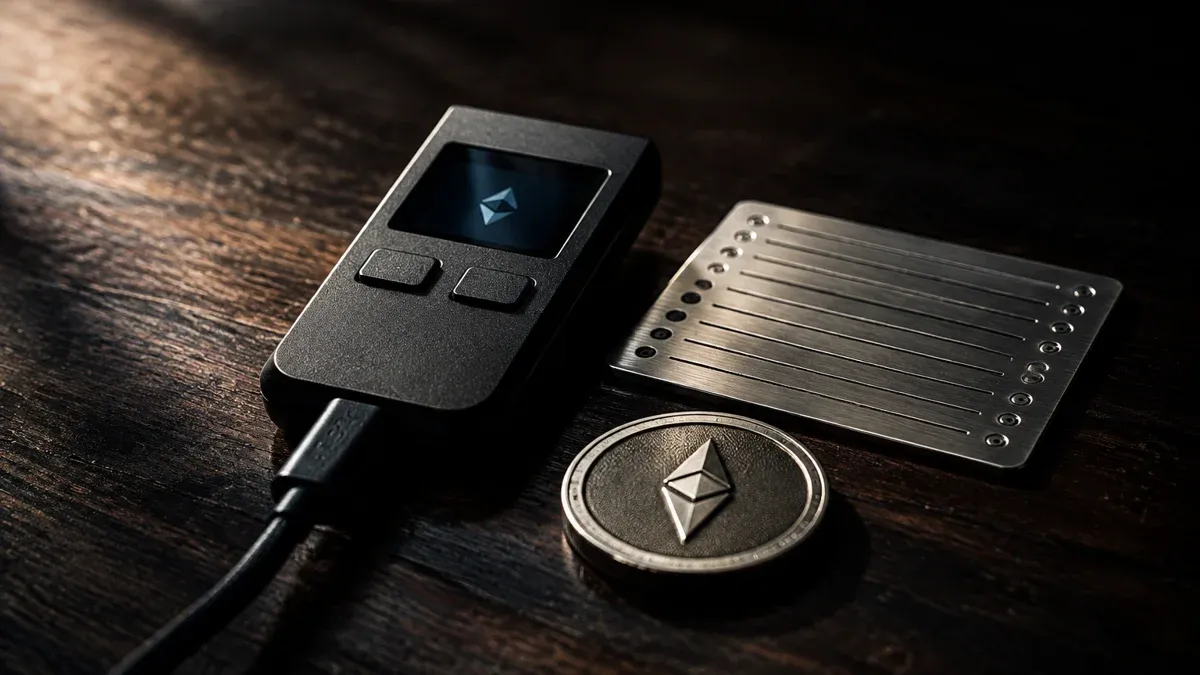
Base fee, priority fee and gas limit: what the Ethereum network fee is made of
Three terms decide what you pay in the end, and they are regularly confused with one another.
Base fee
The base fee is the minimum price per unit of gas that the protocol sets for the current block. The value rises when the preceding blocks were more than half full and falls otherwise. This part of the fee is burned, so it goes to nobody. On Tuesday morning it stood at roughly 1.1 Gwei.
Priority fee
The priority fee is the voluntary tip to the validator who proposes your block. That tip decides how far forward in the block your transaction lands. In the current conditions a few thousandths of a Gwei are enough, because on this morning's readings the blocks were only 27 to 73 percent full.
Gas limit
The gas limit is the ceiling on the units of gas you release for a transaction. If the transaction uses less, you get the difference back. Set it too low and the transaction fails while the gas it consumed is gone anyway. The technical description of this mechanism is in the gas documentation on ethereum.org.
In practice: you have no influence over the base fee, but you do over the timing. And it is the timing that is favourable this week.
Self-custody after the Bitget attack: the move costs six cents
On September 29 it emerged that $387.5 million had flowed out of the exchange Bitget, by the exchange's own account, with the attack running through third-party security software as far as is known so far. The details are in our report on the attack path through third-party software. An incident like that is no argument against exchanges in general, but it answers a question many investors are asking anyway: what is still sitting there that does not need to be sitting there?
Self-custody means that the private keys to your coins are held by you and not by a service provider. The advantage is that no outside break-in and no outside insolvency can reach your holdings. The price is responsibility: a lost recovery phrase is lost for good, and nobody can reset it.
Anyone who was planning this step anyway will find the cheapest argument for it this week. Moving funds from an exchange to your own address is technically a simple ETH transfer and costs around six cents on the network side. The regular expense is the exchange's own withdrawal fee, which is independent of the network fee and at many providers sits well above it. Which devices are suitable for storage, and how to recognise a reputable model, is covered in our hardware wallet comparison.
Two checks before any larger move have proved their worth. First: send a small amount ahead and wait for the confirmation before the rest follows. The six cents for that test run are currently the cheapest insurance on the market. Second: make sure the destination address really is an Ethereum address on mainnet and not an address on a layer-2 network with the same character string.
Holding period and the per-wallet view: why a transfer to yourself is not a sale
This is the point at which many investors in Germany hesitate, and for an understandable reason: the worry is the one-year holding period, which a move supposedly destroys. On the tax authorities' reading, that worry is unfounded.
What governs the question is the German Federal Ministry of Finance circular on individual questions of the income tax treatment of crypto assets, dated March 6, 2025. For private investors it says, in essence: crypto assets are other economic goods, their sale is a private disposal transaction, and once a year has passed between acquisition and sale the gain remains tax-free. A sale or a swap triggers the tax. A move between addresses that both belong to you is neither of those. The clock keeps running.
Two points are still worth keeping in view, and both are practical.
Holdings are assessed per wallet
The tax authorities assess holdings on a per-wallet basis. Once an allocation method has been chosen it is to be retained per wallet and per trading designation until everything there has been disposed of. Consolidating holdings from several sources onto one address does not make the later allocation easier but harder.
The documentation stays your job
A move is tax-neutral, but it has to be traceable. For every movement, record the date, the amount, the sending and receiving address and the transaction proof. If you would rather not keep that by hand, our overview of crypto tax software and portfolio trackers lists programs that read addresses in automatically and mark your own transfers as such. None of this replaces tax advice in an individual case.

Glamsterdam on Sepolia on October 6: EIP-8037 and EIP-2780 reach into gas pricing
The cheap fee environment is not a permanent state, and the next intervention is already scheduled. The Ethereum Foundation announced on September 17 that the upgrade named Glamsterdam will be activated on the Sepolia testnet on October 6 at 13:53:36 UTC, at epoch 353,024 and slot 11,296,768. What that means for the price in the run-up is set out in our piece on the Sepolia fork on October 6.
A testnet is a parallel Ethereum network with worthless coins on which changes are tried out before mainnet. Sepolia is one of them. Important for context: the foundation's announcement expressly names no date for mainnet. It states that the activation dates for Hoodi and for mainnet have not been decided and that the announcement plans no mainnet upgrade.
Glamsterdam matters for the subject of this article because several of the change proposals it contains act directly on gas pricing. The Ethereum Foundation announcement names, among others, EIP-8037 raising the gas costs of creating state data, EIP-8038 recalculating the cost of state access, EIP-2780 for a resource-based base cost per transaction, EIP-7976 raising the minimum cost of calldata and EIP-7981 making access lists more expensive. On top of those come EIP-7732 for the enshrined separation of proposer and block builder and EIP-7928 for block-level access lists.
For you as an investor, nothing follows that you would have to act on today, because a testnet does not touch your holdings. If, on the other hand, you run a node or a validator on Sepolia yourself, the announcement expressly requires both the execution layer and the consensus layer to be brought up to a supporting version in good time. For validators that applies to beacon nodes and validator software alike.
Ethereum network fees: $1.57 million in a single day
A low fee per transaction does not mean there is little going on in the network. According to DefiLlama data, fees of $1.57 million accrued on the Ethereum network over the past 24 hours. Across seven days that adds up to $6.07 million, across thirty days to $14.80 million.
Together those three numbers give a picture the plain Gwei reading does not show. The thirty-day figure corresponds to a daily average of roughly $493,000. Yesterday, at $1.57 million, was therefore more than three times as high, and against the previous day DefiLlama records a rise of 34 percent. Activity is picking up, and the fee per operation stays low regardless.
Both fit together, because a large share of demand now runs over layer-2 networks that write their data to mainnet in bundles. The core of that observation for your decision: the currently cheap window does not rest on an empty network but on a structure that shifts load elsewhere. It can close if that structure changes, and several of the change proposals named above are aimed at precisely that.
What the low network fee does not make cheaper: spread, withdrawal fee and network choice
The six cents are honestly calculated, but they are not the whole price of a move. Three items are untouched by them, and taken together they are regularly larger than the network fee itself.
The first is the exchange's withdrawal fee. Many providers charge a flat fee per withdrawal that they calculate independently of the actual network load. It is worth reading that item in your account before withdrawing, because the differences between providers are considerable, and on small amounts the withdrawal fee exceeds the network fee many times over.
The second is the spread, the difference between the buying and the selling price. It applies as soon as you buy or sell, and a move between your own addresses does not trigger it. Take the cheap fee environment as an occasion to swap, however, and you pay it in full.
The third is the choice of network. Where an exchange offers withdrawals over several networks, the costs differ considerably. What decides the matter is not the cheapest price but whether your destination address supports the chosen network at all. A withdrawal into a network the receiving side does not know is the most common way to lose funds for good.
Levels above and below: $2,637, $2,734 and the high at $2,807
For the price side, the past ten trading days supply three reference points, and all three can be derived from the daily data rather than from an expectation.
Below, the first level is $2,637, the low of the past 24 hours. Beneath it comes $2,628, the low of September 24 and thus the lowest point since the rise of September 21. If the price falls through it, the bracket of the past six days is broken, and the next stop would not come until the September 20 low at $2,563.
Above, the first hurdle is the daily high at $2,734, followed by the September 23 high at $2,788. Over that stands the September 21 high at $2,807, which has not been reached for a good week and marks the upper edge of the current range.
These points are observations from the daily data and not a forecast. A narrow range over several days says nothing about the direction in which it eventually resolves; it says only that the resolution is still outstanding. How the picture looks over longer periods shows in the comparison with the previous week: the range from September 20 to September 29 ran from $2,563 to $2,807 and is thus a good five times as wide as that of the past six daily closes.
Ethereum price and network fee: how to proceed now
From this day's numbers follow three steps you can work through in order.
- Review your holdings and read the withdrawal fee. Look at which part of your funds sits on trading venues although you do not trade it there, and read in your account what each withdrawal costs. Only that number next to the six cents of network fee gives the real price of the move. The terms offered by the providers available in Europe are in our overview of crypto exchanges.
- Settle the custody question before the first transfer runs. Clarify in advance where the funds are going and how the recovery phrase will be kept. A test amount of a few euros currently costs six cents on the network side and answers the question of whether the destination address is right. If a dedicated device is not an option, you will find the alternatives in our overview of software wallets.
- Look at staking commitments before you move anything. Funds tied up in staking cannot be moved without further ado, and the waiting time on exit has nothing to do with the gas fee. Clarify your provider's notice and payout periods before you plan a movement. A side-by-side of the terms is available at the staking providers.
(As of September 29, 2026. This article is not investment advice. Prices and fee structures change; check the terms with the provider before you buy.)
Tether has put a number on its cooperation with US sanctions enforcement, and the timing is no accident. The stablecoin issuer said on Monday that it has helped freeze nearly $550 million in USDT tied to Iran's central bank and Iranian sanctions networks so far in 2026. The announcement came one day after a Senate report accused USDT of being the backbone of Iran's shadow banking system.
How Much Iran-Linked USDT Did Tether Freeze?
Tether detailed two big actions. In April, it helped US authorities freeze more than $344 million in $USDT sitting in two addresses. The following day, OFAC added those same addresses to its sanctions entry for the Central Bank of Iran, which is itself linked to the IRGC-Qods Force and Hezbollah. In July, the Treasury expanded that designation to four more TRON addresses, and Tether froze more than $130 million across those wallets.
Those two rounds account for more than $474 million. The remaining roughly $75 million came from smaller actions between January and September that Tether did not itemize.
The company also pointed to its longer track record. Working with Israel's National Bureau for Counter Terror Financing, Tether has frozen more than 22 million USDT across over 40 referred cases involving more than 640 addresses. Globally, Tether says its cooperation with law enforcement has led to more than $4.9 billion in frozen assets, including over $2.4 billion connected to US authorities, and that it works with around 340 agencies in 67 countries.
Why Is the US Senate Investigating Tether?
The freeze tally landed as a defence. On Sunday, Democratic investigators on the Senate Permanent Subcommittee on Investigations, led by Senator Richard Blumenthal, released a report alleging that Tether and USDT have become central to Iran's shadow banking system. Among their findings: 84% of 846 crypto wallets sanctioned over ties to Iran had transacted exclusively or almost exclusively in USDT.
Blumenthal referred the findings to Treasury Secretary Scott Bessent and Attorney General Todd Blanche, citing potential violations of US sanctions and the Bank Secrecy Act, and called for a federal probe into Tether's compliance.
CEO Paolo Ardoino pushed back, saying Tether has consistently shown that USDT is not a safe harbour for sanctioned actors, terrorist organisations or criminal networks, and that the DOJ, FBI, Secret Service, HSI and OFAC have repeatedly worked with the company to trace, freeze and recover assets.
How Does This Fit Into the Wider Iran Crackdown?
Tether is one front in a much broader campaign. On August 24, the Treasury launched Operation Economic Outcast, targeting almost 60 Iran-linked entities and naming digital assets as one of five sectors vulnerable to sanctions evasion. Federal prosecutors have filed a civil forfeiture case to seize about $61 million in USDT allegedly derived from Iranian black market oil sales, and Manhattan prosecutors are reportedly examining Binance's handling of Iran-linked trading.
Decrypt
Plus, crypto majors rebound as oil and yields fall and Saylor’s Strategy returns to buying Bitcoin.
The judge has told Pleterski he will raise objections on his behalf, to keep inadmissible evidence away from the jury.
Coinbase Clearing will take USDC as collateral and settle around the clock, though margined products stay with partners.
OpenAI says its agents keep landing on government websites because they treat them as reliable sources, but it's pausing training while it adds safeguards.
A UC San Diego-led team impersonated a hardware security module without extracting its key.
U.Today - IT, AI and Fintech Daily News for You Today
Bitwise has bought Solana for the seventh consecutive day of trading amid growing institutional demand for the asset, pushing its Solana ETF product closer to hitting a key milestone of $1.5 billion.
Solana's spot ETFs pulled in $12.70 million on September 28, more than triple the $3.96 million that XRP funds attracted the same day.
Ex-SEC chair Gensler’s 2020 AI vision gets fresh attention from Ripple CTO emeritus.
XRP eyes a rare 3-month win streak to break its bear cycle as new SEC filings prime an ETF launch.
Near Protocol has slipped about 15% from its $5.58 local high to $4.78 after a 200%+ August surge, and a bearish reversal candle suggests the pullback may not be over.
Blockonomi
TLDR
- Warner Bros. Discovery (WBD) stock received a Sell rating from Argus, dropped from Hold.
- Shares currently trade at $30.90, approaching the 52-week peak of $30.92.
- The spread between WBD’s share price and the $31 Paramount Skydance bid has virtually disappeared.
- Analysts project a $0.90 per share loss in 2026, followed by modest $0.07 earnings in 2027.
- Direct-to-consumer streaming saw 10% revenue growth, while Networks and Studios segments posted lower earnings.
On Monday, Argus downgraded Warner Bros. Discovery (WBD) stock from Hold to Sell. This rating shift arrives as the entertainment giant’s combination with Paramount Skydance approaches its final stages.
Warner Bros. Discovery, Inc., WBD
Currently, WBD shares are priced at $30.90, barely below the 52-week peak of $30.92. This valuation hovers just beneath the $31 acquisition offer from Paramount, suggesting minimal potential for additional gains.
Research analyst Joseph Bonner noted that a recent resolution of a multi-jurisdictional antitrust case paved the way for deal completion. He anticipates the transaction will finalize in the near term.
The difference between WBD’s market price and Paramount’s bid has contracted dramatically. Argus believes current shareholders face limited opportunities for further appreciation.
According to InvestingPro analysis, the stock appears overvalued relative to its calculated fair value. Technical indicators, including the RSI metric, suggest the shares have entered overbought levels.
Financial Projections
For 2026, Argus anticipates WBD will post a GAAP loss of $0.90 per share. The forecast calls for a return to profitability in 2027 with earnings of $0.07 per share.
The research firm estimates annual earnings expansion of 6% over the longer term. This projection reflects a combination of momentum in streaming offset by challenges in traditional media businesses.
The company’s direct-to-consumer streaming division generated $3.1 billion in second-quarter revenue, marking a 10% increase. Adjusted EBITDA for streaming operations surged 63% to reach $512 million.
Meanwhile, the Networks division saw adjusted EBITDA decline 5% to $1.45 billion. The Studios segment experienced a more severe 89% drop in EBITDA, falling to only $96 million.
Transaction Status
The Paramount Skydance acquisition is proceeding through its concluding phases. Citigroup plans to commence meetings with debt investors to secure financing for the transaction.
Paramount has entered discussions with California’s top law enforcement official. The company has proposed a $1.5 billion capital commitment in the state as part of regulatory approval efforts.
The Federal Communications Commission granted approval for foreign capital participation in the $110 billion transaction. However, international investors will be restricted from acquiring voting shares.
Benchmark continues to maintain a Hold recommendation on WBD stock throughout the negotiation period. Not all Wall Street observers believe the appreciation potential has been fully exhausted.
Beyond merger-related factors, Argus highlighted additional concerns. These include the ongoing erosion in traditional cable subscription numbers and the company’s failure to retain domestic NBA broadcasting rights.
Year-to-date, WBD stock has advanced approximately 7%. This performance lags behind the broader market’s 12% increase during the identical period.
The post Warner Bros. Discovery (WBD) Stock Downgraded to Sell Despite Touching 52-Week Peak appeared first on Blockonomi.
Key Points
- Shares of uniQure tumbled 48% to $20.50 during premarket hours Tuesday.
- The selloff was triggered by newly released 48-month data from the AMT-130 gene therapy trial.
- The treatment demonstrated a 44% reduction in Huntington’s disease progression at 48 months but failed to achieve statistical significance.
- The company maintains confidence in its FDA submission, which relies on robust 36-month outcomes from all 15 high-dose trial participants.
- Earlier this month, uniQure filed a Biologics License Application with the FDA seeking accelerated approval.
Shares of uniQure plummeted 48% to $20.50 in premarket action Tuesday following the Dutch biotechnology firm’s announcement of updated clinical results for its experimental Huntington’s disease treatment.
uniQure N.V., QURE
The investigational gene therapy, designated AMT-130, aims to decelerate the advancement of this devastating neurological condition by reducing concentrations of a harmful protein in the brain.
According to a 48-month assessment of 12 patients receiving the high dose, AMT-130 demonstrated a 44% reduction in disease advancement. However, this outcome failed to reach the predetermined threshold for statistical significance.
The disappointing results mark a dramatic reversal from June, when uniQure announced plans to pursue regulatory clearance for the treatment. Investor sentiment was decidedly positive at that time.
Breaking Down the Latest Clinical Findings
Researchers at uniQure evaluated trial subjects against an external control cohort. As the study progressed, attrition rates increased within that control population.
This created a comparison baseline composed predominantly of individuals whose condition was naturally advancing at a slower rate. According to the company, this compositional shift may have distorted the 48-month findings.
The biotech highlighted an alternative 36-month evaluation as a more dependable reference point. This assessment encompassed all 15 participants in the high-dose arm and achieved statistical robustness.
An additional 36-month review focusing solely on 12 high-dose subjects revealed an 80% slowdown in disease advancement. This calculation utilized information gathered through June 30, 2026.
The company emphasized that participants demonstrated good tolerability across both dosage levels examined. Safety concerns were not identified as contributing factors to Tuesday’s market reaction.
Regulatory Pathway and FDA Engagement
At the beginning of this month, uniQure submitted a Biologics License Application to the FDA. The application requests accelerated approval for AMT-130, scientifically known as ifezuntirgene inilparvovec.
The regulatory submission was constructed around the 36-month dataset rather than the more recent 48-month analysis. The company noted that FDA officials confirmed during a June consultation that 36-month outcomes from 12 high-dose participants would constitute adequate evidence for the filing.
The regulatory agency has previously expressed reservations about the program. In the prior year, the FDA determined that Phase I and II evidence was insufficient to warrant a submission and recommended conducting an additional trial as recently as March.
Huntington’s disease is a hereditary condition with universal fatality. Currently, no approved therapies exist that alter the disease trajectory; available interventions only address symptomatic management.
uniQure has dedicated nearly ten years to developing AMT-130. The program represents the cornerstone asset in the company’s development portfolio.
In Tuesday’s announcement, uniQure emphasized that the update remains clinically significant for patients considering the absence of alternative disease-modifying therapies. Complete study results will be disclosed at an upcoming scientific conference.
The sharp decline on Tuesday represents what is expected to be uniQure’s steepest single-session percentage loss since November, based on information from Dow Jones Market Data.
The post uniQure (QURE) Stock Crashes 48% on Disappointing Huntington’s Trial Results appeared first on Blockonomi.
Key Takeaways
- Deutsche Bank shifted its rating on Netflix to Buy from Hold, while reducing its price target from $100 to $95.
- The streaming giant’s shares have dropped 26% year-to-date and are down 36% from the April peak of $107.79.
- Shares gained 1% to reach $70.05 during Tuesday’s premarket session following a 3% Monday decline.
- Deutsche Bank’s Bryan Kraft highlights growing global engagement and artificial intelligence opportunities as catalysts.
- Contrasting views emerged as Wells Fargo and HSBC recently downgraded the stock over engagement concerns.
Trading near $70, Netflix shares have caught the attention of Deutsche Bank, which believes the recent weakness presents a compelling entry point. The firm elevated its stance to Buy from Hold, despite lowering its price objective to $95 from $100.
Netflix, Inc., NFLX
Shares of Netflix have tumbled 26% throughout 2026. The stock currently sits 36% beneath its April zenith of $107.79.
In Tuesday’s early trading, the stock climbed 1% to $70.05. This uptick came after Monday’s 3% pullback.
Deutsche Bank analyst Bryan Kraft contends that the market is overly fixated on underwhelming domestic viewing metrics. According to Kraft, this perspective fails to account for Netflix’s substantial international expansion runway.
Global engagement has climbed on a year-over-year basis across four consecutive six-month intervals, Kraft notes. Over 60% of the company’s content creation now originates from markets beyond U.S. borders.
The stock currently trades at approximately 18 times Kraft’s 2027 earnings projection. This represents a dramatic compression from the roughly 40 times forward earnings multiple seen in June 2025.
According to Kraft, this compressed valuation fails to reflect Netflix’s growth trajectory. He anticipates the stock could command a multiple in the low-to-mid 20s range.
Global Expansion Fuels Optimism
Deutsche Bank maintains that Wall Street’s emphasis on domestic engagement data fails to capture Netflix’s full market potential. The investment bank highlights stronger performance in overseas markets as justification for its bullish stance.
The bank suggests this year’s U.S. weakness may stem from a lighter slate of blockbuster programming rather than fundamental subscriber erosion.
Kraft characterized artificial intelligence as offering “more friend than foe” dynamics for Netflix. He identified opportunities in content creation, recommendation algorithms, and advertising optimization.
Divergent Analyst Perspectives
Deutsche Bank’s optimism doesn’t reflect universal Wall Street sentiment. Wells Fargo analyst Steven Cahall recently moved Netflix to Underweight from Equal Weight.
Cahall dramatically reduced his price objective as well, dropping it to $57 from $80. HSBC followed suit with a downgrade to Hold from Buy.
The bearish arguments center primarily on decelerating engagement metrics. HSBC specifically cited competition from Alphabet’s YouTube, which appears to be capturing audience attention away from Netflix.
Market sentiment soured in July after Netflix announced plans to reduce its engagement reporting frequency from biannual to annual updates. The change sparked conjecture that the company faces intensifying competitive pressure.
Deutsche Bank dismisses these concerns as exaggerated. While opinions vary, the broader analyst community maintains a generally positive outlook.
Among 45 Wall Street analysts monitored by FactSet, Netflix holds an average Overweight rating. The consensus price target stands at $93.57, with 28 analysts recommending Buy and 17 suggesting Hold.
Deutsche Bank’s $95 price target suggests potential upside of approximately 37% from the stock’s most recent closing price.
The post Netflix (NFLX) Stock Gets Deutsche Bank Upgrade Despite 26% Year-to-Date Decline appeared first on Blockonomi.
The best crypto payment gateways help businesses accept crypto payments, automate payment processing, manage settlement, and integrate digital assets into existing payment infrastructure.
The right crypto payment gateway depends on your business model. Important factors include supported cryptocurrencies, fees, settlement options, API access, e-commerce integrations, compliance requirements, and geographic availability.
Here are 10 crypto payment solutions worth comparing.
| Crypto payment gateway | Best for | Notable capability |
| Confirmo | EU businesses and stablecoin payments | Stablecoin-first payments with MiCA authorisation |
| Finassets | High-volume stablecoin payments | TRON energy optimization system for USDT TRC20 payments |
| Triple-A | International businesses | Crypto payments with local-currency settlement |
| BitPay | Consumer-facing merchants | Online and point-of-sale payments |
| CoinGate | European e-commerce | E-commerce plugins |
| CoinsPaid | High-volume crypto processing | Business payment ecosystem |
| NOWPayments | Businesses needing broad crypto support | 300+ cryptocurrencies |
| BTCPay Server | Businesses seeking self-hosting | Open-source, self-hosted payments |
| BVNK | Stablecoin payment operations | Stablecoin and fiat infrastructure |
| Bridge | Businesses building stablecoin products | API-focused stablecoin infrastructure |
1. Confirmo
Confirmo.com is a stablecoin-first crypto payment platform founded in 2014 in the Czech Republic. Its Irish entity, Confirmo Limited, is authorised by the Central Bank of Ireland under MiCA and as a payment institution, which allows it to serve businesses across the EU under a single regulatory framework.
The platform focuses on businesses that process frequent payments, including e-commerce, forex, prop trading, and payroll providers.
Features
Confirmo provides merchant checkout, invoicing, mass payouts, automated currency conversion, and stablecoin settlement across major blockchain networks.
Strengths
Dual regulatory authorisation in the EU gives businesses a compliant option for accepting and settling stablecoin payments in Europe.
Best for
Confirmo suits EU-based businesses and companies serving European customers that need a regulated provider for stablecoin payments and payouts.
2. Finassets
Finassets.io is a Panama-registered B2B crypto payment infrastructure provider operating since 2021. The platform helps businesses accept, manage, track, and send cryptocurrency payments through structured payment infrastructure rather than relying on manual wallet-to-wallet transactions.
Finassets supports 70+ cryptocurrencies and stablecoins across multiple blockchain networks. Its services target crypto-driven and cross-border businesses, including e-commerce, iGaming, Web3 projects, affiliate payout platforms, digital-goods companies, and businesses processing high transaction volumes.
Features
Finassets provides crypto checkout, payment links, payment buttons, crypto invoices, mass payouts, API integration, B2B crypto exchange, and crypto-to-stablecoin auto-conversion. Businesses also receive a dashboard for monitoring transactions, fees, and payment statuses.
Security controls include 2FA, role-based access control, and MPC-based wallet technology.
Strengths
Low fees, processing fees start at 0.40% and decrease to 0.20% as monthly transaction volume increases. Finassets combines payment acceptance, crypto payouts, conversion, invoicing, and API infrastructure within one B2B platform. A strong choice for USDT TRC20 payments, thanks to its TRON Energy optimization system, which cuts network fees by 50%.
Best for
Finassets suits iGaming, e-commerce, Web3, affiliate platforms, forex, digital goods, cross-border businesses, and companies processing high USDT TRC20 transaction volumes. A good fit for regions such as Latin America, Asia, and Africa, subject to onboarding and jurisdictional restrictions.
3. Triple-A
Triple-A.io provides cryptocurrency and stablecoin payment infrastructure for businesses operating across international markets. The platform enables merchants to accept digital assets through checkout and other payment methods while supporting settlement in traditional currencies where available.
Its infrastructure covers more than basic crypto acceptance. Triple-A also provides payment links, invoicing, payouts, APIs, and e-commerce integrations, making it relevant to businesses that want to integrate crypto payments into established payment operations without necessarily holding cryptocurrency themselves.
Features
Triple-A supports checkout, payment links, invoicing, remittances, payouts, APIs, and e-commerce integrations. Merchants can accept crypto while receiving settlement in supported local currencies.
Strengths
Its combination of crypto acceptance, local-currency settlement, and payment infrastructure can reduce the operational work associated with managing digital assets directly.
Best for
Triple-A suits international merchants and enterprises that want customers to pay with crypto while the business settles in traditional currencies.
4. BitPay
BitPay.com is an established crypto payment processor that enables businesses to accept cryptocurrency from customers. Its payment infrastructure covers online commerce and physical retail, giving merchants different ways to add digital assets as a payment method.
The platform provides tools for checkout, invoices, payment links, payouts, and point-of-sale payments. BitPay supports Bitcoin, Ethereum, stablecoins, and other supported digital assets, making it relevant to merchants serving customers who already use cryptocurrency.
Features
BitPay provides online checkout, payment links, invoicing, point-of-sale capabilities, crypto payouts, and settlement options.
Strengths
BitPay combines consumer-facing crypto payments with tools for online and in-store merchants.
Best for
BitPay fits retailers and consumer-facing businesses that need online or point-of-sale crypto payment acceptance.
5. CoinGate
CoinGate.com is a cryptocurrency payment gateway focused on helping online merchants accept digital assets through established payment and e-commerce workflows. Its services include crypto payment processing alongside tools for invoices, payment links, payouts, and settlement.
CoinGate places particular emphasis on e-commerce integration. Its ready-made plugins support platforms such as WooCommerce, PrestaShop, and OpenCart, allowing merchants to implement crypto payments without developing the complete checkout infrastructure internally.
Features
CoinGate provides payment processing, payment links, invoicing, payouts, and e-commerce integrations. Businesses can accept crypto and use supported fiat settlement options.
Strengths
Ready-made e-commerce plugins can reduce the development work required to start accepting crypto payments.
Best for
CoinGate suits European e-commerce stores, hosting businesses, digital services, and merchants that prefer plugin-based integration.
6. CoinsPaid

CoinsPaid.com provides B2B cryptocurrency payment infrastructure for companies that accept, hold, convert, and send digital assets. Its services are designed around business payment operations rather than consumer cryptocurrency trading.
The platform combines a crypto payment gateway with business wallets, payment links, payouts, point-of-sale tools, and API integration. This broader infrastructure makes CoinsPaid relevant to businesses that process frequent or high-volume cryptocurrency transactions.
Features
Its infrastructure includes a business wallet, payment gateway, payment links, crypto payouts, point-of-sale tools, and API-based integration.
Strengths
CoinsPaid focuses on transaction-intensive business operations and combines payment acceptance with crypto asset management and payouts.
Best for
CoinsPaid suits iGaming, Forex, and other businesses with frequent or high-volume cryptocurrency transactions.
7. NOWPayments
NOWPayments.io is a non-custodial crypto payment gateway designed to help online businesses accept a broad range of digital assets. The available source material reports support for more than 300 cryptocurrencies, giving merchants access to a wide selection of payment assets.
Businesses can integrate the service through APIs, e-commerce plugins, and other payment tools. NOWPayments also provides recurring payment functionality, donation widgets, and mass payouts, extending its use beyond standard online checkout.
Features
The service provides payment APIs, recurring payments, donation widgets, e-commerce plugins, mass payouts, and other payment tools.
Strengths
Broad cryptocurrency coverage gives merchants more flexibility when customers want to pay using different digital assets.
Best for
NOWPayments fits online businesses that prioritize broad cryptocurrency support and multiple integration methods.
8. BTCPay Server
BTCPayServer.org is an open-source, self-hosted cryptocurrency payment system. Unlike a conventional crypto payment processor, it allows businesses to operate payment infrastructure themselves instead of depending entirely on a third-party provider to process payments.
The software focuses on Bitcoin payments and supports the Lightning Network. Its self-hosted model gives merchants direct control over their payment setup, making it particularly relevant to technically capable businesses that prioritize control and reduced dependence on payment intermediaries.
Features
BTCPay Server supports Bitcoin and the Lightning Network while giving merchants direct control over their payment setup.
Strengths
Self-hosting provides direct control over payment infrastructure and reduces dependence on an intermediary.
Best for
BTCPay Server suits developers, privacy-focused merchants, and businesses that have the technical resources to manage self-hosted Bitcoin payment infrastructure.
9. BVNK
BVNK.com provides stablecoin and fiat payment infrastructure for businesses. Its proposition extends beyond accepting cryptocurrency at checkout and focuses on helping companies move, manage, convert, and settle value across digital assets and traditional currencies.
The infrastructure includes stablecoin wallets, payments, payouts, currency conversion, and API connectivity. This combination makes BVNK relevant to businesses using stablecoins for international payments, treasury operations, settlement, and cross-border money movement.
Features
Its infrastructure includes stablecoin wallets, payment capabilities, payouts, currency conversion, API connectivity, and options for managed or self-managed payment infrastructure.
Strengths
BVNK combines stablecoin operations with fiat payment infrastructure, making it relevant to businesses that use stablecoins beyond checkout alone.
Best for
BVNK suits businesses managing stablecoin balances, cross-border money movement, payouts, and crypto-to-fiat operations.
10. Bridge
Bridge.xyz provides stablecoin infrastructure for businesses and technology companies that want to incorporate digital-dollar payment capabilities into their own products. Its model focuses on infrastructure and APIs rather than operating only as a conventional merchant checkout gateway.
Businesses can use its infrastructure for stablecoin payment operations, wallets, currency conversion, and cross-border money movement. This API-focused approach makes Bridge relevant when stablecoin functionality needs to become part of an existing platform or financial product.
Features
Its API-focused infrastructure supports stablecoin orchestration, payment capabilities, wallets, currency conversion, and cross-border payment operations.
Strengths
Bridge emphasizes developer-oriented infrastructure, allowing businesses to integrate stablecoin functionality through APIs rather than operating a separate consumer payment product.
Best for
Bridge fits technology companies and businesses building stablecoin payment, treasury, or cross-border money-movement functionality into their products.
How Do You Choose the Best Crypto Payment Gateway?
The best crypto payment gateway should match your customers, transaction volume, settlement requirements, technical infrastructure, and operating jurisdictions.
Before choosing a provider, compare:
- Check supported cryptocurrencies and networks. Confirm that the gateway supports the coins, stablecoins, and blockchain networks your customers use.
- Compare total costs. Consider processing fees, withdrawal fees, conversion costs, and blockchain network fees rather than one advertised rate.
- Review settlement options. Decide whether your business wants crypto settlement, fiat settlement, stablecoins, or automatic conversion.
- Assess integration methods. Look for APIs, SDKs, payment links, payment buttons, and e-commerce plugins that fit your existing system.
- Check security and compliance. Review available security controls, KYC/AML requirements, and geographic restrictions.
- Evaluate payouts. Businesses that send funds to affiliates, suppliers, or customers may benefit from integrated crypto payouts or mass payouts.
A small e-commerce business may prioritize plugins and simple setup. An enterprise processing frequent transactions may place greater weight on API infrastructure, automated payouts, settlement controls, and transaction monitoring.
Frequently Asked Questions About Crypto Payment Gateways
What is a crypto payment gateway?
A crypto payment gateway provides infrastructure that lets a business accept cryptocurrency payments. Depending on the provider, it can generate payment addresses, confirm blockchain transactions, convert currencies, manage settlement, and connect payments to existing business systems.
How can a business start accepting crypto payments?
A business can start accepting crypto by choosing a suitable provider, completing required account and compliance checks, selecting supported currencies, and integrating a checkout, payment link, plugin, payment button, or crypto payment API.
Can crypto payment gateways convert crypto to fiat?
Some crypto payment gateways support crypto-to-fiat conversion and fiat settlement. This allows customers to pay with digital assets while the merchant receives a supported traditional currency. Availability depends on the provider and jurisdiction.
Do crypto payments have chargebacks?
Blockchain transactions generally do not provide traditional card-style chargebacks. Merchants should still establish refund procedures and use appropriate fraud prevention, compliance, and customer-service controls.
What fees do crypto payment gateways charge?
Costs can include processing fees, blockchain network fees, conversion costs, and withdrawal fees. Fee structures vary by provider, asset, blockchain network, and transaction volume. Businesses should compare total payment costs before selecting a gateway.
What is the difference between custodial and non-custodial crypto payments?
A custodial service can control or manage digital assets on behalf of the business. A non-custodial setup gives the merchant more direct control over its funds or wallet infrastructure. The operational and security responsibilities differ between these models.
Which crypto payment gateway is suitable for e-commerce?
E-commerce businesses should compare gateways based on checkout integration, plugins, supported cryptocurrencies, fees, settlement currencies, refunds, and API access. E-commerce plugins can reduce the manual work required to implement crypto payments.
Can businesses accept stablecoin payments?
Yes. Several payment providers support USDT, USDC, and other stablecoin payments. Stablecoins can support international payments, settlement, and payouts, depending on the provider, blockchain network, and local regulations.
Disclaimer: This article is for informational purposes only and does not constitute legal, regulatory, or tax advice. Details about payment providers are based on publicly available information as of September 2026 and may change. Verify current features, fees, and eligibility with each provider before making a decision.
The post Best Crypto Payment Gateways for Business | Top 10 Options appeared first on Blockonomi.
Key Takeaways
- Fair Isaac shares plummeted 20% in Tuesday’s premarket session to $675.39, marking the steepest decline in over six years.
- Federal Housing Finance Agency head Bill Pulte revealed that Fannie Mae and Freddie Mac would consolidate to a single mortgage pricing framework.
- VantageScore, a competing credit model developed by Equifax, TransUnion, and Experian, now joins FICO Classic on the pricing grid.
- Rocket Mortgage announced VantageScore 4.0 will become its default credit scoring system for qualifying mortgages beginning Q4.
- Fair Isaac shares have tumbled 50% year-to-date and remain significantly below the November 2024 peak of $2,382.40.
Shares of Fair Isaac ($FICO) plunged 20% during Tuesday’s premarket hours, bottoming at $675.39. The collapse represents the company’s sharpest single-day decline in more than six years.
Fair Isaac Corporation, FICO
The dramatic selloff came after a 2.6% retreat on Monday. The combined losses pushed Fair Isaac toward its weakest closing level since April 2023.
The catalyst emerged from a social media announcement by Bill Pulte, who leads the Federal Housing Finance Agency. His statement outlined plans to streamline mortgage pricing mechanisms for consumers.
Consolidation Into One Framework
Fannie Mae and Freddie Mac are transitioning from their dual pricing structure to a unified grid. The consolidated framework incorporates VantageScore alongside FICO Classic.
VantageScore represents a collaborative effort among the three major credit bureaus: Equifax, TransUnion, and Experian. The model has persistently challenged FICO’s market position in credit assessment.
For generations, prospective homeowners required a FICO score to qualify for mortgage financing. The regulatory shift eliminates this mandatory requirement for lenders.
Pulte’s announcement clarified the structural changes. He explained that the government-sponsored enterprises would adopt a unified pricing grid incorporating VantageScore alongside the established FICO Classic framework.
This regulatory action follows earlier moves targeting FICO’s market dominance. On September 9, the FHFA eliminated the prerequisite for lenders to obtain advance written authorization before implementing VantageScore 4.0.
Major Lender Shifts Strategy
Rocket Mortgage intensified the competitive pressure on Monday. The mortgage giant, operating under Rocket Cos., declared it would pioneer the adoption of VantageScore 4.0 as its primary scoring mechanism.
The company confirmed VantageScore would become the default option during the fourth quarter for mortgages destined for Fannie Mae and Freddie Mac. The decision marks a significant endorsement from one of America’s largest residential lenders.
Fair Isaac’s stock trajectory has deteriorated steadily since reaching its all-time closing high of $2,382.40 last November. Pulte has consistently advocated for expanded competition within the credit scoring industry.
The shares have shed 27% during May alone. Through Monday’s close, the stock had declined 50% since the start of 2025.
Related credit reporting stocks experienced collateral damage. TransUnion retreated 4.3% while Equifax fell approximately 4% in premarket activity, though Rocket Cos. shares advanced 1.6%.
Broader market conditions offered no refuge on Monday. The S&P 500 ended essentially unchanged, the Dow Jones recorded modest gains, and the Nasdaq finished marginally lower, indicating FICO’s decline stemmed entirely from company-specific developments.
Fair Isaac had previously retreated from a 52-week peak of $1,998.01. Extended trading sessions on Tuesday drove the stock to a new 52-week low approaching $832.
The post Fair Isaac (FICO) Stock Plunges 20% as VantageScore Breaks Into Mortgage Market appeared first on Blockonomi.
CryptoPotato
Bitcoin is trading around $84K after a strong recovery from the $60K area over the past couple of months. The charts show that BTC has moved back above its major moving averages, while the shorter-term structure remains constructive but capped by a clear supply zone. Meanwhile, adjusted SOPR has recovered above 1, suggesting that realized profitability is improving.
Bitcoin Price Analysis: The Daily Chart
The daily chart shows a significant structural recovery from the $60K demand area. BTC subsequently reclaimed the $67K resistance zone and broke sharply higher in August, moving above both the 100-day and 200-day moving averages with force.
The 200-day moving average is currently around $71K, and the 100-day moving average is converging from below near $70K. Both are below the current market price, have begun turning higher, and are on the verge of a potential bullish crossover, which keeps the broader structure constructive. The previous resistance around $67K has therefore shifted into an important structural support area.
After the August breakout, BTC established another consolidation zone around $75K-$80K before pushing toward the $88K region. That $75K-$80K area remains the nearest major daily support zone, while the $67K region represents a deeper structural support.
The main obstacle is overhead supply. The first major resistance zone is roughly at $88K-$90K, followed by the higher supply area around $95K. BTC would need to reclaim these zones to extend the current recovery beyond the $100K mark and potentially toward new all-time highs.
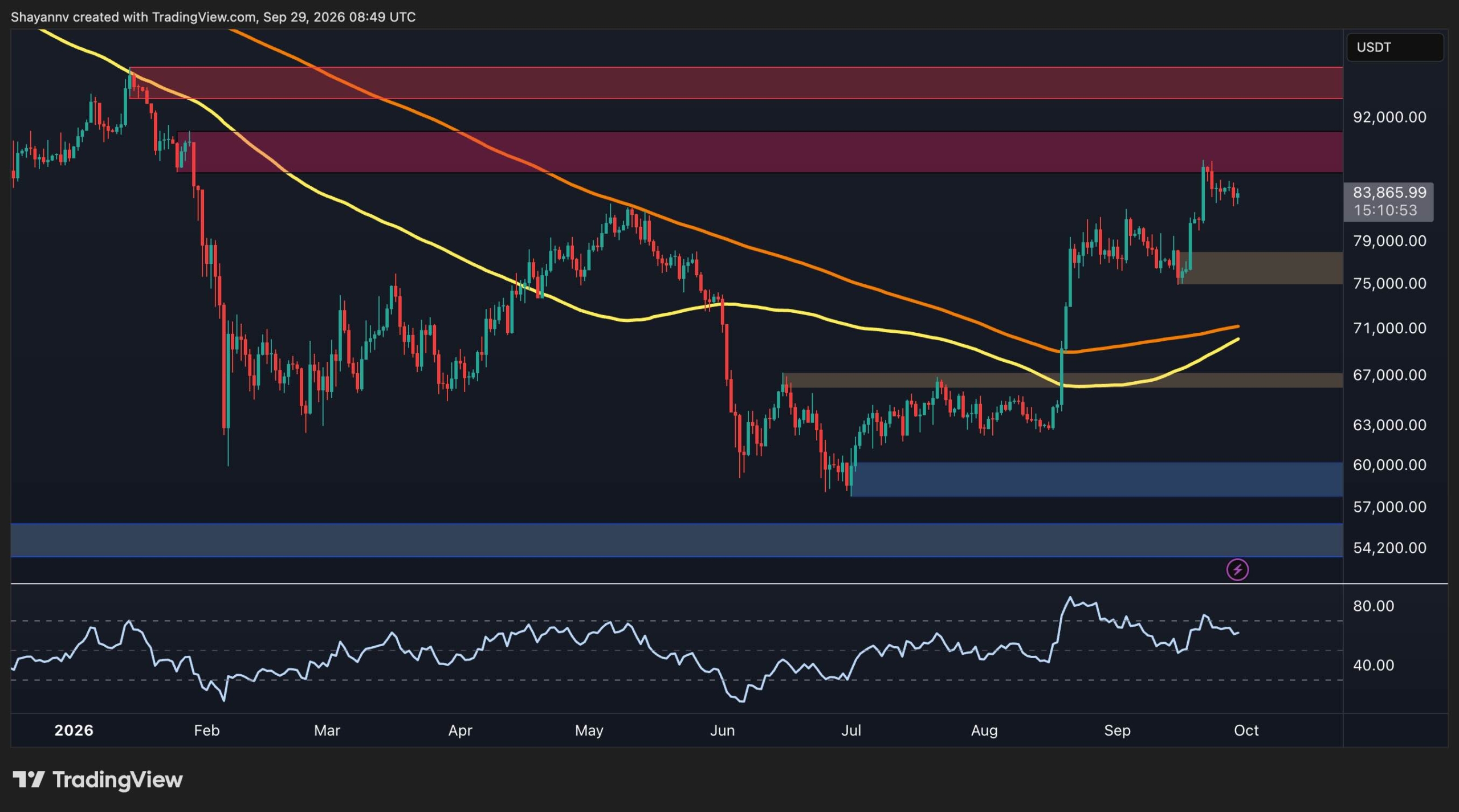
BTC/USDT 4-Hour Chart
The 4-hour chart provides a more immediate view of the current consolidation. BTC made a sharp move from the $75K region through the $82K area and subsequently accelerated toward the $86K resistance level.
Since reaching that area, price has been rejected and is now consolidating near $83K. The bullish order block near the $80-$82K zone is the key near-term demand area, and it has already acted as a base following the breakout.
On the upside, the $86K-$90K region is the immediate supply zone. The price has already tested this area and failed to establish a sustained breakout, leaving it as the main hurdle for continuation.
Still, the 4-hour RSI is around 50 after recovering from lower levels. This suggests that short-term momentum has stabilized rather than becoming excessively stretched, but is yet to show a bullish shift.
A strong move above $86K would put the upper part of the supply zone in focus, while a breakdown below $80K would weaken the current short-term structure and increase the possibility of a deeper retracement toward the $75K area.

On-Chain Analysis
The adjusted SOPR chart shows a notable improvement in Bitcoin’s on-chain profitability conditions. Adjusted SOPR measures whether coins being spent are, in aggregate, being moved at a profit or loss, with a value above 1 indicating that profitable spending is dominating.
The metric has recently climbed back above the 1.0 level, and its 30-day exponential moving average is currently around 1.01 after spending much of 2026 below 1.
This recovery coincides with BTC’s move from roughly $60K toward the current $84K level. The improving aSOPR therefore supports the idea that the recent price recovery is accompanied by improving realized profitability rather than occurring while the metric continues to deteriorate.
However, the current reading remains only modestly above 1. The metric has not reached the significantly higher levels seen during previous strong advances. Therefore, the on-chain data currently suggests improving conditions, but does not by itself confirm another major expansion in the trend. Still, this points to the fact that the market participants are once again realizing profits, which reduces the immediate fears of panic selling flooding the market with excess supply and leading to further capitulations and crashes.

The post Bitcoin Price Analysis: BTC Reclaims Major Moving Averages as Bulls Target $90K Resistance appeared first on CryptoPotato.
[PRESS RELEASE – NEWPORT BEACH, California, September 29th, 2026]
Proposed acquisition would bring a gold-backed decentralized financial ecosystem, including decentralized financial infrastructure targeting retail, institutional, and blockchain markets.
- A retail and institutional platform designed for the rapidly growing stablecoin industry, delivering compliance-focused infrastructure for payments, yield, lending and open-ecosystem, industry-wide decentralized financial applications.
- Institutional gold-based infrastructure spanning gold as a currency, gold-collateralized USD products and gold-backed financial products, anchored to an Ethereum-based Layer 2 network designed as a stable foundation for the next generation of industry products.
- Proprietary yield engines designed to power institutional products targeting competitive returns by bridging traditional and decentralized markets.
Amaze Holdings, Inc. (NYSE American: AMZE) (“Amaze” or the “Company”) today announced it has entered into a binding Letter of Intent (“LOI”) to acquire the assets of BullionFX, including its core platform Alchemy (collectively, the “BullionFX Assets”), for stock valued at approximately $155 million.
The BullionFX Assets comprise the technology, infrastructure and intellectual property behind a blockchain financial ecosystem built around auditable physical gold. If completed, the acquisition would mark a strategic expansion for Amaze beyond creator commerce and into gold-backed digital-asset infrastructure. The transaction comes amid a broad resurgence in cryptocurrency markets, rapid growth in volume within the stablecoin industry, renewed institutional engagement with digital assets, and continued strength in gold as a long-established store of value. Adjusted stablecoin transaction volume hit $1.79 trillion in June 2026, up 125% year on year, according to Visa Onchain Analytics (Allium).
“Crypto’s renewed momentum and gold’s enduring role as a store of value have opened a rare window for infrastructure built on both,” said Joel Krutz, Interim Chief Executive Officer of Amaze. “Alchemy is a full-stack, gold-backed financial ecosystem, and we believe bringing it into the public markets can create meaningful long-term value for our stockholders.”
The acquisition gives Amaze the technology, infrastructure and intellectual property behind a comprehensive decentralized finance (DeFi) ecosystem in which every unit of digital value is tied to physical gold held by independent custodians. The platform’s architecture supports lending and borrowing protocols, yield products, cross-chain interoperability, and an Ethereum-based Layer 2 network that links traditional and decentralized finance while offering the rapidly growing market of gold- and USD-backed stablecoins users’ broad functionality, including access to yield opportunities.
Following closing, Amaze intends to prioritize activation of the self-custody retail wallet and yield engines and, as an initial institutional application, to pursue a listed Stable Asset Treasury (“SAT”) vehicle for gold and USD, subject to applicable regulatory approvals.
“We have seen traditional financial markets adopt blockchain, and more recently stablecoins, as a direct result of retail users seeking more control, custody, and transferability of their own assets. We believe traditional finance will increasingly bridge with decentralized finance to extract the ideal attributes of both industries. Alchemy is well-positioned to compete in bringing to market a range of bridged traditional and decentralized financial products to introduce innovative financial offerings on a retail and institutional level while seeking to mitigate certain risks associated with traditional stablecoin models,” said Stephen Moss, Founder, BullionFX. “Joining a publicly listed company gives Alchemy the access and institutional credibility to accelerate our mission. That mission is a stable, transparent financial ecosystem for retail users that bridges traditional and decentralized finance.”
INSIDE THE ALCHEMY PLATFORM
$GOLD, Backed by Physical Gold. Alchemy’s core $GOLD token is designed to be backed one-to-one by vaulted, independently custodied and audited physical gold, with reserves intended to be subject to real-time attestation through third-party, institutional-grade audit mechanisms. $GOLD is designed to serve as the network’s settlement asset, combining the stability of a hard asset with the speed and transparency of blockchain settlement.
Built for the Stablecoin Industry. Alchemy is a retail and institutional platform designed for the rapidly growing stablecoin industry. Its compliance-focused architecture is built to support gold-linked payments, yield, lending and borrowing, cross-chain interoperability and open-ecosystem DeFi applications that third-party developers can build on.
Institutional Gold Infrastructure on Ethereum Layer 2. For institutions, Alchemy provides gold-based infrastructure spanning gold as a currency, gold-collateralized USD products and gold-backed financial products. Running on an Ethereum-based Layer 2 network, it is designed to bring gold’s stability on-chain as a foundation for future industry products.
Proprietary Yield Engines. Alchemy’s proprietary yield engines for gold and USD are designed to power institutional products targeting competitive returns by bridging traditional and decentralized markets.
Self-Custody for Retail. A planned self-custody retail wallet is designed to give users direct access to gold-linked payments, yield and DeFi applications while keeping control of their own assets.
“Stablecoins have proven the demand for digital money. The next question is what that money is anchored to,” said Simon Rahme, Co-Founder and CTO, BullionFX | Alchemy. “We engineered Alchemy’s Layer 2 so that gold sits inside the settlement layer itself rather than on top of it. That gives developers and institutions a base for payments, lending and yield products, with reserves designed to be verifiable on-chain.”
Transaction Terms
Under the LOI, which contains certain binding provisions, the parties will work toward definitive agreements. The transaction, if consummated, will result in significant issuance of Amaze common stock to BullionFX. Final terms are subject to due diligence, regulatory review, approval by each party’s board of directors and other customary closing conditions.
About Amaze Holdings, Inc. (NYSE American: AMZE)
Amaze Holdings, Inc. is an end-to-end, creator-powered commerce platform offering tools for brand development, product creation, advanced e-commerce, audience growth and scalable managed services. By helping people turn what they know, create and share into sustainable income, Amaze enables creators to build deeper audience relationships and more flexible paths to a better life. Discover more at www.amaze.co.
Cautionary Note Regarding Forward-Looking Statements
This news release contains “forward-looking statements” within the meaning of Section 27A of the Securities Act of 1933, and Section 21E of the Securities Exchange Act of 1934, and the Private Securities Litigation Reform Act of 1995, including statements regarding the proposed acquisition of the BullionFX Assets; the anticipated benefits, capabilities and potential of those assets; the parties’ ability to negotiate and enter into definitive agreements; the ability to successfully integrate the BullionFX Assets and realize anticipated synergies and value creation; the ability to generate anticipated yields or returns from proprietary yield engines or other platform features; the timing and success of planned product launches, including the self-custody retail wallet and Stable Asset Treasury vehicle; and expectations regarding the adoption and growth of decentralized finance, stablecoins, and gold-backed digital assets. Forward-looking statements often contain words such as “expects,” “anticipates,” “intends,” “plans,” “believes,” “will,” “should,” “could,” “may,” “designed to,” or “targeted.” These statements are based on management’s current views and assumptions and are not guarantees of future performance. Important factors that could cause actual results to differ materially include, without limitation: the ability of the parties to negotiate and execute definitive agreements; the completion of due diligence; the receipt of required regulatory, stockholder and board approvals and the satisfaction of other closing conditions; the occurrence of any event that could give rise to termination; the significant dilution to Amaze stockholders in connection with the transaction; the continued availability of capital and financing; the ability to commercialize and operationalize the BullionFX Assets; Amaze’s lack of operating history in digital asset infrastructure and decentralized finance; the performance and security of blockchain-based technology and digital assets; risks related to smart contract vulnerabilities, software bugs, cyberattacks, hacking incidents, and operational failures affecting blockchain-based systems; evolving federal and state laws, regulations and guidance applicable to digital assets, stablecoins, decentralized finance platforms and related custodial arrangements, including potential classification of tokens as securities; the creditworthiness, performance and regulatory status of third-party custodians holding physical gold reserves; the ability to maintain one-to-one gold backing and real-time attestation as described, and the risk that reserves may not be verified as anticipated; competition from established and emerging participants in the digital asset, stablecoin and decentralized finance industries; the ability to protect and enforce intellectual property rights in the acquired technology; the volatility of cryptocurrency and gold markets; prevailing market, regulatory and business conditions; and other risks and uncertainties described in Amaze’s filings with the Securities and Exchange Commission, including its most recent Annual Report on Form 10-K. Readers are cautioned not to place undue reliance on these forward-looking statements, which speak only as of the date of this release. Amaze undertakes no obligation to update any forward-looking statement except as required by law.
The post Amaze Holdings Executes Binding LOI to Acquire BullionFX | Alchemy, a Decentralized Gold-Backed Financial Ecosystem for Valued at $155 Million appeared first on CryptoPotato.
[PRESS RELEASE – GEORGE TOWN, Cayman Islands, September 29th, 2026]
Network fees from personal data reads now fund staking rewards, buybacks and ecosystem development under a fixed protocol split; public dashboard launches at token.vana.org
The Vana Foundation today announced that expanded staking as part of the Vega upgrade to the Vana network is complete and published the paper “VANA: The Asset Behind an Open Data Economy”, which sets out the VANA token economics. A public dashboard at token.vana.org reports network reads, fee income, buybacks, burns and token supply, with the on-chain record behind each figure.
Vana is a network for moving personal data under the permission of the person it belongs to. Under the network’s fee model, an application that reads a person’s data with a granted permission pays one cent per scope read. Fees are allocated by protocol rule: 60 per cent to stakers through staking pools, 20 per cent to the purchase and burn of VANA, and 20 per cent to ecosystem development. Each buyback and burn is published with its transaction hash.
With expanded staking, staking runs through three staking pools, each with a 5 per cent operator commission. Staking rewards are paid from network fees, accrue to the staked position and may be claimed as they accrue. Existing staked positions may be moved into one of the three pools in a single transaction at stake.vana.org by midnight UTC on 31 October 2026. Principal can be withdrawn at any time, with no deadline. After 31 October, a position that has not moved no longer earns rewards.
“Every read of a person’s data on the network is a paid transaction, and the fees pay the node operators and stakers who make that movement possible,” said Art Abal, Managing Director of the Vana Foundation. “The split is written into the protocol, and every figure is published on chain.”
Applications on the network have produced 2,937,447 verified reads to date, as of 28 September 2026.
Total VANA supply and release schedules remain unchanged.
The paper “VANA: The Asset Behind an Open Data Economy” and the whitepaper addendum “The Vega Upgrade: Data Portability and Transformations” are available at token.vana.org.
About Vana
Vana is an open network for personal data portability. Its standard, the Personal Data Portability Protocol, was contributed to Linux Foundation Decentralized Trust as a Community Specification. vana.org
About the Vana Foundation
The Vana Foundation is a non-profit foundation that supports the development and adoption of the Vana network and is a member of Linux Foundation Decentralized Trust.
About OpenDataLabs
OpenDataLabs builds and operates the products that governments and industry run on the Vana network. www.opendatalabs.com
This release is for information only and does not constitute an offer or solicitation to buy or sell any token or security.
The post Vana Completes Expanded Staking as Part of the Vega Upgrade, Publishes Expanded VANA Token Economics appeared first on CryptoPotato.
QNT has suddenly become one of the biggest stories in the altcoin market after a major partnership with The Clearing House. Its price climbed nearly 400% from $74 to $357 in less than a week.
While it has since pulled back to $241, there seems to be more to the story as opposed to the move being simply a news-driven event.
Traders Pile In
According to data shared by Santiment, around 645 QNT whale transactions worth at least $100,000 were recorded on September 28th. This was the highest level ever seen on its chart. The analytics firm explained that while continued whale activity is encouraging, “cooling prices and consolidation would create a healthier setup than another straight-line surge.”
The rally followed The Clearing House’s September 24 announcement that it had selected Quant to power its On-Chain Money Initiative. The project is being developed to help financial institutions clear and settle transactions involving tokenized deposits.
The Clearing House operates payment networks that process more than $2 trillion in transactions each day. Quant’s role gives QNT a clear “institutional-use” narrative, which appears to have attracted traders looking for exposure to blockchain infrastructure tied to traditional finance. The network is expected to become available to participating institutions in the first half of 2027.
Still, the announcement was enough to move the market. But that’s not the most interesting part.
The biggest rush in on-chain activity did not happen immediately. Santiment found that QNT recorded just 351 new addresses on the day of the announcement. By September 27, that number had jumped to 7,516. Active addresses followed the same pattern, rising from 2,064 to 14,458 over the same period. That is a huge jump in just a few days.
Open interest also exploded. Dollar-denominated open interest increased almost nine times between September 23 and 27. Measured in QNT, open interest rose about 2.2 times. Much of the dollar increase therefore came from its rapidly rising price. There was also no obvious new announcement on September 26 or 27 to explain the sudden wave of activity. The market simply appeared to catch up with the news a few days later, Santiment added.
Short-Term Risks
One trader, however, decided to lock in his gains. Doctor Profit said the rally has been impressive, but he is not comfortable holding the token at these levels, and highlighted the high funding rate, which suggests many traders are betting on further upside.
Doctor Profit said he would rather be open about taking profits, even if QNT continues to climb after his exit.
The token’s Relative Strength Index (RSI) also shows how overheated the move has become. The indicator briefly climbed close to 100 before falling back to around 74. It remains in overbought territory, which means that QNT could face some short-term pressure after its steep climb.
The post Understanding Why This Cryptocurrency Jumped 400%: Quant (QNT) Defies Market Slowdown appeared first on CryptoPotato.
Bitwise Chief Investment Officer Matt Hougan has laid out why financial advisors are buying Ripple’s native token, and the reasons have little to do with it price.
His remarks follow an 80% rise in XRP ETF net assets during the third quarter, to a record $1.77 billion on September 25.
XRP Will Always Be Around
Hougan called XRP “one of the Mount Rushmore assets in crypto” and gave two reasons it appeals to investors. The first is that they are confident it won’t go away.
“A lot of financial advisors look at crypto and wonder, ‘Are these things for real? Will they persist? Will they be here in the future?’ And XRP has this enormous track record and this enormous background that gives people confidence it will be there in the future,” Hougan explained.
The second reason is practical. XRP “fits into real-world applications that they can understand,” according to the CIO. Advisors follow the stablecoin space and the cross-currency and liquidity space, and pay attention to news such as Ripple getting a bank charter.
XRPL community figure Hussein Zangana, who goes by Vet on X, made a related case, calling the network “real” and adding that it “has persisted the most amount of scrutiny any crypto has received.” As CryptoPotato reported earlier, XRP ETFs took in about $76 million last week, their best week in a month, extending the run to 11 straight weeks of inflows.
Bitwise’s fund leads with $677 million in cumulative inflows, followed by Franklin’s at $501 million, while the one from 21Shares has so far bled $21.15 million. On Monday, SoSoValue data shows, Canary’s XRPC added $3.96 million, taking cumulative inflows across all XRP ETFs to $1.79 billion. Total net assets were $1.68 billion, below Friday’s record level.
In related news, Bitwise filed an updated prospectus on September 28 for its XRP fund, which charges a 0.34% fee and holds its coins with Coinbase Custody. This is because, as analyst Xaif Crypto noted, the ETF keeps issuing new shares, so the prospectus has to stay current.
XRP Price Watch
At the time of writing, XRP was trading around $1.50, up about 2% in 24 hours, almost 7% in the last 14 days, and nearly 8% across the past month. However, it’s still 47% lower than where it was a year ago and 59% below its all-time high of $3.65.
The Ripple token is on track for a third straight green month, having gained about 30% in August and a more modest 2.10% in July, something Xaif Crypto reminded has rarely happened in bear markets.
The last time XRP had a longer run of consecutive monthly gains was in 2023, when it went on a run from September to December that year, which was broken by an 18% drop in January 2024.
The post Bitwise CIO Explains XRP’s Institutional Appeal After 80% ETF Jump appeared first on CryptoPotato.