Cryptocurrency Posts
Crypto Briefing
The voluntary AI safety accord may lead to inconsistent global standards, as companies face varying regulations across different jurisdictions.
The post Trump unveils voluntary AI safety accord with six tech giants appeared first on Crypto Briefing.
The significant token transfers to exchanges may impact market stability and investor confidence, given the team's large remaining holdings.
The post TRUMP team wallets move $249 million in tokens to exchanges over eight months appeared first on Crypto Briefing.
The financial backing for HYPE buybacks may boost investor confidence, potentially driving long-term value and market interest in the token.
The post Hyperliquid receives $15M USDC for HYPE token buybacks appeared first on Crypto Briefing.
Hyperliquid's new yield-based buyback strategy diversifies revenue streams, potentially stabilizing HYPE's value amid trading fluctuations.
The post Hyperliquid lines up roughly $15M in USDC yield for HYPE buybacks appeared first on Crypto Briefing.
Peirce's departure may weaken financial privacy advocacy at the SEC, potentially impacting regulatory approaches to digital assets.
The post Hester Peirce argues financial privacy should be the default, not the exception appeared first on Crypto Briefing.
Bitcoin Magazine
Bitcoin Magazine
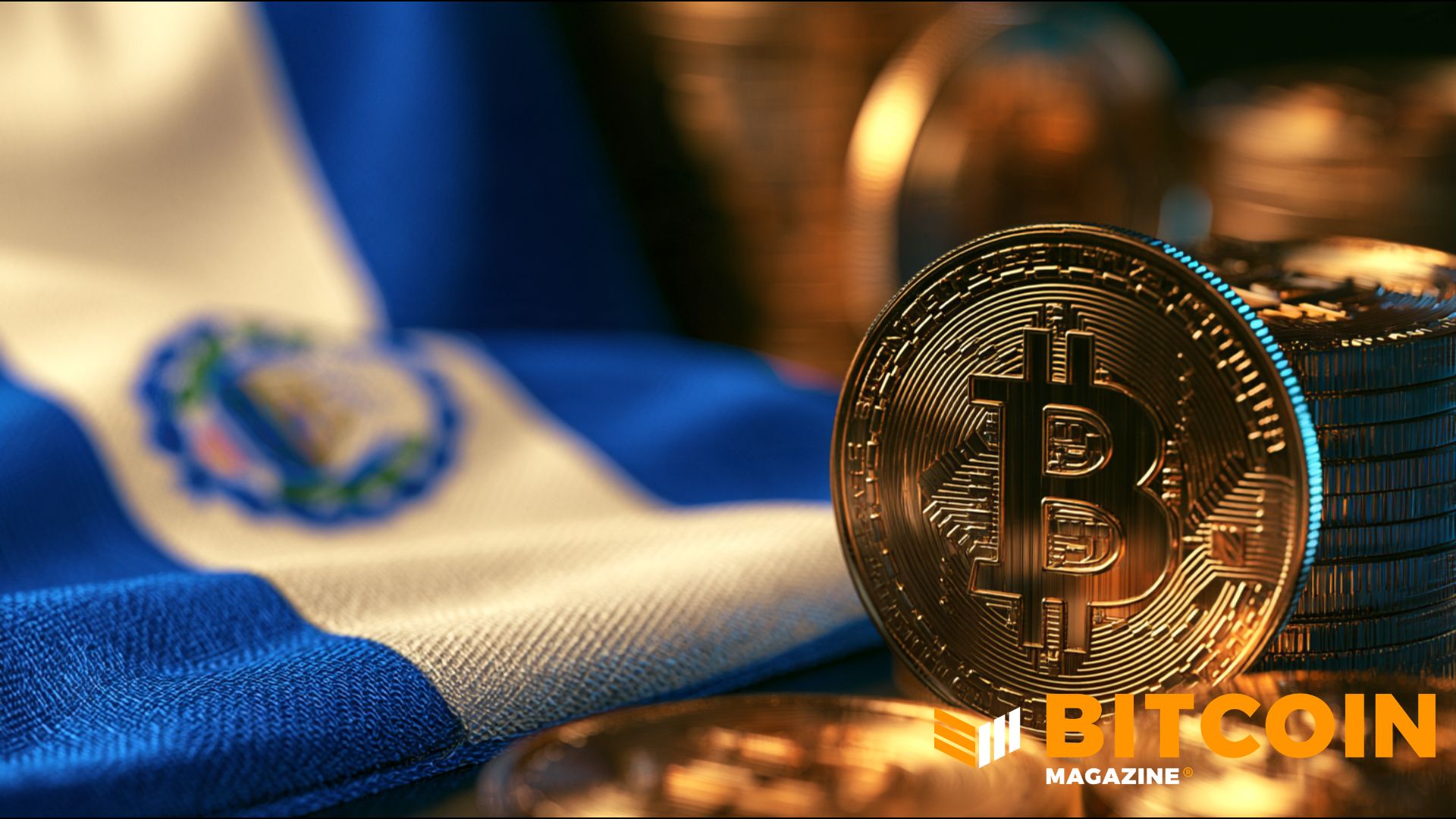
IMF Praises El Salvador — But Still Tries To Scale Back Its Bitcoin Project
The International Monetary Fund has praised El Salvador for improving its economy — but scolded it at the same time for its ongoing Bitcoin experiment.
In a statement Friday, the IMF said that it had approved a $139 million disbursement to the Central American nation while also trying to “reduce the state’s involvement in Bitcoin-related activities.”
El Salvador in 2021 made Bitcoin legal tender, much to the ire of the IMF and other major institutions. The Latin American country was at the time negotiating a development loan with the agency.
“El Salvador’s economy continues to perform strongly”
— Nayib Bukele (@nayibbukele) October 1, 2026https://t.co/Rvaerha9QA
The IMF in September said that El Salvador wasn’t buying bitcoin; the country’s Bitcoin Office has repeatedly said that it does buy the cryptocurrency.
“Economic activity has exceeded expectations, supported by sustained improvements in security and investor confidence, as macroeconomic imbalances continue to be addressed,” the IMF said.
It continued: “However, certain performance criteria were not met, including on the Bitcoin accumulation front, for which waivers were granted based on strong corrective measures and renewed commitments.”
The IMF further said that the Salvadoran state’s involvement in Bitcoin-related activities is being unwound and that “no further bitcoin accumulation is envisaged beyond the documented donations.”
Salvadoran president Nayib Bukele in 2022 said the country would buy one bitcoin per day but it was never clear where the money was coming from — or if he was actually buying at all.
The IMF said in September that El Salvador was — at least for some time —not using public funds to accumulate bitcoin but rather had received bitcoin from private donations.
El Salvador and the IMF entered a $1.4 billion loan agreement at the end of December but the fund asked for the country to scale back certain aspects of its Bitcoin strategy.
The Salvadoran state gifted its citizens bitcoin in 2021 and debuted a wallet with the hope of getting more citizens using the cryptocurrency in the dollarized country.
President Bukele in 2024 admitted that Salvadorans weren’t using the cryptocurrency to buy things as expected, but always boasted that the government was still stacking sats.
This post IMF Praises El Salvador — But Still Tries To Scale Back Its Bitcoin Project first appeared on Bitcoin Magazine and is written by Mathew Di Salvo.
Bitcoin Magazine
When the Banks Don’t Work, Bitcoin Does: Cornell University’s Adoption Index
A lot of people know little about Bitcoin and how it works.
But despite knowledge being shallow, for those holding the leading cryptocurrency, it appears to be solving a problem: getting around failing banking rails or inflation.
That’s according to new findings from the U.S. Ivy League research university Cornell, which spoke to nearly 26,000 around the globe about Bitcoin.
In its new Bitcoin Adoption Index report, the top college found that El Salvador, Venezuela and Nigeria were the countries that had the highest number of people who had ever owned bitcoin.
“Ranked by the share of all respondents who have ever owned bitcoin, the leaders are not wealthy financial centers — they are economies where the national currency has been unstable and everyday access to dollars or reliable banking is hard,” the report read.
“In each, bitcoin functions less as a speculative bet and more as a practical workaround.”
Bitcoin Advocacy Associate at Strategy and Junior Fellow at Cornell University’s Brooks School Tech Policy Institute, Ella Hough, added: “Bitcoin works the same everywhere, but people’s need for it does not.
“Across 25 countries, we found that people are more likely to see Bitcoin as a tool for financial freedom where currencies are less stable, banking access is limited, or monetary controls are tighter.”
Still, Cornell found that actually being able to explain the fundamentals of the protocol was difficult for most — including how many bitcoins would ever be minted in existence. In fact, 58% of those surveyed said they didn’t know the supply was capped at 21 million coins.
Technicalities aside, the cryptocurrency has still proved helpful to people wanting to use it, the report found.
One Venezuelan — who wasn’t named — told interviewers that Bitcoin was “faster, cleaner, and much less risky” than other methods of getting dollars in the country.
While another Salvadoran was quoted saying: “When nobody controls [bitcoin], it means we all have control of it.”
A Nigerian interviewee reportedly told Cornell researchers: “I’ve been to six African countries and whenever I go there, I don’t fear it because I know I can spend my bitcoin.”
Bitcoin adoption started growing in Venezuela ahead of other countries years ago, when hyperinflation crippled the economy and strict government currency controls meant getting dollars became difficult.
El Salvador made bitcoin legal tender — along with the dollar — in 2021. The country’s leader admitted that getting its citizens to use the cryptocurrency was difficult but the Central American nation still says it buys the asset for its government coffers.
In Nigeria, which has had some of the highest transaction volumes in the world, saving in bitcoin has been used by some to get around the collapse of the naira.
Cornell University’s research was fielded by Morning Consult in partnership with the Tech Policy Institute in Cornell University’s Jeb E. Brooks School of Public Policy, the Cornell Bitcoin Club, the Human Rights Foundation and the Reynolds Foundation.
Researchers interviewed 25,880 people in 25 countries between December 16, 2024 to March 10, 2025, asking 125 individual questions.
This post When the Banks Don’t Work, Bitcoin Does: Cornell University’s Adoption Index first appeared on Bitcoin Magazine and is written by Mathew Di Salvo.
Bitcoin Magazine
South Africa’s Absa Becomes First Bank on the Continent to Custody Bitcoin: Report
South African bank Absa has become the first African lender to custody bitcoin, according to reports.
As reported first by Bloomberg on Friday, the Johannesburg-based lender will serve institutional clients, mostly by custodying bitcoin — but other digital assets will also be a part of the service.
Banks worldwide are integrating or offering bitcoin-related products and services. A number of U.S. and European banks have started offering crypto-related services by custodying assets for institutions.
JUST IN:
— Bitcoin Magazine (@BitcoinMagazine) October 2, 2026Absa has become the first African bank to offer Bitcoin custody
pic.twitter.com/JaDza3S7Ez
Rob Downes, head of digital assets at Absa’s corporate and investment banking unit, was quoted saying that while bitcoin was the biggest asset the bank would custody, others would follow.
Absa did not immediately respond to questions from Bitcoin Magazine.
The African continent has a large crypto-native base, with data firms frequently highlighting the high adoption — particularly in countries where currencies have been significantly debased.
In Chainalysis’s 2025 report, South Africa’s $36.0 billion in on-chain value made it second in Sub-Saharan Africa. Nigeria alone received $92.1 billion, nearly three times the total of second-place South Africa.
On the global index, South Africa ranked 30th for crypto adoption.
The character of its market is different from Nigeria‘s: it’s more institutional, with regulatory clarity resulting in hundreds of licenses being issued to VASPs and attracting professional investors and traditional finance.
BNY Mellon in 2022 became the first major U.S. bank to offer digital asset custody services. And this month, German multinational Deutsche Bank said it would debut a bitcoin custody service for European corporate and institutional clients later in 2026.
This post South Africa’s Absa Becomes First Bank on the Continent to Custody Bitcoin: Report first appeared on Bitcoin Magazine and is written by Mathew Di Salvo.
Bitcoin Magazine

Bitcoin Price Surges Above $87,000 on Softer-Than-Expected Jobs Data
The price of bitcoin surged above $87,000 on Friday morning in New York, buoyed by constant exchange-traded fund flows and a jobs report showing that unemployment in the U.S. had ticked up.
Bitcoin’s price recently stood at $85,990 after a 2% jump over a 24-hour period. Over the past week, it has also risen by more than 2%.
Nonfarm payrolls increased 29,000 last month after a downward revision to the prior two months, Bureau of Labor Statistics data showed Friday.
JUST IN: Bitcoin jumps to $87,000 as U.S. Unemployment Rate comes in at 4.2%, higher than expectations
— Bitcoin Magazine (@BitcoinMagazine) October 2, 2026pic.twitter.com/jqtU8Q9zsd
Weaker-than-expected jobs data can give a lift to riskier assets like bitcoin and stocks, whose prices tend to swing more sharply.
A softer labor market typically means less consumer spending, which eases pressure on prices. That could make the Federal Reserve less inclined to keep raising interest rates to fight inflation.
Many economists and politicians have said the U.S. is in the midst of an affordability crisis, and the topic is a hot one ahead of the November midterm elections.
The Federal Reserve’s new chair, Kevin Warsh, has said that prices in the world’s biggest economy are too high and that the central bank is fully focused on making life more affordable again.
Bitcoin investors shrugged off the central bank’s interest rate hike in September, climbing on the news.
The largest cryptocurrency started rallying in August on news that the U.S. Treasury Department said it would more than double the size of its government debt repurchases. The coin had its best run in three years and third best August ever.
The coin’s price has benefited from the so-called debasement trade: when investors buy certain assets to hedge against currency being devalued. The dollar slid in value in August.
It continued to have a good September, rising nearly 6% over a 30-day period.
October has historically delivered good returns for bitcoin investors, with traders dubbing the phenomenon “Uptober.”
This post Bitcoin Price Surges Above $87,000 on Softer-Than-Expected Jobs Data first appeared on Bitcoin Magazine and is written by Mathew Di Salvo.
Bitcoin Magazine

Impacts of Daily Dividends on Digital Credit
In May 2026, Strive rebranded itself as “The Daily Dividend Company,” then moved SATA to daily cash dividends beginning June 16. Strategy has now pushed the same idea into its own digital credit engine. On September 24, its board proposed moving STRC, STRF, STRK and STRD to daily dividends, subject to shareholder approval at an October 28 special meeting. The proposal keeps the annual dividend economics unchanged and changes the cadence of cash payments.
STRC spent much of the summer below its $100 stated amount even as Strategy raised its dividend rate to 12% and deployed more than $1 billion buying back STRC. The move to daily dividends by Strategy could be seen as the latest attempt to make the security more attractive and help it trade near par.
Now that the overton window has fully shifted in favor of digital credit paying daily dividends, we should take a look at the actual impacts of daily dividends.
Daily Dividends Fit Onchain Finance
Digital credit is increasingly becoming an input for other financial products—so called “digital money” or “digital yield” products. Strategy estimated in mid-May that more than $440 million of STRC exposure had moved into DeFi through stablecoins, tokenized securities, yield products and other structures.
However, there is a cash flow mismatch. Crypto products commonly accrue and distribute yield at high frequency. A security that pays monthly or twice monthly forces the product sitting on top of it to bridge the period between economic accrual and actual cash receipt.
Daily dividends compress that gap to one day. The protocol, fund or issuer receives cash from the underlying asset at almost the same cadence that users expect to receive yield. That simplifies liquidity management and reduces the cash needed between dividend dates. This is much more impactful to a financial product funding daily distributions or redemptions than to a long term investor focused on total return. The crypto-heavy setting of the “Layer 3” products on top of digital credit raises the attractiveness of daily dividends.
Daily Dividends Are Primarily a Retail Feature
For investors focused strictly on total return, dividend payment frequency makes little difference in underlying economic value. The asset’s price accrues between distribution dates and adjusts post-payment, meaning annual, quarterly, monthly, and daily payouts produce comparable long-term results.
The true advantage of daily dividends lies in product psychology and user experience. Cash arriving every day provides immediate visibility and an engaging feedback loop. Investors can spend, withdraw, or automatically reinvest the payout while leaving their principal position intact, turning an abstract yield metric into tangible recurring cash flow.
This dynamic mirrors the strategy of Realty Income, which built a massive retail follower base by branding itself as “The Monthly Dividend Company.” As a member of the S&P 500 Dividend Aristocrats Index, Realty Income has paid and raised dividends for 31 consecutive years.
Daily dividends on digital credit extends this product concept even further: SATA pairs frequent daily payouts with a target price near $100 and a double-digit yield.
While institutional investors prioritize yield spreads, liquidity, tax structure, and balance sheet coverage, daily payments offer their strongest appeal to retail buyers. If the overarching objective is to raise capital to purchase Bitcoin, optimizing security design for retail investor preferences is the most effective approach.
Options Get Cleaner Too
Daily dividends also change options mechanics. STRC currently pays $0.50 twice monthly. SATA pays roughly five cents each business day. Larger dividend events create larger discrete adjustments in the underlying price, which affects option pricing and early exercise decisions. Daily payments spread the same annual cash flow across much smaller adjustments.
The total value of dividends over an option’s life is a key economic input. The more interesting effect comes from the price stability created by daily dividends. If daily dividends, variable rates and active par management keep SATA and STRC trading in narrower ranges, realized volatility should fall. Implied volatility can follow as the market gains confidence in that behavior.
The Biggest Test
The real test is whether daily dividends increase demand enough to eventually lower the required yield.
If investors consistently support SATA near the top of its target range, Strive can theoretically reduce the dividend rate while attempting to keep SATA near par. Success would show that a Bitcoin company can issue permanent preferred capital, manage it around a stable price, and adjust its yield with market demand. The benefit of the variable rate preferreds was, from inception, the eventual opportunity to lower the rate and reduce the cost of capital without upsetting price stability. In comparison, fixed rate credit locks in fixed rate forever.
Conclusion
Strategy adopting daily dividends would move the feature from a SATA differentiator toward a digital credit category standard. The annual economics barely change but the retail appeal and crypto composability become meaningful improvements.
This post Impacts of Daily Dividends on Digital Credit first appeared on Bitcoin Magazine and is written by Allard Peng.
CryptoSlate
Arbitrum's Security Council temporarily blocked new Stylus contract activations on Arbitrum One and Nova in an October 2 emergency action, restricting programs and app updates that require fresh activation. Already-active Stylus applications can keep running, while ordinary Solidity contract deployment and execution remain unaffected, according to the Council's action report.
Arbitrum attributed the precaution to increasingly sophisticated AI-assisted attacks involving hand-crafted WebAssembly programs outside the standard Stylus compiler toolchain. It said known Stylus bugs primarily threaten chain liveness, including denial-of-service risks, and that no attack permitting theft of user funds had been discovered.
The linked Ethereum, Arbitrum One and Nova transaction records show successful execution on October 2, around 15:30 to 15:31 UTC.
For builders, the distinction is between storing code and making it usable. Stylus contracts run WebAssembly programs, which need activation to become executable. Arbitrum's documentation distinguishes that step from deployment, which stores code onchain. New contract instances using identical program code can reuse an existing activation, provided it is still valid.
A new application version requiring fresh activation cannot become executable during the pause. Reactivating an expired program, or one needing reactivation after a Stylus version change, is also blocked, the Council said. The scope is activation, rather than a blanket prohibition on deploying every new contract instance.
Existing programs remain callable until expiration. Developers can continue extending an active program's lifetime through the permissionless keepalive renewal mechanism before it expires, according to the official pause notice. This leaves renewal available while reactivation of an already-expired program is blocked.

The Council said it implemented the restriction by raising the activation gas requirement to a prohibitively expensive level. It described this as a configuration change requiring no upgrade to ArbOS, the network's operating software.
When withdrawals could wait
The same emergency action installed a separate safeguard for BoLD's one-step proofs on Arbitrum One. Anyone can present two conflicting answers to the same step of an open challenge. If the one-step proof accepts both, the guard puts One's settlement to Ethereum on hold, according to the Council.
Arbitrum says One would continue processing normally during that suspension. However, messages from One to Ethereum that have not yet been confirmed, including withdrawals, would have to wait while the Council deploys a fix and resumes settlement. Installing the guard does not itself pause withdrawals; the delay depends on its conflict condition being met.
For builders waiting to activate new Stylus code, reopening remains the next decision. The October 2 report and developer notice give no date, saying the Foundation will work with ArbitrumDAO on the timeline and manner of restoring activations.
The post Arbitrum pauses new Stylus activations over AI-assisted attack risks appeared first on CryptoSlate.
Companies building AI applications can rent powerful computers instead of buying the equipment themselves, paying for access to the graphics processing units, or GPUs, that run their software.
Lower rental prices make those applications cheaper to operate, but they can also make life harder for the company that bought the machines and needs the rent to pay its debts.
If you've financed a room full of GPUs assuming customers will pay a certain hourly rate, a cheaper competitor can upset the calculation long before you've paid off the equipment. Your machines might still work perfectly, and demand for AI might still be strong, but the amount you earn from each hour could start falling below what the business needs.
Financial contracts could let you protect part of that income by arranging a payment when rental prices fall, in exchange for taking on your own obligations. That's the basic idea behind AI compute derivatives, which let businesses trade their exposure to computing prices separately from renting the computers themselves.
Luxor, a company that provides services and financial products to Bitcoin miners, included these contracts in its latest expansion into AI. It sees an opportunity to bring its experience hedging mining revenue to another business that spends heavily on machines before knowing what it'll earn.
The company told CryptoSlate that it's already brokering agreements between owners of computing capacity and customers who want to use it.
However, its cash-settled derivatives business is still early, and the company said it couldn't provide a customer hedge example or current derivatives trading volumes because a liquid market hadn't formed yet.
That gives this promising idea the difficult commercial task of persuading someone to accept losses another business wants to avoid.
Getting that arrangement to work could help operators plan around more predictable income, but the protection is only as dependable as the price used to calculate it and the party responsible for paying.
Locking in the rent without locking in a customer
The tried-and-true way to make rental income more predictable is to sign a customer for a longer period at an agreed price. The customer gets access to the machines, while the operator gets a commitment it can use to plan its business.
That works well when both sides want the same arrangement, but customers don't always know how much computing they'll need that far into the future. Operators may also prefer to keep selling capacity to different users.
Cash-settled derivatives offer another approach because the contract pays money according to a price formula, without requiring the parties to exchange computing capacity. The operator can keep renting its GPUs to customers while using a separate financial agreement to offset movements in the rental rate.
Imagine an operator expecting to sell 1 million GPU-hours in a month, where one GPU-hour means access to one processor for an hour. At $2 per hour, that would produce $2 million in rental income, and the operator enters a hypothetical contract designed to protect that rate.
If the agreed market benchmark falls to $1.50, the contract pays the operator the 50-cent difference across the million hours, or $500,000. Assuming its actual rental income also falls to $1.5 million, that payment brings the combined amount back to $2 million before fees and other costs.
The obligation runs both ways, so if the benchmark increases to $2.50, the operator owes $500,000 while earning more from its customers. It gives up the benefit of a higher rate in exchange for protection against a lower one, making revenue easier to plan around.
This is just back-of-the-napkin math to explain the arrangement, as the result depends on the operator actually selling the expected hours at a rate that tracks the benchmark. Empty machines still produce no rental income, so fixing the hourly price doesn't guarantee someone will buy it.
Someone on the other side needs a reason to accept the opposite payments, and an AI business worried about more expensive computing could have one. Its financial contract would pay when the benchmark increased, helping cover a larger rental bill, while a fall would create a payment obligation alongside cheaper computing.
Dealers could help connect those interests or take some of the exposure themselves, charging for the risk they carry. But customers need a price for the amount of protection they want, covering the period when their business needs it.
CME Group is pursuing an exchange-traded version of this idea through its announced H100 and B200 rental-index futures. Its Aug. 11 announcement targeted Oct. 5, subject to regulatory review, for contracts tied to Silicon Data's GPU rental benchmarks, although listing a contract alone can't guarantee enough participation to make it easy to trade.
Your GPU hour might be different from mine
But even with willing counterparties, the payment formula needs a price both sides accept as relevant to their business.
In the example above, the hedge works perfectly because the operator's rental income moved exactly with the benchmark. However, you can't replicate perfect conditions once actual customers enter the picture.
Suppose its customers negotiate rates down to $1.25 while the benchmark only falls to $1.50, perhaps because the index covers a different service or type of equipment. The same $500,000 hedge payment would then bring its $1.25 million in rental income to $1.75 million, leaving a gap even though the contract works as written.
That mismatch is called basis risk, which simply means the price you've protected against doesn't move exactly like the price you actually receive. Compute hedges can leave Bitcoin miners exposed, and this is one reason a hedge needs to be judged against the particular business using it.
Luxor compared its AI ambitions with its path in Bitcoin mining, where publishing a reference price helped create a foundation for financial contracts. Its hashprice measure estimates what a unit of computing power can earn from mining Bitcoin, giving operators a shared revenue reference even when their own operating costs differ.
Bitcoin miners perform the same network task, whereas AI customers can attach different values to access that looks similar on a specification sheet. Someone buying uninterrupted access for months is purchasing a different service from someone willing to have a short job stopped whenever the provider needs the machines back.
Price providers already account for differences like these, with CCIR's rental-data methodology treating interruptibility and commitment length as separate characteristics. It uses publicly advertised rates, which also means the figures don't necessarily capture privately negotiated discounts.
The index Luxor supplied in its reply was its AI Hardware Price Index, which measures advertised prices for selected GPU systems. That can help someone assess an equipment purchase, but buying a machine and earning rent from it involve different prices, so the link doesn't establish how an AI rental hedge would settle.
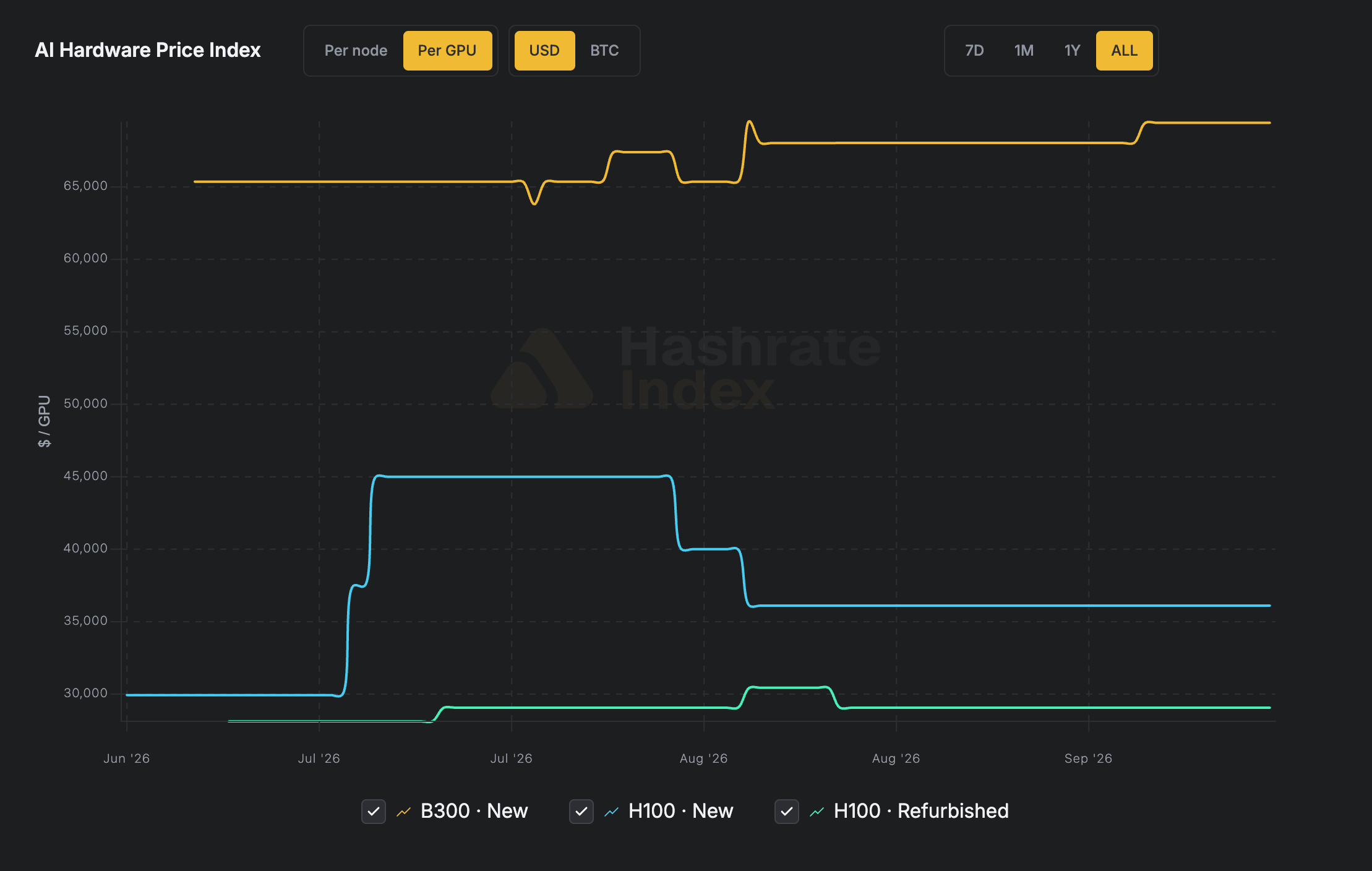
Luxor's August data announcement described expanded compute spot pricing as forthcoming. Operators trying to protect income would still need contracts that name a rental benchmark and show it tracks what customers pay.
Narrower benchmarks might fit better, but each additional contract splits potential trading among smaller groups. Building this market requires a compromise between matching each customer's business closely and bringing enough people together under the same contract to make trading affordable.
The protection has to survive the bad month
Even a closely matched contract leaves the operator relying on someone else's ability to pay when rental income falls.
If that counterparty also earns much of its money from AI infrastructure, cheaper computing could damage both businesses at the same moment, just when one expects support from the other.
Collateral can reduce that dependence by requiring money or eligible assets to be posted against obligations, giving the recipient something to draw on if the other party fails. It also creates a financing requirement, because money committed to the hedge can't simultaneously pay the operator's other bills.
In the example where rental prices increase, the operator might have to pay its hedge obligation before customers settle their higher invoices.
The overall economics could still work even if the bank account runs short, making the timing of cash flows a huge part of that protection's affordability.
Luxor didn't provide the requested AI collateral terms or explain the procedures for a counterparty failing to pay. Its reply also left unanswered how it separates its own trading from the business it arranges for customers, a relevant point because the launch announcement disclosed an internal compute trading fund.
More predictable rental income could give an operator greater confidence about meeting its debt payments, even when customers become less willing to pay yesterday's rates.
Getting that benefit requires a contract that follows the income closely enough, with payment obligations the operator can afford throughout the period it's trying to protect.
Cheaper computing could let more people build and use AI while leaving some owners of the machines with disappointing returns.
Financial contracts won't make that loss disappear, but they could move part of it to someone prepared to bear it, giving the operator more room to keep serving customers when the rent falls.
The post Plunging GPU prices threaten AI hosts, and new hedges step in appeared first on CryptoSlate.
Investors in LIBRA, the memecoin promoted by Argentine President Javier Milei, lost a district-court route to recovering their losses after a US judge dismissed the proposed class action over LIBRA and fellow memecoin M3M3.
In a Sept. 29 opinion, Judge Jennifer L. Rochon dismissed the amended complaint with prejudice, denied permission to amend it again and ordered the Southern District of New York case closed. The decision also blocked investors' proposed expansion of the lawsuit to three other tokens.
The plaintiffs alleged that insiders controlled token launches and extracted funds from liquidity pools at outside investors' expense.
According to the complaint as recounted by the court, LIBRA launched on Feb. 14, 2025, and Milei promoted it before withdrawing his support that day. The dismissal resolved the legal sufficiency of the claims and the court's jurisdiction.
Why the racketeering claims in the LIBRA case failed
The central federal claim relied on the Racketeer Influenced and Corrupt Organizations Act, or RICO. It requires a pattern of related racketeering acts that either spans a substantial period or threatens continuing criminal activity.
The court found neither form of continuity adequately pleaded against the Kelsier defendants, including Kelsier Ventures and Hayden Davis, and Benjamin Chow, Meteora's co-founder and former CEO.
For the first route, the court treated the alleged conduct from October 2024 through the March 2025 complaint as a six-month period. Multiple schemes and a potentially large group of victims did not overcome that short duration.
The opinion applied Second Circuit precedent that generally demands a longer period for this form of continuity, while expressly recognizing that two years is not a fixed cutoff. I
The alternative route required facts supporting a continuing threat. The court found that broad assertions about a repeatable token-launch business and referrals to other projects did not establish, defendant by defendant, that alleged wire fraud was a regular business practice. The dependent RICO conspiracy claims failed too.
The proposed amendment would have added MELANIA, ENRON and TRUST, another plaintiff and new defendants. But the judge found it extended the alleged racketeering period to only seven months and provided no facts curing the continuing-threat defect.
After RICO failed, the court dismissed the Kelsier defendants' remaining state-law claims for lack of personal jurisdiction. Allegations about nationwide social media and crypto infrastructure did not establish the necessary New York connections. The court did not reach the merits of those state-law claims.
The court dismissed all claims against Chow for pleading defects, including insufficient allegations of fraudulent intent. Claims against Meteora failed because investors had not adequately pleaded it as a legal association or partnership capable of being sued.

Hayden Davis's denied wrongdoing and jurisdiction objections in June 2025. The new ruling turns that earlier dispute into a concrete setback for investors seeking recovery through this action.
The order does not establish that every alleged act was lawful or determine the status of every other possible recovery route.
The post US judge kills Milei’s LIBRA memecoin lawsuit, leaving investors stranded appeared first on CryptoSlate.
The US Securities and Exchange Commission’s proposed crypto custody fallback could broaden investment choices while making them easier for larger advisers to offer.
The agency’s economic analysis says the expense of safeguarding assets and arranging independent oversight may lead smaller firms to decline to offer the service.
Approved on Oct. 1, the proposal would let advisers hold covered client crypto assets when an eligible custodian is unavailable, subject to safeguards. Table 8 models certain annual costs of $433,833 per adviser using that option.
That estimate includes an independent control report but leaves out some potentially significant technology costs.
For clients, the consequence could be that an asset might become available through an adviser with sufficient custody resources while remaining outside another adviser’s offering.
SEC Commissioner Hester Peirce distinguished adviser “self-custody” from investors holding their own assets. Here, an intermediary would hold clients' key materials, potentially including a non-controlling portion. Clients would still depend on that intermediary’s safeguards.
For ordinary advisory clients, the adviser amendments concern crypto assets that are funds or securities, while the relevant scope for regulated-fund accounts is securities or similar investments.
What the annual estimate includes
The largest modeled annual component is the independent internal control report. The SEC puts its average cost at $376,000, alongside $57,833 in recurring internal compliance work.
Table 8 combines those amounts and separately lists an initial internal compliance cost of $173,499, all in 2026 dollars.
| Modeled adviser cost | Amount | Timing |
|---|---|---|
| Internal compliance work | $173,499 | Initial |
| Internal compliance work | $57,833 | Recurring annually |
| Independent internal control report | $376,000 | Annual estimate |
| Table 8 adviser annual subtotal | $433,833 | Internal work plus control report |
The internal estimate assumes 300 initial hours and 100 recurring annual hours at $578.33 an hour. It covers information, communications, and an agreement between adviser and client to treat the asset as a financial asset under applicable state law.
The subtotal leaves out some technology, software, hardware, and associated systems and processes. The SEC expects those costs to be economically high. Recordkeeping and disclosure burdens also appear separately in other tables, so the subtotal cannot serve as a complete operating budget.
The accountant figure comes from an inflation-adjusted prior estimate in the Paperwork Reduction Act analysis, rounded to the nearest $1,000, reflecting the agency’s historical cost model. Report costs could vary with the assets, safeguarding systems, and expertise needed to check different networks.
The agency assumes approximately 823 advisers, or 5% of 16,442 registered advisers, would use self-custody for that burden calculation. It cautions that actual uptake may be lower.
Scale changes the cost of access
The economic analysis explicitly anticipates that smaller advisers may elect against self-custody, while larger advisers could have sufficient resources to meet the safeguards. It also identifies ways to share some costs across a larger client base, multiple assets, or affiliated businesses.
That creates a plausible advantage without establishing a universal minimum firm size. An adviser with substantial overall assets may have only a small pool of covered crypto assets needing this fallback.
Conversely, an adviser with a focused crypto business may already have the expertise and infrastructure another firm would have to acquire.
A shared cost weighs more heavily on a small pool of assets than a large one, if the burden stays constant. Firms could allocate costs across their wider businesses rather than charge only clients using the fallback.
The SEC expects many direct costs could be passed on to clients through fees or expenses. More assets and more networks can require more complex controls and more specialized accountant work, increasing absolute costs. The potential benefit comes from spreading or reusing parts of the infrastructure.
Accountant pricing could work either way: the SEC warns that demand for people who can assess crypto controls could make services harder to obtain, particularly for smaller advisers with less bargaining power.
An option that can expire for each asset
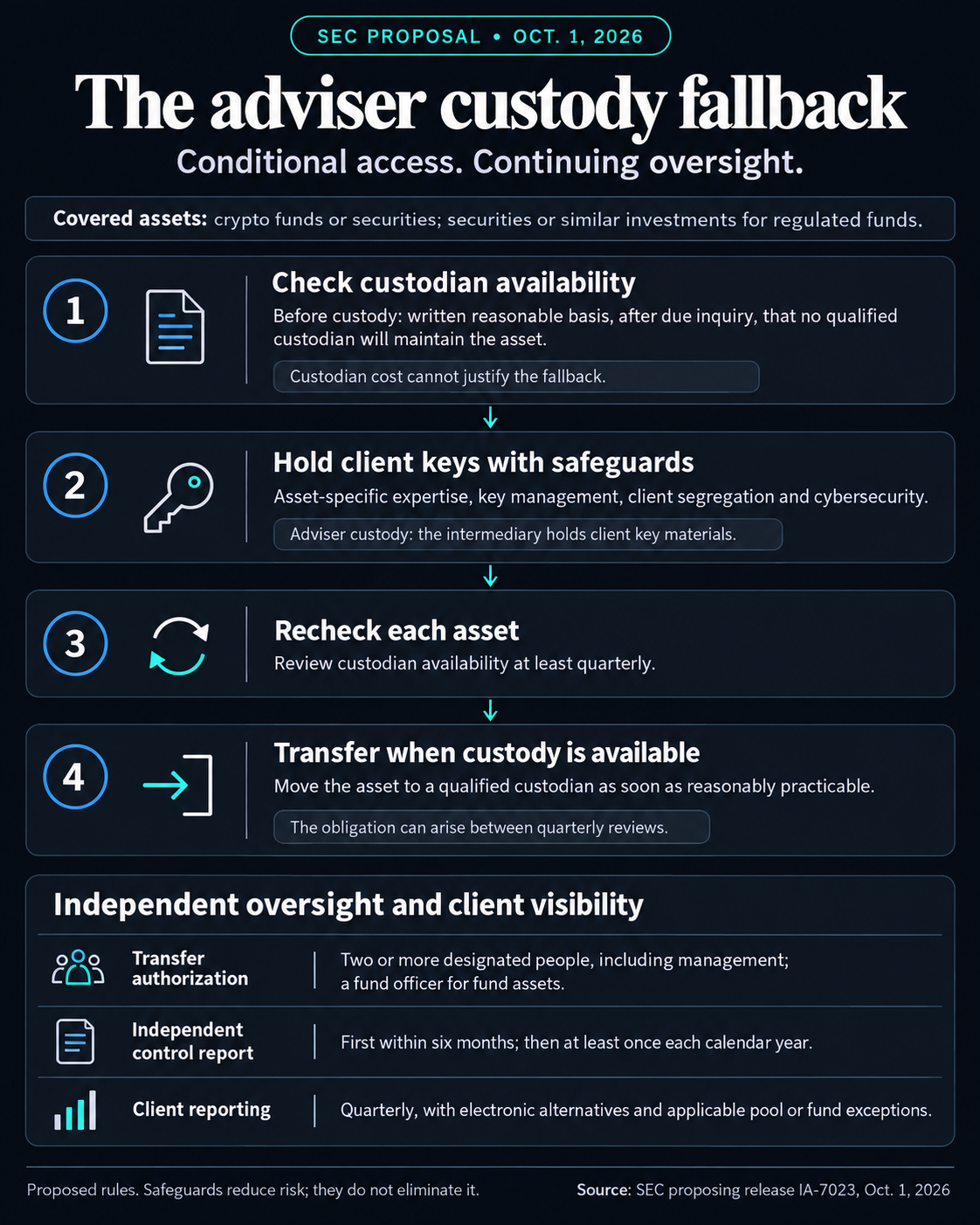
The proposed fallback would depend on the adviser having a written reasonable basis, after due inquiry, that no qualified custodian would maintain each asset.
The adviser would need to make this determination before taking custody and at least quarterly afterward. Custodian costs could not form the basis of that determination.
An adviser could not choose the fallback simply because its custody arrangement looked cheaper. The relevant barrier is the availability of an eligible custodian for the asset, assessed under the proposed conditions.
Once an adviser learned that a qualified custodian had become available, it would have to place the asset with that custodian as soon as reasonably practicable. That obligation could arise between quarterly reviews. The proposal does not specify a single transfer deadline for every situation.
A firm might incur costs to support an asset and later have to move it out of adviser custody. Eligibility could also leave the firm with only a narrow set of unsupported assets to spread the remaining expense across.
If no client crypto assets remained in self-custody by the report’s due date, the report would not be required. That could reduce costs for a short-lived arrangement, although advisers retaining other covered client crypto assets in self-custody would still face the applicable obligation.
The safeguards buy independent scrutiny
The expense accompanies a change in who holds the assets. An adviser offering investment advice would also hold client key materials, creating risks of misuse, misappropriation and operational error. A lower-cost arrangement would have to be assessed alongside those risks.
As SEC Commissioner Mark Uyeda’s statement explains, the proposed conditions include safeguarding expertise, cybersecurity protections, annual reviews, reporting and client disclosures.
The adviser would need asset-specific expertise and systems for key management, authorization by two or more designated people, and segregation of each client’s assets.
The first independent control report would be due within six months of taking self-custody and at least once each calendar year thereafter. It would assess the design, implementation and effectiveness of controls and include verification of reconciliation to the crypto network.
That supplies scrutiny beyond an adviser’s assessment of its capability.
Quarterly client reporting would also apply, with electronic alternatives and exceptions for qualifying audited pools and regulated funds. Clients’ visibility into balances and transactions can complement safeguards, while the accountant’s work addresses questions that a balance alone cannot settle.
These protections would not eliminate custodial risk, and the SEC cautions that spending itself does not establish safeguarding competence. A firm’s ability to absorb compliance costs is a separate question from whether its systems effectively protect clients.
Alternatives could soften the scale advantage
SEC Commissioner Hester Peirce’s Sept. 30, 2025 statement described conditional staff no-action relief for certain state trust companies and identified national and state banks as other permissible custodians.
The October proposal would also permit eligible state trust companies to custody crypto assets, subject to initial and annual due inquiry into authorization and safeguards. Where an eligible institution supports an asset, clients may gain access without their adviser building the proposed fallback arrangement.
Its cost advantage would depend on the particular asset and custody arrangement, since a firm authorized to provide crypto custody does not necessarily maintain every asset a client wants to hold.
The question for investors is whether the proposal would produce usable access at an acceptable cost and level of protection. The SEC’s analysis supports a possible advantage for advisers with sufficient resources and reusable infrastructure.
How widely clients benefit would depend on firms’ actual implementation costs, independent-accountant pricing, and the assets that eligible custodians begin to support.
The post New SEC crypto rules threaten small advisers, but big firms win appeared first on CryptoSlate.
Ethereum layer-2 network built around native yield Blast said on Oct. 2 that it will shut down because maintaining the chain costs more than it earns.
The project asked users to move their assets to Ethereum mainnet by Oct. 26 to withdraw through its normal interface.
Blast said in its shutdown announcement that it sees no credible path to making the network economically sustainable. It plans to wind down the chain through an asset withdrawal process that will temporarily interrupt users’ ability to exit.
The decision comes nearly three years after Blast disclosed $20 million in funding from Paradigm and Standard Crypto on Nov. 20, 2023. The network opened early access that November, with a mainnet launch then planned for February 2024.
Its documented design describes an Ethereum-compatible optimistic rollup that passes yield from ETH staking and real-world-asset protocols to users. The website identifies Lido and MakerDAO as yield sources and lists additional investors among Blast's backers.
The yield model was intended to let holders benefit from returns earned by those underlying protocols, but Blast now says those operating economics no longer justify keeping the network running.
Blast's withdrawal pause and Oct. 26 cutoff
Blast said it will first withdraw its assets from Lido, which its design identifies as a source of ETH staking yield, a process that is expected to take approximately one week.
User withdrawals will be temporarily unavailable during the unwind, even after the network reduces its withdrawal delay to 24 hours.
Withdrawals will resume with the new 24-hour delay once the Lido process is complete, according to the announcement. The roughly one-week interruption and the withdrawal delay after reopening are separate parts of the exit timetable.
The request to move funds back to Ethereum includes balances held in Blast’s web app, which the announcement calls the PWA. Blast encouraged all users to withdraw before Oct. 26.
After that date, Blast said assets will remain withdrawable, but users will need to interact directly with its bridge contracts on Ethereum mainnet.
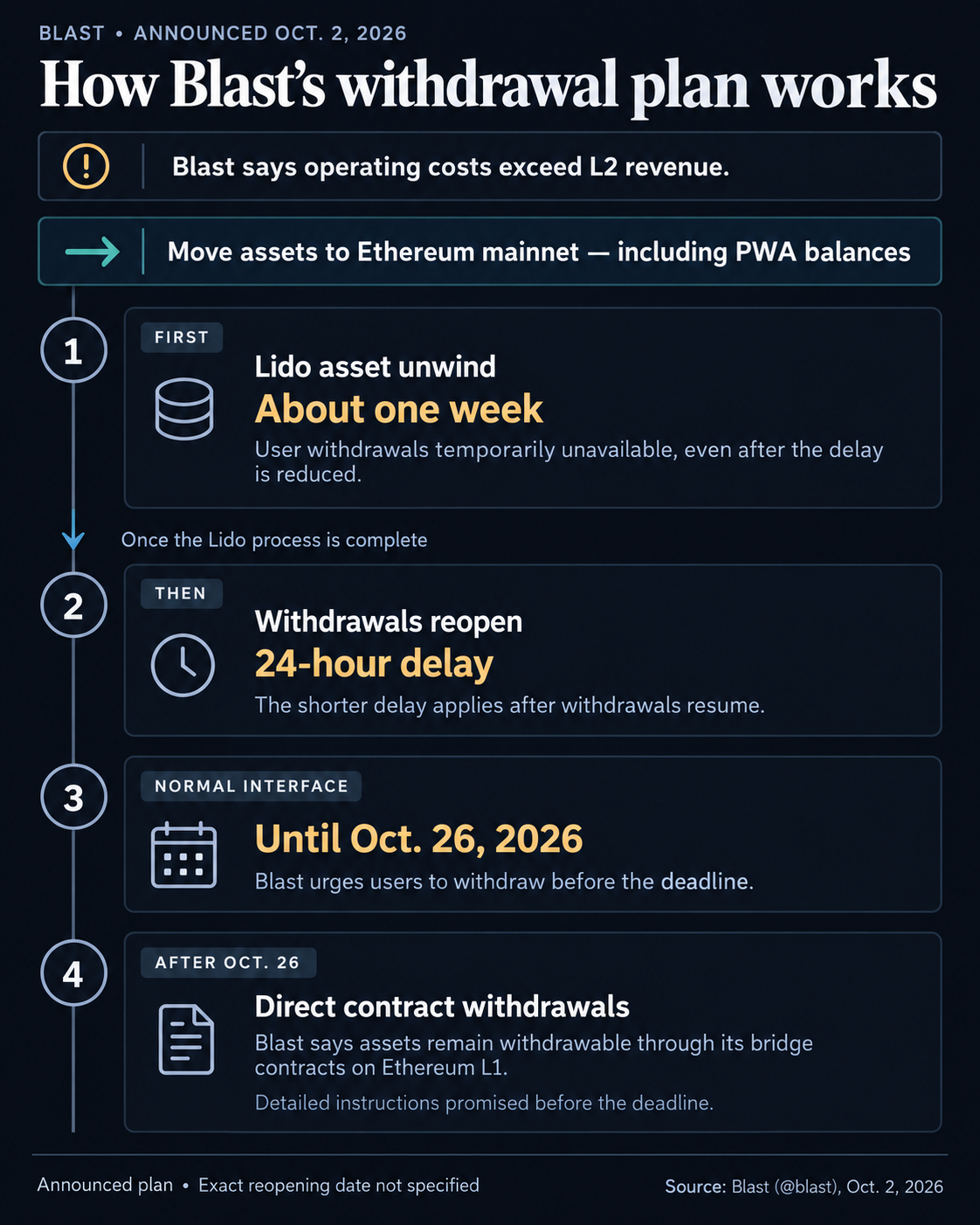
Blast promised to publish detailed instructions for that route before the deadline. The announcement gives an approximate duration for the Lido unwind but does not specify an exact date when normal withdrawals will resume.
The post Blast shuts down $20M layer-2 network, forcing Oct. 26 exit deadline appeared first on CryptoSlate.
CryptoTicker.io
XRP has spent the past month going nowhere fast. After the explosive August rally from $1 to almost $1.70, the XRP price has been grinding sideways around $1.50, trapped inside a second falling wedge while the rest of the market waits for direction. Boring, yes, but this is exactly the kind of structure that tends to resolve with a sharp move. In this XRP price prediction we look at where the price stands today, what the chart is telling us, and how XRP could realistically climb to $3 if the crypto bull market comes back.
Where Does the XRP Price Stand Right Now?
At the time of writing, XRP trades at $1.48 on the daily chart, just below the $1.50 line that has acted as the pivot for the whole of September. The 200-day EMA sits at $1.37 and is finally curling upward after months of pointing down, which is the first time since spring that the long-term trend indicator is on the bulls' side.
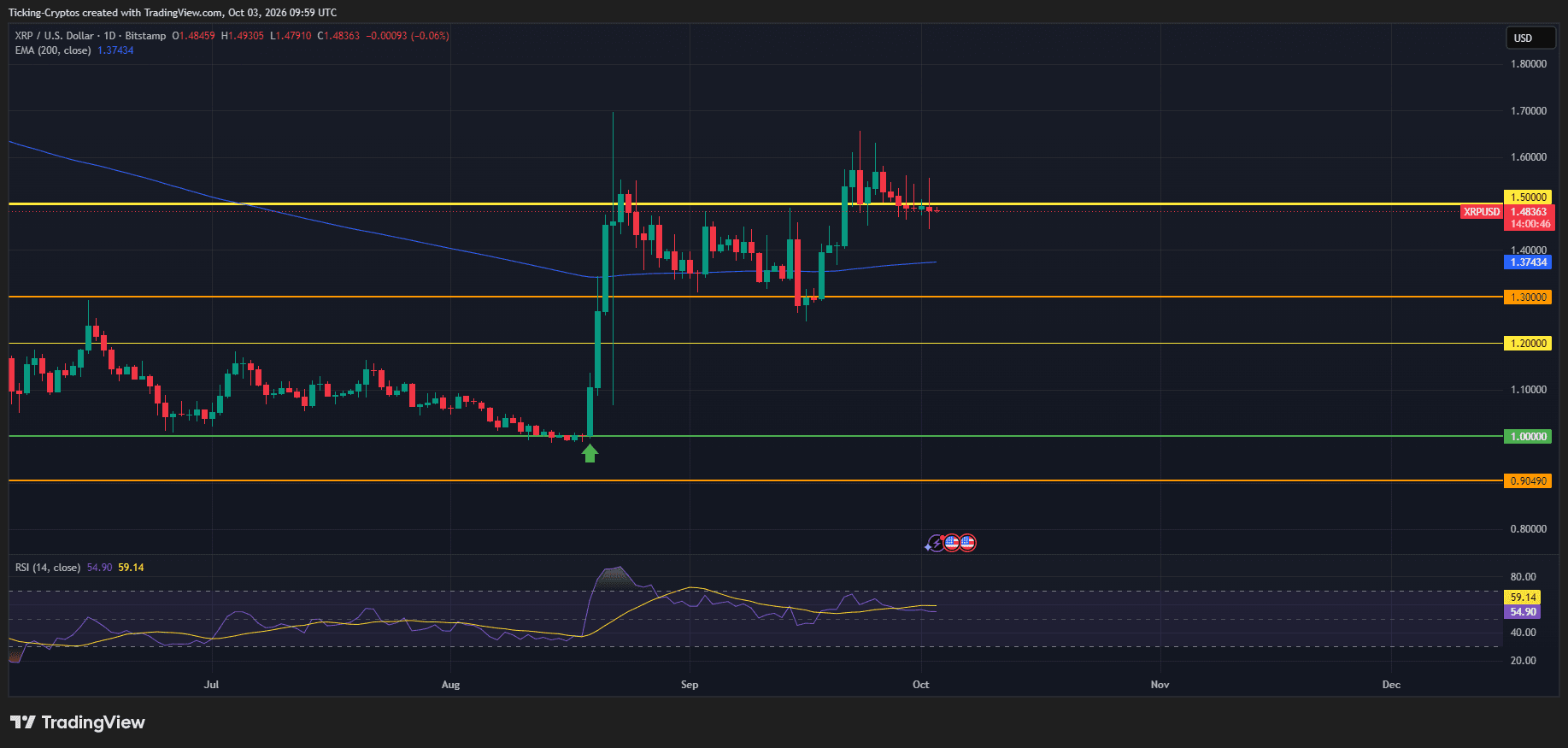
The bigger picture matters here. XRP bottomed right at the $1.00 psychological level in late August, bounced hard, and printed a vertical candle straight into $1.70. That move was too fast to hold, and the price has since been digesting it in two consecutive falling wedges. The first wedge broke to the upside in mid-September and sent XRP back to $1.65. The second one is forming right now, with the price pressed against the upper trendline.
Momentum is neutral rather than weak. The daily RSI sits at 55, well off the overbought spike above 80 from August, and has carved out a series of higher lows while the price moved sideways. That is quiet accumulation behavior, not distribution. You can follow the live XRP price on our crypto prices page.
What Does the XRP Chart Say About the Next Breakout?
The setup is a textbook falling wedge inside an uptrend, which is a bullish continuation pattern. Lower highs are compressing the price against the $1.50 pivot while the lows are flattening around $1.40 to $1.45. The wedge projects down toward $1.20 if it ran to completion, but these patterns usually break before the apex, and the last one did exactly that.
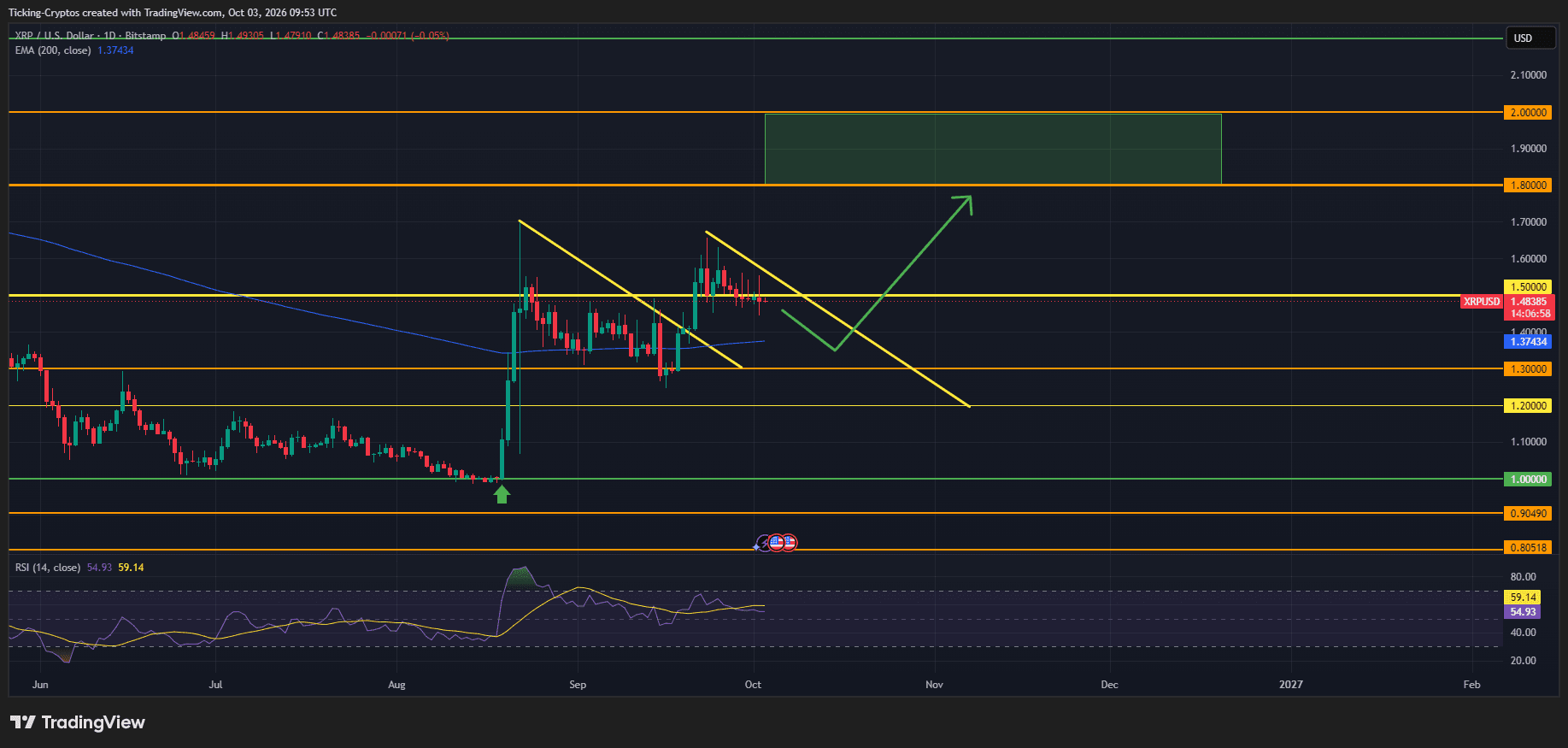
Our base case for the coming weeks: one more shakeout first. A dip toward the 200-day EMA at $1.37, possibly a brief wick into the $1.30 support, would flush out late longs and reset funding before the real move. From there, a daily close above the wedge's upper trendline and the $1.50 pivot would confirm the breakout.
The first target after a breakout is the $1.80 to $2.00 zone, marked as the green box on both charts. This is a heavy area: $1.80 is the first major resistance since the August spike, and $2.00 is the round number every trader is watching. Expect the first attempt to fail and the price to chop between $1.80 and $2.20 for several weeks, roughly through November and December, before the next leg.
If the price breaks down instead and loses $1.30 on a daily close, the bullish wedge is invalidated and the next stops are $1.20 and the $1.00 floor. Until that happens, the structure favors the upside.
Can XRP Reach $3 If the Bull Market Comes Back?
Yes, but not in a straight line, and not without help from the broader market. $XRP rarely leads; it tends to lag Bitcoin for weeks and then catch up violently. So the $3 XRP price prediction only plays out if $Bitcoin reclaims its highs and risk appetite returns to altcoins. If that happens, the chart gives us a clear roadmap with four stages:
- Stage 1: Break the wedge, reclaim $1.50. A daily close above the trendline flips the September range into support. Target: the $1.80 to $2.00 box, likely by November.
- Stage 2: Build a base between $1.80 and $2.20. Two or three failed attempts at $2.00 and $2.20 are normal here. The key is that every pullback holds above $1.80, turning the old resistance box into a launchpad. This phase probably eats up the rest of 2026.
- Stage 3: Clear $2.20 and run to $2.75. Once $2.20 goes, there is very little historical structure until $2.75, so this leg could be fast. The $2.75 level is the last meaningful resistance before the big round number.
- Stage 4: The $3 test. $3.00 is both a psychological magnet and the area where XRP topped in previous cycles. A first touch early in 2027 is realistic in a full bull market; a clean break above it would need genuine euphoria.
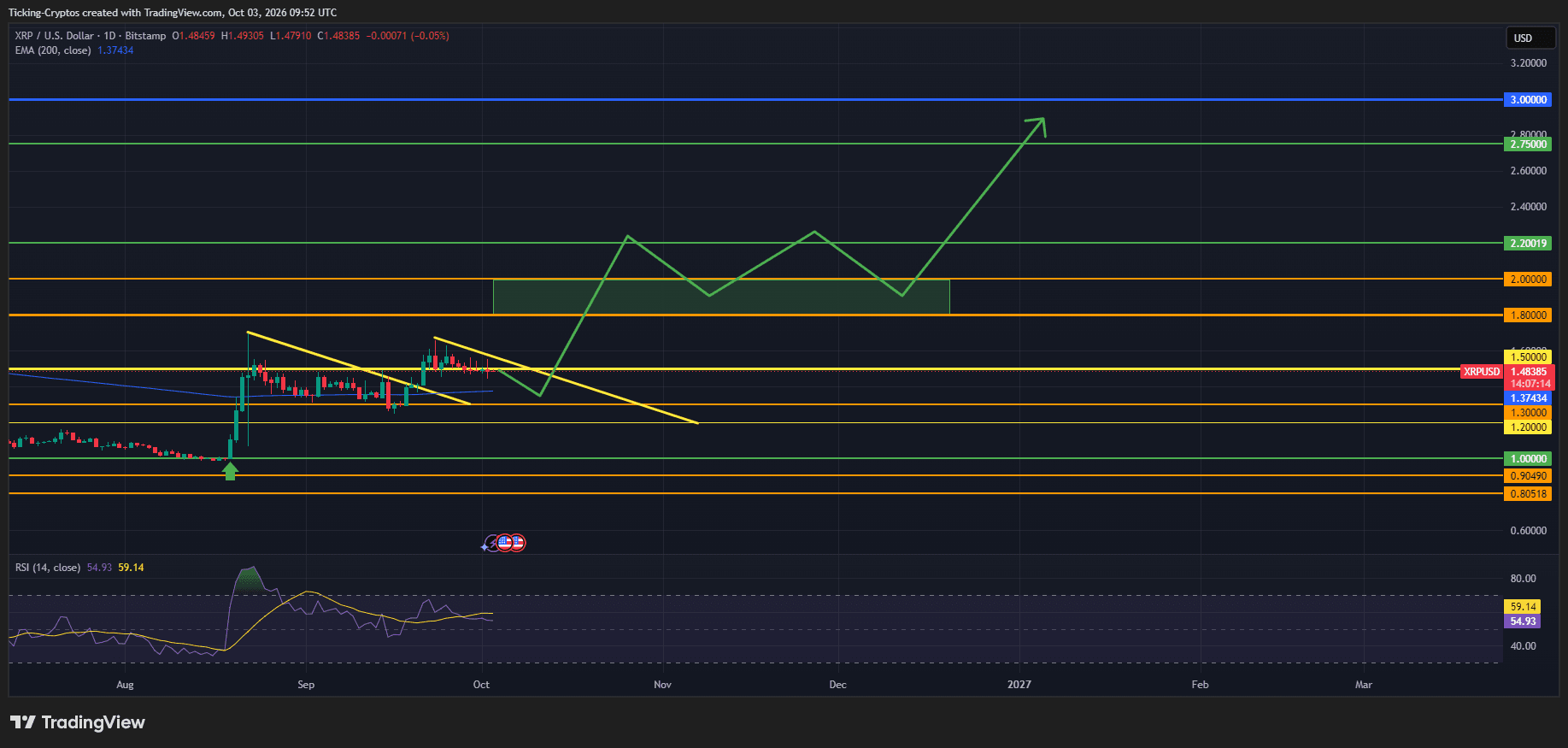
The arrow on our long-term chart sketches exactly this path: a shakeout to $1.37, a breakout to $2.20, a long consolidation between $1.80 and $2.20, then the final push to $2.75 and $3.00 around the turn of the year. From today's price, $3 is roughly a doubling. Ambitious, but XRP went from $1 to $1.70 in two weeks in August, so the volatility to get there clearly exists.
What Could Derail the XRP Price Prediction?
The obvious risk is that the bull market simply does not come back. XRP's chart looks constructive, but it is a relative call: if Bitcoin rolls over, no wedge in the world will carry XRP to $3. Watch the total crypto market cap and Bitcoin dominance on our market charts alongside the XRP chart itself.
On the XRP chart, these are the levels that matter on the downside:
- $1.37: the 200-day EMA. A dip here is healthy and part of our base case.
- $1.30: the September low and first real support. Losing it on a daily close invalidates the bullish wedge.
- $1.20: the wedge's full downside projection and the last line before the round number.
- $1.00: the August bottom and the level that started this whole move. A return here would mean the August rally was a one-off spike, not the start of a new trend.
- $0.90 and $0.81: deeper supports from the summer range, only in play in a full market breakdown.
The practical takeaway: the $3 XRP price prediction is a conditional one. The chart says the structure is ready and the trend indicators are turning. The macro backdrop has to do the rest. As long as XRP holds above $1.30 and the broader market finds its footing, the path to $2, $2.75 and eventually $3 stays open.
BNB costs around $767 late on Friday evening, 2 October 2026 (according to CoinGecko). On 13 October 2025, so almost exactly a year ago, the coin of the BNB Chain reached its record high of $1,369.99. Since then 44 percent are missing. Around the anniversary of the record the next quarterly burn is due, in which part of the supply is destroyed. For the BNB price prediction the question is therefore whether the burn pulls the price out of its sideways phase.
What the 37th burn does and what it does not
BNB Chain reduces the supply four times a year according to a fixed formula, the auto-burn. The amount depends on the BNB price and on the number of blocks in the quarter, with 100 million BNB as the target. In the 36th burn on 15 July 2026, 1,615,827.8 BNB were destroyed, worth around $932 million at the time. The remaining supply stood at 133.17 million BNB afterwards, as BNB Chain documents on its own blog. On the 90-day rhythm the 37th burn falls in mid-October; BNB Chain has not yet named a date.

For the price the burn is less of an event than the sum suggests. It has been running to plan since 2017, every market participant knows about it in advance, and around 1.2 percent of the supply per quarter works out at a good four percent over a year. That has an effect over time, but rarely on the day itself. What lies behind the BNB Chain’s lead in tokenised assets we described in September.
BNB price prediction: the band in the chart
The one-year chart shows a long road down and a clear recovery from the low. The low of the past twelve months stood at around $546 on a closing basis, and BNB has recovered around 40 percent since then. The price sits above the 50-day average (around $720) and above the 200-day average (around $692), both calculated by us from CoinMarketCap daily closing prices.
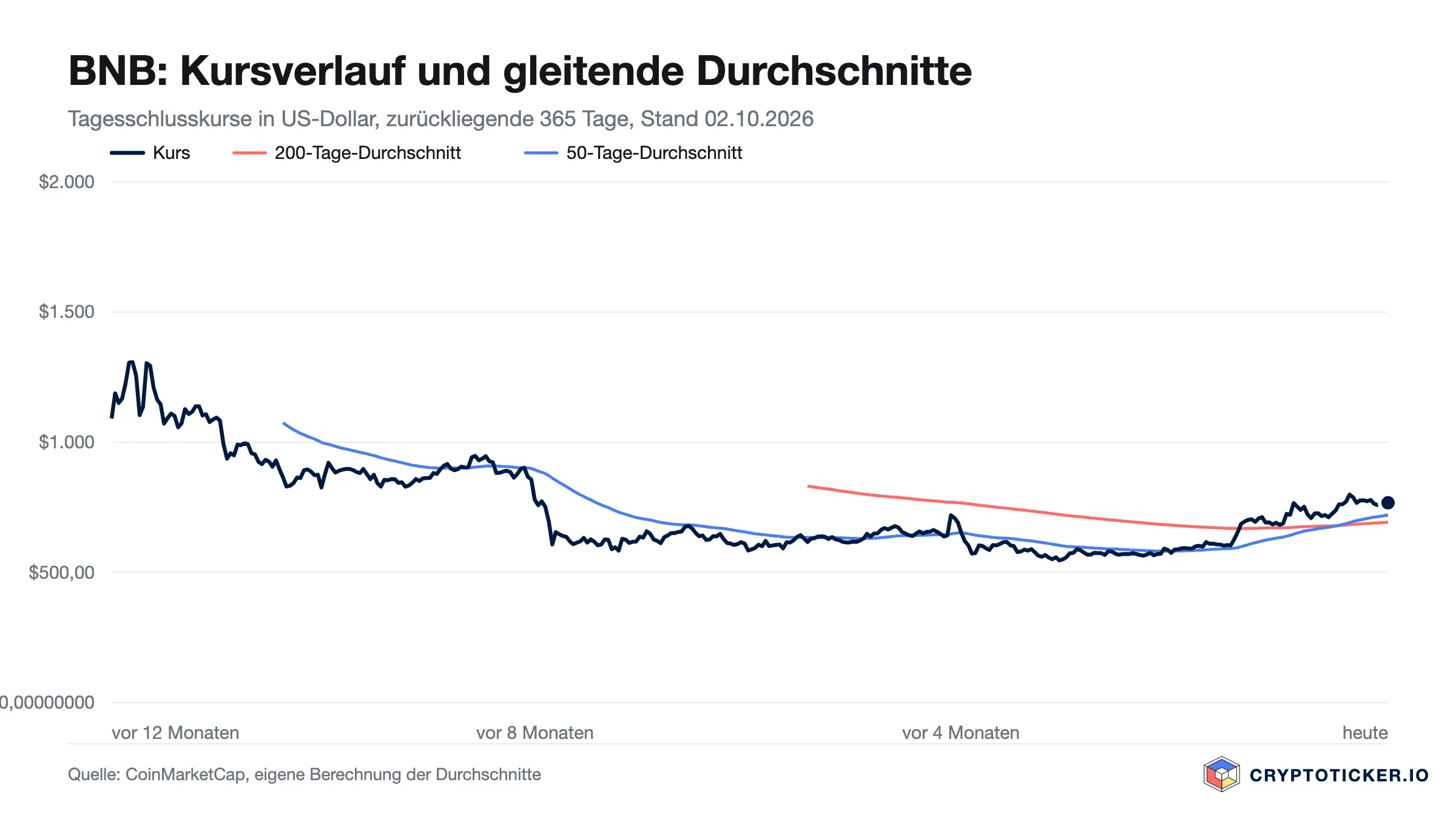
Around $807 is the level on the upside, the September high. Ahead of it lies a band of resistance between $781 and $792 that BNB had not yet overcome at the start of October, as Blockchain.News breaks down. Only a close above $807 would end the sideways phase.
Around $746 is the level on the downside, where the same analysis places the stronger support. If it gives way, the 50-day average at around $720 is the next line. The average daily range has lately been just under $24, which is around three percent. BNB therefore swings considerably less than most large altcoins.
Why BNB has been moving sideways for weeks
Since 19 September the daily closing prices have swung between $758 and $799 (CoinMarketCap). Over seven days there is a loss of just under one percent, over 30 days a gain of around 12 percent (CoinGecko). Bitcoin ran similarly quietly over the same period. BNB is thus following the overall market and currently has no momentum of its own strong enough to break out of the band.
BNB versus Bitcoin: the distance to the record
The comparison with Bitcoin is notable. Both coins reached their records in October 2025, and both stand clearly below them today. A year’s distance from the record is therefore no special case for BNB but part of a movement of the whole market. The difference lies in the burn: with BNB the supply shrinks to plan, with Bitcoin it keeps growing slowly.

Anyone wanting to use BNB needs it above all for fees on the BNB Chain. How BEP20 tokens, BscScan and the fees work in practice is shown by our guide to the BNB Chain. For custody a wallet that supports the BNB Chain is enough; which ones do that well is set out in our comparison of software wallets.
BNB: What to take away
Three points sum up the situation. First: BNB sits in a narrow band between around $746 and $807, and a close outside that band is the next signal. Second: the 37th burn is coming to plan around mid-October; it reduces the supply but is known in advance and therefore hardly a surprise. Third: the distance of 44 percent to the record is large, but a record is not a price target, only a point of orientation.
An assessment of whether an entry at the current price is worthwhile is set out in our analysis Is BNB a Good Buy at Current Prices?. Crypto assets swing sharply and a total loss is possible. This article places price levels and dates in context; it is not a recommendation to buy or sell BNB.
(As of October 2, 2026. This article is not investment advice. Prices and fee structures change; check the terms with the provider before you buy.)
The price of Shiba Inu stands at $0.00000568 on Saturday morning, that is 5.68 millionths of a dollar, and therefore 3.6 percent lower than the day before. That is not the news of this weekend. The news is a draft bill from the German federal finance ministry that is due to go before the cabinet on 14 October and that decides whether you will ever be able to apply the one-year holding period to your SHIB again. The ministry is only accepting comments on it until 6 October.
For holders of Shiba Inu this draft weighs more heavily than for holders of almost any other crypto-asset. SHIB trades 93.4 percent below its record. Anyone who bought in 2021 is sitting on a loss, and anyone who wants to buy more today is making a decision with the purchase date that cannot be corrected later. This article works through both.
Shiba Inu price on 3 October: $0.00000568 and 93.4 percent below the record
As of Saturday morning, 3 October, one SHIB costs $0.00000568 or 0.00000505 euros. The figures come from the CoinGecko market overview. Over 24 hours there is a loss of 3.59 percent, over seven days a loss of 3.81 percent. The month looks different: over 30 days SHIB is up 9.0 percent. So the week is giving back part of the October gain, nothing more for now.
The record stands at $0.00008616. From today’s price that is a distance of 93.4 percent. This single figure explains why with SHIB the tax question weighs more heavily than the price question. A portfolio that is 93 percent down will not throw off a taxable gain for the foreseeable future. What it can throw off is a loss, and in Germany losses are only worth something under narrow conditions.
Shiba Inu’s market capitalisation comes to $3.35 billion with a circulating supply of 589.24 trillion tokens. For a sense of scale: on the same morning Dogecoin reaches $14.52 billion, a good four times as much.
What 100 euros buys today
At 0.00000505 euros per token you get around 19.8 million SHIB for 100 euros. That number of units is not a curiosity but matters for tax. Every single purchase is its own acquisition with its own date, and on a partial sale the first-in, first-out order applies in Germany. Anyone buying in five tranches has five periods to manage.
Spread and daily turnover at 5.68 millionths of a dollar: $107 million in 24 hours
Trading turnover in SHIB over the past 24 hours comes to around $107 million. Measured against the market capitalisation of $3.35 billion, that turns over 3.2 percent of the stock in a single day. That sounds like a lot, but it is spread across a great many venues.
More important than turnover is the daily range. Between the low at $0.00000553 and the high at $0.00000597 there are 7.96 percent. The net move of the day comes to 3.59 percent. The timing of your order within the day has therefore decided more about the execution price than the direction of the day. With a price carrying six decimal places, every price step also weighs more heavily, because the smallest tradable step makes up a larger share of the price than with a coin in the double-digit dollar range.
3 October is a public holiday in Germany, and the weekend thins out trading further. Anyone placing a larger order as a market order on such a day pays for the thin depth. A limit order costs patience and saves money in exactly this situation. Which venues are authorised in Germany and which fee models they run is set out in the crypto exchange comparison.

Why the draft bill weighs more for SHIB holders than the move of the day
The federal finance ministry has sent the draft to the industry associations. It provides for gains on crypto-assets to be treated in future as investment income under section 20 of the Income Tax Act. Today they run as private disposals under section 23 of the Income Tax Act, and that is where the sentence sits on which the whole German crypto practice is built: after a holding period of one year the gain is tax-free.
It is precisely this sentence that falls under the draft for everything acquired after 31 December 2026. The summary of the draft at Blocktrainer names the cabinet date of 14 October and the deadline for comments on 6 October. For holdings bought up to 31 December 2026, the draft provides for grandfathering. There the one-year period remains in place.
A draft is not a law. It can still be changed in the cabinet, in the Bundestag and in the Bundesrat, and the associations have until 6 October to attempt exactly that. What you take from it today you take from a plan and not from applicable law. For planning an additional purchase that is still enough, because the cut-off date itself is in the draft and is not fixed only later.
Cut-off date 31 December 2026: grandfathering for old SHIB, section 20 for new ones
The draft draws a line through your portfolio. On one side stand the SHIB you bought up to and including 31 December 2026. For them the previous rule is to continue to apply, meaning the one-year holding period and tax-free gains thereafter. On the other side stand the SHIB that enter the portfolio from 1 January 2027. For them the gain is to be taxable regardless of how long you hold it.
For a coin trading 93.4 percent below its record, that is not a theoretical distinction. Anyone betting on a recovery is betting on a multiple, and a multiple is exactly the case in which the difference between tax-free after a year and fully taxable becomes visible.
What section 20 means in practice
Investment income in Germany is subject to the flat-rate withholding tax, meaning 25 percent plus the solidarity surcharge and, where applicable, church tax. In return there is the saver’s allowance of 1,000 euros a year. Today’s exemption threshold for private disposals, of the same amount, works differently, namely as a threshold and not as an allowance. Anyone exceeding it by one euro pays tax on the whole gain and not only on the part above it.
Buying more into a portfolio in the red: the purchase date separates old from new holdings
Here lies the one decision you really have to make before the turn of the year. Suppose you hold SHIB from 2021 and want to lower your average entry price by buying more. If you buy before 31 December 2026, the purchase falls under grandfathering according to the draft, and the one-year period continues to run on that tranche. If you buy in January 2027, the same tranche is permanently taxable.
That is not an argument for buying now. A coin standing 93 percent below its record is not therefore cheap, only fallen for the time being. It is an argument for not pushing a purchase you were going to make anyway into the new year without need. The reverse holds just as much: anyone unsure whether they want SHIB in the portfolio at all should not buy because of a deadline.
The order on partial sales
If you later sell only part, the first-in, first-out order applies in Germany for the same cryptocurrency in the same wallet. With a mixed holding of old and new purchases, the oldest tokens therefore go first, and under the draft those are the protected ones. Anyone who wants to keep old and new holdings cleanly separate needs a separate wallet or very good documentation. Which tools carry such tranches across several exchanges is shown by the comparison of crypto tax tools and portfolio trackers.
Offsetting losses on Shiba Inu: what section 23 does with a 93 percent loss
A loss from a private disposal can under section 23 of the Income Tax Act only be offset against gains from private disposals, so not against wages and not against interest or dividends. Unused losses can be carried back to the previous year and forward into coming years, but always only within the same category of income.
From this follows the uncomfortable symmetry of the one-year period. After twelve months the gain is tax-free, and for the same reason the loss is worthless for tax. What is not taxable also produces no deductible loss. Anyone holding SHIB for longer than a year and selling at a loss cannot set that loss against other crypto gains under current law. Within the one-year period it works perfectly well.
How the draft treats old losses under the new regime cannot be taken from the points summarised publicly so far. That is one of the points on which the associations can comment until 6 October, and one of the reasons why final planning is only possible after the cabinet decision.

Substitute assessment without a purchase record: 50 percent of the sale proceeds as the tax base
The draft provides for a flat 50 percent of the sale proceeds to be applied as the tax base where the acquisition costs cannot be proven. We have written up this rule in more detail in a separate article on the substitute assessment where the acquisition record is missing.
This rule hits holders of Shiba Inu harder than holders of large crypto-assets, and that is down to the coin’s history. SHIB was frequently swapped on decentralised exchanges in the 2021 wave, bought on exchanges that no longer exist, or moved between wallets. A bank statement from a German bank does not exist in these cases. Anyone who cannot prove the purchase price would, under the draft, be taxed on half the proceeds, even if the actual purchase was more expensive than the sale.
What can still be secured today
Transaction data of old exchanges disappears with the exchanges. Whatever you can still export today you should export: trading history as a CSV, deposit and withdrawal records, the wallet addresses and the transaction hashes of the transfers. A blockchain transaction remains permanently traceable; the euro price at the time of purchase is only traceable with the right price source. For the long-term custody of the tokens themselves, what the hardware wallet comparison says applies independently of that.
Staking and lending as investment income: what the draft provides for Shibarium earnings
Under the draft, earnings from staking and lending are to be treated as investment income. In the Shiba Inu environment that concerns the interest mechanisms around its own side chain Shibarium and the in-house exchange, where users deposit tokens and receive earnings for it. Shibarium is a side chain that settles transactions more cheaply and anchors the result on Ethereum.
In practice that means: anyone drawing earnings from such models today should document them separately from pure price gains, because under the draft they land in a different category of income. How dependable the earnings in the Shiba environment currently are is a separate question. Part of the functions in the ecosystem was recently unavailable for months.
Withholding at source from 2028: exchanges may sell crypto-assets without consent
From 1 January 2028 exchanges are to withhold the tax directly, as German banks do today with shares. So that the exchange can pass on the amount, it is to be allowed to sell crypto-assets for that purpose without asking first. What that means for the choice of trading venue we have written up in the article on withholding at source at the exchanges.
For SHIB this point has a sharpness of its own. A forced sale in a token with six decimal places and thin order books runs into exactly the range that today amounts to 7.96 percent. The timing of such a sale then follows the tax logic of the exchange and not the state of the market.
Comments until 6 October, cabinet on 14 October: the timetable
Between the dispatch to the associations and the end of the response deadline lie six calendar days, after which eight days remain until the planned cabinet discussion. 6 October is a Tuesday, and before it lies a long weekend with German Unity Day. For associations that is little time; for you as an investor it is above all a date after which the points of the draft become more dependable.
14 October is the day on which an administrative draft is to become a government bill. Only after that follow the Bundestag and the Bundesrat. Until then, 31 December 2026 remains the only date that is already fixed for your purchase planning.
Levels above and below: 5.53 and 5.97 millionths of a dollar from the daily range
The nearest points of orientation are the day’s own extremes. On the downside the daily low lies at $0.00000553. If the price falls below it, the daily range is resolved to the downside, and the next reference point would be the area from which the recovery of the past 30 days started.
On the upside the daily high lies at $0.00000597, so just under the mark of six millionths of a dollar. Above that mark the current week’s loss of 3.81 percent would be worked off. Both figures are points of observation and not a forecast, because they come from the price movement of the past 24 hours and say nothing about where the price is heading.
The distance of 93.4 percent to the record of $0.00008616 remains the figure against which every recovery calculation has to be measured. To reach the record again, today’s price would have to rise more than fifteenfold.
Shiba Inu and the cut-off date: Your next three steps
- Establish and record the purchase date. Note for every SHIB tranche when it was bought and whether a record exists. Everything held in the portfolio up to 31 December 2026 falls under grandfathering according to the draft. Tools that carry such tranches across several exchanges are in the comparison of crypto tax tools.
- Secure records before exchanges disappear. Export the trading history, deposits and withdrawals and the transaction hashes. Without proof the draft applies a flat 50 percent of the sale proceeds. Where you trade in future and which exports a provider delivers you can compare in the exchange comparison.
- Schedule a planned purchase instead of forcing one. Anyone who wanted to buy anyway has a tax reason until the end of the year not to postpone it. Anyone who is unsure does not buy because of a deadline. For the long-term custody of the tokens, the hardware wallet comparison applies.
(As of October 3, 2026. This article is not investment advice. Prices and fee structures change; check the terms with the provider before you buy.)
WhiteBIT destroyed 32,426 WBT at 13:48 UTC on 1 October 2026, worth 2,716,488 USDT. This is not a one-off event but the exchange’s regular weekly buyback, through which it puts part of its revenue into permanently shrinking the supply of its own token. According to CoinGecko the price stands at $84.22 as of 05:46 on Saturday, which is 4.2 percent below the all-time high of $87.91 set on 21 September.
For you as a holder or a prospective buyer, three things matter here: how much was actually burned, what that means in relation to the circulating supply, and through which route you can legally buy and hold the token in Germany at all. In that order.
What happened in the WBT burn on 1 October
By its own account, WhiteBIT carries out what it calls a burn every week. The exchange buys back its own tokens on the market and sends them to an address they cannot leave again. The amount follows from the previous week’s revenue: 33 percent of trading fees and 5 percent of further income, for example from withdrawal fees and margin trading, flow into the buyback.
For 1 October the exchange names 32,426 tokens and a value of 2,716,488 USDT on its WBT overview page. That works out at an average buyback price of around $83.78 per token. Measured against the circulating supply of 118,819,745 WBT, the batch amounts to roughly 0.027 percent of all freely tradable tokens. That is a small number for one week, and that is precisely the point: the model works through repetition, not through single events.
Why the exchange burns at all
An exchange token such as WBT is not a standalone network asset like Bitcoin but a product of the exchange that issues it. Its usefulness rests on discounts on trading fees, on tier models for high-volume traders and on extra platform functions. The burn is the counterpart to that: it ties part of the business result to the token without the exchange having to promise a payout. The more that is traded on the platform, the larger the weekly batch.
WBT price this week: $84.22 and 4.2 percent away from the all-time high
According to CoinGecko the price stands at $84.22 as of 05:46 on Saturday, German time. Over 24 hours that is 1.17 percent lower, over seven days a gain of 0.21 percent. Market capitalisation comes to around $10.01 billion, which corresponds to rank 15 among all crypto-assets.
What is notable is less the direction than how narrow the movement is. On CoinGecko’s daily values, WBT moved between $83.49 and $84.73 over the past seven days. The range of the last 24 hours is considerably wider at $83.53 to $86.71, so the spike to the upside did not carry through to the end of the week.
Turnover in relation to valuation
Trading turnover comes to around $130.7 million in 24 hours. Measured against a market capitalisation of a good ten billion dollars, that moves about 1.3 percent of the stock in a single day. For large assets such as Bitcoin or Ethereum this ratio is usually higher in calm phases. In practice that means: larger orders can move the price more than with more liquid coins, and limit orders make more sense here than market orders.
Token burn explained: how WhiteBIT uses 33 percent of trading fees
Token burn describes the final destruction of tokens by sending them to an address with no known private key. Technically they continue to exist on the blockchain, but nobody can dispose of them any more, which is why they are deducted from the circulating supply.
What is special about the WhiteBIT model is that it is tied to ongoing revenue rather than to a fixed plan. Many projects burn a fixed number of units on a schedule set in advance. Here the amount hangs on the business: a month with strong turnover destroys more tokens than a weak one. That turns the burn into a kind of temperature chart of the platform, from which a patient reader can tell how trading volume runs over the months.
As its stated aim, the exchange says it will continue the buyback until at least half of all coins ever created have been destroyed. That is a declaration of intent by the provider, not a guaranteed end state and not a date anything could be pinned to.

MiCA and the purchase route: what the EU authorisation changes for investors in Germany
The transition period of the EU regulation on markets in crypto-assets expired on 1 July 2026. Since then, crypto services may only be provided in the European Union by providers holding the corresponding authorisation; the competent supervisor in Germany is BaFin. Anyone buying in Germany therefore first checks whether the platform holds that authorisation and under which company it takes you on.
WhiteBIT has cleared that hurdle: the group’s European company received a MiCA authorisation in June 2026 via the Austrian supervisory authority, which acts as a passport for the entire European Economic Area. For you in Germany that means the provider is in principle allowed to operate within the regulated framework. It expressly does not mean that the economic risk of the token has become any smaller; an authorisation governs how a provider has to work, not how a price develops. What the licensing obligations cover in detail is broken down in our overview of the MiCA obligations.
One practical note on the purchase route: WBT is not tradable on every platform available in Germany, and the fees differ considerably. A look at our comparison of regulated crypto exchanges shows which providers can prove their authorisation and what trading costs there.
Circulating, total and maximum supply: the three figures that frame the burn
When it comes to scarcity, three quantities are regularly mixed up, and without them the effect of a burn cannot be placed. For WBT, CoinGecko reports a circulating supply of 118,819,745 tokens, a total supply of 293,389,244 tokens and a maximum supply of 400,000,000 tokens.
The circulating supply is the part that is actually freely tradable. The total supply additionally covers everything that exists but is locked, reserved or not yet distributed. The maximum supply is the ceiling that can never be exceeded.
What the gap to the maximum supply says
Between the maximum supply of 400 million and the reported total supply of 293,389,244 tokens there is a gap of 106,610,756 WBT, a good quarter of the ceiling. That difference is the clearest evidence that considerable amounts have been taken out of the system over the years. With the stated target of at least half of all coins, the road is not over yet.
Put these figures in relation before you draw conclusions from a single burn. 32,426 tokens destroyed in one week stand against a good 118.8 million in circulation. Even over a whole year, at an unchanged pace, the order of magnitude would stay in the low single-digit percentage range of the circulating supply. Scarcity is a slow process here.
Deflation is no price promise: the limits of the burn model
The fact that supply disappears does not automatically mean the price rises. The price arises from supply and demand, and demand for an exchange token depends on how well the exchange behind it is running. That very dependency works both ways: if trading volume falls, the value of the fee discounts falls, and at the same time the amount that gets burned shrinks. The mechanism amplifies good phases as well as bad ones.
This week’s figures show that in miniature. Despite the burn on Wednesday, the price over seven days stands almost unchanged at a gain of 0.21 percent. A batch of $2.7 million simply does not weigh much against daily turnover of $130.7 million. Anyone reading a burn as a short-term price driver overestimates it.
There is also a point that is easily overlooked with exchange tokens: the exchange itself sets the rules of the model. Percentages, rhythm and target are the provider’s own decisions and can be adjusted. That is not an accusation but a property of the asset class you should factor into your assessment.

Custody of exchange tokens: why WBT carries a counterparty risk at the exchange
With an exchange token there is a conflict of aims that other coins do not know in this sharpness. The fee discounts and tier models only work as long as the tokens sit in the exchange account. But that is exactly where you carry the counterparty risk, meaning the danger that in the event of insolvency or an attack you cannot get at your balance because the exchange holds the keys.
How real that risk is was shown by the third quarter of 2026: according to the count by the security firm CertiK, losses from security incidents added up to $1.26 billion, spread over 247 incidents. The largest single case of the quarter fell on a trading platform.
No prohibition follows from this, but a split does. The part you actively need for trading and for fee tiers stays on the exchange. What you want to hold for the longer term belongs in your own custody; which devices are suitable and how they differ is set out in our hardware wallet comparison. In addition it is worth looking at an exchange’s proof of reserves, which reputable providers publish regularly and which can be recalculated yourself with a little patience.
Holding period and tax: how gains on WBT are treated in Germany
For crypto-assets held as private assets, the German rules on private disposals apply. The decisive factor is the holding period: if more than a year lies between purchase and sale, the gain stays tax-free. If you sell within a year, the gain is taxed at your personal income tax rate as soon as the exemption threshold for private disposals is exceeded in the calendar year.
With an exchange token a practical problem is added. Anyone using fee discounts moves their holdings more often than they realise, and every reshuffle starts a new period running. So keep a clean record from the outset with purchase date, amount and value in euros. Specialised programs take over the bookkeeping automatically and prepare the data for the tax return.
Note as well that the legal framework is currently moving. A draft bill on the taxation of crypto-assets is on the table and is to be dealt with by the cabinet in October. What applies today is therefore not automatically the position for next year.
Levels above and below: $83.49, $86.71, $87.91
Three points of orientation follow from the week’s figures, to be understood as observations and not as price targets.
On the downside the weekly low of $83.49 marks the zone that has caught the price several times over the past seven days. Below that, $83 is a round number where orders tend to cluster. On the upside the 24-hour high of $86.71 is the first hurdle, because last night’s spike already bounced off it once. Above that follows the all-time high of $87.91 from 21 September, currently 4.2 percent away.
That the distance to the record is so small while the course of the week stayed so narrow describes the situation best: WBT is consolidating just below its high without either side gaining the upper hand. The weekly burn changes nothing about that in the short term; it works on a timescale of months.
WBT and the burn: How to proceed now
- Clarify authorisation and purchase route. Check which company your provider takes you on under and whether it can prove its MiCA authorisation. The comparison of regulated crypto exchanges shows the providers side by side with their fees.
- Split your holdings. Decide which part has to stay on the exchange for trading and fee tiers and which part moves into your own custody. Suitable devices and their differences are in the hardware wallet comparison.
- Document the periods. Record the purchase date, amount and euro value of every position so the one-year period stays provable. The programs in our overview of crypto tax tools take the bookkeeping off your hands.
(As of October 3, 2026. This article is not investment advice. Prices and fee structures change; check the terms with the provider before you buy.)
Bitcoin trades at around $84,500 late on Friday evening, 2 October 2026 (CoinMarketCap). That is almost exactly where it stood ten days ago, even though a great deal of money has moved into Bitcoin in the meantime: the US spot ETFs took in $2.65 billion in September, and October is opening with inflows too. For the Bitcoin price prediction that is the contradiction now to be resolved: why is the price not rising when the funds are buying?
What the ETF figures show
September’s net inflows of $2.65 billion are the second-highest monthly figure since October 2025; in August it was $3.52 billion, The Block reports using data from SoSoValue. A further $102.7 million arrived on 1 October, after the last day of September had brought outflows of $148.7 million. Together the funds hold Bitcoin worth around $109.3 billion (Cointelegraph).

In the third quarter that paid off. From 30 June to 30 September, Bitcoin rose from $58,566 to $83,576, a gain of almost 43 percent (daily closing prices, CoinMarketCap). Since 21 September, by contrast, the price has barely moved.
Bitcoin price prediction: the levels on the chart
The one-year chart shows both: the deep slump after the record of October 2025 and the recovery since the summer. The highest daily close of the past twelve months was around $124,700, the low around $58,600. Today Bitcoin sits well above its 50-day average (around $78,300) and its 200-day average (around $75,300), both calculated by us from the daily closing prices.
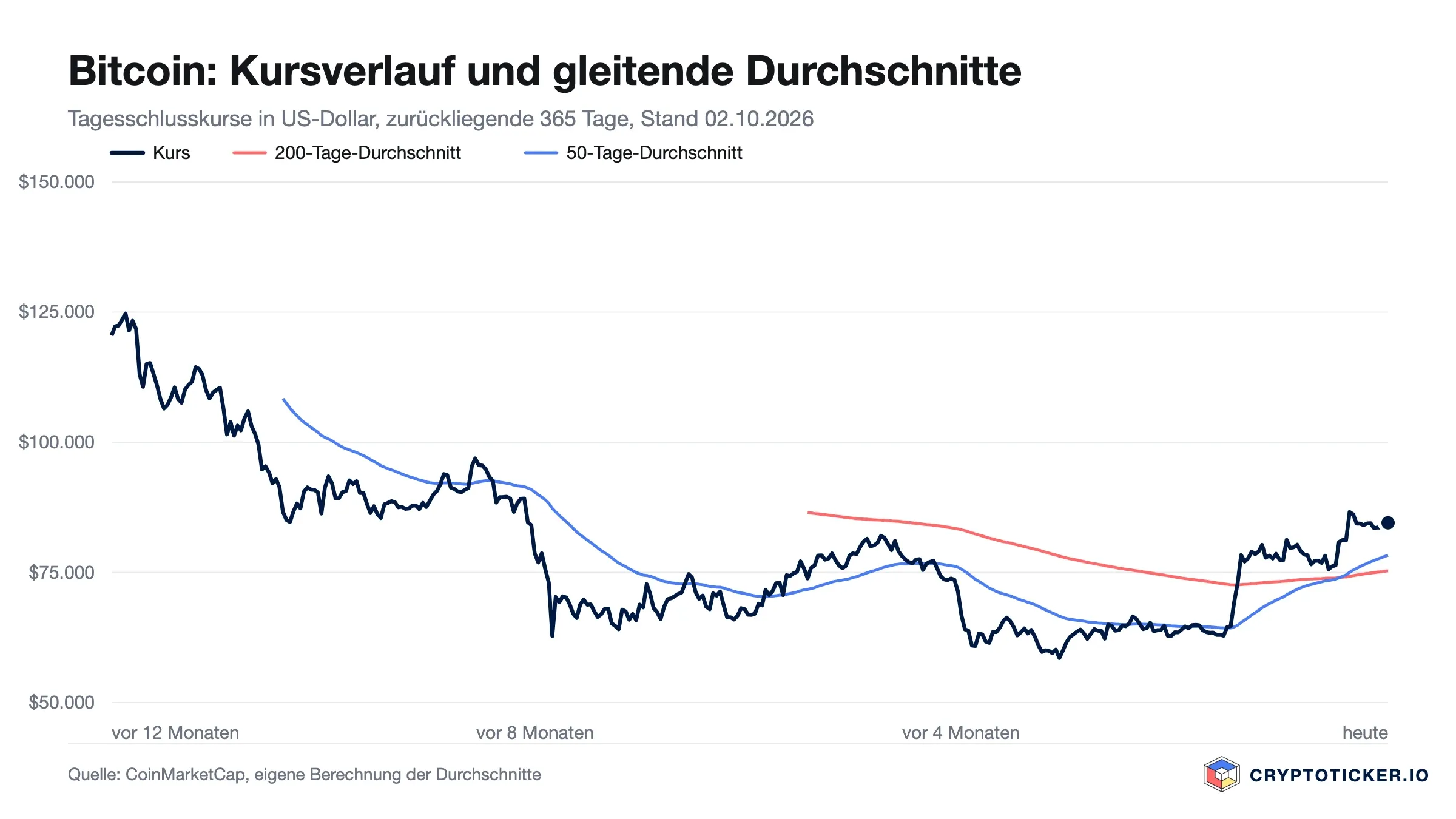
Around $86,600 is the level on the upside. Bitcoin closed at $86,597 on 21 September and has not been higher since. On Friday the price did climb briefly to around $87,100 after the US jobs report, but fell back below that mark by the evening. crypto.news also names the hurdle at $86,500. How the report moved the price is set out in our article on the jobs report.
Around $83,500 is the level on the downside. No daily close has been below it since 21 September; the lowest was $83,479 on 28 September. That zone has therefore held three times.
$78,300 and $75,300 are the two average lines beneath. If the zone around $83,500 gives way, there is roughly six percent of room down to the 50-day average. Between $81,000 and $83,500 there were two closing prices on 19 and 20 September that can serve as a staging post.
Why the inflows are not lifting the price
ETF inflows are only one side of the market. On the other stand sellers: long-term holders taking profits after a quarterly gain of almost 43 percent, or traders closing leveraged positions. When the two sides balance, the price stands still. That September’s inflows were smaller than August’s fits the picture: the buyers are still there, but they are pushing less hard than in the summer.
Bitcoin versus Ethereum: the funds part ways
The contrast with Ether is notable. While the Bitcoin ETFs were taking in money on 1 October, $55.4 million flowed out of the Ether ETFs, the third minus in a row (Cointelegraph). Institutional investors are therefore leaning towards Bitcoin at the start of the fourth quarter. How the two largest crypto-assets measure up is broken down in our comparison for the fourth quarter.

For investors in Germany, a US Bitcoin ETF is usually not a direct route, because such funds are generally not tradable here. Anyone who wants to buy Bitcoin directly will find the providers and their fees in our comparison of Bitcoin savings plans. A savings plan spreads the entry over time and takes the question of the right day out of the calculation.
Bitcoin: What to take away
Three points sum up the situation. First: demand from the funds is there, but at present it is not enough to lift the price above $86,600. Second: as long as the zone around $83,500 holds, the sideways phase is a pause after a strong quarter. Third: a close outside the range between $83,500 and $86,600 is the next signal for the direction of travel.
Anyone taking profits from the summer should know the holding period: Bitcoin held for less than a year is taxable on sale in Germany once the annual exemption threshold of 1,000 euros is exceeded. Whether an entry at the current price is worthwhile is assessed by our analysis Is Bitcoin a Good Buy at Current Prices?. Crypto assets swing sharply and a total loss is possible. This article is not a recommendation to buy or sell Bitcoin.
(As of October 2, 2026. This article is not investment advice. Prices and fee structures change; check the terms with the provider before you buy.)
Decrypt
California's attorney general wants answers from OpenAI about AI models that escaped a locked test environment and hacked Hugging Face—and whether the company can be held legally accountable.
Ethereum's zkAPI lets users prepay in USDC and query AI models through cryptographic proofs, so no single party sees both who they are and what they ask.
The USDC issuer told the European Commission that MiCA's reserve mandates and concentration caps keep the largest global stablecoins outside Europe's perimeter—siding with the ECB in calling for more flexible rules.
Tavus says 26 of 54 people on a one-minute video call thought its new Griffin model was human. The results are the company's own, and the model isn't going to retail customers yet.
Blast said operating costs now exceed the revenue its Ethereum layer-2 generates and asked users to withdraw their assets to mainnet before Oct. 26.
U.Today - IT, AI and Fintech Daily News for You Today
The upcoming Nasdaq listing of Evernorth and its relationship with the XRP $2 price target.
Shiba Inu keeps moving forward, but the market dynamic is somewhat questionable.
Altcoins are testing important technical levels after their latest recoveries, with several assets now approaching resistance zones that could determine whether bullish momentum continues.
Galaxy Digital CEO Mike Novogratz believes Bitcoin’s drop to roughly $60,000 marked the cycle low, predicting that the cryptocurrency could finish 2026 near $100,000 despite the possibility of another short-term pullback.
Bitcoin holders gain a direct, decentralized route to Zcash shielded pools with zero intermediaries.
Blockonomi
TLDR:
- Joseph Lubin says no indication exists that MetaMask wallets or customer funds were affected.
- Consensys and its partners rotated validator keys as a precaution after the security incident.
- Validator and withdrawal keys are separate, so the incident cannot cause unauthorized ETH transfers.
- Lubin says Consensys does not hold withdrawal keys for clients, in line with Ethereum self-custody.
Joseph Lubin, Ethereum co-founder and Consensys founder, said a security incident affected part of the company’s infrastructure.
However, the investigation so far shows no indication that MetaMask wallets or customer funds were affected. Lubin added that users’ recovery phrases and private keys were not involved.
Consensys and its partners rotated validator keys as a precaution. He also explained that validator and withdrawal keys are separate, so the incident could not cause unauthorized transfers of staked ETH.
Joseph Lubin Clarifies Scope of the Security Incident
In a post on X, Joseph Lubin said he returned from a dense week in Seoul at KBW. During the event, he stayed on top of the response to the security event. The post followed the public disclosure of the incident. He can now respond to queries and speculation.
Lubin wrote that “there is no indication that MetaMask wallets or customer funds in wallets have been affected.” He then addressed user keys directly.
The Secret Recovery Phrase and wallet assets “were not part of this incident because they CANNOT be,” he said. He added, “You custody and control your own keys. That is how self custody works.”
Lubin also said Consensys faces attempted attacks from a range of threat actors. Like many providers, the company periodically encounters security issues. He explained that “we do not publicly discuss the details of an open incident.”
Lubin said the company discloses issues “promptly to partners and relevant stakeholders once an issue is sufficiently understood.”
In this case, Consensys shared details with partners. Both sides agreed on a response strategy and implemented it together. The company then disclosed the incident publicly. This sequence matches the approach he described.
Validator Key Rotation and Ethereum Staking Design
As a precaution, Consensys and its partners rotated validator keys. Lubin called the step “operationally inconvenient,” noting it was regrettable.
Validators must exit the staking queue and then re-enter it to restake. This process takes time. The change also required coordination with partners.
Lubin explained that Ethereum’s validator architecture separates two keys. One key proposes and attests, while another can withdraw the stake. He said “an issue in the validator infrastructure CANNOT result in the improper movement of the underlying ETH.”
On custody, Lubin stated, “In accordance with the Ethereum principle of self-custody, we do not hold withdrawal keys for our clients.”
Therefore, the incident could not lead to unauthorized transfers of staked ETH. Rotating the keys reduced residual operational risk.
Lubin described self-custody and user control as central design principles at Consensys. He said they guide MetaMask, staking, and validation.
He also applied them across Ethereum more broadly. Joseph Lubin concluded that “self custody plus rigorous decentralization represents a paradigm shift in security.” He noted the world is increasingly waking up to the benefits of this architecture.
The post Joseph Lubin: No MetaMask Wallets or Customer Funds Affected by Security Incident appeared first on Blockonomi.
TLDR:
- CZ said he suggested pausing withdrawals after the Bybit hack to prevent further abnormal outflows.
- Zhao said security risks should take priority over trading continuity, even if users face inconvenience.
- Bybit did not pause withdrawals and saw no further issues, which Zhao says shows risk assessment is key.
- Zhao rejected claims his 2022 FTT tweet killed FTX, saying it failed due to a lack of liquidity.
Changpeng Zhao, the co-founder of Binance, said he urged a pause on withdrawals after the Bybit hack. He made the remarks on September 25, 2026, in an interview.
Zhao described the pause as a cautious step to stop abnormal fund outflows. He said security risks should come before trading continuity.
Bybit did not pause withdrawals, and no further problems followed. The interview also covered FTX, his pardon, and his future plans.
Why Zhao Favored a Pause After the Bybit Breach
Binance founder CZ discussed the matter on the When Shift Happens podcast hosted by KevinWSHPod. He said he publicly suggested pausing withdrawals after Bybit was hacked. In his view, the step would help prevent further abnormal outflows of funds.
Changpeng Zhao acknowledged that suspending services can disrupt trading continuity. It can also inconvenience users who need access to their funds. However, he said security risks should take priority in such cases.
Bybit ultimately did not pause withdrawals. Notably, no further issues occurred afterward. Zhao said this outcome shows that no absolute right or wrong exists in these situations.
He added that the key lies in risk assessment. He cited Binance’s response to its own 2019 hack when discussing security breaches. He also claimed that Binance’s later market share held up despite criticism after the 2025 market crash.
Zhao on FTX, Binance’s Growth, and His Pardon
Changpeng Zhao also addressed claims that his 2022 tweet about selling Binance’s FTT holdings killed FTX. Zhao responded with a pointed remark.
“If one of your competitors can make a tweet to kill your company, then you don’t have a company.” He described the post as a transparent disclosure and said he did not expect a major market reaction.
In his account, FTX failed because it lacked liquidity after misusing customer funds. He pointed to prior reporting about its finances and a response from Alameda’s CEO. Zhao argued the tweet was not the underlying cause.
Changpeng Zhao also recalled Binance’s launch in 2017. He redirected an existing exchange-software team toward building a crypto-to-crypto exchange.
He credited rapid early execution to a hardworking, humble, and closely aligned team. However, he acknowledged that strong deference to leadership can make candid feedback difficult.
He also explained the “four” meme as shorthand for focusing on education, compliance, and products while ignoring misleading negative narratives.
On his 2025 pardon, Changpeng Zhao said he applied through a lawyer and never met or spoke with President Trump. He maintained that his conviction concerned inadequate anti-money-laundering controls.
He called his punishment unusually severe, while acknowledging his view is biased. Looking ahead, he plans to advise on crypto policy, invest in Web3, and offer free education.
The post CZ Explains Why He Recommended Pausing Withdrawals After the Bybit Hack appeared first on Blockonomi.
TLDR
- Karl Keirstead from UBS, ranked #357 among 12,504 analysts, maintains a Buy recommendation with a $120 target on CoreWeave shares.
- The AI infrastructure provider implemented a 25% GPU rate increase in July, followed by an additional 10% hike in subsequent months.
- CoreWeave’s committed revenue backlog approached $104 billion before incorporating over $25 billion in fresh Q3 contracts.
- Analyst consensus leans toward Moderate Buy with a mean price target of $138.78, suggesting substantial appreciation potential.
- Company insiders have divested over 6.4 million shares valued at approximately $557.7 million during the past three months.
Shares of CoreWeave (CRWV) began trading Friday at $89.62, markedly below the stock’s 52-week peak of $153.20. Yet the AI cloud infrastructure specialist has remained active, capturing attention from market analysts.
CoreWeave, Inc. Class A Common Stock, CRWV
Karl Keirstead, a five-star analyst at UBS who ranks #357 among 12,504 tracked professionals, holds a Buy stance with a $120 valuation target. His thesis rests on a straightforward observation: the company continues to increase pricing, and clients continue to accept the higher costs.
In July, CoreWeave boosted its hourly billing rates for Nvidia GPU access by 25%. The firm then added another 10% to those rates during the following two to three months.
Such pricing power is unusual in markets with robust competition. It indicates that access to AI computing resources remains scarce.
According to CoreWeave, short-duration agreements executed during Q3 generated roughly $40 million in annual revenue per megawatt. This substantial figure underscores the persistent supply constraints in the sector.
Massive Revenue Pipeline Expands Further
At the close of June, the company reported a committed revenue pipeline of approximately $104 billion. This total excluded more than $25 billion in additional customer agreements secured early in Q3.
UBS analysts believe this upward pricing trajectory extends beyond CoreWeave. The investment bank anticipates similar dynamics throughout the AI infrastructure sector.
The critical uncertainty involves whether companies can construct sufficient physical capacity to satisfy market demand. Community opposition to data center projects represents one obstacle, with local residents expressing concerns over energy usage and development impact.
Keirstead notes that industry intelligence suggests well-capitalized operators can navigate these challenges. Capital requirements present a different challenge entirely, however.
Constructing AI data centers demands enormous upfront investment before revenue generation begins. CoreWeave recently completed a $3.7 billion convertible note offering maturing in 2033, expanded from an initial $3 billion target, with a 2.875% coupon rate.
The firm also established an at-the-market equity program permitting the sale of up to 35 million shares to enhance financial liquidity.
Financial Performance and Price Targets
CoreWeave released its most recent quarterly figures on August 11. The business reported a per-share loss of $1.14, surpassing the Wall Street consensus forecast of a $1.52 deficit.
Total revenue reached $2.58 billion, representing 112% year-over-year expansion. Alongside this growth, CoreWeave recorded a negative return on equity of 47.95% and a net margin of negative 25.41%.
Multiple Wall Street firms have issued updated views subsequently. Citigroup elevated its price objective to $159, JPMorgan upgraded the stock to overweight with a $125 target, and Wells Fargo increased its target to $160.
The Street’s overall rating stands at Moderate Buy, with a consensus price target of $138.78, derived from 23 Buy recommendations, nine Hold ratings, and three Sell calls.
Meanwhile, company insiders have actively liquidated positions. Chief Executive Officer Michael Intrator divested 200,000 shares in July at $78.23 per share, while significant shareholder Magnetar Financial unloaded more than 307,000 shares in August.
Combined, insiders have disposed of over 6.4 million shares totaling approximately $557.7 million over the trailing 90-day period. CoreWeave currently commands a market capitalization of $41.12 billion, while carrying a debt-to-equity ratio of 5.53.
The post UBS Backs CoreWeave (CRWV) With $120 Target After Back-to-Back Price Hikes appeared first on Blockonomi.
Key Takeaways
- ASML’s stock price climbed approximately 4% to reach $1,870.48 following an expanded Samsung collaboration on High-NA EUV technology.
- Samsung announced plans to deploy High-NA EUV systems for mass DRAM manufacturing by 2028.
- Intel has successfully processed over one million wafers using ASML’s next-generation High-NA equipment.
- TSMC confirmed it will begin large-scale High-NA implementation in 2030, reinforcing multi-year demand visibility.
- Analysts maintain a Strong Buy rating on ASML with a consensus price target suggesting 29% potential gains.
Shares of ASML Holding gained roughly 4% this week, reaching $1,870.48, following news that the Netherlands-based semiconductor equipment maker has expanded its partnership with Samsung focused on High-NA extreme ultraviolet lithography.
ASML Holding N.V., ASML
Announced on September 8, the expanded collaboration includes joint development efforts on larger 12-inch photomasks. Samsung intends to integrate High-NA EUV technology into mass-production DRAM manufacturing by 2028.
This represents a significant milestone for ASML. Until recently, High-NA systems were widely regarded as costly experimental platforms with uncertain commercial viability.
The technology is now transitioning into genuine manufacturing infrastructure. Intel has already run more than one million wafers through High-NA equipment and reports that critical production benchmarks are being achieved.
Intel currently deploys High-NA lithography on specific layers within its 18A process node. This operational validation from a major customer provides crucial market confidence for ASML.
Growing Adoption Across Foundry Leaders
TSMC has also confirmed its High-NA strategy. The world’s leading contract chipmaker plans to launch high-volume production using the technology beginning in 2030.
TSMC is collaborating with ASML on the development of those larger-format photomasks as well. The objective is to enhance scanner throughput while reducing per-chip manufacturing expenses.
With AI semiconductor architectures growing increasingly intricate, TSMC anticipates that additional process layers will necessitate High-NA capabilities. Each new layer translates into incremental demand for ASML’s most expensive machines.
Meanwhile, ASML is actively scaling production. The company intends to increase 2027 low-NA EUV manufacturing capacity by 30%, expanding from approximately 65 units in 2026.
According to July disclosures, ASML’s 2027 EUV capacity was already nearly fully reserved. This provides the company with a solid foundation to convert backlog into revenue.
Potential Headwinds Remain
China represents the primary uncertainty. A recent Reuters investigation revealed that domestically manufactured immersion DUV lithography systems have entered commercial production within China.
These Chinese-built tools remain technologically inferior to ASML’s offerings. However, continued advancement could eventually reduce China’s reliance on imported semiconductor equipment.
This development carries weight because China accounted for roughly 16% of ASML’s revenue during the first half of 2026. Existing export restrictions already prevent ASML from shipping EUV and certain advanced DUV systems to Chinese customers.
Valuation metrics also warrant attention. ASML currently trades above 32 times forward earnings estimates, offering limited margin for execution shortfalls.
The stock also trades approximately 48% above a GF Value benchmark of around $1,270. Any setbacks in High-NA deployment schedules could trigger outsized stock price reactions.
Despite these concerns, Wall Street maintains strong conviction. Analysts have established a Strong Buy consensus rating based on six Buy recommendations issued over the past three months.
The consensus price target stands at $2,391.80, indicating approximately 29% upside potential from present levels. Neither system order quantities nor delivery schedules were revealed in conjunction with the Samsung partnership announcement.
The post ASML (ASML) Stock Jumps 4% as Samsung Commits to High-NA EUV Production by 2028 appeared first on Blockonomi.
TLDR
- Bitcoin stabilized around $84,500 as diminished expectations for additional Federal Reserve rate increases supported digital asset prices.
- Spot Bitcoin exchange-traded funds in the United States attracted approximately $2.4 billion in capital during the most recent complete trading week.
- Citigroup elevated its one-year Bitcoin projection to $113,000 while boosting its Ethereum estimate to $3,028.
- American financial regulators unveiled a proposed regulatory structure governing cryptocurrency custody practices for investment advisers.
- European authorities increased oversight of Binance as a MetaMask validator security breach and the closure of Blast Layer-2 network introduced additional market uncertainties.
Bitcoin maintained levels near $84,500 throughout the week, accompanied by corresponding movements in Ethereum and other leading digital currencies. The upward momentum emerged after a challenging September period, fueled by growing market confidence that the Federal Reserve might maintain current interest rate levels.
Earlier in the trading week, Bitcoin momentarily reached elevated price points before moderating. Statements from Federal Reserve policymakers dampened anticipation for imminent rate adjustments, strengthening appetite for higher-risk investment vehicles.
Equity securities tied to cryptocurrency markets experienced parallel gains. Shares of Strategy, Coinbase, and Robinhood advanced in tandem with Bitcoin’s upward trajectory.
Institutional Capital Returns Through ETF Channels, Wall Street Outlook Improves
American spot Bitcoin exchange-traded funds experienced renewed capital inflows this week. These investment vehicles accumulated roughly $2.4 billion in net deposits throughout the trading period concluding September 25. This influx reversed earlier outflows, pushing cumulative 2026 Bitcoin ETF flows back into positive range.
Strategy maintained its aggressive accumulation strategy. The corporation acquired an additional 1,665 BTC, expanding its aggregate position to 847,666 BTC.
Bitcoin’s market dominance ratio, representing its proportion of total cryptocurrency market capitalization, approached 60% toward week’s end. This metric indicates sustained investor preference for the leading cryptocurrency despite broader risk-on sentiment across markets.
Citigroup analysts enhanced their price forecasts. The financial institution upgraded its 12-month Bitcoin valuation target from $82,000 to $113,000, citing heightened crypto market participation and resurgent ETF capital flows. Simultaneously, Citigroup revised its Ethereum projection upward from $2,240 to $3,028.
Employment Figures and Federal Reserve Policy Trajectory
Macroeconomic indicators influenced cryptocurrency price action throughout the week. American employers generated merely 29,000 new positions in September, while the unemployment rate climbed to 4.2%.
Subdued employment growth diminishes the likelihood of aggressive Federal Reserve rate hikes. Diminished rate increase expectations typically benefit cryptocurrency valuations by enhancing the relative attractiveness of speculative assets.
However, market dynamics remain fluid. Inflation readings exceeding forecasts could rapidly alter the policy outlook and apply downward pressure to digital asset prices.
Ethereum’s Performance Trails Bitcoin Gains
Ethereum remained in focus this week, although its price appreciation lagged behind Bitcoin’s advance. A security compromise affecting MetaMask’s Ethereum validation infrastructure attracted market attention following an unauthorized diversion of staking compensation.
MetaMask initiated preventative validator withdrawal procedures in response. The quantity of misappropriated staking rewards remained minimal, approximating 0.36 ETH.
Financial Authorities Advance Cryptocurrency Custody Standards
American regulatory development progressed this week. The Securities and Exchange Commission introduced a proposed regulatory structure governing cryptocurrency custody arrangements for registered investment advisory firms.
The framework could authorize advisers to maintain direct custody of specific digital assets when qualified third-party custodial services prove unavailable. Advisory firms would remain obligated to satisfy stringent security protocols and demonstrate appropriate technical competency.
European Regulators Intensify Binance Examination
European oversight authorities adopted a more restrictive posture. Officials are investigating whether Binance has continued providing services to European clients without obtaining necessary approvals under the European Union’s Markets in Crypto-Assets (MiCA) regulatory framework.
Binance maintains that certain clients access its platform through Europe’s “reverse solicitation” regulatory exemption. Supervisory bodies are currently assessing whether this exemption is being implemented appropriately.
Tether Pursues Bitcoin Integration While Blast Terminates Operations
The stablecoin sector witnessed notable developments. Tether disclosed intentions to integrate USDT capabilities with Bitcoin via an initiative designated Utexo. This framework would facilitate confidential USDT transactions, BTC-USDT exchange functionality, and Bitcoin-collateralized lending services.
Conversely, some projects encountered difficulties. Ethereum Layer-2 scaling solution Blast revealed its operational cessation following a decline in network assets from a peak exceeding $2 billion.
The network’s closure underscores intensifying competition among Layer-2 platforms as transaction activity gravitates toward established infrastructure providers. Bitcoin’s effort to maintain support near $84,500 represents the primary narrative entering the coming week, though elevated leverage positions and evolving regulatory frameworks suggest continued price volatility.
The post Crypto Markets Rally on Fed Rate Pause Hopes While Regulators Advance Custody Framework appeared first on Blockonomi.
CryptoPotato
Although the US labor market showed clear signs of a cooldown on Friday, which, overall, should be bullish for risk-on assets, BTC’s price surge was halted in its tracks, and the asset plummeted hard in the following hours before finally calming at $84,500.
The larger-cap altcoin field is deep in the red today, with ETH losing the $2,700 support once again, and XRP slipping below $1.50. QNT and NIGHT, though, are in a different league.
BTC Calms After Big Volatility
The business week began on the wrong foot for BTC, which was stopped at $85,000 and slipped below the key $83,000 support on several occasions in the next few days. However, the bulls managed to defend that level and initiated a leg up that challenged the upper boundary of the tight trading range at $85,000. The biggest breakthrough mid-week came after the Wednesday PCE data release, when bitcoin skyrocketed from $83,000 to $85,600 within hours.
However, it was rejected almost immediately and plummeted toward its starting point. It remained sideways on Thursday before it started to climb again on Friday. The bulls got assistance from the softer-than-expected US jobs report, which pushed BTC to over $87,000 for the first time in about ten days.
Despite the positive developments on the inflation front and the labor market, bitcoin was violently rejected at that level and slumped to under $84,000 in the following hours, leaving nearly $600 million in liquidations.
It has since rebounded to $84,500, with its market cap standing at $1.69 trillion, while its dominance over the alts is up to 59% on CMC.

QNT, NIGHT Defy the Odds
Ethereum continues its fight with the $2,700 resistance, but it’s still on the wrong side. XRP has dipped below $1.50 after a 3.5% daily decline. ZEC has plummeted by more than 5% daily and now sits inches above $1,300. DOGE, LINK, ADA, RAIN, XLM, and NEAR are also deep in the red on a daily scale.
The situation with the mid-cap alts is similar. In contrast, QNT has resumed its recent run by posting a 13% surge that has taken it to well over $260. NIGHT has risen by a similar percentage and has tapped $0.50.
The total crypto market cap is down by almost 2% in the past 24 hours, and now sits at $2.880 trillion on CMC.

The post QNT and NIGHT Continue to Defy Market Correction, BTC Settles After Wild Ride: Weekend Watch appeared first on CryptoPotato.
Ripple’s native token enters the final quarter of the year trading at around $1.50 and still substantially below its 2025 all-time high of $3.65.
Nevertheless, the asset had a strong Q3, which was somewhat unexpected given the unfavorable market conditions with the failure of the CLARITY Act. The question we asked ChatGPT now is how high it can climb if the overall environment stays the same or improves, as it has historically done in Q4.
How High, XRP?
Despite the dip to just under $1.00 in August, XRP managed to rebound strongly and ended the quarter with a notable 43.3% increase. Although it remains well below the $3.65 peak from 15 months ago, it is 50% above the 2026 low, and this increase came despite the failure of the CLARITY Act in the US Senate.
As such, ChatGPT noted that $2.70 would be a realistic target for XRP in Q4 under favorable market conditions. Getting there would require another surge of around 80% from the current levels and would put the asset’s market capitalization at somewhere around $170 billion.
However, XRP would require the alignment of several important factors to reach such high levels. At first, BTC would have to remain strong rather than suffer another major correction. Secondly, fresh capital would need to go into large-cap altcoins, and institutional demand for the cross-border asset would have to maintain its recent run.
As reported frequently, the spot XRP ETFs continue to attract inflows, with the cumulative total hitting consecutive all-time highs.
In a less bullish scenario, the popular AI platform predicted that XRP can peak at somewhere around $2.00, but only if it manages to break through the tough $1.60-$1.70 resistance, which has halted its attempts on several occasions in the past few months.
ATH Chances?
ChatGPT outlined an even more favorable outcome for XRP under “an exceptionally strong Q4”: surging past the 2025 record and going as high as $4.00. Such a move would require a massive triple-digit increase from today’s valuation and would put its market cap well above $250 billion.
“This is possible in a genuinely euphoric crypto market, but the conditions would need to be considerably stronger than those required for $2.70. Bitcoin would probably need to remain firmly bullish, altcoins would need to enter a broad risk-on phase, and XRP itself would need enough fresh demand to break through several layers of holders looking to take profits on the way up,” said the AI.
The post We Asked ChatGPT: How High Can Ripple (XRP) Go Under Bullish Q4 Conditions? appeared first on CryptoPotato.
OG Ethereum investors woke up a few days ago by completing the biggest move of long-dormant coins since early June.
However, the actual number of ETH that reached exchanges was negligible, which suggests that this unusual activity may reflect wallet reshuffling rather than holders rushing to cash out as the underlying asset continues to fight the $2,700 level.
Old ETH Woke Up
According to data shared by the analytics resource Santiment Intelligence, Ethereum’s Age Consumed metric surged to approximately 580 million token-days on September 30. This was roughly nine times its average weekday level during September and the highest reading since June 2.
Age Consumed measures the movement of coins based on how long they had previously remained dormant. This means that such a large spike indicates that significant quantities of older ETH were suddenly transferred.
While this might sound like old holders trying to take advantage of the recent rally that saw ETH surge from $1,500 to $2,700 and book some profits, Santiment reassured that this doesn’t seem to be the case. Exchange supply increased by only around 18,000 tokens on September 30 before declining by approximately 21,000 ETH a day later.
This relatively insignificant amount suggests that the immediate selling pressure didn’t spike, especially when compared to the roughly 5.9 million coins held on trading platforms.
In contrast, exchange balances soared by more than 140,000 ETH on June 2, when the Age Consumed metric last registered a massive increase.
Although Santiment cautioned that it’s impossible to determine who moved the latest batch of dormant ETH, the analysts said previous such moves have coincided with wallet reorganizations rather than outright selling.
Long-dormant $ETH moved on Sep 30 at a scale we haven’t seen since early June. Exchange balances hardly budged.
Age consumed hit 580M token-days on Sep 30, about 9x its September weekday average and the highest since Jun 2.
Exchange supply rose ~18K ETH that day and fell… pic.twitter.com/cDcts7Avm3
— Santiment Intelligence (@SantimentData) October 2, 2026
ETH Still Constructive
Meanwhile, popular trader Merlijn The Trader highlighted what he considers a major shift in the ETH/BTC pair. He argued that the altcoin has broken the long-running downtrend that has weighed on it against the market leader for the past nearly ten years. The trader described the development as potentially marking the cycle in which ETH establishes itself as the market’s “blue chip.”
Fellow analyst Altcoin Sherpa added that the Ethereum setup still looks “pretty solid” and explained that the landscape is not as bearish as some others believe. However, he stressed that ETH’s outlook will remain heavily dependent on what BTC does next.
Interestingly, the sentiment around the largest altcoin recently dropped to its most bearish level since June 7, with Santiment recording only 0.89 bullish comments for every bearish one. However, similar occasions could have the opposite effect on the underlying asset, the analysts said.
The post Massive Ethereum Awakening: Why 580M in Dormant ETH Just Moved Without Crashing Price appeared first on CryptoPotato.
The next 28 days or so are packed with major macro catalysts that could reshape interest-rate expectations and inject fresh volatility into bitcoin and the broader crypto market.
After the PCE and jobs data released last week, focus shifts back to the Federal Reserve, which, ahead of the next FOMC meeting at the end of the month, still needs to digest more information, including the CPI numbers.
Inflation Takes Central Stage (Again)
The first major date to watch is October 7, when the central bank will release the minutes from the previous FOMC meeting held on September 15-16, in which it raised interest rates for the first time in over three years. The document should provide additional insight into policymakers’ thinking and, perhaps even more importantly, how they view the path forward.
The September Consumer Price Index (CPI) is next and comes out on October 14. It remains one of the most watched macro releases for risk assets. An upside surprise has historically strengthened the case for tighter monetary policy, while a softer reading could produce the opposite reaction.
A day later comes another crucial inflation data point, with the release of the September Producer Price Index (PPI). The report measures price changes from the perspective of domestic producers and can offer additional evidence about underlying inflationary pressures.
The September retail sales will also be announced on that day, making it a particularly important date. Strong consumer spending could reinforce the idea that the US economy remains resilient despite restrictive monetary conditions, and vice versa.
Fed Into Focus
The single biggest event of the month arrives on October 28 when the Federal Reserve will conclude its two-day FOMC meeting, with the policy statement due at 2:00 p.m. ET and Chair Kevin Warsh’s press conference scheduled half an hour later.
The combination has quite obvious implications for risk on assets like bitcoin. Beyond the rate decision itself, which could be priced in by then, markets will be watching Warsh’s language for any clues about whether the central bank believes further tightening is necessary.
However, only a day after investors digest the Fed’s decision, the US will publish two highly important reports: the advance estimate of third-quarter GDP and September Personal Income and Outlays, which includes the Fed’s preferred PCE inflation gauge.
The timing makes the final week of the month particularly important. The September PCE reading will arrive too late to influence October’s FOMC decision itself, but it could immediately reshape expectations for the central bank’s final meeting of the year.
Separately, October is BTC’s greenest month historically, which could lead to additional volatility and possibly gains, even though, as we know, history is no indication of future price performance.
The post October Could Be Wild for Bitcoin: 5 Events Every Crypto Trader Should Watch appeared first on CryptoPotato.
Milwaukee-based Fiserv announced on October 1 that its digital asset platform is live with financial institutional clients, and Bank of North Dakota’s Roughrider Coin is the first product running on it.
The dollar-backed stablecoin settles on Solana and gives more than 90 banks and credit unions in the state a new way to move money between each other.
Roughrider Coin Runs on Solana Inside Fiserv’s Banking Platform
Bank of North Dakota is using Fiserv’s issuance, reserve, custody, and settlement infrastructure to roll the coin out across the state’s banking and payments workflows. Participating institutions will reach it through Commercial Center, the commercial online banking system Fiserv’s clients already use for traditional interbank transfers.
VersaBank will issue Roughrider Coin and handle custody, a job that includes minting, burning, and managing the reserve assets. Fireblocks supplies the digital asset infrastructure and tokenization services, while transactions are processed on the Solana blockchain.
Sunil Sachdev, Firsev’s head of embedded finance and digital assets, stated that the company is “helping clients unlock new efficiencies in banking and payments” while keeping the security and regulatory standards they expect.
Bank of North Dakota’s chief executive, Don Morgan, called the coin “a new tool to move money more efficiently across North Dakota’s interbank network.”
VersaBank founder and president David Taylor described Fiserv’s scale paired with his firm’s regulated capabilities as a “trusted foundation to bring stablecoins into established banking and payments systems.”
Roughrider Coin is only one use for Fiserv’s platform. It says it also supports stablecoin card issuance, cross-border payments, programmable commerce and treasury automation for financial institutions, corporates, marketplaces and fintechs. It also covers tokenized deposits and global currency account services, including US dollar accounts for financial institutions around the world.
Stablecoin Regulations Taking Shape
The launch comes as financial institutions face questions about how stablecoins should be backed, supervised, and presented to customers. As CryptoPotato reported last month, the Federal Reserve proposed two rules under the GENIUS Act: one requiring Fed-supervised issuers to fully back tokens with approved reserves, such as short-term Treasury bills, and another covering applications from supervised banks that want to issue payment stablecoins. The proposals were open to public comment, with the period set to run for 60 days after publication in the Federal Register.
Consumer confidence is another hurdle. Visa’s Money Travels 2026 study found that 56% of surveyed Americans had never heard of stablecoins. However, the study also found that 45% would be willing to use them when offered by an existing financial provider, compared with 36% under a scenario without hypothetical bank-level fraud protection and deposit insurance.
The post North Dakota’s Roughrider Coin Goes Live on Fiserv and Solana appeared first on CryptoPotato.