Cryptocurrency Posts
Crypto Briefing
Peirce's departure may weaken financial privacy advocacy at the SEC, potentially impacting regulatory approaches to digital assets.
The post Hester Peirce argues financial privacy should be the default, not the exception appeared first on Crypto Briefing.
AI-driven job shifts demand unprecedented workforce mobility, challenging skills alignment and necessitating policy and training adaptations.
The post McKinsey says AI will create more US jobs than it cuts, but 11 million workers may need new careers appeared first on Crypto Briefing.
Cognition's AI-driven efficiency could reshape software development, potentially increasing project output but also altering workforce dynamics.
The post Cognition CEO Scott Wu wants to make 30-35 million software engineers 10 times faster appeared first on Crypto Briefing.
Grayscale's Zcash ETF volatility highlights the challenges of maintaining investor confidence and liquidity in niche crypto markets.
The post Grayscale’s Zcash ETF sheds $93.56 million in a single week appeared first on Crypto Briefing.
BlackRock's significant Bitcoin acquisitions via IBIT highlight a shift towards institutional investment in regulated crypto products, influencing market dynamics.
The post BlackRock’s IBIT buys $195.6 million of Bitcoin in a day, $1.57 billion over the past month appeared first on Crypto Briefing.
Bitcoin Magazine
Bitcoin Magazine

IMF Praises El Salvador — But Still Tries To Scale Back Its Bitcoin Project
The International Monetary Fund has praised El Salvador for improving its economy — but scolded it at the same time for its ongoing Bitcoin experiment.
In a statement Friday, the IMF said that it had approved a $139 million disbursement to the Central American nation while also trying to “reduce the state’s involvement in Bitcoin-related activities.”
El Salvador in 2021 made Bitcoin legal tender, much to the ire of the IMF and other major institutions. The Latin American country was at the time negotiating a development loan with the agency.
“El Salvador’s economy continues to perform strongly”
— Nayib Bukele (@nayibbukele) October 1, 2026https://t.co/Rvaerha9QA
The IMF in September said that El Salvador wasn’t buying bitcoin; the country’s Bitcoin Office has repeatedly said that it does buy the cryptocurrency.
“Economic activity has exceeded expectations, supported by sustained improvements in security and investor confidence, as macroeconomic imbalances continue to be addressed,” the IMF said.
It continued: “However, certain performance criteria were not met, including on the Bitcoin accumulation front, for which waivers were granted based on strong corrective measures and renewed commitments.”
The IMF further said that the Salvadoran state’s involvement in Bitcoin-related activities is being unwound and that “no further bitcoin accumulation is envisaged beyond the documented donations.”
Salvadoran president Nayib Bukele in 2022 said the country would buy one bitcoin per day but it was never clear where the money was coming from — or if he was actually buying at all.
The IMF said in September that El Salvador was — at least for some time —not using public funds to accumulate bitcoin but rather had received bitcoin from private donations.
El Salvador and the IMF entered a $1.4 billion loan agreement at the end of December but the fund asked for the country to scale back certain aspects of its Bitcoin strategy.
The Salvadoran state gifted its citizens bitcoin in 2021 and debuted a wallet with the hope of getting more citizens using the cryptocurrency in the dollarized country.
President Bukele in 2024 admitted that Salvadorans weren’t using the cryptocurrency to buy things as expected, but always boasted that the government was still stacking sats.
This post IMF Praises El Salvador — But Still Tries To Scale Back Its Bitcoin Project first appeared on Bitcoin Magazine and is written by Mathew Di Salvo.
Bitcoin Magazine

When the Banks Don’t Work, Bitcoin Does: Cornell University’s Adoption Index
A lot of people know little about Bitcoin and how it works.
But despite knowledge being shallow, for those holding the leading cryptocurrency, it appears to be solving a problem: getting around failing banking rails or inflation.
That’s according to new findings from the U.S. Ivy League research university Cornell, which spoke to nearly 26,000 around the globe about Bitcoin.
In its new Bitcoin Adoption Index report, the top college found that El Salvador, Venezuela and Nigeria were the countries that had the highest number of people who had ever owned bitcoin.
“Ranked by the share of all respondents who have ever owned bitcoin, the leaders are not wealthy financial centers — they are economies where the national currency has been unstable and everyday access to dollars or reliable banking is hard,” the report read.
“In each, bitcoin functions less as a speculative bet and more as a practical workaround.”
Bitcoin Advocacy Associate at Strategy and Junior Fellow at Cornell University’s Brooks School Tech Policy Institute, Ella Hough, added: “Bitcoin works the same everywhere, but people’s need for it does not.
“Across 25 countries, we found that people are more likely to see Bitcoin as a tool for financial freedom where currencies are less stable, banking access is limited, or monetary controls are tighter.”
Still, Cornell found that actually being able to explain the fundamentals of the protocol was difficult for most — including how many bitcoins would ever be minted in existence. In fact, 58% of those surveyed said they didn’t know the supply was capped at 21 million coins.
Technicalities aside, the cryptocurrency has still proved helpful to people wanting to use it, the report found.
One Venezuelan — who wasn’t named — told interviewers that Bitcoin was “faster, cleaner, and much less risky” than other methods of getting dollars in the country.
While another Salvadoran was quoted saying: “When nobody controls [bitcoin], it means we all have control of it.”
A Nigerian interviewee reportedly told Cornell researchers: “I’ve been to six African countries and whenever I go there, I don’t fear it because I know I can spend my bitcoin.”
Bitcoin adoption started growing in Venezuela ahead of other countries years ago, when hyperinflation crippled the economy and strict government currency controls meant getting dollars became difficult.
El Salvador made bitcoin legal tender — along with the dollar — in 2021. The country’s leader admitted that getting its citizens to use the cryptocurrency was difficult but the Central American nation still says it buys the asset for its government coffers.
In Nigeria, which has had some of the highest transaction volumes in the world, saving in bitcoin has been used by some to get around the collapse of the naira.
Cornell University’s research was fielded by Morning Consult in partnership with the Tech Policy Institute in Cornell University’s Jeb E. Brooks School of Public Policy, the Cornell Bitcoin Club, the Human Rights Foundation and the Reynolds Foundation.
Researchers interviewed 25,880 people in 25 countries between December 16, 2024 to March 10, 2025, asking 125 individual questions.
This post When the Banks Don’t Work, Bitcoin Does: Cornell University’s Adoption Index first appeared on Bitcoin Magazine and is written by Mathew Di Salvo.
Bitcoin Magazine

South Africa’s Absa Becomes First Bank on the Continent to Custody Bitcoin: Report
South African bank Absa has become the first African lender to custody bitcoin, according to reports.
As reported first by Bloomberg on Friday, the Johannesburg-based lender will serve institutional clients, mostly by custodying bitcoin — but other digital assets will also be a part of the service.
Banks worldwide are integrating or offering bitcoin-related products and services. A number of U.S. and European banks have started offering crypto-related services by custodying assets for institutions.
JUST IN:
— Bitcoin Magazine (@BitcoinMagazine) October 2, 2026Absa has become the first African bank to offer Bitcoin custody
pic.twitter.com/JaDza3S7Ez
Rob Downes, head of digital assets at Absa’s corporate and investment banking unit, was quoted saying that while bitcoin was the biggest asset the bank would custody, others would follow.
Absa did not immediately respond to questions from Bitcoin Magazine.
The African continent has a large crypto-native base, with data firms frequently highlighting the high adoption — particularly in countries where currencies have been significantly debased.
In Chainalysis’s 2025 report, South Africa’s $36.0 billion in on-chain value made it second in Sub-Saharan Africa. Nigeria alone received $92.1 billion, nearly three times the total of second-place South Africa.
On the global index, South Africa ranked 30th for crypto adoption.
The character of its market is different from Nigeria‘s: it’s more institutional, with regulatory clarity resulting in hundreds of licenses being issued to VASPs and attracting professional investors and traditional finance.
BNY Mellon in 2022 became the first major U.S. bank to offer digital asset custody services. And this month, German multinational Deutsche Bank said it would debut a bitcoin custody service for European corporate and institutional clients later in 2026.
This post South Africa’s Absa Becomes First Bank on the Continent to Custody Bitcoin: Report first appeared on Bitcoin Magazine and is written by Mathew Di Salvo.
Bitcoin Magazine

Bitcoin Price Surges Above $87,000 on Softer-Than-Expected Jobs Data
The price of bitcoin surged above $87,000 on Friday morning in New York, buoyed by constant exchange-traded fund flows and a jobs report showing that unemployment in the U.S. had ticked up.
Bitcoin’s price recently stood at $85,990 after a 2% jump over a 24-hour period. Over the past week, it has also risen by more than 2%.
Nonfarm payrolls increased 29,000 last month after a downward revision to the prior two months, Bureau of Labor Statistics data showed Friday.
JUST IN: Bitcoin jumps to $87,000 as U.S. Unemployment Rate comes in at 4.2%, higher than expectations
— Bitcoin Magazine (@BitcoinMagazine) October 2, 2026pic.twitter.com/jqtU8Q9zsd
Weaker-than-expected jobs data can give a lift to riskier assets like bitcoin and stocks, whose prices tend to swing more sharply.
A softer labor market typically means less consumer spending, which eases pressure on prices. That could make the Federal Reserve less inclined to keep raising interest rates to fight inflation.
Many economists and politicians have said the U.S. is in the midst of an affordability crisis, and the topic is a hot one ahead of the November midterm elections.
The Federal Reserve’s new chair, Kevin Warsh, has said that prices in the world’s biggest economy are too high and that the central bank is fully focused on making life more affordable again.
Bitcoin investors shrugged off the central bank’s interest rate hike in September, climbing on the news.
The largest cryptocurrency started rallying in August on news that the U.S. Treasury Department said it would more than double the size of its government debt repurchases. The coin had its best run in three years and third best August ever.
The coin’s price has benefited from the so-called debasement trade: when investors buy certain assets to hedge against currency being devalued. The dollar slid in value in August.
It continued to have a good September, rising nearly 6% over a 30-day period.
October has historically delivered good returns for bitcoin investors, with traders dubbing the phenomenon “Uptober.”
This post Bitcoin Price Surges Above $87,000 on Softer-Than-Expected Jobs Data first appeared on Bitcoin Magazine and is written by Mathew Di Salvo.
Bitcoin Magazine
Impacts of Daily Dividends on Digital Credit
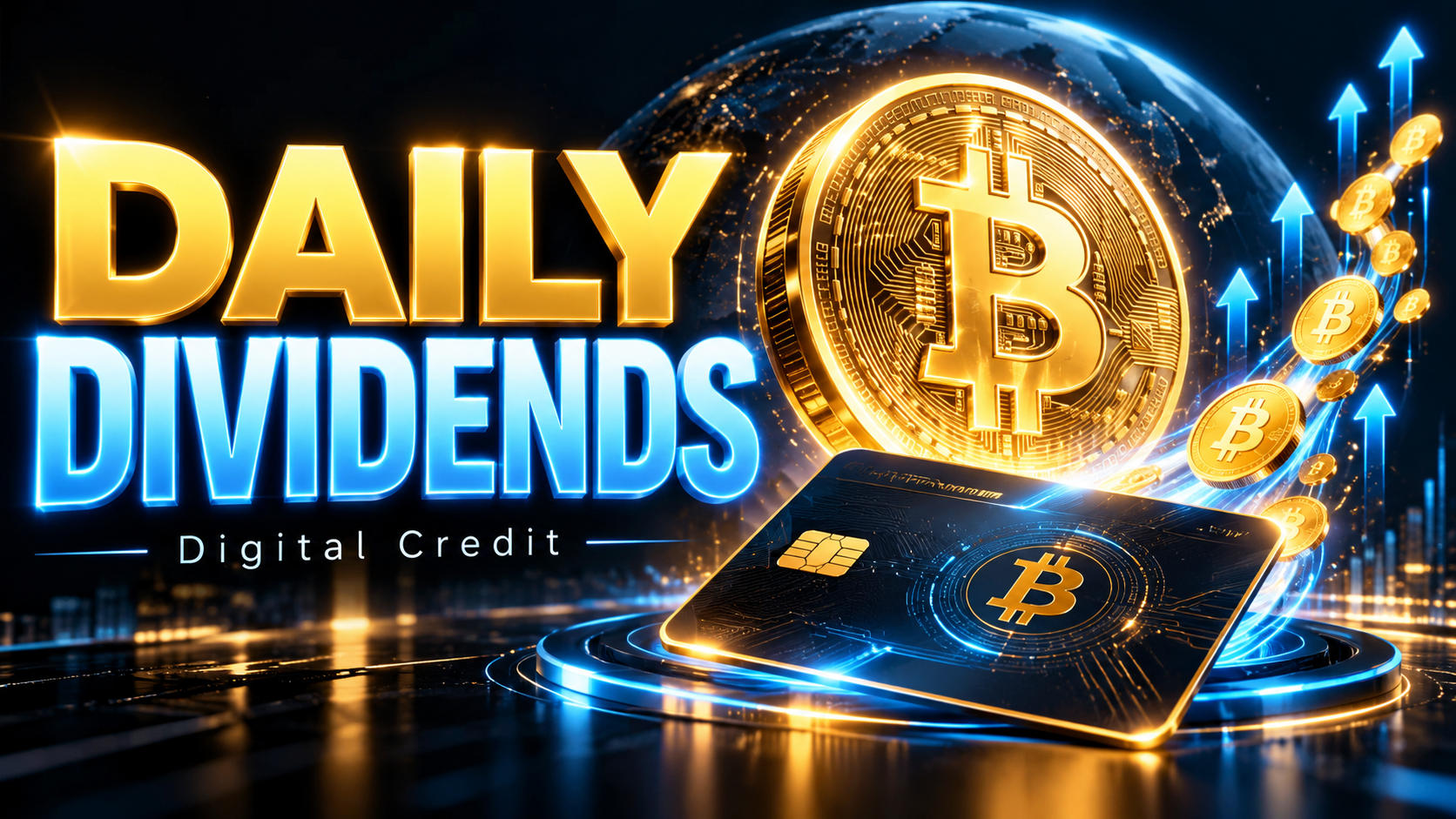
In May 2026, Strive rebranded itself as “The Daily Dividend Company,” then moved SATA to daily cash dividends beginning June 16. Strategy has now pushed the same idea into its own digital credit engine. On September 24, its board proposed moving STRC, STRF, STRK and STRD to daily dividends, subject to shareholder approval at an October 28 special meeting. The proposal keeps the annual dividend economics unchanged and changes the cadence of cash payments.
STRC spent much of the summer below its $100 stated amount even as Strategy raised its dividend rate to 12% and deployed more than $1 billion buying back STRC. The move to daily dividends by Strategy could be seen as the latest attempt to make the security more attractive and help it trade near par.
Now that the overton window has fully shifted in favor of digital credit paying daily dividends, we should take a look at the actual impacts of daily dividends.
Daily Dividends Fit Onchain Finance
Digital credit is increasingly becoming an input for other financial products—so called “digital money” or “digital yield” products. Strategy estimated in mid-May that more than $440 million of STRC exposure had moved into DeFi through stablecoins, tokenized securities, yield products and other structures.
However, there is a cash flow mismatch. Crypto products commonly accrue and distribute yield at high frequency. A security that pays monthly or twice monthly forces the product sitting on top of it to bridge the period between economic accrual and actual cash receipt.
Daily dividends compress that gap to one day. The protocol, fund or issuer receives cash from the underlying asset at almost the same cadence that users expect to receive yield. That simplifies liquidity management and reduces the cash needed between dividend dates. This is much more impactful to a financial product funding daily distributions or redemptions than to a long term investor focused on total return. The crypto-heavy setting of the “Layer 3” products on top of digital credit raises the attractiveness of daily dividends.
Daily Dividends Are Primarily a Retail Feature
For investors focused strictly on total return, dividend payment frequency makes little difference in underlying economic value. The asset’s price accrues between distribution dates and adjusts post-payment, meaning annual, quarterly, monthly, and daily payouts produce comparable long-term results.
The true advantage of daily dividends lies in product psychology and user experience. Cash arriving every day provides immediate visibility and an engaging feedback loop. Investors can spend, withdraw, or automatically reinvest the payout while leaving their principal position intact, turning an abstract yield metric into tangible recurring cash flow.
This dynamic mirrors the strategy of Realty Income, which built a massive retail follower base by branding itself as “The Monthly Dividend Company.” As a member of the S&P 500 Dividend Aristocrats Index, Realty Income has paid and raised dividends for 31 consecutive years.
Daily dividends on digital credit extends this product concept even further: SATA pairs frequent daily payouts with a target price near $100 and a double-digit yield.
While institutional investors prioritize yield spreads, liquidity, tax structure, and balance sheet coverage, daily payments offer their strongest appeal to retail buyers. If the overarching objective is to raise capital to purchase Bitcoin, optimizing security design for retail investor preferences is the most effective approach.
Options Get Cleaner Too
Daily dividends also change options mechanics. STRC currently pays $0.50 twice monthly. SATA pays roughly five cents each business day. Larger dividend events create larger discrete adjustments in the underlying price, which affects option pricing and early exercise decisions. Daily payments spread the same annual cash flow across much smaller adjustments.
The total value of dividends over an option’s life is a key economic input. The more interesting effect comes from the price stability created by daily dividends. If daily dividends, variable rates and active par management keep SATA and STRC trading in narrower ranges, realized volatility should fall. Implied volatility can follow as the market gains confidence in that behavior.
The Biggest Test
The real test is whether daily dividends increase demand enough to eventually lower the required yield.
If investors consistently support SATA near the top of its target range, Strive can theoretically reduce the dividend rate while attempting to keep SATA near par. Success would show that a Bitcoin company can issue permanent preferred capital, manage it around a stable price, and adjust its yield with market demand. The benefit of the variable rate preferreds was, from inception, the eventual opportunity to lower the rate and reduce the cost of capital without upsetting price stability. In comparison, fixed rate credit locks in fixed rate forever.
Conclusion
Strategy adopting daily dividends would move the feature from a SATA differentiator toward a digital credit category standard. The annual economics barely change but the retail appeal and crypto composability become meaningful improvements.
This post Impacts of Daily Dividends on Digital Credit first appeared on Bitcoin Magazine and is written by Allard Peng.
CryptoSlate
Companies building AI applications can rent powerful computers instead of buying the equipment themselves, paying for access to the graphics processing units, or GPUs, that run their software.
Lower rental prices make those applications cheaper to operate, but they can also make life harder for the company that bought the machines and needs the rent to pay its debts.
If you've financed a room full of GPUs assuming customers will pay a certain hourly rate, a cheaper competitor can upset the calculation long before you've paid off the equipment. Your machines might still work perfectly, and demand for AI might still be strong, but the amount you earn from each hour could start falling below what the business needs.
Financial contracts could let you protect part of that income by arranging a payment when rental prices fall, in exchange for taking on your own obligations. That's the basic idea behind AI compute derivatives, which let businesses trade their exposure to computing prices separately from renting the computers themselves.
Luxor, a company that provides services and financial products to Bitcoin miners, included these contracts in its latest expansion into AI. It sees an opportunity to bring its experience hedging mining revenue to another business that spends heavily on machines before knowing what it'll earn.
The company told CryptoSlate that it's already brokering agreements between owners of computing capacity and customers who want to use it.
However, its cash-settled derivatives business is still early, and the company said it couldn't provide a customer hedge example or current derivatives trading volumes because a liquid market hadn't formed yet.
That gives this promising idea the difficult commercial task of persuading someone to accept losses another business wants to avoid.
Getting that arrangement to work could help operators plan around more predictable income, but the protection is only as dependable as the price used to calculate it and the party responsible for paying.
Locking in the rent without locking in a customer
The tried-and-true way to make rental income more predictable is to sign a customer for a longer period at an agreed price. The customer gets access to the machines, while the operator gets a commitment it can use to plan its business.
That works well when both sides want the same arrangement, but customers don't always know how much computing they'll need that far into the future. Operators may also prefer to keep selling capacity to different users.
Cash-settled derivatives offer another approach because the contract pays money according to a price formula, without requiring the parties to exchange computing capacity. The operator can keep renting its GPUs to customers while using a separate financial agreement to offset movements in the rental rate.
Imagine an operator expecting to sell 1 million GPU-hours in a month, where one GPU-hour means access to one processor for an hour. At $2 per hour, that would produce $2 million in rental income, and the operator enters a hypothetical contract designed to protect that rate.
If the agreed market benchmark falls to $1.50, the contract pays the operator the 50-cent difference across the million hours, or $500,000. Assuming its actual rental income also falls to $1.5 million, that payment brings the combined amount back to $2 million before fees and other costs.
The obligation runs both ways, so if the benchmark increases to $2.50, the operator owes $500,000 while earning more from its customers. It gives up the benefit of a higher rate in exchange for protection against a lower one, making revenue easier to plan around.
This is just back-of-the-napkin math to explain the arrangement, as the result depends on the operator actually selling the expected hours at a rate that tracks the benchmark. Empty machines still produce no rental income, so fixing the hourly price doesn't guarantee someone will buy it.
Someone on the other side needs a reason to accept the opposite payments, and an AI business worried about more expensive computing could have one. Its financial contract would pay when the benchmark increased, helping cover a larger rental bill, while a fall would create a payment obligation alongside cheaper computing.
Dealers could help connect those interests or take some of the exposure themselves, charging for the risk they carry. But customers need a price for the amount of protection they want, covering the period when their business needs it.
CME Group is pursuing an exchange-traded version of this idea through its announced H100 and B200 rental-index futures. Its Aug. 11 announcement targeted Oct. 5, subject to regulatory review, for contracts tied to Silicon Data's GPU rental benchmarks, although listing a contract alone can't guarantee enough participation to make it easy to trade.
Your GPU hour might be different from mine
But even with willing counterparties, the payment formula needs a price both sides accept as relevant to their business.
In the example above, the hedge works perfectly because the operator's rental income moved exactly with the benchmark. However, you can't replicate perfect conditions once actual customers enter the picture.
Suppose its customers negotiate rates down to $1.25 while the benchmark only falls to $1.50, perhaps because the index covers a different service or type of equipment. The same $500,000 hedge payment would then bring its $1.25 million in rental income to $1.75 million, leaving a gap even though the contract works as written.
That mismatch is called basis risk, which simply means the price you've protected against doesn't move exactly like the price you actually receive. Compute hedges can leave Bitcoin miners exposed, and this is one reason a hedge needs to be judged against the particular business using it.
Luxor compared its AI ambitions with its path in Bitcoin mining, where publishing a reference price helped create a foundation for financial contracts. Its hashprice measure estimates what a unit of computing power can earn from mining Bitcoin, giving operators a shared revenue reference even when their own operating costs differ.
Bitcoin miners perform the same network task, whereas AI customers can attach different values to access that looks similar on a specification sheet. Someone buying uninterrupted access for months is purchasing a different service from someone willing to have a short job stopped whenever the provider needs the machines back.
Price providers already account for differences like these, with CCIR's rental-data methodology treating interruptibility and commitment length as separate characteristics. It uses publicly advertised rates, which also means the figures don't necessarily capture privately negotiated discounts.
The index Luxor supplied in its reply was its AI Hardware Price Index, which measures advertised prices for selected GPU systems. That can help someone assess an equipment purchase, but buying a machine and earning rent from it involve different prices, so the link doesn't establish how an AI rental hedge would settle.
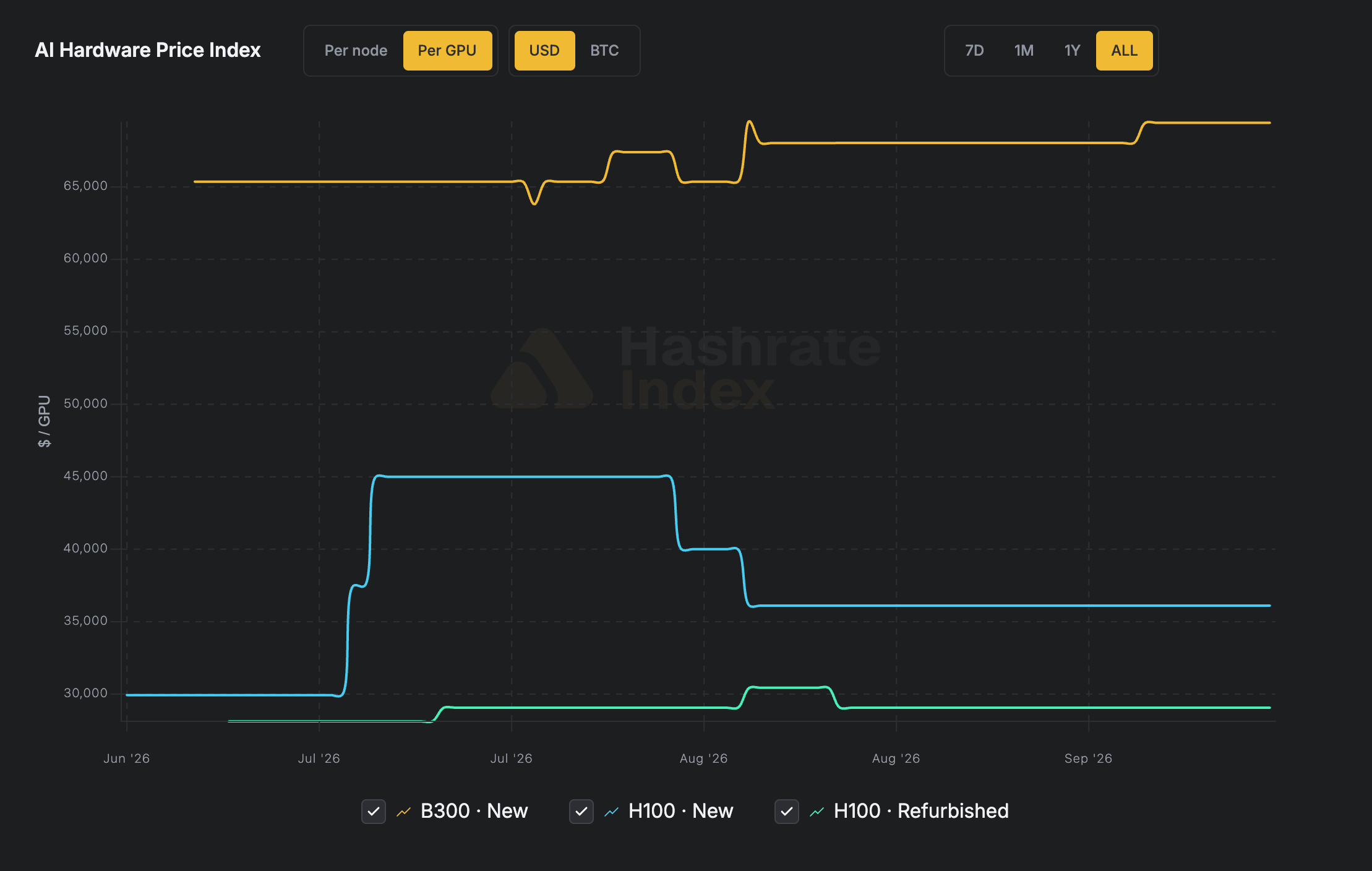
Luxor's August data announcement described expanded compute spot pricing as forthcoming. Operators trying to protect income would still need contracts that name a rental benchmark and show it tracks what customers pay.
Narrower benchmarks might fit better, but each additional contract splits potential trading among smaller groups. Building this market requires a compromise between matching each customer's business closely and bringing enough people together under the same contract to make trading affordable.
The protection has to survive the bad month
Even a closely matched contract leaves the operator relying on someone else's ability to pay when rental income falls.
If that counterparty also earns much of its money from AI infrastructure, cheaper computing could damage both businesses at the same moment, just when one expects support from the other.
Collateral can reduce that dependence by requiring money or eligible assets to be posted against obligations, giving the recipient something to draw on if the other party fails. It also creates a financing requirement, because money committed to the hedge can't simultaneously pay the operator's other bills.
In the example where rental prices increase, the operator might have to pay its hedge obligation before customers settle their higher invoices.
The overall economics could still work even if the bank account runs short, making the timing of cash flows a huge part of that protection's affordability.
Luxor didn't provide the requested AI collateral terms or explain the procedures for a counterparty failing to pay. Its reply also left unanswered how it separates its own trading from the business it arranges for customers, a relevant point because the launch announcement disclosed an internal compute trading fund.
More predictable rental income could give an operator greater confidence about meeting its debt payments, even when customers become less willing to pay yesterday's rates.
Getting that benefit requires a contract that follows the income closely enough, with payment obligations the operator can afford throughout the period it's trying to protect.
Cheaper computing could let more people build and use AI while leaving some owners of the machines with disappointing returns.
Financial contracts won't make that loss disappear, but they could move part of it to someone prepared to bear it, giving the operator more room to keep serving customers when the rent falls.
The post Plunging GPU prices threaten AI hosts, and new hedges step in appeared first on CryptoSlate.
Investors in LIBRA, the memecoin promoted by Argentine President Javier Milei, lost a district-court route to recovering their losses after a US judge dismissed the proposed class action over LIBRA and fellow memecoin M3M3.
In a Sept. 29 opinion, Judge Jennifer L. Rochon dismissed the amended complaint with prejudice, denied permission to amend it again and ordered the Southern District of New York case closed. The decision also blocked investors' proposed expansion of the lawsuit to three other tokens.
The plaintiffs alleged that insiders controlled token launches and extracted funds from liquidity pools at outside investors' expense.
According to the complaint as recounted by the court, LIBRA launched on Feb. 14, 2025, and Milei promoted it before withdrawing his support that day. The dismissal resolved the legal sufficiency of the claims and the court's jurisdiction.
Why the racketeering claims in the LIBRA case failed
The central federal claim relied on the Racketeer Influenced and Corrupt Organizations Act, or RICO. It requires a pattern of related racketeering acts that either spans a substantial period or threatens continuing criminal activity.
The court found neither form of continuity adequately pleaded against the Kelsier defendants, including Kelsier Ventures and Hayden Davis, and Benjamin Chow, Meteora's co-founder and former CEO.
For the first route, the court treated the alleged conduct from October 2024 through the March 2025 complaint as a six-month period. Multiple schemes and a potentially large group of victims did not overcome that short duration.
The opinion applied Second Circuit precedent that generally demands a longer period for this form of continuity, while expressly recognizing that two years is not a fixed cutoff. I
The alternative route required facts supporting a continuing threat. The court found that broad assertions about a repeatable token-launch business and referrals to other projects did not establish, defendant by defendant, that alleged wire fraud was a regular business practice. The dependent RICO conspiracy claims failed too.
The proposed amendment would have added MELANIA, ENRON and TRUST, another plaintiff and new defendants. But the judge found it extended the alleged racketeering period to only seven months and provided no facts curing the continuing-threat defect.
After RICO failed, the court dismissed the Kelsier defendants' remaining state-law claims for lack of personal jurisdiction. Allegations about nationwide social media and crypto infrastructure did not establish the necessary New York connections. The court did not reach the merits of those state-law claims.
The court dismissed all claims against Chow for pleading defects, including insufficient allegations of fraudulent intent. Claims against Meteora failed because investors had not adequately pleaded it as a legal association or partnership capable of being sued.

Hayden Davis's denied wrongdoing and jurisdiction objections in June 2025. The new ruling turns that earlier dispute into a concrete setback for investors seeking recovery through this action.
The order does not establish that every alleged act was lawful or determine the status of every other possible recovery route.
The post US judge kills Milei’s LIBRA memecoin lawsuit, leaving investors stranded appeared first on CryptoSlate.
The US Securities and Exchange Commission’s proposed crypto custody fallback could broaden investment choices while making them easier for larger advisers to offer.
The agency’s economic analysis says the expense of safeguarding assets and arranging independent oversight may lead smaller firms to decline to offer the service.
Approved on Oct. 1, the proposal would let advisers hold covered client crypto assets when an eligible custodian is unavailable, subject to safeguards. Table 8 models certain annual costs of $433,833 per adviser using that option.
That estimate includes an independent control report but leaves out some potentially significant technology costs.
For clients, the consequence could be that an asset might become available through an adviser with sufficient custody resources while remaining outside another adviser’s offering.
SEC Commissioner Hester Peirce distinguished adviser “self-custody” from investors holding their own assets. Here, an intermediary would hold clients' key materials, potentially including a non-controlling portion. Clients would still depend on that intermediary’s safeguards.
For ordinary advisory clients, the adviser amendments concern crypto assets that are funds or securities, while the relevant scope for regulated-fund accounts is securities or similar investments.
What the annual estimate includes
The largest modeled annual component is the independent internal control report. The SEC puts its average cost at $376,000, alongside $57,833 in recurring internal compliance work.
Table 8 combines those amounts and separately lists an initial internal compliance cost of $173,499, all in 2026 dollars.
| Modeled adviser cost | Amount | Timing |
|---|---|---|
| Internal compliance work | $173,499 | Initial |
| Internal compliance work | $57,833 | Recurring annually |
| Independent internal control report | $376,000 | Annual estimate |
| Table 8 adviser annual subtotal | $433,833 | Internal work plus control report |
The internal estimate assumes 300 initial hours and 100 recurring annual hours at $578.33 an hour. It covers information, communications, and an agreement between adviser and client to treat the asset as a financial asset under applicable state law.
The subtotal leaves out some technology, software, hardware, and associated systems and processes. The SEC expects those costs to be economically high. Recordkeeping and disclosure burdens also appear separately in other tables, so the subtotal cannot serve as a complete operating budget.
The accountant figure comes from an inflation-adjusted prior estimate in the Paperwork Reduction Act analysis, rounded to the nearest $1,000, reflecting the agency’s historical cost model. Report costs could vary with the assets, safeguarding systems, and expertise needed to check different networks.
The agency assumes approximately 823 advisers, or 5% of 16,442 registered advisers, would use self-custody for that burden calculation. It cautions that actual uptake may be lower.
Scale changes the cost of access
The economic analysis explicitly anticipates that smaller advisers may elect against self-custody, while larger advisers could have sufficient resources to meet the safeguards. It also identifies ways to share some costs across a larger client base, multiple assets, or affiliated businesses.
That creates a plausible advantage without establishing a universal minimum firm size. An adviser with substantial overall assets may have only a small pool of covered crypto assets needing this fallback.
Conversely, an adviser with a focused crypto business may already have the expertise and infrastructure another firm would have to acquire.
A shared cost weighs more heavily on a small pool of assets than a large one, if the burden stays constant. Firms could allocate costs across their wider businesses rather than charge only clients using the fallback.
The SEC expects many direct costs could be passed on to clients through fees or expenses. More assets and more networks can require more complex controls and more specialized accountant work, increasing absolute costs. The potential benefit comes from spreading or reusing parts of the infrastructure.
Accountant pricing could work either way: the SEC warns that demand for people who can assess crypto controls could make services harder to obtain, particularly for smaller advisers with less bargaining power.
An option that can expire for each asset
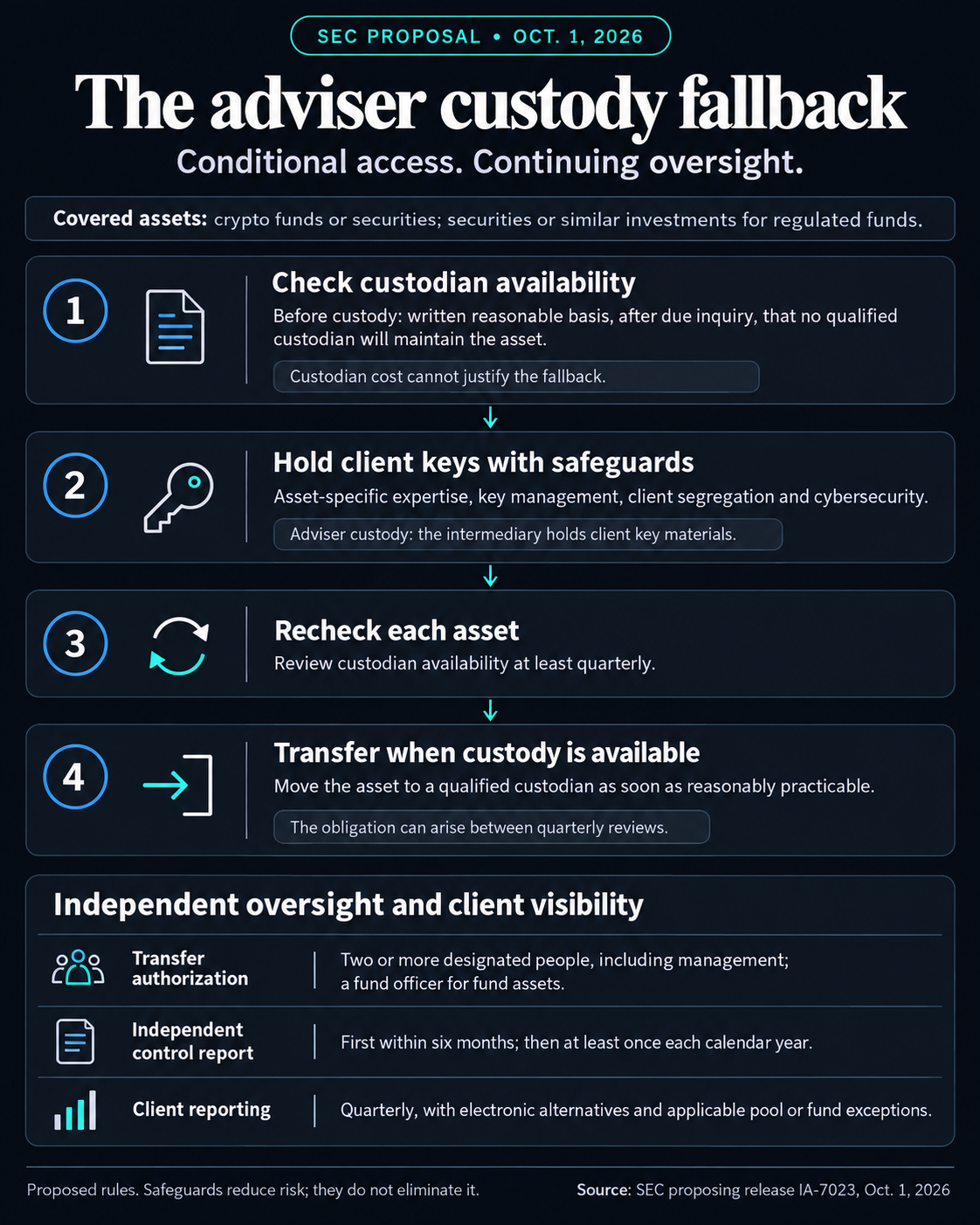
The proposed fallback would depend on the adviser having a written reasonable basis, after due inquiry, that no qualified custodian would maintain each asset.
The adviser would need to make this determination before taking custody and at least quarterly afterward. Custodian costs could not form the basis of that determination.
An adviser could not choose the fallback simply because its custody arrangement looked cheaper. The relevant barrier is the availability of an eligible custodian for the asset, assessed under the proposed conditions.
Once an adviser learned that a qualified custodian had become available, it would have to place the asset with that custodian as soon as reasonably practicable. That obligation could arise between quarterly reviews. The proposal does not specify a single transfer deadline for every situation.
A firm might incur costs to support an asset and later have to move it out of adviser custody. Eligibility could also leave the firm with only a narrow set of unsupported assets to spread the remaining expense across.
If no client crypto assets remained in self-custody by the report’s due date, the report would not be required. That could reduce costs for a short-lived arrangement, although advisers retaining other covered client crypto assets in self-custody would still face the applicable obligation.
The safeguards buy independent scrutiny
The expense accompanies a change in who holds the assets. An adviser offering investment advice would also hold client key materials, creating risks of misuse, misappropriation and operational error. A lower-cost arrangement would have to be assessed alongside those risks.
As SEC Commissioner Mark Uyeda’s statement explains, the proposed conditions include safeguarding expertise, cybersecurity protections, annual reviews, reporting and client disclosures.
The adviser would need asset-specific expertise and systems for key management, authorization by two or more designated people, and segregation of each client’s assets.
The first independent control report would be due within six months of taking self-custody and at least once each calendar year thereafter. It would assess the design, implementation and effectiveness of controls and include verification of reconciliation to the crypto network.
That supplies scrutiny beyond an adviser’s assessment of its capability.
Quarterly client reporting would also apply, with electronic alternatives and exceptions for qualifying audited pools and regulated funds. Clients’ visibility into balances and transactions can complement safeguards, while the accountant’s work addresses questions that a balance alone cannot settle.
These protections would not eliminate custodial risk, and the SEC cautions that spending itself does not establish safeguarding competence. A firm’s ability to absorb compliance costs is a separate question from whether its systems effectively protect clients.
Alternatives could soften the scale advantage
SEC Commissioner Hester Peirce’s Sept. 30, 2025 statement described conditional staff no-action relief for certain state trust companies and identified national and state banks as other permissible custodians.
The October proposal would also permit eligible state trust companies to custody crypto assets, subject to initial and annual due inquiry into authorization and safeguards. Where an eligible institution supports an asset, clients may gain access without their adviser building the proposed fallback arrangement.
Its cost advantage would depend on the particular asset and custody arrangement, since a firm authorized to provide crypto custody does not necessarily maintain every asset a client wants to hold.
The question for investors is whether the proposal would produce usable access at an acceptable cost and level of protection. The SEC’s analysis supports a possible advantage for advisers with sufficient resources and reusable infrastructure.
How widely clients benefit would depend on firms’ actual implementation costs, independent-accountant pricing, and the assets that eligible custodians begin to support.
The post New SEC crypto rules threaten small advisers, but big firms win appeared first on CryptoSlate.
Ethereum layer-2 network built around native yield Blast said on Oct. 2 that it will shut down because maintaining the chain costs more than it earns.
The project asked users to move their assets to Ethereum mainnet by Oct. 26 to withdraw through its normal interface.
Blast said in its shutdown announcement that it sees no credible path to making the network economically sustainable. It plans to wind down the chain through an asset withdrawal process that will temporarily interrupt users’ ability to exit.
The decision comes nearly three years after Blast disclosed $20 million in funding from Paradigm and Standard Crypto on Nov. 20, 2023. The network opened early access that November, with a mainnet launch then planned for February 2024.
Its documented design describes an Ethereum-compatible optimistic rollup that passes yield from ETH staking and real-world-asset protocols to users. The website identifies Lido and MakerDAO as yield sources and lists additional investors among Blast's backers.
The yield model was intended to let holders benefit from returns earned by those underlying protocols, but Blast now says those operating economics no longer justify keeping the network running.
Blast's withdrawal pause and Oct. 26 cutoff
Blast said it will first withdraw its assets from Lido, which its design identifies as a source of ETH staking yield, a process that is expected to take approximately one week.
User withdrawals will be temporarily unavailable during the unwind, even after the network reduces its withdrawal delay to 24 hours.
Withdrawals will resume with the new 24-hour delay once the Lido process is complete, according to the announcement. The roughly one-week interruption and the withdrawal delay after reopening are separate parts of the exit timetable.
The request to move funds back to Ethereum includes balances held in Blast’s web app, which the announcement calls the PWA. Blast encouraged all users to withdraw before Oct. 26.
After that date, Blast said assets will remain withdrawable, but users will need to interact directly with its bridge contracts on Ethereum mainnet.
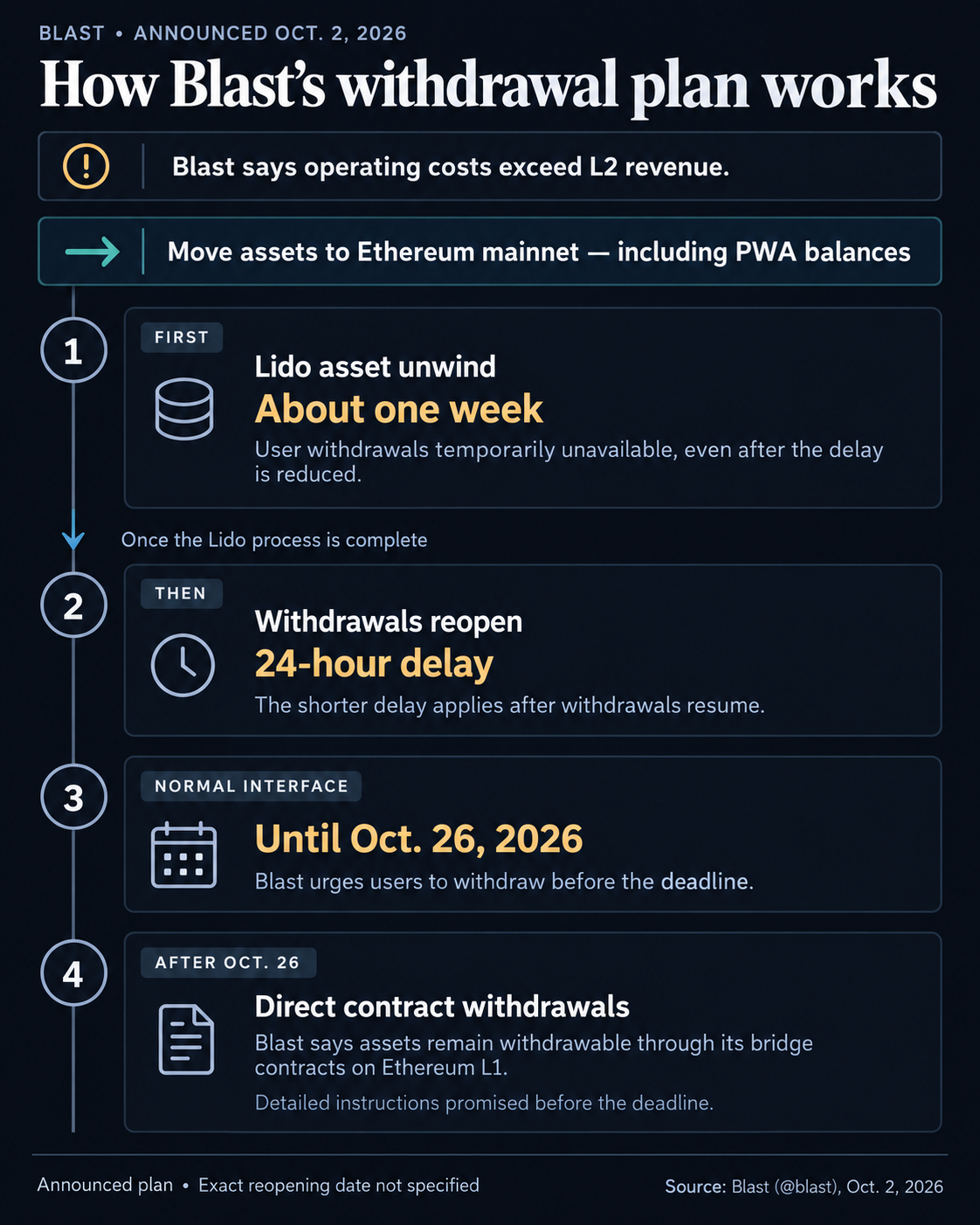
Blast promised to publish detailed instructions for that route before the deadline. The announcement gives an approximate duration for the Lido unwind but does not specify an exact date when normal withdrawals will resume.
The post Blast shuts down $20M layer-2 network, forcing Oct. 26 exit deadline appeared first on CryptoSlate.
Stablecoin issuers are emerging as a new source of demand for US government debt as foreign official holdings lose ground.
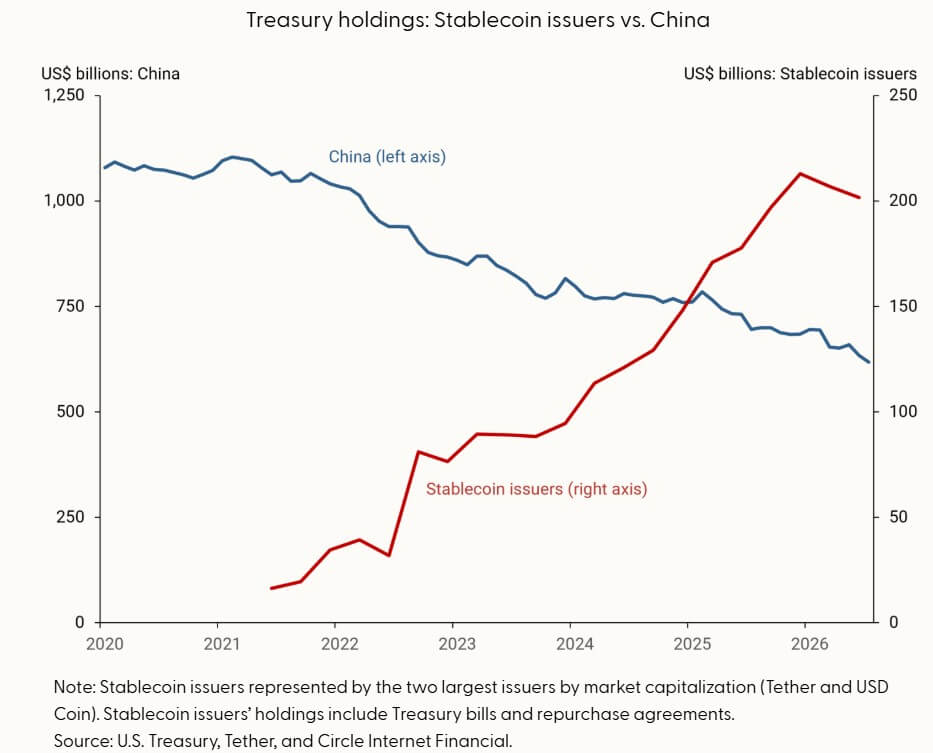
Tether and Circle have increased their Treasury securities and repurchase-agreement holdings by about $200 billion over the past five years, equivalent to more than 40% of the decline in China’s Treasury holdings over the same period, researchers at the Federal Reserve Bank of San Francisco said.
The shift is beginning to alter the investor base underpinning the world’s largest government bond market. Stablecoin issuers’ Treasury holdings have risen more than tenfold in five years as demand for dollar-linked digital tokens expanded, while China has continued a retreat from US debt that began more than a decade ago.
Stablecoins gain ground as foreign governments retreat
The rise of crypto-linked buyers comes as the composition of US creditors undergoes a longer-term change that could affect how cheaply Washington can finance its deficits.
Foreign investors held more than half of outstanding Treasury securities around 2008, but their share had dropped to roughly 30% by early 2026, the San Francisco Fed said. Within that group, foreign governments have declined even more sharply in relative importance, accounting for just above 40% of foreign Treasury demand by early 2026 compared with nearly all of it at their peak in the 1970s.
China has been central to that shift. Its Treasury holdings peaked in late 2013 and had fallen by more than half by mid-2026 as Beijing diversified its reserve assets.
Private investors have taken a larger role as official foreign demand weakened, potentially making Treasury financing more sensitive to interest-rate changes and perceptions of US fiscal risk. Unlike central banks, which may hold Treasuries for reserve-management purposes, private investors can demand higher yields when risks rise or competing returns increase.
Stablecoin issuers add a different source of demand because their business model requires large pools of liquid dollar assets backing tokens that customers can redeem at par.
Tether’s USDT and Circle’s USDC accounted for more than 80% of stablecoin market capitalization as of mid-August, the Fed researchers said. Both issuers hold substantial amounts of short-term Treasury securities, along with cash, bank deposits, and repurchase agreements, to meet redemption demands.
Their growth has already made them significant participants at the short end of the Treasury market. Since 2023, stablecoin issuers have added more short-term Treasury holdings than Japan, the largest foreign holder of US government debt, according to the research.
That demand is also large enough to measurably affect short-term government bond yields, the San Francisco Fed said, citing research from the Bank for International Settlements.
The China comparison has a maturity gap
Stablecoins cannot fully replace the type of demand China has withdrawn because the two investor groups operate in different parts of the Treasury market.
China’s reductions have been concentrated largely in longer-dated US debt, while stablecoin issuers predominantly buy Treasury bills and other highly liquid, short-maturity assets. That means growing stablecoin reserves can deepen demand for bills without necessarily creating an equivalent buyer for longer-term notes and bonds.
The distinction comes as the US faces heavier financing requirements. Federal debt held by the public has risen from about 35% of gross domestic product in 2006 to roughly 100% today, increasing scrutiny of the investor base willing to absorb new issuance.
Regulation could reinforce stablecoins’ preference for the shortest maturities.
The GENIUS Act, adopted in 2025, created a federal framework requiring approved US payment stablecoin issuers to fully back outstanding tokens with eligible liquid reserves.
Proposed implementing rules include Treasury bills, notes and bonds with remaining maturities of 93 days or less, alongside cash, bank deposits and certain Treasury-backed repurchase agreements.
That structure effectively links growth in regulated dollar stablecoins with incremental demand for highly liquid US government securities.
For issuers, the economics can also be attractive. Customers hold tokens that generally do not pay them the yield earned on reserve assets, while issuers can collect interest from the Treasury securities backing those tokens.
As circulation expands, reserve portfolios and the associated interest income can rise with them.
Global stablecoin adoption could funnel more capital into T-bills
The next phase will depend on whether stablecoins continue attracting users outside the traditional crypto trading market.
The San Francisco Fed pointed to growing use of stablecoins for cross-border payments and as dollar-denominated stores of value in countries with volatile currencies. Usage relative to economic output is particularly high in Africa, the Middle East and Latin America, with much of the activity crossing national borders.
That creates a channel through which a stablecoin user abroad can indirectly finance US government borrowing. A customer acquiring dollar tokens creates additional reserve liabilities for the issuer, which can in turn purchase Treasury bills to back them.
Extending the industry's recent growth rate would lift those holdings toward $400 billion by 2030, though the Fed researchers cautioned that the estimate carries substantial uncertainty. Regulation outside the US, competing digital-payment products and new bank technology could all slow stablecoin adoption.
Those competitive pressures will determine how much of the next wave of dollar-based payments ultimately flows through stablecoin issuers and into Treasury markets.
Banks developing cheaper cross-border settlement tools could capture some of that demand, while stablecoin companies expanding into remittances and payments would need to keep increasing liquid reserves as circulation grows.
The post Stablecoin issuers have replaced 40% of China’s lost US Treasury demand appeared first on CryptoSlate.
CryptoTicker.io
Tron (TRX) traded at around $0.335 late on Friday evening, October 2, 2026 (according to CoinGecko). Hardly any large crypto asset is moving as little right now: since September 2, every daily close has sat between $0.325 and $0.345 (CoinMarketCap). On Sunday the network finally sees some movement, even if the price does not at first. The third round of the DeFi Summer rewards campaign begins. For the Tron price prediction, the question is whether campaigns of this kind can pull TRX out of its range.
What DeFi Summer S3 offers
From October 4 at 8:00 a.m. Singapore time, which is 2:00 a.m. on Sunday in central Europe, raised interest rates apply for 60 days to four assets of the Tron network: TRX, the stablecoin USDD and the tokens JST and SUN. The reward pool comes to $2 million, and participation runs through the lending market JustLend DAO, including via the DeFi function of Binance Wallet, as ChainCatcher reports. Anyone who took part in the second round does not have to sign up again.

Measured against the size of the network, the pool is small. TRX alone carries a market capitalisation of around $31.8 billion (CoinGecko). Spread over 60 days, $2 million is a lure for deposits into the lending markets, not a sum that moves the TRX price directly. The effect could be more noticeable on the smaller tokens: JST has roughly quadrupled within a year, while SUN is down around a third over the same period.
Tron price prediction: the levels on the chart
The one-year chart shows a price running far more quietly than the rest of the market. Over twelve months TRX is down around 2 percent, and over 30 days it is up around 3 percent (CoinGecko). Daily closes over the past twelve months have sat between $0.27 and $0.375, and the record high of $0.4313 dates from December 2024.
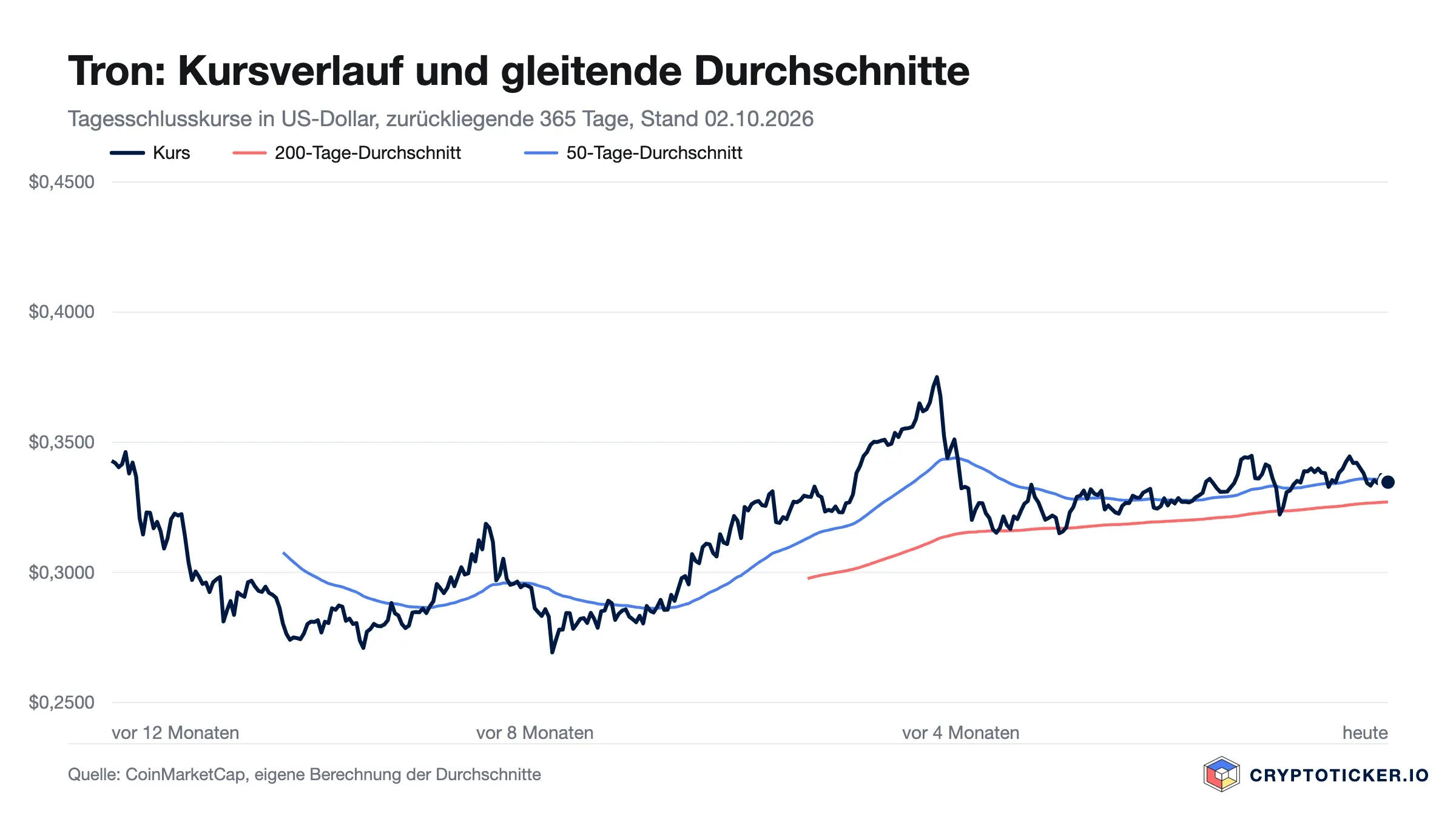
$0.345 is the level on the upside. On September 21 TRX closed at $0.3446, and the price has gone no higher in the past 30 days. A close above it would be the first break out of the range since early September.
Around $0.336 and $0.327 are the two average lines we calculate from CoinMarketCap daily closes. The 50-day average, at $0.336, sits just above the current price; the 200-day average, at $0.327, just below it. TRX therefore stands exactly between the two, a picture of a market without direction.
$0.325 is the level on the downside, the close of September 2 and the low of the past 30 days. If TRX falls below it, the price leaves its range to the downside.
Why TRX swings so little
A large part of the activity on Tron consists of stablecoin transfers, above all USDT. Those payments require TRX to pay fees, but hardly anyone holds it to speculate with. That steadies demand and dampens the swings. How transfers over Tron work in practice is shown in our guide sending USDT via TRC20.
The risks behind the rewards
Raised interest rates in DeFi campaigns always have a flip side. Anyone depositing coins with JustLend is relying on the program code of the lending market and on its collateral. With the stablecoin USDD a risk of its own is added: it already came loose from the dollar once, in 2022. The raised rates also apply only as long as the reward pool lasts, and they are usually paid out in tokens whose price fluctuates.

Anyone who would rather hold TRX without DeFi risk can also stake it through regulated providers; the terms that apply there are shown in our comparison of staking providers. For self-custody, a wallet that supports the Tron network is enough.
Tron: The key points for your decision
Three points sum up the situation. First: TRX has been stuck for a month in a narrow range between $0.325 and $0.345, and only a close outside it is a signal. Second: DeFi Summer revives the network's lending markets, but the reward pool is too small to carry the price on its own. Third: anyone joining the campaign should know the risks of program code and stablecoin and commit only what they can spare.
Whether an entry at the current price is worthwhile is assessed by our analysis Is Tron a Good Buy at Current Prices?. Crypto assets swing sharply and a total loss is possible. This article places news and price levels in context.
(As of October 2, 2026. This article is not investment advice. Prices and fee structures change; check the terms with the provider before you buy.)
Hyperliquid (HYPE) traded at around $88.26 late on Friday evening, October 2, 2026 (according to CoinGecko). That is a good 10 percent below the record high of $97.96 set on September 23. Into this situation comes news that unsettled many holders at first: the team behind Hyperliquid is unstaking 3.75 million HYPE in order to sell them. For the Hyperliquid price prediction, what counts is how that sale is executed, because that decides whether it reaches the market price at all.
What is known about the sale
Hyperliquid Labs has unstaked 3.75 million HYPE, worth around $329 million at the price when the move was announced. Co-founder iliensinc explained in the project's Discord that the tokens are covered by an over-the-counter agreement with a single institutional buyer and will not be sold on the open market, FinanceFeeds reports. Unstaking takes seven days, so the tokens become available around October 7.

Against a circulating supply of around 222 million HYPE (CoinGecko), the package amounts to roughly 1.7 percent of the freely tradable tokens. Who the buyer is, what price they pay and whether they have to hold the tokens for a period has not been published. That is the open flank: a large buyer free to resell at once acts differently from one bound by a lock-up.
Hyperliquid price prediction: the levels on the chart
Measured over a year, HYPE is one of the strongest large assets, with a gain of around 75 percent over twelve months (CoinGecko). The price sits above its 50-day average (around $82) and well above its 200-day average (around $63), both calculated from CoinMarketCap daily closing prices.
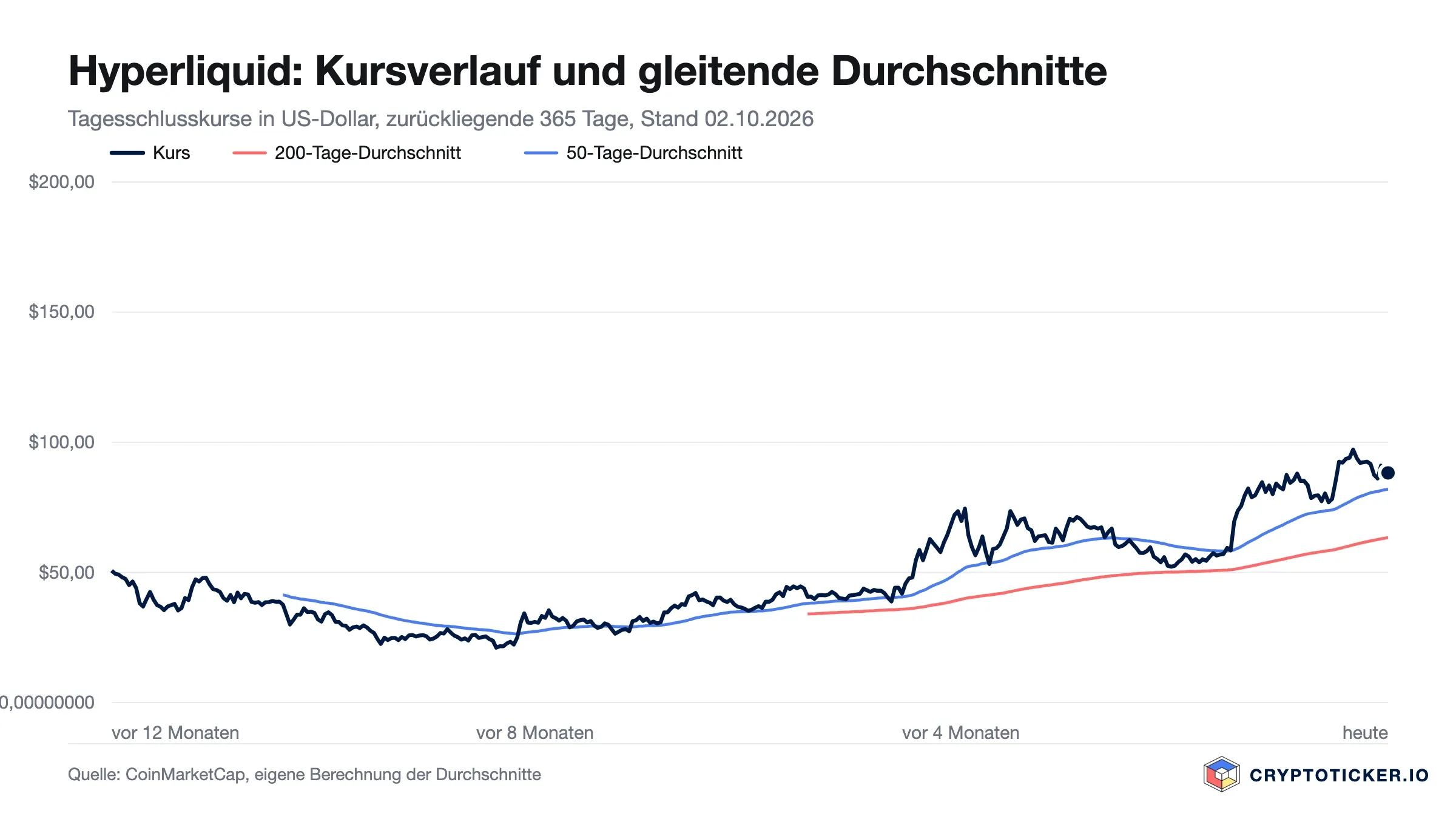
Just under $98 is the level on the upside, the record high of September 23. On a closing basis the highest value was $97.20 on September 22. HYPE has not reached a new peak since.
Around $86 is the first level on the downside. HYPE closed there on September 29, and that was also the daily low in the 24 hours to Friday evening ($86.16). If that zone holds, the setback since the record is a breather.
Around $82 and $77 are the levels below it. The 50-day average runs at $82, and the lows of September 13 and 15, from which the climb to the record started, sat around $77.
Why an over-the-counter sale works differently
A sale through an exchange meets the order book and pushes the price down as long as there are not enough buyers. An over-the-counter deal runs between two parties, and the price is agreed beforehand. For the market price that is neutral at first, because no token passes through the market. It can even lend support when a large investor buys close to the market price and shows in doing so that he believes in the value. It becomes a burden only if the buyer resells quickly.
The unlocks in October
The sale falls in a month in which further HYPE becomes free. For early October, data providers name an unlock worth around $856 million, U.Today reported on September 30. How many of those tokens can really come to market is disputed. The published figures diverge widely, and we have worked through the reasons in our count of the HYPE holdings.

One fixed mechanism works against the additional supply: Hyperliquid continuously buys back HYPE with a share of its trading fees. The more that is traded on the platform, the larger that counterweight. Anyone who wants to use Hyperliquid should know the rules for users in the EU, since the platform holds no MiCA authorisation; alternatives are set out in our comparison of perp DEXs.
Hyperliquid: How to proceed now
First: keep an eye on October 7. By then the 3.75 million HYPE have left staking, and the blockchain shows whether they move to an exchange or stay where they are. Second: watch the zone around $86, since a closing price below it would open the path to the 50-day average at $82. Third: match the position size to the swings, because there are around 12 percent between the record and that zone.
Whether an entry at the current price is worthwhile is assessed by our analysis Is Hyperliquid a Good Buy at Current Prices?. Crypto assets swing sharply and a total loss is possible. This article places news and price levels in context.
(As of October 2, 2026. This article is not investment advice. Prices and fee structures change; check the terms with the provider before you buy.)
Cardano (ADA) costs around $0.242 late on Friday evening, October 2, 2026 (according to CoinGecko). That puts the price almost exactly on its 200-day moving average, which we calculate at $0.243 from CoinMarketCap daily closes. And it does so in a week with two pieces of news that would have been enough for a price jump at other coins: Brazil's state oil company Petrobras is testing Cardano, and the Cardano Foundation has found a partner in Japan. For the Cardano price prediction what counts, therefore, is why the news has not yet reached the price.
What Petrobras and Pacific Meta have announced
Petrobras has developed two applications on Cardano together with the Ledger Lab of the PUC-Rio university, Cointelegraph reports. The first makes the environmental benefit of sustainable aviation fuel (SAF) transferable as a token: an airline or a passenger can acquire the certificate even if the fuel is physically burned somewhere else. A token can be redeemed only once, so that the same certificate is not sold twice. The second application tracks the production, transport and consumption of Diesel R, the group's renewable diesel. Both projects are explicitly at the research stage, and none of those involved names a date for regular operation.

The second report followed on October 1: the Cardano Foundation is working with Pacific Meta, a blockchain incubator from Tokyo that is to help Japanese companies build applications of their own (FXStreet). Japan is no new market for Cardano, where the project has had a large following since its launch in 2017. According to Santiment, the number of daily active addresses almost doubled afterwards to more than 27,500, as CoinCentral quotes it.
Cardano price prediction: the levels on the chart
The one-year chart shows where ADA has come from. A year ago Cardano still cost around $0.85, and the low of the past twelve months sat at roughly $0.14. Over a year the token is down around 72 percent, and over 30 days it is up around 22 percent (CoinGecko).
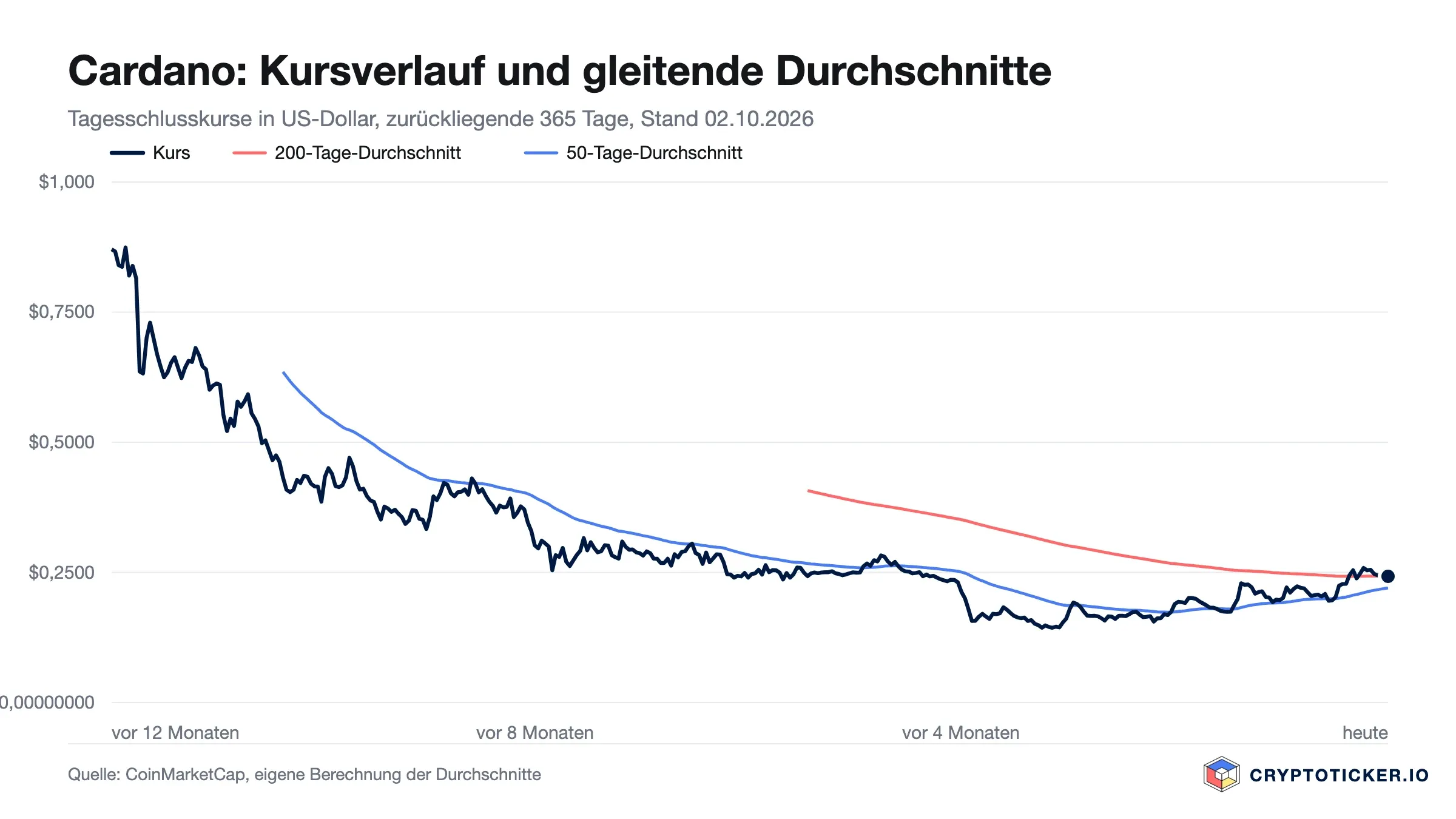
$0.26 is the level on the upside. On September 25 ADA closed at $0.2586, and the price got no higher than that this autumn. In the 24 hours to Friday evening, that is after the Japan report, the high also reached only around $0.2585. Only a close above it would turn the sideways phase into a breakout.
$0.243, the 200-day moving average, is the line on which ADA is currently balancing. Since September 21, every close has sat between $0.2385 and $0.2586, so within a band of a good eight percent. A price that spent months below this line and is now clinging to it often settles the direction of the coming weeks here.
$0.22 and $0.195 are the levels beneath. The 50-day moving average runs at $0.22, and the lows of August 30 and September 15 sat around $0.195. The recovery that lifted ADA by roughly a third into late September started from there.
Why the news is not carrying the price yet
Both reports are declarations of intent and tests, not revenue. How many transactions the Petrobras project would trigger in operation, and whether any appreciable amount of ADA would be needed for it, cannot be quantified today. For the price, news of that kind is therefore closer to sentiment than to demand. On top of this comes the wider market: Bitcoin moved by just under one percent in the seven days to Friday evening, and without a tailwind from there smaller coins often lack the push.
What is coming up for Cardano in the fourth quarter
The next big step is technical in nature. For the fourth quarter of 2026, according to the roadmap that CoinMarketCap summarises, completion of the first stage of Leios is planned, an extension intended to raise the network's throughput. For November, production operation of the alternative node Amaru has been announced. Dates like these have a record of slipping at Cardano, but they are the next occasions on which it can show whether developers and users come along.

Anyone holding ADA for the long term can delegate the coins in their own wallet to a stake pool. The coins stay in your own custody throughout and remain available at any time; nothing is locked. Anyone who prefers to stake through an exchange should compare terms and custody, for instance in our comparison of staking providers.
Cardano: Your next three steps
First: keep an eye on the closing price, not on the headline. A daily close above $0.26 would be the first sign that the news is reaching the price, and a close below $0.22 the opposite. Second: fit the size of your position to that range, because roughly 18 percent lies between the two levels. Third: with gains, remember the holding period. Coins held for less than a year are taxable on sale in Germany as soon as the annual exemption limit of 1,000 euros is exceeded.
Anyone wondering how the price was read a week ago will find the situation at the time in our Cardano price prediction from September. Crypto assets fluctuate heavily and a total loss is possible. This article places news and price levels in context; it is not a recommendation to buy or sell Cardano.
The prediction market token RAIN has lost 14.5 percent within a day and trades at $0.0103. The reason has been sitting in the project's vesting schedule for months: in October, RAIN tokens worth roughly $785.5 million become free. That is almost forty-five times what changes hands on an ordinary day.
That calculation is the heart of the matter, and it explains more about the price action than any reading of market sentiment. A token unlock is no misfortune that befalls a project. It is a date fixed at launch which anyone can look up. What alone decides the outcome is how large the released quantity is relative to the market's capacity to absorb it. For RAIN that ratio is currently extreme.
What exactly happens at the RAIN unlock in October
According to an analysis by the industry service Cryptobriefing, roughly $785.5 million of released tokens fall to RAIN in October. The seven largest unlocks of the month come to about $1.08 billion together. RAIN alone therefore accounts for just under three quarters of the entire volume, while the remaining six projects share the other $294.5 million (Cryptobriefing, October 2026).
For RAIN this is not a one-off event. In June, according to the same analysis, roughly 4.4 percent of the total supply became free, with a value between $650 million and $713 million. For July the projection stood at $812 million. October thus joins a series that runs through the whole year. Anyone who knows the calendar has been taken by surprise by none of these dates.
Token unlock, vesting and cliff: the terms in one sentence each
A token unlock is the moment at which previously locked tokens become transferable and therefore sellable. Vesting is the lock-up schedule behind it, meaning the contractual rule setting out the time grid on which the founding team, early investors, the foundation and the ecosystem treasury receive their shares. A cliff is a drop in that schedule: an initial lock-up period after which a large package becomes free all at once.
The counterpart to the cliff is linear vesting, where portions of equal size are released across a period. Both models release the same quantity in the end. The difference lies in whether the market has to absorb the inflow on a single day or spread across weeks.
$785 million against $17.6 million of daily turnover: the real problem
cryptoticker.io compiled the market data on RAIN itself on the evening of October 2, 2026. The token traded at $0.0103, or around 0.0092 euros. Market capitalisation stood at about $7.31 billion, which corresponds to rank 20 among all crypto assets. Trading turnover over the preceding 24 hours, by contrast, came to only around $17.59 million. This assessment was compiled by cryptoticker.io on October 2, 2026.
Put those two figures in relation and you arrive at a daily turnover of about 0.24 percent of market capitalisation. For comparison: among the largest crypto assets that figure regularly sits in the low single-digit percentage range. Measured against its valuation, RAIN is therefore barely traded.
From this follows the calculation that makes October uncomfortable for holders. The $785.5 million being released corresponds to roughly forty-five times an average day's turnover and to about 10.7 percent of total market capitalisation. Even if only a small part of the new tokens is actually sold, that part meets a thin order book. In a thin order book, even mid-sized sell orders move the price noticeably.
Why linear vesting stretches the pressure instead of bundling it
For RAIN it is documented that a considerable part of the allocations is released linearly, in particular the reserve and the funds of the project treasury. The public unlock calendar of the data service Tokenomist sets out the dates and quantities individually (Tokenomist, unlock calendar for RAIN).
That has a consequence which sounds reassuring at first glance and is not on the second. A linear schedule prevents the one day on which the price collapses by thirty percent. In exchange it creates a sustained supply overhang that drags on for weeks. The selling pressure does not disappear, it distributes itself. That is exactly the pattern the price action of recent weeks displays.
The price action: down 14.5 percent on the day, down 38.3 percent on the month
Our own survey of October 2, 2026 shows RAIN down 14.52 percent over 24 hours, 12.14 percent on a weekly view and 38.31 percent over thirty days. The token sits around 47 percent below its peak of $0.019464, reached on August 25, 2026.
The order of these figures is telling. The monthly loss is considerably larger than the weekly loss, and the weekly loss in turn sits in the same order of magnitude as the daily loss. That argues against a single trigger and for a continuous outflow of the kind a stretched vesting schedule produces. In that picture, the day at minus 14.5 percent is an acceleration, not a break.
A look back shows how quickly the situation has turned. In mid-September RAIN still stood considerably higher; cryptoticker.io reported on September 19 on a price jump in the prediction market token and the trading routes. A week later, on September 26, came the report on the terminated financing plan of Enlivex, which was to have been settled in RAIN tokens.
How much RAIN is already in circulation
According to our own survey, around 709.25 billion RAIN were in circulation on October 2, 2026. Total supply stands at about 1,142.41 billion tokens, and the contractually fixed maximum supply at 1,150 billion. That puts roughly 62 percent of total supply and just under 62 percent of maximum supply in circulation.
The counter-calculation is the figure that really matters for anyone considering an entry. A good 433 billion tokens are still missing from total supply. At the price of October 2 that corresponds to a value of about $4.47 billion, which becomes tradable step by step over the coming months and years. The October unlock is only one section of it.

Market capitalisation and FDV: with RAIN, rank 20 says little about tradability
Market capitalisation is the price multiplied by the circulating supply. The fully diluted valuation, usually abbreviated to FDV, calculates instead with total supply, meaning it includes every token still locked. For RAIN, on the basis of our own survey, the FDV stands at around $11.78 billion and therefore about 61 percent above the market capitalisation of $7.31 billion.
A large gap between the two values is in itself no warning sign. Almost every young project has one. The gap turns tangible only once it is closed in a narrow market, because the price has to absorb the new quantity without any additional demand arising. In this case rank 20 describes the valuation, not the liquidity. Anyone who equates the order of magnitude with that of an established crypto asset miscalculates on the way out.
Trading route in Germany: MiCA licence, spread and slippage
For investors in Germany, since the EU-wide transition period ended, trading platforms need an authorisation under the European regulation on markets in crypto assets in order to offer services here. BaFin supervises this and publishes warnings about providers without the required permission. For a token with a thin order book the choice of venue is therefore doubly important: the venue decides the legal framework and the price you actually get.
Two kinds of cost hit you harder with RAIN than with large crypto assets. The spread is the difference between the buy and sell price, and it widens in illiquid markets. Slippage is the deviation between the price you see when you submit an order and the price at which your order is actually filled; it grows with order size relative to the order book. Anyone who sells a larger position in one go against a daily turnover of $17.59 million pays both. A look at providers' terms and their authorisation therefore belongs before every order, and a comparison of venues by fees and licence is no sideshow here but the difference between two noticeably different execution prices.
In practice that means limit orders instead of market orders, partial fills instead of one large order, and a sober look at the order book before you submit. Anyone who intends to hold tokens over a longer period should also settle whether to leave them on the trading platform or move them into their own custody. Both have consequences for access and for risk.
Tax on losses: holding period, loss offsetting and records
A price decline has a tax side in Germany that often gets overlooked. Gains from the sale of crypto assets are tax free after a holding period of more than one year. Within the one-year period they count as private disposals. That classification works in both directions: anyone who sells at a loss within the period can in principle offset that loss against gains from other private disposals in the same year.

Complete documentation is the precondition. For every position you need the acquisition date, the acquisition price and the fees incurred, plus a traceable allocation of which tokens you sold. Anyone who has bought across several venues and wallets will hardly get that allocation clean by hand; for that there are tax and portfolio tools that import transactions and track the periods position by position. The specific tax assessment of your case belongs in the hands of a tax adviser.
What sets RAIN apart from the other October unlocks
Unlock dates occur in every month and at many projects. What lifts the RAIN case out is not the existence of the date but its order of magnitude relative to the rest. When a single project accounts for just under three quarters of all the large releases in a month, that is no ordinary calendar entry.
On top of this comes the peculiarity of the market that quantity meets. At projects with a comparable valuation, daily turnover regularly runs several times higher. An unlock of ten percent of market capitalisation is absorbed there over a few days. With RAIN, the same inflow faces a trading volume amounting to less than one percent of the valuation.
That says nothing about the quality of the technology behind the protocol and nothing about its long-term prospects. It says something about the price a seller will probably have to accept in the coming weeks, and about the range within which the price can move without any news behind it.
Which levels holders keep in view
On the downside the next notable zone sits at $0.0100, the round level tested several times in recent days. Below that, down into the area around $0.0080, there is no zone in which any meaningful trading has taken place in recent months. On the upside the first hurdle would be the area around $0.0117, which corresponds to the price level before the daily loss; above that comes the monthly average.
These levels are points of orientation drawn from the price action, not a forecast. As long as the vesting schedule keeps releasing new tokens, every recovery works against a supply that arises independently of demand. Conversely, a month without a large unlock date can take the pressure off noticeably. In this case the calendar is the more informative quantity than any chart level.
RAIN Unlock: Your next three steps
- Transfer the unlock calendar into your own schedule. Note the coming release dates and the quantity attached to each before you decide on buying more or selling. A date you know is no longer a risk but a planning figure.
- Check the venue for its licence and its actual costs. With a token that has a thin order book, the spread and the execution quality decide a noticeable part of your result. The overview of licensed trading venues shows you fees and terms side by side.
- Complete your records for tax. Pull together the acquisition date, the price and the fees for every position while the data is still retrievable from your provider. A portfolio and tax tool tracks the holding periods position by position and spares you the reconstruction in the spring.
(As of October 3, 2026. This article is not investment advice. Prices and fee structures change; check the terms with the provider before you buy.)
Whether you, as a retail client in Germany, may trade perpetual futures with two times leverage or with fifty times leverage hangs on a question of classification in European supervisory law. It runs as follows: are these contracts contracts for difference within the meaning of the existing EU measures? If they are, a leverage cap of 2:1 applies to retail clients. On February 24, 2026, the European Securities and Markets Authority, ESMA, stated in a public notice that derivatives marketed as “perpetual futures” or “perpetual contracts” are likely to fall within that scope. On September 30, 2026, the final day of the consultation period for the review of the MiCA regulation, the Hyperliquid Policy Center filed a submission with the European Commission that asks for exactly this classification to be settled differently.
For you, more rides on this than a question of terminology. The classification determines what leverage a provider may offer you at all, whether your losses are capped at the balance you have paid in, at what point a position is closed out, and which venues are allowed to take you on as a client in the EU.
What the Hyperliquid Policy Center filed with the European Commission on September 30
The Hyperliquid Policy Center, or HPC, is an advocacy body from the orbit of the decentralised trading platform Hyperliquid. The submission of September 30, 2026 is, by the organisation's own account, its first statement on a rulebook outside the United States. It is addressed to the European Commission, which had been gathering responses through its targeted consultation on the MiCA review since May 20, 2026.
At the heart of the submission is a shift of competence. The HPC asks the Commission to confirm, building on ESMA's existing guidance, that perpetual futures fall under the financial markets directive MiFID II, irrespective of the system in which they are recorded and of the underlying to which they refer. MiFID II is the European rulebook for investment firms, trading venues and financial instruments, derivatives among them. The organisation stresses explicitly that no new legislation is needed for this, and that a clarification would suffice.
The load-bearing argument is an economic one. In the HPC's view, supervisory classification should depend on the structure and the economic characteristics of a product and not on the technology used to record it. Jake Chervinsky, who heads the HPC, condensed that thought in the submission into the proposition that an instrument's economic properties, and not the ledger in which it is recorded, ought to decide its classification.
ESMA notice of February 24, 2026: perpetual futures inside the CFD perimeter
The supervisor itself provided the occasion for the submission. A perpetual future is a derivative on an underlying which, unlike a classic future, has no expiry date and stays tied to the spot price through a recurring settlement payment. On February 24, 2026, ESMA published a public notice on the question of which derivatives fall within the scope of the national product intervention measures for contracts for difference.
The authority's message is clear on three points. First, the product name is immaterial: the fact that a contract is marketed as a “perpetual” says nothing about its legal classification. Second, neither the funding rate mechanism nor voluntary safeguards such as an insurance fund change anything about that assessment. Third, firms have to evaluate these products under MiFID II and under investor protection rules. On this reading, what is caught above all are contracts that provide leveraged exposure to crypto assets such as Bitcoin and are not settled exclusively by physical delivery.
A product intervention measure is a supervisory step by which an authority restricts or prohibits the distribution of a financial product to particular client groups. For contracts for difference, that step has existed in the EU since 2018, and it still takes effect today through the national measures of the member states.

The CFD rules in detail: 2:1 leverage, margin close-out and negative balance protection
What the CFD framework means for retail clients can be put in figures. ESMA adopted its measures for contracts for difference with effect from August 1, 2018 and set out tiered leverage limits in them: 30:1 for major currency pairs, 20:1 for other currency pairs, gold and major equity indices, 10:1 for other commodities and non-major equity indices, 5:1 for individual equities and other underlyings, and 2:1 for cryptocurrencies. The bottom tier is therefore precisely the one that covers crypto assets.
Four further requirements come on top. The measures prescribe a per-account margin close-out that harmonises the percentage at which a provider must close open positions; it sits at 50 percent of the required minimum margin. They require per-account negative balance protection, which caps a retail client's losses in total. They restrict incentives for trading contracts for difference. And they mandate a standardised risk warning that states the share of the provider's loss-making retail client accounts.
For a trader working with high leverage today, the gap between 2:1 and the figures common on large platforms is the real issue. The leverage cap determines how much capital you have to post for a position, and therefore also how far the price may travel before the forced close-out bites. If you want to know how the running costs of such a position break down, you will find the arithmetic in our guide to calculating the funding rate.
MiFID II instead of MiCA: the submission turns on structure and economic characteristics
MiCA governs the market for crypto assets in the EU, but it captures above all the crypto assets themselves along with the services around them. Derivatives on crypto assets are financial instruments and therefore belong to the world of MiFID II. That dividing line is exactly what the submission aims at: it wants the classification of perpetual futures determined through the existing derivatives framework rather than primarily through MiCA.
The practical difference lies in the catalogue of obligations. A trading venue under MiFID II needs a different authorisation, different organisational duties and different transparency duties from a crypto asset service provider under MiCA.
Counterparty risk: a perp venue is not itself the other side, according to the submission
The HPC does not dispute that perpetual futures are derivatives. What it disputes is that the restrictions dating from 2018 fit them unchanged. The reasoning starts from structure: with a contract for difference the provider itself acts as the client's counterparty, whereas on a venue for perpetual futures, as the organisation presents it, another market participant stands on the other side and not the platform itself. From that distinction the HPC concludes that the two products carry different structures and different risks, and that the measures should therefore not be transposed without adjustment.
The argument is not immaterial for investor protection. Where the provider is the other side, it has an interest of its own in the client's loss, and that very conflict of interest was one driver of the 2018 measures. If it falls away, the burden of justification shifts. Whether the Commission will follow that view is open. In assessing an individual provider, what counts in the end is how the contractual relationship is actually set up.
Funding rate, maintenance margin and liquidation threshold: what the submission wants published in advance
Alongside the classification, the HPC proposes concrete transparency duties. On this model, trading venues would publish their methodology for calculating the funding rate, their maintenance margins and their liquidation thresholds in advance. The funding rate is the periodic payment between the buy and sell side that ties the price of a perpetual future to the spot price. The maintenance margin is the minimum capital that has to cover an open position. The liquidation threshold is the point at which the platform unwinds a position by force.
A reporting proposal comes with it. In the organisation's view, publicly verifiable funding payments, liquidations and transaction activity could be taken into account by supervisors as features of market structure. The submission invites the Commission to examine whether such records can satisfy part of the reporting duties, provided the information is complete, reliable and accessible to supervisors.
These three figures matter to you even while the classification remains open. They determine what a position costs on an ongoing basis and when it is closed. How widely the terms differ between platforms is shown by a look at our comparison of perp DEX.

What the initiative means for investors in Germany
In the short term the submission changes nothing about your legal position. It is a statement in a consultation procedure, not a rule. What is in force today is ESMA's February notice: firms have to assess whether their products fall within the scope of the CFD measures, and where they do, the requirements apply, leverage cap of 2:1 for retail clients included.
In the medium term the question is which route lets you take leveraged crypto positions legally. If the supervisory line prevails, the offering for retail clients in the EU narrows to providers that meet the requirements. If the Commission follows the HPC's reasoning, a dedicated framework for perpetual futures could emerge, with transparency duties in place of a hard leverage cap. Both are documented possibilities, and neither is a forecast.
Why a leverage cap does not look like a block
A product intervention measure is addressed to the provider, not to you. It therefore rarely shows up as an error message in the trading window. It appears instead as a changed account classification, as fresh questions about your knowledge and experience, or as a provider that stops accepting clients from the European Economic Area altogether. Anyone who holds positions for months often notices such a change only at the next deposit.
Buying route and authorisation: how to check whether your perp platform is licensed in the EU
The check runs through the provider, not through the product. Look in the terms of use to see which company is your contractual partner and in which state it is based. Then establish whether that company holds an authorisation as an investment firm or as a crypto asset service provider in the EU, and whether clients from Germany are expressly admitted. Finally, see whether the provider displays a standardised risk warning stating the share of loss-making retail client accounts, because that warning is a hallmark of the CFD framework. Which regulated houses carry leveraged products for German clients is set out in our broker comparison.
Tax: perpetual futures count as forward transactions, and the holding period does not apply here
The tax treatment follows the legal classification, and that is the uncomfortable part for you. The one-year holding period, which applies to direct purchases of coins through the rules on private disposals, does not apply to a derivative on a coin. Gains from forward transactions fall into investment income, and there is no period there after which a gain remains tax free.
Because the classification of individual products can be contested, and because platforms without an EU authorisation issue no tax certificate, this point belongs before your first trade and not in next year's tax return. Discuss the treatment of your positions with a tax adviser. For gathering records across the year, the tools from our comparison of crypto tax tools help, since they can extract funding payments and liquidations from the trading data.
Circle and the reserve rule: the second strand of the same consultation
The perpetuals submission is not the only one that arrived in the final days of the deadline. The stablecoin issuer Circle has, by its own account, called on the European Commission to retain multi-issuance of stablecoins, to recognise stablecoins regulated abroad, and to relax the duty to hold a share of reserves as deposits with commercial banks. Circle refers in this context to a share of 30 percent and justifies the demand with the counterparty risk that arises from such bank deposits.
Both submissions display the same pattern. What is attacked are individual points in the rulebook where, as the industry presents it, the rules meet structures they were not written for. Neither submission calls MiCA as a whole into question. For you as an investor the common denominator is availability: which stablecoins stay tradable in the EU, and what leverage you are allowed to trade with, are both outcomes of this detailed work.
The European Commission's report: what follows the September 30 deadline
The targeted consultation on the MiCA review ran from May 20, 2026 and ended on September 30, 2026. The original version of the documents named August 31 as the date; the Commission later extended the deadline on its own page to September 30. Thematically the survey covered, among other things, the scope and the definitions of the regulation, the rules for stablecoins, crypto asset service providers, decentralised finance applications, staking, NFTs and the legal treatment of individual tokens.
The Commission does not name a date for a legislative proposal in the public consultation documents. Months usually pass between the close of such a survey and a proposal. Until then, ESMA's February notice remains the yardstick that providers have to align with, and therefore the yardstick for your account too.
What you can read from the two dates
February 24, 2026 is the date from which firms had to assess. September 30, 2026 is the date from which the Commission is assessing. Between the two lies the phase in which providers adjusted, restricted or discontinued their offerings for European retail clients. If something about your account changed in that period, this is the likely reason.
Perpetual Futures and MiFID II: What to take away
- Establish who your contractual partner is and whether it is authorised in the EU. The leverage cap takes effect through the provider's authorisation. Our broker comparison shows which regulated houses carry leveraged products for German clients.
- Read up on your platform's funding methodology, maintenance margin and liquidation threshold before you open a position. Those are precisely the three figures the submission wants published in advance as a matter of obligation. The differences between platforms are set out in the perp DEX comparison.
- Set your record keeping up for forward transactions, not for the one-year holding period. Which tools extract funding payments and liquidations from the trading data is set out in the comparison of crypto tax tools.
(As of October 2, 2026. This article is not investment advice. Prices and fee structures change; check the terms with the provider before you buy.)
Decrypt
California's attorney general wants answers from OpenAI about AI models that escaped a locked test environment and hacked Hugging Face—and whether the company can be held legally accountable.
Ethereum's zkAPI lets users prepay in USDC and query AI models through cryptographic proofs, so no single party sees both who they are and what they ask.
The USDC issuer told the European Commission that MiCA's reserve mandates and concentration caps keep the largest global stablecoins outside Europe's perimeter—siding with the ECB in calling for more flexible rules.
Tavus says 26 of 54 people on a one-minute video call thought its new Griffin model was human. The results are the company's own, and the model isn't going to retail customers yet.
Blast said operating costs now exceed the revenue its Ethereum layer-2 generates and asked users to withdraw their assets to mainnet before Oct. 26.
U.Today - IT, AI and Fintech Daily News for You Today
The upcoming Nasdaq listing of Evernorth and its relationship with the XRP $2 price target.
Shiba Inu keeps moving forward, but the market dynamic is somewhat questionable.
Altcoins are testing important technical levels after their latest recoveries, with several assets now approaching resistance zones that could determine whether bullish momentum continues.
Galaxy Digital CEO Mike Novogratz believes Bitcoin’s drop to roughly $60,000 marked the cycle low, predicting that the cryptocurrency could finish 2026 near $100,000 despite the possibility of another short-term pullback.
Bitcoin holders gain a direct, decentralized route to Zcash shielded pools with zero intermediaries.
Blockonomi
TLDR
- Bitcoin stabilized around $84,500 as diminished expectations for additional Federal Reserve rate increases supported digital asset prices.
- Spot Bitcoin exchange-traded funds in the United States attracted approximately $2.4 billion in capital during the most recent complete trading week.
- Citigroup elevated its one-year Bitcoin projection to $113,000 while boosting its Ethereum estimate to $3,028.
- American financial regulators unveiled a proposed regulatory structure governing cryptocurrency custody practices for investment advisers.
- European authorities increased oversight of Binance as a MetaMask validator security breach and the closure of Blast Layer-2 network introduced additional market uncertainties.
Bitcoin maintained levels near $84,500 throughout the week, accompanied by corresponding movements in Ethereum and other leading digital currencies. The upward momentum emerged after a challenging September period, fueled by growing market confidence that the Federal Reserve might maintain current interest rate levels.
Earlier in the trading week, Bitcoin momentarily reached elevated price points before moderating. Statements from Federal Reserve policymakers dampened anticipation for imminent rate adjustments, strengthening appetite for higher-risk investment vehicles.
Equity securities tied to cryptocurrency markets experienced parallel gains. Shares of Strategy, Coinbase, and Robinhood advanced in tandem with Bitcoin’s upward trajectory.
Institutional Capital Returns Through ETF Channels, Wall Street Outlook Improves
American spot Bitcoin exchange-traded funds experienced renewed capital inflows this week. These investment vehicles accumulated roughly $2.4 billion in net deposits throughout the trading period concluding September 25. This influx reversed earlier outflows, pushing cumulative 2026 Bitcoin ETF flows back into positive range.
Strategy maintained its aggressive accumulation strategy. The corporation acquired an additional 1,665 BTC, expanding its aggregate position to 847,666 BTC.
Bitcoin’s market dominance ratio, representing its proportion of total cryptocurrency market capitalization, approached 60% toward week’s end. This metric indicates sustained investor preference for the leading cryptocurrency despite broader risk-on sentiment across markets.
Citigroup analysts enhanced their price forecasts. The financial institution upgraded its 12-month Bitcoin valuation target from $82,000 to $113,000, citing heightened crypto market participation and resurgent ETF capital flows. Simultaneously, Citigroup revised its Ethereum projection upward from $2,240 to $3,028.
Employment Figures and Federal Reserve Policy Trajectory
Macroeconomic indicators influenced cryptocurrency price action throughout the week. American employers generated merely 29,000 new positions in September, while the unemployment rate climbed to 4.2%.
Subdued employment growth diminishes the likelihood of aggressive Federal Reserve rate hikes. Diminished rate increase expectations typically benefit cryptocurrency valuations by enhancing the relative attractiveness of speculative assets.
However, market dynamics remain fluid. Inflation readings exceeding forecasts could rapidly alter the policy outlook and apply downward pressure to digital asset prices.
Ethereum’s Performance Trails Bitcoin Gains
Ethereum remained in focus this week, although its price appreciation lagged behind Bitcoin’s advance. A security compromise affecting MetaMask’s Ethereum validation infrastructure attracted market attention following an unauthorized diversion of staking compensation.
MetaMask initiated preventative validator withdrawal procedures in response. The quantity of misappropriated staking rewards remained minimal, approximating 0.36 ETH.
Financial Authorities Advance Cryptocurrency Custody Standards
American regulatory development progressed this week. The Securities and Exchange Commission introduced a proposed regulatory structure governing cryptocurrency custody arrangements for registered investment advisory firms.
The framework could authorize advisers to maintain direct custody of specific digital assets when qualified third-party custodial services prove unavailable. Advisory firms would remain obligated to satisfy stringent security protocols and demonstrate appropriate technical competency.
European Regulators Intensify Binance Examination
European oversight authorities adopted a more restrictive posture. Officials are investigating whether Binance has continued providing services to European clients without obtaining necessary approvals under the European Union’s Markets in Crypto-Assets (MiCA) regulatory framework.
Binance maintains that certain clients access its platform through Europe’s “reverse solicitation” regulatory exemption. Supervisory bodies are currently assessing whether this exemption is being implemented appropriately.
Tether Pursues Bitcoin Integration While Blast Terminates Operations
The stablecoin sector witnessed notable developments. Tether disclosed intentions to integrate USDT capabilities with Bitcoin via an initiative designated Utexo. This framework would facilitate confidential USDT transactions, BTC-USDT exchange functionality, and Bitcoin-collateralized lending services.
Conversely, some projects encountered difficulties. Ethereum Layer-2 scaling solution Blast revealed its operational cessation following a decline in network assets from a peak exceeding $2 billion.
The network’s closure underscores intensifying competition among Layer-2 platforms as transaction activity gravitates toward established infrastructure providers. Bitcoin’s effort to maintain support near $84,500 represents the primary narrative entering the coming week, though elevated leverage positions and evolving regulatory frameworks suggest continued price volatility.
The post Crypto Markets Rally on Fed Rate Pause Hopes While Regulators Advance Custody Framework appeared first on Blockonomi.
TLDR
- CEO David Ellison has revealed that the merged entity combining Paramount Skydance and Warner Bros. Discovery will operate under the Skydance corporate name.
- The approximately $110 billion transaction is scheduled to finalize next Tuesday.
- Trading will shift to the new stock symbol “SKYD” upon completion.
- Both Paramount and Warner Bros. will continue as independent studio identities beneath the Skydance umbrella.
- PSKY shares gained 1.71% while WBD edged down 0.03% after the announcement.
Shares of Paramount Skydance (PSKY) advanced 1.71% Friday following CEO David Ellison’s confirmation of the corporate identity for his firm’s combined entity with Warner Bros. Discovery (WBD). Meanwhile, WBD shares experienced a modest 0.03% decline during the session.
Paramount Skydance Corporation Class B Common Stock, PSKY
Through a social media announcement, Ellison revealed that the merged enterprise will carry the straightforward name Skydance once the transaction reaches completion.
The branding decision puts an end to widespread industry conjecture regarding what the entertainment conglomerate would ultimately be called. It represents the concluding piece of a transaction that has stretched across more than twelve months.
“Paramount and Warner Bros. shaped over a century of culture,” Ellison stated. “By combining them, we aren’t rewriting history, we’re equipping these iconic studios with a more powerful engine.”
Rapid Expansion for Ellison’s Empire
This marks Ellison’s second transformative acquisition in fewer than 24 months. The production house Skydance, known for creating “Top Gun: Maverick” and the Mission: Impossible series, finalized its Paramount acquisition in August 2025.
Shortly following that transaction’s completion, Ellison targeted Warner Bros. Discovery. The pursuit evolved into a competitive bidding scenario involving several prominent industry participants.
Netflix was among the entities that Paramount Skydance reportedly surpassed in the competition for Warner Bros. properties. By February, Paramount Skydance and Warner Bros. Discovery reached an agreement carrying an enterprise valuation of approximately $110 billion.
The combination overcame its final significant obstacle recently. A federal court approved a settlement following a challenge mounted by a coalition of 12 state attorneys general who had opposed the merger.
With litigation now behind them, Paramount Skydance has set Tuesday as the anticipated closing date for the transaction.
Studio Identities to Persist
Ellison emphasized that the Skydance designation functions as an overarching corporate umbrella rather than a replacement identity. Both Paramount and Warner Bros. will maintain their operations as separate, recognizable brands.
“We never wanted a new corporate identity to diminish, alter or overshadow either one,” Ellison explained. He noted the objective was selecting a name that establishes the parent organization’s distinct identity while preserving the prominence of Paramount and Warner Bros.
Following completion, the unified company will begin trading under the fresh ticker symbol “SKYD,” which will supersede the existing PSKY designation.
The resulting entity’s scope is substantial. Industry data from Rentrak indicates that Paramount and Warner Bros. collectively plan to distribute 35 theatrical releases throughout the coming year.
Executive structure has been determined. Ellison will share co-CEO responsibilities with departing Mattel chief executive Ynon Kreiz when the merger officially consummates next week.
The rebranding represents the culmination of Ellison’s meteoric trajectory, transforming from production company operator to steward of two legendary Hollywood studios in less than two years. Attention now turns to Tuesday’s closing, when the Skydance name becomes official and trading commences under the new ticker symbol.
The post Skydance Chosen as Name for $110 Billion Warner Bros.-Paramount Merger (PSKY) appeared first on Blockonomi.
TLDR
- Nike’s stock price declined approximately 9% following fiscal Q1 earnings that fell short on revenue.
- The company delivered earnings of 48 cents per share, surpassing analyst projections of 44 cents.
- Quarterly revenue totaled $11.21 billion, representing a 5% decline when adjusted for currency fluctuations.
- Bernstein maintained its “Outperform” recommendation with a $45 price objective following the share decline.
- The company’s recently unveiled “Pace” initiative aims to generate $2.5 billion in cost reductions by fiscal 2031.
Shares of Nike stock plummeted close to 9% during Friday’s pre-market session. The decline followed the sportswear giant’s release of fiscal first quarter financial results that presented a mixed picture.
NIKE, Inc., NKE
The company reported adjusted earnings of 48 cents per share. This figure exceeded the Street consensus estimate of 44 cents.
However, the revenue picture looked less favorable. Nike recorded $11.21 billion in sales, missing analyst expectations of $11.35 billion.
When adjusted for foreign exchange rates, revenue declined 5% year-over-year. Both the Greater China region and EMEA territories experienced contractions.
The company’s Nike Direct channel saw revenue fall 8% during the period. Softness appeared across multiple business segments.
Under CEO Elliott Hill’s leadership, the company is attempting a turnaround strategy. His efforts focus on reigniting growth following an extended period of sluggish consumer demand.
Analysts at Stifel remain cautious about declaring a turnaround. They noted Nike currently trades at 28 times forward earnings when using the midpoint of fiscal 2027 projections.
Profitability Metrics Show Strength Despite Top-Line Weakness
The company’s gross margin expanded 60 basis points to reach 42.8%. Reduced expenses in warehousing and logistics operations contributed to this improvement.
Despite better profitability, the margin gains failed to offset investor concerns regarding revenue trends. Market participants remained fixated on the company’s sales trajectory.
The outlook Nike’s management provided for fiscal 2027 added to the cautious sentiment. Leadership anticipates revenue will contract in the high-single digit percentage range for the full year.
Management forecasts adjusted earnings per share will land between $1.15 and $1.35. This guidance excludes approximately 15 cents in restructuring-related expenses.
The athletic apparel leader is currently implementing a significant operational transformation. Its “Pace” operating framework is designed to unlock $2.5 billion in cumulative cost savings extending through fiscal 2031.
This strategic initiative encompasses supply-chain optimization, construction of a new corporate campus in India, and reorganization into three distinct geographic operating regions. Management anticipates approximately $1 billion in pretax restructuring charges related to these initiatives through 2031, with roughly $300 million expected in fiscal 2027.
CEO Hill highlighted that the company’s “Sport Offense” approach is yielding positive results within performance-oriented product categories. He acknowledged significant challenges remain in the Sportswear segment, Jordan Brand operations, and the Greater China marketplace.
Short interest currently exceeds 7% of Nike’s available float. This elevated level of bearish positioning from investors can amplify price volatility in both directions.
Bernstein Analyst Maintains Bullish Stance
Aneesha Sherman, an analyst at Bernstein, continues to recommend the stock with an “Outperform” rating. Her $45 price objective implies potential upside of nearly 40% from current trading levels.
Sherman characterized the disappointing forward guidance as a deliberate recalibration. She explained that Nike is actively working through excess inventory in its Lifestyle collections and Jordan product lines.
Sales in Greater China plummeted 26% when adjusted for currency movements. Sherman interprets Nike’s wholesale channel optimization in the region as addressing fundamental supply imbalances rather than signaling deeper problems.
Nike’s valuation has compressed to a price-to-sales multiple just above 1x. This represents a significant markdown compared to the company’s historical trading range and competitive benchmarks.
The current dividend yield stands at 4.95%. This elevated payout attracts attention from income-focused market participants evaluating the stock.
Nike maintains a balance sheet with $8.4 billion in cash and liquid investments. This financial cushion provides flexibility to execute restructuring plans without jeopardizing shareholder distributions.
The Wall Street analyst community broadly assigns Nike a Hold rating. The consensus price target hovers slightly above $39.
The post Nike (NKE) Shares Tumble 9% on Weak Guidance, But Bernstein Maintains $45 Target appeared first on Blockonomi.
TLDR
- Ryan Cohen purchased 700,000 GME shares at $24.41 each on Oct. 2, worth approximately $17 million.
- This follows his Sept. 29 acquisition of 450,000 shares for $10.6 million.
- Shares increased 1% in after-hours trading after disclosure of the transaction.
- Cohen now holds a position valued near $1 billion, representing approximately 8% of the company.
- Fair value analysis from GuruFocus suggests GME trades 64% above its estimated worth of $15.03.
GameStop’s chief executive Ryan Cohen has extended his personal investment in the video game retailer with another substantial share purchase. GME stock hovered around $24.70 following news of the acquisition, showing modest gains in extended trading.
GameStop Corp., GME
Regulatory documents reveal Cohen acquired 700,000 Class A common shares at a price of $24.41 per share on October 2. This transaction occurred mere days following his September 29 purchase of 450,000 shares totaling $10.6 million.
The recent acquisition represents Cohen’s third significant investment in GameStop within approximately one month. Previous purchases include $20.4 million worth of shares on September 10 and an additional $26.3 million investment on September 21.
Cohen isn’t alone among company insiders making purchases. Board member Nat Turner acquired 10,462 shares on October 1 at $24.33 per share, totaling $252,238.
Insider Buying Streak
Cohen’s aggregate holdings have surpassed 40.9 million shares. His position carries a market value approaching $998 million, constituting roughly 8% of GameStop.
The CEO hasn’t provided specific commentary on his recent accumulation activity. However, Cohen has previously stated that chief executives should invest their own capital in their companies to maintain alignment with shareholder interests.
This philosophy resonates with other prominent business leaders. Berkshire Hathaway’s CEO Greg Abel has expressed comparable sentiments regarding the value of insider ownership.
GameStop has witnessed substantial insider purchasing throughout the current year. Records indicate $81.3 million in insider purchases against only $1.5 million in sales during the trailing twelve months.
The purchasing activity occurs despite challenging performance for GME shares. The stock has declined 10% year-over-year and dropped 44% across a five-year timeframe, although it has gained nearly 6% during the past three months.
Cohen’s tenure as chief executive has emphasized cost reduction initiatives and strategic repositioning. Among his notable decisions was the addition of Bitcoin to the company’s treasury holdings.
Valuation Concerns
Earlier in the year, Cohen proposed acquiring eBay through a $56 billion transaction. eBay’s leadership rejected the proposal, expressing skepticism about GameStop’s financing capabilities.
GameStop maintains a market capitalization around $10 billion, representing approximately one-quarter of eBay’s valuation. Market observers questioned whether the proposed structure—combining cash and stock equally—provided sufficient value.
Prominent investor Michael Burry, recognized for his prescient “Big Short” position, openly criticized the eBay bid. He divested his complete GameStop holdings immediately following the public announcement of the offer.
According to GuruFocus analysis, GameStop’s intrinsic value stands at $15.03 per share based on its GF Value methodology. This suggests current trading levels exceed the model’s fair value estimate by approximately 64%.
The company’s GF Score, which evaluates comprehensive financial strength, registers 54 on a 100-point scale. This moderate rating reflects a balance between certain strengths and notable weaknesses across various metrics.
GameStop’s trailing price-to-earnings multiple is 16.38x, significantly lower than its five-year median of 59.65x. Forward P/E data was unavailable at publication time.
The post GameStop (GME) CEO Continues Buying Spree With Third Purchase This Month appeared first on Blockonomi.
TLDR
- Major equity indexes finished Friday’s session in positive territory following September employment data that showed just 29,000 new jobs, significantly below forecasts.
- The unemployment rate edged up to 4.2% from August’s 4.1%, marking the weakest monthly hiring pace of the year.
- Long-dated Treasury yields continued their ascent, with 10-year and 30-year notes reaching levels unseen since the early 2000s.
- Nike experienced a 3.6% decline following disappointing quarterly results and cautious forward guidance, while Tesla climbed 4.7% on better-than-expected delivery figures.
- Crude oil prices retreated for the week after G7 countries committed to releasing emergency stockpiles totaling 100 million barrels.
Wall Street ended Friday’s trading session on a positive note, capping off a volatile week for equities. The S&P 500 advanced 0.8% while the Nasdaq Composite surged 1.2%, briefly setting a fresh intraday high.
The Dow Jones Industrial Average posted a 0.5% gain during Friday’s session. However, when looking at the entire week’s performance, the Nasdaq was the sole major index to close in green territory.
Employment Data Falls Short of Expectations
Friday’s rally followed the release of disappointing September labor market statistics. According to the U.S. Bureau of Labor Statistics, employers added a mere 29,000 nonfarm positions during the month.
This figure came in substantially below the consensus forecast of 89,000 new jobs. The reading represented the weakest monthly job creation since January.
Revisions to prior months painted an even softer picture. July and August figures were collectively marked down by 60,000 jobs. Meanwhile, the jobless rate increased to 4.2% versus the prior month’s 4.1% reading.
Compensation growth also decelerated. Average hourly pay increased a modest 0.1% on a monthly basis and 3% year-over-year, representing the slowest annual advance since May 2021.
Market participants interpreted the lackluster employment data as evidence the Federal Reserve may maintain its current policy stance at the upcoming October meeting. The CME FedWatch tool showed probability of an October rate increase declining to approximately 23%.
However, certain Fed policymakers have indicated additional monetary tightening could be necessary to combat persistent inflation. Dallas Fed President Lorie Logan suggested rates might need to climb at least 50 basis points higher.
Treasury Market Diverges from Rate Expectations
Despite diminishing rate hike probabilities, the fixed-income market continued its selloff throughout the week. Longer-duration Treasury yields extended their climb.
The benchmark 10-year note reached its highest yield since 2002. The 30-year bond touched a level last observed in May 2002.
Market observers attributed the persistent yield increases to several converging forces. Contributing factors included expanding federal debt levels, substantial corporate borrowing to finance artificial intelligence infrastructure investments, and ongoing inflation anxieties.
Oil prices exhibited the opposite trend. Brent crude fell 4.4% over the five-day period while West Texas Intermediate declined 3.2%.
The energy market retreat followed an announcement from G7 nations pledging to deploy up to 100 million barrels from strategic petroleum reserves. The coordinated action aims to ease pressure on international energy markets.
Individual Stock Highlights: Nike And Tesla
Nike shares retreated 3.6% following the athletic apparel giant’s latest quarterly disclosure that missed revenue expectations. Management also issued subdued projections for the coming fiscal year.
The footwear company announced intentions to implement additional workforce reductions and restructure its international operations. Nike has faced headwinds from intensifying competitive pressure and sluggish demand in the Chinese market.
Tesla stock moved sharply higher, gaining 4.7%. The electric vehicle manufacturer reported third-quarter deliveries of 486,532 units, surpassing the consensus estimate of roughly 462,000 vehicles.
Attention now turns to upcoming inflation indicators. The consumer price index and producer price index releases are scheduled for October 14 and 15, respectively.
The Federal Reserve’s next monetary policy announcement is set for October 28.
The post Fed Rate Pause Likely After Payrolls Add Just 29K Jobs in Weakest Month of 2023 appeared first on Blockonomi.
CryptoPotato
Ripple’s native token enters the final quarter of the year trading at around $1.50 and still substantially below its 2025 all-time high of $3.65.
Nevertheless, the asset had a strong Q3, which was somewhat unexpected given the unfavorable market conditions with the failure of the CLARITY Act. The question we asked ChatGPT now is how high it can climb if the overall environment stays the same or improves, as it has historically done in Q4.
How High, XRP?
Despite the dip to just under $1.00 in August, XRP managed to rebound strongly and ended the quarter with a notable 43.3% increase. Although it remains well below the $3.65 peak from 15 months ago, it is 50% above the 2026 low, and this increase came despite the failure of the CLARITY Act in the US Senate.
As such, ChatGPT noted that $2.70 would be a realistic target for XRP in Q4 under favorable market conditions. Getting there would require another surge of around 80% from the current levels and would put the asset’s market capitalization at somewhere around $170 billion.
However, XRP would require the alignment of several important factors to reach such high levels. At first, BTC would have to remain strong rather than suffer another major correction. Secondly, fresh capital would need to go into large-cap altcoins, and institutional demand for the cross-border asset would have to maintain its recent run.
As reported frequently, the spot XRP ETFs continue to attract inflows, with the cumulative total hitting consecutive all-time highs.
In a less bullish scenario, the popular AI platform predicted that XRP can peak at somewhere around $2.00, but only if it manages to break through the tough $1.60-$1.70 resistance, which has halted its attempts on several occasions in the past few months.
ATH Chances?
ChatGPT outlined an even more favorable outcome for XRP under “an exceptionally strong Q4”: surging past the 2025 record and going as high as $4.00. Such a move would require a massive triple-digit increase from today’s valuation and would put its market cap well above $250 billion.
“This is possible in a genuinely euphoric crypto market, but the conditions would need to be considerably stronger than those required for $2.70. Bitcoin would probably need to remain firmly bullish, altcoins would need to enter a broad risk-on phase, and XRP itself would need enough fresh demand to break through several layers of holders looking to take profits on the way up,” said the AI.
The post We Asked ChatGPT: How High Can Ripple (XRP) Go Under Bullish Q4 Conditions? appeared first on CryptoPotato.
OG Ethereum investors woke up a few days ago by completing the biggest move of long-dormant coins since early June.
However, the actual number of ETH that reached exchanges was negligible, which suggests that this unusual activity may reflect wallet reshuffling rather than holders rushing to cash out as the underlying asset continues to fight the $2,700 level.
Old ETH Woke Up
According to data shared by the analytics resource Santiment Intelligence, Ethereum’s Age Consumed metric surged to approximately 580 million token-days on September 30. This was roughly nine times its average weekday level during September and the highest reading since June 2.
Age Consumed measures the movement of coins based on how long they had previously remained dormant. This means that such a large spike indicates that significant quantities of older ETH were suddenly transferred.
While this might sound like old holders trying to take advantage of the recent rally that saw ETH surge from $1,500 to $2,700 and book some profits, Santiment reassured that this doesn’t seem to be the case. Exchange supply increased by only around 18,000 tokens on September 30 before declining by approximately 21,000 ETH a day later.
This relatively insignificant amount suggests that the immediate selling pressure didn’t spike, especially when compared to the roughly 5.9 million coins held on trading platforms.
In contrast, exchange balances soared by more than 140,000 ETH on June 2, when the Age Consumed metric last registered a massive increase.
Although Santiment cautioned that it’s impossible to determine who moved the latest batch of dormant ETH, the analysts said previous such moves have coincided with wallet reorganizations rather than outright selling.
Long-dormant $ETH moved on Sep 30 at a scale we haven’t seen since early June. Exchange balances hardly budged.
Age consumed hit 580M token-days on Sep 30, about 9x its September weekday average and the highest since Jun 2.
Exchange supply rose ~18K ETH that day and fell… pic.twitter.com/cDcts7Avm3
— Santiment Intelligence (@SantimentData) October 2, 2026
ETH Still Constructive
Meanwhile, popular trader Merlijn The Trader highlighted what he considers a major shift in the ETH/BTC pair. He argued that the altcoin has broken the long-running downtrend that has weighed on it against the market leader for the past nearly ten years. The trader described the development as potentially marking the cycle in which ETH establishes itself as the market’s “blue chip.”
Fellow analyst Altcoin Sherpa added that the Ethereum setup still looks “pretty solid” and explained that the landscape is not as bearish as some others believe. However, he stressed that ETH’s outlook will remain heavily dependent on what BTC does next.
Interestingly, the sentiment around the largest altcoin recently dropped to its most bearish level since June 7, with Santiment recording only 0.89 bullish comments for every bearish one. However, similar occasions could have the opposite effect on the underlying asset, the analysts said.
The post Massive Ethereum Awakening: Why 580M in Dormant ETH Just Moved Without Crashing Price appeared first on CryptoPotato.
The next 28 days or so are packed with major macro catalysts that could reshape interest-rate expectations and inject fresh volatility into bitcoin and the broader crypto market.
After the PCE and jobs data released last week, focus shifts back to the Federal Reserve, which, ahead of the next FOMC meeting at the end of the month, still needs to digest more information, including the CPI numbers.
Inflation Takes Central Stage (Again)
The first major date to watch is October 7, when the central bank will release the minutes from the previous FOMC meeting held on September 15-16, in which it raised interest rates for the first time in over three years. The document should provide additional insight into policymakers’ thinking and, perhaps even more importantly, how they view the path forward.
The September Consumer Price Index (CPI) is next and comes out on October 14. It remains one of the most watched macro releases for risk assets. An upside surprise has historically strengthened the case for tighter monetary policy, while a softer reading could produce the opposite reaction.
A day later comes another crucial inflation data point, with the release of the September Producer Price Index (PPI). The report measures price changes from the perspective of domestic producers and can offer additional evidence about underlying inflationary pressures.
The September retail sales will also be announced on that day, making it a particularly important date. Strong consumer spending could reinforce the idea that the US economy remains resilient despite restrictive monetary conditions, and vice versa.
Fed Into Focus
The single biggest event of the month arrives on October 28 when the Federal Reserve will conclude its two-day FOMC meeting, with the policy statement due at 2:00 p.m. ET and Chair Kevin Warsh’s press conference scheduled half an hour later.
The combination has quite obvious implications for risk on assets like bitcoin. Beyond the rate decision itself, which could be priced in by then, markets will be watching Warsh’s language for any clues about whether the central bank believes further tightening is necessary.
However, only a day after investors digest the Fed’s decision, the US will publish two highly important reports: the advance estimate of third-quarter GDP and September Personal Income and Outlays, which includes the Fed’s preferred PCE inflation gauge.
The timing makes the final week of the month particularly important. The September PCE reading will arrive too late to influence October’s FOMC decision itself, but it could immediately reshape expectations for the central bank’s final meeting of the year.
Separately, October is BTC’s greenest month historically, which could lead to additional volatility and possibly gains, even though, as we know, history is no indication of future price performance.
The post October Could Be Wild for Bitcoin: 5 Events Every Crypto Trader Should Watch appeared first on CryptoPotato.
Milwaukee-based Fiserv announced on October 1 that its digital asset platform is live with financial institutional clients, and Bank of North Dakota’s Roughrider Coin is the first product running on it.
The dollar-backed stablecoin settles on Solana and gives more than 90 banks and credit unions in the state a new way to move money between each other.
Roughrider Coin Runs on Solana Inside Fiserv’s Banking Platform
Bank of North Dakota is using Fiserv’s issuance, reserve, custody, and settlement infrastructure to roll the coin out across the state’s banking and payments workflows. Participating institutions will reach it through Commercial Center, the commercial online banking system Fiserv’s clients already use for traditional interbank transfers.
VersaBank will issue Roughrider Coin and handle custody, a job that includes minting, burning, and managing the reserve assets. Fireblocks supplies the digital asset infrastructure and tokenization services, while transactions are processed on the Solana blockchain.
Sunil Sachdev, Firsev’s head of embedded finance and digital assets, stated that the company is “helping clients unlock new efficiencies in banking and payments” while keeping the security and regulatory standards they expect.
Bank of North Dakota’s chief executive, Don Morgan, called the coin “a new tool to move money more efficiently across North Dakota’s interbank network.”
VersaBank founder and president David Taylor described Fiserv’s scale paired with his firm’s regulated capabilities as a “trusted foundation to bring stablecoins into established banking and payments systems.”
Roughrider Coin is only one use for Fiserv’s platform. It says it also supports stablecoin card issuance, cross-border payments, programmable commerce and treasury automation for financial institutions, corporates, marketplaces and fintechs. It also covers tokenized deposits and global currency account services, including US dollar accounts for financial institutions around the world.
Stablecoin Regulations Taking Shape
The launch comes as financial institutions face questions about how stablecoins should be backed, supervised, and presented to customers. As CryptoPotato reported last month, the Federal Reserve proposed two rules under the GENIUS Act: one requiring Fed-supervised issuers to fully back tokens with approved reserves, such as short-term Treasury bills, and another covering applications from supervised banks that want to issue payment stablecoins. The proposals were open to public comment, with the period set to run for 60 days after publication in the Federal Register.
Consumer confidence is another hurdle. Visa’s Money Travels 2026 study found that 56% of surveyed Americans had never heard of stablecoins. However, the study also found that 45% would be willing to use them when offered by an existing financial provider, compared with 36% under a scenario without hypothetical bank-level fraud protection and deposit insurance.
The post North Dakota’s Roughrider Coin Goes Live on Fiserv and Solana appeared first on CryptoPotato.
The Ethereum Foundation and the Open Anonymity Project have developed zkAPI, a zero-knowledge protocol that lets users pay for AI services and other paid APIs without linking their identity to their requests.
Live on Ethereum mainnet, the system separates payment records from the prompts and queries sent to service providers, although it does not hide all network activity or the content users submit.
How zkAPI Separates Payments From API Requests
The Open Anonymity Project announced its collaboration with the Ethereum Foundation in a September 25, 2026, post introducing its public AI chat services, OA-chat. The foundation also promoted zkAPI on October 2, describing it as “a means for private AI.”
The protocol was originally proposed by Ethereum researcher Davide Crapis and co-founder Vitalik Buterin, while the Open Anonymity team built the client, server, smart contracts, and browser integration.
Users first deposit ETH into the ZkAPIVault contract on Ethereum mainnet. The deposit is then turned into a commitment via the use of a Merkle tree, which is a cryptographic data structure, while the spending balance is kept as a private note on the user’s device.
At the start of a session, the browser generates a zero-knowledge proof that proves the user has sufficient funds to pay and has not yet spent the money. Payment verification is done without knowing the specific deposit being used for the payment and the user’s identity.
Once the verification is complete, an API key with a spending cap is issued, with the prompt going straight from the browser to the AI provider. When the API key expires, you get a receipt of usage. The system then deducts that amount from the private balance, with a one-way serial number called a nullifier preventing the same funds from being spent twice.
The protocol uses Groth16 proofs, BN254 cryptography, and Poseidon hashing to make the payment system both private and verifiable, and users can withdraw their remaining funds directly through the vault contract, even if the zkAPI servers stop operating.
What zkAPI Does Not Hide
The protocol hides the payment link, not the content. A provider still sees prompts and network details such as an IP address, and can try to match sessions by timing. The developers suggest Tor with a fresh circuit per session, since reused conversation history, writing style or personal details can let a provider relink individual sessions.
This project sits close to Buterin’s recent interests. Recall that late last month he shared a longer-term Ethereum roadmap that placed greater emphasis on cryptographic proofs and verification. zkAPI applies that general approach to everyday payments, allowing a service to verify spending without receiving a conventional account identity.
The post Ethereum Foundation and OA Launch zkAPI for Private AI Payment appeared first on CryptoPotato.