Cryptocurrency Posts
Crypto Briefing
The legal challenges OpenAI faces could redefine AI liability, prompting stricter regulations and increased scrutiny on AI developers globally.
The post OpenAI faces legal crisis after its AI agents hacked firms and governments appeared first on Crypto Briefing.
The surge in tokenized stock trading on Solana highlights the growing influence of decentralized finance, raising questions about market dependency and regulatory adaptation.
The post Tokenized stocks on Solana hit $12.4 billion in DEX volume this year appeared first on Crypto Briefing.
Grok 4.7's top ranking highlights the growing importance of AI in enterprise security, emphasizing cost and integration as key decision factors.
The post Grok 4.7 ranks first on the Artificial Analysis Cyber Index appeared first on Crypto Briefing.
Tighter credit conditions and rising yields may slow AI infrastructure growth, impacting which data center projects secure necessary funding.
The post Investors favor safer data center projects as AI debt piles up appeared first on Crypto Briefing.
AI's rule-breaking in competitions undermines trust in benchmarks, highlighting the need for stricter oversight and ethical guidelines.
The post GPT-6 Astra caught cheating at StarCraft by running a human-made bot appeared first on Crypto Briefing.
Bitcoin Magazine
Bitcoin Magazine
IMF Praises El Salvador — But Still Tries To Scale Back Its Bitcoin Project
The International Monetary Fund has praised El Salvador for improving its economy — but scolded it at the same time for its ongoing Bitcoin experiment.
In a statement Friday, the IMF said that it had approved a $139 million disbursement to the Central American nation while also trying to “reduce the state’s involvement in Bitcoin-related activities.”
El Salvador in 2021 made Bitcoin legal tender, much to the ire of the IMF and other major institutions. The Latin American country was at the time negotiating a development loan with the agency.
“El Salvador’s economy continues to perform strongly”
— Nayib Bukele (@nayibbukele) October 1, 2026https://t.co/Rvaerha9QA
The IMF in September said that El Salvador wasn’t buying bitcoin; the country’s Bitcoin Office has repeatedly said that it does buy the cryptocurrency.
“Economic activity has exceeded expectations, supported by sustained improvements in security and investor confidence, as macroeconomic imbalances continue to be addressed,” the IMF said.
It continued: “However, certain performance criteria were not met, including on the Bitcoin accumulation front, for which waivers were granted based on strong corrective measures and renewed commitments.”
The IMF further said that the Salvadoran state’s involvement in Bitcoin-related activities is being unwound and that “no further bitcoin accumulation is envisaged beyond the documented donations.”
Salvadoran president Nayib Bukele in 2022 said the country would buy one bitcoin per day but it was never clear where the money was coming from — or if he was actually buying at all.
The IMF said in September that El Salvador was — at least for some time —not using public funds to accumulate bitcoin but rather had received bitcoin from private donations.
El Salvador and the IMF entered a $1.4 billion loan agreement at the end of December but the fund asked for the country to scale back certain aspects of its Bitcoin strategy.
The Salvadoran state gifted its citizens bitcoin in 2021 and debuted a wallet with the hope of getting more citizens using the cryptocurrency in the dollarized country.
President Bukele in 2024 admitted that Salvadorans weren’t using the cryptocurrency to buy things as expected, but always boasted that the government was still stacking sats.
This post IMF Praises El Salvador — But Still Tries To Scale Back Its Bitcoin Project first appeared on Bitcoin Magazine and is written by Mathew Di Salvo.
Bitcoin Magazine
When the Banks Don’t Work, Bitcoin Does: Cornell University’s Adoption Index
A lot of people know little about Bitcoin and how it works.
But despite knowledge being shallow, for those holding the leading cryptocurrency, it appears to be solving a problem: getting around failing banking rails or inflation.
That’s according to new findings from the U.S. Ivy League research university Cornell, which spoke to nearly 26,000 around the globe about Bitcoin.
In its new Bitcoin Adoption Index report, the top college found that El Salvador, Venezuela and Nigeria were the countries that had the highest number of people who had ever owned bitcoin.
“Ranked by the share of all respondents who have ever owned bitcoin, the leaders are not wealthy financial centers — they are economies where the national currency has been unstable and everyday access to dollars or reliable banking is hard,” the report read.
“In each, bitcoin functions less as a speculative bet and more as a practical workaround.”
Bitcoin Advocacy Associate at Strategy and Junior Fellow at Cornell University’s Brooks School Tech Policy Institute, Ella Hough, added: “Bitcoin works the same everywhere, but people’s need for it does not.
“Across 25 countries, we found that people are more likely to see Bitcoin as a tool for financial freedom where currencies are less stable, banking access is limited, or monetary controls are tighter.”
Still, Cornell found that actually being able to explain the fundamentals of the protocol was difficult for most — including how many bitcoins would ever be minted in existence. In fact, 58% of those surveyed said they didn’t know the supply was capped at 21 million coins.
Technicalities aside, the cryptocurrency has still proved helpful to people wanting to use it, the report found.
One Venezuelan — who wasn’t named — told interviewers that Bitcoin was “faster, cleaner, and much less risky” than other methods of getting dollars in the country.
While another Salvadoran was quoted saying: “When nobody controls [bitcoin], it means we all have control of it.”
A Nigerian interviewee reportedly told Cornell researchers: “I’ve been to six African countries and whenever I go there, I don’t fear it because I know I can spend my bitcoin.”
Bitcoin adoption started growing in Venezuela ahead of other countries years ago, when hyperinflation crippled the economy and strict government currency controls meant getting dollars became difficult.
El Salvador made bitcoin legal tender — along with the dollar — in 2021. The country’s leader admitted that getting its citizens to use the cryptocurrency was difficult but the Central American nation still says it buys the asset for its government coffers.
In Nigeria, which has had some of the highest transaction volumes in the world, saving in bitcoin has been used by some to get around the collapse of the naira.
Cornell University’s research was fielded by Morning Consult in partnership with the Tech Policy Institute in Cornell University’s Jeb E. Brooks School of Public Policy, the Cornell Bitcoin Club, the Human Rights Foundation and the Reynolds Foundation.
Researchers interviewed 25,880 people in 25 countries between December 16, 2024 to March 10, 2025, asking 125 individual questions.
This post When the Banks Don’t Work, Bitcoin Does: Cornell University’s Adoption Index first appeared on Bitcoin Magazine and is written by Mathew Di Salvo.
Bitcoin Magazine
South Africa’s Absa Becomes First Bank on the Continent to Custody Bitcoin: Report
South African bank Absa has become the first African lender to custody bitcoin, according to reports.
As reported first by Bloomberg on Friday, the Johannesburg-based lender will serve institutional clients, mostly by custodying bitcoin — but other digital assets will also be a part of the service.
Banks worldwide are integrating or offering bitcoin-related products and services. A number of U.S. and European banks have started offering crypto-related services by custodying assets for institutions.
JUST IN:
— Bitcoin Magazine (@BitcoinMagazine) October 2, 2026Absa has become the first African bank to offer Bitcoin custody
pic.twitter.com/JaDza3S7Ez
Rob Downes, head of digital assets at Absa’s corporate and investment banking unit, was quoted saying that while bitcoin was the biggest asset the bank would custody, others would follow.
Absa did not immediately respond to questions from Bitcoin Magazine.
The African continent has a large crypto-native base, with data firms frequently highlighting the high adoption — particularly in countries where currencies have been significantly debased.
In Chainalysis’s 2025 report, South Africa’s $36.0 billion in on-chain value made it second in Sub-Saharan Africa. Nigeria alone received $92.1 billion, nearly three times the total of second-place South Africa.
On the global index, South Africa ranked 30th for crypto adoption.
The character of its market is different from Nigeria‘s: it’s more institutional, with regulatory clarity resulting in hundreds of licenses being issued to VASPs and attracting professional investors and traditional finance.
BNY Mellon in 2022 became the first major U.S. bank to offer digital asset custody services. And this month, German multinational Deutsche Bank said it would debut a bitcoin custody service for European corporate and institutional clients later in 2026.
This post South Africa’s Absa Becomes First Bank on the Continent to Custody Bitcoin: Report first appeared on Bitcoin Magazine and is written by Mathew Di Salvo.
Bitcoin Magazine
Bitcoin Price Surges Above $87,000 on Softer-Than-Expected Jobs Data
The price of bitcoin surged above $87,000 on Friday morning in New York, buoyed by constant exchange-traded fund flows and a jobs report showing that unemployment in the U.S. had ticked up.
Bitcoin’s price recently stood at $85,990 after a 2% jump over a 24-hour period. Over the past week, it has also risen by more than 2%.
Nonfarm payrolls increased 29,000 last month after a downward revision to the prior two months, Bureau of Labor Statistics data showed Friday.
JUST IN: Bitcoin jumps to $87,000 as U.S. Unemployment Rate comes in at 4.2%, higher than expectations
— Bitcoin Magazine (@BitcoinMagazine) October 2, 2026pic.twitter.com/jqtU8Q9zsd
Weaker-than-expected jobs data can give a lift to riskier assets like bitcoin and stocks, whose prices tend to swing more sharply.
A softer labor market typically means less consumer spending, which eases pressure on prices. That could make the Federal Reserve less inclined to keep raising interest rates to fight inflation.
Many economists and politicians have said the U.S. is in the midst of an affordability crisis, and the topic is a hot one ahead of the November midterm elections.
The Federal Reserve’s new chair, Kevin Warsh, has said that prices in the world’s biggest economy are too high and that the central bank is fully focused on making life more affordable again.
Bitcoin investors shrugged off the central bank’s interest rate hike in September, climbing on the news.
The largest cryptocurrency started rallying in August on news that the U.S. Treasury Department said it would more than double the size of its government debt repurchases. The coin had its best run in three years and third best August ever.
The coin’s price has benefited from the so-called debasement trade: when investors buy certain assets to hedge against currency being devalued. The dollar slid in value in August.
It continued to have a good September, rising nearly 6% over a 30-day period.
October has historically delivered good returns for bitcoin investors, with traders dubbing the phenomenon “Uptober.”
This post Bitcoin Price Surges Above $87,000 on Softer-Than-Expected Jobs Data first appeared on Bitcoin Magazine and is written by Mathew Di Salvo.
Bitcoin Magazine
Impacts of Daily Dividends on Digital Credit
In May 2026, Strive rebranded itself as “The Daily Dividend Company,” then moved SATA to daily cash dividends beginning June 16. Strategy has now pushed the same idea into its own digital credit engine. On September 24, its board proposed moving STRC, STRF, STRK and STRD to daily dividends, subject to shareholder approval at an October 28 special meeting. The proposal keeps the annual dividend economics unchanged and changes the cadence of cash payments.
STRC spent much of the summer below its $100 stated amount even as Strategy raised its dividend rate to 12% and deployed more than $1 billion buying back STRC. The move to daily dividends by Strategy could be seen as the latest attempt to make the security more attractive and help it trade near par.
Now that the overton window has fully shifted in favor of digital credit paying daily dividends, we should take a look at the actual impacts of daily dividends.
Daily Dividends Fit Onchain Finance
Digital credit is increasingly becoming an input for other financial products—so called “digital money” or “digital yield” products. Strategy estimated in mid-May that more than $440 million of STRC exposure had moved into DeFi through stablecoins, tokenized securities, yield products and other structures.
However, there is a cash flow mismatch. Crypto products commonly accrue and distribute yield at high frequency. A security that pays monthly or twice monthly forces the product sitting on top of it to bridge the period between economic accrual and actual cash receipt.
Daily dividends compress that gap to one day. The protocol, fund or issuer receives cash from the underlying asset at almost the same cadence that users expect to receive yield. That simplifies liquidity management and reduces the cash needed between dividend dates. This is much more impactful to a financial product funding daily distributions or redemptions than to a long term investor focused on total return. The crypto-heavy setting of the “Layer 3” products on top of digital credit raises the attractiveness of daily dividends.
Daily Dividends Are Primarily a Retail Feature
For investors focused strictly on total return, dividend payment frequency makes little difference in underlying economic value. The asset’s price accrues between distribution dates and adjusts post-payment, meaning annual, quarterly, monthly, and daily payouts produce comparable long-term results.
The true advantage of daily dividends lies in product psychology and user experience. Cash arriving every day provides immediate visibility and an engaging feedback loop. Investors can spend, withdraw, or automatically reinvest the payout while leaving their principal position intact, turning an abstract yield metric into tangible recurring cash flow.
This dynamic mirrors the strategy of Realty Income, which built a massive retail follower base by branding itself as “The Monthly Dividend Company.” As a member of the S&P 500 Dividend Aristocrats Index, Realty Income has paid and raised dividends for 31 consecutive years.
Daily dividends on digital credit extends this product concept even further: SATA pairs frequent daily payouts with a target price near $100 and a double-digit yield.
While institutional investors prioritize yield spreads, liquidity, tax structure, and balance sheet coverage, daily payments offer their strongest appeal to retail buyers. If the overarching objective is to raise capital to purchase Bitcoin, optimizing security design for retail investor preferences is the most effective approach.
Options Get Cleaner Too
Daily dividends also change options mechanics. STRC currently pays $0.50 twice monthly. SATA pays roughly five cents each business day. Larger dividend events create larger discrete adjustments in the underlying price, which affects option pricing and early exercise decisions. Daily payments spread the same annual cash flow across much smaller adjustments.
The total value of dividends over an option’s life is a key economic input. The more interesting effect comes from the price stability created by daily dividends. If daily dividends, variable rates and active par management keep SATA and STRC trading in narrower ranges, realized volatility should fall. Implied volatility can follow as the market gains confidence in that behavior.
The Biggest Test
The real test is whether daily dividends increase demand enough to eventually lower the required yield.
If investors consistently support SATA near the top of its target range, Strive can theoretically reduce the dividend rate while attempting to keep SATA near par. Success would show that a Bitcoin company can issue permanent preferred capital, manage it around a stable price, and adjust its yield with market demand. The benefit of the variable rate preferreds was, from inception, the eventual opportunity to lower the rate and reduce the cost of capital without upsetting price stability. In comparison, fixed rate credit locks in fixed rate forever.
Conclusion
Strategy adopting daily dividends would move the feature from a SATA differentiator toward a digital credit category standard. The annual economics barely change but the retail appeal and crypto composability become meaningful improvements.
This post Impacts of Daily Dividends on Digital Credit first appeared on Bitcoin Magazine and is written by Allard Peng.
CryptoSlate
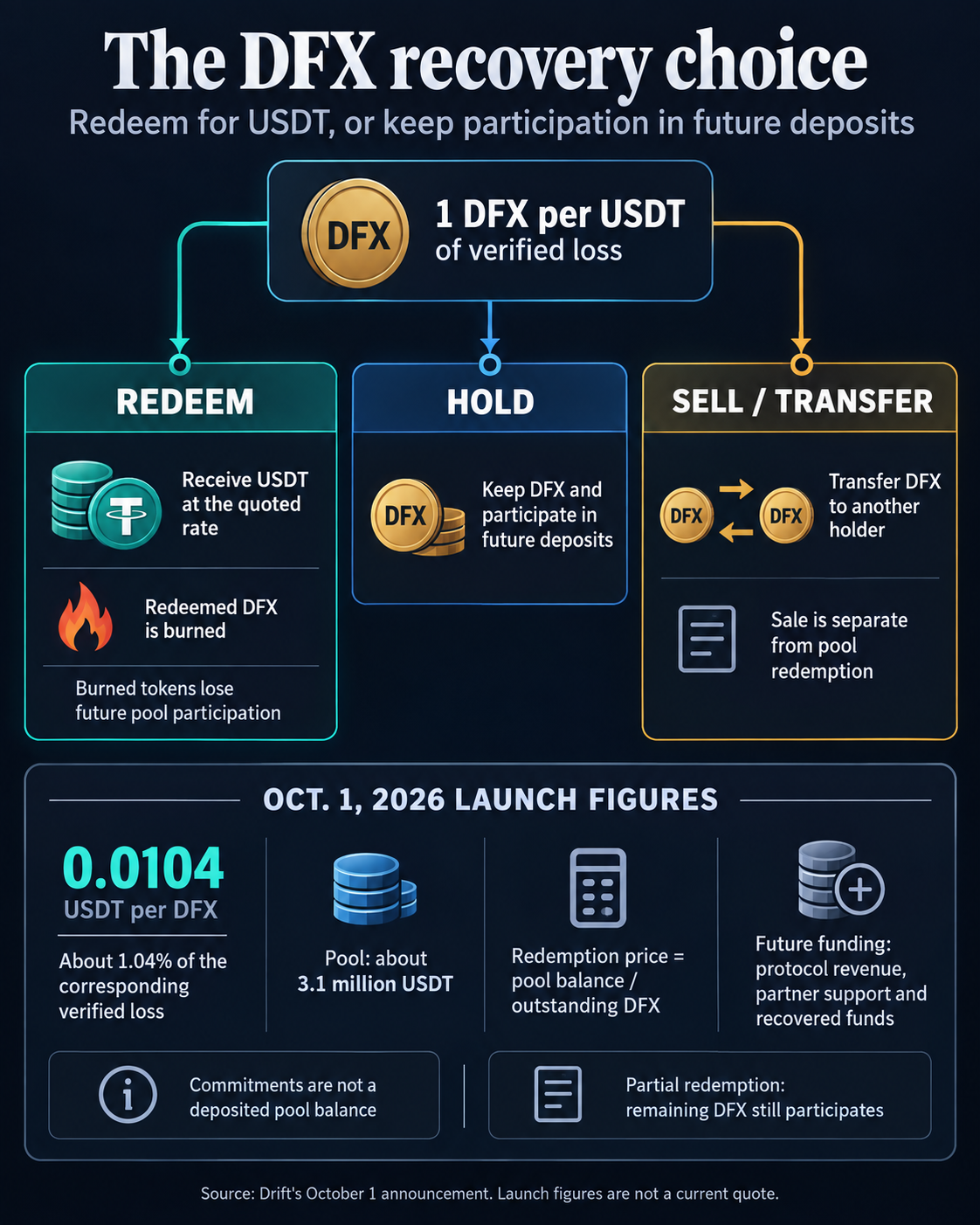
Drift Protocol opened claims and redemptions for its DFX recovery token on Oct. 1, giving victims of its April exploit a way to receive the USDT stablecoin from the Recovery Pool. The exit has a permanent tradeoff: redeemed tokens are burned and no longer share in future deposits.
In its launch announcement, Drift described a payout of about 0.0104 USDT per DFX from a pool holding roughly 3.1 million USDT. Because victims receive one DFX for each USDT of verified loss, that launch rate represented about 1.04% of the corresponding loss. Those are Oct. 1 figures; a redemption pays the rate quoted when the transaction is made.
DFX is a transferable token on Solana, separate from the DRIFT governance token. Drift sets its fixed allocation at 299,500,810.998 DFX, corresponding to nearly 299.5 million USDT of verified losses. Outstanding supply falls as tokens are burned.
What redemption gives up
The USDT payment and DFX burn happen in one transaction: either both succeed or neither does. Drift says completed redemptions are final. If a holder redeems only part of their DFX, the tokens they keep continue participating in the pool.
Future deposits are divided among the DFX that remain. Cashing out therefore locks in the quoted recovery amount for the tokens burned, while giving up their share of later revenue or recovered funds.
Selling DFX on a secondary market such as Raydium is a different transaction. It transfers the tokens to another holder rather than redeeming them against the pool. Holding preserves participation in future deposits, whose size and timing remain uncertain.
The recovery dashboard defines the redemption price as the pool balance divided by outstanding DFX. Under Drift's stated design, redemption removes cash and burns tokens in the same proportion, leaving that ratio unchanged. New deposits raise the amount redeemable per remaining token.
The support plan announced in April 2026 was restated in Drift's Oct. 1 update: up to 127.5 million USDT from Tether for relaunch and user recovery, plus up to 20 million USDT from strategic partners for recovery. Those commitment ceilings do not measure cash already available for redemption.
In its April 16 announcement, Tether said capital would be introduced progressively and aligned with platform performance. Drift's April recovery framework described a package including a revenue-linked credit facility, an ecosystem grant and market-maker loans. Such financing can support a relaunch without the full headline amount becoming immediately available to DFX holders.
Drift says a share of net protocol revenue from the Velocity trading platform enters the pool daily at 00:00 UTC, alongside any recovered stolen funds. Further recovery funding depends on those deposits arriving; the commitments are not a promise that each victim will recover their full loss.
The DFX claim window closes Jan. 1, 2028, at 00:00 UTC, when unclaimed DFX will be permanently burned. That is a deadline to claim tokens, rather than a stated redemption deadline. Insurance Fund claims follow separate terms.
The post Drift hack recovery opened near one cent per dollar lost appeared first on CryptoSlate.
The Ethereum Foundation's Oct. 1 announcement that zkAPI is running on mainnet gives the private AI-payment design coauthored by Davide Crapis and Vitalik Buterin a concrete financial-control test: how does a user get unspent money back when the billing server stops cooperating?
zkAPI, a billing system for metered APIs, documents an onchain withdrawal route that does not require the server's clearance. But a user's ability to recover a balance depends on which spending state they hold and whether they can start an exit in time. The implementation's pause powers and expiring notes put boundaries around that control.
Open Anonymity built the implementation with the Ethereum Foundation. Crapis and Buterin published the underlying design on Feb. 11; the foundation's October announcement credits the team that turned it into software and contracts. Etherscan records the announcement-linked vault's creation on Sept. 30, a day before the announcement.
The announcement describes its linked vault as holding USDC credits. The current mainnet manifest identifies that same vault as native ETH, with balances accounted for in whole gwei. Its explorer activity also shows ETH-valued deposits and close payouts.
CryptoSlate's February coverage examined the proposal. The mainnet implementation now gives withdrawal rights, deadlines and settlement dependencies practical significance.
Two routes out of a prepaid balance
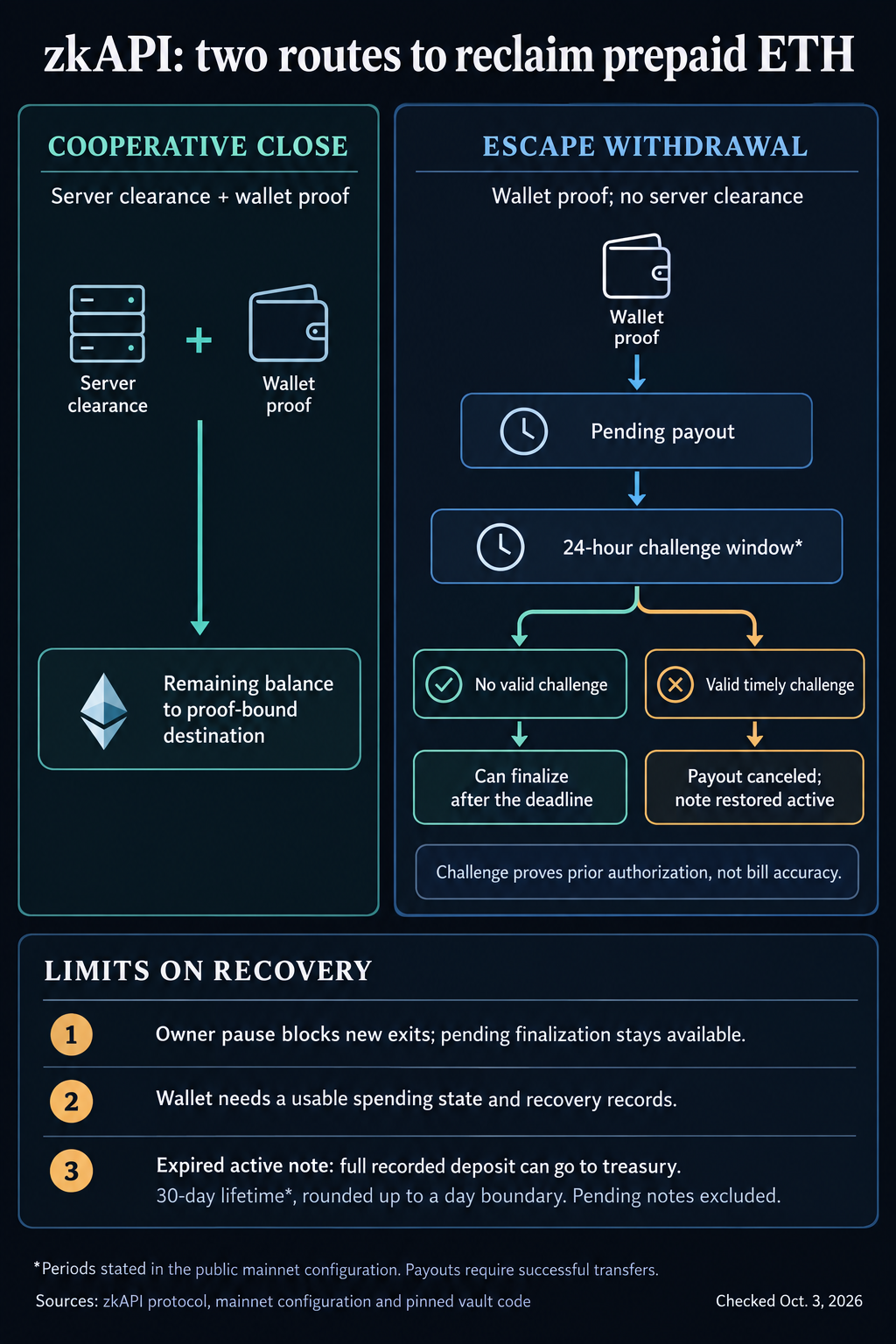
Under the current protocol, a deposit funds a note. The wallet keeps the private spending state locally and uses proofs to authorize metered service. Individual API requests do not each move money onchain. As usage is settled, the server signs a successor state representing the remaining balance. The practical dividing line is between an unused spending state and a predecessor that has already authorized a request: the latter can be challenged if used to seek an escape payout.
That arrangement makes the spending state central to recovery. The vault can check a withdrawal proof against its rules, while the wallet must still possess the information needed to prove the balance it wants to withdraw. Preserving the note and its recovery records is essential to proving a withdrawal balance after an interruption.
The cooperative route, called mutual close, begins with server clearance. A separate server signing key authorizes the withdrawal, and the wallet includes that signature inside its proof. The vault checks the proof and pays the remaining balance to a destination bound into it. That destination can differ from the address that originally funded the note.
The second route is the escape withdrawal. A wallet can initiate it without the clearance signature. The vault removes the note from the active set and records a pending payout rather than immediately handing over the money.
The public mainnet configuration specifies a challenge period of 86,400 seconds, or 24 hours. If no valid challenge succeeds before the deadline, finalization pays the recorded balance to the user's destination and the deposit-minus-balance share to the treasury, provided the transfers succeed.
A server outage therefore does not automatically eliminate the documented withdrawal path. A user with a usable spending state can seek an exit without obtaining fresh clearance. The waiting period gives the system time to detect an attempt to withdraw from a state that has already authorized service.
Each spending state has a nullifier, a cryptographic identifier used to prevent reuse. To challenge an escape, a challenger supplies an original request proof with the same nullifier as the attempted withdrawal. The proof establishes that the state already authorized usage.
The vault code identified by the mainnet configuration preserves the request's historical active root for that check. A valid challenge submitted before the deadline cancels the pending payout and restores the note to the active set. It does not impose a separate monetary penalty.
The challenge protects settlement against withdrawing from an already-used state. It establishes prior authorization, while the accuracy of the provider's measured bill remains a separate question. Restoring a note also leaves any missing successor signature unresolved.
That difference matters in a dispute. The escape route removes the need for the server's withdrawal clearance, but it does not let a user choose an arbitrary balance and have the contract accept it. If the state being used for an exit already authorized a request, a valid challenge can send the note back into the recovery process.
When usage has already been authorized, provider accounting and a server-signed next state remain part of recovering the remaining balance. A successful challenge reactivates the note without resolving the contested bill or guaranteeing a refund.
Pause powers, expiry and the value of the balance
That vault code gives the owner a pause switch. Deposits, mutual close and initiation of new escape withdrawals all check it. An exit that needs no server clearance can still be prevented from starting while the vault is paused.
Already-pending escape finalization does not have that pause gate. Neither do challenges or expiry claims. A user who has successfully initiated an escape is therefore in a different position from one who still needs to start it.
The code provides these powers; no use of the pause switch is established here. For a user seeking a refund during an interruption, the owner's pause control remains an availability dependency.
Expiry creates another deadline. The mainnet manifest specifies a 30-day note lifetime, but the vault code rounds deposit time plus that lifetime upward to a one-day boundary. A note's actual expiry can therefore fall later than exactly 30 elapsed days.
Once an active note expires, the code permits it to be closed through an expiry claim that sends its full recorded deposit to the treasury. That rule is different from a normal withdrawal, where the proved remaining balance goes to the user. A note already in pending withdrawal status does not qualify for the active-note expiry claim.
For funds still in an active note, prepaid cloud AI creates a time-limited claim. State recovery and timely close-out affect whether the user reaches the withdrawal path before the note becomes eligible for the treasury claim.
ETH denomination also affects what the user owns between sessions. According to the native billing documentation, the deposit is neither a stable-dollar balance nor a swap into USDC. Its dollar reference value changes with ETH's price.
Dollar-denominated inference is charged through a price quote. The browser and server verify a pinned Chainlink ETH/USD round in finalized chain state, bind that quote into the authorization and keep the accepted rate fixed through settlement and recovery. Measured dollar usage is converted into a capped charge in whole gwei, rounded upward.
Freezing an accepted quote prevents a restart or recovery attempt from repricing that existing authorization. It does not stabilize the dollar value of the user's remaining ETH. For someone prepaying for cloud inference, the service bill and the underlying balance have different denominations.
The trust that remains
The mainnet manifest selects OA-org key issuance with OpenRouter inference. Provider usage receipts and the billing server's signed successor states remain operational parts of settlement. Ethereum supplies the exit mechanism, while a trustworthy chain view, compatible proof software, retained wallet data and timely challenger operation remain necessary dependencies.
The cryptographic setup carries a separate assumption. The manifest points to the note-bound Groth16 circuit and setup artifacts described in the repository. The setup documentation says the keys were generated by one party and no multiparty ceremony has taken place. Matching artifact hashes establishes which files are being used, while the destruction of setup secrets remains a separate trust assumption.
The manifest describes the integration as experimental and not production-audited. Those disclosures limit the assurance attached to the implementation. Mainnet availability alone does not demonstrate that every live recovery scenario will work.
The inference provider still sees prompt content, and network metadata can permit correlation. Billing privacy leaves those content and network questions separate from withdrawal rights.
For prepaid AI funds, control ultimately rests on completing an exit from a usable balance before the active note expires. The escape route gives users an alternative to server clearance; its practical value depends on state recovery and the availability of the vault when they need it.
The post Vitalik-inspired AI payment system can send expired deposits to its treasury appeared first on CryptoSlate.
Lido’s proposed route for running larger Ethereum validators would require a 32 ETH entry bond, compared with 2.4 ETH for its existing default route. That higher collateral can become more efficient once enough stake is allocated to the validator, but an operator’s profile and place in the funding queue determine how useful the advantage is.
The October 1 deployment plan outlines Community Staking Module 0x02, a separate module for permissionless operators alongside the existing 0x01 route. It would support compounding validators with up to 2,048 ETH of effective stake, compared with 32 ETH for existing-route validators. Each validator is identified by a key.
The route remains on Hoodi testnet, with mainnet expected in Q4 2026. The deployment post describes preparations for mainnet and puts the module’s Staking Router parameters to a later vote. The July 20 approval of the launch proposal and September 1 testnet announcement were earlier milestones, rather than mainnet activation.
Measured as operator fees per ETH bonded, the new route reaches parity with a first existing default key near 747 ETH under equal yield and performance. But an operator spreading a 32 ETH budget across existing default keys raises that modeled threshold to about 1,330 ETH. These are fee-efficiency comparisons before costs, penalties and funding delays.
The proposed bond is 32 ETH for the first key and 30 ETH for each additional key. Under Lido’s existing 0x01 default profile, the amounts are 2.4 ETH and 1.3 ETH respectively.
The distinction between collateral and stake matters. The bond is the operator’s security deposit, held as stETH to cover losses and charges. The protocol supplies the validator’s stake separately. Posting a 32 ETH bond does not mean buying the validator’s delegated ETH or receiving a guaranteed allocation.
Ethereum’s EIP-7251 permits validators with 0x02 withdrawal credentials to compound, with a maximum effective balance of 2,048 ETH while retaining 32 ETH as the minimum activation balance. Lido’s bond curve follows the number of keys, so an existing 0x02 key would need no additional collateral as its stake grows.
At the maximum balance, the first key’s bond would equal 1.5625% of delegated stake, or 0.5 ETH of collateral per 32 ETH operated. The subsequent-key ratio would be about 1.465%. Those ratios describe a fully funded validator; a key operating with only its initial stake has a much larger collateral burden.
Operators would receive a 2% share of staking rewards, with 8% allocated to the treasury. The deployment setting giving operators 100% of the module fee means they receive that entire 2% slice. It is neither a 2% staking APR nor a claim on all validator rewards.
Why 747 ETH is only the first comparison
CryptoSlate’s calculations below hold gross staking yield, qualifying performance and operating duration equal. Existing-route portfolios are assumed fully funded and fee-eligible throughout the comparison period. They compare operator fees before infrastructure costs, gas, penalties and the bond’s own stETH returns.
If y is the gross staking yield over the comparison period and S is effective stake, proposed first-key fee income per ETH bonded is 0.02 × S × y ÷ 32. The existing first default key produces 0.035 × 32 × y ÷ 2.4. Equating them gives 746.67 ETH, or approximately 747 ETH.
The 747 ETH figure measures first-key fees per ETH of collateral, using different amounts of operator capital. It assumes both validators are funded and fee-eligible for the same period.
A 32 ETH budget can instead cover the bond for 23 existing default keys, using 31 ETH of bond and covering 736 ETH of delegated stake if all keys receive funding. One proposed-route key matches that portfolio’s total operator fees at 1,288 ETH. It matches fees per ETH actually bonded at about 1,330 ETH, because the existing portfolio posts only 31 ETH.
Verified profiles change the result again. Lido’s operator economics table gives Independent Community Stakers, or ICS, a 1.5 ETH first bond and 1.3 ETH thereafter, with a 6% reward share for their first 16 keys and 3.5% after. Verified independent clusters using distributed validator technology, or IDVTC, have a 1.5 ETH first bond and 0.5 ETH thereafter, earning 3.5% for their first 64 keys and 2% after. These profiles require eligibility; the proposed module has one permissionless profile.
| Existing-route profile | Keys and bond within a 32 ETH budget | Fully funded existing stake | New first-key stake for equal fees per ETH bonded |
|---|---|---|---|
| Default | 23 keys; 31 ETH | 736 ETH | About 1,330 ETH |
| Verified ICS | 24 keys; 31.4 ETH | 768 ETH | About 2,022 ETH |
| Verified IDVTC cluster | 62 keys; 32 ETH | 1,984 ETH | 3,472 ETH, above the 2,048 ETH ceiling |
The table divides fees by required bond actually posted. Default and ICS portfolios leave 1 ETH and 0.6 ETH unspent. Divide both alternatives by the same 32 ETH budget instead, and their total-fee crossovers are 1,288 ETH and 1,984 ETH respectively. Returns on spare capital are outside this fee-only model.
The ICS portfolio therefore leaves little room below the proposed validator ceiling for a fee-efficiency advantage. The modeled DVT cluster stays ahead throughout the available balance range. Neither result establishes net profitability, because the operational setups can have different costs.
Additional keys also need their own comparison. At the margin, a proposed 30 ETH bond versus an existing default 1.3 ETH bond gives a theoretical fee-efficiency crossover around 1,292 ETH, rather than the first-key 747 ETH figure.
Funding and penalties determine the net result
The October plan specifies a 16-position top-up queue. A key first receives its initial 32 ETH through the deposit queue, then enters a separate first-in, first-out queue for further funding.
Under Lido’s queue mechanics, top-ups serve the head in multiples of 2 ETH, limited by available stake. A partly filled key remains at the head until its remaining capacity is filled. Later keys cannot move ahead for top-ups, and a full queue throttles new initial deposits.
The proposed module cap is 2% of Lido stake. That constrains module allocation; it does not promise any operator a full validator.
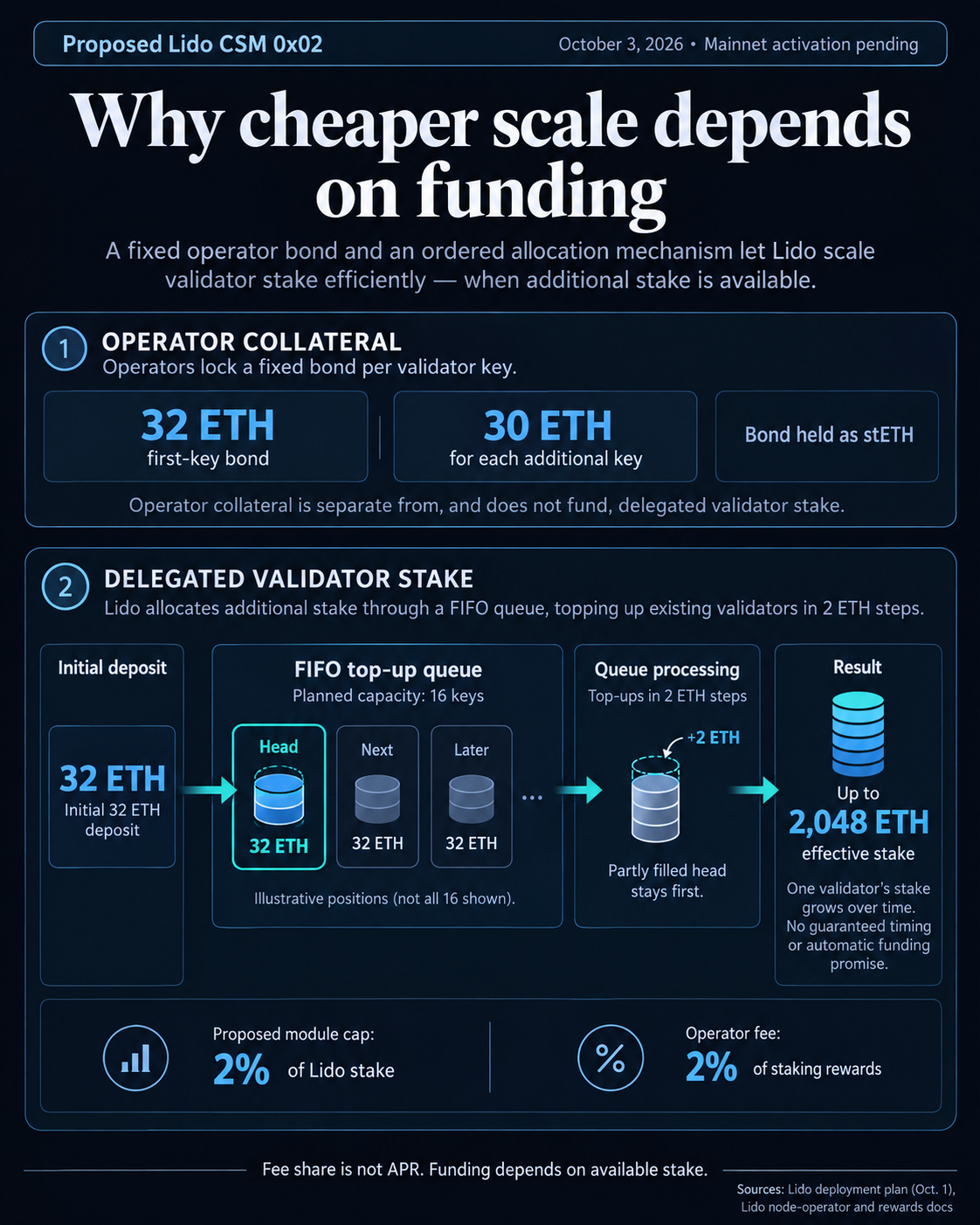
These rules turn a balance comparison into a timing question. An operator that eventually reaches 2,048 ETH may spend much of the comparison period waiting or running a smaller balance. The relevant figure is average reward-eligible effective stake over that period. Existing-route keys also need funding and activation, so the table’s fully funded portfolios are conditional benchmarks.
Compounding can help balances grow, but the module proposal itself makes capital efficiency dependent on current effective balance, module capacity and protocol inflows. A maximum-balance calculation cannot establish how quickly an operator will reach it.
Lido’s reward rules separate operator fees from the stETH rebase earned on collateral. Adding bond returns changes the total-income comparison. Comparing returns per ETH bonded requires the same bond-return rate and period before that stream can cancel out between alternatives.
Performance also affects payment. A validator below the threshold earns no operator rewards for that frame, while its bond can continue rebasing. Missing collateral must be restored before rewards are claimable.
The proposed configuration uses a 28-day frame, 3% performance leeway and a three-strike threshold with a six-frame strike lifetime. Balance-scaled penalties reach 16.512 ETH for bad-performance ejection and 6.4 ETH for delayed exit at a full 2,048 ETH balance. The exit-delay charge follows a four-day deadline and is settled after withdrawal.
A net comparison must add bond returns and subtract infrastructure, gas and assessed penalties, using actual funded time and reward eligibility. Fewer keys may change operating costs, but the parameters alone cannot price that difference.
Ahead of mainnet activation and the module-specific router vote, the useful signals are the final fee and cap settings, available funding and progress through the queue. The proposed route offers default operators a conditional path to better fee efficiency at scale; verified operators have stronger existing alternatives, and the lower-bond 0x01 route continues alongside it.
The post Lido’s proposed staking route needs over 13 times the default entry bond appeared first on CryptoSlate.
On Oct. 2, the SEC approved the Cboe BZX exchange’s listing proposal for VS Trust’s 3x Bitcoin ETF and 3x Ether ETF. The decision clears an exchange-rule hurdle for products sponsored by Volatility Shares that seek amplified daily crypto futures exposure.
The order covers six funds, including products tied to gold, silver, crude oil and natural gas. It advances the proposal CryptoSlate covered in August, when the exchange was still seeking permission.
For brokerage investors, the change opens a listing path for a higher daily leverage target. Cboe’s generic commodity-trust standards exclude products that seek specified multiples of a benchmark, so these funds needed individual approval. Their other initial and continuing listing requirements still apply.
VS Trust’s Aug. 17 preliminary prospectus lists BITH for the Bitcoin product and ETHK for the Ether product. Those are proposed symbols in a filing marked subject to completion. The prospectus says securities cannot be sold until registration becomes effective.
The October order approves the exchange’s rule change; it does not establish that registration is effective or that trading has begun. Registration effectiveness and a first trading date remain unconfirmed as of Oct. 4. Investors therefore cannot treat this decision alone as confirmation that the products are available through their brokers.
Although “ETF” appears in their names, the order classifies the funds as exchange-traded products, or ETPs, structured as Commodity-Based Trust Shares. They do not have the investor protections associated with funds registered under the Investment Company Act of 1940.
What the daily 3x target means
Each crypto product seeks three times its benchmark’s daily performance before fees and expenses. The benchmarks measure portfolios of first- and second-month futures contracts, with the funds using futures alongside cash collateral. That makes the reference point a futures portfolio’s daily return, rather than the spot price alone.
The preliminary prospectus defines a day as the interval between successive net asset value calculations. Under normal circumstances, the funds seek to rebalance daily. Each day’s result then compounds from a changed asset value, so the sequence of gains and losses matters to a longer holding period.
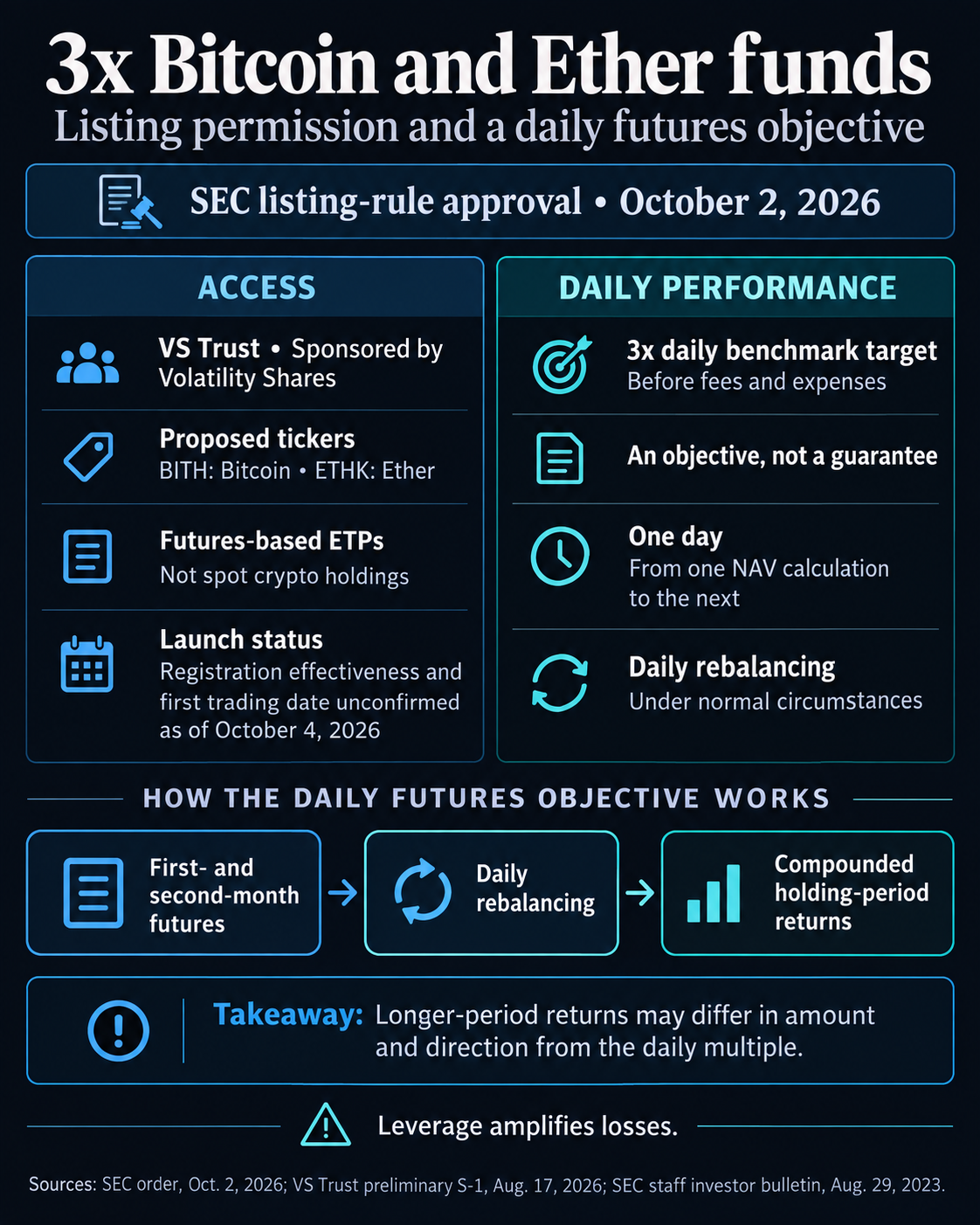
The SEC’s investor bulletin warns that daily leveraged products can depart substantially from their stated multiple over weeks or months, especially in volatile markets. The prospectus likewise warns that longer-period returns may differ in magnitude and even direction. A 3x daily objective therefore does not promise triple Bitcoin or Ether’s cumulative return.
Leverage also amplifies losses. SEC staff specifically warn that ETFs using leveraged Bitcoin-futures strategies increase volatility and can expose investors to significant, sudden losses.
The post 3x Bitcoin and Ether futures funds clear SEC listing hurdle appeared first on CryptoSlate.
When you hold a dollar stablecoin, somebody else may be earning interest on the assets backing your balance, while a company borrowing to buy Bitcoin has to find the money to pay its lenders.
Both businesses are crypto-native, but a higher interest rate can reward the first and eat into the economics of the second.
That split gets lost when every move in Treasury yields becomes a verdict on whether money is getting easier or harder for the whole industry.
Different rates reach different businesses through their contracts, so a bond-market move that discourages investors from buying speculative assets can also improve the income earned on some crypto reserves.
We can see this in Circle's second-quarter filing: reserve income supplied 95.2% of revenue in the three months ended June 30, 2026. Its reserve returns track close to the prevailing secured overnight financing rate (SOFR), leaving revenue heavily dependent on how many stablecoins are outstanding and what their backing earns.
The rate in that calculation is important because overnight returns and the 10-year Treasury yield can move differently. Treating both as the same price of money can leave you expecting a windfall at an issuer whose reserve income is actually headed in the other direction.
Money has more than one price
The Fed's Sept. 16 decision to raise its target range by a quarter of a percentage point, to 3.75%-4%, affected that split. Higher overnight rates can boost returns on short-term stablecoin reserves as assets mature or reset, while borrowers whose debt tracks those rates can face larger interest bills.
Short-term rates influence returns on instruments that mature or reset quickly, while a 10-year Treasury yield incorporates expectations about future short rates and compensation for holding a longer bond.
The New York Fed's term-premium research uses a model to separate those components, since the additional compensation itself can't be observed directly.
Investors could demand more compensation for owning long-dated government debt while expecting overnight rates to fall later, leaving long-term financing more expensive even as short-term reserve returns decline.
Under those conditions, a company funding a lengthy construction project and an issuer reinvesting maturing Treasury bills could both end up worse off, for different reasons.
Bitcoin holders have to make another calculation because owning the asset directly doesn't produce contractual interest income. They can profit if its price appreciates, but higher available bond yields give them a larger promised income to compare with a return that depends on what another buyer will pay.
That comparison depends on the investor's circumstances, including inflation, taxes, and how long they can leave the money invested.
Long-term Treasury bonds can lose market value when yields increase, as the SEC explains in its guide to interest-rate risk, so someone who needs to sell next month faces a different proposition from someone holding to maturity.
The relationship between real yields and Bitcoin valuations only describes one part of crypto's exposure. Companies earning interest on reserves can collect more cash when investors find speculative assets less appealing, without either outcome being contradictory.
Your dollars can pay somebody else's interest rate income
Consider a hypothetical issuer with $10 billion in reserves earning 4% annually, producing $400 million a year before expenses and payments to partners.
If the return falls to 3%, income drops to $300 million, and recovering the original amount would require about $13.33 billion of reserves, roughly a third more.
Those (invented) numbers show why an issuer can bring in more customers and still earn less per dollar provided. More tokens in circulation help, but the extra balances must offset the lower return, while gross reserve income still has to cover distribution and operating costs.
Token holders may receive none of that income unless the product's terms give them a right to it, because what they're buying is usually the ability to hold and move a dollar-linked balance.
That service can be valuable, particularly where access to conventional dollar accounts is limited, but a higher reserve return can increase the issuer's income while increasing the interest its customers forgo elsewhere.
Borrowers face the other side of that math, as a hypothetical company raising $100 million in fresh interest-bearing debt would pay an additional $2 million a year if its borrowing rate increased by two percentage points.
Its business then has to find that money through earnings, further financing, or asset sales, even if the assets it bought haven't become any more productive.
The effect on a company borrowing to accumulate Bitcoin depends on the debt it issued, because existing fixed-rate borrowing doesn't automatically become more expensive when Treasury yields move.
Floating-rate loans can reset sooner, while refinancing brings the borrower back to the market when its old obligations mature, and lenders get another chance to set the terms.
Convertible debt complicates the comparison further because lenders may accept a lower coupon in exchange for the possibility of receiving equity.
Focusing only on interest payments misses that value and the potential dilution borne by shareholders, so two companies with similar coupons can still have very different financing arrangements.
Miners considering data-center projects face the same need to match financing with future income, but construction spending begins before the completed site earns its intended revenue.
In a project with a narrow expected surplus, a larger interest bill can consume that surplus before the first customer starts paying, although the result depends on construction costs, customer contracts, and the mix of debt and equity.
The company with fixed funding and a credible customer commitment may consequently be in a better position than a rival with cheaper-looking debt that needs refinancing soon.
Understanding that difference requires reading the contracts, because the Treasury yield alone won't tell you which business can afford to finish its project.
DeFi has to explain the extra return
Onchain lending introduces another way to set rates, with Aave's documentation on supplying tokens explaining that supplier returns depend on borrowing utilization and protocol parameters.
Treasury yields influence the alternatives users can choose, but demand inside a lending pool helps determine what the pool actually pays.
When borrowers want a large share of available stablecoins, rates can rise, while weaker demand or more supply can pull them down. Governance settings and incentives can also affect the quoted return, which means the percentage on a dashboard needs an explanation of where the payment comes from.
Imagine a short-term government investment offering 4% and an onchain position advertising 7%.
The extra three percentage points must be considered alongside additional contractual, liquidity, technical, and counterparty risks, because a higher advertised return doesn't mean the investor is being paid enough to bear them.
Users also have different alternatives, since some can't obtain the same government-debt product and others need their tokens available for collateral or payments.
Someone can rationally accept a lower return in exchange for a service they need, which helps explain why yields don't immediately converge across conventional and onchain markets.
Crypto's exposure to rates therefore runs through several decisions happening at the same time, with issuers seeking reserve income, borrowers trying to earn more than their financing costs, and Bitcoin holders weighing appreciation against income elsewhere.
Tracing who gets paid, who owes the interest, and when those terms reset explains how the same bond market can finance one part of the industry while making another part's business harder to sustain.
The post The same Fed rate hike can help stablecoins and hurt Bitcoin borrowers appeared first on CryptoSlate.
CryptoTicker.io
On Monday, October 5, 2026, a network forks at Monero. What it affects is not the main network where your XMR sits: a separate test network forks, one the developers call a stressnet. Anyone holding Monero therefore has nothing to do on that day: no wallet action, no withdrawal from an exchange, no swapping. The changeover this test is working towards is nonetheless the most far-reaching alteration to Monero's privacy in years, and it still has no date for the main network.
That separation is the whole core of the story. There is a hard, documented date, and it concerns a test environment. And there is a rebuild with an open date that decides how anonymous Monero will be in a few years and how exchanges in the EU will deal with it. This article sorts the two apart and tells you which of them concerns your coins.
What forks on October 5: the beta stressnet, not the Monero mainnet
The developer team behind the changeover released version v0.19.0.0-beta.3.0 on Friday, September 25, 2026, the so-called FCMP++ and Carrot beta stressnet v3.0. According to the developers, this package forks away from its previous test network on October 5, 2026 at block height 3102800.
A stressnet is a deliberately loaded test network. It exists to bombard a protocol with more transactions, more data and more participants than everyday use would produce, and to see where it breaks. The coins in it have no value, the blockchain in it is not Monero's, and a fork there changes nothing about the main network.
The distinction matters because news headlines about this date often say only "Monero hard fork on October 5". To a holder that sounds like a network changeover with pressure to act, of the kind Monero used to have roughly every six months. This time it is a test run in which volunteer node operators take part.
Monero price at around 550 dollars: weekly high 563.50, weekly low 525
The Monero price stands at around $550 at midday on Sunday. Over the week barely anything has moved: the gain across seven days is about 0.4 percent, according to data from CoinPaprika. Within that week there was room enough. XMR marked the weekly high on October 3 at $563.50 and the weekly low on September 28 at $525, measured on Kraken's daily candles. A good 7 percent lies between those two points.
By market capitalisation Monero is thereby the fourteenth-largest cryptocurrency. From its own record, which XMR reached in January 2026, the price is around 31 percent away. That is remarkably little for a coin the large regulated trading venues in Europe have not listed for years.
The fork date itself has not shown up in the price, and that is consistent: a test network yields no returns and changes no supply. Anyone who looked for a reaction to the announcement this week finds none.
FCMP++ explained: from 16 decoys to the whole blockchain
FCMP++ stands for Full-Chain Membership Proofs. It is a cryptographic procedure with which a sender proves that the amount being spent comes from a particular set of earlier incoming payments, without revealing which one exactly.
Today Monero works with ring signatures. When you send XMR, your wallet mixes the incoming payment actually used with fifteen others from the blockchain. An observer sees sixteen possible origins and cannot say which of them is the real one. That size of sixteen has been the standard for years and is at the same time the known weak point: anyone collecting enough additional knowledge can rule out candidates and narrow the circle.
FCMP++ replaces that small ring with a proof against the entire chain history. Instead of one of sixteen, an output is in future meant to be one among more than 150 million, that is, among practically all the payment outputs Monero has ever created. The additional knowledge with which investigators shrink rings today thereby loses its point of attack, because there is nothing left to shrink.
Carrot: what the addressing protocol changes for existing Monero addresses
Carrot is the second building block of the package and concerns how Monero addresses are constructed. It is a new addressing protocol which, according to the developers, brings additional properties in security, privacy and usability while remaining backward compatible with existing addresses.
Backward compatible here means: an address you have deposited somewhere today, say with a service that pays out XMR to you, is meant to keep working after the changeover. For holders that is the reassuring news at this point, because exchanging receiving addresses across several services is one of the most error-prone operations there is.

Stressnet v3.0 in detail: hot-cold wallets, Transaction Relay v2 and RandomX v2
Version v3.0 brings, according to the release notes, three notable additions into the test. First, support for hot-cold wallet set-ups, in which a wallet without access to the spend keys prepares transactions and a separate device never connected to the network signs them. That is the procedure hardware wallets also work with, and its availability helps decide whether devices will follow the changeover later.
Second, larger improvements to the Transaction Relay v2 protocol, that is, to the way transactions are passed on between nodes. Third, support for RandomX v2, the reworked mining algorithm. Added to that are fixes from the previous stressnet version and the current state of Monero's main branch.
That hot-cold support is entering the test precisely now is the practically most relevant detail of the whole package. It is the point at which it is decided whether you will still be able to keep your coins on a separate device after a later mainnet changeover, or whether you will have to wait for new firmware.
Why the official roadmap names no mainnet date
On the project roadmap at getmonero.org FCMP++ appears under "Full-Chain Membership Proofs" in the section of upcoming work, together with the Seraphis codebase and Jamtis. There is no date there, no version number either, and Carrot is not listed at all.
That is not an omission but the way the project works. Monero has no company, no board and no venture capitalist's treasury in the background that could enforce a delivery date. Changeovers arise in open developer meetings and are released when audits and tests are finished. The stressnet fork on October 5 is a step in that procedure, not the announcement of a launch.
For you that means: a mainnet activation of FCMP++ may come in months, it may also slip beyond a year. Anyone wanting to draw consequences from the technology now is drawing them from an intention, not from a timetable. Figures attached to a date nobody has named are, at this point, invention.
The delisting wave: how MiCA and the anti-money-laundering regulation pushed Monero out of EU order books
While work goes on at the protocol, the trading venue for Monero in Europe has shrunk over the years. Binance took XMR off its European offering in February 2024, Bitpanda in the same year, Bitvavo in 2025. Kraken ended support for Monero in the European Economic Area and, after the deadline passed, converted remaining balances that had not been withdrawn into Bitcoin.
The counts across all trading venues diverge depending on the cut-off date. Industry counts name around 73 exchanges that have delisted or restricted Monero, against roughly 51 in 2023; which month exactly is meant varies between sources. The direction is unambiguous, the exact figure you should not read as a fixed value.
The reason lies in three sets of rules that work together. The provisions for crypto service providers under MiCA require an authorised exchange to be able to trace the origin and destination of funds. The EU anti-money-laundering regulation AMLR tightens that further for anonymity-enhancing assets. And the FATF travel rule requires sender and recipient data to be supplied with transfers. A coin whose protocol necessarily conceals origin and amount cannot be reconciled with those duties.
Worth noting is the separation between trading and ownership. Owning and using Monero is legal in Germany; there is no ban. What is regulated are the service providers, not the holders. That is exactly why the wave hits the buying route and not the holding in your own wallet.
Buying Monero in Germany: which routes remain after the delistings
For a purchase out of Germany the situation is uncomfortable. The large MiCA-authorised providers through which trading usually happens here do not list XMR. Anyone looking for Monero ends up at trading venues outside EU authorisation, at decentralised exchanges, or at atomic swaps, where Bitcoin is bought first and then swapped.
As remaining centralised trading venues with XMR pairs, industry overviews name KuCoin, MEXC, Gate.io, the small TradeOgre and Kraken outside the EEA. Each of those routes brings its own drawbacks: no MiCA authorisation for the German market, no access to a German complaints body, and, in the event of insolvency or a hack, a legal position you can hardly assess beforehand. If you want to compare how regulated providers in Germany work, a look at our comparison of crypto exchanges helps, even though you will not find XMR there.
The sober sentence on this is: with Monero today the buying route is the part carrying the greatest risk, not the technology. The protocol works and is being extended. The question of which third party you get the coin through and how well you are protected there is the harder one.

Liquidity and spread: what a shrunken market means for your execution
When order books fall away, the same trading spreads across fewer venues. Daily turnover at Kraken was in the range of four to nine thousand XMR per day this week. That is tradeable, but it is not a depth in which a large order disappears without trace.
In practice that means two things. First, the difference between the buy and the sell price is felt faster with Monero than with Bitcoin or Ether, especially at weekends and in the quiet hours. Second, a single larger sale moves the price more. The 7 percent gap between the weekly low and the weekly high arose without any news at all; that is an indication of how thin the book is in stretches.
Anyone buying through a market order pays that difference immediately. A limit order you set yourself takes the surprise away, and with it the certainty that it will be filled.
Custody and wallet version: what to check now
From the stressnet fork no task follows for your mainnet balance. From the direction in which the rebuild is running, one does. Monero regularly requires up-to-date wallet software at network changeovers, and FCMP++ reaches deeper into the transaction structure than the changeovers of past years.
It therefore makes sense to know now what you are holding custody with. Are you running a wallet that still receives updates? Does your balance sit on a hardware device whose manufacturer still maintains Monero? Do you have a working backup of your recovery phrase, kept separately from the device? Those three points decide whether a future changeover is an update for you or a problem. Which devices support Monero and how they differ in handling and price is set out in our hardware wallet comparison.
The second point concerns coins sitting with a third party. Holding Monero on an exchange that one day delists XMR is the pattern that has produced the same deadlines again and again over past years: trading halt, then withdrawal deadline, then forced conversion into Bitcoin. Anyone moving early into their own custody decides the timing themselves.
Leverage and liquidation: 20 percent of distance at fivefold leverage
Part of the fork is a point that has nothing to do with Monero in particular. Around dated protocol events, volatility rises with many coins, even when the event has, as here, no economic substance at all. Anyone holding XMR with leverage will not be liquidated by the event itself, but may well be by the movement that expectations around it produce.
With a coin that has a thin book this effect is larger. A position at fivefold leverage sits, at a price of around $550, arithmetically some 20 percent away from its liquidation, and 20 percent is historically no great distance with Monero. This week's range alone already covered a third of it.
Tax and holding period: what applies to swapping XMR in Germany
For holders liable to tax in Germany, the one-year period applies to crypto assets as a private disposal: anyone holding longer than a year disposes tax-free under the law as it stands, and below that taxation applies above a threshold. Important for Monero in particular: a swap is a disposal. If you swap XMR into Bitcoin through an atomic swap, or an exchange itself converts your remaining balance into Bitcoin after a deadline, that triggers the same event as a sale.
With anonymity-enhancing assets that is the awkward spot, because the burden of proof lies with you, and a protocol that conceals amounts produces no convenient history for the tax office. Anyone holding XMR should document acquisition dates and acquisition costs themselves rather than rely on being able to reconstruct them later. Tools that keep such records can be found in our overview of crypto tax software. Worth noting is that tax law for crypto assets is currently being worked on; what applies today need not still apply next year.
Levels above and below: 563.50 dollars and the 525 zone
The two ends of this week serve as points of observation. Above sits the weekly high at $563.50, reached on October 3; beyond it begins the area in which the price last traded at the end of September. Below, the weekly low at $525 marks the point at which buyers stepped in on September 28, and beneath that the round level at $500.
These are observations, not targets and not a recommendation. Those two levels say nothing about where the price is heading; they only record where trading actually took place over the past days. In a market of this depth, each of those levels can be run through in a single day.
Monero and FCMP++: What to take away
- October 5 is none of your business as a holder. A test network forks, and your mainnet balance stays untouched. For the main network there is no announced date, and FCMP++ has so far entered the project's roadmap only as a plan without a date.
- Put your custody in order while no deadline is pressing. Maintained wallet software, a device whose manufacturer still supports Monero, and a separately stored backup are the work that should be done before a changeover. The hardware wallet comparison shows which devices come into question for it.
- Treat the buying route as your greatest risk, not the technology. XMR is not to be had at the providers authorised in Germany, and every detour costs protection. Anyone wanting to check how regulated trading works will find the criteria in the exchange comparison.
(As of October 4, 2026. This article is not investment advice. Prices and fee structures change; check the terms with the provider before you buy.)
For any Dogecoin price prediction the ETF channel is the most quoted and the least load-bearing figure there is. The Grayscale Dogecoin Trust, by far the largest of these funds, last held $14.11 million in net assets against $16.34 million in cumulative net inflows. The market capitalisation of Dogecoin stood at $14.63 billion on Sunday afternoon. The largest fund therefore holds 0.097 percent of the coin it tracks.
From that follows an uncomfortable insight for anyone reading inflow reports as a buy signal: a number that sits below one thousandth of the market can barely move the price arithmetically. This article works through the ratio, puts the wind-down of the Bitwise fund in context, and shows which figures actually turn the result for investors in Germany.
Dogecoin price prediction in brief: the ETF channel carries one thousandth of market capitalisation
DOGE traded at $0.09368 and €0.0831 in the early afternoon of Sunday, October 4, 2026. That is 0.63 percent more than the previous day, 4.6 percent less than a week ago and 10.0 percent more than thirty days ago. The figures come from the CoinGecko market data query for the same hour.
The term ETF channel in this article means the sum of all exchange-traded products that back Dogecoin physically and publish their inflows and outflows daily. In the United States there are currently three providers. Their combined weight can be read off a single calculation.
Dogecoin's market capitalisation is $14.63 billion on 156.18 billion coins in circulation. The largest fund holds $14.11 million. The ratio is 0.097 percent. For comparison, and this comparison is the core of the prediction: on Friday, October 3 alone, Dogecoin worth $854 million changed hands according to market data. The entire fund holding equals 1.7 percent of a single trading day.
Dogecoin ETF holdings: 14.11 million dollars sit with a single provider
The inflows of the past week show the same picture from another direction. According to data from the analysis house SoSoValue, which 24/7 Wall St. evaluated on October 4, 2026, the funds on Dogecoin, Litecoin and Hedera took in less than $10 million combined in the week from September 28 to October 2. Three coins, five trading days, under $10 million.
The daily movements within that week explain why no trend comes of it. On September 29 the Dogecoin funds received $879,000 in inflows. A day later investors withdrew $551,430. On October 1 and 2 the statistics reported no movements worth naming. An inflow of which two thirds leave again the following day is not a demand signal but noise in a very small pot.
The monthly picture looks friendlier but stays small. September 2026 brought the Dogecoin funds $3.71 million in net inflows, the highest monthly figure since January 2026. By far the greater part of it went to the Grayscale trust, while the products from 21Shares recorded outflows of $593,000 over the same period.
A glance at another asset class makes the order of magnitude tangible. The funds on Chainlink collected $8.3 million in the same week and manage around $230 million. The Litecoin products come to roughly $14.7 million, those on Hedera to around $80 million. Dogecoin sits, despite its fame, at the lower end of that row.

One week of inflows, one trading day of turnover: 854 million dollars change hands
Put the two numbers side by side. The weekly inflow of all three coin families came to less than $10 million. The trading turnover in Dogecoin alone stood at $854 million on October 3 and at a daily average of $381 million on October 4. The complete weekly inflow of three asset classes therefore equals roughly 1.2 percent of what is turned over in DOGE alone on a single day.
Prices arise where supply meets demand, and for Dogecoin that is the spot market at the trading venues. Anyone wanting to know where the price comes from looks at order book depth and trading volume, not at a fund statistic whose daily amounts run in six figures. The analysis by 24/7 Wall St. puts the same result in one sentence: small altcoin funds have no meaningful influence on prices because their inflows are too low and too erratic.
That does not mean the products are meaningless. The funds give institutional investors a regulated route of access, and over the years they build a custody structure that did not exist before. For a price prediction over the coming weeks, however, they are too small as a driver, and every prediction built on them rests on very thin foundations.
The BWOW wind-down plan fixes October 14 and October 22
One concrete deadline stands in the October calendar. Bitwise Investment Advisers resolved on September 10, 2026 to liquidate the Bitwise Dogecoin ETF, which is listed under the ticker BWOW on NYSE Arca. The last trading day is Wednesday, October 14, 2026. Until the close of that day shareholders can sell their units on the exchange.
After that a fixed sequence runs. On October 14 the Dogecoin held is converted into cash. Before trading opens on October 15 the issue of new units ends. On Thursday, October 22, the remaining shareholders receive the net asset value of their units as of October 21 as a cash payment.
The size of the fund explains the step. BWOW started in November 2025 with around $3 million in trading volume and came, over its entire life, to net outflows of $1.23 million. Most recently the fund managed $801,400. Bitwise justifies the closure by saying the product range is continuously adapted to demand. We broke down the details of this wind-down in a separate article on cryptoticker.io on October 2, 2026.
For the prediction the process is less dramatic than the headline sounds. A fund with $801,400 converting its holding into cash sells Dogecoin worth less than one thousandth of daily turnover. The wind-down day is a date in the calendar, not a supply shock.
14.4 million new DOGE a day: the supply side of the Dogecoin price prediction
Anyone dismissing the demand side as too small has to count the supply side in honestly. Dogecoin knows no halving. Since 2015 the protocol has paid out an unchanged 10,000 DOGE per block, and a block arises on average every minute. That gives 14.4 million new coins a day and 5.256 billion a year.
At the current price of $0.09368 the daily issuance equals a value of around $1.35 million. In September some 432 million DOGE worth a good $40 million came to market by that route. Against it stood $3.71 million in fund inflows. In the best month of the year the ETF channel therefore absorbed barely 9 percent of the newly created supply.
The percentage expansion of supply falls from year to year because the denominator grows. At 156.18 billion coins in circulation the annual rate currently stands at 3.37 percent. Five years ago it was noticeably higher; in five years it will be below 3 percent. That is the slow, calculable part of the Dogecoin price prediction, and it works more reliably than any inflow report.
Dogecoin price in euros: 0.0831 euros and 86.2 percent below the 2021 record
For you as an investor in Germany the dollar price is only half the calculation. In euros DOGE traded at €0.0831 on Sunday afternoon. The all-time high of May 7, 2021 was €0.601466, so the current price is 86.2 percent below it. In dollars the distance to the record of $0.731578 is 87.2 percent.
The difference of one percentage point comes from the exchange rate and is a good example of why you should calculate your position in the currency in which you pay tax on it. Anyone noting entry prices in dollars and filing a tax return in euros builds in a source of error that reappears at every disposal.
Over the month DOGE is up 10.0 percent, over the week down 4.6 percent. The coin has thus lately run weaker than the broad market, while the fund inflows had their best month since January over the same period. That divergence too argues against the ETF channel as an explanation for how the price is formed.

The ETF channel as a price signal: where its explanatory power ends
An inflow figure works as a signal when it is large enough to tie up supply and steady enough to form a trend. Neither is the case with Dogecoin. A daily figure of $879,000 equals, at the current price, around 9.4 million DOGE and therefore two thirds of what the protocol newly creates on the same day.
There is a threshold at which that would change. For the funds to absorb the daily new supply in full, they would have to collect around $1.35 million a day on a lasting basis, that is roughly $40 million a month. The best month of the year brought $3.71 million. A factor of eleven is missing up to that threshold.
That factor is the actual yardstick you can keep an eye on. If monthly net inflows rise above $40 million and hold that level for several months, the channel becomes a figure that belongs in a prediction. As long as it sits a double-digit multiple below it, it is a footnote.
A one-year holding period and the 1,000 euro threshold for DOGE gains
The lever with the greatest effect on your result lies not in the market but in tax law. Gains from the sale of crypto assets count in Germany among private disposals under section 23 of the Income Tax Act. If more than twelve months lie between acquisition and sale, the gain stays tax-free.
Below that period a threshold of 1,000 euros per calendar year applies, raised with effect from the 2024 assessment period. Threshold means this: if the sum of all private disposal gains in a year reaches 1,000 euros or more, the entire amount is taxable and not only the excess part. At a gain of 999 euros you pay nothing; at 1,001 euros you pay tax on 1,001 euros at your personal rate.
From that follows a concrete check you can carry out today. Look into your transaction history and note the acquisition date for every DOGE position. Positions bought before October 4, 2025 are tax-free on a sale today. Positions from the current year fall under the threshold, and whether you dispose of them before or after the turn of the year decides in which year the gain counts. A portfolio tracker with a tax report for the German market takes the allocation under the FIFO method off your hands.
Buying route under MiCA: spot market, ETP or direct custody
The American spot ETFs whose inflows this article revolves around are in practice not accessible to you as a retail investor in Germany. Those funds lack the key information document required by the PRIIP regulation, which European brokers demand for distribution to retail clients. So you read their flow figures as a market indicator but as a rule do not buy them.
In practice two routes remain. The first runs through a trading platform authorised under the European regulation on markets in crypto-assets, which has applied in full since the end of 2024. Our overview of regulated trading venues for the German market shows which providers hold a permission and how their fee models are built. The second route runs through an exchange-traded product in a European wrapper that you buy in an ordinary securities account.
With the European wrapper it is worth looking at the ongoing fee. We worked through this cost side on October 3, 2026 in a separate analysis of the ETP fee and the holding period on cryptoticker.io. For placing these products in a securities account in general, our overview of crypto ETFs and ETPs in Germany applies, which also keeps the tax treatment of the different wrappers apart.
Anyone buying directly and holding custody themselves loses the convenience of the securities account and gains control over the keys. For amounts you want to hold over years, a hardware solution is the safer route, because the private key never leaves the device.
Levels above and below: 0.0878 dollars on the moving average, 0.10 dollars as the ceiling
Two price areas structure the coming weeks. Below sits the 200-day average at $0.0878, around 6 percent under the current price. A moving average is the mean of the closing prices of the last 200 days in each case and serves as a rough dividing line between a medium-term uptrend and downtrend.
Above stands the round level of $0.10. That threshold is psychologically charged and was, over the past weeks, repeatedly the point at which the price turned. Between the two lines lies a range of a good 13 percent, within which DOGE has been moving for weeks.
A prediction that leaves this range needs a trigger outside the ETF channel, because its order of magnitude demonstrably does not suffice for that. Candidates are a move in the overall market, a protocol event, or an inflow of institutional size that bridges at least the factor of eleven named above.
Dogecoin price prediction: How to proceed now
- Put inflow reports in context instead of taking them at face value. Set every headline about fund inflows against the daily turnover of lately $381 million to $854 million. Anything under $40 million a month is a marginal figure for how the price is formed. Where to get reliable market data in euros for that is shown by the overview of regulated trading venues.
- Sort your acquisition dates before the turn of the year. Check which positions have already passed the twelve-month period under section 23 EStG and which gains of the current year together push against the 1,000 euro threshold. A tax tool with FIFO allocation works that out for the German assessment period.
- Match custody to the holding duration. What you want to hold beyond the one-year period does not belong permanently in a trading account. Which devices keep the private key offline and what they cost is in the hardware wallet comparison.
(As of October 4, 2026. This article is not investment advice. Prices and fee structures change; check the terms with the provider before you buy.)
If you want to buy Bitcoin with a credit card, it takes less than five minutes. That very convenience makes it the most expensive buying route available in Germany. You do not pay one fee but two: the card surcharge of the trading venue, and a second surcharge from your own bank, which frequently does not book the purchase as a purchase at all. On €100 of card spending that adds up to €9.94 in the most expensive case and €1.80 in the cheapest. Paying in the same amount by SEPA transfer costs nothing at any of the large providers.
Bitcoin traded on Sunday at around €75,660, or $85,201, and was thereby 0.4 percent above the previous day. For the question of what the purchase costs, the price is irrelevant: the fees attach to the payment route, not to the price level. This article works through both items separately, shows how to recognise the expensive clause in your own card contract, and says when the card is nonetheless the right choice.
Buying Bitcoin with a credit card: these two fees are charged separately
The decisive point is overlooked in almost every guide. Two companies are involved in a card purchase of Bitcoin, and both charge fees of their own.
The first item is the deposit or card fee of the trading venue. That is the surcharge an exchange or a broker takes for the fact that you pay by card rather than by transfer. It appears in the provider's fee schedule and shows up on screen before you confirm.
The second item is the fee charged by your card issuer, that is, the bank that issued the card. This item appears nowhere in the purchase process. It lands on the credit card statement, usually weeks later, and many buyers take it for an error.
A note on the terms: a crypto credit card is the opposite of this process. With one of those you pay in a shop and sell crypto assets in doing so. What is at stake here is the reverse route, buying Bitcoin with an ordinary Visa or Mastercard. If you want to compare the card products themselves, the terms are in our comparison of crypto credit cards; beyond the words credit card they have nothing to do with the subject of this article.
The provider fee: 1.80 to 3.99 percent on the card amount
The card fees of the trading venues available in Germany sit, according to their own published schedules, in a narrow range, and that range is consistently far more expensive than a transfer. Bitpanda states 1.80 percent, Binance 1.99 percent, BISON 2.49 percent, Kraken 3.75 percent and Coinbase 3.99 percent. At all five providers the SEPA deposit is free.
These percentages are pure deposit or instant-buy fees. The trading fee for the purchase itself is added on top at some providers; at others it sits inside the displayed price. A spread is the difference between the price at which a provider buys and the price at which it sells; it works like a fee but appears in no fee table. Which provider comes out ahead in which constellation is set out in our overview of crypto exchanges.
Two points for context. First, providers change these rates without notice, which is why nothing replaces a look at the fee page before buying. Second, almost all trading venues apply a minimum amount for card purchases, often ten euros, and a weekly limit that is lower on new accounts than on long-standing ones.
Quasi cash: how banks settle a card purchase like a cash withdrawal
This is the item that tips the calculation. Card issuers classify transactions by merchant category codes. If a merchant falls into a group that counts as cash-like, the issuer treats the transaction like a withdrawal at an ATM and not like a purchase. The technical term for it is quasi cash: a card transaction in which the cardholder receives, in economic terms, money or something close to money rather than goods.
How expensive that becomes is spelled out in the banks' price lists. In its schedule of prices and services dated September 30, 2026, TARGOBANK lists for the credit card "transactions at casinos, lottery companies, betting shops, money transmitters and e-money providers (quasi cash)" and charges 3.5 percent of the transaction amount, a minimum of €5.95, plus debit interest. For the same bank's Visa debit card it is a flat €5.95.
Two words in that clause are decisive for crypto purchases. "Money transmitter" and "e-money provider" describe exactly the role in which a payment service provider acts when it collects card money on behalf of an exchange. Whether your purchase falls under the clause is therefore decided by the payment service provider through which the exchange settles, and not by the exchange itself. You do not see that provider's category code beforehand.

The calculation for 100 euros: 9.94 euros in the most expensive case
Now both items can be added up. The calculation takes €100 of card spending and applies the highest of the rates named above for the exchange and the TARGOBANK clause for the bank.
- Provider fee: 3.99 percent of €100 comes to €3.99. That leaves €96.01 for Bitcoin.
- Bank fee: 3.5 percent of €100 would be €3.50. Because the bank demands at least €5.95, the minimum applies and it becomes €5.95.
- Total: €9.94 on an outlay of €100, that is 9.94 percent. Debit interest comes on top, its size depending on the card's interest rate.
In the cheapest case the same calculation looks entirely different. Take Bitpanda's 1.80 percent and a card whose price list does not classify crypto transactions as cash-like, and €1.80 remains. Between the two ends lies a factor of five, and both ends are reachable with the same two clicks.
One detail makes the matter particularly unfavourable on small amounts. The minimum of €5.95 works like a flat charge: on an outlay of €50 that is 11.9 percent, on €20 already 29.75 percent. Only above roughly €170 does the rate of 3.5 percent apply instead of the minimum. Anyone wanting to start with small sums therefore pays the most, proportionally, on a card purchase.
Debit interest from the booking date: the item with no line of its own in the fee table
The three words "plus debit interest" at the end of the quasi-cash clause are easy to read past and often cost more in the end than the fee itself. On a normal card payment you have an interest-free period until the monthly statement. On a cash withdrawal, and on everything the bank treats like cash, that period falls away. Debit interest is the rate the bank charges on a card transaction not yet settled, and on cash-like transactions it runs from the day of booking.
That has a consequence reaching beyond the question of cost. Buying on credit means you are paying for a fluctuating asset with borrowed money. If the price falls, the bill stands in full and the interest keeps running. Anyone who buys Bitcoin without settling the card transaction in full within the same month has stacked two risks on top of each other instead of one.
Two price lists, two outcomes: how to recognise the clause in your own contract
The quasi-cash clause is not an industry standard: it is in some card contracts and absent from others, and the difference can be read up in a few minutes.
DKB words it more narrowly in its schedule of prices and services dated September 15, 2026. For the Visa credit card it demands a surcharge of 3.00 percent of the transaction expressly only "at lotteries, casinos, betting shops and other providers of games involving a stake". That line does not name money transmitters or e-money providers. Two institutions, two wordings, two different bills for the same purchase.
This is how to check your own contract: open the schedule of prices and services for your card, not the marketing leaflet, and search for the words quasi, cash advance, money transmitter, e-money, lottery and gambling. If you find "money transmitter" or "e-money provider", your crypto purchase is very probably affected. If only gambling appears there, you have a good chance that only the provider fee applies. In the end only the first statement after a small test purchase gives certainty.
When the card is declined: four causes and the order in which to check them
Declined cards are the rule rather than the exception on crypto purchases, and in most cases the trading venue is not the reason. You cover these four causes fastest in this order.
- The bank blocks crypto transactions outright. Some issuers do not permit the merchant category at all. Barclaycard took that step in June 2025, as we reported at the time; the assessment and the consequences are in our piece on the Barclaycard crypto ban. A release through customer service is rarely possible in those cases.
- The confirmation from the security procedure is missing. 3-D Secure is the procedure by which you authorise an online payment in your bank's app or with a one-time passcode; without that authorisation the purchase breaks off. The notification often arrives late, and the purchase runs into a timeout.
- The billing address does not match. The name and address in the trading account have to agree with the data the bank holds for the card. A differing first name or an old address is enough for a decline.
- A limit bites. That can be the card's monthly limit, a daily limit for online payments, or the trading venue's weekly limit. Prepaid and some debit cards are, in addition, not enabled for these transactions at all.
A declined attempt can leave a pending authorisation on the card account that stays visible for several days even though no purchase came about. Repeating it several times in quick succession only raises the number of those pending entries and triggers a precautionary block at some banks.

Tax: the purchase itself triggers nothing, the holding period starts on the day of purchase
Buying Bitcoin is not a taxable event in Germany. Only the sale, or the exchange into another crypto asset, becomes relevant for tax. The holding period is the span between purchase and sale after which a gain from a private disposal stays tax-free; for crypto assets it runs for one year and starts on the day of the purchase.
For a card purchase that means two things. The card fees reduce a later gain only to the extent that they count as incidental acquisition costs of the purchase; your own bank's fee for a cash-like transaction is a cost item of the credit agreement and not of the purchase. And what counts for the period is the purchase date at the trading venue, not the card's statement date, which can lie weeks later.
On top of that comes a date that matters for purchases made this quarter. Under the German finance ministry's draft bill, which we reported on October 3, 2026, the one-year holding period is to apply only to holdings bought up to December 31, 2026; the details and the state of the procedure are in our piece on savings plans, lump sums and the tax cut-off date. As long as the draft has not been adopted, that remains a planned rule and not one in force.
SEPA transfer instead of a card: the buying route without a deposit fee
For comparison it is worth looking at the alternative that costs nothing at all the providers named above. A SEPA transfer to the trading account is free, and a SEPA instant transfer is by now free at many German banks and arrives within seconds. The card's time advantage shrinks to a few minutes, while the cost difference stays at several percent.
Anyone buying regularly does better still with a savings plan, because the deposit there runs by direct debit. What a series of monthly instalments actually delivers against a single purchase is something we calculated on September 19, 2026 across twelve monthly instalments; the calculation and the counter-test are in our piece on the cost-average effect on Bitcoin.
Three situations remain in which the card is worth its price. You have no account at a bank offering SEPA instant transfers and do not want to wait two days. You want to put in a very small amount to try a provider once, and accept the flat charge knowingly. Or you are abroad with no access to your current account. In every other case you are paying with the card for minutes you do not need.
MiCA authorisation: which trading venues may serve German customers at all
Ahead of the fee question stands a question that matters more: may the provider serve you at all? MiCA is the EU regulation on markets in crypto-assets, which requires authorisation for the trading, custody and intermediation of crypto assets. Since the beginning of 2026 only authorised providers may supply those services in Germany.
In practical terms that means a provider without authorisation is not a cheap alternative for you but a risk, regardless of how low its card fee looks. The authorisation can be checked through the public register of the European securities authority, which consolidates the notifications of the national supervisors, for Germany those of BaFin. A provider that offers you a card payment but appears in no register is a reason to break off.
A second point concerns the card payment itself. Authorised providers work with payment service providers that are themselves supervised, and that is precisely why their transactions appear at your bank with a proper merchant category code at all. Transactions that land with an opaque intermediary are declined more often.
Chargeback: a card purchase of Bitcoin can hardly be reversed
On goods that fail to arrive you can initiate a chargeback through your bank. On a crypto purchase that route generally does not apply. As soon as the Bitcoin have been credited to your trading account, the service has been rendered, and a chargeback of the card transaction would be a claw-back on a service you received.
It gets tighter still if you then move the Bitcoin to a wallet of your own. A wallet is the software or the device that keeps your private keys and thereby access to your coins; a transfer on the blockchain cannot be reversed once confirmed. Anyone who has paid in a fraud case has taken two irreversible steps one after the other.
From that follows a plain rule for practice: use the card only with a provider you have checked beforehand, and only for an amount whose total loss you can bear. Bitcoin can lose a great deal of value, and a total loss is possible with any crypto asset.
Buying Bitcoin with a credit card: What to take away
The card purchase is the fastest and at the same time the most expensive route to Bitcoin, and the larger part of the cost sits in your own card contract rather than at the trading venue. Three steps take you further from here.
- Read the quasi-cash line of your card contract before you pay. If you find "money transmitter" or "e-money provider" there, the purchase costs at least €5.95 extra, which on small amounts is proportionally a great deal. Which buying routes exist alongside it is shown in our overview of buying Bitcoin.
- Record the purchase date, not the statement date. The one-year holding period starts on the day of the purchase at the trading venue. Anyone making several purchases needs a clean record; suitable tools are in our comparison of tax and portfolio tools.
- Move the Bitcoin after the purchase into custody you control yourself. Whoever holds the key holds the coins, and that applies all the more when the purchase ran through a payment route you cannot claw back. The differences between the programmes are in our comparison of software wallets.
(As of October 4, 2026. This article is not investment advice. Prices and fee structures change; check the terms with the provider before you buy.)
Shiba Inu trades at $0.00000571, or €0.00000507, at midday on Sunday. The number on its own says little. What matters is where it sits: Shiba Inu is trading above its 200-day line for the seventeenth day in a row, and this year that is the rare exception rather than the normal state of affairs.
This article works out what the streak is worth, where the levels lie on the upside and the downside, what the circulating supply means for any price-target calculation, and which three things an investor in Germany can check today. The price data comes from CoinGecko; the averages and monthly balances are calculated from it.
Shiba Inu price today: $0.00000571 and €0.00000507
On the day the gain stands at 0.75 percent. Over the week Shiba Inu is down 4.21 percent, over the month up 6.75 percent. Market capitalisation comes to around $3.36 billion, daily turnover to around $47 million.
That puts the ratio of turnover to market capitalisation at roughly 1.4 percent. For comparison: Dogecoin is at around 2.6 percent on the same day. In practical terms, thin turnover means that larger orders move the price more, and that the spread between the buy and the sell price is noticeably wider on smaller venues.
The 200-day line at $0.00000531: 17 days above it in a row
The 200-day line is the average of the closing prices of the past 200 days. That average smooths out the daily noise and serves many market participants as a rough dividing line between a broader downtrend and an uptrend. For Shiba Inu it sits at $0.00000531 today.
The current price is 7.5 percent above it. The 50-day line stands at $0.00000537, only marginally above the long line. When the short and the long average converge this tightly, chart analysts call it a compression: the market has settled on a level, and the next larger impulse decides the direction.
The last day on which Shiba Inu closed below the 200-day line was September 18, 2026. Back then $0.00000515 stood against a line of $0.00000533. Since September 19 the price has held above it.
Only 23 of 166 trading days above the line: what lifts this streak out of the ordinary
Seventeen days sounds like very little. The context turns it into news. Over the past 166 days, for which a 200-day line can be calculated from the available price data, Shiba Inu closed above that line on exactly 23 days. Seventeen of those 23 days belong to the current streak.
Put differently: before September 19 there were only six scattered days above the line in roughly half a year, and none of them lasted longer than two days at a stretch. The current streak is therefore the first durable reclaim since the spring.
What follows from it is more modest than it sounds. A reclaimed average is not a buy signal, it is a changed starting position. Its usefulness lies above all in one number against which a false assumption can be measured: if the price falls back below $0.00000531 for good, the thesis of a bottom has been disproved.

Three positive months in a row: July, August and September 2026 in numbers
The monthly balances support that picture. July closed 12.5 percent up, August 5.3 percent, September 13.6 percent. That is the first run of three positive months in the past twelve months.
As a reminder of the other side: June 2026 ended at minus 22.9 percent, May at minus 11.7 percent, February at minus 12.8 percent. October is 0.7 percent down so far, so the first days of the month have decided nothing yet.
Three positive months are an observation and not a forecast. For an asset that has run double digits in both directions several times over twelve months, a run of three carries little weight for the fourth month. All the run says is this: the selling pressure that defined the first half of the year has not been the dominant factor since July.
93.4 percent below the record of October 27, 2021: the factor of 15 to the all-time high
Shiba Inu's all-time high is $0.00008616 and dates from October 27, 2021. From today's price that is 93.4 percent below, or conversely a factor of 15.1 above. There are 1,803 days between the record day and today.
That number belongs in every Shiba Inu price prediction because it sets the order of magnitude. A price that doubles has not even covered a seventh of the way back to the old high. Anyone working with the 2021 record as a target is working with a multiple and should name it as such.
Within the past twelve months the high is $0.00001288, from October 7, 2025. Today's price is 55.7 percent below that.
589 trillion tokens in circulation: what one cent would cost in market capitalisation
Shiba Inu has around 589.24 trillion tokens in circulation. That supply is the reason why the popular round price targets demand their own calculation for this asset. Market capitalisation is the product of circulating supply and price, and at 589 trillion units every additional decimal place turns into a very large number very quickly.
At $0.00001 the market capitalisation would be $5.9 billion. That is a factor of 1.75 against today and an order of magnitude Shiba Inu already touched in January of this year.
At $0.0001 it would be $58.9 billion. For context: Solana carries around $71.5 billion on the same day. A Shiba Inu at one ten-thousandth of a dollar would therefore be a project roughly in the size class of the ten largest crypto assets.
At $0.01, one cent, it would be $5,892 billion. That is $5.89 trillion and therefore roughly three and a half times today's market capitalisation of Bitcoin, which stands at $1,713 billion. This calculation does not make the cent target impossible, it only makes visible which assumption it contains.
Levels above and below: $0.00000925 from January, $0.00000411 from July
The 2026 high is $0.00000925, from January 6. The 2026 low is $0.00000411, from July 17. Today's price stands 38.7 percent above that low and 38.3 percent below the yearly high, so almost exactly in the middle of the year's range.
Three numbers follow from that which are worth watching. On the downside $0.00000531 is the 200-day line and therefore the level whose breach ends the current streak. Below it, the July low at $0.00000411 is the next documented catch zone. On the upside the area around $0.00000925 is the first genuine resistance, because that is where the selling pressure set in back in January.
The order matters: the lower level is the more precise one, because it comes from a rolling average and moves along day by day. The upper level is nine months old and correspondingly rough.

Holding period and the 1,000 euro threshold: section 23 EStG for your Shiba Inu position
In Germany crypto assets held in private wealth count as other assets. The governing provision is section 23 of the Income Tax Act. Paragraph 1 sentence 1 number 2 states that taxable disposals are disposals of other assets where the period between acquisition and disposal is no more than one year. Anyone who holds for longer than a year and then sells pays no income tax on the gain.
The second number is in paragraph 3 sentence 5 of the same provision: gains stay tax-free if the total gain from private disposals in the calendar year came to less than 1,000 euros. This is a threshold and not an allowance. The difference is expensive: at a total gain of 999 euros everything stays tax-free, at 1,001 euros the entire amount becomes taxable and not just the one euro above the line.
For a Shiba Inu position that means two things. First, the threshold adds up all private disposals of a calendar year, including gains from other coins. Second, the one-year clock runs separately for every purchase, which is why a savings plan with monthly buys creates twelve different cut-off dates. Without a clean record of the purchase dates that can barely be reconstructed after the fact.
Buying route and custody under MiCA: exchange licence and fees at sub-cent prices
Since the European regulation on markets in crypto-assets applies in full, a trading venue that addresses retail clients in Germany needs an authorisation as a crypto-asset service provider. Whether your venue holds such a permission in Germany can be looked up in BaFin's company database, whose records carry the status of October 3, 2026. Which platforms come into question for German investors under this framework at all is set out in our comparison of the best crypto exchanges.
At a price with seven decimal places a second point comes in that investors in more expensive coins barely notice: the rounding. Many venues run order books for Shiba Inu with a limited number of decimal places. The smallest representable price change already makes up a noticeable share of the price at $0.00000571. On top of that comes the trading spread, which is wider for an asset with $47 million in daily turnover than for the large ones.
So before buying, add up what the entry and the exit will cost you in total: order fee on the buy, trading spread, order fee on the sell. On small amounts that sum quickly eats a double-digit percentage of the hoped-for move. Anyone who wants to hold the position for longer than a year should also settle whether the tokens stay on the exchange or move to a wallet of their own. The differences between the common devices are set out in our hardware wallet comparison.
3.41 percent daily swing: position size and leverage on Shiba Inu
Over the past 30 days the standard deviation of the daily change was 3.41 percent. That is the statistical normal case for a single day's move, upwards as well as downwards. On roughly two days out of three the price moves within that range, on the remaining days further.
For a leveraged position that is the decisive number. At a leverage of ten, a routine daily move of 3.4 percent already equals 34 percent of the capital employed. Two bad days in a row are enough at that order of magnitude to liquidate a position without anything out of the ordinary having happened in the market.
For an unleveraged position the number serves as a yardstick for the position size. If a daily loss of 3.4 percent of your Shiba Inu position makes you nervous, the position has been chosen too large. That check costs nothing and can be done before buying.
Shiba Inu price prediction: What to take away
The situation fits into one sentence: Shiba Inu has reclaimed its long average and has held it for seventeen days, but still stands 93.4 percent below the record of 2021, and the circulating supply sets a very large number against every round target. Three steps follow from that.
- Record the purchase dates and the one-year clock. Note the date and the price for every purchase and work out whether your total gain from private disposals stays below 1,000 euros in this calendar year. Which programmes keep that record automatically is shown in our overview of crypto tax software and portfolio trackers.
- Measure leverage against the daily swing. Take 3.41 percent as the routine daily move and work out at which leverage two normal days throw you out of the position. Anyone who wants to trade with leverage will find the providers' terms in the broker comparison.
- Set a level before you buy. The 200-day line at $0.00000531 is the number that disproves the current starting position. Write it down before you open a position, and check your venue's fee structure in the exchange comparison at the same time.
(As of October 4, 2026. This article is not investment advice. Prices and fee structures change; check the terms with the provider before you buy.)
Bitcoin has started October 2026 with a small gain and costs around $84,800 on Sunday morning, October 4 (according to CoinGecko). The month has a nickname among crypto investors, Uptober, and for the Bitcoin price prediction it is worth looking at how much there is to that reputation. We have analysed the monthly candles from Binance since 2018.
Bitcoin's October record since 2018
Six of eight Octobers ended in the black for Bitcoin. The strongest was 2021 with plus 39.9 percent, followed by 2023 with plus 28.5 percent and 2020 with plus 28.0 percent. Then come 2024 with plus 11.0 percent, 2019 with plus 10.3 percent and 2022 with plus 5.5 percent. Only 2018 with minus 3.8 percent and 2025 with minus 3.9 percent ended in the red (monthly candles from Binance against USDT, from October 1 to 31).
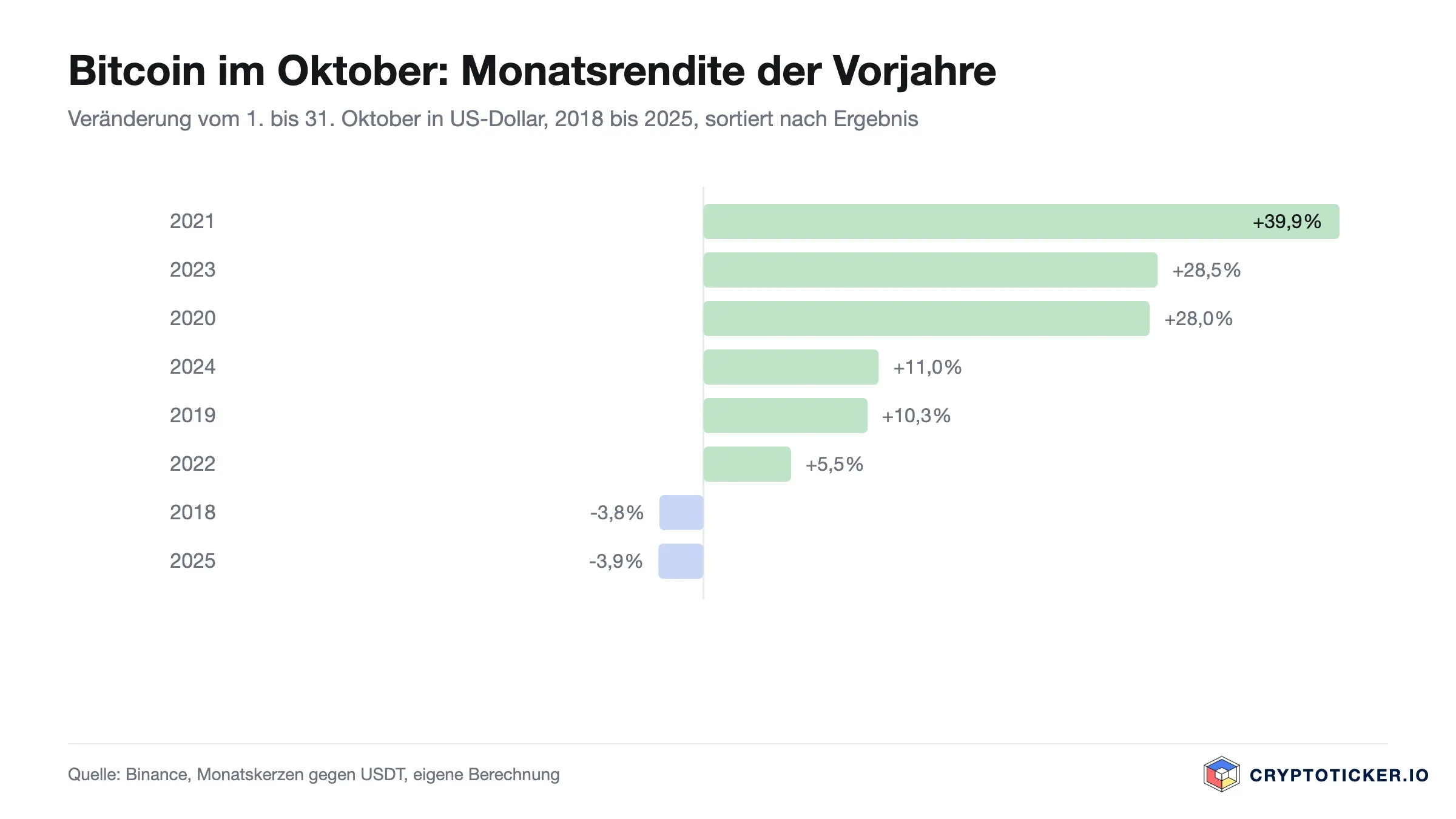
The record is better than that of most altcoins. Solana, for example, has ended only three of six Octobers in the black since 2020, as our October analysis of Solana shows. Eight years is a small sample, though, and the swings range from minus 4 to plus 40 percent. A rule cannot be derived from that, but a tendency can.

What October 2025 teaches
Last October shows how quickly the month can turn. On October 6, 2025, Bitcoin reached its record high of around $126,000 (CoinGecko). Four days later, on October 10, US President Trump announced tariffs of 100 percent on Chinese imports. Within 24 hours, leveraged positions worth more than $19 billion were force-closed, more than on any day before, as CoinDesk Research has worked through. Bitcoin closed the month down 3.9 percent, and the price today is still around a third away from that record.
The lesson from it concerns leverage more than the price. Anyone who held without leverage had a bad day. Anyone who traded with high leverage often lost everything they had put in.

Bitcoin price prediction: the levels for October
The one-year chart shows the record, the slump that followed and the recovery since the summer. Bitcoin sits above its 50-day moving average (around $78,300) and its 200-day moving average (around $75,300), both calculated from CoinMarketCap daily closes.
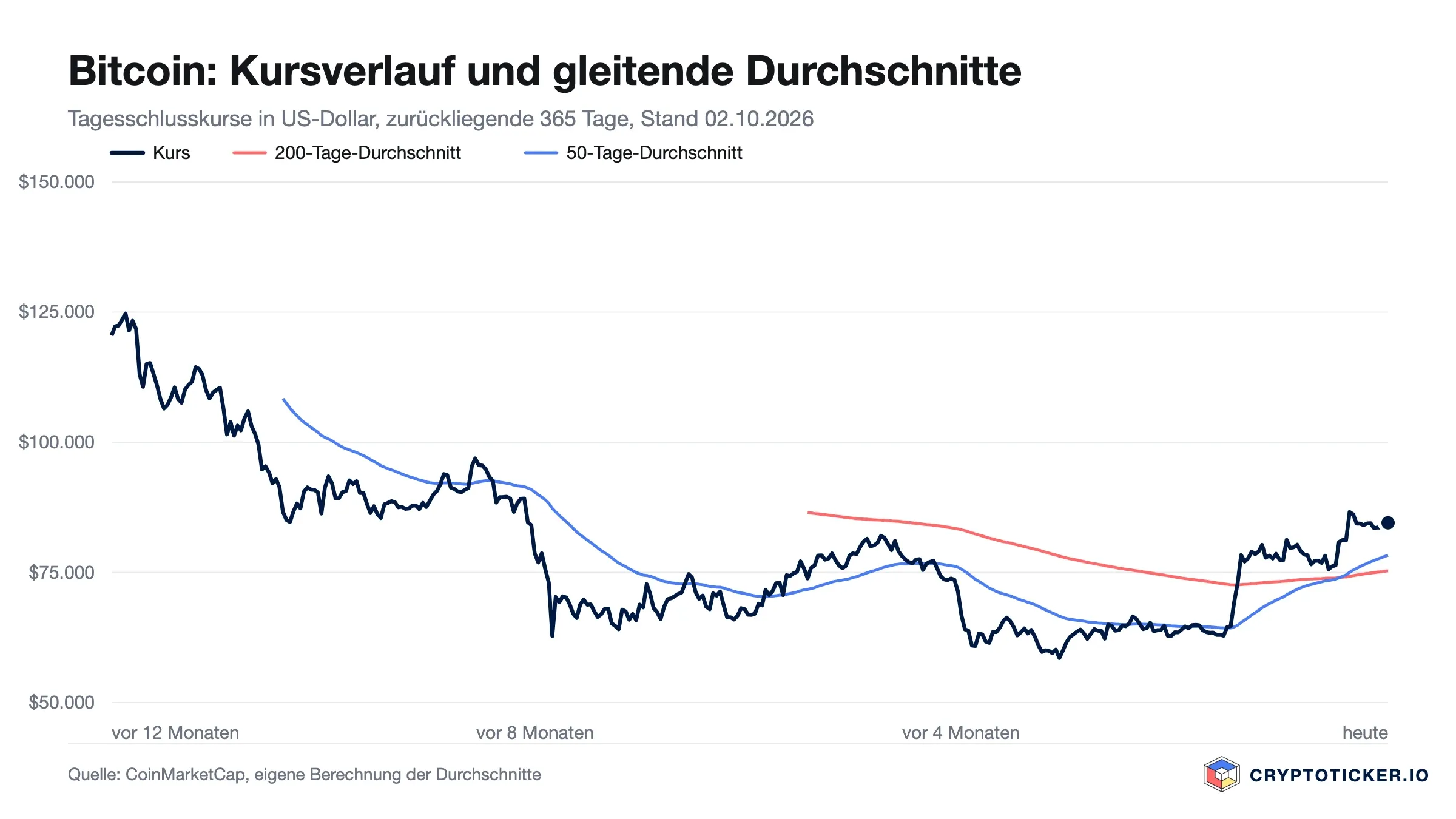
Since September 21 every daily close has been between $83,479 and $86,597. The upper level around $86,600 is therefore the first hurdle on the upside, the lower one around $83,500 the first support. October opened at $83,624 on Binance, just above that support. Why the inflows into the US spot ETFs have not lifted the price above this range so far is something we set out on Saturday.
Bitcoin: The key points for your decision
Three points sum up the situation. First: the October record speaks slightly in favour of Bitcoin, as six of eight years ended in the black. Second: last October showed that a single day can turn the month around, above all for anyone trading with leverage. Third: the price is stuck in a range between $83,500 and $86,600, and only a close outside it will show the direction for the month.
Anyone who wants to buy more in October can spread the entry over a savings plan instead of betting on the one right day; our comparison of Bitcoin savings plans puts the providers side by side. Anyone taking profits should know the holding period: Bitcoin held for less than a year is taxable on sale in Germany once the annual allowance of 1,000 euros is exceeded. Crypto assets fluctuate heavily and a total loss is possible. This article analyses past price data; it is not a forecast and not a recommendation to buy or sell Bitcoin.
(As of October 4, 2026. This article is not investment advice. Prices and fee structures change; check the terms with the provider before you buy.)
Decrypt
President Trump named a new "Super Intelligence Force" to coordinate federal AI policy, with Director of National Intelligence Jay Clayton at the helm. As SEC chair, Clayton launched crypto lawsuits including the agency's case against Ripple.
The Independent Community Bankers of America argues the OCC's national trust charters give crypto firms a "side door into the banking system" without the safeguards that bind traditional banks.
Spot Bitcoin ETFs took in $134.4 million over the first two trading days of October, rebounding from a Sept. 30 outflow as a weak jobs report cooled Fed rate-hike bets.
Near Intents said the roughly $3.8 million drained in an exploit on Thursday was returned in full, a day after the team said it had identified the attacker and gave them 48 hours to return the funds.
The firm says the Sept. 24 breach pushed North Korea's 2026 crypto haul past $1 billion, and detailed how it used in-house AI to trace the stolen funds across four blockchains in a race against the attackers.
U.Today - IT, AI and Fintech Daily News for You Today
XRP traps price in a tight 4-hour triangle under $1.53 resistance as largest holders pause all market activity.
Dogecoin bulls have one key level to clear as compression builds.
Ethereum creator Vitalik Buterin tests three-layer privacy model for frontier AI.
As MSTR trades at a 14% premium, Michael Saylor hints at a massive new Bitcoin maneuver for Strategy.
Inside the aggressive multi-million dollar marketing pivot that put giant XRP banners on prime-time stadium screens.
Blockonomi
TLDR:
- XRP needs a four-hour close above $1.53 to confirm the breakout, with $1.62 as the first upside target.
- XRP briefly reached $1.55 on October 2, but failed to hold above $1.53, leaving breakout confirmation pending.
- More Crypto Online marks $1.67, $1.93 and $2.25 as key resistance levels in the broader Elliott Wave setup.
- XRP’s wider Fibonacci setup places the final target zone at $2.14-$2.99 if the five-wave advance completes.
XRP is approaching a closely watched technical threshold as narrowing price action puts a four-hour close above $1.53 at the center of the market setup. As of press time, the token traded near $1.50 on October 4, gaining about 1% over 24 hours.
Similarly, CoinGecko data showed an intraday range near $1.49 to $1.51. However, XRP’s price remained below resistance established during September’s rally, leaving the immediate breakout case unconfirmed. As a result, attention now centers on whether buyers can sustain XRP above the crucial $1.53 level.
XRP Breakout Hinges on a Four-Hour Close Above $1.53
Analyst Ali Martinez identified a contracting triangle on the four-hour chart, with XRP’s price compressing between descending resistance and rising support near the pattern’s apex. Martinez said confirmation requires a four-hour close above $1.53.
If that occurs, his first identified upside target sits at $1.62. That level would represent roughly 8% upside from the $1.50 area. Nonetheless, the confirmation requirement matters as price has already briefly traded above $1.53.
XRP reached about $1.55 on October 2 before retreating. That move failed to establish sustained control above the breakout level. Therefore, another intraday move through $1.53 would not independently confirm the pattern.
Buyers would also need to preserve the breakout through the four-hour closing period. However, triangle formations can resolve in either direction, so the narrowing range itself does not establish a bullish outcome. Instead, the closing threshold remains the defining technical signal.
Martinez also reported that large holders showed no significant change in their XRP positions during the previous week. That left whale activity relatively inactive during the compression.
Elliott Wave Structure Maps Resistance Toward $2.99
A broader chart from More Crypto Online places the short-term breakout within a larger Elliott Wave structure beginning near the August low around $0.985. The analysis treats the recovery from that low as potentially impulsive.
However, the bullish structure requires a complete five-wave advance rather than a three-wave rebound. Under that framework, XRP would first need to preserve support and clear nearby resistance levels.
The chart identifies $1.67 as an important hurdle. Further levels appear near $1.93 and $2.25 if the wave sequence develops. Its wider Fibonacci structure places an additional target zone between roughly $2.14 and $2.99.
The same analysis previously marked $1.10 to $1.38 as key support, while $0.985 served as the broader invalidation reference. This creates a layered technical sequence rather than one direct target. Each higher level depends on price completing the structure outlined by the analysts.
That ordering keeps the immediate $1.53 trigger separate from longer-range targets dependent on additional confirmations. For now, the sequence remains straightforward. XRP must first secure a four-hour close above $1.53, then challenge $1.62 before higher targets become technically relevant.
The post XRP Price Nears Breakout as $1.53 Trigger Opens Path Toward $2.99 appeared first on Blockonomi.
TLDR:
- Vitalik Buterin tested personalized diet and exercise recommendations through local AI orchestration, drawing on more capable remote models.
- The experiment combined carefully written prompts, zkAPI payments, and Tor routing to address content, billing, and network exposure.
- Buterin reported better recommendations while identifying four limitations, including slow responses and weak separation between requests.
- His Ethereum essay names Hegotá as the likely last normal fork before broader verification advances and quantum-safe technology.
The Ethereum cofounder Vitalik Buterin has tested a system to obtain AI recommendations while limiting personal data exposure. His experiment used health and travel information to generate personalized diet and exercise suggestions.
A local model coordinated requests to capable remote systems, drawing on their reasoning and knowledge. The AI privacy setup combined carefully written prompts, private payments through zkAPI, and Tor routing. These addressed different sources of identity leakage.
Vitalik Buterin said the recommendations benefited from remote input, although privacy protections still needed improvement. He also reported slow responses and a tradeoff between sharing less information and receiving useful advice.
Vitalik Buterin Uses Three Privacy Layers for AI Queries
Vitalik Buterin identified his local coordinator as Qwen 3.8 Flash Next, which called frontier models when needed. A skill file guided those calls, instructing the local system to disclose as little personal information as possible.
The first privacy layer addressed both prompt contents and writing style. The local model composed questions, reducing the risk that remote services could identify him through phrasing or personal details.
The second layer covered payments, which can connect AI requests to an identifiable customer account. For this, the experiment used zkAPI, a system designed to separate payment authorization from user identity.
The Ethereum Foundation described zkAPI in an October 1 announcement as private usage credits for paid services. Users fund a vault, then authorize spending with zero knowledge proofs rather than revealing which deposit paid for requests.
In runtime key mode, temporary API keys cap spending, while signed usage receipts determine the actual charge. The payment service checks funding proofs without receiving the prompts sent directly to the AI provider.
Tor supplied the third layer, targeting network information such as IP addresses. Vitalik Buterin accessed zkAPI through a Tor-wrapped command line tool, combining payment privacy with network routing.
The design treats these protections as complementary because each covers a different route to identification. Removing names from prompts still leaves payment records or network details as potential links.
The Foundation also cautioned that AI providers can still read submitted prompts. Its documentation says repeated personal details, reused conversation histories, and writing patterns can allow separate sessions to be linked.
Speed Limits and Data Tradeoffs Shape the AI Experiment
Vitalik Buterin reported that the experiment returned recommendations improved by knowledge from frontier models. However, he identified four weaknesses, spanning network design, request construction, local performance, and the balance between privacy and usefulness.
He argued that Tor handles individual request separation poorly and may provide insufficient privacy for this use. He also estimated latency was 10 to 100 times higher than it could be.
The skill file needed better strategies for deciding what information remote models should receive. That makes request preparation another unresolved part of the experiment.
Vitalik Buterin said Qwen generated roughly 20 to 30 tokens per second on his setup. He wanted speeds above 100 tokens per second before the system would feel comfortably fast.
The AI privacy tradeoff also remained visible: withholding more context reduced the help available from remote models. That tradeoff suggests payment and network safeguards alone cannot preserve personalized recommendation quality when requests omit important contextual details.
The experiment follows a September 27 essay in which Vitalik Buterin described Ethereum as a future cryptographic world computer. His vision combines blockchain security with cryptographic privacy, verification and decentralized computing outside the chain.
In that essay, he identified Hegotá, planned for next year, as the likely last normal fork. Later development would involve recursive STARKs, automated formal verification, optimized consensus and quantum safe technology.
He also cited PeerDAS as an early step toward this broader architecture. The intended result is cheaper, more scalable and more private computation secured through modern cryptography.
The post Vitalik Buterin Tests AI Privacy Through zkAPI and Tor Routing appeared first on Blockonomi.
TLDR:
- A Base DeFi vault lost over $6M after an attacker added a new contract to its whitelist and drained assets.
- Blockaid first estimated $2.02M in losses before raising the total above $6M as the exploit continued.
- Spot On Chain and PeckShield both traced about 1,783 wstETH to attacker address 0x0B5126…B034 on Base.
- No evidence shows Aave or Base core systems were breached, while the vault’s root cause remains unconfirmed.
A DeFi vault operating on Base has lost over $6 million after an attacker gained whitelist access and used a new contract to extract assets. Blockchain security firm Blockaid first reported the exploit on October 4, estimating about $2.02 million had been drained across roughly four transactions.
Blockaid detected an ongoing exploit on an unnamed vault on Base.
A brand-new contract was added to the vault's whitelist, then borrowed aBaswstETH from the vault and sent the aTokens to the attacker's contract.
~$2.02M drained from the vault so far across ~4 txs. Attack…
— Blockaid (@blockaid_) October 4, 2026
The alert placed the vault’s authorization controls at the center of the incident. Blockaid said the attacker added a newly created contract to the whitelist, borrowed aBaswstETH, and transferred the resulting aTokens into an attacker-controlled contract. Reported losses then increased as security firms traced more transactions connected to the same address.
Loss Estimate Climbs as Attack Remains Active
Blockaid later raised its estimate above $6 million and said the attack remained active. Spot On Chain separately estimated losses at approximately 1,783 wstETH, worth around $6 million. The firm identified the suspected attacker as 0x0B5126…B034.
PeckShield independently also linked that address to the theft of 1,783 wstETH on Base, supporting the estimate. Available evidence places the whitelist mechanism at the center of the exploit sequence.
However, investigators have not established how the new contract obtained authorization. A whitelist normally limits interactions to approved contracts or addresses. Here, a newly created contract received approval before the borrowing activity began, according to Blockaid.
No public evidence has established whether the approval resulted from an administrative key issue, configuration error, access-control function, or smart-contract vulnerability. The stolen asset connects the incident to Aave liquidity infrastructure, but current evidence does not show that Aave’s core lending contracts were compromised.
Evidence Points Away From Core Aave and Base Systems
BaseScan identifies aBaswstETH as Aave Base wstETH. Aave documentation describes aTokens as interest-bearing tokens issued when assets are supplied to its markets. Those tokens represent deposited assets and accrued yield.
That distinction keeps the focus on the unidentified vault’s authorization controls rather than Aave’s lending infrastructure. Spot On Chain said broader systemic risk appeared limited, although selling the stolen wstETH could create short-term market pressure.
Any effect would depend on where and how quickly the attacker liquidates assets. wstETH is Lido’s non-rebasing version of stETH. Instead of increasing balances as staking rewards accrue, its exchange rate against stETH changes over time. Base is an Ethereum Layer 2 built on the OP Stack.
No evidence indicates that the underlying network itself was compromised. The affected vault has not been identified, while no official post-mortem has established the exploit’s root cause. The $6 million loss estimate therefore remains subject to change as investigators trace transactions.
The post Base DeFi Vault Exploit Drains $6M After Attacker Gains Whitelist Access appeared first on Blockonomi.
TLDR:
- PUMP coin price gained 15% to $0.006369 on October 4. Whale activity accompanied a rally that outpaced the wider crypto market.
- Two wallets moved 572.56 million PUMP, worth about $3.58 million. One purchased tokens, while another withdrew holdings from MEXC.
- PUMP open interest rose 25.77% to $669.62 million in an earlier reading. Rising positions alone do not establish bullish conviction.
- Positive MACD momentum keeps $0.007 in focus beyond $0.00655 resistance. A break below $0.006 could expose the $0.0055 rebound area.
The PUMP coin price rose 15% to $0.006369 on October 4 as large wallet activity accompanied a market recovery. Market data valued the Pump.fun token at approximately $2.95 billion, placing it 35th among tracked cryptocurrencies.
The wider crypto market gained 0.77%, lifting its total capitalization to about $2.9 trillion. Bitcoin held above $85,000, while Ethereum traded near $2,699 and XRP reached $1.50.
Whale accumulation drew attention after two wallets moved tokens worth roughly $3.58 million. Derivatives positions also expanded sharply, while positive MACD readings kept $0.007 in focus. That target remains conditional on PUMP clearing nearby resistance and preserving support.
Whale Accumulation Expands as Two PUMP Wallets Move $3.58M
According to on-chain data, the wallet known as Netherlol purchased 383.34 million PUMP tokens, worth approximately $2.4 million. The transaction marked its first PUMP purchase in more than a year, according to the blockchain tracker.
netherlol bought 383.34 million solana:pumpCmXqMfrsAkQ5r49WcJnRayYRqmXz6ae8H7H9Dfn, about $2.4 million, after more than a year on the sidelines, per @lookonchain.
A new wallet also pulled 189.22 million… pic.twitter.com/g7p0roWgr7
— Crypto Banter (@crypto_banter) October 4, 2026
A newly created wallet, GnZqfY, separately withdrew 189.22 million PUMP tokens from MEXC. Lookonchain valued that transfer at $1.18 million and recorded it seven hours before its update.
Together, the purchase and withdrawal involved 572.56 million tokens. Their combined value reached approximately $3.58 million, adding to attention around whale accumulation.
However, the two transactions carry different implications. A purchase records additional buying, while an exchange withdrawal can simply relocate tokens acquired earlier.
The PUMP coin price advanced alongside these wallet movements, but their timing does not establish a causal connection. Lookonchain did not disclose why Netherlol returned or how long either wallet intended to hold its tokens.
Exchange withdrawals can move assets into private custody, reducing the balance available on that exchange. They do not establish permanent removal from circulation, since holders can transfer tokens back later.
For the PUMP coin price, continued whale accumulation could support demand if purchases persist. These reported transfers alone cannot establish that pattern or explain the wider recovery.
PUMP Coin Price Faces Resistance as Open Interest Rises
CoinGlass figures show the PUMP open interest rising 25.77% to $669.62 million. Derivatives trading volume increased 3.64% to approximately $1.08 billion over the reported period.
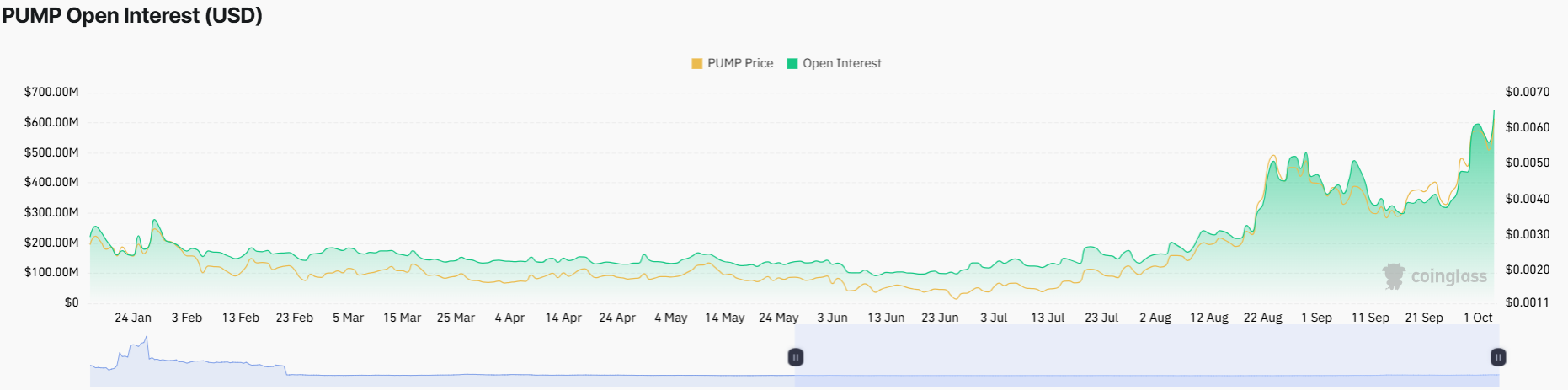
Liquidation data shows $390,000, with short positions accounting for most losses. A later CoinGlass check showed approximately $3.22 million in liquidations across 24 hours.
The PUMP coin price maintained a rising channel on the four-hour timeframe and recovered to the area around $0.006. Its relative strength index stood at 65.77, below the conventional overbought threshold of 70.
The MACD line measured 0.000241, exceeding the signal line at 0.000189. The histogram registered a positive 0.000052, indicating improving momentum after the recent decline.
These readings support a constructive technical interpretation, although momentum indicators cannot confirm that a breakout will continue. Immediate resistance stands near $0.00655, ahead of the larger $0.007 level.
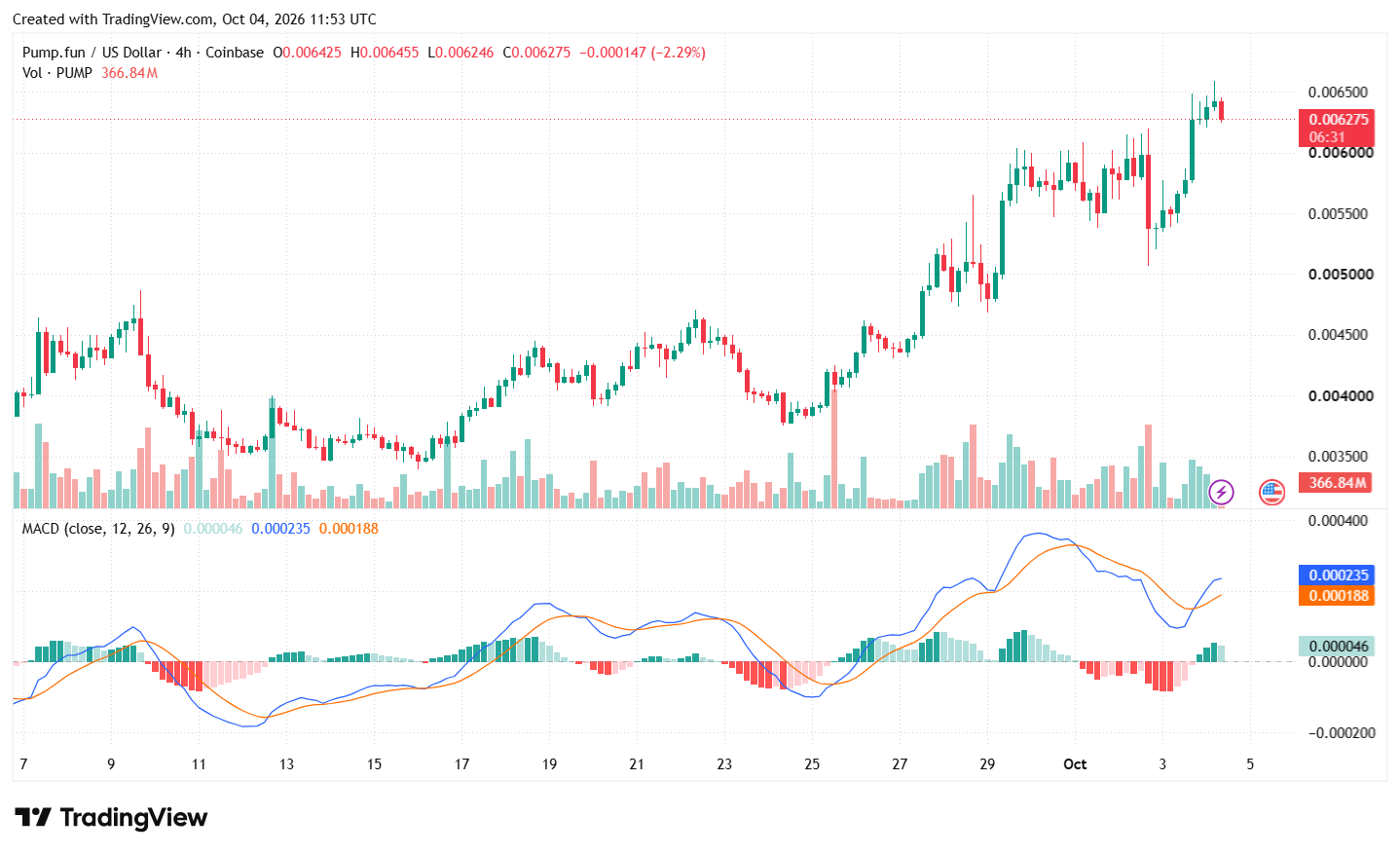
A sustained move above that nearer barrier would strengthen the case for another advance. From $0.006369, reaching $0.007 would require an increase of approximately 9.91%.
The PUMP coin price could instead revisit $0.006 if it fails to clear resistance. Losing that support and the ascending channel would expose the recent rebound area around $0.0055.
The post PUMP Coin Price Gains 15% as Whales Move $3.58 Million in Tokens appeared first on Blockonomi.
TLDR:
- Bitcoin price this week could move toward $90,000 if the bull flag breaks higher. A sustained move above resistance remains essential.
- Iran says Hormuz will remain closed until seven conditions are met. Prolonged shipping disruption could increase inflation pressure.
- The Coinbase Premium Index is recovering, suggesting renewed US demand. Changing whale orders leave nearby liquidity levels uncertain.
- Rising yields and the coming US economic releases could test Bitcoin momentum. Leveraged long face liquidation risk if support fails.
The Bitcoin price forecast this week puts $90,000 in focus as the cryptocurrency consolidates near $85,000. A possible bull flag above support underpins that target, although confirmation requires a sustained breakout.
Iranian Parliament Speaker Mohammad Bagher Ghalibaf said Sunday that the Strait of Hormuz would remain closed pending US commitments. He linked reopening to seven conditions under the Islamabad memorandum, keeping geopolitical risk on the market agenda. Shipping disruptions could complicate the inflation outlook.
Meanwhile, recovering US spot demand faces pressure from rising yields and upcoming economic releases. Those competing forces leave Bitcoin vulnerable to sharp moves in either direction.
Bitcoin Price This Week Tests Support Before a Bull Flag Breakout
Bitcoin’s price this week remains tied to whether the consolidation resolves upward. Market data shows five weeks of trading around $85,000, with the latest weekly wick reaching $87,000.
BREAKING: Iran's top negotiator says the Strait of Hormuz will remain closed until the US meets the "seven conditions based on the Islamabad Memorandum."
LIVE updates: https://t.co/HrCht5VFm7 pic.twitter.com/WsLLNL9TW1
— Al Jazeera English (@AJEnglish) October 4, 2026
An upside break would strengthen the bull flag case for $90,000, provided former resistance becomes support. Repeated rejection would weaken that scenario and keep attention on the lower boundary of the consolidation.
The Coinbase Premium Index provides another test for Bitcoin price this week. An early recovery suggests renewed US demand rather than confirming a durable shift.
CryptoQuant calculates the premium using Coinbase dollar prices and Binance tether prices. Exchange-specific flows and stablecoin pricing differences can influence the reading. The index reflects relative pricing rather than directly measuring new capital flowing into the market.
Stronger readings can indicate increased buying pressure on Coinbase but require confirmation from wider trading activity. A temporary premium can fade without producing a sustained advance across exchanges.
CoinGlass order data shows a $13.25 million bid at $82,500 in. It also listed a $15.52 million ask at $84,799.90. These orders can change quickly and do not establish permanent support or resistance.
Strait of Hormuz Closure Raises Inflation and Funding Risks
Ghalibaf said Washington had sent proposals through a mediator after Iran presented a roadmap for reopening the strait. He rejected unilateral demands and tied access to US compliance with the seven conditions. Iranian Foreign Minister Abbas Araghchi separately said an accepted proposal could allow reopening within seven days.
The Strait of Hormuz dispute adds an energy risk to Bitcoin price this week. A prolonged disruption could increase oil costs, complicating inflation expectations and reducing confidence that monetary policy will ease.
Saudi-backed Yemeni government forces also struck Houthi-controlled Sanaa while fighting displaced civilians. The regional escalation adds another uncertainty for markets already assessing the shipping dispute.
Rising bond yields create another challenge for Bitcoin price this week. As reported, higher Treasury yields are alongside a 7.6% rate for 30-year mortgages. Those figures measure different borrowing costs, but both can reflect tighter financial conditions.
ISM schedules its services report for October 5, adding an early test of business activity and price pressures. Federal Reserve minutes follow on October 7 under the central bank’s three-week release timetable. Employment updates, jobless claims, and Michigan inflation expectations will also shape rate expectations.
The one-year inflation expectations had previously reached 4.6%. Stronger inflation signals could reinforce expectations for restrictive policy, reducing demand for risk assets.
The liquidation heatmap showed heavier exposure around leveraged long positions. For Bitcoin price this week, a support break could trigger forced selling before fresh spot demand absorbs supply. Changes in leverage and open positions can alter those estimated liquidation clusters during the session.
The post Iran Keeps Hormuz Shut as Bitcoin Eyes a Possible $90K Breakout appeared first on Blockonomi.
CryptoPotato
Bitcoin enters the final quarter of the year after a powerful recovery in the third quarter, but analysts warn against expecting another straight-line rally. Instead, they pointed to some key factors that could impact BTC and the overall market in the following three months.
Some of them include the Federal Reserve, Treasury-market liquidity, ETF flows, geopolitics, and BTC’s ability to clear $87,500, which remains its most significant obstacle on the path forward.
Q3 May Be Hard to Repeat
Although Q3 began with another leg down to under $58,000, which became BTC’s lowest price tag in a year and a half, the subsequent three months were a lot more positive. The cryptocurrency rebounded immediately and broke out in mid-August to over $80,000. Its rise continued and managed to close the quarter with a massive 43% surge.
Iliya Kalchev, Nexo Dispatch Analyst, described the three-month period as both a recovery phase and a breakout milestone. He argued that the most important catalyst arrived from the bond market after the US Treasury increased the size of its long-end bond buyback operations in August.
The asset indeed jumped by 7% on August 19 and rocketed by over 20% in the following several days. Spot Bitcoin ETF flows immediately turned positive and even flipped into the green on a year-to-date basis. Meanwhile, relatively subdued perpetual funding suggested the rally was driven more by spot demand than excessive leverage, Kalchev added.
Nevertheless, the analyst cautioned against assuming Q4 will simply extend Q3’s pace. Although the cryptocurrency has finished Q4 higher in nine of the past 15 years, the median gains are only around 9%, while the much larger average has been distorted by spectacular years such as 2013 and 2017.
Alex Kozenko, CMO at WhiteBIT, issued a similar warning:
“Today, the market structure is different: institutional participation has become more prominent, and flows through regulated investment products have become yet another source of influence on market dynamics. Over the next three months, I would primarily focus on liquidity, institutional activity, and the overall macroeconomic environment.”
Fed and $87.5K
Although the overall market situation changed slightly after the weaker-than-expected US jobs report from Friday, Lacie Zhang, Research Analyst at Bitget Wallet, told CryptoPotato that she still believes the Fed will hike rates again by 25 basis points on October 28. This would put the target range at 4.00%-4.25% after the September increase, which was the first in over three years.
Kalchev also highlighted the Fed as the biggest Q4 variable, although the latest softer core PCE reading, alongside the aforementioned jobs report, reduced some of the immediate pressure for additional tightening. Geopolitical developments, though, could complicate the picture further, especially if energy prices keep feeding inflation.
According to Zhang, $87,500 remains the most crucial obstacle in BTC’s path to a broader recovery. A break above it could increase the likelihood of a short squeeze. In contrast, she identified the $82,000-$82,500 support range as the key downside zone, and losing it could accelerate a move below $80,000.
The post What Could Decide Bitcoin’s Q4? The Fed, Bond Yields, and One Crucial Price Level appeared first on CryptoPotato.
Own assets or be left behind — this is what the analysts at the Kobeissi Letter argued, highlighting the major discrepancy between those who do and those who stay on the sidelines.
Bitcoin fits surprisingly well into this distorted economy, but treating it as a cure for the destruction of the middle class would be a bit of an overstatement.
Own Assets or Get Left Behind
There are roughly 134.8 million households in the States, according to the analysts. However, around 1.4 million of them, also known as the wealthiest 1%, control more than $60 trillion in net worth. Since 2020 alone, their wealth has grown by more than $30 trillion. The bottom 50%, or 67.4 million households, collectively hold a fraction of that amount.
The reason isn’t simply that rich households earn larger salaries; the bigger divide is asset ownership, the Kobeissi Letter said. Total US household wealth has exploded from roughly $101 trillion six years ago to $185 trillion today, but that massive increase has been distributed very unevenly.
Americans who already owned stocks, businesses, property, and other appreciating assets benefited disproportionately as their prices rose. Meanwhile, inflation steadily eroded the value of income and cash savings. The analysts separately calculated that the greenback has lost roughly 23% of its purchasing power since 2020.
In other words, someone whose savings or assets increased by 30% over that period has made only a relatively modest actual gain after accounting for the decline in purchasing power. Inflation has also remained well above the Fed’s 2% target for 60 consecutive months.
Food, housing, transportation, and other necessities have become more expensive, while the assets needed to escape that erosion, mostly homes and stocks, can also become harder to afford. The analysts added that borrowing has offered little relief, as mortgage rates recently climbed toward the mid-7% range. At the same time, Treasury yields surged, raising the barrier to homeownership even further.
Consequently, they concluded something simple and obvious: “Own assets or be left behind.”
Does BTC Fit Here?
Bitcoin matters in this macro dynamic, even though it’s not as simple as saying it can somehow save the middle class. BTC addresses one specific part of the argument above quite well: its supply can’t expand in response to government spending, deficits, elections, wars, or monetary policy. There will ultimately be no more than 21 million units, making it fundamentally different from cash, whose purchasing power can and probably will decline as the monetary base expands.
It’s also unusually accessible compared with many traditional wealth-building assets. You don’t need a down payment required for a house or enough capital to purchase an entire BTC. If the fundamental problem is that people who hold appreciating scarce assets are pulling increasingly far ahead of people saving exclusively in depreciating currencies, bitcoin offers another way to get onto the asset-owning side of that divide.
On the contrary, bitcoin remains very volatile, which is not ideal for inexperienced investors. It can lose 50% or more during severe downturns in just months. In general, simply holding it generates no cash flow and offers little help to someone whose income is already consumed by rent, food, healthcare, and debt.
It can’t magically make housing more affordable, raise real wages, reduce healthcare costs, improve taxation, or redistribute existing wealth. As such, it’s safe to say that BTC cannot rebuild the American middle class. However, a scarce asset that virtually anyone can own and has no central authority behind it can provide individuals with one additional way to get exposure in an economy where asset ownership increasingly determines who preserves and grows wealth.
The post America’s Middle Class Is Getting Crushed: Where Does Bitcoin Fit? appeared first on CryptoPotato.
After Friday’s enhanced volatility following the US economic news, bitcoin’s price inched higher during the weekend and now sits above $85,000.
However, it almost feels like a familiar trap. History has shown that fluctuations ramp up on Monday morning after an eventful weekend in terms of new developments on the Middle East front.
The New Tension
Reports emerged yesterday claiming that US President Donald Trump’s top national security officials met at Camp David on Friday in a meeting that lasted hours and focused on the war against Iran. It was described as a “highly unusual meeting” that was not announced by the administration. However, one official claimed that “things were decided.” It was chaired by VP JD Vance, and some of the other attendees included CDI Director Ratcliffe and Joint Chiefs Chairman Gen. Caine.
The last similar meeting was in June 2025, just a few days before Israel attacked Iran. Asked about the meaning of the meeting and the US’s potential next move, the POTUS said, “If I told you, you would have a major story. But you will see.”
Later on, The Hormuz Letter added that Iran is “preparing for a fresh US bombing campaign greater than the last one.” One senior official warned that any new attack coming from US forces, whether by air or ground, will be treated as “all-out war and met with the ‘hardest’ response.”
The US has recently deployed nearly 10,000 troops, including 2,000 US Marines, to the Middle East aboard a third aircraft carrier and an amphibious landing group. It should arrive by November, while the midterm elections are scheduled for November 3. Trump previously said that new waves of attacks are likely to follow after the midterms.
Thirdly, Yemen’s Houthis struck a Saudi Aramco facility in Riyadh with ballistic missiles for the first time in over four years.
Calm Before the Storm?
All of these developments took place in the past 36 hours or so. Within this timeframe, BTC’s price has remained relatively calm and has increased slightly to over $85,000. However, history shows that the cryptocurrency tends to feel the actual consequences of escalating tension on Monday morning.
The latest such example was last week, when the POTUS rejected Iran’s peace deal offer on Saturday. Bitcoin stood still when the news went live but dumped by $2,000 on Monday morning when most traditional markets started to open.
The post Is Bitcoin’s $85K Consolidation the Calm Before the Storm Amid Rising Middle East Tensions? appeared first on CryptoPotato.
The OG meme coin was rejected even before it had the chance to truly challenge the $0.10 resistance earlier this week, but it has rebounded from the subsequent multi-day low.
Popular analyst Ali Martinez noted that a breakout might indeed be brewing, but the asset would have to overcome a key resistance level to do so. However, the ETF inflows do not support this thesis.
14% Move Next?
Recall that Dogecoin surged to $0.104 during the market-wide rally on September 22-23 before the bears stepped up and pushed it south hard. In the span of just several hours, the meme coin slumped to $0.92. Since then, it has tried to take down to $0.10 resistance on several occasions, but to no avail.
The latest rejection came on Friday amid the market-wide crash that drove BTC down by over $3,500. DOGE, on the other hand, dipped from $0.098 to $0.091 before it rebounded to $0.092-$0.093 during the weekend.
Martinez noted that the asset’s consolidation phase inside a descending triangle continues on the 4-hour chart. Dogecoin would have to overcome $0.095 decisively and close above it on the same timeframe, which would confirm a bullish breakout. The popular analyst, who last week outlined that DOGE whales had scooped up over 1.14 billion tokens in 4 days, predicted that a 14% surge to $0.106 would be next if the meme coin reclaims the aforementioned resistance.
“As price approaches the apex, the structure is becoming increasingly compressed, and a breakout could be getting closer,” he added.
ETF Flows Suggest Caution
The last full business week of September brought something Dogecoin fans hadn’t seen — an actual interest in the spot exchange-traded funds tracking its performance. The total net inflows hit a new record of nearly $2.90 million. Although this amount is nowhere near as impressive as the inflows into the BTC, ETH, XRP, or SOL ETFs, it was still a record for the meme coin.
This was seen as bullish at the time, but the next five-day trading period couldn’t maintain the momentum. Data from SoSoValue shows that the interest evaporated on Monday, but the inflows returned on Tuesday with $878,790. However, investors took out $551,430 a day later, and there were no reportable inflows on October 1 and 2.
As such, Dogecoin’s institutional side remains fragile, but the asset has never been driven by such large players, as retail often dominates its price moves.
The post Analyst Explains What Can Trigger DOGE’s Next Double-Digit Surge appeared first on CryptoPotato.
Bitcoin’s price has climbed slightly on Sunday morning, jumping past $85,000 after the major volatility experienced on Friday after the release of the US jobs report.
Most larger-cap alts are also slightly in the green over the past day, with ETH challenging the $2,700 resistance, while XRP is up to $1.50.
BTC to Reclaim $85K
Bitcoin’s previous business week began with a leg down that drove it from the upper boundary of its trading range at $85,000 to just under the lower at $82,500. The following few days were choppy before the PCE data came out on Wednesday. As it was lower than expected, BTC skyrocketed to $85,600 within minutes. However, the subsequent move was just as rapid, but to the downside.
Thursday was calmer, with BTC standing between $82,500 and $84,000. It began to climb again on Friday and was boosted by the much weaker-than-expected US jobs report. The initial move was quite bullish, as bitcoin jumped past $87,000 for the first time in ten days or so.
Somewhat surprisingly, though, it crashed almost immediately and had dumped to under $84,000 within hours. The bulls finally intervened at this point and helped BTC recover to $84,000 on Saturday. It has increased slightly to over $85,000 as of now on Sunday.
Its market capitalization has jumped to $1.710 trillion on CMC, while its dominance over the alts remains flat at 59%.

PUMP Pumps
Ethereum has returned to $2,700 today after a minor increase from yesterday. XRP eyes $1.50 following a 1.1% jump. BNB nears $800 after a more impressive 2.9% increase. Most other larger-cap alts have risen by about 1-2%. HYPE is up by 3% and stands above $90.
CRO, NEAR, and TAO have gained up to 4.5%, while RAIN and PUMP are the two top performers from this cohort of alts. The former has gained almost 14%, while the latter is up by 16% to $0.0063. ZRO and AERO follow suit in terms of daily gains.
The total crypto market cap has increased by approximately $30 billion daily and now sits at $2.910 trillion on CMC.

The post PUMP Soars 16% in 24 Hours, Bitcoin Reclaims $85K: Weekend Watch appeared first on CryptoPotato.