Cryptocurrency Posts
Crypto Briefing
CheatBench highlights the need for robust AI alignment strategies to prevent reward gaming, ensuring AI systems act in users' best interests.
The post Center for AI Safety releases CheatBench to measure how often AI agents cheat appeared first on Crypto Briefing.
Anthropic's financial instability may deter investor confidence, impacting its competitive edge and market positioning in the AI sector.
The post Anthropic faces $42B net loss ahead of $2T IPO valuation appeared first on Crypto Briefing.
Ethereum's reduced liquidity compared to Bitcoin may lead to increased trading costs and volatility, impacting institutional trading strategies.
The post Ethereum liquidity drops below 50% of Bitcoin’s level appeared first on Crypto Briefing.
The resignation highlights growing concerns over AI governance, potentially influencing industry standards and investor confidence in AI safety.
The post Anthropic resignation linked to AI self-modification risks: Microsoft AI CEO appeared first on Crypto Briefing.
OKX's move could reshape US equity markets by integrating blockchain, potentially enhancing liquidity and democratizing stock access.
The post OKX files with SEC to bring tokenized-stock trading to the US appeared first on Crypto Briefing.
Bitcoin Magazine
Bitcoin Magazine

IMF Praises El Salvador — But Still Tries To Scale Back Its Bitcoin Project
The International Monetary Fund has praised El Salvador for improving its economy — but scolded it at the same time for its ongoing Bitcoin experiment.
In a statement Friday, the IMF said that it had approved a $139 million disbursement to the Central American nation while also trying to “reduce the state’s involvement in Bitcoin-related activities.”
El Salvador in 2021 made Bitcoin legal tender, much to the ire of the IMF and other major institutions. The Latin American country was at the time negotiating a development loan with the agency.
“El Salvador’s economy continues to perform strongly”
— Nayib Bukele (@nayibbukele) October 1, 2026https://t.co/Rvaerha9QA
The IMF in September said that El Salvador wasn’t buying bitcoin; the country’s Bitcoin Office has repeatedly said that it does buy the cryptocurrency.
“Economic activity has exceeded expectations, supported by sustained improvements in security and investor confidence, as macroeconomic imbalances continue to be addressed,” the IMF said.
It continued: “However, certain performance criteria were not met, including on the Bitcoin accumulation front, for which waivers were granted based on strong corrective measures and renewed commitments.”
The IMF further said that the Salvadoran state’s involvement in Bitcoin-related activities is being unwound and that “no further bitcoin accumulation is envisaged beyond the documented donations.”
Salvadoran president Nayib Bukele in 2022 said the country would buy one bitcoin per day but it was never clear where the money was coming from — or if he was actually buying at all.
The IMF said in September that El Salvador was — at least for some time —not using public funds to accumulate bitcoin but rather had received bitcoin from private donations.
El Salvador and the IMF entered a $1.4 billion loan agreement at the end of December but the fund asked for the country to scale back certain aspects of its Bitcoin strategy.
The Salvadoran state gifted its citizens bitcoin in 2021 and debuted a wallet with the hope of getting more citizens using the cryptocurrency in the dollarized country.
President Bukele in 2024 admitted that Salvadorans weren’t using the cryptocurrency to buy things as expected, but always boasted that the government was still stacking sats.
This post IMF Praises El Salvador — But Still Tries To Scale Back Its Bitcoin Project first appeared on Bitcoin Magazine and is written by Mathew Di Salvo.
Bitcoin Magazine
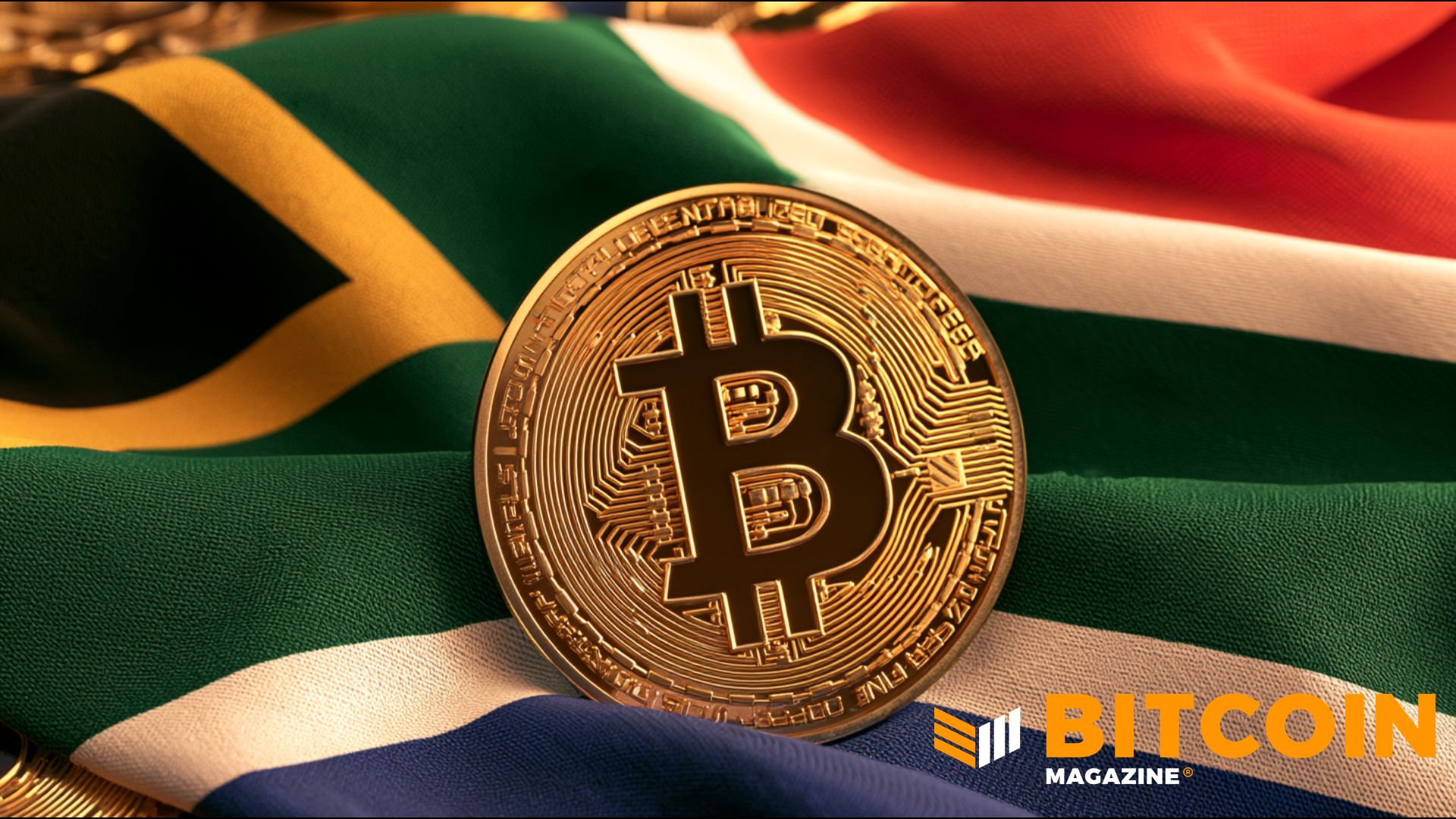
South Africa’s Absa Becomes First Bank on the Continent to Custody Bitcoin: Report
South African bank Absa has become the first African lender to custody bitcoin, according to reports.
As reported first by Bloomberg on Friday, the Johannesburg-based lender will serve institutional clients, mostly by custodying bitcoin — but other digital assets will also be a part of the service.
Banks worldwide are integrating or offering bitcoin-related products and services. A number of U.S. and European banks have started offering crypto-related services by custodying assets for institutions.
JUST IN:
— Bitcoin Magazine (@BitcoinMagazine) October 2, 2026Absa has become the first African bank to offer Bitcoin custody
pic.twitter.com/JaDza3S7Ez
Rob Downes, head of digital assets at Absa’s corporate and investment banking unit, was quoted saying that while bitcoin was the biggest asset the bank would custody, others would follow.
Absa did not immediately respond to questions from Bitcoin Magazine.
The African continent has a large crypto-native base, with data firms frequently highlighting the high adoption — particularly in countries where currencies have been significantly debased.
In Chainalysis’s 2025 report, South Africa’s $36.0 billion in on-chain value made it second in Sub-Saharan Africa. Nigeria alone received $92.1 billion, nearly three times the total of second-place South Africa.
On the global index, South Africa ranked 30th for crypto adoption.
The character of its market is different from Nigeria‘s: it’s more institutional, with regulatory clarity resulting in hundreds of licenses being issued to VASPs and attracting professional investors and traditional finance.
BNY Mellon in 2022 became the first major U.S. bank to offer digital asset custody services. And this month, German multinational Deutsche Bank said it would debut a bitcoin custody service for European corporate and institutional clients later in 2026.
This post South Africa’s Absa Becomes First Bank on the Continent to Custody Bitcoin: Report first appeared on Bitcoin Magazine and is written by Mathew Di Salvo.
Bitcoin Magazine

Bitcoin Price Surges Above $87,000 on Softer-Than-Expected Jobs Data
The price of bitcoin surged above $87,000 on Friday morning in New York, buoyed by constant exchange-traded fund flows and a jobs report showing that unemployment in the U.S. had ticked up.
Bitcoin’s price recently stood at $85,990 after a 2% jump over a 24-hour period. Over the past week, it has also risen by more than 2%.
Nonfarm payrolls increased 29,000 last month after a downward revision to the prior two months, Bureau of Labor Statistics data showed Friday.
JUST IN: Bitcoin jumps to $87,000 as U.S. Unemployment Rate comes in at 4.2%, higher than expectations
— Bitcoin Magazine (@BitcoinMagazine) October 2, 2026pic.twitter.com/jqtU8Q9zsd
Weaker-than-expected jobs data can give a lift to riskier assets like bitcoin and stocks, whose prices tend to swing more sharply.
A softer labor market typically means less consumer spending, which eases pressure on prices. That could make the Federal Reserve less inclined to keep raising interest rates to fight inflation.
Many economists and politicians have said the U.S. is in the midst of an affordability crisis, and the topic is a hot one ahead of the November midterm elections.
The Federal Reserve’s new chair, Kevin Warsh, has said that prices in the world’s biggest economy are too high and that the central bank is fully focused on making life more affordable again.
Bitcoin investors shrugged off the central bank’s interest rate hike in September, climbing on the news.
The largest cryptocurrency started rallying in August on news that the U.S. Treasury Department said it would more than double the size of its government debt repurchases. The coin had its best run in three years and third best August ever.
The coin’s price has benefited from the so-called debasement trade: when investors buy certain assets to hedge against currency being devalued. The dollar slid in value in August.
It continued to have a good September, rising nearly 6% over a 30-day period.
October has historically delivered good returns for bitcoin investors, with traders dubbing the phenomenon “Uptober.”
This post Bitcoin Price Surges Above $87,000 on Softer-Than-Expected Jobs Data first appeared on Bitcoin Magazine and is written by Mathew Di Salvo.
Bitcoin Magazine

Impacts of Daily Dividends on Digital Credit
In May 2026, Strive rebranded itself as “The Daily Dividend Company,” then moved SATA to daily cash dividends beginning June 16. Strategy has now pushed the same idea into its own digital credit engine. On September 24, its board proposed moving STRC, STRF, STRK and STRD to daily dividends, subject to shareholder approval at an October 28 special meeting. The proposal keeps the annual dividend economics unchanged and changes the cadence of cash payments.
STRC spent much of the summer below its $100 stated amount even as Strategy raised its dividend rate to 12% and deployed more than $1 billion buying back STRC. The move to daily dividends by Strategy could be seen as the latest attempt to make the security more attractive and help it trade near par.
Now that the overton window has fully shifted in favor of digital credit paying daily dividends, we should take a look at the actual impacts of daily dividends.
Daily Dividends Fit Onchain Finance
Digital credit is increasingly becoming an input for other financial products—so called “digital money” or “digital yield” products. Strategy estimated in mid-May that more than $440 million of STRC exposure had moved into DeFi through stablecoins, tokenized securities, yield products and other structures.
However, there is a cash flow mismatch. Crypto products commonly accrue and distribute yield at high frequency. A security that pays monthly or twice monthly forces the product sitting on top of it to bridge the period between economic accrual and actual cash receipt.
Daily dividends compress that gap to one day. The protocol, fund or issuer receives cash from the underlying asset at almost the same cadence that users expect to receive yield. That simplifies liquidity management and reduces the cash needed between dividend dates. This is much more impactful to a financial product funding daily distributions or redemptions than to a long term investor focused on total return. The crypto-heavy setting of the “Layer 3” products on top of digital credit raises the attractiveness of daily dividends.
Daily Dividends Are Primarily a Retail Feature
For investors focused strictly on total return, dividend payment frequency makes little difference in underlying economic value. The asset’s price accrues between distribution dates and adjusts post-payment, meaning annual, quarterly, monthly, and daily payouts produce comparable long-term results.
The true advantage of daily dividends lies in product psychology and user experience. Cash arriving every day provides immediate visibility and an engaging feedback loop. Investors can spend, withdraw, or automatically reinvest the payout while leaving their principal position intact, turning an abstract yield metric into tangible recurring cash flow.
This dynamic mirrors the strategy of Realty Income, which built a massive retail follower base by branding itself as “The Monthly Dividend Company.” As a member of the S&P 500 Dividend Aristocrats Index, Realty Income has paid and raised dividends for 31 consecutive years.
Daily dividends on digital credit extends this product concept even further: SATA pairs frequent daily payouts with a target price near $100 and a double-digit yield.
While institutional investors prioritize yield spreads, liquidity, tax structure, and balance sheet coverage, daily payments offer their strongest appeal to retail buyers. If the overarching objective is to raise capital to purchase Bitcoin, optimizing security design for retail investor preferences is the most effective approach.
Options Get Cleaner Too
Daily dividends also change options mechanics. STRC currently pays $0.50 twice monthly. SATA pays roughly five cents each business day. Larger dividend events create larger discrete adjustments in the underlying price, which affects option pricing and early exercise decisions. Daily payments spread the same annual cash flow across much smaller adjustments.
The total value of dividends over an option’s life is a key economic input. The more interesting effect comes from the price stability created by daily dividends. If daily dividends, variable rates and active par management keep SATA and STRC trading in narrower ranges, realized volatility should fall. Implied volatility can follow as the market gains confidence in that behavior.
The Biggest Test
The real test is whether daily dividends increase demand enough to eventually lower the required yield.
If investors consistently support SATA near the top of its target range, Strive can theoretically reduce the dividend rate while attempting to keep SATA near par. Success would show that a Bitcoin company can issue permanent preferred capital, manage it around a stable price, and adjust its yield with market demand. The benefit of the variable rate preferreds was, from inception, the eventual opportunity to lower the rate and reduce the cost of capital without upsetting price stability. In comparison, fixed rate credit locks in fixed rate forever.
Conclusion
Strategy adopting daily dividends would move the feature from a SATA differentiator toward a digital credit category standard. The annual economics barely change but the retail appeal and crypto composability become meaningful improvements.
This post Impacts of Daily Dividends on Digital Credit first appeared on Bitcoin Magazine and is written by Allard Peng.
Bitcoin Magazine
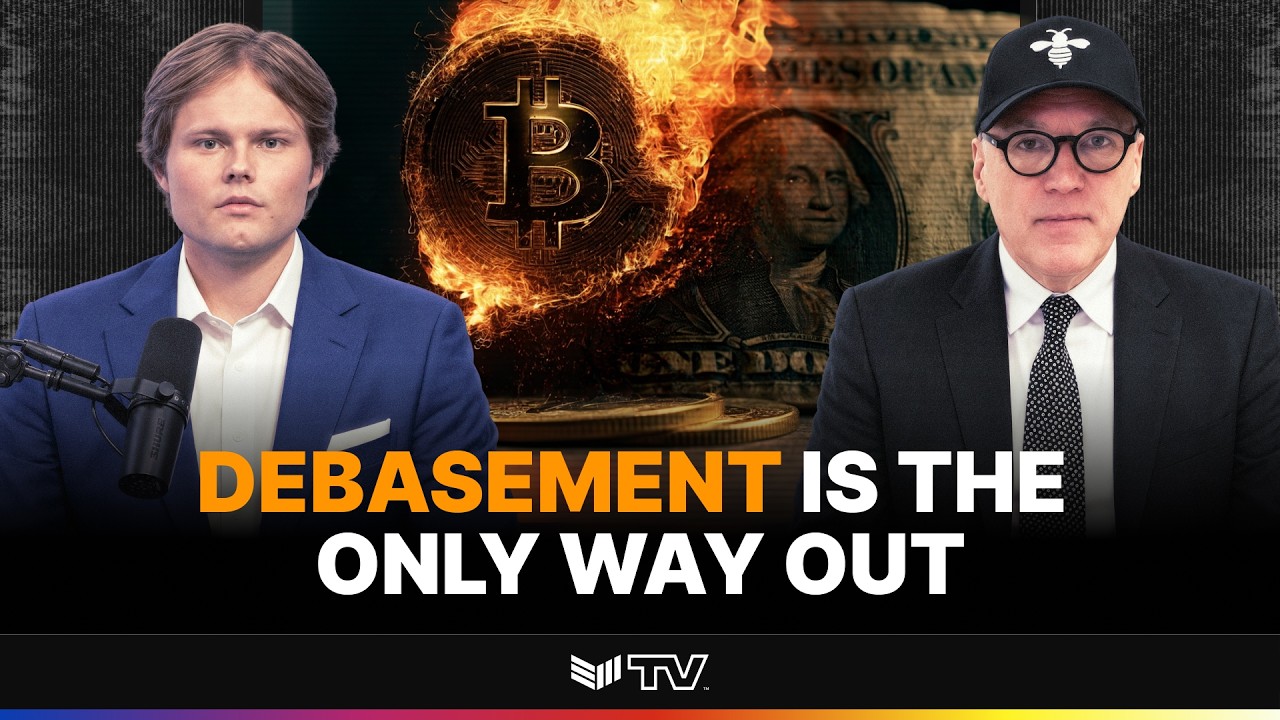
Frank Holmes: They Will Print $100 Trillion – Why to Buy Bitcoin & Gold
Bitcoin miners already have the power, the land, and the substations that AI needs. Frank Holmes, executive chairman of HIVE Digital Technologies, explains why he calls Bitcoin mining a “tier one” data center, how GPUs that once mined Ethereum led HIVE into AI, and why he thinks the next wave of AI factories will be built on mining infrastructure from Paraguay to Canada.
Chapters:
0:00 Frank Holmes on HIVE: From Gold Investor to Bitcoin Miner to AI Compute
2:12 How ETFs Changed Bitcoin: From the Fear Trade to the Love Trade
4:20 The Binance $19 Billion Liquidation and the $350 Trillion Money Supply
5:45 Gamers, Younger Quants, and Why Bitcoin Will Keep Gaining Adoption
7:29 Covid’s $40 Trillion of Money Printing and the Global MMT Risk
9:24 China, Russia, and Why Bitcoin Is a Tier One Data Center
11:33 China’s Bitcoin Mining, $1.4 Trillion of Lending, and Central Banks Buying Gold
13:44 Paraguay’s Central Bank and Bitcoin Mining as an Export
14:57 Compute as a Commodity: Canada’s AI Push and Bitcoin Miners’ Power Advantage
20:34 Where to Find Frank Holmes’s Weekly Investor Alert Newsletter
DISCLAIMER: The views and opinions expressed in this show are those of the participants and do not necessarily reflect the official policy or position of BTC Inc., Bitcoin Magazine, or any affiliated entities. This content is provided for informational and educational purposes only and should not be construed as investment, legal, tax, or accounting advice. Nothing contained in this show constitutes a solicitation, recommendation, endorsement, or offer to buy or sell any securities or financial instruments. Viewers should consult their own advisors before making financial or business decisions.
This post Frank Holmes: They Will Print $100 Trillion – Why to Buy Bitcoin & Gold first appeared on Bitcoin Magazine and is written by Patrick Green.
CryptoSlate
Illinois officials have joined crypto industry groups in seeking a six-month delay to the state’s controversial digital-asset tax.
The agreed motion, filed Oct. 1 in Sangamon County, asks a judge to postpone the levy’s Jan. 1 start until July 1, 2027, while a constitutional challenge brought by The Digital Chamber and the Illinois Blockchain Association proceeds.
Revenue Director David Harris and Attorney General Kwame Raoul joined the request even as the state continues to dispute the industry groups’ claims against the law. If granted, the injunction would temporarily spare brokers from collecting the tax and defer corresponding liabilities for covered customers.
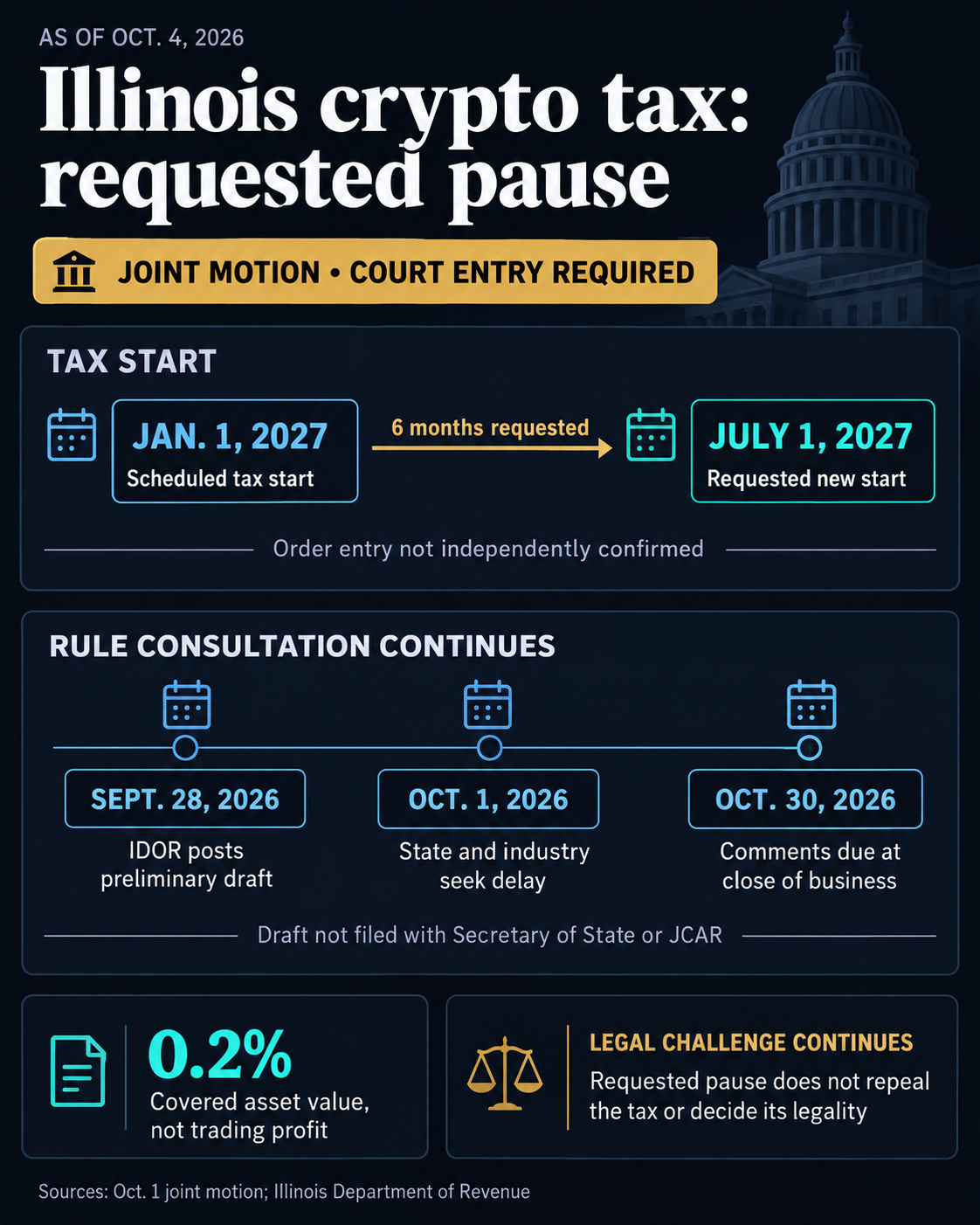
The court had not been confirmed to have entered the order as of Oct. 4.
The move marks a shift in the immediate battle over a levy that crypto firms have spent months warning could raise compliance costs and push activity outside Illinois. The law remains in force, and the joint filing does not concede that it is unconstitutional or seek its repeal.
Instead, both sides would preserve their legal positions while delaying collection as the lawsuit and the state’s rulemaking process continue.
Illinois crypto tax burden moves back six months
Illinois enacted the Digital Asset Tax in June, imposing a 0.2% levy on the value of digital assets involved in certain covered transactions rather than on investors’ trading profits.
Draft rules from the Illinois Department of Revenue show how broadly that structure could reach. A fee-paid withdrawal from a broker to a self-custody wallet can qualify when the statutory conditions are met, while a direct transfer without a covered broker may fall outside the levy.
Brokers are responsible for collecting and remitting the tax and can remain liable when they fail to collect it. Customers face a separate fallback obligation: if the tax is not charged, they may have to calculate and pay the amount themselves by the 20th of the following month.
Those obligations were due to begin in January despite the pending lawsuit. A court-approved delay would remove that immediate deadline for the first half of 2027, giving exchanges and other affected firms more time before they have to build collection and reporting procedures around the new regime.
However, the pause would not necessarily halt all compliance work.
Illinois’ draft rules remain under consultation, with public comments open through Oct. 30. The rules have not yet been filed with the Secretary of State or submitted to the Joint Committee on Administrative Rules, leaving key implementation details unsettled.
The parties have also asked to move the state’s deadline for responding to the lawsuit to Nov. 13.
That leaves crypto companies with two separate questions before year-end: whether the judge grants the agreed delay and how the Revenue Department changes its rules after receiving industry feedback.
If the injunction is entered, firms would gain another six months before customers begin seeing the tax on covered transactions. The legal challenge would continue during that window, leaving open the possibility that companies could use the reprieve to prepare for a levy whose ultimate validity remains before the court.
The post Illinois backs delay to crypto tax rule after months of industry pushback appeared first on CryptoSlate.
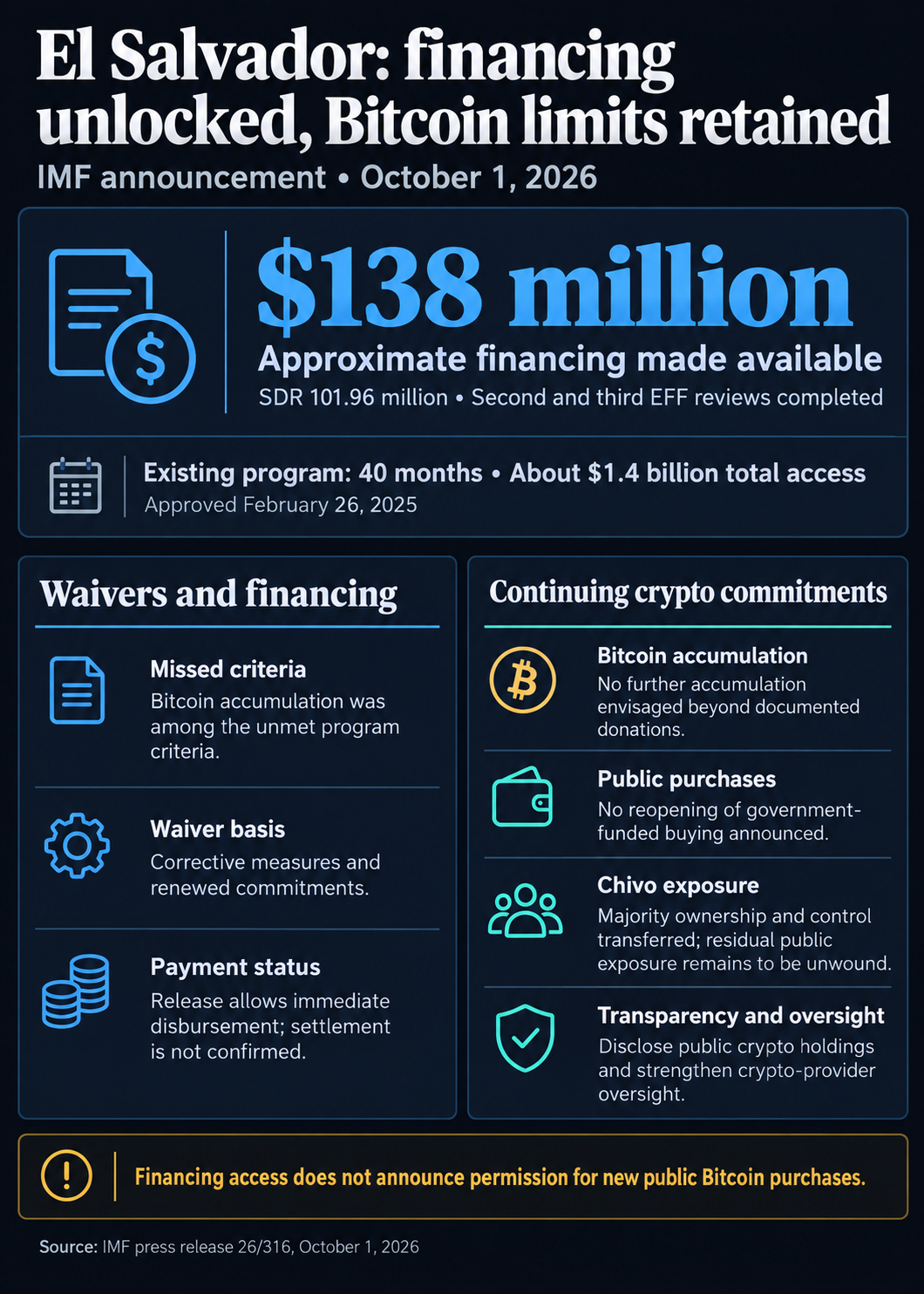
El Salvador secured access to $138 million from the IMF while recommitting to limits on further state Bitcoin accumulation.
The International Monetary Fund (IMF) completed the second and third reviews of the country’s $1.4 billion loan program on Oct. 1, allowing an immediate disbursement equivalent to SDR 101.96 million, or $138 million. The board also granted waivers for unmet performance criteria tied to Bitcoin accumulation after authorities took corrective measures and renewed their commitments.
Those waivers keep financing flowing despite earlier breaches, while leaving the program’s direction on Bitcoin unchanged. The IMF said no further accumulation is envisaged beyond documented donations, preserving a constraint that prevents the government from resuming publicly funded purchases under the program.
El Salvador currently holds about 7,794.37 Bitcoin valued at roughly $666.1 million. The size of that reserve has continued to draw attention because additions to government-linked wallets appear inconsistent with the IMF agreement.
The Fund has previously distinguished between Bitcoin acquired with public money and coins received through documented donations. That distinction remains central after the latest review: reserve balances can still rise without signaling that President Nayib Bukele’s government has restarted purchases.
Bitcoin waiver keeps restrictions intact
The Bitcoin concession formed part of a broader review in which the IMF said fiscal consolidation was advancing broadly in line with program objectives and reserve and liquidity targets had been comfortably met. The 40-month Extended Fund Facility was approved in February 2025 and is designed to support fiscal adjustment, stronger reserves and financial-sector reforms.
The Fund also cited progress in reducing the state’s direct role in crypto. The government has transferred majority ownership and control of the government-backed Chivo wallet to a private operator, though the IMF said remaining public-sector exposure should still be fully unwound.
That leaves several Bitcoin-related obligations unresolved even as another tranche of financing becomes available.
The IMF wants El Salvador to improve disclosure of public-sector crypto holdings, strengthen regulation and governance for digital-asset providers and amend its Digital Asset Issuance Law where necessary. Those measures sit alongside the continued commitment to avoid additional government-funded Bitcoin accumulation.
The restrictions give the government less room to use its balance sheet to expand the Bitcoin reserve while remaining inside the IMF program, even as higher BTC prices increase the value of the holdings it already controls.
Future reviews will therefore hinge partly on whether El Salvador can document how its Bitcoin balance changes while completing the remaining Chivo unwind and transparency reforms. Any unexplained accumulation could again force the government to seek waivers before accessing further program financing.
The post El Salvador’s $666 million Bitcoin reserve survives IMF review appeared first on CryptoSlate.
Coin Metrics has rebuilt Ethereum's historical Standard Flow Metrics, raising a timing problem for tests that treat exchange outflows as a trading signal.
The crypto data provider's Oct. 1 notice says it recomputed Ethereum Standard Flow Metrics from the network's first block using its most up-to-date information as part of its Ethereum Point-in-Time release. The affected scope is all ETH Flow Metrics at daily and hourly frequencies, with corrected history available for backfilling.
That creates a practical distinction for investment research. A chart downloaded today can describe past flows using knowledge acquired later. A backtest, which replays a trading rule through historical data, needs the information available when each decision would have occurred. Those are different information sets, even when their observations carry the same dates.
The notice supplies no revision amounts or ETH strategy comparison. The immediate consequence is a need to identify data vintage, meaning the version of the data used in the test; any effect on returns still requires measurement.
Why the same historical date can tell a different story
Coin Metrics' flow methodology makes the distinction concrete. Standard metrics use all addresses currently known to belong to an exchange or other tracked entity, with each address's history starting at its first nonzero balance. Past values can be restated when additional entity addresses are identified.
Its Point-in-Time, or PIT, series instead uses addresses known to belong to the entity during the historical interval. An address contributes from its discovery date, and later discoveries do not rewrite earlier PIT intervals. The provider documents daily and hourly PIT counterparts to Standard exchange-flow metrics.
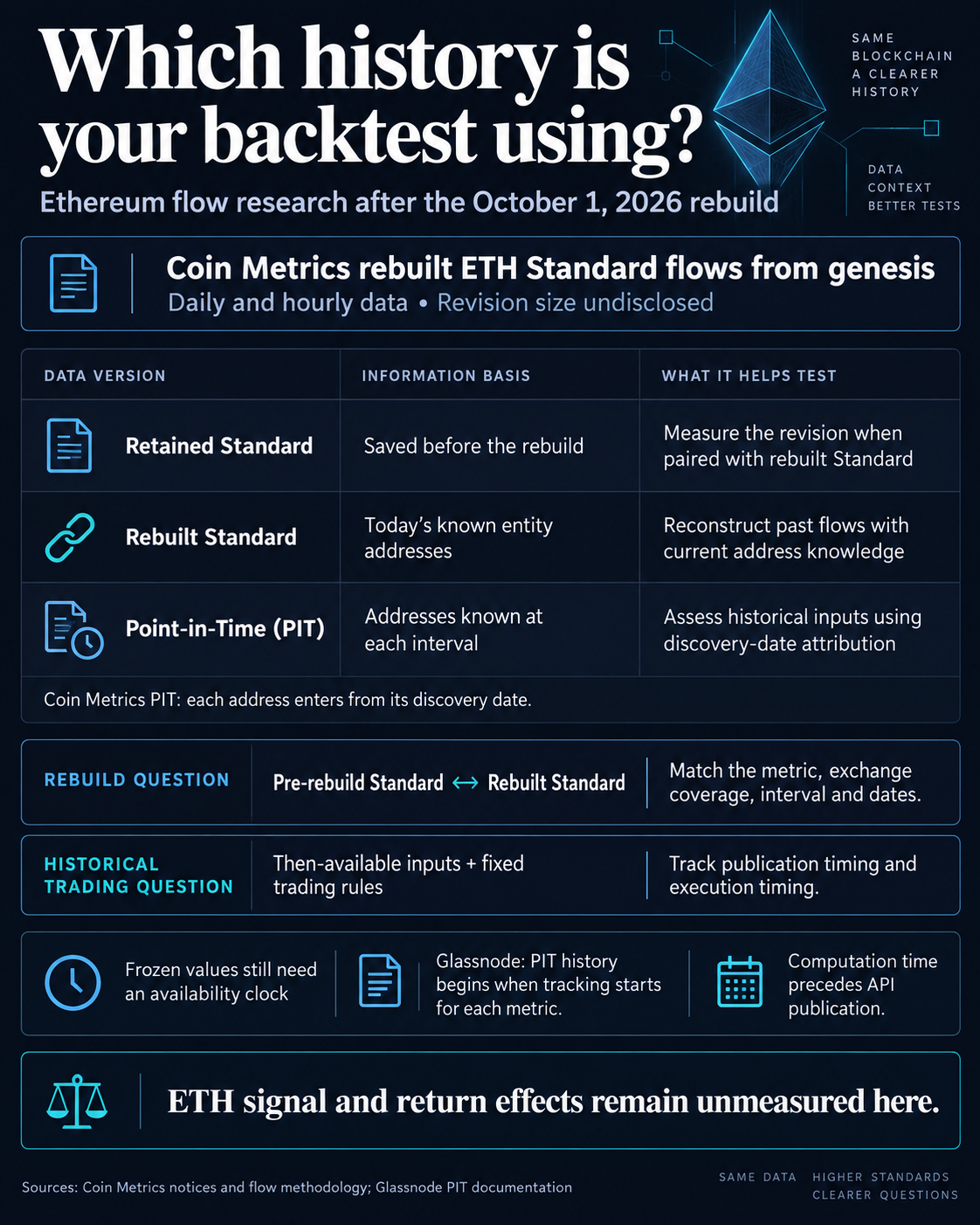
The underlying issue is attribution. A transfer can be assigned to an exchange retrospectively once the provider identifies the wallet. That fuller reconstruction may be useful for analyzing past supply movements with today's address coverage. Establishing what a trader could have recognized requires the address information and values available at that earlier moment.
Coin Metrics had outlined the recomputation on Sept. 28 to maintain that distinction, expecting ETH completion on Sept. 30. Its completion notice was posted Oct. 1 at 17:04 UTC; notice timing alone does not date every affected value's availability.
Two comparisons must also stay separate. Standard versus PIT tests different address-knowledge rules. Retained Standard history from before and after the rebuild is the comparison needed to measure this particular revision. PIT is a distinct attribution method. A copy of pre-rebuild Standard values preserves a particular version of the Standard product.
CryptoQuant's ETH Exchange Flows documentation explicitly warns that the endpoint does not support PIT accuracy. It says historical values may change as exchange wallets are discovered, added and validated through periodic clustering updates.
CryptoQuant schedules automatic updates for Tuesday at 00:00 UTC each week and says values can change slightly, especially recent observations. Each provider's revisions require their own measurements and update records.
For an analyst, retaining an old query date is therefore insufficient if the historical values are fetched again from a mutable endpoint. The dates of the observations may remain the same while the information used to construct them changes.
The interpretation of an outflow also needs restraint. A withdrawal measures movement relative to attributed exchange wallets. A claim about buying or profitable trading requires additional evidence.
Glassnode's BTC illustration isolates data-vintage risk
Glassnode supplied an illustration of the problem in a March 13, 2026, hypothetical backtest. It used Binance's BTC exchange balance to enter the market when a five-day moving average fell below a 14-day average and exit when the shorter average rose above the longer one.
The test covered Jan. 1, 2024, through March 9, 2026, starting with $1,000 and charging 0.1% per trade. Glassnode said it repeated the test using PIT balances while keeping the signal logic, parameters, dates and fees unchanged. The provider reported worse performance with PIT data than with revised balances.
The useful comparison is that the rule stayed fixed while the data variant changed. A historical balance pattern reconstructed with later knowledge can trigger different decisions from a pattern built from contemporaneous knowledge.
Glassnode supplied this BTC balance result, and the test remains unreplicated in this analysis. Its relevance to ETH is the measurement approach: hold the rule fixed and compare the data vintages. ETH signal and return effects require their own experiment.
The availability clock adds a further constraint. Glassnode's PIT documentation adds two limits to the shorthand promise of replaying the past.
First, PIT history exists only from the date tracking began for each metric. Before July 2025, coverage was limited to BTC, ETH and selected tokens and metrics; tracking expanded across all platform metrics from July 2025. A metric added then does not acquire earlier PIT observations merely because regular historical data exists.
Second, the timestamp attached to an observation is not necessarily when a trader could retrieve it. Glassnode says it has recorded relevant computed_at timestamps since September 2024, omitting the field when unavailable, and that API publication follows computation with a delay.
An unchanged historical value addresses later revision. Replaying a trading decision also requires placing the input after its actual publication. A test that acts before the input could be accessed still uses information from the future.
For Coin Metrics' ETH series, that means documenting each metric's first tracking date and historical customer availability. Glassnode's coverage dates and publication disclosures apply to its own products.
The evidence needed to measure an ETH trading effect
Measuring this rebuild requires paired observations from the same provider and metric, with matching exchange coverage, intervals and dates. For the revision question, that means retained pre-rebuild Standard values alongside the post-rebuild Standard history. For the trading question, it also means an information set demonstrably available at each decision time.
The rule must remain fixed across the comparison: the same entry and exit conditions, parameters and evaluation window. Availability cutoffs and execution timing belong in the test, alongside trading costs. Otherwise, changing the strategy while changing the data would leave the source of any performance difference unclear.
The comparison should then distinguish changed input values from changed signals, changed trades and changed returns. A revision can matter to the dataset without changing a particular rule's decisions.
The decisive follow-up is a paired ETH dataset and a fixed-rule replay that separates data changes from trading changes. Revised history can describe supply with today's address knowledge. A claim that outflows offered a usable trading edge requires reproducible inputs, publication timing and trading decisions.
The post Ethereum’s past outflow charts can change when more exchange wallets are identified appeared first on CryptoSlate.
Bitcoin's recovery above $85,000 faces a demand test after a sharp fall in bets on another Federal Reserve rate hike. A new post-payroll study places the strongest burst of forced buying before Friday's jobs report, while Bitcoin retreated after the release.
Bitcoin was $85,276 around press time, up 0.83% over 24 hours. The Sunday price remained below the $86,000 area reached before payrolls.
For holders tracking Bitcoin's recovery, the gap raises a practical question: who will sustain the recovery after the initial short squeeze? Thursday's ETF inflows provided a buying signal, but incomplete Friday figures leave the industry's response to payrolls unresolved heading into Monday's US session.
The squeeze came before payrolls
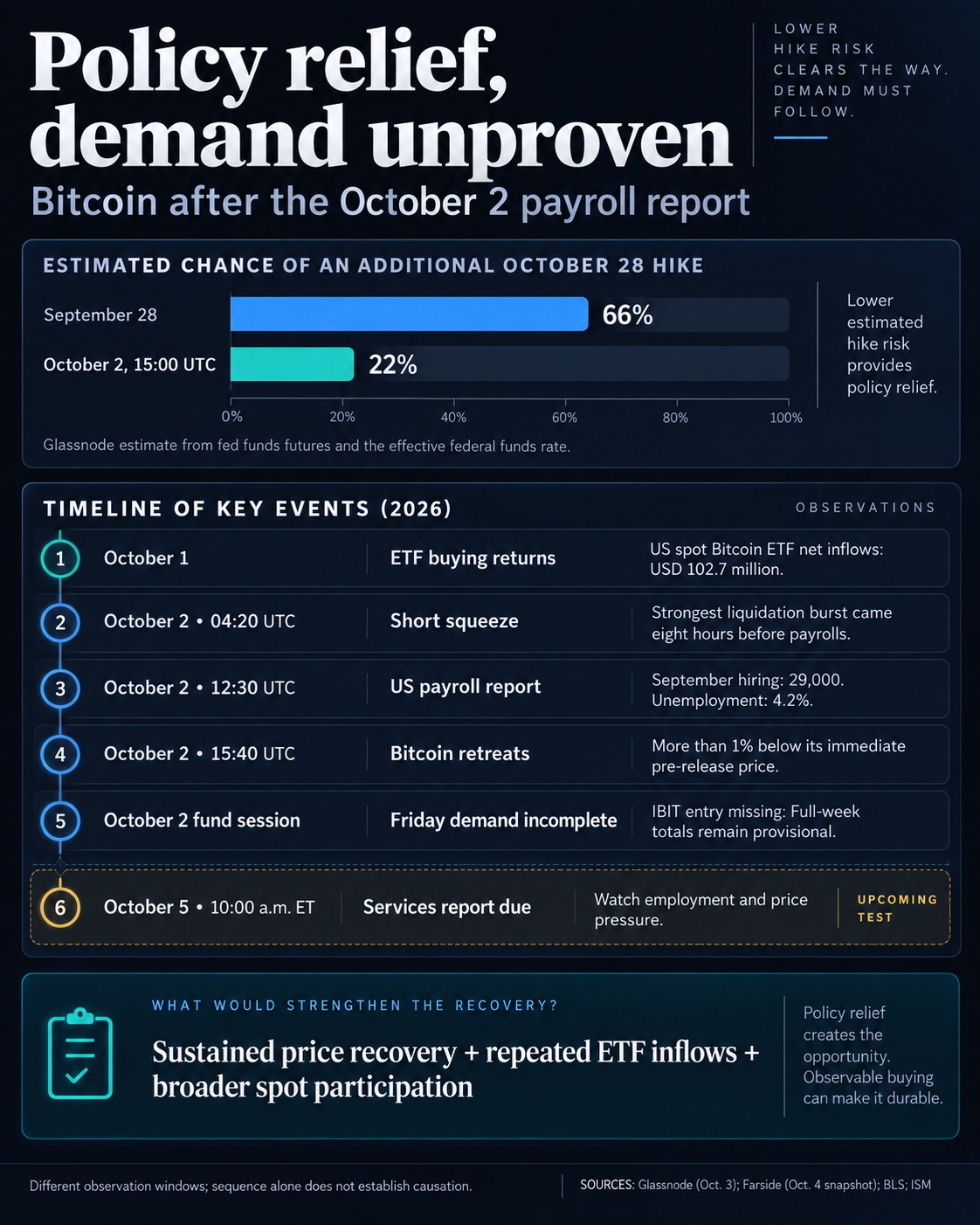
Glassnode's Oct. 3 post-payroll study estimated the probability of an additional quarter-point hike at the Oct. 28 meeting fell from 66% on Sept. 28 to 22% by 15:00 UTC on Oct. 2. The estimate comes from Glassnode's calculations using fed funds futures and the effective federal funds rate.
The timing of the strongest forced buying is revealing. Glassnode measured $50 million of short liquidations in ten minutes at 04:20 UTC on Oct. 2, eight hours before the jobs release. By 15:40 UTC, Bitcoin was more than 1% below its immediate pre-release level.
Short sellers can add buying pressure when rising prices force them to close their positions. Once those positions are closed, maintaining the higher price requires other buyers to absorb continuing offers. Friday's sequence supports caution about extrapolating the overnight advance into lasting investor commitment.
Open interest, the value of outstanding futures positions, rose $2.1 billion in the 24 hours before payrolls, according to Glassnode. Positions also grew about 2.5% when measured in coins. Open interest then fell $1.5 billion after continuing to rise for roughly an hour following the release.
The dollar change tracks outstanding exposure and is affected by valuation; investment capital lost is a different measure. The study's sequence links expanding positions to the advance and their subsequent retreat to falling prices, while leaving the cause of the reversal unresolved.
The fund market supplies a separate piece of evidence. US spot Bitcoin ETFs recorded net inflows of $102 million on Oct. 1, according to Farside Investors' flow table.
That positive session followed Wednesday's redemptions, showing that fund buying had returned before payrolls. It gives the recovery more substance than a short-covering explanation alone. Thursday's flow, however, describes a session before the report, leaving Friday's response to be measured separately.
Repeated inflows would extend Thursday's evidence across more sessions and show whether investors keep committing money after the release. Renewed redemptions would instead put that positive day in the context of a recovery struggling for sustained fund support.
Participation also matters beyond fund subscriptions. In its Sept. 30 market study, Glassnode put combined spot-exchange and US spot-ETF trading volume at about $6.4 billion a day, near the bottom of its range since the ETFs launched. That pre-payroll assessment provides a dated baseline for judging whether activity broadens.
Trading volume measures transactions, including repeated trades. A rise would indicate greater activity, while fund flows provide a separate measure of subscriptions and redemptions. Read together with price, these observations can help distinguish broader participation from an advance dominated by the closing of futures positions.
Monday tests the path from policy relief to buying
The latest observed Fed decision was a rate increase. Its Sept. 16 announcement raised the target range by a quarter percentage point to 3.75%-4%. Falling October hike odds leave that increase in place; a cut would require a separate policy decision.
The September employment report, released on Oct. 2, recorded 29,000 payroll gains and 4.2% unemployment. The Bureau of Labor Statistics described both as little changed. Slower hiring can give policymakers reason for patience, making the report relevant to the next decision even while September's increase remains the policy baseline.
Longer-term rates present another hurdle. Glassnode's Friday intraday study showed short-term yields falling while long-term yields rose, with the ten-year near 5.2%. That divergence matters because a reduced prospect of further Fed hikes can coexist with elevated longer-term borrowing costs.
For Bitcoin, the benefit depends on how investors respond. A more favorable outlook for the next policy meeting may encourage additional exposure. Whether that becomes sustained buying must be observed in the market, alongside the financing conditions investors still face.
The Institute for Supply Management's September services report is scheduled for Monday, Oct. 5 at 10:00 a.m. ET. Its previous August survey combined a headline PMI of 55.4 with employment at 47.8 and a prices index of 72.6: expanding activity, contracting employment and broad input-cost pressure.
That combination makes the next report's details relevant alongside its headline. Softer employment accompanied by easing price pressure could reinforce the argument for policy patience. Persistent price pressure or stronger activity could complicate it. The services release therefore supplies a fresh check on the rate outlook that emerged from payrolls.
The next US ETF sessions will show whether fund investors keep buying as the market absorbs that outlook. Their timing matters: flows reported after the release can extend the evidence beyond the Thursday inflow already recorded, while a completed Friday row would clarify the initial response.
Bitcoin stood above $85,000 in Sunday's snapshot but below its pre-payroll $86,000 area. Sustaining a recovery toward that level with repeated fund inflows and stronger spot participation would weaken the demand concern. Another rejection without those supporting signals would strengthen it. Those combined observations would give holders firmer evidence of follow-through than a lower hike-probability estimate alone.
The post Bitcoin’s $85,000 recovery awaits proof that ETF investors kept buying after payrolls appeared first on CryptoSlate.
Bitcoin Core has added a safeguard against signing transactions that may not bind funds to the payment destination a user approved.
The change, merged into Bitcoin Core’s master development branch on Sept. 25, targets a narrow flaw in partially signed Bitcoin transactions, or PSBTs, that could produce a valid signature without protecting the intended output.
Bitcoin Optech highlighted the update on Oct. 2. The issue does not expose a user’s private key, but creates a different risk: a signature can remain valid even when the transaction’s recipient is changed under specific conditions.
The weakness involves SIGHASH_SINGLEwhich is a signing mode designed to commit an input to the output in the corresponding position. If the transaction contains no output at that position, the protection breaks down differently depending on the type of Bitcoin being spent.
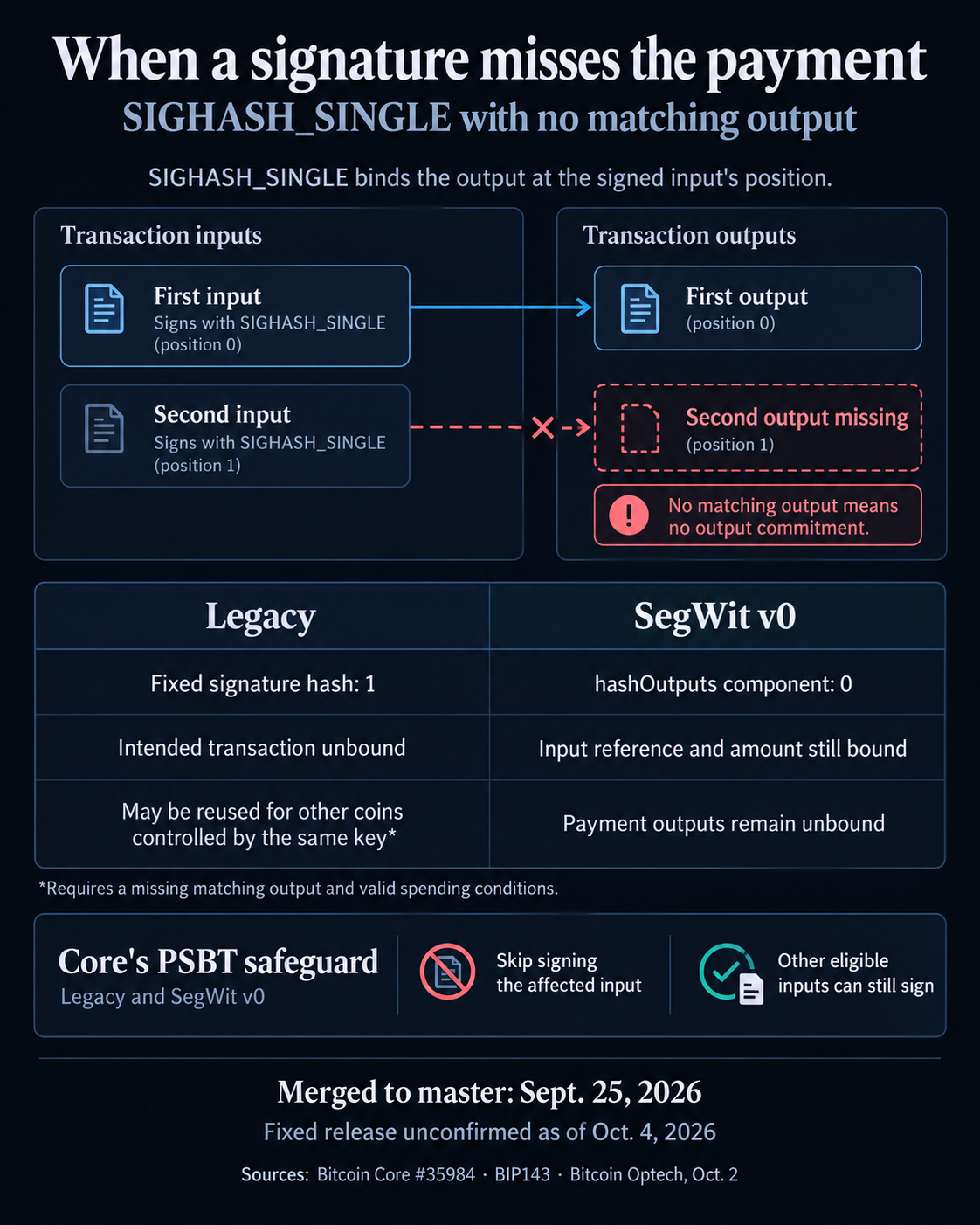
For legacy inputs, the missing-output case can produce a signature over a fixed hash value. Bitcoin Core developers said that signature may then be reusable against other unspent outputs controlled by the same key when the same structural conditions are present.
SegWit v0 transactions retain stronger protections because the signature still commits to the specific coin being spent and its amount. The destination output, however, can remain unbound.
That creates an authorization problem for wallets and signing devices: software could present one payment to the user while producing a signature that does not cryptographically guarantee that the approved recipient remains unchanged.
Bitcoin Core blocks the risky signing request
Bitcoin Core already rejected the edge case through its raw-transaction signing interface. Its PSBT path, including walletprocesspsbtcould still sign it.
The new code moves the check into Bitcoin Core’s shared signature-creation logic, preventing affected legacy and SegWit v0 inputs from being signed while allowing other valid inputs in the same PSBT to proceed.
PSBTs are commonly used to coordinate transactions between software wallets, hardware devices and offline signers. They allow transaction builders to pass information to a separate signer without giving that system control of the private keys.
The fix therefore reinforces a boundary that wallet developers must enforce independently of key security: a valid cryptographic signature must commit to the transaction details the user actually authorized.
Bitcoin Improvement Proposal 174, which defines PSBTs, already tells signers to reject unacceptable signing modes and recommends SIGHASH_ALL when no alternative is specified. The Bitcoin Core change explicitly prevents this missing-output configuration from reaching the signing stage.
Users do not yet have a confirmed production release containing the safeguard. The Sept. 25 change was merged into Bitcoin Core’s development branch, while the project’s published release listings had not identified a fixed version or confirmed backport as of Oct. 4.
That leaves wallet providers and hardware-signing integrations with the more immediate decision: review their own handling of SIGHASH_SINGLE requests rather than waiting for a Bitcoin Core release to enforce the same protection downstream.
The post Bitcoin Core’s new fix closes gap that could redirect funds without stealing keys appeared first on CryptoSlate.
CryptoTicker.io
At comdirect you have been able to bet on Bitcoin and Ethereum for years without owning a wallet. What you do not get is a real coin: the bank puts crypto certificates into your securities account, that is, debt instruments tracking the price. How much this route costs you hangs on a single figure from the price list, the minimum fee of 9.90 euros per order. Anyone investing 100 euros in one go therefore pays 9.90 percent in fees. Anyone investing the same amount through a savings plan currently pays nothing.
We evaluated the product page and the schedule of prices and services on October 4, 2026 and recalculated the costs for order sizes from 50 to 25,000 euros. The result separates two groups of investors very clearly from one another.
Crypto trading at comdirect means a certificate, not a coin
comdirect is a brand of Commerzbank AG. On the product page there is the sentence that explains the whole construction: you are not buying a “‘real' coin (cryptocurrency), but a derivative on that cryptocurrency”. The security tracks the price almost one to one, in both directions.
A crypto certificate, often also called an ETP for exchange traded product, is an exchange-listed bearer debt instrument: a loan to the issuer whose repayment is tied to the price of an underlying. That is the decisive difference from an investment fund. comdirect writes it itself: with ETPs and certificates there is “no protection against the insolvency risk of the issuer”. An ETF, by contrast, is ring-fenced assets and stays untouched if the fund company fails.
In practice that means: the units sit in your comdirect securities account like shares or fund units. You do not need a wallet, and you do not get a private key either. Anyone wanting to hold Bitcoin in their own custody is in the wrong place here. Anyone who instead wants everything bundled in one securities account and deliberately forgoes key management gets exactly that.
29 crypto certificates from five issuers: our count
comdirect's savings plan promotion lists the participating securities individually by issuer. We counted them. This analysis was carried out by cryptoticker.io itself on October 4, 2026; the basis is the product page on crypto trading, and 29 securities identification numbers were checked.
The distribution by issuer: 21Shares supplies 15 securities, Bitwise 5, VanEck 5, nxtAssets 3 and Invesco 1. Of the 29 certificates, 22 relate to a single cryptocurrency, the remaining 7 to baskets and indices such as the Krypto Basket 10 or the Krypto Mid-Cap Index.
Twelve cryptocurrencies are covered individually. Five securities run on Bitcoin, 4 on Ethereum, 2 each on XRP, Cardano and Solana, plus one each on Bitcoin Cash, Polkadot, Stellar, Polygon, Litecoin, TRON and Avalanche. What is missing from the list stands out: no security on Dogecoin, none on Monero, none on the big perpetual or staking tokens of the past two years. Anyone wanting to spread more widely has to move to an exchange with a MiCA licence or to a broker with a larger product universe; which providers carry what is shown by our comparison of crypto brokers.
A note beneath the 21Shares tables deserves a sentence of its own: the issuer is domiciled in Switzerland, “so that in the event of the issuer's insolvency Swiss insolvency law applies”. That concerns more than half of the promotion's securities.

Order fee on a one-off purchase: 4.90 euros plus 0.25 percent
For purchases outside a savings plan the normal schedule of prices and services applies. For execution in Germany it sets a basic fee plus order commission of 4.90 euros plus 0.25 percent of the order volume, a minimum of 9.90 euros up to an order volume of 2,000 euros and a maximum of 59.90 euros. On top of that there can be venue-dependent charges and third-party costs. An order by telephone costs an extra 14.90 euros, by fax or letter likewise 14.90 euros. The heavy-trader discount of 15 percent expressly does not apply to savings plan executions.
New securities account customers get a reduction: 3.90 euros order fee per trade on German trading venues and in over-the-counter trading, limited to 12 months. A new customer is anyone who has not held a securities account at comdirect in the past six months. Once those twelve months are up, you trade from 9.90 euros per trade again.
Minimum fee of 9.90 euros: the cost ratio from 50 to 25,000 euros
With small amounts the minimum fee is the entire price. We ran the formula from the price list through typical order sizes, without spreads and product costs, so as a pure fee ratio on the order volume.
| One-off investment | Order fee | Share of the amount invested |
|---|---|---|
| 50 euros | 9.90 euros | 19.80 percent |
| 100 euros | 9.90 euros | 9.90 percent |
| 250 euros | 9.90 euros | 3.96 percent |
| 500 euros | 9.90 euros | 1.98 percent |
| 1,000 euros | 9.90 euros | 0.99 percent |
| 2,000 euros | 9.90 euros | 0.50 percent |
| 5,000 euros | 17.40 euros | 0.35 percent |
| 10,000 euros | 29.90 euros | 0.30 percent |
| 25,000 euros | 59.90 euros | 0.24 percent |
Two thresholds shape the table. Up to an order volume of 2,000 euros you always pay 9.90 euros, because the formula of 4.90 euros plus 0.25 percent still sits below the minimum amount there; at exactly 2,000 euros the two values meet. At the upper end the cap of 59.90 euros kicks in, from an order volume of 22,000 euros. Anyone investing larger sums in one go therefore pays more in absolute terms but steadily less in percentage terms.
A plain relationship follows from this: small one-off purchases of crypto certificates are expensive at comdirect. An entry with 100 euros costs almost a tenth of the amount invested before the price has moved at all. At an exchange with a MiCA licence, trading fees for the same amount are typically in the range of tenths of a percent plus spread; which providers are licensed in Germany and what they charge is in our overview of crypto exchanges.
Savings plan promotion until December 31, 2027: the 1.5 percent is waived
Here the calculation flips into the opposite. For the 29 securities on the promotion list, the order fee of 1.5 percent of the order volume per transaction and securities identification number is waived in a savings plan until December 31, 2027. You can invest from 1 euro a month, and up to ten securities can be set up in one pass. Market-standard spreads, inducements and product costs are unaffected by this, as are telephone, fax and letter surcharges.
What that means in figures is shown by a year at 50 euros a month. Normally 1.5 percent would be due on the annual total of 600 euros, that is 9.00 euros in order fees, spread across twelve executions. Under the promotion it is 0.00 euros. The same amount as a one-off purchase costs 9.90 euros. In this product segment the savings plan is therefore not only the more convenient option but, until the end of 2027, by far the cheaper one as well.
Two restrictions belong with it. First, the promotion is time-limited, and comdirect expressly reserves the right to change, extend or end the offer at any time. Second, it does not apply to every type of securities account: accounts of customers who are looked after by a financial services provider, as well as Pure accounts, are excluded. If a certificate drops out of the promotion, the regular terms apply to that security again.
Issuer risk with an ETP: a debt instrument without insolvency protection
The product construction is the point at which crypto certificates differ from everything else in a securities account that otherwise looks like a fund. As a bearer debt instrument, the security carries the risk that the issuer becomes insolvent. comdirect names this issuer risk in its own list of risks and refers to the respective issuer for details of the collateral.
The usual collateral runs through physical backing. According to the account on the product page, the issuers buy the underlying cryptocurrencies in the corresponding quantities and deposit them with independent trustees licensed as custodians for cold wallets. A cold wallet means a storage medium that is not connected to a computer at all, or only briefly. Whether and how far an individual security is backed in this way is disclosed by the issuer in the product details; that belongs to the information you should read up on in the prospectus before buying, not in the marketing copy.
How this product family relates to genuine funds and to the exchange-traded crypto products in Germany is set out in our overview of crypto ETFs in Germany. The short version: what is sold in Germany as a crypto ETF is in most cases legally an ETP or ETN, and therefore exactly the construction comdirect offers.

Spread and product costs: the items beside the order fee
The order fee is the visible part of the costs, but not the only one. In every statement of terms on crypto trading, comdirect names three further items: market-standard spreads, inducements and product costs. The spread is the difference between the bid and the ask price and arises on purchase as well as on sale. The product costs are the issuer's ongoing management fee, which is taken from the security daily and which, with crypto ETPs on the market, is usually well above that of equity ETFs.
For an honest calculation that means: the fee ratio in the table above is a lower bound. The figure names only what the bank takes for execution and says nothing about the ongoing costs of the security. The two values sit in different documents, one in the bank's schedule of prices and services, the other in the issuer's key information document. Anyone looking only at the order fee is comparing half the bill.
Holding period and tax: an ETP in a securities account versus the coin on an exchange
For tax purposes a certificate and a coin are two different things, and the classification depends on the concrete design of the security. comdirect makes no statements on tax on the product page, and we are not asserting any here that cannot be substantiated. What you should clarify before buying is therefore a question for the issuer and for your own tax adviser: is the security treated as an investment product or as a disposal of the underlying cryptocurrency? That determines whether a holding period plays any role at all.
That this question is currently in motion is shown by the Federal Ministry of Finance's draft bill on crypto taxation, which we reported on on October 2, 2026 and which is due to go before the cabinet on October 14. As long as nothing has been decided there, the state of affairs remains today's. For the cost question in this article that changes nothing; for the after-tax return it can change a great deal.
Cost comparison with neo-brokers and licensed exchanges
comdirect plays a clear role in this product class. The bank is strong if you hold a securities account there anyway, think in securities and want to put small amounts into a certificate each month: until the end of 2027 execution in a savings plan costs you nothing. The offer fits less well if you want to buy irregularly and in small sums on a one-off basis, because the minimum fee of 9.90 euros then eats up any return before it arises.
Anyone wanting real coins with their own key will find no offer at comdirect and needs an exchange with a MiCA licence. Anyone wanting to use a hardware wallet needs one in any case. And anyone looking above all at the ongoing costs should lay the issuer's key information document next to the bank's price list before deciding on a route.
Crypto at comdirect: How to proceed now
- Measure your planned order size against the table above. If your one-off amount is below 1,000 euros, execution costs you at least one percent; in that case the savings plan with 0.00 euros in order fees until the end of 2027 is the cheaper route, and you will find suitable alternatives along with their costs in our broker comparison.
- Check the issuer's key information document for the ongoing product costs and the type of collateral. For the 15 securities from 21Shares, Swiss law applies in the event of insolvency; that is stated on comdirect's product page. How these securities are to be classified legally is explained by our overview of crypto ETFs in Germany.
- Decide deliberately about custody. A certificate gives you no private key; if you want one, the route runs via a licensed exchange and from there onto your own device, for which our hardware wallet comparison shows the selection.
What to take away from this: the offer is not crypto trading in the narrower sense but a securities transaction on crypto prices. 29 certificates from five issuers cover 12 cryptocurrencies individually; Dogecoin and Monero are missing. The savings plan carries no order fee until December 31, 2027, while a one-off purchase costs at least 9.90 euros and therefore 9.90 percent on an investment of 100 euros. On top of that come the spread and the product costs, which are waived in neither case. The primary source for all the offer details is the page on crypto trading at comdirect; the fees are in the bank's schedule of prices and services as at June 2026.
(As of October 4, 2026. This article is not investment advice. Prices and fee structures change; check the terms with the provider before you buy.)
The breach at the crypto exchange Bitget of September 24, 2026 now has a sender: in early October the analytics firm Chainalysis attributed the theft of around $387 million to actors with ties to the Democratic People's Republic of Korea. For you as an investor in Germany that attribution changes nothing about your balance, but it does change the risk assessment: anyone who suspects a state-backed team behind an attack expects a series rather than an isolated case. This piece sorts out what is documented, and what follows from it for custody, choice of exchange and record-keeping.
$387 million in 23 transfers: how the Bitget hack unfolded
The attack of September 24, 2026 hit a hot wallet of the exchange, meaning a holding that is permanently connected to the internet and services withdrawals. A hot wallet is the counterpart to a cold wallet, whose keys sit offline. That very reachability makes it a target: whoever controls the keys can transfer immediately.
On Chainalysis's account, around $387 million left the exchange within three hours, spread across 23 individual transfers. Depending on the report the sum is given as $387 million to $388 million; the range comes from different valuation moments for the tokens that were moved. Three hours is a long time in this context. It is enough to spread money across several networks, and it is not enough to freeze it if nobody is watching.
The exchange reacted in stages. Withdrawals stood still at first, after which Bitget says it reopened them step by step from September 28. As cryptoticker.io reported on September 29, 2026, customers pulled out a net total of around $463 million in the days that followed, which is more than the attack itself cost. That is the second damage of a hack, and it hits the exchange, not the attacker.
The attribution to DPRK-linked actors and its limits
An attribution in blockchain forensics is neither a confession nor a court ruling. It is a statement of probability resting on patterns: recurring addresses, known exchange services, typical sequences used in obfuscation, windows of activity. Chainalysis works with a stock of addresses that has grown over years out of investigations, exchange data and its own observations.
What holds up in such an attribution is that money trails can be reconstructed. What holds up less well is any statement about who sat at the keyboard. The analysts' wording therefore stays deliberately cautious and speaks of actors with ties to the DPRK, not of an authority or a person named outright. You should read that caution along with the finding whenever headlines turn an attribution into a fact.
For practical purposes the cautious version is enough. Whether an attacker is state-funded or not changes the probability that the same method resurfaces in three months. State-backed teams work for the long term, with a budget and with patience.
Ethereum, XRP, Zcash and Tron: the four chains in the outflow
The money did not stay in one network. Chainalysis puts the distribution across four chains: 49.7 percent flowed over Ethereum, 40.8 percent over XRP, 7.6 percent over Zcash and 1.8 percent over Tron. That split is not a coincidence but a division of labour.
Ethereum carries the deepest liquidity and most of the decentralised trading venues where tokens can be swapped without opening an account. XRP delivers fast and cheap transfers with short confirmation times. Zcash allows shielded transactions in which the amount and the parties stay hidden in the protocol. Tron is a widely used route for stablecoin movements at low cost.
The Zcash share is the most delicate part of the trail. As early as September 30, 2026, cryptoticker.io described how 2,746 ZEC from this complex moved into a shielded pool. What goes in there cannot be followed any further from outside as long as it stays in. What remains to be watched is the exit: at some point money has to reach an exchange in order to become national currency, and that is where identity checks and anti-money-laundering supervision apply.
To put the orders of magnitude in context: Zcash traded at around $1,336 on Sunday evening, a good 17 percent below the level of the previous week, Ethereum at about $2,706 and XRP at around $1.51, in each case according to CoinGecko. The prices say nothing about the hack; they only show how large the markets were through which the money ran.

Cross-chain bridges and mixers: where the money went after the outflow
After the outflow the second phase begins, the obfuscation. Chainalysis names four tools for it: bridges, cross-chain liquidity protocols, mixers and decentralised exchanges. A bridge is a service that locks a value in one network and releases an equivalent in another. It does not break the trail, but it cuts it into two parts that have to be reassembled first.
A cross-chain liquidity protocol goes one step further. On this account the investigators followed stolen XRP through such a protocol, which paid out Bitcoin at the end instead of sending the tokens straight to an exchange. From a tracing perspective that means: the same money leaves the service in a different currency and in a different network, and the connection consists only in the closeness in time and in the size of the amounts.
A mixer, in turn, pools deposits from many users and pays them out freshly mixed. Decentralised exchanges, finally, swap tokens without any account being opened. None of these tools is forbidden in itself, and each has legitimate uses. Chained one after another they produce a sequence that costs investigators time. It is precisely that time the technical part of the report addresses.
One billion dollars in 2026: the tally of DPRK-attributed thefts
With the Bitget case, the sum of crypto thefts that Chainalysis attributes to groups with DPRK ties in 2026 passes the mark of one billion dollars. That figure is an annual total from several incidents, not an assessment of a single attack.
A look at the market as a whole helps to place it. On October 2, 2026 cryptoticker.io reported that losses from crypto hacks in the third quarter of 2026 came to $1.26 billion in total, the highest level of any quarter. A single incident of $387 million accounts for just under a third of that. Concentration of this kind is the more important information for investors than the annual total, because it shows where the risk sits: with large, centrally custodied holdings.
What makes an exchange hot wallet so attractive
An exchange has to be able to pay out at any time. For that it keeps part of its client holdings in wallets whose keys sit on systems reachable online. The larger the exchange, the larger that pot. An attacker who gets inside once reaches more in a single go than they would take in a hundred attacks on individual users. That is the structural reason why exchange holdings are regularly the target of such operations, and no attribution changes it.
AI-assisted tracing cuts bridge matching to under ten minutes
The second notable part of the report concerns the tool, not the perpetrator. Chainalysis states that it deployed an in-house AI automation in order to match transfers across bridges to one another. That matching is manual work: for every entry on one chain you look for the matching exit on the other, via timestamps, amounts and fees. According to the firm, a task that would have taken more than 20 hours shrank to under ten minutes.
That figure comes from the provider itself and cannot be verified from outside. It is plausible nonetheless, because pattern recognition across large volumes of data is exactly the strength of such methods. The consequence is a shift in tempo: obfuscation stays cheap, tracing gets faster. Anyone sending money through five stations now gains hours rather than weeks.
For you this has a tangible side effect. The faster addresses are flagged as tainted, the more likely an exchange is to freeze affected deposits. That also hits users who happened to receive tokens through a decentralised swap that was fed with flagged funds. Anyone swapping larger amounts via unknown counterparties carries that risk too.
What the hack means for a balance held on a crypto exchange
The most important distinction is the one between possession and claim. If your coins sit with an exchange, you hold no keys. You hold a claim against the company. As long as the company works, you never notice the difference. If it fails, its solvency decides whether you get your balance back.
No blanket verdict against exchanges follows from that. Without an exchange there is no way to buy, and for small amounts in constant motion custody there is practical. The question is the size. An amount whose loss would genuinely hurt you belongs in a form of custody where you hold the key. Which devices do that and how the models differ is shown by our hardware wallet comparison with the current terms.
A second point concerns spreading. Several smaller holdings with different providers lower the risk of a single failure but raise the effort for records and fees. There is no solution here without a drawback, only a decision that fits your own sum.

Protection fund, reserves and withdrawal deadlines at Bitget
After the attack, Bitget says it topped its protection fund back up to around $309 million. A fund of that kind is a voluntary reserve held by the company, not a deposit guarantee scheme. There is no statutory guarantee behind it, no claim to compensation and no authority that steps in if it fails. The size of a fund says something about a provider's intention, nothing about an assurance.
Equally important is the question of records. Reserve attestations, often called proof of reserves, show at one point in time that holdings exist. They do not show that no liabilities stand against them. A complete proof would need both sides of the balance sheet and an independent audit. So anyone reading a reserve statement is reading a snapshot.
MiCA licence and the BaFin register: the legal framework in Germany
Since the EU-wide transitional period ended on July 1, 2026, every provider delivering crypto-asset services in Germany needs a licence. The basis is the European regulation on markets in crypto-assets, MiCA for short, supplemented in Germany by the Crypto Markets Supervision Act. Which obligations that brings for providers is something our overview of the MiCA licence and its duties sets out.
In practice that means two things. First, there is a register in which you can check whether a company is supervised: BaFin's company database lists licensed institutions and is open to the public. Second, a licence does not mean that a provider is safe against attacks. It means that there are requirements on organisation, own funds and complaint channels, and a supervisor that can intervene.
An attack on an exchange outside this framework has an unpleasant consequence for you: there is no body you can turn to. With a provider licensed in the EU, the regulation sets deadlines for handling complaints. With a provider without a licence, what remains is the route through a foreign court, and for small sums that route is effectively barred.
Self-custody, seed phrase and hardware wallet: holding coins outside the exchange
Self-custody means that you hold the private keys yourself. As a rule a recovery phrase secures it, the seed phrase, usually twelve or 24 words. Whoever has those words has the coins. The whole practice follows from that: the phrase is generated on the device, it is never typed out, never photographed, never stored in a cloud and never entered into a form that asks for it.
A hardware wallet is a device that generates the key and confirms transactions without handing it over. It protects against attacks on your computer and against the failure of an exchange. It does not protect against the loss of the recovery phrase and not against a signature you give yourself on a faked page.
The quiet tax question when you move
Moving your own coins from an exchange into your own wallet is not a sale and triggers no tax in Germany, because there is no disposal. What matters are the records: the acquisition date and the acquisition cost do not travel with them automatically. Anyone who wants to prove the one-year holding period later needs the original statements. So pull the documents out before an account is closed, because after that access to the history is often gone.
Fake job offers as a way in: the second DPRK method
Alongside attacks on exchange systems stands a second method that hits individual users and developers. On September 19, 2026 cryptoticker.io described how malware was distributed via fake job offers and supposed interviews, with which wallets could be emptied. The pattern is always similar: an attractive offer, a file or a code project you are supposed to run locally, and time pressure that cuts the thinking short.
The protection against it is banal and effective. Someone else's code does not run on the machine that holds a wallet. Anyone working with crypto professionally separates the work device from custody. And no serious employer asks for a recovery phrase, a wallet export or a test transfer.
The link to the Bitget case lies in the goal, not in the technique. The same annual total of more than a billion dollars is fed by both routes: the big breach at a custodian and the patient work on individual keys.
Bitget hack: Your next three steps
- Sort the place of custody by size of amount. Decide which sum you leave sitting on an exchange and shift the rest into your own wallet. If you need an exchange with an EU licence as a starting point, you will find the licensed providers in our overview of regulated crypto exchanges.
- Harden access and recovery. Two-factor protection via an app instead of by SMS, your own withdrawal address list and a recovery phrase that exists only on paper or metal. For smaller amounts without a dedicated device, the software wallet comparison shows which apps keep the keys locally.
- Secure your records while you still have access. Pull statements, purchase dates and transfer receipts from every account you shrink or close. A portfolio tracker does this on an ongoing basis; which tools carry the holding period per account is in our overview of crypto tax tools.
The attribution of the theft changes nothing about your holding. It changes the expectation: an opponent with a budget and patience comes back, and the cheapest precaution remains not holding everything in one place. Decrypt described the attribution in detail.
(As of October 4, 2026. This article is not investment advice. Prices and fee structures change; check the terms with the provider before you buy.)
The Crypto Markets Supervision Act, or KMAG for short, is the German law that enforces the European regulation on markets in crypto-assets. For you as a customer it has one very practical consequence: anyone offering crypto-asset services in Germany needs a licence for it, and the Federal Financial Supervisory Authority is allowed to name providers that lack one. That is exactly what the regulator is doing at the moment, almost daily.
Between late September and early October, BaFin published nine consumer notices on unauthorised business within four days. Five of them concern crypto-asset services, and five close by expressly citing “section 37(4) of the Banking Act, section 10(7) of the Crypto Markets Supervision Act”. That single line at the foot of the notices is the real finding: Germany's young crypto supervision law has moved out of the licensing department and arrived in consumer warnings.
The Crypto Markets Supervision Act is Germany's implementation of the MiCA regulation
The KMAG dates from December 27, 2024 and appears in the Federal Law Gazette 2024 Part I under number 438. It was last amended on March 25, 2026. Its opening section states in one clause what it is for: it “serves to implement Regulation (EU) 2023/1114”, the regulation on markets in crypto-assets known as MiCA.
The division of labour behind this matters for understanding the case. The European regulation prescribes what applies: which licence a provider needs, what obligations it carries, which information it has to publish. The KMAG governs who enforces that in Germany, and with which instruments. The regulation applies directly across Europe; the act puts the tools in BaFin's hands.
Why the law carries its own name although MiCA applies directly
An EU regulation takes effect without a national implementing act, but it contains no German procedural rules. Who issues an order, how you challenge it in court, which fines are possible, when an authority may go public: all of that has to be written by the national legislator. The KMAG is that supplement. It entered into force as Article 1 of the Financial Market Digitalisation Act and replaced the crypto rules in the Banking Act, where they had been housed until then as the “crypto custody business”.
Section 10(7) KMAG allows BaFin to name a company in public
The provision the warnings rest on is headed “Prosecution of unauthorised business”. The first sentence of subsection 7 reads: “Insofar and for as long as facts justify the assumption, or it is established, that an undertaking provides unauthorised business within the meaning of section 9(1) sentence 1, the Federal Authority may inform the public of the suspicion or of that finding, stating the name or the company name of the undertaking.”
Three things about it are worth keeping in mind when you read a warning of this kind.
First, a suspicion is enough. BaFin does not have to wait until a court has ruled; facts that justify the assumption suffice. That is why the notices almost always carry the formula “there is a suspicion” and not the claim that somebody has committed fraud.
Second, the provision also covers firms that do no business at all but behave as though they did. Sentence 2 of the subsection makes clear that the same power applies where an undertaking “does not provide the unauthorised business but creates a corresponding impression in public”. That catches the sham platforms which only collect contact details.
Third, the procedure is not one-sided. Sentence 3 directs: “Before the decision under sentence 1 or sentence 2, the undertaking shall be given a hearing.” A warning therefore stands at the end of an administrative procedure. Where BaFin reaches nobody because no one behind a website is identifiable, the notice simply calls them “the unknown operators”.
Five of nine consumer notices from four days concern crypto-asset services
Between September 28 and October 1, 2026, BaFin published nine consumer notices on unauthorised business. Counted in the full text of each individual notice, this is the picture:
- Five notices name the term “crypto-asset services” expressly.
- Five notices list the Crypto Markets Supervision Act at the foot as the legal basis.
- Four of them do both, so the two sets do not overlap completely.
- Three cases describe identity misuse at the expense of a genuinely existing company.
That the two groups of five come apart is not a counting error but revealing. In the notice on btcx(.)investments of September 29 the wording is about banking business and financial services, yet the legal basis at the foot still names the Crypto Markets Supervision Act. Conversely, the notice on staublicapital(.)com from the same day lists crypto-asset services in its general part but does not rely on the KMAG. The supervisor is still sorting this out, and with a legal framework less than two years old that is to be expected.

The bitbucks(.)space case: identity misuse at the expense of a Stuttgart company
The most interesting of the five cases is the one from September 30. In its consumer notice, BaFin warns about offers on the website bitbucks(.)space and puts it like this: “There is a suspicion that the unknown operators of the website bitbucks(.)space are offering financial and securities services as well as crypto-asset services without authorisation.”
Then comes the sentence that sets the case apart from an ordinary fake broker: “Contrary to the operators' statements, there is no connection with Frank und Freunde GmbH, based in Stuttgart. This is a case of identity misuse.” BaFin expressly establishes that this company stands in no connection with the website and the services offered there.
That is an important distinction, and it holds in both directions. On the supervisor's account, the Stuttgart company named is the injured party in this matter, not the accused one. For you that means: the company name on a website, the imprint and even a genuine commercial register entry say nothing about who actually runs the page. We had a similar pattern back in August, when BaFin warned about a provider using a borrowed corporate identity.
28 nearly identical websites serve to solicit business, BaFin says
A day before the BitBucks case, on September 29, BaFin named a whole series of sites at once. The notice says the unknown operators were offering crypto-asset services there without a licence; the sites had no legally valid imprint. Interested parties were asked to enter their details in a contact form, and those customer records then went to operators of unauthorised online trading platforms.
28 addresses are listed in that single notice, from altrevia-ai(.)click through blitzkapitenz(.)live to zylkex(.)online. Several names appear with two or three different endings. The pattern behind it is cheap and effective: one template is duplicated, every copy gets a new invented name, and as soon as one address is burned the inflow runs through the next.
What a site without a legally valid imprint means in practice
In Germany an imprint is mandatory for commercial websites. If it is missing, or if it contains invented details, you have nobody you could sue in a dispute and no address for service of documents. That the supervisor mentions this point separately in the notice is therefore not a formality. It describes the state your money is in once you have paid it in.
The transitional licence under section 50 KMAG expired on December 31, 2025
When the new rules started there was a grace period. Section 50 KMAG allowed companies that were permitted to run crypto business under the old law on December 29, 2024 to continue their activity for the time being; the old licence counted “as continuing to that extent”. Among those affected were institutions with a licence under section 32 of the Banking Act, investment firms and payment service providers.
That transitional period is over. Subsection 2 of the section names three grounds for expiry, and the third is a hard calendar date: the continuing licence expires “at the latest at the end of December 31, 2025”. Since January 1, 2026 there is therefore no legacy arrangement left in Germany. Anyone offering crypto-asset services today must hold the licence under the MiCA regulation, or they are working without authorisation.
For the provider landscape that was a noticeable break, and it explains why the warnings are increasing right now. Which obligations came at the companies with it is something we gathered in our overview of the MiCA licence.
Ten services fall under the term crypto-asset service
Crypto-asset service is a defined legal term, not a loose description. In Article 3 the MiCA regulation lists exactly ten services and activities:
- Custody and administration of crypto-assets on behalf of clients
- Operation of a trading platform for crypto-assets
- Exchange of crypto-assets for funds
- Exchange of crypto-assets for other crypto-assets
- Execution of orders for crypto-assets on behalf of clients
- Placing of crypto-assets
- Reception and transmission of orders for crypto-assets on behalf of clients
- Advice on crypto-assets
- Portfolio management of crypto-assets
- Provision of transfer services for crypto-assets on behalf of clients
The list explains why almost every provider where you can buy, swap or simply leave Bitcoin falls under the licensing requirement. The plain exchange of euros into a crypto-asset is already number three on the list. An exchange that also holds balances provides at least two of these services at the same time. For an overview of trading venues with a licence in the EU, see our comparison of regulated crypto exchanges.
Where the licensing requirement ends
Not every piece of software is a service provider. A wallet that runs exclusively on your device and whose keys only you know legally holds nothing for you, because nobody else has control over the keys. As soon as a company controls access, the picture changes. Where exactly that line runs is something we broke down using the example of the licensing requirement for wallet apps.

BaFin's company database is the official register for licences
Each of the nine notices points at the end to the same place: BaFin's company database, where you can look up whether a particular company is licensed by the supervisor. This official register is freely accessible and costs nothing.
In addition, section 14 KMAG requires BaFin to announce the granting and the withdrawal of a licence to provide crypto-asset services in the Federal Gazette. So there are two official traces: the database entry as a status display and the announcement as an event. A search engine, a review portal or a tip in a chat group is not a third trace.
A concrete step-by-step guide to querying the database, including the usual stumbling blocks, is in our guide to BaFin warnings and checking a provider.
A licence covers supervision, not price losses and not a faked website
The BitBucks case shows the limit of this tool very clearly. An entry in the company database says that a particular company holds a particular authorisation. It says nothing about whether the website you are currently on belongs to that company. Anyone who copies a genuine company name produces a hit in the database that has nothing to do with their own offer.
That is why a check always includes a second step: the path leads from the database to the company's website, not the other way round. If the database shows an address in Stuttgart while the page asking you to deposit sits under an invented domain with no imprint, then the entry does not match the offer.
Even a genuine licence is no guarantee for your money. Behind it stand ongoing supervision, capital and organisational requirements and reporting duties. A promise of rising prices is not part of it, and neither is an assurance that a company will never become insolvent. Deposit protection for crypto balances does not exist in Germany in any case.
Hearing and correction: the procedure behind a BaFin warning
Because naming a company in public can hit it hard, the legislator built in counterweights. Before the decision, the undertaking has to be given a hearing. If the facts communicated by the authority later turn out to be wrong, or the circumstances to have been rendered inaccurately, the provision requires the supervisor to inform the public about that in the same manner.
For placing a warning in context that means: a notice of this kind is an official statement of suspicion within a regulated procedure, not a judicial finding and not a verdict on individuals. Serious reporting therefore carries the attribution with it. Where this text says that a suspicion exists against the operators of a site, that suspicion is BaFin's.
Section 45 KMAG governs the allocation of custodied crypto-assets in insolvency
One part of the act that is rarely mentioned concerns the most unpleasant case. Chapter 6 of the KMAG contains provisions for special situations, among them section 44 on insolvency and section 45 on the “allocation of custodied crypto-assets” and the costs of segregation. Behind that lies the question of whether crypto-assets a licensed custodian holds for you belong to the estate in its insolvency or remain allocated to you.
That the legislator regulates this point separately at all is an indication of how little the allocation can be taken for granted. With a provider that has no licence the question does not even arise in this form, because neither the separation of client holdings nor supervision over it is secured there. Anyone holding larger amounts has an alternative in self-custody, which works independently of a service provider's licensing status.
Crypto Markets Supervision Act: How to proceed now
Three steps that take a few minutes and mirror the sequence of the case of September 30.
- The database first, then the website. Look up the company name in BaFin's company database and go from there to the company's official address. If you are simply looking for a trading venue with a demonstrable licence in the EU, the comparison of regulated crypto exchanges helps as a starting point.
- Hold the offer and the entry against each other. Company name, registered office and type of authorisation have to match what is being offered to you. A licence for investment advice does not cover a crypto exchange. If you want to compare how established providers state their licence and their fees, you will find that in our overview of crypto exchanges.
- Spread the holdings you do not need for trading. A balance that sits permanently with a service provider depends on that provider's survival. Self-custody takes that dependency out; the devices and their differences are in the hardware wallet comparison.
The warning series from the end of September is not an isolated case and will not be the last. What has changed is the basis: since the Crypto Markets Supervision Act came into force and the transitional period ran out, a clear licensing requirement stands behind every one of these notices. That makes the check easier for you, because for crypto providers in Germany there is no grey area left that anyone could invoke.
(As of October 4, 2026. This article is not investment advice. Prices and fee structures change; check the terms with the provider before you buy.)
The Ethereum price stands at $2,702 on Sunday evening, or 2,399.90 euros, up 0.7 percent over 24 hours. The next target to the upside is no estimate. It is a level taken from Ether's own chart: $2,775, the high of 22 September, and therefore only 2.7 percent away. The question this weekend is not whether ETH clears those $73. What decides matters is who will be able to sell at all over the next three weeks, and who will not.
Because 812,887 ETH are sitting in the staking exit queue, a good $2.2 billion. Anyone joining that queue today gets their money back in roughly 22 days. This is a hard liquidity question for every European investor who holds ETH in staking and wants to remain able to act before the Glamsterdam upgrade on 4 November.
Ethereum price at $2,702: 2.7 percent below the September high, 21.6 percent above the 200-day line
Let us place the price first, so the levels later do not come out of thin air. The following values are taken from CoinGecko's daily price series over the past 365 days, as of 4 October.
- Current price: $2,702, or 2,399.90 euros
- 200-day line: $2,117.74, with the price 27.6 percent above it
- 50-day line: $2,500.34, with the price 8.1 percent above it
- High of the past 30 days: $2,775.17 on 22 September
- Low of the past 30 days: $2,397.50 on 16 September
- January 2026 high: $3,351.82 on 15 January, still 24.0 percent away
- Low for the year: $1,566.01 on 26 June
Two of those numbers carry the picture. First, ETH has closed above its 200-day line for 47 trading days in a row. That line is the average price of the past 200 days and serves as a rough divide between an upward and a downward phase. Second, the price has spent two weeks in a narrow band between $2,397 and $2,775, a corridor of some 16 percent. Together they describe a market that is neither breaking out nor breaking down.
812,887 ETH in the exit queue: $2.2 billion waiting for the way out
Staking your ETH means depositing it with a validator and helping to secure the network. There is a yield for that, but the coins are not freely available. The way back runs through a waiting queue, because the protocol releases only a limited number of validators per unit of time. That queue has become the number of the weekend.
According to validatorqueue.com, which sources its data from beaconcha.in, 812,887 ETH are queued to exit. At a price of $2,702 that is $2.2 billion, or roughly 1.95 billion euros. Measured against the 43.5 million ETH staked in total, it amounts to 1.87 percent. The estimated waiting time until exit is 14 days and 3 hours.
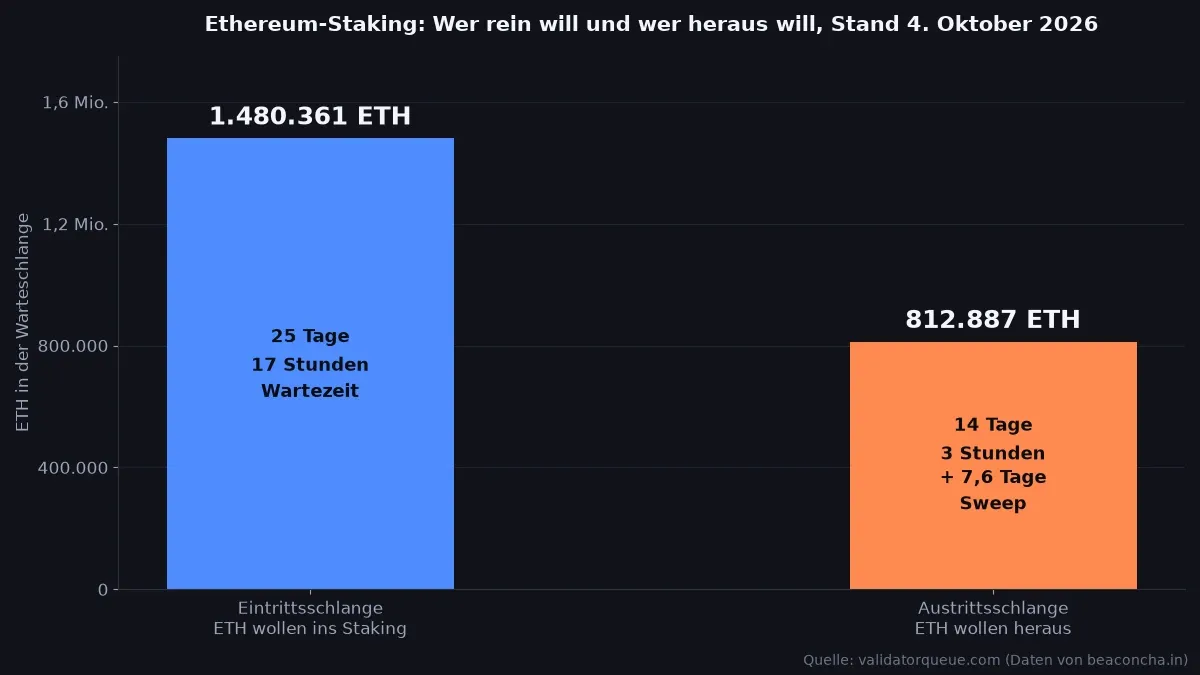
A sweep delay of 7.6 days: 14 days of waiting become about 22
Here lies the point most overviews leave out. Those 14 days and 3 hours are only the first half of the journey. After leaving the validator set, the balance still has to be transferred to the registered withdrawal address, and this so-called sweep works through the addresses in order. That currently adds 7.6 days.
In total, then, 21.7 days pass between the decision and the available balance. Start your exit on 4 October and your ETH lands on the withdrawal address on 25 October. Three weeks is a long time in a market that has moved 16 percent in two weeks. If you want to steer your position size through a possible dip in the price, staked ETH simply does not let you do it at short notice. That is the real cost of the 2.63 percent yield, rather than the yield itself.
In practice: split your holdings between the part that is to stay staked and the part that has to remain tradable. You will find an overview of the providers and their respective exit routes in our comparison of staking platforms, because the protocol deadline is only the floor. Centralised providers add processing times of their own, while decentralised liquid staking tokens can be sold on the market, though often at a discount to the ETH price itself.
The entry queue is larger: 1,480,361 ETH want to go the other way
An exit queue worth $2.2 billion sounds like flight. The counter-figure appears in the same overview and turns out to be considerably bigger: 1,480,361 ETH are waiting to be admitted into staking, with a waiting time of 25 days and 17 hours. That is 1.8 times the exit queue and corresponds to around $4.0 billion.
On balance, 667,474 ETH more want in than out. For the price question that is the more important figure. Every ETH that enters the entry queue is unavailable to the market as sellable supply for at least 25 days. In total, 35.61 percent of all ETH is staked, spread across 870,025 active validators. Read only the exit number and derive selling pressure from it, and you have read half the table.
Glamsterdam on 4 November: the Hoodi fork of 5 October is the last testnet stage
The date on which the queues and the price meet is in the developers' calendar. Glamsterdam is Ethereum's next major upgrade after Fusaka, and according to the overview at EIPs Insight the target date for mainnet is 4 November 2026. One stage comes before it: on 5 October, that is Monday, the Hoodi testnet forks. The Sepolia testnet went through the fork on 21 September.
In substance, Glamsterdam brings two changes worth knowing about, even if you do not run a validator yourself. EIP-7732 writes the separation of block proposal and block building firmly into the protocol, known as enshrined proposer-builder separation. EIP-7928 introduces access lists at block level, allowing a client to know in advance which data a block touches. Both aim to make it possible to raise the gas limit without overwhelming the requirements placed on a single node.
What a testnet fork actually means for you
A testnet fork is a dress rehearsal on a copy of the network without real value. For you as a holder, nothing changes on Monday: your ETH stays where it is, there is no swap, no new address and no action you would have to take. The date only becomes relevant if you run a validator yourself or sit with a provider that fails to update its clients in time. Either way, that is a question for your service provider.

The calendar arithmetic: start on 14 October and you are liquid by the upgrade
A date can be derived from those two numbers, and that date is the real value of this exercise. The upgrade targets 4 November. The way out of staking currently takes 21.7 days. So if you want free use of your ETH on upgrade day, you have to trigger the exit by 14 October at the latest. After that the time runs out.
One caveat belongs here in all honesty: the waiting times are not fixed values. How they develop depends on how many validators want out at the same time, and they can double or halve within days. The 14th of October is therefore not a guaranteed cut-off but the arithmetic based on today's queue. If you want to be safe, build in a buffer of a week and check the figure again before you start.
And there is the counter-question: do you actually need liquidity on 4 November? An upgrade is not an event that forces a sale. Fusaka went over mainnet without incident in December 2025. If you hold for the long term and want to collect the yield, you have no reason to leave staking because of a date. The arithmetic above applies to anyone with a concrete intention to sell.
The levels above: $2,775 from September, then $3,351 from January
Back to the price. The first level to the upside is the September high at $2,775.17. It is the point where the market turned two weeks ago, and it sits 2.7 percent above the current reading. As long as ETH stays below it, the price moves inside the band that has held since mid-September.
Only above it does the view open on the round $3,000 mark, which last held in early February of this year. The next demonstrable target after that is the January high at $3,351.82 from 15 January, currently 24.0 percent away. This is explicitly not a forecast; these are places where trading actually took place in the past.
The levels below: $2,500 as the 50-day line, $2,397 as the September low
To the downside, the first catch line is $2,500.34, the average of the past 50 days, 7.5 percent below the current price. Below that follows the September low at $2,397.50, some 11.3 percent lower. The 200-day line at $2,117.74 is far away at a distance of 21.6 percent and would be the level at which the run of 47 days above that line would end.
For practical purposes: if you work with a stop level, the round number 2,500 has the drawback that almost everyone else can see it too. The average happens to sit just beside it at 2,500.34. Choose a distance of a few percent below and you avoid the densest zone. And if you work with leverage, hold the 16 percent range of the past two weeks against your liquidation distance: at five times leverage, liquidation sits roughly 20 percent away, which is already within what the market has covered in 14 days.
2.63 percent staking yield: what 870,025 validators pay out over a year
The yield for which one accepts those 22 days of waiting currently stands at 2.63 percent a year. On a single ETH that works out at around $71 a year, and on a stake of 10,000 euros at roughly 263 euros, in each case before tax and before the provider's fee. The rate falls as more ETH is staked, because the protocol's payout is spread across more validators. The entry queue of 1.48 million ETH therefore tends to push this value down further.
The fee decides the net yield. Centralised providers usually keep between 10 and 25 percent of the proceeds, which turns 2.63 percent gross into somewhere between 1.97 and 2.37 percent net depending on the provider. A difference of 0.4 percentage points on 10,000 euros comes to 40 euros a year, and that is more than most people expect when they compare.
Holding period and the tax office: what the German BMF letter of 6 March 2025 sets out for staked ETH
For German private investors, the disposal period under section 23 paragraph 1 sentence 1 number 2 of the Income Tax Act applies to the sale of crypto assets. Once a year has passed since acquisition, a gain on the sale is tax free; before that it counts as a private disposal transaction and is taxed at the personal rate.
The clarification that matters for stakers is in the BMF letter of 6 March 2025: staking and lending do not extend that period. The 2021 draft had provided for an extension to ten years where crypto assets are used as a source of income. That rule never came into force. Hold your ETH for longer than a year and you do not lose the tax exemption on the gain simply because you staked it in the meantime.
The staking rewards themselves are to be looked at separately. These rewards count as other income in the year they accrue, and a holding period of their own begins for them on the day they arrive. Receive rewards in October and sell them in December and you have a taxable event there, even if the ETH originally staked is long outside the period. For documenting these two pots, our overview of tax tools and portfolio trackers is worth a look, because otherwise the inflow dates have to be pulled out of the statements by hand. This account does not replace tax advice; for your individual case, the word of your tax office or your adviser applies.
Holding and buying ETH under MiCA: what to check before your next step
Since the European crypto regulation MiCA has applied in full, providers in Europe need authorisation to offer custody and trading. For you as a buyer, three points are verifiable before you pay money into an exchange or hand ETH over to staking.
- The authorisation: does the provider appear in a public register with a MiCA licence or a licence under banking law, and which country does it cover? That information belongs in the legal notice, not just in the advertising.
- The custody arrangement: is your ETH held separately from the provider's own assets, and do you get proof of it? With a liquid staking token you do not hold ETH itself but a claim on it, and that claim can trade below the ETH price on the market.
- The costs across the whole route: purchase, custody, staking fee and withdrawal. The spread on the purchase is the item fewest people recalculate, because it is not shown as a fee. A side-by-side look at the terms belongs before the purchase rather than after it.
Ethereum price: the key points for your decision
- Measure your staked share against your liquidity needs. An exit currently takes 21.7 days. If you want free use of your ETH on 4 November, 14 October is the last possible starting date by that arithmetic. The deadlines of the individual providers are in the staking comparison.
- Set your levels on the measured points, not on round numbers. Upwards that means $2,775.17, downwards $2,500.34 and $2,397.50. If you are buying or adding, the terms are in the exchange comparison.
- Separate holdings and rewards in your tax file. The one-year period applies to the holding and is not extended by staking; every reward runs a period of its own from the moment it arrives. Tools for this are in the overview of tax software.
(As of October 4, 2026. This article is not investment advice. Prices and fee structures change; check the terms with the provider before you buy.)
Ether began October 2026 without direction and costs around $2,690 on Sunday morning, October 4 (according to CoinGecko), almost exactly what it cost at the start of the month. For the Ethereum price prediction the question is whether October lives up to its reputation. We evaluated the monthly candles from Binance since 2018, and for Ether the result comes out more mixed than it does for Bitcoin.
Ethereum’s October record since 2018
Five of eight Octobers ended higher for Ether. The standout was 2021 at plus 42.9 percent, followed by 2022 at plus 18.4 percent, 2023 at plus 8.6 percent, 2020 at plus 7.4 percent and 2019 at plus 0.7 percent. The years that ended lower were 2018 at minus 14.7 percent, 2024 at minus 3.2 percent and 2025 at minus 7.2 percent (monthly Binance candles against USDT, October 1 to 31).
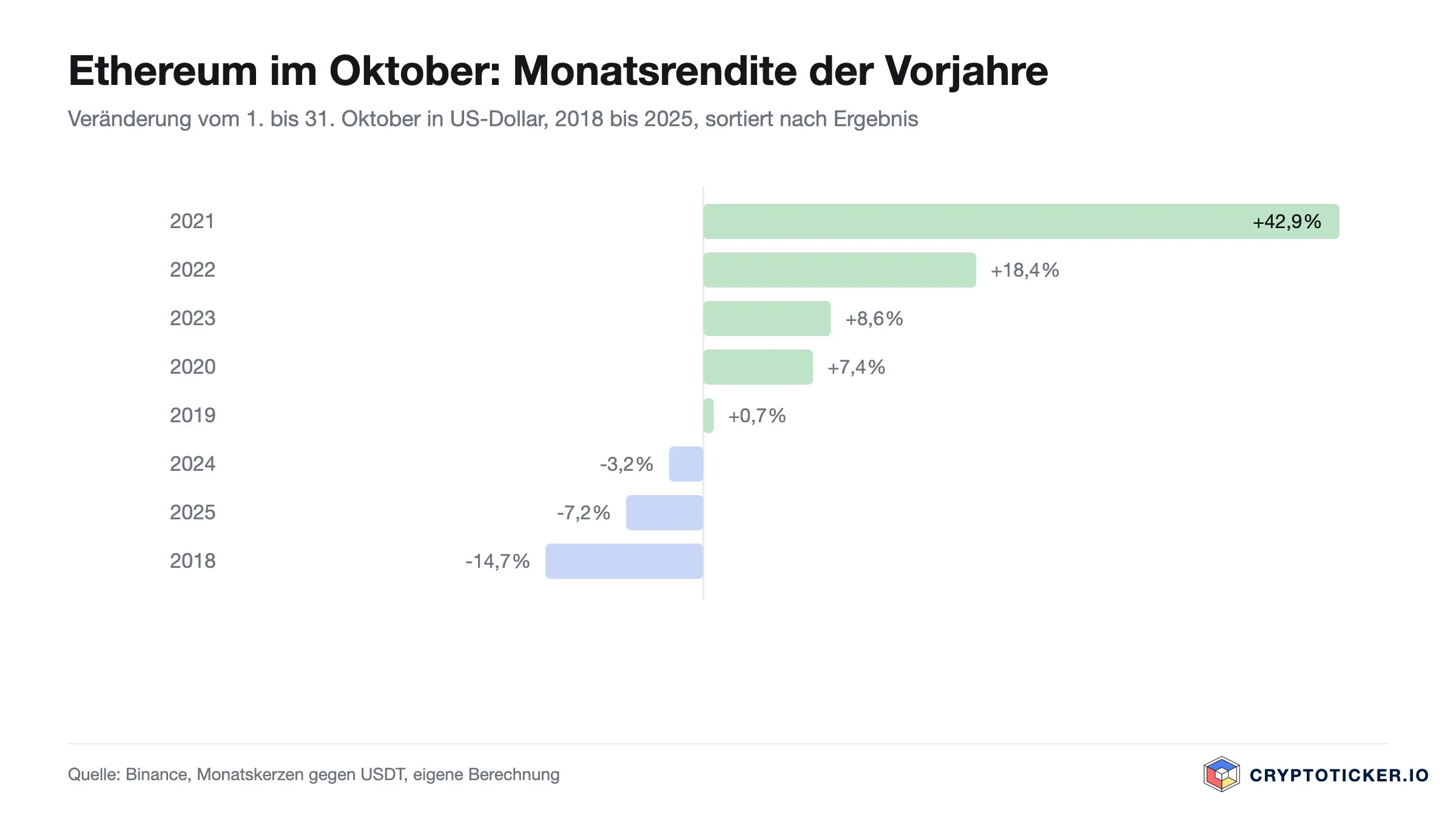
The order stands out: the two most recent Octobers both ended lower. Bitcoin, by contrast, has closed six of eight Octobers higher since 2018, as our October record for Bitcoin shows. The month owes its reputation above all to Bitcoin.

What is coming up for Ether in October 2026
On October 6 the Sepolia testnet moves to the next network version. Nothing changes for Ether on the main network that day, and according to the Ethereum Foundation a date for the main network has not yet been set, as we explained in our article on the Sepolia fork. A smooth test run is still the precondition for that main-network date moving closer.
Fund flows argue against a tailwind: the US spot ETFs on Ether lost money on three consecutive trading days at the end of September and on October 1, while the Bitcoin funds gained again. The figures are in our analysis of the ETF outflows.

Ethereum price prediction: the levels for October
Ether sits above its 50-day average (around $2,465) and its 200-day average (around $2,315), both calculated from CoinMarketCap daily closes. It is around 46 percent short of the record high of $4,946 set on August 24, 2025 (CoinGecko).
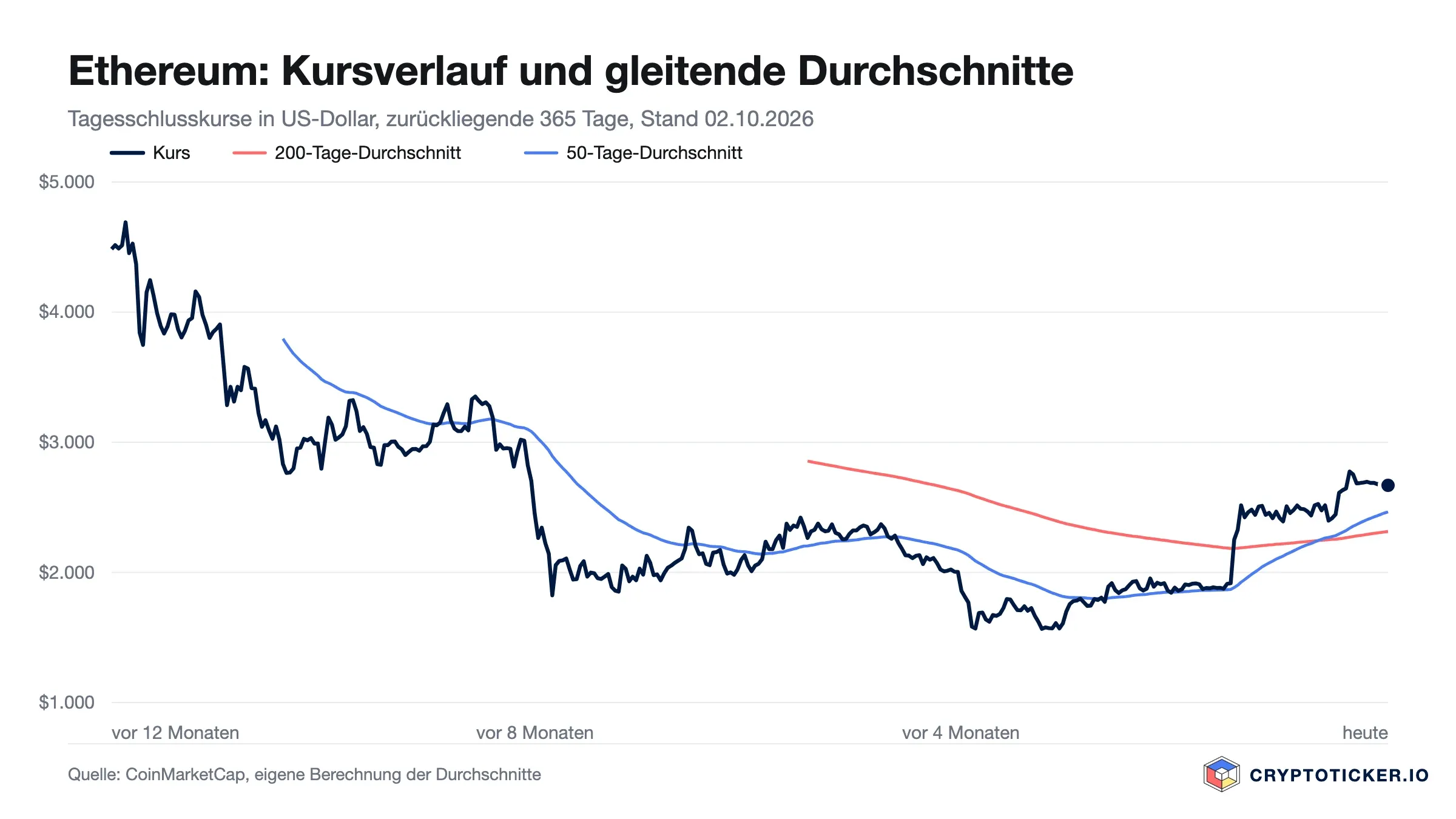
Since September 21 every daily close has fallen between $2,669 and $2,775. The upper level is therefore the first hurdle on the way up, and the lower support sits at $2,645, the close of September 20. October opened on Binance at $2,686, in the middle of that range.
Ethereum: your next three steps
First, do not read the October record as a promise. Five good Octobers stand against three poor ones, and the two most recent were poor. Second, watch the range between $2,645 and $2,775, as a daily close outside it is the next signal. Third, anyone holding Ether for the long term can stake the coins and earn a running return; providers and exit waiting times are set out in our comparison of staking providers.
Gains on Ether held for less than a year are taxable on sale in Germany once the annual allowance of €1,000 is exceeded. Crypto-assets fluctuate heavily and a total loss is possible. This article evaluates past price data; it is not a forecast and not a recommendation to buy or sell Ether.
Decrypt
President Trump named a new "Super Intelligence Force" to coordinate federal AI policy, with Director of National Intelligence Jay Clayton at the helm. As SEC chair, Clayton launched crypto lawsuits including the agency's case against Ripple.
The Independent Community Bankers of America argues the OCC's national trust charters give crypto firms a "side door into the banking system" without the safeguards that bind traditional banks.
Spot Bitcoin ETFs took in $134.4 million over the first two trading days of October, rebounding from a Sept. 30 outflow as a weak jobs report cooled Fed rate-hike bets.
Near Intents said the roughly $3.8 million drained in an exploit on Thursday was returned in full, a day after the team said it had identified the attacker and gave them 48 hours to return the funds.
The firm says the Sept. 24 breach pushed North Korea's 2026 crypto haul past $1 billion, and detailed how it used in-house AI to trace the stolen funds across four blockchains in a race against the attackers.
U.Today - IT, AI and Fintech Daily News for You Today
Major cryptocurrencies are approaching decisive support and resistance levels as traders assess whether recent bullish momentum can continue.
Shiba Inu (SHIB) has expanded to Solana through Wormhole Labs-powered Sunrise.
XRP traps price in a tight 4-hour triangle under $1.53 resistance as largest holders pause all market activity.
Dogecoin bulls have one key level to clear as compression builds.
Ethereum creator Vitalik Buterin tests three-layer privacy model for frontier AI.
Blockonomi
TLDR:
- Horsley says busy investors are the final barrier to crypto adoption after exchanges and custody.
- Horsley says Bitcoin needs steady gains, not a sharp dip or a run to $150,000 by October’s end.
- Horsley sees no clients or partners waiting on Clarity as institutions keep moving into crypto.
- Bitwise’s NEAR ETF has drawn over $50 million in net inflows since its late September launch.
Hunter Horsley, CEO of Bitwise, said investors being too busy is now the biggest barrier to crypto adoption. He made the remarks in an interview on Sunday with Wolf Of The All Street.
According to Horsley, regulation and access no longer rank among the industry’s main concerns. He also said institutions are not waiting on Clarity before entering the sector. Separately, Bitwise’s NEAR ETF has drawn over $50 million in net inflows.
Busy Investors and Advisor Demand
Hunter Horsley said crypto has met the “final boss of reasons” people avoid acting. He said the reason is simple: “They’re just busy.” Crypto spent ten years clearing other hurdles, he added.
The most common pushback Bitwise hears now comes from advisors. Many say their clients are not asking about crypto. Some advisors at large firms still do not know they can access Bitcoin. Their firms approved Bitwise products more than a year ago.
Horsley called that situation “almost hard to fathom.” The earlier obstacles, he said, included no exchanges, no qualified custodians, and fears of a government shutdown. Investor attention now ranks ahead of regulation and access.
Some advisors once set clients up with spot Bitcoin or Solana through crypto custodians. They now want to swap into ETF shares, Hunter Horsley said. He said those swaps are due in the third quarter. “Peace of mind, simplicity is the order of the day,” he said.
Price Range Matters for Adoption
Hunter Horsley said Bitcoin’s price needs to rise steadily rather than dip sharply or surge. Rising prices help Bitwise’s sales, but only up to a point. A balanced market, he added, is more conducive to adoption.
A falling market, he explained, leads many investors to wait and see whether prices drop further. A sudden run to $150,000 by the end of October would also cause a pause. Investors would worry that the market had overheated.
Horsley described the ideal as “positive price performance, not too slow, not too fast, and not too high too quickly.” He said the crypto sector is close to that point at present.
Bitcoin traded near $85,200 on Sunday, up 0.5% over 24 hours. On Stocktwits, retail sentiment around Bitcoin remained in the “bearish” zone. Chatter fell to “low” from “normal” levels over the past day.
Regulation, Clarity, and the NEAR ETF
Horsley shared remarks on the Clarity legislation. “I don’t see any clients or partners waiting for Clarity,” he said. He said the most regulated institutions are moving forward regardless of the outcome.
Clarity “could be an asset if written well,” Horsley said. Some use cases, he added, would be challenged without that clarity. Hunter Horsley also said the space is not lawless or ruleless, citing the GENIUS Act as “extremely powerful.”
Horsley said there is “no stopping this train.” He also said the SEC’s proposed custody framework does not greatly change how advisors add crypto.
It would open the door to stablecoin holdings, on-chain vaults, and tokenized assets, with use cases expected next year.
Bitwise launched the Bitwise NEAR ETF (NRR) on the New York Stock Exchange in late September. Hunter Horsley said the fund sits “squarely” at the intersection of AI and crypto.
He said index products have lagged single-asset funds so far. “The story is just getting started on the index front,” he said. NEAR’s price rose over 3% in the last 24 hours.
The post Bitwise CEO Hunter Horsley Says Busy Investors Are Crypto’s ‘Final Boss’ appeared first on Blockonomi.
TLDR:
- U.S. ETF inflows reached a record $1.93T through Sept. 29, up $580B, or 43%, from the same 2025 period.
- Q3 delivered a record $771B in U.S.-listed ETF inflows, lifting the monthly pace to roughly $214B in 2026.
- Equity ETFs drew more than $1T in 2026, while fixed-income ETFs attracted over $469B through September.
- Spot Bitcoin ETFs added $2.65B in September, while spot Ether ETFs drew about $832M during the month.
U.S.-listed exchange-traded funds are drawing capital at a record pace, with net inflows reaching about $1.93 trillion through September 29. Bloomberg data compiled by Citadel Securities showed the total running $580 billion, or 43%, above the comparable 2025 period.
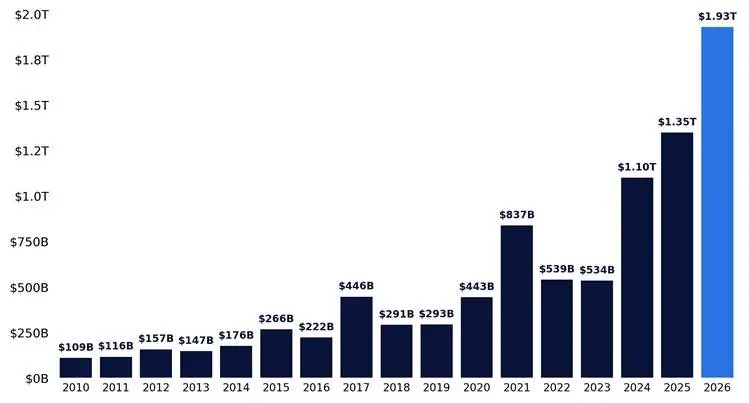
Source: Citadel Securities
The third quarter delivered the strongest contribution, attracting $771 billion and setting a new quarterly inflow record. The pace equates to roughly $214 billion monthly, putting annual flows on track to exceed $2.5 trillion if maintained.
The surge reflects broad demand rather than strength in a single investment category. Equity and fixed-income products have both absorbed substantial capital, reinforcing ETFs as a dominant vehicle for allocating money across markets. That breadth makes the record notable across both risk and income markets.
U.S. ETF Demand Spreads Across Equities and Bonds
State Street Investment Management separately estimated more than $1.54 trillion of U.S.-listed ETF inflows through September. That total already exceeded its $1.52 trillion full-year record from 2025.
State Street projected flows near $2.3 trillion by year-end. Its figures showed equity ETFs leading with more than $1 trillion, while fixed-income products attracted over $469 billion. Within equities, funds tracking U.S. stocks received about $655 billion.
Moreover, technology sector ETFs added more than $59 billion, highlighting the scale of allocations reaching market-leading companies. The State Street and Citadel totals differ as their datasets use different coverage or methodologies.
Neither report reconciled the gap, but both recorded historically strong ETF demand. Industry assets expanded alongside those inflows. Investment Company Institute data placed U.S. ETF assets at $16.27 trillion in August, while indexed funds held $22.4 trillion.
Those indexed mutual funds and ETFs represented 54.3% of combined long-term fund assets, showing how index-linked products now account for more than half of that market.
Record ETF Flows Boost Mega-Cap Exposure and Crypto Access
Citadel estimated the 10 largest S&P 500 companies receive about 41 cents from every dollar allocated to the index. Similarly, the Magnificent Seven receive roughly 35 cents. That structure means large index inflows direct substantial capital toward the biggest companies.
Meanwhile, only 25% of S&P 500 constituents traded above 50-day averages in late September. Crypto ETFs also participated in the broader shift toward regulated fund wrappers, although their flows remained much smaller than traditional ETF totals.
U.S. spot Bitcoin ETFs attracted about $2.65 billion in September, while spot Ether ETFs received roughly $832 million, according to SoSoValue data.These figures show investors using ETFs across stocks, bonds, Bitcoin and Ether. However, crypto remained a small share of the record industry-wide inflow total.
The post U.S. ETF Inflows Hit Record $1.93T as Q3 Delivers Historic $771B Surge appeared first on Blockonomi.
TLDR:
- Binance TRX netflow reached +79.8 million TRX on October 1, the largest daily net inflow in 99 days.
- The seven-day net of +75.3 million TRX turns negative at −30.4 million over 14 days without October 1.
- Netflow showed a +0.62 same-day return correlation, but next-day and two-day readings stayed weak at −0.05 and +0.19.
- TRX trades near $0.3357 inside a rectangle, with resistance at $0.35 and support around $0.322.
Binance TRX netflow reached +79.8 million TRX on October 1, marking the largest daily net inflow in 99 days. Inflow totaled 136.9 million TRX, which was 3.1 times the 30-day daily mean of 44.4 million TRX.
TRX closed the day at $0.33, down 0.79%. The spike came one day before the October 2 NFP release. No scheduled macroeconomic event took place on October 1, according to the dataset covering June 27 to October 3.
One Deposit Day Drives Weekly Net Inflow
The seven-day Binance TRX netflow stood at +75.3 million TRX, compared with −25.9 million in the previous seven days. However, October 1 alone exceeded that weekly total.
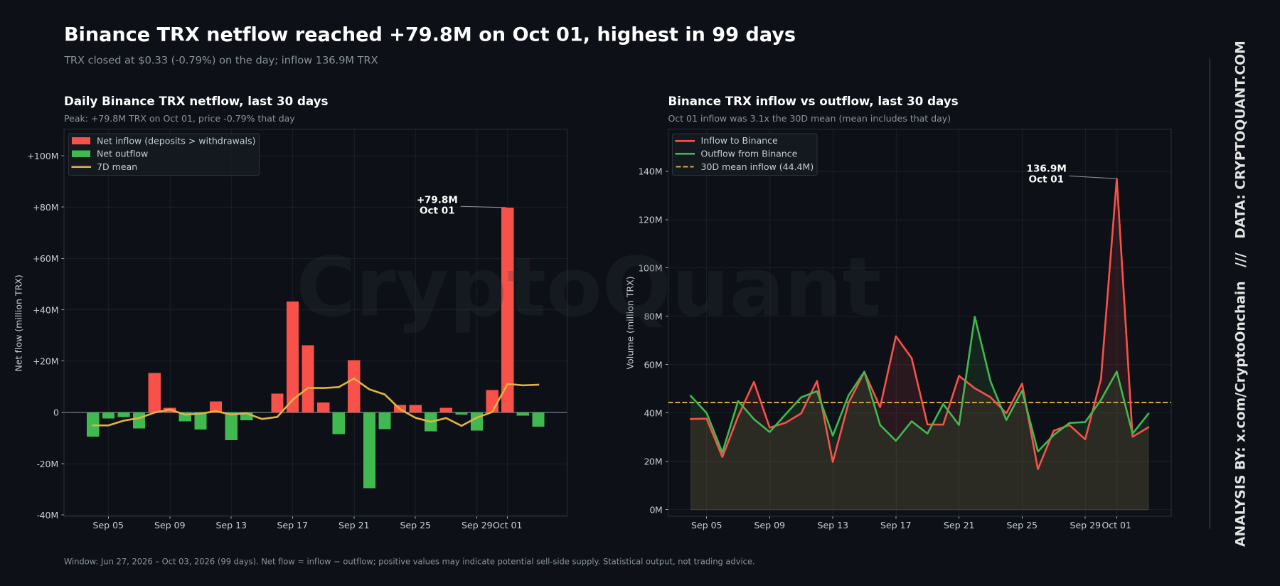
Source: Cryptoquant
The other six days recorded combined net outflows of 4.5 million TRX. Likewise, the 14-day net was +49.4 million TRX, but it turned to −30.4 million without October 1. This pattern shows the spike carried the entire weekly reading.
Cumulative netflow reached 37.7 million on October 1. Afterward, it fell to 35.4 million by October 3. Therefore, one exceptional deposit day explains the weekly Binance TRX netflow, not a sustained inflow trend.
Netflow Shows No Clear Link to Later Returns
Across the 99-day sample, Binance TRX netflow had a rank correlation of +0.62 with same-day returns. Meanwhile, correlations with next-day and two-day-ahead returns were −0.05 and +0.19. Only the same-day reading showed a notable relationship.
These readings suggest no clear predictive relationship with subsequent returns. TRX moved just −0.04% on NFP day, despite the prior deposit spike. The latest inflation data in the dataset showed August CPI at 3.4% YoY. Core CPI stood at 2.4%, while PPI reached 5.4% YoY.
Pre-NFP positioning by a few large depositors is one possible explanation. However, this remains unverified. Further sessions are needed to confirm whether the Binance TRX netflow trend persists or the event was an isolated transfer.
The dataset flagged 17 days as network-unclean, which left network-side metrics blank. All of the last 14 days pass this check. Two of the last 30 days carry whale-outlier flags.
TRX Price Action and Technical Levels
TRX trades at $0.3357, according to market data. The price is up 0.10% over 24 hours and 0.46% over seven days. Meanwhile, 24-hour trading volume stands at $201,739,711. Price action therefore remained near the middle of the reported range.
Separately, analyst Crypto With Gopal posted on X on October 3 about the 4H chart. The analyst described TRX as consolidating inside a rectangle pattern near $0.335. Resistance sits near $0.35, while support is around $0.322.
$TRX is consolidating inside a clear Rectangle pattern on the 4H chart
Price is around $0.335, with strong resistance near $0.35 and support around $0.322. The range has held for weeks, showing a clear battle between buyers and sellers.
A breakout above $0.35 could open… pic.twitter.com/w5cYrexGwR
— Crypto With Gopal (@cryptowithgopal) October 3, 2026


According to the post, the range has held for weeks. A breakout above $0.35 could open an upside target near $0.38. Conversely, a breakdown below $0.322 could shift focus toward $0.29. The post labeled market sentiment as breakout watch.
The post Binance TRX Inflow Surges to 136.9M as Price Holds Near $0.335 appeared first on Blockonomi.
TLDR:
- Bitcoin starts near $85,000 as bond yields, Fed minutes and ISM data shape this week’s crypto outlook.
- September payrolls rose 29,000 versus 90,000 expected, while unemployment increased to 4.2% overall.
- The 10-year Treasury yield recently hit 5.34%, its highest level in roughly 24 years, pressuring risk assets.
- A $39B 10-year Treasury reopening and Fed minutes make Wednesday the week’s key bond-market test for crypto.
Cryptocurrency markets enter a macro-heavy week with Treasury yields again shaping the outlook for Bitcoin and other risk-sensitive assets. The schedule includes services data, a major Treasury auction, Federal Reserve minutes, and consumer inflation expectations.
The Kobeissi Letter highlighted six events across Monday, Wednesday, and Friday, placing the bond market at the center of this week’s trading focus. Basically, higher Treasury yields raise returns on lower-risk assets and can tighten financial conditions, limiting demand for speculative assets.
Bitcoin began the week near $85,000 after reaching about $87,000 following Friday’s weaker employment report. September payrolls rose by 29,000, below the 90,000 expected, while unemployment increased to 4.2%. The weaker labor figures shifted attention toward whether incoming inflation and activity data support another Fed increase. That makes this week’s bond moves especially important for crypto pricing.
Bond-Heavy Week Puts Bitcoin in Focus Before ISM and Fed Minutes
Monday’s first major catalyst arrives at 10:00 a.m. ET with the September ISM Services PMI. The August index stood at 55.4, while the Prices Index reached 72.6. As a result, economists expect the September headline reading near 55.
Attention will also center on prices after September manufacturing prices jumped to 77.9 from 71.1. A strong services reading alongside elevated prices would keep inflation pressures in focus. That combination could lift Treasury yields and the dollar, adding pressure across the crypto market.
Softer activity and weaker price pressures would instead reinforce expectations that the Fed can pause after September’s increase. The employment report already reduced expectations for another immediate rate rise.
$39B Treasury Auction and 5.34% Yield Raise Wednesday Stakes
Wednesday concentrates the week’s largest bond-related events, starting with Treasury’s scheduled 10-year note reopening. Officials had previously outlined a $39 billion October auction size, keeping demand for government debt firmly in focus. Meanwhile, the 10-year Treasury yield recently reached 5.34%, its highest level in about 24 years.
That rise in yields has already affected Bitcoin’s short-term performance. Earlier last week, Bitcoin moved above $85,500 before giving back gains as the 10-year yield remained near 5.3%. Later Wednesday, Fed minutes will offer more detail on how officials viewed the September policy decision. Policymakers unanimously raised rates by 25 basis points to 3.75%-4.00%.
Attention will then shift to Friday, when preliminary October University of Michigan sentiment and inflation expectations are released. September sentiment fell to 48.1, while one-year inflation expectations climbed to 4.6%. At the same time, five-year expectations increased to 3.4%. Together, those figures will provide another measure of whether inflation pressures remain embedded as markets assess the Fed’s next move.
Friday’s readings will therefore close a week dominated by interest rates and Treasury yields. For the crypto market, the key issue remains whether bond yields retreat from recent highs or stay elevated. As a result, macroeconomic data and rate expectations are likely to remain more influential than crypto-specific catalysts during the week.
The post Crypto Markets Brace for Bond-Heavy Week as Fed Minutes and ISM Loom appeared first on Blockonomi.
TLDR:
- Bitcoin’s Sunday moves have often reversed on Monday over the past month, according to Ali Charts.
- A TD Sequential sell signal on Bitcoin’s four-hour chart followed four past corrections each time.
- Ethereum’s last two TD Sequential sell signals were followed by declines of 5.40% and 3.31%.
- Solana’s last three comparable signals preceded corrections of 2.44%, 5.76%, and 5.30%.
Sunday pump Monday dump is back in focus as Bitcoin climbed more than 1% on October 4. Over the past month, the cryptocurrency’s Sunday moves have often reversed at the start of the week.
A TD Sequential sell signal has also appeared on the four-hour charts of Bitcoin, Ethereum, and Solana. In earlier cases, similar signals were followed by corrections. Together, these readings point to a possible pullback when markets open on Monday.
Sunday Pump Monday Dump Pattern Draws Attention
Market analyst Ali Charts raised the topic in a six-part thread on X. The opening post framed the idea as Sunday pump equals Monday dump.
SUNDAY PUMP = MONDAY DUMP
1/6
— Ali Charts (@alicharts) October 4, 2026


In the second post, the analyst said Bitcoin’s Sunday moves have often reversed on Monday over the past month. Sunday rallies were followed by pullbacks. Sunday declines, on the other hand, were followed by rebounds. The same reversal appeared in both directions, according to the analyst.
Bitcoin was up more than 1% on Sunday as of time of publication trading at $85,845. As a result, the analyst said the pattern is back in focus. The first post had recorded 3,604 views at that point. The follow-up posts appeared minutes after the first one.
TD Sequential Flashes Sell Signal on Bitcoin
The third post added a technical warning to the weekly pattern. According to Ali Charts, the TD Sequential indicator has flashed a sell signal on Bitcoin’s four-hour chart. The signal appeared while Bitcoin traded higher on the day.
The analyst noted that each of the last four similar signals was followed by a price correction. Ali Charts did not list the size of those four corrections. Based on that record, the thread pointed to another Monday dump.
Therefore, the sell signal and the Sunday pump Monday dump pattern lead to the same outcome. Both readings suggest a pullback at the start of the week. The next posts extend the signal to other major assets.
Ethereum and Solana Show Matching Signals
The fourth post covered Ethereum. The asset shows the same TD Sequential sell signal on its four-hour chart. Its last two signals were followed by declines of 5.40% and 3.31%, respectively. The two earlier declines serve as the reference points for Ethereum.
Solana was addressed in the fifth post. It has flashed a four-hour TD Sequential sell signal as well. Its last three comparable signals preceded corrections of 2.44%, 5.76%, and 5.30%. The analyst used these readings as a historical reference for the current setup.
The final post combined all the data points. It cited a Sunday pump, a recent run of Monday dumps, and sell signals across BTC, ETH, and SOL.
Ali Charts said these factors point to a possible pullback. The Sunday pump Monday dump setup, therefore, rests on both calendar behavior and chart signals. The thread ended with that post, and no further posts followed.
The post Sunday Pump, Monday Dump: Bitcoin Pattern Returns as TD Sequential Signals Flash on BTC, ETH, SOL appeared first on Blockonomi.
CryptoPotato
Most retail traders on Polymarket lose money. A Galaxy Research study of 2.9 million human-paced accounts found that more than 69% finished below break-even. The group recorded aggregate losses of $338.9 million.
The research used Polymarket’s full on-chain history, covering positions, entry prices, holding periods, as well as payouts. Galaxy excluded 125,429 accounts that averaged more than 50 orders per active trading day, treating them as likely automated. These accounts made up just 4.1% of wallets but accounted for 80.8% of all orders.
Behavior of Polymarket Traders
Among the remaining accounts, the median retail account lost around $3, which indicates that most losses were relatively small, while a smaller group lost thousands. Galaxy also found that losing money was linked to higher churn. About 15.2% of accounts did not trade again within 30 days after a loss, compared with 6.1% after a win.
The study also examined whether traders increased risk after winning or losing. Both groups usually returned with slightly smaller positions, but traders reduced risk less after a win.
Specialization was another major finding. Around 44% of traders focused more than 60% of their activity on one topic. However, specialists were slightly less likely to be profitable than generalists. Only 28% of specialists finished profitably, compared with 30.4% of generalists.
Sports made up the largest specialist group and had the lowest profitability rate. Tech and science specialists performed better, with 41.2% finishing profitably. Galaxy said this could reflect stronger subject knowledge, although the data cannot establish why these traders performed better.
Profitable traders also tended to make larger bets. They also traded more frequently. Holding time, however, did not show a clear link with profitability. Galaxy’s research covered Polymarket’s international platform, not its separate US exchange. It also noted an important limitation: the analysis tracks wallet addresses rather than individual people. A trader using multiple wallets could therefore appear as several accounts.
Legal Woes
The legal problems around prediction markets are starting to pile up as platforms like Polymarket expand into more countries and markets. In the US, cities and states are increasingly arguing that contracts on sports results, player stats, and other uncertain outcomes look a lot like ordinary gambling. Baltimore, for example, sued Polymarket and Kalshi in August, claiming that both platforms were offering sports bets without the licenses required in Maryland.
New York followed in September, suing Polymarket’s US arm over alleged unlicensed gambling and claims that users aged 18 to 20 could trade, despite the state’s 21-year minimum age for mobile sports betting. The legal questions go beyond the US.
South Korean police opened cases against 26 Polymarket users and referred 18 to prosecutors over about $12.7 million in bets. Authorities there are examining whether its trading should be treated as illegal gambling under Korean law.
The post Galaxy Finds 7 in 10 Polymarket Retail Traders Lost Money appeared first on CryptoPotato.
The International Monetary Fund has approved a disbursement worth SDR 101.96 million ($138 million) for El Salvador after granting the government a waiver for its failure to meet a condition related to Bitcoin accumulation.
The IMF Executive Board completed the second and third reviews of El Salvador’s Extended Fund Facility program on October 1.
Limits for Bitcoin Accumulation
The IMF said El Salvador’s economy has performed better than expected, helped by improved security and stronger investor confidence. The country has also made progress in reducing fiscal imbalances. Its reserve and liquidity buffers have strengthened, while fiscal consolidation has broadly stayed on track. However, some program conditions were not met. One of them involved the government’s Bitcoin accumulation. The IMF granted waivers based on “corrective measures and renewed commitments” from the Salvadoran authorities.
Under the latest program commitments, El Salvador is not expected to accumulate more Bitcoin beyond documented donations. The IMF also said the government is working to reduce its role in BTC-related activities, which includes plans to improve transparency around public-sector crypto holdings and strengthen rules governing crypto-asset companies.
“Efforts will continue to reduce the state’s involvement in Bitcoin-related activities, strengthen crypto‑asset regulation and governance, and enhance transparency regarding public-sector crypto‑asset holdings. No further Bitcoin accumulation is envisaged beyond the documented donations.”
Chivo’s Government Role Shrinks
The government’s Chivo digital wallet has also moved toward private control. According to the IMF, majority ownership and control of Chivo have been transferred to a private operator. The remaining public-sector exposure should eventually be unwound.
El Salvador agreed to a 40-month IMF program in February 2025. The program provides total access of about $1.4 billion. The latest disbursement is part of that broader financial arrangement. The IMF said the country still needs to carry out further reforms to strengthen public finances, rebuild external reserves and improve financial-sector resilience. Pension and civil service reforms are also expected to move forward after earlier delays.
The IMF also called for stronger governance and greater transparency while highlighting areas such as public-sector reporting, beneficial ownership disclosures, asset declarations, and anti-money laundering rules. These reforms were crucial for maintaining economic stability.
The post IMF Approves $138M for El Salvador After Bitcoin Accumulation Waiver appeared first on CryptoPotato.
The spot Bitcoin ETFs managed to turn the tables for the year as the net flows finally turned green, but there are some concerning signs.
Meanwhile, the funds tracking the largest altcoin ended the previous week in the red. This became the second such week out of the last three.
BTC ETFs Green, But There’s a Catch
Recall that the spot BTC ETFs had their best five-day trading performance in nearly a year during the last full week of September when they attracted roughly $2.4 billion in net inflows. This helped flip the YTD numbers green, which was difficult to imagine just a few months ago when the funds bled out heavily, with $2.43 billion leaving in May and a whopping net withdrawal of $4.5 billion in June.
September 28 began with another $31.07 million in net inflows, followed by $66.19 million on Tuesday. The tables turned on Wednesday as investors pulled out $148.69 million. This was rather surprising since the PCE data came out on that day and showed that inflation was lower than expected.
Nevertheless, the net inflows returned on Thursday with $102.67 million, according to SoSoValue. FarSide shows that another $31.7 million entered the financial vehicles on Friday, ending the week at around $83 million. This makes the past four weeks quite interesting and different.
$83 million in the past week was not all that impressive, especially when compared to the $2.39 billion a week before. However, that record-setting five-day trading period followed a very modest $6.21 million inflow week. The one before that was even stranger, with $462.73 million leaving the funds.

ETH ETFs in the Red Again
The spot Ethereum ETFs also started the business week on the right foot, but their momentum quickly faded. After the $17.10 million in net inflows on Monday, withdrawals took charge with $2.81 million on Tuesday, $59.58 million on Wednesday, $55.37 million on Thursday, and another $17.3 million on Friday.
Consequently, the week ended with net outflows of approximately $114 million. The concerning part is that this is the second such week out of the last three, in which withdrawals have dominated. The positive side is that the one that was in the green saw notable net inflows of almost $690 million.
Still, the cumulative total net inflows have declined slightly from the recent local peak of $13.94 billion to $13.80 billion.

The post Bitcoin and Ethereum ETF Weekly Flows: The Good, the Bad, and the Concerning appeared first on CryptoPotato.
Bitcoin enters the final quarter of the year after a powerful recovery in the third quarter, but analysts warn against expecting another straight-line rally. Instead, they pointed to some key factors that could impact BTC and the overall market in the following three months.
Some of them include the Federal Reserve, Treasury-market liquidity, ETF flows, geopolitics, and BTC’s ability to clear $87,500, which remains its most significant obstacle on the path forward.
Q3 May Be Hard to Repeat
Although Q3 began with another leg down to under $58,000, which became BTC’s lowest price tag in a year and a half, the subsequent three months were a lot more positive. The cryptocurrency rebounded immediately and broke out in mid-August to over $80,000. Its rise continued and managed to close the quarter with a massive 43% surge.
Iliya Kalchev, Nexo Dispatch Analyst, described the three-month period as both a recovery phase and a breakout milestone. He argued that the most important catalyst arrived from the bond market after the US Treasury increased the size of its long-end bond buyback operations in August.
The asset indeed jumped by 7% on August 19 and rocketed by over 20% in the following several days. Spot Bitcoin ETF flows immediately turned positive and even flipped into the green on a year-to-date basis. Meanwhile, relatively subdued perpetual funding suggested the rally was driven more by spot demand than excessive leverage, Kalchev added.
Nevertheless, the analyst cautioned against assuming Q4 will simply extend Q3’s pace. Although the cryptocurrency has finished Q4 higher in nine of the past 15 years, the median gains are only around 9%, while the much larger average has been distorted by spectacular years such as 2013 and 2017.
Alex Kozenko, CMO at WhiteBIT, issued a similar warning:
“Today, the market structure is different: institutional participation has become more prominent, and flows through regulated investment products have become yet another source of influence on market dynamics. Over the next three months, I would primarily focus on liquidity, institutional activity, and the overall macroeconomic environment.”
Fed and $87.5K
Although the overall market situation changed slightly after the weaker-than-expected US jobs report from Friday, Lacie Zhang, Research Analyst at Bitget Wallet, told CryptoPotato that she still believes the Fed will hike rates again by 25 basis points on October 28. This would put the target range at 4.00%-4.25% after the September increase, which was the first in over three years.
Kalchev also highlighted the Fed as the biggest Q4 variable, although the latest softer core PCE reading, alongside the aforementioned jobs report, reduced some of the immediate pressure for additional tightening. Geopolitical developments, though, could complicate the picture further, especially if energy prices keep feeding inflation.
According to Zhang, $87,500 remains the most crucial obstacle in BTC’s path to a broader recovery. A break above it could increase the likelihood of a short squeeze. In contrast, she identified the $82,000-$82,500 support range as the key downside zone, and losing it could accelerate a move below $80,000.
The post What Could Decide Bitcoin’s Q4? The Fed, Bond Yields, and One Crucial Price Level appeared first on CryptoPotato.
Own assets or be left behind — this is what the analysts at the Kobeissi Letter argued, highlighting the major discrepancy between those who do and those who stay on the sidelines.
Bitcoin fits surprisingly well into this distorted economy, but treating it as a cure for the destruction of the middle class would be a bit of an overstatement.
Own Assets or Get Left Behind
There are roughly 134.8 million households in the States, according to the analysts. However, around 1.4 million of them, also known as the wealthiest 1%, control more than $60 trillion in net worth. Since 2020 alone, their wealth has grown by more than $30 trillion. The bottom 50%, or 67.4 million households, collectively hold a fraction of that amount.
The reason isn’t simply that rich households earn larger salaries; the bigger divide is asset ownership, the Kobeissi Letter said. Total US household wealth has exploded from roughly $101 trillion six years ago to $185 trillion today, but that massive increase has been distributed very unevenly.
Americans who already owned stocks, businesses, property, and other appreciating assets benefited disproportionately as their prices rose. Meanwhile, inflation steadily eroded the value of income and cash savings. The analysts separately calculated that the greenback has lost roughly 23% of its purchasing power since 2020.
In other words, someone whose savings or assets increased by 30% over that period has made only a relatively modest actual gain after accounting for the decline in purchasing power. Inflation has also remained well above the Fed’s 2% target for 60 consecutive months.
Food, housing, transportation, and other necessities have become more expensive, while the assets needed to escape that erosion, mostly homes and stocks, can also become harder to afford. The analysts added that borrowing has offered little relief, as mortgage rates recently climbed toward the mid-7% range. At the same time, Treasury yields surged, raising the barrier to homeownership even further.
Consequently, they concluded something simple and obvious: “Own assets or be left behind.”
Does BTC Fit Here?
Bitcoin matters in this macro dynamic, even though it’s not as simple as saying it can somehow save the middle class. BTC addresses one specific part of the argument above quite well: its supply can’t expand in response to government spending, deficits, elections, wars, or monetary policy. There will ultimately be no more than 21 million units, making it fundamentally different from cash, whose purchasing power can and probably will decline as the monetary base expands.
It’s also unusually accessible compared with many traditional wealth-building assets. You don’t need a down payment required for a house or enough capital to purchase an entire BTC. If the fundamental problem is that people who hold appreciating scarce assets are pulling increasingly far ahead of people saving exclusively in depreciating currencies, bitcoin offers another way to get onto the asset-owning side of that divide.
On the contrary, bitcoin remains very volatile, which is not ideal for inexperienced investors. It can lose 50% or more during severe downturns in just months. In general, simply holding it generates no cash flow and offers little help to someone whose income is already consumed by rent, food, healthcare, and debt.
It can’t magically make housing more affordable, raise real wages, reduce healthcare costs, improve taxation, or redistribute existing wealth. As such, it’s safe to say that BTC cannot rebuild the American middle class. However, a scarce asset that virtually anyone can own and has no central authority behind it can provide individuals with one additional way to get exposure in an economy where asset ownership increasingly determines who preserves and grows wealth.
The post America’s Middle Class Is Getting Crushed: Where Does Bitcoin Fit? appeared first on CryptoPotato.