Cryptocurrency Posts
Crypto Briefing
The success of tokenized stocks hinges on improving information flow, crucial for accurate valuation and sustainable market growth.
The post Binance’s Richard Teng says tokenized stock demand is strong, but information flow lags appeared first on Crypto Briefing.
The shift towards native blockchain-based funds could redefine financial efficiency, offering real-time data and significantly reduced costs.
The post Franklin Templeton CEO says rival tokenized funds miss the point of blockchain appeared first on Crypto Briefing.
The deal could set a precedent for balancing tech growth with consumer protection, influencing future utility cost-sharing frameworks nationwide.
The post Duke Energy strikes deal with tech giants to shield North Carolina customers from data center costs appeared first on Crypto Briefing.
Clayton's dual role may streamline AI policy but risks conflating national security with tech innovation, impacting regulatory balance.
The post Trump’s new AI czar heads to Silicon Valley for first sit-downs with top AI executives appeared first on Crypto Briefing.
Cointelegraph's traffic collapse highlights the risks of SEO penalties, impacting brand value and posing challenges for potential buyers in crypto media.
The post Blockchain and digital asset news outlet Cointelegraph explores sale: Report appeared first on Crypto Briefing.
Bitcoin Magazine
Bitcoin Magazine
CFTC Chair Says New Crypto Rulemaking Will Prevent Another FTX-Style Collapse
Pro-crypto regulator Mike Selig has said that pushing ahead with new rules will stop another collapse like FTX.
Speaking on Fox Business Network’s Varney & Co. show Wednesday, the Commodity Futures Trading Commission Chair said that crypto exchanges will have the chance to register with the regulator in order to safeguard digital asset spot markets.
Once one of the most popular crypto exchanges, FTX quickly and abruptly went bankrupt in 2022 due to mismanagement. Its founder, Sam Bankman-Fried, is now serving 25 years in prison for fraud and other crimes after $8 billion in customer funds was stolen.
The CFTC and other regulators are pushing ahead with rulemaking for the crypto space, despite lawmakers last month blocking the long-awaited Clarity Act.
“Four years ago, we saw the collapse of Sam Bankman-Fried’s FTX, where he stole over $8 billion in customer funds. That can’t happen under our regime,” Selig said.
“Actually, Sam Bankman-Fried’s subsidiary that was CFTC registered, all the funds were safe and secure because they were segregated, and we have some of the most stringent requirements of any federal agency when it comes to markets — we want to bring that to the crypto world,” he added.
Selig added that some exchanges may choose to remain under the state regimes, while others will register federally.
The CFTC is relying on powers it already has to regulate crypto markets. The watchdog this week sought public comment on a framework that would create a new federal registration category, called a “crypto asset market,” for exchanges offering leveraged, margined or financed crypto trades to retail customers.
Exchanges that don’t offer leverage could stay under state licenses. But the agency reads “leverage” broadly, which could bring even fully paid trades under its oversight unless customers take delivery of their crypto.
CFTC Chair Selig, formerly chief counsel at the SEC’s Crypto Task Force, last month said that the regulator was preparing for the transition of markets moving “24-7, on-chain.”
Both the CFTC and Securities and Exchange Commission have taken a more friendly approach to regulating the crypto industry since U.S. President Donald Trump took power.
This post CFTC Chair Says New Crypto Rulemaking Will Prevent Another FTX-Style Collapse first appeared on Bitcoin Magazine and is written by Mathew Di Salvo.
Bitcoin Magazine
US Investors Want to up Their Crypto Holdings: Charles Schwab
Forget stocks — U.S. investors are more interested in upping their bitcoin holdings, according to new research.
Charles Schwab’s 2026 Modern Wealth Survey dropped on Wednesday, and showed that current cryptocurrency investors want to keep adding to their holdings.
The research revealed that a total of six in 10 plan to invest more over the next 12 months — a higher share than among owners of all other investments measured, including ETFs (56%), stocks (52%), bonds (42%), and mutual funds (41%).
“Existing cryptocurrency investors are certainly leaning in, particularly younger investors who are driving much of the interest and momentum in cryptocurrency,” Head of Digital Assets at Charles Schwab, Joe Vietri, said in a statement.
“But to me, the bigger story is that cryptocurrency is increasingly viewed as a complement to traditional investments.”
Charles Schwab is the country’s largest custodian for registered investment advisors, and earlier this year began a phased rollout of Schwab Crypto to retail clients, giving them direct access to bitcoin trading along with educational content and professional support.
Schwab also offers crypto-linked exchange-traded funds, bitcoin futures, and its own Schwab Crypto Thematic Index ETF. CEO Rick Wurster has said Schwab clients hold more than 20% of all crypto exchange-traded products across the industry.
Wednesday’s report added that one in five Americans overall own cryptocurrency today, and another one in five say they don’t own it but are interested in buying it. Among investors, nearly half own cryptocurrency.
It further noted that millennials are the most likely to own cryptocurrency, and are more than four times the rate among Boomers.
The online survey was conducted by Logica Research from August 24 to September 17, 2026, among a national sample of 2,000 Americans ages 21 to 75.
This post US Investors Want to up Their Crypto Holdings: Charles Schwab first appeared on Bitcoin Magazine and is written by Mathew Di Salvo.
Bitcoin Magazine

Jack Dorsey’s Block Gifts One Bitcoin to Lucky ComplexCon Attendee
Jack Dorsey’s Block is pushing so hard for bitcoin adoption, it gifted 1 BTC to a lucky conference attendee at this year’s ComplexCon in Los Angeles.
The fintech giant attended the Complex Networks yearly event at the weekend in a bid to introduce newbies to the leading cryptocurrency through — in its words — “culture, shopping and play.”
Block’s Cash App had a stall at the event with a fishing game dubbed “Lightning Lake”, allowing attendees to win small amounts of bitcoin.
But one fortunate player was lucky enough to scoop up a whole coin — worth $85,000 at the time.
“We wanted bitcoin to feel approachable, tangible and fun,” Maria Pesce, Head of Bitcoin Marketing at Block, told Bitcoin Magazine.
“People could go from never having used bitcoin to paying with it, all in a trip around the lake.”
She added: “At Block, our goal is to make bitcoin everyday money, and ComplexCon gave us a chance to introduce bitcoin to a new audience through culture, shopping, and play.”

Block has long pushed for bitcoin adoption via its companies and products: Cash App allows users to send, receive and buy bitcoin and Square point-of-sale terminals accept the orange coin via the Lightning Network.
NYSE-listed Block this month even debuted an advertising campaign to make the push for people to use the leading cryptocurrency as a medium of exchange.
Dorsey, who in 2021 left Twitter to focus his efforts on payments and Bitcoin adoption in 2021, has repeatedly said he wants the cryptocurrency to be the global currency and “everyday money.”
Block even piqued the interest of celebrities at ComplexCon: Kanye West’s daughter North West and rapper French Montana were spotted by Lightning Lake trying to fish for bitcoin.
This post Jack Dorsey’s Block Gifts One Bitcoin to Lucky ComplexCon Attendee first appeared on Bitcoin Magazine and is written by Mathew Di Salvo.
Bitcoin Magazine
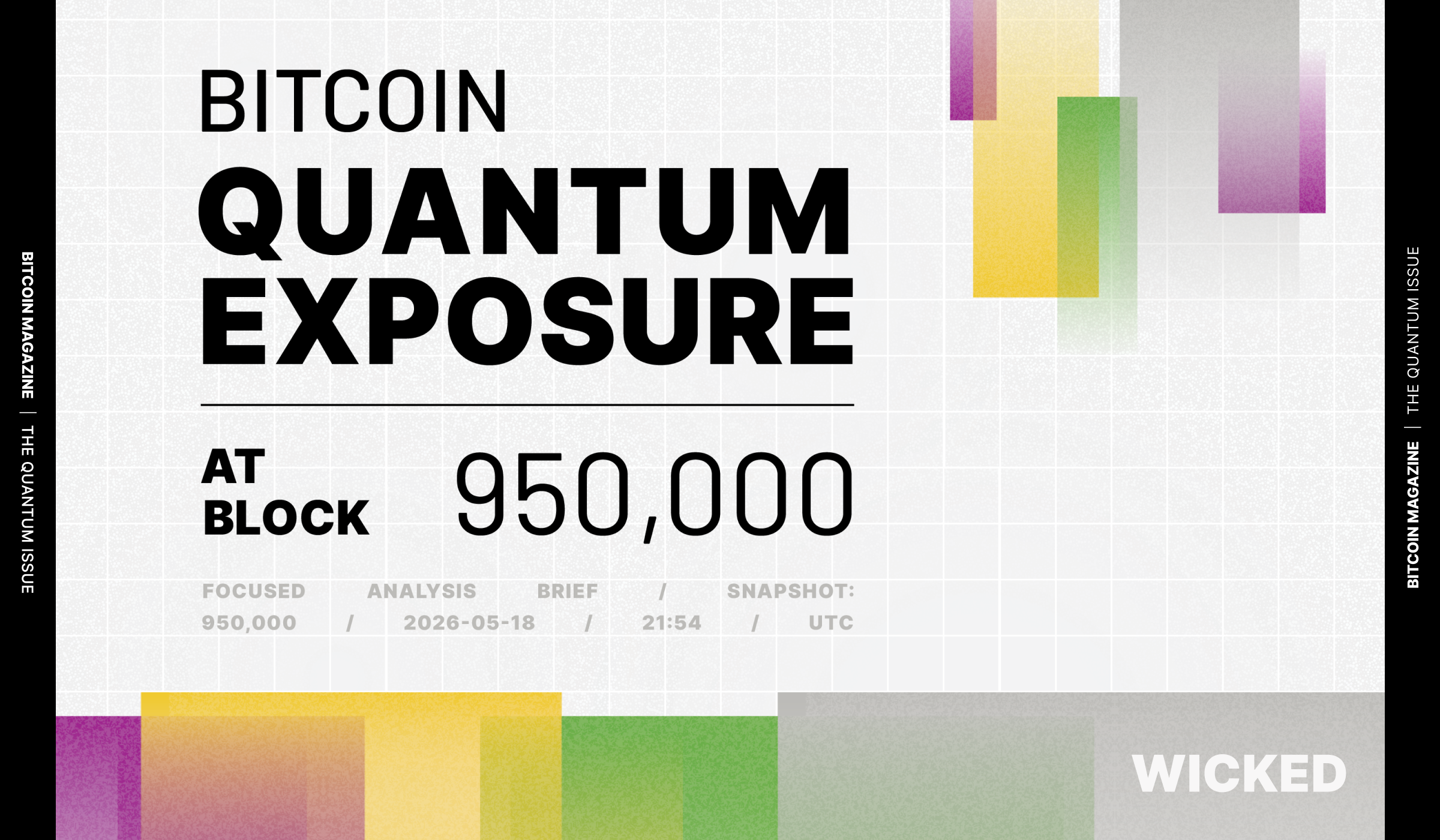
The Quantum Issue: Bitcoin Quantum Exposure at Block 950,000
| At block 950,000, 6.90 million BTC are cryptographically exposed, equal to 34.45% of circulating supply. That headline number should not be read as the amount of bitcoin likely to be lost in a quantum event. Practical risk depends on whether the owner can respond, whether the entity is operationally active, whether the balance is large enough to justify the cost of attacking, and how quickly funds can be migrated. Considering those dimensions, the risk profile is narrower, more concentrated, and more dormant than the raw exposure figure implies. |
| 6.90M BTC Raw exposed supply |
| 34.45% Raw exposed share |
| 3.33M BTC Active >=1 BTC exposure |
| 2.28M BTC Dormant unknown >=1 BTC |
Exposure Decomposition
| View | Exposed BTC | % Supply | % Raw Exposure | Groups | UTXOs | Migration Est. |
| Raw total exposure | 6,900,573 | 34.45% | 100.00% | 16,047,454 | 102,347,011 | ~140.99 days |
| Active, >=1 BTC, 5-year threshold | 3,331,639 | 16.63% | 48.28% | 46,163 | 4,906,508 | ~9.37 days |
| Never-spent + inactive, >=1 BTC | 3,413,767 | 17.04% | 49.47% | 113,627 | 2,669,847 | ~5.29 days |
| Never-spent + inactive, >=1 BTC, known entities removed; Satoshi retained | 2,277,978 | 11.37% | 33.01% | 73,658 | 1,096,018 | ~2.56 days |
| Same filter, >=10 BTC | 2,187,481 | 10.92% | 31.70% | 39,897 | 365,830 | ~23.33 hrs |
| Same filter, >=100 BTC | 351,654 | 1.76% | 5.10% | 675 | 33,573 | ~2.17 hrs |
Migration estimates are useful for relative sizing, not as forecasts of real-world coordination, fee pressure, or user behavior.
Bitcoin Quantum Exposure Analysis Brief – Block 950,000 Page 1
Top-Level Analysis
1. The headline exposure figure overstates practical theft risk.
The raw view shows 6,900,573 BTC exposed, but it intentionally treats exposure as a cryptographic condition: a public key has appeared on-chain. That is the right starting point, but it is not the same as economic loss risk. A live exchange wallet, an institutional multisig, a dormant early address, and an abandoned key can all be cryptographically exposed while having very different abilities to migrate.
2. Active and known-entity exposure is less concerning than raw exposure implies.
The active >=1 BTC filter captures 3,331,639 BTC, or 48.28% of all exposed supply. This is a large amount of bitcoin, but it is concentrated in 46,163 groups rather than millions of unmanaged holders. The largest visible active exposures include operational entities such as exchanges, brokers, custodial multisig operators, stablecoin infrastructure, and mining-related wallets. These entities are among the most likely to monitor quantum developments, coordinate wallet rotations, and migrate before a practical attack window opens.
This does not make the exposure irrelevant. It creates coordination and execution risk. But it is meaningfully different from lost-key risk: active custodial and exchange balances are generally the coins most likely to move first in a credible threat scenario.
3. The core long-term problem is dormant and non-responsive exposure.
When active entities are removed and the view is narrowed to never-spent or inactive balances of at least 1 BTC, exposed supply is 3,413,767 BTC. After removing known operational entities while retaining Satoshi-attributed coins, the remaining exposed supply falls to 2,277,978 BTC across 73,658 groups and 1,096,018 UTXOs.
That 2.28M BTC segment is the cleanest approximation in this dataset of the harder-to-mitigate exposure surface: early holders, inactive self-custody, old address reuse, dormant P2PK outputs, and coins that may be lost or otherwise unable to respond. This is where the practical quantum risk is most persistent.
4. Quantum attack economics make the target set smaller still.
A capable quantum adversary would still face operating costs, limited throughput, opportunity costs, transaction fees, and operational risk. The rational target set is therefore unlikely to be every exposed key. It is more likely to start with the highest-value exposed balances.
Applying balance thresholds shows how quickly the practical attack surface compresses. With known entities removed and only dormant or never-spent balances included, the >=10 BTC view still contains 2,187,481 BTC but only 39,897 groups and 365,830 UTXOs. At >=100 BTC, the target set drops to 351,654 BTC across just 675 groups and 33,573 UTXOs.
Bitcoin Quantum Exposure Analysis Brief – Block 950,000 Page 2
Script-Type and Threshold Observations
Filtered to only show never-spent + inactive balances, known operational entities removed, Satoshi coins retained unless excluded by the balance threshold.
| Script Type | >=1 BTC | >=10 BTC | >=100 BTC | Observation |
| P2PK | 1,715,778 BTC | 1,715,539 BTC | 10,246 BTC | Dominates dormant exposure at lower thresholds because early P2PK outputs are exposed by construction and mostly inactive. |
| P2PKH | 408,789 BTC | 356,368 BTC | 273,865 BTC | Becomes dominant in the >=100 BTC view after Satoshi-era 50 BTC outputs drop out. |
| P2SH | 43,444 BTC | 34,225 BTC | 21,113 BTC | Falls sharply once known operational entities are removed; remaining dormant script-hash exposure is relatively small. |
| P2WPKH | 8,696 BTC | 5,271 BTC | 2,194 BTC | Low in the non-entity dormant view, consistent with more modern wallet behavior and activity. |
| P2WSH | 2,938 BTC | 2,886 BTC | 2,750 BTC | Very small after known-entity removal; much broader P2WSH exposure is likely institutional and active. |
| P2TR | 98,327 BTC | 73,193 BTC | 41,486 BTC | Always exposed at the key level, but the high-value dormant non-entity subset remains limited. |
Displayed totals may differ by a few BTC from KPI totals due to dashboard rounding at the script-type level.
Important threshold note
The apparent crossover from P2PK dominance at the >=10 BTC threshold to P2PKH dominance at the >=100 BTC threshold should not be interpreted as P2PK risk disappearing. It is primarily a filter artifact: the Satoshi-attributed P2PK outputs in this dataset are 50 BTC per key, so they are included at >=10 BTC and excluded once the pubkey balance threshold exceeds 50 BTC. That exclusion causes the P2PK bucket to collapse from roughly 1.716M BTC to about 10k BTC in the >=100 BTC view.
Bottom Line
| The strongest reading of the block-950,000 snapshot is that Bitcoin has a large cryptographic exposure surface but a much narrower practical exposure surface. Active known entities make up a major share of exposed supply, yet they are also the most likely participants to migrate quickly. The more persistent risk is concentrated in dormant, non-responsive, and possibly lost coins. Once known entities and low-value targets are filtered out, the economically attractive target set becomes very small: 351,654 BTC across 675 groups at the >=100 BTC threshold. Quantum exposure is therefore best understood as a concentrated dormant-coin problem, not a uniform risk across all exposed bitcoin. |
Data source: Bitcoin Quantum Exposure Dashboard snapshot at block 950,000. This analysis assumes the dashboard methodology PDF supplied separately to the editor.

This piece is featured in the latest Print edition of Bitcoin Magazine, The Quantum Issue. We’re sharing it here as an early look at the ideas explored throughout the full issue.
This post The Quantum Issue: Bitcoin Quantum Exposure at Block 950,000 first appeared on Bitcoin Magazine and is written by Wicked.
Bitcoin Magazine
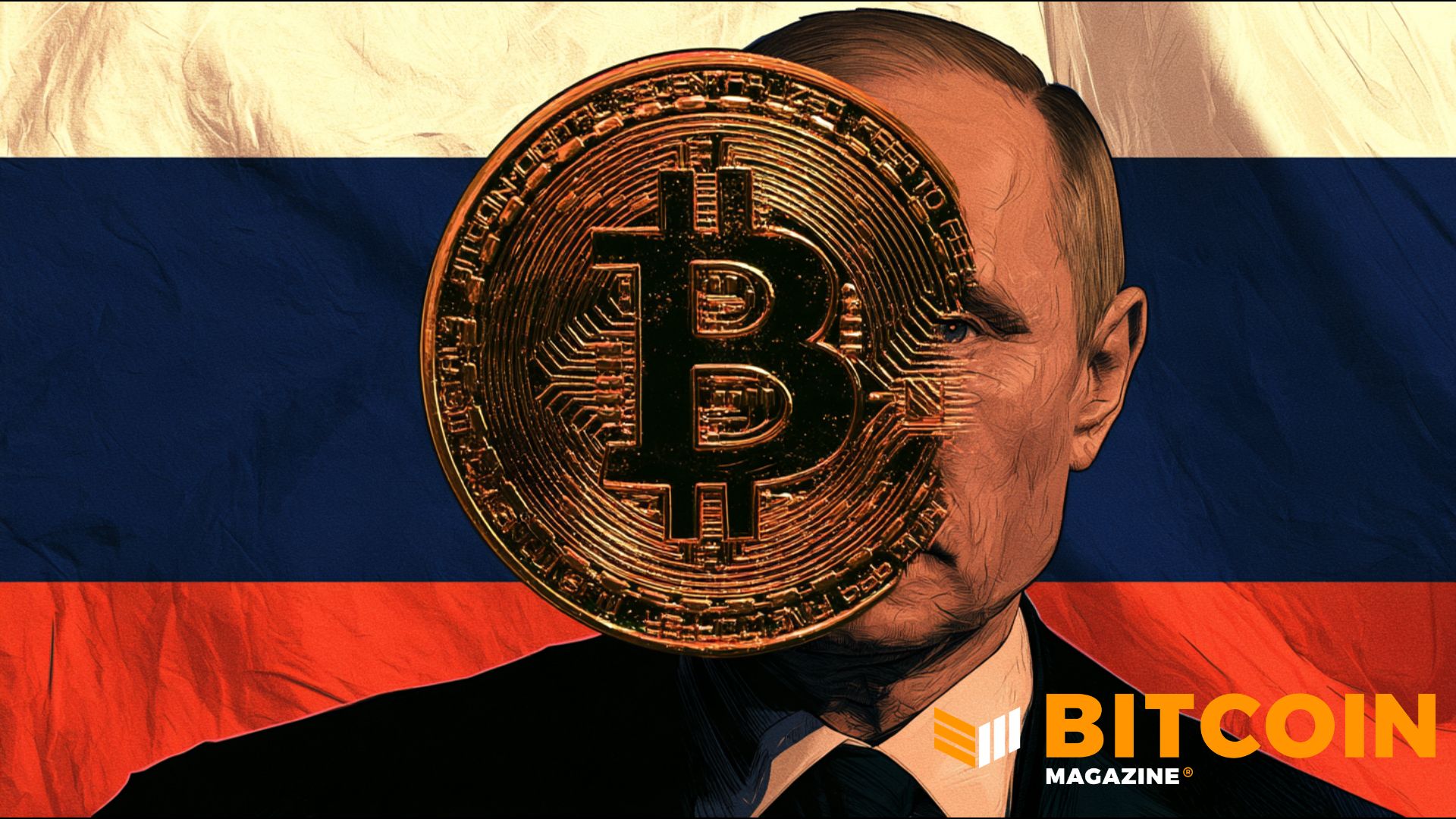
Russia’s Sberbank Given Green Light to Custody Bitcoin
Russia’s largest bank has announced it is the first in the country to have been approved to custody bitcoin.
Sberbank said in an announcement Wednesday that the Bank of Russia gave the company the green light for “digital currency record-keeping” and to facilitate the transfer of such assets. It said that bitcoin and other, smaller cryptocurrencies were given approval.
Russia is fast moving ahead with regulating digital assets in the country. Russian President Vladimir Putin this month signed a law to set in stone the regulation of digital currencies and digital rights in the country.
JUST IN:
— Bitcoin Magazine (@BitcoinMagazine) October 7, 2026Russia's largest bank Sberbank, has received approval to offer digital asset custody services starting with Bitcoin
pic.twitter.com/lbhXspcHtd
“Customers will be able to conduct cryptocurrency transactions via SberBank Online, SberInvestments, and the SberBusiness online banking platform,” the bank said in a statement, adding that no new apps or platforms will be released.
It added: “For users, this means that digital currency transactions are moving into familiar banking interfaces — complete with standard customer identification, transaction monitoring, and reporting.”
Before mass rollout, the bank will provide the service for a limited number of customers, it continued.
Sberbank in July revealed plans to debut a Bitcoin and crypto wallet as well as digital asset custody by December. The Bank of Russia in July published draft regulations for crypto trading, and the State Duma has this year prepared the comprehensive regulation of digital assets.
Despite the rollout, using digital assets as a means of payment or legal tender within Russia is still banned. Using crypto as a form of payment has been prohibited in Russia since 2022.
President Putin has appeared to praise Bitcoin in the past, once saying that the leading cryptocurrency can’t be stopped.
This post Russia’s Sberbank Given Green Light to Custody Bitcoin first appeared on Bitcoin Magazine and is written by Mathew Di Salvo.
CryptoSlate
The US government moved about $470 million in seized crypto to likely Coinbase Prime addresses, according to Arkham, reviving questions over potential asset sales.
On Oct. 7, blockchain analytics firm Arkham Intelligence said the transfers included Bitcoin, wrapped Bitcoin and USDT.
Arkham linked the transferred assets to seizures involving the 2016 Bitfinex hack and Alameda Research, the trading firm previously controlled by FTX founder Sam Bankman-Fried.
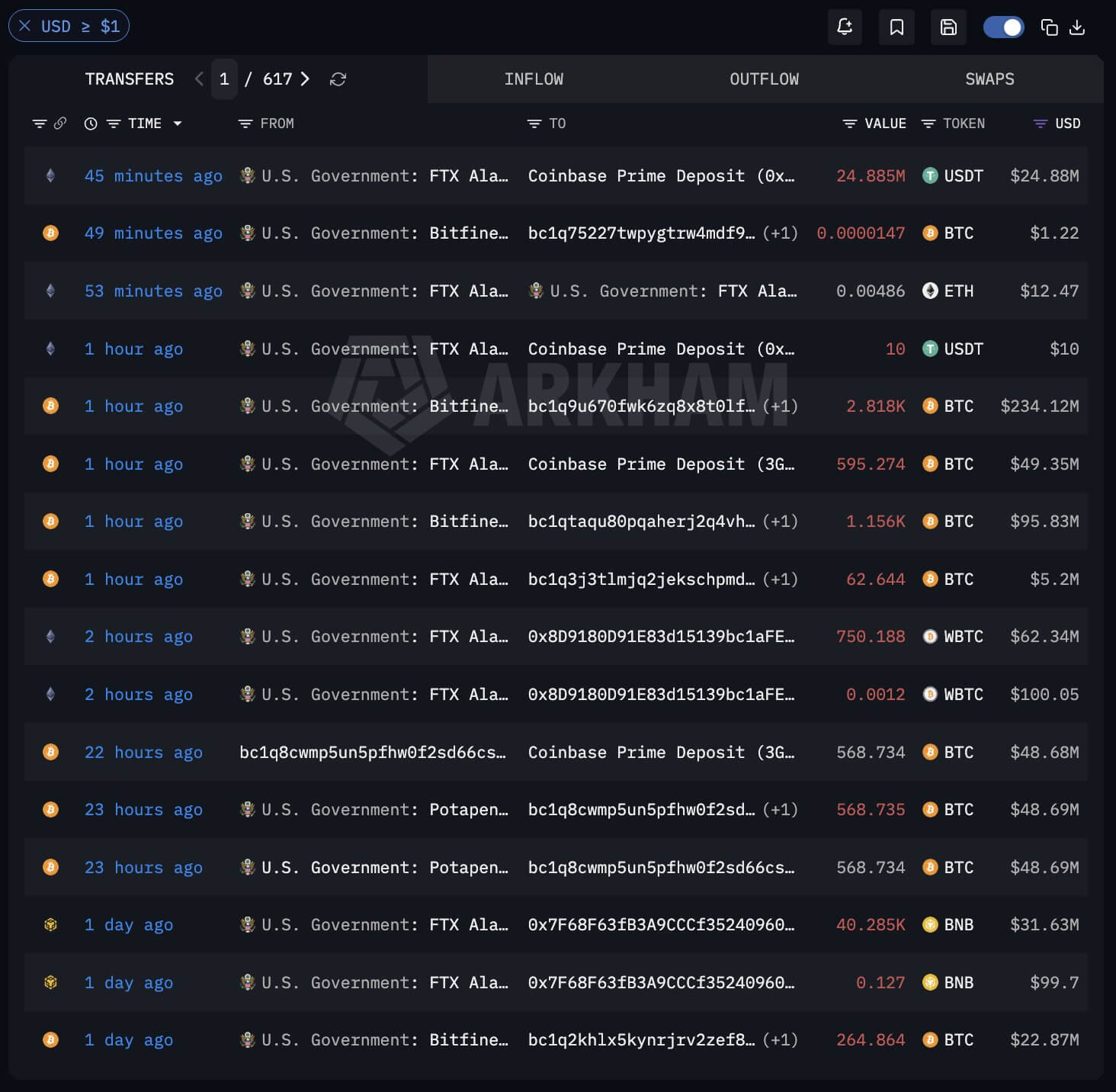
While we obviously can't say the Bitcoin is being sold, it is one plausible outcome. It's probably just as likely they are performing internal wallet hygiene or administrative work.
Still, the destination puts the transaction under greater scrutiny after the Trump administration pledged to retain Bitcoin placed in the US Strategic Bitcoin Reserve and federal officials earlier this year rejected claims that seized coins had been quietly sold.
A previous sale claim ended in a government denial
The latest movement lands nine months after the US Marshals Service pushed back against reports that Washington had disposed of Bitcoin surrendered in the Samourai Wallet criminal case.
Bitcoin Magazine reported in January that roughly $6.3 million of Bitcoin paid to the Justice Department as part of guilty pleas appeared to have been sold. Sen. Cynthia Lummis, one of Congress’ most prominent Bitcoin advocates, responded by questioning why the government would liquidate the asset after President Donald Trump had directed officials to preserve Bitcoin for the national reserve.
But the Marshals Service told DL News it had not sold those BTC, while adding that its crypto liquidations pass through a multi-level approval process before forfeited assets can be disposed of.
The issue became more sensitive after Trump established the Strategic Bitcoin Reserve in March 2025. His executive order said Bitcoin deposited into the reserve “shall not be sold” and should instead be maintained as a US reserve asset.
The White House argued at the time that premature government Bitcoin sales had already cost taxpayers more than $17 billion in foregone value.
Seized Bitcoin does not automatically mean reserve Bitcoin
The policy, however, leaves room for some government-controlled crypto to move out of federal hands.
Trump’s order permits digital assets to be disposed of when required by a court or law, and when officials determine that assets or their proceeds should be returned to verified crime victims, used for law-enforcement purposes or applied toward other statutory forfeiture obligations.
That distinction could be particularly important for these latest transfers.
The government seized about 95,000 Bitcoin in 2022 from wallets controlled by Ilya Lichtenstein and Heather Morgan as part of the investigation into the Bitfinex hack. Lichtenstein later admitted to hacking the exchange, where about 119,754 Bitcoin were stolen in 2016. Authorities subsequently seized another roughly $475 million in assets tied to the theft.
Those assets have faced competing forfeiture and restitution claims, so their legal treatment may differ from Bitcoin already transferred into the Strategic Bitcoin Reserve.
The FTX collapse also led to criminal forfeiture proceedings. The judge in Bankman-Fried’s case authorized recovered forfeiture funds to compensate victims, adding another potential victim-repayment dimension to the latest movements.
That makes Wednesday’s transaction a test of how much can be inferred from government wallets alone.
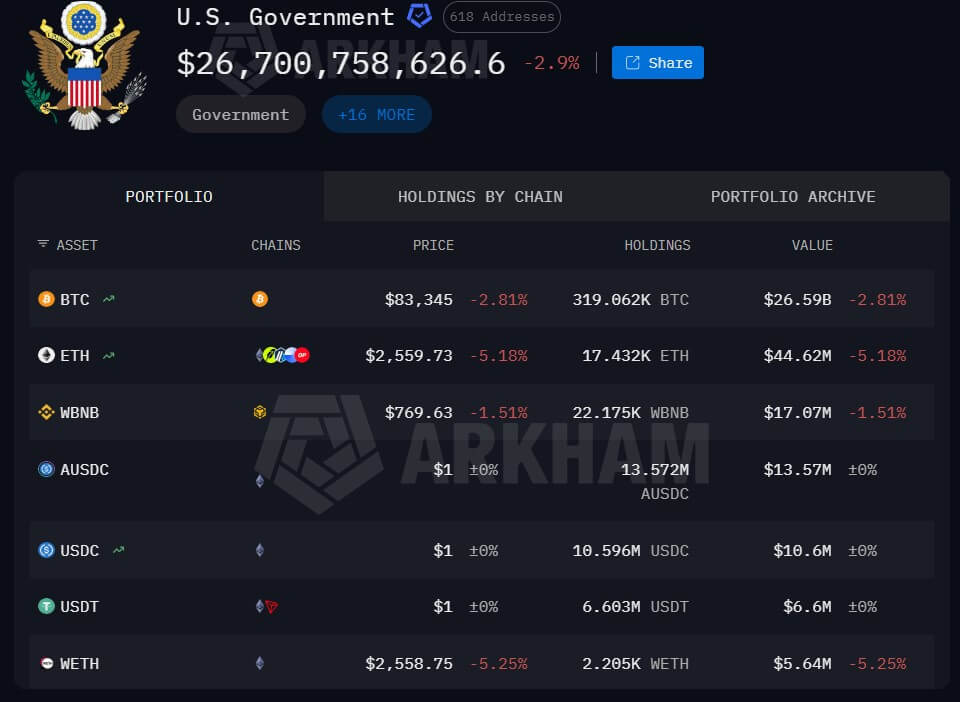
A confirmed sale of Bitcoin deposited into the Strategic Bitcoin Reserve, outside the order’s exceptions, would reopen questions over whether federal agencies are following the administration’s accumulation policy. A transfer made for custody, restitution or another permitted forfeiture purpose would fall into a different category.
For now, Arkham reports hundreds of millions of dollars leaving US government wallets for likely Coinbase Prime deposit addresses. Whether those assets remain there, move into new custody arrangements, or are converted into dollars will determine whether the transaction becomes another false alarm over government Bitcoin sales or the first sign of a significant new disposal.
The post US government moves $470 million in seized crypto to Coinbase wallets, raising Bitcoin sale questions appeared first on CryptoSlate.
OpenAI’s latest advances in mathematics have prompted a leading Ethereum researcher to warn that crypto’s core wallet security could face an unexpected AI threat.
On Oct. 7, Ethereum researcher Justin Drake urged the blockchain industry to prepare for what he described as “bunker mode,” including a controlled migration of digital assets into fresh addresses whose public keys have never been exposed.
Drake said large and sophisticated holders should consider moving most of their assets to addresses that have never signed transactions. Once those addresses are used to send funds, he recommended transferring any remaining balance into another fresh address.
His warning followed OpenAI’s Oct. 6 release of a broad collection of new mathematical results produced by an internal frontier model.
The company said it tested the model across thousands of problems, published many of the resulting proofs with computer-checkable Lean formalizations and spent the equivalent of about three hours of ChatGPT Pro reasoning on the average result.
Drake argued that the accelerating pace of AI-driven mathematical discovery should force the crypto industry to reconsider assumptions about how long elliptic-curve cryptography will remain secure.
“In the worst case,” he said, an effective break of the Elliptic Curve Digital Signature Algorithm, or ECDSA, could arrive “in months, not years.”
OpenAI’s announcement does not report a practical attack on ECDSA or RSA. Drake’s months timeline is a worst-case conjecture, not a demonstrated capability.
Drake warns AI could shorten crypto’s security timetable
Bitcoin and Ethereum rely heavily on elliptic-curve cryptography to establish ownership and authorize transactions.
Standard Ethereum externally owned accounts use ECDSA on the secp256k1 curve. Once an account sends a transaction, its public key can be reconstructed from information placed onchain. Someone capable of efficiently deriving the corresponding private key could then take control of the assets.
Standard Ethereum accounts whose public keys remain unexposed have an additional layer of protection: only the address, a hash of the public key, is visible, Ethereum’s documentation says.
The industry has traditionally treated that problem primarily as a future quantum-computing risk.
Ethereum has already established a dedicated post-quantum security effort, with work underway on hash-based signatures, account abstraction and replacements for other cryptographic systems vulnerable to sufficiently powerful quantum computers. Core post-quantum infrastructure is currently targeted for roughly 2029, although the roadmap remains subject to change.
Drake is challenging the assumption that quantum computing will necessarily be the first technology capable of breaking those systems.
He pointed to recent surprises in mathematics and argued that sufficiently capable AI could uncover a classical algorithm that dramatically reduces the difficulty of recovering private keys.
That would change the industry's timetable because it would remove the need to wait for large fault-tolerant quantum computers.
Drake cited the precedent of quantum algorithms occasionally inspiring faster classical approaches and said researchers should remain open to a classical counterpart to Shor’s algorithm, which would threaten both elliptic-curve cryptography and RSA.
Whether such an algorithm exists remains unknown.
Europol separately added urgency to the broader issue, warning that quantum computing could eventually undermine cryptography protecting cryptocurrency wallets and urging the industry to begin preparing before the threat becomes practical. The agency said uncertainty over timing should not delay migration because upgrading systems and coordinating defenses could itself take years.
Crypto holders could start moving before cryptography changes
Drake’s proposed response does not require waiting for new blockchain infrastructure.
Drake proposed moving funds to addresses that keep public keys hidden behind hashes and avoiding unnecessary outgoing transactions. That protection depends on the address type: Bitcoin Taproot outputs expose a public key from the outset. Taproot also uses Schnorr signatures rather than ECDSA, although both rely on the secp256k1 curve.
Drake urged large custodians to lead that transition, specifically naming Binance, Bitbank, Robinhood, Bitfinex and Tether as firms with an opportunity to harden cold-storage practices.
He also recommended more aggressive precautions for critical blockchain infrastructure. Oracles and layer-2 security councils, for example, could rotate ECDSA keys after signing messages or combine existing signatures with hash-based systems such as SPHINCS.
Those measures would amount to an interim defense rather than a permanent solution.
Drake said his preferred long-term approach would rely heavily on hash-based cryptography, which has less algebraic structure for future AI systems to exploit than elliptic curves, lattices or isogenies.
Ethereum is already moving partly in that direction. Its post-quantum roadmap includes hash-based validator signatures and mechanisms designed to let individual accounts eventually adopt different signature schemes without requiring the entire network to migrate at once.
Drake cautioned against a rushed migration, warning that hurried transfers could create more risk than they remove. But he said Ethereum’s existing timelines should now be revisited as AI changes the assumptions underlying them.
Ethereum’s second annual post-quantum research retreat is scheduled for Oct. 9 to Oct. 12, while Drake said he plans to address institutional participants in London next month as he pushes for faster defensive preparations.
The post OpenAI math breakthroughs raise ‘bunker mode’ alarm from Bitcoin researcher Justin Drake appeared first on CryptoSlate.
XRP traded around $1.43 on Oct. 7, down 5.46% over 24 hours. Five tracked US spot XRP ETFs held an estimated $1.7 billion at the previous day's close, according to market data tracker Maketo.
The holdings total is accumulated exposure. The latest net flows were much smaller, and the ETF sector contained withdrawals as well as additions: Franklin and Canary recorded outflows on Oct. 6, even though the five funds collectively received net inflows. The exchange-wallet decline used to support a supply-squeeze story also includes a storage migration that left coins under the same exchange's control.
ETF inflows and wallet withdrawals tell a smaller story
Maketo estimated that its five tracked funds held $1.7 billion, or about 1.13 billion XRP, at the Oct. 6 close. It values the coins at its own daily closing price and estimates some holdings when issuers do not publish a coin count.
Its flow data for the same date showed $3.14 million of aggregate net inflows. The past-week total was roughly $3.9 million, alongside $112 million over the past month. The weekly and monthly figures cover the tracker's trailing periods.
The rounded daily breakdown showed about $11 million entering Bitwise's fund. Franklin recorded roughly $4.1 million leaving, while Canary lost about $3.3 million. Grayscale and 21Shares were flat. Bitwise's additions outweighed withdrawals elsewhere, leaving the sector positive.
Canary's shares-outstanding table shows its share count moving from 23.35 million on Oct. 5 to 23.14 million on Oct. 6, consistent with net redemptions. That identifies a fund where exposure was being reduced, without naming the investors or showing where any underlying XRP changed hands.
There is also a distinction between investors selling ETF shares on an exchange and shares being redeemed from the fund. Individual shares trade in the market, while authorized participants handle creation and redemption units.
The exchange picture is also mixed. An Oct. 7 reading from ledger data tracker XRP Insights, taken at 08:00 UTC, counted 21.98 billion XRP in 699 publicly attributed wallets across 24 exchanges. That includes cold storage and some reserves backing wrapped tokens, so it is broader than readily tradable inventory.
Selling can also occur within an exchange's pooled customer accounts. As an accounting matter, XRP moving from one customer's ownership to another's need not alter the exchange's total on the ledger. That lets sellers trade existing exchange inventory even while coins are being withdrawn.
Comparing the same wallets over seven days, the tracker reported a decline of 26.5 million XRP, or 0.13%. Binance-attributed balances fell by 33 million XRP, while Upbit's rose by 11.5 million.
The monthly figure looked much more dramatic: a 1.63 billion XRP decline. XRP Insights attributed most of that fall to an Uphold storage migration into newer wallets outside its tracked set. Excluding Uphold, the decline was 75 million XRP, or 0.54%.
Even the adjusted measure can include transfers into untracked wallets. A recorded withdrawal may reflect an exchange moving its own storage rather than customers taking coins away.
Ripple's Oct. 1 cycle released 1 billion XRP and re-escrowed 700 million, according to XRP Insights' ledger tracker. The remaining 300 million left escrow; that change in availability does not establish that the coins were sold.
Heavy futures trading leaves price leadership unresolved
At 14:29 UTC on Oct. 7, CoinGlass recorded $3.97 billion of XRP futures turnover over 24 hours against $801.56 million of covered spot turnover. Open interest stood at $3.35 billion. Its XRP price reading was $1.4308, down 5.46% over the same rolling day.
Futures activity was roughly five times the covered spot figure. Gross turnover counts trading activity rather than net bearish exposure, leaving open whether futures sellers led the price move or followed it.
Open interest includes outstanding long and short positions. To distinguish a leveraged unwind from fresh positioning, price, funding and liquidation data need to be considered together. A fall in open interest alone would not establish forced liquidations.
The backdrop also extends beyond XRP. Bitcoin was around $83,100 in CryptoSlate's Oct. 7 snapshot, below its Oct. 6 reference close of $85,557.56.
The dated redemptions identify where ETF exposure was reduced. The dominant XRP sellers remain unidentified. The next useful signals are stronger net ETF additions, exchange movements traced beyond storage migrations, and derivatives data showing how positions changed during the fall.
The post XRP ETFs now hold $1.7 billion but took in just $4M last week appeared first on CryptoSlate.
Ethereum’s slide toward $2,500 has put about $1.35 billion of leveraged long positions at increasing risk of liquidation.
CoinMarketCap data showed roughly $1.35 billion of ETH long exposure sat at liquidation levels below the prevailing price, compared with about $999.78 million of shorts vulnerable above it. The figures represent positions exposed across a range of lower price levels rather than a single liquidation threshold.
The nearest pressure point is already approaching. About $112.83 million of ETH longs on Hyperliquid were positioned to liquidate around $2,511, CoinMarketCap said. When ETH traded at $2,605.65, the distance to that level had narrowed to about 3.6%, compared with a 7.4% cushion a day earlier.
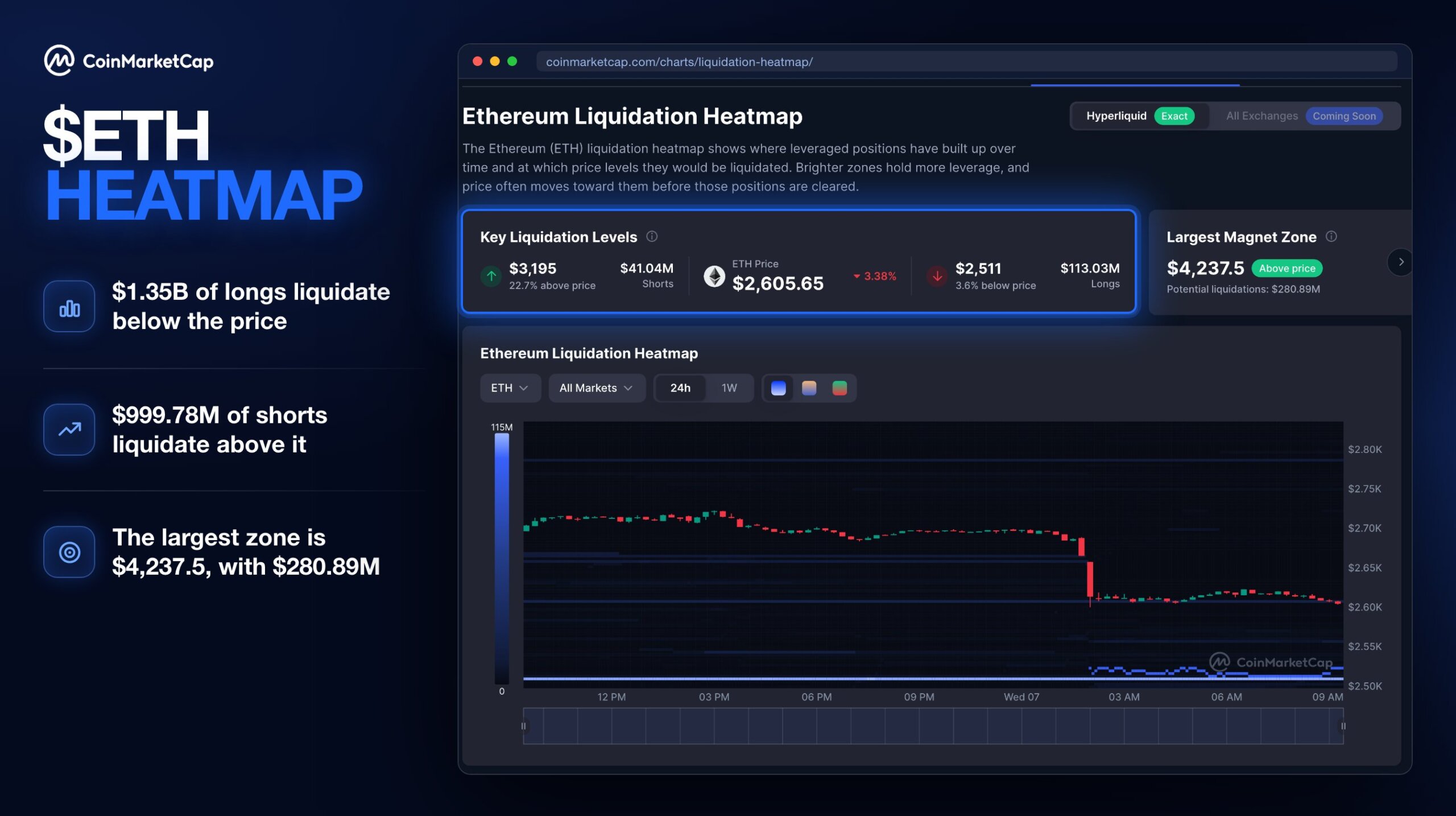
The risk comes after ETH fell 5.9% over the last 24 hours to $$2,570 as of press time, according to CryptoSlate's data, extending a break from the $2,700 area that had contained the token despite several days of institutional selling.
ETH longs take the first hit as $2,500 comes into focus
Available data shows that the latest price break triggered a sharp wave of forced closures before Ethereum has even reached the nearest major liquidation cluster.
CoinGlass data showed $233.36 million of ETH positions were liquidated over the last 24 hours, with long traders accounting for $221.87 million, or about 95% of the total.
Of this, roughly $226.22 million was wiped out over 12 hours, including $216.11 million of long exposure.
Notably, Ethereum also accounted for the largest single liquidation across the broader crypto market, with a $26.64 million ETHUSDC position on Binance forced closed.
The scale of those losses makes the remaining liquidation map more consequential. Liquidation maps do not mean every identified position will automatically be closed. They instead show where leveraged trades become increasingly vulnerable as prices move through successive thresholds.
A continued decline toward $2,500 would therefore test whether the first wave of liquidations has removed enough leverage to stabilize the market or whether another layer of long positions remains vulnerable below it.
However, current market positioning suggests that risk has not disappeared.
CoinGlass showed a 3.32 long-to-short ratio among Binance ETH/USDT accounts, while the comparable ratio on OKX stood at 2.13. Binance’s largest traders were also skewed toward longs, with a 2.34 ratio by accounts and 1.62 when measured by positions.
Those metrics do not measure the dollar value committed to either side, but they show bullish positioning remains widespread even after more than $220 million of long bets were erased.
Funding rates, however, have turned negative.
Data from CoinGlass shows Ethereum’s open-interest-weighted funding rate stood at -0.0041%, while its volume-weighted rate was -0.0034%. Negative funding indicates stronger demand for short exposure, with short sellers paying longs to maintain perpetual futures positions.
That shift raises the prospect of increasingly crowded positioning on both sides if traders continue buying the decline while others add shorts after the breakdown.
ETF withdrawals remove another source of support
Ethereum’s weakening price is also coinciding with a sharp deterioration in demand for US spot Ether ETFs.
The funds recorded about $202 million of net outflows on Oct. 6, their largest single-day withdrawal since Sept. 16. The move extended the current outflow streak to six sessions and brought total withdrawals during the run to roughly $408 million.
The latest withdrawal also marked a significant acceleration. Investors had pulled almost $206 million from the funds across the previous five sessions combined, meaning Oct. 6 alone nearly matched that amount.
Ether had initially absorbed those withdrawals while holding near $2,700, suggesting ETF selling was not immediately translating into weaker prices. That resilience has now broken, with another large outflow arriving as ETH slipped toward $2,500.
Despite the recent retreat, the funds have accumulated $13.55 billion in cumulative net inflows since their launch, according to SoSoValue, leaving the latest withdrawals as a reversal within a much larger pool of institutional capital already committed to Ethereum.
Nonetheless, the outflows put greater focus on whether institutional investors begin treating the lower price as an entry point or continue reducing exposure.
Continued redemptions would remove a source of spot demand at a time when Ethereum is already struggling to regain its previous range. A reversal in flows, however, could signal that investors see the latest decline as an opportunity rather than the start of a deeper pullback.
The post Ethereum falls 6%, leaving $1.35 billion in long bets at risk of liquidation appeared first on CryptoSlate.
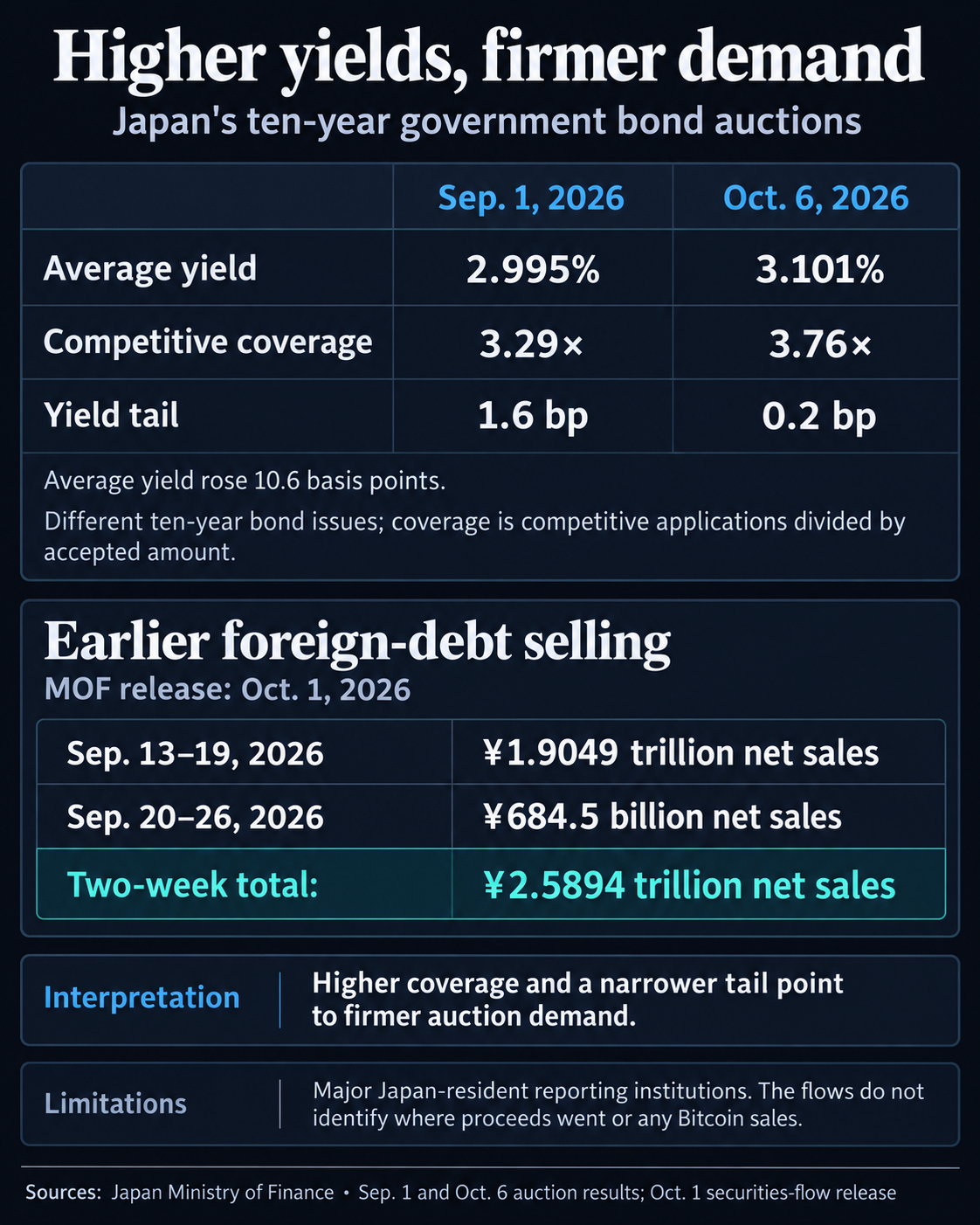
Japan’s October 6, 2026 auction of ten-year government bonds attracted more competitive demand relative to the debt sold, even as its average yield rose to 3.101%. For Bitcoin, higher returns on Japanese debt raise a question about how a sustained shift in bond allocation could affect global financing.
The Ministry of Finance’s result put the average yield up from 2.995% at the September 1 sale, an increase of 10.6 basis points. Competitive auction coverage, the amount sought by participants divided by the amount accepted, rose from about 3.29 times to 3.76 times.
The yield tail narrowed from 1.6 to 0.2 basis points. That gap measures the yield at the lowest accepted price against the average yield. Alongside the higher coverage, the smaller tail points to firmer demand at the higher yield.
The backdrop is two earlier weeks of foreign-debt selling. MOF’s October 1 flow release recorded net long-term debt sales of ¥1.9049 trillion during September 13–19 and ¥684.5 billion during September 20–26. Together, those weekly observations amount to net sales of ¥2.5894 trillion.
The series covers designated major Japan-resident reporting institutions and classifies foreign securities by issuer residence. It does not identify US Treasury sales, currency conversion, reinvestment into Japanese government bonds or Bitcoin transactions.
The potential financing pressure on Bitcoin
If Japanese institutions persistently prefer domestic bonds over overseas debt, reduced foreign bond demand could raise borrowing costs and weigh on capital available for risk-taking.
The authors of a Bank for International Settlements working paper identify global funding conditions and speculative motives as important drivers of cross-border Bitcoin and Ether flows. Their 2017 to mid-2024 sample supports the relevance of funding conditions to crypto flows.
Institutional portfolio allocation also differs from leveraged yen carry trades, which involve positions financed with borrowed yen. A ten-year auction yield does not measure the short-term cost of that borrowing. In their August 2024 analysis, BIS researchers described how deleveraging and margin increases amplified that month’s market turbulence. It illustrates how financing stress can spread across markets, without demonstrating a current unwind.
The next useful evidence is whether foreign-debt selling continues alongside independently observed funding stress. That pattern would be consistent with the proposed Bitcoin financing channel; renewed buying and calm funding would weaken the interpretation.
The post As Japanese institutions sell ¥2.6 trillion in foreign debt, here’s what Bitcoin investors need to watch appeared first on CryptoSlate.
CryptoTicker.io
MyNearWallet, one of the oldest browser wallets for the NEAR protocol, is being shut down on October 31, 2026. Your NEAR balances will still sit on the blockchain afterwards, but the route you have been reaching them through in the browser disappears. Do nothing and you lose no balance, then, only convenient access to it, and you will have to claw that access back later through your recovery data the hard way.
The deadline falls on a day when NEAR is the only one of the 25 largest cryptocurrencies in positive territory. The two belong together: the price brings new holders into the network, and many of them land through search results on precisely the wallet that closes in a good three weeks.
MyNearWallet in one sentence: what a browser wallet for NEAR actually does
A browser wallet, often also called a web wallet, is a website that manages your private key in the browser and uses it to sign transfers for your account. It does not hold the coins, because those sit in the blockchain's account balance. What is held is the key that allows that balance to be moved.
In the jargon, that distinction is called self-custody: you hold the key yourself, no company holds it for you. MyNearWallet works on that principle, so it is not a custodian, and precisely for that reason a shutdown here is something other than at an exchange. An exchange that closes is sitting on your money. A browser wallet that closes only takes the interface with it.
NEAR adds a peculiarity. The protocol supports readable account names, and one account can carry several access keys. Switching wallets therefore need not technically be a move of the coins; it can also remain a change of key on the same account. Which of the two routes applies to you depends on how your account was set up.
October 31, 2026 and the phased plan through 2027
On its sunset page, MyNearWallet writes that the wallet is scheduled for deprecation on October 31, 2026. Alongside that, the page sets out a phased plan that began back in the summer: notices ran inside the wallet itself from July 2026, guided migration help was available from August through September, and from October to December 2026 the wallet shrinks to an interface serving mainly migration and recovery. Individual functions may be restricted or removed as early as October 2026. From 2027, only a static information page is to remain.
What can fall away from October 2026
The upshot: October 31 is not the day things get tight, but the day it is over. Things get tight during the current month, because functions can disappear step by step while the wallet is still officially reachable. The page itself explicitly calls the step a plan and promises details later, so it is no promise of a fixed set of functions through to the final day.
“Your assets are stored onchain”: the shutdown takes access, not ownership
The official @NEARProtocol account wrote on X on October 6, 2026 that MyNearWallet would be shut down on October 31, and added: “Your assets are stored onchain. You only need a new way to access them.” The sunset page points the same way and records that accounts, tokens, staking positions and NFTs remain safe.
That statement is technically correct and still no reason to ignore the deadline. A route of access that disappears is in practice often just as expensive as a lost balance, because recovering it through the recovery phrase costs experience and nerves. The recovery phrase, usually called a seed phrase, is a sequence of twelve or more words from which the private key can be recomputed in full.
Anyone who can no longer find those words has a final problem, not a mere access problem. So the calmest reading of NEAR's announcement is the most uncomfortable one: you have until the end of the month, and that time only helps if you use it.

Meteor Wallet or near.com: two official channels name two destinations
A closer look pays off here, because the two official sources do not point in the same direction. MyNearWallet's sunset page names Meteor Wallet as the expected recommended migration route and alongside it explicitly permits other supported wallets from the NEAR ecosystem; which ones those will be in the end, it says it will announce in due course. The NEAR protocol account's post of October 6, by contrast, points to near.com and describes an account there that can be controlled by passkey and is meant to cover swapping, paying and earning yield across more than 30 chains. A passkey is an access method that ties the key to a device and biometric approval rather than to a typed phrase.
That gap between the two channels is not a formality for you. Treat the reference to near.com as the only official recommendation and you may end up in a product with a considerably larger feature set than you need. Follow the sunset page alone and you are waiting for a list that is not yet complete at the time of writing. All that stands up so far is that there are several permissible destinations and that the choice is yours.
In practice that means picking the wallet by the same criteria as outside any deadline: which networks do you need, how is the key secured, how does recovery work, and what happens if this provider also stops in two years. An overview of the categories and how they differ is in our overview of trading venues and custody models, if you do not want to hold NEAR yourself permanently anyway.
Staking positions and delegation: what travels along in a wallet switch
NEAR works with delegated staking. Meaning: you entrust your tokens to a validator that produces blocks, and you receive a share of its reward without running a server yourself. The delegation hangs on the account, not on the wallet interface you set it up through.
The sunset page accordingly records that staking positions remain safe and that confirming balances and staking positions is part of the migration. What it does not describe is the sequence in detail: how an existing delegation is handled during and after the switch is left open there. That gap is the reason to tackle the staking part first rather than last.
Unbonding period and forgone rewards
Two points matter here regardless of provider. First, NEAR has an unbonding period: pull delegated tokens back and you wait several epochs after unstaking until they are freely available. An epoch is the network's accounting interval, in which the validator set is determined. Second, rewards do not keep accruing during that time. Begin a week before October 31, then, and you can end up in the unhappy position of the deadline expiring while the tokens are still unbonding.
On top of that sits a development affecting the yield itself. cryptoticker.io reported on October 3, 2026 on a governance proposal in the NEAR ecosystem to lower the issuance of new tokens step by step to a target of 1.6 percent. Should it be adopted, the staking yield falls accordingly, because it is paid essentially out of that issuance. At the time of writing, that is not decided.

Seed phrase and phishing: the scam that comes with every migration deadline
Every announced shutdown is an invitation to fraudsters, for one simple reason: the occasion supplies the pretext they otherwise have to invent. A message urging you to “verify” or “migrate” your account because of the shutdown looks like assistance in this phase and hardly like a crude attempt at fraud.
The sunset page therefore makes unmistakably clear that neither MyNearWallet nor Meteor Wallet nor the NEAR Foundation or its support will ever ask for a seed phrase, private key, recovery phrase, passwords or credentials. In its own words, anyone demanding those details is trying to gain access to the account. The NEAR account's post of October 6 takes the same line, noting that staff never ask for a phrase.
That yields a rule which is easy to remember: migration always starts from you, never on request. You open the new wallet yourself, you establish the connection yourself, and you enter addresses from the clipboard of your own application, not from a message. The official guide additionally recommends testing with a small amount first, moving only one asset at a time and waiting for each transfer to complete before starting the next. You keep the old wallet's recovery data until the full balance has arrived in the new one.
NEAR rises 5.74 percent while the overall market falls
At 0:55 on October 8, NEAR is quoted at $5.36 or €4.79 according to CoinGecko, a gain of 5.74 percent within 24 hours. The daily range ran from $4.89 to $5.44. That makes NEAR, at rank 21 among the largest cryptocurrencies, the only gainer in the top 25 excluding stablecoins: bitcoin loses 2.68 percent over the same period, ethereum 4.70 percent, XRP 5.33 percent, solana 4.20 percent, uniswap 8.44 percent.
Over a longer horizon the picture looks different from this one day. Over 30 days NEAR is up 127.91 percent, while over seven days it is slightly down at 0.75 percent. Market capitalisation stands at around $7.0 billion, the day's trading volume at around $1.08 billion, the circulating supply at around 1.308 billion NEAR. The all-time high of $20.44 dates from January 16, 2022; the price is 73.8 percent below it.
For orientation up and down, the figures from the data itself therefore serve better than round wished-for levels: the daily low at $4.89 marks the zone the market defended that day, the daily high at $5.44 the one where it failed. The 30-day rise of around 128 percent also means that a large share of today's holders have only been in for a short while, so without a buffer.
The day was marked market-wide by forced liquidations, whose scale reports put at different figures. Finance Magnates names more than $400 million in long positions unwound within roughly 20 minutes, Mitrade around $550 million, Yahoo Finance citing Coinglass around $696 million over 24 hours. An oil price above $101 a barrel of Brent and a failed recovery above about $87,000 in bitcoin are seen as the triggers. None of these sources names a NEAR-specific reason for the daily gain; nobody claims the shutdown is driving the price, and this article does not either.
The route to buying in Germany: MiCA authorisation and the limit of self-custody
Anyone buying or selling NEAR in Germany does so at an authorised service provider, now that the EU regulation on markets in crypto-assets applies in full. MiCA covers companies that trade or exchange crypto-assets or hold them for third parties, and requires of them a licence and ongoing supervision.
For the MyNearWallet case, the dividing line is the actual point. Software with which you hold your own key provides no custody for third parties and therefore needs no authorisation. That is convenient, but it has a flip side: there is no supervisor that can oblige an operator to keep running, no deposit protection and no body you could complain to about a shutdown. Announcing a deadline here is a courtesy, not a duty.
How differently the regulated route runs has just been demonstrated in Germany. BaFin has refused the operator of bitcoin.de its MiCAR authorisation; in that case rules on the segregation and transfer of client assets applied, and client assets stayed with the custodian bank until they pass to another authorised custodian. The details are in our report on the refused MiCAR licence for bitcoin.de. Both cases fall in the same week and show the same decision from two directions: with self-custody you carry the operational risk yourself, with an authorised custodian a supervised company carries it, and you carry counterparty risk in exchange.
Holding period and allowance: the move is not a sale, a swap during migration is
On tax, the good news comes first: a transfer between two wallets that both belong to you is not a disposal. The storage location changes, the owner does not, and so no new holding period begins either. For private disposals, Section 23 of the German Income Tax Act sets a period of one year, after which a gain remains tax-free, plus an exemption threshold that has stood at €1,000 per calendar year since the 2024 Annual Tax Act. Exemption threshold means: exceed it and the entire gain is taxable, not only the part above it.
The unpleasant news sits in the detail of the migration. As soon as you swap along the way rather than simply transferring, because the new wallet offers an exchange across several chains say, that is a swap of one crypto-asset for another. Such a swap is, for tax purposes, a sale followed by a purchase; it can trigger a gain and starts the holding period afresh for the new asset. Precisely because near.com is explicitly promoted with swap functions across more than 30 chains, this distinction matters more during the moving weeks than it otherwise would.
Which records the tax office wants to see
That creates a documentation duty in your own interest. You should be able to prove that both addresses belong to you, and record every transaction with its date, amount and transaction ID. Without that evidence, the tax office can read an outflow from the old wallet as a sale. Keeping track through a portfolio tool is the calmer route for this than a table by hand. The German Federal Ministry of Finance's circular on crypto-assets of March 6, 2025 is the authoritative administrative guidance; for larger holdings or staking income, this article is no substitute for tax advice.
What the shutdown says about NEAR's wallet landscape
A wallet being switched off is not yet a verdict on a network. MyNearWallet emerged as the successor to an earlier browser wallet run by the development side and was for years the standard answer to the question of how to reach a NEAR account without extra software. That this slot is now being filled anew fits a line that has been visible around NEAR for months: fewer standalone interfaces, more bundling onto one account that works across chains.
Two things about that are interesting for holders. The bundling lowers the number of places where something can go wrong and at the same time raises dependence on the one place that remains. Anyone who does not want that has good conditions, with a protocol offering readable accounts and several access keys per account, to spread access across two independent routes instead of hanging everything on one interface.
What remains open at the time of writing is which wallets will end up on the list of supported destinations and how the sunset page and the protocol account will reconcile their differing recommendations. Until then the simpler truth both sources share applies: the account is yours, access is replaceable, and nobody does the replacing for you.
MyNearWallet shutdown: your next three steps
- Take stock of holdings and delegation. Open your account while it is still October and write down what sits there: free NEAR balance, delegated tokens including the validator, NFTs and other tokens. Check in the same pass that your recovery phrase is complete and legible. Which wallet categories are candidates as a destination and how they differ is set out in our software wallet comparison.
- Release staking first, then move. Unstake delegated tokens early so the unbonding period does not run into October 31, then move a small test amount before the rest follows. Record every transaction with its date, amount and ID; a tracker from our comparison of crypto tax tools and portfolio trackers is the more reliable route for that than a list by hand.
- Decide whether you want self-custody at all. If deadlines like this are too much effort for you, the alternative is an authorised custodian with supervision and segregated client holdings, to be found through our overview of regulated crypto exchanges. You are trading operational risk for counterparty risk, and that is a deliberate choice, not a fallback.
(As of October 8, 2026. This article is not investment advice. Prices and fee structures change; check the terms with the provider before you buy.)
Quant and Chainlink court the same clientele: banks that want to connect their systems to several blockchains without committing to any one of them. The two projects solve that at different levels, however. Quant builds a layer above the networks and takes the decision of which blockchain to address away from the bank. Chainlink builds a standard for transfers between networks and has each one of them confirmed by several independent groups.
The distinction sounds technical, but it has practical consequences for the question of whom a bank ultimately has to trust, and for the question of whether a project's token is needed at all. Both points are covered below. None of this is a recommendation to buy, and there is nothing here about price targets.
The same job, two designs: abstraction layer and messaging standard
A bank that wants to represent tokenised deposits or securities faces a plain problem: there is not one blockchain but dozens, and they do not speak the same language. Connect to each one individually and you build a separate integration for every network and maintain it indefinitely.
Quant's answer is abstraction. Overledger sits as a layer above the networks, and the bank's application only ever talks to that layer. Which blockchain works underneath becomes a configuration setting. Chainlink's answer is standardisation. CCIP, the Cross-Chain Interoperability Protocol, defines what a transfer between two networks looks like and how it is confirmed. The bank stays closer to the networks but gets the same shape for every connection.
We have written up the fundamentals of Overledger at length in our explainer on Quant and Overledger. This piece sets out alongside it what Chainlink does differently.
The Fusion Rollup anchors states across 74 networks, according to Quant
Quant's Fusion Rollup has been running on mainnet since June 2, 2026. According to Quant's own announcement, it connects 74 blockchains, among them Ethereum, Bitcoin, Solana and the XRP Ledger. The company calls the construction Layer 2.5, because an ordinary layer 2 anchors its states in exactly one underlying blockchain, while Fusion writes them into many networks at once.
Two caveats belong with that, and they matter. The figure of 74 comes from the company itself and is not an independently verified number. And a connection on mainnet is not yet evidence of use in a bank's production operations. To assess the project, keep the question of what is connected separate from the question of what is being used.

CCIP moves data and tokens and has every transfer confirmed by several oracle networks
Chainlink describes CCIP on Chainlink's page on cross-chain transfers as a standard with which institutions, issuers and applications connect digital value across blockchains. Both things get moved: messages including instructions that are executed on the destination network, and tokens via so-called cross-chain tokens and token pools that remain with the issuer.
The core of the safeguard sits in one sentence on that page: every transfer over CCIP is confirmed by several oracle networks. Beyond that, issuers or third parties they appoint can add further checkpoints, which Chainlink calls Cross-Chain Verifiers. Regulatory checks run in a separate unit, the Automated Compliance Engine.
Where the trust sits: own anchoring at Quant, distributed confirmation at Chainlink
The real difference sits here, and it is not a matter of taste. With Quant, the bank relies on a layer operated by one company, whose states are anchored across several blockchains. The advantage is simplicity: one integration, one contractual counterparty, one invoice. The price is a dependency on precisely that provider.
With Chainlink, confirming a transfer is spread across several mutually independent oracle networks, and the issuer can add checkpoints of its own. The advantage is that no single group can wave a transfer through on its own. The price is a more demanding setup, because the bank has to deal with more moving parts.
What a supervisory authority wants to see of this
What decides it for a bank is not the more elegant design but the question of which construction it can explain to its regulator. A dependency on a single service provider is nothing unfamiliar there; it is treated as outsourcing. A safeguard spread across several independent groups creates no such contractual relationship, but it does require an explanation of why those groups cannot fail together.
The banking projects: tokenised deposits at Quant, Swift connection at Chainlink
On the evidence side, the picture looks similar for both: big names, little finished production. Quant's best-known undertaking is the mandate from US clearing house The Clearing House for tokenised deposits, which we covered on September 26 in our piece on tokenised deposits with Quant. The launch there is set for 2027 according to the clearing house, so it still lies ahead of any proving ground.
At the same level, Chainlink has its cooperation with Swift to show, which we described on September 29 under Chainlink and the Swift connection, plus a banking standard with Infosys, which we took up on September 24 under Chainlink and Infosys. Count them up and both projects come to a handful of announced undertakings and to little that runs in a bank's daily business today.
Market size: €8.9 billion for LINK, €3.3 billion for QNT
According to market data from CoinGecko, LINK costs around €11.94 on October 7 and reaches a market capitalisation of about €8.9 billion, putting it in 15th place. QNT stands at around €224.97 and about €3.3 billion, so 33rd place. Chainlink is the larger project, then, but not by orders of magnitude, rather by roughly two and a half times.
More interesting than the total is the structure of supply. Of a maximum supply of one billion units, around 748 million LINK are in circulation, so about three quarters. Of a maximum supply of a good 14.6 million units, around 14.55 million QNT are in circulation, practically all of it. A quarter of the supply is therefore still outstanding for LINK and can enter the market at some point. For QNT that question is settled. LINK thus still has a block of supply ahead of it that an investor should factor in, QNT no longer does.

For both, whether banking revenue runs through the token remains open
This is the question that counts for investors, and neither project has answered it conclusively. A network can be commercially successful without its token sharing in that. At Quant it hangs on the terms of the Overledger licence, whose current pricing the company does not disclose publicly. Third-party accounts of it contradict each other, so we do not pass them on as fact.
At Chainlink the same question arises for CCIP's fees and for the remuneration of the oracle networks. Anyone looking at either project as an investment should treat this question as open rather than as tacitly resolved. The most honest sentence on it: a bank mandate is evidence for the technology, but not yet evidence for the token.
Both tokens in Germany: where buying is possible and when gains are tax-free
QNT and LINK are listed on established trading venues, LINK considerably more widely than QNT. For buying in Germany, MiCAR means a provider needs authorisation in order to offer services around crypto assets. Which providers are subject to European supervision is shown in our overview of regulated crypto exchanges.
For tax, the same applies to both as to other crypto assets held privately. A gain on a sale is only taxable under Section 23 of the German Income Tax Act (EStG) if no more than one year lies between acquisition and sale. If the total gain from all private disposals in a calendar year stays below €1,000, it remains tax-free under Section 23(3) sentence 5 EStG. Anyone buying in several tranches needs the acquisition data per unit, because the one-year clock runs separately for each.
The evidence that will make the difference in the coming months
For both projects there are measurable signs that separate progress from announcement. At Quant that is the clearing house's timetable: the closer 2027 comes, the sooner the mandate has to turn into live operation, and the more concrete any figures on volume and participating institutions would have to become. At Chainlink it is the question of whether the work with Swift and Infosys turns into an offering that banks deploy without a pilot character.
The same applies to the token at both. Solid evidence would be a published fee schedule showing that part of the revenue is actually settled through the respective network. As long as that is missing, the link between business success and token price remains an assumption.
Both networks can exist side by side
The question “Quant or Chainlink” presumes that a bank has to choose. It does not. An abstraction layer and a transfer standard sit at different levels and are not technically mutually exclusive. An institution can connect its applications through a layer and settle transfers between networks through a standard.
For investors, that means there is no mechanism that takes from one token what the other gains. The two prices are not two sides of one bet. Anyone engaging with either project judges it on its own evidence and not on how the other is faring.
Quant and Chainlink: your next three steps
- Collect the evidence instead of the announcements. Define for both projects which event would convince you, a published fee schedule say, or a named institution in live operation, and write it down before the next price jump shifts your memory. Where QNT and LINK can be traded and at what cost is set out in our comparison of crypto exchanges.
- Keep custody separate from the project question. Whichever of the two networks prevails, holdings on a trading account still belong to a third party. A device from our hardware wallet comparison takes that question out of the equation, and the transfer to an address of your own is not itself a taxable event.
- Record the acquisition data per tranche. With two tokens bought at different times, the one-year clock quickly gets hard to follow. A tool from our comparison of crypto tax tools keeps the purchase date, purchase price and sequence per unit together.
(As of October 7, 2026. This article is not investment advice. Prices and fee structures change; check the terms with the provider before you buy.)
Abstract Chain is shutting down. The deadline is December 15, 2026, and by then you need to move anything you hold on the chain onto another network. The project words the consequence unusually bluntly: users who do not migrate their funds by that date lose access to them. No extension has been announced.
Abstract is a layer-2 solution on Ethereum, meaning a separate network that bundles transactions and passes them to the main chain for settlement. It was built by Igloo Inc., the company behind the Pudgy Penguins NFT collection. If you have never bridged anything to Abstract, the shutdown does not affect you. If you have, treat this article as a set of instructions.
What Abstract announced: a December 15, 2026 deadline and the wording on the Migration Hub
The project's own migration page sets out the process in three sentences. All users can bridge their funds down through the Migration Hub or through Abstract's native bridge, starting now. All users have until December 15, 2026. And then comes the sentence that matters: “Any users that do not migrate their assets by this date will lose access to their funds”. The same sentence recommends getting it done at the earliest opportunity.
The announcement went out through the project's channel on X. Trade publication Decrypt confirms the details independently and adds that the chain goes dark on that day, leaving anything abandoned on it unreachable. After just under three years in operation, this is the end.
Who is actually affected: balances on the chain, not the PENGU token
The most common misconception sits here, and a single sentence clears it up: the chain is being shut down, not the token. PENGU does not live on Abstract alone, and anyone holding it on an exchange or in a wallet on Ethereum has nothing to do because of this announcement.
You are affected if one of these descriptions fits you. You bridged funds to Abstract at some point to use an application there. You hold tokens that were issued on Abstract. Or you own NFTs that sit on this chain. All three cases share the same deadline.
The practical check is to connect your wallet to the migration page and let it show you what is still sitting there. A leftover amount you have forgotten about will appear too. If you used several addresses, check each one separately; there is no combined view across all of your own addresses.
Migration Hub, native bridge, Stargate, Relay and Jumper: the routes off the chain
Abstract names five routes on its migration page. The first is the Migration Hub itself, which walks you through the process once your wallet is connected. The second is the network's native bridge. Alongside those sit three independent bridging services: Stargate, Relay and Jumper.
A bridge is not a transfer in the usual sense. Your funds are locked on one chain and issued or released in the same amount on the other. That creates the most important practical difference between the routes: a network's native bridge is usually the safest option, because it works without an outside intermediary, and at the same time the slowest. Third-party bridging services are faster, charge a fee for it and bring another provider into the picture.
The closer the deadline gets, the less room you have for the slow route. Act now and you can still choose at leisure.

Three hours of delay on the native bridge: the buffer you will not have in December
Decrypt puts a concrete number on the native bridge: the route carries a delay of three hours. That is not a fault, it is part of how layer-2 networks are built. Withdrawals run through a waiting period in which the main chain confirms the operation; depending on the technology, that window runs from hours to a week.
Three hours sound harmless, and for a single operation they are. They turn awkward in the situation where most people deal with jobs like this: shortly before the end. Start on December 15 and you have no buffer for a failed transaction, for missing network fees or for an overloaded interface. How waiting periods on layer-2 withdrawals work in general, and where to look them up, is covered at length in our piece on layer-2 withdrawal waiting times.
The sober conclusion from that number: treat December 15 as the outer limit and set yourself a date well before it.
Network fees and leftover dust: what to check before you withdraw
Three things go wrong regularly in migrations like this, and all three can be headed off beforehand.
The first is network fees. Every transaction on Abstract costs a fee in the currency the network requires for it. Send your entire balance away in one go and you have nothing left to pay for a second transaction, say for a forgotten token. So leave a small remainder for fees and clear it out last.
The second is tiny holdings. After months across several applications, a wallet often holds residual amounts worth less than the fees it would cost to withdraw them. No disaster, but a decision worth taking deliberately rather than noticing on December 15.
The third is tokens that do not exist on the destination chain. Not every token issued on Abstract has a counterpart on Ethereum or another network. Where a bridge does not carry a token, selling on the chain while it still runs is the only option left. Abstract points to project-specific instructions on the migration page for cases like that.
Where you take the funds is the second decision. Self-custody is the obvious choice for longer holding periods; which devices suit it is covered in our comparison of hardware wallets. If you intend to sell anyway, bridge to Ethereum and go on from there to a trading platform.
What happens to NFTs and to applications on Abstract
NFTs are the most awkward part, because they cannot be handled like a balance. An NFT is tied to the chain it was issued on, and no general bridge for NFTs exists. Whether and how a particular piece reaches another chain is for the project behind it to decide. Holders should look up what route their project offers, and do that now instead of in December.
For the applications on the chain, Abstract has announced that its own developers will support projects moving to other networks. For users, that is good news with one restriction: an application moving does not automatically mean it takes your position with it. Funds you have parked inside an application, in a liquidity pool or a lending market, have to be withdrawn there first, before you leave the chain.

Igloo Inc. gives up the chain: the reason given
Abstract launched as a network for applications beyond pure trading, so for games, collectibles and social applications. Decrypt describes the ending with the reasoning that the network could not be scaled beyond that niche. Abstract itself speaks on the migration page of winding down with regret after almost three years.
For context that matters more than it first appears. A layer-2 depends on enough activity running on it to cover the cost of settling through the main chain. If usage stays below that threshold, the operation does not pay for itself, and the project faces a choice between a permanent subsidy and an orderly ending. Abstract chose the orderly ending and set a window of a good two months for it.
The decision says nothing about the NFT collection or about the company's token. Keep the two apart and you read the news correctly.
The third layer-2 wind-down within a few weeks: Blast, Mint Chain, Abstract
Abstract is not an isolated case, and that is the real finding for investors. Mint Chain announced its wind-down in late September, Blast followed in early October, and now Abstract. Three networks with the same pattern: a deadline, a bridge, and no access afterwards. We wrote up both earlier cases separately, the shutdown of Blast and the deadline at Mint Chain.
A habit can be drawn from this that carries beyond this one case. Leaving funds on a small layer-2 because you once needed them there is a risk with a mechanism of its own: it costs nothing until a deadline turns up, and then everything hangs on a date someone else has set. After three wind-downs in quick succession, taking stock of every chain you have ever bridged to is not a panic reaction but housekeeping.
Abstract: the key points for your decision
The situation is unambiguous and so is the timeframe. Whatever belongs to you has to come off Abstract Chain by December 15, 2026, or it will no longer be reachable, according to the project. Three steps are enough.
- Take stock, today. Connect every address you have ever used on Abstract to the migration page and note what sits there: balances, tokens, NFTs, open positions in applications.
- Set a destination and bridge. Decide in advance where the funds are going. Self-custody suits longer holding periods, and our comparison of hardware wallets gives an overview. If you want to sell, bridge to Ethereum and go on from there to a platform from our comparison of crypto exchanges. Leave a small remainder for fees.
- Document the process. Record the date, amount and value of every bridge transaction. You will need that later for tax treatment, and the tools for it are in our comparison of crypto tax tools and portfolio trackers.
(As of October 7, 2026. This article is not investment advice. Prices and fee structures change; check the terms with the provider before you buy.)
If a crypto exchange becomes insolvent and you later get something back, what decides the crypto tax is not the size of the payment but its form. If the same coins return into your control, nothing has happened for tax purposes: acquisition date and acquisition cost run on unchanged, and a holding period that expired long ago stays expired. If money arrives instead on a filed insolvency claim, the event is an entirely different one, and the tax authorities have not expressly regulated it to this day.
That difference is the whole article. It concerns many German investors right now, because several large proceedings are stuck in the wind-up phase and a deadline at Mt. Gox expires on October 31, 2026. Both routes are set out below in detail, along with the evidence question on which most cases turn in practice.
Two Routes Out of the Proceedings: Segregation in Coins or an Insolvency Claim in Euros
When insolvency proceedings open, the assets split into two pots. Everything belonging to the debtor forms the insolvency estate and is distributed among the creditors. What belongs to a third party, even though it sits with the debtor, is not part of it. For that case the German Insolvency Code provides for segregation: under Section 47 InsO, a person holding a right in an object that does not belong to the estate may demand its surrender. They are then not an insolvency creditor but an owner reclaiming their property.
Whether that route is open to you depends on the custody arrangement. If your coins sat in a holding that was separated from the exchange's own assets and attributed to you, much speaks for segregation. If they were mingled in the exchange's pooled wallets with the holdings of every other customer, the result is as a rule a simple insolvency claim under Section 38 InsO: a monetary claim valued as at the opening date which brings only a dividend in the end. We have written up the legal side of that distinction in a separate piece on segregation in an exchange insolvency, and how a filing works in practice is shown by the zondacrypto case.
Why This Classification Comes Before the Tax Question
The tax treatment follows the classification under civil law, not the other way around. Anyone who does not know whether they will get coins or a monetary claim back cannot determine the tax consequence. In case of doubt, the answer sits in the insolvency administrator's letter and in the schedule of claims: if a claim is listed there in euros or dollars, you are an insolvency creditor.
Surrender of the Same Coins Is Not a Disposal Within the Meaning of Section 23 EStG
Under settled case law, crypto-assets are “other assets” within the meaning of Section 23(1) sentence 1 no. 2 of the German Income Tax Act (EStG). The Federal Fiscal Court decided this in its judgment of February 14, 2023, and the Federal Ministry of Finance circular of March 6, 2025 carries that classification forward. Gains from a sale of privately held assets are therefore taxable only if no more than one year lies between acquisition and disposal.
The two terms are decisive. An acquisition is the acquisition from third parties for consideration. A disposal is, as its mirror image, the transfer of the acquired asset to third parties for consideration. Both presuppose consideration and a change of legal owner. When an insolvency administrator surrenders your own coins to you, they are fulfilling a claim for surrender. You pay no consideration for it, and ownership does not change hands but merely becomes accessible again. On that definition there is no private disposal, and the return itself triggers no tax.
One qualification belongs here: the Ministry circular does not deal with the insolvency case separately at this point. The classification follows from the general definitions set out in it, and not from any statement by the tax authorities on insolvency proceedings.
On Surrender, the Holding Period From the Year of Acquisition Runs On
The one-year periods of Section 23 EStG begin anew after every exchange of assets. A surrender is not an exchange, so nothing begins anew. For you that usually means good news: whoever bought in 2021, lost access in 2022 and receives the same coins back in 2026 holds assets whose holding period expired years ago. A sale after that is tax-free for privately held assets, regardless of how far the price has risen in the meantime.
Conversely, the same mechanism also works against you if the acquisition fell shortly before the collapse and the surrender came quickly. Then the period may still be running. For the total gain of a calendar year, the exemption threshold of Section 23(3) sentence 5 EStG remains: if the sum of all private disposals stays below €1,000, it stays tax-free. Up to the 2023 assessment period that threshold stood at €600. This threshold applies to all private disposals of one year taken together, not per coin.

Mt. Gox: The Extended Repayment Deadline Ends on October 31, 2026
The most concrete date for those affected in Germany comes from Japan. By a notice from the Rehabilitation Trustee of October 27, 2025, the trustee of the Mt. Gox proceedings moved the deadline for the base repayment, the early lump-sum payment and the intermediate repayment from October 31, 2025, to October 31, 2026, Japanese time. Japan is eight hours ahead of Germany, so for you the effective moment still falls on the preceding day.
As the reason, the trustee names that many creditors have not completed the necessary procedural steps to this day, among them identity verification and the lodging of payment details. It is already the third postponement of this kind. Anyone still waiting will find the particulars in our piece on the Mt. Gox repayment deadline. In tax terms the date matters because it fixes the assessment period in which the inflow falls.
The Dividend in Money Meets an Open Point in the Ministry Circular
The second route is the harder one. In the large proceedings, customer claims are not satisfied in coins but valued in money as at the opening date and later paid out as a dividend. At FTX, which opened Chapter 11 proceedings in November 2022, that is the basic structure of the wind-up. In economic terms you therefore receive money for coins you never sold.
On the wording of Section 23 EStG this can be read in two directions. One reading holds that a transfer to third parties for consideration is missing: the coins have perished in the estate, and the dividend is repayment on a claim, hence not a disposal and not taxable. The other reading sees the disposal event already in the conversion of the coins into a monetary claim. It would then turn on whether more than a year lay between the acquisition and the opening of the proceedings, which is almost always the case for holdings from the years before 2022.
Both readings lead to the same result for legacy holdings, namely no tax. They diverge only where the acquisition fell shortly before the collapse. The Ministry circular says nothing about the dividend payment from insolvency proceedings. If your case turns on that question, it is the case for a binding ruling from the tax office under Section 89(2) of the German Fiscal Code or for a tax adviser, and the facts belong openly in the return rather than quietly in a single line.
Payment in US Dollars: The Foreign Currency Balance Is an Asset of Its Own
Here lies a trap that has nothing more to do with the coins. Large proceedings pay out in US dollars. A foreign currency balance is, taken on its own, likewise an “other asset” within the meaning of Section 23(1) sentence 1 no. 2 EStG. With the inflow of the dollars you acquire that asset, and a one-year period of its own begins for it.
If you exchange the dollars into euros within that year and the dollar has gained against the euro in the meantime, a taxable gain can arise from it. That holds even if the underlying coins were long since unobjectionable for tax purposes. The exemption threshold of €1,000 applies here too, because it is the same category of income. Anyone holding the dollars for longer than a year has the question off the table.
Which Units Count as Returned Is Determined by Individual Attribution and FIFO
If only part of your holdings comes back, the question arises which units these are. The Ministry circular names the principle of individual attribution for this. Where individual attribution is not possible, the crypto-assets of one trading designation acquired first count as disposed of for the holding period, and the average method is to be applied for valuation. For simplification it may be assumed that the units acquired first were disposed of first, that is, first in, first out.
On top of that comes a wallet-based view: within one wallet the method chosen is to be retained until all units of that trading designation there have been disposed of. The account at the insolvent exchange was, in this logic, a unit of its own. Anyone who bought there in several tranches over the years has to reconstruct the order before calculating anything at all.

Paragraph 89: Missing Records Are Borne by the Taxpayer
The hardest sentence for those affected sits not in insolvency law but in tax law. The Ministry circular states verbatim at paragraph 89: “Missing records and data losses (for example because of the insolvency of the trading platform or as a result of a hacker attack) are borne by the taxpayer.” The insolvency of the exchange is thereby named expressly, and it is no excuse.
In practical terms that means: the tax office does not have to believe that you bought in 2017 merely because the platform has disappeared. The burden of evidencing the acquisition and its date rests on you. What usually carries weight are bank statements of the original transfer, archived transaction overviews, old confirmation emails from the exchange, blockchain transfers to an address of your own, and the documents from the insolvency proceedings themselves, that is, the filing of the claim and an extract from the schedule of claims. How such a line of evidence is built up, we worked through in the case of stolen coins.
For Foreign Trading Platforms, the Extended Duty to Cooperate Applies
Mt. Gox was wound up in Japan, FTX in the United States and the Bahamas. Almost every known proceeding therefore concerns a foreign operator, and the Ministry circular holds a tightening ready for exactly that. Where crypto-assets are acquired or disposed of through the central trading platforms of a foreign operator, that establishes an extended duty to cooperate under Section 90(2) of the German Fiscal Code. You must then not merely disclose the facts but clarify them and procure the necessary evidence. Expressly named is the regular and complete retrieval of transaction overviews for as long as the platform still exists.
For the tax reports of private providers the circular draws a clear line: a report can carry the audit trail if it appears plausible, is coherent in itself and does not contradict other findings of the authority. Obviously missing acquisition costs or missing trading platforms argue against plausibility. Adjustments and corrections, by contrast, do no harm where they are marked as such and reasoned comprehensibly, for instance because acquisition data is missing after an insolvency. Anyone who has to bring several sources together will find in our comparison of crypto tax software and portfolio trackers the programs that deliver exactly that consolidation and the settings extracts required.
Total Loss Without a Dividend: Section 23 EStG Knows No Write-Down to Zero
If proceedings end without a dividend, or with a dividend close to zero, the question of the loss suggests itself. The answer is uncomfortable. A loss under Section 23 EStG presupposes a disposal event just as a gain does. If the holding falls away without replacement and nothing is transferred, that event is missing, and for privately held assets no loss arises that you could deduct under Section 23 EStG.
Even where a loss is recognised, it is tightly fenced in. Under Section 23(3) sentence 7 EStG, losses may be offset only up to the amount of the gain you achieved from private disposals in the same calendar year. An offset against employment income, interest or share gains is ruled out. Section 23(3) sentence 8 EStG does at least allow a carry-back to the immediately preceding year and a carry-forward to the following years, but there too only against gains of the same kind. Which routes remain in an individual case, we have compiled under crypto total loss and tax.
Self-Custody Takes the Insolvency Risk Out of the Calculation
Everything described above arises only because a third party holds the keys. Coins in a wallet of your own never pass into the control of an exchange and therefore never into an insolvency estate. The question of segregation, dividend and opening date does not arise at all then, and the acquisition records sit in your own documents rather than in the books of a company that can disappear.
You pay the price for it elsewhere, namely in the key risk. Whoever loses the recovery words has no administrator with whom to file a claim. Which programs are suitable for your own custody and where their limits lie is shown by our comparison of software wallets. For larger holdings, separating the trading balance from the long-term holding remains the simplest rule: only what you really intend to move sits in an account belonging to a third party.
Exchange Insolvency: Your Next Three Steps
- Clarify the form of the return and gather the evidence. Read in the administrator's letter whether coins will be surrendered to you or a claim is being listed in money, and file purchase receipts, transfers and old transaction overviews in one place. A tool from the comparison of crypto tax software holds the acquisition records together with the settings extract the tax office wants to see for plausibility.
- Move the recovered holding into your own custody. What comes back out of proceedings does not have to land on the next trading account. A device from our hardware wallet comparison takes the holding out of every future insolvency estate, and the transfer to an address of your own is not itself a taxable event.
- Choose your future trading venue by authorisation and custody segregation. Whether a segregation succeeds when it matters is decided years earlier by the question of whether customer holdings are kept separately. Our overview of regulated crypto exchanges shows which providers are subject to European supervision.
(As of October 7, 2026. This article is not investment advice. Prices and fee structures change; check the terms with the provider before you buy.)
The Dogecoin price stands at $0.0886 on Wednesday evening, below the nine-cent mark for the first time in days. In euros that is €0.0791. The day's low was $0.0880, the day's high $0.0940. Over 24 hours DOGE is down 5.4 percent, over seven days 5.9 percent. The more important number, however, is not in the price but beside it: the entire meme segment has melted down to $33.2 billion and now carries only 3.9 percent of the altcoin market. For you as an investor, what hangs on it is whether the levels at $0.0871 and $0.0828 hold or whether the market takes the next step down.
Dogecoin Price on Wednesday Evening: $0.0886 and a Day's Low at $0.0880
Dogecoin is quoted at $0.0886 on the evening of October 7, 2026. Its market value stands at $13.84 billion, enough for twelfth place among all cryptocurrencies. Trading turnover over the past 24 hours comes to $1.18 billion.
Over 30 days it is down 1.4 percent, over one year down 64.4 percent. DOGE sits 87.9 percent away from its all-time high of $0.7316, reached on May 7, 2021. That span is the real frame for any decision: whoever buys today is entering a sideways phase at the lower edge of a long downward cycle, not a running uptrend.
Supply in circulation comes to 156.2 billion DOGE. Dogecoin has no fixed cap. The protocol issues 10,000 DOGE per block, which adds up over a year to around five billion new coins. That inflow is constant, and it is the reason an absent surge in demand weighs more heavily on the DOGE price than on a coin with falling issuance.
Meme Segment Down to $33.2 Billion: Our Own Count of October 7
For this article we counted the market value of the entire meme segment ourselves rather than adopting someone else's figure. The basis is the category data of a public market data provider, reconciled with the global market values of the same reading. 771 categories were examined, 18 of them meme categories with a stated market value. cryptoticker.io compiled this analysis itself on October 7, 2026.
The result: the meme segment carries $33.18 billion. The whole crypto market stands at $2.846 trillion. Bitcoin holds 58.8 percent of it, Ethereum 11.0 percent. That leaves $859.5 billion for all remaining coins. Measured against that remainder, the meme segment comes to 3.86 percent; measured against the whole market, to 1.17 percent.
15 of the 18 meme categories are down over 24 hours. The segment as a whole loses 5.0 percent. The retreat therefore concerns the entire class and not Dogecoin alone.

2.7 or 3.9 Percent: Two Routes to the Same Meme Share
Since October 6 the figure of 2.7 percent has been circulating in the industry. The analyst Darkfost published the value on the data platform CryptoQuant, and it was picked up by outlets including FXEmpire. Darkfost describes the value as the lowest reading in the history of that analysis.
Our own measurement arrives at 3.86 percent. The divergence is not a contradiction but a question of definition. Treat the altcoin market as everything without Bitcoin and without Ethereum, and you get a smaller reference base and therefore a higher share. Count Ethereum and other large assets as part of the altcoin market, and you get a larger base and therefore a lower share. Both numbers describe the same situation: the meme segment has collapsed to a fraction of what it was at the end of 2024.
Meme dominance denotes the share of all meme coins in the market value of a larger reference set, usually the altcoin market. The metric does not measure how well a single coin is doing, but how much risk capital still flows into this segment at all.
For your decision, the direction counts, not the second decimal place. Both routes show the same downward course. So rely on the range of 2.7 to 3.9 percent and not on a single value you read in one article.
Dogecoin Carries 41.7 Percent of the Meme Segment: The Concentration Risk in Numbers
From the same count of our own follows a figure that has been missing from the coverage so far. Dogecoin alone accounts for 41.7 percent of the entire meme segment. Shiba Inu comes to 9.6 percent. Together the two oldest meme coins carry 51.4 percent of the class.
That has two consequences which pull in opposite directions. For one, Dogecoin is not just any meme coin but the reference asset: when capital returns to the segment, statistically it lands here first. For another, the concentration means a recovery of the broad class is barely possible unless DOGE carries it. A glance at the smaller meme categories shows how thin the cover is: the Solana meme category weighs in at $3.50 billion, the Base meme category at $0.30 billion.
Anyone holding a meme position should therefore know that, as a rule, they are not holding a segment but a bet on two names. Spreading across five meme coins lowers this risk less than the number of positions suggests.
Downside Levels: $0.0871, $0.0828 and $0.076
Several analyses describe the technical situation consistently as a rising broadening wedge. The lower boundary of that formation runs between $0.090 and $0.092. At the current reading of $0.0886, DOGE has left that zone to the downside.
The FXEmpire analysis of October 6 names the targets derived from it in three steps: $0.0871 as a pullback to the 0.5 Fibonacci level, $0.0828 at the 0.618 level and $0.076 to $0.077 at the 0.786 level. The last step would correspond to a loss of around 20 percent against the reading at the start of the week.
Then there are the moving averages. The 50-day average sits at $0.088, the 100-day average at $0.086. DOGE is therefore sitting exactly on the first of those two lines. A daily close below $0.085 counts in the same analysis as the trigger for a move towards $0.070.
These numbers are derivations from the chart and not facts about the future. As orientation the values are useful all the same, because many market participants set their stops at exactly these points, which is why such levels often fulfil themselves. As a buy signal they are useless.
Upside Levels: $0.093, $0.102 and the Threshold at $0.1055
To the upside, the first hurdle sits at the 200-day average around $0.093. Above it follows the psychologically occupied ten-cent mark, then a resistance at $0.102. As the point at which the negative chart picture would lapse, the analysis cited names a sustained reading above $0.1055. The upper boundary of the wedge runs at about $0.11.
Between today's reading and $0.1055 lie 19 percent. That is the distance a recovery would have to cover before anything changes structurally in the situation. Anyone working with a short holding period should know that distance before building a position.
Short Ratio 0.68 at CoinGlass: What an Overcrowded Short Trade Can Trigger
The industry portal Parameter reports, citing derivatives data from CoinGlass, that the ratio of long to short positions in Dogecoin has fallen to 0.68, the lowest value in a month. A value below 1.0 means more capital is positioned for falling than for rising prices.
Long-short ratio is the quotient of the volume of all futures positions set for rising prices and the volume of all those set for falling prices. It measures positioning, not conviction.
A short ratio at a monthly extreme has two readings. On the one hand, the value confirms the negative mood. On the other, it creates the material for a rapid counter-move, because any recovery through a heavily occupied level closes short positions by force and thereby generates buying pressure. Both effects are real, and neither can be scheduled in advance.
For you that means one thing above all: if you trade Dogecoin with leverage, the liquidation price is the number that counts, not the price target. At five times leverage, a move of 20 percent against you is enough to end the position. The span between $0.076 and $0.1055 set out above covers 39 percent. If you want to compare the mechanics and the costs of such products, you will find the providers in our overview of perp DEXs.
Holding Period and Exemption Threshold: The Tax Rules for Dogecoin in Germany
In Germany, Dogecoin counts among other assets. A sale therefore falls under the private disposal rules of Section 23 of the German Income Tax Act. Two rules follow from it that influence your net return more than any chart level does.
First, the holding period. If more than twelve months lie between purchase and sale, the gain stays tax-free. Sell within a year, and the gain is taxable at your personal income tax rate.
Second, the exemption threshold. If all private disposal gains of one calendar year together stay below €1,000, no tax arises. If the threshold is exceeded, the entire gain becomes taxable and not only the excess. That is the difference between an exemption threshold and an allowance, and it is confused regularly.
From that follows a concrete calculation for this evening. Anyone who bought DOGE in October 2025 has been outside the period since the start of October 2026. Anyone who bought in December 2025 only reaches the period in December 2026. A sale at $0.0886 a few weeks before the cut-off date costs you the tax advantage for the entire position. So check the purchase date first and the chart level second. Which tools carry the periods cleanly per purchase is shown by our comparison of crypto tax software.
A note for completeness: if you hold Dogecoin through an exchange-traded product rather than directly in your own holdings, this calculation does not apply without qualification. The tax treatment of such products depends on their legal structure and is disputed in parts. Clarify that with your tax adviser before selling.

Buying Route Under MiCA and Custody: Where Your DOGE Sit After the Purchase
Since the European regulation on markets in crypto-assets became fully applicable, providers addressing customers in the EU need an authorisation as a crypto-asset service provider. For you that is not a formalism but the difference between a supervised counterparty and a provider with no European legal framework. Before your first purchase, check whether your provider states the authorisation and which supervisory authority granted it. A side-by-side view of the trading venues available in Germany is set out in our exchange comparison.
After the purchase comes the custody question. If the coins sit on the trading platform, what belongs to you is a claim against the provider, not the private key. With your own wallet, the key belongs to you, and with it the sole responsibility for backing up the recovery words. Dogecoin is supported by the common hardware wallets. Which devices differ, and in what, is set out in the hardware wallet comparison.
A practical tax point comes on top: if you transfer DOGE from the exchange into your own wallet, that is not a sale and triggers no tax. The holding period keeps running. Document the transfer all the same, because at a later sale you have to be able to evidence the original acquisition date.
Liquidity as a Risk: $1.18 Billion in Turnover on $13.8 Billion in Market Value
Daily turnover corresponds to 8.6 percent of market value. For a coin of this size that figure is in the normal range and means usual order sizes are executed without appreciable price movement. It says nothing, however, about the depth of the order book in a phase of stress.
More relevant for most readers is the spread and the fee on purchase. At smaller amounts, the trading fee outweighs any advantage from an entry half a cent better. So add up the total costs of trading fee, spread and, where applicable, withdrawal fee before buying, instead of looking only at the price.
Against Shiba Inu, Dogecoin gains an advantage here: turnover of $1.18 billion stands against turnover of $88 million at SHIB. The greater liquidity is one of the reasons DOGE has so far given way less sharply than smaller meme coins in downward phases.
Dogecoin Position: How to Proceed Now
- Purchase date before chart level. Dig out the acquisition records of your DOGE purchases and check which part-positions have already reached the twelve-month period. Only then do you decide on a sale. A tool that carries the periods per purchase is in the comparison of crypto tax software.
- Note two levels, not five. To the downside, $0.085 as the point from which the analysts bring $0.076 into play. To the upside, $0.1055 as the point from which the negative chart picture would lapse. Everything in between is noise.
- Settle authorisation and custody. Check whether your trading venue states a European authorisation, and decide whether the coins stay there or move into your own wallet. The trading venues are in the exchange comparison, the devices in the hardware wallet comparison.
The meme segment has shrunk to 3.9 percent of the altcoin market, and Dogecoin carries 41.7 percent of that. This concentration works in both directions. On the one hand it makes DOGE the first destination should capital return to the class. On the other it takes away the illusion that a meme position can be meaningfully spread.
(As of October 7, 2026. This article is not investment advice. Prices and fee structures change; check the terms with the provider before you buy.)
Decrypt
OpenAI posted 722 AI-written math manuscripts from an unreleased model, saying most came from a single prompt. Some mathematicians call the claims unverified.
Ethereum Foundation researcher Justin Drake urged holders to calmly move funds to unused addresses, warning that AI-driven math could break crypto signatures before quantum computers do.
Claude Haiku 5.5 costs about 75% less to run than its predecessor and targets high-volume jobs like summaries and live customer support. It arrives 15 days after Opus 5.5.
The House Financial Services chairman credited the SEC and CFTC for stepping in after the Clarity Act's collapse but said only "permanent law change" can secure U.S. leadership.
Tether, issuer of the USDT stablecoin, will help Kazakhstan's central bank study a tenge-pegged token and put real-world assets on a blockchain.
U.Today - IT, AI and Fintech Daily News for You Today
The U.S. government moved roughly $566 million in seized cryptocurrency to Coinbase Prime within hours.
Top Ethereum researcher Justin Drake is urging the crypto industry to prepare for “bunker mode,” warning that rapid advances in AI could potentially expose weaknesses in ECDSA and put wallets with revealed public keys at risk.
Ripple ends the "XRP Killer" narrative by integrating Canton Network to secure Wall Street's RWA pipeline.
Chainlink (LINK) has surged roughly 24% since Sept. 1, but the rally has failed to attract a comparable influx of new wallets, with address growth rising by less than 2%, according to Santiment.
Flare CEO Hugo Philion challenges Ripple’s David Schwartz, using proxy infrastructure to unlock the passive XRP lending market.
Blockonomi
TLDR:
- ASIC’s no-action period ended September 30, 2026, leaving unlicensed digital asset firms exposed.
- Penalties for unlicensed conduct include civil and criminal action, with fines up to 10% of turnover.
- The DAP and TCP licensing regime under the Digital Assets Framework Act starts on April 9, 2027.
- AUSTRAC’s expanded AML/CTF rules took effect March 31, 2026, with wallet reporting due in 2029.
The ASIC no-action period for digital asset firms in Australia ended on September 30, 2026. Firms offering in-scope services without a license application now face possible enforcement action from October 1.
The regulator had extended the original June 30 deadline to give the industry more time. Separately, Australia’s digital asset rules are moving along two other tracks.
These include a new platform licensing regime and expanded anti-money laundering requirements from AUSTRAC.
INFO 225 Licensing Applies Now
TRM Labs outlined the changes in a post on X. The firm said “ASIC’s no-action period has ended” and that it “breaks down Australia’s three digital asset tracks.”
The first track covers Information Sheet 225, known as INFO 225. It explains how existing financial services law applies to digital assets.
@ASIC 's no-action period has ended. TRM breaks down Australia's three digital asset tracks: INFO 225 licensing now, the new DAP/TCP regime from April 9, 2027, and @AUSTRAC's expanded AML/CTF rules.
Read more
https://t.co/VrxUWcScvd pic.twitter.com/FHhYwVjx3B
— TRM Labs (@trmlabs) October 7, 2026
ASIC clarified the sheet in December 2025, following Consultation Paper 381. The guidance says certain stablecoins, wrapped tokens, and staking arrangements can be financial products under the Corporations Act 2001.
Businesses that deal in, advise on, or hold these products generally need an Australian Financial Services License (AFSL).
The requirement also reaches offshore businesses that promote or provide these services to people in Australia. ASIC’s worked examples list yield-bearing stablecoins, managed staking, and wrapped tokens as likely financial products. Self-custody wallets, meme coins, and basic proof-of-stake rewards are listed as unlikely to qualify.
ASIC adopted the no-action position to support an orderly transition. Under the ASIC no-action period, the regulator would not act if a firm lodged an AFSL application by the deadline.
The date moved from June 30 to September 30, 2026. Unlicensed firms now face civil and criminal penalties, including fines of up to 10% of annual turnover. ASIC had recorded more than 45 license applications as of September 2.
New DAP and TCP Licensing Regime
The second track is the Corporations Amendment (Digital Assets Framework) Act 2026. It takes effect on April 9, 2027, after the ASIC no-action period.
The Act brings digital asset platforms (DAPs) and tokenized custody platforms (TCPs) into the AFSL framework. This applies even if the tokens they hold are not financial products.
A DAP is a facility where the operator holds digital tokens for clients and records their interests in an account. This captures most crypto exchanges, brokers, and custodians. A TCP covers operators that hold real-world assets and issue tokens representing a right to redeem or take delivery.
Platform operators must hold an AFSL and maintain platform rules. These rules cover eligibility, client obligations, settlement, fees, and how assets are deposited, redeemed, and delivered. Operators must also give retail consumers a DAP or TCP Guide before onboarding.
The Act includes carve-outs, such as a de minimis exemption for low-volume platforms. It also excludes public digital token infrastructure and certain custodial staking arrangements.
ASIC will set detailed standards by legislative instrument. It has released an 18-month roadmap that begins with stakeholder roundtables and consultation.
AUSTRAC Expands AML/CTF Obligations
Separate from the ASIC no-action period, AUSTRAC’s reformed AML/CTF regime has been in force since March 31, 2026. The reforms replace “digital currency” with “virtual asset” and widen the scope of regulated services.
Before the change, only exchanges between digital currency and fiat were covered. Virtual asset service providers (VASPs) now face broader obligations, whether or not they need an AFSL.
The regime now covers several services. These include exchanging virtual assets for money or for other virtual assets. Safekeeping of assets or private keys for customers is also covered. Transfers made on behalf of customers carry Travel Rule obligations.
AUSTRAC set different dates for specific obligations. Full obligations for exchanging virtual assets for money applied from March 31, 2026.
Customer due diligence and record-keeping for newly regulated services began on July 1, 2026. Reporting of transfers involving unverified self-hosted wallets starts on March 31, 2029.
The obligations apply where a service has a geographical link to Australia. Where a firm cannot yet meet an obligation, AUSTRAC expects a documented implementation plan. TRM noted that firms can end up “compliant on one track and exposed on another.”
The post ASIC No-Action Period Ends for Australian Digital Asset Firms appeared first on Blockonomi.
TLDR:
- Buterin says AI-accelerated math poses a core new risk to ML-DSA, FHE, and lattice-based cryptography.
- Ethereum’s lean roadmap uses hash-based signatures such as WOTS and SPHINCS- instead of lattices.
- He suggests multiplying key sizes by 10 to make public-key encryption plausibly long-term secure.
- Users are advised to keep funds in unused addresses, with caution about botched wallet migrations.
Vitalik Buterin has urged the crypto community to take AI-driven threats to cryptography seriously. The Ethereum co-founder said lattice-based schemes such as ML-DSA and FHE face growing risk from accelerated mathematical research.
He advised against rushing to move funds to new wallets. However, he recommended reducing exposure to both quantum-vulnerable and potentially AI-vulnerable cryptography. He also said ECDSA could fall sooner than many expect, which supports keeping funds in fresh addresses.
Why Lattice-Based Cryptography Faces New Scrutiny
Vitalik Buterin outlined the concern in a post on X. He said many people think elliptic curves are broken but hashes and lattices are safe. In his words, “there is a good chance that the concrete security of lattices will take serious hits.” He tied that risk to AI math over the next two years.
He compared the situation to factoring. Factoring naively takes 2^(n/2) time. Researchers later developed number field sieves and cut that to 2^O(n^(1/3)). Hence, RSA keys and signatures need about 400 bytes instead of 64 bytes.
Buterin then asked, “What if there are skeletons in the closet like that, both for elliptic curves and lattices?” He said humans may not be smart enough to discover them, “but bots soon will be.” He named ML-DSA, FHE, and lattices as the core new area of risk.
Buterin added a conditional scenario. If AI delivers 50 years of math in two years, lattices would need much larger parameters. At those sizes, hash-based constructions would beat lattice-based ones on efficiency wherever they apply.
Hash-Based Alternatives and Practical Recommendations
Ethereum’s lean roadmap has moved toward hash-only designs over the past year. It excludes lattices, ML-DSA, Falcon, and lattice-based commitments inside ZK proofs.
Signatures in lean Ethereum rely on hash-based schemes, either WOTS or SPHINCS-. Buterin said signatures and proofs can already go hash-only.
Public-key encryption presents a harder challenge. Vitalik Buterin said theorems show it cannot be built from hashes alone. It needs a trapdoor object with usable structure, such as lattices or code-based systems.
He expects AI to make some progress breaking that structure. His advice is to “multiply the key sizes by 10” for long-term security.
Buterin does not yet see a reason to pad the byte size of hashes. If concerns grow, he would increase round counts first. He noted that P = NP would break hashes but called it very unlikely. His summary was, “Hash-based > lattice-based, in those situations where hash-based is possible at all.”
The post also listed practical steps. Buterin advised keeping funds in addresses that have not made a transaction, if easy.
He warned, “I personally have lost more money in botched migrations than I have lost in all hacks combined.” Vitalik Buterin also favored offchain multisig confirmations and offchain delivery of encrypted privacy notes.
The post Vitalik Buterin Warns AI Could Break Lattice Cryptography Faster Than Expected appeared first on Blockonomi.
TLDR
- IBM stock rebounds 0.11% overnight to $220.76 after closing down 0.35% on Wall Street.
- DARPA advances IBM to Stage C for independent quantum hardware testing and review.
- IBM targets 2029 for its first fault-tolerant quantum computer, Quantum Starling.
- DARPA launched its quantum initiative to assess industrial computing by 2033.
- IBM expands quantum research through partnerships with over 340 organizations.
IBM (IBM) stock showed signs of recovery in overnight trading after DARPA advanced the company into its quantum testing phase. Shares closed at $220.51, down 0.35%, before recovering to $220.76, gaining 0.11% overnight. The selection moves IBM into independent testing of its technology for building fault-tolerant quantum computers.
International Business Machines Corporation, IBM
IBM Stock Recovers as DARPA Selects Company for Stage C
IBM secured a place in Stage C of the Quantum Benchmarking Initiative, which the Defense Advanced Research Projects Agency oversees. The selection allows IBM to advance beyond technical planning into independent hardware testing and system evaluation. DARPA will examine whether the company’s technology can support a reliable and commercially useful quantum computing system.
The agency launched the initiative in 2024 to assess the feasibility of industrial quantum computing by 2033. Its program focuses on machines that can deliver greater computational value than their operating and development costs. Consequently, participating companies must demonstrate technical progress, practical engineering plans, and clear approaches to managing development risks.
IBM completed the program’s earlier assessment stages before receiving approval for the third phase. Stage A examined technical concepts, while Stage B reviewed detailed research plans and risk management strategies. Stage C now introduces independent verification of hardware performance, engineering methods, and proposed computing architectures.
IBM Targets Fault-Tolerant Quantum Computing by 2029
IBM continues developing IBM Quantum Starling, a fault-tolerant quantum computer that the company expects to deliver in 2029. The system will combine advanced processors, error correction methods, and improvements in hardware engineering. IBM aims to reduce computational errors and support more complex operations through these developments.
IBM has demonstrated core hardware components that support its fault-tolerance plans. The company has also reported advances in error correction decoding, an important requirement for reliable quantum operations. These developments support its broader research program as DARPA begins evaluating technical performance.
IBM maintains a global network of quantum computing systems alongside its Qiskit software platform. More than 340 organizations use its quantum technology across research, healthcare, finance, materials science, and government operations. These partnerships support practical research and help organizations explore applications beyond conventional computing capabilities.
DARPA Testing Expands IBM’s Quantum Development Program
DARPA’s independent verification team will assess IBM’s technology against the program’s technical and economic requirements. The process examines whether participating companies can translate their development plans into working quantum computing systems. It also measures engineering challenges that could affect performance, reliability, and future expansion.
IBM will continue working with government agencies, academic institutions, and commercial partners throughout its quantum development program. These collaborations provide research support and technical expertise across different computing applications and engineering requirements. Meanwhile, DARPA’s evaluation will provide another independent assessment of IBM’s progress toward fault-tolerant computing.
The Stage C selection represents another development in IBM’s long-term quantum computing strategy. However, the testing phase still requires the company to demonstrate its technical capabilities through independent examination. IBM maintains its 2029 target as DARPA works toward assessing industrially useful quantum computing by 2033.
The post IBM (IBM) Stock: Rebounds as DARPA Advances IBM to Quantum Testing Stage appeared first on Blockonomi.
TLDR
- HPQ stock climbs 1.61% to $32.24 as HP expands its NVIDIA-powered AI PC lineup.
- HP unveils new NVIDIA-powered Windows systems for consumers and enterprise users.
- HP demonstrates its ZGX Fury workstation running Windows on NVIDIA GB300 hardware.
- HP sets October 16 launch for OmniBook Ultra 16 and OmniBook X 14 AI laptops.
- HP adds Perplexity features and a free Pro trial to eligible consumer devices.
HP Inc. (HPQ) shares gained 1.61% to close at $32.24, supported by developments in the company’s artificial intelligence portfolio. The stock advanced another 0.19% to $32.30 in after-hours trading. Meanwhile, HP expanded its NVIDIA-powered computer lineup and announced new Windows systems for consumers and businesses.
HP Inc., HPQ
HP Expands NVIDIA AI Portfolio With New Windows Systems
HP introduced new computing products that support artificial intelligence tasks directly on personal computers and workstations. The expanded portfolio combines NVIDIA processors with Windows software to serve consumers, developers, and enterprise customers. Additionally, HP outlined plans to increase local processing capabilities across its hardware lineup.
The announcement builds on HP’s existing efforts to expand beyond traditional personal computers and printing products. HP now targets customers who need stronger computing performance for software development, content creation, and workplace applications. Consequently, the company has expanded its hardware offerings to support different computing requirements.
HP also introduced new software features through its partnership with Perplexity. The integration allows users to search for information, complete tasks, and create content through supported consumer devices. Furthermore, HP plans to extend these services across eligible computers beginning in November 2026.
HP Demonstrates NVIDIA GB300 Workstation Running Windows
HP demonstrated Windows running on its ZGX Fury workstation powered by NVIDIA’s GB300 Grace Blackwell Ultra processor. Microsoft CEO Satya Nadella and NVIDIA CEO Jensen Huang presented the system during a Microsoft event. The demonstration marked HP’s first public presentation of the workstation operating within the Windows environment.
The ZGX Fury targets developers, researchers, data scientists, and businesses that require substantial computing capacity. Its design supports demanding applications, larger models, and multiple simultaneous requests within local computing environments. As a result, organizations can process sensitive workloads internally while maintaining greater control over their infrastructure.
HP previously outlined its GB300 workstation plans during Computex earlier in 2026. The latest demonstration advances those plans by showing how the hardware operates with Microsoft’s software platform. However, HP has not announced public pricing or a general release date for the workstation.
HP Sets October 16 Release for New OmniBook AI PCs
HP plans to release two NVIDIA-powered OmniBook laptops on October 16, 2026, targeting users who require advanced computing performance. The OmniBook Ultra 16 will start at $3,199.99, while the OmniBook X 14 will cost $2,999.99. Both devices use NVIDIA RTX Spark technology to support local processing, graphics performance, and creative applications.
The company will sell the OmniBook Ultra 16 through its website and Best Buy stores. Meanwhile, customers can purchase the OmniBook X 14 through HP, Costco, Micro Center, Walmart, and other retailers. These launches follow HP’s September presentation of its RTX Spark-powered computers at the IFA technology exhibition.
The new laptops combine processing power, graphics capabilities, and shared memory to handle demanding tasks without constant cloud access. HP will also offer eligible customers a free one-month Perplexity Pro trial beginning in November. The expansion strengthens HP’s position in premium computing as manufacturers introduce more powerful Windows devices for artificial intelligence applications.
The post HP Inc. (HPQ) Stock: Climbs as HP Launches New AI PCs With NVIDIA appeared first on Blockonomi.
TLDR
- Wells Fargo stock falls 1.53% as Payward crypto liquidity talks gain focus.
- Payward could provide Wells Fargo with liquidity for digital asset trading services.
- Wells Fargo already offers spot Bitcoin ETFs to eligible wealth management clients.
- Payward is expanding bank partnerships through Kraken Prime trading infrastructure.
- A potential deal would deepen Wells Fargo’s push into digital asset services.
Wells Fargo (WFC) stock closed at $80.26, falling 1.53%, before slipping another 0.10% after hours. The decline came as reports linked Wells Fargo with Payward, the parent company of crypto exchange Kraken. The reported discussions could expand Wells Fargo’s digital asset operations through external crypto trading infrastructure.
Wells Fargo & Company, WFC
Wells Fargo Explores Kraken Liquidity Partnership
Payward is discussing a potential agreement to provide Wells Fargo with liquidity for digital asset trading. Under the proposed arrangement, Payward would help the bank access crypto markets and execute client transactions. However, the companies have not announced any final agreement regarding the reported discussions.
Crypto exchanges increasingly provide infrastructure that allows traditional banks to offer digital asset products without building trading systems internally. Payward already provides liquidity, custody, settlement, payments, and trading technology through its Payward Services division. Therefore, a Wells Fargo agreement would extend Payward’s role as an infrastructure provider for established financial institutions.
The discussions follow Wells Fargo’s broader expansion into digital assets and blockchain-based financial services. The bank already provides eligible wealth clients with access to spot Bitcoin exchange-traded funds. It has also supported crypto compliance company Elliptic and institutional trading technology provider Talos.
Payward Expands Relationships With Major Banks
Payward has increased its focus on partnerships with banks, asset managers, fintech companies, and other financial institutions. In September, Payward partnered with SoFi to provide customers access to liquidity from Kraken Prime. The agreement also included continuous dollar settlement and supported the listing of SoFiUSD on Kraken.
Payward also entered discussions with BNY Mellon over a potential financial infrastructure partnership earlier this month. Those talks could include custody, trading, wealth management, crypto products, and payment services. The developments show Payward expanding beyond its traditional role as the operator of Kraken.
Wells Fargo already has a previous connection with Payward through Nasdaq’s investment in the crypto company. The bank advised Nasdaq during its $100 million investment agreement with Payward in September. That transaction valued Payward at $21 billion while expanding cooperation around tokenized equities and market surveillance.
Wells Fargo Builds Wider Digital Asset Presence
Wells Fargo has continued developing its digital asset strategy across trading, payments, and blockchain-based banking services. Earlier this year, the bank strengthened its digital assets team by hiring former Citi banker Mark Gracia. The move added experience as Wells Fargo expanded its involvement with crypto-related financial infrastructure.
The bank has also outlined plans for blockchain-based deposits as financial institutions test faster settlement systems. Wells Fargo joined a banking consortium working on a dollar-backed stablecoin for institutional and commercial payment applications. These projects extend its blockchain strategy beyond investment products offered to wealth management clients.
Meanwhile, clearer federal rules have encouraged deeper connections between banks and established digital asset companies. The GENIUS Act created a federal regulatory framework for payment stablecoins after becoming law in July 2025. A Payward agreement would further connect Wells Fargo with crypto infrastructure as traditional finance expands its digital asset services.
The post Wells Fargo (WFC) Stock: Drops as Kraken Parent Eyes Crypto Liquidity Deal appeared first on Blockonomi.
CryptoPotato
An interesting case seems to be brewing around Hyperliquid.
Reports have emerged that authorities in Singapore, the city-state the decentralized trading platform claims is home to its corporate headquarters, say they have no jurisdiction over Hyperliquid at all.
MAS Questions Where Hyperliquid Falls Under Regulation
According to a Financial Times report on October 7, the Monetary Authority of Singapore (MAS) is not aware of Hyperliquid being regulated in any major jurisdiction and has previously warned investors that its perpetual futures are not regulated by the authority.
People familiar with MAS’s thinking reportedly told the FT that the regulator did not consider the platform to be based in Singapore because of its decentralized nature. That could place the protocol outside MAS’s jurisdiction even though the corporate entity is located in the country.
Hyperliquid Labs confirmed to the FT that it is based in Singapore. Even job advertisements posted as recently as the previous week asked applicants whether they could work from the company’s Singapore office, while company documents identified Singapore as its registered headquarters.
The company also made its position clear on licensing. It stated that Hyperliquid is unregulated and “is not, and has never claimed to be, licensed or authorized by MAS,” while adding that it respected regulators’ roles and remained committed to engaging with them.
The distinction has drawn attention because the protocol has grown into a sizeable trading venue. Hyperliquid Financials data covering the 12 months through October 6 shows $730.5 million in protocol revenue and $723.7 million in operating net income. Total perpetual derivatives volume reached $716.4 billion in the third quarter, while open interest stood at $16.4 billion at quarter-end.
HYPE Activity Grows as HIP-3 Expands
The regulatory question has come at a time when the platform is broadening the type of markets available through HIP-3, its deployer-based perpetual futures system.
At TOKEN2049 Singapore, founder Jeff Yan stated that HIP-3 markets accounted for about 51% of trading volume at one point in July, and Hyperliquid Financials data puts HIP-3 at 36.6% of total perpetual derivatives volume in the third quarter, up from 32.7% in the second quarter.
Yan argued that users are moving toward on-chain versions of financial products that were previously harder to access, pointing to perpetual contracts tied to assets such as crude oil and pre-IPO markets. He also described the project as infrastructure rather than a conventional trading front end, saying, “No one is competing with the internet.”
HYPE, the platform’s native token, has also moved well beyond its earlier August peak, when it passed $82 to set a then-record high, after it got to within touching distance of $98 on September 23. However, at the time of writing it had retreated more than 7% from that ATH and was trading near $91 after falling about 2% over 24 hours.
The post Hyperliquid Faces Singapore Regulatory Questions Despite Local HQ: Report appeared first on CryptoPotato.
Bitcoin (BTC) was trading near $84,000 after another failure to break above its yearly open at $87,700. Bitfinex said the next move will depend more on renewed spot demand than on increased futures leverage.
Bitcoin had reached $87,200 on October 2, before retreating below the key level. The rejection marked the third failed breakout in the past ten days. The question now is whether it will flip the trend.
Leverage Drops as Demand Slows
According to Bitfinex, futures activity drove much of the move, with open interest rising by $2.1 billion before the September payrolls report. Futures open interest then fell by $1.5 billion as traders closed positions after the data.
Aggregate futures open interest now stands at about 625,000 BTC, its lowest level since January 1. The decline suggests lower leverage.
At the same time, spot demand has also weakened, with US spot Bitcoin ETFs recording $241.1 million in net inflows from September 28 to October 2. That was about 90% below the $2.39 billion recorded a week earlier. The nine-day inflow streak also ended on September 30 with a $148.7 million outflow.
ETF Demand and Key Levels
BlackRock’s IBIT recorded $450.2 million in inflows, while Fidelity’s FBTC saw $168 million in outflows. Bitfinex attributed the weaker demand partly to the average ETF holder’s cost basis of about $84,320.
Meanwhile, ETF inflows have averaged about $65 million when Bitcoin trades within 2% of that level, compared with $136 million when it trades more than 10% above it. Bitfinex sees $86,000 as an important level, while a drop below $82,600 could put ETF holders back in losses.
Beyond ETF flows, the $84,000 to $84,500 range holds roughly 867,000 BTC. It is the largest cost-basis cluster, with about 75% of Bitcoin supply in profit. Weak payroll growth has also raised expectations of an October rate pause, although inflation, spending and Treasury yields remain elevated.
Bitfinex expects BTC to consolidate between $84,000 and the yearly open. Stronger ETF inflows could support a move toward $90,000. Sustained trading below $81,300 could bring $77,000 and the True Market Mean near $77,200 into focus.
The post Bitcoin Struggles to Break Higher as ETF Demand Weakens: Bitfinex Alpha appeared first on CryptoPotato.
Russia has taken a major step toward a regulated crypto market. The Bank of Russia has registered the country’s first digital asset operators under rules that came into force on September 1st.
The regulator added five firms to its digital depository register and four to its crypto exchange register. Sberbank is among the newly approved custodians. VTB Bank was listed in both categories.
Crypto Rules Take Shape in Russia
The move follows a law signed by President Vladimir Putin in August. It created a formal framework for crypto exchanges, custodians, brokers, and investors, with the Bank of Russia overseeing the market. Crypto still cannot be used to pay for goods and services in Russia.
Sberbank is already preparing products for the new market. The bank plans to launch its first crypto offerings on December 1st. Bitcoin, Ether, and USDT are expected to be supported at launch. The central bank said the approved firms must follow the new transaction rules and bring their operations fully in line with the legislation by September 1, 2027.
There’s an interesting contrast in how quickly Russia and the US are moving on crypto rules. In the latter, the industry is still waiting for clearer rules. The Digital Asset Market Clarity Act, which aimed to define whether different digital assets fall under the Securities and Exchange Commission (SEC) or the Commodity Futures Trading Commission (CFTC), failed to clear a Senate procedural vote last month.
The bill fell short of the 60 needed, due to roadblocks over ethics rules for senior officials with crypto interests, including President Donald Trump, as well as concerns around investor protection and illicit finance.
Wallet Demand Rises
Demand for hardware crypto wallets also picked up sharply in Russia. Data released in August from two major retailers pointed to a clear jump in sales during 2026. M.Video said unit sales on its marketplace climbed 107% in the second quarter compared with the first three months of the year. Sales by value also rose 92%.
Wildberries saw a similar trend. According to RIA Novosti, citing the marketplace’s parent company RWB, hardware wallet sales by units increased 84% in the first half of 2026 from the same period last year. Sales value was up 60%.
The post While America’s CLARITY Stalls, Russia’s Crypto Market Gets Official Operators appeared first on CryptoPotato.
Chainlink’s LINK has rocketed by approximately 24% since the start of September, but the latest on-chain data from Santiment reveals an unusual disconnect as new wallet creation has barely moved in the right direction.
Today’s price correction, though it’s happening alongside the rest of the market, has raised questions about whether demand is keeping pace with the recent rally or whether another leg down is in the making.
The Good and the Bad
The analysts from Santiment Intelligence noted that Chainlink averaged 1,249 new addresses per day during the four weeks ending October 6, compared with 1,225 during the four weeks leading up to September 1. This is a very modest increase of less than 2%, even though the native token rocketed by almost 25% within the same period.
The contrast with other chains such as Solana is worth mentioning. Santiment reported that new SOL addresses skyrocketed 33% alongside a price surge of around 20% over comparable periods. Ethereum looked more similar to Chainlink, with new addresses remaining relatively flat. However, ETH’s price increase was a lot more modest during that period at 11%.
It’s worth noting, though, that Santiment’s metric counts LINK activity on Ethereum mainnet, so it doesn’t capture tokens bridged through Chainlink’s Cross-Chain Interoperability Protocol (CCIP) or held through exchange-traded products.
$LINK is up 24% since Sep 1. Are new wallets following? Not really, according to our data.
LINK went from $11.22 to $13.96 between the Sep 1 and Oct 6 closes.
New LINK addresses averaged 1,249 a day over the four weeks to Oct 6, against 1,225 in the four weeks to Sep 1. That’s a rise of under 2%.
Over the same windows, Solana’s new addresses rose 33% on a ~20% price move.
Ethereum’s new addresses were flat while ETH gained ~11%.
One caveat: this counts LINK on Ethereum mainnet. LINK bridged through CCIP or held through ETFs doesn’t show up here.
The headlines keep coming, but the new wallets do not.
Explore LINK network growth in Sanbase: https://t.co/TLd0ygMsnh
— Santiment Intelligence (@SantimentData) October 7, 2026
Nevertheless, Chainlink has generated substantial headlines and price momentum, but that has yet to translate into a significant influx of new on-chain wallets. Separately, as we reported recently, the number of non-empty LINK wallets had declined to 912,020 while the asset rallied to a multi-month peak of over $15. This suggested that some smaller holders were using this run to secure profits.
LINK Slides
LINK was rejected at the recent high of $15.80, and the past 24 hours have been quite painful, with the token slumping to $13.40 as of press time. Beyond the broader market correction, another plausible reason explains its pullback.
Further on-chain data from Onchain Lens showed that GSR has transferred another 303,010 LINK to Binance after receiving the tokens from a Gnosis Safe. This was the second major asset transfer to the leading crypto exchange over the past couple of days, with the total exceeding 578,000 LINK (valued at $8.25 million). Similar developments could intensify the immediate selling pressure but also be mimicked by smaller investors.
The post LINK Is Up 24% in Weeks: But This Key Growth Metric Is Barely Moving appeared first on CryptoPotato.
Arthur Hayes, the former BitMEX CEO and co-founder of crypto investment firm Maelstrom, told CNBC at the Gamma Prime Investing Conference in Singapore that humanity is “wasting multi-trillion dollars” on AI data centers.
His bet is that the overbuilding ends in a crash and a bailout, and that Bitcoin and other crypto absorb the money that follows.
Overbuilt, Then Bailed Out
The buildout, he argued, will leave computing power “extremely cheap and extremely plentiful.” “If you study financial history and you study every single major technological rollout, it always is overbuilt. There always is a crash, and there always is a bailout,” he stated, pointing to the aftermath of the 2008 financial crisis and other episodes since.
“Thankfully, we have Bitcoin and other crypto to soak up that excess liquidity, and so we know the asset that’s going to perform the best when the bailout comes,” he added, telling investors “you just have to be patient.”
He claimed SpaceX, OpenAI and Anthropic are among the end users behind demand for computing power, and that none of them makes money.
His contention is backed by Anthropic’s own numbers, with the firm recently sharing a prospectus ahead of a possible IPO that showed $4.6 billion in 2025 revenue, up from $400 million, against net losses near $42 billion, including a $34 billion noncash charge.
Additionally, compute and infrastructure cost $7.33 billion, which was over half of $12.65 billion in operating expenses.
According to Hayes, once the data centers under construction are finished, infrastructure providers will want payment for the compute Anthropic and the other AI firms committed to, which he expects in late 2027 or 2028.
He did leave room for a different outcome, though, where AI could become “so useful” over the next 12 months that demand expands enough for AI companies to become profitable. Some suppliers already earn money, he noted, including the likes of Nvidia.
The Debt Behind the Argument
As CryptoPotato reported in September, Hayes had pointed out that compute demand from some of the biggest artificial intelligence builders backs more than $1 trillion of investment-grade debt.
According to him, a downgrade would leave insurers tied to that debt short of capital, pushing Washington to buy compute as a last resort or print money to rescue them.
Before that, the crypto investor had predicted that AI spending would slow next year, then contract, with bailouts bigger than 2008 that could possibly take Bitcoin near $1 million.
The post Arthur Hayes: AI Is Overbuilt, and Bitcoin Could Benefit From It appeared first on CryptoPotato.