Cryptocurrency Posts
Crypto Briefing
The divergence between Bitcoin and its proxy stocks highlights the risks of leveraged exposure amid rising yields and shifting liquidity dynamics.
The post Bitcoin holds near September highs as crypto stock proxies slide appeared first on Crypto Briefing.
Asian manufacturers' early AI adoption boosts productivity, positioning them advantageously as US awaits future gains from infrastructure investments.
The post Asian manufacturers are cashing in on AI now while the US waits for its payoff appeared first on Crypto Briefing.
Pendle's srnOPAL market highlights DeFi's shift towards real-world assets, offering fixed yields but introducing credit and counterparty risks.
The post Pendle opens fixed-yield market for srnOPAL, backed by Brazilian credit card receivables appeared first on Crypto Briefing.
The partnership exemplifies the growing trend of separating robotics hardware and AI software development, enhancing efficiency and innovation.
The post Ultra raises $62M and deepens ties with robot-brain startup Physical Intelligence appeared first on Crypto Briefing.
OpenAI's reduced revenue run rate raises concerns about its financial stability, potentially affecting future funding and market confidence.
The post OpenAI revenue run rate drops to $50B, raising financial stability concerns appeared first on Crypto Briefing.
Bitcoin Magazine
Bitcoin Magazine

AI Coding Agents Drive Surge in Bitcoin Integration Requests: Breez
Bitcoin software company Breez said demand for its developer tools has surged since AI coding agents went mainstream, with partnership inquiries rising roughly 14-fold as developers, and increasingly the agents they deploy, look to add bitcoin payments to their apps.
In a company blog post, it tied the jump directly to Anthropic’s Claude Code, which launched as a research preview in February 2025 and became generally available three months later.
Before 2025, Breez said, most prospective partners fell into three camps: committed bitcoin enthusiasts, crypto developers, and fintech firms that treat bitcoin as an asset class.
Since Claude Code arrived, the company said, it has heard from many developers with little or no bitcoin experience. Requests have come from fitness apps, messaging apps that want users to send each other money, an eSIM service for travelers, and the team behind a mushroom-identification app.
Breez said many of these developers pick bitcoin for speed. Setting up traditional payment acceptance, including a bank account and cross-border transfers, can take weeks or months, while the company says its SDK can be running within minutes.
Breez said a growing share of inquiries now come from software, not people. The company said it regularly fields requests from coding agents writing on behalf of the companies that deploy them.
The company argues agents favor bitcoin because it is permissionless. An agent can build an app and set up payments for users worldwide without opening a bank account, passing onboarding checks or signing forms.
“Bitcoin is agnostic about whether the code of its current owner and user is composed of DNA base pairs or weights in a neural net,” Breez wrote.
That same absence of gatekeeping has long drawn scrutiny from financial regulators, who require traditional payment providers to verify customers.
Breez said its newest SDK implementation, built on the Bitcoin scaling protocol Spark, handled the added volume without problems.
The company framed the shift as an update to investor Marc Andreessen’s 2011 essay arguing that software is eating the world, saying AI is now eating software. It compared Bitcoin’s role to background infrastructure like electrical sockets and subsea cables.
This post AI Coding Agents Drive Surge in Bitcoin Integration Requests: Breez first appeared on Bitcoin Magazine and is written by Mathew Di Salvo.
Bitcoin Magazine
WhiteBIT Integrates Lightning Network for Fast and Cheap Bitcoin Transactions
The Lightning Network continues to find use cases.
Crypto exchange WhiteBIT announced on Thursday that the platform has integrated the network to help users quickly and efficiently move funds.
Powered by BTC infrastructure provider Voltage, the Swiss exchange said that bitcoin withdrawals and deposits can be made over the network. A number of major exchanges — including Coinbase and Kraken — have integrated the second-layer solution in recent years.
— WhiteBIT (@WhiteBit) October 8, 2026
Lightning Transactions are now on WhiteBIT!
Faster $BTC transactions via the Lightning Network — using a QR code or payment details.
Deposit fee: 0.25%
Withdrawal fee: 0.15%
Move $BTC at Lightning speed. Learn more: https://t.co/nt0svdMqg5 pic.twitter.com/WHfmRKT6QI
“WhiteBIT’s mission is to make blockchain technology accessible and widely adopted by delivering practical, user-friendly solutions for digital assets,” WhiteBIT Founder and CEO Volodymyr Nosov said in a statement.
“Adding Lightning support brings us closer to this goal as we are making Bitcoin faster and more useful for customers who want to top up accounts, send and receive funds, and use Bitcoin across more real-world flows.”
Zug-based WhiteBIT, the 17th biggest exchange by transaction volume, according to CoinGecko data, added that the launch supports a faster Bitcoin rail with use cases for “remittances, exchange funding, merchant-style QR payments, and interoperability with Lightning-enabled wallets and applications.”
Transaction volume on Lightning has surged this year. The reason, broadly, is that exchanges are using the network to move funds because it’s so cheap and fast.
Launched in 2018, Lightning was previously pushed for smaller transactions like tipping or buying a cup of coffee.
The network also offers more privacy than Bitcoin’s main chain: because Lightning payments are settled off-chain rather than recorded on the public blockchain, individual payments are harder to trace.
This post WhiteBIT Integrates Lightning Network for Fast and Cheap Bitcoin Transactions first appeared on Bitcoin Magazine and is written by Mathew Di Salvo.
Bitcoin Magazine
Greece Plans Crypto Capital Gains Tax: Report
Greece is planning a law to tax crypto investors’ capital gains at a rate of 15%, according to reports.
According to Reuters and local media, the country’s Finance Ministry has drafted a bill with the proposal. Greece currently has no legal framework for taxing crypto.
Under the draft, the first €500 (about $580) of crypto gains each year would be exempt.
The bill would tax only the net gain when crypto is sold, after deducting trading fees. Swapping one cryptocurrency for another, such as bitcoin, would not trigger the tax. It would apply only when holdings are converted into euros or another fiat currency, or used to pay for goods and services.
Investors could carry losses forward against future crypto gains for up to five tax years, and tokens earned through staking or lending would be taxed only when sold.
The rules would apply retroactively from January 1, 2025, meaning gains from last year onward would be declared on tax returns filed in 2027.
The bill is due to be submitted to parliament in November.
Greece follows the EU’s Markets in Crypto-Assets Regulation. The Hellenic Capital Market Commission authorizes and supervises crypto service providers, and the Bank of Greece handles prudential oversight of stablecoin issuers.
Licensing has been slow: no Greek providers appeared on the EU’s register until September, about two months after MiCA’s transitional period ended on July 1.
Since January 2026, the EU’s DAC8 directive has required crypto exchanges to collect detailed data on their users and transactions and report it to national tax authorities, much like banks already do for ordinary accounts. Greece wrote those rules into national law in May.
Crypto tax treatment varies widely across the bloc. Rates range from 8% in Cyprus to 30% in France. Some countries are more lenient: Germany exempts crypto held for more than a year, and Portugal does the same after 365 days.
This post Greece Plans Crypto Capital Gains Tax: Report first appeared on Bitcoin Magazine and is written by Mathew Di Salvo.
Bitcoin Magazine
Bitcoin Falls Below $81,000 as Oil Spikes, Fed Talks Tough
Bitcoin’s price has dropped further, sliding with other assets as the oil price continued to climb and the Federal Reserve made a hawkish statement.
The price of the leading asset recently stood at $81,203 after dropping as low as nearly $80,922 at one point on Thursday morning in New York.
Over the past day, bitcoin’s price has shed nearly 3% of its value; over a seven-day period, it’s down by 4%.
Just last week, the coin seemed to be closing in on the $90,000 mark after a phenomenal September rally and one of its best quarters in years.
But so-called Uptober — the month of October typically gives bitcoin investors good returns — is starting slow on a surging oil price.
This week, the price of Brent crude has jumped following renewed attacks on tankers in the Strait of Hormuz. U.S. President Trump also hinted that talks with Iran weren’t going the way he wanted.
A surging oil price this year has — at least in the short-term — hurt the price of bitcoin and other “risk-on” assets because it increases the chances of the U.S. central bank raising interest rates. Bitcoin has in the past done well with low interest rates because of increased liquidity.
In a speech Thursday, Federal Reserve Governor Christopher Waller also said further interest-rate hikes will likely be needed to slow inflation. He did add that there was “flexibility” about the pace of increases.
Oil prices have jumped since the U.S. and Israel attacked Iran in February, which resulted in the closure of the Strait of Hormuz in retaliation by Iran. Higher oil prices have meant sticky and climbing prices around the world — including in the States.
But bitcoin’s price in September appeared to shrug off comments by the new Federal Reserve Chair, Kevin Warsh, and jumped despite the central bank raising interest rates.
Despite the bitcoin price dip, the coin, according to some analysts, has entered a bull market again. The biggest cryptocurrency spent most of 2026 in a bear market after reaching record highs in October 2025. It is currently more than 30% below its record of $126,080.
This post Bitcoin Falls Below $81,000 as Oil Spikes, Fed Talks Tough first appeared on Bitcoin Magazine and is written by Mathew Di Salvo.
Bitcoin Magazine

EDX Markets and VerifiedX Partner to Bring Verified Bitcoin (vBTC) to Institutional Markets
VerifiedX (verifiedx.io), a programmable layer for Bitcoin and other crypto assets, and EDX Markets (“EDX”), a Chicago-based digital asset technology firm that combines an institution-only trading venue with a central clearinghouse, announced a strategic partnership to bring Verified Bitcoin (vBTC), a tokenized form of Bitcoin, to EDX for institutional spot trading.
vBTC, VerifiedX’s flagship product, is designed to be a programmable, one-to-one backed Bitcoin asset, enabled by their layer-two protocol. As part of the partnership, EDX will join the VerifiedX network as a validator, providing EDX with direct participation in network validation and governance. The partnership will extend the relationship beyond asset trading into the underlying infrastructure supporting vBTC, while unlocking the asset for institutional traders and investors, according to a press release shared with Bitcoin Magazine.
“Bitcoin has become a globally recognized institutional asset, yet much of its financial utility remains fragmented across exchanges, custodians, wrappers, bridges and application-layer protocols,” they wrote. The press release explained how VerifiedX works to address that fragmentation by making the bitcoin backing vBTC verifiable on-chain at a more granular level, avoiding the pooling of funds and using more advanced Bitcoin technologies than other alternatives. In turn, this makes the asset easier to program for trading, payments, treasury management, lending, and other financial applications.
The partnership is expected to support a range of institutional strategies, including:
- Bitcoin trading and price discovery through institutional spot markets;
- Cross-market arbitrage and liquidity strategies between BTC and vBTC markets;
- Treasury and balance-sheet mobility, allowing Bitcoin capital to move between trading and programmable environments;
- Borrowing, lending and yield strategies built around Bitcoin-backed capital;
- On-chain liquidity and financial applications native to VerifiedX;
- EVM composability through vBTC.b, the canonical representation of vBTC for supported EVM environments, allowing Bitcoin capital to participate in broader decentralized financial markets while preserving a direct redemption path to underlying Bitcoin.
Through EDX, market participants will gain a new venue for trading vBTC within an institutional market structure designed around aggregated liquidity, central clearing and capital-efficient settlement.
“Bitcoin does not need another financial abstraction. It needs infrastructure that allows the asset itself to do more,” said Jay Pollak, Head of Strategy at the VerifiedX Foundation. “Bringing vBTC to EDX is important because it connects programmable Bitcoin capital with market infrastructure purpose-built for sophisticated institutions. An allocator should be able to trade Bitcoin, deploy it, move it across financial environments, and ultimately redeem back to Bitcoin without losing the fundamental ownership characteristics that made Bitcoin valuable in the first place.”
“EDX joining as a validator makes this partnership even more meaningful. This is not simply about adding another trading pair. It connects institutional trading infrastructure directly with the network infrastructure underneath the asset,” Pollak added. As a validator, EDX gets maximum sovereignty over the signing and governance of the vBTC they are responsible for, while also becoming a node in Bitcoin and the VerifiedX layer.
Aside from their home page at VerifiedX.io, the company has a dedicated block explorer as well as a Discord, X profile, and GitHub repo. They can also be contacted via email at info@verifiedx.io.
Bitcoin Magazine has a financial relationship with VerifiedX. This article was not commissioned or reviewed by VerifiedX and reflects the independent judgment of the author.
This post EDX Markets and VerifiedX Partner to Bring Verified Bitcoin (vBTC) to Institutional Markets first appeared on Bitcoin Magazine and is written by Juan Galt.
CryptoSlate
Amazon's Bedrock AgentCore Payments, built with Coinbase and Stripe, lets AI agents discover paid services, authenticate, and pay with stablecoins and x402 under preset spending limits.
AI agents are getting wallets before merchants get a court, and shopping agents have started placing orders across the open internet.
The harder problem arrives once the payment clears, when a buyer's agent pays correctly, and the buyer wants the money back. The Reserve Bank of Australia (RBA) put that gap on the record Oct. 6, and Edgars Nemse, CEO of the GenLayer Foundation, argued it caps what agents can buy.
Nemse told CryptoSlate that payment “is the easy part, because it's deterministic: the money moved, or it didn't,” while “the outcome isn't.” Defining if work was delivered as promised is a judgment call.
| Transaction stage | What agents can increasingly do | What remains unresolved | Why it matters |
|---|---|---|---|
| Discovery | Find merchants, APIs, content, services | Whether merchants trust unknown agents | Controls who gets distribution |
| Authorization | Use mandates, credentials, spending limits | Whether the agent stayed within user intent | Determines who bears liability |
| Payment | Pay with cards, stablecoins, x402 or wallets | Payment success does not prove satisfaction | Settlement is deterministic |
| Fulfillment | Receive goods, services or API access | Was the outcome delivered as promised? | Requires judgment |
| Dispute | Submit complaints or refund requests | Who adjudicates outside a platform? | Determines whether open commerce can scale |
AI agents remove the friction disputes depend on
According to Nemse, every dispute system runs on a hidden assumption that disputing is tedious enough that most people skip it. AI is already eroding that friction, with people filing the complaints themselves for now.
Complaints to the Consumer Financial Protection Bureau doubled to 6.6 million in 2025, and the regulator warned that LLMs and autonomous software can flood complaint systems with duplicative submissions.
A Nature Human Behaviour study estimates that LLM use raises the probability of favorable relief at the CFPB by 6.9 percentage points.
These figures describe complaint systems, and the CFPB data covers mostly credit reporting.
Mastercard and Datos’s 2025 outlook projected 324 million chargebacks worldwide by 2028. Mastercard’s 2026 US merchant benchmark of $128 per chargeback covers internal costs and third-party fees, excluding the lost goods or services. Applying that US benchmark to the global volume as an illustrative assumption, a 5% increase would add 16.2 million chargebacks and about $2.1 billion in operational costs; a 15% increase would add 48.6 million and about $6.2 billion.
Nemse noted that every queue behind those cases is staffed by humans, “Amazon's included,” and they are “already bending.”
| Scenario | Increase in chargebacks | Added chargebacks vs. 324M baseline | Added operational cost at $128 each | What it shows |
|---|---|---|---|---|
| 2025 outlook baseline | 0% | 0 | $0 | No additional chargebacks in this scenario |
| +5% case | +5% | 16.2M | ~$2.1B | Even small automation effects become material |
| +15% case | +15% | 48.6M | ~$6.2B | Dispute automation could become a major merchant cost |
| +30% stress case | +30% | 97.2M | ~$12.4B | Human review queues could become the bottleneck |
Regulators put merchant costs on the record
The RBA's Oct. 6 summary of its payments consultation drew on written submissions from 75 stakeholders. Merchants, payment service providers and issuers said chargeback rules leave liability unclear when an agent acts outside its authority.
They said agentic commerce could raise merchant costs and that networks may struggle to tell whether an agent followed its customer's instructions. One stakeholder referred to reports of an additional 4% charge for AI-assisted purchases.
Submissions described adoption as early and evidence of harm as limited, generally favoring industry standards and monitoring. The RBA plans to announce regulatory priorities by the end of 2026.
A consumer's agent can file a dispute at negligible cost, while a merchant responds with evidence, including logistics records and processor workflows. Nemse expects agents to “dispute far more often, because disputing costs them nothing.”
Platforms keep the judge
Amazon blocked Meta's Muse shopping agent, citing unauthorized access and its own policies, and Nemse reads the block as a fight over the interface.
He said Amazon “has no doubt Meta's agent can buy something,” and it wants to keep the interface because becoming an API that another company's agent consumes would hand over the customer relationship, data, and advertising real estate worth billions.
Google faces the same problem, and in his view “they'll block outside agents and ship their own.”
Small merchants sit in the opposite position, because “an agent searches for whoever solves the problem best, not whoever bought the ad.” Shopify has moved toward admitting browser-based AI shopping agents into checkout.
Nemse argued that discovery covers half the job, since platforms own “the interface and the judge.” Agents can take the first, and the second needs a credible, neutral dispute process. He added:
“Without it, your agent finds the small merchant, and you still go back to Amazon.”
A CI&T survey of 1,011 US consumers found 27% comfortable with full AI shopping. Nemse puts the ceiling on agentic commerce at “the loss they'll accept with no recourse.”
API calls cost cents, so agents pay for API calls. For work, insurance claims, or refunds, “nobody lets an agent commit” unless recourse exists and someone is clearly liable. Nemse noted that “better payment rails don't move that ceiling.”
Who judges the machines
Google's AP2, Mastercard Agent Pay and Visa Intelligent Commerce focus on authorization, with signed mandates, tokenized credentials, spending controls and agent identity. A mandate proves what the buyer instructed and leaves the delivery judgment open.
Nemse's answer is validators running AI models that reach consensus on the outcome, with the decision enforced on-chain and open to appeal, a design his GenLayer Foundation is building.
| Model | Who controls the interface? | Who decides disputes? | Strength | Weakness |
|---|---|---|---|---|
| Amazon-style platform | Platform | Platform support/refund system | Buyer trust and clear recourse | Keeps merchants dependent on platform rules |
| Open merchant web | Agent or browser | Unclear | More distribution for small merchants | Weak recourse unless standards emerge |
| Card-network model | Merchant, agent, wallet or network | Existing dispute/chargeback rails | Familiar liability infrastructure | May struggle with agent intent and subjective fulfillment |
| On-chain escrow/adjudication | Agent-facing apps or protocols | Validators / arbitration process | Can enforce escrowed funds programmatically | Cannot automatically compel off-chain refunds |
| GenLayer-style AI consensus | Open agent ecosystem | AI validators with appeals | Targets subjective outcomes at machine scale | Must prevent frivolous disputes and bad model decisions |
GenLayer says common cases can finalize in roughly 30 minutes and fully escalated ones in about three hours.
Fees, bonds, or reputation penalties have to make frivolous disputes uneconomic when filing is free for an AI agent, and validators judge the evidence supplied, such as receipts, tracking, and task specifications.
Appeals protect against bad model outputs and add time and cost, and an on-chain verdict governs escrowed funds while an ordinary merchant's card refund sits outside its reach.
Where agentic commerce goes from here
If merchants and networks settle on standards, with verifiable mandates, merchant evidence records, and escrow that filters disputes before they become chargebacks, AI agents can move from API calls into services and unfamiliar counterparties. The long tail would gain the recourse that platforms enjoy today.
If disputes stay cheap to file and costly to resolve, merchants raise fees, restrict agent purchases, or send buyers back to trusted platforms.
The post AI agents can pay for your shopping. Who gets your money back? appeared first on CryptoSlate.
Strategy's $1.45 billion preferred-share buyback program is supporting a substantial share of trading in one of its key Bitcoin financing instruments.
According to a Keyrock research report, Strategy's repurchases accounted for more than 20% of weekly trading volume in its variable-rate preferred stock, STRC, during almost every week of September.
The company's share reached about 28% the week of Sept. 8 before falling to just under 20% in early October.
The findings raise questions about how much of STRC's market liquidity comes from independent investors and how trading conditions might change if Strategy reduces its purchases.
That question is becoming increasingly relevant as the Michael Saylor-founded company approaches the limit of its repurchase authorization.
Strategy had spent approximately $1.45 billion of its $2 billion authorization as of Oct. 4, leaving $547.2 million available. The program has helped support STRC as its shares recovered from the mid-$70s in June to approximately $99.50, approaching the security's $100 reference price.
However, the repurchases are discretionary, and Strategy can modify, suspend, or terminate the program.
For a company seeking to establish preferred securities as a recurring funding channel for Bitcoin accumulation, the concern is whether those instruments can sustain investor demand without continued intervention from their issuer.
Strategy's buying accounts for a fifth of STRC trading
STRC is already among the most actively traded preferred securities in the market, averaging approximately $150 million in daily volume.
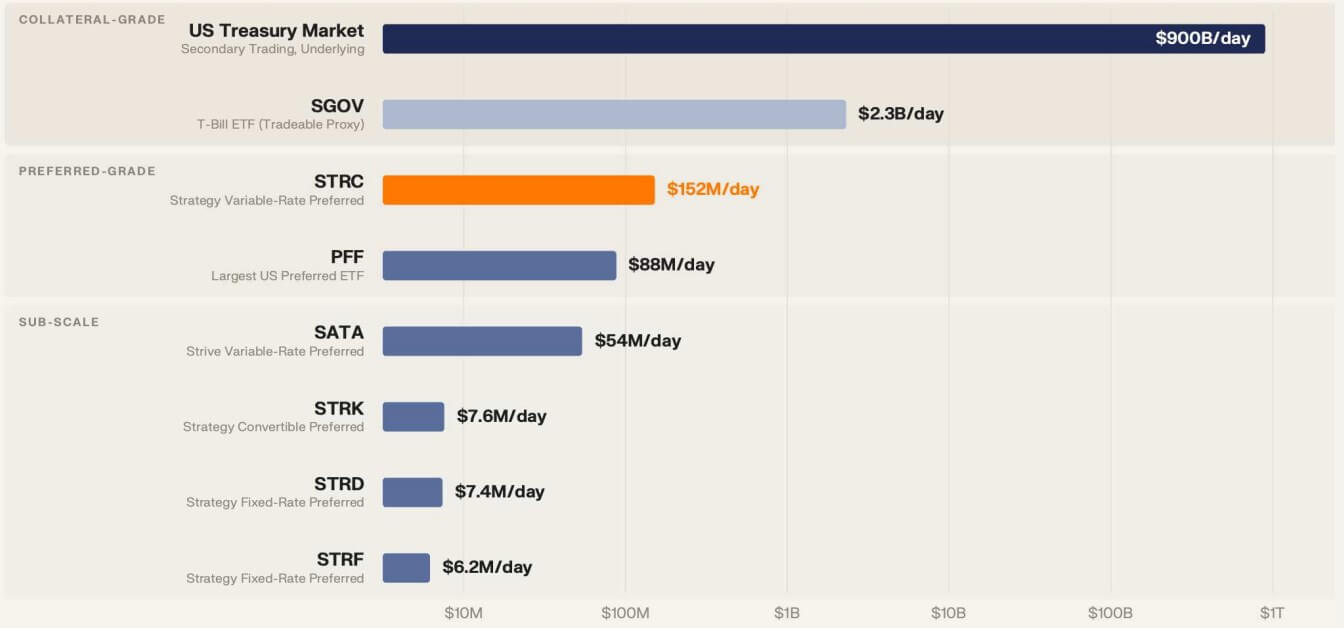
Keyrock found that the instrument can typically absorb about $28 million in trading before its price moves 10 basis points, or 0.1%.
That puts it well ahead of Strive's SATA and Strategy's fixed-rate preferred securities, each with less than $3 million in comparable market depth.
For institutional investors, that difference has practical consequences.
Using an illustrative execution rate equivalent to 20% of daily trading volume, Keyrock estimated that a $50 million STRC position could be liquidated in less than two trading days.
The same transaction would take approximately five days in SATA and six to eight weeks across Strategy's fixed-rate preferred instruments.
However, those estimates become less reassuring once Strategy's repurchases are considered.
Removing the company's buying activity reduces estimated trading capacity to approximately 80% of reported volume, implying that a $50 million exit could take longer than headline turnover suggests.
Keyrock cautioned that the calculation does not establish how much liquidity would disappear if Strategy stopped buying. Other market participants could also change their behavior in response.
A preferred-income manager interviewed for the report suggested that some trading around STRC's $100 reference price comes from arbitrage firms and high-frequency traders responding to the issuer's activity.
Such participants could reduce their involvement if Strategy withdraws, potentially leaving the market more dependent on longer-term investors and opportunistic buyers.
STRC liquidity weakens when prices fall below $100
The risk extends beyond the company's direct contribution to trading volume.
Keyrock found that STRC's market depth deteriorates sharply when the security moves away from its $100 reference price.
On the worst 10% of trading days, estimated depth within a 10-basis-point price move falls from about $28 million to $6.5 million.
The deterioration becomes more pronounced as the price discount widens.
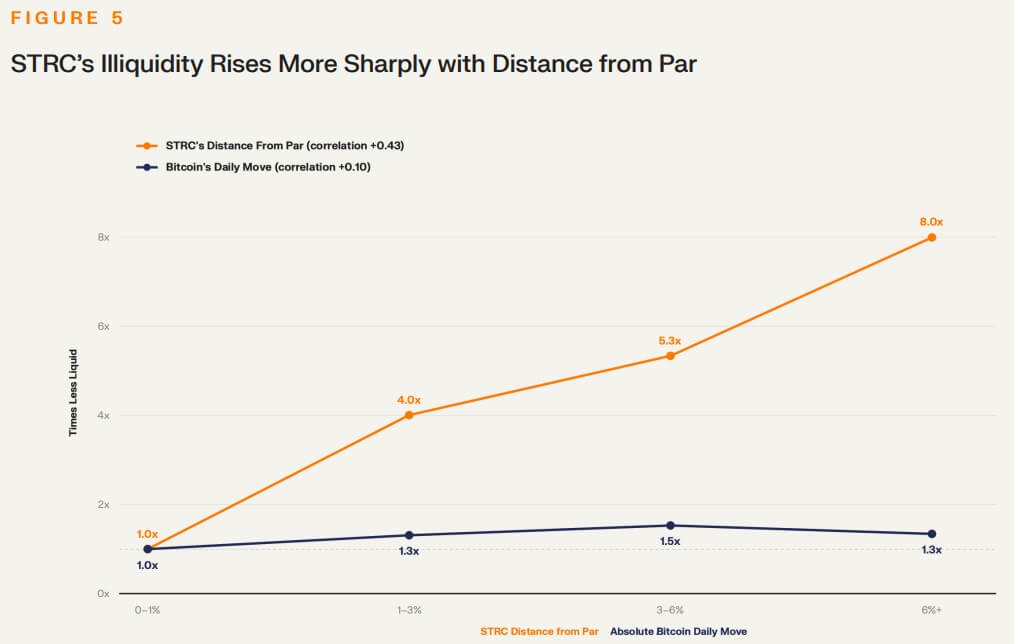
STRC is approximately four times less liquid when trading 1% to 3% away from par and roughly eight times less liquid when the deviation exceeds 6%, according to the report.
That creates a potential problem for investors expecting to exit large positions without accepting significant price discounts.
The relationship between STRC's distance from par and market illiquidity had a correlation of 0.43, compared with 0.10 for the magnitude of Bitcoin's daily price movements.
The findings suggest that STRC's tradability is more closely tied to how far its price has moved from $100 than to Bitcoin's immediate direction.
Keyrock also found that a typical decline from par represented approximately seven months of dividend income, while STRC's June drop toward the mid-$70s amounted to roughly two years of coupon payments.
Those discounts illustrate how quickly capital losses can outweigh the income investors expect to collect from the security.
Still, the research does not establish that Strategy's repurchases caused the observed relationship. Keyrock found a similar pattern before the buyback program began, and STRC remains substantially more liquid than competing preferred securities.
The unresolved concern is whether that advantage can persist under stress without significant support from Strategy.
Strategy faces a new test as its buyback capacity shrinks
The findings come as Strategy increasingly allocates capital to maintain its preferred-stock market.
Between Sept. 28 and Oct. 4, the company repurchased approximately $176.3 million of STRC, including $102.6 million during the final three days of September and $73.7 million in early October.
During the same reporting period, Strategy acquired 334 Bitcoin for approximately $28.7 million.
Of the preferred repurchases, $154.1 million came from the company's cash reserves, compared with $13 million used for Bitcoin purchases.
That allocation highlights growing tension between supporting the securities that finance Strategy's operations and deploying capital directly into Bitcoin.
If the company maintained its recent weekly repurchase pace, its remaining $547.2 million authorization would last approximately three weeks.
However, that is an illustrative estimate rather than a fixed deadline. Strategy previously doubled the authorization in September and could adjust the program again.
The company is also pursuing a separate measure intended to strengthen demand for its preferred securities.
Shareholders are scheduled to vote on Oct. 28 on amendments that would introduce daily dividends across Strategy's US-listed preferred stocks.
If approved and implemented, STRC would begin making payments under the new schedule on Nov. 2.
Strategy argues that more frequent distributions could improve price stability, reduce trading disruptions around dividend dates, and broaden institutional interest without increasing total regular dividend obligations.
However, the experience of Strive's SATA, which already uses a near-continuous payment structure, suggests that dividend frequency alone may not guarantee deeper liquidity.
Keyrock identified family offices, private-bank discretionary accounts and specialist credit funds as the most promising sources of larger allocations.
Those investors can commit tens of millions of dollars without necessarily facing the restrictions that prevent some pension and insurance funds from purchasing unrated perpetual preferred securities with deferrable dividends.
Their participation could determine whether STRC develops enough independent demand to support larger institutional positions.
For Strategy, the next disclosures will provide an indication of whether that transition is occurring.
A sustained decline in the company's share of STRC trading, alongside stable market depth and prices near $100, would suggest that independent investors are absorbing more activity.
If issuer participation remains elevated as the authorization approaches its limit, Strategy would face another capital allocation decision: extend the repurchase program, tolerate a potentially wider discount or redirect resources toward preferred dividends, debt obligations and Bitcoin accumulation.
The Oct. 28 vote and subsequent weekly repurchase disclosures will offer the first evidence of whether changes to STRC's dividend structure can attract sufficient demand to reduce that dependence.
The post Strategy’s $150 million-a-day STRC market has a hidden dependency on its own buybacks appeared first on CryptoSlate.
Coinbase streamed an in-person trading competition from Singapore on Oct. 8, advertising $150,000 for the trader crowned Coinbase Champion and presenting the event as a spectator tournament.
The company's Token 2049 Champions Cup page billed the contest as an esports-style perpetual-futures tournament featuring 10 traders and one winner. Its standings tracked the traders' profit and loss in dollars, while the broadcast mixed trading updates with walkouts, jokes and an invitation for viewers to pick a contestant.
At 6:54 p.m. UTC, the event page listed Intern first with $4,263.37 in profit and loss. Coinbase CEO Brian Armstrong promoted the contest as it went live, saying that “in an hour” one trader would be crowned Coinbase Champion and win $150,000.
Coinbase's announcement described the in-person competition as live, streamed from Singapore.
Coinbase's coverage identified several contestants: Ansem (@blknoiz06), @izebel_eth and @intern among its walkout and introduction posts. It also posted updates naming @Goupenguin, @osf_rekt and @insomniacxbt, with @osf_rekt making what the company called a high-energy entrance.
Coinbase joked that @Goupenguin was trading while watching cats, then said @intern had decided to make memes instead and was backing Jez to win. Intern, who later topped the displayed standings, was also a running joke.
During the action, Coinbase said @osf_rekt had moved into first place at 1:32 p.m. UTC. Seven minutes earlier, its @insomniacxbt update said there were 35 minutes left to win the prize.
A separate prize drawing for Coinbase cup viewers
Coinbase invited viewers to the Champions tab in its app to vote for a trader, but only in certain geographies. Its official rules describe a free promotion: no purchase was necessary, and spending or trading would not improve a participant's chance of winning.
Only votes for the winning trader would qualify for a random prize drawing. If traders tied for the highest total profit and loss, votes for any tied trader would qualify.
The rules called for three voting rounds, with one trader selected per round and up to three votes overall. Entry was limited to eligible app users at least 18 and the age of majority, with jurisdiction and, in some markets, onboarding requirements.
The post Coinbase streams $150,000 Singapore trading cup and crowns its first champion appeared first on CryptoSlate.
Crypto firms authorized under the EU's Markets in Crypto-Assets regulation (MiCA) should resolve EU clients' remaining exposure to non-compliant stablecoins through their services within three months, according to a new opinion from the bloc's markets watchdog.
The European Securities and Markets Authority (ESMA) published the opinion Oct. 8. Where national regulators find legacy exposures, ESMA said they should require remediation as soon as possible and no later than three months after publication, or about Jan. 8, 2027.
National regulators may allow firms that do not yet comply to provide strictly limited services needed for an orderly wind-down and to avoid harm to clients. These can include liquidation, conversion, withdrawal, transfer or safekeeping of existing holdings.
Those exit services should be time-limited, clearly communicated to clients and closely supervised. They should not enable new acquisitions, promotion, active distribution or continued market availability.
National supervisors decide whether to allow them, so customers do not automatically get three months of continued service.
The opinion's legal route is Article 66(1) of MiCA, which requires providers to act in clients' best interests. In ESMA's view, providing any MiCA service involving a non-compliant stablecoin should give rise to a presumption that it is incompatible with that duty, whether or not the individual service constitutes an offer to the public or admission to trading.
ESMA argued that providers cannot adequately mitigate the risks created by missing issuer-level safeguards. Warnings, disclosures and client acknowledgments would not resolve those concerns.
ESMA's Jan. 17, 2025 statement left mere custody and transfers open while restricting trading and other services that constituted public offers. The new opinion complements that guidance, preserving the earlier offer-to-the-public interpretation while adding expectations under providers' existing duties.
In its Sept. 30 MiCA-review response, ESMA had sought legislation prohibiting all licensable services involving non-compliant stablecoins, without specifying an implementation date or wind-down path for that proposal.
The October opinion adds a timetable and supervised exit arrangements under current MiCA obligations to the legislative request from Oct. 3.
Access to stablecoins beyond trading
ESMA's opinion names no token or issuer. However, Tether's USDT is among the assets Coinbase's EEA retail guidance labels MiCA-non-compliant.
Kraken's guidance, updated April 13, lists USDT among stablecoins delisted for EEA trading while still permitting deposits and withdrawals, although it discourages deposits.
Removing USDT trading pairs alone may not satisfy ESMA's expectations where a MiCA-authorized provider continues servicing it as a non-compliant token. Remaining services would need to fit any narrowly permitted, supervised wind-down.
For existing holders, the practical question is which exit services their provider and national supervisor allow. The opinion concerns access through regulated EU firms, but it does not impose a worldwide ban on owning USDT.
The post EU regulators target non-compliant stablecoins with a 90-day deadline appeared first on CryptoSlate.
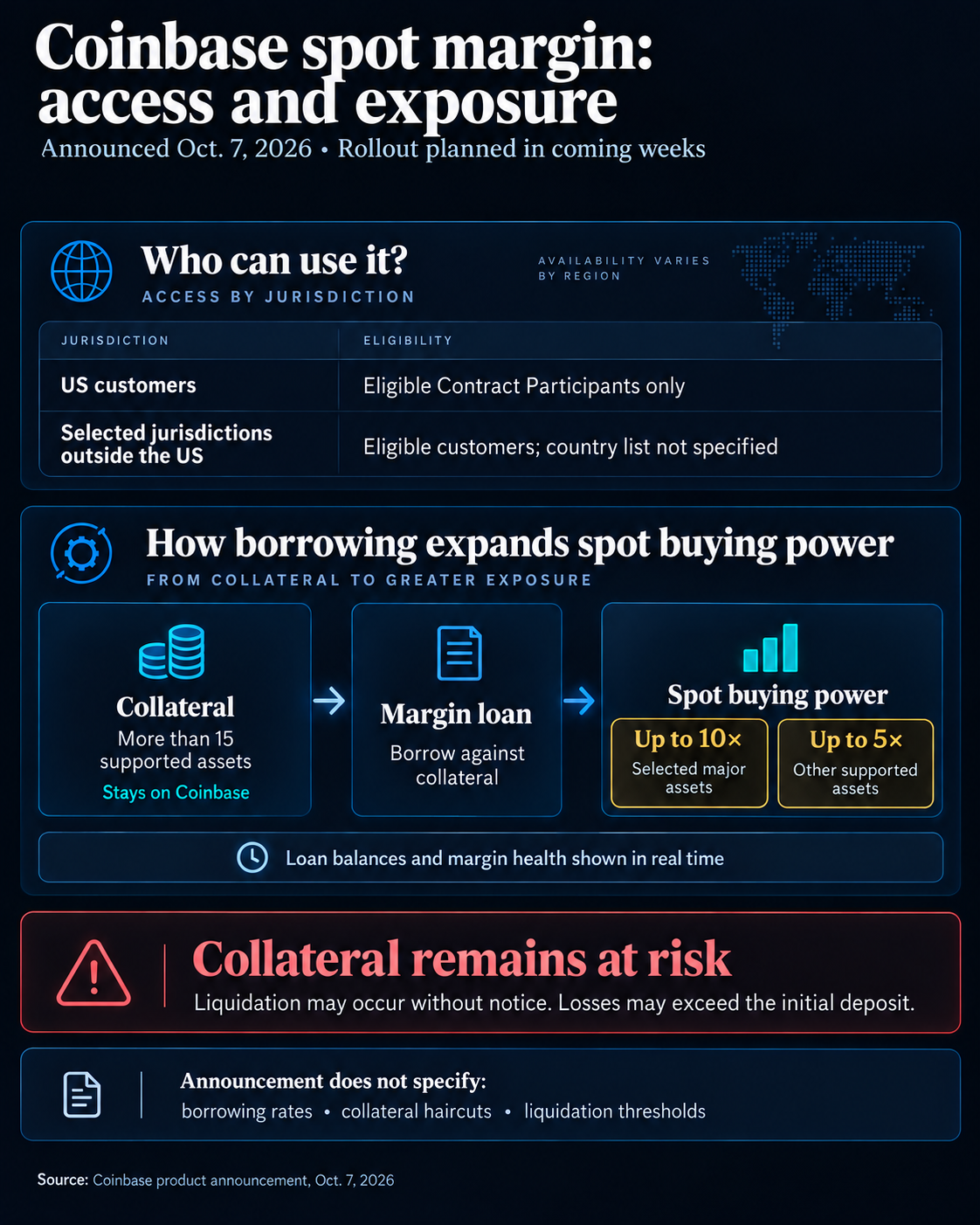
Coinbase plans to introduce spot borrowing with up to 10x leverage, letting eligible traders borrow against collateral to buy crypto on spot markets, but US customers who do not qualify as Eligible Contract Participants will be excluded.
The exchange's Oct. 7 announcement puts the rollout in the coming weeks. Access will depend on customer eligibility and selected jurisdictions, but Coinbase does not identify those countries, so availability cannot be assumed for every trader outside the US.
For US individuals, a 2021 statement by a commissioner at the CFTC, the US derivatives regulator, describes discretionary investments exceeding $10 million in aggregate, or exceeding $5 million when the transaction is for risk management purposes. That distinction puts the planned service beyond ordinary US retail access.
The restriction applies specifically to spot borrowing, and Coinbase says the product is offered by affiliates and is separate from Coinbase Financial Markets, which offers US derivatives.
For US customers, the margin lenders will be Coinbase Custody International Limited or Coinbase Credit, Inc., even though traders would manage spot borrowing and derivatives exposure through a shared margin portfolio.
Coinbase completed the Deribit migration on Oct. 2, setting the stage for Coinbase's expansion, while the spot-margin plan adds a distinct borrowing option for eligible customers.
Collateral remains exposed
For customers who qualify, Coinbase sets maximum leverage at 10x on selected major assets and 5x on other supported assets.
The company says traders can post collateral in more than 15 supported assets, with those holdings remaining on Coinbase. Loan balances, collateral levels, and margin health will be visible in real time across open borrows.
Keeping collateral on the platform does not protect it from a forced sale. Coinbase warns that borrowed trading magnifies losses as well as gains, that collateral can be liquidated without notice, and that losses can exceed the initial deposit.
The announcement leaves borrowing rates, collateral valuation haircuts, or discounts applied to pledged assets, and liquidation thresholds unspecified. Those terms determine the cost of using the service and when collateral is at risk.
The post Coinbase rolls out 10x spot leverage, but blocks US retail from it appeared first on CryptoSlate.
CryptoTicker.io
On Thursday, 8 October 2026, the Bundestag rejected the Greens' bill to abolish the crypto holding period. In a recorded vote, 445 members voted against and 132 in favour, with no abstentions. The existing rule therefore continues to apply: anyone holding Bitcoin, Ether or other crypto assets for more than a year sells them tax-free. The holding period is not saved by this vote, however. The measure that actually decides its future sits as a draft bill at the Federal Ministry of Finance and has yet to reach parliament.
On the same morning, the Bundestag also rejected a motion from the Left party that sought to tax crypto gains as investment income and to allow trading bans on certain coins at EU level. Late in the evening, parliament then passed a law under which German tax authorities exchange data on crypto transactions automatically with other states. What the speakers said, why the SPD position in particular matters for investors, and what you should do now follows below.

Vote on the crypto holding period: how the parliamentary groups voted
The vote concerned the “Bill to close a fairness gap in the taxation of crypto assets” (Drucksache 21/5752) at second reading. The Greens had called for a recorded vote, so it is documented for every parliamentary group who voted which way. A total of 577 voting cards were cast. Because the bill fell at second reading, the rules of procedure dispense with a third reading, and the procedure is thereby closed.
| Parliamentary group | Yes | No | Abstention | Not cast |
|---|---|---|---|---|
| CDU/CSU | 0 | 198 | 0 | 10 |
| AfD | 0 | 134 | 0 | 16 |
| SPD | 0 | 112 | 0 | 8 |
| Bündnis 90/Die Grünen | 76 | 0 | 0 | 9 |
| Die Linke | 54 | 0 | 0 | 10 |
| independent members | 2 | 1 | 0 | 0 |
| Total | 132 | 445 | 0 | 53 |
The result follows party lines: the conservatives, the SPD and the AfD against as a bloc, the Greens and the Left in favour as a bloc. The figures come from the voting result on bundestag.de and from the plenary minutes of the 99th sitting. Back in May, the finance committee had already recommended rejection with the same majorities.
What the Greens' bill 21/5752 proposed for the holding period
At the heart of the bill of 5 May 2026 was a single sentence in section 23 of the Income Tax Act: the one-year period for private disposals would no longer apply to crypto assets. Crypto gains would thereby have become taxable regardless of the holding period, and at the personal income tax rate rather than the flat-rate withholding tax. It was to apply to crypto assets bought after 31 December 2025. The Greens reckoned with additional revenue of “at least around 5 billion euros”.
For investors that would have been the strictest of the variants under discussion: at high incomes, gains could have been taxed at up to 45 percent plus the solidarity surcharge, while losses would have remained offsettable only against gains from private disposals. How the holding period works today with recurring purchases and the order of sales is explained in our piece on Bitcoin savings plans, the holding period and the exemption threshold.
Video from the Bundestag: Olav Gutting (CDU/CSU) on the crypto holding period
The debate began at 10:15 and ran as part of a larger tax package from the Greens that also covered inheritance tax, property transfer tax and real estate. Olav Gutting answered for the conservatives from 10:21; the holding period comes up in the second half of his speech.
Speech by Olav Gutting (CDU/CSU) on 8 October 2026, 99th sitting, agenda item 8. Source: German Bundestag. The full debate is available in the Bundestag media centre.
Gutting defended the holding period as a basic decision of tax law rather than a special arrangement for crypto. Private crypto assets, he argued, are treated like other private economic goods: whoever speculates short term pays tax on the gain, whoever holds long term can in principle sell tax-free once the period has elapsed. Anyone who finds that unfair would have to put the question “openly and systematically for comparable cases” and not only for an asset class that happens to be “more politically visible” at the moment. For greater transparency he pointed to the new reporting obligations for crypto exchanges under the EU directive DAC 8.
Key statements from the debate: SPD for the withholding tax, conservatives with an open flank
Parsa Marvi (SPD) delivered the sentence investors should note. The SPD, he said, “expressly shares the aim of bringing more tax fairness to crypto assets” and does not find it “fair that gains from cryptocurrencies are tax-free today after a holding period of one year”. He rejected the Greens' route all the same: the existing flat-rate withholding tax is efficient, so subjecting crypto gains to it is the right course. He expressly welcomed the Finance Ministry's draft bill and said the SPD was willing to bring the project to a conclusion with the coalition in the Bundestag.
Lukas Krieger and Fritz Güntzler (both CDU/CSU) warned that a special rule for crypto would create new inequalities against foreign currencies, precious metals and securities. Güntzler recalled that shares and futures contracts once counted as speculative transactions too and later moved to investment income. “Now we are discussing doing something similar for crypto assets. It is also being discussed within the coalition,” he said. That is not a clear commitment to the holding period.
Isabelle Vandre (Die Linke) likewise called for an end to the holding period, but by a different route: crypto assets should move into section 20 of the Income Tax Act so that the exchanges remit the tax directly, coupled with exit taxation. By her account, only 3 percent of crypto users declare their gains correctly in their tax return. Max Lucks (Greens) countered that section 23 is the right place, and that the only pointless element is the tax exemption once the speculative period has elapsed.
The Left's motion 21/5824 rejected: section 20, exit tax and trading bans
The motion “Regulate crypto assets strictly and tax them fairly” went considerably further than the Greens' bill. Among other things it called for crypto assets to be brought into section 20 from the promulgation of a law, for an examination of a wealth-growth tax on the Dutch model for decentralised transactions, for identity requirements for self-custodied wallets at regulated service providers, and for an EU supervisor with the power to impose trading bans on coins causing high environmental damage, for instance through proof of work. The Bundestag followed the finance committee's recommendation and rejected the motion by a show of hands, with the votes of CDU/CSU, AfD and SPD against the Greens and the Left.
CARF reporting framework adopted: which crypto data the tax office receives from abroad
A decision taken late in the evening has more effect for many investors. The Bundestag approved the law on the Multilateral Competent Authority Agreement on automatic exchange of information under the Crypto-Asset Reporting Framework (Drucksache 21/7195), the OECD framework on which the EU directive DAC 8 also builds. CDU/CSU, SPD, the Greens and the Left voted in favour, the AfD against. The contracting states collect tax-relevant data on crypto trading and exchange it: users' names, addresses, countries of residence, tax identification numbers and dates of birth, plus the type of crypto asset, gross amounts, quantities and the number of transactions. Anyone holding coins on an exchange outside the EU should therefore not assume the tax office will remain unaware of it.
What changes for investors after the vote: holding period and exemption threshold still apply
In the short term, nothing changes. Gains from the sale of crypto assets held privately are taxable under section 23 of the Income Tax Act if no more than one year lies between purchase and sale. After that, the gain is tax-free. Within the period, a gain stays tax-free as long as all private disposal gains in a calendar year together remain below the exemption threshold of 1,000 euros. Once it is exceeded, the entire amount is taxable, not only the part above it.
Thursday's vote takes only one of several variants off the table, namely the deletion of the period with taxation at the personal rate from 2026 purchases onwards. For holdings you own today, that was the riskiest variant, because it would have reached back into the current year.
The Finance Ministry's draft bill: the 31 December 2026 cut-off decides
The future of the holding period will be decided by the draft bill on reforming the taxation of certain privately held crypto assets of 30 September 2026. It moves so-called exchange crypto assets such as Bitcoin and Ether into section 20 of the Income Tax Act, that is, to investment income, for which the separate tax rate of 25 percent plus the solidarity surcharge and, where applicable, church tax applies. That is to take effect for the first time from 1 January 2027, and only for crypto assets acquired after 31 December 2026. From 2028, platforms are to withhold the tax directly.
| Model | Tax rule | Holding period | Purchases affected | Status |
|---|---|---|---|---|
| Current law | section 23 EStG, personal tax rate, 1,000-euro exemption threshold | one year, tax-free thereafter | all | in force |
| Greens' bill 21/5752 | section 23 EStG, personal tax rate | abolished | after 31.12.2025 | rejected on 8 October |
| Left's motion 21/5824 | section 20 EStG, withholding by exchanges, exit taxation | abolished | from promulgation | rejected on 8 October |
| Finance Ministry draft | section 20 EStG, 25 percent plus surcharge, withholding by platforms from 2028 | abolished for new purchases | after 31.12.2026 | draft, cabinet still pending |
For existing holdings, the draft means this: whatever sits in a securities account or a wallet by the end of 2026 keeps the one-year holding period. The tricky part is the fallback rule for cases in which the platform does not know the purchase date and purchase price. It is then to assume a purchase after the cut-off and to base the tax withholding on 50 percent of the sale proceeds. What that means in euros is worked through in our piece on the substitute assessment in the crypto tax draft. The ministry estimates the additional revenue at 70 million euros for 2027 and, from 2029, at 350 million euros a year, a fraction of the 5 billion euros the Greens had reckoned with.

Next steps on crypto tax: petitions committee, cabinet, Bundesrat
On Monday 12 October, the Bundestag's petitions committee holds a public hearing from 12:00 on petition 201716, which calls for the holding period to be kept. The procedure and the livestream are set out in our piece on the petitions committee on 12 October. According to the timetable so far, the federal cabinet is to take up the draft bill on 14 October. If it adopts it, the draft becomes a government bill, on which the Bundesrat comments first. According to the draft, the law also needs the consent of the state chamber at the end. The Bundestag then debates it in three readings, and only with promulgation in the Federal Law Gazette does the legal position change. After Thursday's debate it is clear where the majority for it would have to come from: from the SPD, which openly supports the move to the withholding tax, and from a conservative group that, in Güntzler's words, is itself discussing it.
What you should do now: secure purchase records and sort holdings by purchase date
Whatever the law ends up looking like, one thing decides your tax bill in every variant: the evidence of when and at what price you bought. That helps you today with the holding period and tomorrow against a blanket substitute assessment.
- Export the complete transaction history of every exchange and every broker while the accounts still exist. Why that is urgent is set out in our piece on the tax records export at the exchanges.
- Sort your holdings by purchase date. Whatever you buy up to 31 December 2026 would keep the holding period under the draft; everything after that would not.
- Keep a complete record of transfers between wallets and exchanges, so purchase dates can still be documented after the coins have moved. A crypto tax tool does that automatically and calculates the periods per position.
- Do not sell in haste. The Bundestag tightened nothing on Thursday, and a sale inside the one-year period costs tax today that patience can avoid.
How to prepare the documents for the tax office in order is explained in our guide to the crypto tax return in seven steps. With larger holdings or gains, your own case belongs with a tax adviser.
Grayscale will have the TAO of its Bittensor trust held by two houses in future instead of one. The asset manager has added Coinbase Prime as a second custodian, with BitGo remaining primary custodian. The move is set out in an 8-K that the trust filed with the US Securities and Exchange Commission on 5 October 2026. For holders of Bittensor, this is not price news but news about the question of who holds the keys.
The price itself has a weak week behind it. TAO trades at $275.96, which is 10.7 percent below the highest daily value of the past seven days, according to CoinGecko as of Friday, 9:00. Over seven days it shows a loss of 11.99 percent, over 30 days a gain of 6.39 percent. Taken together, the two describe a pullback inside a month that is still in positive territory on balance.
What Grayscale reported in the 8-K on the custody of TAO
An 8-K is the mandatory filing with which an issuer registered with the SEC discloses a material event between two quarterly reports. In it, the Grayscale Bittensor Trust reports two contracts signed and one contract terminated, all dated to the end of the month.
On 29 September 2026, the sponsor signed an amendment to the Coinbase Prime Broker Agreement of 3 October 2025 on behalf of the trust. Coinbase will thereby hold a portion of the trust's TAO. A day later, on 30 September, an amendment followed to the revised custody agreement with BitGo Bank & Trust of 5 June 2026, which brings the trust into that agreement. The older BitGo agreement of 12 March 2025 was terminated on the same day.
One figure the document expressly does not name: how much TAO moves to Coinbase has not yet been determined by the sponsor, by its own account. Anyone reading a split in percent over the coming weeks should check where it comes from, because it does not come from this filing. What is recorded, by contrast, is that the custodians' fees are borne by the sponsor and that fees and expenses are taken in TAO.

BitGo stays primary custodian, Coinbase Prime will hold a portion
The division of roles remains clear. BitGo is and remains the trust's primary custodian; Coinbase joins as a second address. In the language of institutional custody that means a portion of the holdings will sit in a second infrastructure, with its own keys, its own approval paths and its own operations team.
Prime broker is not a synonym for custodian here. A prime broker agreement bundles trading, settlement and custody with one provider so an institutional client can move large quantities without maintaining a separate relationship for every step. The fact that the trust extended precisely that agreement points to trading capability, not storage alone.
Why a second custodian shifts the operational risk of a trust
With a single custodian, everything hangs on one operation. If it fails, the fund stands still, regardless of how healthy the assets inside it are. Two custodians spread that operational outage across two mutually independent houses. The risk has not vanished as a result; it is divided.
Set against that is the second route of attack. Every additional infrastructure brings its own keys, its own staff and its own software, and any of those can become the point of entry. The hacks of 2026 repeatedly hit the software around the edges rather than the cryptography itself. Whether the split is a gain is therefore decided by the quality of the second house, not by the number two.
GTAO is an OTC-traded trust and not yet an ETF
The Grayscale Bittensor Trust runs under the ticker GTAO and trades over the counter, not on a regular US exchange. Grayscale has set out on the road to an exchange-traded fund: the S-1 registration statement reached the SEC on 30 December 2025, and a first amendment followed on 2 April 2026. No approval has come of it to date.
The difference is practical for you rather than academic. A trust traded over the counter can sit permanently above or below the value of its holdings, because the mechanism that continuously creates and redeems shares in an ETF is missing. Anyone who equates such structures with a spot ETF is buying something other than what they think. How the product types diverge in Germany is unpicked in the overview of crypto ETFs for investors in Germany.
Then there is the distribution route. A trust registered in the US is not offered to retail investors in Germany; for distribution to retail clients in the EU, the PRIIPs Regulation requires a key information document, which such products do not carry. The news from the 8-K changes none of that and remains information about the market for you, not a way to buy.
Price of the week: $275.96, 10.7 percent below the weekly high
The daily values of the week trace a clear arc: $292.09 on 3 October, then four days between $304 and $309 with the peak of $308.88 on 7 October, after that $291.29 on 8 October and $268.40 at the start of 9 October. Over the past 24 hours the low stood at $254.82 and the high at $287.30. All values according to CoinGecko, as of Friday, 9:00.
For context: market capitalisation stands at around $3.13 billion, trading turnover of the past 24 hours at around $308 million. TAO is 63.6 percent away from its all-time high of $757.60 from March 2024. The week's pullback therefore falls into a phase that already runs far below the old record.
Circulating supply: 11.34 of 21 million TAO have been issued
Bittensor is capped at 21 million units, as Bitcoin is. Of those, 11,339,646 TAO are in circulation, or 54.0 percent of the maximum. Issuance declines in steps over time, and the timing of the next step depends on the quantity issued rather than on a calendar date. There is no documented date for it at present, and a forecast would be guesswork.

Subnets: what the network pays out its issuance for in the first place
A subnet on Bittensor is a self-contained competition in which providers deliver a particular service, a language model or data preparation for instance, and are rewarded according to assessed quality. The network's issuance is distributed across these subnets, and anyone holding or delegating TAO is economically tied to that distribution.
For the custody question this matters more than it sounds. Delegating TAO rather than merely holding it puts it into a process that requires active use of keys. Between “sitting in a custodian's vault” and “working in the network” lies a noticeable difference in risk profile, and that holds whether a fund or a private individual holds the tokens.
Buying TAO in Germany: a MiCA exchange instead of a US trust
If you want exposure to TAO in Germany, the route runs through a trading platform licensed under MiCA, or through a certificate on the token authorised in the EU. The US structure from the 8-K is not open to you. Which platforms can show a MiCA licence is set out in the overview of regulated crypto exchanges.
After the purchase comes the same question Grayscale has just answered for itself: who holds the keys. Leave the tokens on the exchange and you carry its operational risk. Withdraw them and you carry it yourself, but the counterparty risk disappears. Which device suits that depends on how much you hold and how often you move the balance.
Two further points belong in the review. Leveraged products on a token that gives up double digits inside a week liquidate quickly; on a decline of 10.7 percent from the weekly high, a ten-times leveraged position is already finished on paper. And for tax, the one-year holding period for private disposals still applies in Germany, whose abolition is under discussion but has not been decided. Spreading several purchases across the year calls for a clean record of the acquisition dates.
Levels above and below: $308.88 and $254.82
Above, the next documented point of orientation lies at the weekly high of $308.88, below that the round level of $300. On the downside, the 24-hour low of $254.82 marks the last place where buyers appeared again, followed by the round 250. These are observation points from this week's price data and not price targets.
What the custody news means for the price cannot be quantified in good faith. An amendment to agreements on custodians is a structural event with no immediate effect on supply or demand. Selling it as a price driver overstretches it.
Bittensor custody: without ETF approval, GTAO stays over the counter
- First establish whether you are looking for access at all: the US trust is not open to you, while buying directly through a licensed platform is. The licensing position of the providers is listed under regulated crypto exchanges.
- Settle the key question deliberately before the first purchase runs, not after it. For withdrawing from the exchange, the hardware wallet comparison helps with choosing a device.
- Set up the record for the holding period with the first purchase, or the acquisition dates will be missing later. Tools for that are in the comparison of crypto tax software.
(As of October 9, 2026. This article is not investment advice. Prices and fee structures change; check the terms with the provider before you buy.)
Primary sources: the 8-K of the Grayscale Bittensor Trust of 5 October 2026 and the amendment to the S-1 registration of 2 April 2026, both filed with the SEC.
Anyone holding ICX has until 19 October 2026 to sell the token on its largest remaining venue. At 15:00 Korean time, 8:00 in the morning in Germany, the South Korean exchange Upbit halts trading in the ICX against won pair and deletes every open order in the process. A balance held there can still be withdrawn until 18 November 2026. After that, Upbit ends all support for the token, including support for airdrops, wallet upgrades, migrations and hard forks.
Upbit is not a trading address for investors in Germany, as the exchange serves the Korean market and requires a Korean bank account. The date nonetheless helps determine the price at which a remaining European holding can still be sold at all. The won pair on Upbit is the last large market ICX has anywhere, and it disappears around ten weeks before the day the ICON blockchain is shut down for good.
What happens to ICX at Upbit on 19 October
A delisting is the removal of a crypto asset from an exchange's trading: the pair vanishes from the offering, and buy and sell orders are no longer possible afterwards. Upbit is carrying out this step for ICX in two stages, and only the first falls on 19 October.
At the close of trading that day, the exchange will cancel every order still sitting in the order book, uniformly and by its own announcement. A sell limit parked well above the market price therefore comes back rather than filling. Only in the second stage, four weeks later, does the withdrawal window close as well. That sequence is customary and carries the more important information for holders: between 19 October and 18 November a balance can no longer be sold, but it can still be moved out. The date was first reported by a Korean trade publication, in the report of 18 September.
Why Upbit is halting trading: replay attack and warning list
Upbit justifies the removal with security risks that remain unresolved in the exchange's view. The background is an incident on the ICON chain at the end of August. In a replay attack, a transaction that has already been validly signed is submitted again, so the same instruction is executed several times although it was authorised only once.
According to the available reports, two such signed withdrawal messages were reused 1,492 times on 27 August. That released 119.9 million ICX and 531,600 bnUSD, and the chain then stood still for around 25 hours. On 28 August, Upbit put the token on its warning list and, after further review, decided to end trading support. Upbit's own notice page is not freely accessible from outside Korea; the date and the reasoning therefore rest on reporting by Korean and international trade media, not on the exchange's page itself.
Only one market left: 18 of 865 Upbit pairs carry the warning flag
How seriously Upbit takes the case can be read from the exchange's own market list. Of 865 trading pairs, exactly 18 carry the warning flag on 9 October, and those 18 are practically identical with the current removal and review cohort: alongside ICX there are BLAST, EGLD, MANTRA, RVN, SOPH and ZIL.
Within that group, ICX is the only asset left with just a single pair at Upbit. Its earlier pairs against Bitcoin and against USDT no longer exist there. EGLD, MANTRA, RVN and BLAST each still have two or three pairs affected; for ICX, the won pair takes the entire venue with it. How the same mechanism runs for another token was described in early October in our piece on the Upbit delisting of Ravencoin.

Almost half of worldwide ICX turnover runs through Upbit
Liquidity describes a market's ability to absorb an order without a large price concession; the thinner it is, the more expensive a sale becomes. On ICX it is small, and it hangs on a single place.
The won pair at Upbit turned over around 501 million won on Thursday, at a price of 19.6 won and a volume of 25.8 million ICX. Converted, that is $348,000 to $373,000, depending on whether the official exchange rate or the token's world market price is applied. Worldwide daily turnover across all venues combined came to about $776,000 over the same period. Upbit alone therefore carries 45 to 48 percent of all ICX trading. The token's market value stands at around $14.9 million.
That order of magnitude is the real heart of the date. When close to half of turnover falls away on a single day, the remainder barely redistributes to the other venues; the remaining market becomes noticeably thinner as a result. Selling a larger position after that means moving the price with your own order. Which venues remain an option for a move, and what to weigh when choosing, is set out in our comparison of regulated crypto exchanges with MiCA authorisation.
Around eight percent premium: ICX costs more in Korea than on the world market
A second effect comes into play, and it is easily missed when looking at a single price. On Upbit, one ICX cost 19.6 won on Thursday. At the official exchange rate that is about 1.46 US cents, while the token traded at around 1.35 US cents on the world market. The Korean market therefore pays a good eight percent more for the same token.
Premiums of this kind have been known in Korea for years and arise because capital moves between Korean and international venues less easily than the price difference suggests. For assessing the date, the consequence is this: the average price that price pages show for ICX today contains a share of Korean purchases at higher prices. If that market falls away, so does the part of demand that carried the premium.
Withdrawals until 18 November: the second Upbit deadline
Four weeks lie between the trading close and the withdrawal close at Upbit. Whoever still has ICX sitting in a Korean account can send the balance to their own address or to another exchange during that period, but can no longer sell it. After 18 November 2026, Upbit also explicitly stops handling airdrops, wallet upgrades, migrations and hard forks for the token.
That last point is no footnote in the case of ICX. The exchange of ICX into SODA, on which the entire remaining supply depends, is technically exactly such a migration process. An exchange that ends migration support thereby takes away holders' option of having the swap handled through the account.
The deadline calendar for ICX up to 31 December
The Upbit date does not stand alone. For a European ICX holder, several dated cut-offs line up before the end of the year, and most of them are already behind us or immediately ahead:
- 2 October 2026: Bitvavo closed deposits, trading and withdrawals for ICX. Whatever remained in the account after that is automatically converted into euros by the exchange on 12 October at the latest, according to its schedule. The details are in our report on the Bitvavo forced conversion.
- 30 September and 3 October 2026: At OKX, trading ended first in the euro pairs, then in the USDT pairs. The exchange accepts withdrawals until 23 December 2026, according to the details in our article on the OKX delisting.
- 19 October and 18 November 2026: trading close and withdrawal close at Upbit.
- 31 December 2026: The ICON blockchain is shut down, and at the same moment the option of swapping ICX into SODA ends.
Binance had already taken ICX out of spot trading earlier, in September. Anyone who suspects a balance is still there will find the sequence of the dates at the time in our article on the Binance delisting; the November withdrawal dates named there, however, come from a single secondary source and should be treated with corresponding caution. If in doubt, check the withdrawal window directly in the account.
A one-way street since 30 September: the road back to ICX is closed
The migration is the swap of the old token for the new one: ICX is withdrawn, SODA is issued. The ICON Foundation set the dates for it back in May and published them on its own project page. What the two cut-offs mean for holders was sorted out in August in our overview of the two deadlines before the ICON blockchain shuts down. Since 30 September the swap has run in one direction only; converting SODA back into ICX has been ruled out since then. On 31 December 2026 the chain will be halted permanently, with only an archive remaining reachable for looking up old transactions.
That leaves exactly two states for an ICX balance at year-end: swapped, or worthless on a shut-down chain. How large the unswapped portion is was established by cryptoticker.io in early September through its own count of both chains: at the time, 1.109 billion ICX still sat on the ICON chain, and there is no public progress indicator for the migration. No more recent reliable figure is available.

Exchange or your own wallet: who carries out the migration
Self-custody means the keys to the coins lie with the holder and not with an exchange. For the ICX migration, that difference determines who has to act.
If the balance sits on an exchange that carries out the migration itself, the house handles the swap and credits SODA. Several venues have already completed this and automatically converted customer balances in the process. If the balance sits in a private wallet, by contrast, it does not migrate on its own: there the holder has to start the swap through the project's official portal, and the 31 December deadline applies without leniency. What decides the timetable is not 31 December but the day your own exchange ends its support.
Copycat portals asking for keys tend to multiply around migrations like this one. Open the swap page only through the official project address and never enter a seed phrase; a genuine migration portal asks for a signature from the wallet, not a word list.
Holding period and tax: what separates a sale, a forced conversion and a migration
The holding period is the span after which a gain from a private sale of crypto assets stays tax-free in Germany; under section 23 of the German Income Tax Act it is one year. Within that year the gain is taxable, with a threshold applying to the sum of all private disposals in a year.
Three routes now run in parallel for ICX, and they are not treated alike for tax. Selling yourself on an exchange is a clear disposal with a date and proceeds. A forced conversion, in which the exchange turns the residual balance into euros without an order, is economically a sale as well, merely without your own decision on timing; it too triggers the event. The swap of ICX into SODA, by contrast, is legally contested: whether a swap in the course of a project migration counts as a disposal of the old token or as the continuation of the same investment has not been conclusively settled, and the answer determines whether the holding period starts afresh.
In practical terms: record for each of these events when it took place, how many tokens were involved and what value arose. On a holding that has been sitting since 2021 or longer, the question of a restarted holding period can decide more than the price does. With larger holdings or an unclear acquisition history, the case belongs with a tax adviser rather than a rule of thumb.
What argues against a quick sale, and what argues for it
Market mechanics argue for a prompt exit. With the won pair, close to half of trading disappears, and the Korean premium of a good eight percent disappears with it. Anyone who intends to sell anyway sells into a thinner market the longer they wait. Added to that, at a market value of just under $15 million even a medium-sized order leaves visible traces in the price.
Against a rushed sale stand the tax question and the size of the amounts. At 1.35 US cents per token, a holding of 10,000 ICX is worth around $135; trading and withdrawal fees can eat up a noticeable share of that. Whoever migrates instead of selling keeps a position in the successor project, but carries its risk. And that risk is real: a project that shuts down its own blockchain, and a token whose largest venue removes it over unresolved security questions, are both warning signs. A total loss is possible at a value of this size, and on both routes.
This text cannot give a recommendation, because the right answer depends on the purchase price, the holding period, the size of the position and your own assessment of the successor project. What it can give is the calendar: after 19 October, every one of these decisions becomes more expensive to carry out, and after 31 December one of them is no longer possible at all.
ICX: 19 October decides the four later deadlines
Three steps sort out the situation, and the first costs only a few minutes:
- Establish the balance and its location. Look in every account and every wallet for where ICX is still sitting, and note the deadline that applies at each place. If the balance is at an exchange that has already removed it, the withdrawal deadline is the date that counts. Which venues are suitable for a move is shown in our comparison of crypto exchanges.
- Decide before 19 October, not after. Selling or migrating are the two routes; both are cheaper to carry out before the trading close than after it. Migrating out of self-custody requires access to the keys and a small reserve for network fees. Which device suits that is set out in the hardware wallet comparison.
- Document every event. The date, the number of tokens and the value of every sale, forced conversion and swap belong in your own records while the exchange still displays them. After an account closure, the evidence is laborious to obtain. The tools in our overview of crypto tax software and portfolio trackers help with the collecting.
(As of October 9, 2026. This article is not investment advice. Prices and fee structures change; check the terms with the provider before you buy.)
Shibburn lists 707,506,927 Shiba Inu tokens burned over 30 days as of Thursday morning, 1,945,872 of them in the past 24 hours. Measured against a circulating supply of 585.48 trillion SHIB, that comes to 0.000121 percent, and at a price of $0.0000054 it is worth roughly $3,820 for the whole month. A burn headline only becomes readable with those two reference points: the share of supply and the dollar value.
Shiba Inu and the 707,506,927 tokens burned over the past 30 days
A burn is a transfer of tokens to an address whose private key nobody holds. The tokens stay visible on the chain but can no longer be moved, and the circulating supply drops by that amount on paper. For Shiba Inu, Shibburn adds up these transfers and publishes them as daily, weekly and monthly totals.
The three figures from 9 October sit far apart. Over 24 hours they add up to 1,945,872 SHIB, over seven days to 401,302,586 and over 30 days to 707,506,927. The weekly figure therefore carries 56.7 percent of the monthly total, although a week accounts for barely a quarter of the period. A single large transfer shifts the statistic for weeks.
What 707.5 million SHIB amount to against 585.48 trillion in circulation
The ratio is the point at which most reports stop. 707,506,927 divided by 585,482,205,001,143 gives 0.00000120842, or 0.000121 percent. If the pace stayed the same for a year, roughly 8.49 billion SHIB would be burned, and it would take about 690 years for a single percent of today's supply to disappear. Reaching half the supply would take a good 34,000 years on paper.
That calculation is not a forecast but an extrapolation of the current pace. The only thing it reveals is the order of magnitude the mechanism works in. And 707 million sounds large only until you name the reference: there are 585 trillion of them.
Shibarium and ShibTorch: how transaction fees turn into burned tokens
Shibarium is the project's own network, a layer above Ethereum that bundles transactions and settles them more cheaply. The base fees of transactions there accumulate in the network currency BONE, are swapped into SHIB and sent to a burn address. The mechanism is called ShibTorch.
That has a consequence worth keeping in mind whenever you read a burn figure: the pace follows network load rather than a calendar. There is no fixed schedule under which a given amount disappears each month. When little is settled on Shibarium the burn falls, and on quiet days single-digit millions are left over, as the 1,945,872 tokens of the past 24 hours show.

The burn rate jumps by thousands of percent because the base is tiny
Early October brought reports of a burn rate rising by several thousand percent. Percentages like that appear when a quiet previous day serves as the comparison base. If the daily figure climbs from 1.9 million to 297 million, that works out at more than 15,000 percent, even though the absolute amount still sits in the hundred-thousandths of a percent of supply.
The current numbers show the same swing in the other direction. The daily average of the past week is around 57.3 million SHIB; the past 24 hours brought 1,945,872. That amounts to 3.4 percent of the weekly average, a drop of more than 96 percent, and this figure would work as a headline just as well without anything having changed about the mechanism. A rate without an absolute amount and without a reference point says little about Shiba Inu.
The burn address balance on chain: 410.437 trillion SHIB
The figure that cannot be spun is the balance of the burn address. The best-known one ends in 2069 and holds 410,437,103,366,901 SHIB on 9 October according to Ethplorer. That comes to around 41 percent of the original one quadrillion created in 2020, and it stems overwhelmingly from a single action in May 2021, when a large part of the supply was destroyed in one go.
Shibburn puts the total of all burns at 410,844,855,570,460 SHIB. The gap of roughly 407.75 billion tokens to the balance of the 2069 address comes from the counter adding up several burn addresses. Put both figures side by side and the scale of the running burn against the historical stock is immediately clear: the 707.5 million of a month are 0.00017 percent of what already sits at those addresses.
Four days, 323.5 million tokens: the jump in the 30-day balance
On 5 October, cryptoticker reported 384 million SHIB over 30 days in its burn balance for Shiba Inu. Four days later the same counter stands at 707,506,927. The increase of 323.5 million tokens amounts to a gain of 84.2 percent in the monthly balance, and it comes largely from a single large transfer in early October that also carries the weekly figure of 401.3 million.
That is precisely why a monthly figure should never be read as a trend. The value is a rolling window: once the large transfer drops out of the 30-day period in about four weeks, the figure halves again without anyone having done anything differently. The same mechanic then produces headlines about a supposed collapse in burn activity.
Daily turnover of $91.7 million against $3,820 a month
The dollar value makes the order of magnitude clearest fastest. At a price of $0.0000054 on Thursday morning, the 707,506,927 tokens of a month are worth around $3,820, or roughly 3,400 euros. The 1,945,872 tokens of the past 24 hours come to $10.51.
Against that stands trading turnover of $91.7 million in 24 hours, at a market capitalisation of $3.18 billion (data from CoinGecko, as of 9 October). A single trading day therefore moves about 24,000 times what a full month of burns takes out of circulation. The SHIB price forms on the demand side, and the supply side is barely touched by this mechanism over the course of a month.
| Period | SHIB burned | Share of supply | Value |
|---|---|---|---|
| 24 hours | 1,945,872 | 0.00000033 % | $10.51 |
| 7 days | 401,302,586 | 0.0000686 % | $2,167 |
| 30 days | 707,506,927 | 0.000121 % | $3,820 |
| total since 2020 | 410,844,855,570,460 | 41.08 % of the quadrillion | $2.22 billion |
Sources for the table: burn figures from Shibburn, price and supply from CoinGecko, both as of 9 October. The value of the total is a pure arithmetic figure at today's price, not an amount anyone ever paid.

Holding period, the 1,000-euro threshold and what a burn headline settles for tax
For investors in Germany, the holding period decides on a SHIB sale, not the burn statistic. Under section 23 of the German Income Tax Act, a gain from a private disposal is tax-free if more than one year lies between purchase and sale. Below that period a threshold of 1,000 euros per calendar year applies to all private disposals taken together; once it is exceeded, the entire gain is taxable and not only the excess.
A burn headline changes nothing in that calculation, because it triggers no inflow. Selling on the strength of a headline shortly before the one-year mark can mean paying tax on a gain that would have been tax-free a few weeks later. Which purchase and sale records the tax office wants to see, and which tools track holding periods per tranche, is set out in the overview of crypto tax software and portfolio trackers.
Spread, minimum order size and the eighth decimal place on SHIB
At a price of $0.0000054 the eighth decimal place decides what you pay. A move of a single place at this scale already amounts to around 0.18 percent, as the look at tick size on Shiba Inu from 4 October showed. The gap between bid and ask is a multiple of that on many venues.
Over 24 hours SHIB moved between $0.00000510 and $0.00000546, a range of 7.1 percent. An order placed in a hurry because of a headline hits that range at a random point. Before buying, it is worth looking at the actual fee structure and the spread of the venue in question, compiled in the comparison of crypto exchanges for investors in Germany.
On Thursday morning SHIB was up 0.5 percent, while Ethereum lost 2.4 percent, Dogecoin 2.1 percent and Solana 3.6 percent. Over seven days, by contrast, it shows a loss of 7.9 percent. A single green day inside a weak week is no signal, and it has nothing to do with the burn in any case.
The counter-test on a burn headline: share, dollar value and address balance
The counter-test needs two figures and a calculator. The first is the reported burn amount for a clearly named period, the second the current circulating supply. Dividing one by the other gives the share, and multiplying the burn amount by the price gives the dollar value.
Three things reliably expose an inflated report. A percentage without an absolute amount leaves out the base it refers to. A 24-hour figure without the weekly and monthly figures beside it hides whether a single transfer is carrying the statistic. And a burn figure without a price conversion leaves open whether the subject is millions or a two-digit dollar amount. With Shiba Inu it is currently the two-digit amount per day.
The balance of the burn address itself serves as the counter-test to the counter. It is openly visible at Ethplorer and can be compared from week to week. If it does not rise by the order of magnitude a report claims, the report is wrong.
Burn balance: 0.000121 percent a month is the whole effect
- Convert every burn headline into two numbers before you trade: the share of supply and the value in euros. When the share sits at 0.000121 percent a month, as it does today, the headline is news about the mechanism and not about supply. Which venues are licensed under MiCA in Germany and what fees they charge is set out in the comparison of regulated crypto exchanges.
- Look at the range before every order. SHIB swung 7.1 percent over 24 hours, and the spread comes on top of that. Which exchange runs which fee model, and where limit orders are available without a surcharge, is shown in the comparison of crypto exchanges.
- Record the purchase dates per tranche. The one-year period under section 23 of the German Income Tax Act decides over considerably more money on SHIB than any burn statistic, and it runs separately for each purchase. Tools for that are listed in the overview of portfolio trackers with tax features.
(As of October 9, 2026. This article is not investment advice. Prices and fee structures change; check the terms with the provider before you buy.)
The Cronos community has resolved that 228 million CRO be burned and that the revenue of two new products flow into buybacks in future. At the same time, the network’s Strategic Reserve releases around 1.167 billion CRO every month. The two figures belong together, and it is precisely that ratio which decides whether a burn shifts anything in the supply at all.
Cronos (CRO) is the token of the Cronos blockchain, which comes out of the orbit of the trading platform Crypto.com. The token pays transaction fees on the network, is staked, and serves as a discount instrument in the provider’s products. Holding it means depending on two things: demand, and the quantity that newly joins it.
The CRO price this week: 0.0538 euros and 12.2 percent down in seven days
CRO cost 0.0538 euros on Friday, October 9, at around 6 in the morning, according to CoinGecko. Over seven days that is 12.2 percent less, over 24 hours 3.5 percent less. Over 30 days the loss is markedly smaller at 3.0 percent, so the decline has concentrated into this week. With a market capitalisation of around 2.66 billion euros, CRO sits at rank 39 on CoinGecko.
The weekly high was 0.0622 euros on Monday, October 5, at around 1 in the afternoon. The weekly low followed three days later: 0.0527 euros on Thursday, October 8, at around 8 in the evening. From the high to the current level that is a discount of roughly 13.6 percent, from the low a recovery of a good 2 percent. For context: the all-time high of 0.793 euros dates from November 23, 2021.
The week fell into a broad pullback
The timing of the low coincides with a weak Thursday across the market as a whole. CRO was therefore not moving against the market but with it, and more strongly. That puts the price move into perspective as a statement about the vote: a resolution that touches supply works over months, not over one trading week.
The burn carried out: 228 million CRO to a burn address on Cronos POS
The vote on two proposals closed on October 3 and the result was reported on October 4. Proposal 36 took 228 million CRO out of what is called the community pool and sent them to a burn address on the Cronos POS chain, as Blockonomi reports. A burn address is an address with no known private key: whatever arrives there can no longer be moved and counts as permanently out of circulation.
The procedure is not new. Four earlier rounds each removed 50 million CRO. Together with the current round, 428 million CRO have now been burned through this programme. Blockonomi values the 228 million at about 15 million dollars; at Friday morning’s price the quantity corresponds to around 12.3 million euros. The spread comes from CRO having given way between the resolution and today.
We reported on the vote while it was running on October 1 in our piece on the Cronos burn vote. The result was still outstanding then. Now it is in, and with it the question of what it moves in relation to total supply.

Proposal 37 in force: revenue from Ult and Cronos Launch goes into monthly buybacks
The second resolution is the further-reaching one. Proposal 37 carries the name “Product Revenue Buyback and Burn of CRO” and found 99.78 percent approval, according to a report from KuCoin. It commits to converting all revenue from two products into CRO on the open market and then burning that CRO. The buybacks are to be executed monthly on-chain, and the transaction hash is to be published for every operation.
Both products are young. Cronos Launch went live on September 15, the trading app Ult on September 17. Neither has therefore been on the market for three weeks. How much revenue they generate has not been published so far, and without that figure the effect of the buyback programme remains an open quantity. A programme that deploys 100 percent of revenue says nothing about how high that revenue is.
Why the published transaction hash is the most useful part
A transaction hash is the unique identifier of an operation on the blockchain. Published for each buyback, it makes the commitment something to recalculate rather than to believe. For holders that is the only part of the resolution verifiable without inside knowledge. The first monthly cycle is still to come, so there is no record of it yet.
The Strategic Reserve: 70 billion CRO and around 1.167 billion a month
The second half of the calculation sits in an older resolution. In March 2025 the Cronos community voted to create 70 billion new CRO and hold them in an escrow account as the Strategic Reserve on the Cronos POS chain. That effectively reversed a burn from 2021 and brought total supply back towards 100 billion CRO.
The reserve is not freely available; it vests. Under the governance proposal, around 1.167 billion CRO come free roughly every 30.4 days, linearly and monthly, administered through a periodic vesting account of the Cosmos SDK. On the term the accounts diverge: one reading describes five years with 60 monthly tranches, while other reports arrive at ten years in total because they count in a lock-up period that has already expired. That spread cannot be resolved from the public information, and it is therefore left standing here as a spread.
The calendar dates of the individual tranches are also less firm than overview pages make them look. CoinGecko lists October 17 as the next date, with 1.17 billion CRO and 1.2 percent of total supply. A data provider modelling the same reserve expressly marks the monthly placement as an estimate and names no individual dates at all. For holders that means the monthly rate is documented, while the exact day is an assumption of the trackers.
Burn against issuance: 428 million stand against one monthly tranche
Now the two sides can be laid side by side. Burned through the community programme is a total of 428 million CRO, built up over five rounds. Released from the reserve is around 1.167 billion CRO in a single month. Set the two figures in relation and one monthly tranche corresponds to about 2.7 times the entire burn to date. Measured against the circulating supply of 49.5 billion CRO, that is roughly 2.4 percent per month, while the 228 million of the latest round make up just under half a percent.
This comparison carries an important caveat, and it belongs ahead of any conclusion. A release from vesting is not a sale. The tokens move into the reserve’s availability, and what happens to them there hangs on its decisions. Supply for sale only arises once they reach a market. Conversely, the 228 million came from the community pool, that is from holdings not yet in circulation. Both movements are supply mechanics; neither is automatically buying or selling pressure.
What remains is the order of magnitude. A buyback programme fed from the revenue of two three-week-old products works against a monthly rate in the billions. For it to shrink supply on a net basis, that revenue would have to reach a level for which no published basis exists so far. Buying CRO through a regulated crypto exchange therefore means buying into a supply that is scheduled to keep growing.

Circulating supply and dilution: 49.5 billion CRO are in circulation, 99 billion exist
The bare quantities make the picture clearer. In circulation are around 49.5 billion CRO according to CoinGecko, with total supply at just under 99 billion. Roughly half the existing supply is therefore not yet in the market. Dilution describes exactly that process: the share a single token has in the overall stock falls when new tokens join without demand growing with them.
The 428 million burned CRO correspond to 0.43 percent of total supply. That is a measurable quantity, but not one that shifts the relationship between circulation and total stock. The reserve remains the determining factor in this balance, and the staking payouts hang on it too under the resolution: the terms, including lock-up periods and bonus tiers, stay unchanged according to Blockonomi, supported out of the reserve, while ongoing issuance falls.
These levels show the week’s path: 0.0622 euros above, 0.0527 euros below
Three values from this week are useful for watching the next few days. On the upside, Monday’s weekly high of 0.0622 euros marks the point where the recovery last ended. On the downside lies Thursday evening’s weekly low of 0.0527 euros; the price stands a good 2 percent above it. Between them runs the current level of 0.0538 euros.
These levels are an observation, not a price target. All they show is where trading last took place, and nothing about where it will take place next. Using them means using them as orientation for your own limits, not as a forecast.
Buying route, custody and holding period for CRO: what to watch with your provider
Four points are practically relevant for investors in Germany. What decides is your own access to the token, not the outcome of the vote.
The provider and its authorisation. Since the EU regulation MiCA took hold, providers of crypto services in Germany need authorisation as a crypto asset service provider; the old permission under the Banking Act no longer suffices. Check before buying whether your provider holds that authorisation and whether CRO is tradable there at all. Tradability and authorisation are two separate questions.
Staking and what it really is. Staking means tying up tokens for a time and receiving a payment for it. Under the Cronos resolution that payment comes from the reserve, not from a profit. Lock-up periods also mean you cannot simply get out in a falling market. Anyone staking should know how long their tokens are tied up and who pays the reward.
Custody. Tokens sitting on an exchange sit within that exchange’s reach. In August 2026, after an attack on a protocol in its own ecosystem, Cronos rolled back blocks, and that episode showed that the chain itself can intervene too. For larger holdings, self-custody is the obvious answer, with everything that entails in responsibility for the private key.
Holding period. For crypto assets held privately, a one-year holding period has applied in Germany so far: once it passes, gains on a sale are tax-free. Abolishing that period is politically under discussion but has not been decided. Staking rewards are to be treated separately and are relevant for tax in the year they accrue. Record your purchase dates while the period still applies.
What the calculation does not cover: staking issuance and circulation without a burn
Three gaps remain open after this resolution, and they are the reason no supply squeeze follows from 428 million burned CRO. The revenue of the two products is not published, so the buyback quantity is unknown. The term of the reserve is given contradictorily in the sources, so the end of the monthly rates is unclear. And the staking payouts continue to run out of the reserve, so one part of the system keeps adding to supply while another part takes away from it.
What can be checked, by contrast, is the execution. The first monthly cycle of buybacks is still to come. If the announced transaction hashes appear, the quantity can be counted and set against the monthly tranche. If they fail to appear, that is the more telling information.
CRO burn: 428 million gone, 1.17 billion follow every month
- Put the first buyback cycle in your diary. It is the first evidence of whether the resolution turns into quantities. Record the purchase date and quantity of your own holdings while you are at it, because the holding period counts from the purchase; a portfolio tracker with a tax function handles that as you go rather than after the fact.
- Check the terms before you stake CRO. What matters is the lock-up period and the source of the reward, here the reserve. Compare the terms with other staking offers before tying up tokens for months.
- Decide where your tokens sit. For holdings you want to keep longer, the private key belongs in your hand; a hardware wallet separates the holding from the exchange’s reach. For small amounts you want to move, the exchange remains the more convenient place.
(As of October 9, 2026. This article is not investment advice. Prices and fee structures change; check the terms with the provider before you buy.)
Decrypt
Raheim Hamilton forfeited some 1,230 BTC. His co-creator Thomas Pavey, who agreed to forfeit 1,584 BTC, is due to be sentenced this month.
Ajay Shinjin helped steal nearly $265,000 in crypto after criminals hijacked BT customers' phone numbers in November 2021.
Manus built a self-driving AI assistant before the hype, sold itself to Meta, then watched Beijing unwind the deal. Its first fresh money since: more than $500 million.
Google Cloud unveiled a single Gemini agent that takes goals instead of questions, works in the background for days, and can join a company as a staffer with its own inbox and calendar.
Ethereum's Sepolia test network activated Glamsterdam on October 6 with a block gas limit near 200 million, over three times mainnet's 60 million.
U.Today - IT, AI and Fintech Daily News for You Today
Liquidation volume is surging, with a possibility of reaching levels that might start off the bear market.
New XRPL upgrade changes wallet rules for big accounts to let them hide master keys offline.
Ethereum whales keep on betting on the market downfall, but the liquidity thresholds are getting thinner.
Binance is set to delist 22 cryptocurrencies and restrict access to eight services in Brazil starting Oct. 27.
Cardano founder Charles Hoskinson has unleashed a scathing attack on Ethereum co-founder Vitalik Buterin over his warnings about AI-driven threats to lattice-based cryptography.
Blockonomi
TLDR
- Micron stock gained during Friday’s premarket session as broader technology market sentiment improved.
- D.A. Davidson raised Micron’s price target to $3,000 from $2,100, maintaining its Buy rating.
- Analyst Gil Luria expects growing AI memory demand to support Micron’s earnings over several years.
- Longer supply agreements could make Micron’s revenue more predictable and reduce exposure to traditional memory cycles.
- December 9 marks a possible turning point for Micron’s share buyback plans as restrictions expire.
Micron (MU) stock advanced in Friday’s premarket trading as U.S. futures recovered and investors reviewed a revised analyst forecast. Nasdaq futures rose 0.89%, while S&P 500 futures gained 0.44%, pointing to a stronger opening after Thursday’s technology selloff.
Micron Technology, Inc., MU
Micron Stock Tracks Broader Market Rebound
Micron Technology (NASDAQ: MU) joined a wider recovery in technology shares before Friday’s opening bell. Micron stock had declined Thursday as concerns about OpenAI’s reported revenue weighed on several chipmakers.
The latest move followed an uneven week for semiconductor stocks. Investors remain focused on whether demand for AI hardware can sustain high memory prices and recent profit growth. Micron supplies memory used in servers that support large, complex AI models.
D.A. Davidson Raises Micron Price Forecast
On October 7, D.A. Davidson analyst Gil Luria increased his 12-month Micron price target to $3,000 from $2,100. He maintained a Buy rating. Separately, AMD shares fell despite strong data center demand on Thursday, showing mixed trading across the sector.
Luria told CNBC that Micron traded near six times expected earnings, compared with about 40 times or more for AMD and Intel. His target applies roughly 19 times forecast fiscal 2027 earnings. Such a change would require investors to pay more for each dollar of expected profit.
AI Changes Demand for Memory Chips
Luria said memory now plays a direct role in how quickly AI systems process information and manage longer requests. The industry continues expanding its computing capacity, although Nvidia stock fell during Thursday’s session even as the company announced new research spending.
He expects major customers, including Microsoft, Amazon and Google, to sign more long-term supply agreements. Luria forecast that five-year deals could eventually cover over half of Micron’s products, reducing its reliance on shorter sales contracts. These are analyst expectations, not confirmed contracts for all future shipments.
Buybacks Offer Another Potential Factor
Luria also pointed to December 9, when restrictions tied to U.S. chip funding are due to end. Micron has discussed using excess cash for share repurchases. Meanwhile, Amazon faces questions over rising AI investment costs, even as it expands data center spending.
Micron stock remains tied to customer spending and memory prices. Supply shortages have supported earnings, but the chip industry has experienced sharp downturns before. Investors will also watch whether future buybacks proceed as planned and whether the company can maintain its current profit margins.
The post Micron (MU) Stock Rises Before a Key Buyback Deadline appeared first on Blockonomi.
TLDR
- Delta Air Lines (DAL) stock drops 3.50% despite reporting $1.5B in Q3 profit.
- Delta reports $20.2B in Q3 revenue as strong travel demand supports earnings.
- Adjusted earnings reach $1.72 per share despite rising fuel costs in 2026.
- Delta expects $4.5B in annual pre-tax profit despite $6B in higher fuel costs.
- Delta targets $2.5B in free cash flow while maintaining its 2026 EPS outlook.
Delta Air Lines (DAL) stock fell 3.50% to $79.30 in Friday’s pre-market trading despite reporting strong third-quarter earnings. The airline recorded $1.5 billion in adjusted pre-tax profit for the September quarter, matching last year’s performance. However, higher fuel expenses continued to pressure operations as Delta outlined its financial expectations for the remainder of 2026.
Delta Air Lines, Inc., DAL
Delta Air Lines Reports Strong Third-Quarter Financial Results
Delta reported third-quarter GAAP operating revenue of $20.2 billion, supported by continued demand for air travel. The company generated $1.5 billion in operating income, representing an operating margin of 7.2%. Meanwhile, GAAP pre-tax income reached $1.1 billion, with earnings per share totaling $1.15.
On an adjusted basis, Delta recorded operating revenue of $17.6 billion and operating income of $1.7 billion. The airline achieved a 9.4% adjusted operating margin and an 8.5% adjusted pre-tax margin. Adjusted earnings per share reached $1.72, reflecting the company’s performance despite elevated operating costs.
Delta also generated $1.7 billion in operating cash flow during the September quarter. Furthermore, the airline accumulated $1.9 billion in free cash flow during the first nine months. These results reflected sustained travel demand and the company’s efforts to maintain profitability.
Higher Fuel Expenses Challenge Delta’s Profitability
Delta continues to face substantial fuel expenses despite maintaining strong demand across its travel network. Chief Executive Officer Ed Bastian attributed the company’s resilience to operational improvements and sustained customer demand. He also highlighted the airline’s ability to manage higher costs while maintaining its financial performance.
The airline expects approximately $6 billion in additional fuel costs during 2026. However, management projects roughly $4.5 billion in adjusted pre-tax profit for the full year. Delta continues prioritizing profitable growth, stronger cash generation, and improved financial efficiency.
Fuel assumptions also influence Delta’s outlook for the December quarter. The company projects an all-in fuel price of approximately $4.25 per gallon during the period. This estimate includes a refinery benefit of approximately $0.40 per gallon.
Delta Maintains Full-Year 2026 Financial Guidance
Delta expects full-year adjusted earnings per share between $5.10 and $5.60. The airline also projects an operating margin ranging from 7% to 9%. Additionally, management forecasts approximately $2.5 billion in free cash flow for 2026.
For the December quarter, Delta anticipates adjusted earnings per share between $1.15 and $1.65. The company based its quarterly fuel assumptions on forward market prices recorded October 2. Meanwhile, its full-year outlook includes gross leverage of approximately 2.2 times.
Delta continues targeting mid-teens margins and returns under its longer-term financial framework. The airline also seeks durable free cash flow and gross leverage approaching one times. Nevertheless, Friday’s pre-market stock decline contrasted with its reported earnings and projected profitability.
The post Delta Air Lines (DAL) Stock: Sinks 3.50% Despite $1.5B Q3 Profit appeared first on Blockonomi.
TLDR:
- Digital asset funds attracted $11.1 billion since mid-July, but weekly inflows have slowed.
- The 10-year Treasury yield topped 5.3%, while the 30-year yield reached 5.7%.
- October rate-hike odds fell to 23% from 71% three weeks earlier.
- CoinShares says sustained fund inflows could reveal whether fiscal concerns strengthen Bitcoin demand.
CoinShares says the Bitcoin bond market connection could become more important as digital asset fund inflows lose momentum. The funds attracted approximately $11.1 billion since mid-July, but demand has slowed this week.
Meanwhile, the 10-year U.S. Treasury yield has climbed above 5.3%, while the 30-year yield has reached 5.7%. Both yields are near their highest levels in more than two decades. CoinShares argues that concerns about U.S. fiscal sustainability could eventually influence Bitcoin more than Federal Reserve policy.
Bitcoin Bond Market Signals a Shift Beyond Fed Policy
U.S. government bond yields have continued rising despite Treasury Department efforts to support the market. The department doubled long-term liquidity-support buybacks in August to at least $4 billion per operation. Those measures remain in place through early November, but yields have continued climbing.
The report suggests investors remain concerned about the government’s underlying fiscal position. Treasury Secretary Scott Bessent has acknowledged that the Treasury cannot simply control the bond market. He has also pointed to higher oil prices as a factor behind rising yields.
September was the worst month for U.S. government bonds in four years. During that period, the 10-year Treasury yield increased by more than 50 basis points. Such increases typically pressure Bitcoin by making traditional fixed-income investments more attractive.
However, CoinShares identifies a different possibility. If rising yields reflect concerns about government debt rather than stronger economic growth, investors could reconsider Bitcoin’s role. Instead of treating BTC purely as a risk asset, they might increasingly view it as an alternative to government-issued money.
That distinction matters because the same market movement can carry different implications for cryptocurrency. Yields rising alongside stronger growth can tighten financial conditions and weigh on speculative assets.
Rising yields driven by fiscal concerns could strengthen the investment argument for assets outside the traditional financial system.
Treasury Yields and Their Growing Influence on Bitcoin
The Federal Reserve faces conflicting signals from employment and inflation.
September payrolls came in considerably weaker than expected, reducing the market-implied probability of an October rate hike. That probability fell to 23%, down from 71% three weeks earlier.
However, inflation remains a concern for policymakers. Higher energy prices, partly linked to the Iran conflict, continue adding pressure. Meanwhile, purchasing managers’ indexes still indicate economic expansion, and consumer spending has held up relatively well.
These conflicting signals help explain why weaker employment data has not triggered a decisive Bitcoin rally. Investors must weigh softer labor conditions against persistent inflation and resilient economic activity.
For Bitcoin traders, the distinction between monetary policy and bond-market pressure is increasingly important. Lower expectations for rate hikes do not automatically guarantee stronger BTC performance. Rising Treasury yields can still tighten financial conditions, even when markets anticipate a less aggressive Federal Reserve.
Fund flows therefore offer an important signal to monitor. CoinShares reports that digital asset investment products have attracted $11.1 billion since mid-July, although momentum has weakened recently.
The report attributes earlier demand partly to investors buying at depressed valuations, alongside growing concerns about U.S. fiscal sustainability.
Whether that second factor becomes a stronger investment driver remains uncertain. Sustained inflows would provide evidence that investors are allocating more capital to digital assets despite elevated bond yields.
The post Bitcoin Faces a New Macro Test as Crypto Fund Inflows Slow appeared first on Blockonomi.
TLDR:
- The UK sanctioned Cryptomus, Heleket, and TokenSpot over links to Russia’s wartime economy.
- Chainalysis linked Cryptomus and Heleket to more than 15,000 distinct illicit counterparties.
- TokenSpot, Grinex, and Meer sent funds toward an HTX deposit address receiving over $308 million.
- The sanctions also target Russian oil, military supply chains, financial institutions, and shadow fleet tankers.
The UK sanctioned three crypto firms on October 8 over alleged links to Russia’s wartime economy and sanctions evasion. The targets include payment processors Cryptomus and Heleket, operated by Xeltox Enterprises Ltd., and Kyrgyzstani exchange TokenSpot CJSC.
Blockchain analytics firm Chainalysis identified extensive connections between these services and illicit financial networks. Its analysis found that Cryptomus and Heleket received funds from more than 15,000 distinct illicit counterparties.
Separately, TokenSpot was linked to a network of exchanges funneling funds toward an HTX deposit address that received over $308 million.
What the UK Crypto Sanctions Reveal About Illicit Finance
The UK’s Foreign, Commonwealth & Development Office designated 38 entities on October 8. The measures target organizations accused of supporting Russia’s wartime economy, military supply chains, and sanctions evasion.
According to Chainalysis, Cryptomus and Heleket received funds associated with scams, ransomware, fraud shops, and organized criminal networks. Their transaction histories also included indirect flows connected to North Korea’s Lazarus Group and the $1.4 billion Bybit exploit.
Chainalysis found that both processors received funds from more than 15,000 distinct illicit counterparties. In several categories, their exposure exceeded that of all tracked cryptocurrency mixing services combined.
These categories included scams, sanctioned jurisdictions, terrorist financing, and other illicit activity. Mixers deliberately obscure transaction trails, while payment processors typically facilitate cryptocurrency transfers and conversions.
The findings raise concerns about how services presented as legitimate payment providers can facilitate illicit financial flows. Weak identity verification and compliance controls can make it easier for criminal actors to move cryptocurrency through these platforms.
Chainalysis also reported a surge in illicit counterparties linked to both services during late 2025. The number exceeded 900 in a single month, although newly designated entities may have contributed to the increase.
The analysis suggests that enforcement actions against other services may have redirected activity. Following the dismantling of Russian exchange Garantex in 2025, some users may have shifted activity toward Cryptomus and Heleket.
Cryptomus had also faced regulatory action in Canada. In October 2025, FINTRAC imposed a CAD 177 million penalty for anti-money laundering and counter-terrorist financing violations.
How TokenSpot Connects to Russia’s Sanctions-Evasion Network
Chainalysis identified connections between TokenSpot and Kyrgyzstani exchanges Grinex and Meer. Both exchanges were linked to the broader network surrounding A7A5, a ruble-backed cryptocurrency associated with sanctions-evasion activity.
Blockchain transaction analysis showed funds from all three exchanges converging on the same HTX deposit address. That address received more than $308 million, according to Chainalysis Reactor analysis.
The firm also identified connections to addresses affiliated with Ilan Shor and the A7A5 instant swapper. This service allows users to exchange ruble-backed A7A5 tokens for dollar-backed stablecoins.
Chainalysis further noted similarities between the websites of TokenSpot and Meer. Both operate Russian-language crypto-fiat exchange platforms with closely matching layouts and visual elements. These similarities suggest shared infrastructure or operators, although website similarities alone cannot establish common ownership.
The UK’s sanctions package also extends beyond cryptocurrency. Authorities targeted Russian oil companies, financial institutions, military suppliers, and twelve shadow fleet tankers. The measures brought the total number of sanctioned vessels above 600.
For crypto traders and businesses, the designations demonstrate how blockchain transaction trails can expose links between seemingly separate services. Exchanges and payment providers connected to sanctioned entities may face heightened compliance scrutiny.
The post UK Sanctions 3 Crypto Firms as Chainalysis Traces $308M in Flows appeared first on Blockonomi.
TLDR:
- Bitcoin has fallen 7% from its highs as government transfers and elevated unrealized profits weigh on sentiment.
- U.S. government Bitcoin holdings fell by 17,468 BTC since October 6, leaving 174,481 BTC tracked.
- Short-term holders sent 45,600 BTC to exchanges, including 29,100 BTC transferred at a loss.
- Bitcoin must defend $74,600 to preserve its early bull-market structure, according to CryptoQuant.
Bitcoin is trading at $82,529.31 after falling 3.96% over the past seven days. The decline follows a 7% pullback from recent highs, according to CryptoQuant. The analytics firm linked the sell-off to U.S. government Bitcoin transfers and elevated unrealized profits.
Short-term holders also sent 45,600 BTC to exchanges within 24 hours, increasing potential selling pressure. Traders are now watching $74,600, a key level that could determine whether Bitcoin’s early bull-market structure remains intact.
Why Bitcoin Is Facing Renewed Selling Pressure
CryptoQuant reported that tracked U.S. government Bitcoin holdings declined by 17,468 BTC since October 6. The transfers were valued at approximately $1.44 billion.
Daily movements included 569 BTC on October 6, 4,632 BTC on October 7, and 12,267 BTC on October 8.
The tracked government balance now stands at 174,481 BTC. These transfers coincided with Bitcoin’s pullback, although the available data does not establish that every transferred coin was sold.
Bitcoin is down 7% from its highs.
U.S. Government BTC transfers sparked the pullback, but the market was already vulnerable due to elevated unrealized profits.
A thread
pic.twitter.com/TShjmYfyjH
— CryptoQuant.com (@cryptoquant_com) October 9, 2026
CryptoQuant also identified elevated unrealized profits as a source of market vulnerability. When investors hold substantial unrealized gains, price weakness can encourage profit-taking. That selling can intensify declines when buyers struggle to absorb available supply.
Short-term holder activity adds another concern. These investors transferred 45,600 BTC to exchanges within just 24 hours. Of that amount, 29,100 BTC moved at a loss, marking the largest loss-side exchange flow since June’s pre-rally consolidation.
Exchange transfers do not automatically mean investors have sold their Bitcoin. However, large inflows can signal greater readiness to trade or reduce exposure. Loss-making transfers also suggest that some recent buyers face pressure to exit their positions.
Can Bitcoin Hold $74,600 as BTC Price Tests Support?
CryptoQuant identified $74,600 as the short-term holder realized price. This metric represents the average acquisition price of BTC held by short-term investors. It helps traders assess whether recent buyers are collectively holding coins above or below their estimated cost basis.
According to CryptoQuant, holding above this level would preserve the early bull market structure. A decisive break below it could increase the risk of a deeper correction.
Technical analyst Dami-Defi identified $82,500 as Bitcoin’s immediate decision point. The level aligns with an earlier May high and represents nearby support. Bitcoin recently reached $86,996 before retreating to approximately $82,416 in the analyst’s assessment.
A weekly close below $82,500 could open a move toward $76,500, with approximately $74,000 providing another support area. These levels are technical scenarios rather than confirmed price targets.
Momentum indicators offer some counterbalance to the selling pressure. Dami-Defi reported a weekly Relative Strength Index of 57.77, while the MACD histogram remained positive despite contracting.
Bitcoin would need to reclaim the $87,000 region to strengthen the recovery case, with 95,000–96,000 emerging as a potential upside area.
Lennaert Snyder highlighted additional liquidity zones following more than $1 billion in long liquidations. He identified potential resistance near $84,000, $85,000, $87,400, and $90,000.
He also noted that a sweep below $80,000 followed by a strong recovery could present another trading setup.
For now, Bitcoin faces competing forces: rising selling pressure and technical support that could stabilize prices. The $82,500 area is the immediate test, while $74,600 remains the key threshold for assessing short-term holder profitability and broader market structure.
The post Bitcoin Price Analysis: Why $74,600 Is the Key BTC Support Level appeared first on Blockonomi.
CryptoPotato
It was just several days ago, on Monday morning, when bitcoin last challenged the $87,000 resistance, with analysts outlining the next major targets of up to $92,000 if it fell.
The reality was entirely different. BTC was rejected and plummeted by almost $7,000 in the following few days to bottom out (for now) at $80,400 on Thursday evening. Here’s why.
US Govt FUD
It all began on Wednesday morning with a sudden price drop of $2,000 within 20 minutes, and the most likely reason for this came from the US government. Popular on-chain resources reported that the authorities have started to move sizeable portions of their crypto holdings, including 834 BTC, to Coinbase Prime.
The transfers continued the following day or so. Ultimately, Lookonchain said that the government had deposited roughly $1.5 billion worth of bitcoin and $62 million in WBTC into Coinbase Prime over a 72-hour period. As the analysts said as well, BTC’s price dived by nearly 7% within this time.
The U.S. government deposited 17,733 $BTC ($1.48B) and 750 $WBTC ($62M) into #CoinbasePrime over the past 3 days.
During this period, the price of $BTC dropped 6.9%.
https://t.co/esJntewKzz https://t.co/g69x1ziB1K
— Lookonchain (@lookonchain) October 9, 2026
Different Selling Pressures
This one is rather obvious. If BTC’s price drops, someone has to be selling, right? Well, here’s who in particular. First, let’s start with the ETFs. The funds saw major net inflows since mid-August and September, but the tide turned this week. October 7 and 8 were particularly painful, with net outflows skyrocketing to $487 million and $244 million, respectively.
Secondly, some miners hoped on the selling bandwagon as well. Lookonchain noted that MARA Holdings had seemingly disposed of 996 BTC (worth over $81 million) on October 8.
And there was also profit-taking. According to data from Santiment, BTC recorded its “second-highest realized profit day of 2026” yesterday, with investors securing over $1 billion in profits. The yearly peak was slightly above this number at $1.04 billion.
“These spikes frequently appear around short- to mid-term market cooling periods. Heavy profit-taking adds sell-side pressure, while falling prices can trigger additional traders and leveraged positions to exit. It does not guarantee a major reversal, but $1.03B in realized profits is a clear sign that Bitcoin’s recent rally is being tested,” said the company.
Macro News
Although US President Donald Trump reassured late last night that his country won’t attack Iran ahead of the midterm elections on November 3, he had previously hinted that they were planning to do so. This major macro factor, along with secret meetings at Camp David with top security officials, led to a substantial uptick in tension. Similar news typically impacts BTC, and we can add it to the list.
Separately, US Federal Reserve Governor Christopher Waller said yesterday that the central bank would require additional rate increases to reach its 2% inflation target. Although he added that there was “flexibility” on the pace of hikes, leaving room for a pause at the upcoming late October meeting, risk-on assets felt immediate pressure.
Regular Correction?
Dropping by $7,000 in just days sounds painful, because it is, but it’s far from the first similar instance in BTC’s long and volatile history. As such, CryptoQuant’s CEO, Ki Young Ju, tried to calm his over 500,000 followers by saying this wasn’t anything out of the ordinary. Moreover, he remains a believer that the bull market has commenced and people should not be afraid of similar “bull market corrections.”
Don’t confuse a bull market correction with a bear market. Bitcoin is still in the early bull phase. BTFD. https://t.co/vmCbDXog1O
— Ki Young Ju (@ki_young_ju) October 8, 2026
The post 6 Reasons Bitcoin Crashed by $7K in 3 Days: Bull Market Over or Regular Correction? appeared first on CryptoPotato.
The Core Team has finally provided a clear explanation of how stablecoins could be integrated into the broader ecosystem following the major partnership with Open Standard announced last week.
Pi Network made one thing certain: it intends to keep PI as the main cryptocurrency.
PI and Stablecoins
In the new update published earlier this week, the team said stablecoins could support use cases where predictable pricing is particularly important, including commerce, payments, accounting, and settlement. However, their role would be deliberately narrower than that of the native token PI, which is expected to remain the primary digital asset across all network processes.
As we reported at the beginning of the month, Pi Network first announced it would dip its toes in the stablecoin market by exploring reward programs for Pioneers and broader OUSD utility through its new partnership with Open Standard. OS includes more than 200 participants across finance, payments, technology, and crypto.
Pi explained that stablecoins could bring more economic activity inside its ecosystem rather than forcing users to rely on external infrastructure. Nevertheless, the team added that they will approach implementation cautiously, as they are currently working on principles that should govern future integrations and are emphasizing compliance as an important consideration.
Unlike some of the speculations online, the Core Team has not confirmed that OUSD is already integrated on Pi Mainnet. There’s no rollout date confirmation or details of any Pioneer rewards program yet.
Pi Network is exploring how stablecoins can support additional utility across the Pi ecosystem while maintaining a distinct, complementary role to Pi.
Read the new blog in the Pi mining app to learn about:
– Pi’s approach to stablecoins
– How stablecoins may help expand participation within the ecosystem
– Why their implementation requires careful designAnd how the OUSD partnership can fit into Pi’s broader stablecoin strategy.
— Pi Network (@PiCoreTeam) October 9, 2026
PI Slides
The broader market’s correction over the past few days didn’t spare Pi Network’s native token. The asset traded well above $0.09 until a week ago, but it crashed hard after it lost that support level on October 7. The bears drove it south to $0.078, which became a three-month low.
PI has managed to recover slightly alongside most other major crypto assets, and currently trades above $0.081. Nevertheless, its market cap has plummeted to $915 million, making it the 69th-largest cryptocurrency by that metric on CMC.
The post Pi Network Just Clarified Its Big Stablecoin Plans: Here’s What Pioneers Should Know appeared first on CryptoPotato.
After posting massive gains in September, Ethereum has returned to roughly its price level from a month ago. This comes amidst a broader market correction that has erased more than $110 billion from the total market capitalization of altcoins in the past three days alone. ETH has dropped 10% during this period, wiping more than $38 billion off its market capitalization.
Its reserves on Binance, however, fell to the lowest level in six months.
Shrinking Exchange Reserves
CryptoQuant found that some investors are continuing to move their ETH off trading platforms. The asset’s reserves on Binance fell from 3.57 million to 3.47 million ETH over the period. Back in August, the exchange held around 3.92 million ETH, which means that reserves have dropped nearly 11.5% since then.
Withdrawals have also surged. On October 6, Binance recorded more than 320,000 ETH withdrawal transactions in a single day, which is a record high. Such a trend essentially indicates that investors may be looking to hold their crypto asset in private wallets for longer rather than keeping it on an exchange. Some may also be putting their holdings to work while waiting for a better opportunity to sell.
Meanwhile, Michaël van de Poppe believes that Ethereum’s failed attempt to break higher could still present an “opportunity” for investors and serve as a potentially attractive “entry point.” BATMAN also said that the altcoin may be approaching a point where buyers step back in.
ETH appeared to be testing the lower trendline of a rising channel, while its RSI has fallen to around 23, a level considered to be deeply oversold. If the trendline holds, BATMAN said that there is a possible rebound towards $2,700, with $3,000 next on the radar.
Ted Pillows, on the other hand, flagged that the altcoin is sitting right at its 100-week exponential moving average (EMA), a major level to watch. He warned that a weekly close below this zone could put further pressure on ETH and send its price below $2,400.
Losing Streak Continues
US-listed spot Ethereum ETFs are going through a rough patch after a strong run, as outflows stretched into October. The funds have now recorded eight straight days of outflows. Nearly $580 million has been pulled out so far this month.
While the outflows don’t tell the whole story of the market, they show that appetite for these funds has cooled considerably in recent days.
The post Ethereum (ETH) Correction Deepens, But Binance Withdrawals Tell Another Story appeared first on CryptoPotato.
Licensed EU crypto firms have until early January 2027 to wind down services for stablecoins that fail MiCA, the European Securities and Markets Authority (ESMA) said on Thursday.
ESMA set that three-month deadline in an opinion addressed to national supervisors. The opinion covers asset-referenced tokens (ARTs) and e-money tokens (EMTs) that do not meet MiCA’s conditions for a lawful offer or trading in the EU. It names no individual token.
Supervisors are told to check whether a firm lets EU clients buy, trade, hold, or add to such tokens. That check spans every service type, from trading platforms and order execution to advice and portfolio management. Firms offering those services should block new purchases by EU clients with technical and contractual controls.
Custody Comes Into Scope
ESMA first addressed non-compliant stablecoins in a statement on January 17, 2025. That statement told trading platforms to stop offering them, with sell-only access allowed until the end of March 2025. It also said mere custody and transfer of those tokens could continue. Binance kept to that timeline and delisted nine non-MiCA stablecoins, including Tether’s USDT, for European users on March 31, 2025.
After that date, Binance users could only sell those stablecoins through its Convert tool.
Thursday’s opinion brings custody and transfers into scope. Both now sit on the list of services supervisors should review. The opinion also rejects investor warnings as a fix. The 2025 statement had asked firms to run awareness campaigns for EU investors. ESMA now says warnings, disclosures and client acknowledgments would not address its concerns.
ESMA’s 2025 guidance turned on whether a service amounted to a public offer of the token. Thursday’s opinion keeps that public offer analysis and adds a second basis. It cites the MiCA duty for licensed firms to act honestly, fairly and professionally in their clients’ best interests. Serving a non-compliant token should be presumed to breach that duty, ESMA said.
Wind-Down Runs to January
Unlicensed firms hit an earlier cutoff this year. On June 23, ESMA told those unlicensed providers to stop onboarding new EU clients ahead of the July 1 end of MiCA’s transition period. By July 21, fewer than 300 of the more than 3,000 firms serving EU crypto clients held a license, according to CASP Tracker.
Thursday’s opinion targets the firms that made the cut. Those not yet in line may keep limited exit services running to avoid harming clients. The services cover selling, conversion, withdrawal, transfer and safekeeping of existing holdings.
Those exit services should not support new purchases, promotion or trading. They should be time-limited, clearly communicated to clients and closely supervised. ESMA itself will monitor, with each national supervisor, how promptly the opinion is applied.
The post ESMA Sets 3-Month Exit for Non-MiCA Stablecoins, Pulls Custody Into Scope appeared first on CryptoPotato.
Ripple is moving deeper into Wall Street’s leveraged ETF business, with its prime brokerage arm providing swap financing to funds that use derivatives to amplify bets on stocks and indexes.
A recent Wall Street Journal report shows how the crypto company is entering a fee-heavy part of traditional finance where banks have long dominated, while tighter capital rules are creating room for nonbank firms.
Ripple Takes Aim at Leveraged ETF Financing
Ripple entered the business last year through its $1.25 billion acquisition of Hidden Road, now known as Ripple Prime. The platform is already working with ETF providers and is seeking business from other investment managers, including hedge funds.
Additionally, on October 6, Ripple Prime announced its prime brokerage and clearing and financing service for Brevan Howard, which adds yet another hedge fund to the list of clients.
Leveraged ETFs use total return swaps and other derivative instruments in order to amplify the daily changes in individual stocks or indexes. The swap is provided by a bank or broker at a cost, and the risk is then hedged by purchasing the underlying security.
Morningstar Direct data quoted by the WSJ put the number of US leveraged ETFs at 593, with more than $256 billion in assets. Single-stock leveraged funds account for 426 of them, a category regulators first approved in 2022.
Noel Kimmel, president of Ripple Prime, described swap financing as a “growing and meaningful part” of the business. Nonbank firms such as Jane Street and Clear Street are also gaining ground as banks face tighter limits on the amount of risk they can take.
One example shows why the business can generate substantial fees. The Tradr 2X Long SDNK Daily ETF pays Ripple a fee tied to the overnight bank funding rate plus four percentage points. As of October 7, that worked out to roughly 8% of the fund’s assets on an annualized basis.
The Cost Falls on Leveraged ETF Investors
These financing charges are different from management fees and are captured in the net asset value of the fund. In a situation where leveraged ETFs are held by investors over long periods of time, the swaps costs will come together with daily compounding, and market movements will be very expensive for returns.
Swap financing also carries risk for providers. A sufficiently large one-day decline in an underlying stock could wipe out a leveraged ETF’s equity and leave its counterparty facing losses. Providers therefore hedge that exposure through other asset managers or market makers.
As CryptoPotato reported yesterday, Ripple Prime had expanded its relationship with Brevan Howard to include multi-asset prime brokerage, clearing and financing. The move follows Hidden Road’s earlier expansion into US institutional crypto OTC swaps, cross-margining and financing after Ripple acquired the brokerage.
Ripple’s latest push therefore reaches beyond crypto trading and payments, putting its prime brokerage operation into a financing business that has traditionally generated fees for Wall Street firms.
The post Ripple (XRP) Expands Wall Street Push With Leveraged ETF Swap Financing: Report appeared first on CryptoPotato.