Cryptocurrency Posts
Crypto Briefing
The CFTC's crypto market plan could reshape regulatory dynamics, but its success hinges on judicial interpretation and industry adoption.
The post CFTC’s new crypto market plan faces scrutiny after Loper Bright appeared first on Crypto Briefing.
Investor caution and tighter credit conditions may hinder AI sector growth, affecting valuations and infrastructure financing prospects.
The post AI companies face borrowing slowdown amid $466B debt concerns appeared first on Crypto Briefing.
Bitcoin's surge highlights the volatility and risk in leveraged trading, emphasizing the need for cautious market strategies and robust risk management.
The post Bitcoin tops $84,000 and liquidates nearly $83 million in short bets appeared first on Crypto Briefing.
Increased equity issuance could strain market absorption, impacting valuations and investor returns, especially if buyback support wanes.
The post Goldman Sachs projects $600 billion in US equity issuance in 2027 appeared first on Crypto Briefing.
The incident highlights vulnerabilities in supply chains, urging stricter controls and verification to protect crypto assets from unauthorized access.
The post Ledger confirms draining cases linked to CryptoBilis-sold devices appeared first on Crypto Briefing.
Bitcoin Magazine
Bitcoin Magazine
Bitcoin Life Insurer Meanwhile Raises $37.5M as Wealthy Families Look to Pass On Their BTC
Meanwhile, the first life insurer licensed to operate entirely in Bitcoin, has raised $37.5 million in new funding from its existing investors, the company announced.
Bain Capital Crypto led the round, with participation from Haun Ventures, Framework Ventures, Pantera Capital, Apollo, Northwestern Mutual Future Ventures and Morgan Creek Digital. The raise brings Meanwhile’s total funding to more than $180 million. Sam Altman is also among its backers.
The company said the round follows a surge in demand for its Bitcoin life insurance policies outside the US, particularly in Asia, Europe and the Middle East, amid broader macroeconomic instability.
“Wealthy families around the world already hold Bitcoin. What they haven’t had is a regulated way to pass it on,” Zac Townsend, Meanwhile’s co-founder and CEO, said in a statement.
“Brokers came to us because their clients kept asking. This round lets us keep up with them.”
In early 2026, Meanwhile launched BTC Life 1-Pay, a single-premium whole life policy aimed at high-net-worth clients outside the US. It is the company’s second product line, after BTC 10-Pay, which is designed for US taxpayers.
Under BTC Life 1-Pay, a client pays one premium in Bitcoin and receives a guaranteed death benefit in Bitcoin for life. The policy’s value grows in Bitcoin, and after the first year the owner can borrow up to 90% of it, with no repayment schedule and no margin calls.
Policies can be owned by individuals, trusts or companies, which the company says makes them suited to succession and estate planning.
Since launch, Meanwhile has signed 15 brokers serving wealthy families, including in Singapore, Hong Kong, the UAE and Switzerland. Partners include Lioner, an insurance, trust and family office group with offices in Hong Kong, Singapore and Zurich, and Apeiron Group, a marketplace for high-net-worth life insurance.
“We’re reaching a turning point where more high-net-worth clients are asking not just how to hold Bitcoin and digital assets, but how to plan around them and ultimately transfer that wealth to the next generation,” said Justin Man, CEO of Apeiron Group. Digital assets.
Meanwhile said its net long-term underwriting income has already passed last year’s total and is on track to more than double in 2026. The company did not disclose specific figures.
“Meanwhile owns every layer of a regulated life insurer and builds it like an AI-enabled startup,” said Stefan Cohen, partner at Bain Capital Crypto. “The growth this year proves the model, and we’re glad to back them again.”
The company’s operating entity, Meanwhile Insurance Bitcoin (Bermuda) Limited, holds the first Class IILT license granted by the Bermuda Monetary Authority. It received the license in July 2024 after two years in the regulator’s sandbox.
The insurer’s balance sheet, reserves and audited financial statements are all denominated in Bitcoin. Policyholder Bitcoin is held with regulated institutional custodians.
This post Bitcoin Life Insurer Meanwhile Raises $37.5M as Wealthy Families Look to Pass On Their BTC first appeared on Bitcoin Magazine and is written by Mathew Di Salvo.
Bitcoin Magazine

‘We Know Where It Is’: Treasury Secretary Threatens To Freeze $1B of Iran’s Crypto
U.S. Treasury Secretary Scott Bessent has said the American authorities will soon seize $1 billion in crypto from Iran.
Speaking on Newsmax’s NPolicy Summit in Washington, D.C. on Thursday, Bessent added that economic sanctions on the Middle Eastern country were working.
Iran has been using bitcoin — and other cryptocurrencies — to skirt around U.S. sanctions. The U.S. in April started targeting crypto wallets linked to the Iranian regime, Bessent said at the time.
“What we have done has never been seen before,” Bessent said Thursday on Iranian sanctions.
“We’re probably going to seize $1 billion of crypto this week,” he continued. “We know where it is. We are isolating them. We did have a maximum pressure campaign, now we have an absolute isolation campaign and it’s working.”
Bessent didn’t reveal what cryptocurrencies the U.S. will seize or how.
It would be very hard — if not impossible — for the U.S. to freeze Iran’s bitcoin unless it keeps it on a centralized exchange.
Bitcoin, being censorship resistant, cannot be frozen. But many other cryptocurrencies, including Tether’s USDT, can. Bessent previously said the feds had seized Iran’s crypto in the form of the popular stablecoin.
Iran started a bitcoin-backed insurance service for its counties shipping companies earlier this year.
The Financial Times last month reported that the Middle Eastern country was using bitcoin to settle cross-border transactions through Iranian crypto exchanges after the central bank advised its countrymen to do anything necessary to help the economy.
U.S. President Donald Trump revived his “maximum pressure” campaign weeks after returning to office. A national security memorandum signed in February 2025 put the Treasury on a sustained campaign against Iran’s shadow banking, money laundering and sanctions-evasion networks.
This post ‘We Know Where It Is’: Treasury Secretary Threatens To Freeze $1B of Iran’s Crypto first appeared on Bitcoin Magazine and is written by Mathew Di Salvo.
Bitcoin Magazine

Here’s How Not To Screw up Your Bitcoin Privacy
Just one transaction can compromise years of discreet Bitcoin activity, Cake Wallet’s chief operating officer has warned.
Speaking on the Bitcoin Rails podcast this week, activist Seth for Privacy talked about different ways of protecting one’s privacy when using Bitcoin and said that focusing on privacy was a must for the West.
Bitcoin privacy is a hot topic again ever since the developers of private coin mixer Samourai Wallet went on trial last year and were subsequently imprisoned.
But just this week, the U.S. Department of Treasury scrapped two long-stalled crypto surveillance proposals, handing a major win to privacy advocates and the digital asset industry.
“If you ever spend your no-KYC coins with one of your KYC coins — which if you just let the wallet do its thing, it could do because it doesn’t know the difference — you immediately connect all of the non-KYC Bitcoin that you spend in that with your identity,” Seth said, referring to UTXO management, also called “coin control” by some wallets.
Bitcoin wallets don’t hold a single balance but a collection of separate unspent transaction outputs — UTXOs — each one a discrete “coin” from a specific past transaction.
When you send a payment larger than any one UTXO, the wallet picks several and combines them as inputs to the same transaction — an easy mistake to make, Seth highlighted.
Seth added that unlike in the global South, where people have experienced more oppressive states, citizens in the West will need to “feel pain” in order to realize how important privacy is.
Still, he added that attitudes were changing and people were getting more serious about protecting their privacy.
“It has been shifting, in the last five or six years a lot of people — even in the West — are starting to think [privacy] really matters, we really need to think about this seriously now,” he said.
Cake Wallet is a privacy-oriented, self-custody, open-source wallet. The wallet earlier this year integrated Bitcoin’s Lightning Network into its platform.
Using the second layer solution is not only faster and cheaper, it also offers more privacy than Bitcoin’s main chain.
While Cake Wallet supports other cryptocurrencies, including privacy coin Monero, Seth for Privacy added that he’d love it if the digital coin didn’t exist.
“If Bitcoin’s privacy got good enough that you could use it and have at least almost as good privacy as Monero without massive hoops to jump through, and Monero ceased to exist, that’s fine,” he said.
“I would much rather the thing that more people use has better privacy than a more niche tool that has perfect privacy, and that’s something that less people are using because it’s less well known.”
This post Here’s How Not To Screw up Your Bitcoin Privacy first appeared on Bitcoin Magazine and is written by Mathew Di Salvo.
Bitcoin Magazine

Bitcoin ETFs Shed $729M in Two Days as Investors Reverse Course
U.S. investors this week reversed course, cashing out $729 million from spot bitcoin exchange-traded funds — putting downward pressure on the leading cryptocurrency’s price.
Funds managed by BlackRock, Fidelity, Morgan Stanley, and ARK 21-Shares all experienced significant outflows on Wednesday and Thursday, according to data from Farside Investors.
Investors had started the week by selling close to $90 million in shares but then bought nearly $119 million on Tuesday.
The rest of the week has seen outflows following news that the Federal Reserve may raise interest rates. Other negative news includes the price of Brent crude jumping following renewed attacks on tankers in the Strait of Hormuz.
U.S. President Trump also hinted that talks with Iran weren’t bearing fruit — a sign war in the Middle East could continue.
Bitcoin’s price recently stood at a little over $82,688, down more than 3% over a seven-day period. The leading cryptocurrency has rebounded slightly over the past day, jumping nearly 2% over 24 hours.
Still, the coin was fast closing in on $90,000 last week. Investors are expecting decent returns as the month dubbed “Uptober” has historically delivered for bitcoin speculators.
The price of bitcoin has been particularly sensitive to geopolitical headwinds this year — especially since the U.S. and Israel attacked Iran, leading to an oil price surge.
Oil prices going up tend to lead investors to bet on the Federal Reserve raising interest rates. And with higher interest rates comes less liquidity for the price of bitcoin to do well.
Still, that’s not always the case: the Fed last month talked tough on getting inflation down and raised interest rates by a quarter of a percentage point and bitcoin’s price rose in the following days.
Bitcoin’s price is 34% below the all-time high of $126,080 it touched in October. It has spent most of 2026 in a bear market but analysts are now increasingly pointing to evidence of a bull market following a rally in August and September.
This post Bitcoin ETFs Shed $729M in Two Days as Investors Reverse Course first appeared on Bitcoin Magazine and is written by Mathew Di Salvo.
Bitcoin Magazine

Ledger Warns Buyers Not to Set Up Wallets From Reseller After Users Report Losses
Hardware wallet manufacturer Ledger has said that it is investigating loss of user funds after customers in South East Asia reported issues with devices bought from a reseller.
The Paris-based company on Friday advised customers who’d bought from vendor CryptoBilis within the last 90 days to not set up their devices.
Ledger did not reveal how much money users had lost but one blockchain investigator, Specter, wrote on X that he’d traced theft addresses following social media posts and that over $86 million had been lost.
The issue comes following a number of data breaches this year in the crypto world and a huge hack of popular Coldcard hardware wallet devices in July.
“Ledger is investigating reports of loss of funds from users in South East Asia who purchased products from a reseller named CryptoBilis,” Ledger said via its support X account.
Ledger added that it had asked CryptoBilis to pause all sales and shipments of Ledger devices.
“If you have set up your Ledger device, consider moving assets to a new Ledger signer (with new seed). We will continue to inform customers of updates as the investigation progresses,” the company said.
In a statement to Bitcoin Magazine, Ledger said that based on the information to date, the incident is isolated specifically to this reseller in this specific market.
“No reports were made of products purchased directly from Ledger, and Ledger’s infrastructure, systems and services were not compromised,” the company added.
CryptoBilis is a Kuala Lumpur, Malaysia-based hardware wallet vendor, according to its website. The company did not immediately respond to questions from Bitcoin Magazine.
The crypto industry is still reeling after hackers in July were able to steal close to $120 million in bitcoin from Coldcard users.
The products, made by Canadian company Coinkite, had a firmware bug which led to faulty seed generation, allowing hackers to essentially guess investor seedphrases.
Galaxy Research said in the months following the attack various attackers were able to exploit the bug independently.
In a separate incident, hardware wallet manufacturer Trezor last month reported that close to 81,000 customers had their details leaked after its third-party fulfillment partner had data stolen.
Criminals have been targeting data this year, with scammers getting hold of customer information via crypto wallet Ledger’s payment processor Global-e to send phishing emails.
This post Ledger Warns Buyers Not to Set Up Wallets From Reseller After Users Report Losses first appeared on Bitcoin Magazine and is written by Mathew Di Salvo.
CryptoSlate
Evernorth is preparing to begin trading on Nasdaq on Monday, bringing approximately 473 million XRP into a publicly traded treasury company.
The company completed its merger with Armada Acquisition Corp. II on Oct. 9 and expects its shares to trade under the ticker XRPN on Oct. 12. It also reported approximately $300 million in gross cash proceeds before transaction expenses, backed by investors including Ripple, SBI Group, Pantera Capital, Kraken, and GSR.
The listing gives stock-market investors access to one of the largest corporate XRP treasuries while establishing a new source of capital for the XRP Ledger's expanding financial ecosystem.
Evernorth targets XRP liquidity and institutional finance
Evernorth intends to distinguish itself from traditional crypto treasury companies that primarily accumulate digital assets and rely on price appreciation to generate shareholder returns.
Instead, Chief Executive Officer Asheesh Birla said the company would actively deploy capital across the XRP ecosystem, supporting infrastructure and financial applications while pursuing strategies designed to increase XRP holdings per share.
The strategy includes institutional and decentralized finance yield opportunities, ecosystem participation, and capital markets activities intended to put the company's assets to productive use.
In an October 9 shareholder letter, Birla outlined a vision of financial markets moving toward blockchain-based infrastructure capable of operating continuously rather than within traditional banking and exchange hours.
He argued that tokenization could transform how securities, credit and other financial assets are traded, settled and used as collateral.
Under that model, assets could carry programmable conditions governing interest payments, lending arrangements and transfers, potentially reducing the delays associated with traditional financial intermediaries.
However, Birla identified market liquidity as an essential requirement for these applications to become commercially viable.
Tokenized assets may technically trade around the clock, but their usefulness depends on sufficient capital and market participation to support transactions whenever investors need to enter or exit positions.
Evernorth intends to help address this constraint by deploying capital on the XRP Ledger, supporting liquidity and working with developers building financial infrastructure for institutional users.
The approach could expand XRP's role beyond payments by supporting applications involving tokenized securities, lending and collateral management.
It could also create additional economic activity around the token, though any direct increase in XRP demand will depend on how Evernorth deploys its resources and whether those applications require XRP rather than other assets.
For shareholders, the company aims to combine cryptocurrency exposure with potential returns from actively managing its holdings.
That creates an additional performance measure beyond XRP's market price: whether Evernorth can generate sufficient income and accumulate additional tokens to increase the amount of XRP backing each share.
Ripple ties could complicate Evernorth's XRP earnings
The company's financial ambitions face an unusual reporting constraint stemming from its relationship with Ripple.
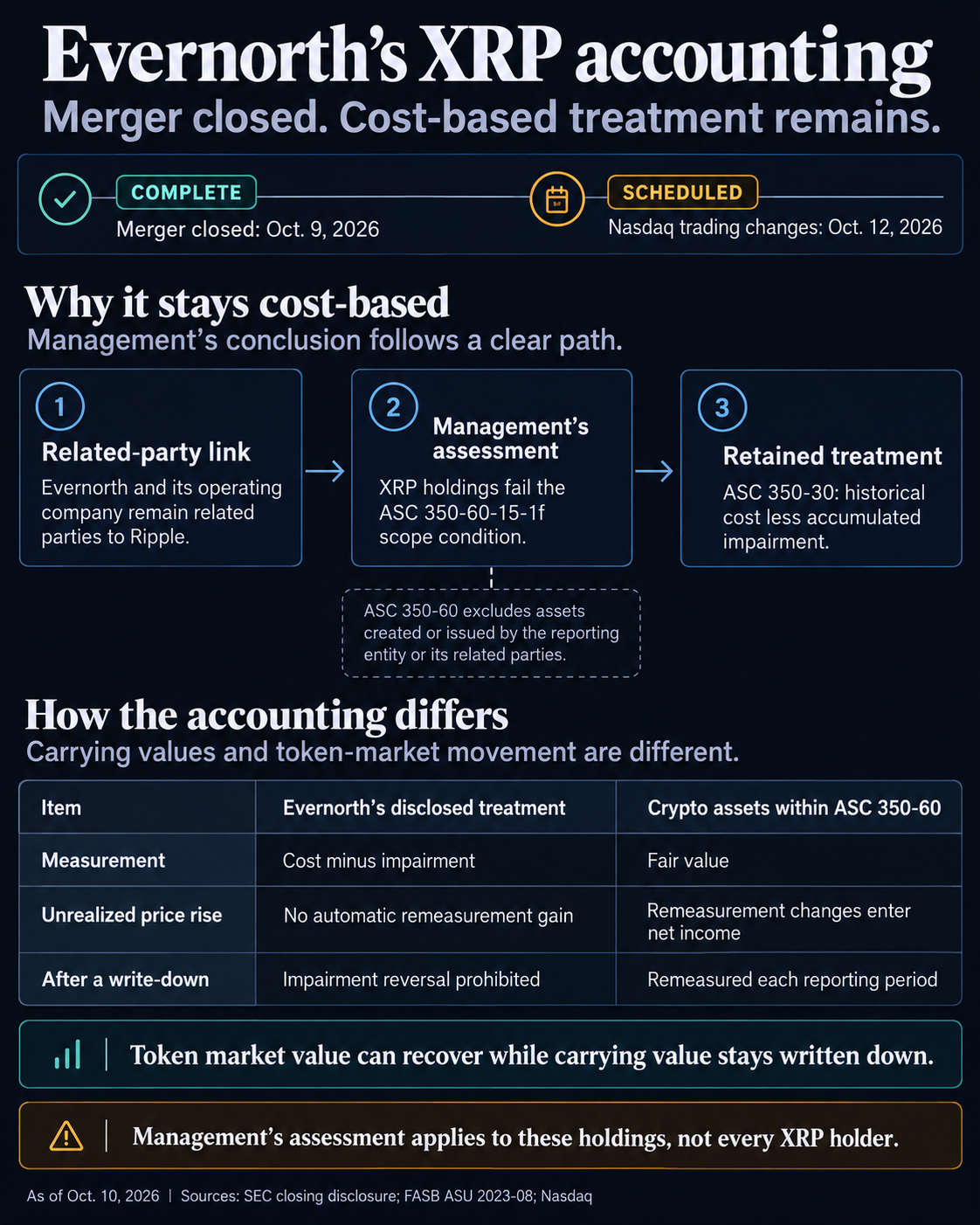
In financial disclosures accompanying the completed merger, Evernorth said it would continue to account for its XRP holdings at historical cost, reduced by accumulated impairment losses.
That differs from the fair-value accounting treatment available to many other corporate cryptocurrency holders.
Under rules introduced by the Financial Accounting Standards Board in 2023, qualifying crypto assets must be valued at prevailing market prices, with unrealized gains and losses reflected in reported earnings.
However, the standard excludes certain digital assets created or issued by a reporting company or its related parties.
Although Evernorth ceased being a wholly owned or consolidated Ripple subsidiary following its merger, management determined that the companies remained related parties.
Consequently, Evernorth concluded that its XRP holdings remained outside the newer fair-value standard and must continue under the older cost-minus-impairment model.
This distinction creates an asymmetry in its financial results.
When XRP prices decline sufficiently, Evernorth may have to recognize impairment losses that reduce the carrying value of its holdings.
However, subsequent price recoveries cannot reverse those write-downs while the assets remain under that accounting treatment.
For example, if a $100 million XRP position is written down to $70 million, a subsequent recovery to $150 million would not automatically restore its accounting value or produce an $80 million unrealized gain in earnings.
That could leave a substantial difference between the market value of Evernorth's treasury and the asset values reflected in its financial statements.
The merger disclosure already illustrates the potential consequences.
Management said XRP's lowest observable Coinbase price between July 1 and the Oct. 9 closing was $0.99, a level that would have produced an additional $6.9 million impairment after June 30. The filing did not confirm whether it ultimately recognized that amount.
Still, the accounting treatment does not prevent Evernorth from profiting economically from higher XRP prices, realizing gains through sales or recognizing income generated by its investment strategies.
However, it could make the company's reported earnings and book value harder to compare with crypto treasury businesses eligible for fair-value accounting.
That distinction becomes particularly relevant to Evernorth's promise of growing XRP per share, because changes in token holdings, market valuation, and reported accounting income may tell different stories about performance.
Investors will therefore need to distinguish returns from active treasury management from changes in XRP's market value, especially when evaluating the company's ability to finance further expansion.
Evernorth's first post-merger financial statements will initially test that distinction, showing how much its treasury activities contribute to reported results even as its accounting treatment continues to exclude unrealized XRP price recoveries.
The post XRP’s next Wall Street expansion comes with an unexpected complication from Ripple appeared first on CryptoSlate.
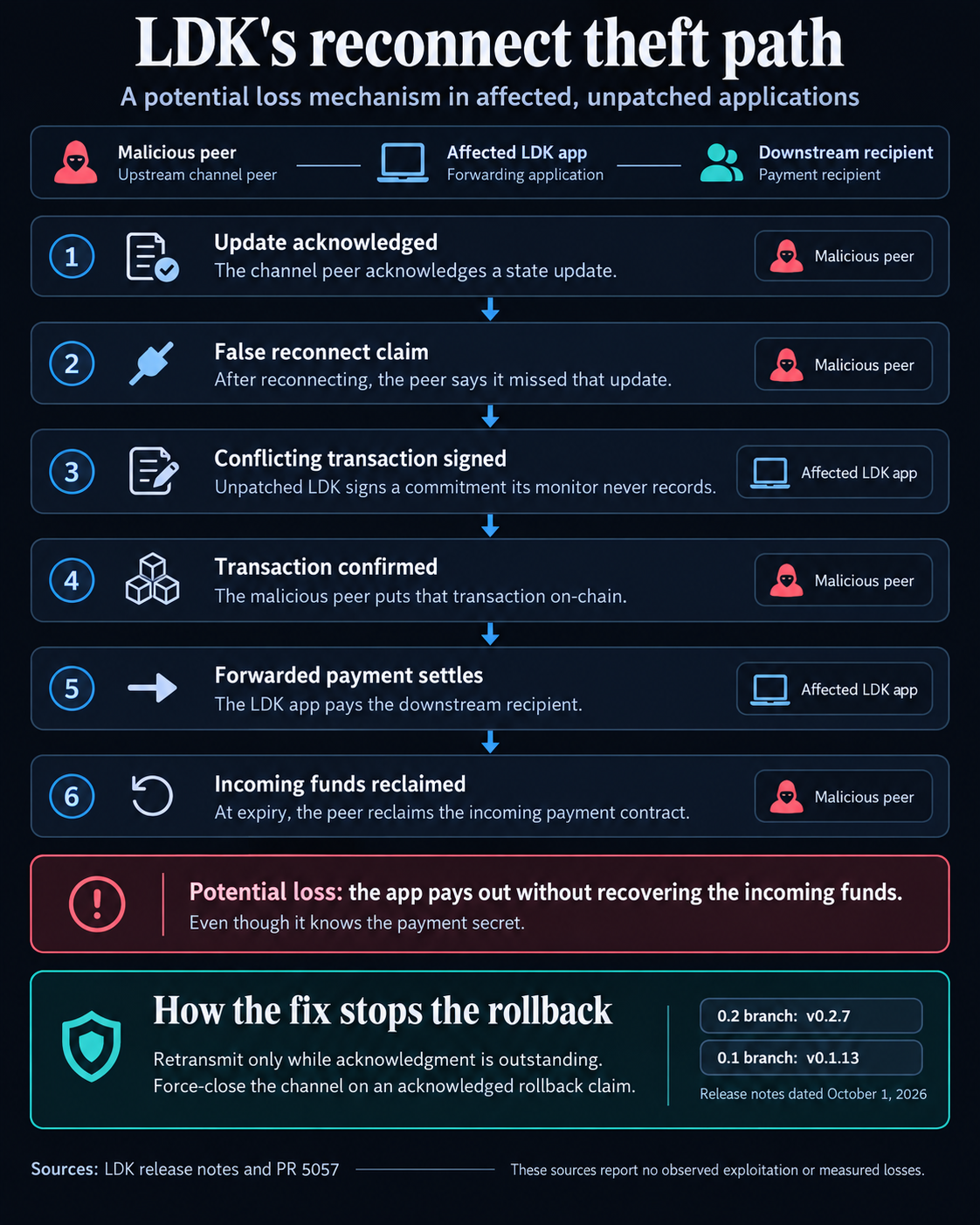
Lightning Development Kit (LDK), a library for building Bitcoin Lightning wallets and payment applications, has patched a flaw that could let a malicious channel peer steal the value of a forwarded payment by lying after reconnecting. Affected application developers need to incorporate the fix into the software they deploy.
The October 1-dated v0.2.7 and v0.1.13 security releases address the LDK reconnect vulnerability on the 0.2 and 0.1 branches, respectively. Bitcoin Optech described the fixes in its Oct. 9 newsletter.
How the LDK reconnect flaw could cost Bitcoin
The attack starts with a channel peer acknowledging an update, then reconnecting and pretending it never received it. Before the fix, that false claim could cause LDK to sign a conflicting commitment transaction.
A commitment transaction represents a channel's agreed state and can be used to settle it on Bitcoin's blockchain. In the scenario described in PR 5057, the newly signed transaction was not recorded by LDK's channel monitor, the component tracking the channel's on-chain claims.
That gap could turn a forwarded payment into a loss. The malicious sender could confirm the transaction on-chain and let the payment settle with the next recipient. It could then reclaim the incoming payment contract when it expired, even though the forwarding node knew the secret normally used to claim payment.
The forwarding application would have paid downstream without recovering the corresponding incoming funds. The fix permits retransmission only while the peer's acknowledgment remains outstanding and force-closes the channel when the peer claims an already-acknowledged update was missed.
Alongside the LDK reconnect fix, version 0.2.7 addresses a different theft path involving LSPS2 just-in-time payments, where a liquidity service opens a channel as part of handling a payment.
An intercepted payment could misrepresent its amount, causing the service to open a channel and forward more Bitcoin than the incoming payment supplied. The service would cover the difference from its own funds. PR 5042 addresses that amount check.
That exposure concerns the LSPS2 service flow. The v0.1.13 notes list the shared reconnect fix without listing the LSPS2 fix.
These defects differ from the splice-fee diversion and saved-state loading bugs covered in CryptoSlate's Sept. 13 LDK v0.2.6 report. Core Lightning is a separate implementation, as described in the update below.
LDK’s architecture documentation explains that the SDK is compiled and executed inside applications. Developers must incorporate the relevant patched library code into deployed software. For LSPS2 integrations, the PR 5042 commit explanation flags that payment contracts queued by a prior version retain unvalidated amounts; teams need to account for those pending contracts as well as updating the library.
The post Lightning apps using unpatched LDK risk Bitcoin theft from a reconnect lie appeared first on CryptoSlate.
Some Kraken futures limit orders can still execute after a successful cancellation if the cancel arrives during the Maker Protection hold window. Kraken expanded the system on Oct. 8, bringing that order-handling rule to more contracts.
Kraken completed Phase 2 after announcing 61 additional perpetual contracts. Maker Protection applies to selected futures markets; Kraken’s documentation describes an initial 20-millisecond hold.
What a Kraken futures cancellation changes
Maker Protection holds orders that can take liquidity before they reach the matching engine, giving traders with resting orders time to react. A limit order without a post-only instruction is held on a covered market even if it would otherwise have rested on the book.
A cancel inside that window changes what the order may leave behind. Kraken converts the held placement to immediate-or-cancel, meaning it can trade when released but cannot leave an unfilled remainder on the book. The original hold expiry stays the same.
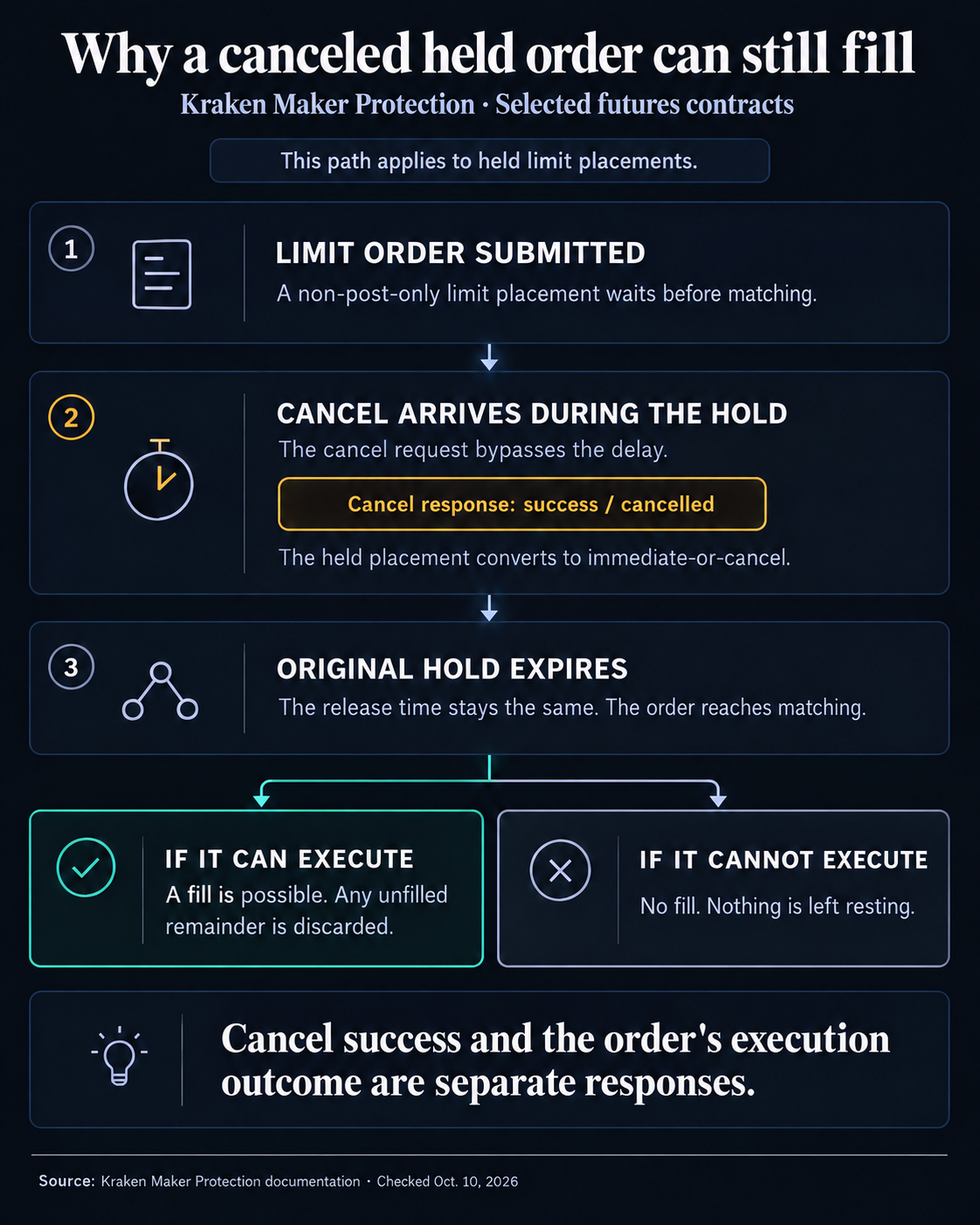
For example, a trader submits a non-post-only limit order and cancels before the hold expires. The cancel request bypasses the delay and converts the held placement to immediate-or-cancel. At the original release time it can still fill; any unfilled amount is discarded.
Kraken reports those instructions separately. The cancel receives success with order status “cancelled,” while the order later reports its own fills or failure to execute. For a converted limit that cannot trade, the REST v3 response is iocWouldNotExecute.
Kraken’s instruments feed identifies each market’s configured hold through makerProtectionMillis. Its documentation says an absent or zero value means no configured delay.
The distinction is contract-specific, so traders cannot infer coverage from the coin name alone. Kraken says its ten most liquid linear perpetual markets are excluded and spot trading is unaffected. Standalone post-only placements bypass the hold. Cancel requests also bypass it; a held limit placement still waits for its original release time.
Other held order types have different cancel responses. A cancel targeting a held immediate-or-cancel, fill-or-kill or market placement returns ORDER_NOT_FOUND; the original request still reaches matching when released.
Automated traders in Kraken futures need to reconcile the order’s execution response as well as the cancellation acknowledgment. A successful held-limit cancel can coexist with a later fill.
The post Some Kraken futures limit orders can still fill after a successful cancel appeared first on CryptoSlate.
Here's a hypothetical situation: a hedge fund is making money, but one of its exchanges is about to liquidate its position anyway. Bitcoin has fallen, its short position on CME is profitable, and the matching long on Hyperliquid is bleeding cash. The two trades were designed to offset each other, but Hyperliquid can't use profits sitting at CME to cover the losses on its own books. The fund has to find more collateral before the exchange closes the position for it.
Moving money between exchanges takes time, and during a downturn, withdrawals can slow down or stop altogether. The fund could have enough money to cover every position and still lose half its hedge because the profits are sitting in different accounts.
Once that happens, a strategy designed to avoid betting on Bitcoin's direction can suddenly become a very large bet on where the price goes next.
In the high-stakes world of institutional Bitcoin trading, a fund can be profitable across its entire portfolio and still face forced liquidation because the exchange holding its losing position doesn't know or care about the money it has made somewhere else.
And the more efficiently the fund uses its capital, the less money it may have sitting around to solve the problem.
A 20% Bitcoin crash can break a perfectly good hedge
Here's another hypothetical situation: a fund holding two opposing Bitcoin positions. It's long Bitcoin on Hyperliquid and short Bitcoin futures on CME, with both positions worth $4.5 million.
If Bitcoin falls 20%, the short position earns roughly $900,000 while the long loses approximately the same amount, assuming both contracts track the price equally. On paper, the fund hasn't lost much from Bitcoin's directional move. Its short has offset its long, which was the entire point of the trade.
But unfortunately, the exchanges don't see it that way.
Hyperliquid sees a losing position and demands enough collateral to keep it open. CME sees a profitable short position, but those profits are in a different account, subject to different margin and settlement arrangements. The fund needs to transfer some of those profits or close both positions before Hyperliquid decides to liquidate the losing one. If withdrawals are delayed, transfers are frozen, or the profitable trade can't be closed quickly enough, the fund can find itself short of money in one account despite having enough assets across the portfolio.
Once Hyperliquid liquidates the long, the fund is left holding a short position that no longer has an offsetting trade. Now it loses money if Bitcoin rebounds, having gone to considerable trouble to avoid betting on Bitcoin's direction in the first place.
Ian Weisberger, CEO of trading technology provider CoinRoutes, pointed to the disorderly exchange liquidations during the October 2025 crypto crash as an example of how dangerous this can become. Traders who thought their portfolios were balanced could suddenly be left exposed because an individual exchange closed one position without accounting for the other.
The problem isn't necessarily that the fund made a bad bet; it's that the money needed to keep the bet alive was sitting somewhere the exchange couldn't reach.
One million dollars goes a (surprisingly) long way
The problem becomes more complicated when funds use borrowing and derivatives to stretch relatively small amounts of capital into much larger positions. Weisberger explained to CryptoSlate how a hedge fund depositing $1 million in USDC could, in theory, end up controlling $9 million worth of Bitcoin positions.
The fund starts with $1 million of its own capital and borrows another $2 million from a lender, giving it $3 million to work with. It allocates $1.5 million to CME and $1.5 million to Hyperliquid, then uses derivatives to establish a $4.5 million position on each exchange. It can buy $4.5 million worth of Bitcoin exposure on Hyperliquid while selling $4.5 million through CME futures. That's $9 million in total positions, financed with $1 million of the fund's own money, $2 million borrowed from a lender, and additional leverage through derivatives.
The fund isn't necessarily betting that Bitcoin will go up or down. If Bitcoin goes up 10%, the long makes roughly $450,000 while the short loses about the same amount, assuming both contracts track the price equally. Instead, the fund wants to collect the difference between futures prices, perpetual funding payments, or other small discrepancies, with its opposing positions keeping most of the directional exposure out of the trade.
The problem is that the hedge still has to work in practice.
Any one of a hundred different things could go wrong: futures and perps can move apart, funding payments can become expensive, and even a 1% discrepancy between two $4.5 million positions amounts to a $45,000 difference. Even if the prices eventually converge, the fund needs enough collateral to survive whatever happens in between. And although the positions are supposed to offset each other, the exchanges still make their own margin decisions.
CME won't waive a collateral requirement because the fund has a profitable position on Hyperliquid, and Hyperliquid won't automatically credit profits that haven't been transferred from CME. Keeping large deposits at both exchanges would certainly help, but that can get expensive pretty fast when the entire business depends on making small amounts of money from differences between markets.
The alternative is to make the same capital work harder, which introduces another problem: the more exposure a fund can support with every dollar, the more dependent it becomes on being able to access that dollar when something goes wrong.
The exchange doesn't care that your other trade is profitable
Traditional prime brokers have spent decades helping hedge funds manage financing, collateral, and trading across different markets, but crypto markets have always been much more fragmented.
Funds trading Bitcoin futures at CME, perpetual contracts at Hyperliquid, and spot Bitcoin on another exchange need to maintain separate pools of collateral even when all of those positions are essentially part of the same strategy. This is because every exchange has its own margin requirements and settlement processes.
CRX Trade, a Swiss institutional prime brokerage built on CoinRoutes technology, is now trying to coordinate those arrangements. It allows professional traders to manage Bitcoin, stablecoins, and tokenized assets as collateral across crypto exchanges and traditional markets, including Hyperliquid and CME. Instead of funding each exchange separately and hoping money can move quickly enough when something goes wrong, funds can manage their positions and financing through one account.
Weisberger said the system considers both the total size of a fund's positions and how much directional risk remains when they're assessed together. That's also why a lender might agree to finance a fund controlling nine times its original capital in trading exposure. The client has borrowed $2 million rather than $9 million, and the long and short positions are supposed to offset each other.
CRX's risk engine monitors positions across the portfolio and can begin reducing exposure before an individual exchange forces a liquidation. Under one approach, called delta-neutral liquidation, it attempts to close both sides of a hedge together. If a fund is short a Tesla perpetual and long an equivalent amount of tokenized Tesla shares, the system can unwind both positions as a pair instead of leaving the client with an unwanted bet on Tesla. Another method reduces whichever position contributes the most directional risk.
Both approaches are designed to avoid the situation where an exchange closes the losing half of a trade and leaves the fund exposed to a market move it was trying to hedge.
But there's a limit to what coordinated risk management can accomplish. Software can't force an exchange to process an order during an outage, and it can't guarantee there will be someone willing to take the other side at a reasonable price. That's why the fund can still lose money closing its positions, especially when markets are moving quickly and buyers disappear. And the exchanges still retain the right to liquidate positions that fail to meet their margin requirements.
CRX can recognize that two positions were meant to work together and try to keep them from being separated.
Bitcoin can finance trades even where it isn't accepted as collateral
The same approach can also allow funds to use Bitcoin holdings to support trades in markets where Bitcoin itself isn't accepted as collateral.
Weisberger explained this using an example of a client holding $1 million in Bitcoin that wants to trade CME futures. The client transfers the Bitcoin to a crypto exchange, sells $500,000 worth, and replaces that portion of its holdings with $500,000 in Bitcoin futures or perpetuals. The fund now owns $500,000 in Bitcoin and has another $500,000 in derivative exposure, so its sensitivity to Bitcoin's price is approximately the same. The spot sale has freed up $500,000 in cash, which can move through CRX's USDC infrastructure to support trading at CME.
The money isn't being used twice here. Only half the original Bitcoin has been sold, and the fund has bought a contract to replace the exposure it gave up. That contract has its own margin requirements and financing costs, and the position can be liquidated if the fund can't keep enough collateral behind it.
Weisberger estimated that borrowing cash directly against Bitcoin would typically cost around 8%, while replacing some spot exposure with derivatives means paying the relevant futures basis or perpetual funding rate instead. That could be cheaper, although funding payments can fluctuate, and the fund still has to account for fees and spreads.
The company didn't provide a full comparison of actual costs under both arrangements. In either case, the fund found a way to put more of its existing capital to work. It also added another position that needs financing, margin, and someone willing to keep the trade open when markets become disorderly.
Keeping collateral away from exchanges doesn't eliminate the risk
One way to reduce exposure to an exchange failure is to avoid keeping all the collateral at the exchange in the first place. CRX uses tri-party settlement where available, keeping collateral with a separate custodian instead of depositing it directly at the trading venue. The exchange processes the trades, but the assets stay with the custodian, and profit and loss is settled periodically.
Weisberger said those settlements can occur every eight or 24 hours. This can limit the amount directly exposed to an exchange withdrawal freeze to the unsettled profit and loss rather than the client's entire collateral deposit. But the extent of that protection depends on the agreements and settlement arrangements, and it doesn't prevent an exchange outage from interfering with trades that need to be closed.
It also introduces another institution whose obligations matter when something goes wrong. CRX Trade is operated by RAS Capital, a Swiss financial intermediary affiliated with VQF, a regulator-recognized self-regulatory organization. It isn't a bank or securities firm and doesn't provide loans itself. Financing comes from independent lenders using the platform. Weisberger said clients retain legal ownership of assets held in dedicated, segregated wallets and exchange subaccounts.
However, if a client borrows money, the lender receives a lien over the portfolio collateral under a separate agreement. The Bitcoin still belongs to the client, but the lender has a legally enforceable claim against the pledged collateral if the client fails to meet its obligations. The agreement determines how much the fund can borrow, how the assets are valued, and when the lender can exercise its rights.
Meanwhile, the exchanges have their own margin requirements and contracts with the trader, while the custodian operates under another agreement governing where assets are held and who can access them.
Bringing everything into one account doesn't eliminate any of those relationships, just makes them easier to coordinate.
CRX didn't provide the custody and lending agreements needed to establish exactly what would happen if the platform, a custodian, or one of its lending partners became insolvent. Weisberger said clients retained ownership through segregated wallets, but recovering assets in an insolvency would depend on the contracts and laws governing each relationship.
Another important question is whether collateral can be pledged onward, something the company's responses didn't establish. So while keeping collateral away from an exchange can reduce one type of risk, it doesn't necessarily mean the assets will be immediately available when another institution demands payment.
Everyone still wants their money back
There's another problem with building large positions on borrowed capital, which is that, eventually, the lender will want its money back.
Weisberger said loans arranged through CRX usually run for 30 to 90 days, with leverage limits, collateral weights, and loan-to-value requirements agreed when the client borrows. The lender can decline to renew the loan when it matures, leaving the fund to repay the money or find someone else willing to finance its positions. That can happen regardless of whether the fund's trading strategy is profitable.
Exchange margin requirements and derivative funding costs can also move during the loan term, regardless of what the lender originally agreed to. So funds can then face demands for additional collateral from an exchange while also needing to repay or refinance money borrowed against the same portfolio. Shared collateral can make that portfolio more capital-efficient, but it can't override the lender's contract or an exchange's rules. And during a market disruption, the fund may need cash at several exchanges at once, precisely when transfers become harder and closing positions gets more expensive.
That's the trade-off behind making institutional Bitcoin trading more efficient. There's no reason for a fund to keep unnecessarily large amounts of capital scattered across exchanges if it can coordinate its positions and collateral more effectively. Doing so can reduce unnecessary liquidations, free up capital, and make hedged strategies cheaper to operate.
However, it also allows funds to support larger positions without committing more of their own money. And the larger those positions become, the more important it is that lenders, exchanges, and custodians all do what they're supposed to do at the same time.
The better a fund gets at putting every dollar to work, the less money it has sitting around for emergencies. Shared collateral can reduce the risk of a profitable hedge being liquidated because its money is trapped in the wrong account. It can't eliminate the underlying dependence on financing, liquidity, and exchange access.
The real measure of that efficiency won't be how much exposure $1 million can support when markets are calm, but how much of it the fund can safely keep open when everyone wants their money back.
The post Bitcoin hedge funds face a liquidation trap when their collateral is split across markets appeared first on CryptoSlate.
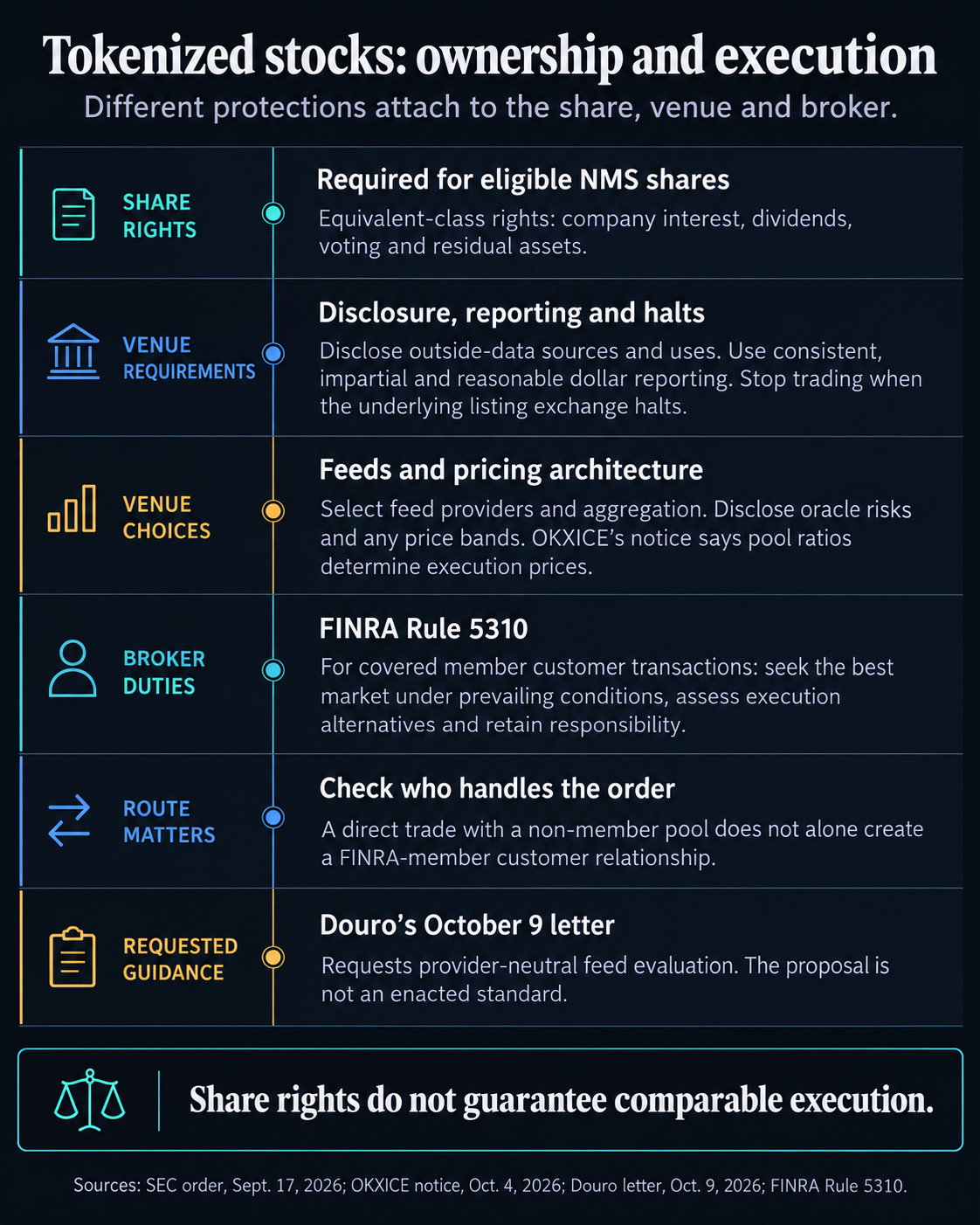
Tokenized stocks eligible for the SEC’s September exemption must carry equivalent shareholder rights, yet their trading venues can operate outside key Regulation NMS protections. Investors therefore need to examine both what the share represents and how their order is priced and handled.
Market-data provider Douro Labs asked SEC staff in an October 9 submission for provider-neutral principles to assess external price feeds and use them for dollar reporting. Douro contributes to Pyth Network and develops and operates Pyth Pro, giving it a commercial interest in the standards under discussion.
The order requires venue disclosures and safeguards. FINRA-member brokers retain applicable best-execution duties when they handle covered customer transactions.
The September 17 order grants temporary, conditional relief from the definition of an exchange to venues offering permissioned automated market maker pools for eligible tokenized National Market System (NMS) stock. These pools use software to let approved participants trade against committed assets. The order also provides separate dealer-definition relief for certain liquidity providers using their own capital.
Its scope is narrower than the tokenized-stock label. Third-party securities providing synthetic exposure, including tokenized linked securities and security-based swaps, are excluded, as are rights and warrants. Eligibility depends on the defined security and the venue’s compliance with the order.
For eligible shares, the venue must verify the same rights and privileges as traditional stock of an equivalent class. Those include an interest in the company, dividends, voting rights and a share of residual assets on liquidation. A claim to those rights concerns what the investor owns; execution concerns the terms on which the investor buys or sells it.
A venue meeting the exemption’s conditions is outside the exchange, alternative trading system and trading-center framework for the relevant Regulation NMS rules. That includes Rule 611’s protection against venue trades at prices worse than certain protected quotations elsewhere. Those protections and a broker’s best-execution duty are separate, however, and the order preserves applicable anti-fraud and anti-manipulation laws and participants’ separate regulatory obligations.
Tokenized stocks: what external price data controls
The order’s market-data provision requires a venue to explain whether and how it uses external data or oracles, the services that bring outside information to blockchain applications. Its public notice must identify providers and sources, explain the purposes of the data and describe oracle use. Other items cover known material risks, including oracle manipulation, and any reference-price bands or other risk controls.
The order also requires concurrent stoppages when the underlying stock halts on its primary listing exchange, participant notifications, operational-event remediation, accessible records, trading limits and restrictions on venue credit.
The order does not prescribe a single provider, minimum contributor count, common aggregation method, confidence threshold or uniform response to stale prices.
Douro wants staff to supply a framework for assessing those choices. Its proposed criteria emphasize independent contributors involved in price formation, aggregation designed to resist manipulation, public contributor identities and calculation methods, and comparison with external market benchmarks. The letter also proposes disclosures about confidence, staleness and responses when data becomes uncertain or unavailable.
There already are binding conditions around reporting. Venues must publish free, machine-readable dollar-denominated data covering transactions in the preceding 30 days, updated within ten minutes of each transaction. Conversion must use consistent, impartial and reasonable methods commonly applied by market participants. Trading-interest and transaction records also must state dollar prices.
An existing SEC staff FAQ uses similar dollar-conversion language for pairs trading on exchanges and alternative trading systems. Douro’s request addresses a different issue: how venues should evaluate feed quality.
How venue notices describe different feed roles
OKXICE’s October 4 notice illustrates why identifying an external provider is only the start. It describes AMM execution prices determined by pool asset ratios, while external price data serves other functions: displaying stock values, detecting underlying-market trading halts and reporting stablecoin-paired transactions in dollars.
The notice identifies Massive.com for stock prices and trading-halt data and affiliated OKX INC for stablecoin price indices. It also says OKXICE applies no additional circuit breakers or reference-price bands beyond the stoppages it describes.
The notice lists Circle’s dollar-pegged USDC among its payment assets. A stablecoin-price input converts the trade into dollars for reporting; pool ratios determine the execution price.
The notice separately describes outside volume data submitted to the venue’s smart contracts for trading-limit checks. Price information and volume inputs therefore control different parts of the trade.
TSV LLC’s September 23 notice provides a different kind of disclosure. It says operations had not commenced as of that notice, outlines intended external-data uses including halt detection and price-divergence monitoring, and says a production market-data provider had not yet been selected. The disclosed functions are prospective as of that notice.
Best execution for tokenized stocks remains a broker duty
For a FINRA member handling a covered customer transaction, Rule 5310 requires reasonable diligence to find the best market and obtain a price as favorable as possible under prevailing conditions. It applies when the firm acts as an agent and when it trades as principal.
The assessment considers the market’s character, transaction size and type, the markets checked, quotation accessibility and the customer’s order terms. The rule’s execution review also considers speed, the likelihood of executing limit orders, costs and customer needs. It is broader than checking whether a pool price matches one external reference.
A member cannot transfer that duty to another person. Automated, non-discretionary order routers and internalizers using regular and rigorous review instead of individual order reviews must conduct the relevant reviews at least quarterly, by security and order type, and compare current arrangements with competing markets. Material execution-quality differences require changes to routing or a justification for retaining it.
Sparse pricing information calls for particular diligence, written procedures and documented compliance under Rule 5310.
Who handles the customer’s order matters
The customer’s instructions and the firm’s role matter. An unsolicited instruction to route an order to a particular market limits the best-execution determination beyond that instruction, while prompt processing and compliance with the order terms remain required. The duty also covers applicable customer orders routed from another broker for handling and execution. Merely filling another broker’s customer order against the member’s quote falls outside that routed-order duty.
Investors interacting directly with a non-member pool should establish whether a FINRA member is handling a covered customer transaction before relying on those broker protections. The venue’s exemption conditions and applicable anti-fraud protections continue to matter in either route.
FINRA’s Regulatory Notice 26-15 sought comments on modernizing guidance under the existing principles-based standard. Its distinction between best execution and trade-through protection helps explain why venue relief and a member’s customer duties operate separately.
What tokenized-stock investors can compare
Investors can read a venue notice for more than a provider’s name. Does outside data set the execution price, support a displayed valuation, convert a transaction for reporting or trigger a halt? Does a disclosed price band actually constrain trading, and what happens if its reference becomes stale or unavailable? Where a broker handles the order, how does it compare the execution with alternatives?
Douro’s October 9 request gives SEC staff a concrete framework to consider. For investors comparing tokenized stocks, the practical test is whether the venue’s data, pricing controls and any broker’s execution review support the trade they expect.
The post Tokenized stocks can carry the same rights without the same trading protections appeared first on CryptoSlate.
CryptoTicker.io
A federal judge in Chicago sentenced Raheim Hamilton to 40 years in prison and a $5 million fine on Monday, October 5, 2026. Hamilton co-founded the darknet marketplace Empire Market and ran it from 2018 to 2020. Part of his agreement with prosecutors: he hands over around 1,230 bitcoin, 24.4 ether and three properties in Virginia. So says the statement from the US Attorney's Office for the Northern District of Illinois of October 7. His co-founder Thomas Pavey has agreed to hand over around 1,584 bitcoin, with his sentence due later in October.
Together that comes to 2,814 bitcoin, worth around $234 million or 209 million euros at Sunday morning's price. The more interesting question is what the state does with them rather than how much they are worth. The United States now collects seized bitcoin instead of selling it. Saxony did the opposite in 2024, and the money is still sitting in an account.
Empire Market: $430 million of turnover in cryptocurrency
Empire Market was one of the largest darknet marketplaces until it was taken down in 2020. According to prosecutors, more than four million deals worth over $430 million ran through the site, with drugs accounting for the bulk at just under $375 million. Payment was exclusively in cryptocurrencies, and the operators advised their customers to obscure payments through mixers. Investigators had already secured crypto assets worth $75 million during the inquiry, BleepingComputer reports.
Will the bitcoin end up in Trump's bitcoin reserve?
The basis is an executive order issued by President Donald Trump on March 6, 2025. It created a strategic bitcoin reserve to be stocked with all Treasury bitcoin finally forfeited in criminal or civil proceedings. Bitcoin in that reserve may not be sold. The order names exceptions explicitly, among them the return of funds to identifiable victims of crime and a court order.
A drugs marketplace leaves hardly any victims who would have to be repaid. Much therefore suggests that the coins end up in the reserve. Whether and when that happens has not been announced by the authorities. It requires the forfeiture to be final, and Pavey has yet to be sentenced.
How closely the market watches state holdings was on show this week. Wallets attributed to the government moved 17,733 bitcoin to accounts at Coinbase Prime, and talk of sales followed at once. No sale has been documented to date. Congress is also sitting on a bill that would make state bitcoin unsellable for at least 20 years. It has not been passed.
Saxony sold 49,858 bitcoin in an emergency disposal
Germany went the other way. In the case surrounding the illegal streaming site movie2k, a defendant transferred around 49,858 bitcoin to investigators in January 2024. The Dresden public prosecutor general sold them between June 19 and July 12, 2024 through the Frankfurt bank Bankhaus Scheich, raising 2,639,683,413.92 euros, as set out in its statement of July 16, 2024.
The legal basis was the emergency disposal under section 111p of the Code of Criminal Procedure. Where seized assets face a loss in value of around ten percent or more, they have to be sold before judgment. With bitcoin, the authority considered that condition met at any time because of the price swings. The price on the day of sale plays no part in that decision, it stressed.
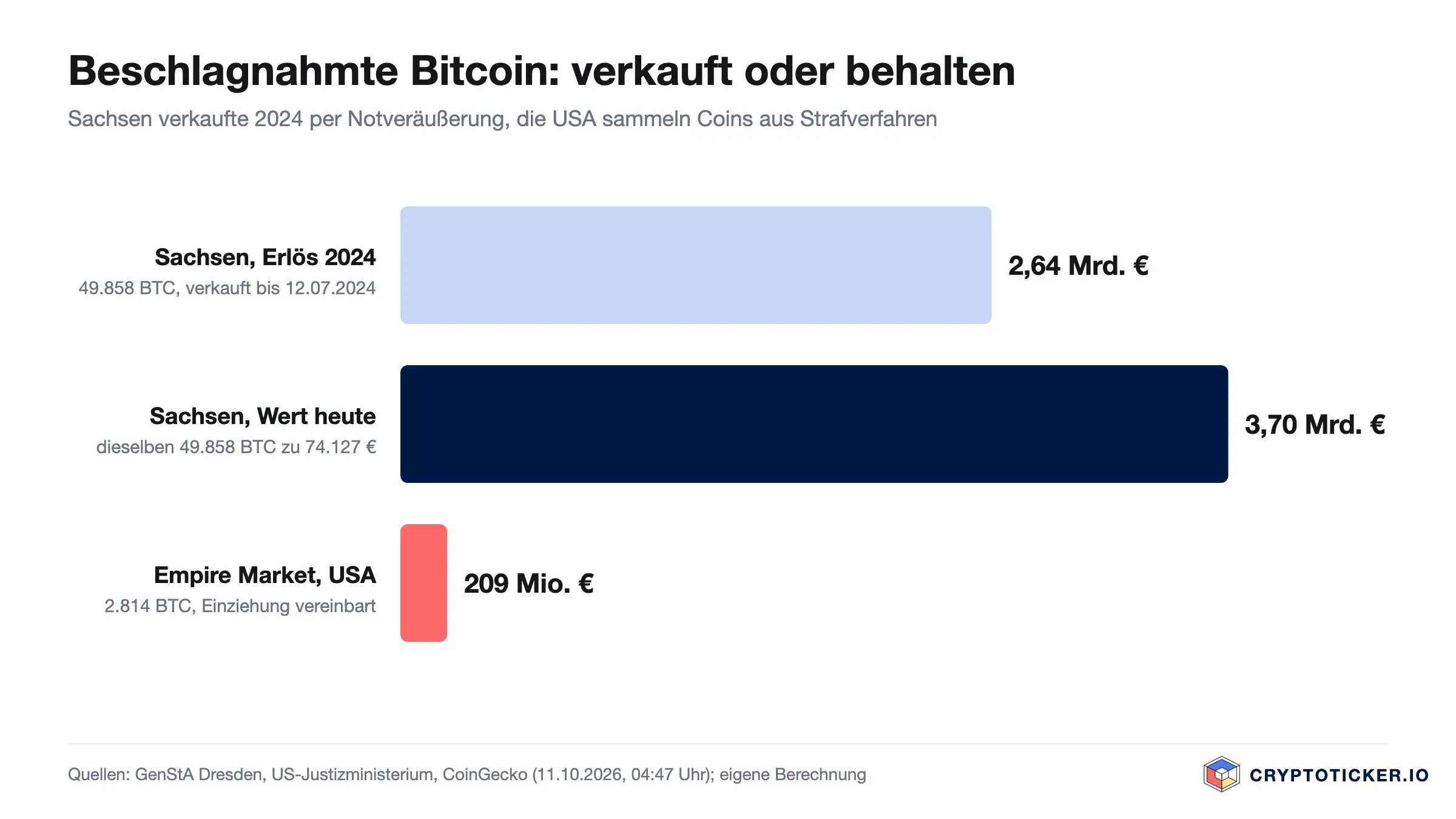
In hindsight the sale was expensive. Saxony achieved around 52,944 euros per bitcoin on average. A bitcoin costs around 74,127 euros today, so the same coins would be worth some 3.70 billion euros, a good billion euros more than the proceeds. The sum works the other way round too: had the price fallen, the authority would have speculated with someone else's assets. Preventing exactly that is the point of the emergency disposal.
Who the 2.64 billion euros from the movie2k case belong to
The money does not flow into the state budget. It is secured only provisionally for the criminal proceedings, and the Leipzig regional court decides on forfeiture, with the trial of the alleged main operator having opened there in February 2026. Injured parties would rank ahead of the state, above all the rights holders of the films. The prosecutor general's most recent statement on the complex, dated June 29, 2026, concerns a side case: a Berlin estate agent has to pay around 2.5 million euros in compensation. No final decision on the billions is reported there.

Seized bitcoin: what the difference means for holders
What counts for the price is how much state-held supply can still reach the market. The United States settled the question with its 2025 order: forfeited bitcoin is to stay where it is as a matter of principle. Every case like Empire Market therefore shrinks the supply that might one day be sold, rather than adding to it. Germany has no comparable rule. The Code of Criminal Procedure still governs here, and for bitcoin it generally demands a quick sale.
There are two takeaways in this if you hold bitcoin. Reports of state wallets on the move are not a sale in themselves, and a look at the legal position of the state in question says more than the movement does. And long-term holders should know that a large part of the state-held supply in the United States is tied up for the foreseeable future, while emergency sales of the Saxon kind remain possible at any time. Vetted venues for buying are set out in the comparison of regulated crypto exchanges.
(As of October 11, 2026. This article is not investment advice. Prices and fee structures change; check the terms with the provider before you buy.)
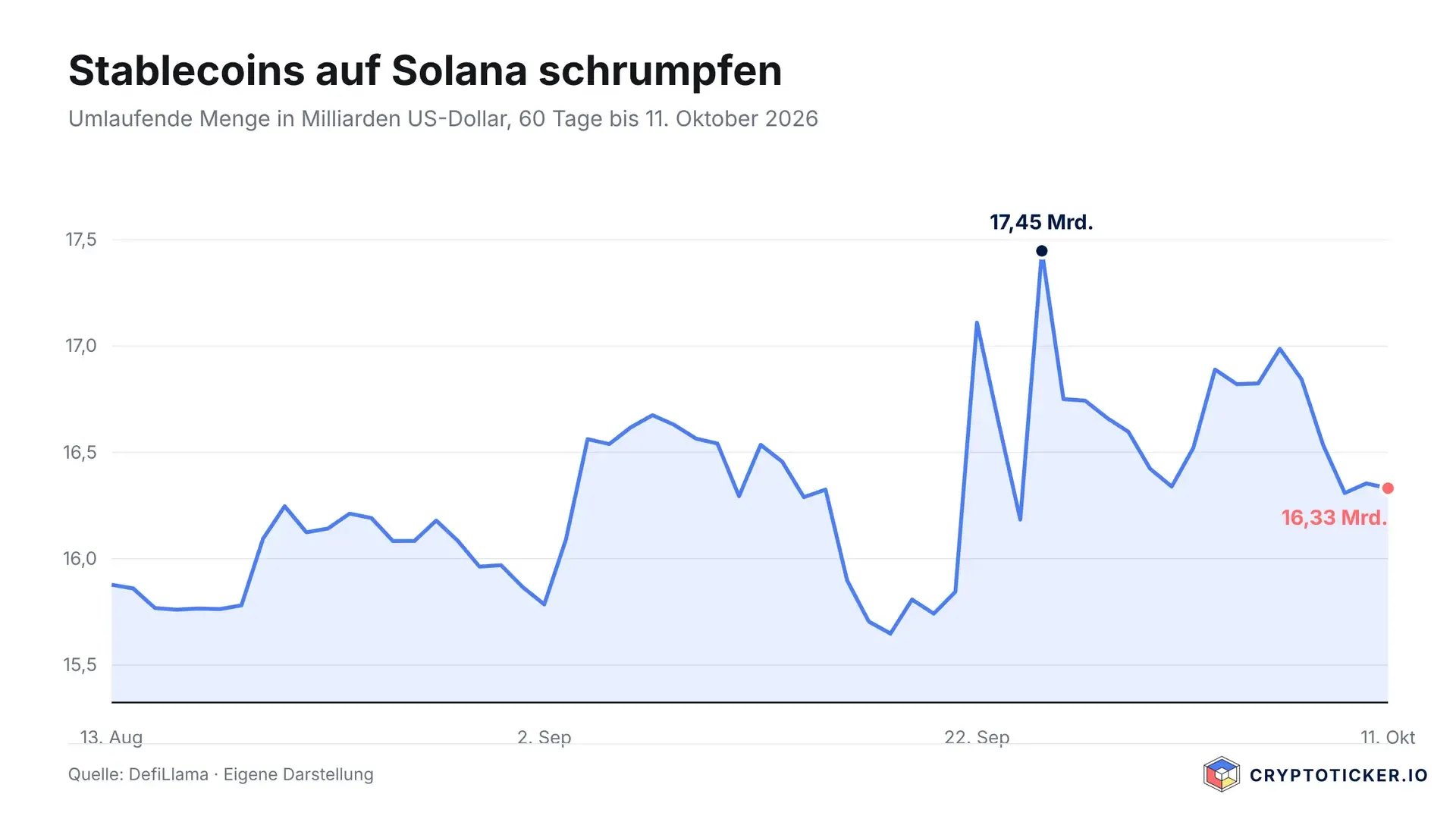
Solana holds $16.33 billion in stablecoins on Sunday afternoon. On September 25 the figure was $17.45 billion. Around $1.12 billion has therefore left the chain in 16 days, just under $70 million a day on average. That is 6.4 percent of the entire stablecoin cushion, and it is the number that reaches you when you sell, earlier than any price headline does.
Stablecoins are a blockchain's cash. Sell something on Solana and you will almost never be credited in euros; what arrives is a dollar token. When that stock shrinks, the other side of your sell order shrinks with it. The price itself says nothing about this: SOL traded at $111.79 at around 16:43 UTC on October 11, up 1.48 percent in a day, with a daily high of $111.84 and a daily low of $108.94. Over a week it is down 7.8 percent, over 30 days up 9.5 percent. The figures come from CoinGecko.
Stablecoins on Solana: $1.12 billion less than on September 25
The DefiLlama time series puts the peak on September 25 at $17.45 billion. The stock has fallen in steps since then, interrupted by two brief counter-moves in early and mid-October. The reading on October 11 is $16.33 billion. Add up all the individual dollar tokens and the result is $16.29 billion; the small discrepancy between two queries of the same database comes from different sampling times and is not smoothed over here.
What counts is the direction of travel, and the second decimal place is beside the point. A drop of 6.4 percent in a little over two weeks is more than noise. For comparison: over the preceding 60 days the stock oscillated between $15.6 billion and $17.5 billion, so the distance from trough to peak came to around $1.9 billion over two months. A third of that span has now been worked off in 16 days.
What a chain's stablecoin cushion actually tells you
The stablecoin cushion is the sum of all dollar-pegged tokens issued on a blockchain. It is no use as a price indicator, because it is a stock figure: what gets measured is how much sale-ready capital is parked on the chain. Unlike the SOL price, it does not hang on the market price. A dollar token stays worth a dollar even when SOL falls. If the total drops anyway, somebody has redeemed tokens or bridged them to another chain.
That is exactly what makes the metric useful. When the price falls, the dollar value of every locked coin falls automatically with it, without a single investor having done anything. Stablecoins carry no such arithmetic artefact. Every billion that disappears is a decision by somebody who wanted their money somewhere else.
Slippage when selling: how a thinner cushion hits your order
Slippage is the difference between the price you see when you submit an order and the price at which it is actually filled. It occurs when your order is larger than the other side available at the best price and therefore eats through several price levels.
The mechanism takes two sentences. On a decentralised exchange on Solana, every liquidity pool holds a coin on one side and a dollar token on the other. The fewer dollar tokens sitting in those pools, the more a sell order moves the price against you, because it accounts for a larger share of the pool.
For small amounts this stays invisible. Sell 500 euros of SOL and $1.12 billion less cushion will not register. It becomes visible at four- and five-figure amounts, earlier than that for illiquid Solana tokens away from the big names, and always when many holders want to sell at once. SOL's 24-hour trading volume stands at $1.70 billion according to CoinGecko, with a market capitalisation of $65.85 billion.
Solana against Ethereum and Tron: where the stablecoins sit
Among the chains, Solana remains a mid-sized venue. On the same data, Ethereum holds around $145 billion in stablecoins and Tron around $95 billion, against a good $16 billion on Solana. Solana therefore carries about a ninth of the Ethereum cushion.
That order of magnitude matters more for your own trading than it sounds. The gap explains why large sales move the price more on Solana than on Ethereum, and why an outflow of $1.12 billion weighs far more in percentage terms here. On Ethereum the same amount would have been a decline of 0.8 percent.
USDC, USDT and USD1: which stablecoins on Solana are authorised in the EU
Trading from Germany calls for knowing not only how many dollar tokens sit on Solana, but which ones. The breakdown on October 11 looks like this: USDC from Circle leads with $6.79 billion or 41.7 percent, followed by USDT from Tether with $2.87 billion or 17.6 percent. Then come USD1 from World Liberty Financial with $1.41 billion, USDGO with $1.29 billion, BlackRock's tokenised money market fund BUIDL with $0.93 billion, PayPal's PYUSD with $0.71 billion, USDG with $0.63 billion and Ethena's crypto-backed USDe with $0.48 billion.
Under the European Markets in Crypto-Assets Regulation, MiCA for short, a dollar token needs an authorised issuer in the EU before it may be offered on licensed trading venues. The technical term is the e-money token: a crypto asset that replicates exactly one official currency and is issued by a supervised e-money institution.
The register of the European Securities and Markets Authority, ESMA, lists as of September 30, 2026 USDC and EURC from Circle Internet Financial Europe, supervised by the French ACPR, as well as USDG from Paxos Issuance Europe under the supervision of Finland's FIN-FSA, among others. USDT, PYUSD and USD1 have no entry.
Apply that to the stock and a finding emerges that appears in none of the usual market overviews: of the $16.29 billion on Solana, $7.42 billion or 45.5 percent sits in tokens with EU authorisation, and $5.00 billion or 30.7 percent in tokens with no ESMA entry. The remainder is spread across structures that are not e-money tokens at all, such as the BUIDL fund share and the crypto-backed USDe.
Holding USDT is not thereby prohibited. Owners may keep it and transfer it to their own wallet. What is missing is trading on venues with a MiCA licence. The licensing duty falls on the trading venue, while the holder is unaffected.
Revolut on August 31: a forced conversion over holders' heads
How practical this gets was on show on August 31, 2026. Revolut converted European customers' USDT holdings without those customers having to act themselves. That assessment comes from our own stablecoin comparison with MiCA status, as of October 2, 2026.
The episode is the pattern that counts: the timing belongs to the provider, and the investor has no say in it. Anyone holding an unauthorised dollar token on a European trading venue bears the risk that the position is turned at a price and on a date set by somebody else. On your own Solana wallet that risk disappears, leaving the question of where the token can later be swapped back into euros.

Check before you sell: what depth your venue really offers
The chain's stablecoin cushion is a background figure. What hits your order is the depth at the venue where you actually trade. Three things can be looked up in a few minutes.
First, the order book of a centralised exchange: it shows how much of the other side sits within 1 and 2 percent of the current price. If your planned sale is larger than the sum inside that band, you will move the price yourself. Second, the expected slippage display that every larger decentralised exchange shows before confirmation; it calculates the effect for your exact order size. Third, the question of which dollar token you end up holding, and whether your venue swaps that token back into euros.
Split the order if you are moving larger amounts. Two or three partial sales spread over a few hours cost a little more in fees and save more than they cost when the cushion is thin.
DeFi TVL on Solana: $6.19 billion and 53 percent below the 2025 high
Alongside the stablecoins, DefiLlama measures the total value locked in Solana applications. It stands at $6.19 billion on October 11. On October 5 it was $6.63 billion, a decline of 6.6 percent in six days, so at the same pace as the stablecoins.
Over 30 days, by contrast, it is up 7.6 percent, because capital flowed in during September. The value is 53.2 percent away from its peak of $13.24 billion on September 14, 2025. That figure does contain the price effect, though: when SOL falls, the dollar-denominated TVL falls with it. The stablecoin series is the cleaner signal for precisely that reason.
Set against our own earlier coverage: on the evening of October 10, SOL stood at $110.28 when the US spot ETFs lost $24.8 million net for the first time after 14 weeks of inflows. The price has gained 1.37 percent since then, while the stablecoin cushion has carried on shrinking. The detail on the ETF week is in our report on the end of the inflow streak at Solana ETFs. On the technical side, block times have been running at 200 milliseconds since October 9, as set out in our assessment of the halved slots; the chain has grown faster, in other words, while the capital drains away.
The editorial team's view: the outflow is a warning sign, not an alarm
In the editorial team's judgement the finding carries medium weight. Three pieces of evidence support it: the decline has run in the same direction for 16 days, it shows up in the TVL as a second, independently collected measure, and it coincides with the first ETF outflow after 14 weeks. Against it stands the fact that $16.33 billion is still above the level of mid-August, when the cushion stood at $15.88 billion, and that over 30 days the chain records 7.6 percent more locked capital in the same period.
What this amounts to is a cooling after a strong September, well short of a flight. If you hold SOL and have no intention of selling, nothing follows from it. If you plan to move larger amounts in the coming weeks, reckon with somewhat more slippage than in September and plan partial sales. None of this is a buy or sell recommendation, and total losses are possible with crypto assets.
Solana reserves: $1.12 billion less buffer than on September 25
- Check which dollar token you end up holding after a sale and match it against the supervisor's register. The entry in the ESMA register is what governs, and the name of the token is no guide.
- Check the depth of your trading venue within 1 and 2 percent of the price before placing a larger order. Which exchanges operate in Germany with a licence is set out in the crypto exchange comparison.
- Holdings you want to keep for longer have no business on a trading venue. The differences between the devices are set out in the hardware wallet comparison.
This article draws on the public series from DefiLlama on the stablecoin supply on Solana and on the European Securities and Markets Authority's register for the Markets in Crypto-Assets Regulation.
(As of October 11, 2026. This article is not investment advice. Prices and fee structures change; check the terms with the provider before you buy.)
France wants to close a tax gap that Germany never had. On Wednesday, October 7, 2026, the finance committee of the National Assembly adopted an amendment to the 2027 budget bill under which swapping crypto assets into stablecoins will be taxed in future. It is due to apply from January 1, 2027. The amendment was tabled by Nicolas Sansu, a deputy for the left-wing GDR group. The same day, the committee adopted a second amendment that favours investors: losses on crypto assets should in future be carried forward for ten years.
None of this is settled. The changes have to win a majority again in the plenary of the National Assembly, after which the Senate takes them up. The view across the border is worth having all the same, because it shows how strict the German rule on swaps already is, and which consequence of it many investors overlook.
What France wants to change about stablecoin swaps
The rule in France so far: swapping one crypto asset for another incurs no tax. Only when an investor cashes out into euros or buys something with crypto does the gain come under the French flat-rate tax. That also covers swaps into stablecoins. Sansu calls it a loophole in the law in his explanatory note: stablecoins have long been used like money, they can be spent and used to buy other crypto assets, yet the gain on the way in stays untaxed. The United Kingdom and Italy, he argues, have already settled the matter differently.
The amendment changes article 150 VH bis of the French tax code. The tax exemption on swaps would no longer apply where the investor receives e-money tokens as defined by the European crypto regulation MiCA. That means stablecoins designed to track the value of a single state currency, the euro or the dollar for instance. Swapping bitcoin for ether would remain untaxed in France.
In Germany, swapping into stablecoins is already a taxable event
What France is planning has been German practice for years. The Federal Ministry of Finance is explicit in its guidance on crypto assets of March 6, 2025: swapping crypto assets for euros, goods, services or other crypto assets is a disposal. Swapping bitcoin for a dollar stablecoin therefore counts with the tax office exactly as a sale for euros does. The proceeds are the market value of the coins received at the moment of the swap.
The gain is only taxable, however, if no more than a year lies between purchase and swap. The investor's personal tax rate then applies, once private disposal gains for the year reach the 1,000 euro threshold. After more than a year the swap is tax free. In France, under the new amendment, it would be taxable even after ten years, because French law has no holding period.
The trap when parking in stablecoins: the holding period starts again
One sentence in the ministry's guidance is often overlooked: the periods start afresh after every swap. Swap bitcoin into a stablecoin tax free after three years to lock in gains, then later buy bitcoin again with that stablecoin, and a fresh one-year clock starts for the new bitcoin. A sale within that year is taxable once more, even though the money has been in the market for years.
The stablecoin itself rarely produces much of a gain, because its price is pegged to the dollar or the euro. With a dollar stablecoin, though, the exchange rate can create a small gain or loss in euros, and that counts too. Switching often between coins and stablecoins makes the picture hard to follow without clean records. The free CryptoTicker tax calculator also captures coin-for-coin swaps, calculates on a FIFO basis and shows for each purchase whether it is still inside the holding period.

France and Germany side by side
| France today | France from 2027 (amendment) | Germany today | |
|---|---|---|---|
| Swapping crypto into a stablecoin | tax free, tax only on cashing out | taxable | a disposal, taxable in the first year |
| Swapping crypto into crypto | tax free | tax free | a disposal, taxable in the first year |
| Holding period | none | none | one year, starts again after every swap |
| Losses | offset only within the same year | carried forward ten years | offset against private disposal gains, in later years too |
The table shows the heart of it. France taxes every gain, yet grants a deferral on swaps. Germany taxes the swap itself, yet releases gains entirely after a year. Long-term holders are better off in Germany today, while anyone who reshuffles often pays here sooner.
What the German reform could change on October 14
Crypto tax faces an overhaul in Germany as well. Under its draft bill, the Federal Ministry of Finance wants gains on crypto assets acquired from January 1, 2027 to count as investment income, with no holding period. Anything acquired up to December 31, 2026 stays tax free after a year. The cabinet is due to adopt the draft on Wednesday, October 14. The Greens' bill to abolish the holding period immediately was rejected by the Bundestag on October 8.
For swaps that carries a consequence worth knowing. On the logic of the ministry's guidance, every swap is also a fresh acquisition. Move coins from today's holdings into a stablecoin and back after the turn of the year, and what you hold afterwards are coins acquired in 2027. Under the draft, no holding period would apply to them. Things may still change before the cabinet decision and the Bundestag. Which programmes document swap chains across several exchanges cleanly is set out in our comparison of crypto tax software.
(As of October 11, 2026. This article is not investment advice. Prices and fee structures change; check the terms with the provider before you buy.)
The Ethereum price stood at $2,504 on Sunday afternoon, or 2,237 euros. Over 24 hours that is a move of three dollars, 0.15 percent. The real movement this time sits in the block data rather than the chart: the base fee per unit of gas, the minimum price every Ethereum transaction has to pay, averaged 0.0673 gwei over the past 24 hours. Across the past seven days the average was 0.4210 gwei. The network is running at a sixth of last week's price.
There are two sides to that if you hold ether. Sending ether costs a fraction of a cent today, so whoever already planned to move holdings off an exchange and into their own wallet is paying about as little as they ever will. At the same time the network's ether consumption, which normally offsets part of the new issuance, has all but disappeared. Both effects belong together, and both are set out below with figures.
Ethereum price $2,504: the daily range narrows to 0.63 percent
Today's low of $2,495.23 and high of $2,510.93 are $15.70 apart, which is 0.63 percent. Compare that with the four trading days before, measured on the daily candles of the Coinbase exchange: October 8 spanned 7.53 percent, October 7 spanned 6.48 percent, October 9 still spanned 1.99 percent and October 10 spanned 1.34 percent. The range has contracted on four consecutive days, and today is the tightest session since October 6.
Across the full rolling 24-hour window, which takes in yesterday evening as well, the range runs from $2,495.23 to $2,517, or 0.87 percent. A market moving that little either has no trigger or is waiting for one. This week brings the US consumer price release on Wednesday.

The base fee per gas stands at 0.0673 gwei
Gas is the unit in which Ethereum measures the work a transaction requires. A simple ether transfer consumes 21,000 gas, whatever the amount sent. The base fee is the price per unit of gas that the protocol sets itself, measured in gwei, or billionths of an ether. That price moves from block to block with network load.
The figures for the past 24 hours, taken from the block data at ultrasound.money on October 11: an average of 0.0673 gwei, a lowest block of 0.0510 gwei and a highest block of 0.1551 gwei. The weekly average is 0.4210 gwei and the monthly average 0.3812 gwei. Since the base fee was introduced in August 2021, the average has been 18.827 gwei.
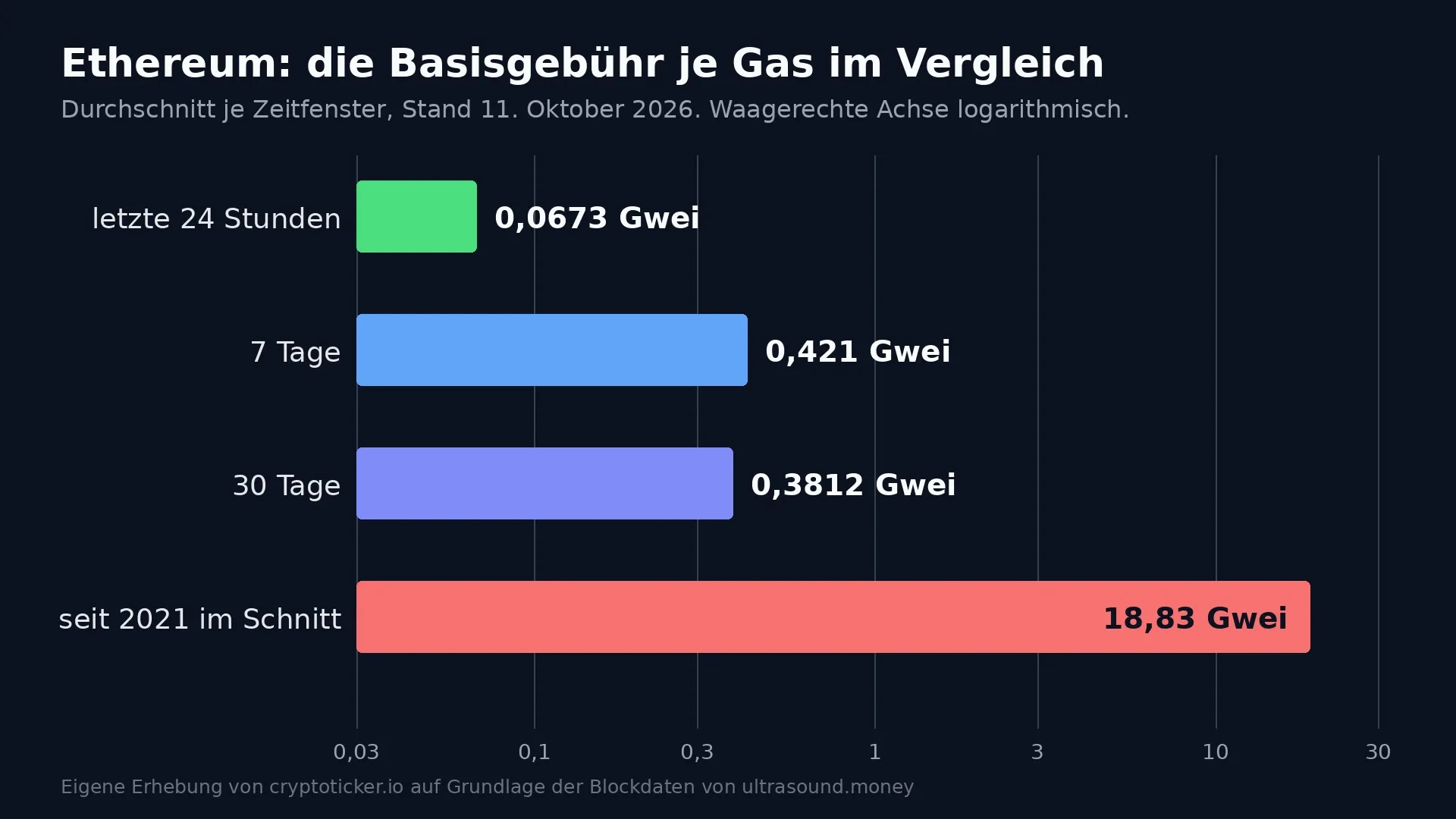
The live reading sits a little above the daily average: an Ethereum node queried directly reported a gas price of 0.077 gwei on Sunday afternoon, which is the base fee plus the customary tip to the validator. The all-time low for the base fee is 0.0087 gwei, set in block 23,937,362. The network is some way off that, but the gap to its own monthly average is considerable.
Half-empty blocks push the base fee down automatically
The base fee follows a fixed rule from the protocol change EIP-1559, in force since August 2021. If a block is more than half full, the base fee for the next block rises by up to 12.5 percent. If it is less than half full, it falls by up to 12.5 percent. The rule can be read in the text of the change itself at eips.ethereum.org. A fee of 0.0673 gwei therefore means one thing only: blocks have been running half empty on average for days.
That is demand at work rather than a defect. Little trading on decentralised exchanges, little movement in stablecoins, little minting and selling of NFTs: each of those activities fills blocks. Take them away and gas costs next to nothing. The narrow price action above and the cheap fee here are two readings of the same thing.
The burn now offsets just 0.49 percent of new issuance
The base fee never reaches the validator. It is destroyed instead, and that burn is the reason the ether supply can shrink when the network is busy. At 0.0673 gwei, very little of it accumulates.
Measured on October 11: 0.0102 ether per minute was burned over the past 24 hours. The seven-day average is 0.0636 ether per minute and the monthly average 0.0569. Annualised, today's figure gives 5,365 ether burned against 1,087,004 ether issued to validators. The burn offsets 0.49 percent of that. On the weekly average it was 3.07 percent, on the monthly average 2.77 percent.
Supply is growing at 0.886 percent a year as a result. In absolute terms, read from the same source: the ether supply stood at 122,116,611 ether at 14:43 on October 10 and at 122,119,572 at the same time on October 11. That is a net addition of 2,960.61 ether in 24 hours. At a price of $2,504 that amounts to roughly $7.4 million of new supply in a single day.

Some context, so the number does not look bigger than it is: 0.886 percent annual growth is low by historical standards. Under the old mining regime, issuance would run at 4,930,875 ether a year and growth at 4.03 percent. The switch to proof of stake in September 2022 removed most of the dilution, and the burn was always the fine adjustment on top. Judging the situation by slogans such as ultra sound money measures the wrong quantity.
The staking queue since October 10
Our report yesterday recorded that the buffer in the staking entry queue had shrunk by 252,402 ether, at a price of $2,507. The price has moved three dollars lower since then, and today's narrow range shows that no direction has come of it. The $2,500 mark, which fuelled the debate as recently as October 9, has held in both directions for three days.
What is new in the 24 hours in between is set out above: the base fee has fallen to a sixth of the weekly average, and the burn with it. Whoever tracks the ether supply has one more figure on the list, and it points the opposite way to the staking queue. The queue locks ether up, while the low fee leaves more of it in circulation.
0.077 gwei in euros: what a transfer costs today
Converting the daily average of 0.0673 gwei into money, at $2,504 and 2,237 euros per ether:
- A simple ether transfer at 21,000 gas: 0.00000141 ether, around 0.35 US cents or 0.32 euro cents.
- A transfer of an ERC-20 token such as a stablecoin, roughly 65,000 gas: around 1.1 US cents.
- A swap on a decentralised exchange, roughly 150,000 gas: around 2.5 US cents.
The gas figures for the token transfer and the swap are guide values; actual consumption depends on the contract. The price per gas, by contrast, is measured. For comparison: at the all-time average of 18.827 gwei the same simple transfer would have cost around 99 US cents, and at the weekly average around 2.2 cents.
Network fees before you send: what you can do now
A low network fee changes nothing about whether ether is a good buy. Cheap gas only changes the cost of a transaction you intended to make anyway. Three cases where it counts in practice today:
Moving to self-custody. Pulling holdings off an exchange to hold them yourself costs fractions of a cent on the chain right now. The catch lies elsewhere: exchanges often charge a flat withdrawal fee of their own, independent of the network and untouched by the cheap gas. Check your exchange's withdrawal fee before you rely on the gas price. Which venues charge what is set out in our crypto exchange comparison, and which device makes sense for custody is compared in our hardware wallet comparison.
Tidying up your holdings. If small amounts have accumulated on several addresses over the years, consolidating them normally costs more than the remainders are worth. At 0.077 gwei that calculation shifts. Work out before each transaction whether the sum carries the effort.
Pending contract business. Revoking a contract approval or unwinding a staking arrangement is cheaper today than on the weekly average. That is no reason to rush it, and a good reason to stop putting it off.
Holding period and proof when moving to your own wallet
For investors in Germany, the one-year rule under section 23 of the Income Tax Act still applies to private disposals: hold crypto assets for more than a year before selling and the gain carries no income tax. The Bundestag rejected scrapping that period on October 9, 2026 by 445 votes to 132, as we reported the same day.
What counts in practice when moving between your own addresses is the paper trail. The tax authorities expect transfers between an investor's own addresses to be documented, so that the acquisition date and the acquisition cost can be assigned later. If you use today's cheap gas to move holdings, the safest course is to save the transaction hash, the date and time and both the source and the destination address straight away. Which tools record that automatically is set out in our overview of crypto tax software and portfolio trackers. The individual case remains a matter for a tax adviser.
Three levels decide the range: $2,495, $2,517 and $2,555
The nearest level below is $2,495.23, today's low, which also sits just under the round $2,500 threshold. If it gives way, the weekly low of $2,404.60 from October 8 is the next stop, more than four percent lower.
Above, the 24-hour high of $2,517 caps the narrow band the price has held since Friday. Beyond it, at some distance, lies the 50-day line, which runs at $2,555.47 on the daily closes of the past 50 trading days, around two percent above the current level. The weekly high of $2,737.55 from October 4 is 9.3 percent away.
Far below runs the 200-day line at $2,133.72. The gap of 17.4 percent to the upside shows that the longer-term trend is intact despite a weak week. All four values are calculated from the daily candles of the same exchange, as of October 11.
Our view: cheap gas is no buy signal
In the editorial team's view, the low network fee will turn up in some coverage over the coming days as a good sign for ether. The figures above argue against it. A base fee of 0.0673 gwei arises because blocks are half empty, which is to say because little is happening on the chain. It is evidence of weak demand, not strong. The burn falls in the same move to 0.49 percent of new issuance, which leaves the supply side growing less restrained than it was the week before.
On the other side of the ledger, a cheap chain makes the network easier to use, and 0.886 percent annual growth is still modest next to the 4.03 percent of the old mining regime. Direction will be settled elsewhere in any case: in fund inflows, in Wednesday's US consumer prices, and in whether the $2,495 mark holds. The fee is a thermometer rather than an engine. The reading tells you how warm it is, and nothing about where the price is going.
Network fee at 0.077 gwei: cheap only if you had a reason to send
Three steps to make use of today's situation without taking a directional bet:
- Check the withdrawal fee, not just the gas price. The chain costs less than a cent, the exchange often a multiple of it. Which venues levy which flat fee is set out in the crypto exchange comparison.
- Settle custody before you send. A transfer to an address whose keys you do not securely hold is no progress at all. The devices in the hardware wallet comparison differ above all in recovery.
- Keep the records as you go. The transaction hash, the timestamp and both addresses belong in your archive while they are still to hand. Tools that record this themselves are listed in the overview of tax software and portfolio trackers.
(As of October 11, 2026. This article is not investment advice. Prices and fee structures change; check the terms with the provider before you buy.)
Bitcoin trades at $83,063 on Sunday midday, putting it 15.4 percent above its 200-day line, which runs at $71,969. At the same time the price is 34.1 percent short of its all-time high of $126,080. The two numbers belong together, because they answer different questions: the distance to the moving average says whether the uptrend is intact. The distance to the all-time high says how much headroom is open on paper.
Between them lies a third level that hardly anyone has named so far, even though it falls out of two independent calculations. One comes from the chart, the other from the miners' electricity bill. Both land at roughly $86,600 to $86,900. This article shows how that level arises, what happens on the network this coming Friday, and what bitcoin price prediction can be drawn from it for your coins.
The 200-day line sits at $71,969, the price $11,094 above it
The 200-day line is the average of the closing prices of the past 200 days. That average smooths away daily swings and shows which way the market has run over half a year. From CoinGecko's daily data, calculated across the full 200 days to October 11, the value comes to $71,969.
The price sits $11,094, or 15.4 percent, above it. Not a single day of the current run closed below that line. For a market standing 34 percent below its peak, that is an unusual finding: the short term looks poor, the medium term does not.
The 100-day line stands at $72,896, almost level with the 200-day. When two moving averages sit that close together, the market has made little headway over the past three months and moved sideways. The July low of $58,566, set on July 1, drags the longer line further down the longer it stays inside the window.
Why the 50-day line at $80,927 is the tighter level now
For the coming days what counts is not the 200-day but the 50-day line. That line sits at $80,927, only 2.7 percent below the current price. It is the distance bitcoin can cover in a single weak trading session.
The line is interesting because it has arrived almost exactly where the discussion has been running for a week. In our forecast on the options expiry from October 10 the $80,000 mark was the pivot, because below it the call side loses its position. The 50-day line now stands $927 above that round number. Two levels with different justifications thus practically coincide, and zones like that are the ones defended in trading.
Yesterday's $80,000 mark holds, the difficulty estimate has risen
Two things have moved since Saturday's forecast. The price stood at $82,749 then and now trades $314 higher, a gain of 0.38 percent. The $80,000 mark has therefore held, and the buffer to the downside still comes to 3.7 percent.
The estimate for the network's next difficulty adjustment has shifted more clearly. Yesterday it stood at plus 3.03 percent, today at 4.39 percent. The reason lies in block time: over the current period the network needed an average of only 575.2 seconds per block instead of the 600 it targets. Every block that arrives too quickly pushes the estimate up.
Sentiment has eased as well. The fear and greed index from alternative.me stood at 64 points yesterday and at 61 today. Both readings sit in greed territory, so the drop is a cooling and not a turn.
1,020.7 exahash: computing power is back above one zettahash
Hashrate measures how many computing operations the Bitcoin network performs per second in order to find new blocks. According to mempool.space it stands at 1,020.7 exahash per second when queried this Sunday. One zettahash equals 1,000 exahash, so the threshold has been crossed again.
The path there has been steep in recent days: 916.1 exahash on Friday, 960.7 on Saturday, 1,024.8 as Sunday's daily average. The month's high sits higher, though, at 1,177.2 exahash on October 6. Computing power swings widely on a daily basis, because it is calculated back from the number of blocks found and cannot be measured directly.

Current difficulty comes to 132.72 trillion. That value governs how hard it is to find a valid block and is reset every 2,016 blocks. The previous adjustment, at minus 0.03 percent, was effectively a flat line. The coming one turns out markedly different.
What an adjustment of 4.39 percent does to the revenue per computing step
On Friday, October 16, at around 19:23 German time, the network reaches block height 971,712 and resets difficulty. 780 blocks are still missing and 61.3 percent of the period has passed. The estimate reads plus 4.39 percent.
The mechanism behind it is simpler than it sounds. If difficulty rises, a block takes longer again, and the number of blocks per day falls back to the target of 144. The reward per block has stood at 3.125 bitcoin since the last halving and does not change in the process. The same quantity of new bitcoin is therefore spread across more computing power.
$38.20 against $36.62: the calculation behind the $86,600 level
From that the hashprice can be worked out, meaning the daily revenue per petahash of computing power. At the current block time of 575.2 seconds, 150.2 blocks arrive per day, which is 469.4 new bitcoin or $38.99 million at today's price. Spread across 1,020,729 petahash, that gives $38.20 per petahash per day.
After Friday's adjustment, block time normalises to 600 seconds. That means 144 blocks, 450 bitcoin and $37.38 million, spread across the same computing power. The hashprice falls to $36.62, a decline of 4.1 percent.
Now comes the part that explains the level. For a miner to earn the same dollar revenue per machine after Friday as today, the price has to offset that decline. On the arithmetic that is $86,643, a gain of 4.3 percent on today. Below that level the network earns less in real terms from Friday than it did this week, regardless of what the chart says.
The calculation assumes two things that need stating: transaction fees are left out, because they fluctuate, and hashrate is held constant. Should it fall, the revenue spreads across fewer machines and the level drops accordingly.
$86,896: half the distance from the July low to the October high
Independently of any mining arithmetic, a second level emerges from the chart. The one-year high sits at $115,227, set on October 14, 2025, and the one-year low at $58,566, set on July 1, 2026. The midpoint between those two points lies at $86,896.
That midpoint is a common reference in trading, because it marks whether a market has recovered more than half of a slump. Bitcoin has not reached it yet. The distance comes to 4.6 percent.
Two different methods, one electricity costs and one chart geometry, therefore land $253 apart. More than a round number argues for a zone between $86,600 and $86,900, and that is the difference from a freely chosen price target.

The ETF week ahead of CPI Wednesday on October 14
The levels do not stand in a vacuum. Two dates shape the coming week. On Wednesday, October 14, the US Bureau of Labor Statistics publishes September consumer prices, at 14:30 German time according to its calendar. A core rate at the top of expectations would reignite the rate debate, a lower one would dampen it.
Added to that is the position in the funds. As we reported on October 10, more than a billion dollars flowed out of crypto ETFs in October. For the week to October 9, the trade services U.Today and Coinpedia put the outflow from US spot bitcoin funds at $678.9 million to $681 million, after three consecutive weeks of inflows. Anyone using such products as their route in will find the variants tradable in Germany in our overview of crypto ETFs and ETNs.
The connection to the levels above is the timing: the CPI figure comes on Wednesday, the difficulty adjustment on Friday. Should the rate news turn out unfavourably, the adjustment meets an already weakened market, and the $86,600 moves further away.
What you can do if the $80,900 line breaks
The 50-day line at $80,927 is the next level to the downside, not the 200-day line. Anyone setting a sell threshold is better guided by it than by the round $80,000, because at just above $80,900 the average itself breaks and not merely a psychological number.
With leveraged positions the distance is decisive. A price of $83,063 and a liquidation threshold at $80,927 mean 2.6 percent of room. At five times leverage that room is used up after a fall of roughly 0.5 percent in the underlying. That is less than the daily range of the past 24 hours, which at $422 between $82,713 and $83,135 was tight in any case. Anyone using leverage checks before the week opens where their own threshold sits, and picks the venue by fees and margin obligations. Which providers are authorised in Germany under MiCA is set out in our comparison of crypto exchanges.
For unleveraged holdings the logic runs the other way. After a holding period of one year, gains on cryptocurrencies in Germany are tax-free under section 23 of the Income Tax Act. Below that, an exemption threshold of 1,000 euros per calendar year applies, and from the first euro above it the entire gain is taxable at your personal rate. Anyone selling in October should first look up which tranche was bought when: a sale a few weeks before the deadline costs more than the price difference being argued over here. The documentation is handled by trackers, which we have set side by side in the overview of crypto tax tools.
Our assessment: the miner arithmetic carries further than the round number
In our view the zone between $86,600 and $86,900 is currently the most robust orientation to the upside, and not because of an analyst target but because two separate calculations arrive there $253 apart. The evidence lies open: a hashprice of $38.20 against $36.62 after the October 16 adjustment, a one-year high of $115,227 and a one-year low of $58,566.
Against it stands the demand side. An outflow week of around $680 million from the funds and a fear and greed index easing from 64 to 61 show no buying pressure that carries 4.3 percent in a few days. More likely is that the zone is approached only after Wednesday's CPI figure. An assessment of the situation is not a recommendation to buy, and a total loss remains possible with cryptocurrencies.
Bitcoin at $83,000: above $86,600 the miner arithmetic turns
Three steps for the coming week:
- Enter the levels. To the downside $80,927 as the 50-day line, to the upside the zone from $86,600 to $86,900. The 200-day line at $71,969 only becomes relevant after that. Anyone watching prices at a venue will find the terms in the exchange comparison.
- Note the dates. Wednesday, October 14, 14:30, the US consumer prices. Friday, October 16, around 19:23, the difficulty adjustment at block height 971,712. Anyone investing through fund products should check the crypto ETFs and ETNs tradable in Germany beforehand.
- Check holding periods. Before any sale, look up the purchase date of the tranche concerned and weigh the one-year period against the expected price gain. The tools for that are in the overview of tax tools.
(As of October 11, 2026. This article is not investment advice. Prices and fee structures change; check the terms with the provider before you buy.)
Decrypt
An IMF analysis found that more than half of tokenized stock trading happens outside U.S. market hours, though the roughly $2.3 billion market remains more volatile and less liquid than traditional equities.
Bitcoin ETFs have seen $386.3 million in net outflows through the first seven trading days of October, while Ethereum funds have now posted nine straight days of losses.
Zakura, a Zcash full node developer, says it expects hash-based signatures to land in Zcash in January, and is rolling out a privacy tool for rotating transparent addresses this week.
A proposed rule would expressly fold event contracts tied to sports, politics, culture and weather into the “swap” definition, while an interim rule excludes casino-style gambling—sharpening the agency’s claim to exclusive jurisdiction.
The Bermuda-based insurer, which runs entirely on Bitcoin, drew the funding from existing backers led by Bain Capital Crypto after a record year driven by demand from wealthy families in Asia, Europe and the Middle East.
U.Today - IT, AI and Fintech Daily News for You Today
Saylor teases upcoming Bitcoin purchases at a historic $70 billion milestone for world's largest cryptocurrency treasury firm.
XRP Ledger upgrade countdown begins with key fixes for Lending, DEXs and Permission Delegation set to go live.
XRP Kuwait slams centralized control claims after a 2015 currency-minting bug forced an emergency XRP Ledger patch.
The key question is whether ADA confirm pattern with continued selling or recovers enough to invalidate the short-term bearish setup.
Bitcoin’s autumn rally stalls at $82,800 as global markets run out of cash.
Blockonomi
TLDR:
- Peter Brandt favors Monero among the altcoin charts he compared, saying its previous overhead supply has already been absorbed.
- XRP faces potential selling from investors who bought at higher prices, creating resistance that could interrupt a recovery toward $2.16.
- The developing XRP reversal pattern has a short, poorly formed right shoulder, although Brandt says further development is not required.
- The $2.16 daily chart objective and earlier $5.40 monthly projection reflect separate patterns, rather than a revised single forecast.
Peter Brandt favors Monero over XRP, despite identifying a potential XRP advance toward $2.16. The veteran trader says XRP faces substantial overhead supply that could interrupt a recovery. Monero, by comparison, has absorbed the comparable supply in his chart assessment. His preference reflects trading patterns rather than an evaluation of either cryptocurrency’s underlying technology.
Brandt also compared Solana, Ethereum, and Stellar over the same period, highlighting differences in resistance and chart structure. For XRP, the bullish objective remains conditional. Its developing pattern could change, while investors who bought at higher prices may sell as the market approaches their entry levels.
Peter Brandt Favors Monero as XRP Faces Supply Barriers
Peter Brandt described Monero as his strongest choice among the altcoin charts under review. He argued that its previous overhead supply had already been absorbed, leaving a clearer technical path.
“Of these, my favorite by far is XMR,” he wrote.
That assessment explains why a bullish XRP price target did not make XRP his preferred trade. A chart can suggest potential gains while still showing barriers along the route.
Overhead supply refers to potential selling from holders who purchased above the current market price. When prices recover, some may exit near their original purchase levels, limiting further progress.
Brandt identified that issue as a significant negative for XRP. His comparison focused on the relative burden visible across charts covering the same period.
Solana received a more favorable assessment for its cup and handle formation. He considered that structure stronger than the corresponding pattern developing in XRP.
Ethereum showed considerable congestion, reflecting trading concentrated within a crowded range. However, Brandt distinguished that congestion from the overhead supply he identified in XRP.
Stellar also faced overhead supply, although he considered its burden smaller. These distinctions shaped his preference for Monero without establishing guaranteed outcomes for any asset.
For Peter Brandt, the distinction concerns both the potential move and the resistance that could delay it. His favorable reading of Monero addresses the latter issue, while XRP’s measured objective describes a possible destination without resolving the supply problem along the way.
Peter Brandt said he did not need to understand Monero’s fundamental narrative to assess its chart. His stated approach prioritizes price behavior, with Bitcoin an exception to his broader indifference toward cryptocurrency fundamentals.
Daily XRP Target Differs From Earlier Monthly Projection
Peter Brandt derived the $2.16 objective from a possible inverse head and shoulders pattern. He used daily closing prices to measure the formation, rather than intraday highs and lows.

The setup features three troughs, with the central trough deeper than the surrounding two. Projecting the pattern’s height upward produces a measured objective, subject to the structure developing as anticipated.
His earlier daily XRP chart highlighted a cup and handle formation. He suggested that smaller pattern could become the right shoulder of the larger reversal structure.
However, the shoulder remained short and poorly developed in his assessment. More formation appeared likely, although he explicitly stopped short of calling further development necessary.
Peter Brandt cautioned that chart patterns can evolve into different configurations as trading continues. A projected destination therefore does not establish that the market will reach it.
“Targets or objectives are not sacred,” he wrote.
The XRP price objective also differs from his earlier $5.40 projection, shared on September 21. That assessment came from a monthly chart and addressed a separate, longer term structure.
He did not describe $2.16 as a replacement for $5.40. Nor did he identify the lower figure as a required intermediate stop toward the higher objective.
In a September 26 comment, Brandt said XRP’s chart alone could justify considering a trade. He later asked XRP supporters not to interpret his technical criticism as a personal offense.
The post Peter Brandt Prefers Monero as XRP Rally Faces Selling Pressure appeared first on Blockonomi.
TLDR:
- Trump announced an energy ceasefire between Russia and Ukraine, saying both countries had agreed to stop immediately, without detailing the terms.
- Ukrainian officials initially expressed surprise at the announcement, with a source close to Zelensky saying acceptance depended on Russia.
- The announcement followed a controversial Russian diesel deal and diplomatic meetings involving senior American and Ukrainian officials in Miami.
- Zelensky said Ukraine could stop attacking Russian diesel facilities if Moscow halted its strikes, making reciprocal action central to his position.
President Donald Trump announced an energy ceasefire between Russia and Ukraine on Sunday, saying both countries had agreed. He said the arrangement would take effect immediately, without explaining its terms or how it would be enforced. Ukrainian officials initially expressed surprise, while Moscow offered no immediate confirmation.
The announcement followed tensions over a separate Russian diesel deal and renewed exchanges between Trump and President Volodymyr Zelensky. Earlier Sunday, Zelensky said Ukraine was willing to halt attacks on Russian diesel facilities if Russia stopped its strikes. His comments outlined a reciprocal offer, rather than confirmation that an agreement had been reached.
Trump Says Energy Ceasefire Begins as Details Remain Unclear
Trump announced the energy ceasefire in a Truth Social post, presenting it as an agreement already accepted by both sides. He urged Russia and Ukraine to comply, but provided no accompanying explanation of the negotiations.
The post did not identify the facilities covered, the duration of the arrangement, or any process for reporting violations. It also did not explain whether representatives from both governments had communicated their acceptance directly to Washington.
Reuters reported that neither Kyiv nor Moscow immediately confirmed the announcement. That left a gap between the American statement and public acknowledgment from the countries expected to implement it.
A source close to Zelensky told CNN the announcement was unexpected, but Ukraine would agree if Russia did. Another Ukrainian official said they had learned about the statement by reading it.
Those responses indicated conditional Ukrainian support for an energy ceasefire, while leaving the status of any negotiated agreement unclear. They did not establish that Ukrainian officials had approved the terms before Trump published his announcement.
The distinction matters because willingness to suspend attacks does not establish the starting conditions for an operational agreement. Neither the announcement nor the initial responses described a shared mechanism for checking compliance.
The initial statements also left unanswered how either government would distinguish covered energy targets from other infrastructure affected by the fighting.
Russian Diesel Deal Adds Friction to Diplomatic Talks
The energy ceasefire announcement came days after Trump spoke with Russian President Vladimir Putin about supplying markets with Russian diesel. Their separate fuel agreement drew sharp criticism from Zelensky and added strain to discussions involving Washington and Kyiv.
Ukraine peace talks involving senior American officials began in Miami on Friday, when the diesel agreement was announced. Participants included special envoy Steve Witkoff and Jared Kushner, who is also related to Trump through marriage.
The available account did not establish whether those meetings produced the arrangement Trump announced Sunday. No negotiating document accompanied his social media statement.
Trump had criticized Ukrainian leadership a day earlier, suggesting the country should choose someone else capable of reaching a deal. That remark placed additional pressure on the diplomatic relationship as officials continued discussions.
Zelensky addressed the possibility of an energy ceasefire during an ABC News interview earlier Sunday. He said Ukraine was open to stopping attacks on Russian diesel facilities if Moscow halted attacks against Ukraine.
His position linked restraint by Ukrainian forces to equivalent action from Russia. The offer therefore depended on Russian conduct, rather than an unconditional Ukrainian decision to suspend strikes.
Zelensky also urged Russia to stop killing Ukrainian children as he explained the proposed exchange. His remarks tied protection from Russian attacks to any Ukrainian commitment concerning diesel targets.
Trump described the energy ceasefire as immediate, while the Ukrainian comments emphasized reciprocity. His post supplied no timetable beyond that starting point and named no officials responsible for coordinating implementation on either side.
The post Trump Says Russia and Ukraine Have Agreed to Energy Ceasefire appeared first on Blockonomi.
TLDR:
- XRP price remained near $1.39 on Sunday, holding above recent support as the disclosure failed to trigger an immediate sharp selloff.
- Veria Labs estimated the vulnerability could create approximately 18.45 trillion XRP, threatening confidence in the existing token supply.
- Developers released the emergency repair on September 25, before public disclosure, and investigators found no evidence of exploitation.
- Separate lending amendments still depend on validator support, while the recent price recovery leaves overhead resistance unchallenged.
XRP price held near $1.39 on Sunday after researchers disclosed a critical vulnerability that could have created unauthorized tokens. The flaw affected the XRP Ledger payment engine and had remained hidden since 2015. Developers released a fix before publishing details, and investigators found no evidence of exploitation on public networks.
According to TradingView market data, XRP traded around $1.39, with its daily change remaining below 1%. Buyers continued defending recent lows despite the security disclosure. The muted response followed a difficult week, leaving traders focused on nearby support and whether the recovery could extend beyond the narrow weekend trading range.
XRP price Defends Support as Buyers Hold Recent Lows
XRP price continued trading above the 1.32–1.37 support zone after buyers absorbed the latest decline. The weekly chart showed a lower wick near $1.32, indicating buying interest below current levels.
That rebound kept the ascending support line connecting earlier lows in focus. However, holding support does not establish a lasting reversal. A stronger recovery would require sustained demand above the current range.
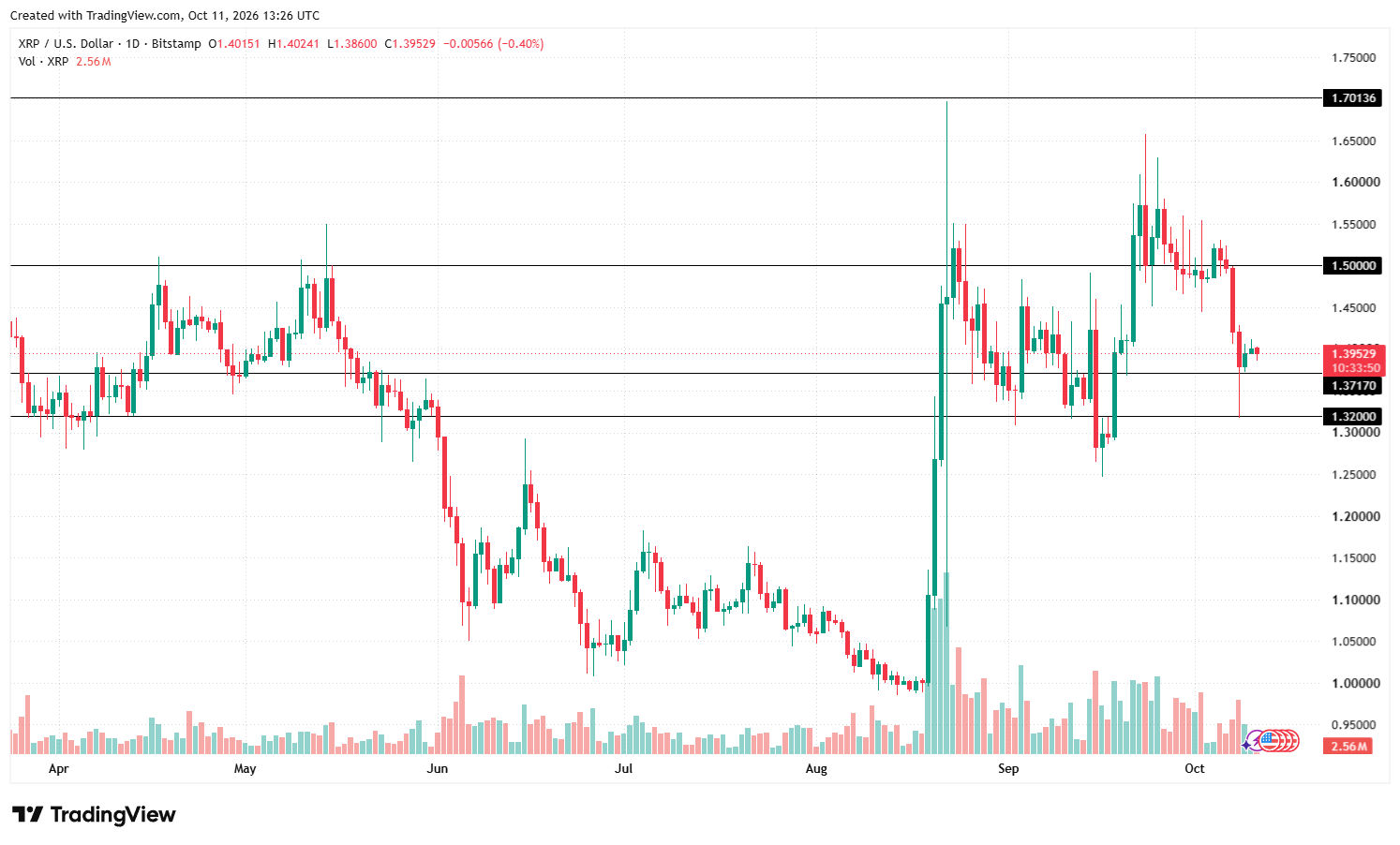
The broader resistance area remains between $1.50 and $1.70, where earlier weekly highs could attract selling. Until buyers reclaim those levels, the recent stabilization leaves the larger trading range intact.
XRP price also remained sensitive to broader cryptocurrency conditions. Bitcoin had retreated toward 80,000–83,000, adding pressure across digital assets. The limited weekend movement therefore offered evidence of stability, without proving that sellers had exhausted their positions.
The security report described a vulnerability already addressed, which may help explain the restrained reaction. That interpretation remains an inference, since price action alone cannot establish why individual traders bought or sold.
For XRP price, the immediate distinction is between defending support and clearing resistance. A brief recovery from the weekly low confirms buying occurred there. It does not guarantee that the same zone will hold during another selloff.
Ledger Security Fix Arrives Before Public Disclosure
Veria Labs said its AI system identified the flaw on September 21. Researcher Cayden Liao validated the finding, which entered the bug bounty program on September 22.
The firm estimated that one transaction could create approximately 18.45 trillion XRP, around 184 times the original supply. Its $94 billion exposure estimate referred to existing token value, rather than money stolen.
Veria also cautioned that an attacker could not sell such an enormous amount at prevailing prices. The central threat was unauthorized supply undermining confidence in the asset.
The official October 9 disclosure explained that arithmetic overflow affected payment calculations and a separate supply safety check. Both calculations could wrap around, allowing newly created XRP to escape detection.
RippleX engineers confirmed the issue and released xrpld 3.4.1 on September 25. More than 80% of relevant validators upgraded that day. The emergency protection took effect through software upgrades instead of the usual amendment activation process.
Veria reported receiving the maximum critical bounty of $250,000 on October 8. The official investigation found no evidence that attackers exploited the flaw on any public network.
Meanwhile, XRP price traded quietly as separate network amendments remained under review. Official documentation lists the lending feature as open for voting. Its activation depends on validator support, rather than a predetermined commercial launch schedule.
The proposed lending framework would add native borrowing functions, while associated vault amendments would support pooled assets. These changes are separate from the emergency overflow repair. Their voting status measures progress toward deployment, but does not measure future demand for XRP or establish how much lending activity the network will eventually attract commercially.
Ordinary amendments require sustained validator approval before activation. Losing the required support interrupts that process. The ledger records amendment status and majority timing, allowing observers to distinguish proposed functionality from features already available on the network.
The post XRP price Holds Near $1.39 After Critical Ledger Flaw Disclosure appeared first on Blockonomi.
TLDR:
- The Kalshi investigation examines three bets placed before Katie Zacharia was publicly identified as the next White House press secretary.
- Wagers of approximately $19, $74 and $80 carried expected payouts totaling $9,608, although those figures do not represent net profits.
- Kalshi has confirmed the inquiry but has not publicly established that the traders used confidential information or breached its rules.
- Employment disclosures and congressional scrutiny put prediction markets under closer review as platforms address risks involving nonpublic information.
The Kalshi investigation into bets on Katie Zacharia is examining trades placed before her White House appointment became public. At least three wagers could deliver substantial payouts from small stakes, according to reporting by The Wall Street Journal.
Traders backed Zacharia before news outlets identified her as President Donald Trump’s next press secretary on Friday. The market had previously assigned her roughly a 1% chance of securing the role.
Kalshi confirmed its inquiry but withheld details about the accounts involved. The timing has drawn scrutiny, although the reported bets alone do not establish that anyone traded using confidential government information.
Kalshi Investigation Examines Timing and Potential Payouts
The Kalshi investigation centers on one Thursday evening wager and two trades placed shortly before Friday’s reports. A $19 position carried an expected payout of $1,896.
Two further wagers, worth approximately $74 and $80, were placed at 1:41 p.m. Friday. Their expected payouts were $3,689 and $4,023, respectively. News reports identifying Zacharia began appearing around 2 p.m.
These figures describe potential settlement payouts rather than confirmed net profits. The amounts also exclude any adjustment for fees. A large percentage return can follow a successful bet on an outcome initially considered unlikely.
The Kalshi investigation has not publicly established how the traders chose their positions or whether they shared information. Publicly visible transactions show timing and amounts, but they cannot independently establish a trader’s knowledge or intent.
Trump subsequently announced Katie Zacharia as his choice through Truth Social. She previously worked as a Department of Homeland Security spokesperson and advised Trump Media on communications.
She will replace Karoline Leavitt, who left the press secretary position earlier this year. The White House referred Trump’s announcement when asked about the inquiry.
Trader identities remain confidential to the public, while Kalshi retains internal identification records for compliance purposes. Those records give the platform information unavailable to outside observers reviewing market activity.
No publicly announced finding in the Kalshi investigation has linked these accounts to officials involved in the appointment. Neither the size of the payouts nor the timing resolves that question.
Political Betting Faces Tougher Monitoring and Oversight
The Kalshi investigation follows a separate enforcement case involving former White House teleprompter operator Gabriel Perez. In August, the Commodity Futures Trading Commission settled charges over his use of advance access to presidential speeches.
The regulator ordered Perez to return $107,539.02 in trading profits and pay a $65,000 civil penalty. It also imposed a three-year trading ban. The repayment and penalty represent distinct components of the settlement.
That established case provides context for the Kalshi investigation without determining its outcome. The Zacharia traders have not been publicly shown to possess comparable access to nonpublic material.
Scrutiny of prediction markets has also prompted changes to platform controls. In June, Kalshi introduced employment disclosures for markets carrying heightened risks of insider trading or manipulation.
The company reported more than 150 investigations during the first quarter, alongside over 20 referrals to law enforcement. It also disclosed five disciplinary actions and screening tools that blocked more than 100 potential insider trades.
Those figures cover the broader enforcement program rather than findings about the appointment wagers. An investigation or referral does not itself establish a completed rule violation.
Its update introduced new tools for reporting suspected misconduct. Users can submit tips directly to the surveillance team through individual markets.
Congress is separately examining safeguards across prediction markets. House Oversight Committee Chairman James Comer launched an inquiry involving Kalshi and Polymarket in May.
The committee has requested information about identity checks and systems for detecting suspicious activity. In a subsequent update, it reported receiving nearly 1,000 documents and five briefings from representatives of the two platforms.
The post Kalshi Investigation Examines Bets on Katie Zacharia Selection appeared first on Blockonomi.
TLDR:
- Papertrade exploit allegations involve two wallets’ reported $20 million Hyperliquid orders, 10–20 basis points of ETH movement, and much larger Papertrade longs.
- Papertrade uses Hyperliquid’s best bid and offer midpoint for synthetic fills, creating a documented price-reference risk that remains an allegation in this case.
- Hyperliquid uses separate oracle and mark prices for its own margin and liquidation safeguards, so the claims do not establish a breach of its native systems.
- No independent wallet analysis, verified loss amount, compensation plan or Papertrade response was available in the October 11 reports reviewed.
Papertrade exploit allegations surfaced October 11. X user Boblob (@Dr_bobo54) claimed two wallets placed roughly $20 million each in Ether trades on Hyperliquid. He said the trades moved ETH quotes 0.1%–0.2%. The wallets allegedly held leveraged Papertrade positions worth hundreds of millions of dollars.
Trader Rune (@RuneCrypto_) shared the warning. No independent analysis had confirmed the manipulation, wallet identities, profits or losses. Papertrade had not issued a confirmed public response in reports published that day. Claims focus on its pricing design. Papertrade uses Hyperliquid’s best bid and offer midpoint to price synthetic trade entries and exits. The market impact remains unclear.
Papertrade Exploit Claims Center on $20M ETH Trades
The researcher said orders shifted ETH quotes roughly 10 to 20 basis points. A basis point equals 0.01%, making that move approximately 0.1% to 0.2%. He claimed the same wallets held long positions on Papertrade, with combined nominal exposure in the hundreds of millions. Long positions can magnify small quote changes when notional exposure far exceeds the margin posted by the trader.
Rune flagged the Papertrade exploit risk in its own published risk disclosures. However, initial reports did not include wallet addresses, transaction hashes or independent transaction analysis. The Papertrade exploit remains unverified; public claims have not established that any account profited from the price moves.
Papertrade launched recently on HyperEVM, the smart-contract environment connected to Hyperliquid. It uses synthetic swaps between each trader and its liquidity pool, rather than matching users through a Papertrade order book. When a position opens or closes, the protocol reportedly reads Hyperliquid’s best bid and best offer. It uses their midpoint as the fill price. The platform supports leverage up to 1,000 times on supported Bitcoin and Ethereum markets.
The Papertrade exploit theory centers on the use of another venue’s midpoint as a reference price. A new order can shift the best bid or offer before it executes. Rune argued that such a move could change Papertrade’s quoted price while a much larger position remains open. The documentation reportedly identifies manipulation of the best bid and offer as an unresolved risk. That risk disclosure does not prove the suspected wallets exploited it.
Hyperliquid Price Safeguards Differ From Papertrade BBO
The alleged Papertrade exploit concerns how the protocol uses external prices, not evidence of a Hyperliquid system breach. Hyperliquid’s native perpetuals use separate oracle and mark prices for trading safeguards. Its oracle price is a weighted median of centralized exchange prices and updates about every three seconds.
The mark price combines several inputs, including Hyperliquid order-book prices and data from other trading venues. Hyperliquid uses it to calculate unrealized profit and loss, determine margin requirements and trigger liquidations. Papertrade’s reported BBO midpoint serves a different function: it determines synthetic trade entries and exits. The distinction matters when assessing which system may have been affected.
A separate, unaffiliated PaperJet description says Papertrade’s liquidity pool starts at zero and grows from traders’ realized losses. It also says profitable closes may wait in a queue if the pool lacks funds. PAPER tokens can be minted after eligible trading losses, and stakers may receive USDC distributions. Those mechanics describe possible settlement constraints, not confirmed effects from the current allegations.
A Hyperliquid-linked SK Hynix perpetual contract dropped 17.9% in July. An unusual South Korean transaction then affected its external price reference. Trade.xyz later said it would cover qualifying liquidation losses. That case involved a different contract and pricing arrangement; it does not confirm the Papertrade allegations.
Reports published October 11 did not establish whether the Papertrade exploit affected the pool. They left withdrawals and queued claims unconfirmed. The reports also lacked verified wallet identities, a loss amount, compensation or a timetable for changing the midpoint-based pricing system.
The post Papertrade Exploit Claims Follow $20M ETH Trades on Hyperliquid appeared first on Blockonomi.
CryptoPotato
After reports emerged of a potential theft of over $80 million in crypto from its devices, Ledger confirmed over the weekend that at least one wallet tied to the ongoing CryptoBilis investigation contained an unauthorized hardware implant.
Meanwhile, a new community report on X claimed a suspicious Ledger device bought from MediaMarkt in Europe may also have been compromised, which would widen the scope well beyond Southeast Asia.
Ledger Confirms
In the latest update published on Saturday evening, the hardware wallet manufacturer said it had examined one device belonging to an impacted user and found an “unauthorized hardware implant” inside. The team said they have contacted affected users and have started working with authorities.
CryptoBilis has also responded to Ledger’s plea to stop sales of all hardware-wallet inventory, not merely Ledger products, until the investigation is concluded. The company behind devices such as Nano X said it has no indication that its own security infrastructure, systems, or services were compromised. It has also yet to determine how many affected devices contain implants or confirm that the discovered implant is responsible for all reported wallet drains.
The initial report, which we published yesterday, stated that customers who bought through CryptoBilis in Indonesia, Malaysia, and the Philippines were impacted. Initial investigations claimed the suspected losses exceed $86 million, but a new report from Bitquery puts that estimate closer to $93 million across 311 wallets on five chains.
Europe, Too?
A post from one X user claimed that a Ledger purchased through MediaMarkt in Europe also showed signs of possible hardware manipulation. The report quickly circulated through the vast crypto community, prompting warnings that the incident may no longer be geographically isolated to Southeast Asia.
However, the European situation has not been confirmed as compromised by the wallet manufacturer, and users examining the published images disagree about what they actually show. Some argued that the hardware appears inconsistent with a genuine Ledger board, while others said they could not see the same type of additional implant identified in the Southeast Asian case.
Nevertheless, MediaMarkt is an official reseller for Ledger in several European markets, including Germany and Austria. For now, though, this unconfirmed part of the story remains uncertain, while the original case in Asia continues to take new victims, according to reports on X.
The post Ledger Confirms Hardware Implant as Tampered Wallet Reports Allegedly Spread to Europe appeared first on CryptoPotato.
The spot exchange-traded funds tracking bitcoin experienced their worst week in terms of outflows since the end of June, which became one of the reasons behind the underlying asset’s major correction.
Although the net outflows from the spot Ethereum ETFs were slightly less, the overall ETH picture is worse given the lack of any green days.
BTC ETFs Bleed Heavily
The business week began on the wrong foot for the ETFs, with almost $90 million in net outflows. Coincidentally, BTC’s price was rejected at $87,000 and dropped by over a couple of grand on the same day. It recovered some ground on Tuesday when the ETF flows turned positive, and investors poured in $118.86 million.
However, the trend changed for the worse on Wednesday and Thursday, with the net outflows skyrocketing to $487.07 million and $244.13 million, respectively. As expected, BTC tumbled hard during those two days, with the culmination taking place on Thursday, with a nosedive to a 2-week low of $80,400.
The inflows returned on Friday, but they were quite modest, with just $21.13 million entering the funds. This wasn’t nearly enough to offset the major losses experienced during the previous two trading days. As such, the week ended with $681.10 million in net outflows – the most since the last full week of June, when investors pulled out $1.79 billion. The cumulative total net inflows dropped from $57.79 billion to $57.11 billion.
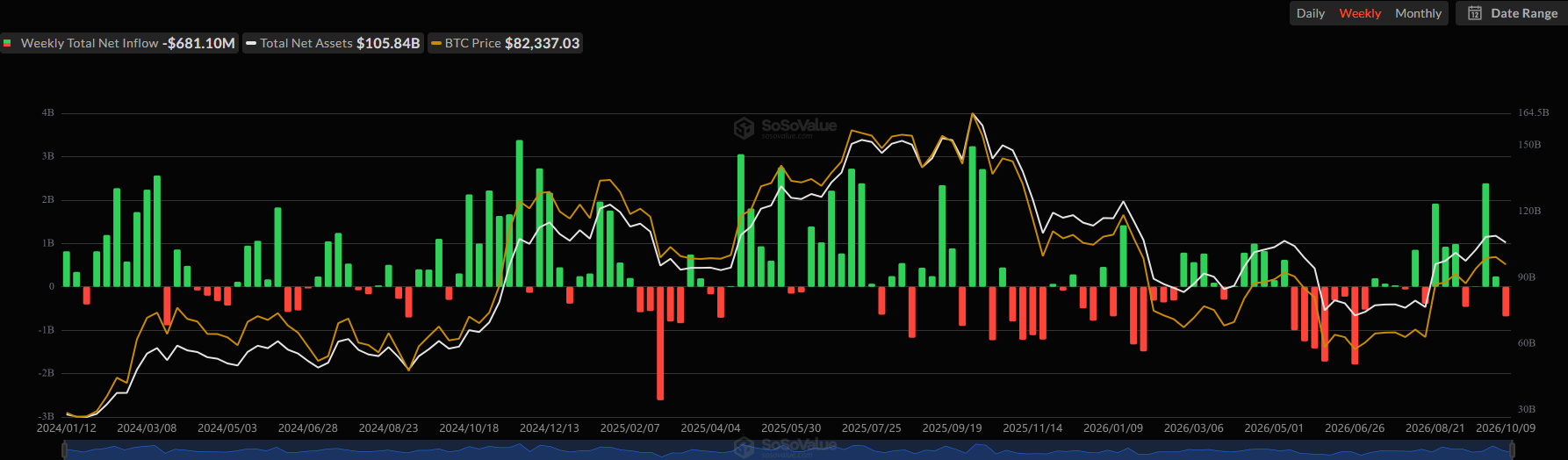
ETH ETFs Fare Even Worse
The Ethereum ETFs began the week with $50.76 million in net outflows. The pace of withdrawals accelerated on Tuesday, with $201.89 million leaving the funds, and $160.77 million on Wednesday. The red streak continued by the end of the week, with another $72.54 million taken out on Thursday and $56.10 million on Friday.
Worse still, these five consecutive red days only built on the previous four. Overall, the funds haven’t been in the green since September 28. Within this timeframe, the cumulative net totals dropped from $13.95 billion to $13.26 billion.
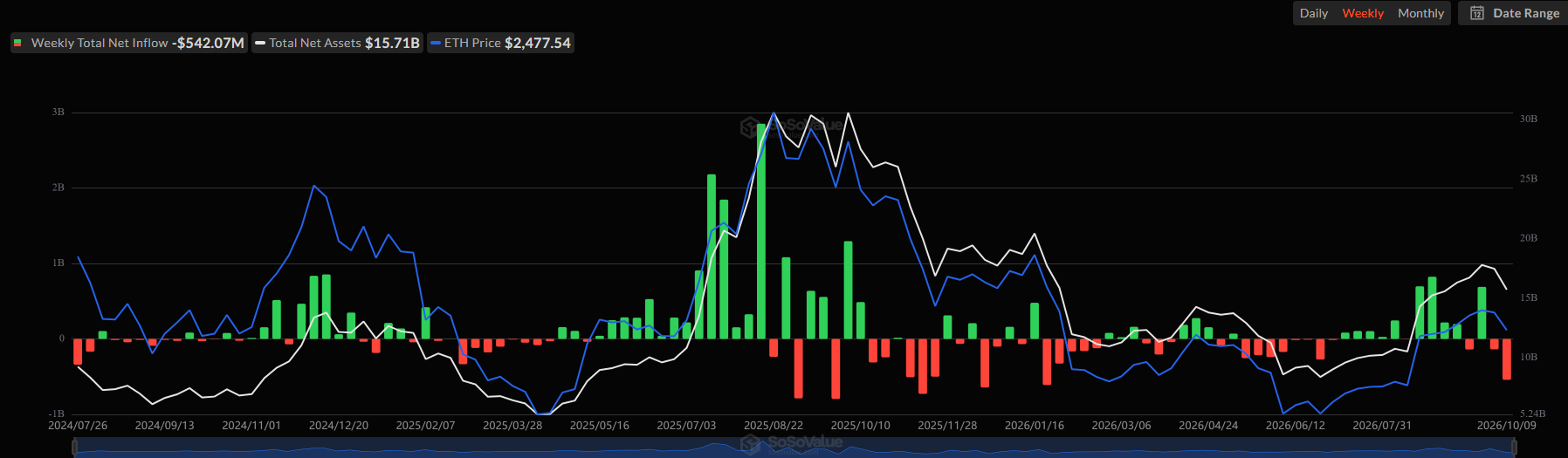
The underlying asset was halted at $2,800 a few weeks ago, but it managed to remain above $2,700 until the mid-week crash, which took it south to $2,400. It has recovered some ground since then and now trades above $2,500.
The post Bitcoin ETF Weekly Outflows Hit 3-Month High, Ethereum Funds Extend Losing Streak appeared first on CryptoPotato.
The past week didn’t go well for the entire cryptocurrency market, with prices falling to local lows after BTC was rejected at $87,000 and dragged most altcoins with it.
The ETF flows were among the reasons behind the market-wide correction, as almost all exchange-traded funds tracking crypto assets were in the red. Almost all.
XRP ETFs Defy the Trend
We will discuss in detail the major outflows from the spot BTC and ETH ETFs in another article, but we will just mention the end results here: $681 million in net outflows from the former, and $542 million from the latter. The funds tracking SOL bled out as well, with nearly $25 million taken out.
And then there were the XRP ETFs. Not only were they not in the red last week, but they actually performed better than the previous five-day trading period. Although there were three (out of five) trading days with no reportable action, which obviously is not ideal, they still attracted $3.14 million on October 6 and $8.17 million on October 8, ending the week with $11.31 million in net inflows.
Once again, the cumulative total net inflows hit a new all-time high of $1.8 billion. The week wasn’t perfect, as mentioned above, but it still extended the green-only streak to 13 consecutive weeks. It started in mid-July, and the financial vehicles have attracted over $300 million since then.
Bitwise’s XRP ETF remains the undisputed market leader, with cumulative net inflows of almost $688 million. Franklin Templeton’s XRPZ follows with $509 million, while Canary Capital’s XRPC is third with $487 million.

XRP Still Suffers
The ETF demand for Ripple’s cross-border token failed to prevent a price crash. The entire market unraveled in the past week, especially on Thursday, and XRP joined the ride south. The asset traded above $1.51 on Monday and Tuesday as analysts outlined the next major targets above $1.60 if it managed to break past that level, but the reality was different.
XRP was rejected immediately, and the market-wide pullback drove it south hard to $1.32 on Thursday evening. This became a three-week low for the token, which finally rebounded after this calamity and currently stands at $1.40. Despite this recovery, XRP is still 7% down weekly, and analysts are still bullish even if it falls to $1.20 next.

The post Ripple ETFs Defy Crypto Slump With Another Green Week but XRP Price Sinks appeared first on CryptoPotato.
Let’s start with a quick disclaimer – we used to write a lot of similar articles several years ago. The reason was simple: searches on Google typically show the demand for the cryptocurrency industry among retail investors. After all, institutions don’t go to the world’s largest search engine to ask about buying BTC or altcoins. They have their own methods.
However, the tide has turned since then, as retail investors have shown a different attitude. The charts we will display in this article prove that the actual Google queries about BTC or crypto as a whole plummeted, especially during bear market years. Now, though, there’s an interesting change.
Buy Crypto Is Back
The first chart below shows that ‘buy crypto’ searches plummeted at the end of 2021 – right at the time when BTC and the alts were charting then-ATHs, and went below 20 for over a year; yes, it coincided with the bear market. They picked up slightly in May 2024 (as prices soared), dropped again as the market cooled, and jumped high at year-end when BTC and the alts were booming after the US presidential elections.
Another decline followed in mid-2025 as the market experienced a fresh drop, and it surged to a five-year high in August. Shortly after, bitcoin marked a new (and its latest) all-time high of just over $126,000. After the October 2025 crash, the leading cryptocurrency went into a 10-11-month-long bear market, in which searches for ‘buy crypto’ decreased significantly.
The yearly bottom came in July when BTC slumped to under $58,000, and most alts struggled just as much. Since then, though, the searches have risen sharply and are projected to beat the 2026 record in October. Needless to say, prices have recovered, and we are far from the recent lows. In other words: the retail pattern has repeated perfectly again.

What About Bitcoin?
The landscape around BTC itself is less straightforward. The ‘buy bitcoin’ searches were below 40 on average for four straight years – from late 2021 to late 2025. Even the US elections couldn’t really break that negative streak. They finally picked up in August 2025, just a few months before BTC’s rise to $126,000, dipped again by January, before suddenly soaring to a new multi-year peak in February.
That was a one-month thing, as the queries quickly dropped to 40-50 for the next few months. Although they jumped again in September, the October projections are quite different than those for ‘buy crypto,’ as current Google Trends data shows a massive decline toward 20. As such, it’s somewhat safe to determine that even if retail is indeed coming back, they are not looking specifically for BTC.

The post ‘Buy Crypto’ Google Searches Hit Yearly Highs: Is Retail Coming Back? appeared first on CryptoPotato.
Bitcoin’s weekend sluggishness continues as the asset has barely moved from $83,000 over the past 36 hours, but more volatility is likely to hit later today or tomorrow morning.
The larger-cap alts have also failed to produce any significant moves in either direction in the past day, but there’s a new rockstar among the mid caps.
BTC Calms at $83K
The primary cryptocurrency started October with a bang, surging to over $87,000 on the second day of the month. However, the bears quickly interfered and pushed it south to under $84,000 on the same day. It rebounded last weekend toward $85,000 before it tried to break out again on Monday morning, only to be stopped at $86,600 this time.
The following legs down were a lot more painful. At first, bitcoin crashed to $83,600. It bounced to $84,400 before the bears took complete control of the market and drove it south to $82,400 on Wednesday and to a multi-week low of $80,400 on Thursday. After losing nearly $7,000 in just a few days, the cryptocurrency was due for a rebound, which took place on Friday.
However, the bulls’ attempt was stopped at $83,500. Since then, the asset has been trading sideways at around $83,000 without any major moves. More volatility is likely to ensue later tonight or tomorrow morning after the new attacks against Saudi Arabia and President Trump’s hint that the US could join the fight.
Bitcoin’s market cap remains at $1.660 trillion, while its dominance over the alts is at 59.5% on CMC.
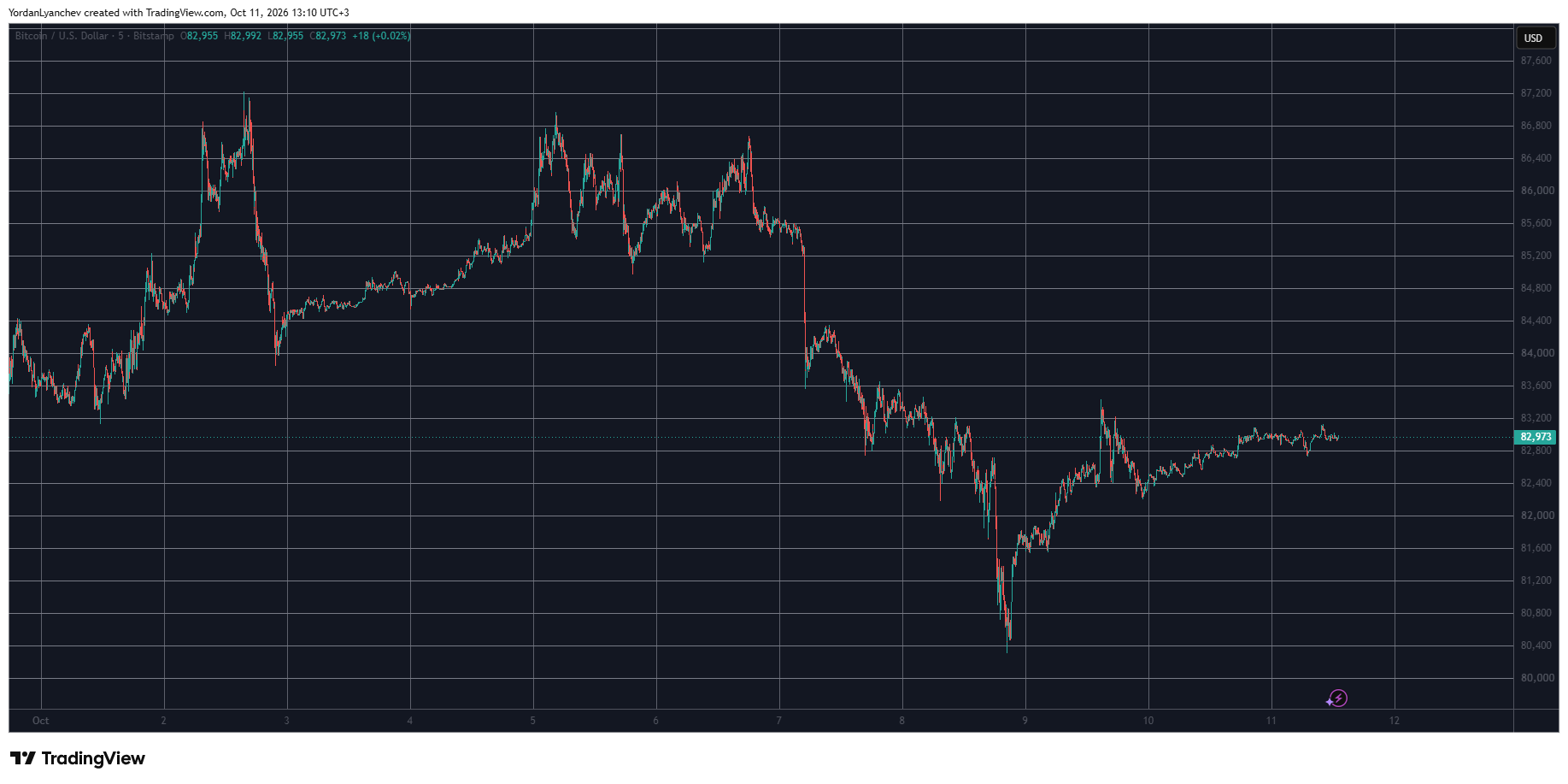
3 Double-Digit Gainers
As mentioned above, there’s little to no movement among the larger-cap alts. ETH is close to $2,500, XRP has dipped below $1.40, while ZEC and HYPE are up by around 1%. BNB, SOL, TRX, DOGE, XMR, LINK, and ADA are slightly in the red.
At the same time, STRK has stolen the show today, skyrocketing by over 53% to almost $0.11. The asset is up by over 105% in the past week. The other double-digit gainers are TIA (21%) and AERO (15%). The former trades at close to $0.60, while the latter is up to $1.
The cumulative market cap of all crypto assets stands still at $2.8 trillion on CMC.
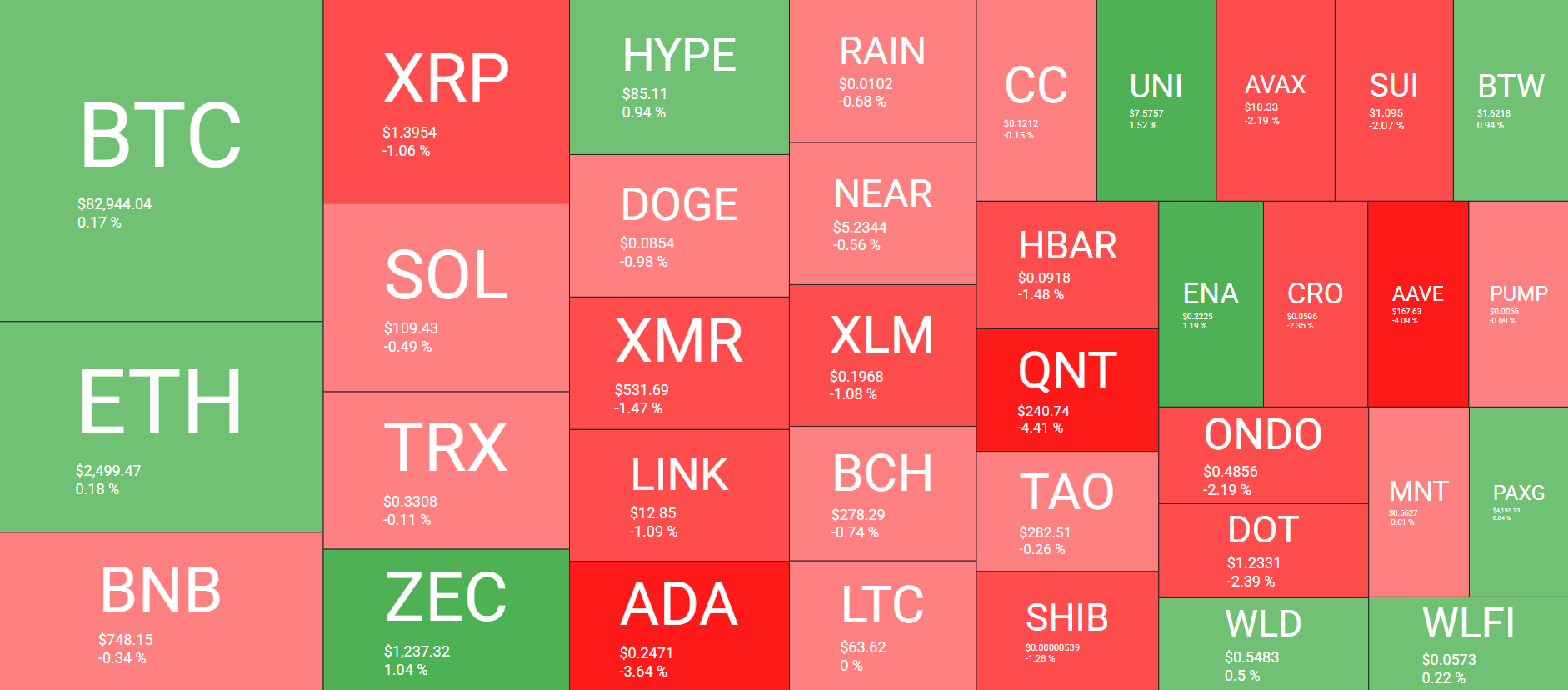
The post Viral Altcoin Defies Market Slumber With 53% Surge, BTC Calms at $83K: Weekend Watch appeared first on CryptoPotato.