Cryptocurrency Posts
Crypto Briefing
The rapid accumulation of staker rewards highlights the high-risk nature of the platform, potentially attracting speculative traders and impacting market dynamics.
The post Papertrade shows $10.3 million in staker rewards shortly after launch appeared first on Crypto Briefing.
Salesforce's rebranding aligns with political trends, potentially enhancing federal contract opportunities but risks alienating some customers.
The post Salesforce’s Marc Benioff joins Trump’s AI rebranding effort with SIForce appeared first on Crypto Briefing.
The push for advanced on-device AI models could revolutionize personal tech, but challenges in memory costs and battery life may hinder progress.
The post Qualcomm CEO says AI firms want 100B-parameter models running on phones by 2028 appeared first on Crypto Briefing.
Institutional interest in Bitcoin ETFs suggests a shift towards long-term adoption, but recent outflows highlight potential volatility.
The post Bitcoin ETF inflows hit $3 billion in eight days as institutions return appeared first on Crypto Briefing.
Nadella's AI oversight approach could redefine corporate governance, emphasizing transparency and accountability to mitigate AI risks.
The post Satya Nadella wants companies to treat AI models like insider threats appeared first on Crypto Briefing.
Bitcoin Magazine
Bitcoin Magazine
Bitcoin Life Insurer Meanwhile Raises $37.5M as Wealthy Families Look to Pass On Their BTC
Meanwhile, the first life insurer licensed to operate entirely in Bitcoin, has raised $37.5 million in new funding from its existing investors, the company announced.
Bain Capital Crypto led the round, with participation from Haun Ventures, Framework Ventures, Pantera Capital, Apollo, Northwestern Mutual Future Ventures and Morgan Creek Digital. The raise brings Meanwhile’s total funding to more than $180 million. Sam Altman is also among its backers.
The company said the round follows a surge in demand for its Bitcoin life insurance policies outside the US, particularly in Asia, Europe and the Middle East, amid broader macroeconomic instability.
“Wealthy families around the world already hold Bitcoin. What they haven’t had is a regulated way to pass it on,” Zac Townsend, Meanwhile’s co-founder and CEO, said in a statement.
“Brokers came to us because their clients kept asking. This round lets us keep up with them.”
In early 2026, Meanwhile launched BTC Life 1-Pay, a single-premium whole life policy aimed at high-net-worth clients outside the US. It is the company’s second product line, after BTC 10-Pay, which is designed for US taxpayers.
Under BTC Life 1-Pay, a client pays one premium in Bitcoin and receives a guaranteed death benefit in Bitcoin for life. The policy’s value grows in Bitcoin, and after the first year the owner can borrow up to 90% of it, with no repayment schedule and no margin calls.
Policies can be owned by individuals, trusts or companies, which the company says makes them suited to succession and estate planning.
Since launch, Meanwhile has signed 15 brokers serving wealthy families, including in Singapore, Hong Kong, the UAE and Switzerland. Partners include Lioner, an insurance, trust and family office group with offices in Hong Kong, Singapore and Zurich, and Apeiron Group, a marketplace for high-net-worth life insurance.
“We’re reaching a turning point where more high-net-worth clients are asking not just how to hold Bitcoin and digital assets, but how to plan around them and ultimately transfer that wealth to the next generation,” said Justin Man, CEO of Apeiron Group. Digital assets.
Meanwhile said its net long-term underwriting income has already passed last year’s total and is on track to more than double in 2026. The company did not disclose specific figures.
“Meanwhile owns every layer of a regulated life insurer and builds it like an AI-enabled startup,” said Stefan Cohen, partner at Bain Capital Crypto. “The growth this year proves the model, and we’re glad to back them again.”
The company’s operating entity, Meanwhile Insurance Bitcoin (Bermuda) Limited, holds the first Class IILT license granted by the Bermuda Monetary Authority. It received the license in July 2024 after two years in the regulator’s sandbox.
The insurer’s balance sheet, reserves and audited financial statements are all denominated in Bitcoin. Policyholder Bitcoin is held with regulated institutional custodians.
This post Bitcoin Life Insurer Meanwhile Raises $37.5M as Wealthy Families Look to Pass On Their BTC first appeared on Bitcoin Magazine and is written by Mathew Di Salvo.
Bitcoin Magazine

‘We Know Where It Is’: Treasury Secretary Threatens To Freeze $1B of Iran’s Crypto
U.S. Treasury Secretary Scott Bessent has said the American authorities will soon seize $1 billion in crypto from Iran.
Speaking on Newsmax’s NPolicy Summit in Washington, D.C. on Thursday, Bessent added that economic sanctions on the Middle Eastern country were working.
Iran has been using bitcoin — and other cryptocurrencies — to skirt around U.S. sanctions. The U.S. in April started targeting crypto wallets linked to the Iranian regime, Bessent said at the time.
“What we have done has never been seen before,” Bessent said Thursday on Iranian sanctions.
“We’re probably going to seize $1 billion of crypto this week,” he continued. “We know where it is. We are isolating them. We did have a maximum pressure campaign, now we have an absolute isolation campaign and it’s working.”
Bessent didn’t reveal what cryptocurrencies the U.S. will seize or how.
It would be very hard — if not impossible — for the U.S. to freeze Iran’s bitcoin unless it keeps it on a centralized exchange.
Bitcoin, being censorship resistant, cannot be frozen. But many other cryptocurrencies, including Tether’s USDT, can. Bessent previously said the feds had seized Iran’s crypto in the form of the popular stablecoin.
Iran started a bitcoin-backed insurance service for its counties shipping companies earlier this year.
The Financial Times last month reported that the Middle Eastern country was using bitcoin to settle cross-border transactions through Iranian crypto exchanges after the central bank advised its countrymen to do anything necessary to help the economy.
U.S. President Donald Trump revived his “maximum pressure” campaign weeks after returning to office. A national security memorandum signed in February 2025 put the Treasury on a sustained campaign against Iran’s shadow banking, money laundering and sanctions-evasion networks.
This post ‘We Know Where It Is’: Treasury Secretary Threatens To Freeze $1B of Iran’s Crypto first appeared on Bitcoin Magazine and is written by Mathew Di Salvo.
Bitcoin Magazine

Here’s How Not To Screw up Your Bitcoin Privacy
Just one transaction can compromise years of discreet Bitcoin activity, Cake Wallet’s chief operating officer has warned.
Speaking on the Bitcoin Rails podcast this week, activist Seth for Privacy talked about different ways of protecting one’s privacy when using Bitcoin and said that focusing on privacy was a must for the West.
Bitcoin privacy is a hot topic again ever since the developers of private coin mixer Samourai Wallet went on trial last year and were subsequently imprisoned.
But just this week, the U.S. Department of Treasury scrapped two long-stalled crypto surveillance proposals, handing a major win to privacy advocates and the digital asset industry.
“If you ever spend your no-KYC coins with one of your KYC coins — which if you just let the wallet do its thing, it could do because it doesn’t know the difference — you immediately connect all of the non-KYC Bitcoin that you spend in that with your identity,” Seth said, referring to UTXO management, also called “coin control” by some wallets.
Bitcoin wallets don’t hold a single balance but a collection of separate unspent transaction outputs — UTXOs — each one a discrete “coin” from a specific past transaction.
When you send a payment larger than any one UTXO, the wallet picks several and combines them as inputs to the same transaction — an easy mistake to make, Seth highlighted.
Seth added that unlike in the global South, where people have experienced more oppressive states, citizens in the West will need to “feel pain” in order to realize how important privacy is.
Still, he added that attitudes were changing and people were getting more serious about protecting their privacy.
“It has been shifting, in the last five or six years a lot of people — even in the West — are starting to think [privacy] really matters, we really need to think about this seriously now,” he said.
Cake Wallet is a privacy-oriented, self-custody, open-source wallet. The wallet earlier this year integrated Bitcoin’s Lightning Network into its platform.
Using the second layer solution is not only faster and cheaper, it also offers more privacy than Bitcoin’s main chain.
While Cake Wallet supports other cryptocurrencies, including privacy coin Monero, Seth for Privacy added that he’d love it if the digital coin didn’t exist.
“If Bitcoin’s privacy got good enough that you could use it and have at least almost as good privacy as Monero without massive hoops to jump through, and Monero ceased to exist, that’s fine,” he said.
“I would much rather the thing that more people use has better privacy than a more niche tool that has perfect privacy, and that’s something that less people are using because it’s less well known.”
This post Here’s How Not To Screw up Your Bitcoin Privacy first appeared on Bitcoin Magazine and is written by Mathew Di Salvo.
Bitcoin Magazine

Bitcoin ETFs Shed $729M in Two Days as Investors Reverse Course
U.S. investors this week reversed course, cashing out $729 million from spot bitcoin exchange-traded funds — putting downward pressure on the leading cryptocurrency’s price.
Funds managed by BlackRock, Fidelity, Morgan Stanley, and ARK 21-Shares all experienced significant outflows on Wednesday and Thursday, according to data from Farside Investors.
Investors had started the week by selling close to $90 million in shares but then bought nearly $119 million on Tuesday.
The rest of the week has seen outflows following news that the Federal Reserve may raise interest rates. Other negative news includes the price of Brent crude jumping following renewed attacks on tankers in the Strait of Hormuz.
U.S. President Trump also hinted that talks with Iran weren’t bearing fruit — a sign war in the Middle East could continue.
Bitcoin’s price recently stood at a little over $82,688, down more than 3% over a seven-day period. The leading cryptocurrency has rebounded slightly over the past day, jumping nearly 2% over 24 hours.
Still, the coin was fast closing in on $90,000 last week. Investors are expecting decent returns as the month dubbed “Uptober” has historically delivered for bitcoin speculators.
The price of bitcoin has been particularly sensitive to geopolitical headwinds this year — especially since the U.S. and Israel attacked Iran, leading to an oil price surge.
Oil prices going up tend to lead investors to bet on the Federal Reserve raising interest rates. And with higher interest rates comes less liquidity for the price of bitcoin to do well.
Still, that’s not always the case: the Fed last month talked tough on getting inflation down and raised interest rates by a quarter of a percentage point and bitcoin’s price rose in the following days.
Bitcoin’s price is 34% below the all-time high of $126,080 it touched in October. It has spent most of 2026 in a bear market but analysts are now increasingly pointing to evidence of a bull market following a rally in August and September.
This post Bitcoin ETFs Shed $729M in Two Days as Investors Reverse Course first appeared on Bitcoin Magazine and is written by Mathew Di Salvo.
Bitcoin Magazine

Ledger Warns Buyers Not to Set Up Wallets From Reseller After Users Report Losses
Hardware wallet manufacturer Ledger has said that it is investigating loss of user funds after customers in South East Asia reported issues with devices bought from a reseller.
The Paris-based company on Friday advised customers who’d bought from vendor CryptoBilis within the last 90 days to not set up their devices.
Ledger did not reveal how much money users had lost but one blockchain investigator, Specter, wrote on X that he’d traced theft addresses following social media posts and that over $86 million had been lost.
The issue comes following a number of data breaches this year in the crypto world and a huge hack of popular Coldcard hardware wallet devices in July.
“Ledger is investigating reports of loss of funds from users in South East Asia who purchased products from a reseller named CryptoBilis,” Ledger said via its support X account.
Ledger added that it had asked CryptoBilis to pause all sales and shipments of Ledger devices.
“If you have set up your Ledger device, consider moving assets to a new Ledger signer (with new seed). We will continue to inform customers of updates as the investigation progresses,” the company said.
In a statement to Bitcoin Magazine, Ledger said that based on the information to date, the incident is isolated specifically to this reseller in this specific market.
“No reports were made of products purchased directly from Ledger, and Ledger’s infrastructure, systems and services were not compromised,” the company added.
CryptoBilis is a Kuala Lumpur, Malaysia-based hardware wallet vendor, according to its website. The company did not immediately respond to questions from Bitcoin Magazine.
The crypto industry is still reeling after hackers in July were able to steal close to $120 million in bitcoin from Coldcard users.
The products, made by Canadian company Coinkite, had a firmware bug which led to faulty seed generation, allowing hackers to essentially guess investor seedphrases.
Galaxy Research said in the months following the attack various attackers were able to exploit the bug independently.
In a separate incident, hardware wallet manufacturer Trezor last month reported that close to 81,000 customers had their details leaked after its third-party fulfillment partner had data stolen.
Criminals have been targeting data this year, with scammers getting hold of customer information via crypto wallet Ledger’s payment processor Global-e to send phishing emails.
This post Ledger Warns Buyers Not to Set Up Wallets From Reseller After Users Report Losses first appeared on Bitcoin Magazine and is written by Mathew Di Salvo.
CryptoSlate
Bitcoin's next recovery could vindicate your investment thesis but leave your leveraged fund deep in the red, because the fund's daily reset can make waiting a pretty expensive habit.
Getting Bitcoin right and actually making money on Bitcoin are becoming two different skills, especially now that Wall Street is preparing products for people who don't find the ordinary version exciting enough.
On Oct. 2, the SEC approved exchange-listing rules for proposed 3x Bitcoin and Ethereum funds from VS Trust. The approval brings them closer to trading, with the appeal captured neatly in the multiplier: more exposure to a market you already believe will go up.
But what happens between buying the fund and being proved right? Bitcoin can fall, recover, and return to your entry price while a leveraged fund still nurses losses, even when it's doing exactly what the product promised.
That promise covers just one day, a much shorter relationship than many investors intend with their money.
Your Bitcoin conviction doesn't reset
The proposed funds seek three times their benchmark's daily return, before fees and expenses. Holding them for a month doesn't extend that promise to three times the month's return, because each day's gain or loss becomes the starting balance for the next.
The Bitcoin investor thinks about where the market will be in six months, while the fund continually resizes its exposure around how much money it has today.
When the market falls, leverage eats through the fund's capital faster than it reduces the size of its market position. To restore the intended multiple, the fund cuts exposure, leaving it with a smaller position when the rebound begins.
Gains then apply to that reduced balance, so getting the underlying market back to its old level doesn't necessarily get the shareholder there too.
During a rally, profits give the fund more capital, allowing it to take on more exposure for the next session. You can leave your shares untouched while the investment inside them grows and shrinks every day, indifferent to your long-term Bitcoin outlook.
The SEC describes in its investor bulletin on leveraged funds a real four-month period when an unnamed index gained about 8%, while a fund seeking three times its daily return lost 53%. That wasn't a Bitcoin fund or a forecast for these proposed products, but it puts a financial result behind an easily dismissed prospectus warning.
Daily compounding can also work beautifully during a sustained advance, allowing a leveraged fund to earn more than three times the benchmark's cumulative gain. The mechanism rewards some price paths and punishes others, which means a buyer needs to be right about more than the eventual destination.
Bitcoin's reputation for rewarding patience affects this, and not in a good way, since a daily-reset fund continually recalculates how much exposure your remaining money can support.
The ETF wrapper comes with extra paperwork
The listing approval showed that these funds use futures, adding another layer between the Bitcoin price people follow and the return they receive.
Futures are contracts with expiration dates, so maintaining exposure requires replacing contracts as they approach expiry. The prices of those replacements can make the strategy more expensive or work in its favor, depending on the relationship between nearer and later contracts.
Either way, multiplying Bitcoin's spot-price return by three won't reproduce the fund's results.
VS Trust's Oct. 7 amended filing lists a 1.85% annual management fee for both proposed products. Its estimated trading return needed to cover costs is 1.98% for the Bitcoin fund and 2.78% for the Ethereum fund, incorporating other expenses and assumed interest earned on collateral.
Those breakeven estimates describe the return needed to cover the estimated operating bill under the filing's assumptions, before the investor earns anything from taking the risk.
But the familiar ETF comes with less familiar paperwork. These are commodity-pool products outside the Investment Company Act of 1940 framework that governs conventional investment-company ETFs, and the filing anticipates partnership tax reporting through Schedule K-1.
Shareholders may have taxable allocations without receiving cash distributions, adding another complication to a trade likely bought for price appreciation.
The Oct. 7 filing says the funds haven't begun trading, so none of this amounts to a record of returns from BITH or ETHK. The listing decision permits a route to market, while the disclosures explain what buyers would actually own.
When a bad trade becomes a long-term investment
Traders who want amplified exposure over a short period, and understand what they're buying, find a legitimate attraction here. Buying shares with cash can save them the work of managing their own futures margin account, though the leverage remains.
The trouble begins when a short-term position loses money, and its owner promotes it to a long-term investment. Waiting for Bitcoin to recover is more comfortable than accepting a loss.
But the fund keeps rebuilding its position around the capital left inside it, regardless of whether shareholders choose to be patient. Even the prospect of waiting assumes enough capital will remain to participate in a rebound: the issuer warns that the entire investment could be lost in a day or overnight.
Buying a 3x fund means accepting daily exposure adjustments and the possibility that a volatile recovery will leave you far behind the asset you correctly believed in.
Even if Bitcoin recovers, a daily-reset fund has no obligation to restore the money lost along the way. Conviction can't persuade a fund to calculate tomorrow's return on money that disappeared yesterday.
The post Being right about Bitcoin won’t save your 3x leveraged ETF position appeared first on CryptoSlate.
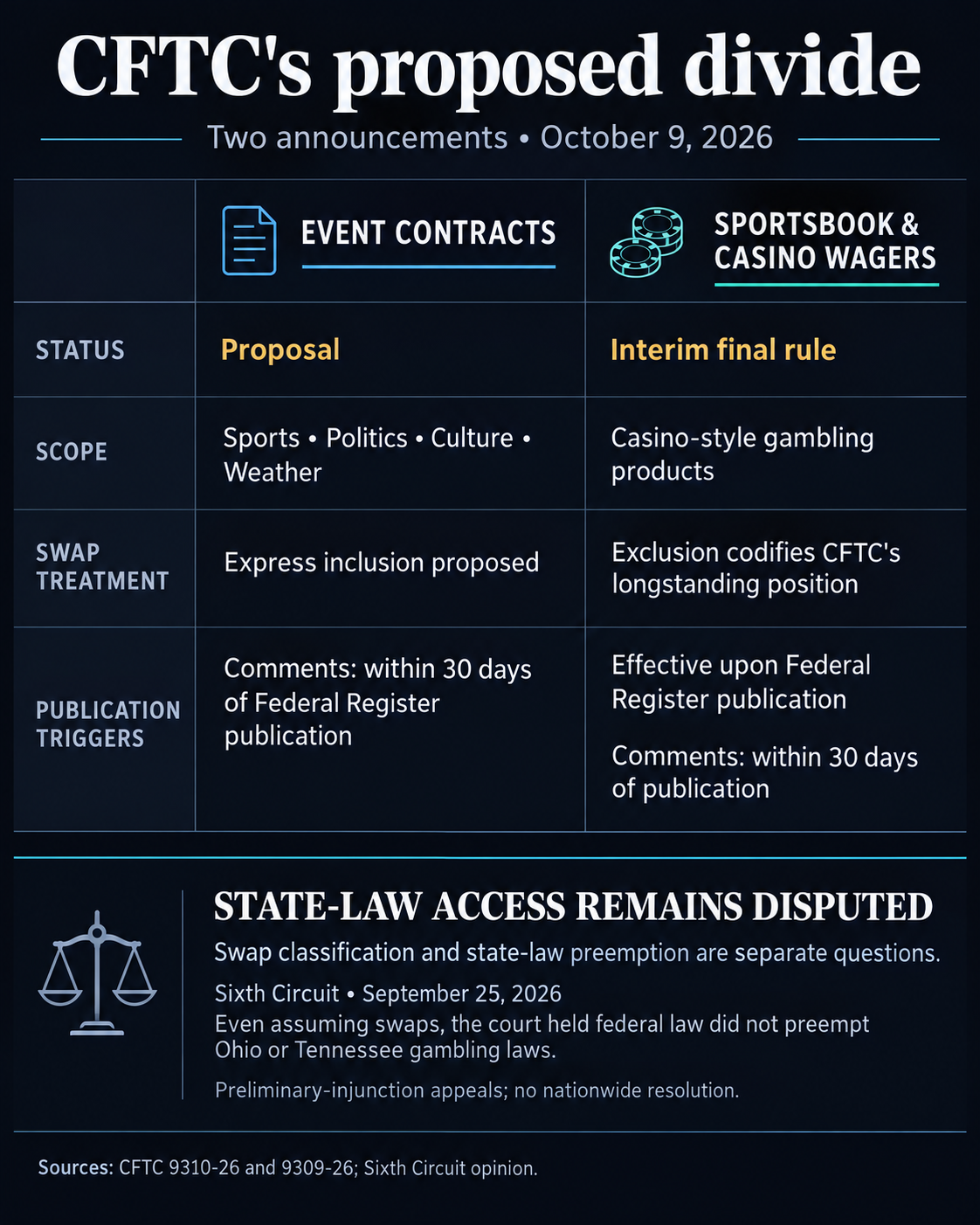
The Commodity Futures Trading Commission announced two actions on Oct. 9 seeking to clarify the federal regulatory boundary between prediction-market contracts and traditional gambling. It proposed expressly including sports and other event contracts in the definition of a swap, a category of financial derivative, while announcing a separate interim final rule to codify the exclusion of sportsbook and casino wagers.
The event-contract proposal covers sports, politics, cultural events and weather-related outcomes. CFTC Chairman Michael S. Selig said these products fall within the agency’s exclusive jurisdiction under the Commodity Exchange Act.
That classification matters because the products can look familiar to bettors. The CFTC explains that event contracts often let traders buy yes-or-no positions on a future outcome, with a fixed payout, usually $1. Their value depends on that outcome, and they can be used to hedge risk or speculate.
The distinction is visible in how platforms present their products: CryptoSlate’s Cloudbet sportsbook review examines odds-based wagers, while its Polymarket review examines tradeable outcome contracts.
The proposed inclusion is not final. The CFTC is seeking written comments through Regulations.gov within 30 days of the proposal’s publication in the Federal Register.
The casino-wager action is an interim final rule. The agency describes it as codifying its longstanding position that casino-style gambling products, including wagers placed on sportsbooks and casino games, fall outside the swap definition.
According to the CFTC, the exclusion takes effect immediately upon publication in the Federal Register. It also carries a 30-day comment window tied to that publication. Neither announcement specifies the Federal Register publication date, so the Oct. 9 date does not establish an effective date or comment deadline.
State-law disputes remain consequential
The agency’s classification position faces a separate legal question: whether federal regulation displaces state gambling laws.
In a Sept. 25 ruling on preliminary-injunction appeals involving prediction-market operator Kalshi, the Sixth Circuit held that the company had not shown its sports-event contracts met the statutory swap definition. It also held, alternatively, that even assuming the contracts were swaps, the Commodity Exchange Act did not expressly or impliedly preempt Ohio’s or Tennessee’s gambling laws.
That alternative holding illustrates the obstacle for operators seeking nationwide access: winning an argument about product classification does not necessarily win the argument over state authority.
The distinction also drew criticism from advocacy group Better Markets. In an Oct. 9 statement, securities-policy director Benjamin Schiffrin argued that sports event contracts enable sports betting and should remain subject to state gambling laws.
The post CFTC proposes a divide between prediction contracts and sportsbook wagers appeared first on CryptoSlate.
Luxor, a Bitcoin mining derivatives provider, reported a 6–13% annualized Bitcoin financing spread in its September lookback, published Oct. 9. It says lenders and Bitcoin treasury companies bought prepaid mining power and paired it with a price hedge, while miners used the reverse trade to obtain financing.
The return comes from the discount a miner accepts for receiving money upfront. The hedge can fix gross BTC receipts if mining delivery and settlement perform, while the investor’s capital remains exposed to failure in that repayment chain. Luxor’s reported September range does not establish an executed return after costs or a quote available today.
Where the Bitcoin return comes from
Mining power, or hashrate, produces revenue at a rate known as hashprice. Luxor’s contracts express that rate in Bitcoin or dollars per unit of computing power per day. Buying future mining power gives the purchaser exposure to the income that power generates over the contract period.
In a deliverable forward, the buyer pays the full purchase price upfront. The seller must deliver hashrate to Luxor’s Bitcoin Mining Pool, with the buyer’s daily BTC settlement tied to the hashprice index and contracted amount of mining power.
That prepayment supplies financing to the miner. Luxor says deliverable forwards typically trade below comparable non-deliverable forwards to compensate the buyer for credit risk and the cost of committing capital. The lower prepaid purchase price is the source of the lender’s potential profit.
Without a hedge, the buyer’s receipts would vary with the mining-revenue rate. The paired trade adds a sale of a non-deliverable forward, or NDF, which settles in cash rather than requiring physical mining-power delivery.
For the NDF seller, daily settlement is the agreed hashprice minus that day’s index rate, multiplied by the contracted hashrate. When the index is below the agreed price, the seller receives the difference. When it is above, the seller owes the difference.
If the two legs use the same BTC denomination, hashrate quantity, settlement dates and index methodology, their price exposures cancel. Fully delivered mining receipts at the daily index rate, plus the NDF settlement, equal receipts at the fixed NDF rate. The profit depends on how much those receipts exceed the prepaid purchase cost and other costs.
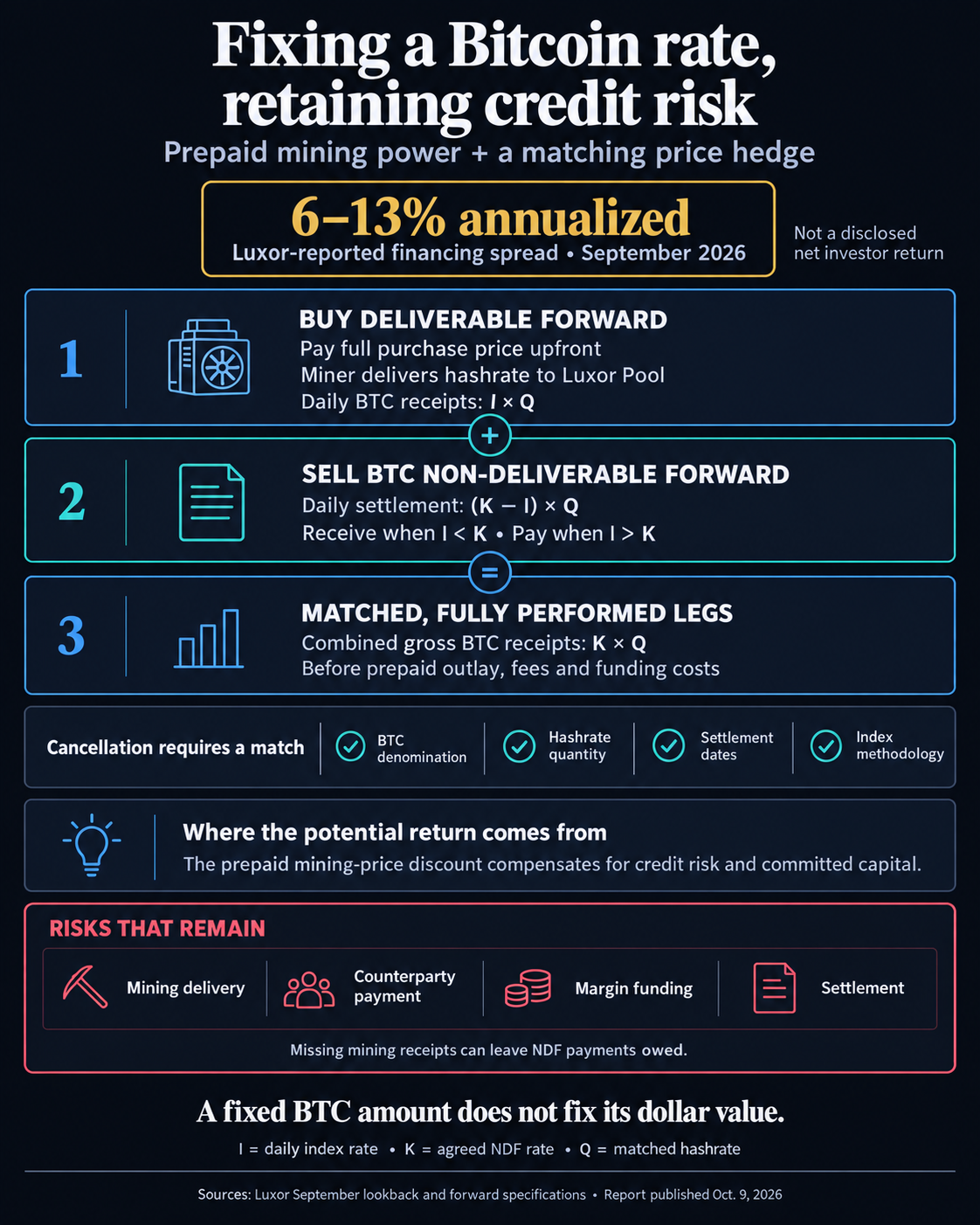
The matching conditions matter. A hedge covering different quantities or dates leaves part of the mining revenue exposed. A dollar-denominated contract also cannot simply be substituted for a BTC-denominated one while preserving the same Bitcoin payoff.
A BTC-denominated hedge also leaves the dollar value of Bitcoin receipts exposed to BTC/USD changes.
Luxor’s product pages describe monthly contracts up to 18 months out and custom durations. That is the general product range; the September financing discussion does not identify which tenors produced the reported 6–13%, or give its annualization formula.
Annualized pricing also does not mean an investor earns the quoted percentage over any shorter contract. The actual contract period, repayment timing, costs and capital committed across both legs determine the return on the investor’s funds.
Delivery failure can leave the hedge running
The cancellation works because the buyer receives the mining revenue against which the NDF settles. If promised mining power is not delivered and the shortfall is not cured, that revenue leg can be smaller than expected while the hedge still has settlement obligations.
When settlement hashprice exceeds the NDF’s fixed rate, the seller owes the difference, expecting higher mining receipts to offset it. If those receipts fail to arrive, the price hedge can require payment without the corresponding income.
There is also a distinction between the miner supplying the output and the investor’s contractual counterparty. Luxor’s order-book documentation says Luxor is counterparty to both the buyer and seller. The platform displays buy and sell orders, and its derivatives team contacts the parties to confirm trades; the book itself is not an execution system.
For an investor, that makes Luxor’s own performance part of the repayment chain alongside the mining operation.
Luxor’s upfront-payment procedures require seller credit profiling before money is advanced. The requirements cover mining-site and power documents, insurance, pool performance, financial statements and future obligations. Its margin policy also lists documentation for a performance bond or guarantor among its supplemental checks.
Credit checks reduce uncertainty about a seller’s ability to perform, while recovery after failure depends on enforceable claims. The public requirements do not specify a complete repayment priority or identify which assets an investor could enforce against after default.
For eligible investors, collateral custody and the ability to exit remain part of the credit exposure. The order book allows open orders to be canceled; that does not establish an exit from a confirmed forward.
Margin changes the capital calculation
Collateral determines how much additional capital may be needed to maintain the hedge. Luxor’s margin policy requires BTC collateral for BTC contracts and collects variation margin when the lower of realized and unrealized margin balances falls below maintenance requirements. Credit-qualified deliverable sellers can have custom procedures based on realized balances.
The policy describes initial margin as protection against potential exposure during the time needed to close out and replace a defaulted position.
The public schedules are not consistent: the NDF page quotes 18% BTC initial margin and the DF page quotes 18% seller hashprice margin plus possible delivery margin, while the general policy lists 17.5% BTC initial and 14% maintenance on non-offset future daily notional. The pages do not explain the difference.
The policy identifies Nov. 14, 2025, as its last initial-margin evaluation. Qualified BTC deliverable sellers can receive discretionary initial terms after supplemental credit profiling, so neither product-page rate establishes a universal requirement for the paired trade.
Prepaid DF buyers are exempt from that leg’s initial-margin schedule because they already pay in full. That exemption does not establish that their NDF leg is collateral-free.
That capital matters when comparing the reported spread with an investor’s net return. Fees, execution prices and any additional funds committed to support the hedge can affect the amount earned relative to the money put at risk.
Luxor’s Steelhead Capital Management case study describes the pairing in practice: Steelhead bought physical hashrate upfront, added an NDF to fix hashprice, and used Luxor Pool for delivery, reward distribution and settlement.
Luxor says daily repayment reduces exposure over the contract’s life. That supports the mechanism of returning funds progressively, while the remaining unpaid amount still depends on performance.
Access is also restricted. Luxor’s resources page says participants must qualify as Eligible Contract Participants. Its examples include entities with more than $10 million in assets and entities with at least $1 million in net worth hedging commercial risk. The structure is not universally available to retail Bitcoin holders.
The post Luxor’s reported 6–13% annualized Bitcoin yield depends on mining delivery appeared first on CryptoSlate.
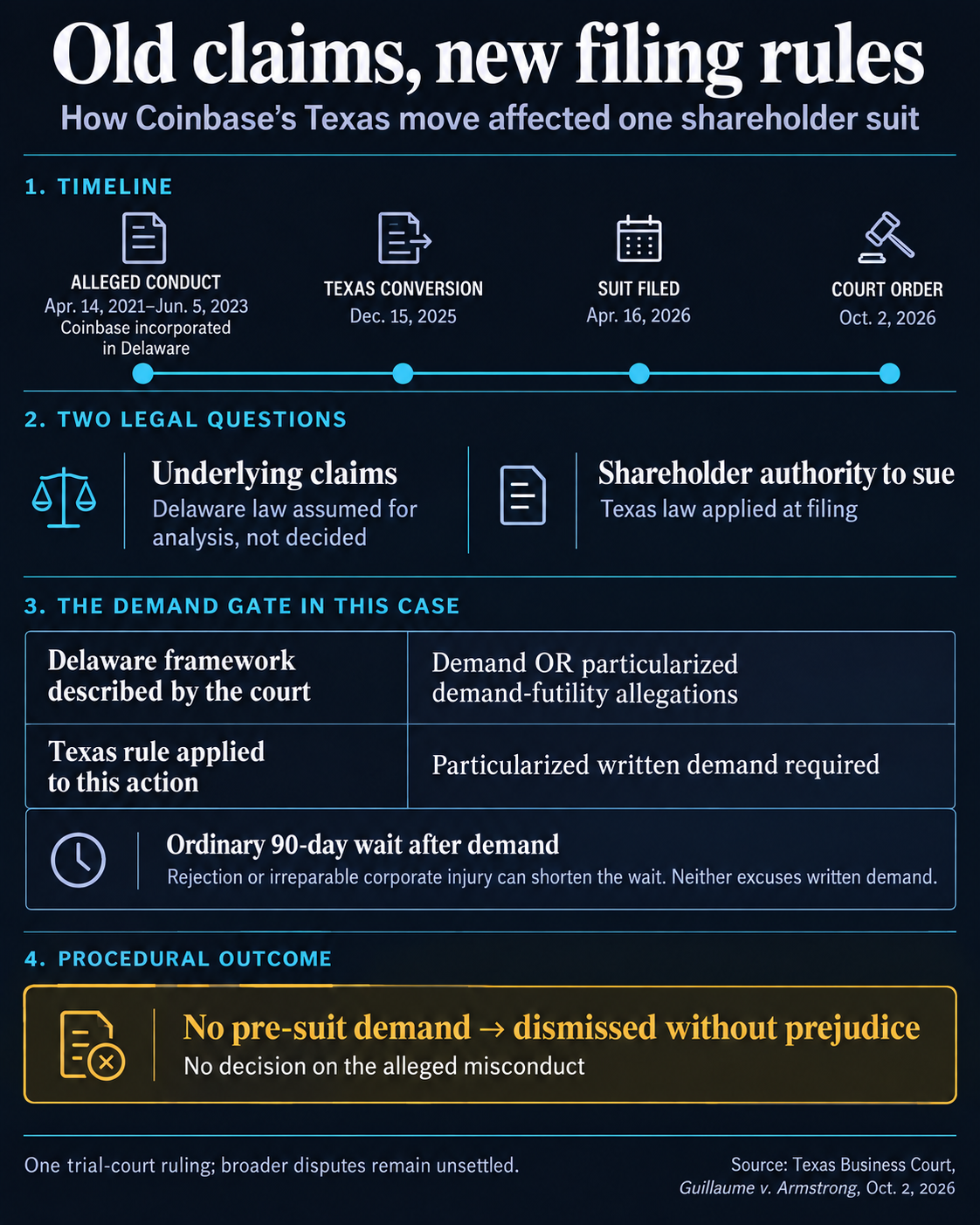
Coinbase’s move to Texas changed the rule a shareholder had to satisfy before suing its directors over alleged conduct from the company’s Delaware years. In an October 2 ruling, the Texas Business Court dismissed Gary Guillaume’s derivative action because he had not first demanded that Coinbase take action on the claims.
The dismissal was without prejudice, and the court did not decide whether the alleged misconduct occurred. Its consequential finding concerned who could pursue claims belonging to Coinbase: Texas’s demand requirement applied to the shareholder’s authority to sue, even though the court assumed without deciding that Delaware law governed the underlying claims.
On October 9, Coinbase CEO Brian Armstrong praised the precedent as encouraging more companies to incorporate in Texas and thanked Greg Abbott. That endorsement came a week after Judge Andrea K. Bouressa signed the order. The immediate lesson for public shareholders is that the law governing a company’s past conduct and the law governing their ability to challenge it can diverge after reincorporation.
Why older claims faced Texas’s demand rule
A derivative action lets a shareholder pursue a claim on the corporation’s behalf. The claim belongs to the company, and the shareholder seeks to exercise authority ordinarily held by its board. That distinction explains why the first dispute here concerned permission to bring the action rather than the directors’ alleged wrongdoing.
The parties agreed that Guillaume filed his suit on April 16, 2026, alleging misconduct between April 14, 2021, and June 5, 2023. Coinbase was incorporated in Delaware during that earlier period. Its Texas conversion became effective on December 15, 2025, several months before the suit was filed.
Under the Delaware framework described in the opinion, a derivative plaintiff can make a demand or plead that doing so would be futile. Futility requires particularized allegations about individual directors, examining whether they received a material personal benefit, face a substantial likelihood of liability, or lack independence from someone who benefited or faces such liability. At least half the relevant board must satisfy the test.
Guillaume tried that route. He did not make a pre-suit demand.
For this action involving a public company, Texas required a particularized written demand identifying the disputed conduct and requesting suitable corporate action. The October 2 opinion described an ordinary 90-day wait after demand, with derivative proceedings permitted from the 91st day. Corporate rejection of the demand or irreparable injury to the corporation can shorten the waiting period. Both exceptions leave the written-demand requirement in place.
Guillaume’s futility allegations could not substitute for the written request Texas required. The missing demand was enough to end this action before the court reached its merits.
Guillaume argued that Delaware law should apply because the claims arose before Coinbase’s Texas move. Bouressa accepted that premise about the underlying claims for purposes of the analysis, without resolving it.
She then considered a separate question: which state’s law governed the shareholder’s authority to file those claims for Coinbase?
The court’s answer turned on the company’s incorporation when the shareholder exercised that authority. A corporate claim can arise under one state’s law, while a later effort to pursue it derivatively is governed by another state’s rules. The opinion reasoned that a shareholder does not acquire a vested right, when a corporate claim arises, to bring it personally on the corporation’s behalf at some later date.
That reasoning gives reincorporation consequences beyond future board decisions. In this case, the December 2025 conversion affected the route for challenging alleged conduct dating back to 2021.
Coinbase’s conversion disclosures supplied Guillaume with another argument. He relied on language preserving eligible shareholders’ standing and ability to bring derivative claims concerning earlier conduct, subject to continued ownership.
The opinion’s treatment of that language was narrower than Guillaume’s interpretation. The court said it did not promise that Delaware law would continue to govern shareholder authority after conversion. The disclosures also expressly said Texas law would govern Coinbase’s affairs following the move.
Bouressa further found that Guillaume offered no argument or evidence showing how losing the option to plead demand futility adversely affected his ability to sue. He had not shown that making a demand was impossible, irreparably harmful or prejudicial, or that the futility option gave him a particular advantage.
The court also found no evidence that Coinbase had successfully contracted around the Texas requirement.
Concentrated votes, a different accountability route
The governance backdrop makes that distinction matter. Coinbase’s November 2025 information statement said the Armstrong- and Fred Ehrsam-associated consenting group held approximately 78.40% of voting power at the October 31, 2025 record date. The group approved the conversion by written consent on November 4.
Coinbase said a committee of Christa Davies and Paul Clement, whom the board found independent and disinterested, evaluated Delaware, Nevada and Texas before recommending Texas. The board unanimously approved the move.
The company cited greater litigation predictability, potential savings on defense costs, indemnification and insurance, and Texas’s crypto-friendly environment.
The consent figure describes approval in 2025. In its April 24, 2026 proxy, Coinbase reported March 31 voting-power figures of 49.6% for Armstrong, 18.9% for separately listed Armstrong-associated entities and trusts with an independent trustee, and 10.6% for Ehrsam. The figures use SEC beneficial-ownership rules, including qualifying options. Class B shares carry 20 votes each, compared with one for Class A.
Coinbase’s February 2026 annual filing described Armstrong and the independent trustee collectively as able to exercise majority voting rights. Its July 30 quarterly filing reported no material changes to the annual risk factors, without supplying a new individual voting-power percentage.
The post Coinbase’s Texas move gets a shareholder suit dismissed over Delaware-era claims appeared first on CryptoSlate.
Bitcoin traded near $82,900 in PerpFinder’s Oct. 10, 09:36 UTC snapshot, with traders watching whether the weekend rebound brings fresh leverage or further position unwinding.
The same snapshot put Binance BTC futures open interest at $7.70 billion and showed longs receiving funding, indicating negative funding. Saturday’s Deribit expiry has already settled at 08:00 UTC; Sunday’s expiry remains ahead.
The rebound’s durability depends on what traders do with leverage: rebuild it, keep closing positions, or hedge against another decline.
Futures positioning is the test
Funding payments help distinguish those paths: positive funding means longs pay shorts, while negative funding reverses that flow.
A recovery with price up, open interest stable or climbing, and funding modest would be consistent with traders rebuilding risk in a healthy way. Price rising while open interest falls would be consistent with position unwinding, including short covering, rather than necessarily showing fresh conviction.
Price falling with open interest falling would suggest continued deleveraging. Falling price with rising open interest could indicate new bearish exposure, particularly if funding also turns more negative.
The following positioning scenarios and price areas are the author’s illustrations. They are conditional reference points, rather than a quoted market forecast.
| BTC price action | Open interest | Funding | What it would suggest |
|---|---|---|---|
| Price rises | Stable or rising | Modest | Possible healthy risk rebuild |
| Price rises | Falling | Modest or falling | Possible short covering / position cleanup |
| Price falls | Falling | Weakening | Continued deleveraging |
| Price falls | Rising | Neutral to negative | Possible new bearish exposure |
Sunday’s options book is put-heavy
PerpFinder’s Oct. 10, 09:49 UTC options snapshot put Sunday’s BTC expiry at $272.4 million of open interest, with $98.5 million in calls and $174.0 million in puts, a put/call ratio of 1.77. The contracts settle at 08:00 UTC on Oct. 11.
Each outstanding contract has a buyer and a seller. The put-heavy book shows where risk is concentrated in the Deribit expiry, consistent with downside hedging or bearish exposure without identifying which side initiated those positions.
What Bitcoin volatility implies
The same 09:49 UTC snapshot put Deribit’s DVOL index at 36.63% annualized. Using an assumed $82,600 starting price, a two-day, one-standard-deviation calculation gives about $2,239 either side, leaving rounded reference points near $80,400 and $84,800.
Spot demand is the swing factor. US spot Bitcoin ETFs recorded nearly $730 million in outflows between Oct. 7 and Oct. 8: $484.9 million and $244.1 million respectively, according to Farside’s daily table. Friday, Oct. 9, then returned to a modest $21.1 million net inflow.
Weekend liquidity leans on derivatives, so a futures-led rebound can fade faster when weekday ETF buying is soft.
| Scenario | Price area | Confirmation signals |
|---|---|---|
| Bearish continuation | $80,000–$80,400 | BTC loses $80,400, long liquidations return, OI keeps falling |
| Range stabilization | $82,000–$83,000 | OI flattens, funding stays modest, price holds the weekend range |
| Recovery extension | $84,500–$85,000 | Price rises with stable/rising OI and healthy spot demand |
| Overshoot / thin-liquidity move | Below $79,000 or above $86,000 | Sharp weekend move without strong confirmation, with reversal risk |
What decides the weekend for Bitcoin
If Bitcoin holds above $82,000, open interest stabilizes or climbs, and funding stays modest, a move toward $84,500 to $85,000 would have healthier positioning behind it. ETF and spot demand strengthening beyond Friday’s modest inflow, along with short liquidations outnumbering long ones, would support that reading.
If Bitcoin loses $80,400, Binance open interest keeps falling, funding remains weak or turns more negative, long liquidations return, and Sunday’s put-heavy expiry meets weak spot demand, $80,000 comes back into play.
The post Bitcoin’s weekend rebound faces an $80,400 test after nearly $730 million in ETF outflows appeared first on CryptoSlate.
CryptoTicker.io
Bitcoin stands at $82,749 on Saturday afternoon, which is around 73,863 euros. Over the past 24 hours the price has moved by 0.2 percent; measured across the week it is 2.1 percent lower. Set against the days before it, that is close to standstill. And that standstill is the story of the day, because Wednesday brings the US consumer price index, the appointment likely to set the direction for the coming weeks.
Anyone looking at the Bitcoin chart today sees little. Anyone looking at the range sees something that can be put in figures: the gap between the daily high and the daily low has fallen to less than a third of the weekly average. This article tells you which levels count coming out of that calm, what happens on Wednesday at 2.30 p.m. German time, and which three figures in your own portfolio should be settled beforehand.
Bitcoin price at $82,749: the figures on Saturday afternoon
The price has been moving in a narrow band since the morning. The 24-hour high stands at $83,204, the low at $82,229. Between the two lie $975, or 1.2 percent. For comparison: on Thursday, $3,136 lay between high and low.
Converted into euros, Bitcoin stands at around 73,863 euros. The figures come from CoinGecko, as of Saturday, October 10, early afternoon. For context: a good 34 percent currently separates the price from its record of $126,080.
A brief definition, because it carries the rest of the article. The daily range is the distance between the highest and the lowest price of a day, expressed as a percentage of the daily low. The figure measures how far the market swung on a given day, irrespective of where it ends up. A day can close at plus zero percent and still have had a range of four percent.
0.74 percent: the narrowest range of the week
For this article we evaluated CoinGecko's four-hour candles for the past two weeks and determined the high and low for each calendar day from them. The result for the past seven days, in each case as the percentage gap between daily high and daily low:
- Sunday, October 4: 1.12 percent
- Monday, October 5: 2.28 percent
- Tuesday, October 6: 1.79 percent
- Wednesday, October 7: 3.42 percent
- Thursday, October 8: 3.90 percent
- Friday, October 9: 2.24 percent
- Saturday, October 10 up to the early afternoon: 0.74 percent
The six days before today average 2.46 percent. The running Saturday sits at 0.74 percent and therefore at just under 30 percent of that value. The day is not over yet, so the range can still grow. Even if it doubled by midnight, it would stay below the week's average.
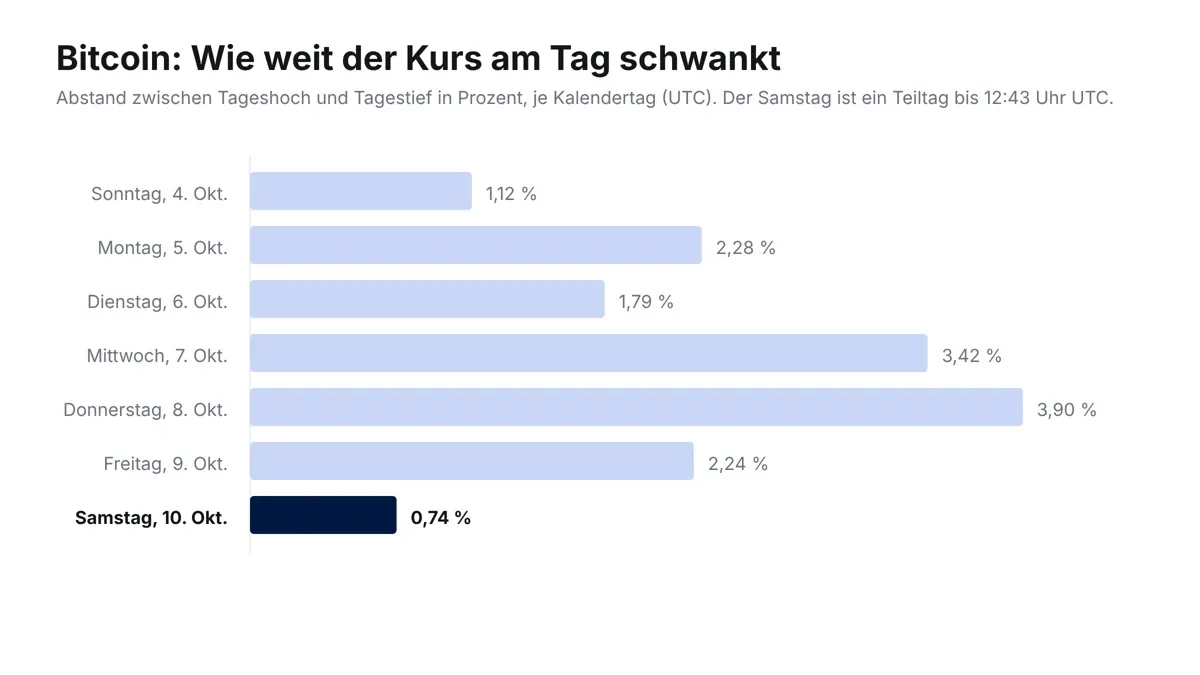
That Saturdays run quieter than weekdays is normal: the US exchanges are closed, the ETF counters stand still, institutional orders pause. What is remarkable is the margin. The previous Saturday, October 3, came to 0.93 percent, and the Sunday after it to 1.12 percent. So today is narrow even for a Saturday.
What has changed since Friday
On Friday we wrote in this slot about the Bitcoin price and the oil price. Bitcoin stood at $82,991 at the time, Brent had fallen to $103.53, and the question was whether a retreating oil price relieves the crypto market.
Since then almost nothing has happened to the price: $82,749 today against $82,991 on Friday afternoon is a difference of $242, or 0.3 percent. What has changed is something else, namely the movement itself. On Friday the price still swung 2.24 percent within the day, today 0.74 percent. The $82,000 level, briefly breached on Thursday evening, has not been touched since early Friday. Thursday's low of $80,427 has therefore stood unchallenged as the week's lowest point for two days.
For you as a reader following this thread, that means the question has shifted. Last week it was about whether the slide would continue. That question has been answered for now; it did not continue. Now it is about which direction the market comes out of this calm in, and what pushes it there.
Why a narrow range ahead of a data release is no cushion
The mechanism behind it is less mysterious than it is often made out to be, and it can be explained in three steps.
First: when the price barely swings for hours, measured volatility falls, and the risk models of trading houses hang on it. Lower measured volatility allows those same models a larger position on the same risk budget. So positions tend to get bigger, not smaller.
Second: in the futures market, stop orders and liquidation thresholds gather close together in such phases, because many participants set their levels at the same visible points, at the daily high, at the daily low, at a round number. The narrower the range, the closer together those points lie.
Third: when a piece of news then forces a direction, those thresholds get touched in quick succession. Every triggered liquidation is a market order that pushes the price further in the same direction and reaches the next threshold. That is how a cascade forms.
What that looks like in practice could be observed on Thursday of this week. We analysed at the time that 94 percent of Dogecoin liquidations hit long positions, meaning bets on rising prices. Bitcoin fell from $83,563 to $80,427 that day. The trigger was no catastrophe but a chain of the oil price and restrained expectations of the US Federal Reserve.
The CPI on Wednesday, October 14: what happens at 2.30 p.m. German time
On Wednesday the US Bureau of Labor Statistics publishes the consumer price index for September. The time is 8.30 a.m. local time on the US East Coast, so 2.30 p.m. in Germany. The CPI, short for consumer price index, measures how much a fixed basket of goods and services has risen in price against the same month a year earlier. It is the single most important figure for rate expectations in the market.
Why this release matters for Bitcoin: the expectation of whether and how far the US Federal Reserve cuts rates moves the dollar and the appetite for risk across all markets. Rising inflation argues against rate cuts, and rate cuts failing to arrive have regularly weighed on crypto prices over the past two years. The link is not mechanical, but it has been stable enough since 2022 that trading desks position themselves accordingly.

Two things make this Wednesday particular. For one, analysts cited by Admiral Markets expect the annual rate to rise from 3.4 to between 3.6 and 3.7 percent, driven above all by petrol prices in September. For another, it is the last inflation figure before the US Federal Reserve's rate decision on October 28. A reading markedly above expectations would therefore meet a market that has no further opportunity to reorganise itself before then.
You can look up the release date itself at the US Bureau of Labor Statistics, where the publication calendar is kept.
Bitcoin is holding up better than the altcoins: the weekly balance
A second perspective alongside the chart is the comparison within the market. Over the past seven days the large names stand as follows:
- Bitcoin: minus 2.1 percent
- Shiba Inu: minus 4.1 percent
- XRP: minus 5.4 percent
- Ethereum: minus 7.0 percent
- Chainlink: minus 7.1 percent
- Dogecoin: minus 7.6 percent
- Solana: minus 8.1 percent
So Bitcoin has taken on around a quarter of Solana's loss and a good third of Dogecoin's. In market phases where money moves out of risk, that is a familiar pattern: the smaller names give way more strongly, because their order books are thinner and because investors sell first where the leverage was greatest.
For placing today, that means the quiet range in Bitcoin is no sign of general market calm. The picture shows rather that Bitcoin is at present the most stable part of a market that is giving way overall.
The levels to the upside: $83,204 and $84,150
To the upside, two points can be justified. The first is the 24-hour high at $83,204. It is the boundary of the current range, and a break above it would be the first signal that the calm is ending upwards.
The second lies higher. The analysis service DiarioBitcoin locates the next resistance in the zone between $84,150 and $84,260, and points out that the price trades below the moving averages of the past 7, 15 and 20 days while still sitting above those of the past 30, 50, 90 and 200 days. Trading volume there is below the average of the past 30 days, which fits the picture of a narrow range.
What that distance means in practice: from the current level to the upper zone is around 1.7 percent. That is a move the market has managed several times on a normal trading day this week.
The levels to the downside: $82,229 and $80,427
To the downside, the first level is the 24-hour low at $82,229, a good 0.6 percent below the current price. That marks the lower edge of the calm zone.
The second and more important level is the weekly low at $80,427 from Thursday evening. The weekly low sits around 2.8 percent below the current level. What is special about it is not the number but what it marks: the price was last below that point in early September. A break beneath it would not merely repeat Thursday's slide but extend it.
The analysis service Börse Global additionally names the round $83,000 as a short-term decision level and sees the zone around $80,000 in focus on a slip below it. Both assessments point in the same direction: between a good $80,000 and a good $84,000 stretches the frame in which the coming days will be decided.
Leverage and liquidation: three figures that should be settled before Wednesday
When the range is narrow and a release is pending, the obvious action is not to guess a direction. It makes more sense to know your own figures beforehand. Three of them can be calculated concretely.
First, the liquidation price. Anyone holding a leveraged position finds it in the position overview at their exchange. What matters is the distance to the current price in percent. If it is under 3 percent, it lies within what Bitcoin covered on each of this Wednesday and last week's Thursday in a single day. Anyone working with leverage should additionally know how the funding rate and the settlement work on their platform, because both shift the liquidation price over the holding period.
Second, the holding period. In Germany, gains from selling cryptocurrencies are tax-free after a holding period of one year; within the year the exemption threshold of 1,000 euros per calendar year applies. Anyone holding balances close to the year-end cut-off should know which part of the holding was bought when, before reacting in panic on Wednesday. What comes together for tax purposes in October this year is set out in our article on Bitcoin tax and the December 31 cut-off.
Third, the buying route. Anyone wanting to buy more should $80,427 be tested needs the route beforehand, not in the moment of the move. Verification at a new exchange takes hours to days, a bank transfer overnight. Which providers are authorised in Germany under the MiCA regulation and what they cost per order is set out in our crypto exchange comparison.
Our assessment of the situation ahead of Wednesday
In the editorial team's view, the narrow range is the most remarkable signal of this weekend, and it argues for tension rather than relief. The evidence: at 0.74 percent, the range sits at less than a third of the weekly average of 2.46 percent, trading volume is below the 30-day average as measured by DiarioBitcoin, and the market has the CPI on Wednesday ahead of it, the last inflation figure before the rate decision on October 28.
What argues against overstretching this reading: a quiet Saturday is first of all a Saturday. October 3 came to 0.93 percent without an extraordinary week following it. And the direction in which a market emerges from a narrow phase cannot be derived from the narrowness itself; it says something about the possible force of the move, nothing about its sign.
What follows from that is therefore not a directional bet but a question of preparation: the two levels of $82,229 and $80,427 to the downside, along with $83,204 and the zone around $84,150 to the upside, are the points at which Wednesday will show where the market wants to go.
Bitcoin before the CPI: $82,229 is the first level on Wednesday
To take away, in the order in which the three steps make sense:
- Recalculate your own thresholds. Note the liquidation price and its distance to the market in percent. If that distance is under 3 percent, it lies within a normal daily move of this week. The settlement models of the leverage platforms are in the perp DEX comparison.
- Settle the buying route beforehand. Verification, payment method and order fee are fixed before a level is tested, not after. The providers authorised in Germany and their cost per order are in the exchange comparison.
- Put the date in the diary. Wednesday, October 14, 2.30 p.m. German time. Anyone with an order open at that moment should know that spreads regularly widen in the minutes afterwards. Anyone preferring to track the move through an exchange-traded product will find the routes tradable in Germany in the overview of crypto ETFs and ETPs.
(As of October 10, 2026. This article is not investment advice. Prices and fee structures change; check the terms with the provider before you buy.)
If you hold USDT, PYUSD or DAI at Coinbase, you have until October 30, 2026 to move those balances off the account. After that, the exchange converts any remaining holdings into USDC itself. Tokens that arrive in your Coinbase account after the cut-off date will not be credited at all. Buying, selling and swapping these stablecoins is already blocked for customers in the European Economic Area, and a withdrawal is the only route still open.
This is not a decision Coinbase took on its own. Behind it sits the EU regulation on markets in crypto-assets, MiCA for short, and an opinion issued by the European securities supervisor ESMA on October 8, 2026. The exchange is merely setting its own deadline well ahead of the European outer limit.
Coinbase delists several stablecoins for customers in the European Economic Area
The list of affected tokens includes, according to Coinbase, Tether (USDT), PayPal USD (PYUSD), Dai (DAI), Pax Dollar (PAX), Gemini Dollar (GUSD) and GYEN. The exchange's help page names further tokens beyond those. What they all have in common: there is no MiCA authorisation for them, neither as an asset-referenced token nor as an e-money token.
An e-money token is the MiCA term for a stablecoin that tracks the value of a single official currency, such as the euro or the US dollar. Anyone issuing such a token in the EU needs a permission as an electronic money institution or as a credit institution and has to be able to redeem the reserve at par at any time. An asset-referenced token, by contrast, tracks a basket of several currencies, commodities or crypto-assets and needs an authorisation of its own.
The difference between the two categories sounds technical, but it decides which supervisor is competent and which reserve obligations apply. For you as a holder, what counts above all is the consequence: without one of those two authorisations, an authorised provider may neither offer the token in the EU nor admit it to trading. Which issuers now hold the authorisation is listed in the supervisor's public register, and anyone wanting to know which euro and dollar tokens are still tradable in Europe at all will find the overview in our stablecoin comparison.
The scale makes clear why the step carries weight. At a market value of around $184 billion, USDT is by far the largest stablecoin of all and ranks third among all crypto-assets. DAI comes to about $4.6 billion, PYUSD to roughly $2.9 billion. GUSD and PAX, at $36 million and $25 million respectively, are niche products by comparison (market values according to CoinGecko, as of October 10, 2026). For context: USDC, the token Coinbase converts into, stands at around $73 billion.
October 30, 2026 is the final deadline for withdrawals
Coinbase has staggered the restrictions. Trading, buying and swapping the affected tokens are already switched off for accounts in the European Economic Area. What remains until October 30, 2026 is solely the option of sending the tokens to another address. Anyone taking that route needs a destination that supports the relevant chain: depending on the account, USDT sits on Ethereum, Tron, Solana or further networks, and a withdrawal to the wrong chain cannot be recovered.
Build in time while you are at it. Withdrawals usually require approval by two-factor authentication, and with larger amounts or a newly added address, exchanges are fond of imposing a hold of 24 to 72 hours. Anyone starting on October 29 may run straight into that waiting period.

Coinbase converts remaining holdings into USDC automatically
Whatever is still in the account after October 30 will be converted into USDC, by Coinbase's own account, as far as that is possible for the token in question. So your balance does not disappear; it changes form. For most holders that is a manageable event, because both tokens are pegged to the dollar and the conversion runs close to one for one.
Two points deserve attention nonetheless. First, with an automatic conversion you keep no control over the timing and therefore none over the rate at which it is settled. With a stablecoin trading cleanly at one dollar that hardly matters; with a token deviating from par it does. Second, USDC is itself a decision: afterwards you hold a token from a different issuer, with a different reserve and a different supervisor.
What the conversion means for small residual amounts
With tiny amounts left over from old trades in particular, it is worth considering whether a withdrawal pays off at all. Network fees on Ethereum can swallow a residual balance of a few euros entirely. In such a case, the automatic conversion into USDC or a sale into euros is usually the more sensible route than a transfer that costs more than it moves.
Transfers arriving after the cut-off date no longer land in the account
This point is easily skimmed past and is the most expensive part of the whole change: tokens from the affected list that are sent to a Coinbase deposit address after October 30, 2026 will no longer be credited to the account by the exchange. So anyone who has stored an old USDT deposit address with another service, with a payer, or in a withdrawal profile should change it beforehand.
That covers more cases than it first appears. Recurring withdrawals from a second exchange, proceeds from a marketplace, repayments from a lending contract: a saved address nobody thinks about any more can be sitting in any of those. A similar constellation has occurred during earlier changeovers, for instance in earlier forced conversions where those affected only noticed on looking into the account that something had not arrived.
Behind the deadline sit MiCA and an ESMA opinion of October 8
On October 8, 2026, ESMA published an opinion that sets an upper limit for the national supervisors: by January 8, 2027 at the latest, authorised providers in the EU must have wound down their residual holdings of stablecoins that do not comply with MiCA. Individual supervisors may set an earlier date, not a later one. What the opinion requires in detail and which services it captures is set out in our assessment of the ESMA deadline.
The scope is drawn more widely than you would expect from a delisting. It captures not only trading platforms but also exchange services, the execution of orders, investment advice and custody. Customers in the EU may no longer buy the affected tokens and may no longer add to their holdings; only selling, swapping, transferring and withdrawing within an orderly wind-down remain permitted. In the supervisor's view, a warning notice or a customer confirmation does not substitute for the protective provisions MiCA imposes on the issuer.
That is exactly what explains why Coinbase is acting so early. Anyone who only starts the wind-down in December has to push it through across all products and customers within a few weeks. With October 30, the exchange gives itself a good ten weeks of buffer ahead of the European outer deadline. Which providers now hold their authorisation in Europe, and what they had to meet for it, is a separate matter from this delisting.

DAI is on the list although no company issues the token
DAI is the biggest surprise. There is no firm behind the token that issues it. It comes into being in a protocol in which users deposit collateral and generate DAI against it. So there is no company that could apply for an authorisation, and no reserve within the meaning of the regulation that a supervisor could examine.
MiCA barely recognises this distinction in its practical consequence: the regulation attaches the obligations to the issuer and to whoever offers the token in the EU. Where an issuer capable of meeting the obligations is missing, all that remains for the authorised provider is withdrawal. For stablecoins created in a decentralised way, that is a structural disadvantage in the European market, and it cannot be remedied with the means of the protocol.
Our assessment: the change narrows the choice in Europe noticeably to a handful of authorised euro and dollar tokens, and the biggest winner so far is USDC. The figures above argue for that, as does the fact that Coinbase converts residual holdings into precisely that token. Against it stands the point that a market in which almost everything runs through one issuer creates a new concentration risk: anyone holding USDC depends on its reserve, its bank and its supervisor. That is not a recommendation for or against any token; the total loss of a crypto-asset remains possible in every case.
For the tax office, the forced conversion is a sale
For tax purposes, swapping one crypto-asset for another is a disposal in Germany under section 23 of the Income Tax Act, and nothing about that changes because the exchange triggers the swap instead of you. For stablecoins, the gain or loss arising is as a rule minute, because the purchase and sale rates both sit close to one dollar. What can make the matter noticeable is the exchange rate: anyone who bought USDT at a point when the euro stood markedly differently can realise a rate difference in euros.
That is why documentation matters most of all. Record when the conversion took place, what quantity was affected and at which rate it was settled. If that record is missing later, you will have to explain a transaction you did not trigger yourself. Whether your case falls under the exemption threshold, and how to enter it in the tax return, is best clarified with tax advice; this article does not replace it.
Three ways out remain until the cut-off date
Which route fits depends on what you intend to do with the balance.
Withdrawal to your own address
You keep the token and become independent of what individual exchanges in Europe are allowed to offer. The price for that is responsibility for the keys. Watch out for the correct chain, and with larger amounts send a small test amount first.
Swap into an authorised token
Anyone who only needs a dollar placeholder between two trades can switch into USDC or an authorised euro token before the deadline and thereby keep control of the timing. The result resembles the automatic conversion, except that you decide when it happens.
Sale into euros
The plainest route, and sensible for everyone who needs the money in a bank account anyway. You end up outside the crypto market and do not have to worry about chains and addresses. Check your exchange's withdrawal fee beforehand; for SEPA payouts it varies a great deal from provider to provider.
Coinbase stablecoins: there is time to withdraw until October 30
- Review your holdings. Open your Coinbase account and check whether USDT, PYUSD, DAI, PAX, GUSD or GYEN are sitting there, including in small remainders. For the route into self-custody, the hardware wallet comparison helps.
- Set a destination and tidy up your addresses. Decide on withdrawal, swap or sale, and replace old Coinbase deposit addresses everywhere they are stored. If you want to change exchange anyway, take a look at the regulated crypto exchanges.
- Act before October 29. Factor in holding periods and network fees and keep the record of the transaction. Which euro and dollar tokens remain authorised in Europe is shown by the stablecoin comparison.
(As of October 10, 2026. This article is not investment advice. Prices and fee structures change; check the terms with the provider before you buy.)
Sources: Coinbase, help page on the stablecoins restricted under MiCA and Cointelegraph on the wind-down of USDT at Coinbase in Europe.
Revolut will cover the fees if customers hit by the data theft need new identity documents. Béatrice Cossa-Dumurgier, the bank's head of Western Europe, said so on October 7, 2026 in an interview with the French broadcaster BFM TV; the news agency Reuters reported the pledge the same day. The breach affects 680 customer accounts. Cossa-Dumurgier gave no estimate of the total cost, and she did not say whether any customers have already replaced their papers.
Anyone who holds cryptocurrencies and is among those affected has a second problem that has nothing to do with the fee for an ID card. According to the reports, what left the bank were copies of identity documents, address data and account statements, which is precisely the data set needed to reconstruct an identity in front of a service provider. This article places the pledge in context, states the documented figures and shows which steps are open in Europe.
Revolut covers the ID document fees: where things stand as of October 7
The pledge is brief and comes without a procedure. According to Reuters, Cossa-Dumurgier said Revolut would take care of the associated costs should affected customers ever have to replace their identity documents. An application route, a deadline and an upper limit are not part of that statement. Anyone wanting to make use of it should approach the bank's support team and have the case confirmed in writing, because a pledge in a television interview is not a published reimbursement policy.
In the same interview, the head of Western Europe drew two lines: the bank's own systems had not been compromised, and Revolut would not pay a ransom. Public authorities are sometimes the weak link in the chain, she said, referring to the route by which the data left the bank. The pledge as the agency report words it contains no figure for how many of the 680 affected customers live in Germany.
What the cost cover does not include
The fee for a new document is the smallest item in this case. Replacing an ID card does not undo the fact that a date of birth, an address, an occupation and account movements now sit with third parties; none of those details changes with a new card chip. So anyone who only gets the fee reimbursed has settled the part of the damage that can be expressed in euros.
680 affected accounts and five months of access: the chronology of the data leak
The case is considerably older than the ransom demand. According to the analysis by SecurityWeek, the access spans a period of five months, 680 accounts are affected, and the demand amounted to around three million dollars. Of the 680 affected customers, 55 live in France according to the Reuters report; Revolut is said to have offered help to all 680.
The matter became public in September 2026, when the attacker group set a deadline and threatened to sell the data. We reported on that phase at the time, including the question of how those affected can place their own status: Revolut data breach: am I affected, and what about my Bitcoin history? The pledge on ID document costs is the bank's first step that goes beyond information and actually costs money.
The figure of 680 is a floor, not a final count
SecurityWeek lists the 680 accounts as high-profile accounts. Whether the figure holds once the review is complete is open; with access running over five months, the count depends on which disclosures are retrospectively identified as unauthorised. A higher figure is therefore possible, but the sources reviewed offer no confirmation of one.
A hijacked government address as the way in: how the attackers reached the data
By its own account, Revolut handed customer data to an unauthorised party after information requests arrived from an email address carrying a public authority's domain. According to the reports, the attackers controlled the email system of an Italian authority in order to do so. Technically, that describes no break-in to the banking systems. What was abused is a procedure that banks have to serve for law enforcement agencies every day.
Italy's interior minister has criticised Revolut for it: the bank should have checked more carefully whether the request really came from the Italian government. That assessment is his, not ours; whether a breach of duty follows from it is for the supervisor and the courts to settle, not for an editorial team.
Why this route is so hard to defend against
An information request from a law enforcement agency comes from outside by definition, carries urgency, and must not be noticed by the customer. Those three properties are exactly what strips the bank of its usual counter-checks: asking the customer is ruled out, and the sender domain looks genuine for as long as the authority's own mailbox sits under someone else's control. A second channel for verification, such as a call back on an independently obtained official number, is the point at which this attack fails.
From passport to verification selfie: which data fields were taken
The reports describe a data set that reaches far beyond name and account number. It covers full names, dates of birth, occupations, addresses and contact details, along with passports and driving licences, account statements as well as facial verification images and transaction histories. Taken together, that is a complete identity file with a financial profile attached.

A card number can be blocked and replaced within days. A date of birth cannot, an address only by moving house, and a facial image not at all. That is where this incident genuinely differs from ordinary card fraud: the fields that leaked stay usable for years.
Why a KYC data set weighs more heavily than a card number
An account at a bank or a crypto exchange is opened by way of an identity check, and that same check serves many services as their emergency exit when somebody has lost access. The mechanism this creates explains the rest of this article, and it runs through three stages.
Credibility comes first. A caller who knows a date of birth, an address, an occupation and the most recent account movements does not sound like a fraudster but like the case officer he claims to be. The account statements supply the details that nobody outside the bank would otherwise hold.
Access follows. Wherever a service ties account recovery to a copy of an ID document and a selfie, both building blocks now sit with third parties. The transaction history additionally shows which accounts are worth the effort, because it reveals where money has flowed and on what scale.
What remains at the end is the risk away from the network. A documented home address next to a documented level of wealth is the precondition for the attack the industry describes as a wrench attack, meaning physical coercion instead of a technical detour. The attacker group claims it selected customers with larger crypto holdings via blockchain analysis; that selection is not documented, it comes from the perpetrators themselves, and it still explains why this data set is judged differently in the crypto scene than a trade in addresses.
6,000 Monero as ransom: the equivalent at today's price
The group that gave itself the name "iamnotavillain" demanded 6,000 Monero according to reports in the Financial Times, and set a deadline of 24 hours. At the time of the demand, that corresponded to around three million dollars. Monero trades at $527.46 on October 10, 2026; calculated at that price, 6,000 XMR come to roughly $3.16 million. So the demand has risen slightly in dollar terms without the attackers changing anything.
The choice of currency is part of the threat. Monero obscures amounts and participants within the protocol itself, which is why the payment trail that makes an investigation possible with Bitcoin is missing. According to the Reuters report, Revolut has stated it will pay no ransom, while also saying it has had no direct contact with, and received no demand from, the group claiming responsibility for the incident. Both statements stand side by side, and the sources do not resolve the contradiction.
Data was stolen, not balances
According to the reports and to Revolut's own account, no funds left the bank. The damage lies in the identity and account information, not in an emptied account. That distinction matters for placing the case: a financial loss can only arise later, in the place where the data carries a second attack.
46 euros for a German ID card: what the cost cover actually buys
Since February 7, 2026, a German ID card has cost 46 euros for applicants aged 24 and over, up from 37 euros; the Bundesrat approved the increase on January 30, 2026, and municipalities have published it since. For applicants under 24, whose card is valid for six years, 27.60 euros is due. A provisional ID card costs 10 euros, and direct delivery to the home address adds 15 euros.
The fee for a passport cannot be documented for 2026 from the sources reviewed, because the amounts given there still carry the old ID card price of 37 euros and therefore predate the increase. Anyone wanting to replace a passport should ask the responsible local registration office for the fee instead of relying on a figure from a guide. For reimbursement by Revolut, what counts in any case is the fee notice from the office, not an estimate.
Replacing the document solves only half the problem
A new ID card carries a new document number, and the old number loses its validity. That removes the part of the misuse which depends on a valid number, such as a new registration involving a document check. The facial image from the verification, by contrast, stays usable, and so does the address for as long as it is still correct.
Identity theft after a KYC leak: the attack routes in detail
Several attacks can be built from this data set, and they differ in what the perpetrators additionally need.
The call with insider knowledge
A caller poses as an employee of the bank, an exchange or a public authority and proves the role with details from the account statement. The aim is an authorisation, a code or a transfer to an allegedly secure account. No bank and no crypto exchange ever asks for a recovery code or the words of a wallet backup over the phone; that rule is the hard line at which such a call ends.
Recovering somebody else's access
At many services, an ID image and a selfie are the proof that retrieves lost access. If both sit with third parties, the security of an account rests on the provider additionally requiring a factor that the data set does not contain, meaning a hardware key or an app on a specific device. Confirmation by SMS does not count, because a phone number can be ported to someone else's device with a complete identity file in hand.
The route via the home address
An address next to a documented crypto holding shifts the risk from technology into the home. It helps to prepare by storing holdings so that a single handover does not cost everything, for instance by separating a small balance for everyday use from a larger one in self-custody.

GDPR compensation under Article 82: the legal framework for those affected in Germany
Article 82 of the General Data Protection Regulation gives every person a right to compensation for the material and the non-material damage suffered through processing that infringes the regulation. Article 34 obliges the controller to notify those affected of a data breach carrying a high risk, and Article 15 grants the right to information about which data is stored on a person and to whom it has been disclosed.
None of that establishes that an infringement occurred in the Revolut case. That assessment is for the competent supervisory authority and, in a dispute, the courts, and it hangs on whether the examination of the information request met the required standard. As an affected person, your rights under Article 15 are open to you regardless of that assessment, and a subject access request under Article 15 is the way to put your own exposure on the record rather than assume it.
Jurisdiction and supervision
Revolut runs its banking business in the EU on a Lithuanian banking licence and offers its services in other member states under the European passport. Affected customers can lodge a complaint with the data protection authority of their country of residence, in Germany therefore with the competent state authority; the authorities coordinate with one another during the procedure. Going through your own state authority is the shorter route, because it works in your own language and without a cross-border element.
Self-custody with a hardware wallet: how the attack surface shrinks
An account with a provider hangs on an identity check, and that very check is the weak point in this case. Self-custody inverts the relationship: there, possession of a device and knowledge of a backup decide access, and an ID image in someone else's hands is no help with either. Which devices are candidates and how they differ is set out in our comparison of crypto hardware wallets.
The move has a flip side that fits this case. Anyone holding their own keys carries the risk of loss alone, and the backup words are then the only thing that counts. Those words belong neither in a photo nor in cloud storage, because a data set like the one that leaked here shows how far information travels once it exists in digital form.
What applies for tax when you move holdings
A transfer between your own wallets is not a disposal and triggers no tax in Germany. What matters is the documentation: the acquisition dates have to remain traceable, because the one-year holding period depends on them. Anyone moving holdings without records does not lose the period itself, but does lose the simple proof of it.
What has changed since the articles in September
In September, the question in the foreground was whether you are affected yourself and what a publicly released data set means. Two things have moved since then. First, as of October 7 there is a pledge from the bank that costs money and goes beyond advice. Second, SecurityWeek's analysis documents the five-month period, which leaves the incident standing as longer-running access rather than a single mistaken disclosure.
Three points remain open that would be needed to close the case for German customers: how many of the 680 affected customers live in Germany, which route the reimbursement runs through, and whether the data was sold or published after the deadline expired. On none of these points do the sources reviewed supply an answer.
Our assessment: the cost cover is a signal, not compensation
In the editorial team's view, the pledge is right and too small. The numbers make the case: 46 euros for an ID card stand against a data set that comprises a date of birth, an address, an occupation, account statements and a facial image, and of those fields, replacing the document renews exactly one, namely the document number. Five months of access and 680 accounts are also not an order of magnitude that can be settled through a fee refund.
Against that, on the account of every source reviewed, Revolut was the victim of an attack on somebody else's government mailbox rather than of a break-in to its own systems. A bank that answers an information request from a law enforcement agency is discharging an obligation; the only question is how strictly it counter-checks while doing so. Whether the standard was sufficient here is for the supervisor to judge, and until then the pledge remains what it is: a first step that covers the fee and leaves the rest open. Crypto investments can lead to a total loss; this assessment judges the situation and recommends neither a purchase nor a sale.
Revolut data breach: ten years of validity, ten years of exposure
A German ID card is valid for ten years, six for applicants under 24. For that long, a leaked copy stays usable as proof if the document is not replaced. The next steps hang on that.
- Establish your exposure in writing and start the reimbursement. Request information under Article 15 GDPR from support, have the pledge on cost cover confirmed in writing in the same case, and keep the fee notice from the registration office. For the everyday balance on your phone, a look at the comparison of crypto software wallets is worth it alongside, because splitting holdings limits the damage of any single breach.
- Detach your logins from SMS codes. At every exchange and broker, switch the second factor to an app or a hardware key and review the recovery routes, because a phone number is attackable once someone holds a complete identity file. Which providers sit under European supervision and which safeguards they offer is shown by the overview of the best regulated crypto exchanges.
- Document the move into self-custody. Anyone withdrawing holdings from an exchange should record the date, the amount and the address so that the one-year period stays provable; a transfer between your own wallets remains tax-free. Tools for that are in the overview of crypto tax software and portfolio trackers.
(As of October 10, 2026. This article is not investment advice. Prices and fee structures change; check the terms with the provider before you buy.)
Shibarium, the dedicated chain behind Shiba Inu, holds $50,639 of locked capital on October 10, 2026. The day before, the figure was $157,958. That is 68 percent less within a single day, and the price took no notice of it: SHIB trades at $0.00000545, or 0.00000487 euros, by Saturday midday, up 2.4 percent over 24 hours.
Anyone who reads that collapse as a signal of capital flight is measuring the wrong number. Behind the decline there is no withdrawal by a crowd of users, but one single liquidity position at one single decentralised exchange, which has been appearing and disappearing every one to three days for weeks. This article shows how the figure comes about, what it says about the chain's actual utility, and which levels for SHIB follow from it.
Shibarium on October 10: $50,639 in the protocols after $157,958 the day before
DefiLlama's daily values for the chain read like an electrocardiogram over the first half of October. On October 4, Shibarium carried $56,770, on October 5 it was $149,644, on October 6 it was back down to $55,832, and on October 7 it stood at $172,020. Then came $163,757 on October 8 and $157,958 on October 9, before the value fell back to $50,639 on October 10.
Across the past 30 days, the average of that series is $55,867. The highest daily reading of the period was October 7 at $172,020, the lowest was September 10 at $49,740. For context: in December 2024, the same chain once carried $6,437,163, and the 2026 high was $1,481,811.
WoofSwap as the water gauge: a single pool carries 95 percent of the decline
DefiLlama breaks the capital down by protocol, which makes it possible to split the jump apart. WoofSwap Shibarium, a decentralised exchange on the chain, held $113,498 on October 9 and only $11,219 on October 10. That one entry accounts for $102,279 of the total decline of $107,319, which is 95.3 percent. The day before, it made up 71.9 percent of the entire chain capital.
The pattern repeats itself: on October 5, WoofSwap held $106,596, on October 6 it was $12,253, and on October 7 it was $124,556. A position of that size, swinging tenfold within a day, typically comes from a single market participant who provides liquidity and then pulls it out again. Large numbers of small investors do not move in lockstep by the hour.
Total value locked: what the metric says about a chain
Total value locked, or TVL, is the dollar value of all assets deposited in a chain's contracts, meaning trading pools, lending markets and staking contracts. The metric measures tied-up capital, not turnover and not user numbers. The value also rises when a single actor pays money in, and it falls when the same actor collects it again.
Two further things distort the number. First, it counts in dollars: if the price of the deposited tokens rises, TVL rises without any new deposit at all. Second, Shibarium's protocol list includes an entry for the trading platform Gate at $97,658, which DefiLlama assigns to the centralised exchange category and therefore does not count towards the chain value. Add the protocol totals up without that distinction and you arrive at $148,299, almost three times the figure actually reported.
The base without WoofSwap: $39,420 spread across thirteen further protocols
Strip out the swinging pool and a remarkably quiet remainder is left. On October 10 that remainder is $39,420. Over the past 30 days, this base has never left the range between $38,020 and $47,654, not on a single day. So the chain has not suffered capital flight; it has never held capital worth mentioning.
Broken down, the base looks like this: ShibaSwap V1 holds $20,952, Shibex $5,671, DogSwap $5,494, ChewySwap $2,862, PunkSwap $1,899 and ShibaSwap V2 a further $1,317. Behind those come seven more entries below $500 each. In total, DefiLlama lists 14 protocols on Shibarium. The in-house exchange ShibaSwap reaches $22,269 across both versions combined.
Since October 8: $159,561 turned into $50,639
Our Shiba Inu forecast of October 8 still carried a Shibarium figure of $159,561, alongside 1,323 transactions a day and a price of $0.00000528. Two days later, three of those numbers read differently, and they are moving in different directions.
The capital on the chain has fallen to a third. Over the same period, the price rose from $0.00000528 to $0.00000545, which is 3.2 percent. Chain usage has picked up: Shibariumscan counts 2,438 transactions for October 10 by 10:51 UTC alone. The level of $0.00000610 named back then still stands, but the distance to it has narrowed from 15.5 to 11.9 percent.
Fee burning through Shibarium: the burn hangs on chain turnover
The reason the capital on Shibarium matters at all for a SHIB forecast lies in how the project is built: a share of the chain's transaction fees is meant to flow into the burning of SHIB. The more that happens on the chain, the more tokens disappear from circulation. That is the economic bridge between technology and price on which every forecast that argues from scarcity rests.
That bridge can be quantified. Shibariumscan reports gas consumption of 186,831,439 units for the current day. A simple transfer on an Ethereum-compatible chain costs 21,000 gas units, so the daily consumption corresponds roughly to 8,900 such transfers. In total, the chain has processed 736,027,044 transactions in 11,114,269 blocks since launch, at an average block time of 5.0 seconds. How much of that actually arrives in the burn is shown by a look at the burn addresses, which we last recalculated in the burn balance of October 9.

Slippage in thin pools: what to watch on a SHIB order
Slippage is the difference between the price you see when you submit an order and the price at which it is actually filled. The less capital sits in a trading pool, the more a merely mid-sized order moves the price against you. With a pool of $20,952, which is what ShibaSwap V1 currently holds, a four-figure amount is enough to do it.
In practice that means: for a SHIB purchase or sale of any meaningful size, the centralised venues are the more realistic address, not the decentralised pools on Shibarium. SHIB's daily turnover across the market is $66.58 million, roughly 1,315 times the entire chain capital. Before placing an order, three points are worth a look: the stated slippage tolerance, the provider's trading fee, and whether the provider is registered under MiCA in Europe. Our crypto exchange comparison gives an overview of the fee models.
On tax, the familiar position holds in Germany: under section 23 of the Income Tax Act, gains from selling SHIB are tax-free after a holding period of one year, and below that the exemption threshold of 1,000 euros per calendar year applies. Swapping SHIB for another token on Shibarium is a disposal and restarts the clock for the token received.
Market value against chain capital: $3.21 billion against $50,639
SHIB ranks 36th among cryptocurrencies with a market value of $3.21 billion, on 589.24 trillion tokens in circulation. The capital locked on its own chain amounts to $50,639. The market value is therefore around 63,400 times as large as the capital working in the associated infrastructure, and the TVL equals 0.0016 percent of the valuation.
A comparison within the segment helps to place that. Dogecoin trades at $0.085829, reaches a market value of $13.41 billion and daily turnover of $484.78 million, yet has no smart contract chain of its own at all and claims no utility of that kind either. Anyone who values SHIB above a pure meme token usually justifies it with Shibarium. That justification is exactly what has to be measured against the numbers above.

Levels for the coming days: $0.00000533 below, $0.00000552 above
The nearest support is the daily low of October 10 at $0.00000533. Below that lies the low of the past 30 days, reached on September 16 at $0.00000494. To the upside, the daily high of $0.00000552 caps things first.
The more telling level above that is $0.00000561. It marks half of the October decline, from the high of $0.00000592 on October 5 to the low of $0.00000529 on October 9. A price that recovers that half has neutralised the past week's downward move. Only after that does the $0.00000610 from our October 8 forecast come back within reach, the high of the past 30 days set on September 23. Over seven days SHIB is down 3.5 percent, over 30 days it is up 5.7 percent.
Our assessment: the price follows the narrative, not the chain capital
In the editorial team's view, the data speaks against any forecast that argues from Shibarium usage. The evidence for that sits in this article: the base of the chain capital has not left the range from $38,020 to $47,654 for 30 days, while the price rose 5.7 percent over the same stretch. On October 10, the reported TVL falls 68 percent, and the price gains 2.4 percent on the very same day. Between the two quantities, no connection is visible over the observation period.
This reading says nothing about the direction of the price; it makes a statement about the reasoning. Anyone holding SHIB should know that the movement currently comes from market sentiment and from whatever is happening across the wider crypto market, and not from measurable demand for the chain itself. A price forecast resting on Shibarium adoption has no foundation in this data. That is not a recommendation to buy or to sell. It is a warning about a particular kind of argument.
Three objections with numbers that argue for a different reading
First, TVL measures only tied-up capital. Chain usage has risen lately, from 1,323 transactions a day on October 8 to 2,438 transactions by midday on October 10. What counts for fee burning is the number of transactions, not the capital in the pools.
Second, the base is stable rather than shrinking. A project whose core business is collapsing normally shows a falling trend, not a horizontal line across 30 days. Third, one month is a short window. The chain already held $6,437,163 in December 2024 and $1,481,811 during 2026, so capital demonstrably can come back. What remains open is what is supposed to bring it back.
Shibarium capital: without turnover the burn stays a rounding error
- Check the number yourself before you believe it. The breakdown by protocol sits on DefiLlama under the chain's entry, and the transactions and gas consumption sit on Shibariumscan. Tools that bundle data of this kind are in our overview of analytics platforms.
- Price in slippage and fees before you place an order. With pools in the four to five figure range, a larger on-chain order costs you more than the fee at a centralised venue; the terms are in the exchange comparison.
- Settle custody if you intend to hold SHIB for more than a year to use the clock under section 23 of the Income Tax Act. Which devices are suitable is covered in the hardware wallet comparison.
The raw data behind this article is publicly available at DefiLlama for the chain capital and at Shibariumscan for blocks, transactions and gas consumption.
(As of October 10, 2026. This article is not investment advice. Prices and fee structures change; check the terms with the provider before you buy.)
For years, the threat to Bitcoin's cryptography had a name and a date: quantum computers, sometime in the 2030s. This week, Ethereum's co-founder suggested the real danger might arrive sooner and from a different direction entirely. Artificial intelligence, Vitalik Buterin argued, could compress 50 years of mathematical progress into two, and some of that math could break the locks on your wallet.
$Cardano founder Charles Hoskinson read the argument and reached for a sharper word: numerology. The result is the most important crypto security debate of the year, and it is happening in public between two of the industry's biggest names.
What Is Crypto "Bunker Mode" and Who Started It?
The spark came from Ethereum Foundation researcher Justin Drake. After OpenAI published hundreds of new mathematical results in a single release on Tuesday, Drake warned that AI-accelerated math might eventually break ECDSA, the elliptic curve signature scheme that secures Bitcoin and Ethereum wallets today, before quantum computers get there. His advice: enter "bunker mode" by gradually moving funds to fresh addresses whose public keys have never been exposed on-chain.
Buterin backed the warning, while telling users not to panic-move their coins. His bigger point was aimed at the industry's quantum defense plans. Most of the post-quantum world is being built on lattice-based cryptography, including the ML-KEM and ML-DSA standards NIST finalized in 2024. Buterin wrote that there is a good chance the concrete security of lattices takes serious hits from the next two years of AI math, and that Ethereum's long-term roadmap has deliberately moved toward hash-based signatures and proofs instead.
Why Does Hoskinson Call Vitalik's Warning Numerology?
Hoskinson's rebuttal, posted on Thursday, is long and unsparing. His core claim is that Buterin has not identified any credible attack on lattice problems. He argues that the historical case Buterin leans on, the general number field sieve that gutted RSA key sizes in the 1990s, came from specific arithmetic structure in integer factorization. No comparable mechanism has been shown against lattices after four decades of cryptanalysis, and NIST's security parameters already price in every known improvement to lattice reduction and sieving.
He also went after Buterin's suggestion that multiplying key sizes by ten might buy safety against AI. That, Hoskinson wrote, is numerology. Security parameters move with measurable gains in attack algorithms, not with round-number guesses. And he turned the argument back on Ethereum: hash functions have been broken before, from MD5 to SHA-1, and Poseidon, the hash Ethereum is exploring for zero-knowledge proofs, is itself a target for AI-assisted algebraic attacks. If AI is a threat to lattices, why would hashes be exempt?
The personal edge was unmistakable. Hoskinson accused Buterin of being too invested in Ethereum's research direction to reconsider it, and reminded readers of past $Ethereum pivots, from Plasma to early Casper designs, that developers later had to revisit.
Is Bitcoin Safe From AI and Quantum Computers Right Now?
Today, yes. Nobody in this debate claims that ECDSA or SHA-256 is broken, or that any AI system has produced a working attack. The disagreement is about where to invest the next decade of defensive effort. Buterin wants the industry to hedge against both quantum and AI risk by favoring hash-based constructions. Hoskinson warns that scaring developers away from lattices could delay the quantum protections already rolling out across web traffic and messaging, leaving everyone exposed for longer.
There is a real cost to getting this wrong in either direction. Hash-based signatures can authorize transactions, but lattices also power encryption and key exchange, capabilities that privacy systems and secure communications need and that hashes alone cannot provide.
What Should Crypto Holders Do About the Bunker Mode Debate?
Less than you might think, and more than nothing. The one practical step both camps would endorse is hygiene: avoid reusing addresses, since an address that has signed a transaction has its public key exposed on-chain, and that is the data any future attack would need. Hardware wallets, strong backups and self-custody remain the baseline, and the CryptoTicker shop carries vetted hardware wallets if you want to tighten up.
Beyond that, watch the researchers rather than the influencers. If AI-driven math produces a genuine improvement in lattice reduction, it will show up in peer-reviewed cryptanalysis long before it shows up in a stolen wallet. Until then, this is a fight about roadmaps, not a reason to sell. The Bitcoin and Ethereum prices, for what it is worth, barely blinked.
Decrypt
A proposed rule would expressly fold event contracts tied to sports, politics, culture and weather into the “swap” definition, while an interim rule excludes casino-style gambling—sharpening the agency’s claim to exclusive jurisdiction.
The Bermuda-based insurer, which runs entirely on Bitcoin, drew the funding from existing backers led by Bain Capital Crypto after a record year driven by demand from wealthy families in Asia, Europe and the Middle East.
Physicists at George Washington University say a formula can estimate when an AI chatbot will flip from good answers to bad ones, and early tests on small models back it up.
A National Assembly committee adopted amendments taxing stablecoin swaps and crypto exits by wealthy holders, then rejected the 2027 budget's revenue section.
Executives are war-gaming the political fallout of a major AI-driven cyberattack and preparing to brief Congress fast if and when necessary.
U.Today - IT, AI and Fintech Daily News for You Today
The surge puts Shiba Inu layer 2 Shibarium’s transaction activity back in focus.
BTC Pioneer Adam Back Takes Aim at Ethereum in favor of Bitcoin’s UTXO Model.
Ex-Ripple Exec highlights XRP Ledger’s next growth chapter amid AI payments surge.
A large amount of Solana tokens exit major cryptocurrency exchanges as sellers appear to be dominating the market following its price downturn.
Evernorth has completed its SPAC merger, preparing to list on Nasdaq with approximately 473 million XRP and $300 million in cash proceeds. Yet XRP continues to decline.
Blockonomi
TLDR:
- The Bitcoin price fell 3.6% for the week after touching $80,400, then recovered above $83,000 following Thursday’s sharp decline.
- NEAR lost just 0.3% in the weekly comparison after a 91.7% monthly advance, then jumped more than 10% to about $5.25 on October 10.
- Monero’s 1.3% weekly decline beat Bitcoin’s loss, though price performance alone cannot show whether trading activity or buying demand drove the difference.
- Bitcoin ETF outflows reached $244 million in one day, while XRP funds saw $8.2 million in inflows even as XRP fell 9% for the week.
The Bitcoin price fell to a weekly low near $80,400 on October 8 as a crypto market selloff accelerated. By October 9, BTC had recovered to $83,247, leaving it 3.6% lower for the week. Most large tokens lost more over that same seven-day period.
NEAR Protocol and Monero were exceptions, down 0.3% and 1.3%, respectively, in the weekly comparison. Yet those figures capture only one point in a volatile stretch. NEAR had climbed 91.7% over the prior month, then rose more than 10% on October 10. The Bitcoin price and altcoin moves show resilience in the data, but not its cause.
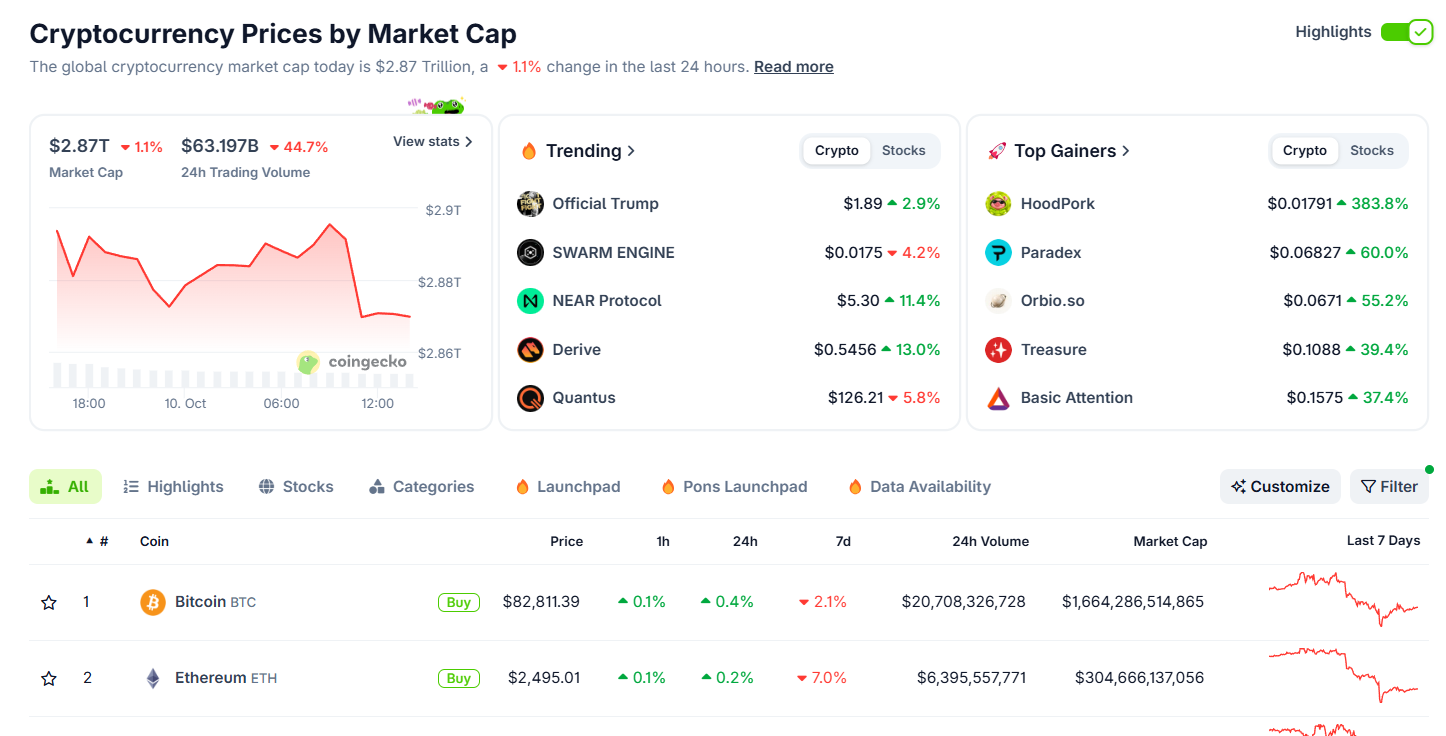
Bitcoin Price Slide Put NEAR and Monero Under Scrutiny
The selloff followed several failed attempts by BTC to reclaim $87,000. After slipping below $84,000 earlier in the week, Bitcoin fell to $80,400 on Thursday. The decline erased nearly $7,000 in a few days before buyers lifted BTC above $83,000. Bitcoin price weakness contrasted with the narrower weekly losses in NEAR and Monero.
NEAR’s small weekly drop deserves context. Its token price had climbed 91.7% in the previous month. That run can change how a weekly selloff appears. Even an intraday pullback may leave a token close to its starting price for the week. NEAR then gained more than 10%, reaching roughly $5.25 on October 10.
BTC price rebound shows how quickly the comparison shifted as prices recovered. Monero’s 1.3% loss also compared favorably with BTC. But a small decline alone cannot show whether buyers were accumulating, holders were inactive, or trading was thin.
ETF Flows and Weekend Recovery Point to Uneven Demand
Gains were not broad among large-cap coins. Thirteen of 16 tracked major tokens fell more than BTC during the measured week. Stellar posted the steepest decline at 13.5%. XRP lost 9%, despite XRP funds recording $8.2 million in inflows. Bitcoin ETFs, meanwhile, had $244 million in daily net outflows. Those flows complicate a simple demand narrative. Positive fund subscriptions did not protect XRP from falling. BTC declined despite its ETFs recording daily net outflows.
Bitcoin’s dominance increased to 59.5% as its market capitalization stood around $1.66 trillion. The total crypto market value rebounded to about $2.8 trillion after losing roughly $200 billion from its high to low. ETH recovered toward $2,500 after falling to $2,400, while XRP moved from $1.34 to around $1.41. The bounce restored some lost value but left several large tokens below recent levels.
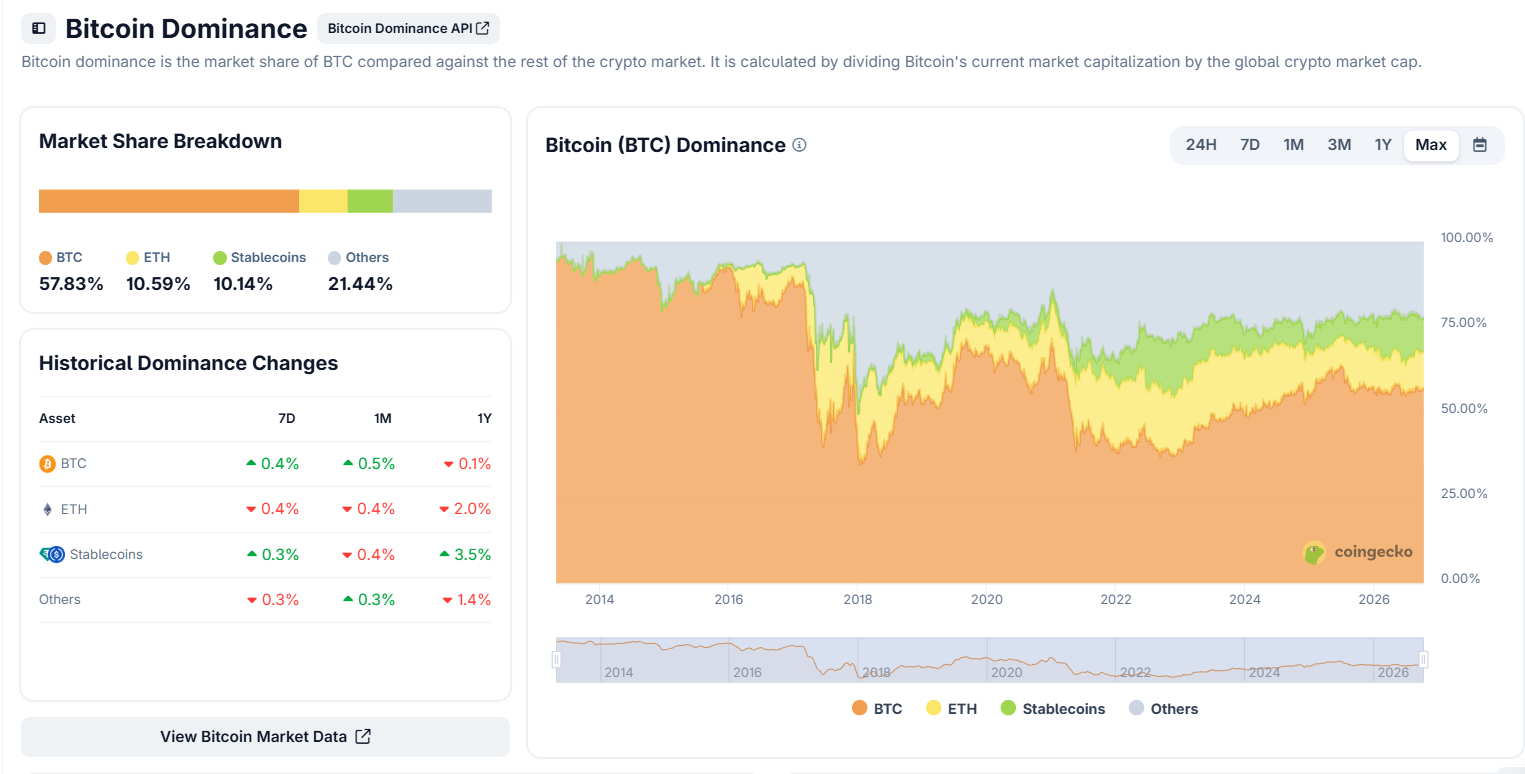
NEAR and ADA led the daily rebound among larger altcoins. Cardano rose about 7%, reclaiming $0.255, while NEAR’s advance outpaced peers. The Bitcoin price remained near $83,000 on October 10, below Monday’s $87,000 test and above Thursday’s low. This places the weekly outperformance beside a quick bounce, without confirming a lasting change in market leadership.
That matters for the Bitcoin price beside smaller tokens. Daily changes can look calm if trading is light, but weekly returns alone do not reveal activity. The same result can emerge from steady demand, limited selling, or a sharp drop followed by a rebound.
The post Bitcoin Price Holds Near $83K as NEAR and Monero Defy Selloff appeared first on Blockonomi.
TLDR:
- Strive Bitcoin funding through SATA generated an estimated $55 million during the week of Oct. 5, enough to purchase roughly 638 BTC at recent prices.
- SATA traded above its $100 par value on Oct. 5 and for much of Oct. 6, then stayed below par through Oct. 9, slowing estimated issuance.
- Strive held 29,462 BTC on Oct. 2 after buying 2,000 BTC at an average price near $84,422 between Sept. 28 and Oct. 2, while quarter-to-date BTC Yield reached 18.5%.
- Strategy sold zero STRC shares from Sept. 28 to Oct. 4, yet bought 334 BTC using MSTR common stock, lifting its holdings to 848,000 BTC.
Strive Bitcoin funding is accelerating through its SATA preferred stock program. The company generated an estimated $55 million during the week beginning October 5. That amount could purchase about 638 BTC at current prices. SATA traded $317 million in total volume during the period. However, issuance depends on shares trading at or above the $100 par value.
The preferred stock spent three sessions below that level. Most estimated proceeds came during Monday and Tuesday. Bitcoin traded near $82,800 on Friday, valuing 638 BTC at roughly $53 million. The result closely links Strive’s Bitcoin treasury strategy to Strategy’s capital markets playbook.
Strive Bitcoin Funding Depends on SATA Trading Above Par
That distinction matters because volume is not the same as corporate funding. Traders can exchange SATA below par without creating new proceeds. Strive therefore needs active demand and a supportive price. The next filing will actually determine how much cash reached its Bitcoin treasury.
Market trackers estimate that Strive sold about $55 million through its at-the-market program. The estimate uses eligible SATA volume and a capture ratio. That ratio reflects how much trading typically converts into newly issued shares. Past Securities and Exchange Commission filings help calibrate the calculation.
An ATM program lets a company issue shares gradually into public trading. It avoids the timing pressure of a large financing. Yet SATA cannot issue efficiently when its market price falls below par. Selling beneath $100 would weaken the program’s economics and dilute its yield proposition.
SATA traded above $100 on October 5 and for much of October 6. It then remained below par through October 9. Daily volume still reached some of its highest levels. The gap shows that trading activity alone does not guarantee Bitcoin purchases.
For Strive Bitcoin buyers, the distinction between volume and issuance is material. A busy tape can suggest strong demand, yet the company may receive little cash. Only eligible trading produces room for new shares. The estimate therefore remains provisional until the company files its next report.
The mechanism creates a brake. Investors must support SATA at par or higher before Strive can expand supply. When that support disappears, issuance pauses. Bitcoin buying then relies on cash already available or another financing route.
Strive Bitcoin Holdings Grow While Strategy Uses Common Stock
Strive reported 29,462 BTC on October 2. The balance followed a purchase of 2,000 BTC between September 28 and October 2. The average purchase price was about $84,422 per coin.
The company also reported adding 8,137 BTC during the third quarter. Those purchases carried an average cost of $78,885. Strive’s BTC Yield reached 18.5% quarter-to-date and 63.2% year-to-date on September 30. The metric measures Bitcoin growth per share.
The balance sheet has no debt principal. However, SATA carries about $168 million in annualized dividend obligations. Each new preferred share adds to that future payment burden. The model depends on continued investor demand for the income-oriented security.
Strategy provides the larger comparison. Its October 5 filing showed no STRC shares sold between September 28 and October 4. Strategy still bought 334 BTC from October 1 through October 4. It funded that purchase with MSTR common stock, taking its holdings to 848,000 BTC.
Both companies illustrate the same Bitcoin treasury model. Preferred or common equity raises capital for Bitcoin accumulation. The financing channel changes when market prices move. Strive’s SATA program currently shows that constraint more sharply because issuance stops below par.
The next weekly 8-K filings should provide the exact number of Bitcoin bought with SATA proceeds. They will also show whether Strive resumed issuance after the preferred stock recovered above $100.
The post Strive Bitcoin Has Enough for 638 BTC Through SATA Stock Sales appeared first on Blockonomi.
TLDR:
- Ethereum price prediction is bearish below the 50-day SMA, with $2,370 support and the 100-day average near $2,200 shaping the next levels to watch.
- U.S. spot Ethereum ETFs shed about $542 million in the week ended October 9, their largest weekly outflow since late January.
- BlackRock’s ETHA accounted for roughly $477 million in weekly withdrawals, while total U.S. Bitcoin ETF outflows reached $681 million.
- Whales reportedly added more than 166,000 ETH in 72 hours even as exchange balances rose 90,000 ETH and futures open interest declined.
Ethereum price prediction has weakened recently. Ether fell below its 50-day simple moving average. U.S. spot Ethereum ETFs logged their largest weekly outflow since January. ETH traded near $2,491 on October 10. It was down more than 7% in seven days, while trading volume fell 61% to $7.2 billion.
Yet whale data offered a counterpoint: holders added about 166,000 ETH over 72 hours, alongside Bitcoin and XRP purchases. The conflicting signals leave traders watching $2,370 support for now. A break could expose the $2,200 area, while a defense may steady the market. ETF redemptions and rising exchange balances remain risks.
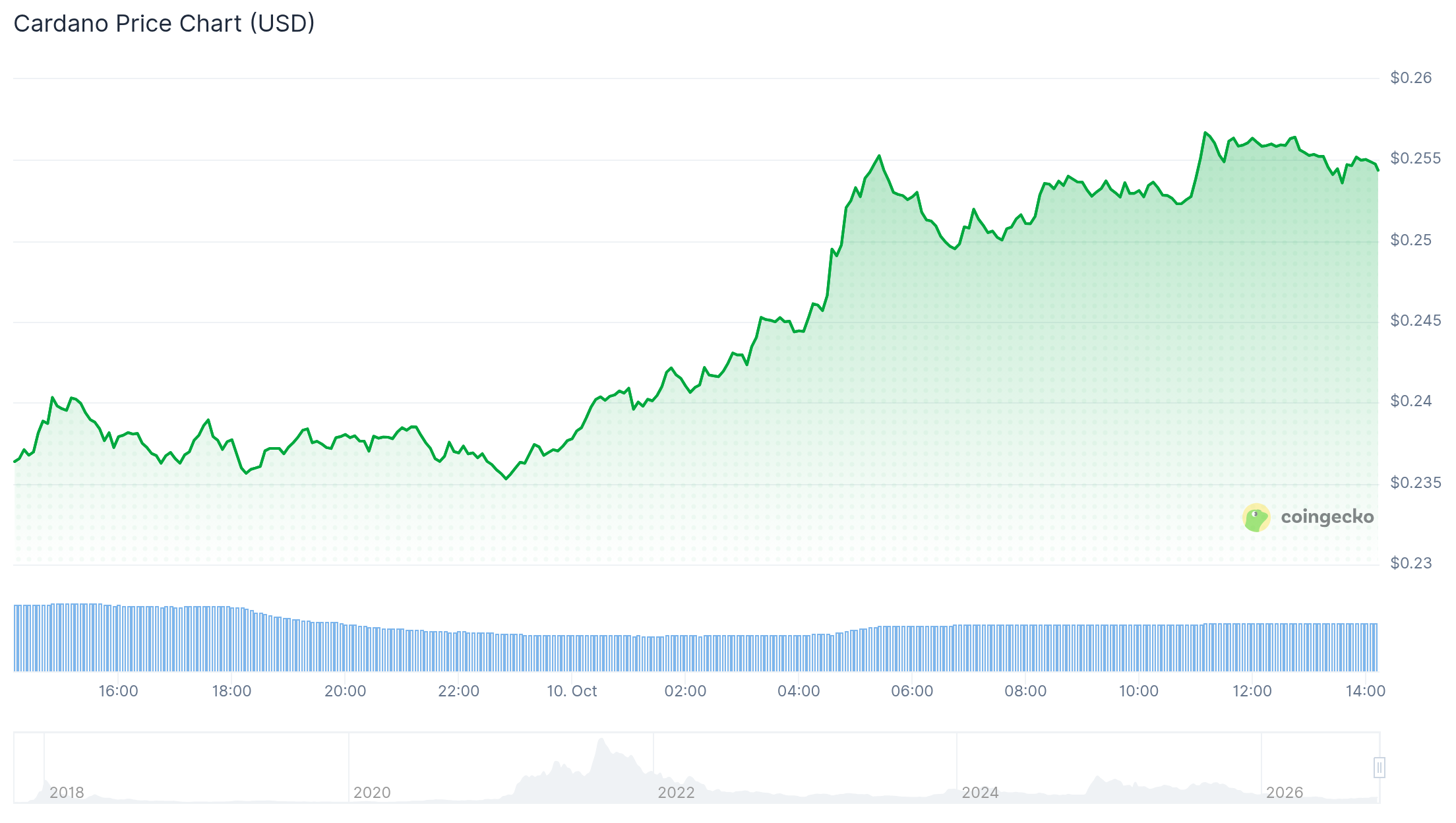
Ethereum Price Prediction Weighs ETF Outflows Against Whale Buying
U.S. spot Ethereum ETFs saw approximately $542 million in net withdrawals for the week ended October 9, SoSoValue data showed. It was their largest outflow since late January. BlackRock’s iShares Ethereum Trust, known as ETHA, accounted for about $477 million. It was the fund’s largest weekly withdrawal since December 2025. Bitcoin ETFs saw pressure, with $681 million leaving during the period.
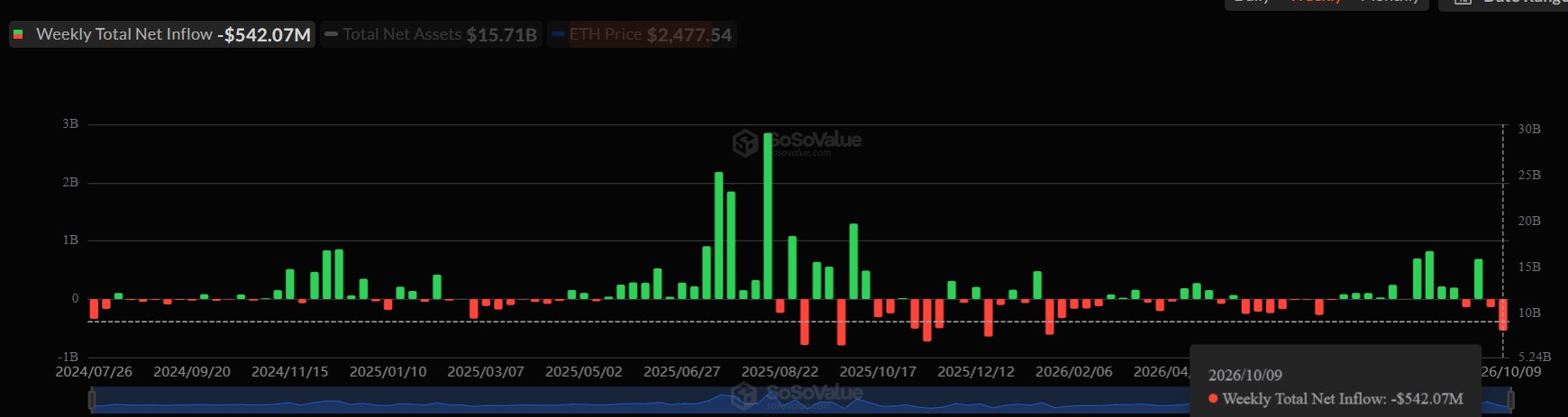
These Ethereum ETF outflows point to reduced exposure. They do not show every investor is selling ETH. However, they weaken a key source of demand during a price decline. An outflow streak could cap attempts to recover above resistance. Whale accumulation complicates that bearish picture. Analyst Ali Martinez says large wallets added roughly 15,000 BTC and more than 166,000 ETH. They also added about 45 million XRP in 72 hours.
Whale balances can rise while smaller holders or funds distribute coins. For the Ethereum price prediction, this divergence matters. Wallet demand may absorb some supply without quickly reversing ETF outflows or retail selling. Traders need follow-through in spot buying to treat the signal as durable.
ETF flows and wallet data track different activity. ETF figures capture listed-product flows; whale estimates track large on-chain balances. Those signals can diverge if ETF investors withdraw while other holders accumulate.
The Ethereum price prediction depends on whether whale buying continues beyond the 72-hour window. Continued purchases could absorb some supply, but a pause would leave ETF redemptions as the clearer demand signal.
Exchange Inflows and Futures Deleveraging Add Pressure on ETH
Exchange data adds caution. CoinGlass figures show Ethereum balances on trading platforms rising from 11.71 million ETH on October 8. They reached 11.8 million the next day. That 90,000-ETH increase marked the highest balance since September 23. Coins transferred to exchanges may be prepared for sale, but transfers alone do not prove liquidation. At the same time, open interest fell from 13.29 million to 12.77 million ETH.
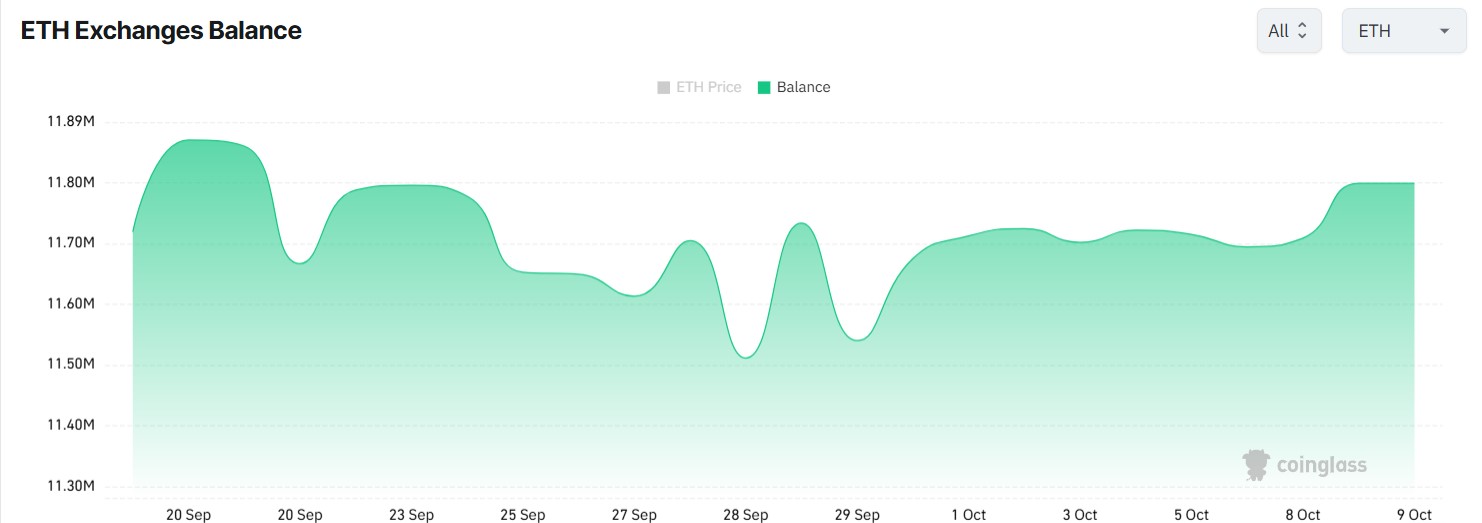
Lower futures open interest points to reduced outstanding positions and possible deleveraging. It can ease liquidation risk, but it also signals weaker appetite for leveraged longs. Combined, rising exchange balances and lower OI suggest traders are reducing exposure as spot supply increases. For the Ethereum price prediction, exchange balances now add another warning.
On the daily chart, ETH’s relative strength index slipped to 39, its lowest reading since June. Price also moved below the 50-day SMA. The $2,500 level has also turned into overhead resistance after ETH fell beneath it. The ETH price forecast hinges first on $2,370. A daily close below that support would strengthen the bearish case.
It would put the 100-day SMA near $2,200 in view. This Ethereum price prediction would need confirmation from continued selling or weak demand. If buyers defend $2,370, ETH could consolidate instead. A recovery above the 50-day average would give bulls a stronger signal. ETH had not reclaimed it by publication.
The post Ethereum ETFs Post Biggest Weekly Outflows Since January as Price Breaks Below $2,500 appeared first on Blockonomi.
TLDR:
- Cardano price rose nearly 7% on Oct. 10 and reached about $0.256 after a short-window rebound.
- ADA reclaimed the $0.2353 moving average and $0.2359 Fibonacci level, while reported volume fell 34.86%, leaving the breakout short of strong confirmation.
- Daily active addresses reached 27,500 and 27,200 on Oct. 7–8 after CIP-0113 launched, but ADA fell roughly 13% over that same period.
- Analyst Andreou’s $0.90 scenario remains conditional: ADA must hold the 0.22–0.25 base, reclaim 0.30–0.35, then clear higher resistance zones.
Cardano’s ADA token climbed 7% on Oct. 10, trading near $0.256 as buyers returned to the market. The Cardano price gain outpaced major cryptocurrencies during the session. The rebound followed an October decline, making this a recovery attempt rather than a confirmed trend reversal.
Cardano price analysis reveal ADA reclaimed its 30-day average near $0.2353 and the 50% Fibonacci level around $0.2359. But reported trading volume fell 34.86%, leaving buyers to prove they can defend the breakout. Network activity had increased earlier in the week.
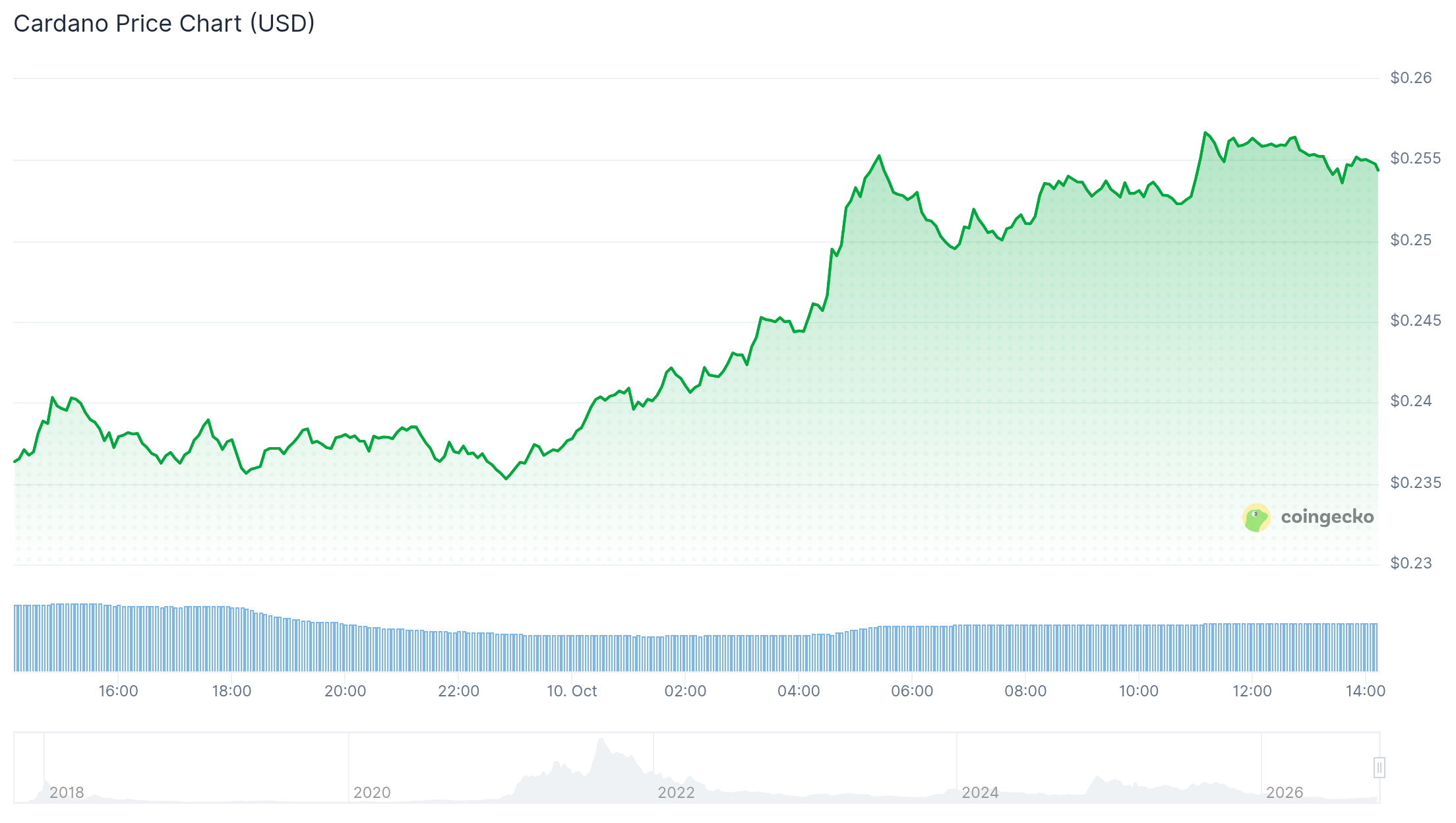
Cardano Price Rebound Tests Support as Volume Remains Thin
The reclaimed average and retracement level now form a short-term checkpoint. A drop below them would weaken the breakout case. The support band extends from $0.2359 to $0.2276.
Holding that area could leave room for a test of weekly Supertrend resistance near $0.2762. The Cardano price would need a daily close above $0.256 to show that buyers can sustain the bounce. A rejection at that level would raise the risk of a false breakout.
Volume remains a key concern. The 34.86% decline suggests the rally drew less participation than its price move implied. The figure varies by exchange and measurement window, but the direction argues for caution. The Altcoin Season Index rose 5.17% to 61, pointing to stronger relative demand for alternative tokens. That measure describes rotation; it does not prove capital will stay in ADA.
Bitcoin traded near $82,800, a level that matters for altcoins. Spot Bitcoin ETFs shed $729 million over two days, adding pressure to risk assets. Renewed selling could again put ADA support levels under strain.
The immediate test is twofold: defend reclaimed levels and attract stronger spot volume. Until both happen, the Cardano price recovery remains technically constructive but unconfirmed.
ADA Active Addresses Rose After CIP-0113, Then Price Fell
Santiment reported about 27,500 daily active Cardano addresses on Oct. 7 and 27,200 on Oct. 8, around 1.7 times September’s weekday average. The increase coincided with CIP-0113 going live on mainnet on Oct. 7. The standard enables programmable tokens with issuer-defined rules. The Cardano Foundation says issuers can add KYC checks, sanctions screening, and transfer restrictions to native tokens. Wallets and explorers can handle these assets like other Cardano tokens. The standard required no protocol hard fork.
Coincidence does not establish that the upgrade caused the address spike. Santiment’s figures also showed Bitcoin and Ethereum addresses at or below September averages. Active addresses measure participation, not intent.
They cannot show whether users bought ADA, moved tokens, staked, or used applications. The Cardano price fell about 13% from the Oct. 6 close through Oct. 8, despite the increase. That divergence shows network use did not translate into immediate buying pressure.
The Cardano price bounce came on October 10, after both the activity increase and the selloff. It should not be attributed to CIP-0113 without evidence linking buyers to the upgrade. A lasting signal would require elevated addresses to persist beyond launch.

Analyst Giannis Andreou says initial support is present at 0.22–0.25 and first resistance at 0.30–0.35. A weekly reclaim and successful retest would strengthen that recovery case. Higher zones sit at 0.40–0.45 and 0.55–0.65. The $0.90 scenario depends on clearing each barrier, so it remains conditional. A sustained break below $0.22 would weaken the setup.
The post Cardano Price Rises 7% as ADA Tests Key Resistance Near $0.28 appeared first on Blockonomi.
TLDR
- Eli Lilly stock gains 0.62% as new Phase 3b findings highlight treatment gains.
- Combined therapy changes 482 proteins versus 140 with Taltz alone by Week 36.
- Gene activity shifts span 467 genes with both drugs, versus 16 on Taltz alone.
- Taltz and Zepbound deliver improved skin clearance and weight loss at Week 36.
- Researchers report consistent safety findings, but no new approved indication.
Eli Lilly and Company stock rose 0.62% to $1,176.80 on Friday, gaining $7.20 during the trading session. The company announced new Phase 3b findings showing broader biological responses from combined Taltz and Zepbound treatment. The results expand earlier evidence of improved psoriasis symptoms and weight reduction among adults living with psoriasis and obesity.
Eli Lilly and Company, LLY
Eli Lilly Reports Stronger Phase 3b Results for Taltz and Zepbound
Eli Lilly released new exploratory findings from its TOGETHER-PsO Phase 3b clinical trial examining two existing prescription medicines. Researchers compared the combined use of Taltz and Zepbound against Taltz alone in adults with moderate-to-severe plaque psoriasis. The study also included participants with obesity or overweight alongside at least one additional weight-related medical condition.
The latest analysis identified broader changes in proteins and genes among participants receiving both medicines compared with Taltz alone. By Week 36, researchers identified changes involving 482 proteins in the combination group, compared with 140 in the other group. Similarly, gene expression changes affected 467 genes with combined treatment, against only 16 genes with Taltz alone.
These biological differences appeared as early as Week 12, according to the pharmaceutical company’s newly released findings. Researchers also identified stronger reductions in inflammatory immune activity among participants receiving both treatments over the study period. Eli Lilly presented the findings at the 2026 Fall Clinical Dermatology Conference in Las Vegas.
Combined Treatment Improves Skin Clearance and Weight Reduction
The latest findings build on earlier clinical results showing better treatment outcomes among participants receiving Taltz alongside Zepbound. At Week 36, the combination delivered superior skin clearance and meaningful weight reduction compared with Taltz alone. Furthermore, participants maintained or improved these clinical benefits through Week 52, according to Eli Lilly’s previously reported findings.
The analysis also examined neutrophils, which play an important role in the body’s inflammatory immune response. Researchers found that combined treatment produced greater changes in inflammatory pathways associated with these immune cells. Changes in certain neutrophil-related markers partly explained the additional improvement in psoriasis severity scores among combination-treatment participants.
The TOGETHER-PsO trial included 274 adults across multiple clinical research centers, with participants divided equally between two treatment groups. One group received Taltz alone, while the other received Taltz and Zepbound through injections under the skin. Both groups also received guidance on reducing calorie intake and increasing physical activity throughout the clinical study.
Eli Lilly Expands Research Into Psoriasis and Obesity
Eli Lilly designed the study to examine the relationship between metabolic health and inflammatory skin conditions. Approximately 61% of Americans with psoriasis also experience obesity or overweight alongside another weight-related medical condition, according to Lilly. The findings provide additional research into how treatments targeting different biological processes may influence both conditions.
Taltz works by blocking interleukin-17A, an immune signaling protein involved in inflammation and several related inflammatory conditions. Zepbound targets GIP and GLP-1 receptors, helping regulate appetite and support weight management in eligible adults. The two medicines therefore act through different biological pathways, providing the basis for investigating their combined clinical effects.
Eli Lilly reported that the combination’s safety findings matched the established safety profiles of the individual medicines. The exploratory results do not establish a new approved indication for using the medicines together. The company continues examining the relationship between immune and metabolic processes as researchers assess broader approaches to psoriasis management.
The post Eli Lilly and Company (LLY) Stock: Rises as Taltz and Zepbound Show Promising Results appeared first on Blockonomi.
CryptoPotato
CryptoQuant’s latest weekly report, shared with CryptoPotato, said that bitcoin miners’ revenues have jumped 78% from the July lows, profitability has improved, and the extreme miner outflows have disappeared.
After concluding that these major network participants have emerged from their toughest period of the year, CQ added that BTC’s price could further benefit due to the removal of this consistent selling pressure.
Selling Pressure From Miners Is Fading
The report highlighted no extreme miner outflow events since August 21, when roughly 29,000 left wallets associated with them as the cryptocurrency’s price rallied from under $65,000 to $76,000. The largest daily outflows were approximately 12,000 BTC, within what the analytics company considers a normal range.
Older miners are also selling substantially fewer units. Excluding Patoshi-associated BTC, Satoshi-era miners moved approximately 600 units out of their wallets in September, around 70% below January’s 2,000 BTC. At the same time, their combined holdings remain close to 590,000 bitcoins.
The trend extends to larger modern miners as addresses holding between 100 and 1,000 units saw their collective balance drop by about 20%, from roughly 64,000 BTC in December 2025 to 51,000 BTC by early September. However, the figure has since stabilized rather than continuing to decline.
Although CQ admitted that miners are not accumulating yet, the report determined that the persistent selling pressure has stopped. This is a notable change from early August, when we reported that major miners, including MARA and Riot Platforms, were continuing to move BTC to NYDIG amid difficult industry and market conditions.
Why Such a Change?
The report explained that miners are not obligated to sell right now because BTC has rallied 45% from under $58,000 at the start of July to over $83,000 this week. This lifted the total daily miner revenue from $27 million to around $48 million, which shows a 78% increase. Transaction fees also recovered from a seven-day average of $195,000 to $275,000, although they remain far below the peaks seen in 2025.
CryptoQuant’s Miner Profit/Loss Sustainability Indicator shifted from “extremely underpaid” between May and August to “fairly paid” after August 21. This means miners earning enough to cover operating costs need less to liquidate BTC just to stay afloat.
Bitcoin’s hash rate has recovered as well, going from under 900 EH/s in late July to over 960 EH/s, while its drawdown from the previous peak narrowed from 18% to 13%. CQ interprets this as mining capacity returning rather than operators capitulating.
However, the report outlined a missing piece. Miners have stopped selling, but they have not yet started rebuilding their BTC balances. CQ believes a sustained return to accumulation would provide an even stronger signal that the backbone of the Bitcoin network has shifted decisively from a source of market supply to long-term holders.
The post Bitcoin Miners Stop Selling Aggressively: Why This Could Be Big for BTC appeared first on CryptoPotato.
October has a very solid reputation in the cryptocurrency markets as “Uptober” – a green month that has historically led to major gains.
Last year’s edition was quite historic. On the one hand, BTC skyrocketed to its latest all-time high of roughly $126,000. On the other hand, though, it experienced its worst liquidation event ever. This weekend marks the first anniversary of the latter.
A Date to Remember
In the days leading up to October 10, more on that date in a second, BTC was climbing hard, earning the name Uptober. The latest record came on October 7 at just over $126,000. Analysts and permabulls were quick to praise the move and highlight the next massive targets of $200,000 or even $500,000 by the end of the year.
The reality was different. Very different. And a lot more painful. On October 10, 2025, escalating US-China trade tensions, among other reasons, triggered a violent sell-off that was exacerbated by the enormous amount of leveraged positions. According to most estimates, the total value of wrecked positions exceeded $19 billion within 24 hours. This was the worst such day in the entire 16-year history of the cryptocurrency industry at the time.
Bitcoin led the charge with a nosedive from $122,000 to $105,000 on most exchanges and even to $101,000 on a few. Over 1.6 million traders were caught by surprise and were liquidated.
The timing made the collapse particularly brutal: BTC had reached a fresh (and its latest) all-time high above $126,000 just 48-72 hours earlier. Today, a year later, that level sounds like a mirage.
Yet to Recover in a Different Market
That crash was the start of a prolonged bear market that culminated, at least for now, with a price slump to under $58,000 on July 1. In other words, bitcoin tumbled by 53% in months after its worst liquidation event to date. It now sits at around $82,000-$83,000, which is still around 34% lower than the 2025 peak.
Although the situation appears significantly better now than it did in July, there are still some warning signs, such as the correction experienced in the past week, in which BTC dipped from $87,000 to $80,400 before it rebounded to the current levels. On the plus side, at least five indicators tracked by BIT recently moved into territory associated with bullish market regimes.
But the October 10, 2025 event is one that has to be remembered. Hopefully, it could serve as a lesson to certain traders who tend to go all-in once the market is doing well and vice versa. I wish I could say that this is precisely the case, and people have learned their lesson. However, last week’s pullback in which over $1 billion in leveraged positions was wiped out in less than a day says otherwise.
The post 1 Year Since Crypto’s Biggest Liquidation Event: Bitcoin Hasn’t Fully Recovered Yet appeared first on CryptoPotato.
Despite the major leg down at the end of the business week, on-chain data showed that the daily active addresses on the Cardano network surged to roughly 1.7 times September’s weekday average following the launch of a new token standard.
At the same time, Cardano reached a substantial milestone in its bid for a .ada internet domain.
On-Chain Activity Pumps
Data from Santiment Intelligence shows that Cardano recorded approximately 27,500 daily active addresses on October 7 and almost as many a day later, which is significantly higher than the average weekday level seen in September. The analysts tested whether the broader market decline could explain the increase but found that active addresses on Bitcoin and Ethereum remained at or below their respective September norms during the same period.
The timing coincided with the October 7 launch of CIP-0113, Cardano’s new programmable token standard. The Cardano Foundation explained that the standard lets issuers of regulated assets such as stablecoins and tokenized funds build requirements, including KYC, sanctions checks, and transfer restrictions, directly into native Cardano tokens.
It went live following multiple independent security audits and has been recognized by the Capital Markets and Technology Association (CMTA), CF said.
Despite this uptick in activity, Santiment warned that it remains below Cardano’s late-August local high. It remains to be seen now whether this increase survives beyond the initial launch period, especially as ADA’s price rally has cooled. The asset recently soared to a multi-month peak of $0.28, where it was rejected, and the subsequent leg down drove it below $0.24 on Friday. However, it’s up by over 7% in the past 24 hours again.
New Cardano Milestone
The activity spike coincided with another potentially important development for the broader Cardano ecosystem. CF revealed at TOKEN2049 earlier this week that its application for the .ada generic top-level domain has advanced to the next phase of ICANN’s New gTLD Program. The proposal previously received approximately 75% support from the Cardano community through an on-chain Governance Action.
If approved, .ada would operate as a genuine internet top-level domain, similar to extensions such as .com or .org. CF believes it could eventually support simplified wallet addresses, decentralized identity integrations, and domain tokenization. However, ICANN still needs to assess the application’s technical, financial, and operational readiness, with successful domains from the current round expected to be delegated between 2028 and 2030.
The post Cardano Just Delivered Two Bullish Signals at TOKEN2049 as ADA Rebounds appeared first on CryptoPotato.
Bitcoin’s price recovery from the Thursday collapse continues as the asset currently sits close to $83,000 after marking a multi-week low at under $80,500.
Most larger-cap alts have remained sluggish on a daily basis, with ETH struggling below $2,500 and XRP barely defending the $1.40 support. ADA and NEAR, though, have posted notable gains.
BTC Eyes $83K
The business week began on the right foot for the primary cryptocurrency, which surged by a few grand on Monday morning to touch $87,000 for the first time since the previous Friday. However, just as it happened at the end of the previous week, BTC was stopped and quickly dipped to $85,000.
The bulls initiated another leg up that resulted in challenging the same resistance, but the bears intervened even faster this time and brought a whole army. Instead of another bounce, bitcoin slumped hard to under $84,000 on Tuesday. It couldn’t really recover on Wednesday, and the bulls lost complete control of the market on Thursday.
At the time, BTC crashed by several grand and dipped to a multi-week low of $80,400. It finally rebounded after this near-$7,000 decline in just days and jumped to $83,400 yesterday. However, it was stopped there and now trades inches below $83,000.
Its market capitalization has pulled back to $1.660 trillion on CMC, but its dominance over the alts has skyrocketed to 59.5%.

ADA, NEAR Pump
Ethereum slipped to $2,400 during the market-wide crash and has recovered slightly to almost $2,500 as of now, but it’s still far away from its local top at $2,800. XRP dipped to $1.34 before it rebounded to $1.41 as of now. BNB is back at $750 after a slight daily increase, similar to DOGE and LINK.
In contrast, SOL, TRX, and HYPE are slightly in the red. Cardano’s ADA has rebounded by 7% and has reclaimed the $0.255 level. NEAR Protocol’s native token has risen the most among the larger-cap alts, rocketing by over 10% to $5.25. DOT, WLD, BTW, and WLF have also charted notable gains.
The total crypto market cap shed $200 billion from top to bottom but has rebounded slightly to $2.8 trillion on CMC now.

The post NEAR Rockets by 10% Daily, BTC Price Eyes $83K: Weekend Watch appeared first on CryptoPotato.
Toobit is an award-winning international cryptocurrency exchange that recently announced that it has been named the Best Exchange for Trading Tokenized Equities at the CoinGape Global Onchain Awards 2026.
Toobit, among other nominees, was evaluated on tokenized equity listings, trading volume, and institutional trading capabilities. Winners were determined through quantitative research, expert jury review, and community participation. The Global Onchan Awards is intended to recognize institutions and innovators that advance the convergence of traditional and onchain finance across tokenization, digital assets, infrastructure, and compliance.

A Foray Into Traditional Finance
Recall that the exchange introduced Stock Futures in February 2026 with 10 major US equities, including Apple (APPL), Tesla (TSLA), and Nvidia (NVDA), available as USDT-settled perpetual contracts.
This move has since been expanded as part of the exchange’s overall TradFi lineup. It now covers over 240 pairs across equities, forex, precious metals, and indices.
Traders are able to access these markets using their existing Toobit account and USDT balance, which makes it very convenient, especially for those who also want to open long and short positions, participate in round-the-clock trading, and rely on up to 500x leverage on selected pairs.
Not the First Award for Toobit
Now, it’s important to note that this is far from being the first award that the exchange has received. In fact, it marks the fifth one in 2026.
Earlier this year, Toobit was named Best New Exchange at the Crypto Awards 2025, Digital Asset Derivatives Platform of the Year at the Hedgeweek Global Digital Assets Awards 2026, Best Crypto Exchange for Day Trading at the CoinGape Web3 Innovation Awards 2026, and Global Exchange of the Year at the FinanceFeeds Awards 2026.
The award also comes as tokenized equities continue to gain traction through the year. The onchain market cap of tokenized equities soared to almost $5 billion in early September, while the active market capitalization is up more than 300% since the start of the year.
Monthly trading volume is soaring, reaching almost $8 billion as opposed to just $240 million in January.
The post Toobit Wins Best Exchange for Trading Tokenized Equities Award appeared first on CryptoPotato.