Cryptocurrency Posts
Crypto Briefing
The convergence of crypto and traditional finance could drive institutional demand, impacting market dynamics and Ethereum's future prospects.
The post OKX founder Star Xu sees crypto and traditional finance convergence appeared first on Crypto Briefing.
The bill's potential to expedite energy projects may reshape U.S. energy policy, but it risks deepening divides over environmental safeguards.
The post US energy permitting bill unites fossil fuels, renewables; divides environmentalists appeared first on Crypto Briefing.
The investigation underscores the risks of influencer-driven crypto markets, highlighting the need for transparency and caution among retail traders.
The post Bubblemaps estimates Ethan made $125K from 49 token callouts appeared first on Crypto Briefing.
Increased USDC supply on Solana may enhance network activity and adoption, but market caution persists regarding significant price gains.
The post Circle mints 250M USDC on Solana, boosting liquidity and network potential appeared first on Crypto Briefing.
The drone attack highlights the vulnerability of digital infrastructure to physical threats, potentially impacting investor confidence and tech operations.
The post Drone attack disrupts data centre in eastern Moscow, Russia says appeared first on Crypto Briefing.
Bitcoin Magazine
Bitcoin Magazine
Bitcoin Life Insurer Meanwhile Raises $37.5M as Wealthy Families Look to Pass On Their BTC
Meanwhile, the first life insurer licensed to operate entirely in Bitcoin, has raised $37.5 million in new funding from its existing investors, the company announced.
Bain Capital Crypto led the round, with participation from Haun Ventures, Framework Ventures, Pantera Capital, Apollo, Northwestern Mutual Future Ventures and Morgan Creek Digital. The raise brings Meanwhile’s total funding to more than $180 million. Sam Altman is also among its backers.
The company said the round follows a surge in demand for its Bitcoin life insurance policies outside the US, particularly in Asia, Europe and the Middle East, amid broader macroeconomic instability.
“Wealthy families around the world already hold Bitcoin. What they haven’t had is a regulated way to pass it on,” Zac Townsend, Meanwhile’s co-founder and CEO, said in a statement.
“Brokers came to us because their clients kept asking. This round lets us keep up with them.”
In early 2026, Meanwhile launched BTC Life 1-Pay, a single-premium whole life policy aimed at high-net-worth clients outside the US. It is the company’s second product line, after BTC 10-Pay, which is designed for US taxpayers.
Under BTC Life 1-Pay, a client pays one premium in Bitcoin and receives a guaranteed death benefit in Bitcoin for life. The policy’s value grows in Bitcoin, and after the first year the owner can borrow up to 90% of it, with no repayment schedule and no margin calls.
Policies can be owned by individuals, trusts or companies, which the company says makes them suited to succession and estate planning.
Since launch, Meanwhile has signed 15 brokers serving wealthy families, including in Singapore, Hong Kong, the UAE and Switzerland. Partners include Lioner, an insurance, trust and family office group with offices in Hong Kong, Singapore and Zurich, and Apeiron Group, a marketplace for high-net-worth life insurance.
“We’re reaching a turning point where more high-net-worth clients are asking not just how to hold Bitcoin and digital assets, but how to plan around them and ultimately transfer that wealth to the next generation,” said Justin Man, CEO of Apeiron Group. Digital assets.
Meanwhile said its net long-term underwriting income has already passed last year’s total and is on track to more than double in 2026. The company did not disclose specific figures.
“Meanwhile owns every layer of a regulated life insurer and builds it like an AI-enabled startup,” said Stefan Cohen, partner at Bain Capital Crypto. “The growth this year proves the model, and we’re glad to back them again.”
The company’s operating entity, Meanwhile Insurance Bitcoin (Bermuda) Limited, holds the first Class IILT license granted by the Bermuda Monetary Authority. It received the license in July 2024 after two years in the regulator’s sandbox.
The insurer’s balance sheet, reserves and audited financial statements are all denominated in Bitcoin. Policyholder Bitcoin is held with regulated institutional custodians.
This post Bitcoin Life Insurer Meanwhile Raises $37.5M as Wealthy Families Look to Pass On Their BTC first appeared on Bitcoin Magazine and is written by Mathew Di Salvo.
Bitcoin Magazine

‘We Know Where It Is’: Treasury Secretary Threatens To Freeze $1B of Iran’s Crypto
U.S. Treasury Secretary Scott Bessent has said the American authorities will soon seize $1 billion in crypto from Iran.
Speaking on Newsmax’s NPolicy Summit in Washington, D.C. on Thursday, Bessent added that economic sanctions on the Middle Eastern country were working.
Iran has been using bitcoin — and other cryptocurrencies — to skirt around U.S. sanctions. The U.S. in April started targeting crypto wallets linked to the Iranian regime, Bessent said at the time.
“What we have done has never been seen before,” Bessent said Thursday on Iranian sanctions.
“We’re probably going to seize $1 billion of crypto this week,” he continued. “We know where it is. We are isolating them. We did have a maximum pressure campaign, now we have an absolute isolation campaign and it’s working.”
Bessent didn’t reveal what cryptocurrencies the U.S. will seize or how.
It would be very hard — if not impossible — for the U.S. to freeze Iran’s bitcoin unless it keeps it on a centralized exchange.
Bitcoin, being censorship resistant, cannot be frozen. But many other cryptocurrencies, including Tether’s USDT, can. Bessent previously said the feds had seized Iran’s crypto in the form of the popular stablecoin.
Iran started a bitcoin-backed insurance service for its counties shipping companies earlier this year.
The Financial Times last month reported that the Middle Eastern country was using bitcoin to settle cross-border transactions through Iranian crypto exchanges after the central bank advised its countrymen to do anything necessary to help the economy.
U.S. President Donald Trump revived his “maximum pressure” campaign weeks after returning to office. A national security memorandum signed in February 2025 put the Treasury on a sustained campaign against Iran’s shadow banking, money laundering and sanctions-evasion networks.
This post ‘We Know Where It Is’: Treasury Secretary Threatens To Freeze $1B of Iran’s Crypto first appeared on Bitcoin Magazine and is written by Mathew Di Salvo.
Bitcoin Magazine

Here’s How Not To Screw up Your Bitcoin Privacy
Just one transaction can compromise years of discreet Bitcoin activity, Cake Wallet’s chief operating officer has warned.
Speaking on the Bitcoin Rails podcast this week, activist Seth for Privacy talked about different ways of protecting one’s privacy when using Bitcoin and said that focusing on privacy was a must for the West.
Bitcoin privacy is a hot topic again ever since the developers of private coin mixer Samourai Wallet went on trial last year and were subsequently imprisoned.
But just this week, the U.S. Department of Treasury scrapped two long-stalled crypto surveillance proposals, handing a major win to privacy advocates and the digital asset industry.
“If you ever spend your no-KYC coins with one of your KYC coins — which if you just let the wallet do its thing, it could do because it doesn’t know the difference — you immediately connect all of the non-KYC Bitcoin that you spend in that with your identity,” Seth said, referring to UTXO management, also called “coin control” by some wallets.
Bitcoin wallets don’t hold a single balance but a collection of separate unspent transaction outputs — UTXOs — each one a discrete “coin” from a specific past transaction.
When you send a payment larger than any one UTXO, the wallet picks several and combines them as inputs to the same transaction — an easy mistake to make, Seth highlighted.
Seth added that unlike in the global South, where people have experienced more oppressive states, citizens in the West will need to “feel pain” in order to realize how important privacy is.
Still, he added that attitudes were changing and people were getting more serious about protecting their privacy.
“It has been shifting, in the last five or six years a lot of people — even in the West — are starting to think [privacy] really matters, we really need to think about this seriously now,” he said.
Cake Wallet is a privacy-oriented, self-custody, open-source wallet. The wallet earlier this year integrated Bitcoin’s Lightning Network into its platform.
Using the second layer solution is not only faster and cheaper, it also offers more privacy than Bitcoin’s main chain.
While Cake Wallet supports other cryptocurrencies, including privacy coin Monero, Seth for Privacy added that he’d love it if the digital coin didn’t exist.
“If Bitcoin’s privacy got good enough that you could use it and have at least almost as good privacy as Monero without massive hoops to jump through, and Monero ceased to exist, that’s fine,” he said.
“I would much rather the thing that more people use has better privacy than a more niche tool that has perfect privacy, and that’s something that less people are using because it’s less well known.”
This post Here’s How Not To Screw up Your Bitcoin Privacy first appeared on Bitcoin Magazine and is written by Mathew Di Salvo.
Bitcoin Magazine

Bitcoin ETFs Shed $729M in Two Days as Investors Reverse Course
U.S. investors this week reversed course, cashing out $729 million from spot bitcoin exchange-traded funds — putting downward pressure on the leading cryptocurrency’s price.
Funds managed by BlackRock, Fidelity, Morgan Stanley, and ARK 21-Shares all experienced significant outflows on Wednesday and Thursday, according to data from Farside Investors.
Investors had started the week by selling close to $90 million in shares but then bought nearly $119 million on Tuesday.
The rest of the week has seen outflows following news that the Federal Reserve may raise interest rates. Other negative news includes the price of Brent crude jumping following renewed attacks on tankers in the Strait of Hormuz.
U.S. President Trump also hinted that talks with Iran weren’t bearing fruit — a sign war in the Middle East could continue.
Bitcoin’s price recently stood at a little over $82,688, down more than 3% over a seven-day period. The leading cryptocurrency has rebounded slightly over the past day, jumping nearly 2% over 24 hours.
Still, the coin was fast closing in on $90,000 last week. Investors are expecting decent returns as the month dubbed “Uptober” has historically delivered for bitcoin speculators.
The price of bitcoin has been particularly sensitive to geopolitical headwinds this year — especially since the U.S. and Israel attacked Iran, leading to an oil price surge.
Oil prices going up tend to lead investors to bet on the Federal Reserve raising interest rates. And with higher interest rates comes less liquidity for the price of bitcoin to do well.
Still, that’s not always the case: the Fed last month talked tough on getting inflation down and raised interest rates by a quarter of a percentage point and bitcoin’s price rose in the following days.
Bitcoin’s price is 34% below the all-time high of $126,080 it touched in October. It has spent most of 2026 in a bear market but analysts are now increasingly pointing to evidence of a bull market following a rally in August and September.
This post Bitcoin ETFs Shed $729M in Two Days as Investors Reverse Course first appeared on Bitcoin Magazine and is written by Mathew Di Salvo.
Bitcoin Magazine

Ledger Warns Buyers Not to Set Up Wallets From Reseller After Users Report Losses
Hardware wallet manufacturer Ledger has said that it is investigating loss of user funds after customers in South East Asia reported issues with devices bought from a reseller.
The Paris-based company on Friday advised customers who’d bought from vendor CryptoBilis within the last 90 days to not set up their devices.
Ledger did not reveal how much money users had lost but one blockchain investigator, Specter, wrote on X that he’d traced theft addresses following social media posts and that over $86 million had been lost.
The issue comes following a number of data breaches this year in the crypto world and a huge hack of popular Coldcard hardware wallet devices in July.
“Ledger is investigating reports of loss of funds from users in South East Asia who purchased products from a reseller named CryptoBilis,” Ledger said via its support X account.
Ledger added that it had asked CryptoBilis to pause all sales and shipments of Ledger devices.
“If you have set up your Ledger device, consider moving assets to a new Ledger signer (with new seed). We will continue to inform customers of updates as the investigation progresses,” the company said.
In a statement to Bitcoin Magazine, Ledger said that based on the information to date, the incident is isolated specifically to this reseller in this specific market.
“No reports were made of products purchased directly from Ledger, and Ledger’s infrastructure, systems and services were not compromised,” the company added.
CryptoBilis is a Kuala Lumpur, Malaysia-based hardware wallet vendor, according to its website. The company did not immediately respond to questions from Bitcoin Magazine.
The crypto industry is still reeling after hackers in July were able to steal close to $120 million in bitcoin from Coldcard users.
The products, made by Canadian company Coinkite, had a firmware bug which led to faulty seed generation, allowing hackers to essentially guess investor seedphrases.
Galaxy Research said in the months following the attack various attackers were able to exploit the bug independently.
In a separate incident, hardware wallet manufacturer Trezor last month reported that close to 81,000 customers had their details leaked after its third-party fulfillment partner had data stolen.
Criminals have been targeting data this year, with scammers getting hold of customer information via crypto wallet Ledger’s payment processor Global-e to send phishing emails.
This post Ledger Warns Buyers Not to Set Up Wallets From Reseller After Users Report Losses first appeared on Bitcoin Magazine and is written by Mathew Di Salvo.
CryptoSlate
Metaplanet sold 10,000 BTC and bought back 11,000 at a higher average price to show it was willing to sell its Bitcoin.
The Japanese treasury company was pursuing a credit rating and better access to financing, and its Oct. 5 disclosure explained why turning coins into cash was part of that effort. Prospective creditors needed confidence that management could use its holdings to meet obligations, even if shareholders bought into the company because of those holdings.
Proving the point was expensive, with Metaplanet receiving ¥124.7 billion from the sale and spending ¥149.9 billion on the subsequent purchase, paying roughly 9.3% more per coin.
Applying that average purchase price to the 10,000 coins replaced produces a price difference of about ¥11.57 billion, before transaction costs and potential tax effects. That gives shareholders an expensive receipt for the demonstration.
The company didn't use the proceeds to repay borrowings or bonds, and it ended September with 44,000 BTC. Selling was part of an effort to improve the financing behind continued accumulation.
That brings us to the strange relationship underlying the corporate Bitcoin trade. Shareholders are usually happy to wait years for a higher price, but lenders have contracts that specify when they want their money back. The same reserve has to satisfy both groups.
Lenders would like their money back in dollars
A company that owns an asset as liquid as Bitcoin isn't quite the same as a company having cash available to pay a bill. Coins may be pledged against borrowing, or management may be unwilling to sell at the available price.
Either way, creditors need to know what happens when the payment date and the preferred selling price don't cooperate.
Metaplanet's June financial statement reported ¥67.49 billion in short-term borrowings and ¥8 billion in bonds payable within a year, against ¥1.09 billion in cash and deposits and ¥250 million in USDC.
The numbers exclude the company's much larger Bitcoin reserve and the financing it could access, so the gap explains why lenders want more than a coin count when assessing repayment.
The contracts give dates to that discussion, although the numbers below come from different reporting periods and shouldn't be read as a like-for-like comparison of current liquidity.
| Financing detail | Metaplanet | Strategy |
|---|---|---|
| Disclosed Bitcoin holdings | 44,000 BTC at Sept. 30 | 848,000 BTC at Oct. 4 |
| Cash information | June 30: ¥1.09 billion in cash and deposits, plus ¥250 million in USDC; a comparable September balance isn't established here | Oct. 4: $4.88 billion dedicated reserve, plus $833.4 million in separate USD cash |
| Identified 2027 repayment provision | ¥8 billion zero-coupon bond issued with an April 23, 2027 redemption date and an early-redemption right | Holders of $1.01 billion in notes can request cash repurchase on Sept. 15, 2027 |
| Qualification | Full ¥8 billion was reported in June; the balance still outstanding needs confirmation | Principal is based on June balances; payment depends on exercise of the holder right and intervening financing activity |
Sources: Metaplanet's bond terms, June accounts, and October disclosure; Strategy's June filing and October update.
Strategy's notes technically mature in September 2028, but the holder's right to demand repayment brings a potential cash obligation forward by a year.
Its June filing also lists roughly $4.9 billion of notes with similar holder repurchase rights during 2028, taking the principal associated with those 2027 and 2028 dates to about $5.91 billion.
Holders must exercise their rights, and conversions or repurchases could reduce those amounts before then, meaning the company has clear points when access to cash is more important than confidence in Bitcoin's eventual price.
This is why corporate Bitcoin has financing deadlines even though Bitcoin itself doesn't expire. Management can borrow again, issue securities, or use cash to meet obligations, but those options have their own costs, and they aren't equally attractive in every market.
Keeping Bitcoin takes money that isn't Bitcoin
Strategy has built a sizable dollar cushion, giving it more room. Its Oct. 5 filing reported a $4.88 billion dedicated reserve and another $833.4 million in separate dollar-denominated cash, totaling approximately $5.71 billion as of Oct. 4.
The dedicated reserve supports preferred-stock dividends and debt interest, and its policy requires board authorization for other uses. The separate cash balance provides a lot of flexibility, so adding the two together doesn't make the entire sum an unrestricted pot for future debt repayments.
The same filing shows how much work now goes into managing the coins' financing. Between Sept. 28 and Oct. 4, Strategy used $142.5 million from its reserve for dividends and interest, spent $154.1 million on repurchasing preferred shares, and bought $13 million of Bitcoin.
Strategy still held 848,000 BTC, bought for about $63.97 billion, so Bitcoin dominates the balance sheet. But the cash gives management breathing room when payments come due, helping it avoid selling coins simply because the market has chosen an inconvenient week to fall.
Its earlier Bitcoin sales and reserve-building already showed that supporting the securities financing the reserve could take precedence over buying more coins. Keeping some money in dollars can help the company retain Bitcoin through a downturn.
There's also a shareholder version of the same problem. When a treasury company's shares trade above the value of the assets behind them, issuing shares can bring in enough money to increase Bitcoin exposure per existing share.
When that premium disappears, the company must give away more ownership to raise the same amount, making the deal less attractive to existing investors.
Metaplanet's June results said its market-value-to-net-asset-value measure (mNAV) was below 1.0 for much of the period. Its policy generally avoids discretionary common-share issuance below that threshold, so the restriction prevented some fundraising, leaving financing below earlier expectations.
The company continued buying through other funding sources, but the experience demonstrates how dilution can complicate accumulation well before anyone faces a forced sale. The reserve can get bigger while an existing shareholder's economic interest becomes less attractive.
Selling some Bitcoin can be the better option when the alternative is issuing shares cheaply. Preferred shares are one way to do that, but they give investors claims ahead of common shareholders, with the exact payment rights depending on the terms.
Missing a preferred dividend isn't automatically a bond default, although disappointing those investors can make the next fundraising harder.
The decision is about how much Bitcoin shareholders can afford to keep exposed once everyone financing the company has been accounted for, a less photogenic number than total BTC holdings.
One Bitcoin company starts financing another
Metaplanet is also trying to generate income beyond holding coins, because Bitcoin by itself doesn't produce the dollars or yen needed to service financing. Its revised allocation policy targets roughly 85% to 90% of assets in Bitcoin and 10% to 15% in strategic investments, including income-producing securities.
Its Net Interest Income Strategy seeks to earn more from those investments than it pays to finance them. Possible investments include preferred securities issued by other Bitcoin treasury companies, meaning one company's plan to support its Bitcoin reserve could include collecting payments from another company facing a similar challenge.
That could provide recurring cash for financing costs or further purchases, but it also creates the possibility of exposure to the same weakness twice. Falling Bitcoin prices could reduce Metaplanet's core asset value, while securities issued by other treasury companies could lose value or become less dependable income sources.
The policy acknowledges potential correlation, and the actual risk depends on what the company buys and how it finances those investments. It shows how far the business can travel from the simple proposition of buying shares in a company that owns Bitcoin.
Across the rest of the market, these financing arrangements make corporate purchases less permanent than the accumulation announcements can make them feel. Companies can keep believing in Bitcoin while slowing purchases, building cash, or selling coins because the terms available to their shareholders have deteriorated.
Voluntary sales and forced liquidations are different events, and neither company's disclosures establish an imminent liquidation. The more immediate consequence can be a buyer spending its next dollar on financing obligations.
Metaplanet's round trip still has to earn its keep through better credit access or borrowing terms, since the disclosure doesn't prove a rating agency ordered the sale or that cheaper financing has been secured.
Strategy's cash cushion buys flexibility, but how much depends on the obligations it needs to cover and the capital it can raise later.
Both cases make the same point about holding Bitcoin through a corporate balance sheet: keeping the coins requires decisions about the money around them.
Management willing to sell some Bitcoin on sensible terms may do more for shareholders than management defending a never-sell promise by borrowing expensively or handing away too much ownership to keep it.
The post Bitcoin companies are learning that holding forever takes cash appeared first on CryptoSlate.
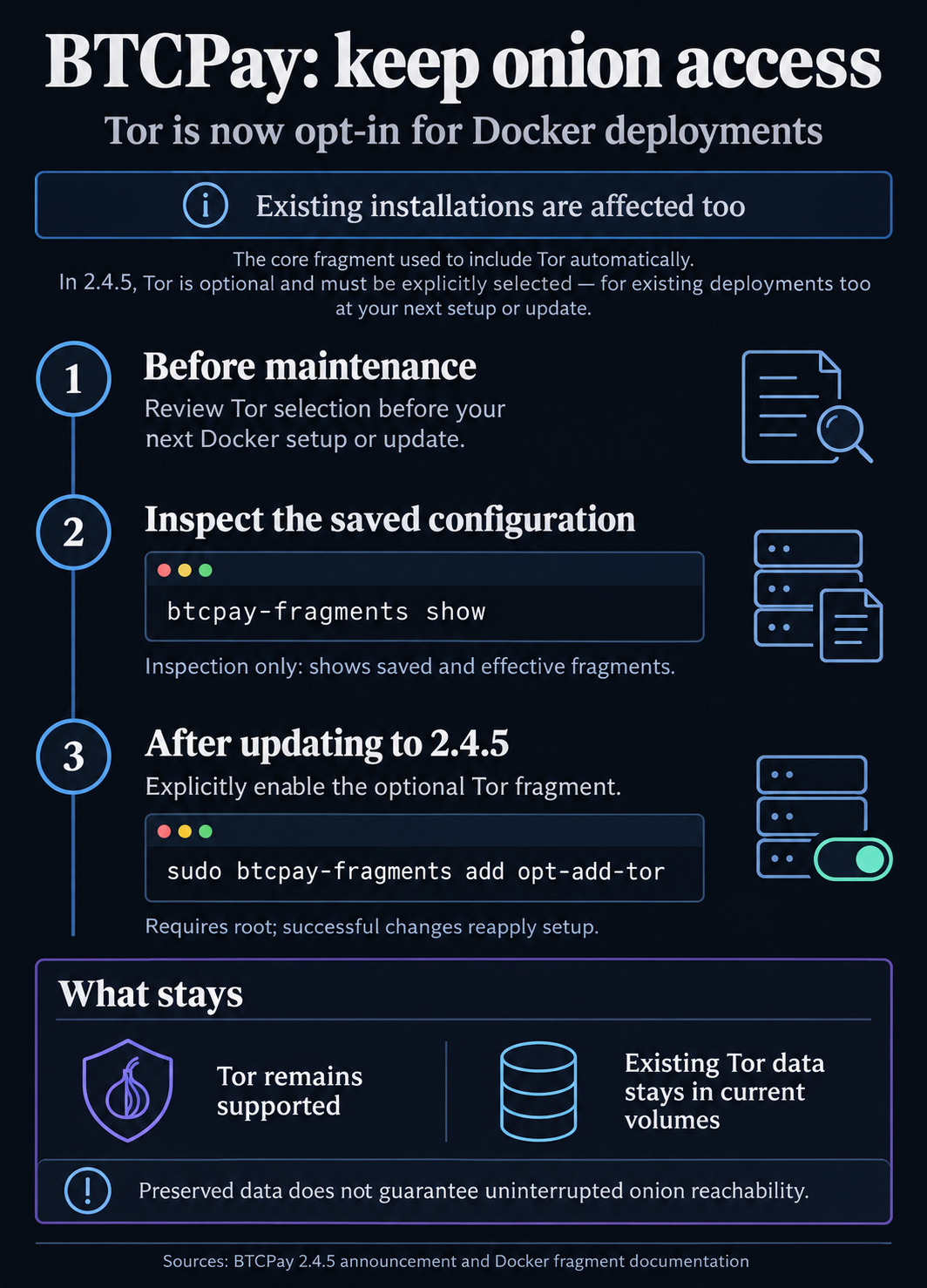
Operators running the Bitcoin payment software BTCPay Server through its standard Docker deployment must explicitly select Tor at their next setup or update if they want to retain onion access. The change removes Tor from the automatically included components, making a previously bundled service an administrator’s configuration choice.
BTCPay detailed the deployment change in its Oct. 5 announcement accompanying version 2.4.5. The official GitHub release page records the software release on Oct. 6. For existing installations, the relevant trigger is their next Docker setup or update.
The change matters to Docker operators who rely on Tor, including access through their server’s onion address, but previously received it through the core BTCPay Server fragment. Fragments are the configuration components used to assemble the Docker stack.
BTCPay advises administrators to review the deployment changes before updating. After updating to 2.4.5, its instruction for enabling Tor is:
sudo btcpay-fragments add opt-add-tor
Tor remains supported, and BTCPay says existing data stays in the current Tor volumes. That preserves stored data; continued onion access still depends on including and running Tor in the deployment.
BTCPay Server documentation describes the optional Tor fragment opt-add-tor as adding hidden services and selected onion connectivity. Operators can inspect configuration using btcpay-fragments show, which does not change configuration and reports saved additional and excluded fragments alongside the effective fragments from the last generated manifest.
Fragment-changing commands require root and reapply setup immediately.
Private services need separate exceptions
The 2.4.5 release notes also identify a breaking change for outbound HTTP requests: private-network destinations are blocked by default for Lightning connections, LNURL requests, invoice notification URLs and webhooks. The restriction is intended to prevent server-side request forgery, or SSRF.
With that protection enabled, operators intentionally using private services must allow the needed destinations through ssrfexceptions.
BTCPay’s operator guide says to restart the application and exercise the affected integration after changing the setting.
The post BTCPay Docker users must opt into Tor at their next update to keep onion access appeared first on CryptoSlate.
Coinbase reported Oct. 7 that newer versions of three major AI model families caught fewer fraudulent payments and a smaller share of fraud value in a historical test of payment screening for its Onramp service, despite an unchanged decision policy. The findings challenge the assumption that upgrading a model improves an existing payment screener.
The company’s evaluation replayed 16,140 transactions across 7,293 users, including 813 confirmed fraudulent transactions. The cohort covered nine weeks before its risk agent rolled out, retaining all matured fraud cases while sampling legitimate traffic.
Each candidate reviewed recent transaction behavior under fixed guidance and the same policy for turning risk classifications into decisions. This isolated the decision model’s behavior within that setup, rather than comparing redesigned screening systems.
Results from a fixed historical replay
Coinbase compared Opus 4.5 with Opus 5, Sonnet 4.6 with Sonnet 5, and GPT-5.4 with GPT-5.6 (sol). Every newer version had lower recall, a lower combined precision-and-recall score called F1, and lower dollar-weighted recall. Recall measures the share of fraud cases a model catches; dollar-weighted recall measures how much of the total fraud value it catches.
Sonnet’s recall fell 22.2 percentage points and its dollar-weighted recall dropped 22.9 points. Opus’s recall declined 0.8 points. Both newer models also had lower precision, meaning a smaller share of transactions they classified as fraud were actually fraudulent.
GPT showed why one improving score can be misleading. Its precision rose 11.5 percentage points, but recall fell 20.7 points and dollar-weighted recall fell 21.8 points. Its fraud flags were more accurate, while more fraud cases and value escaped detection in the replay.
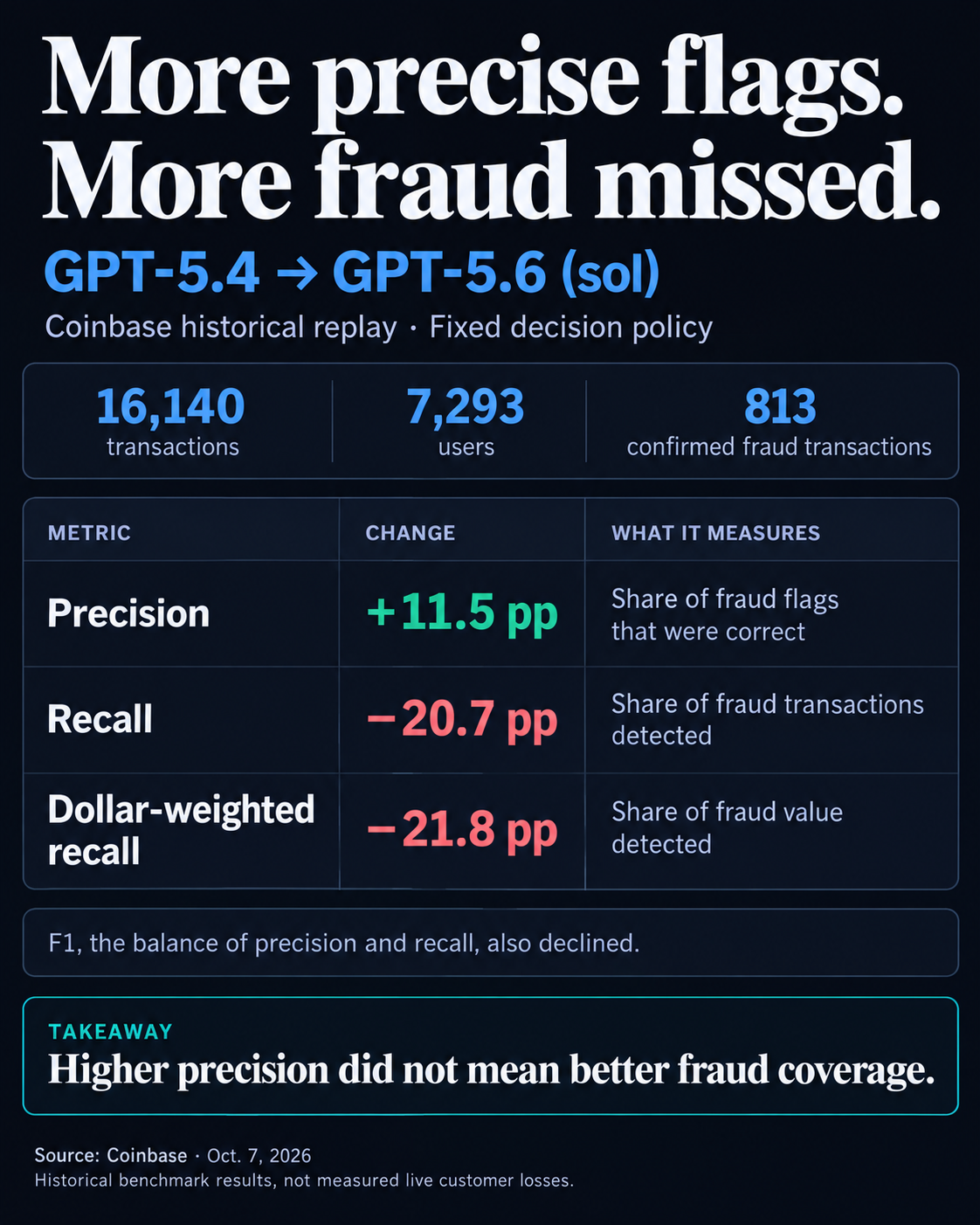
The replay does not establish customer losses from deploying those versions. Coinbase also said it could identify the regressions without establishing their cause.
Coinbase’s earlier online experiment compared adding selective LLM review with the existing models and rules alone. That agent-enabled flow recorded 30% fewer fraudulent transactions and 22% less fraud value; it did not compare newer model versions.
In their limitations, the SR-Fraud researchers say the proprietary dataset cannot be released, restricting independent replication and generalization. Their related payment-fraud study first appeared Sept. 23 and was revised Sept. 30, before the October blogs.
A separate case for a custom model
In its Oct. 8 disclosure, Coinbase reported that a post-trained Qwen3.5-9B model exceeded Opus 4.5 across four fraud-detection metrics. F1 improved 9.6 percentage points and dollar-weighted recall rose 35.4 points. The company specialized it using historical fraud outcomes and deterministic rewards balancing fraudulent and legitimate examples.
Separately, production measurements put median end-to-end LLM-request latency at 0.683 seconds versus 1.515 seconds for Opus 4.5, a 55% relative reduction. Faster inference and stronger benchmark detection came from different evaluations.
For payment providers, the upgrade question is whether a candidate improves fraud coverage under their actual decision setup. Coinbase recommends testing that configuration first, then evaluating changed prompts or thresholds separately, with latency, reliability and cost alongside detection quality.
The post Newer AI models missed more payment fraud in Coinbase’s benchmark appeared first on CryptoSlate.
Bitcoin's next recovery could vindicate your investment thesis but leave your leveraged fund deep in the red, because the fund's daily reset can make waiting a pretty expensive habit.
Getting Bitcoin right and actually making money on Bitcoin are becoming two different skills, especially now that Wall Street is preparing products for people who don't find the ordinary version exciting enough.
On Oct. 2, the SEC approved exchange-listing rules for proposed 3x Bitcoin and Ethereum funds from VS Trust. The approval brings them closer to trading, with the appeal captured neatly in the multiplier: more exposure to a market you already believe will go up.
But what happens between buying the fund and being proved right? Bitcoin can fall, recover, and return to your entry price while a leveraged fund still nurses losses, even when it's doing exactly what the product promised.
That promise covers just one day, a much shorter relationship than many investors intend with their money.
Your Bitcoin conviction doesn't reset
The proposed funds seek three times their benchmark's daily return, before fees and expenses. Holding them for a month doesn't extend that promise to three times the month's return, because each day's gain or loss becomes the starting balance for the next.
The Bitcoin investor thinks about where the market will be in six months, while the fund continually resizes its exposure around how much money it has today.
When the market falls, leverage eats through the fund's capital faster than it reduces the size of its market position. To restore the intended multiple, the fund cuts exposure, leaving it with a smaller position when the rebound begins.
Gains then apply to that reduced balance, so getting the underlying market back to its old level doesn't necessarily get the shareholder there too.
During a rally, profits give the fund more capital, allowing it to take on more exposure for the next session. You can leave your shares untouched while the investment inside them grows and shrinks every day, indifferent to your long-term Bitcoin outlook.
The SEC describes in its investor bulletin on leveraged funds a real four-month period when an unnamed index gained about 8%, while a fund seeking three times its daily return lost 53%. That wasn't a Bitcoin fund or a forecast for these proposed products, but it puts a financial result behind an easily dismissed prospectus warning.
Daily compounding can also work beautifully during a sustained advance, allowing a leveraged fund to earn more than three times the benchmark's cumulative gain. The mechanism rewards some price paths and punishes others, which means a buyer needs to be right about more than the eventual destination.
Bitcoin's reputation for rewarding patience affects this, and not in a good way, since a daily-reset fund continually recalculates how much exposure your remaining money can support.
The ETF wrapper comes with extra paperwork
The listing approval showed that these funds use futures, adding another layer between the Bitcoin price people follow and the return they receive.
Futures are contracts with expiration dates, so maintaining exposure requires replacing contracts as they approach expiry. The prices of those replacements can make the strategy more expensive or work in its favor, depending on the relationship between nearer and later contracts.
Either way, multiplying Bitcoin's spot-price return by three won't reproduce the fund's results.
VS Trust's Oct. 7 amended filing lists a 1.85% annual management fee for both proposed products. Its estimated trading return needed to cover costs is 1.98% for the Bitcoin fund and 2.78% for the Ethereum fund, incorporating other expenses and assumed interest earned on collateral.
Those breakeven estimates describe the return needed to cover the estimated operating bill under the filing's assumptions, before the investor earns anything from taking the risk.
But the familiar ETF comes with less familiar paperwork. These are commodity-pool products outside the Investment Company Act of 1940 framework that governs conventional investment-company ETFs, and the filing anticipates partnership tax reporting through Schedule K-1.
Shareholders may have taxable allocations without receiving cash distributions, adding another complication to a trade likely bought for price appreciation.
The Oct. 7 filing says the funds haven't begun trading, so none of this amounts to a record of returns from BITH or ETHK. The listing decision permits a route to market, while the disclosures explain what buyers would actually own.
When a bad trade becomes a long-term investment
Traders who want amplified exposure over a short period, and understand what they're buying, find a legitimate attraction here. Buying shares with cash can save them the work of managing their own futures margin account, though the leverage remains.
The trouble begins when a short-term position loses money, and its owner promotes it to a long-term investment. Waiting for Bitcoin to recover is more comfortable than accepting a loss.
But the fund keeps rebuilding its position around the capital left inside it, regardless of whether shareholders choose to be patient. Even the prospect of waiting assumes enough capital will remain to participate in a rebound: the issuer warns that the entire investment could be lost in a day or overnight.
Buying a 3x fund means accepting daily exposure adjustments and the possibility that a volatile recovery will leave you far behind the asset you correctly believed in.
Even if Bitcoin recovers, a daily-reset fund has no obligation to restore the money lost along the way. Conviction can't persuade a fund to calculate tomorrow's return on money that disappeared yesterday.
The post Being right about Bitcoin won’t save your 3x leveraged ETF position appeared first on CryptoSlate.
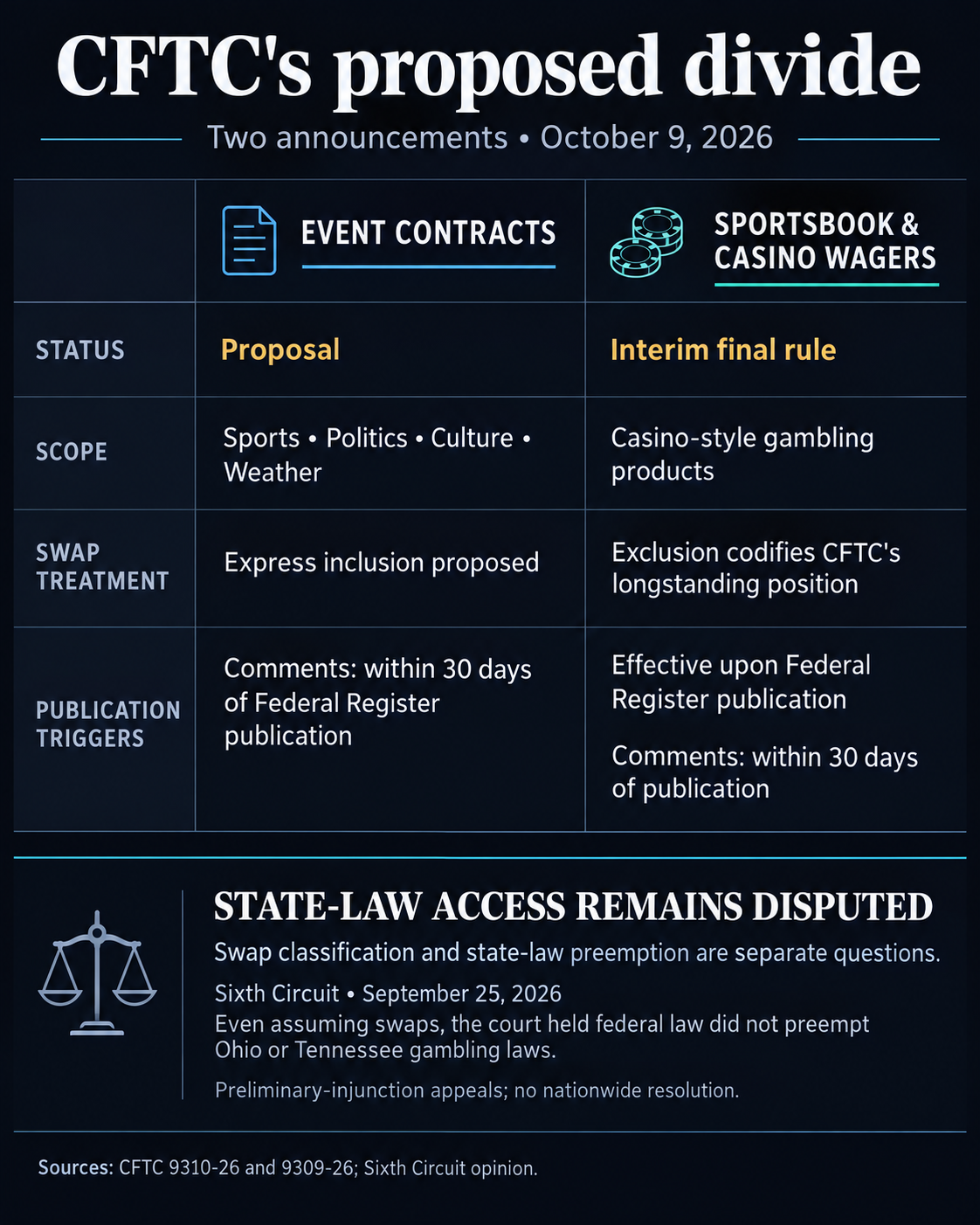
The Commodity Futures Trading Commission announced two actions on Oct. 9 seeking to clarify the federal regulatory boundary between prediction-market contracts and traditional gambling. It proposed expressly including sports and other event contracts in the definition of a swap, a category of financial derivative, while announcing a separate interim final rule to codify the exclusion of sportsbook and casino wagers.
The event-contract proposal covers sports, politics, cultural events and weather-related outcomes. CFTC Chairman Michael S. Selig said these products fall within the agency’s exclusive jurisdiction under the Commodity Exchange Act.
That classification matters because the products can look familiar to bettors. The CFTC explains that event contracts often let traders buy yes-or-no positions on a future outcome, with a fixed payout, usually $1. Their value depends on that outcome, and they can be used to hedge risk or speculate.
The distinction is visible in how platforms present their products: CryptoSlate’s Cloudbet sportsbook review examines odds-based wagers, while its Polymarket review examines tradeable outcome contracts.
The proposed inclusion is not final. The CFTC is seeking written comments through Regulations.gov within 30 days of the proposal’s publication in the Federal Register.
The casino-wager action is an interim final rule. The agency describes it as codifying its longstanding position that casino-style gambling products, including wagers placed on sportsbooks and casino games, fall outside the swap definition.
According to the CFTC, the exclusion takes effect immediately upon publication in the Federal Register. It also carries a 30-day comment window tied to that publication. Neither announcement specifies the Federal Register publication date, so the Oct. 9 date does not establish an effective date or comment deadline.
State-law disputes remain consequential
The agency’s classification position faces a separate legal question: whether federal regulation displaces state gambling laws.
In a Sept. 25 ruling on preliminary-injunction appeals involving prediction-market operator Kalshi, the Sixth Circuit held that the company had not shown its sports-event contracts met the statutory swap definition. It also held, alternatively, that even assuming the contracts were swaps, the Commodity Exchange Act did not expressly or impliedly preempt Ohio’s or Tennessee’s gambling laws.
That alternative holding illustrates the obstacle for operators seeking nationwide access: winning an argument about product classification does not necessarily win the argument over state authority.
The distinction also drew criticism from advocacy group Better Markets. In an Oct. 9 statement, securities-policy director Benjamin Schiffrin argued that sports event contracts enable sports betting and should remain subject to state gambling laws.
The post CFTC proposes a divide between prediction contracts and sportsbook wagers appeared first on CryptoSlate.
CryptoTicker.io
The week from October 5 to 11 left its mark on every crypto portfolio, but to very different depths. Bitcoin trades at $82,922, or €74,020, on Sunday morning, 2.1 percent below the level of last Sunday. Ether lost 6.8 percent, XRP 5.8 percent and Solana as much as 8.1 percent. Holders who mostly own Bitcoin got off lightly. Those spread widely across altcoins lost considerably more. Here is the week in review, with the reasons behind it and what to go through in your own portfolio today.
How your crypto portfolio performed this week
The week started strong. On Monday morning Bitcoin stood at $86,636, the high of the week. By Thursday evening the price had slipped to just above $80,000, and among the altcoins the sell-off was fiercer still. The market has steadied somewhat since then, without making up the losses. The figures rest on hourly prices from CoinGecko, calculated from Sunday, October 4, at 2 a.m. to Sunday, October 11, at 2 a.m. German time.
| Coin | A week ago | Sunday morning | Change | Low of the week |
|---|---|---|---|---|
| Bitcoin (BTC) | $84,743 | $82,922 (€74,020) | minus 2.1% | $80,652 on Thursday |
| Ether (ETH) | $2,687 | $2,504 (€2,235) | minus 6.8% | $2,414 on Thursday |
| XRP | $1.49 | $1.40 (€1.25) | minus 5.8% | $1.33 on Thursday |
| Solana (SOL) | $119.60 | $109.91 (€98.18) | minus 8.1% | $106.41 on Thursday |
A simple calculation shows what this means for a typical portfolio. A basket holding equal parts of these four coins lost 5.7 percent over the week: $1,000 became $943. A basket with 60 percent Bitcoin, 20 percent Ether and 10 percent each in XRP and Solana lost only 4.0 percent. The Bitcoin weighting, in other words, cushioned the fall. Both figures are calculated in dollars, because that is the currency the prices are set in.

Why Bitcoin lost less than Ether, XRP and Solana
The pattern of the week is a familiar one: when investors cut risk, they sell the smaller holdings first. Bitcoin counts as the safer harbour within the crypto market, relative though that is. Its share of total market capitalisation stands at 59.1 percent, according to CoinGecko. The market as a whole is worth around $2.81 trillion.
The trigger came from the US central bank. On Wednesday the Fed published the minutes of its September 15 and 16 meeting. They state that most members consider a further rate rise before the end of the year appropriate. In September the Fed had already lifted its key rate to 3.75 to 4.00 percent. Higher rates make safe assets more attractive and pull money out of risky markets. What the minutes say in detail is set out in our report on the Fed minutes.
What the ETF outflows reveal about sentiment
The retreat shows most clearly in the US exchange-traded funds. On figures from Farside Investors, the Bitcoin ETFs lost around $680 million from Monday to Friday, with around $485 million flowing out on Wednesday alone, the most on any single day since June. The week before, around $241 million had still come in. For the Ether ETFs it is worse: they have recorded outflows on nine consecutive trading days since September 29. The detail on the funds is in our analysis of the ETF outflows.

Sentiment has nonetheless not turned. The Fear and Greed Index from alternative.me stands at 61 points on Sunday, still in greed territory. On Tuesday it was 73 points, a week ago 65. Many investors therefore read the setback as a pause rather than a reversal. Whether they are right will be settled in the coming week by the inflation data.
What changed this week for investors in Germany
The holding period stays, for now. On Thursday the Bundestag rejected the Greens' bill to abolish the crypto holding period by 445 votes to 132. Anyone holding crypto assets for more than a year therefore continues to sell them tax-free. That does not settle the matter. The Federal Ministry of Finance put forward its own draft on the taxation of crypto assets on September 30, and according to the covering letter to the industry bodies the federal cabinet is to take it up on Wednesday, October 14. What the draft contains and which objections have been raised is covered in our piece on the tax draft. We summarised the outcome after the vote in the Bundestag. That same evening parliament also passed a law under which German tax authorities will automatically exchange data on crypto transactions with other states.
Two exchanges are clearing house. Coinbase is ending trading in the stablecoins USDT and DAI as of October 30, and anyone holding them there has to act. The detail is in our article on the Coinbase conversion. Kraken is dropping a series of smaller tokens as of October 23; the coins affected and the deadlines are in our overview of the Kraken delisting.
Three points for your Sunday portfolio review
First, the holding periods. Bitcoin's record high is more than a year back; it was reached on October 6, 2025. Anyone who bought then is around a third down and has passed the one-year mark. A sale would be tax-free, but the tax office will then no longer recognise the loss. Holders sitting on purchases from October 2025 whose period is still running should work the numbers through beforehand. How to do that is explained in our piece on losses and the holding period. A portfolio tracker with a tax function shows the deadlines per purchase at a glance.
Second, leverage. On Wednesday the US publishes the September inflation data. Dates like that often move the market within minutes. Anyone holding leveraged positions should check beforehand how far away the liquidation price sits.
Third, where the coins are held. Coins sitting on an exchange hang on that exchange's decisions, as the cases at Coinbase and Kraken show. Whether yours holds a MiCA licence can be seen in the comparison of crypto exchanges.
What the new week brings for Bitcoin and altcoins
Wednesday, October 14, bundles two dates at once. In Berlin the cabinet is to deliberate on the crypto tax draft; in Washington the US consumer price index for September appears at 2:30 p.m. German time. If inflation comes in higher than expected, the probability of a further rate rise at the end of October goes up, and that would hit above all the altcoins that already gave way the most this week. If it comes in lower, the market would have room for a recovery. For Bitcoin the first level to the downside is the weekly low just above $80,000, to the upside the weekly high of $86,636.
(As of October 11, 2026. This article is not investment advice. Prices and fee structures change; check the terms with the provider before you buy.)
The crypto price today tells two very different stories. Bitcoin is holding its ground around $83,000, while most large altcoins are nursing losses of 5% to 10% over the past seven days. Ethereum has slipped back to $2,500, Solana is barely above $109 and XRP is flirting with $1.39. At the same time, a handful of coins are quietly outperforming, and the week ahead is packed with events that could decide whether this dip becomes a bigger correction or a buying opportunity.
Here is a full breakdown of the crypto market today, what is driving it, and the dates you need on your calendar. For live numbers on every coin, check the CryptoTicker crypto prices page.
Bitcoin Price Today: Why Is BTC Stuck Below $85,000?
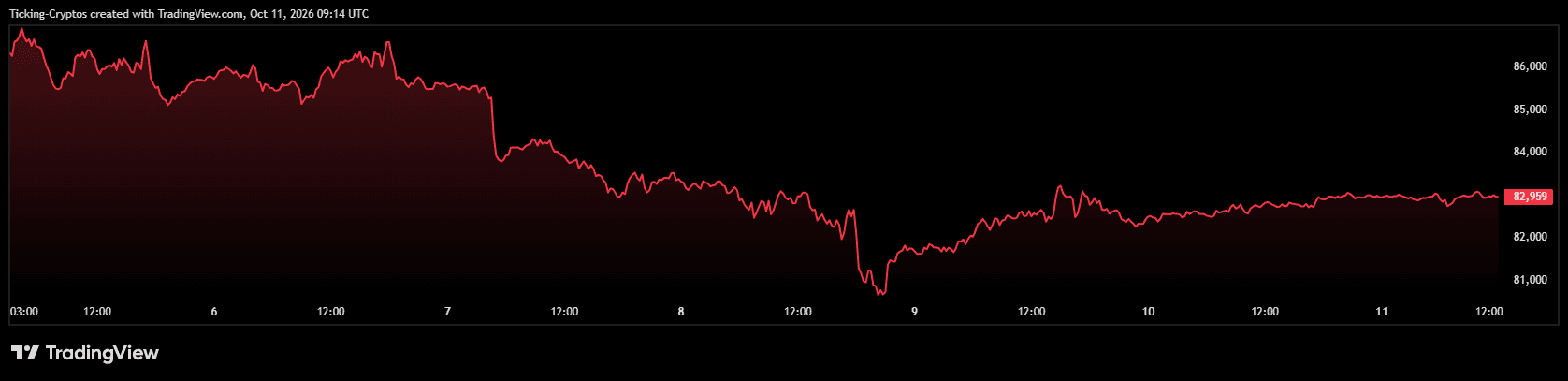
$Bitcoin trades at $83,033 at the time of writing, up 0.56% over 24 hours but down 2.25% on the week and 5.12% year to date. The market cap sits at $1.66 trillion with $11.76 billion in daily volume, which is modest for a market that just absorbed a week of selling.
The key battleground remains the $84,000 to $85,000 zone. That is where a large cluster of long-term holders bought their coins, and every attempt to reclaim it has been sold into. Below, $80,000 is the level bulls cannot afford to lose.
Three forces are weighing on the bitcoin price today:
- ETF demand has cooled. US spot Bitcoin ETFs managed a small $21 million inflow on October 9, but the prior five sessions were still roughly $679 million in the red, and crypto ETFs as a group lost about $1.29 billion last week.
- Rates are biting. The Fed hiked in September for the first time since 2023, the 10-year Treasury yield is above 5%, and the latest FOMC minutes show most officials want another hike by year-end. That is a hostile backdrop for any risk asset.
- Geopolitics. Oil is above $100 on Middle East headlines, which keeps inflation fears, and therefore Fed hawkishness, alive.
The bright spot: bitcoin is holding its 7-day losses to just over 2% while altcoins bleed far harder. Bitcoin dominance is climbing, and that usually signals a defensive market rather than a panicked one.
Ethereum Price Today: Is $2,500 the Bottom for ETH?
$Ethereum is the weak link among the majors. The ethereum price today is $2,501, down 7.10% over seven days and 15.68% year to date. The market cap has shrunk to $305 billion.
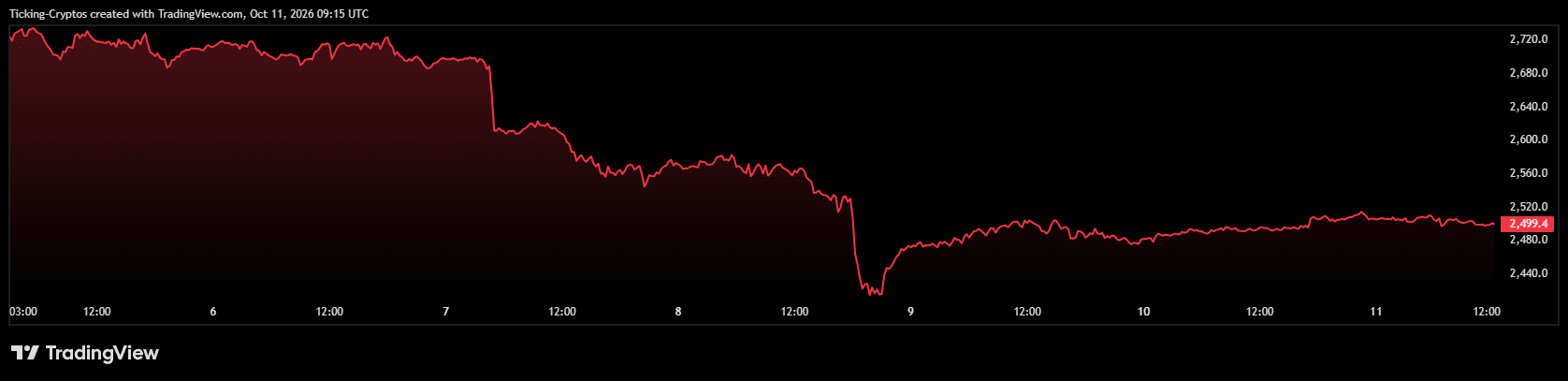
The pain is coming from the ETF side. Spot Ether ETFs have now logged nine consecutive days of outflows, roughly $697 million in total, including a single-day exit of $202 million on October 6. On the positive side, on-chain data shows whales accumulated around 166,000 ETH over the past 72 hours, and the Glamsterdam upgrade is progressing on the Sepolia testnet. Fundamentals are improving; flows are not. Until the ETF bleeding stops, $2,500 remains a floor under pressure rather than a confirmed bottom.
Solana Price Today: Can SOL Recover From a 10% Weekly Drop?
$Solana is the worst performer in the top 10 this week. The solana price today is $109.52, down 9.56% over seven days and 12% year to date, with a market cap of $64.5 billion.
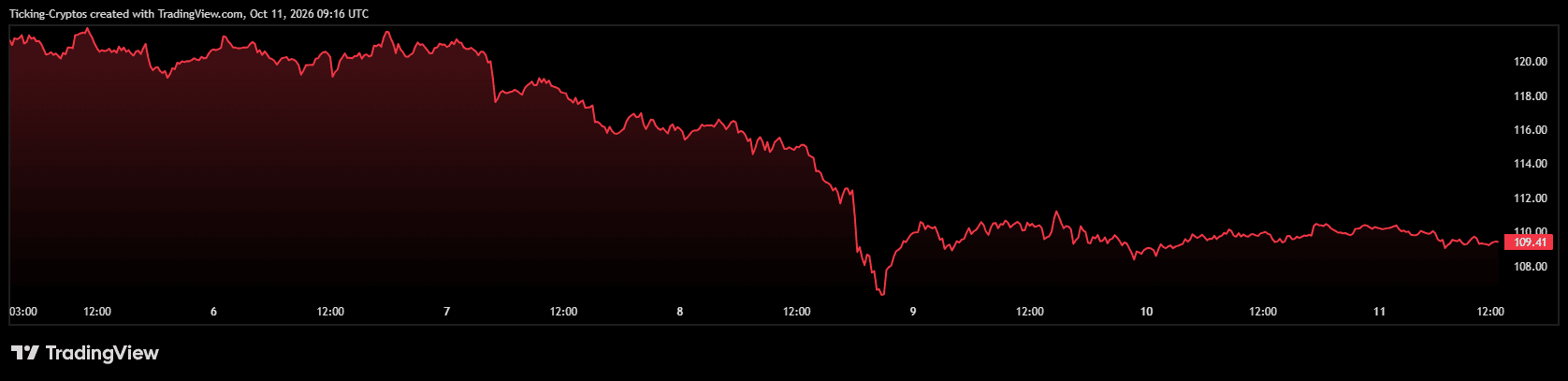
The drop is notable because Solana's roadmap is arguably the strongest it has been in years. Alpenglow, the new consensus protocol, is targeting block finality close to 150 milliseconds, and the Foundation plans a further cut to 200-millisecond block times. The market is simply ignoring tech news in a risk-off week. If broader sentiment turns, $SOL has the most room to snap back.
XRP Price Today: Why Is XRP Down 24% This Year?
$XRP is trading at $1.39, down 6.88% on the week and 24.25% year to date. It remains the biggest year-to-date loser among the top five, sitting well below its peak despite a market cap of $88 billion.
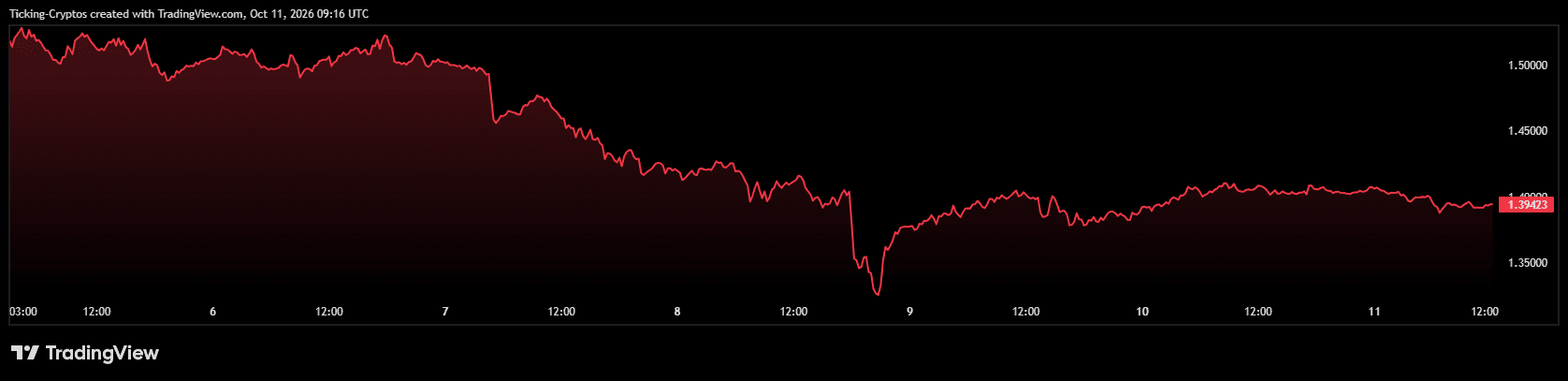
The XRP Ledger activated new institutional account controls on October 9, which is exactly the kind of feature banks have been asking for. Price has not reacted. For now, XRP is trading as a high-beta altcoin and needs bitcoin to reclaim $85,000 before it can build a base of its own.
Which Altcoins Are Pumping and Which Are Bleeding Today?
Scroll past the top five and the crypto market today looks a lot less uniform.
The winners
- NEAR Protocol ($NEAR) is the standout, up 9.08% in seven days to $5.23 and an eye-watering 246% year to date. The catalyst is a quantum-resistance upgrade that landed this week, plus vocal support from Arthur Hayes. NEAR is one of only two coins in the top 17 with a green 7-day chart.
- Cardano ($ADA) is the other one, up 1.22% on the week to $0.2478. It is still down 25% this year, but it held firm while everything around it fell, which is worth noting.
- Monero ($XMR) is up 1.41% in 24 hours to $528 and 21.91% year to date. Privacy coins continue to trade on their own narrative.
- Zcash ($ZEC) is down 7.72% this week but still up 139% year to date at $1,227, with Grayscale's Zcash ETF just crossing $1 billion in assets. The dip looks like profit-taking after a monster run.
- Hyperliquid ($HYPE) fell 5.46% on the week to $84.81 but remains the top-10 leader with a 233% year-to-date gain.
The losers
- Stellar ($XLM) dropped 9.26% to $0.1956.
- Dogecoin ($DOGE) fell 8.39% to $0.08527 and is now down 27% in 2026, the worst year-to-date figure in the top 15.
- Chainlink ($LINK) slid 8.01% to $12.87 despite rolling out CCIP 2.0 for institutions.
- $BNB lost 5.06% to $747.64 ahead of its Jenner hard fork testnet.
- TRON ($TRX) is down just 1.56% on the week and still up 16% this year, making it the quiet outperformer among layer-1s.
The pattern is clear: coins with a fresh, specific catalyst (NEAR, privacy coins) are holding or gaining, while generic large caps are being sold as liquidity drains.
What Are the Most Important Crypto Events This Week?
This is one of the most event-heavy weeks of the quarter. Here is the calendar from Monday, October 12 to Sunday, October 18, plus the big one at the end of the month.
Monday, October 12
- US markets closed for Columbus Day. Expect thin liquidity and exaggerated moves in either direction.
- Aptos (APT) unlock of roughly 11.31 million tokens. This one also marks the end of Aptos' four-year investor vesting cycle, so monthly unlocks shrink sharply afterward.
- IMF-World Bank Annual Meetings begin in Bangkok (through October 18), with a new World Economic Outlook on Tuesday.
- Paradigm Frontiers conference in San Francisco (October 12 to 14).
Wednesday, October 14: US CPI (September)
The single most important date of the week. Economists expect headline inflation around 3.7% and core near 2.5%. This is the last CPI print before the Fed's October 27 to 28 meeting, where a second rate hike in two months is on the table. A hot number pushes yields higher and hits crypto; a soft number could spark a sharp relief rally, especially in oversold altcoins.
Thursday, October 15
- US Producer Price Index and retail sales.
- Arbitrum (ARB) unlock of about 92.65 million tokens, worth roughly $17.5 million, going to investors, team and advisers.
- Filecoin's tokenomics vesting program ends.
Friday, October 16: Options expiry
Around $1.25 billion in bitcoin options and $247 million in ether options expire on Deribit. Expect volatility into the New York close.
Saturday and Sunday, October 17 to 18
EDCON 2026 in Kuala Lumpur, the Ethereum community conference, where Glamsterdam mainnet timing could get clearer.
Beyond this week
- October 27 to 28: FOMC meeting. The decision everyone is positioning for. Another hike would be the first back-to-back tightening since 2023.
- Ethereum Glamsterdam continues on the Sepolia testnet with mainnet to follow.
- Solana Alpenglow (Agave 4.3) is expected on mainnet this month.
- BNB Chain Jenner hard fork hits testnet ahead of a November mainnet deployment.
- Tether (USDT) EU deadline as European regulators tighten stablecoin enforcement under MiCA.
Crypto Price Today: What Should Traders Watch Next?
The crypto price today reflects a market that is defensive but not broken. Bitcoin is down 2% on the week while altcoins are down 5% to 10%, ETF flows have turned negative, and the Fed is openly discussing another hike. That combination explains the red screens, and it also explains why the setup into Wednesday's CPI is so binary.
Three things to watch:
- Bitcoin at $85,000. A clean reclaim flips the short-term structure bullish and pulls altcoins with it. A break of $80,000 opens the door to the mid-$70,000s.
- ETF flows. Nine straight days of ether outflows is the number to track. The first green day for ETH ETFs will likely mark the local bottom.
- The CPI reaction, not the CPI number. If crypto rallies on a slightly hot print, the selling is exhausted. If it dumps on an in-line print, more downside is coming.
Until those questions are answered, the coins with their own catalysts, NEAR, Zcash and Monero, are where the relative strength lives. Keep an eye on the live crypto prices and the market-wide dashboards on the CryptoTicker charts page as the week unfolds.
The Dogecoin chain settled 17,404 transfers over the past 24 hours, and a single one of them carried 5.12 percent of the entire daily value. $48,607,636 moved from one address to the next in that one transfer. At the same moment, six entries sat in the queue of unconfirmed transactions. Dogecoin traded at $0.085353 on Sunday morning, or €0.07631.
Those three figures describe a chain that is barely used and whose daily movement hangs on a handful of very large addresses. Two practical consequences follow for investors in Germany: a transfer costs almost nothing, and a sell order meets a book that is thinner than the $13.34 billion market capitalisation suggests. Every on-chain figure in this article comes from the public node dump at Blockchair, the price and turnover figures from CoinGecko.
$48.6 million in one Dogecoin transfer: 5.12 percent of the daily volume
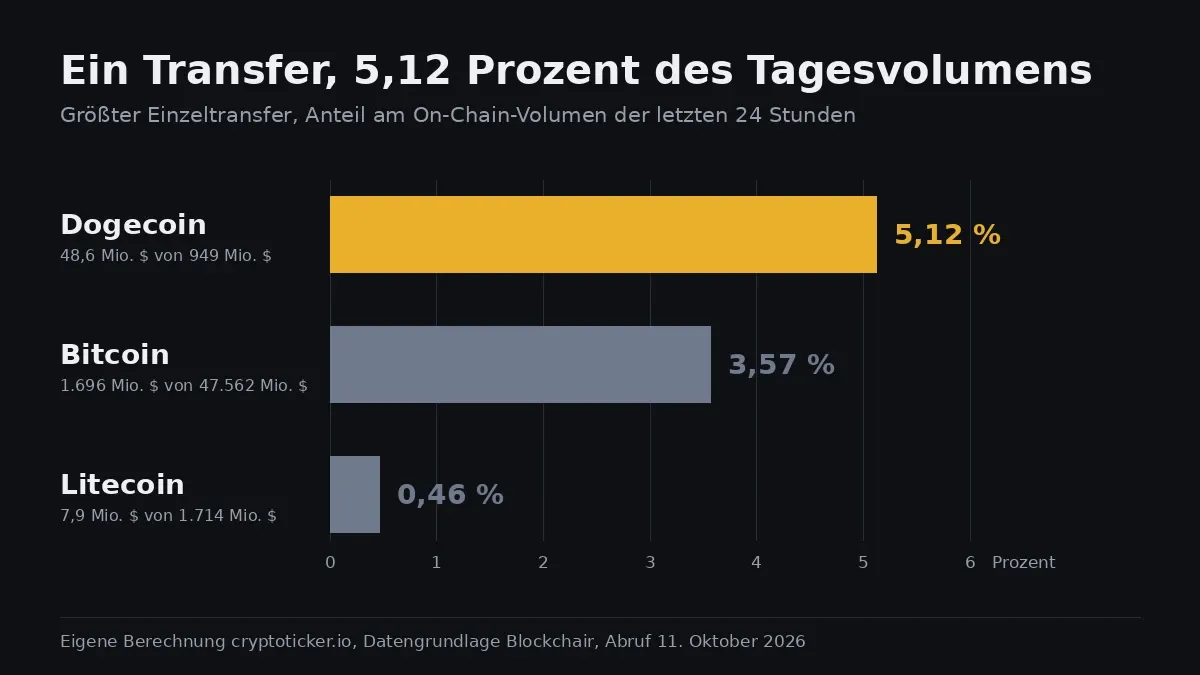
The largest single transfer of the past 24 hours carried $48,607,636. Measured against total on-chain volume of $949.5 million, that is 5.12 percent. Put differently, every twentieth dollar that crossed the Dogecoin chain that day sat in one booking. The transaction carries the identifier 305a0b463533d4543b19fc26e3d80766442c79c54b2d142b3af2d9c6d5f399df and can be read in the public block dump.
Who stands behind it cannot be read off the chain alone. A transfer of that size fits a shift between two custodians just as well as the build-up or unwinding of a position. So no interpretation belongs here, only the measurement: a transfer of that size means the movement on the chain is not carried by many small payments.
On average, each of the 17,404 transfers came to 639,182 DOGE, or roughly $54,556 at Sunday morning's price. An average at that level does not come from tipping on the network. It comes from the kind of reshuffling that exchanges, custodians and large holders carry out.
11.12 billion DOGE in 24 hours: 17,404 transfers moved $949 million
11,124,324,222 DOGE crossed the chain. At a price of $0.085353 that equals $949.5 million. For comparison, reported exchange turnover over the same period came to $330,998,299. The chain therefore moved 2.87 times what changed hands on trading venues.
That ratio is unremarkable on its own. For Bitcoin it stood at 3.36 on the same day, higher still. High on-chain turnover proves neither demand nor selling pressure; it only counts how much value shifted between addresses, in-house reshuffling included. The figure becomes interesting only alongside the question of how many bookings it spreads across.
Six entries in the Dogecoin mempool: the median fee sits at 0.113 DOGE
The mempool is a network's waiting area. It holds transactions that have been sent but not yet taken into a block. The fuller it is, the more users have to bid to have their transfer pulled forward. On Dogecoin, six transactions sat there. On Litecoin there were 131, on Bitcoin 30,578.
Without a queue there is no fee competition. The median fee on a Dogecoin transfer came to 0.113 DOGE, around one US cent. The average paid was 0.38772 DOGE, about 3.3 cents. The average runs more than three times the median because the large transfers consist of more inputs and are therefore heavier; the fee is measured by data volume.
For a holder in Germany the practical point is narrow: the route from a trading platform into self-custody costs almost nothing on the chain. A move like that almost always gets expensive somewhere else, namely at the platform's flat withdrawal charge. That charge sits in the provider's fee schedule and is independent of the chain fee; a look at the fee schedule before the withdrawal is worth more than any optimisation on the transaction itself.
Dogecoin against Litecoin: 5.12 percent concentration vs 0.46 percent
Litecoin works as a yardstick because both chains use the same Scrypt algorithm and are secured by the same data centres at the same time. The largest Litecoin transfer of the past 24 hours carried $7.9 million, or 0.46 percent of that chain's volume of $1.714 billion. On Dogecoin the same figure stood at 5.12 percent, eleven times as high.
On Bitcoin, the largest transfer carried $1.696 billion; measured against chain volume of $47.562 billion, that is 3.57 percent. Dogecoin therefore sits above Bitcoin and far above Litecoin. The metric measures one day only and fluctuates; it holds up as a snapshot, not as a trend. Anyone who wants to track it over weeks will find the daily value in the public dump of each of these chains.
1,347 Dogecoin blocks instead of 1,440: the chain ran at 93.5 percent of its pace
Dogecoin targets one block a minute, so 1,440 blocks on a full day. 1,347 were counted. That equals 93.5 percent of the target pace and is the normal lag of the difficulty adjustment: when computing power leaves, blocks take longer until difficulty has caught up. The figure last stood at 45,739,871, with hashrate over the past 24 hours at 3.07 petahash per second.
Those 1,347 blocks carried 17,404 transfers, or 12.92 per block. How the data centres' income splits between issuance and fees is something we broke down on October 10 in the calculation on the shared mining budget.

Turnover ratio of 2.48 percent: a market order meets a thin book
Exchange turnover of $330,998,299 equals 2.48 percent of the $13.34 billion market capitalisation. The ratio says how much of the entire stock changes hands in a day. It is not a measure of the depth of any single order book, but the upper bound of what was tradeable across all venues together.
The difference counts when selling. A market order takes every offer standing in the book until the desired quantity is filled. In a thin book the executed average price slips below the quoted price as it goes, and the larger the order, the further it slips. A limit order, by contrast, names the worst price a seller will accept and stays put when the book cannot supply it.
The daily range shows how tight things were: 1.9 percent lay between the high at $0.0865 and the low at $0.084881. Working a market order inside a range that narrow easily gives away more than the venue's fee amounts to.
Since October 10: the Dogecoin daily low at $0.084881 has held
In our calculation of October 10 the price stood at $0.0862. Since then it has been $0.085353, a decline of 0.98 percent. Over 24 hours the loss comes to 1.04 percent, over seven days to 8.03 percent. The all-time high at $0.731578 lies 88.3 percent above the price.
Two levels can be justified from the daily data rather than from a drawing: the daily low at $0.084881, which has held so far, and the daily high at $0.0865. Both come from the past 24 hours and lose their meaning as soon as a new range forms. Levels from earlier days, such as the $0.0878 of the 200-day line from our calculation of October 4, now sit above the price and therefore act as resistance rather than support.
Holding period under Section 23 of the German Income Tax Act: a Dogecoin transfer between your own wallets is not a disposal
Moving DOGE from a trading platform to your own hardware wallet sells nothing. A transfer between addresses belonging to the same person is not a private disposal within the meaning of Section 23 of the German Income Tax Act and triggers no tax. The one-year holding period keeps running; it does not start again.
Documentation still matters. Without proof that the sending and receiving addresses belong to the same person, the acquisition date is hard to establish later, and whether a sale after one year is tax-free depends on it. Inside the year, gains from private disposals carry an exemption limit of €1,000 per calendar year; once it is exceeded the entire gain is taxable, not only the part above it. Anyone running many transfers cannot avoid clean record-keeping, of the kind portfolio trackers and tax tools deliver.
MiCA and the BaFin register: how to spot an authorised trading platform
The European regulation on markets in crypto-assets has applied in full since December 30, 2024. Anyone exchanging or holding crypto-assets commercially in the EU needs authorisation as a crypto-asset service provider. In Germany, BaFin keeps the register of authorised firms, and every provider appears there with its name and the scope of its licence.
Two things need separating here. Authorisation says something about supervision, own funds and a provider's obligations. It says nothing about the depth of its order book for a given pair. The two together decide what a sell order finally brings in, and both can be looked up before buying: the licence in the register, the depth in the venue's order book view. Holders who then want to keep their own coins in self-custody compare the form factors of custody devices separately.
Our take on Dogecoin: concentration is the risk, not issuance
The criticism levelled at Dogecoin is usually the unlimited issuance of new coins. The day's figures suggest a different emphasis. 13,470,000 DOGE were newly issued, worth $1,149,705. Over the same period $949.5 million crossed the chain, and $48.6 million of that sat in a single booking. Daily issuance therefore equals 0.12 percent of chain volume, while the one large transfer equals 42 times issuance.
Against that: a one-day measurement proves no structure. A single large transfer can be a reshuffle that does not return tomorrow, and the mempool reading is a snapshot. Only what has been measured repeatedly holds up. Our assessment is therefore this: issuance is calculable and small against the daily movement, the dependence on a few large addresses is not. Anyone holding DOGE should size the position by how much of it can be sold inside a narrow daily range without a discount. That is not a recommendation to buy or sell.
Dogecoin transfers: below $0.084, the depth of the book decides
Three concrete steps follow from the day's figures:
- Settle the order type before the range narrows. On Sunday, 1.9 percent lay between $0.084881 and $0.0865. A limit order names the worst price accepted; a market order takes what the book supplies. Which venues offer DOGE any meaningful depth at all is shown in the comparison of trading venues.
- Hold the flat withdrawal charge against the chain fee. On the chain, a transfer cost a median of 0.113 DOGE, around one US cent. Holders who move into self-custody regularly should know their provider's flat charge and pick the form factor of their wallet to match; the form factors and their differences are set out in the hardware wallet overview.
- Record every transfer with its date. The one-year holding period keeps running through a move between your own addresses, but only with proof. The record-keeping is handled by tax tools and portfolio trackers.
(As of October 11, 2026. This article is not investment advice. Prices and fee structures change; check the terms with the provider before you buy.)
Four companies sit behind almost everything still being built in Web3 gaming in 2026: Igloo Inc. with the Pudgy Penguins, Animoca Brands out of Hong Kong, Yuga Labs with the Bored Ape Yacht Club and Sky Mavis with Axie Infinity. Three of them have switched something off or handed something over this year, and one has set a date that concerns you if you hold a balance on the Abstract chain: it ends there on December 15, 2026.
This article works through the four companies one by one. What is still running, what has been discontinued, which token hangs on what, and how much of it a holder in Europe can actually get at. To see what became of the games themselves, the review of Illuvium, Axie and Sandbox is in our Web3 Gaming in 2026 piece. This one is about the companies behind them.
Web3 Gaming in 2026: These Four Companies Still Decide What Gets Built
Web3 gaming describes games whose items, currencies or plots of land sit on a blockchain as tokens, so that players can trade them outside the game. The sector has narrowed sharply since the boom of 2021. What is left is a handful of houses that run a brand, their own blockchain and a token all at once.
That triple role is expensive. A brand needs marketing, a blockchain needs operations and developers, a token needs liquidity. All four companies pulled back on at least one of the three in 2026. At Igloo it is the blockchain, at Yuga Labs the brands, at Animoca the route to the stock market, at Sky Mavis the rewards model.
Igloo Shuts Down the Abstract Layer 2 on December 15, 2026
Igloo Inc., the company behind the Pudgy Penguins, is closing its own blockchain. Abstract will be switched off on December 15, 2026. Chief executive Luca Netz announced the step on October 6, 2026, and the company confirmed it the following day. Once the network is off, balances still sitting on it will no longer be reachable, according to the team.
Abstract carries the only firm deadline in this entire text, and it is a hard one. If you hold tokens, NFTs or stablecoins on Abstract, you have a good two months to bridge them to Ethereum or another chain. Which wallet is up to that, and how custody types differ, is set out in our software wallet comparison.
What a Layer 2 Is, and Why Abstract Had One of Its Own
A layer 2 is a network that bundles transactions away from the main chain and settles them on Ethereum in batches, so that fees and waiting times fall. Abstract was such a layer 2, built for consumer applications rather than financial ones: sign-up without a classic wallet, small amounts, games and collectibles.
Reported reach differs between trade outlets. The figures cited are roughly 400,000 users and somewhere between a good 300 and 325 million transactions over the chain's lifetime. Both numbers come from the coverage of the shutdown rather than from audited accounts, which is why we give them as a range.
No Token, No ICO: Igloo Paid for Abstract Out of Its Own Cash
The notable part of the announcement is what did not happen. Igloo never issued a token for Abstract and never ran a coin offering to raise fresh money. On Netz's account, which several trade outlets report consistently, the company funded the chain quietly for 18 months out of its own pocket and lost a double-digit million sum in the process.
The reasons given for the ending are high running costs, thin liquidity, a weak supply of financial applications and little appetite among institutional investors. For holders, the conclusion is the part that counts: a chain of your own is not a mark of quality but a cost base that somebody has to carry indefinitely.

Pudgy Penguins After the End of Pudgy Party: The Browser Game Pudgy World Is What Remains
Abstract is not the first thing Igloo has discontinued this year. On June 12, 2026, the company announced it would stop developing the mobile game Pudgy Party. Built together with Mythical Games, it came out in August 2025 and was downloaded more than a million times, according to the coverage.
The reaction was blunt. Several trade outlets reported that the announcement named neither a refund nor a way to carry purchased items over into the remaining game. What is documented is the criticism, not a breach of law: whether buyers have a claim, and which, depends on the individual case and on the contract law of the country concerned.
What is left is Pudgy World, a free browser game Igloo has run since the spring of 2026 and on which the firm is now concentrating its resources. Add to that the part of the business that has little to do with blockchain: plush figures and collectibles, sold in US Walmart stores since a partnership struck in September 2023.
The token of the ecosystem is called PENGU, and it fell by around 7 percent after the Abstract announcement; sources date the drop to October 7 or 8, 2026. The point for holders: PENGU runs mainly on Solana and additionally on Ethereum and the BNB Chain, not on Abstract. The shutdown changes nothing there. How the price has moved since is in our PENGU price prediction.
Animoca Brands: The Currenc Group Merger Has Been on Ice Since September 22
Among the four, Animoca Brands is the odd one out: not a games company in the narrow sense but an investment house that has backed a very large number of projects in the sector while running products of its own, The Sandbox among them. The stock market listing was meant to be the big story of 2026. It became one, just not as planned.
On September 22, 2026, Animoca and the Nasdaq-listed Currenc Group said they were suspending their merger discussions. The statement says both sides concluded, after reviewing the expected closing timelines and the changed market environment, that the estimated interim period before completion did not fit their short- and medium-term strategic goals.
Animoca is sticking to the aim. In the same statement it says it remains fully committed to a listing on a major public exchange, and it points to its own timetable on the accounts: the audited annual report for 2023 was published on July 17, 2026, and the one for 2024 is in preparation. Co-founder and executive chairman Yat Siu is quoted saying the company's agility has to take priority and that it will keep pursuing the best routes to a listing.
What a Reverse Merger Is
In a reverse merger, a company that is not listed merges with an already listed shell and reaches a quotation without a conventional stock market flotation. The plan announced in November 2025 provided for Animoca's shareholders to hold roughly 95 percent of the combined company. In a mandatory filing, Currenc recorded that the previously extended exclusivity period had expired without a definitive agreement.
For investors in Europe, this is above all a way of placing the business model: a firm that stands behind many projects as an investor cannot be mapped onto any single token. Buying into Animoca would have required the share, and the share is precisely what remains unavailable on a major exchange for now.
Moca Chain: Animoca's New Layer 1 Aims at Digital Identity, Not at Games
A week after the merger fell away, something else at Animoca got going. On September 29, 2026, the Moca Foundation and Moca Network announced that the Moca Chain mainnet is live. Mainnet means the network is running in real operation with real value, no longer as a test environment.
Moca Chain is a layer 1, an independent blockchain with security of its own, and it is compatible with Ethereum's developer tooling. Its purpose is digital identity: companies can issue, verify, update and withdraw credentials, while the user decides which part of them to disclose. The MOCA token pays the network fees and serves staking as well as the verification processes.
What is striking is what is missing: the game. Animoca is shifting the focus away from playing and towards identity, credentials and applications for AI agents. Coverage of the launch names partners such as SK Planet, Lamborghini, OneFootball and Nansen; one trade service notes, however, that the statement does not distinguish which of these connections are already in production and which are pilots or plans. With ecosystem lists, that distinction is the single most important question.

Yuga Labs: New Chief Executive, Brands Handed Over, Everything on Otherside and ApeChain
Yuga Labs has the best-known brand in the sector and, at the same time, the clearest retrenchment behind it. In April 2026, long-serving product chief Michael Figge took over the leadership; co-founder Greg Solano, chief executive since February 2024, moved to the top of the board and said he would return to creative work.
Before that, the company had let go of two of its best-known acquisitions. The rights to CryptoPunks went to the non-profit Infinite Node Foundation, which is dedicated to preserving digital art, and the trademark rights to Moonbirds were also handed over. Yuga has concentrated on the Apes and on Otherside ever since.
Otherside is the metaverse part, open in the browser since November 12, 2025 and reachable with an email address or a wallet. A resource economy with 74 materials has been announced; no date is fixed for it. Yuga does not publish player numbers either, which makes the progress hard to place. Technically the whole thing runs on ApeChain, and the associated currency is ApeCoin, whose development is covered in our APE price prediction.
Governance has shifted along the way: the ApeCoin DAO, the voting community of token holders, was dissolved in 2025 and replaced by a company that Yuga controls. Anyone who understood APE as a say in decisions has been holding something else since then.
ApeFest 2026 on October 17: One Evening in a Studio in Charleston
How far the sector has shrunk shows in its annual gathering. ApeFest 2026 takes place on October 17 at the Beeple Studios in Charleston, South Carolina, as a single evening. Why barely any of the German Ape community is making the trip, we wrote up in our piece on ApeFest 2026.
Sky Mavis: bAXS Replaces AXS as the Reward, Atia's Legacy Is Stuck in Its Third Playtest
Sky Mavis, the studio behind Axie Infinity and the Ronin blockchain, rebuilt its rewards model in 2026. Since January 2026, a new so-called AppToken named bAXS has replaced the previous payouts in AXS; February brought an airdrop worth around $135,000 to bAXS holders. An airdrop is a free allocation of tokens to a defined group.
June 2026 saw the launch of Terrariums V1, an earnings system for owners of the Axie land plots. In July, Sky Mavis opened the third playtest for Atia's Legacy, the announced role-playing game in the Axie universe, this time with the emphasis on real-time combat. A release date is still not named, even though the game was held out for 2026 when it was announced in March 2025.
In parallel, the studio is handing responsibility over: further development of the original game Axie Classic passed to the player community in August 2026. On the blockchain side, Ronin distributes four- and five-figure dollar sums to developer studios at regular intervals through a programme called Proof of Distribution. How the main token is faring is in our AXS price prediction.
Active Wallets Are Not Players: What the DAUW Figure Really Measures
The metric DAUW, daily active unique wallets, turns up constantly in the sector's press releases. It counts how many addresses triggered at least one transaction with an application on a given day. What it does not count is people.
One person can run ten wallets, and many games reward exactly that. The other way round, a player who spends an hour in a game may trigger only a single transaction, while a script generates hundreds. A high wallet count therefore proves activity on the chain, but neither an audience nor revenue.
Abstract is the cleanest example of this from the past year. The chain reported hundreds of millions of transactions and six-figure user numbers and was discontinued all the same, because liquidity and earnings were missing. When a project shows you wallet numbers in future, the more useful question is: how much revenue stands behind them, and who pays for the operation?
Three Ecosystem Tokens Side by Side: 99 Percent Below Their All-Time Highs, and Still Up
We have laid the three tradable tokens of these four houses next to one another: PENGU for Pudgy Penguins, APE for Yuga Labs and AXS for Sky Mavis. Animoca has no main token of this kind, which is why there are three. The basis is the public price data of the market data service CoinGecko in euros, as of October 11, 2026, three verified values. This analysis was compiled by cryptoticker.io itself on October 11, 2026.
- PENGU: around 0.0072 euros, market value about 455 million euros. Up 9.9 percent over 30 days, down 66.9 percent over a year, and 88.9 percent below its peak of December 17, 2024.
- AXS: around 1.09 euros, market value about 190 million euros. Up 35.3 percent over 30 days, down 24.9 percent over a year, and 99.2 percent below its peak of November 6, 2021.
- APE: around 0.135 euros, market value about 135 million euros. Up 15.3 percent over 30 days, down 59.5 percent over a year, and 99.5 percent below its peak of April 28, 2022.
Two things stand out. First, all three sit far below their peaks, two of them so far that practically nothing of the valuations of the time is left. Second, all three are nonetheless up over 30 days, AXS markedly so. The two fit together once the tokens are read as what they currently are: small, mobile markets whose direction on the day has more to do with the general state of the market than with the progress of the company in question.
The market value also tells you something about the risk. All three sit in the hundreds of millions. At that size, comparatively small buy or sell orders already move the price noticeably, and the gap between bid and ask is wider than it is for the large caps.
MiCA and Custody: Where These Tokens Can Be Traded in Europe
Since the EU's MiCA regulation took effect, crypto services in Germany may only be provided by licensed firms. In practical terms: whether you can buy PENGU, APE or AXS depends not on the project but on whether your trading venue lists the pair and is licensed here. Smaller ecosystem tokens appear less often in the range of regulated providers than at the large international exchanges. Which venues are licensed in Germany and which tokens they carry is in our crypto exchange comparison.
On custody, the Abstract deadline comes on top. If you hold NFTs or tokens on a chain that is being switched off, the best wallet in the world is no help while the value stays there. Check in your wallet which network a holding actually sits on. The display in the app usually names the network right next to the balance.
Tax treatment holds nothing special for these tokens: in Germany, gains from a sale within one year fall under private disposal transactions, and after a holding period of one year the holding rule applies. Moving from one chain to another over a bridge can count as a swap, depending on how it is structured. If you are moving larger holdings, record the transactions with date and value and take tax advice if in doubt.
Web3 Gaming: December 15 Is the Only Hard Deadline
Of all four cases, only one carries a date that asks something of you. Everything else is context.
- Move Abstract holdings out before December 15, 2026. Open your wallet, check the network for every position, and bridge everything that sits on Abstract to Ethereum or another chain. Which wallet shows that cleanly is in the software wallet comparison.
- Check the trading venue before you buy. Small ecosystem tokens are not listed everywhere, and in thin markets the gap between bid and ask eats into part of the stake. The exchange comparison shows who is licensed in Germany.
- With NFTs, think about the marketplace too. A collectible is only as tradable as the marketplace it sits on, and marketplaces get shut down as well. Which ones are still open in 2026 is in the marketplace comparison.
(As of October 11, 2026. This article is not investment advice. Prices and fee structures change; check the terms with the provider before you buy.)
The cryptography protecting your $Bitcoin is nearly unbreakable. The front door of your house is not. France has just put a number on that uncomfortable truth: 90 cases of crypto-related kidnapping, abduction, extortion, threats and violent theft between January 1 and mid-August 2026, according to figures the French Interior Ministry provided to Cointelegraph. That is a new case roughly every two and a half days.
Police made 223 arrests and jailed 126 people over the period. And yet the attacks keep spreading, from Paris to Marseille, Strasbourg, Toulouse, Grenoble and Nantes.
Why Is France the World Capital of Crypto Wrench Attacks?
A "wrench attack" is crypto slang for the oldest hack in the book: skip the encryption and threaten the person holding the keys. France has topped the global leaderboard for years. Jameson Lopp's long-running directory of physical Bitcoin attacks counts 365 cases across 60 countries since 2014, with France in first place. Security firm Gart.io has tracked 73 French attacks so far in 2026, ahead of the United States at 66 and the United Kingdom at 27. Chainalysis counted 30 publicly known violent incidents in France through mid-year and conceded the real figure was almost certainly higher.
The Interior Ministry's 90 blows every one of those tallies out of the water. The ministry only began recording this category of crime on January 1, 2026, so there is no official year-on-year comparison. But Chainalysis data shows French attacks running well above their historical baseline since late 2024, and 2026 is on course to roughly quadruple the 19 known incidents of 2025.
How Did Leaked Tax Data Turn French Crypto Holders Into Targets?
Here is the part that should worry every crypto holder in Europe. Chainalysis head researcher Eric Jardine believes the surge is very likely linked to a significant data breach. In 2024, a tax official in the Paris region leaked personal, financial and crypto-holding information on French taxpayers. Attacks spiked from late November that year. In January 2026, French crypto tax platform Waltio disclosed a breach affecting around 50,000 users, handing criminals a second target list.
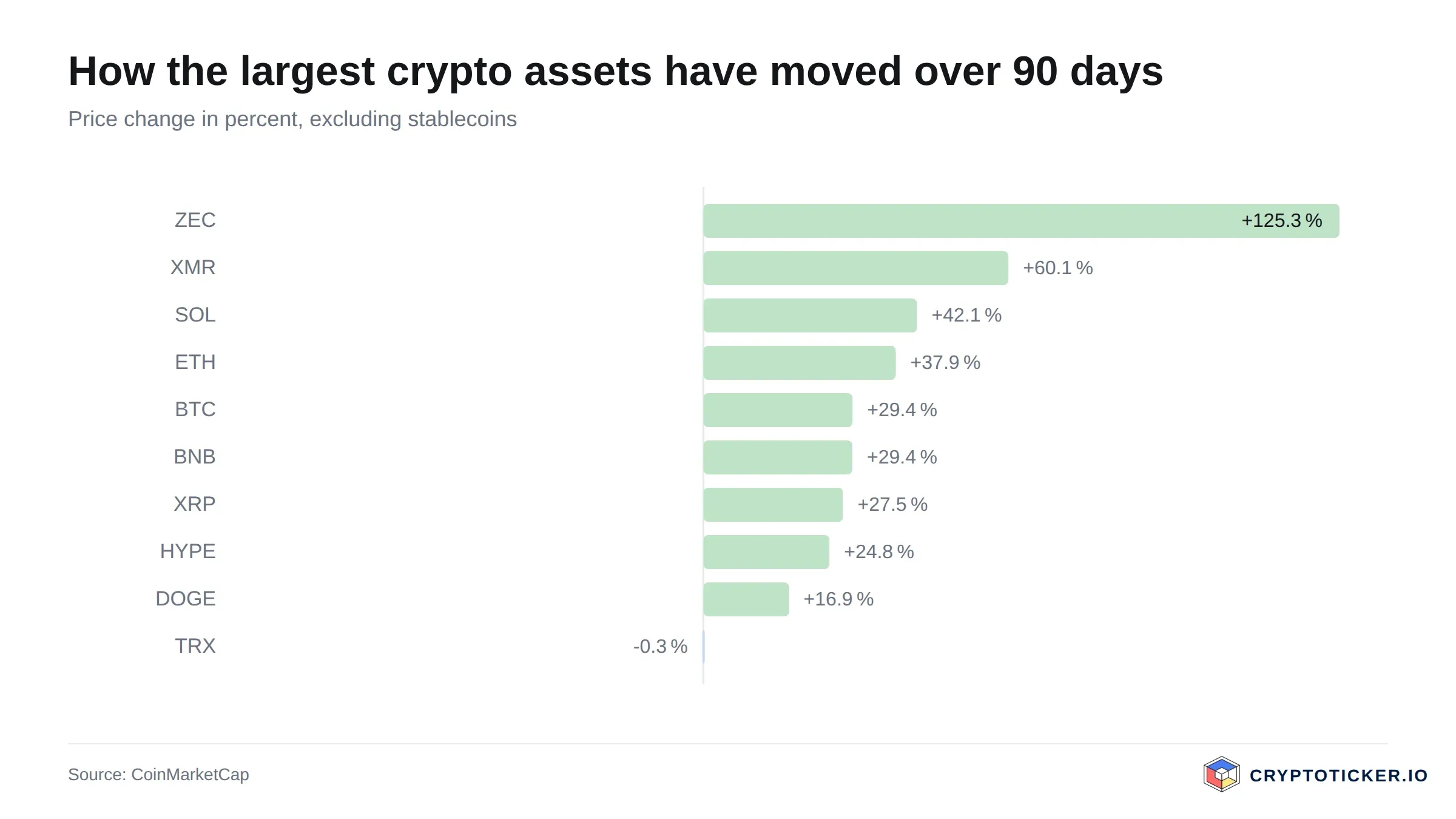
Such breaches reveal who owns crypto, how much, where they live and how to reach them. The attacker's hardest job, finding a victim worth the risk, is done before anyone picks up a wrench. Of the French victims with known residency, 93 percent were French nationals, not crypto-rich tourists. Critics such as Bull Bitcoin founder Francis Pouliot have gone further, arguing that the EU's DAC8 crypto reporting regime, which expands mandatory data collection on crypto users, has turned Know Your Customer into a kidnapping manual.
Why Are Criminals Kidnapping the Families of Crypto Investors?
The most chilling trend is who gets grabbed. Globally, relatives and acquaintances made up 25 to 30 percent of violent crypto incidents by early 2026. In France, that figure is over 40 percent.
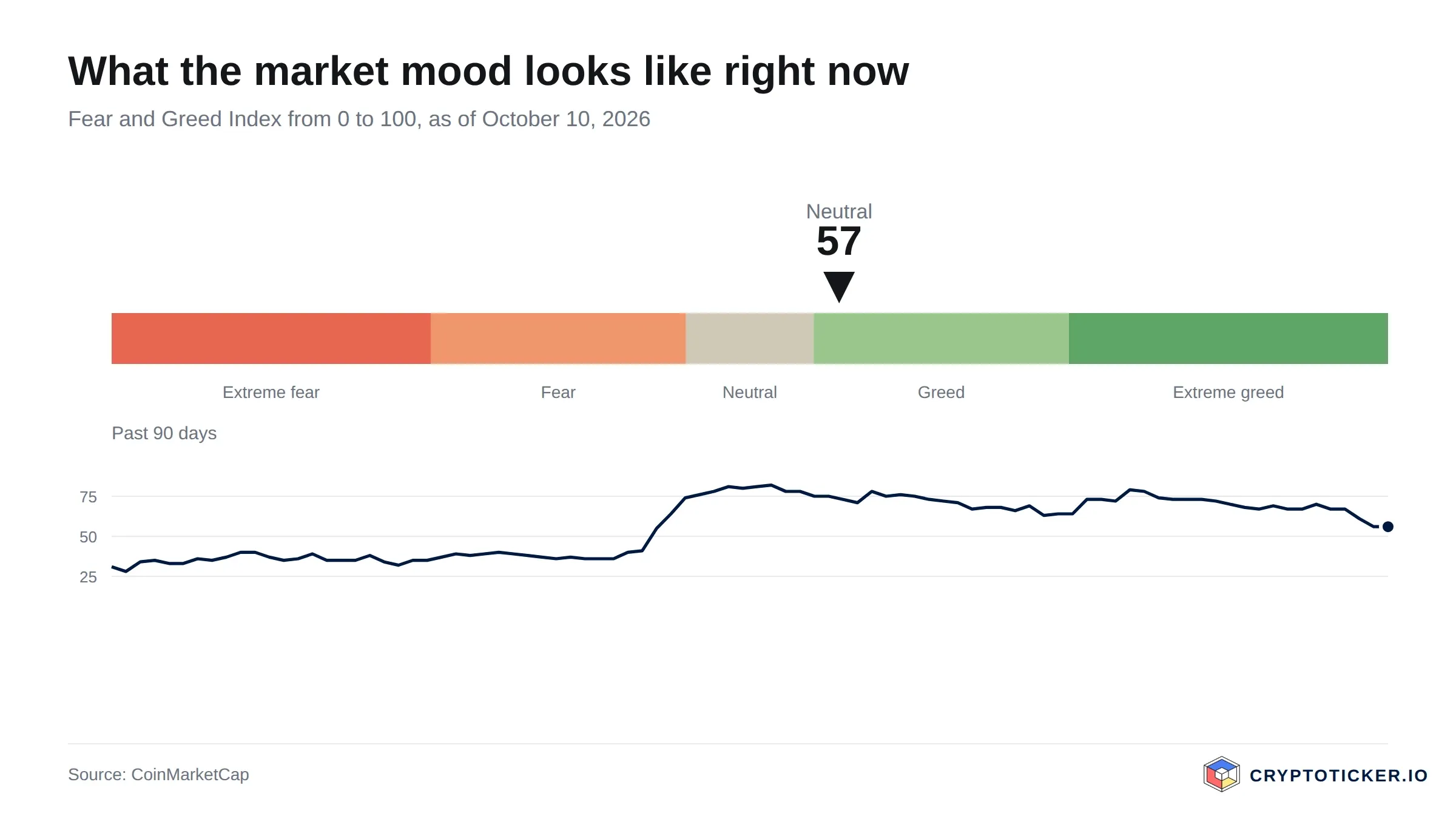
In May, six men allegedly tried to abduct the wife of The Sandbox co-founder Sébastien Borget from the couple's home near Paris, with one attacker posing as a delivery driver to get the gate opened. In August, a couple in rural France endured three separate break-in attempts after buying a house previously owned by crypto millionaires whose leaked tax records still listed the address. In 2025, the father of a crypto entrepreneur was held for two days in Paris while kidnappers severed part of his finger and demanded $5.6 million. In Finistère this April, five members of one family were held at their home.
Jardine says the pattern shows criminals doing reconnaissance first: social media, blockchain analysis, leaked data, insider tips. French authorities now treat the cases as organized crime and route them through JUNALCO, the national organized-crime jurisdiction.
How Do You Protect Your Crypto From a Wrench Attack?
The standard playbook still matters. A hardware wallet, a metal seed backup stored away from home and a healthy suspicion of phishing links remain the baseline, and the CryptoTicker shop stocks vetted hardware wallets if yours is overdue an upgrade. But none of that stops someone who already knows your address.
The new rules are about information, not keys. Never discuss holdings publicly or on social media. Keep your name off exchange leaderboards and conference badges. Consider a multisig setup where no single person, including you, can move funds alone, and a time-locked "duress" wallet that can be handed over under threat. Check whether your tax software or exchange has had a breach, and if so, assume your address is already in criminal hands. As Cointelegraph put it, cryptography can protect a wallet, but it cannot stop a $5 wrench.
Decrypt
A proposed rule would expressly fold event contracts tied to sports, politics, culture and weather into the “swap” definition, while an interim rule excludes casino-style gambling—sharpening the agency’s claim to exclusive jurisdiction.
The Bermuda-based insurer, which runs entirely on Bitcoin, drew the funding from existing backers led by Bain Capital Crypto after a record year driven by demand from wealthy families in Asia, Europe and the Middle East.
Physicists at George Washington University say a formula can estimate when an AI chatbot will flip from good answers to bad ones, and early tests on small models back it up.
A National Assembly committee adopted amendments taxing stablecoin swaps and crypto exits by wealthy holders, then rejected the 2027 budget's revenue section.
Executives are war-gaming the political fallout of a major AI-driven cyberattack and preparing to brief Congress fast if and when necessary.
U.Today - IT, AI and Fintech Daily News for You Today
Ledger has confirmed the discovery of an unauthorized hardware implant inside a crypto wallet linked to its ongoing theft investigation, raising serious concerns about a sophisticated supply-chain attack.
Ripple engineer Mayukha Vadari has warned that AI is making critical security vulnerabilities easier to uncover and exploit.
This week’s top stories: October 4–10.
The surge puts Shiba Inu layer 2 Shibarium’s transaction activity back in focus.
BTC Pioneer Adam Back Takes Aim at Ethereum in favor of Bitcoin’s UTXO Model.
Blockonomi
TLDR:
- The Bitcoin price fell 3.6% for the week after touching $80,400, then recovered above $83,000 following Thursday’s sharp decline.
- NEAR lost just 0.3% in the weekly comparison after a 91.7% monthly advance, then jumped more than 10% to about $5.25 on October 10.
- Monero’s 1.3% weekly decline beat Bitcoin’s loss, though price performance alone cannot show whether trading activity or buying demand drove the difference.
- Bitcoin ETF outflows reached $244 million in one day, while XRP funds saw $8.2 million in inflows even as XRP fell 9% for the week.
The Bitcoin price fell to a weekly low near $80,400 on October 8 as a crypto market selloff accelerated. By October 9, BTC had recovered to $83,247, leaving it 3.6% lower for the week. Most large tokens lost more over that same seven-day period.
NEAR Protocol and Monero were exceptions, down 0.3% and 1.3%, respectively, in the weekly comparison. Yet those figures capture only one point in a volatile stretch. NEAR had climbed 91.7% over the prior month, then rose more than 10% on October 10. The Bitcoin price and altcoin moves show resilience in the data, but not its cause.
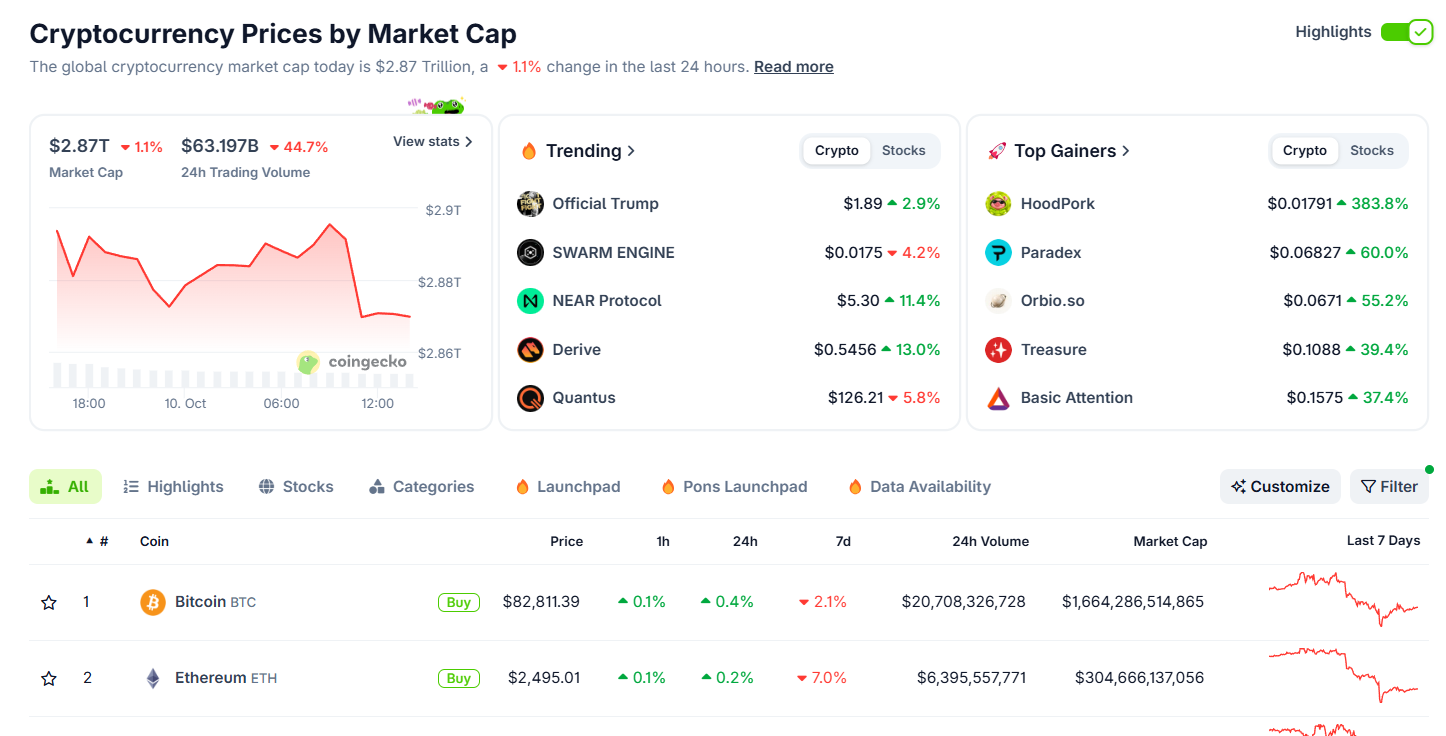
Bitcoin Price Slide Put NEAR and Monero Under Scrutiny
The selloff followed several failed attempts by BTC to reclaim $87,000. After slipping below $84,000 earlier in the week, Bitcoin fell to $80,400 on Thursday. The decline erased nearly $7,000 in a few days before buyers lifted BTC above $83,000. Bitcoin price weakness contrasted with the narrower weekly losses in NEAR and Monero.
NEAR’s small weekly drop deserves context. Its token price had climbed 91.7% in the previous month. That run can change how a weekly selloff appears. Even an intraday pullback may leave a token close to its starting price for the week. NEAR then gained more than 10%, reaching roughly $5.25 on October 10.
BTC price rebound shows how quickly the comparison shifted as prices recovered. Monero’s 1.3% loss also compared favorably with BTC. But a small decline alone cannot show whether buyers were accumulating, holders were inactive, or trading was thin.
ETF Flows and Weekend Recovery Point to Uneven Demand
Gains were not broad among large-cap coins. Thirteen of 16 tracked major tokens fell more than BTC during the measured week. Stellar posted the steepest decline at 13.5%. XRP lost 9%, despite XRP funds recording $8.2 million in inflows. Bitcoin ETFs, meanwhile, had $244 million in daily net outflows. Those flows complicate a simple demand narrative. Positive fund subscriptions did not protect XRP from falling. BTC declined despite its ETFs recording daily net outflows.
Bitcoin’s dominance increased to 59.5% as its market capitalization stood around $1.66 trillion. The total crypto market value rebounded to about $2.8 trillion after losing roughly $200 billion from its high to low. ETH recovered toward $2,500 after falling to $2,400, while XRP moved from $1.34 to around $1.41. The bounce restored some lost value but left several large tokens below recent levels.
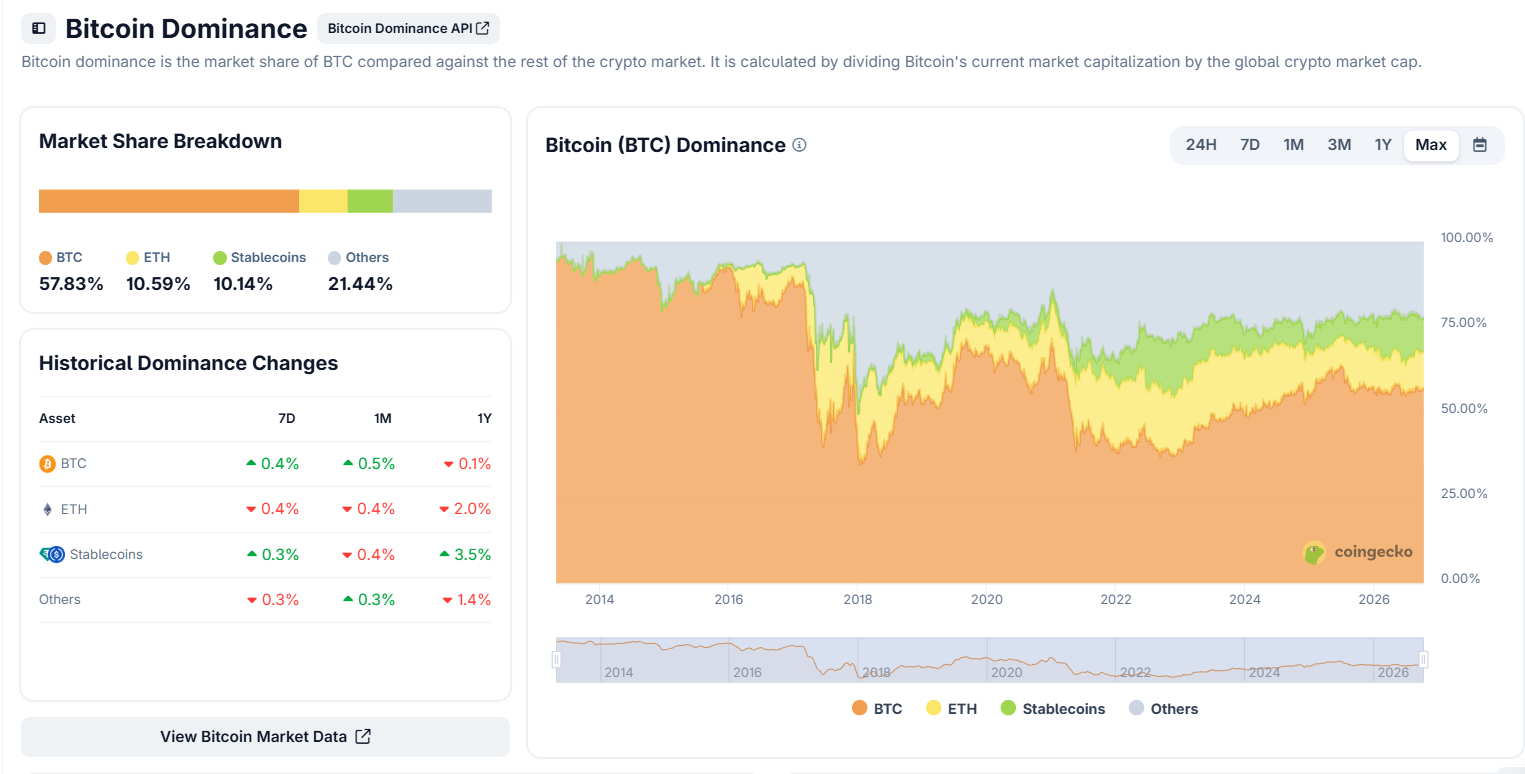
NEAR and ADA led the daily rebound among larger altcoins. Cardano rose about 7%, reclaiming $0.255, while NEAR’s advance outpaced peers. The Bitcoin price remained near $83,000 on October 10, below Monday’s $87,000 test and above Thursday’s low. This places the weekly outperformance beside a quick bounce, without confirming a lasting change in market leadership.
That matters for the Bitcoin price beside smaller tokens. Daily changes can look calm if trading is light, but weekly returns alone do not reveal activity. The same result can emerge from steady demand, limited selling, or a sharp drop followed by a rebound.
The post Bitcoin Price Holds Near $83K as NEAR and Monero Defy Selloff appeared first on Blockonomi.
TLDR:
- Strive Bitcoin funding through SATA generated an estimated $55 million during the week of Oct. 5, enough to purchase roughly 638 BTC at recent prices.
- SATA traded above its $100 par value on Oct. 5 and for much of Oct. 6, then stayed below par through Oct. 9, slowing estimated issuance.
- Strive held 29,462 BTC on Oct. 2 after buying 2,000 BTC at an average price near $84,422 between Sept. 28 and Oct. 2, while quarter-to-date BTC Yield reached 18.5%.
- Strategy sold zero STRC shares from Sept. 28 to Oct. 4, yet bought 334 BTC using MSTR common stock, lifting its holdings to 848,000 BTC.
Strive Bitcoin funding is accelerating through its SATA preferred stock program. The company generated an estimated $55 million during the week beginning October 5. That amount could purchase about 638 BTC at current prices. SATA traded $317 million in total volume during the period. However, issuance depends on shares trading at or above the $100 par value.
The preferred stock spent three sessions below that level. Most estimated proceeds came during Monday and Tuesday. Bitcoin traded near $82,800 on Friday, valuing 638 BTC at roughly $53 million. The result closely links Strive’s Bitcoin treasury strategy to Strategy’s capital markets playbook.
Strive Bitcoin Funding Depends on SATA Trading Above Par
That distinction matters because volume is not the same as corporate funding. Traders can exchange SATA below par without creating new proceeds. Strive therefore needs active demand and a supportive price. The next filing will actually determine how much cash reached its Bitcoin treasury.
Market trackers estimate that Strive sold about $55 million through its at-the-market program. The estimate uses eligible SATA volume and a capture ratio. That ratio reflects how much trading typically converts into newly issued shares. Past Securities and Exchange Commission filings help calibrate the calculation.
An ATM program lets a company issue shares gradually into public trading. It avoids the timing pressure of a large financing. Yet SATA cannot issue efficiently when its market price falls below par. Selling beneath $100 would weaken the program’s economics and dilute its yield proposition.
SATA traded above $100 on October 5 and for much of October 6. It then remained below par through October 9. Daily volume still reached some of its highest levels. The gap shows that trading activity alone does not guarantee Bitcoin purchases.
For Strive Bitcoin buyers, the distinction between volume and issuance is material. A busy tape can suggest strong demand, yet the company may receive little cash. Only eligible trading produces room for new shares. The estimate therefore remains provisional until the company files its next report.
The mechanism creates a brake. Investors must support SATA at par or higher before Strive can expand supply. When that support disappears, issuance pauses. Bitcoin buying then relies on cash already available or another financing route.
Strive Bitcoin Holdings Grow While Strategy Uses Common Stock
Strive reported 29,462 BTC on October 2. The balance followed a purchase of 2,000 BTC between September 28 and October 2. The average purchase price was about $84,422 per coin.
The company also reported adding 8,137 BTC during the third quarter. Those purchases carried an average cost of $78,885. Strive’s BTC Yield reached 18.5% quarter-to-date and 63.2% year-to-date on September 30. The metric measures Bitcoin growth per share.
The balance sheet has no debt principal. However, SATA carries about $168 million in annualized dividend obligations. Each new preferred share adds to that future payment burden. The model depends on continued investor demand for the income-oriented security.
Strategy provides the larger comparison. Its October 5 filing showed no STRC shares sold between September 28 and October 4. Strategy still bought 334 BTC from October 1 through October 4. It funded that purchase with MSTR common stock, taking its holdings to 848,000 BTC.
Both companies illustrate the same Bitcoin treasury model. Preferred or common equity raises capital for Bitcoin accumulation. The financing channel changes when market prices move. Strive’s SATA program currently shows that constraint more sharply because issuance stops below par.
The next weekly 8-K filings should provide the exact number of Bitcoin bought with SATA proceeds. They will also show whether Strive resumed issuance after the preferred stock recovered above $100.
The post Strive Bitcoin Has Enough for 638 BTC Through SATA Stock Sales appeared first on Blockonomi.
TLDR:
- Ethereum price prediction is bearish below the 50-day SMA, with $2,370 support and the 100-day average near $2,200 shaping the next levels to watch.
- U.S. spot Ethereum ETFs shed about $542 million in the week ended October 9, their largest weekly outflow since late January.
- BlackRock’s ETHA accounted for roughly $477 million in weekly withdrawals, while total U.S. Bitcoin ETF outflows reached $681 million.
- Whales reportedly added more than 166,000 ETH in 72 hours even as exchange balances rose 90,000 ETH and futures open interest declined.
Ethereum price prediction has weakened recently. Ether fell below its 50-day simple moving average. U.S. spot Ethereum ETFs logged their largest weekly outflow since January. ETH traded near $2,491 on October 10. It was down more than 7% in seven days, while trading volume fell 61% to $7.2 billion.
Yet whale data offered a counterpoint: holders added about 166,000 ETH over 72 hours, alongside Bitcoin and XRP purchases. The conflicting signals leave traders watching $2,370 support for now. A break could expose the $2,200 area, while a defense may steady the market. ETF redemptions and rising exchange balances remain risks.
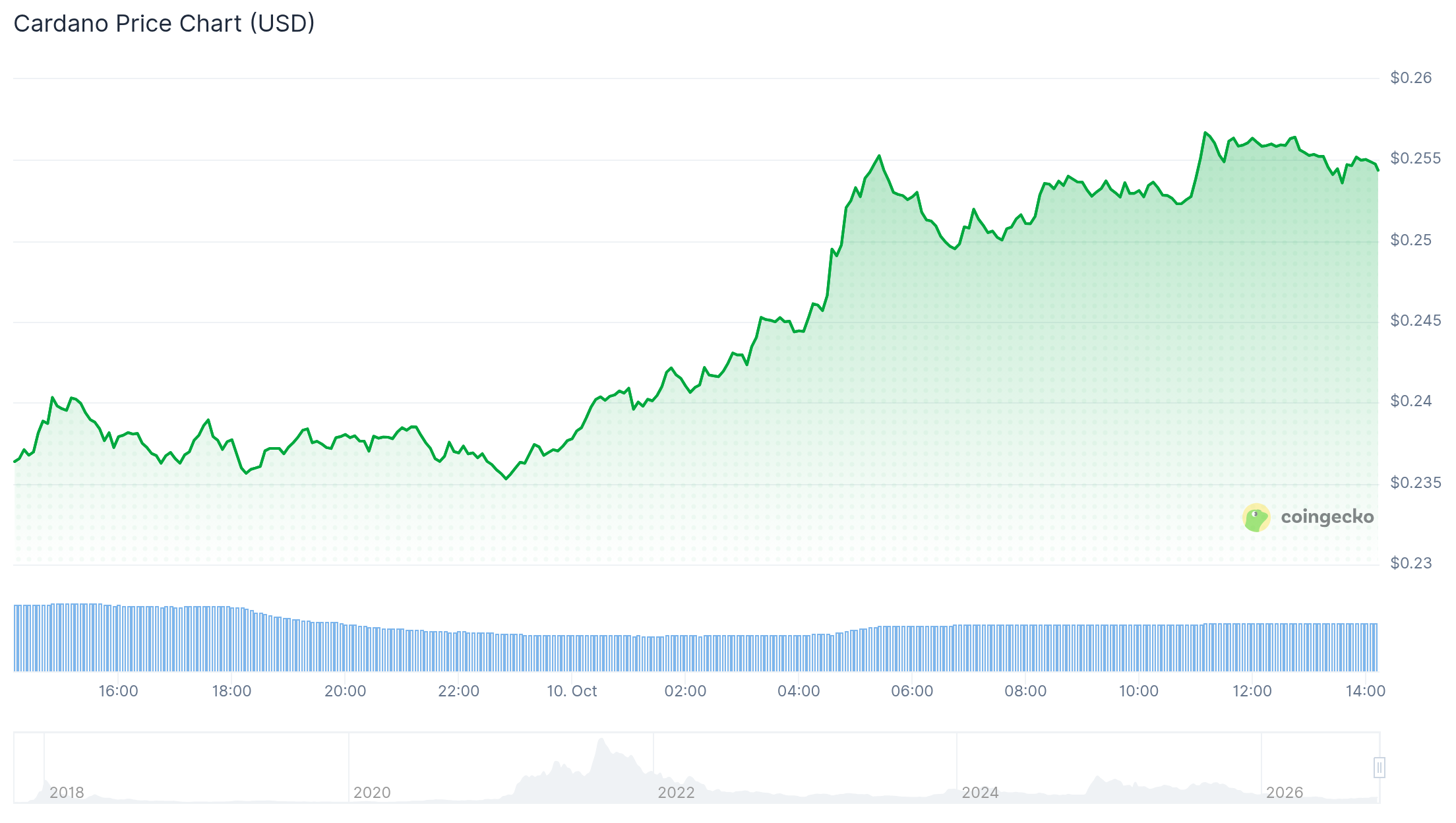
Ethereum Price Prediction Weighs ETF Outflows Against Whale Buying
U.S. spot Ethereum ETFs saw approximately $542 million in net withdrawals for the week ended October 9, SoSoValue data showed. It was their largest outflow since late January. BlackRock’s iShares Ethereum Trust, known as ETHA, accounted for about $477 million. It was the fund’s largest weekly withdrawal since December 2025. Bitcoin ETFs saw pressure, with $681 million leaving during the period.
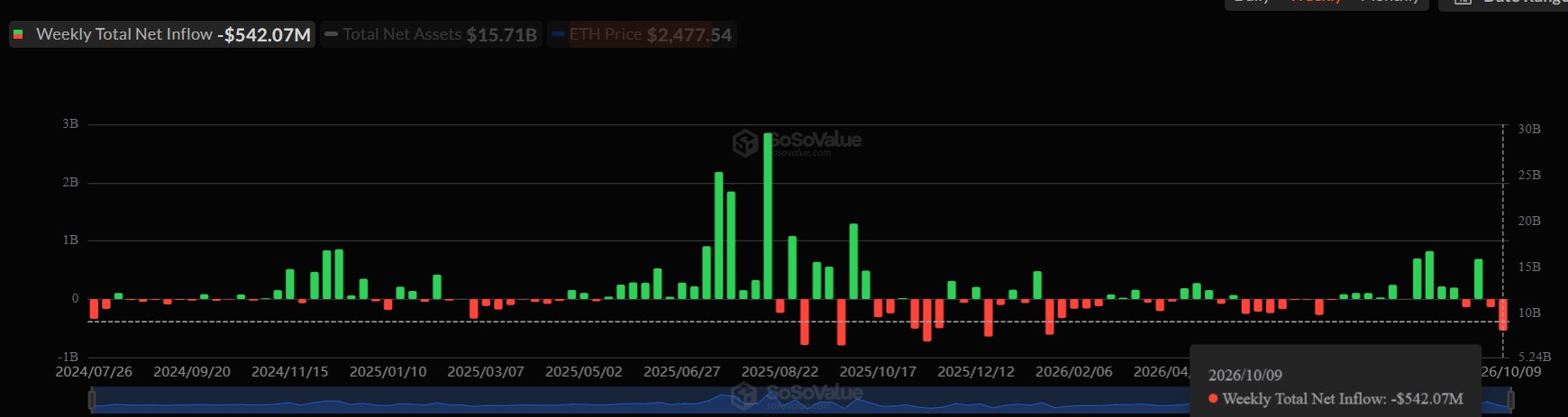
These Ethereum ETF outflows point to reduced exposure. They do not show every investor is selling ETH. However, they weaken a key source of demand during a price decline. An outflow streak could cap attempts to recover above resistance. Whale accumulation complicates that bearish picture. Analyst Ali Martinez says large wallets added roughly 15,000 BTC and more than 166,000 ETH. They also added about 45 million XRP in 72 hours.
Whale balances can rise while smaller holders or funds distribute coins. For the Ethereum price prediction, this divergence matters. Wallet demand may absorb some supply without quickly reversing ETF outflows or retail selling. Traders need follow-through in spot buying to treat the signal as durable.
ETF flows and wallet data track different activity. ETF figures capture listed-product flows; whale estimates track large on-chain balances. Those signals can diverge if ETF investors withdraw while other holders accumulate.
The Ethereum price prediction depends on whether whale buying continues beyond the 72-hour window. Continued purchases could absorb some supply, but a pause would leave ETF redemptions as the clearer demand signal.
Exchange Inflows and Futures Deleveraging Add Pressure on ETH
Exchange data adds caution. CoinGlass figures show Ethereum balances on trading platforms rising from 11.71 million ETH on October 8. They reached 11.8 million the next day. That 90,000-ETH increase marked the highest balance since September 23. Coins transferred to exchanges may be prepared for sale, but transfers alone do not prove liquidation. At the same time, open interest fell from 13.29 million to 12.77 million ETH.
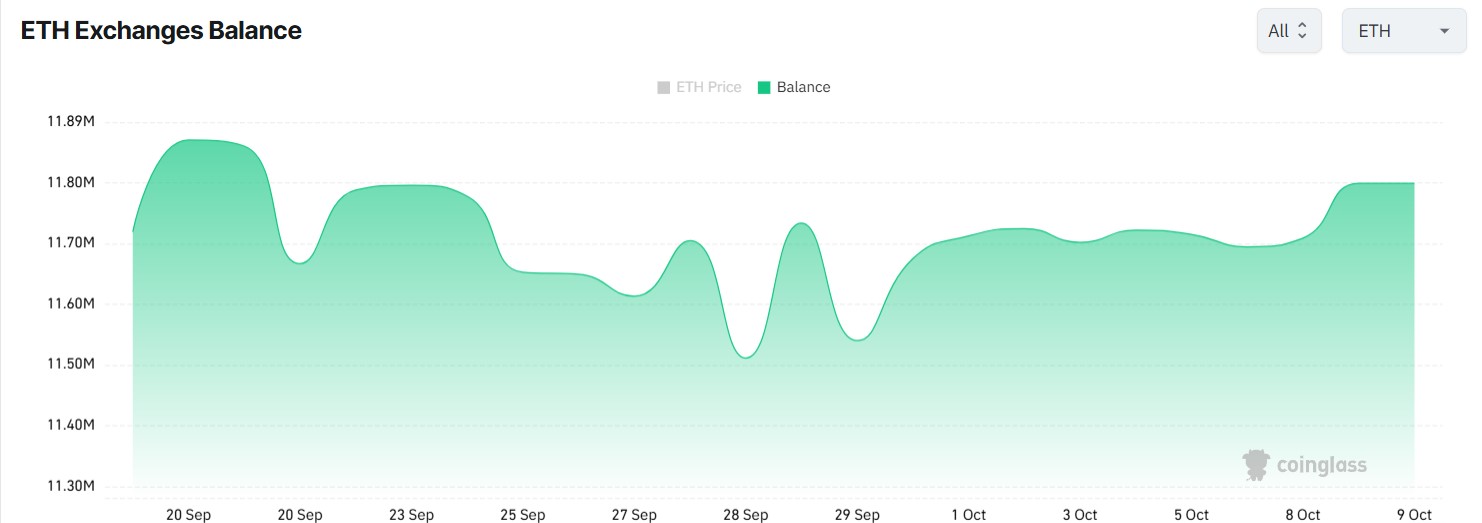
Lower futures open interest points to reduced outstanding positions and possible deleveraging. It can ease liquidation risk, but it also signals weaker appetite for leveraged longs. Combined, rising exchange balances and lower OI suggest traders are reducing exposure as spot supply increases. For the Ethereum price prediction, exchange balances now add another warning.
On the daily chart, ETH’s relative strength index slipped to 39, its lowest reading since June. Price also moved below the 50-day SMA. The $2,500 level has also turned into overhead resistance after ETH fell beneath it. The ETH price forecast hinges first on $2,370. A daily close below that support would strengthen the bearish case.
It would put the 100-day SMA near $2,200 in view. This Ethereum price prediction would need confirmation from continued selling or weak demand. If buyers defend $2,370, ETH could consolidate instead. A recovery above the 50-day average would give bulls a stronger signal. ETH had not reclaimed it by publication.
The post Ethereum ETFs Post Biggest Weekly Outflows Since January as Price Breaks Below $2,500 appeared first on Blockonomi.
TLDR:
- Cardano price rose nearly 7% on Oct. 10 and reached about $0.256 after a short-window rebound.
- ADA reclaimed the $0.2353 moving average and $0.2359 Fibonacci level, while reported volume fell 34.86%, leaving the breakout short of strong confirmation.
- Daily active addresses reached 27,500 and 27,200 on Oct. 7–8 after CIP-0113 launched, but ADA fell roughly 13% over that same period.
- Analyst Andreou’s $0.90 scenario remains conditional: ADA must hold the 0.22–0.25 base, reclaim 0.30–0.35, then clear higher resistance zones.
Cardano’s ADA token climbed 7% on Oct. 10, trading near $0.256 as buyers returned to the market. The Cardano price gain outpaced major cryptocurrencies during the session. The rebound followed an October decline, making this a recovery attempt rather than a confirmed trend reversal.
Cardano price analysis reveal ADA reclaimed its 30-day average near $0.2353 and the 50% Fibonacci level around $0.2359. But reported trading volume fell 34.86%, leaving buyers to prove they can defend the breakout. Network activity had increased earlier in the week.
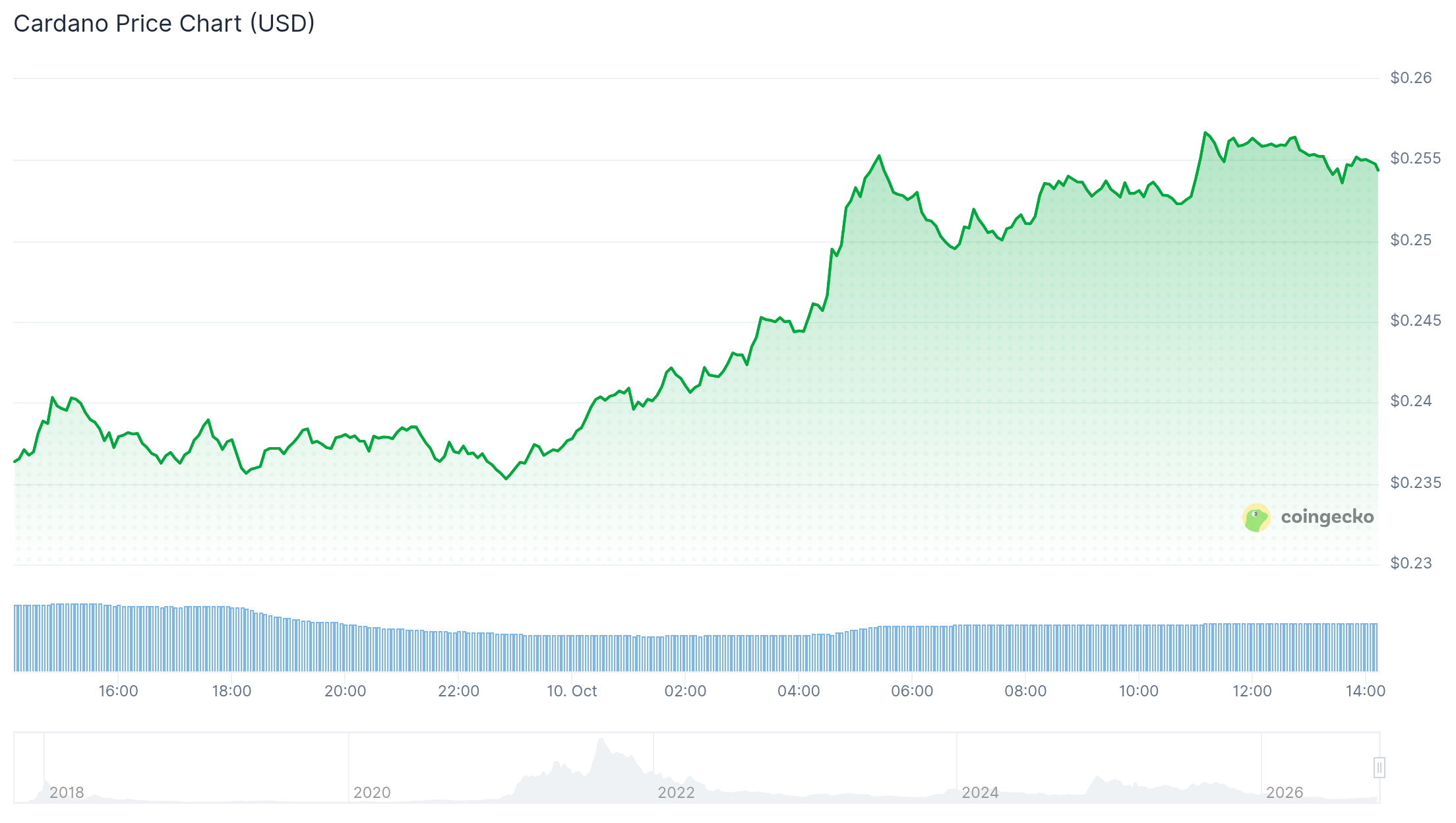
Cardano Price Rebound Tests Support as Volume Remains Thin
The reclaimed average and retracement level now form a short-term checkpoint. A drop below them would weaken the breakout case. The support band extends from $0.2359 to $0.2276.
Holding that area could leave room for a test of weekly Supertrend resistance near $0.2762. The Cardano price would need a daily close above $0.256 to show that buyers can sustain the bounce. A rejection at that level would raise the risk of a false breakout.
Volume remains a key concern. The 34.86% decline suggests the rally drew less participation than its price move implied. The figure varies by exchange and measurement window, but the direction argues for caution. The Altcoin Season Index rose 5.17% to 61, pointing to stronger relative demand for alternative tokens. That measure describes rotation; it does not prove capital will stay in ADA.
Bitcoin traded near $82,800, a level that matters for altcoins. Spot Bitcoin ETFs shed $729 million over two days, adding pressure to risk assets. Renewed selling could again put ADA support levels under strain.
The immediate test is twofold: defend reclaimed levels and attract stronger spot volume. Until both happen, the Cardano price recovery remains technically constructive but unconfirmed.
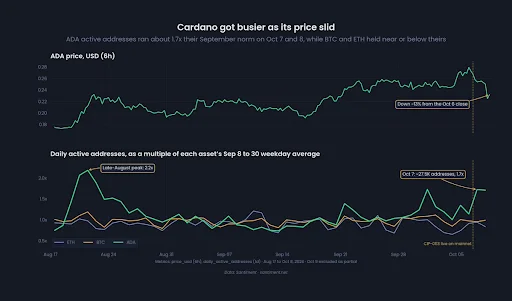
ADA Active Addresses Rose After CIP-0113, Then Price Fell
Santiment reported about 27,500 daily active Cardano addresses on Oct. 7 and 27,200 on Oct. 8, around 1.7 times September’s weekday average. The increase coincided with CIP-0113 going live on mainnet on Oct. 7. The standard enables programmable tokens with issuer-defined rules. The Cardano Foundation says issuers can add KYC checks, sanctions screening, and transfer restrictions to native tokens. Wallets and explorers can handle these assets like other Cardano tokens. The standard required no protocol hard fork.
Coincidence does not establish that the upgrade caused the address spike. Santiment’s figures also showed Bitcoin and Ethereum addresses at or below September averages. Active addresses measure participation, not intent.
They cannot show whether users bought ADA, moved tokens, staked, or used applications. The Cardano price fell about 13% from the Oct. 6 close through Oct. 8, despite the increase. That divergence shows network use did not translate into immediate buying pressure.
The Cardano price bounce came on October 10, after both the activity increase and the selloff. It should not be attributed to CIP-0113 without evidence linking buyers to the upgrade. A lasting signal would require elevated addresses to persist beyond launch.

Analyst Giannis Andreou says initial support is present at 0.22–0.25 and first resistance at 0.30–0.35. A weekly reclaim and successful retest would strengthen that recovery case. Higher zones sit at 0.40–0.45 and 0.55–0.65. The $0.90 scenario depends on clearing each barrier, so it remains conditional. A sustained break below $0.22 would weaken the setup.
The post Cardano Price Rises 7% as ADA Tests Key Resistance Near $0.28 appeared first on Blockonomi.
TLDR
- Eli Lilly stock gains 0.62% as new Phase 3b findings highlight treatment gains.
- Combined therapy changes 482 proteins versus 140 with Taltz alone by Week 36.
- Gene activity shifts span 467 genes with both drugs, versus 16 on Taltz alone.
- Taltz and Zepbound deliver improved skin clearance and weight loss at Week 36.
- Researchers report consistent safety findings, but no new approved indication.
Eli Lilly and Company stock rose 0.62% to $1,176.80 on Friday, gaining $7.20 during the trading session. The company announced new Phase 3b findings showing broader biological responses from combined Taltz and Zepbound treatment. The results expand earlier evidence of improved psoriasis symptoms and weight reduction among adults living with psoriasis and obesity.
Eli Lilly and Company, LLY
Eli Lilly Reports Stronger Phase 3b Results for Taltz and Zepbound
Eli Lilly released new exploratory findings from its TOGETHER-PsO Phase 3b clinical trial examining two existing prescription medicines. Researchers compared the combined use of Taltz and Zepbound against Taltz alone in adults with moderate-to-severe plaque psoriasis. The study also included participants with obesity or overweight alongside at least one additional weight-related medical condition.
The latest analysis identified broader changes in proteins and genes among participants receiving both medicines compared with Taltz alone. By Week 36, researchers identified changes involving 482 proteins in the combination group, compared with 140 in the other group. Similarly, gene expression changes affected 467 genes with combined treatment, against only 16 genes with Taltz alone.
These biological differences appeared as early as Week 12, according to the pharmaceutical company’s newly released findings. Researchers also identified stronger reductions in inflammatory immune activity among participants receiving both treatments over the study period. Eli Lilly presented the findings at the 2026 Fall Clinical Dermatology Conference in Las Vegas.
Combined Treatment Improves Skin Clearance and Weight Reduction
The latest findings build on earlier clinical results showing better treatment outcomes among participants receiving Taltz alongside Zepbound. At Week 36, the combination delivered superior skin clearance and meaningful weight reduction compared with Taltz alone. Furthermore, participants maintained or improved these clinical benefits through Week 52, according to Eli Lilly’s previously reported findings.
The analysis also examined neutrophils, which play an important role in the body’s inflammatory immune response. Researchers found that combined treatment produced greater changes in inflammatory pathways associated with these immune cells. Changes in certain neutrophil-related markers partly explained the additional improvement in psoriasis severity scores among combination-treatment participants.
The TOGETHER-PsO trial included 274 adults across multiple clinical research centers, with participants divided equally between two treatment groups. One group received Taltz alone, while the other received Taltz and Zepbound through injections under the skin. Both groups also received guidance on reducing calorie intake and increasing physical activity throughout the clinical study.
Eli Lilly Expands Research Into Psoriasis and Obesity
Eli Lilly designed the study to examine the relationship between metabolic health and inflammatory skin conditions. Approximately 61% of Americans with psoriasis also experience obesity or overweight alongside another weight-related medical condition, according to Lilly. The findings provide additional research into how treatments targeting different biological processes may influence both conditions.
Taltz works by blocking interleukin-17A, an immune signaling protein involved in inflammation and several related inflammatory conditions. Zepbound targets GIP and GLP-1 receptors, helping regulate appetite and support weight management in eligible adults. The two medicines therefore act through different biological pathways, providing the basis for investigating their combined clinical effects.
Eli Lilly reported that the combination’s safety findings matched the established safety profiles of the individual medicines. The exploratory results do not establish a new approved indication for using the medicines together. The company continues examining the relationship between immune and metabolic processes as researchers assess broader approaches to psoriasis management.
The post Eli Lilly and Company (LLY) Stock: Rises as Taltz and Zepbound Show Promising Results appeared first on Blockonomi.
CryptoPotato
The Asian country has added another 23 tonnes of gold to its reserves in September, which became its largest monthly purchase in roughly three years.
Other central banks, including those from Poland, Uzbekistan, and Kazakhstan, have been accumulating the precious metal as well in substantial portions over the year.
China Keeps Buying Gold
The Kobeissi Letter highlighted over the weekend that the People’s Bank of China purchased approximately 23 tonnes of gold in September, beating its previous 2026 record in terms of monthly purchases. This marked its 23rd consecutive month of buying and followed additions of roughly 20 tonnes in both July and August.
The world’s most populous country has bought more than 100 tonnes of the bullion in 2026, and its reported reserves have skyrocketed to 2,410 tonnes.
China has become the fifth-largest gold holder, trailing the US, Germany, Italy, and France. However, the analysts at the Kobeissi Letter said China is likely to surpass Italy and France as early as this year at this pace, as both European nations hold 2,452 tonnes and 2,437 tonnes, respectively.
BREAKING: China’s central bank officially bought +23 tonnes of gold in September, its largest monthly purchase since September 2023.
This follows +20 tonnes purchased in both August and July, and marks its 23rd consecutive monthly gold purchase.
So far in 2026, China has officially acquired +103 tonnes of gold, raising total holdings to a record 2,410 tonnes.
China is now the world’s 5th-largest gold holder, following the US, Germany, Italy, and France.
At this pace, it could surpass Italy and France as early as this year, which hold 2,452 tonnes and 2,437 tonnes, respectively.
China is aggressively buying the dip in gold.
— The Kobeissi Letter (@KobeissiLetter) October 9, 2026
The bullion’s price soared to $4,700/oz during the mid-August breakout rally, but it was rejected and dipped to $4,060 earlier in October. It recovered some ground to $4,194/oz as of Friday’s close.
Not Just China
Data from the World Gold Council shows that global central banks reported 39 tonnes of net purchases in August alone, following 23 tonnes in July. China led August with 20 tonnes, but several other countries followed suit.
The National Bank of Poland added 8 tonnes, taking its 2026 purchases to almost 100 tonnes and its total reserves to roughly 648 tonnes. Uzbekistan also purchased 8 tonnes in August, while Kazakhstan added 7 tonnes.
A WGC survey found that 84% of central banks expected gold to represent a larger share of global reserves five years from now.
The post China’s Gold Buying Spree Accelerates as Central Banks Keep Stockpiling Bullion appeared first on CryptoPotato.
The weekend is going relatively calmly for bitcoin and most of the crypto market, as is typical, but another macro event in the past several hours threatened to disrupt that.
Yemen’s Houthis reportedly attacked the King Khalid International Airport in Riyadh, Saudi Arabia, with at least 12 people killed and over 300 injured. Saudi Arabia’s authorities have vowed to respond to the attack, while the Houthis are yet to comment on it.
Fighting in the region has escalated in the past week or so, as another three people were killed in separate Houthi strikes on two different Saudi airports on October 6 and 7.
International authorities, as well as US Secretary of State Marco Rubio, strongly condemned the recent attacks. Rubio even confirmed an American citizen was killed. Meanwhile, US President Donald Trump suggested that his country is likely to join the strikes against the Houthis:
“We may. We’re going to look at it. We just found out about the recent attack, so we’ll make a decision. We move very quickly.”
The consequences for bitcoin and the altcoins are not evident yet. BTC has remained close to $83,000, while most alts have remained sideways over the past 24 hours. However, history has taught us that the real volatility arrives on Monday morning when most financial markets start to open.
Recall the events from last week. The tension in the Middle East skyrocketed over the weekend again, with Iran saying it has prepared for a fresh US bombing campaign after Trump’s top security officials met at Camp David on Friday in a meeting focused on that war.
BTC stood in a well-defined range over the weekend, before the fluctuations began on Monday morning with an unsuccessful breakout attempt and a violent rejection.
The post Bitcoin Price Under Pressure as Houthis Attack Saudi Arabia and Trump Signals US Involvement appeared first on CryptoPotato.
Most major cryptocurrencies tanked over the past several days, led by bitcoin’s nosedive from $87,000 to under $81,000, which became its lowest price tag in well over two weeks.
Large altcoins such as XRP and ETH were not spared, with the former posting a double-digit decline over the past seven-day period. The question now is what whales were doing during this time, and what’s next for the underlying assets.
The BTC Case
Some of the most probable reasons behind BTC’s crash include substantial ETF outflows, FUD initiated by big transfers from the US government, macro news, and profit-taking. It’s worth exploring what whales did during this time of distress, and Ali Martinez pointed to a growing accumulation spree.
In a recent video on X, the popular analyst said these large market participants pressed the buy button hard on bitcoin, adding over $1.2 billion worth of the asset to their holdings in 72 hours.
In another bullish post, he explained that the TD Sequential has finally flashed a buy signal for the cryptocurrency on the four-hour chart. This came after the asset crumbled by 7% in a few days and hints at a potential rebound.
2/5 The TD Sequential is flashing a buy signal on Bitcoin’s four-hour chart.
It comes after $BTC fell 5.55%, from $86,976 on October 5 to $82,150 today.
The signal suggests this pullback may be nearing an end, with a rebound now worth watching. https://t.co/o9ZS4Q1anl
— Ali Charts (@alicharts) October 8, 2026
Here’s ETH’s Situation
The leading altcoin crashed hard as well, tumbling from over $2,700 to $2,400 before it found some support. Although it rebounded to $2,500 on Friday, where it was stopped, it still remains well in the red on a weekly scale.
According to Martinez, Ethereum whales didn’t just stand on the sidelines. They increased their holdings by 0.64%: in other words, they purchased around 166,000 tokens as the asset’s price corrected.
ETH’s 8% decline also led to a change in the TD Sequential indicator. Similar to BTC, the four-hour chart flashed a buy signal once the asset slipped below $2,550, where it currently sits. Martinez noted that the recovery can take ETH to somewhere between $2,620 and $2,650.
What About XRP?
Ripple’s native token remains down by double digits on a weekly scale, even though it rebounded from the local low at $1.34. On the plus side, the rejection at $1.51 and the subsequent retracement allowed whales to resume their accumulation spree.
Martinez said these big market players bought over 45 million tokens, worth around $63 million, during the nosedive. And, not to be outdone by BTC and ETH, XRP’s four-hour chart also saw a new buy signal, according to the TD Sequential.
“An earlier sell signal aligned closely with XRP’s local high. Now, the question is whether this buy signal marks a local low,” added Martinez.
The post BTC, ETH, XRP Crash Sparks Whale Accumulation as Buy Signals Appear appeared first on CryptoPotato.
Bitcoin is trading around $83K after the rejection from the $86K to $90K resistance zone weakened short-term structure, while the Coinbase Premium Index has turned sharply negative, suggesting US-based buying demand may be fading. BTC is attempting to stabilize, but buyers need to reclaim nearby resistance to improve the outlook.
Bitcoin Price Analysis: The Daily Chart
Bitcoin’s daily chart shows a substantial recovery from the June lows near $58K to the recent highs around $86K. However, the rally has encountered strong resistance, and the latest price action suggests that sellers are regaining control in the short term.
BTC has been rejected at the $86K to $90K resistance zone, with the lower end of that zone, around $86K, acting as the immediate barrier to a renewed advance. A broader resistance area appears around $95K, which would matter if Bitcoin reclaims the nearer supply zone and resumes its recovery.
Still, the price is above the 100-day and 200-day moving averages, both currently near $72K, after a bullish crossover. Although BTC remains comfortably above these averages, their recent crossover and upturn reflect improved medium-term structure following the summer recovery. The moving averages could become important dynamic support if the correction deepens, but they are not immediate downside targets while the market remains above the nearer support zones.
The first key downside area to watch is the $77K demand zone created by the bullish order block that initiated the final leg of the recent rally. If this area is lost and the price closes below $75K, it would weaken the recovery structure and expose the mentioned moving averages around $72K.
Yet, for now, the daily structure remains in a recovery phase, but the rejection from resistance and a potential loss of short-term support could suggest that Bitcoin may need to undergo a deeper correction before attempting another advance.
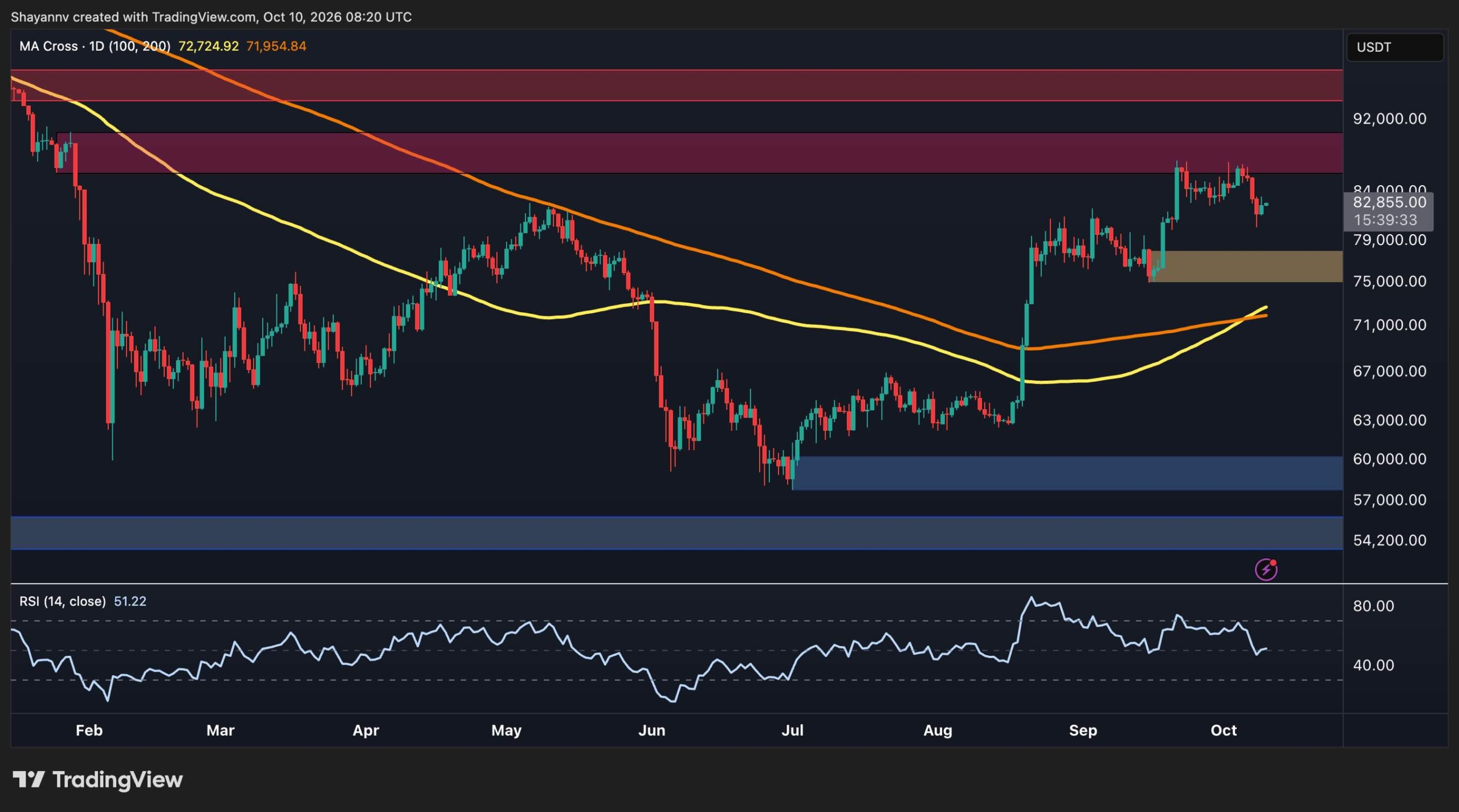
BTC/USDT 4-Hour Chart
On the 4-hour chart, the asset has broken below a rising wedge after getting rejected from the $86K region. The breakdown below the pattern’s lower trendline indicates the pattern has resolved bearishly, at least in the short term.
Following the breakdown, BTC declined toward the $80K area before staging a modest rebound toward $83K. This recovery suggests that buyers are attempting to stabilize the price, but the bounce remains limited as a bearish order block has formed near $85K that could push the asset lower once more.
On the downside, the $80K low represents the nearest area where buyers have recently attempted to step in. If BTC loses this zone, the next major support is the same $75K to $78K demand area visible on the daily chart.
The 4-hour RSI has also recovered from the oversold territory and is now in the mid-40s, suggesting that selling momentum has eased somewhat. However, it remains below the neutral 50 level, meaning the rebound has not yet established convincing bullish momentum.
The short-term outlook therefore remains cautious. Bitcoin could continue consolidating around $82K to $84K if buyers manage to defend the recent lows. However, another rejection below $86K followed by a break under $80K would increase the likelihood of a deeper move toward the $75K to $78K demand zone.

Sentiment Analysis
The Coinbase Premium Index chart shows that the metric has turned sharply negative in the latest reading, falling to approximately -0.1 while Bitcoin trades near $82.7K. The index measures the price difference between Bitcoin on Coinbase and a comparable market price, with a negative reading generally indicating that BTC is trading at a discount on Coinbase relative to the reference market.
A persistently positive premium can indicate stronger buying pressure on Coinbase, often associated with US-based spot demand. Conversely, a negative premium suggests weaker relative demand or stronger selling pressure on the platform. However, the metric is not a direct measure of total US investor flows, and it can also be affected by differences in liquidity and market conditions across exchanges.
The latest deterioration is notable because it coincides with Bitcoin’s rejection from the $86K resistance region and its subsequent breakdown from the four-hour rising wedge. The alignment between weakening price structure and a negative Coinbase Premium suggests that spot demand may not currently be strong enough to support an immediate continuation of the rally.
The index has displayed repeated swings between positive and negative territory throughout the chart, so the latest decline should not be interpreted as definitive evidence of sustained distribution. Still, a continued negative premium alongside further price weakness would reinforce the bearish case, particularly if BTC loses the $80K support area.

The post Bitcoin Price Analysis: Is BTC’s Recovery Over as US Demand Turns Negative? appeared first on CryptoPotato.
XRP is attempting to stabilize after a sharp correction from its September highs, with the price currently trading around $1.40. While buyers have managed to trigger a rebound from the $1.30 support area, the broader technical picture remains mixed. XRP needs to claim nearby resistance to continue the recovery, while another rejection could expose lower support levels.
Ripple Price Analysis: The USDT Pair
XRP’s daily chart shows a significant recovery from the August lows below $1, followed by a sharp rally that carried the asset toward the $1.60 region. However, the market has rejected this level twice, suggesting bullish momentum has weakened considerably.
The price is currently hovering around $1.40, with the $1.30 zone serving as the key nearby support area. This region has already attracted buying interest, as demonstrated by the recent rebound. Holding this zone could allow the asset to consolidate and attempt another move higher. A decisive breakdown, however, would weaken the recovery structure and bring the $1 support zone back into focus.
The 100-day and 200-day moving averages are also converging for a potential bullish crossover near the $1.30 zone, adding to this level’s importance for XRP’s short- to mid-term trend. Yet, with the RSI dropping below the neutral 50 level, bullish momentum is clearly weak, putting the market at significant risk of losing the key support zone.
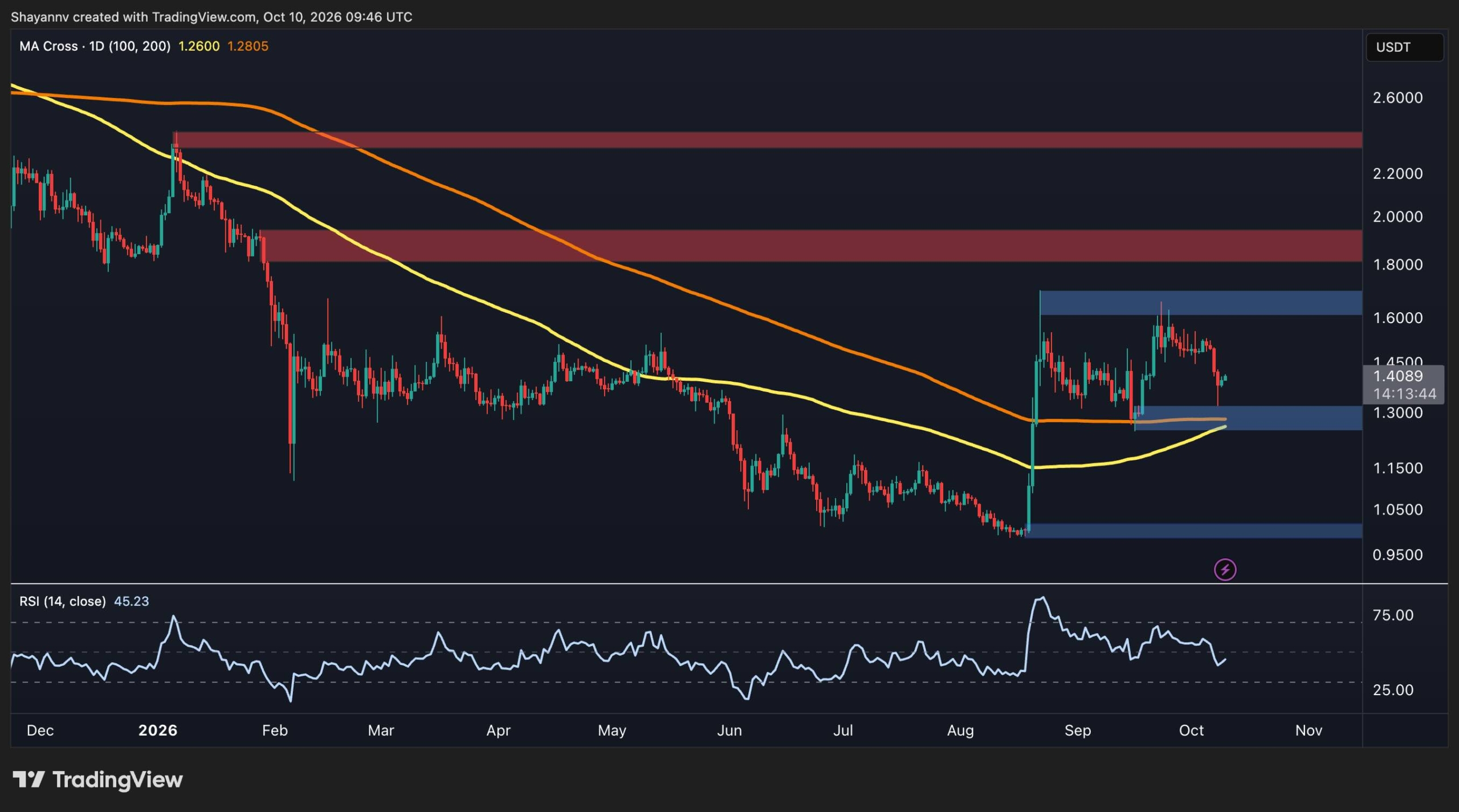
The 4-Hour Chart
The 4-hour chart highlights the recent correction more clearly. XRP has been trading beneath a descending resistance trendline drawn from the September highs, with successive lower highs reflecting persistent selling pressure. The latest decline pushed the price toward the $1.30 support zone before buyers stepped in and initiated a modest rebound toward $1.40.
Despite this recovery, XRP remains below the $1.45 resistance area. This zone is particularly important because it aligns with the descending trendline, making it a key level for determining whether the latest rebound can develop into a broader recovery. A convincing breakout above $1.45 could invalidate the immediate bearish structure and allow the price to target the $1.60 region once more.
Conversely, a rejection near $1.45 could send XRP back toward the $1.15 imbalance which was formed during the almost vertical rally mid-August. With the 4-hour RSI climbing back above the oversold region to approximately 40, selling pressure has moderated, although the indicator remains below 50 and does not yet confirm a bullish momentum shift.
Overall, XRP is at a pivotal point. The defense of $1.30 offers the bulls an opportunity to extend the rebound, but the descending 4-hour trendline and resistance near $1.45 remain significant obstacles. A breakout above this barrier would strengthen the recovery case, while a renewed loss of $1.30 would increase the risk of a deeper correction.
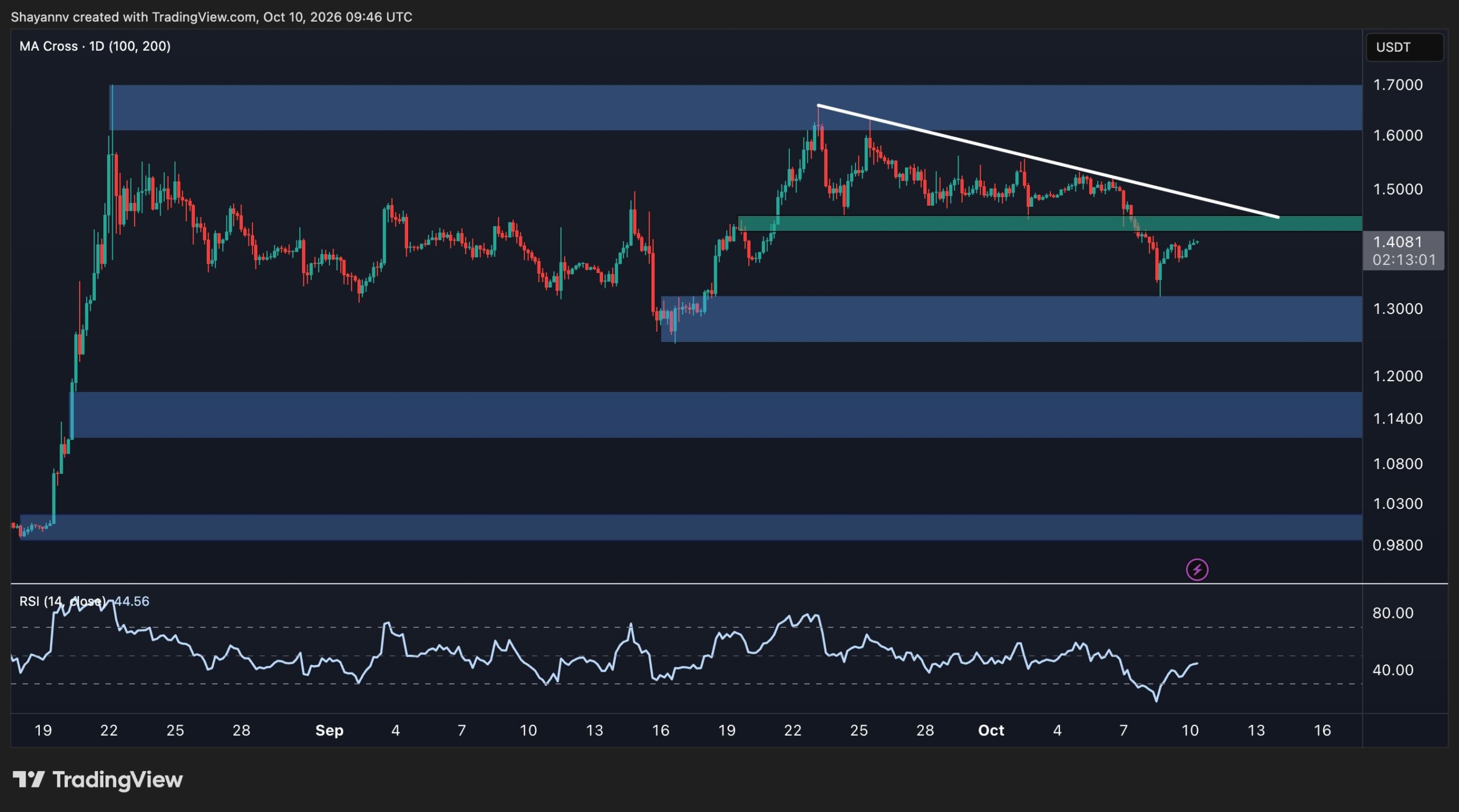
The post Ripple Price Analysis: XRP Tests Critical Trendline Following Recent Correction appeared first on CryptoPotato.