Cryptocurrency Posts
Crypto Briefing
Polymarket's decision between equity or token launch could reshape its market strategy, impacting investor dynamics and industry standards.
The post Polymarket weighs an equity path against a token launch appeared first on Crypto Briefing.
The expedited document release may impact OpenAI's IPO plans, raising concerns about its financial stability and valuation targets.
The post Judge orders OpenAI to expedite document release in Apple trade secrets case appeared first on Crypto Briefing.
SoftBank's massive debt-financed AI investment heightens financial risk, underscoring market's cautious optimism and potential volatility in AI.
The post SoftBank’s record $11.1 billion junk bond sale raises the stakes on Son’s AI bets appeared first on Crypto Briefing.
Anthropic's investor day may signal increased market confidence, potentially accelerating its IPO timeline and impacting future valuations.
The post Anthropic reportedly holding institutional investor day tomorrow ahead of potential IPO appeared first on Crypto Briefing.
Starknet's Shadow Accounts enhance DeFi privacy, potentially reshaping user anonymity and security, while balancing compliance needs.
The post Starknet launches Shadow Accounts to keep DeFi wallets unlinkable appeared first on Crypto Briefing.
Bitcoin Magazine
Bitcoin Magazine
Kraken Parent Payward Wins Full Dubai License, Plans UAE Launch
Crypto exchange Kraken’s parent company Payward has said it has plans to launch in the United Arab Emirates.
After receiving full market approval from Dubai’s Virtual Asset Regulatory Authority, Payward said Tuesday that Payward can now operate as a regulated virtual asset service provider serving retail, professional and institutional investors.
It follows a preliminary approval in May that allowed the company to complete its operational set-up ahead of onboarding clients.
JUST IN:
— Bitcoin Magazine (@BitcoinMagazine) October 13, 2026Kraken has been approved to launch Bitcoin and crypto asset trading in the UAE
pic.twitter.com/H7gJNwK3KS
At launch, Kraken clients in the UAE will be able to trade spot and margin with dirham-denominated pairs and fund and withdraw directly in dirhams.
They’ll also have access to on-chain staking, xStocks tokenized equities and Krak for crypto transfers, while institutional clients gain OTC spot trading and Kraken Prime. Crypto derivatives and new yield products are expected later in 2026 and into 2027, subject to regulatory approval.
Payward holds more than 100 licenses and registrations worldwide, spanning Europe, the Americas, Asia-Pacific and the Middle East.
The expansion comes as the company increasingly makes a number of deals. In September, Bloomberg reported that Nasdaq Inc. was investing $100 million in Payward in a deal valuing the company at $21 billion. Kraken will distribute Nasdaq’s tokenized stocks on its own platform, according to the report.
Payward and SoFi Technologies also recently announced a deal to route SoFi customers’ crypto orders through Kraken Prime, Kraken’s prime brokerage arm launched in 2025, and to list SoFi’s stablecoin on the exchange.
Kraken, like other crypto exchanges, is pushing into the traditional finance world, allowing users to trade stocks, bonds and other assets. The company has sold its app as a “primary account for everything.”
This post Kraken Parent Payward Wins Full Dubai License, Plans UAE Launch first appeared on Bitcoin Magazine and is written by Mathew Di Salvo.
Bitcoin Magazine
Researchers Build First Working Post-Quantum Defense for Bitcoin’s Lightning Network
Whether or not quantum computers will break Bitcoin one day is a hot topic.
But what about second-layer solutions like Lightning?
Well, researchers from East Texas A&M University, North American University, Florida Gulf Coast University, and Florida Institute of Technology have been working on that.
JUST IN: East Texas A&M University students announce they've built the first post-quantum security solution for the Bitcoin Lightning Network
— Bitcoin Magazine (@BitcoinMagazine) September 22, 2026pic.twitter.com/GJYL2a9g2G
In an announcement Tuesday, the team of researchers said that they built what they describe as the first full post-quantum security design for the Lightning Network.
As first uncovered in a research paper in September, the team said they added post-quantum cryptography to Lightning’s communications, payment requests and related systems, implemented in Rust-Lightning.
It works like this: The solution layers new quantum-resistant cryptography on top of Lightning’s existing cryptography rather than replacing it. It uses ML-DSA digital signatures and ML-KEM key exchange, post-quantum algorithms standardized by the U.S. National Institute of Standards and Technology, alongside the classical methods Lightning already relies on.
In this hybrid design, an attacker would have to break both the new and the old cryptography to compromise a connection or forge a payment request.
According to the team led by Dr. Ahmet Kurt, an assistant professor in East Texas A&M’s Department of Computer Science and Information Systems, it took about three to four months and roughly 11,000 lines of code — and it’s a complete working implementation, not just a small demo.
Lightning lets users make fast, cheap Bitcoin payments through a network of off-chain channels instead of recording each one on the blockchain.
Its cryptography could eventually be broken by powerful quantum computers, and that risk exists even if Bitcoin itself gets upgraded, because Lightning has its own communication and payment systems, the team said.
They added that their work demonstrates that Lightning’s off-chain systems can begin preparing for the quantum era independently while others focus on solutions for the mainnet.
Quantum researchers have warned that a time will come when Bitcoin’s software — which underpins the biggest and strongest computer network in the world — will need to be upgraded to deal with quantum computing.
While some crypto VC firms have urged action, top developers in the space have argued that many of today’s quantum computers have limited capabilities.
Still, they have noted that their development could arrive unexpectedly — just like advances with artificial intelligence — and have started developing some solutions, including top Bitcoin infrastructure firm, Blockstream.
This post Researchers Build First Working Post-Quantum Defense for Bitcoin’s Lightning Network first appeared on Bitcoin Magazine and is written by Mathew Di Salvo.
Bitcoin Magazine
The Amount of Bitcoin on Exchanges Is Shrinking. Is a Rally Imminent?
Bitcoin’s price could be due a move upwards as the supply of the leading cryptocurrency on exchanges shrinks.
That’s according to a researcher at data firm CryptoQuant, who wrote in a Monday report that bitcoin on exchanges has dropped to 2.67 million from 2.8 million since February.
The price of bitcoin was recently $83,485, unmoved over a 24-hour period but up 8% over the past 30 days after having its best quarter in years. Its surge in August and September has led a number of analysts to declare the bear market is over.
“If buying demand continues to improve while exchange supply remains low, BTC could benefit from a supply-demand imbalance, creating favorable conditions for a longer-term upward trend,” the report by on-chain researcher Rei Researcher read.
It added: “More importantly, in recent weeks, bitcoin has recovered from its lows while exchange reserves have continued to decline. This is a notable development, suggesting that the supply readily available for trading is decreasing even as the market recovers.”
The report further noted that it was possible investors were taking bitcoin off exchanges to put in cold storage solutions.
Bitcoin’s price was mostly trading under $65,000 for the first half of 2026. The coin spent most of this year in a bear market following the all-time high of $126,080 it hit in October 2025.
But that all changed in August. News that the U.S. Treasury would double the size of its liquidity-support buyback operations, weakening the dollar but strengthening bitcoin and other non-yield bearing assets.
Now, the so-called debasement trade — where investors throw money at an asset to hedge against a currency losing its value — is hot again. Bitcoin is benefiting from the trade, analysts say, as it did in 2024 and 2025.
Bitcoin’s price is still more than 30% below its record.
This post The Amount of Bitcoin on Exchanges Is Shrinking. Is a Rally Imminent? first appeared on Bitcoin Magazine and is written by Mathew Di Salvo.
Bitcoin Magazine
Trezor Reduces Number of Resellers Following Ledger Drainage Incident
Hardware manufacturer Trezor has said it has reduced the number of resellers it works with following supply-chain incidents related to its competitor Ledger.
The Prague, Czech Republic-based company added in a Tuesday post on X that it was in the process of checking which vendors it works with.
It added that there were no reports of any issues with Trezor devices. “Let us be very clear: there is not a single piece of evidence that Trezor devices have been compromised,” the company wrote.
“This is a preventive step, taken out of an abundance of caution.”
Signing device manufacturer Ledger last week said it had started an investigation after customers in South East Asia reported they’d lost funds after buying from Malaysia-based reseller, CryptoBilis.
Ledger then said that one of the impacted users’ devices contained an unauthorized hardware implant.
More reports of what appear to be tampered devices have since surfaced on social media but Ledger said Tuesday that only devices sold through CryptoBilis have been linked to lost funds.
It added that it had only confirmed an unauthorized hardware implant in one affected user’s device. The implant, according to Ledger, was able to read a seedphrase when it appeared on the device.
Ledger did not reveal how much money had been lost but blockchain investigator Specter said $86 million had been drained from devices.
“We have not confirmed the total number of affected users or the total value lost,” Ledger added on X. “Figures circulating online come from third parties and Ledger has not fully verified them.”
Ledger did not respond to Bitcoin Magazine’s questions.
CryptoBilis has also stopped selling devices, Ledger added, and advised customers who bought from CryptoBilis to not set up their devices and contact the Ledger support team.
Criminals have been targeting hardware wallets this year. Hackers in July were able to steal close to $120 million in bitcoin from Coldcard users due to a firmware bug in the devices.
Canadian company Coinkite, which makes the popular products, said that the bug led to faulty seed generation, allowing hackers to guess investor seedphrases.
In a separate incident, hardware wallet manufacturer Trezor last month reported that close to 81,000 customers had their details leaked after its third-party fulfillment partner had data stolen.
Scammers earlier this year were able to get hold of customer information via crypto wallet Ledger’s payment processor Global-e to send phishing emails.
This post Trezor Reduces Number of Resellers Following Ledger Drainage Incident first appeared on Bitcoin Magazine and is written by Mathew Di Salvo.
Bitcoin Magazine
Strive Buys More Bitcoin, Crosses 30,000 BTC Mark
Nasdaq-listed Strive isn’t slowing down with its bitcoin buys.
The company now has more than 30,000 BTC after buying 3,311 coins last week, according to a Tuesday filing.
Strive now holds 32,773 coins worth $2.7 billion at today’s prices, keeping its position as the fifth biggest publicly traded bitcoin company, according to Bitcoin Treasuries.
Strategy, Twenty One, Metaplanet, and MARA all hold more bitcoin than Strive.
BREAKING:
— Bitcoin Magazine (@BitcoinMagazine) October 13, 2026Public company Strive purchases 3,311 Bitcoin worth $275 million!
This brings their total to 32,773 BTC
Strive’s stock (ASST) was trading slightly lower on Tuesday. Unlike other treasuries, though, Strive shares are up significantly this year: year-to-date, ASST has risen by close to 60%.
A number of top bitcoin treasuries have seen their stock plummet this year since the price of bitcoin took a hit. Some top treasuries have had to sell bitcoin or rethink their model altogether.
Dallas, Texas-based Strive debuted as an official bitcoin treasury last year, following in the footsteps of software company Strategy, the biggest corporate holder of bitcoin.
Unlike Strategy, though, Strive hasn’t used debt to buy the cryptocurrency. CEO Matt Cole has described the company as debt-free with zero margin requirements and zero encumbered bitcoin.
Like with other digital asset treasuries, the idea is that investors can get amplified returns from Strive’s stock.
In January 2026, it completed the acquisition of Semler Scientific in an all-stock deal — the first instance of a publicly traded Bitcoin treasury company acquiring another such company.
The company was founded by former Ohio gubernatorial candidate and tech entrepreneur Vivek Ramaswamy.
This post Strive Buys More Bitcoin, Crosses 30,000 BTC Mark first appeared on Bitcoin Magazine and is written by Mathew Di Salvo.
CryptoSlate
Metaplanet plans to raise $329 million to refinance Bitcoin-backed loans and fund share buybacks after its stock has declined 90% from its peak. On Oct. 13, the Japanese Bitcoin treasury company announced plans to issue ¥52 billion ($329 million) in unsecured, zero-coupon Euro-yen convertible bonds due in 2031. Expected to close on Oct. 29, the…
Read the full story on CryptoSlate
Understand the crypto stories that matter and what to watch next. Get The Catalyst in your inbox
Historical estimates point to stronger USDC growth sensitivity to deposit repricing, while exchange rewards complicate adoption forecasts.
Read the full story on CryptoSlate
Understand the crypto stories that matter and what to watch next. Get The Catalyst in your inbox
A proposed budget link could pass genuine savings into LDO purchases, while corrected scenarios show why counter resets cannot improve underlying profit.
Read the full story on CryptoSlate
Understand the crypto stories that matter and what to watch next. Get The Catalyst in your inbox
Trezor is cutting authorized resellers after a hardware-implant attack against rival Ledger exposed vulnerabilities in cryptocurrency wallet distribution. In an Oct. 13 letter, Trezor Chief Commercial Officer Danny Sanders said selected partners would lose their authorization on Jan. 1, 2027, as the company tightens oversight of its supply chain. The decision marks an escalation in…
Read the full story on CryptoSlate
Understand the crypto stories that matter and what to watch next. Get The Catalyst in your inbox
Bitcoin rebounded above $83,000 on Tuesday despite a sharp Asian stock selloff, as cryptocurrency liquidations exceeded $800 million. BTC recovered after briefly slipping below $81,000, while semiconductor shares continued a deepening rout that sent South Korea's benchmark KOSPI index down 6%. South Korea's AI stock collapse exposes concentrated market risks Reports noted that South Korea's…
Read the full story on CryptoSlate
Understand the crypto stories that matter and what to watch next. Get The Catalyst in your inbox
CryptoTicker.io
Anyone looking to buy a Ledger at MediaMarkt or Saturn today will find none. Since Tuesday, October 13, 2026, the electronics chain has stopped selling hardware wallets made by the French manufacturer in Germany, neither in its stores nor online. Ledger confirmed the step itself on X: MediaMarkt Saturn has halted sales "in coordination with Ledger" while the investigation runs. The trigger is the report of a customer in Germany who says he found an implant in his device.
The key context first: for the German case Ledger reports no lost customer funds and no indication of a breach of its own systems. All thefts confirmed so far go back to devices sold by the retailer CryptoBilis in Southeast Asia. The sales halt is a clear signal nonetheless, because it affects the country's largest electronics retailer. What follows is what is documented, what is open, and what to do if your Ledger came from a store.
Ledger at MediaMarkt and Saturn: what applies since October 13
Ledger made the sales halt public on October 13 in a post on X. According to it, MediaMarkt Saturn has discontinued the sale of Ledger devices while the investigation continues. The occasion is said to be the report of a customer in Germany about an implant. Ledger writes that there is no indication that infrastructure, systems or services were compromised, and that no customer funds were lost in this case. The security team Donjon is examining the devices sent in, and customer service is evaluating the reports.
MediaMarktSaturn confirmed to the industry service Cointelegraph that it had pulled all Ledger products from its stores and online platforms. It takes the incident "very seriously" and is in contact with the manufacturer, the crypto portal Blocktrainer quotes from the statement. Neither Ledger nor the retailer has said when the devices will return to the shelf. On returns of devices already sold there is likewise no information as of the afternoon of October 13.
How many devices have to be checked, and whether the German case is connected to the tampered devices from Southeast Asia, is open. The portal crypto.news, among the first outlets to report the halt, stresses that too.

The report from Germany: two devices from two stores
The case was made public by a user who writes on X under the name @0xJohannes_. At the weekend he reported a tampered device from a MediaMarkt store, and on Monday a second one from a different store, filming himself unboxing it. In both devices he says he found the same modifications: additional cables and a mobile network module. A member of staff confirmed to him that the second device was not another customer's return. By his own account he sent one device to Ledger and the other to Mark Karpelès, the former head of the exchange Mt. Gox, who has himself taken apart and documented tampered devices in recent days.
These details come from the customer himself. Ledger has not named the model, the store or the type of tampering in the German case. Our article of October 12 still carried the report from European retail as unconfirmed. With the sales halt the position has changed: manufacturer and retailer take the report seriously enough to sell nothing nationwide.
What Ledger has confirmed about the implant
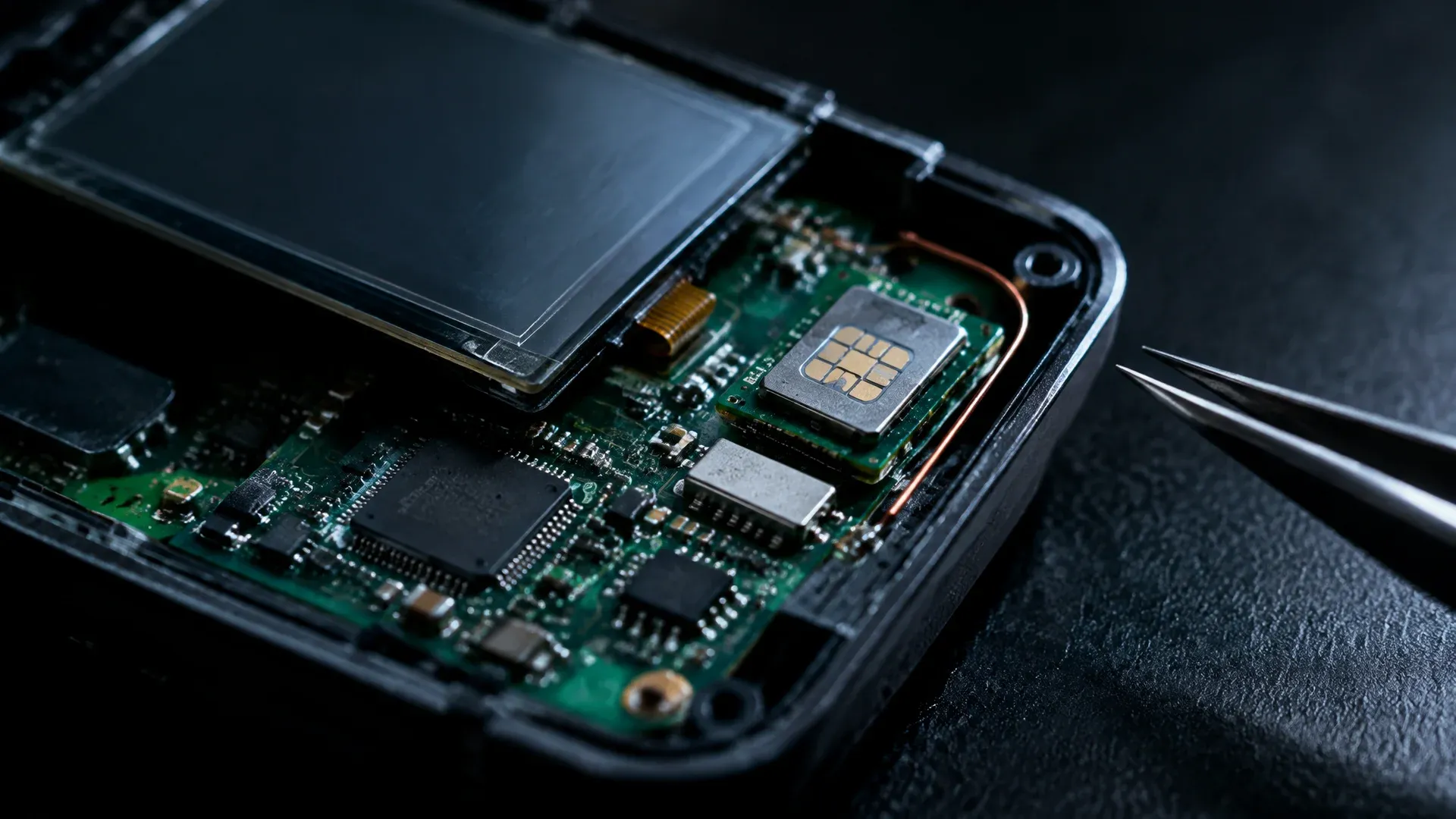
Behind the sales halt stands the CryptoBilis case, which we have been covering since October 9. On October 10 Ledger confirmed that an unauthorised additional circuit board sat inside a device from that Southeast Asian retailer. According to the manufacturer's account, which CoinDesk summarised on October 13, the implant works like this: a microcontroller of its own reads the 24 words of the recovery phrase off the display while the device is being set up, and sends them to the attackers over an eSIM via LTE mobile network.
The secure element, the operating system and the signatures of transactions were not altered, according to Ledger. Chief technology officer Charles Guillemet announced a review of reseller controls and of tamper protection. Chief executive Pascal Gauthier said the investigation should establish who tampered with the devices and at which point in distribution that happened. Ledger notes that every confirmed loss so far concerns a device from CryptoBilis. An outflow from a device bought elsewhere has not been verified.
Damage of more than $100 million, with no figure confirmed
There is no official damage total, and Ledger names none itself. The estimates of on-chain analysts diverge, because they attribute different numbers of wallets to the case:
| Source | Estimate | As of |
|---|---|---|
| Galaxy Research (Alex Thorn) | around $91 million | October 9 |
| On-chain researchers via CoinDesk | up to $93.2 million across more than 300 wallets | October 13 |
| Bitquery via crypto.news | around $102 million across 324 wallets | October 12 |
Tether has frozen USDT worth $10 million linked to the thefts, according to CoinDesk. For those affected that is a small ray of light, because frozen stablecoins can be returned later. Anything that flowed out in Bitcoin or Ether, by contrast, cannot be recovered.
Why the authenticity check does not help here
Many Ledger owners rely on the genuine check in the Ledger Live app. It verifies that the secure element is genuine and that the firmware comes from Ledger. Those are precisely the parts the implant left alone. A tampered device therefore passes the check, as Karpelès showed on his test unit. The additional board can only be spotted by opening the casing.
An uncomfortable truth follows from that: it is not the device that decides your security, but the route by which it reached you, and the moment the 24 words stand on the display. Set up a tampered device and you give away your recovery phrase at the instant you write it down. Background on the sequence is in our article on Ledger confirming the implant in a hardware wallet, and the prior history in the first report on the CryptoBilis case.
A Ledger from MediaMarkt or Saturn: return, new phrase, moving the coins
Ledger officially recommends swapping the device only to buyers from CryptoBilis. For devices from German retail there is no recommendation from the manufacturer yet. These steps serve as orientation for anyone who wants to be on the safe side:
- Device still shrink-wrapped or not set up: do not set it up. Ask the retailer whether it will take the device back, and contact official Ledger support. Devices bought online can usually be returned within 14 days.
- Device set up, bought at MediaMarkt or Saturn: the safest solution is a new device straight from the manufacturer, a freshly generated recovery phrase and moving all coins onto it. Important: restoring the old phrase on a new device is no protection. Once it has been read out, the attacker knows it.
- Device bought directly from Ledger: as things stand today there is no confirmed case from direct sales. Following the situation is enough here.
- In every case: never enter your 24 words anywhere, neither on a website nor in a form nor over the phone. Ledger never calls unprompted, sends no direct messages and never asks for the recovery phrase.
Fraudsters exploit situations like this deliberately. Fake Ledger pages turned up in Google search as early as October 11. How to spot them is in our guide to spotting a fake Ledger website in Google. We advise non-experts against unscrewing the device: the warranty can lapse in the process, and without a reference image an implant is hard to tell apart from genuine components.
Buying a hardware wallet directly from the manufacturer: what it achieves
The case shows that every additional stop between factory and customer is a risk. A purchase in the manufacturer's own shop shortens the route to the minimum. That holds for Ledger as much as for Trezor, Tangem or OneKey. Which devices exist, how they handle recovery and what they cost is shown in our comparison of hardware wallets. Our experience with the best-selling entry-level model is summarised in our test of the Ledger Nano S Plus.
A second protection is splitting up: larger amounts can be spread across several wallets, and anyone using a multisig setup needs several devices for a payout. A single tampered device then cannot give everything away.
Ledger sales halt: what to take away
The sales halt at MediaMarkt and Saturn is a precaution, not evidence of thefts in Germany. Losses are confirmed so far only for devices from Southeast Asia. What is also clear: an implant that passes the authenticity check makes the route of purchase the most important security question. Buy a hardware wallet and you are best served buying it directly from the manufacturer, setting it up yourself and keeping the 24 words to yourself. We will update this article as soon as Ledger or MediaMarktSaturn provide new information.
South Korea's financial supervisor blocked access to 27 websites on October 13, 2026, through which unregistered foreign exchanges were serving customers in the country. KuCoin, MEXC and BingX are on the list, along with Phemex, XT.com, Bitrue, CoinW, BTCC, BitMart and DigiFinex. For investors in Germany the case is no distant administrative matter: several of those venues hold no workable licence in the European Union either, and in Germany the grandfathering for legacy providers lapsed back on December 31, 2025.
The block does not affect crypto trading in the country, but access to providers that never completed South Korean registration. Anyone holding a balance on one of the affected platforms has to reckon with the route to their account becoming harder. That is precisely the point that turns the case into a question to check here too.
What South Korea's financial supervisor ordered on October 13
Responsibility lies with the Financial Intelligence Unit, the anti-money-laundering reporting office of the South Korean supervisor FSC. It did not enforce the blocks itself but applied for them at the Korea Communications Standards Commission, which approved them after reviews on October 6 and 7, 2026. The financial service FinanceFeeds reports this, citing the authority.
The technical route depends on where a site sits. For offerings hosted abroad, access from South Korea is blocked. For sites with servers or operators in the country, it amounts to shutting the service down. The direction is new: in future the FIU intends to apply for blocks as soon as it establishes unregistered activity, without waiting for a court ruling or documented harm to users. In total the authority says it has handed 44 unregistered operators to the investigating authorities.
A precursor dates back two and a half years. In March 2025 Google Play restricted 17 platforms for the South Korean market, KuCoin and MEXC among them. The browser route stayed open then. This step closes it.
These venues are on the block list
Ten names are publicly documented: KuCoin, MEXC, BingX, Phemex, XT.com, Bitrue, CoinW, BTCC, BitMart and DigiFinex. The authority did not list the remaining addresses of the 27 individually, which also has to do with individual providers running several domains.
Three of those exchanges are familiar to German readers from events of their own. KuCoin pulled 25 tokens from trading at the start of October and set its customers a withdrawal deadline for them. At MEXC an attack through an API key was the theme in September, in which the exchange reimbursed $340,000. Both are separate matters from registration, but they show that the platforms have customers here.
The registration duty in South Korea: ISMS certificate and notification to the FIU
A virtual asset service provider in South Korea is a provider that exchanges, transfers or holds crypto assets for third parties. Serving customers in the country in that role takes two things: an ISMS certificate, the state-audited proof of an information security management system, and registration with the FIU. The two together are the entry ticket, and the blocked providers lack both.
The numbers show how narrow the bottleneck is. In the first half of 2026, 26 providers were registered, of which 17 were exchange operators and nine custody or wallet services. A market with South Korea's trading volume therefore runs through a double-digit number of licensed houses, while alongside them dozens of foreign platforms were taking on customers without registration.
What happens to a balance on a blocked exchange
An access block deletes no account. The authority itself points out that users may run into difficulties managing their account, closing positions or withdrawing existing balances. Existing accounts are left untouched by the decision, and there is no general withdrawal deadline. For the wind-down the FIU intends to provide guidance together with the industry body DAXA and the operators.
In practice that means the platform keeps working but is no longer reachable from the blocked network without detours. Holding open leveraged positions carries the greater risk here, because a margin call takes no account of whether the customer can currently reach their account. The authority has also announced that it will pursue replacement sites should blocked providers resurface under new addresses.
The German framework: since January 1, 2026 the CASP licence counts
The European crypto regulation MiCA requires authorisation as a crypto-asset service provider, CASP for short, for crypto-asset services. Article 143 of the regulation allowed member states to give legacy providers a transition period of up to 18 months, that is until July 1, 2026. Germany did not use that period in full.
The shorter variant sits in the Crypto Markets Supervision Act, KMAG for short. Section 50 paragraph 2 number 3 KMAG provides that the permission deemed to continue lapses "at the latest at the end of December 31, 2025". What matters is who that rule applied to at all: only companies that already held a German permission on December 29, 2024, for instance under the Banking Act or the Securities Institutions Act. A foreign exchange without such a legacy permission could never invoke it. For them the position since the regulation took effect is simply this: no business with German customers without a CASP licence or a notification under Article 60.
The six-month offset between the German and the European deadline explains why the situation differs from country to country. Which duties a licence triggers in concrete terms, from own-funds requirements to the segregation of client money, is set out in our overview of the MiCA duties for crypto companies.
KuCoin holds an EU licence and still may not start
Here lies the part of the case that is missing from the reports on the South Korean block. KuCoin is not simply unlicensed in Europe; the position is more complicated, and less favourable for customers, than a plain yes or no would capture.
The Austrian Financial Market Authority FMA granted KuCoin EU Exchange GmbH authorisation as a crypto-asset service provider on November 27, 2025. On February 19, 2026 it prohibited the company from taking on new business, because key functions for anti-money-laundering and sanctions were unfilled. The authority lifted that ban on May 18, 2026, after the posts had been filled. The decisive sentence comes next: commencement of business operations remains impermissible under a separate order of February 18, 2026, because requirements on governance and further key functions in the management body are outstanding. The FMA states this on its own site.
For a customer in Germany the distinction means more than a formality. A granted licence shows up in registers and in marketing claims; an order prohibiting the commencement of operations does not necessarily show up beside it. Rely on the entry alone and you see half the picture. At MEXC the matter is more straightforward: the South Korean FIU lists the exchange among the unregistered providers, and by the company's own account it has not applied for a licence in the EU.
How to check your exchange's licence yourself
A provider's status is public and looked up in a few minutes. Three places are enough.
The first is the MiCA register of the European securities supervisor ESMA. Under Article 109 of the regulation it brings together all CASP authorisations in the European Economic Area, including those refused and withdrawn. It shows whether a provider is licensed at all and which national authority supervises it. The second is BaFin's company database for the German market. The third is the site of the supervisory authority that the register names as responsible: only there do measures such as new-business bans or conditions appear, and those are exactly what the register lacks.
A look at the provider's terms and conditions is worth adding. They say which group company the contracting party is. It happens that a European subsidiary is licensed while the customer contracts with a company outside the EU; the consumer protection of that company then applies, not the European one. Which houses can show a licence in the European Economic Area and how their fees differ is shown by the comparison of regulated crypto exchanges.

Moving to your own wallet: what happens for tax
A transfer from an exchange to an address you control yourself is not a sale. No disposal gain arises, and the one-year holding period under section 23 of the German Income Tax Act keeps running; it does not start afresh. It is different if you sell holdings on the old exchange and buy again at a new one: those are two separate events for tax, and a sale within a year of acquisition is taxable insofar as the year's total gains exceed the exemption threshold.
The order therefore matters. Set up the destination address first and test it with a small amount, then transfer the rest. Sell out of haste instead, and you may pay tax merely because a website was blocked. For the records the rule is: document every withdrawal with its transaction ID and timestamp, because obtaining acquisition data from a blocked customer account later is laborious. The usual tax tools and portfolio trackers help with that, assigning deposits and withdrawals automatically.
Our assessment: why supervisors now hit access rather than users
From the newsroom's point of view, the South Korean step marks a change of method. Until now, proceedings against unregistered exchanges ran through investigations and criminal complaints, in 44 cases in South Korea. That takes years and never reaches the user. An access block works immediately, costs the authority almost nothing and shifts the consequences onto the platform's customers.
The evidence that this will not stay a one-off is on the table: the FIU has announced that it will apply for blocks in future without a court ruling and without proven harm, and it intends to track replacement addresses. Against that stands the fact that a block is technically easy to circumvent and changes nothing about the offering itself; the exchanges stay online, just out of reach. For the EU this does not mean network blocks are coming. The European route runs through the licence: a provider without one may not advertise, may not broker and may not offer a service. The lever sits with the provider, not with the access provider.
What both routes share is the consequence for the investor. A balance held at a provider without a usable licence hangs on a decision they have no influence over. That is the real reason to know the status, rather than looking it up only once the page stops loading. A total loss is possible at any time with crypto assets, independently of supervision; a missing licence lays an operational risk on top.
Exchange block in South Korea: the register decides, not the app
Three steps put your own position in order, and in this sequence:
- Establish the status. Look in the ESMA register for whether your provider holds a CASP licence, and on the site of the responsible supervisor for whether conditions or prohibitions stand against it. A selection of houses with a licence in the European Economic Area is in the comparison of the best crypto exchanges.
- Set up the destination address. Before the first withdrawal, create custody you control yourself and transfer a test amount first. Which devices come into question and what they cost is in the hardware wallet comparison.
- Secure the records. Export the trading and withdrawal history before you empty an account, and keep the acquisition data for the holding period. The tax tools and portfolio trackers read those exports in and track the deadlines per position.
The next mark in the calendar is not a deadline for users but one for providers: a company that has not obtained a licence by the end of the European transition period on July 1, 2026 may not conduct new business in the EU. Which houses have managed it keeps changing, and in Germany the cut-off date of December 31, 2025 already counts.
(As of October 13, 2026. This article is not investment advice. Prices and fee structures change; check the terms with the provider before you buy.)
Moving stablecoins across the BNB Smart Chain currently costs no gas. That exemption ends on October 31, 2026 at 23:59 UTC. After that the normal network fees apply again. The price of BNB stands at $742.83, 5.15 percent lower than a week ago.
The operator calls the campaign the "0 Fee Carnival" and has already extended it several times. It covers three stablecoins, seven trading venues and two bridge providers. For investors in Germany this is less a question of price than of cost: anyone who already planned to pull a balance off an exchange and onto an address of their own has a good two weeks left in a window without transfer fees.
Zero fees on BNB Chain: what runs without gas until October 31
According to the BNB Chain announcement, the campaign covers three tokens: USDC, USD1 and U. Three kinds of movement are therefore gas-free, namely withdrawals from participating exchanges, direct wallet-to-wallet transfers on the BNB Smart Chain, and bridging USDC in from other blockchains over two specific bridges.
The operator states that it has already covered more than $4.5 million in gas fees for users as part of the campaign. That figure comes from the platform itself and cannot be verified from the outside; it describes the order of magnitude, no more.
What gas normally costs on the BNB Smart Chain
Gas is the fee a blockchain charges for executing a transaction, paid in the network's own currency. On the BNB Smart Chain it falls due in BNB. It has sat in the range of fractions of a dollar there for years, and is therefore markedly lower than on Ethereum. For a single transfer the saving is hardly noticeable. It becomes tangible for users who make many small movements. Every individual fee can be read up in the network's block explorer, which lists each transaction with the amount actually paid.
These seven exchanges cover the withdrawal fee
According to the operator's list, the withdrawal fee for the named tokens is waived at Binance, Bitget, MEXC, Ourbit, BingX, LBank and HTX. Some of those withdrawals also run over opBNB, the network's second layer; which routes are open depends on the individual venue.
Two restrictions matter. First, the waiver applies only to the listed assets and networks, not to arbitrary tokens and not to every blockchain an exchange offers. Second, the platforms require minimum amounts which, according to the operator, run roughly between five and twenty dollars per provider. Withdraw smaller sums and you drop out of the campaign and pay the regular fee.
That an exchange pays out without a fee says nothing about its licence, incidentally. Which venues hold a MiCA permission in Germany, and what to look at when choosing, is broken down in our comparison of the best crypto exchanges.
Wallet transfer: two free transactions a day for USDC
For direct transfers between two addresses the waiver applies exclusively on the BNB Smart Chain. USD1 and U are unlimited here, while USDC allows two free transfers per user per day. The minimum amount is ten cents. Supported wallets include Binance Wallet, Trust Wallet, SafePal, TokenPocket, Coin98 and imToken, according to the operator.
Bridge: two providers, different mechanics
For bringing USDC onto the BNB Smart Chain the campaign distinguishes two routes. Celer cBridge charges zero fee for USDC from Ethereum, Arbitrum, Polygon, Avalanche and Optimism, according to the operator. Meson.fi works with a full rebate instead and additionally accepts Tron as a source network. The difference is relevant in practice: a rebate presupposes that you front the fee first.

BNB price $742.83: the week in figures
BNB trades at $742.83, according to Coinpaprika as of 17:58 on Tuesday. Over 24 hours that works out at minus 0.19 percent, over seven days at minus 5.15 percent. Market capitalisation stands at roughly $98.9 billion, trading turnover over the past 24 hours at roughly $621 million.
The week split in two. In the daily candles of the trading platform Kraken, the weekly high sits at $779.42 on October 7 and the weekly low at $716.63 on October 8. Between those two days the price fell by a good $60, before steadying in the range between $730 and $760. On Tuesday itself the span ran from $721.76 to $746.84.
One date on the side puts the picture in context: the all-time high of $1,370.98 dates from October 13, 2025 and is therefore exactly a year old. The price currently sits 45.84 percent below that record.
Supply is shrinking, but slowly: 133.16 million BNB in circulation
The second half of this week's BNB story has to do with supply. Total supply stands at 133,158,616 BNB. It is reduced through two separate mechanisms, which are often confused.
The first is the quarterly auto-burn. It destroys an amount determined by a formula built from the BNB price and the number of BNB Smart Chain blocks produced in the quarter. The sum is therefore not at the operator's discretion. The second mechanism runs permanently in the background: a fixed share of the gas fees of every block is destroyed for good, and the size of that share is steered by the validators through the network's governance.
The 36th burn as a yardstick
The 36th auto-burn destroyed roughly 1.62 million BNB, worth about $932 million according to crypto.news. Total supply fell to 133,166,127.91 BNB as a result. The 37th auto-burn is expected in mid-October on the quarterly rhythm. There is no officially confirmed date so far, and certainly no amount, and neither can be calculated seriously in advance because the price feeds into the formula. What the coming burn could mean for the price levels is handled separately in our assessment of the 37th burn.
Our own calculation: 33.16 million BNB left to the burn target
The stated goal of the auto-burn is a total supply of 100 million BNB, half of the 200 million originally created. The tracking site bnbburn.info names that target explicitly. From today's total supply a simple calculation follows: 33,158,616 BNB still have to disappear to reach the goal, which is 24.9 percent of today's supply.
Taking the size of the 36th burn of 1.62 million BNB as the yardstick, roughly twenty more quarters would be needed. That amounts to about five years. The calculation is an extrapolation and not a forecast: if the price falls, the formula destroys more tokens for the same dollar value; if it rises, correspondingly fewer. It does show the order of magnitude at stake in the tightening, though, and it makes clear that a single burn changes supply by a good one percent.
The price and supply figures in this article were collected by cryptoticker.io itself on October 13, 2026. The basis is the seven daily candles from October 7 to October 13 and the total supply of 133,158,616 BNB.
The levels after midweek: $716 below, $779 above
Two traceable points of orientation emerge from the week. On the downside the weekly low of $716.63 is the next place where it shows whether buyers step in again; below that lies the round $700 level, which market participants tend to watch. On the upside the weekly high of $779.42 marks the area where the price turned last week, followed by the $800 mark.
Those are observations from the price action, not price targets and not a recommendation. Working with levels also means bearing in mind that a quarterly burn without a fixed date is an event that can widen the range in the short term.

Dates that count in the coming weeks
Two dates are firm enough to note down. The first is October 31, 2026 at 23:59 UTC, the end of the zero-fee campaign. The second is the turn of the quarter: on the rhythm so far, the 37th auto-burn falls in the second half of October, and the operator usually publishes the transaction only once it has been executed.
A third point is not a date but an ongoing change: with the Pasteur hard fork the BNB Smart Chain has processed 28 percent more gas per block, according to the operator. More capacity per block generally means steadier fees at load peaks, and it is the reason the network can carry the zero-fee campaign at all.
The route to buy under MiCA: what is open in Germany
Since January 1, 2026 a provider offering crypto services in Germany needs authorisation as a crypto-asset service provider under MiCA, or a valid notification. In practice that means buying BNB at a venue that can show that permission, and checking it before the first deposit rather than after. A waived withdrawal fee weighs far less in that decision than the licence.
A second point concerns the stablecoins themselves. Under MiCA, venues licensed in the EU may only offer e-money tokens for purchase if they meet the regulation's requirements. The European supervisor ESMA set a deadline for that on October 8, 2026: providers are to wind down business in non-compliant stablecoins by January 8, 2027, while holding, receiving and sending remain possible. The details are set out in our piece on ESMA's stablecoin deadline. That a fee campaign promotes a token says nothing about that token's licensing status. Check with the provider which of the three tokens you are pulling into your wallet.
Custody: the transfer is only half the way
A gas-free withdrawal moves a balance from the exchange to an address you control yourself. Responsibility for the keys moves with it. The two mistakes that cost money here are the wrong network and the lost recovery phrase. Check before sending that receiving address and network match, because a sum sent on the BNB Smart Chain reaches no address that exists only on Ethereum.
For larger amounts a hardware solution is the more usual route, because the keys never leave the device. Which devices prove themselves in everyday use and how they differ is shown in our hardware wallet comparison.
Leverage and liquidation
BNB also trades as a futures contract. There the rule is unchanged: leverage magnifies gain and loss in equal measure, and liquidation does not come at the end of a day but in the moment the collateral no longer covers the position. With an asset that fell from $779 to $717 within two trading days, that sits closer than a weekly balance of minus 5.15 percent suggests. The difference between a price decline and a forced closure is exactly that span inside the week.
Tax: holding period, exemption threshold and the stablecoin swap
In Germany, gains from selling crypto assets are free of tax after a holding period of one year; inside the year an exemption threshold of €1,000 per year applies to private disposal transactions. The point that matters for this article is one that easily goes missing in fee campaigns: a swap from one stablecoin into another is a disposal like any other swap. That the transfer costs nothing changes none of it.
A pure move between two of your own addresses, by contrast, is not a sale and triggers no tax. It does not interrupt the holding period, but it should be documented so that the acquisition data stay intact. Tools that keep exactly this history are set side by side in our comparison of crypto tax tools and portfolio trackers.
From the 2026 reporting year onwards, providers report their customers' data to the tax administration in any case, with the first transmission to the Federal Central Tax Office scheduled for mid-2027. Keeping your transfers in order therefore adds no work, it saves work later.
Our assessment: a cost campaign, not a price story
Two things about this week are documented: a deadline on October 31 up to which certain transfers cost no gas, and a supply of 133.16 million BNB that keeps falling on schedule through the auto-burn. Both can be looked up.
Our assessment of it, and this is explicitly an assessment: for the price, the fee campaign is the smaller theme. It lowers friction in the network's payment traffic and fits the direction the operator has taken with more block capacity. What would matter for the price is whether this usage volume stays after October 31, once the fee sits with the user again. Only the November transaction figures will answer that.
BNB zero fees: after October 31 the gas is on you again
- Bring forward open transfers. If you want to pull a balance in USDC, USD1 or U off one of the seven named exchanges anyway, do it before the deadline and mind the provider's minimum amount. Whether your venue is licensed in Germany at all is settled beforehand through our exchange comparison.
- Prepare the destination. Set up the receiving address on the BNB Smart Chain and send a small amount first, before the whole sum goes. For amounts meant to be held longer, a device from the hardware wallet comparison is the sounder place than an exchange app.
- Take the records with you. Note the date, amount and equivalent value of every movement, including fee-free transfers between your own addresses. A tool from the comparison of tax tools takes over the bookkeeping, as long as the data are imported in full.
(As of October 13, 2026. This article is not investment advice. Prices and fee structures change; check the terms with the provider before you buy.)
Shiba Inu trades at $0.00000521 on Tuesday evening, the equivalent of €0.00000466. The daily reading of $0.00000516 is the lowest since September 18. The entire recovery from the second half of September has been given back. Over 30 days SHIB is nonetheless almost unchanged, and that contradiction is the finding of this Tuesday.
Shiba Inu last stood lower than today on September 18
We analysed CoinGecko's daily readings for the 36 days from September 9 to October 13 ourselves. In that series there is no day after September 18 on which SHIB stood lower than it does today. September 18 closed at $0.00000515; today's daily reading is $0.00000516. Between them lie 25 days in which the price twice rose above $0.0000059 and twice came back.
Two further values from the same series matter for context. The low of the window dates from September 16 at $0.00000494, the high from September 23 at $0.00000610. Seven calendar days and a gain of 23.5 percent separate those two days. From the September 23 high to today it is 14.6 percent down.
The market value of all circulating SHIB stands at $3.07 billion, rank 38 by market capitalisation. The price is 93.9 percent away from the record of $0.00008616 set on October 27, 2021.
Why the monthly figure hides the week
CoinGecko puts SHIB at minus 0.5 percent over 30 days and minus 9.5 percent over seven days. In our daily series both figures come out somewhat larger: 1.5 percent against September 13, and 11.4 percent against October 6. The gap arises because CoinGecko takes the price from exactly 168 or 720 hours earlier, while a daily series sets fixed daily marks. Depending on the sampling point, the weekly loss is therefore 9.5 to 11.4 percent and the monthly balance 0.5 to 1.5 percent.
Both calculations say the same thing: the whole of the month's loss arose in the past week. In the three weeks before that, SHIB was up. Read only the monthly number and you see a quiet month; read only the weekly number and you see a slump. Both are true, and each on its own is misleading.
The mechanism behind it is unspectacular and often overlooked. Two percentage figures covering two different periods refer to two different starting points. If a price first rises and then falls inside the longer period, the long horizon looks close to neutral even though the short one is sharply negative. For investors, that means a single percentage figure is no substitute for the path the price took.
The September recovery has been given back in full
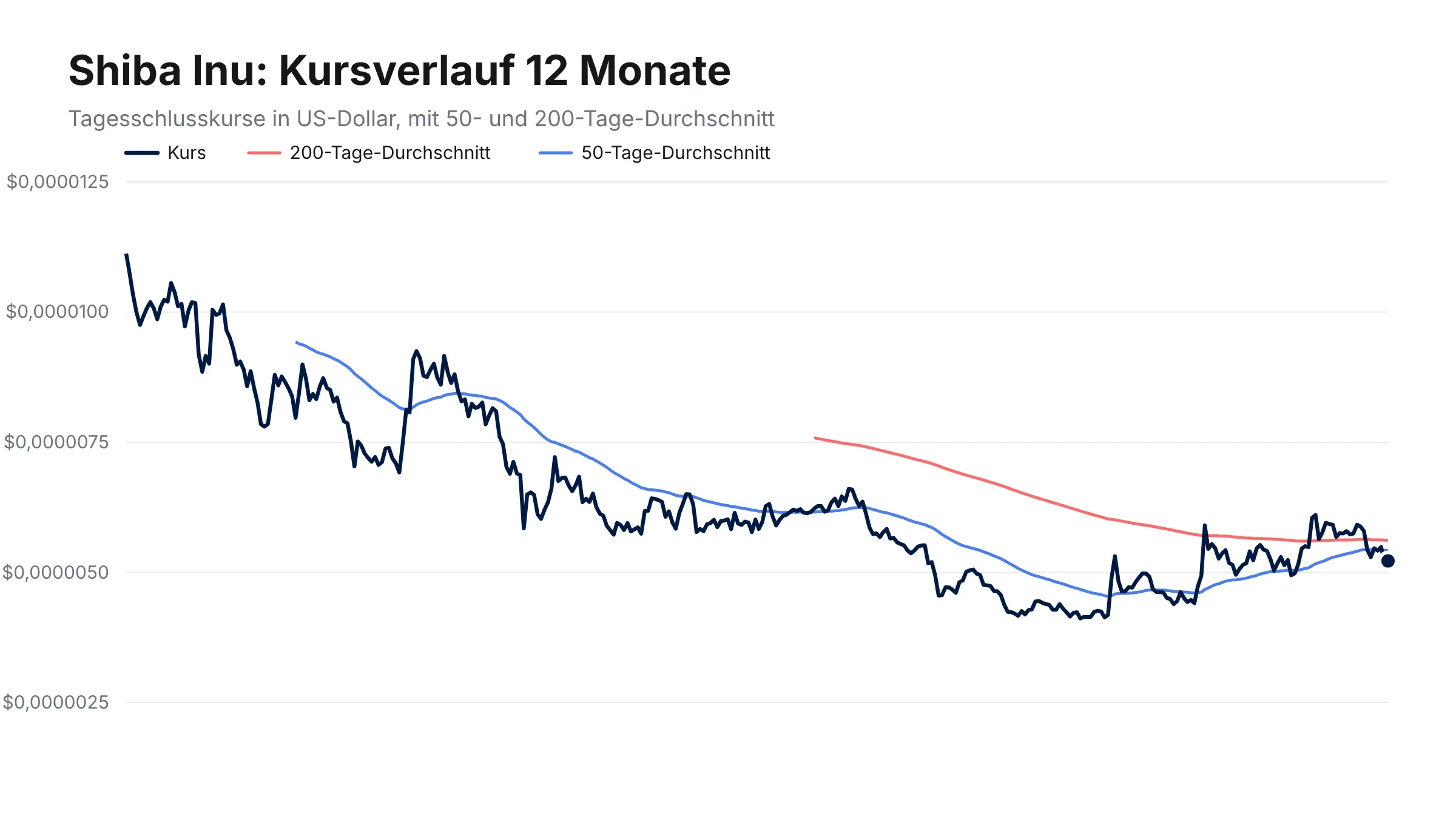
The annual picture removes the last doubt. Twelve months ago SHIB stood at $0.00001112, which is also the high of the past 365 days. Today it is $0.00000521, 53 percent less. The annual low is $0.00000411.
More telling than these extremes are the two moving averages we calculated from the same series. The 200-day average stands at $0.00000561, the 50-day average at $0.00000542. The price is therefore 7.0 percent below the long line and 3.6 percent below the short one. With the short line running under the long one and the price under both, the downtrend holds on both time frames.
A moving average is not a forecast. It says at what level the buyers of the past 50 and the past 200 days entered on average. With the price below it, the majority of those buyers sit on a loss, and every recovery runs into willingness to sell.
3.5 against 5.8 percent: Shiba Inu trades thinner than Dogecoin
A second reference point beyond the chart comes in here, and it explains why SHIB falls harder than its larger relative on weak days. We calculated the turnover ratio of both meme coins, that is trading volume over the past 24 hours divided by market capitalisation.
Shiba Inu comes to $107.0 million in volume on $3.07 billion of market value, which is 3.5 percent. Dogecoin comes to $760.7 million on $13.22 billion, which is 5.8 percent. In a single day Dogecoin therefore turns over 1.65 times what SHIB moves relative to its size. Both figures date from October 13 and come from the same source, so they are collected on a comparable basis.
The practical effect shows up as soon as larger amounts are moved. A thin turnover ratio means the same order shifts the price further. SHIB lost 2.7 percent this Tuesday, while Dogecoin at $0.084533 gave up only 0.9 percent. To buy or sell in this situation, a limit order serves you better than a market order, and the order book depth of your crypto exchange is worth a look first. With a price carrying eight decimal places, the smallest tradable price increment helps decide what an order actually costs.
What has changed since the article of October 12
Yesterday this space covered a fake SHIB airdrop that a community member exposed as a wallet drainer. The price was still at $0.00000549 at publication. Since then 6.0 percent has been given up, and the $0.0000055 level, which had held twice on October 10 and October 12, has broken.
The two events are not connected. A drainer attempt does not move a price of this size, and there is no indication that the ploy succeeded. The chart alone has changed: two defended days have turned into a break, and the next floor lies lower.
These two levels carry the rest of October
On the downside the September low of $0.00000494 counts. It is the lowest value of the past five weeks and sits 5.2 percent below today's price. An event stands behind that level: on September 16 buyers stepped in there, and the recovery began.
On the upside the October high of $0.00000592 from October 5 counts. It lies 13.6 percent above today's price and almost coincides with the 200-day average of $0.00000561. The band between $0.0000056 and $0.0000059 is the zone SHIB would have to reclaim for the monthly balance to mean something again.
Between them lies the level that broke today. $0.0000055 held three times in October and counts as resistance from now on, no longer as a floor. To track the levels yourself, take the same daily series and mark the high and the low of the past 35 days instead of round numbers.

For the tax office the purchase date counts, not the price
A distance of 93.9 percent from the record means most SHIB holdings from 2021 and 2022 sit deep in the red. Whether that loss exists for tax purposes at all is decided in Germany by the purchase date alone.
The legal basis is section 23 paragraph 1 number 2 of the German Income Tax Act, the private disposal transaction. Hold a cryptocurrency for more than a year and then sell, and the gain is free of tax. The flip side of the same rule is rarely mentioned: once the year has passed, a loss is irrelevant for tax as well. It can no longer be offset against anything.
A sale inside the one-year period, by contrast, falls into taxable territory. There an annual exemption threshold of €1,000 applies, and it covers all private disposal transactions together rather than crypto assets alone. Exceed it and the entire gain is taxable, not only the part above the threshold. A tax tool or portfolio tracker assigns your purchases by the method the tax office expects, usually first in, first out.
Losses inside the year and how they are offset
Losses from private disposal transactions are trapped in a world of their own. They can be offset solely against gains from other private disposal transactions; salary, interest and share gains stay out of it. Gains from other crypto assets in the same year qualify, and so does a gold sale inside the one-year period.
If a loss remains at year end, it is not lost. It is assessed separately and carried forward into coming years, where it is offset against future gains of the same kind. The condition is that it is declared in the tax return. A loss that is not declared does not exist for the tax office.
That is why this topic belongs in October rather than December. Eleven weeks remain until December 31. Sorting now which SHIB tranches still fall inside the one-year period leaves time for a decision, instead of one that has to be taken between the holidays. From the day a tranche turns one year old the question is off the table, and its loss can no longer be used for tax.
None of this is a recommendation to realise losses. A sale for tax reasons can be economically wrong if it breaks up a holding someone meant to keep anyway. Checking the data, by contrast, costs nothing.
The sources and the calculation
All price figures in this article come from CoinGecko, the daily series from its interface for historical market data, the current prices from the market query for Shiba Inu and Dogecoin. The moving averages and the turnover ratios were calculated by us from those series rather than taken over. Rebuilding them takes the daily closing prices of the past 365 days and a spreadsheet.
Two points belong with that. The price on a single exchange always differs from an average across many exchanges, with SHIB in the eighth decimal place and therefore visibly so in percentage terms. And an exemption threshold is not a flat withholding tax: gains inside the one-year period are taxed at the personal rate, not at a flat 25 percent. Both points are regularly miscalculated in forums.
Our assessment of the situation at Shiba Inu
From the newsroom's point of view, today's daily reading is the weaker of the two signals. A price in a downtrend marking a five-week low is the normal case. The turnover ratio of 3.5 percent against Dogecoin's 5.8 percent weighs more, because it is not a day's event but a structure. As long as SHIB carries markedly less turnover relative to its size than its closest comparison, every weak market day hits harder here.
Against that stands the monthly balance. A loss of 0.5 to 1.5 percent over 30 days is a quiet number for a coin of this volatility, and the September low of $0.00000494 has held so far. A break of that level would be the signal that invalidates the quiet monthly figure. Until then the picture describes a downtrend with intact support, not a collapse.
None of these observations is an argument to buy or to sell; both only describe what the next move can be measured against. As always with crypto assets, a total loss is possible.
Shiba Inu in October: only above $0.0000059 does the balance turn
- Sort the purchase data. Collect every SHIB tranche with its purchase date and purchase price and mark which of them still falls inside the one-year period on December 31. A portfolio tracker with a tax function takes over the first in, first out allocation.
- Settle the order route. With a turnover ratio of 3.5 percent, spread and order book depth are worth a look, and a limit order protects against a market order slipping. Which providers in Germany charge what is shown by the comparison of crypto exchanges.
- Decide on custody. Holdings meant to sit for several years do not belong on an exchange. Letting the one-year period run deliberately means planning the move to a hardware wallet and keeping the records of the transfer.
(As of October 13, 2026. This article is not investment advice. Prices and fee structures change; check the terms with the provider before you buy. Statements on taxation are not tax advice and do not replace a review of the individual case.)
Since the afternoon of October 13, a proposal has been up for a vote on Polkadot's governance platform that would set a new course for the network's most important body. Referendum 1954 is titled "[Wish For Change] DOT DAO Strategy Mandate", and after a good three hours 26.8 percent of weighted votes were in favour and 73.2 percent against. In absolute terms that is 19,370 weighted DOT against 53,030. The approval rate is the clearest rejection any strategy proposal has drawn in its opening hours this year.
The proposal comes from PCF, the Polkadot Community Foundation, and it is expressly not a technical specification. "It constitutes a strategic mandate, not a technical specification", the text states. What it demands is a ranking: user acquisition ahead of every other metric. In its own words, the DOT DAO should "for the present time, prioritise user-acquisition over other KPIs".
What Referendum 1954 asks of the DOT DAO
The proposal names four areas. First, user acquisition is to rank ahead of ecosystem size and ahead of capital locked in contracts; the competitive frame thereby shifts from other smart contract platforms to Web2 and mobile applications. The proposal puts that as a target state: "fewer products/integrations with more users is a more desirable position for Polkadot to be in".
Second, the network is to gain permissionless, DOT-backed assets with a fixed exchange rate, which the proposal calls dotStables. As a model it cites Liquity, a design in which users lock up collateral and mint a dollar-pegged asset against it. One such implementation is to receive support and a grant from the DAO.
Third, the proposal sets out a product platform on which users and applications meet directly and on which incentives are paid per person rather than per account, with a cap per human being. Fourth, Polkadot is to feel like a Web2 application, with free entry tiers, readable names and access from a phone, without giving up self-determination, privacy and access without sign-up. The proposal itself describes this fourth point as a target state rather than a commitment.
Wish For Change: the track that pays out no treasury money
The proposal runs on the "Wish For Change" track, number two at Polkadot. That track is a governance peculiarity and the reason the numbers above are easier to read than they look: a referendum passed on this track pays out no money and changes no code. It merely records that token holders wish for a change. Implementation stays with the funded entities, with the technical fellowship and with the teams that then have to file proposals of their own.
For holders of DOT, that means for now: no till is being opened here. The decision period runs 28 days, to November 10, with a confirmation period of one day after that. So far there has been no attempt to move the referendum into confirmation; the counter for that stands at zero.
73 percent against at 0.00 percent support: what the numbers say
The second figure is the more important one, and most reports leave it out. Alongside the approval rate, Polkadot runs a second value called support. It measures how much of total supply voted at all, unweighted. That value stands at 0.00 percent, 5,458 DOT in absolute terms. Against it stands total issuance of roughly 1.68 billion DOT.
Worked out, that is 0.00032 percent of supply. Put differently: of every 10,000 DOT in circulation, not even one has voted. A vote with that turnout says next to nothing about the stance of Polkadot holders, and that applies to the no as much as to the yes.
Conviction voting: why 53,030 votes can come from 8,838 DOT
Anyone wanting the percentages in their proper place has to know a component of Polkadot governance that many exchange users have never seen. Conviction voting means a vote weighs more heavily the longer the voter is barred from moving the tokens afterwards. The multiplier ranges from 0.1 to 6.
That changes the arithmetic fundamentally. In the extreme case, the 53,030 weighted no votes could come from 8,838 actual DOT, namely if every no voter picked the highest tier. At the price of $1.17 on Tuesday evening, that is worth roughly $10,300. On the same assumption, the yes side would amount to 3,228 DOT, about $3,780. A single holder with a five-figure dollar amount and patience can therefore tip a strategy vote in this network within its opening hours.
That is not a flaw in the system but its intent: whoever commits for years is meant to carry more weight than someone looking to sell again the same evening. The lesson for reading governance news still holds: a percentage without the number of tokens involved and without the conviction tiers is a headline, not information.

The lock-up periods from 7 to 224 days in detail
The tiers are set out in the Polkadot wiki and are fixed. Every doubling of the lock periods raises the multiplier by one:
- 0.1x: no lock, 0 days
- 1x: 1 period, 7 days
- 2x: 2 periods, 14 days
- 3x: 4 periods, 28 days
- 4x: 8 periods, 56 days
- 5x: 16 periods, 112 days
- 6x: 32 periods, 224 days
The period starts only once the referendum has ended, not when you vote. Vote today at the highest tier and the referendum ends on schedule on November 10, and you will not be able to transfer your DOT until around the end of June 2027. Count the period from the day you voted and you will be a good four weeks out.
The distinction between a lock and a freeze matters. During a governance lock you can still use the tokens to vote and still use them for staking; what is barred is only the transfer to another account. Staking yield therefore keeps running, and the terms on which providers pass it on are in the staking platform comparison. The 28-day unbonding period in Polkadot staking itself and the current yield of 2.77 percent we broke down on October 11 in a separate article; it runs independently of the governance lock and can overlap with it.
Voting works only from your own wallet, not from an exchange
This is the point at which the vote ends in practice for most German investors. In Polkadot's governance, only whoever holds the private keys to an account has a vote. If your DOT sit in an exchange account, the account belongs to the exchange, and so does the vote. None of the large providers passes it through to customers.
Voting therefore requires a wallet of your own and a transfer of the DOT to it. That costs network fees and brings responsibility for the key with it; which devices are suitable is in the hardware wallet comparison. If you do not want to take that route, you can delegate your vote to another account, though that too only from a wallet of your own. From an exchange account there is no path into the vote, and to see first what the transfer costs at your provider, the fee models are in the exchange comparison.
Holding period and staking during the lock
For tax purposes, the governance lock is not a separate event in Germany. Under Section 23 of the Income Tax Act, the one-year holding period applies to crypto assets, and it only runs out on a disposal. A lock under which the tokens stay in your own account and nobody else can access them is not a disposal. The holding period therefore keeps running, and a sale after the lock expires is tax-free if the year is complete by then.
Staking, which is allowed to continue during the lock, is a different matter. Rewards received are taxable in the year they arrive, at the price at the moment of receipt. Voting and staking at the same time therefore puts two separate matters in one position: an untouched holding period on the stock and continuously taxable inflows alongside it. Only a tax adviser can settle that bindingly, and the tax authorities have so far issued no statement of their own on individual governance locks.
dotUSD is already live: what the mandate would change about it
The proposal's second point is not new; it is already reality. Referendum 1944 approved the launch of dotUSD with 98.4 percent in favour, and the asset has been running since the start of October. It is backed by USDT for now, with the switch to DOT as collateral set down in the documents for later. After several revisions, the launch pool stood at roughly three million dollars, half USDT for issuance and half DOT for the trading pool. What dotUSD means for German investors, and why MiCA authorisation is the decisive open question there, we set out in detail on October 9.
Referendum 1954 would turn that into a principle: not one stablecoin but a class of permissionless, DOT-backed assets, one implementation of which the DAO would support with money. That is precisely where part of the opposition comes in. With an implementation already running, a mandate of this kind ties the network to one design before the first version has been through its stress test.
The ETP route: $12.37 million without a vote
A second way into DOT runs through exchange-traded products, and it shows how small interest in this asset currently is. The 21Shares Polkadot Staking ETF on Nasdaq, ticker TDOT, had net assets of $12.37 million on October 12 against cumulative net inflows of $3.33 million. That day's trading volume was $324,223. For comparison: total DOT trading across all venues came to roughly $236 million on Tuesday.
For the vote, the same applies on this route as on an exchange, only one step more strictly: a share in a fund or certificate is not an account on the blockchain. No voting rights arise from it, not even when the product stakes the underlying DOT. Shaping governance means taking custody yourself.
The price is not reacting to the mandate so far
DOT traded at $1.17 on Tuesday evening, 3.87 percent below where it stood 24 hours earlier. The daily high was $1.22, the daily low $1.12. The decline roughly matches what the broad altcoin market gave up that day, and it set in before the referendum was filed. No price reaction to the proposal is visible in the data.
Market capitalisation stands at around $1.99 billion, which corresponds to rank 50. DOT is 97.9 percent away from its all-time high of $54.98. Two levels are justifiable for the coming days: the daily low at $1.12 on the downside, because buyers stepped in there on Tuesday, and the daily high at $1.22 on the upside. Both come from today's trading and not from a model.
Our assessment: a declaration of intent, not a price signal
From the editorial team's point of view, the headlines on this referendum considerably overstate its reach, and the evidence sits in the figures on the voting page itself. The track pays out no money. Support stands at 0.00 percent, 5,458 of roughly 1.68 billion DOT. The weighted no votes could arithmetically come from tokens worth about as much as a mid-range car. A mandate that obliges nobody to anything, and in which not even a ten-thousandth of supply takes part, is weak as news about Polkadot's direction.
One point runs the other way, and it is not a small one: the substantive question the proposal raises is a fair one. Polkadot has delivered technically in recent years with JAM, with Agile Coretime and with dotUSD, and still stands 97.9 percent below its high. Whether a formal resolution changes that is doubtful. That the question about users is being asked is not. Holders of DOT should therefore watch the 28 days to November 10 less for the outcome than for whether turnout rises. A vote still showing 0.00 percent support in November says more about the state of governance than any result.
DOT DAO mandate: turnout is what decides by November 10
Three steps make sense over the coming weeks if you hold DOT:
- Settle the custody question. Check whether your DOT sit in an account of your own or in a provider's custody. Only in the first case do you have a vote at all. Which devices are suitable and what they cost is in the hardware wallet comparison.
- Work out the conviction tier before you vote. Take the tier whose lock you can see through to the end, and count it from the end of the referendum on November 10, not from the day of your vote. The 6x tier ties you until around the end of June 2027. If you still want to reshuffle beforehand, check your provider's transfer fees in the exchange comparison.
- Keep staking and the lock apart. The governance lock bars only the transfer; staking keeps running. Which providers offer which yield and which notice periods is shown by the staking platform comparison.
(As of October 13, 2026. This article is not investment advice. Prices and fee structures change; check the terms with the provider before you buy.)
Decrypt
A Saudi national working at OpenAI allegedly hid an encrypted audio recorder behind a TV in an executive meeting room. OpenAI says its own models helped trace it back to him.
The chatbot app once valued at $1 billion is up for sale in a Delaware court, two weeks after launching new models. If nobody buys it, it shuts down.
Binance will discontinue Binance Pool, Pool Savings, Cloud Mining, and other related services in a retreat from mining infrastructure.
A wallet that received 4,581 BTC in March 2020, worth about $40 million then, moved its stash today when it was worth about $377 million.
The Nasdaq-listed asset manager bought the Bitcoin at an average of about $84,500 during a rough week for the market, lifting its total stash to 32,773 BTC.
U.Today - IT, AI and Fintech Daily News for You Today
Cryptocurrency market stays under pressure that's coming from bears, but the recovery is still a possibility.
Ripple has partnered with Stripe-owned Privy to bring AI-powered payments to the XRP Ledger, expanding its push into agentic commerce.
Hardware wallet giant Trezor is severing ties with a significant portion of its authorized resellers following the massive Ledger supply-chain security scare, introducing stricter controls to protect customers from potential attacks.
SEC report exposes who really owns Nasdaq's new XRP stock, revealing massive stakes held by Chris Larsen, Ripple, and SBI Holdings.
Tesla still boasts nearly a billion dollars worth of Bitcoin years after Elon Musk directed the electric vehicle maker to invest $1.5 billion in the leading crypto asset.
Blockonomi
TLDR
- Walmart stock gains 0.25% as AI chatbot recommendations boost retail visibility.
- UBS research shows Walmart leads AI shopping suggestions for everyday products.
- Gartner finds 34% of US consumers willing to use AI for holiday gift shopping.
- Walmart’s strong retail presence supports its position in AI shopping results.
- High stock valuation remains a challenge despite new AI-driven growth prospects.
Walmart Inc. rose 0.25% to $113.36 during Tuesday’s intraday trading, gaining $0.28 as shares advanced modestly. The increase came as UBS research highlighted Walmart’s strong position in artificial intelligence-powered shopping recommendations. Analysts identified the retailer as a frequent recommendation across AI chatbots, creating another potential channel for attracting customers.
Walmart Inc., WMT
UBS Research Highlights Walmart’s Strength in AI Shopping
UBS analysts examined how leading AI chatbots recommend retailers when consumers search for everyday products and shopping advice. The research covered several shopping categories, including groceries, household supplies, and other essential consumer goods. Results showed Walmart frequently appeared among the leading recommendations, reflecting its established retail presence and competitive pricing.
The analysts tested 12 shopping questions across New Jersey, New York, and Minnesota to evaluate different recommendation patterns. They examined responses from ChatGPT, Claude, Gemini, and Muse to identify which retailers appeared most frequently. Walmart performed strongly across multiple categories, while Costco and Aldi also gained recognition for their respective retail strengths.
The findings highlight how artificial intelligence could influence where consumers begin their shopping journeys. Chatbots help users compare products, identify retailers, and narrow purchasing decisions without reviewing multiple websites. Walmart could attract additional customer interest as more households incorporate these tools into everyday shopping activities.
Gartner Survey Shows Growing Demand for AI Shopping Tools
A Gartner survey found that 34% of American consumers expressed strong willingness to use AI for holiday gift recommendations. Researchers surveyed 1,004 consumers in August 2026 to examine changing shopping habits ahead of the holiday season. The findings indicate growing acceptance of automated product suggestions, particularly among consumers seeking faster purchasing decisions.
Traditional shopping channels continue playing a central role despite increasing interest in artificial intelligence. Gartner found that 77% of respondents planned to shop in physical stores during the holiday period. Additionally, 75% expected to purchase products through Amazon, highlighting continued demand for established retail platforms.
Walmart’s extensive store network gives the company an established position across both physical and online retail markets. Its product selection covers groceries, electronics, clothing, household goods, and other frequently purchased consumer products. Customers can combine online searches with store visits, pickup services, and home delivery options.
Walmart Stock Valuation Remains a Key Growth Challenge
Despite the potential benefits of AI recommendations, Walmart shares have delivered relatively modest gains during 2026. The stock has advanced approximately 2% this year, trailing the broader market despite the company’s established retail operations. Its valuation exceeds 40 times trailing earnings, placing greater emphasis on future revenue and profit growth.
Walmart generated more than $730 billion in revenue over the preceding 12 months, reflecting its substantial operating scale. However, that size also means incremental sales from AI referrals may produce limited changes in overall growth. The company would need significant additional spending from customers to produce a meaningful improvement in its revenue trajectory.
Walmart continues developing its digital operations while maintaining its position in the competitive US retail market. Its broad product selection and established reputation for affordable goods support its visibility across emerging shopping platforms. The UBS findings identify another potential source of customer traffic, although they do not establish additional sales or earnings.
The post Walmart Inc. (WMT) Stock: AI Chatbot Recommendations Fuel Growth Potential appeared first on Blockonomi.
TLDR
- UnitedHealth stock rises 0.25% as management outlines stronger growth for 2027.
- UnitedHealth raises its 2026 earnings forecast following stronger Q3 results.
- Management targets 13% to 16% long-term earnings growth as operations improve.
- AI tools reduce clinical review times by 33% as UnitedHealth cuts paperwork.
- Optum expands pharmacy services while Medicare and Medicaid reforms advance.
UnitedHealth Group Incorporated (UNH) rose 0.25% to $379.47 on Tuesday following its third-quarter 2026 earnings announcement. The healthcare company raised its annual earnings outlook and outlined plans for stronger financial performance in 2027. Management emphasized operational improvements, artificial intelligence adoption, and medical cost controls as major drivers of future growth.
UnitedHealth Group Incorporated, UNH
UnitedHealth Group Raises Earnings Outlook After Strong Q3 Performance
UnitedHealth Group reported third-quarter revenue of $112.7 billion, while operating earnings reached $6.6 billion during the reporting period. Adjusted earnings reached $4.69 per share, exceeding Wall Street expectations as the company improved its cost management. Management raised its full-year 2026 adjusted earnings guidance to at least $20.50 per share.
The company also reduced its medical care ratio to 88.4%, compared with 89.9% a year earlier. Management attributed the improvement to pricing discipline, benefit adjustments, and stronger coordination across its healthcare operations. Specialty pharmacy expenses and higher treatment intensity continued to pressure medical spending across several business segments.
UnitedHealth expanded its operational modernization efforts across UnitedHealthcare and Optum to improve service delivery and efficiency. Approximately 40% of employed clinicians now use AI-powered documentation tools, reducing medical record review times by 33%. The company plans to eliminate 30% of prior authorization requirements by year-end to simplify patient access.
Management Targets Stronger Earnings Growth in 2027
UnitedHealth management expressed confidence in reaching the lower end of its long-term adjusted earnings growth target for 2027. The company maintains a growth framework of 13% to 16%, supported by stronger execution and operational improvements. Chief Financial Officer Wayne DeVeydt also indicated that current analyst earnings estimates may underestimate the company’s recovery potential.
The company’s Medicare Advantage strategy prioritizes health maintenance organizations and specialized plans serving patients with complex medical needs. These offerings include Chronic Special Needs Plans and Dual Special Needs Plans, which support targeted healthcare management. UnitedHealth expects its quality improvement programs to strengthen its competitive position across government-sponsored insurance markets.
Management also expects Optum Insight to advance its technology offerings through new AI-focused products during 2027. The company anticipates further expansion in 2028 as these services gain commercial traction across healthcare organizations. Optum Rx continues developing transparent pharmacy services, with external customers accounting for more than half its membership.
Medical Costs and Regulatory Reforms Shape Recovery
Despite improving operating performance, UnitedHealth continues managing medical expenses and regulatory requirements across its insurance businesses. Medicaid margins remain under pressure, although management expects them to reach their lowest point during 2026. The company targets stronger profitability by 2028 through reimbursement negotiations and improved care for patients with complex needs.
Management identified the No Surprises Act arbitration process as another source of elevated healthcare costs. The company reported that related disputes account for up to 6% of medical spending in certain regions. Consequently, UnitedHealth continues advocating regulatory changes while improving its internal claims management and payment processes.
UnitedHealth also expects 75% of its Medicare Advantage membership to enter plans with ratings of four stars or higher. The target applies to 2028 ratings and reflects continued spending on service quality and patient outcomes. Separately, the United Health Foundation committed $1 billion toward rural healthcare, workforce education, and broader community health programs.
Management expects fourth-quarter performance to reflect seasonal medical spending alongside additional investments in technology and clinical operations. The company will continue expanding administrative automation while strengthening its healthcare delivery network and insurance offerings. These initiatives form part of UnitedHealth’s broader plan to improve operating margins and support earnings growth beyond 2026.
The post UnitedHealth Group Incorporated (UNH) Stock: Climbs as Management Targets Strong 2027 Growth appeared first on Blockonomi.
TLDR
-
Applied Materials (AMAT) stock plunges 8.19% despite strong demand for AI chips.
-
Applied Materials targets over two percentage points of market share gains by 2030.
-
Applied Materials expects its eBeam equipment revenue to reach $2 billion in 2026.
-
Applied Materials projects semiconductor service revenue above $12 billion by 2030.
-
Applied Materials plans to more than double its research and production capacity by 2030.
Applied Materials (AMAT) stock plunged 8.19% to $456.77 during Tuesday’s intraday trading, losing $40.76 despite strong demand for AI chips. The decline followed the company’s presentation of ambitious semiconductor equipment growth targets through 2030. Meanwhile, Applied Materials outlined expansion plans across advanced manufacturing, research facilities, and semiconductor services.
Applied Materials, Inc., AMAT
Applied Materials Targets Stronger Growth in AI Chip Equipment
Applied Materials presented its long-term growth strategy during the 2026 SEMICON West Investor Breakfast on Tuesday. The company expects expanding AI infrastructure to support sustained demand for wafer fabrication equipment. Its strategy focuses on advanced chip production, memory technology, and semiconductor packaging.
CEO Gary Dickerson identified AI infrastructure development as a major driver of future semiconductor equipment spending. He emphasized the company’s leadership in technologies that improve computing performance, energy efficiency, and production costs. Applied Materials expects broader AI adoption to increase demand for advanced silicon manufacturing.
The company projects three semiconductor segments will generate approximately 75% of wafer fabrication equipment growth between 2025 and 2030. These segments include leading-edge foundry logic, DRAM memory, and advanced packaging technologies. Applied Materials aims to increase its equipment market share by more than two percentage points during this period.
Applied Materials Expands Semiconductor Services and eBeam Technology
Applied Materials expects its electron-beam inspection equipment business to generate $2 billion in revenue during calendar 2026. The technology helps semiconductor manufacturers identify production defects and improve yields during advanced chip manufacturing. Additionally, its imaging systems support faster production processes and more efficient factory operations.
The company also expects its semiconductor services revenue to increase more than 20% during 2026. Management projects annual services revenue will exceed $12 billion by 2030, supported by a mid-teens compound growth rate. These services help semiconductor manufacturers improve equipment performance, factory productivity, and manufacturing efficiency.
Chief Financial Officer Brice Hill outlined plans to strengthen profitability while expanding research and development spending. According to Hill, previous technology investments have established the company’s position across important semiconductor manufacturing processes. The company now plans to increase operating leverage as semiconductor equipment demand expands.
Applied Materials Plans Major Manufacturing Expansion Through 2030
Applied Materials plans to more than double its research laboratory and manufacturing capacity by 2030. The expansion supports expected growth in semiconductor production and demand for advanced manufacturing equipment. The company continues investing in facilities that support collaboration with semiconductor manufacturers.
On Monday, Applied Materials unveiled its Equipment and Process Innovation and Commercialization Center in Silicon Valley. The new facility supports joint research into semiconductor process technology and equipment development. The company has already announced 15 partnerships involving chipmakers, technology companies, equipment manufacturers, and universities.
Applied Materials has also expanded its manufacturing infrastructure across several international locations. These facilities include operations in Austin, Texas, Singapore, and Treviso, Italy. The investments support the company’s long-term production strategy as semiconductor manufacturers expand capacity for increasingly complex computing applications.
The post Applied Materials (AMAT) Stock: Sinks 8% Despite Strong AI Chip Demand appeared first on Blockonomi.
TLDR
- BigBear.ai (BBAI) stock climbs 3.83% as new government awards surpass $225M.
- BigBear.ai secures over 25 generative AI awards across major U.S. agencies.
- FBI, NASA, and the Coast Guard join BigBear.ai’s growing government client base.
- BigBear.ai expands defense operations with new military and intelligence awards.
- BigBear.ai reports a $270M backlog, with only 29% funded as of June 30, 2026.
BigBear.ai Holdings (BBAI) stock rose 3.83% to $2.3877 during Tuesday’s intraday trading, gaining $0.0877. Shares stabilized after an early surge above $2.50, following developments in the company’s government business. BigBear.ai announced more than $225 million in awards across several U.S. agencies since July.
BigBear.ai Holdings, Inc., BBAI
BigBear.ai Secures $225 Million in New Awards
BigBear.ai reported new business and renewals across homeland security, defense, intelligence, and civilian agencies. The agreements support its expansion in national security, trade, and travel technology markets. The latest wins also strengthen its relationships with existing customers while expanding its government presence.
According to the announcement, BigBear.ai secured more than 25 new generative AI awards. Customers include the FBI, NASA, U.S. Coast Guard, Department of Energy, and Department of Veterans Affairs. These projects cover specialized technology services for law enforcement, security operations, and civilian applications.
CEO Kevin McAleenan identified customer retention and new agency relationships as major drivers of the company’s recent activity. He highlighted continued work with Customs and Border Protection alongside new partnerships with security organizations. The developments reflect broader adoption of advanced technology across government operations.
BigBear.ai Expands Defense and Intelligence Operations
BigBear.ai also secured agreements supporting U.S. Central Command, U.S. Southern Command, and classified intelligence operations. These projects extend its services into additional military and intelligence environments. Meanwhile, demand for secure AI platforms continues to shape the company’s product offerings.
Its generative AI products provide access to models and automated tools from leading technology providers. Government teams can select available systems according to their operational requirements and security standards. The platforms also support disconnected networks and restricted environments that require tighter data controls.
BigBear.ai retained important work with U.S. Customs and Border Protection through two competitive renewals. The company supports border operations involving traveler screening, cargo movement, and customs security. Its technology helps personnel assess shipments, process information, and make operational decisions.
BigBear.ai Reports $270 Million Backlog
BigBear.ai reported approximately $270 million in total backlog as of June 30, 2026. The company identified only 29% of that amount as funded at the reporting date. This distinction separates secured financial commitments from the broader value of outstanding business.
The announced $225 million includes potential award values, unexercised options, and maximum contract limits. Consequently, actual revenue will depend on government funding decisions, project execution, and exercised options. Agencies also retain the authority to modify agreements, reduce spending, or terminate work.
The post BigBear.ai Holdings (BBAI) Stock: Gains on $225M Federal AI Contract Wins appeared first on Blockonomi.
TLDR
- Goldman Sachs (GS) stock rises 0.27% as Q3 revenue jumps 23% to $18.68 billion.
- Goldman Sachs reports $5.29 billion in Q3 profit as earnings reach $17.01 per share.
- Equities revenue surges 72% as stronger financing and derivatives lift results.
- Investment banking fees climb 21% as mergers and underwriting activity rebound.
- Goldman Sachs returns $4.49 billion to shareholders and declares a $5 dividend.
Goldman Sachs Group (GS) stock rose 0.27% to $896.36 during Tuesday’s intraday trading, gaining $2.41 after retreating from earlier highs. The bank reported third-quarter revenue growth of 23% to $18.68 billion, driven by stronger trading and investment banking activity. Meanwhile, net earnings reached $5.29 billion as its major business divisions delivered improved annual results.
The Goldman Sachs Group, Inc., GS
Goldman Sachs Reports Strong Q3 Earnings Growth
Goldman Sachs reported diluted earnings per share of $17.01, up from $12.25 during the same quarter last year. However, earnings declined sequentially from $20.98 per share in the second quarter. The bank recorded an annualized return on average common shareholders’ equity of 18.7%.
For the first nine months of 2026, the company generated $56.24 billion in revenue and $17.55 billion in earnings. Its book value per common share also increased 4.2% during the period to $372.64. These results reflected stronger banking operations and improved profitability compared with 2025.
Operating expenses increased 20% annually to $11.31 billion, primarily due to higher transaction costs and employee compensation. Meanwhile, provisions for credit losses reached $368 million, reflecting impairments related to wholesale loans. Despite these costs, the bank improved its nine-month efficiency ratio to 59.4% from 62.1%.
Investment Banking and Equities Support Revenue Growth
Global Banking & Markets generated $13.46 billion in quarterly revenue, representing a 32% increase from the previous year. Investment banking fees climbed 21%, supported by higher completed merger transactions and increased underwriting activity. Stronger initial public offerings and secondary share sales also contributed to the division’s performance.
Equities revenue surged 72% annually, supported by stronger financing operations and derivatives trading. Meanwhile, fixed income, currency, and commodities revenue remained largely unchanged despite mixed performance across trading products. Higher currencies and commodities revenue helped offset weaker mortgage, credit, and interest rate activity.
Asset & Wealth Management revenue increased 14% from the previous year, supported by higher management and incentive fees. Increased average assets under supervision contributed to stronger recurring fee income during the quarter. However, weaker investment returns and private banking revenue partly offset the division’s growth.
Goldman Sachs Announces Dividend and Capital Returns
Goldman Sachs declared a quarterly dividend of $5.00 per common share on October 12, 2026. The company scheduled payment for December 30 to shareholders of record on December 2. The announcement followed continued capital distributions through dividends and share repurchases.
During the third quarter, the bank returned $4.49 billion to common shareholders through its capital return program. Share repurchases accounted for $3 billion, while common stock dividends represented the remaining $1.49 billion. The company also maintained its shareholder payout strategy alongside increased investment banking activity.
Meanwhile, average global core liquid assets increased to $574 billion from $555 billion in the previous quarter. Headcount also rose 3% sequentially, reflecting the timing of new graduate recruitment. However, the investment banking backlog declined from the second quarter despite stronger completed transactions.
The post Goldman Sachs Group (GS) Stock: Gains as Q3 Revenue Jumps 23% and Profit Hits $5.29B appeared first on Blockonomi.
CryptoPotato
South Korea is expanding its crackdown on unregistered exchanges. Financial authorities have ordered blocks on 27 overseas cryptocurrency exchange websites operating without registration in the country. The list includes major platforms such as KuCoin, MEXC, BingX, Phemex, XT.com, Bitrue, CoinW, Poloniex, BTCC, and BitMart.
The decision comes after two reviews held on October 6 and 7 by the Korea Communications Standards Commission.
New Restrictions
The Financial Intelligence Unit (FIU) announced the move on October 13. Authorities had already restricted downloads and updates of their apps on Google Play and Apple’s App Store. Now, they are extending those restrictions to the exchanges’ websites.
The enforcement approach is also becoming stricter.
Crypto exchanges that want to serve users in South Korea must meet local requirements, which include obtaining Information Security Management System (ISMS) certification and filing a report with the FIU. Overseas platforms are also covered if they target Korean customers. This can include operating Korean-language websites, marketing services to local users, or supporting payments in Korean won. Companies that operate without the required registration can face up to five years in prison or fines of up to 50 million won (over $37,000).
The FIU has so far referred 44 unregistered virtual asset service providers to investigative authorities. Measures to limit transactions between registered domestic exchanges and unregistered operators were also introduced. Purchases of virtual assets from these platforms using credit cards have been restricted as well.
The FIU plans to keep monitoring alternative domains used by affected exchanges to bypass the restrictions. Additional website blocks could follow if these platforms continue operating through new addresses. For existing users who need to withdraw their funds, authorities said guidance on withdrawal methods and procedures will be provided through the Digital Asset Exchange Association (DAXA).
Balancing Crackdown With Crypto Growth
The country has also taken a tougher stance on crypto-related misconduct. In February, a Seoul court sentenced crypto asset management firm CEO Jong-hwan Lee to three years in prison for manipulating token prices and making around 7.1 billion won ($5 million) in illegal profits. The ruling was the first case under the Virtual Asset User Protection Act. Lee was also fined 500 million won.
Crypto-related betting has also come under scrutiny. In September, police opened cases against 26 South Korean users of the prediction market Polymarket over bets worth around 17.6 billion won.18 of them were referred to prosecutors. Investigators used public blockchain records to trace the users. Police argued the bets may qualify as illegal gambling.
Crackdown aside, South Korea is moving ahead with plans to bring traditional financial assets onto the blockchain as it recently unveiled a phased roadmap to tokenize stocks, bonds, and investment funds. The first phase is expected to begin in February 2027, once amendments to the Electronic Registration Act take effect.
South Korea’s crypto market is also attracting firms looking to build within the regulatory framework. Ripple is one of them. The company recently teamed up with Meritz Securities to explore digital asset custody and tokenization for the country’s financial market. Ripple has already been working with Kyobo Life Insurance to explore using blockchain for tokenized government bond transactions.
The post South Korea Blocks 27 Crypto Exchange Websites, Including KuCoin and MEXC appeared first on CryptoPotato.
A UK High Court judge has ruled that Chinese law, not English law, must govern the claims of victims to more than 61,000 BTC recovered from a multibillion-pound fraud.
But while the decision settles an important preliminary legal question, it does not determine whether the victims can establish ownership of the cryptocurrency or how much, if anything, they may recover.
How Qian’s Fraud Led to the High Court Dispute
This case arises from investment scams arranged by Zhimin Qian in China from 2014 until July 2017. They involved about 10 schemes via the company known as “Tianjin Lantian Gerui Electronic Technology” and others, which included digital currencies, elderly care services, and consumer products. The company lacked authorization to offer financial products and Qian confessed that there was a need for such an authorization under Chinese law.
According to an audit, there were at least 128,409 investment contracts related to the scams; however, as per the court, the number of contracts is not equal to the number of people who were victims of this crime. The total amount of funds collected was approximately 40.23 billion yuan, which is almost £4.1 billion, or over $5 billion.
Most of these funds were used to pay off the previous investors in the schemes whereas some of them were converted into assets, including Bitcoin. More than 100,000 BTC were purchased through a Huobi trading account before Qian left the country in July 2017, crossing into Myanmar to evade arrest.
She arrived in London that September and, together with her associate, Wen, started converting the Bitcoin into other assets. However, she later came under investigation by the Metropolitan Police, who seized four separate devices containing more than 61,000 BTC found in a safety deposit box and a property where the two accomplices were living at the time.
As CryptoPotato reported in October last year, Qian pled guilty at Southwark Crown Court of having possession of criminal property in the form of cryptocurrency. The case established the background to the subsequent dispute over who has the legal right to the recovered assets.
Victims instituted a civil proceeding under Section 281 of the Proceeds of Crime Act 2002, which allows claimants to ask a court to declare the recovered property is theirs, with Justice Turner’s judgement addressing a preliminary question: whether those claims should be assessed under English law, Chinese law, or a combination of both.
Why Chinese Law Matters to Victim’s Claims
According to the judge, Chinese law applies, and he rejected four arguments advanced by applicants seeking to rely on English legal principles. He found that the contracts, investor payments and Bitcoin purchases were rooted in China, and that the location of the cryptocurrency in England did not change which law governed the underlying rights.
Justice Turner also rejected the suggestion that English law should apply by default because the content of Chinese law had not yet been presented in court. As he explained, identifying the applicable law comes before establishing what the law says. The judgement states that applicants’ claimed proprietary rights “must be assessed by reference to Chinese law.”
That distinction matters because Section 281 requires victims to establish an ownership interest in the property, rather than simply show that they lost money in the fraud. The court has not yet determined whether individual applicants have such rights under Chinese law, nor how much they might recover.
The post UK Judge Says Chinese Law Applies to Claims Over £4B Bitcoin Fraud appeared first on CryptoPotato.
The SHIB Army, the collective term for Shiba Inu holders, supporters, traders, and enthusiasts, has once again found itself in the crosshairs of scammers.
Such schemes can lead to painful losses, so here’s how users can protect themselves.
‘This is a Drainer’
Recently, an X account falsely claimed a Shiba Inu airdrop was “back,” telling users they were eligible for the dubious campaign after they completed a supposed wallet verification check. The mysterious person or entity also provided a link, but people should not click it, as it was flagged as a scam.
Long-time Shiba Inu community member Marzael.shib warned that no such token distribution exists, calling the development “a drainer.” “They are flooding the timeline; recommend not clicking and report,” they added.
The X account BSCN also sounded the alarm on the matter. The team said the real danger comes when users connect their wallets and sign malicious approvals.
“Those permissions can allow scammers to transfer tokens without stealing a victim’s password,” the warning reads.
The popular meme coin boasts a vast and devoted community, making it a frequent target for scammers. Earlier this year, Shibarium Trustwatch (an X account dedicated to warning Shiba Inu users about potential threats) warned about numerous fraud attempts involving the SOU NFT.
Its team clarified that users will never receive the non-fungible token in question, and that eligible users can claim it only through Shiba Inu’s official website.
“Do not click on shared, shortened, or copied links. Scammers often create fake websites that look identical to the real one in order to steal funds. Always type the official address directly into your browser and verify you are on the correct domain before connecting your wallet. Never share your private keys or seed phrase with anyone under any circumstances,” it added.
Prior to that, the same X account warned that bad actors created a malicious website impersonating Shiba Inu’s official platform. The fake site includes “special” promotions and false claims of collaborations and presale bonuses, designed to lure people into connecting their wallets.
SHIB Price Outlook
The meme coin’s price has plunged by nearly 12% over the past week. However, the main reason for the drop appears to be the overall decline in the cryptocurrency market during that period, not the scam warning that could have spread panic across the community.
As of this writing, SHIB trades around $0.000005163 (per CoinGecko), down 95% from its late-2021 all-time high. Analysts have been relatively silent on the token lately, yet certain technical indicators may help traders identify the next potential move.
Today (October 13), Shiba Inu coins stored on crypto exchanges fell to a near one-month low of roughly 87.2 trillion. This can be interpreted as a bullish signal since it reduces immediate selling pressure.

The post Critical Shiba Inu (SHIB) Warning: Here’s the Latest Threat appeared first on CryptoPotato.
Blur will shut down its frontend on November 12, 2026. But the NFT marketplace won’t disappear. Its protocol will keep running on-chain, and the BLUR token will still control the fee switch.
The same date also marks a change for Blend, Blur’s lending platform. It will stop matching new loans, giving borrowers until then to repay or risk default. Users who still have assets on Blend will get a withdrawal tool after the deadline, according to the announcement.
What Happened to Blur?
Blur raised $11 million in seed funding in March 2022 and emerged as a major rival to OpenSea, targeting professional NFT traders. After launching in October, it attracted users with zero marketplace fees, bulk trading tools, and token rewards. Its BLUR token launch in February 2023 brought a wave of activity, while Blend later expanded Blur into NFT-backed lending. By December 2023, it commanded 80% of the NFT market’s share.
Blur still maintained its lead in Q1 2024 after recording $1.5 billion in volume. However, falling NFT activity and declining lending demand gradually weakened its position. By 2025, OpenSea was recovering market share, while Blend went in the opposite direction. In April 2026, KuCoin removed BLUR cross-margin trading. Two months later, Binance placed the token under its “Monitoring Tag.”
Shutdowns in 2026
2026 has seen several crypto and Web3 platforms announce shutdowns or wind-downs. NFT platform Nifty Gateway and social collecting app Rodeo announced plans to wind down, while Foundation announced its closure in April after a sale fell through. Meanwhile, Blur’s news comes less than a fortnight after Blast announced it would close on October 2.
Interestingly, both projects were created by Blur founder Tieshun Roquerre, better known as Pacman, and developed by the same team. Blast, an Ethereum scaling network, also revealed it was ceasing operations just over two years after launch. It said that “the economics of operating the chain no longer make sense.” Activity on the network had faded, which left it unable to cover its running costs.
The post Blur Is Pulling the Plug on Its Frontend, but the On-Chain Protocol Lives On appeared first on CryptoPotato.
The November 2024 election, which saw Donald Trump become America’s 47th president, triggered a major cryptocurrency rally. After all, the Republican presented himself as a strong supporter of the industry throughout his campaign, promising to make the USA a global crypto hub, promote innovation, establish a strategic Bitcoin reserve, ban the creation of a CBDC, and implement a more favorable regulatory framework for digital assets.
During his nearly two years in office, he fulfilled several promises, but other decisions have increased geopolitical tensions and negatively affected financial and crypto markets. With that in mind, we asked three of the most widely used AI-powered chatbots to assess how Bitcoin might react if the Republicans lose the midterms next month. Here’s what they had to say.
Pullback on the Way?
According to ChatGPT, if Republicans lose control of Congress (especially both chambers), BTC could face short-term selling pressure. Specifically, OpenAI’s platform expects a 5-10% drop immediately after the potential news, while a 15% fall was described as “a stress scenario.”
At the same time, ChatGPT said this would not mark the start of a new bear market and would likely be followed by a substantial rebound. It also claimed that if the result is already priced in, BTC might barely move south.
The latest polls suggest Democrats have the upper hand ahead of the November 3 midterm elections. Prediction market Kalshi, for instance, currently assigns Republicans less than a 30% chance of winning Congress despite Trump’s promises for a $5,000 payment if they maintain control.
Perplexity shared a similar view, expecting that a possible loss for Trump’s party could lead to a short-term correction in Bitcoin and not automatically trigger a crypto crash.
Meanwhile, the chatbot warned that a collapse is not completely out of the question and may occur only if election results align with falling ETF inflows, higher interest rates from the Federal Reserve, or a major deleveraging event.
Google’s Gemini agreed with the thesis, estimating that a short-term correction after a Democratic midterm victory is a realistic possibility.
“However, unless accompanied by a major macroeconomic shock (like hawkish Federal Reserve pivots or liquidity contractions), such a pullback would represent a temporary price adjustment rather than a fundamental trend reversal,” it added.
The Historical Data
Not long ago, popular analyst Ali Martinez noted that the US midterm elections have historically preceded a major drop in Bitcoin’s price. He reminded that after the 2010, 2014, 2018, and 2022 elections, the cryptocurrency fell 72%, 65%, 52%, and 27%, respectively.
At the same time, Martinez doesn’t think this could stop BTC’s overall bullish move, viewing a potential drop after the elections as a perfect buying opportunity.
The post What Will Happen to BTC if Trump Loses the US Midterms? (3 AIs Analyze) appeared first on CryptoPotato.


