Cryptocurrency Posts
Crypto Briefing
Kalshi's ban on Santos underscores the critical need for stringent compliance in prediction markets to maintain integrity and trust.
The post Kalshi bans George Santos over State of the Union bets appeared first on Crypto Briefing.
The dismissal highlights challenges startups face in competing with tech giants and the complexities of proving antitrust violations in court.
The post Meta wins dismissal of Instagram Shopping antitrust suit appeared first on Crypto Briefing.
US fuel prices surged more during the Iran conflict's first six months than after the Ukraine invasion. Crude oil reaching a new all-time high by December 31 at.
The post US fuel prices rise more in Iran conflict’s first six months than post-Ukraine invasion appeared first on Crypto Briefing.
The tech sector's dominance in equity inflows highlights a market imbalance, potentially increasing volatility and risk concentration.
The post Technology equity funds pull in $195B in inflows, dwarfing every other sector combined appeared first on Crypto Briefing.
Belgium's stance highlights tensions between EU financial stability and geopolitical strategies, impacting future asset management and international trust.
The post Belgium rejects EU push to use frozen Russian assets for Ukraine loan appeared first on Crypto Briefing.
Bitcoin Magazine
Bitcoin Magazine
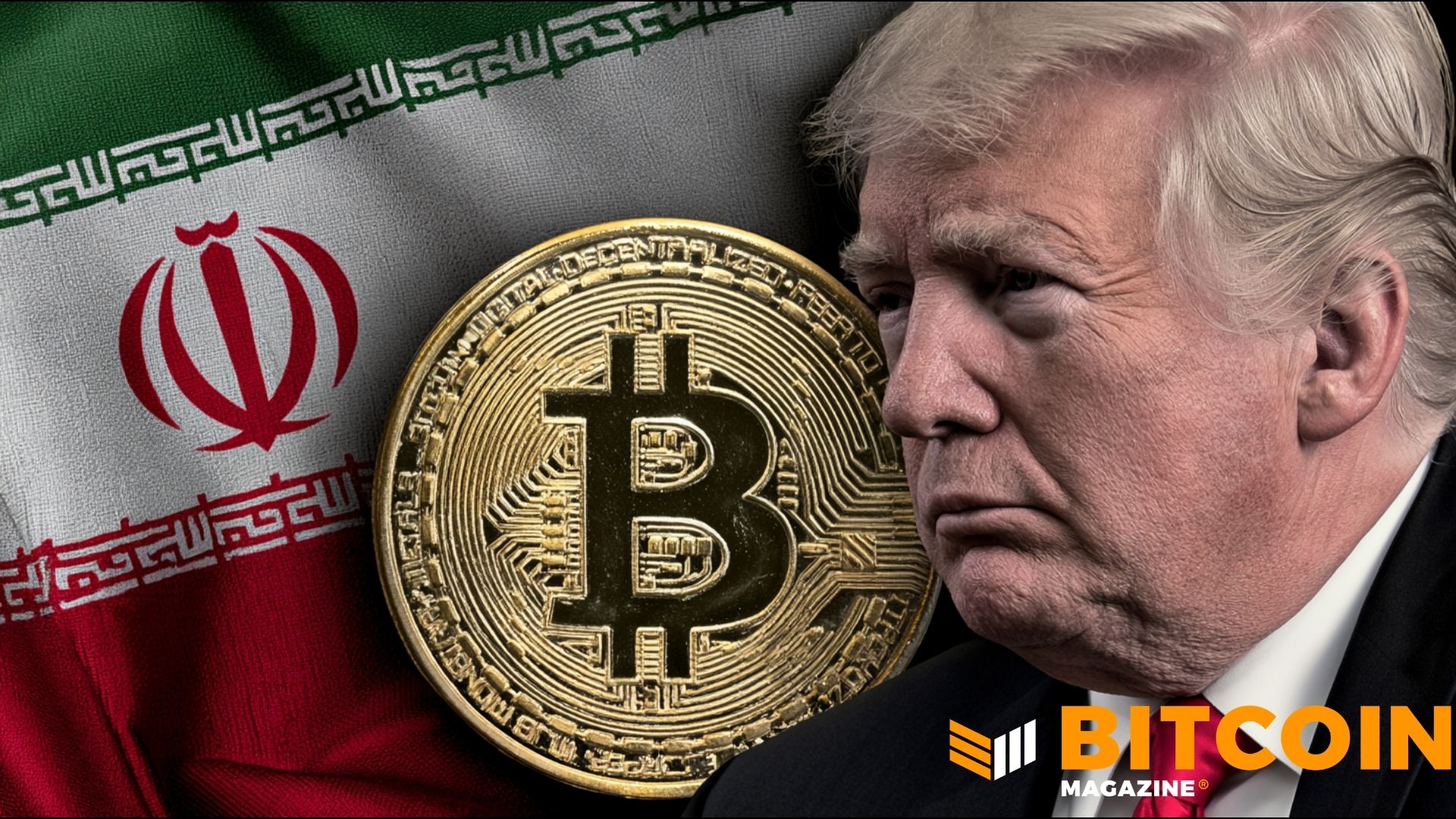
Bitcoin Unfazed by Trump’s Iran Threats
Bitcoin shrugged off tensions in the Middle East, barely moving despite U.S. President Donald Trump vowing on Monday to hit Iran hard.
The price of the biggest cryptocurrency recently stood at $79,076, unmoved over a 24-hour period. The coin also hasn’t budged from where it stood seven days ago.
Bitcoin started a phenomenal run two weeks ago — its best in three years — and is up nearly 30% over the past month.
Its price started surging after the U.S. Treasury would at least double the size of its liquidity-support buyback operations. The announcement hurt the dollar but non-yielding assets like bitcoin and gold have benefited.
Positive regulatory news has also helped bitcoin this month: President Donald Trump last week said that the long-awaited crypto Clarity Act was a “very, very powerful” piece of legislation, and urged lawmakers to get it over the line.
The Clarity Act aims to establish a framework for distinguishing between digital assets that are securities, commodities or payment stablecoins — legislation that the crypto industry has long called for.
Investors have piled back into exchange-traded funds this month, too, which has also helped bitcoin’s price. From August 17 to 27, investors threw over $2.8 billion at the vehicles — the most since October.
JUST IN: Crypto ETFs attracted $3.2 billion in inflows last week, "their largest weekly intake since October 2025", The Kobeissi Letter reports.
— Bitcoin Magazine (@BitcoinMagazine) August 31, 2026
BlackRock's IBIT led with $928 million last week, adding to their $1.3 billion from the prior week, and marking the biggest 2-week… pic.twitter.com/ROC9tYPMGN

Bitcoin reached as high as $81,281 last week before sliding again on Friday.
Geopolitical strife has this year hurt Bitcoin’s price, with the cryptocurrency typically facing downward pressure on news of war and rallied in hopes of a ceasefire.
When the U.S. and Israel first attacked Iran in February, the coin nosedived, and had been shaky on news of war in March and April.
But in recent months, Bitcoin’s volatility has been muted, according to analysts, and Monday was no different: President Trump promised to hit Iran again but the asset didn’t flinch.
The U.S. and Iran started strikes again on Sunday — the first in over one month.
“We’re going to hit them hard,” President Trump was quoted telling a Fox News reporter on Monday.
This post Bitcoin Unfazed by Trump’s Iran Threats first appeared on Bitcoin Magazine and is written by Mathew Di Salvo.
Bitcoin Magazine
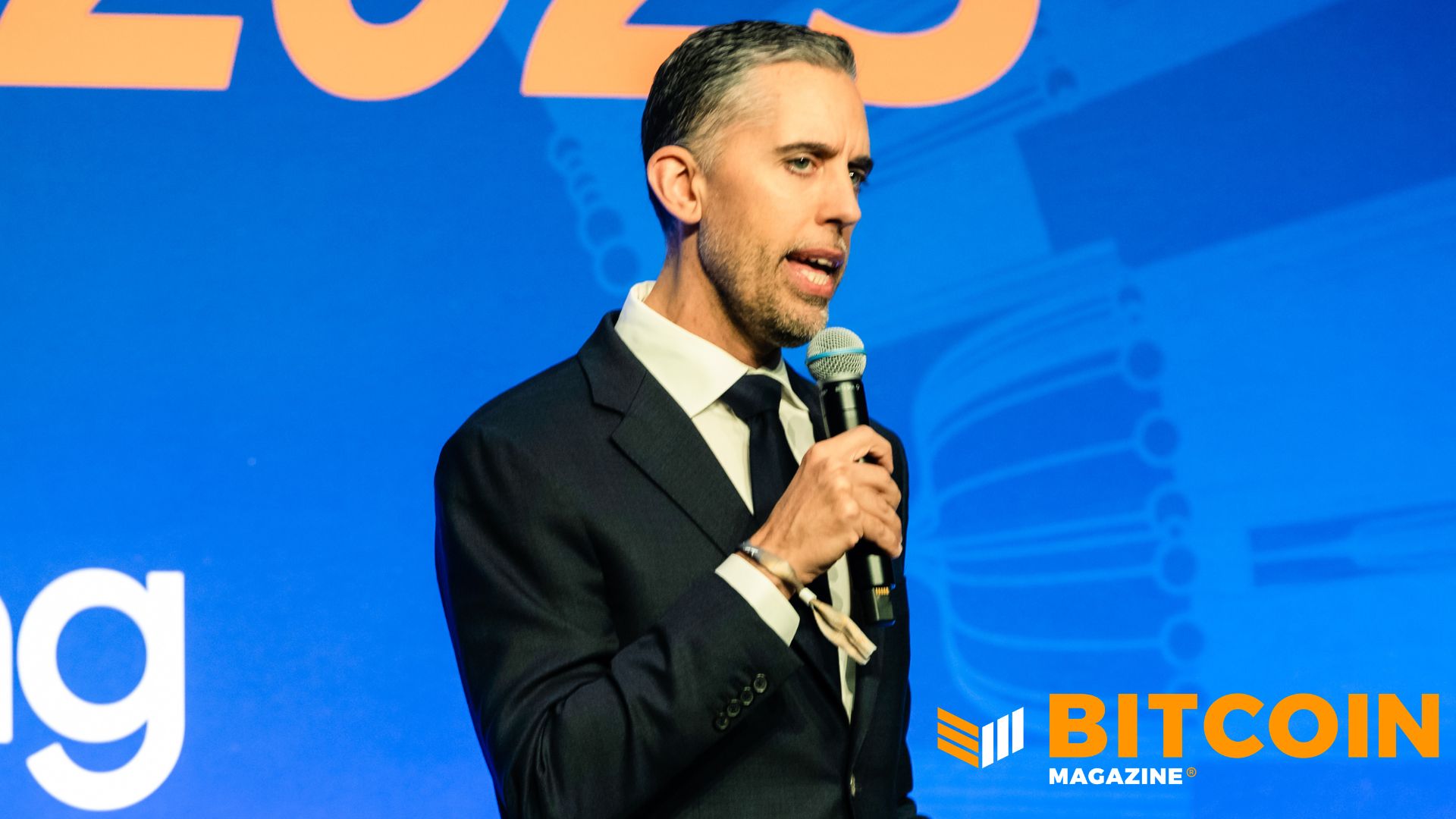
Strive Becomes Fifth-Largest Bitcoin Treasury, Stock Jumps on Latest Buy
Strive’s stock soared on Monday after the company announced a $143 million bitcoin buy, making it the fifth biggest publicly traded crypto treasury.
The Nasdaq-listed company announced its latest buy of 1,800 bitcoins between August 24 and August 28. It snapped up the coins for an average price of $79,431, according to a filing with the Securities and Exchange Commission.
The Dallas, Texas-based company now holds 23,156 coins worth $1.8 billion at today’s prices. Its stock (NASDAQ: ASST) was trading 9% higher at about 12.30pm in New York. Year-to-date, Strive’s stock has risen by nearly 40%.
JUST IN:
— Bitcoin Magazine (@BitcoinMagazine) August 31, 2026Public company Strive bought 1,800 BTC for $143 million
pic.twitter.com/xEkWx3ZNZp
Strive’s year-to-date Bitcoin yield, a metric that compares growth in bitcoin holdings relative to share count, reached 40.8% as of its Aug. 28 filing, up from less than 37% in early June.
Strive now is the fifth biggest bitcoin treasury, behind only Strategy, Twenty One, Metaplanet, and MARA.
Founded by former Ohio gubernatorial candidate Vivek Ramaswamy in 2025, after raising $750 million to buy Bitcoin, Strive debuted as an official bitcoin treasury.
In January 2026, it completed the acquisition of Semler Scientific in an all-stock deal — the first instance of a publicly traded Bitcoin treasury company acquiring another such company.
The idea is that investors can get amplified returns from Strive’s stock. The company buys bitcoin with equity, and maintains a debt-free balance sheet: no bonds, no credit lines, and no leveraged positions that could trigger forced liquidation in a downturn.
Strive CEO Matt Cole has described the company as debt-free with zero margin requirements and zero encumbered bitcoin.
Strive’s latest purchase comes as Strategy, the biggest corporate holder of bitcoin, restarted its buying last week.
The software company had paused buying bitcoin for 10 weeks but announced it had bought 4,603 bitcoins for $369.7 million between August 24 to August 30.
This post Strive Becomes Fifth-Largest Bitcoin Treasury, Stock Jumps on Latest Buy first appeared on Bitcoin Magazine and is written by Mathew Di Salvo.
Bitcoin Magazine
Russia’s Sberbank Estimates $46.4B Trading Volume in First Year of Crypto Buildout
Russia’s largest bank, Sberbank, has said it expects trading volume with its new crypto rollout to hit 4 trillion rubles ($46.43 bln) in the first year, according to reports.
Volumes are also expected to hit 7.5 trillion rubles ($87.06 bln) by 2029, Sberbank Deputy Chairman of the Executive Board Anatoly Popov was quoted saying, as reported by Tass on Saturday.
The forecast was deemed “conservative” according to the news report. Sberbank in July revealed plans to debut a Bitcoin and crypto wallet as well as digital asset custody by December. The Bank of Russia in July published draft regulations for crypto trading, and the State Duma is preparing the comprehensive regulation of digital assets.
And in a Friday report, Tass quoted Sberbank Deputy Chairman Anatoly Popov saying that the bank was planning to accept Bitcoin — and other cryptocurrencies — as collateral for loans.
Russia is fast moving ahead with regulating digital assets in the country. Russian President Vladimir Putin this month signed a law to set in stone the regulation of digital currencies and digital rights in the country.
The new law reportedly allows only registered entities to operate as exchanges, and puts limits on the amount of crypto retail investors can use.
Still, despite the rollout, using digital assets as a means of payment or legal tender within Russia is still banned. Using crypto as a form of payment has been prohibited in Russia since 2022.
President Putin has appeared to praise Bitcoin in the past, once saying that the leading cryptocurrency can’t be stopped.
Since the U.S. and European governments cut Russia off from the SWIFT payments system after it invaded Ukraine in 2022, Russian companies have been using Bitcoin to skirt around the penalties.
But the Russian state keeps a tight grip on what its citizens can do with crypto: authorities have been cracking down and arresting people operating unregistered crypto exchanges.
And the amounts involved barely matter — a nuclear engineer in Sarov was sentenced to 18 years for sending about $13 from his crypto wallet to groups the state designates as terrorist organizations.
This post Russia’s Sberbank Estimates $46.4B Trading Volume in First Year of Crypto Buildout first appeared on Bitcoin Magazine and is written by Mathew Di Salvo.
Bitcoin Magazine
Strategy Resumes Bitcoin Buying After 10-Week Hiatus
Bitcoin treasury Strategy resumed its bitcoin buys last week, snapping up nearly $370 million in the leading cryptocurrency, according to a Monday announcement from the company.
A filing with the Securities and Exchange Commission shows that Strategy bought 4,603 bitcoins for $369.7 million between August 24 to August 30. Each coin was bought at an average price of $80,318, according to the filing.
The buy comes after Strategy paused its bitcoin buys in June, instead focusing on building a cash buffer, buying back its stock and even sometimes selling some of its holdings.
JUST IN: Strategy buys 4,603 BTC for $370 million!
— Bitcoin Magazine (@BitcoinMagazine) August 31, 2026
“Strategy is evolving from one-way capital issuance to active capital management,” Strategy CEO Phong Le said in June. “We intend to move between issuing securities when capital is attractive and repurchasing securities when our instruments trade at levels that make buybacks accretive. This flexibility is designed to create shareholder value, improve corporate performance, and strengthen the quality and market standing of Strategy’s securities in the eyes of investors.”
Strategy now has $5.1 billion in its USD Reserve and $1.61 billion its new USD Cash reserve — which was announced last week.
The company holds 845,050 bitcoins worth $65.8 billion at today’s prices.
Software company Strategy — formerly MicroStrategy — began buying bitcoin in August 2020 as a treasury strategy to boost shareholder returns during the pandemic.
It has since spent more than $63.7 billion on buying bitcoin and remains by far the largest corporate holder of Bitcoin in the world. Its approach spawned a wave of copycat companies that have since adopted similar crypto-treasury strategies of their own.
Chairman and Strategy founder Michael Saylor has said that the company is now focusing on creating digital credit: high-yield products, such as its preferred equity, STRC, which are backed by its bitcoin holdings.
Strategy’s stock (NASDAQ: MSTR) was trading slightly higher on Monday morning in New York. Year-to-date, its price has dipped nearly 20%.
Bitcoin was trading for $77,821 on Monday morning in New York after hitting a high last week of $81,281. Over a 24-hour period, the coin now sits unmoved, but over a 30-day period, it has jumped by more than 24%.
This post Strategy Resumes Bitcoin Buying After 10-Week Hiatus first appeared on Bitcoin Magazine and is written by Mathew Di Salvo.
Bitcoin Magazine

What Is Worth Preserving: Rupture on Remains, Decay, and the Collector’s Dilemma
In 1915, Kazimir Malevich hung a black square on a gallery wall and called it the zero point of painting – the end of the image, presented as an image. A little over a century later, the black square returns in Remains, but this time as consequence rather than statement. If the collector of one of these works by artist Rupture does nothing, the on-chain response is to produce the black square for them, one pixel at a time, one block at a time, until nothing is left of the image.
Remains is a series of four hybrid works in which a painting and a related ordinal are structurally bound. Each inscription contains exactly 210,000 pixels – the number of blocks mined in a bitcoin halving epoch. Beginning at the next halving in April 2028, the inscription begins to decay in real time: one pixel dies for every block the network mines. The only way to stop it is hidden beneath the surface of the physical painting – a unique alphanumeric code, retrievable only by destroying a meaningful portion of the work, which must then be inscribed as a “child” of the ordinal to permanently halt the decay. Preserve the painting, and the image on the blockchain is consumed. Save the inscription, and the painting is wounded forever. The collector cannot remain passive. Inaction is itself a choice, and the Bitcoin blockchain makes both outcomes permanent.
Art history is full of destruction deployed as a gesture. Robert Rauschenberg erased a de Kooning drawing in 1953 and framed the absence. Banksy fed Girl with Balloon through a shredder hidden in its own frame the moment the auction concluded at Sotheby’s. And in 2016, Sun Yuan and Peng Yu caged an industrial robot at the Guggenheim and gave it a single task: sweep the blood-red fluid endlessly pooling around its base back toward itself, a futile act of self-maintenance it performed for three years, slowing visibly, until it stopped. Can’t Help Myself may be the saddest machine ever built. It is also a close ancestor to Remains: both works run on a clock, and both make the audience watch something decay in real time. But where the robot’s fate was sealed by its programming, Remains leaves the outcome unwritten. Destruction here is not a spectacle performed by the artist. It is stewardship demanded of the collector.

Rupture (b. 1993, Switzerland) is a self-taught artist based in Mexico City. Within the digital art space, he has produced one of the most widely collected artist-made bodies of work on Bitcoin, the Persona series (750 works, 2024–2025), alongside earlier work on Ethereum; he was also among the first artists to release work on Solana. The physical practice reaches back further: exhibiting internationally since 2016, with presentations at Museum Halle Saint-Pierre in Paris, Art Basel Miami, the 2nd Triennial of Self-Taught Visionary Art in Belgrade, and a nomination for the Prix Suisse d’Art Brut, figurative painting built on dense, obsessive mark-making and an insistence on the irreversible. Remains is where the two paths collide: painting and blockchain bound into single objects, each incomplete without the other.
Bitcoin is the most consequential permanence system produced in the digital age. Its architecture assumes that what is recorded cannot be lost. Remains takes that assumption seriously enough to test it — and in doing so forces a reckoning with a fundamental asymmetry between physical and digital culture: one forgets by nature, the other records permanently regardless of intent.
I sat down with Rupture ahead of the exhibition to talk about decay as a medium, the collector as an unwilling participant, and what it costs to save anything.
BMAG: Let’s start with the mechanism, because it’s the basis of the whole series. Each digital component contains exactly 210,000 pixels – the number of blocks in a Bitcoin halving epoch – and beginning at the April 2028 halving, one pixel dies for every block the network mines. Discuss how you arrived at that structure. Did the concept come first and the math followed, or did the number 210,000 suggest the work?
Rupture: The concept was there before any of the pieces existed. I was thinking a lot about permanence, especially in relation to digital mediums. Bitcoin is seen as the most permanent and unchangeable record humanity has built, and Ordinals were marketed on exactly that thesis – a truly permanent storage layer, unlike NFTs on other chains with their broken links and files sitting on someone’s server. Persona, my first series on Ordinals, embraced that promise. With Remains I wanted to turn it on its head.
I think there is something beautiful about impermanence. We live in a moment where movements like transhumanism want to engineer it away, and I understand the impulse, but I’d argue the opposite: life would lose its meaning if it were eternal. The same applies to art. Tibetan monks spend weeks building a sand mandala and then sweep it away – the dissolution becomes part of the work.
So I set out to make a digital work that would be consumed by Bitcoin’s own metabolism. From there the structure basically assembled itself. The closest on-chain analogue to a pixel dying was a block being mined – a discrete, irreversible event that happens roughly every ten minutes, forever. So I linked them one to one. An epoch is 210,000 blocks, which meant the image had to be 210,000 pixels. The math followed the concept.

BMAG: The “kill switch” is hidden beneath the paint on the physical painting. To retrieve the code that stops the decay, the collector has to destroy a meaningful portion of the physical work – and then inscribe it as a child of the Ordinal. Did you paint these differently knowing the surface is also a type of vault? It’s very taboo to touch (or cut) a painting (outside of Lucio Fontana).
Rupture: I tried to approach these the way I would approach any other painting. The only real difference is that I had to start with the code. Each one was written on paper, laminated, and sealed at the center of the panel under layers of molding paste and gesso. Only then could the painting begin. So the secret is literally the first layer. Everything else sits on top of it.
As for the taboo – I think most of us, me included, are conditioned to ascribe a much higher value to the physical object. The painting feels irreplaceable in a way the inscription doesn’t, even when the inscription is the scarcer thing. That conditioning is what makes the concept work. The taboo gives the act of destruction its emotional weight, and that weight is what the collector has to sit with.
I deliberately left it open-ended. I’m not telling anyone what the right choice is. The collector confronts the question of value and permanence and answers it for themselves – publicly, and only once.

BMAG: There’s a lineage of destruction in art – Rauschenberg erasing de Kooning, Tinguely’s self-destroying machine at MoMA, Banksy’s shredder at Sotheby’s. And more recently, the “burn a physical to mint a digital” gesture that flared up during the initial NFT boom. Remains feels like a response to that last one in particular: in your work, destruction isn’t a spectacle the artist performs – it’s a responsibility the collector inherits. Where do you place yourself in that lineage, and what do you think the burn-to-mint era got wrong?
Rupture: I like to think of destruction as integral to creation. Jasper Johns destroyed nearly everything he made before 1954 so he could start over. Agnes Martin did the same, more than once. So artists questioning the preciousness of the art object is nothing new. And I think that preciousness is inherited – art objects have absorbed the aura that used to belong to relics. Now that commodities are the closest thing we have to a religion, cutting open a painting might be our version of desecration. Which is exactly why it carries weight.
The burn-to-mint mechanic treats the physical as a husk. You burned the painting to “upgrade” it into a token, the destruction was filmed, and the spectacle was the marketing. What it got wrong, I think, is that nothing was actually at stake. You destroyed something to get something the market valued more. That’s more of a transaction than a sacrifice.
In Remains there’s no version where you come out ahead. The collector already owns both halves, and destruction doesn’t produce anything new, it only decides which loss to accept. The loss runs on Bitcoin – a system built for remembering, repurposed as an engine of forgetting.

BMAG: The press text says the collector cannot remain passive – that inaction is itself a choice. That’s a strong tenet of the bitcoin idea. Self-custody works the same way: hold your own keys, and doing nothing is perhaps the best outcome. Did you set out to build a custody parable of some kind, or did the parallel arrive after? Artmaking can sometimes be nonlinear and we don’t see the connections in order.
Rupture: The parallel only occurred to me after the work existed. And funny enough, Remains actually inverts the rule. In self-custody, doing nothing is the safe move, while for Remains, doing nothing is what kills half the work.
But the deeper thing is the same in both. You’re on your own. There’s no institution behind you, no support line, no one to make the decision for you or undo it afterwards. The system just records what you do, and there are no exceptions.
Most people have never owned anything under those conditions. Bitcoiners have. I think that’s why they tend to understand this work faster – they know what it feels like to be the only one responsible for something that can’t be undone.

BMAG: At the next halving, the decay clock starts for any un-rescued work. Anyone can watch the inscriptions on-chain as they change. Is a completed black square a failed Remains, or the most honest version of the work?
Rupture: It definitely isn’t a failed Remains. It’s the piece brought to one of its logical outcomes. The work was never meant to be just the image – it’s the image plus the decision, and a black square is what one of those decisions looks like. It means the collector chose the painting, whether out of conviction or paralysis, and the chain holds the receipt: 210,000 confirmations of a single choice, applied one block at a time over four years. I don’t know of another artwork that documents its owner’s decision at that resolution.
And then there’s the Malevich analogue, which you opened with. He declared the zero point of painting. Remains arrives at the black square instead of starting from it – block by block, with an exit available the entire time. I don’t know which of the four pieces will end there, if any. That’s the one part of the work I can’t determine.

BMAG: For someone standing in front of these four paintings at the exhibition – someone who knows bitcoin as a price ticker but has never thought about what permanence actually costs – what do you want them to walk away thinking about?
Rupture: How permanence is never free. Nothing survives by default. Every object in every museum is there because someone paid for it to be – in money, in labor, in space, in other things thrown away to make room. History isn’t just what happened. It’s what someone decided was worth keeping. What persists does so because something else was set aside or destroyed. We just rarely see the other half of the equation.
Remains by Rupture debuts September 2–8, 2026 at PRIV.Y Gallery, 46 Hester Street, New York, presented by BMAG and running parallel to NFT.NYC. The opening reception is September 2. RSVP at luma.com/cckjg9kl.
BMAG is also running a bounty on X: enter for a chance to win Memory Theatre VI, an original work by Rupture. Full details and entry at shop.museum.b.tc/items/memory-theatre-vi.
Remains is now available to preview at https://shop.museum.b.tc/preview/remainsbyrupture. For acquisition inquiries, DM @BMAG_HQ on X or email bmag@btcmedia.org.
Follow Rupture on X @RuptureNFT.
The Bitcoin Museum & Art Gallery (BMAG) is the curatorial and cultural programming division of BTC Inc and the Bitcoin Conference. Learn more at museum.b.tc.
This post What Is Worth Preserving: Rupture on Remains, Decay, and the Collector’s Dilemma first appeared on Bitcoin Magazine and is written by Dennis Koch.
CryptoSlate
Bitcoin traded near $77,700 today, Aug. 31, putting the largest crypto asset up about 23.5% over 30 days. CryptoSlate’s market signal registered a bullish 68 out of 100 after a late-week pullback. The score measures trailing market conditions.
CryptoSlate published its latest Bitcoin September forecast at the Aug. 30 close. The model used a $77,667 reference price and produced an $81,319 median for Sep. 29. The projected gain is about 4.7%, compared with Bitcoin’s 23.5% advance during the preceding month.
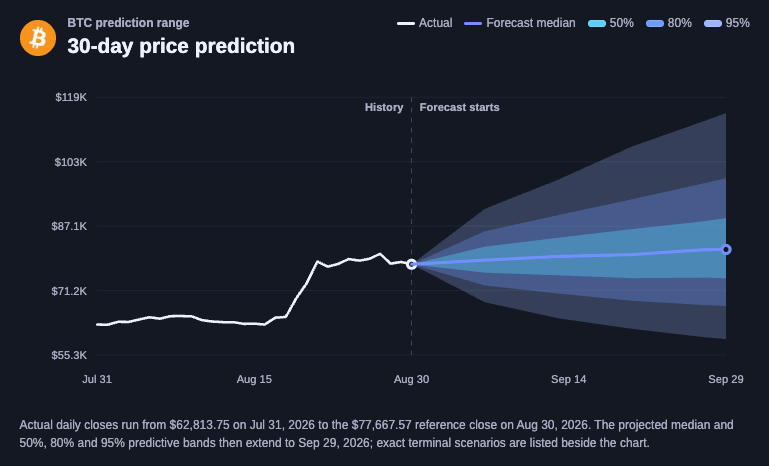
Measured from the reference close, the model’s median adds about $3,651. The central forecast therefore preserves additional upside into late September at a much slower pace after the August rebound.
The model also maps a broad distribution of possible September prices. Its P80 estimate, the 80th-percentile point in that distribution, was $91,049. Its P20 estimate, the 20th-percentile point, was $72,502. The labels identify relative positions in the modeled distribution, with P80 marking the upper estimate and P20 marking the lower estimate.
The $18,547 gap between P20 and P80 quantifies that uncertainty. It covers outcomes on both sides of the reference close and places the median much nearer the middle of the published range.
The distance between the median and those estimates matters after such a fast rally. The distribution’s center points upward, and its wide span preserves substantial volatility around that path.
The late-August move had evidence of spot demand. CryptoSlate’s analysis of the rally cited $2.23 billion of spot Bitcoin ETF demand, an 11% decline in futures open positions measured in Bitcoin and funding near neutral. That combination suggested cash buying supported the advance as speculative leverage cleared.
ETF flows softened at the end of the week. A nine-day US spot Bitcoin ETF inflow streak totaling about $3.04 billion ended with net outflows of $201.9 million on Aug. 28. The reversal ended the clean daily streak. The earlier cumulative inflows still underpin part of the rally.
That shift matters because the preceding inflows were one of the clearest sources of cash demand during the climb.
Price structure supplies the immediate test. Bitcoin’s late-August rejection above $81,000 turned $80,000 back into a near-term reclaim level, and CryptoSlate’s technical analysis placed immediate support around $77,000.
The Bitcoin September forecast arrives with a bullish trailing trend and a central forecast whose projected gain is much smaller than August’s move.
A sustained recovery above $80,000 would strengthen the upside case; a loss of $77,000 would weaken it. ETF flows provide the other near-term signal for the strength of spot demand.
The post Bitcoin gains 24% as CryptoSlate price prediction model maps a volatile September appeared first on CryptoSlate.
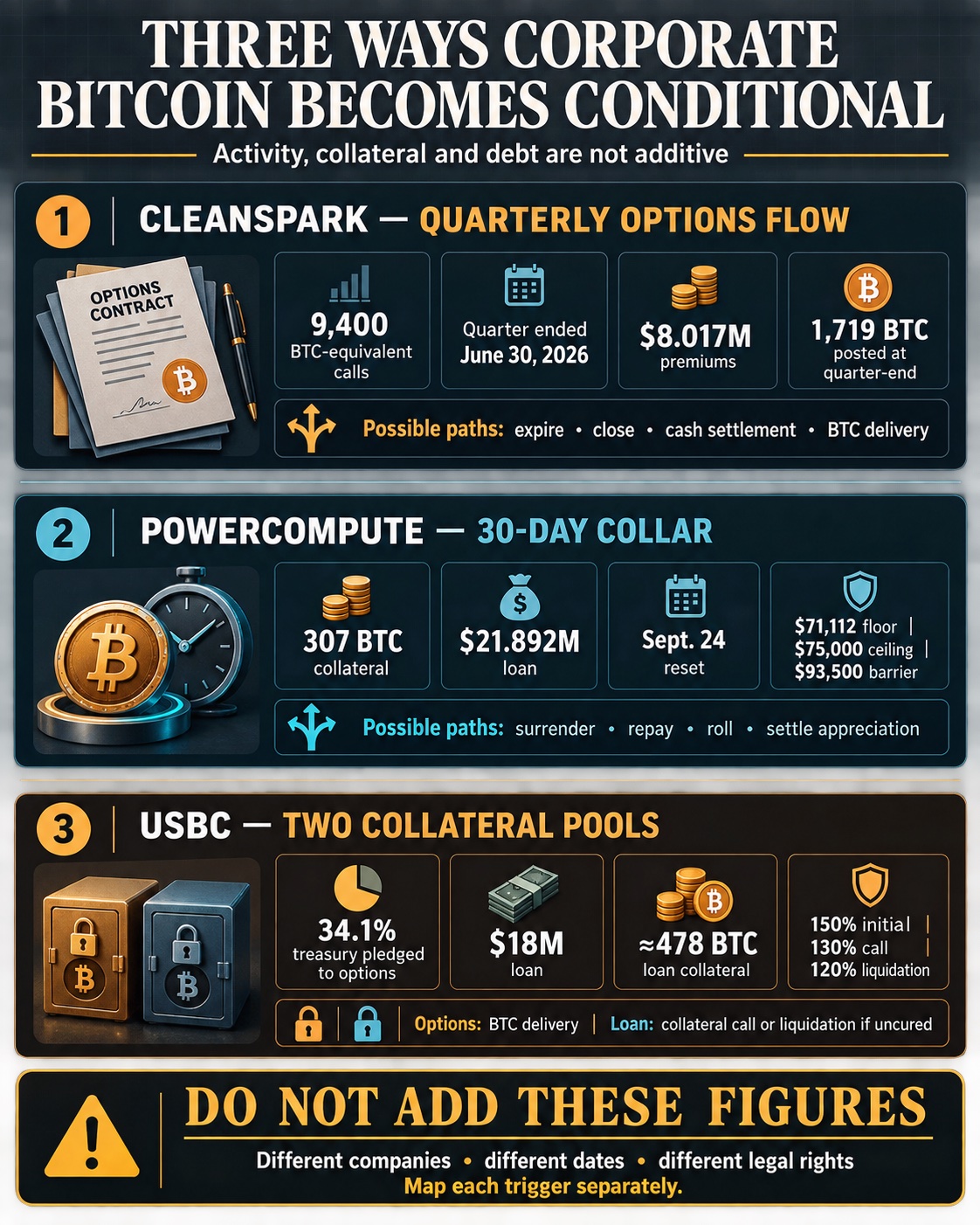
During the three months ending June 30, CleanSpark put 9,400 Bitcoin-equivalent call contracts through Spot+, its strategy for selling options around ongoing sales from its corporate Bitcoin treasury. Because the figure is expressed in Bitcoin equivalents, it can resemble a balance-sheet position even though it measures a quarter’s trading flow.
In its Aug. 6 quarterly filing for the period ended June 30, CleanSpark reported $8.017 million in premium proceeds from those calls. Bitcoin averaged $68,766 when the contracts were entered, against an average strike price of $76,383.
The distinction exposes a blind spot in corporate Bitcoin treasury analysis. A headline holding tells investors how much Bitcoin a company reports, while options, collars and secured loans can assign rights over some coins or connect them to future settlement choices.
CleanSpark, PowerCompute and USBC illustrate three versions of that conditional supply. Their filings show pathways to delivered Bitcoin, cash costs, more debt, capped upside or lender-controlled collateral. The disclosed measures span different companies, dates and legal structures, so combining them would produce a false exposure total.
CleanSpark’s corporate Bitcoin treasury flow and inventory differ
CleanSpark’s 9,400 Bitcoin-equivalent figure sits in the period-activity column. Its point-in-time disclosure was different: the company reported 12,205 Bitcoin as held at June 30 and a separate receivable for 1,719 Bitcoin posted to derivative trading counterparties.
CleanSpark’s July 7 June operational update presented 13,924 Bitcoin in total, including the 1,719 posted as collateral or receivable. This reconciles the company’s operational total with the filing’s accounting boundary.
The settlement figures show where potential supply became actual delivery. During June, CleanSpark reported 250 Bitcoin sold through call exercises, 25 acquired through put exercises and 244 acquired through a delta-neutral basis trade. Its quarterly digital asset management reconciliation reported $8.595 million in proceeds from premiums and incremental Spot+ trading. The activity table also lists 7,850 Bitcoin-equivalent close-out transactions with negative $3.523 million in the premium-proceeds column, while the reconciliation included $2.982 million of fair value above strike on settled derivatives.
Those figures occupy four distinct categories: 9,400 Bitcoin-equivalent calls were period activity; 1,719 Bitcoin was posted at period end; 250 Bitcoin was sold through call exercises in June; and the dollar values record premiums, close-outs and settlement accounting.
| Company | Disclosure | What the Bitcoin measure means | What can happen |
|---|---|---|---|
| CleanSpark | Quarter ended June 30; holdings snapshot at June 30 | 9,400 BTC-equivalent Spot+ calls are period activity; 1,719 BTC was posted to derivative counterparties at period end | Calls may expire, close early, settle in cash or result in Bitcoin delivery |
| PowerCompute | 30-day collar running Aug. 25 through Sept. 24 | 307 BTC secures a $21.892 million non-recourse collar loan | Reset choices can return, retain, sell or deliver collateral; a high-price knock-in can create a settlement cost or added debt |
| USBC | Options and loan disclosures as of Aug. 24 | 34.1% of the treasury was pledged for options; about 478 BTC separately secured a credit facility | Options can require Bitcoin delivery; a falling collateral ratio can produce a call and, if uncured, lender liquidation rights |
PowerCompute’s ceiling is tested at reset
PowerCompute offers the clearest example of why contract terms matter more than a single strike price. On Aug. 25, the company entered a $21,892,131.88 collar loan secured by 307 Bitcoin at 6.5% annual interest. The new principal included a $3.765 million cost to unwind the prior collar, which the borrower elected to add to the loan balance.
The contract annex sets a $71,112 floor, a $75,000 ceiling and a $93,500 knock-in barrier for the rolling period scheduled to end Sept. 24.
Bitcoin traded near $78,767 on Aug. 31, above the ceiling and below the barrier. PowerCompute had not forfeited appreciation above $75,000 at that price. The contract tests the barrier at the reset time on Sept. 24 and disregards price moves before that moment. An early exit would move the same test forward to the exit date.
If the reference price is below $93,500 at the applicable test, the ceiling has no effect and PowerCompute keeps the appreciation, even when Bitcoin is above $75,000. At or above the barrier, the cap knocks in and appreciation above $75,000 becomes payable to the lender. PowerCompute can settle that amount with pledged Bitcoin or cash. On a rollover, it may instead add the amount to principal or absorb it into the next pricing terms.
Below the $71,112 floor, PowerCompute may surrender the pledged Bitcoin in full satisfaction of the non-recourse debt, repay and recover the collateral, or roll after curing the shortfall. Without an election, the loan matures automatically and the annex’s collateral retention or sale provisions apply.
The result is conditional supply governed by a reset structure rather than continuous intraday liquidation. PowerCompute’s 307 Bitcoin is tied to a defined decision point and a menu of settlement routes. Its latest reset has already been examined in CryptoSlate’s PowerCompute coverage; the wider lesson is that an encumbered treasury coin need not be immediately for sale.
USBC separates option control from loan liquidation
USBC’s Aug. 27 filing disclosed two constraints on its Bitcoin as of Aug. 24.
First, 34.1% of the treasury was pledged for options trading. The Bitcoin sat in cold-storage wallets with custodial partners designated by the trading counterparties, which controlled the private keys. The program can create a right to receive or an obligation to deliver a fixed amount of Bitcoin, with exposure capped by the treasury’s holdings.
The 34.1% figure therefore describes collateral under counterparty control, rather than a forecast of imminent sales. Its outcome depends on the options positions and their settlement.
Second, USBC reported a separate $18 million Bitcoin-backed borrowing from Payward Interactive, with approximately 478 Bitcoin pledged under an account-control agreement and held by Payward Financial. The loan required a 150% initial margin. A decline to 130% permits a collateral call, while a fall to 120% can give the lender liquidation rights if the deficiency is not cured.
That pathway resembles conventional secured lending: lower Bitcoin prices weaken collateral coverage, potentially requiring more coins or repayment before liquidation becomes available. It differs from CleanSpark’s rolling option activity and PowerCompute’s reset-tested non-recourse collar. Prior USBC collateral coverage and broader corporate treasury loan analysis provide the lending context, while USBC’s options pledge adds a separate layer of counterparty control.
Together, the filings leave no defensible combined total for economically unencumbered corporate Bitcoin. CleanSpark distinguishes 12,205 Bitcoin held from 1,719 posted to derivative counterparties. PowerCompute identifies 307 coins tied to one live collar. USBC reports an options-collateral percentage and a separate credit-facility collateral balance. The companies, dates, units and legal effects differ.
CleanSpark’s earlier liquidity analysis showed why a treasury’s funding demands matter. The newer filings sharpen the measurement problem: every corporate Bitcoin figure needs labels for activity versus inventory, control of the coins, the price and time that activate the contract, and whether settlement means delivery, cash, more debt or lost upside.
A corporate Bitcoin treasury holding can look permanent even when part of its economics already belongs to a contract.
The post Why Bitcoin’s $2B corporate treasuries are a ticking time bomb of hidden conditional supply appeared first on CryptoSlate.
Leveraged funds held a 41,252 BTC-equivalent net short across CME Bitcoin futures, including standard and Micro contracts on Aug. 25, while the CFTC snapshot showed the same category net long just 151 BTC in Coinbase's nano Bitcoin perpetual-style contract.
For the next forced unwind, the important distinction is scale rather than an evenly matched directional split. The report showed 118,267 BTC-equivalent of open interest across the two CME products, compared with 2,322 BTC on Coinbase. CME was about 51 times larger by that measure, and its leveraged-fund net short was roughly 272 times the magnitude of Coinbase's net long.
A standard CME Bitcoin futures contract represents 5 BTC and a Micro Bitcoin futures contract represents 0.1 BTC, according to CME's specifications. Leveraged funds were net short 8,114 standard contracts, or 40,570 BTC, and 6,821 micro contracts, or 682.1 BTC.
Each Coinbase nano perpetual-style contract represents 0.01 BTC. The category's 15,162-contract net long therefore equaled 151 BTC, which is the residual between 1,195 BTC-equivalent of gross longs and 1,043 BTC-equivalent of gross shorts.
CME positioning also became materially more net short during the week. From Aug. 18 to Aug. 25, the standard-contract net shifted 3,295 BTC further short and the micro net moved 777 BTC further short, a combined bearish change in net positioning of 4,072 BTC.
That change still cannot safely be called an outright bearish wager. The CFTC's category notes do not connect reported futures accounts to spot Bitcoin, exchange-traded fund holdings, or cross-venue hedges. Without matched Aug. 25 readings for CME basis and Coinbase funding, the snapshot cannot distinguish directional shorts from cash-and-carry trades or other hedges.
The CME Bitcoin futures unwind depends on the hidden second leg
If CME shorts are uncovered directional positions, a squeeze would force futures buying through a pool far larger than Coinbase's current net long. If they are basis trades, closing them would pair futures buying with the sale of spot Bitcoin or ETF exposure, the same two-legged structure described in cash-and-carry analysis. That sale could offset part of the price effect even as the reported short contracts.
Coinbase can still generate venue-specific liquidations, a risk built into perpetual-style markets, but the 151 BTC net figure reveals neither gross leverage nor liquidation thresholds. Its small size cannot counterbalance the much larger CME position by itself.
ETF flows reinforce the timing limit. Farside data show US spot Bitcoin ETFs absorbed $1.12 billion from Aug. 24 through Aug. 27, then lost $201 million on Aug. 28. The five sessions remained net positive by $924 million, but the CFTC snapshot was fixed on Aug. 25 and cannot reflect the later inflows or Friday's reversal.
A clearer unwind signal would combine the next CFTC position change with matched CME basis, Coinbase funding, and ETF flows. Until then, the mismatch shows where the larger exposure sits, not whether it is a naked bet or one leg of a hedge.
The post Massive Bitcoin derivatives gap between CME and Coinbase threatens violent position shakeout appeared first on CryptoSlate.
Bitcoin is on track to log its best August performance since 2017, demonstrating remarkable resilience against back-to-back macro shocks as escalating US-Iran hostilities and a hawkish pivot from the Federal Reserve test the durability of the digital-asset rebound.
Data from CryptoSlate shows that the largest cryptocurrency is trading near $78,400 as of press time, bringing its monthly advance to more than 24%. This represents its strongest August rally in nine years and its biggest single-month gain since November 2024, per CoinGlass data.
The advance comes even as crude oil jumped above $90 a barrel following American airstrikes on Iranian targets and Tehran's subsequent retaliation against US military positions in Jordan, unleashing a fresh wave of risk aversion across global equity and bond markets.
Yet, rather than retreating under the weight of geopolitical instability and renewed inflation anxieties, Bitcoin has preserved its monthly gains, suggesting that a shift in internal market mechanics may be shielding the token from traditional cross-asset contagion.
Bitcoin has already survived one major macro shock
The resilience on display following the Middle East military flare-up marks the second time in less than a week that digital assets have absorbed severe macro headwinds.
Last Friday, Bitcoin briefly dipped below $77,000 after Federal Reserve Chair Kevin Warsh delivered an unexpectedly hawkish debut address at the Jackson Hole Economic Policy Symposium.
At the event, Warsh explicitly challenged market expectations of monetary easing, warning that progress on lowering inflation has stalled well above the central bank’s 2% target and emphasizing that policymakers’ primary focus must remain on price stability.
Warsh also dismantled the Fed’s traditional forward-guidance framework, cautioning that excessive verbal commitments risk creating a “hall of mirrors” between policymakers and financial markets.
The Fed Chair pointed to resilient corporate investment, much of it tied to AI infrastructure, alongside unemployment near 4.1% and consumer spending growth above 2%, as evidence the economy can withstand tighter policy.
The remarks sent Treasury yields higher and lifted the market-implied probability of a 25-basis-point rate hike at the Fed’s September policy meeting to 60%.
While traditional risk assets buckled under the prospect of prolonged monetary tightness, Bitcoin staged a rapid weekend recovery, reclaiming the $78,000 handle just before geopolitical headlines broke.
Oil adds another inflation problem for the Fed
The renewed outbreak of fighting in the Middle East has introduced a secondary inflation impulse that threatens to further complicate the Fed’s policy path.
Over the weekend, US forces struck two Iranian rocket launchers on Larak Island in the first direct American military action against Tehran in more than a month.
US Central Command confirmed the operation, noting the launchers were reportedly preparing to deploy naval mines into the Strait of Hormuz. In an X statement, the authorities said:
“[US] took limited, precise action against IRGC minelaying forces posing an imminent threat in the Strait of Hormuz. In essence, Iran created the threat, and the US military eliminated it to protect civilian mariners, commercial shipping, and the free flow of global commerce.”
Iran retaliated by targeting American installations in Jordan, where Jordanian air defenses intercepted eight inbound missiles.
The clashes pushed Brent crude up more than 3% to around $91 a barrel on Monday, bolstered further by signals from Washington that the US plans to intensify secondary sanctions on Iranian oil exports.
The transmission mechanism from the Persian Gulf to digital assets is direct: higher oil prices reignite headline inflation risks, reinforce the Fed's higher-for-longer rate posture, and reduce broader dollar liquidity.
However, commodity strategists caution that the geopolitical risk premium in crude is facing structural limits.
Ole Hansen, head of commodity strategy at Saxo Bank, said:
“These developments have once again reduced the prospects of bringing the conflict to an end.”
Yet Hansen noted that catastrophic supply disruptions remain unlikely in the immediate term, pointing out that an estimated 6 million to 8 million barrels per day of crude continue to flow uninterrupted through the Strait of Hormuz, capping upside risk for global benchmark prices.
By keeping the energy shock contained, the steady maritime flow has prevented a broader liquidity panic, giving Bitcoin room to consolidate rather than capitulate.
Bitcoin's Cycle Structure Turns More Constructive
Beyond the macro backdrop, Bitcoin's internal market structure has strengthened after months of weakness.
Fidelity Investments Director of Global Macro Jurrien Timmer said Bitcoin's recent price action suggests the corrective phase may have matured.
Timmer said Bitcoin has held the lower boundary of his power-law curve while spending enough time correcting to satisfy what he describes as the time component of a mild four-year-cycle winter.
Under Timmer's framework, Bitcoin's recent cycle low near $59,572 remained above power-law support around $58,237, leaving the cryptocurrency within roughly 2.3% of the model's lower boundary before rebounding.
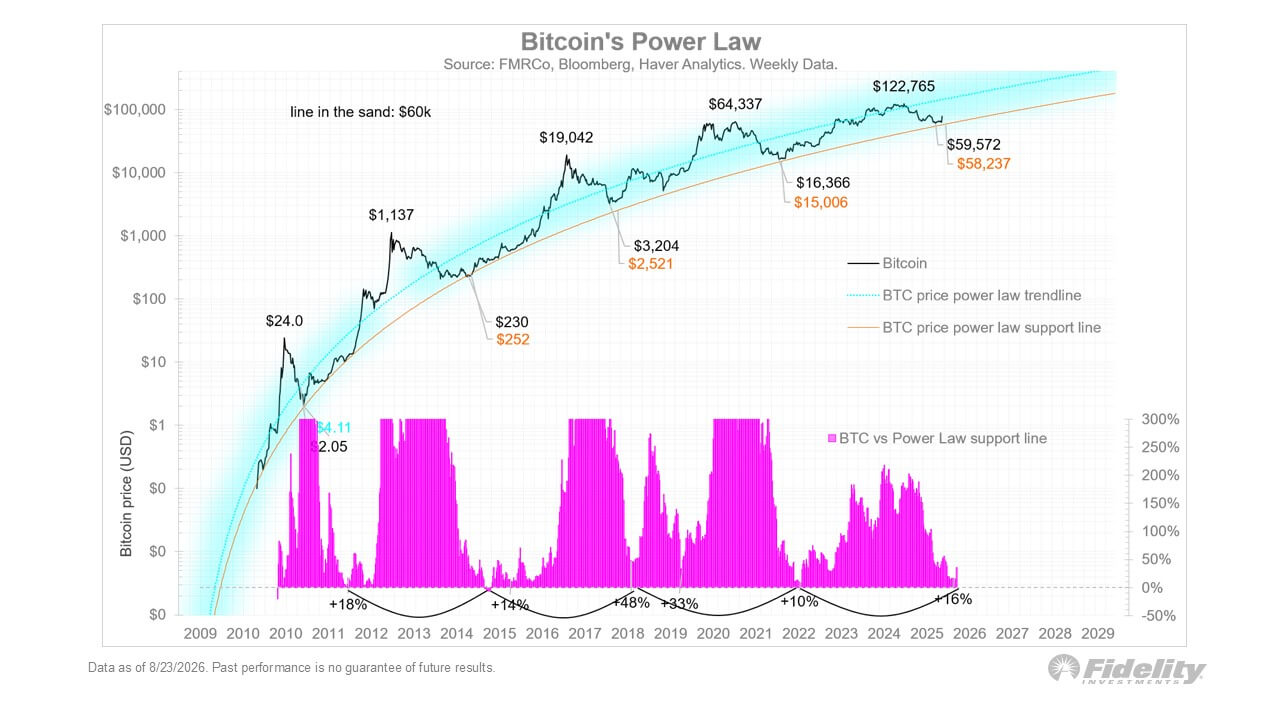
We can't, however, assume from the framework that Bitcoin has definitively completed its correction, nor does Bitcoin's historical four-year cycle guarantee future price behavior.
Timmer's analysis instead suggests the latest downturn has met both the price and duration conditions for a cyclical correction to have matured.
That more constructive long-term setup is being tested against weaker evidence of fresh capital entering the market.
Analysts at market analytics firm Bit Official said growth in aggregate stablecoin market capitalization, a widely followed gauge of deployable crypto liquidity, has remained largely stagnant. While Circle's USDC has recorded modest supply growth, Tether's USDT has shown little material expansion.
That contrasts with the expansion between August 2024 and October 2025, when USDT grew from $120 billion to $196 billion, and USDC climbed from $35 billion to $75 billion.
Without a sustained resumption of fiat-to-stablecoin creation, market watchers warn that the current advance may rely too heavily on derivatives positioning rather than durable spot accumulation.
$80,000–$82,000 Becomes the Confirmation Zone
Bitcoin's improving derivatives positioning is running ahead of activity in the underlying spot market, leaving the strength of the August rebound still short of full confirmation.
Bit Official said Bitcoin's options skew has flipped positive for the first time since October 2025, reflecting stronger demand for call options relative to downside-protective puts. September implied volatility surged from 33.8% to 41.1% before moderating to 38.5%, while traders have rolled shorter-dated calls into October and December expirations or sold calls against existing Bitcoin positions.
However, BTC's spot trading tells a less convincing story.
CryptoQuant data shows exchange volumes remained near levels last seen in September 2023 despite Bitcoin's sharp August advance, extending the subdued activity recorded in July. The divergence suggests the price recovery has yet to draw the kind of trading participation that accompanied previous market peaks.
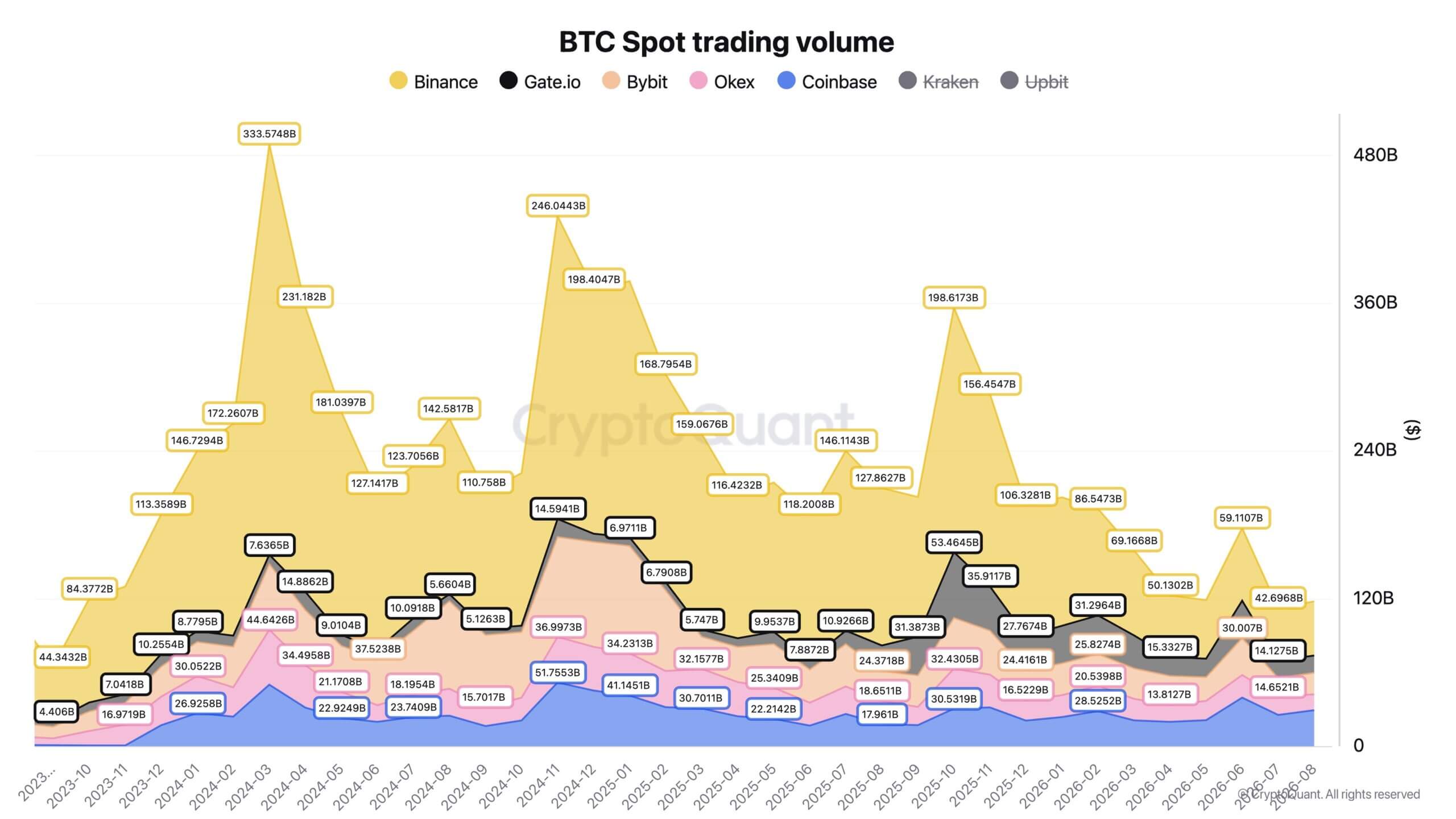
The contrast is particularly stark against October 2025, when Bitcoin reached its previous market top. Monthly spot volume on Binance has fallen to about $44 billion from $198 billion, while Gate's volume dropped to $14 billion from $53.4 billion and Bybit's declined to $17.4 billion from $41.2 billion.
That amounts to an average decline of roughly 70% across the three exchanges.
However, early signs suggest the contraction may be stabilizing. Binance's August volume was about $1.6 billion higher than in July, while overall activity across the major exchanges remained broadly around the previous month's levels rather than deteriorating further.
CryptoQuant said the stabilization could indicate that investor disengagement reached an extreme during the summer. A sustained recovery in volume alongside rising prices would provide stronger evidence that Bitcoin is entering another expansionary phase.
That leaves the price itself facing an equally important test.
Bitcoin is negotiating overhead resistance between $78,214 and $82,139. Bit Official said a decisive break and hold above $82,000 would strengthen the bullish thesis, while $70,973 remains an important level for preserving the broader uptrend.
Barring a sharp reversal, Bitcoin will close August with its strongest performance for the month since 2017. But the next leg of the rally may require something largely absent so far: a meaningful return of spot trading activity.
A sustained move through $80,000 and $82,000 accompanied by rising exchange volumes would provide stronger confirmation that the rebound is broadening beyond price momentum alone.
The post Bitcoin on course for best August since 2017 despite renewed US-Iran hostilities appeared first on CryptoSlate.
The SEC’s proposed Regulation Crypto Assets offers a $75 million fundraising ceiling. A Senate market-structure framework starts with a greater-of-$50-million-or-10% formula. Those numbers look comparable, but they attach to different legal mechanisms.
The SEC proposal would create exemptions by rule for certain crypto-asset offerings. Section 103 of the Senate’s version of the CLARITY Act would create a statutory exemption for certain transactions involving ancillary assets sold pursuant to an investment contract. The distinction changes which issuers and instruments qualify, what buyers receive, and how the two paths could interact.
Neither route is currently available. The SEC proposal remains subject to public comment through Oct. 20, 2026, while the congressional framework remains unfinished legislation.
Different legal objects create different fundraising paths
The SEC proposal describes two routes. A limited “startup” exemption would allow up to $5 million over a four-year period. A separate offering-and-reporting exemption would permit up to $75 million in a 12-month period, paired with disclosure and continuing-reporting duties.
The Senate text takes a different approach. Its Section 103 would exempt qualifying transactions in “ancillary assets” sold under an investment contract. The annual amount would be the greater of $50 million or 10% of the total dollar value of the issuer’s outstanding ancillary assets, measured during a four-year period. An issuer could not exceed $200 million in aggregate sales under the exemption.
That 10% alternative means the congressional route is not necessarily a $50 million ceiling. For an issuer whose outstanding ancillary assets are valued above $500 million, 10% would exceed $50 million, although the separate $200 million aggregate limit would still matter. The calculation also depends on a category, ancillary assets, that is not identical to the covered assets and transactions contemplated by the SEC proposal.
| Issue | SEC proposal | Senate Section 103 |
|---|---|---|
| Current status | Proposed agency rules | Pending statutory text |
| Covered object | Qualifying crypto-asset offerings under proposed exemptions | Qualifying ancillary-asset transactions under an investment contract |
| Main limits | $5 million over four years; or $75 million in 12 months | Greater of $50 million annually or 10% of outstanding ancillary-asset value during four years; $200 million aggregate |
| Issuer access | Depends on the conditions of the chosen SEC exemption | Depends on the statutory ancillary-asset and transaction conditions |
| Retail rule | Proposed purchaser limits apply under the larger SEC route | No matching purchaser-cap structure appears in Section 103 |
| Resale | No general holding period in the larger proposed SEC route | Special conditions apply to specified related persons and coordinated-control holders |
| Timing | Would apply only after adoption and effectiveness | Would apply only after enactment and the statutory implementation period |
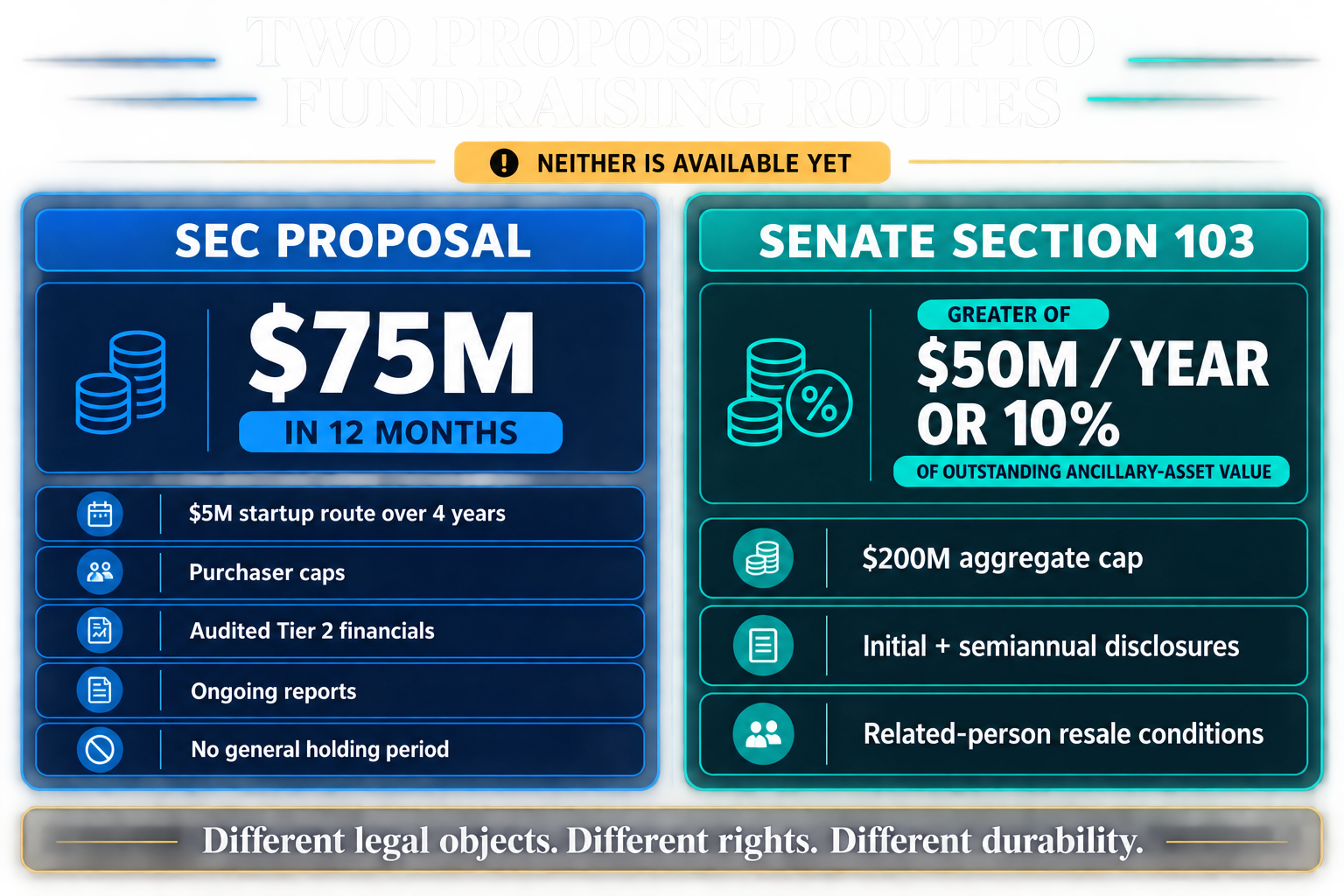
The practical choice would therefore turn on more than the amount an issuer wants to raise. Counsel would first need to identify the asset, the transaction, the issuer’s eligibility and any affiliate or control relationships. A token sale that fits one route might not fit the other.
Investor rights depend on the mechanism
Under the SEC’s proposed $75 million route, purchaser limits would generally restrict how much an investor could buy, using a 10% financial-capacity formula. The proposal would require offering disclosures, audited financial statements for the larger tier, and annual, semiannual and current reports. It also says there would be no general resale restriction under that route and proposes federal preemption of state registration and qualification requirements for covered offerings.
The SEC proposal would not erase federal anti-fraud law. Its release also presents the exemptions as nonexclusive, meaning an issuer could rely on another available exemption if the facts and conditions support it.
The Senate framework offers a different package. Section 103 requires an initial filing after the first sale and semiannual disclosures while the conditions apply. The bill text preserves specified federal liability provisions, including Securities Act Section 12(a)(2), Exchange Act Section 10(b) and Rule 10b-5. It also preserves private rights of action rather than replacing them with a bespoke remedy.
At the same time, the Senate text says that failure to satisfy the exemption does not, by itself, determine whether the ancillary asset is a security. That clause separates compliance with the transaction exemption from the broader legal classification of the asset.
Resale treatment also differs. The SEC’s larger proposed route does not impose a general holding period. The Senate text instead places conditions on sales by related persons and holders acting as a coordinated group to control the network. Those rules could matter most for founders, insiders and concentrated holders, even when ordinary downstream trading looks less constrained.
Federal preemption is another fault line. The SEC proposal expressly addresses state registration and qualification for its covered offerings. The Senate text would operate through a federal statutory exemption and related market-structure provisions, but its preemption consequences must be read from the enacted text as a whole.
Overlap would require reconciliation, not an automatic wipeout
If Congress enacted provisions that directly conflicted with an SEC rule, the agency would have to administer its rules consistently with the later statute.
The current texts leave room for coexistence. The SEC proposal says its exemptions would be nonexclusive, while the Senate bill creates a targeted statutory route for transactions in ancillary assets. An issuer could potentially assess both, provided it independently met every condition of the route used. A final law could also direct, narrow or supersede portions of the SEC framework, and later SEC rulemaking could modify the proposal before adoption.
Timing reinforces the uncertainty. The SEC must first complete notice-and-comment rulemaking. The Senate text contains its own effective and implementation provisions, including a period tied to enactment and required rulemaking. Transition provisions address some offerings and reporting obligations, but they do not make an unfinished bill operative now.
Congressional versions also remain a moving target. The Senate Banking Committee advanced one text in May, a reported Senate version appeared in June, and an updated discussion text was released in July. Any legal conclusions will need to be checked against the version that ultimately advances, not treated as fixed by an earlier draft.
The headline $25 million difference is therefore the least reliable guide. The SEC route pairs a fixed 12-month ceiling with purchaser caps, audited financials and continuing reports. The Senate route uses an asset-value alternative, a four-year framework and a $200 million aggregate ceiling, while preserving a different liability and disclosure structure. For issuers and investors, the operative divide is the legal object and the attached rights, not the first number in each proposal.
The post Why the SEC’s $75 million crypto path is not the same deal Congress is offering appeared first on CryptoSlate.
CryptoTicker.io
On September 1, 2026, a chain is due to launch that splits away from the Bitcoin blockchain. If you hold bitcoin, you do not need to transfer anything, exchange anything or unlock anything before then. That is what the project's own documentation says, and none of the reports so far contradicts it.
What is unusual is the level at which this fork intervenes. It reaches one layer deeper than the usual points of contention: what changes is the hashing algorithm used to produce blocks in the first place. SHA-256d becomes BLAKE2b. That renders every existing bitcoin mining machine useless for the new chain, and it is precisely at this point that it will be decided whether the new chain comes into existence in practice at all.
This article sets out the case: what is planned for September 1, what the backstory tells us, what risk a chain split actually creates for you, and how German tax law treats coins from a fork if you are ever allocated any. We explained the mechanics of a chain split as such in a separate article on August 20, 2026, on the bitcoin fork and how to secure your coins. Here the subject is this specific case and what sets it apart from earlier forks.
Bitcoin fork with BLAKE2b: what is planned for September 1, 2026
Behind the project are supporters of the bitcoin software Bitcoin Knots. Bitcoin Knots is a separate variant of the bitcoin software that serves the same chain as the widely used Bitcoin Core, but offers stricter rules, for instance against storing arbitrary data in blocks. The driving figure is the developer Luke Dashjr, whose main role is chief technology officer at the mining provider Ocean Mining.
The sequence of events, as crypto.news described it on August 31, 2026: on August 29, Dashjr called on miners to power down their hash rate ahead of a test on August 30. That test was the dress rehearsal for swapping out the hashing algorithm. If it runs without errors, version 29.4.1 of the Knots software can lock in the new chain on September 1. The candidate running in the test was 29.4.1rc4, the fourth release candidate of that version.
An important qualification: September 1 is a target, not an irreversible activation deadline. If technical problems arise, further release candidates and a rollback to the last block under the old algorithm are provided for. On the public record, there is no fixed date at which the chain necessarily comes into being.
In substance, the fork brings a limit alongside the new hashing algorithm: arbitrary data in blocks is temporarily capped at around 300 kilobytes per block. According to the project documentation, this limit is due to expire on September 1, 2027; after that, node operators decide for themselves whether to keep it.
One term up front, because the rest rests on it: a hard fork is a rule change that the old software no longer accepts. From the point of separation onwards, both sides continue their own chain, and both carry the same history up to that point.
Proof of work: why the switch from SHA-256d to BLAKE2b locks out existing miners
Proof of work is the method by which a network secures its blocks: anyone who wants to append a block must solve a computationally expensive task whose result everyone else can verify in a fraction of a second. Bitcoin has used the SHA-256d function for this since 2009.
The machines that solve this task are special-purpose devices. They can do SHA-256d and nothing else. A switch to BLAKE2b therefore means that the entire existing hash rate of the bitcoin network is unavailable to the new chain. Anyone who wants to produce blocks there has to do it with ordinary processors or graphics cards, or have new hardware built.
For the project's supporters, that is the whole point of the exercise. They want to prise block production out of the hands of the large mining operations that set the pace today. The price is a chain that starts out with very little hash power behind it, and that is no side issue: the less hash power secures a chain, the easier it is to rewrite its history after the fact.
The size of the gap can be read off a figure from the public debate reported by the trade outlet CryptoSlate on August 31, 2026: one of the proposed starting difficulties would require around 870 terahash per second. The testnet4 environment under discussion for the purpose was estimated at 50 to 70 terahash per second. How much hash power operators had actually committed was not apparent from the public debate. For comparison: the bitcoin network itself has been operating for years in the range of several hundred thousand petahash per second, that is, many orders of magnitude above it.
Bitcoin Knots, BIP-110 and two blocks: the backstory of the fork
The September 1 attempt is not the first. Three weeks earlier, a fork out of the same circle was already under way. It went back to BIP-110, a proposal conceived as a user-activated tightening of the rules: nodes that enforce it reject, from a cut-off date, blocks that do not support it.
On August 8, 2026, those nodes began rejecting. The bulk of the hash rate went on producing blocks under the old rules. According to the reported figures, the enforcing branch reached 2.53 percent miner support, produced two blocks and then came to a halt.
Why a new chain can fail for want of hash power
A blockchain depends on blocks appearing at regular intervals. If the hash power does not materialise, none appear. Balances on such a chain then exist arithmetically but cannot be moved in practice, because no transfer is confirmed. Anyone hoping a fork will hand them a second balance should know about this case before putting effort into it.
On top of that comes the question of who will accept the new coins at all. On the state of reporting, no major exchange, no widely used wallet, no custodian, no block explorer and no Lightning implementation had publicly committed to supporting the BLAKE2b chain shortly before the planned launch. Without a trading venue there is no price, and without a price there is nothing to sell.
Do bitcoin holders need to do anything before September 1?
The project documentation answers this itself, and the answer is unambiguous. It states: “Your addresses, keys, and coins stay the same. You do not need to move bitcoin before the fork.” You can read it in the project's frequently asked questions.
That statement comes from the people running the project and is therefore self-reported. On this point, however, it matches the general mechanics of a chain split: your balance hangs on your keys, and a fork does not change them.
The pressure to act arises somewhere else. Anyone holding their own bitcoin in self-custody should know whether their wallet supports the signature form that prevents a replay attack, and whether it even registers that a second chain exists. Anyone whose bitcoin sits with a provider depends on that provider's decision. Which form of custody keeps control in which situation is shown in our comparison of hardware wallets.
Replay protection in the BLAKE2b fork: why SIGHASH_UNIFIED is optional
A replay attack is the most unpleasant consequence of a chain split. It works like this: you send a transfer on one chain. Because both chains know the same history and the same format, the identical transfer is also valid on the other chain. Someone picks it up there and sends it again. Your balance on the second chain thereby moves to the same recipient without you intending it.
The project documentation names a dedicated signature format called SIGHASH_UNIFIED as the countermeasure. The decisive part is how it is built: by the description, it only takes effect if a wallet actively supports and uses it. That makes it something short of protection that applies in every case. Wallets meant to spend on both chains would have to support the format.
In practice this means: as long as it is unclear whether a second chain exists and whether your wallet knows this format, holding back on larger transfers in the days around a fork is the simpler decision. That is not a rule, but a trade-off between convenience and a mistake that cannot be undone.
Light wallets and block headers: why 164 bytes instead of 80 affect your wallet software
A block header is the short record that uniquely describes a block and chains it to the previous one. In bitcoin it is 80 bytes long. According to the reports, the BLAKE2b chain works with a divergent format of 164 bytes.
That sounds technical but has a very concrete consequence. A light wallet, often called an SPV wallet, does not download the whole blockchain but only these block headers in order to verify payments. It cannot make sense of a different format without an update. Your ordinary phone wallet will therefore not see the new chain by itself.
For hardware wallets, the project documentation distinguishes two cases. Devices that verify the hashing algorithm or the chain identity themselves need new firmware. Ordinary signing of a payment, by contrast, continues to work. Security-relevant firmware updates should only ever be fetched through the manufacturer's official application, as most recently in the case of the Coldcard firmware and the seed that had to be generated anew.
Bitcoin on exchanges: what trading venues do with deposits and withdrawals during a chain split
The project documentation expressly recommends that trading venues suspend deposits and withdrawals across the period of the fork and state publicly which chain they support. That is exactly how exchanges handled earlier splits.
For you this means two things. First, you may be unable to deposit or withdraw for a few hours even though nothing has happened to your balance. Second, the provider decides whether to credit you with coins from a new chain. The terms and conditions of most houses give you no claim to that. Anyone who cares about deciding for themselves in a split needs the private keys in their own hands. Which providers are licensed in Germany and how they have behaved in such situations so far can be found in our overview of the best crypto exchanges.
One practical note: news about a fork reaches you most reliably through your provider's status page. Anyone waiting instead for posts on social networks will mostly see advertising from those who profit from the excitement.
Node operators: how to tell which software enforces your rules
If you run a node yourself, that is the only place in this article with a genuine need to act before September 1. Check which software is running on your machine and which version. Bitcoin Core and Bitcoin Knots are two different programs with different default settings.
Anyone who wants to follow the new chain needs, according to the project documentation, a version that supports BLAKE2b, and has to set an additional configuration value; the software is distributed via bitcoinknots.org. Anyone who wants to keep following the existing chain need do nothing. That is the reassuring half of this news: doing nothing is a valid decision here, and it means your node follows the chain it follows today.
A node, incidentally, is not a prerequisite for holding bitcoin. It is the means of checking the rules yourself instead of trusting a third party's word. In a contested fork, that is the difference between an answer of your own and a borrowed one.
Fake claim sites: why nobody needs your seed phrase for a fork
Every announced fork brings with it a wave of offers to help you claim the supposed new coins. The pattern has been the same for years: a cleanly designed page, an input field for the seed phrase or a wallet connection with sweeping permissions, and after that the balance is gone.
The rule of thumb is short. A chain split creates balances automatically out of your existing keys. There is nothing to claim, nothing to register and nothing to unlock. Anyone asking for your seed phrase wants your money, no matter how the page looks.
Just as important is the second variant, in which no seed is requested but only a signature. How to recognise such an approval before you grant it is something we described using the example of wallet drainers and their signature prompts.
Tax on a bitcoin fork: what the German finance ministry says about splitting acquisition costs
If coins from a new chain are in fact allocated to you in a fork, that is not a tax non-event in Germany. The Federal Ministry of Finance set out the treatment in its letter of March 6, 2025, on individual questions of the income tax treatment of crypto assets, file reference IV C 1 - S 2256/00042/064/043.
Two points from it are material for private investors. First, the allocation of the new crypto assets counts as an acquisition. Second, the acquisition costs of the coins held before the fork are apportioned between the old and the new assets, in the ratio of their market prices at the time of the fork.
From that follows a question that stays open in the case of a chain without a trading venue: with no market price for the new chain, the yardstick for the apportionment is missing. How the tax office handles that is a question for your tax adviser and not one that can be answered in general terms. What you can do regardless: record the date, block height and balance at the time of a split, because these details are only laboriously reconstructed later. Tools that keep a running record of your holdings can be found in our comparison of crypto tax tools and portfolio trackers.
What is settled about the BLAKE2b fork and what remains open
Settled is the plan: the swap of the hashing algorithm, the test on August 30, the release candidate 29.4.1rc4, September 1 as the target and the temporary data limit until September 1, 2027. Settled too is the backstory with the two blocks in August.
Open is whether a chain comes into being at all on September 1, how much hash power carries it, whether a trading venue can be found and whether the replay protection reaches widely used wallets. Anyone telling you today what such a coin allocation will be worth is going far beyond what is publicly known.
And one distinction that is quickly lost in reports of this kind: the existing bitcoin blockchain is unaffected by the project. It continues to run on SHA-256d, your bitcoin there stay where they are, and neither your addresses nor your keys change.
Making sense of the BLAKE2b fork: what you take away
- Check your custody, do not reshuffle it. Look at whether your coins sit with a provider or in your own custody, and whether your wallet software is up to date. You do not have to move anything before September 1. Which devices take on which job is set out in the hardware wallet comparison.
- Read your trading venue's status page. If your provider suspends deposits and withdrawals, it will say so there and not in a direct message. If in doubt, compare which provider gives clean information in such situations with the overview of the best crypto exchanges.
- Secure your records, never enter your seed. Note the date and your holdings in case an allocation happens, and do not enter your seed phrase on any claim page. The crypto tax tools help with keeping a running record of your holdings.
(As of August 31, 2026. This article is not investment advice. Prices and fee structures change; check the terms with the provider before you buy.)
Around 15.5 million WFLOW drained from the lending market More Markets on August 31, 2026, worth roughly $9.3 million according to the security firm Blockaid. The attacker needed no stolen keys and no gap in the blockchain underneath. They used two building blocks that are wired into almost every larger lending market: a liquid staking token as collateral, and the so-called E-Mode, which treats both sides of a loan as equivalent.
That is precisely why this incident can concern you beyond one small chain. If you have borrowed against staked Ethereum somewhere, or one stablecoin against another, your position is very likely running in the same mode. This article sets out what is established as of today, what remains open, how E-Mode works, and which four details you can look up in your own lending market.
More Markets Exploit: What Happened on Flow EVM on August 31, 2026
More Markets is a non-custodial lending market from More Labs that builds on the Aave V3 codebase and runs on Flow EVM. Users deposit assets there to earn interest, or post them as collateral to borrow against. WFLOW and ankrFLOW are among the supported markets.
According to Blockaid, the incident began on August 31, 2026 at 07:58 UTC. 15.5 million WFLOW disappeared from the reserve labelled mFlowWFLOW. Blockaid explicitly described the figure of roughly $9.3 million as detected impact and not as a final loss figure; the definitive amount is not yet settled, because the transactions are still being traced. The security firm made the incident public first through its channel on the short-message service X, from where several trade outlets picked it up the same day.
More Markets commented briefly on the same day, saying its own team was investigating the reports of an attack and would share its findings. A full post-mortem of the incident is not available at the time of writing. Everything this article says about the sequence of events therefore comes from the security firm's observation and not from the protocol's own analysis.
ankrFLOW and E-Mode: How the Attack Worked According to Blockaid
Blockaid's brief description is that the attacker used a bonded liquid staking token from Ankr together with E-Mode to empty the WFLOW reserve. Put at greater length: the value of the deposited ankrFLOW holdings was set higher in the protocol than it actually was. Against that overvalued collateral, the attacker borrowed real WFLOW and cleared out the reserve with it.
What matters just as much is what that description does not say. Blockaid did not describe either Ankr itself or the Flow blockchain as compromised. On this account, only the More Markets application running on Flow EVM was affected. Whether the weakness sat in the More Markets implementation, in the way the Ankr asset was handled, in the pricing assumptions, or in the interplay between those parts, has not been established so far.
Why a Loan Can Arise Without Price Manipulation
In the two incidents of the past week, the lever lay in the price of a thinly traded token each time. That can be observed and read off the price chart after the fact, as our analysis of the Moonwell exploit on Base on August 30 describes. The route sketched out here is a different one: it does not necessarily require a market price to be driven upwards. It is enough for a protocol to derive the value of collateral from a rule that, under certain conditions, no longer matches reality.
E-Mode Explained: Why a Lending Market Treats Two Assets as Equivalent
E-Mode, written out as Efficiency Mode, is a setting in Aave V3 that permits considerably higher borrowing limits for closely correlated assets. The idea behind it is obvious enough. Anyone posting Ethereum as collateral and borrowing Ethereum carries almost no price risk between the two sides, because it is the same good. Anyone posting staked Ethereum and borrowing Ethereum carries almost no price risk either, because both values normally move in lockstep.
Aave turns this into categories of its own. Each category sets its own values for the assets it contains: the borrowing limit, the threshold at which liquidation kicks in, and the bonus a liquidator receives. The difference is substantial. According to Aave, ordinary borrowing against Ethereum permits around 80 percent of the deposited value, while E-Mode with staked Ethereum as collateral and Ethereum as the loan allows up to 93 percent.
Those thirteen percentage points sound unremarkable, but they change the arithmetic fundamentally. At 80 percent, a fifth of the collateral value remains as a buffer. At 93 percent, seven percent is left. A price drop that would pass without consequence in ordinary mode leads to liquidation in E-Mode. Aave describes the setting in its own documentation on Efficiency Mode and names the underlying assumption there as well: the mode assumes that correlated assets stay correlated.

Liquid Staking Tokens as Collateral: What Sets a Bonded LST Apart From Its Underlying Asset
A liquid staking token is a tradable receipt for a deposited staking position. Anyone staking a cryptocurrency locks it up for a certain period. A liquid staking provider accepts the deposit, takes over the staking, and issues a token in return that can still be traded, lent and posted as collateral. With Ethereum, stETH and rETH are the best-known examples; with Flow it is the ankrFLOW involved here.
The decisive point for any lending market is this: that token is not the same thing as the underlying asset. Its value is derived from a position that can only be unwound after a waiting period. How a protocol sets that derived value is a decision each protocol makes for itself. Some query a market price. Others calculate the value from the ratio of deposited quantity to issued receipts. Both have advantages and drawbacks, and both can come under pressure.
Anyone interested in the yield side of these products will find the providers and their terms in our overview of the best staking platforms. For this article the other side counts: a liquid staking token serving as collateral ties together two risks that were previously separate. The staking risk and the lending market risk then hang on the same position.
What Is Established and What Remains Open in the More Markets Exploit
As of the afternoon of August 31, 2026, the incident breaks cleanly into three parts. The on-chain movement is established: 15.5 million WFLOW left the reserve, and Blockaid named both the triggering transaction and the onward transfers of the funds that followed. The security firm's assessment is likewise established, namely that a bonded liquid staking token and E-Mode together opened the route.
The figure of roughly $9.3 million is flagged as an estimate. Blockaid marked it as detected impact, which means the sum may come out above or below the final number, depending on where the funds went and how much of that can be recovered.
The cause remains open. Nobody has yet evidenced whether the fault lay in More Markets' adaptation of the Aave code, in the parameters of the E-Mode category, in the price source for ankrFLOW, or in some combination of these. Anyone naming an unambiguous cause today is going beyond what is publicly known. That restraint is more than a formality: in the incidents of recent weeks, the first explanation offered has shifted several times once the post-mortem arrived.
Aave V3 Fork Instead of Aave: Why an Offshoot's Parameters Can Differ
A large share of today's lending markets are copies of an established protocol placed on a different chain and fitted out with their own values, rather than independent designs. The technical term for that is a fork. More Markets is one such offshoot of Aave V3.
For you as a user, that produces a difference which is barely visible in the interface. The code may be the same; the numbers are not. Borrowing limits, liquidation thresholds, caps on the borrowable quantity and the choice of price source are set by each offshoot itself, and it does so for a market that is often considerably thinner than the original's. The same setting that is defensible on a deep market can be dangerous on a shallow one.
On top of that comes the question of who is allowed to adjust those values at all, and how quickly that works. The Ajna incident of August 29 showed the opposite pole: there the protocol was immutable and had no governance, which is why there was no pause button. Almost all lending markets sit somewhere between those two ends, and where exactly a protocol stands determines what is possible at all in an emergency.
Checking Your E-Mode Position: Four Details You Can Find in Your Lending Market
This is where the incident turns practical. If you have an open position in a lending market, there are four things you can look up today, and you need neither programming knowledge nor special tools for it. All four appear in the interface of the protocol concerned or in its documentation.
First: is your position running in E-Mode? The setting is usually a toggle in the account view and carries labels there such as E-Mode, Efficiency Mode or Correlated Assets. If it is active, the higher limits of the relevant category apply to you.
Second: how far is your position from the liquidation threshold? Most interfaces show a health factor for this. If it sits close to one, a small movement is enough. The buffer in E-Mode is narrower by construction, so the same numeric value is less reassuring there than in ordinary mode.

Depeg in E-Mode: What Happens When Two Values Drift Apart
A depeg is the drifting apart of two values that are meant to move in lockstep. With a liquid staking token, that means the receipt is worth less on the market than the position it represents. It happens when many holders want to exit at once while unwinding the staking position takes time.
In ordinary mode, drift of that kind is uncomfortable. In E-Mode it can end the position, even though nothing has been lost to you economically. Your collateral still represents the same quantity of the underlying asset, but the price the protocol applies has fallen, and the narrow buffer no longer absorbs it. Aave names exactly that as the principal risk of this setting.
Anyone wanting to see the yield side and the risk side of lending markets next to each other will find the providers and their terms in the comparison of crypto lending platforms; we took apart the underlying mechanics of interest and risk in our article on the interest and risks in crypto lending from August 16, 2026.
Bad Debt: Who Ultimately Carries the Shortfall in a Lending Market
Bad debt describes a loan that no longer has sufficient collateral behind it and can no longer be covered by liquidation either. That gap does not disappear; it travels. In a lending market it hits the depositors of the reserve that was borrowed from first.
On More Markets, the reserve concerned is the WFLOW reserve. Anyone who deposited WFLOW there to earn interest is tied to an event they took no part in and made no decision about. That is the most uncomfortable feature of incidents of this kind, and it repeats: in the incident on Base mentioned above, the open gap hit depositors who had never touched the token that triggered it.
Third in the series of details you can look up: which market exactly is your deposit sitting in? Many protocols separate a core market, in which several assets share a common liability, from isolated markets, in which a shortfall stays contained. This distinction determines whether a shortfall in an entirely different asset can reach you.
Fourth: where does the protocol source the price of your collateral? The answer is in the documentation, usually under headings such as Oracle or Price Feed. If a single trading venue is named there as the source and the asset is thinly traded, you know the weak point.
What You Can Do Without Closing the Position
There is plenty of room between doing nothing and exiting entirely. You can switch E-Mode off if your buffer allows it, and fall back to the ordinary limits. You can add collateral and widen the distance to the threshold. And you can move a position sitting on an offshoot with a thin market over to the protocol whose parameters are carried by broader oversight. Which of these routes makes sense for you depends on your position; none of them is a recommendation for everyone.
Tax and Evidence: What to Document After an Exploit
Regardless of whether this incident affects you, the same advice applies to every shortfall in a lending market: secure the evidence while it is still retrievable. That includes the address of your position, the transaction numbers for the deposit and the outflow, the balance before and after the event, and a dated printout of the protocol interface.
Whether and how a loss of this kind has tax consequences is a question of the individual case and the circumstances, which a tax adviser has to assess. What you can influence yourself is the evidence. Protocol interfaces tend to disappear quickly after incidents, and what you can still download today may be out of reach in a few weeks.
Flow and Ankr: What Is Not Affected According to the Reports So Far
Because reports about incidents often take on a life of their own in circulation, the boundary belongs here explicitly. On Blockaid's account there was no indication that Ankr itself was affected, and none that the Flow blockchain or its infrastructure were impaired. What was described is an incident in a single application running on Flow EVM.
This distinction is no quibble. For you it marks the difference between a chain whose balances are in question and a chain on which one of many applications has taken damage. If you hold assets on Flow that have nothing to do with this lending market, no action is required on what is publicly known so far. How that looks once a full post-mortem is available remains to be seen.
Lending Markets Without Your Own Due Diligence: Where the Responsibility Sits
There is a reason why this kind of incident does not occur in supervised offerings: there a provider makes the decisions about collateral and borrowing, and is liable for them. In an open lending market, that assessment sits with you. It is the price of direct access, and anyone unwilling to pay it will find the supervised alternatives and their terms in the overview of regulated crypto exchanges. For an understanding of the prices such positions run against, a look at our Ethereum price prediction helps, because most E-Mode categories ultimately hang on that value.
The number of incidents in lending markets has been strikingly high in recent days, and all of them followed different routes. Deriving a pattern from that would be premature, because the post-mortems are still outstanding. What can be said is more modest and useful all the same: the building blocks taken apart here are present in many protocols, and their values can be looked up.
Checking E-Mode Collateral: What to Take Away
- Check whether your position is running in E-Mode and how narrow the buffer really is. The toggle is in your protocol's account view, and the distance to the liquidation threshold is in the health factor beside it. Which providers set which limits is shown in the comparison of crypto lending platforms.
- Check where the price of your collateral comes from, especially with liquid staking tokens. If the documentation names a single thin trading venue as the source, you know your biggest risk. Anyone wanting to see the yield side of these tokens side by side will find it in the overview of the best staking platforms.
- Decide deliberately how much due diligence you want to carry out yourself. Anyone unwilling to check an offshoot's parameters regularly is better served by a supervised provider; the terms are in the overview of regulated crypto exchanges.
The incident was picked up by several trade outlets the same day; the fullest account, including Blockaid's figures, is at crypto.news.
(As of August 31, 2026. This article is not investment advice. Prices and fee structures change; check the terms with the provider before you buy.)
The Mina network will temporarily suspend operations on Thursday, September 3, 2026. Between 10:00 and 18:00 UTC, a transaction stop, a full network halt and a restart under new protocol rules follow one another. Anyone holding MINA is affected in three places: transfers submitted too late will not make it onto the chain. Exchanges will suspend deposits and withdrawals. And anyone who has delegated their holdings will receive no block rewards for the duration of the pause, because no filled blocks are produced during that time.
The upgrade is called Mesa. The development company o1Labs has published the timetable with exact times, along with an overview of what users, exchanges and node operators can expect. Both documents are publicly available and form the basis of this article. The deadline is three days away, and the only preparation the vast majority of investors need takes five minutes.
Mina Mesa Hard Fork: What Exactly Happens on September 3, 2026
Mesa is a hard fork, meaning a change to the protocol rules that is not backwards compatible. A hard fork requires every node on the network to switch to the same new software at the same time, because the old version would no longer recognize the new blocks as valid. At Mina, this switch does not happen while the network keeps running. The chain is halted on schedule, brought into a defined final state, and then restarted under the new version.
The date was prepared in several stages. The rule changes were confirmed in an on-chain vote that ran from December 8 to December 15, 2025; voting power was determined by a snapshot date of November 22, 2025. A dedicated testnet and dry runs with node operators followed. On August 19, 2026, Mesa was first rolled out on the Devnet testnet before the mainnet date was set.
For you as an investor, the governance history matters in one respect only: it shows that the date is a planned event rather than an emergency measure after an incident. That sets Mesa apart from the chain halts that have followed attacks recently. Knowing the difference between a planned halt and a forced one makes reports about stalled blockchains far easier to read calmly.
The Mesa Timetable in Detail: From 10:00 UTC to the First Mesa Block
The o1Labs timetable names four markers, all on September 3, 2026 and all in UTC. Central European Summer Time runs two hours ahead, so 10:00 UTC is 12:00 in Berlin.
- 10:00 UTC: The stop-transaction slot begins. From this point on, submitted transfers are no longer included in the chain that continues after the upgrade.
- 15:00 UTC: The stop-network slot is reached. The network halts and no further blocks are produced.
- 16:30 UTC: The Mesa packages are released. From here, node operators can obtain the new version.
- 18:00 UTC: The first Mesa slot begins and block production starts up again.
- Between 10:00 and 15:00 UTC the network technically keeps running, but produces only blocks without content.
In practice this means the decisive moment for you is 10:00 UTC, and not 15:00 UTC. From the late morning onwards the chain is already dead for transfers, even though it is still technically writing blocks. Anyone who initiates a withdrawal at 14:00 UTC has missed the train, without any error message saying so.
Hard Fork Explained: Why a Blockchain Has to Halt for a Rule Change
A blockchain is a shared ledger without a central authority. For thousands of computers to arrive independently at the same result, they have to apply the same rules. When those rules change, there are two routes. Either the new version is built so that old nodes continue to accept the new blocks, which is called a soft fork. Or the change goes deep enough that the old and the new version reject each other, and then it is a hard fork.
For Mesa, Mina takes the orderly route through a defined halt. The network agrees on a final valid state, freezes it, and restarts from that state. The advantage is that two competing chains cannot emerge, as has happened with contested hard forks in the past. The price is the downtime you will feel on September 3.
What that looks like in practice can be read off a second date in the same week: Zilliqa is carrying out its hard fork as early as September 2, with its own swap mechanism for the tokens. We described that case in Zilliqa Hard Fork on September 2, 2026. The Pasteur hard fork at BNB in August followed the same pattern. The comparison is worth making, because it shows how differently the networks handle the same underlying problem.

Stop-Transaction Slot: Why MINA Transfers After 10:00 UTC Are Lost
The stop-transaction slot is the point from which submitted transfers no longer feed into the state that survives the upgrade. The wording in the timetable is unambiguous: transactions submitted after the stop-transaction slot are not present on the chain after the upgrade.
This is not a loss of your balances. Your holdings remain where they were before 10:00 UTC. The movement is what disappears; the money stays put. So anyone sending MINA from an exchange to their own address at 11:00 UTC has to expect that the transfer simply did not take place and will have to be initiated again after the restart.
It gets awkward wherever a payment is tied to a deadline. If you are settling an invoice in MINA, want to post collateral for a position elsewhere, or have a deadline to meet with a third-party provider, take September 3 out of your planning altogether. The calmest route is to get everything necessary done on September 1 or 2 and treat Thursday as a public holiday.
MINA on Exchanges: Why Deposits and Withdrawals Pause
The vast majority of investors hold MINA on a trading venue and not in their own wallet. For this group the message is clear: MINA deposits and withdrawals will be suspended during the downtime window. No individual exchange is choosing this. It follows inevitably from a chain that processes no transfers at all during that period.
Trading on the exchange itself can carry on unaffected. Buying and selling take place in the provider's own books and never touch the blockchain. Anyone who only wants to trade may notice nothing at all. Anyone who wants to move MINA in or out on that day stands in front of a locked door. Which trading venues come into question, and how they differ on deposits and withdrawals, is shown in our comparison of the best crypto exchanges.
How to Check Whether Your Exchange Has Announced a Pause
Every provider announces pauses of this kind in its own notification area, usually under headings such as Announcements or System Status. Two points matter here. First, the exchanges' windows rarely start and end exactly at the protocol's times; most providers add a safety buffer before and after. Second, the absence of an announcement says nothing about whether the pause is coming. It is coming regardless, because the chain has stopped. The announcement only tells you how generous the buffer is.
If you have a withdrawal firmly scheduled and find no notice by the evening before, asking support is the faster solution than trying your luck on the day itself. A stuck withdrawal is laborious to resolve, as our article on transfers that do not arrive shows with a different example.
Three Hours or Eight Hours? What the Conflicting Downtime Figures Mean
This is where the two o1Labs publications diverge, and the difference deserves to be named openly. The timetable with the exact times puts the network halt at 15:00 UTC and the first new block at 18:00 UTC, which comes to three hours. The accompanying overview speaks instead of roughly eight hours of expected downtime during the upgrade window.
Both figures can be reconciled once you separate what each one measures. The three hours are the period in which no blocks are produced at all. The eight hours cover the entire window from 10:00 UTC, during which the chain is already unusable for transfers even though it is still writing empty blocks. For you as a user, the second number is the more honest one, because a chain that no longer accepts your transfer has come to a standstill as far as you are concerned.
Plan with the larger figure. If the upgrade runs faster, you lose nothing. If it is delayed, which happens regularly with hard forks, you have already built the buffer into your plans. During a coordinated halt, delays are routine as long as the developers communicate the current status.
Delegation and Block Rewards: What MINA Stakers Lose During the Network Halt
Mina works with delegation. Anyone who does not run a block producer themselves transfers their voting weight to an external node and receives a share of that node's rewards in return. These rewards come from blocks that are produced, and that is exactly where the upgrade intervenes.
The timetable states that no block rewards are generated during the upgrade phase, because the blocks remain empty. For delegators this means a shortfall in earnings for the duration of the window. Measured against an annual yield, the amount from a few hours of downtime is small, but it is real, and it hits every delegator equally.
What an Empty Block Means for Your Yield
An empty block is a block without transactions. It formally keeps the chain running, but carries no fees and, in this phase, no reward either. Anyone calculating their yield across the year should book windows of this kind as part of routine network maintenance. Anyone calculating with day-by-day earnings, for example because they hold a position on borrowed money, should show the shortfall in their figures.
A second point concerns the choice of block producer. A node that sleeps through the upgrade will produce nothing at all after the restart. Delegators have no direct influence on that, but they can check after September 3 whether their node is delivering blocks again, and switch if in doubt. How providers differ on yield, fees and availability is set out in our comparison of staking platforms.
Node Operators: Which Version You Have to Install Before the Deadline
Anyone running a Mina node themselves has real work to do before September 3. The timetable distinguishes two routes. Those using the automated operating mode, Automode, install the stable version 4.0.0. Those updating by hand install the stop-slot version 3.5.0 first and switch to the Mesa version 4.0.0 once the packages have been released.
For block producers there is an additional requirement that is easily overlooked: at least one node has to keep running continuously until after the stop-network slot. Shutting your node down early because nothing is happening anyway withdraws capacity from the network in its most sensitive phase. The task is therefore to update in good time and to leave the node running afterwards instead of switching it off early.
The upgrade itself runs automatically under Automode as soon as the packages are available at 16:30 UTC. Anyone working by hand should have that time in their calendar and should not count on catching it in passing.

Archive Nodes and Schema Migration: The Step Many Overlook
An archive node is a node that holds the full history of the chain in a database instead of only checking the current state. Block explorers, tax tools and exchanges fall back on archives of this kind when they have to evidence old transfers.
These operators face a requirement of their own: the database schema migration has to be complete before the stop slot. Anyone who misses it ends up after the restart with a database that no longer fits the new chain, and has to catch up while everyone else is already running again.
Even if you do not run an archive yourself, there is something in this for you. When archives lag behind after a hard fork, explorers and analysis tools temporarily display incomplete histories. If you pull a tax report during that period and wonder about the gaps, repeat the export a few days later before passing it on to the tax office. Which tools are suitable for that is shown in our overview of crypto tax tools.
MIP 6 to MIP 9: What Mesa Changes Technically at Mina
Mesa bundles four improvement proposals, which are tracked in the Mina ecosystem as Mina Improvement Proposals. A Mina Improvement Proposal is a formalized request to change the protocol, which holders vote on before it is implemented.
- MIP 6 shortens the block time and thereby increases transaction throughput.
- MIP 7 raises the limit for state data on the chain from eight to thirty-two fields.
- MIP 8 extends the limits for events and actions that an application is allowed to emit.
- MIP 9 increases the number of account updates a zkApp can carry out in a single operation.
For investors with no interest in development work, one thing above all is relevant here: all four points target capacity and the applications that are meant to run on Mina. Whether that actually translates into more usage will only be decided in the months after the upgrade. Anyone trading the date as a price event is trading an expectation, with no proven effect behind it.
Self-Custody or Exchange: Where Your MINA Is Better Off on the Day
A hard fork is one of the few moments when custody stops being a question of principle and becomes a question of logistics. Both routes have a visible drawback on September 3.
On an exchange you depend on its buffer. If the buffer is generous, you may already be unable to withdraw on September 2 and have to wait until September 4. In return, you do not have to concern yourself with node versions and timings. In your own wallet you keep control, but your transfer fails just the same if you miss the window, and nobody catches the mistake for you.
The sober answer is therefore that the place of custody is secondary for this one day, while the timing is what counts. Anyone already thinking about pulling larger holdings off an exchange should do it before September 1 and not in the week of the upgrade. Which devices come into question for that is set out in the hardware wallet comparison.
Phishing Around Hard Forks: Why Nobody Will Ask You for Your Recovery Phrase
Every announced upgrade attracts fraud attempts, because it supplies a credible reason for urgency. The pattern is always the same: a message warning of an alleged loss, a link to a page dressed in the project's visual identity, and a request to connect your wallet or enter your recovery phrase.
With Mesa the situation is unambiguous. For holders of MINA no action on the wallet is required: no swap, no migration, no confirmation. Anyone claiming otherwise is after your holdings. The only addresses that count for this date are the project's official channels and the notification areas of the trading venues.
A second note concerns the time after the upgrade. If a transfer does not arrive after the restart, the first place to look is the block explorer, and not a help page that a search engine puts at the top of its results. Fake support offers live off exactly this moment of uncertainty.
Surviving the Mina Hard Fork: What to Take Away
The date is manageable as long as you know about it. Three steps are enough to prepare.
- Complete all MINA transfers by September 2. From 10:00 UTC on September 3, nothing submitted after that point lands on the chain. Check your trading venue's notification area to see when its pause starts; an overview of the relevant providers is in the exchange comparison.
- Expect a shortfall in earnings if you delegate. No block rewards are generated during the window. Check after September 4 whether your block producer is delivering again, and switch if in doubt; the differences between the providers are set out in the staking comparison.
- Postpone reports and tax exports by a few days. Archives need time after a hard fork before the history is complete again. Exporting too early means working with gaps; which tools are suitable for the job is shown in the tax tool comparison.
The sources for this article are the o1Labs timetable with the times for the upgrade day and the accompanying overview of what users, exchanges and operators can expect. Both can be read here: Timetable for the Mesa upgrade and What to expect from Mesa.
(As of August 31, 2026. This article is not investment advice. Prices and fee structures change; check the terms with the provider before you buy.)
Cosmostation is shutting down its wallet. From September 1, 2026, a single function will remain reachable in the app: the export of the recovery phrase and of the private key. Everything else will be wound down in stages, according to the provider. If you manage holdings from the Cosmos ecosystem through Cosmostation, you still have time today for the step that matters: secure your key material and check in another wallet whether it shows the same addresses and the same balances.
Nothing is lost in the process. Cosmostation is a non-custodial wallet, and your holdings sit on the respective blockchains, not in the app. That is precisely the point at which shutdowns of this kind become expensive: anyone who never wrote the recovery phrase down, or can no longer find it, loses access along with the interface. This article sets out what ends on September 1, what you should export before then, and where a migration fails in practice.
Cosmostation wallet shutdown: what ends on September 1, 2026
Cosmostation announced the discontinuation of its wallet on August 14, 2026, through its own @IBCwallet account on X. The wording of the notice is brief: „After careful consideration, we have decided to discontinue Cosmostation Wallet.“ The iOS app, the Android app and the Chrome extension are affected, which covers every route through which users have operated the wallet so far.
September 1 is not a switch-off date in the sense of a hard ending, but the start of a wind-down. From that date on, only the export of the recovery phrase and the export of the private key remain operable; the remaining functions will be dismantled in stages, according to the provider, until the applications disappear entirely. Cosmostation has not published a timetable for those stages, and the company has not commented on the reasons for the decision either. Crypto Briefing, among others, reported on the announcement.
For you, that staged logic means one thing above all: September 1 is the last date on which you can still rely on a complete set of functions. Whether a transaction, the unbonding of a staking position or a change of validator will still work on September 5 or on September 20 has not been promised. Anyone who waits is waiting on an interface whose range of functions is shrinking.
Non-custodial wallet explained: why your coins are not held in the app
A non-custodial wallet is a program that holds your private keys on your device and signs transactions with them. The holdings themselves sit on the respective blockchain and are tied to an address that is derived from the key. The provider therefore custodies nothing and cannot pay anything out to you; it supplies an interface and a connection to the networks.
From this follows the good news of this shutdown. Your ATOM, and everything else you managed through Cosmostation, stays exactly where it is. There is no deadline by which you would have to „withdraw“, as would be the case with an exchange, and there is no provider with control over your balance. What you lose is the keyring manager, not the key.
But the uncomfortable side follows from it as well. There is nobody you can write to if you no longer have your recovery phrase. A custodial exchange has customer support, an identity check and, in case of doubt, a procedure. Here there is none of that. This is why the order matters: export first and verify the export, then take the app off your device.
Recovery phrase and private key: what to export before the deadline
The recovery phrase, often also called a seed phrase, is the sequence of words from which all keys and addresses of a wallet account can be derived. The private key, by contrast, belongs to exactly one account. Cosmostation will continue to offer both exports after September 1, and both are important for a simple reason: the recovery phrase brings you to the same state in another wallet, while a single key rescues only one account.
In practice that means: write the recovery phrase down on paper or in metal, not as a screenshot, not in a notes app and not in cloud storage. A screenshot ends up in the photo gallery and therefore often in an automatic backup that more programs can reach than you are aware of. How to solve storage permanently, what role an additional passphrase plays and when splitting it across several places is worthwhile is described at length in our guide to storing your seed phrase safely.
If you have created several accounts in the app, check each one individually to see whether it derives from the same recovery phrase. Wallets allow you to import a single key or a second phrase on top. Accounts like these are not attached to the main phrase and simply will not show up after a restore. A list of all accounts with their addresses, drawn up before you delete anything, costs ten minutes and saves you a long search in case of doubt.
How to verify the export before the deadline runs out
An export is only worth something once it can be loaded back in. Install a second wallet that supports the Cosmos ecosystem, import the recovery phrase there and compare the addresses with those in Cosmostation. If they match and the new wallet shows the same balances, the migration is technically done and you can remove the old app. Which software wallets are suited to which purpose, and how they differ in handling and supported networks, is shown by our software wallet comparison.
Run this test while Cosmostation is still fully operational. Only then can you place both interfaces side by side and see the differences. If the old app has already lost functions, you have no benchmark, and in case of doubt you will not know whether a missing position is down to the new wallet or to the dismantled old one.
Coin type 118: why the new wallet has to show the same addresses
A recovery phrase on its own does not yet determine which addresses a wallet calculates from it. That is what the derivation path does. This path contains a number that designates the network, and for Cosmos that number is 118. It is recorded in the SLIP-0044 registry, in which the common networks register their identifying numbers.
That sounds technical but has a very practical consequence. If you load your recovery phrase into a wallet that uses a different path for the Cosmos ecosystem, you will see correct but empty addresses. The balance is not gone; the wallet is simply looking in the wrong place. Anyone unaware of this takes the migration for a failure and falls into exactly the panic in which mistakes happen.
The countermeasure is unspectacular. Before the import, check whether the new wallet supports the Cosmos path, and then compare the first address character by character with the one from Cosmostation. Many wallets also let you state the path explicitly during the import. If the address is identical, all further accounts from the same phrase are reachable too.
Delegated ATOM: what happens to staking positions and rewards
If you have delegated ATOM, you are not managing a position in the app but an entry on the chain. The delegation is tied to your address and remains in place no matter which wallet you use. The accrued rewards do not disappear when Cosmostation shuts down either. As soon as your new wallet holds the same key, you will see the same delegations and can carry on managing them there.
The order is what matters. Do not unbond a delegation in a panic shortly before the deadline just to „be on the safe side“. The Cosmos Hub provides for an unbonding period of 21 days for ATOM, held as a parameter in the chain’s staking configuration. During that time the balance earns no rewards, cannot be transferred, and remains exposed to the validator’s slashing risk. An unnecessary unbonding therefore costs you three weeks of yield without making anything safer.
The sensible route runs through the key and not through the position: export the key material, load it into another wallet, check the delegations there, done. If you are thinking about where your holdings should generate returns in future anyway, it is worth a look at the overview of staking platforms before you dissolve an existing delegation.
What the 21-day unbonding period means for your schedule
The unbonding period is the reason why a wallet migration and a change of staking strategy do not belong in the same week. A migration concerns only the management of your keys and is done in half an hour. A reallocation in staking ties up your balance for three weeks. Anyone who mixes the two ends up with a new wallet and a locked balance, and cannot react to price movements during that time.
Our own survey: which Cosmostation addresses still respond today
To gauge how far the wind-down has already progressed, on August 31, 2026 at 06:59 UTC we checked eight hostnames belonging to the provider: for each one the name resolution on the network and, where a record existed, a retrieval over HTTPS with the response code noted. Seven addresses in the cosmostation.io space were checked, along with the Mintscan blockchain explorer operated by the same company. cryptoticker.io collected this survey itself on August 31, 2026.
The result is mixed. The provider’s main site answers with code 200, as does the version with a leading www and the Mintscan explorer. Four further hostnames, by contrast, could no longer be resolved at all, among them the address of the web wallet, the address of the guides section and the address of the blog. A fifth address in the documentation area still resolved but no longer returned an answer.
These figures say nothing about whether the apps on your phone still work today; applications do not run through these hostnames, and we were unable to check either the app stores or the extension marketplace reliably. What the measurement shows is something else: parts of the environment have already vanished, and they did so before the announced date. Anyone looking for a manufacturer guide today will no longer find it at its previous address. That is a good reason not to push the export back to the last day.
Hardware wallet or software wallet: what the migration changes about custody
A shutdown is a good occasion to rethink your own custody, because you are holding the recovery phrase in your hands anyway. With a software wallet the key sits on a device that goes online; with a hardware wallet it sits in a separate element that never releases it and displays transactions for confirmation on a screen of its own. The difference becomes noticeable precisely when your computer or your phone has been compromised without your noticing.
For the migration itself that means an additional consideration. If you want to use a hardware wallet in future, generate a new recovery phrase on the device and move your holdings in a regular transaction. Simply loading the old phrase into the device would be convenient, but it spent years stored on an ordinary phone and carries that whole history with it. Which devices come into question, and how they differ in handling, supported networks and price, is shown by the hardware wallet comparison.
Anyone staying with software should at least take the separation along: one account for small amounts and everyday use, a second for holdings that stay untouched for a long time. This split costs nothing and limits the damage if an approval ever falls into the wrong hands.

Leap and Cosmostation: why the wallet layer around Cosmos is shrinking
Cosmostation is not the first departure of this year. Leap Wallet, likewise geared towards the Cosmos ecosystem, ceased operations on May 28, 2026, and back then also called on its users to export the recovery phrase or the private key. Within a few months, two providers from the same ecosystem that had been standard tools for years have therefore closed down.
For you as an investor, a rule can be derived from this that reaches beyond this case: the wallet is a tool with a limited lifespan, your key material is not. If you keep your backup in a way that works independently of any particular app, the next shutdown will hit you as a scheduling matter and not as an emergency. Anyone who has never given the recovery phrase a thought, because the app was running, ends up under time pressure with every new announcement.
A second point belongs to the assessment. Cosmostation has not commented on the reasons for the decision, and we are not speculating about them here. All that can be established is the sequence: announcement on August 14, start of the wind-down on September 1, and parts of the web environment had already vanished beforehand, according to our measurement today.
Changing wallets and tax: why a migration is not a sale
If you transfer your balance from one wallet to another and both belong to you, the beneficial owner does not change. Such a transaction is not a disposal, and in particular it does not start a new holding period. The acquisition date of the individual holdings remains the date on which you acquired them.
The case is different as soon as the migration turns into a swap. Anyone who takes the opportunity to swap one token for another in order to hold it more conveniently in the new wallet has, for tax purposes, carried out a sale and a purchase, with all the consequences for the holding period and the calculation of gains. How quickly that line is crossed in practice was shown by Phantom Wallet dropping Sui and Monad, where of the two routes offered only one remained free of tax consequences.
In practical terms, for the Cosmostation case that means: document the plain migration with the date, the sender and recipient address and the transaction identifier, and keep the records. If you hold balances across several wallets, a portfolio tool helps to carry acquisition dates and holding periods cleanly across the change; which programs manage that is set out in our overview of crypto tax and portfolio tools. For questions of doubt about your own tax assessment, your tax adviser remains responsible; this text is no substitute for advice.
Phishing around shutdowns: how to spot a fake migration request
Announced shutdowns are a template for fraudsters, because they supply a genuine deadline on which pressure can be built. The pattern is always the same: a message in the provider’s name, a reference to the upcoming date, a pointer to a supposed migration tool and the request to enter the recovery phrase there or to connect the wallet.
Two sentences are enough to fend that off. First: no reputable provider ever asks for your recovery phrase, in no form and in no conversation. Whoever asks for it wants your balance. Second: a migration between wallets needs no tool on the web. You load your phrase locally into an application that you selected yourself and installed from the official source.
More dangerous than the crude request is the variant that only wants to move you to a confirmation. A token approval that has been granted keeps working even after you have long closed the window, and it cannot be withdrawn without action on your part. What happens technically with a confirmation of this kind, and how to collect old approvals back in, we described in our article on wallet drainers and signature approvals.
Cosmostation shutdown: what to take away from it
- Export today, not tomorrow. Secure the recovery phrase and the private key from Cosmostation, note them down away from your devices and load them into a second application as a test. Which software wallet comes into question for that is set out by the software wallet comparison.
- Check addresses before you delete. In the new wallet, compare the first address with the old one and make sure that the Cosmos derivation path is supported. Only once addresses and balances match do you take the old app off the device. If you want to raise your custody standard while you are at it, the hardware wallet comparison helps with the choice.
- Leave delegations in place for now. Staking positions hang on your address and not on the app; unbonding locks your ATOM for three weeks. Decide on validator and platform only after the migration, with an eye on the overview of staking platforms.
(As of August 31, 2026. This article is not investment advice. Prices and fee structures change; check the terms with the provider before you buy.)
The nominal staking yield of Solana (SOL) stands at around 5.25 percent a year today. In three years it will be roughly 2.25 percent, according to the calculation of the asset manager 21Shares. The decision behind it was taken on August 28, 2026: in the network's first binding vote, validators doubled what is known as the disinflation rate. A start date for the reduction still does not exist.
That is the short answer. The longer one matters more, because two things were decided on the same night and only one of them appears in the German-language reports. The cut to new issuance has been approved. The fee reform, which was meant to cushion the loss of income on the other side of the equation, failed. Anyone reading only the first half will consider the matter half as serious as it is for stakers.
How high the Solana staking yield is today and where it is heading
The staking yield is the annual return in percent that you receive for depositing your SOL in the network and thereby supporting the security of the blockchain. This return is usually quoted as APY, the effective annual rate including compounding.
The asset manager 21Shares put a figure on the path after the decision, quoted at Decrypt: from around 5.25 percent today to roughly 2.25 percent within three years. Intermediate steps lie at approximately 4.34 percent in the first year and 3 percent in the second. These numbers are one provider's projection, not a guaranteed quantity: what ends up in your stake account also depends on your validator's commission, its uptime and MEV earnings.
What matters for understanding this is where the yield comes from. The return stems almost entirely from newly issued SOL and only to a small extent from users' transaction fees. When the network prints fewer new tokens, the pot from which all stakers are paid shrinks. That is exactly what has been decided.
What SGP-0002 decided: disinflation rate from 15 to 30 percent
The disinflation rate is the annual pace at which new SOL issuance shrinks. The figure therefore describes the speed of the decline, not the level of issuance itself. Solana had set it at 15 percent a year so far; the proposal SGP-0002 doubles it to 30 percent.
Technically this is implemented by proposal SIMD-0550, submitted by engineers of the infrastructure company Helius. The consequence: according to the figures in the proposal, Solana reaches its fixed inflation floor of 1.5 percent as early as 2029 instead of 2032. Over the next six years this means around 18.9 million fewer SOL will come into existence than would have under the old schedule.
For holders who simply leave their SOL untouched this is good news: less new supply means less dilution. For stakers it is a cut to their ongoing income. Both sides sit inside the same decision, and whoever stakes feels the cut first.
Why the counterweight is missing: the fee reform SGP-0003 failed
The second economic proposal of the same evening was called SGP-0003, technically SIMD-0553, submitted by the research firm Temporal. It would have split the transaction fee on Solana into two parts: a base fee for inclusion in a block, which continues to go to validators, and a new resource fee measured by a transaction's computational cost, which would have been burned outright.
Burning here means that the coins disappear from circulation permanently. According to the figures in the application, this would have raised the daily burn from about 650 SOL to as much as 9,000 SOL, twelve to fourteen times as much. That would have been the counterweight to the reduced issuance, because a higher burn tightens supply without any intervention in staking rewards.
The proposal failed and ended at 53.9 percent approval: 142.84 million SOL in favor, 50.15 million against and a heavy 72.03 million abstentions. That was not enough for the required two-thirds majority. What is notable is that the proposal had already passed the code review of both client teams, Anza and Firedancer, on July 20. The vote was not about technical maturity, only about switching it on.
It is precisely this split that is missing from the German coverage of August 27 and 28, which describes both proposals as a single package. Anyone reading them as a package assumes that the cut and the compensation arrive together. Only the cut arrived.
How close the vote was: 0.334 percentage points above the threshold
SGP-0002 cleared the two-thirds hurdle of 66.67 percent with 67.0 percent approval. In absolute numbers: 176.29 million SOL in favor against 66.19 million opposed, spread across 1,326 votes at a turnout of 60.7 percent. The on-chain analysis by Solana Compass puts the result at 67.001 percent and the margin at 0.334 percentage points.
A custodian tipped the balance. The exchange Kraken, whose voting weight stood at 8.92 million SOL, voted against throughout the entire count and only withdrew that vote shortly before the close. Kraken's co-chief executive Arjun Sethi justified the step publicly with the line that custodians should be conduits and not votes. The asset manager Galaxy had initially abstained, which counts like a rejection under this method, and likewise changed its position in the final hour.
For comparison, the third proposal of the same evening: SGP-0001, the Solana constitution, passed with 86.0 percent approval, 193.65 million SOL in favor against 4.63 million opposed across 1,153 votes. It governs how votes will be held in future. The network was divided only on the two proposals with money attached to them.
Institutional holders also pulled in different directions. The listed Solana Company voted for the constitution and against both economic proposals, arguing that the timing was wrong for institutional stakers, who need a plannable yield. DeFi Development Corp voted the other way and subsequently bought 19,000 SOL for $1.86 million.
When the cut takes effect: the feature gate and the open precondition SIMD-0607
Here is the point that no German-language report has named so far: the disinflation rate has not changed yet. No date for it has been published.
SIMD-0550 is implemented through a feature gate, a switch in the network that arms an already shipped change for everyone simultaneously at a set moment. It takes effect at an epoch boundary. An epoch is Solana's settlement period, at the end of which staking rewards are distributed; it currently lasts a good two days. All epochs up to the flipping of the switch settle under the old schedule, all following ones under the faster one.
A hard precondition stands before that switch. The two productive validator clients on mainnet, Agave and Firedancer, must deliver bit-for-bit identical results in every reward calculation. Those results feed into the bank hashes through which validators agree on the state of the chain. If one client's calculation deviates even in the last digit, that is a consensus failure.
Floating-point arithmetic cannot guarantee this, because the same operation can produce different results on different hardware and with different compilers. That is why SIMD-0607 has to be merged first: it replaces the floating-point calculation in the reward computation with deterministic integer mathematics and targets client version Agave v4.4. The associated pull request is open and awaits sign-off from one representative each of the Anza and Firedancer teams. Anza has named the order itself in a thread: the implementation is a single permanent feature gate, one precondition is under review, and the switch can be scheduled after that.
In practice this means for you: your yield does not fall on a known cut-off date. The decline sets in as soon as this technical chain has been worked through, and then runs down in steps over years. Anyone who gives you a date has made it up. How such an activation date comes about at Solana is something we wrote up using the Alpenglow upgrade as an example in our article on the Solana upgrade and your SOL staking.
How Solana staking rewards come about in the first place
Solana works on the proof of stake method: whoever deposits tokens may help decide on the order and validity of transactions and is paid for it. The machines that do this are called validators. As an ordinary holder you do not run your own validator but delegate your stake to one. Your SOL do not leave your control in the process.
Three quantities matter for the payout. The commission is the share of the reward your validator keeps as an operating fee. Uptime describes how reliably it is online and confirming blocks; one that fails often earns less for its delegators. MEV stands for additional income from the ordering of transactions within a block, which some validators pass on to their delegators and others do not.
Because the reward comes from new issuance, the decision affects every route through which you stake in the same way. A better validator can soften the decline; none can stop it.
What the cut means concretely for 100 SOL
A worked example, deliberately rough and without any price assumption for the future. Anyone staking 100 SOL receives around 5.25 SOL a year at 5.25 percent. At 2.25 percent it is 2.25 SOL. The quantity of new coins flowing to you each year therefore falls by about 57 percent once the end point of the reduction is reached.
Measured against the price of $102.55 per SOL on August 31, 2026 at 06:40 UTC according to CoinGecko data, that would be roughly $538 a year compared with around $231. Price performance is expressly not included in this calculation, and it can completely override the figure in either direction. The point of the example is solely the order of magnitude of the cut, not a yield forecast. If you want to know how the return differs between providers, a look at our comparison of staking platforms helps, where commission and payout mode stand side by side.

Native staking, liquid staking and staking through an exchange
With native staking you create your own stake account in your wallet and delegate it to a validator of your choice. The keys stay with you. Activation and deactivation each take effect only at the next epoch boundary, so your stake is not immediately available for around two days.
With liquid staking you hand your SOL to a protocol and receive a tradable token that represents your share including accrued rewards. JitoSOL is one of these instruments, and in the vote it was more than an investment product: according to the analysis by Solana Compass, JitoSOL stakers outvoted their validators. The price of that flexibility is an additional smart contract risk, because your claim hangs on the protocol's code.
With staking through an exchange the provider handles everything. That is convenient and costs you custody: the coins sit with a third party, and in case of doubt that third party votes on the rules of the network, as the Kraken case showed that evening.
Which risks remain in Solana staking
The most common worry is whether the stake itself can be lost. With native staking your deposited amount is not automatically seized if your validator performs badly or is temporarily offline. What you lose during that time are rewards, not the stake itself.
The real risks lie elsewhere. Price risk is the largest: a yield of 5 percent does not carry a price decline of 30 percent. Added to that is custody risk when a third party holds your coins, along with smart contract risk in liquid staking. And there is an availability risk, because your stake is tied up until the next epoch boundary and you cannot sell immediately in a fast-moving market.
Since August 28 a planning risk has been added: the yield you are counting on today is a falling quantity with no known schedule. Anyone budgeting firmly for staking income should adjust that number downwards.
How you as a delegator outvote your validator
The vote ran according to the voting weight of the deposited stake. By default the validator you delegated to votes on behalf of your share. You can, however, cast that vote yourself and thereby replace your validator's vote for your share. That is exactly what happened in this vote, when JitoSOL stakers outvoted the position of their validators.
A practical consequence follows from this that reaches beyond this single vote. If your provider holds custody for you, you effectively surrender that vote. Anyone who wants a say in future proposals needs their own stake account and has to keep an eye on the voting period. The decision here came down to a margin of 0.334 percentage points, and single votes the size of a custodian's tipped it.
Tax on staking rewards in Germany
Staking rewards are other income in Germany under section 22 number 3 of the Income Tax Act. They are taxable at the moment of receipt, valued at the market price at that time. An exemption limit of 256 euros a year applies. Exemption limit means: if the amount is exceeded by even one cent, the entire amount is taxable and not merely the excess.
If you sell the coins you received later, the one-year holding period for private disposal transactions applies. Under the prevailing administrative view, staking does not extend that period to ten years. The authority here is the Federal Ministry of Finance circular of March 6, 2025 on individual questions in the taxation of crypto assets, which also describes the record-keeping obligations. Because every single credit has to be valued, clean record-keeping of the rewards is the actual work; suitable tools are listed in our comparison of crypto tax tools. For your specific case, a visit to a tax adviser remains the safe route.
One side effect of the cut is notable at this point: anyone who was just above the 256-euro exemption limit may slip below it as the yield falls. That is no cause for celebration, but it is a point for your tax planning in the coming year.
How this decision fits into Solana's recent weeks
The decision is the provisional end point of a debate that has been running for weeks. For context on the price move around the vote and on the relationship between SOL and Bitcoin, we described the situation in our article on the SOL/BTC breakout, which still lists the two proposals as an ongoing vote. The result is now in, and it is split.
For you as a holder, the combination of an approved cut and a failed fee reform means that the argument about a supply squeeze stands on one leg. Fewer new SOL really are coming. The additional burn that many observers had factored in is not coming for now. Whether and when a revised version of SIMD-0553 will be put to a vote again is open.
Reviewing your Solana staking: what to take away
- Recalculate your staking expectation. For the coming years assume a declining path towards 2.25 percent instead of today's 5.25 percent, and take the opportunity to check your provider's commission. The comparison of staking platforms shows where that deduction stands at what level.
- Get your records in order. Every credit counts at the moment of receipt, and the 256-euro exemption limit decides the tax liability of the entire amount. A tool from the comparison of crypto tax tools takes the collecting work off your hands.
- Decide who votes for you. If the rules of the network matter to you, your stake belongs in your own stake account rather than in third-party custody. Where you can obtain SOL and then hold it yourself is set out in the comparison of crypto exchanges.
The sources for this text: the voting result with all vote counts at Decrypt and the technical precondition for activation in the analysis by Solana Compass.
(As of August 31, 2026. This article is not investment advice. Prices and fee structures change; check the terms with the provider before you buy.)
Decrypt
Spot XRP funds have drawn inflows for nine straight days, reaching $1.6 billion in cumulative net inflows even as the token's price cools.
Deputy Chairman Anatoly Popov told state media that trading could hit 4 trillion rubles in its first year, as the bank prepares to broaden crypto-backed lending once regulators sign off.
A deal would route the decentralized exchange's perpetual futures through Payward's US-regulated Bitnomial, marking Hyperliquid's first US entry—weeks after Trump said his administration was working to bring it onshore.
With the Clarity Act stuck in recess limbo, the agencies are pressing ahead on crypto derivatives and custody, as former officials warn that overly burdensome rules will keep a $90 trillion perps market offshore.
The largest cryptocurrency is on track for its best month since 2017, holding above $78,000 even as a hawkish Fed and renewed Middle East conflict drag on stocks and lift crude.
U.Today - IT, AI and Fintech Daily News for You Today
Ripple tops Kraken in Wall Street's C1 Fund portfolio as pre-IPO demand surges.
Bitwise’s XRP ETF has surpassed $500 million in assets under management just nine months after launching.
SHIB token is up 20% this quarter but faces its worst historical month under a huge price wall.
Michael Saylor has finally purchased Bitcoin again after about a two-month break, now adding 4,603 Bitcoin to its holdings amid market criticisms.
A setback in the action could create a governance bottleneck at an important time for the Cardano network, with a major upgrade at risk.
Blockonomi
TLDR
- OpenSea has added full Solana NFT trading support, allowing users to buy, sell, and trade Solana-based collectibles.
- The rollout builds on OS2, which already supported Solana fungible tokens before adding NFT functionality.
- Solana becomes OpenSea’s first non-EVM network for NFT trading since its earlier 2022 beta ended.
- Users can now access collections such as Mad Lads, Claynosaurz, BoDoggos, Collector Crypt, and Phygitals.
- OpenSea is expanding its multi-chain strategy as the broader NFT market continues to operate well below its 2021 and 2022 trading peaks.
OpenSea has expanded its marketplace by adding support for Solana NFT trading, giving users access to buy, sell, and trade digital collectibles issued on the Solana blockchain. The move brings Solana NFTs back to OpenSea after an earlier beta launch failed to gain strong market share. The latest integration runs on OS2, OpenSea’s rebuilt multi-chain platform. The company had already added Solana fungible token trading in April 2025 and said NFT support would follow.
OpenSea Adds Solana NFT Trading to OS2
OpenSea first tested Solana NFTs in April 2022. That beta covered about 165 collections, but Solana-focused marketplaces such as Magic Eden and Tensor handled most trading activity across the network.
The new rollout gives OpenSea users access to Solana collections including Claynosaurz, Mad Lads, BoDoggos, Collector Crypt, and Phygitals. Solana also becomes OpenSea’s first non-EVM network for NFT trading since the earlier beta ended.
OpenSea completed the public rollout of OS2 in May 2025. The platform supports NFTs and fungible tokens across more than 19 blockchain networks, shifting the marketplace toward a wider on-chain trading model.
Its supported networks include Ethereum, Polygon, Arbitrum, Optimism, Avalanche, Base, Monad, Sei, and Berachain. Solana adds a different blockchain design to that list and broadens the range of assets available to users.
Solana Returns as NFT Competition Changes
The Solana NFT market has also changed since OpenSea’s first attempt. Magic Eden recently closed its Bitcoin and EVM marketplaces as it shifted more attention back to Solana, while Tensor remains active in the ecosystem.
OpenSea enters that market as wider NFT trading remains far below its 2021 and 2022 peaks. Monthly marketplace volumes now stand at a few hundred million dollars, compared with billions during the earlier boom.
Several NFT platforms have reduced or ended operations as trading activity weakened. Binance closed its centralized NFT service in June, while Nifty Gateway, Kraken NFT, and X2Y2 have also shut their marketplaces.
OpenSea’s Solana rollout follows changes to its wider business. The company also moved beyond NFTs by supporting fungible tokens and has discussed a future SEA governance token, although that launch has faced delays.
The company said OS2 aims to bring several types of on-chain assets into one interface, giving traders access to collectibles and tokens without switching across multiple separate marketplace products.
The post OpenSea Adds Solana NFTs as Market Competition Shifts appeared first on Blockonomi.
TLDR
- Apple stock fell 1.8% on Monday as John Ternus prepares to succeed Tim Cook as CEO.
- Ternus will inherit a company valued at nearly $5 trillion, making future growth a key investor focus.
- Apple sold about 72 million iPhones when Cook became CEO, compared with an estimated 255 million this year.
- Apple returned more than $1 trillion to shareholders through dividends and share buybacks during Cook’s tenure.
- Artificial intelligence and Siri development are expected to rank among Ternus’s main priorities.
Apple (AAPL) stock fell 1.8% on Monday as John Ternus prepares to replace Tim Cook as chief executive. The leadership change comes as Apple approaches a $5 trillion valuation and faces pressure to find new sources of growth beyond the iPhone and services. Investors are watching how the transition may affect strategy, spending and products.
Apple Inc., AAPL
Apple Stock Falls as Leadership Changes
Ternus will inherit a company that expanded sharply under Cook. Apple sold about 72 million iPhones when Cook became CEO. Counterpoint Research now estimates the company will sell about 255 million units this year.
Cook also expanded Apple’s services business and maintained a steady product cycle. During his tenure, Apple returned more than $1 trillion to shareholders through dividends and share buybacks. The stock has gained more than 2,200% since he took charge.
Ternus will face immediate pressure to strengthen Apple’s artificial intelligence strategy. The company has announced new Siri features that aim to handle more tasks. Early testing showed that some responses remained slower than those from rival assistants.
Futurum Group CEO Daniel Newman said Apple must identify the next major computing platform after smartphones. He noted that users already access services such as ChatGPT and Claude through Apple devices, giving the company a strong position in consumer AI.
Valuation and Supply Chain Risks Remain
Apple stock trades at about 33 times next year’s earnings, compared with roughly 20 times for the S&P 500. Apple’s earnings growth is also running at about half the pace of the broader market, increasing attention on its valuation.
The company also faces rising supply chain costs. AI companies are competing for memory, storage and logic chips, which can lift component prices. Apple still depends heavily on China for production while US-China trade tensions remain a risk.
Apple continues to draw demand from its core products. The iPhone 17 Pro has benefited from camera and battery upgrades. Mac demand has also improved as Apple-designed chips support large language models directly on devices.
A foldable iPhone is expected to feature in Ternus’s first major iPhone launch event. IDC estimates the device could capture 40% of the foldable smartphone market by the end of 2027. Ternus will also oversee Apple’s search for new products as competition in AI and consumer hardware increases.
The post Apple Stock Slips as CEO Transition Puts AI Strategy in Focus appeared first on Blockonomi.
TLDR
- Tesla stock rose Monday as investors prepared for the Cybercab launch event in Austin on Thursday.
- The Cybercab is a two-seat autonomous vehicle with no steering wheel or pedals and uses Tesla’s AI4 computer.
- Elon Musk previously said the Cybercab could cost about $30,000, though prediction markets see limited odds of that price.
- Tesla plans to add the Cybercab to its Austin Robotaxi fleet, which has operated since June 2025.
- Tesla stock trades above its 20-day and 50-day moving averages, showing stronger short-term momentum.
Tesla (TSLA) stock rose Monday as investors prepared for the company’s Cybercab launch event in Austin, Texas, on Thursday. Tesla has promoted the invite-only event on X, where it shared an image showing the vehicle’s silhouette and said the launch countdown had entered its final stage.
Tesla, Inc., TSLA
Tesla Stock Gains Ahead of Cybercab Event
The Cybercab is a two-seat autonomous vehicle with no steering wheel or pedals. Tesla designed it to use the company’s AI4 computer for driverless operation. The company first presented a concept version in October 2024, when 20 prototypes carried guests during a Tesla event.
Tesla plans to add the Cybercab to its Robotaxi service in Austin. That service has operated since June 2025. The launch gives investors another look at Tesla’s effort to expand beyond electric vehicle sales and build a larger autonomous transport business.
Investors are watching the expected Cybercab price. Tesla CEO Elon Musk previously said the vehicle could cost about $30,000. Prediction markets currently give an 18% chance that the final price will come in at $30,000 or lower.
Tesla has also said Cybercab will not be its only vehicle built for autonomous ride services. The company has cited the Robovan as another model planned for the future. No confirmed launch date has been announced for that vehicle.
Tesla Stock Technical Levels Draw Attention
Tesla stock now trades about 7% above its 20-day moving average and around 1.4% above its 50-day average. The move follows a recovery from the stock’s July low and shows stronger short-term trading activity.
However, shares remain about 4.3% below the 100-day moving average and nearly 9% below the 200-day average. The 20-day average also remains under the 50-day average. In April, the 50-day average moved below the 200-day average.
The MACD line has moved above its signal line, while the histogram has turned positive. Those readings show that recent selling pressure has eased. They do not confirm a full trend reversal because longer-term moving averages remain above the share price.
Resistance stands near $366.50, where previous rebounds have slowed. Support sits near $297.50, close to Tesla’s 52-week low. Traders may watch those levels closely as the Cybercab event approaches and Tesla stock reacts to new details on pricing, production plans, and broader future robotaxi expansion.
The post Cybercab Countdown Begins as Tesla (TSLA) Stock Tests Resistance appeared first on Blockonomi.
TLDR
-
Amazon stock remains near record levels after reaching a new all-time high following second-quarter results.
-
AWS revenue rose 36.7% year over year to $42.2 billion, while backlog climbed to $496 billion.
-
AWS generated $16.6 billion in operating income and reached an annualized revenue run rate of about $169 billion.
-
Amazon’s custom chip and AI-related businesses each surpassed a $25 billion annualized revenue run rate.
-
Advertising revenue increased 26% year over year to $19.8 billion, supported by Sponsored Products, Prime Video, and live sports.
Amazon (AMZN) stock remains close to record levels after Amazon reported its second-quarter results and reached a new all-time high. Shares later eased from that peak, but the company’s core businesses continued to post strong growth across cloud computing, advertising, e-commerce, and artificial intelligence services.
Amazon.com, Inc., AMZN
Amazon also continued heavy spending on AI infrastructure. Strong operating results helped support that investment plan as the company expanded data centers, chips, automation, and cloud capacity.
Amazon Stock Supported by AWS Growth
Amazon Web Services generated $42.2 billion in second-quarter revenue, up 36.7% from a year earlier. AWS growth accelerated for a fifth straight quarter, while revenue increased by more than $4.6 billion from the previous quarter.
AWS backlog reached $496 billion and grew at a triple-digit rate from a year earlier. The business now has an annualized revenue run rate of about $169 billion as customers move more workloads to cloud services.
AWS also produced $16.6 billion in operating income during the quarter, while its revenue growth accelerated for the fifth consecutive quarter, according to management at Amazon.
Amazon’s custom chip business exceeded a $25 billion annualized revenue run rate and grew at a triple-digit pace. AI-related revenue also moved above $25 billion as customers increased spending on computing power and AI services.
Demand for Amazon’s Graviton processors also increased. Revenue commitments for the platform nearly tripled from the previous quarter, while Graviton5 adoption continued to grow among large AWS customers.
Advertising Revenue Keeps Expanding
Amazon’s advertising revenue reached $19.8 billion in the second quarter, rising 26% from a year earlier. Sponsored Products remained the company’s largest advertising format and continued to support growth across its retail platform.
Amazon also expanded advertising through Prime Video, live sports, Alexa+, and shopping tools. These services give brands more ways to reach consumers across Amazon’s digital platforms.
Amazon continued to improve its e-commerce network by placing inventory closer to customers and reducing package travel distances. The company also cut handling steps and improved package consolidation to control delivery costs.
Automation remains part of that strategy. Amazon expects to more than double its fleet of robotic arms, which could increase warehouse productivity as order volumes grow. Together, cloud growth, advertising gains, AI spending, and fulfillment improvements remain central to the current Amazon stock story.
The post Amazon (AMZN) Stock Pulls Back, but One Growth Engine Is Accelerating appeared first on Blockonomi.
TLDR
- GameStop Q2 profit surges as strong eBay gains offset a sharp decline in revenue.
- GameStop expects Q2 net income of $290M to $310M despite a steep sales decline.
- eBay gains contribute about $238M to GameStop’s preliminary quarterly profit.
- GameStop records a $75M loss tied to digital assets and related receivables.
- GME stock rises 2.61% to $18.34 as traders digest the preliminary Q2 update.
GameStop reported preliminary second-quarter figures showing stronger profits despite a sharp year-over-year decline in net sales. The company benefited substantially from gains tied to its large eBay investment during the quarter. Meanwhile, GME stock traded at $18.34, gaining 2.61% after recovering from an earlier decline.
GameStop Corp., GME
GameStop Q2 Sales Fall as Operating Income Improves
GameStop expects second-quarter net sales between $780 million and $800 million for the 13 weeks ended August 1. By comparison, the retailer generated $972.2 million during the corresponding quarter one year earlier. Therefore, preliminary figures indicate revenue declined by at least $172 million from the previous year’s level.
GameStop linked the sales decline partly to Nintendo Switch 2 sales recorded during the comparable prior-year quarter. Planned store closures also reduced the company’s sales base during the latest reporting period. Furthermore, the divestiture of its French operations removed another source of revenue from the company’s results.
However, operating income moved sharply higher despite the weaker sales performance. GameStop expects operating income between $150 million and $170 million, compared with $66.4 million one year earlier. That range represents more than twice the operating profit reported during the previous year’s second quarter.
eBay Investment Drives GameStop Net Income Higher
GameStop expects second-quarter net income between $290 million and $310 million based on its preliminary unaudited financial information. The retailer reported $168.6 million in net income during the same quarter last year. Consequently, the expected result represents a substantial year-over-year increase despite lower revenue.
A large portion of the quarterly profit came from GameStop’s financial exposure to eBay. The company recorded about $238 million in net gains from its eBay derivative asset and equity investment. GameStop converted the previously disclosed derivative position into a direct eBay equity holding during the quarter.
By August 1, GameStop owned approximately 43.4 million shares of eBay common stock. Those shares carried a fair value of about $4.947 billion at the quarter’s close. Therefore, eBay now represents a significant asset within GameStop’s broader investment portfolio.
Digital Asset Losses Offset Some Gains as Cash Declines
GameStop also recorded approximately $75 million in losses from digital assets and related receivables during the second quarter. Those losses partially reduced the substantial gains generated through the company’s eBay position. Even so, preliminary net income remained well above the level reported one year earlier.
The company’s cash, cash equivalents, and marketable securities also declined significantly from the previous year’s second-quarter balance. GameStop expects those assets between $5.050 billion and $5.070 billion as of August 1. The company held approximately $8.694 billion in the same category at the previous year’s second-quarter close.
The conversion of GameStop’s eBay derivative position into direct shares contributed to the decline in reported liquid assets. Meanwhile, GameStop released the preliminary figures alongside amendments involving its convertible notes exchange. The company plans to publish complete second-quarter financial results on September 8, 2026.
The post GameStop (GME) Stock: eBay Gains Lift Q2 Profit as Revenue Falls Year Over Year appeared first on Blockonomi.
CryptoPotato
Cardano’s native cryptocurrency has lost much of its gains posted in mid-August and has dropped below the psychological level of $0.20.
We asked three of the most popular AI-powered chatbots about what’s next in September – a rally or a deeper decline. Here are their answers.
The Slightly Bullish Prospects
ChatGPT predicted a volatile September for ADA, claiming the asset is most likely to trade between the $0.18-$0.27 range. OpenAI’s platform noted that the rebound from $0.17 earlier this month showed that buyers are still willing to jump on the bandwagon when the token is heavily discounted.
That said, it assumed that a return above $0.23 could trigger another attempt at $0.25-$0.27. Moreover, if ADA breaks $0.27 with strong volume, the next realisting area would be $0.30-$0.35, ChatGPT added.
The chatbot claimed that the asset’s biggest problem in September is the upcoming FOMC meeting, where the Federal Reserve will discuss its monetary policy and decide whether to hike, cut, or keep interest rates unchanged.
“A hike – or even a strongly hawkish message – could push Bitcoin lower and send ADA back toward $0.18. Losing that support would expose $0.17 and potentially $0.14-$0.15.”
In conclusion, ChatGPT remains slightly bullish but suggested that September will be more about rebuilding the chart than starting a major bull run.
Perplexity described the coming month as “challenging” and paid special attention to the $0.21 mark, classifying it as the “make-or-break” level.
“Clearing and holding $0.21 is the single most critical technical trigger for Cardano right now because it acts as the pivot point between a healthy bull market structure and a deeper correction,” it explained.
Not long ago, X user Sssebi issued a similar thesis, arguing that a weekly close above that zone would mean “game on” for ADA. If you want to explore additional price predictions involving the asset, check our detailed article here.
Bearish to Neutral
Google’s Gemini presented a more cautious outlook, suggesting that the following month could prove unfavorable for Cardano’s token due to a mix of macroeconomic pressures, market dynamics, and technical headwinds. That said, it warned that an extreme pullback to $0.10 in the next four weeks is not completely impossible.
The chatbot also noted that September has historically been the worst period for the asset. According to CryptoRank, ADA has finished the month in the green only once (in 2024), while the other seven closes were all in the red.

The post Cardano (ADA) Enters Its Worst Month: 3 AIs Examine Its September Prospects appeared first on CryptoPotato.
David Schwartz, the Ripple CTO emeritus, argued on August 31 that supporters of Bitcoin’s BIP-110 fork crossed from governance into an attack after rejecting the soft-fork result and continuing on a separate proof-of-work chain.
His exchange with fork supporter loogart captures the dispute: whether losing a consensus fight justifies creating a new Bitcoin chain, or whether that move itself amounts to attacking the network.
New Chain Goes Live
The account loogart opened the exchange by describing the sequence from the group’s perspective: it objected to the direction Bitcoin Core was taking, was told to fork, forked with a different proof-of-work algorithm, and is now building a separate chain, all while still being called an attacker.
“You’re not ‘still’ attacking,” Schwartz wrote in response to loogart’s take. “You switched from participating in governance to attacking when you refused to accept that you lost.”
Loogart replied that their group had accepted defeat and continued their version of Bitcoin elsewhere. They argued that open dialogue, a soft fork, and eventually a hard fork cannot amount to an attack because no one was compelled to follow, writing, “Nobody was forced to follow us.”
However, Schwartz rejected that framing, stating that inventing language that makes disagreement impossible to reason through moves the dispute beyond a good-faith disagreement and into what he called attacks and lunacy.
“I’m not arguing that you are incapable of pretending you have good faith disagreement over governance,” the XRP Ledger architect added. “I’m arguing that there’s lots of evidence that when you do so, you are pretending.”
The chain he referenced went live through a flag-day hard fork at block 961,640, replacing SHA256d with BLAKE2b as the mining algorithm. The update also introduced a new 164-byte block header and temporary rules capping block size at roughly 300 kilobytes until September 2027.
Bitcoin Knots developer Luke Dashjr defended the switch on August 30, arguing that BLAKE2b carries none of SHA256d’s known weaknesses, such as ASICBoost, and that the redesigned header closes a block-withholding loophole that previously relied on miner monitoring to catch.
A Fork That Struggled Before It Split Again
As CryptoPotato reported previously, the BIP-110 chain split from Bitcoin’s main chain at block 961,632 after failing to draw enough miner support.
The backing pool, Roughnecks, produced only two blocks before the branch stalled while the main chain kept its normal pace, and the gap between them grew to several hundred blocks within weeks. Dashjr was separately removed as an editor of Bitcoin’s improvement proposal repository over what was described as a conflict of interest in his handling of BIP-110.
The dispute traces back to Bitcoin Core dropping its old limit on OP_RETURN data, which let more non-monetary content, including Ordinals and Runes, fill blocks that BIP-110 supporters wanted reserved for payments.
That disagreement has since split Bitcoin’s online community into camps, exemplified by how one X user, Robin Seyr, called BLAKE2b hostile in the same way Bitcoin Cash (BCH) and Bitcoin SV (BSV) were viewed, while another poster, Luke Mikic, described BIP-110 as an attempt to fix bugs introduced by Taproot rather than an attack on Bitcoin at all.
The post Ripple CTO Emeritus: BIP-110 Vote Loss Doesn’t Justify New Chain appeared first on CryptoPotato.
Coinbase CEO Brian Armstrong has accused “entrenched incumbents” of lobbying against the CLARITY Act, arguing that established financial players are trying to stop crypto companies from competing in US financial services.
His comments frame the fight over the bill as a contest between traditional firms protecting their position and crypto businesses seeking clearer rules.
Armstrong Puts Competition at Center of CLARITY Fight
Armstrong said the Trump administration came to power after millions of Americans felt “disenfranchised” by the previous administration’s approach to crypto.
He pointed to Donald Trump’s 2024 campaign promise to remove former SEC Chair Gary Gensler, recalling the reaction when Trump said at a Bitcoin conference that he would fire Gensler “on day one.”
He then ran through what he sees as progress since Trump took office: an executive order calling for clearer crypto rules, the appointment of SEC Chair Paul Atkins and CFTC Chair Mike Selig, and passage of the GENIUS Act for stablecoins. The CLARITY Act, Armstrong said, is the next piece.
“Make no mistake, there are people out there actively fighting against this,” Armstrong said. “There are entrenched incumbents who don’t want competition from crypto companies that would provide better financial services.”
He went further, alleging that some of those firms are “actively lobbying against it, trying to kill it.” The Coinbase chief also singled out Senator Elizabeth Warren, saying she is among those seeking to stop the legislation. His argument comes as the bill approaches a September 15 Senate vote on a motion to proceed.
As CryptoPotato reported previously, Armstrong had earlier said on August 21 that regulatory clarity was coming either through Congress or through action by the SEC and CFTC. He pointed to September 15 and 16 as possible dates for that development.
The Senate needs 60 votes for cloture, while Republicans hold 53 seats. That means if all of them support the measure, it would still leave them needing at least seven additional votes from Democrats or independents.
Furthermore, the bill still faces disputes over ethics rules, anti-money laundering provisions, and whether crypto companies can offer rewards on customer stablecoin holdings.
Banks Remain a Point of Tension
The banking industry’s concerns over stablecoin rewards sit close to Armstrong’s competition argument. The provision has drawn resistance from traditional lenders, who say such products could pull deposits away from banks.
That dispute helps explain why the CLARITY debate is about more than deciding which regulator handles crypto. The legislation would establish federal rules for digital assets, including how tokens are classified and where SEC and CFTC responsibilities begin and end.
With all that going on, Armstrong’s message is direct: the bill should pass because consumers and crypto firms need clearer rules, while established financial companies should not be able to block competitors through lobbying.
“It’s time to get the Clarity Act, which will protect consumers, over the finish line,” he wrote on X. “There’s something in it for everyone: banks, law enforcement, crypto companies, and most importantly the American people.”
The post Brian Armstrong: ‘Incumbents’ Are Trying to Kill Crypto Competition appeared first on CryptoPotato.
Solana’s native token remains the best-performing cryptocurrency (at least among the top 10 club) on a weekly scale, while certain factors suggest a much more significant rally may be coming next.
An additional ray of hope comes from September, a month that has historically been highly favorable for the asset.
Major Rally on the Way?
Currently, SOL is worth around $103 (according to CoinGecko), translating into a 9% rise over the past week. X user Ash Crypto noted that the asset ended the previous week at roughly $102.80, the highest close in the last seven months.
“Bullish for Solana holders,” the analyst added.
Another major achievement for the token is the growing institutional appetite. SoSoValue’s data show that spot SOL ETFs have experienced nine consecutive green days, the longest streak since May this year.

The well-known entities offering such financial products include Bitwise, Fidelity, Grayscale, VanEck, Franklin Templeton, and others. Bitwise’s product BSOL is by far the most popular one in the pack, and it recently surpassed the $1 billion milestone in assets under management.
Crypto X has been buzzing with users making SOL predictions following the asset’s positive price performance. Carl Hawley recently claimed that if momentum holds, $120 could be the next important level to watch in the coming weeks. For their part, The Black Bull argued that SOL is a $1,000 token trading at $102, envisioning a “massive pump” on the way.
The approaching September suggests that the asset may indeed experience a further surge. The month has historically been highly beneficial for the asset, with its price finishing in the green on five of the past six occasions. The only red September was in 2020, when SOL crashed by almost 40%.

The Bottom Is Not In?
Other analysts, like Crypto with Harris ₿, made somewhat pessimistic predictions (at least in the near future). The X user claimed that closing the week above the $98-$100 range (as it happened) is “a very strong sign that the recent move is more than just a short-term pump.” He forecasted a jump to $120, which could be followed by a drop towards $80.
“One thing is clear: the bottom is not in,” the analyst added.
The post 2 Major Achievements for Solana (SOL): Is the Price Ready to Fly? appeared first on CryptoPotato.
Ethereum is consolidating after a sharp breakout from the $1.9K area, with ETH currently trading below $2.5K. The technical structure has improved considerably, while the continued decline in exchange reserves provides a supportive backdrop.
However, ETH’s $2.5K resistance zone is a meaningful one, and a breakout or rejection from this level is key to determining whether the recovery can extend or the recent price surge was just a bull trap.
Ethereum Price Analysis: The Daily Chart
The daily chart shows a significant structural improvement over the past several weeks. ETH broke above the descending channel that had contained the price throughout the past few months, subsequently reclaiming the $1.9K region and then accelerating sharply higher.
The breakout also pushed ETH through the $2.1K resistance zone before the asset surged toward the current $2.5K area. The move also brought ETH above both the 100-day (~$1.9K) and 200-day (~$2.05K) major moving averages. These moving averages are also now sloping upward, which suggests that the broader bearish structure is losing momentum and a structural bullish shift might be occurring.
As already mentioned, ETH is now trading inside a resistance zone around $2.45K-$2.55K. This area has repeatedly attracted selling pressure in recent sessions, with several candles failing to establish a decisive breakout above $2.5K. A daily close above this region would strengthen the bullish continuation scenario and could expose the next major resistance around $3K and potentially higher.
On the downside, the first important support is around $2.1K. This zone is particularly significant because it previously acted as resistance and was decisively reclaimed during the latest rally. A pullback that holds this area would therefore keep the bullish breakout structure intact.
Below it, the $1.9K zone represents another important support region and serves as the initial point of the breakout. Therefore, a sustained move back below it would weaken the current bullish structure and raise the risk that the recent breakout was just a failed recovery preceding a deeper decline.
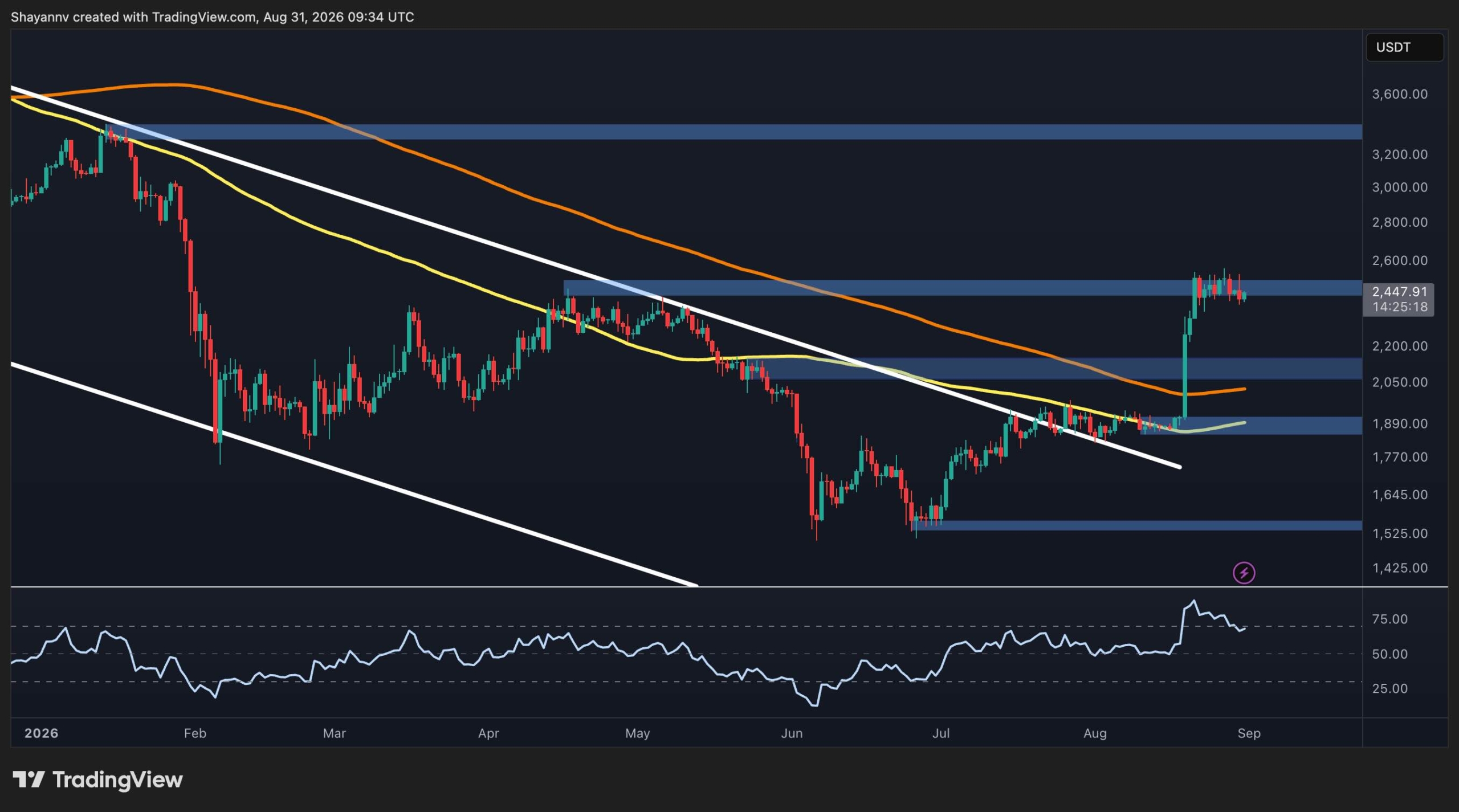
ETH/USDT 4-Hour Chart
The 4-hour chart provides a clearer view of August’s price action and the current consolidation. Following the vertical breakout from $1.9K, ETH initially pushed above $2.3K and continued toward $2.5K. Since then, the price has been moving sideways within a relatively tight range, with the $2.5K level acting as the upper boundary.
This consolidation can be interpreted constructively as long as ETH continues to hold the higher levels established during the breakout. The market is effectively digesting a very aggressive upward move rather than immediately giving back the entire rally.
Therefore, the immediate resistance remains around $2.5K. A decisive 4-hour breakout and sustained trading above this zone would provide confirmation that buyers are regaining control and could open the way toward higher daily-chart resistance.
Looking below, the first notable support lies around $2.2K-$2.3K. This zone coincides with a bullish order block, where the latest acceleration higher began, and could therefore attract buyers if ETH undergoes a deeper retracement.
The next support is around $2.05K-$2.1K, and holding this area would be particularly important, as a drop below it would also lead to a decline below the $2K psychological level and could quickly damage market sentiment.
Meanwhile, the 4-hour RSI has pulled back from overbought territory and is hovering around 50. This is consistent with a cooling-off phase following the breakout rather than an outright momentum breakdown. A renewed move above the $2.5K area while RSI expands again would strengthen the continuation setup, but this scenario will likely materialize after further consolidation or correction, as the market seems over-extended in the short-term.

Sentiment Analysis
The exchange-reserve chart provides a notably constructive signal for Ethereum. ETH held on exchanges has declined steadily from above 21M ETH in 2025 to approximately 14.9M ETH at the latest reading shown on the chart. The decline has even become steeper over the past couple of months.
At the same time, ETH’s price has recovered from $1.5K to approximately $2.4K. The divergence is important because the declining exchange reserve suggests that a smaller quantity of ETH is sitting on exchanges and potentially immediately available for selling. While exchange reserves alone cannot determine future price direction, sustained withdrawals can reduce readily available sell-side supply if the trend reflects longer-term accumulation or movement into self-custody and other non-exchange venues.
The chart also shows that the decline in exchange reserves has persisted even through periods of significant price volatility. This makes the current supply-side backdrop more constructive than if reserves were rising alongside the latest rally.
As a result, the technical and on-chain pictures are currently aligned. ETH has broken its longer-term descending trend, reclaimed the key $2K area, and is consolidating near the next resistance while exchange reserves continue to fall. This shrinking supply might just need a slight demand push from the spot or the futures market to result in a breakout and a further rally.

The post Ethereum Price Prediction: What’s Next for ETH After Massive Rally From $1.9K to $2.5K? appeared first on CryptoPotato.