Cryptocurrency Posts
Crypto Briefing
Blockchain-based ticketing could revolutionize event access, enhancing transparency and revenue while challenging traditional resale markets.
The post FIFA Collect uses blockchain to curb World Cup ticket scalping appeared first on Crypto Briefing.
Zuckerberg's tax strategy may sway billionaire sentiment, potentially affecting California's wealth tax proposal and its political dynamics.
The post Zuckerberg’s California tax move is a win for Meta — and for him appeared first on Crypto Briefing.
Capping leverage may deter risk-seeking users, potentially decreasing PAPER token demand and impacting its market valuation and growth.
The post Papertrade leverage cap could reduce PAPER token demand: Delphi Digital appeared first on Crypto Briefing.
The AI boom's reliance on tangible earnings growth, unlike past bubbles, suggests a sustainable trajectory, yet supply constraints pose challenges.
The post Altimeter’s Brad Gerstner says AI demand makes this boom different from dot-com appeared first on Crypto Briefing.
Bitwater's dual-functionality could decentralize Bitcoin mining, potentially increasing network security while offering homeowners energy cost offsets.
The post Heatbit unveils Bitwater, a water heater that mines Bitcoin appeared first on Crypto Briefing.
Bitcoin Magazine
Bitcoin Magazine

Utexo Opens Utexo Mint Early Access for USDT on Bitcoin Ahead of November 28 Launch
Professional operators can now test USDT on Bitcoin and get their integrations ready for November’s public launch.
Utexo has opened Utexo Mint, its dedicated platform for professional operators preparing to support and offer USDT on Bitcoin. The public launch is scheduled for November 28.
The return of USDT creates an opportunity to bring dollar liquidity into the Bitcoin ecosystem, opening new markets for trading and BTC-backed lending. Operators who integrate early can be among the first to offer USDT on Bitcoin, “positioning themselves to capture initial demand and build market share as adoption grows,” according to a press release shared with Bitcoin Magazine.
Utexo says existing partners are already preparing for the launch, as it is opening onboarding to exchanges, wallets, market makers, OTC desks, trading firms, and other professional operators interested in supporting USDT on Bitcoin.
Utexo Mint
Utexo Mint is a dedicated platform for verified operators to mint and redeem USDT on Bitcoin.
Within its sandbox environment, operators can test how USDT works on Bitcoin via RGB, including “minting, confidential transfers, and redemption.” The testing period should give operators time to validate their transaction flows and finalize their integrations ahead of the launch.
Utexo said they will also offer tools to manage USDT liquidity across supported networks and convert between fiat and USDT, giving operators greater flexibility in how they source and move funds. While Utxo Mint is not owned or operated by Tether, USDT on Bitcoin is nevertheless backed by USDT via Tether’s USDT0 protocol.
Bringing USDT Back Home to Bitcoin
USDT is returning to Bitcoin, where it first launched in 2014, bringing deep stablecoin liquidity to the ecosystem and expanding what businesses can do on the network. USDT on Bitcoin is launched by Utexo and not by Tether, the company clarified.
USDT on Bitcoin will be “private by design,” said the press release, allowing individuals to hold and transfer funds without publicly exposing their transaction details. Among the various technology differences between its Bitcoin implementation and that on EVM blockchains, RGB’s USDT avoids address reuse, the worst privacy practice and one which may even expose holders to quantum computer risks.
When it comes to compliance, the press release said businesses will be able to protect sensitive commercial activity while maintaining the controls required for regulatory compliance. When asked how privacy and compliance with sanctions and law enforcement can be offered as features at the same time, Utxo told Bitcoin Magazine, “We monitor all source USDT coming in, and check AML score + we monitor the risk on the RGB side too. We have a partnership with Crystal Intelligence for the AML”
The rollout will take place in two phases. The first begins on November 28, when USDT becomes publicly available on the Bitcoin network via RGB. The launch will make it accessible through partner wallets and exchanges, introducing new liquidity for swap providers and lending platforms.
The second phase, planned for Q1 2027, will extend USDT to the Lightning Network for payments, according to Utexo.
This post Utexo Opens Utexo Mint Early Access for USDT on Bitcoin Ahead of November 28 Launch first appeared on Bitcoin Magazine and is written by Juan Galt.
Bitcoin Magazine
Bitcoin Slides Towards $81,000 as Oil Above $110 Revives Rate-Hike Bets
Bitcoin’s price on Thursday slid — erasing the gains it made earlier in the week — after oil prices jumped.
The largest cryptocurrency was down by nearly 4% over a 24-hour period on Thursday in New York, trading as low as $81,331 at one point.
On Wednesday, the price of the top cryptocurrency was fast closing in on $85,000 as investors piled back into tech stocks following Elon Musk’s SpaceX earnings.
But conflict in the Middle East pushed the oil price higher, spurring inflation fears with U.S. A surging oil price can — at least in the short-term — hurt the price of bitcoin and other “risk-on” assets because it increases the chances of the U.S. central bank raising interest rates.
Bitcoin has in the past done well with low interest rates because of increased liquidity, moving at times with tech stocks and the Nasdaq.
Stocks on Thursday slid on the news of more attacks from the Yemeni Houthis on Saudi Arabia — stoked fears of oil supply disruptions and a wider Middle East conflict.
Bitcoin has typically faced downward pressure on news of war and rallied in hopes of a ceasefire.
When the U.S. and Israel first attacked Iran in February, the coin nosedived, and had been shaky on news of war in March and April.
Oil rising is stoking what many politicians are calling an affordability crisis in the U.S. Americans will go to the polls on November 3, and surging inflation is one of the hottest topics.
The Federal Reserve has said getting inflation down in the world’s largest economy is its top priority.
Despite the price of bitcoin dipping, the asset just had its best quarter in years, and analysts have said the coin is now in a bull market after rising above its 365-day moving average.
Bitcoin last month shrugged off the Federal Reserve raising interest rates and lawmakers blocking landmark crypto legislation, the Clarity Act.
This post Bitcoin Slides Towards $81,000 as Oil Above $110 Revives Rate-Hike Bets first appeared on Bitcoin Magazine and is written by Mathew Di Salvo.
Bitcoin Magazine
Robinhood Wins Dubai License to Bring Bitcoin and Stock Trading to the Middle East in 2027
Robinhood Markets has received authorization from the Dubai Financial Services Authority (DFSA) to offer retail trading and custody across 10 asset classes, including bitcoin and other cryptocurrencies, equities, ETFs and investment tokens, the company said in a statement on Wednesday.
The platform is set to go live in the region in 2027 from a new hub in the Dubai International Financial Centre (DIFC), a special economic zone that will serve as the firm’s Middle East and North Africa headquarters.
Salah Kaddoura has been named senior executive officer and president of Robinhood MENA. The title is a DFSA-recognized role, which makes him the person regulators will call. He will build out the Dubai team ahead of launch.
“The DIFC is one of the world’s most important financial hubs, and our expansion there brings us closer to building a global platform that enables anyone, anywhere to own the highest quality financial assets,” said Vlad Tenev, Robinhood’s chairman and CEO, in the company statement.
JUST IN:
— Bitcoin Magazine (@BitcoinMagazine) October 22, 2026Robinhood has been approved by the Dubai Financial Services Authority to launch Bitcoin and digital asset trading in the Middle East
pic.twitter.com/8jBNriCnP9
Robinhood’s expansion over the years
Dubai extends a run of expansion beyond the US, where the app made its name with young investors trading single stocks.
Robinhood entered the UK in 2024, opened full operations in the European Union last year, won in-principle approval for brokerage services in Singapore in April, and closed its purchase of Canadian crypto platform WonderFi in June.
At home, it added weekend trading and perpetual futures in September. The company says it counts more than one million customers outside the US.
Johann Kerbrat, who runs crypto and international for Robinhood, framed the Dubai move around a wave of new retail investors in the region. He is the same executive who disclosed on October 7 that Robinhood had put $25 million of bitcoin on its own balance sheet, the first time the firm held BTC as a corporate asset rather than on behalf of customers.
The DFSA has signed off on Robinhood holding client digital assets, not routing trades alone. For a firm that took years to enable bitcoin withdrawals in the United States, being cleared for custody from day one in a new jurisdiction says something about how far its crypto operation has matured.
Robinhood arrives in a financial center that keeps growing despite the war with Iran and tension across the region. The DIFC passed 10,000 active registered firms this year and continues to draw global names, Ken Griffin’s Citadel among them.
In March, it opened a cluster of new towers with 600,000 square feet of commercial space, with Deutsche Bank and Moody’s among the tenants, according to Bloomberg. Proprietary trading firm Maven said this week it will close its New York office as it shifts weight to Dubai.
Competition will not be thin. The DIFC listed 72 authorized brokerages as of March 31, and several crypto-native exchanges hold licenses from Dubai’s separate Virtual Assets Regulatory Authority.
Robinhood has not said which countries will be served at launch, what pricing will look like, or how “eligible investors” will be defined, and that last point will decide the size of the addressable market.
This post Robinhood Wins Dubai License to Bring Bitcoin and Stock Trading to the Middle East in 2027 first appeared on Bitcoin Magazine and is written by Micah Zimmerman.
Bitcoin Magazine
Fireblocks Denies Report of $2.5 Billion Visa Takeover Talks
Fireblocks has denied a report that Visa is in late-stage talks to buy the institutional crypto custody and stablecoin infrastructure firm for around $2.5 billion.
“We are aware of the rumors about a possible acquisition of Fireblocks by Visa. This is news to us, and not true at present time,” the company told The Block on Thursday.
The denial came hours after Axios reported, citing multiple sources, that the two sides were close to a deal. It would have been Visa’s first acquisition in the stablecoin sector and one of the largest in crypto’s history, behind Coinbase’s $2.9 billion purchase of Deribit in 2025 and Naver Financial’s pending $10.3 billion deal for Upbit parent Dunamu.
The reported price would have been a steep markdown from the $8 billion valuation Fireblocks commanded in January 2022, when it raised $550 million in a Series E round at the peak of the venture cycle. Founded in 2018 by Michael Shaulov, Pavel Berengoltz and Idan Ofrat, three veterans of the Israeli cybersecurity scene, the company sells the plumbing that banks, exchanges and fintechs use to hold and move digital assets.
Its customers include BNY Mellon, Worldpay, Revolut and Galaxy, and it says it has secured trillions of dollars in transfers across more than 150 blockchains.
Fireblocks powers FIS’s institutional bitcoin trading, underpins BNP Paribas’s digital asset custody, and sits among the founding members of the Botanix federation, a bitcoin sidechain project.
The crypto land grab
Whatever the status of the talks, the report landed on fertile ground. Payment incumbents spent 2026 buying or courting the companies that handle stablecoin and crypto rails rather than building them from scratch.
Mastercard agreed in March to buy BVNK for up to $1.8 billion, after takeover talks with Zerohash fell through, closed that deal in August and secured a New York BitLicense along the way.
Zerohash, for its part, is seeking a US national trust bank charter.
Visa partnered with Zerohash in August to add stablecoin funding and payouts to Visa Direct, and in September said its stablecoin settlement volume had passed a $20 billion annualized run rate, more than 15 times the prior year’s level.
Both card networks joined a coalition of more than 140 companies behind Open USD, a dollar stablecoin designed to spread the economics of a $300 billion market beyond Tether and Circle.
Fireblocks launched its own stablecoin payments network in September 2025 with over 40 participants, including Circle, Bridge, Zerohash and Yellow Card, and this year rolled out acceptance tools for neobanks and a settlement suite aimed at AI agents.
This post Fireblocks Denies Report of $2.5 Billion Visa Takeover Talks first appeared on Bitcoin Magazine and is written by Micah Zimmerman.
 ▶
Bitcoin Magazine
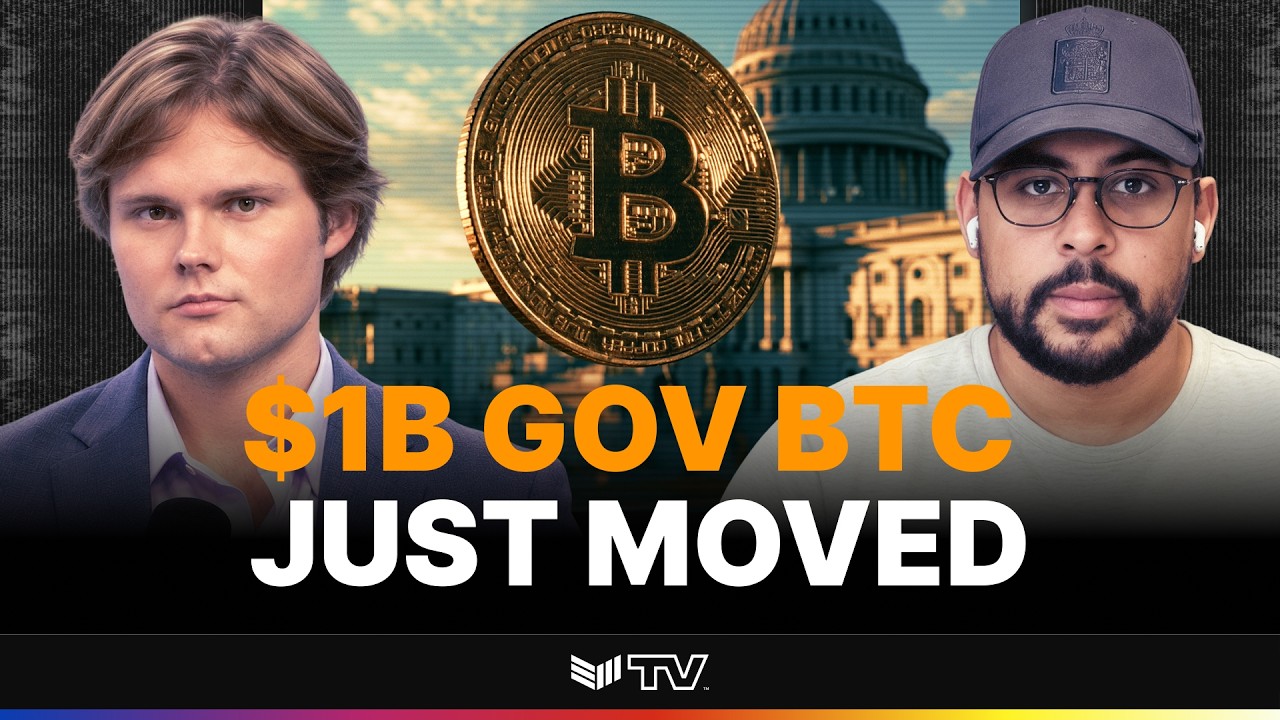
Arkham CEO on $1 Billion of U.S. Government Bitcoin Moved to “Unknown” Wallet
A US government-linked wallet just moved about $1 billion in Bitcoin from the Bitfinex hack, and the market wants to know if a sale is coming. Arkham Intelligence CEO Miguel Morel explains what the transaction trail shows, what it can’t show, and why it’s still unclear whether the coins are being sold or moved to a new custodian. He also breaks down how disposal orders and the Strategic Bitcoin Reserve factor in.
Chapters:
00:00 US Government Moves $1B in Bitfinex Hack Bitcoin
00:47 Sale or Custody Change? What the Government Might Be Doing
01:52 How Arkham Labels Government Wallets
03:30 Tracking Bitcoin Treasury Companies Before SEC Filings
05:18 Why Exchanges Like Coinbase Can Be a Black Box
06:26 Segregated Wallets and Tracking MicroStrategy
07:52 How AI Agents Are Using Arkham Today
09:42 Is There Any Privacy Left On-Chain?
12:02 Does Anonymity Help or Hurt Institutional Adoption?
14:12 How Investigators Trace Stolen Funds From Hacks
DISCLAIMER: The views and opinions expressed in this show are those of the participants and do not necessarily reflect the official policy or position of BTC Inc., Bitcoin Magazine, or any affiliated entities. This content is provided for informational and educational purposes only and should not be construed as investment, legal, tax, or accounting advice. Nothing contained in this show constitutes a solicitation, recommendation, endorsement, or offer to buy or sell any securities or financial instruments. Viewers should consult their own advisors before making financial or business decisions.
This post Arkham CEO on $1 Billion of U.S. Government Bitcoin Moved to “Unknown” Wallet first appeared on Bitcoin Magazine and is written by Patrick Green.
CryptoSlate
An Oct. 22 DEXScreener snapshot listed about $579 million in liquidity alongside 22.6 USDC, illustrating the limits of a pool's displayed valuation.
Read the full story on CryptoSlate
Understand the crypto stories that matter and what to watch next. Get The Catalyst in your inbox
Bitwise’s Q3 estimates put most fees with the operator before business expenses, while ARB and ETH offer different economic exposures.
Read the full story on CryptoSlate
Understand the crypto stories that matter and what to watch next. Get The Catalyst in your inbox
SIG’s Ethereum example burns a shielded claim before payout, while restoring it after failure requires an attested outcome.
Read the full story on CryptoSlate
Understand the crypto stories that matter and what to watch next. Get The Catalyst in your inbox
The October 21 notice targets inputs to payments between opposing traders, but gives no resulting rates or payment amounts.
Read the full story on CryptoSlate
Understand the crypto stories that matter and what to watch next. Get The Catalyst in your inbox
Listed vulnerable wallets can require evidence beyond a valid signature before holders regain access, even when an attacker took nothing.
Read the full story on CryptoSlate
Understand the crypto stories that matter and what to watch next. Get The Catalyst in your inbox
CryptoTicker.io
This much is documented: since October 14, 2026 USDC has carried the status "significant" as the EU's first e-money token, the European Banking Authority EBA takes over direct supervision of the issuer's own funds, reserve and redemption plans on November 12, 2026, and for USDT Tether holds no authorisation as an e-money token under the EU's MiCA regulation. If your balance sits with a provider holding an EU licence, you can therefore continue to buy, swap and redeem USDC unchanged, while USDT drops out of the offering there. Our assessment follows further down: for a portfolio in Germany, a stablecoin's authorisation now weighs more heavily than its market size.
The relative sizes point the other way from the supervisory law. On October 22, 2026 USDT came to around $183 billion in market value and USDC to around $72 billion; the older token is thus roughly two and a half times the weight of the authorised one. Our comparison of the two stablecoins for EU investors dates from December 2024, when this question was still purely a matter of reserves and trust. Since the stablecoin part of MiCA has been in application, authorisation decides first and everything else after.
USDT or USDC: what happens in the European Economic Area on October 30, 2026
Coinbase has set a cut-off date for customers in the European Economic Area. Until October 30, 2026, balances in the affected stablecoins can be withdrawn or swapped by the customer. Whatever is still in the account after that, the exchange converts at the market rate, primarily into USDC and, where USDC does not fit, into another supported asset. According to the exchange's help page on stablecoins that are not MiCA-compliant, those affected include USDT, DAI, PYUSD, PAX, GUSD, GYEN, USD1, USDS and PAXG; buying, selling and swapping these tokens is already restricted for customers in the Economic Area.
Behind the cut-off date stands a European requirement. Licensed crypto service providers may no longer offer tokens without MiCA authorisation freely in the EU; what remains are wind-down services. How the changeover works in detail and which balances it covers, we set out in our report on the conversion of USDT and DAI by October 30. The exchange itself calls the conversion a step towards complying with the regulation and expressly flags withdrawal before the date as the route alongside it.
Other houses set their own dates, and they can fall earlier. For the choice between the two tokens that means the timing is often not set by the holder but by the provider where the balance sits.
E-money tokens under MiCA: why USDC is authorised in the EU and USDT is not
MiCA is the EU regulation on markets in crypto-assets. Its part on value-stable tokens has been in application since June 30, 2024, and the regulation distinguishes two kinds there. An e-money token, EMT for short, references a single official currency, such as the dollar or the euro. An asset-referenced token, ART for short, references a basket of several values. For both kinds the issuer needs an authorisation in the Union.
Within the EU, USDC is issued by Circle Internet Financial Europe SAS, an e-money institution authorised in France; that makes USDC an authorised e-money token. Tether holds no such authorisation for USDT, and the token does not appear in the European register of authorised issuers. The obligations an authorisation triggers are collected in our overview of the MiCA licensing duties for crypto companies.
The difference is no formality. An authorisation obliges the issuer to hold a backed reserve, to maintain own funds, to have a redemption plan and to submit to ongoing supervision by a designated authority. A token without authorisation can function technically without fault and still drop out of the regulated offering, because the provider's obligations govern distribution and not the properties of the token.
Redemption at par: the core right behind an authorised stablecoin
Article 49 of the MiCA regulation gives holders of an e-money token a claim against the issuer. The token is issued at the par value of the funds received and redeemed at par at any time on request, free of charge. A euro in, a euro out: that right distinguishes an authorised stablecoin from a token that is worth only roughly a dollar on the market.
Article 50 additionally prohibits any interest. Neither the issuer nor a crypto service provider may grant remuneration amounting to interest. Recital 68 of the regulation justifies this on the grounds that e-money tokens are meant to serve payments and not the storage of value. A running yield on a stablecoin balance is therefore not something the token itself offers in the EU.
In practice the redemption right works only against the issuer, and only where the issuer accepts customers. A balance in a self-managed wallet is untouched by it; if you bought the token through an exchange, the way back usually runs through the same exchange. The fewer authorised providers that carry a token, the longer that way becomes, and precisely there lies the disadvantage of a token without authorisation for a holder in the EU.

USDC under direct EBA supervision from November 12, 2026
On October 14, 2026 the EBA classified USDC as the EU's first "significant" e-money token. In the Union 45 e-money tokens are notified, and USDC is the first to reach that threshold. From November 12, 2026 supervision of own funds, reserve, liquidity and recovery and redemption plans moves from the French supervisor ACPR to the EBA. With the ACPR remain management, qualifying holdings, the fit-and-proper assessment of those responsible, outsourcing and conflicts of interest. The EBA has additionally concluded an agreement on cooperation with the New York financial regulator, which supervises Circle in its home market.
The classification follows size: reach many users and high amounts in circulation and you are supervised more strictly under MiCA. It is not a seal of quality, and not a warning either. What changes specifically for holders is in our report on the EBA taking over USDC supervision. For holders nothing changes about the token; what changes is the authority behind the redemption promise.
The ESMA deadline of January 8, 2027 and what it does not ban
The European securities regulator ESMA published an opinion on October 8, 2026 that sets January 8, 2027 as the outer limit. By then licensed crypto service providers are to have wound down their remaining holdings and services around stablecoins that are not MiCA-compliant. Covered are e-money tokens and asset-referenced tokens without authorisation, and not in trading alone: the opinion reaches into custody, transfer, order execution, investment advice and portfolio management.
What remains permitted are wind-down services, that is liquidation, conversion, payout, transfer and safekeeping. These services have to be limited in time, calibrated to risk and closely supervised, and they may not be used for new purchases or for marketing. National supervisors can start earlier than January 8, 2027, and that is exactly what explains individual providers' cut-off dates as early as October.
Two points are missing from many summaries. First, the opinion names no individual token; that USDT and PYUSD are meant is a conclusion drawn from the authorisation status and not a statement by the authority. Second, the text is addressed to the national supervisors and through them to the service providers, not to private holders. Nobody in the EU bans a USDT balance in a self-managed wallet. What falls away is the convenient route through licensed providers, and with it the option of buying more there.
Legally the opinion rests on the duty to act in the best interests of clients. On that reading, offering a token without authorisation breaches that duty. No new prohibition is contained in it, which is why implementation hangs on the national authorities, who can move at different speeds.
Reserves compared: government paper at USDC, gold and Bitcoin at Tether
Reserves stand behind both tokens, but they are built differently. Circle holds the USDC reserve predominantly in short-dated US government paper and in repurchase agreements, the rest as bank deposits; the largest part sits in the Circle Reserve Fund, a money market fund registered with the US securities regulator. The attestation reports on it appear monthly and come from Deloitte.
In its report for the second quarter of 2026 Tether shows reserves of around $187.8 billion, with a surplus of $4.11 billion over liabilities. The largest part sits in US Treasury bills, to which are added around ten percent gold and about three percent Bitcoin. According to that report the gold holding was above 146 tonnes and the Bitcoin holding just under 99,000 coins. Attestation is quarterly and comes from BDO. Depending on the reporting date, gold and Bitcoin together account for between about 13 and 14 percent of the reserve, because both items fluctuate in price.
Therein lies the substantive difference for a portfolio. A reserve of short-dated government paper hardly fluctuates in value and can be turned into cash quickly. A reserve with a gold and Bitcoin share hangs on two volatile markets, and the surplus over liabilities shrinks when those markets fall; the report for the second quarter showed exactly that. Both issuers report regularly, one monthly, the other quarterly. Which stablecoins exist besides these two and how they are built is shown in our overview of stablecoins.
An attestation is not a running certificate. An attestation also always depicts a single reporting date and does not describe what happens in the reserve between two dates. For the choice between the tokens the cadence therefore counts too: monthly produces a tighter picture than quarterly.

Tax on a stablecoin swap: holding period and the €1,000 exemption limit
In Germany, swapping one crypto-asset for another counts as a disposal. The move from USDT into USDC therefore falls under private disposals pursuant to Section 23 of the German Income Tax Act. If the token given up was bought less than a year ago, a gain is taxable; since 2024 it stays tax-free only below an exemption limit of €1,000 in the calendar year, and that limit applies to all private disposals of a year taken together. Exceed the limit and the entire gain is taxable.
With a stablecoin the gain is usually small but rarely zero. Between purchase and swap the euro-dollar rate moves, and that alone produces a difference in the euro equivalent. More important is the second consequence: for the USDC received, the one-year period starts again. If you held an old balance whose period had almost run, you stand back at the beginning after the swap.
That makes for a practical difference between the two routes ahead of a cut-off date. Withdraw the balance without swapping it and no disposal arises, and the holding period runs on. Have it converted and one does arise, at the rate of the conversion moment, which you do not set yourself. Both routes are permissible; they differ in timing and in documentation.
Where German investors can trade and hold USDC today
USDC can be traded normally at the providers licensed in the EU. Among those licensed are Kraken, Bitpanda, Coinbase and Bitvavo. Bitpanda holds a direct permission from BaFin, while other houses serve Germany via the EU passport out of Ireland, the Netherlands, Luxembourg or Malta. Which exchanges hold an EU licence and what trading there costs is in our comparison of regulated crypto exchanges. ESMA's public register and BaFin's publications are the authoritative reference works for it.
For custody the same division applies as with any other crypto-asset. Leave the token on the exchange and you carry the provider's risk and are bound to its offering; if the provider changes its offering, your own position changes with it. Keep the token in your own wallet and access hangs on the key, and you exercise the redemption right from Article 49 through a provider that still carries the token. Euros in a bank account, by contrast, are a deposit and not crypto-assets; there the deposit guarantee scheme applies, with a stablecoin it does not.
Euro stablecoins as a third option: EURC and the banks' plans
Live in Europe and count in euros and you carry a currency risk with every dollar stablecoin. A third option are euro tokens. The largest is EURC from Circle, likewise an authorised e-money token. At around $484 million in market value, though, it is markedly smaller than the two dollar variants, and less circulation usually means thinner order books and wider gaps between bid and ask. Alongside that, European banks are working on euro tokens of their own, which are not in the market so far.
For the question of this article that means: a move from USDT to USDC answers the authorisation question. The currency question stays open, and only an authorised euro token or euros in a bank account can answer it. If you use dollar stablecoins as a parking space between two purchases, you carry that risk knowingly; if you use them as a substitute for a current account, you should know the difference.
Our assessment: for a German portfolio the authorisation weighs more than the market size
From the newsroom's point of view, what speaks for USDC is that its legal framework in the EU can be documented: authorisation as an e-money token via Circle Internet Financial Europe SAS, redemption at par under Article 49, direct EBA supervision of reserve and own funds from November 12, 2026, monthly attestation reports from Deloitte. Against it speaks the concentration: a token whose reserve sits largely in a single fund and whose EU supervision converges on one authority spreads risk less broadly than a market with several authorised issuers. What speaks for USDT is market size. $183 billion against $72 billion means deeper order books and more trading pairs, above all outside Europe.
Anyone holding a balance inside the EU at licensed providers no longer has the choice in practice; cut-off dates such as October 30, 2026 and the deadline of January 8, 2027 make that decision. Trading outside that framework keeps the choice open and carries in return the risk that a token can no longer be redeemed in Europe through a licensed provider. A total loss is possible with any crypto-asset, a stablecoin included: the peg to a currency is a promise by the issuer and not a constant of nature.
Stablecoin choice: from October 30 the authorisation counts, not the size
- First check which provider your stablecoin balance sits with and whether that provider holds an EU licence. Fees, trading pairs and the licensing status of the large houses are in the comparison of crypto exchanges.
- Decide before your provider's cut-off date between withdrawal and swap, and factor in the tax consequence. Purchase date, rate and the new holding period can be documented with a crypto tax tool before the tax office asks for them.
- Settle where the balance is to sit after the changeover. For self-custody you need a key that only you know; the devices for it are compared in our overview of hardware wallets.
(As of October 22, 2026. This article is not investment advice. Prices and fee structures change; check the terms with the provider before you buy.)
This much has been documented since October 21, 2026: the Dogecoin Foundation and the Nasdaq-listed company House of Doge (HODO) have founded a new company called Dogecoin Labs, which takes over three products that were separate until now. Our assessment follows further down: for the price of Dogecoin the step changes little in the short term, but for the question of what DOGE will be good for in two years it changes more than any fund announcement of recent weeks.
The three products are the wallet app MyDoge, the developer platform DogeOS and the merchant tool Such App. Dogecoin Labs is led by Jordan Jefferson, who founded MyDoge and DogeOS. Tim Stebbing, a director of the Dogecoin Foundation, moves from the board of House of Doge to that of Labs. The Foundation keeps stewardship of the protocol, support for open-source development and the work in the community, and appoints Labs as its official commercial partner. The details of the agreement have been broken down by crypto.news, among others.
What Dogecoin Labs is and who owns it
Dogecoin Labs is a company in its own right, not a department of the Dogecoin Foundation. That is the decisive difference from the previous arrangement: until October 21 House of Doge was the Foundation's exclusive commercial partner, and the products sat spread across House of Doge and the teams around Jefferson. Now they sit in one company in which House of Doge holds a stake.
House of Doge contributes selected products, development work, commercial operations and further assets, and receives a stake in Dogecoin Labs in return. Neither the size of the stake nor a valuation of the new company has been named. The company describes the agreements as definitive but lists closing conditions among the risks in its forward-looking statements. In plain terms: signed, not yet completed.
Marco Margiotta, chief executive of House of Doge, justified the step with the stake itself. Through the strategic holding, House of Doge shareholders would benefit from what Dogecoin Labs builds, he said. His company wants to concentrate more heavily on the tokenisation of alternative investment products and on its holdings in sport.
MyDoge, DogeOS and Such App: the three products in detail
MyDoge is a wallet app for retail users and, according to the announcement, the largest of the three units, with more than 500,000 users. The recently released V3 version connects the wallet to applications built on DogeOS. That connection is exactly the point at which the matter becomes practical for holders, and at the same time the point at which it acquires a risk. More on that below.
DogeOS is an environment in which applications around DOGE can be built. The environment is EVM-compatible, so it speaks the language of the Ethereum tool chain and developers can work with familiar environments such as Hardhat or Foundry. The public testnet has been open since September 30, 2026. As the security model the developers named validator signatures, valid proofs and a trusted execution environment in September. Named applications include Barkswap, Superposition Finance, Split Markets, USDoge and DogeFundMe. DogeOS was funded in May 2025 with $6.9 million in a round led by Polychain Capital.
Such App is the merchant side of the plan and is in beta. The tool handles invoicing and payments in person by QR code. House of Doge presented it in January 2026; development began in March 2025 with a twenty-strong team in Melbourne building on the Foundation's open-source technology. A link to DogeOS is planned but not yet in operation. The planned "Hustles" feature is to let service providers, artists and tradespeople offer work and accept DOGE directly from the customer.

Smart contracts beside Dogecoin, not in Dogecoin
Here lies the point most reports on this day leave out, and it decides how much the news is worth. Dogecoin itself gets no smart contracts. The Dogecoin blockchain is technically a close relative of Litecoin and Bitcoin and knows no freely programmable contracts. DogeOS builds the smart contract capability alongside it, in a second layer that is to report its results back to Dogecoin.
For that reporting back to work without an advance of trust, Dogecoin Core would itself have to receive a new opcode: OP_CHECKZKP, a check of so-called zero-knowledge proofs directly in the protocol. A short definition, because the term comes up several times: a zero-knowledge proof shows mathematically that a computation was carried out correctly without disclosing the computation itself. That opcode is so far a proposal and not implemented. As long as it is missing, the security of the second layer rests on a group of validators and on a protected execution environment, that is on technology and on operators, not on the Dogecoin blockchain alone.
For holders the difference is no splitting of hairs. Move DOGE into a second layer and you leave the security assumptions of the main blockchain and take on those of the side layer. At Ethereum the same design took years before the first rollups managed without a single operator's emergency brake. For DogeOS there is still no named date for a mainnet, and according to one report the applications in the public user guide still carry the note "coming soon".
What has changed since the fund article of October 21
On October 21 we set out here the balance sheet of the American Dogecoin funds: $16.43 million had been paid in since launch, $13.38 million still stood on the books as net assets, a gap of around $3.05 million. Two things have come on top since then, and they point in opposite directions.
First, on this October 22 the Dogecoin fund from Bitwise (BWOW) is being paid out in cash. Bitwise announced the closure on September 10, trading ended on October 14, and the net asset value of October 21 governs the payout. According to reports the fund was left with around $722,000. Bitwise chief Hunter Horsley attributed the failure in October to a gap between the investors in crypto funds and the users of crypto apps. Second, with Dogecoin Labs the product track has been rebuilt. The fund track is therefore shrinking on the very day the product track starts.
For holders in Germany the Bitwise wind-down only matters if they held BWOW through an American brokerage account. The European product is a different one and remains in place; more on that below.
The price on October 22 and the $0.08 level
On Thursday afternoon DOGE traded at $0.0795, 3.1 percent below its level 24 hours earlier. The daily high was $0.0837 and the daily low $0.0788; the figures come from CoinGecko. Dogecoin thus stands in 12th place by market capitalisation, at $12.43 billion, and turns over $632.1 million in a day. From its all-time high of $0.7316 the price is 89.1 percent away.
The round level at $0.08 gave way on this day and has not been recovered so far. The level is justified because the daily low of $0.0788 sits just below it and the daily high of $0.0837 clearly above: the day plays out around that level. Bitcoin shed 2.2 percent over the same period to $81,685, so DOGE fell around one and a half times as hard as the leading currency. Anyone who had read the news as a price trigger was not served on this day.
That is no contradiction of the news itself. A restructuring of product teams takes effect over years, if at all, not over hours. The level that counts in the coming days is the recovery of $0.08; below it the daily low of $0.0788 remains the next stop, above the daily high of $0.0837 things open up again.

21Shares Dogecoin ETP: the route via Xetra and what it costs
The new licence between House of Doge and the Foundation has one part that directly concerns German investors. The cooperation with the Swiss provider 21Shares is being kept. That includes the American funds TDOG and TXXD as well as a Dogecoin ETP listed on the Swiss exchange SIX. This ETP is tradeable in Germany, and that makes it the only place in this news where something can be settled in this country.
An ETP, short for exchange traded product, is an exchange-traded debt security that tracks an asset and, where physically backed, is secured with the asset itself. The 21Shares Dogecoin ETP carries the ISIN CH1431521033 and the German security number A4A5WJ, was launched on April 8, 2025 and, according to justETF, trades on Xetra, on gettex and on SIX, in euros at the German venues. The total expense ratio is 2.50 percent a year and fund volume stands at around €9 million. The Dogecoin is held in custody at BitGo Europe GmbH.
Two of those figures are worth weighing against each other before you buy. The 2.50 percent a year is markedly more than at a Bitcoin ETP and is charged regardless of whether the price rises. And a fund volume of €9 million is small: with thin order books the spread between bid and ask quickly becomes a second block of costs alongside the fee. For a broader comparison of the cost side, the overview sits in the hub on crypto ETFs and ETPs in Germany.
In tax terms, direct ownership and a securities wrapper are two different worlds, and that is the part many only notice on selling. Holding DOGE directly in your own wallet puts you in the field of private disposals under Section 23 of the German Income Tax Act with its familiar one-year period. Holding an ETP in a brokerage account puts you in a different system, whose treatment depends on how the security is specifically structured. Settle this point with your tax adviser before the purchase and not after the sale; the tools for documenting it sit in the hub on tax tools and portfolio trackers.
How to check which app holds your DOGE
The link from MyDoge V3 to applications on DogeOS is the practical core of the news and at the same time the place where money will be lost in the coming months. Whenever a wallet connects to applications, approvals arise, and approvals are the most common way in at new platforms. Three points count now:
First, the separation of testnet and live operation. DOGE from a testnet has no value and cannot be sold. Never connect a wallet holding real balances to a testnet portal, and as a matter of principle never enter a recovery phrase in any interface that asks for one. A serious application never asks.
Second, the question of who holds the keys. Check in your app whether you hold the recovery phrase yourself or whether a provider holds it for you. Both are legitimate, but they are different risks: with self-custody you carry the loss of the phrase, with third-party custody the provider's default risk. For larger balances a separate hardware wallet remains the more robust route; the models sit in the hub on hardware wallets.
Third, the buying route. If you are building up DOGE in Germany, buy at a provider licensed under the European MiCA regulation, where you get the prescribed information sheets and a complaints body in the EU. The licensed platforms and their fees are in the hub on crypto exchanges.
Our assessment: two moves in two days
From the newsroom's point of view, the simultaneity of the two announcements is the real finding of this week. On October 22 an American Dogecoin fund with around $722,000 left is wound down in cash; a day earlier a company comes into being that bundles wallet, developer platform and merchant tool. That suggests the route via the financial product has been exhausted at DOGE for now: $13.38 million in net assets across all the American funds together is a rounding error measured against a market capitalisation of $12.43 billion.
Against that stands the record of the announcements. DogeOS opened its testnet on September 30 and still names no date for the mainnet, Such App has been announced since January and is still in beta, and the link between the two is planned and not in operation. The size of the House of Doge stake and a valuation of Labs were not named either. Anyone judging the news is therefore judging an intention and not a revenue figure.
Jordan Jefferson justified the founding with the coin's reach. No other digital asset has the combination of liquidity, community and cultural reach that Dogecoin has, he said in the announcement; Dogecoin Labs had been founded to bring the best developers together in one organisation. Tim Stebbing added that the aim was products people use, while preserving the principles and the open development model at the core of Dogecoin. That is a statement of intent, and we report it as one. It becomes verifiable on two dates: the date for the DogeOS mainnet and the end of the Such App beta. If both are still missing in three months, October 21 was a change of name and not a fresh start.
Dogecoin Labs: without a date DogeOS stays a testnet
What you take away from this day comes down to three steps:
- Take stock of custody. Look in your wallet app to see whether you hold the recovery phrase yourself, and move larger balances to a separate device. The models and their prices sit in the hub on hardware wallets.
- Do the cost arithmetic before the ETP. Set the 2.50 percent annual fee of the 21Shares product against the fees of a direct purchase, and factor in the trading spread at €9 million of fund volume. The alternatives sit in the hub on crypto ETFs and ETPs.
- Note two dates. The DogeOS mainnet and the end of the Such App beta are the two dates against which this news can be measured. Until then the price is driven by the $0.08 level and not by the corporate structure.
(As of October 22, 2026. This article is not investment advice. Prices and fee structures change; check the terms with the provider before you buy.)
Here is what is documented: Evernorth Holdings filed a prospectus with the US Securities and Exchange Commission on October 19, 2026 that registers 11,499,992 new Class A shares. Those shares only come into being once the holders of the exchange-traded warrants exercise their subscription right and buy one share per warrant at $11.50. On full exercise the company would receive around $132.2 million. Our assessment follows further down: nowhere does the prospectus commit to putting that money into XRP, and that is precisely what decides whether the filing is good news for XRP holders at all.
The token itself slipped on Thursday afternoon. XRP traded at $1.32 at around 4:42 p.m. German time, 3.5 percent below the previous day, after the day had opened at $1.40 (source: CoinGecko). Where the price can point over a horizon of months is set out in our XRP price prediction. This piece is about something else: the condition under which a listed company receives fresh money for XRP purchases, and what happens if it spends it otherwise.
The October 19 prospectus registers 11,499,992 new XRPN shares
Evernorth Holdings has been listed on the Nasdaq Global Market since October 12, 2026, the share under the ticker XRPN and the warrants under XRPNW. The company is what is known as a treasury vehicle: its business purpose is to hold XRP and to grow the amount per share. It emerged from a merger with a shell company, on completion of which investors contributed around 388,910,554 XRP in kind and the company received about $272.6 million in gross cash, of that roughly $224.6 million from private placements and roughly $48.0 million from the released trust account. All of these figures appear in the prospectus on Form 424B3, registration number 333-294417.
The new prospectus governs a narrowly defined transaction. It registers no shares that Evernorth sells on the market. It registers only those shares that have to be issued if holders of the warrants from the former listed shell exercise their right. One warrant entitles the holder to buy one Class A share at $11.50. 11,499,992 warrants times $11.50 gives the roughly $132.2 million that appears in every headline on this filing.
Why the $11.50 exercise price decides the $132.2 million
A warrant is not a promise to pay. It is a right that its holder exercises only when the maths works. At an exercise price of $11.50, exercising pays off precisely while the share trades above that. If the share price sits below it, nobody voluntarily pays $11.50 for something available more cheaply on the exchange, and Evernorth receives not a cent.
The prospectus itself gives the last prices from October 16, 2026: the Class A share closed at $15.45, the warrant at $4.16. That left the warrants around $3.95 in the money. That is exactly why the registration became urgent in the first place. As long as XRPN trades well above $11.50, exercising is good business for holders, and without a valid prospectus Evernorth could not issue the shares needed for it at all.
For XRP holders this produces a sequence that is usually missing from the reports. The XRP price drives the value of the treasury. The treasury drives the XRPN share price. The share price decides whether warrants are exercised. And only exercise brings in money with which new XRP could in theory be bought. If XRPN falls below $11.50, the sequence breaks at its weakest point, and it does so before a single dollar is on its way to the XRP market.

The prospectus says "general corporate purposes", not XRP purchase
This is where reading the exact wording pays off. The section on the use of proceeds states that the company expects to use any net proceeds from the exercise "for general corporate purposes". Two paragraphs further on comes the second decisive sentence: "We will have broad discretion over the use of any proceeds from the exercise of the Public Warrants."
General corporate purposes is not an XRP purchase. It covers salaries, advisory and placement fees, custody charges, the running costs of a Nasdaq listing and reserves. Evernorth may put the money into XRP, but it does not have to, and the prospectus gives no commitment on the point. Anyone reading in the headlines that capital is being raised here in order to buy XRP is reading an expectation, not an obligation.
There is a second limitation in the same document: there is no assurance that the warrant holders will exercise at all, whether in full or in part. The $132.2 million is therefore a ceiling under two conditions, only one of which Evernorth can influence.
XRP per share is Evernorth's own metric, and dilution pushes it down
In its filings the company names a primary performance metric, namely XRP per share. It is defined as the amount of XRP attributable to the listed company divided by the sum of the outstanding Class A and Class C shares. Alongside it sits a second metric, the yield per token from the income-oriented strategies.
That definition makes the arithmetic uncomfortably clear for investors. If 11,499,992 shares are newly issued, the denominator grows immediately. The numerator, the amount of XRP, grows with it only if the $132.2 million received actually flows into XRP. If it does not, the very metric by which the company asks to be judged falls. A wave of exercises without a subsequent XRP purchase would therefore be dilution for the shareholders and a non-event for the XRP market.
The $18 threshold and the buyback at one cent
The warrants have a second level built in that is discussed less often. Evernorth may buy back the outstanding warrants at $0.01 apiece if the last reported price of the Class A share is at or above $18.00 on 20 trading days within a period of 30 trading days. The period ends on the third trading day before the day the notice is sent, and a deadline of at least 30 days applies.
A buyback at one cent is in effect an expropriation of the time value. Anyone who has not exercised by then receives exactly one cent for a security that, at a share price of $18.00, carries an intrinsic value of $6.50. That is why the clause works like a forcing mechanism: if XRPN reaches that level durably, practically all holders exercise, and the $132.2 million flows in one go. Measured on October 16, the threshold sits around 16.5 percent above the share price of $15.45 at the time.
Covered calls and secured puts on the XRP holdings
One point from the prospectus has nothing to do with the warrants and still matters more for the price question than most headlines. Evernorth describes income-oriented strategies on its own XRP holdings there. Covered calls are envisaged, under which the company sells call options on part of its holdings, with strike prices around 20 to 30 percent above the current market level and a term of usually one month. Added to that are secured puts, under which the company sells puts and backs the obligation with cash or stablecoin holdings.
What that means for the price the prospectus describes with welcome candour: the premium comes in, participation in gains above the strike price is capped. Translated, one of the largest listed XRP addresses would turn seller on a rise of more than 20 to 30 percent in a month. Hold the size of those holdings against market depth and you can see a structural ceiling in it that appears in no price forecast. Trading volume across all XRP exchanges stood at around $1.80 billion over 24 hours on Thursday.
What has changed since our article of October 16
On October 16, 2026 we wrote here about Evernorth's balance sheet, then with around 473 million XRP in holdings and the question of why the price had slipped since the listing (see our piece on the Evernorth balance sheet of October 16). Since then the situation has moved in two directions.
The first direction is the price. On October 16 XRP still stood well above the $1.40 level; on Thursday the token traded at $1.32. The $1.40 that still marked the daily high at the start of Thursday gave way over the course of the day, and the daily low of $1.32 sat on the current price. The company's holdings have therefore become less valuable over these six days without anything changing in the number of tokens.
The second direction is the structure. On October 16 it was open where further capital was to come from. Since October 19 the prospectus has put a concrete route on the table, complete with price, number of shares and threshold. The answer to the question of back then is thus: there is a route, it depends on the share price, and it is not tied to XRP purchases.

XRP at $1.32: the levels that gave way during the day
For watching the price, this yields levels that can be justified rather than derived from a chart pattern. On the upside the daily high of $1.40 is the first hurdle, because that is where the price turned down on Thursday. On the downside lies the daily low of $1.32, which in the afternoon was also the current price. A token trading at its daily low has not yet defended that level; it is reaching it right now.
XRP's market capitalisation stood at around $83.5 billion on Thursday afternoon. Its own record high of $3.65 is a good 63 percent away. The broad market slipped similarly on the same day, with Bitcoin down 2.8 percent at $81,771 and Ethereum down 2.8 percent at $2,408. At 3.5 percent XRP fell somewhat harder than the two large names, which weakens the case for a purely XRP-specific trigger behind the setback.
If you treat the XRPN share as leverage on XRP, do the sum in both directions. A falling XRP price depresses the value of the treasury, depresses XRPN with it, and brings the share closer to the $11.50 below which the warrants expire worthless. This feedback works just the same in a recovery, only in the other direction. If you want to trade securities on crypto companies, our comparison of crypto brokers has the costs.
Two routes to XRP, two tax rules in Germany
For investors in Germany the difference between the two routes is above all a tax one, and it is a marked one. Holding XRP directly as private assets falls under Section 23 of the German Income Tax Act. Once the one-year holding period has passed, a disposal gain is free of income tax. Within the year the personal tax rate applies, with an exemption limit of €1,000 for private disposals.
A share such as XRPN, by contrast, is a security. Gains on it are subject to the flat-rate withholding tax of 25 percent plus the solidarity surcharge and, where applicable, church tax, regardless of the holding period. There is no holding period that makes it tax-free after a year, but there is the saver's allowance of €1,000 for investment income. Two investors with identical market expectations therefore arrive at different net results depending on the wrapper they choose.
Important for annual planning: the one-year holding period still applies. A draft bill from the German Federal Ministry of Finance dated September 30, 2026 would move crypto assets into Section 20 of the Income Tax Act and thus subject them to the flat-rate withholding tax, for holdings acquired after December 31, 2026. The cabinet did not adopt the draft on October 14, 2026, and no new date has been set. We track the current state of the process in our overview of the crypto holding period reform.
Our assessment of the $132.2 million
Our assessment: the registration is neutral to slightly negative for XRP, for three documented reasons. First, the prospectus explicitly names general corporate purposes as the use and grants the board broad discretion; a commitment to buy XRP is absent. Second, an exercise raises the share count immediately, while the amount of XRP only follows on an actual purchase, which pushes down the self-chosen XRP-per-share metric. Third, the same document describes covered calls 20 to 30 percent above market, which turns a large holder into a seller on strong rises.
There is one serious argument against this. A treasury company whose sole reason to exist is holding XRP has little cause to use fresh capital otherwise, and its own metric sets exactly the incentive to buy. That the prospectus leaves the use open is also the customary wording in documents of this kind and no special case. Neither side is documented: there is no commitment to buy and no announcement of any other use. Deriving a price effect from this means reckoning with an expectation, not with a fact. The question will only be settled once Evernorth reports what it has done with the money.
Evernorth warrants: fresh money flows only above $11.50
The three steps that follow from the situation:
- Track the share price as a leading indicator. While XRPN trades below $11.50, the entire sum from the prospectus is moot; above $18.00 on 20 of 30 trading days it will probably fall due in one block. If you would rather hold the position through an exchange than a brokerage account, check the fees first in our comparison of crypto exchanges.
- Wait for the use of proceeds instead of pre-empting it. Only a report of an actual purchase turns the $132.2 million into demand on the XRP market. Until then it remains general corporate purposes.
- Settle the tax wrapper before you buy. Directly held XRP and a share in an XRP treasury are taxed differently, and the choice cannot be made good later. Documenting the acquisition dates is handled by the programs in our comparison of crypto tax tools.
(As of October 22, 2026. This article is not investment advice. Prices and fee structures change; check the terms with the provider before you buy.)
US hosting provider Railway said on October 21, 2026 that an unauthorised third party may have accessed the environment variables stored for its customers and decrypted some of them. Those variables hold API keys, database credentials and, at many crypto services, exchange keys and private wallet keys as well. Railway is advising every customer to rotate all of their keys. Security researcher Taylor Monahan already counts roughly $371,000 drained from wallets whose keys sat on Railway; Railway has not confirmed that link. Cryptoticker is a Railway customer too and received the warning overnight.
How the incident unfolded, what Railway's terms say about liability and why this is a matter for policymakers has been set out in detail by our founder Dennis Weidner, with a screenshot of the customer email: Railway security incident: why liability stops at $100.
Railway hack: the key facts
- October 21, 2026, 21:59 UTC: Railway names the security incident on its status page and advises customers to revoke all environment variables.
- Around $371,000 flowed out from 19:36 UTC onwards according to Taylor Monahan, across more than 500 transactions from over 200 addresses on at least 19 blockchains.
- More than 2 million developers use Railway, by the company's own account. How many customers are affected, it does not say.
- October 22, 04:17 UTC: Railway invalidates all of its customers' Railway API tokens.
- $100 is the liability cap in Railway's terms of use, where the fees of the past twelve months are lower.
Railway hack: what is known so far
Railway is a platform on which developers run applications, databases and background services without managing servers of their own. Crypto projects use platforms like it as well, for trading bots, Telegram bots and small backends. On the morning of October 21 the status page first reported a platform outage and builds were halted. That evening came the security notice from founder Jake Cooper: Railway had detected anomalous activity on the systems that store environment variables, and suspects a series of attacks on platform companies aimed at compromising AI providers (Railway security disclosure).
How the attackers got in, and which customers are affected, Railway has not said so far. The company has itself reset the credentials of all storage buckets and the GitHub connections, and on October 22 invalidated every Railway API token (status page for the incident). Builds for enterprise customers were running again from 03:32 UTC and for Pro customers from 06:29 UTC, while smaller plans were still waiting at midday.
Wallet outflows after the Railway hack: what on-chain analysts report
The first consequences arrived before the warning. Security researcher Taylor Monahan wrote on X overnight that private keys from Railway had apparently been emptied with a widely used sweeper script. She counts roughly $371,000, more than 500 transactions, over 200 affected addresses and at least 19 EVM blockchains, starting on October 21 at 19:36 UTC (Taylor Monahan on X). The service Onchain Lens reports a suspected attacker wallet said to have sent at least $369,300 to the exchange HitBTC and to further addresses, and calls the link to Railway itself unconfirmed.
The two figures come from different counts and cannot be added together. Railway has not confirmed the outflows. The timing stands out: the outflows began a good two hours before Railway warned its customers publicly. If you rotated your keys only after the email, you may already have been too late for an affected wallet.
Why crypto bots are especially exposed in the Railway hack
A trading bot needs access to an exchange, and an arbitrage or sniper bot often needs direct access to a wallet. On platforms such as Railway both typically end up as an environment variable: the exchange API key together with its secret, or the private key of a hot wallet outright. Open that store and no second gap is needed. One private key is enough to move a balance to someone else's address within seconds, on every blockchain where that same address holds funds.
With exchange keys the damage depends on the permissions. A key without withdrawal rights and with an IP restriction is worth little to an attacker; a key with withdrawal rights is an open account. How few permissions a tax tool or a bot really needs is shown in our guide to checking API keys at crypto exchanges. That a single key can survive an account takeover was shown most recently by the case at MEXC.
Add to that the motive Railway names itself: AI keys. Stolen access to language models is resold, and Sysdig security researchers put the cost to a victim at more than $46,000 a day back in 2024 (Sysdig on LLMjacking). If you use AI features in your crypto project, rotate those keys just like the exchange credentials.

Key rotation after the Railway hack: wallets first, then exchange keys
Every key that sat on Railway counts as known until the opposite is proven. Rotation happens at the issuer, not only in Railway. The order follows what moves money:
- Wallets first. If a private key or a seed phrase sat in a variable, move the balance to a new address with a new key straight away, ideally to a hardware wallet; which devices are suitable is shown in our hardware wallet comparison. Simply renaming the variable protects nothing.
- Revoke exchange keys. Delete the old API keys at the exchange itself and create new ones, without withdrawal rights and with a fixed IP address. Check the list of permitted withdrawal addresses. Bots are better served by exchanges with clear rules for API permissions, and our comparison of regulated crypto exchanges gives an overview.
- Read the logs. At every exchange and every service, look for access from unfamiliar IP addresses since October 21, and for orders or withdrawals you do not recognise.
- Rotate AI and payment keys. Railway's own guides name OpenRouter, Grok, Anthropic, OpenAI and Stripe explicitly. Set spending limits there.
- Secure databases. New passwords, open connections terminated. If customer data sits in them, the 72-hour deadline for a report to the data protection authority is running.
Liability: Railway pays at most $100
Railway has not announced any compensation. Its terms of use in the version of April 20, 2026 exclude consequential damages, business interruption and data loss, and cap everything else at $100 or the fees of the past twelve months, whichever is higher (Railway Terms of Service). According to archived versions the clause has stood in the contract word for word since 2021. Delaware law applies, and disputes go to arbitration in San Francisco. For a bot wallet that has been emptied, the loss is yours. Why this is a fundamental problem for German companies, and who can be addressed politically, is set out in the analysis by Dennis Weidner.
PHP2Shell: a second critical flaw in the same week
Updates for PHP2Shell appeared on that same October 21: two flaws in PHP rated 9.2 out of 10, through which attackers can run code on web servers without logging in. They are fixed in PHP 8.5.12, 8.4.27, 8.3.36 and 8.2.35 (php.net). Germany's BSI advises taking unpatched systems off the network if need be. For crypto users the point is above all this: with services on older PHP stacks, such as small shops or payment pages with a crypto checkout, it pays not to reuse credentials. Further cases we collect in our crypto hacks and security section.
This article is not investment advice. We will update it as soon as Railway names the attack path or the number of those affected.
A cryptocurrency is digital money whose balances sit in a public ledger that thousands of computers keep at the same time and constantly reconcile with one another. For a payment to count, nobody has to trust a bank: it is enough that the majority of those computers recognise the same order of entries. What you own is therefore neither a coin nor a file on your hard drive, but an entry in that ledger plus the cryptographic key that lets you pass it on.
The market behind it has grown large. On October 22, 2026 CoinGecko listed 22,424 cryptocurrencies across 1,511 trading venues, worth around $2.78 trillion in total. Of that, 59.5 percent falls to Bitcoin alone and 10.7 percent to Ethereum. The remaining 22,400-odd entries share less than a third.
What a cryptocurrency is: the answer in two sentences
A cryptocurrency is a unit of account kept on a blockchain whose transfer is secured by cryptography rather than by an intermediary. The rules under which new units come into being and entries become valid sit openly in the network's program code and can only be changed if the operators of the computers adopt the change.
Blockchain is the technical term for the ledger: a chain of data blocks in which every block carries a checksum of the one before it. Changing an old entry would mean recalculating every checksum after it, and doing so faster than the rest of the network appends new blocks.
The word "currency" is easy to misread here. A currency in the legal sense is issued by a state, and the state obliges everyone to accept it in payment. That does not hold for Bitcoin in Germany. The supervisor and the tax administration treat crypto assets as property you dispose of freely and that nobody has to accept.
The blockchain as a ledger that many keep at once
A classic account works like this: the bank keeps a list on which your balance sits. Only the bank may change that list, and if it makes a mistake, it corrects the entry. A cryptocurrency turns that structure around. Anyone who wants to downloads the complete list and keeps it alongside everyone else. A new entry is distributed to all, everyone checks it against the rules, and only once it has been taken into a block and that block appended to the chain does it count as confirmed.
A block is a package of entries with a timestamp and a checksum. With Bitcoin one appears roughly every ten minutes, with other networks within seconds. The more blocks follow your entry, the more expensive it would be to reverse it. That is exactly why trading venues advise waiting for a few confirmations after a deposit.
Why the order matters more than the encryption
Many people assume the word "crypto" is mostly about secrecy. In fact the entries on Bitcoin and Ethereum are visible to everyone; what is encrypted is not the content but the proof of entitlement. The real problem these networks solve is called double spending: a file can be copied at will, a balance must not be. The shared, undisputed order of entries prevents the same unit from being spent twice.
Why nobody can print more Bitcoin: the cap of 21 million
With state money, a central bank decides how much of it circulates. With Bitcoin the quantity sits in the protocol: there will never be more than 21 million units. New units arise solely as a reward for the computer that finds the next block, and that reward halves roughly every four years. Satoshi Nakamoto described the concept in 2008 in a nine-page paper, the Bitcoin whitepaper; the network has been running since January 2009.
That scarcity, however, is a property of Bitcoin, not a property of cryptocurrencies as such. Ethereum knows no fixed cap, many smaller projects issue new units at will, and with some a team keeps the bulk of the supply locked and releases it over years. Carrying the notion of scarcity across to any cryptocurrency means taking over an assumption that simply does not hold there. The issuance schedule is one of the first points to look up before buying, and it appears on every serious market data site.
Proof of work and proof of stake: who may write the next block
So that not everyone appends blocks at will, a network needs a hurdle. Two methods have prevailed.
Proof of work demands computational effort. Specialised machines search for a number until the block's checksum takes a prescribed form. That costs electricity, and precisely that expense makes an attack expensive. Bitcoin still works this way today.
Proof of stake demands a pledge instead. Whoever wants to propose blocks deposits their own units in the network; whoever plays foul loses part of them. Ethereum switched from computational effort to this pledge method in September 2022 and cut its electricity consumption by more than 99 percent in doing so. Depositing the pledge is called staking in the trade, and the reward for it counts in Germany as taxable income rather than as a tax-free capital gain.
For investors, one thing matters above all: both methods continuously create new units that can come onto the market. How many that is, the code decides, not demand.

The difference from the euro: a private asset, not legal tender
The euro is legal tender. A creditor has to accept it in settlement of a debt, and balances in a current account are protected by law up to 100,000 euros per customer and bank. Neither holds for cryptocurrencies. No merchant has to accept Bitcoin, and there is no deposit guarantee for balances held at a trading venue.
A second big difference comes with that: the price. One unit of euro stays one unit of euro, while the value of a cryptocurrency forms daily out of supply and demand. Bitcoin traded at around $82,479 or 73,355 euros on October 22, 2026, Ethereum at about $2,430. Whether a cryptocurrency serves anyone as a means of payment therefore depends less on the technology than on whether both sides want to carry that price risk.
In practice almost none of it is spent. By far the greater part of the $2.78 trillion sits as an investment, not as cash. The label "digital gold" that circulates for Bitcoin describes that use more accurately than the word currency.
Coin or token: why not every cryptocurrency has its own blockchain
The terms get thrown together, but the difference is simple.
A coin is the native unit of its own blockchain. Bitcoin runs on the Bitcoin blockchain, Ether on Ethereum, SOL on Solana. If the network fails, the coin is affected.
A token, by contrast, is an entry in a program running on someone else's blockchain. The vast majority of the 22,424 listed entries are tokens, mostly on Ethereum, Solana or BNB Chain. A token inherits the security of its blockchain, but it also inherits its fees, and its issuer can give it properties a coin does not have: a freeze on individual addresses, for instance, or the ability to issue new units later on.
In practical terms that means buying a token means buying the issuer's risk on top of the market risk. Who stands behind it and what rights they have reserved in the terms belong to the points to clear up before buying. Which further criteria come before picking an individual coin, we have set out in which cryptocurrency to buy.
Stablecoins such as Tether and USD Coin: crypto assets pegged to a currency
A stablecoin is a token meant to track the value of a state currency, usually that of the US dollar. The issuer promises to hold a corresponding reserve for every unit put out and to redeem it on request. Tether (USDT) traded at $0.9992 on October 22, 2026 and therefore practically at its target.
Stablecoins are the reason crypto trading runs around the clock: as a parking spot between two purchases they hold the value steady without money having to leave the network. At the same time they carry a risk Bitcoin does not know. Behind every stablecoin stands a company that actually has to hold the reserve and that can freeze individual addresses. In the EU, the Regulation on Markets in Crypto-Assets covers these instruments separately as e-money tokens. Where you can trade them and at which fees is shown by our comparison of crypto exchanges.
Wallet, public and private key: who controls the coins
A wallet is not a purse with coins lying in it. What it holds are two numbers that belong together. The public key produces the address you pass on so that someone can send you something. The private key is the proof that you are entitled to dispose of the entries at that address. Whoever knows it can move the balance, and nobody can pull the entry back.
That leads to the most important practical rule of this whole subject. If your coins sit at a trading venue, that venue holds the keys and you hold a claim against a company. If they sit in your own wallet, you hold the thing itself, but you also carry sole responsibility for securing it. Which devices are built for that and what they cost is set out in the hardware wallet comparison.
The usual backup is a sequence of twelve or twenty-four words from which the private key can be restored. That word list belongs neither in a cloud nor in a photo on your phone.

How many cryptocurrencies there are, and how few of them count
The figure of 22,424 sounds like an unmanageable choice, but it describes the situation poorly. Bitcoin and Ethereum together carry a good 70 percent of the entire market value. Daily trading of around $89 billion is distributed just as unevenly: a large share of the listed entries barely trades on a normal day, and selling larger amounts there moves the price against you.
A day's trading volume is therefore one of the most telling figures of all when an unfamiliar name is in front of you. A market value of a few hundred million against a daily turnover of a few tens of thousands of dollars means the price exists on paper but not for larger quantities.
Buying cryptocurrencies in Germany: what MiCA and BaFin require
Since the end of December 2024 the Regulation on Markets in Crypto-Assets, MiCA for short, has applied across the entire EU. Every provider rendering crypto-asset services needs an authorisation under it, trading venues and custodians included. In Germany the Crypto Markets Supervision Act implements the regulation, and the competent authority is BaFin, which monitors the attendant notification and reporting duties. The transition period for providers already on the market ran out at the end of December 2025 in Germany and on July 1, 2026 across Europe.
That gives you one clear thing to check before a first purchase: a provider addressing customers in the EU needs an authorisation, and reputable houses name it on their site. Where that reference is missing, the basis is missing. An authorisation is no guarantee against price losses, though; it governs who may run the business and which duties apply in doing so.
Tax on cryptocurrencies: the one-year period under section 23 EStG and the 1,000-euro threshold
Cryptocurrencies count as "other assets" in German tax law. Gains therefore fall under private disposals pursuant to section 23 of the Income Tax Act (EStG). The provision captures sales in which the period between acquisition and disposal "is not more than one year". If more than a year lies in between, the gain stays tax-free, whatever its size.
Within the year a second rule applies: gains stay tax-free if the total gain from all private disposals in a calendar year comes to less than 1,000 euros. That is a threshold, not an allowance. At 1,000 euros of gain the full amount is taxable; at 999 euros not a cent of it is.
Beginners regularly overlook two points. First, swapping one cryptocurrency for another counts as a sale, and for the newly received coin the one-year period starts afresh. Second, every sale requires proof of when and at what price you bought, otherwise the tax office estimates. Whether the one-year period stays in this form is politically contested; we track the course of the reform debate continuously in our piece on the crypto holding period and the state of the reform.
What a cryptocurrency is not: no account, no deposit guarantee
To close, the distinctions on which most misunderstandings hang.
A cryptocurrency is not an account. There is no body that pulls back a wrongly addressed transfer, no block on suspicion and no customer service that restores a forgotten access. Nor is a cryptocurrency a security in the classic sense: behind Bitcoin stands no company distributing profits and no claim to anything.
And it is not anonymous. The entries lie open, trading venues in the EU have to identify their customers, and specialised firms trace flows of payments across addresses. Pseudonymous fits better than anonymous.
Cryptocurrency: without your own keys the coin stays a claim
If you take one sentence away from this piece, take this one: you own a cryptocurrency in full only once you control the private key. Everything short of that is a claim against a company. Three steps put the start in order:
- Check and choose a trading venue. Look for the authorisation, compare the total costs of fee and spread, and begin with an amount whose loss will not hurt you. Our comparison of crypto exchanges provides the overview.
- Decide on custody before the amount grows. Small sums at the trading venue are defensible, larger ones belong on a device of your own. Which models exist is set out in the hardware wallet comparison.
- Record purchase data from day one. The date, quantity and price of every purchase decide later on the one-year period and on your tax bill. Tools that write that down automatically can be found under crypto tax tools.
(As of October 22, 2026. This article is not investment advice. Prices and fee structures change; check the terms with the provider before you buy.)
Decrypt
Spot Bitcoin ETFs have drawn about $1.07 billion over three sessions, pushing October flows to a gain of roughly $460 million, even as Bitcoin and Ethereum prices slipped.
Neoclouds like CoreWeave and Nebius rent Nvidia GPUs to AI labs, and several started out mining crypto. Here's how the AI cloud model works.
Major banks including Morgan Stanley, JPMorgan, Bank of America, and Citi are moving to restrict third-party AI agents that log in with customers’ credentials.
Decrypt is building a destination where readers can discover, understand and trade the news, directly where they consume information.
Each SOFIE token represents $1 on deposit at SoFi Bank, earning 4.40% APY with FDIC insurance—a yield-and-protection combination ordinary stablecoins lack.
U.Today - IT, AI and Fintech Daily News for You Today
RLUSD-backed settlement liquidity is set to land on the XRP Ledger as Ripple enters a new partnership with global liquidity and settlement firm Arf.
Bitcoin hashrate returns to a strong uptrend as public miners run at max capacity with massive TradFi backing.
The major crypto wallet answers rumors about the massive PHP hack and confirms total safety for all users.
Shiba Inu community veteran explains why major Shiba Inu burn portal has gone quiet.
XRP ETFs have reached a key level in their cumulative inflows as the funds continued to witness sustained demand since they launched.
Blockonomi
TLDR
- Broadcom stock trades near $326 as technical indicators point to continued selling pressure.
- MACD signals selling, while the CCI stands at -111.83, indicating oversold conditions.
- Broadcom expects quarterly AI semiconductor revenue of $21.7 billion despite recent share weakness.
- Analysts’ technical projections place the next trading range between $320.24 and $333.62.
- A break below $320.24 could increase downside pressure, while $328.69 remains immediate resistance.
Broadcom (AVGO) stock remained under pressure near $326 this week despite agreements and AI chip sales guidance. Technical indicators point to continued weakness, with traders watching whether shares can hold support near $320 next week.
Broadcom Inc., AVGO
Broadcom Stock Faces Selling Pressure
The daily moving average convergence divergence indicator, or MACD, shows a sell signal. The Commodity Channel Index, known as CCI, stands at -111.83, placing it in oversold territory. These readings reflect selling, not another decline.
Bull/Bear Power also indicates weak buying demand, while the Relative Strength Index remains neutral. Weekly price volatility reached 3.75%. Together, the readings show mixed conditions, although the short-term technical picture still favors sellers.
NTT DOCOMO Deal Expands Cloud Business
Broadcom announced a 10-year agreement with Japanese telecom operator NTT DOCOMO to upgrade its private cloud systems. The partnership uses VMware Cloud Foundation to support security, reliability and faster service delivery. Financial terms were not disclosed.
The agreement follows a recent report on Broadcom’s cloud partnership. The company has introduced Arcot Scam Defense, a fraud protection product. Neither announcement has yet reversed the weakness described.
AI Chip Outlook Remains Strong
Broadcom expects quarterly AI semiconductor sales of $21.7 billion, supported by long-term customer commitments. The figure represents management guidance, not completed sales. The company’s acquisition-related cash generation and debt reduction remain distinct from its share price.
Earlier reporting examined Broadcom’s AI revenue and valuation concerns. Demand for custom processors continues, but large data center projects require funding and infrastructure. Those costs affect growth forecasts.
Traders Watch $320 Support Next Week
The technical outlook places the projected weekly trading range between $320.24 and $333.62. Immediate resistance sits at $328.69, while the Ichimoku Kijun reference stands higher at $354.74. These levels identify possible price barriers rather than guaranteed outcomes.
The supplied model assigns a 77% probability to a decline and 23% to an increase. Its calculation method was not provided. A close below $320.24 would strengthen the bearish case, while a sustained move above $328.69 could weaken it.
Recent coverage of the wider AI chip market offers context for Broadcom’s growth plans. However, the next confirmed price move will depend on trading activity rather than company forecasts alone.
The post Broadcom (AVGO) Stock Faces Critical $320 Test Despite AI Deals appeared first on Blockonomi.
TLDR
- BMO Capital raised its IBM stock price target to $265 from $230 while maintaining Market Perform.
- IBM reported third-quarter revenue of $17.1 billion and adjusted earnings of $2.95 per share, beating estimates.
- Software revenue increased 8%, but weaker underlying growth kept BMO cautious about the company’s outlook.
- IBM raised its annual free cash flow outlook while maintaining its revenue growth guidance.
- Stifel raised its IBM price target to $260 following the company’s third-quarter financial results.
IBM stock drew a higher price target from BMO Capital on Thursday after the company reported better-than-expected quarterly results. The bank raised its target to $265 from $230 but kept its Market Perform rating.
International Business Machines Corporation, IBM
The change followed IBM’s third-quarter earnings release on Wednesday. Shares closed that session at $251.46, before Thursday’s trading brought fresh scrutiny of software sales and the pace of growth. The new target stood roughly 5% above Wednesday’s closing price.
IBM Stock Target Rises Despite Caution
BMO said IBM delivered stronger revenue than analysts expected in the third quarter, helped by transactions that had slipped into the latest quarter. The bank’s assessment followed coverage of IBM’s quarterly earnings. The firm questioned whether that lift would continue without more steady software demand.
IBM reported revenue of $17.1 billion and adjusted earnings of $2.95 per share. Revenue rose 5% from a year earlier, or 6% at constant exchange rates. Both figures exceeded Wall Street estimates of $16.82 billion and $2.86 per share.
Software Growth Remains Under Review
Software revenue rose 8% to $7.8 billion. Transaction Processing increased 9%, while Red Hat gained 11%. Automation revenue fell 3%, giving analysts different signals across the software business.
BMO said organic software growth remained below IBM’s long-term target. It estimated weakness in Data and Automation after excluding acquisitions. Separately, SAP’s latest quarterly results showed 26% cloud revenue growth, reflecting another development in business software this week.
Consulting and Infrastructure Results
IBM’s consulting division generated $5.3 billion, broadly unchanged from last year. Revenue grew 2% after adjusting for currency changes, while strategy and technology consulting posted a modest increase.
Infrastructure revenue reached $3.7 billion, up 4%. Distributed infrastructure sales rose 31%, although IBM Z revenue declined 20%. BMO attributed part of the infrastructure improvement to higher prices and sales volumes. Infrastructure support revenue fell 3% during the period.
Cash Outlook and Analyst Ratings
IBM generated $3 billion in quarterly free cash flow and increased its full-year target. The company expects annual free cash flow to rise by more than $1 billion. In related consulting news, Accenture expanded its services through an acquisition this week.
IBM maintained its forecast for 4% to 5% annual revenue growth in constant currency. Stifel raised its stock target to $260, while BMO said it needs firmer evidence of lasting organic software growth before taking a more positive position.
The post IBM Stock: BMO Raises Target to $265, but Doubts Remain appeared first on Blockonomi.
TLDR
- Spotify stock climbed 8.6% after its fourth-quarter operating income forecast exceeded Wall Street expectations.
- Spotify expects €820 million in fourth-quarter operating income, compared with analysts’ €813.4 million estimate.
- The company projects 316 million premium subscribers by year-end, above the 314.7 million analyst forecast.
- Third-quarter revenue reached €4.97 billion, while earnings per share of €2.48 missed expectations.
- Spotify expanded its AI music plans through licensing deals with Believe, Universal Music Group, Merlin and Kobalt.
Spotify (SPOT) stock gained 8.6% on Thursday after the streaming company forecast fourth-quarter operating income above Wall Street estimates. Shares rose despite a wider technology selloff tied to AI spending concerns.
Spotify Technology S.A., SPOT
Spotify gained paying subscribers in the third quarter, although revenue and earnings missed forecasts. Management expects stronger operating profit before year-end.
Spotify Stock Climbs on Profit Forecast
Spotify expects fourth-quarter operating income of €820 million, above LSEG’s €813.4 million analyst estimate. The company forecast €5.2 billion in revenue for the final quarter.
Operating income reached €672 million in the September quarter, near Visible Alpha’s €671.8 million estimate. Revenue totaled €4.97 billion versus forecasts of €4.98 billion. Earnings per share reached €2.48, below expectations of €2.80. The company reported a gross margin of 33%.
Spotify cited higher marketing, cloud and AI costs. The spending follows industry investment, including Meta’s recent AI launches. Management described those costs as temporary.
Premium Subscriber Outlook Beats Estimates
Spotify ended September with 306 million premium subscribers after adding six million during the quarter. It now projects 316 million by December, versus analysts’ 314.7 million estimate.
Monthly active users reached 788 million, up 1% from June. Spotify expects 818 million by year-end, slightly below Wall Street’s estimate of 819 million.
Other streaming companies face different pressures. Netflix lowered its advertising revenue forecast Wednesday. Spotify’s latest outlook instead centers on growth in paid music subscriptions.
AI Tools Remain a Spending Priority
Spotify uses AI DJ and prompt-based playlists to help users discover music. It has connected its service with outside AI tools to handle listening requests.
The company faces emerging AI music services, including Suno and Udio. Spotify is developing licensed features for fans to create covers and remixes.
Co-CEO Alex Norström said Spotify invests when it finds growth opportunities. The company expects costs to moderate after higher marketing and cloud expenses.
New Licensing Deals Cover AI Remixes
Spotify signed an agreement with Believe on Tuesday for its planned paid remix tool. The deal also covers TuneCore artists. Participating artists can approve use of their music and earn royalties.
Similar deals cover Universal Music Group, Merlin and Kobalt. Spotify plans to offer the tool as a Premium add-on amid questions about AI revenue and spending.
Spotify has not set a launch date or price. The company continues expanding its audio products while seeking subscriber growth and higher profit.
The post Spotify Stock Jumps 8.6% as Q4 Profit Outlook Beats Estimates appeared first on Blockonomi.
TLDR
- Ireland’s central bank imposed a €3.25 million fine on Coinbase Ireland over customer fund protection and outsourcing failures.
- The regulator found weak internal controls and excessive reliance on Coinbase’s US operations.
- Coinbase said errors left its safeguarding account underfunded by an average of 0.54% during 2023 and early 2024.
- Coinbase maintained that no customers lost money or access to their funds.
- The penalty follows a separate €21.46 million fine against Coinbase Europe in November 2025.
Coinbase Ireland has agreed to a €3.25 million ($3.6 million) fine over failures to protect customer funds. The central bank cited breaches of safeguarding and outsourcing rules between November 2020 and August 2025.
Irish Regulator Finds Weak Controls
The Central Bank of Ireland said Coinbase relied too heavily on its US-based parent for safeguards. Its Irish operation lacked local expertise to oversee the work and check whether customer balances stayed protected.
The regulator found flaws in account systems, testing and reports about changes to fund protection. These weaknesses left a designated customer account short for extended periods. The case concerns customer cash, not stolen cryptocurrency.
Coinbase Explains How Funds Were Mixed
Coinbase said Silvergate Bank’s troubles in 2023 led it to direct 30 customers to another US bank account. That account held money belonging to clients of a different Coinbase entity, contrary to Irish rules.
Some customers kept using old UK bank details after Brexit. Coinbase said daily transfers moved those deposits into Ireland’s safeguarded account, but did not prevent mixing. Separate reporting on protections when crypto exchanges fail examines how firms hold customer assets.
The company said it also paid certain US and UK customers’ euro withdrawals from its Irish account. Coding mistakes left that account underfunded by an average of 0.54% in 2023 and the first half of 2024.
Company Says Customers Lost No Money
Coinbase said no customer suffered losses or lost access to funds. It reported several problems to regulators in January 2024 and said it has corrected the errors and strengthened its systems.
Kazakhstan’s proposed restrictions on Coinbase apps present another challenge. Authorities there plan to seek app-store restrictions on six platforms. The Irish settlement concerns different rules and does not involve that case.
Earlier Fine and Court Approval
The central bank agreed a settlement on October 21. Coinbase accepted the findings and a reprimand. A 30% settlement discount cut the proposed €4.65 million penalty to €3.25 million.
The company said it added a €25 million guarantee bond and appointed a dedicated safeguarding chief. Recent US rules for stablecoin rewards concern a separate regulatory framework. Ireland’s High Court must confirm this penalty before it takes effect. In November 2025, the central bank fined another Coinbase subsidiary €21.46 million over anti-money laundering monitoring failures.
The post Coinbase Hit With €3.25M Irish Fine Over Customer Funds appeared first on Blockonomi.
Plenty of crypto casinos try to win players over with the size of their game library or the number of promotions on offer. POP.Game set out to compete on something else. The premium, crypto-friendly sports betting and casino platform wants to raise the standard for the whole player experience, and the idea behind that goal is short enough to fit on a single line: “built with players, for players.” It shows how the platform was developed, in the way the brand talks about trust and responsible gaming, and in its plans for the future.
The wider online gambling industry gives some context for why that matters. In some of the biggest gambling markets, online play now makes up close to 40% of total gambling revenue. With that much activity moving online, players have more choice than ever, and the platforms they stick with tend to be the ones that get the full experience right.
Where the Player-First Philosophy Started
POP.Game was built with players at the centre from the very beginning.
When the platform first launched, the team created a community of several hundred members and started talking to them directly about what they wanted from it. They listened to feedback, talked through ideas and used those conversations to get a clearer picture of what mattered most to real players.
Some of those suggestions went straight into the product. Several ideas from the community were taken on board and implemented into the platform and the wider player experience. That early back and forth is where “built with players, for players” comes from. For POP.Game, it is more than a marketing line. It describes how the platform was developed in the first place, by listening, learning and improving based on what players said.
And the conversation is still going. Community feedback continues to help POP.Game refine its platform, services and promotions. The plan is to keep evolving alongside its players and community instead of building in isolation.
What Premium Means at POP.Game Crypto Casino
POP.Game wants to be seen as an elite, premium gaming brand. Its idea of premium, though, starts with the details across the entire player journey and not only with the games.
That includes a smooth and intuitive platform, reliable service and quality sports betting and casino experiences. It also means convenient deposits and withdrawals, customer support that responds when players need it, bonuses and rewards that are relevant to them, and user journeys that stay simple and straightforward.
Each of those points connects back to the things players care about most: quality, reliability, convenience, entertainment, rewards and support. POP.Game has designed the platform around that list.
The brand also wants to strike a particular balance in how it feels. It aims to come across as premium and credible while staying approachable, entertaining and human. For an online crypto casino trying to build something that lasts, getting that balance right is part of the job.
A Unified Entertainment Experience with Sports, Casino and Esports
POP.Game brings sports betting, casino games and esports together in one place, giving players the freedom to explore what they enjoy most. Some may prefer following their favourite sports, while others enjoy playing casino games or the excitement of esports. With different options available on a single platform, POP.Game aims to offer a flexible entertainment experience that suits a variety of interests and preferences.
On the other hand, talking about the payment side, POP.Game supports USDT, USDC and $POPG, which makes it a good fit for crypto-native users. Crypto is treated as a convenient way to pay and one part of the overall experience. It is not meant to define the brand. As an online crypto casino, POP.Game keeps its broader focus on entertainment and the people using the platform.
Peter Schmeichel and a Shared Standard
POP.Game’s Brand Ambassador is Peter Schmeichel, the Manchester United legend and one of the most recognised goalkeepers in football history. Schmeichel brings sporting heritage, credibility and international recognition, along with a strong connection to football fans. His reputation for performing at the highest level sits comfortably alongside POP.Game’s ambition to build a premium brand.
The partnership is rooted in values both sides share. High standards, preparation, confidence, experience, performance and a passion for sport all feature in it. His role goes further than being a promotional face. Schmeichel helps connect POP.Game with the wider world of sport, fans and entertainment.
How POP.Game Puts Trust into Practice
Trust is a big part of what POP.Game stands for. For the brand, providing entertainment is only one part of running a gaming platform. Players also want to feel confident about where they play, how their funds are handled, the support they can turn to and whether they can rely on the overall experience.
POP.Game is licensed by Anjouan Gaming. But the brand recognises that trust takes more than a statement in an advert. It comes from the experience players have over time. Through consistency, transparency, reliable service and ongoing support, POP.Game aims to build lasting relationships with its players. In the crypto casino space, building that kind of reputation takes time, but it reflects the approach POP.Game has chosen to take.
Building a Culture of Responsible Entertainment
POP.Game believes gaming should always stay a form of entertainment. One of its core beliefs puts it plainly: have fun, enjoy the game, know your limits and stay in control.
Responsible gaming at POP.Game is meant to be part of the brand experience rather than a disclaimer tucked away somewhere. Players are encouraged to play within their personal limits and stay in control of their spending. Taking breaks when needed is part of it too, along with keeping gaming balanced with everyday life and avoiding chasing losses. Above all, gaming is seen as entertainment and not as a way to make money.
The brand prefers to say all of this in a positive way instead of making it sound like a warning. The thinking behind it is simple. The best gaming experience is one you remain in control of, and great entertainment should stay enjoyable.
Making Community Part of the POP.Game’s Journey
Community plays a big part in POP.Game’s long-term strategy. The brand wants to create a space where players feel their opinions and feedback count. It listens to its community and uses what it learns to improve the experience over time.
The aim is for players to feel involved in how the brand develops, as participants and not only as customers. That relationship is meant to be open, responsive and two-way.
It also gives the brand philosophy its meaning. “Built with players, for players” began with a community of several hundred people at launch, and it carries feedback every time from that community that helps shape the platform.
Part of the Wider POPG Ecosystem
POP.Game belongs to the wider POPG Web3 entertainment ecosystem. The POPG vision is to create new ways for fans to experience, take part in and be rewarded through entertainment. There are three parts to the ecosystem. POP.GAME is the sports betting, casino and esports platform. POP.VIP serves as the loyalty layer. POP.LIVE, which covers live entertainment and experiences, will be launched at a later stage.
Players can collect VIP Fan Points (VFPs) through eligible activity on POP.Game and use those benefits through other projects within the POPG ecosystem.
This makes POP.Game part of a larger entertainment ecosystem, rather than a platform that operates purely on its own as a betting site.
What Makes POP.Game Different
Plenty of crypto casinos offer games, promotions and crypto payments. What makes POP.Game different is the .mix it brings together.
It was built with players, for players, and it is shaped by community-led development. It puts a premium player experience and a strong focus on reliability and trust at the front. Sports, casino and esports all sit in one place, and payments in USDT, USDC and $POPG keep things crypto-friendly. Add Peter Schmeichel as Brand Ambassador, a responsible gaming philosophy and the link to POP.VIP and the wider POPG ecosystem, and the picture becomes clearer.
Its strongest point of difference comes from combining a premium experience with player-first thinking, trust, community and responsible entertainment.
Final Thoughts
POP.Game is building a premium gaming platform around the people who use it. It brings together quality entertainment, reliability, community and responsible play, and it holds onto one belief throughout: gaming should be fun, enjoyable and always experienced within your limits.
That approach started with a community of several hundred members and a team willing to listen, and it still guides the platform today.
Anyone curious about a crypto casino that grew out of conversations with its own players can learn more at POP.Game.
The post POP.Game: How a Player-First Philosophy Shapes Its Premium Identity appeared first on Blockonomi.
CryptoPotato
Ethereum’s latest recovery has reversed sharply, returning the price to approximately $2.4K and keeping a bearish breakdown as the main scenario. Escalating Iran–US tensions add a potential risk-off headwind, though their impact on ETH remains speculative rather than a confirmed cause of the decline.
Ethereum Price Analysis: The Daily Chart
On the daily timeframe, Ethereum’s rebound toward $2.48K–$2.52K failed to generate sustained follow-through. The latest bearish candle has pushed the price back inside the $2.36K–$2.44K demand zone and beneath the ascending channel’s lower boundary. This rejection suggests that buyers have yet to regain control despite repeatedly defending nearby support.
The main scenario favors a breakdown if ETH establishes a daily close beneath $2.36K, followed by a loss of the recent wick lows around $2.32K. Such a move would confirm deterioration beyond a temporary trendline breach and could extend the correction toward the $2.2K–$2.27K region.
However, demand has not yet decisively failed. A sustained reclaim of $2.44K and the channel boundary would weaken the immediate bearish outlook. Buyers would then need to clear $2.48K–$2.52K to interrupt the sequence of lower highs and support a broader recovery.
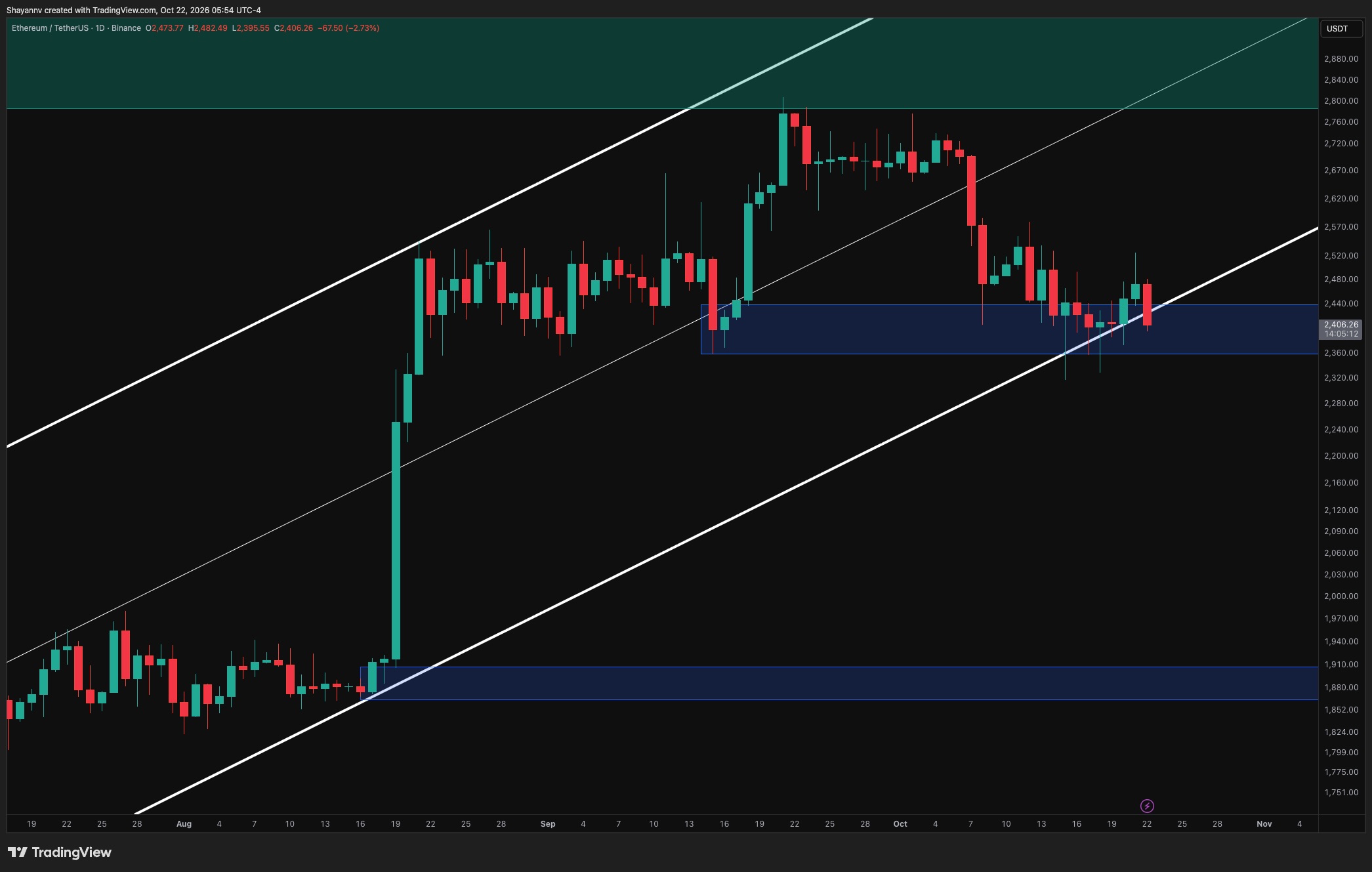
ETH/USDT 4-Hour Chart
The 4-hour chart shows an upside breakout from the falling wedge, followed by a sharp rejection near $2.52K. Ethereum has surrendered most of that advance and returned to the demand zone, indicating that the breakout failed to establish a durable bullish shift.
The price is now approaching the former descending resistance around $2.39K–$2.4K. While this could act as retest support, the speed of the reversal leaves the recovery vulnerable. Losing this area would bring the $2.35K–$2.36K demand boundary into focus, followed by the recent lows around $2.32K–$2.34K.
A sustained break beneath those lows would favor bearish continuation toward $2.27K and potentially $2.2K. Conversely, holding the retest and recovering above $2.44K would keep the breakout-retest interpretation alive. A subsequent move through $2.52K would be necessary to provide stronger evidence that buyers have overcome the latest selling pressure.

Sentiment Analysis
The one-month Binance ETH/USDT liquidation heatmap highlights a persistent estimated liquidation cluster around $2.15K–$2.2K. Its bright, extended band indicates a substantial concentration of potential liquidation exposure below the current price, making it particularly relevant to the bearish breakdown scenario.
If Ethereum loses the $2.36K demand zone and the recent lows, this cluster could become a downside liquidity target. Long liquidations triggered during an extended decline may amplify selling pressure as price approaches the region, potentially accelerating a move toward $2.2K.
The cluster’s proximity to the deeper technical support area reinforces its significance, but it does not guarantee that ETH will reach it or rebound there. For now, the failed recovery and renewed pressure on demand keep this downside pool relevant, while a sustained reclaim of $2.44K–$2.52K would reduce its immediate importance.

The post Ethereum Price Prediction: Is $2K Next After ETH’s Latest $2.5K Rejection? appeared first on CryptoPotato.
The cryptocurrency market remains highly sensitive to major political events, and all eyes are now on the US midterm elections scheduled for November 3. Some analysts have warned that this vote preceded a significant decline in Bitcoin’s (BTC) price in the past, but it remains to be seen whether history will repeat itself.
Another interesting question is how Ethereum (ETH) might perform after the upcoming elections, and to gauge the potential impact, we asked three of the most popular AI-powered chatbots. Here are the answers.
Serious Volatility Incoming?
According to ChatGPT, ETH is more likely to drop sharply, then recover after the vote. OpenAI’s platform noted that the asset’s price fell after the previous two US midterm elections, but said this occurred during crypto bear markets, and the latter coincided with FTX’s collapse, so it can’t establish a historical pattern.
The chatbot claimed that a Republican win would likely give ETH a more bullish initial reaction, while a Democratic sweep would carry greater short-term downside risk. According to prediction market Kalshi, the Democratic Party has a 67% chance of winning the US Senate at the start of November, while its rivals are estimated at 33%.
Meanwhile, ChatGPT warned that elections are only one of many upcoming factors that could influence ETH’s valuation in the near future, highlighting inflation, interest rates, and institutional demand as even more significant drivers.
Perplexity shared a similar stance. It said the political event could trigger a quick, liquidation-driven move in either direction, especially if ETH is trading near crowded leverage zones.
“Analysts expect midterms to create meaningful volatility across BTC, ETH, and altcoins, but view them as less decisive than monetary policy and growth data,” it added.
Crypto Rally After the Elections?
Google’s Gemini was more optimistic, expecting the US midterms to fuel an immediate ETH price pump and set the stage for a broader bull run across the cryptocurrency market.
The chatbot forecasted that the price could rise to around $3,200 one month after the election, with a potential move toward $4,000 within 90 days.
“Ethereum is expected to reach a new all-time high of $5,200 to $6,000+ within 12 to 18 months following the election, driven by sustained post-election regulatory clarity, expanding spot ETF inflows, and the broader market expansion cycle,” it concluded.
The post Will Ethereum (ETH) Rally or Crash After the US Midterms: 3 AIs Weigh in appeared first on CryptoPotato.
While the broader cryptocurrency market has headed south today (October 22), the privacy coin XMR has extended its impressive rally. It currently trades just below $650, up 20% weekly and at its highest level since January.
Analysts are optimistic the uptrend is far from over, with some anticipating the asset will hit a new all-time high soon.
How Much More?
XMR’s latest pump was likely fueled by an announcement coming from Monero. The team revealed on X that GUI v0.18.5.4 ‘Fluorine Fermi’ has been released. In a more detailed disclosure, it said the highlights of this minor upgrade include reopening testnet and stagenet wallets, along with bug fixes.
“This release was the direct result of 2 people who worked to put out 8 commits containing 38 new lines of code. We’d like to thank them very much for their time and effort. In no particular order, they are: selsta and tobtoht,” the team added.
Optimism is now running high, with numerous market observers calling for further gains. X user Sweep predicted that XMR will reach a new historical peak and possibly hit $1,000 in the coming months.
Shortly after, he applauded the asset for having “the best-looking chart right now.” He also reminded his followers of ZEC’s major rally earlier this year, suggesting XMR could repeat the pattern.
Alaoui Capital also issued a bullish forecast. The analyst identified a potential multi-year cup-and-handle structure on the token’s chart and claimed it could be on the verge of an ascent toward $1,000.
For his part, Crypto With Gopal argued that the privacy coin is breaking out of a rectangle pattern, with bulls pushing above the $630-$640 resistance zone after weeks of consolidation between $520 support and resistance.
“Momentum is heating up as buyers attempt to take control! A confirmed breakout could open the door toward $750. Watch for a successful retest to confirm strength. Bullish momentum is surging – breakout watch is ON,” he concluded.
The Bearish Signals
Despite the overall expectations of a further rally, XMR’s exchange netflow serves as a warning that a cool-off may be on the way. According to CoinGlass, inflows have surpassed outflows over the past several days, suggesting investors have shifted from self-custody to centralized platforms, increasing immediate selling pressure.

Meanwhile, XMR’s Relative Strength Index (RSI) has risen to almost 70. This means the asset is nearing overbought territory, which is typically seen as a pre-correction signal.

In addition, Dr Profit recently cautioned that XMR’s open interest has reached a historic high and noted that the last time the OI jumped this much, the price crashed 66% in just 20 days.
It is important to mention that Santiment rejected that claim. According to the analytics platform, OI closed October 20 at around $198 million, marking the fifth-highest daily close of the past year.
The post Monero (XMR) Soars 20% Weekly: Can It Repeat ZEC’s Explosion? appeared first on CryptoPotato.
[PRESS RELEASE – Singapore, Singapore, October 22nd, 2026]
Travala’s monthly AVA Strategic Reserve buyback will now match up to 3x the AVA rewards earned by AVA Smart members
Travala, the Binance-backed crypto travel booking platform, and the AVA Foundation—Travala’s loyalty program provider and issuer of the platform’s native AVA token—today announced the AVA Buyback Multiplier, an upgrade to the AVA Strategic Reserve launched in September 2026.
Under the new structure, Travala’s monthly match of the AVA Foundation’s buyback scales with the AVA giveback rewards earned by AVA Smart members for booking travel, rising from 1x to up to 3x and taking total monthly buybacks to up to four times member givebacks.
Each month, the AVA Foundation buys back the AVA given to AVA Smart members as booking rewards in the previous month and returns it to its rewards pool. To date, the AVA Foundation has bought back 5,423,181 AVA through its monthly buybacks. Travala matches the monthly amount and moves it into the AVA Strategic Reserve, a multi-signature wallet Travala has committed never to sell or transfer from. Since the AVA Strategic Reserve launched in September, Travala has matched two monthly buybacks, and the reserve now holds 598,458.78 AVA.
Under the AVA Buyback Multiplier, the previous month’s AVA givebacks set Travala’s matched AVA buyback amount. Below $100,000 in monthly AVA givebacks, Travala matches 1x. The match rises to 1.5x at $100,000, 2x at $150,000, 2.5x at $200,000, and a maximum of 3x at $250,000 and above. This brings potential total monthly AVA buybacks to four times monthly AVA Smart member givebacks.
If monthly AVA givebacks fall below a target, the match returns to the lower level the following month. All AVA buybacks by Travala and the AVA Foundation are reported monthly and are verifiable on-chain.
“The AVA Buyback Multiplier ties AVA even more closely to our members’ travel bookings,” said Steve Hipwell, Lead Ecosystem Contributor at AVA Foundation. “Every booking that earns AVA giveback rewards now counts towards the next step up, and every token Travala buys back is permanently locked away in the AVA Strategic Reserve multi-signature custody wallet.”
“We want AVA’s tokenomics to be simple, transparent, and built around real activity,” he continued. “The Buyback Multiplier gives the Smart member community clear milestones to work towards, with every step published on-chain.”
The Buyback Multiplier follows the AVA Smart Program lock update and the launch of the Travala AI Agent on BNB Chain announced earlier this month.
About Travala
Travala founded in 2017 and now backed by industry giant Binance, is the leading crypto-native travel booking service, offering 2,200,000+ properties across 230 countries, 600+ airlines, 50,000+ car rental locations, and 400,000+ activities globally. Travala is a champion of cryptocurrency adoption, accepting over 100 leading cryptocurrencies alongside traditional payment methods. For more information, visit: www.travala.com.
About the AVA Foundation
The AVA Foundation oversees the AVA token ecosystem, including the AVA Smart Program, AVA token, and Travel Tiger NFTs. The AVA token functions as the key to accessing the AVA Smart Program, which provides travel perks and other benefits to Travala customers, such as AVA payment discounts and AVA loyalty rewards. AVA tokenises the concept of loyalty reward programs using blockchain technology, bringing web3 to traditional loyalty models. For more information, visit: www.avafoundation.org.
Disclaimer
Travala may modify, suspend or discontinue the AVA Buyback Multiplier and future monthly purchases at any time. AVA already in the AVA Strategic Reserve remains subject to the never-sell commitment. This announcement is for information only and does not constitute financial advice, an offer to buy or sell any digital asset, or an inducement to acquire, hold or lock AVA. References to Travala are to TravelFront and its group companies. This announcement is not directed at persons in the United Kingdom, the United Arab Emirates or any jurisdictions where distribution would be unlawful.
The post Travala Introduces AVA Buyback Multiplier, Scaling Buybacks Up to 4x Member Rewards appeared first on CryptoPotato.
The cryptocurrency market enjoyed a short-lived rebound before sellers regained control over the past several hours. Some leading digital assets, including Bitcoin (BTC), Hyperliquid (HYPE), and Zcash (ZEC), were not spared in the latest pullback, all of which entered red territory.
However, key indicators suggest they might soon recover the losses and head north.
BTC to Bounce Back?
Just hours ago, the primary cryptocurrency looked ready to reclaim $85,000, but it was rejected and now trades near $81,700 (per CoinGecko). Analyst Ali Martinez noted that as it approached $85K, the TD Sequential flashed a sell signal, foreshadowing the correction that followed.
He said the same indicator has now printed a buy signal, suggesting the pullback may be nearing its end and potentially setting the stage for a recovery.
Other popular market observers who commented on BTC’s recent performance include Wealthmanager and Joep Gerla. The former said the price is heading toward rising support around $81,500, and if buyers defend it, $83,500 and $85,000 come back into play.
Joep Gerla noted that BTC got rejected near $85,000 at the top of the volume profile, adding that the structure stays bullish as long as the price remains above $80,000.
“Lose $80K, and it weakens,” he warned.
Renewed institutional demand supports the bullish view. After a period of heavy outflows, spot BTC ETFs posted three green days in a row, suggesting pension funds, hedge funds, and other conservative investors are once again increasing their exposure to the asset. In fact, the inflows in the past 24 hours reached nearly $530 million, the highest figure in the last month.

HYPE and ZEC
Hyperliquid’s native token jumped to almost $82 yesterday (October 21), but is currently worth just under $78. Martinez said a TD Sequential sell signal appeared around its local top, and the same indicator has now flipped bullish.
“If $78 holds, HYPE could rebound toward $82 or higher,” he predicted.
The privacy coin ZEC also rallied substantially and briefly surged above $1,360. Martinez explained that, as with BTC and HYPE, a TD Sequential sell signal acted as an early warning of the pullback that later dragged the asset to its current value of around $1,240.
“With a buy signal now flashing, I’m watching the $1,250 support. If it holds, ZEC could rebound toward $1,350,” the analyst concluded.
The post BTC, HYPE, and ZEC Ready for a Rebound? Analyst Explains Why appeared first on CryptoPotato.