Cryptocurrency Posts
Crypto Briefing
The emphasis on AI communication traits could shift industry focus towards enhancing user interaction quality, impacting market dynamics.
The post AA-PersonalityBench ranks Anthropic’s Claude models highest in information density and literacy appeared first on Crypto Briefing.
The DOJ's crypto freeze highlights the growing need for robust international cooperation and regulatory frameworks to combat digital fraud.
The post Trump says DOJ has frozen nearly $1 billion in scam-linked crypto appeared first on Crypto Briefing.
Visa's potential acquisition of Fireblocks could reshape crypto custody dynamics, influence stablecoin infrastructure, and impact market valuations.
The post Visa in late-stage talks to buy Fireblocks for about $2.5 billion: Report appeared first on Crypto Briefing.
The financial strain on CoreWeave highlights the risks of heavy debt reliance in volatile markets, prompting scrutiny of AI sector sustainability.
The post CoreWeave faces financial strain as AI enthusiasm wanes appeared first on Crypto Briefing.
The potential integration of Dynamic wallets into major payment systems could revolutionize banking operations, enhancing efficiency and security.
The post Fireblocks exec says Dynamic wallets likely power some bank transfers on Fiserv appeared first on Crypto Briefing.
Bitcoin Magazine
Bitcoin Magazine
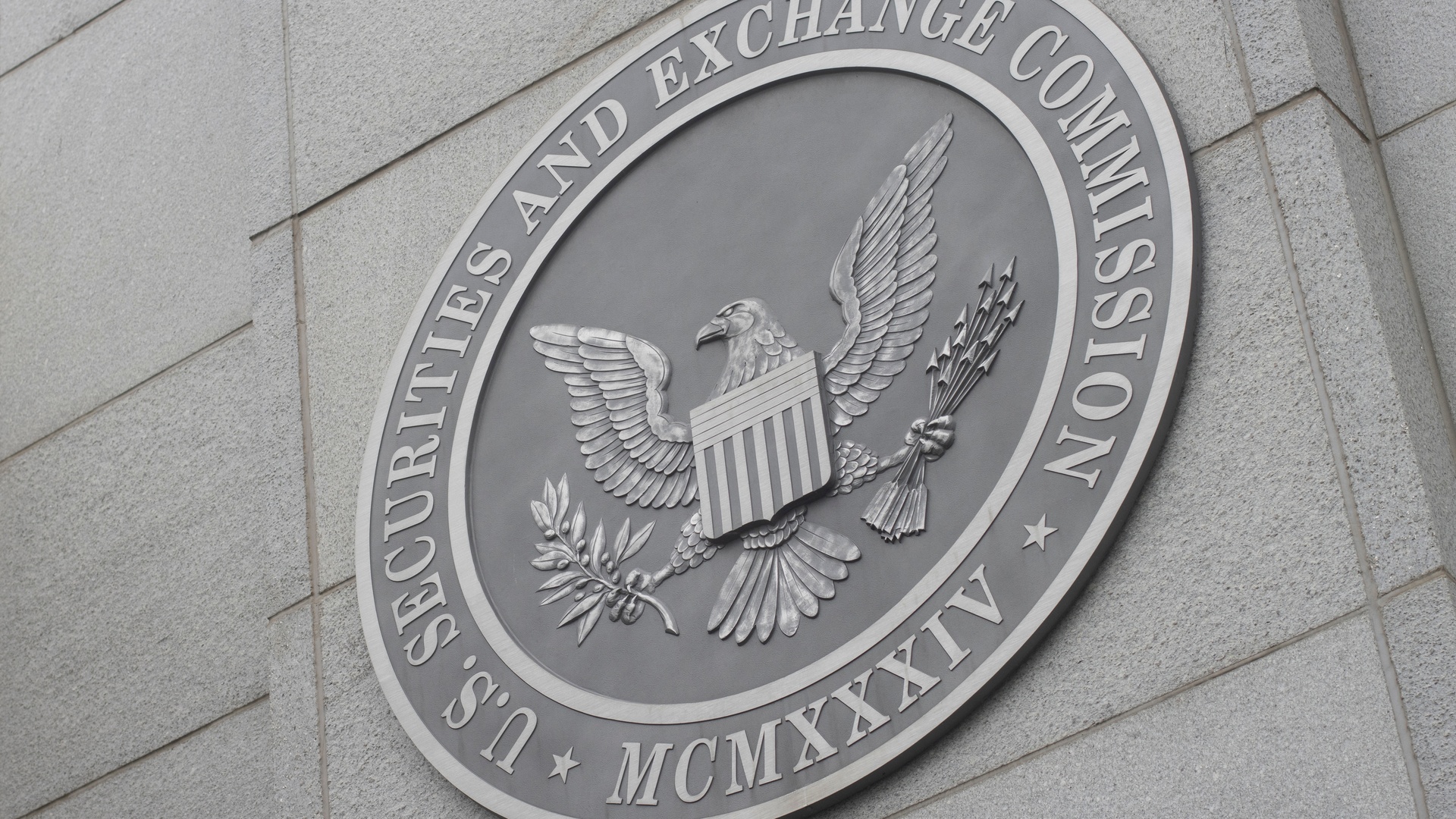
Three Companies Have Notified the SEC of Intention To Start Tokenized Stocks Trading
Three companies have notified the U.S. Securities and Exchange Commission of their plans to operate tokenized securities venues following a new rule, according to the top regulator.
Tokenized Stock Venue, Perpetuals.com, and OKX have all submitted plans to operate by allowing trading of tokenized stocks, the SEC said in a Wednesday announcement.
Along with the Intercontinental Exchange, crypto exchange OKX was the first to file with the regulator to debut tokenized securities trading on a new platform, OKXICE.
The SEC in September said it was offering a five-year exemption to platforms that facilitate trading of tokenized stocks. Regulators like the SEC are pushing ahead with regulating the crypto space despite lawmakers blocking major digital asset legislation in September.
Tokenized stocks are the latest example of firms wanting to utilize Bitcoin’s underlying technology to help upgrade traditional finance. By putting stocks on the blockchain, traders can operate 24/7, according to proponents.
The SEC said Wednesday that just because the firms are on the list, doesn’t necessarily mean they meet all the requirements for the rule.
Wall Street’s top regulator is now very pro-crypto under U.S. President Donald Trump. SEC Chair Paul Atkins has said the regulator wants to “update” how it watchdogs securities, and “modernize them in the age of blockchain and crypto assets.”
Atkins has said that the regulator wants the U.S. to be on track to be the “crypto capital of the world.”
Under the previous Democratic Joe Biden administration, the SEC was hostile towards the crypto industry and hit major companies — including Coinbase and Kraken — with lawsuits. The regulator attracted criticism for so-called regulation by enforcement.
But under Trump, that has changed: the Republican campaigned on a ticket to help the crypto space and has signed a number of laws and executive orders aimed at helping the digital asset space.
Traditional finance titans like BlackRock and Franklin Templeton for years have used blockchain rails to tokenize money funds.
In January, the S&P 500 gave crypto platform Trade[XYZ] the green light to debut a new derivative contract on decentralized exchange Hyperliquid, giving traders the ability to trade the stock index 24-7.
This post Three Companies Have Notified the SEC of Intention To Start Tokenized Stocks Trading first appeared on Bitcoin Magazine and is written by Mathew Di Salvo.
Bitcoin Magazine
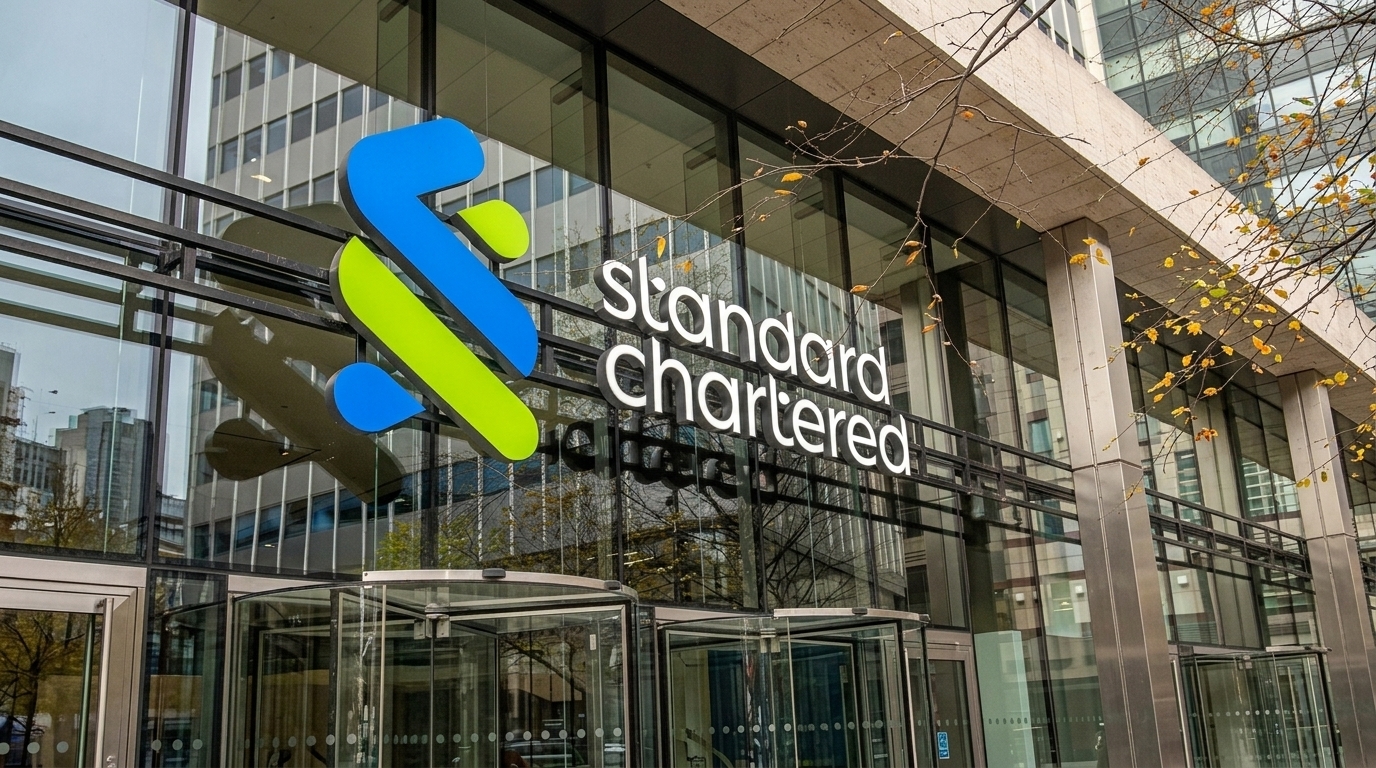
Standard Chartered Signs Agreement To Acquire Crypto Custodian Zodia Custody
British multinational Standard Chartered will buy digital asset custodian Zodia Custody, months after signing an agreement.
A statement from London-based Zodia Custody on Wednesday said that the deal will see the company’s service integrated into Standard Chartered’s existing digital asset custody activities.
Standard Chartered is expanding its crypto-related offerings worldwide. Earlier this month, it said it had plans to offer crypto custody services for institutional clients in Singapore. It already offers the service in the UAE, Luxembourg, and Hong Kong.
“As institutional adoption of digital assets accelerates, custody is increasingly becoming part of the global banking landscape,” Zodia Custody CEO Richard Clark said.
He added: “Zodia Custody has built a strong business with the specialist expertise and capabilities to meet the needs of institutional clients.
“Bringing that expertise together with Standard Chartered’s global reach and established banking platform will strengthen its digital asset custody offering and provide institutions with greater access to trusted, regulated custody services worldwide.”
Ying Ying Tan, global head of securities services and digital assets at Standard Chartered, added that the deal “further deepens our digital asset custody portfolio and reinforces our position as a leading provider of digital asset services globally.”
Zodia Custody shareholders in May approved Standard Chartered’s offer to buy the company.
The company works to custody bitcoin and other digital assets for institutional and asset managers.
Standard Chartered has delved deeper into the crypto space in recent years. In 2025, the bank set up a trading desk for bitcoin and other cryptocurrencies in London, making it one of the first global banks to enter spot cryptocurrency trading.
It has since debuted custody and trading services in countries around the world.
Top banks worldwide are debuting or planning to debut crypto custody services, with State Street, Standard Chartered, U.S. Bank, and Citigroup all committing to direct crypto custody over the past 18 months.
Crypto custody is often a starting point for banks moving into the digital asset space. BNY Mellon in 2022 became the first major U.S. bank to offer digital asset custody services.
This post Standard Chartered Signs Agreement To Acquire Crypto Custodian Zodia Custody first appeared on Bitcoin Magazine and is written by Mathew Di Salvo.
Bitcoin Magazine
Beyond HODLing: How Bitcoin-Backed Loans Can Unlock New Financial Opportunities
For long-term Bitcoin holders, accessing capital has traditionally presented a difficult choice: sell a portion of their holdings or leave that value untouched.
Bitcoin-backed lending offers another option, allowing holders to borrow against their Bitcoin while maintaining exposure to the asset.
In a recent video shared on X, SALT Lending highlighted how borrowers can use Bitcoin-backed loans for more than simply accessing cash, outlining several ways liquidity can support broader financial goals.
Turning Bitcoin Holdings Into Financial Opportunity
Rather than selling Bitcoin to fund a major purchase or investment, borrowers can pledge their holdings as collateral to access capital while preserving their long-term position.
One potential use case is real estate. Bitcoin holders looking to purchase property may be able to leverage their holdings for liquidity instead of liquidating Bitcoin to fund the transaction.
Business expansion presents another opportunity. Entrepreneurs and business owners can potentially use Bitcoin-backed loans to fund operations, hire employees, or pursue growth opportunities without selling their Bitcoin or giving up equity in their businesses.
SALT Lending also pointed to investment diversification as another possible application. Borrowers may use loan proceeds to access other markets or investment opportunities while retaining exposure to Bitcoin.
Another consideration is tax planning. Selling appreciated Bitcoin can trigger capital gains taxes, while receiving proceeds from a properly structured loan generally does not constitute a taxable sale. However, individual tax circumstances vary, and borrowing introduces additional financial risks.
A Strategic Approach to Bitcoin Liquidity
The broader takeaway from SALT Lending’s video is that Bitcoin-backed borrowing should be viewed as a financial planning decision rather than simply a way to access cash.
Real estate purchases, business investments, and other opportunities all require borrowers to weigh the potential benefits of liquidity against borrowing costs, repayment obligations, and the risks associated with Bitcoin’s price volatility.
Because Bitcoin-backed loans are secured by a volatile asset, significant price declines can increase loan-to-value ratios and potentially require additional collateral or trigger liquidation, depending on the loan terms.
For borrowers with a clear financial strategy, however, the ability to access capital without immediately selling Bitcoin creates another avenue for putting their holdings to use.
SALT Lending provides Bitcoin-backed lending solutions designed to help eligible borrowers access liquidity while maintaining their long-term Bitcoin exposure.
As Bitcoin continues to evolve beyond an asset primarily associated with buying and holding, lending may play an increasingly important role in how holders manage their finances and pursue opportunities without necessarily selling their Bitcoin.
SALT Lending is the Official Liquidity Sponsor of BMTV. Learn more about borrowing against your bitcoin and explore SALT’s BMTV offer at https://saltlending.com/bmtv/?utm_source=bmtv&utm_medium=article&utm_campaign=52783658-BMTV%20article&utm_term=BMTV.
Disclaimer: SALT Lending is a paid sponsor of BMTV and serves as BMTV’s Official Liquidity Sponsor. This article is sponsored content and does not necessarily reflect the views or opinions of Bitcoin Magazine. The information provided is for promotional purposes and should not be considered financial advice. Readers are encouraged to conduct their own research before making any investment decisions related to Bitcoin or other financial products mentioned herein.
This post Beyond HODLing: How Bitcoin-Backed Loans Can Unlock New Financial Opportunities first appeared on Bitcoin Magazine and is written by Josh Plischke.
Bitcoin Magazine

Kalshi Pushes Deeper Into Crypto Derivatives With Bitcoin-Backed Margin Loans
Kalshi is doubling down on its bid to become the regulated U.S. home for crypto perpetual futures, pairing a new bitcoin-backed lending arrangement with digital-asset custodian BitGo alongside a distribution deal that will put its perpetual contracts in front of Webull’s more than 6 million customers.
Bloomberg first reported Wednesday that customers of Kalshi Prime, the company’s U.S.-registered futures commission merchant, will be able to borrow against digital assets held at BitGo and use the proceeds to fund margin positions on perpetual futures traded on Kalshi’s main exchange.
Under the tri-party structure, loans will be issued by Kalshi Katalyst, a lending affiliate of Kalshi Prime, and secured against assets held at BitGo Bank & Trust, the firm’s federally chartered trust bank.
Eligible collateral will include bitcoin, ethereum and stablecoins deemed compliant with the GENIUS Act, with additional custodians expected to join Kalshi’s network over time.
Prime CEO Jeff Bandman told the outlet the product was designed with crypto-native traders in mind, including those already active on unregulated offshore perpetuals venues and large holders who would rather not sell their bitcoin to fund futures positions.
He also pointed to unexpected demand from businesses, such as Latin American firms that run their operations on U.S. dollar stablecoins.
The move targets a segment where the company has acknowledged a structural disadvantage against Polymarket, its offshore, blockchain-based rival, which has long catered to crypto whales and trading firms that prefer to keep their capital in digital assets. The two platforms have been racing to build out perpetuals since the spring.
Webull debuting crypto-linked perpetual futures via Kalshi rails
The BitGo arrangement landed a day after Webull announced Tuesday that eligible U.S. customers will be able to trade perpetual futures on its platform beginning in November, starting with bitcoin and a handful of other crypto assets.
The contracts will trade on KalshiEX LLC, Kalshi’s CFTC-regulated designated contract market, and clear through Kalshi Klear LLC, its derivatives clearing organization. Access will initially be limited to customers already approved for futures trading through existing Webull Futures accounts, with broader availability expected before year-end.
Webull Group President and U.S. CEO Anthony Denier said in the company’s release that perpetual futures saw more than $90 trillion in global volume in 2025 and that American investors should be able to access them through a regulated platform.
These two announcements extend a product buildout for the company, which secured CFTC clearance for the first U.S.-regulated bitcoin perpetual in late May and went live with the contract in early June, before adding gold and silver perpetuals in September and a US500 stock index perpetual earlier this month.
The expansion comes amid mounting state-level legal pressure, with Utah becoming the latest state to sue Kalshi on Monday over what it alleges is illegal sports gambling, following New York’s similar action against Polymarket last month.
This post Kalshi Pushes Deeper Into Crypto Derivatives With Bitcoin-Backed Margin Loans first appeared on Bitcoin Magazine and is written by Micah Zimmerman.
Bitcoin Magazine

Bitcoin Nears $85,000 as SpaceX Earnings Reignite Risk Appetite
Bitcoin’s price rose above $84,500 on Wednesday as investors flooded back into risk-on assets — particularly tech-related stocks.
The leading cryptocurrency was recently priced at $84,461 after rising nearly as high as $84,588 earlier on Wednesday morning in New York.
Over a 24-hour period, the coin is up 2%. Zooming out over a seven-day timeframe and it is up 3%.
JUST IN: $84,003 Bitcoin
— Bitcoin Magazine (@BitcoinMagazine) October 21, 2026pic.twitter.com/ht1VmQnDQ5
Bitcoin’s rise comes as SpaceX reported surging revenue growth in its third quarter, and its owner, Elon Musk, talked of a potential SpaceX-Tesla merger.
SpaceX — which debuted in June on the Nasdaq in the biggest initial public offering ever — reported third-quarter revenue on Tuesday of $14.6 billion, up 161% from the previous year and smashing estimates.
Technology stocks rallied on the news. Bitcoin has in the past risen with risk assets and been correlated with the Nasdaq.
But this year, the OG cryptocurrency has moved with gold as the so-called debasement trade becomes hot again. The trade is when investors buy certain assets to hedge against currency being devalued.
The dollar slid in value in August after the U.S. Treasury Department said it would more than double the size of its government debt repurchases. Bitcoin had its best quarterly run in three years and third best August ever.
U.S. investors this week have piled back into spot bitcoin exchange-traded funds, too. On Monday and Tuesday, the funds managed by BlackRock, Fidelity, Grayscale, and others received new investment of over $549 million, according to Coinglass data.
Bitcoin’s price is still over 30% below its all-time high of $126,080 — reached in October 2025 — but analysts are saying the cryptocurrency is now back in a bull market after spending most of this year in a bear.
This post Bitcoin Nears $85,000 as SpaceX Earnings Reignite Risk Appetite first appeared on Bitcoin Magazine and is written by Mathew Di Salvo.
CryptoSlate
Listed vulnerable wallets can require evidence beyond a valid signature before holders regain access, even when an attacker took nothing.
Read the full story on CryptoSlate
Understand the crypto stories that matter and what to watch next. Get The Catalyst in your inbox
Solana activated Alpenglow on mainnet on Oct. 21 at slot 459,653,000, replacing TowerBFT with a consensus design that targets about 150 milliseconds to finality. Under the new protocol, confirmed and finalized become the same state. At the National Securities Clearing Corporation (NSCC), multilateral netting cuts the value of equities payment obligations by an average of…
Read the full story on CryptoSlate
Understand the crypto stories that matter and what to watch next. Get The Catalyst in your inbox
Treasury Secretary Scott Bessent compared the GENIUS Act to the National Currency Act of 1863 on Oct. 21, the day the Office of the Comptroller of the Currency (OCC) released its 721-page stablecoin final rule. He called the law a cornerstone of America's position as the world's crypto capital. The American Bankers Association (ABA) responded…
Read the full story on CryptoSlate
Understand the crypto stories that matter and what to watch next. Get The Catalyst in your inbox
Bitcoin holds the $80,000 area, where Glassnode places the estimated average acquisition costs of US spot Bitcoin ETFs and publicly traded corporate treasuries, while ETF inflows slowed by 95.6% in a day. Farside Investors recorded $526.7 million in net inflows on Oct. 19 and $23.2 million on Oct. 20, with both sessions positive. A $26…
Read the full story on CryptoSlate
Understand the crypto stories that matter and what to watch next. Get The Catalyst in your inbox
SideSwap’s wallet funds the reopened swaps while partly manual refills can delay payments and direct Federation withdrawals remain restricted.
Read the full story on CryptoSlate
Understand the crypto stories that matter and what to watch next. Get The Catalyst in your inbox
CryptoTicker.io
A cryptocurrency is digital money whose balances sit in a public ledger that thousands of computers keep at the same time and constantly reconcile with one another. For a payment to count, nobody has to trust a bank: it is enough that the majority of those computers recognise the same order of entries. What you own is therefore neither a coin nor a file on your hard drive, but an entry in that ledger plus the cryptographic key that lets you pass it on.
The market behind it has grown large. On October 22, 2026 CoinGecko listed 22,424 cryptocurrencies across 1,511 trading venues, worth around $2.78 trillion in total. Of that, 59.5 percent falls to Bitcoin alone and 10.7 percent to Ethereum. The remaining 22,400-odd entries share less than a third.
What a cryptocurrency is: the answer in two sentences
A cryptocurrency is a unit of account kept on a blockchain whose transfer is secured by cryptography rather than by an intermediary. The rules under which new units come into being and entries become valid sit openly in the network's program code and can only be changed if the operators of the computers adopt the change.
Blockchain is the technical term for the ledger: a chain of data blocks in which every block carries a checksum of the one before it. Changing an old entry would mean recalculating every checksum after it, and doing so faster than the rest of the network appends new blocks.
The word "currency" is easy to misread here. A currency in the legal sense is issued by a state, and the state obliges everyone to accept it in payment. That does not hold for Bitcoin in Germany. The supervisor and the tax administration treat crypto assets as property you dispose of freely and that nobody has to accept.
The blockchain as a ledger that many keep at once
A classic account works like this: the bank keeps a list on which your balance sits. Only the bank may change that list, and if it makes a mistake, it corrects the entry. A cryptocurrency turns that structure around. Anyone who wants to downloads the complete list and keeps it alongside everyone else. A new entry is distributed to all, everyone checks it against the rules, and only once it has been taken into a block and that block appended to the chain does it count as confirmed.
A block is a package of entries with a timestamp and a checksum. With Bitcoin one appears roughly every ten minutes, with other networks within seconds. The more blocks follow your entry, the more expensive it would be to reverse it. That is exactly why trading venues advise waiting for a few confirmations after a deposit.
Why the order matters more than the encryption
Many people assume the word "crypto" is mostly about secrecy. In fact the entries on Bitcoin and Ethereum are visible to everyone; what is encrypted is not the content but the proof of entitlement. The real problem these networks solve is called double spending: a file can be copied at will, a balance must not be. The shared, undisputed order of entries prevents the same unit from being spent twice.
Why nobody can print more Bitcoin: the cap of 21 million
With state money, a central bank decides how much of it circulates. With Bitcoin the quantity sits in the protocol: there will never be more than 21 million units. New units arise solely as a reward for the computer that finds the next block, and that reward halves roughly every four years. Satoshi Nakamoto described the concept in 2008 in a nine-page paper, the Bitcoin whitepaper; the network has been running since January 2009.
That scarcity, however, is a property of Bitcoin, not a property of cryptocurrencies as such. Ethereum knows no fixed cap, many smaller projects issue new units at will, and with some a team keeps the bulk of the supply locked and releases it over years. Carrying the notion of scarcity across to any cryptocurrency means taking over an assumption that simply does not hold there. The issuance schedule is one of the first points to look up before buying, and it appears on every serious market data site.
Proof of work and proof of stake: who may write the next block
So that not everyone appends blocks at will, a network needs a hurdle. Two methods have prevailed.
Proof of work demands computational effort. Specialised machines search for a number until the block's checksum takes a prescribed form. That costs electricity, and precisely that expense makes an attack expensive. Bitcoin still works this way today.
Proof of stake demands a pledge instead. Whoever wants to propose blocks deposits their own units in the network; whoever plays foul loses part of them. Ethereum switched from computational effort to this pledge method in September 2022 and cut its electricity consumption by more than 99 percent in doing so. Depositing the pledge is called staking in the trade, and the reward for it counts in Germany as taxable income rather than as a tax-free capital gain.
For investors, one thing matters above all: both methods continuously create new units that can come onto the market. How many that is, the code decides, not demand.

The difference from the euro: a private asset, not legal tender
The euro is legal tender. A creditor has to accept it in settlement of a debt, and balances in a current account are protected by law up to 100,000 euros per customer and bank. Neither holds for cryptocurrencies. No merchant has to accept Bitcoin, and there is no deposit guarantee for balances held at a trading venue.
A second big difference comes with that: the price. One unit of euro stays one unit of euro, while the value of a cryptocurrency forms daily out of supply and demand. Bitcoin traded at around $82,479 or 73,355 euros on October 22, 2026, Ethereum at about $2,430. Whether a cryptocurrency serves anyone as a means of payment therefore depends less on the technology than on whether both sides want to carry that price risk.
In practice almost none of it is spent. By far the greater part of the $2.78 trillion sits as an investment, not as cash. The label "digital gold" that circulates for Bitcoin describes that use more accurately than the word currency.
Coin or token: why not every cryptocurrency has its own blockchain
The terms get thrown together, but the difference is simple.
A coin is the native unit of its own blockchain. Bitcoin runs on the Bitcoin blockchain, Ether on Ethereum, SOL on Solana. If the network fails, the coin is affected.
A token, by contrast, is an entry in a program running on someone else's blockchain. The vast majority of the 22,424 listed entries are tokens, mostly on Ethereum, Solana or BNB Chain. A token inherits the security of its blockchain, but it also inherits its fees, and its issuer can give it properties a coin does not have: a freeze on individual addresses, for instance, or the ability to issue new units later on.
In practical terms that means buying a token means buying the issuer's risk on top of the market risk. Who stands behind it and what rights they have reserved in the terms belong to the points to clear up before buying. Which further criteria come before picking an individual coin, we have set out in which cryptocurrency to buy.
Stablecoins such as Tether and USD Coin: crypto assets pegged to a currency
A stablecoin is a token meant to track the value of a state currency, usually that of the US dollar. The issuer promises to hold a corresponding reserve for every unit put out and to redeem it on request. Tether (USDT) traded at $0.9992 on October 22, 2026 and therefore practically at its target.
Stablecoins are the reason crypto trading runs around the clock: as a parking spot between two purchases they hold the value steady without money having to leave the network. At the same time they carry a risk Bitcoin does not know. Behind every stablecoin stands a company that actually has to hold the reserve and that can freeze individual addresses. In the EU, the Regulation on Markets in Crypto-Assets covers these instruments separately as e-money tokens. Where you can trade them and at which fees is shown by our comparison of crypto exchanges.
Wallet, public and private key: who controls the coins
A wallet is not a purse with coins lying in it. What it holds are two numbers that belong together. The public key produces the address you pass on so that someone can send you something. The private key is the proof that you are entitled to dispose of the entries at that address. Whoever knows it can move the balance, and nobody can pull the entry back.
That leads to the most important practical rule of this whole subject. If your coins sit at a trading venue, that venue holds the keys and you hold a claim against a company. If they sit in your own wallet, you hold the thing itself, but you also carry sole responsibility for securing it. Which devices are built for that and what they cost is set out in the hardware wallet comparison.
The usual backup is a sequence of twelve or twenty-four words from which the private key can be restored. That word list belongs neither in a cloud nor in a photo on your phone.

How many cryptocurrencies there are, and how few of them count
The figure of 22,424 sounds like an unmanageable choice, but it describes the situation poorly. Bitcoin and Ethereum together carry a good 70 percent of the entire market value. Daily trading of around $89 billion is distributed just as unevenly: a large share of the listed entries barely trades on a normal day, and selling larger amounts there moves the price against you.
A day's trading volume is therefore one of the most telling figures of all when an unfamiliar name is in front of you. A market value of a few hundred million against a daily turnover of a few tens of thousands of dollars means the price exists on paper but not for larger quantities.
Buying cryptocurrencies in Germany: what MiCA and BaFin require
Since the end of December 2024 the Regulation on Markets in Crypto-Assets, MiCA for short, has applied across the entire EU. Every provider rendering crypto-asset services needs an authorisation under it, trading venues and custodians included. In Germany the Crypto Markets Supervision Act implements the regulation, and the competent authority is BaFin, which monitors the attendant notification and reporting duties. The transition period for providers already on the market ran out at the end of December 2025 in Germany and on July 1, 2026 across Europe.
That gives you one clear thing to check before a first purchase: a provider addressing customers in the EU needs an authorisation, and reputable houses name it on their site. Where that reference is missing, the basis is missing. An authorisation is no guarantee against price losses, though; it governs who may run the business and which duties apply in doing so.
Tax on cryptocurrencies: the one-year period under section 23 EStG and the 1,000-euro threshold
Cryptocurrencies count as "other assets" in German tax law. Gains therefore fall under private disposals pursuant to section 23 of the Income Tax Act (EStG). The provision captures sales in which the period between acquisition and disposal "is not more than one year". If more than a year lies in between, the gain stays tax-free, whatever its size.
Within the year a second rule applies: gains stay tax-free if the total gain from all private disposals in a calendar year comes to less than 1,000 euros. That is a threshold, not an allowance. At 1,000 euros of gain the full amount is taxable; at 999 euros not a cent of it is.
Beginners regularly overlook two points. First, swapping one cryptocurrency for another counts as a sale, and for the newly received coin the one-year period starts afresh. Second, every sale requires proof of when and at what price you bought, otherwise the tax office estimates. Whether the one-year period stays in this form is politically contested; we track the course of the reform debate continuously in our piece on the crypto holding period and the state of the reform.
What a cryptocurrency is not: no account, no deposit guarantee
To close, the distinctions on which most misunderstandings hang.
A cryptocurrency is not an account. There is no body that pulls back a wrongly addressed transfer, no block on suspicion and no customer service that restores a forgotten access. Nor is a cryptocurrency a security in the classic sense: behind Bitcoin stands no company distributing profits and no claim to anything.
And it is not anonymous. The entries lie open, trading venues in the EU have to identify their customers, and specialised firms trace flows of payments across addresses. Pseudonymous fits better than anonymous.
Cryptocurrency: without your own keys the coin stays a claim
If you take one sentence away from this piece, take this one: you own a cryptocurrency in full only once you control the private key. Everything short of that is a claim against a company. Three steps put the start in order:
- Check and choose a trading venue. Look for the authorisation, compare the total costs of fee and spread, and begin with an amount whose loss will not hurt you. Our comparison of crypto exchanges provides the overview.
- Decide on custody before the amount grows. Small sums at the trading venue are defensible, larger ones belong on a device of your own. Which models exist is set out in the hardware wallet comparison.
- Record purchase data from day one. The date, quantity and price of every purchase decide later on the one-year period and on your tax bill. Tools that write that down automatically can be found under crypto tax tools.
(As of October 22, 2026. This article is not investment advice. Prices and fee structures change; check the terms with the provider before you buy.)
An issuer is the company, the state or the bank that issues a security or a crypto asset and stands behind it. With a share that is the public company, with a German federal bond the federal government, with a Bitcoin ETN the firm that brings the paper to market, and with a euro stablecoin a licensed bank or e-money institution. The documented position: European prospectus law calls an issuer any legal entity that issues securities, and the crypto regulation MiCA any person or firm that issues crypto assets. For your money, one question matters above all: do you hold a share in segregated assets, or merely a claim against the issuer? How we assess the risk of the individual products is set out further down as a marked assessment.
The term usually turns up in the small print: in the key information document of an ETF, in the terms of a certificate, in the whitepaper of a stablecoin. This guide explains who the issuer is in the case of a share, an ETF, an ETN, a certificate, a stablecoin and a stock token, what issuer risk means in a worked example with 10,000 euros, and how to find the issuer in a few minutes. How many parties can stand behind a single tokenised security is shown by our guide on stock tokens and who is behind them.
Issuer: the key points
- Definition: under Article 2(h) of EU Prospectus Regulation 2017/1129, an issuer is a legal entity that issues or proposes to issue securities. The German Securities Prospectus Act refers to it in section 2 no. 5.
- Crypto: MiCA Regulation (EU) 2023/1114 separates the issuer (no. 10) from the offeror (no. 13) in Article 3(1). It has applied since December 30, 2024, and for stablecoins since June 30, 2024.
- ETF: the fund assets are segregated assets. Under section 99(3) of the German Investment Code (KAGB) they do not form part of the fund company's insolvency estate.
- ETN and certificate: both are debt instruments. Capital-protected certificates of the Lehman subsidiary became largely worthless after the insolvency of September 2008.
- Deposit guarantee: it covers up to 100,000 euros per customer and bank, but only deposits. Shares, certificates and fund units do not fall under it.
- Stablecoins: in the EU, only banks and e-money institutions may issue euro and dollar tokens. As at October 16, 2026 the ESMA register lists exactly 25 such issuers from 14 countries.
What is an issuer? The meaning in law
An issuer is the party that puts out a security or a token, meaning the entity that brings it into circulation and against which your rights are directed. That can be a public company, a state, a bank, a fund company or a special purpose vehicle set up for the task. The process itself is called an issuance.
The term appears in law in two places, depending on whether securities or crypto assets are at stake. For securities the EU Prospectus Regulation applies: an issuer there is a "legal entity which issues or proposes to issue securities". Whoever offers the papers to the public is called the offeror and may be a different party, such as a bank placing a bond with investors on behalf of a company. The German Securities Prospectus Act takes over both terms in section 2.
For crypto assets the Regulation on Markets in Crypto-Assets, MiCA for short, applies. Article 3(1) no. 10 calls an issuer any natural or legal person, or other undertaking, who issues crypto assets. No. 13 defines the offeror as the party that offers crypto assets to the public, which can be the issuer itself or a third party. Under Article 149, MiCA has applied since December 30, 2024, and Titles III and IV on stablecoins since June 30, 2024.
Issuer of a share, an ETF, an ETN and a stablecoin: examples at a glance
Who the issuer is follows from the type of product. More important than the name is the third column of the table: it shows what you hold in legal terms.
| Product | Issuer | What you hold | Example |
|---|---|---|---|
| Share | the public company itself | a stake in the company with voting rights | Deutsche Telekom AG for the T-share |
| Bond | state, federal state or company | a claim to interest and repayment | the Federal Republic of Germany for federal bonds |
| ETF | fund company (investment management company) | a unit in segregated assets held separately | fund companies such as iShares (BlackRock) or Xtrackers (DWS) |
| ETN or crypto ETP | issuing company, often a special purpose vehicle | a debt instrument, frequently with deposited coins as collateral | 21Shares AG, Zurich, for the 21Shares Bitcoin ETP |
| Certificate | usually a bank | a debt instrument, as a rule without collateral | Lehman Brothers Treasury Co. B.V. until the insolvency of 2008 |
| E-money token (stablecoin) | bank or e-money institution | a claim to redemption at par | Circle Internet Financial Europe SAS for USDC and EURC in the EU |
| Stock token | platform or special purpose vehicle | a claim on the market value, usually without shareholder rights | Backed Assets (JE) Limited for the xStocks |
With a share and a bond the matter is straightforward: you either hold a stake in the company or a claim to repayment. With an ETF the fund company is indeed the issuer, but the money invested does not belong to it. The fund's securities sit with a depositary and must be kept separate from the company's own assets under section 92 KAGB. With an ETN and a certificate it is the other way round: the money belongs to the issuer and you hold a claim against it. How both routes differ from buying a coin directly is shown by our comparison of Bitcoin certificate, ETN or coin.

Issuer risk: what happens if the issuer goes under
Issuer risk means that the party putting out the paper can no longer meet its promises and, in the worst case, becomes insolvent. How much you lose then depends less on the price of the underlying than on whether your money is segregated from the issuer's assets.
With an ETF it is segregated. Under section 99(3) KAGB, the segregated assets do not form part of the fund company's insolvency estate. If the company fails, its right to manage the fund lapses. The depositary takes over and winds the fund up, or transfers it to another fund company with BaFin's approval (section 100 KAGB).
With an ETN and a certificate nothing is segregated. You are a creditor of the issuer, much like a supplier with an unpaid invoice. How that can end is shown by the Lehman Brothers case: the Dutch subsidiary Lehman Brothers Treasury Co. B.V. had issued certificates that were sold to retail customers in Germany through savings banks as well, and that were meant to repay the amount invested even in the least favourable case. With the insolvency of the issuer and the guarantor in September 2008, they became largely worthless according to the German Federal Court of Justice. The capital protection held only as long as the issuer existed.
Two layers of protection that savers like to rely on do not apply to such papers. Under section 8 of the German Deposit Guarantee Act, the statutory deposit guarantee covers up to 100,000 euros per customer and bank, but only deposits such as instant-access savings. Shares, certificates and fund units do not fall under it, according to BaFin. And if a bank gets into difficulty, the resolution authority can write down its debt instruments, index certificates among them, or convert them into shares before insolvency proceedings even begin. That procedure is called a bail-in: shareholders bear the loss first, creditors after them.
Issuer risk in a worked example: 10,000 euros in six products
Suppose you have invested 10,000 euros and on the same day the party putting out the product files for insolvency. The table shows what is left depending on the product. The costs and recovery rates in the fourth column are assumptions for this calculation, not a forecast; real insolvency recovery rates vary widely and are often only settled after years.
| Product | Your position | What happens in the insolvency | Assumption | What is left of 10,000 euros |
|---|---|---|---|---|
| Instant-access savings at the bank | depositor | statutory deposit guarantee up to 100,000 euros | full coverage | 10,000 euros |
| ETF | unit in segregated assets | depositary winds the fund up or transfers it | price unchanged, 0.5 percent wind-up costs | 9,950 euros |
| E-money token | claim to redemption at par | redemption out of the reserves under the redemption plan | reserves complete, 1 percent costs | 9,900 euros |
| Crypto ETP with deposited coins | secured creditor | the security trustee realises the deposited coins | realisation yields 95 percent | 9,500 euros |
| ETN or certificate without collateral | ordinary creditor | filing a claim in the insolvency, payment of the recovery rate | recovery rate 10 percent | 1,000 euros |
| Share in the issuer | owner | shareholders come after all creditors | no residual assets | 0 euros |
The range runs from 10,000 to 0 euros, even though the same sum was invested in every case. The difference comes solely from the position relative to the issuer. Time is added to that: a wind-up or a realisation can take months, and with a crypto ETP the value of the collateral fluctuates with the price during that period.
Our assessment: the biggest risk lies in the mix-up, not in the individual product. ETFs and ETNs run through the same securities account, carry similar tickers and are traded on the same exchange, yet in legal terms they sit at opposite ends of the table. For crypto in a securities account the ETN is the normal case: our count of September 12, 2026 found 122 crypto ETNs from 16 provider families on Xetra, with more on that in our guide on crypto ETNs in your securities account. Deposited coins lower the risk considerably, but they do not replace a look at the issuer. For the 21Shares Bitcoin ETP, the product page names a security trustee and two custodians alongside 21Shares AG, so four parties instead of one. Knowing that, you can use crypto ETPs deliberately. Mistake an ETN for a fund, and you are carrying a risk you never chose.

Who is the issuer of a stablecoin? E-money tokens under MiCA
With a euro or dollar stablecoin, the issuer is the firm that puts the tokens out against money and takes them back. In the EU it has to be authorised as a credit institution or an e-money institution under Article 48 MiCA and publish a whitepaper. Against it you hold a claim to redemption under Article 49, at any time, at par and free of charge.
MiCA calls such tokens e-money tokens because they are meant to track the value of exactly one official currency. Tokens that reference another value or a basket are called asset-referenced tokens and need their own authorisation under Article 16. The issuer has to hold at least 30 percent of the countervalue of e-money tokens in separate accounts at credit institutions, and the rest in secure, highly liquid investments in the same currency (Article 54). It may not pay interest on the tokens (Article 50).
Which firms are authorised is set out in the register of the European securities regulator ESMA. As at October 16, 2026 it lists 25 issuers of e-money tokens with 50 whitepaper entries from 14 countries of the European Economic Area, most of them from France (6) and from Luxembourg and the Netherlands (3 each). In mid-August there were 23, as our count of the MiCA register shows. From Germany there is a single issuer, AllUnity GmbH. USDC and EURC are issued in the EU by Circle Internet Financial Europe SAS, an e-money institution based in France. For asset-referenced tokens the register holds not a single entry so far. Where you can trade such tokens is shown by our comparison of crypto exchanges.
Issuers in crypto: Bitcoin has none, stock tokens have one
Not every crypto asset has an issuer. Bitcoin comes into being through mining under fixed rules in the protocol; nobody puts it out and nobody has to take it back. MiCA draws the consequence in recital 22: crypto assets without an identifiable issuer do not fall under Titles II to IV, and therefore not under the rules on whitepapers and stablecoin issuers. Exchanges and custodians that trade or hold Bitcoin for customers still need authorisation.
With a stablecoin, by contrast, a missing issuer is a problem. Polkadot launched dotUSD, a dollar token without an issuer, on October 8, 2026; with no issuer there is also nobody against whom a redemption claim would exist, as our report on Polkadot launching dotUSD without an issuer shows.
With stock tokens the case is different again: they do have an issuer, but they do not fall under MiCA, because financial instruments are excluded under Article 2(4). Prospectus law applies to them instead. The xStocks, for example, are issued by Backed Assets (JE) Limited, a company from Jersey; the Dutch supervisor AFM lists a prospectus notification of May 8, 2026 for the issuance of tokenised securities, with the Liechtenstein financial market authority as the competent body. What you own with such tokens and what you do not is set out in our guide on tokenised stocks and why they do not make you a shareholder.
Issuer, offeror, exchange, custodian: who stands behind what
Buying a security or a token usually involves several parties, which in everyday use get mixed up easily. Only against the issuer is your claim to repayment, dividend or redemption directed. Using the 21Shares Bitcoin ETP as an example, the split looks like this:
| Role | What it does | Your claim | At the 21Shares Bitcoin ETP |
|---|---|---|---|
| Issuer | puts the paper out and is liable for it | repayment of the countervalue | 21Shares AG, Zurich |
| Security trustee | holds the collateral for the benefit of investors | realisation if the issuer defaults | The Law Debenture Trust Corporation PLC |
| Custodian of the coins | safekeeps the deposited Bitcoin | as a rule none directly, the coins serve as collateral | Coinbase Custody Trust Company and Zodia Custody |
| Exchange | brings buyers and sellers together | proper execution of your order | Xetra, for example |
| Broker and custodian bank | accepts your order and holds the paper | delivery of your securities | your bank or your online broker |
The difference counts when it matters. If your custodian bank fails, you can demand delivery of your securities according to BaFin, because they belong to you and not to the bank. If the issuer fails, however, that right helps you little: you get the paper, but it is worth no more than the claim behind it.
In crypto the same separation applies. Anyone who safekeeps crypto assets for customers in the EU or operates a trading platform needs authorisation as a crypto-asset service provider under MiCA; banks notify the service to their supervisor. As at October 19, 2026 ESMA's interim register lists exactly 374 such firms, 106 of them with Germany as the home country. Which platforms hold an EU authorisation is shown by our comparison of regulated crypto exchanges. Where you buy crypto ETPs and real coins, and what the trading costs, is set out in our crypto broker comparison.
Identifying the issuer: ISIN, key information document and MiCA register
You can find the issuer in a few minutes once you know where it is stated. Four places are enough for almost any product:
- Read the ISIN: the twelve-digit international securities identification number begins with two letters for the country in which the paper is registered, often the issuer's home country. CH0454664001, for instance, belongs to the 21Shares Bitcoin ETP of 21Shares AG in Zurich.
- Open the key information document: under Article 8 of the PRIIPs Regulation it names the manufacturer's name and contact details and its supervisory authority right at the start. A separate section asks what happens if the manufacturer is unable to pay out. That is where it states whether a compensation or guarantee scheme applies.
- Check the whitepaper: for crypto assets, Article 6 MiCA requires the whitepaper to carry details of the offeror and, where that is someone else, of the issuer as well. For an e-money token it also sets out the conditions for redemption.
- Cross-check the register: whether a stablecoin issuer is authorised is shown by the ESMA register. Banks, fund companies and investment firms can be found in BaFin's company database.
With crypto ETNs it is also worth looking at the final terms, because the brand name and the legal entity often diverge. How to find the actual debtor there is shown by our guide on crypto ETNs and who your debtor is.
Issuer risk: without segregated assets the issuer alone is liable
An issuer puts out and is liable. For investors one simple check follows from that before every purchase: do you hold a unit in segregated assets, as with an ETF, or a claim, as with an ETN, a certificate and a stablecoin? With claims, what decides the outcome is the issuer's solvency and the question of whether collateral has been deposited. The deposit guarantee of up to 100,000 euros helps with none of these papers. Buying crypto through a securities account therefore means comparing not only the price and the fee, but also the name at the very top of the key information document.
The Bitcoin cycle is the observation that the price has moved in a recurring rhythm since 2012: roughly every four years the reward for miners halves, a good eighteen months later a record follows, and after that comes a deep slump. Ask today whether that rhythm still holds and you get two opposing answers. Both can be checked with numbers.
The documented figures: the last three cycle highs arrived 526, 548 and 534 days after the respective halving, so within three weeks of each other, and the high of October 6, 2025 fits that pattern exactly. Equally documented is that the swing gets smaller from cycle to cycle. Our assessment follows further down: the rhythm holds, the return per cycle does not, and those two things are precisely what the debate about the supposedly dead four-year cycle mixes up. Bitcoin traded at around $84,300 on October 22, 2026, the equivalent of some 75,000 euros.
Bitcoin cycle: the key points
- The rhythm is intact: 526, 548 and 534 days separated the last three halvings from their respective cycle highs.
- The records follow at even intervals: 1,478, 1,424 and 1,426 days from high to high.
- The gain is shrinking: from high to high it was first a factor of 16.9, then 3.5, most recently only 1.8.
- The crash is shrinking with it: 86.9 percent after 2013, 84.1 after 2017, 77.6 after 2021 and so far 54.3 percent after the high of 2025.
- On October 22, 2026 Bitcoin sits 33 percent below the record. In the three cycles before it, the price was 72 to 80 percent down on the same cycle day.
- The next halving falls at block 1,050,000, which at today's block speed means March or April 2028.
What the Bitcoin cycle is: halving, block reward and the four-year rhythm
The halving is a rule hard-coded into the Bitcoin protocol: every 210,000 blocks, the amount of new Bitcoin a miner receives for a block found drops by half. Because a block appears every ten minutes on average, that takes around four years. The block reward currently stands at 3.125 Bitcoin; after the next halving it will be 1.5625.
Cycle theory grew out of that. The logic behind it: new supply halves overnight, demand stays flat or grows, the price picks up with a delay, attracts new buyers, overshoots and then slumps. Four phases, four years. The term four-year cycle refers to exactly that sequence.
What matters is what the theory does not claim. An immediate price rise after the halving is no part of it, nor is a target price. What it describes is a sequence in time. That is precisely why the theory can be checked: what gets measured are intervals, not forecasts. We keep the date overview with countdown and block height up to date on our page on the Bitcoin halving.

Four halvings, four highs: the dates are in the blockchain
Nobody has to estimate the halvings. Each one carries a timestamp in the blockchain, readable at the block in question: block 840,000, for instance, carries April 20, 2024. Alongside them the peak prices, measured against the daily prices of the Bitstamp exchange:
| Halving | Block | Reward after | Cycle high | Peak price |
|---|---|---|---|---|
| November 28, 2012 | 210,000 | 25 BTC | November 30, 2013 | $1,163 |
| July 9, 2016 | 420,000 | 12.5 BTC | December 17, 2017 | $19,666 |
| May 11, 2020 | 630,000 | 6.25 BTC | November 10, 2021 | $69,000 |
| April 20, 2024 | 840,000 | 3.125 BTC | October 6, 2025 | $126,272 |
One number needs framing: the all-time high of October 6, 2025 sits between $126,080 and $126,272 depending on the data source. The lower figure averages across many venues, the higher one is the daily peak at a single exchange. The spread changes nothing about the point.
The series holds one exception: in March 2024, still before the fourth halving, a new record had already been set at $73,794. That had never happened before, and it was the first sign that a second force is at work.
526, 548 and 534 days: the rhythm from halving to cycle high
The strongest evidence for the cycle is not a price but an interval. From the day of the halving to the highest price of the upswing that followed, this much time passed:
- after the 2012 halving: 367 days to the high of November 30, 2013
- after 2016: 526 days to December 17, 2017
- after 2020: 548 days to November 10, 2021
- after 2024: 534 days to October 6, 2025
The first value falls outside the pattern, and there is a plausible reason for that: in 2013 Bitcoin was a niche market with few venues, one in which a single buyer could move the price. The three more recent cycles, by contrast, sit close together. Twenty-two days separate the shortest interval from the longest; the average is 536.
The picture tightens further when you measure record to record instead of halving to record: 1,478 days from the 2013 high to the 2017 high, 1,424 days to 2021, 1,426 days to 2025. The last two intervals differ by two days. Each is a good 3 years and 11 months. Extend that interval and you arrive, on paper, at September 1, 2029. That is an arithmetic exercise and not a prediction, because three readings do not yet make a law.
One thing can be stated regardless: anyone who claimed in 2024 that the cycle was dead got the timing of the high wrong. It came, and it came on schedule.
A factor of 16.9, then 3.5, then 1.8: the amplitude shrinks with every cycle
On schedule does not mean equally strong. Measure each record against the one before it and the series flattens with every pass:
| From high to high | Price before | Price after | Factor | Interval |
|---|---|---|---|---|
| 2013 to 2017 | $1,163 | $19,666 | 16.9 | 1,478 days |
| 2017 to 2021 | $19,666 | $69,000 | 3.5 | 1,424 days |
| 2021 to 2025 | $69,000 | $126,272 | 1.8 | 1,426 days |
The asset manager Grayscale put the same finding differently: the strongest twelve-month gain of this cycle came to 240 percent, measured to March 2024, while earlier upswings delivered annual gains of more than 1,000 percent.
The downward move follows the same pattern. From record to the lowest point afterwards, Bitcoin lost 86.9 percent (to January 2015), 84.1 percent (to December 2018) and 77.6 percent (to November 2022). The current cycle so far shows a decline of 54.3 percent: from October 6, 2025 to July 1, 2026, when the price found its low to date at $57,735.
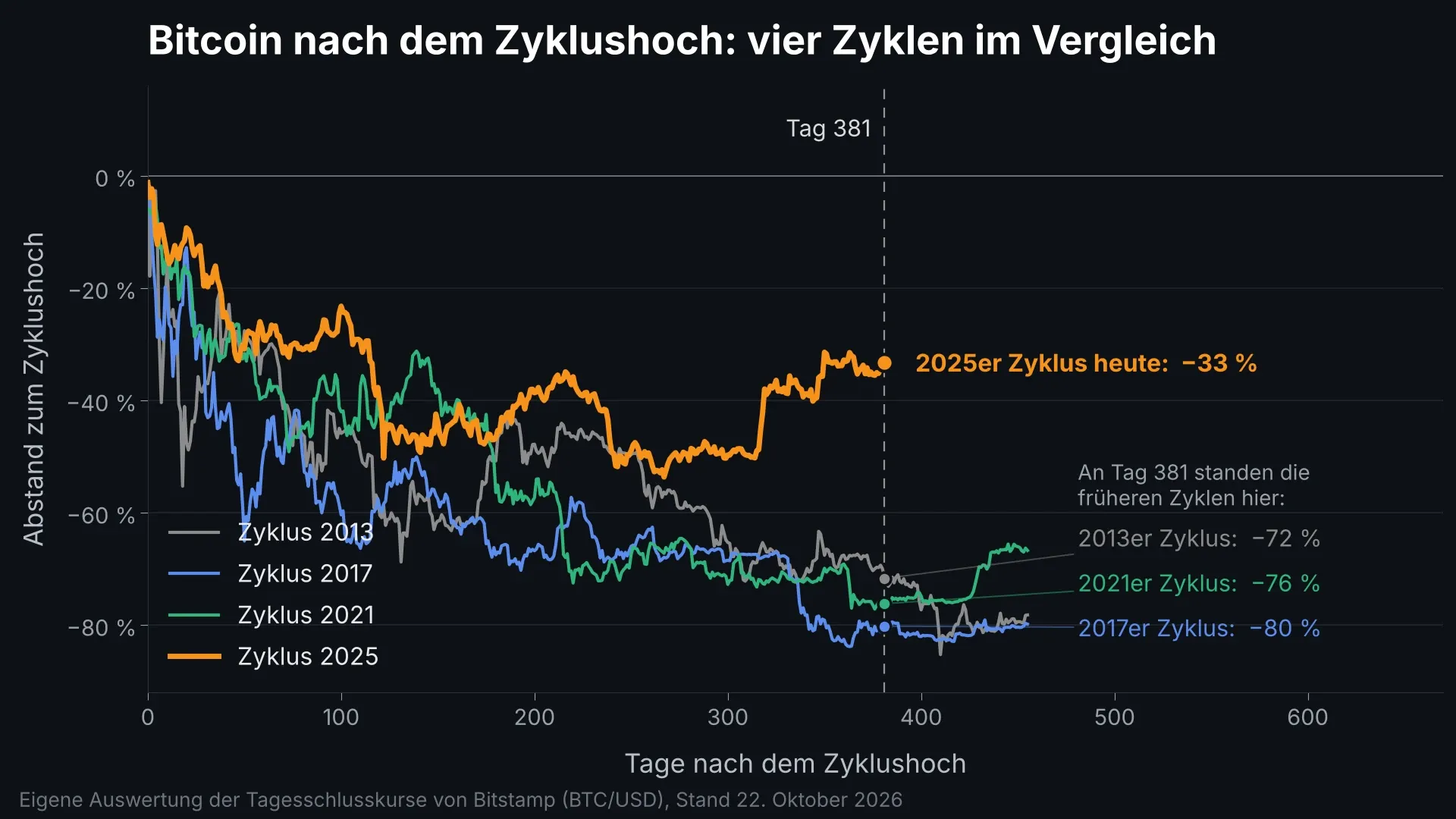
33 percent instead of 72 to 80: the direct comparison on the same cycle day
The most telling measurement in this article lays the four cycles over each other and asks where the price stood on the same day after the record. October 22, 2026 is day 381 after the high of October 6, 2025. On their respective day 381, the older cycles stood as follows:
- cycle of 2013: $329, 71.7 percent below the record
- cycle of 2017: $3,886, 80.2 percent below the record
- cycle of 2021: $16,454, 76.2 percent below the record
- cycle of 2025: $84,264, 33.3 percent below the record
The three old cycles sat between 72 and 80 percent down on that day, inside a corridor of eight percentage points. The current cycle sits more than 38 percentage points above them. In the chart above, the orange curve runs above all three predecessors across the full 381 days, and it does so without a single point of contact.
A second difference lies in the timing of the low. The earlier cycles found their deepest point 363 to 410 days after the high, which is roughly now. The low of this cycle so far sits on day 268, more than three months earlier, and the price has risen since. Whether that low holds is for the coming months to decide; a cycle is only over with the next record.
The time taken to recover has shortened as well. From high to the next record, Bitcoin needed 1,181 days (from 2013), then 1,079 days (from 2017) and most recently 846 days (from 2021). Measured against that series, the current cycle would still be mid-course on day 381. In January 2026 we had already put the same question and asked whether this crypto cycle is running like the one in 2021. Nine months on, the answer can be split: on timing yes, on the depth of the fall no.
The year 2026 itself reads as unspectacular: a peak of $97,939 on January 14, a low of $57,735 on July 1, and a loss of 5 percent since the start of the year. Since the end of July the price has moved in a range between $62,216 and $87,374. That sideways move at a moderate distance from the record is what is genuinely new about this cycle.
Supply, funds and market size: the halving's drive falls to 0.8 percent
There is an explanation for the shrinking amplitude that needs no reference to sentiment: the halving loses leverage with every pass. What counts is not that the block reward halves, but how much new supply that removes relative to the amount already in existence.
| Period | Reward per block | New Bitcoin per year | Share of circulating supply |
|---|---|---|---|
| from 2012 | 25 BTC | around 1,314,000 | around 12.1 percent |
| from 2016 | 12.5 BTC | around 657,000 | around 3.9 percent |
| from 2020 | 6.25 BTC | around 328,500 | around 1.7 percent |
| from 2024 | 3.125 BTC | around 164,250 | around 0.8 percent |
| from 2028 | 1.5625 BTC | around 82,125 | around 0.4 percent |
In 2012 the halving removed a stream of supply equivalent to a tenth of all existing Bitcoin per year. Today it is less than one percent, and after 2028 half of that. Around 450 new Bitcoin are added daily at present, against a circulating supply of a good 20.1 million. An event that touches 0.4 rather than 12 percent of the stock can hardly move the price the way it once did. That does not invalidate the cycle, but its drive is getting weaker.
Add to that the sheer size. Bitcoin was worth around $1.69 trillion on October 22, 2026. Doubling that today takes a multiple of the capital needed in 2017 to achieve the same percentage jump. And the origin of that capital has shifted: Grayscale points out that new money now arrives predominantly through exchange-traded products and corporate balance sheets rather than through private accounts at trading venues. How such products work in Germany is set out in our overview of crypto ETFs and ETNs. To follow the shift between Bitcoin and the rest of the market, we publish the course of Bitcoin dominance as a running chart.
Funds buy and sell differently from retail investors: more regularly, in larger blocks and often against the short-term trend. That is what dampens excesses in both directions. We have set the tools for tracking such inflows and outflows side by side in our overview of crypto analytics platforms.

The counter-test: what Grayscale and Bitwise had announced for 2026
In December 2025 several houses published annual outlooks declaring the four-year cycle finished. Those statements can be measured against prices today, and that belongs to an honest assessment.
Grayscale wrote in its outlook that the four-year cycle thesis would prove wrong, and considered a new all-time high in the first half of 2026 likely. Measured against the price, that expectation has not materialised: the highest level of the first half of 2026 came on January 14 at $97,939, which is 22.4 percent below the record of October 2025.
Matt Hougan, chief investment officer of the asset manager Bitwise, likewise expected new records for 2026 in his firm's annual forecasts, and based that on institutional capital whose inflow would accelerate. That expectation has not been met by October 22, 2026 either; the year is down 5 percent. In fairness: the year is not over, and a good two months remain.
Not everyone committed. Galaxy Digital called the year too chaotic for a forecast at the time. One point stands out above all: both houses that declared the cycle dead derived rising prices from it. What has happened so far is the opposite, and it has happened on a rhythm that still matches the old intervals.
Holding period and allowance: what the cycle changes for investors in Germany
By the measured intervals, a cycle lasts around 1,426 days, or just under four years. For investors in Germany that span has a tax counterpart. Private disposals of crypto assets fall under section 23 of the Income Tax Act: hold a coin for longer than a year and then sell, and no income tax is due on the gain. Sell inside the year and the gain is taxable, provided the sum of all private disposal gains in a year reaches the allowance of 1,000 euros.
That produces a connection usually missing from cycle talk: holding a position across a cycle low inevitably crosses the one-year mark. Trying to catch highs and lows, by contrast, usually means trading inside the period and landing in the tax net. The holding period is currently under political debate; we keep the latest state of play, with dates, on our page on the crypto holding period. This text is no substitute for tax advice.
For choosing a trading venue, the MiCA regulation has applied across the EU since the last transition period ended on July 1, 2026: providers need authorisation as crypto-asset service providers, supervised in Germany by BaFin. Which platforms hold that authorisation is shown in our comparison of regulated crypto exchanges.
Block 1,050,000: when the next halving falls
The fifth halving takes effect at block 1,050,000. On October 22, 2026 the blockchain stood at height 972,548, so 77,452 blocks are missing. When those are reached depends on the speed at which miners find blocks.
Across the last 2,016 blocks, meaning a full difficulty period, the interval was 9.39 minutes and therefore below the target of ten minutes. Project that pace forward and the halving falls on March 10, 2028. At the ten-minute target it would be April 11, 2028. A window in spring 2028 is therefore realistic, around 505 to 537 days from today. The more computing power joins the network, the further the date slides forward.
What would break the cycle: three conditions with a date
Instead of declaring the cycle dead or alive, it is possible to set out how a break would be recognisable. Three conditions can be checked:
- A record at the wrong time. Should the price climb above $126,272 before the halving in spring 2028, the pattern of March 2024 repeats on a larger scale. The price would then be driving the halving rather than the other way round.
- A low that is not a low. Should the level of July 1, 2026 hold until the next halving, this would be the first cycle since 2013 without a decline of more than 70 percent. The gap to the three predecessors would then exceed 20 percentage points.
- A rhythm that fails. The interval between the last three records was 1,478, 1,424 and 1,426 days. Should the next record arrive well before or well after the calculated date around September 1, 2029, the rhythm has broken.
Each of these three conditions carries a date and a number. That makes the question answerable in two years without having to rely on sentiment.
Our assessment: the rhythm holds, the return per cycle does not
From the newsroom's point of view, the debate confuses time with yield. The measured intervals argue for that reading: 526, 548 and 534 days from halving to high, plus 1,424 and 1,426 days from record to record. The timeframe has held every time so far, most recently in October 2025. At the same time the gain fell from a factor of 16.9 to 3.5 and then to 1.8, and the supply effect of the halving sank from 12.1 to 0.8 percent of circulating supply. Together that produces a rhythm of diminishing force.
Against that stands the small sample. Four cycles are four data points, and two of them come from a time when the whole market was smaller than a single large fund is today. Against it also stands the fact that the current cycle falls markedly out of line on the decline: 54 instead of 78 to 87 percent. Deriving a fixed timetable from that overstretches the data. Bitcoin remains an asset in which a total loss is possible, and none of the numbers in this article says anything about tomorrow's price.
Bitcoin cycle: around 500 days remain until the next halving
The rhythm of the cycle has held so far, the return per pass is shrinking, and the next halving lies in spring 2028. Three steps turn that into something practical:
- Match your own time horizon to the length of the cycle. Just under four years from record to record means a position held across a full cycle clears the one-year tax mark by a wide margin. If you want to buy regularly and regardless of the price level, the terms are in our comparison of Bitcoin savings plans.
- Collect the records from the first purchase onwards. Purchase date, price and venue decide later whether a gain falls inside the one-year period. Which programs take that over is set out in our overview of crypto tax tools.
- Keep an eye on the three conditions above. A record before spring 2028, a holding low from July 1, 2026, or a record far away from September 1, 2029: each of these marks says more about the cycle than any annual forecast. Our comparison of crypto exchanges shows where a coin is tradable at which fees.
(As of October 22, 2026. This article is not investment advice. Prices and fee structures change; check the terms with the provider before you buy.)
At 8 a.m. UTC on December 25, 132,411 Bitcoin in open contracts expire on the options exchange Deribit. At the price of $82,009 on Thursday midday that is around $10.9 billion, and it is the second-largest expiry currently on the books. To see where the market expects Bitcoin at the turn of the year, look at that book: it holds the most honest answer available, not an opinion but money someone has actually put down.
The documented figures: the calculated centre of gravity of this expiry sits at $78,000, which is $4,009 below today's price, while 35,862 Bitcoin in call options sit at strikes of $100,000 and above. Our assessment follows further down. The two numbers contradict each other only in appearance, and taken together they describe a market that hedges on the way down and hopes cheaply on the way up.
Our Bitcoin price prediction tracks how the picture fits together over a horizon of months. This piece takes on the single date that bundles everything in December.
What expires on December 25: 132,411 Bitcoin in open contracts
An option is a right, not an obligation. Whoever holds a call may take delivery of Bitcoin at the agreed strike price on the settlement date. Whoever holds a put may sell at that price. If the contract runs out without that being worthwhile, it expires worthless. Open contracts, known in the trade as open interest, are all the rights still standing at a given date.
For December 25 the Deribit book of October 22, 12:45 p.m., shows 82,148 Bitcoin in calls and 50,262 Bitcoin in puts. The put-to-call ratio is 0.61. Together that comes to 132,411 Bitcoin. Only the monthly expiry on October 30 is heavier, at 136,292 Bitcoin, and that one will be history in eight days.
The number looks large, and it shrinks quickly in context. Around 19.9 million Bitcoin are in circulation, so the December expiry covers barely 0.7 percent of the supply. What makes it matter anyway is the concentration: this money does not sit evenly spread out, it clusters at a handful of strikes, and those clusters are exactly where the levels form that the price will rub against in December.
Max pain at $78,000: what the number says and what it does not
Max pain is the price at which the sum of all open contracts carries the least intrinsic value on expiry day. For this date it sits at $78,000. Put differently: were Bitcoin to settle exactly there on December 25, as much as possible would expire worthless, and the writers, meaning the sellers of the options, would keep more premium than in any other outcome.
Caution is in order here, because the term is routinely stretched too far. Max pain is neither a forecast nor a target. It is a snapshot of a book that shifts daily, and it says nothing about whether anyone can or wants to drive the price there. In a market worth more than $1.6 trillion, an options book of $10.9 billion does not move the price on its own.
What the number does deliver is a different piece of information. The metric shows where the weight of the book lies. A level of $78,000 below the current price means the bulk of the options sold were written when Bitcoin traded lower or was expected to trade lower. The market has moved up since then, and the book has followed that path only in part.
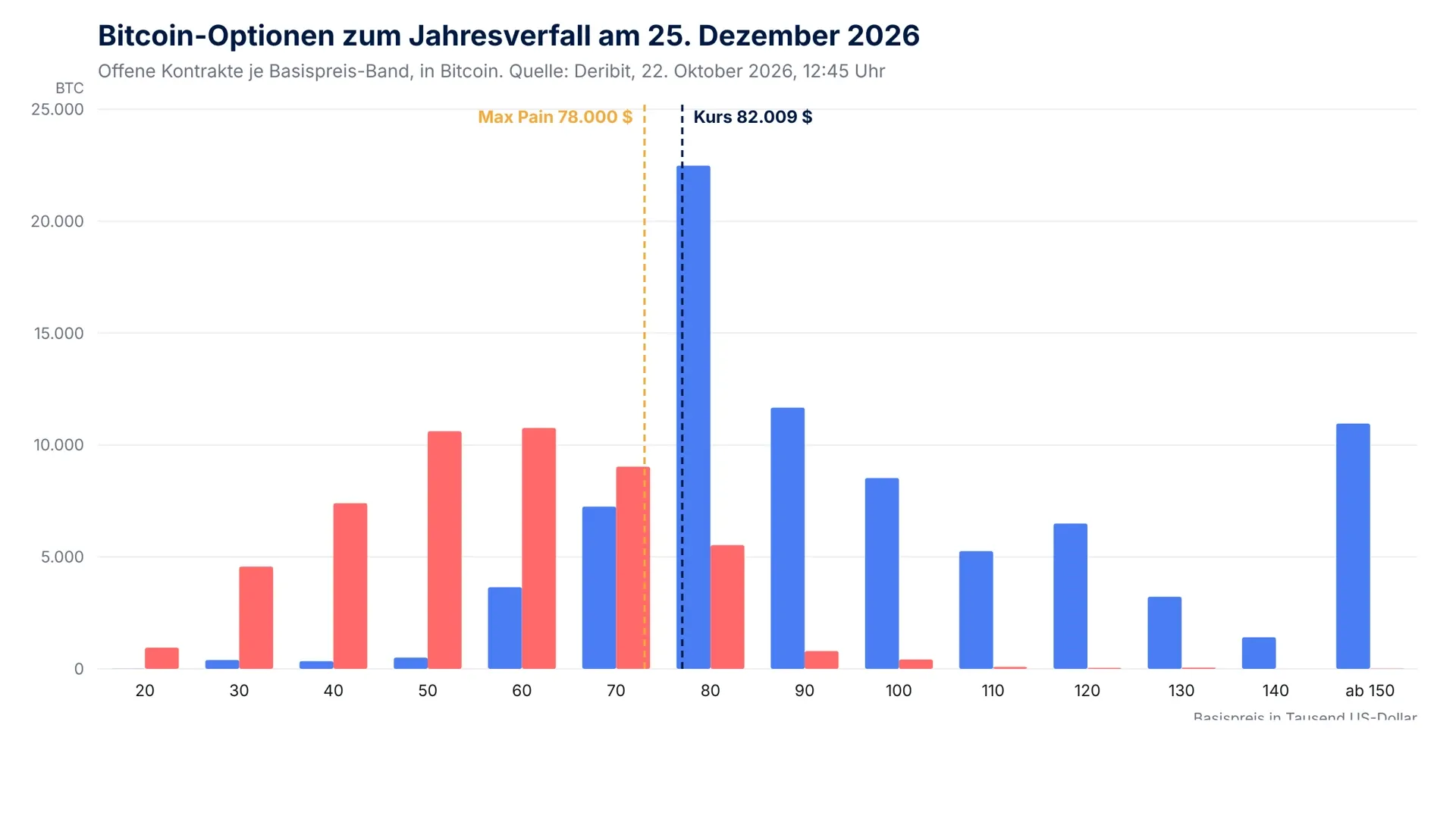
The call wall from $100,000 up: 35,862 Bitcoin on distant strikes
The chart above shows a distribution with two centres. The first sits close to the action: the band between $80,000 and $89,999 holds 22,482 Bitcoin in calls and 5,524 in puts. The round strike of $80,000 alone carries 11,287 Bitcoin, the largest single position of the entire expiry.
The second centre sits far above. Strikes of $100,000 and higher hold 35,862 Bitcoin in calls, or 43.7 percent of every call at this date. The $100,000 strike alone accounts for 6,089 Bitcoin, with another 5,958 at $120,000.
These positions are cheap, and that is where their message lies. Bitcoin would have to gain 22 percent by December 25 just to reach $100,000, and 46 percent to crack $120,000. Options covering such distances cost little because they rarely pay off. The fact that so many of them sit in the book shows hope with a small stake, not conviction with a large one. The all-time high of $126,080 dates from October 6, 2025 and has not been reached since.
The put side down to $70,000: 37,229 Bitcoin of downside protection
The underside mirrors that picture, and it is the more serious part of the book. Strikes of $70,000 and below hold 37,229 Bitcoin in put options, or 74.1 percent of every put at this date. Down to $60,000 the figure is still 30,313 Bitcoin. The thick single position sits at $60,000 with 6,784 Bitcoin.
Nobody buys puts at $60,000 because they expect that price. They buy them because they hold a position they do not want to sell, and because a 27 percent slide would cost them too much. That distribution is typical of holders hedging, not of speculators betting on a fall. The put-to-call ratio of 0.61 supports the reading: the book holds markedly more calls than puts.
Between $70,000 and $90,000 it thins out. That corridor is exactly where the price is trading right now, and exactly where the options book has least to say. Anyone expecting quiet weeks in December will find no contradiction in the book.
How an expiry date affects the price at all
The mechanism is less spectacular than it is usually made out to be. Whoever sells an option carries the risk and hedges it in the spot market. When the price moves towards a strike where many calls sit, the writer has to hold more Bitcoin to stay able to deliver, and buys. When the price falls, the writer sells again. That running adjustment is called delta hedging.
Close to large strikes the effect is usually a damping one, because the hedging purchases and sales run against the move. If the price breaks clean through a cluster, however, the same mechanism can amplify the move, because every writer has to buy in the same direction. At $80,000, with 11,287 Bitcoin, sits the largest such cluster of this expiry.
One point matters for the framing: the effect is strongest in the days immediately before an expiry, not two months ahead. For today's price the December book says little. For the week around Christmas it says a great deal. If you approach dates like these with leveraged products, know what the platform costs; our comparison of perp DEX platforms shows which providers settle how.
Futures at $82,763: what the December contract reveals about expectations
Alongside the options book, a second look at the futures market pays off. The December future on Deribit stood at $82,763 on Thursday midday, 0.92 percent above spot. Annualised, that works out at around 5.5 percent. The June 2027 future sits at $84,936, 3.58 percent above spot, a similar annual rate.
This structure is called contango and is the normal state of affairs: buying Bitcoin forward ties up no capital, and that convenience carries a premium. It only gets interesting next to the level of interest rates. The Federal Reserve's target range currently sits at 3.75 to 4.00 percent, so the futures market pays a little more than the risk-free rate, but not much. In euphoric phases those premiums have run beyond 15 percent a year.
The funding rate of the perpetual contract fits that picture at 0.0026 percent per eight hours. The value is mildly positive, which means buyers are paying sellers, but it sits far from the readings that mark an overheated market. The volatility index DVOL, at 37.9, is also in the lower part of its usual range.

The rate decision on October 28 comes two days before the October expiry
Before the December date becomes relevant, a closer one is due. The Federal Reserve meets on October 27 and 28 according to its own calendar, with the decision landing on Wednesday, October 28. Two days later, on October 30, the 136,292 Bitcoin of the October expiry run out.
That sequence is the more important one for the coming weeks. The rate decision supplies the trigger, the expiry the amplification. Should the decision land differently than expected, the reaction will hit a book whose writers have to adjust their hedges immediately beforehand.
For the December expiry that means one thing: it will change its face several times before then. Open interest is not a fixed amount. After October 30 many positions roll on into December, and the picture that holds today can look markedly different in four weeks.
What has changed since our prediction of October 21
On October 21 we wrote in this space about the mining difficulty adjustment and named $83,691 as the next target. That target was reached. The price rose as far as $84,808 and then fell back; on Thursday midday it stands at $82,009. The full calculation from that day sits in our prediction on mining difficulty of October 21.
What remains open is the counter-test: the breakout did not hold. Within 24 hours the price went from $84,808 to a low of $81,607, a distance of 3.9 percent, and it is now back in the old corridor. For the levels that is a clear shift. The $84,808 mark has turned from a target into resistance, and $81,607 is the fresh support that will be tested first.
What is new is the view beyond the turn of the year that this piece supplies. The levels of the December book sit considerably further apart than the daily marks: $70,000 below as the start of dense hedging, $100,000 above as the start of the hope zone.
Our assessment: the options market is not pricing year-end fireworks
From the newsroom's point of view, this book shows a sober market. Three things argue for that reading, and all of them appear above with numbers: the centre of gravity at $78,000 sits below the price, the hedging crowds in with 37,229 Bitcoin below $70,000, and the futures premium of 5.5 percent a year barely exceeds the policy rate. A market counting on a year-end rally looks different.
Against that stands the call side. 35,862 Bitcoin at strikes from $100,000 up are no trifle, and they were bought cheaply. Should a trigger arrive that is strong enough, those very positions would amplify the move, because the writers would then have to buy on the way up. The direction therefore stays open; only the costs of the two scenarios are distributed differently today.
What follows is not a buy or sell recommendation but a frame. Between $70,000 and $100,000 the December book carries little weight. Inside that range the price is driven by other things: the rate decision, fund flows, the news cycle. Only at the edges does the options book speak up.
Year-end expiry on December 25: three levels for your turn of the year
For an investor in Europe this translates into three concrete points.
- Note the levels, not the opinions. $81,607 as fresh support, $84,808 as new resistance, $70,000 and $100,000 as the edges of the December book. If you are planning an order, place it at these documented points rather than at round numbers. Our comparison of crypto exchanges shows where you trade at which fees.
- Look up the purchase date of every holding. If you are weighing a sale before the turn of the year, you first need the date on which the position in question was bought. How lawmakers currently treat the one-year holding period is something we track on our page crypto holding period: state of the reform.
- Document the holdings cleanly. Holdings spread across several exchanges and wallets make purchase dates easy to lose track of. Which tools pull the records together automatically is set out in our comparison of tax tools and portfolio trackers.
The figures in this piece come from the public options book of Deribit and the meeting calendar of the Federal Reserve. The price comes from CoinGecko.
(As of October 22, 2026. This article is not investment advice. Prices and fee structures change; check the terms with the provider before you buy.)
A Bitcoin crash is a fast, deep slump in the price, and Bitcoin has seen plenty of them since 2011. Here is what is documented: seven times the price fell more than 50 percent below its most recent record high, measured on daily closing prices in US dollars. The deepest fall came in 2011, at around 93 percent. The most recent one began on October 6, 2025 at $124,753 and reached down to $58,559 by June 30, 2026, a loss of 53.1 percent. After each of the six earlier declines Bitcoin later traded above the old high again, though after the four big bear markets only 630 to 1,127 days after the high. What the newsroom draws from that for investors is set out further down as a marked assessment.
On October 22, 2026 at 3:16 a.m. Bitcoin stood at $84,212, which is 32.5 percent below the record and 43.8 percent above the June low. What pushed the price below $82,000 around October 20 is explained by our report crypto crash today. This guide shows the big picture: every decline of more than 50 percent since 2011, the known crash days, the patterns behind them and what a crash does to a portfolio.
Bitcoin crash: the key points at a glance
- Seven crashes of more than 50 percent: 2011, April 2013, December 2013, December 2017, April 2021, November 2021 and October 2025 each marked the start of a decline of more than half.
- Largest decline in percent: in 2011 Bitcoin fell from a little over $30 to a little over $2, a loss of roughly 93 percent.
- Largest single-day loss: on March 12, 2020, a day after the WHO declared Covid a pandemic, Bitcoin lost 37.2 percent.
- The lows became shallower: the big bear markets ended at minus 93, 85, 83 and 77 percent, while the most recent decline reached minus 53.1 percent by June 30, 2026.
- Recovery takes years: in the big bear markets, 630 to 1,127 days passed between the record high and the next record.
- The holding period counts: in Germany the gain on a sale is tax free after more than a year (Section 23 of the Income Tax Act, as of October 2026).
Bitcoin crash history: the table of every decline since 2011
In this overview a crash means any decline in which Bitcoin fell more than 50 percent below its highest daily closing price up to that point. A decline ends as soon as the price closes above that old high again. cryptoticker.io compiled this analysis itself from daily closing prices in US dollars: from April 29, 2013 onwards from the data of CoinMarketCap, and for the period before that from the average price across large exchanges from Blockchain.com. The cut-off is the daily close of October 21, 2026. The figures for 2011 and April 2013 are rounded, because there were only a few exchanges at the time.
| Decline | High | Low | Loss | Days from high to low | Days from low to new high |
|---|---|---|---|---|---|
| 2011, after the Mt.Gox hack | June 2011, a little over $30 | November 2011, a little over $2 | around 93 percent | around 160 | around 470 (March 2013) |
| April 2013 | April 10, 2013, around $230 | April 17, 2013, around $68 | around 71 percent | 7 | around 200 (November 2013) |
| 2013 to 2015, Mt.Gox collapse | December 4, 2013, $1,151 | January 14, 2015, $178 | 84.5 percent | 406 | 721 (January 4, 2017) |
| 2017 to 2018 | December 16, 2017, $19,497 | December 15, 2018, $3,237 | 83.4 percent | 364 | 716 (November 30, 2020) |
| 2021, China's crackdown on mining | April 13, 2021, $63,503 | July 20, 2021, $29,807 | 53.1 percent | 98 | 91 (October 19, 2021) |
| 2021 to 2022, Terra and FTX | November 8, 2021, $67,567 | November 21, 2022, $15,787 | 76.6 percent | 378 | 469 (March 4, 2024) |
| 2025 to 2026 | October 6, 2025, $124,753 | June 30, 2026, $58,559 | 53.1 percent | 267 | still open |
Two patterns stand out. First, the big falls each took roughly a year from the high to the low: 406 days after the 2013 high, 364 days after the 2017 high and 378 days after the 2021 high. Second, the way back was longer every time than the way down. From the low to the new high, Bitcoin needed 721, 716 and 469 days after those three crashes. Anyone who bought at the record high therefore waited between 847 and 1,127 days until their purchase price was reached again.

How often has Bitcoin crashed? The known crash days since 2013
Seven times by more than half, if you measure from the respective record high. Count individual crash days and the number is far higher: since the end of April 2013, Bitcoin has closed more than 10 percent lower than the previous day on 61 days. Of those, 35 fell in the years 2013 to 2017, 25 in the years 2018 to 2022, and since 2023 only a single one, February 5, 2026.
| Day | Occasion | Close versus previous day | Lowest price on the day |
|---|---|---|---|
| March 12, 2020 | Covid: the WHO classified COVID-19 as a pandemic the day before | minus 37.2 percent | $4,860 |
| May 19, 2021 | China bars banks and payment services from crypto business | minus 13.8 percent | $30,682 |
| May 9, 2022 | Terra: the stablecoin UST loses its dollar peg | minus 11.0 percent | $30,297 |
| November 9, 2022 | FTX crisis, bankruptcy filing two days later | minus 14.3 percent | $15,683 |
| October 10, 2025 | Tariff threat against China, more than $19 billion in liquidations | minus 7.0 percent | $104,582 |
| February 5, 2026 | Largest single-day loss of the most recent decline | minus 14.1 percent | $62,354 |
October 10, 2025 shows how badly a closing price can understate the force of a day. Bitcoin closed only 7.0 percent lower than the previous day, yet traded 14.1 percent below it during the session. February 6, 2026 was similar: the price fell as far as $60,074 intraday, and by the close it stood at $70,555, up 12.5 percent. Swings like these arise when exchanges force leveraged positions closed and every sale triggers the next.
The Bitcoin crashes in history: triggers from Mt.Gox to FTX
The triggers repeat themselves in four forms: the collapse of large exchanges, forced selling of leveraged positions, intervention by states, and shocks on the rest of the financial markets. In most cases several of them worked together.
2011 and 2014: Mt.Gox twice
In June 2011 the Tokyo exchange Mt.Gox sat at the centre of Bitcoin trading. On June 19, 2011 the price there collapsed after a hack: within minutes it fell from around $17.50 to below $10 and briefly to one cent, as Bitcoin.com reconstructs in its chronicle. The fall to one cent stayed confined to Mt.Gox; the damage to confidence did not. By November 2011 Bitcoin had fallen to a little over $2.
Three years later the same exchange was hit for good. On February 28, 2014 Mt.Gox filed for bankruptcy in Japan and reported roughly 850,000 missing bitcoin, 750,000 of them belonging to customers, as MPR News reported the same day. Bitcoin fell from $885 to $539 between January 26 and February 25, 2014, and as low as $420 intraday, and the bear market dragged on into January 2015.
2017 to 2020: from the record to the Covid crash
At the end of 2017 Bitcoin ran up to $19,497 on December 16 and lost 83.4 percent over the following year. Only on November 30, 2020 did the price stand above that again, and in the middle of it lay the blackest day in Bitcoin's history. On March 11, 2020 the World Health Organization classified COVID-19 as a pandemic, and on March 12 Bitcoin fell 37.2 percent from $7,911 to $4,971. Measured from the interim high of February 12, 2020, that came to 51.9 percent in 29 days. The recovery went faster than after any big bear market: on July 27, 2020 the price stood above the February high again, 137 days after the low.
2021 and 2022: China, Terra and FTX
In April 2021 Bitcoin reached $63,503. In May China's State Council announced it would move against Bitcoin mining and trading, a few days after banks and payment services had been barred from crypto business, according to a Reuters report of May 22, 2021. By July 20 the price had fallen 53.1 percent, and by October it was back at a record.
The next fall began on November 8, 2021 at $67,567 and turned into a series of collapses. In May 2022 the stablecoin UST lost its peg to the dollar and the Terra system broke apart. The losses are estimated at roughly $40 billion, and founder Do Kwon was sentenced to 15 years in prison in New York in December 2025, Yahoo Finance reports. On November 11, 2022 the exchange FTX, together with more than 130 affiliated companies, filed for creditor protection under Chapter 11 of US bankruptcy law, as Semafor reported. Ten days later Bitcoin closed at $15,787, 76.6 percent below the record.
2025 and 2026: leverage, tariffs and rate worries
The most recent decline began on October 6, 2025 at $124,753. Four days later US President Donald Trump announced additional tariffs of 100 percent on goods from China. According to data from Coinglass, leveraged positions worth more than $19 billion were then forcibly closed across more than 1.6 million traders, the largest wave of liquidations in crypto history, as PYMNTS summarises. On February 5, 2026 came the largest single-day loss since November 9, 2022, at minus 14.1 percent.
In June 2026 Bitcoin slid below $60,000. According to Trending Topics, a sell-off in technology and AI stocks, outflows from the US Bitcoin ETFs and worries about higher rates after the rise in the oil price weighed on the price. The lowest close fell on June 30, 2026, at $58,559.
Largest Bitcoin crash: 2011, 2020 or 2026, depending on the yardstick
Which crash was the largest depends on what you measure. In percent it was 2011, at roughly 93 percent from the high to the low. On a single day it was March 12, 2020, at minus 37.2 percent. In dollars per bitcoin the most recent decline is the largest: from October 6, 2025 to June 30, 2026 every bitcoin lost $66,194 in value, against $51,780 in the 2021/22 fall.
For your portfolio the percentage is what counts, and there an uncomfortable asymmetry applies. A loss of 50 percent needs a gain of 100 percent to make it back. From the low of November 2022 to the old record, Bitcoin had to rise 328 percent, and from the low of January 2015, 546 percent. From the low of June 2026 to the record of October 2025, 113 percent is missing.

Bitcoin crash in the cycle: why the declines became smaller
The big bear markets became shallower from cycle to cycle: minus 93 percent in 2011, minus 84.5 percent to 2015, minus 83.4 percent to 2018 and minus 76.6 percent to 2022. The decline since October 2025 reached minus 53.1 percent by the end of June 2026. Whether June was the low of this cycle is open.
The rhythm has stayed similar. The record highs of 2013, 2017, 2021 and 2025 each came 12 to 18 months after a halving of the reward for new blocks, with the last halving in April 2024. In the three earlier cycles the high was followed by roughly a year of downtrend each time.
Our assessment: the shallower lows have a comprehensible reason in the market itself. In 2011 Bitcoin was a niche product with a handful of exchanges; today exchange-traded funds in the US buy and sell it too, and their outflows dragged the price down in June 2026. A larger, broader market dampens the swings but does not protect against them: a loss of 53 percent still halves a position. The force of individual days also depends less on the size of the market than on leverage, as October 10, 2025 showed. A guarantee that the next decline will again be smaller cannot be derived from four bear markets.
Bitcoin crash 2025/2026: where the most recent decline stands
On October 22, 2026 the record lay 381 days in the past. Comparing the earlier cycles on the same day after the high shows how differently this decline has run so far.
| Record high | 381 days later | Distance from the record |
|---|---|---|
| December 4, 2013 | December 20, 2014 | minus 71.3 percent |
| December 16, 2017 | January 1, 2019 | minus 80.3 percent |
| November 8, 2021 | November 24, 2022 | minus 75.4 percent |
| October 6, 2025 | October 22, 2026, 3:16 a.m. | minus 32.5 percent |
In the three earlier cycles Bitcoin stood close to the floor on this day; this time the price is 43.8 percent above the June low. Two readings fit this data: the floor has already been found, or the decline is running in a more drawn-out way than before. Which scenarios analysts are running for the price is collected by our Bitcoin price prediction. What weighed on the market in early October, from ETF outflows to liquidations of more than $651 million, is set out in crypto market slides.
Bitcoin crash in the portfolio: position size and holding period count
History yields no timing, but it does yield an order of magnitude. If you hold Bitcoin, you have to reckon with declines of more than 50 percent that can last years. How hard that hits a portfolio is decided by the share, not by the price. The table works through a portfolio of €10,000 in which only the Bitcoin part falls and the rest stays unchanged.
| Bitcoin share | Amount | Decline as in 2025/26 (minus 53 percent) | as in 2021/22 (minus 77 percent) | as in 2013/15 (minus 85 percent) |
|---|---|---|---|---|
| 5 percent | €500 | minus €265 (2.7 percent of the portfolio) | minus €385 (3.9 percent) | minus €425 (4.3 percent) |
| 10 percent | €1,000 | minus €530 (5.3 percent) | minus €770 (7.7 percent) | minus €850 (8.5 percent) |
| 25 percent | €2,500 | minus €1,325 (13.3 percent) | minus €1,925 (19.3 percent) | minus €2,125 (21.3 percent) |
| 50 percent | €5,000 | minus €2,650 (26.5 percent) | minus €3,850 (38.5 percent) | minus €4,250 (42.5 percent) |
At a 10 percent share, even a fall like 2013/15 costs less than a tenth of the portfolio; at 50 percent it costs more than two fifths. The second lever is financing: anyone buying on credit or with leveraged derivatives cannot sit out a floor, as shown by the more than 1.6 million traders whose positions were forcibly closed on October 10, 2025. The third is custody. At Mt.Gox in 2014 and FTX in 2022, customers' coins sat on the exchange and were caught in the insolvency proceedings when it failed. Devices for your own custody can be found in the hardware wallet comparison, and trading venues including fees in the comparison of the best crypto exchanges.
For tax, what counts in Germany is above all the holding period. Under Section 23 of the Income Tax Act, the gain from selling Bitcoin held privately is tax free if more than a year lies between purchase and sale. Inside that period gains stay tax free as long as all private disposal gains of a year together remain below €1,000. Losses from sales inside the period may be offset against gains from private disposals in the same year, and losses not offset may be carried back to the previous year or forward to later years. A loss after a holding period of more than one year does not count for tax. How long your individual purchases have been in the portfolio and which sale would be tax free is calculated by the free CryptoTicker tax calculator. That is no substitute for tax advice.
The one-year period could change from 2027. A draft bill from the German finance ministry dated September 30, 2026 provides for crypto assets acquired after December 31, 2026 to be taxed as capital assets at 25 percent capital gains tax, with no holding period. In the Bundestag's petitions committee a ministry representative said on October 12, 2026 that the proposal was in interdepartmental coordination. There is no cabinet decision: on October 14, 2026 the federal cabinet did not take up the draft, on October 21 it did not meet, and the ministry has named no new date (as of October 22, 2026). Our article on the crypto holding period keeps the status current.
Bitcoin crash history: up to 1,127 days to the next record
Seven times since 2011 Bitcoin has lost more than half its value, and six times the price later stood at a record again. The way there took between 630 and 1,127 days in the big bear markets, the lows became shallower from cycle to cycle, and the fiercest days were brought by exchange failures, leverage and shocks from outside. The most recent decline, at minus 53.1 percent to the end of June 2026, is still open. Whether and when Bitcoin reaches the high of $124,753 again cannot be read from history. What can be read from it is how much patience and what position size earlier crashes demanded. Cryptocurrencies remain a volatile investment and a total loss is possible. We will extend the table as soon as the decline is complete or a new one begins.
Decrypt
Each SOFIE token represents $1 on deposit at SoFi Bank, earning 4.40% APY with FDIC insurance—a yield-and-protection combination ordinary stablecoins lack.
Police say a car-rental firm near Milan was an underground bank for 'Ndrangheta and Camorra figures, moving money abroad and into crypto.
A Tianjin court will hear the application after a six-month notice period, while a parallel fight over the same coins continues in London.
Citadel's founder says investors are almost certainly in an AI bubble, warns a chip glut could crash prices like empty airline seats, yet expects the survivors to lead for decades.
Nvidia's OpenShell Reference Architecture pairs a software sandbox on Vera CPUs with Sentry monitoring on BlueField-4 chips, aiming to let companies run autonomous agents while enforcing limits agents cannot reach.
U.Today - IT, AI and Fintech Daily News for You Today
No hacks occurred, but a brief technical blip among servers automatically reset the timeline for the latest XRP upgrade.
XRP Ledger's recovery tempo is promising, but the fresh activity might not correspond with a proper price retrace.
Coinbase derivatives 'Downtime' to occur this date in October.
Bitcoin is at $83,900, but Bob Loukas warns bulls have just 45 days to confirm the cycle before a winter drop.
The market is witnessing a return of bullish volatility which might become the much-needed fuel for altcoins.
Blockonomi
TLDR
- Trump hosted a White House cybercrime roundtable on Wednesday and said Americans lost more than $20 billion to cybercrime in 2025.
- He said officials froze $1 billion in “cybercurrency tied to foreign scammers” and prevented $1.6 billion in losses.
- Trump, Attorney General Todd Blanche and Homeland Security Secretary Markwayne Mullin did not use the words “cryptocurrency” or “digital assets.”
- The FBI has reported Americans lost $11 billion to crypto-related scams in 2025.
- Italian police arrested 30 people in a crypto money laundering case tied to an alleged mafia-linked bank.
US President Donald Trump hosted a roundtable on cybercrime at the White House on Wednesday. During the event, he did not use the word “crypto” once.
Reports before the meeting said the event would focus on a crackdown on foreign crypto scams. Instead, Trump used the term “cybercurrency,” an older word for what most people now call cryptocurrency.
Trump Details Cybercrime Losses
Trump said “countless” Americans lost more than $20 billion to cybercrime in 2025. He listed impersonation schemes, ransomware attacks and scam centers as some of the methods used.
The president said federal officials froze $1 billion in “cybercurrency tied to foreign scammers.” He added that $1.6 billion in losses were prevented in 2025 after a March executive order.
Attorney General Todd Blanche also did not use the terms “cryptocurrency” or “digital assets” when discussing the scams. Homeland Security Secretary Markwayne Mullin referred only to “digital extortion.”
Secretary of Defense Pete Hegseth also appeared at the event alongside the president.
The Federal Bureau of Investigation has reported that Americans lost $11 billion to scams tied to digital assets in 2025. That figure includes losses through crypto ATMs.
Cointelegraph contacted the White House for comment on the roundtable but did not receive an immediate response.
Scrutiny Over Trump Family Crypto Ventures
The roundtable took place as Trump and members of his administration face questions from lawmakers and voters. Critics accuse them of using their positions to profit from digital assets.
Trump and his family are tied to several crypto ventures. Trump reported that these ventures earned him $1.4 billion in 2025.
A report from the group Public Citizen said his alleged “schemes” cost investors about $4.7 billion.
World Liberty Financial, the Trump family’s crypto company, is also facing scrutiny. Its USD1 stablecoin was used to settle a $2 billion investment in Binance by an entity tied to Sheikh Tahnoon bin Zayed Al Nahyan of the United Arab Emirates.
Trump’s memecoin project, Official Trump, is set to host another dinner for tokenholders on Nov. 22. Past events held by the team behind the memecoin led lawmakers and interest groups to accuse Trump of selling access to the presidency through “pay-to-play” schemes.
The White House roundtable followed news from Italy, where police arrested 30 people over a crypto money laundering scheme. The group allegedly used crypto to launder millions of dollars through a bank tied to the mafia.
According to Bloomberg, Italian police were investigating a criminal network that moved money from corporate fraud, crypto investment scams and drug trafficking into digital wallets.
The post Trump Avoids Saying “Crypto” at White House Cybercrime Roundtable appeared first on Blockonomi.
TLDR
- Tether led a pre-seed funding round in Bolivian fintech Peso but did not disclose the size of the investment.
- Peso plans to expand its USDT payment services across Bolivia, Brazil, Colombia and Argentina.
- The company has added USDT payments to Yango’s food delivery service in Bolivia.
- Lending platform Tala partnered with digital wallet El Dorado to offer USDT loans on the Tempo blockchain.
- Bolivia has turned to stablecoins since 2025 because of a long US dollar shortage and high inflation.
Tether has led a pre-seed funding round in Peso, a fintech company based in Bolivia. The startup offers payments in USDT, Tether’s stablecoin, through food delivery apps and local banking networks.
Tether announced the deal on Wednesday, Oct. 21. The company did not say how much money it invested.
The funding will help Peso grow its stablecoin payment services across Latin America. The company plans to operate in Bolivia, Brazil, Colombia and Argentina.
How Peso Uses USDT
Peso connects USDT with local currencies through banking and merchant payment systems. This lets users move between the stablecoin and their national money.
The company has already added USDT payments to Yango’s food delivery service in Bolivia. Customers can now pay for their food orders using the stablecoin.
Peso also offers QR code payments and point-of-sale services for merchants. These tools let shops accept USDT from customers.
The fintech provides virtual accounts as well. These accounts link to Bolivia’s banking system through ACH transfers.
Other Firms Grow USDT Services in Bolivia
Peso is not the only company building USDT services in Bolivia. On Tuesday, lending platform Tala announced a partnership with El Dorado, a digital wallet.
Under the deal, Tala will offer credit directly through the El Dorado wallet. Eligible customers can receive and repay loans in USDT.
These loans run on the Tempo blockchain. Tala said customers can get access to funds in seconds.
Bolivia has relied more on stablecoins since 2025. The country has faced a long shortage of US dollars along with high inflation.
As foreign currency became harder to get, many businesses started accepting USDT for purchases. The stablecoin is designed to hold the same value as the US dollar.
In November 2025, the Bolivian government announced plans to bring cryptocurrencies and stablecoins into its financial system. This included letting banks offer digital asset custody and crypto-linked financial products.
In June 2026, Bolivia dropped its longstanding currency peg. The dollar shortage continued after that, which pushed up demand for dollar-based options like USDT.
In July 2026, the government began considering a new regulatory framework. The rules would recognize USDT for payments, savings and trade alongside the boliviano and the US dollar.
Tether’s investment in Peso, announced this week, is the latest deal tied to USDT payments in Bolivia. Tala’s USDT lending partnership with El Dorado was announced one day earlier.
The post Tether Invests in Peso to Bring USDT Payments to Latin America appeared first on Blockonomi.
TLDR
- The American Bankers Association criticized the OCC’s final GENIUS Act rules on stablecoin issuance and custody.
- The OCC dropped a proposed provision that would have presumed certain third-party yield arrangements break the law.
- The ABA says issuers can now offer yield-like rewards through affiliates and exchanges while avoiding the ban.
- The Blockchain Association backed the change, while the Bank Policy Institute sided with the ABA.
- The GENIUS Act takes effect in January 2027, with Federal Reserve and Treasury rules still expected.
The American Bankers Association (ABA) has criticized new rules from the Office of the Comptroller of the Currency (OCC) on payment stablecoins. The group said the regulator’s approach goes against what Congress intended.
The OCC recently finalized its rules for carrying out the GENIUS Act. The rules cover how payment stablecoins are issued and held in custody.
In a statement released Wednesday, the ABA said the final rules included “several positive steps.” However, the group remained critical of provisions related to stablecoin yield.
OCC Drops Proposed Yield Safeguard
The GENIUS Act bans payment stablecoin issuers from paying yield. The OCC had proposed a rule that would have presumed certain third-party arrangements broke that ban.
That provision was removed from the final version. The ABA said this change opens a path for issuers to offer rewards through partners.
“The final rule removes the OCC’s originally proposed safeguards that would have addressed indirect arrangements involving affiliates, exchanges and other distribution partners,” the ABA said.
The group added that “payment stablecoin issuers can provide economically equivalent yield while technically avoiding the statutory prohibition.” It also noted the OCC declined to adopt a broader presumption against arrangements designed to get around the ban.
The ABA said these gaps “risk undermining the distinction Congress drew between payment stablecoins and traditional bank deposits.” It warned this could threaten the funds banks use to make loans.
Industry Groups Split on the Change
Not every group agreed with the ABA. The Blockchain Association, which represents crypto companies, supported the OCC’s decision.
The Blockchain Association said the OCC brought “the final rule more closely in line with the statutory text.”
The Bank Policy Institute, another banking advocacy group, largely sided with the ABA. It said “the decision to omit the yield presumption replaces clarity with ambiguity.”
The Bank Policy Institute added that the change “puts the banking system and its customers at risk of deposit flight.”
Stablecoin rewards were a key point of debate before and after the GENIUS Act passed Congress in July 2025. The issue is still drawing attention in talks over another bill.
That bill is the Digital Asset Market Clarity Act, which would set rules for the crypto market’s structure. It is currently stalled after a procedural vote failed in the Senate last month.
The OCC finalized its rules ahead of the GENIUS Act’s implementation in January 2027. Other agencies, including the Federal Reserve and the Treasury, are expected to release their own rules on stablecoins under the law.
The post American Bankers Association Says OCC GENIUS Act Rules Undermine Congress appeared first on Blockonomi.
TLDR
- Qubic restarted its blockchain on Oct. 19 after a thief drained 1,404 wallets of nearly $1.3 million in QU tokens.
- The attacker exploited weak wallet recovery seeds, not the blockchain itself.
- The flaw hit wallets made on iPhone and iPad browsers, Safari on Macs, and older Qubic iOS apps.
- About 87.1% of stolen tokens stayed on chain, and MEXC froze an account holding the other 12.9%.
- Victims can file claims through Qubic’s recovery portal until May 1, 2027.
Qubic has restarted its blockchain after a thief drained 1,404 wallets of nearly $1.3 million worth of QU tokens. The attack forced the network into an emergency shutdown.
The Oct. 18 attack saw about 2.94 trillion QU tokens stolen in less than two hours. Qubic’s validators, known as Computors, stopped transactions at tick 85,371,949 to prevent further losses.
By the evening of Oct. 19, the blockchain was processing transactions again. On Oct. 20, Qubic said its validators had approved a recovery plan, opened a claims portal and started paying verified victims.
How the Wallets Were Exposed
The thief did not break Qubic’s blockchain. Instead, the attacker exploited weak wallet recovery seeds, the secret strings of characters that give owners access to their crypto.
Older versions of Qubic’s wallet software used a random-number generator that was not secure enough. This made some recovery seeds predictable.
The flaw affected wallets created through browsers on iPhones and iPads, Safari on Macs, and older versions of Qubic’s iOS app. Attackers could potentially rebuild these seeds and gain access without knowing the owner’s password.
Qubic said it fixed the problem in wallet version 4.26.4, released around Oct. 19. The update replaced the weak generator with a more secure method.
Updating the software does not repair an old recovery seed, however. Anyone who created a wallet with the affected software must make a new wallet and move their funds.
Simply opening the old wallet on another device will not make it safe.
Stolen Funds Frozen as Claims Open
The thief’s escape plan stalled when Qubic halted its network. About 87.1% of the stolen tokens stayed trapped on the blockchain.
Crypto exchange MEXC froze an account holding the remaining 12.9%. Qubic then placed the affected onchain funds into protected escrow so validators could return them to verified owners.
Victims can submit claims through Qubic’s official recovery portal until May 1, 2027. Applicants must provide their affected wallet identity and a newly generated destination wallet.
They must also include a signed ownership message and supporting evidence. Approved claims face a seven-day dispute period before payment.
Recovery of the funds held at MEXC depends on the exchange and any law enforcement proceedings.
Qubic has also warned users about recovery scams. The team said legitimate recovery help never requires handing over a wallet seed or paying a fee.
Payments to verified victims began on Oct. 20, and the claims window remains open until May 1, 2027.
The post Qubic Restarts Blockchain After $1.3 Million Wallet Hack appeared first on Blockonomi.
TLDR
- A wallet linked to convicted Irish drug dealer Clifton Collins moved 500 BTC, worth about $41.5 million, to a Coinbase Prime address on Oct. 20.
- It was the fifth 500 BTC transfer from Collins-linked wallets this year, bringing the total moved to 2,500 BTC, worth about $208 million.
- The coins had been untouched since January 2016, nearly 11 years.
- Ireland’s Criminal Assets Bureau has confirmed recovering 1,500 BTC. Arkham believes law enforcement is behind the later moves, but this has not been confirmed.
- About 3,500 BTC, worth roughly $291 million, remains in wallets tied to Collins.
A Bitcoin wallet linked to convicted Irish drug dealer Clifton Collins has moved about $41.5 million worth of the cryptocurrency. The funds had been inactive for nearly 11 years.
Blockchain analytics firm Arkham Intelligence reported that 500 BTC moved on Oct. 20. The coins went to a wallet Arkham identifies as a Coinbase Prime deposit address.
This is the fifth 500 BTC transfer from Collins-linked wallets this year. In total, 2,500 BTC has now moved, worth about $208 million at a Bitcoin price of around $83,157.
Coins Held Since 2016 Are Moved
Blockchain records show the latest transfer came from coins received in January 2016. Those holdings had not been touched since then.
After the funds arrived, the receiving address split them into 42 outputs. These included 40 transfers of exactly 10 BTC each.
Earlier transfers in July and August followed the same pattern. In those cases, separate wallets also sent 500 BTC each to the same Coinbase Prime-linked address.
The records do not show whether any Bitcoin was sold. They also do not reveal who approved the latest transfer.
How the Fortune Was Lost and Found
Collins was a former security guard and cannabis grower. He built up about 6,000 BTC between 2011 and 2012 using money from drug dealing.
He reportedly split the coins across 12 wallets holding 500 BTC each. He stored the private keys on printed paper hidden inside a fishing rod case.
After Collins went to prison in 2017, his landlord reportedly threw out his belongings, including the case. They ended up at a landfill in County Galway, and the Bitcoin was widely believed to be lost.
That changed in 2026. In March, Ireland’s Criminal Assets Bureau, working with Europol’s European Cybercrime Centre, said it had accessed a wallet holding 500 BTC, then worth about €30 million.
The bureau announced another 500 BTC recovery in May and a third in July. That brought its officially confirmed total to 1,500 BTC.
Europol gave investigators technical help and decryption tools. Authorities have not explained how they regained access to the wallets.
Another 500 BTC moved in August, followed by the October transfer. Both go beyond the amounts the bureau confirmed in July.
Arkham says law enforcement is the most likely party behind the moves, based on their size and similarity to earlier seizures. Irish authorities have not publicly confirmed their role in the latest transfer.
Coinbase Prime offers custody and trading services for large holders. Bitcoin can be moved there without being sold on the open market.
The Criminal Assets Bureau decides how to sell or dispose of seized property case by case under court orders. It has not said whether it will keep or sell the latest 500 BTC.
About 3,500 BTC, worth roughly $291 million, remains in wallets Arkham links to Collins. Bitcoin was trading near $81,870 at the time of reporting, down 1.42% over 24 hours.
The post Irish Drug Dealer’s Lost Bitcoin Fortune Moves Again as $41 Million Goes to Coinbase appeared first on Blockonomi.
CryptoPotato
[PRESS RELEASE – Singapore, Singapore, October 22nd, 2026]
Travala’s monthly AVA Strategic Reserve buyback will now match up to 3x the AVA rewards earned by AVA Smart members
Travala, the Binance-backed crypto travel booking platform, and the AVA Foundation—Travala’s loyalty program provider and issuer of the platform’s native AVA token—today announced the AVA Buyback Multiplier, an upgrade to the AVA Strategic Reserve launched in September 2026.
Under the new structure, Travala’s monthly match of the AVA Foundation’s buyback scales with the AVA giveback rewards earned by AVA Smart members for booking travel, rising from 1x to up to 3x and taking total monthly buybacks to up to four times member givebacks.
Each month, the AVA Foundation buys back the AVA given to AVA Smart members as booking rewards in the previous month and returns it to its rewards pool. To date, the AVA Foundation has bought back 5,423,181 AVA through its monthly buybacks. Travala matches the monthly amount and moves it into the AVA Strategic Reserve, a multi-signature wallet Travala has committed never to sell or transfer from. Since the AVA Strategic Reserve launched in September, Travala has matched two monthly buybacks, and the reserve now holds 598,458.78 AVA.
Under the AVA Buyback Multiplier, the previous month’s AVA givebacks set Travala’s matched AVA buyback amount. Below $100,000 in monthly AVA givebacks, Travala matches 1x. The match rises to 1.5x at $100,000, 2x at $150,000, 2.5x at $200,000, and a maximum of 3x at $250,000 and above. This brings potential total monthly AVA buybacks to four times monthly AVA Smart member givebacks.
If monthly AVA givebacks fall below a target, the match returns to the lower level the following month. All AVA buybacks by Travala and the AVA Foundation are reported monthly and are verifiable on-chain.
“The AVA Buyback Multiplier ties AVA even more closely to our members’ travel bookings,” said Steve Hipwell, Lead Ecosystem Contributor at AVA Foundation. “Every booking that earns AVA giveback rewards now counts towards the next step up, and every token Travala buys back is permanently locked away in the AVA Strategic Reserve multi-signature custody wallet.”
“We want AVA’s tokenomics to be simple, transparent, and built around real activity,” he continued. “The Buyback Multiplier gives the Smart member community clear milestones to work towards, with every step published on-chain.”
The Buyback Multiplier follows the AVA Smart Program lock update and the launch of the Travala AI Agent on BNB Chain announced earlier this month.
About Travala
Travala founded in 2017 and now backed by industry giant Binance, is the leading crypto-native travel booking service, offering 2,200,000+ properties across 230 countries, 600+ airlines, 50,000+ car rental locations, and 400,000+ activities globally. Travala is a champion of cryptocurrency adoption, accepting over 100 leading cryptocurrencies alongside traditional payment methods. For more information, visit: www.travala.com.
About the AVA Foundation
The AVA Foundation oversees the AVA token ecosystem, including the AVA Smart Program, AVA token, and Travel Tiger NFTs. The AVA token functions as the key to accessing the AVA Smart Program, which provides travel perks and other benefits to Travala customers, such as AVA payment discounts and AVA loyalty rewards. AVA tokenises the concept of loyalty reward programs using blockchain technology, bringing web3 to traditional loyalty models. For more information, visit: www.avafoundation.org.
Disclaimer
Travala may modify, suspend or discontinue the AVA Buyback Multiplier and future monthly purchases at any time. AVA already in the AVA Strategic Reserve remains subject to the never-sell commitment. This announcement is for information only and does not constitute financial advice, an offer to buy or sell any digital asset, or an inducement to acquire, hold or lock AVA. References to Travala are to TravelFront and its group companies. This announcement is not directed at persons in the United Kingdom, the United Arab Emirates or any jurisdictions where distribution would be unlawful.
The post Travala Introduces AVA Buyback Multiplier, Scaling Buybacks Up to 4x Member Rewards appeared first on CryptoPotato.
The cryptocurrency market enjoyed a short-lived rebound before sellers regained control over the past several hours. Some leading digital assets, including Bitcoin (BTC), Hyperliquid (HYPE), and Zcash (ZEC), were not spared in the latest pullback, all of which entered red territory.
However, key indicators suggest they might soon recover the losses and head north.
BTC to Bounce Back?
Just hours ago, the primary cryptocurrency looked ready to reclaim $85,000, but it was rejected and now trades near $81,700 (per CoinGecko). Analyst Ali Martinez noted that as it approached $85K, the TD Sequential flashed a sell signal, foreshadowing the correction that followed.
He said the same indicator has now printed a buy signal, suggesting the pullback may be nearing its end and potentially setting the stage for a recovery.
Other popular market observers who commented on BTC’s recent performance include Wealthmanager and Joep Gerla. The former said the price is heading toward rising support around $81,500, and if buyers defend it, $83,500 and $85,000 come back into play.
Joep Gerla noted that BTC got rejected near $85,000 at the top of the volume profile, adding that the structure stays bullish as long as the price remains above $80,000.
“Lose $80K, and it weakens,” he warned.
Renewed institutional demand supports the bullish view. After a period of heavy outflows, spot BTC ETFs posted three green days in a row, suggesting pension funds, hedge funds, and other conservative investors are once again increasing their exposure to the asset. In fact, the inflows in the past 24 hours reached nearly $530 million, the highest figure in the last month.

HYPE and ZEC
Hyperliquid’s native token jumped to almost $82 yesterday (October 21), but is currently worth just under $78. Martinez said a TD Sequential sell signal appeared around its local top, and the same indicator has now flipped bullish.
“If $78 holds, HYPE could rebound toward $82 or higher,” he predicted.
The privacy coin ZEC also rallied substantially and briefly surged above $1,360. Martinez explained that, as with BTC and HYPE, a TD Sequential sell signal acted as an early warning of the pullback that later dragged the asset to its current value of around $1,240.
“With a buy signal now flashing, I’m watching the $1,250 support. If it holds, ZEC could rebound toward $1,350,” the analyst concluded.
The post BTC, HYPE, and ZEC Ready for a Rebound? Analyst Explains Why appeared first on CryptoPotato.
In this article, we will review some of the most important news, partnerships, and developments around the broader Ripple ecosystem, including the company’s ongoing effort to expand its regulatory and institutional footprint.
We will also check to see what has happened with the XRP ETFs, as there’s finally some good news, but in a very modest manner, and we will talk about the underlying asset’s price.
Ripple and XRPL
Let’s begin with a report from earlier this week, which informed that Ripple has backed the proposed Regulation Crypto Assets framework made by the US Securities and Exchange Commission. The company argued that the industry needs clear legislation instead of case-by-case enforcement.
Ripple was particularly supportive of the principle that the investment contract, rather than the token itself, should determine whether the asset is a security. It also pushed back against several classifications it believes could recreate regulatory uncertainty.
The firm also expanded its institutional presence through 24/7 RWA perpetual swaps via its own prime brokerage, Ripple Prime. Additionally, Cross River Bank partnered with Ripple to bring the latter’s stablecoin, RLUSD, into its banking platform.
There are also some new developments on the latest XRP Ledger upgrade. As reported recently, the fixCleanup3_4_0 amendment was expected to be activated on Friday, October 23, provided validator support remains above the required 80% threshold. However, the threshold briefly dropped below that percentage yesterday, just two days before implementation, delaying it until November.
On the adoption front, Ripple’s cross-border token finally got its own official X account. It attracted almost 50,000 followers in just a couple of hours after launching, but the number is above 150,000 as of press time. Some of the first major official accounts that welcomed it included Ripple’s CEO, Brad Garlinghouse, Gemini, Uphold, Flare, MoonPay, and others.
XRP ETFs Broke Their Streak
CryptoPotato reported over the weekend that one of the longest crypto ETF weekly streaks finally came to an end. After 13 consecutive green weeks, in which net inflows dominated, the spot XRP ETFs recorded minor outflows of less than $2 million in the week that ended on October 15.
This was a sharp contrast to the massive $75 million in net inflows recorded just a few weeks earlier. The reversal didn’t erase the strong run the products enjoyed beforehand, but it signaled that institutional appetite cooled alongside the broader market’s stagnation.
The beginning of the current business week solidified this belief, as the XRP ETFs saw two days with no reportable flows. The first green day was October 21, which was the good news, but the bad news was that the actual inflow was less than $1 million.
XRP Price Rejected Again
The native token of the Ripple ecosystem tried to break out yesterday alongside the rest of the market. While BTC headed toward $85,000 and ETH briefly exceeded $2,500, XRP jumped to almost $1.40 for the first time in ten days. However, the market’s weakness translated into another rejection for XRP, which is down to $1.33 as of press time.
The asset’s current price setup remains quite mixed. Santiment’s latest 365-day MVRV data puts XRP around 0.92, meaning the average buyer over the past year is sitting at a loss. Historically, that places the token in a comparatively more favorable, lower-risk zone, although MVRV alone does not guarantee a rebound.
Exchange activity, though, is less encouraging, as smaller Binance withdrawals have surged to their highest share since October 2024, while the relative share of whale-sized transfers has declined. Overall, the combined XRP reserves across Binance, Upbit, and Bithumb have increased by roughly $120 million.
On the technical side, $1.33 remains a crucial level, especially after the latest rejection. Analyst ChartNerd warned that continued weekly closes below the 20-week EMA could expose a retest of $1.00, while reclaiming $1.33 could reopen the path toward $1.50-$1.55, and potentially up to $2.00.
The post Important Ripple News and XRP Price Update: October 22 appeared first on CryptoPotato.
[PRESS RELEASE – Willemstad, Curaçao, October 22nd, 2026]
BetFury, a leading crypto casino, has integrated Swapped Connect, a deposit tool that lets players fund their accounts in a few clicks, much the way a card payment works. The integration is now live on BetFury and removes the manual wallet-address step that makes standard crypto deposits slow and prone to error.
The problem it solves
A standard crypto deposit, especially when a player deposits and plays from the same device, means copying an address from a deposit popup, pasting it into a wallet, selecting the right network, and sending the transaction. Each step invites mistakes: an incomplete or incorrect address, or funds sent over the wrong blockchain. Human error is always a possibility, and in crypto it is rarely reversible.
How Swapped Connect works
The new flow mirrors a fiat payment. A player opens the deposit popup and selects Swapped, and a window appears listing available wallets and exchanges. Options already installed as browser extensions carry an “Installed” badge, and any a player has used before appear at the top with a “Recent” badge. After a selection, the player is redirected to the wallet or exchange with every transaction detail already passed through. Nothing has to be copied, pasted, or typed. The player simply signs and confirms.
For players, that translates into four concrete gains:
- Simple connection: link a wallet or exchange such as Binance, Coinbase, or MetaMask directly.
- Network safety: the system automatically selects the correct blockchain, with no risk of sending over the wrong network.
- No manual addresses: long wallet destinations are passed through, not copied by hand.
- Flexible fees: if a player lacks enough of the native coin to cover the network fee, it can be paid using a token instead.
Swapped Connect runs as non-custodial middleware: it never holds player funds, and the deposit moves directly from the user’s own wallet or exchange to their BetFury balance. The integration currently supports over 20 wallets and exchanges, with the most-used options, including Binance, Coinbase, and MetaMask, surfaced first. It applies specifically to crypto deposits, rather than to buying crypto or any other transaction type.
“Depositing has always been the one step where crypto still felt like crypto, full of addresses, networks, and chances to get it wrong,” said CPO of BetFury. “Swapped Connect turns it into something closer to a card payment: pick a wallet, sign, done. It takes friction out of the moment that matters most to a new player.”
About BetFury
Established in 2019, BetFury is a leading crypto casino with over 3.5M registered players and $11.5B in lifetime wagering volume. The platform offers over 13,000 games, including 24 Original games with an RTP of up to 99.28%, and 80+ sports for crypto betting with highly competitive market odds. Beyond gaming, BetFury provides a full suite of advanced crypto utilities, including Crypto Staking with up to 60% APR, Futures, and Crypto Swap. Moreover, the platform features proprietary BFG Staking, enabling users to hold native tokens to earn daily passive payouts in either BFG or USDT. BetFury continuously evolves based on user feedback and remains deeply committed to responsible gambling practices.
Website: betfury.com
The post BetFury Integrates Swapped Connect to Make Crypto Deposits as Simple as Card Payments appeared first on CryptoPotato.
It was less than 24 hours ago that BTC was riding high, and the bulls had turned their focus to the next major milestone ahead of $90,000. Now, though, the attention is back on the $80,000 level and whether it will help prevent another massive leg down.
The altcoins are deep in the red as well, far below yesterday’s peak. XMR is the only exception here, while NEAR, UNI, TAO, WLD, BTW, and AAVE have marked substantial losses.
BTC Rejected at $85K Again
The primary cryptocurrency dipped below $80,000 precisely a week after inflation fears materialized following the release of the US CPI and PPI reports. However, it reacted well to this nosedive and rebounded by nearly $3,000 in an instant. More volatility ensued over the weekend, including a flash crash on Saturday evening, and a fresh decline to under $81,000 on Sunday.
The bulls went on the offensive on Monday, pushing BTC to $83,000. It was stopped there again and dropped by $2,000. A sudden price uptick drove it north by the same amount, and BTC topped $83,000 on Tuesday evening. The actual gains came on Wednesday when the cryptocurrency climbed to a two-week peak of just under $85,000.
As the landscape appeared to have improved significantly, came the aforementioned rejection. BTC tanked to $83,000 within a few hours, and has dived further to under $82,000 as of press time.
Its market cap has plummeted to $1.640 trillion on CMC, while its dominance over the alts remains at 60%.

Alts Dive, XMR Doesn’t
Ethereum jumped past $2,500 yesterday, but the violent rejection has driven it south by $100. BNB is down to $730, while XRP was stopped at $1.40 again and now sits at $1.33. SOL, HYPE, ZEC, DOGE, LINK, and RAIN have all dropped by 3%-5%.
BTW’s volatility has gone mad again, as a 25% plunge has pushed it to $1.61. UNI, TAO, NEAR, AAVE, and WLD have dropped hard as well. In contrast, XMR has soared by almost 11% and now sits at $650.
The total crypto market cap has shed over $60 billion since yesterday’s peak, and it’s down to $2.740 trillion on CMC.

The post Bitcoin Plunges Over $3K After $85K Rejection, Altcoins Get Hit Harder: Market Watch appeared first on CryptoPotato.