Cryptocurrency Posts
Crypto Briefing
The expanded AI partnership could significantly enhance operational efficiency and innovation across multiple sectors, driving industry-wide transformation.
The post Google and Cognizant expand AI partnership, eye Gemini rollout to 200,000 workers appeared first on Crypto Briefing.
Meta's Prometheus supercluster enhances AI capabilities, potentially influencing global AI infrastructure standards and regional economic growth.
The post Meta brings Prometheus supercluster online in Ohio to train its Muse AI models appeared first on Crypto Briefing.
This milestone highlights the growing role of classical simulations in advancing quantum computing, emphasizing memory architecture's importance.
The post Nvidia and Jülich simulate a 50-qubit quantum computer on classical hardware appeared first on Crypto Briefing.
The rise in stablecoin use in Canada highlights a shift towards utility-driven crypto demand, potentially impacting domestic financial policies.
The post Chainalysis: USDC-led stablecoins take 44% of Canadian dollar crypto volume appeared first on Crypto Briefing.
Town's rapid unicorn status highlights the growing demand and investment in AI-driven productivity tools, reshaping workplace efficiency.
The post AI assistant startup Town hits $1 billion valuation with $108 million Series B appeared first on Crypto Briefing.
Bitcoin Magazine
Bitcoin Magazine
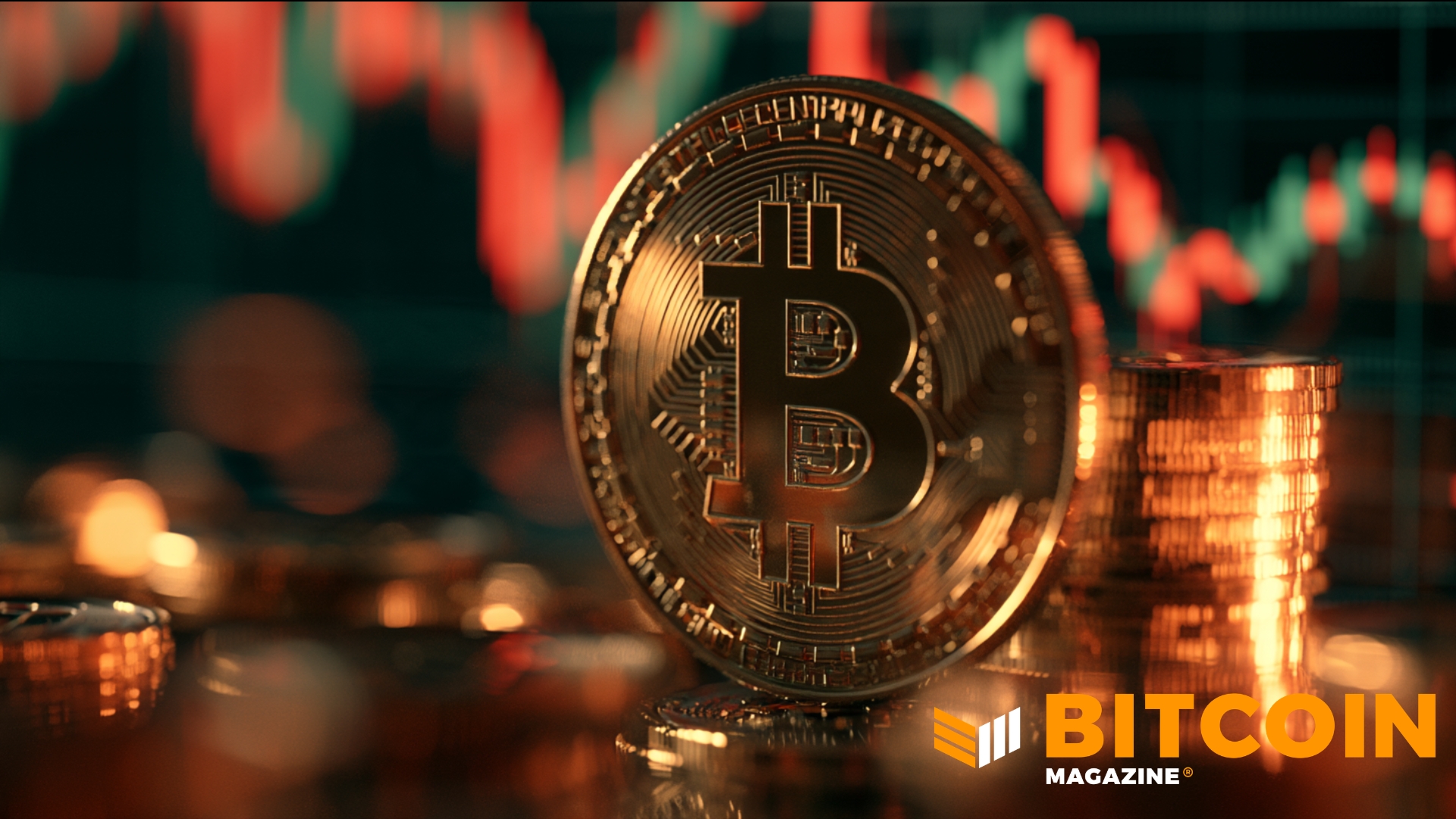
No ‘Uptober’ Yet: Bitcoin Slips 2% in a Month That’s Historically Bullish
Bitcoin’s price retook $82,000 on Monday as choppy trading last week stunted the coin’s gains.
The biggest cryptocurrency by market cap was recently trading for close to $82,393 — up by close to 2% over the past day but still down over a seven-day period.
Bitcoin has gotten off to a slow start for so-called Uptober, a month when the cryptocurrency has typically surged: Since the beginning of October, bitcoin’s price has dropped by 2%.
U.S. investors last week cashed out of exchange-traded funds, with speculators redeeming $228.4 million in shares from the investment vehicles managed by BlackRock, Fidelity, and Grayscale, according to data from Farside Investors.
Bitcoin is often moved by investors buying shares of the U.S. ETFs. The funds give investors easy exposure to the asset via shares they can buy on their brokerage accounts.
Despite the slow October so far, analysts have said that bitcoin is now in a bull market after spending most of 2026 trading under $70,000 — well below its all-time high of $126,080.
Bitcoin’s price started rallying in August after the U.S. Treasury Department said it would more than double the size of its government debt repurchases. The coin had its best run in three years and third best August ever.
The coin’s price has recently benefited from the so-called debasement trade: when investors buy certain assets to hedge against currency being devalued. The dollar slid in value in August.
It continued to have a good September, rising nearly 6% over a 30-day period. Bitcoin in the third quarter of this year had its best three months since 2024.
After a record third quarter, will October keep the streak alive?
This post No ‘Uptober’ Yet: Bitcoin Slips 2% in a Month That’s Historically Bullish first appeared on Bitcoin Magazine and is written by Mathew Di Salvo.
Bitcoin Magazine
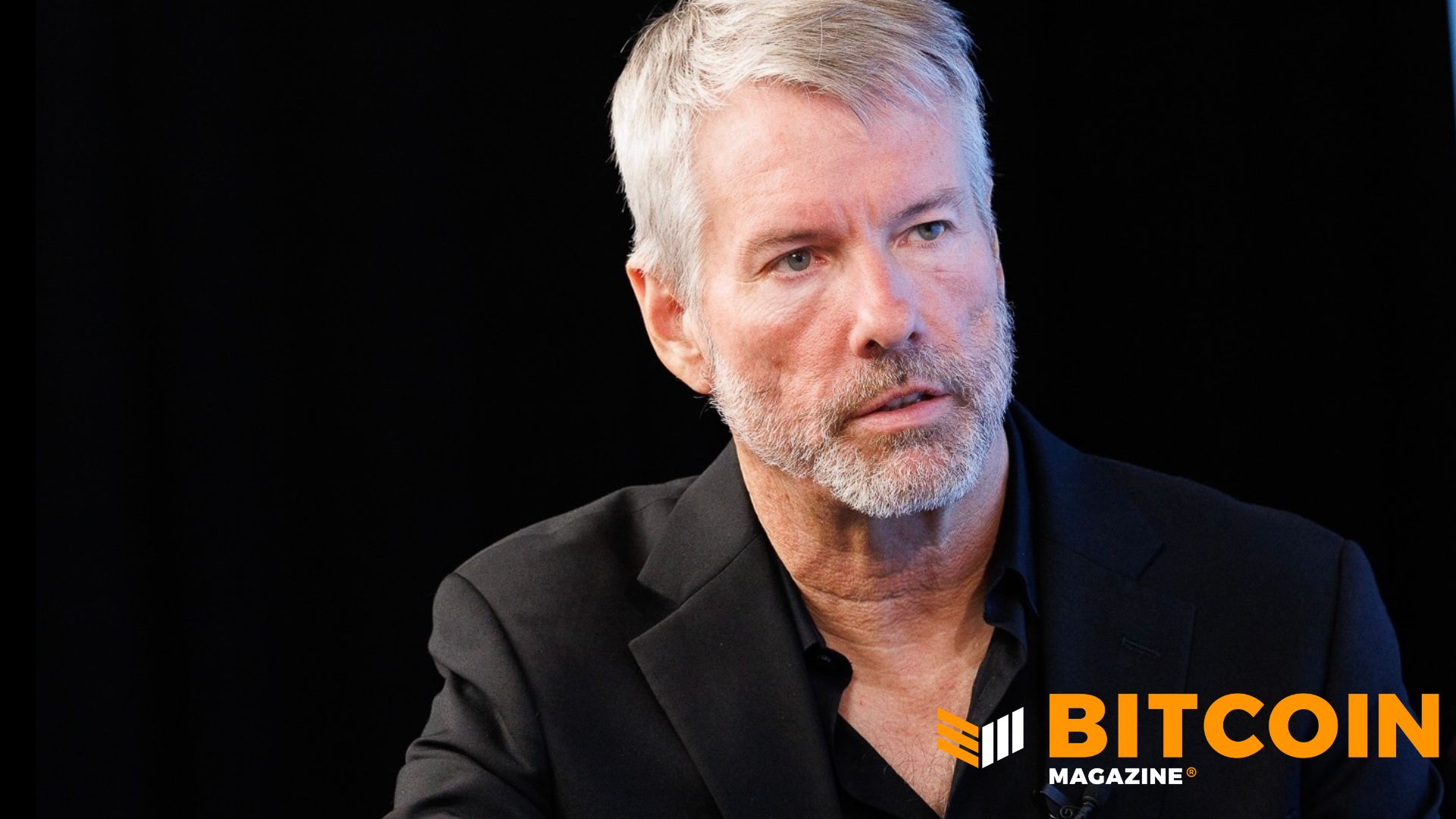
Strategy Keeps Buying: Third Purchase This Month Brings October Spending to $73 Million
The largest corporate holder of bitcoin, Strategy, bought another 267 BTC last week, bringing its holdings to 848,517 digital coins — worth $69.5 billion at today’s prices.
According to a Monday filing, the software company said it spent slightly more than $22 million on buying the new bitcoins.
The latest buy allowed Strategy to snap up slightly more coins than its transaction the previous week, when it spent again $22 million on 250 BTC. So far in October, Strategy has spent $73 million on buying bitcoin.
BREAKING:
— Bitcoin Magazine (@BitcoinMagazine) October 19, 2026Michael Saylor's Strategy buys 267 BTC worth $22 million
pic.twitter.com/16yaYZikHw
Strategy stock (NASDAQ: MSTR) was trading nearly 2% higher Monday morning New York time at about $139 per share. Over the past month, MSTR has dropped by 17%. Year-to-date, it’s down 11%.
Monday’s filing also shows that Strategy also repurchased $193.1 million of its STRC preferred stock.
Strategy has bought back its stock this year as its STRC preferred shares have traded below their $100 face value due to market volatility and index changes.
Strategy — formerly MicroStrategy — started buying Bitcoin in August 2020 as a way to generate better returns for its shareholders.
It has since spent around $64 billion on BTC, making it the largest corporate holder of the asset. Investors can buy its shares to gain exposure to the leading cryptocurrency without having to buy bitcoin themselves.
The company is now also focusing on products that pay investors yield via its STRF, STRC, STRK, and STRD preferred shares.
Strategy could face trouble soon though after Morgan Stanley Capital International last week said it was moving ahead with a proposal “to define and classify non-operating companies as ineligible for inclusion in the MSCI Global Investable Market Indexes.”
Such a move could eventually remove Strategy from the index, leading to fewer institutional investors holding the stock.
This post Strategy Keeps Buying: Third Purchase This Month Brings October Spending to $73 Million first appeared on Bitcoin Magazine and is written by Mathew Di Salvo.
Bitcoin Magazine

El Salvador’s National Bitcoin Office Hosts Five November Events Led by Herbert and Keiser
El Salvador’s National Bitcoin Office, led by Stacey Herbert and Max Keiser of Keiser Report fame, is hosting a series of Bitcoin events this November in El Salvador. Five main events will take place, with plenty of side events hosted by the local community.
The Bitcoin Capital Summit starts off the official schedule on November 10 at the downtown library and tech center, BINAES. Bitcoin Histórico runs November 11 and 12 at the National Palace and surrounding sites in Centro Histórico. The Renaissance Rodeo follows on November 13 at Lake Ilopango. EmTech AI LATAM is set for November 18 and 19 at the Escuela Superior de Economía y Negocios. The Global Bitcoin Circular Economies Summit closes the sequence on November 19 and 20 in El Zonte.
Bitcoin Capital Summit
The Bitcoin Capital Summit takes place on November 10 from 5:00 p.m. to 7:30 p.m. at BINAES in San Salvador. Hosted by Luca Esposito of Blockstream Capital Partners in collaboration with the Bitcoin Office, the evening is framed around Bitcoin’s institutional era from treasury to capital markets. The agenda includes a welcome by Luca Esposito, a keynote by Sean Bill, former CIO of BSTR at Blockstream, and a panel on the institutional Bitcoin stack featuring Pierre Rochard, CEO of The Bitcoin Company, and Juan Diego Sol, Regional Manager, Central America at IBEX. As well as a closing fireside with Max Keiser and Stacy Herbert, among other panels. Registration is free but approval-required through the official Luma page.
Bitcoin Histórico
Bitcoin Histórico runs November 11 and 12 across the Centro Histórico of San Salvador, with keynotes at the National Palace live-streamed to giant LED screens on Plaza Gerardo Barrios. Organized by the National Bitcoin Office, the conference focuses on Bitcoin, financial freedom, and El Salvador’s transformation. Tickets are sold exclusively in Bitcoin at bitcoinhistorico.com. The $350 Trailblazer Seat includes guaranteed seating, access to public sessions, tech demos, community meetups, and an invitation to the afterparty, while locals with Salvadorian ID can buy entry with the $21 Satoshi Chero ticket.
The $2,100 Genesis Crown Pass adds VIP seating inside the National Palace, fast-track entry, private lounge access with meals, an exclusive merch pack, and priority networking with keynote speakers.
All tiers include free admission to the Renaissance Rodeo the following day. Promo codes CROWN15 and Cowboy21 have been shared by organizers.
Renaissance Rodeo
The inaugural Renaissance Rodeo takes place on November 13 on the shore of Lake Ilopango. The event features bull riding, mutton busting, barrel racing, music, and barbecue, and is positioned as a celebration of Salvadoran cowboy culture and regenerative agriculture. Details and a waitlist are available at the official site renaissance.rodeo. Holders of any Bitcoin Histórico ticket receive free admission.
EmTech AI LATAM
EmTech AI LATAM runs November 18 and 19 at the Escuela Superior de Economía y Negocios. This is the first Latin American edition of the MIT Technology Review conference, organized with Opinno and local partner C² Labs and supported by the Agencia Nacional de Inteligencia Artificial. The agenda covers moving AI from pilots to production impact, governance, talent development, and technology trends. Coverage of the announcement is available via Diario El Salvador. Registration is available at emtechai-latam.com.
Global Bitcoin Circular Economies Summit
The Global Bitcoin Circular Economies Summit takes place November 19 and 20 in El Zonte. Organized by Bitcoin Beach and the Federation of Bitcoin Circular Economies, this is the first public edition of the gathering. Previous events have been invite-only and have gathered top international talent, focused on delivering the benefits of Bitcoin to the developing world.
Registration is free via the official Bitcoin Beach summit page. Confirmed speakers include Jeremy Almond, Co-Founder and CEO of Paystand, Alexandra Navarro of Paystand, Gerardo Linares, and Evelyn Lemus. The program focuses on Bitcoin as everyday money, merchant adoption, education, and lessons from circular economies across Latin America, Africa, and Asia.
This post El Salvador’s National Bitcoin Office Hosts Five November Events Led by Herbert and Keiser first appeared on Bitcoin Magazine and is written by Juan Galt.
Bitcoin Magazine

Financial Repression in the Age of AI
America can’t build its own defense equipment, robots, or AI hardware anymore, and Craig Tindale says that’s a national security crisis. Drawing on Alexander Hamilton and Dwight Eisenhower, he explains why decades of offshoring left the U.S. dependent on its rivals for critical metals. He also explains why he sees AI as a race to automate the world and build an impenetrable defense network.
 Host: Spencer Nichols — Bitcoin Magazine Craig Tindale — Independent Investor
Chapters:
0:00 – Craig Tindale: Financial Repression in the Age of Superintelligence
2:17 – Why Yields Are Rising Everywhere and Countries Don’t Go Broke
5:22 – Operation Twist and a New Treasury–Fed Accord
8:40 – Hong Kong’s Gold Vault and Why Nations Need Hard Assets
10:44 – Who Pays? Why Domestic Savers Bear the Cost of Financial Repression
14:39 – Stablecoins, the GENIUS Act and a Fragmenting Multipolar World
19:53 – Protectionism, Hamilton and the Case for Reindustrializing America
27:27 – AI as a Weapon: Automation, Code and State Capitalism
32:35 – Protecting Capital: Gold, Silver, Copper, Bitcoin and Diversification
37:20 – Resilience, Self-Sufficiency and the Fourth Turning
DISCLAIMER: The views and opinions expressed in this show are those of the participants and do not necessarily reflect the official policy or position of BTC Inc., Bitcoin Magazine, or any affiliated entities. This content is provided for informational and educational purposes only and should not be construed as investment, legal, tax, or accounting advice. Nothing contained in this show constitutes a solicitation, recommendation, endorsement, or offer to buy or sell any securities or financial instruments. Viewers should consult their own advisors before making financial or business decisions.
This post Financial Repression in the Age of AI first appeared on Bitcoin Magazine and is written by Mark Mason.
Bitcoin Magazine

Richard Byworth: Bitcoin’s Next Run “Just a Mater of Time” thanks to Seller Exhaustion
How do you earn yield on Bitcoin without risking your stack? Richard Byworth, who spent his career structuring for hedge funds, explains why Bitcoin is the hurdle rate for everyone, and why covered-call overwriting can cost you a significant portion of your Bitcoin in a rally. He walks through how basis trades collateralized by Bitcoin can deliver low-volatility, market-neutral returns.
Chapters:
0:00 – Richard Byworth on Leaving Syz Capital Over Bitcoin Treasuries
1:43 – Earning Yield in Bitcoin and Why Covered Calls Are Risky
3:51 – Basis Trading: Earning Dollars Collateralized by Bitcoin
4:47 – Inflation, AI Borrowing and How Digital Credit Pressures the Treasury
8:39 – Record Seller Exhaustion: Is the Bitcoin Bottom In?
9:55 – Why SATA Reached Par Before STRC
13:51 – Digital Credit Funds in Swiss Francs
15:51 – MSCI’s “Attack” on Bitcoin Treasury Companies
17:20 – Bitcoin Bonds for Nations: Working With JAN3
20:06 – El Salvador’s Bitcoin Bond and Bitcoin in the Mortgage Market
DISCLAIMER: The views and opinions expressed in this show are those of the participants and do not necessarily reflect the official policy or position of BTC Inc., Bitcoin Magazine, or any affiliated entities. This content is provided for informational and educational purposes only and should not be construed as investment, legal, tax, or accounting advice. Nothing contained in this show constitutes a solicitation, recommendation, endorsement, or offer to buy or sell any securities or financial instruments. Viewers should consult their own advisors before making financial or business decisions.
This post Richard Byworth: Bitcoin’s Next Run “Just a Mater of Time” thanks to Seller Exhaustion first appeared on Bitcoin Magazine and is written by Patrick Green.
CryptoSlate
CFTC data for Oct. 13 show rising spread legs lifted gross longs despite fewer outright longs, without establishing spot buying.
Read the full story on CryptoSlate
Understand the crypto stories that matter and what to watch next. Get The Catalyst in your inbox
Crystal’s selected cohort cut USDT balances in Q3, while Allium assigns it 84% of January–September 2026 classified payment value.
Read the full story on CryptoSlate
Understand the crypto stories that matter and what to watch next. Get The Catalyst in your inbox
GHO would remain transferable, while a return swap, withdrawal of USAT and issuer redemption would each face separate conditions.
Read the full story on CryptoSlate
Understand the crypto stories that matter and what to watch next. Get The Catalyst in your inbox
A moving weekend index helps explain how a 5.9% opening-to-low mark decline coexisted with minute-close mark/index gaps below 3%.
Read the full story on CryptoSlate
Understand the crypto stories that matter and what to watch next. Get The Catalyst in your inbox
Fast sampled blocks do not establish the maximum proving burden, while Ethereum’s CPU gas analysis excludes proof generation.
Read the full story on CryptoSlate
Understand the crypto stories that matter and what to watch next. Get The Catalyst in your inbox
CryptoTicker.io
Seventy-six minutes passed between the unauthorised mint and the freeze, and in that time the damage was already done. On Saturday, October 17, 2026, at 12:31:38 UTC, ten million CYS came into being on BNB Smart Chain without anyone having deposited a single token. The Cysic Foundation added the recipient address to the token contract's blacklist at 13:47:52 UTC. By then, 7.2 million of the new tokens had already left the address, around 72 percent of the mint.
The bridge the attack ran through has been switched off since, and the foundation has named no date for a restart. For holders that is the real point: what decides the fate of the rest of a position is not the price swing but the question of which blockchain your own tokens sit on and who is allowed to create them there.
What happened in the 76 minutes between mint and blacklist
The chronology can be read off the movements on the blockchain, and it is tightly timed. Five minutes after the mint, at 12:36 UTC, the first selling round began: 5.65 million CYS went out within five minutes for 588,315 USDT, at an average of about ten cents per token. At 12:44 UTC, 100,000 USDT left the setup through a bridging service, and a minute later 40.88 ETH arrived on Ethereum.
At 12:53 UTC, 488,315 USDT followed in six transfers through another service. Between 12:57 and 12:59 UTC the second selling round ran, with roughly 1.55 million CYS that brought in about 220 BNB. Shortly afterwards, between 13:05 and 13:06 UTC, 80 and 139 BNB were withdrawn by two different routes. At 13:11 UTC a second wallet received 306.52 ETH in five transfers. The industry service Cryptopolitan traced this sequence from the transactions on October 18.
By the time the blacklist took effect at 13:47:52 UTC, the address had sent no tokens for 48 minutes. The freeze therefore only bit once the outflow was long over; all it caught was the remainder left behind.
Unauthorised mint: how ten million CYS arose with no deposit
A mint is the creation of new tokens by a smart contract. On a cross-blockchain bridge, that process is normally tied to something given in return: anyone wanting to move tokens from one blockchain to another locks the original on the source blockchain, and only then does the contract create a representation on the destination blockchain. That representation is called a wrapped token and is nothing other than a voucher for the locked original.
It is precisely that coupling that broke here. According to the Cysic Foundation's report, published on October 18, 2026 on the @cysic_fdn account, the attacker gained unauthorised access to a database serving services around the bridge operation. They then used a weakness in the processing of messages to submit a forged mint instruction that bypassed the check. The foundation explicitly describes these findings as preliminary; the definitive cause has not yet been confirmed.
What arose in the process were not duplicates of existing tokens but ten million units with no backing whatsoever on the source blockchain. The voucher existed, the collateral behind it did not.
The cause according to the Cysic Foundation: access to a bridge database
The foundation draws a clear boundary around the incident in its report. Affected was solely the processing of bridge messages and the creation of tokens. Consensus, block production and smart contract execution on the Cysic mainnet remained untouched, it says, and existing user balances were not stolen.
That distinction matters, and reports on incidents often blur it. An attack on a bridge hits the accounting between two blockchains, not users' wallets. If your tokens sit under your own keys, nothing was taken from you. Hold wrapped tokens, by contrast, and you hold a claim whose backing has just deteriorated.

6.22 percent more in circulation: what the mint does to supply
The scale only becomes clear in relation to the existing stock. Around 160.8 million CYS are in circulation out of a maximum supply of one billion. Ten million additional tokens therefore amount to 6.22 percent of circulating supply, created on a Saturday lunchtime in a little over a minute. At the price of $0.1113 at which CYS stands on October 19, 2026, the mint has a value of roughly $1.11 million.
What is decisive here is the ratio to market depth. Total daily turnover in CYS runs to about $1.75 million. The 7.2 million tokens sold come to around $801,000 at today's price, close to half of a full trading day. Selling pressure of that size cannot be absorbed in a market of that depth without the price giving way.
The price itself shows how little cushion there is. CYS reached its high of $1.78 on August 15, 2026, and its low stands at $0.1063. At $0.1113 the token trades 4.7 percent above that low and 93.7 percent below the high.
Blacklist in the token contract: why 2.8 million CYS are stuck and 306 ETH are not
A blacklist is a function in the token contract with which the operator can bar individual addresses from sending and receiving. Here it froze around 2.8 million CYS, the 28 percent of the mint that still sat on the recipient address.
The reach of that freeze, however, ends exactly at the token. It applies to CYS on BNB Smart Chain and nowhere else. By that point the proceeds had already been swapped into USDT, BNB and finally a total of roughly 306.6 ETH and moved to Ethereum, which at an ether price of about $2,372 on October 18 corresponded to a value of around $727,000. The blacklist does not reach those funds.
For judging a token, that means two things. A blacklist function can save what has not yet been moved in the event of damage, and in this particular case it was useful. At the same time, its existence means a central party can decide at any time how freely your own tokens can move.
Wrapped tokens and bridge risk: what a bridged token really is
Move a token across a bridge to another blockchain and you exchange a property right for a claim. On the destination blockchain you hold a representation whose value depends on the original staying locked on the other side and on nobody being able to create further representations without backing. Both hang on the technology and on the bridge operator's keys.
A hardware wallet offers no protection against this kind of damage. The device keeps the private key such that nobody can take tokens out of your wallet. That does not help against a dilution of supply on the destination blockchain, because the attack does not go after your key at all. Which devices solve that task how, and where the differences in handling lie, is set out in our hardware wallet comparison.
The second way around this risk is to do without the bridge. Hold a token on its source blockchain, or leave it with a provider that takes on custody, and you carry other risks, but not this one.
CYS on 13 venues: not a single euro pair
For investors in Germany, where a token can be had at all is part of weighing the risk. cryptoticker.io compiled this survey itself on October 19, 2026. It is based on the 15 trading pairs CoinGecko lists for CYS, spread across 13 venues.
The result: not one of those 15 pairs is against the euro. Nine run against the dollar stablecoin USDT, one against Bitcoin, one against the South Korean won, and the remaining four against stablecoins directly on BNB Smart Chain. The largest single venue by turnover is in South Korea. The two decentralised venues on BNB Smart Chain account for 816,538 of the $3.01 million in total daily turnover, or 27.1 percent.
In practice that means: anyone wanting to buy CYS goes either through an exchange outside the European Union or through a decentralised venue on precisely the blockchain where the mint took place. Buying in euros from a provider that falls under the European MiCA regulation and uses its authorisation in Germany is currently not an option for this token. Which providers hold that authorisation and what it means for you is set out in the overview of regulated crypto exchanges.

$700 million through bridges: Cysic in the 2026 annual tally
The incident does not stand alone, and that can be quantified. cryptoticker.io compiled this survey itself on October 19, 2026, on the basis of the 299 incidents DefiLlama records for 2026. Together they account for $2.25 billion in damage.
Of those, 32 incidents involve bridges and cross-blockchain procedures, with damage of $700.1 million between them. Seventeen incidents concerned the unauthorised creation of tokens, the same mechanism as at Cysic, totalling $349.2 million. The largest single case of that kind hit Liquid Network in September with $320 million.
The Cysic case is a small one in that series. What makes it instructive is the speed: 35 minutes passed between the first forged message and the proceeds flowing out onto another blockchain. How hard such gaps are to find in advance was broken down in our piece on the scope of crypto audits. A similar case hit the routing of Bitcoin across another bridge in October, covered in our report on the Symbiosis exploit.
Mint rights, blacklist, backing: what can be read off the token contract
Three properties of a token contract determine how large this risk is for a particular position, and all three are publicly visible.
The first is the mint right. In any block explorer, the verified contract shows whether a mint function exists and which address may call it. If it hangs on a single address, that address's security determines the supply. If it hangs on a multi-signature contract, the bar is higher.
The second is the blacklist. Where it exists, the operator can immobilise addresses, to holders' benefit in the event of damage and to their detriment in a dispute. Both belong in the assessment.
The third is the backing. With a bridged token, the supply on the destination blockchain can be compared with the balance locked on the source blockchain. Where one diverges from the other, there are representations without collateral. That difference was precisely the damage on October 17.
Documenting losses: what to evidence in the event of a total loss
Anyone affected by an incident like this needs evidence first, regardless of how the case turns out. German tax law treats gains from the sale of crypto assets as a private disposal, in which the one-year holding period and the exemption threshold play a role. How a loss from a theft or from a token that has become worthless is to be classified in an individual case depends on the facts and belongs with a tax adviser; there is no blanket answer for it.
Independently of that, the evidence can be secured: transactions with timestamps and addresses, acquisition costs, the price level at the time of the incident, and the project's own publications. Tools that record such events across several exchanges and wallets are set out in the comparison of tax software and portfolio trackers. The later such documentation is put together, the more gaps it will have.
How things proceed at Cysic and which dates remain open
The foundation has announced a second report covering the verified scale of the damage, the tracing of the funds and the countermeasures. There is no date for it. Equally open is when the bridge will run again; the condition the foundation names is the completion of a security review, for which it has brought in an external firm.
Until then the route between the Cysic mainnet and BNB Smart Chain stays closed. Trading in CYS on BNB Smart Chain itself continues, as does trading on the exchanges that list the token. What remains open is how the 2.8 million frozen tokens and the supply that has grown by 6.22 percent will be handled. Whether and how the additional tokens will be taken out of circulation again, the foundation has not so far said.
Cysic bridge: without a restart the route to BNB Chain stays shut
Three steps make sense now, and in this order:
- Check which blockchain your tokens sit on. For every bridged balance the rule holds: the representation is worth only as much as its backing. A balance held under your own keys is protected against theft, not against dilution. Which device suits you is shown in the hardware wallet comparison.
- Look at the contract's mint rights before you buy more. A single address with a mint right is a risk that can be established in two minutes in a block explorer. For anything you want to buy in euros from an authorised provider, the overview of regulated crypto exchanges sets the frame.
- Document every position before the situation clears up. Acquisition costs, dates and price levels belong on record while they can still be retrieved. The tools for that are in the comparison of tax software.
(As of October 19, 2026. This article is not investment advice. Prices and fee structures change; check the terms with the provider before you buy.)
The stablecoin USD1 has shrunk by roughly $401 million in two weeks. Its market capitalisation fell from about $4.43 billion on October 6 to around $4.02 billion, a drop of 9.1 percent. The dollar price held steady throughout: the token traded consistently between $0.998 and $1.000. What shrank, then, was not the price but the number of tokens in circulation.
Who triggered that decline is the striking part. According to an analysis by the blockchain research outfit Onchain Benchmark, just under $200 million of the redemptions trace back to a single address whose owner is unknown. For holders in Germany, a practical question hangs on this: what rights do you have against the issuer when a stablecoin shrinks quickly?
What happened to USD1 between October 6 and October 19
USD1 is a dollar-pegged stablecoin issued by World Liberty Financial. A stablecoin of this design holds its price through deposited reserves rather than an algorithm: for every token issued, a dollar or a dollar-like asset is meant to sit with the issuer.
Between October 6 and October 19, 2026, market capitalisation fell by about $401 million according to CoinGecko data. World Liberty Financial's proof-of-reserves dashboard showed roughly $4.01 billion in reserves over the same period, a figure close to the reported market capitalisation. CoinGecko data put USD1 at $0.9990 on October 19, 2026, with a market capitalisation of $4.01 billion and daily turnover of around $958 million.
For a sense of scale: Tether (USDT) stood at roughly $183.5 billion the same day, USDC at about $72.3 billion. At four billion dollars, USD1 is a mid-sized stablecoin, where a single withdrawal of several hundred million dollars lands hard in percentage terms.
$184.60 million on Ethereum: 63 burns through the BitGo wallet
When a stablecoin is redeemed, the returned tokens are destroyed. That process is called a burn: the issuer takes the tokens out of circulation and pays out from the reserve in exchange. Every burn is visible on the blockchain, and that is precisely how a decline can be recalculated.
On Ethereum, Onchain Benchmark counted net redemptions of $184.60 million between October 6 and October 15, spread across 63 burns. USD1 circulation on Ethereum fell 11.45 percent over those nine days. More than 99 percent of the tokens submitted for redemption ran through a wallet labelled as BitGo, according to that analysis. BitGo is currently the issuer and custodian of USD1.
63 burns over nine days works out at an average of around $3 million per transaction. The picture on Ethereum is therefore one of a broader return by many participants, not of a single exit.
$200.43 million on BNB Chain: a single address behind nearly all of it
On BNB Chain the distribution looks entirely different. There, Onchain Benchmark recorded $200.43 million in redemptions over the same period, but only 12 burns. Just under $200 million of that came from a single address, which returned tokens in tranches of $30 million to $50 million.
Who controls that address, and why the tokens were returned, the research outfit says it could not establish. That is an important caveat: a large return could be a market maker reshuffling holdings, an exchange holding client money differently, or a fund getting out. Blockchain data alone cannot separate those cases.
Why circulation was not merely shifted between blockchains
With a token that exists on several blockchains, the first cross-check is always the same: has the balance really disappeared, or has it just moved? USD1 runs on Ethereum, BNB Chain and Solana, among others.
Onchain Benchmark puts cross-blockchain transfers between Ethereum and BNB Chain at less than $1 million over this period. On Solana, the USD1 balance stayed at around $1.42 billion across the nine days examined, so nothing new was issued there to offset the redemptions either. The decline is therefore a genuine reduction in circulation, not a relocation.

The dollar price held: $0.998 to $1.000 over nine days
The real stress test for a stablecoin is its price, not its size. When a token meant to be a dollar falls persistently below a dollar, that is called a depeg, and at that point a means of payment turns into a risk asset.
That did not happen here. Onchain Benchmark found no sustained depegging over the period studied; the price moved between $0.998 and $1.000. That a return of several hundred million dollars was processed with no visible price effect suggests the reserves were available at that scale.
USDC, USDT and USDe over the same period: the comparison on Ethereum
An 11.45 percent decline on Ethereum says little on its own. It only becomes interesting next to the other large dollar tokens over the same window. For October 6 to 15 on Ethereum, Onchain Benchmark reports the following changes: USDe lost 4.93 percent, USDC 2.18 percent, circulating USDT 0.76 percent.
October was therefore a month of outflows for several dollar tokens, but USD1 sat well clear of the field. Part of that is the arithmetic of the smaller number: for a token worth four billion dollars, a $200 million withdrawal weighs more than it does for one worth $183 billion.
Burn, redemption, proof of reserves: the terms in brief
Redemption means a holder submits tokens to the issuer and receives money for them. Burn is the technical part of that: destroying the submitted tokens on the blockchain. Proof of reserves is a disclosure by the issuer of which assets it holds as backing.
A proof-of-reserves dashboard is not, however, an audit by an independent accountant. It shows what the issuer reports as backing, and it says nothing about what liabilities sit alongside it or how quickly those assets would turn into cash. Anyone wanting to judge how robust a stablecoin is therefore reads both side by side: the reported backing and the conditions under which the issuer actually pays out.
MiCA and the redemption right under Article 49: what applies to USD1 in Germany
For holders in Germany it is the European MiCA regulation that decides, not US law. It treats stablecoins pegged to a single currency as e-money tokens. Article 49 of MiCA obliges the issuer of such a token to redeem it at any time, at par and free of charge. Article 50 also prohibits paying interest on e-money tokens.
That claim depends on authorisation. As the ESMA register stood on September 30, 2026, USDC and EURC are authorised as e-money tokens, issued by Circle Internet Financial Europe and supervised by France's ACPR. For USDT and USD1 there is no register entry. Which stablecoins are listed with which MiCA status is tracked continuously in our overview of stablecoins with MiCA status.
In practice that means: if you hold USD1, your redemption follows the issuer's terms and not the European claim to par value. What obligations authorisation brings with it, and how to recognise an authorised provider, is covered in our overview of MiCA licensing duties for crypto companies.

Concentration risk: when a few large holders carry the size
The finding on BNB Chain describes a pattern that appears more often with young stablecoins: a substantial share of circulation sits with a few addresses. Twelve burns for $200 million means a handful of large participants exited here, not a mass of retail holders.
For small holders no immediate loss follows from that, as long as price and reserves hold. A dependency does follow, though. When a large holder withdraws, the token's liquidity on trading venues falls, trading pairs thin out, and spreads can widen. Anyone using a stablecoin as a parking position between two purchases notices that first when selling.
The switch of issuer to the trust company: the next test
Onchain Benchmark points to a step ahead: "The next tests come with the change of issuer." World Liberty Financial has announced that a trust company of its own is to take over the issuance of USD1. The research outfit reads that as meaning this company would take on a token whose size depends on a few large holders, and do so under a charter whose legal basis is being litigated. The report gives no date for the opening.
A change of issuer is no marginal formality for holders. With it come a different counterparty, a different custodian and a different supervisor, and therefore a different address against which a redemption claim is directed at all. The background on the trust company and the open questions is set out in our piece on the World Liberty Financial US Trust Bank.
What is established and what remains open
Established is the order of magnitude: roughly $401 million less in circulation, $184.60 million of redemptions on Ethereum, $200.43 million on BNB Chain, a stable price between $0.998 and $1.000, reported reserves of around $4.01 billion.
Open is the cause. Neither who controls the large address on BNB Chain nor why tokens were returned there is known. No accusation against the issuer follows from a decline in circulation alone: redemptions are the intended way to leave a stablecoin, and that they worked without breaking the price is, for now, a sign that the mechanism held. Reading more into it would require information that nobody currently has in public.
USD1 in Germany: no MiCA entry, no claim under Article 49
Three steps make sense now if you hold dollar stablecoins:
- Check the authorisation status of your stablecoins. What matters is whether the token is listed in the register as an e-money token, because the claim to par value under Article 49 hangs on that. The status per token is in the stablecoin overview with MiCA status.
- Check which provider you hold through. A service provider authorised in the EU is subject to rules on segregating client funds and on custody. Which houses hold an authorisation is shown in the comparison of regulated crypto exchanges.
- Weigh holding period against risk. For brief parking between two purchases, liquidity counts; for longer holding, the legal framework counts. Anyone holding larger balances over longer periods should factor in custody away from the exchange; the differences are set out in the hardware wallet comparison.
The figures in this report come from the Onchain Benchmark analysis published on October 19, 2026, and from CoinGecko market data of the same day. They can be read in the Cointelegraph report and at Onchain Benchmark.
(As of October 19, 2026. This article is not investment advice. Prices and fee structures change; check the terms with the provider before you buy.)
The XRP Ledger reported transfers worth $49.66 billion on Monday. That is 60.4 percent of XRP's entire market value, moved in a single day. On exchanges, $1.47 billion changed hands over the same 24 hours, one thirty-third of that figure. The fees the network withheld and destroyed for the whole movement come to roughly $664.
XRP traded at $1.30, or 1.16 euros, on Monday evening, after a daily low of $1.26 and a high of $1.32. Which ranges are in play at all over a horizon of months is set out in our XRP price prediction. This piece takes on the number that ran through Monday's market reports and works out what it says about demand. The answer is a sober one.
$49.66 billion in a day: what Santiment measured
The figure comes from the data service Santiment and was circulated on Monday morning by the analyst account Ali Charts. What it measures is the dollar value of all coins that moved from one address to another on the blockchain within 24 hours. Santiment itself calls the spike anomalous.
What matters is what this metric is not. It is not a trading volume. It does not count purchases or sales. What is added up are amounts that changed their place on the blockchain, regardless of whether an owner changed with them. An exchange moving 2 billion XRP from a hot to a cold custody address generates a billion-dollar figure in this statistic without a single investor having bought anything.
For a sense of the orders of magnitude: XRP's market value stood at $82.16 billion on Monday evening, with 63.13 billion XRP in circulation out of 99.99 billion in total. A transfer volume of $49.66 billion therefore claims that a good three fifths of all existing XRP changed place within a single day.
$664 in fees: what the movement cost the network
This is where a cross-check is possible, using numbers that come straight from the blockchain. Every transaction on the XRP Ledger carries a fee, and that fee goes to no one: it disappears from the total supply. The total supply appears in every closed ledger in the total_coins field. The difference between two ledgers is therefore the sum of all fees paid between them.
In ledger number 107,765,823, closed on Monday evening, the value reads 99,985,589,187.52 XRP. In ledger 107,739,858 from Sunday afternoon it still stood at 99,985,589,698.40 XRP. Between the two lie 25,965 closed ledgers and a difference of 510.88 XRP. At Monday's price of $1.30, that is $664.
Measured against the claimed transfer volume, that means the network collected $13.37 in fees for every $1 billion the statistic says was moved. That is precisely why transfer volume grows so easily on this blockchain. Shift $10 billion between two addresses you own and you pay fractions of a cent for it. It is not expensive, and for that very reason it is not meaningful either.
The network's base fee is 0.00001 XRP per transaction. In practice more is due, because the fee rises under load. The 510.88 XRP across 25,965 ledgers works out at an average of 0.0197 XRP per ledger. Every one of these values can be looked up in the public XRP Ledger explorer.
Why a high transfer volume says nothing about demand
The mechanism behind it takes three sentences. A purchase happens on an exchange, in the order book, and it shows up in spot turnover. Nothing of it appears on the blockchain at first, because the exchange rebooks internally. Only when someone withdraws their XRP does a transfer arise, and that then says something about custody, not about demand.
The reverse holds too. The largest items in a transfer statistic typically come from four sources: exchanges reshuffling between their own addresses, market makers balancing their holdings across several venues, custodians consolidating client balances, and individual large holders redistributing their positions. None of those four movements is a buy order.
Spot turnover, by contrast, is the number that counts when demand is the question. It stood at $1.47 billion on Monday, 68 percent above Sunday's $872 million. That is a genuine increase, and it is the real news of the day. It is simply 33.8 times smaller than the figure that ran through the reports.
How to look up the total supply on the XRP Ledger yourself
Anyone with a spare minute can follow the calculation above. In the XRP Ledger explorer, pick a confirmed ledger and find the total_coins field in the data set. The value is given in drops, that is millionths of an XRP. Separate six digits from the end and you have the amount in XRP.
Take the same value again 24 hours later. The difference is the amount of XRP destroyed by fees over that period. Nothing more is needed to place a volume report: if a supposedly enormous movement is matched by a fee total in the tens or hundreds of dollars, the movement was cheap and therefore no evidence of demand.
Two further values are worth a look, because they determine the cost of running your own address. The base reserve is 1 XRP, currently around $1.30. Every additional entry in an address, such as a trust line for a token, ties up a further 0.2 XRP. These amounts are not lost, but for as long as the address exists they are locked and cannot be transferred.
Hold through an exchange instead and you pay no network reserve but trading and withdrawal fees, and those differ widely. What each provider charges in Germany is set out in our crypto exchange comparison.
11.81 billion XRP sit on exchanges
Against Monday's friendly reading stands a second number. XRP reserves held on exchanges reached a local high of 11.81 billion XRP, according to the day's market reports. Measured against the 63.13 billion XRP in circulation, that is 18.7 percent.
That amount sits where selling happens. It is not a sell signal, because holdings on exchanges can equally sit there for years. It is, however, the ceiling on what can hit the market at short notice, and it has just risen rather than fallen.
One caveat belongs with it, because it is often missing. Exchange reserves are estimates. They are arrived at by data services assigning addresses to particular venues. If an address is assigned wrongly or not at all, the figure shifts. As a direction it is reliable; as an exact balance it is not.

ETF inflows break after 13 weeks
The third number comes from the fund side, and it is the most uncomfortable. In the week to October 16, US spot ETFs on XRP recorded a net outflow of $1.84 million, according to SoSoValue data. That ends a run of 13 inflow weeks that had been going since the start of July.
A single day accounts for most of it. Canary Capital's XRPC fund saw $2.47 million leave on October 16. Without that session the week would have stayed positive on the same reports. The funds' net assets stand at roughly $1.47 billion, down from about $1.57 billion a week earlier, a decline of 6.4 percent.
The outflow is small compared with a market value of $82 billion. Its significance lies in the sign. For 13 weeks the fund side was the reliable buyer, taking up material regardless of the daily news. That reliability is gone for now, and it is missing in precisely the week in which exchange reserves are rising.
$1.26 and $1.32: Monday's levels
Two documented levels emerge from the daily data. The daily low of $1.26 sits 3.1 percent below Monday's price and marks the point where buyers stepped in during the morning. The daily high of $1.32 is the other side. For as long as the price stays between the two, Monday is a recovery day within a weak week and nothing more.
The longer lines support that reading. Over seven days XRP is down 5.5 percent, over 30 days 9.8 percent, and it remains 64.4 percent short of its record of $3.65. Monday's jump changed none of those figures.
A third level appears in the day's market reports, and it is explicitly not ours. The chart analysis there sees a target of $1.80 to $2.00, but only above $1.56. That is 20 percent away, and for as long as the gap exists, the target is a condition rather than an expectation.
What has changed in the numbers since Sunday
On Sunday this space worked through the supply side, namely the fee burn against the escrow release. XRP stood at $1.29 then, and $1.28 was named as the decisive level. That level held. The price now sits 0.6 percent higher.
Two things have been added since. First, the 510.88 XRP the network destroyed across the 25,965 ledgers since Sunday afternoon, which puts the total supply at 99,985,589,187.52 XRP. Second, Monday's volume report, which bears no relation in scale to the fee total, and which is exactly why it has been recalculated here.
Unchanged is the date that governs the supply side in November. On November 1 the escrow contracts open and release 1 billion XRP. Against that amount the burn since Sunday is negligible, and Monday's transfer volume changes nothing about it either.

What German investors can actually buy
The ETF figures in the section above refer to spot funds listed in the US. For retail investors in Germany these funds are not the route in, because they are not approved for distribution here. Read those numbers and you are reading demand you are not part of. As a sentiment gauge they remain useful nonetheless.
In practice two routes remain in Germany. The first is buying the coin directly from a provider with a MiCA licence, with the option of taking the holdings into your own custody afterwards. The second is exchange-traded notes on XRP, which run through a securities account. The two routes differ on three points, and those are worth laying side by side before you buy.
First, the legal nature. A spot purchase makes you the owner of the coin. A note is a claim against an issuer, even when it is collateralised, and it therefore carries that issuer's default risk. Second, the running costs: trading fees and spread against the paper's annual management fee. Third, custody: with the coin you can choose between exchange custody and your own keys, with the paper you cannot.
The editorial team's assessment
Our assessment: Monday's transfer volume is not a buy signal, and anyone selling it as one has not done the arithmetic. The evidence is above and can be checked: $664 in fees for a supposed $49.66 billion of movement, spot turnover of $1.47 billion, exchange reserves at a local high of 11.81 billion XRP, and a fund week that comes out negative for the first time after 13 positive ones.
What argues against our reading belongs here too. Spot turnover rose 68 percent against Sunday, and liquidations in the futures market stayed small at $5.75 million according to the day's reports. That combination suggests Monday's recovery really did come from the cash market rather than from forced position closures. It is a genuine argument. It only supports the $1.47 billion, not the $49.66 billion.
XRP at $1.30: $664 in fees does not carry a rally
Monday evening's picture can be worked through in three steps:
- Recalculate the number itself. Before a volume report justifies a buying decision, compare it with the same day's spot turnover. Which tools report such data is shown in the comparison of analytics platforms.
- Settle the custody question. When 18.7 percent of the circulating supply sits on exchanges, whether your holdings need to sit there too is not a theoretical question. The devices and how they differ are set out in the hardware wallet comparison.
- Document the purchases. Purchase date, amount and price per tranche belong on record before the number of tranches gets out of hand. What automates that is covered in the comparison of crypto tax software.
(As of October 19, 2026. This article is not investment advice. Prices and fee structures change; check the terms with the provider before you buy.)
The euro plays a minor role in Shiba Inu trading, and a smaller one than the Turkish lira. A proprietary analysis of the hundred highest-turnover trading pairs, taken on Monday afternoon, October 19, 2026, puts the euro at 1.59 percent of all reported daily turnover. The lira accounts for 6.54 percent, the Korean won for 5.16 percent. Four fifths of the trading runs through the dollar stablecoin USDT.
For an investor in Germany, that is not a statistic at the margin. The share determines how tightly bids and offers sit in your order book, how far apart bid and ask prices lie, and how much a larger order moves the price. For where the price could reach over a horizon of months, see our Shiba Inu price prediction. This piece looks at what sits between your order and that price.
Shiba Inu in euros: 1.59 percent of trading, the lira carries four times as much
SHIB traded at $0.00000502, or 0.00000446 euros, on Monday afternoon, up roughly 2.2 percent over 24 hours. The daily high was $0.00000504, the low $0.00000480. Over one week the coin is down 7.5 percent, over thirty days 8.7 percent, over twelve months 50.7 percent. Market capitalisation stands at about $2.95 billion, rank 36 in the overall market. All figures come from CoinGecko, retrieved on the afternoon of October 19.
More telling than the price level is which currencies that trading runs through. Across the fifteen counter-currencies in the top 100 pairs, the split looks like this:
- USDT: $41.04 million, 80.51 percent
- Turkish lira: $3.34 million, 6.54 percent
- Korean won: $2.63 million, 5.16 percent
- USDC: $1.35 million, 2.65 percent
- US dollar: $1.28 million, 2.51 percent
- Euro: $0.81 million, 1.59 percent
That leaves the euro in sixth place, behind two currencies from countries whose crypto markets have traditionally been carried by retail investors. Turkish demand for dollar-linked and speculative assets follows from the country's history of inflation, and the Korean market has for years been treated as a world of its own, with price premiums to match. The German investor trades in a book smaller than either.
How this analysis was produced
The figures come from a query of our own. On October 19, 2026 we called CoinGecko's public interface for the Shiba Inu trading pairs, sorted by turnover, first page with one hundred pairs. For each pair the interface reports 24-hour turnover converted into dollars, along with the bid-ask spread in percent as quoted at that moment. The sum across all hundred pairs came to $50.98 million. The same provider's coin endpoint gives $47.7 million of total turnover for the same period; the gap between the two numbers stems from different retrieval times and from the pair list ending at one hundred entries. Both values are quoted here rather than smoothing one of them away. The method is set out in the documentation for the interface and can be repeated by anyone.
Two caveats belong with it. First, exchanges report their own turnover, and not every report carries the same weight. Second, a bid-ask spread is a snapshot; it moves through the day, and more sharply in thin books than in deep ones. The orders of magnitude below do not change because of that, the second decimal place does.
Seven euro pairs and $811,651 a day
Behind that 1.59 percent sit seven trading pairs against the euro, carrying $811,651 of daily turnover between them. This is how they split, each with the bid-ask spread quoted at the time of retrieval:
- Bitvavo: $311,683, spread 0.074 percent
- Kraken: $156,937, spread 0.022 percent
- Bit2Me: $153,798, spread 0.022 percent
- Niza.io: $78,469, spread 0.045 percent
- WhiteBIT: $61,255, spread 0.670 percent
- Coinbase: $25,540, spread 0.224 percent
- Binance: $23,969, spread 0.224 percent
On the arithmetic, each of those pairs carries around $116,000 of turnover a day, or roughly $4,800 an hour. The largest euro pair averages about $13,000 an hour, the two smallest around $1,000. An order of 10,000 euros is no longer a routine event on those smaller venues; it is a noticeable slice of hourly turnover.

The spread varies 30-fold
The bid-ask spread is the gap between the highest bid and the lowest offer in the order book. That gap is a cost that no fee schedule discloses: buy immediately at the market price and you pay the ask, sell immediately and you receive the bid, and the difference stays in the market.
Between the cheapest and the most expensive euro pair on the measurement day sits a factor of 30, from 0.022 to 0.670 percent. Same coin, same blockchain, same day, and still a thirtyfold difference in invisible costs depending on the venue. For Bitcoin, where euro books are considerably deeper, the same range at the major venues runs to a few hundredths of a percent.
What an order of 1,000 euros actually costs
A simple calculation makes the scale tangible. Buy 1,000 euros of SHIB and sell it again later, and you pay the bid-ask spread once in full, on top of the exchange's order fee:
- 0.022 percent spread: around 0.22 euros
- 0.074 percent spread: around 0.74 euros
- 0.224 percent spread: around 2.24 euros
- 0.670 percent spread: around 6.70 euros
In absolute terms that sounds harmless. It becomes decisive in two patterns. The first is the savings plan: buy 100 euros twelve times a year and you pay the spread twelve times, and on the most expensive venue that single line item adds up to a noticeable share of the annual return on a coin that has already lost half its value over twelve months. The second is the large single order: in thin books the quoted spread is not the end of it, because the order consumes the top offers and eats into deeper, worse price levels. That second effect appears in no spread statistic; it shows up only on the settlement note.
The trading fee itself is well above the spread at most venues and remains the larger line item. Current tiers are published by the providers themselves, for instance in Kraken's fee schedule. Which platforms trade under a MiCA licence in Germany and what they charge per order is set out in our overview of regulated crypto exchanges.
Bitcoin as a yardstick: 175 times the euro volume
Whether $811,651 is a lot or a little only becomes clear against a second coin. Same query, same day, same method, applied to Bitcoin: there, $142.17 million runs through euro pairs. That is 175 times the Shiba Inu figure. In percentage terms the euro is actually lower for Bitcoin, at 0.44 percent, because the overall Bitcoin market is incomparably larger at $32.29 billion a day. In practice, though, what counts is the absolute depth of the book your order lands in, not its share of a global total.
The difference feeds straight through to the spread. At the largest euro venue it stood at 0.011 percent for Bitcoin and 0.074 percent for Shiba Inu, close to seven times as wide. At Kraken the figures were 0.013 against 0.022 percent. Trade both coins in euros on the same venue and you reliably pay more for the smaller one, and that premium is not an exchange's error but the result of demand.

The detour via USDT and its tax catch
Because the dollar books are deeper, a detour suggests itself: swap euros into USDT, then buy SHIB against USDT. That can work out in trading terms, since the USDT book carries $41 million of turnover against $0.81 million in the euro book. Against it, two spreads apply instead of one, on the euro-USDT swap and on the USDT-SHIB purchase, and two more on the way back.
The catch lies elsewhere. Under German tax law, swapping one cryptocurrency for another is a private disposal under section 23 of the Income Tax Act, and a stablecoin is not exempt from it. Swapping euros into USDT triggers nothing in itself, because the euro is legal tender. But swap USDT for SHIB and later SHIB back into USDT, and you have two tax-relevant events instead of one, each with its own acquisition and disposal date. With a coin that moves sharply in a short time, that creates documentation work which a direct euro pair never generates. How long you have to hold for gains to stay tax-free, and how lawmakers are currently handling it, is covered in our continuously updated overview of the state of the holding-period reform. Tools that record every single swap automatically take the job of reconstruction off your hands.
What has changed since the October 18 analysis
Yesterday this space dealt with the supply side: 99.96 percent of all SHIB is in circulation and no major unlock date is pending, as the analysis of circulating supply showed. That figure has not moved since, with circulation still at roughly 589.24 trillion tokens out of 589.50 trillion in total.
That is precisely why the question shifts. If no pressure is coming from the supply side for the foreseeable future, the demand side decides, and demand is measured where trading actually happens. The price has gained around 2.2 percent since yesterday but remains 7.5 percent down on the week. The explanation for that is not in the circulating supply but in books that, on an ordinary Monday, move less than $51 million between them, against a market capitalisation of $2.95 billion.
Our assessment: the venue weighs more here than the price view
In the editorial team's view, the choice of venue is currently the lever with the best ratio of effort to effect for Shiba Inu. The evidence sits above: a factor of 30 between the cheapest and the most expensive quoted euro spread on the same day, a euro book with $811,651 of turnover, and a difference of roughly 6.70 against 0.22 euros per 1,000 euros traded from the spread alone. That difference is certain, it applies on every order, and the investor can influence it.
Against that, these amounts stay small in absolute terms on small sums and are swamped by the order fee; buy 200 euros once and the choice of venue shifts a few cents. A spread is also a snapshot and can look entirely different in quiet overnight hours than in the afternoon. For anyone trading regularly or in larger tranches, the ratio reverses. No statement about price direction follows from any of this, and a buy or sell recommendation certainly does not: a coin that has lost 50.7 percent over twelve months does not become a better investment through a tighter spread.
Keeping an eye on the spread
Three things can be settled in a few minutes before your next order. First: does your exchange display bid and ask side by side in the order book, and how far apart are they for SHIB? The difference divided by the midpoint gives the spread in percent. Second: does your exchange trade a genuine euro pair, or only a dollar pair with automatic conversion? In the second case a conversion margin is added that is rarely disclosed. Third: is there enough depth for your order size? A look at the order book shows how much volume sits in the top price levels.
A limit order instead of a market order protects against both effects. Such an order is filled only at your price or better, and it does not run into deeper price levels. The price for that is that it can stay open during fast moves. Which venues run a direct euro pair for SHIB at all is shown in the list above: there are seven, and two of them carry close to 58 percent of euro turnover between them.
Trading SHIB in euros: the spread decides your return
- Before your next order, check the bid-ask spread for SHIB in euros at your venue and compare it with a second provider. On the measurement day, best and worst euro pair stood at 0.022 and 0.670 percent. Which venues trade under licence in Germany is set out in the overview of regulated crypto exchanges linked above.
- Choose deliberately between a direct euro pair and the detour via USDT. The dollar book is roughly fifty times deeper, but costs two spreads per direction and creates additional taxable swaps. Anyone taking the detour needs clean records, for instance with crypto tax software.
- For amounts from a few thousand euros upwards, use a limit order and split it when the book is thin. The order fee remains the larger line item, which makes it worth looking at the tiers in the crypto exchange comparison.
(As of October 19, 2026. This article is not investment advice. Prices and fee structures change; check the terms with the provider before you buy.)
Bittensor has changed the rule by which a subnet distributes its rewards. Since the release of Runtime 475 on October 7, 2026, the owners of a subnet may choose between two procedures: the existing Yuma Consensus and a new mode called Null. Under Null, no vote among many validators decides the weights any more; exactly one validator does, namely the one with the largest stake. At the same time the number of slots per subnet rises from 256 to as many as 2,500.
For holders of TAO this is no footnote from a developer channel. Anyone delegating their tokens to a validator receives their dividend on a different calculation. And anyone wanting to enter a subnet as a miner no longer needs TAO to do it under certain conditions. The price stands at $273.87 on Monday, October 19, 2026, or 244.29 euros, which is 7.3 percent below the level of a week ago.
Null Consensus: the largest stake scores alone
A subnet at Bittensor is a market of its own for one kind of computation, for language models or for image processing, say. Miners deliver results, validators score them, and the distribution of the emission arises from those scores. The score is called a weight in the protocol, and whoever may set weights thereby decides about money.
This is exactly where Null takes hold. The mode grants precisely one validator permit, to the identifier with the largest unrounded stake; in a tie it goes to the lower identifier. Only that one identifier may set, commit or reveal weights, and that also covers the routes by which an owner scores itself. It is set out that way in the corresponding pull request of the Subtensor project, which was merged into the main branch on October 6, 2026.
The consequence is a markedly shorter calculation. Under Null an epoch loads only the single weight row, skips the consensus and skips the bonds, that is the accounting of trust over time. The frozen bond stores are retained but no longer updated. If the chosen validator supplies no valid weights, the protocol distributes the miner rewards evenly across all registered identifiers.
Yuma Consensus: what the existing procedure delivers
Yuma Consensus is the procedure Bittensor has used for years to score the participants of a subnet and fix their rewards. It takes the weights of all eligible validators, forms a stake-weighted consensus from them and penalises outliers: whoever deviates sharply from the majority view loses influence. The Bittensor protocol documentation still describes it as the procedure that translates weights into rewards.
That mechanism costs computing time, and it costs it quadratically in the number of validators. Hence a subnet's capacity under Yuma sits at 256 identifiers. Null buys the higher capacity by leaving out the most expensive part of the calculation. That is a trade, not an improvement on every axis: the deviation penalty that reins in a single validator under Yuma falls away with the consensus.
2,500 slots, divided by the number of mechanisms
The 2,500 slots are not a fixed figure per subnet but a shared budget. It is divided by the number of emission mechanisms: with one mechanism 2,500 identifiers are available, with two it is 1,250, with four 625. An owner can raise the capacity only after switching to Null. The project's tests draw the line sharply; 2,500 identifiers are accepted, 2,501 rejected.
The way back is more laborious than the way out. Anyone switching from Null back to Yuma has to prune their subnet explicitly to the shared ceiling of 256 identifiers beforehand. That pruning deletes at most 64 identifiers per operation, aborts commitments already running and clears orphaned entries in limited steps. A subnet with 2,000 participants therefore does not come back in a single step.
The upshot for the projects: Null is built for large subnets with a division of labour, in which many miners deliver a clearly measurable service and the scoring leaves little room for argument. For small subnets with contested scores, Yuma remains the more robust procedure.

Dividends under Null: inactive identifiers are served too
Here lies the point that concerns delegators directly. Although only one identifier may set weights, all identifiers with a positive stake keep their pro-rata dividends, expressly including the inactive ones and those without a validator permit. The permission to score and the entitlement to a dividend are decoupled under Null.
Anyone who has delegated TAO to a smaller validator therefore does not lose their entitlement through the switch. What changes is influence: in a Null subnet the validator you follow no longer has a say in how the miners are scored, as long as it is not the largest. The payout then depends solely on the stake share, no longer on the quality of the scoring.
The allocation itself is computed by the protocol in whole units with wide integers, and it never exceeds the funded epoch budget. That sounds technical but has a practical side: rounding remainders that arise with many thousands of recipients do not run out of the budget.
Fee-free PoW registration: computing work instead of a TAO burn
The second part of the upgrade is the more tangible one for newcomers. Until now, entering a subnet as a miner cost a registration fee, the so-called burn: you destroy TAO to obtain a slot. The upgrade places a second route alongside it, one that the owners of a subnet can enable. Through the pow_register call, a slot arises through computing work, a proof of work.
A direct call without a tip requires neither a TAO transaction fee nor the registration burn nor the prior purchase of a security deposit. The root subnet is excluded from this. New or missing settings default to off, and expressly stored enablements are retained. The old registration routes keep their burn behaviour unchanged.
The proof is tied to the slot and not transferable. It binds the subnet, a recent historical block hash, the hotkey, the signing coldkey and a nonce. It is accepted at an age of one to five blocks. If the search takes longer, the command line fetches the latest block hash and the difficulty anchored to it every twelve seconds. A proof that has been found and then sits too long is rejected.
Burn price and PoW difficulty rise separately
The two routes do not affect each other in price. Registrations via computing work raise only the PoW difficulty, registrations via the burn raise only the burn price. Both draw on the same settings for multiplier and half-life, but they have their own price limits and their own demand.
A subnet owner can offer the burn alone, computing work alone, or both. The protocol refuses to switch off whichever route is the last one remaining; so a subnet cannot accidentally close itself to new participants. The existing rules continue to apply to the owner's cool-down and lock-up periods.
Economically this shifts entry from capital to hardware. Whoever has graphics cards and electricity pays with computing work. Whoever does not keeps paying with TAO. For the price the direction is ambiguous: less burn means less demand for TAO for registrations, more participants mean more demand for stake. Which effect prevails will only show once enough subnets have enabled the route. Anyone looking for an exchange with a European licence for that will find one in the crypto exchange comparison.
Runtime 475 to 478: how a Bittensor upgrade goes live
Between October 5 and October 13, 2026 the project published five runtime versions: Runtime 473 on October 5, Runtime 475 on October 7, a proposal for 476 and Runtime 477 on October 8, and Runtime 478 on October 13. Null Consensus and the PoW registration sit in Runtime 475; the pull request itself carries specification number 474, which received no release entry of its own. cryptoticker.io compiled this review itself on October 19, 2026, on the basis of the eight most recent release entries of the Subtensor project and the pull request named.
The interim entry for 476 is interesting because it lays open the route by which a new runtime lands on the Finney mainnet. The entry names a deployment via a two-of-two multi-signature: the build automation sets its half, after which the three-member panel has to produce the second approval. Alongside that it carries the commit, the call hash, the checksum of the runtime file and a deployment time, so that anyone can check the published file against a rebuild of their own.
For holders that is a useful yardstick. An entry with the addition “proposed” is code waiting for signatures, not a change already in effect. Anyone wanting to know whether an announced change has arrived in the network looks at the specification number the network reports, not at the headline.

What stays open in the pull request
The upgrade is merged and shipped, and it carries two open points in its own record. The project's owner expressly admitted a single review instance named Skeptic as a non-green check; its five findings on resource accounting remain unresolved and visible. All other checks had to pass.
Plainer still is the sentence at the end of the rationale: the accounting of the reference weights and the resource envelope of the deployment remain unchecked, and a runtime update on a shared testnet had not been submitted at that point. The owner settled on 2,500 identifiers with atomic payouts and deferred further optimisations of the reward accounting. Historical comparative costs for 4,096 identifiers are noted in the project as a historical measurement, not as a reason for the smaller capacity.
Our assessment: the capacity of 2,500 slots is documented and tested, operation at that size is not, according to the project's own record. In favour are the passed boundary tests and the successful registration without a balance; against are the five open findings on resource accounting and the missing testnet run. Anyone holding TAO should therefore read the first wave of large Null subnets as a stress test and not as a settled matter. No recommendation to buy follows from that; with TAO a total loss is possible.
TAO price week on week: $273.87, with $269 as the weekly low
The price stood at $273.87 on Monday, October 19, 2026 at around 9:50 a.m. German time, according to CoinGecko data. Over 24 hours that is 1.5 percent more, over seven days 7.3 percent less and over 30 days 6.5 percent more. The weekly high of the daily values was $295.17 on October 12, the weekly low $269.16 on October 18. Within the past 24 hours the range ran from $254.35 to $275.54.
Market value comes to $3.11 billion, which corresponds to rank 35. In circulation are 11,339,646 TAO out of a maximum of 21 million, so 54 percent. Daily turnover is $162 million and therefore a good 5 percent of market value; in that respect TAO is considerably more liquid than many tokens of comparable size. The price is 63.9 percent away from the peak of $757.60 of March 7, 2024.
As levels on the downside, the weekly low at $269 and the round mark at $250 suggest themselves, on the upside the weekly high at $295 and the $300 mark. That is an observation of the range the price has moved in over the past seven days, and not a price target. The hard ceiling of 21 million tokens makes TAO scarcer than most protocol tokens; release schedules and the running emission determine how quickly the remainder reaches circulation.
Buying TAO in Germany: the route via a licensed exchange
TAO is not a token every German platform carries. Since the end of the MiCA transition period, only licensed providers may supply crypto-asset services in Germany, and the range of thinner altcoins differs markedly from provider to provider. Before buying, first check whether your provider trades TAO at all and whether it holds a licence under the European crypto regulation; the list of licensed institutions is kept by the supervisor, not by the exchange itself.
On custody the same arithmetic applies to TAO as to other protocol tokens. If the holding sits on the exchange, you carry the provider's default risk. Anyone holding it themselves takes on responsibility for the keys. Delegated staking is the normal case at Bittensor and not a side business, because stake decides influence in the network. Anyone delegating through an exchange should establish beforehand who holds the keys in that case and what share of the reward stays with the provider.
For tax, the one-year holding period remains unchanged for 2026: anyone holding TAO for longer than twelve months and then selling pays no tax on the gain. Staking income is to be kept separate from that and runs as other income. With several exchanges and wallets the allocation of acquisition dates quickly becomes confusing; how the order counts there is set out in our piece on the FIFO method across several exchanges.
Leveraged products on TAO exist, and with a token that runs through a range of $21 in a single day they are correspondingly risky. A position with fivefold leverage is liquidated on a counter-move of 20 percent, and those 20 percent sit inside the monthly range with TAO.
Bittensor upgrade: 2,500 slots change the arithmetic for stakers
Three steps make sense now:
- Check which mode the subnets holding your stake run in. The mode is a setting of the owner, and it determines whether your validator's scoring still counts at all. If your stake sits with a smaller validator in a Null subnet, the dividend remains, the influence does not. If you want to change provider, compare the terms in the staking comparison first.
- Settle your buying route before you top up. TAO is not traded at every licensed provider, and fees for smaller altcoins are frequently above those for Bitcoin. Which institutions hold a European licence is set out in the comparison of regulated exchanges.
- Keep the holding period and staking income apart in your records. The disposal gain after twelve months and the running staking income are treated differently. Which tools keep the two separate is set out in the comparison of tax tools.
(As of October 19, 2026. This article is not investment advice. Prices and fee structures change; check the terms with the provider before you buy.)
Decrypt
The Department of Homeland Security told civilian agencies to remove China's DeepSeek and any service built on it, and banned buying more, citing the risk of sensitive data reaching Beijing.
JPMorgan is rolling out JPM Coin on Ethereum for institutional clients, a token backed by dollars in its accounts that settles in seconds, any day of the week.
A Bitcoin address dormant since 2013 moved 411.45 BTC worth about $33.4 million, according to Galaxy Research, and it’s among the wallets named in the “Noah Doe” lawsuit.
Bitcoin keeps limping back to the same floor while $108 oil and 5% yields weigh on risk assets. The chart shows a coiled spring, not a trend.
The purchase lifts Bitmine’s stash to 6.04 million ETH—4.9% of supply and 99% of the way to its “Alchemy of 5%” goal—as chairman Tom Lee framed a market-wide selloff as an attractive entry point.
U.Today - IT, AI and Fintech Daily News for You Today
XRP has finally launched its official X account after more than a decade, drawing a warm welcome from Ripple CEO Brad Garlinghouse and quickly attracting over 21,000 followers.
Solana clinches a landmark 1.4 million equity holders milestone, exposing a massive new divide on the RWA market $SOL.
XRP exchange reserves have surged to 11.81 billion tokens, nearing the highest level this year as Binance traders reduce leverage and whale activity weakens.
Shiba Inu sees 2,349% burn activity surge, but the real figure behind it remains surprising.
The discussion highlights a growing focus across the crypto industry on ensuring that major blockchains remain secure as quantum technology advances.
Blockonomi
TLDR
- NVIDIA (NVDA) stock gains 1.54% to $217.43 following a European quantum milestone.
- NVIDIA completes a 104-qubit simulation using Europe’s JUPITER supercomputer.
- New magic-state cultivation method could cut required quantum qubits by 90%.
- Researchers scaled testing to 8,192 GPUs and reduced weekslong work to days.
- NVIDIA’s cuQuantum and CUDA-Q software powered the fault-tolerant simulation.
NVIDIA (NVDA) stock rose 1.54% to $217.43 on Monday as the company reported a major quantum computing simulation in Europe. Shares gained $3.30, although intraday selling trimmed earlier advances. The announcement highlighted a 104-qubit test aimed at improving fault-tolerant quantum computing.
NVIDIA Corporation, NVDA
NVIDIA Completes Record 104-Qubit Simulation
NVIDIA researchers ran the simulation on JUPITER, Europe’s first exascale supercomputer, at Germany’s Jülich Supercomputing Centre. The project used NVIDIA GH200 processors to model complex quantum operations under realistic hardware noise. According to NVIDIA, the work represents the largest comprehensive simulation of a fault-tolerant quantum processor.
The researchers examined magic-state cultivation, a method that helps quantum systems carry out reliable calculations. Quantum computers face errors because their qubits respond to noise during processing. Consequently, scientists need methods that limit these errors without requiring excessive hardware.
Earlier research at Jülich modeled 50 qubits under ideal conditions without noise. The new project extended that work by examining 104 qubits in a more realistic setting. This approach helps researchers assess how proposed quantum machines might perform outside controlled simulations.
Quantum Method Targets Lower Hardware Requirements
NVIDIA said the cultivation approach could require 90% fewer qubits than previous methods. That reduction matters because useful quantum computers need substantial resources to correct processing errors. Lower hardware requirements could simplify future designs and reduce the cost of scaling them.
Magic states support calculations that ordinary error-correction methods cannot complete alone. However, quantum processors continually consume these states during fault-tolerant operations. Researchers therefore study faster and more efficient ways to produce them.
The team tested how noise affects cultivation and identified ways to evaluate future improvements. Its findings could guide hardware developers before they commit resources to physical prototypes. Such testing also supports research involving drug discovery, financial modeling and advanced materials.
NVIDIA Expands GPU Simulation Capacity
The team first developed its methods using NVIDIA’s GB200 NVL72 system at its Accelerated Quantum Research Center. Researchers expanded testing from four GPUs to hundreds before moving to JUPITER. They eventually used 8,192 GPUs to perform the larger simulation.
This process helped the team check accuracy and compare overall performance across computing environments. It also shortened work that previously required weeks into a process lasting days. The development stage prepared the software for JUPITER’s much larger computing resources.
NVIDIA used its cuQuantum software to improve simulation performance across the entire system. Meanwhile, its CUDA-Q platform provided tools for describing fault-tolerant quantum circuits. Together, the systems showed how conventional GPU supercomputers can support quantum research before engineers build larger physical processors.
The post NVIDIA (NVDA) Stock: Rises as Company Achieves Quantum Computing Breakthrough in Europe appeared first on Blockonomi.
TLDR
- Amazon (AMZN) stock jumps 4.98% to $262.45 following its latest nuclear deal
- Amazon backs a 960MW nuclear plant in Indiana to support growing energy demand
- X-energy will supply 12 small modular reactors for Amazon’s Indiana power plant
- Amazon and X-energy target 5GW of new nuclear power capacity by the year 2039
- X-energy shares initially surge 10% after Amazon unveils its new nuclear deal
Amazon (AMZN) stock surged 4.98% to $262.45 on Monday as the company announced a major nuclear energy project. The shares gained $12.45 during the session, while Amazon outlined plans to fund a 960-megawatt nuclear plant in Indiana. The project expands Amazon’s nuclear energy commitments and supports its growing electricity needs across its data center operations.
Amazon.com, Inc., AMZN
Amazon stock gains as nuclear energy expansion accelerates
Amazon shares climbed throughout Monday morning before stabilizing near $262.45 during the afternoon trading session. The stock maintained most of its gains despite minor price fluctuations after its sharp morning advance. Meanwhile, the company’s latest energy agreement adds another nuclear development project to its expanding power strategy.
Amazon will fund the proposed Indiana facility and become its first electricity customer under the announced arrangement. American Electric Power will operate the plant, while X-energy will provide 12 Xe-100 small modular nuclear reactors. The companies plan to develop the facility south of Terre Haute on the site of a former coal plant.
The agreement marks Amazon’s second commercial project with X-energy and triples the capacity of their previous arrangement. Amazon previously led X-energy’s $700 million Series C-1 funding round in October 2024. Furthermore, both companies aim to develop five gigawatts of nuclear generating capacity across the United States by 2039.
Indiana nuclear project targets electricity demand
The proposed 960-megawatt facility will connect to the public electricity grid rather than supply Amazon exclusively. However, Amazon expects the project to provide electricity for its data centers alongside other grid customers. This arrangement supports Amazon’s broader plans to secure energy supplies for its technology infrastructure.
The Indiana project’s development also depends on X-energy’s progress at its first planned nuclear facility in Texas. X-energy plans to install four Xe-100 reactors at Dow Chemical’s Seadrift plant to supply heat and electricity. The company has not started construction, although federal regulators have advanced its construction permit review toward completion.
Texas authorities have sued Dow over alleged water and solid-waste regulatory violations at the Seadrift industrial complex. The legal dispute concerns the site’s environmental compliance and adds background to X-energy’s first planned deployment. Nevertheless, the nuclear construction schedule remains subject to licensing requirements and completion of the initial reactor project.
X-energy shares react to Amazon nuclear agreement
X-energy entered public markets in April through a Nasdaq listing that priced its shares at $23. Its stock gained 27% during the first trading session before declining substantially in subsequent months. Shares have since lost nearly two-thirds of their value from the initial public offering price.
Following Monday’s Amazon announcement, X-energy shares initially advanced approximately 10% during premarket trading. The stock later reversed direction and traded less than 2% lower at publication time. The price movement followed the announcement of the larger commercial agreement between the two companies.
Small modular reactor developers aim to reduce construction costs through standardized designs and repeated manufacturing processes. However, previous American nuclear projects experienced significant cost overruns and lengthy construction delays. Amazon’s latest commitment expands its nuclear portfolio, while X-energy continues developing its first commercial reactor facility.
The post Amazon (AMZN) Stock: Surges 4.98% as Company Backs 960MW Nuclear Power Plant appeared first on Blockonomi.
TLDR
- EOSE stock slides 3.02% to $1.7650 despite revenue growth of up to 172% in Q3.
- Eos projects up to $83 million in quarterly revenue as battery shipments rise 23%.
- Eos narrows gross losses for an eighth straight quarter as output ramps up.
- A $765 million backlog supports Eos as it ramps zinc battery production in the US.
- Eos targets around-the-clock Thorn Hill output as EOSE stock drops 3.02% Monday.
Eos Energy Enterprises posted rapid sales growth, yet its stock declined during Monday’s trading session. EOSE shares fell 3.02% to $1.7650, losing $0.0550 despite preliminary third-quarter revenue growth of up to 172%. The drop contrasted with rising battery shipments and improving production efficiency at Thorn Hill.
Eos Energy Enterprises, Inc., EOSE
EOSE stock drops despite higher third-quarter sales
Eos expects third-quarter revenue between $82 million and $83 million for the period ended September 30. That represents year-over-year growth of 169% to 172%, according to preliminary results. Revenue also climbed 19% to 21% from the previous quarter.
Battery shipments rose about 23% quarter over quarter as the company increased output. Thorn Hill’s second production line supplied 17% of total battery production during the quarter. Eos brought that line’s first-pass yield in line with its original line.
Eos makes American-produced zinc batteries for long-duration energy storage, including commercial and industrial applications. Its technology serves customers needing electricity storage for extended periods, including data centers and defense sites. However, the company still recorded substantial manufacturing losses despite faster sales growth.
Thorn Hill production lifts Eos gross margins
Eos expects third-quarter GAAP gross margins between negative 55% and negative 53%. That represents an improvement of 16 to 18 percentage points from the second quarter. The company recorded its eighth consecutive quarter of gross margin improvement.
Greater output and lower conversion costs per unit helped reduce production losses. However, Line 2 continued operating with partial shifts during the quarter. Eos continued hiring and training workers to support higher volumes and longer operating hours.
The company plans to add its final shift during the fourth quarter after further employee training. Eos expects that change to enable 24-hour operations at Thorn Hill as it consolidates manufacturing. The facility should eventually provide 4 GWh of annual nameplate production capacity across two lines.
Backlog and cash support Eos 2026 outlook
Eos held approximately $344 million in cash, including restricted funds, at September’s end. Cash fell from $364 million in June despite $114 million in operating cash inflows. Customer deposits, project payments and tax credit collections contributed to those inflows during the reporting period.
Eos also received an $87 million advance under its Department of Energy loan facility. Capital spending reached about $35 million, mainly for Line 2 automation. Its order backlog stood near $765 million, equivalent to roughly 3.2 GWh.
Eos received six customer orders, including a previously announced $100 million order under an existing capacity reservation agreement. The company expects 2026 revenue in the lower half of its $300 million to $350 million guidance. Defense projects and work involving MN8 and Google support demand ahead of expanded fourth-quarter production.
The post Eos Energy Enterprises (EOSE) Stock: Slide 3% Despite 172% Revenue Growth appeared first on Blockonomi.
TLDR
- PLTR stock jumps 5.01% to $195.35 as Palantir unveils Knox Systems alliance.
- Palantir and Knox target faster software rollouts for U.S. defense agencies.
- Knox says its accelerated FedRAMP authorization process can take 90 days or less.
- New Palantir-Knox deal targets secure cloud deployments across FedRAMP and IL5.
- Palantir and Knox disclosed no partnership deal value or new agency contracts.
Palantir Technologies shares climbed Monday as the software company announced a partnership with federal cloud provider Knox Systems. The agreement targets faster deployment of commercial software across tightly regulated U.S. government and defense environments. Meanwhile, PLTR stock advanced 5.01% to $195.35, adding $9.32 during the trading session.
Palantir Technologies Inc., PLTR
Palantir Technologies stock gains as defense partnership expands
Palantir announced the Knox agreement on Monday, adding another channel for serving federal agencies and defense programs. The companies plan to support customers operating in FedRAMP and Impact Level 5, or IL5, environments. These settings require security controls for sensitive government information and demanding defense workloads.
The partnership combines Palantir’s existing government deployment infrastructure with Knox’s cloud authorization services. As a result, commercial software developers could gain a more direct path into federal technology programs. The companies aim to reduce deployment delays while meeting the security requirements of their government customers.
Palantir has worked with software providers seeking to serve government agencies through its accredited infrastructure. Knox, meanwhile, supports more than 100 artificial intelligence and enterprise software applications across federal environments. The new arrangement brings those capabilities together without announcing contract values or specific agency purchases.
Knox Systems brings faster FedRAMP authorization process
Knox says its process can help software companies secure FedRAMP authorization within 90 days or less. FedRAMP establishes a common security assessment and authorization framework for cloud services that federal agencies use. Therefore, an accelerated review process could help developers bring eligible products to government customers sooner.
The partners also identified IL5 environments as a focus for their work. IL5 forms part of the U.S. military’s cloud security framework for certain sensitive workloads. Consequently, providers entering these environments must address requirements beyond ordinary commercial cloud deployment.
Knox chief executive Irina Denisenko described the partnership as an expansion of government software delivery efforts. Palantir business development leader Kevin Kawasaki also emphasized quicker access to mission-critical technology. Both companies presented speed and security as central priorities, although they provided no financial targets.
U.S. defense technology focus supports Palantir expansion
Federal agencies face lengthy security and procurement procedures when introducing new software into sensitive operations. These steps protect government systems, but they can delay the adoption of useful commercial tools. Palantir and Knox intend to address the deployment process rather than remove existing security obligations.
The agreement also reflects Palantir’s broader business focus on government operations and software deployment. Its infrastructure already supports applications that help organizations meet demanding federal mission requirements. Knox adds a service model centered on authorization timelines and ongoing protection for hosted software.
For Palantir, the announcement extends its reach among software companies seeking government customers. However, neither company disclosed expected revenue, new agency awards, or a timetable for individual deployments. Monday’s 5.01% stock advance accompanied the announcement, while future business contributions remain unspecified.
The post Palantir Technologies (PLTR) Stock: Climbs 5% as New Partnership Strengthens U.S. Defense Technology appeared first on Blockonomi.
TLDR
- Binance launched AI Pro on October 19, allowing users to create automated crypto trading strategies without coding.
- Strategy Canvas lets desktop users review and adjust trading conditions before testing or deploying strategies.
- Users must approve live trading, while separate accounts prevent AI agents from independently transferring funds.
- Binance AI Pro supports spot and USD-margined futures strategies, subject to regional restrictions.
- The free plan offers 250,000 monthly credits, while Premium provides 10 million credits for 19.99 USDC monthly.
Binance launched Binance AI Pro on October 19, allowing customers to create custom automated crypto trading strategies through written instructions. The service works through its website and app. Users can test proposed trades before committing real money.
Binance AI Pro Turns Instructions Into Strategies
Traders can choose assets, set buying or selling conditions, and define risk limits. The tool identifies missing details and builds a trading plan from their instructions. Customers need no coding skills or separate registration to use it.
On desktop, Strategy Canvas displays each stage beside the conversation. Users can change settings, remove steps, or add new ones. Mobile customers make changes through chat. Binance uses its market data, research, and selected outside sources to build workflows.
Virtual Trading Comes Before Live Orders
Recent market data showed Binance altcoin market breadth falling to 51.6%, down from more than 90% earlier in October. With AI Pro, users can test their plans using virtual funds before placing live orders.
Live trading requires separate approval. Approved strategies run inside dedicated AI Strategy Accounts, apart from customers’ main balances. Traders transfer money into those accounts manually. The AI agent cannot move funds on its own.
Customers can pause a strategy, change its instructions, or remove its trading access. Any revised version needs another approval before it starts trading. Binance says these controls follow its policy of keeping financial decisions under human authority.
More Tools and Supported Markets
The launch follows growth in other exchange products. Last week, Binance’s tokenized stock platform passed $1 billion in assets. AI Pro initially supports spot trading and USD-margined futures strategies, depending on local restrictions.
The assistant can also prepare daily reports, monitor markets and generate price alerts or signals. Jeff Li, Binance’s vice president of product, said customers can review and test workflows before approving deployment. More trading products are planned.
Pricing and Control Requirements
AI use in financial services is drawing closer attention to account permissions. On October 19, World introduced identity tools for AI agents. Binance requires customers to approve their strategies and fund dedicated accounts themselves.
Binance offers a free Standard plan with 250,000 monthly credits. Premium costs 19.99 USDC per month, offering 10 million credits and additional AI models. Both plans support paper trading and live deployment.
The post Binance AI Pro Goes Live: What Can It Do? appeared first on Blockonomi.
CryptoPotato
BitMine Immersion Technologies (BMNR) said on Monday its crypto, cash, and equity holdings were worth $15.1 billion on October 18, down from $16.2 billion a week earlier.
Most of that total is Ethereum (ETH). BitMine marked its Ether at $2,365 per token, using Coinbase prices, against $2,544 in the prior update. That is its lowest weekly mark since the update for August 16, according to its SEC filings.
The company bought 12,535 ETH over the week, taking its treasury to 6,041,481 tokens. That equals 4.9% of the 122.1 million ETH in supply, short of BitMine’s 5% goal. The buy nearly matched the 12,532 ETH BitMine added in the week to October 11.
Cash and marketable securities fell to $582 million, the fourth weekly drop in a row from $714 million on September 20. BitMine’s release gives no reason for the cash decline.
Lee Cites AI Stock Selloff
Chairman Tom Lee warned in a post on X on October 13 that a slump in South Korean equities could hit crypto. He said in Monday’s release that investors’ appetite for risk has shrunk over the past few weeks. He tied that to concerns over AI funding and AI model safety. Lee also cited the escalating US-Iran war, anxiety ahead of the US midterm elections and rising bond yields worldwide.
Lee said those worries set off a selloff in AI stocks, including chip and memory makers. That selloff then spread to South Korea and Taiwan, whose stock markets those companies dominate, he said.
“Crypto is widely held in the US, Korea and Taiwan. So naturally, when investors in those regions de-risk, this creates spillover pressures in crypto markets,” Lee stated.
He noted that past price drops that came while fundamentals held up have offered attractive risk and reward. He said he expects the same this time, citing crypto’s exposure to modernizing financial rails and to agentic AI.
Legal Note Drops The Finished-Buying Line
Lee said in an October 7 video message that BitMine needed about 100,000 more ETH. BitMine’s next weekly release then added a line to its note on forward-looking statements, and that line cited a management statement that BitMine is largely finished buying ETH.
Monday’s note drops that statement. Its wording on buying matches the updates through the week to October 4, which cited continued weekly ETH acquisitions, without any explanation.
The same note lists Lee’s staking projections. He put annual staking revenue at $309 million on the 5,067,309 ETH BitMine has staked. That staked count has not moved in any weekly update since August 9. Fully staked, he said, the treasury would earn $369 million at a 2.58% seven-day yield.
The post BitMine Adds 12,535 ETH to Treasury as Tom Lee Cites Macro and Tech Headwinds appeared first on CryptoPotato.
Cardano’s native cryptocurrency rebounded strongly at the start of October, climbing to a five-month high near $0.28. However, bears reclaimed control, and it now trades below $0.22, down by double digits over the past week.
Here are the next key levels market participants should monitor, along with recent price predictions from popular analysts.
What Now?
X user Sssebi recently noted that ADA has been trading below the 200-day moving average (MA) for more than a year. The analyst suggested it finally has the opportunity to bounce off it and confirm the bullish trend reversal.
“If it holds, we could see a crazy ADA pump,” they added.
Just hours later, Sssebi revealed that ADA closed the daily candle above the 200 MA, stressing that a “big bounce” would now depend on trading volume.
Crypto With Gopal and Trend Rider also chipped in. The former claimed that ADA has formed a falling wedge after a prolonged downtrend, with buyers now defending the $0.21 mark.
“A breakout above $0.23 resistance could open the door towards $0.25. ADA bulls are showing signs of life – breakout confirmation is key,” he added.
For their part, Trend Rider claimed Cardano’s native token has maintained a price floor, which briefly cracked this summer when the price plunged to about $0.14. The analyst believes a monthly close above $0.23 would confirm the floor’s reclamation and suggest the breakdown was a trap. On the other hand, a rejection would mean that old support becomes resistance.
ADA’s recent exchange netflow supports the bullish perspective. Over the past several weeks, outflows have surpassed inflows, meaning investors have continued shifting from centralized platforms to self-custody, reducing immediate selling pressure.

- ADA Exchange Netflow, Source: CoinGlass
The Bearish Theory
About a week ago, Ali Martinez outlined several reasons ADA could be poised for a “big correction.” He started by noting that whales offloaded more than 110 million ADA in about five days.
This development increases the coins available on the open market and could trigger a price decline (assuming demand doesn’t respond accordingly). The selling spree may also spread panic across the community, prompting smaller players to cash out as well.
Martinez also mentioned the cooling network activity, with daily active addresses down more than 40%. “Fewer active addresses suggest participation is weakening while whales are selling,” he said.
At the time, the analyst identified rising channel support around $0.24, arguing that a breakdown (which later occurred) could pave the way for a drop to the channel floor at $0.21
Most recently, X user Crypto Million described ADA’s performance as “weak” and regretted canceling their short position.
The post Top Cardano Price Predictions as ADA Slips 12% in a Week appeared first on CryptoPotato.
Bitcoin is attempting to stabilize after another defense of the $80K demand zone. The biggest crypto asset is now trading around $82.8K and remains below the $88K resistance area that rejected its recent advance, leaving the market between a continuation of the broader recovery and a deeper correction toward lower support.
Meanwhile, the Adjusted SOPR suggests that profit-taking remains moderate, although the metric has started to cool alongside the latest pullback.
Bitcoin Price Analysis: The Daily Chart
On the daily timeframe, BTC continues to trade within the ascending channel that has guided the recovery from the late-June lows near $58K. The sharp rally in late September carried the price into the channel’s upper boundary, which overlapped with the major supply zone around $88K. This region marks the origin of the late-January breakdown, and sellers have once again defended it, rejecting BTC twice near $88K in late September and early October.
Following the rejection, the price has retreated toward the channel’s midpoint, which is currently converging with the $80K area. Buyers have so far defended the recent lows, and holding above this region would keep the structure constructive and support another attempt toward the $85K supply boundary. A decisive breakout above the zone would be required to open the path toward the $90K region and beyond.
On the downside, the nearby notable support is the $77K order block, which formed the base of the late-September breakout. A daily candle close below the channel midpoint would likely expose this region, while a breakdown beneath it would bring the channel’s lower boundary, currently around $70K, back into focus. For now, the broader recovery structure remains intact, but the repeated rejections from supply suggest that buyers need to hold the midpoint to preserve it.
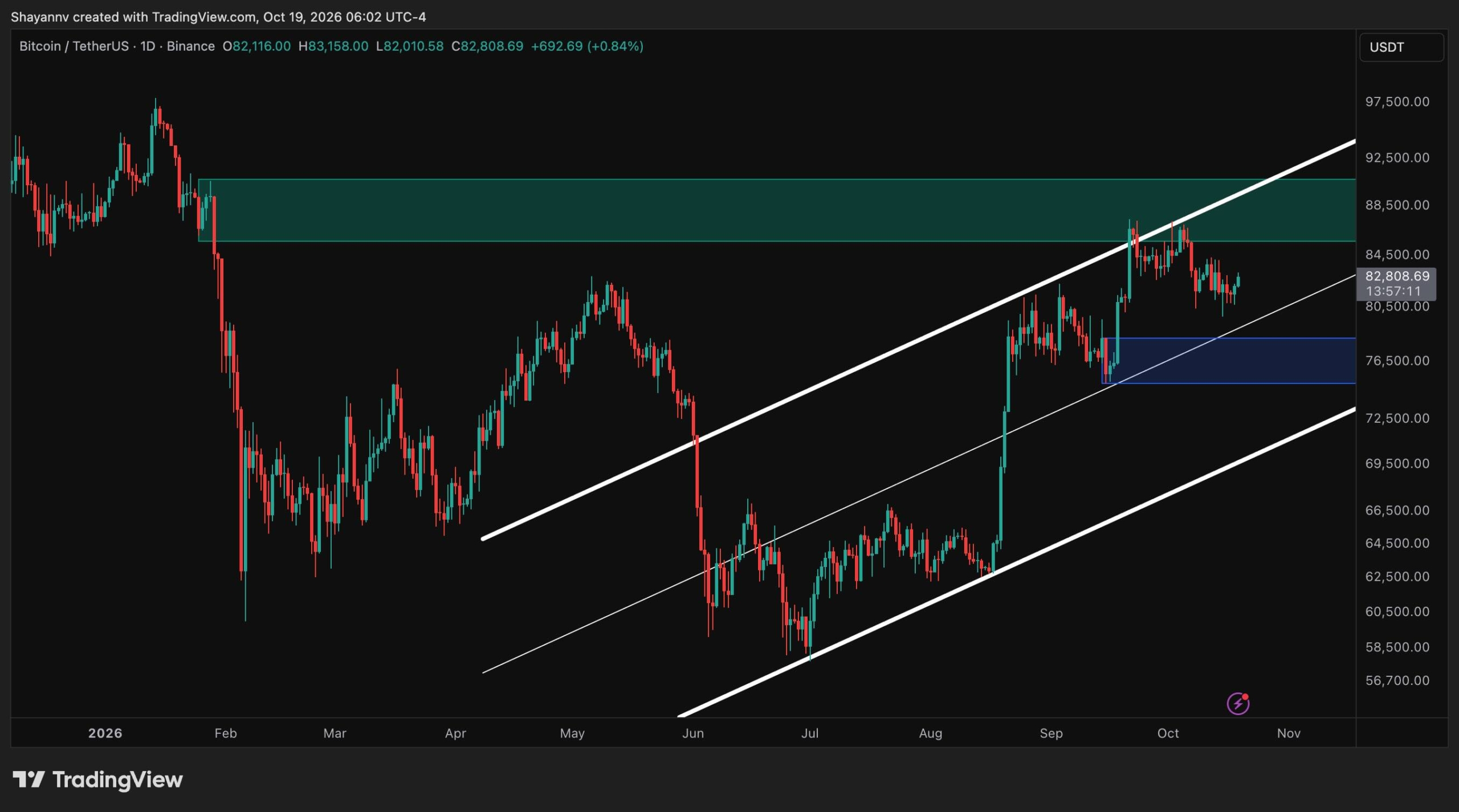
BTC/USDT 4-Hour Chart
The 4-hour chart shows that Bitcoin has formed a series of lower highs since the rejection from the $86K-$88K region in early October, with subsequent rebounds stalling near $84K. Despite this, the price remains within the short-term ascending channel, and every decline since early October has been absorbed by the $80K demand zone, which served as the consolidation base before the strong rally in late September. This zone now overlaps with the channel’s rising lower boundary, creating a meaningful support confluence.
The latest impulsive move away from this confluence has left a bullish fair value gap below the current price, suggesting that buyers have stepped in with notable strength. If this imbalance holds on a retest, BTC could extend its relief bounce toward the $84K rebound highs, followed by the $86K supply zone, where the early-October breakdown began.
Conversely, failure to hold the fair value gap would return the price to the $80K demand zone for another test. Repeated tests tend to weaken support, and a valid break below both the zone and the rising trendline would invalidate the current stabilization attempt, exposing the $75K order block. The short-term structure therefore favors a cautious recovery, but buyers still need to clear $84K level to end the sequence of lower highs.

On-Chain Analysis
The Adjusted Spent Output Profit Ratio (aSOPR), shown here through its 30-day exponential moving average on CryptoQuant, measures whether coins moved on-chain are being spent at a profit or a loss, excluding outputs younger than one hour. Readings above 1 indicate that spent coins are realizing profits on average, while readings below 1 suggest coins are being sold at a loss, a behavior often associated with capitulation phases.
The metric dropped below 1 in early 2026 and reached approximately 0.98 in February, coinciding with BTC’s slide toward the $60K region. After a brief recovery in spring, it fell below the threshold again during the June decline, before climbing steadily alongside the price since July. The 30-day EMA peaked near 1.013 in early October and has since begun to turn lower, indicating that profit realization is easing as the price retreats from resistance.
Notably, current readings remain well below the 1.05–1.08 peaks recorded during the 2024 and 2025 rallies, suggesting that profit-taking is still moderate rather than euphoric and that the market is not yet overheated. However, the metric does not by itself confirm the trend. During healthy uptrends, aSOPR tends to hold above 1 as holders refuse to sell at a loss, so a renewed drop below this threshold while BTC loses the $80K support would signal weakening conviction.

The post Bitcoin Price Analysis: Can BTC Reclaim $84K Before Another Slide Toward $77K? appeared first on CryptoPotato.
Meme coins have faced more than $1.4 billion in cumulative selling pressure on Binance since Bitcoin hit its last peak, according to CryptoQuant.
The sector has taken a heavy hit amid the broader crypto market struggle.
Meme Coins Lose Ground
Bitcoin’s maximum drawdown since its October peak reached 54%, while its price now sits around 35% below that high. Meme coins have suffered even more as investors pull back from riskier assets. Unlike projects with stronger fundamentals, most meme coins rely heavily on online trends and community hype, which has left them vulnerable during the downturn.
Their share of the total altcoin market cap has now dropped below 3%, which is its lowest level. The decline points to a sharp loss of liquidity across the sector. CryptoQuant went on to explain,
“Overall, this situation reflects massive selling pressure on the riskiest segment of the crypto ecosystem. It is also a reminder that meme coins suffer the most in every correction, and that exposure to them carries a very high risk of capital loss.”
As uncertainty weighed on the crypto market, Dogecoin (DOGE) and rival Shiba Inu (SHIB) have both dropped almost 9%. dogwifhat (WIF) also fell by more than 10% over the past week. The controversial Official Trump (TRUMP) slid over 12%. Meanwhile, BONK and FLOKI suffered steeper losses as each fell more than 15% during the same period. MemeCore (M) saw the biggest drop among these tokens, as weekly losses went up to over 19%.
Hunter Biden’s LAPTOP is another example of how quickly things can change in the meme coin market. The token launched on Coinbase’s Base network on September 9 and had a wild start before suffering a steep crash. It has since lost 98% of its value.
Are Meme Coin Communities Dying Out?
The growing pressure on this sector has also sparked criticism from traders. One market commentator believes meme coins are dying because of the “toxic” trading culture surrounding them. In a recent post, Maverick blamed the Solana-based launchpad, Pump.fun, for encouraging rapid trading instead of building strong communities because many traders now hold tokens for barely a few seconds before selling, making it hard for any project to build real momentum.
The post also questioned the role of KOLs, while accusing some of promoting coins only to dump their holdings minutes later. Even tokens with genuine community support can struggle to gain traction as traders keep selling and pushing prices down. To top that, bundled launches offer little reassurance either, as insiders can eventually dump their tokens and leave other buyers facing heavy losses.
The post Meme Coins Face $1.4 Billion Sell-Off on Binance as Bitcoin Slides From Its Peak appeared first on CryptoPotato.
The past week has been quite turbulent for Bitcoin (BTC), Ethereum (ETH), and Ripple (XRP), as they all ultimately posted losses during that period.
Analyst Ali Martinez believes these digital assets have reached pivotal points, where their next major move will likely depend on key technical structures and crucial levels. Here’s what market participants need to monitor.
BTC and ETH
The primary cryptocurrency currently trades around $82,500 (per CoinGecko) after briefly tumbling below $80K last week. Martinez said the important level now is $81,000, which marks the lower boundary of the asset’s daily rising channel.
He maintained that if buyers defend it, BTC could rebound to the structure’s mid-range at $84,000 and then to the upper barrier at $86,500. At the same time, Martinez warned that a break below $81,000 could result in a deeper decline toward $76,000.
The analyst then shifted his attention toward ETH, arguing that it has a similar test at $2,350 (the support line of a right-angled ascending broadening pattern).
Martinez thinks that a bounce from that mark could push the asset’s price toward $2,700 or even the $3,000 psychological zone. On the other hand, he added that a daily close below $2,350 could open the door to a crash to about $2,000. As of this writing, ETH is worth roughly $2,440, which supports the bullish scenario.
XRP’s Potential
Ripple’s cross-border token has lagged the market’s leaders over the past week, down 7% and currently trading near $1.32. Martinez said he is now monitoring the $1.25 level, as holding above it could complete the right shoulder of a potential inverse head-and-shoulders pattern on the 3-day chart.
However, that’s not all XRP would need to do to post a decisive breakout. The analyst maintained that the resurgence should be combined with a sustained close above $1.56, which could set the stage toward a move to $2. From the bearish perspective, losing $1.25 might result in a drop to $1.
Shortly after, the analyst assumed XRP had bottomed out. He based his theory on the fact that transaction volume on the XRP Ledger exploded several hours ago as the token’s price hovered around the $1.25 support.
“The total dollar value of coins transferred on-chain skyrocketed to $49.70 billion, coinciding with the rebound that is now taking place. This surge in on-chain activity around such a critical support level suggests that $1.25 could mark the bottom,” Martinez explained.
In conclusion, the analyst doubled down on his thesis that as long as this support holds, XRP could be on track for a rally toward $2.
The post BTC, ETH, and XRP at Turning Points: Major Breakout or Deep Correction Coming Next? appeared first on CryptoPotato.