Cryptocurrency Posts
Crypto Briefing
Investor confidence in fiscal discipline may stabilize UK economic expectations, influencing monetary policy and reducing inflation concerns.
The post UK gilts rally as investors bet on Chancellor Healey’s fiscal discipline appeared first on Crypto Briefing.
The potential tax delay in South Korea may boost short-term crypto market confidence, affecting asset prices and regulatory perceptions.
The post South Korea to meet crypto exchanges amid calls for tax delay appeared first on Crypto Briefing.
The escalating unrest in France could reshape political landscapes and influence security policies across Europe, affecting future elections.
The post Protests in France over living costs escalate to violence, spark security talks appeared first on Crypto Briefing.
The dominance of OpenAI and Anthropic could reshape market dynamics, potentially overshadowing many public companies and altering AI investment trends.
The post OpenAI, Anthropic dominate AI sector with $1.8T combined valuation appeared first on Crypto Briefing.
The escalation may alter regional power dynamics, affecting market perceptions and reducing the likelihood of Houthi territorial expansion.
The post Saudi Arabia escalates military campaign in Yemen against Houthi forces appeared first on Crypto Briefing.
Bitcoin Magazine
Bitcoin Magazine

Poetic Justice: Scammer Lost $5M in Bitcoin After Being Targeted by Ledger Thieves
Call it poetic justice: one of the biggest victims of last week’s Ledger theft happened to be a scammer themself, according to blockchain analysts, and lost nearly $5 million in bitcoin.
In a post Thursday, Chainalysis wrote that a crook lost 60 bitcoins worth about $4.8 million they’d stolen via a so-called task scam.
According to Chainalysis, the address was linked with a con where people were paid to fake sales and reviews of real items. They were told to add their own money in order to get paid — and then stolen from.
But the mastermind behind the task scam moved the stolen money to Ledger addresses which were then targeted by different scammers last week.
“On Sep 22, the person behind the scam moved the proceeds into three separate Ledger addresses,” Chainalysis said. “On Oct 9, thieves emptied all three. One transfer each, into the same wallet. The wallet is reported as stolen funds.”
Paris-based Ledger last week said it had started an investigation after customers in South East Asia reported they’d lost funds after buying from Malaysia-based reseller, CryptoBilis.
Ledger has since said that the scam was a massive organized crime operation where a group installed implants into devices and put them back on the market. The implants could read users’ seed phrases so criminals could then drain wallets.
Calling it one the most “sophisticated attacks” the digital asset industry has experienced, Ledger is yet to reveal how much money has been lost — but blockchain investigator Specter said $86 million had been drained.
And the task scam conman, according to Chainalysis, was one of the victims.
Ledger has said that it is working with law enforcement to “follow the funds and dismantle the attackers’ infrastructure” and has made sure no other vendors have been targeted by scammers.
CryptoBilis has stopped selling Ledger products, the company said.
Criminals have targeted bitcoin hardware sellers this year, with a huge attack taking place in July on the popular Coldcard products.
Crooks were able to steal close to $120 million in bitcoin from Coldcard users because the devices had a firmware bug which led to faulty seed generation, allowing hackers to guess investor seedphrases.
This post Poetic Justice: Scammer Lost $5M in Bitcoin After Being Targeted by Ledger Thieves first appeared on Bitcoin Magazine and is written by Mathew Di Salvo.
Bitcoin Magazine

BFFS26 Denver: Joseph Kelly on Bitcoin Custody and Credit; Alan Lane on Banking Lessons
The Bitcoin for Financial Services Summit (BFFS26) returns to Denver October 20–22, 2026, bringing together CPAs, wealth advisors, attorneys, lenders, and finance leaders who are building Bitcoin into their practices. Now in its second year, the summit has grown to more than 30 sessions across two full program days, with a speaker lineup drawn from the firms defining Bitcoin custody, credit, and advisory.
Headlining the program are Joseph Kelly, CEO and co-founder of Unchained, who opens the summit with a keynote on custody, credit, and trust at scale; Alan Lane, former CEO of Silvergate Bank, on lessons for Bitcoin and banking; Patrick Lowry, CEO of Samara Asset Group, on holding Bitcoin as a public-company treasury reserve; and Colin Crossman, Wyoming’s Deputy Secretary of State, on the regulatory outlook for banks, exchanges, and advisors. Additional speakers include Kate Goldman of Anchorage Digital, Sam Baker of River, Eric Yakes of Epoch Ventures, Daniel Hillery of UTXO Management, Moish Peltz of Falcon Rappaport & Berkman, and CJ Konstantinos of Peoples Reserve.
Sessions focus on practical application: bringing Bitcoin into wealth planning and family offices, Bitcoin-backed lending and mortgages, treasury accounting and valuation, retirement and income planning, charitable giving strategies, mining as an asset class, and fiduciary duty when clients hold Bitcoin. Dedicated workshops will offer continuing education credit for financial advisors and CPAs.
“Last year proved that financial professionals want more than a Bitcoin primer. They want to know how to serve clients who already own it,” said Jordan Guess, CPA, co-host of the summit in a press release shared with Bitcoin Magazine. “This year’s program is built around the questions advisors and accountants are actually getting from clients, answered by the people building the infrastructure.”
The summit opens Tuesday, October 20, with the Better Money Invitational golf tournament at City Park Golf Course, hosted with Bitcoin Sports Network, followed by a welcome party at The Space sponsored by Falcon Rappaport & Berkman. Evening programming includes wine and whiskey tastings, and Thursday begins with an optional sunrise hike in the Rocky Mountains.
BFFS26 is co-hosted by Jordan Guess and Wyatt O’Rourke of BFFS Media, producers of the Bitcoin for Financial Services podcast. Sponsors include Unchained, Anchorage Digital, UTXO Management, River, SOUND HSA, SustainHash, and Stormrake.
Registration is open now at https://www.bffs.media/summit.
Media contact: Wyatt O’Rourke, wyatt@bffs.media
This post BFFS26 Denver: Joseph Kelly on Bitcoin Custody and Credit; Alan Lane on Banking Lessons first appeared on Bitcoin Magazine and is written by Juan Galt.
Bitcoin Magazine
Sazmining Now Sells Jack Dorsey’s Proto Immersion Hashboards
Bitcoin mining just got a lower barrier to entry.
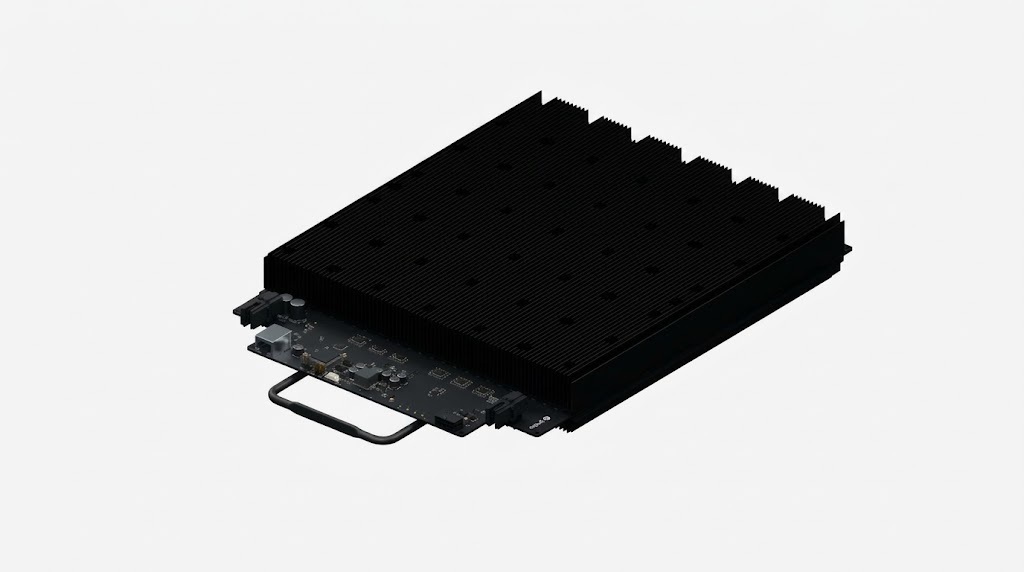
Sazmining announced Thursday that it is now selling Proto’s immersion hashboards directly to individual and institutional buyers through its mining-as-a-service platform. Previously, the hardware was mostly in the hands of large-scale operators.
Each hashboard delivers roughly 200 TH at around 15 J/TH, and buyers own them outright while Sazmining handles deployment, monitoring and maintenance at a US facility. Mining rewards go straight to the owner’s wallet.
The move follows a multi-megawatt supply deal between Sazmining and Proto — the bitcoin mining arm of Jack Dorsey’s Block (NYSE: XYZ) — which both companies expect to expand as demand grows.
“Because of our aligned-incentive model, Sazmining only earns when we produce bitcoin for our clients,” said Kent Halliburton, CEO and co-founder of Sazmining.
He also pitched mining as a form of bitcoin acquisition diversification: rather than paying the market price on the day of purchase, a miner’s costs are spread across the machine’s working life.
Wyoming-based Sazmining, founded in 2018, operates renewable-powered facilities across the US, Paraguay, and Norway. It says its fleet runs more than 20 percentage points ahead of the Bitcoin network’s carbon-free share.
Proto is Jack Dorsey’s Block’s bitcoin mining play. The Twitter founder has spent years arguing bitcoin is the foundation of “a more open financial system,” funding everything from Cash App’s buy-and-send rails to the Bitkey self-custody wallet, and he framed mining as the obvious missing piece back in 2021: “Bitcoin mining should be as easy as plugging a rig into a power source.”
Block formally announced it was building an open bitcoin mining system in January 2022, with the stated aim of making mining “more distributed and efficient.”
This post Sazmining Now Sells Jack Dorsey’s Proto Immersion Hashboards first appeared on Bitcoin Magazine and is written by Mathew Di Salvo.
Bitcoin Magazine
Hot Inflation Data Puts Bitcoin Under Pressure, but ‘Difficult’ Isn’t ‘Bearish’: CoinShares
Bitcoin’s price has dropped this week as new inflation data has come in hot.
But while the largest cryptocurrency’s near-term setup is difficult, it’s not “fundamentally bearish,” according to European asset manager CoinShares’ Head of Research, James Butterfill.
In a report Friday, the analyst said that bitcoin’s near-term challenge stems from a macro environment that’s caught in an awkward middle ground: inflation is too elevated for the Fed to ease up, while the economy is too resilient to force a policy pivot.
“Bitcoin and the broader digital asset market have moved lower on the resulting hawkish repricing, a reminder of how sensitive Bitcoin remains to monetary policy over short horizons,” he wrote.
Bitcoin’s price recently stood at $81,473, down 2% over a seven-day period.
The price of the leading cryptocurrency dropped Wednesday after data showed that U.S. consumer prices shot up more than expected in September.
Then, on Thursday, the Labor Department’s Bureau of Labor Statistics said that U.S. producer prices rose in September at the fastest pace in more than four years.
This has weighed on bitcoin’s price because higher inflation means the Federal Reserve may hike interest rates. Higher borrowing costs can restrict the liquidity the digital coin needs to rally.
The Federal Reserve hiked rates in September and will meet at the end of this month.
But Butterfill added that investors should be patient and advised investors to instead think in the long-term and not react to any single weekly data point.
“For investors, that argues for reading the coming weeks as a data-driven range rather than a trend, and for sizing digital asset exposure against a strategic allocation rather than against this week’s print,” he wrote.
Bitcoin spent the first half of 2026 in a bear market but had its best quarter in years after surging in August and September. Analysts have now said the leading cryptocurrency is now back in a bull market after trading above its 365-day moving average.
This post Hot Inflation Data Puts Bitcoin Under Pressure, but ‘Difficult’ Isn’t ‘Bearish’: CoinShares first appeared on Bitcoin Magazine and is written by Mathew Di Salvo.
Bitcoin Magazine

Deutsche Bank To Debut Bitcoin Custody Within Weeks: Report
German multinational Deutsche Bank is just weeks away from its crypto custody service, according to reports.
The lender — which is Germany’s biggest — also plans to expand the custody platform into Asia next year, according to a Friday Reuters report, which quoted its corporate banking chief.
Top banks worldwide are debuting or planning to debut crypto custody services, with BNY Mellon, State Street, Standard Chartered, U.S. Bank, and Citigroup all committing to direct crypto custody over the past 18 months.
JUST IN:
— Bitcoin Magazine (@BitcoinMagazine) October 16, 2026€732 billion Deutsche Bank to launch Bitcoin custody to its 28 million clients
pic.twitter.com/TAh9EwLkIX
Deutsche Bank first officially announced plans to debut a bitcoin custody service for European corporate and institutional clients in September, with the German multinational at the time saying service was subject to the completion of the applicable regulatory timeline.
Friday’s report added that the service will support custody of major cryptocurrencies such as bitcoin before moving to services that help clients move money into and out of stablecoins.
Gerald Podobnik, co-head of the corporate bank, was quoted by Reuters saying that the financial system will need to “offer tokenized or blockchain solutions.”
A number of top banks have started using the technology that powers bitcoin, the blockchain, for their own products in recent years.
Stablecoins and tokenization in particular have become a hot topic as traditional financial firms aim to accelerate certain services.
Crypto custody is often a starting point for banks moving into the digital asset space. BNY Mellon in 2022 became the first major U.S. bank to offer digital asset custody services.
Banks like Citi and Standard Chartered have this year debuted or announced plans for bitcoin custody around the world.
This post Deutsche Bank To Debut Bitcoin Custody Within Weeks: Report first appeared on Bitcoin Magazine and is written by Mathew Di Salvo.
CryptoSlate
NU7 would leave legacy funds issued but unspendable, even with intact keys, while the mainnet activation decision remains pending.
Read the full story on CryptoSlate
Understand the crypto stories that matter and what to watch next. Get The Catalyst in your inbox
The California agreement requires notice if Fidelity ends its retail transfer feature, while preserving security restrictions and IRA exclusions.
Read the full story on CryptoSlate
Understand the crypto stories that matter and what to watch next. Get The Catalyst in your inbox
The crypto industry has finally found a way to participate in America's partisan warfare without committing to either of the (only) two available parties: help elect people who agree with it about crypto, then let them argue about everything else. Fairshake's latest House spending plans cover 32 candidates, with 19 Republicans and 13 Democrats on…
Read the full story on CryptoSlate
Understand the crypto stories that matter and what to watch next. Get The Catalyst in your inbox
Two tracked Ethereum V3 Umbrella stakes fell 9.7%, while their implied annualized reward run rate stayed near $2 million.
Read the full story on CryptoSlate
Understand the crypto stories that matter and what to watch next. Get The Catalyst in your inbox
On October 17, JUST, the leading DeFi infrastructure in the TRON ecosystem, announced the completion of its fifth buyback and burn of its native token JST as scheduled. Over 170M JST were burned in this round (approx. 1.72% of total supply), backed by nearly $23.53M in capital deployed—all funded directly by JustLend DAO's net operating…
Read the full story on CryptoSlate
Understand the crypto stories that matter and what to watch next. Get The Catalyst in your inbox
CryptoTicker.io
When you transfer euros to a crypto exchange and leave them there until you buy, that money sits somewhere. Not with you, not in your wallet, but in an account somebody else runs. Which account that may be, and in whose name it has to be held, is what the European Securities and Markets Authority, ESMA, spelled out in a new answer on October 16, 2026. The short version: a payment service provider without a banking licence is a staging post for no more than one business day, and the account at the bank has to be in the exchange's name, not in the name of the provider in between.
What ESMA answered on MiCA article 70 on October 16
ESMA published five new questions and answers that day. Four concern crowdfunding platforms and the calculation of the active account under the EMIR 3 reform, and are of no relevance to retail investors. The fifth, Q&A 2949, is addressed to crypto asset service providers, and therefore to every exchange where you hold a euro balance.
A market participant had asked two things. First: may an authorised crypto asset service provider park client funds temporarily in an account at a payment service provider without a banking licence, such as an e-money institution or a payment institution? Second: may the funds stay there longer if the account does sit at a genuine bank but is held in the name of that payment service provider and kept technically separate from its other accounts?
ESMA answers the first question with a qualified yes and the second with a plain no. The answer is dated October 6, 2026 and was published ten days later.
MiCA article 70: the duty that holding client funds triggers
A crypto asset service provider, CASP in the rulebook, is any firm that commercially trades, exchanges, holds or arranges crypto assets in the EU and needs a MiCA authorisation for it. Every exchange you can legally buy through in Germany falls under it.
Article 70 of the MiCA regulation governs what such a firm has to do with its clients' money. Paragraph 2 requires arrangements that safeguard clients' ownership rights in their funds and prevent those funds being used for the firm's own account. Paragraph 3 then sets the actual duty: the money belongs in an account at a credit institution or a central bank.
The contrast with the crypto side matters. Different paragraphs of the same rulebook apply to your coins. Article 70 covers only the euros you have deposited and not yet invested, and the euros sitting in your exchange account after a sale. That money is precisely what raises the hardest questions if an exchange becomes insolvent. How supervision of these firms will be organised from 2027 is set out in our overview of ESMA's direct supervision of crypto providers.
The one-day limit: when the money has to sit at a credit institution
The first part of ESMA's answer is a permission on a short leash. When a crypto asset service provider receives client money, whether directly from the client or from a third party on the client's behalf, it may hold that money temporarily in a payment account at a non-bank payment service provider. Throughout that time it must continue to meet the safeguarding requirements of article 70 paragraph 2.
Then comes the deadline. By the end of the business day following receipt of the money at the latest, the provider has to place it in an account at a credit institution or a central bank. That is not a new rule, it is what article 70 paragraph 3 says. What is new is the clarification that a stop at an e-money institution neither extends nor replaces that deadline.
In practice that means: transfer on a Monday and your money should be in a bank account by the close of Tuesday at the latest. What happens at weekends and on public holidays depends on what counts as a business day in the country concerned. On this reading, a transfer on a Friday evening can be in transit until Monday evening without any rule being broken.

Why an account in the payment provider's name is not enough
The second part of the answer is the tougher one. ESMA writes that the account at the bank or central bank must be opened and maintained directly in the name of the crypto asset service provider, or in line with whichever legal regime on asset segregation applies.
An account held in the name of a non-bank payment service provider does not satisfy article 70 paragraph 3 on this reading. The authority's reasoning is a legal one, but it has tangible consequences: in that construction the crypto asset service provider would merely hold a claim against the payment service provider, instead of being the account holder vis-a-vis the credit institution itself. And according to ESMA that applies expressly even where the account was set up for that single crypto asset service provider and kept technically separate from every other account.
A claim is an entitlement against a firm. An account balance is an entitlement against the bank that holds the account. If another firm sits between you and the bank and fails, you have to join the queue in its insolvency proceedings. Keeping that chain of staging posts short is exactly what the rule is for.
How quickly that turns practical was shown by the case of the broker Trive, which we reported on in September: Trive froze client funds, and holders of crypto CFDs could not reach their money. The more staging posts lie between your money and a bank account, the longer it takes to establish who owns what.
E-money institution, payment institution, credit institution: the three terms apart
ESMA's answer hangs on a distinction almost nobody draws in everyday life. It is worth a look.
- A credit institution is what people colloquially call a bank. It holds a banking licence, may take deposits from the public and grant loans, and it belongs to a statutory deposit guarantee scheme.
- An e-money institution issues electronic money and runs payment accounts. It may not take deposits and does not lend out client money. Instead it safeguards client funds through trust accounts or insurance.
- A payment institution processes payments without issuing e-money itself. Here too there is no banking licence and no classic deposit guarantee.
All three are supervised, and all three are legitimate business models. But only the first is a permissible permanent home for your euro balance at a crypto exchange under article 70 paragraph 3. Under the new answer, the other two may only be the staging post of at most one business day.
Deposit guarantee: your euro balance on the exchange is not a bank balance
Here is the point where many investors assume something the rule does not give them. The fact that your money ends up in an account at a bank does not make you a client of that bank. Your counterparty remains the exchange.
The statutory deposit guarantee in the EU covers deposits up to 100,000 euros per client and institution. Whether and how it applies where an account is held in a provider's name and pools many clients' funds depends on the specific legal structure of that account and on national law. ESMA does not address this in Q&A 2949 and answers a narrower question: who has to be the account holder.
That is precisely why the answer matters to you. The more directly the path runs between your money and a credit institution, the fewer parties can fail in between. If you would rather not leave a euro balance sitting on a trading platform permanently, withdraw it after buying or selling, and hold the coins yourself. Which devices are suitable for that we have gathered in our hardware wallet comparison.

Interest on client funds: what Q&A 2486 awards the client
The new answer does not stand alone. It builds on an older one that shows how tightly the supervisor reads article 70 as a whole. Q&A 2486, last updated on February 18, 2026 and answered by the European Commission, dealt with interest.
The question was whether a crypto asset service provider may earn interest on client funds it places in a savings account at a credit institution. The answer is no. On that reading, CASPs are obliged to place client funds in risk-free savings accounts and may not earn interest from them for themselves. The duty serves the protection of clients alone. Any interest arising from compliance with article 70 paragraph 3 has to be passed on to the client, because the income comes from the client's money.
That differs from what some platforms do in other jurisdictions, where interest income on client deposits is a revenue line of its own. In the EU, on the Commission's reading, that income belongs to the client. Whether and how exchanges implement it is in their price and service lists, and it is a question worth asking.
What a Q&A does legally and what it does not change
Some perspective belongs here so the reach of these answers is not overstated. ESMA puts a note in front of its own Q&As: these answers explain provisions that already stand in applicable law. They do not extend rights and obligations, they introduce no additional requirements, and they are meant only to help authorities and firms with application. Only the Court of Justice of the European Union can interpret Union law bindingly.
In practice it carries weight all the same. National supervisors such as Germany's BaFin take their bearings from these answers when they examine business models. A crypto asset service provider that permanently routes client funds through an account in a payment provider's name has to expect questions after this answer.
ESMA has also declared digital finance and innovation a supervisory priority for 2027, so clarifications of this kind are unlikely to be the last. Another, considerably harder deadline is already running: for stablecoins without MiCA authorisation the authority has given platforms until January 8, 2027, which we set out in our piece on ESMA's stablecoin deadline.
Your exchange's documents: where the custodian for euros is named
You cannot look up where your money sits tonight. But you can read what your exchange commits to. Three places are worth it.
The terms and conditions almost always have a section on client funds or the holding of monies. That is where it says whether the funds sit in trust or pooled accounts and who the account holder is. The risk disclosures say whether the provider claims a deposit guarantee for euro balances, and if it makes no such claim, that is the answer. The price and service list tells you whether interest on balances is credited.
If one of those statements is missing or stays unclear, that is not an accusation but a reason to ask the provider. A list of the platforms that can show a MiCA authorisation in the EU is in our overview of regulated crypto exchanges. Anyone comparing anyway should look at that section of the documents as closely as at the trading fee.
Euro balances: after one business day the bank has to hold them
ESMA's answer changes nothing about your balance today. What it does sharpen is the question you can put to your exchange, and it hands you three steps.
- Read up on who the account holder is. Find the section on client funds in your platform's terms and check whether a credit institution is named there and in whose name the account runs. Whether your platform holds an EU authorisation at all is shown in our overview of regulated crypto exchanges.
- Keep the euro balance small. What you do not intend to invest does not have to sit on the trading platform. A current account at a bank is covered by the deposit guarantee; an exchange balance is legally something else.
- Separate trading from storage. Coins you intend to hold for longer do not belong on an exchange permanently. Which hardware is up to the job and what it costs is in the hardware wallet comparison.
(As of October 19, 2026. This article is not investment advice. Prices and fee structures change; check the terms with the provider before you buy.)
Crypto airdrops in week 43: two windows close, one exchange shuts down
This is the densest week of the month: Meteora closes the claim for its season 2 LP Stimulus on October 21, 2026, and four days later the Pharos claim portal shuts. Both deadlines fall inside this calendar week, and the same applies to both: planning for the last day is planning tight.
There is also a case this format rarely sees. StandX is not distributing a token of its own but winding the platform down and paying out the remaining proceeds as DUSD. The entitlement is real and the dates are fixed, but the claim itself only opens in November.
If you are new to the subject, what an airdrop is, how snapshots work and how to spot dubious offers are covered in our airdrop guide. Last week's situation was still shaped by the Sonic deadline; that expired on October 15 and appears here only as a footnote.
The dates at a glance
| Project | Status | Date / deadline |
|---|---|---|
| Meteora (MET), LP Stimulus season 2 | Claim open, window closing | until October 21, 2026 |
| Pharos (PROS) | Claim open, portal closes afterwards | until October 25, 2026 |
| StandX (DUSD) | Eligibility page from October 26, claim from November 1 | November 1, 2026, 00:00 UTC to December 31, 2026, 08:00 UTC |
| Grass (stage 2, paid out in USDC) | Claim open | until January 22, 2027 |
1. Meteora (MET): the season 2 claim closes on October 21
This is the next closing date, and it falls in the middle of this week. Meteora opened the claim for its season 2 LP Stimulus on July 21, 2026; the project's governance post gives the period as July 21 to October 21, 2026. No time of day is stated there, and no time zone for the claim window itself. The UTC reference in the post applies to the assessment period. The last day is therefore not a buffer you can rely on.
The distribution covers 20 million MET, around two percent of total supply, from the Ecosystem Reserve. Eligibility covers anyone who earned fees as a liquidity provider on the Solana blockchain between July 1, 2025 and June 30, 2026 (UTC). Only fees from DLMM and DAMM v2 pools count; limit orders and DAMM v1 pools are expressly not eligible.
Two thresholds decide whether anything arrives at all: at least 100,000 points are required, and the calculated allocation must come to at least 10 MET. Fall below either and the entitlement is lost, with the share redistributed among the remaining eligible wallets. What happens to allocations nobody claims by the closing date is not something the project sets out.
The conditions, the points formula and both thresholds are in Meteora's governance post on the LP Stimulus season 2. We have written up the details of the process in a separate piece on the Meteora claim deadline.
2. Pharos (PROS): the claim portal closes on October 25
The Pharos airdrop has been running since April 28, 2026 with a clearly stated duration of 180 days. That gives October 25, 2026 as the last day. What happens afterwards is in the project's FAQ: unclaimed tokens return to the Pharos Foundation, and the airdrop page is closed. Here too the project names neither a time of day nor a time zone.
Eligible, according to the project, are testnet participants, contributors to the "Stake Before the Stake" campaign, holders of certain Discord roles and users of the OKX wallet campaign. Anyone eligible across several categories has their entitlements combined automatically into a single claim.
The conditions and the closing date are in the FAQ of the Pharos claim portal, and the details of the process in our piece on the Pharos claim deadline.
3. StandX (DUSD): no token, but a payout, and a fixed schedule
This week's new entry is not an ordinary airdrop. StandX, an exchange for perpetual futures, has cancelled its planned token launch and is shutting operations down in stages. Instead of a token of its own, the remaining proceeds will be distributed to users once as DUSD. There is no lock-up attached.
The schedule is dated throughout in the project's announcement. The perpetual contracts move on October 20, 2026 into a mode in which positions can only be reduced. The page for checking your own entitlement opens on October 26, 2026 at 00:00 UTC. Claiming runs from November 1, 2026, 00:00 UTC, to December 31, 2026, 08:00 UTC; whatever nobody claims by then expires. Open positions will be closed at market price on January 15, 2027, and withdrawals and DUSD redemptions end on January 31, 2027.
How much falls to an individual address is something the project has not published, neither a total sum nor a formula. By its own account the inputs are advance deposits, participation in the alpha phase, mainnet trading, market making and referrals, and the project says it will filter out multiple accounts and wash trading. In concrete terms: whether and how much reaches you only shows on the eligibility page on October 26.
All the dates are in StandX's announcement on the payout and wind-down, which the notice banner on the exchange's home page also points to. In the same notice the project makes clear that it never contacts users by direct message and never asks for private keys.
4. Grass (stage 2): until January 22, 2027, and paid out in USDC
With Grass this is about the rewards for taking part in the network in stage 2. Eligibility covers anyone who shared bandwidth in epochs 1 to 19, the period from October 14, 2024 to June 8, 2026. The hard deadline runs to January 22, 2027; rewards that go unclaimed stay with the project.
The point many people read past: the payout is in USDC, not in GRASS. No new GRASS tokens are created, so circulating supply does not change. For you that means you are not receiving a project token whose price you have to watch, but a dollar stablecoin, and for tax purposes that is a different event from a token airdrop. Grass sets out the background in its explanation of the stage 2 distribution. Because the window stays open three months longer than the two October deadlines, this is the entry with no urgency.
Before the claim: two points that count this week
Only the genuine portal. The closer a closing date comes, the more cloned claim pages appear. Clones with similar-sounding addresses are known for Pharos, and StandX warns about them expressly in its wind-down notice. Always reach the claim address through the project's official channel, never through a link in a direct message, and check it character by character. A signature asking for more than the claim is one you cancel. How to keep entitlements and wallets apart is shown in our hardware wallet comparison.
The claim is the moment that matters for tax. Record the time, the token amount and the price at the moment of receipt, and do it immediately: a wallet transaction on its own rarely answers those questions later. Unsold airdrops can be taxable too, which catches many people out every year, and our piece on taxing crypto airdrops covers the basics. How an entitlement arises in the first place and when it expires is explained in our piece on claiming airdrops.
And afterwards? What happens to a claimed token
A freshly claimed airdrop token is almost always a low-cap token: thin trading volume, wide spreads, prices that can halve or double within hours. Total loss is a realistic outcome here, not a theoretical one. Doing nothing at all after the claim is also a decision, and often the calmer one.
If you do want to trade tokens like these, you need something other than a charting tool: Dexscreener and TradingView show you prices, they do not let you trade. The mobile app FOMO Family is built for it, with meme and low-cap tokens discovered, swiped through and traded directly in the app, and fast deposits. Download the app through the link and secure ten percent off the trading fees. The community is also speculating about a possible airdrop for active users; that is unconfirmed, there is no announcement from the provider, and it is no reason to deposit money.
What does not make the list this week
Two things are deliberately missing. Sonic (S) is done: the deadline for the season 1 and season 2 airdrops expired on October 15, 2026, around 32,690,000 unclaimed S tokens have been free for burning since then, and there is no grace period. The claim cannot be made up; the details are in our piece on the Sonic claim deadline.
And MINT (MNTD) stays out, even though the token appears in several round-ups with a launch on October 20. The project itself names only a quarter rather than a day, and the statements about the blockchain contradict each other. Missing as before are OpenSea, MetaMask, Base and Lighter: all four have been traded as likely airdrops for months, and none of these projects has published a snapshot or claim date. "Airdrop confirmed, date open" is not an entry for a deadline list.
Disclosure: some of the providers named in this article work with us through partner programmes. That has no influence on the editorial assessment.
(As of October 19, 2026. This article is not investment advice. Deadlines and participation terms change; check them with the provider before taking part.)
Since today, Monday, October 19, 2026, the first Sparkasse customers have been able to buy and sell cryptocurrencies directly in the App Sparkasse. Five assets are tradable: Bitcoin, Ethereum, XRP, Solana and Polygon. Behind the offering stands DekaBank, the securities house of the Sparkassen-Finanzgruppe, with custody run in cooperation with Boerse Stuttgart. There is no nationwide launch date.
"When a savings bank starts is for it to decide," Joachim Schmalzl, a managing board member of the German Savings Banks Association (DSGV), told the news agency dpa. "Interest within the group is high," Schmalzl added. Another 30 to 40 institutions are to join each month, and in the first half of 2027 the association wants a large share of the interested savings banks connected. The details are in the dpa report of October 19, 2026.
For around 50 million Sparkasse customers, the barrier to entry has just moved. Buying Bitcoin used to mean registering with a crypto exchange, running a second account and finding a custody solution of your own. Going through your own bank saves those steps. It costs something else instead, and that is what this article is about: control over your own coins. Our assessment of the launch while it was still only planned is in our overview of crypto trading at Sparkasse.
Krypto - powered by Deka: DekaBank's execution-only offering
The product is called "Krypto - powered by Deka" and is, according to DekaBank, an execution-only offering available exclusively to Sparkasse customers. Execution-only means the savings bank does not check whether a crypto investment suits your financial position, and it does not recommend a purchase either. DekaBank puts it on its product page as being aimed "exclusively at self-directed investors," with no advice given at the savings bank.
Execution-only is not a footnote, it is the legal foundation of the whole construction. In investment advice, the institution is liable for a recommendation matching the client's profile. Remove the advice and that check goes with it. The DSGV stresses that from the savings banks' point of view cryptocurrencies remain "highly speculative investments," and it points customers explicitly to sharp price swings and the risk of total loss. According to the association, there are no plans to market the product actively on a broad scale.
DekaBank says it is a notified crypto asset service provider and holds the cryptocurrencies in custody for its clients. Notified, under the EU's MiCA regulation, means the institution has extended its existing banking licence to cover crypto services and needs no separate authorisation. For investors that is the decisive difference from an offshore exchange, because supervision, the complaints route and insolvency law all sit in Germany.
No nationwide launch date: 30 to 40 savings banks join each month
Around 350 independent savings banks each decide on their own start. Crypto trading can therefore already be in the app in Hamburg while Passau waits until the spring. If you find nothing in the app today, you do not have a technical problem, you have an institution that is not yet connected. The association gives the pace as 30 to 40 houses a month and the target as the first half of 2027.
In arithmetic terms that pace means this: a good eight months lie between today and the end of June 2027, and at 35 institutions a month just under 290 houses would come on board. The phrase "a large share of the interested savings banks" leaves open how many institutions want to take part at all. A house that decides against the offering never shows up in that figure.

The crypto account in the App Sparkasse: the "Anlegen" section and push TAN
Access runs through a dedicated crypto account at DekaBank, opened inside the App Sparkasse. According to DekaBank you open the "Anlegen" investing section in the app, call up "Krypto - powered by Deka" there and open the account in a few steps. A current account at a participating savings bank is the prerequisite. Approvals run through the familiar online banking security tools, such as push TAN.
The portfolio value then appears alongside the other accounts in the same app. That is the strength of the model and at the same time its blind spot: the coins sit visibly inside your banking, but they do not sit in your hands. The section on withdrawals below sets out what follows from that.
Bitcoin, Ethereum, XRP, Solana and Polygon: the five tradable cryptocurrencies
The selection is deliberately narrow. According to DekaBank's product page, Bitcoin (BTC), Ethereum (ETH), Ripple (XRP), Solana (SOL) and Polygon (POL) are tradable. Memecoins, small altcoins and stablecoins are absent entirely. By market capitalisation these five assets cover the largest part of the market without the bank having to put thinly traded tokens into a mass-market product.
Two details are worth a second look. First, DekaBank lists Polygon as POL rather than MATIC; the token was renamed, and the bank follows the new designation. Second, there is no staking function at all. Ethereum, Solana and Polygon all allow rewards to be earned on the network when tokens are committed. The Sparkasse offering has no such option, so a holding sits there without any running yield.
If you need a broader selection, staking or payouts to any address of your choosing, a regulated crypto exchange as a second route is unavoidable. Our overview is in the comparison of the best crypto exchanges.
Omnibus wallet at DekaBank: why the private key is not yours
A private key is the secret key that opens access to crypto assets. Whoever holds it can move the coins. With "Krypto - powered by Deka" the private keys are, in the bank's words, held "in trust" for clients in a "jointly managed omnibus wallet."
Omnibus means that all clients' holdings sit in one shared pot on the blockchain, not in separate addresses per person. Who is entitled to which share follows solely from the bank's internal books. On the blockchain, your share is not identifiable as yours. This is the usual route at banks and large exchanges, and it works reliably for as long as the bookkeeping is correct and the institution solvent.
One point hangs on that which the marketing rarely mentions: crypto assets do not fall under the statutory deposit guarantee scheme. DekaBank writes this itself. The 100,000 euros that protect your savings account do not apply here. The protection comes instead from custody law, which separates crypto assets held in custody from the bank's own assets. Even with professional custody, risks remain, for instance from external attacks on blockchain infrastructure, as the bank concedes in its risk disclosure.

Withdrawals only to CASP addresses: your own hardware wallet stays excluded
This is the hardest restriction in the offering, and it is written out in DekaBank's own glossary: a withdrawal is only possible to the wallet addresses of certain crypto asset service providers, meaning other licensed providers, CASPs in the jargon. "A withdrawal to other wallet addresses is excluded," it reads.
In everyday terms: you can send your Bitcoin from Sparkasse to a regulated exchange, but not to a Ledger or Trezor in your drawer. Self-custody, the actual core of the Bitcoin promise, is not provided for in this product. Taking the coins into your own hands requires an intermediate step through a provider that permits withdrawals to private addresses.
The mechanism behind it is regulatory, not technical. Under the anti-money-laundering transfer rule, providers have to collect details about the recipient of a transfer and, for payments to self-custodied addresses, additionally verify who owns the address. Many houses solve that workload by not offering such payouts at all. The restriction is therefore not an oversight but a product decision that avoids verification duties.
Fixed-price trades instead of an order book: where the spread sits behind 99 cents an order
Trading does not run through an order book in which buyers and sellers meet. According to DekaBank, a binding price guaranteed by the bank is provided for each transaction for a limited period. You see a fixed price, click to accept it and know what you are getting.
That is convenient, and it shifts the cost to a place no price list discloses. In a fixed-price trade the provider earns on the difference between its own purchase price in the market and the guaranteed price for the client, the spread. An order fee can be compared, a spread cannot, as long as it goes unquantified. Our own review of the price information for crypto assets, September 2026 edition, was published by cryptoticker.io on October 10, 2026: the transaction fee for buying and selling came to 0.99 euros there, there was no minimum order size, and the spread was not named in the documents examined. Those figures come from our article on the fees and are not external evidence for today's position; check the current version in the price and service list of your own savings bank.
A comparison makes the order of magnitude tangible. On a purchase of 1,000 euros the order fee is 99 cents, which is 0.099 percent. If the spread is one percent, the same purchase costs 10 euros on top. The visible fee is, in that case, the smaller part of the price.
No deposit guarantee for crypto assets: what applies during outages and maintenance windows
In its disclosure, DekaBank names three situations in which trading can be restricted: unusual market conditions, technical faults and scheduled maintenance windows. Buying or selling is then not possible at any time of your choosing or at the price you are aiming for.
In practice that matters more than it sounds. Crypto markets move at night, at weekends and on public holidays too. Wanting to sell into a slump and running into a maintenance window means carrying the price move until trading reopens. A crypto exchange with an order book knows the same risk, but it usually stays open continuously and offers limit orders that trigger automatically. DekaBank's fixed-price model has no such tool.
The 1,000 euro exemption limit: what DekaBank says about tax
On taxation, DekaBank points to the exemption limit of 1,000 euros a year for private disposals, which under current law include gains from trading cryptocurrencies. If the annual gain stays below that threshold, the proceeds are tax free. The bank attaches the 2026 position to that statement, together with the note that tax treatment depends on personal circumstances and may in future be changed even retroactively, for instance by legislation or a different reading by the tax authorities.
An exemption limit is not an allowance: exceed it by one euro and the entire gain becomes taxable, not just the part above it. It also matters that the bank issues no tax certificate of the kind it provides for shares, because crypto gains are not subject to withholding tax. Recording them therefore remains a matter for your tax return, and anyone trading on an exchange as well is merging two histories.
Our assessment: the distribution channel weighs more than the product range
In the view of this desk, this launch is the more important crypto event of the year for German retail investors, and not because of the product. Five coins, no staking, no withdrawal to your own wallet and a fixed price with no disclosed spread add up to less than any regulated exchange offers. The leverage lies in distribution: the Sparkassen-Finanzgruppe reaches around 50 million customers through an app those customers already open every day. That is reach no crypto provider in Germany can buy.
Against it stands the construction itself. Buy crypto as a hedge against bank risk and you get the opposite here: a claim against a bank, booked in a shared pot, with no deposit guarantee, no key and no route to self-custody. Both are documented, the omnibus custody and the exclusion of third-party wallet addresses, in DekaBank's risk disclosure and glossary. As a first entry with small amounts inside familiar banking, the offering is usable. As a permanent home for a larger holding, it lacks control. None of this is a recommendation to buy or sell, and the risk of total loss remains in every case.
Sparkasse crypto trading: DekaBank holds the key, not you
Three steps put the situation in order:
- Settle custody before you buy. As long as withdrawals only run to service provider addresses, the holding stays in someone else's keeping. Holding coins yourself requires a device and a provider that permits withdrawals to private addresses. The devices sit side by side in the hardware wallet comparison.
- Keep a tax history from day one. Without a tax certificate the burden of proof is yours, and with two routes running at once two histories quickly turn into one gap. The tools for it are in the overview of crypto tax software and portfolio trackers.
- Weigh up a second route. Staking, limit orders, a broader selection and unrestricted payouts are not part of the bank offering. Which licensed houses cover them is shown in the comparison of the best regulated crypto exchanges.
(As of October 19, 2026. This article is not investment advice. Prices and fee structures change; check the terms with the provider before you buy.)
Bitcoin stands at $82,769 on Monday morning. That is 1.6 percent above Friday's close of $81,501, and the whole gain was built over two days in which exchange turnover ran at a third of its usual level. That is what makes it fragile: buying on a Saturday or a Sunday moves the price with less money than buying on a Tuesday. The level that decides the week therefore sits below the market rather than above it, at $81,501.
This article checks the weekend against our own data: 84 daily candles for the Bitcoin against US dollar pair on the Kraken exchange, collected for the period from July 28 to October 19, 2026. That makes it possible to quantify how much thinner the book really is at the weekend, and what that means for an order sent on a Sunday evening.
Bitcoin starts the week at $82,769
The reading on Monday morning: $82,769. The high of the past 24 hours is $82,774, the low $80,568. Monday opened at $82,002, Sunday's closing price.
The week before was weak. On Thursday, October 15, the price fell to $79,709 during the session and so dropped below the round $80,000 mark, but recovered to $82,134 by the evening. Friday gave part of that back and closed at $81,501. Against that Friday close, Bitcoin now stands $1,268 higher.
On Sunday we looked at the network fees in the mempool in this slot, at a price of $81,685 at the time. Little has changed on the network itself since then; the price has moved $1,084, almost all of it overnight into Monday. The $81,000 mark, which counted as the floor back then, has not been tested a second time.
Saturday and Sunday in numbers: 599 and 987 Bitcoin of turnover
The weekend in detail, daily candles in coordinated universal time, turnover in Bitcoin:
| Day | Close in dollars | Daily range | Turnover in BTC | Trades |
|---|---|---|---|---|
| Friday, October 16 | 81,501 | 2.63 percent | 2,089 | 144,685 |
| Saturday, October 17 | 81,382 | 1.24 percent | 599 | 71,492 |
| Sunday, October 18 | 82,002 | 2.00 percent | 987 | 107,516 |
Saturday was the thinnest day of the entire week: 599 Bitcoin of turnover, less than a third of Friday's, and a daily range of 1.24 percent. Sunday picked up to 987 Bitcoin but stayed below half of Friday's figure. Together the two days turned over 1,586 Bitcoin, less than Friday managed on its own.
The $620 gain that Sunday closed with was therefore built on turnover that would have passed for a quiet half day during the working week. That is not a judgement, it is the basis for everything that follows.

Why the Bitcoin order book thins out at the weekend
The reason does not lie with the crypto exchanges. They trade around the clock, Christmas Eve included. What closes is the other part of the market: the stock exchanges where the Bitcoin funds are listed.
A spot Bitcoin ETF is a fund that holds Bitcoin physically and whose shares trade on an exchange like a stock. When an investor buys a share, the fund can acquire Bitcoin for it; when the share is handed back, the fund can sell. This mechanism is called creation and redemption, and it only works while the exchange is open. New York is open Monday to Friday, and so is Frankfurt. From Friday evening to Monday morning, then, not a single fund share is created or destroyed, and the fund neither buys nor sells any Bitcoin in that time. How this route looks for investors in Europe is set out in our overview of crypto ETFs in Germany.
There is also the professional side of the market. Market makers, the firms that keep buy and sell quotes in the book and so create the narrow gap between bid and offer in the first place, run their positions down over the weekend because they cannot hedge them against futures while the derivatives exchange is closed. Less hedging means less quoted volume. What remains is retail trading, and that is smaller.
The result shows up in the trade counts above. Saturday produced 71,492 trades, Friday 144,685. The number of transactions halves, but turnover in Bitcoin falls to less than a third. Every single trade is smaller at the weekend. The large blocks are missing.
Our own survey: 84 daily candles compared
A single weekend proves nothing. We therefore went through the daily candles of the past twelve weeks, from July 28 to October 19, 2026: 84 days, of which 24 are weekend days and 60 are weekdays. The comparison uses the middle value, the median, because individual outliers such as the slump of October 8 would distort an average.
| Metric, median | Weekend (24 days) | Weekdays (60 days) | Weekend to weekday |
|---|---|---|---|
| Turnover in Bitcoin per day | 912 | 2,559 | 35.6 percent |
| Trades per day | 58,987 | 104,185 | 56.6 percent |
| Daily range | 1.24 percent | 2.61 percent | 47.4 percent |
Weekend turnover therefore comes to a good third of weekday turnover, the number of trades to around 57 percent and the daily range to just under half. At 599 and 987 Bitcoin, the weekend just gone sat below that median of 912, so it was not a quiet exception but a normally thin to below-average weekend.
The ratio between the three figures is the revealing part. If turnover falls to 35.6 percent while the range only falls to 47.4 percent, then a dollar of turnover moves the price further at the weekend than it does on a working day. In arithmetic terms, a third of the money is enough for half of the movement at the weekend. That is the number behind the claim that a thin book is more vulnerable.
Spread and slippage: what thin liquidity costs a market order
Two measures matter in practice. The spread is the gap between the best bid and the best offer in the order book. Slippage is the difference between the price you see when you send a market order and the price at which it is actually filled.
Both depend on the depth of the book. A market order works its way up through the available offers until it is filled. If there are offers for ten Bitcoin within $50 at midday on a Tuesday, a purchase of one Bitcoin costs barely any premium. If only three Bitcoin sit in the same price range on a Sunday evening, the same order reaches deeper into the book and pays more.
The figures above quantify how large that difference is on average. At 35.6 percent of weekday turnover the book is not only narrower, it also refills more slowly after a larger order has cleared it. For a position of a few hundred euros this stays a rounding error. For a four-figure sum in one go it is measurable.
Which exchange quotes which spread differs considerably, and at the weekend that difference weighs more heavily than on a working day. We have set the fees and spreads of the providers available in Germany side by side in our crypto exchange comparison.
How to check the execution day of your Bitcoin savings plan
A Bitcoin savings plan buys on a fixed day, not at a fixed price. That day is in the contract, and most providers let you change it. If you have put it on a Saturday or a Sunday, you are buying into the thinnest book of the week by design.
Three points count here. First, the setting that holds the execution day, usually under savings plan, interval or execution. Second, whether the provider fills the order as a market order, which is the normal case, or lets you set a limit. Third, whether the provider adds its own premium to the reference price on top of the spread.
An execution day in the middle of the week makes sense, because Tuesday to Thursday were consistently above the weekday median of 2,559 Bitcoin in our survey. If you cannot change the day, you lose nothing dramatic: across a year with twelve purchases the difference largely averages out. This is about basis points, not percentages. Which providers offer a savings plan at which minimum amount and interval is covered at the end of this article.

The levels: $81,501 as the floor, $82,826 as the ceiling
Both of this week's levels come out of the weekend itself, not out of a model.
On the downside it is Friday's close of $81,501. If the price falls below it, the entire weekend gain has been worked off, and the week starts, in arithmetic terms, where the previous one ended. Below that lies the weekend low of $80,568 as a second step, and behind it the round $80,000 mark, which was already briefly breached on October 15 at $79,709.
On the upside it is Friday's high of $82,826. That is where the price turned down on Friday, and it has not reached that value since; the high of the past 24 hours, at $82,774, sits $52 below it. As long as that ceiling holds, Bitcoin is moving in a range of around $1,300, or 1.6 percent.
What decides the outcome is not the level itself but the turnover on which it gives way. A break of $82,826 on Monday on 2,500 Bitcoin of daily turnover carries different weight than the same break on a Sunday on 900.
October 28: what the rate decision has to do with the weekend
The next meeting of the US Federal Reserve's Open Market Committee takes place on October 27 and 28, 2026, with the rate decision on the second day. The date appears in the Federal Reserve's official meeting calendar and is therefore the only firmly scheduled major event that can act on the price this week and next.
For liquidity that means two things. Ahead of a date like this, professional traders keep their books smaller, because a decision can move the price in jumps. That reinforces the effect that is already at work over the weekend. After the event, volume usually returns quickly.
So if you still want to move a larger position in one go in October, the more liquid days lie between today, Monday, and October 27, not after it. That is a statement about the order book, not about the direction of the price: which way the rate decision cuts is open, and nobody can evidence it today.
Holding period: why the purchase date on the calendar counts
For investors in Germany the purchase date carries a second meaning that has nothing to do with the price. Under current law, gains from the sale of Bitcoin are tax free if more than a year lies between purchase and sale. That period runs to the day, and it starts on the day of the purchase.
Buy today, on October 19, 2026, and you can sell the position tax free from October 20, 2027. Miss the deadline by a day and the gain is taxed at your personal income tax rate. With a savings plan that buys monthly, each individual execution starts its own period, which is why documenting the purchase dates is worth the effort.
Whether that period stays is open. The German finance ministry has not committed itself so far; we track the state of the debate in our overview of the crypto holding period. As long as no change has been passed, the one-year rule applies.
Our assessment: the gain hangs on Monday's volume
In the view of this desk, Sunday's rise is not yet a turn, for a reason that can be quantified: it came on 987 Bitcoin of turnover, which is 39 percent of the weekday median of 2,559. Moves that form at the weekend are frequently corrected on Monday, once the funds and the market makers are back and put their quotes into the book again.
The survey above supports that: a third of the money produces half of the movement at the weekend, so the price runs further than demand carries it. Against it stands the fact that the price on Monday morning is already above Sunday's close and has left the weekend low of $80,568 well behind. The decision falls at $81,501. If that level holds into Tuesday on turnover above the weekday median, the gain is confirmed. If it gives way, it was a weekend phenomenon.
The direction cannot be evidenced today, only the condition under which it shows itself. If you are building a position, Monday and Tuesday are the most liquid days of the week ahead of you.
Bitcoin on Monday: below $81,500 the gain is gone
The price stands at $82,769, built over a weekend running on a good third of the usual turnover. Three steps follow from that:
- Check the execution day of your savings plan and, if it falls on a Saturday or Sunday, move it to Tuesday, Wednesday or Thursday. The providers with the matching intervals and minimum amounts are in the savings plan comparison.
- For a larger purchase, compare your own provider's spread on a working day with the one at the weekend. Where Bitcoin is available at what cost is set out in our overview of buying Bitcoin.
- Note the purchase date, because the one-year holding period runs to the day. A purchase made today can be sold tax free from October 20, 2027; the tools for tracking it are in the crypto tax software comparison.
The price data in this article comes from the daily candles of the Bitcoin against US dollar pair, queried through Kraken's public market data interface.
(As of October 19, 2026. This article is not investment advice. Prices and fee structures change; check the terms with the provider before you buy. Trading cryptocurrencies carries the risk of total loss.)
If you hold bitcoin on two exchanges and in a wallet of your own, and then sell part of it, you need to know which of your tranches counts as sold. That is what decides whether the sale stays tax-free. The answer goes by the name of crypto FIFO, and in Germany it works differently from what most holders expect: the Federal Ministry of Finance does not calculate across your total holdings but separately for each wallet and each exchange account. A sale on account A never reaches the older coins in wallet B, however long they have been sitting there.
That separation decides more in the autumn of 2026 than it did in earlier years. Providers will report to the Federal Central Tax Office under the Crypto Asset Tax Transparency Act for the current year for the first time, each one on its own. And under the draft bill on the holding period, 31 December 2026 is to become the line between protected legacy holdings and taxable new holdings. Which tranche sits in which pot has stopped being an academic question.
What FIFO means for crypto, and why individual identification comes first
FIFO stands for "first in, first out": the units bought first count as the units sold first. The term describes an assumed order of consumption, in other words an assumption about which units of a holding of the same kind leave it in a partial sale. That assumption is needed for crypto assets because one bitcoin cannot be told apart from another.
It is only needed, though, where you cannot identify the individual units. The BMF guidance on individual questions of the income tax treatment of crypto assets of 6 March 2025 puts individual identification first in Randnummer 61, its paragraph 61: the governing principle for the order of use is individual identification. Only where that is not possible do the crypto assets of one trading designation acquired first count as sold for the purposes of the holding period.
Individual identification means that you prove which specific unit you sold. On a wallet of your own with clearly separated access and unbroken records, that is possible. On an exchange account that pools deposits and withdrawals into a single balance, it generally is not. FIFO is therefore the rule in practice rather than the exception, even though it is the second step in law.
“A wallet-by-wallet view applies”: paragraph 62 of the BMF guidance
The sentence that settles the matter sits one paragraph further on. Randnummer 62 opens with the words "Es gilt eine walletbezogene Betrachtung" — a wallet-by-wallet view applies. It goes on to say that within a wallet the chosen method must be retained until all crypto assets of one trading designation in that wallet have been sold in full.
For holders, that means every wallet and every exchange account is a pot of its own with an order of its own. A FIFO calculation running across all your holdings on every platform does not exist under this administrative view. Anyone running three accounts runs three orders. This is the most common false assumption on the subject, and it cuts both ways: the separation can take away a completed holding period you never actually had, and it can leave you one you would have lost under a combined view.
The tax authorities are sticking to this reading even though it means more work for investors. The reason is easy enough to follow: the records from which any order can be derived in the first place arise provider by provider. An exchange knows nothing about your hardware wallet.
Holding period and gain calculation follow two different methods
Paragraph 61 separates two questions that are often thrown together. For the holding period, the crypto assets of one trading designation acquired first count as sold. For valuation, meaning the size of the gain, the guidance names the average cost method and refers for it to a Federal Fiscal Court ruling of 24 November 1993. For reasons of simplification, though, it may equally be assumed there that the units acquired first were sold first.
In practice, you may use FIFO for both questions but do not have to. The holding period is set by the oldest tranche in the pot concerned, while the gain can be calculated from that pot's average price. Running both on FIFO puts you on the safe side of the administrative view and leaves you with the simpler schedule.
Section 23 EStG prescribes FIFO for foreign currency amounts only
Here lies a point that many guides skip past. No statutory FIFO obligation exists for crypto assets. Section 23(1) sentence 1 no. 2 of the German Income Tax Act contains a FIFO fiction in its third sentence, and that fiction is expressly limited: where several foreign currency amounts of the same kind are acquired and sold, the amounts acquired first are to be assumed to have been sold first.
Crypto assets, under settled practice, are not foreign currency but other assets within the meaning of the same provision. The fiction in sentence 3 therefore does not apply to them directly. What applies to crypto sits in the BMF guidance, and BMF guidance is an administrative instruction to the tax offices, not a statute. It binds the offices, not the courts. That is exactly where the dispute set out further below comes from.
Is FIFO permitted in Germany?
Yes, and in two senses. FIFO is permitted for the holding period where individual identification is not possible, and it is permitted for valuation too, for reasons of simplification. Apply FIFO wallet by wallet, document it, and retain it across the entire holding of one trading designation in that wallet, and you are moving inside the administrative view.
The question the other way round is the more interesting one: whether FIFO is mandatory. The statute does not prescribe it for crypto assets; the tax authorities expect it. For the tax return, that means FIFO brings no argument, while another method may well bring one.

Worked example: the same sell order, two wallets, two tax outcomes
A worked example with round numbers shows how strongly the wallet-by-wallet view bites. Assume you hold 0.2 bitcoin in two pots:
- Account at an exchange: 0.1 bitcoin, bought on 1 February 2026 for 8,000 euros.
- Your own hardware wallet: 0.1 bitcoin, bought on 1 June 2024 for 5,500 euros.
On 20 November 2026 you sell 0.1 bitcoin for 7,000 euros. Which pot you use for it decides the outcome.
Sale through the exchange account: the oldest tranche in this pot is the purchase of 1 February 2026. Roughly nine months lie between acquisition and sale, so the one-year period is not met. The transaction is taxable, and it ends in a loss of 1,000 euros, because 7,000 euros of proceeds stand against 8,000 euros of acquisition cost.
Sale out of the hardware wallet: the oldest tranche in this pot is the purchase of 1 June 2024, more than two years back. The holding period is met and the gain of 1,500 euros stays tax-free.
The same quantity, the same day, the same price, and yet two entirely different outcomes. A FIFO calculation across platforms would consume the 2024 tranche in both cases, because it is the oldest of them all. That is precisely what paragraph 62 rules out. Knowing the difference lets you choose the pot deliberately; not knowing it means hearing about it from the tax office.
The loss in the first case is not worthless, incidentally, but it is tightly tied: losses from private disposal transactions may be offset only against gains of the same kind, not against wages, interest or equity gains. How far that offsetting reaches across the years is set out below in the section on the exemption threshold.
The election exists per wallet and per trading designation
Paragraph 62 grants two separate elections. The first applies per wallet: in every pot you decide independently whether you apply individual identification, the average cost method or FIFO. The second applies per trading designation, meaning per type of coin. Where crypto assets with differing trading designations are held through one wallet, a separate election exists in each case.
You may therefore choose one method for bitcoin in your hardware wallet and another for ether in the same wallet, and another again for bitcoin on the exchange account. What you may not do is switch back and forth within the same pot for the same type of coin. That consistency is the price of the election.
A change of method is possible only after a complete sale
The commitment does not end with the calendar year; it ends with the holding. Under paragraph 62, the chosen method must be retained until all crypto assets of one trading designation in that wallet have been sold in full. Only after a complete disposal and a subsequent fresh acquisition of crypto assets of that trading designation can the method be changed.
An example: you sell all the bitcoin in your hardware wallet and buy bitcoin into the same wallet again two months later. From that fresh acquisition onwards, the choice of method is open to you once more. But as long as a single satoshi of the old trading designation remains in that pot, the method once chosen stands. Anyone hoping to switch annually, as some other tax questions allow, finds no door here.
LIFO and HIFO: the dispute between the tax authorities and a tax court
Alongside FIFO, practice knows two further procedures. Under LIFO ("last in, first out") the units bought last count as sold first; under HIFO ("highest in, first out") the most expensive ones do. Both can lower the tax burden, LIFO above all where older tranches have already met the holding period and the holder wants to leave them untouched.
The administrative view does not mention these procedures. Several tax firms do report, however, on a decision of the Nuremberg tax court of 22 January 2025 in which the court is said to have held LIFO admissible alongside FIFO, on the grounds that no specific statutory rule exists for crypto assets. The accounts of the case number and of whether the decision is final diverge, and no clarification from the Federal Fiscal Court, the highest court in tax matters, is available.
For practical purposes the position therefore stays a sober one: FIFO matches what your tax office expects. Another method is legally defensible but will with some probability lead into a dispute that you have to conduct and evidence yourself. Anyone weighing that route talks to a tax adviser beforehand, not to a forum. Our earlier assessment comparing FIFO and LIFO for crypto in Germany sets out the background in more detail.
How to keep track of your tranches wallet by wallet
The schedule that has to carry all of this is manageable, but it has to be kept per pot. For every wallet and every exchange account you need a list of its own, and in that list each inflow and each outflow carries the date, the quantity, the type of coin, the price in euros, the fees and the nature of the transaction. Paragraph 102 of the BMF guidance frames the standard as being that every private disposal transaction can be traced individually and in its own right.
In concrete terms, every line holds at least the ticker or the full name of the crypto assets concerned, the number of units, the gain with acquisition cost and disposal proceeds, or the time and the rate of purchase and sale, together with the holding period. Anyone who did not buy in euros also states the market rate and the source it was taken from. A spreadsheet is enough for that; from a three-figure number of transactions upwards, a crypto tax tool or portfolio tracker does the work more reliably, because it keeps the pots separate automatically.
On a transfer between your own wallets, the acquisition data travels with it
A transfer from one wallet of your own into another wallet of your own is not a sale. It triggers no tax and does not reset the holding period. What it does do is move a tranche out of one pot and into another, and with that the order in both of them changes.
The original acquisition data therefore has to travel with it. Paragraph 103 of the BMF guidance expressly names the documentation of reallocations within wallets, for the wallet-by-wallet application of the average cost or FIFO method, as a record a tax office can request. Send a tranche from the exchange to your own hardware wallet without noting the purchase date and you have not lost the holding period, but you can no longer evidence it. What else is worth watching when moving between providers is written up in our piece on switching crypto exchange and the holding period.
What your exchange reports to the Federal Central Tax Office from 2027
Up to 2026, the order of your tranches was a matter between you and your tax return. That is changing. The Crypto Asset Tax Transparency Act obliges providers under section 9(1) to transmit information on reportable users to the Federal Central Tax Office annually, by 31 July at the latest, for the preceding reporting period in each case. The transmission runs electronically via an officially prescribed data record.
The first report therefore covers the current calendar year and reaches the authority in the summer of 2027. Which details flow in, and why the amount reported is not your gain, is something we took apart in our assessment of the crypto reporting obligation and the gross amount. That providers need a tax self-certification from you for it, and that accounts without that certification can be restricted, is set out in the piece on self-certification at the crypto exchange.

The report comes provider by provider, not as one combined holding
This is where the circle closes back to the wallet-by-wallet view. Reporting happens per provider, because each provider holds only its own records. The Federal Central Tax Office therefore receives several data records about the same person, one per exchange, and no consolidated total holding. Your own wallet, which no provider operates, appears in none of those records.
Two things count in the end. First, the structure of the reporting matches the structure of the taxation: both run pot by pot. Second, your own schedule is the only place where the pots come together. If a reconciliation raises questions, because an exchange has reported a high gross turnover for instance, that schedule is your evidence. Without it, the exchange's figure stands there on its own.
31 December 2026 separates legacy holdings from new holdings
Running alongside the reporting obligation is the reform of the holding period. Under the draft bill, gains from crypto assets acquired after 31 December 2026 are to become taxable regardless of how long they were held; for purchases up to that cut-off date, grandfathering is envisaged. The plan has not been passed: the Bundestag rejected an abolition of the holding period in October, and a cabinet date expected for the middle of October passed without a decision. We track the state of the legislation in our assessment of grandfathering and the 31 December cut-off date.
Should the draft become law in this form, the order within each pot matters even more. The acquisition date of every single tranche then decides whether it can still become tax-free at all. And because the order applies wallet by wallet, the pot you sell from decides whether you touch protected legacy holdings or not. Anyone who wants to keep that cleanly separated later needs the acquisition data per wallet now.
Can the tax office see into your wallet?
Not directly. The information documented in a blockchain is open to anyone, but because public keys pseudonymise it, it allows no direct inference about the identity of individual taxpayers. The BMF guidance expressly assigns that information to the sphere of the taxpayers, who are closer to the evidence. Handing over a public key alone is not enough for the office to discharge the burden of proof; share it, though, and it can be used to check what you have declared.
Indirectly the reach is wider than that sounds. The office can request tax reports and, with them, the files they were produced from, such as transaction statements or CSV files. Once it has exhausted its own enquiries, through a block explorer for example, the guidance also regards requesting screen recordings from a wallet or an exchange account as proportionate. With providers based abroad, an extended duty of cooperation under section 90(2) of the German Fiscal Code applies on top: you have to clarify the facts and obtain the evidence, by retrieving the transaction statements regularly and in full. Missing records and data losses, after an insolvency of the trading platform or an attack for instance, fall to your detriment under this instruction.
The 1,000 euro exemption threshold and the offsetting of losses
Two figures belong to any FIFO calculation. The first is the exemption threshold: under section 23(3) sentence 5 of the Income Tax Act, gains stay tax-free where the total gain realised from private disposal transactions in the calendar year came to less than 1,000 euros. The decisive word is threshold: where the total gain reaches 1,000 euros or more, it is taxable in full, not merely the part above the line. And the count runs across all private disposal transactions of the year, meaning across all the pots together.
The second concerns losses. These may be offset only up to the amount of the gain you realised from private disposal transactions in the same calendar year. A deduction from other types of income is ruled out; a carry-forward into later years and a carry-back into the immediately preceding year are possible in accordance with section 10d EStG, but again only within the same type of income. For the choice of method, that means a loss from the young pot is no free pass, and is usable only inside those narrow limits.
Crypto FIFO: every wallet counts on its own, and 31 December decides
The wallet-by-wallet view is no formality. It is the lever the tax exemption of a sale hangs on. Three steps bring your records up to the state that 2027 will demand:
- List the pots. Write down every wallet and every exchange account separately, and assign to each tranche its acquisition date, its quantity and its euro price. A tax tool or portfolio tracker takes this over where there are many transactions and keeps the pots apart.
- Retrieve the transaction reports. Get the complete history from every provider as a file while you still have access, and store it safely. Which providers deliver usable reports is covered in the exchange comparison; with platforms based abroad, the extended duty of cooperation applies.
- Choose the pot before you sell. Use your list to see which tranche is the oldest in the pot concerned before you place an order. Transfers into a hardware wallet of your own are tax-free, but they shift the order and have to be documented with the acquisition date.
(As of October 19, 2026. This article is not investment advice. Prices and fee structures change; check the terms with the provider before you buy.)
Decrypt
MapQuest’s app now offers an optional map layer that plots known license plate readers from Flock Safety and other vendors, as backlash against the cameras grows.
Bitcoin ETFs lost a net $228.6 million this week, following a $681.1 million drain the week before and pushing October deep into the red.
A Bank for International Settlements working paper found that stablecoin growth slows when U.S. banks raise deposit rates, with Circle’s USDC most sensitive.
An FEC filing shows the Fairshake affiliate Defend American Jobs disclosed roughly $7 million more in ads against the Ohio Democrat, pushing its total past $46 million—days after the PAC expanded its map to 32 House races.
The nine-member group, modeled on the Internet Engineering Task Force, aims to set open standards for testing quantum-resistance claims as forecasts place the first practical attack in the late 2020s.
U.Today - IT, AI and Fintech Daily News for You Today
Binance founder Changpeng Zhao (CZ) has mocked longtime Bitcoin critic Peter Schiff over his history of bearish BTC predictions, joking that the gold advocate will eventually be right only after changing his mind.
Ripple's David Schwartz has hinted at a major breakthrough in XRP Ledger-based decentralized finance.
The market's response to the Uptober is certainly disappointing with most assets struggling to beat September's highs.
Former Mt. Gox CEO Mark Karpelès has stepped in to address Ledger's security woes, developing an affordable device capable of detecting hidden spy implants in hardware wallets without opening them.
October continues to be a busy month for the XRP Ledger and the Ripple ecosystem.
Blockonomi
TLDR:
- White House crypto leadership has no publicly named successor after Patrick Witt announced his departure and return to the private sector.
- The departures of Witt, Bo Hines and Harry Jung leave questions about who will coordinate presidential priorities with lawmakers.
- A White House official said cryptocurrency and the Digital Asset Market Clarity Act remain priorities for President Donald Trump.
- Federal agencies continue digital asset rulemaking as the midterm elections approach and Congress faces further legislative work in 2027.
White House crypto leadership faces a vacancy after Patrick Witt announced his departure from government service last week. Witt, executive director of the President’s Council of Advisors for Digital Assets, said he would return to the private sector. No successor had been publicly named as of October 18.
His exit follows earlier departures by Bo Hines and Harry Jung. The staffing gap comes before the November midterm elections, while federal agencies continue developing digital asset rules. A White House official said that cryptocurrency and the Digital Asset Market CLARITY Act remain priorities for President Donald Trump.
White House Crypto Vacancy Follows Several adviser Departures
Witt took over the council after serving as deputy to Hines, its first executive director. He subsequently became a prominent administration representative during negotiations over the CLARITY Act. CLARITY Act talks sought to establish a federal framework for cryptocurrency markets.
Witt reportedly confirmed his departure in a Wednesday night post on X. He thanked lawmakers and agency leaders involved in the legislative effort. His announcement pointed to a move into private business without naming his next employer.
Witt disclosed Georgia National Guard commitments in July but remained involved as negotiations over market structure legislation continued.
Hines had previously left government after helping advance the GENIUS Act, which established rules for stablecoin issuers. Jung also departed, adding to turnover among officials responsible for the administration’s digital asset agenda.
The White House crypto opening leaves an unanswered staffing question as legislative discussions continue. The administration has maintained its stated support for the sector. However, officials have not publicly identified who will take over Witt’s responsibilities.
The role involves more than appearances or industry meetings. It also provides a connection between presidential priorities, agency work and negotiations with lawmakers. That coordination could become particularly relevant when the next Congress begins work in 2027.
The broader policy structure already includes officials across multiple departments. A January 2025 executive order established the President’s Working Group on Digital Asset Markets. Its membership includes Treasury leadership and the heads of the two principal federal market regulators.
That order assigned an executive director responsibility for coordinating the working group’s daily functions. It also required recommendations covering both regulatory changes and legislation.
Congress and Regulators Face a Crowded Digital Asset Agenda
White House crypto policy will face a different congressional setting after the midterm elections. Reportedly, that renewed legislative efforts in 2027 could address cryptocurrency taxes before returning to market structure reform. That sequence remains an expectation rather than an announced legislative timetable.
The election outcome will also influence negotiations. Democrats could gain control of the House of Representatives, creating a potentially less receptive chamber for administration proposals. The result remains undecided, and the staffing vacancy does not establish how lawmakers will vote.
A White House crypto liaison would provide legislators with a designated administration contact during those discussions. Without a publicly named replacement, the immediate question concerns who will represent presidential priorities in future negotiations.
Meanwhile, federal regulatory work continues across several agencies. The Securities and Exchange Commission and Commodity Futures Trading Commission remain involved in digital asset policymaking. The Office of the Comptroller of the Currency and Treasury Department also have ongoing work affecting the sector.
These separate responsibilities mean congressional legislation represents only one part of the policy calendar. Agency rulemaking can proceed while lawmakers debate proposals, although regulators operate within their existing legal authority.
For White House crypto officials, the coming workload therefore spans personnel decisions, congressional outreach and coordination with financial regulators. The administration has not publicly set out a replacement process or appointment date.
The post White House Crypto Leadership Gap Grows as Patrick Witt Exits appeared first on Blockonomi.
TLDR:
- Prediction markets traded $102.4 billion in contracts over 30 days, with about $25.7 billion paid.
- Stablecoins hold a $302.34 billion market cap, while DeFi total value locked sits at $88.49 billion.
- Tokenized real-world assets stand near $34.61 billion onchain, with $4.12 billion active in DeFi.
- Four areas could drive DeFi’s next phase: stablecoin payments, lending, tokenization, and consumer apps.
DeFi is evolving, and attention is turning to what comes after betting and prediction markets. Prediction markets recorded $102.4 billion in contracts traded over 30 days, with about $25.7 billion actually paid.
Stablecoins hold a market capitalization of $302.34 billion. DeFi total value locked stands at $88.49 billion. Real-world assets represent roughly $34.61 billion onchain, with $4.12 billion used actively in DeFi. Prediction-market figures include centralized venues. Snapshots date from October 17 to 18, 2026.
From Token Swaps to Betting on Real-World Events
Deadline framed the question in a recent post. A few years ago, DeFi centered mainly on token swaps, yield farming, and staking. Memecoins and perpetual trading followed. Prediction markets such as Polymarket then gained traction. Today, DeFi is evolving again.
DeFi is evolving. But what comes after betting and prediction markets?
A few years ago, DeFi was mainly about token swaps, yield farming and staking.
Then came memecoins, perpetual trading and the explosive rise of prediction markets like @Polymarket.
Today, people aren't… pic.twitter.com/YgEIrSvtNn
— Deadline
| ETHGas
(@cryptodeadline) October 18, 2026


Under this model, people are not only trading crypto prices. They are trading expectations about real-world events. The post treats this change as a sign that financial innovation can expand beyond crypto tokens. Meanwhile, the post says other parts of DeFi offer something more practical.
Stablecoins, lending protocols, and tokenized assets are creating opportunities for more practical uses, according to the post.
These products connect onchain infrastructure with everyday financial needs. As a result, Deadline presents them as the direction after betting and prediction markets.
The first wave of DeFi was about making finance decentralized. The next wave, according to Deadline, could be about making decentralized finance genuinely useful. Prediction markets, in this view, are not the end of DeFi’s evolution. They are one part of a much bigger financial transformation.
How DeFi Is Evolving Toward Practical Use
Deadline outlined four areas that could shape the next phase. Stablecoin payments would move money across borders more efficiently. Onchain lending would expand access to borrowing and liquidity.
Real-world asset tokenization would bring traditional financial products onto blockchain infrastructure. In each case, DeFi is evolving toward use cases outside crypto trading.
The fourth area is consumer-friendly financial apps. These apps would let people use DeFi without understanding wallets, gas fees, or smart contracts.
For example, a user could receive payments, borrow money, or access investments through an app. The user would not need to know DeFi powers it. Deadline called that kind of adoption worth watching.
However, the post acknowledges obstacles. Security, regulation, and liquidity remain serious challenges for the sector. These issues remain alongside the growth in stablecoins, lending, and tokenized assets. Even so, Deadline says the bigger picture is becoming clearer, as DeFi is evolving beyond its first wave.
Deadline ended the post with a question for its audience. It asked whether stablecoins, tokenized assets, or onchain lending will lead the next growth phase. It also asked whether another sector is being overlooked. Readers were invited to share their views.
The post DeFi Is Evolving: What Comes After Betting and Prediction Markets? appeared first on Blockonomi.
TLDR:
- NEAR trades near 4.895 after falling about 17% this week, with a low of 4.527 and the candle still open.
- The 4.30 region acted as a recurring pivot during 2024 and anchors the long scenario in the chart.
- The trade drawing sets entry at 4.316 and a stop at 3.928, about 9% below the planned entry.
- A break above 6.00 would point to 7.847, a 2024 resistance level and 81.8% above the entry.
NEAR price is testing a former resistance zone after a sharp weekly pullback from 6.00. The token trades near 4.895 on the weekly chart. The current candle shows a decline of about 17%, with a low at 4.527.
That candle remains open. Price still sits above the 4.30 region, which now serves as the main support level for buyers. The move follows an advance through earlier resistance at 3.133 and roughly 4.30.
NEAR Price Breakout Faces First Major Test
Analyst Giannis Andreou shared the weekly chart on X and labeled the setup a breakout retest. He placed the next major objective at 7.85. The post describes a sharp advance through former resistance levels. Price then reached 6.00 before pulling back.
$NEAR: A BREAKOUT RETEST WITH 7.85 AS THE NEXT MAJOR OBJECTIVE
NEAR is trading around 4.895 on this weekly chart after a sharp advance through the former resistance levels at 3.133 and approximately 4.30. Price reached 6.00 before pulling back, placing the focus on whether… pic.twitter.com/pTtto5nCdZ
— Giannis Andreou (@gandreou007) October 18, 2026
The 4.30 region acted as a recurring pivot during 2024. Reclaiming it marks a change from the earlier bearish structure. The weekly chart marks it as the foundation of the long scenario. A successful retest requires buyers to defend the area and form a higher low.
The trade drawing sets entry at 4.316 with a stop at 3.928. That stop sits about 9% below the planned entry. A move through it would invalidate the setup. A sustained loss of the breakout region could raise the risk of a retracement toward 3.133.
The current weekly candle remains open, so the 17% decline may still change. The low at 4.527 stays above the marked support. Price therefore holds the breakout area for now. The 4.30 level remains the marked reference for buyers.
Upside Targets Near 6.00 and 7.85
The immediate hurdle is the recent high around 5.90–6.00. The yellow projection expects a bounce from support into that area. A pullback would follow, forming another higher low. Holding above the first retest low would show steady buyer support. The projection ends with a move back above that range.
A break above 6.00 would strengthen the case for continuation. The projected path then points toward 7.847. That area matches major historical resistance from 2024. Sellers previously defended the zone during that year, and the analyst treats it as a potential profit-taking zone.
From the 4.316 entry, the target represents about 81.8% upside. The target sits above the entry by roughly 3.53. The chart displays a risk/reward ratio of 9.1. That ratio compares the 3.928 stop against the 7.847 target.
The technical case rests on two conditions. The 4.30 region must become support. Then price must confirm a break of 6.00. Each condition depends on buyer participation at those levels. Until both occur, the NEAR price remains in a retest phase.
The post NEAR Price Retests Breakout Zone as Analyst Eyes 7.85 Target appeared first on Blockonomi.
TLDR:
- Monero price prediction centers on $558 resistance after XMR traded near $555, with a daily close above the barrier putting $575 in view.
- Spot volume rose 171% to $13.13 million, while futures volume advanced 70% to $200 million in the reported trading period.
- Open interest climbed 11% to $261 million, and about 63% of traders in the tracked positioning sample held long exposure.
- The $500 level and broader $475 to $500 demand zone remain support references, while $650 marks a more distant swing high.
Monero price prediction shifted into focus after XMR climbed 10% in October 18. The token traded near $555, placing $558 immediately ahead of buyers. That level matters because it acts as resistance before a move toward $575. Derivatives activity also accelerated. Open interest rose 11% to roughly $261 million, while spot and futures volumes increased.
Monero Price Prediction Weighs Spot Demand Against Futures
Spot volume rose 171% to $13.13 million, while futures volume advanced 70% to $200 million in the reported period. Spot trading grew faster by percentage, but futures activity remained far larger in dollar terms. That gap makes cash market participation especially relevant to the Monero price prediction. Rising futures turnover can accompany a strong advance without showing whether traders will hold their positions.
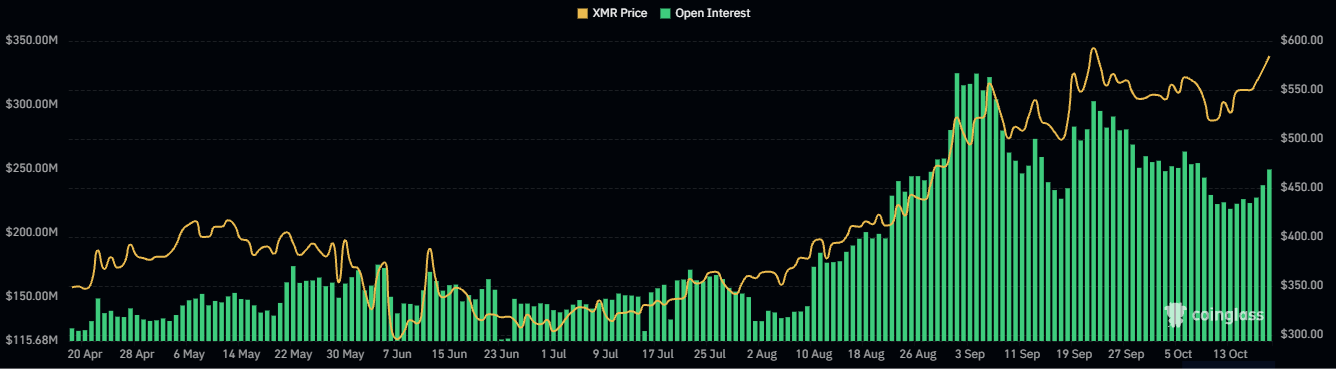
Another volume measure nearly doubled to $147 million. These figures track different markets and methods, so they should not be added together. Higher volume means more XMR changed hands during the period. It does not, on its own, show sustained net buying or confirm a breakout.
Monero open interest provides a clearer view of positions left outstanding. Its 11% increase indicates that traders expanded derivatives exposure during the recovery. Open interest can rise when new long and short contracts enter the market. It cannot show that all new exposure favors higher prices. That makes the price reaction around $558 more useful than the headline figure alone.

Positioning data in the report placed long traders near 63% within the sample tracked by Coinalyze. The measure suggests a bullish tilt among those accounts, though it does not cover every Monero trader. For the Monero price prediction to strengthen, XMR would need to clear $558 and hold the move. A daily close above that level would bring the $575 area into view. Failure there could leave recent long positions exposed to a pullback.
Crowded XMR Longs Face the $558 Resistance and $500 Support Test
XMR price had already reclaimed $500 during its earlier advance, turning that mark into a nearby support reference. The XMR price analysis also identified a broader demand area between $475 and $500. Several rebounds had occurred around that range, while the daily chart showed XMR above key exponential moving averages. These are observed chart conditions, not guarantees that the range will hold again.
A retreat below $500 would put the wider demand zone under pressure. If buyers defend it, they may have another chance to challenge $558. The $650 swing high remains a more distant reference. For the Monero price prediction to reach that level, XMR must clear nearer barriers and sustain demand after the initial breakout.
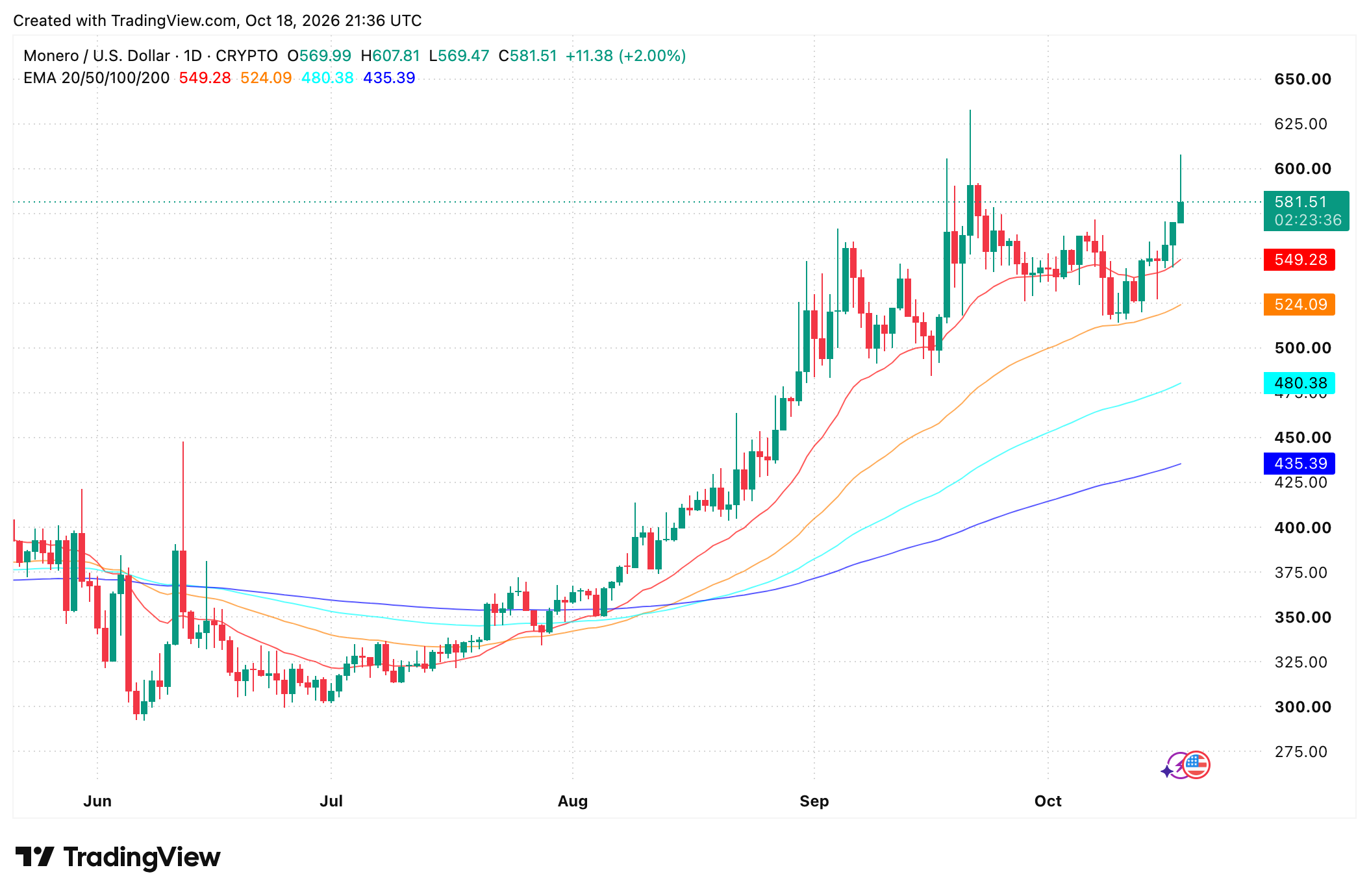
The Monero price prediction also depends on how leverage responds to a reversal. When crowded longs close voluntarily or face liquidation, their exits can add selling into a falling market. The reported 63% long share cuts both ways. It reflects bullish positioning, but it also identifies a group sensitive to a failed rally.
THORChain’s protocol upgrade adds a separate development for Monero. Its published update discussed work toward Monero activation, including swap and node improvements. That work could eventually widen self-custodial trading routes. The update does not establish that native Monero swaps were fully available on the main network during this market snapshot.
According to onchain data, its number of XMR swaps rose 1.43% in August, compared with Monero’s 43% price gain that month. That measure covers one platform and an earlier period than the October trading figures.
The post Monero Rally Tests $558 as XMR Open Interest Reaches $261M appeared first on Blockonomi.
TLDR:
- ONDO is described by the Ondo Foundation as a governance token for the Ondo DAO and Flux Finance.
- Published risk disclosures say ONDO holders have no shareholder rights or claim to company dividends.
- Andreou asks for a clear mechanism, enforceable scope and measurable benefit linking products to holders.
- Ondo’s Solana tokenized assets passed $500M, and Ondo Stocks reached $1B TVL and $18B in volume.
The ONDO token faces a fresh debate over what its holders actually own as Ondo expands its tokenized finance business. Questions have emerged over how product growth translates into value for token holders.
Meanwhile, tokenized assets tied to Ondo on Solana reportedly crossed $500 million. The two views reflect a wider discussion about the link between platform adoption and governance token demand. Both positions depend on how the token is defined in Ondo’s published documents.
What the ONDO Token Represents
The Ondo Foundation describes ONDO as a governance token for the Ondo DAO and Flux Finance. Holders therefore take part in decisions tied to those two areas. The ONDO token is not presented as a claim on company revenue.
Giannis Andreou raised the question in a post on X. He asked how the success of Ondo’s products reaches someone holding the token.
$ONDO BULLS: WHAT EXACTLY DOES THE TOKEN HOLDER OWN?
Ondo could become an important business in tokenized finance.
Institutions could adopt its products. Assets under management could grow. Distribution could expand across wallets, exchanges and financial platforms.
My… pic.twitter.com/F8tbhdRGjE
— Giannis Andreou (@gandreou007) October 18, 2026
He pointed to the Foundation’s token-sale risk disclosures. Those disclosures state that holding the token provides no shareholder rights. They also exclude rights to company dividends and distributions.
Andreou added that a customer buying a tokenized financial product acquires something different from an ONDO buyer.
The yield or economic rights attached to a product do not automatically belong to the governance token holder. Governance rights and product economics therefore sit in separate categories.
What Would Support a Bullish Case
Andreou acknowledged that governance can carry value. He also noted that future changes could strengthen the token’s role. Market demand may rise as the ecosystem grows. However, he asked that each of those arguments be evaluated separately.
He wants supporters to identify the existing mechanism, its enforceable scope, and the measurable economic benefit for holders.
If a thesis relies on a future governance decision, he asked that the dependency be explained. He also asked who holds the power to deliver that decision.
According to Andreou, a documented link between product success and durable demand for the ONDO token would change his view. He said numbers should show why that link matters. This standard applies to any claim that product growth benefits holders.
Solana Milestone Adds Another Angle
Niels offered a separate view in a post on X. He reported that ONDO crossed $500 million in tokenized assets on Solana. Ondo brought its tokenized stocks to the network only in January. The launch started with more than 200 U.S. stocks and ETFs.
Since then, Ondo has expanded 24/7 minting and redemption on Solana. Niels added that the wider Ondo Stocks platform has passed $1 billion in TVL. Cumulative volume has reached $18 billion in under eight months.
Niels described the pace of cross-chain expansion as hard to ignore. His post centers on platform scale. Andreou’s post centers on how the ONDO token captures benefits from that scale. Both posts therefore frame the same debate from different sides.
The post What Does the ONDO Token Holder Own? Debate Grows as Solana Assets Pass $500M appeared first on Blockonomi.
CryptoPotato
After a major correction experienced in the past several days and a dip to a monthly low, bitcoin enters another potentially fluctuating week with the Fed now back in its blackout period.
Attention has shifted to Big Tech earnings, US PMI data, consumer inflation expectations, jobless claims, and developments in the oil market. Here’s what to expect for the following five days.
Tech Earnings and Oil Shake
This week’s macro calendar is lighter than last week’s CPI- and PPI-heavy schedule, but several events could still move BTC indirectly through risk sentiment, bond yields, and expectations for the upcoming FOMC meeting on October 27 and 28. Perhaps the biggest market event comes on Wednesday when Meta and Tesla will report earnings, alongside IBM and several other major companies.
The impact on crypto could stem from the recent sell-off, driven by concerns about AI spending and technology valuations, which shows similar developments aren’t isolated in the current market environment. The Nasdaq 100 just posted its worst week since April 2025, while semiconductor stocks plummeted. Weak guidance from Meta and Tesla could renew the risk-off trade and spill over into BTC.
The EIA’s weekly petroleum report is due the same day, adding oil as another key variable. Crude prices have become increasingly important because higher energy costs have helped push inflation upward. A renewed oil surge could revive fears that the Fed will need to keep rates higher for longer. This is highly unfavorable for the crypto market, as we have witnessed lately.
Key Events This Week:
1. September Pending Home Sales data – Tuesday
2. SpaceX, $SPCX, Reports Earnings – Tuesday
3. Tesla, $TSLA, and Meta, $META, Report Earnings – Wednesday
4. Initial Jobless Claims data – Thursday
5. October MI Consumer Sentiment data – Friday
6. October MI Inflation Expectations data – Friday
~15% of the S&P 500 will report earnings this week.
— The Kobeissi Letter (@KobeissiLetter) October 18, 2026
Friday in Focus
Thursday brings weekly jobless claims, one of the few fresh labor-market indicators available before the Fed’s next meeting. The direct impact on crypto will likely be minimal, but all eyes will be on Friday as S&P Global publishes its October flash manufacturing and services PMIs.
This report will offer an early look at growth and, more importantly, whether businesses continue to face elevated price pressures. Later that day, the University of Michigan will release its final October consumer sentiment and inflation-expectations figures, with preliminary data showing one-year inflation expectations rising to 4.7% from 4.6%. Five-year expectations also rose from 3.4% to 3.5%.
This could be particularly significant for markets after last week’s CPI and PPI data showed inflation remains elevated.
The post Bitcoin Volatility Ahead? These 5 Events Could Move Crypto This Week appeared first on CryptoPotato.
XRP has extended its decline into a key demand zone near $1.30, giving up more of September’s recovery. While nearby support could trigger a relief bounce, the persistent sequence of lower highs and lower lows keeps the immediate outlook bearish.
XRP Price Analysis: The Daily Chart
On the daily timeframe, XRP has fallen into the highlighted $1.24–$1.32 demand zone after failing to sustain its rebound around $1.40. Consecutive bearish candles show that sellers remain in control, with the price now approaching the region that supported September’s strong advance.
This historical reaction makes the current zone important, but buyers have yet to produce a comparable response. Stabilization followed by a sustained reclaim of $1.32 would provide an initial sign that demand is returning. Such a recovery could support a move toward the $1.38–$1.42 resistance area, where the previous rebound stalled.
Conversely, continued weakness through the lower demand boundary around $1.24 would undermine the September base and increase the risk of a deeper correction. The next highlighted daily support sits around $1.11–$1.17. For now, holding demand is essential, but a reversal requires stronger bullish follow-through.

XRP/USDT 4-Hour Chart
The 4-hour chart shows XRP continuing to trade within a descending channel. Recent recoveries have repeatedly stalled beneath its midpoint, while the latest decline has pushed the price into the $1.27–$1.31 support zone near the channel’s lower boundary.
This confluence could attract buying interest and produce a short-term rebound. However, XRP first needs to reclaim $1.31 and the descending midpoint around $1.32–$1.33 to interrupt the immediate bearish sequence. Above that, the recent $1.34–$1.35 swing highs represent another resistance area, followed by the channel’s upper boundary near $1.39–$1.40.
If buyers fail to defend $1.27, the price could revisit the earlier wick lows around $1.25. Sustained acceptance below both support and the descending channel boundary would suggest accelerating selling pressure. Until XRP breaks the sequence of lower highs, any bounce remains vulnerable to renewed supply.

The post Ripple Price Analysis: What’s Next for XRP After Holding Key Support? appeared first on CryptoPotato.
The total crypto market cap increased by $840 billion, or 39.6%, to close the third quarter at $3 trillion, per data from CoinGecko, ending three straight quarters of declines.
It was the largest quarterly rise since the fourth quarter of 2024, but prices outpaced participation with trading volumes still falling.
August Delivered More Than Half the Quarter’s Gain
Market cap peaked near $3 trillion on September 21 before closing the quarter at $2.96 trillion, which is still 4% lower year to date.
August did the heavy lifting, with a 21.8% jump worth $490 billion that followed a US Treasury announcement to at least double its planned buybacks of long-dated bonds, plus steady net inflows into spot Bitcoin ETFs. A Senate procedural vote on the CLARITY Act failed on September 15 and barely slowed the climb.
Ethereum, meanwhile, gained 71% to $2,684, beating Bitcoin and every other major coin, helped by net inflows of $3.1 billion into US spot ETH funds that erased all the outflows from the first half of the year.
However, its trading volume still fell 23.2% to $11.5 billion, and Glamsterdam, the network upgrade already delayed in the second quarter, missed mainnet again and is still reaching test networks, with Sepolia activated on October 6.
Average daily volume fell 8.6% from Q2 to $73.3 billion, a third consecutive quarterly decline, while spot volume at the top ten centralized exchanges slid 14.2% to $1.65 trillion. But leverage came back faster than buyers did, since open interest on perpetual futures, which counts the value of contracts still open, rose 40.6% and closed above $100 billion for the first time since the third quarter of 2025.
Binance Gains Share While Newer Platforms Draw Traders
Binance extended its spot share to 42.7% from 38.7% in the second quarter, and it was the only exchange in double digits. It also added $12.7 billion to open interest, while KuCoin and Deribit lost 41.2% and 18.9%, a split CoinGecko called uneven rather than broad-based.
Bitget, for its part, fell to #11 after a hack in September, having already dropped from $37.8 billion in monthly volume in June to $15.7 billion in July.
CoinGecko also tracked Robinhood Chain, which launched July 1, and recorded more than $88.9 billion in trading volume during the quarter. Although the network was built with tokenized stocks and real-world assets in mind, meme coin traders took over, becoming a major source of activity that saw transactions per day hit an average of 9.5 million in Q3, even though most newly deployed tokens failed to gain traction.
The market has since then given back some ground, with BTC falling to a monthly low of $80,200 on October 15 amid pressure from Asian stock markets and September inflation data that came in slightly above forecasts.
The post Crypto Ends Three-Quarter Losing Streak With 39% Q3 Gain: Report appeared first on CryptoPotato.
A recent report by Chainalysis claimed that the United States has become a net importer of bitcoin this year while continuing to export dollar-backed stablecoins around the world.
The trend highlights an increasingly unusual dynamic: institutions are pulling BTC into the US, while the rest of the world is becoming more dependent on tokenized dollars.
Institutions Bring BTC Into the US
The report found that the US became a net importer of BTC this year for the first time since 2022. The distinction between retail and institutional activity is particularly notable, as transfers below $10,000 remained net outbound, but larger transactions moved strongly in the opposite direction. The $10 million-plus bracket alone accounted for 53,200 BTC flowing into the country.
In other words, retail users are sending BTC out, while US-based institutions are bringing it in. Chainalysis links the shift partly to the rise of spot Bitcoin ETFs, which have steadily increased the US share of global crypto activity since their launch in early 2024.
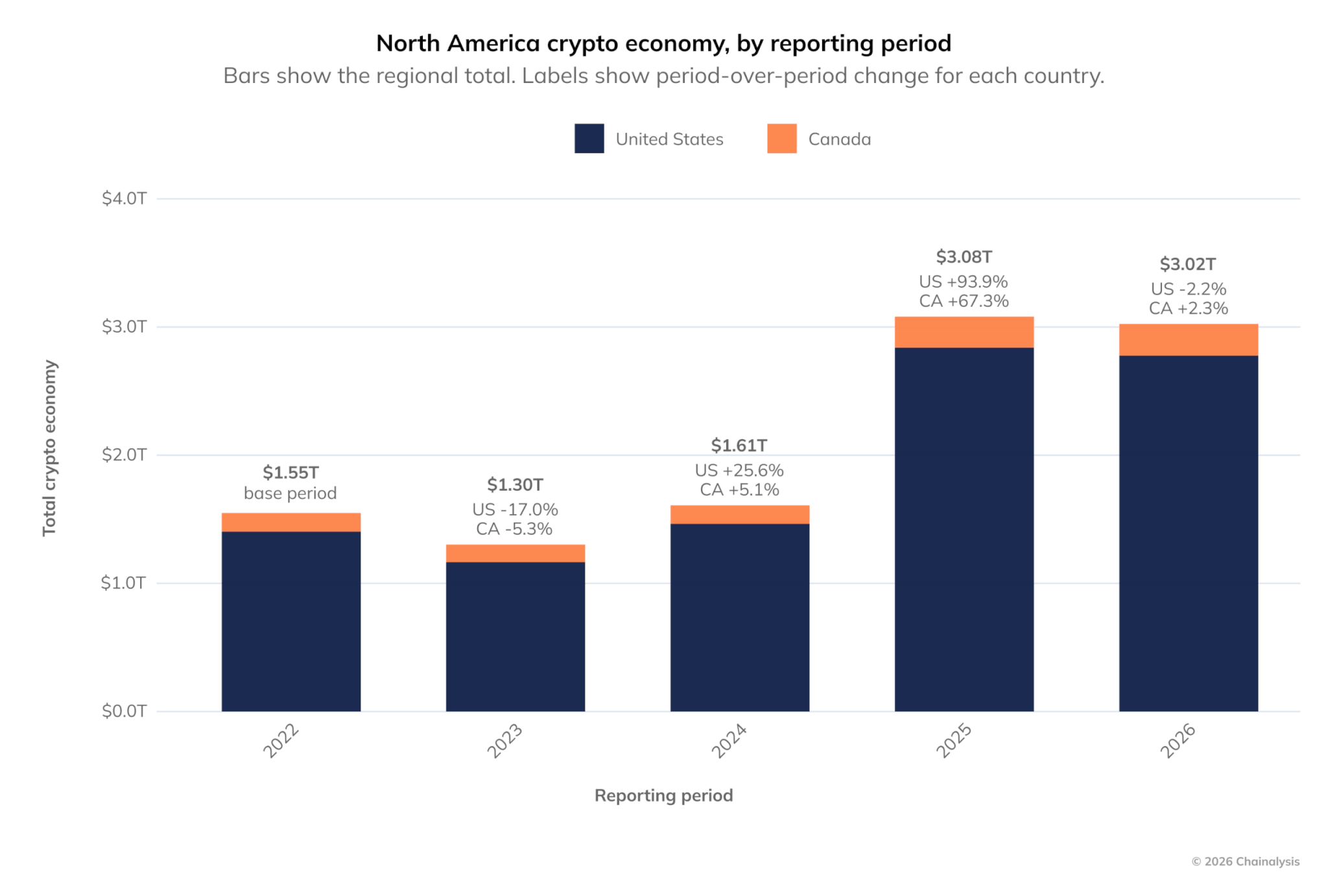
That fits a broader trend we previously covered, suggesting BTC has increasingly migrated from exchange balances to institutional structures such as ETFs and corporate treasuries. This reduces the amount of units readily available on trading platforms.
Chainalysis also noted that the US Strategic Bitcoin Reserve has added another layer of implicit sovereign demand, despite there being no standing federal purchasing program yet.
Everyone Else Wants Digital USD
The report further indicated that 99.1% of stablecoin order-book volume is tied to the greenback. It argued that users outside the US increasingly rely on such assets because they offer access to dollars without requiring an American bank account. That dynamic ultimately feeds back into US financial markets because stablecoin issuers typically hold reserves in short-dated US government debt.
The growing RWA sector reinforces the same trend, as the global market exceeded $36 billion in Q2 this year. It’s up 135% from the previous period, while tokenized US Treasuries alone accounted for $15.42 billion, or almost 43% of the total.
We have previously highlighted the rapid expansion of the sector, with tokenized Treasuries emerging as one of the largest and fastest-growing niches.
Taken together, the picture is quite straightforward: foreign users are increasingly demanding tokenized dollars and US debt, while American institutions are accumulating BTC.
The post US Is Importing Bitcoin and Exporting Digital Dollars: What Does it Mean? appeared first on CryptoPotato.
Chainalysis has revealed that one of the biggest victims of the Ledger implant thefts was a task scam operator who lost more than 60 Bitcoin (BTC).
The blockchain analytics firm put that loss at about $4.8 million. It seems the operator moved the scam’s proceeds into three Ledger addresses on September 22, and then emptied all three into the same wallet on October 9.
A flow chart Chainalysis posted traces the money back to a consolidation wallet, and it labels three of the wallets feeding it as reported scams. Likewise, the largest scam wallet sent it $1.36 million across 106 transfers. Each Ledger address was then drained of about $1.64 million in a single transfer.
Fake Reviews Led to Deposits
The report said the scam paid people to fake sales and reviews of real products, who then saw a negative balance appear in their accounts. They were told to add their own money before they could be paid.
One of the biggest victims of the Ledger theft was a scammer themselves. They lost more than 60BTC, about $4.8M. The funds were from a task scam.
In this task scam, people were paid to fake sales and reviews of real items. Then a “negative balance” appeared, and they were told to add their own money in order to get paid.
On Sep 22, the person behind the scam moved the proceeds into three separate Ledger addresses. On Oct 9, thieves emptied all three. One transfer each, into the same wallet. The wallet is reported as stolen funds.
— Chainalysis (@chainalysis) October 15, 2026
The US Federal Trade Commission (FTC) described the same pattern in a December 2024 report on task scams. The agency estimated that task scams made up nearly 40% of job scam reports in 2024.
“Cryptocurrency is the payment of choice for these scams,” the FTC said. Reported crypto losses to job scams hit $41 million in the first half of 2024, the agency added.
Ledger Ties Losses to CryptoBilis
Chainalysis didn’t disclose where the operator bought the Ledger signers, but Ledger has tied every confirmed loss from the incident it disclosed on October 9 to signers sold through CryptoBilis, a Southeast Asian reseller.
On October 10, Ledger found an unauthorized hardware implant inside one victim’s signer. Its Donjon security team said the implant reads the screen during setup and captures the 24-word recovery phrase. The implant then sends those words out over LTE through a provisioned eSIM.
On-chain analyst Specter has estimated losses from the CryptoBilis drain at more than $86 million, across Bitcoin, Ethereum (ETH) and TRON (TRX).
“We have not confirmed the total number of affected users or the total value lost,” Ledger said on Tuesday. The company has told anyone who set up a signer bought from CryptoBilis to move their assets to a new signer with a new recovery phrase.
The post Scammer Gets Scammed: Ledger Implant Thieves Steal $4.8M in Bitcoin appeared first on CryptoPotato.