Cryptocurrency Posts
Crypto Briefing
The lawsuits could redefine regulatory boundaries between state gambling laws and federal oversight of financial derivatives in the U.S.
The post Crypto.com and Novig sue Missouri to block sports wagering laws appeared first on Crypto Briefing.
The CFTC's proposal could enhance regulatory clarity and consumer protection, potentially influencing crypto market dynamics and Bitcoin prices.
The post CFTC proposes federal oversight framework for US crypto exchanges appeared first on Crypto Briefing.
The incident may prompt Saudi airspace restrictions, heightening regional tensions and impacting military strategies and territorial control dynamics.
The post Saudi helicopter downed near Yemen, two pilots killed in renewed conflict appeared first on Crypto Briefing.
TSMC's record growth highlights the transformative impact of AI on semiconductor demand, signaling a pivotal shift in tech industry dynamics.
The post TSMC posts record Q3 as AI chip demand pushes revenue up 50.9% appeared first on Crypto Briefing.
DeepSeek-V4.1-Flash's cost-efficiency and high ranking may drive more developers to adopt open models, influencing AI market dynamics.
The post DeepSeek-V4.1-Flash takes the top open model spot in Code Arena appeared first on Crypto Briefing.
Bitcoin Magazine
Bitcoin Magazine

Poetic Justice: Scammer Lost $5M in Bitcoin After Being Targeted by Ledger Thieves
Call it poetic justice: one of the biggest victims of last week’s Ledger theft happened to be a scammer themself, according to blockchain analysts, and lost nearly $5 million in bitcoin.
In a post Thursday, Chainalysis wrote that a crook lost 60 bitcoins worth about $4.8 million they’d stolen via a so-called task scam.
According to Chainalysis, the address was linked with a con where people were paid to fake sales and reviews of real items. They were told to add their own money in order to get paid — and then stolen from.
But the mastermind behind the task scam moved the stolen money to Ledger addresses which were then targeted by different scammers last week.
“On Sep 22, the person behind the scam moved the proceeds into three separate Ledger addresses,” Chainalysis said. “On Oct 9, thieves emptied all three. One transfer each, into the same wallet. The wallet is reported as stolen funds.”
Paris-based Ledger last week said it had started an investigation after customers in South East Asia reported they’d lost funds after buying from Malaysia-based reseller, CryptoBilis.
Ledger has since said that the scam was a massive organized crime operation where a group installed implants into devices and put them back on the market. The implants could read users’ seed phrases so criminals could then drain wallets.
Calling it one the most “sophisticated attacks” the digital asset industry has experienced, Ledger is yet to reveal how much money has been lost — but blockchain investigator Specter said $86 million had been drained.
And the task scam conman, according to Chainalysis, was one of the victims.
Ledger has said that it is working with law enforcement to “follow the funds and dismantle the attackers’ infrastructure” and has made sure no other vendors have been targeted by scammers.
CryptoBilis has stopped selling Ledger products, the company said.
Criminals have targeted bitcoin hardware sellers this year, with a huge attack taking place in July on the popular Coldcard products.
Crooks were able to steal close to $120 million in bitcoin from Coldcard users because the devices had a firmware bug which led to faulty seed generation, allowing hackers to guess investor seedphrases.
This post Poetic Justice: Scammer Lost $5M in Bitcoin After Being Targeted by Ledger Thieves first appeared on Bitcoin Magazine and is written by Mathew Di Salvo.
Bitcoin Magazine

BFFS26 Denver: Joseph Kelly on Bitcoin Custody and Credit; Alan Lane on Banking Lessons
The Bitcoin for Financial Services Summit (BFFS26) returns to Denver October 20–22, 2026, bringing together CPAs, wealth advisors, attorneys, lenders, and finance leaders who are building Bitcoin into their practices. Now in its second year, the summit has grown to more than 30 sessions across two full program days, with a speaker lineup drawn from the firms defining Bitcoin custody, credit, and advisory.
Headlining the program are Joseph Kelly, CEO and co-founder of Unchained, who opens the summit with a keynote on custody, credit, and trust at scale; Alan Lane, former CEO of Silvergate Bank, on lessons for Bitcoin and banking; Patrick Lowry, CEO of Samara Asset Group, on holding Bitcoin as a public-company treasury reserve; and Colin Crossman, Wyoming’s Deputy Secretary of State, on the regulatory outlook for banks, exchanges, and advisors. Additional speakers include Kate Goldman of Anchorage Digital, Sam Baker of River, Eric Yakes of Epoch Ventures, Daniel Hillery of UTXO Management, Moish Peltz of Falcon Rappaport & Berkman, and CJ Konstantinos of Peoples Reserve.
Sessions focus on practical application: bringing Bitcoin into wealth planning and family offices, Bitcoin-backed lending and mortgages, treasury accounting and valuation, retirement and income planning, charitable giving strategies, mining as an asset class, and fiduciary duty when clients hold Bitcoin. Dedicated workshops will offer continuing education credit for financial advisors and CPAs.
“Last year proved that financial professionals want more than a Bitcoin primer. They want to know how to serve clients who already own it,” said Jordan Guess, CPA, co-host of the summit in a press release shared with Bitcoin Magazine. “This year’s program is built around the questions advisors and accountants are actually getting from clients, answered by the people building the infrastructure.”
The summit opens Tuesday, October 20, with the Better Money Invitational golf tournament at City Park Golf Course, hosted with Bitcoin Sports Network, followed by a welcome party at The Space sponsored by Falcon Rappaport & Berkman. Evening programming includes wine and whiskey tastings, and Thursday begins with an optional sunrise hike in the Rocky Mountains.
BFFS26 is co-hosted by Jordan Guess and Wyatt O’Rourke of BFFS Media, producers of the Bitcoin for Financial Services podcast. Sponsors include Unchained, Anchorage Digital, UTXO Management, River, SOUND HSA, SustainHash, and Stormrake.
Registration is open now at https://www.bffs.media/summit.
Media contact: Wyatt O’Rourke, wyatt@bffs.media
This post BFFS26 Denver: Joseph Kelly on Bitcoin Custody and Credit; Alan Lane on Banking Lessons first appeared on Bitcoin Magazine and is written by Juan Galt.
Bitcoin Magazine

Sazmining Now Sells Jack Dorsey’s Proto Immersion Hashboards
Bitcoin mining just got a lower barrier to entry.
Sazmining announced Thursday that it is now selling Proto’s immersion hashboards directly to individual and institutional buyers through its mining-as-a-service platform. Previously, the hardware was mostly in the hands of large-scale operators.
Each hashboard delivers roughly 200 TH at around 15 J/TH, and buyers own them outright while Sazmining handles deployment, monitoring and maintenance at a US facility. Mining rewards go straight to the owner’s wallet.
The move follows a multi-megawatt supply deal between Sazmining and Proto — the bitcoin mining arm of Jack Dorsey’s Block (NYSE: XYZ) — which both companies expect to expand as demand grows.
“Because of our aligned-incentive model, Sazmining only earns when we produce bitcoin for our clients,” said Kent Halliburton, CEO and co-founder of Sazmining.
He also pitched mining as a form of bitcoin acquisition diversification: rather than paying the market price on the day of purchase, a miner’s costs are spread across the machine’s working life.
Wyoming-based Sazmining, founded in 2018, operates renewable-powered facilities across the US, Paraguay, and Norway. It says its fleet runs more than 20 percentage points ahead of the Bitcoin network’s carbon-free share.
Proto is Jack Dorsey’s Block’s bitcoin mining play. The Twitter founder has spent years arguing bitcoin is the foundation of “a more open financial system,” funding everything from Cash App’s buy-and-send rails to the Bitkey self-custody wallet, and he framed mining as the obvious missing piece back in 2021: “Bitcoin mining should be as easy as plugging a rig into a power source.”
Block formally announced it was building an open bitcoin mining system in January 2022, with the stated aim of making mining “more distributed and efficient.”
This post Sazmining Now Sells Jack Dorsey’s Proto Immersion Hashboards first appeared on Bitcoin Magazine and is written by Mathew Di Salvo.
Bitcoin Magazine

Hot Inflation Data Puts Bitcoin Under Pressure, but ‘Difficult’ Isn’t ‘Bearish’: CoinShares
Bitcoin’s price has dropped this week as new inflation data has come in hot.
But while the largest cryptocurrency’s near-term setup is difficult, it’s not “fundamentally bearish,” according to European asset manager CoinShares’ Head of Research, James Butterfill.
In a report Friday, the analyst said that bitcoin’s near-term challenge stems from a macro environment that’s caught in an awkward middle ground: inflation is too elevated for the Fed to ease up, while the economy is too resilient to force a policy pivot.
“Bitcoin and the broader digital asset market have moved lower on the resulting hawkish repricing, a reminder of how sensitive Bitcoin remains to monetary policy over short horizons,” he wrote.
Bitcoin’s price recently stood at $81,473, down 2% over a seven-day period.
The price of the leading cryptocurrency dropped Wednesday after data showed that U.S. consumer prices shot up more than expected in September.
Then, on Thursday, the Labor Department’s Bureau of Labor Statistics said that U.S. producer prices rose in September at the fastest pace in more than four years.
This has weighed on bitcoin’s price because higher inflation means the Federal Reserve may hike interest rates. Higher borrowing costs can restrict the liquidity the digital coin needs to rally.
The Federal Reserve hiked rates in September and will meet at the end of this month.
But Butterfill added that investors should be patient and advised investors to instead think in the long-term and not react to any single weekly data point.
“For investors, that argues for reading the coming weeks as a data-driven range rather than a trend, and for sizing digital asset exposure against a strategic allocation rather than against this week’s print,” he wrote.
Bitcoin spent the first half of 2026 in a bear market but had its best quarter in years after surging in August and September. Analysts have now said the leading cryptocurrency is now back in a bull market after trading above its 365-day moving average.
This post Hot Inflation Data Puts Bitcoin Under Pressure, but ‘Difficult’ Isn’t ‘Bearish’: CoinShares first appeared on Bitcoin Magazine and is written by Mathew Di Salvo.
Bitcoin Magazine

Deutsche Bank To Debut Bitcoin Custody Within Weeks: Report
German multinational Deutsche Bank is just weeks away from its crypto custody service, according to reports.
The lender — which is Germany’s biggest — also plans to expand the custody platform into Asia next year, according to a Friday Reuters report, which quoted its corporate banking chief.
Top banks worldwide are debuting or planning to debut crypto custody services, with BNY Mellon, State Street, Standard Chartered, U.S. Bank, and Citigroup all committing to direct crypto custody over the past 18 months.
JUST IN:
— Bitcoin Magazine (@BitcoinMagazine) October 16, 2026€732 billion Deutsche Bank to launch Bitcoin custody to its 28 million clients
pic.twitter.com/TAh9EwLkIX
Deutsche Bank first officially announced plans to debut a bitcoin custody service for European corporate and institutional clients in September, with the German multinational at the time saying service was subject to the completion of the applicable regulatory timeline.
Friday’s report added that the service will support custody of major cryptocurrencies such as bitcoin before moving to services that help clients move money into and out of stablecoins.
Gerald Podobnik, co-head of the corporate bank, was quoted by Reuters saying that the financial system will need to “offer tokenized or blockchain solutions.”
A number of top banks have started using the technology that powers bitcoin, the blockchain, for their own products in recent years.
Stablecoins and tokenization in particular have become a hot topic as traditional financial firms aim to accelerate certain services.
Crypto custody is often a starting point for banks moving into the digital asset space. BNY Mellon in 2022 became the first major U.S. bank to offer digital asset custody services.
Banks like Citi and Standard Chartered have this year debuted or announced plans for bitcoin custody around the world.
This post Deutsche Bank To Debut Bitcoin Custody Within Weeks: Report first appeared on Bitcoin Magazine and is written by Mathew Di Salvo.
HTTP error 429 on https://cryptoslate.com/feed/
Failed to fetch feed: https://cryptoslate.com/feed/
Failed to fetch feed.
CryptoTicker.io
Quant Fusion is what is known as a multi-ledger rollup: a settlement layer that connects several blockchains at once instead of running on a single one. It has been on mainnet since June 2, 2026, and Quant Network states that it links 74 blockchain networks in one shared environment. The heart of the matter is not the number but a promise: a token that today sits in seven copies on seven blockchains is meant to appear in this environment as a single value with a single liquidity pool.
This piece explains what works under the Quant Fusion rollup technically, how it differs from an ordinary rollup, what role the QNT token plays in it and which claims are documented. For what Quant is in the first place and what banks use the network for, see our overview of Quant, QNT and Overledger. This goes one level deeper.
Quant Fusion is a multi-ledger rollup, not a second layer 2
A classic rollup bundles transactions off a blockchain, nets them and writes the result back to that one blockchain. Arbitrum and Optimism work that way, and both hang off Ethereum. A multi-ledger rollup is meant to do the same for several blockchains at once: it executes transactions in an environment of its own and anchors the results in several connected networks.
Gilbert Verdian, the founder of Quant Network, announced the launch on X with a sentence that sums up the intention well: “Today we go live on mainnet with the Fusion Rollup, the world’s first multi-ledger rollup, connecting 74 blockchain networks in one unified environment, built for institutions.” The phrase “world’s first” is the company’s own presentation, not an independently verified fact. What is documented is the launch date and that the infrastructure is running.
Quant itself avoids the term layer 2 for Fusion and speaks of a category of infrastructure of its own. That is not pedantry: a layer 2 derives its security from exactly one base blockchain. Fusion does not have that single base, because it deliberately does not want one.
Before Fusion, institutions had two unsatisfactory routes: one blockchain or many bridges
The problem Quant describes is familiar to anyone holding tokens across several networks. It is not a problem of technology but of fragmentation. Verdian puts it this way in the same announcement: “For years, institutions had two bad options: bet everything on a single chain, or stitch together insecure bridges across many.” The first route leaves a bank’s clients and counterparties sitting on other networks; the second brings bridges into the picture.
A bridge is a link between two blockchains that locks a token on one side and issues a packaged representation of it, a wrapped token, on the other. That construction has been attackers’ favourite target for years, because the locked holdings sit in one place and the counterpart is only as safe as the contract issuing it. For a regulated institution a second problem comes on top: it has to be able to explain to its supervisor where an asset legally sits. With a wrapped representation on someone else’s blockchain, that question is uncomfortable.
Fusion is meant to make both routes unnecessary. Quant describes the moving of value, the settlement and the exchange of messages between networks as built firmly into the rollup instead of running over bridges. How robust that is in practice cannot be judged from outside yet, because there are no independent technical audit reports on it.

Unified assets: seven USDC copies become one uUSDC with a single liquidity pool
The part of Fusion that goes furthest beyond the usual interoperability is called unified assets. A unified asset is the representation of the same token across several blockchains as a single value inside the rollup. Quant names two examples: the stablecoin USDC, which today sits in copies on several networks, becomes uUSDC in the rollup. Holding USDC across two networks has so far meant two balances that know nothing of each other. BlackRock’s tokenised money market fund BUIDL becomes uBUIDL.
Why that counts becomes clear from liquidity. If a stablecoin sits in seven copies on seven blockchains, there are also seven separate liquidity pools. Moving a larger sum means moving it in the one pool where it happens to sit, at a worse price than pooled liquidity would give. That fragmentation is an annoyance for retail investors and a real cost factor for institutional volumes.
What matters for understanding it is what does not happen: the original token does not travel. On Quant’s account, every component stays anchored to its home blockchain and can be withdrawn at any time. The unified asset is therefore more a shared set of books over distributed holdings than a new token issued somewhere. That is precisely the difference from a wrapped token.
OP Stack and Hyperledger Besu: what works under the rollup technically
According to the technical description reproduced in trade coverage of the launch, Fusion is an optimistic rollup whose software builds on the OP Stack. Optimistic in this context means the system first assumes the submitted transactions are correct and allows a window in which someone can prove an error. That is the same basic idea working under Optimism and Base.
The difference sits beneath it. On that account the transaction data is not stored on a public blockchain but on a permissioned Hyperledger Besu network. Hyperledger Besu is Ethereum software that can also be run in closed networks where only approved participants may write. The state roots, meaning the cryptographic summaries of the respective system state, are returned to the connected layer 1 networks.
For banks that is the decisive property, and for part of the crypto scene the sore point. A permissioned data network means the data does not sit publicly on a blockchain that anyone can check. That meets confidentiality and jurisdiction requirements a public network does not meet. But it also shifts trust from mathematics back to the operators. Quant describes smart contracts with confidentiality protection, nodes with identity checks and access rules with which it can be set who may take part under which legal regime.
That design also explains why Quant builds the technology for institutions and not for the open market. A bank may only move client money through systems its compliance department can sign off, and that includes the question of who runs a node and which supervisor it answers to. An open network in which anyone can take part anonymously fails that requirement regardless of its technical quality. The compliance functions are therefore not an accessory but the actual reason to buy. Yet that is also where usage is decided: the stricter the admission rules, the smaller the circle of possible participants, and the longer it takes for noticeable volume to build.
Layer 2.5: why Quant places the rollup between blockchain and application
For its own position Quant has coined the term layer 2.5. What is meant is a layer that sits above the individual blockchains but below the applications. A layer 1 is the base blockchain, Ethereum for instance. A layer 2 relieves exactly one such base. An application layer sits above all of it and talks to the whole lot.
Fusion wants to stand in between and serve several layer 1 networks at once. Whether that term catches on is open; for now it is a provider’s self-description. Factually, though, it describes a genuine peculiarity, because a component that anchors its settlement back into several independent networks fits none of the established boxes. How Quant’s approach differs from other providers’ is in our comparison of Quant and Chainlink; both solve the same task by different means, and Chainlink’s price development is often read by investors as a gauge of the same bet.
The Trusted Node Program and the role of the QNT token
Further networks, public as well as private, are to be added through the Trusted Node Program, according to Quant. A trusted node is a node whose operator has been vetted and which takes part in processing transactions. For investors, the interesting question about it is where the QNT token comes in.
According to reports on the programme, node operators deposit QNT in order to take part in transaction processing. At the same time, overviews of Quant’s roadmap still list general QNT staking as an item without a fixed date. Those two statements cannot be reconciled cleanly from outside, which is why no clear picture is drawn here on purpose: that QNT has a function in the Trusted Node Program is described. To what extent that is already running, and how many tokens are actually locked for it, is not documented. If you read a figure on this, ask for the source.
The older, well-documented function of the token is a different one: commercial use of Overledger carries a licence fee that is settled in QNT. That construction has existed since late 2021 and is the actual reason the token has a job in the system at all.

Overledger connects, Fusion settles: two layers with two jobs
Overledger and Fusion are often lumped together, but they are two different things. Overledger is the older layer and at its core a universal connector: an application docks onto Overledger once and reaches several blockchains through it, without having to program a separate connection for each. That is integration work and saves companies effort.
Fusion is the newer layer and takes on something else, namely execution and settlement itself. One image for it: Overledger is the wiring through which all networks can be reached. Fusion is the place where the business is actually settled. For the commercial side of tokenised deposits, see our piece on Quant and tokenised deposits.
What is documented about the 74 networks and what Quant leaves open
The number 74 appears in every report on the mainnet launch, and in every one of those reports it comes from Quant itself. Gilbert Verdian too names no breakdown of the networks in his announcement, only the total. The company has not published a complete list of the connected networks, which trade coverage pointed out explicitly. The company’s presentation mentions public networks such as Ethereum alongside permissioned systems of the kind in use inside banks.
That is not an accusation but a piece of context that counts for any assessment. A technical connection is not the same as usage. A network can be connected in the sense of the count without a single piece of business ever having been settled over that connection. It is precisely on that distinction that it will be decided whether Fusion becomes infrastructure for real volume or remains a well-built facility waiting for customers. Trade press at the launch asked the same question: whether large banks will move from testing to live operation.
QNT in the market: rank 38 and the open question about revenue
On Sunday midday QNT was quoted at around $198, or roughly 176 euros, almost three percent below the previous day. Market capitalisation stood at about $2.9 billion, which corresponds to rank 38 among all cryptocurrencies. The price is far from its September 2021 peak of a good $427. The circulating supply is around 14.6 million tokens and therefore very close to the maximum the protocol provides for; hardly any new tokens are being added, which makes the supply side highly predictable.
The question that matters for investors cannot be answered from those figures, and it reads: does the revenue banks generate over this infrastructure actually flow through the QNT token? The licence fee for Overledger in QNT is documented. What is not documented is that every transaction settled over Fusion creates demand for the token. Buying QNT means buying a bet on that connection, not on the technology alone. Where the token can be traded in Germany, and which venues hold a licence under the European crypto regulation MiCA, can be looked up in our crypto exchange comparison.
uBUIDL and tokenised funds are the real test
That Quant names BUIDL of all things as an example is no coincidence. Tokenised money market funds are the segment in which institutional money is currently moving onto blockchains fastest, and they suffer particularly from fragmentation: a fund unit sitting on five networks means five sets of books for a custodian.
If a unified asset reduces that bookkeeping to one without the unit losing its legal anchoring, that has a measurable value for custodians and fund companies. It is the part of the promise most likely to find customers, and at the same time the part where it will show fastest whether the technology holds. A custodian running tokenised fund units over a third party’s settlement layer has to be able to explain that to its own supervisor.
The proof Fusion has to deliver before the clearing house start in 2027
Quant says it is working with the US payments body The Clearing House on tokenised deposits, with a start in the first half of 2027. That is the date on which the technology has to prove itself publicly, and until then there are three things by which progress can be read without having to believe the announcements.
First, a published list of the connected networks, or at least an independent check of the number. Second, a named user in live operation rather than a pilot project, meaning an institution that says it actually settles over Fusion. Third, a verifiable figure for how much QNT is locked in the Trusted Node Program. If none of those three pieces of evidence arrives, Fusion remains what it demonstrably is today: a running facility with a strong blueprint behind it.
Quant Fusion: without bank volume the rollup stays a blueprint
For investors in Germany a sober order of business follows from that. The technology is real and has been in operation since June 2026. The economic benefit for the token is not yet. Three steps make sense now:
- Clarify the venue and its licence. Check which provider lets you trade QNT at all and whether it is licensed in the EU. Our comparison of regulated crypto exchanges shows which providers hold a MiCA licence.
- Factor in the holding period and tax from the start. In Germany the gain from a sale stays tax-free after a holding period of one year; below that it counts as a private disposal. Holding over several years calls for clean records of the purchase dates; the tools for that are in our comparison of tax software and portfolio trackers.
- Keep the three pieces of evidence in view. The network list, a named user in live operation, the locked QNT amount. For tracking metrics on an ongoing basis, the tools from our comparison of analytics platforms are suitable.
And through all of it one thing holds: QNT is a bet on an institutional rollout that is still outstanding. A total loss is possible with any crypto token, including one with a banking mandate.
Further evidence on the launch is in Quant Network’s announcement and in DisruptionBanking’s assessment.
(As of October 18, 2026. This article is not investment advice. Prices and fee structures change; check the terms with the provider before you buy.)
Bitcoin trades at $81,017 on Sunday evening, and the weekend’s most important number is not in the chart but in the protocol itself: since October 16 the network has demanded 5.92 percent more computing work for the same block. Mining difficulty climbed with block 971,712 to 140.58 trillion, its highest level since March 5. At the same time the price has fallen from $84,506 to $81,017 since the previous adjustment on October 3. More effort, less revenue: for miners that is the squeeze which ultimately decides how much they have to sell.
Difficulty is the Bitcoin network’s automatic adjustment screw. Every 2,016 blocks, roughly every two weeks, the protocol measures how quickly the past blocks were found and resets the difficulty so that a block is produced every ten minutes on average. For the longer-term view of where the price can head over a horizon of months, see our Bitcoin price prediction. For the next two weeks, though, what counts is the miners’ short-term arithmetic, and that shifted noticeably on October 16.
Bitcoin at $81,017: what the price board shows right now
The price stood at $81,017 on Sunday evening, down 0.24 percent within 24 hours (source: CoinGecko, as of October 18). The daily range ran from $80,823 to $82,178, so less than 1.7 percent between high and low. That makes Sunday the weakest day of the week: the seven-day high was $83,115.
Set against the quarter it looks different. The 30-day high stands at $86,597, the low of the past 90 days at $62,773. The price is 35.7 percent away from the all-time high of $126,080 set on October 6, 2025. So the market has been moving for weeks in a band that carries neither panic nor euphoria, and it is precisely in such phases that the miners’ cost side becomes a price factor in its own right.
What has happened since our article of October 17
Yesterday this slot focused on the October 30 options expiry, in which contracts worth $12.2 billion run out. You can read that in our piece on the options expiry of October 30. Since then the price has moved from $81,524 to $81,017, a fall of $507 or 0.62 percent.
More important than the $507 is which line gave way. The average of the past 50 daily closes sits at $81,382, our own calculation from the CoinGecko daily data. Yesterday Bitcoin was still above that line, today it is $365 below it. That is no slump, but it is the week’s first close below a level that short-term traders orient themselves by. What is new is the cost side, on which there was nothing to say yesterday: the October 16 adjustment has only been fully felt in mining operations’ books since the weekend.
How a mining operation does the maths since October 16
The mechanism behind the difficulty jump takes three sentences. A mining operation sells nothing but computing power; its revenue depends on what share it holds of the network’s total computing power and on what a Bitcoin is worth. When difficulty rises, so does the total computing power needed to find a block, and each individual operation’s share of the daily payout falls. The electricity bill stays the same, because the machines keep running.
The network pays out 3.125 Bitcoin per block, so 450 Bitcoin a day at the targeted 144 blocks, transaction fees aside. At the October 3 price that was $38.03 million a day, at Sunday’s price it is $36.46 million. The computing power sharing that money has risen over the same period from around 950 to 1,006 exahash per second, derived from the difficulty.

The hashprice falls to $36.23 per petahash per day
The industry rolls both figures into one metric: the hashprice. It says what one petahash per second of computing power earns per day, and is therefore the revenue per machine deployed. We calculated it ourselves from the difficulty values on mempool.space and the CoinGecko prices, excluding transaction fees and operating costs.
On October 3 the hashprice was $40.03 per petahash per day. On October 18 it is $36.23. That is 9.5 percent less in a little over two weeks, and the decline splits almost exactly in half: 4.1 percent comes from the price, the rest from the higher difficulty. An operator running electricity costs close to the break-even point therefore loses almost a tenth of its income in two weeks without anything changing in its hardware.
That is the figure that matters for the price. Mining operations cover their running costs in euros and dollars, while their income arrives in Bitcoin. When the hashprice falls, a larger share of the mined amount has to be sold immediately instead of moving onto the balance sheet. That selling lands on the same exchanges where the rest of the market trades.
Hashrate has been falling since the jump
That very reaction is already visible in the network data. The 30-day average of computing power sits at 1,019 exahash per second. The daily readings of the past week paint a different picture, however: from 1,084 exahash the figure fell to 943 exahash most recently, a drop of 13.0 percent (source: mempool.space, retrieved October 18).
Part of that is noise, because daily hashrate readings are estimated from the number of blocks found and fluctuate by a few percent even at constant output. The rest is switch-offs: operations whose power price no longer works at a hashprice of $36 are taking machines off the network. That also shows in the current period’s average block time of 9 minutes and 59 seconds, marginally above the target.
October 16 was the year’s second-largest step up
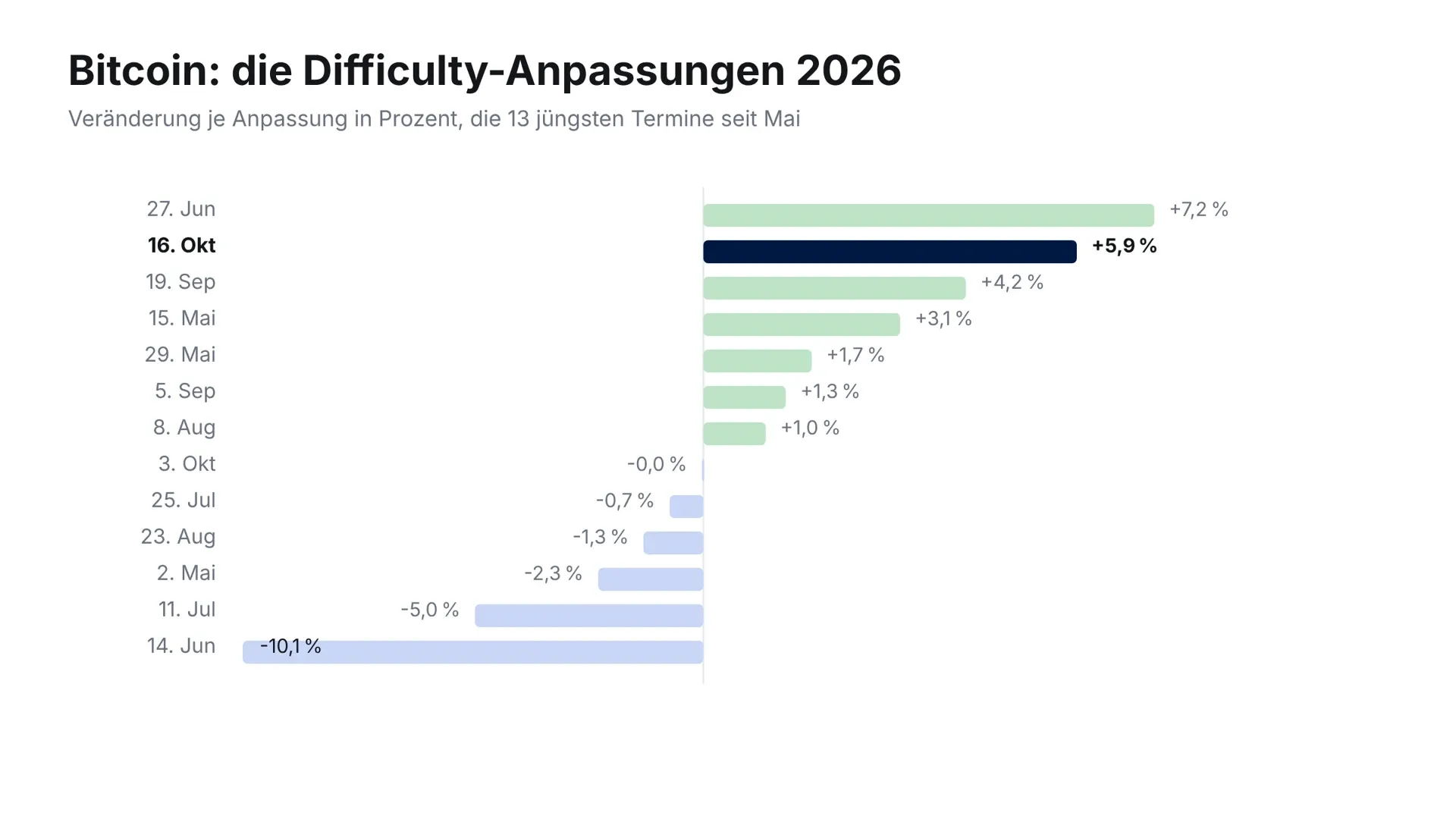
A look at the 13 most recent adjustments puts the 5.92 percent in context. Only June 27 was bigger in 2026, at 7.15 percent. Then come September 19 with 4.16 percent and May 15 with 3.12 percent (long-run series: blockchain.com). At the other end of the series sits June 14 with minus 10.09 percent, followed by July 11 with minus 5.00 percent.
The immediate predecessor is notable: on October 3 the adjustment came to minus 0.03 percent, practically zero. Within two weeks, then, the network tipped from standstill to the year’s second-largest increase. Such jumps arise when new computing capacity ordered and built over months comes online, and they hit the market regardless of where the price happens to stand.
The next adjustment is due on October 30
The coming adjustment falls at block 973,728. At the current block pace some 1,703 blocks are still missing, and the period is a good 15 percent through. As things stand that points to October 30, and the estimate is minus 0.45 percent. The estimate is no promise, because the network recalculates it with every block, and it shifts as soon as operations switch off or back on at scale.
The date is interesting all the same, because it coincides with the options expiry we wrote about yesterday. Two dates that can both cause short-term movement thus fall on the same day. The difficulty adjustment works on the supply side, the expiry on traders’ positioning.

The levels: $81,382 above, $80,823 below
Three levels can be justified for the coming days, and each has an origin rather than being a line on a chart.
$81,382. The average of the past 50 daily closes. The price sits $365 below it. As long as it stays below, every recovery attempt has this line above it as the first resistance. A daily close above turns the relationship around.
$80,823. Sunday’s daily low and therefore the immediate floor. If it breaks, the next reference is the area around $78,000, where the price turned several times in early October.
$83,115. The seven-day high. Only above it does the sideways move become an upward move again, and only then does selling pressure from the mining sector lose weight, because the hashprice rises with the price.
The span between floor and ceiling thus comes to just under 2.9 percent. For a week that is narrow, and narrow ranges tend to resolve in the direction of the first larger sale.
Our assessment: the selling pressure is real but limited
In the editorial team’s view the difficulty jump is a genuine drag for the coming two weeks, but no reason for a new price picture. The numbers support that: a 9.5 percent fall in the hashprice forces operations at the margin of profitability to sell, and the 13 percent less computing power in the daily readings shows that some have already taken that step. The daily payout of 450 Bitcoin amounts to only $36.46 million at $81,017, however, and measured against a market capitalisation of $1.63 trillion that is a small sum.
The mechanics also argue against it: if operations switch off, computing power falls, and the next adjustment comes out correspondingly lower. The estimated minus 0.45 percent for October 30 is exactly that counterbalance in figures. The network corrects its own overheating, and does so within twelve days. Deriving a months-long downward forecast from the difficulty jump overstretches a metric designed for two weeks. Bitcoin remains an asset carrying the risk of total loss, and none of these figures is a buy or sell recommendation.
What hangs on a top-up purchase in Germany
For investors in Germany a sideways phase has a side effect that has nothing to do with the chart. Every additional purchase starts its own one-year holding period for exactly that amount. If you top up today at $81,017, you can only sell that tranche tax-free from October 18, 2027; earlier holdings are unaffected, but the tax authorities generally allocate them on a first in, first out basis. We track the current state of the political debate about the deadline on an ongoing basis at crypto holding period: reform and status.
In practice that means a purchase decision in this phase is also a decision about a cut-off date in October 2027. Buying regularly in fixed instalments creates a corresponding number of deadlines side by side, which makes the bookkeeping more laborious but smooths the entry price. Which providers offer a savings plan on Bitcoin, and at what fees, is in our overview of buying Bitcoin with a savings plan.
The fee side stays cheap for investors
One development argues for moving coins on the blockchain in this situation: network fees are low. As we measured this morning, one satoshi per byte was enough to make it into the next block, which made a withdrawal possible for around 12 cents. The details of that measurement from the morning of October 18 are in our analysis of the network fee and the mempool.
That connection is no coincidence. When demand for block space falls, fees stay low, and precisely then miners lack the revenue source that could cushion the fallen hashprice. For investors who want to move holdings from an exchange into their own custody, that is the favourable side of the same coin.
Bitcoin at $81,017: the $81,382 line decides the week
The difficulty jump of October 16 makes mining 5.92 percent more expensive, the hashprice sits 9.5 percent below its October 3 level, and the price is quoted $365 below the 50-day average. Three steps follow for the coming days:
- Watch the line at $81,382. A daily close above it ends the short-term weakness, a break of $80,823 opens the way towards $78,000. Where you trade and at what fees is shown in our overview of the best crypto exchanges.
- Mark October 30 in the calendar. On that day the next difficulty adjustment and the options expiry coincide. For a staggered entry in fixed instalments until then, the providers in our comparison of Bitcoin savings plans are suitable.
- Document the holding period of every new tranche. Each additional purchase brings its own cut-off date in October 2027. Which programs keep acquisition dates and deadlines cleanly is in our comparison of crypto tax tools.
(As of October 18, 2026. This article is not investment advice. Prices and fee structures change; check the terms with the provider before you buy.)
The Bundestag decided on October 8, 2026 that German tax authorities may in future exchange data on crypto transactions with countries outside the European Union as well. What passed is a treaty act on an international agreement from 2023 that implements the crypto-asset reporting framework. If you hold coins at an exchange in Singapore, the Cayman Islands or Switzerland, that account no longer sits beyond the reach of the German tax office, as soon as the partner state delivers in return.
This piece sets the vote in context: what exactly gets reported, from when, which countries take part, and where the figures in press coverage diverge. The tax liability itself does not change. What changes is the likelihood that the tax office can cross-check a figure.
What the Bundestag decided on October 8
Parliament adopted the government bill in the version agreed in committee. The full title is the “Act on the Multilateral Agreement of 8 June 2023 between the Competent Authorities on the Automatic Exchange of Information pursuant to the Crypto-Asset Reporting Framework”. It is on file as Bundestag printed paper 21/7195, the finance committee’s recommendation as printed paper 21/8425.
The majority was broad. According to the Bundestag, CDU/CSU, SPD, Bündnis 90/Die Grünen and Die Linke voted in favour, while the AfD group voted against. The federal government justifies the measure with the aim it words as follows: “To effectively combat cross-border tax evasion”.
A treaty act is not new tax law. It grants domestic approval to an agreement under international law that Germany has already signed. Only then may the Federal Republic actually send and receive the data.
CARF: the crypto-asset reporting framework in one sentence
CARF stands for Crypto-Asset Reporting Framework and is the OECD reporting standard that obliges crypto service providers to report user data and transaction totals to their tax authority, which then passes them on to the countries where those users are resident. The model is the Common Reporting Standard, under which banks have been exchanging account data for years. CARF carries that pattern over to exchanges, brokers, custodians and swap services.
We have taken the standard and its relationship to the CRS apart in a separate piece on the OECD reporting standards for crypto-assets. The October vote is the step with which Germany makes that framework usable beyond the EU border.
The data points the bill lists
The bill sets out what is transmitted for every reported user: “name, address, countries of residence, tax identification number and date of birth”. Added to that is the type of each individual crypto-asset. And finally the transaction data: gross transaction amounts, the number of units and the number of reportable transactions.
The term gross transaction amount deserves attention. What is reported is not your profit but your turnover. Move the same 2,000 euros around twenty times in a year and you appear with 40,000 euros in volume, even though the profit can be zero. We have described what that distinction means in practice here: what your exchange reports to the tax office.
Why the gross figure triggers follow-up questions
A tax office that sees a high gross total and finds no corresponding entry in the tax return has a starting point for a query. That is neither suspicion nor an estimate, but first of all a discrepancy between two data sets. It can only be resolved with a breakdown of the individual transactions. Without that breakdown you have to reconstruct it after the fact, and that is laborious at an exchange you left three years ago. A portfolio tracker with tax reporting solves the problem in advance, because it records the transactions as they happen instead of rebuilding them later.

DAC 8 and CARF: two routes, one tax office
Inside the European Union the exchange already exists. The Bundestag points out that for platforms and cryptocurrencies the corresponding European and national reporting obligations under DAC 7 and DAC 8 are already in place. DAC 8 is the EU administrative cooperation directive that brings crypto service providers into the reporting regime; the Bundestag had passed the German implementation back in November 2025.
That makes the division of labour clear: DAC 8 covers the EU, CARF covers the countries outside it. We wrote up what DAC 8 requires in detail when the German implementation was adopted. The October vote closes the gap that had sat between the two worlds until then.
The timeline: collection in 2026, reporting in 2027
Precision matters here, because several years get mixed up in press coverage. The sequence that follows from the available information looks like this: the service providers subject to reporting collect the transaction data from 2026 onwards. Reporting to the respective tax authority begins in 2027. Under the OECD’s plans, the international exchange between the authorities also starts in 2027.
The Bundestag’s own text names neither a start date for the exchange nor a collection year. If you read a specific month, treat it as the reporting outlet’s figure rather than as something the law fixes. The direction is certain: the current year is already a collection year. Nothing about that can be changed retroactively.
There is also a condition that is easy to miss. An exchange relationship does not come into being through the signature alone. Both states have to bring their rules into force, notify the OECD and name each other as partners. Until that has happened, nothing flows between two signatories.
27, 46 or 55 countries? Why the numbers differ
Three figures circulate for the number of countries involved, and all three can be explained once you tie them to the right question.
For the signing, the Bundestag gives a clear figure: the multilateral agreement was signed in November 2024 by Germany and 26 further countries, so by 27 states. The signing took place in Asunción, Paraguay. Separate from that is the number of states that actually intend to start the exchange from 2027: for that, the OECD names 46 jurisdictions, according to the specialist site Blocktrainer. The third figure, 55, comes from the Bundestag debate itself; the AfD member Jörn König spoke of 55 further states. Blocktrainer considers that figure inaccurate and points to the OECD number.
The middle figure is the most useful one in practice, because it describes where data is meant to flow from 2027. The agreement is also open-ended: further states will join later. The United Arab Emirates and Turkey are named for 2028, the United States has committed to taking part from 2029 and is absent from the first wave.
What a missing country does not mean
A country missing from the first wave does not make gains there tax-free. In Germany, tax liability attaches to your residence, not to where the exchange is based. A missing exchange relationship only lowers the chance that a figure gets matched automatically. The duty to file a complete return applies regardless, and an incomplete return stays incomplete even if nobody checks it.
Exchanges outside the EU: where reporting applies
The reporting duty falls on the providers, not on the users. A provider is caught where it is resident or carries on its business. One simple question follows from that: in which country is the provider holding your balance based, and does that country have an exchange relationship with Germany?
For a platform licensed in the EU, DAC 8 answers that anyway. For a provider in a non-EU state, the partner list decides. And there is a third case that has become very concrete in Germany this year: providers that fail to get their licence and rebuild their business. The marketplace bitcoin.de shows what that looks like after BaFin refused it a MiCAR licence; we set out the situation for balances held there in October. If you move for a reason like that, choose the destination by its licence and not by its fee table; an overview of the trading venues regulated in the EU is in our comparison of regulated crypto exchanges.

Documentation: the records a data match requires
Matching two data sets only works if you have your own. For every position, what counts is the date of acquisition, the acquisition cost, the date of disposal and the disposal proceeds. At a single exchange with a handful of purchases that is manageable. It gets messy with moves between platforms, with coin-to-coin swaps and with transactions at providers that can no longer be reached.
Two points are especially error-prone. First, swapping one coin for another: for tax purposes that is a disposal and an acquisition in one transaction, even though no euro moved. Second, transfers to your own wallet, which are not a sale but can appear as a transaction in a reported data set. Both can only be explained with a breakdown that shows the transaction.
The exemption threshold for private disposals and the one-year holding period under section 23 of the German Income Tax Act continue to apply unchanged. Motions by the Greens and the Left to abolish the holding period found no majority in the Bundestag. Check the amounts that apply for your year before you file, with the tax office or in your tax software, because they have been adjusted several times in recent years.
The criticism: data protection in non-EU states and Article 2
The dissent came from the AfD group. According to Blocktrainer’s report, the member Jörn König raised two objections. First, sensitive data should not go to states whose level of data protection falls below the European one. Second, he criticised Article 2 of the act: it allows the federal finance ministry to change the scope of the exchanged data by regulation, without the Bundestag voting again. König called for that article to be deleted. His group also demanded that transfers between a user’s own wallets be excluded and that a de minimis threshold be introduced.
The second objection concerns a mechanism that is notable regardless of the political verdict: after the vote, the scope of reporting is not fixed for good; it can be widened by regulation. To know what will be reported in two years, you therefore have to keep an eye on the regulations, not just on the act.
There is reticence inside the coalition too, though on a different question. On the debate about taxing crypto-assets like shares, the CDU/CSU member Georg Günther was sceptical, according to the same report: “There is no convincing reason for a change of system”, crypto-assets were “not classic securities”, and he summed up: “Tax transparency yes, but no tightening for its own sake.” The distinction in that is useful for context: transparency and the tax rate are two different building sites, and so far only transparency has been decided.
What CARF does not change: the tax liability stays
A reporting framework does not levy tax. It only shifts who knows what. That comes down to three points which remain unchanged after the vote.
The amount of your tax still follows German income tax law, not the law of the state where the exchange is based. The duty to file a complete return rests with you and not with the service provider; a report from the exchange does not replace an entry in your tax return. And the burden of proof for acquisition cost and holding period also stays with you, which is why patchy documentation is a problem even when nothing was reported at all.
That reporting duties are growing beyond exchanges is shown by a development of late summer: wallet manufacturers are now covered in the EU as well. Across all the individual measures the direction is the same: what only you used to know is becoming matchable.
Crypto tax reporting: from 2027 the 2026 data is on file
The vote of 8 October only takes effect in the future, but the collection year is running now. Three steps follow from it.
- Take stock. Note which providers hold balances for you and which country each of them sits in. That shows which positions DAC 8 already captures and which will be added through CARF. Which trading venues are licensed in the EU is shown in our comparison of regulated crypto exchanges.
- Close the gaps in your history. Export the transaction history everywhere you can still retrieve it, and store it off the platform. At a provider that is rebuilding or winding down its business, the export is no longer available later. A tax tool with portfolio reporting handles that part on an ongoing basis.
- Move long-term holdings into your own custody. A transfer to your own wallet is not a sale, but it can appear as a transaction in a reported data set. Note the date and the destination address so the transaction stays explainable later. Which devices are suitable for that is shown in our hardware wallet comparison. If you failed to declare gains for a past year, settle that with tax advice beforehand.
You can read the vote itself: the Bundestag documents it in its text archive for the sitting week, and the DAC 8 implementation from November 2025 is documented there as well.
(As of October 18, 2026. This article is not investment advice. Prices and fee structures change; check the terms with the provider before you buy.)
Chainlink announced a partnership with the Tokyo advisory firm Pacific Meta on October 16. Pacific Meta will use the Cross-Chain Interoperability Protocol, CCIP for short, as its preferred solution for the Japanese financial sector and additionally takes the Automated Compliance Engine, ACE for short, into its partner offering. The price acknowledged the news with nothing: Chainlink traded at $11.76 on Sunday afternoon, 2.06 percent below the previous day.
That discrepancy is the real subject of this piece. Since the beginning of October, Chainlink has reported integrations, protocol launches and institutional agreements at a weekly rhythm, and the token has lost ground regardless. Further down is a simple calculation showing why that is no contradiction but a question of magnitude.
What Pacific Meta and Chainlink agreed on October 16
Pacific Meta is a consultancy based in Minato-ku, Tokyo, founded on August 10, 2022. Its managing director is Shota Iwasaki. By its own account the firm has supported more than 300 projects in more than 41 countries. This is not its first collaboration with Chainlink Labs: a first cooperation came in 2023, then covering Web3 services and gaming.
The new agreement covers three fields: tokenised financial products, identity on the blockchain and compliance infrastructure. CCIP is declared the preferred solution for transferring tokenised assets between different blockchains. ACE is listed in Pacific Meta's partner offering, which means it is presented to Japanese institutions as a finished building block. Crypto Briefing reported this on October 16, citing the statement from both firms.
Two terms run through this text. Tokenisation means that an asset, a bond or a fund unit for instance, is issued as an entry on a blockchain instead of a booking at a custodian. Interoperability means that such an entry can move from one blockchain to another without anyone rebooking it by hand along the way.
ACE: the rule moves into the transfer
The Automated Compliance Engine is Chainlink's answer to a problem familiar to every bank considering tokenised securities. A fund unit may not go to just anyone. Depending on the product, the buyer needs a completed identity check, residence in an approved country, sometimes the status of a professional investor. Today an employee or a downstream system checks that before an order is executed.
ACE moves that check into the transfer itself. Chainlink words the promise on its ACE product page like this: set compliance rules once and enforce them everywhere. A transfer that breaches a stored rule never comes about in the first place, regardless of which blockchain it takes place on.

CCID, Policy Manager and ERC-3643: the building blocks in detail
ACE is no single program but a kit. Chainlink names five parts on its product page, and each of them solves a different sub-task.
The Cross-Chain Identity Framework, CCID for short, maps an investor's identity across blockchains. It stores cryptographic proof that a check has taken place, an identity check under anti-money-laundering rules for instance. What matters is what it does not store: the personal data itself stays off the blockchain. All that sits there is the proof that the check was passed.
The Policy Manager is the rules engine. Here an issuer sets out which conditions a recipient has to meet. The rules can run on the blockchain or off it, depending on how much confidentiality the product demands. Chainlink ships prefabricated modules with it, allow and block lists or volume limits for example.
The Cross-Chain Token Compliance Extension is the interface through which any token can use these functions without being rebuilt from the ground up. The Identity Manager administers the life cycle of the proofs, meaning issuance, distribution and revocation. The Monitoring and Reporting Manager watches ongoing operations and produces the reports a supervisor wants to see.
Then there is a detail that makes specialists sit up: ACE works with the ERC-3643 standard. That is the most widely used norm for tokens with built-in transfer restrictions, precisely the form in which tokenised securities are issued today. Chainlink is therefore not building its own island but relying on something issuers already use.
Japan, Tokyo and the timing of the announcement
Japan is no arbitrary market for tokenised securities. The country regulated the issuance of digital securities early in its financial market law, and large houses have been working on tokenised bonds and property funds for years. Anyone wanting to offer products there needs compliance tooling that maps the Japanese requirements, and needs it before the first product goes live.
In this constellation Pacific Meta is not an issuer but an intermediary. The firm advises companies entering blockchain applications and, by its own account, maintains relationships with large names in telecommunications, consumer electronics and digital advertising. What Chainlink gains is therefore not a customer but a distributor.
What the announcement lacks: no customers, no deadlines
This is where the counter-check is worth making, and it comes out clearly. The statement names not a single Japanese institution that actually uses ACE or CCIP. Neither a launch date nor a product nor a timetable is given, and no volume and no financial terms either. Crypto Briefing describes the agreement as the designation of a preferred solution, a listing in a marketplace and a business development deal, explicitly not as a series of running installations.
That is no reproach but a piece of context. Agreements of this kind stand at the beginning, not at the end. For valuing the token, though, it means this: for the time being no additional protocol revenue follows from this announcement, and therefore no additional demand for LINK. Anyone buying today is buying a declaration of intent.

LINK at $11.76: the calculation that explains October
Now to the figure that explains the gap between the news flow and the price. Our report of October 16 stated that the Chainlink Reserve had bought 431,900 LINK within 30 days. That number sounds large. Measured against the market it is not.
431,900 LINK spread over 30 days works out at around 14,400 LINK a day. At Sunday afternoon's price of $11.76 that corresponds to a daily purchase volume of about $169,000. LINK's daily turnover at the same time was around $247.7 million. The reserve therefore buys just under 0.07 percent of daily trading volume.
That names the mechanism which gets lost in the month's headlines. A buyer taking less than a thousandth of daily turnover moves no price. It carries no weight even when the buying happens reliably every day. What moves the price are inflows and outflows on the scale of trading volume, and those currently come from the broad market, not from the project's own treasury.
For context, Sunday's remaining key figures, all from CoinGecko: the market value of all LINK stood at around $9.01 billion. The price is 77.7 percent away from its record of $52.70.
What has happened since the reserve report of October 16
Anyone following our coverage over the past week can read the development off two levels. On October 15, when Chainlink's data feeds went live on Stellar, LINK stood at $12.13 according to our report. On Sunday afternoon it was $11.76, a fall of 3.05 percent in three days. In between, on October 16, came the reserve's purchase, and on that day too the price gave way.
The $12 level has therefore not held. That mark was the most frequently cited holding point in last week's analyses, among them at KuCoin, which quoted the chartist Ali Charts warning of a head-and-shoulders pattern in the four-hour chart. That reading belongs to the analyst, not to us. A confirmed break requires, by the common interpretation, a daily close below the level, and there is none as of Sunday afternoon. The next catching points named in those analyses lie at $11.72 and $11.46.
The finding holds even without a forecast: three positive infrastructure announcements within four days, the Stellar launch, the reserve's purchase and now Japan, have together produced no rising price. Anyone who has read the series as a buying argument so far should set the calculation from the previous section alongside it. What lies behind the purchase and how it is financed is set out in our analysis of the Chainlink Reserve of October 16.
Our assessment: infrastructure does not pay in day-to-day trading
In the view of this desk, ACE is the technically most interesting announcement Chainlink has made this quarter and at the same time the one with the smallest immediate price effect. Three pieces of evidence in this text speak for that. First, ACE builds on ERC-3643, the standard issuers of tokenised securities use anyway; that lowers the hurdle to adoption considerably. Second, the Japan announcement names not a single pilot customer and no date. Third, the reserve calculation shows, at around 0.07 percent of daily turnover, how little buying pressure comes from the project itself.
The timeline speaks against it. Compliance infrastructure is bought before products come into being, not afterwards. Should a larger tokenised fund build on ACE in Japan next year, today's contract would have been the precondition for it. Only that case cannot be evidenced today, and what cannot be evidenced we do not treat as fact. This is explicitly not a buying recommendation: with crypto assets, a total loss is possible.
What ACE changes for you in Germany
You cannot buy ACE directly, it is a product for issuers and institutions. Indirectly it touches you at two points.
The first is the range of products. The easier it becomes for fund companies to issue units as tokens, the sooner such products turn up at European providers too. The technology behind it helps decide whether a unit lives only within one platform or can move between custodians.
The second is supervision. What ACE automates technically is what the European crypto regulation MiCA demands of licensed providers anyway: identity checks, proof of origin, documentation. We have put together an overview of the MiCA licensing obligations, setting out which duties those are in detail and which deadlines apply to providers. In practice it means this: a provider without a licence may not render you a crypto service in Germany, and whether it holds one is something you can look up yourself.
How to check your provider's licence
The route takes a few minutes and demands no specialist knowledge.
- Look up the full company name. It appears in the platform's legal notice, not in the brand name of the app. The two often differ, because the operator is a company in another EU country.
- Look it up in BaFin's company database. The supervisor maintains a register of supervised companies at portal.mvp.bafin.de. If you do not find the name there, check whether the provider operates under the licence of a company in another EU state. That is permitted and has to appear in the legal notice.
- Consider custody separately. A licence says who may trade, not where your tokens sit. Anyone holding larger amounts separates trading from custody and puts the tokens on their own hardware. Which devices suit that and what they cost is in our hardware wallet comparison.
If you are looking for a platform with a European licence for the purchase itself, our overview of regulated crypto exchanges helps with the shortlist. Check the fees directly with the provider in any case, they change more often than any overview.
The open points until the end of the year
Three things decide whether the Japan announcement becomes more than a line in the annual review. First: does Pacific Meta name an institution using ACE before the year is out? Without a name it stays a declaration of intent. Second: does a product with volume arrive, a tokenised fund or a bond of appreciable size? Third: does the reserve stay at its current pace, or does the purchase volume rise to a magnitude that becomes visible in daily turnover?
All three points can be checked, and that is what separates them from a forecast. We will follow them in our continuing coverage.
Chainlink and ACE: without a pilot customer the Japan news stays a promise
The position on October 18 can be summed up in three sentences. Chainlink has a compliance tool in the market with ACE, one that builds on the established ERC-3643 standard and is now offered to Japanese institutions through Pacific Meta. The contract is evidenced, its effect is not: no customer, no date, no volume. And the token meanwhile follows the broad market, because the project's own purchases, at around 0.07 percent of daily turnover, are too small to achieve anything else.
(As of October 18, 2026. This article is not investment advice. Prices and fee structures change; check the terms with the provider before you buy.)
The XRP Ledger destroyed 398.19 XRP for good on Sunday. That is no estimate but the difference between two closed ledgers: early on Saturday afternoon the network showed 99,985,590,096.59 XRP, by Sunday afternoon 99,985,589,698.40. On November 1 the counter-movement arrives, when the escrow contracts open and release 1 billion XRP.
A factor of 2.5 million separates those two figures. Where the price can point over a horizon of months is set out in our XRP price prediction. This piece takes on the supply side, with numbers that come straight from the blockchain and that nobody else reports in this form.
Ledger 107,739,858: what the XRP Ledger shows on Sunday afternoon
Every closed ledger carries a field called total_coins. It states how many XRP exist at that moment. In the ledger numbered 107,739,858, closed early on Sunday afternoon, the value reads 99,985,589,698.399227 XRP.
The network started in 2012 with exactly 100 billion XRP. There can never be more, because the XRP Ledger has no way of issuing new units. Only the reverse route exists: every transaction costs a fee, and that fee goes to nobody. The amount disappears from total supply.
XRP trades at $1.29 on Sunday afternoon, 0.26 percent below its level 24 hours earlier. The daily high was $1.30, the daily low $1.27. Market capitalisation stands at $81.69 billion on daily turnover of $1.01 billion, which makes it fifth in the market. It remains 64.7 percent short of its record of $3.65 from July 2025.
14,410,301 XRP since 2012: the network's entire fee burn
The 100 billion at launch and today's ledger reading give the full balance: 14,410,301.60 XRP have been burned since day one. Across fourteen years of operation and more than 107 million closed ledgers.
Measured against the launch supply, that is 0.0144 percent. Measured against today's circulating supply of 63.13 billion XRP, it is 0.0228 percent. At the current price, the entire burn of those fourteen years comes to the equivalent of around $18.6 million. On the exchanges a comparable sum changes hands in about 27 minutes on a quiet Sunday.
That figure rarely appears in articles about XRP, because nobody publishes it separately. It can only be read off by subtracting the current ledger reading from the launch supply.
398 XRP in a day: the measured drain on total supply
The pace tells you more than the cumulative balance. For that, older ledgers can be pulled from the archive and their total_coins field compared with today's reading.
Over the past 24 hours the network destroyed 398.19 XRP. Across seven days it was 2,840.98 XRP, across thirty days 24,271.14 XRP. At a price of $1.29 that comes to $514 a day and $31,310 a month.
Per closed ledger, 0.018 XRP of that remains. The monthly figure of 24,271 XRP equals 0.0000384 percent of circulating supply. At this pace it takes a good 41,000 months to burn a single billion XRP.

Ten drops base fee and one XRP in reserve: how the burn works
One XRP divides into a million drops. The base fee on a simple payment is ten drops, or 0.00001 XRP. Unlike Bitcoin or Ethereum, that fee reaches neither a validator nor a miner. It is struck from total supply instead and is therefore gone.
The reason is technical and has nothing to do with the price. The fee is there to prevent spam: anyone wanting to flood the network with millions of empty transactions has to destroy real money to do it. The rules are set out in the network's developer documentation on the transaction cost.
Then there is the minimum reserve. A new account on the XRP Ledger has to hold 1 XRP permanently, and every additional object such as a trust line or an open trading order ties up a further 0.2 XRP. That reserve is not burned, but it is locked for as long as the account exists. If you move XRP from an exchange to your own wallet, factor in that one XRP, or the account stays unusable. The details are in the documentation on reserves.
194 drops per transaction: more than the base fee demands
Sunday's 398.19 XRP amount to 39.8 million drops. At ten drops per transaction that would be almost four million transactions. There were not that many.
A sample of twelve ledgers spread evenly across the 24 hours gives an average of 92.4 transactions per ledger. With 22,154 ledgers closed that day, that works out at around 2.05 million transactions. From that follows an average fee paid of roughly 194 drops, about nineteen times the minimum rate. The transaction count is an extrapolation from that sample, while the burned quantity is measured exactly.
The premium has two causes. For one, the fee rises automatically as soon as a ledger is heavily loaded. For another, certain operations cost more than a simple payment: creating an account, cancelling an escrow contract or collecting several signatures all register a multiple. The network's load factor stood at one on Sunday, its resting value.
1.44 percent of a monthly release: how small the burn is next to the escrow
That is what makes the arithmetic revealing. As our escrow analysis of October 17 set out, escrow contracts from 2017 open again on November 1 and release 1 billion XRP. Net of the customary re-locks, around 300 million XRP of that most recently stayed in circulation.
Against that stand 24,271 XRP burned in a month. To take just the net quantity of a single monthly release back out of the world, the network would need 12,360 months at today's pace. That is 1,030 years. For the full billion it would be 3,433 years.
Turned around: everything the XRP Ledger has burned in fourteen years of operation equals 1.44 percent of a single monthly release. The 14.4 million XRP burned since 2012 face 1,000 million on one November day.
Why deflationary is the wrong description for the XRP Ledger
In forums and in promotional copy you regularly read that XRP is deflationary because the supply falls with every transaction. Formally the second half of that sentence holds. Total supply does fall, and it can never rise again.
Economically the claim still does not carry. What counts for a price is not theoretical total supply but tradable supply. And that grows, because hundreds of millions of XRP move from escrow into circulation every month while the burn stays in the tens of thousands. Both movements run at the same time, yet they sit four orders of magnitude apart.
An image makes the ratio tangible. If the monthly release were a full freight train, the monthly burn would be a handful of gravel on one of its wagons.
Since Saturday's escrow analysis: two cents lower, 398 XRP fewer
On Saturday morning XRP traded at $1.31, when we described the escrow mechanics and the 55 contracts from 2017. Two cents have come off since then, and the price stands at $1.29.
The $1.29 level named there as the lower edge has therefore been reached, though not durably broken. The daily low of $1.27 sat below it, after which the price turned back up. Added over these good 28 hours are 398 burned XRP and around 2.4 million transactions.

The 200-day line at $1.28: one cent below the price
Two hundred daily closes give an average of $1.2799. The current price sits 0.8 percent above it, around one cent. To the downside that is the next level with a basis, and it almost coincides with the sixty-day low of $1.2682 from August 21. Two levels derived independently at the same spot weigh more than one.
Upwards the picture differs. The 30-day line sits at $1.4437, the 50-day line at $1.4147 and the 7-day line at $1.3239. The price stands below all three. The sixty-day high of $1.5713 from September 23 is 21.8 percent away.
The nearest hurdle is therefore the 7-day line at $1.32, not three cents away. Above that, the next level that can be justified only begins at $1.41.
Our view: the burn does not carry the price
Our assessment: the fee burn does not work as a price argument for XRP, and the numbers in this piece show that in both directions. 24,271 XRP a month against 300 million net from escrow gives a ratio of one to 12,360. Anyone buying XRP for a shrinking supply is buying a property that, at this pace, never takes effect within an investing lifetime.
A fair objection belongs alongside it. The argument turns if network load rises durably. The average fee paid on Sunday was nineteen times the minimum rate even though the load factor sat at its resting value. A network with ten times the transactions and periodically high fees would produce different numbers. That case has not been measured so far, it is hoped for. What is measurable today is set out above.
The price over the next two weeks is therefore moved by the known quantities: November 1 with the release, the fund flows and the level at $1.28. The burn is not among them. With any cryptocurrency, a total loss is also possible.
Holding twelve months: what the anniversary of the purchase decides for tax
For investors in Germany, more hangs on the calendar than on the supply arithmetic. In private assets, XRP falls under private disposals pursuant to Paragraph 23 of the German Income Tax Act. Hold a position for longer than twelve months and sell it afterwards, and no tax is due on the gain.
Within the twelve months an exemption threshold of 1,000 euros a year applies to all private disposals taken together. Go above it and the full gain is taxed at your personal rate, not only the part above the threshold. Losses from the same year can be set against it, though only within this category of income. How the legislator intends to proceed with the one-year period is something we track continuously in the status of the holding-period reform.
In practice that means anyone who bought XRP in October or November 2025 reaches the anniversary in these weeks. For such positions, a sale after the cut-off date changes the tax bill, regardless of what happens with the escrow on November 1. The purchase date appears on the exchange statement; where there were several purchases, the order of acquisition applies.
XRP burn: 1,030 years for one monthly release
The supply side of XRP can be summed up in one sentence this Sunday: the network destroys 398 XRP a day and gets 1 billion back into circulation on November 1. Three steps follow from that:
- Look up the purchase date. If the first purchase is more than twelve months back, a sale is tax free and the decision hangs on the price alone. The programs that document this allocation cleanly across several purchases are in the comparison of crypto tax tools.
- Note the level at $1.28. The 200-day line and the sixty-day low from August 21 sit close together there. If the price falls below it, the next level with a basis is far away. Anyone looking to build or reduce a position compares the fees beforehand in the overview of crypto exchanges.
- Budget for one XRP in reserve. Moving from an exchange to your own wallet costs 1 XRP as a minimum reserve plus 0.2 XRP for every further object. Which devices support XRP is shown by the comparison of hardware wallets.
(As of October 18, 2026. This article is not investment advice. Prices and fee structures change; check the terms with the provider before you buy.)
Decrypt
MapQuest’s app now offers an optional map layer that plots known license plate readers from Flock Safety and other vendors, as backlash against the cameras grows.
Bitcoin ETFs lost a net $228.6 million this week, following a $681.1 million drain the week before and pushing October deep into the red.
A Bank for International Settlements working paper found that stablecoin growth slows when U.S. banks raise deposit rates, with Circle’s USDC most sensitive.
An FEC filing shows the Fairshake affiliate Defend American Jobs disclosed roughly $7 million more in ads against the Ohio Democrat, pushing its total past $46 million—days after the PAC expanded its map to 32 House races.
The nine-member group, modeled on the Internet Engineering Task Force, aims to set open standards for testing quantum-resistance claims as forecasts place the first practical attack in the late 2020s.
U.Today - IT, AI and Fintech Daily News for You Today
Former Mt. Gox CEO Mark Karpelès has stepped in to address Ledger's security woes, developing an affordable device capable of detecting hidden spy implants in hardware wallets without opening them.
October continues to be a busy month for the XRP Ledger and the Ripple ecosystem.
As Ripple tests RLUSD with banks, fraud networks are spoofing brand names to steal XRP.
Shibarium, the layer-2 network associated with Shiba Inu, sees a slowdown in transaction activity, with daily transactions hitting a monthly low.
Michaels Saylor teases more Bitcoin buys for Strategy’s $69 billion BTC hoard via a fresh ‘orange’ chart update.
Blockonomi
TLDR:
- The Ethereum gas limit on Hoodi is scheduled to rise from 60 million to 200 million when Glamsterdam activates on October 26, the Foundation said.
- The Ethereum Foundation has not set a mainnet activation date; Hoodi is the next scheduled public test network after Sepolia for Glamsterdam.
- Glamsterdam adds enshrined proposer-builder separation, block-level access lists, and gas repricing that reflects execution costs and state growth.
- A higher block gas limit creates room for more computation in each block, but it does not guarantee faster confirmations or higher transaction rates.
The Glamsterdam upgrade will raise the Ethereum gas limit on Hoodi to 200 million on October 26. The planned setting expands the computation each block can hold, giving developers another chance to examine Ethereum’s layer-one capacity. The Foundation has not set a mainnet launch date or activation schedule.
The increase could leave room for more transactions or complex contract calls, depending on demand and gas use. A larger gas target, however, does not translate directly into a fixed transactions-per-second figure. Client teams must assess execution behavior and node requirements under load before weighing results against a potential mainnet deployment plan.
Ethereum Gas Limit Moves to 200 Million on Hoodi Testnet
The Ethereum gas limit rise takes Hoodi from 60 million to 200 million, about 3.3x its former level. The Ethereum Foundation’s Hoodi announcement places that change at the same fork epoch as Glamsterdam. Sepolia activated the upgrade on October 6, and now the Hoodi testnet follows. Hoodi’s result will help developers evaluate client behavior under the revised rules.
The Ethereum gas limit sets a ceiling on computation each block can contain. Every transaction uses gas based on the work it requires. A higher cap could leave room for more transactions or more complex contract activity when demand exists. It does not promise faster confirmations or a fixed transactions-per-second figure. Actual throughput also depends on block demand, transaction size, and how quickly nodes propagate and process blocks. The 200 million figure describes the Ethereum gas limit ceiling, not guaranteed network activity.
The higher Ethereum gas limit may add pressure to node hardware, storage, and bandwidth. The Glamsterdam upgrade includes changes intended to manage those demands. Block-level access lists record accounts and storage locations accessed during a block. That record could help clients read state and validate transactions in parallel.
Gas repricing will also adjust costs to better reflect execution and long-term state growth. Developers will watch whether these changes let nodes handle larger blocks reliably. Researcher Toni Wahrstätter has discussed 300 million gas as a possible longer-term target, not a confirmed Glamsterdam setting.
Glamsterdam Upgrade Pairs Capacity Gains with Node Testing
The Ethereum Foundation identifies enshrined proposer-builder separation and block-level access lists as core parts of the Glamsterdam upgrade. Under ePBS, the protocol separates the validator proposing a block from the builder assembling its execution payload. The change formalizes that handoff within Ethereum and gives validators more time to check execution data.
Access lists track which accounts and storage locations transactions touch across a block. This structure could let clients process state reads and validation work in parallel. That could support higher layer-one capacity while keeping validation practical. The Ethereum gas limit also aligns with Glamsterdam’s broader processing and validation changes.
The Hoodi testnet is the next scheduled public network after Sepolia for this fork. Wahrstätter has described it as the last testnet step before a possible mainnet launch. Client teams will review test results before establishing the next schedule. Node operators must also install compatible execution and consensus clients before Hoodi’s activation.
The Sepolia client guidance showed that some validator clients defaulted to a 60 million gas target after the fork. Those operators needed an explicit setting to propose blocks with 200 million gas. The Hoodi announcement also tells validators to check their gas-target settings.
Ethereum’s next planned fork after Glamsterdam is Hegotá, expected in 2027. Wahrstätter said developers were considering 23 proposals, including FOCIL and Frame Transactions, though the final package remained undecided.
Buterin has described Hegotá as a possible last fork using conventional cryptography. He pointed to future work on advanced cryptography, formal verification, consensus, and quantum resistance. PeerDAS has also been discussed as a way for nodes to verify data availability without downloading every block.
The post Ethereum Gas Limit Rises as Glamsterdam Moves to Hoodi Testnet appeared first on Blockonomi.
TLDR:
- Binance altcoin market breadth fell from above 90% in early October to 51.6% by October 18, Darkfost said.
- In late August, 81% of tracked altcoins traded below their 200-day averages, before the rally reversed.
- Darkfost reported a $134 billion altcoin retreat in 15 days but did not clarify whether it was net outflows.
- CoinMarketCap’s Altcoin Season Index stood at 54, below the 75 threshold, as Bitcoin dominance reached 60.1%.
The altcoin market’s strongest breadth recovery in months has weakened sharply, raising questions about whether its latest rally can still qualify as a sustained altcoin season. CryptoQuant analyst Darkfost reported on October 18 that just 51.6% of tracked Binance altcoins remained above their 200-day moving averages. That share exceeded 90% in early October, meaning broad participation has nearly halved within weeks.
The Altseason Is cooling fast as Altcoin breadth drops from over 90% to around 52%
Between late August and early October, altcoins went through a brief altseason, which is now starting to fade.
To measure these favorable periods, the number of altcoins trading above their… pic.twitter.com/Er6yvb4evn
— Darkfost (@Darkfost_Coc) October 18, 2026
The shift matters because the 200-day average measures longer-term price direction. Therefore, when fewer assets trade above it, gains become less widespread, even if individual cryptocurrencies remain resilient. This benchmark captures participation across many assets, rather than tracking one token’s price alone.
Binance Altcoin Breadth Falls From Over 90% to 51.6%
The reversal followed a rapid improvement beginning in late August, when 81% of tracked assets traded below their 200-day averages. By September 19, roughly 70% had climbed above that benchmark, their strongest breadth reading since October 2025.
Meanwhile, altcoin market capitalization excluding Ethereum surpassed $800 billion. By September 28, the share above the moving average had reached 87%, before exceeding 90% in early October. Yet warning signs emerged before the downturn.
Darkfost flagged rising exchange deposits and weakening momentum, with weekly deposit transactions topping 22,700 on Binance and 8,300 on Coinbase. Exchange deposits can precede sales, although they do not prove selling occurred. The latest figures show 48.4% below the benchmark, compared with fewer than 10% earlier in October.
$134B Altcoin Retreat Deepens Concerns as Season Index Hits 54
Darkfost estimated that more than $814 billion entered the altcoin market during the preceding two-month upswing. He also reported over $134 billion leaving the sector across the latest 15 days. However, those amounts were described as capital movements without distinguishing actual net inflows from changes in market capitalization.
The distinction matters as falling valuations do not necessarily indicate equivalent withdrawals. Other market measures also fall short of confirming a full altcoin season. At press time, CoinMarketCap’s Altcoin Season Index stood near 54, below its 75-point confirmation threshold.
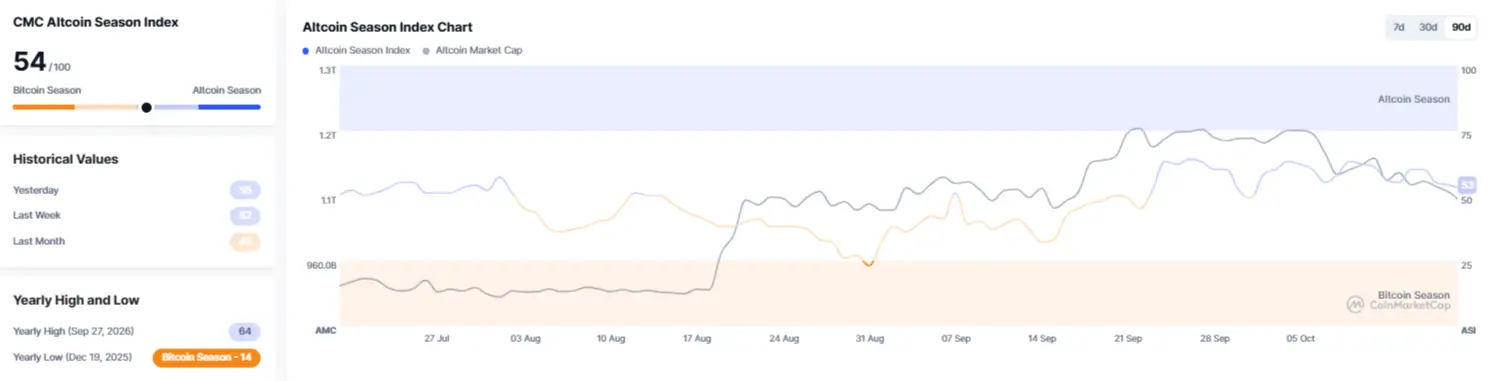
Source: CoinMarketCap
Meanwhile, Bitcoin dominance remained around 60.1%, while its price hovered near $81,500. BlockchainCenter’s separate index likewise sat below the level associated with sustained altcoin outperformance. Its reading offered another check on the rally’s reach beyond individual price gains.
Taken together, the readings establish weaker market participation, not a definitive end to the cycle. A renewed breadth recovery would require more assets to regain their long-term averages.
The post Is Altcoin Season Ending? Binance Market Breadth Collapses From 90% to 52% appeared first on Blockonomi.
TLDR:
- Bitcoin volatility may rise ahead of the November 3 midterms, but Ali Charts’ four-cycle sample is mixed and cannot establish a repeatable election-driven direction.
- The VIX rose 21.5% to 19.99 Friday, yet it fell the following Monday in 25 of 32 prior cases; those historical odds still leave room for another rise.
- CoinGlass data shows crypto liquidations at $352.1 million in 24 hours, including $33.8 million in AI-chip-linked contracts, mostly longs.
- BTC’s reported $80,996 price sat close to an $80,862 long liquidation-risk level, while ETH was also near a concentration of leveraged long positions.
Bitcoin volatility is back in focus as traders weigh Friday’s surge in markets’ fear gauge against weekend BTC trading. The Cboe Volatility Index, or VIX, climbed 21.5% to 19.99 as the S&P 500 fell 1.09%.
Bitcoin stayed above $80,000, while its implied volatility gauge eased slightly. The mixed signals arrive weeks before U.S. midterm elections on November 3. Analyst Ali Charts says Bitcoin’s one-month post-election record is mixed, with losses in the last two cycles.
Neither that pattern nor historical VIX behavior offers a reliable forecast for Monday or November. Short-term market signals can reverse sharply. Investors face elevated uncertainty.
Bitcoin Volatility Meets a Mixed Midterm Election Record
Ali Charts’ October post lists BTC’s one-month returns after midterms: +30.91% in 2010 and +6.61% in 2014. Returns turned negative in 2018 (-47.13%) and 2022 (-18.15%).
The record is mixed; only the last two readings were negative. Four elections offer context but limited predictive power. The comparison tracks monthly returns but offers little predictive value.
U.S. voters return to polls Nov. 3, 2026. Markets may watch policy, fiscal debate and sector reactions. Rates, earnings, liquidity and global conflict can outweigh election effects.
Bitcoin volatility may rise around the vote without a predictable direction. Past returns cannot say whether BTC rises or falls next November. There is no prior 2026 cycle to compare.
Friday’s stock selloff followed pressure on AI shares and geopolitical concerns. The VIX prices options tied to expected S&P 500 swings over roughly 30 days. Its jump signals greater demand for protection against future swings.
BTC trades around the clock, giving investors a weekend view of risk appetite. Quiet Sunday trading cannot guarantee stocks will resume buying Monday. Bitcoin volatility and equity fear can diverge.
According to Coindesk analysis, the VIX index has jumped at least 20% on a Friday 32 times before this week ,since 1990, . It fell the next Monday 25 times and rose seven; its typical Monday decline was 4.5%.

A month later, it was lower in 25 cases, with a median drop of 16%. The history favors easing, but seven exceptions matter. Friday’s close below 20 also leaves room for another rise. Seven Monday advances show how quickly the historical tendency can fail.
VIX Index and Crypto Liquidations Keep Traders on Alert
Bitcoin price analysis shows the BVIV, which measures expected 30-day Bitcoin volatility, stayed just below 40% after slipping 1%.
It contrasts with Friday’s VIX jump, but the gauges track different markets, horizons and risks. Bitcoin volatility can diverge from equity fears, so calm in one market proves little about the other. It reflects expected future swings, rather than realized price moves.
According to CoinGlass, there has been $352.1 million in crypto liquidations over 24 hours, up 67%. AI-chip-linked perpetuals accounted for $33.8 million, mostly from long bets. SOXL led with $13.05 million; SanDisk contracts lost about $11.98 million.
These exits reflect the distinct margin risks of leveraged positions. These contracts trade continuously without expiry and follow underlying prices.
CoinGlass data placed BTC near $80,996, just above an $80,862 long liquidation-risk level. About $46.39 million in longs sat near that threshold. ETH traded near $2,372, roughly 0.75% above a $2,354 level tied to $25.98 million in longs.
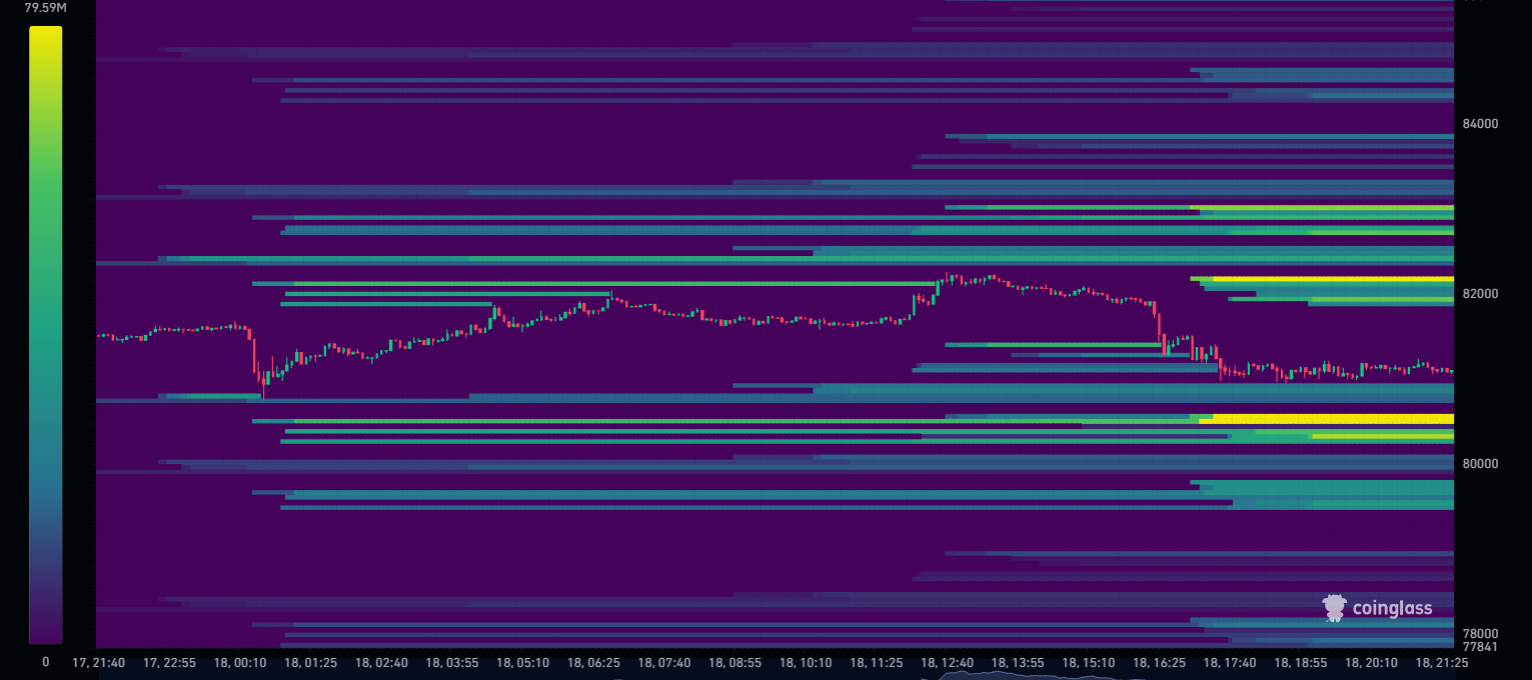
These clusters can amplify moves, but shift as positions change. Such levels are dynamic risk markers as positions change.
Monday marks 39 years since Black Monday, when the Dow lost 22.6% on Oct. 19, 1987, the Federal Reserve says. The anniversary adds context, but does not show that today’s selloff mirrors 1987. Bitcoin did not exist then.
The VIX, Bitcoin and election returns measure different risks. Traders watching Bitcoin volatility face crosscurrents: equity fear may fade while leveraged positions remain close to liquidation zones. It remains a calendar marker only.
The post Bitcoin Volatility Builds as Traders Weigh VIX and Election Risks appeared first on Blockonomi.
TLDR:
- Cysic halted its bridge after an attacker minted 10 million CYS tokens without backing on BNB Smart Chain.
- Cysic blacklisted the wallet about 76 minutes later, restricting 2.8 million CYS, or 28% of the mint.
- Initial on-chain reports link sales of 7.2 million CYS to 306.6 ETH worth roughly $727,000 on Ethereum.
- The 10 million unauthorized tokens equaled 1% of total supply, while mainnet operations remained unaffected.
Cysic suspended its cross-chain bridge after an attacker created 10 million unauthorized CYS tokens on BNB Smart Chain and moved reported proceeds to Ethereum. The October 17 breach exposed faulty authentication of bridge messages authorizing token issuance.
The mint occurred at 12:31:38 UTC, according to its October 18 incident report. Investigators traced the breach to unauthorized access to a bridge database. The attacker then exploited a message-processing vulnerability to submit fraudulent mint instructions without a corresponding asset transfer.
On-chain activity cited in initial reporting linked the incident to sales of 7.2 million tokens and approximately 306.6 ETH received on Ethereum. Those proceeds were valued near $727,000, although the foundation has not verified the complete transaction trail or final losses.
How Hacker Minted 10M CYS Before Cysic Suspended Its Bridge
Cross-chain bridges use authenticated messages to recognize transfers between blockchains and release matching assets. In this case, fraudulent instructions caused the system to mint tokens that lacked a legitimate transfer backing them. The breach therefore centered on bridge message validation, rather than a breakdown in the underlying network’s consensus.
Cysic blacklisted the receiving address at 13:47:52 UTC, about 76 minutes after the mint. By that point, 2.8 million tokens remained in the blocked wallet. That was 28% of the issuance; the remaining 7.2 million, or 72%, had moved out. The project’s cross-chain bridge was suspended to prevent further unauthorized activity.
An external security firm is now examining bridge messages, permissions and asset records, while investigators trace affected addresses. The bridge remains closed without a reopening date, pending security review and validation.
Unauthorized 10M CYS Mint Equals 1% of Supply as Probe Continues
The scale of the issuance matters beyond the reported transfer proceeds. Project tokenomics document a total supply of 1 billion tokens, used for governance, computing services and network incentives. The 10 million unauthorized units equaled 1% of that stated supply, raising questions about unrecovered circulation.
However, the amount transferred to Ethereum should not be treated as the confirmed financial loss. Although initial tracking attributed 306.6 ETH to the attacker, the foundation has yet to establish how much was ultimately retained. Similarly, the 2.8 million restricted tokens are a verified containment measure, not evidence of recovery.
Mainnet consensus, block production and transaction execution continued normally, and existing assets in users’ wallets were unaffected. Users have also been warned against fake compensation links, recovery pitches and requests for private keys. A follow-up report is expected to address verified losses, fund tracing and remediation.
The post Cysic Suspends Bridge After Hacker Mints 10M CYS, Moves $727K to Ethereum appeared first on Blockonomi.
TLDR:
- Exchange reserves rose from about 2.67 million BTC to 2.68 million BTC but remain low versus January.
- Spot demand neared zero before turning negative, while perpetual futures demand stayed positive.
- Holders of 100–1,000 BTC remain net accumulators, while the over-10,000 BTC cohort is still negative.
- A durable recovery needs positive spot demand, buyers absorbing exchange inflows, and wider accumulation.
Bitcoin recovery remains uneven, according to updated CryptoQuant charts reviewed in a new XWIN Japan column. Exchange reserves, spot demand, and whale behavior show mixed signals as the U.S. midterms approach.
Low reserves, whale accumulation, and improving estimated demand still support a possible base. However, the latest data shows that buying strength is not yet consistent across the market. The column examines three charts that explain where support holds and where it weakens.
Exchange Reserves Edge Higher
Exchange reserves measure the amount of BTC held on trading platforms. They have risen from roughly 2.67 million BTC in early October to around 2.68 million BTC. Despite the increase, reserves remain low compared with January. Low reserves do not mean supply keeps shrinking.
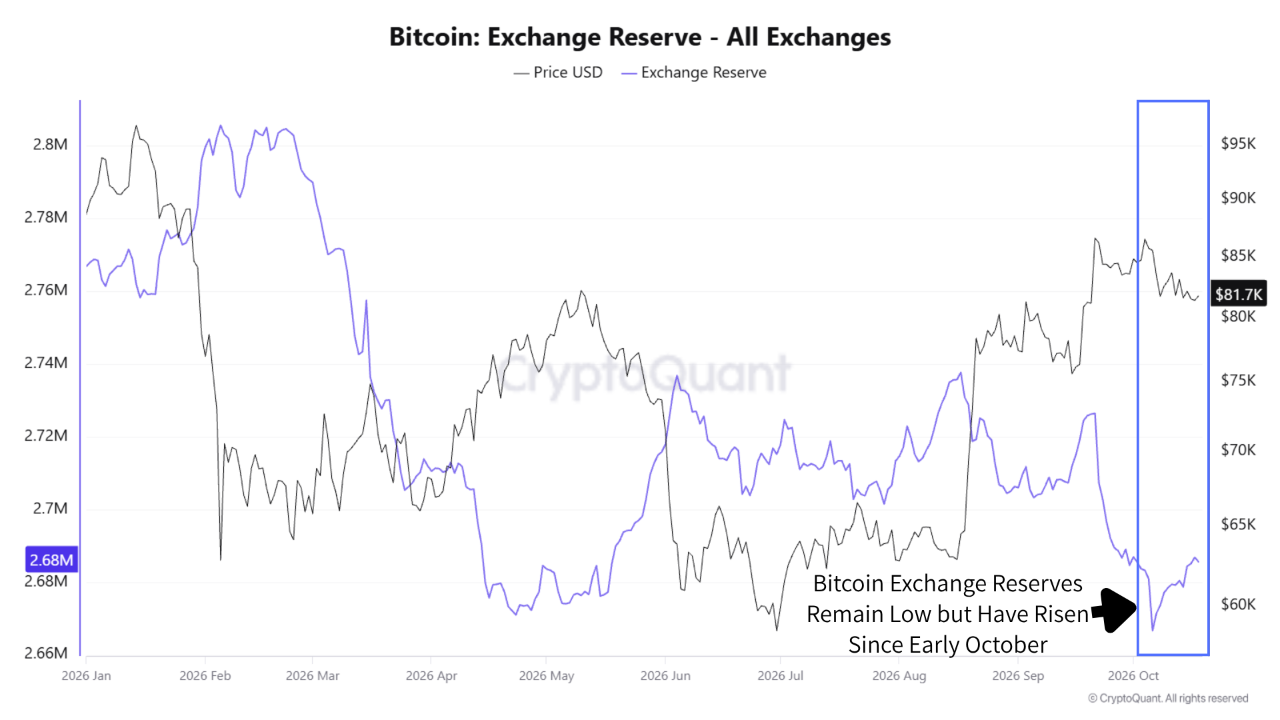
Source: Cryptoquant
Transfers may reflect custody changes rather than selling. Therefore, rising reserves alone do not prove that holders are selling.
The increase is modest, and it comes from a low base. The supports from the earlier column remain, yet the Bitcoin recovery is uneven.
The earlier column, published six days ago, listed low reserves among the signs of base building. That earlier analysis centered on Bitcoin base building ahead of the U.S. midterms.
A durable Bitcoin recovery now requires buyers to absorb BTC that returns to exchanges. Reserves are rising, so that condition matters more.
Spot Demand Loses Momentum
The 30-day demand chart shows spot demand approaching zero before turning negative again. Spot demand reflects direct BTC purchases, while perpetual futures involve derivatives.
Meanwhile, positive perpetual futures demand supports total demand. Spot buying therefore remains weaker than futures activity.
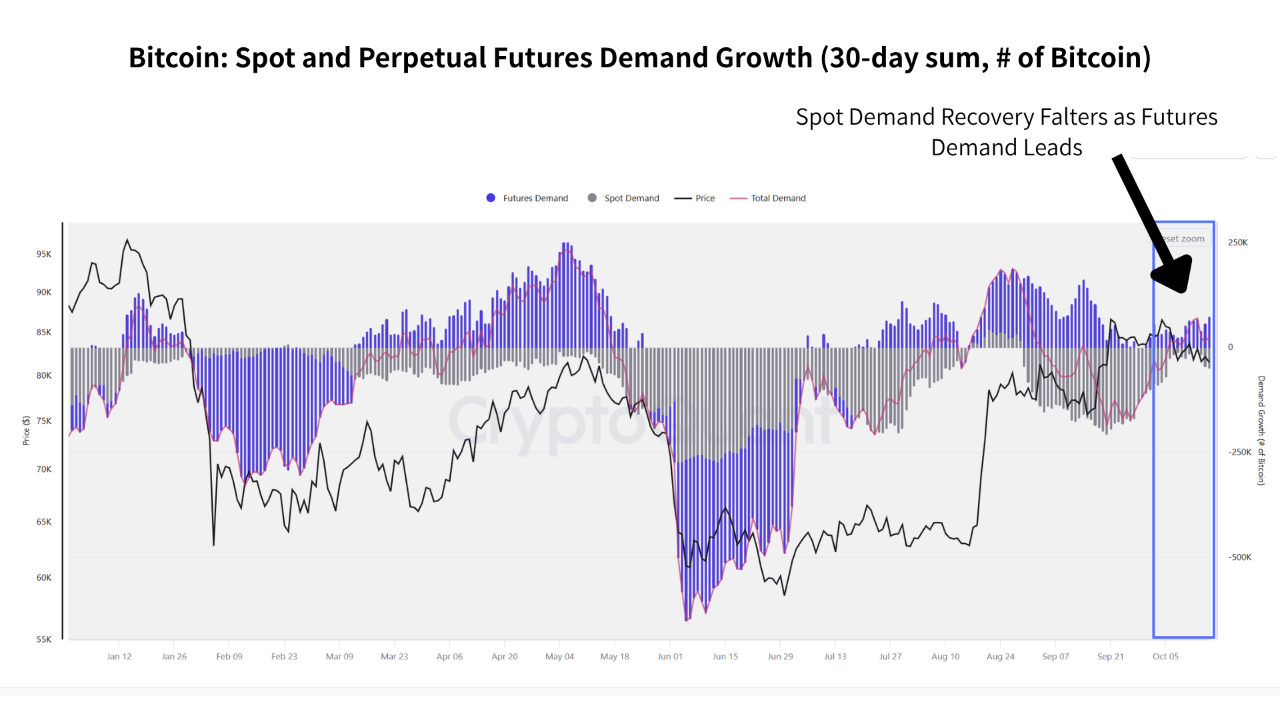
Source: Cryptoquant
The earlier column cited improving estimated demand. This new breakdown differs from the Apparent Demand metric discussed previously. Their values are not directly comparable, so the readings should be viewed separately.
Sustained positive spot demand is one of three conditions for a durable Bitcoin recovery. Without it, futures demand carries the total figure. Positive spot readings would show buyers acting directly in the market.
Whale Cohorts Show Mixed Behavior
Holders of 100–1,000 BTC remain net accumulators over 60 days. Their buying sits below the late-September peak despite a modest rebound. The cohort has kept buying through the past two months.
Net holding declines among the 1,000–10,000 BTC cohort have narrowed toward zero. Meanwhile, the cohort above 10,000 BTC remains negative.
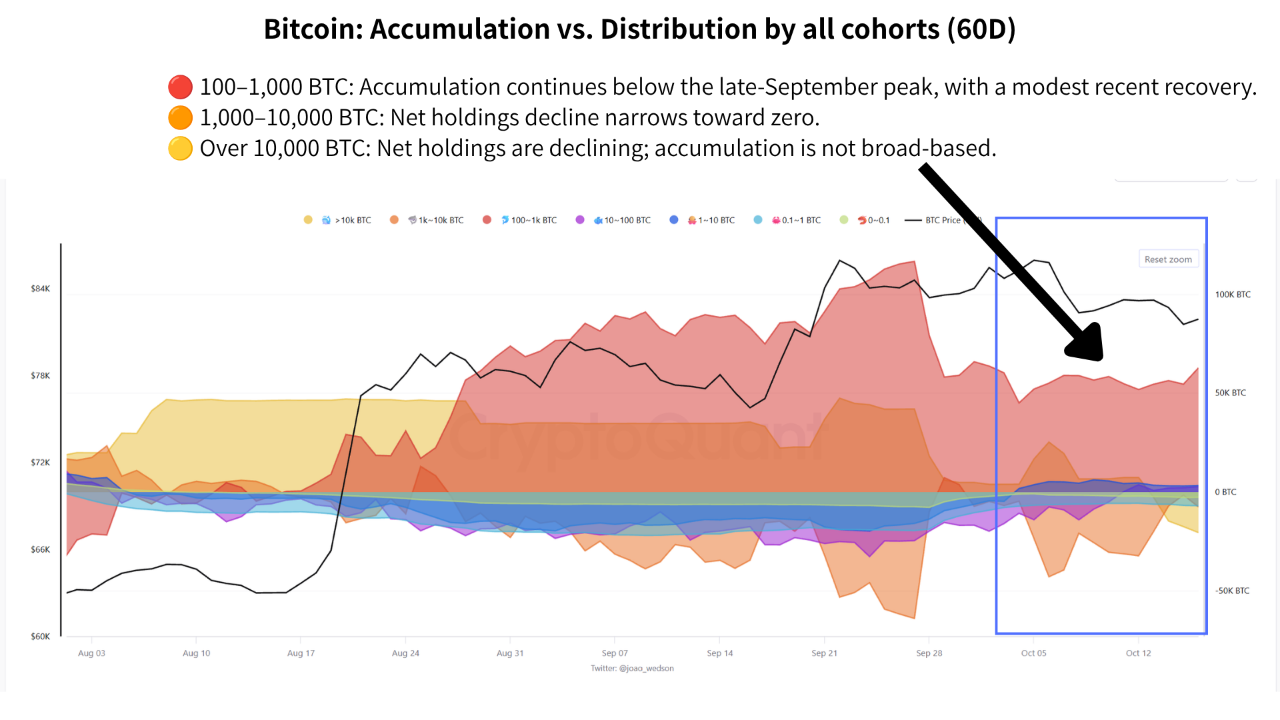
Source: Cryptoquant
Accumulation is therefore not broad-based across holder groups. A durable recovery also needs accumulation to spread more widely.
These rolling figures include pre-October activity and can reflect transfers between cohorts. Conditions that could support a base still exist. Expectations around the midterms and monetary policy must translate into actual buying.
The key is whether rallies gain a growing, lasting base of buyers. Until then, the Bitcoin recovery depends on whether buying broadens beyond a single holder group.
The post Bitcoin Recovery Stays Uneven as Spot Demand Weakens and Exchange Reserves Rise appeared first on Blockonomi.
HTTP error 429 on https://cryptopotato.com/feed/
Failed to fetch feed: https://cryptopotato.com/feed/
Failed to fetch feed.