Cryptocurrency Posts
Crypto Briefing
Meta's revision highlights the tension between tech giants and publishers, emphasizing the need for clear AI data usage policies to maintain trust.
The post Meta removes controversial scraping language from its commercial terms appeared first on Crypto Briefing.
Investor's dual role in competing startups raises ethical concerns, potentially impacting trust and talent dynamics in the tech sector.
The post Secretive investor behind Ramp and Cognition raises conflict concerns appeared first on Crypto Briefing.
The proposed nuclear-powered data centers could reshape US-Russia tech collaboration, challenging existing sanctions and geopolitical dynamics.
The post Russia floats nuclear-powered data centers as part of new joint initiatives with the US appeared first on Crypto Briefing.
CoreWeave's financial distress highlights the broader risks of debt-financed AI ventures, potentially tightening credit for similar startups.
The post CoreWeave faces bankruptcy risk amid $50B debt, bond yields over 15% appeared first on Crypto Briefing.
The analysis highlights the strategic shift in resource allocation, emphasizing efficiency and cost management as key factors for industry competitiveness.
The post Vitalik Buterin breaks down Bitcoin mining costs versus AI inference appeared first on Crypto Briefing.
Bitcoin Magazine
Bitcoin Magazine

Poetic Justice: Scammer Lost $5M in Bitcoin After Being Targeted by Ledger Thieves
Call it poetic justice: one of the biggest victims of last week’s Ledger theft happened to be a scammer themself, according to blockchain analysts, and lost nearly $5 million in bitcoin.
In a post Thursday, Chainalysis wrote that a crook lost 60 bitcoins worth about $4.8 million they’d stolen via a so-called task scam.
According to Chainalysis, the address was linked with a con where people were paid to fake sales and reviews of real items. They were told to add their own money in order to get paid — and then stolen from.
But the mastermind behind the task scam moved the stolen money to Ledger addresses which were then targeted by different scammers last week.
“On Sep 22, the person behind the scam moved the proceeds into three separate Ledger addresses,” Chainalysis said. “On Oct 9, thieves emptied all three. One transfer each, into the same wallet. The wallet is reported as stolen funds.”
Paris-based Ledger last week said it had started an investigation after customers in South East Asia reported they’d lost funds after buying from Malaysia-based reseller, CryptoBilis.
Ledger has since said that the scam was a massive organized crime operation where a group installed implants into devices and put them back on the market. The implants could read users’ seed phrases so criminals could then drain wallets.
Calling it one the most “sophisticated attacks” the digital asset industry has experienced, Ledger is yet to reveal how much money has been lost — but blockchain investigator Specter said $86 million had been drained.
And the task scam conman, according to Chainalysis, was one of the victims.
Ledger has said that it is working with law enforcement to “follow the funds and dismantle the attackers’ infrastructure” and has made sure no other vendors have been targeted by scammers.
CryptoBilis has stopped selling Ledger products, the company said.
Criminals have targeted bitcoin hardware sellers this year, with a huge attack taking place in July on the popular Coldcard products.
Crooks were able to steal close to $120 million in bitcoin from Coldcard users because the devices had a firmware bug which led to faulty seed generation, allowing hackers to guess investor seedphrases.
This post Poetic Justice: Scammer Lost $5M in Bitcoin After Being Targeted by Ledger Thieves first appeared on Bitcoin Magazine and is written by Mathew Di Salvo.
Bitcoin Magazine

BFFS26 Denver: Joseph Kelly on Bitcoin Custody and Credit; Alan Lane on Banking Lessons
The Bitcoin for Financial Services Summit (BFFS26) returns to Denver October 20–22, 2026, bringing together CPAs, wealth advisors, attorneys, lenders, and finance leaders who are building Bitcoin into their practices. Now in its second year, the summit has grown to more than 30 sessions across two full program days, with a speaker lineup drawn from the firms defining Bitcoin custody, credit, and advisory.
Headlining the program are Joseph Kelly, CEO and co-founder of Unchained, who opens the summit with a keynote on custody, credit, and trust at scale; Alan Lane, former CEO of Silvergate Bank, on lessons for Bitcoin and banking; Patrick Lowry, CEO of Samara Asset Group, on holding Bitcoin as a public-company treasury reserve; and Colin Crossman, Wyoming’s Deputy Secretary of State, on the regulatory outlook for banks, exchanges, and advisors. Additional speakers include Kate Goldman of Anchorage Digital, Sam Baker of River, Eric Yakes of Epoch Ventures, Daniel Hillery of UTXO Management, Moish Peltz of Falcon Rappaport & Berkman, and CJ Konstantinos of Peoples Reserve.
Sessions focus on practical application: bringing Bitcoin into wealth planning and family offices, Bitcoin-backed lending and mortgages, treasury accounting and valuation, retirement and income planning, charitable giving strategies, mining as an asset class, and fiduciary duty when clients hold Bitcoin. Dedicated workshops will offer continuing education credit for financial advisors and CPAs.
“Last year proved that financial professionals want more than a Bitcoin primer. They want to know how to serve clients who already own it,” said Jordan Guess, CPA, co-host of the summit in a press release shared with Bitcoin Magazine. “This year’s program is built around the questions advisors and accountants are actually getting from clients, answered by the people building the infrastructure.”
The summit opens Tuesday, October 20, with the Better Money Invitational golf tournament at City Park Golf Course, hosted with Bitcoin Sports Network, followed by a welcome party at The Space sponsored by Falcon Rappaport & Berkman. Evening programming includes wine and whiskey tastings, and Thursday begins with an optional sunrise hike in the Rocky Mountains.
BFFS26 is co-hosted by Jordan Guess and Wyatt O’Rourke of BFFS Media, producers of the Bitcoin for Financial Services podcast. Sponsors include Unchained, Anchorage Digital, UTXO Management, River, SOUND HSA, SustainHash, and Stormrake.
Registration is open now at https://www.bffs.media/summit.
Media contact: Wyatt O’Rourke, wyatt@bffs.media
This post BFFS26 Denver: Joseph Kelly on Bitcoin Custody and Credit; Alan Lane on Banking Lessons first appeared on Bitcoin Magazine and is written by Juan Galt.
Bitcoin Magazine

Sazmining Now Sells Jack Dorsey’s Proto Immersion Hashboards
Bitcoin mining just got a lower barrier to entry.
Sazmining announced Thursday that it is now selling Proto’s immersion hashboards directly to individual and institutional buyers through its mining-as-a-service platform. Previously, the hardware was mostly in the hands of large-scale operators.
Each hashboard delivers roughly 200 TH at around 15 J/TH, and buyers own them outright while Sazmining handles deployment, monitoring and maintenance at a US facility. Mining rewards go straight to the owner’s wallet.
The move follows a multi-megawatt supply deal between Sazmining and Proto — the bitcoin mining arm of Jack Dorsey’s Block (NYSE: XYZ) — which both companies expect to expand as demand grows.
“Because of our aligned-incentive model, Sazmining only earns when we produce bitcoin for our clients,” said Kent Halliburton, CEO and co-founder of Sazmining.
He also pitched mining as a form of bitcoin acquisition diversification: rather than paying the market price on the day of purchase, a miner’s costs are spread across the machine’s working life.
Wyoming-based Sazmining, founded in 2018, operates renewable-powered facilities across the US, Paraguay, and Norway. It says its fleet runs more than 20 percentage points ahead of the Bitcoin network’s carbon-free share.
Proto is Jack Dorsey’s Block’s bitcoin mining play. The Twitter founder has spent years arguing bitcoin is the foundation of “a more open financial system,” funding everything from Cash App’s buy-and-send rails to the Bitkey self-custody wallet, and he framed mining as the obvious missing piece back in 2021: “Bitcoin mining should be as easy as plugging a rig into a power source.”
Block formally announced it was building an open bitcoin mining system in January 2022, with the stated aim of making mining “more distributed and efficient.”
This post Sazmining Now Sells Jack Dorsey’s Proto Immersion Hashboards first appeared on Bitcoin Magazine and is written by Mathew Di Salvo.
Bitcoin Magazine

Hot Inflation Data Puts Bitcoin Under Pressure, but ‘Difficult’ Isn’t ‘Bearish’: CoinShares
Bitcoin’s price has dropped this week as new inflation data has come in hot.
But while the largest cryptocurrency’s near-term setup is difficult, it’s not “fundamentally bearish,” according to European asset manager CoinShares’ Head of Research, James Butterfill.
In a report Friday, the analyst said that bitcoin’s near-term challenge stems from a macro environment that’s caught in an awkward middle ground: inflation is too elevated for the Fed to ease up, while the economy is too resilient to force a policy pivot.
“Bitcoin and the broader digital asset market have moved lower on the resulting hawkish repricing, a reminder of how sensitive Bitcoin remains to monetary policy over short horizons,” he wrote.
Bitcoin’s price recently stood at $81,473, down 2% over a seven-day period.
The price of the leading cryptocurrency dropped Wednesday after data showed that U.S. consumer prices shot up more than expected in September.
Then, on Thursday, the Labor Department’s Bureau of Labor Statistics said that U.S. producer prices rose in September at the fastest pace in more than four years.
This has weighed on bitcoin’s price because higher inflation means the Federal Reserve may hike interest rates. Higher borrowing costs can restrict the liquidity the digital coin needs to rally.
The Federal Reserve hiked rates in September and will meet at the end of this month.
But Butterfill added that investors should be patient and advised investors to instead think in the long-term and not react to any single weekly data point.
“For investors, that argues for reading the coming weeks as a data-driven range rather than a trend, and for sizing digital asset exposure against a strategic allocation rather than against this week’s print,” he wrote.
Bitcoin spent the first half of 2026 in a bear market but had its best quarter in years after surging in August and September. Analysts have now said the leading cryptocurrency is now back in a bull market after trading above its 365-day moving average.
This post Hot Inflation Data Puts Bitcoin Under Pressure, but ‘Difficult’ Isn’t ‘Bearish’: CoinShares first appeared on Bitcoin Magazine and is written by Mathew Di Salvo.
Bitcoin Magazine

Deutsche Bank To Debut Bitcoin Custody Within Weeks: Report
German multinational Deutsche Bank is just weeks away from its crypto custody service, according to reports.
The lender — which is Germany’s biggest — also plans to expand the custody platform into Asia next year, according to a Friday Reuters report, which quoted its corporate banking chief.
Top banks worldwide are debuting or planning to debut crypto custody services, with BNY Mellon, State Street, Standard Chartered, U.S. Bank, and Citigroup all committing to direct crypto custody over the past 18 months.
JUST IN:
— Bitcoin Magazine (@BitcoinMagazine) October 16, 2026€732 billion Deutsche Bank to launch Bitcoin custody to its 28 million clients
pic.twitter.com/TAh9EwLkIX
Deutsche Bank first officially announced plans to debut a bitcoin custody service for European corporate and institutional clients in September, with the German multinational at the time saying service was subject to the completion of the applicable regulatory timeline.
Friday’s report added that the service will support custody of major cryptocurrencies such as bitcoin before moving to services that help clients move money into and out of stablecoins.
Gerald Podobnik, co-head of the corporate bank, was quoted by Reuters saying that the financial system will need to “offer tokenized or blockchain solutions.”
A number of top banks have started using the technology that powers bitcoin, the blockchain, for their own products in recent years.
Stablecoins and tokenization in particular have become a hot topic as traditional financial firms aim to accelerate certain services.
Crypto custody is often a starting point for banks moving into the digital asset space. BNY Mellon in 2022 became the first major U.S. bank to offer digital asset custody services.
Banks like Citi and Standard Chartered have this year debuted or announced plans for bitcoin custody around the world.
This post Deutsche Bank To Debut Bitcoin Custody Within Weeks: Report first appeared on Bitcoin Magazine and is written by Mathew Di Salvo.
CryptoSlate
Someone paying for lunch with a stablecoin card doesn't need the restaurant to know what USDC is. The card works like any other at the terminal, with the customer's digital dollar balance funding the purchase while the merchant receives regular dollars through its usual payment provider. That leaves several companies to collect fees for connecting…
Read the full story on CryptoSlate
Understand the crypto stories that matter and what to watch next. Get The Catalyst in your inbox
Mining stops at 07:00 UTC, while final payments depend on eligibility and historical pages close two weeks later.
Read the full story on CryptoSlate
Understand the crypto stories that matter and what to watch next. Get The Catalyst in your inbox
The Oct. 15 release blocks a cached-authentication route to Eclair's API and requires direct browser interfaces to add a backend.
Read the full story on CryptoSlate
Understand the crypto stories that matter and what to watch next. Get The Catalyst in your inbox
There's a Bitcoin company that's now offering investors a 15% annual dividend, paid in small installments every business day. While a 15% dividend is high enough to grab everyone's attention, the more revealing number is what buyers agreed to pay for it. On Oct. 15, Strive priced seven million shares of its new SATS preferred…
Read the full story on CryptoSlate
Understand the crypto stories that matter and what to watch next. Get The Catalyst in your inbox
Borrowing costs, missed interest income, and futures fees can all eat into returns even when Bitcoin holds its value. That's a big problem, and it gets even worse when inflation stays high. September's US inflation report showed consumer prices up 3.7% year over year, fueling concerns about the dollar's purchasing power. That same inflation pressure…
Read the full story on CryptoSlate
Understand the crypto stories that matter and what to watch next. Get The Catalyst in your inbox
CryptoTicker.io
Anyone converting Bitcoin into Wrapped Bitcoin usually wants just one thing: to make their holding usable on Ethereum. In tax terms this step has still not been settled in Germany. The short answer to whether swapping into WBTC is taxable is therefore: there are two defensible readings, and they lead to entirely different outcomes. Under one, the switch is a swap and therefore a private disposal transaction that restarts the one-year clock on your coins. Under the other, economic identity is preserved and the transaction stays tax-neutral. Which reading counts in the end depends on what you can document.
This guide sets out the legal position under German law, meaning the Income Tax Act, the administrative view of the Federal Ministry of Finance and the case law of the Federal Fiscal Court. It names the points on which the tax authorities have so far stayed silent, and it says which documents carry the same weight under both readings.
What Wrapped Bitcoin is and why WBTC is needed on Ethereum
Wrapped Bitcoin (WBTC) is a token on the Ethereum blockchain that tracks the value of one Bitcoin. That is the one-sentence definition. Technically, the real Bitcoin sits with a custodian, which issues an ERC-20 token against it at a ratio of 1:1. Only that makes it possible to deploy Bitcoin in applications that know nothing but Ethereum tokens.
The construction has a cost, on a level other than the price: you have to trust the custodian holding the backing, and the smart contract issuing the tokens. In mid-October around 116,100 WBTC were in circulation, which at a Bitcoin price of roughly $81,300 corresponds to a value of a good $9.4 billion. How wrapped and staked holdings differ from one another we set out at length in our piece on whether your Bitcoin is really Bitcoin.
What matters for tax is that WBTC and BTC are two different assets on two different blockchains carrying the same value. That dual nature is precisely where the two readings take hold.
Why section 23 of the Income Tax Act applies to swaps of crypto assets at all
Crypto assets held privately count as other assets. Gains on their sale therefore fall under the private disposal transactions of section 23 of the German Income Tax Act. The provision ties the tax charge to a single period: the transaction is taxable if the interval between acquisition and disposal is "not more than one year". Hold for longer than a year and you sell tax-free.
That one-year period is the core of every crypto tax question in Germany. An exemption threshold applies alongside it: if total gains from all private disposal transactions in a calendar year stay below 1,000 euros, they are tax-free. An exemption threshold is not an allowance. Breach it, and the entire gain is taxable, not merely the part above the line.
Important for the subject of this article: a disposal is not only a sale for euros. Swapping one crypto asset for another is also, in tax terms, a disposal of the one and an acquisition of the other. If you would rather sell Bitcoin for euros outright than wrap it, the venues for that are in our comparison of the best crypto exchanges.
The first reading: the switch into WBTC counts as a swap and therefore a disposal
The obvious classification follows directly from the previous paragraph. You give up Bitcoin and receive a different token that lives on a different blockchain, is issued by a custodian and carries its own risks. Two different assets with one transaction in between: that fits the picture of a swap.
The consequences of this reading are uncomfortably concrete. If the wrap falls within a year of buying the Bitcoin, a taxable gain arises equal to the difference between acquisition cost and market value on the day of the wrap. And the holding period for the new WBTC starts again from that day. Wrapping shortly before the first anniversary of your Bitcoin purchase therefore pushes tax exemption out by another twelve months. How tight that link becomes when a wrapper steps in between is shown by the case around cirBTC and the holding period.
The second reading: identity of the asset under Federal Fiscal Court ruling IX R 31/12
Against the swap reading stands a concept from case law: identity of the asset, known in German as Nämlichkeit. The question is whether the asset acquired and the asset disposed of are essentially the same thing. The Federal Fiscal Court described the standards for this in its ruling of June 12, 2013 in case IX R 31/12. What counts, on that basis, is equivalence of function, of kind and of value. The case itself concerned a plot of land whose heritable building right had been cancelled before the onward sale. The court held partial economic identity to be sufficient there.
On that basis, several law firms specialising in crypto assets argue that the switch from BTC to WBTC should not be a private disposal transaction. The tax firm Winheller writes that the economic identity of the tokens remains "largely intact", because WBTC is backed by BTC and represents the same value; it is therefore likely, in the firm's view, that the swap will not be treated as a private disposal transaction. The firm Ruge Fehsenfeld reaches the same conclusion in its analysis of wrapped tokens and considers the transaction possibly tax-neutral, while expressly urging readers to follow developments and any statements from the tax authorities.
Both are advisers' legal opinions, not confirmed administrative practice. There is as yet no tax court ruling on wrapped tokens and no position from the tax authorities that you could invoke in a dispute.

A worked example shows how far apart the two readings are
The figures in the following example are rounded and freely chosen; the mechanism behind them is not. Suppose you buy one Bitcoin on March 1 for 60,000 euros. On October 1 of the same year you wrap it into WBTC, with the price that day at 70,000 euros.
Under the swap reading you completed a private disposal transaction on October 1. The gain is 10,000 euros, the transaction falls inside the one-year period, and the 1,000 euro threshold is breached by a wide margin. The full amount is charged at your personal income tax rate, and a new holding period begins for the WBTC that only runs out on October 1 of the following year.
Under the identity reading, nothing happened for tax purposes on October 1. The clock keeps running from March 1, and a sale after March 1 of the following year stays tax-free, even though WBTC sat in the account in the meantime. The gap between the two outcomes covers, in this example, the entire tax on a 10,000 euro gain, which at the top rate means a four-figure sum.
What the Finance Ministry circular of March 6, 2025 says about wrapped tokens
The administrative view on taxing crypto assets is set out in the circular of the Federal Ministry of Finance of March 6, 2025, titled "Individual questions on the income tax treatment of certain crypto assets" (file reference IV C 1 - S 2256/00042/064/043). It replaces the circular of May 10, 2022 and classifies crypto assets by their function. For currency and payment tokens it clarifies, among other things, that the extended disposal period of section 23(1) sentence 1 no. 2 sentence 4 of the Income Tax Act does not apply. Lending or staking your coins therefore does not drop you into a ten-year period.
What is not in it matters more for this article: the circular contains no express statement on wrapped tokens. The tax authorities have so far said nothing on whether a wrap is a disposal. For you that means a case officer can take either reading, and that in case of doubt you have to bring the reasoning yourself.
A second part of the circular concerns duties of cooperation and record-keeping. Those duties are the reason documentation gets so much room further down: the effort involved is the same under both readings.
Why tax software usually books the wrap as a disposal
The common crypto tax reporting programs treat every transaction in which one token leaves and another arrives as a swap by default. A wrap looks exactly like that in the imported data. Winheller points out that in the programs available on the market, representing equivalence of kind without assuming a private disposal transaction means extra work.
That has a practical consequence which surprises many crypto investors: your tax report does not give you the legal position, it gives you a default setting. If you want to rely on the identity reading, you have to flag the transaction accordingly in the tool and justify the departure to the tax office. Not every program allows that intervention, and some discard it at the next import.
The reverse also holds: simply accepting the default means paying too much if the wrap fell inside the first year. A transaction overlooked in the gain calculation therefore feeds straight through to the tax bill.
FIFO applies per wallet, and the wrap shifts the order
If you have bought Bitcoin several times at different prices, the tax office needs a rule for which unit you disposed of first. In Germany that is usually the first-in-first-out method, and it is applied per wallet, meaning per address or account rather than across all holdings. Which unit counts as sold first decides the size of the gain.
A wrap intervenes in that order. When Bitcoin leave a wallet to reappear as WBTC at a different address, the oldest acquisition costs of that wallet leave the calculation with them. Even under the identity reading you have to be able to show which acquisition costs and which acquisition date attach to the new token. Without that evidence, the tax office may estimate the acquisition costs.

DeFi with WBTC creates its own taxable events: lending, staking, liquidity pools
The wrap is rarely the end point. Holders of WBTC generally use it in DeFi applications, and each of those steps can trigger a taxable event of its own. Income from lending or staking in private holdings is regularly other income under section 22 no. 3 of the Income Tax Act and is therefore treated differently from a disposal gain. Such income falls under your personal tax rate and is untouched by the flat withholding tax; it has its own exemption threshold of 256 euros a year.
Depositing into a liquidity pool is a further case: there you hand over WBTC and receive a pool token back, which raises the same disputed question once again, one level higher. To settle the yield side before working through the tax part, the providers are in our comparison of the best staking platforms.
For the holding period of your actual stake, what was said above is reassuring: lending or staking alone does not extend the one-year period under the administrative view.
What evidence the tax office wants to see on Wrapped Bitcoin
Private disposal transactions belong in the Anlage SO annex of the tax return. Whichever reading you take, you need four details for every transaction: the acquisition date of the original Bitcoin, the acquisition cost, the date of the wrap and the market value on that day. Add to that the transaction identifiers on both blockchains, with which the route can be traced.
Anyone claiming identity of the asset also carries the reasoning: that the token is backed 1:1, tracks the same value and serves the same function. There is no form for it; you attach the explanation to the return in your own words. Which records support a holding period of more than a year we have described using the example of Bitcoin held for longer than a year.
That the tax office learns of crypto transactions is no longer a matter of conjecture. Trading venues in the European Union report user data to the tax authorities; what is transmitted, and why the reported sum is not your gain, is explained in our article on crypto reporting duties. A wrap on a decentralised application does not show up in those reports, but the preceding purchase on an exchange does.
The way back: what happens for tax when WBTC is unwrapped into Bitcoin
The question applies in mirror image on the way back. Under the swap reading, unwrapping is again a disposal, this time of the WBTC, with a fresh period starting for the Bitcoin received back. Under the identity reading nothing happens again, because economic identity persisted throughout.
From that comes a rule that works under both readings: switching back and forth without compelling reason multiplies the number of transactions you later have to explain. Every wrap and every unwrap is one more date, one more price and one more justification. If you intend to hold your stake for a long time anyway, the easier route is to leave the Bitcoin where they are.
The second point concerns timing. While the question remains open, the day shortly before the first anniversary is the worst moment for a wrap. A few weeks of patience cost nothing and take the sting out of the whole dispute for that holding.
Wrapped Bitcoin: wrap before the anniversary and you pay tax on the gain
The legal position is open; your preparation need not be. Three steps put you in the better position under both readings:
- Gather the acquisition data. Note the purchase date, purchase price and wallet for each Bitcoin holding before you wrap anything. A tool that tracks holding periods per wallet can be found in our comparison of crypto tax tools.
- Check the anniversary before you wrap. If the purchase is less than twelve months ago, the wrap pushes tax exemption out by a full year under the stricter reading. Leaving the holding untouched instead calls for reliable custody; the devices for that are in the hardware wallet comparison.
- Justify the departure if you rely on it. Anyone applying identity of the asset attaches the reasoning to the return and documents the 1:1 backing on the relevant date. Tools with which prices and backing can be evidenced for a given date are collected in the comparison of analytics platforms.
(As of October 17, 2026. This article is not investment advice. Prices and fee structures change; check the terms with the provider before you buy.)
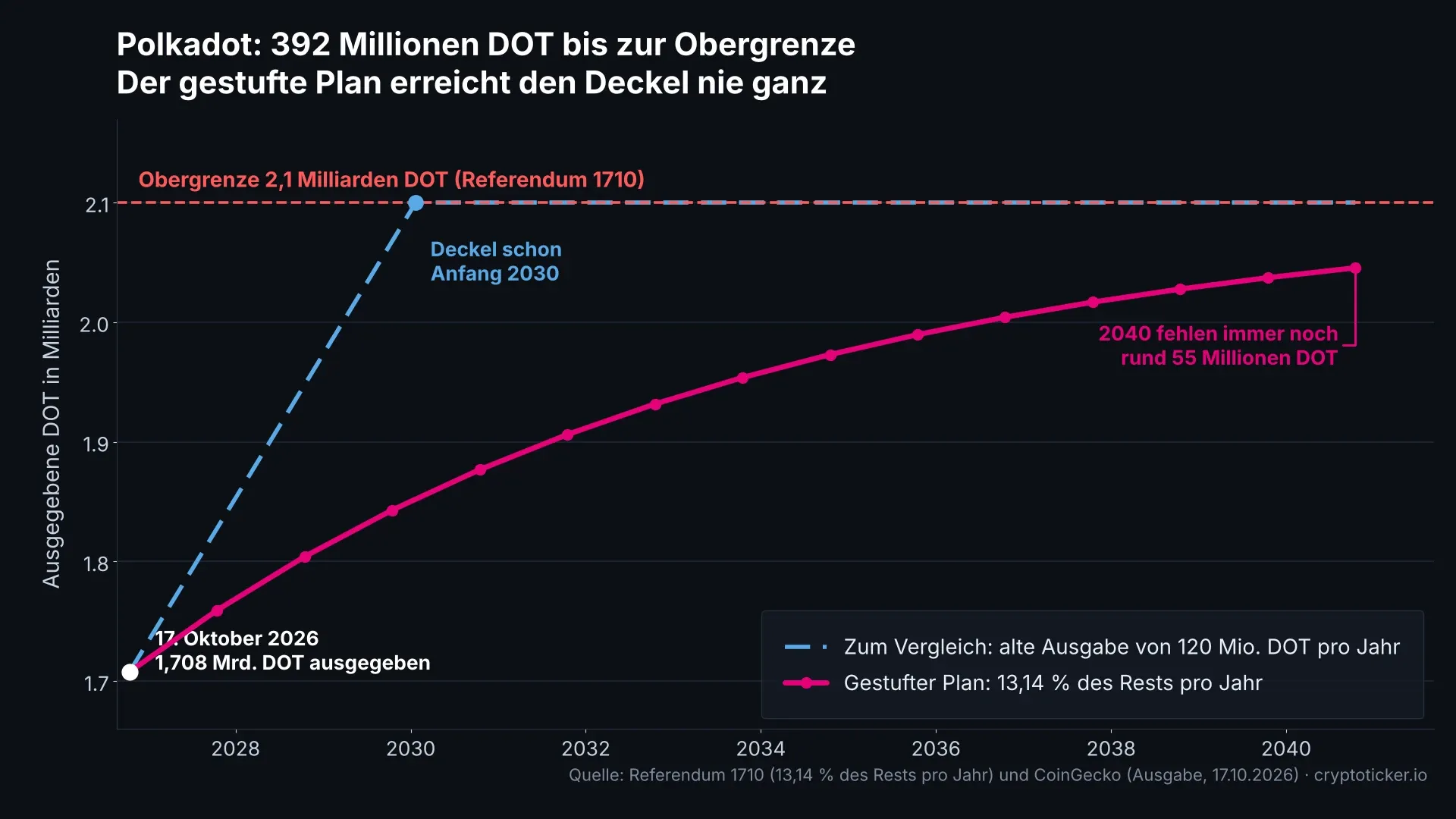
Polkadot has put a hard limit on its money supply for the first time. Referendum 1710 has been executed, the cap stands at 2.1 billion DOT, and 1.708 billion of them had been issued as of October 17, 2026. That leaves 392.2 million DOT that can still come into existence. It amounts to 18.7 percent of the cap, and it will not arrive in one go but in steps that shrink every year.
If you hold DOT, two things change straight away: the yield you can expect from staking, and the quantity against which your share will be diluted in future. The price of Polkadot stands at $1.13 on Saturday afternoon, 5.5 percent below the previous day. Supply and price have little to do with each other on this particular day, and that is exactly where most reports fall short.
Referendum 1710 executed: the 2.1 billion DOT cap is in place
The proposal is titled "Hard Pressure Capped & Stepped Supply Schedule" and carries the status "Executed" in Polkadot governance. It brings to an end the open issuance model Polkadot has run since launch: until now roughly 120 million new DOT came into being each year, with no figure fixed at the top. The proposal itself can be inspected in the governance portal: Referendum 1710 on Polkassembly.
A supply cap is no end in itself in crypto; it turns an open variable into a number against which every later issuance can be measured. Bitcoin has done it that way with 21 million from the outset, Ethereum still does not. Polkadot is drawing the line after the fact, and that is possible only because holders themselves get to vote on it.
How "total issuance" differs from circulating supply
The cap refers to total issuance, meaning every DOT ever created. Circulating supply is practically level with it, because Polkadot holds back barely any tokens: on October 17 CoinGecko reports 1,707,778,352 DOT in circulation and 1,707,785,370 DOT in total. The difference of a good 7,000 units is immaterial at this order of magnitude, and the total is what counts for the calculation up to the cap.
392 million DOT remain, 18.7 percent of the cap
The arithmetic is plain: 2.1 billion minus 1.708 billion leaves 392.2 million DOT. At today's price of $1.13 that corresponds to roughly $443 million, spread over the coming decades. The market value of all circulating DOT is about $1.94 billion, with daily turnover of $162.8 million.
More interesting than the figure is the path towards it, and the proposal describes that with unusual precision.
The stepped schedule: 13.14 percent of the remainder instead of a fixed annual amount
Polkadot does not issue the same quantity every year. The proposal sets out that each step issues 13.14 percent of the remaining amount, that is 13.14 percent of the difference between 2.1 billion and the quantity issued by then. Because that difference shrinks with every step, the issued quantity shrinks with it.
For the next annual step that means: 13.14 percent of 392.2 million comes to 51.5 million DOT. The year after it is 44.8 million, then 38.9 million, then 33.8 million. The curve flattens out, and it never meets the cap exactly. Even in 2040 this calculation still leaves around 55 million DOT short of the ceiling.
Why issuance fell from 120 million to 55.7 million DOT on March 14, 2026
The proposal cites an immediate cut of 53.6 percent in issuance, followed by a flattening curve up to the cap. The arithmetic works out exactly: 120 million DOT less 53.6 percent gives 55.68 million, and that is precisely 13.14 percent of the amount still missing to the cap in March 2026. The two figures therefore describe the same rule from two angles, once as a one-off cut and once as a standing formula.
One comparison suggests itself, and it limps in one place. A Bitcoin halving cuts issuance in half every four years, a 50 percent reduction at a stroke. Polkadot's first step went beyond that at 53.6 percent, but no second cut of that size follows, only a steady decline of around 13 percent a year. Describing Polkadot as "scarcer than Bitcoin" on that basis sets a one-off reduction against a recurring event.
What the blockchain does with the new DOT
The newly issued DOT do not vanish into thin air. Part goes as rewards to the validators and to holders who have bonded their DOT, and a further part flows into the blockchain's treasury, from which governance pays for projects. That treasury is also the source of funding for the dotUSD stablecoin project, decided by Referendum 1944, which earmarks $2.5 million in USDT and $2.5 million in DOT for a liquidity pool. How issuance is distributed technically is set out in the project documentation at Polkadot Wiki: Learn DOT.
The DOT inflation rate stands at 3.0 percent and falls every year
Set the 51.5 million DOT of the next step against today's circulating supply and the inflation rate comes to 3.02 percent. The year after it is 2.54 percent, then 2.16, then 1.83. From the middle of the 2030s the figure sits below one percent. That is the real lever in the proposal, because an inflation rate affects every holder equally, whether or not they move their DOT.
The number works as a yardstick, though, not as a promise about the price. A year with 3 percent issuance can see a price rise or fall, depending on how much demand meets it. Issuance says how many new units are offered; what they cost is settled by the other side of the market.
What falling issuance does to the staking yield
Staking rewards on Polkadot come predominantly out of current issuance. As issuance falls, so does the sum distributed among bonded DOT. A second variable applies alongside it: the more DOT are bonded in total, the smaller the share for the individual. Both move in the same direction if the schedule takes effect and the bonding ratio stays stable.
In practice, the nominal yield on bonded DOT is more likely to shrink than grow in the coming years. Anyone choosing a platform for their rewards today should therefore watch the fee deducted between reward and payout. With a nominal yield running from double digits towards single digits over the years, a high rate eats a growing share. A look at the staking platform comparison shows how far the rates diverge.
The unbonding period is the second variable
Bonded DOT are not immediately available on Polkadot. Once unbonded, a waiting period runs during which the units neither generate rewards nor can be sold. If you are working around short-term price moves, know that period before you bond; it is the reason a staking position and a trading position should rarely be the same position.
Polkadot price $1.13: down 9.9 percent in seven days
DOT trades at $1.13 on Saturday afternoon, roughly 1.01 euros. Over 24 hours it is down 5.5 percent, over seven days 9.9 percent. Over 30 days, by contrast, it is up 9.5 percent, and over twelve months down 61.1 percent. The figures come from CoinGecko as of October 17.
On October 15 the price in this slot was $1.08, as recorded in our article on the Polkadot ETF and the German ETP. DOT has gained a good 4.6 percent since then, even though the past 24 hours were clearly negative. The week was therefore not a straight path downwards, but a recovery followed by a setback.
The distance to the all-time low and the all-time high
The all-time low was $0.727 on August 18, 2026. Today's price is around 55 percent away from it. From the all-time high of $54.98 in November 2021, DOT is 97.9 percent adrift. The two figures belong together: the recovery since August is real, but it changes little about the scale of the earlier collapse.
The $1.20 and $1.13 levels from the day's trading
Two values serve for short-term bearings on this day, and both come from trading itself rather than from an estimate. The day's high is $1.20 and the day's low $1.13. The current price therefore sits practically on the day's low, which means the downward move had not yet turned at the time of measurement.
The $1.20 level is interesting for the same reason: that is where the price turned lower on the day. While DOT stays below it, the day is technically unchanged. These levels offer no explanation for the 9.9 percent of the week; they only describe where trading took place.

Staking rewards and the holding period: what the tax office sees with DOT
This is where the supply question gets concrete for German investors, because staking rewards are not a price gain. They accrue while you hold, and the tax office records them in the year they accrue. They are valued at the price at the moment of accrual, and because Polkadot distributes at short intervals, a year produces a long list of individual inflows, each with its own price.
A later sale of those same DOT is treated separately. There, the difference between acquisition value and sale value counts, and there the one-year holding period applies, provided it survives in its current form. The German finance ministry has been reticent on the matter of late; we track the current state of the possible reform on an ongoing basis.
Why lower issuance does not simplify the bookkeeping
You might assume that less issuance also means less work. It does not: the number of inflows stays the same, only their amount gets smaller. Anyone who does not record rewards as they arrive faces the same job at year end as before, just with smaller numbers. Automatic recording through the year saves more time here than any calculation in March.
Custody under MiCA: your own wallet, an exchange or a security
There are three usual routes to custody in Germany, and they differ precisely on whether you can generate rewards at all. In your own wallet you keep the keys and can bond directly; responsibility for securing them rests entirely with you. Through an exchange licensed under MiCA the route is more convenient, the exchange holds the keys and takes a fee for bonding.
The third route is an exchange-traded product on DOT. There you buy a security rather than the coin, and staking rewards usually do not reach you directly in that form. In exchange, key management falls away. Which route is right therefore depends less on the price than on whether the rewards matter to you at all.
Our assessment: a cap without demand remains a calculated figure
From the newsroom's point of view, Referendum 1710 is the cleanest tokenomics decision Polkadot has taken so far, and it still does not solve the price problem. The evidence sits in the same dataset: the 53.6 percent cut has been in force since March 14, 2026, and since then DOT has not risen but fallen to an all-time low of $0.727 in August. Tightening supply presupposes demand to meet it; without that, the cap remains a number in the documentation.
The time horizon argues the other way. The schedule works over decades, and the inflation rate falls below one percent by the middle of the 2030s. Anyone holding DOT over such a period gets dilution that is plannable and that did not exist before. For the coming months, by contrast, the proposal supplies no argument, and reading it as a price trigger stretches it too far. Total loss remains possible with any cryptocurrency.
Polkadot's supply cap: 392 million DOT in ever smaller steps
Whether your DOT generate rewards at all is settled by bonding. Beyond that, three steps make sense given this picture:
- Record inflows as they happen rather than retrospectively. Every reward needs a date, a quantity and the price at the moment of accrual. Tools that log this automatically can be found in the comparison of tax tools and portfolio trackers.
- Check the holding period before you sell. For the price gain, the day of acquisition counts, not the day of the last reward. How lawmakers are currently handling the one-year period is set out on our page on the crypto holding period and its possible reform.
- Decide on custody before the next bonding, not after. Bonding yourself calls for secure key management, and unbonding takes time. Which devices come into question is shown by the hardware wallet comparison.
(As of October 17, 2026. This article is not investment advice. Prices and fee structures change; check the terms with the provider before you buy.)
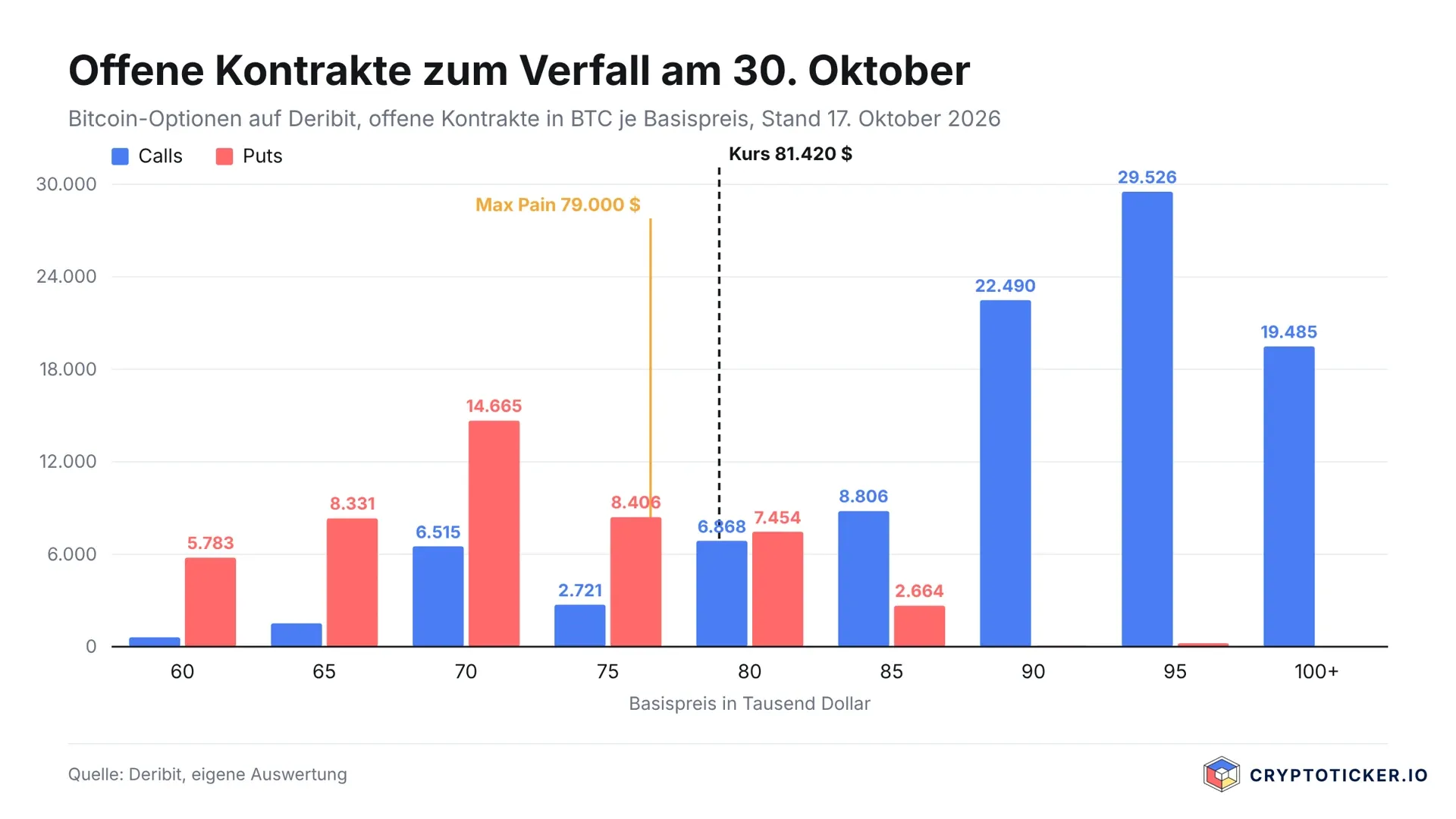
At 08:00 UTC on October 30, 149,686 Bitcoin contracts expire on the Deribit options exchange. At $81,420, the price at midday on Saturday, that is a notional value of $12.2 billion. It is by far the largest date in the coming weeks: the expiry on October 23 carries 14,759 contracts, the November date on the 27th another 26,779. The monthly expiry is ten times the size of the next weekly one.
Two thirds of these contracts are calls, in other words bets on rising prices. How they are spread across the strike prices says more about sentiment on the derivatives market than any survey, and it reveals an imbalance that can weigh on the price over the next thirteen days. For where the price may head over a horizon of months, see our Bitcoin price prediction.
The October 30 expiry date, 09:00 German time
An option is the right to buy or sell Bitcoin at a set price. The buyer of a call at $95,000 may exercise at that price on the expiry date, wherever the market happens to trade. If Bitcoin sits below it, the right expires worthless and the seller of the option, known in the trade as the writer, keeps the premium.
On Deribit these contracts are denominated in Bitcoin rather than dollars. So 149,686 open contracts mean 149,686 Bitcoin of underlying value. For comparison, roughly $22 billion of Bitcoin changes hands on the spot market on an average day. An expiry of this size therefore moves the market not through sheer volume, but through the hedging business attached to it.
October 30 is the last Friday of the month and so the monthly expiry. These dates are traditionally the largest, because institutional investors roll their positions in monthly steps. After the clocks change on October 25, the expiry falls at 09:00 German time instead of 10:00 as before.
98,552 calls against 51,134 puts: how the expiry is positioned
Breaking the open contracts down by strike price reveals three clusters on the call side, and all three sit well above the current price. There are 25,570 contracts at $95,000, another 15,254 at $90,000 and 14,330 at $100,000. Together with the smaller positions in between, the calls add up to 98,552 contracts.
The picture on the put side is different. The largest single position sits at $70,000 with 4,142 contracts, followed by $75,000 with 3,034 and $72,000 with 3,084. The puts are therefore packed just below the price while the calls sit far away. In total, 51,134 puts face 98,552 calls, a ratio of 0.52.
The top band is the most telling: 19,485 contracts sit at $100,000 and above. That is 13 percent of all open contracts, with a notional value of $1.6 billion. For those positions to be worth a cent on October 30, Bitcoin would have to rise 23 percent in thirteen days.
Max pain sits at $79,000, $2,420 below the price
From this distribution it is possible to calculate the point at which the combined value of all in-the-money options is smallest. That point is called max pain, because it is where buyers of options collectively take out the least. For October 30 our analysis puts it at $79,000, some $2,420 or just under 3 percent below Saturday's midday price.
Max pain is neither a forecast nor a price target. It describes a calculated figure, not a promise, and academic work on max pain theory in equity markets reaches mixed conclusions. Its use is as a bearing: it shows where the positions that have been built up force the fewest payouts, and it currently sits below the price rather than above it.
Its position relative to the market matters more than the point itself. Max pain below the price means the put side sits closer to the action than the call side. Call buyers have placed their stakes at levels the market can only reach in thirteen days with a sharp jump.
How hedging by the option writers feeds through to the price
Behind every call stands a seller who would have to deliver if the option ends in the money. These writers hedge on the spot market: as the price moves towards a large strike they buy Bitcoin, and as it falls they sell again. That continuous adjustment is known as delta hedging, and it generates trading volume that has nothing to do with any view on Bitcoin.
The closer the expiry comes, the sharper the adjustment around the large strikes. Some 40,824 contracts sit at $90,000 and $95,000 combined, and a price approaching those levels forces the writers to buy. The mechanism works as a brake while the price stays well below them: hedges for options that are unlikely to reach their target are unwound step by step, and that means selling in the spot market.
That is precisely where the market stands. At $81,420, with implied volatility to match, the $95,000 calls are all but out of the running on the arithmetic. The hedge behind them melts away day by day, and what is unwound arrives as supply.

Friday's forecast revisited: $79,806 held
On Friday this slot carried the Bitcoin forecast on the jump in mining difficulty, with $79,806 on the downside and $82,508 on the upside. Both held: the low of the past 24 hours was $80,761 and the high $82,385. The price has come back 0.9 percent since Friday evening and 1.8 percent over the week.
Two things have changed since then. Computing load on the network, Friday's peg for the story, has eased again after the jump: the three-day average hashrate fell from 1.084 to 1.010 quintillion hashes per second, and the next difficulty adjustment is now estimated at plus 2.0 percent rather than Friday's near 6 percent. Sentiment has also turned: the Fear and Greed Index stands at 55 points, against 69 on October 12.
The implied range to October 30: $76,500 to $86,300
The options market says not only what is being bet on, but also how much the market expects prices to move. Deribit's published volatility measure for Bitcoin stands at 32.2 percent on an annual basis. Converted to the remaining 12.8 days to expiry, that implies a move of a good 6 percent either way.
In figures, the market is pricing a range of roughly $76,500 to $86,300 for October 30. The $90,000 calls would need 10.5 percent, those at $95,000 16.7 percent and those at $100,000 22.8 percent. All three lie outside what the derivatives market itself considers likely.
The same calculation caps the downside. At $76,500, the lower end of the implied range sits a good 5 percent above the 200-day line at $72,419. The 50-day line currently runs at $81,326, $97 below the price: the market is sitting almost exactly on it, and it is the first level to watch in the coming days for whether the direction holds.
The view from the newsroom: the expiry alone will not turn the price
Our assessment: the monthly expiry works as an explanation for moves around October 30, not as a directional signal for the weeks before it. Three pieces of evidence from the figures above support that. First, max pain at $79,000 is only just under 3 percent below the price, so the arithmetic pull is weak. Second, 149,686 contracts count for little against daily spot turnover of $22 billion. Third, implied volatility is low at 32.2 percent, and low volatility means smaller hedging flows.
The concentration argues the other way. Should the price fall below $79,000, the puts at $75,000 and $72,000 come into play, and hedging would then amplify the move rather than damp it. To read the next two weeks, look not at expiry day but at the $79,000 level ahead of it.
Leveraged products, holding periods and tax: the German framework
For investors in Germany the tax treatment is what matters most with options, and the gap is wider than many expect. Anyone holding Bitcoin directly falls under section 23 of the German Income Tax Act: after a holding period of one year the gain is tax-free. Where that rule goes next is covered in the current status of the crypto holding period, on which the German finance ministry declined to commit on October 16.
Derivatives follow different rules. Options, knock-outs, certificates and CFDs on Bitcoin count as forward transactions or capital claims and are taxed under section 20 of the Income Tax Act at the flat withholding rate. There is no holding period there, and no tax exemption after a year. Two routes to the same underlying, two entirely different tax outcomes.
In practice: anyone looking to position for the expiry date will find leveraged products in Germany at brokers that carry such instruments, and a look at the crypto broker comparison shows which providers offer what and at what cost. Anyone who merely wants to tidy up a spot holding has a cheap window right now: transaction fees on the Bitcoin network stand at one satoshi per virtual byte at every tier as of Saturday midday, the minimum. A standard transfer with one input and two outputs weighs about 141 virtual bytes and therefore costs around ten cents. Moving coins from an exchange into self-custody is not a sale and does not interrupt the holding period, though the exchange's withdrawal flat fee comes on top and is often well above the network fee.
Expiry on October 30: 19,485 calls need 23 percent in 13 days
The state of the derivatives market fits into one sentence: the bets on rising prices are numerous, but they are placed too high. Some 19,485 contracts at $100,000 and above need a 23 percent jump in thirteen days, while the options market itself prices only a 6 percent move. As a rule that gap does not close by October 30 through a leap in the price, but by the positions expiring worthless.
Three numbers are worth watching in the coming days: the 50-day line at $81,326 as the next level below the price, max pain at $79,000 as the threshold below which the put side gains weight, and the upper end of the implied range at $86,300. While the price stays between those points, the expiry is a date in the calendar rather than an event.
(As of October 17, 2026. This article is not investment advice. Prices and fee structures change; check the terms with the provider before you buy.)
The community treasury of Cardano has almost exhausted its own spending allowance. Of the 500 million ADA the network has permitted itself for the current budget period, 457,395,629 ADA are committed through approved payouts. That is 91.5 percent. What remains is 42,604,371 ADA, around $9.5 million at the current price, and that remainder is meant to last until the period ends in the summer of 2027.
If you hold ADA, this is no administrative footnote. The treasury funds the developers, the infrastructure and the marketing behind the network. When the allowance grows tight, the coming votes decide whether work under way keeps being paid for or stands still for months.
What the Net Change Limit governs at Cardano
The Net Change Limit, NCL for short, is the ceiling on everything that may flow out of the Cardano treasury within a defined span of time. It does not cap the treasury balance itself, but the sum of approved payouts in that period.
The current limit is 500 million ADA and applies to epochs 613 to 713. An epoch at Cardano lasts five days. The period began on 13 February 2026 and ends, on this count, at the end of June 2027. For comparison: the limit for the preceding period was 350 million ADA, so the increase amounts to a good 43 percent.
The figure was settled not through a protocol change but through what is known as an InfoAction. That is a governance proposal with no technical effect, by which the community puts a direction on record. In epoch 647, 62.35 percent of the stake-weighted DRep voting power supported it, CryptoSlate reports. Every individual payout still needs the approval of the DReps and the constitutional committee afterwards.
457 million ADA from 30 approved payouts
cryptoticker.io has analysed the public governance data of the Cardano blockchain, examining all 105 payout proposals submitted since Conway governance began. cryptoticker.io compiled this analysis itself on 17 October 2026.
The result for the current year: 30 proposals were enacted, together 457,395,629 ADA. The largest single item is a payout of 120 million ADA to the AlphaGrowth Cardano PRIME programme, approved in July. Behind it come 62.1 million ADA for the maintenance initiative run by Input Output and Ensurable Systems, 50 million ADA for the joint fund with Draper Dragon and 32.9 million ADA for the Cardano Vision 2026 programme.
Across the whole stretch since 2025, the 70 enacted payouts add up to 804,427,136 ADA. The figures rest on the proposals as submitted; what counts in each case is the amount stated in the proposal.
Treasury and spending cap are two different things
One confusion is worth avoiding, because it crops up regularly in discussion forums. The treasury balance stood at around 1.378 billion ADA in epoch 661 and has in fact risen against epoch 650, from about 1.337 billion ADA.
The treasury fills up continuously from transaction fees and from the protocol's reserves. The spending cap moves independently of that: inflows, donations and returned grants do not free it up again. The network therefore has ample money, but in this period may spend only another 42.6 million ADA of it.

29 failed proposals worth 230 million ADA
The second half of the analysis explains why the allowance has not long since been blown despite the high number of proposals. In the current year, 29 proposals worth 230,725,260 ADA in total expired without securing the necessary approval. Against 30 approved proposals stands almost the same number of failed ones.
The most recent case concerns a payout of 11,787,063 ADA for deploying the security firm OpenZeppelin in the Cardano environment. The proposal expired in epoch 661. Before that, among others, a 20 million ADA envelope for the Cardano Builder DAO, 39.8 million ADA for Tweag's infrastructure work and several attempts to fund the Cardano Summit 2026 all failed.
DReps rejecting proposals is everyday business at Cardano, not an emergency. How the voting weights come about and what role the constitutional committee plays in it, we set out in our piece on the DRep vote about the constitutional committee.
The open proposal: 22 million ADA for tokenised copper
Exactly one payout proposal is currently up for a vote, and it is an unusual one. Under the title Cardano Strategic Copper Reserve, the US company Toto Finance Inc. asks for a one-off payout of 22,000,000 ADA, about $4.9 million at the current price.
With the money, according to the proposal, certified COMEX grade 1 copper cathodes are to be bought, stored in an approved US warehouse and represented as tokens under the ticker CuTT on Cardano. One token is to stand economically for one certified pound of copper. The proposal names a holding period of 18 to 24 months and provides for returning the proceeds of the later sale, together with unspent funds, to the treasury by month 36.
The breakdown is itemised in the proposal: 14,724,409 ADA or 66.93 percent for the copper itself, 2,640,000 ADA for technology and project management by Toto Finance, 3,533,859 ADA for external operations and auditing, 441,732 ADA for execution and 660,000 ADA for independent administration. Independent oversight is to be appointed; the proposal names a US member firm of PwC as preferred, without any engagement being in place.

Were the proposal to pass, 20,604,371 ADA would be left under the cap for the rest of the period. That is why this single vote draws more attention than its sum might at first suggest.
The timetable up to mid-November
The proposal was submitted in epoch 661 and lapses if it finds no majority by the start of epoch 668. On the blockchain's current pace, that transition falls on 15 November 2026. Until then DReps can cast their votes and change them again.
The current epoch 662 ends on 21 October. Every epoch boundary is a possible moment for ratification, because Cardano evaluates votes at the epoch boundary. That means the dates to watch are 21 October, 26 October and the following five-day steps up to mid-November.
You can check the state of every vote yourself, without relying on reports. The official governance interface GovTool lists the proposals with vote tallies and deadlines.
ADA at $0.2233, almost 13 percent below the weekly high
ADA costs $0.2233, according to CoinGecko on Saturday morning. Over seven days it is down 11.96 percent, over 24 hours down 3.38 percent. The weekly high was $0.2557, the weekly low $0.2188. That puts the price 12.7 percent below the high and only 2.0 percent above the low.
Over 30 days the arithmetic looks different: there, a gain of 12.56 percent still stands. Market value is $8.39 billion, which means rank 17. In circulation are 37.56 billion ADA out of a maximum of 45 billion.
No direct connection between the budget position and the week's price action can be drawn from these figures. The setback fell in a week in which Bitcoin and Ether also gave ground.
Levels above and below
On the downside the weekly low at $0.2188 is the next level to watch, behind it the round $0.20 mark. On the upside lies the weekly high at $0.2557, and before it the $0.25 mark, where the price last lingered on 12 October.
These are observation points from the week's course, not price targets. How the levels have developed over recent months is shown by our continuously maintained overview of the ADA price.
Buying route, custody and holding period in Germany
If you want to buy ADA in Germany, the usual route runs through an exchange with MiCA authorisation. Since the regulation took hold, providers addressing customers in the EU need a licence from a European supervisor; in Germany that is BaFin. Which providers are licensed and how their fees differ is set out in our crypto exchange comparison.
One point counts more often at ADA than at other coins: governance runs on delegated stake. Leave your ADA sitting at an exchange and you generally leave it to the exchange whether, and to whom, the voting right is delegated. To vote yourself or appoint a DRep, you need your own wallet. How staking returns differ between providers is shown by the staking platform comparison.
For tax, the one-year period under section 23 of the German Income Tax Act still applies: hold for longer than twelve months and you pay no income tax on the gain. Whether the rule survives is politically open; we have gathered the state of the debate in our piece on the reform of the crypto holding period. Staking can touch the period, so with larger holdings it is worth looking at your own tax documentation before you delegate.
Leveraged products on ADA also exist. There, the distance to the liquidation price decides whether a move of a few percent ends the position. With a coin that loses 12 percent inside a week, that distance is used up quickly.
Cardano budget: 42.6 million ADA of room left until the end of June 2027
The spending allowance is 91.5 percent committed, the treasury itself is well filled, and the last open proposal will be decided by 15 November at the latest. Three things are worth taking from this:
- Keep an eye on the voting dates. Every epoch boundary from 21 October onwards can decide the copper proposal. Anyone holding ADA through an exchange who wants a say should first check whether the provider passes the voting right on at all: a point the exchange comparison lists per provider.
- Settle your own custody. At Cardano, governance and staking hang on the same key. To delegate yourself you need a wallet under your own control; the differences in returns are shown by the staking comparison.
- Count the holding period in. Before a sale it is worth checking the acquisition date, because after twelve months no income tax falls due on the gain in Germany. The state of the political debate is in the overview of the holding period.
What follows in the summer of 2027 is open. Towards the end of the period at the latest, the community will have to vote on a new allowance, and the experience of the past two rounds shows that this is no formality either.
(As of October 17, 2026. This article is not investment advice. Prices and fee structures change; check the terms with the provider before you buy.)
Next Thursday ends a story that began in January to considerable applause. On 22 October 2026 Bitwise pays out the last shareholders of its Dogecoin fund BWOW in cash. The net asset value of 21 October is what counts, and the security has not been tradable since 14 October. For the price of Dogecoin this has so far been a non-event: the coin stands at $0.0803 on Saturday midday, 2.5 percent below the previous day.
The wind-down is interesting for another reason: it lays bare how small the regulated fund market for Dogecoin has actually remained after a year of exchange trading. The two largest remaining US products together manage $22.5 million. That is 0.18 percent of Dogecoin's market capitalisation of $12.56 billion, and around 3.7 percent of what changes hands on exchanges in a single day.
The timetable up to 22 October
Bitwise announced the wind-down on 10 September, with immediate effect for the fund structure and a staggered schedule for investors. The notice names four dates, three of which have already passed.
| Date | What happens |
|---|---|
| 10 September 2026 | Bitwise announces the dissolution, liquidation takes effect |
| 14 October 2026 | last trading day on NYSE Arca, the fund converts its Dogecoin into cash |
| 15 October 2026 | creation of new shares ends before the open |
| 21 October 2026 | record date for the net asset value |
| 22 October 2026 | cash payment to the remaining shareholders |
Anyone still holding shares need do nothing. The payment runs through the custodian bank, with no application and no deadline. As its reason, Bitwise says in the mandatory notice only that the firm continuously optimises its product range to meet the changing needs of investors. No fund size appears in the notice. All it gives is the house figure: more than 70 products and $9 billion in client assets.
What is left of the US fund market for Dogecoin
After BWOW departs, three spot products remain on the market. Two of them publish their figures daily, and both sit at almost the same level.
| Fund | Provider | Assets | As of | Fee per year |
|---|---|---|---|---|
| GDOG | Grayscale | $11.41 million | 15 October 2026 | 0.35 percent |
| DOJE | REX-Osprey | $11.12 million | 14 October 2026 | 1.50 percent |
| TDOG | 21Shares | no current figure | not stated | not stated |
| BWOW | Bitwise | being wound down | 14 October 2026 | not stated |
Converting the two reported holdings into coins gives, at the current price, around 280 million Dogecoin. In circulation are 156 billion units. The regulated fund wrapper therefore holds roughly one Dogecoin in five hundred. For a sense of scale: the coin's turnover alone came to $612 million over the past 24 hours, 27 times the entire fund assets.

Why a small fund closes sooner than a large one
An exchange-traded fund carries costs that barely grow with its size. The custodian, the auditor, legal advice, the exchange listing fee and the market maker quoting prices every trading day cost almost the same at $10 million in assets as at $1 billion. Revenue, by contrast, comes solely from the management fee, and that is measured against assets.
What this means can be worked through on the two remaining funds. At 0.35 percent on $11.41 million, Grayscale takes in just under $40,000 a year. REX-Osprey charges 1.5 percent, more than four times as much, and arrives at around $167,000 even though its fund is slightly smaller. Both sums are enough for a niche product inside a large fund family, where custody and audit are spread across many funds. As a standalone business, neither pays its way.
Therein lies the reason why products of this size disappear quietly, long before anyone notices. It is not the price that decides this but the inflows. Bitwise waited ten months and then pulled the cord.
German investors were never on the distribution list
The wind-down of BWOW affects almost nobody in Germany, and there is a supervisory reason for that. US funds produce no key information document under the European PRIIPs regulation. Without that document a broker in the EU may not sell the security to retail clients. Anyone with a securities account in Germany could therefore not buy BWOW through the regular route at all, and the same applies to GDOG, DOJE and TDOG.
Access to Dogecoin in securities form runs in Germany through exchange-traded notes backed by real coins. Which products exist, what to look for in the issuer and the collateral, and how this differs from buying directly, is set out in our overview of crypto ETFs and ETPs in Germany. The second route remains buying the coin itself through a regulated crypto exchange, with self-custody or custody at the exchange.
Tax hangs on the wrapper, not on the coin
At this point the product question becomes a money question, and more sharply than with equities. A directly held Dogecoin is, for tax purposes, a different asset from a security that tracks the same coin.
For a direct holding, section 23 of the German Income Tax Act applies. A gain from a sale within one year counts as a private disposal transaction and is taxed at the personal rate, but stays outside the calculation up to the exemption limit of €1,000 per calendar year. Exceed that limit and the whole amount becomes taxable. After twelve months of holding, the gain is tax-free. That holding period was in the balance several times this autumn: the Bundestag rejected its abolition on 9 October by 445 votes to 132, the cabinet date passed without a decision, and the Federal Ministry of Finance is keeping its counsel. We track the current state continuously in our overview of the crypto holding period.
With a security the arithmetic looks different. There, flat-rate withholding tax of 25 percent applies in principle, plus the solidarity surcharge and church tax where applicable, withheld by the bank holding the account, with the €1,000 saver's allowance as a tax-free amount. Whether a physically backed crypto ETP nonetheless falls under section 23 in an individual case depends on how it is structured and whether it securitises a claim to delivery of the coins. No article answers that question across the board; the key information document of the particular product does, and a tax adviser in case of doubt. Anyone who has spread purchases across several platforms will find, in our comparison of crypto tax tools, the programs that track acquisition dates and holding periods automatically.
Three points count now: what form the holding takes, when it was acquired, and whether the supporting records are complete. The first two determine the type of tax, the third the burden of proof before the tax office.

The price this Saturday
Dogecoin trades at $0.0803 at midday on 17 October, the equivalent of €0.0715. Over the past 24 hours the range ran from $0.0793 to $0.0828, with a volume-weighted average of $0.0804. Over seven days it is down 6.9 percent, over thirty days down 1.5 percent. From the all-time high of $0.7316 the coin is 89 percent away.
The intraday low at $0.0793 sits close to the level at which the price steadied last week as well. On the upside it gets tight at $0.0828, the high of the current 24 hours. Both are daily marks and not trend lines; anyone looking at longer periods will take their bearings more from the February low, which we wrote about on 14 October when the price still stood at $0.0845. Dogecoin has given up a further 5 percent since then without either level breaking.
Our assessment of the retreat from the niche
From the editorial team's point of view, the closure of BWOW is not a signal against Dogecoin but one about the product landscape. The evidence: the coin ranks 12th by market capitalisation at $12.56 billion and turns over $612 million on a quiet Saturday. At the same time the four US funds together have not gathered even $25 million in ten months. The demand is there, then; it simply is not looking for a fund wrapper.
Against that stands an objection worth taking seriously: a market without institutional vehicles remains carried by retail investors and is therefore more prone to swings. At Bitcoin the ETF wave bundled demand that had not existed before. For Dogecoin that effect has so far failed to appear, and after Bitwise's retreat it has become less likely for this year. No price forecast follows from this. Any purchase of crypto assets can lead to a total loss.
BWOW wind-down: the money moves on 22 October, the coin stays
For Dogecoin held in German accounts and wallets, next Thursday changes nothing. What has changed is the position of everyone who had backed a regulated US product: of four funds three remain, and two of them together manage as much as the coin turns over in three and a half trading hours. Anyone sorting out their holdings anyway can take the week as an occasion to record the acquisition date and holding period for each position. By the turn of the year that determines the 2026 tax bill.
(As of October 17, 2026. This article is not investment advice. Prices and fee structures change; check the terms with the provider before you buy.)
Decrypt
StepFun's STEPX Neo opened for pre-orders in China on Oct. 13 at 3,999 yuan, with an AI agent built into the operating system instead of bolted on as an app.
AI companies charge by the token, and most people burn them on jobs a cheap model could do. Here's how to spend less and get better results, from your first prompt to your first agent.
Tesla's new Roadster flips through the air, jumps a row of Teslas and lands on SpaceX thrusters. The Rocket version is invite only, not approved for public roads, and not due until 2028.
Calif showed an untethered jailbreak on an iPhone 18 Pro running iOS 27.0.1 at Hexacon in Paris. It survived a reboot, but no tool or bug details are public yet.
Circle CEO Jeremy Allaire told Reuters the USDC issuer plans to enter about 40 emerging and developing markets, citing rising demand in Southeast Asia, Latin America, Africa and the Middle East.
U.Today - IT, AI and Fintech Daily News for You Today
XRP has posted its worst weekly ETF performance since July as the spot XRP ETFs have just concluded a week of steady withdrawals from investors.
Coinbase takes SHIB burn spotlight with 152.3 million tokens sent to dead addresses.
Ripple CTO Emeritus issues urgent warning over wallet scam notification.
Cardano founder names one major milestone that remains before he considers his long-term ADA vision fulfilled.
Ethereum's founder Vitalik Buterin has stirred discussions about Bitcoin and AI after spotlighting a key difference between both rapidly emerging technologies.
Blockonomi
Tokenized real-world assets, often called RWAs, are digital tokens on a blockchain that represent ownership of an off-chain asset. The asset can be a government bond, a loan, a fund share, a stock or a bar of gold. Supporters point to faster settlement, smaller minimum purchases and assets that can serve as collateral.
The market has grown quickly in 2026, but the totals depend on who is counting. Trackers report anywhere from about $19 billion to more than $60 billion, because they define tokenized assets in different ways. This article pulls together data from several recent reports to show where the market stands.
Most of the value sits in a few places. US Treasuries lead, private credit follows, and real estate remains very small. The sections below cover market size, growth, major products, asset classes, holders, lending, stocks and forecasts.
How Big Is the Tokenized RWA Market in 2026?
There is no single agreed figure. As of mid-September 2026, tracked data cited by Learnsignal shows about $38.8 billion in tokens distributed on-chain. Those tokens represent underlying assets worth around $365 billion, or about $305 billion once stablecoins are removed.
Other trackers land in a similar range for distributed assets. Chainalysis put the market at $36.07 billion at the end of the second quarter of 2026. Dune reported that total supply passed $34 billion this year, and Centrifuge reported a rise from about $25 billion to $37 billion in the first seven months.
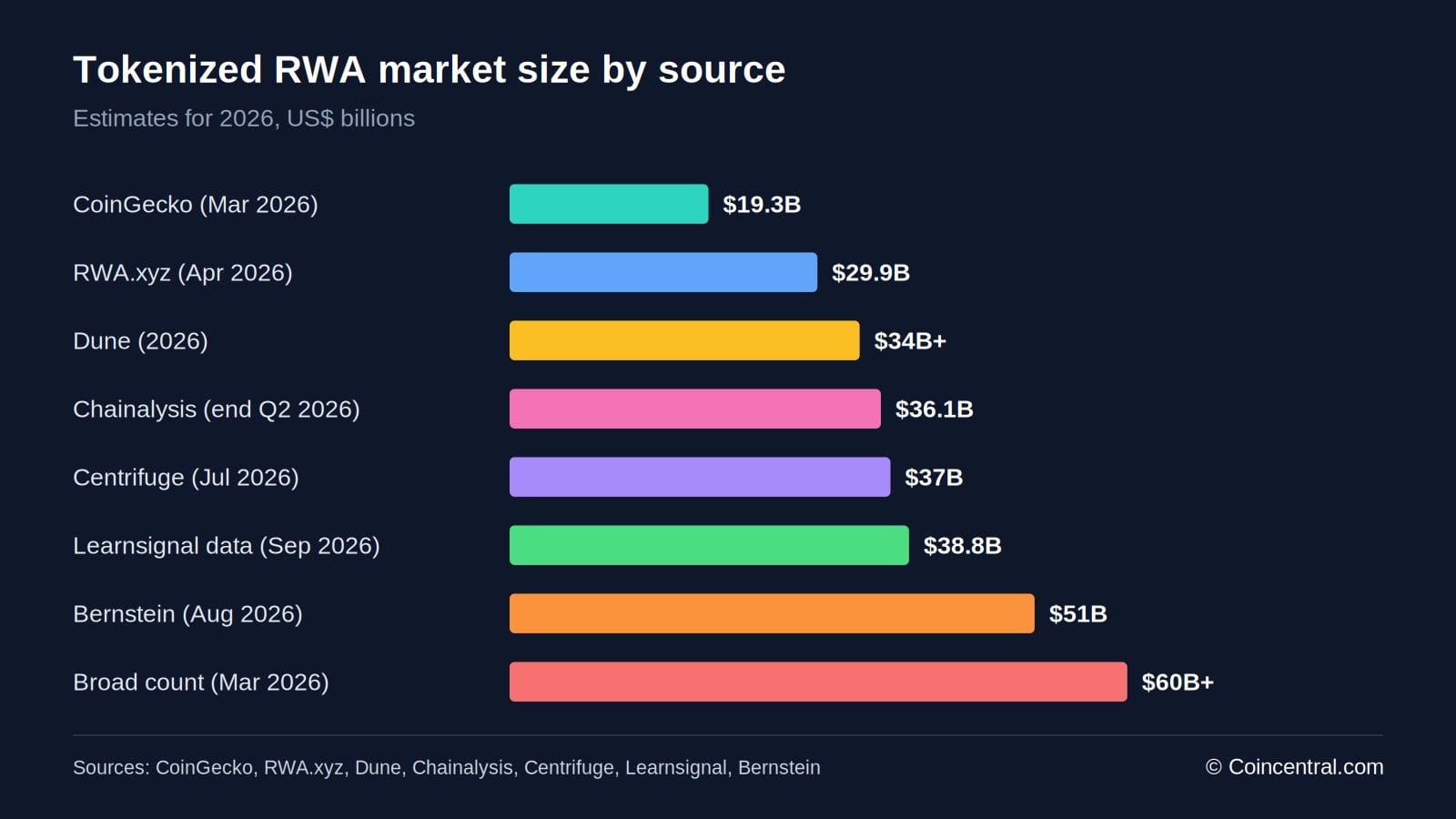
- Figure 1: Estimates of the tokenized RWA market in 2026 range from about $19 billion to more than $60 billion.
Some counts are lower and some are much higher. CoinGecko measured a market capitalization of $19.32 billion in March 2026. Bernstein, cited by CoinDesk, said about $51 billion of tokenized assets are on-chain, and broader definitions have produced totals above $60 billion.
| Source | Measure | Date | Value |
|---|---|---|---|
| CoinGecko | Market capitalization | Mar 2026 | $19.32B |
| RWA.xyz via EtherWorld | Tokenized RWA value | Apr 16, 2026 | $29.9B |
| Dune | Total supply | 2026 | Over $34B |
| Chainalysis | Tokenized RWA value | End of Q2 2026 | $36.07B |
| Centrifuge | Tokenized asset value | Jul 2026 | About $37B |
| Learnsignal tracked data | Tokens distributed | Mid-Sep 2026 | $38.8B |
| Bernstein via CoinDesk | On-chain tokenized RWAs | Aug 2026 | About $51B |
| Broad definition | Total value | Mar 2026 | Over $60B |
The gap comes from method. Market capitalization counts the circulating value of tokens. Total value locked can include assets held in smart contracts, such as collateral that does not trade freely.
Some trackers also count assets on permissioned chains, while others count only publicly distributed tokens. Chainalysis noted that activity on private networks such as Canton does not appear in on-chain holder counts. The full market may be larger than any single dataset shows.
For scale, CoinDesk Data reported that the total stablecoin market capitalization reached $317 billion in March 2026. A distributed RWA market of roughly $30 billion to $40 billion is a small fraction of that figure.
Dates matter too. Several of these figures were taken in different months, and the market moved between them. A March 2026 report will look small next to a September 2026 report, even if both use the same method.
How Fast Is Tokenized Asset Growth?
Growth over the past year is large on every measure. RWA.xyz data shows the market rose from $8.8 billion on April 16, 2025, to about $29.9 billion on April 16, 2026. That is an increase of about 240%.
CoinGecko reported a rise of 256.7%, from $5.42 billion in January 2025 to $19.32 billion in March 2026. Yellow.com research cited year-over-year growth of 184% in its mid-2026 count. Chainalysis reported 135% growth over the prior period for a market that ended the second quarter at $36.07 billion.
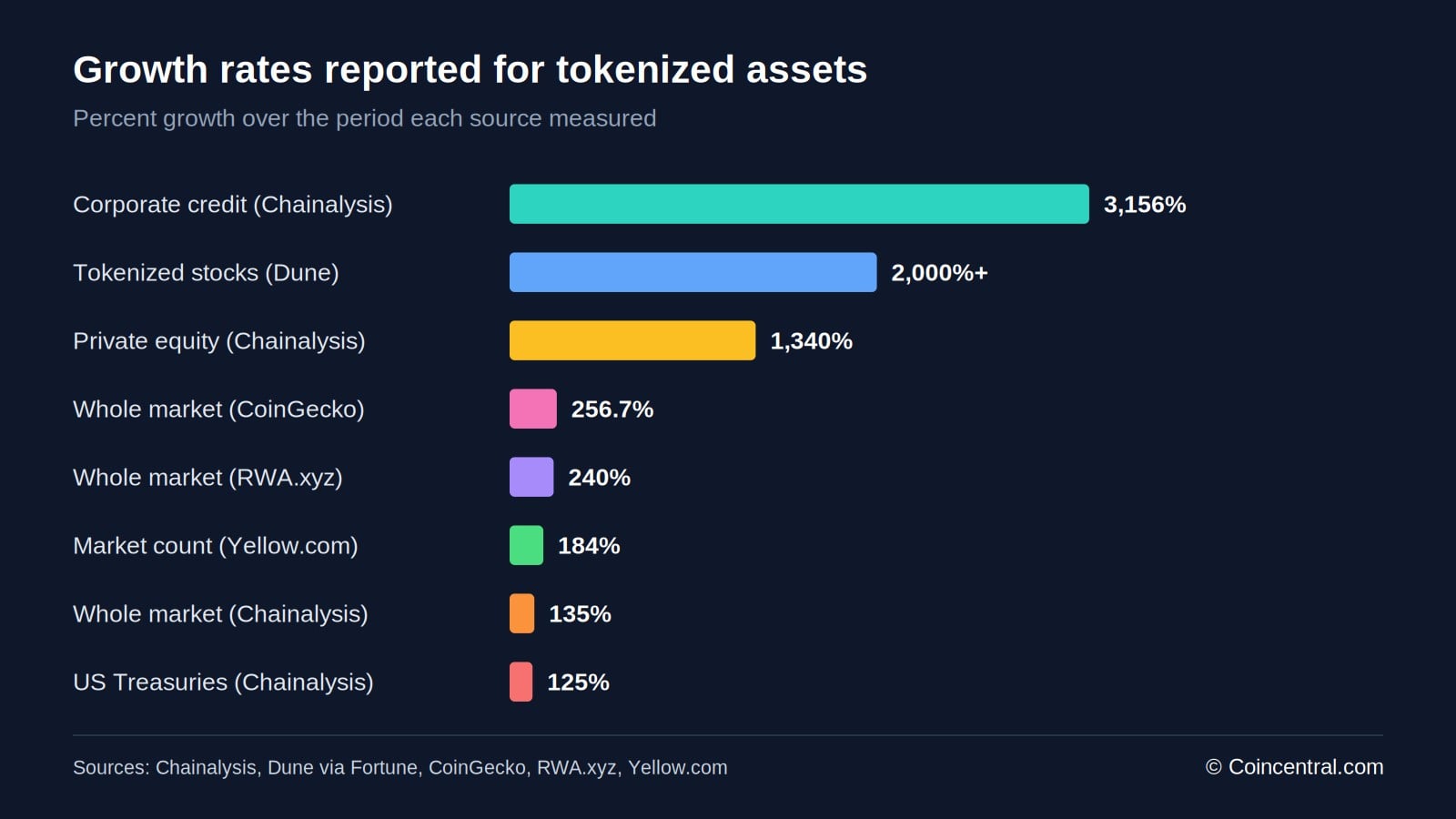
- Figure 2: Growth rates differ by source, and the largest percentages come from the smallest starting bases.
The fastest percentage gains came from small starting points. Chainalysis found that corporate credit grew 3,156% and private equity 1,340%, but those moves took each category from tens of millions of dollars to about a couple of billion. Dune reported that tokenized stocks rose more than 2,000%.
Treasuries grew less in percentage terms but added more dollars. Chainalysis reported a 125% rise, from $6.86 billion to $15.42 billion. That is more than the next three categories combined in dollar terms.
Base effects matter when reading these numbers. A category that moves from $50 million to $1.5 billion shows a huge percentage gain, yet it adds little to the total. Readers should check the dollar change as well as the percentage.
| Measure | Growth | Period or source |
|---|---|---|
| Tokenized RWA market | About 240% | Apr 2025 to Apr 2026, RWA.xyz |
| Tokenized RWA market cap | 256.7% | Jan 2025 to Mar 2026, CoinGecko |
| Tokenized RWA market | 135% | Period to Q2 2026, Chainalysis |
| US Treasuries | 125% | $6.86B to $15.42B, Chainalysis |
| Tokenized stocks | Over 2,000% | Past year, Dune |
| Tokenized stocks | Over 17% | 30 days to Sep 2026, Learnsignal |
Short-term data shows the mix is still changing. Learnsignal’s 30-day figures for September 2026 showed tokenized stocks growing more than 17%, the fastest category. Tokenized Treasuries slipped slightly over the same stretch.
Tokenized US Treasuries: The Largest Category
US government debt is the largest tokenized asset class. Chainalysis counted $15.42 billion on-chain in the period ending mid-2026, or 42.8% of all tokenized RWA value. Learnsignal’s September data shows about $15.7 billion, roughly 40% of the market.
Other counts are lower. MetaMask, citing RWA.xyz, listed about $12.88 billion in early April 2026, up from roughly $5 billion in late 2024. Astraea Law found that tokenized Treasury funds crossed about $15 billion by mid-May 2026.
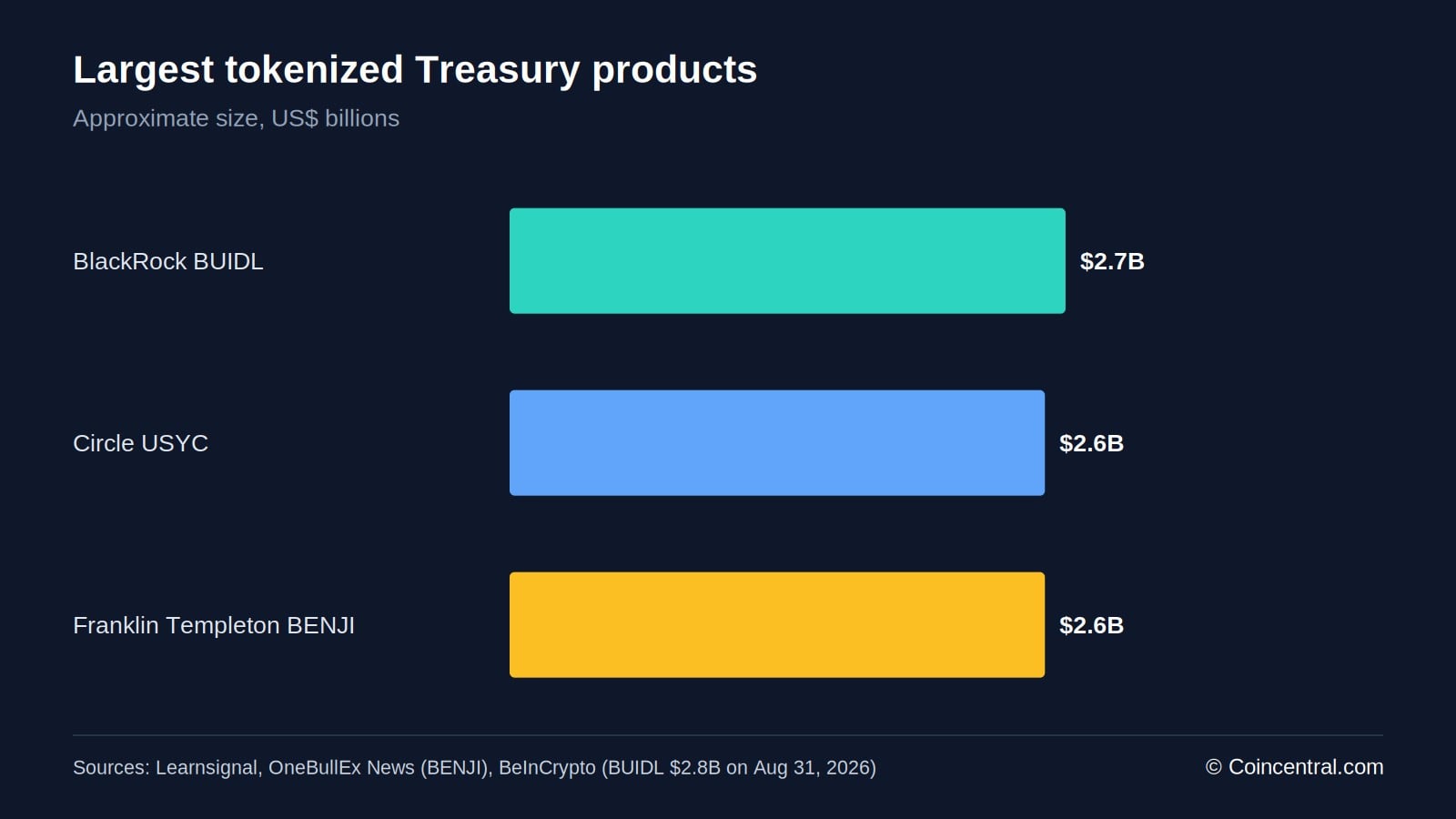
- Figure 3: Three funds each hold about $2.6 billion to $2.7 billion in tokenized Treasuries.
Three products stand out. BlackRock’s BUIDL fund holds roughly $2.7 billion, and BeInCrypto put its market cap at $2.8 billion on August 31, 2026. Circle’s USYC holds around $2.6 billion, and Franklin Templeton’s BENJI fund is also reported at $2.6 billion.
| Product | Issuer | Approximate size | Detail |
|---|---|---|---|
| BUIDL | BlackRock with Securitize | $2.7B to $2.8B | Live on nine blockchain networks |
| USYC | Circle | About $2.6B | Works like a tokenized money market fund |
| BENJI | Franklin Templeton | About $2.6B | Running since 2021; $1.5B on BNB Chain |
These products hold short-term government securities and issue tokens that represent a claim on the pool. MetaMask lists typical yields of about 3% to 5%, with daily redemption common. Some tokens grow in price as interest builds, while others keep a price near $1 and add more tokens to the wallet.
Learnsignal makes a useful point about what changes. The legal exposure is familiar, since a tokenized Treasury fund still holds Treasury bills. What changes is the record-keeping layer, where transfers can settle in minutes instead of days and the token can serve as collateral without a separate custody handoff.
The risks sit mostly in the token layer. The underlying debt carries little credit risk, but holders face counterparty, smart contract and redemption delay risk. Franklin Templeton has also received SEC no-action relief that lets its mutual funds and ETFs invest in BENJI, with implementation possible as early as the fourth quarter of 2026.
Tokenized Assets by Category
Each category behaves differently. MetaMask, using RWA.xyz data from early April 2026, lists Treasuries at about $12.88 billion and commodities at about $7.37 billion. Private credit stood near $5 billion in distributed value, though broader counts reach $18 billion to $19 billion.
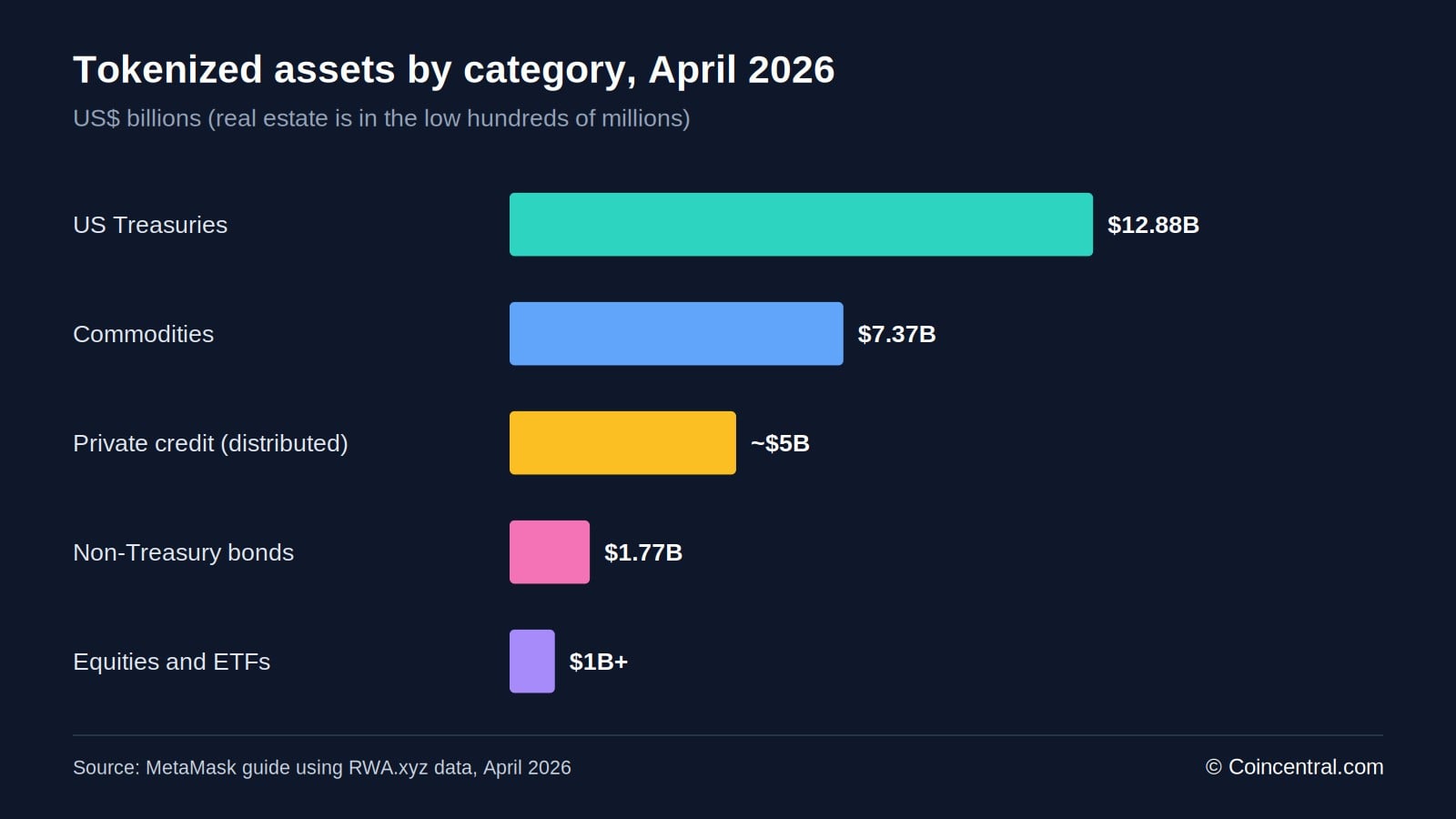
- Figure 4: US Treasuries, commodities and private credit lead tokenized asset value as of April 2026.
Commodities are almost all gold. Tether Gold holds about $2.7 billion and Paxos Gold about $2.4 billion, together roughly 74% of the category. These tokens pay no yield, so returns depend on the gold price.
| Category | Size (Apr 2026) | Typical yield | Liquidity |
|---|---|---|---|
| US Treasuries | About $12.88B | 3% to 5% | High |
| Commodities | About $7.37B | None | Medium |
| Private credit | About $5B distributed | 8% to 15% | Low |
| Non-Treasury bonds | About $1.77B | 4% to 8% | Low to medium |
| Equities and ETFs | Over $1B | Market return | Medium |
| Real estate | Low hundreds of millions | 4% to 10% | Low |
Real estate is the smallest of the major categories. Learnsignal puts it at about $226 million, less than 1% of the tracked market. That stands out because real estate is one of the most cited use cases in industry commentary.
Forecasts for the category are far larger. Deloitte projects $4 trillion in tokenized real estate by 2035. The gap between that figure and today’s value shows how early the category is.
Higher yields come with higher risk. MetaMask noted that stress in the broader private credit market in March 2026 showed how weak loans can affect tokenized products. Lockup periods are common, and secondary market trading is thin.
Who Holds Tokenized Assets
The holder base is global. Chainalysis found that US holders make up 11.7% of the global tokenized RWA holder base and 11.4% of its value. Tokenized Treasuries break that pattern.
By value, Italy accounts for 29.9% of geolocated tokenized Treasury holdings. Portugal holds 18.8% and Singapore 18.2%, while the United States ranks fourth at 10.5%.
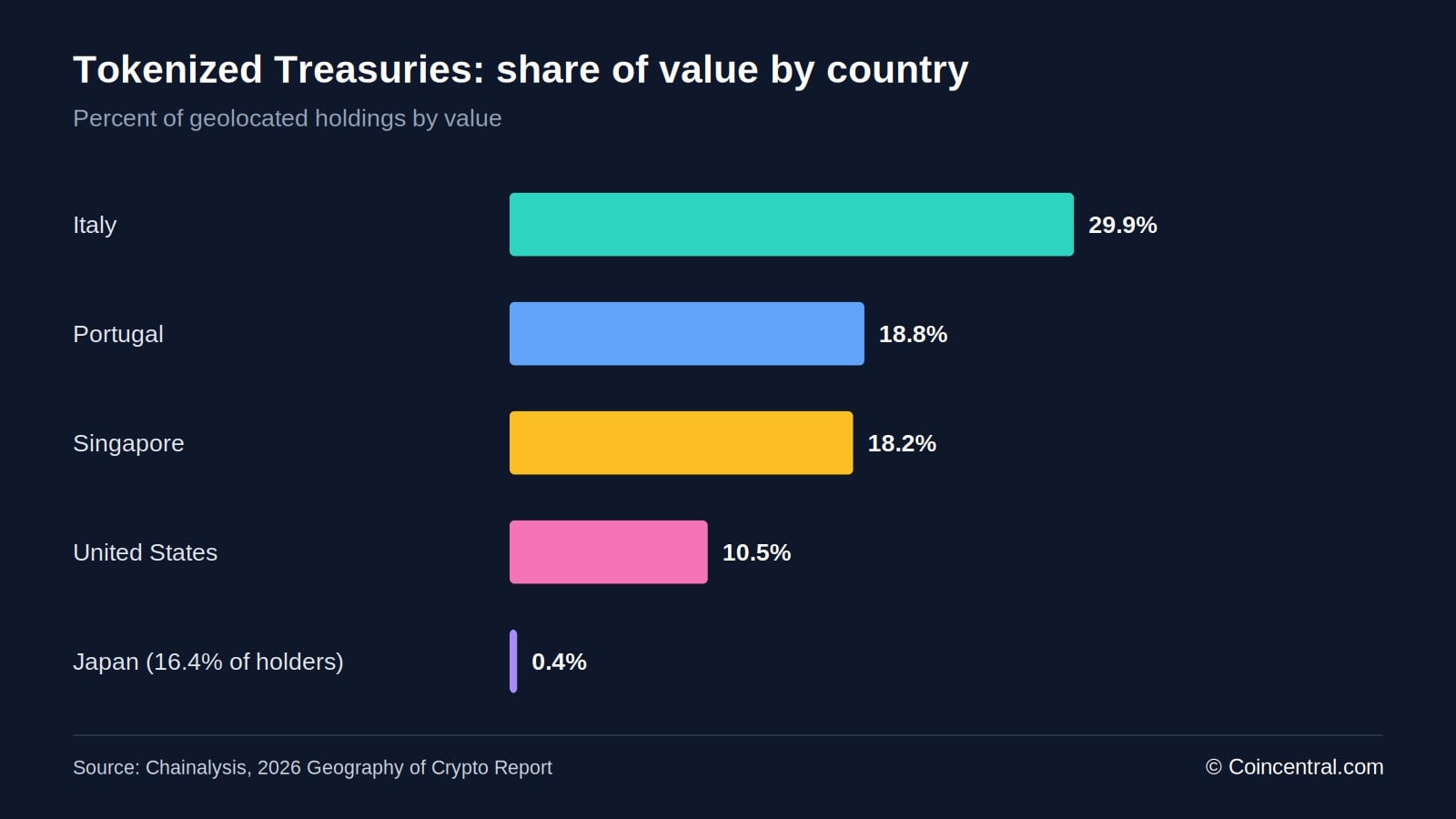
- Figure 5: Italy, Portugal and Singapore hold the largest shares of tokenized Treasuries by value.
Holder counts tell a different story. Japan leads with 16.4% of holders but just 0.4% of the value. Chainalysis reads this as a small group of large foreign holders driving value, with a wider retail base building small positions.
| Country | Share of value | Note |
|---|---|---|
| Italy | 29.9% | Largest by value |
| Portugal | 18.8% | Second by value |
| Singapore | 18.2% | Third by value |
| United States | 10.5% | Fourth by value |
| Japan | 0.4% | 16.4% of holders |
The issuers are mostly large traditional firms. Learnsignal lists BlackRock, Franklin Templeton, Apollo, Hamilton Lane and WisdomTree among the main builders. These are asset managers, not crypto startups.
Ethereum remains the main network. MetaMask reports that it hosts over 56% of all tokenized asset value as of April 2026. Stellar, Solana, Polygon, Avalanche, Arbitrum, Base and BNB Chain also host products.
Chainalysis adds a policy point. A holder outside the United States who buys a tokenized Treasury product creates demand for US government debt rather than for their own government’s debt.
Tokenization also changes who can buy. Chainalysis says it lowers the minimum position size and removes the need for a US brokerage relationship. A wholesale instrument becomes one that a retail holder in Lisbon or Singapore can buy directly.
Private Credit and On-Chain Lending
Lending data shows how people use tokenized assets. Dune found that credit assets make up about three-quarters of all real-world assets deposited in decentralized lending. Only a tiny fraction of tokenized Treasuries is used the same way.
Chainalysis reached a similar result. Private credit accounts for 77% of all value lent against tokenized RWAs. The number of wallets lending private credit grew 1,618% over the period.
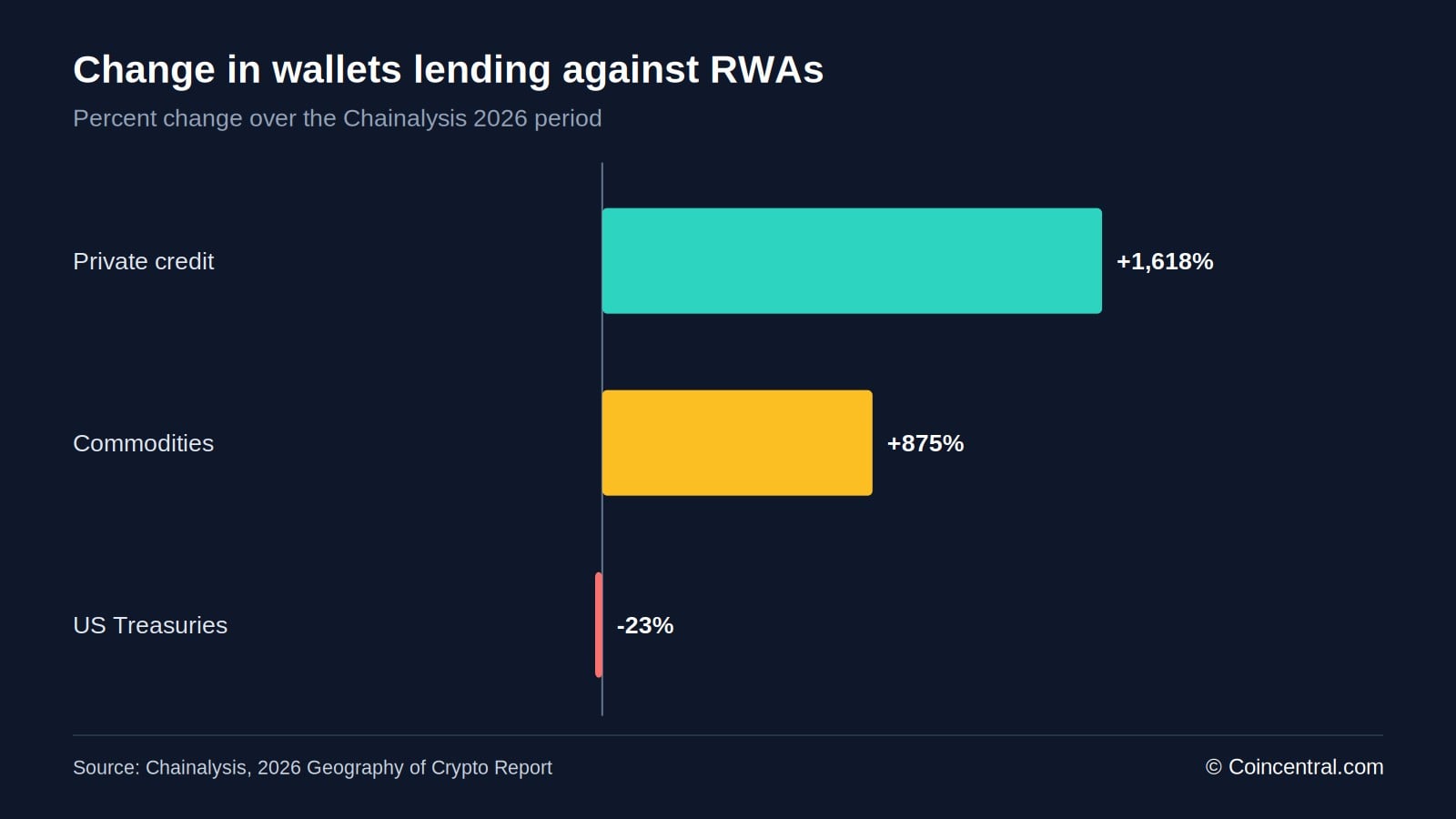
- Figure 6: Private credit lending grew fast while Treasury lending fell.
Commodities lending grew 875%. Treasuries went the other way and fell 23%, the only category to contract. Chainalysis links the split to liquidity.
| Category | Change in lending wallets | Share of value lent |
|---|---|---|
| Private credit | +1,618% | 77% |
| Commodities | +875% | Not reported |
| US Treasuries | -23% | Not reported |
Private credit is hard to sell in its untokenized form, so a token that can be posted as collateral is worth more to its holder. Treasuries are already the most liquid collateral in traditional finance. A holder who wants cash against them has established ways to get it.
Yield is another reason. Dune CEO Frederik Haga said tokenized private credit lets investors earn interest while using the same assets as collateral to borrow and fund other trades. MetaMask lists typical private credit yields of 8% to 15%.
Private credit also looks larger in some datasets. Bernstein, cited by CoinDesk, said about 47% of $51 billion in tokenized assets is private credit. That category often sits below the surface of public dashboards.
Tokenized Stocks and ETFs
Tokenized equities are small by value but growing fast in users. Insights4VC tracked distributed tokenized stocks rising from $951 million in March 2026 to $1.89 billion in July. Dune reported that active holders passed one million.
Other data points higher. A figure cited by OneBullEx shows holders rising from 103,000 in January to 1.9 million by September 2026. Ondo Finance’s stock platform reached $1 billion in total value locked in May 2026.
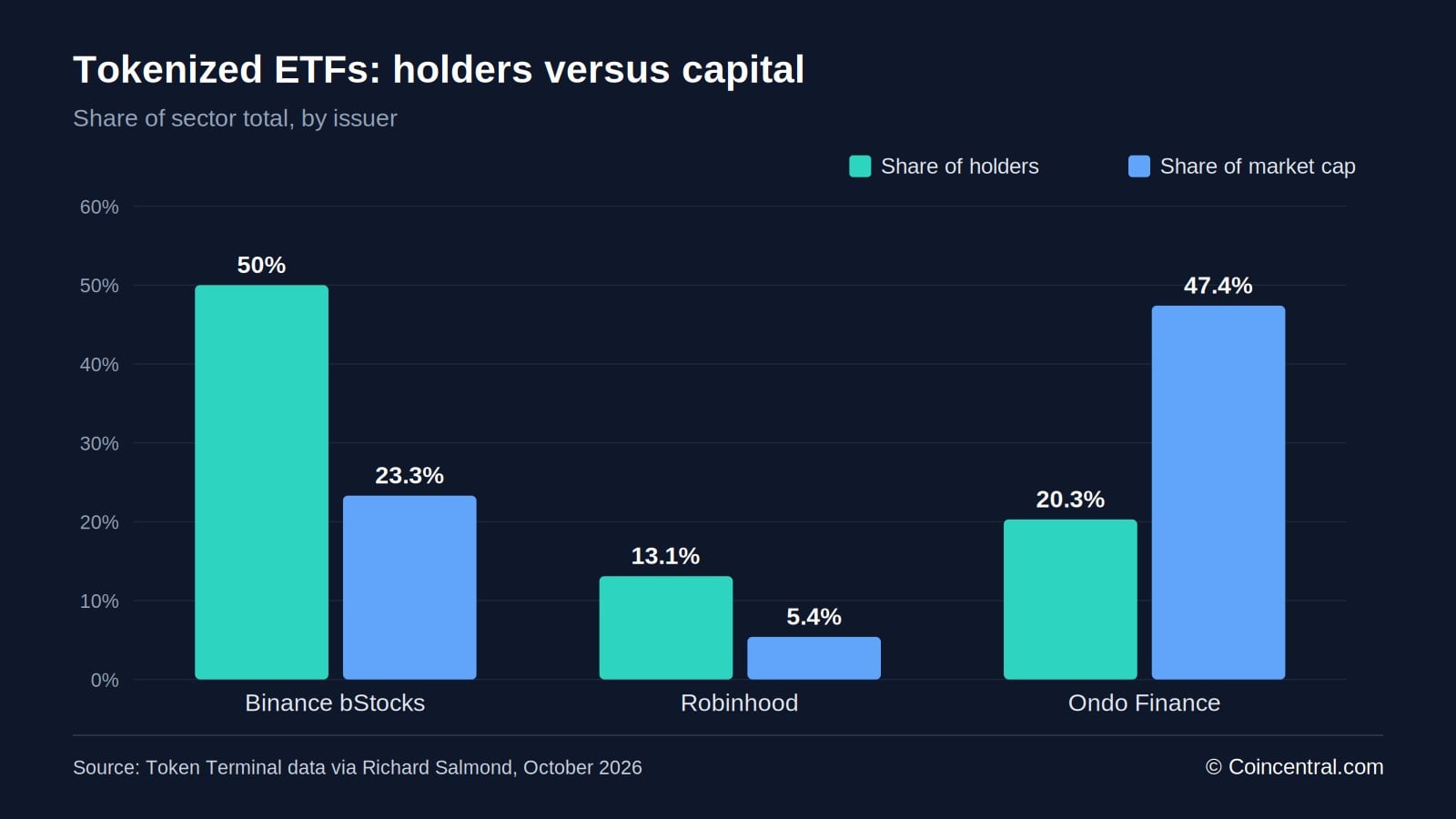
- Figure 7: Binance has half of tokenized ETF holders but under a quarter of the capital.
Token Terminal data shows tokenized ETFs tripled in size this year. Market capitalization rose from $219 million on January 1 to $654 million. Holders of tokenized ETFs rose about 51-fold, while holders of individual tokenized stocks rose about 26-fold.
Binance bStocks has 448,400 holders, half of all tokenized ETF holders, but only 23.3% of market cap, or $160 million. Robinhood has 13.1% of holders and 5.4% of capital. Ondo Finance holds 47.4% of capital, or $325.7 million, from only 20.3% of holders.
| Product | Market cap | Detail |
|---|---|---|
| QQQb (Binance) | $67.6M | 314,500 holders, 35% of the total |
| SPYx | $62.2M | Tracks the S&P 500 |
| IVVon (Ondo) | $61.5M | Tracks the S&P 500 |
| Ethereum | $303M | 44.1% of tokenized ETF value |
| BNB Chain | $192.1M | 28% of tokenized ETF value |
Users prefer single companies over funds. Dune estimates that individual stocks make up 81% of tokenized equities held in spot markets, and their value grew ninefold in a year. On traditional markets, more than 6,000 US-listed ETFs now outnumber individual stocks.
The Token Terminal data also shows overlap. Products tracking the S&P 500 and Nasdaq-100 have a combined value of about $330 million, nearly half the sector total. Because several issuers offer similar exposure on different chains, demand for one index is split across near-identical tokens.
Liquidity is a limit. MetaMask notes that order books for most tokenized stocks are much thinner than for traditional shares. The SEC said on January 28, 2026, that existing securities laws apply whether ownership is recorded on-chain or off-chain.
Forecasts, Regulation and Risks
Long-term forecasts vary widely. BCG and ADDX project a $16.1 trillion opportunity by 2030. McKinsey’s base case is about $2 trillion in tokenized market capitalization by the same date.
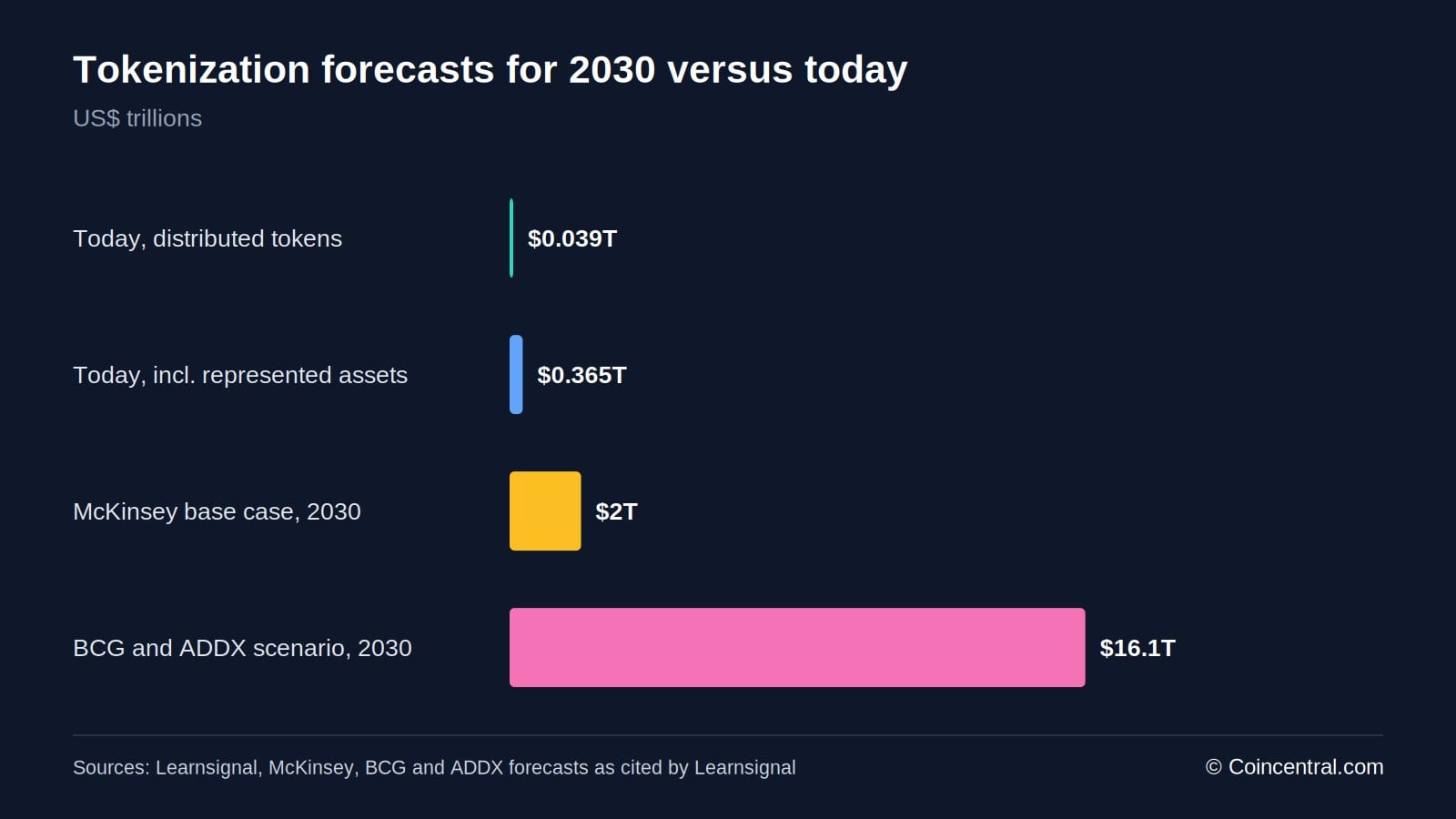
- Figure 8: Two credible 2030 forecasts differ by about eight times.
That is a gap of about eight times between two institutional forecasts. Today’s distributed market is about $38.8 billion. Any single projection should be treated as an estimate, not a settled fact.
Rules differ by region. The US House Financial Services Committee held a hearing on March 25, 2026, on the Modernizing Markets Through Tokenization Act of 2026. No comprehensive federal framework exists, and the SEC works case by case, including the Franklin Templeton relief and a pending Ondo filing.
The EU treats tokenized securities as financial instruments under existing law and licenses service providers under MiCA. OneBullEx describes this as clearer, though demanding. Firms that operate across borders face questions about which rules apply.
| Issue | What the data shows |
|---|---|
| Concentration | Yellow.com found 80% of value sits in a handful of protocols and funds |
| Liquidity | An arXiv study found asset value grew faster than trading volume |
| Custody | SEC treatment of tokenized securities custody is unresolved |
| Fragmentation | Funds sit on separate chains, and bridges add security risk |
The risks are practical. An arXiv study of December 2025 to May 2026 found signs of illiquidity in some tokenized markets. Tokenized funds are also spread across networks that cannot share collateral without a bridge.
Infrastructure may drive the next phase. The NYSE has announced plans for 24/7 trading and instant settlement. Franklin Templeton is working with DigiFT and Binance on wider institutional use.
What the Statistics Show
The tokenized RWA market is real and growing, but it is still narrow. Distributed value sits in the range of $30 billion to $40 billion on most trackers, and Treasuries account for about 40% of it. Private credit comes next, while real estate is under 1%.
Growth is fastest in stocks and ETFs, driven by retail users on large platforms. Capital still sits with a smaller group of large holders. The gap between holder counts and dollars is a pattern across ETFs, Treasuries and stocks.
Forecasts for 2030 range from $2 trillion to $16.1 trillion. Readers should compare sources carefully, because each tracker defines the market differently. This article is for information only and is not financial advice.
Several events could change the picture in the coming months. These include the SEC response to Ondo’s filing, Franklin Templeton’s plan to place BENJI inside traditional funds, and whether NYSE round-the-clock trading leads to tokenized listings. Each would change how easily assets move between old and new markets.
Sources
- Real-World Asset Tokenization Explained: Where the Market Actually Stands in 2026 (Learnsignal)
- North America: Inside the Growth of Agentic Commerce (Chainalysis)
- RWA categories in 2026: tokenized Treasuries, stocks, commodities, and more (MetaMask)
- New report finds that rapid expansion of tokenization is giving rise to new styles of investing (Fortune)
- Tokenized ETFs Triple in Size as Retail Adoption Outpaces Capital Growth (Richard Salmond)
- Tokenized Treasuries Drive RWA Market Past $30 Billion In Early 2026 (OneBullEx)
- Stablecoins & Tokenized Assets Report March 2026 (CoinDesk Data)
The post Tokenized Real-World Assets Statistics 2026: Market Size, Growth and Top Asset Classes appeared first on Blockonomi.
AI agents are software tools that plan and complete tasks with limited human input. In 2026, surveys show that more companies are buying them and putting them to work. They also show that results are uneven and that running costs are rising.
This article pulls together the main statistics from five recent sources. Two are original surveys from G2 and McKinsey. Three are reviews that compare many studies.
One warning applies to every number below. Surveys ask different people different questions, so the figures do not always line up.
Why AI Agent Adoption Numbers Do Not Match
Reported adoption of AI agents ranges from 14% to 86%. Most of that gap comes from what each survey counted. Some count companies that are only testing, while others count only firms that run agents at work.
McKinsey’s 2025 survey found that 62% of organizations were at least experimenting with agents. Only 23% had scaled agents anywhere in the company. In any single business function, no more than 10% had done so.
A review by bdautomated found the same pattern in other studies. PwC reported that 79% of US executives said agents were being adopted in their companies. A Capgemini survey that checked what people meant by “agent” found that 14% had implemented one.
The US Census Bureau found that 19.8% of all US businesses used AI in any business function as of May 2026. That figure covers firms of every size and counts any AI tool, not only agents.
| Source | What was counted | Result |
|---|---|---|
| US Census Bureau (May 2026) | Any AI use, all US businesses | 19.8% |
| Capgemini | Respondents who had implemented an agent | 14% |
| McKinsey (2025) | Scaled agents in at least one function | 23% |
| McKinsey (2025) | At least experimenting with agents | 62% |
| PwC (2025) | Executives saying agents are being adopted | 79% |
| G2 (2026) | B2B buyers who bought agent software or services | 86% |
The definition of an agent also varies. Anthropic’s engineering guide describes an agent as a system where a language model directs its own steps and tool use. A chatbot answers a question, and a workflow follows a fixed path.
This is why a single headline number rarely tells the full story. The sections below note who was asked and what was measured.
The bdautomated review checked 75 figures from 18 publishers. It traced each number to the original report and recorded who was asked and what counted. It found that numbers disagree mainly because they measure different things.
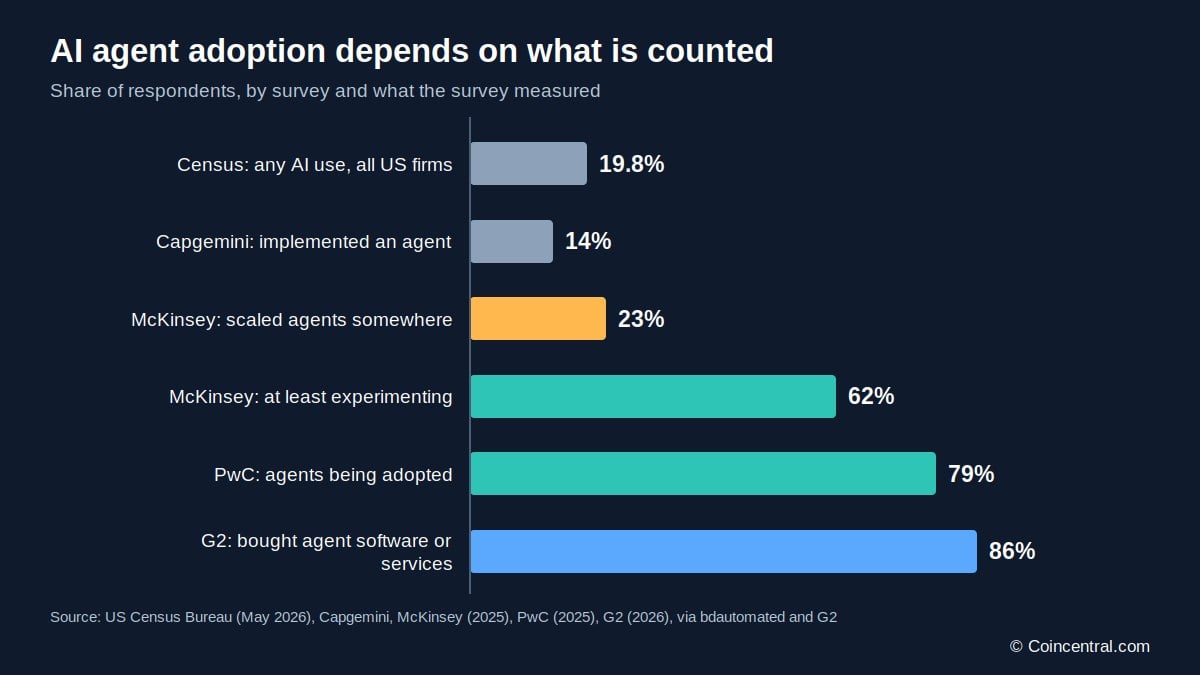
AI Agent Adoption: From Pilots to Production
McKinsey’s 2025 survey of 1,993 executives in 105 countries shows a funnel. 88% reported regular AI use in at least one function. 62% said their organizations had started using agents, and 23% were scaling them.
G2 found that more buyers are paying for agents. In its 2026 survey of 1,019 B2B decision makers, 86% had bought AI agent software or services in the past year, up from 69% a year earlier.
G2 also reports that 66% of agent buyers now have agents in limited or scaled production. That is an 18% increase from the year before. In McKinsey’s 2025 data, software engineering and IT were furthest along, yet no more than 10% of organizations reported scaling agents there.
| Source | What was counted | Result |
|---|---|---|
| Gartner (2026 Hype Cycle survey) | Organization has deployed AI agents | 17% |
| Gartner (Aug. 2026 preview) | Already deployed agents; another 34% plan to within 12 months | 37% |
| KPMG US (Q2 2026, 204 firms) | Agents deployed, firms with $1B+ revenue | 53% |
| KPMG US (Q3 2026, 314 leaders) | Building, deploying or developing agents | 62% |
| EY (2026, 202 US executives) | Agentic AI in pilots or enterprise deployment | 91% |
| Deloitte (2026, 3,235 respondents) | Expect moderate or higher agent use by 2027 | 74% |
Gradually.ai cautions that these results are not one time series. KPMG’s Q3 figure includes firms that are still building agents, so it cannot be compared with the Q2 figure for firms that have deployed them.
EY also limited its sample to large public US companies that already ran AI programs. That helps explain its high result.
Customer service is one area with clear growth. Salesforce data cited by FwdSlash shows that 66% of service organizations use agentic AI, up from 39% a year earlier.
Budgets are also rising. G2 says half of organizations have an agent budget of at least $1 million, and healthcare leads, with 57% spending at least that much each year. Technology and retail saw the biggest rise in budgets of $5 million or more.
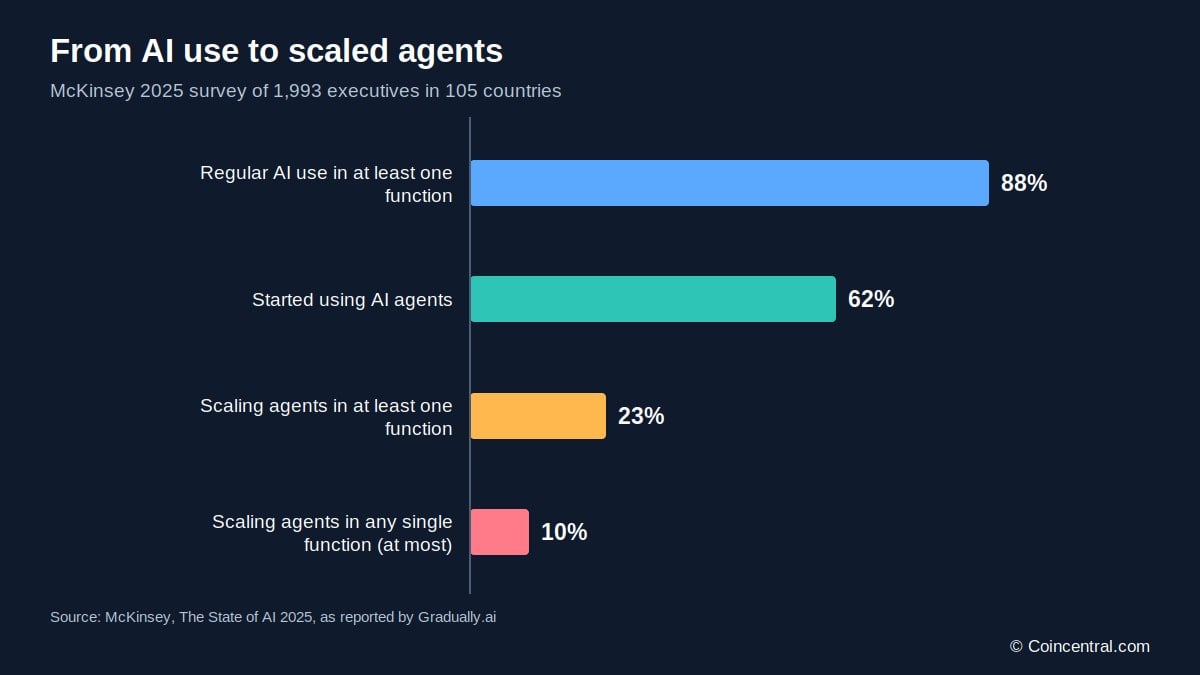
Large Companies Pull Ahead on Agents and Coding Tools
McKinsey’s 2026 survey of 1,719 people in 97 countries found that 40% of respondents at firms with more than $1 billion in revenue were scaling agents, up from 27% last year. At smaller firms the share stayed flat at 22%.
Large firms lead on broader AI use as well. 54% of respondents at firms with at least $1 billion in revenue report scaling AI across the enterprise, compared with one-third at smaller firms. Across all respondents, 44% report enterprise-wide scaling, up from 38%.
| Measure (McKinsey) | 2025 | 2026 |
|---|---|---|
| Large firms scaling agents | 27% | 40% |
| Smaller firms scaling agents | 22% | 22% |
| AI scaling across the enterprise, all firms | 38% | 44% |
| Use of AI in three or more functions | 51% | 56% |
Chatbots are the most widely scaled tool, at 47% of respondents. About two in ten are scaling AI agents, and a similar share are scaling software coding agents. At larger firms, 31% are scaling coding agents.
Coding agents are also changing buying choices. 32% of respondents say their organizations decided against buying at least one software product or feature because they could build it in-house. These decisions were most common in technology and healthcare.
Among AI high performers, nearly half reported such a decision, compared with 31% of other respondents.
McKinsey’s Lieven Van der Veken says leaders are now asking what they need to build AI tools themselves. He adds that this does not mean firms should build everything or avoid partners. The fastest movers are more deliberate about where to buy and where to build.
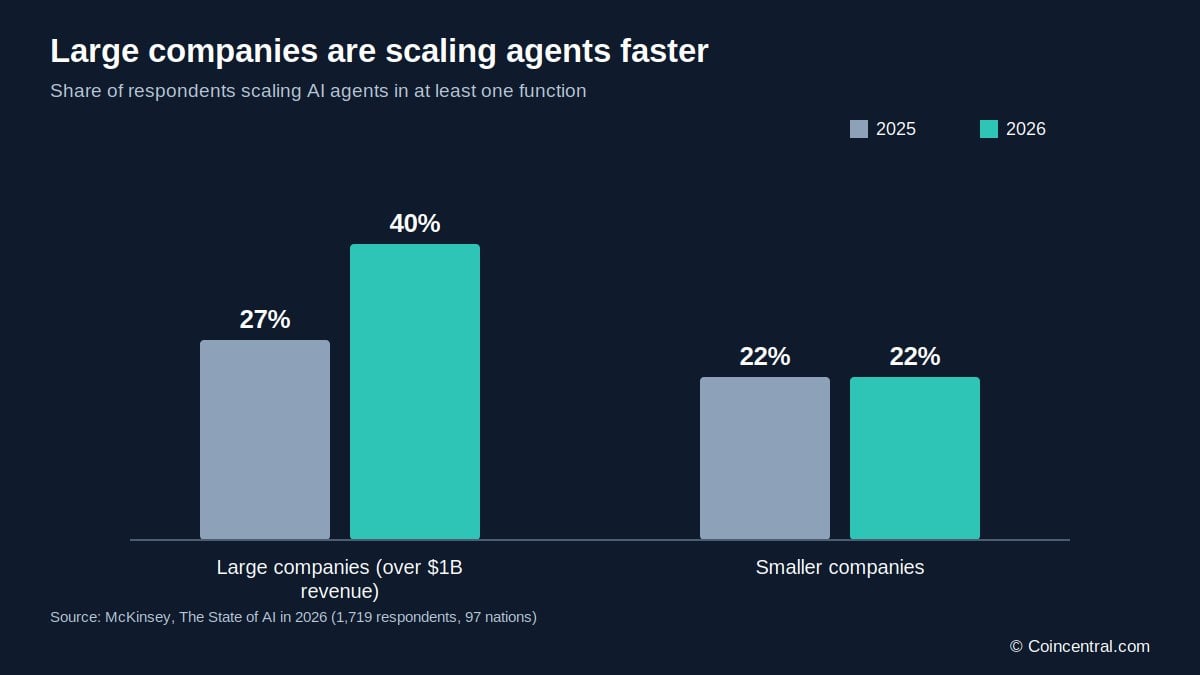
What AI Agents Cost to Run and Oversee
Costs show up in two places: operating bills and staff time. McKinsey found that about 20% of respondents say operating costs, including token costs, have limited their AI use. The share was similar across company sizes.
Companies are still spending. 28% of respondents say AI takes more than 10% of their information and communication technology budget. Also, 60% expect to raise AI investment in the next year.
G2 calls the price of oversight the “Distrust Tax.” 31% of buyers say employees spend at least 6 hours a week overseeing agent work. G2 calls this bot-sitting.
45% say oversight and rework consume more than a quarter of the gains they expected. 46% report operating costs that are higher than expected.
| Measure | Share | Source |
|---|---|---|
| Higher-than-expected agent operating costs | 46% | G2 |
| Oversight and rework use over a quarter of expected gains | 45% | G2 |
| Employees spend 6+ hours a week overseeing agents | 31% | G2 |
| Large enterprises needing far more oversight | 27% | G2 |
| Small and mid-size firms needing far more oversight | 15% | G2 |
| AI use limited by operating costs | 20% | McKinsey |
McKinsey’s Michael Chui says per-token prices have fallen, but the number of tokens used has grown faster. High performers reported cost limits on coding agents about three times as often as other respondents.
Cost limits are not tied to one tool. About one in ten respondents say costs limited their use of chatbots, and the same is true for agents and for coding agents. Respondents in pharmaceuticals, insurance and banking were the most likely to expect higher investment.
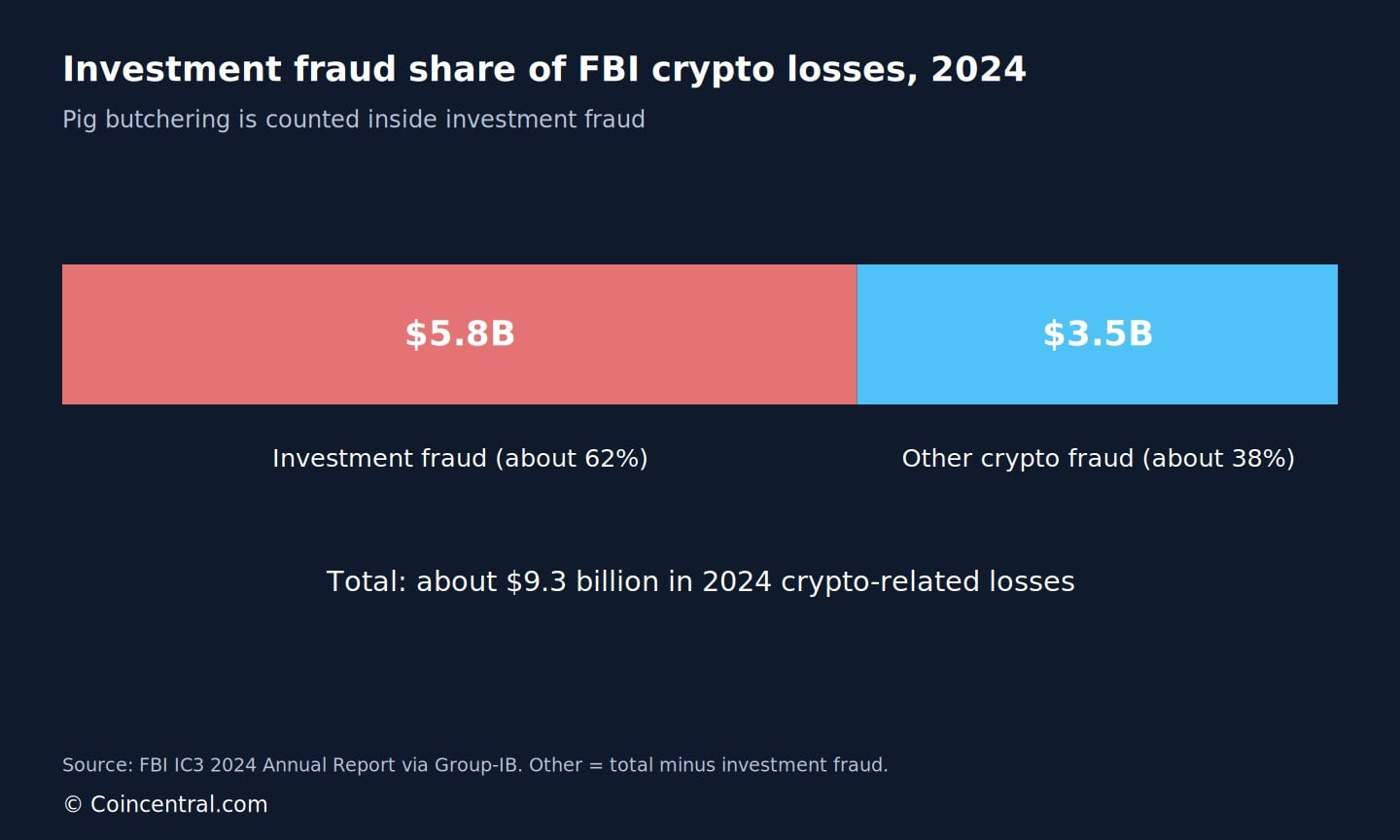
Results: Productivity Gains and Company Impact
At the personal level, the results are strong. McKinsey found that 80% of respondents say AI improved their productivity, and half say it helps them make better decisions. Mid-level managers and individual contributors were more likely to report strain, at 47% compared with 31% of executives.
G2 reports speed gains in busy workflows. Four in five organizations using agents in high-volume work report cycle times that improved by at least 11%, and nearly half report gains of at least 25%. Also, 83% say agents raise employee satisfaction by cutting repetitive work.
Company-wide results are weaker. 37% of McKinsey respondents report a positive effect on earnings before interest and taxes, or EBIT, which is about the same as last year. Only 6% are AI high performers, which McKinsey defines as firms that credit AI for at least 5% of EBIT and report strong value.
| Study | Who was tested | Result |
|---|---|---|
| GitHub Copilot experiment | 95 developers on a clearly scoped task | 55.8% faster |
| METR (2025) | 16 experienced developers, 246 tasks in their own code | 19% longer on average |
| METR update (Feb. 2026), retested group | Same group, retested | 18% slower, range from 38% slower to 9% faster |
| METR update (Feb. 2026), new group | New participants | 4% slower, range from 15% slower to 9% faster |
Developer studies give mixed answers because they test different work. The GitHub test used a narrow task, while METR studied experts working in their own projects. METR’s new ranges include no effect at all.
By function, McKinsey respondents most often report cost cuts in supply chain management, service operations and manufacturing. Revenue gains are most often tied to marketing and sales.
McKinsey notes that employees are building AI skills on their own or through company rollouts. About half say AI helped them develop new skills.
High performers handle the change differently. Nearly three-quarters say they redesigned workflows because of AI, up from 55% last year. About one in four other respondents say the same.
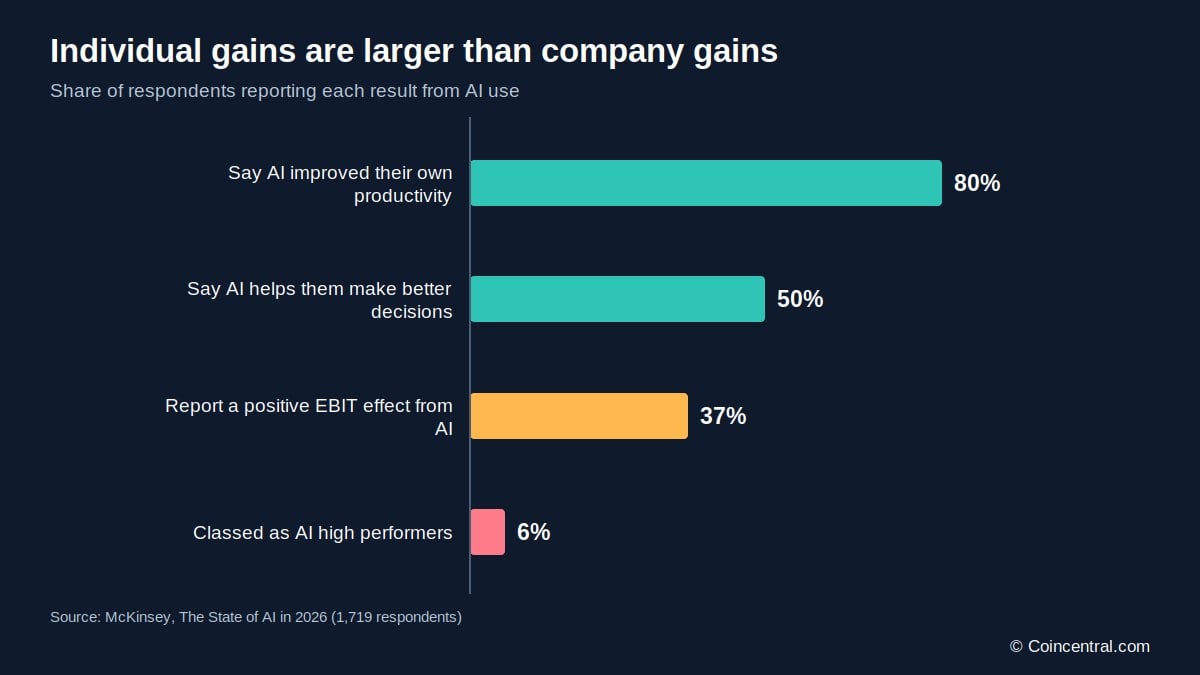
Governance and Trust in AI Agents
As agent fleets grow, tracking them gets harder. G2 found that 38% of organizations with agents in production run more than 100 of them. Yet 47% say agent ownership and controls are informal or led by single departments, compared with 23% that govern them centrally.
Only 27% keep a central agent registry. 18% use automated discovery to find approved and unapproved agents, and just 14% have real-time monitoring of unusual behavior, costs or risks. G2 calls unmanaged tools “shadow agents.”
Buyers do test before launch. 52% require human quality review, 48% require security testing, and 41% need legal, risk or compliance review. After launch, 77% re-evaluate agents at least monthly.
| Control or attitude | Share | Source |
|---|---|---|
| Central agent registry | 27% | G2 |
| Automated agent discovery | 18% | G2 |
| Real-time observability | 14% | G2 |
| Prefer agents with guardrails | 48% | G2 |
| Want agents limited to specific tasks | 29% | G2 |
| Comfortable with full autonomy | 7% | G2 |
Trust depends on the task. In a 2025 PwC survey, business leaders said they would trust agents with data analysis at 38%, but only 20% for financial transactions. In a Ping Identity survey of 11,000 consumers, 3% were comfortable with AI acting without final approval.
G2 adds that 67% of buyers have high trust in their own organization’s AI system. The comfort level drops when the system acts alone.
G2 says central IT and AI, data and machine learning teams manage 49% of agent operating costs. Together they own 60% of governance accountability. McKinsey adds that high performers more often work to reduce risks such as unauthorized or unintended agent actions.
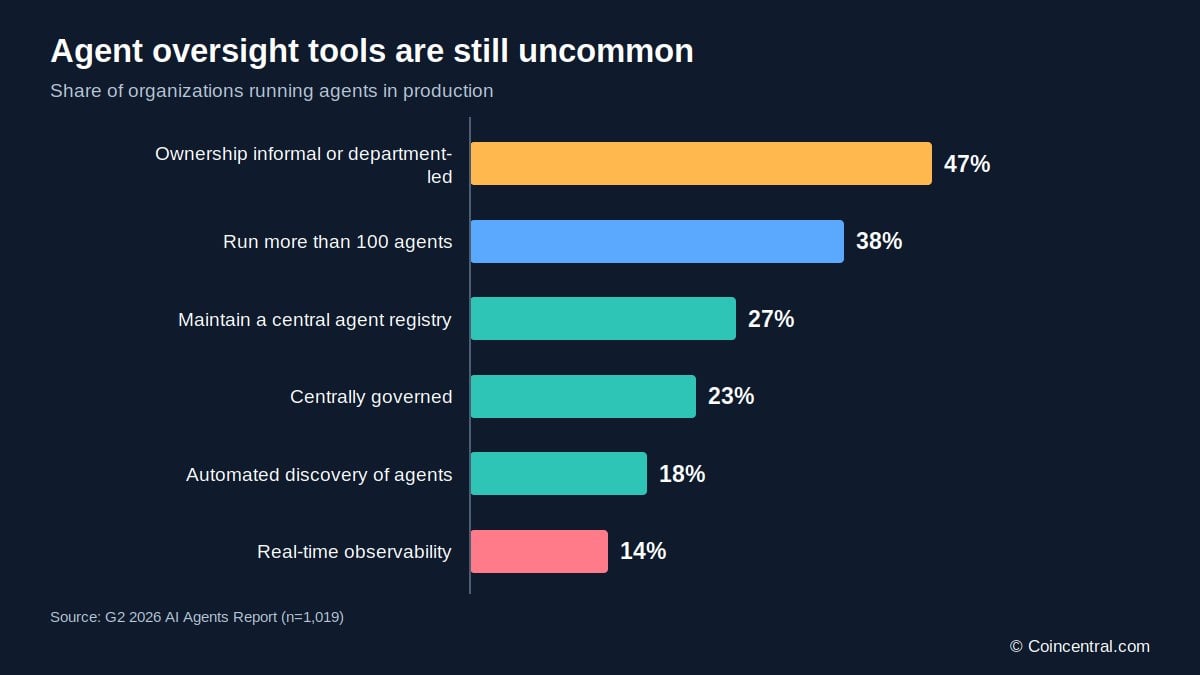
AI Agent Market Size, Pricing and Funding
Estimates for the 2026 agent market run from about $8 billion to $12 billion. Gradually.ai notes that these are commercial estimates, not measured revenue. Firms use different base years and definitions.
Some count standalone agent platforms, while others include agent features inside business software. Gartner estimated that up to $234 billion in enterprise software spending could be at risk from agentic AI by 2030. Gradually.ai describes that as an exposure scenario, not a forecast of lost sales.
| Firm | Starting estimate | Forecast | Growth rate |
|---|---|---|---|
| Research and Markets | $12.06B (2026) | $53.2B by 2030 | 44.9% |
| Grand View Research | $10.9B (2026) | $182.9B by 2033 | 49.6% |
| Fortune Business Insights | $9.14B (2026) | $139.19B by 2034 | 40.5% |
| Deloitte | $8.5B (2026) | $35B by 2030 | Not stated |
| MarketsandMarkets | $7.84B (2025) | $52.62B by 2030 | 46.3% |
Pricing is changing too. G2 found that only 9% of buyers see per-seat pricing as the fairest model for agents. Pay-as-you-go models rose from 38% in 2025 to 57% in 2026.
On the money side, half of G2 respondents have an agent budget of at least $1 million. Crunchbase recorded $159 billion in global venture funding in Q3 2026, and $102 billion, or 64%, went to AI companies. That covers the broader AI sector, not agents alone.
G2 also found that 72% say a strong set of connectors, actions, skills or marketplace offerings is very important or a must-have for agent adoption. Crunchbase counted $211 billion in AI-related venture funding for 2025, up 85% from $114 billion in 2024.
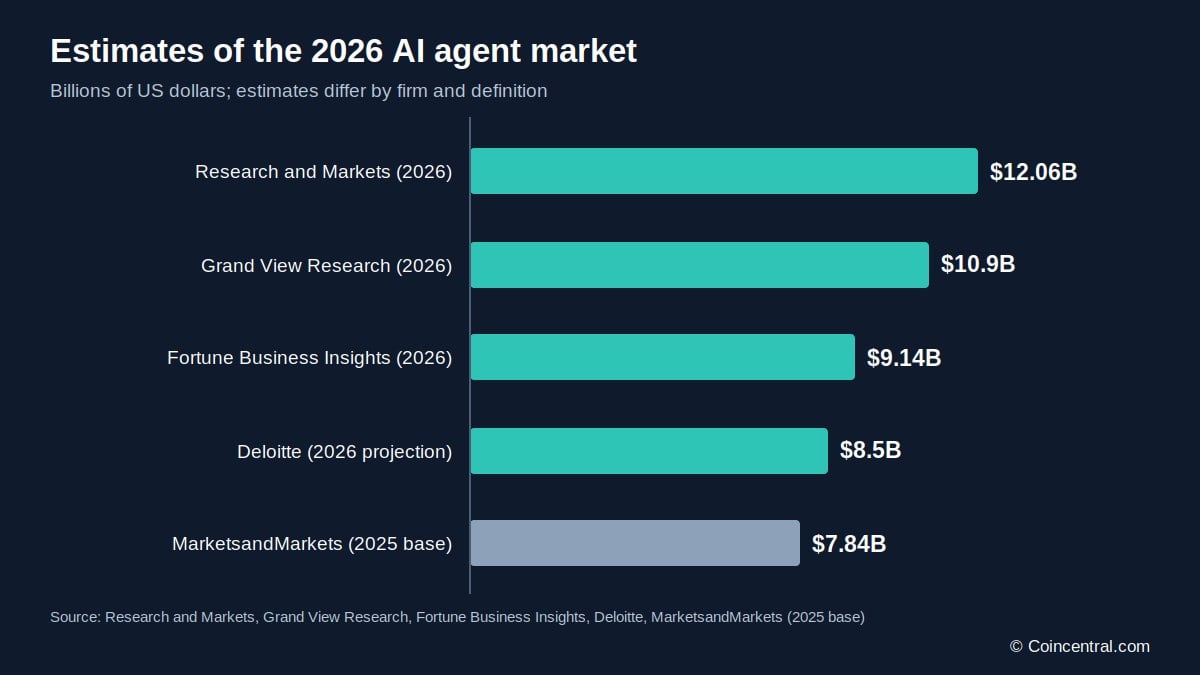
AI Agents and Jobs: Expectations vs. Reports
Fears of fast job cuts have not matched what firms report. McKinsey found that 14% of respondents at AI-using organizations said AI contributed to a smaller workforce in the past year. In last year’s survey, 32% had expected cuts over that period.
Two-thirds report little or no AI-related change in total employment. For the coming year, 39% expect a decrease and 43% expect little or no change. Only 13% say AI makes them anxious about their own careers.
The gap shows up by function. In marketing and sales, manufacturing, strategy and corporate finance, and knowledge management, reported cuts are about half the share that predicted them.
G2 reports a similar pattern among buyers. Just 14% have reduced headcount, while 35% have moved staff into higher-value roles.
| Measure (McKinsey) | Share |
|---|---|
| Expected a workforce fall (2025 survey) | 32% |
| Reported a workforce fall (past year) | 14% |
| Expect a workforce fall (next year) | 39% |
| Expect little or no change (next year) | 43% |
In 2025, respondents most often expected cuts in service operations, supply chain management, marketing and sales, and software engineering. For the coming year, the largest share again predicts cuts in service operations and supply chain management. In many functions, more respondents expect no change than a cut.
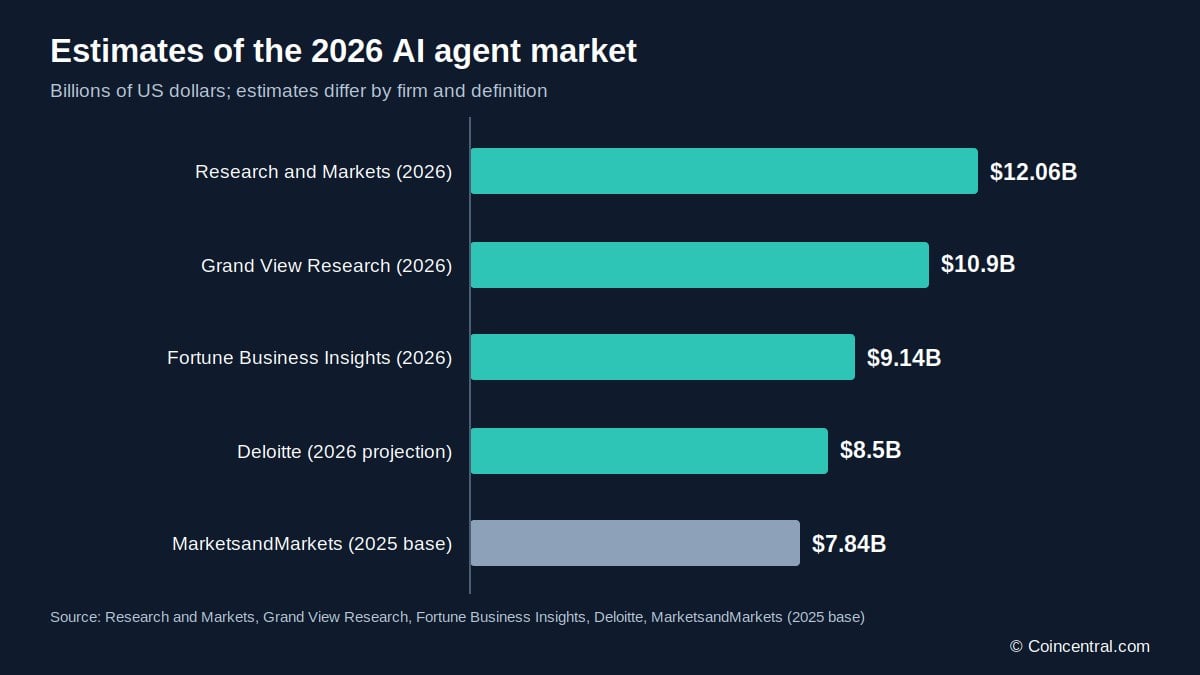
Outlook: Plans, Forecasts and Open Questions
Buyers plan to keep going. G2 found that 84% say agent features will influence their 2027 software choices, and 34% call them a primary factor. In addition, 56% expect agents to orchestrate work across their software stack by 2030.
Forecasts of failure also exist. Gartner projects that more than 40% of agentic AI projects will be canceled by the end of 2027, citing cost, unclear value and weak risk controls. That is a forecast, and bdautomated notes that nobody has counted cancellations yet.
Some headline numbers are often misread. An MIT study found that 95% of organizations saw zero return, but it measured profit impact about six months after a pilot. Its sample was 52 interviews, 153 survey responses and 300 public deployments, and the authors call the findings preliminary.
| Forward-looking figure | Share | Type |
|---|---|---|
| Buyers saying agents will shape 2027 software choices | 84% | G2 survey |
| Respondents expecting higher AI investment next year | 60% | McKinsey survey |
| Buyers expecting agents to run SaaS work by 2030 | 56% | G2 survey |
| Agentic projects forecast to be canceled by end of 2027 | Over 40% | Gartner forecast |
Taken together, the data shows fast adoption and uneven payoffs. Individual gains are common, company-wide gains are less so, and oversight eats into the time saved. Gradually.ai notes that Gartner placed agentic AI at the Peak of Inflated Expectations in its 2026 Hype Cycle.
Readers should check who was asked and what was counted before using any single figure.
Security remains a concern in the FwdSlash review. It cites a survey of 919 organizations in which 88% reported confirmed or suspected agent security incidents. It also cites IBM data showing that 97% of organizations with an AI-related breach lacked proper access controls.
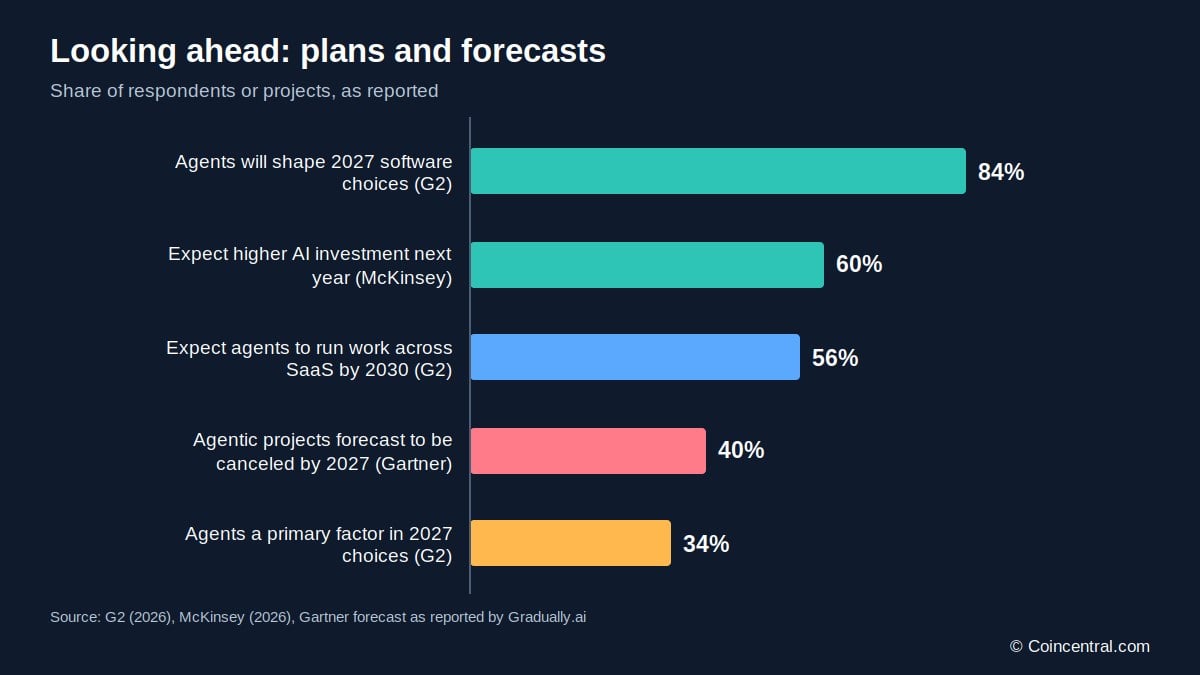
Sources
- G2: AI Agents Have Moved From Pilot to Production, But Oversight Comes at a Cost (2026 AI Agents Report)
- McKinsey: The State of AI in 2026: On the Road to ROI
- bdautomated: AI Agent Statistics 2026: Every Number Checked at Its Source
- Gradually.ai: AI Agent Statistics 2026: Adoption, Market & Facts
- FwdSlash: AI Agent Statistics 2026: 100+ Stats on Market and Adoption
The post AI Agent Statistics 2026: Adoption, Costs and Results appeared first on Blockonomi.
TLDR:
- Ethereum Derivatives carried $30.59 billion in futures open interest, although the aggregate book slipped 0.42% during the latest 24-hour period.
- Calls represented 61.75% of Ethereum options open interest, but 24-hour put volume narrowly exceeded call volume, showing balanced near-term flow.
- Long liquidations exceeded short liquidations over both 24-hour and 12-hour windows, while positive funding kept leveraged bulls paying shorts.
- Max pain levels differed across Deribit, OKX, and Binance for October and December, so they do not form one market-wide price target.
Ethereum derivatives are sending mixed messages as ETH trades inside a weekly range. The token moved between $2,324 and $2,575 during the week, while futures traders maintained $30.59 billion in open interest. Options positioning still tilted toward calls, which accounted for 61.75% of outstanding contracts. Yet the futures book slipped, positive funding persisted, and liquidations struck more longs than shorts.
Ethereum derivatives therefore show substantial bullish positioning without a clear signal. The split matters because calls can serve hedging strategies, while rising leverage creates vulnerability during sharp price moves. ETH traded near $2,428 intraday on October 17.
Ethereum Derivatives Keep $30B in Futures as OI Slips
Outstanding Ethereum futures totaled 12.63 million ETH, valued at $30.59 billion, after a 0.42% daily decline. Open interest tracks active contracts rather than completed trades. Binance held $8.73 billion, or 28.55% of the total. MEXC followed with $3.25 billion, narrowly above CME at $3.24 billion.
Binance’s share made it the largest venue in the reported futures rankings. Other venues held smaller shares of exposure.
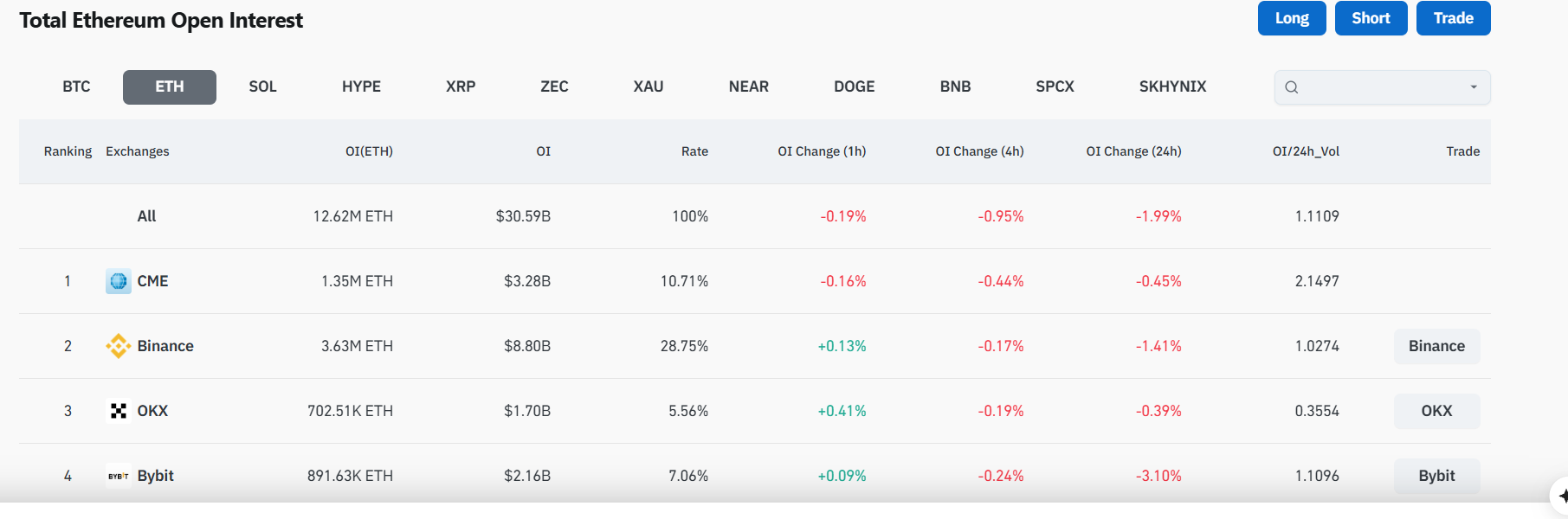
Hyperliquid carried $2.61 billion, followed by Bybit at $2.15 billion and Bitget at $2 billion. The distribution shows liquidity remains spread between centralized platforms, a regulated exchange, and a perpetuals DEX. Large open interest does not identify the market direction by itself. It shows the amount of capital still exposed to future price changes.
That distinction matters when comparing dollar open interest across exchanges. ETH price changes can alter the book’s reported value even if contract quantities change less.
Exchange trends were uneven. MEXC added 6.49% to its open interest, and Bitget grew 1.22%. Bitunix fell 11.27%, BingX lost 7.57%, and Hyperliquid declined 1.70%. CME also contracted 1.11%, pointing to selective rather than broad leverage growth.
Ethereum derivatives still held a large aggregate futures book, but the liquidation data put bulls on notice. The market recorded 3,222 long liquidations against 2,181 shorts in 24 hours. The 12-hour count showed 2,651 longs liquidated, compared with 876 shorts. Positive funding near 0.0053 meant longs continued paying shorts.
Ethereum Options Show Bullish Calls but Fragile Long Positions
Ethereum options carried 1.59 million ETH in calls and 983,689 ETH in puts. That composition gave calls a 61.75% share of open interest. Still, the newest flow was nearly balanced. Twenty-four-hour volume reached 414,521 ETH for calls and 420,513 ETH for puts.
Ethereum derivatives can look call-heavy without proving that every holder expects an immediate rally. Traders may use calls to hedge short exposure or structure spreads. The put activity near the spot also remained visible. Bybit’s $2,100 and $2,200 put led several high-volume contracts. $2,500 calls also traded actively on Binance and Bybit.
Deribit’s December 25 $3,200 call held the largest individual position at 69,667 ETH. Its $2,200 call held 51,016 ETH, and an October 30 $2,600 call held 38,043 ETH. These positions show interest across several price levels and expiries. They do not prove a single outright bullish view.
Ethereum options max pain readings differed by exchange. For October 30, Deribit and Binance pointed to $2,500, while OKX stood near $2,650. For December 25, Deribit showed $2,200, OKX $2,300, and Binance $2,500. Max pain represents a theoretical payout-minimizing level, not a price target.
CME options exposure had also declined toward 50,000 ETH by October from above 500,000 ETH earlier in 2026. Its dollar position readings fell near $10 million after exceeding $70 million in late 2025. Ethereum derivatives remain divided between a reduced CME options footprint and larger crypto-native futures markets.
The post Ethereum Derivatives Show $30B Exposure Amid Long Liquidations appeared first on Blockonomi.
TLDR:
- Cardano Leios is the final requirement in Charles Hoskinson’s personal definition of a complete Cardano network, but the upgrade remains in public testing.
- Musashi Dojo’s Earth phase peaked at 26.8 TxkB/s, roughly six times the current Praos ceiling, but the metric measures data throughput rather than TPS.
- Linear Leios is targeted for phase one of the Dijkstra hard fork in late 2026, subject to governance approval, pool readiness, and staged parameters.
- Hoskinson offered no technical description of the Midnight concept he called his magnum opus, leaving the announcement short of a product confirmation.
Cardano Leios has become Charles Hoskinson’s stated finish line for the network he founded. In an October 17 exchange, Hoskinson said Cardano would be complete only after the throughput upgrade reaches mainnet. The comment defines his personal completion standard, not a formal release declaration.
Cardano Leios remains on a public testnet, where its first phase peaked at 26.8 TxkB/s. That figure measures transaction data per second, rather than transactions per second. Hoskinson also teased an undeveloped Midnight concept he called his career’s magnum opus. He supplied no technical design, launch date, or product specification for the privacy-focused partner network.
Cardano Leios Sets the Final Bar for Network Completion
Hoskinson’s reply did not change Cardano’s roadmap or create a new governance action. It instead framed Leios as the last major element in his original design. He cited decentralized consensus, on-chain governance, continuous development, eUTXO, Plutus, scalability, formal methods, and independent node clients.
He also described a network that can improve through its own governance processes. The statement therefore concerns completeness in the founder’s view. It does not confirm that every future feature, application, or engineering task has ended. He noted that millions of people already hold ADA, which makes the final milestone relevant beyond the engineering team.
Cardano Leios is an Ouroboros extension designed to expand throughput without replacing the Praos chain. Block producers publish larger endorser blocks beside regular Praos blocks. A stake-weighted committee verifies these blocks and creates a certificate for their contents. The arrangement leaves the underlying proof-of-stake chain in place.
Under the design, the committee is weighted by staking share. Certified endorser transactions enter the ledger through the existing Praos sequence. Its objective is to process more transaction data while preserving the consensus system already used on mainnet.
Midnight enters the story separately. Hoskinson said he had almost completed a concept that only Midnight could deliver to crypto. He described it as the magnum opus of his career and said it could address many industry problems. The post contained no architecture, feature list, timeline, or governance proposal.
That leaves the announcement as a personal preview, rather than a confirmed product release. Neither the Midnight tease nor the Leios milestone establishes an immediate effect on ADA.
Cardano Leios Testnet Result Needs Context Before Mainnet
Musashi Dojo launched on June 23 as the public Cardano Leios testnet. Its Earth phase reached a peak of 26.8 TxkB/s, compared with 4.51 TxkB/s for mainnet using Praos alone. The test result is roughly six times the current mainnet ceiling.
TxkB/s measures transaction kilobytes processed each second. It is not a TPS reading, and it cannot be treated as a direct mainnet transaction count. The trial tested the full protocol across real distances and latencies. It was the first public network run rather than a simulation.
The initial phase exercised the protocol publicly, including Praos blocks, endorser blocks, stake votes, and certificates. The development report listed more than 127,000 blocks, 30,000 endorser blocks, and nearly 8,000 certificates. Engineers also found five incidents during testing, including forks and synchronization failures.
The report said they were implementation bugs rather than design failures. Those results still apply to the testnet environment, not production conditions.
Linear Leios is slated for the first phase of the Dijkstra hard fork, targeted for late 2026. The date remains subject to Cardano’s on-chain governance process. DReps, stake pool operators, and the Constitutional Committee must ratify a hard fork action.
Stake pools must then register BLS keys for Leios voting. Parameter changes will raise throughput in steps after activation instead of a single network-wide jump.
The post Cardano Leios Testnet Logs 26.8 TxkB/s Ahead of Mainnet Push appeared first on Blockonomi.
TLDR:
- Sui Network reported more than $500 million in institutional commitments for its DeFi protocols, but it did not disclose deployed liquidity or adoption figures.
- The Bitcoin blockchain remains the security reference for Sui contracts, which carry cryptographic rights tied to Bitcoin rather than replacing the original chain.
- Sui Agent Payments lets autonomous agents pay Alibaba Cloud for AI and cloud service calls in USDC, with users defining spending limits beforehand.
- Sui market analysts cited $0.85 to $0.90 as SUI support and a possible $1.30 to $1.40 range if buyers clear descending resistance.
Sui Network has issued new institutional and payments updates aimed at decentralized finance. The layer-1 blockchain said it has exceeded $500 million in institutional commitments across its DeFi protocols. Its latest updates also place the Bitcoin blockchain at the center of contract design. Separately, Sui Agent Payments now lets autonomous software purchase Alibaba Cloud services with USDC.
Every payment settles on Sui, while users set spending limits before agents act. The announcements broaden the project’s use cases beyond token trading. They do not, however, establish immediate demand for the SUI token. Adoption, transaction activity, and enterprise use determine eventual impact.
Sui Network Contracts Reinforce Bitcoin’s Role in DeFi
The reported commitment figure represents capital intended for Sui-based DeFi products. It does not automatically show deployed liquidity or daily trading volume. Still, it signals that institutional participants are exploring the network’s financial infrastructure.
The Hashi protocol sits within that effort. Sui Network presents it as a way to reduce procedural barriers around institutional DeFi activity. The stated goal is to improve trust, efficiency, and operational coordination for larger participants.
Bitcoin forms the security reference for the contract side of the announcement. Sui contracts hold cryptographic rights connected to Bitcoin, preserving a link to the original blockchain. That design aims to let participants use Bitcoin-related value without treating Sui as a replacement for Bitcoin.
The Bitcoin blockchain therefore remains the verification anchor in this model. For institutions, that relationship could provide a familiar security basis while applications use Sui’s faster execution environment.
The setup also addresses a persistent institutional concern: how to access DeFi without weakening custody and audit controls. Cryptographic claims can help establish which rights are attached to a contract. Yet the practical value depends on legal structure, counterparty arrangements, and redemption processes.
Sui Network has not detailed activity tied to the $500 million figure. It also has not quantified the number of institutions using the Bitcoin-linked contracts. Those measures will matter more than announced commitments when market participants assess traction.
Sui Network Agent Payments Shift Adoption into Focus
Alongside the contract update, Sui Network has integrated Alibaba Cloud services into Sui Agent Payments. The tool allows AI agents to make USDC payments for cloud and AI service calls. Users set spending ceilings in advance, rather than approving every transaction manually.
ICYMI
@alibaba_cloud is bringing its services to Sui Agent Payments, letting agents pay per call in $USDC within limits you set. Every payment settles on Sui.
Watch the announcement: https://t.co/44Crea4i0v
— Sui (@SuiNetwork) October 15, 2026
Agents can then make payments per call as they access a requested service. Each settlement is recorded directly on the Sui blockchain. The approach shifts costs from standard subscriptions toward usage-based billing.
The model could fit businesses that operate automated workloads at variable volumes. It may also support developers building software agents that need controlled recurring access to infrastructure. USDC offers a stable-value payment unit for those microtransactions.
However, more USDC activity does not automatically create direct buying pressure for SUI. The token’s role in transaction fees could matter, but the relationship depends on actual service use. No adoption figures or transaction volumes were provided for the rollout.
Market watchers will focus on observable evidence after the launch. Relevant indicators include the number of active agents, Alibaba Cloud service calls, USDC settlement volume, and repeat enterprise users. According to analyst Bitguru, he identifies $0.85 to $0.90 as a support area for SUI.

A possible recovery range is present between $1.30 and $1.40 if price clears descending resistance. That technical outlook requires buyers to hold support and show stronger volume and open interest.
The post Bitcoin Blockchain Backs Sui Network Contracts and Agent Payments appeared first on Blockonomi.
CryptoPotato
The world’s largest corporate holder of bitcoin faces the prospect of being removed from major MSCI indexes under newly finalized eligibility rules, potentially triggering billions of dollars in passive outflows.
However, CryptoQuant CEO Ki Young Ju argued that the risk is already priced in, while Michael Saylor, Strategy’s co-founder and former CEO, has dismissed the issue as relatively unimportant to the company.
MSCI Risk Priced In?
CryptoPotato reported yesterday that MSCI finalized the new rules this week targeting companies it classified as “non-operating,” potentially putting Strategy, Metaplanet, and other digital-asset treasury firms at risk of exclusion from the Global Investable Market Indexes. The final list of affected entities is due on November 11, with the methodology taking effect at the close of November 30.
JPMorgan analysts have previously estimated that Strategy’s removal could lead to approximately $2.8 billion in passive outflows from MSTR. However, CryptoQuant’s Ki Young Ju offered a different perspective, indicating that investors may be focusing too heavily on that figure.
He explained that MSCI is primarily a fund-flow issue already reflected in MSTR’s valuation, while major Wall Street firms continue to maintain substantially higher price targets. He cited Citigroup putting MSTR at $240, Barclays at $175, and B. Riley at $195, adding that these targets have generally moved higher rather than lower.
CryptoQuant’s CEO added that Strategy’s positioning depends on more important factors, including its roughly 1x market-cap-to-Bitcoin-NAV ratio, STRC trading close to par, and billions of dollars in reserves to support dividend obligations.
Analysts don’t care about MSCI. $MSTR consensus still very bullish.
Citi $240, Barclays $175, B. Riley $195. Targets going up, not down.
MSCI is a flow story, and it’s priced in. What matters now: mNAV ~1.0x, STRC at par, $3.75B reserve covering dividends. https://t.co/NWKtUrVVaM
— Ki Young Ju (@ki_young_ju) October 16, 2026
Saylor Fires Back
Speaking to Bloomberg before MSCI finalized the rules, Strategy’s former CEO said the decision was “not that important to us,” as the capital controlled through the relevant indexes is relatively small from the company’s perspective. He also attacked the reasoning behind the classification, arguing that treating oil, natural gas, land, or machinery as legitimate corporate capital while refusing to treat BTC the same way amounts to a subjective value judgment.
Saylor called MSCI’s stance a bad precedent and said digital assets remain the future regardless of whether the index provider agrees. However, the market reacted differently. MSTR experienced a substantial sell-off on Friday, dumping from a Thursday peak of over $151 to under $137 at Friday’s close.
Strategy remains the largest corporate holder of BTC, holding 848,250 units after the latest purchase announced on October 12.
The post Wall Street Stays Bullish on Strategy Despite MSCI Threat, CryptoQuant CEO Says appeared first on CryptoPotato.
Less than two months after indicating that it will add SOL, LINK, and AVAX to its Schwab Crypto platform, Charles Schwab has opened direct crypto trading to its broader retail client base.
At the same time, Deutsche Bank is reportedly preparing to launch institutional custody for the two largest digital assets, BTC and ETH.
Schwab Opens Crypto Trading Broadly
According to a recent report, the banking behemoth has opened Schwab Crypto to all eligible US retail clients, expanding a rollout that initially began with selected customers. The platform allows investors to hold and trade cryptocurrencies directly alongside stocks and other traditional investment products.
Schwab Premier Bank serves as custodian, while Paxos handles trade execution and sub-custody. It’s worth noting, though, that crypto holdings are not covered by Securities Investor Protection Corporation protections in the same way as securities held in a conventional brokerage account.
Charles Schwab’s latest move follows another recent expansion. As we reported in late August, the bank said it would move beyond BTC and ETH for certain services, adding SOL, LINK, and AVAX.
It has roughly $12 trillion in client assets, making its direct entry particularly notable for retail crypto adoption.
Deutsche Bank Targets Institutional Clients
In another major adoption development from earlier this week, Deutsche Bank said it is preparing to launch its own digital-asset custody service in Germany within the next few weeks, as Reuters reported. The initial offering will support Bitcoin and Ethereum custody, before expanding into stablecoin transactions.
The German banking giant also plans tokenized deposits and blockchain-based securities issuance, including digital bonds.
“I believe that, as the financial system, we will need to offer tokenized or blockchain solutions to our clients as additional services alongside our traditional ones … but not necessarily to replace what we are doing today,” commented Gerald Podobnik, co-head of the bank.
Moreover, Deutsche Bank intends to move beyond Europe by expanding the business into major Asian financial centers next year as part of a broader push to capture growth in the digital economy.
The post 2 Banking Giants Make Major Crypto Moves as Schwab and Deutsche Bank Expand Into Digital Assets appeared first on CryptoPotato.
Although bitcoin rebounded from the dip below $80,000 and now sits two grand higher, the risk of another deep correction has not been completely eliminated.
Analysts are watching the $84,000 resistance as the immediate recovery level, while one longer-term scenario envisions the cryptocurrency plummeting to $68,000 first before going after its 2025 all-time high.
$68K First, Rally Later?
Daan Crypto Trade argued that BTC managed to sweep liquidity while still saving its daily close. He described the recent move as a good example of why waiting for candle closes actually matters. However, he warned that the recovery now needs to continue, which it hasn’t.
The analyst said BTC must reclaim at least $84,000 in the coming trading days, as remaining and consolidating below it could leave the asset vulnerable to another gradual move south. A successful recovery above $84,000, though, would instead put the untapped highs around $87,000-$88,000 back in focus.
This aligns with BTC’s recent price moves, as the asset has repeatedly struggled around the $84,000 area after tumbling toward $80,000. Weakening buyer pressure has intensified uncertainty around the recovery attempt, and the macro landscape dealt another blow earlier this week with a higher-than-expected September CPI reading.
Meanwhile, fellow analyst EGRAG CRYPTO noted that investors should not necessarily interpret another substantial correction as the end of the bull market. Using a 2023 fractal, he added that BTC previously experienced a 22% pullback before its next major expansion wave. Applying similar math to the current numbers would mean a drop to $68,000.
EGRAG identified $84,800 as the 0.5 Fibonacci “battlefield” and $68,000 as a possible shakeout zone before a potential move toward $114,000-$125,000, provided the broader structure remains intact.
Buying Opportunity?
CryptoGoos offered a different way of assessing the current market structure through BTC’s supply in profit. His strategy is to accumulate when the percentage falls toward what he considers a historically important support line, before gradually taking profits once the metric exceeds 80%.
The analyst expects multiple local tops during the current cycle rather than one clean vertical move. Other recent BTC indicators have also painted a mixed picture. For instance, bitcoin has remained above its 50-week moving average for several consecutive weeks, which some analysts view as evidence that the broader recovery is intact.
However, it has repeatedly failed to break through the $86,000-$89,000 resistance region, while more than $1 billion in profits were recently realized after it last climbed above $87,000.
The post Bitcoin’s Road to $125K Could Include a Brutal Drop to $68K: Analyst appeared first on CryptoPotato.
Bitcoin continued to be volatile at the end of the business week, dipping below $80,000 for the first time in a month, before rebounding by roughly $2,000.
Most altcoins have turned red once again, with XRP sliding back to $1.30, and ZEC plunging by over 5% after it was rejected at $1,200.
BTC Calms at $81.5K
After the price calamity on October 9, which drove BTC to just over $80,000, the asset managed to regain some traction and returned to $83,000 during the weekend. It climbed to $84,000 on Monday morning, but it was quickly rejected there and plummeted to $81,000. Major price fluctuations continued, with a bounce off that drove it to the same upper boundary it hit on Tuesday and held until Wednesday afternoon.
Then came the CPI data for September, which showed inflation was slightly higher than expected. Bitcoin reacted with an immediate leg down to under $82,000. The PPI data released a day later showed that inflation is indeed not going away. Alongside other macro reasons, such as the major crash of the KOSPI and the Nikkei, Bitcoin dived again. This time, it dipped below $80,000 to mark a monthly low.
Bitcoin rebounded again rather quickly and jumped to almost $83,000 on Friday. Another rejection followed, though, and the cryptocurrency now struggles at $81,500, while the macro pressure builds.
Its market cap is down to $1.630 trillion on CMC, while its dominance over the alts has dipped below 60%.

Alts See Heavy Selling
Ethereum is down by 1% to $2,430, BNB has slipped by a similar percentage to $723, while XRP struggles at $1.31 after a 2.4% decline. The landscape around SOL, HYPE, DOGE, LINK, XMR, and ADA is similar.
More painful declines come from ZEC (-5.2%), RAIN (-7.4%), and TAO (-5.5%). ZRO, STRK, and PYTH lead the adverse trend with double-digit price drops. In contrast, BTW, TIA, and LIT have defied the overall trend and have marked some gains.
The cumulative market cap of all crypto assets has declined by 1% over the past 24 hours, and it’s down to $2.740 trillion.

The post These Alts Bleed the Most as Bitcoin (BTC) Settles Below $82K: Weekend Watch appeared first on CryptoPotato.
Although BTC is already down by several grand since its local peak, the real trouble could be around the corner as reports emerged hours ago that US President Donald Trump is preparing a fresh wave of attacks against Iran during the weekend.
The US stock market also plummeted again on Friday, especially the Nasdaq 100, which, according to the analysts at the Kobeissi Letter, is close to a technical correction.
Macro Pressure Builds
The initial reports claimed that the POTUS has asked Iran for permission to strike its Pickaxe Mountain nuclear site without retaliation, but the authorities in the Middle Eastern country rejected the request. The claims come from IRIB state media correspondent Morteza Ghoroghi, who said: “Trump’s statements today point to war within the next 24 hours.” He also suggested that Iran’s military forces are “in a state of complete readiness.”
Shortly after, new reports indicated that Trump went to Mar-A-Lago for the first time since May 1, which is the same location where he started the war against Iran on February 28. Oil prices responded with an immediate uptick. Brent crude oil jumped from under $106 to a monthly peak of $110.
BREAKING: Brent crude oil surges to nearly $110, its highest level since September 15, as Iran places its armed forces on the highest alert for 72 hours and mobile bomb shelters being rapidly deployed in Tel Aviv.
US oil is now at $100. https://t.co/WKJ45cFVtF
— The Strait Report (@StraitReport) October 17, 2026
Stock Market Pressure
The other macro pressure on BTC could come from the overall stock market state. Earlier this week, the major KOSPI and Nikkei crash led to a correction in the crypto market as well. Now, US equities are under pressure, with the S&P 500 down by 2% last week.
The Nasdaq 100 had its biggest weekly decline since April 2025, dumping by 3% on Friday alone. The tech sector has erased over $3 trillion (more than the entire crypto market) in the past 10 days. The Kobeissi Letter argued that the Nasdaq 100 is just 2.5% away from “entering a technical correction.”
There it is folks.
The Nasdaq 100 is now down -3% on the day and on track for its biggest weekly decline since April 2025.
US tech stocks have erased over -$3 trillion in market cap in just 10 days.
This puts the Nasdaq 100 just ~2.5% away from entering a technical correction.
As outlined below, we are in a “Bear-Bull Market.”
— The Kobeissi Letter (@KobeissiLetter) October 16, 2026
These corrections are not isolated. The Indonesian stock market recently experienced its worst daily dump in 28 years, plunging by over 11%.
Will BTC Fall Below $80K?
The primary cryptocurrency dipped below the key $80,000 support earlier this week for the first time in a month but managed to rebound above that level immediately. However, the growing pressure explained above could lead to another substantial leg down, especially if the US indeed strikes Iran over the weekend.
Bitcoin didn’t respond immediately to the major developments on previous weekends, but waited until Sunday evening and Monday morning when traditional financial markets started to open. For now, the asset remains at $81,500, down by 1.5% weekly and by over 6% from its local top marked a few weeks ago.
The post Bitcoin Under Pressure as Trump Reportedly Prepares to Strike Iran Within 24 Hours appeared first on CryptoPotato.