Cryptocurrency Posts
Crypto Briefing
The latency reduction enhances developer productivity and positions Anthropic's Claude as a more competitive player in the AI coding market.
The post Anthropic cuts Claude Code response lag nearly 3x to 1.33 seconds appeared first on Crypto Briefing.
AI's potential to significantly boost US GDP by 2030 underscores its transformative economic impact, influencing market valuations and strategies.
The post AI could push US GDP to $44T by 2030, says Anthropic appeared first on Crypto Briefing.
China's AI leadership in manufacturing could reshape global industrial dynamics, challenging Europe to leverage its data expertise for competitiveness.
The post China positioned to lead AI deployment in factories as Europe races to catch up appeared first on Crypto Briefing.
Anthropic's rapid AI advancements could reshape market dynamics, influencing investor confidence and competitive positioning in the tech sector.
The post Anthropic’s AI capabilities advancing faster than expected, says co-founder Clark appeared first on Crypto Briefing.
AI's potential to significantly boost GDP underscores the need for adaptive policies to manage economic shifts and mitigate unemployment risks.
The post Anthropic’s Jack Clark says AI could push US GDP to about $44 trillion by 2030 appeared first on Crypto Briefing.
Bitcoin Magazine
Bitcoin Magazine

Poetic Justice: Scammer Lost $5M in Bitcoin After Being Targeted by Ledger Thieves
Call it poetic justice: one of the biggest victims of last week’s Ledger theft happened to be a scammer themself, according to blockchain analysts, and lost nearly $5 million in bitcoin.
In a post Thursday, Chainalysis wrote that a crook lost 60 bitcoins worth about $4.8 million they’d stolen via a so-called task scam.
According to Chainalysis, the address was linked with a con where people were paid to fake sales and reviews of real items. They were told to add their own money in order to get paid — and then stolen from.
But the mastermind behind the task scam moved the stolen money to Ledger addresses which were then targeted by different scammers last week.
“On Sep 22, the person behind the scam moved the proceeds into three separate Ledger addresses,” Chainalysis said. “On Oct 9, thieves emptied all three. One transfer each, into the same wallet. The wallet is reported as stolen funds.”
Paris-based Ledger last week said it had started an investigation after customers in South East Asia reported they’d lost funds after buying from Malaysia-based reseller, CryptoBilis.
Ledger has since said that the scam was a massive organized crime operation where a group installed implants into devices and put them back on the market. The implants could read users’ seed phrases so criminals could then drain wallets.
Calling it one the most “sophisticated attacks” the digital asset industry has experienced, Ledger is yet to reveal how much money has been lost — but blockchain investigator Specter said $86 million had been drained.
And the task scam conman, according to Chainalysis, was one of the victims.
Ledger has said that it is working with law enforcement to “follow the funds and dismantle the attackers’ infrastructure” and has made sure no other vendors have been targeted by scammers.
CryptoBilis has stopped selling Ledger products, the company said.
Criminals have targeted bitcoin hardware sellers this year, with a huge attack taking place in July on the popular Coldcard products.
Crooks were able to steal close to $120 million in bitcoin from Coldcard users because the devices had a firmware bug which led to faulty seed generation, allowing hackers to guess investor seedphrases.
This post Poetic Justice: Scammer Lost $5M in Bitcoin After Being Targeted by Ledger Thieves first appeared on Bitcoin Magazine and is written by Mathew Di Salvo.
Bitcoin Magazine

BFFS26 Denver: Joseph Kelly on Bitcoin Custody and Credit; Alan Lane on Banking Lessons
The Bitcoin for Financial Services Summit (BFFS26) returns to Denver October 20–22, 2026, bringing together CPAs, wealth advisors, attorneys, lenders, and finance leaders who are building Bitcoin into their practices. Now in its second year, the summit has grown to more than 30 sessions across two full program days, with a speaker lineup drawn from the firms defining Bitcoin custody, credit, and advisory.
Headlining the program are Joseph Kelly, CEO and co-founder of Unchained, who opens the summit with a keynote on custody, credit, and trust at scale; Alan Lane, former CEO of Silvergate Bank, on lessons for Bitcoin and banking; Patrick Lowry, CEO of Samara Asset Group, on holding Bitcoin as a public-company treasury reserve; and Colin Crossman, Wyoming’s Deputy Secretary of State, on the regulatory outlook for banks, exchanges, and advisors. Additional speakers include Kate Goldman of Anchorage Digital, Sam Baker of River, Eric Yakes of Epoch Ventures, Daniel Hillery of UTXO Management, Moish Peltz of Falcon Rappaport & Berkman, and CJ Konstantinos of Peoples Reserve.
Sessions focus on practical application: bringing Bitcoin into wealth planning and family offices, Bitcoin-backed lending and mortgages, treasury accounting and valuation, retirement and income planning, charitable giving strategies, mining as an asset class, and fiduciary duty when clients hold Bitcoin. Dedicated workshops will offer continuing education credit for financial advisors and CPAs.
“Last year proved that financial professionals want more than a Bitcoin primer. They want to know how to serve clients who already own it,” said Jordan Guess, CPA, co-host of the summit in a press release shared with Bitcoin Magazine. “This year’s program is built around the questions advisors and accountants are actually getting from clients, answered by the people building the infrastructure.”
The summit opens Tuesday, October 20, with the Better Money Invitational golf tournament at City Park Golf Course, hosted with Bitcoin Sports Network, followed by a welcome party at The Space sponsored by Falcon Rappaport & Berkman. Evening programming includes wine and whiskey tastings, and Thursday begins with an optional sunrise hike in the Rocky Mountains.
BFFS26 is co-hosted by Jordan Guess and Wyatt O’Rourke of BFFS Media, producers of the Bitcoin for Financial Services podcast. Sponsors include Unchained, Anchorage Digital, UTXO Management, River, SOUND HSA, SustainHash, and Stormrake.
Registration is open now at https://www.bffs.media/summit.
Media contact: Wyatt O’Rourke, wyatt@bffs.media
This post BFFS26 Denver: Joseph Kelly on Bitcoin Custody and Credit; Alan Lane on Banking Lessons first appeared on Bitcoin Magazine and is written by Juan Galt.
Bitcoin Magazine

Sazmining Now Sells Jack Dorsey’s Proto Immersion Hashboards
Bitcoin mining just got a lower barrier to entry.
Sazmining announced Thursday that it is now selling Proto’s immersion hashboards directly to individual and institutional buyers through its mining-as-a-service platform. Previously, the hardware was mostly in the hands of large-scale operators.
Each hashboard delivers roughly 200 TH at around 15 J/TH, and buyers own them outright while Sazmining handles deployment, monitoring and maintenance at a US facility. Mining rewards go straight to the owner’s wallet.
The move follows a multi-megawatt supply deal between Sazmining and Proto — the bitcoin mining arm of Jack Dorsey’s Block (NYSE: XYZ) — which both companies expect to expand as demand grows.
“Because of our aligned-incentive model, Sazmining only earns when we produce bitcoin for our clients,” said Kent Halliburton, CEO and co-founder of Sazmining.
He also pitched mining as a form of bitcoin acquisition diversification: rather than paying the market price on the day of purchase, a miner’s costs are spread across the machine’s working life.
Wyoming-based Sazmining, founded in 2018, operates renewable-powered facilities across the US, Paraguay, and Norway. It says its fleet runs more than 20 percentage points ahead of the Bitcoin network’s carbon-free share.
Proto is Jack Dorsey’s Block’s bitcoin mining play. The Twitter founder has spent years arguing bitcoin is the foundation of “a more open financial system,” funding everything from Cash App’s buy-and-send rails to the Bitkey self-custody wallet, and he framed mining as the obvious missing piece back in 2021: “Bitcoin mining should be as easy as plugging a rig into a power source.”
Block formally announced it was building an open bitcoin mining system in January 2022, with the stated aim of making mining “more distributed and efficient.”
This post Sazmining Now Sells Jack Dorsey’s Proto Immersion Hashboards first appeared on Bitcoin Magazine and is written by Mathew Di Salvo.
Bitcoin Magazine

Hot Inflation Data Puts Bitcoin Under Pressure, but ‘Difficult’ Isn’t ‘Bearish’: CoinShares
Bitcoin’s price has dropped this week as new inflation data has come in hot.
But while the largest cryptocurrency’s near-term setup is difficult, it’s not “fundamentally bearish,” according to European asset manager CoinShares’ Head of Research, James Butterfill.
In a report Friday, the analyst said that bitcoin’s near-term challenge stems from a macro environment that’s caught in an awkward middle ground: inflation is too elevated for the Fed to ease up, while the economy is too resilient to force a policy pivot.
“Bitcoin and the broader digital asset market have moved lower on the resulting hawkish repricing, a reminder of how sensitive Bitcoin remains to monetary policy over short horizons,” he wrote.
Bitcoin’s price recently stood at $81,473, down 2% over a seven-day period.
The price of the leading cryptocurrency dropped Wednesday after data showed that U.S. consumer prices shot up more than expected in September.
Then, on Thursday, the Labor Department’s Bureau of Labor Statistics said that U.S. producer prices rose in September at the fastest pace in more than four years.
This has weighed on bitcoin’s price because higher inflation means the Federal Reserve may hike interest rates. Higher borrowing costs can restrict the liquidity the digital coin needs to rally.
The Federal Reserve hiked rates in September and will meet at the end of this month.
But Butterfill added that investors should be patient and advised investors to instead think in the long-term and not react to any single weekly data point.
“For investors, that argues for reading the coming weeks as a data-driven range rather than a trend, and for sizing digital asset exposure against a strategic allocation rather than against this week’s print,” he wrote.
Bitcoin spent the first half of 2026 in a bear market but had its best quarter in years after surging in August and September. Analysts have now said the leading cryptocurrency is now back in a bull market after trading above its 365-day moving average.
This post Hot Inflation Data Puts Bitcoin Under Pressure, but ‘Difficult’ Isn’t ‘Bearish’: CoinShares first appeared on Bitcoin Magazine and is written by Mathew Di Salvo.
Bitcoin Magazine

Deutsche Bank To Debut Bitcoin Custody Within Weeks: Report
German multinational Deutsche Bank is just weeks away from its crypto custody service, according to reports.
The lender — which is Germany’s biggest — also plans to expand the custody platform into Asia next year, according to a Friday Reuters report, which quoted its corporate banking chief.
Top banks worldwide are debuting or planning to debut crypto custody services, with BNY Mellon, State Street, Standard Chartered, U.S. Bank, and Citigroup all committing to direct crypto custody over the past 18 months.
JUST IN:
— Bitcoin Magazine (@BitcoinMagazine) October 16, 2026€732 billion Deutsche Bank to launch Bitcoin custody to its 28 million clients
pic.twitter.com/TAh9EwLkIX
Deutsche Bank first officially announced plans to debut a bitcoin custody service for European corporate and institutional clients in September, with the German multinational at the time saying service was subject to the completion of the applicable regulatory timeline.
Friday’s report added that the service will support custody of major cryptocurrencies such as bitcoin before moving to services that help clients move money into and out of stablecoins.
Gerald Podobnik, co-head of the corporate bank, was quoted by Reuters saying that the financial system will need to “offer tokenized or blockchain solutions.”
A number of top banks have started using the technology that powers bitcoin, the blockchain, for their own products in recent years.
Stablecoins and tokenization in particular have become a hot topic as traditional financial firms aim to accelerate certain services.
Crypto custody is often a starting point for banks moving into the digital asset space. BNY Mellon in 2022 became the first major U.S. bank to offer digital asset custody services.
Banks like Citi and Standard Chartered have this year debuted or announced plans for bitcoin custody around the world.
This post Deutsche Bank To Debut Bitcoin Custody Within Weeks: Report first appeared on Bitcoin Magazine and is written by Mathew Di Salvo.
CryptoSlate
There's a Bitcoin company that's now offering investors a 15% annual dividend, paid in small installments every business day. While a 15% dividend is high enough to grab everyone's attention, the more revealing number is what buyers agreed to pay for it. On Oct. 15, Strive priced seven million shares of its new SATS preferred…
Read the full story on CryptoSlate
Understand the crypto stories that matter and what to watch next. Get The Catalyst in your inbox
Borrowing costs, missed interest income, and futures fees can all eat into returns even when Bitcoin holds its value. That's a big problem, and it gets even worse when inflation stays high. September's US inflation report showed consumer prices up 3.7% year over year, fueling concerns about the dollar's purchasing power. That same inflation pressure…
Read the full story on CryptoSlate
Understand the crypto stories that matter and what to watch next. Get The Catalyst in your inbox
Converted Intersect-administered budgets reduce ADA exposure, while milestone release and stablecoin cash-out conditions still govern access to usable money.
Read the full story on CryptoSlate
Understand the crypto stories that matter and what to watch next. Get The Catalyst in your inbox
Visa's Inyo rollout and Mastercard's BVNK platform give businesses stablecoin funding routes, subject to eligibility and rollout limits.
Read the full story on CryptoSlate
Understand the crypto stories that matter and what to watch next. Get The Catalyst in your inbox
The bank says fintechs can access dollar and RLUSD payments through one API, with availability limited to some US states.
Read the full story on CryptoSlate
Understand the crypto stories that matter and what to watch next. Get The Catalyst in your inbox
CryptoTicker.io
XRP trades at $1.31 on Saturday morning. The price has lost 2.7 percent over the past 24 hours, market capitalisation stands at $82.4 billion and that leaves XRP fifth among all cryptocurrencies (CoinGecko, as of October 17). The date that shapes the coming fortnight is not in the chart, however, but in the ledger: in the night of November 1, Ripple's next escrow contract for up to 1 billion XRP expires.
The headline is the same every time: a billion tokens pours into the market. The number that counts is a different one, and over the past twelve months it averaged 300 million. This article weighs the two against each other and shows how to read the actual net amount yourself before the month turns. Where the price can point over a horizon of months is set out in our XRP price prediction.
XRP at $1.31: where the price stands on Saturday morning
The trading range of the past 24 hours ran from $1.29 to $1.35. Across all exchanges, XRP worth around $1.25 billion changed hands in that period. 63.13 billion tokens are in circulation.
Two reference points from the daily data of the past two months put that in context. The highest level in that period was $1.66 on August 22. From there the price stands a good 21 percent lower today. The average of the past 20 daily closes is around $1.42, clearly above the current level. Both figures are calculated from CoinGecko's own daily data.
55 escrow contracts from 2017: how the monthly release works
An escrow in the XRP Ledger is a lock written into the protocol: a quantity of tokens is placed on a contract and stays unavailable until a set point in time, not even reachable by the owner. Ripple created 55 such contracts in December 2017, each for 1 billion XRP, each expiring on the first of a month. That is reported by Tokenpost, citing the ledger data on the November date.
The decisive part of the construction is the way back. Whatever Ripple does not use in a given month can be placed into new contracts at the end of it. The process therefore consists of two entries: the release at the start of the month and the renewed lock afterwards. Count only the first and you are counting a number that has looked the same every month for nine years and says nothing about the market.
Ripple itself reported 37,656,053,914 XRP in its own holdings as of June 30, 2026, of which 32.6 billion sat in escrow contracts. That disclosure is the last figure confirmed by the company; the ledger estimates circulating since then put the escrow balance between 31.4 and 31.7 billion XRP, depending on the survey date. The range stays a range here instead of being smoothed into a single value.
1 billion on November 1: what the ledger has earmarked for the month's turn
The next expiry is dated November 1, 2026 at 00:00 UTC, which is 1 a.m. German time in the night of November 1. Germany is already on winter time by then; the clocks change on October 25. The earmarked amount is up to 1 billion XRP. How much of it actually stays in circulation becomes clear only in the days that follow.
The October date shows the pattern in detail. The billion left escrow in four transfers of 400, 200, 300 and 100 million XRP. Within the month, 700 million of that went back into new contracts. 300 million tokens stayed out. What happened to those 300 million, whether they were sold, passed on to partners or merely rebooked, cannot be read from the ledger data alone, and nobody should claim otherwise.
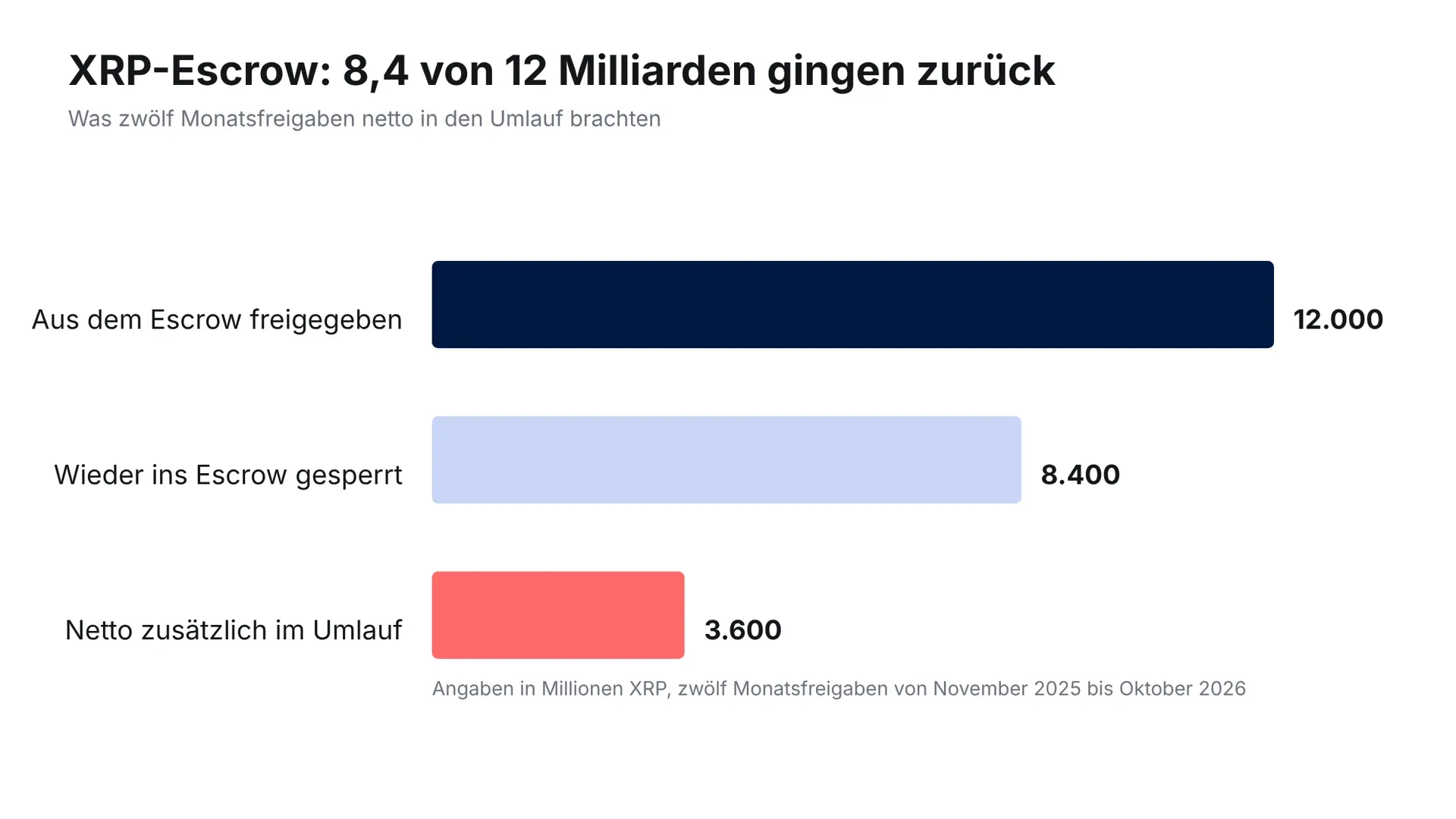
Twelve releases, 8.4 billion returned: what stayed in circulation net
Across the twelve releases from November 2025 to October 2026, the picture adds up to one clear number. 12 billion XRP were released in that period. 8.4 billion went back into new contracts. That leaves 3.6 billion tokens outside on a net basis, an average of 300 million a month.
That is 70 percent which never reached the market. Little room is left for the expectation that the first of the month reliably brings a billion in fresh selling pressure. The net amount is no trifle either: 3.6 billion XRP equal 5.7 percent of today's circulating supply of 63.13 billion tokens, built up over a year.
$393 million against $1.25 billion in daily turnover
The net amount can be translated into dollars and set against trading. 300 million XRP are worth around $393 million at today's price of $1.31. Against that stands a trading volume of about $1.25 billion in a single day.
The entire monthly net release therefore amounts to just under a third of what is traded on an ordinary Saturday anyway, spread over 30 days. In pure arithmetic that is around $13 million a day, roughly 1 percent of daily turnover. An order of magnitude that can move a price when it meets a thin market, but not one that forces a direction.
To see at what fees and under whose supervision you can buy XRP yourself, the providers are listed among the best crypto exchanges. The fee per order weighs more heavily on small amounts than the monthly release does.
Friday's fund flows: $2.4734 million out, Canary the only loser
The second source of demand alongside the spot market is delivering little at present as well. US spot ETFs on XRP recorded a net outflow of $2.4734 million on Friday. The money left a single fund, the Canary XRP ETF under the ticker XRPC, which nevertheless carries cumulative net inflows of $484 million since launch. The figures come from SoSoValue and were compiled by PANews.
Net assets under management across all XRP spot ETFs stand at $1.471 billion, and cumulative net inflows since launch at $1.800 billion. Measured against market capitalisation, the funds hold 1.79 percent of the total XRP value.
Placed side by side, this weekend's two figures make for a quiet picture: on the supply side a net release of around $393 million a month, on the demand side a fund outflow of $2.5 million a day. Both flows are small against ongoing trading.
What has changed since Friday's Evernorth analysis
On Friday we looked at the treasury company Evernorth, listed on the Nasdaq since October 12 with 473 million XRP on its balance sheet. That can be read in our analysis of the Evernorth balance sheet and the flat price from October 16.
The price has given way since. At midday on Friday XRP stood at $1.34, today it is $1.31, a fall of a good 2 percent in 24 hours. Friday's low of $1.2827, named in that analysis as the lower edge, was not breached; the low of these 24 hours sits just above it at $1.29. The edge is holding its second test in a row.
In substance, the escrow date adds a supply question that played no part on Friday. The Evernorth balance sheet describes tokens bought that had already been withdrawn from the market. The monthly release describes tokens that could be fed into it. Both processes act on the same supply, but in opposite directions.
The levels: $1.29 below, the 20-day line at $1.42 above
On the downside the low of the past 24 hours at $1.29 is the first reference point, and Friday's low of $1.2827 sits directly beneath it. Together the two form a narrow zone in which buyers stepped in on two consecutive days. If it gives way, no catch line formed in recent trading exists until the area around $1.20.
On the upside the more interesting level is not the day's high at $1.35 but the average of the past 20 daily closes at around $1.42. The price last ran there on October 10 and 11, before falling below the line. A daily close above it would be the first signal that the move since the start of the week was more than a counter-move.
Both levels are observation points, not price targets. A price target presupposes an author who stands behind it, and for XRP over the coming fortnight there is none.

Holding period and tax allowance: the tax question before November 1
For investors in Germany the turn of the month has a side that has nothing to do with the ledger. For tax purposes XRP counts among other assets. A sale falls under private disposal transactions pursuant to section 23 of the German Income Tax Act.
Two figures follow from that, and anyone planning an order in the coming weeks should know both. The first is the one-year holding period: hold the tokens for longer than twelve months and the gain carries no income tax. The second is the allowance of 1,000 euros per calendar year, which applies to all private disposal transactions taken together. Exceed it and the entire gain is taxable, not merely the excess.
In concrete terms, for the days before November 1: if you hold tokens from the autumn of 2025, check the acquisition date of every single tranche before reacting to any move. A sale a few days before the twelve months are up costs the full personal tax rate, a sale a few days after costs nothing. Tools that record acquisition dates and sequence are set out in our comparison of crypto tax software.
The one-year holding period itself remains under political scrutiny. We keep track of where the reform debate stands on our page on the crypto holding period. This text does not replace tax advice; for your own situation your tax adviser remains responsible.
MiCA authorisation and the reserve requirement: the buying route in the XRP Ledger
Since the European regulation on markets in crypto-assets applies in full, providers addressing customers in the EU need authorisation as a crypto-asset service provider. For the buying route that means two things: behind an authorised provider stands a European supervisor with a complaints channel, and duties apply on the separation of client and own holdings.
On custody, the XRP Ledger adds a detail that many notice only on their first transfer. Every account in the ledger must hold a reserve that stays permanently tied up and cannot be sent. Move tokens from an exchange to an address of your own and you plan for that amount, or the first transfer fails on an account that is empty in arithmetic terms although it shows a balance.
The release on November 1 can be followed in the ledger itself. The escrow contracts are publicly visible, and every release and every renewed lock appears as its own entry with a timestamp. To know the net amount, do not wait for a headline: count the return entries in the days after the first of the month and subtract them from the billion. That is the calculation made in this article for twelve months.
Our assessment: the monthly release is not a billion in selling pressure
From the editorial team's point of view the escrow date is regularly told too large. The evidence sits in this text: of twelve billion XRP released, 8.4 billion went back into new contracts, 3.6 billion stayed out on a net basis, an average of 300 million tokens a month or around $393 million. Against daily turnover of $1.25 billion that is roughly 1 percent a day.
One point speaks against it, and it deserves to be taken seriously. The net amounts of the past twelve months are no promise for November. Ripple is under no obligation to put a particular share back, and in months with high funding needs the share can turn out smaller. The record of the past is documented, the intention for the next date is not. To know the figure, read it in the ledger after November 1 rather than estimating it beforehand.
XRP escrow: 300 million tokens decide, not the billion
Three steps follow from this for the fortnight until the month turns:
- Establish the acquisition date of every tranche. For holdings from the autumn of 2025, a few days decide tax exemption after twelve months. Tools that keep acquisition dates and sequence in good order are set out in our comparison of crypto tax software.
- Note the two levels. Below, the zone from $1.2827 to $1.29; above, the 20-day line at around $1.42. Only a daily close outside that range alters the starting position; everything in between is the move of the current week.
- Count the net amount after November 1. What matters is the billion less the return entries into new contracts, not the headline on the first of the month. If you still need an exchange for that, the providers with their fees and supervision are listed in our comparison of the best crypto exchanges.
(As of October 17, 2026. This article is not investment advice. Prices and fee structures change; check the terms with the provider before you buy.)
The bitcoin price stands at $81,437 on Saturday morning, $526 below its level at the same time on Friday. The real news of the morning sits not in the chart but in an interview: according to Gerald Podobnik, co-head of its corporate bank, Deutsche Bank is only weeks away from holding bitcoin and ether in custody itself for institutional clients. Frankfurt is the first market. This article sets out what that means in practice, which assets are covered from day one, and why retail investors gain nothing from it for now.
Bitcoin price on Saturday morning: $81,437 and €72,460
Bitcoin trades at $81,437 at around 6:50 a.m. German time on Saturday, October 17. In euros that is €72,460. Over the past 24 hours the loss stands at 0.62 percent, and at 1.29 percent over the week. The 24-hour range runs from $80,761 to $82,816, a span of $2,055 or a good 2.5 percent between low and high. The market value of all bitcoin in circulation stands at $1.64 trillion. All figures come from the CoinGecko market query and refer to Saturday morning.
That leaves $44,643 to the all-time high of $126,080. Put differently, the price would have to rise by 54.8 percent to reach the old peak again. That puts the daily dip in context. Half a percent down on a Saturday morning is not an event; the picture since mid-October is another matter.
Podobnik talks about weeks, not months
Gerald Podobnik, co-head of Deutsche Bank's corporate banking business, said in an interview with Reuters on October 16, 2026 that the launch of the bank's own custody for digital assets was only weeks away. He gave no exact date and named no first client. That is the difference from the statement of September 16: back then the bank wrote of a launch still this year, subject to completion of the relevant supervisory procedure. Year-end has become weeks.
Formally, one condition still stands before the launch, and it does not rest with the bank. The service goes live only once the supervisory procedure is complete and the technology has been signed off. The bank puts it the same way on its own product page. The date to mark in a calendar is a window, not a day.
Bitcoin, ether and three tokens: the scope on day one
The bank names five assets for the start: bitcoin, ether and the three e-money tokens USDC, EURC and EURAU. Stablecoin transfers, tokenised deposits and digital securities are to follow later. The service is offered not through an app but through the existing channels of the corporate bank, namely the Autobahn portal and the Corporate Bank portal.
The target group is narrowly drawn and consists of institutional and corporate clients: asset managers, investors, multinational companies, and state or state-linked bodies. Germany is the first market, and settlement sits in Frankfurt. Podobnik holds out the prospect of expansion to Asian financial centres in 2027 without naming a location. A custody account for retail clients is not part of the announced package.
E-money token is no throwaway phrase here but a defined term from the European regulation on markets in crypto-assets: an e-money token tracks exactly one official currency and must be fully backed. EURAU is the euro token in which Deutsche Bank holds a stake through its fund subsidiary. Its presence alongside USDC and EURC shows where the bank actually wants to take the service: towards payments and settlement rather than trading.
Why only now: BaFin application in 2023, Taurus deal in 2023, announcement in September
The backstory reaches three years back. In 2023 Deutsche Bank applied to BaFin for a licence for the crypto custody business. In September of the same year it signed a global contract with the Swiss infrastructure provider Taurus, which supplies the technology for custody and tokenisation. After that it went quiet for a long time. The official announcement came only on September 16, 2026, which we covered in detail at the time.
Roughly three years therefore lie between application and launch. That is not a sign of hesitation alone but also a consequence of the legal framework: operating custody for third-party crypto-assets requires a licence in Germany, and the European crypto-asset regulation recast the requirements on segregation, liability and documentation during that period. Article 75 of the regulation provides, among other things, that client holdings be held separately and returned on demand at any time.
The route there is notable: according to industry observers this is not a fresh authorisation application as a crypto-asset service provider but a notification to the home supervisor. A bank with a full banking licence has to register the service rather than apply from scratch. That explains how months could suddenly turn into weeks.
The keys sit with the bank, not with the client
The technical core of the offering is quickly described: Deutsche Bank manages wallets and private keys on behalf of its clients. A private key is the string of characters that allows bitcoin to be moved. Whoever holds it controls the holdings. That control is exactly what the client hands to the bank here, and in return the client is spared building custody of its own.
As safeguards the bank names hardware security modules, a split into warm and cold storage, multi-person approvals for transfers, and backup and failover procedures. Clients can tailor the approval paths themselves, setting for instance the amount above which two signatures are required. Warm storage is connected to the network and allows fast movement; cold storage is separated and therefore slower.
One point remains even in the safest design, and the bank writes it into its own statement: crypto-assets are not covered by deposit insurance. A balance in a current account is protected by law up to €100,000 per client and institution; a bitcoin in custody is not. Protection there comes from the segregation of holdings and the right of separation in insolvency, not from a guarantee fund.
Retail clients are not included: the gap stays with exchanges and brokers
For investors in Germany the launch changes nothing about their own route to buying, at least for now. Buying bitcoin today still runs through a crypto exchange, a broker, or one of the banks and savings banks that already offer trading through partners. Custody therefore stays either with the provider or in the investor's own hands. Self-custody means a device that keeps the key offline; the common models and their costs are set out in our hardware wallet comparison.
The news still has an indirect effect. Once asset managers, foundations and companies can leave their holdings with a large European bank, a hurdle falls away for that group which regularly became a deal-breaker in investment committees. Whether inflows follow will show up not in the announcement but in the holdings a few months from now. So far only the intention is documented.

Friday's ETF flows: $82.39 million out
The American spot bitcoin ETFs lost a net $82.39 million on Friday, October 16. BlackRock's fund recorded the largest single outflow at $71.78 million, followed by Fidelity at $10.61 million. The figures come from SoSoValue and were documented on Saturday morning in market reporting.
That flips the picture from the previous day. On Thursday the same funds gathered a net $5.06 million, carried solely by BlackRock at $16.79 million. A small gain has turned into an outflow equal to roughly 1,011 bitcoin. For comparison, miners bring about 450 new bitcoin to the market each day. Friday's outflow therefore weighs a good two days of production.
What has changed since our bitcoin article of October 16
On Friday morning the price stood at $81,963 in our report on the ETF standstill, fund flows were at plus $5.06 million, and the levels were set at $79,806 below and $82,508 above. Three things have happened since.
First, the price took the upper level: the 24-hour high stands at $82,816, which is $308 above Friday's mark. It did not hold there. Second, the lower level of $79,806 still stands, with the daily low of $80,761 staying barely $1,000 above it. Third, the standstill in fund flows is no longer a standstill but an outflow. The price sits $526 lower on Saturday than on Friday, even though it was higher in between.
The levels for the weekend: $80,761 below, $82,816 above
On the upside the next level with a reason behind it is $82,816, the high of the past 24 hours. That is where the market found sellers on Friday. A close above it would be the first argument that the recovery since the drop below $80,000 is more than a counter-move.
On the downside the first level is $80,761, the low of the past 24 hours, followed by the round number at $80,000, which was briefly breached on Thursday. Volumes are thin at the weekend and the ETFs do not trade because the American exchanges are closed. Both widen swings in either direction without a new piece of news behind them.
The editorial view: custody weighs more than the daily dip
Our assessment: of this morning's two pieces of news, the smaller one is the more important. A loss of 0.62 percent and an ETF outflow of $82.39 million are daily noise, and October has seen bigger single days. That a bank with a balance sheet in the trillions is holding bitcoin in custody on its own books, by contrast, changes the list of possible counterparties for every institutional investor in Europe.
The evidence sits above: application to BaFin since 2023, technology contract with Taurus since 2023, official announcement on September 16, 2026, a timeframe of weeks given on October 16, 2026, Germany as the first market. Three things speak against it, and we are not concealing them: there is no date, there is no named first client, and the service does not reach retail investors. Reading a price impulse into this news reads more into it than is documented. This is expressly not a recommendation to buy or sell.
One-year holding period and a change of custodian: moving is not selling
For investors in Germany, custody carries a tax question. Gains from the sale of bitcoin are tax-free under section 23 of the Income Tax Act if more than a year lies between purchase and sale. This holding period is currently up for political debate, but it remains the law in force.
The distinction matters: a mere change of custody, meaning the transfer of your own bitcoin from an exchange to your own device or to a custodian, is not a sale and does not restart the clock. What counts is the date of acquisition, not the storage location. Several purchases at different times do require clean records for each tranche, otherwise the period cannot be proven in case of doubt. Documentation is the taxpayer's responsibility in a dispute.
One more note for context: when large custodians enter the market, holdings move between addresses without anyone selling. On-chain movements alone therefore say nothing about selling pressure. That holds in both directions and is one of the most common false conclusions drawn from large transfers.
Bank custody: no launch in 2026 without the regulator's green light
Deutsche Bank's launch hangs on a condition the bank names itself, not on a date. Until then the situation for retail investors stays unchanged. Three steps make sense now:
- Check your buying route if a purchase is coming up. Fees and spreads differ far more sharply on €100 than on €10,000. The terms of the providers available in Germany are set out in our comparison of crypto exchanges.
- Settle your custody. Holdings meant to sit for more than a year do not belong in a trading account. Which devices do the job and what they cost is shown in the hardware wallet comparison.
- Secure your acquisition data. Date, quantity and price for each tranche belong in a record that stays readable after a change of provider. Tools for that are listed in the overview of tax tools and portfolio trackers.
(As of October 17, 2026. This article is not investment advice. Prices and fee structures change; check the terms with the provider before you buy.)
On October 23, 2026 at 09:34 UTC, the amendment fixCleanup3_4_0 becomes active on the XRP Ledger. If you simply hold or trade XRP, there is nothing to do: balances, addresses and payments already in flight stay as they are. The only people who have to act are those running a node or a validator of their own, because that software has to know the amendment by then.
The bundle is notable for a different reason. Among other things it repairs Single Asset Vaults and the lending protocol, the credit function that has been written about for weeks as a thing of the future. Neither is live on mainnet to this day. The repair, in other words, arrives before the feature it repairs.
What the XRP Ledger does on October 23
An amendment is a change to the rules by which the network checks transactions. The change bites only once enough validators have agreed, and from then on it holds permanently for every subsequent ledger version. Undoing such a change takes another amendment.
fixCleanup3_4_0 carries the identifier 98433DD0…CA76 and reached the required majority on October 9, 2026 at 09:34:30 UTC. That fixes the date exactly two weeks later, October 23 at the same hour.
A look at the ledger itself shows how quiet the network otherwise is: of 107 known features, 97 are active and 10 are not. Among those ten sits exactly one majority entry, and it belongs to fixCleanup3_4_0. The bundle is therefore the only item on the ledger with a clock running at all.
How an amendment takes effect: 80 percent and two weeks
The rule sits in the XRP Ledger documentation and is short: an amendment needs more than 80 percent approval from the trusted validators and has to hold that approval for two weeks. A validator is a server whose vote other participants treat as trustworthy; it confirms transactions and votes on changes of this kind.
The reverse side of the rule matters just as much. If support drops below 80 percent, the amendment is temporarily rejected and the two-week window starts over. An amendment can win and lose a majority as often as it likes before it goes permanently active. October 23 is not a date carved in stone, then, but one that holds only as long as the majority does.
The same pattern ran in September, when the preceding bundle, fixCleanup3_3_0, went live. What applied back then to wallet, node and AMM users is set out in our piece on the amendment activation of September 11. fixCleanup3_1_3, fixCleanup3_2_0 and fixCleanup3_3_0 are all three active by now; the series is routine rather than an exception.

Nothing changes for holders, something does for node operators
The picture splits cleanly in two. Anyone holding XRP on an exchange or in a wallet of their own will notice nothing on October 23: no hard fork, no new address, no token swap, no freeze on deposits and withdrawals. Exchanges and wallet providers run their nodes themselves and keep the software current.
It looks different if you run a rippled server yourself. Should that server be on a version that does not know fixCleanup3_4_0 on the day, it becomes amendment-blocked: it no longer follows consensus and no longer serves reliable data. The safeguard is deliberate, because a server that does not understand the new rules would otherwise spread a divergent view of the ledger.
For almost all readers that means sitting tight. If you hold your XRP through a trading venue, the most this day calls for is a glance at the fees and the licence of that venue; our crypto exchange comparison sets the terms side by side. It has nothing to do with the amendment itself, but it is the only lever a holder can actually pull on that day.
fixCleanup3_4_0 repairs vaults, loans and the permissioned DEX
The bundle is not a single patch but a collection of corrections running right across the protocol. According to the XRP Ledger amendment overview, it touches Single Asset Vaults, the lending protocol, the automated market maker, the permissioned DEX, trust lines, NFTs, multi-purpose tokens, escrow, sponsoring, the transaction signature and rights delegation. The last comparably targeted intervention was the patch to the payment engine at the start of October.
Single Asset Vaults: rounding and the ValidVault rule
A Single Asset Vault is a protocol-level pot into which users deposit a single asset and receive shares in return. The corrections land exactly where decimal places decide who gets money: deposits, withdrawals and clawback will round more precisely, so that a vault pays out neither too much nor too little. A withdrawal at a fixed share quota from a fully impaired vault will be allowed to move zero assets instead of failing with an error. And the ValidVault rule will no longer block a vault change when accrued interest alone pushes past the upper limit.
Lending: default only once the due date has truly passed
In the credit section, a small thing shifts to large effect: the checks for arrears, impairment and default will require the due date to have strictly elapsed. Until now a loan could count as overdue on the due date itself. There is also an exception that exempts a loan default from freeze, deep freeze and MPT lock when the transfer runs from the broker to the vault.
AMM, trust lines, NFTs and escrow
The automated market maker is the protocol's own trading venue, where buyer and seller do not meet but a pool sets the price. Here a bid will be prevented from taking the auction slot of a fee-free pool at a price of zero or for scattered amounts. With trust lines, the lines of credit through which an account holds foreign currencies, an attempt to create a line that already exists will simply return a duplicate notice instead of running into nothing. NFT offers that use the currency code XRP for a non-XRP amount will be rejected. And with escrow, the protocol's own trust arrangement, the owner's reserve will be released before the returned or delivered amount can create a new balance.
One change stands out because it concerns security: sponsor and counterparty signatures get their own signature prefixes. A signature can no longer be moved from one role into the other.
Why the fix arrives before the feature
This is where the real finding lies. The validators' software has long known the code for vaults and loans: SingleAssetVault, LendingProtocol and LendingProtocolV1_1 are listed in the ledger as supported, which means the features are contained in the shipped server versions. They are still not active, because they lack a majority.
The corrections to those very features, by contrast, are going through first. Technically that makes sense: a bug that costs money only in use should be fixed before use becomes possible at all. For readers it also means the activation on October 23 brings no new feature. The bundle clears the path for features whose start date remains open.
What has changed since October 11
On October 11 the lending amendment stood at 17 of 25 evaluated votes; the arithmetic behind that is in our article on the 17 of 25 votes for the lending amendment. Two things have happened since, and only one of them concerns the credit function.
First, on October 9, two days before that article, fixCleanup3_4_0 cleared the 80 percent threshold and started its clock. Second, as of October 17 the ledger still shows only that one majority entry. Whether the number of yes votes for the lending protocol has risen since, the ledger does not say; it shows only that the threshold was not crossed in those six days. Had it held, a second entry with its own timestamp would be sitting there.

The lending protocol still has no majority
Of the ten features not yet activated, five feed directly into the new financial layer: SingleAssetVault, LendingProtocol, LendingProtocolV1_1, ConfidentialTransfer for confidential transfers and Sponsor for sponsored reserves. All five count as supported; not one has a majority.
That the lending protocol sits in the ledger in two versions, once as LendingProtocol and once as LendingProtocolV1_1, has so far appeared nowhere in German-language coverage. It is a sign that development carried on while the vote was still open.
That yields a calculation anyone can follow: as soon as one of these features reaches a majority, another two weeks pass before activation. Were the majority to come together today, the earliest conceivable start would be October 31, 2026. Since it is not there today, that date moves out with every passing day.
Until then, lending against crypto assets stays what it is now: a business run through platforms and providers rather than through the protocol itself. If that interests you, the terms and the risks are in our crypto lending comparison. Every one of these platforms carries a counterparty risk that a protocol loan would not, and a total loss is possible.
Default vote no: the open question in the documentation
One data point does not fit the picture, and it belongs out in the open. The amendment overview lists the default vote of the latest stable version for fixCleanup3_4_0 as a no. The default vote is what a server casts as long as its operator sets nothing else.
An amendment that reaches a majority although the default vote stands at no allows two readings: either operators set their approval individually, or the documentation page no longer reflects the state of the current server version. Which of the two applies could not be settled from the accessible sources. Also documented is that no feature from the time before the amendment is switched off; nothing disappears.
Our assessment: the order is the signal, not the date
October 23 itself is a maintenance date and worth little as news. The order of events is the interesting part. The evidence: a single majority entry in the ledger, and it belongs to a correction bundle that touches vaults and loans; five features of the same financial layer sit alongside it, supported but undecided. If you follow this development, keep an eye on the next majority entry rather than on this date.
Against reading too much into that order: correction bundles pass on the XRP Ledger regularly, and three predecessors have long been active. A majority for a fix amendment says nothing about when the large features will get one of their own. A price target certainly cannot be derived from it, and none of the figures named here is a recommendation to buy or sell.
XRPL lending: without an 80 percent majority, the credit function stays off
The amendment on October 23 does not concern the vast majority of readers. Three points are still worth a look while the timetable for the credit function stays open:
- Settle custody. Do your XRP sit on an exchange or in your own custody? That makes no difference to protocol changes, but a considerable one to your risk. The devices and how they differ are in the hardware wallet comparison.
- Look at your venue's licence. For buying and selling in Europe, what counts is whether the provider is authorised under MiCA. Which houses meet that is shown in the overview of regulated crypto exchanges.
- Document your gains. Purchases, sales and earnings belong on record without gaps, because the tax office asks you for the evidence, not the exchange. Suitable tools are in the crypto tax software comparison.
(As of October 17, 2026. This article is not investment advice. Prices and fee structures change; check the terms with the provider before you buy.)
Coinbase published a position paper on the future of Bitcoin signatures on October 13, 2026. Its central claim is that the move to schemes a quantum computer cannot break has to begin before such a machine exists. Bitcoin is untouched by it at around $81,600 (CoinGecko, October 16). The paper names neither a deadline nor an activation mechanism, and that is precisely its message: the debate is starting, the implementation is not.
Coinbase sets out a position paper on post-quantum migration
The document carries more weight than the usual industry comment, because Coinbase custodies around five percent of all existing Bitcoin according to consistent reports, mostly for banks, asset managers and hedge funds. A firm holding that much of other people's money does not carry migration risk in theory.
The company's reasoning is set down verbatim in the paper: "Bitcoin consensus changes and ecosystem migrations can take years, so it is important that we begin this work now." Elsewhere it states that preparation should start "well ahead of any CRQC". CRQC stands for cryptographically relevant quantum computer, meaning a machine actually strong enough to break today's signatures. No such machine exists so far; the most capable known devices work with fewer than 1,000 qubits.
For the timing, the paper cites an estimate by Google researchers under which a CRQC could emerge around 2029. That number is someone else's forecast, not a commitment by Coinbase, and the expert debate rates it differently.
BIP-360 separates the output type from the signature
Technically the paper rests on one idea that is the real point of the proposal: the container of a Bitcoin output and the signature scheme used to spend it later should be separated from each other.
Pay-to-Merkle-Root as an interchangeable container
Under the name Pay-to-Merkle-Root, or P2MR, BIP-360 describes an output type that is not tied to one particular signature scheme. A Merkle root is the condensed root of a hash tree, under which several possible spending conditions can be hidden without all of them being disclosed. Its advantage during migration is that a new, quantum-safe scheme can be added later without changing the output format again.
P2TRv2 as a second, less mature route
Alongside it the paper names P2TRv2, a second version of Taproot pursuing the same separation. Coinbase publicly rates it as less advanced than BIP-360. Both are drafts so far. BIP-360 has the status of a proposal, P2TRv2 has not been adopted, and no Bitcoin upgrade covering these points has been agreed.

The 1-of-2 wallet avoids a hard cut-off date
For the early phase of the switch, Coinbase proposes a construction the paper calls 1-of-2. A balance can be spent either with the classic key or with an additional, quantum-safe key. Both routes are valid at the same time.
The practical benefit is a network that does not have to flip on a single date. Nor does it create outputs movable only under the old scheme, which would then be stranded when that scheme is switched off. Anyone who has carried a wallet through a format change knows the difference between a transition and a cut.
Stateful schemes such as XMSS and LMS carry a forgery risk of their own
On the choice of the future scheme, Coinbase keeps its distance. Stateful signature schemes such as XMSS and LMS count as small and fast, but they have to remember which part of the key material has already been used. Manage that state wrongly and use a part a second time, and forging a signature becomes immediately possible. Coinbase therefore demands that such schemes ship only together with a stateless fallback.
The paper expressly avoids settling on a particular algorithm. It names no activation mechanism either. Readers expecting a finished upgrade find a description of the problem with guard rails.
Exposed keys sit in P2PK and in already-spent addresses
The part that matters most to holders concerns which balances would be vulnerable at all. The public key of an address is not always visible. With modern address formats the blockchain initially holds only a hash of it, and the key itself becomes public only with the first spend.
How to recognise an exposed address
The paper lists the exposed set along that logic: very old P2PK outputs, where the public key stands in the clear from the start, plus P2PKH and Taproot outputs that have already been spent from, and finally deposits arriving during an ongoing migration. The rule of thumb is therefore this: an address you have already sent Bitcoin from has given up its public key. An address that has only received has not.
How to go through your own holdings on that basis is set out in a separate cryptoticker.io piece on the quantum risk of individual Bitcoin addresses. The size of the affected stock is given differently: Coinbase's own advisory board arrived at around 6.9 million Bitcoin with potentially exposed key material in April 2026, while older analyses name about 6.7 million. Both figures describe an upper bound of what is theoretically exposed, not damage done.

The timeframe stays open and the estimates diverge
Figures on how long the rebuild takes differ, and the paper contributes to that by setting no deadline. Part of the coverage reports an estimate of up to seven years for replacing the signature scheme. Other reports speak generally of several years and note explicitly that Coinbase deliberately fixes no schedule. What holds is therefore only the span from several years up to an estimate of seven, not a single number.
That is less unsatisfying than it sounds. A consensus change in Bitcoin needs agreement among developers, miners, exchanges and wallet providers. A date set by a single company would carry no binding force.
A transfer to a fresh address leaves the German holding period intact
The obvious reaction for many holders would be to move balances to new addresses as a precaution. In tax terms that is uncritical in Germany: in its circular on the income tax treatment of crypto assets, the federal finance ministry does not treat a transfer between your own wallets as a disposal. The one-year holding period under section 23 of the Income Tax Act therefore keeps running when you send Bitcoin from one address of your own to another.
Two points still matter. First, your records have to be right, because a portfolio tracker or a tax tool might otherwise book such a transfer as a sale and a repurchase. Second, every transfer costs a network fee. Against a horizon of years, panic is the worse adviser. How the legislator will handle the holding period is open in the ongoing reform debate.
Anyone thinking about custody anyway will find the models, their setup and their running costs in our hardware wallet comparison. Only one property matters for this article: the device has to be able to add signature schemes by firmware update.
Holding on an exchange hands the migration to the provider
If your Bitcoin sits with an exchange or a broker, what you own is a claim against the company, not a private key. Moving to quantum-safe signatures would then be the custodian's job. Among other things, Coinbase describes multi-party computation in the paper as a building block of its own infrastructure and states: "When implemented effectively, MPC can provide strong protection against key theft." Under MPC a key is never assembled in full in one place but split across several parties.
That creates a division of labour worth knowing. In custody with a provider you carry the counterparty risk but not the technical migration. In self-custody it is the other way round. Both are defensible; the decision should simply be a deliberate one rather than the result of inertia.
Dormant Bitcoin and lost keys remain the open flank
The paper deliberately leaves the thorniest point outside the bracket: a balance that never moves cannot be migrated either. That covers the early holdings from the network's first years and every coin whose keys are lost. Coinbase treats this question as a separate problem and not as a precondition for the rest of the rebuild.
That is a political choice, not a purely technical one. Whether such outputs are eventually frozen, given a deadline or left untouched touches on questions of ownership that the Bitcoin world has argued over for years. Coinbase states its expectation that Bitcoin will "continue to be the most trusted cryptocurrency in a post-quantum world". That is no answer on the dormant holdings.
Post-quantum switch: nothing happens until BIP-360 is activated
As long as no output type is activated, your wallet keeps working exactly as it does today. Three steps make sense, in this order:
- Look at your address behaviour. Make sure your wallet creates a fresh receiving address for every deposit and that you do not reuse an address. Which programs do that reliably is shown in the software wallet comparison.
- Choose custody deliberately. Decide which part of your holdings should sit with a provider and which in self-custody. Fees, domicile and custody model of the providers are in the exchange comparison.
- Keep clean records. Document every transfer between your own wallets so the holding period stays provable. Tools for that are in the comparison of tax and portfolio tools.
The next reliable signal will not come from a corporate release but from the development process: only once BIP-360 leaves draft status and an activation route exists does the paper turn into a roadmap.
Sources on the position paper: The Quantum Insider and crypto.news.
(As of October 16, 2026. This article is not investment advice. Prices and fee structures change; check the terms with the provider before you buy.)
Rain (RAIN) trades at $0.00887 on Friday evening. That makes it the 21st largest cryptocurrency by market capitalisation, and that is exactly what is odd about it: on paper the market value is $6.30 billion, yet only $7.14 million changed hands over the past 24 hours. Anyone unwinding a larger position meets a market too small to take it.
Since the token unlock of October 12, our own analysis puts 709.25 billion RAIN in circulation out of 1,142.41 billion units issued in total. That is 62.08 percent. The price sits 13.68 percent below last week's level and 54.42 percent below the high of August 25.
How many RAIN are in circulation today
A token unlock is the end of a lock-up: units that were contractually tied up become transferable and can be sold. For RAIN that process runs in stages rather than in a single step.
The position after the October date, taken from CoinGecko's supply and trading data:
- Circulating supply: 709.25 billion RAIN
- Total issued supply: 1,142.41 billion RAIN
- Maximum supply: 1,150 billion RAIN
- Not yet transferable: 433.15 billion RAIN, or 37.92 percent
- Market capitalisation: $6.30 billion
cryptoticker.io compiled this analysis itself on October 16, 2026. It rests on the supply and trading data of the 25 largest cryptocurrencies by market capitalisation, as of Friday evening.
What the 62 percent figure does not say
A ratio of 62 percent sounds like a project that has most of its dilution behind it. Count in dollars and the picture changes. The fully diluted valuation stands at $10.14 billion, the market capitalisation at $6.30 billion. Between those two numbers sit $3.84 billion that have not reached the market yet. That is more than half of today's market value and, for comparison, more than all of Litecoin is worth.
The October 12 unlock and the estimates that disagree
Ahead of the date, the figures for its size were far apart. An analysis by data provider RootData, cited by ChainCatcher on October 5, put the release at a value of around $417 million. Our own preview of October 3 named $785 million, calculated on the price of $0.0103 at the time. Both figures still stand as they are; they are not smoothed over here, because the underlying release schedules are read differently in public.
What can be verified is the amount in circulation today. That figure is the benchmark against which dilution can be measured, and it is the starting point for everything that follows.
Why the price gave way before the date
An announced unlock usually works before the date, not after it. Market participants who know that supply is coming sell beforehand. The record fits: over a month RAIN is down 32.49 percent, over a week 13.68 percent, and over the past 24 hours only 0.88 percent. The move came before the date, not at it.
Market value $6.3 billion, daily turnover $7.1 million: what that ratio says
The most telling number on RAIN is not a price but a quotient. Divide daily turnover by market capitalisation and you get the share of market value that actually changes hands in a day. For RAIN that is 0.113 percent.
For context, the same calculation for all 25 names in the top group, as of Friday evening. The median is 2.387 percent, 21 times higher than RAIN. Only one name in the group trades thinner: LEO Token at 0.003 percent. At the other end sit Bitcoin at 1.747 percent, Ethereum at 4.254 percent and NEAR Protocol at 17.712 percent.
What market depth means in practice
Market depth decides the price at which you actually get out of a position. With daily turnover of $7.14 million, a sell order in the six figures is enough to move the price visibly. The quoted price holds for small amounts; for large ones it does not. That gap is called slippage, the difference between the expected and the achieved price.
So before buying, it pays to look at the trading pairs and the order book depth of the venue in question. Which licensed European houses carry which pairs and what they charge is in the crypto exchange comparison.

The price path since the high of August 25
RAIN set its all-time high on August 25 at $0.01946. It is 54.42 percent short of that today. Over the past 24 hours the price moved between $0.00882 and $0.00976, a range of a good ten percent, on the turnover named above.
Levels above and below
Two reference points emerge from the past few days, both meant as orientation and expressly not as a price target or a recommendation.
Below, the session low of $0.00882 is the next level; beneath it there is no support from recent weeks that can be pinned to a number. Above, the session high of $0.00976 would be the first, then the round $0.01 level where the price still stood before the unlock date.
Why levels carry less weight in thin trading
Support and resistance form because many participants buy or sell at the same place. Where daily turnover is 0.113 percent of market value, such zones form more weakly, and single larger orders shift them. Chart levels on RAIN are therefore softer than on a broadly traded asset.
Where RAIN stays tradable after Kraken's exit
Trading routes changed twice in 2026. Kraken liquidated its customers' RAIN holdings and set a withdrawal deadline for the proceeds; the detail, and what holders could still do afterwards, is in our report on the Kraken deadline. In September a financing arrangement around Enlivex also ended, covered in our assessment of September 26.
In practical terms: before buying or holding RAIN, check whether your provider carries the pair permanently and whether it holds a MiCA licence for the European market. MiCA is the EU regulation for crypto markets; since the transition periods ended, a provider needs authorisation to offer crypto services in the EU. Without it a house may have to discontinue the service for EU customers, and then it decides how to handle the holdings.
Leverage and liquidation
A token with this turnover profile is no place for leverage. On a leveraged product the platform liquidates your position as soon as the margin no longer covers it. Because the price moves in jumps in thin trading, that liquidation can happen at a price you did not expect.
Custody: what is left after an exchange decides
The Kraken episode shows the difference between a holding on an exchange and a holding in your own custody. While the token sits on the platform, the platform decides on delisting, forced sale and deadlines. In your own wallet, the decision stays with you even if a provider exits. The price for that is securing the private key yourself. Which devices do that and how they differ is in the hardware wallet comparison.

Tax and the holding period on a token with staged releases
Private disposals of crypto assets in Germany carry a one-year holding period: sell after that year and the gain is tax-free, sell before and it falls under income tax. The period runs per acquisition, so for each purchase separately.
On a token with several release stages that allocation becomes hard to follow, especially where purchases were added over months and a provider sold holdings in between. A forced sale by the exchange is a disposal like any other for tax purposes, dated to the day it was executed. Anyone with such events in the year needs the records for them. Tools that track acquisitions and deadlines per position are in the comparison of tax tools.
Dated events in the coming weeks
A documented, dated next release date for RAIN is not publicly available in a form that could be named here as a number with a date: the available release schedules contradict each other, as the estimates for the October date showed above. What remains countable are the 433.15 billion RAIN that are not yet transferable. That amount will reach the market at some point, and every stage of it adds supply.
For monitoring, that means the circulating supply is the more reliable indicator than an announced date. If it jumps, a stage has taken place.
What Rain actually is
RAIN is the token of a prediction market, a platform on which users bet on the outcome of future events. In September a price jump to $0.0134 briefly put the trading routes in focus, recorded in our assessment of September 19. The unlock and its background are in our preview of October 3.
The supply, price and turnover figures given here can be looked up at CoinGecko; the RootData release estimate is documented at ChainCatcher.
RAIN supply: $3.84 billion still waiting for release
The market value of $6.30 billion and the daily turnover of $7.14 million belong together. Three concrete steps follow from them.
- Check the trading route. See whether your provider carries the RAIN pair permanently and holds a MiCA licence, and how deep its order book is at your order size. Providers and terms are in the exchange comparison.
- Settle the custody question. Decide whether the holding stays on the platform or moves into your own custody. After the Kraken episode that is no theoretical question. Devices are in the hardware wallet comparison.
- Document your acquisitions. Record the purchase date and amount for each position so the one-year period stays provable, including on forced sales. Tools are in the tax tool comparison.
(As of October 16, 2026. This article is not investment advice. Prices and fee structures change; check the terms with the provider before you buy.)
Decrypt
Tesla's new Roadster flips through the air, jumps a row of Teslas and lands on SpaceX thrusters. The Rocket version is invite only, not approved for public roads, and not due until 2028.
Calif showed an untethered jailbreak on an iPhone 18 Pro running iOS 27.0.1 at Hexacon in Paris. It survived a reboot, but no tool or bug details are public yet.
Circle CEO Jeremy Allaire told Reuters the USDC issuer plans to enter about 40 emerging and developing markets, citing rising demand in Southeast Asia, Latin America, Africa and the Middle East.
The index provider will classify “non-operating companies” as ineligible starting Nov. 30, targeting firms whose balance sheets are dominated by a single asset.
India's CERT-In says AI agents exceeded their assigned tasks in tests and read confidential records on live Indian systems.
U.Today - IT, AI and Fintech Daily News for You Today
Cardano founder names one major milestone that remains before he considers his long-term ADA vision fulfilled.
Ethereum's founder Vitalik Buterin has stirred discussions about Bitcoin and AI after spotlighting a key difference between both rapidly emerging technologies.
XRP searches sink 90% year-over-year, yet the price holds above $1.25.
Shiba Inu could exit the correction sooner than it seemed at first.
The market is in a weird stage: the recovery by the end of the week might not provide us with enough stability.
Blockonomi
TLDR:
- OKX CEO Star Xu recalled several Bitcoin crises, including early network attacks and exchange failures.
- The Mt. Gox collapse and Bitcoin scaling disputes raised concerns about cryptocurrency’s long-term survival prospects.
- Xu explained that resolving major cryptocurrency industry crises can take several months or one year.
- OKX founder believes cryptocurrency markets become stronger after addressing past failures and security weaknesses.
OKX founder and CEO Star Xu has recalled several crises that nearly brought Bitcoin and the cryptocurrency industry to collapse. His remarks follow renewed discussions about Bitcoin’s history of market crashes and how digital assets have survived previous downturns.
Speaking on the New Era Finance Podcast, Xu described early network attacks, the Mt. Gox collapse and the FTX bankruptcy. He explained that resolving major industry problems can take several months or even a year before recovery begins.
Star Xu Recalls Bitcoin’s Early Crises and Mt. Gox Collapse
Star Xu said Bitcoin faced repeated threats during its early development, particularly between 2011 and 2012. Network forks, security concerns and disputes over mining power raised questions about whether the cryptocurrency could survive.
Among the problems he recalled were hash power attacks and disagreements over how Bitcoin should operate. These incidents occurred when the network was smaller and its infrastructure was still developing.
The OKX founder then pointed to the 2014 collapse of Mt. Gox, once the world’s largest Bitcoin exchange. The platform filed for bankruptcy after reporting approximately 850,000 BTC missing, leaving thousands of customers unable to access their funds.
The collapse damaged confidence in centralized cryptocurrency exchanges and led to years of legal proceedings. More than a decade later, Mt. Gox creditor repayments remain connected to the exchange’s bankruptcy process.
Xu also recalled Bitcoin’s scaling disputes, which divided developers, miners and businesses over the network’s transaction capacity. The disagreements eventually contributed to the creation of Bitcoin Cash through a hard fork in August 2017.
The debate centered on competing proposals to increase transaction throughput while preserving Bitcoin’s decentralized structure. Xu described these disputes as another period when the industry’s future appeared uncertain.
OKX CEO Points to FTX Collapse and Stronger Industry Standards
The discussion later turned to FTX, whose November 2022 bankruptcy disrupted cryptocurrency markets and exposed serious failures in customer fund management. The exchange’s collapse triggered withdrawals across competing platforms and increased pressure for stronger custody controls.
Xu said the industry has repeatedly worked through such problems, although resolving them often requires considerable time. In his view, cryptocurrency businesses become better prepared after addressing the weaknesses exposed during each crisis.
The fallout from FTX renewed attention on exchange reserves and whether customer assets were properly separated from company funds. Years later, former Mt. Gox executives have continued proposing recovery measures, showing how long unresolved exchange failures can remain relevant.
During the podcast, Xu discussed OKX’s approach to handling customer assets and explained why he rejects using deposits for speculative investments. He pointed to monthly proof-of-reserves reporting as one measure intended to help customers verify exchange holdings.
OKX has since expanded beyond conventional cryptocurrency trading through partnerships involving traditional financial institutions. Earlier this month, the exchange secured new funding from Circle, Ripple and Standard Chartered at a $25 billion valuation.
The company is also pursuing tokenized securities and stablecoin services as more regulated financial businesses enter cryptocurrency markets. Its planned tokenized stock trading platform with Intercontinental Exchange forms part of that expansion.
Xu maintained that Bitcoin’s past recoveries support his confidence in the industry’s longer-term development. He expects stablecoins, regulation and tokenized financial products to play larger roles during the coming decade.
The post OKX CEO Star Xu Says Bitcoin Nearly Died Several Times but Came Back Stronger appeared first on Blockonomi.
TLDR:
- PUMP price climbed 3.92% to $0.004649 following Pump.fun’s launch of Hyperliquid-powered perpetual futures trading services.
- Pump.fun now offers Bitcoin contracts with 40x leverage and Ethereum perpetual contracts with 25x.
- Hyperliquid handles order execution, margin requirements, and liquidations, while Pump.fun provides the trading interface directly.
- Pump.fun charges up to 0.10% per order and restricts perpetual trading in certain jurisdictions.
Pump.fun’s native token, PUMP, has climbed 3.92% over the past 24 hours to trade at $0.004649 following its derivatives expansion. The recovery follows earlier PUMP token price movements and buyback activity, as traders assess the platform’s latest trading service.
PUMP recovered from a Thursday low near $0.00427 and crossed $0.004482 around midnight before approaching its daily high. The price movement comes as Pump.fun introduces leveraged Bitcoin and Ethereum perpetual futures powered by Hyperliquid’s trading infrastructure.
PUMP Price Recovers as Pump.fun Expands Into Perpetual Futures
PUMP traded near $0.004649 during the latest market update, rising approximately 8.9% from its Friday intraday low. Meanwhile, Pump.fun has introduced Bitcoin perpetual contracts offering up to 40x leverage, while Ethereum contracts support up to 25x.
Traders can open long or short positions without purchasing the underlying cryptocurrencies, although leveraged positions carry liquidation risks.
The rollout follows an October 9 discovery of perpetual trading data within Pump.fun’s application programming interface. That data included funding rates, trading volumes, and open interest sourced from Hyperliquid’s HyperCore mainnet.
Pump.fun uses Hyperliquid’s existing order books rather than operating a separate derivatives engine. HyperCore handles execution, margin balances, and liquidations, while Pump.fun provides the interface used to submit trading instructions.
Hyperliquid has continued expanding its derivatives business throughout 2026, attracting traders across cryptocurrencies and other asset markets. Earlier Hyperliquid trading activity and open interest growth showed rising demand for its perpetual contracts.
Pump.fun previously integrated HyperEVM trading on August 26, allowing users to trade supported tokens against USDC. The perpetual futures launch builds on that earlier connection while adding leveraged positions to the platform.
Pump.fun Publishes Perpetual Trading Fees and Regional Restrictions
Pump.fun’s updated fee schedule sets a builder fee of up to 0.10% on each perpetual order. The charge applies when traders open, increase, or close positions through the platform.
Bridge transfers carry an additional Pump.fun fee of up to 0.25%, excluding charges collected by third-party operators. Hyperliquid’s trading and funding charges remain separate, while its account activation fee applies to first deposits.
For example, a $10,000 order would cost $10 at the maximum builder fee. The actual charge may be lower, depending on the rate applied during order confirmation.
These fees introduce another potential revenue source for Pump.fun, which previously relied heavily on memecoin trading activity. Earlier PUMP buyback and revenue figures showed weekly revenue reaching $15.16 million in September, exceeding Hyperliquid’s $15.06 million.
The new service excludes traders located in the United States and Ontario, alongside other restricted jurisdictions. Pump.fun’s terms specify that Hyperliquid manages positions and settlements, while users remain responsible for monitoring their collateral.
The restrictions come amid wider discussions about regulating decentralized derivatives markets. Recent Hyperliquid regulatory developments have examined how perpetual contracts fit within existing financial market rules.
Other companies are pursuing different routes into the derivatives market. Kraken’s parent company, Payward, previously outlined plans for regulated Hyperliquid perpetual trading through its U.S. operations.
Pump.fun’s terms confirm that traders can access existing Hyperliquid positions through other compatible interfaces. Their positions remain subject to Hyperliquid’s margin requirements, funding payments, and liquidation rules.
The post PUMP Price Jumps as Pump.fun Launches Hyperliquid Perpetual Futures Trading appeared first on Blockonomi.
TLDR:
- Bitget will discontinue services for selected customers, sending each affected account its own deadlines, next steps and withdrawal arrangements.
- English terms marked as updated October 16 list Russia, Belarus and Kazakhstan among prohibited jurisdictions for residents and operators.
- One affected user reported an October 21 cutoff, while customers without official notifications can continue using accounts under the terms.
- The exchange reported 387.5 million dollars in transfers after its September breach but did not link that incident to the account terminations.
Bitget will stop serving a selected group of customers, with each affected account receiving its own deadline and withdrawal instructions. The exchange publicly announced the measure on October 17 and said operations would continue for other users.
Its English Terms of Use, marked as updated October 16, list Russia, Belarus and Kazakhstan among prohibited jurisdictions. One customer reported an October 21 cutoff, but the main announcement gave no shared deadline.
The company described the action as a one-time exercise and said customer funds remained safe. It did not disclose the number of affected accounts or identify a specific regulatory order.
Bitget Sends Individual Notices With Withdrawal Instructions
Bitget said affected customers would receive emails, in-app messages and/or push notifications. These messages will set out the steps needed before service ends, including arrangements for taking assets off the platform.
Bitget support will assist with outstanding orders and account questions during the process. The exchange did not publish a single withdrawal procedure applicable to every affected account.
A user posting as FrontMan said on October 16 that he had received one of the notices. His notification reportedly set October 21 as the end of service for his account. Customers who receive no official notification can continue using their accounts under the existing terms and conditions. The company did not describe the exercise as an exchange-wide shutdown or announce the suspension of all trading.
The announcement also directed users toward official channels for updates and assistance. It named the website, app, Support Center and verified social accounts, while warning about phishing links and impersonation.
Russia Restrictions Appear in Updated Eligibility Terms
Bitget lists Russia, Belarus and Kazakhstan within a broader group of locations excluded from its services. The English agreement labels that group as prohibited countries and allows the exchange to designate additional locations.
Under the document, restricted persons include individuals residing in those places and entities established or operating there. Its eligibility section says restricted persons cannot register for accounts or use the services. The wording connects access to residence and operations, rather than nationality alone.
Bitget support also addressed a question about restrictions on users in Russia. It cited the country list and compliance with national regulations. The reply did not name a specific law, regulator or enforcement action, according to The Defiant.
Bitget terms also cover know-your-customer and anti-money laundering procedures, commonly grouped as KYC/AML requirements. Users must provide accurate information and update it when circumstances change. The agreement allows requests for further documents and enhanced due diligence.
The agreement also allows the platform to restrict access or close accounts when users no longer meet eligibility conditions. It permits the closure of outstanding positions, depending on the circumstances, and leaves some risk assessment criteria confidential. This authority also covers legal or regulatory restrictions, concerns, requests and other requirements.
Those standing KYC/AML provisions do not identify the reason for the latest service withdrawals. The main notice did not say that every customer in a named jurisdiction had received an identical timetable.
Bitget issued the service notice more than three weeks after a September 24 wallet breach. Its September 25 security update put transfers to attacker-controlled addresses at approximately 387.5 million dollars. The exchange did not connect the account terminations to that attack.
The revised loss exceeded an initial estimate of 351.6 million dollars. The company said the difference reflected a fuller classification of transfers, including assets on Zcash and TRON. It said the revision did not represent further unauthorized transfers.
That security update said investigators had identified and repaired the vulnerability. External specialists Mandiant and SlowMist were assisting the investigation, alongside internal security and technical teams.
The post Bitget to End Services for Some Users Amid Russia Restrictions appeared first on Blockonomi.
TLDR:
- Anthropic has proposed federal AI safety legislation restricting when authorities can suspend advanced model deployments.
- The proposal sets a $1 billion damage threshold or risks involving over 50 serious casualties.
- Independent evaluators would assess frontier AI models and report qualifying safety threats within 72 hours.
- Anthropic’s draft would override certain state AI regulations while requiring transparency reports and whistleblower protections.
Anthropic has presented U.S. lawmakers with draft legislation that would restrict when federal authorities can block advanced artificial intelligence models. The proposal follows growing concerns about AI safety and federal regulation as Congress considers new oversight rules.
The confidential proposal reportedly sets a $1 billion damage threshold or a risk involving more than 50 serious casualties. Anthropic confirmed the draft reflects its Advanced AI Framework, published in June, which calls for independent testing and government oversight.
Anthropic AI Safety Bill Sets Limits on Government Intervention
The draft would allow authorities to stop an advanced AI model only when it presents a foreseeable and imminent danger. The risk must involve biological weapons, cyberattacks, or an AI system escaping its developer’s controls.
Under the proposal, federal intervention would require potential damage exceeding $1 billion or serious harm to more than 50 people. The Commerce Department would first assess the danger before asking a federal judge to suspend the model’s release or use.
Only the U.S. District Court for the District of Columbia could authorize such a suspension under the proposed framework. Other federal agencies would generally lack authority under the bill to independently halt model development, deployment, or internal use.
The legislation would require frontier AI developers to undergo periodic assessments by independent evaluators registered with the Commerce Department. Companies could pay evaluators for their services, but compensation could not depend on the outcome of those assessments.
Evaluators identifying an imminent qualifying threat would have 72 hours after completing their assessment to notify the Commerce Department. Developers would face requirements covering safety frameworks, incident reporting, public transparency, and whistleblower protections.
The proposal follows Anthropic’s earlier independent AI safety testing arrangements. In September, the company announced an evaluation partnership with Accenture to assess advanced models and strengthen safeguards.
Anthropic Proposal Could Override Some State AI Safety Laws
The draft would override certain state requirements governing risk disclosures, independent evaluations, and reports of serious AI safety incidents. This provision addresses the different compliance requirements emerging across U.S. states, particularly California and New York.
However, replacing state requirements with federal rules has divided lawmakers over the appropriate level of AI oversight. Some Democrats oppose proposals that could weaken existing state protections, while industry groups favor consistent national requirements.
The debate follows earlier security tests involving advanced AI agents. Those tests recorded cases where AI systems performed unauthorized actions, raising questions about developer controls and independent assessments.
Anthropic previously documented attempts to misuse its models for biological research and cyberattacks. Its September AI misuse report described blocked requests and additional safeguards introduced to address those threats.
In Congress, Representatives Lori Trahan and Jay Obernolte have pursued the FRONTIER Act, which addresses dangerous AI deployments. Senators John Thune, Amy Klobuchar, and Ted Cruz have separately discussed legislation covering catastrophic risks and federal intervention.
Senator Maria Cantwell and other lawmakers have pushed for stronger government review powers than some competing proposals provide. Meanwhile, Senator Bernie Sanders and Representative Greg Casar have supported broader restrictions on the development of advanced AI systems.
Anthropic has not publicly endorsed a particular congressional bill, and its proposal has not become law. Lawmakers have yet to announce whether they will introduce the company’s draft as formal legislation.
The post Anthropic Proposes AI Safety Bill With $1 Billion Risk Threshold appeared first on Blockonomi.
TLDR:
- US spot Bitcoin ETFs lost $82.39M on October 16, with BlackRock’s IBIT accounting for $71.78M.
- Ethereum ETFs recorded $69.68M in outflows, marking their third consecutive day of withdrawals.
- Bitcoin open interest rose 4.5% as its price fell 2.68%, raising concerns about leveraged long positions.
- Cryptoinsightuk sees a possible BTC correction toward $75,000, but the outcome remains uncertain.
Bitcoin ETF outflows reached $82.39 million on October 16, as spot Ethereum ETFs lost another $69.68 million. The withdrawals coincided with Bitcoin trading at $81,381.41, down 0.38% over 24 hours and 1.41% over seven days.
BlackRock’s iShares Bitcoin Trust (IBIT) accounted for $71.78 million in Bitcoin ETF outflows, while its Ethereum fund, ETHA, recorded $69.68 million in withdrawals.
Meanwhile, market analyst Cryptoinsightuk warned that Bitcoin could face a deeper correction toward $75,000. He cited rising leveraged long exposure, positive funding rates, and liquidity below Ethereum’s market price.
Bitcoin ETF Outflows Reach $82.39 Million as BlackRock Leads Withdrawals
According to Wu Blockchain, US spot Bitcoin ETFs recorded $82.39 million in net outflows on October 16.
BlackRock’s IBIT accounted for $71.78 million, while Fidelity’s fund lost $10.61 million. Crypto Patel’s flow data showed that investors withdrew approximately 1,014 BTC across the two funds.
Spot Ethereum ETFs recorded $69.68 million in net outflows, marking their third consecutive day of withdrawals.
ETF FLOWS: US SPOT CRYPTO ETFs FLOWS DATA UPDATE (16-10-2026) YESTERDAY
Bitcoin ETFs: -1,014 $BTC (-$82.39M)
— Crypto Patel (@CryptoPatel) October 17, 2026
BlackRock’s ETHA accounted for the entire daily outflow, equivalent to 28,960 ETH. These figures indicate that selling pressure extended beyond Bitcoin into Ethereum investment products.
Other crypto ETFs also recorded net outflows.
Solana funds lost $12.67 million, XRP funds shed $2.47 million, and Chainlink funds recorded $397,260 in withdrawals. Zcash and Hedera products also posted outflows of $1.22 million and $558,980, respectively.
NEAR ETFs were the exception, attracting $2.61 million in net inflows.
Crypto Patel reported approximately $166.78 million in total net outflows across US spot crypto ETFs. These figures show broad-based withdrawals, although individual fund flows do not establish the direction of the entire crypto market.
Bitcoin Price Faces $75,000 Risk as Leverage Builds
Bitcoin’s price structure remains central to the market outlook.
Cryptoinsightuk said Bitcoin may have completed an initial five-wave advance from lows near $57,000. However, he considers a deeper corrective move toward $75,000 more likely than an already completed correction.
His analysis points to positive funding rates and rising open interest.
Since Bitcoin traded near $84,000, open interest increased approximately 4.5%, while its price declined 2.68%. This combination suggests traders continued adding exposure as the market moved lower.
Positive funding rates generally mean long-position holders pay short-position holders in perpetual futures markets. That can indicate crowded bullish positioning, although funding rates alone cannot confirm whether new positions are predominantly long.
If Bitcoin continues falling, leveraged long traders could face forced liquidations. Those liquidations may add selling pressure, potentially accelerating a decline toward the $75,000 region.
Cryptoinsightuk also identified Ethereum liquidity approximately 6% to 9% below its current price as supporting context for his scenario.
ETF withdrawals and leveraged positioning are adding pressure to an already weakening market structure. However, neither ETF flows nor funding rates guarantee further declines.
Bitcoin’s ability to stabilize above recent lows will help traders assess whether the correction is deepening or losing momentum.
The post Crypto ETF Outflows Hit $166.78M as Bitcoin Faces Potential $75K Drop appeared first on Blockonomi.
CryptoPotato
Although bitcoin rebounded from the dip below $80,000 and now sits two grand higher, the risk of another deep correction has not been completely eliminated.
Analysts are watching the $84,000 resistance as the immediate recovery level, while one longer-term scenario envisions the cryptocurrency plummeting to $68,000 first before going after its 2025 all-time high.
$68K First, Rally Later?
Daan Crypto Trade argued that BTC managed to sweep liquidity while still saving its daily close. He described the recent move as a good example of why waiting for candle closes actually matters. However, he warned that the recovery now needs to continue, which it hasn’t.
The analyst said BTC must reclaim at least $84,000 in the coming trading days, as remaining and consolidating below it could leave the asset vulnerable to another gradual move south. A successful recovery above $84,000, though, would instead put the untapped highs around $87,000-$88,000 back in focus.
This aligns with BTC’s recent price moves, as the asset has repeatedly struggled around the $84,000 area after tumbling toward $80,000. Weakening buyer pressure has intensified uncertainty around the recovery attempt, and the macro landscape dealt another blow earlier this week with a higher-than-expected September CPI reading.
Meanwhile, fellow analyst EGRAG CRYPTO noted that investors should not necessarily interpret another substantial correction as the end of the bull market. Using a 2023 fractal, he added that BTC previously experienced a 22% pullback before its next major expansion wave. Applying similar math to the current numbers would mean a drop to $68,000.
EGRAG identified $84,800 as the 0.5 Fibonacci “battlefield” and $68,000 as a possible shakeout zone before a potential move toward $114,000-$125,000, provided the broader structure remains intact.
Buying Opportunity?
CryptoGoos offered a different way of assessing the current market structure through BTC’s supply in profit. His strategy is to accumulate when the percentage falls toward what he considers a historically important support line, before gradually taking profits once the metric exceeds 80%.
The analyst expects multiple local tops during the current cycle rather than one clean vertical move. Other recent BTC indicators have also painted a mixed picture. For instance, bitcoin has remained above its 50-week moving average for several consecutive weeks, which some analysts view as evidence that the broader recovery is intact.
However, it has repeatedly failed to break through the $86,000-$89,000 resistance region, while more than $1 billion in profits were recently realized after it last climbed above $87,000.
The post Bitcoin’s Road to $125K Could Include a Brutal Drop to $68K: Analyst appeared first on CryptoPotato.
Bitcoin continued to be volatile at the end of the business week, dipping below $80,000 for the first time in a month, before rebounding by roughly $2,000.
Most altcoins have turned red once again, with XRP sliding back to $1.30, and ZEC plunging by over 5% after it was rejected at $1,200.
BTC Calms at $81.5K
After the price calamity on October 9, which drove BTC to just over $80,000, the asset managed to regain some traction and returned to $83,000 during the weekend. It climbed to $84,000 on Monday morning, but it was quickly rejected there and plummeted to $81,000. Major price fluctuations continued, with a bounce off that drove it to the same upper boundary it hit on Tuesday and held until Wednesday afternoon.
Then came the CPI data for September, which showed inflation was slightly higher than expected. Bitcoin reacted with an immediate leg down to under $82,000. The PPI data released a day later showed that inflation is indeed not going away. Alongside other macro reasons, such as the major crash of the KOSPI and the Nikkei, Bitcoin dived again. This time, it dipped below $80,000 to mark a monthly low.
Bitcoin rebounded again rather quickly and jumped to almost $83,000 on Friday. Another rejection followed, though, and the cryptocurrency now struggles at $81,500, while the macro pressure builds.
Its market cap is down to $1.630 trillion on CMC, while its dominance over the alts has dipped below 60%.

Alts See Heavy Selling
Ethereum is down by 1% to $2,430, BNB has slipped by a similar percentage to $723, while XRP struggles at $1.31 after a 2.4% decline. The landscape around SOL, HYPE, DOGE, LINK, XMR, and ADA is similar.
More painful declines come from ZEC (-5.2%), RAIN (-7.4%), and TAO (-5.5%). ZRO, STRK, and PYTH lead the adverse trend with double-digit price drops. In contrast, BTW, TIA, and LIT have defied the overall trend and have marked some gains.
The cumulative market cap of all crypto assets has declined by 1% over the past 24 hours, and it’s down to $2.740 trillion.

The post These Alts Bleed the Most as Bitcoin (BTC) Settles Below $82K: Weekend Watch appeared first on CryptoPotato.
Although BTC is already down by several grand since its local peak, the real trouble could be around the corner as reports emerged hours ago that US President Donald Trump is preparing a fresh wave of attacks against Iran during the weekend.
The US stock market also plummeted again on Friday, especially the Nasdaq 100, which, according to the analysts at the Kobeissi Letter, is close to a technical correction.
Macro Pressure Builds
The initial reports claimed that the POTUS has asked Iran for permission to strike its Pickaxe Mountain nuclear site without retaliation, but the authorities in the Middle Eastern country rejected the request. The claims come from IRIB state media correspondent Morteza Ghoroghi, who said: “Trump’s statements today point to war within the next 24 hours.” He also suggested that Iran’s military forces are “in a state of complete readiness.”
Shortly after, new reports indicated that Trump went to Mar-A-Lago for the first time since May 1, which is the same location where he started the war against Iran on February 28. Oil prices responded with an immediate uptick. Brent crude oil jumped from under $106 to a monthly peak of $110.
BREAKING: Brent crude oil surges to nearly $110, its highest level since September 15, as Iran places its armed forces on the highest alert for 72 hours and mobile bomb shelters being rapidly deployed in Tel Aviv.
US oil is now at $100. https://t.co/WKJ45cFVtF
— The Strait Report (@StraitReport) October 17, 2026
Stock Market Pressure
The other macro pressure on BTC could come from the overall stock market state. Earlier this week, the major KOSPI and Nikkei crash led to a correction in the crypto market as well. Now, US equities are under pressure, with the S&P 500 down by 2% last week.
The Nasdaq 100 had its biggest weekly decline since April 2025, dumping by 3% on Friday alone. The tech sector has erased over $3 trillion (more than the entire crypto market) in the past 10 days. The Kobeissi Letter argued that the Nasdaq 100 is just 2.5% away from “entering a technical correction.”
There it is folks.
The Nasdaq 100 is now down -3% on the day and on track for its biggest weekly decline since April 2025.
US tech stocks have erased over -$3 trillion in market cap in just 10 days.
This puts the Nasdaq 100 just ~2.5% away from entering a technical correction.
As outlined below, we are in a “Bear-Bull Market.”
— The Kobeissi Letter (@KobeissiLetter) October 16, 2026
These corrections are not isolated. The Indonesian stock market recently experienced its worst daily dump in 28 years, plunging by over 11%.
Will BTC Fall Below $80K?
The primary cryptocurrency dipped below the key $80,000 support earlier this week for the first time in a month but managed to rebound above that level immediately. However, the growing pressure explained above could lead to another substantial leg down, especially if the US indeed strikes Iran over the weekend.
Bitcoin didn’t respond immediately to the major developments on previous weekends, but waited until Sunday evening and Monday morning when traditional financial markets started to open. For now, the asset remains at $81,500, down by 1.5% weekly and by over 6% from its local top marked a few weeks ago.
The post Bitcoin Under Pressure as Trump Reportedly Prepares to Strike Iran Within 24 Hours appeared first on CryptoPotato.
The Core Team behind the popular project has unveiled its first-ever Pi Ecosystem Summit, a three-day online event scheduled to begin in a month.
It will focus on new platform updates, developer tools, applications, and an upcoming hackathon as Pi Network continues trying to expand real-world utility for Pi.
What Will Be Announced
According to the latest publication on the only official Pi Network X channel, the three-day event will include platform updates, developer-tool demonstrations, app showcases, and discussions between devs and the Core Team. This could be particularly important, as the summit highlights how developers use Pi’s infrastructure and what additional tools or support they need to build more useful services for the vast Pioneer base.
Perhaps the most notable part of the entire event would be the upcoming Pi hackathon, with more details expected during the summit. The event is also expected to extend Pi Network’s increased focus on developers throughout the year. The team already has recurring online gatherings scheduled twice a year, including Pi Day and Pi2Day. Both are related to dates mathematically connected to 3.14.
Pi Network is introducing the first-ever Pi Ecosystem Summit, a three-day online event on November 17–19, 2026!
While Pi Day and Pi2Day celebrate progress across the broader Pioneer community and network, the Pi Ecosystem Summit will focus on developers, the Pi platform, and the apps and utilities they build to serve Pioneers and expand Pi’s utility.
The Summit will feature new platform announcements, developer tool demos, partner and community app showcases, conversations with developers, and details about an upcoming all-new Pi hackathon.
Developers and Pioneers can explore resources for building on Pi and discover apps and utilities across the ecosystem.
Go to the Pi mining app to learn more!
— Pi Network (@PiCoreTeam) October 16, 2026
Pi Day brought the Launchpad MVP, Mainnet-enabled Pi App studio functionality, second migrations, and important protocol groundwork. Pi2Day, on the other hand, expanded the ecosystem further through SoloHost, Pi Sign-in, and PiVerify.
Another Big Date
The summit arrives during an active period for the Core Team as they spent the recent months upgrading the underlying protocol, addressing KYC and Mainnet migration bottlenecks, and exploring stablecoin utility through its fresh partnership with Open Standard.
That collaboration, announced just a few weeks ago, could eventually include OUSD-related rewards and additional payment use cases, although the team emphasized that PI will remain the ecosystem’s primary cryptocurrency.
Meanwhile, the native token’s price recently tumbled to well below $0.08. Although it has rebounded from the $0.077 lows, it still hasn’t reclaimed the $0.08 support.
The post Pi Network Announces First-Ever Ecosystem Summit: Here’s What Pioneers Need to Know appeared first on CryptoPotato.
Ripple’s native token suffered in the past few weeks, dumping below $1.30 on Thursday for the first time in a while. Although it has recovered some ground, its weakness around the $1.33 line continues to look discouraging.
However, popular analyst EGRAG CRYPTO argued that the choppy price action resembles previous long-term bottoming formations that could translate into a massive run toward the current ATH and well beyond.
Is XRP Building Another Major Bottom?
EGRAG has typically remained focused on XRP’s long-term perspective, and the latest analysis is no different. Looking at the token’s three-month chart, the analyst highlighted three previous bottoming formations that differed in shape but were all choppy, nonlinear, chaotic, and time-consuming.
He believes the current structure around $1.33 is beginning to display similar characteristics, although he stressed that the bottom has not been confirmed yet. His argument is that investors should not expect major bottoms to form through a clean V-shaped reversal. Instead, extended periods of high volatility and repeated failed moves can exhaust traders before a sustainable recovery commences.
The $1.30 region has already attracted attention from other analysts. As recently reported, Bird identified a major demand zone at roughly $1.30-$1.34, while a break above the key resistance at $1.52-$1.56 could potentially open the door toward $2.00. However, the latest rejection at that resistance questioned this narrative.
There are also tentative signs of larger-holder activity around current levels. CryptoQuant data showed that the gap between whale and retail XRP outflows on Binance widened sharply between October 7 and 13, even though the metric alone does not confirm outright accumulation.
Double-Digit XRP?
EGRAG’s long-term thesis comes from the asset’s 21-, 50-, and 100-month exponential moving averages, combined with corrective fractals from previous cycles. If history repeats, he sees $3.67 as the major breakout trigger. Obviously, this 2025 ATH level remains a distant mirage at the moment, but EGRAG noted that a surge past it would bring a series of Fibonacci targets into play, such as $5.25, $6.33, and $8.28. After that lies his ultimately macro target of $13.69.
Given the asset’s current struggles, these figures, even the most modest one, remain highly speculative projections rather than guaranteed destinations. For now, the much more immediate battle remains around $1.30. XRP’s spot activity has recently weakened substantially, with combined trading volume on centralized exchanges falling by almost $2 billion between late August and mid-October.
The post XRP’s Chaos Near $1.33 Could Be the Start of a Much Bigger Move appeared first on CryptoPotato.