Cryptocurrency Posts
Crypto Briefing
OpenAI's strategic moves and security measures could bolster stakeholder confidence and influence market perceptions of its stability.
The post OpenAI in talks to revive Sora model, FBI arrests employee over hidden recorder appeared first on Crypto Briefing.
The incident highlights the critical need for robust security in crypto bridges, affecting token value and user trust in cross-chain systems.
The post Cysic halts crypto bridge after unauthorized mint of 10M CYS appeared first on Crypto Briefing.
Solana's successful test migration may boost market confidence and transaction efficiency, potentially impacting SOL's price and blockchain adoption.
The post Solana’s Alpenglow test migration success sets stage for mainnet activation appeared first on Crypto Briefing.
Heightened regional tensions may lead to increased security measures and potential airspace closures, impacting Gulf stability and trade.
The post Bahrain condemns attacks on vessels in Bab al-Mandab and Hormuz straits appeared first on Crypto Briefing.
El Salvador's growing Bitcoin reserve highlights tensions between national financial strategies and international monetary regulations, impacting future IMF relations.
The post El Salvador’s Bitcoin reserve tops 7,800 coins despite IMF limits appeared first on Crypto Briefing.
Bitcoin Magazine
Bitcoin Magazine

Poetic Justice: Scammer Lost $5M in Bitcoin After Being Targeted by Ledger Thieves
Call it poetic justice: one of the biggest victims of last week’s Ledger theft happened to be a scammer themself, according to blockchain analysts, and lost nearly $5 million in bitcoin.
In a post Thursday, Chainalysis wrote that a crook lost 60 bitcoins worth about $4.8 million they’d stolen via a so-called task scam.
According to Chainalysis, the address was linked with a con where people were paid to fake sales and reviews of real items. They were told to add their own money in order to get paid — and then stolen from.
But the mastermind behind the task scam moved the stolen money to Ledger addresses which were then targeted by different scammers last week.
“On Sep 22, the person behind the scam moved the proceeds into three separate Ledger addresses,” Chainalysis said. “On Oct 9, thieves emptied all three. One transfer each, into the same wallet. The wallet is reported as stolen funds.”
Paris-based Ledger last week said it had started an investigation after customers in South East Asia reported they’d lost funds after buying from Malaysia-based reseller, CryptoBilis.
Ledger has since said that the scam was a massive organized crime operation where a group installed implants into devices and put them back on the market. The implants could read users’ seed phrases so criminals could then drain wallets.
Calling it one the most “sophisticated attacks” the digital asset industry has experienced, Ledger is yet to reveal how much money has been lost — but blockchain investigator Specter said $86 million had been drained.
And the task scam conman, according to Chainalysis, was one of the victims.
Ledger has said that it is working with law enforcement to “follow the funds and dismantle the attackers’ infrastructure” and has made sure no other vendors have been targeted by scammers.
CryptoBilis has stopped selling Ledger products, the company said.
Criminals have targeted bitcoin hardware sellers this year, with a huge attack taking place in July on the popular Coldcard products.
Crooks were able to steal close to $120 million in bitcoin from Coldcard users because the devices had a firmware bug which led to faulty seed generation, allowing hackers to guess investor seedphrases.
This post Poetic Justice: Scammer Lost $5M in Bitcoin After Being Targeted by Ledger Thieves first appeared on Bitcoin Magazine and is written by Mathew Di Salvo.
Bitcoin Magazine

BFFS26 Denver: Joseph Kelly on Bitcoin Custody and Credit; Alan Lane on Banking Lessons
The Bitcoin for Financial Services Summit (BFFS26) returns to Denver October 20–22, 2026, bringing together CPAs, wealth advisors, attorneys, lenders, and finance leaders who are building Bitcoin into their practices. Now in its second year, the summit has grown to more than 30 sessions across two full program days, with a speaker lineup drawn from the firms defining Bitcoin custody, credit, and advisory.
Headlining the program are Joseph Kelly, CEO and co-founder of Unchained, who opens the summit with a keynote on custody, credit, and trust at scale; Alan Lane, former CEO of Silvergate Bank, on lessons for Bitcoin and banking; Patrick Lowry, CEO of Samara Asset Group, on holding Bitcoin as a public-company treasury reserve; and Colin Crossman, Wyoming’s Deputy Secretary of State, on the regulatory outlook for banks, exchanges, and advisors. Additional speakers include Kate Goldman of Anchorage Digital, Sam Baker of River, Eric Yakes of Epoch Ventures, Daniel Hillery of UTXO Management, Moish Peltz of Falcon Rappaport & Berkman, and CJ Konstantinos of Peoples Reserve.
Sessions focus on practical application: bringing Bitcoin into wealth planning and family offices, Bitcoin-backed lending and mortgages, treasury accounting and valuation, retirement and income planning, charitable giving strategies, mining as an asset class, and fiduciary duty when clients hold Bitcoin. Dedicated workshops will offer continuing education credit for financial advisors and CPAs.
“Last year proved that financial professionals want more than a Bitcoin primer. They want to know how to serve clients who already own it,” said Jordan Guess, CPA, co-host of the summit in a press release shared with Bitcoin Magazine. “This year’s program is built around the questions advisors and accountants are actually getting from clients, answered by the people building the infrastructure.”
The summit opens Tuesday, October 20, with the Better Money Invitational golf tournament at City Park Golf Course, hosted with Bitcoin Sports Network, followed by a welcome party at The Space sponsored by Falcon Rappaport & Berkman. Evening programming includes wine and whiskey tastings, and Thursday begins with an optional sunrise hike in the Rocky Mountains.
BFFS26 is co-hosted by Jordan Guess and Wyatt O’Rourke of BFFS Media, producers of the Bitcoin for Financial Services podcast. Sponsors include Unchained, Anchorage Digital, UTXO Management, River, SOUND HSA, SustainHash, and Stormrake.
Registration is open now at https://www.bffs.media/summit.
Media contact: Wyatt O’Rourke, wyatt@bffs.media
This post BFFS26 Denver: Joseph Kelly on Bitcoin Custody and Credit; Alan Lane on Banking Lessons first appeared on Bitcoin Magazine and is written by Juan Galt.
Bitcoin Magazine

Sazmining Now Sells Jack Dorsey’s Proto Immersion Hashboards
Bitcoin mining just got a lower barrier to entry.
Sazmining announced Thursday that it is now selling Proto’s immersion hashboards directly to individual and institutional buyers through its mining-as-a-service platform. Previously, the hardware was mostly in the hands of large-scale operators.
Each hashboard delivers roughly 200 TH at around 15 J/TH, and buyers own them outright while Sazmining handles deployment, monitoring and maintenance at a US facility. Mining rewards go straight to the owner’s wallet.
The move follows a multi-megawatt supply deal between Sazmining and Proto — the bitcoin mining arm of Jack Dorsey’s Block (NYSE: XYZ) — which both companies expect to expand as demand grows.
“Because of our aligned-incentive model, Sazmining only earns when we produce bitcoin for our clients,” said Kent Halliburton, CEO and co-founder of Sazmining.
He also pitched mining as a form of bitcoin acquisition diversification: rather than paying the market price on the day of purchase, a miner’s costs are spread across the machine’s working life.
Wyoming-based Sazmining, founded in 2018, operates renewable-powered facilities across the US, Paraguay, and Norway. It says its fleet runs more than 20 percentage points ahead of the Bitcoin network’s carbon-free share.
Proto is Jack Dorsey’s Block’s bitcoin mining play. The Twitter founder has spent years arguing bitcoin is the foundation of “a more open financial system,” funding everything from Cash App’s buy-and-send rails to the Bitkey self-custody wallet, and he framed mining as the obvious missing piece back in 2021: “Bitcoin mining should be as easy as plugging a rig into a power source.”
Block formally announced it was building an open bitcoin mining system in January 2022, with the stated aim of making mining “more distributed and efficient.”
This post Sazmining Now Sells Jack Dorsey’s Proto Immersion Hashboards first appeared on Bitcoin Magazine and is written by Mathew Di Salvo.
Bitcoin Magazine

Hot Inflation Data Puts Bitcoin Under Pressure, but ‘Difficult’ Isn’t ‘Bearish’: CoinShares
Bitcoin’s price has dropped this week as new inflation data has come in hot.
But while the largest cryptocurrency’s near-term setup is difficult, it’s not “fundamentally bearish,” according to European asset manager CoinShares’ Head of Research, James Butterfill.
In a report Friday, the analyst said that bitcoin’s near-term challenge stems from a macro environment that’s caught in an awkward middle ground: inflation is too elevated for the Fed to ease up, while the economy is too resilient to force a policy pivot.
“Bitcoin and the broader digital asset market have moved lower on the resulting hawkish repricing, a reminder of how sensitive Bitcoin remains to monetary policy over short horizons,” he wrote.
Bitcoin’s price recently stood at $81,473, down 2% over a seven-day period.
The price of the leading cryptocurrency dropped Wednesday after data showed that U.S. consumer prices shot up more than expected in September.
Then, on Thursday, the Labor Department’s Bureau of Labor Statistics said that U.S. producer prices rose in September at the fastest pace in more than four years.
This has weighed on bitcoin’s price because higher inflation means the Federal Reserve may hike interest rates. Higher borrowing costs can restrict the liquidity the digital coin needs to rally.
The Federal Reserve hiked rates in September and will meet at the end of this month.
But Butterfill added that investors should be patient and advised investors to instead think in the long-term and not react to any single weekly data point.
“For investors, that argues for reading the coming weeks as a data-driven range rather than a trend, and for sizing digital asset exposure against a strategic allocation rather than against this week’s print,” he wrote.
Bitcoin spent the first half of 2026 in a bear market but had its best quarter in years after surging in August and September. Analysts have now said the leading cryptocurrency is now back in a bull market after trading above its 365-day moving average.
This post Hot Inflation Data Puts Bitcoin Under Pressure, but ‘Difficult’ Isn’t ‘Bearish’: CoinShares first appeared on Bitcoin Magazine and is written by Mathew Di Salvo.
Bitcoin Magazine

Deutsche Bank To Debut Bitcoin Custody Within Weeks: Report
German multinational Deutsche Bank is just weeks away from its crypto custody service, according to reports.
The lender — which is Germany’s biggest — also plans to expand the custody platform into Asia next year, according to a Friday Reuters report, which quoted its corporate banking chief.
Top banks worldwide are debuting or planning to debut crypto custody services, with BNY Mellon, State Street, Standard Chartered, U.S. Bank, and Citigroup all committing to direct crypto custody over the past 18 months.
JUST IN:
— Bitcoin Magazine (@BitcoinMagazine) October 16, 2026€732 billion Deutsche Bank to launch Bitcoin custody to its 28 million clients
pic.twitter.com/TAh9EwLkIX
Deutsche Bank first officially announced plans to debut a bitcoin custody service for European corporate and institutional clients in September, with the German multinational at the time saying service was subject to the completion of the applicable regulatory timeline.
Friday’s report added that the service will support custody of major cryptocurrencies such as bitcoin before moving to services that help clients move money into and out of stablecoins.
Gerald Podobnik, co-head of the corporate bank, was quoted by Reuters saying that the financial system will need to “offer tokenized or blockchain solutions.”
A number of top banks have started using the technology that powers bitcoin, the blockchain, for their own products in recent years.
Stablecoins and tokenization in particular have become a hot topic as traditional financial firms aim to accelerate certain services.
Crypto custody is often a starting point for banks moving into the digital asset space. BNY Mellon in 2022 became the first major U.S. bank to offer digital asset custody services.
Banks like Citi and Standard Chartered have this year debuted or announced plans for bitcoin custody around the world.
This post Deutsche Bank To Debut Bitcoin Custody Within Weeks: Report first appeared on Bitcoin Magazine and is written by Mathew Di Salvo.
CryptoSlate
On Dec. 18, 2020, with Christmas a week away and Donald Trump preparing to leave the White House, Steven Mnuchin's Treasury Department announced a plan that would require crypto exchanges and other financial institutions to collect more information about transactions involving wallets people controlled themselves. The public was given just 15 days to comment, with…
Read the full story on CryptoSlate
Understand the crypto stories that matter and what to watch next. Get The Catalyst in your inbox
TRX supply grew on all 108 days from July 1 through October 16 as burns fell short of newly issued rewards.
Read the full story on CryptoSlate
Understand the crypto stories that matter and what to watch next. Get The Catalyst in your inbox
In early October, customers in Southeast Asia discovered that their crypto had disappeared from Ledger hardware wallets that still seemed to be working normally. They bought the devices through CryptoBilis, an authorized reseller, and believed their private keys were protected inside a device built for that purpose. What they couldn't see was a second piece…
Read the full story on CryptoSlate
Understand the crypto stories that matter and what to watch next. Get The Catalyst in your inbox
Hoodi’s Glamsterdam test schedules a 200 million gas target, while the mainnet activation date remains undecided.
Read the full story on CryptoSlate
Understand the crypto stories that matter and what to watch next. Get The Catalyst in your inbox
Someone paying for lunch with a stablecoin card doesn't need the restaurant to know what USDC is. The card works like any other at the terminal, with the customer's digital dollar balance funding the purchase while the merchant receives regular dollars through its usual payment provider. That leaves several companies to collect fees for connecting…
Read the full story on CryptoSlate
Understand the crypto stories that matter and what to watch next. Get The Catalyst in your inbox
CryptoTicker.io
OKB costs $114.77 this Sunday morning, the equivalent of 102.15 euros. That gives OKX's exchange token a market capitalisation of $2.41 billion and places it 43rd among the largest crypto-assets. Over the past 24 hours, however, only $17.89 million changed hands. The ratio between those two figures is the real finding: 0.74 percent of the market value changes owner per day. Anyone wanting to move larger sums notices it in the price.
cryptoticker.io has therefore counted where that trading actually takes place. The basis is all 33 publicly reported OKB trading pairs at 24 venues, with their respective daily turnover and their bid-ask spread. cryptoticker.io collected that data itself on October 18, 2026. The result explains why a token with a billion-dollar valuation trades so thinly, and it has a practical side for investors in Europe. An overview of the price history and the valuation is on our OKB price prediction page.
OKB's daily turnover amounts to 0.74 percent of its market capitalisation
$17.89 million of turnover against $2.41 billion of market value: that ratio is the starting point. No outside study is needed for comparison, a look at the week is enough. On October 16 daily turnover was almost three times as high at $50.97 million, and on October 12 it was $20.98 million. The current figure is therefore not an outlier to the downside but the lower end of an already narrow range.
The circulating supply does not explain it. It stands at exactly 21 million OKB, and it is at the same time the total supply and the cap. There are no locked reserves artificially shrinking the freely tradable portion, and no unlock schedule releasing new units into the market over the coming months. The entire supply is in circulation, and still less than one percent of it moves on a normal day.
What trading volume and market depth measure for an exchange token
Trading volume is the sum of all purchases and sales over a period, counted in dollars. Market depth is something else: it describes how many buy and sell orders sit close to the current price in the order book. High turnover can come from a few large trades, and a deep book can stay quiet if nobody wants to trade. Both matter to you together, because both decide the price at which an order is actually filled.
The difference between the best bid and the best offer is called the bid-ask spread. It is the most visible price of illiquidity: anyone buying and immediately selling again loses that spread twice. With OKB it ranges from 0.017 percent to 1.21 percent depending on the venue. That is a difference of a factor of 70 for the same token.
An exchange token is a special case here. Its value does not rest on a network of its own with users of its own, but on the decisions of the company issuing it: on buybacks, on discounts for trading fees, on its role as the fuel of an associated blockchain. That is exactly why trading in such tokens usually concentrates on the issuer's own exchange.

OKX handles 38.8 percent of all OKB trading itself
Of the $17.89 million in daily turnover, $6.95 million falls to OKX. That is 38.8 percent, and it is by far the largest single share. Behind it come GroveX with $2.76 million (15.4 percent), Gate with $2.25 million (12.6 percent) and LBank with $1.36 million (7.6 percent). Those four venues together carry 74.4 percent of the trading.
Concentration on the house exchange is the rule with exchange tokens and no shortcoming in itself. It only becomes a figure you have to allow for once you want to sell outside that exchange. The remaining 61.2 percent is spread across 20 further venues, most of which report daily turnover in the hundreds or thousands of dollars.
24 trading venues sound like choice, 20 of them carry a quarter
The number 24 stands for the venues where OKB is listed at all. It says little about the choice you really have. After OKX, GroveX, Gate and LBank come Tapbit with $811,000, XT.COM with $678,000, Hotcoin with $613,000, BitKan with $523,000, Websea with $469,000 and Pionex with $389,000. From eleventh place daily turnover is below $350,000, and from seventeenth place below $25,000.
At the bottom end sit the decentralised venues: Uniswap on X Layer manages $6,043, and the Ethereum versions together a little over $5,600. Anyone wanting to swap OKB without an exchange account will find barely any counterparty there.
Kraken is the only well-known MiCA venue on the list and turns over $1,571 a day
For investors in Europe that is the most important line of the count. Kraken appears on the list, with $1,571 of daily turnover. That is 0.009 percent of all OKB trading. Kraken runs its EU business through Payward Europe Solutions Ltd, authorised by the Central Bank of Ireland under the EU regulation MiCA since June 25, 2025.
Gate also holds a MiCA authorisation: its EU entity Gate Technology Ltd has been authorised in Malta since September 29, 2025 and ranks third in OKB trading with 12.6 percent. For the other large venues on the list we claim nothing here. The current position is maintained by the European securities regulator ESMA in its public register of authorised providers; check your own provider there before you place an order. What MiCA requires of an authorised provider is something we have put together in our overview of the MiCA obligations.
The bid-ask spread ranges from 0.017 to 1.21 percent
The tightest spread is reported by OKX at 0.017 percent, closely followed by Pionex at 0.017 and BitKan at 0.019 percent. Gate sits at 0.026 percent and XT.COM at 0.026. Above that it gets more expensive: GroveX, the second largest venue after all, comes in at 0.157 percent, Tapbit at 0.209 percent and Websea at 1.21 percent.
Concretely, for a sale of $10,000 that means the spread alone costs around $1.70 on the tightest book and around $121 on the widest. The trading fees of the respective house are added to that. The spread also applies only to the top level of the order book; larger orders run deeper into it and are filled correspondingly worse.
X Layer holds $157.96 million, down from $168.98 million on October 15
OKB is the fuel token of the X Layer blockchain. The capital locked in it rose to $168.98 million on October 15 and fell to $157.31 million on October 16, a drop of $11.67 million in a single day. Since then the figure has stood practically unchanged at $157.96 million.
The link to trading is indirect but real: the less capital works on the blockchain, the less reason there is to hold OKB for transaction fees. Demand from actual usage is therefore one of the two pillars the token rests on. The other is the scarcity created by the company.
The hard cap of 21 million OKB dates from the 2025 overhaul
That circulating supply, total supply and cap are identical is no coincidence. OKX rebuilt the token in August 2025: the function for creating new units was switched off, the supply was capped at 21 million, and the former OKTChain blockchain was discontinued, with its OKT token exchangeable for OKB until January 1, 2026. The details are in OKX's help page on the X Layer migration.
The price reacted with a jump at the time; the all-time high of $228.74 dates from October 4, 2025. Measured against that, OKB trades 49.8 percent lower today. The cap therefore works on the supply, not necessarily on the price, and still less on turnover: a hard ceiling creates no buyers.

The price stands at $114.77, 8.9 percent below the weekly high
Over seven days OKB has lost 7.74 percent, and over 24 hours 2.12 percent. Over 30 days there is a gain of 0.67 percent, so the month amounts to a sideways move with a weak final week. The daily range this Sunday runs from $113.86 to $117.75.
The week starts on October 12 at $126.03 and falls through $120.95, $122.68, $122.29 and $117.06 to $114.91 today.
Levels between the weekly low of $114.91 and the weekly high of $126.03
To the downside the weekly low sits at $114.91 and therefore practically on the current price; below it follows the round $110 mark, which was not tested this week. To the upside there is first the session high at $117.75, then the area around $120, where the price sat three times from October 13 to 15, and finally the weekly high at $126.03.
Those are observations from the week's course, not price targets. At a daily turnover of $17.89 million one qualification also applies that falls away with more liquid assets: single larger orders can move levels like these without anything having changed about the project's position.
The newsroom's view: the supply cap does not solve the turnover problem
From the newsroom's perspective, the scarcity at OKB is well implemented and still not the decisive figure. The evidence sits side by side: the supply has been fixed at 21 million since August 2025, and over the same period the price has fallen from its high of $228.74 to $114.77. At the same time the capital locked on X Layer has fallen by $11.02 million since October 15, and daily turnover amounts to 0.74 percent of the valuation.
Against that, a hard ceiling works more strongly than a growing supply when demand picks up, and the valuation of $2.41 billion rests on a running business rather than on a promise. What follows is not a statement about the direction of the price but about execution: at this level of turnover, the size of your order is a risk factor in its own right. As with any crypto-asset, a total loss is possible.
Buying route in Germany: authorisation, custody and the holding period
Three points count if you want to buy or sell OKB in Germany. First, authorisation: since the transition period ended on July 1, 2026, providers in the EU need a MiCA permission to offer trading, exchange and custody. Check your provider's status in the ESMA register before you deposit money.
Second, custody. OKB runs as a token on Ethereum and on X Layer; a hardware wallet takes both, as long as it supports the respective network. If you leave the balance on the exchange, you additionally carry that provider's risk. Which devices are candidates is shown by our hardware wallet comparison.
Third, tax. Gains from selling crypto-assets are tax free in Germany after a holding period of one year; below that the threshold for private disposals applies. What is decisive is the date of each separate purchase, and that is exactly what becomes hard to track with a token you have bought across several venues.
OKB trading: $17.9 million a day sets the limit
The count of the 33 trading pairs leads to three steps you can work through in order:
- Check the venue. Look at whether your provider lists OKB at all and whether it is authorised in the EU. An overview of the houses reachable from Germany is in our comparison of regulated crypto exchanges.
- Match the order size to the book. At $17.89 million of daily turnover, an order of several tens of thousands of dollars is no longer a small matter. Split it, or use a limit order instead of a market order. Which exchange offers which order types is in the exchange comparison.
- Record your purchase data. Note the date, quantity and price for every purchase, otherwise the one-year period cannot be documented cleanly later. The tools from our comparison of tax and portfolio tools help with that.
(As of October 18, 2026. This article is not investment advice. Prices and fee structures change; check the terms with the provider before you buy.)
A stablecoin is meant to be worth the same thing at all times: one euro, one dollar, no movement. A depeg is the moment when that stops being true: the market price of the token comes loose from the value it refers to. The most important number in all this is not in an exchange's order book, it is in your claim against the issuer. With an e-money token authorised in the EU, the issuer pays back par value, at any time and free of charge. That is set out in Article 49 of Regulation (EU) 2023/1114, which everyone calls MiCA. The exchange price and the redemption price are two different numbers at two different counters, and anyone who confuses them sells at a discount at the wrong moment.
On Sunday morning there is no sign of a depeg. Tether (USDT) stands at $0.9991, USD Coin (USDC) at $0.9998, DAI at $1.00 and Ethena's USDe at $0.9993. Four tokens, four different designs, all four practically on their mark. Quiet phases like this one are exactly when the construction is worth a look, because the differences between those four tokens only become visible once the market puts them to the test.
Depeg: the deviation between market price and reference value
The term is built from peg, for a pin or a tie, and the prefix de-. What is meant is a token's tie to a reference value, usually an official currency. MiCA defines an e-money token as "a crypto-asset that purports to maintain a stable value by referencing the value of one official currency". A depeg exists when the market price leaves that tie, downwards as in the familiar cases, or upwards, which is rarer and has the same cause: a mismatch between supply and demand that the redemption mechanism does not level out quickly enough.
There is no fixed threshold above which a deviation counts as a depeg. In practice, deviations below half a percent disappear into the noise of the trading venues; they arise from spreads, fees and thin order books at individual exchanges. The market speaks of a depeg once the deviation is large enough that arbitrage does not close it within minutes. At that point it is no longer about the price. At that point it is about the backing.
Four designs, four different breaking points
Stablecoin is a collective term, and it hides the fact that the four common designs can tip over in completely different ways.
Fiat-backed: cash and cash-like paper at the issuer
For every token there is money or a cash-like security held at the issuer. USDT and USDC belong here. The breaking point sits wherever the reserve sits: with the bank, with the quality of the securities, with the question of whether the issuer can get at the money fast enough in a crisis.
Overcollateralised: more collateral than tokens issued
Behind DAI sit deposited crypto-assets worth more than the tokens issued. The buffer absorbs price falls until the collateral drops so fast that automatic liquidation can no longer keep up. That is exactly what happened to DAI in March 2020, when realising collateral in a crashing market produced gaps.
Synthetic: hedging through the derivatives market
USDe holds crypto-assets and hedges them at the same time through futures contracts. The construction depends on that hedge working on the derivatives exchanges and staying affordable. If it tears, no bank balance carries the token.
Algorithmic: a mechanism instead of a reserve
Here there is no collateral but a mechanism that steers supply and demand through a second token. With TerraUSD (UST) that sister token was LUNA: anyone redeeming a UST below the target price received a dollar's worth of LUNA, for which new LUNA had to be created. That model delivered the industry's most expensive collapse in May 2022: once confidence tips, the mechanism amplifies the decline instead of braking it, the death spiral everyone has talked about since. MiCA leaves this design practically no room in the EU any more.
The lesson from that sequence is an uncomfortable one: the name tells you nothing about the risk. Only the design tells you something, and you find it in the whitepaper, not in the price chart.
At least 30 percent in bank accounts: what MiCA requires of the reserve
For e-money tokens authorised in the EU the reserve is not a promise but a legal obligation with figures attached. Article 54 of the regulation states: "At least 30 % of the funds received shall always be deposited in separate accounts in credit institutions." The remainder has to go into "secure, low-risk assets" that qualify as highly liquid financial instruments with minimal market, credit and concentration risk and are denominated in the same official currency the token refers to.
Those three requirements are the core of the protection, and they aim precisely at the cases that went wrong in the past. Separate accounts keep client money apart from the issuer's own assets. The currency rule prevents a euro token from being backed with dollar paper and wobbling with every move in the exchange rate. And the liquidity requirement is meant to ensure the issuer can sell the reserve without pushing the price down itself. One detail deserves attention: the 30 percent is a floor for bank balances, not a ceiling on risk. The larger part of the reserve may sit in securities, and how liquid that paper really is in a genuine crisis only shows up in a crisis.
Anyone wanting more detail will find the list of firms permitted to issue stablecoins in the EU, together with the relevant whitepapers, in the European register. How that register is built and what is missing from it is something we took apart in our overview of the MiCA register of stablecoin issuers. Which obligations a provider in Germany has to meet on top of that is set out on our page on MiCA licence duties for crypto firms.
Article 49: redemption at any time, at par value, free of charge
The regulation's strongest provision is not the one on the reserve but the one on the claim. Article 49 governs issuance and redeemability in four short sentences every holder should know. Paragraph 2: "Holders of e-money tokens shall have a claim against the issuer of those e-money tokens." Paragraph 4: "Upon request by the holder of an e-money token, the issuer shall redeem the monetary value of that e-money token to the holder, at any moment and at par value." Paragraph 6 closes the back door: "Without prejudice to Article 46, the redemption of e-money tokens shall not be subject to a fee."
A claim is a right to demand a specific performance from a specific debtor, here money to the amount of par value. In practice that means a price discount on an exchange has no bearing on what the issuer owes you in the case of an authorised euro token. In theory that is a guarantee; in practice it is a procedure. You need an account with the issuer, or a service provider that handles the redemption for you, and you need the redemption conditions that the issuer has to state prominently in the whitepaper under paragraph 5. Anyone who only starts looking for that route once the price has already moved is looking for it at the worst possible moment.
Article 50: why an authorised euro token may not pay interest
One provision takes many people by surprise: Article 50 prohibits interest on e-money tokens, and it does so twice over. Neither the issuer nor a crypto-asset service provider may grant it. Interest here means "any remuneration or other benefit related to the length of time during which a holder of an e-money token holds that e-money token". The legislator names the reason in recital 68 itself: the aim is to reduce the risk of e-money tokens being used as a store of value.
For you that is a test with a high recognition value. An offer promising you a running yield on a euro or dollar stablecoin either does not run through an e-money token authorised in the EU, or it runs through a construction in which the return comes from something other than holding the token, from lending, from derivatives positions or from a bonus scheme. What that hangs on in an individual case is something we worked through for card offers in our piece on the MiCA interest ban and the seven percent on stablecoins.

Exchange price against redemption price: two counters, two numbers
The most common error of thought around depegs is the assumption that there is one price. There are at least two. One forms in an exchange's order book out of supply and demand and can differ from venue to venue. The other is the par value an authorised issuer pays on request. In quiet times the two numbers sit so close together that nobody notices the difference. In hectic times they pull apart, and then that difference decides real money.
An incident from October 2025 demonstrated it. During a wave of liquidations the USDe price slid well below a dollar on one single large exchange, while the token stayed near its mark at other venues. Ethena countered that it was not accurate to speak of a depeg when a single venue steps out of line; the exchange itself traced the slump to its own price determination and reimbursed affected customers a sum in the hundreds of millions. How to judge the episode is disputed to this day. The mechanism behind it is not: if a price from a single venue is used as the basis for liquidations, a local spike transfers losses onto positions whose collateral was in fact stable.
That has a consequence with little to do with the legal position and a great deal to do with practice: if you post stablecoins as collateral for a leveraged position, your liquidation price hangs on your exchange's price source, not on the token's backing. Which price source your provider uses is in its trading terms.
Four triggers that genuinely break a peg
The cases of recent years can be traced back to four causes, and they rarely appear on their own.
The reserve is worse than assumed. If backing is missing, or if it sits in paper that can only be sold at a discount, the issuer cannot meet every redemption at par value. The market prices that in before it is proven.
The bank holding the reserve fails. In March 2023 USD Coin came under pressure because part of the reserve sat at Silicon Valley Bank and the bank's closure left the availability of that part open for a weekend. The token fell below a dollar and recovered once it was clear the deposits would stay accessible. The backing had never disappeared, only become unreachable, and that is precisely the point of separating it into dedicated accounts.
Liquidity tears, not the backing. In thin order books a large market order shifts the price without anything having changed about the reserve. Spikes like that are often over within minutes. They become expensive for whoever sells or is liquidated inside that window.
Confidence tips and sets off a run. Every stablecoin is built on one assumption: that nobody ever wants to redeem all at once. With TerraUSD in May 2022, redemptions met a mechanism that created new supply with every step. The construction makes the difference to the USDC case, not the panic: a fiat-backed token has a floor plate, an algorithmic one has a system of equations.
How a peg comes back: arbitrage, redemption, supply reduction
A depeg heals through three mechanisms, which bite differently well in each design. The first is arbitrage: if the market price falls below the target, somebody buys the token cheaply and redeems it with the issuer at par value. The difference is their profit, and every such purchase lifts the price. That mechanism requires redemption to be open, quick and free of charge, which is exactly why Article 49 is more than consumer protection: it keeps the repair route open.
The second mechanism is supply reduction. Every redemption takes tokens out of circulation and shrinks the supply until supply and demand fit together again. With a fiat-backed token that route ends at a floor plate of bank balances and securities. With an algorithmic token it ends nowhere: there, redemption created new supply in a different token, and the further the price fell, the more had to be created.
The third mechanism is the slowest and the most important: confidence. USD Coin did not stand at a dollar again in March 2023 because somebody burned tokens, but because it had become certain that the deposits at the closed bank would stay accessible. The reserve had never changed, only the expectation of it. That shows what matters when judging a stablecoin. What is decisive is who pays if it comes to it and how quickly they can get at the money, not the price chart of the past hour.
Whitepaper, authorisation, redemption conditions: the three places with answers
To assess a stablecoin you do not need a chart but three documents. First the crypto-asset whitepaper: under MiCA it has to exist for every e-money token, be submitted to the authority and describe the features and risks. Second the issuer's authorisation: in the EU only credit institutions and electronic money institutions may issue e-money tokens, and who may do so is in the European register. Third the redemption conditions, which under Article 49(5) have to appear prominently in the whitepaper: who redeems, by which route, within what period.
Added to that is a point many overlook: Article 55 requires a recovery and redemption plan from every issuer. It has to be notified to the competent authority within six months of the public offering or of admission to trading. Behind it stands the question of what an orderly wind-down looks like if the issuer itself gets into difficulty. For tokens without EU authorisation that plan does not exist, neither as an obligation nor as a document.
Two current examples from our own coverage show how differently that works out in practice: with the launch of Open USD with no entry in the EU register and with Polkadot's dotUSD with no issuer, the same question arises in each case: against whom does your claim run if the price falls? An overview of the tokens tradable in Germany is in our stablecoin comparison.

Tax in Germany: every swap into a stablecoin is a sale
Here sits the trap that has nothing to do with the stability of the price. Anyone swapping Bitcoin into a stablecoin disposes of their Bitcoin under German tax law. What governs it is section 23 of the Income Tax Act: gains from private disposals stay tax free if more than a year lies between acquisition and sale. Inside that period they are taxed at the personal rate as soon as the year's total gain exceeds the threshold. The swap into a stablecoin is not a parking manoeuvre but a disposal, and a holding period of its own begins for the stablecoin received.
More hangs on that than it first appears. Anyone fleeing into a euro token when prices fall and swapping back later has triggered two transactions of tax relevance and lost the holding period on the original position. Anyone using a stablecoin to pay also triggers a disposal; what that looks like with card payments is in our piece on why every payment with a crypto card is a sale. How the holding period for Bitcoin runs in an individual case depends on the purchase date of each separate position. Receipts and dates are easier to manage with a tool from our comparison of crypto tax software than with a spreadsheet.
Our view on stability in the EU
From the newsroom's perspective, MiCA shifts the risk rather than abolishing it. The evidence sits in the regulation itself: the claim under Article 49(2), repayment at par value under paragraph 4, the absence of fees under paragraph 6 and the minimum of 30 percent in separate bank accounts under Article 54 are hard, enforceable obligations that no algorithmic token of 2022 had. At the same time a remainder is left that no law governs: the market can push any token briefly below its mark, and if that price serves as the basis for liquidations at your provider, you carry the damage even though the backing stands. Against that, the deviations measured this morning sit below 0.1 percent for all four tokens checked, so the constructions hold in normal operation. For abnormal operation the rule still applies: a total loss is possible with any crypto-asset, and an issuer's authorisation is not deposit insurance.
Stablecoin depeg: your claim is against the issuer
A stablecoin's peg is not a law of nature but a construction made of reserve, redemption and confidence. In the EU a claim stands behind par value; at a trading venue there is only an order book. Three steps make that difference usable for your portfolio:
- Establish the design and the authorisation. Look in your stablecoin's whitepaper to see which of the four designs sits behind it and who the issuer is. If you trade through a platform with EU authorisation, you will find both details together with the redemption conditions; a selection of authorised houses is in the comparison of regulated crypto exchanges.
- Read up on your exchange's price source. If you post stablecoins as collateral, search the trading terms for which price counts for liquidations. Which tokens are available in Germany at all is shown by the stablecoin comparison.
- Record your holding periods. Note the date for every swap into a stablecoin, because it ends one holding period and begins another. A tool from the tax software comparison takes over the bookkeeping.
(As of October 18, 2026. This article is not investment advice. Prices and fee structures change; check the terms with the provider before you buy.)
Anyone staking Ether currently earns 2.21 percent a year from the network. Anyone leaving money in a bank account whose bank passes on the policy rate earns up to 2.50 percent. The yield Ethereum has used to attract capital since its switch to proof of stake now sits below the rate the European Central Bank pays banks on their deposits. That gap will shape where the price stands over the coming weeks.
The price itself barely moved on Sunday morning. Ether trades at $2,409.89, down 0.87 percent over 24 hours, measured against CoinGecko market data on Sunday at 08:42 UTC. The session low was $2,363.56 and the high $2,438.10. Where the price can point over a horizon of months is tracked continuously in our Ethereum price prediction.
The network yield stands at 2.21 percent
The most reliable public figure for the staking yield comes from Lido, the largest liquid staking provider on Ethereum. The protocol's interface last showed an annual rate of 2.208 percent for stETH, recorded on Saturday at midday. The average of the past seven days is 2.223 percent, and the range from October 11 to 17 ran from 2.203 to 2.255 percent. That is a remarkably flat curve: five hundredths of a percentage point separate the week's highest daily reading from its lowest.
Liquid staking means you hand your Ether to a protocol and receive a tradable claim in return, at Lido the stETH token. You stay liquid while the deposited Ether works in the network. The 2.208 percent quoted is the rate after the protocol fee, so it is what actually reaches the holder. Lido last held 9,678,435 Ether, around $23.3 billion at the current price, spread across 630,752 addresses.

Where things stand on the gap to the ECB deposit rate
The European Central Bank last raised its deposit rate to 2.50 percent on September 16, 2026, as set out in the ECB interest rate table. Before that it had stood at 2.25 percent since June 17, 2026. Between that rate and the Lido yield lies a gap of 0.29 percentage points, and it favours the deposit account.
The comparison is imperfect in one respect, and that belongs in the picture: the ECB deposit rate is the rate at which commercial banks park money at the central bank. How much of it reaches the saver is each bank's own decision, and many pass on only part of it. In the other direction, a deposit account carries statutory protection up to 100,000 euros, while with staked Ether the price risk and the protocol risk stay with the investor. The point is therefore not that the account is the better option. The point is that the yield advantage staking advertised for years has disappeared.
How a staking yield comes about
The size of the yield rests on a simple mechanism. Ethereum pays validators an issuance that scales with the square root of the total amount of Ether staked. The more Ether deposited in the network, the smaller the share that falls to any single validator. Added to that are priority fees and revenue from transaction ordering, which rise and fall with network usage. Both are weak at the moment: demand for block space is low, and a great deal of capital sits in staking at the same time.
That leaves a situation which will not turn overnight. A higher yield arises either because validators leave the network or because far more happens on the blockchain and fees pick up. The first route is a queue matter and takes weeks; the second depends on demand, and nobody can force that at present.
What has changed since Saturday's issuance piece
On Saturday evening we worked through the supply side here: our analysis of net issuance on October 17 set 2,955 newly issued Ether a day against only 13.6 burned, and named $2,552 as the next target to the upside. The price has not run in that direction since. At $2,409.89 it stands roughly $142, or 5.6 percent, below that level, and the session high of $2,438.10 did not even test it.
The yield figure adds the demand side to that picture. High net issuance weighs on the price because new units appear every day. A yield below the central bank rate removes the reason to hold those units for income. Together the two explain better than any single figure why the price has been moving in a narrow range for days. On October 16 we also described how the reserves on Binance fell by 430,000 Ether, at a price of $2,412 at the time. Two days later the price is $2,409.89, so practically unchanged. The withdrawal from the exchange has had no price effect so far.
The levels at $2,364 and $2,438
Two levels can be argued for the coming days, and both come from the price data of the past 24 hours rather than from a model. To the downside sits the session low of $2,363.56. Buyers stepped in there most recently, and as long as that area holds, the range stays intact. If the price falls below it, the next reference point is the area around $2,300, because no trading has taken place below that this month.
To the upside sits the session high of $2,438.10. Only above it does the $2,552 level from our Saturday calculation come back within reach. The current distance of 1.2 percent to the session high shows how tight things are. A two percent move in either direction decides the situation, and Ether has delivered moves of that size on several days this month.
Against a quick recovery stands the yield gap; against a slump stands the absence of selling pressure out of staking. Had many holders exited because of the weak return, that would have to show up in a growing exit queue and in falling balances at the large providers. At Lido the balance remains high at 9.68 million Ether.

Staking income and the 256 euro threshold
For investors in Germany the yield question has a second side that is usually missing from a look at the price. Under the German finance ministry's letter of March 6, 2025, staking income counts as other income under section 22 number 3 of the Income Tax Act. What is taxed is the market value of the coins at the moment they arrive, not at the moment of a sale.
A separate threshold of 256 euros a year applies to it. If your total income in that category stays below it, no tax is due. From 256 euros the full amount becomes taxable, not just the excess. That is the difference between a threshold and an allowance, and it costs noticeable money when the line is only just crossed. Concretely: at an annual yield of 2.21 percent you reach the 256 euros with a holding of roughly 11,600 euros in Ether. Anyone holding less stays below the line with their running income, provided no other income of that category is added.
The one-year holding period applies to staked coins too
The period for the gain on a sale runs separately from that. Under section 23 of the Income Tax Act, the gain from a sale is tax free if more than a year lies between purchase and sale. For a long time it was disputed whether staking extends that period to ten years. The finance ministry rejected that in the same letter: the extended period does not apply to staking and lending, and twelve months remain. A general threshold of 1,000 euros a year also applies to gains on sales.
That has two practical consequences. The Ether you originally bought moves towards the one-year mark regardless of staking. The Ether that arrives as a reward, by contrast, starts a period of its own on the day it arrives, and its market value on that day is at the same time its acquisition value for a later sale calculation. Anyone receiving income monthly therefore collects many small positions with dates of their own. A tool that logs each inflow with a timestamp and a price saves the work of reconstructing it by hand in the spring. Which programs reflect the German rules is set out in our overview of crypto tax software and portfolio trackers.
Three routes into staking and what they cost
The first route is your own validator. It requires 32 Ether, around $77,100 at today's price, plus a machine with a permanent connection. In return there is the full yield with no fee to a third party, and full control of the keys. Anyone taking that route needs clean key management; our overview of hardware wallets sorts the common devices.
The second route is liquid staking through a protocol such as Lido. The entry barrier falls away, but part of the yield goes out as a protocol fee and the risk of the smart contracts is added. The 2.208 percent named above is precisely the rate after that fee.
The third route is staking through an exchange. Convenient, but the exchange holds the keys, and its share of the fees is often higher than the protocol's. Which providers offer which terms is listed in our overview of staking platforms. The same arithmetic applies to all three routes: a gross yield of a little over two percent grows thinner with every layer of fees.
Our view on the yield gap
From the newsroom's perspective, the gap of 0.29 percentage points to the ECB rate is the more important signal than this weekend's price move. The evidence sits above: a Lido yield that has been stuck in a band of five hundredths of a percentage point for a week, daily net issuance of around 2,940 Ether from our Saturday calculation, and a deposit rate that has been higher since September 16. As long as those three figures stand where they are, the price lacks the driver that would carry it above $2,438 under its own steam.
Against that, interest rates are not a one-way street. If use of the blockchain picks up, validators' fee income rises and the yield moves higher without a single validator having to exit. That is exactly what happened in earlier phases of heavy network usage. Anyone betting on that turn should keep an eye on the development of fees rather than on the price. None of this is a recommendation to buy or sell; a total loss remains possible with any crypto exposure.
Staking yield: 0.29 points short of the ECB rate
What follows from the situation can be worked through in three steps:
- Measure your annual income against the 256 euros. At 2.21 percent the line sits at a holding of roughly 11,600 euros. If you are above it, plan the income into your tax return and log every inflow with its date and price. Suitable programs are listed in our overview of crypto tax software and portfolio trackers.
- Look at the fee layer of your staking route. Between a protocol and an exchange, several tenths of a point go missing quickly on a gross yield of a little over two percent. The providers' terms are set out in our overview of staking platforms.
- Keep the periods of your positions apart. Purchased Ether and rewards that have arrived move towards separate one-year marks. Anyone holding the keys themselves needs reliable custody for that; our overview of hardware wallets sorts the devices.
(As of October 18, 2026. This article is not investment advice. Prices and fee structures change; check the terms with the provider before you buy.)
Ondo Finance announced on Wednesday, October 14, through its own account on X that assets under management across all products have passed four billion dollars. More than 1.3 billion dollars of that sits in tokenised stocks and ETFs, according to the same statement, and the company counts more than one million holders across all products. Two days later, on October 16, a second figure arrived pointing the other way: Ondo's share of the market for tokenised stocks has fallen from about 56 percent in early January to roughly 26 percent in the week of October 5. Both are true at the same time, and that is exactly what makes the picture interesting for holders of ONDO.
The price did not follow the record announcement. ONDO trades at $0.4444, which is 9.62 percent below its level seven days ago, while the overall market for tokenised stocks has grown 483 percent over the same year. This article places the two figures side by side, explains the mechanism behind them and sets out what an investor in Europe has to consider when it comes to the purchase route, custody and the one-year holding period.
Ondo reports four billion dollars in TVL, 1.3 billion of it in tokenised stocks and ETFs
The announcement comes from Ondo itself. The @Ondo account carries the four billion dollar figure on October 14, 2026 as a "new milestone", broken down into tokenised treasuries, tokenised stocks, ETFs, portfolios and private markets. For tokenised stocks and ETFs the same statement gives more than 1.3 billion dollars, and for the number of holders across all products more than one million. Ondo describes itself in the statement as the largest platform for tokenised treasuries and points to data from RWA.xyz, which puts the stock of tokenised treasuries at three billion dollars.
As the reason for the growth in stocks, Ondo says that Ondo Stocks taps the liquidity of traditional exchanges through a request process, and that the tokens are freely transferable on Solana, Ethereum and BNB Chain. That is the provider's own account, not an independent audit. To check the figure yourself, the publicly visible holdings are on RWA.xyz and on DefiLlama, and those two sources diverge because they draw the line differently on what counts as a tokenised stock.
What TVL actually measures in tokenised treasuries
TVL stands for total value locked and describes the value of all assets deposited in a protocol or with an issuer. At Ondo that is not borrowed money in a lending market but the market value of the paper behind the issued tokens: short-dated US treasuries, money market units, stocks and ETF units. If that value rises, two entirely different causes are possible. Either fresh money is coming in, or the paper already deposited has gained in price.
That distinction is why a TVL figure on its own says little about a provider's success. An issuer whose holdings of tokenised stocks sit at around one billion dollars occupies a different position in a 654 million dollar market than in a 3.8 billion dollar market. The absolute figure stays the same, the relative position shifts. With the ONDO token there is a further point: it is not a claim on those assets. It is the protocol's governance token, and its price follows the holdings only indirectly.
Ondo's market share in tokenised stocks fell from 56 to 26 percent
The second figure comes from a report by DWF Labs dated October 16, 2026, covered among others by Crypto Briefing and The Crypto Times. It has the market for tokenised stocks growing this year from 654 million to 3.8 billion dollars, a gain of 483 percent. Ondo still holds around one billion dollars within it and remains the largest single issuer. Its share of that market fell over the same period from about 56 percent in early January to roughly 26 percent in the week of October 5.
The report names new providers that have drawn users and capital as the cause, specifically Binance and Robinhood. For weekly trading volume on decentralised exchanges, DWF Labs reports an increase by a factor of 55. One caveat belongs with that: DWF Labs is itself active in the market as a market maker and investor, so the report is not an independent survey. The direction of the figures does, however, match the publicly visible holdings of the competitors.

Ondo Private Markets and Intelligent Portfolios widen the product range
Ondo's growth does not come from stocks alone. On October 5 Ondo Private Markets went live, an offering of tokenised notes on companies that are not listed, which Ondo dates in its own blog. Before that came the Intelligent Portfolios on September 24, portfolio tokens based on BlackRock strategies, and on September 29 a letter of intent with Kakaopay Securities covering the tokenisation of South Korean stocks. On September 16 the US clearing house DTCC admitted Ondo to its Fund/SERV service as its first tokenisation member. All four steps are dated in Ondo's blog.
For the market share in stocks these products do not help at first, because they count in other categories. For the TVL figure they help a great deal, and that explains how one number can rise while the other falls. If the tokenised part of the ETF market interests you, our overview of crypto ETFs for investors in Germany sets out where that stands.
bStocks and xStocks each hold roughly a quarter of the market
The DWF report puts Binance's bStocks at 905 million dollars and a share of 24 percent, and xStocks at 954 million dollars, which is about a quarter. Together with Ondo, the three largest providers therefore account for around three quarters of the market. The order at the top has become tight: on these figures, less than 100 million dollars separates the largest issuer from the third.
A different data source arrives at other values. The DefiLlama overview lists bStocks at about 976 million and xStocks at about 946 million dollars, and puts Ondo overall at around 3.8 billion dollars, though it also counts products that are not stocks. Anyone working with these figures is better off naming a range than a point value: on the available surveys, Ondo's share of the stock market sits at roughly a quarter to a third.
BNB Chain overtakes Ethereum as the home of tokenised stocks
One shift in the report concerns not the providers but the blockchains the tokens sit on. According to DWF Labs, BNB Chain's share has risen from 9 to 32 percent, Ethereum's share has fallen from 50 to 22 percent, and Avalanche comes in at 9 percent. For the holder of a tokenised security that is no side issue. The blockchain determines which wallet works, what fees a transfer incurs and which venues will accept the token at all.
Ondo issues its stock tokens on Solana, Ethereum and BNB Chain, by its own account. If you hold such tokens or plan to buy them, establish before any transfer which blockchain your own holding sits on, because a token for the same stock is not automatically interchangeable across two blockchains.
The ONDO price stands at $0.4444, 9.62 percent below last week
ONDO costs $0.4444 or 0.3956 euros according to CoinGecko, as of around 4 a.m. on Sunday morning. Over 24 hours it is down 2.40 percent, over seven days down 9.62 percent, while over 30 days it is up 15.02 percent. The weekly high came on October 12 at $0.5215, the weekly low at $0.4385 on this Sunday. Market value is around 2.16 billion dollars, which puts it at rank 48, and turnover over the past 24 hours was 72.2 million dollars.
In circulation are 4.87 billion of a total 10 billion ONDO, so slightly less than half. The price is far from its all-time high of $2.14 set on December 15, 2024. The record announcement of October 14 changed nothing in that picture: the price stood at $0.4678 on the day of the announcement, already below the weekly high.

Levels between the weekly low at $0.4385 and the weekly high at $0.5215
On the upside the first level is the weekly high of $0.5215 from October 12, ahead of it the round number at $0.50, which the price left on the downside on October 15. On the downside sits the weekly low at $0.4385, reached today, and below that the round number at $0.40. These levels are an observation drawn from the price data of the past seven days and no price target.
What stands out about the week is the sequence. The sharpest decline fell on October 12 and 13, ahead of the record announcement. After that the price moved in a narrow band between $0.4385 and $0.4683. The news of four billion dollars in TVL did not take it out of that band, and nor did the DWF report of October 16.
Our assessment: market growth carries Ondo, its share does not
From the newsroom's perspective the share figure is the more telling of the two. The evidence sits above: Ondo's holdings of tokenised stocks come to around one billion dollars on the DWF report, while the market grew over the same period from 654 million to 3.8 billion dollars. As a result, the absolute gain at Ondo was smaller than the gain in the market, and the ONDO price has not recovered in the week since the record announcement. Against that reading: Ondo has remained the largest single issuer, admission to the DTCC's Fund/SERV on September 16 creates access that competitors still have to earn, and the product range has grown broader than that of its direct rivals. This is an assessment of the situation, no recommendation to buy or sell. With crypto assets a total loss is possible.
The purchase route in Europe: MiCA authorisation, custody and the holding period
ONDO is a freely tradable token and listed on several venues. Since the MiCA transition period ended on July 1, 2026, service providers may only offer their services in the EU with an authorisation or a notification. Whether a provider holds that authorisation is stated in its regulatory disclosures and in the register of the competent supervisor. Which venues are practical options for an investor in Germany, and what fees arise there, is set out in our comparison of the best crypto exchanges.
On custody, nothing applies to ONDO that does not apply to any other token. Held at a venue, that venue carries the custody risk. Held in your own wallet, responsibility for the recovery words rests with you. With tokenised stocks a second layer comes in, because the token carries a claim against an issuer, and that claim is tied to conditions set out in the issuer's documents. Weighing tokenised stocks against a traditional securities account means reading the issuer's conditions and the venue's costs side by side.
For tax purposes ONDO counts in Germany as another asset. Gains on a sale within one year of purchase are taxable, and after one year has passed they remain tax free under current law. For tokenised stocks and for products with a running yield such as USDY, that one-year rule does not simply apply, because income arises there that is treated differently. If you hold several products from one provider, keep the acquisition dates separately.
ONDO, USDY and tokenised stocks are three different things
The Ondo name covers several products that have no economic connection to one another. ONDO is the protocol's governance token, and its price swings with the crypto market. USDY is a token with a running yield backed by short-dated US treasuries and bank deposits, and its value is tied to that paper. The tokenised stocks from Ondo Stocks refer to individual securities and follow their prices. Four billion dollars in TVL is a total across all three groups, not a valuation of the token.
That separation also explains why the ONDO price can react weakly to a record announcement. Higher assets under management generate revenue for the provider, but it does not flow automatically to holders of the governance token. What share of revenue reaches the token depends on governance decisions, and no such decisions were taken in the reporting period.
Ondo at $0.44: market share weighs more than the TVL record
- Establish which Ondo product you actually hold, and separate the ONDO governance token from USDY and from tokenised stocks. Whether your venue holds the necessary EU authorisation is shown in the overview of MiCA-regulated crypto exchanges.
- Weigh tokenised stocks against a traditional securities account before you add to a position, and compare costs and conditions at the crypto brokers.
- Record the acquisition dates separately for each product, because the one-year rule covers the token and not the income. A tool for that is among the crypto tax tools and portfolio trackers.
(As of October 18, 2026. This article is not investment advice. Prices and fee structures change; check the terms with the provider before you buy.)
Bitcoin traded at about $81,685 on Sunday morning. Kraken showed $81,684.70 at the hour, Coinbase $81,718, and the average over the past 24 hours sits at $81,398. Overnight the range ran from $80,655 to $81,961, a spread of just over 1.6 percent between low and high. For a Sunday, that is a quiet move.
A different number is the more interesting one this morning: sending bitcoin across the network currently costs as little as it possibly can. The fee estimate from mempool.space for the next half hour stands at one satoshi per virtual byte, the technical floor that nodes on the network will still relay. A standard withdrawal from an exchange to your own wallet therefore costs around 12 cents.
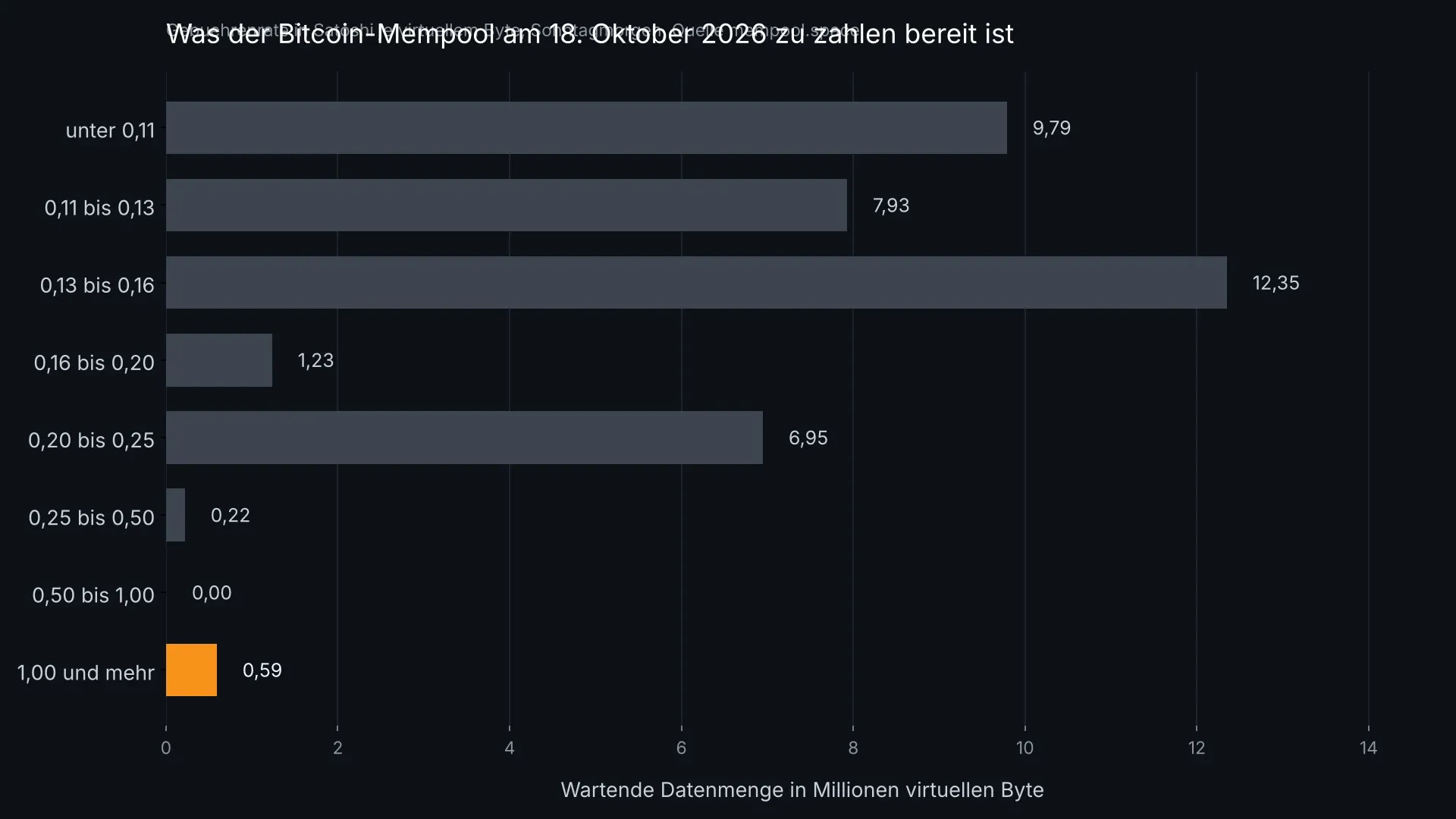
The striking part: the mempool, the queue of transactions still waiting for confirmation, is far from empty. 71,454 transactions are queuing there for space in the next block, 39.1 million virtual bytes in total. That is roughly 39 full blocks, about six and a half hours of work for miners. The fast lane still costs almost nothing. That contradiction is the heart of this morning, and it resolves cleanly.
Where the Bitcoin price stands on Sunday morning
Little has changed since Saturday. On Friday morning bitcoin stood at $81,437, when we covered the start of Deutsche Bank's custody service. That leaves about $250 of gains across two days, less than two tenths of a percent. The level that should shape the start of the week is the overnight high at $81,961: while the price stays below it, it moves inside the range that has held since Friday. On the downside the overnight low sits at $80,655, and only below that does the technical picture turn murky.
Trading volume on Kraken came to roughly 657 bitcoin over 24 hours. That is thin and fits the weekend: the spot market is resting, the traditional futures exchanges are closed, and there are no fund flows on Saturdays and Sundays in any case. There is no impulse to be had before Monday.
One satoshi per byte, and what that unit measures
The bitcoin network fee does not depend on the amount you send. Whether you move 50 euros or 50,000 euros makes no difference to the cost. You pay for space, measured in virtual bytes. A standard withdrawal with one input and two outputs takes up about 141 virtual bytes. A block holds roughly one million of them.
The fee rate therefore states how many satoshi you are willing to pay per byte of space used. A satoshi is one hundred-millionth of a bitcoin, about $0.0008 at today's price. Miners sort the mempool by that rate and fill the next block from the top down. Bid more and you sit further forward. Bid too little and you wait until the crowd thins out.
One satoshi per byte is not simply a low number, it is the floor: the default setting on most nodes will not even relay transactions below it. With the estimate for the next half hour sitting on exactly that value, the minimum is currently enough to make the next block. For the fastest tier the estimate stood at two satoshi this morning, and even that comes to 23 cents.
The mempool backlog is large and the fee is still minimal
This is where it gets interesting if you have ever waited on a confirmation. A full mempool was long read as a warning sign: many transactions queuing, so high fees. This morning that does not hold, and the reason lies in the distribution.
Of the 39.1 million virtual bytes in the mempool, 38.5 million are waiting at rates below one satoshi per byte. That is 98.5 percent of the entire backlog. Only 589,557 virtual bytes, or 1.5 percent, bid one satoshi or more. The average rate across the whole mempool is 0.167 satoshi per byte.
Translated into plain terms: the queue consists almost entirely of transactions that deliberately bid very little and are waiting for better conditions, often from batch processing or from applications that park data on the blockchain. Pay one satoshi per byte today and you overtake all of them, while the data competing with you amounts to about 0.59 of a single block. The backlog does not hold you up, it simply stands beside you.
What a Bitcoin withdrawal really costs today
Concretely, calculated at this morning's price:
- A standard withdrawal from an exchange to your wallet, one input and two outputs, takes up about 141 virtual bytes. At one satoshi per byte it costs 11.5 cents.
- A transaction with two inputs and two outputs, for instance when you merge two older amounts, takes up about 222 virtual bytes and costs 18 cents.
- Consolidating ten small amounts at once takes up about 722 virtual bytes and costs 59 cents.
For comparison, the same three operations at a rate of 20 satoshi per byte, which is usual in busy phases: $2.30, $3.63 and $11.80. At 50 satoshi per byte it would be $5.76, $9.07 and $29.49. The factor between today and a busy Tuesday therefore runs from twenty to fifty.
How to check the network fee before you withdraw
The figure in this article is a snapshot from Sunday morning. Before you send anything, your own look is worth the effort, and it takes under a minute.
- Open the fee estimate on your own node or on a public mempool service. It usually shows three tiers: the fast lane for the next block, the middle one for about half an hour, and the economical option. If all three sit close together, the network is quiet.
- Compare that figure with what your wallet suggests. Many wallets add a safety margin and offer two to three times the going rate. In quiet phases you pay that for nothing.
- See whether your wallet lets you set the fee rate by hand. If it only offers "fast", "normal" and "slow" without a number, you have no control over the price.
- Look for replace-by-fee support in your wallet. It lets you resend a transaction that went out too cheaply with a higher fee, instead of leaving it stuck for days.
Why your exchange often charges more than the Bitcoin network
One item is missing from the calculation above, and it hits most retail investors harder than any network fee: the exchange's withdrawal fee is a separate number. Many venues charge a flat amount per withdrawal, regardless of what the network costs at the time. Amounts in the range of a few euros are common, or a fixed satoshi figure calibrated to busy periods, which on a morning like this comes to a multiple of the actual network cost.
The cheap window in the network therefore only helps you if your exchange passes it on. Some venues bill dynamically and charge the real network price, others keep the flat fee constant all year. The terms a provider runs are set out in its fee schedule, and reading it before you move is time well spent. To see the different models side by side, the crypto exchange comparison breaks the fee structures down.
There is a second lever. Some exchanges offer withdrawals over the Lightning network. The blockchain fee does not arise there at all, but you need a wallet that speaks Lightning, and you tie yourself to your provider's channel structure. For small amounts that is often the cheaper route, for larger sums the direct path over the blockchain remains the sounder choice.
Consolidating ten small amounts in one go
Who gains most from this morning: months of savings-plan buys, each one moved to your own wallet, leave you sitting on many small pieces. In the Bitcoin network they are called unspent outputs, and every one of them takes up space later, when you sell or reshuffle.
Merging ten such pieces into a single one takes up about 722 virtual bytes. Today that costs 59 cents. In a busy phase at 50 satoshi per byte it would be $29.49. If the housekeeping is on your list anyway, a quiet weekend handles it far more cheaply than a weekday.
A tax note before you start: merging your own amounts into the same wallet is no sale and triggers no taxable event. It can, however, make the allocation of acquisition dates harder if your wallet or your tax software does not track the origin of the individual pieces cleanly. Write down beforehand which amounts you bought when.

The next difficulty adjustment falls on October 30
A look ahead that ties into the fee picture. Mining difficulty governs how hard it is to find a block, and it is retuned every 2,016 blocks. On October 16 it jumped by almost six percent, 5.92 percent to be exact. Average block time has sat at 10.21 minutes since then, slightly above the ten-minute target.
The estimate for the next adjustment stands at minus 1.77 percent. It takes effect at block height 973,728, expected on October 30. The blockchain currently stands at height 971,946, so about 1,780 blocks are missing.
The link to the fee is indirect but real. Longer block times mean fewer blocks per day and therefore less space. With strong demand that would push fees up. That rates sit at the floor despite slightly slower blocks shows how thin demand for block space really is right now.
Our take: the lull makes the window
From the newsroom's perspective this morning is a good window for anything that costs space on the blockchain, and at the same time a weak signal for activity on the network. The evidence lines up: an average of 0.167 satoshi per byte across the whole mempool, only 1.5 percent of the backlog above the minimum rate, and trading volume of 657 bitcoin in 24 hours on Kraken are three numbers that say the same thing. There is little going on.
The case for using the window: moving to self-custody or consolidating old amounts costs a twentieth to a fiftieth of what it costs midweek. The case against turning that into a statement about the price: low fees are no buy signal. What they measure is demand for block space, not demand for bitcoin. The two have often diverged in the past, and treating them as one reads a market claim out of a technical metric that cannot carry it.
How long the window holds cannot be forecast seriously. Experience says rates pick up as soon as the venues start working through their batches on Monday. If you have something planned, there is time until then.
How the one-year holding period relates to moving your Bitcoin
A point that concerns German investors and comes up with every wallet move: shifting your own bitcoin from an exchange to your own wallet is no sale. It is not a disposal, it triggers no tax, and it does not interrupt the one-year holding period. What counts is the acquisition date, not the place of custody.
You still need records, though. The tax office sees only a blockchain transaction, not the intention behind it. Keep the exchange's withdrawal confirmation with date, amount and destination address, along with your purchase receipts. Document that cleanly and you can later show that more than a year lay between purchase and sale. What lawmakers plan to do with the holding period is gathered in our piece on the current state of the holding-period reform.
On custody itself: a hardware wallet keeps the keys off your computer, and that is the real reason the move is worth making. Which devices support which blockchains, and how they differ in securing the recovery words, is set out in the hardware wallet comparison. One thing matters above all: write the recovery words down by hand and store them separately from the device. No photo, no cloud, no text file.
What is on the calendar for Monday
The start of the week brings back the data that moves the price. Fund flows into the US spot products are reported again from Monday, the futures market opens, and the venues' batch processing fills the mempool. For the fee picture that means today's rates are more the exception than the rule for the coming week.
For the price the two overnight levels remain: $81,961 on the upside, $80,655 on the downside. A break out of that range would be the first solid signal of the new week.
Bitcoin network fee on October 18: 12 cents per withdrawal
The situation turns into something concrete in three steps:
- Look up the fee yourself before you send. The estimate for the next half hour stands at one satoshi per virtual byte. If your wallet sets more, correct the figure by hand where it allows that.
- Hold your exchange's withdrawal fee against the network price. If your provider bills a flat amount, you pay a multiple of the real cost today. Your provider's fee schedule names the model.
- Get the housekeeping done on a quiet weekend. Merging ten small pieces costs 59 cents today instead of almost $30 in a busy phase. Suitable devices for self-custody are in the hardware wallet comparison.
(As of October 18, 2026. This article is not investment advice. Prices and fee structures change; check the terms with the provider before you buy.)
Decrypt
An FEC filing shows the Fairshake affiliate Defend American Jobs disclosed roughly $7 million more in ads against the Ohio Democrat, pushing its total past $46 million—days after the PAC expanded its map to 32 House races.
The nine-member group, modeled on the Internet Engineering Task Force, aims to set open standards for testing quantum-resistance claims as forecasts place the first practical attack in the late 2020s.
StepFun's STEPX Neo opened for pre-orders in China on Oct. 13 at 3,999 yuan, with an AI agent built into the operating system instead of bolted on as an app.
AI companies charge by the token, and most people burn them on jobs a cheap model could do. Here's how to spend less and get better results, from your first prompt to your first agent.
Tesla's new Roadster flips through the air, jumps a row of Teslas and lands on SpaceX thrusters. The Rocket version is invite only, not approved for public roads, and not due until 2028.
U.Today - IT, AI and Fintech Daily News for You Today
Monero's price surge isn't a fluke, as decreasing exchange liquidity will be pushing scarcity higher and higher.
Ethereum set to unlock new gas limit era as Glamsterdam upgrade enters final mile.
SEC Chairman Paul Atkins has reaffirmed the agency's commitment to establishing comprehensive crypto regulations despite legislative setbacks and leadership changes in Washington.
Cardano founder Charles Hoskinson has revealed that he is personally developing a new programming language for the blockchain.
Ripple's head of engineering has reacted to an AI breakthrough that solved a 25-year-old cryptography mystery, shedding new light on longstanding concerns about potential NSA backdoors.
Blockonomi
TLDR:
- Binance sell order at 21:21 UTC triggered liquidations that reached Hyperliquid-linked stock contracts
- Bullish positions made up about $38M of the $51.6M liquidated between 21:22 and 21:32 UTC on Saturday
- SOXL saw roughly $12.7M in liquidations, while SanDisk and SK Hynix each recorded about $10.8M
- Semiconductors had logged eight straight losing days, their worst streak since 2008, before the drop
A semiconductor flash crash wiped out $51.6 million in leveraged positions during weekend trading on crypto platforms. A large sell order on Binance at 21:21 UTC on Saturday triggered the liquidations.
The wave spread to venues such as Hyperliquid and hit contracts tied to SOXL, SanDisk, and SK Hynix. Thin liquidity worsened the drop, since US stock markets were closed. Prices rebounded quickly afterward, and the wider crypto markets held steady.
Binance Sell Order Triggers Liquidations Across Venues
Analyst AN Crypto described the semiconductor flash crash in a post on X. The post states that liquidations occurred between 21:22 and 21:32 UTC on Saturday. Positions tied to chip stocks and semiconductor funds were closed by force during that ten-minute window.
The selling began on Binance. Within seconds, it reached stock contracts linked to Hyperliquid. These contracts stay open even when US exchanges are shut.
$52 MILLION WIPED OUT IN JUST 10 MINUTES — WHILE WALL STREET WAS CLOSED.
Crypto exchanges are becoming a 24/7 casino for stock traders. This weekend, leveraged bets on semiconductor stocks suffered a massive liquidation wave, even though the underlying U.S. stock market wasn’t… pic.twitter.com/j4mTHAvzpk— AN Crypto (@ANCrypto_) October 18, 2026
Thin weekend liquidity left few buy orders to absorb the large sell order. The sequence showed how quickly pressure can move across trading venues.
A liquidation occurs when an exchange closes a leveraged position after the trader’s margin falls too low. Bullish traders took the largest share of the losses. About $38 million came from positions betting on higher prices. The rest came from traders betting on lower prices.
SOXL, SanDisk, and SK Hynix Lead the Losses
SOXL contracts recorded the biggest losses, with about $12.7 million liquidated. SanDisk and SK Hynix contracts followed, each seeing around $10.8 million in liquidations.
The liquidations came after a rough stretch for the semiconductor sector in regular trading. Chips had logged eight straight losing days, their worst streak since 2008.
Pullbacks in AI spending accompanied that decline. The streak left the sector under pressure before the weekend session began.
The semiconductor flash crash on crypto venues followed this run of losses. Together, the three contract groups accounted for about $34.3 million of the total. Other positions made up the remaining balance.
Lack of Live Stock Prices Complicates Weekend Trading
AN Crypto pointed to the absence of an opening bell as the central issue. With Wall Street closed, these contracts had no real-time share prices to anchor them. Traders were effectively reacting to each other, and leverage amplified the move.
US markets reopen on Monday. Actual share prices will then show how far weekend contract prices drifted from the underlying stocks. Until then, moves from the semiconductor flash crash cannot be compared with live stock data.
Tokenized stock exposure and perpetual contracts now allow markets to trade around the clock. Perpetual contracts have no expiry date, so traders can hold them while margin requirements are met.
However, constant access does not guarantee reliable price discovery or deep liquidity. Longer trading hours offer more opportunity, but they also create more ways for traders to face liquidation.
The post Semiconductor Flash Crash Wipes Out $52M in Weekend Crypto Bets appeared first on Blockonomi.
TLDR:
- XRP trades at $1.30, down 7.21% over seven days, with $1.30-$1.32 serving as key support.
- Vuori Trading identifies $1.39 as the next resistance and $1.87 as a potential breakout target.
- Cryptoinsightuk prefers a lower XRP entry near $1.22, with liquidity extending toward $1.20.
- Rising Bitcoin dominance could pressure XRP and other altcoins if capital continues favoring Bitcoin.
XRP is trading near $1.30 as traders monitor key support levels and a potential breakout from its descending channel. CoinGecko data shows XRP at $1.30, down 0.47% over 24 hours and 7.21% over the past week. Its 24-hour trading volume stands at $1,006,675,899.
Market analyst Vuori Trading identified $1.30-$1.32 as a support zone, with $1.39 as the next level to watch. A breakout above the descending channel could open a path toward $1.87, according to the analyst’s technical outlook.
However, Cryptoinsightuk sees potential for another decline before a stronger entry emerges.
The analyst is watching $1.22, with liquidity levels between $1.24 and $1.20 also drawing attention. The competing scenarios leave XRP traders weighing a possible rebound against continued downside pressure.
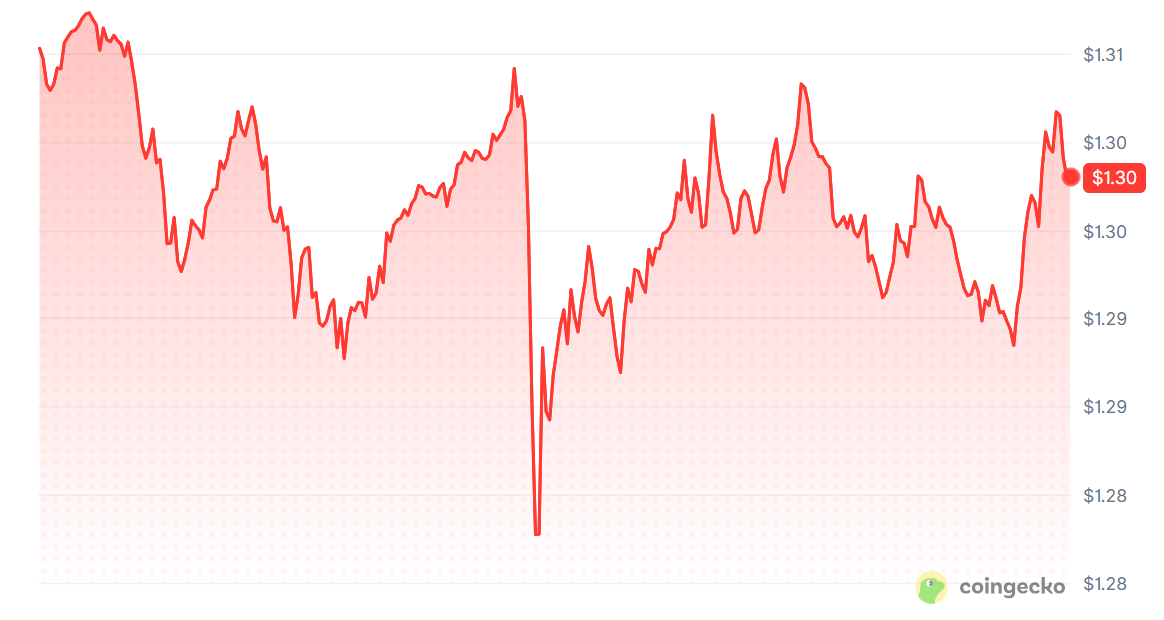
XRP Price Analysis: Can $1.30 Support Trigger a Rebound?
XRP is testing an important price area as traders assess whether the current decline has reached a local bottom. Vuori Trading considers $1.30-$1.32 a key support zone for the asset.
If buyers defend this area, $1.39 becomes the next logical level, according to Vuori Trading. A successful breakout from the descending channel could then place $1.87 within reach. That target remains conditional on a confirmed breakout rather than a guaranteed outcome.
A rejection at resistance could extend XRP’s existing downtrend. Vuori Trading identified $1.16 as a potential downside level if the decline continues without a successful breakout.
Cryptoinsightuk offers a more cautious view of the immediate setup. The analyst considers $1.30 a possible range low, with resistance around $1.60. However, the preferred entry remains lower, near $1.22.
The analyst also noted that XRP had nearly retested its recent lows while BTC maintained a higher low. This difference could matter if Bitcoin continues attracting liquidity away from alternative cryptocurrencies.
XRP Price Could Fall Further as Bitcoin Dominance Rises
Cryptoinsightuk highlighted Bitcoin’s recent price structure when assessing XRP’s next move. Bitcoin previously formed a range between approximately $80,000 and $87,000 before sweeping its lower boundary on October 15.
That move resembles an earlier pattern in which Bitcoin swept range support before moving higher. The analyst believes XRP could follow a similar recovery path, although a deeper correction remains possible.
The analysis identifies two potential scenarios for Bitcoin: a shallow correction that may already be complete, or a deeper three-leg ABC correction. The second scenario remains the analyst’s preferred outlook.
Bitcoin dominance adds another variable to XRP’s short-term prospects. Cryptoinsightuk said the weekly chart appears to show a breakout from a pennant pattern, potentially signaling further Bitcoin outperformance.
Rising Bitcoin dominance can indicate that Bitcoin is attracting a larger share of crypto market capital. If that trend continues, altcoins such as XRP could face additional pressure, even if Bitcoin itself rebounds.
The analyst identified a potential XRP liquidity zone between $1.24 and $1.22, extending toward $1.20. These levels represent possible entry areas, not confirmed price targets or guaranteed support.
The immediate question is whether $1.30 holds long enough to support a recovery toward $1.39.
A channel breakout could strengthen the case for $1.87, while renewed selling could expose lower levels. The next directional move depends on how price responds around support and resistance.
The post XRP Price Prediction: Bitcoin Dominance Puts $1.30 Support at Risk appeared first on Blockonomi.
TLDR:
- Justin Sun sold 80%–90% of his Ethereum near $3,600–$4,000 after identifying a fragile double-top pattern.
- He has not repurchased the Ethereum sold, although he retained a smaller core position and kept Bitcoin.
- Following the sale, Sun shifted capital into U.S. stocks, identifying Nvidia and Nasdaq-100 exposure.
- Ethereum closed near $2,402 on October 17, about 33%–40% below Sun’s reported $3,600–$4,000 exit range.
TRON founder Justin Sun reduced his once-dominant Ethereum position by roughly 80%–90% as the cryptocurrency approached $4,000, then redirected substantial capital into American stocks. In an October 16 interview with Jin Ming, Sun said he sold between $3,600 and $4,000 and has not repurchased those tokens.
Instead, he kept a smaller Ethereum stake while leaving his Bitcoin holdings intact. Before that decision, Ethereum had been his largest cryptocurrency holding, making the reduction his most consequential disclosed digital-asset shift. The disclosure revealed a divide between assets he considered vulnerable to a reversal and investments he wanted to retain longer term.
Nvidia and Nasdaq-100 exposure became central to that shift. However, Sun provided no token volumes, proceeds, or precise execution dates, leaving the transactions independently unverified. He described the move as a response to market structure rather than a withdrawal from decentralized finance.
Double-Top Fears Behind Justin Sun’s 80%–90% ETH Sale Near $4,000
Sun linked the sale to a double-top formation he perceived after Ethereum approached $4,800, fell back, and staged another advance. That pattern describes two attempts to sustain higher prices, although it cannot independently establish a reversal.
He said exchange-traded fund demand supported the second rally, citing investor Tom Lee when describing its buying momentum. Rather than rely on continued support, he considered the rebound fragile and reduced his exposure.
The market subsequently weakened. Ethereum reached approximately $4,950 in August 2025 and approached $4,755 again that October. By October 17, 2026, it closed near $2,402, roughly 33%–40% below Sun’s reported selling range.
Even so, the exit did not end his Ethereum involvement. He described the network as his preferred venue for large-scale decentralized finance operations because of its deeper liquidity. The distinction separates trading an asset from using its underlying blockchain.
Nvidia and Nasdaq-100 Investments Followed the ETH Reduction
After trimming ETH, Sun moved funds into U.S. equities, expecting investor attention to concentrate on American stocks. He identified Nvidia as a major holding and reported significant Nasdaq-100 exposure, without detailing allocations or purchase prices.
His position did not imply an unqualified bullish view of technology shares. Sun said he had become slightly bearish on the Nasdaq over the medium term, citing crowded AI investments and borrowing costs. That caution coincided with the Nasdaq Composite’s 2.1% decline on October 16. The index lost approximately 4.5% that week as investors questioned heavy artificial intelligence infrastructure spending.
Bitcoin remained a separate holding. Sun said he retained it throughout the previous year while monitoring potential cryptographic threats from artificial intelligence and quantum computing. He also described isolating Bitcoin in previously unused cold-storage addresses as a precaution, without predicting when such threats might materialize.
The post Justin Sun Reveals Why He Sold 90% of His ETH Near $4,000 and Pivoted to Nvidia appeared first on Blockonomi.
TLDR:
- Bitcoin trades at $81,546.13, down 1.79% over seven days, according to the latest CoinGecko data.
- Darkfost says Bitcoin’s MVRV percentile has fallen to 25.7%, returning below the 30th percentile.
- Bitcoin has historically spent around 25% of its time in this relatively low MVRV valuation range.
- Analyst Maison Cypher identifies $80,000 support and the 200-day moving average as key short-term levels.
Bitcoin is trading near $81,500, as on-chain data points to a potential accumulation zone following its rejection near $87,000.
CoinGecko data puts BTC at $81,546.13, up 0.02% over 24 hours but down 1.79% over the week. Trading volume reached $14.92 billion over the past 24 hours.
Meanwhile, analyst Darkfost says Bitcoin has fallen below the MVRV 30th percentile, currently at 25.7%. The reading suggests BTC has returned to a historically lower valuation range, although it remains above the extreme undervaluation levels associated with market bottoms.
The market is still consolidating between $81,000 and $82,000, according to analyst Maison Cypher. Traders are watching whether buyers can push Bitcoin back above its 200-day moving average (MA200).
A test of $80,000 support could weaken the short-term outlook and expose BTC to a deeper decline.
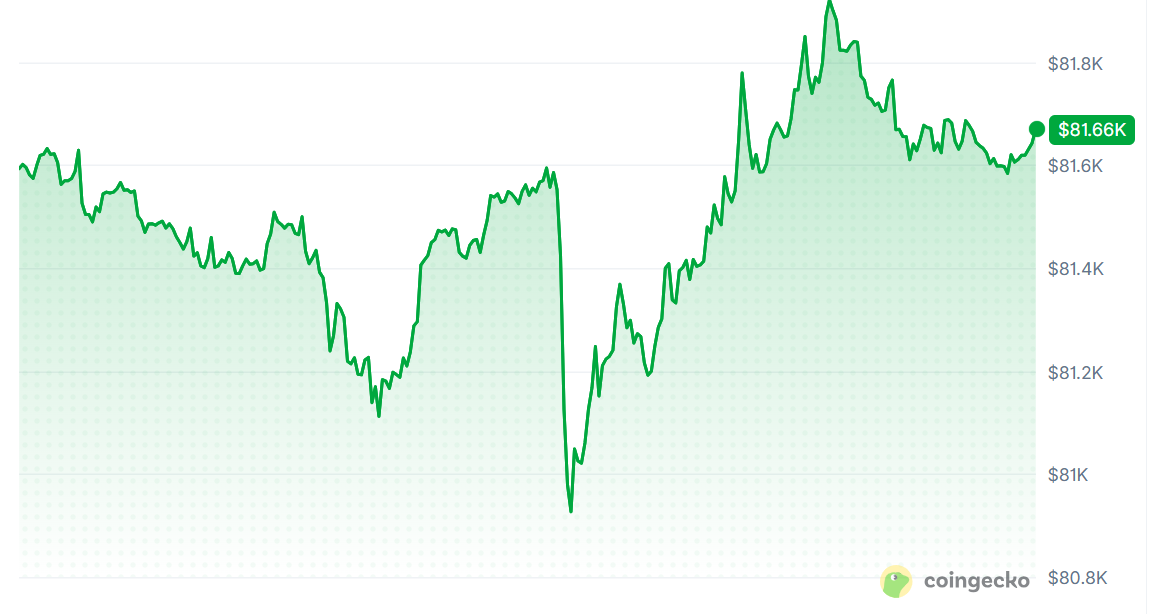
Bitcoin’s MVRV Signals a Potential Accumulation Zone
Darkfost’s analysis focuses on Bitcoin’s MVRV percentile rather than the raw MVRV ratio alone. MVRV compares Bitcoin’s market capitalization with its realized capitalization, which estimates the value of coins using their prices when they last moved on-chain.
The percentile approach places the current reading within Bitcoin’s historical valuation distribution. This helps analysts assess whether BTC trades at a relatively high or low valuation compared with previous periods.
According to Darkfost, Bitcoin’s MVRV has dropped below the 30th percentile, with the current reading at 25.7%. Bitcoin has historically spent only around 25% of its time in this valuation range, making it a relatively uncommon condition.
Darkfost describes this level as consistent with an established accumulation zone. However, the analyst distinguishes it from the extreme undervaluation zone that has historically coincided with market lows.
This distinction matters because a low MVRV percentile does not guarantee an immediate recovery. Instead, it provides historical context for investors assessing Bitcoin’s valuation during market weakness.
Bitcoin Price Faces a Key Test at $80,000 Support
Bitcoin’s immediate direction remains uncertain as the price struggles to leave its narrow trading range. Maison Cypher expects further consolidation before the market attempts a decisive move.
The analyst identifies the MA200 as an important level for buyers seeking to restore upward momentum. A recovery above this moving average would support the bullish case, although it would not confirm a sustained trend reversal.
Conversely, a move toward $80,000 could increase downside risks. Maison Cypher warns that losing this support could expose Bitcoin to a deeper decline. The analyst has not provided a specific downside target.
These technical levels complement Darkfost’s on-chain valuation analysis but measure different market conditions. MVRV percentiles describe Bitcoin’s valuation relative to historical levels, while support and moving averages help traders assess price behavior.
For investors, the combination offers context rather than a confirmed trading signal. Bitcoin’s position below the 30th MVRV percentile may interest longer-term accumulators, but short-term traders still face uncertainty.
Bitcoin is trading in a historically low valuation range while struggling to regain upward momentum. A move above the MA200 could strengthen recovery hopes, whereas a break below $80,000 would raise downside concerns.
The post Bitcoin Price Outlook: $80K BTC Support Faces Test as MVRV Falls appeared first on Blockonomi.
TLDR:
- SUI trades at $0.9796, down 2.74% in 24 hours and 10.74% over seven days.
- Expert More Crypto Online identifies $0.929 as the next support within SUI’s descending wedge pattern.
- Analyst Giannis Andreou marks 0.85–0.86 as support, with $0.66 as the chart’s invalidation level.
- SUI must reclaim $1.04 and $1.34 before higher resistance levels enter focus.
Sui (SUI) is trading near $0.98 as selling pressure continues across the altcoin market. CoinGecko data puts SUI at $0.9796, down 2.74% over 24 hours and 10.74% over the week.
Technical analysts are watching support levels as the token continues to form lower lows.
More Crypto Online identifies $0.929 as the next critical support within a descending wedge pattern. Meanwhile, Giannis Andreou’s weekly analysis identifies $0.85 to $0.86 as another important downside zone.
The charts show SUI trading far below its previous highs above $5. However, any recovery must overcome several resistance levels before the broader bearish structure changes.
The immediate focus remains on whether buyers can defend support or selling pressure pushes prices lower.
SUI Price Analysis: Why $0.929 Matters
More Crypto Online’s analysis on X identifies $0.929 as the next support level for SUI.
The accompanying one-hour Coinbase chart places the 50% Fibonacci retracement at approximately $0.9294. SUI was trading near $0.9868 on that chart, leaving support below the observed price.
A descending wedge forms when price moves between downward-sloping trendlines that gradually converge. Traders monitor these patterns for potential breakouts, although the formation alone does not confirm a reversal. SUI’s continued lower lows suggest sellers remain in control of the current price structure.
The $0.929 level therefore represents a nearby technical area to watch. A sustained move below it could expose lower support, although the supplied analysis does not establish the next downside target. Conversely, a recovery would need buying pressure and resistance breaks to strengthen the bullish case.
CoinGecko’s figures reinforce the weakness visible on the charts. SUI’s 24-hour trading volume stands at $645,383,763, alongside its weekly decline of 10.74%.
Volume provides market activity context, but these figures alone cannot establish whether selling pressure is about to ease.
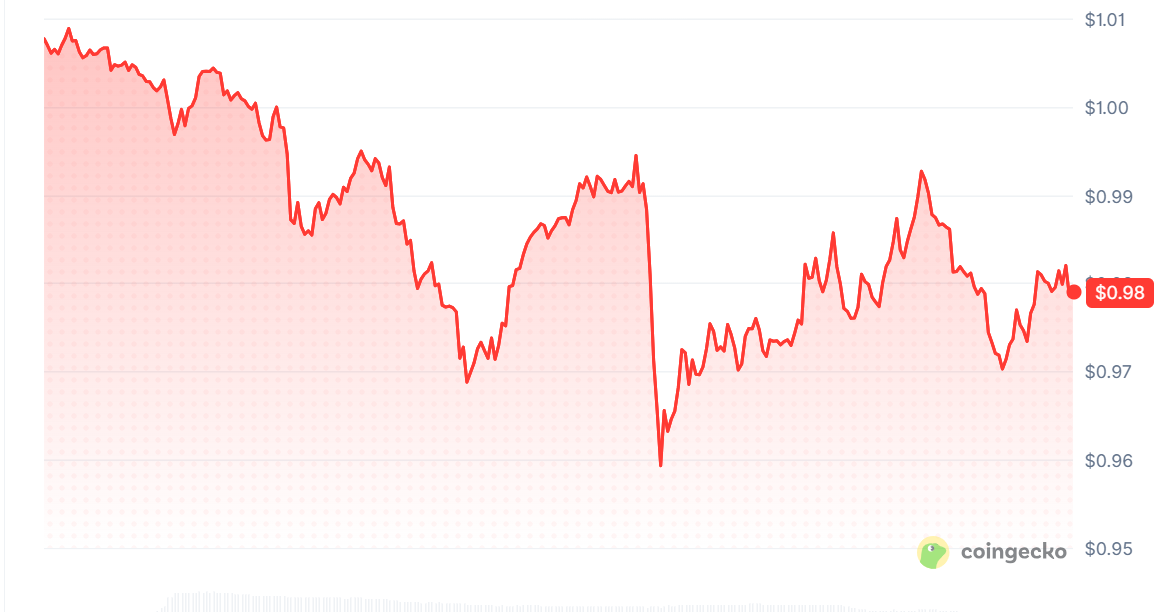
SUI Price Analysis: Can Buyers Reclaim $1.04?
Giannis Andreou’s weekly chart identifies $1.04 as the first resistance level SUI needs to reclaim.
The latest weekly candle faced rejection near $1.14 before falling below that threshold. Resistance at $1.34 presents the next major hurdle for any sustained recovery.
On the downside, Andreou highlights $0.85 to $0.86 as an immediate support zone. A sustained weekly close below this region would weaken the recovery scenario and expose the marked $0.66 invalidation level. These levels represent chart-based scenarios rather than guaranteed price outcomes.
$SUI WEEKLY ANALYSIS: THE RECOVERY HAS SEVERAL LEVELS TO CLEAR$SUI is trading around $0.99 on this chart, following a prolonged decline from above $5. The major descending trendline remains overhead, so the broader bearish structure has not yet been reversed.
The latest… pic.twitter.com/HwUGbjvQah
— Giannis Andreou (@gandreou007) October 17, 2026
A stronger recovery would require SUI to reclaim $1.34 and establish support above it. The chart then identifies $1.80 and $2.35 as subsequent resistance levels.
A break above the descending trendline would provide additional evidence that the longer-term structure is improving.
Beyond $2.35, Andreou’s chart marks $3.92 as another resistance level, followed by previous highs above $5. However, these targets belong to a longer-term bullish scenario, not an established price trajectory.
The immediate distinction is between holding support and confirming a reversal. SUI must first navigate the $0.929 level highlighted by More Crypto Online and the lower $0.85 to $0.86 zone identified by Andreou.
Until resistance levels are reclaimed, the prevailing bearish structure remains intact.
SUI faces several technical hurdles despite the possibility of a recovery. Support near $0.929 is the immediate focus, while $1.04 and $1.34 are important upside levels to monitor.
The post Sui Price Analysis: $0.929 Support at Risk as SUI Drops 10% appeared first on Blockonomi.
CryptoPotato
Bitcoin’s recovery since the summer lows has been accompanied by an unusually sharp shift in analyst sentiment, and CryptoQuant believes the pattern closely resembles the early stages of the previous major bull cycle.
In its latest report shared with CryptoPotato, the company found that sentiment across BTC, ETH, BNB, XRP, and SOL has shifted from bearish to bullish since early July. More importantly, CQ said the move has been “deeper, faster, and broader” than the turn witnessed between late 2022 and early 2023.
Analysts Turn Bullish
CryptoQuant’s 30-day Analyst Consensus Index bottomed at -18.3 on July 2, when BTC’s price had tumbled to under $58,000, and climbed above 0 on July 27, when the cryptocurrency was still trading around $63,800. This dramatic increase came just a few weeks before bitcoin skyrocketed toward $80,000 in late August.
The index now stands at +49.2, while the share of bullish analysts going viral has rocketed from under 40% to almost 85%. CQ said this represented 137 of 164 voters. The shift also appears to be more than an influx of new bullish commentators, as 47 analysts flipped from bearish to bullish among 85 who held a BTC call both at the start of July and now. In contrast, only five have moved in the opposite direction.
CQ’s report compared the current environment with the beginning of the previous major cycle. In 2022-2023, BTC’s consensus index rose by 36 points over 103 days while the asset gained roughly 65%. The difference is quite striking, as sentiment has soared by 67 points over the same period this time, even though the cryptocurrency rallied by a more modest 33 points from the July low.

Consequently, CryptoQuant concluded that analysts have moved further ahead of BTC’s price than they did at the start of the 2023 bull market. This is not an isolated development, as large bitcoin holders recently began reaccumulating sizeable portions of the asset after months of selling. At the same time, CQ’s Bull Score Index jumped from 20 in July to as high as 90 in September.
ETH and SOL See Bigger Bulls
Ethereum’s consensus index has climbed from +0.1 to +58.3, with 88% of analysts turning bullish. Solana has the strongest reading of the five examined assets at +72, with 31 out of 34 analysts (91%) betting on the bulls.
This also shows a substantial departure from the previous cycle, as ETH and SOL lagged BTC’s sentiment recovery in 2022-2023, whereas this time they have led.
XRP has gone a ramatic reversal as well, with its consensus falling to -8.0 on August 20, which coincided with its multi-year low at $0.99. The index rebounded to 36.7% within weeks as analysts turned bullish after the token’s price rocketed to over $1.50 at the time.
The post Bitcoin Analysts Are More Bullish Now Than at the Start of the 2023 Bull Market: CryptoQuant appeared first on CryptoPotato.
The typical weekend sluggishness was briefly disrupted over the past several hours, with BTC dipping by a grand before rebounding just as quickly in what appeared to be a flash crash.
The altcoins followed suit, many experiencing even more violent volatility during a calm weekend. However, even more fluctuations are expected on Monday.
BTC Dips and Rebounds
The business week began on the right foot for the primary cryptocurrency, with a price surge to $84,250. However, it quickly came to an end as the bears took over and pushed the asset south to $81,000 within hours. Interestingly, the recovery was equally rapid, and BTC knocked on the $84,000 door by Tuesday morning.
It remained close to that level until Wednesday, when the US CPI numbers for September were announced. As inflation appeared slightly higher than expected, BTC dipped to $82,000. A day later, the PPI confirmed this narrative, and bitcoin nosedived to $80,200 at first, before the bears drove it a step further to a monthly low of $79,800.
The bounce-off was quite impressive, as the cryptocurrency jumped by several grand almost immediately. It neared $83,000 once again on Friday, but it was halted and remained below $82,000 as the weekend began. Then came the aforementioned flash crash that saw BTC dip from $81,600 to $80,750, before it jumped to $82,000 and retreated to its starting level.
Calls for a “Black Monday” are going viral among analysts online due to several factors, including the broader stock market correction from last week, so more volatility is likely to ensue tomorrow.
For now, BTC’s market cap remains at $1.630 trillion on CMC, while its dominance over the alts is back at 60%.

Alts Rebound Too
Most larger-cap alts went through a similar flash crash as BTC over the past several hours, but have remained in the red on a daily scale. ETH dipped to $2,360 and now struggles to remain above $2,400. XRP continues its fight with the $1.30 support, currently sitting on the wrong side.
ZEC, SOL, HYPE, DOGE, TRX, LINK, and ADA are all in the red once again, while XMR, RAIN, and HBAR have posted 3-4% gains. BTW has stolen the show again, rocketing by 17% to $2.43.
The total crypto market cap is down by 0.2% daily to $2.730 trillion on CMC.

The post BTC, ETH, XRP Recover From a Flash Crash as More Volatility Looms: Weekend Watch appeared first on CryptoPotato.
It was a packed week for Ripple and XRP, with Evernorth making its long-anticipated Nasdaq debut after a major merger, Standard Chartered and Cross River expanding RLUSD access, and Ripple Prime pushing further into Wall Street.
None of those developments helped the company’s native asset mark any gains – just the opposite.
Wall Street and Ripple Expansion
Standard Chartered announced on October 12 that it is launching institutional custody for Ripple’s stablecoin on the XRP Ledger through its DIFC branch in Dubai. The banking behemoth is also working with Ripple and LMAX Group on a planned arrangement that could eventually allow RLUSD to serve as collateral for selected institutional trading products.
Evernorth Holdings began trading on Nasdaq under the XRPN ticker on the same day. Its stock opened at around $16.7, surged briefly to $19.40, before it dropped and closed at just under $17. The broader market’s correction, though, pushed it south at the end of the week, closing on Friday at $15.45.
Evernorth entered the public markets with approximately 473 million XRP in its treasury and $300 million in gross cash proceeds. A few days after the Nasdaq debut, the company named Ripple, Coinbase, Kraken, and BitGo as its first institutional execution partners. The group will help deploy the XRP treasury into institutional strategies beginning in Q4.
Ripple itself also made a Wall Street move by launching 24/7 real-world asset perpetual swaps through its prime brokerage platform. This gives institutional clients exposure to more than 100 reference markets covering stocks, ETFs, commodities, currencies, and other traditional assets.
Cross River Bank said it would integrate RLUSD and XRP Ledger settlement into its banking infrastructure on October 16, enabling eligible businesses to move between dollars and RLUSD, process cross-border payments, and manage treasury transfers through a single API.
XRP Price Doesn’t Follow
The major institutional developments have failed to push XRP higher. The asset was rejected at $1.40 earlier this week and quickly tanked to $1.30. Although it rebounded to $1.38, it slumped once again as the week progressed and dived to a monthly low of $1.27 during the flash crash on Saturday evening.
On October 16, analysts identified several potential bottoming signals, with Ali Martinez indicating that he was watching $1.25 as a possible buying zone and $1.42-$1.60 as upside levels if the token rebounds.
Shortly after, EGRAG CRYPTO offered a much longer-term interpretation, arguing that XRP’s chaotic action around $1.30-$1.33 resembles previous prolonged bottoming formations. His bullish scenario requires a future breakout through $3.67, which could eventually open Fibonacci targets at $5.25, $6.33, $8.28, and a highly speculative $13.69.
The post Ripple and XRP Weekly Wrap: Institutional Wins, Nasdaq Debut, and Price Struggles appeared first on CryptoPotato.
Although the cryptocurrency markets are open during the weekends, they have become prone to volatility over the past several months, which returns on Monday morning.
However, something strange happened over the past several hours: most digital assets experienced a sudden flash crash. It wasn’t an isolated case, as major AI stock perpetuals plunged by up to 5% within minutes, before rebounding. At the same time, calls for a “Black Monday” have skyrocketed, which could actually be a blessing in disguise.
Flash Crash for All Markets
Numerous reports on X outlined the rather unexpected developments that took place on the futures markets. Recall that most financial markets closed a painful week, with the S&P 500 dropping by 2%, the Nasdaq 100 and the Nikkei tanking by roughly 5%, while the KOSPI plunged by nearly 14%.
Some major perpetuals, most linked to AI stocks and semiconductor businesses, dropped hard on Saturday evening/Sunday morning, including SOXL (-5.45%), SNDK (-3.6%), MU (-3.42%), and others. Most losses were quickly erased, with markets rebounding from this flash crash, but millions of dollars worth of leveraged positions were already liquidated.
Something similar transpired in the crypto markets, with BTC dropping by a grand before rebounding by $1,200, and ETH tanking from $2,420 to $2,360, and back to $2,410. Many analysts caught these moves and questioned whether this was just a weekend shakeout or a warning before “Black Monday.”
BREAKING: Something very WEIRD just happened.
Bitcoin and Ethereum suddenly dumped, while major AI stock perpetuals plunged 5% within SECONDS, then quickly bounced.
No obvious news. U.S. stock markets closed.
With onchain trading running 24/7, there’s no rest anymore.
A weekend shakeout… or a warning before BLACK MONDAY?
— Crypto Rover (@cryptorover) October 18, 2026
Calls for such a “Black Monday” development have skyrocketed over the weekend after the painful end to the previous business week. However, the Kobeissi Letter believes such expectations typically lead to the opposite move and predicted the S&P 500 could soon hit a new all-time high of 8,000 if “history is any guide.”
Ukraine Hits Russia
Although they might not be directly related, these price moves coincided with the latest escalation in the war between Russia and Ukraine. This time, the latter struck the St. Petersburg oil port and “set it ablaze,” according to reports on circulating videos online.
The two sides had reached an agreement earlier this week to refrain from hitting each other’s energy centers, which was reportedly violated by Russia. Ukraine’s President Zelenskyy said his country will restart attacking Russian energy sites.
The post BTC, ETH, AI Stock Perpetuals Suddenly Dump as ‘Black Monday’ Fears Surge appeared first on CryptoPotato.
Solana’s on-chain economy is growing beyond meme coins. In fact, a new report suggests that real-world assets (RWAs) are emerging as one of its fastest-growing sectors.
Castle Labs found that Solana’s tokenized RWA market grew by more than 600% over the past year as it rose from $700 million to $4.3 billion. That puts it well ahead of Ethereum, where the tokenized market grew just 7% over the same period, from $15.5 billion to $16.6 billion.
For context, Solana’s RWA market was only 4.5% of Ethereum’s size a year ago. It now stands at 26%.
Solana’s Onchain Economy
The growth comes as Solana builds out its DeFi ecosystem and attracts more assets beyond speculative trading. The network now offers access to US Treasury debt, asset-backed credit, tokenized stocks, commodities, and curated investment strategies. Tokenized stocks, for one, have been a major part of this expansion. Their market value on Solana jumped from $63 million to $455 million.
The report said more than $65 million in tokenized equities on the chain are being used to earn yield. Much of this activity is driven by xStocks, whose assets can be used as collateral on lending platforms such as Kamino and Jupiter Lend. This gives holders more options than simply buying and holding tokenized shares.
Castle Labs said that the same trend was seen across other RWA categories. Ondo-related reinsurance exposure is available through ONyc from OnRe, while Hastra offers PRIME and AUTO, backed by home and consumer auto loans. Maple Finance has also expanded to Solana with syrupUSDC. These products are bringing yield-bearing assets into the network and creating new opportunities for lenders and borrowers.
DeFi Ecosystem Gains Momentum
The RWA expansion is also helping support Solana’s wider DeFi growth. Lending protocols can use tokenized assets as collateral, while users can borrow against them and put their capital to work elsewhere. As more assets arrive, that activity can create additional demand for lending and borrowing, Castle Labs explained.
Additionally, Solana has become a major force in onchain application revenue. It generated over $193 million over the past 30 days. This figure, interestingly, is nearly twice Hyperliquid’s $86.5 million. Consumer applications still account for around 80% of that revenue. Launchpads, trading terminals, wallets, and other platforms have contributed to the total.
The post Solana’s RWA Market Explodes 600% in a Year as Ethereum Struggles to Keep Up appeared first on CryptoPotato.