Cryptocurrency Posts
Crypto Briefing
Iran's economic strain and leadership uncertainty could destabilize political dynamics, affecting both domestic and international relations.
The post Iran central bank dismisses collapse claims amid 74% inflation, rial drop appeared first on Crypto Briefing.
India's focus on AI startups could shift global tech dynamics, challenging US and China dominance while boosting local innovation and economy.
The post India’s billionaire family offices bet big on homegrown AI startups appeared first on Crypto Briefing.
Taiwan's industrial park initiative in Texas could significantly enhance US-Taiwan trade relations and bolster the semiconductor supply chain.
The post Taiwan plans up to $4 billion Texas industrial park for Nvidia suppliers appeared first on Crypto Briefing.
The revised loan terms highlight growing caution among investors in AI infrastructure, indicating a recalibration of risk tolerance in the sector.
The post JPMorgan and Goldman Sachs sweeten terms on Volta’s $5 billion AI loan appeared first on Crypto Briefing.
Bailey's focus on cost-cutting over inflation suggests potential stability in wage and price-setting, impacting future BoE policy decisions.
The post BOE’s Bailey sees subdued inflation effects, businesses focus on cost-cutting appeared first on Crypto Briefing.
Bitcoin Magazine
Bitcoin Magazine

Brooklyn DA Pulls the Plug on Crypto Scam Network
The Brooklyn District Attorney’s office has dismantled the online backbone of a multinational cryptocurrency scam that drained tens of millions of dollars from Russian-speaking victims across the U.S.
Working with the FBI, investigators executed search warrants across three time zones in a matter of hours and seized or disrupted 241 scam domains and more than 100 cloud servers hosted by Eastern European and American companies. The servers held the scammers’ victim data, site content and operating software, according to a Wednesday statement.
“Our groundbreaking Virtual Currency Unit identified the fraud, tracked the stolen cryptocurrency, broke new ground by uncovering the infrastructure behind the operation, and worked with the FBI to dismantle it,” Brooklyn District Attorney Eric Gonzalez said.
“By disrupting more than 100 servers and hundreds of fraudulent websites, we have struck at the heart of this criminal enterprise and made it far harder for these scammers to victimize others. I commend our investigators and thank the FBI for their partnership in this extraordinary operation.”
The scam worked by luring victims via Russian-language investment ads on Facebook. A Russian-speaking “advisor” then called and walked them through opening an account on a fake crypto platform and buying digital assets.
Weeks or months later, when victims tried to withdraw, they were locked out or hit with bogus “fees” and “taxes.”
Some lost their life savings. Then the scammers came back for more: Posing as recovery services, they contacted victims weeks later and promised to retrieve the stolen money.
The unit had already taken down 400 scam domains, but new ones kept appearing. Hitting the servers behind them cuts off the scammers’ ability to launch new sites quickly or reach past victims.
The three-year investigation has recovered about $300,000 so far, and prosecutors say they are working to claw back more.
This post Brooklyn DA Pulls the Plug on Crypto Scam Network first appeared on Bitcoin Magazine and is written by Mathew Di Salvo.
Bitcoin Magazine

Bitcoin’s Volatility Has Fallen Within S&P 500 Ranks, Study Shows
Stocks and shares are a safer bet than buying bitcoin? Not so fast.
According to research from crypto asset manager Grayscale, the digital coin’s realized volatility fell within the distribution of S&P 500 constituents — with a meaningful number of large-cap stocks exhibiting more price swings.
Bitcoin’s price surged in August and September, giving it its best quarter in years and leading a number of analysts to declare that it’s back in a bull market.
“As the asset has matured, with deeper liquidity, broader institutional participation, and more regulated access venues, its price swings have narrowed considerably from the extremes of its early years,” the Grayscale’s head of research, Zach Pandl, wrote in a Wednesday note.
“That shifts the question from whether to own a volatile asset to how to size an allocation.”
He added that bitcoin’s volatility has declined to 43% over the past year, from an average of 64% over the past 10 years and 81% five years ago.
It is now lower than that of 19% of S&P 500 constituents. “For those comfortable owning volatile equities, Bitcoin’s price fluctuations may be less daunting than assumed,” the report added.
December data from K33 Research revealed that 2025 was the least volatile year for the asset so far.
Bitcoin’s price became notorious for wild swings in its early days — with drawdowns of over 80% in the space of months.
But as more investors have piled into the asset — especially since the 2024 approval of U.S. spot bitcoin exchange-traded funds — it’s become harder to move its price.
Still, bitcoin at one point in 2026 was down over 50% from the all-time high it hit last October . It has since recovered and was recently trading for $82,485 — 35% below its record of $126,080.
The coin in August benefited from news that the U.S. Treasury would at least double the size of its liquidity-support buyback operations. The so-called debasement trade — where investors buy an asset to hedge against a weakening currency — has become popular again, especially as the dollar has dropped.
This post Bitcoin’s Volatility Has Fallen Within S&P 500 Ranks, Study Shows first appeared on Bitcoin Magazine and is written by Mathew Di Salvo.
Bitcoin Magazine

US Hoovers up Bitcoin While the World Runs on Its Digital Dollars: Report
America is accumulating bitcoin while exporting dollar-pegged stablecoins to everyone else, according to a new Chainalysis report.
The blockchain data said in its Wednesday report, “North America: Inside the Growth of Agentic Commerce,” that the U.S. became a net importer of Bitcoin in 2026 — for the first time since 2022.
According to the data, institutions this year have been buying bitcoin while retail largely sells.
“A dollar stablecoin is a way to hold dollars without an American bank account, and Americans already have one,” the report read.
“The rest of the world is pivoting to a digital dollar because it meets a need that American users don’t share. Meanwhile, Americans are leaning harder on bitcoin as an infinitely scarce store of value.”
It added that U.S. dominance keeps climbing: Since the 2024 launch of spot bitcoin exchange-traded funds, America’s share of global Bitcoin activity has risen every single reporting period — even as the overall U.S. crypto economy ($2.78 trillion) contracted 2.2% in a brutal bear market, retaining most of 2025’s near-doubling.
The U.S. Securities and Exchange Commission approved bitcoin ETFs in January 2024 after a decade of denying the products.
Managed by Wall Street titans like BlackRock, Fidelity, and most recently, Morgan Stanley, the funds had the most successful debut in the history of ETFs.
Institutions and Wall Street can now buy shares of the funds which track the price of bitcoin and take care of buying and selling the digital coin.
The approval of the ETFs has helped the industry mature, the report noted, and helped the U.S. become an overall bigger bitcoin investor.
Stablecoins, meanwhile, have turned U.S. debt into a “currency-of-choice for peer-to-peer economies as well as businesses working across borders,” the report continued.
“In the 2026 period we continued to see stablecoins enter new use cases most especially abroad, benefitting the U.S. companies, and the U.S. government, with billions of dollars in economic activity,” it added.
Since Donald Trump became president, he has signed a number of pro-crypto laws and executive orders. The GENIUS Act, signed in 2025, allows banks and other entities to issue stablecoins if they back the tokens with assets like U.S. Treasuries and provide monthly disclosures of their reserves.
This post US Hoovers up Bitcoin While the World Runs on Its Digital Dollars: Report first appeared on Bitcoin Magazine and is written by Mathew Di Salvo.
Bitcoin Magazine

Ledger Says Organized Crime Group Spent Millions Targeting Hardware Wallet Users
Ledger has issued a statement following reports from customers of loss of funds and tampered devices, calling it one the most “sophisticated attacks” the digital asset industry has experienced.
The hardware manufacturer said Thursday that a “highly organized criminal group” bought Ledger devices and installed implants that could read users’ seedphrases before then putting them back into the supply chain via resellers.
Paris-based Ledger last week said it had started an investigation after customers in South East Asia reported they’d lost funds after buying from Malaysia-based reseller, CryptoBilis.
The company then said it confirmed that one of the impacted users’ devices contained an unauthorized hardware implant.
It isn’t clear how much money has been lost from the tampered devices but blockchain investigator Specter said $86 million had been drained. Ledger did not respond to Bitcoin Magazine’s written questions.
“[The criminal group] built their own logistics and technology infrastructure with seeds collector servers, draining and laundering infrastructures. They were patient, they spent millions, and they struck in one coordinated operation, draining wallets,” Ledger said in a Thursday statement.
“There was no flaw in Ledger’s chip, operating system or servers. Ledger’s systems were not compromised. This was an attack on the distribution channel after the devices left our control.”
The company said that in its “largest investigation to date” it sent employees to other markets — including Europe — to make sure other supply chains hadn’t been targeted.
It said that screened devices were clean and authorized resellers and distributors in Southeast Asia and Hong Kong have suspended their sales.
Ledger added that it was working with law enforcement to “follow the funds and dismantle the attackers’ infrastructure.”
It isn’t clear how many customers had been targeted from Ledger’s statement.
The crypto industry is still reeling after hackers in July were able to steal close to $120 million in bitcoin from Coldcard users.
There have also been a number of data breaches this year, with scammers targeting Ledger to get customer information via the company’s payment processor Global-e.
This post Ledger Says Organized Crime Group Spent Millions Targeting Hardware Wallet Users first appeared on Bitcoin Magazine and is written by Mathew Di Salvo.
Bitcoin Magazine

Bitcoin Briefly Slides Below $80,000 On More Hot Inflation Data
Bitcoin’s price momentarily dipped below $80,000 on Thursday following more hotter-than-expected U.S. inflation data.
The price of the biggest cryptocurrency recently stood at $81,028 after dropping as low as $79,805 on Thursday morning in New York.
Over a 24-hour period, it’s only down over 1% after making a recovery. But over the past week, it’s shed nearly 3% of its value.
Data Thursday from the Labor Department’s Bureau of Labor Statistics showed U.S. producer prices rose in September at the fastest pace in more than four years.
The numbers came one day after September’s Consumer Price Index came out higher than expected.
Bitcoin has news that high prices won’t go away in the world’s largest economy — leading traders to bet that the Federal Reserve may keep interest rates higher for longer.
The Federal Reserve will make a decision on what to do with interest rates at the end of this month.
Bitcoin’s price has previously done well in a low interest rate environment as when borrowing costs are cut, more liquidity can be used to buy the cryptocurrency.
But the Fed this year has raised interest rates, with the head of the central bank claiming that getting inflation down in the U.S. is its number one priority.
The biggest cryptocurrency is currently nearly 36% below the record of $126,080 it touched last October.
Despite the dip this week, analysts have declared the asset to be out of the bear market it spent most of 2026 following a rally in August and September.
This post Bitcoin Briefly Slides Below $80,000 On More Hot Inflation Data first appeared on Bitcoin Magazine and is written by Mathew Di Salvo.
CryptoSlate
Toronto police allege attackers sought cryptocurrency and business security access; searches uncovered ammunition stolen from the military.
Read the full story on CryptoSlate
Understand the crypto stories that matter and what to watch next. Get The Catalyst in your inbox
Reservations are open for the data-only device, which pairs everyday apps with hardware approvals and targets 2027 delivery.
Read the full story on CryptoSlate
Understand the crypto stories that matter and what to watch next. Get The Catalyst in your inbox
Nic Carter's hypothetical attack highlights why safer signatures would leave an ownership choice for holders unable to migrate or prove prior control.
Read the full story on CryptoSlate
Understand the crypto stories that matter and what to watch next. Get The Catalyst in your inbox
River’s net holdings figures show concentration, while issuer disclosures separate fresh purchases from merger transfers, expected financing and share buybacks.
Read the full story on CryptoSlate
Understand the crypto stories that matter and what to watch next. Get The Catalyst in your inbox
The October 12–15 custody build raises a supply question, but the balance data cannot establish completed sales.
Read the full story on CryptoSlate
Understand the crypto stories that matter and what to watch next. Get The Catalyst in your inbox
CryptoTicker.io
A purchase of 100 euros on Bitvavo costs 25 cents according to the fee table. Move the coins to your own wallet afterwards and with Bitcoin you pay another 1.31 euros. The second item is therefore more than five times the first, and it appears in no advertising banner. For this article we recorded every one of the provider's cost items separately on 15 October 2026 and converted them into euros for the largest trading pairs.
The Bitvavo fees consist of four items, and only one of them is usually quoted. Ranked by weight, the order at small amounts is exactly the reverse of the order in which the items are advertised.
Four items that add up on a 100 euro purchase
The first item is the trading fee, a percentage of the order volume. The second is the spread, the distance between the best bid and the best ask in the order book; it is not charged as a fee but it worsens the price. The third is the withdrawal fee, charged when the coins leave the house. The fourth is the deposit and withdrawal in euros.
On 100 euros in Bitcoin the arithmetic looks like this: 25 cents trading fee, a spread in the range of ten-thousandths of a percent, 1.31 euros for the withdrawal to your own address and zero euros for the SEPA transfer. Together 1.56 euros, or 1.56 percent of the stake. Leave the coins where they are and you pay only the 25 cents.
What separates a taker order from a maker order
A maker order places an offer of your own in the order book and waits until somebody takes it. A taker order reaches straight for an existing offer and is charged more for it. Every purchase at the current price through the buy button is a taker order, and every limit order set away from the market price is usually a maker order.
The trading fee: 0.15 percent for maker orders, 0.25 percent for taker orders
For the entry tier several German comparison sites consistently quote 0.15 percent for maker and 0.25 percent for taker orders, among them capitalo.de, misscrypto.de and kagels-trading.de. On 100 euros that works out at 15 and 25 cents respectively. For the normal case, an immediate purchase at the market price, the higher rate applies.
Above the entry tier a sliding scale based on trading volume over the past 30 days takes effect. Its tiers diverge between the comparison sites, and there is a section of its own on that below. For amounts on the order of 100 euros it is irrelevant: in every account the first tier only begins at 100,000 euros of monthly volume.
For a sense of scale at a competitor: for Bitpanda we worked out on 1 October 2026 how much of the stake the spread in the purchase price consumes. There the price sits inside the quote instead of in a disclosed fee, which is why comparing two providers only becomes meaningful once both items stand side by side.

The spread in the order book: measured at 0.0005 to 0.0192 percent
A great deal is claimed about the spread and little of it measured. On the night of 15 October 2026 we read off the distance between the best bid and the best ask for the four largest euro pairs and related it to the mid price.
- Ethereum against the euro: 0.0005 percent, a gap of one cent at a mid price of 2,158.07 euros.
- XRP against the euro: 0.0008 percent, a gap of one hundred-thousandth of a euro.
- Bitcoin against the euro: 0.0014 percent, a gap of one euro at a price of 72,835 euros.
- Dogecoin against the euro: 0.0192 percent and thus the widest of the four, in absolute terms still a fraction of a cent.
Applied to 100 euros of Bitcoin, 0.0014 percent comes to about 0.14 cents. So on these pairs the spread is not the item that decides the cost. What was measured is a single snapshot in a quiet trading hour; in fast markets, and on orders larger than the best offer in the book, the gap widens. For exactly that, order book depth is a better yardstick than the spread alone.
The withdrawal fee per coin: 28 cents for Dogecoin, 1.31 euros for Bitcoin
Here sits the item that makes the difference at small amounts. Bitvavo discloses a fixed withdrawal fee for each of the 482 crypto assets it lists, denominated in the respective coin unit. Converted at the prices of 15 October 2026, that gives the following for the four largest euro pairs:
- Bitcoin: 0.000018 BTC, about 1.31 euros at a price of 72,840 euros.
- Ethereum: 0.00033 ETH, about 0.71 euros at a price of 2,160.60 euros.
- XRP: 0.34 XRP, about 0.40 euros at a price of 1.19 euros.
- Dogecoin: 3.9 DOGE, about 0.28 euros at a price of 0.07292 euros.
The most expensive move therefore costs 4.6 times the cheapest, and that at an identical value. Measured against 100 euros, the Bitcoin withdrawal at 1.31 percent is the single largest item in the whole exercise. At the minimum order of five euros it would be 26 percent. Ten of the 482 crypto assets can be withdrawn without a fee according to the provider's table, among them Neo, Theta and Mina.
A simple rule for practice follows: the smaller the amount, the more it pays to bundle purchases instead of withdrawing small sums one by one each month. A single withdrawal of 1,000 euros in Bitcoin costs the same 1.31 euros as a withdrawal of 100 euros. Which devices are suitable and which networks they support is set out in our hardware wallet comparison.
Euros in, euros out: SEPA free of charge in both directions
For euros Bitvavo charges nothing for either the deposit or the withdrawal according to its own table, in both directions via SEPA and with no minimum amount. That is the pleasant part of the calculation and the more important one for beginners: leave the coins at the trading venue and swap them back into euros later, and you pay the trading fee twice and nothing else.
Our assessment: for small, regular purchases this model is inexpensive as long as the coins stay at the trading venue. The evidence is above, 25 cents on 100 euros and zero euros for the transfer in both directions. Against it stands the custody risk: hand the private keys to the provider and you carry its default risk with it, and the only way to switch that off is a withdrawal, which in turn costs 1.31 euros. Which of the two items weighs more depends on the sum and the holding period, not on the provider. A total loss is possible with any crypto asset.

Five euro minimum order across all 427 euro markets
The minimum order size at this provider is unusually uniform. Of the 438 trading pairs, 427 run against the euro and eleven against the stablecoin USDC, and in every single one of the 427 euro markets the minimum order is exactly 5.00 euros. There are no pairs with a higher threshold, not even among the smallest assets on the list.
In practice that means a savings plan of 25 euros a month can be spread across up to five positions without hitting a minimum. Whether that makes sense is another matter, because every additional position generates purchase data of its own that you have to document for tax.
Five markets outside the standard category, and all five are stablecoin pairs
Bitvavo assigns every trading pair to a fee category. Of the 427 euro markets, 422 sit in the same category and the remaining five in two others: the euro pairs of the stablecoins USDC, EURC, EURCV, EUROP and USDCV. Several trading venues apply a separate, lower scale to stablecoin pairs, because both sides of the trade carry an asset with a fixed price.
For the cost calculation of an ordinary coin purchase that changes nothing, since Bitcoin, Ethereum, XRP and Dogecoin all sit in the standard category. It matters for the swap between the euro and a stablecoin, for instance to park a balance: there the separate category decides the rate, and that rate is in the provider's fee table.
Why the sliding scale tiers diverge between comparison sites
Search for the sliding scale and you find at least three different accounts. Capitalo lists tiers at 100,000, 250,000 and 500,000 euros of monthly volume, Misscrypto tiers at 100,000 euros, one million and five million, Kagels-Trading describes ten tiers up to 100 million euros. The rates at the highest tiers lie between 0.03 and 0.08 percent in these accounts.
All three agree on the entry tier and on the start of the first scale at 100,000 euros. The divergence above that is explained by the state of each page, as the figures carry dates from June to September 2026. For a calculation with small amounts the entry tier is enough; for anything above it the provider's table is the binding position. We give a range here because the sources give a range.
The licence: MiCA authorisation from the Dutch AFM, valid across the EU
A cost comparison is only worth anything if the provider is allowed to run the business at all. Bitvavo holds its authorisation under the EU regulation on markets in crypto assets from the Dutch financial supervisor AFM and provides its services in Germany through the European passport, so without a second authorisation from BaFin. You can look that up yourself, because the AFM lists the firms it has authorised in public registers.
This check is worth doing with any provider whose name you have from an advert. The company name is in the imprint, not on the app icon, and a company only appears in the register under that name.
What a licence does not cover
A licence is a statement about the provider, not about the crypto assets traded. An authorised trading venue can pull individual assets from trading at any time. We showed how that works at the end of September using the forced conversion of ICX into euros: first trading ended, and ten days later the remaining holdings were converted into euros automatically.
Withdrawing is not a sale: what counts for tax when you move coins
A withdrawal to your own address is not a disposal, because the coins only change where they are kept and not who owns them. The one-year clock keeps running and no taxable event arises. Tax only becomes due on the sale, or on the swap into another crypto asset, if no more than a year lies between acquisition and disposal under section 23(1) sentence 1 no. 2 of the German Income Tax Act.
Two things still matter when you move coins. First, the withdrawal fee is deducted in coin units, so in Bitcoin for Bitcoin. After the move there is correspondingly less at your own address, and the acquisition date of the remaining quantity stays as it was. Second, you will later need the purchase date, quantity and price of each tranche to prove the holding period. Neither travels with the coins automatically, and both are hard to reconstruct after the fact.
Bitvavo fees: at 100 euros the withdrawal costs more than the purchase
- Add both items together before you choose a provider. Trading fee plus withdrawal fee gives a different picture at small sums than the percentage alone. The terms of the major trading venues stand side by side in our comparison of the best crypto exchanges.
- Decide before you buy whether the coins stay or move. Leave them at the trading venue and the exercise costs 25 cents per 100 euros; move them and with Bitcoin 1.31 euros is added. Which device supports which networks is shown in the hardware wallet comparison.
- Check the licence under the company name from the imprint. Only providers authorised under the EU regulation may serve customers in Germany. Which trading venues can show it is set out in the overview of regulated crypto exchanges.
(As of 15 October 2026. This article is not investment advice. Prices and fee structures change; check the terms with the provider before you buy.)
On 15 October 2026 Mastercard launched the Global Money Platform together with the payments provider BVNK. Behind the name sits a single interface through which banks, fintechs and companies can hold accounts in state money and in stablecoins side by side, swap between the two in real time, tie cards to a stablecoin balance and pay money out to ordinary bank accounts. As a customer of such a bank or app you will notice nothing at first: the product is aimed at firms, not at private individuals. It gets interesting at the point where those firms build it in, because from then on a crypto exchange is no longer the only thing deciding how a stablecoin balance turns into euros in an account.
What Mastercard's Global Money Platform actually bundles together
The platform combines four things that previously had to be bought separately. First, multi-currency accounts holding state money and stablecoins at the same time. Second, the exchange between the two, in real time according to the announcement. Third, the issuance of cards that draw on a stablecoin balance. Fourth, payouts to local bank accounts via Mastercard Move, the group's existing transfer infrastructure.
A stablecoin is a token that tracks the value of a state currency, usually the US dollar, and whose issuer holds reserves against it. That predictability is exactly what makes it usable for payments and sets it apart from a coin whose price moves freely.
What is new about the announcement is not the idea of using stablecoins for payments. The novelty lies in who is offering it. Mastercard is not selling a token of its own here, it is selling a pipeline: rent it and you get crypto balances and bank money in the same ledger. A card network with hundreds of millions of acceptance points taking this step shifts the question from whether it can be done to who builds it in.
Mastercard Move: payouts to the bank account instead of the exchange
The part investors can grasp most readily is the payout. Companies can fund a payment order in state money or in stablecoins, and the recipient gets the money in an ordinary domestic account. Mastercard puts the reach of Move at more than 17 billion endpoints, meaning accounts and wallets reachable through this network. The figure comes from the provider itself and describes reachable destinations, not payments actually made.
The mechanism behind it is unspectacular, and important for precisely that reason: at the end of the journey there is no blockchain, only a transfer in the national payment system. The stablecoin carries the amount across the border, the last mile runs on the same rails as before. So anyone hoping to sidestep bank checks with this is mistaken: on entry into the banking system, anti-money-laundering checks and proof of origin apply unchanged.

Nuvei, Marqeta and the route through a single interface
Mastercard names the payment processor Nuvei and the card issuer Marqeta as the first providers to build the platform in. Both sell to companies that want to offer payments or cards, not to retail customers. That is where the real leverage of this announcement lies: the stablecoin card you eventually see in an app is not built by Mastercard. It is built by a provider using Marqeta.
According to BVNK the package is available immediately through its platform. For 2027 Mastercard is announcing an expansion to more than 40 currencies in over 200 countries and territories. That is a plan rather than a commitment, and reports on the scope of the expansion diverge: one account mentions additional countries and features in general terms, another gives the figures above.
Stablecoin-linked cards: how a balance becomes a card payment
A card tied to a stablecoin balance does not pay with tokens at the terminal. At the moment of authorisation the issuer sells part of your balance, converts the amount into the merchant's currency and sends off a perfectly ordinary card payment. The merchant notices nothing. You notice it in two places: in the exchange rate the issuer applies, and in a possible foreign currency fee if your balance is in dollars and you pay in euros.
Those two items are why crypto cards differ so markedly in practice although they all promise the same thing. Anyone using such a card today, or thinking about it, compares the providers' terms in the crypto credit card comparison and pays less attention to the marketing promise than to the mark-up on the conversion. The new platform changes none of that; it only makes entry easier for more providers.
For a sense of how small the steps in this field have been so far: at the end of September the US provider SoFi settled card payments through stablecoins for the first time. That involved one provider and one settlement route. The same function now sits ready as a building block that any card issuer can buy in.
MiCA decides which stablecoin reaches Germany at all
A platform moving stablecoins worldwide runs into a clear limit in the European Union. The EU regulation on markets in crypto assets, MiCA for short, divides stablecoins into e-money tokens, which track a single currency, and asset-referenced tokens, which refer to a basket. Offering them publicly in the EU requires authorisation; without it a token may not be issued to retail customers here. That is why trading venues in the EU removed individual stablecoins from their offering for European customers last year, while others stayed.
For holders, that means not every token running technically on this platform will be offered to you in Germany. We have set out the obligations facing providers in our overview of MiCA licence duties for crypto companies. If you want to know which stablecoins can be traded in Europe under a licence at all, the overview of regulated crypto exchanges takes you further.

Paying with stablecoins counts as a sale in Germany
Here is the point the announcement does not mention and the most important one for German users. Paying with a stablecoin means disposing of an asset. For tax purposes that is a private sale transaction under section 23 of the German Income Tax Act, with everything that comes with it: a holding period of one year, an exemption threshold of 1,000 euros within that period for the sum of all private disposal gains in a year, and a duty to record acquisition and sale.
With a stablecoin this sounds harmless, because the price is supposed to stand still. It only stands still against the US dollar, though. If your balance sits in a dollar stablecoin and you pay in euros, a gain or loss arises from the movement of the euro-dollar rate between purchase and payment. On a cup of coffee that is irrelevant, on larger amounts it is not, and the duty to record does not depend on the sum. Use such a card regularly and you generate a great many small transactions, all of which have to be added up at the end of the year.
What the announcement proves and what remains a plan
Proven is the launch itself, the range of functions and availability through BVNK, along with the first partners named. Also proven is that the platform is the first major joint product launch since Mastercard took over BVNK in August 2026. A plan is the expansion to more than 40 currencies and over 200 countries in 2027, and further functions.
Not proven is what using it costs. Neither the announcement nor the reporting names fees, exchange spreads or minimum volumes. That is no side issue: in cross-border payments it is precisely that spread which decides whether the route through a stablecoin is cheaper than a bank transfer. As long as the numbers are missing, the cost advantage is a claim by the provider and not a calculation anyone can follow.
Two executives are quoted in the announcement. Chris Harmse, co-founder and chief business officer of BVNK, says the platform will become the single infrastructure layer “not just for stablecoins, but for every form of money”. Raj Dhamodharan, executive vice president for blockchain and digital assets at Mastercard, says the company believes the future of commerce builds on connecting several forms of money, and calls the launch an important step. Both are statements by the companies involved about their own product.
Our assessment: the rail is new, the cost question stays open
In the editors' view this is the clearest step a card network has taken into stablecoin payments so far, and it works through distribution rather than through technology: Nuvei and Marqeta serve hundreds of providers, which can now build this function in without a crypto department of their own. In favour are the timing, two months after the takeover, and the choice of partners. Against are the missing fee disclosure, the expansion to more currencies announced only for 2027, and MiCA authorisation in the EU, which Mastercard does not decide. On balance the announcement shifts availability, not the arithmetic. Anyone buying stablecoins because of it is buying a means of payment and not a promise of value; a total loss is possible with any crypto balance.
Stablecoin cards: more than 40 currencies only arrive in 2027
Until then the picture for German users stays manageable, and three steps are already worth taking:
- Look at where your stablecoin balance sits. The conversion mark-up and the foreign currency fee arise where you buy and hold, not in the card network behind it. The trading venues are listed in the crypto exchange comparison.
- Set up your records before you pay. Every card payment out of a crypto balance is a disposal; reconstructing it after the fact is close to impossible. Suitable tools are listed under crypto tax software.
- Check the provider's licence. In the EU only a licensed firm may offer these services. Which trading venues hold one is shown in the overview of regulated crypto exchanges.
Mastercard's announcement on the Global Money Platform is in the company newsroom; a summary of the functions and partners has been published by Cointelegraph.
(As of 15 October 2026. This article is not investment advice. Prices and fee structures change; check the terms with the provider before you buy.)
On 14 October 2026 the Brooklyn District Attorney's office and the FBI shut down a fraud network: 241 websites went offline and 112 servers were seized. What makes this case unusual is the second stage of the fraud rather than the first. The same operators called their victims again weeks after the loss – this time posing as a recovery service that would get the lost money back. The tactic is known as a recovery scam, and it carries on after the takedown.
For investors in Germany this is not a distant American story. Five days before the Brooklyn announcement, on 9 October 2026, the German regulator BaFin issued a warning about a purported “Vantex Bank” and named the suspicion of recovery fraud explicitly. The method is identical and the target group never changes: people who have already lost money and whose contact details sit in the operators' database.
What the Brooklyn District Attorney and the FBI shut down
The figures in the case are modest, which makes them easy to remember. 241 websites were seized or disabled, together with 112 servers held at hosting providers in Eastern Europe and the United States. The investigation ran for three years. Authorities say the operators took several tens of millions of dollars; about $300,000 has been secured so far. There were no arrests.
Victims were recruited through Russian-language ads on Facebook. Supposed investment advisers then telephoned and walked them step by step through buying crypto assets and sending them to a fake trading platform. District Attorney Eric Gonzalez said, according to the report by CoinDesk, that the operators had tried to exploit the victims “a second time with false promises to recover their money”.
Stage one: a fake trading platform and a blocked withdrawal
The first part follows a sequence that supervisors have been describing for years. The victim sees a portfolio on the platform in which the stake keeps growing. The numbers on the screen are invented, but they work, because they move and because a friendly adviser explains them over the phone. As long as money only flows in, everything runs smoothly.
The break comes with the first withdrawal attempt. The account is frozen, or a demand appears: a tax, an unlocking fee, an administrative charge, a security deposit. Pay it and the next demand arrives. Refuse and the line goes quiet. Either way the money is gone, and the operators hold a complete profile: name, phone number, address, size of the loss, often a copy of an ID document as well.
We showed what a series of such platforms looks like from the outside on 14 October 2026, using the 23 near-identical websites that BaFin had warned about: what to watch on an unlicensed crypto platform. The design repeats itself because it is cheap to copy.
Stage two: the recovery service calls back weeks later
After a few weeks comes the second call. On the line now is no trading platform but a law firm, an IT forensics specialist, an investigation unit, sometimes a bank. The caller knows the case in striking detail, quotes amounts and dates, and that is precisely why the scam works: the details come from the operators' own database.
The promise is that the transfer can be traced on the blockchain and the balance frozen or reversed. Technically it sounds plausible enough to raise hope. The demand that follows is always the same: a payment up front. Sometimes it is billed as expert fees, sometimes as a court cost advance, sometimes as tax on the repayment, sometimes as an activation fee for an escrow account.
BaFin warnings now also describe a variant aimed at people who have lost nothing at all: the story involves a grant or a gift that supposedly only needs to be released. The mechanism stays the same and only the pretext is swapped out.

Why 112 seized servers achieve more than 400 deleted domains
Brooklyn's virtual currency unit had already taken some 400 domains out of circulation before this case. The effect lasted only briefly each time: a blocked domain is replaced within hours, and the content sits ready as a copy. So this time the action targeted the servers themselves, which held the sites, the customer database and the dialling software.
That removes not only the website but also the call list. Whether it holds remains to be seen; the infrastructure used IP addresses in Ukraine and other Eastern European countries, and prosecutors have reported no arrests so far. A network taken offline without defendants can be rebuilt somewhere else.
In short, do not rely on a site having disappeared. What decides the matter is who approaches you and what they want from you, not the address in the browser bar.
BaFin warning of 9 October 2026: the fake Vantex bank and the forged EBA register
The German case sits right alongside it in time. On 9 October 2026 BaFin warned about the sites vantex-bank.com and vantex-bank.net, which advertise a credit institution called “Vantex Bank”. No such institution exists in Germany or in France. To back up the supposed authorisation, the operators pointed to an apparently forged register of the European Banking Authority. BaFin sees indications that the purported bank is intended for recovery fraud involving crypto balances. Austria's FMA published its own warning about the same address on the same day.
The forged register is the most elaborate part of the scam, because it is meant to neutralise the obvious cross-check. Our analysis of 9 October sets out what such a forgery looks like and how to spot it: forged EBA register: how to check a crypto licence. The supervisor publishes its current warnings itself under BaFin news and warnings.
Five features that give the recovery scam away
The features recur across every known case, from the Brooklyn network to the BaFin warnings of recent weeks.
- The contact comes from outside. You have not hired anyone. The call, messenger note or email arrives unsolicited, often from a foreign number.
- The caller knows your loss. Amount, date, platform name: how would an unknown law firm have that? The data comes from stage one.
- There is a guarantee of success. Serious legal action never promises an outcome. An assurance that the money will be recovered “100 percent” is on its own enough to rule the offer out.
- The ID copy first, the money second. The identity check looks official and serves identity theft at the same time.
- At the end stands a payment up front. Whatever it is called, it is the real purpose of the entire conversation.
A sixth feature appears less often but is the most dangerous: the request for access to the wallet in order to “prepare the reversal technically”. Anyone using a hardware wallet who has never recorded their recovery words digitally is protected at this point. Which devices do the job and what they cost is set out in our hardware wallet comparison.
Authorisation under MiCA: which registers give an answer
Anyone offering crypto asset services commercially in Germany has needed authorisation since the European MiCA regulation took effect. That authorisation is publicly verifiable, and at a place the supervisor runs itself: BaFin's company database at portal.mvp.bafin.de. It shows whether a provider is licensed and for what. A second source is ESMA's MiCA register.
The detour matters: you look the provider up in the database instead of following the link somebody sends you. A forged register like the one in the Vantex case only works as long as the recipient clicks the link in the email. We have collected the obligations behind a genuine authorisation in our overview of the MiCA licence.
Recovering stolen crypto assets, incidentally, falls into none of these categories. Anyone offering it is either providing legal services – which fall under Germany's Legal Services Act, and a lawyer is listed in the federal register of attorneys – or offering nothing they can actually deliver.

Advance payment, tax, fee: the demand for money is the giveaway
Every variant of the scam converges on the same point. At some stage money is supposed to move before anything happens. The justification changes, the mechanism does not.
A simple line of reasoning from German law helps here. Tax on a repayment is paid to the tax office, not to a service provider. Court costs are collected by a court, on the basis of a costs order with a file number. A bank that unblocks your account does not ask for a transfer to an account abroad. As soon as the payment route departs from that pattern, the matter is settled, however convincing the conversation was.
Investment fraud with fictitious gains also raises a tax question that catches many victims off guard. What the tax office makes of invented profits, and how losses are treated, is a separate matter worth clarifying before the next tax return.
Seed phrase and remote access: where a loss of money becomes a loss of wallet
Stage two does not always aim at a transfer. In some cases it is after credentials. The supposed forensics specialist asks you to install remote maintenance software in order to “analyse the transaction”. Or he asks for the twelve or twenty-four recovery words, the seed phrase, supposedly to set the wallet up again in a secure environment.
There is no room for manoeuvre here. The recovery words are the key to the holdings. Hand them over and you transfer the balance; afterwards no body exists that can undo it. No authority, no court, no custodian and no service provider ever asks for them. The same goes for screen sharing during access to a wallet.
If remote maintenance software is already installed, disconnect the device from the network and move the holdings from a clean environment to a freshly set up wallet with a new seed phrase. The old one counts as burned from then on, even if nothing has left yet.
Report, bank, evidence: the route after money has left in Germany
Once money has gone, the order of steps counts. First the bank or the payment service provider, and immediately: where a transfer has not yet been executed or not yet passed on, there is a small chance of a recall. Card payments allow a chargeback procedure depending on the case. Both run to deadlines measured in days.
Then the criminal complaint with the police, which is also possible through the online stations of the federal states. What is useful for the file: bank statements, transaction IDs of the blockchain transfers, recipient addresses, the chat history, the phone numbers and screenshots of the platform while it is still reachable. Gather these records before you break off contact, because access disappears quickly afterwards.
In parallel, BaFin accepts tips about unauthorised business; the public warnings that help other investors grow out of them. Consumer advice centres and victim support organisations advise free of charge or for a small fee. What does not exist is a body that recovers money against payment up front.
Recovery services: no authority asks for money up front
The Brooklyn takedown shows both things: that investigations can bite, and that they come late. Three years of work, 241 sites, 112 servers, around $300,000 secured out of several tens of millions of dollars in damage. Prevention is far more effective in this field than clearing up afterwards. Three steps that change something today:
- Check the licence before you deposit. Look the provider up in BaFin's company database, not in the register the website links to. An overview of licensed venues is available under regulated crypto exchanges compared.
- Keep holdings off the trading platform. Whatever you are not actively trading belongs in your own custody; a frozen platform account then reaches into thin air. The devices for it are listed in the hardware wallet comparison.
- Hang up on the second call. Any unsolicited recovery offer after a loss is stage two of the same scam until proven otherwise. For the obligations a genuine provider has to meet, read the overview of MiCA duties.
(As of 15 October 2026. This article is not investment advice. Prices and fee structures change; check the terms with the provider before you buy.)
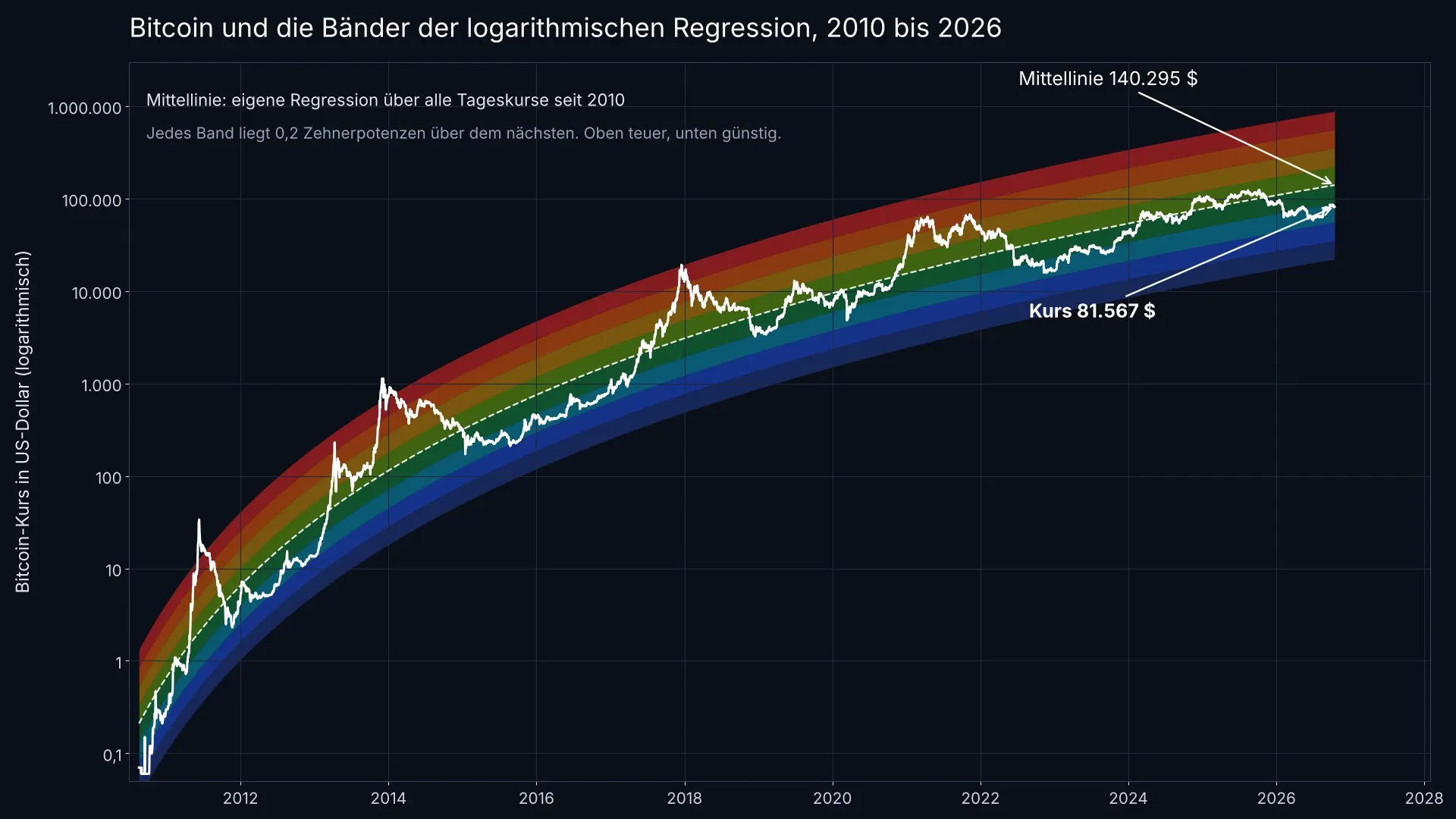
The Bitcoin Rainbow Chart is not a price target but a frame of reference: it lays nine coloured bands over the price history and shows whether the current price sits high or low against the long-term growth path. Recalculating the regression across every daily close since 2010, the centre line of the arc runs at roughly $140,300 on this October 15, 2026. The bitcoin price itself stands at $81,600 to $82,200. Bitcoin is therefore trading well below the middle of its own historical trend, in the green zone of the arc.
That is exactly the appeal of this presentation, and at the same time its danger. The arc turns a volatile price into a tidy graphic with clear colours. That the colours themselves rest on an assumption which shifts with every cycle is not something the picture reveals.
What the Bitcoin Rainbow Chart shows: nine bands around a logarithmic regression
A logarithmic regression is a fitted curve drawn through a cloud of points whose increments shrink over time. For bitcoin that means the price grew by multiples at first and by percentages later. Plot the price on a logarithmic axis, where each step upwards means a tenfold increase, and the steep climb of the early years becomes an almost straight line.
That line is the middle of the arc. Around it the model places bands at fixed distances, above and below. The common presentation works with nine bands, from a deep blue zone at the very bottom to a red zone at the very top. Each band stands for a fixed distance from the middle, measured in powers of ten. A distance of 0.2 powers of ten corresponds to a factor of 1.58, a distance of 0.6 powers of ten to a factor of 4.
In the best-known version the colours carry mocking names, from the sell-off at the bottom to maximum bubble territory at the top. The operator of the site writes himself that there is no scientific basis for it and that you cannot predict the price with a rainbow. That line does not sit in the small print but directly beneath the graphic.
The formula behind the arc: why the centre line grows with the logarithm of the days
The calculation behind it fits on one line. The centre line follows from the number of days since the blockchain started in January 2009. The base-ten logarithm of the price grows linearly with the natural logarithm of the elapsed days. In the original 2014 version it reads: price equals 10 to the power of 2.9065 times the natural logarithm of the days, minus 19.493.
The two numbers 2.9065 and 19.493 are no natural constants. Both come from a fitting exercise on the price data available in 2014. Repeat the same calculation with more data and you get different numbers. Recalculated across all 5,903 daily closes from August 18, 2010 to October 15, 2026, the coefficient is 2.4318 and the subtracted term 16.2007.
The difference sounds small and is enormous. With the 2014 numbers, the centre line would sit at around $1.14 million today. With the numbers from the complete price history it sits at $140,300. The same model, the same form of equation, a difference of a factor of eight. The centre line is therefore no property of bitcoin but a property of the period it is calculated from.
Where the price sits today: 0.24 powers of ten below the centre line
For October 15, 2026, the calculation across the full price history gives a centre line at $140,295. The daily close stood at $81,567, with afternoon trading at around $82,200. The distance is therefore 0.24 powers of ten to the downside, or in familiar terms: bitcoin costs 58 percent of what the fitted curve shows for this day.
The distance to the all-time high helps place that. It stands at $124,777 and dates from October 7, 2025, the week of a good year ago. From the high to today the price has given up around 35 percent, while the centre line has kept rising over the same year. Together, both push the price down within the arc without anything having changed about bitcoin itself.
The nine bands in dollars: from 35,240 to 885,200 for October 15, 2026
Because the centre line rises every day, the band boundaries move with it. For today they sit, calculated from the same fitted curve, at these values:
- $35,240 and below: the lowest zone, the sell-off in the familiar version
- $35,240 to $55,852: deep blue zone, historically the floor of severe bear markets
- $55,852 to $88,520: green zone, where the price stands today
- $88,520 to $140,295: light green zone below the middle
- $140,295 to $222,352: first zone above the centre line
- $222,352 to $352,405: yellow to orange zone
- $352,405 to $558,524: orange to red zone
- $558,524 to $885,200: red zone
- above $885,200: the maximum bubble territory of the presentation
These numbers apply to this one day. In a year the centre line sits around 9 percent higher on the arithmetic, in five years around 39 percent. The model therefore extends a path that rises more slowly than in the early days but never stops rising. That too is an assumption, not a measurement.
How often bitcoin stood in which band: 1,772 of 5,903 days in today's zone
A model is worth only as much as its hit rate. Count how many days the price spent in which band and a lopsided picture emerges. The zone where bitcoin stands today was by far the most frequent, with 1,772 of 5,903 days: 30 percent of the entire price history. Together with the two neighbouring bands around the middle, 75 percent of all days add up.
The spectacular edges, by contrast, are almost empty. Above the red zone, in maximum bubble territory, the price spent 100 days, or 1.7 percent of the time. Below the deepest blue band it was 36 days, or 0.6 percent. Waiting for those edges means waiting a statistically very long time. Over the past seven years the lower edge has not been reached once.
A sober finding follows. The colour scale promises a decision aid but fails to deliver one precisely when it would be needed. For 75 percent of the time the price stands in the broad middle, and there the colour says nothing a glance at the price chart would not show as well.
Where the model comes from: a 2014 joke and a regression from the Bitcointalk forum
The rainbow and the calculation have different fathers. The coloured arc over the price history appeared in August 2014 as a post in a Reddit forum and was, according to several retrospectives, half ironic: a jab at the scene's habit of seeing a law of nature in every price chart.
The calculation beneath it came the same year from another corner. On October 22, 2014, a user opened the thread "Logarithmic (non-linear) regression - Bitcoin estimated value" in the Bitcointalk forum and presented the formula there along with a chart. In his own post, the author writes that the whole thing is "just a model, not a crystal ball".
The two parts were brought together later on the Blockchaincenter site, which maintains the chart to this day. Its operator reworked the formula in November 2022, after the price broke through the lower boundary of the old version on its fall below $16,000. The current version continuously fits the regression to the entire price history.

Where the model goes wrong: the centre line falls with every cycle
The heaviest objection to the Rainbow Chart can be worked out on paper. Fit the same curve through the price data only up to a given cut-off date and it becomes clear how strongly the result depends on the period chosen. For today, the calculation says:
- With data only to the end of 2014: centre line today at $1,140,722
- With data only to the end of 2017: centre line today at $141,720
- With data only to the end of 2021: centre line today at $193,892
- With data only to the end of 2024: centre line today at $150,388
- With all data to today: centre line at $140,295
The 2014 version is off by a factor of eight, because it was extended twelve years into the future. That alone would be no reproach. What stands out is the direction: every extension of the data window pushes the curve down. The model therefore always corrects itself the same way, and only once the price has forced it to.
In practice that means a band showing "cheap" today can show "expensive" in two years after the next adjustment of the same formula, without the price having moved. A statement that changes retrospectively is no basis for a purchase decision.
The cycle highs are moving down: from 1.04 to 0.47 powers of ten above the middle
The same development shows in the three big price peaks. Measured against today's fitted curve, the high of November 30, 2013 stood at $1,134 and therefore 1.04 powers of ten above the centre line, or eleven times it. The high of December 16, 2017 reached $17,508 and 0.77 powers of ten; the high of November 9, 2021 stood at $67,562 and only 0.47 powers of ten above the middle.
The lows move along too, but less strongly: the floor of December 15, 2018 sat 0.22 powers of ten below the centre line, that of November 21, 2022 at 0.33. The price therefore swings in an ever narrower corridor around its trend. For a model with nine equally wide bands that is a problem: the outer bands lose their function because the price no longer reaches them. October 7, 2025 at $124,777 was the most recent cycle high, and that too stayed within the middle bands.
To place the market breadth behind this, metrics with the same ambition but a shorter horizon are in our look at the 200-day line and the hashprice. The halving rhythm underlying many of these cycle comparisons is shown in our halving overview.
Rainbow Chart against stock-to-flow: two models, one design flaw
The Rainbow Chart has a well-known relative. The stock-to-flow model derived the bitcoin price from the ratio of existing supply to annual new production and was considered strikingly accurate around 2020. It predicted six-figure prices for the years after the 2020 halving and was, measured against the actual course of 2022 and 2023, far off.
Both models share the same design flaw: a curve that fits the data so far already counts, for them, as a property of the market. The longer the series grows, the worse the original curve fits, and the more often it has to be readjusted. A model that adapts to every new data point describes the past ever better and the future not one day further.
Both are therefore usable as a reading aid and useless as a signal generator. Comparing valuation models properly takes raw data rather than colourful pictures. An overview of the tools for that is in our comparison of crypto analytics platforms.
What the Rainbow Chart is worth for investors in Europe: a frame, not a buy signal
For investors the chart remains an orientation picture with tight limits. Three points count in practice. First, the colour is a statement about the distance to the price's own trend, not about the business behind it, the regulation or the rate environment. Second, the scale changes retrospectively, which makes any buying rule built on it unreliable. Third, it says nothing about timing: the price can spend years in one band.
In tax terms the chart changes nothing in any case. For private disposals of cryptocurrencies, the one-year holding period under Section 23 of the German Income Tax Act applies, and once it has run, a gain is tax-free. A sale that a colour suggests can destroy a running holding period and therefore cost more than the supposedly good entry level brings in.
If you still want something out of the model, use it as a cross-check on your own mood. When the price sits high in the arc and enthusiasm does too, the question of where the next buyer is to come from is worth asking. When it sits in the green zone as it does today amid general apathy, that is no buy signal, but it is an indication that the market is not trading expensively against its own history. For regular purchases over time, the cost-average effect is the more sober answer than any colour scale.
Rainbow Chart: $140,000 is a calculation, not a forecast
The centre line at $140,295 is the result of a fitting exercise across 5,903 daily closes, not the announcement of a future price. The distance of 58 percent to today's price describes the present and says nothing about the next month. Three steps follow from it:
- Check the data basis before trusting a colour. With any presentation, ask which period the regression comes from and when it was last adjusted. Tools that disclose raw data and the basis of calculation are in the comparison of analytics platforms.
- Decouple purchases from the model. A fixed amount at a fixed rhythm needs no colour reading and sidesteps the problem of a retrospectively shifted scale. Which providers allow that at what cost is shown by the comparison of bitcoin savings plans.
- Settle custody separately from the price. Whether the price sits in the green or the red band changes nothing about key risk. The devices for it are compared in our overview of hardware wallets.
The full interactive version of the model, including the operator's statement that the chart has no scientific basis, is on Blockchaincenter.
(As of October 15, 2026. This article is not investment advice. Prices and fee structures change; check the terms with the provider before you buy.)
The US Labor Department published September's producer prices this Thursday, and they come in markedly hotter than Wednesday's consumer price index: prices for final demand rose 1.3 percent against August and 6.3 percent over twelve months. That has two consequences for your portfolio. The market is once again pricing in a rate rise on October 28, and it has already taken two different views of that today. Bitcoin fell to just under $80,000 in the turbulence and is back at $82,266.
The producer price index measures what producers receive for their goods and services before retailers and consumers pay for them. It therefore sits at the start of price formation, not at the end. That is exactly what makes the 6.3 percent uncomfortable: consumer prices stood at 3.7 percent in September, as cryptoticker.io reported on October 14. A gap lies between the two readings, and gaps of this kind have historically closed upwards rather than downwards.
September producer prices: 1.3 percent on the month, 6.3 percent on the year
The figures are in the producer price index release from the Bureau of Labor Statistics, published on October 15 at 8:30 am New York time. The index for final demand rose 1.3 percent against August on a seasonally adjusted basis. Unadjusted, it climbed 6.3 percent in the twelve months to September.
A monthly jump of 1.3 percent is large for this series. Annualised, the rate would sit in double digits. Such extrapolations are no use as a forecast, because individual months swing sharply, but they show why the reading had an immediate effect in the futures markets.
How the two figures are read matters. The monthly number is seasonally adjusted, the annual one is not. Putting both in one sentence compares two different calculations. For the question of whether the central bank reacts, the trend over several months counts, not a single data point.
Producer prices run ahead of consumer inflation
The mechanism behind this is unspectacular and therefore reliable. When costs for inputs, transport and energy rise, manufacturers and retailers try to pass them on. Whether that works depends on demand. If it does, inflation reaches the consumer with a delay. If it does not, corporate margins shrink.
Both paths are uncomfortable for the central bank. The first means higher consumer prices in the coming quarters, the second weaker profits and therefore weaker equity markets. That is why rate expectations often react more strongly to producer prices than their news value would suggest.
For crypto, the effect travels through real interest rates. The higher the expectation for short-term rates, the more expensive it becomes to park money in assets that pay no yield. Bitcoin pays no coupon. As the expected return on cash rises, the relative calculation worsens, and the current Bitcoin price shows how sensitive the market is to macro data in such phases.
Rate rise on October 28: from 22 to 47 percent and back to 26
The Fed's Open Market Committee meets on October 27 and 28, with the decision coming on the second day. Every data point is currently being recalculated against that date.
How unsettled that calculation is shows in CoinDesk's analysis: after the consumer price report, the probability of a rate rise implied by CME Group's FedWatch tool jumped from around 22 to almost 47 percent and then fell back to 26 percent. On the prediction platform Polymarket it briefly rose to almost 50 percent and eased to about 30 percent. The same source reads a probability of more than 70 percent for an unchanged rate out of Fed funds futures at the same time.
That spread is the real story. There is no consensus at present. One camp considers a rise likely, while the majority stays with an unchanged rate. Positions leveraged towards either side will end up on the wrong one several times over the next 13 days.

Bitcoin at $82,266, session low just under the $80,000 level
According to CoinGecko, bitcoin is quoted at $82,266, with the session high at $82,508. On the downside the move reached $79,806 or $79,711 depending on the data source, which means the round number broke during the session. Ether fell to a low of $2,324.97 and stands at $2,456.
The $80,000 mark is the line where something will be decided over the coming days, for two reasons. First, the price tested it today and won it back, which makes it an evidenced level rather than a drawn one. Second, below it lie the positions that were already closed out today.
Liquidations: $948.22 million in 24 hours, 90.6 percent on the long side
A liquidation is the forced closure of a leveraged position by the exchange as soon as the collateral no longer suffices. It is not a sale out of conviction but a technical process, and it hits the price because the exchange sells at the next available level.
According to CoinGlass data compiled by Decrypt, positions worth $948.22 million were closed out within 24 hours, spread across 177,440 accounts. Long positions accounted for $858.96 million, or 90.6 percent. Ether led the list with $282.03 million, with bitcoin following at a good $200 million.
One detail from the same analysis explains this article's headline better than any percentage: the largest single position was a bitcoin long worth $12.03 million, which the exchange Binance closed out at $80,208.96. Precisely there, a few dollars above the round number, lay the threshold at which a paper loss became a realised one.
ETF outflows on October 14: $150.5 million after an inflow the day before
US exchange-traded funds on bitcoin recorded outflows of $150.5 million on October 14. The day before, $175.7 million had still flowed in. These figures come from Vikram Subburaj, head of the trading platform Giottus, quoted in the analysis linked above.
The change of direction within a single day fits the picture of the rate bets. Fund flows are no use as a leading indicator. What shows up in them is the trace of decisions already taken. Reading them as a forecast confuses cause and effect. To see whether a move is carried by large addresses, fund flows offer a usable cross-check.
Outside crypto, the day was equally unsettled. South Korea's benchmark Kospi index lost 8 percent according to the same source, triggering its automatic trading halts. That puts the crypto move in context: it belonged to a broad retreat from risk across several asset classes.
Funding rate and open interest: the two metrics before the rate decision
Open interest is the sum of all outstanding futures contracts. It says how much leverage sits in the market. The funding rate is the balancing payment between the long and short side in perpetual futures contracts, known as perpetuals. When it is positive, buyers pay, and that is the normal case in rising markets.
Together, the two answer a question the price alone does not: whether a move is carried by fresh money or by leverage. If the price rises while open interest falls, shorts are mainly closing their positions. If it falls with high open interest and a positive funding rate, further forced closures are queued up. If you use leveraged products, the running costs and the liquidation rules are in the perp exchange comparison, because those terms decide exactly at what price a position dies.

What has changed since the consumer price report of October 14
cryptoticker.io published its own assessment of the consumer price index yesterday: US inflation rises to 3.7 percent. Three things are new since then.
First, the producer price index is now out, and at 6.3 percent year on year it runs well above the 3.7 percent on the consumer side. Second, the rate bet has turned a full circle: up to almost 47 percent, back down to 26. Third, the $80,000 level, which still had room yesterday, broke today and was won back. A number in the calendar has thereby become a level with a history.
The twelve-month holding period: selling in a panic costs tax
The holding period is the time after which a gain from selling crypto-assets remains tax-free in Germany under the law as it stands. It is one year, counted from acquisition, and it applies per purchase. Selling on the day of a macro shock gives that period away for precisely the units handed over.
That is why a rate decision is a different question for a long-built holding than for a leveraged position. The leveraged position has a mechanical end determined by the price. The holding has a tax date determined by the calendar.
Before reacting to a macro figure, a look at your own acquisition history pays off: which tranches are more than a year old and which are not. A portfolio tracker with a tax function answers that in minutes, where doing it by hand takes considerably longer across several purchases.
The purchase route under MiCA: authorisation, spread and payout
MiCA is the EU regulation on markets in crypto-assets. It requires trading venues to hold an authorisation and governs what information they must give customers. In practice, that means you can check a provider's authorisation, the gap between its buying and selling price and the time a euro payout takes before you buy.
Payout times are underestimated in quiet weeks and expensive in unsettled ones. On a day with $948 million in liquidations, deposit and withdrawal routes are measurably slower, because the review processes run under load. Noticing only then that your account is not fully verified costs days.
Our assessment: the rate path hangs on two data points, not one
From the newsroom's point of view, the 26 percent probability of a rise on October 28 looks too low rather than too high. In favour of that are the 6.3 percent on the producer side and the monthly jump of 1.3 percent, two readings from the same release that both point the same way. Against it is that the market has already driven the same bet to 47 percent today and unwound it again, and that Fed funds futures still argue for more than 70 percent in favour of an unchanged rate. A central bank caught between two contradictory data series waits, when in doubt, for the third.
No directional bet follows from that, but preparation for both outcomes does. Leveraged positions have a poor ratio of opportunity to risk in this muddle, because the market reprices the probability twice a day. For an unleveraged holding, a single rate step changes the investment case little. A total loss is possible at any time with crypto-assets, and that holds regardless of how this meeting ends.
Fed decision on October 28: 13 days to the rate verdict
- Measure the leverage against the $80,000 level. Put your liquidation price next to today's session low of $79,806. If it sits above, today's move would have ended your position. The cost side and the liquidation rules are in the perp exchange comparison.
- Sort out the acquisition dates. Check which tranches have reached the twelve-month period and which have not, before a macro figure pushes you into a sale. A tax and portfolio tool shows that per purchase.
- Test the payout route. Transfer a small amount in euros and measure how long it takes. Knowing your route means not having to look for it on the day of the rate decision. Authorisations and fees of the providers are in the exchange comparison.
(As of October 15, 2026. This article is not investment advice. Prices and fee structures change; check the terms with the provider before you buy.)
Decrypt
Researchers added hidden text to contact AI agents probing Alibaba’s map service, getting replies about their tasks as investigators traced activity to Tencent Cloud infrastructure.
Google's Willow chip cut errors 40x on the scarce “magic states” quantum computers burn through, a step toward smaller, useful machines—and toward ones that could threaten today's encryption.
Russians have until July 1, 2027 to buy and sell crypto directly with each other. After that, every trade runs through a broker or exchange approved by the Bank of Russia.
In a note to investors, Matt Hougan used a “Choose Your Own Adventure” framework to argue that superabundance, an AI bust or a muddle-through economy all ultimately funnel to the same place: Bitcoin higher.
Speaking after BlackRock’s Q3 earnings, Fink said AI infrastructure spending has become so central to growth that a construction halt would be dangerous—calling the backlash “misinformation” as data centers become a midterm flashpoint.
U.Today - IT, AI and Fintech Daily News for You Today
Cryptocurrency market is certainly struggling to regain the control of the market, as bears push most assets even lower.
Strategy executive chairman Michael Saylor has reacted to a new study examining AI models' monetary preferences with a bullish Bitcoin statement.
Three members of the Canadian Armed Forces are among seven suspects charged in connection with a shocking cryptocurrency-related kidnapping in Toronto.
Overnight liquidations hit $932 million as XRP, DOGE, and NEAR face deep corrections before a sudden market reversal.
Dogecoin whale activity may be rising as the ongoing market volatility pushes traders to dump their crypto holdings to hedge against further losses.
Blockonomi
TLDR:
- Cross River Bank is integrating Ripple’s RLUSD stablecoin into its proprietary Core Operating System.
- RLUSD transactions on the XRP Ledger settle in 3-5 seconds at a fraction of a cent, around the clock.
- Fintechs can move between dollars and RLUSD and access ACH, wires, and real-time payments via one API.
- RLUSD market capitalization has passed $2.5 billion, with more than $1 billion issued on the XRP Ledger.
Cross River Bank has partnered with Ripple to integrate RLUSD, Ripple’s U.S. dollar-backed stablecoin, into its Core Operating System.
The integration supports transactions on the XRP Ledger, a public blockchain. The move brings traditional banking and blockchain-based payments closer within the regulated U.S. financial system.
Issuers and acquirers gain a new option to settle intraday and reduce settlement latency. Fintechs can reach RLUSD payments through a single API connection for real-time settlement.
How Cross River Brings RLUSD Into Its Banking Core
Cross River Bank described its platform as an integration layer between regulated financial services and blockchain-based payment networks.
RLUSD will sit inside the bank’s proprietary technology. As a result, customers can access the stablecoin without deploying their own blockchain infrastructure.
Cross River Bank shared the news in a post on X. The post said the partnership expands its stablecoin optionality. It also said the bank is proud to give partners “greater choice and flexibility.” The bank described the effort as a unified payments experience.
We’re excited to announce that we’re partnering with @Ripple to expand our stablecoin optionality and integrate RLUSD into our banking core infrastructure, with support for transactions on the XRP Ledger.
Together, we’re combining traditional payment technology with RLUSD on… pic.twitter.com/VnWjrexqWT
— Cross River Bank (@crossriverbank) October 15, 2026
Adam Goller, Head of Fintech Banking at Cross River, commented on the partnership. He said, “Businesses shouldn’t have to rely on several different providers to move money across the globe.”
Goller added that the integration builds on existing stablecoin infrastructure and expands “capabilities already in development.”
Fintechs can move between U.S. dollars and RLUSD on the platform. They can also settle cross-border payments and treasury movement 24/7.
Customers will access ACH, wires, and real-time payments through the same platform. Cross River will add RLUSD as an additional payment rail.
RLUSD and the XRP Ledger Support Faster Settlement
RLUSD is purpose-built for institutional use and issued on the XRP Ledger, a public blockchain. Transactions on the network settle in three to five seconds at a fraction of a cent. Payments can also move 24/7. The XRP Ledger has settled more than $1.3 trillion in value to date.
Markus Infanger, SVP of RippleX at Ripple, also commented on the integration. He said, “Stablecoins won’t transform payments through parallel financial systems.” “They’ll do it by becoming part of the banking infrastructure businesses already use,” he added.
Infanger said Cross River is “at the forefront of putting that into practice.” He said the combination “can make it easier for fintechs to move money in real time.”
Transfers can also occur across borders and around the clock. Together, the companies are building tools so RLUSD can move alongside traditional dollars under the same standards. The expanded partnership brings Ripple deeper into Cross River’s ecosystem.
RLUSD has grown to more than $2.5 billion in market capitalization. More than $1 billion is issued on the XRP Ledger.
Demand continues to rise for regulated stablecoins across payments, trading, and institutional use cases. Services from Cross River Bank are currently available only in limited states.
The post Cross River Bank Integrates Ripple’s RLUSD Stablecoin Into Its Core Banking Platform appeared first on Blockonomi.
TLDR
- Meta (META) shares closed at $736.72, then dipped further to $735.02 after hours.
- Muse Spark Open offers 816 billion parameters and a 1M-token context window.
- Meta’s new AI model can run locally using two powerful M5 Ultra Mac Studio computers.
- Developers can access Muse Spark Open through leading API and cloud services.
- Meta expands its open-weight AI lineup following August’s Muse Glimmer launch.
Meta Platforms shares fell Thursday, October 15, as the company released Muse Spark Open for coding and automated tasks. Meta (META) stock closed at $736.72, down 0.11%, then slipped 0.23% to $735.02 after hours. The launch expanded access to advanced AI tools, while shares recorded losses in both sessions.
Meta Platforms, Inc., META
Meta Releases Muse Spark Open for Coding
Meta introduced Muse Spark Open as an open-weight model for software development and multi-step reasoning. The system has 816 billion parameters, with 42 billion active during processing. It also handles context windows reaching one million tokens, supporting lengthy, complex coding assignments.
The model processes multiple information formats and handles programming tasks that require several decisions. Meta said the system supports long projects and difficult software engineering work. Company evaluations also compared its performance against other open-weight models available to developers.
Open-weight releases let developers download parameters and customize systems for specific operations. Businesses can therefore control deployment and manage information within their preferred environments. Meta released a smaller model, Muse Glimmer, in August before introducing this larger system.
Mac Studio Deployment Brings Hardware Demands
Meta designed Muse Spark Open to run on two Apple Mac Studios with M5 Ultra chips. The setup uses Apple’s MLX framework to manage machine learning operations locally. However, this configuration requires substantial hardware resources, including about one terabyte of memory.
The company tested Muse Spark Open alongside Muse Code, its terminal assistant for development work. One exercise involved updating a Mastodon client through software fixes and new features. These demonstrations illustrated how the system manages connected tasks without repeated manual instructions.
Meta also tested the model with DaVinci Resolve, a professional video editing application. The system reviewed footage and cropped selected sections during the demonstration. That work showed its potential for desktop tasks outside conventional programming assignments.
Meta Expands Access Through APIs and Cloud Services
Meta made the model accessible through Baseten, Fireworks AI, Groq, Modal, Nebius, OpenRouter, and Together AI. Developers can download weights from Hugging Face, Amazon SageMaker AI, Google Cloud, and Microsoft Foundry. These services provide alternatives to installing an expensive local hardware setup.
Compatible inference engines include vLLM, SGLang, TensorRT-LLM, llama.cpp, and Hugging Face Transformers. The new model also supports AMD, Apple, Intel, and Nvidia hardware for wider deployment. Developers can customize the system using PyTorch for specialized applications.
Open-weight distribution can reduce dependence on proprietary providers and increase deployment flexibility. However, running large models still demands technical expertise and significant computing resources. Meta’s release expands its AI offerings as Thursday’s stock action remained slightly negative.
The post Meta Platforms (META) Stock: Slips as Muse Spark Open AI Debuts appeared first on Blockonomi.
TLDR
- Volvo Cars expands its Nvidia partnership to advance automated driving technology.
- Nvidia’s Hyperion and Alpamayo platforms will power future Volvo driving systems.
- The automaker plans to introduce Nvidia technology across future vehicle models.
- Nvidia’s Alpamayo software surpasses 650,000 developer downloads worldwide.
- Volvo Cars targets its next-generation automated driving system before 2030.
Volvo Cars announced an expanded Nvidia partnership on Thursday, October 15, to develop advanced automated driving technology for future vehicles. Separately listed AB Volvo (VOLV-B.ST) shares stood at SEK 319.70, gaining SEK 0.70, or 0.22%, according to supplied figures. The agreement combines Nvidia’s artificial intelligence platforms with Volvo Cars’ vehicle safety engineering to improve automated navigation.
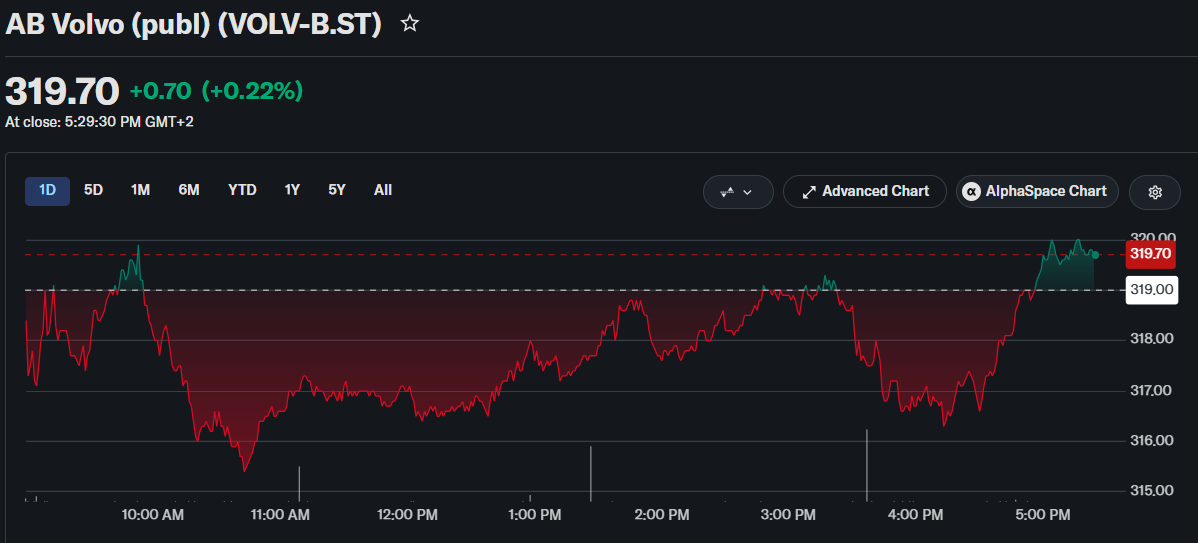
Volvo Cars Expands Nvidia Partnership With Advanced AI Systems
Volvo Cars will integrate Nvidia’s Hyperion architecture, Alpamayo driving software, and Halos safety technology into its next-generation vehicles. Hyperion combines sensors and computing systems to help vehicles process surrounding traffic conditions and road information. Alpamayo provides artificial intelligence tools that support driving decisions across different road environments.
Nvidia developed Alpamayo as a collection of AI models, training datasets, simulation tools, and software development resources. The platform operates alongside conventional driving software that uses machine learning, cameras, and radar systems. This combined approach allows different technologies to process information simultaneously and support more reliable driving decisions.
Nvidia automotive division head Ali Kani explained that the company operates multiple software systems alongside different sensor technologies. The approach uses separate systems to assess road conditions and reduce dependence on individual software components. More than 650,000 developers have downloaded Nvidia’s open-source Alpamayo software, according to Kani.
Volvo Targets Automated Driving Across Future Vehicle Models
Volvo Cars plans to extend its automated driving technology beyond its existing battery-electric vehicle lineup. The company also intends to support plug-in hybrids and gasoline-powered vehicles through a broader software architecture. This expansion reflects its strategy of developing shared technology platforms across different vehicle categories.
Volvo Cars uses Nvidia’s Orin computing technology across its battery-electric vehicle range. These processors analyze information from cameras, radar, and other sensors to support driving assistance functions. The expanded partnership introduces additional computing capabilities and software components for more advanced automated driving features.
Volvo Cars software development head Alwin Bakkenes outlined the company’s shift toward developing integrated vehicle technology internally. The automaker previously relied on vehicle-specific development programs and multiple technology suppliers for different models. Now, its approach combines hardware, software, and safety engineering through a more unified development structure.
Nvidia Technology Supports Volvo Cars’ Long-Term Driving Strategy
Volvo Cars plans to introduce the upgraded Nvidia platform through a new vehicle before the decade ends. Management has not confirmed the model name, production schedule, or specific launch date. The company expects the initial deployment to support supervised automated driving, while drivers retain responsibility for vehicle operation.
The new system will use Nvidia’s Hyperion sensor and computing architecture to process information across different driving conditions. The Halos safety layer will support the evaluation of automated driving functions and system performance. These technologies will help the automaker develop software for increasingly complex road and traffic situations.
The partnership also supports Volvo Cars’ broader transition toward software-based vehicle development and shared technology platforms. Standardizing computing systems and sensors could simplify future integration across electric, hybrid, and conventional vehicles. The companies have not announced commercial revenue targets, implementation costs, or financial forecasts associated with the expanded agreement.
The post Volvo Cars (VOLCAR) Stock: Expands Nvidia Partnership to Advance Self-Driving Technology appeared first on Blockonomi.
TLDR
- LULU stock jumps 5.16% to $98.95 despite declining revenue and earnings.
- Quarterly net income falls to $329 million as operating margins continue to shrink.
- The retailer holds $1.39 billion in cash despite a challenging sales outlook.
- Free cash flow climbs to $225 million despite weaker quarterly sales performance.
- The company spends $1.16 billion on share buybacks as annual profits face pressure.
Lululemon Athletica (LULU) shares climbed 5.16% to $98.95 on Thursday, gaining $4.86 despite continued weakness in its financial performance. The athletic apparel retailer reported lower quarterly revenue and earnings, while operating margins also narrowed. The company maintained substantial cash reserves and generated positive free cash flow despite weaker sales.
Lululemon Athletica Inc., LULU
The latest trading gain followed an extended period of poor share performance. Lululemon stock has declined 44.6% over the past year, while the S&P 500 gained 17.3%. This performance gap reflects pressure on the retailer as weaker revenue and profitability challenge its previous growth trajectory.
Management reduced its annual revenue forecast on September 3 after reporting softer business conditions. Revenue declined 4.3% year over year during the quarter ending August 2, 2026. The revised outlook reflects weaker sales expectations and increases attention on the company’s ability to protect operating earnings.
Lululemon Earnings Decline as Profit Margins Narrow
Lululemon reported quarterly net income of $329 million, compared with $371 million during the corresponding period last year. The decline exceeded the percentage drop in revenue, showing that costs consumed a larger share of sales. Weaker operating efficiency affected profitability even before accounting for unusual financial adjustments.
The retailer recorded an operating margin of 18.8%, compared with 20.7% one year earlier. One-time tariff refunds contributed 5.6 percentage points to the latest margin. Excluding that benefit, the operating margin reached approximately 13.2%, indicating substantially weaker underlying profitability.
If the latest quarter repeated four times, annual net income would reach approximately $1.32 billion. The quarter included roughly $97 million in after-tax tariff refunds, which increased reported profits. Excluding those refunds, the annualized earnings figure falls to approximately $930 million, below the trailing twelve-month total of $1.42 billion.
Lululemon Maintains Strong Cash Flow and Balance Sheet
Despite declining earnings, Lululemon maintained a relatively strong balance sheet during the latest reporting period. The company held $1.39 billion in cash and cash equivalents as of August 2, 2026. It reported no outstanding bank loans or bond borrowings, reducing its exposure to financing costs.
Lululemon carried approximately $2.14 billion in lease liabilities, representing its principal long-term financial obligations. The company generated $1.35 billion in free cash flow during the previous twelve months. That amount covered approximately 63% of its lease liabilities, providing financial flexibility despite slowing business growth.
Quarterly free cash flow also improved, reaching $225 million compared with $151 million during the previous year. This increase showed that the retailer continued generating cash despite lower revenue and shrinking profit margins. Its cash generation remained stronger than the latest earnings performance alone would suggest.
Lululemon spent approximately $1.16 billion repurchasing shares over the trailing twelve-month period. These purchases represented about 10.8% of its market capitalization, reflecting substantial capital returns to shareholders. Management also indicated in September that its 2026 repurchase spending would match the previous year’s level.
The company’s valuation presents a different picture after adjusting for the temporary tariff benefits. At the October 14 close, shares traded near 7.5 times trailing earnings, including those one-time refunds. Excluding the refunds and annualizing quarterly profits produces an earnings multiple of approximately 11.5 times.
The annualized calculation remains a mechanical comparison rather than a forecast of future financial results. Lululemon generates its highest quarterly sales during the reporting period ending in February, which creates seasonal differences. Its financial position therefore combines declining underlying earnings with substantial liquidity, positive cash generation, and continued share repurchases.
The post Lululemon Athletica (LULU) Stock: Earnings Slide as Revenue Declines appeared first on Blockonomi.
TLDR
- CleanSpark’s September Bitcoin production fell nearly 11% to 529 BTC from 593 BTC in August.
- CleanSpark sold 702 BTC and closed September with Bitcoin holdings of 13,530 BTC.
- CleanSpark discontinued monthly mining reports while advancing its $2.276 billion data center financing.
- BitFuFu’s cloud mining output fell to 69 BTC as an electricity dispute threatened its Ethiopia acquisition.
- Canaan mined 44 BTC, while its Nordic heating project supplied recovered heat to approximately 2,800 homes.
CleanSpark mined 529 Bitcoin in September, down from 593 in August, while rival BitFuFu also recorded lower production. Canaan held steady at 44 BTC. The three publicly traded miners reported different changes to their operations.
CleanSpark reduces production and ends monthly updates
CleanSpark finished September with 13,530 BTC, compared with 13,703 at August’s end. It sold two BTC on spot markets and another 700 through exercised call options. The company reported an average sale price of $72,928, including option premiums.
Its average daily production reached 17.64 BTC. CleanSpark reported 50 exahashes per second in operational computing power and nearly 200,000 deployed mining machines. The company will now report quarterly rather than release monthly mining updates.
Data center investment remains a priority
CleanSpark closed a $2.276 billion secured bond offering to fund construction at Sandersville, Georgia. It expects a data center lease there to generate approximately $6.6 billion during its initial term. A separate report on AI chip supplies examined potential problems for miners.
On October 13, Bitcoin Magazine shared an X discussion about Bitcoin mining and artificial intelligence computing. CleanSpark said the bond financing covers Sandersville through completion, while its mining business continues operating.
BitFuFu faces an Ethiopian power dispute
BitFuFu produced 167 BTC in September, versus 174 in August. Its own mining increased from 88 to 98 BTC, but customer cloud mining fell from 86 to 69 BTC. Total managed computing power dropped to 19.4 exahashes per second.
Its proposed Ethiopian mining acquisition remains unfinished because of a dispute involving the site’s electricity supplier. BitFuFu paid $4.1 million and deployed around 13,700 machines there. Separately, Binance announced plans to close its cloud mining service in November.
Canaan maintains output and expands heat recovery
Canaan ended September holding 1,875 BTC, up from 1,868 at August’s close. Its non-joint-venture computing capacity remained at 10 exahashes per second, while joint ventures operated at 4.18. September mining production matched the previous month.
Thursday’s trading also followed a wider fall in Bitcoin mining shares. CleanSpark traded at $8.76, BitFuFu at $1.27 and Canaan at $0.25. Several rival miners had fallen more than 12% during Wednesday’s stock market selloff.
Canaan said its eight-megawatt Nordic heating facility now supplies recovered mining heat to about 2,800 homes. The company is also preparing a similar heat-recovery project for Canadian greenhouses, pending final site inspections.
The post CleanSpark Mines 529 BTC, but Reporting Takes a Turn appeared first on Blockonomi.
CryptoPotato
Circle’s USDC has become the first stablecoin in the European Union to receive significant e-money token status under the Markets in Crypto-Assets Regulation (MiCA).
The classification was made by the European Banking Authority (EBA) after assessing the token against the regulation’s criteria.
Regulatory Upgrade
The EU currently has 45 e-money tokens notified under MiCA. USDC is the first to be classified as “significant.” The new rules will take effect on November 12, 2026. From that date, the EBA will take over direct supervision of the crucial areas, such as capital requirements, asset reserves, liquidity, and recovery and redemption plans. These responsibilities currently fall under France’s banking regulator, the ACPR.
However, the ACPR will retain oversight of other areas. These include governance, major shareholdings, management suitability, outsourcing, as well as conflicts of interest. The EBA and ACPR will work together to manage the transition and coordinate their supervision.
USDC has a presence on both sides of the Atlantic. Circle Internet Financial Europe SAS issues the token in the EU, while Circle Internet Financial, LLC handles issuance in the United States.
The EBA has also signed a memorandum of understanding with the New York State Department of Financial Services. The agreement aims to improve cooperation and information sharing on cross-border stablecoin activities.
Expansion Across Banks and Payments
USDC faced fresh competition concerns earlier this year following the unveiling of Open USD (OUSD), a stablecoin project that was developed with founding partners including Visa, Mastercard, Stripe, Coinbase, and Shopify, and backed by a consortium of over 140 companies. The announcement put the spotlight on the battle for stablecoin adoption, but USDC continues to find new opportunities to expand its reach.
For instance, BNY Mellon expanded its partnership with Circle by bringing USDC to its Digital Asset Custody platform for institutional clients. The bank allowed its clients to hold and transfer USDC, as well as mint tokens by converting US dollars and redeem them back into dollars. BNY has already been serving as the primary custodian of USDC reserves.
Binance also doubled down on USDC with a fresh five-year agreement with Circle, alongside a $100 million investment in the stablecoin issuer. The deal could help the token reach more users through Binance, which has previously agreed to hold USDC in its corporate treasury and make it available to its 240 million users.
Samsung announced plans to bring USDC transfers to Samsung Wallet for eligible Galaxy users in the US, the rollout, for which, is expected in the last week of October 2026. The service will let users send the stablecoin to compatible crypto wallets and transfer funds to eligible bank accounts in more than 60 countries.
The post USDC Just Hit a Major EU Regulatory Milestone: Here’s What Changes in November appeared first on CryptoPotato.
According to Charles Edwards, CEO of Capriole Investments, Bitcoin’s price could rise 30% to 50% in a day if developers agree on a roadmap to protect the blockchain against quantum computers.
He also warned that delays in addressing the threat could weigh on the asset’s valuation.
Edwards Sees Quantum Security as a Potential Bitcoin Catalyst
Speaking to BMTV, Edwards described the quantum threat as tangible within a typical two- to three-year investment horizon. Bitcoin developers have yet to reach a consensus on a path forward, he noted, despite early-stage proposals intended to help prepare the network.
“If they kind of align and say, okay, this is the roadmap that we’re going to do, or this is the signature schemes that we’re going to probably implement in the next sort of 12 months or 18 months or what have you,” Edwards said, “I think that results in a significant repricing of Bitcoin up.”
He estimated that a concrete plan from Bitcoin Core developers could produce a 30% to 50% price move in one day as investors reassess the threat. The next six to 12 months could therefore be positive for BTC if development progresses. Failure to make headway would leave the network increasingly exposed as technology advances, prompting Edwards to reconsider Bitcoin’s fair value.
Coinbase has also outlined requirements for post-quantum security, arguing that any new signature design must account for transaction fees and the cost of validating transactions across the network. Its October 13 blog discussed possible technical approaches, including hybrid signatures during a transition.
Rates and Mining Data Complicate the Outlook
BTC was trading around $81,000 at the time of writing, down nearly 3% in the last 24 hours, with a daily range of $80,400 to $84,000. In the past week, it lost over 2%, although it is up more than 4% from a month ago, while sitting roughly 36% below its all-time high.
According to Edwards, interest rates are a short-term liquidity headwind, though the CEO doubts they will stay high for long because the inflation behind them comes mostly from oil prices tied to the US-Iran conflict.
Mining data provides another reason for cautious optimism. Bitcoin’s hash rate, a measure of computing power committed to secure the network, began recovering four to six weeks ago after a prolonged decline. Edwards views that recovery as evidence that the cycle bottom may be in, although miners shifting capacity toward AI makes future hash rate trends harder to interpret.
He also warned that AI could accelerate quantum development, even though he considers current fears about AI independently breaking Bitcoin’s encryption premature.
The post Bitcoin Could Jump 50% If Developers Agree on Quantum Plan: Capriole CEO appeared first on CryptoPotato.
Hotter-than-expected US inflation data, along with the KOSPI index’s crash in South Korea, weighed heavily on the cryptocurrency market. Bitcoin (BTC) slipped below $80,000, while most altcoins followed suit, posting steeper declines.
Pi Network’s PI couldn’t escape the broader correction, plunging to around $0.077, or its lowest level since July. Many investors have likely grown weary of the token’s major downfall over the past several months, so we asked three of the most popular AI-powered chatbots for their outlook on the remainder of the year. Here’s what they had to say.
More Pain or a Rebound?
ChatGPT leaned bearish, expecting the price to sustain its current level or even plunge to a new all-time low of around $0.06 sometime in Q4. OpenAI’s platform claimed that the constant PI token unlocks are the main factor preventing a decisive comeback. It also cited KYC issues reported by some Pioneers and migration struggles as additional hurdles.
On the other hand, ChatGPT sees potential for a significant rebound in the coming months, but only if protocol 28 deploys successfully and prices sustain a recovery above $0.10. While the upgrade is scheduled for tomorrow (October 16), it won’t be a surprise if it gets delayed, since the Core Team has a habit of postponing important developments.
Perplexity also warned of an additional downside risk that could drive the price down to $0.05. The chatbot estimated that such a collapse has a 15% to 25% probability of happening sometime during the final quarter of 2026, while the base case for PI is to trade between $0.07 and $0.10.
Google’s Gemini seemed more favorable to a price increase, suggesting that a rise to $0.15 is mathematically and technically possible. It added an important disclaimer that such a pump would depend on several catalysts, including the protocol 28 upgrade, further ecosystem developments, and listings on major exchanges.
“A surprise spot listing on Binance or Coinbase during Q4 would unlock significant retail and institutional buying liquidity, typically sparking short-term price surges capable of pushing a micro-cap asset past key resistance barriers ($0.10, $0.12, and up to $0.15),” it explained.
Additional Forecast
X user Crypto With Gopal is among the few to address PI lately, and his analysis points to a cautious approach. He assumed that a breakout above $0.10-$0.105 could open the door toward $0.15, but that represents a solid 42% increase from current levels.
“Until then, $0.075-$0.08 is a key support zone to watch; losing it could signal further downside. Sentiment: cautiously watching for reversal. A confirmed neckline is needed to validate the double-bottom setup,” he concluded.
The post Pi Network (PI) Plunges Near Its ATL: 3 AIs Speculate Whether Q4 Will Bring More Pain appeared first on CryptoPotato.
The primary cryptocurrency posted substantial gains in September, fueling expectations that the uptrend would continue this month. In fact, BTC started October on the right foot and briefly surged to nearly $87,000 at one point.
However, the bulls couldn’t maintain momentum, and the asset headed south. The past 24 hours brought more pain for investors as Bitcoin dipped below $80,000 after US inflation came in hotter than expected, while South Korea’s KOSPI index crashed over 7% on the day. The latest red wave, though, might be just a temporary correction before a renewed rally, and here’s why.
The Bullish Signals
Let’s start with the fact that October has historically been one of the best months for BTC, earning it the nickname “Uptober.” The asset has finished the period in the red on only 3 of 13 occasions. We still have more than two weeks left to see whether bulls can regain control and secure another successful “Uptober.”
Next is whale activity. Not long ago, Ali Martinez revealed that large investors used the slump from $87K to $80K to stack an additional 16,010 coins (worth nearly $1.3 billion).
An analysis published by CryptoQuant also shows that whales have launched a buying spree. The team revealed that big wallets (excluding exchanges and mining pools) have increased their total holdings to 3.03 BTC, the highest combined balance since November last year.
This accumulation is generally seen as a bullish signal, as large investors are often considered smart money with a longer-term investment horizon. Their buying leaves fewer coins available on the open market, which, combined with steady demand, could trigger a price uptick. In addition, these efforts can encourage smaller players to join the ecosystem, bringing in fresh capital.
Last but not least, we will observe BTC’s price movement after the previous US CPI data. The asset saw major initial volatility after the last four announcements (similar to what we witnessed over the past 24 hours), but X user Crypto Rover noted that the bulls eventually gained control each time, and Bitcoin rallied hard. It remains to be seen whether this time will be the same.
The Latest Predictions
According to the X account Wealthmanager, BTC has “major bid zones” stacked between $75,000 and $80,000. That said, the price could sweep lower toward that range before resuming its next big move.
X user Aman claimed that Bitcoin might be developing a “head-and-shoulders” pattern. The analyst suggested that if this plays out, $76,000-$77,000 could become “the next area to watch.”
“Not saying it will happen for sure, but the setup is there. Better to prepare for the possibility now than panic if BTC actually breaks down,” they added.
Martinez also recently chipped in. He identified $84,000 as a key level marking the 50 SMA and potentially unlocking the next rally.
The post 3 Reasons Why Bitcoin (BTC) Could Bounce Back Quickly After the Latest Pullback appeared first on CryptoPotato.
XRP is approaching a key technical inflection point after weeks of declining price action erased much of its August recovery. Trading around $1.30, the asset is testing an important support zone on both the daily and 4-hour charts. The next move around this area could determine whether buyers manage another rebound or sellers push XRP toward lower support levels.
Ripple Price Analysis: The USDT Pair
The daily chart shows XRP maintaining a broader bearish structure after falling from its early-2026 highs above $2.30. The asset has formed a series of lower highs, while the descending orange trendline continues to reflect the prevailing downward pressure, as the price has once again dropped below it and failed to continue higher. Although XRP staged a sharp recovery from the $1.00 region in August, the subsequent rally toward $1.70 failed to establish a sustained bullish reversal.
The latest decline has brought the token back to the $1.30 support zone. This area is key because it previously consolidated before the June sell-off. Holding above it could help XRP stabilize and attempt another recovery, while a decisive daily close below it would raise the risk of a deeper correction.
If support breaks, the $1.15 zone represents the next major downside area visible on the chart. Below that, the $1.00 region remains an important floor, having preceded the sharp August rally.
On the upside, XRP would first need to reclaim the $1.50 region created by recent highs to show signs of improving short-term structure. Beyond that, the $1.70 resistance zone stands out as the major obstacle, and the main level buyers must break through to start a new long-term rally.

The 4-Hour Chart
The 4-hour chart offers a clearer view of immediate selling pressure. Since reaching approximately $1.65 in late September, XRP has been trading within a descending channel, characterized by lower highs and lower lows. Both channel trendlines remain relevant, with the upper boundary acting as dynamic resistance and the lower boundary marking the area where buyers could attempt to defend the price.
XRP is now testing the $1.30 support zone, which overlaps with the lower boundary of the descending channel. This confluence makes the current area particularly important for the short-term outlook. The latest candles show the price pressing against this support, but the chart does not yet confirm a decisive breakdown or a valid bullish reversal.
If buyers defend the zone, the asset could attempt a relief rally toward the $1.40 region, where the upper channel boundary is located. A breakout above this resistance would weaken the immediate bearish structure and potentially bring the $1.60-$1.70 area back into focus.
However, a confirmed move below $1.30 would suggest that buyers are losing control of the current support area. In that scenario, XRP could face further downside pressure, with the daily $1.15 zone emerging as the next major support region.
The descending channel therefore remains the dominant short-term pattern. While its lower boundary could provide a foundation for a rebound, a bullish shift would require XRP to reclaim nearby resistance and eventually break above the channel’s upper trendline.

The post Ripple Price Analysis: Is the Worst Over for XRP After Holding $1.30? appeared first on CryptoPotato.