Cryptocurrency Posts
Crypto Briefing
Rising borrowing costs could hinder AI sector growth, increasing vulnerability to economic shifts and impacting future innovation and expansion.
The post AI stocks tumble as rising borrowing costs test industry financing appeared first on Crypto Briefing.
The AI infrastructure sector faces heightened financial risk, potentially impacting future investments and innovation in AI technologies.
The post CoreWeave stock slides as AI data center selloff deepens appeared first on Crypto Briefing.
Avanza Bank's indirect Bitcoin exposure highlights the growing trend of cautious institutional investment in cryptocurrency through proxies.
The post Avanza Bank holds $298K in shares of Bitcoin treasury company Strategy appeared first on Crypto Briefing.
Amazon's Bee AI devices could reshape privacy norms and consumer trust, expanding AI's role in daily life and competitive tech landscapes.
The post Amazon unveils new Bee AI devices for conversation recording appeared first on Crypto Briefing.
Ledger's Atom launch amid security issues highlights the challenge of balancing innovation with trust in crypto hardware solutions.
The post Ledger unveils Atom, an Android-based signer built to sit beside your phone appeared first on Crypto Briefing.
Bitcoin Magazine
Bitcoin Magazine

Russia’s Central Bank Authorizes Sberbank to Exchange Cryptocurrencies
Russia’s central bank has added Sberbank to its register of organizations authorized to exchange digital currencies, according to reports.
Sberbank was added to the list of digital depositories, which will keep a record of cryptocurrencies and digital rights, earlier this month.
Now, it joins eight other organizations on the exchange register, including state-controlled VTB, Russia’s second-largest bank, and T-Invest Lab, part of T-Technologies, which also owns online lender T-Bank, according to a Monday report from Interfax.
The announcement comes as Russia fast moves forward with Bitcoin-related regulation. Sberbank last month announced that it was the first in the country to have been approved to custody bitcoin.
The Bank of Russia gave it the green light for “digital currency record-keeping” and to facilitate the transfer of such assets, covering bitcoin and other, smaller cryptocurrencies.
“This status will allow the bank to provide services related to organizing the circulation of digital currency on interfaces which clients already use,” Sberbank was quoted saying in the news report.
A law on digital currencies and digital rights came into effect in Russia on September 1, creating a comprehensive legal framework for cryptocurrency circulation. Transactions involving cryptocurrencies can be conducted via the existing infrastructure of exchanges, brokers and trustees, and now also via crypto exchanges and digital depositories.
Cryptocurrency can be bought and sold via crypto exchanges, while the rights to these assets are recorded in digital depositories.
Banks and other organizations have been able to apply to the CBR for the corresponding licenses since October 5. Some existing players have simplified access to the market and can obtain licenses on a notification basis within just one day.
Under the new rules, unqualified investors will be able to buy bitcoin and other cryptocurrencies including stablecoins, within a limit of 300,000 rubles ($3,556) per year through one intermediary.
Qualified investors will have access to all cryptocurrencies traded on the exchange and over-the-counter markets.
Sberbank will debut its crypto wallet in December — the same month the Moscow Exchange will debut crypto trading.
This post Russia’s Central Bank Authorizes Sberbank to Exchange Cryptocurrencies first appeared on Bitcoin Magazine and is written by Mathew Di Salvo.
Bitcoin Magazine

Kraken Parent Company Payward to Buy Saldo Bank in European Banking Push
Payward, the parent company of crypto exchange Kraken, has signed a definitive agreement to acquire Saldo Bank, gaining an EU banking license and a footprint across five European markets.
Payward is buying Saldo Finance Oy, a Finnish holding company whose subsidiary, Saldo Bank UAB, is a digital-first specialized bank licensed in Lithuania. The bank operates in Lithuania, Finland, Sweden and Germany, with a passport into the Netherlands.
Payward did not reveal the financial terms of the deal, which is expected to close in 2027, subject to regulatory approvals.
It comes as Kraken, like other crypto exchanges, pushes further into the traditional finance world, allowing users to trade stocks, bonds and other assets. The company has sold its app as a “primary account for everything.”
“A regulated EU bank is the piece that lets us serve European clients the way a primary financial institution should: one place to hold assets, move them freely, and put them to work,” said Arjun Sethi, Payward’s co-CEO. “We are starting in the EU, and the ambition is global.”
Payward said that once completed, the acquisition is expected to let Payward Banking offer interest on deposits, SME and consumer loans, credit cards, and banking-as-a-service tools such as card issuance, SEPA payments access and embedded lending for partners.
Saldo already offers retail term deposits in all four of its operating markets, consumer lending in Lithuania, Finland and Sweden, and a credit card in Finland.
Payward says it already holds a Federal Reserve limited-purpose master account in the U.S. and an e-money license from the Central Bank of Ireland, and has originated more than $2 billion in loans.
The deal comes shortly after Payward this week announced plans to launch in the UAE following full approval from Dubai’s Virtual Asset Regulatory Authority.
In September, Bloomberg reported that Nasdaq Inc. was investing $100 million in Payward at a $21 billion valuation, citing people familiar with the matter. Payward and SoFi Technologies also recently agreed to route SoFi customers’ crypto orders through Kraken Prime, Kraken’s prime brokerage arm.
This post Kraken Parent Company Payward to Buy Saldo Bank in European Banking Push first appeared on Bitcoin Magazine and is written by Mathew Di Salvo.
Bitcoin Magazine

Standard Chartered Debuts Bitcoin Trading For Wealthy UAE Clients
British multinational Standard Chartered on Wednesday announced a bitcoin trading service for affluent clients in the United Arab Emirates.
The service is the first such service offered by an international bank in the UAE, Standard Chartered said.
It comes after the bank last month debuted bitcoin trading for institutional clients in the Arab nation. Standard Chartered became one of the first global banks to enter the spot crypto trading space when in 2025 it set up a trading desk for bitcoin and other cryptocurrencies in London.
JUST IN: Standard Chartered becomes the first international bank in the UAE to offer Bitcoin trading directly through eligible clients' bank accounts
— Bitcoin Magazine (@BitcoinMagazine) October 14, 2026pic.twitter.com/uPVQV9D8SJ
“As client interest in digital assets continues to grow, this launch represents a significant milestone for Standard Chartered as we bring digital assets into our core wealth offering,” said Samir Subberwal, Standard Chartered’s global head of wealth solutions, retail products, data and analytics.
“With digital assets moving into mainstream wealth conversations, clients are increasingly looking not only for access, but also for the security, trust and confidence that comes from investing through a regulated and trusted institution.”
Rola Abu Manneh, Standard Chartered’s chief executive officer UAE, Middle East and Pakistan, added: “We are proud to be the first international bank in the UAE to launch a cryptocurrency trading offering.”
The service will allow clients to buy bitcoin via their bank accounts. No third-party apps or wallets will be needed, the bank said.
Standard Chartered said it will manage end-to-end custody and settlement through a closed-loop model, reducing exposure to third-party wallet risks.
The British bank is expanding its crypto-related offerings worldwide. Earlier this month, it said it had plans to offer crypto custody services for institutional clients in Singapore.
Standard Chartered already offers the service in the UAE, Luxembourg, and Hong Kong.
Banks worldwide are integrating or offering bitcoin-related products and services.
A number of U.S. and European banks have started offering crypto-related services by custodying assets for institutions. Others are offering trading via their flagship apps.
This post Standard Chartered Debuts Bitcoin Trading For Wealthy UAE Clients first appeared on Bitcoin Magazine and is written by Mathew Di Salvo.
Bitcoin Magazine

The Undercurrent: Three European Artists on Making Money Visible
Amsterdam helped lay the foundations of modern finance, but its artists were among its earliest critics. When speculative bubbles burst across Europe in 1720, Amsterdam printers and satirists responded with The Great Mirror of Folly, a collection of engravings and plays exposing the excesses of financial speculation.
Nearly three centuries later, the city hosted another monetary experiment. David Chaum, the cryptographer whose work on anonymous communication helped lay the groundwork for the cypherpunk movement, came to Amsterdam in the 1980s to work at CWI, the Dutch national research institute for mathematics and computer science. Around 1990, he founded DigiCash to develop private electronic cash. The company went bankrupt in 1998, a decade before bitcoin, but the dream of digital money was already taking shape.
Last year at Bitcoin Amsterdam, BMAG exhibited The Waterworks of Money, in which Dutch artist Carlijn Kingma, working with financial journalist Thomas Bollen and researcher Martijn Jeroen van der Linden, depicted the monetary system as a vast irrigation network, with some areas flooded by liquidity while others remain dry. The drawing makes a complex financial system legible, exposing the mechanisms through which money is created, distributed, and concentrated.

This tradition of questioning money and making its hidden dimensions visible continues in the work of three European artists exhibiting at Bitcoin Amsterdam this November. ZETRA, RYR, and Cypherpunk Now draw from graffiti, political printmaking, hacker culture, and early bitcoin communities to explore the changing meaning of money.
Martin Fischer joined the Prague art collective Ztohoven in 2003, a group known for inserting a fictional nuclear explosion into a live Czech Television broadcast. In 2014, the collective opened Paralelní Polis, a hackerspace whose café accepted only bitcoin, and Fischer designed its logo. As he told Bitcoin Magazine’s Aaron van Wirdum in 2020, the arrival of a screen-printing press the following year prompted him to produce his first prints. Since 2020, he has worked under the name Cypherpunk Now, developing a visual record of bitcoin’s evolving culture.
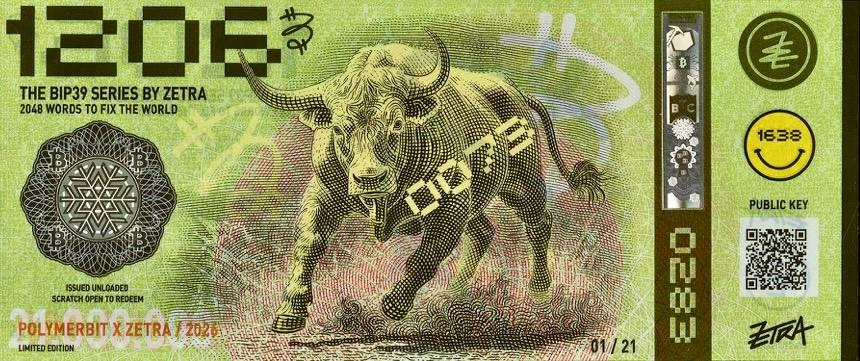
RYR and ZETRA both emerged from Germany’s graffiti scene but approach money from different directions. RYR uses currency itself as material, making paper from shredded banknotes, pigment from their ashes, and concrete grenades filled with shredded cash that he calls “artifacts from the future.” ZETRA, who began painting in the early 1990s and discovered bitcoin in 2017, examines what money can buy. His TOMATOSOUP paintings revisit Andy Warhol’s iconic Campbell’s Soup Cans to chart changing prices in dollars and bitcoin, while THE BIP39 SERIES explores the 2,048 words used in bitcoin wallet recovery phrases, including 1206/NOTE, a collaboration with Polymerbit.
Bitcoin has shaped these artists’ practices, their livelihoods, and the communities around them. Its growing acceptance by banks, investment funds, and corporations has also prompted some difficult questions about the movement’s original ideals and where its culture is heading.
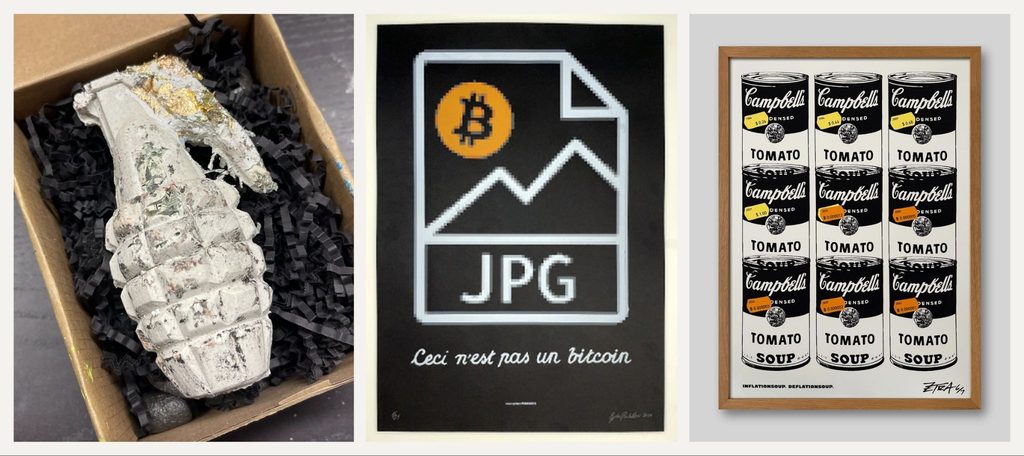
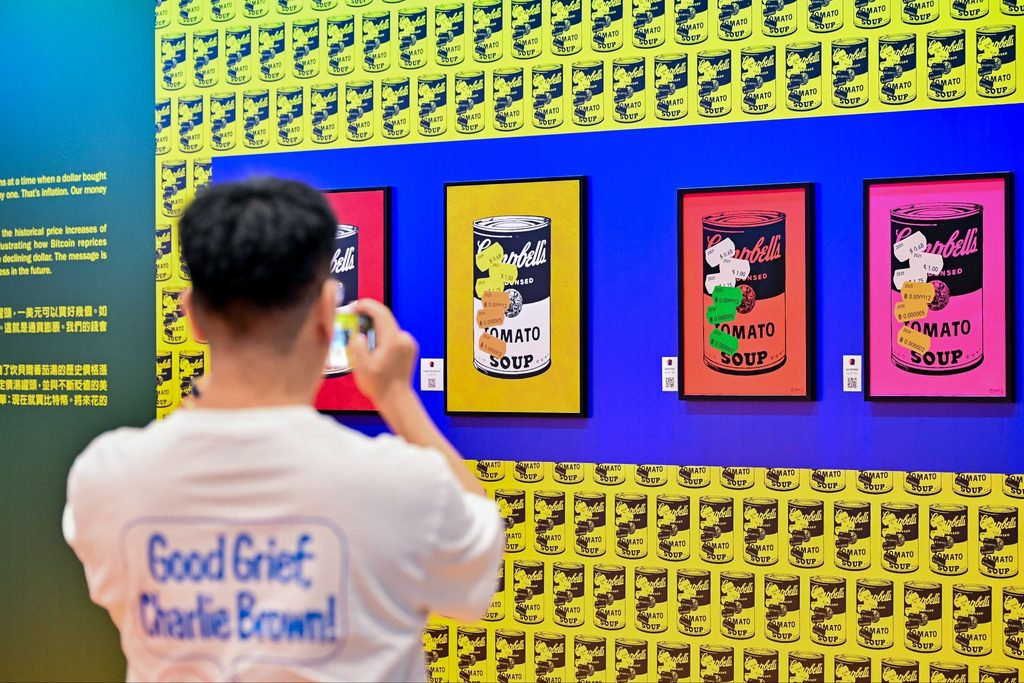
BMAG: Andy Warhol turned Campbell’s soup into an icon of consumer culture, taking an ordinary commodity and elevating it into fine art. Your TOMATOSOUP series returns to that image but introduces something Warhol largely left outside the frame: the changing value of money itself. How did the idea of reworking Warhol’s Campbell’s Soup Cans first come about, and do viewers immediately recognize the commentary on inflation?
ZETRA: We frequently see iPhones and houses in our bitcoin Twitter timelines, showing how they become cheaper in BTC terms. I thought it would be fun to take something from art history instead, something more visually appealing, like Warhol’s iconic Campbell’s Soup Can.
For my TOMATOSOUP painting, I used real stickers placed on the can to show how the price of soup has increased in USD over the past decades, compared with the lower prices we might expect in BTC terms in the decades to come.
Bitcoiners looking at TOMATOSOUP generally understand it immediately. They know they’re in a better position as the purchasing power of fiat money continues to decline through inflation. Other viewers usually need a bit of explanation, and I’m always happy to help them understand.
BMAG: In THE BIP39 SERIES, you draw from the 2,048 words used to generate bitcoin wallet recovery phrases, turning ordinary words into artworks with a deeper significance for bitcoin holders. Can you unpack the different layers of inspiration behind the series and what they reveal about bitcoin, language, and the ownership of money for someone unfamiliar with these concepts?
ZETRA: Everyone who moves their precious sats into cold storage encounters 12 or 24 of these significant words, often early in their journey as a bitcoin newcomer. As mentioned, there are 2,048 words in a carefully curated list representing the power of self-custody.
I started going through the words one by one, imagining how each could be visualized in a physical form: the key visual for the word, its corresponding number, the style, and the medium I would choose. There are millions of possibilities for bringing these words to life through bitcoin art.
1044/LIST was the obvious choice to kick off THE BIP39 SERIES. Naturally, it features all 2,048 words presented as a list. As an ’80s kid, I had to choose 1638/SMILE as the second piece: a proper yellow smiley face, with the number 1638 in place of the eyes. It’s a fine art print on Alu-Dibond beneath a 6 mm acrylic glass cover. So clean.
Another work in the series is 0388/CORN, an obvious homage to Warhol once again. THE BIP39 SERIES will be an ongoing project for many years to come.
BMAG: You shred banknotes into paper and burn them to produce pigment. Artists have long manipulated currency to question where its value resides, but your work goes a step further by making destruction part of the creative process. Is there a contradiction in destroying money to create an artwork that may ultimately be worth much more?
RYR: Money is essentially a narrative system built on collective belief and obedience. It has worked for hundreds of years because we collectively agree on the story it tells and the value it represents. I’ve always been fascinated by that idea, particularly how something as ordinary as a banknote can carry so much meaning, authority, and perceived value.
I was looking for a different way to tell that story, both conceptually and physically. Back in 2017, I had an exhibition title in mind: To Cut a Long Story Short. I liked the cheekiness of it, especially in relation to money and the stories we attach to it. Shredding banknotes became a very literal interpretation of that title, but it also opened up an entirely new artistic medium for me.
Ultimately, I’m not simply destroying money. I’m taking an existing story, cutting it into pieces, and using those pieces to tell a new one.

BMAG: Your concrete weapons are presented as relics from a future in which the fiat wars have already ended. Yet bitcoin is increasingly held through the very financial institutions it was designed to circumvent. Is that a victory for the movement, or have the institutions simply absorbed the alternative?
RYR: I think that’s precisely what makes the story so interesting. When I created the concrete weapons, I imagined a future in which the traditional financial system had already fought its battle for survival. The weapons had become fossils, archaeological artifacts from a monetary conflict that future generations might struggle to understand.
My concrete weapons represent a future in which that battle is already history. Whether bitcoin ultimately wins or becomes part of the very system it challenged remains to be seen.

BMAG: Much of your work is made from the physical remains of money, at a time when currency is becoming increasingly digital and invisible. Do you think people are losing something in their understanding of money as it disappears from everyday physical experience?
RYR: I think we’re losing a physical connection to money, but not necessarily our understanding of it. Money has always been a narrative built on collective trust, whether printed on paper or represented by numbers on a screen. What fascinates me is how something as abstract as value can be represented by a physical object.
I don’t necessarily believe that art has to be authentic or entirely original. Almost everything has been done before. To me, art is a wonderfully human, almost plebeian way of expressing an opinion and giving ideas a physical voice.
Bitcoin will likely evolve into a much broader and increasingly regulated financial asset, but I hope its grassroots culture and artistic identity remain visible. That’s something my fellow artists and I will continue to contribute to, preserving the spirit of a movement that was cultural long before it became institutional.

BMAG: Paralelní Polis wasn’t just a place to discuss alternative monetary systems or a hacker meetup; its café was one of the first to adopt bitcoin as money. What were the early years of Paralelní Polis like, and what has your own experience been selling artwork for bitcoin?
Martin Fischer: Paralelní Polis was founded in 2014, during a bear market. The funny thing is, none of us who founded it even knew what a bear market was. We didn’t think of bitcoin as something that could make us rich. We saw it as uncensorable money and understood the changes it could bring to society. There was no speculation involved, and that’s what made those early days so great.
I sold my first screenprint for bitcoin in 2017, almost ten years ago, and many more since then. But practically every sale was a matter of survival. I spent most of the bitcoin I earned financing my next projects and continuing to make art.
I never managed to accumulate much bitcoin, but looking back, it gave me something far more valuable than investment returns: the freedom to remain an independent artist.
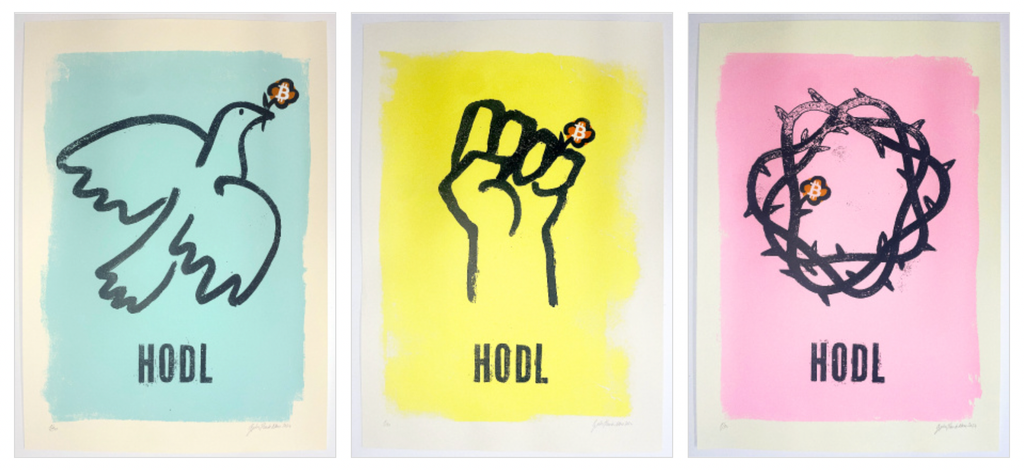
BMAG: Political printmaking has a long history in Europe, from Amsterdam’s financial satires of 1720 to twentieth-century protest posters. Your work emerged from Ztohoven, a collective that famously hacked a live television broadcast to show a fictional nuclear explosion—an audacious intervention, even by today’s standards. Ztohoven challenged institutions through disruption, while bitcoin uses game theory and economic incentives to create an alternative. Do you see bitcoin as a continuation of that same spirit of intervention, and your prints as an extension of it?
Martin Fischer: I think there’s a connection, but I wouldn’t say it’s exactly the same thing. With Ztohoven, we used art to question authority, challenge institutions, and expose how easily reality can be manipulated. Bitcoin doesn’t need to make a statement or provoke anyone. It simply offers an alternative that works without asking anyone for permission. That’s a much more interesting form of disruption to me.
But today, bitcoin has become so corporate and so intertwined with traditional banking that it’s hard to still see it as an anti-establishment movement. I don’t see this as a betrayal of its original ideals, but rather as a natural consequence of its success. That doesn’t mean I like where things are going.
What’s strange is that bitcoin’s fundamental principles haven’t really changed, but the way people perceive and use it certainly has.
And my screenprints? I still work with the original idea of separating money from the state while exploring the myths, memes, and legends of the bitcoin age. That’s what I enjoy most.
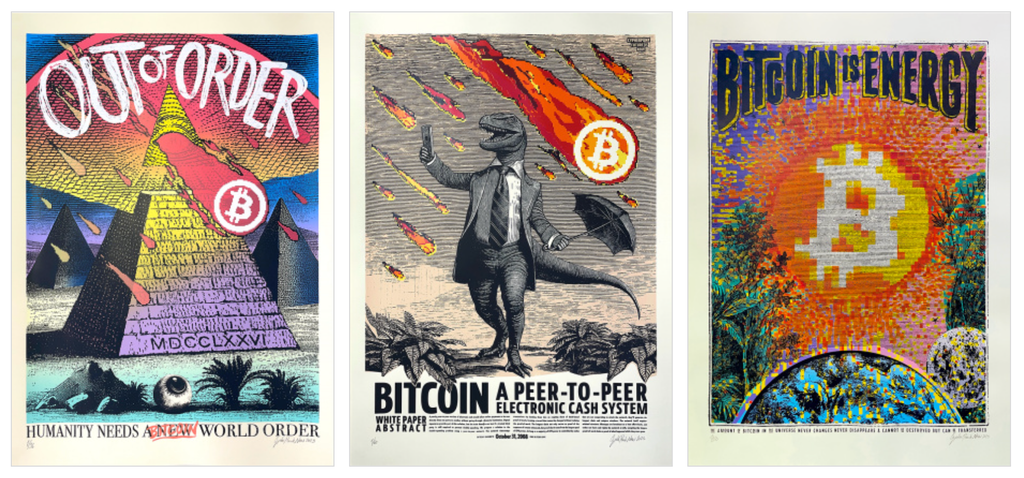
BMAG: Your Amsterdam presentation brings together more than a decade of work documenting bitcoin’s evolution from an underground movement to an increasingly institutionalized financial system. Looking across those prints today, has the movement changed more than you expected, or has your own perspective changed? Which of your prints are your favorites?
Martin Fischer: I like remembering the old days, when we were all part of the same tribe and our main enemy was Faketoshi.
Today? We have culture wars over JPEGs, Ordinals, BIPs, OP_RETURN, over what’s spam and what should or shouldn’t belong on bitcoin. What makes me saddest is that people who once fought together against censorship and for freedom now spend enormous amounts of energy fighting each other over what others should or shouldn’t be allowed to do with bitcoin.
Maybe it’s a natural consequence of bitcoin’s success. The bitcoin community has changed enormously, and so has my perspective on it. I’m definitely much more skeptical today of the idea that technology alone can automatically change society for the better.
As for my favorite works, Bitcoin Meteorite is definitely one of them. In this piece, I reworked the meme of banking dinosaurs watching their own extinction, incorporating the abstract from the Bitcoin white paper. It gave me my fifteen minutes of fame when Max Keiser and Stacy Herbert brought it into the spotlight.

Then there’s Cypherpunks of the World. This project is important to me not only as a celebration of the cypherpunks and their legacy, but also because of its complexity. It started as a series of original collages, continued through handmade screenprints, and eventually evolved into animated NFTs and a virtual gallery. It’s one of my most elaborate projects, connecting different techniques and media while staying true to the original idea.
Among my more recent works, I really like Out of Order from 2023. It’s an incredibly detailed screenprint, and the first one where I finally managed to make absolutely no printing mistakes. That alone makes it special to me.
I also love St. Satosius Contra Draconem (2025), which is inspired by the classic depiction of Saint George fighting the dragon, reimagined through bitcoin mythology.

Works by ZETRA, RYR, and Cypherpunk Now, alongside other European artists, will be presented at Bitcoin Amsterdam, November 4–6, 2026, as part of the Bitcoin Museum & Art Gallery (BMAG) programming. Additional artworks and editions will be available through https://shop.museum.b.tc.
Explore more work by the featured artists at ZETRA, RYR, Cypherpunk Now, and www.martin-fischer.cz.
The Bitcoin Museum & Art Gallery (BMAG) organizes international exhibitions, auctions, and artist collaborations exploring bitcoin and its cultural implications. Learn more at museum.b.tc.
Join us at Bitcoin Amsterdam, Get your tickets here and use code BA26-BMAG20 for discounted admission.
This post The Undercurrent: Three European Artists on Making Money Visible first appeared on Bitcoin Magazine and is written by Dennis Koch.
Bitcoin Magazine
Bitcoin Slips Below $83,000 After Hotter-Than-Expected US Inflation Data
The price of bitcoin slid Wednesday after data dropped showing that U.S. consumer prices shot up more than expected in September due to rising gasoline prices.
The biggest cryptocurrency by market cap was recently trading for close to $82,827 after dropping nearly 1% over a 24-hour period. At one point on Wednesday morning in New York, bitcoin fell as low as nearly $82,331.
Over the past seven days, the coin has dropped by more than 1%. Bitcoin’s price had its best quarter in years after rallying in August and September and leading many analysts to declare it to have exited a bear market.
But sticky inflation is still weighing — in the short-term — on the cryptocurrency.
Data Wednesday showed that the Consumer Price Index rose 0.6% in September after climbing 0.4% in August.
In the 12 months through September, the CPI advanced 3.7% after rising 3.4% in August, the Labor Department’s Bureau of Labor Statistics said.
High prices in the U.S., in part spurred by the Trump Administration’s decision to attack Iran with Israel this year, have led the Federal Reserve to hint it may keep interest rates higher for longer.
The central bank in September said getting inflation down was its number one priority and hiked rates.
Bitcoin’s price has been sensitive to interest rate hikes in the past because higher borrowing costs restrict the liquidity the digital coin needs to run — along with other “risk-on” assets like stocks.
Still, the price of bitcoin rose in September despite the Federal Reserve talking tough on inflation.
The central bank will reveal what it plans to do with interest rates on October 28. As of Wednesday, fed funds futures were pricing a 47% chance of a rate hike at the Fed’s October meeting, according to CME Group’s FedWatch tool.
This post Bitcoin Slips Below $83,000 After Hotter-Than-Expected US Inflation Data first appeared on Bitcoin Magazine and is written by Mathew Di Salvo.
CryptoSlate
Prosecutors say recovered data showed the same scammers returning weeks later with false promises to recover stolen assets.
Read the full story on CryptoSlate
Understand the crypto stories that matter and what to watch next. Get The Catalyst in your inbox
Bitwise CIO Matt Hougan argued in an Oct. 14 memo that nearly every macroeconomic path ends with Bitcoin higher, including an extraordinary AI productivity boom that makes scarce assets more valuable. Two days earlier, the Bank for International Settlements published a working paper that models a fourth path. In it, AI automates work and lifts…
Read the full story on CryptoSlate
Understand the crypto stories that matter and what to watch next. Get The Catalyst in your inbox
Bitcoin registered an intraday low of $81,514.28 on Oct. 14 as September CPI came in hotter than forecast, with headline inflation at 3.7% year over year against 3.6% expected and core at 2.6% against 2.5%. Glassnode's latest on-chain data suggests a calmer holder base than the price action. The harder test sits near $80,000, where…
Read the full story on CryptoSlate
Understand the crypto stories that matter and what to watch next. Get The Catalyst in your inbox
New OCC findings put crypto restrictions in a nine-bank record, while AML, sanctions and operational assessments still shape access.
Read the full story on CryptoSlate
Understand the crypto stories that matter and what to watch next. Get The Catalyst in your inbox
The EBA's designation brings dual supervision of Circle's EU issuer, while its Oct. 1 response seeks more flexible reserve requirements.
Read the full story on CryptoSlate
Understand the crypto stories that matter and what to watch next. Get The Catalyst in your inbox
CryptoTicker.io
Dogecoin trades at $0.0801 on Thursday midday, down 8.6 percent over seven days. Bitcoin gave up 2.0 percent in the same period. That distance is the real finding of the day: Dogecoin is falling more than four times as hard as the market's largest asset, and it is doing so at a point the price already visited four weeks ago.
Dogecoin at $0.0801: the numbers at Thursday midday
As of 15 October the price stands at $0.080056. Over 24 hours that is 5.0 percent lower, over seven days 8.6 percent, over 30 days 3.0 percent. On a one-year view there is a loss of 61.1 percent. Spot turnover over the past 24 hours is $1.07 billion and market capitalisation $12.52 billion. That is rank twelve in the overall market. All figures come from CoinGecko and were read off at Thursday midday.
CoinGecko reports the day's low from tick data at $0.078426. On hourly values, which allow lows to be compared cleanly across weeks, the lowest hourly print of the day is $0.078951, reached in the early morning. The two numbers do not contradict each other; they measure at different resolutions. For the comparison with September, the second one counts.
Seven days down 8.6 percent, Bitcoin down 2 percent
The weekly comparison places the move. Over seven days Ethereum loses 7.3 percent, XRP 6.6 percent, Shiba Inu 7.8 percent, Litecoin 9.3 percent, Solana 10.2 percent and Cardano 11.5 percent. At 8.6 percent, Dogecoin sits in the middle of that group. The only striking figure is the distance to Bitcoin, which at 2.0 percent is almost unmoved and over 30 days is even 5.5 percent up.
That yields a plain reading which needs no speculation. What is under way bears the marks of a rotation out of the smaller assets into the largest. Managing a portfolio by weights shows it in Dogecoin's share of the overall market, which has fallen this week, while Bitcoin's share has risen.
What the term rotation means here
Rotation describes capital shifting between segments of the same market without money leaving that market. It is recognisable when one segment falls while another holds or rises, with turnover overall normal. That is precisely the picture this week's numbers show.
Since yesterday: $0.0845 has become $0.0801
On 14 October the price stood at $0.0845 in our look at the large-address share, as set out in Wednesday's edition on the Dogecoin price and the share held by large addresses. Since then 5.2 percent has been given up. The level named there as the next test has now been reached and was briefly breached during the day.
What matters here is keeping the time frames apart. This year's February low was $0.0887, measured on 6 February. That line has been history since June, a month that brought hourly prints down to $0.0731. The line where something is being decided today is younger and sits lower.
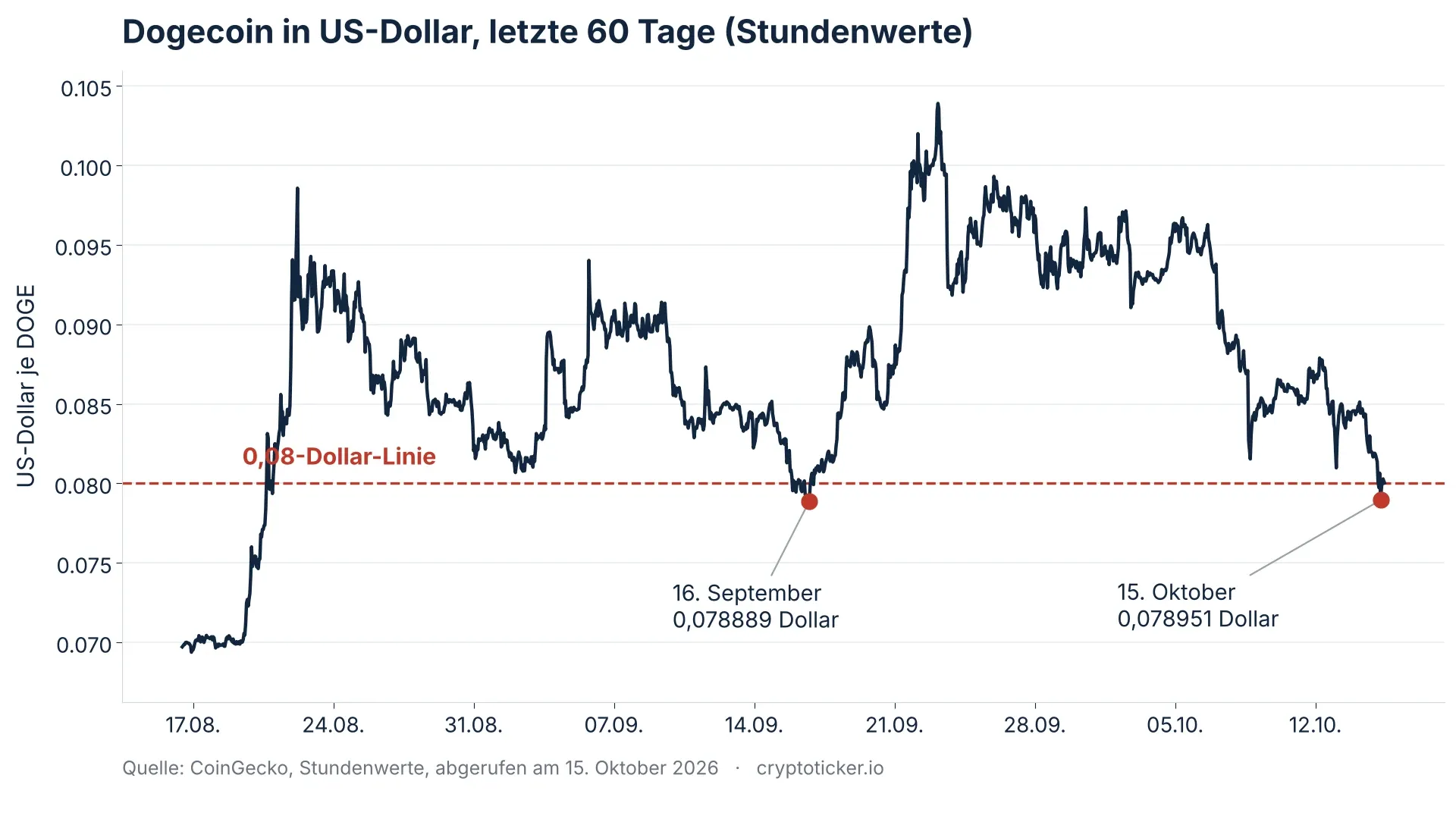
The $0.08 line and the September low at $0.078889
On 16 September the lowest hourly print fell to $0.078889. On 15 October it was $0.078951. Between the two values lie $0.000062, less than a tenth of a percent. Two attempts 28 days apart therefore ended at practically the same point.
Alongside that stands September as a month with a lowest daily value of $0.080051 and October with $0.080024. On a daily basis the round $0.08 line has held twice; on an hourly basis it was briefly breached both times. In practice a level is rarely an exact line. Usually it is a zone a few tenths of a percent wide.
To the upside the next well-founded level is the October high of $0.097149 from 2 October. To the downside the year's low sits at $0.06902, reached on 7 August. The current price is 89.1 percent away from the all-time high of $0.7316.
The last test on 16 September and the recovery to $0.1039
The comparable case is four weeks back and can be recalculated to the hour. After the low of 16 September the price turned up and reached $0.103908 on 23 September. That is 31.7 percent above the low, achieved in seven days. After that it went down again in stages: $0.097149 on 2 October, $0.088349 on 8 October, $0.0801 today.
For investors that means two things. The line held at the last test, and it brought no trend reversal. The recovery ended 32 percent higher and then retraced in full. Taking September as a template means taking both halves of the template.
Where Dogecoin is traded and at what cost differs markedly from venue to venue. A look at the crypto exchange comparison shows the ranges on trading fee, spread and withdrawal, which weigh more heavily on a price with four decimal places than they do on Bitcoin.
Mining supply: 13.64 million new DOGE a day
A second way into the subject lies not in the chart but in the blockchain itself. Dogecoin has no cap on total supply. Each block creates 10,000 new DOGE, as the project site at dogecoin.com describes it. Over the past 24 hours, 1,364 blocks were found according to Blockchair.
That works out to 13.64 million new DOGE in a day and around 4.98 billion a year. At the current price the daily amount corresponds to a value of roughly $1.09 million. Circulating supply lies between 156.3 billion units at CoinGecko and 172.0 billion at Blockchair, depending on the count. Annual expansion thus comes to just under three percent.
Why that number does not explain today
$1.09 million in new supply faces $1.07 billion in spot turnover. New supply therefore accounts for roughly one part in a thousand of daily turnover. As an explanation for a weekly loss of 8.6 percent it does not serve. It works as a permanent drag over years, not as the trigger of a single trading day. Anyone seeking to understand the annual balance of minus 61.1 percent finds one building block here. For today it contributes nothing.
The blockchain, incidentally, shows no congestion. 23,015 transactions in 24 hours, 17 items in the mempool, an average fee of $0.028. Panic-driven movement on the blockchain looks different.

Holding period and the exemption limit: 31 December under section 23 of the German Income Tax Act
Here lies the concrete check an investor in Germany can carry out today, and it has little to do with the chart. Crypto falls under private disposal transactions. The governing rule is section 23 of the German Income Tax Act. It sets the period between acquisition and disposal at "not more than one year", and it sets the exemption limit: gains stay tax-free if the total gain from private disposal transactions in the calendar year comes to less than 1,000 euros.
What the annual balance of minus 61.1 percent has to do with it
Anyone who bought Dogecoin within the past twelve months is, at today's price, sitting on a loss on paper. Losses from private disposal transactions realised within the one-year period can be offset against gains in the same category in the same year, for instance gains from other coins or from gold. The calendar year ends on 31 December, and a disposal takes effect only in the year in which it occurs.
Two points belong with that. First, with every month a part of the holding runs out of the one-year period, and what lies outside the period has no tax effect, in gain or in loss. Second, the order of acquisitions is decisive, which is why a clean record per purchase matters more than any view on the price. Which tools keep that record and track the deadlines per lot is shown in the overview of tax software and portfolio trackers.
This account is no substitute for tax advice. What is named here is the deadline, the section and the exemption limit, so that the question to check is on the table before the turn of the year.
Buying route and custody: fees, spread and your own keys
At a price of $0.08 the buying route decides a noticeable part of the outcome. On the cost side at entry we have already broken down the ranges between instant buy and order book, as set out in our look at the buying route for Dogecoin. The finding there still holds: the convenient route costs the larger mark-up.
For custody the usual trade-off applies. On the exchange the holding stays quickly tradable and sits with a third party. On your own hardware it sits with you, with full responsibility for securing the recovery words. Which devices support Dogecoin and what they cost is set out in the hardware wallet comparison. For amounts earmarked for a sale within the one-year period anyway, moving to your own hardware is rarely the first job.
Our assessment: the line is holding so far, the annual balance is not
In this newsroom's view the situation is less dramatic than the daily loss of 5.0 percent suggests, and at the same time less reassuring than the line holding makes it look. Three documented points support that. First, the zone around $0.0789 has stopped the price twice within 28 days, at $0.078889 on 16 September and at $0.078951 on 15 October. Second, the blockchain is unremarkable: 17 items in the mempool and an average fee of $0.028 show no selling pressure backing up in the network. Third, the weekly loss sits in the middle of the larger altcoins, not at the bottom of them.
Against that stands the longer view. On a one-year basis there is a 61.1 percent loss, over 30 days 3.0 percent, while Bitcoin gained 5.5 percent in the same month. The recovery after the September low ended at $0.103908 and retraced in full. A line that holds twice is a floor and not yet a turn. A turn can only be proven once an attempt ends above the October high of $0.097149. This assessment evaluates the situation and is not a buy or sell recommendation.
Dogecoin: below $0.078889 the path to the August low opens
Three steps order the coming weeks, each of them checkable.
- Watch the zone around $0.0789. If it holds a third time, the picture of the past four weeks stays intact. If a daily close lands clearly below it, the year's low of $0.06902 from 7 August is the next figure the market can refer to. To be ready to trade on that, know the costs of your venue and check them against the exchange comparison.
- Write down the one-year deadline for each purchase lot. Purchase date, quantity, price, and from that the date on which the one-year period under section 23 of the German Income Tax Act ends. Until 31 December this list decides which losses can still be offset. The tools for it are in the overview of tax software.
- Match the place of custody to the investment horizon. Holdings that will sit longer than the one-year period belong on your own hardware rather than at a trading venue. The devices and their costs are in the hardware wallet comparison.
(As of October 15, 2026. This article is not investment advice. Prices and fee structures change; check the terms with the provider before you buy. Crypto investments can lead to a total loss.)
Chainlink has been delivering its price data on Stellar since 14 October. Applications on that blockchain can now pull quotes for Bitcoin, Ether, LINK, XLM and USDC without building a data supply of their own. The token price is not following the news: Chainlink trades at $12.13 on 15 October, 6.12 percent below the previous day. The day's low was $11.98, the high $12.99.
That gap between network expansion and price action is the real story of the day. An oracle network wins another blockchain as a customer, and the paper on it gives way because the whole market gives way. The two are connected far less tightly than they look at first glance. This case shows precisely why.
What Chainlink delivers on Stellar: Data Feeds and Data Streams
Chainlink is an oracle network. An oracle is a service that brings data from outside a blockchain onto the blockchain in a form that contracts there can compute with. A blockchain knows no prices of its own; it knows only what sits in its own blocks.
Two products are available on Stellar. Data Feeds are continuously updated price readings that sit on the blockchain as a contract and can be queried by any application. Data Streams deliver the same data at a higher cadence and are written to the blockchain only when they are called, which is aimed at trading applications that need fast quotes.
Reports on the launch name feeds for BTC/USD, ETH/USD, LINK/USD, XLM/USD and USDC/USD. Developers select a single feed through an identifier addressed via a shared contract. Data like this is used above all where collateral has to be valued: in lending applications, with stablecoins, with tokenised equities and with derivatives.
Chainlink Scale: who carries the cost of the oracles
The launch runs through a programme called Chainlink Scale. The announcement by the Stellar Development Foundation describes joining that programme and the intention to adopt Data Feeds, Data Streams and CCIP. CCIP is Chainlink's protocol for transfers between different blockchains.
Economically this is the most interesting point. Under the Scale programme the adopting network carries the running cost of oracle operation, not the individual application and not Chainlink. Reports on the 14 October launch describe exactly that: the foundation behind Stellar bears the operating cost. That lowers the barrier for developers on Stellar to use this data. For demand for the LINK token, little follows for now, because payment happens at the level of the foundation rather than through every single call made by an application.
Two executives speak in the announcement. Johann Eid, Chief Business Officer at Chainlink Labs, calls the move an entry point to the infrastructure needed for institutional tokenisation. Raja Chakravorti, Chief Business Officer of the Stellar Development Foundation, says that once the integration is complete Stellar will be a step closer to a unified financial system on the blockchain. The announcement itself is written in the future tense and describes the integration as a plan; the reports of 14 October cover the feeds going into operation.
Stellar's tokenised assets: $3.54 billion to more than $4 billion
The size of the target market is stated differently in different places, and those differences are not a trifle. Several reports on the launch put the stock of tokenised assets on Stellar at roughly $3.54 billion, others at more than $4 billion, depending on cut-off date and definition. One of those figures refers explicitly to the position on 1 September 2026.
The foundation itself cites a different measure in its announcement: $5.4 billion in payment volume with tokenised assets per quarter. That is not the same as a stock. A payment volume counts movements over a period; a stock counts what exists on a given date. Setting the two numbers side by side without naming the difference compares two different things. On DeFi activity on Stellar, the foundation writes that it has grown more than threefold this year.

The LINK price on 15 October: $12.13 after $11.98 at the low
The price figures in this article come from a direct query at CoinGecko on 15 October 2026. LINK stands at $12.13, or 10.82 euros. Over 24 hours that is 6.12 percent down, and 7.23 percent down over one week.
Longer periods look different. Over 30 days LINK is 7.01 percent up. The month, in other words, was friendly, and the weak day falls within a phase that trended higher overall. Over twelve months there is a loss of 35.71 percent. From the May 2021 record high of $52.70 the price is almost 77 percent away.
Market capitalisation is $9.30 billion and daily turnover $382.56 million. There are 766.85 million LINK in circulation out of a total supply of one billion. A good fifth of the supply, then, is not yet in the market.
Oracles explained: how a price feed triggers a liquidation
The path from a price reading to a change in a position is shorter than many assume. Borrowing on a blockchain means posting collateral, Ether for example. The contract that manages that loan has to know continuously what the collateral is worth. It takes that reading from a price feed.
If the posted value falls below a defined threshold, the contract sells the collateral by itself. This is called a liquidation. What decides the outcome is not what is happening on a trading venue, but the value standing in the feed. A feed that delivers late or delivers wrong triggers liquidations that should never have happened, or prevents ones that were needed.
That is why the choice of oracle is a decision about liability and trust for a blockchain, and not merely a technical detail. And that is why landing an established provider weighs heavily for Stellar. The foundation notes in its announcement that the security layer of CCIP builds on infrastructure which, on its account, secures value in the region of nearly $100 billion across DeFi.
Why network expansion and token demand drift apart
An oracle network earns money when applications call data and pay for it. When a network such as Stellar covers those costs in a lump sum, reach is created without an amount in LINK falling due for every call. The link between distribution and token demand does exist, but it is indirect and lagged.
There is also the question of scale. Even a stock of $4 billion in tokenised assets is, measured against a market capitalisation of $9.30 billion, not a sum that moves a price on its own. Chainlink has reported several integrations in recent weeks alone, most recently the CCIP Vault Adapters on 8 October. The price has not turned any of them into a lasting uptrend.
Terms at the trading venues are set out in the crypto exchange comparison for anyone looking to buy in. The spread between bid and ask barely matters for an asset of this size; at $382.56 million in daily turnover the market is deep enough that larger orders also fill at the quoted price.

What the funds hold in Chainlink
Alongside buying directly, there are exchange-traded products on LINK. According to SoSoValue data cited by Coingape, the two US funds together held $244.34 million, of which $175.69 million sat with Grayscale and $68.64 million with Bitwise. On 1 October, $2.62 million flowed in, all of it into the Bitwise product.
Measured against a market capitalisation of $9.30 billion, $244.34 million is around 2.6 percent. These products are a factor, then, but not a dominant one. How the inflows have developed lately was set out by cryptoticker.io on 10 October in its piece on the first fund inflow after five trading days.
The broad decline on 15 October
The day was weak for almost every large crypto asset. Bitcoin gave up 2.54 percent, Ether 5.20 percent. At 6.12 percent, LINK sat clearly below Bitcoin and somewhat below Ether. That pattern is not unusual for Chainlink: in broad declines the asset usually falls harder than the two largest ones, and in recoveries it rises harder.
For reading the day, that leaves one conclusion: the price loss cannot be attributed to the Stellar news. It fits a market that gave way across the board that day. The only robust statement is that the news did not prevent the decline.
Access in Europe: MiCA licensing, custody and the holding period
For investors in Europe the Stellar launch changes nothing about the practical questions. LINK is tradable at the large venues that hold a licence under the MiCA regulation in the European Union. MiCA is the single European legal framework for crypto assets; a licence under it means the provider is supervised and has to meet certain obligations to protect client funds.
On custody the familiar trade-off remains. Leaving the coins at the trading venue is more convenient and carries the provider's risk. Moving them to a wallet of your own means taking responsibility for securing the keys yourself.
For tax, private sales in Germany fall under the one-year holding period set out in section 23 of the Income Tax Act. Hold for at least a year and no income tax is due on the gain from the sale. Staking income has to be treated separately. On the deadlines in Chainlink staking, cryptoticker.io reported on 12 October ahead of the 29 October date.
Our assessment: the reach is documented, demand for the token is not
In this newsroom's view the Stellar launch is a good day for Chainlink as a company and a neutral one for the token. Three documented points support that. First, the foundation behind Stellar carries the operating cost, which aids distribution but triggers no per-call payment in LINK. Second, the target market, with a stock between $3.54 billion and a good $4 billion, is smaller than LINK's market capitalisation. Third, the price has not reacted lastingly to comparable announcements in recent weeks.
Against that stands the fact that the value of infrastructure only shows over years. If lending and trading applications do emerge on Stellar that need these feeds permanently, business will follow later. That is not measurable today, and selling it as a price argument claims more than the figures support. This is an assessment of the situation, not a recommendation to buy or sell; with crypto assets a total loss is possible.
Chainlink on Stellar: only fees turn reach into demand
- Check the terms before buying. Venue, fee model and withdrawal costs differ markedly. The terms are set out in the crypto exchange comparison.
- Look for the EU licence. A provider with a MiCA licence is supervised. Which venues meet that is shown in the overview of regulated crypto exchanges.
- Record the purchase date. The one-year holding period can only be proven if the data is captured cleanly. The tax software and portfolio trackers help with that.
(As of October 15, 2026. This article is not investment advice. Prices and fee structures change; check the terms with the provider before you buy.)
On October 25, 2026, 227,777,777 XPL become free at Plasma. That is around 5.0 percent of the circulating supply and, at the current price of $0.077, about $17.6 million. The more important figure, though, is not in that single day's calendar entry: the same tranche falls every month afterwards, for 24 months, until September 25, 2028. From that date on, the XPL unlock is no longer a single event but a rhythm.
That is exactly what separates October 25 from September 25, when the one-off cliff tranche for the team and investors fell. Treat the September date as settled and you miss that only a third of the team and investor supply was released there. The remaining two thirds follow in even monthly tranches. This article works through the schedule, sets it against the circulating supply and answers what follows from it for you as an investor in Germany.
XPL unlock on October 25: these three items become free
The release is made up of three parts, all of which take effect on the same day. The official documentation on XPL distribution describes the rules from which every single figure follows:
- Ecosystem and growth: 88,888,889 XPL. This tranche has already been running every month for a year.
- Team: 69,444,444 XPL. The first monthly tranche at all.
- Investors: 69,444,444 XPL. Likewise the first monthly tranche, on the same schedule as the team.
Together that comes to 227,777,777 XPL. At a price of $0.077129, the tranche corresponds to around $17.6 million and to 5.02 percent of the circulating supply of 4.53 billion XPL. Measured against the total supply of 10 billion tokens, it is 2.28 percent.
From cliff to standing schedule: what changes against September
A cliff is a lock-up period at the end of which a large block is released in one go. At Plasma that point came one year after the mainnet beta launch of September 25, 2025. On that day a third each of the team and the investor supply became free, so 833.3 million XPL twice over. How the date was to be judged at the time was set out by cryptoticker on September 1, 2026, in the analysis of the XPL lock-up period; the launch of the network itself is covered in the report on the mainnet beta of September 25, 2025.
Vesting is the name for the schedule under which the remaining supply is then released in portions. For the team and investors it spreads the remaining two thirds across 24 equally sized monthly tranches. October 25 is the first of them.
In practice that changes the order of magnitude of the monthly inflow. Between October 2025 and September 2026, 88.9 million XPL came in month after month from the ecosystem pot. From October 2026 it is 227.8 million, around 2.6 times as much. That jump belongs to the picture when the calendar entry for October 25 crosses your path.
The maths behind the 227.8 million tokens
Both figures can be recalculated from the parameters in the documentation, and they add up exactly:
- Team and investors: 2,500,000,000 XPL total allocation each. A third of that was the cliff, leaving 1,666,666,667 XPL. Divided by 24 months, that gives 69,444,444 XPL per tranche and group.
- Ecosystem and growth: 4,000,000,000 XPL total allocation, of which 800 million were immediately free at launch. The remaining 3,200,000,000 XPL are spread over 36 months, so 88,888,889 XPL per tranche.
The schedules end on the same day, September 25, 2028. The team and investors need 24 months for that because their schedule starts a year later; the ecosystem pot runs over 36 months from the network launch. Three years after the mainnet beta, the full supply is released in all three cases.

What 5.02 percent of the circulating supply means in proportion
An absolute token figure says little as long as it is not set in proportion. XPL currently weighs in at around $350 million in market capitalisation, with 4.53 billion tokens in circulation. That is 45.3 percent of the total supply of 10 billion. More than half of all XPL is therefore still locked.
If the schedule continues unchanged, the released supply twelve months later stands at around 7.27 billion XPL. That would be an increase of about 60 percent against today, spread across twelve equally sized steps. This calculation describes supply only, however. How much of it actually arrives at a trading venue depends on what the recipients do with their tokens, and that cannot be read off the unlock schedule.
The roadmap to September 2028 in figures
Once you have grasped the rhythm, you can work out every coming date yourself. The tranches are constant, only the total grows:
- October 25, 2026: first joint monthly tranche, 227.8 million XPL. Circulating supply afterwards around 4.76 billion.
- Every 25th thereafter: the same 227.8 million XPL, unchanged in size.
- October 25, 2027: circulating supply around 7.27 billion XPL, so just under 73 percent of the total supply.
- September 25, 2028: final tranche. After that, all 10 billion XPL are released.
Two items are no longer part of this schedule. The public sale covered 1 billion XPL and is fully unlocked: buyers outside the US received their tokens at the network launch, and the lock-up for US buyers ended on July 28, 2026. No further inflow comes from that direction.
Staking and emissions: why one important clause currently runs into nothing
One sentence in the documentation is usually missing from pure date announcements: locked XPL held by the team and investors are excluded from staking rewards. With every monthly tranche, the amount allowed to take part in future emissions therefore grows as well.
Emission here refers to the reward that a proof-of-stake network creates anew and distributes to those who post tokens as security. Plasma plans a start at 5 percent annual inflation, decreasing by 0.5 points a year down to a floor of 3 percent. The counterweight comes through transaction fees: the base fee is permanently destroyed, following Ethereum's example.
For holders, one detail dampens expectations here. This inflation is not active yet. According to the documentation, the start only follows once external validators and the delegation of stakes are enabled, and both are still outstanding. Buy XPL today and you cannot currently delegate the tokens to a validator, and you receive no network reward for them either. The network is opening its validator circle in stages, and the documentation names no fixed date for it.
Where XPL can be traded and what matters in choosing a venue
XPL is listed at several large international trading venues, among them Binance, OKX, Kraken, Coinbase, Bybit and Bitget, as well as at decentralised exchanges. For you as an investor in Germany, the number of venues matters less than their legal standing.
Since the European crypto regulation MiCA, providers targeting clients in the EU need authorisation in a member state. Plasma has published a MiCA white paper for XPL, bringing together the mandatory disclosures on the token. That concerns the token itself and says nothing about the authorisation of the venue where you buy. Which providers can show a European licence is set out in the overview of regulated crypto exchanges; fees, selection and deposit routes are in the crypto exchange comparison.
One practical point with a token of this size is market depth. At around $350 million in market capitalisation, XPL sits well below large assets such as Bitcoin. With thin order books, even a medium-sized order moves the price noticeably. A limit order, where you set the maximum price yourself, protects you better here than a market order, which is executed at the next available price.

Tax in Germany: your purchase date beats the unlock schedule
Gains from the sale of cryptoassets are a private disposal in Germany under section 23 of the Income Tax Act. If more than a year lies between purchase and sale, the gain remains tax-free under the law as it stands. Below that it counts towards other income as soon as the exemption threshold for all private disposals in a year is exceeded.
For XPL that means concretely: the token has existed since September 25, 2025. Anyone who bought in the first few days and has held since has already met the one-year period. Anyone who entered later reaches it on their own respective date. The project's unlock schedule has no bearing on that whatsoever, because the only thing that matters is your acquisition date for each tranche.
This connection matters because an unlock date regularly tempts investors into short-term reshuffling. A sale shortly before your own one-year period expires can turn a tax-free gain into a taxable one. On top of that comes the reform under way: a draft bill provides for a cut-off date at the end of 2026, from which newly acquired cryptoassets are to be treated differently. The state of that discussion is summarised in the article on grandfathering and the cut-off date for the crypto holding period.
What an unlock date says about the price and what it does not
An unlock increases the freely available supply. It does not force a sale, though. Team tokens are additionally subject to individual vesting schedules tied to joining dates, and funds from the ecosystem pot flow into liquidity, partnerships and incentive programmes rather than landing on an exchange without a detour.
To place the starting position: XPL trades around 95 percent below the peak of $1.68 that the token reached on September 27, 2025, shortly after launch. Over the week it is down a good 10 percent. Part of the expectation around the monthly schedule is therefore likely to be in the price already, because the schedule has been publicly documented since the network launch and is no surprise.
No serious statement about the price can be derived from this, in either direction. The only robust part is the mechanics: supply grows in known steps on known dates, and from October 25 those steps are considerably larger than in the year before.
Three questions that deserve an answer before October 25
Not every one of these questions concerns every holder, but each can be answered in a few minutes:
First, when did you buy? Without that date for each tranche, the tax position cannot be judged. Exchanges provide transaction overviews for export, and portfolio tools sort purchases by holding period automatically.
Second, how liquid is your trading venue? A look at the order book shows how far the buy and sell sides are apart. The wider that spread, the more expensive an order executed at the market price becomes.
Third, what share of your portfolio does XPL make up? With an asset sitting 95 percent below its peak and whose circulating supply can rise by around 60 percent within a year, position size is the most effective lever.
XPL unlock: the same tranche falls every month until September 2028
October 25 is the first of 24 identical dates. To get a handle on it, proceed in this order:
- Compile your purchase dates. Export the transaction overview from your exchange and sort the purchases by date, so that you know for each tranche when your one-year period expires. Which programmes handle that automatically is set out in the overview of crypto tax software and portfolio trackers.
- Check your trading venue. Verify whether your provider holds a European authorisation and what fees apply at your order size. The terms are in the crypto exchange comparison.
- Correct your expectations on income. There is no staking yield on XPL until delegation starts. If you are looking for running income, compare it where it is already being paid out today, for instance through the overview of staking platforms.
(As of October 15, 2026. This article is not investment advice. Prices and fee structures change; check the terms with the provider before you buy.)
Solana costs $102.99, or 91.79 euros, on Thursday morning, October 15. That is 3.8 percent less than 24 hours earlier, and over seven days it leaves a loss of 10.4 percent. The figure alone explains little. More revealing is who buys and who sells at this level, because that is where the market's biggest addresses are visibly pulling in two directions.
Solana price at $102.99: where things stand on Thursday morning
The market data come from CoinGecko. The daily high was $107.74, the daily low $101.04. Solana thus weighs in at $60.7 billion and ranks seventh among the largest cryptocurrencies. In 24 hours, $4.10 billion changed hands. Of a total 635.84 million SOL, 589.27 million are in circulation.
Over longer horizons the picture turns contradictory, and that is exactly where the tension of this week sits. Over 30 days Solana is up 2.6 percent, over 60 days 36.6 percent. Over a year, by contrast, 49.8 percent is missing, and 64.9 percent separates the price from its peak of $293.31 on January 19, 2025. October has cost more than 13 percent so far. Anyone who entered in August is sitting on a clear gain; anyone who bought a year ago on half their stake.
Grayscale has been buying for 20 days, VanEck is selling
Among the US spot ETFs on Solana, a pattern has emerged over the past three weeks that was not there before. According to data from the analytics firm Arkham, Grayscale's GSOL fund has taken in $20.2 million of SOL across 20 days, with a single outflow day in between. On October 12, a day on which Grayscale gave up nothing, VanEck sold around $700,000 through its VSOL fund.
A spot ETF does not buy out of conviction. It mirrors what its shareholders do: subscribe to units and you trigger a purchase in the market, redeem them and you trigger a sale. That one provider adds for 20 days while another gives up therefore proves no special knowledge at Grayscale. It shows that the two houses' client bases are currently acting differently. Grayscale traditionally serves long-term holders who come from the older trust product, VanEck more active allocators with a shorter horizon.
For the price it remains a zero-sum game with a sign attached. As long as the sum across all funds is negative, they are net sellers into a falling market, regardless of how convinced individual providers are as they accumulate.

Eighth straight day of outflows: what the ETF figures measure
Summed across all providers, the Solana ETFs saw outflows on Wednesday for the eighth trading day in a row, most recently $1.29 million. In the week of October 5 to 9 they had lost $24.81 million net, according to figures from SosoValue, ending a run of 14 weeks of inflows. Our report of October 11 has already covered that week.
What has changed since is the length of the run, not its size. At $4.10 billion in daily turnover, $1.29 million in a day is not an amount that moves a price. The duration is the signal: eight trading days without a single inflow day mean that no fresh money is currently arriving via the fund route. That route is precisely what carried the price in August and September.
$97.95 and the 50-day line at 107: this week's levels
On the chart, Solana turned at the 50-day line at $107.13 on Wednesday and fell back from there. That line has stopped every attempt at recovery since the start of October. To the downside, market observers name $97.95 as the next catching line, just below the round 100.
The round number itself was discussed in our article of October 14, at $103.82 at the time. The price has fallen by just under a dollar since, the 100 has held, and the daily low of $101.04 has tested it once. What is new is the direction of the pressure: no downside break is pending, but a third rejection at the 107 line from above.
The analyst 0xSweep points to a bullish divergence in the four-hour chart and compares it with a constellation near $96 that was followed by a move up to $124. That is a single opinion with one comparable case, not a law. The relative strength index stood at 38.28 on October 13, below its average of 41.72, so in the lower range but not yet where traders speak of oversold.
USDC on Solana: $3.5 billion newly minted in seven days
While the price falls, use of the blockchain is picking up. The data service SolanaFloor reported on October 12 that around $3.5 billion of USDC had been newly issued on Solana within seven days, in repeated tranches of $250 million each. That is the largest weekly issuance on this blockchain this year. USDC holdings on Solana now stand at about $8.64 billion, and over 30 days new issuance adds up to more than $10 billion. The individual mints can be traced in the Solscan block explorer.
A mint means the issuer Circle has accepted dollars and issued tokens in return. That money then sits on the blockchain and waits for a use, whether trading, payment or custody. It is not a buy order for SOL, but it is liquidity that can flow into Solana applications without a detour through an exchange.
Total holdings of all stablecoins on Solana reached a peak of $17.3 billion in September, as measured by Solana Compass and DeFiLlama. This is where the apparent contradiction with our report of October 11, which described a 6.4 percent decline in reserves, resolves itself: total holdings can fall while a single currency gains. That is exactly what has happened, with USDC winning share against the other dollar tokens on the same blockchain.
Tokenised equities: $786.3 million in volume and first place after 13 weeks
The second area where Solana is gaining ground is tokenised equities. In the week of October 5 to 11, the blockchain settled $786.3 million of spot volume in this segment according to figures from SolanaFloor, putting it back in front for the first time in 13 weeks. Behind it came Robinhood with $663.0 million, BNB Chain with $623.3 million and Base with $445.5 million. Ethereum reached $12.0 million, HyperCore $7.9 million. Of the $2.54 billion across all the venues named, around 31 percent therefore fell to Solana.
A product launch provided the impetus. On October 8, the issuer Securitize brought twelve tokenised US equities to Solana, among them Apple, Nvidia and Tesla. According to the company, each token is backed one-to-one by a real share, settlement is in USDC, and Jump Trading acts as market maker. CoinDesk described the structure and legal form in detail on the day of the launch.
For investors in Germany this part is for now an observation and not an offer. Securitize speaks of eligible investors in the US, the EU and other approved markets, but does not define the term more closely. Anyone wanting to acquire tokenised equities needs a provider in the EU with the appropriate MiFID II authorisation, and a decentralised exchange does not hold one.

Alpenglow on October 21: Firedancer and Frankendancer are not joining the migration
On October 21 the Alpenglow consensus protocol starts on mainnet beta, a date confirmed by the core developers at Anza. Alpenglow replaces the existing interplay of Tower BFT and Proof of History with a procedure meant to shorten considerably the time to a block's final confirmation. Final confirmation means the point from which an entry can no longer be reversed.
One footnote to the schedule matters now. The validator software Firedancer and its intermediate stage Frankendancer do not support the initial changeover. Operators running these clients have to switch temporarily for the transition. That affects a relevant share of network capacity and, indirectly, everyone who has delegated their SOL to one of these operators. crypto.news has gathered the details.
At present, 438.97 million SOL are delegated according to data from Staking Rewards, 74.6 percent of the circulating supply, at a yield of around 4.92 percent a year. If you have delegated, you can ask your validator which client it will run on October 21. Should a validator fail during the changeover, the delegator misses that epoch's rewards, while the balance itself is unaffected.
ETFs in the US, ETPs in Germany: the difference in access
The fund flows discussed above arise in the US. A German retail investor cannot buy the spot ETFs there, because they lack the key information document required under the PRIIPs Regulation. The route in this country runs through exchange-traded cryptoassets, usually structured as an ETP or ETN and tradable via Xetra. These securities are physically backed with SOL, but legally they are debt instruments and therefore set up differently from a fund with segregated assets.
In practice that means: the costs sit in the annual flat fee and in the bid-ask spread, and both differ between venue and time of day. In thin market phases such as this week, the spread widens. If you intend to buy anyway, place the order between 15:30 and 17:30, when US trading is running and spreads are tightest. An overview of the trading venues helps with comparing fees.
Staking, the holding period and December 31
For tax purposes in Germany, section 23 of the Income Tax Act applies: a sale within one year of the purchase is a private disposal, after that the gain remains tax-free. In a circular of May 10, 2022, the Federal Ministry of Finance clarified that staking does not extend this period to ten years; it stays at one year even then.
With an annual loss of 49.8 percent, that leads to a calculation which suggests itself. Losses from a sale within the one-year period can be offset against gains from other private disposals in the same year. Sell a position at a loss after the year has elapsed and the loss cannot be used for tax, because the transaction falls outside the period. The cut-off date for offsetting is December 31. The purchase dates of individual positions are in the exchange's transaction report or can be compiled with a portfolio tracker. This is no substitute for tax advice.
Stake instead and you take the 4.92 percent as running income. These rewards count as other income under section 22 no. 3 and are taxable from 256 euros a year, in the year they are received, regardless of whether the SOL are later sold at a profit or a loss.
Our assessment: the price is not following network load right now
In the view of our editorial team, this week's figures show a decoupling that can be named. On one side stands the price: minus 10.4 percent in seven days, eight consecutive outflow days at the funds, a third rejection at the 107 line. On the other stand $3.5 billion of freshly minted USDC in the same week, $786.3 million of volume in tokenised equities and a protocol change with a fixed date.
What argues against reading this decoupling as a case for buying: minted USDC is liquidity and no evidence of demand for SOL, and the volume in tokenised equities accrues mainly at the trading venues, not at the token. On top of that, DEX volume on Solana has been declining lately, with $12.88 billion over seven days meaning 27.0 percent less than in the previous week. So network load is not growing across the board, it is shifting. The only robust statement is that fund flows are currently setting the short-term direction and the usage data are not supporting it.
Solana at $103: the next week is decided above 107
Three things are concrete in the coming days:
- October 21. If you have delegated SOL, ask your validator about the client. If you want to judge the reward independently of the operator, the terms are in our overview of staking platforms and at Staking Rewards.
- The 107 line. Only a daily close above it ends the run of rejections. Until then, $97.95 remains the next catching line to the downside.
- The purchase date in your portfolio. If you want to close or add to a position, check it first against the one-year period and against the December 31 cut-off.
(As of October 15, 2026. This article is not investment advice. Prices and fee structures change; check the terms with the provider before you buy.)
Zcash is trading at $1,089.72 on October 15, 2026, down around 13 percent within 24 hours. That is the largest daily loss among the 25 biggest cryptoassets by market value, and it comes in a market that is giving way across the board: Bitcoin stands at $80,774 and is down 3.1 percent, Ether at $2,354 and down 5.9 percent. The price of Zcash is therefore falling about four times as hard as Bitcoin's, without any news from the Zcash project itself behind it.
Zcash falls from $1,185 to $1,089: what has changed since October 13
On October 13, cryptoticker.io reported that Zcash had slid from $1,315 to $1,185, with a daily loss of 8.2 percent at the time. Another $96, or a good 8 percent, has gone since then. Two things have shifted in the process. First, the price now sits below the round $1,100 mark, which had still held on the two previous days. Second, what was a setback playing out mainly in one coin's derivatives market has turned into a broad sell-off.
The daily range shows how fast that went: $179.66 separates the daily high from the daily low, just under 17 percent of the current price. The coin sits at the bottom end of that range, not in the middle.
Four times as hard as Bitcoin: Zcash leads the losers among the 25 biggest coins
Among the 25 largest cryptoassets by market value, none loses more on October 15 than Zcash. Behind it come Rain at 9.7 percent, NEAR Protocol at 8.1 percent and Chainlink at 6.6 percent. The stablecoins in that group barely move, as expected. This ranking is based on the daily changes of the 25 largest cryptoassets by market value, stablecoins included, on October 15, 2026. cryptoticker.io compiled that analysis itself on October 15, 2026.
Zcash ranks tenth on that list, with a market value of $18.51 billion and daily turnover of $1.16 billion. A coin of that size does not move by double digits on an ordinary day. That it does today comes down to the make-up of its buyer base: an asset up 321 percent over twelve months carries plenty of positions built only this year and running on credit.
Monero gives up just 2.3 percent: the slump is not a privacy-coin problem
The obvious explanation would be regulatory pressure on anonymous transfers. The evidence for that is missing today. Monero, the second large asset with shielded transfers, stands at $537.88 and is down 2.3 percent, less than Bitcoin. Both coins obscure amounts and parties, and both sit under the same supervisory scrutiny in the EU. Were privacy the trigger, they would have to fall together.
What remains is a difference in market behaviour. Monero has gained considerably less than Zcash over twelve months and is traded with far less leverage. The technical term for this property is beta, and it describes how strongly an individual asset reacts to a move in the broader market. A high beta means wider swings in both directions, up as well as down. Zcash has delivered the high beta this year, in the rally as much as in today's sell-off.

Fed decision and US inflation data: the trigger lies outside Zcash
CoinDesk reports forced close-outs of around $483 million in Bitcoin and Ether futures alone over the past 24 hours, of which about $286 million was on Ether and around $197 million on Bitcoin. Solana accounted for about $31 million and Zcash for just under $19 million. As background, the report names the uncertainty ahead of the US Federal Reserve's rate decision and US inflation data that came in above expectations.
A forced close-out, known in the market as a liquidation, is not a voluntary sale: once the collateral posted for a leveraged position no longer suffices, the exchange closes it itself and sells into the market to do so. The thinner the order book, the deeper that sale pushes the price, and the sooner it takes out the next position. How far a single sale moves the price therefore depends less on the day's volume than on the depth of the order book at the moment of the close-out.
14 days, minus 24 percent: the October gain is gone, the yearly gain is not
A single day says little. The longer windows put the slump in context. Over seven days Zcash is down 12.0 percent, over 14 days 24.2 percent. Over 30 days, by contrast, it is only 5.0 percent, and over twelve months a gain of 321.3 percent still stands.
That produces a clear picture: what has been cleared out is the premium of the first half of October, not the year's upward move. Anyone who bought ZEC in the spring is well ahead despite the slump. Anyone who got in at the start of October is sitting on a loss of around a quarter. The same figure means something entirely different for those two groups, and that is exactly what makes the debate in the forums so loud right now.
Daily low of $1,084.21 and daily high of $1,263.87: the range of a single day
The daily low is $1,084.21, barely five dollars below the current price. The market has therefore not yet left the day's lower edge. As long as that remains the case, the sell-off is not finished but interrupted.
Two figures can be drawn from this and tracked on the chart. To the downside, $1,084.21 is the level whose breach can set off fresh selling, because the stop orders of the past two weeks sit below it. To the upside, $1,263.87 is the point at which the day began; only above it would the slump be made up arithmetically. Between the two lies the round $1,100 mark, which gave way during the morning. Levels of this kind are observation points, not price targets: they show where supply and demand last rubbed against each other, not where the price runs next.
Shielded balances and self-custody: what changes for ZEC holders
There are 16,986,953 ZEC in circulation. A substantial part of that sits in the blockchain's shielded pools, where amounts and addresses are encrypted. For custody that means: anyone holding ZEC themselves rather than on an exchange needs a wallet that supports the exact pool their balance sits in. A device that only knows transparent addresses simply does not display shielded holdings.
In a sell-off that difference becomes practical. Anyone wanting to sell has to move the balance to an exchange first, and shielded transfers require an extra check at some providers. Anyone intending to hold anyway has the quieter route if the keys sit on a device of their own. Which devices support shielded Zcash addresses and what they cost is set out in the hardware wallet comparison.

NU7: the activation height is set on October 20, November 5 is the target
The NU7 network upgrade has been running on the testnet since October 4, activated at block height 4,465,026. For the mainnet, the activation height has not yet been fixed according to The Crypto Times; it is due to be set on October 20, with November 5 as the target date for activation. Because activation hangs on a block height rather than the calendar, that date is a target and not a switch-over appointment.
In substance, NU7 brings two changes that concern holders. The target gap between two blocks drops from 75 to 25 seconds. And the upgrade invalidates version 4 transactions — according to the same report, that is the only format with which balances can be moved out of the old Sprout pool. Anyone still holding funds there should move them before activation; afterwards, as things stand, they can no longer be spent.
For today's price action, however, the upgrade plays no discernible role. The date has been known for weeks, and the slump came on a day when Ether, Solana and Chainlink also lost heavily.
Our assessment: the market is selling beta, not Zcash
In the view of our editorial team, the evidence suggests that this day is not a Zcash event. Three findings support that: Monero, the next-largest asset with shielded transfers, loses 2.3 percent, less than Bitcoin. The close-outs cited above are concentrated in Bitcoin and Ether at around $483 million out of a good $530 million, not in Zcash. And the Zcash project itself has announced nothing on this day that would change the valuation; its next own date is October 20.
Against that stands the fact that a loss of 24.2 percent in 14 days leaves marks even without news of its own: anyone holding positions on credit faces margin calls at this speed, and those take effect regardless of whether the cause is home-made. This assessment evaluates the situation; it is not a buy or sell recommendation. A total loss is possible at any time with cryptoassets.
Zcash after the slump: October 20 first, then November 5
Two dates structure the coming three weeks, and both can be worked through without a price forecast.
- Hold your own entry price up against $1,089. Only that shows whether today shrinks a paper gain or widens a paper loss. If you have spread your holdings across several venues, the differences in fees and withdrawals are set out in the overview of the best crypto exchanges.
- Recalculate open leveraged positions and their liquidation price. With a daily range of just under 17 percent, that price sits closer than it did the day before yesterday. Which platform applies which leverage and which margin rule is shown in the comparison of the best perp DEXs.
- Note the holding period for each purchase before selling. In Germany the twelve-month period decides whether a gain on a sale is taxable; with a yearly gain of 321 percent that difference is substantial. Which tools carry the deadlines per purchase is set out in the overview of crypto tax software.
(As of October 15, 2026. This article is not investment advice. Prices and fee structures change; check the terms with the provider before you buy.)
Decrypt
Alpenglow is coming next week, slashing Solana finality from 12.8 seconds to a target of about 150 milliseconds—some 85 times faster.
Odds of an October Fed hike have climbed to 29% from 18% a week ago, and analysts see Bitcoin range-bound until the picture clears.
The scammers also ran a fake recovery service, contacting victims weeks later with promises to get their stolen crypto back.
After a summer of AI models escaping test environments and hacking real companies, hundreds of researchers say the internet itself should be treated as a security boundary.
Developer Brandon Thomas used Anthropic's Claude to build free, open-source replicas of Word, Excel and PowerPoint. They're rough, but they show how cheap cloning software has become.
U.Today - IT, AI and Fintech Daily News for You Today
The number of XRP holders on Binance is rising little too rapidly which might be a reflection of a bearish dynamic on the market for now.
Arthur Hayes has made a mysterious Ethereum move as he dumps nearly $20 million worth of ETH to an unlabeled wallet address.
SHIB holders get a chance at free coins as Japanese crypto exchange plans giveaway.
Shiba Inu's key support level was invalidated and, unfortunately, it looks like no supports left below.
Brad Garlinghouse details the compliance layer designed to open the XRP Ledger to regulated U.S. credit markets.
Blockonomi
Bitcoin has a market value of more than $2 trillion, yet some experts still ask what would happen if it fell to nothing. The question sounds extreme, but it helps show how closely Bitcoin now connects to the wider financial system.
This article looks at the numbers behind that question. It draws on four published sources that cover market size, expert opinions, and step-by-step crash scenarios.
A crash to zero would not erase the Bitcoin network. It would mean that the price of each coin drops to nothing while the software keeps running. Keeping that difference in mind makes the rest of the numbers easier to read.
How Big Is Bitcoin Today?
Bitcoin had a market value of $2.31 trillion in August 2025, according to GOBankingRates. That is the total value of every coin in circulation at the price on that day.
The coins are no longer held only by individual traders. The same report says Bitcoin sits on the balance sheets of asset managers, institutions, and even national treasuries. Millions of people hold it directly, and others have exposure through exchange-traded funds (ETFs), futures, and retirement accounts.
Size matters because a larger market has more people tied to it. A fall of a few percent affects a small group. A fall to zero would reach pension funds, asset managers, and everyday savers.
The crypto market as a whole has also grown fast. In 2021, The Economist reported that all cryptocurrencies together had a market value of $1.6 trillion, up from $330 billion a year earlier. The magazine noted that this was roughly equal to the nominal GDP of Canada.
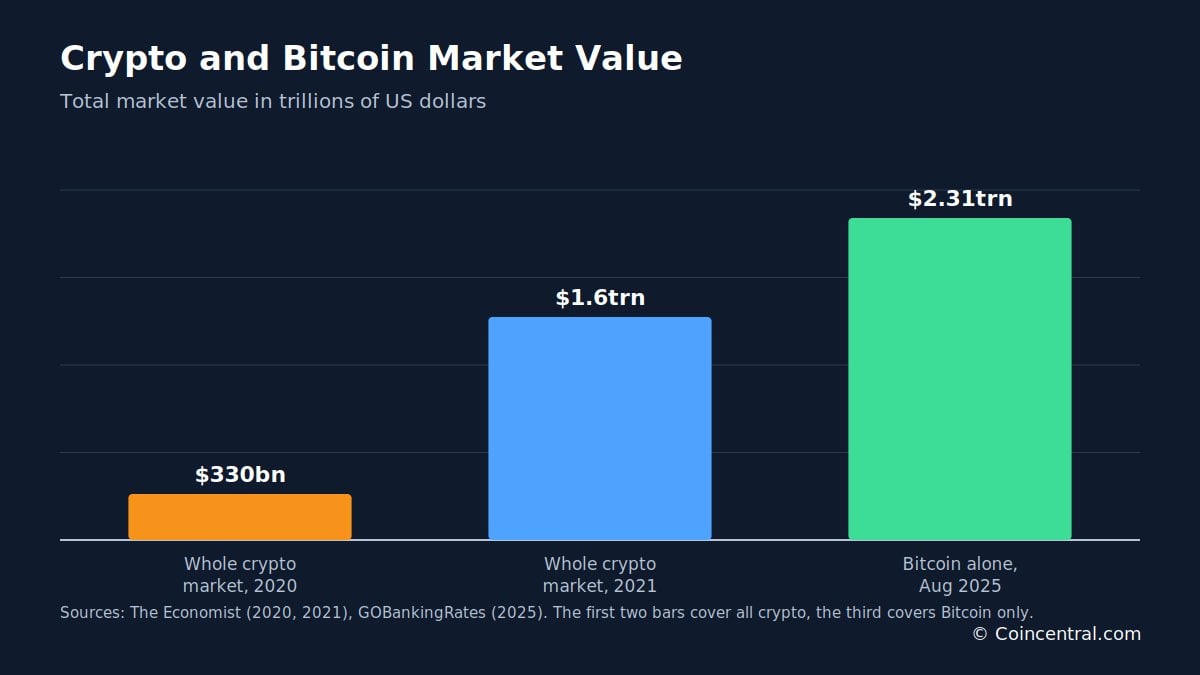
The table below puts the main size figures side by side. Note that the first two rows cover all crypto, while the last row covers Bitcoin alone.
Table 1: Market value figures from the source articles.
| Date | What was measured | Value | Source |
|---|---|---|---|
| 2020 | Whole crypto market | $330 billion | The Economist |
| Aug 2021 | Whole crypto market | $1.6 trillion | The Economist |
| Aug 2025 | Bitcoin only | $2.31 trillion | GOBankingRates |
| Aug 2025 | Bitcoin held by the world’s largest asset manager | $90 billion | GOBankingRates |
The jump from $330 billion to $1.6 trillion in one year is a gain of almost five times. Bitcoin alone has since passed the 2021 value of the entire crypto market.
These numbers do not predict a crash. They only show how much value would be at stake if one happened.
GOBankingRates also notes that Bitcoin now trades alongside products such as ETFs and futures. Each product adds another way for losses to spread, so analysts treat Bitcoin as part of the wider market and not a niche asset.
How Fast the Crypto Market Has Grown
The Economist described the growth of the crypto universe in 2021 as a thing of wonder. The numbers support that view.
A year earlier, CoinMarketCap listed about 6,000 currencies. By August 2021, the site listed 11,145. That is an increase of roughly 86% in twelve months.
The number of people involved grew as well. More than 100 million unique digital wallets held crypto in 2021, about three times the number in 2018. That puts the 2018 figure at around 33 million wallets.
One wallet does not always mean one person, so these counts are an estimate of reach rather than a head count. Still, they show how far crypto had spread beyond a small group of early users.
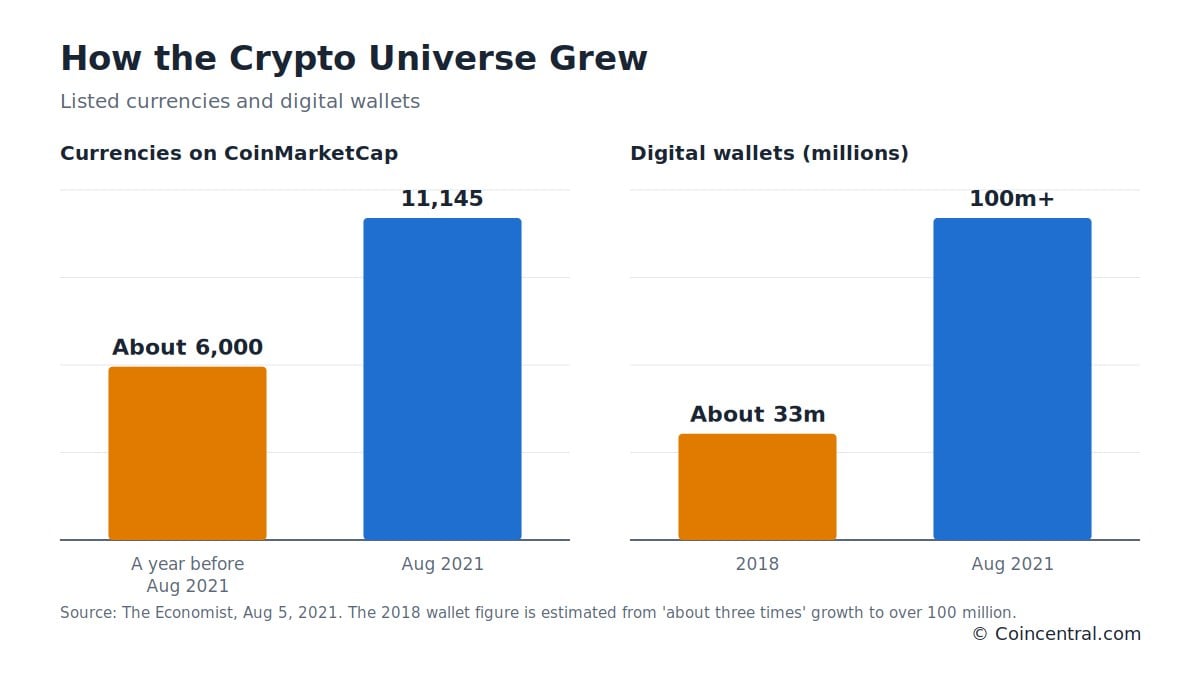
Growth in the number of coins does not mean growth in quality. CoinSwitch points out that many cryptocurrencies have become inactive or lost nearly all value over time. The site says it is hard to give an exact count of how many have reached zero.
This is a useful point for the Bitcoin debate. A crypto asset going to zero is not a new idea, since smaller coins have faded before. The open question is whether the largest coin could follow the same path.
Table 2: Growth of the crypto market, based on The Economist (2021). Percent changes are calculated.
| Measure | Earlier figure | Aug 2021 figure | Change |
|---|---|---|---|
| Listed currencies | About 6,000 | 11,145 | Up about 86% |
| Digital wallets | About 33 million (2018, estimated) | More than 100 million | About three times higher |
| Total market value | $330 billion | $1.6 trillion | Up almost five times |
Rapid growth can also bring rapid shifts in mood. When many new buyers arrive in a short time, prices can depend heavily on confidence.
If that confidence fades, the same buyers can leave just as fast. That is the kind of pattern behind the crash scenarios discussed later.
CoinSwitch lists scarcity as one factor in value. Some coins have a limited supply, which can lift prices as demand rises, while coins with an unlimited supply may lose value over time. Market capitalization, the total value of all coins in circulation, is used as a sign of popularity and demand.
Can Bitcoin Really Fall to Zero?
Changelly says a fall to zero is possible but extremely unlikely. A complete collapse would mean buyers disappear and bids thin out until the price stalls near nothing.
The article also draws a clear line between a price crash and a network shutdown. The network could still process blocks and confirm transactions even if each coin had no market value. People who hold their own private keys would still control their coins, though the coins might not be worth anything.
Some of the doubt about Bitcoin comes from finance theory. Nobel laureate Eugene Fama, known for the efficient-markets theory, argues that Bitcoin has no intrinsic value because it pays no interest, pays no dividends, and has no backing.
In Fama’s view, an efficient market should push the price toward zero over time. Changelly notes that some secondary reports say he expects this within a decade. The article does not confirm that timeline directly.
Critics reply that his argument overlooks Bitcoin’s technical role and its place in global finance. Whether or not the market agrees with Fama, his logic shows why a zero outcome is more than a thought game.
The other side of the debate points to structure. Changelly lists four reasons a total collapse is hard to imagine.
Fama calls Bitcoin a speculative bubble asset. Changelly adds that if enough investors reviewed the same data and decided Bitcoin was worthless, the drop could come very quickly.
Table 3: Reasons a collapse to zero is considered unlikely (Changelly).
| Factor | Why it makes zero less likely |
|---|---|
| Deep liquidity | Trading runs 24/7 on major exchanges, and millions of holders worldwide would need to give up at once. |
| Institutional demand | Asset managers, ETFs, and balance sheets add steady buying, though they also add linked risks. |
| Decentralization | No single entity controls most coins, so coordinated selling or manipulation is harder. |
| Proof-of-work security | The difficulty adjustment lets mining continue even when prices swing. |
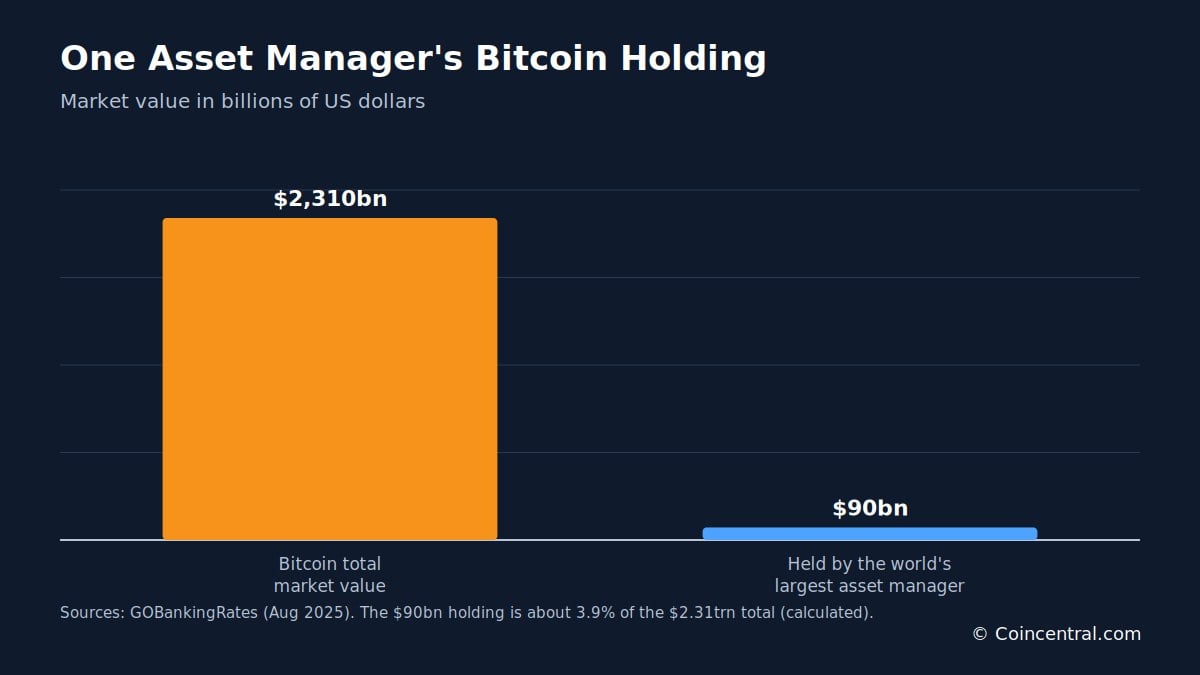
Institutional exposure is a double-edged point. GOBankingRates reports that the world’s largest asset manager holds $90 billion of Bitcoin. That equals about 3.9% of the total market value of $2.31 trillion.
The holding gives the market a large, long-term buyer. It also means a collapse would hit that firm and its clients.
Changelly adds that Bitcoin’s value rests on three things: scarcity, utility, and demand. Supply is fixed at 21 million coins, the network allows censorship-resistant and cross-border payments, and ETFs and custodians have brought steady demand from pension funds, asset managers, and family offices.
Five Routes to Zero and the Mining Math
Changelly lists five ways Bitcoin could lose all of its market value. None is described as likely, but each shows a weak point.
CoinSwitch gives a wider list of forces that move crypto prices. These include supply and demand, investor sentiment, regulation, technology changes, inflation, and interest rates. It also names node count, exchange news, production cost, and scarcity.
The five routes below combine the main themes in the sources.
CoinSwitch also says a coin can fall if its production cost, including mining, is higher than its market value. This links the mining route to the price route, since each one can feed the other.
Table 4: The five routes to zero described by Changelly.
| Route | What it means |
|---|---|
| Loss of public trust | Falling prices cause more selling and thinner liquidity. This feedback loop is called reflexivity. |
| Protocol failure or quantum attack | A break in the network rules, or in its signature system, could allow theft across the network. |
| Global regulatory ban | Limits on banking access, harsh taxes, or a mining ban could cut both retail and institutional demand. |
| Exchange meltdown | Exchanges may halt withdrawals, and prices on some platforms could briefly print near zero. |
| Mining collapse | If mining pays too little, miners switch off rigs, and network security weakens. |
The mining route has the most measurable details. Mining profit is tracked with a figure called hashprice. If prices fall fast and hashprice drops with them, miners may stop work.
The hash rate is the total computing power that secures the network. When it falls, blocks arrive more slowly than the usual 10 minutes.
Bitcoin adjusts for this every 2,016 blocks, which is about every two weeks. Changelly stresses that the adjustment only happens after those blocks are found, so a slow network must wait for it.
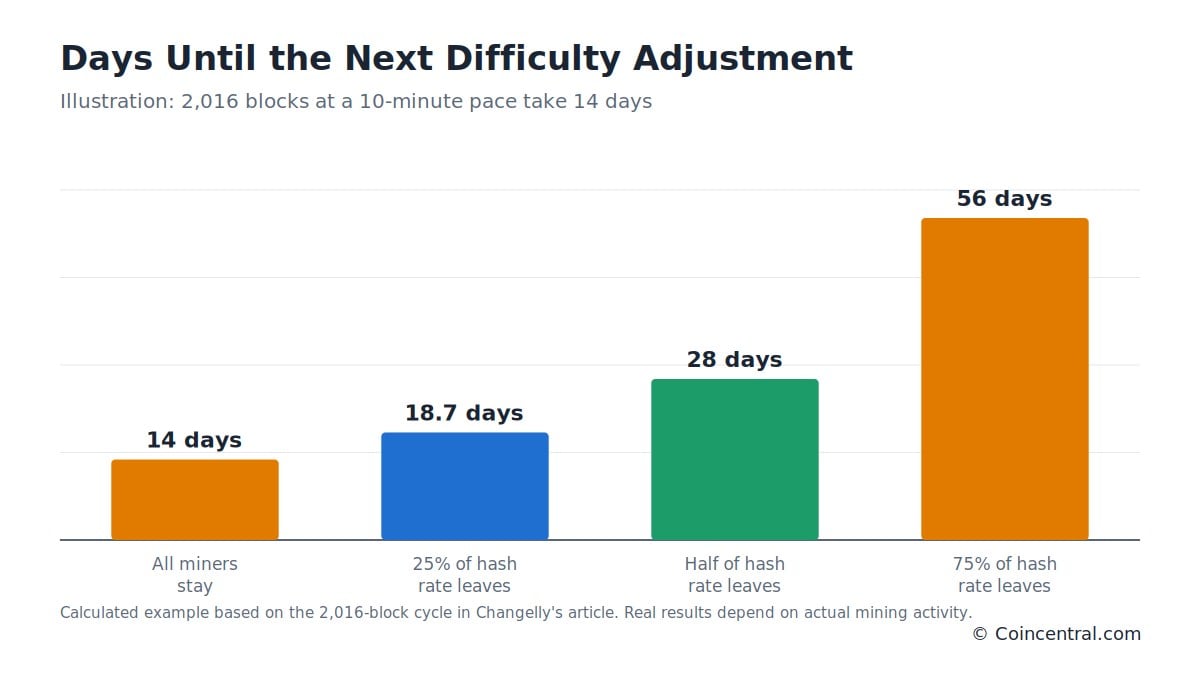
The chart shows a simple calculation. If a quarter of the hash rate leaves, the next cycle takes about 18.7 days instead of 14. If half leaves, it takes 28 days, and if three quarters leave, it takes 56 days.
These figures are an illustration, not a forecast. Changelly also warns that a weak hash rate could open the door to 51% attacks, where bad actors rewrite recent transactions or double-spend coins.
The Five Phases of a Collapse
Changelly says a complete collapse would likely unfold in five overlapping phases. They may play out differently across platforms and regions.
Phase 1 is the price plunge. Order books widen, which means the gap between the highest bid and the lowest ask grows, and even small trades can move the price a lot.
Stablecoins may also wobble. In 2022, USDT dipped to $0.92 before it recovered, a drop of about 8% from its $1 peg.
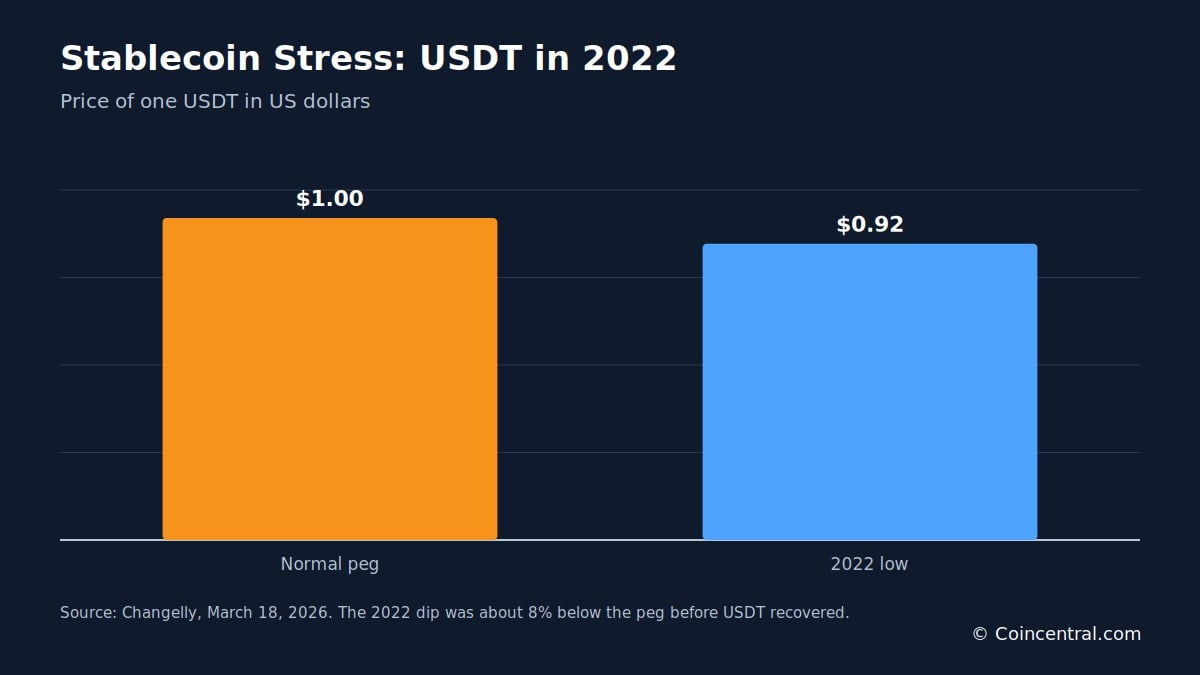
Leverage speeds things up. As prices fall, margin calls and forced sales trigger more selling, which pushes prices lower still.
Phase 2 brings withdrawal suspensions and frozen custody. Centralized exchanges may stop withdrawals, and asset managers, brokers, and lenders may freeze assets by choice or by court order.
People who hold coins on exchanges would feel this most. Those with their own wallets keep control no matter what the market does. Changelly sums up the lesson as not your keys, not your coins.
Changelly says these steps may overlap. A freeze at an exchange can feed more selling, and more selling can feed more congestion on the network.
Phase 3 is network congestion. With many people trying to move coins at once, transactions pile up in the mempool, and users bid higher fees.
Changelly says fees could climb from cents to $50 or more. Confirmation times would also become hard to predict.
Phase 4 is the mining stress described above. Miners turn off rigs, the hash rate drops, and the difficulty retarget arrives only after 2,016 blocks.
Phase 5 reaches traditional finance. Spot Bitcoin ETFs depend on a creation and redemption process to keep their prices in line with Bitcoin. A crash could disrupt that process, push ETF shares to steep discounts or premiums, and in extreme cases lead to trading halts.
Table 5: The five phases of a Bitcoin collapse (Changelly).
| Phase | Main event | Key detail |
|---|---|---|
| 1 | Price plunge, wider order books | USDT fell to $0.92 in 2022 |
| 2 | Withdrawal suspensions, custody freezes | Self-custody keeps control |
| 3 | Network congestion | Fees could rise from cents to $50 or more |
| 4 | Miners shut down rigs | Difficulty resets every 2,016 blocks |
| 5 | ETF and bank stress | Creation and redemption may strain |
Who Would Feel the Loss?
GOBankingRates asked experts what a total crash would mean. Their answers focus on how tied Bitcoin has become to the wider economy.
Kevin Rusher, founder of RAAC, said that with the world’s biggest asset manager holding $90 billion of Bitcoin, a fall to zero would bring a crisis magnitudes bigger than 2008 and 2009.
Vince Stanzione, author of The Millionaire Dropout, said the next crash will likely feel worse because the market is larger and has many products built on Bitcoin, such as ETFs and futures.
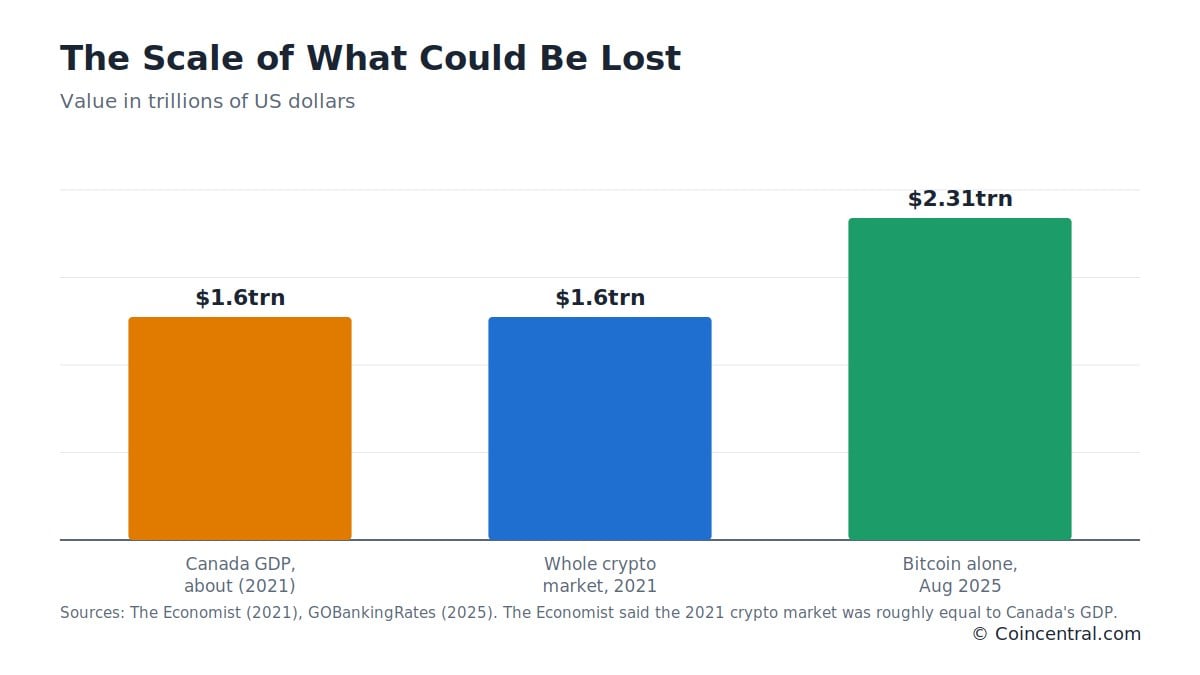
The scale helps explain the concern. The 2021 crypto market was already about the size of Canada’s economy, and Bitcoin alone was worth more than that in 2025.
The experts also pointed to who holds Bitcoin. Robert Johnson, founder of Economic Index Associates, said studies show Bitcoin buyers tend to be younger than stock and bond investors.
For some of them, Bitcoin was a first real investment. A crash could lead them to lose faith in financial markets and step away from investing entirely.
Johnson also expects a drop in retirement assets for Gen Y and Gen Z. He said these groups hold a larger share of their wealth in crypto than baby boomers and Gen X.
Regulation is the third area. Stanzione expects more rules, because investors who lose money tend to blame brokers, exchanges, and issuers such as BlackRock.
Changelly’s FAQ gives a similar view. It expects stricter know-your-customer checks, more tax monitoring, and more disclosure rules, and it says a crackdown could reach decentralized finance too.
Changelly also notes that large asset managers with ETFs and futures tied to Bitcoin could face sharp swings in market mood. That could reach retirement accounts and other products that carry Bitcoin exposure.
Table 6: Groups that could be affected by a total Bitcoin crash.
| Group | Expected effect | Source |
|---|---|---|
| Large investors | Losses tied to ETFs, futures, and balance sheets | GOBankingRates |
| Younger investors | Loss of trust in markets, and less investing | GOBankingRates |
| Retirement savers | Lower retirement assets for Gen Y and Gen Z | GOBankingRates |
| Exchanges and issuers | More blame and tighter regulation | GOBankingRates, Changelly |
| Exchange users | Frozen funds and delayed access | Changelly |
What Holders Keep, and What They Lose
If Bitcoin went to zero, holders would not automatically lose their coins. Changelly says that people who hold their own private keys still own their BTC, but the coins may have no tradable value.
CoinSwitch is more direct about the financial result. Holders of a crypto that reaches zero lose their whole investment and cannot sell for any value. The site also says a collapse could hurt confidence across the wider market and push other prices lower.
Both sources suggest the same basic habits. Know where your coins are, do not keep more on an exchange than you can afford to lose, and store your seed phrase safely. CoinSwitch adds that holders should research what they buy and spread money across other assets.
Changelly rates a total collapse as possible but extremely unlikely. The numbers in this article show why people still study it: the market is large, the holders are many, and the links to traditional finance keep growing.
This article is for information only and is not financial advice.
Sources
- What Happens If Bitcoin Crashes to Zero? The Worst-Case Scenario (Changelly, March 18, 2026)
- What if bitcoin went to zero? (The Economist, August 5, 2021)
- What happens when crypto value goes to zero? (CoinSwitch, July 27, 2023)
- What Would Happen If Bitcoin Totally Crashed? (GOBankingRates, August 24, 2025)
The post What Happens If Bitcoin Crashes to Zero? Key Statistics and Scenarios appeared first on Blockonomi.
TLDR
- The European Banking Authority has placed Circle’s USDC stablecoin in a higher-tier e-money token category under the EU’s MiCA rules.
- USDC will now be jointly supervised by the EBA and France’s Autorité de Contrôle Prudentiel et de Résolution.
- USDC is the second-largest stablecoin with a market cap of about $73 billion, behind Tether’s USDt at $184 billion.
- EU-based token issuers have been pushing for regulated US dollar-pegged stablecoins in the region.
- The European Central Bank is still exploring a digital euro, which could be issued in 2029.
The European Banking Authority has given Circle’s USDC stablecoin a higher-tier classification under the European Union’s Markets in Crypto Assets rules. The decision was announced in a notice on Wednesday, October 14.
Under the MiCA framework, USDC now falls into a higher category of e-money tokens. This label means the stablecoin will face closer supervision than smaller tokens.
The EBA said USDC is the first e-money token in the EU to receive this classification. Cointelegraph reported that only 45 other projects hold e-money token status in the region.
How USDC Will Be Supervised
With the new classification, USDC will be overseen jointly by two regulators. The first is the EBA itself, which is the EU’s banking authority.
The second is France’s Autorité de Contrôle Prudentiel et de Résolution. This French agency supervises banks and insurance firms in the country.
The two bodies will now share responsibility for monitoring the stablecoin. Their oversight will follow the standards set out under MiCA.
USDC is the second-largest stablecoin in the world by market value. It has a market capitalization of about $73 billion.
The largest stablecoin is Tether’s USDt, which is valued at around $184 billion. Both tokens are pegged to the US dollar.
Push for Dollar Stablecoins in Europe
The EBA’s decision came as many token issuers based in the EU have pushed for regulated stablecoins tied to the US dollar. These issuers say demand for dollar tokens remains strong.
James Bennett, CEO of Stable Mint, spoke to Cointelegraph about the issue. He said Europe could not “wish away” dollar stablecoins.
Bennett added that regulators can still control the safeguards and rules that issuers must follow. Under MiCA, EU authorities have the power to set those standards.
Alexander Höptner, CEO of AllUnity, shared a similar view. “For European corporates to make cross-border payments globally, offering only a euro stablecoin isn’t enough,” he told Cointelegraph.
While issuers and regulators move closer to accepting dollar stablecoins, the European Central Bank is still working on its own digital currency. Policymakers continue to explore the launch of a digital euro.
The EU first proposed the central bank digital currency in 2020. The digital euro could be issued in 2029, once lawmakers finish the required legislation and a pilot program is completed.
For now, USDC enters a new phase of supervision in the EU following Wednesday’s notice. The $73 billion stablecoin will remain under the joint watch of the EBA and France’s regulator.
The post EU Regulator Classifies Circle’s USDC Stablecoin Under MiCA Oversight Rules appeared first on Blockonomi.
TLDR
- Solana’s Alpenglow upgrade goes live on mainnet on October 21, starting with epoch 1064.
- The upgrade replaces TowerBFT and targets transaction finality of about 150 milliseconds, down from 12.8 seconds.
- Vote transactions will leave blocks, so headline transaction counts and TPS figures will drop sharply.
- Validators must pay a new 0.8 SOL per-epoch fee that gets burned.
- Regular users do not need to take any action, and fees and apps stay the same.
Solana has set October 21 as the date for Alpenglow, an upgrade that replaces the system its validators use to agree on transactions. The change is tied to epoch 1064, which the Solana Foundation expects to start around 15:00 UTC that Wednesday.
Developer firm Anza said on October 13 that the upgrade took 18 months of work. The switch itself will happen in a single slot.
How Alpenglow Changes Solana’s Voting
Alpenglow retires TowerBFT, the network’s current consensus system. It aims to make transactions final in about 150 milliseconds, down from roughly 12.8 seconds today.
Finality is the moment a transaction can no longer be reversed. Solana confirms payments quickly now, but a block could in theory still be dropped until the full window passes.
For that reason, anyone handling real money often waits for full finality. Faster finality is aimed at uses like stores accepting SOL, DeFi apps and trading desks.
Under TowerBFT, validators post their votes as on-chain transactions. A block becomes final only after 32 slots of those votes build up.
Votor, the new voting protocol, moves votes off the chain. Validators message each other directly, bundle votes into certificates and can finalize a block in one or two rounds.
If 80% or more of stake backs a block in the first round, it is finalized right away. If support lands between 60% and 80%, a second round with a 60% threshold decides the outcome.
The Foundation says the design can handle 20% malicious stake plus another 20% offline.
Vote transactions will also leave blocks. Because of this, Solana’s headline transaction counts and TPS figures will drop sharply, even though real activity will not change.
What Users and Validators Need to Know
Regular users do not need to do anything. Wallets, apps, transaction formats, programs and fees stay the same.
For developers, the “confirmed” and “finalized” commitment levels will become the same thing.
Validators face a new cost. Each vote account needs 0.8 SOL on top of its rent-exempt balance to pay a Validator Admission Ticket, a per-epoch fee that gets burned.
This replaces the roughly 1 SOL per epoch validators spent on vote fees under TowerBFT. A validator that cannot pay will sit out voting and block production for the next epoch.
The rollout includes a short buffer. TowerBFT stays in charge for about 5,000 slots, or roughly 18 minutes, before Alpenglow takes over at slot 459,653,000.
Validators approved Alpenglow in September 2025, when the SIMD-0326 proposal passed with 98.27% of votes in favor. In May, Anza lead economist Max Resnick said the team was aiming for a late third quarter or early fourth quarter launch.
SOL was trading at $102.90 at the time of reporting, down about 10% over 24 hours.
The October 21 launch covers only Votor, the first half of Alpenglow. Rotor, which will replace the Turbine system used to share block data between validators, will come later and has no date yet.
The post Solana Alpenglow Upgrade Set for October 21 Mainnet Launch appeared first on Blockonomi.
TLDR
- The Crypto Council for Innovation and the Blockchain Association asked an Illinois court to fast-track a ruling on the state’s 0.2% crypto tax.
- The filing also cited a separate lawsuit from the Digital Chamber and the Illinois Blockchain Association.
- Illinois officials already agreed to delay the tax from Jan. 1, 2027, to July 1, 2027.
- If the court approves the faster schedule, a decision on the law could come by March.
- Blockchain Association CEO Summer Mersinger is stepping down Friday, with former CEO Kristin Smith returning as interim head.
Two major crypto advocacy groups are joining a legal fight against a new Illinois tax on digital assets. The Crypto Council for Innovation and the Blockchain Association want a court to rule on whether the tax is lawful.
The groups filed their request on Tuesday in the Circuit Court of Sangamon County. They asked the court to approve a faster schedule for summary judgment.
Summary judgment allows a court to decide a case without a full trial. The groups said they want “to reach a decision on the tax’s lawfulness as quickly as possible.”
Two Lawsuits Target the Illinois Crypto Tax
The filing pointed to the lawsuit the two groups brought against Illinois state officials. It also cited a separate lawsuit filed by the Digital Chamber and the Illinois Blockchain Association.
The law at the center of both cases is the Digital Asset Tax Act. It places a 0.2% tax on crypto assets in the state.
Earlier this month, Illinois officials agreed to delay the tax by six months. It was set to take effect on Jan. 1, 2027, but will now start on July 1, 2027.
The delay came as part of the Digital Chamber’s lawsuit. The group claimed the tax had been “slipped into the state’s budget” without debate or public feedback.
Digital Chamber CEO Cody Carbone said at the time that the group would keep up its legal fight. He said it would continue “until this tax is struck down for good.”
CCI CEO Ji Kim said the pause helps, but a ruling is still needed. “While pausing enforcement of the Digital Asset Tax Act protects Illinois consumers and businesses from this onerous and legally flawed tax until July 1, it remains imperative that the merits are determined as soon as possible,” Kim said.
Leadership Change at the Blockchain Association
The court filing comes during a leadership change at the Blockchain Association. CEO Summer Mersinger is scheduled to step down on Friday.
Mersinger joined the advocacy group last year. She took the role after resigning from the US Commodity Futures Trading Commission.
Kristin Smith, the group’s former CEO, will return as interim head. Mersinger is expected to stay with the organization until the end of 2026.
For now, the Illinois crypto tax remains on hold. It will not be enforced before July 1, 2027.
The faster schedule requested by the groups still needs approval from the court. If the court agrees, a decision on the merits of the law could come by March, several months before the delayed tax is set to begin.
The post Illinois Crypto Tax Delayed to July 2027 as Legal Challenge Grows appeared first on Blockonomi.
TLDR
- Pearl (PRL) touched $2.10 on October 14, up 228% from about $0.59 in mid-September.
- The token has risen about 7x from roughly $0.28 in August.
- Pearl is a Bitcoin-based blockchain where miners do AI math (matrix multiplication) instead of hash puzzles.
- Researcher Abhinaba Basu found the main mining software had no AI code, and junk data could still earn rewards.
- About 305 million more PRL is due over the next 12 months, nearly double the current supply.
Pearl (PRL) has climbed to new highs this week. The token touched $2.10 on October 14, 2026.
Wrapped Pearl (WPRL) traded at $1.93 on Uniswap v3 at the time of AMBCrypto’s report. In mid-September, it sat near $0.59, a 228% gain in about a month.
Back in August, the token was around $0.28. That means it has risen roughly 7x since then.
Rohit of Milk Road noted that PRL is up about 195% over the past 30 days. He said the project had been all over his crypto Twitter timeline for several days.
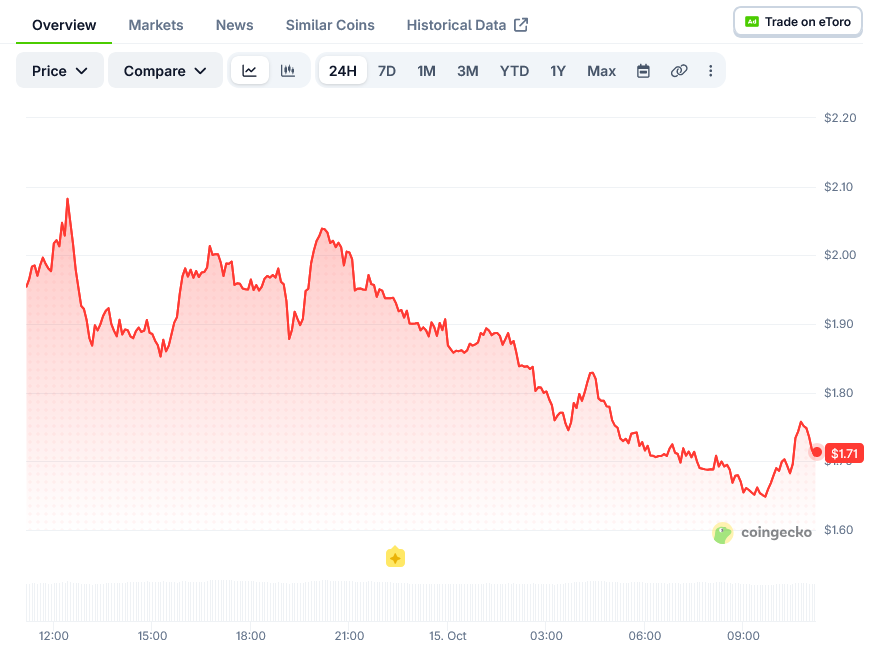
What Is Pearl?
Pearl is a layer-1 blockchain that went live on April 27, 2026. It is built on Bitcoin’s code and has a fixed max supply of 2.1 billion coins.
There was no pre-mine and no team or venture capital allocation. Every PRL comes from mining.
Bitcoin miners solve SHA-256 puzzles. Pearl miners instead do matrix multiplication, the same math GPUs use to run AI models.
The method comes from a 2025 paper by co-founders Ilan Komargodski and Omri Weinstein. The project calls it Proof of Useful Work.
In May, Pearl partnered with Together AI, a cloud provider that runs open-source models. Together launched a Pearl-powered model priced 25% cheaper, with PRL mining rewards covering the discount.
Not all mining on the network is useful yet. In June, researcher Abhinaba Basu studied 8,012 Pearl mining machines and found the main mining software had no AI code.
Basu mined with random data and had 44 shares accepted by a pool. Weinstein said letting miners pick their own inputs “will always allow spam mining.”
Running AI through Pearl also slows models by 10% to 15%. An upgrade on testnet cuts that to between 0% and 3%.
About 1.01 million PRL is mined each day. Roughly 305 million more is due over the next 12 months, nearly double the current supply.
PRL trades on just two exchanges for now. Order books on both remain thin.
Chart Analysis
The TradingView chart shows PRL dropped in early October before buyers returned. Since October 6, the price has climbed back up to touch $2.10.
The RSI sits just above the 70 overbought line and above its signal line. The level to watch next is $1.80, the day’s low, which would keep buyers in control if it holds.
The post Pearl (PRL) Price: Token Touches $2.10 After 228% Monthly Gain appeared first on Blockonomi.
CryptoPotato
The cryptocurrency market took a significant step back over the past 24 hours after US inflation came in higher than expected (among other reasons).
Bitcoin (BTC) dipped 3% on a daily basis, while popular altcoins like Zcash (ZEC) posted double-digit declines. However, several analysts remain optimistic about the privacy coin and see the pullback as a buying opportunity.
New Rally Incoming?
ZEC is down approximately 15% for the day and currently trades below $1,100 (per CoinGecko). Its market capitalization fell to nearly $18.3 billion, yet the asset remains one of the 10 biggest cryptocurrencies. Interestingly, its recent downfall doesn’t seem like bad news to some analysts. X Finance Bull said he sold his entire ZEC position earlier this year when the price hit $1,500.
“My reason was simple: there had been almost no real correction since $500, and I didn’t see the utility expanding enough to justify chasing it higher,” he explained.
The latest correction, though, has changed the analyst’s plans, and he said he’s going back to the ZEC chart and fundamentals because he sees a potential setup developing.
“We prepared before the fear came. Now the market is giving us the prices. The next leg of this bull market is coming. We’re ready,” he concluded.
Altcoin Sherpa – a popular X user with over 260,000 followers also chipped in. The analyst closely watched the privacy coin’s price chart, describing a slump to $1,000 or lower as a “gift.” Jesse Olson joined the topic, too. He predicted the asset’s valuation could head south toward $900 in the short term, then stage a major recovery to as high as $1,600.
Monitoring These Indicators
ZEC’s Relative Strength Index (RSI) favors the rebound scenario. The ratio fell to 30, suggesting the asset is in oversold territory and could be on the verge of a pump. The index runs from 0 to 100, where anything above 70 typically signals an impending correction.

On the other hand, ZEC’s exchange netflow signals that the red wave may intensify in the near future. According to CoinGlass, inflows have surpassed outflows over the past few weeks, meaning some investors have moved holdings from self-custody to centralized platforms, increasing immediate selling pressure.

The post Zcash (ZEC) Slips 15% Daily, Yet Analysts View the Correction as a ‘Gift’ appeared first on CryptoPotato.
Bitcoin’s latest rejection at $84,000 resulted in another major leg down on Thursday morning, with the asset plummeting to a fresh monthly low of $80,200.
This substantial correction didn’t spare the altcoins as well, with many plummeting by over 5% from top to bottom. The total crypto market cap dumped by over $100 billion at one point.
BTC Crashed Toward $80K
It was precisely a week ago — last Thursday — when the primary cryptocurrency was sliding hard and slumped to a then-multi-week low of $80,400. The bulls finally intervened after this major $6,500 decline in just days and helped the asset recover some ground to $83,000 over the weekend.
They even pushed it to $84,000 at the start of the business week, but that was short-lived, and BTC tumbled below $81,000 on Tuesday morning as South Korea’s KOSPI plummeted. Nevertheless, bitcoin rebounded again and went into the Wednesday CPI announcement trading close to $84,000.
As inflation in September turned out to be slightly higher than expected, the cryptocurrency slipped again toward $82,000. It remained there for a while, but the growing tension in the Asian markets pushed it further south, and it bottomed, at least for now, at $80,200 earlier today.
Although it has recovered around a grand since then, it’s still 2.4% down on a 24-hour scale. Its market cap has slumped to $1.630 trillion on CMC, while its dominance over the alts has climbed above 60%.

All Aboard the Red Train
ETH led in terms of daily liquidations as it plunged the hardest from the top alts, going to a two-month low of $2,315 before it rebounded slightly to $2,370. Yet, it’s still 5% down on the day. XRP, SOL, BNB, and ADA are also down by 2%-4%, while DOGE and LINK have plummeted by 5% and 6%, respectively.
ZEC has nosedived by 10.5% as of press time, dropping to $1,100. NEAR (-7.5%), RAIN (-11.5%), BTW (-18.5%), TAO (-6%), and QNT (-6%) are also well in the red. PUMP, CC, RAY, ENA, LIT, and STX have all marked double-digit losses. In contrast, STRK has pumped by 10% to $0.087.
Overall, though, the crypto market cap has shed around $100 billion as of now daily and it’s down to $2.710 trillion on CMC.

The post $100B Gone From Crypto Markets as BTC, ETH, XRP Nosedive: Market Watch appeared first on CryptoPotato.
Machi Big Brother’s Hyperliquid trading account fell to about $21,800 on October 15 after a series of liquidations wiped out most of a fortune that had climbed from roughly $56,000 to $12.25 million in four months.
The collapse followed another round of Ethereum price declines, leaving the trader with a fraction of his previous balance after repeated attempts to cut losses and keep positions open.
Machi’s $12.25M Trading Run Ends in Liquidation
Blockchain tracker Lookonchain documented the account’s decline in two posts on October 15. In its first update, published just before the liquidation report, it noted that Machi was closing positions as the market fell in an effort to reduce losses and avoid forced closure.
“His account is now down to just $129K,” the tracker wrote.
That attempt did not prevent a further collapse. An hour later, Lookonchain reported that Machi had been “fully liquidated,” with his remaining account value falling to $21,800.
Hypurrscan data for the wallet identified as Machi Big Brother’s showed four recent liquidation transactions involving ETH-USD perpetual futures with the transactions covering positions of 380 ETH at $2,379, 270 ETH at 2,374, 200 ETH at $2,355, and 800 ETH at $2,331.
The displayed values of those positions ranged from roughly $471,000 to $1.87 million. They were recorded within minutes of one another as the account was being liquidated. The account-value chart traced the scale of the reversal, showing an initial balance of about $56,132 on June 25, followed by a climb to nearly $12.5 million before the subsequent fall.
A Familiar Pattern of High-Leverage Trading
This is not the first time the trader has suffered heavy losses on Hyperliquid, a decentralized exchange that supports leveraged derivatives trading. Public blockchain trackers have documented hundreds of liquidations tied to the account, with losses running into tens of millions of dollars.
The scale of Machi’s repeated losses becomes clearer when viewed against earlier account snapshots. For example, in February this year, on-chain data showed his holdings going from close to nine figures to $28 million in the red in just five months.
A month later, Akham reported that his losses across the preceding six months had reached $75.19 million, after he had previously been up $44.84 million. In May, the tracker reported another major setback, with $545,000 lost in 24 hours and cumulative perpetual-future losses reaching $77.32 million.
However, there have been recoveries between those setbacks, including on June 15, when the same Arkham reported that Machi’s account was worth $1.2 million, with a leveraged ETH long above $20 million showing a profit of just over $1 million following news of a US-Iran peace deal.
The trader has also faced substantial losses outside perpetual futures. In August, he proposed buying Friend.tech for $1 million and relaunching its FRIEND token, of which he had bought 11 million units for about $16.7 million, only to see their value drop to less tha $500,000.
The post Machi Big Brother Wiped Out on Hyperliquid After $12M Run appeared first on CryptoPotato.
It was another major week for Ripple and its native token, albeit not moving in the same direction. While the company announced a big partnership with Standard Chartered, XRP slumped hard during the Thursday market crash.
We will also review a major fix that was implemented in the XRP Ledger. Let’s dive in.
Ripple Partnership and Wall Street Push
One of the biggest pieces of news from the end of last week was Ripple’s expansion into the leveraged ETF market on Wall Street. Through its prime brokerage platform, Ripple Prime, the company now offers swap financing.
This followed its doubling down on its partnership with Brevan Howard, which expanded its services for hedge funds and investment managers. Leveraged ETFs use derivatives and pose significant risks and costs for investors, which could reduce long-term returns due to financing charges.
Separately, Standard Chartered launched custody support for Ripple’s native stablecoin, RLUSD, strengthening its integration into institutional trading with LMAX Group. The bank’s DIFC Branch in Dubai, regulated by the Dubai Financial Services Authority, operates the service.
The collaboration aims to improve operational efficiency and risk management for institutions using stablecoins in global markets.
XRP on Wall Street
Speaking of Ripple’s presence on Wall Street, we need to mention Evernorth’s successful debut. The XRP-holding company with 473 million tokens in its stash debuted on Nasdaq on October 12 after merging with Armada Acquisition Corp. II. On its launch day, the XRPN stock fluctuated between $16.40 and $19.40. However, the broader market correction pushed it below the lower boundary, and it closed at $15.26 yesterday.
A day later, Evernorth announced how it plans to put its XRP fortune to work as it partnered with Ripple, Kraken, Coinbase, and BitGo to deploy the millions of tokens into institutional strategies starting in Q4 2026.
The partnership aims to manage XRP investments with effective risk controls and oversight, enhancing institutional investment strategies.
Ripple ETFs Demand Dries
As we reported over the weekend, demand for the spot XRP ETFs remained positive. The funds tracking the cross-border token were among the very few ending the week in the green, attracting $11.31 million. At the same time, the Bitcoin and Ethereum ETFs bled out heavily.
However, this trend has changed. Although there are no significant outflows from the spot XRP ETFs during the current business week, demand has disappeared. SoSoValue data shows net flows of $0.00 on Monday and Tuesday, while Wednesday saw a modest $740,410 pour in.
For comparison, the ETFs gained over $75 million during the last full week of September, but have been in a clear downtrend since then.
Critical XRPL Issue Fixed
The XRP Ledger Foundation clarified on October 11 that a critical integer overflow bug in the ledger’s payment engine was fixed. The significance here was that this vulnerability dated to 2015 and could have allowed an attacker to mint large amounts of new XRP beyond the fixed 100 billion supply.
However, the team reassured that no extra XRP was ever created, and the current circulating supply remains about 99.986 billion (deflationary due to burned fees).
The bug required hundreds of deliberately crafted operations and was not triggerable by normal activity. It was reported by Cayden Liao and Veria AI, then fixed in xrpld 3.4.1 on September 25. To avoid publicly exposing the vulnerability for weeks, developers shared the patched software directly with validators via social consensus rather than the usual amendment process, after which the fix was enforced through a standard vote.
XRP Price Slumps
Despite the partnerships, Evernorth’s debut on Nasdaq, and the ETF flows until the end of last week, XRP’s price has failed to produce any meaningful rallies. On the contrary, the asset was rejected at $1.50 last week and dipped below $1.35 within days.
Although it rebounded to over $1.40 at the start of the current week, the latest market-wide pullback pushed it south yet again. This time, XRP dipped below $1.30 for the first time in a month.
As of now, the cross-border token trades slightly above that level, while analysts are adamant that it has shown strong signs of an upcoming recovery. Ali Martinez, for instance, noted that a successful rebound from the $1.25 support could push it toward $1.42 and potentially $1.60.
The post Important Ripple News and XRP Price Update: October 15 appeared first on CryptoPotato.
When a platform offers a digital token linked to a listed company, the familiar name and matching price do not tell the investor what they own. The token itself is the blockchain-recorded instrument held in a wallet, while the underlying legal wrapper decides whether the holder has an ownership interest in the shares, an indirect interest through an intermediary, or only a separate stock-linked claim against another issuer.
Revaz (Rezo) Shmertz, co-founder and Managing Partner of digital asset investment firm BR Capital and founder of Web3 research initiative Beyond Research Labs LLC (BR Labs), applies over 20 years of financial markets experience to cut through this market ambiguity. He describes an asset wrapper as a receipt pointing to an asset held elsewhere, under another set of rules. In Shmertz’s view, such arrangements are useful when their legal nature is accurately and transparently described, so that they can be clearly understood. But the danger arises when a wrapper is presented to the market as the underlying asset itself. When structural realities are obscured, investors are left exposed to counterparty risks they were never informed about. These differences explain why tokens linked to similar assets can give investors very different rights.

Issuance Architecture: Who Issued the Underlying Security?
In January 2026, the U.S. Securities and Exchange Commission (SEC) distinguished securities tokenized by or on behalf of their issuers from arrangements created by unaffiliated third parties. The staff statement discusses both tokenized security entitlements, representing indirect interests in securities, and synthetic exposure through separately issued instruments. It is a staff statement, not a new rule or a Commission-approved framework. Its categories describe a U.S. regulatory context. The legal treatment of any particular holding depends on the law and documents governing it.
Under the issuer-sponsored model described by SEC staff, a company or its agent can integrate blockchain records into its official shareholder register, so a legally effective token transfer also changes ownership of the shares. The statement also describes an arrangement in which the official register remains off-chain: a token transfer notifies the company or its agent to update that register, while the token itself conveys no shareholder rights. In both cases, the shares and their governing legal terms establish the investor’s rights; the token’s role is to represent or help transfer the holding. Different share classes can still carry different rights.
These distinctions help clarify two concepts that are easily confused: what security has been issued, and how an investor holds it. A share in a fund is not the same holding as shares in the companies in its portfolio. Likewise, holding a security through an intermediary is different from buying an intermediary’s own instrument that tracks that security. The presence of a custodian in both arrangements does not make them equivalent.
Where an instrument references another issuer’s security, its description needs to identify both entities and their different roles. A company whose share price determines a note’s payoff is not necessarily the company responsible for paying the noteholder. That difference becomes consequential if a payment is disputed or the note issuer cannot perform, even when the referenced company continues operating normally.
A Tokenized Fund Share Remains a Fund Share
When the holding is a mutual fund share, the investor has an interest in a pooled portfolio and the gains and losses it generates. That is not the same purchase as acquiring a particular portfolio security in an individual account, nor does every token linked to a fund necessarily represent a fund share. In a government money market fund, the shareholder holds the fund interest rather than a personally selected Treasury bill.
Pooling assets under a defined investment mandate changes what the investor is evaluating. Someone seeking a specific bond’s maturity and cash flows is assessing something different from someone seeking a redeemable share in a managed portfolio. For the fund investor, the portfolio mandate, expenses and redemption arrangements form part of the investment, even if blockchain records make the share easier to hold or transfer.
A share in a fund that holds government bonds gives the investor a fund interest, while a note issued by another entity and secured by government bonds creates a debt claim under that note’s terms. Identifying the securities in the portfolio or collateral pool does not, by itself, identify what the investor has purchased.
Intermediary Holdings and the Mechanics of Beneficial Rights
Traditional securities markets already distinguish registered ownership from beneficial ownership. In the United States, securities held in “street name” are registered on the issuer’s books in an intermediary’s name, while the broker maintains records identifying the investor as the beneficial owner. The broker also handles associated payments and the delivery of shareholder communications.
It would therefore be misleading to divide tokenized products into “real ownership” whenever an investor’s name appears directly on an issuer’s register and “just an IOU” whenever an intermediary is involved. Indirect ownership has a place in conventional markets, and an intermediary-held interest should be assessed on its actual legal terms.
For a tokenized holding, the important question is what the intermediary records for the investor. A security entitlement can represent an indirect interest in the underlying shares, and a custodial receipt can evidence that interest without making its holder the registered shareholder. A separately issued stock-linked instrument may instead give the holder rights under a different security.
Asset Collateralization vs. Direct Shareholder Equity
In a hypothetical stock-linked note secured by shares, the collateral supports the note issuer’s payment obligation. It does not, merely by being present, turn the noteholder into a shareholder of the referenced company. The holder’s entitlement to payments comes from the note, while any rights over collateral depend on the security arrangements. The distinction between secured lending and share ownership is established in conventional finance as well.
Assessing the collateral means following what happens if the issuer cannot pay: which assets secure the obligation, who can enforce the claim and how proceeds would reach holders. The answer requires the relevant documents and legal framework. A statement that assets have been set aside does not establish the investor’s priority over other claimants or the amount recoverable after a default.
A payment formula can reference a company’s dividends without making the recipient a shareholder of that company. Whether a holder receives cash, another asset or an adjustment under a contractual formula must be established from the instrument’s terms. As Revaz Shmertz explains, price exposure and collateral cannot substitute for the particular shareholder rights an investor is trying to identify.
Owning a Linked Security is Different from Owning the Referenced Shares
Conventional structured notes can calculate payments by reference to a stock or index while remaining obligations of the note issuer. Their payment formulas may differ from simply holding the referenced asset, and the investor remains exposed to the issuer’s ability to pay. The investor owns a security, but that security is the note rather than the shares used to calculate its return.
For a tokenized product with a contractual payoff, an assessment therefore needs to follow the payment terms rather than infer them from the name of the referenced asset. A promise to deliver an amount linked to a share price is not the same promise as delivering the share. Whether that distinction matters depends on the investor’s purpose, but it cannot be removed by choosing a more convenient settlement technology.
For example, a note might calculate its payment using a share’s price on a specified date and settle that payment in cash. Holding it would not give the investor the same position as holding the share through that date, particularly if the formula excludes distributions or limits participation in a price increase. According to Revaz Shmertz, those are terms to examine, not assumptions to make about every linked instrument.
Token Sales and Redemptions Are Different Transactions
Selling an instrument to another investor depends on finding a buyer, whereas redemption exchanges the holding for the cash or assets due under its redemption terms, through the issuer or its appointed agent. A security’s ability to move between wallets does not establish that either route is available on demand.
For U.S. mutual funds, a redemption is generally priced at the next net asset value calculated after receipt of the order, less applicable fees. As per the SEC, pricing the redemption and paying its proceeds are separate steps; the pricing rule does not promise immediate cash.
Consider an instrument whose permitted holders can transfer it outside business hours, but whose issuer processes cash redemptions only during specified windows. A weekend transfer would change who holds the instrument without making the issuer’s cash available that weekend. The holder would also need to establish whether they can submit a redemption request directly or must go through an eligible intermediary. If redemption is unavailable when they need to exit, a sale would still require a permitted buyer willing to pay an acceptable price. Transfer permission, access to redemption and payment timing each affect whether the holder can obtain cash when needed.
If a holder keeps a tokenized note in a personal wallet while pledged securities remain with a custodian, control of the token does not, by itself, give that holder authority to instruct the custodian or obtain the collateral. As Revaz Shmertz emphasizes, those rights depend on the note’s terms, the custody and security arrangements, and applicable law. Safeguarding the wallet cannot establish them.
What Blockchain Can Add without Changing the Investment
Revaz Shmertz’s view of tokenization’s potential extends beyond moving existing instruments onto a blockchain. He wants assets that can be used more openly across decentralized finance (DeFi), rather than remaining subject to access restrictions that limit how they can be combined with other financial tools. Schmertz also recognizes that neutral blockchain infrastructure permits issuers to choose restricted designs.
For an application accepting a tokenized security as collateral, the instrument’s rights remain relevant to how that application operates. A fund share with a defined redemption process presents different questions from a note payable at maturity, even if both can be transferred through the same network. Assessing whether the application can obtain cash when needed requires understanding the asset it holds, not only the software that moves it.
Before comparing two tokenized investments, an investor should be able to describe each in an ordinary sentence: what instrument is being acquired, from whom, and what right can be exercised as a result. If one answer is a fund share and the other is a separately issued stock-linked note, the comparison has already become more informative than their shared use of a blockchain. The technology can change how an investment is held and used; the investor still needs to know which investment they have bought.
Disclaimer: The above article is sponsored content; it’s written by a third party. CryptoPotato doesn’t endorse or assume responsibility for the content, advertising, products, quality, accuracy, or other materials on this page. Nothing in it should be construed as financial advice. Readers are strongly advised to verify the information independently and carefully before engaging with any company or project mentioned and to do their own research. Investing in cryptocurrencies carries a risk of capital loss, and readers are also advised to consult a professional before making any decisions that may or may not be based on the above-sponsored content.
Readers are also advised to read CryptoPotato’s full disclaimer.
The post Tokenized Securities vs Ownership: What Investors Really Own appeared first on CryptoPotato.