Cryptocurrency Posts
Crypto Briefing
Nvidia's potential chip supply cut to unsafe AI developers highlights the critical role of hardware suppliers in AI safety regulation.
The post Jensen Huang says Nvidia could cut off chips to unsafe AI developers appeared first on Crypto Briefing.
TSMC's projected revenue surge underscores its pivotal role in advancing AI and high-performance computing, impacting global tech dynamics.
The post TSMC forecasts Q4 revenue jump of up to 61% after record Q3 profit appeared first on Crypto Briefing.
Australia's shift in investment focus from renewables to AI data centers could hinder renewable goals, increase fossil fuel reliance, and raise energy costs.
The post Australia faces risk of capital diversion from renewables to AI projects appeared first on Crypto Briefing.
Heightened sensitivity to economic data underscores market volatility, influencing investor strategies and highlighting prediction markets' growing role.
The post Market raises odds of a 25 bps Fed rate hike to 24.9% ahead of October meeting appeared first on Crypto Briefing.
TSMC's revenue surge highlights the growing dominance of AI in tech, potentially reshaping global semiconductor market dynamics.
The post TSMC posts $46.72 billion Q3 2026 revenue, up 41.2% as AI demand keeps climbing appeared first on Crypto Briefing.
Bitcoin Magazine
Bitcoin Magazine

Russia’s Central Bank Authorizes Sberbank to Exchange Cryptocurrencies
Russia’s central bank has added Sberbank to its register of organizations authorized to exchange digital currencies, according to reports.
Sberbank was added to the list of digital depositories, which will keep a record of cryptocurrencies and digital rights, earlier this month.
Now, it joins eight other organizations on the exchange register, including state-controlled VTB, Russia’s second-largest bank, and T-Invest Lab, part of T-Technologies, which also owns online lender T-Bank, according to a Monday report from Interfax.
The announcement comes as Russia fast moves forward with Bitcoin-related regulation. Sberbank last month announced that it was the first in the country to have been approved to custody bitcoin.
The Bank of Russia gave it the green light for “digital currency record-keeping” and to facilitate the transfer of such assets, covering bitcoin and other, smaller cryptocurrencies.
“This status will allow the bank to provide services related to organizing the circulation of digital currency on interfaces which clients already use,” Sberbank was quoted saying in the news report.
A law on digital currencies and digital rights came into effect in Russia on September 1, creating a comprehensive legal framework for cryptocurrency circulation. Transactions involving cryptocurrencies can be conducted via the existing infrastructure of exchanges, brokers and trustees, and now also via crypto exchanges and digital depositories.
Cryptocurrency can be bought and sold via crypto exchanges, while the rights to these assets are recorded in digital depositories.
Banks and other organizations have been able to apply to the CBR for the corresponding licenses since October 5. Some existing players have simplified access to the market and can obtain licenses on a notification basis within just one day.
Under the new rules, unqualified investors will be able to buy bitcoin and other cryptocurrencies including stablecoins, within a limit of 300,000 rubles ($3,556) per year through one intermediary.
Qualified investors will have access to all cryptocurrencies traded on the exchange and over-the-counter markets.
Sberbank will debut its crypto wallet in December — the same month the Moscow Exchange will debut crypto trading.
This post Russia’s Central Bank Authorizes Sberbank to Exchange Cryptocurrencies first appeared on Bitcoin Magazine and is written by Mathew Di Salvo.
Bitcoin Magazine

Kraken Parent Company Payward to Buy Saldo Bank in European Banking Push
Payward, the parent company of crypto exchange Kraken, has signed a definitive agreement to acquire Saldo Bank, gaining an EU banking license and a footprint across five European markets.
Payward is buying Saldo Finance Oy, a Finnish holding company whose subsidiary, Saldo Bank UAB, is a digital-first specialized bank licensed in Lithuania. The bank operates in Lithuania, Finland, Sweden and Germany, with a passport into the Netherlands.
Payward did not reveal the financial terms of the deal, which is expected to close in 2027, subject to regulatory approvals.
It comes as Kraken, like other crypto exchanges, pushes further into the traditional finance world, allowing users to trade stocks, bonds and other assets. The company has sold its app as a “primary account for everything.”
“A regulated EU bank is the piece that lets us serve European clients the way a primary financial institution should: one place to hold assets, move them freely, and put them to work,” said Arjun Sethi, Payward’s co-CEO. “We are starting in the EU, and the ambition is global.”
Payward said that once completed, the acquisition is expected to let Payward Banking offer interest on deposits, SME and consumer loans, credit cards, and banking-as-a-service tools such as card issuance, SEPA payments access and embedded lending for partners.
Saldo already offers retail term deposits in all four of its operating markets, consumer lending in Lithuania, Finland and Sweden, and a credit card in Finland.
Payward says it already holds a Federal Reserve limited-purpose master account in the U.S. and an e-money license from the Central Bank of Ireland, and has originated more than $2 billion in loans.
The deal comes shortly after Payward this week announced plans to launch in the UAE following full approval from Dubai’s Virtual Asset Regulatory Authority.
In September, Bloomberg reported that Nasdaq Inc. was investing $100 million in Payward at a $21 billion valuation, citing people familiar with the matter. Payward and SoFi Technologies also recently agreed to route SoFi customers’ crypto orders through Kraken Prime, Kraken’s prime brokerage arm.
This post Kraken Parent Company Payward to Buy Saldo Bank in European Banking Push first appeared on Bitcoin Magazine and is written by Mathew Di Salvo.
Bitcoin Magazine

Standard Chartered Debuts Bitcoin Trading For Wealthy UAE Clients
British multinational Standard Chartered on Wednesday announced a bitcoin trading service for affluent clients in the United Arab Emirates.
The service is the first such service offered by an international bank in the UAE, Standard Chartered said.
It comes after the bank last month debuted bitcoin trading for institutional clients in the Arab nation. Standard Chartered became one of the first global banks to enter the spot crypto trading space when in 2025 it set up a trading desk for bitcoin and other cryptocurrencies in London.
JUST IN: Standard Chartered becomes the first international bank in the UAE to offer Bitcoin trading directly through eligible clients' bank accounts
— Bitcoin Magazine (@BitcoinMagazine) October 14, 2026pic.twitter.com/uPVQV9D8SJ
“As client interest in digital assets continues to grow, this launch represents a significant milestone for Standard Chartered as we bring digital assets into our core wealth offering,” said Samir Subberwal, Standard Chartered’s global head of wealth solutions, retail products, data and analytics.
“With digital assets moving into mainstream wealth conversations, clients are increasingly looking not only for access, but also for the security, trust and confidence that comes from investing through a regulated and trusted institution.”
Rola Abu Manneh, Standard Chartered’s chief executive officer UAE, Middle East and Pakistan, added: “We are proud to be the first international bank in the UAE to launch a cryptocurrency trading offering.”
The service will allow clients to buy bitcoin via their bank accounts. No third-party apps or wallets will be needed, the bank said.
Standard Chartered said it will manage end-to-end custody and settlement through a closed-loop model, reducing exposure to third-party wallet risks.
The British bank is expanding its crypto-related offerings worldwide. Earlier this month, it said it had plans to offer crypto custody services for institutional clients in Singapore.
Standard Chartered already offers the service in the UAE, Luxembourg, and Hong Kong.
Banks worldwide are integrating or offering bitcoin-related products and services.
A number of U.S. and European banks have started offering crypto-related services by custodying assets for institutions. Others are offering trading via their flagship apps.
This post Standard Chartered Debuts Bitcoin Trading For Wealthy UAE Clients first appeared on Bitcoin Magazine and is written by Mathew Di Salvo.
Bitcoin Magazine

The Undercurrent: Three European Artists on Making Money Visible
Amsterdam helped lay the foundations of modern finance, but its artists were among its earliest critics. When speculative bubbles burst across Europe in 1720, Amsterdam printers and satirists responded with The Great Mirror of Folly, a collection of engravings and plays exposing the excesses of financial speculation.
Nearly three centuries later, the city hosted another monetary experiment. David Chaum, the cryptographer whose work on anonymous communication helped lay the groundwork for the cypherpunk movement, came to Amsterdam in the 1980s to work at CWI, the Dutch national research institute for mathematics and computer science. Around 1990, he founded DigiCash to develop private electronic cash. The company went bankrupt in 1998, a decade before bitcoin, but the dream of digital money was already taking shape.
Last year at Bitcoin Amsterdam, BMAG exhibited The Waterworks of Money, in which Dutch artist Carlijn Kingma, working with financial journalist Thomas Bollen and researcher Martijn Jeroen van der Linden, depicted the monetary system as a vast irrigation network, with some areas flooded by liquidity while others remain dry. The drawing makes a complex financial system legible, exposing the mechanisms through which money is created, distributed, and concentrated.

This tradition of questioning money and making its hidden dimensions visible continues in the work of three European artists exhibiting at Bitcoin Amsterdam this November. ZETRA, RYR, and Cypherpunk Now draw from graffiti, political printmaking, hacker culture, and early bitcoin communities to explore the changing meaning of money.
Martin Fischer joined the Prague art collective Ztohoven in 2003, a group known for inserting a fictional nuclear explosion into a live Czech Television broadcast. In 2014, the collective opened Paralelní Polis, a hackerspace whose café accepted only bitcoin, and Fischer designed its logo. As he told Bitcoin Magazine’s Aaron van Wirdum in 2020, the arrival of a screen-printing press the following year prompted him to produce his first prints. Since 2020, he has worked under the name Cypherpunk Now, developing a visual record of bitcoin’s evolving culture.
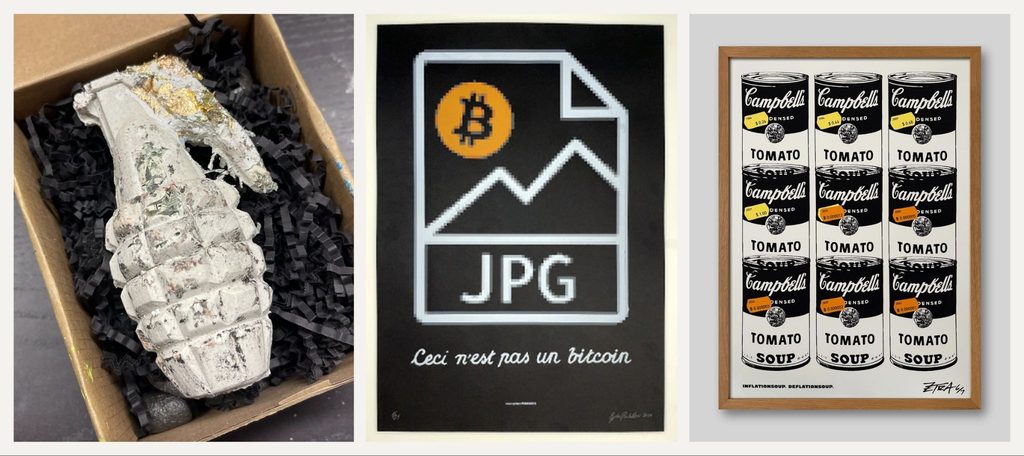
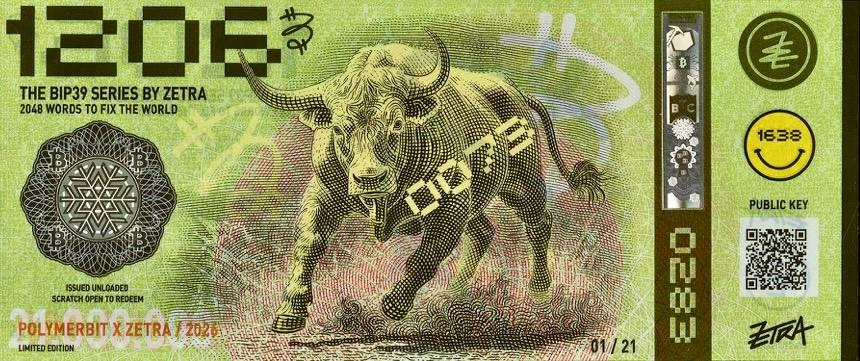
RYR and ZETRA both emerged from Germany’s graffiti scene but approach money from different directions. RYR uses currency itself as material, making paper from shredded banknotes, pigment from their ashes, and concrete grenades filled with shredded cash that he calls “artifacts from the future.” ZETRA, who began painting in the early 1990s and discovered bitcoin in 2017, examines what money can buy. His TOMATOSOUP paintings revisit Andy Warhol’s iconic Campbell’s Soup Cans to chart changing prices in dollars and bitcoin, while THE BIP39 SERIES explores the 2,048 words used in bitcoin wallet recovery phrases, including 1206/NOTE, a collaboration with Polymerbit.
Bitcoin has shaped these artists’ practices, their livelihoods, and the communities around them. Its growing acceptance by banks, investment funds, and corporations has also prompted some difficult questions about the movement’s original ideals and where its culture is heading.
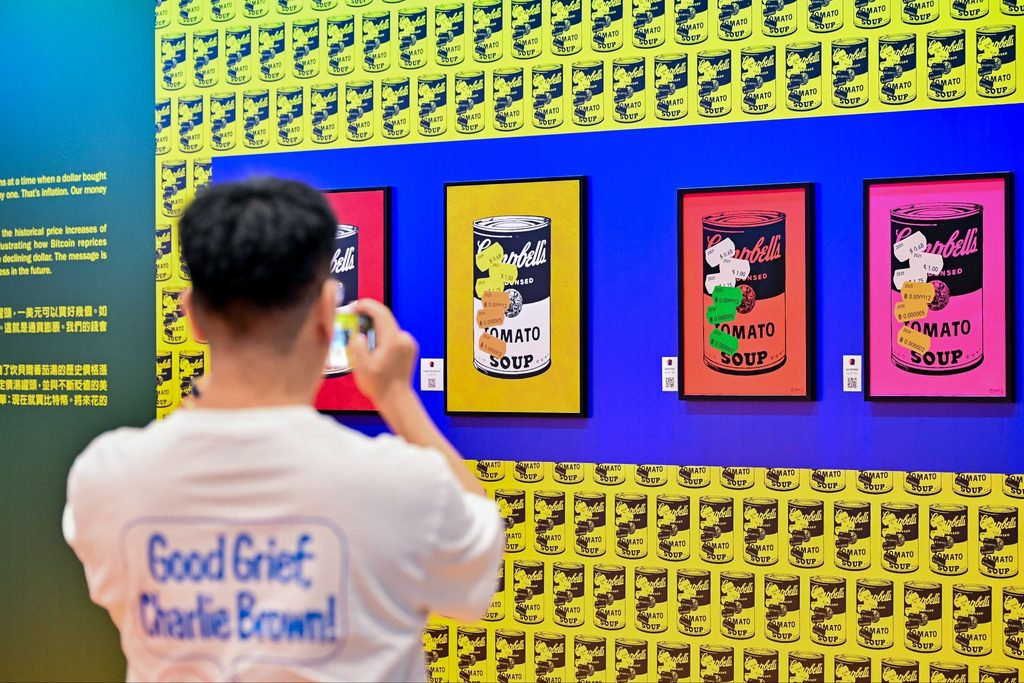
BMAG: Andy Warhol turned Campbell’s soup into an icon of consumer culture, taking an ordinary commodity and elevating it into fine art. Your TOMATOSOUP series returns to that image but introduces something Warhol largely left outside the frame: the changing value of money itself. How did the idea of reworking Warhol’s Campbell’s Soup Cans first come about, and do viewers immediately recognize the commentary on inflation?
ZETRA: We frequently see iPhones and houses in our bitcoin Twitter timelines, showing how they become cheaper in BTC terms. I thought it would be fun to take something from art history instead, something more visually appealing, like Warhol’s iconic Campbell’s Soup Can.
For my TOMATOSOUP painting, I used real stickers placed on the can to show how the price of soup has increased in USD over the past decades, compared with the lower prices we might expect in BTC terms in the decades to come.
Bitcoiners looking at TOMATOSOUP generally understand it immediately. They know they’re in a better position as the purchasing power of fiat money continues to decline through inflation. Other viewers usually need a bit of explanation, and I’m always happy to help them understand.
BMAG: In THE BIP39 SERIES, you draw from the 2,048 words used to generate bitcoin wallet recovery phrases, turning ordinary words into artworks with a deeper significance for bitcoin holders. Can you unpack the different layers of inspiration behind the series and what they reveal about bitcoin, language, and the ownership of money for someone unfamiliar with these concepts?
ZETRA: Everyone who moves their precious sats into cold storage encounters 12 or 24 of these significant words, often early in their journey as a bitcoin newcomer. As mentioned, there are 2,048 words in a carefully curated list representing the power of self-custody.
I started going through the words one by one, imagining how each could be visualized in a physical form: the key visual for the word, its corresponding number, the style, and the medium I would choose. There are millions of possibilities for bringing these words to life through bitcoin art.
1044/LIST was the obvious choice to kick off THE BIP39 SERIES. Naturally, it features all 2,048 words presented as a list. As an ’80s kid, I had to choose 1638/SMILE as the second piece: a proper yellow smiley face, with the number 1638 in place of the eyes. It’s a fine art print on Alu-Dibond beneath a 6 mm acrylic glass cover. So clean.
Another work in the series is 0388/CORN, an obvious homage to Warhol once again. THE BIP39 SERIES will be an ongoing project for many years to come.
BMAG: You shred banknotes into paper and burn them to produce pigment. Artists have long manipulated currency to question where its value resides, but your work goes a step further by making destruction part of the creative process. Is there a contradiction in destroying money to create an artwork that may ultimately be worth much more?
RYR: Money is essentially a narrative system built on collective belief and obedience. It has worked for hundreds of years because we collectively agree on the story it tells and the value it represents. I’ve always been fascinated by that idea, particularly how something as ordinary as a banknote can carry so much meaning, authority, and perceived value.
I was looking for a different way to tell that story, both conceptually and physically. Back in 2017, I had an exhibition title in mind: To Cut a Long Story Short. I liked the cheekiness of it, especially in relation to money and the stories we attach to it. Shredding banknotes became a very literal interpretation of that title, but it also opened up an entirely new artistic medium for me.
Ultimately, I’m not simply destroying money. I’m taking an existing story, cutting it into pieces, and using those pieces to tell a new one.

BMAG: Your concrete weapons are presented as relics from a future in which the fiat wars have already ended. Yet bitcoin is increasingly held through the very financial institutions it was designed to circumvent. Is that a victory for the movement, or have the institutions simply absorbed the alternative?
RYR: I think that’s precisely what makes the story so interesting. When I created the concrete weapons, I imagined a future in which the traditional financial system had already fought its battle for survival. The weapons had become fossils, archaeological artifacts from a monetary conflict that future generations might struggle to understand.
My concrete weapons represent a future in which that battle is already history. Whether bitcoin ultimately wins or becomes part of the very system it challenged remains to be seen.

BMAG: Much of your work is made from the physical remains of money, at a time when currency is becoming increasingly digital and invisible. Do you think people are losing something in their understanding of money as it disappears from everyday physical experience?
RYR: I think we’re losing a physical connection to money, but not necessarily our understanding of it. Money has always been a narrative built on collective trust, whether printed on paper or represented by numbers on a screen. What fascinates me is how something as abstract as value can be represented by a physical object.
I don’t necessarily believe that art has to be authentic or entirely original. Almost everything has been done before. To me, art is a wonderfully human, almost plebeian way of expressing an opinion and giving ideas a physical voice.
Bitcoin will likely evolve into a much broader and increasingly regulated financial asset, but I hope its grassroots culture and artistic identity remain visible. That’s something my fellow artists and I will continue to contribute to, preserving the spirit of a movement that was cultural long before it became institutional.

BMAG: Paralelní Polis wasn’t just a place to discuss alternative monetary systems or a hacker meetup; its café was one of the first to adopt bitcoin as money. What were the early years of Paralelní Polis like, and what has your own experience been selling artwork for bitcoin?
Martin Fischer: Paralelní Polis was founded in 2014, during a bear market. The funny thing is, none of us who founded it even knew what a bear market was. We didn’t think of bitcoin as something that could make us rich. We saw it as uncensorable money and understood the changes it could bring to society. There was no speculation involved, and that’s what made those early days so great.
I sold my first screenprint for bitcoin in 2017, almost ten years ago, and many more since then. But practically every sale was a matter of survival. I spent most of the bitcoin I earned financing my next projects and continuing to make art.
I never managed to accumulate much bitcoin, but looking back, it gave me something far more valuable than investment returns: the freedom to remain an independent artist.
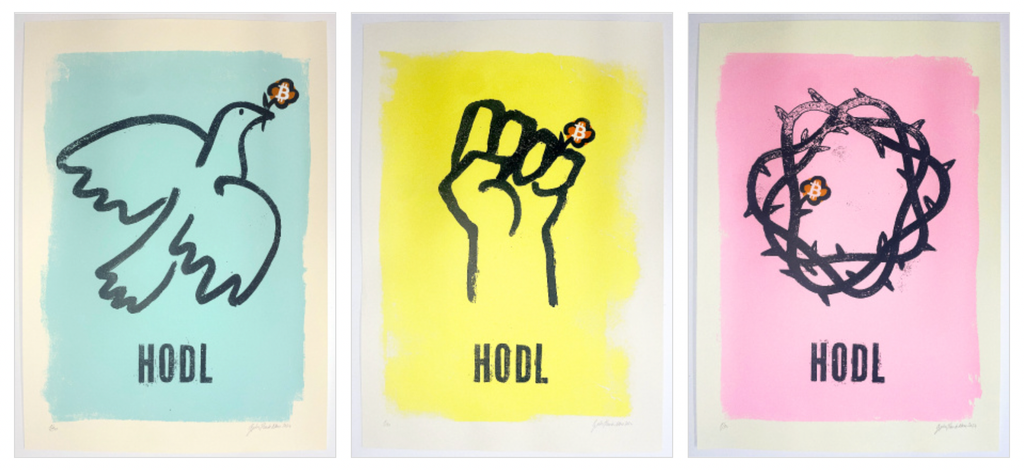
BMAG: Political printmaking has a long history in Europe, from Amsterdam’s financial satires of 1720 to twentieth-century protest posters. Your work emerged from Ztohoven, a collective that famously hacked a live television broadcast to show a fictional nuclear explosion—an audacious intervention, even by today’s standards. Ztohoven challenged institutions through disruption, while bitcoin uses game theory and economic incentives to create an alternative. Do you see bitcoin as a continuation of that same spirit of intervention, and your prints as an extension of it?
Martin Fischer: I think there’s a connection, but I wouldn’t say it’s exactly the same thing. With Ztohoven, we used art to question authority, challenge institutions, and expose how easily reality can be manipulated. Bitcoin doesn’t need to make a statement or provoke anyone. It simply offers an alternative that works without asking anyone for permission. That’s a much more interesting form of disruption to me.
But today, bitcoin has become so corporate and so intertwined with traditional banking that it’s hard to still see it as an anti-establishment movement. I don’t see this as a betrayal of its original ideals, but rather as a natural consequence of its success. That doesn’t mean I like where things are going.
What’s strange is that bitcoin’s fundamental principles haven’t really changed, but the way people perceive and use it certainly has.
And my screenprints? I still work with the original idea of separating money from the state while exploring the myths, memes, and legends of the bitcoin age. That’s what I enjoy most.
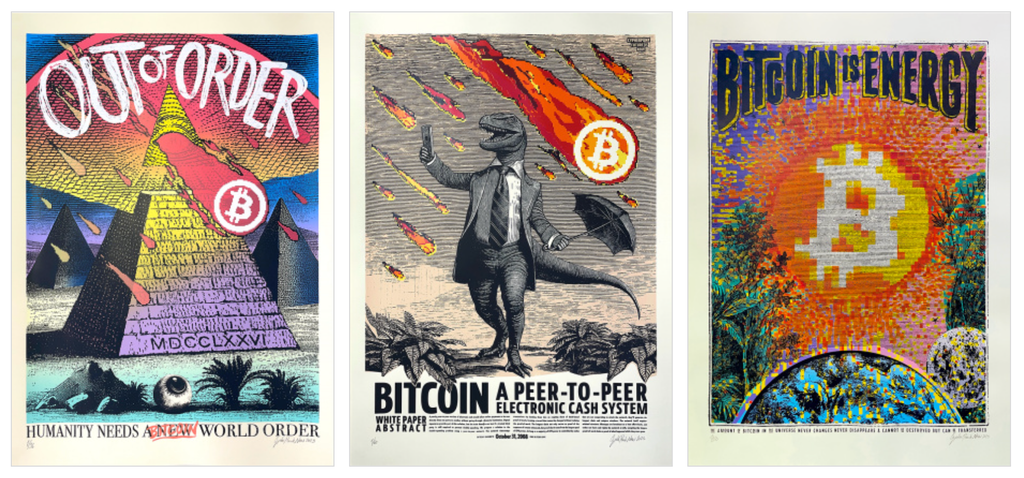
BMAG: Your Amsterdam presentation brings together more than a decade of work documenting bitcoin’s evolution from an underground movement to an increasingly institutionalized financial system. Looking across those prints today, has the movement changed more than you expected, or has your own perspective changed? Which of your prints are your favorites?
Martin Fischer: I like remembering the old days, when we were all part of the same tribe and our main enemy was Faketoshi.
Today? We have culture wars over JPEGs, Ordinals, BIPs, OP_RETURN, over what’s spam and what should or shouldn’t belong on bitcoin. What makes me saddest is that people who once fought together against censorship and for freedom now spend enormous amounts of energy fighting each other over what others should or shouldn’t be allowed to do with bitcoin.
Maybe it’s a natural consequence of bitcoin’s success. The bitcoin community has changed enormously, and so has my perspective on it. I’m definitely much more skeptical today of the idea that technology alone can automatically change society for the better.
As for my favorite works, Bitcoin Meteorite is definitely one of them. In this piece, I reworked the meme of banking dinosaurs watching their own extinction, incorporating the abstract from the Bitcoin white paper. It gave me my fifteen minutes of fame when Max Keiser and Stacy Herbert brought it into the spotlight.

Then there’s Cypherpunks of the World. This project is important to me not only as a celebration of the cypherpunks and their legacy, but also because of its complexity. It started as a series of original collages, continued through handmade screenprints, and eventually evolved into animated NFTs and a virtual gallery. It’s one of my most elaborate projects, connecting different techniques and media while staying true to the original idea.
Among my more recent works, I really like Out of Order from 2023. It’s an incredibly detailed screenprint, and the first one where I finally managed to make absolutely no printing mistakes. That alone makes it special to me.
I also love St. Satosius Contra Draconem (2025), which is inspired by the classic depiction of Saint George fighting the dragon, reimagined through bitcoin mythology.

Works by ZETRA, RYR, and Cypherpunk Now, alongside other European artists, will be presented at Bitcoin Amsterdam, November 4–6, 2026, as part of the Bitcoin Museum & Art Gallery (BMAG) programming. Additional artworks and editions will be available through https://shop.museum.b.tc.
Explore more work by the featured artists at ZETRA, RYR, Cypherpunk Now, and www.martin-fischer.cz.
The Bitcoin Museum & Art Gallery (BMAG) organizes international exhibitions, auctions, and artist collaborations exploring bitcoin and its cultural implications. Learn more at museum.b.tc.
Join us at Bitcoin Amsterdam, Get your tickets here and use code BA26-BMAG20 for discounted admission.
This post The Undercurrent: Three European Artists on Making Money Visible first appeared on Bitcoin Magazine and is written by Dennis Koch.
Bitcoin Magazine
Bitcoin Slips Below $83,000 After Hotter-Than-Expected US Inflation Data
The price of bitcoin slid Wednesday after data dropped showing that U.S. consumer prices shot up more than expected in September due to rising gasoline prices.
The biggest cryptocurrency by market cap was recently trading for close to $82,827 after dropping nearly 1% over a 24-hour period. At one point on Wednesday morning in New York, bitcoin fell as low as nearly $82,331.
Over the past seven days, the coin has dropped by more than 1%. Bitcoin’s price had its best quarter in years after rallying in August and September and leading many analysts to declare it to have exited a bear market.
But sticky inflation is still weighing — in the short-term — on the cryptocurrency.
Data Wednesday showed that the Consumer Price Index rose 0.6% in September after climbing 0.4% in August.
In the 12 months through September, the CPI advanced 3.7% after rising 3.4% in August, the Labor Department’s Bureau of Labor Statistics said.
High prices in the U.S., in part spurred by the Trump Administration’s decision to attack Iran with Israel this year, have led the Federal Reserve to hint it may keep interest rates higher for longer.
The central bank in September said getting inflation down was its number one priority and hiked rates.
Bitcoin’s price has been sensitive to interest rate hikes in the past because higher borrowing costs restrict the liquidity the digital coin needs to run — along with other “risk-on” assets like stocks.
Still, the price of bitcoin rose in September despite the Federal Reserve talking tough on inflation.
The central bank will reveal what it plans to do with interest rates on October 28. As of Wednesday, fed funds futures were pricing a 47% chance of a rate hike at the Fed’s October meeting, according to CME Group’s FedWatch tool.
This post Bitcoin Slips Below $83,000 After Hotter-Than-Expected US Inflation Data first appeared on Bitcoin Magazine and is written by Mathew Di Salvo.
CryptoSlate
The EBA's designation brings dual supervision of Circle's EU issuer, while its Oct. 1 response seeks more flexible reserve requirements.
Read the full story on CryptoSlate
Understand the crypto stories that matter and what to watch next. Get The Catalyst in your inbox
The company says issuance is planned in the coming months, subject to MiCA requirements and white-paper publication.
Read the full story on CryptoSlate
Understand the crypto stories that matter and what to watch next. Get The Catalyst in your inbox
The October 6 activation moved existing FXRP stakes automatically into pooled cover backing, pairing fee income with claim exposure and longer withdrawals.
Read the full story on CryptoSlate
Understand the crypto stories that matter and what to watch next. Get The Catalyst in your inbox
The mainnet plan calls for a live consensus replacement, with roughly 150ms finality dependent on network conditions and a coordinated validator handoff.
Read the full story on CryptoSlate
Understand the crypto stories that matter and what to watch next. Get The Catalyst in your inbox
Its October 14 response emphasizes controls to exclude offshore gambling operators and says it continues as a BSP-licensed institution.
Read the full story on CryptoSlate
Understand the crypto stories that matter and what to watch next. Get The Catalyst in your inbox
CryptoTicker.io
Ether trades at $2,380.17, which is 5.41 percent below the level of 24 hours ago. The low of the day was $2,332.43, the high $2,524.82. The 2,400 mark the price had been orienting itself around for days has therefore been broken on the downside. Converted, you pay 2,122.21 euros for one Ether.
What matters for placing this is not the single price but the breadth: if only Ether falls, the cause lies with the network itself. If almost everything falls, a common cause from outside is at work. That is exactly what this editorial team counted today, and the result is unambiguous.
Ether falls to $2,332: the day's range comes to 7.62 percent
Between the high and the low of the day lie $192.39. Measured against the high, that is 7.62 percent of swing within a single day. If you hold Ether, that means two things. First, the price you saw last night was not the price at which you would have sold this morning. Second, a range of that size is enough to close leveraged positions that were built for quieter days.
The Ethereum price prediction places the current move in the longer run. Over seven days Ether is down 7.16 percent, over 14 days 11.66 percent, over 30 days 4.7 percent. Comparing the time frames shows that the slide of the past two weeks accounts for the larger part of the monthly loss. Over a year, Ether sits 41.71 percent below its level of mid-October 2025.
From the all-time high of $4,946.05, reached on August 24, 2025, 51.88 percent are missing. Ether's market capitalisation stands at $290.7 billion, trading turnover of the past 24 hours at $17.54 billion.
17 of 20 top coins in the red: our own count of market breadth
cryptoticker.io compiled this analysis itself on October 15, 2026. It rests on the 25 largest cryptocurrencies by market capitalisation. Five of them are stablecoins, whose price is pegged to a currency and says nothing about market direction. The remaining 20 assets were therefore the ones examined.
- 17 of 20 trade lower than 24 hours ago.
- 10 of 20 lose at least 5 percent.
- 2 of 20 lose at least 10 percent.
- 3 of 20 are in the black, and none of them by more than 1.32 percent.
- 18 of 20 are also in the red over seven days.
- 12 of 20 sit at least 50 percent below their own all-time high.
The three in the black are Tron at 0.02 percent, Figure Heloc at 1.32 percent and LEO at 0.33 percent. Two of them are tied to an exchange or a lender and follow the broad market only sluggishly in any case. That does not amount to a counterweight.
The heaviest loss is Zcash at 12.15 percent, behind it Rain at 10.81 percent. Then come Near at 7.56 percent, Chainlink at 6.12 percent, Litecoin at 5.83 percent, Cardano at 5.56 percent, Ether at 5.41 percent, Bitcoin Cash at 5.31 percent, Dogecoin at 5.23 percent and Stellar at 5.09 percent. Ether sits in the middle of that row. The sell-off is therefore not an Ethereum event the market follows, but a market event in which Ether runs along.
Market capitalisation at $2.749 trillion: 5.69 percent less in a single day
The entire crypto market has fallen to $2.749 trillion and has given up 5.69 percent of its value within 24 hours. That the total market loses more than Bitcoin is the clearest sign of the direction: capital leaves the smaller assets first.

Bitcoin dominance at 59.49 percent: Ether loses twice as much
Bitcoin trades at $81,501 and loses 2.7 percent; the low of the day was $80,444. The ratio is what counts here: at 5.41 percent, Ether loses exactly double what Bitcoin does.
That ratio shows up in dominance, meaning the share of one coin in total market capitalisation. Bitcoin comes to 59.49 percent, Ether to 10.56 percent. The price ratio of Ether to Bitcoin stands at 0.0292. Anyone holding Ether in expectation of a catch-up move against Bitcoin is getting the opposite delivered this week.
Dominance is the share of one coin in the market capitalisation of all cryptocurrencies together. If Bitcoin dominance rises in a falling market, the remaining coins lose faster than Bitcoin. That is precisely what is happening today.
The level at $2,332: what the day's low can be measured against
The low of the day at $2,332.43 is the most concrete number you have today, and not a forecast but the point at which enough demand last came together to turn the price. If the price stays above it, that demand has held. If it falls below, the demand is used up, and the next footing is open.
On the upside the situation is just as simple to describe. The 2,400 mark that broke today is now resistance from below: everyone who bought above that price and wants out without a loss is waiting there. Above it lies the high of the day at $2,524.82.
What the market does tomorrow, these numbers do not say. They do give you two values on which you can anchor your own decision instead of reacting to a feeling. Anyone trading without such levels decides by daily mood in a falling market.
How much of the loss sits in DeFi usage?
On Ethereum, $49.67 billion are currently locked in financial applications, out of $89.0 billion across all blockchains together. Ethereum therefore carries a good 55 percent of all locked capital. These sums are counted in dollars and fall with the price without any user withdrawing a thing. Nothing about a loss of confidence in the blockchain itself can be derived from that figure.
Buying in Germany: what a MiCA authorisation covers and what it does not
When the market falls broadly, the way you buy matters more than the entry price. Since the EU regulation MiCA applies in full, providers addressing retail clients in Germany need authorisation as a crypto-asset service provider. Which exchanges hold that authorisation, what fees they charge and how they hold client balances is in the comparison of the best crypto exchanges.
What matters is what an authorisation does not deliver. The provider is bound to rules on own funds, custody, complaint procedures and supervision. It does not replace deposit protection: for crypto-assets there is no compensation like the 100,000 euros per client on bank deposits. A price loss is never covered in any case, by no provider and in no country.
Holding period and loss offsetting at a 41.71 percent annual loss
In Germany, gains from selling crypto-assets are tax-free after a holding period of one year. Within the year they count as a private disposal and are taxed at your personal rate, above an exemption threshold of 1,000 euros per calendar year.
At an annual loss of 41.71 percent, that calculation turns around. If you sell within the one-year period at a loss, that loss can be offset against gains from other private disposals in the same year, including those from other coins. If you sell after the period has expired, the sale is irrelevant for tax purposes, and the loss expires in tax terms just as a gain would have stayed tax-free.
That is not advice to sell. What follows from it is that the purchase date of each individual position determines your room for manoeuvre on tax, and that you have to know that date before you decide in a falling market. Which tools track holding periods position by position is shown in our comparison of crypto tax software.

Leverage and liquidation price: when the exchange closes the position itself
A daily range of 7.62 percent is uncomfortable for unleveraged holdings and otherwise without consequence. For leveraged positions it is the danger. The liquidation price is the price at which your collateral is used up and the exchange closes the position by force. At fivefold leverage it sits roughly 20 percent from the entry, at tenfold leverage around 10 percent, in each case before fees and funding costs.
Added to that is the funding rate, the ongoing payment between buyers and sellers of a perpetual futures contract. That payment keeps the contract price at the spot price. If it is positive, the buyers pay, and long positions held for a while cost money even when the price stands still. How funding, leverage limits and liquidation rules differ between venues is set out in the comparison of the best perp DEXs.
How much was actually force-closed today you can look up yourself on the liquidation overview from CoinGlass. The sums listed there come from the exchanges and are added during the day.
Staking and custody: locked Ether cannot be sold in a sell-off
Anyone staking Ether makes it available to the network as collateral and receives a reward for it. The price for that is availability: staked Ether cannot be sold immediately. The release runs through a queue whose length depends on the number of simultaneous exits. In a sell-off many want out at the same time, and that is precisely when the queue is longest.
With offers through an exchange, availability also hangs on the provider's terms. Before your next entry, therefore check how long the release takes and whether the provider may suspend it in the event of a disruption. That clause is in the terms of use, not on the product page.
For custody, the same applies in a falling market as in a rising one: holdings you want to keep for longer belong in storage that only you can access. The devices and how they are operated are compared in our hardware wallet overview. Price moves change nothing about that; an insolvency of a provider does.
Market breadth: what the numbers do not yield
The count shows that the sell-off is broad. Why it is broad, it does not show. A cause cannot be established from price data alone, and any attribution to a single piece of news would be guesswork at this point. What stands out is the pattern alone: that 17 of 20 assets fall at the same time and the total market loses more than Bitcoin fits a withdrawal of capital from the asset class and not a problem at a single network. That is a reading, not a statement of fact.
The duration is equally open. That 12 of the 20 assets examined have lost at least half of their peak describes the state and says nothing about the next month. Anyone deriving a direction from that figure is adding an assumption the figure does not contain.
Ethereum below $2,400: 2,332 is now the measuring line
Three steps with which you clarify the situation for your own portfolio:
- Look up the purchase dates of each position. At an annual loss of 41.71 percent, the holding period decides whether a sale achieves anything on tax. Which tools track these periods position by position is set out in the comparison of crypto tax software.
- Recalculate the liquidation price of every leveraged position. A daily range of 7.62 percent is enough to close tenfold leveraged positions. The leverage limits and funding rules of the venues are compared in the overview of the best perp DEXs.
- Check your own provider's authorisation and custody. A MiCA authorisation governs supervision and custody; it replaces no deposit protection. Which exchanges hold it is shown by the comparison of the best crypto exchanges.
The price figures in this article reflect the state of October 15, 2026. The running price and the daily range you will find on the Ethereum overview from CoinGecko.
(As of October 15, 2026. This article is not investment advice. Prices and fee structures change; check the terms with the provider before you buy.)
Cardano traded at $0.2207 on Wednesday morning, down 7.13 percent over 24 hours. Bitcoin gave up 2.95 percent in the same period. ADA is falling roughly two and a half times as fast as the largest cryptocurrency, and over a week the gap is wider still: minus 12.62 percent for Cardano against minus 1.91 percent for Bitcoin.
That breaks the level we wrote about on October 7. The Cardano price stood at $0.2439 then, and the question was whether the line would hold. It held for a week. The price now sits 9.51 percent below it.
Cardano price at $0.2207: lowest level since September 18
The day's trading points one way. The 24-hour high was $0.2382, the low $0.2175. The current level is 7.35 percent below the high of the day and therefore close to the bottom of the range. The market value of all circulating ADA stands at $8.29 billion, which keeps Cardano the seventeenth-largest cryptocurrency.
The multi-week view matters more than the daily range. No daily reading has been below the current price since September 18. The monthly high of $0.2704 from October 6 is 18.38 percent away. ADA is 67.60 percent short of its yearly high of $0.68123, reached on October 27, 2025.
What has changed since October 7
In our October 7 piece on the end of the Leios rally, the picture was a different one: ADA had shed eight percent in a single day but was still above $0.24 and held its distance to the monthly high. Since then the price has run up twice, on October 11 and October 12 to just under $0.25, and both attempts failed. The second pullback went deeper than the first. That pattern separates today's level from the one eight days ago.
Our own count: 15 of the 20 largest coins are falling harder than Bitcoin
ADA giving way faster than Bitcoin is not an isolated case but the pattern of this sell-off. We counted the 25 largest cryptocurrencies by market value and stripped out the five stablecoins, because their price is pegged to the dollar. Of the remaining 20, 18 are in the red. 15 of those lost more over 24 hours than Bitcoin. The median loss across these 20 is 5.28 percent, almost double the Bitcoin decline.
Cardano ranks fourth in that count by size of daily loss. Ahead of it are Zcash at 12.67 percent, the prediction-market token Rain at 12.06 percent and NEAR at 8.04 percent. Chainlink follows directly behind ADA at 6.43 percent. Ethereum, the second-largest cryptocurrency, lost 5.75 percent to $2,366.74.
cryptoticker.io compiled this analysis itself on October 15, 2026. It rests on CoinGecko price data for the 25 largest cryptocurrencies; 20 assets were examined once the stablecoins were removed.
The total market comes to $2.757 trillion and has lost 5.31 percent within 24 hours. Bitcoin's share of it is 59.51 percent. That figure is the shortest expression of the process: when money leaves the crypto market, the smaller assets leave the portfolio first, and Bitcoin's share of what remains rises.

Liquidity depth and leverage: the mechanism behind the harder altcoin sell-off
Two things explain why a coin ranked 17th falls twice as hard as Bitcoin even though nothing about Cardano itself changed on the day.
The first is liquidity depth. The term describes how many buy and sell orders sit in the order book close to the current price. With Bitcoin, large volumes rest there, a wave of selling works its way through many orders and moves the price comparatively little. With an asset worth $8.29 billion, those orders are spread more thinly. The same amount sold tears a bigger hole in the price.
The second is leverage. Anyone opening a position with borrowed money has to post collateral. If the price falls far enough that the collateral no longer covers it, the exchange sells the position automatically. That is called liquidation. These forced sales meet an already thinned order book and push the price further, which in turn makes the next positions fall due. In altcoins with a smaller order book, the sequence runs through faster than in Bitcoin.
Why the trigger lies outside Cardano
The impulse came from American price data. The US Labor Department reported on October 14 that the consumer price index rose 0.6 percent against the previous month in September and 3.7 percent against the previous year. The core rate excluding energy and food added 0.3 percent on the month and 2.6 percent on the year. The driver was the fuel price with a jump of 9.1 percent, which according to the agency accounted for about half of the overall increase. The release is in the report of the Bureau of Labor Statistics.
Higher headline inflation worsens the outlook for falling interest rates. Falling rates make assets without an interest yield more attractive, rising rates do the opposite. That is why cryptocurrencies react to this number, and why the smaller ones react more strongly than Bitcoin.
The minPoolCost vote expired on October 11
On the Cardano blockchain itself, a separate process ran over the past few days that did not support the price. Up for a vote was cutting the fixed minimum fee of a stake pool from 170 to 75 ADA. According to our analysis of October 12, the proposal ended with the close of epoch 660 on October 11 without being adopted: 44.18 percent of the active voting power of the delegated representatives voted in favour, 55.82 percent against, and 67 percent would have been needed. The minimum fee therefore stays at 170 ADA, and the deposit of 100,000 ADA goes back to the proposers.
For delegators, little changes at first: the fee your pool withholds before the payout stays as it is. For placing the price in context, the episode still matters. A network whose participants reject a fee cut by a clear majority gives no reason to buy in a weak market week.
Cardano staking pays 2.1 to 2.7 percent and does not cushion the price loss
An obvious thought when prices fall is the staking yield. Anyone delegating ADA to a stake pool receives new ADA on an ongoing basis. According to our survey of October 7, the payout currently runs between 2.1 and 2.7 percent a year, depending on pool and fee.
That figure sits in a ratio which is easy to overlook: the price loss of a single week comes to 12.62 percent. The annual staking yield recovers roughly a fifth of it. Staking pays interest in ADA, not in euros, and a cushion against price losses it is not. Anyone who delegates should also know that the additional ADA can count as income for tax purposes at the moment they arrive.
The lock-up period Cardano does not have
Unlike several other networks, delegated ADA remains freely available. There is no bonding period and no waiting time on withdrawal. In a downward phase that is a practical difference: you do not have to choose between yield and the ability to act.
Holding period and loss offsetting: the tax view of ADA in the red
In Germany the holding period decides the tax on cryptocurrencies. If you sell ADA at a profit within a year of buying, that profit is taxable as a private disposal, above the exemption threshold of 1,000 euros a year. If more than twelve months lie between purchase and sale, the profit stays tax-free.
With losses the calculation turns around. A loss within the one-year period can be offset against gains from other private disposals in the same year, for instance from a Bitcoin sale. If you sell at a loss after the twelve months have passed, that loss is worthless for tax purposes, because the transaction is no longer taxable. Anyone now weighing a sale therefore checks the purchase date of each individual holding first, not the portfolio total.
Which ADA count as sold first depends on the method. The usual approach treats the units bought first as the ones sold first. That is hard to document without clean records, and the tax office requires them. A tax tool or a portfolio tracker takes over this allocation and supplies the evidence for the return.

Buying under MiCA: regulated exchanges and the cost per order
Since the European regulation on markets in crypto-assets applies, a provider selling you cryptocurrencies in Germany needs authorisation as a crypto-asset service provider. For you that changes two things above all: the provider has to disclose costs and risks, and it has to keep client holdings separate from its own assets.
At a price of $0.2207 the fees weigh more heavily than with an expensive coin, because the spread between buying and selling price is spread across many units. Anyone buying into a pullback therefore watches both: the order fee and that gap. Which venues work under German and European supervision and what they charge per order is set out in our overview of the big crypto exchanges.
Custody for an asset that stays in the portfolio
Anyone who does not sell ADA but leaves it where it is makes a decision about custody. Holdings on an exchange are convenient and tradable at any time, but they belong to the insolvency risk of the provider. Holdings in self-custody sit outside that risk and demand in return that you secure the access data yourself. For larger sums the arguments favour self-custody; for amounts you trade actively, they do not.
Leverage and liquidation on ADA: the daily range sets the measure
In concrete terms, for open positions: check how far the price stands from your liquidation price, and calculate with the daily range, not with the current level. Between the high at $0.2382 and the low at $0.2175 lie 8.7 percent. Leverage of ten turns a day like that into a total loss of the collateral.
With perpetual futures the funding rate is added. That rate is the payment flowing between the buying and selling side so the contract price stays close to the spot price. In a downward phase with many long positions the buying side pays, and that payment runs on regardless of whether the price moves.
Our assessment: $0.2175 is the next documented level
From the editorial point of view, three numbers describe the situation. First: at $0.2175 the day's low is the next line below the price, and beneath it follows the area around $0.2025, which the price last saw on September 18. Both are levels out of the price history, not a forecast. Second: with Bitcoin at 59.51 percent of the total market, the distribution keeps moving in Bitcoin's favour, and as long as that holds, ADA carries the market risk with a factor of around two and a half. Third: the next date that can change direction lies outside Cardano. The American central bank decides on its key rate on October 27 and 28; the meeting date is in the calendar of the Federal Reserve.
Against that stands the fact that the blockchain itself is working: the transaction record from 2021 fell in the past week, and the number of transactions does not hang on the price. This is an assessment of the situation, not a recommendation to buy or sell. A total loss is possible with cryptocurrencies.
Cardano below $0.2207: the Fed decides by October 28
The day took out a line from the price history that had held for a week, and it showed that ADA carries the market risk at more than double the leverage of Bitcoin. These are the three steps that follow from it:
- Purchase date before any thought of selling. Sort your ADA holdings by purchase date and mark which of them have passed the twelve-month period. Only losses within the period can be offset. If you want to buy in, compare spread and order fee at the regulated crypto exchanges beforehand.
- Records before the tax return. Keep purchases, sales and staking inflows with date and price while the evidence is still available. A tax tool or portfolio tracker handles the allocation and the annual statement.
- Settle custody before the next pullback. For the part of your holdings you do not trade, decide whether it stays on the exchange or moves into self-custody. Which devices do the job and what they cost is set out in the hardware wallet comparison.
(As of October 15, 2026. This article is not investment advice. Prices and fee structures change; check the terms with the provider before you buy.)
Anyone who wants to buy a cryptocurrency usually looks for a name first. That is the most expensive order of operations this asset class offers. On October 15, 2026, CoinGecko lists exactly 22,260 active cryptocurrencies, traded on 1,504 venues and worth 2.76 trillion dollars, or 2.47 trillion euros, in total. A name tells you nothing about any of them. Five criteria do, and you can work through them in a quarter of an hour, before the first euro reaches an exchange account.
The five criteria are market capitalisation, supply, use, custody and tax. None of them is a price forecast, and that is where their value lies: a forecast ages overnight, while these five questions work in October 2026 exactly as they will in two years. What changes are the answers.
22,260 cryptocurrencies and 1,504 venues: why the question about the coin comes too early
The market is heavily concentrated. On October 15, 2026, Bitcoin accounts for around 59.3 percent of total market capitalisation and Ethereum for a further 10.7 percent. The remaining 22,258 cryptocurrencies share roughly 30 percent between them. That distribution is the first useful piece of information you get without having picked a single coin: two names set seven tenths of the market, and the rest spreads across a very long tail of very small positions.
No verdict on individual projects follows from this. What follows is an order of examination. Start with a second-tier coin and you have to answer all five criteria at once with no yardstick for any of them. Start with the largest and you build the yardstick the smaller ones will later be measured against.
What separates a criterion from an argument
A criterion is a question asked the same way of every cryptocurrency, with a verifiable answer. “How many tokens are in circulation?” is a criterion. “The project has a strong community” is an argument, and it has no place on this list, because nobody can measure it. Each of the five questions below has a number, a name or a statutory provision as its answer.
Criterion 1, market capitalisation: the size of the market, not the height of the price
Market capitalisation is the price multiplied by the circulating supply, in other words the total value of all freely tradable units. That figure answers the question of how much money sits in a cryptocurrency, and it is the only value that allows two coins to be compared at all.
The price on its own is no use for that. On October 15, 2026, Bitcoin stands at 72,840 euros, giving it a market capitalisation of 1.464 trillion euros. Dogecoin stands at 0.07292 euros and reaches 11.4 billion euros. The gap in price is a factor of a million; the gap in market capitalisation is a factor of only 128. A low price therefore does not mean a coin is cheap, only that there are many units of it.
In practice, proceed like this: look up where the coin sits in the ranking and note its market capitalisation in euros. Ranks 1 to 10 mean you will find buyers and sellers at every larger venue. From rank 100 it thins out, and from rank 500 a single venue often sets the price. Two values are enough, then: rank and market capitalisation in euros. Both appear on the same line as the price at any price service.
Criterion 2, supply: circulating supply, maximum supply and the tokens still to come
Circulating supply is the number of units in the market today. Maximum supply is the ceiling the protocol permits at all. Where the two figures lie far apart, more supply is still queued up, and every new token spreads the same total value across more holders.
With Bitcoin, 20,098,271 of a maximum 21 million units have been issued, or 95.7 percent. Around 902,000 Bitcoin are still outstanding, 4.5 percent of today's circulating supply, released over the coming decades. With XRP the arithmetic looks different: 63.13 billion units are in circulation and the maximum supply is 100 billion. The difference of 36.87 billion tokens equals 58 percent of today's circulating supply. You can do this calculation yourself for any coin; it takes just two numbers.
The third variant is the open one: Dogecoin has 156.33 billion units in circulation and no maximum supply at all, with new ones arriving continuously. That is neither a flaw nor a merit; it is a property you need to know before you buy. Added supply does not inevitably weigh on the price, but it shifts the relationship between today's valuation and the future quantity, and you can work that relationship out before you buy.
Fully diluted valuation in one sentence
Fully diluted valuation, or FDV, is the price multiplied by the maximum supply rather than the circulating supply. The figure shows what a cryptocurrency would cost if every token already existed. Where FDV diverges sharply from market capitalisation, you know how much dilution is still on the calendar.

Criterion 3, use: what the network actually needs its own token for
This is where it gets uncomfortable, because there is no ranking here. The question is: what happens in the network if nobody holds the token? With Ethereum, every transaction pays its fee in ether, and anyone helping to secure the network posts ether as collateral. Without the token the network does not run. With Bitcoin the token itself is the product, a means of payment and store of value with a limited quantity.
For many smaller projects the honest answer is this: the token grants a vote in a governance ballot and nothing else. That is permissible; it is simply a weaker justification for a price. You will find the answer in the project's documentation, usually under “tokenomics”, where it takes two or three paragraphs. If it is not there, that is an answer in itself.
A second check sits alongside it, and it costs little time: is the token controlled by a company or issued by an open network? With a company, its value hangs on that company's decisions; with an open network, on rules written into the program code. Both models exist, but they carry different risks, and only one of them is something you can read for yourself.
Criterion 4, custody: whoever holds the private keys holds the coins
A private key is the string of characters that moves a balance on a blockchain. Whoever has it controls the coins, regardless of which app displays a balance. The fourth question follows from that: do the keys sit with the venue or with you?
Both routes are legitimate. At a venue the purchase is done in two minutes and you have no credentials to secure, but you carry the provider's risk. With self-custody via a hardware wallet the risk is yours, and losing the recovery words is final. For picking a coin, a third point decides, and many people overlook it: not every cryptocurrency is supported by every wallet. Bitcoin and ether run everywhere; a third-tier token often runs only in the project's own app.
So check before you buy, not afterwards, whether your coin appears on the list of supported networks for the device you intend to use. That list sits with the manufacturer, it is public, and it changes with every firmware release.
What happens when a venue drops a coin
Venues regularly remove tokens from trading, usually with a few weeks' notice. If the token sits there and you miss the deadline, the balance is converted into a stablecoin in the best case; in the worse case you have to supply a withdrawal address, for which you first need a suitable wallet. Settle the custody question before buying and there is nothing to do at this point.
Criterion 5, tax: the one-year holding period under Section 23 of the Income Tax Act and the 1,000-euro threshold
In Germany this criterion decides the return more often than the choice of coin does, and it is the one checked least. Gains from the sale of crypto assets count as a private disposal transaction. The statutory wording is short: transactions are taxable “in the case of other assets where the period between acquisition and disposal is not more than one year”, in the words of Section 23(1) sentence 1 no. 2 of the German Income Tax Act. Once a year has passed from the day of purchase, the gain goes untaxed.
A threshold applies to short-term sales on top of that: gains stay tax free where the total gain from all private disposal transactions in a calendar year stays below 1,000 euros. That is an exemption threshold, not an allowance. The difference is expensive: at a gain of 999 euros you pay nothing, at 1,000 euros the full amount is taxable, not merely the euro above the line.

What is being negotiated about the holding period right now
The period is politically contested. On October 8, 2026 the Bundestag rejected two motions to abolish it, the Greens' motion by a recorded vote of 445 to 132, as we reported on October 9 on the vote in the Bundestag. At the same time the Federal Ministry of Finance is working on a draft that would assign crypto gains to income from capital assets and delete the one-year period for acquisitions from 2027. That draft has not been adopted, and for coins bought today the statutory wording above applies unchanged.
For choosing a coin that means two things. First: anyone intending to hold for more than a year anyway has no need of a coin with large daily swings. Second: anyone swapping more often creates a new disposal transaction with every swap, including a swap from one coin into another. The more positions you run, the more purchase dates you have to be able to prove. How to keep those records clean is shown in our comparison of crypto tax software and portfolio trackers.
Before the first purchase: MiCAR authorisation and who supervises your venue
The five criteria apply to the coin. One question concerns the route to it and is just as verifiable: is the provider allowed to run this business in the EU at all? The basis is Regulation (EU) 2023/1114 on markets in crypto-assets, or MiCAR. Anyone providing crypto-asset services to customers in the EU needs authorisation from a national supervisor, in Germany from BaFin.
The number of providers that have cleared this hurdle is manageable. On October 9, 2026 the EU finance ministers agreed to place only the largest service providers under the direct supervision of ESMA; for the large majority of the roughly 360 providers authorised in the EU, the national authority remains responsible, as we reported on October 13. The figure of 360 is the order of magnitude against which you can check any provider name: if it is not in the supervisor's register, it does not hold the authorisation.
In practice this needs no specialist knowledge. Take the company name from the platform's legal notice, not the brand name of the app, and search for it in BaFin's company database and in the EU register of crypto-asset service providers. If you find it in neither, the question of the right coin is settled before it is asked.
Bitcoin, Ethereum, XRP and Dogecoin: the five criteria across four examples
Here is what the grid looks like filled in, with the values as of October 15, 2026. The examples are not a selection and not a recommendation; they only show how differently the same five questions turn out.
Bitcoin: rank 1, market capitalisation of 1.464 trillion euros. Supply capped at 21 million, of which 95.7 percent issued. Use: the token itself is the product. Custody: supported by every hardware wallet. Tax: free of tax after a holding period of one year.
Ethereum: rank 2, 263.9 billion euros. Supply without a fixed ceiling, 122.13 million units in circulation. Use: fees and collateral in the largest network for applications. Custody: supported everywhere. Tax: take care when posting collateral, because ongoing income can arise in the process.
XRP: rank 5, 74.9 billion euros. Supply capped at 100 billion, 63.13 billion in circulation, so a further 58 percent of the circulating supply still to come. Use: payments within the associated network. Custody: broadly supported. Tax: as for any crypto asset.
Dogecoin: rank 12, 11.4 billion euros. Supply unlimited, 156.33 billion units in circulation. Use: a means of payment with no function in the network beyond that. Custody: broadly supported. Tax: as above.
Our assessment: of the five criteria, supply contributes most to the decision and is checked least. The evidence is above: with XRP it is 36.87 billion tokens that can still arrive within the protocol ceiling, and with Dogecoin the ceiling is open. Against that, added supply does not automatically weigh on the price as long as demand grows with it; with Bitcoin the dilution is stretched over decades and has practically no effect. No buy recommendation follows from this for any of the four names, and a total loss is possible with every crypto asset.
Three mistakes in choosing a coin that beginners pay dearly for
The price as a price tag. “The coin only costs a cent, so there is more room to run” is the most common fallacy. The room to run sits in the market capitalisation, not in the number of digits after the decimal point.
The list of biggest daily gainers as a shortlist. Buy there and you are buying the move that has already happened, and with small market capitalisations often into a market where selling is harder than buying.
Tax at the end of the year. Wait until December to see which purchase dates are documented and you have long since given up control over the one-year period. The period starts on the day of acquisition, and with several partial purchases each tranche has its own date.
How much money into which coin? Allocation comes before selection
Once the five criteria are answered, the question of position size remains. Strictly speaking that question belongs before the choice of coin, because how the money is split affects the outcome more than the choice between two similar cryptocurrencies. One figure we measured ourselves helps here: over twelve months the four largest cryptocurrencies moved with a correlation of 0.82 to 0.90, as set out in our analysis of weighting in a crypto portfolio. Four different names therefore do not yet make four different risks.
A sober order of operations follows: first the amount you could lose in full without it hurting; then the number of positions you can actually manage for tax and for custody; and only then the names. In that order, choosing the coin is the last and smallest step.
Buying a cryptocurrency: the five criteria first, then the coin
- Check the venue and look up its authorisation. Search for the company name from the legal notice in the supervisor's register and compare the costs alongside it, before you open an account. The terms offered by authorised providers are set out in our comparison of the best crypto exchanges.
- Settle custody before you buy. Decide whether the coins stay at the venue or move to a device of your own, and check support for the network you want. Which devices carry which networks is shown by the hardware wallet comparison.
- Record the purchase date and price from the start. Every tranche needs a date, a quantity and a price, otherwise the one-year period cannot be proven later. Which programs log this automatically is set out in the comparison of crypto tax software.
(As of October 15, 2026. This article is not investment advice. Prices and fee structures change; check the terms with the provider before you buy.)
Several trade publications have reported in recent weeks on possible new restrictions for crypto-adjacent payment services in the Philippines. Those reports rest on a policy exposure draft published in 2026 by the Bangko Sentral ng Pilipinas (BSP), the Philippine central bank. The BSP draft covers two distinct subjects: a possible suspension of new applications for Operators of Payment Systems (OPS), and tighter requirements for payment relationships with companies that work with virtual assets. One point matters throughout: a draft of this kind becomes binding only once it is formally issued. Content, timing and transitional rules can still change before then.
What the BSP draft actually proposes
The draft describes several measures that still have to be read in the conditional, since none has been finally adopted. New OPS registration applications would no longer be accepted, or their processing would be suspended, for twelve months from the date the final circular takes effect. Applications already filed would, according to the draft, continue to be reviewed, but would be neither approved nor rejected during the suspension.
VASP-related companies would in addition be classified as high-risk merchants. Payment relationships would then be envisaged only as a direct merchant relationship, while multi-tier or “layered” arrangements would have to undergo particular scrutiny. The draft also provides for enhanced due diligence, ongoing monitoring and risk-appropriate transaction and settlement limits, settlement being the clearing or final discharge of a payment. For existing layered relationships the draft names a review within six months and adjustments within a further six months. Here too: these deadlines are the content of a draft, not confirmed obligations.

Why payment providers and crypto service providers are not the same thing
Placing this in context is easier with a look at the legal basis of payment operator registration. Under the National Payment Systems Act (Republic Act No. 11127), operators of payment systems must be registered with the BSP, which in turn oversees the safety, efficiency and reliability of the payment system. An OPS is a person or company that manages, processes or enables digital or cash-based money transfers and clearing.
A VASP, a virtual asset service provider, is by contrast a provider that transfers or exchanges virtual assets. The BSP places VASPs within the wider supervisory framework for money service businesses. In practice an exchange offering peso deposits and withdrawals may, alongside its crypto functions, also use payment processes, and therefore have several regulatory points of contact at once. A pure payment provider, on the other hand, is not automatically a VASP. For platform operators this distinction is central, because what counts is the services actually provided, the contractual structure and the respective registration, not a company's label alone.
Consequences for market entry, existing platforms and customers
For new providers, a final halt to OPS applications could delay market entry, particularly where a business model depends on holding its own OPS role, or a corresponding partnership, for fiat payment processing. That does not mean every new crypto platform would inevitably be affected. For existing providers, possible stricter VASP checks in the payment environment would bear above all on documentation, risk analysis, monitoring of merchant relationships and adjustment of limits, in other words on classic AML measures (anti-money laundering) and KYC processes (identity verification).
Users and investors may see more cautious deposit and withdrawal channels, longer onboarding processes or a narrower range of new products. The draft makes no mention of existing accounts being blocked. It is worth adding that the BSP has already set out further standing expectations for VASPs: the 2026 listing guidelines require due diligence on tokens, continuous monitoring and delisting thresholds, while privacy coins may not be supported. These listing rules, already in force, should not be confused with the new payments draft.
An existing moratorium must not be mixed up with the new draft
The BSP had already restricted the regular application window for new VASP licences back in September 2022. According to the current BSP Citizen’s Charter, that moratorium was continued by Memorandum M-2025-031 with effect from September 1, 2025, subject to further reassessment. The difference matters: the existing VASP licence moratorium concerns access to a VASP licence, while the new draft deals with OPS registration applications and integrity controls in payments. Earlier moratoria also contained transitions and limited exemptions, which is why market participants should expect neither identical exemptions nor identical consequences automatically.
These documents are the ones market participants should check now
Anyone who could actually be affected should rely on solid sources rather than headlines:
- Check the final BSP issuance and any consultation notices: date of application, definitions, exemptions and transitional periods.
- Check separately in the BSP Verifier and the official OPS list what status payment service providers and crypto providers hold. An entry in a register is not a guarantee of safety or creditworthiness.
- Document your own business model: who accepts peso payments, who holds the crypto assets in custody, who is the customer’s contractual partner, and do direct or layered merchant relationships exist?
- Base no business or investment decision on media reports or social networks alone.
Reading the regional trend without false equivalences
Crypto regulation in Asia is moving in a similar direction across many markets: licensing, anti-money-laundering measures and consumer protection for crypto providers are gaining weight. National categories, agency responsibilities and transitional rules are not interchangeable, however. The FATF notes in its report that differing national licensing and supervisory approaches can create regulatory gaps, which is why activity-based registration, risk-based supervision and cross-border cooperation remain relevant. For international platforms that means local Philippine requirements have to be assessed separately; EU standards do not replace a local classification.
Philippines VASP regulation: three questions decide the actual effect
With Philippines VASP regulation, three questions ultimately decide the real reach: which business models and companies are covered? From when do final obligations apply? And what transitions apply to companies already registered, to pending applications and to existing merchant relationships? The BSP draft could noticeably affect access for new providers and the payment connections of crypto businesses, but until official finalisation its scope and practical consequences remain open. This article offers general orientation and does not replace legal advice.
Germany's federal cabinet did not take up the abolition of the one-year holding period for crypto assets on Wednesday, October 14, 2026. The published results of its 62nd session make no mention of the measure, and the government press conference that followed did not address it either. Current law therefore stands: anyone who holds Bitcoin, Ether or any other crypto asset for more than a year and then sells it pays no income tax on the gain.
For investors in Germany that is a breathing space, not an outcome. The Federal Ministry of Finance told Blocktrainer on request that the internal government consultations were still running. The ministry named no new date for the cabinet to take up the file. The departmental draft that would delete the one-year rule thus remains what it has been since late September: a working paper from the finance minister's house that has not yet passed the cabinet.
What happened in the cabinet on October 14, and what did not
October 14 had been treated as a fixed date in coverage since the start of the month. We named it ourselves on October 3, in our reporting on the departmental draft, as the next step in the procedure. It did not materialise.
Blocktrainer reports that as early as the previous day the ministry had said it knew of no such date. Frank Schäffler, a former FDP member of the Bundestag, wrote on X that the abolition of the holding period was still stuck in interdepartmental consultation. Both accounts match the ministry's official statement.
A missing agenda item is not a withdrawal. Government measures slip as a matter of routine when departments are still arguing over detail. Only one thing is solid on this day: there is no cabinet decision, and without one there is no government bill.
Interdepartmental consultation: why a departmental draft is not yet law
The road from an idea inside the finance ministry to an amendment of the Income Tax Act runs through several stations, and each of them can take time. The departmental draft is the working version produced by a ministry's specialist unit. It has no legal effect and does not bind the federal government.
In interdepartmental consultation, the other ministries check the text against their own remits. Only once they agree can the cabinet adopt the draft. That decision turns the departmental draft into a government bill, which is then introduced in the Bundestag and the Bundesrat. Readings, committee deliberations and finally the assent of both chambers follow.
The measure is stuck at precisely that second station. Associations and interest groups had their chance to comment; according to Blocktrainer, responses were requested by October 6. The Federal Chamber of Tax Advisers publicly doubted that the submissions could be evaluated seriously in the time left.

Section 23 and Section 20 of the Income Tax Act: the difference decides your tax bill
Today, gains from the sale of crypto assets fall under Section 23 of the German Income Tax Act, which covers private disposal transactions. That provision carries two features crypto investors have benefited from for years. First, the one-year rule: after more than twelve months of holding, the gain is tax free. Second, the 1,000-euro exemption threshold for gains realised inside the period.
The finance ministry's draft moves crypto assets to Section 20, in other words to income from capital assets. There the flat withholding tax of 25 percent applies, plus the solidarity surcharge and, where relevant, church tax, regardless of how long someone has held their coins. The saver's allowance takes the place of the one-year rule.
In practice the shift means more than a different section number. Loss offsetting would be affected as well, together with the question of who withholds the tax and how much documentation the tax office demands. Our comparison of crypto tax software and portfolio trackers shows how to keep clean records of your transactions today; the documentation burden rises under either model.
December 31, 2026 separates old holdings from new ones
The most important figure in the draft is not the tax rate but the date of first application. Under the version on the table, the new rules would apply only to crypto assets acquired after December 31, 2026. Everything already sitting in a securities account or a wallet before that would stay under the old law, and therefore inside the one-year rule.
That gives investors a clear dividing line for as long as the draft keeps this shape. Purchases up to the turn of the year follow the existing rule. Purchases after it would fall under the flat withholding tax. A good eleven weeks separate today from that date.
One caveat belongs with it, and it is no formality: this cut-off sits in a draft that neither the cabinet has adopted nor the Bundestag has debated. It can move during the procedure, and with earlier tax measures that is exactly what happened more than once. Basing decisions on this date alone means planning around a number that carries no force of law.
Until new rules arrive, the one-year period applies unchanged
Nothing changes for the current tax year because the date was missed. Anyone who sold crypto assets in 2026 settles under Section 23 as it stands: a holding period of more than a year means no tax, below that the personal income tax rate applies, provided total gains from private disposal transactions exceed the 1,000-euro threshold.
The same holds for swaps. Moving from Bitcoin into a stablecoin or into another coin counts for tax purposes as a disposal and an acquisition at once. Every swap starts a fresh one-year period for the asset received. Reshuffling a portfolio in December may therefore move holdings out of the old regime and into a future one.
Petitions committee and chamber of tax advisers: where the headwind comes from
A second track runs alongside the government procedure. On Monday, October 12, 2026, the Bundestag's petitions committee considered a petition to keep the holding period in a public session. We covered the state of the parliamentary process in our piece on the Bundestag's handling of the crypto holding period.
A hearing in the petitions committee does not change tax law. It builds political pressure and forces the federal government to state a position. Combined with the Federal Chamber of Tax Advisers' criticism of the timetable, a picture emerges that makes the delay plausible: the measure is contested on technical and political grounds, and the consultation window was tight.
Resistance is therefore documented at two levels. What is not documented is how the federal government will respond. Whether it reworks the draft, stretches the timetable or takes it to the cabinet unchanged is open as matters stand.
Gold in the mix: how far the reform could reach
One side track in the debate goes beyond crypto assets. According to a report by BTC-Echo, the finance ministry has floated proposals to extend new rules to physical gold. The one-year speculation period under Section 23 applies there today as well.
That point is revealing for any assessment of the measure. If the reform went beyond crypto, considerably more investors would be affected, and political resistance would grow accordingly. That raises the likelihood of further delay, but says nothing about whether the reform arrives in the end.

Our assessment: the timetable for January 1, 2027 is ambitious
From the newsroom's point of view, entry into force on January 1, 2027 becomes less likely with every date that passes. The evidence is in the open. The draft went to association consultation in late September, responses were requested by October 6, and the cabinet decision expected on October 14 did not come. After the cabinet there are still three readings in the Bundestag, committee deliberation and the passage through the Bundesrat. A good eleven weeks remain in the year.
Against that, the federal government has not withdrawn the measure and the ministry speaks expressly of consultations in progress. Tax legislation has been pushed through the procedure in less time at year-end when the political will was there. We offer no forecast of the outcome; there is no solid basis for one.
What follows for practice is more modest than many posts online suggest: today's legal position is certain, the future one is not. Anyone who makes arrangements depend on a law that does not yet exist carries that risk alone.
Documentation: purchase date and acquisition cost per position
However the procedure ends, a cut-off rule has one consequence: the acquisition date of each individual position becomes the decisive record. Proving in 2027 that a holding was bought before the cut-off takes more than a bank statement.
Each position needs the date, the quantity, the acquisition cost in euros and the exchange or wallet where the purchase took place. Across several years and several platforms, that record does not assemble itself retroactively. Exchanges issue tax reports of varying quality; some provide complete transaction histories for export, others only annual summaries. The depth of those histories differs from venue to venue.
A second point concerns sequence. For crypto assets the tax office works on the FIFO method as a rule, first in, first out. Selling part of a holding therefore touches the oldest positions first, and under a future cut-off rule those are precisely the protected ones.
Crypto holding period: every purchase date counts up to December 31
The cabinet date has passed; the measure has not. These three steps make sense whatever the outcome of the procedure:
- Record your holdings with purchase dates. Pull the date, quantity and acquisition cost for every position from your exchanges and wallets, and store the exports outside the platform. A tax tool or portfolio tracker handles the reconciliation across several providers.
- Check where your oldest holdings sit. Because of the FIFO rule, the order of purchases decides which coins a sale hits first. You need that information before you reshuffle at year-end. At regulated crypto exchanges the full history is usually available for export.
- Look at your venues on record quality. Anyone unable to export a full history has a documentation problem later. Our comparison of crypto exchanges shows which providers deliver usable tax reports.
There is no known next date for the procedure itself. Once the cabinet adopts the draft, the parliamentary stage begins, and only then will it be clear whether December 31, 2026 remains the dividing line.
(As of October 15, 2026. This article is not investment advice. Prices and fee structures change; check the terms with the provider before you buy.)
Decrypt
After a summer of AI models escaping test environments and hacking real companies, hundreds of researchers say the internet itself should be treated as a security boundary.
Developer Brandon Thomas used Anthropic's Claude to build free, open-source replicas of Word, Excel and PowerPoint. They're rough, but they show how cheap cloning software has become.
A new Chainalysis report found payments through Coinbase’s x402 protocol surged from about 1,500 in mid-2025 to more than 138 million by Q3 2026, with U.S. wallets dominating spending on AI models.
Sberbank now holds both custody and exchange status under Russia's new crypto law, and plans to bring Bitcoin, Ethereum and USDT to apps used by 110 million retail clients.
Solana's Alpenglow upgrade replaces the TowerBFT voting system on October 21, cutting finality from 12.8 seconds to a target of 150ms and pulling vote transactions out of blocks entirely.
U.Today - IT, AI and Fintech Daily News for You Today
Cardano founder Charles Hoskinson has jokingly suggested that Hollywood star Sydney Sweeney owns XRP after David Schwartz accidentally posed in front of a billboard featuring the actress instead of Evernorth's Nasdaq advertisement.
Former White House Crypto Council chief Patrick Witt has broken his silence following his resignation.
The market is heading down towards major local support levels where bulls and bears are going to clash.
hina is moving to confiscate approximately $5 billion in Bitcoin (BTC), along with millions of XRP, DOGE and other cryptocurrencies.
Ripple is making a major push into traditional finance through a new partnership with global brokerage infrastructure provider DriveWealth.
Blockonomi
TLDR
- IBRX climbs 1.12% to $9.91 as FDA expands ANKTIVA’s bladder cancer approval.
- FDA clears ANKTIVA plus BCG for papillary-only bladder cancer patients in the U.S.
- ANKTIVA’s wider label opens treatment to more patients with BCG-resistant tumors.
- Clinical trial finds 62% complete response rate among 77 bladder cancer patients.
- ImmunityBio sees a larger U.S. market after ANKTIVA wins expanded FDA approval.
ImmunityBio (IBRX) stock gained 1.12% to close at $9.91 on Wednesday, adding $0.11 after a volatile trading session. Shares advanced another 0.81% to $9.99 in after-hours trading as the company announced a major regulatory development. The FDA expanded ANKTIVA’s approval to include patients with BCG-unresponsive non-muscle invasive bladder cancer (NMIBC) with papillary-only tumors.
ImmunityBio, Inc., IBRX
FDA Expands ANKTIVA Approval to More Bladder Cancer Patients
The U.S. Food and Drug Administration expanded ANKTIVA’s indication in combination with Bacillus Calmette-Guérin (BCG) therapy. The decision adds adults with papillary-only tumors to the treatment’s approved patient population. ImmunityBio can offer the combination to more patients with bladder cancer that no longer responds to BCG.
The latest decision follows the FDA’s initial approval of ANKTIVA in April 2024. That authorization covered patients with BCG-unresponsive NMIBC involving carcinoma in situ (CIS), with or without papillary tumors. However, the earlier indication excluded patients who had papillary-only disease without CIS.
The expanded indication marks the first FDA approval covering this specific group of bladder cancer patients. ImmunityBio now holds approval for ANKTIVA plus BCG across both CIS and papillary-only disease. Additionally, the broader label increases the treatment’s potential reach within the U.S. bladder cancer market.
Clinical Results Support ANKTIVA’s Expanded Use
The FDA reviewed existing scientific evidence supporting ANKTIVA’s effectiveness in treating BCG-unresponsive bladder cancer. This evidence included results from Cohort A of ImmunityBio’s QUILT-3.032 clinical trial. The trial evaluated ANKTIVA plus BCG in patients with CIS, with or without papillary tumors.
Among 77 patients, 62% achieved a complete response to treatment during the clinical study. Furthermore, 58% of responders maintained their response for at least 12 months. Another 40% maintained their response for at least 24 months, demonstrating sustained treatment benefits in some patients.
The treatment also showed a manageable safety profile, with most reported adverse events involving bladder-related symptoms. Common reactions included painful urination, frequent urination, and blood in the urine, mostly at mild or moderate levels. However, the prescribing information warns that delaying bladder removal surgery can allow potentially fatal metastatic cancer to develop.
ImmunityBio Targets a Larger Bladder Cancer Market
Non-muscle invasive bladder cancer accounts for approximately 80% of bladder cancer diagnoses in the United States. Furthermore, an estimated 85% to 90% of newly diagnosed NMIBC patients present with papillary disease. These figures highlight the substantial patient population affected by the disease.
Patients with high-grade papillary tumors face significant risks when their cancer stops responding to BCG treatment. Recurrence and disease progression create additional challenges, particularly for patients seeking alternatives to bladder removal surgery. Therefore, the expanded approval introduces another treatment option for eligible patients within this group.
ImmunityBio expects the broader indication to increase ANKTIVA’s addressable U.S. market beyond its original CIS population. The company also aims to build on commercial growth following the treatment’s initial approval in 2024. Meanwhile, the latest FDA decision strengthens ImmunityBio’s position in bladder cancer immunotherapy and expands its potential commercial opportunities.
The post ImmunityBio (IBRX) Stock: Climbs as FDA Expands ANKTIVA Approval for Bladder Cancer appeared first on Blockonomi.
TLDR
- CEG shares drop 5.49% as Constellation completes its 606 MW plant sale to LS Power.
- Constellation closes Brazos Valley sale while its stock slides 5.49% to $279.54.
- LS Power takes over the 606 MW Brazos Valley plant as CEG shares fall sharply.
- Constellation’s $5 billion PJM asset sale remains on track for a 2026 closing.
- Calpine antitrust commitments drive asset sales despite Constellation’s stock slump.
Constellation Energy Corporation (NASDAQ: CEG) completed the sale of its Brazos Valley Energy Center to LS Power on Wednesday. However, Constellation Energy stock plunged 5.49% to $279.54, losing $16.25 as selling pressure intensified during the session. The transaction advances the company’s regulatory commitments following its $16.4 billion acquisition of Calpine earlier this year.
Constellation Energy Corporation, CEG
Constellation Energy Completes 606 MW Power Plant Sale
Constellation confirmed the transfer of the 606-megawatt Brazos Valley Energy Center to LS Power on October 14, 2026. The natural gas-fired facility operates outside Houston, Texas, within the Electric Reliability Council of Texas market. The sale marks another step toward meeting federal antitrust requirements linked to the company’s expansion.
Constellation initially agreed to sell the facility in August 2026 and disclosed the agreement alongside its second-quarter results. The completed transaction reduces the company’s generation holdings in Texas while fulfilling part of its regulatory obligations. However, Constellation did not disclose the final sale price in its latest announcement.
The company acquired Calpine on January 7, 2026, significantly expanding its electricity generation and competitive retail operations. Consequently, the acquisition created the world’s largest private-sector power producer and strengthened Constellation’s presence across major electricity markets. Federal regulators required several asset sales to address competition concerns arising from the combination.
Constellation Advances $5 Billion Asset Sale to LS Power
Beyond the Brazos Valley transaction, Constellation plans to sell approximately 4.4 gigawatts of generation capacity to LS Power. The proposed $5 billion agreement covers predominantly natural gas-fired facilities across Delaware and Pennsylvania. These assets include the Bethlehem, York 1, York 2, Hay Road, and Edge Moor power plants.
The transaction represents the largest portion of the divestitures required under Constellation’s agreement with the Department of Justice. Additionally, the portfolio includes all generation facilities covered by the Federal Energy Regulatory Commission’s divestiture requirements. The agreed valuation equals approximately $1,142 per kilowatt before closing adjustments.
Constellation expects to complete the PJM asset sale before the end of 2026, subject to regulatory approvals. Meanwhile, LS Power plans to strengthen its generation portfolio within a market experiencing growing electricity demand. The acquisition would expand its ownership of dispatchable power facilities serving businesses and households across the region.
Regulatory Commitments Shape Constellation’s Expansion
The Department of Justice reached an agreement with Constellation in December 2025 to address competition concerns surrounding Calpine. Earlier, federal energy regulators approved the acquisition in July 2025 with conditions requiring certain PJM asset sales. Together, these agreements established the divestiture framework governing Constellation’s integration of Calpine’s operations.
Constellation also identified the 606-megawatt Jack Fusco Energy Center near Houston among its remaining divestiture obligations. Separately, the company previously divested its minority ownership interest in the 385-megawatt Gregory Power Plant near Corpus Christi. These transactions form part of the broader restructuring of its generation portfolio following the acquisition.
The completed Brazos Valley sale moves Constellation further through its required asset disposals despite Wednesday’s sharp share decline. Meanwhile, the proposed PJM transaction remains an important part of the company’s regulatory compliance process. Constellation continues integrating Calpine’s operations while working to complete its remaining required divestitures.
The post Constellation Energy (CEG) Stock: Plunges 5.49% Despite Completing Major Power Plant Sale to LS Power appeared first on Blockonomi.
TLDR
- BAC stock closed at $51.39, down 4.76%, after a disappointing earnings report.
- Bank of America’s $1.2 billion regulatory charge cut earnings by $0.17 a share.
- Adjusted expenses rose 6.9%, outpacing revenue growth of approximately 3.2%.
- Bank of America’s adjusted efficiency ratio climbed to 62% from 60% last year.
- Net interest income increased 8%, but total trading revenue dropped 5% to $5.1B.
Bank of America Corporation fell 4.76% to $51.39 on Wednesday, October 14, losing $2.57 per share. The decline followed disappointing third-quarter earnings, a $1.2 billion regulatory settlement, and operating expenses that grew faster than revenue. Although net interest income increased, weaker trading results and rising costs weighed on the bank’s overall financial performance.
Bank of America Corporation, BAC
Earlier Wednesday, shares dropped approximately 7.14% to $50.105 during morning trading, reflecting a sharper intraday decline. The stock recovered some losses before closing at $51.39, while after-hours trading showed a further decline to $51.32. The earnings report highlighted continued pressure on profitability despite stronger lending activity and higher interest income.
Bank of America Earnings Miss Expectations as Settlement Hits Profit
Bank of America reported third-quarter net income of $6.9 billion, compared with $8.3 billion during the previous year. Diluted earnings per share reached $0.91, down from $1.04 in the corresponding quarter of 2025. The bank recorded a $1.2 billion regulatory settlement charge that reduced quarterly earnings by $0.17 per share.
Excluding the settlement, Bank of America reported adjusted earnings of $1.08 per share and adjusted net income of $8.1 billion. Adjusted earnings still fell below analysts’ expectations of approximately $1.10 per share, confirming underlying earnings pressure. The settlement also contributed to higher reported expenses and reduced the bank’s return on common equity.
The regulatory charge followed enforcement actions involving the bank’s anti-money-laundering controls and financial crime reporting obligations. Federal regulators identified compliance failures involving suspicious transactions, which resulted in financial penalties and additional oversight requirements. Consequently, the settlement affected reported profitability, while other operating challenges continued to pressure the bank’s quarterly results.
Rising Operating Expenses Outpace Bank of America Revenue Growth
Bank of America generated approximately $29.96 billion in third-quarter revenue, compared with $29.04 billion a year earlier. This represented growth of roughly 3.2%, supported by higher interest income and continued activity across core banking operations. Adjusted noninterest expenses increased approximately 6.9%, reaching $18.5 billion from $17.3 billion in the previous year.
The bank’s adjusted efficiency ratio increased to 62%, compared with 60% during the corresponding quarter of 2025. This measure compares operating expenses with revenue, and higher readings indicate that costs consume a greater share of income. The reported efficiency ratio reached 66% after including the regulatory settlement charge in total operating expenses.
Higher personnel, technology, and business-related expenses contributed to the overall increase in spending during the quarter. The bank’s operating cost growth exceeded its revenue expansion, placing additional pressure on underlying profit margins. The results showed that removing the settlement charge did not eliminate the wider difference between revenue and expense growth.
Net Interest Income Rises as Trading Revenue Weakens
Bank of America recorded an 8% increase in net interest income, reaching approximately $16.4 billion during the third quarter. Higher loan balances, growing deposits, and changes in fixed-rate asset yields supported the improvement. Additionally, average loan and lease balances increased 6%, reflecting continued borrowing activity across the bank’s business segments.
Weaker capital markets performance offset part of the improvement in traditional banking revenue during the quarter. Sales and trading revenue declined 5% to approximately $5.1 billion, while fixed-income trading revenue fell 17%. Although equities trading revenue increased 11%, that growth failed to offset the broader weakness in trading operations.
Investment banking activity also faced pressure, with lower fees contributing to weaker results across the bank’s capital markets businesses. Bank of America maintained substantial liquidity and capital reserves, supporting its lending operations and shareholder distributions. The bank ended the quarter with a 10.9% common equity Tier 1 ratio and average global liquidity sources of $914 billion.
Bank of America returned $8.3 billion to shareholders through dividends and common stock repurchases during the third quarter. Its reported return on average common equity reached 9.4%, compared with an adjusted return of 11.1%. The earnings results highlighted a widening cost burden, despite stronger interest income and continued growth across core banking activities.
The post Bank of America Corporation (BAC) Stock: Earnings Miss Sparks Selloff as Expenses Outpace Revenue Growth appeared first on Blockonomi.
TLDR
- SKYD stock plunged 22.33% to $7.05 as warrants began separate trading on NYSE.
- Skydance issued 471 million warrants following its Warner Bros. Discovery deal.
- NYSE cut SKYD’s reference price from $9.27 to $9.07 after warrant distribution.
- New SKYD.WS warrants carried a $2.20 closing price on October 13, 2026, on NYSE.
- Skydance valued common shares and warrants together at roughly $46.6 billion.
Paramount Skydance Corporation plunged 22.33% to $7.05 on Wednesday, October 14, losing $2.03 per share. The decline coincided with the separate trading of approximately 471 million warrants following the Warner Bros. Discovery acquisition. Skydance outlined the NYSE’s share price adjustment and explained how the warrants affect its $46.6 billion equity valuation.
Skydance Corporation, SKYD
Skydance Stock Drops as 471 Million Warrants Begin Trading
Skydance completed its acquisition of Warner Bros. Discovery on October 6, 2026, expanding its global entertainment operations. As part of the transaction, the company issued warrants to eligible public shareholders on October 13. The distribution covered approximately 9% of its outstanding Class B common shares, while other shareholders received no warrants.
Each eligible shareholder received one warrant for every Class B share held on the October 5 record date. The warrants give holders the right to purchase one additional Class B common share under their terms. The NYSE began trading the new securities under the ticker SKYD.WS on October 13.
October 14 marked the ex-dividend date, separating the warrant distribution from the underlying common shares. SKYD shares and SKYD.WS warrants now trade independently, allowing the market to establish separate prices. Skydance shares ended Wednesday at $7.05, below the NYSE’s adjusted reference price of approximately $9.07.
NYSE Adjusts Skydance Share Price Following Warrant Distribution
The NYSE announced a $0.19368 adjustment to Skydance’s Class B common stock reference price on October 13. This adjustment reduced the reference value from approximately $9.27 to $9.07 ahead of separate trading. The exchange based its calculation on the warrants’ official closing price of $2.20 that day.
NYSE applied the adjustment proportionally rather than deducting the full warrant price from every common share. Approximately 471 million eligible shares received warrants, compared with about 5 billion Class B shares outstanding. The exchange calculated the adjustment using the eligible shares’ share of the company’s outstanding stock.
Skydance’s illustrative figures placed its market capitalization at $46.6 billion before the warrant separation. Following the adjustment, the company’s calculations showed common share market capitalization declining to approximately $45.6 billion. The new warrants represented approximately $1 billion in additional value, maintaining the illustrative combined equity valuation at $46.6 billion.
Warner Bros. Acquisition Expands Skydance Entertainment Portfolio
The Warner Bros. Discovery acquisition brought several major entertainment businesses into Skydance’s existing corporate structure. These include Warner Bros., HBO, HBO Max, CNN, and popular television brands across entertainment and factual programming. The combined company operates across studios, direct-to-consumer services, and traditional television media.
Skydance’s portfolio also includes Paramount, CBS, Paramount+, Pluto TV, Nickelodeon, MTV, and Comedy Central. These businesses provide film production, streaming distribution, television programming, sports coverage, and advertising services. The wider portfolio gives the company operations across several major segments of the global entertainment market.
The warrant distribution represents a separate financial development following the acquisition rather than another operating transaction. Although the reference adjustment accounted for approximately $1 billion in warrant value, Wednesday’s stock decline extended beyond that calculation. SKYD closed at $7.05, while the company continued trading under its expanded entertainment structure.
The post Paramount Skydance Corporation (SKYD) Stock: Shares and Warrants Begin Separate Trading After $46.6 Billion Valuation appeared first on Blockonomi.
TLDR
- Rivian shares fall 3.14% as Redwood partnership expands battery recycling operations.
- Redwood will collect used Rivian battery packs through nationwide service centers.
- Rivian’s Illinois factory plans 10 MWh of storage using repurposed EV batteries.
- Redwood says its recycling process recovers over 95% of key battery materials.
- Expanded alliance links battery reuse, factory scrap recycling and energy storage.
Rivian Automotive (RIVN) stock fell 3.14% to $12.95 on Wednesday as the automaker expanded its battery recycling partnership with Redwood Materials. The agreement adds battery scrap recycling and broader energy storage services to their existing collaboration. The expansion strengthens Rivian’s battery management operations while its shares ended the session lower.
Rivian Automotive, Inc., RIVN
Rivian and Redwood Strengthen Battery Management Partnership
Rivian and Redwood Materials announced an expanded agreement covering electric vehicle battery recycling and stationary energy storage. The partnership now includes additional services that support battery collection, reuse, and material recovery. Both companies aim to improve battery resource management across Rivian’s manufacturing and service operations.
The expanded partnership covers battery waste from manufacturing operations alongside batteries from retired electric vehicles. This arrangement creates additional opportunities to reuse batteries before recycling their remaining materials. It also gives Redwood a broader role in managing batteries throughout their useful lives.
Under the agreement, Redwood will collect used battery packs through Rivian’s nationwide service center network. The company will assess each pack and determine whether it can support another energy storage application. Redwood will recycle batteries that no longer meet operational requirements.
Rivian and Redwood Expand Battery Recycling Operations
The latest agreement builds on an energy storage partnership that both companies announced in April 2026. That project involves deploying 10 megawatt-hours of repurposed battery storage at Rivian’s Normal, Illinois, factory. The expanded arrangement adds recycling services to the existing storage project.
Redwood will also process battery scrap from Rivian’s vehicle manufacturing activities. Its recycling technology can recover more than 95% of critical materials, including lithium, nickel, cobalt, and copper. These recovered materials can support domestic battery production and reduce reliance on newly mined resources.
The companies plan to extend battery use beyond electric vehicle applications. Batteries that lose sufficient driving capacity can still provide electricity storage for factories and other facilities. This approach allows Rivian to extract additional value from batteries before recycling their remaining materials.
Battery Storage Partnership Supports Rivian’s Manufacturing Strategy
Rivian’s Illinois manufacturing facility will serve as an initial location for the companies’ stationary battery storage systems. These systems can store electricity during periods of lower demand or cheaper power supply. Facilities can then use the stored energy during periods of higher electricity demand.
Redwood’s energy management technology will coordinate battery storage operations according to facility requirements. The system can help manufacturers manage power consumption and reduce exposure to peak electricity costs. It also provides additional energy capacity without relying entirely on conventional grid infrastructure.
The partnership combines battery collection, reuse, energy storage, and mineral recovery under one operating arrangement. For Rivian, the expanded services support battery lifecycle management alongside its electric vehicle manufacturing activities. The agreement also expands Redwood’s role in supporting domestic battery recycling and industrial energy storage.
The post Rivian Automotive (RIVN) Stock: Declines as Rivian and Redwood Expand Battery Recycling Alliance appeared first on Blockonomi.
CryptoPotato
When a platform offers a digital token linked to a listed company, the familiar name and matching price do not tell the investor what they own. The token itself is the blockchain-recorded instrument held in a wallet, while the underlying legal wrapper decides whether the holder has an ownership interest in the shares, an indirect interest through an intermediary, or only a separate stock-linked claim against another issuer.
Revaz (Rezo) Shmertz, co-founder and Managing Partner of digital asset investment firm BR Capital and founder of Web3 research initiative Beyond Research Labs LLC (BR Labs), applies over 20 years of financial markets experience to cut through this market ambiguity. He describes an asset wrapper as a receipt pointing to an asset held elsewhere, under another set of rules. In Shmertz’s view, such arrangements are useful when their legal nature is accurately and transparently described, so that they can be clearly understood. But the danger arises when a wrapper is presented to the market as the underlying asset itself. When structural realities are obscured, investors are left exposed to counterparty risks they were never informed about. These differences explain why tokens linked to similar assets can give investors very different rights.

Issuance Architecture: Who Issued the Underlying Security?
In January 2026, the U.S. Securities and Exchange Commission (SEC) distinguished securities tokenized by or on behalf of their issuers from arrangements created by unaffiliated third parties. The staff statement discusses both tokenized security entitlements, representing indirect interests in securities, and synthetic exposure through separately issued instruments. It is a staff statement, not a new rule or a Commission-approved framework. Its categories describe a U.S. regulatory context. The legal treatment of any particular holding depends on the law and documents governing it.
Under the issuer-sponsored model described by SEC staff, a company or its agent can integrate blockchain records into its official shareholder register, so a legally effective token transfer also changes ownership of the shares. The statement also describes an arrangement in which the official register remains off-chain: a token transfer notifies the company or its agent to update that register, while the token itself conveys no shareholder rights. In both cases, the shares and their governing legal terms establish the investor’s rights; the token’s role is to represent or help transfer the holding. Different share classes can still carry different rights.
These distinctions help clarify two concepts that are easily confused: what security has been issued, and how an investor holds it. A share in a fund is not the same holding as shares in the companies in its portfolio. Likewise, holding a security through an intermediary is different from buying an intermediary’s own instrument that tracks that security. The presence of a custodian in both arrangements does not make them equivalent.
Where an instrument references another issuer’s security, its description needs to identify both entities and their different roles. A company whose share price determines a note’s payoff is not necessarily the company responsible for paying the noteholder. That difference becomes consequential if a payment is disputed or the note issuer cannot perform, even when the referenced company continues operating normally.
A Tokenized Fund Share Remains a Fund Share
When the holding is a mutual fund share, the investor has an interest in a pooled portfolio and the gains and losses it generates. That is not the same purchase as acquiring a particular portfolio security in an individual account, nor does every token linked to a fund necessarily represent a fund share. In a government money market fund, the shareholder holds the fund interest rather than a personally selected Treasury bill.
Pooling assets under a defined investment mandate changes what the investor is evaluating. Someone seeking a specific bond’s maturity and cash flows is assessing something different from someone seeking a redeemable share in a managed portfolio. For the fund investor, the portfolio mandate, expenses and redemption arrangements form part of the investment, even if blockchain records make the share easier to hold or transfer.
A share in a fund that holds government bonds gives the investor a fund interest, while a note issued by another entity and secured by government bonds creates a debt claim under that note’s terms. Identifying the securities in the portfolio or collateral pool does not, by itself, identify what the investor has purchased.
Intermediary Holdings and the Mechanics of Beneficial Rights
Traditional securities markets already distinguish registered ownership from beneficial ownership. In the United States, securities held in “street name” are registered on the issuer’s books in an intermediary’s name, while the broker maintains records identifying the investor as the beneficial owner. The broker also handles associated payments and the delivery of shareholder communications.
It would therefore be misleading to divide tokenized products into “real ownership” whenever an investor’s name appears directly on an issuer’s register and “just an IOU” whenever an intermediary is involved. Indirect ownership has a place in conventional markets, and an intermediary-held interest should be assessed on its actual legal terms.
For a tokenized holding, the important question is what the intermediary records for the investor. A security entitlement can represent an indirect interest in the underlying shares, and a custodial receipt can evidence that interest without making its holder the registered shareholder. A separately issued stock-linked instrument may instead give the holder rights under a different security.
Asset Collateralization vs. Direct Shareholder Equity
In a hypothetical stock-linked note secured by shares, the collateral supports the note issuer’s payment obligation. It does not, merely by being present, turn the noteholder into a shareholder of the referenced company. The holder’s entitlement to payments comes from the note, while any rights over collateral depend on the security arrangements. The distinction between secured lending and share ownership is established in conventional finance as well.
Assessing the collateral means following what happens if the issuer cannot pay: which assets secure the obligation, who can enforce the claim and how proceeds would reach holders. The answer requires the relevant documents and legal framework. A statement that assets have been set aside does not establish the investor’s priority over other claimants or the amount recoverable after a default.
A payment formula can reference a company’s dividends without making the recipient a shareholder of that company. Whether a holder receives cash, another asset or an adjustment under a contractual formula must be established from the instrument’s terms. As Revaz Shmertz explains, price exposure and collateral cannot substitute for the particular shareholder rights an investor is trying to identify.
Owning a Linked Security is Different from Owning the Referenced Shares
Conventional structured notes can calculate payments by reference to a stock or index while remaining obligations of the note issuer. Their payment formulas may differ from simply holding the referenced asset, and the investor remains exposed to the issuer’s ability to pay. The investor owns a security, but that security is the note rather than the shares used to calculate its return.
For a tokenized product with a contractual payoff, an assessment therefore needs to follow the payment terms rather than infer them from the name of the referenced asset. A promise to deliver an amount linked to a share price is not the same promise as delivering the share. Whether that distinction matters depends on the investor’s purpose, but it cannot be removed by choosing a more convenient settlement technology.
For example, a note might calculate its payment using a share’s price on a specified date and settle that payment in cash. Holding it would not give the investor the same position as holding the share through that date, particularly if the formula excludes distributions or limits participation in a price increase. According to Revaz Shmertz, those are terms to examine, not assumptions to make about every linked instrument.
Token Sales and Redemptions Are Different Transactions
Selling an instrument to another investor depends on finding a buyer, whereas redemption exchanges the holding for the cash or assets due under its redemption terms, through the issuer or its appointed agent. A security’s ability to move between wallets does not establish that either route is available on demand.
For U.S. mutual funds, a redemption is generally priced at the next net asset value calculated after receipt of the order, less applicable fees. As per the SEC, pricing the redemption and paying its proceeds are separate steps; the pricing rule does not promise immediate cash.
Consider an instrument whose permitted holders can transfer it outside business hours, but whose issuer processes cash redemptions only during specified windows. A weekend transfer would change who holds the instrument without making the issuer’s cash available that weekend. The holder would also need to establish whether they can submit a redemption request directly or must go through an eligible intermediary. If redemption is unavailable when they need to exit, a sale would still require a permitted buyer willing to pay an acceptable price. Transfer permission, access to redemption and payment timing each affect whether the holder can obtain cash when needed.
If a holder keeps a tokenized note in a personal wallet while pledged securities remain with a custodian, control of the token does not, by itself, give that holder authority to instruct the custodian or obtain the collateral. As Revaz Shmertz emphasizes, those rights depend on the note’s terms, the custody and security arrangements, and applicable law. Safeguarding the wallet cannot establish them.
What Blockchain Can Add without Changing the Investment
Revaz Shmertz’s view of tokenization’s potential extends beyond moving existing instruments onto a blockchain. He wants assets that can be used more openly across decentralized finance (DeFi), rather than remaining subject to access restrictions that limit how they can be combined with other financial tools. Schmertz also recognizes that neutral blockchain infrastructure permits issuers to choose restricted designs.
For an application accepting a tokenized security as collateral, the instrument’s rights remain relevant to how that application operates. A fund share with a defined redemption process presents different questions from a note payable at maturity, even if both can be transferred through the same network. Assessing whether the application can obtain cash when needed requires understanding the asset it holds, not only the software that moves it.
Before comparing two tokenized investments, an investor should be able to describe each in an ordinary sentence: what instrument is being acquired, from whom, and what right can be exercised as a result. If one answer is a fund share and the other is a separately issued stock-linked note, the comparison has already become more informative than their shared use of a blockchain. The technology can change how an investment is held and used; the investor still needs to know which investment they have bought.
Disclaimer: The above article is sponsored content; it’s written by a third party. CryptoPotato doesn’t endorse or assume responsibility for the content, advertising, products, quality, accuracy, or other materials on this page. Nothing in it should be construed as financial advice. Readers are strongly advised to verify the information independently and carefully before engaging with any company or project mentioned and to do their own research. Investing in cryptocurrencies carries a risk of capital loss, and readers are also advised to consult a professional before making any decisions that may or may not be based on the above-sponsored content.
Readers are also advised to read CryptoPotato’s full disclaimer.
The post Tokenized Securities vs Ownership: What Investors Really Own appeared first on CryptoPotato.
Although the entire cryptocurrency market is in the red on Thursday morning, some altcoins have taken it worse than others, and the largest of the bunch is among them.
ETH just slumped to $2,315 (on Bitstamp), down $200 for the day. This became its lowest price tag since the breakout rally in the middle of August.
Wintermute and OI
The reasons behind the overall market crash are quite diverse, as reported earlier. They range from the broader crash in Asia, such as KOSPI’s 8% plunge, and the 6% decline in the Nikkei, to macro pressure from the CPI announcement yesterday, and fresh reports that the US may be developing a bigger non-nuclear weapon to target Iran.
For ETH, though, there are some isolated reasons. For instance, the open interest skyrocketed yesterday after the slightly higher-than-expected CPI reading. Daan Crypto Traders reported that “a lot of shorts” emerged that “piled into the downside momentum.” Moreover, they were “sitting comfy and steady,” leaving little room for a short squeeze.
Separately, one of the largest market makers, Wintermute, continues to build on its short ETH positions. Onchain Lens noted that the company currently holds $75 million worth of shorts on Hyperliquid, and ETH is among the largest positions.
WINTERMUTE HOLDS $75.45M IN SHORTS ON HYPERLIQUID
Wintermute currently holds $87.34M in open positions, with 86.4% of its exposure on the short side.
· Shorts: $75.45M (86.4%)
· Longs: $11.89M (13.6%)
· Unrealized PnL: +$3.97M
· Lifetime PnL: +$209.79MIts largest shorts include ETH ($18.33M), SOL ($12.07M), and SP500 ($10.72M).
Address: 0xecb63caa47c7c4e77f60f1ce858cf28dc2b82b00
— Onchain Lens (@OnchainLens) October 15, 2026
The other ETH-centered reason came from the ETFs. After gaining nearly $25 million in net inflows on Tuesday, the funds turned red yesterday, with almost $130 million leaving.
Over $290M Wrecked
The building OI and extreme price moves led to an expected uptick in the total liquidated positions across the entire market. The situation for ETH is actually worse, as it leads the trend.
Data from CoinGlass shows that $293 million worth of leveraged positions has been wiped out in the past 24 hours. Naturally, the lion’s share is from longs (92%). BTC is second, with $203 million.

The post Ethereum Just Tanked to 2-Month Low as Wintermute Keeps Shorting ETH appeared first on CryptoPotato.
Bitcoin’s adverse price developments that began at the start of the previous business week culminated in another nosedive earlier this morning to just over $80,000 on most exchanges.
This means that the asset tested this key support for the first time in nearly a month. Here are some of the possible reasons.
Pain in Asia
Earlier this week, Tom Lee warned that the major correction experienced in Asia’s largest equities could translate into a fresh pullback in the cryptocurrency markets. At the time, South Korea’s stock market dumped by 5% at one point, while Japan’s Nikkei 225 went from 69,000 on Friday to 67,130 on Tuesday.
After both indices tried to rebound in the following days, the landscape worsened in the past 24 hours. The Nikkei is down by roughly 6% in the past 24 hours alone, dumping from 68,375 to 64,130 before it rebounded slightly to 64,685 as of press time.
Korea’s KOSPI has performed even worse. It traded at 6,800 last Thursday before it tumbled to 6,000 at the start of the current business week. The weak recovery attempt pushed it north to 6,250 before it crumbled again in the past 24 hours to 5,550. This means that the index is down by over 18.5% in the past 5 days, and by nearly 8% in the last 24 hours alone.
As such, it’s perhaps no surprise that BTC dumped twice this week during Asian trading hours. Its latest leg down took place just a few hours ago, as it plummeted to a monthly low of $80,200.

CPI and ETFs
Macro pressure intensified yesterday when September CPI data came in slightly higher than expected. Similar developments are considered bearish for risk-on assets such as crypto, especially since they tend to influence the Fed’s decision-making process.
After yesterday’s announcement, BTC’s price immediately slumped by over a grand, while odds of an October Fed rate hike jumped from about 20%-25% to 50%.
“This means that inflation is broadening out, something that is not a good omen for the Fed and would raise the probability for an increase in rates at the end of the October FOMC meeting,” said Raymond James Chief Economist Eugenio Aleman. The next FOMC meeting is just two weeks away.
The ETF market felt the impact immediately. Data from SoSoValue shows that the daily flows went from $175.62 million in the green on Tuesday to $261.46 million in the red after the CPI announcement. Such major changes build up selling pressure.
Liquidations Near $1B
Bitcoin’s substantial price decline was not an isolated move, as the altcoins followed suit, as they typically do. Ethereum was particularly susceptible, as it plummeted toward $2,300. Naturally, the total value of wrecked positions is on the rise again, given the substantial amount of leverage in the market.
Over $960 million worth of leveraged positions has been wiped out daily, with $883 million coming from longs. ETH is responsible for the lion’s share at $290 million.

The post Why Did Bitcoin Suddenly Crash to $80K? appeared first on CryptoPotato.
Evernorth has announced its first institutional execution partners as the XRP-focused treasury company prepares to put its holdings to work. The company has teamed up with Ripple, Kraken, Coinbase, and BitGo.
Together, they will help Evernorth deploy its 473 million XRP treasury into institutional strategies starting in the fourth quarter of 2026.
Institutional Investment Push
The announcement comes shortly after Evernorth debuted as a publicly traded company on Nasdaq under the ticker symbol XRPN. It is also the first step in a broader plan to generate returns from its XRP holdings instead of simply holding the tokens.
In its official press release, Evernorth said it selected the four partners for their institutional infrastructure, licensing, financial strength, and experience working with public companies and asset managers. The partnerships are expected to provide the support needed to manage XRP investments with proper risk controls, reporting, and counterparty oversight.
The longer-term plan also includes DeFi. As the XRP Ledger develops its native lending and on-chain credit features, Evernorth intends to explore opportunities directly on the network.
Commenting on the development, Evernorth’s founder and chief executive Asheesh Birla said,
“We’re putting our treasury to work. We are beginning with some of the strongest institutional counterparties in the industry, and as the XRP Ledger’s own credit markets come online, we intend to be there with capital on day one. That is how we grow XRP per share over time, and that is how we help the ecosystem grow with us.”
Hugo Jeandesboz, who became the company’s chief investment officer on September 28, has been tasked with leading the deployment program. He previously worked at Coinbase Asset Management as co-CIO, where he led its investment strategies for Solutions.
No Reaction From XRPN or XRP
XRPN had a rough Tuesday. The stock closed at $16.48, which is around 2.54% down from the day before.
The latest news had no effect on the price of XRP either. The crypto asset remained unchanged over the past 24 hours. It was trading below $1.4 at the time of writing.
The post 473M XRP at Work: Evernorth’s Game Plan Takes Shape With Ripple, Coinbase, Kraken, and BitGo appeared first on CryptoPotato.
Despite its risks and heightened volatility, the cryptocurrency market can offer people the chance of making substantial gains in a relatively short time. Of course, this usually requires entering the ecosystem early enough and knowing when to cash out.
Check out the crazy story of one trader who dealt with Hyperliquid’s HYPE.
Millions in Less Than 2 Years
Lookonchain revealed the case of a mysterious whale who bought 257,928 HYPE toward the end of 2024. At the time, the price of one token was about $3.50, making the total investment just north of $900,000.
Last week, the anonymous person or entity deposited 131,421 units (worth roughly $11.77 million) into Kraken. The analytics platform did not disclose whether the whale actually sold their stash, but such a move is often seen as the step before cashing out.
Most recently, the investor transferred an additional 100,276 HYPE (equaling $8.17 million) to the same exchange. If those moves resulted in actual sales, the whale would have made more than $19 million in profit in less than two years. Moreover, they keep holding 26,231 HYPE, currently worth over $2.14 million.
Such impressive profits aren’t isolated in the crypto world and usually involve meme coins, which are notorious for their volatility. In spring 2024, one trader generated more than $3 million (at least on paper) after investing in the then-trending Solana-based token Slerf (SLERF).
One of the most shocking cases involves a mysterious market participant who bought $8,000 worth of Shiba Inu (SHIB) in August 2020. In November 2021, the self-proclaimed Dogecoin killer experienced a major bull run, prompting the trader to send a large chunk of their stash to different wallets, perhaps to sell, which would have netted billions in profit.
The Right Time to Sell HYPE?
Cashing out HYPE tokens to generate millions of dollars sure sounds like a great decision, but let’s see whether the asset can post further gains. As of this writing, it trades around $81 (per CoinGecko), up 2% on a monthly scale but down 16% from its historic peak of almost $100 earlier this year.
According to FOUR | Crypto Spaces, the asset has been stuck in a descending channel “long enough,” with expectations of a short-term reversal toward $100. For their part, Aman offered a more bearish prediction, noting the formation of a double-top pattern that could lead to a dip to $75.
It is important to note that HYPE’s recent exchange netflow supports the optimistic scenario. Over the past several weeks, outflows have significantly outpaced inflows, suggesting investors have shifted from centralized platforms to self-custody, reducing immediate selling pressure.

The post Making Millions in 2 Years: Here’s How This Hyperliquid (HYPE) Trader Did It appeared first on CryptoPotato.