Cryptocurrency Posts
Crypto Briefing
Banks' continued AI funding despite risks highlights potential financial instability, echoing past tech booms and regulatory challenges.
The post Big banks acknowledge AI financing risks but keep funding the boom appeared first on Crypto Briefing.
The SEC's approval of KPI-based options could reshape trading strategies, emphasizing company performance metrics over stock price movements.
The post SEC approves Cboe prediction market options tied to Coinbase, Nvidia, Tesla metrics appeared first on Crypto Briefing.
The engagement with U.S. health officials may shape future AI healthcare policies, while EU scrutiny could alter market confidence in AI firms.
The post AI, tech giants engage with US health officials on conversational AI policy appeared first on Crypto Briefing.
Coinbase's rigorous key protection highlights the critical importance of secure key generation in safeguarding cryptocurrency assets.
The post Coinbase reveals how it once guarded cold storage keys with Faraday cages appeared first on Crypto Briefing.
McKinsey's AI client simulation in interviews may streamline candidate assessment, ensuring consistency while maintaining human judgment in hiring.
The post McKinsey tests AI client simulation in entry-level interviews appeared first on Crypto Briefing.
Bitcoin Magazine
Bitcoin Magazine

Russia’s Central Bank Authorizes Sberbank to Exchange Cryptocurrencies
Russia’s central bank has added Sberbank to its register of organizations authorized to exchange digital currencies, according to reports.
Sberbank was added to the list of digital depositories, which will keep a record of cryptocurrencies and digital rights, earlier this month.
Now, it joins eight other organizations on the exchange register, including state-controlled VTB, Russia’s second-largest bank, and T-Invest Lab, part of T-Technologies, which also owns online lender T-Bank, according to a Monday report from Interfax.
The announcement comes as Russia fast moves forward with Bitcoin-related regulation. Sberbank last month announced that it was the first in the country to have been approved to custody bitcoin.
The Bank of Russia gave it the green light for “digital currency record-keeping” and to facilitate the transfer of such assets, covering bitcoin and other, smaller cryptocurrencies.
“This status will allow the bank to provide services related to organizing the circulation of digital currency on interfaces which clients already use,” Sberbank was quoted saying in the news report.
A law on digital currencies and digital rights came into effect in Russia on September 1, creating a comprehensive legal framework for cryptocurrency circulation. Transactions involving cryptocurrencies can be conducted via the existing infrastructure of exchanges, brokers and trustees, and now also via crypto exchanges and digital depositories.
Cryptocurrency can be bought and sold via crypto exchanges, while the rights to these assets are recorded in digital depositories.
Banks and other organizations have been able to apply to the CBR for the corresponding licenses since October 5. Some existing players have simplified access to the market and can obtain licenses on a notification basis within just one day.
Under the new rules, unqualified investors will be able to buy bitcoin and other cryptocurrencies including stablecoins, within a limit of 300,000 rubles ($3,556) per year through one intermediary.
Qualified investors will have access to all cryptocurrencies traded on the exchange and over-the-counter markets.
Sberbank will debut its crypto wallet in December — the same month the Moscow Exchange will debut crypto trading.
This post Russia’s Central Bank Authorizes Sberbank to Exchange Cryptocurrencies first appeared on Bitcoin Magazine and is written by Mathew Di Salvo.
Bitcoin Magazine

Kraken Parent Company Payward to Buy Saldo Bank in European Banking Push
Payward, the parent company of crypto exchange Kraken, has signed a definitive agreement to acquire Saldo Bank, gaining an EU banking license and a footprint across five European markets.
Payward is buying Saldo Finance Oy, a Finnish holding company whose subsidiary, Saldo Bank UAB, is a digital-first specialized bank licensed in Lithuania. The bank operates in Lithuania, Finland, Sweden and Germany, with a passport into the Netherlands.
Payward did not reveal the financial terms of the deal, which is expected to close in 2027, subject to regulatory approvals.
It comes as Kraken, like other crypto exchanges, pushes further into the traditional finance world, allowing users to trade stocks, bonds and other assets. The company has sold its app as a “primary account for everything.”
“A regulated EU bank is the piece that lets us serve European clients the way a primary financial institution should: one place to hold assets, move them freely, and put them to work,” said Arjun Sethi, Payward’s co-CEO. “We are starting in the EU, and the ambition is global.”
Payward said that once completed, the acquisition is expected to let Payward Banking offer interest on deposits, SME and consumer loans, credit cards, and banking-as-a-service tools such as card issuance, SEPA payments access and embedded lending for partners.
Saldo already offers retail term deposits in all four of its operating markets, consumer lending in Lithuania, Finland and Sweden, and a credit card in Finland.
Payward says it already holds a Federal Reserve limited-purpose master account in the U.S. and an e-money license from the Central Bank of Ireland, and has originated more than $2 billion in loans.
The deal comes shortly after Payward this week announced plans to launch in the UAE following full approval from Dubai’s Virtual Asset Regulatory Authority.
In September, Bloomberg reported that Nasdaq Inc. was investing $100 million in Payward at a $21 billion valuation, citing people familiar with the matter. Payward and SoFi Technologies also recently agreed to route SoFi customers’ crypto orders through Kraken Prime, Kraken’s prime brokerage arm.
This post Kraken Parent Company Payward to Buy Saldo Bank in European Banking Push first appeared on Bitcoin Magazine and is written by Mathew Di Salvo.
Bitcoin Magazine

Standard Chartered Debuts Bitcoin Trading For Wealthy UAE Clients
British multinational Standard Chartered on Wednesday announced a bitcoin trading service for affluent clients in the United Arab Emirates.
The service is the first such service offered by an international bank in the UAE, Standard Chartered said.
It comes after the bank last month debuted bitcoin trading for institutional clients in the Arab nation. Standard Chartered became one of the first global banks to enter the spot crypto trading space when in 2025 it set up a trading desk for bitcoin and other cryptocurrencies in London.
JUST IN: Standard Chartered becomes the first international bank in the UAE to offer Bitcoin trading directly through eligible clients' bank accounts
— Bitcoin Magazine (@BitcoinMagazine) October 14, 2026pic.twitter.com/uPVQV9D8SJ
“As client interest in digital assets continues to grow, this launch represents a significant milestone for Standard Chartered as we bring digital assets into our core wealth offering,” said Samir Subberwal, Standard Chartered’s global head of wealth solutions, retail products, data and analytics.
“With digital assets moving into mainstream wealth conversations, clients are increasingly looking not only for access, but also for the security, trust and confidence that comes from investing through a regulated and trusted institution.”
Rola Abu Manneh, Standard Chartered’s chief executive officer UAE, Middle East and Pakistan, added: “We are proud to be the first international bank in the UAE to launch a cryptocurrency trading offering.”
The service will allow clients to buy bitcoin via their bank accounts. No third-party apps or wallets will be needed, the bank said.
Standard Chartered said it will manage end-to-end custody and settlement through a closed-loop model, reducing exposure to third-party wallet risks.
The British bank is expanding its crypto-related offerings worldwide. Earlier this month, it said it had plans to offer crypto custody services for institutional clients in Singapore.
Standard Chartered already offers the service in the UAE, Luxembourg, and Hong Kong.
Banks worldwide are integrating or offering bitcoin-related products and services.
A number of U.S. and European banks have started offering crypto-related services by custodying assets for institutions. Others are offering trading via their flagship apps.
This post Standard Chartered Debuts Bitcoin Trading For Wealthy UAE Clients first appeared on Bitcoin Magazine and is written by Mathew Di Salvo.
Bitcoin Magazine

The Undercurrent: Three European Artists on Making Money Visible
Amsterdam helped lay the foundations of modern finance, but its artists were among its earliest critics. When speculative bubbles burst across Europe in 1720, Amsterdam printers and satirists responded with The Great Mirror of Folly, a collection of engravings and plays exposing the excesses of financial speculation.
Nearly three centuries later, the city hosted another monetary experiment. David Chaum, the cryptographer whose work on anonymous communication helped lay the groundwork for the cypherpunk movement, came to Amsterdam in the 1980s to work at CWI, the Dutch national research institute for mathematics and computer science. Around 1990, he founded DigiCash to develop private electronic cash. The company went bankrupt in 1998, a decade before bitcoin, but the dream of digital money was already taking shape.
Last year at Bitcoin Amsterdam, BMAG exhibited The Waterworks of Money, in which Dutch artist Carlijn Kingma, working with financial journalist Thomas Bollen and researcher Martijn Jeroen van der Linden, depicted the monetary system as a vast irrigation network, with some areas flooded by liquidity while others remain dry. The drawing makes a complex financial system legible, exposing the mechanisms through which money is created, distributed, and concentrated.

This tradition of questioning money and making its hidden dimensions visible continues in the work of three European artists exhibiting at Bitcoin Amsterdam this November. ZETRA, RYR, and Cypherpunk Now draw from graffiti, political printmaking, hacker culture, and early bitcoin communities to explore the changing meaning of money.
Martin Fischer joined the Prague art collective Ztohoven in 2003, a group known for inserting a fictional nuclear explosion into a live Czech Television broadcast. In 2014, the collective opened Paralelní Polis, a hackerspace whose café accepted only bitcoin, and Fischer designed its logo. As he told Bitcoin Magazine’s Aaron van Wirdum in 2020, the arrival of a screen-printing press the following year prompted him to produce his first prints. Since 2020, he has worked under the name Cypherpunk Now, developing a visual record of bitcoin’s evolving culture.
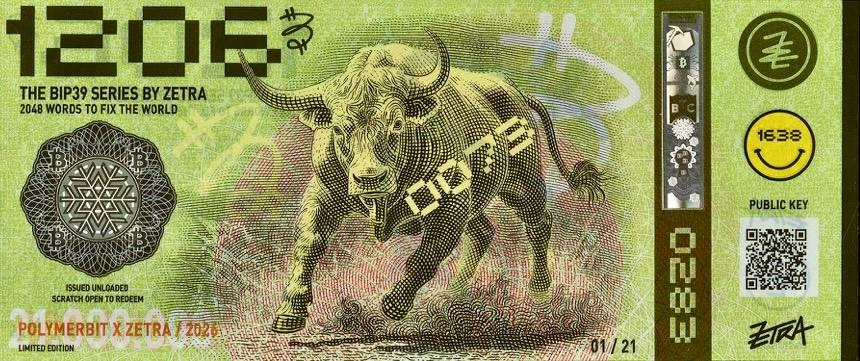
RYR and ZETRA both emerged from Germany’s graffiti scene but approach money from different directions. RYR uses currency itself as material, making paper from shredded banknotes, pigment from their ashes, and concrete grenades filled with shredded cash that he calls “artifacts from the future.” ZETRA, who began painting in the early 1990s and discovered bitcoin in 2017, examines what money can buy. His TOMATOSOUP paintings revisit Andy Warhol’s iconic Campbell’s Soup Cans to chart changing prices in dollars and bitcoin, while THE BIP39 SERIES explores the 2,048 words used in bitcoin wallet recovery phrases, including 1206/NOTE, a collaboration with Polymerbit.
Bitcoin has shaped these artists’ practices, their livelihoods, and the communities around them. Its growing acceptance by banks, investment funds, and corporations has also prompted some difficult questions about the movement’s original ideals and where its culture is heading.
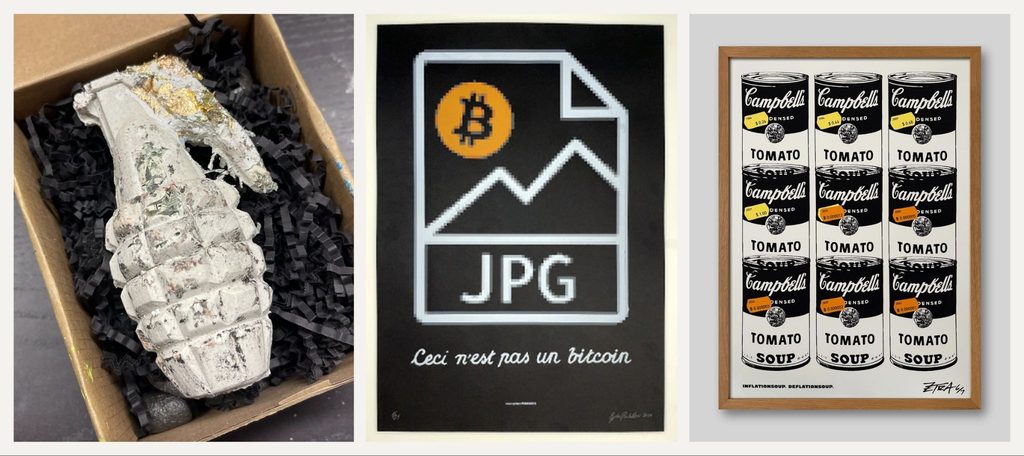
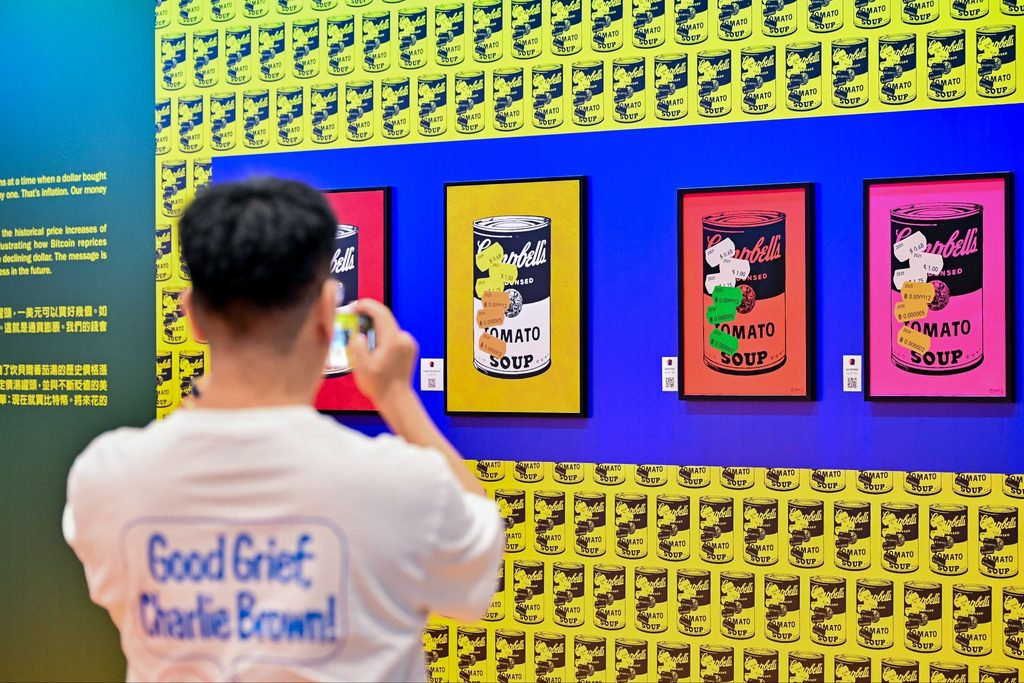
BMAG: Andy Warhol turned Campbell’s soup into an icon of consumer culture, taking an ordinary commodity and elevating it into fine art. Your TOMATOSOUP series returns to that image but introduces something Warhol largely left outside the frame: the changing value of money itself. How did the idea of reworking Warhol’s Campbell’s Soup Cans first come about, and do viewers immediately recognize the commentary on inflation?
ZETRA: We frequently see iPhones and houses in our bitcoin Twitter timelines, showing how they become cheaper in BTC terms. I thought it would be fun to take something from art history instead, something more visually appealing, like Warhol’s iconic Campbell’s Soup Can.
For my TOMATOSOUP painting, I used real stickers placed on the can to show how the price of soup has increased in USD over the past decades, compared with the lower prices we might expect in BTC terms in the decades to come.
Bitcoiners looking at TOMATOSOUP generally understand it immediately. They know they’re in a better position as the purchasing power of fiat money continues to decline through inflation. Other viewers usually need a bit of explanation, and I’m always happy to help them understand.
BMAG: In THE BIP39 SERIES, you draw from the 2,048 words used to generate bitcoin wallet recovery phrases, turning ordinary words into artworks with a deeper significance for bitcoin holders. Can you unpack the different layers of inspiration behind the series and what they reveal about bitcoin, language, and the ownership of money for someone unfamiliar with these concepts?
ZETRA: Everyone who moves their precious sats into cold storage encounters 12 or 24 of these significant words, often early in their journey as a bitcoin newcomer. As mentioned, there are 2,048 words in a carefully curated list representing the power of self-custody.
I started going through the words one by one, imagining how each could be visualized in a physical form: the key visual for the word, its corresponding number, the style, and the medium I would choose. There are millions of possibilities for bringing these words to life through bitcoin art.
1044/LIST was the obvious choice to kick off THE BIP39 SERIES. Naturally, it features all 2,048 words presented as a list. As an ’80s kid, I had to choose 1638/SMILE as the second piece: a proper yellow smiley face, with the number 1638 in place of the eyes. It’s a fine art print on Alu-Dibond beneath a 6 mm acrylic glass cover. So clean.
Another work in the series is 0388/CORN, an obvious homage to Warhol once again. THE BIP39 SERIES will be an ongoing project for many years to come.
BMAG: You shred banknotes into paper and burn them to produce pigment. Artists have long manipulated currency to question where its value resides, but your work goes a step further by making destruction part of the creative process. Is there a contradiction in destroying money to create an artwork that may ultimately be worth much more?
RYR: Money is essentially a narrative system built on collective belief and obedience. It has worked for hundreds of years because we collectively agree on the story it tells and the value it represents. I’ve always been fascinated by that idea, particularly how something as ordinary as a banknote can carry so much meaning, authority, and perceived value.
I was looking for a different way to tell that story, both conceptually and physically. Back in 2017, I had an exhibition title in mind: To Cut a Long Story Short. I liked the cheekiness of it, especially in relation to money and the stories we attach to it. Shredding banknotes became a very literal interpretation of that title, but it also opened up an entirely new artistic medium for me.
Ultimately, I’m not simply destroying money. I’m taking an existing story, cutting it into pieces, and using those pieces to tell a new one.

BMAG: Your concrete weapons are presented as relics from a future in which the fiat wars have already ended. Yet bitcoin is increasingly held through the very financial institutions it was designed to circumvent. Is that a victory for the movement, or have the institutions simply absorbed the alternative?
RYR: I think that’s precisely what makes the story so interesting. When I created the concrete weapons, I imagined a future in which the traditional financial system had already fought its battle for survival. The weapons had become fossils, archaeological artifacts from a monetary conflict that future generations might struggle to understand.
My concrete weapons represent a future in which that battle is already history. Whether bitcoin ultimately wins or becomes part of the very system it challenged remains to be seen.

BMAG: Much of your work is made from the physical remains of money, at a time when currency is becoming increasingly digital and invisible. Do you think people are losing something in their understanding of money as it disappears from everyday physical experience?
RYR: I think we’re losing a physical connection to money, but not necessarily our understanding of it. Money has always been a narrative built on collective trust, whether printed on paper or represented by numbers on a screen. What fascinates me is how something as abstract as value can be represented by a physical object.
I don’t necessarily believe that art has to be authentic or entirely original. Almost everything has been done before. To me, art is a wonderfully human, almost plebeian way of expressing an opinion and giving ideas a physical voice.
Bitcoin will likely evolve into a much broader and increasingly regulated financial asset, but I hope its grassroots culture and artistic identity remain visible. That’s something my fellow artists and I will continue to contribute to, preserving the spirit of a movement that was cultural long before it became institutional.

BMAG: Paralelní Polis wasn’t just a place to discuss alternative monetary systems or a hacker meetup; its café was one of the first to adopt bitcoin as money. What were the early years of Paralelní Polis like, and what has your own experience been selling artwork for bitcoin?
Martin Fischer: Paralelní Polis was founded in 2014, during a bear market. The funny thing is, none of us who founded it even knew what a bear market was. We didn’t think of bitcoin as something that could make us rich. We saw it as uncensorable money and understood the changes it could bring to society. There was no speculation involved, and that’s what made those early days so great.
I sold my first screenprint for bitcoin in 2017, almost ten years ago, and many more since then. But practically every sale was a matter of survival. I spent most of the bitcoin I earned financing my next projects and continuing to make art.
I never managed to accumulate much bitcoin, but looking back, it gave me something far more valuable than investment returns: the freedom to remain an independent artist.
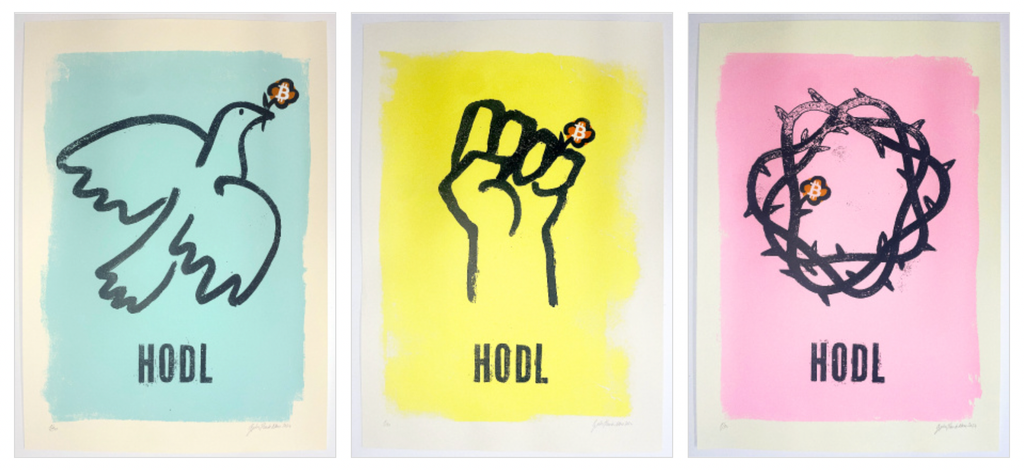
BMAG: Political printmaking has a long history in Europe, from Amsterdam’s financial satires of 1720 to twentieth-century protest posters. Your work emerged from Ztohoven, a collective that famously hacked a live television broadcast to show a fictional nuclear explosion—an audacious intervention, even by today’s standards. Ztohoven challenged institutions through disruption, while bitcoin uses game theory and economic incentives to create an alternative. Do you see bitcoin as a continuation of that same spirit of intervention, and your prints as an extension of it?
Martin Fischer: I think there’s a connection, but I wouldn’t say it’s exactly the same thing. With Ztohoven, we used art to question authority, challenge institutions, and expose how easily reality can be manipulated. Bitcoin doesn’t need to make a statement or provoke anyone. It simply offers an alternative that works without asking anyone for permission. That’s a much more interesting form of disruption to me.
But today, bitcoin has become so corporate and so intertwined with traditional banking that it’s hard to still see it as an anti-establishment movement. I don’t see this as a betrayal of its original ideals, but rather as a natural consequence of its success. That doesn’t mean I like where things are going.
What’s strange is that bitcoin’s fundamental principles haven’t really changed, but the way people perceive and use it certainly has.
And my screenprints? I still work with the original idea of separating money from the state while exploring the myths, memes, and legends of the bitcoin age. That’s what I enjoy most.
BMAG: Your Amsterdam presentation brings together more than a decade of work documenting bitcoin’s evolution from an underground movement to an increasingly institutionalized financial system. Looking across those prints today, has the movement changed more than you expected, or has your own perspective changed? Which of your prints are your favorites?
Martin Fischer: I like remembering the old days, when we were all part of the same tribe and our main enemy was Faketoshi.
Today? We have culture wars over JPEGs, Ordinals, BIPs, OP_RETURN, over what’s spam and what should or shouldn’t belong on bitcoin. What makes me saddest is that people who once fought together against censorship and for freedom now spend enormous amounts of energy fighting each other over what others should or shouldn’t be allowed to do with bitcoin.
Maybe it’s a natural consequence of bitcoin’s success. The bitcoin community has changed enormously, and so has my perspective on it. I’m definitely much more skeptical today of the idea that technology alone can automatically change society for the better.
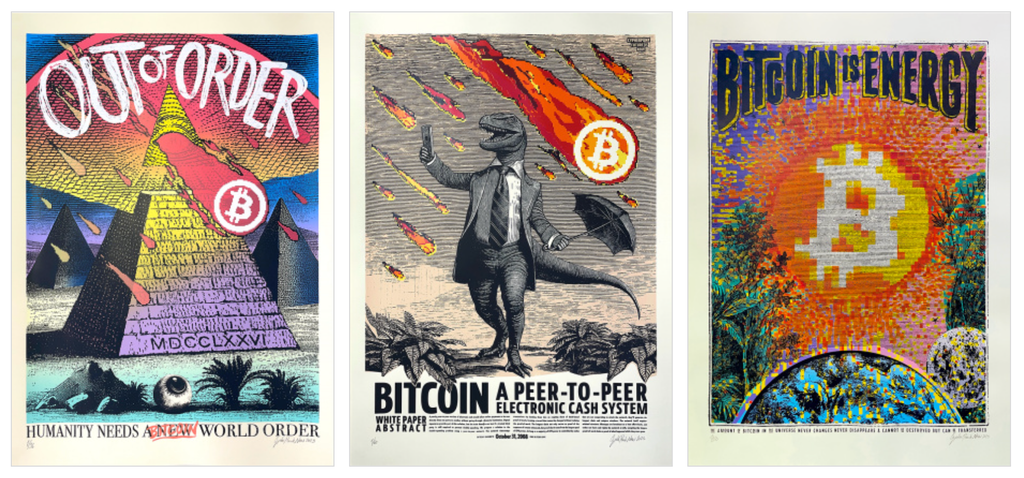
As for my favorite works, Bitcoin Meteorite is definitely one of them. In this piece, I reworked the meme of banking dinosaurs watching their own extinction, incorporating the abstract from the Bitcoin white paper. It gave me my fifteen minutes of fame when Max Keiser and Stacy Herbert brought it into the spotlight.

Then there’s Cypherpunks of the World. This project is important to me not only as a celebration of the cypherpunks and their legacy, but also because of its complexity. It started as a series of original collages, continued through handmade screenprints, and eventually evolved into animated NFTs and a virtual gallery. It’s one of my most elaborate projects, connecting different techniques and media while staying true to the original idea.
Among my more recent works, I really like Out of Order from 2023. It’s an incredibly detailed screenprint, and the first one where I finally managed to make absolutely no printing mistakes. That alone makes it special to me.
I also love St. Satosius Contra Draconem (2025), which is inspired by the classic depiction of Saint George fighting the dragon, reimagined through bitcoin mythology.

Works by ZETRA, RYR, and Cypherpunk Now, alongside other European artists, will be presented at Bitcoin Amsterdam, November 4–6, 2026, as part of the Bitcoin Museum & Art Gallery (BMAG) programming. Additional artworks and editions will be available through https://shop.museum.b.tc.
Explore more work by the featured artists at ZETRA, RYR, Cypherpunk Now, and www.martin-fischer.cz.
The Bitcoin Museum & Art Gallery (BMAG) organizes international exhibitions, auctions, and artist collaborations exploring bitcoin and its cultural implications. Learn more at museum.b.tc.
Join us at Bitcoin Amsterdam, Get your tickets here and use code BA26-BMAG20 for discounted admission.
This post The Undercurrent: Three European Artists on Making Money Visible first appeared on Bitcoin Magazine and is written by Dennis Koch.
Bitcoin Magazine
Bitcoin Slips Below $83,000 After Hotter-Than-Expected US Inflation Data
The price of bitcoin slid Wednesday after data dropped showing that U.S. consumer prices shot up more than expected in September due to rising gasoline prices.
The biggest cryptocurrency by market cap was recently trading for close to $82,827 after dropping nearly 1% over a 24-hour period. At one point on Wednesday morning in New York, bitcoin fell as low as nearly $82,331.
Over the past seven days, the coin has dropped by more than 1%. Bitcoin’s price had its best quarter in years after rallying in August and September and leading many analysts to declare it to have exited a bear market.
But sticky inflation is still weighing — in the short-term — on the cryptocurrency.
Data Wednesday showed that the Consumer Price Index rose 0.6% in September after climbing 0.4% in August.
In the 12 months through September, the CPI advanced 3.7% after rising 3.4% in August, the Labor Department’s Bureau of Labor Statistics said.
High prices in the U.S., in part spurred by the Trump Administration’s decision to attack Iran with Israel this year, have led the Federal Reserve to hint it may keep interest rates higher for longer.
The central bank in September said getting inflation down was its number one priority and hiked rates.
Bitcoin’s price has been sensitive to interest rate hikes in the past because higher borrowing costs restrict the liquidity the digital coin needs to run — along with other “risk-on” assets like stocks.
Still, the price of bitcoin rose in September despite the Federal Reserve talking tough on inflation.
The central bank will reveal what it plans to do with interest rates on October 28. As of Wednesday, fed funds futures were pricing a 47% chance of a rate hike at the Fed’s October meeting, according to CME Group’s FedWatch tool.
This post Bitcoin Slips Below $83,000 After Hotter-Than-Expected US Inflation Data first appeared on Bitcoin Magazine and is written by Mathew Di Salvo.
CryptoSlate
Its October 14 response emphasizes controls to exclude offshore gambling operators and says it continues as a BSP-licensed institution.
Read the full story on CryptoSlate
Understand the crypto stories that matter and what to watch next. Get The Catalyst in your inbox
September US inflation reached 3.7%, lifting yields as markets increased bets on another rate rise before the October 27–28 Fed meeting.
Read the full story on CryptoSlate
Understand the crypto stories that matter and what to watch next. Get The Catalyst in your inbox
Kraken's parent company, Payward, has agreed to acquire a European bank as it expands beyond cryptocurrency trading into traditional financial services. On Oct. 14, the company announced a definitive agreement to purchase Saldo Finance Oy, a Finnish holding company that owns Lithuania-based Saldo Bank. The acquisition would give Payward control of a licensed European banking…
Read the full story on CryptoSlate
Understand the crypto stories that matter and what to watch next. Get The Catalyst in your inbox
Ripple calls Meritz its fourth Korean institutional partner this year, with custody and tokenization cooperation to widen as regulation develops.
Read the full story on CryptoSlate
Understand the crypto stories that matter and what to watch next. Get The Catalyst in your inbox
ZkSync announced Airbender Prime, a prover that Matter Labs says handled 99% of 7,200 consecutive Ethereum mainnet blocks in under 10 seconds each on a single NVIDIA RTX PRO 6000 Blackwell GPU. The announcement came five days after Starknet said it is actively considering becoming an independent layer-1 (L1) blockchain, targeting full quantum resistance in…
Read the full story on CryptoSlate
Understand the crypto stories that matter and what to watch next. Get The Catalyst in your inbox
CryptoTicker.io
Solana gets a new consensus procedure on Wednesday, October 21, 2026, at around 15:00 UTC. The Solana Foundation has set the date for Alpenglow at epoch 1064. For everyone who only holds or transfers Solana, nothing changes: payments become final faster in future, wallets and applications keep running as before. If you have delegated your SOL, by contrast, there is one thing to settle, and to settle beforehand.
The upgrade sets two conditions for every validator. Miss them at the start of epoch 1064 and the validator no longer votes in the following epoch and produces no blocks. For the delegation attached to it, that means no staking rewards for that period. It can be checked beforehand, not afterwards.
Epoch 1064 begins on October 21 at 15:00 UTC
An epoch is the period for which Solana assigns its validators their duties in the network, and it always covers 432,000 slots, meaning 432,000 short time windows in each of which a block can be created. Alpenglow is armed at the start of epoch 1064.
Epoch 1057 was running on Wednesday morning. Seven epochs therefore lie before the switch, and the date is exactly a week away. The Solana Foundation names October 21 “at approximately 15:00 UTC” on its upgrade page; the word approximately is there for good reason, because the start of an epoch hangs on block progress rather than on the clock.
The switch for the upgrade, called a feature gate in Solana, carries the identifier A1pengvuM6JEcyNuTnMqepBKhwHE3N6PmUrdATGawhJS. It is active on testnet and on devnet; on mainnet it reads “not activated”. Alpenglow went live on devnet on September 25.
Alpenglow replaces TowerBFT, execution stays untouched
Consensus describes the procedure by which the machines of a network agree on the order of payments and on the point from which a payment can no longer be reversed. That is exactly the procedure Solana is swapping out: TowerBFT, in operation since the launch in 2020, gives way to Alpenglow.
Today it takes around 12.8 seconds for a payment on Solana to be final. Alpenglow targets about 150 milliseconds, barely a hundredth of that. CoinDesk puts the figure in sober context: the 150 milliseconds are a target, and the actual speed depends on the state of the network. As a side effect, the new procedure tolerates 20 percent malicious plus 20 percent offline stake, according to the Solana Foundation.
Important for everyone using an application on Solana: the execution of payments does not change. The Solana runtime environment SVM, the transaction formats and the fee mechanics stay as they are. Alpenglow intervenes one layer below, in the agreement on blocks.
The primary source clears up a widespread misunderstanding straight away: the 150 milliseconds are the time to finality, not the rhythm in which blocks are created. Block time was lowered independently of this, in four stages from 400 to 200 milliseconds, completed in October 2026.
Votor first, Rotor later: the upgrade comes in two phases
Alpenglow consists of two building blocks that arrive one after the other. On October 21, Votor starts, the voting part. Validators will send their votes directly to one another in future and bundle them into certificates, so that a block is final after one or two rounds of voting. Votor sits in Agave 4.3.
Rotor, the second building block, will later replace the way a block is distributed across the network. It is meant to replace the current distribution layer, called Turbine, with a single relay layer. There is no date for it yet; Rotor only arrives once Votor has settled into operation.
In practice, that means this for next week: on October 21 only the voting changes. Reading about “the Alpenglow upgrade” as a single event is reading a shorthand.
The first 5,000 slots still run on TowerBFT
One peculiarity concerns everyone who wants to watch live on October 21. The feature gate opens at the start of epoch 1064, yet the network works through the first 5,000 slots of the epoch on TowerBFT. Only after that does Alpenglow take over, at slot 459,653,000 according to the Solana Foundation, around 18 minutes after the epoch begins.
That figure can be recalculated, and it adds up. From the block progress on Wednesday morning, the start of epoch 1064 falls at slot 459,648,000. To the switchover named at slot 459,653,000 that is exactly 5,000 slots. The primary source's statement and the state of the blockchain therefore match to the slot.
In that window of a good quarter of an hour, the network still reports that it is running on the old procedure. Check at 15:05 UTC on October 21 and find no Alpenglow confirmation, and you are not looking at a fault but at this transition phase.

Agave 4.3.0 is mandatory, Firedancer is left out of the migration
The first of two conditions concerns the software. A validator has to run an Agave-based client before the start of epoch 1064, and on a version built on Agave 4.3.0. Agave itself, Jito-Solana and Harmonic Salsa are admitted.
A validator client is the program with which an operator takes part in the network. Several teams develop such programs independently of one another, which protects the network against bugs in a single implementation. That very diversity is briefly curtailed during the migration: Firedancer and Frankendancer, the clients from Jump Crypto, are explicitly not supported during the switch. CoinDesk states the consequence independently: operators have to change software temporarily.
For a delegator, that is the first question to put to their validator: is an Agave-based client running there, on a version built on Agave 4.3.0? Validators that rely on Firedancer and do not switch will not be part of the migration.
The Validator Admission Ticket costs 0.8 SOL per epoch
The second condition is a question of money. A validator has to hold at least 0.8 SOL in its vote account, on top of the amount that has to sit there as a minimum balance anyway. The Validator Admission Ticket, VAT for short, is paid out of that balance, a kind of entry fee for taking part in the voting.
The schedule behind it is staggered: the first fee is debited at the start of epoch 1064 and pays for participation in epoch 1065. It continues from there, each epoch paying for the next. The Solana Foundation writes the sentence that matters here: if the fee is not paid, the validator does not vote in the next epoch and produces no blocks.
It even gets cheaper. Until now validators paid for their votes as ordinary transaction fees, around 1 SOL per epoch according to CoinDesk. Those costs fall away and are replaced by the flat 0.8 SOL, a fifth less.
An epoch now lasts around 26 hours instead of two days
A calculation of our own is worth doing here, because it appears in no report. An epoch covers 432,000 slots. As long as a slot lasted 400 milliseconds, that was two days. After the reduction to 200 milliseconds, the epoch shrinks accordingly.
From the gap between the block count on Wednesday morning and the announced start of epoch 1064, a slot time of around 218 milliseconds follows. An epoch therefore lasts a good 26 hours, about a day. Many older explainers still cite 38 or 48 hours; those figures date from before the reduction.
For the fee, that is the actual point. The 0.8 SOL does not fall due every two days but a good once a day. Annualised, that is around 267 SOL per validator, or just under $28,700 at a price of $107. On Wednesday morning the network listed 678 validators with a vote account, 673 of them active and five delinquent. Scaled up, the entire network therefore pays around 542 SOL per epoch, roughly $58,000.
Operators of a validator with little delegated stake have to earn that fee out of block rewards. For large operators, 0.8 SOL a day is a line in the overheads; for small ones it is a hurdle.
Solana's transaction counts collapse on October 21 without usage falling
One consequence of the upgrade will cause confusion in the coming weeks, for everyone who judges Solana by its metrics. Until now the validators' votes were ordinary transactions in the block and were counted as such. With Alpenglow they leave the block entirely.
Addressing developers, the Solana Foundation writes that any metric which counted votes should be put on a new baseline. CoinDesk draws the consequence for outsiders: Solana's reported transaction count could fall sharply without usage by real users declining.
So anyone who sees a chart of Solana's transactions per second pointing steeply downwards after October 21 should check the date first. A break in the measurement looks exactly like a break in the market in a chart. At Solana the share of votes in all transactions has traditionally been high, so the jump will be pronounced.
Two further changes mainly concern developers, but they explain why this is called a breaking change. The two confirmation levels confirmed and finalized merge and will mean the same thing. And Proof of History, Solana's own timekeeping, gives up setting the pace of block production; the timestamps attached to it disappear from the data stream.

The validator behind your delegation: client version and vote balance
Delegating SOL transfers your voting rights to a validator while you keep the coins. The delegator shares that validator's failure risk: if the validator does not vote in epoch 1065, the staking rewards of the delegation attached to it fall away for that period. The SOL themselves are not affected; they stay untouched.
Two details can be settled before October 21. First, the validator's client software including its version. Second, the balance of its vote account, which has to carry the necessary 0.8 SOL on top of the minimum amount. Both appear in the public validator overviews, and staking through a provider means asking them for it.
The situation is simplest with large, professionally operated validators that have worked on the switch anyway. A small validator whose operator rarely publishes anything deserves attention. If the choice is hard: a delegation can be moved to another validator at any time, though the change only takes effect with the next epoch, so it takes a good day.
Staking via exchange, wallet or your own validator: who carries the risk
For investors in Germany three routes come together, and they differ on precisely this question.
Staking through an exchange means having nothing to do with clients and vote accounts. The exchange operates its own validators or works with partners and is responsible for their readiness. In return you carry the exchange's counterparty risk. An overview of the providers and their terms is in the comparison of staking platforms.
Delegating out of your own wallet means choosing the validator yourself. Here the two checks above apply directly, and in return the SOL stay in your own custody.
Running a validator yourself means actively meeting both conditions. For that group, October 21 is a working date, not a reading date.
For tax purposes the upgrade changes nothing. In Germany, staking rewards count as other income under Section 22 number 3 of the Income Tax Act and are taxable in the year they are received, with an exemption threshold of €256 a year. For the staked SOL themselves, the one-year holding period under Section 23 of the Income Tax Act continues to apply; the Federal Ministry of Finance scrapped the earlier extension to ten years for staking back in 2022.
Our assessment: the failure risk is concentrated at small validators
From the editorial team's point of view, the risk for the average German staker is low but not zero, and it is spread unevenly.
Three pieces of evidence argue for that. The switch has been running on devnet since September 25 and on testnet before that, so operators have had weeks. At 0.8 SOL per epoch the fee sits below the previous voting costs of around 1 SOL, so it demands no additional budget. And with 438 million SOL staked, 74.4 percent of circulating supply by our own measurement, the bulk of the stake hangs on a few large validators whose operators are accompanying the switch.
Against that stands the exclusion of Firedancer. It forces precisely those operators who deliberately chose an alternative implementation into a software change, and a change under time pressure is the classic source of error. How much stake hangs on Firedancer validators cannot be read out of the public data; that gap remains. Five delinquent validators out of 678 are the normal state against which it will be possible to read, after October 21, whether the switch went quietly.
No recommendation to buy or sell SOL follows from this. Solana traded at $107 on Wednesday morning, just under 10 percent below its level the week before. Total loss is possible with any cryptocurrency.
What your own holdings say about Alpenglow, and what has changed since September
This date has a backstory that belongs to the picture. At the end of September, September 28 was circulating as the activation date. A mix-up lay behind it: in the roadmap of the developer house Anza, that day merely marked the general resumption of feature activations, without naming Alpenglow. We put the missed date in context at the time.
The checking route for delegators was already in our piece of September 1, though still with the old date there. Exactly three things have changed since: the date is now fixed, the Agave 4.3.0 condition has been named, and the fee has a number at 0.8 SOL. How the stake is distributed across the validators and where the blocking minority sits is something we measured at the beginning of October.
Coverage in German is still lagging behind this state of play. Pieces that carry September 28 as the date or speak of an upgrade “without a fixed date” have been out of date since Wednesday morning. When reading any statement about Alpenglow, look at the publication date.
Alpenglow on October 21: 0.8 SOL decide one epoch of rewards
The date is set, the conditions are named, and both can be settled in the coming week. Three steps are enough:
- Establish who has delegated your SOL. With a provider, responsibility for the client and the vote balance lies there; ask whether their validators run on Agave 4.3.0. Which providers offer which terms is shown in the comparison of crypto exchanges.
- With your own delegation, check the two details. Client software including version, and the balance in the vote account. If one of them is wrong, the delegation can be moved before October 21; the change takes effect with the next epoch. To hold your SOL in your own custody while doing so, the devices are in the comparison of hardware wallets.
- Record your staking rewards for tax. The rewards count in the year they are received, and the exemption threshold is €256. The tools for that are in the comparison of crypto tax software.
The details on the date, on Agave 4.3.0 and on the Validator Admission Ticket come from the Solana Foundation's upgrade page; the framing of the costs and the transaction counts is confirmed independently by CoinDesk.
(As of October 14, 2026. This article is not investment advice. Prices and fee structures change; check the terms with the provider before you buy.)
Solana traded at $103.82 on Wednesday evening. That is 3.7 percent above the round $100 line, 2.99 percent below the previous day and 10.35 percent below a week ago. The short answer to whether the level holds: the futures market currently lacks the leverage that would accelerate a break, and it lacks it on the buy side just as much. We collected the figures ourselves from the exchange OKX, and they tell a different story from the price alone.
Solana price at $103.82, 3.7 percent above the $100 mark
The Solana price stood at $103.82 on October 14 at around 20:44 CEST. During the session the high was $108.45 and the low $103.51, so the price closed the day near its daily low. Market capitalisation therefore comes to $61.17 billion.
The distance to the downside is easy to work out. From $103.82 to $100 is 3.68 percent. The last daily close below $100 is almost a month old and dates from September 17, 2026. Solana has held above that line since, including on the weak days in early October.
The week before looked different. On October 7 Solana still stood at $120.68. From there to today, 13.9 percent has gone, in eight trading days. The steepest single decline fell on October 9, when the daily close slid from $116.23 to $109.51.
Open futures positions fall to $357.4 million
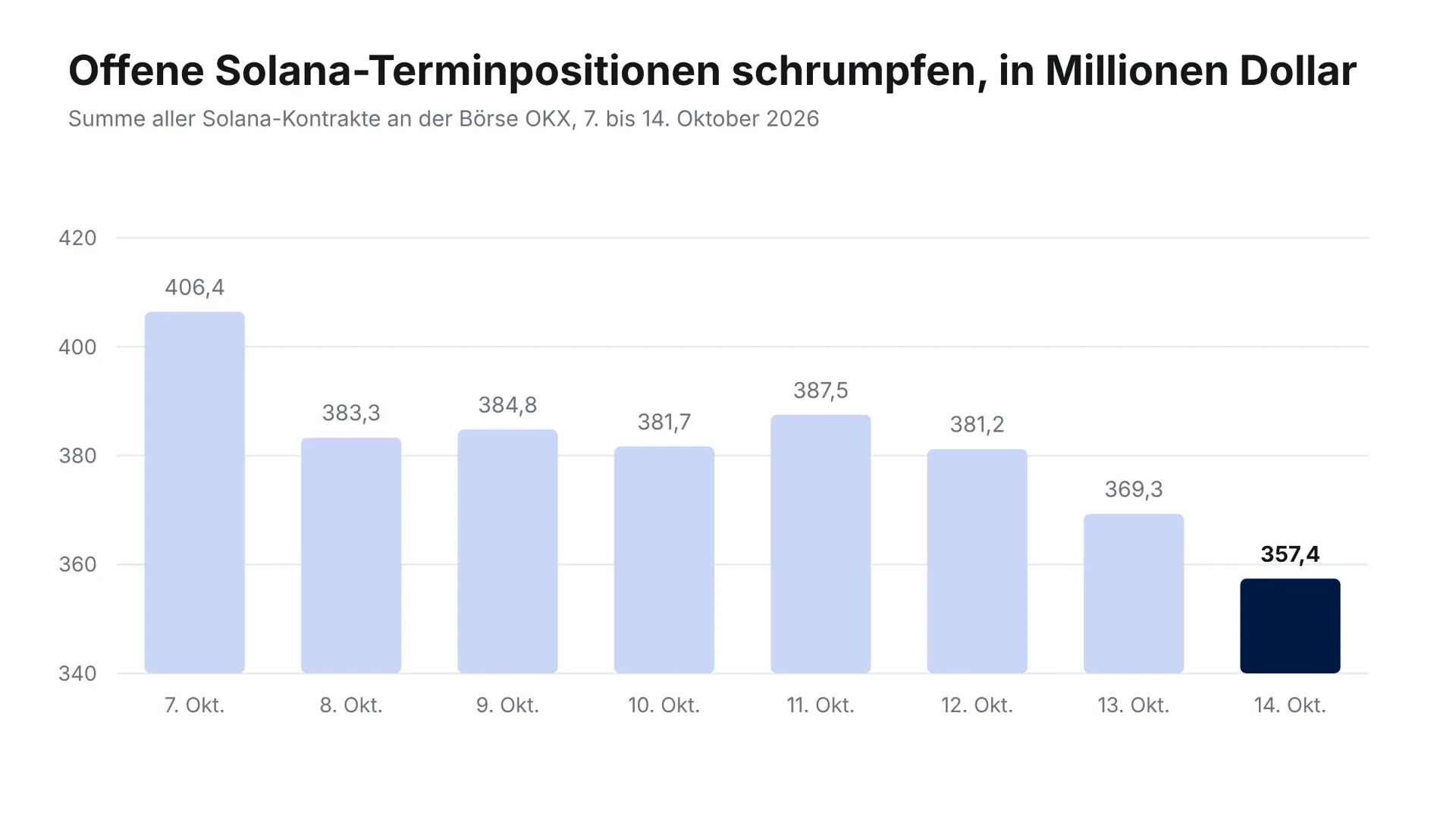
This is the actual occasion for this article, and it appears on no price chart. The sum of all open Solana contracts on the exchange OKX stood at $357.4 million on October 14. On October 7 it was still $406.4 million. That is a drop of 12.1 percent in seven days and the lowest reading since September 17. From September's peak of $426.6 million on September 27, 16.2 percent has been unwound.
Open positions, known in the trade as open interest, are the sum of all futures contracts that have not yet been closed. The figure says how much capital sits in leveraged bets on a coin. It rises when new positions are opened and falls when positions are closed or forcibly liquidated.
In the SOL-USDT swap alone, the most heavily traded perpetual contract on Solana, 3,033,471 SOL are currently open. At the price at the time of the query that is $315.2 million. The rest is spread across the contracts with fixed expiry dates and the variants in other settlement currencies.
The funding rate sits at zero, the leverage is gone
The second figure is the funding rate. On a perpetual contract with no expiry date, it keeps the contract price from drifting away from the spot price: every eight hours one side of the bets pays the other. When the rate is positive, buyers pay sellers, and that is the normal state in a friendly market.
Three rates were settled on OKX on October 14. At 00:00 UTC it was plus 0.0100 percent, at 08:00 plus 0.0089 percent, at 16:00 minus 0.0001 percent. The rate has therefore tipped from slightly positive to exactly zero over the course of the day. For comparison: on October 11 all three settlements ranged between plus 0.0073 and plus 0.0078 percent, a good three times today's level across the day.
The size sounds tiny, and in a single settlement it is. Annualised, however, plus 0.0075 percent every eight hours works out at around 8.2 percent. That is exactly the fee now falling away, because hardly anyone is still willing to pay for a leveraged long.
How open positions, the funding rate and the price hang together
For the question about the $100 mark, the combination of the two figures matters more than either on its own. Falling prices alongside falling open positions mean bets are being unwound. Falling prices alongside rising open positions would instead mean new short bets are being added and fresh pressure is building.
In Solana's case the first variant applies. Open positions have fallen on six of eight days, most recently two days in a row and with the largest single drop on October 14. The market is shedding risk rather than building new risk.
That has a consequence many people miss. A wave of liquidations needs leveraged positions that get closed by force. The fewer of those are open, the less fuel sits below the next round level. Equally, though, that removes the demand which carries a price back up under its own steam.
What a funding rate of zero says about sentiment
A rate at zero means long and short bets are evenly balanced. That is neither a buy signal nor a sell signal, but above all a statement about indifference: nobody is currently paying to bet on a quick rise. Historically such phases mark bottoms rather than tops, but they say nothing about how long they last.
Solana against Bitcoin: 14 percent below the September high
The dollar price alone shows only half the picture, because the whole market gave ground this week. The ratio to Bitcoin is more revealing. One SOL cost 0.00124986 Bitcoin on October 14. On September 26 it was 0.00145259, the highest reading of the past 120 days. From there, 14.0 percent has gone, 11.4 percent of it in the seven days since October 7.
The figures alongside make it plain: Bitcoin lost 2.00 percent in seven days, Ethereum 5.25 percent, Solana 10.35 percent. Solana has therefore fallen roughly five times as hard as Bitcoin this week. This is no Solana accident but the usual pattern when investors take risk out of the market. It does explain why the $100 question is being asked right now.
The trigger for the market's weakness lay outside the Solana blockchain this week. The US inflation rate rose to 3.7 percent, the core rate came in higher than expected, and risk assets gave way accordingly.
The levels: $98.27 as the 200-day line, $107.29 as the 50-day line
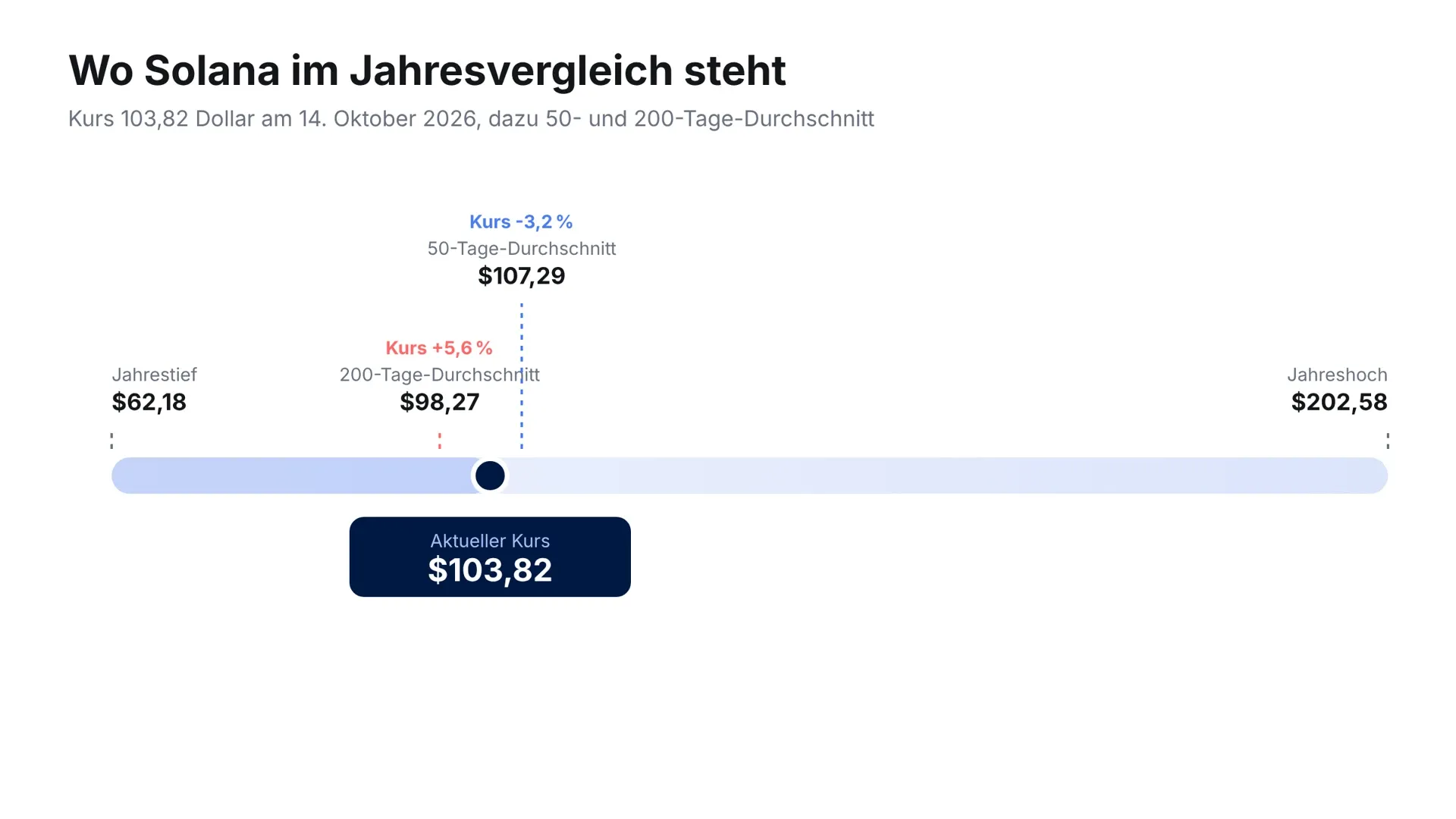
Three lines can be justified for the coming days, and two of them sit close to the round number. The 200-day moving average stands at $98.27, putting the price 5.6 percent above it. The 50-day average is at $107.29, so 3.2 percent above the current price.
That produces a narrow corridor. To the downside, barely a dollar separates the round $100 from the 200-day line at $98.27. Lose the round level and the next technical support arrives almost immediately. To the upside, Solana would first have to get back above $107.29 to turn the medium-term direction around.
Over the year, Solana sits between a low of $62.18 from June 7 and a high of $202.58 from October 15, 2025. The all-time high of $293.31 is 64.6 percent away from the current price.
Our assessment: no fuel for a liquidation wave, but no bid either
From the editorial team's point of view, the data argue against a crash and equally against a quick recovery. The evidence is above: open positions have fallen 12.1 percent in seven days to $357.4 million, and the funding rate stands at minus 0.0001 percent. Under these conditions, a break of $100 would be an orderly slide to the 200-day line at $98.27 rather than a chain reaction of forced selling.
Two things argue against that reading. First, the picture on the futures market can turn within hours if new leveraged positions are built; the figures above are a snapshot from the evening of October 14. Second, at a funding rate of zero there is no visible demand for leveraged buying, and without it a rise above $107.29 stays unlikely. An assessment is not a recommendation, and total loss remains possible with any crypto asset.
Alpenglow: a protocol date reaches into the price question
A technical date falls in the same week. Our editorial team reported on October 14 that the developer Anza has set the switch to Alpenglow for October 21. Alpenglow replaces the Solana blockchain's existing consensus mechanism and is meant to push the time to final confirmation of a transaction down to around 150 milliseconds.
The rebuild itself is documented. The official Solana changelog of October 1 lists Alpenglow among the feature gates on devnet and describes how the Agave client software intends to expose the Alpenglow ranking through its RPC interface. That page says nothing about the exact mainnet date, which is why the date here stands as a report of Anza's statements and not as a commitment of our own.
For the price, such a date means one thing above all: an additional source of uncertainty in a week when little risk is being sought anyway. If you plan to move larger amounts on October 21, expect exchanges to suspend deposits and withdrawals temporarily around protocol changes.
Leverage and liquidation distance for investors in Germany
Concretely: holders of a leveraged long on Solana should now recalculate the distance to their liquidation threshold. At five times leverage a decline of around 20 percent suffices, at ten times one of around 10 percent, before the position is closed by force. From the current price, a fall to $98.27 is 5.3 percent. A ten-times leveraged entry from last week at $120 would have been closed long ago.
In the EU, derivatives on crypto assets are tightly restricted for retail investors. What is permitted under the MiCA regulation are spot transactions and exchange-traded products; the large perpetual contracts run on platforms outside EU authorisation. Trading there carries platform risk on top of price risk. A sober look at the fees and terms of the venues for perpetual contracts therefore belongs before any decision about leverage.
The alternative without a liquidation threshold is buying in the spot market with your own custody. Moving your SOL onto a device of your own removes the risk of a forced close, but it puts the full responsibility for securing your access data on you.

Holding period and exemption threshold on a sale below $100
For investors in Germany, more hangs on the timing of a sale than the price. Gains from selling crypto assets count as a private disposal transaction under Section 23 of the Income Tax Act. If more than a year lies between purchase and sale, the gain stays tax-free. Below that it counts towards taxable income and is charged at the personal tax rate.
For short-term transactions an exemption threshold of €1,000 per calendar year applies. The word threshold is to be taken literally: at €1,001 of gains you are above it and pay tax on the entire amount, not only on the euro that overshoots. Losses from such transactions can be offset only against gains of the same kind, but they can be carried forward into later years.
Before selling below $100, then, check the purchase date of every individual position. With several purchases, the first in, first out method applies per wallet for the allocation. A tax and portfolio tool takes that allocation off your hands; the legal responsibility stays with the investor. With larger amounts there is no way around a tax adviser.
Solana at the $100 mark: below it waits the 200-day line at $98.27
The futures market has unwound 12.1 percent of its open positions over the past seven days, and the funding rate stands at zero. That takes the force out of a break of $100 and the strength out of any rebound. Three steps follow from it:
- Recalculate position size and leverage. If the liquidation threshold is closer than 5.3 percent, it already catches the 200-day line at $98.27. To buy in the spot market instead, first compare the costs of the venues for crypto assets.
- Look up the purchase date of every position before a sale comes up. If the purchase is more than a year old, the gain stays tax-free; below that the €1,000 exemption threshold applies. The tools for tax and portfolio allocate purchases by first in, first out.
- Plan around the October 21 date and decide whether your existing SOL should be put to work. Exchanges suspend deposits and withdrawals temporarily around protocol changes. A look at the providers of staking rewards shows which yields and which lock-up periods apply; those yields count as income for tax purposes, not as disposal gains.
We described yesterday's state of play on October 13, when Solana traded at $108.21 and a buyback of $201 million hung on the $100 condition. The price has lost 4.1 percent since, the condition has moved closer, and the futures market has unwound a further $12 million of open positions. The data in this article come from the public OKX market interface and from CoinGecko.
(As of October 14, 2026. This article is not investment advice. Prices and fee structures change; check the terms with the provider before you buy.)
The Dutch central bank De Nederlandsche Bank granted the Amsterdam company Qivalis B.V. authorisation as an electronic money institution on October 14, 2026. Qivalis may therefore issue a euro-denominated e-money token, backed according to the company by 37 European banks from 15 countries. It is not yet allowed to issue the token, however: before the first issuance it still lacks the whitepaper that the MiCA regulation requires.
For now, that means there is nothing to buy. What there is: a date, an authorisation and an unusually broad list of owners. This piece sets out what the licence means, which obligations remain open, and how to tell for yourself who is actually allowed to issue a euro stablecoin in Europe.
What the EMI authorisation from De Nederlandsche Bank actually permits
An electronic money institution, EMI for short, is a supervised payment company. It may issue electronic money, meaning balances that are created against a payment in and can be redeemed at face value at any time. In its statement of October 14, Qivalis says it has received authorisation as an electronic money institution from De Nederlandsche Bank and is thereby entitled to issue euro-denominated e-money tokens (Qivalis statement).
The authorisation was granted under the Dutch Financial Supervision Act. For the European single market, that is the decisive point: an authorisation granted in the Netherlands takes effect across the entire European Union through the passporting mechanism, Germany included. A German institution needs no second authorisation from BaFin for the same line of business as long as Dutch supervision carries the licence and distribution has been properly notified.
An authorisation is not a product approval, though. It confirms that a company meets the requirements on own funds, management, safeguarding of client money and anti-money-laundering controls. It says nothing about the timing of issuance, the blockchain used or the token's name. All three questions remain open at Qivalis to this day.
One note on the company's own website is worth flagging. Its legal information states that Qivalis currently issues no electronic money and provides no payment services to the public. The authorisation is in place; the business is not yet running. Anyone who comes across offers promising a tradable Qivalis token in these days should treat them with considerable scepticism. An overview of regulated trading venues helps to tell offers from licensed providers apart from those without a licence.
37 banks from 15 countries: who stands behind Qivalis
Qivalis describes itself as a joint venture of 37 European banks from 15 countries. In its report of October 14, CoinDesk names BBVA of Spain, BNP Paribas of France, Dutch lender ING and DZ Bank, the central institution of Germany's cooperative banks based in Frankfurt, among the participants. The company does not publish a full list in the body text of its homepage.
That ownership structure sets the project apart from the large dollar stablecoins. Tether and Circle are companies that issue a token and hold reserves against it. Qivalis is a creation of commercial banks that intend to pass the token on to their own customers later. It changes the question of whom you are trusting when you hold such a balance: behind the balance sits a supervised institution whose shareholders are in turn supervised banks.
The consortium has grown. A company statement of May 20, 2026 reported that 25 further banks had joined. cryptoticker.io reported on the banking group's plans on September 9, 2026 and named Ethereum as the intended blockchain at the time. On today's homepage Qivalis names no blockchain; answering that question means waiting for the whitepaper.
Chief executive Jan-Oliver Sell is quoted as saying: “Europe's currency deserves Europe's rules, onchain.” The sentence stakes out a position against dollar dominance in the stablecoin market. It says nothing about dates.

E-money token: the difference from an asset-referenced token under MiCA
The MiCA regulation knows two kinds of stablecoin, and the distinction is more than terminology. An e-money token, abbreviated EMT, is denominated in exactly one official currency, here the euro. An asset-referenced token, abbreviated ART, refers to a basket of several currencies, commodities or other assets.
E-money tokens face the stricter rules because they come closest to money. Only a credit institution or an electronic money institution may issue them. That second door is the one Qivalis has walked through with its authorisation. An ART issuer, by contrast, needs its own MiCA authorisation and is subject to partly different obligations.
In practice, classification as an e-money token means your balance has to be fully backed and that you can redeem it at face value at any time. That is the core of the promise, and the reason supervisors look so closely here.
The MiCA whitepaper requirement is holding up issuance
Between authorisation and a first token lies another stage. Before an e-money token is offered to the public or admitted to trading in the EU, the issuer has to draw up a crypto-asset whitepaper, submit it to the competent supervisor and publish it. CoinDesk reports that Qivalis still has to meet the remaining MiCA requirements, including publication of a whitepaper, before the token can be issued (CoinDesk report of October 14, 2026).
The whitepaper is not a marketing brochure. It describes the issuer, the rights and obligations of holders, the technology, the reserves, the redemption procedure and the risks. It is the most important document for investors, because it sets out whom you have a claim against in case of doubt and how you assert it.
On timing, the company is keeping quiet. CoinDesk writes that Qivalis wants to issue the token in the coming months without naming a date; the second half of 2026 had originally been announced. A statement of October 5, 2026 still spoke of a planned launch later in 2026. Anyone looking for a firm date will not find one. The obligations coming up for crypto companies in Europe as a whole are set out in our overview of the MiCA licence.
How to check the MiCA registers yourself to see who may issue a euro stablecoin
You do not have to rely on press releases. Public registers exist for both questions, authorisation and the right to issue.
The first route leads to the public register of De Nederlandsche Bank. The supervisor lists the institutions it has authorised there, with legal form and type of authorisation. To check whether a provider really is an electronic money institution, search for the exact company name, here Qivalis B.V., rather than for a brand name.
The second route leads to the register of the European Securities and Markets Authority, ESMA. It holds the issuers of e-money tokens and asset-referenced tokens, along with the whitepapers that have been published. If a token does not appear there, it is not properly offered in the EU. If it does appear, the accompanying whitepaper gives the details on reserve and redemption.
The third route concerns the trading venue, not the token. An exchange offering euro stablecoins needs its own MiCA authorisation as a crypto-asset service provider in the EU. A look at the stablecoin overview shows which euro tokens are available at all at the moment and where they trade.
No interest on e-money tokens: what MiCA forbids issuers
One point surprises many investors. E-money tokens may pay no interest. The MiCA regulation prohibits issuers and service providers from granting holders any remuneration that depends on how long they hold. For the planned token, CoinDesk explicitly points out that holders can redeem it at face value at any time and that it may pay no interest.
That rule has a purpose: an e-money token is meant to be a means of payment, not a savings product that pulls deposits out of the banking system. A euro stablecoin therefore brings you no return. Its use lies in settlement, in moving amounts quickly and around the clock.
A provider promising a yield on a euro stablecoin balance is a warning sign. Either the instrument is not a MiCA-compliant e-money token, or the return comes out of an additional business such as a lending platform. That additional business carries its own default risk, which has nothing to do with the backing of the token.

Distribution through banks and exchanges rather than straight to retail customers
According to the CoinDesk report, the planned token will not reach consumers directly. Qivalis intends to distribute it through banks, crypto exchanges and payment service providers. You would obtain it from your bank, your payment provider or an exchange, not from Qivalis itself.
That model shifts a practical question. How well a euro stablecoin works for you then depends less on the issuer than on whoever passes it on: on their fees, their withdrawal limits, and whether they offer redemption in euros into your account. The backing of the token is regulated; the route to you only as far as the distribution partner is itself supervised.
It is also open which of the 37 banks will actually bring the token into their apps. A stake in the issuer is not yet a commitment to offer the product too. Until announcements from individual institutions are on the table, the distribution route remains a statement of intent.
Euro stablecoin against USDT and USDC: where the difference lies for European investors
The stablecoin market is a dollar market. Investors in Germany trading crypto assets usually park balances in USDT or USDC and thereby carry a currency risk that is often overlooked: the euro-dollar rate can move between entry and exit, and that move feeds through to your result even if the stablecoin itself stays stable at one dollar.
A euro token takes that risk out, provided you count in euros, pay in in euros and cash out in euros. In return the market is narrower. The large trading pairs on exchanges are denominated in dollars, and a euro stablecoin with little in circulation means wider gaps between the bid and the ask.
The offering is not new. Several euro stablecoins are already authorised and in circulation in the EU. What sets Qivalis apart is its backing by commercial banks, and with it the prospect that such a token finds its way into payment settlement between institutions rather than only into trading on crypto exchanges.
Tax in Germany: swapping into a stablecoin is a disposal
One misunderstanding is persistent. Swapping Bitcoin or Ether into a stablecoin is not simply parking in tax terms, it is a disposal. In Germany, swapping one crypto asset for another counts as a private disposal transaction under the Income Tax Act. If the purchase is less than a year old, the gain is taxable as soon as the exemption threshold is exceeded.
A euro stablecoin changes nothing about that. Swapping into USDC or into a euro token is the same for tax purposes: both are crypto assets within the meaning of the law, and both trigger a taxable event. Switching frequently between coins and stablecoins creates a number of transactions that is hard to reconstruct without records.
It is therefore worth documenting the holding period for each purchase before the first swap comes up. Which programmes record purchase, swap and holding period automatically is covered in our survey of tax tools.
Qivalis euro stablecoin: no token without a whitepaper, licence or not
The authorisation of October 14, 2026 is a milestone, not a starting gun. Qivalis may issue a euro token in future, has not yet done so, and the date remains open. Three steps make sense now:
- Put offers in context. As long as no whitepaper has been published, no tradable token from this issuer exists. With any offer, check first whether the trading venue itself holds a licence; the overview of regulated crypto exchanges ranks providers by their authorisation.
- Document holding periods. Every switch into a stablecoin is a taxable event in Germany. A tax tool or portfolio tracker records the purchase date and holding period before the first swap comes up.
- Compare the euro tokens that already exist. Settling in euros today does not mean waiting. Which euro stablecoins are already authorised in the EU and where they trade is set out in the stablecoin overview.
(As of October 14, 2026. This article is not investment advice. Prices and fee structures change; check the terms with the provider before you buy.)
The price of Shiba Inu stood at $0.00000504 on Wednesday evening, 3.0 percent below its level 24 hours earlier. The more interesting figure of the day is a different one: tokens worth roughly $63.5 million changed hands within 24 hours. Exactly a year ago, on October 14, 2025, the figure was $262.0 million. Turnover has therefore dropped by 75.8 percent, while market capitalisation over the same period fell from $6.333 billion to $2.979 billion, a decline of 53.0 percent. Both values come from the same CoinGecko daily series and are directly comparable.
That gap is the core of this article. A market whose turnover shrinks faster than its stock reacts more violently to the same amount of selling pressure. For holders and buyers in Germany, it decides how much an entry really costs and which order type makes sense.
Daily turnover stands at $63.5 million
The bare figures as of October 14, taken from the public interface of CoinGecko: Shiba Inu trades at $0.00000504, or €0.00000452. The daily low was $0.00000500, the daily high $0.00000523. Over seven days the token is down 6.2 percent, over 30 days 5.4 percent, and over a year 53.0 percent. Market capitalisation of $2.97 billion is enough for rank 38 in the overall market.
Daily turnover means the sum of all reported trading volumes on the venues covered within 24 hours, converted into dollars. It says nothing about whether buyers or sellers were in charge, only how much money moved at all. That is precisely why it is the better gauge of tradability than the price.
In quantities: of the 589.24 trillion tokens in circulation, roughly 12.6 trillion changed hands. Total supply is 589.50 trillion, so the difference of about 257 billion tokens is not in circulation.
Turnover ratio explains the price swings better than the price level
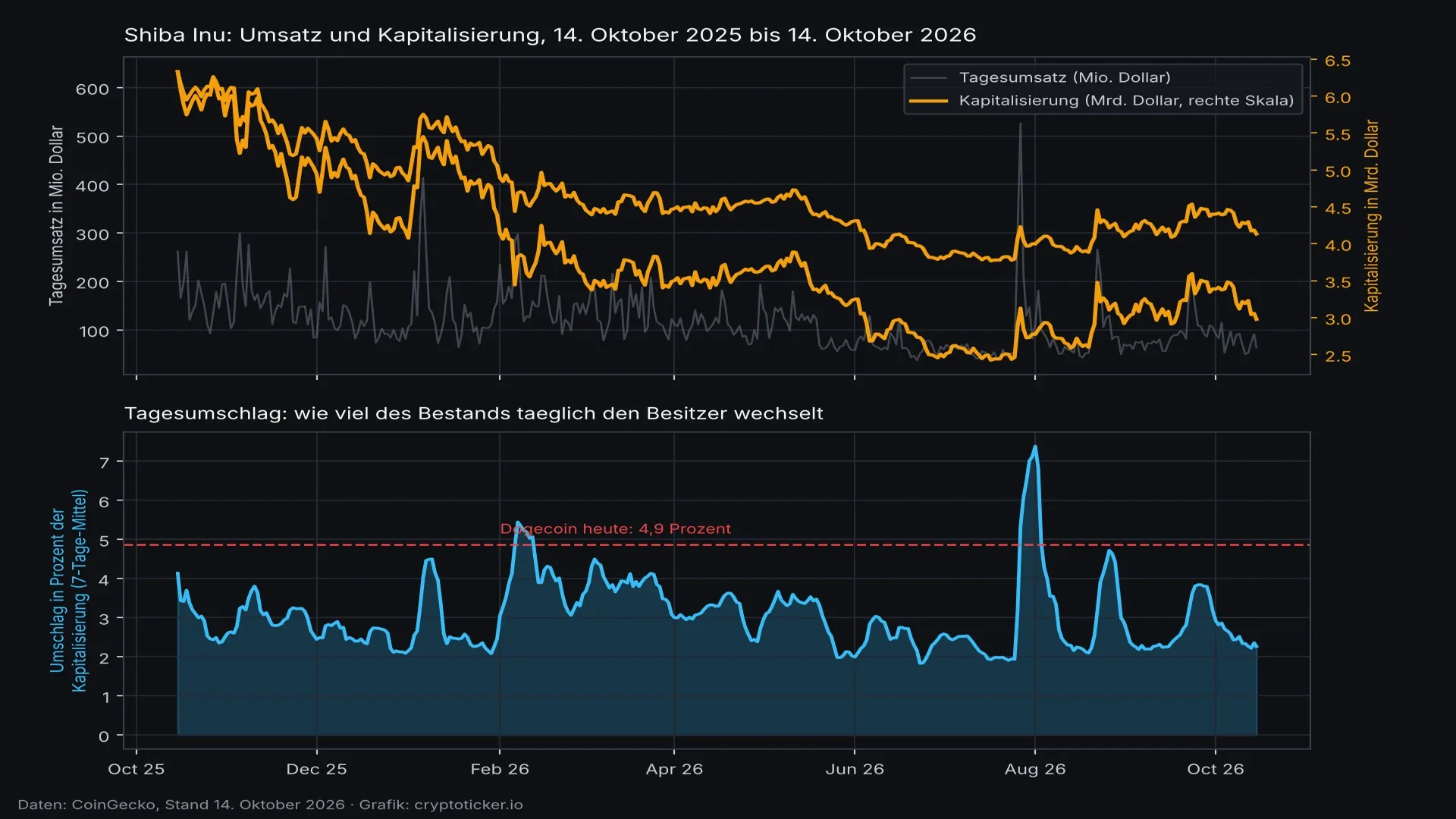
Divide daily turnover by market capitalisation and the result is the daily turnover ratio. It shows what share of the entire stock is traded in a day, which makes it a measure of a market's depth. On a seven-day average, that figure for Shiba Inu now stands at 2.26 percent. A year ago it was 3.10 percent.
The mechanism behind it is rarely spelled out, but it is simple. An order book holds only a limited quantity of bids at each price point. When a larger sell order arrives, it works its way down through those bids until it is fully filled. The less money sits in the book, the deeper it reaches. A sell order of $500,000 is noise at $262 million of daily turnover and a visible move at $63.5 million.
The range of the past year shows how widely this figure swings. The minimum was 1.83 percent on June 23, 2026, the maximum 7.39 percent on August 1, 2026. Today's reading of 2.26 percent therefore sits in the bottom third of the annual distribution.
Shiba Inu against Dogecoin: 2.26 versus 4.87 percent turnover
The obvious comparison is with Dogecoin, the larger of the two well-known dog tokens. On a market capitalisation of $12.82 billion, Dogecoin posts a daily turnover ratio of 4.87 percent on a seven-day average, more than double the figure. A year ago Dogecoin stood at 8.96 percent and Shiba Inu at 3.10 percent.
One finding belongs alongside it, even though it disturbs the simple narrative: Dogecoin's turnover has fallen even harder year on year than Shiba Inu's, from $4,513 million to $648.8 million, a drop of 85.6 percent. Trading in memecoins has become quieter across the board, not just in Shiba Inu. The difference still holds: measured against its own stock, Shiba Inu now trades less than half as actively as Dogecoin.
US inflation of 3.7 percent hits thin markets first
The trigger for Wednesday's slide came from Washington. The US Labor Department published September consumer prices on Wednesday morning New York time. The annual rate rises to 3.7 percent from 3.4 percent in August, above the market forecast of 3.6 percent. Higher inflation lowers the odds of falling policy rates, and falling policy rates are the argument on which risk assets are usually bought.
How the market distributes that can be read off the daily changes. Bitcoin gave up 1.7 percent, Ethereum 3.1 percent, Solana 3.3 percent, Dogecoin 2.9 percent and Shiba Inu 3.0 percent. The order is no accident. Investors cutting risk sell first where the rationale is thinnest and the order book flattest.
Only 1.8 percent of global trading runs in euros
For investors in Germany there is a second point that disappears inside the global turnover figure. Of the roughly $62.0 million reported by the hundred largest trading pairs covered on Wednesday evening, 85.7 percent runs against the dollar stablecoin USDT. Next come the Turkish lira with 5.9 percent, the US dollar itself with 3.4 percent and the stablecoin USDC with 2.6 percent. The euro carries 1.8 percent, or about $1.12 million in absolute terms.
Buying in euros therefore means trading on a fraction of the market. That is no reason to switch to a dollar stablecoin, because the conversion adds a cost item of its own and holding a stablecoin brings its own questions. It is, however, the reason why the choice of venue carries more weight with Shiba Inu than with Bitcoin.
By venue, Wednesday evening's volume splits across KuCoin with 15.0 percent, Binance with 8.9 percent and BitDelta with 7.6 percent as the three largest. None of them accounts for more than a sixth of total turnover, so trading is widely scattered.
Spreads in the euro pair range from 0.04 to 0.66 percent
The gap between the bid and the ask, known in the trade as the spread, is the price you pay the moment you enter, before any fee applies. For Shiba Inu's euro pairs, venues reported widely differing values on Wednesday evening. Kraken and Bit2Me stand at 0.044 percent, Bitvavo at 0.077 percent, Coinbase and Bitstamp at 0.221 percent and WhiteBIT at 0.661 percent.
Between the tightest and the widest of those readings sits a factor of 15. On an order of €1,000 that is €0.44 at one end and €6.61 at the other. These values are snapshots of a single pair and not a fee schedule; they move during the day and say nothing about order fees, deposit and withdrawal routes or custody. The terms side by side are in our crypto exchange comparison.
What the thin order book means for the order type
A market order takes the best available price and, if needed, works further down the book. In a thin book that is exactly what gets expensive. A limit order fixes the highest price you pay and accepts in return that it may go unfilled. At a turnover ratio of 2.26 percent, that trade-off is usually the cheaper one. The same applies in the other direction: a larger position is better split across several orders than sent into the book as one market order.

Where the price stands since the October 13 low
On Tuesday we described the lowest daily level since September 18 in this slot. The price has not recovered since; it has slipped further, from a daily average of $0.00000516 on October 13 to $0.00000504 on Wednesday evening, a decline of 2.4 percent. The round level of $0.00000500 was reached exactly during the session and has held so far.
What has shifted above all is trading activity. Daily turnover still stood at $73.7 million on October 13, above today's reading, even though the price marked a low that day. A falling price alongside falling turnover points less to broad selling pressure than to absent buyers.
Shibarium still holds $48,511 in locked capital
Shibarium, the project's own blockchain, is what Shiba Inu bases its claim to be more than a memecoin on. The capital locked in it, counted in the industry as total value locked, is put at $48,511 by DefiLlama on October 14. For scale: Ethereum reaches $50.29 billion in the same survey, Solana $5.96 billion.
That figure does not explain the turnover ratio, but it belongs next to it. Trading in Shiba Inu takes place almost entirely on centralised venues rather than on its own blockchain. To judge tradability, look at the order books, not at Shibarium.
The one-year deadline under Section 23 of the German Income Tax Act and loss offsetting
With a one-year loss of 53.0 percent, many German investors are holding their position under water. For tax purposes, the purchase date is then the most important number in the portfolio. Crypto assets count as other assets in Germany, and their sale falls under private disposal transactions governed by Section 23 of the Income Tax Act.
That deadline cuts both ways. Sell within a year of buying and a gain is taxable as soon as the total of all private disposal transactions in that year reaches the €1,000 exemption threshold. A loss from that period can be offset against gains from other private disposal transactions in the same year and, on application, carried forward or back. Once the year has passed, a gain is tax-free, and the same sentence holds in the other direction: a loss is then disregarded for tax purposes too.
Which records the tax office wants to see
You have to document the purchase date, purchase price, quantity and sale for each individual transaction. With several purchases of the same token, the allocation of the units sold is added on top, in practice usually under the first in, first out method. With Shiba Inu, where amounts run to the eighth decimal place and small top-ups are often numerous, that is hard to manage without ongoing records. Which tools pull this history out of the venues is set out in our overview of crypto tax software. This section is no substitute for tax advice, and assessing an individual case remains the tax office's job.
Our assessment: the turnover ratio is the risk, not the price level
From the editorial team's point of view, the most important number of the day is not the 3.0 percent decline but the turnover ratio of 2.26 percent. The evidence is above: a 75.8 percent drop in turnover against a 53.0 percent drop in market capitalisation year on year, a 1.8 percent euro share of global trading, and a factor of 15 between the tightest and the widest euro spread. That means executing an order in Shiba Inu currently costs or saves more money than the question of whether you enter two percent higher or lower.
Against that view stands the fact that a turnover ratio of 2.26 percent is no historical outlier. It already sat at 1.83 percent in the past year, and the market then turned back to 7.39 percent. A thin market moves faster in both directions, not only down. No statement about where the price is heading follows from these figures, and we are not making one.
Thin trading: at a 2.26 percent turnover ratio, the order type decides
Three steps that follow from the figures in this article:
- Check your venue's spread before the order goes in. Between 0.044 and 0.661 percent in the euro pair, an order of €1,000 carries a difference of a good €6, and it falls due again on every purchase and every sale. The terms are in the crypto exchange comparison.
- Work with limits and split larger amounts. In a book that turns over 2.26 percent of its stock a day, a market order runs through several price steps faster than in a liquid market.
- Look up the purchase date of every position. It decides whether a loss can still be offset against gains in the same year. The tools for that are in the overview of crypto tax software.
(As of October 14, 2026. This article is not investment advice. Prices and fee structures change; check the terms with the provider before you buy.)
The XRP price stands at $1.33 on Wednesday evening, around 2.7 percent lower than 24 hours earlier. On the same day Ripple delivered what is probably the month's most tangible distribution news: Privy, a subsidiary of payment provider Stripe since last year, is bringing embedded wallets to the XRP Ledger. Developers will be able to create accounts directly inside their own app, without a user installing a separate wallet.
The news and the price tell different stories, and that is exactly what makes the day interesting. Anyone holding XRP gets a reach story in a market that is not paying for it today. This piece places both, recalculates the usage figures Ripple cites for it, and shows the two points at which the matter becomes concrete for investors in Germany.
XRP price at $1.33: where things stand on Wednesday evening
XRP trades at $1.33, around 1.20 euros. The daily high was $1.38 and the daily low $1.33. The price therefore sits at the lower edge of its own daily range, which makes the $1.33 level not just any round number but the point at which trading is fighting out the day.
Over a week XRP is down 6.9 percent, over a month 5.1 percent. Market capitalisation stands at $84.2 billion and trading turnover over the past 24 hours at $1.87 billion. The price is 63.4 percent away from its record of $3.65. All figures come from CoinGecko, as of October 14.
On Tuesday we described an additional 90 million XRP in the accounts of Upbit and Bithumb in this space, with the price at $1.36 at the time. Three cents have come off since then, around 2.2 percent. The $1.30 level named in yesterday's piece as the next support zone has not been tested so far. It has therefore held nothing yet; it simply has not had its turn.
The macro day belongs in the picture as well. US consumer prices rose to 3.7 percent on Wednesday and the core rate came in above expectations. The whole crypto market gave way in response, and Bitcoin slipped below $82,000. XRP's loss of 2.7 percent therefore falls within the market average and is not an XRP story of its own.
What Ripple and Privy announced
Privy builds what are known as embedded wallets. That means an app, say a payment service or a fintech, creates an account on a blockchain in the background, and the user notices nothing about it beyond a pay button. Stripe bought the company last year, and Privy continues to operate independently.
From now on this infrastructure also covers the XRP Ledger. Developers can create XRPL accounts through Privy and build them into their application. XRP, Ripple's stablecoin RLUSD and further assets of the network are supported. Anyone who wants to hold their own keys can export the private key. The target group is expressly payment providers and fintechs, not retail investors.
The second part of the announcement concerns AI agents. Software is to be able to pay independently in future, without a human approving every booking. The x402 protocol is intended for that. Spending limits and the app operator covering the network fees are in the works according to the two companies, but not yet generally available.
x402 is a payment standard with which a program pays for access to data or a service before it receives it. The name alludes to the HTTP status code 402, reserved for "Payment Required" since the early years of the web and until recently practically never used.

x402: how software pays software
The mechanism is simpler than the name sounds. An AI agent queries a data source, say a weather service or a search engine. Instead of a subscription or an API key, the provider charges a micro payment for precisely that one request. The agent settles it from its own wallet, the answer comes back, and the process is complete.
For a blockchain that is attractive business, because such payments arise in large numbers and with very small amounts. The XRP Ledger settles a transaction in a few seconds and for fractions of a cent, which makes it technically suitable for the purpose. That is exactly what Ripple has been aiming at since the summer: since June there have been tools with which agents create their own accounts, check balances and pay in XRP or RLUSD. In September support for the payment standard from Stripe and Tempo was added.
The Privy connection is the distribution step that goes with it and lowers the barrier for developers who would previously have had to build their own wallet infrastructure. Whether revenue comes out of it is decided not by the technology but by how many apps actually build it in.
14.3 million transactions, around $22,000 in value
Ripple cites usage figures alongside the announcement, and they are worth a calculation of their own. J. Ayo Akinyele, head of engineering at RippleX, wrote on X of more than 13 million agent payments via x402 and put their share at around 25 percent of ledger activity. The XRPL AI Hub, operated by infrastructure developer t54, reports more than 14.3 million cumulative transactions across 169 registered merchants as of October 14.
The second figure from the same source gets considerably less attention: the cumulative value of these payments comes to around 6,991 XRP and 12,752 RLUSD. Convert that at today's price and the order of magnitude becomes clear. At $1.33, 6,991 XRP corresponds to about $9,300. RLUSD is pegged to the dollar, which makes a further $12,750 or so. Together, then, roughly $22,050.
Spread across 14.3 million transactions, that is around $0.0015 per payment, about a seventh of a cent. That is technically impressive and economically small. Anyone who reads the 25 percent figure and infers demand for XRP from it is confusing the number of bookings with their value. CoinDesk, which compiled the figures, puts it cautiously in its report of Wednesday: it remains open how much real economic activity sits behind the transactions.
On where the numbers come from: the 13 million figure and the 25 percent share come from Ripple itself and are not independently verified. The hub figures come from t54. Neither value is wrong for that reason, but both describe a system whose operator has an interest in large numbers.
The 1 XRP reserve: what every new account costs
This is where the matter becomes concrete for the first time, for investors and for developers. The XRP Ledger requires a minimum reserve for every new account, which currently stands at 1 XRP. That is how Privy's documentation puts it, and it applies regardless of whether the account later moves XRP or only the stablecoin RLUSD.
This 1 XRP is not lost, it is blocked. It stays in the account as a balance and can only be moved again once the account is deleted. At today's price that is 1.20 euros per account created.
For a payment service with a million users that means a million XRP it has to hold, around $1.33 million at today's price. That is the point at which reach would actually create demand for XRP, and it would do so regardless of how small the individual payments are. Whether the operators put up that amount themselves or pass it on to users is open; the announced fee coverage by app operators points to the first variant.
If you use an app that offers you an embedded XRPL wallet, it is therefore worth a look at the terms: who bears the reserve, and do you get it back when you close the account? An app that deducts 1 XRP from your balance and does not explain it has a transparency problem, not a technical one.
RLUSD lacks MiCA authorisation in the EU
The second concrete point concerns the stablecoin that the new wallets expressly support. RLUSD is not authorised under the MiCA regulation in the European Union. Standard Chartered has just taken over custody of the stablecoin, as we described on Wednesday in a separate piece on the $2.41 billion of RLUSD. European authorisation does not come with that, however.
In practice that means an exchange or a payment service regulated under MiCA in Germany may not offer RLUSD to retail customers without further ado. The embedded wallets can technically hold the stablecoin, but the regulatory route to the German user is missing for now. Anyone wanting to get in from Germany therefore still goes via XRP itself and via an authorised trading platform, not via Ripple's stablecoin.
For judging the announcement, that is no aside. A large part of the benefit Ripple and Privy describe hangs on RLUSD as the unit of account for agent payments. In the EU that part is currently not available.
What of the deal is already running today, and what is not
Available since June is the toolkit with which agents create accounts, query balances and pay in XRP or RLUSD. Since September, support for the Stripe and Tempo standard belongs to it. Both run independently of this week's announcement.
Newly announced is the Privy integration itself, that is, the option of embedding XRPL wallets in any app. No start date has been named for it. Not yet available are the spending limits for agents and the operator covering the network fees. Both are announced, and both are missing today.
So anyone reading that AI agents now pay on the XRP Ledger is reading something that in parts has been true since June and that, in the part which is new this week, still has no date.
Our assessment: the number of payments says little about their value
From the newsroom's point of view the Privy connection is the more valuable half of this news, and it is the half discussed least. The reason is in the calculation above: 14.3 million transactions at around $22,050 in value works out at a seventh of a cent per payment. Agent payments are therefore proof today that the technology works, and not a source of demand.
What would actually create demand is the minimum reserve of 1 XRP per account. This reserve falls due once per user, not per payment, and it stays tied up. If Privy reaches meaningful user numbers through Stripe customers, a measurable need for XRP arises from it, independently of trading volume. That is the lever worth watching.
Three things speak against it. First, no start date has been named for the Privy integration. Second, RLUSD lacks MiCA authorisation, which means part of the benefit described falls away in the EU. Third, the usage figures come from Ripple and from the hub operator themselves. Anyone deriving a price move from that today is building on three open points. The market reacted accordingly on Wednesday, namely not at all: the loss of 2.7 percent matches the market average after the inflation data.
Tax: every agent payment in XRP is a disposal
One point missing from the discussion of agent payments so far concerns German users directly. If a program pays with XRP on your behalf, that is a disposal of those coins for tax purposes, exactly like a sale. The one-year holding period under section 23 of the German Income Tax Act applies unchanged, and the threshold for private disposal transactions stands at 1,000 euros a year.
With tiny amounts that sounds theoretical. The difficulty lies not in the size but in the number: thousands of micro payments mean thousands of individual events for which the acquisition date and acquisition cost have to be established under the FIFO order. Anyone using an app with an embedded wallet should therefore clarify in advance whether it offers an export of the events. Without that export, a clean tax return is practically unachievable with many bookings. A tax tool with an XRPL connection takes the allocation off your hands, but it does not replace the export from the app.
The same thought applies to self-custody. Privy allows the export of the private key, and that is the difference between a balance held with a provider and an account that belongs to you. Anyone who cannot find the export, or is not offered one, effectively holds a claim against the app and not XRP on the blockchain. Which wallet types separate this cleanly is shown by the software wallet comparison further below.
Privy wallets on the XRP Ledger: the 1 XRP reserve remains the catch
XRP stands at $1.33, the news of the day is a distribution step without a start date, and the best number in it is not the one with the most zeros. Three steps make sense now:
- Check the reserve before you use an app wallet. One XRP per account, currently 1.20 euros, stays tied up. Clarify who bears it and whether you get it back when the account is closed. Anyone who would rather buy in the ordinary way will find the terms in the crypto exchange comparison.
- Clarify the key export. Only with an export do you hold XRP yourself. The differences between the wallet types are set out in the software wallet comparison.
- Secure the export of events. Many micro payments mean many taxable events. Without an export function, the allocation under FIFO becomes laborious; a tax tool helps with the evaluation.
The next checkable date is the start date of the Privy integration, which both companies have so far left open. Until then the news stays what it is today: an access route that is being built, and a price that has not responded to it.
(As of October 14, 2026. This article is not investment advice. Prices and fee structures change; check the terms with the provider before you buy.)
Decrypt
After a summer of AI models escaping test environments and hacking real companies, hundreds of researchers say the internet itself should be treated as a security boundary.
Developer Brandon Thomas used Anthropic's Claude to build free, open-source replicas of Word, Excel and PowerPoint. They're rough, but they show how cheap cloning software has become.
A new Chainalysis report found payments through Coinbase’s x402 protocol surged from about 1,500 in mid-2025 to more than 138 million by Q3 2026, with U.S. wallets dominating spending on AI models.
Sberbank now holds both custody and exchange status under Russia's new crypto law, and plans to bring Bitcoin, Ethereum and USDT to apps used by 110 million retail clients.
Solana's Alpenglow upgrade replaces the TowerBFT voting system on October 21, cutting finality from 12.8 seconds to a target of 150ms and pulling vote transactions out of blocks entirely.
U.Today - IT, AI and Fintech Daily News for You Today
hina is moving to confiscate approximately $5 billion in Bitcoin (BTC), along with millions of XRP, DOGE and other cryptocurrencies.
Ripple is making a major push into traditional finance through a new partnership with global brokerage infrastructure provider DriveWealth.
Phong Le, Strategy CEO, forecasts a historic surge in Bitcoin banking as AI agents and inflation push Wall Street integration to 34%.
Ancient Ethereum whale takes profits after selling nine-year-old Ether stash for $15.95 million, securing substantial gains.
Stellar taps Chainlink infrastructure to activate billions in dormant RWA reserves and challenge Ethereum in structural DeFi.
Blockonomi
TLDR
- IBRX climbs 1.12% to $9.91 as FDA expands ANKTIVA’s bladder cancer approval.
- FDA clears ANKTIVA plus BCG for papillary-only bladder cancer patients in the U.S.
- ANKTIVA’s wider label opens treatment to more patients with BCG-resistant tumors.
- Clinical trial finds 62% complete response rate among 77 bladder cancer patients.
- ImmunityBio sees a larger U.S. market after ANKTIVA wins expanded FDA approval.
ImmunityBio (IBRX) stock gained 1.12% to close at $9.91 on Wednesday, adding $0.11 after a volatile trading session. Shares advanced another 0.81% to $9.99 in after-hours trading as the company announced a major regulatory development. The FDA expanded ANKTIVA’s approval to include patients with BCG-unresponsive non-muscle invasive bladder cancer (NMIBC) with papillary-only tumors.
ImmunityBio, Inc., IBRX
FDA Expands ANKTIVA Approval to More Bladder Cancer Patients
The U.S. Food and Drug Administration expanded ANKTIVA’s indication in combination with Bacillus Calmette-Guérin (BCG) therapy. The decision adds adults with papillary-only tumors to the treatment’s approved patient population. ImmunityBio can offer the combination to more patients with bladder cancer that no longer responds to BCG.
The latest decision follows the FDA’s initial approval of ANKTIVA in April 2024. That authorization covered patients with BCG-unresponsive NMIBC involving carcinoma in situ (CIS), with or without papillary tumors. However, the earlier indication excluded patients who had papillary-only disease without CIS.
The expanded indication marks the first FDA approval covering this specific group of bladder cancer patients. ImmunityBio now holds approval for ANKTIVA plus BCG across both CIS and papillary-only disease. Additionally, the broader label increases the treatment’s potential reach within the U.S. bladder cancer market.
Clinical Results Support ANKTIVA’s Expanded Use
The FDA reviewed existing scientific evidence supporting ANKTIVA’s effectiveness in treating BCG-unresponsive bladder cancer. This evidence included results from Cohort A of ImmunityBio’s QUILT-3.032 clinical trial. The trial evaluated ANKTIVA plus BCG in patients with CIS, with or without papillary tumors.
Among 77 patients, 62% achieved a complete response to treatment during the clinical study. Furthermore, 58% of responders maintained their response for at least 12 months. Another 40% maintained their response for at least 24 months, demonstrating sustained treatment benefits in some patients.
The treatment also showed a manageable safety profile, with most reported adverse events involving bladder-related symptoms. Common reactions included painful urination, frequent urination, and blood in the urine, mostly at mild or moderate levels. However, the prescribing information warns that delaying bladder removal surgery can allow potentially fatal metastatic cancer to develop.
ImmunityBio Targets a Larger Bladder Cancer Market
Non-muscle invasive bladder cancer accounts for approximately 80% of bladder cancer diagnoses in the United States. Furthermore, an estimated 85% to 90% of newly diagnosed NMIBC patients present with papillary disease. These figures highlight the substantial patient population affected by the disease.
Patients with high-grade papillary tumors face significant risks when their cancer stops responding to BCG treatment. Recurrence and disease progression create additional challenges, particularly for patients seeking alternatives to bladder removal surgery. Therefore, the expanded approval introduces another treatment option for eligible patients within this group.
ImmunityBio expects the broader indication to increase ANKTIVA’s addressable U.S. market beyond its original CIS population. The company also aims to build on commercial growth following the treatment’s initial approval in 2024. Meanwhile, the latest FDA decision strengthens ImmunityBio’s position in bladder cancer immunotherapy and expands its potential commercial opportunities.
The post ImmunityBio (IBRX) Stock: Climbs as FDA Expands ANKTIVA Approval for Bladder Cancer appeared first on Blockonomi.
TLDR
- CEG shares drop 5.49% as Constellation completes its 606 MW plant sale to LS Power.
- Constellation closes Brazos Valley sale while its stock slides 5.49% to $279.54.
- LS Power takes over the 606 MW Brazos Valley plant as CEG shares fall sharply.
- Constellation’s $5 billion PJM asset sale remains on track for a 2026 closing.
- Calpine antitrust commitments drive asset sales despite Constellation’s stock slump.
Constellation Energy Corporation (NASDAQ: CEG) completed the sale of its Brazos Valley Energy Center to LS Power on Wednesday. However, Constellation Energy stock plunged 5.49% to $279.54, losing $16.25 as selling pressure intensified during the session. The transaction advances the company’s regulatory commitments following its $16.4 billion acquisition of Calpine earlier this year.
Constellation Energy Corporation, CEG
Constellation Energy Completes 606 MW Power Plant Sale
Constellation confirmed the transfer of the 606-megawatt Brazos Valley Energy Center to LS Power on October 14, 2026. The natural gas-fired facility operates outside Houston, Texas, within the Electric Reliability Council of Texas market. The sale marks another step toward meeting federal antitrust requirements linked to the company’s expansion.
Constellation initially agreed to sell the facility in August 2026 and disclosed the agreement alongside its second-quarter results. The completed transaction reduces the company’s generation holdings in Texas while fulfilling part of its regulatory obligations. However, Constellation did not disclose the final sale price in its latest announcement.
The company acquired Calpine on January 7, 2026, significantly expanding its electricity generation and competitive retail operations. Consequently, the acquisition created the world’s largest private-sector power producer and strengthened Constellation’s presence across major electricity markets. Federal regulators required several asset sales to address competition concerns arising from the combination.
Constellation Advances $5 Billion Asset Sale to LS Power
Beyond the Brazos Valley transaction, Constellation plans to sell approximately 4.4 gigawatts of generation capacity to LS Power. The proposed $5 billion agreement covers predominantly natural gas-fired facilities across Delaware and Pennsylvania. These assets include the Bethlehem, York 1, York 2, Hay Road, and Edge Moor power plants.
The transaction represents the largest portion of the divestitures required under Constellation’s agreement with the Department of Justice. Additionally, the portfolio includes all generation facilities covered by the Federal Energy Regulatory Commission’s divestiture requirements. The agreed valuation equals approximately $1,142 per kilowatt before closing adjustments.
Constellation expects to complete the PJM asset sale before the end of 2026, subject to regulatory approvals. Meanwhile, LS Power plans to strengthen its generation portfolio within a market experiencing growing electricity demand. The acquisition would expand its ownership of dispatchable power facilities serving businesses and households across the region.
Regulatory Commitments Shape Constellation’s Expansion
The Department of Justice reached an agreement with Constellation in December 2025 to address competition concerns surrounding Calpine. Earlier, federal energy regulators approved the acquisition in July 2025 with conditions requiring certain PJM asset sales. Together, these agreements established the divestiture framework governing Constellation’s integration of Calpine’s operations.
Constellation also identified the 606-megawatt Jack Fusco Energy Center near Houston among its remaining divestiture obligations. Separately, the company previously divested its minority ownership interest in the 385-megawatt Gregory Power Plant near Corpus Christi. These transactions form part of the broader restructuring of its generation portfolio following the acquisition.
The completed Brazos Valley sale moves Constellation further through its required asset disposals despite Wednesday’s sharp share decline. Meanwhile, the proposed PJM transaction remains an important part of the company’s regulatory compliance process. Constellation continues integrating Calpine’s operations while working to complete its remaining required divestitures.
The post Constellation Energy (CEG) Stock: Plunges 5.49% Despite Completing Major Power Plant Sale to LS Power appeared first on Blockonomi.
TLDR
- BAC stock closed at $51.39, down 4.76%, after a disappointing earnings report.
- Bank of America’s $1.2 billion regulatory charge cut earnings by $0.17 a share.
- Adjusted expenses rose 6.9%, outpacing revenue growth of approximately 3.2%.
- Bank of America’s adjusted efficiency ratio climbed to 62% from 60% last year.
- Net interest income increased 8%, but total trading revenue dropped 5% to $5.1B.
Bank of America Corporation fell 4.76% to $51.39 on Wednesday, October 14, losing $2.57 per share. The decline followed disappointing third-quarter earnings, a $1.2 billion regulatory settlement, and operating expenses that grew faster than revenue. Although net interest income increased, weaker trading results and rising costs weighed on the bank’s overall financial performance.
Bank of America Corporation, BAC
Earlier Wednesday, shares dropped approximately 7.14% to $50.105 during morning trading, reflecting a sharper intraday decline. The stock recovered some losses before closing at $51.39, while after-hours trading showed a further decline to $51.32. The earnings report highlighted continued pressure on profitability despite stronger lending activity and higher interest income.
Bank of America Earnings Miss Expectations as Settlement Hits Profit
Bank of America reported third-quarter net income of $6.9 billion, compared with $8.3 billion during the previous year. Diluted earnings per share reached $0.91, down from $1.04 in the corresponding quarter of 2025. The bank recorded a $1.2 billion regulatory settlement charge that reduced quarterly earnings by $0.17 per share.
Excluding the settlement, Bank of America reported adjusted earnings of $1.08 per share and adjusted net income of $8.1 billion. Adjusted earnings still fell below analysts’ expectations of approximately $1.10 per share, confirming underlying earnings pressure. The settlement also contributed to higher reported expenses and reduced the bank’s return on common equity.
The regulatory charge followed enforcement actions involving the bank’s anti-money-laundering controls and financial crime reporting obligations. Federal regulators identified compliance failures involving suspicious transactions, which resulted in financial penalties and additional oversight requirements. Consequently, the settlement affected reported profitability, while other operating challenges continued to pressure the bank’s quarterly results.
Rising Operating Expenses Outpace Bank of America Revenue Growth
Bank of America generated approximately $29.96 billion in third-quarter revenue, compared with $29.04 billion a year earlier. This represented growth of roughly 3.2%, supported by higher interest income and continued activity across core banking operations. Adjusted noninterest expenses increased approximately 6.9%, reaching $18.5 billion from $17.3 billion in the previous year.
The bank’s adjusted efficiency ratio increased to 62%, compared with 60% during the corresponding quarter of 2025. This measure compares operating expenses with revenue, and higher readings indicate that costs consume a greater share of income. The reported efficiency ratio reached 66% after including the regulatory settlement charge in total operating expenses.
Higher personnel, technology, and business-related expenses contributed to the overall increase in spending during the quarter. The bank’s operating cost growth exceeded its revenue expansion, placing additional pressure on underlying profit margins. The results showed that removing the settlement charge did not eliminate the wider difference between revenue and expense growth.
Net Interest Income Rises as Trading Revenue Weakens
Bank of America recorded an 8% increase in net interest income, reaching approximately $16.4 billion during the third quarter. Higher loan balances, growing deposits, and changes in fixed-rate asset yields supported the improvement. Additionally, average loan and lease balances increased 6%, reflecting continued borrowing activity across the bank’s business segments.
Weaker capital markets performance offset part of the improvement in traditional banking revenue during the quarter. Sales and trading revenue declined 5% to approximately $5.1 billion, while fixed-income trading revenue fell 17%. Although equities trading revenue increased 11%, that growth failed to offset the broader weakness in trading operations.
Investment banking activity also faced pressure, with lower fees contributing to weaker results across the bank’s capital markets businesses. Bank of America maintained substantial liquidity and capital reserves, supporting its lending operations and shareholder distributions. The bank ended the quarter with a 10.9% common equity Tier 1 ratio and average global liquidity sources of $914 billion.
Bank of America returned $8.3 billion to shareholders through dividends and common stock repurchases during the third quarter. Its reported return on average common equity reached 9.4%, compared with an adjusted return of 11.1%. The earnings results highlighted a widening cost burden, despite stronger interest income and continued growth across core banking activities.
The post Bank of America Corporation (BAC) Stock: Earnings Miss Sparks Selloff as Expenses Outpace Revenue Growth appeared first on Blockonomi.
TLDR
- SKYD stock plunged 22.33% to $7.05 as warrants began separate trading on NYSE.
- Skydance issued 471 million warrants following its Warner Bros. Discovery deal.
- NYSE cut SKYD’s reference price from $9.27 to $9.07 after warrant distribution.
- New SKYD.WS warrants carried a $2.20 closing price on October 13, 2026, on NYSE.
- Skydance valued common shares and warrants together at roughly $46.6 billion.
Paramount Skydance Corporation plunged 22.33% to $7.05 on Wednesday, October 14, losing $2.03 per share. The decline coincided with the separate trading of approximately 471 million warrants following the Warner Bros. Discovery acquisition. Skydance outlined the NYSE’s share price adjustment and explained how the warrants affect its $46.6 billion equity valuation.
Skydance Corporation, SKYD
Skydance Stock Drops as 471 Million Warrants Begin Trading
Skydance completed its acquisition of Warner Bros. Discovery on October 6, 2026, expanding its global entertainment operations. As part of the transaction, the company issued warrants to eligible public shareholders on October 13. The distribution covered approximately 9% of its outstanding Class B common shares, while other shareholders received no warrants.
Each eligible shareholder received one warrant for every Class B share held on the October 5 record date. The warrants give holders the right to purchase one additional Class B common share under their terms. The NYSE began trading the new securities under the ticker SKYD.WS on October 13.
October 14 marked the ex-dividend date, separating the warrant distribution from the underlying common shares. SKYD shares and SKYD.WS warrants now trade independently, allowing the market to establish separate prices. Skydance shares ended Wednesday at $7.05, below the NYSE’s adjusted reference price of approximately $9.07.
NYSE Adjusts Skydance Share Price Following Warrant Distribution
The NYSE announced a $0.19368 adjustment to Skydance’s Class B common stock reference price on October 13. This adjustment reduced the reference value from approximately $9.27 to $9.07 ahead of separate trading. The exchange based its calculation on the warrants’ official closing price of $2.20 that day.
NYSE applied the adjustment proportionally rather than deducting the full warrant price from every common share. Approximately 471 million eligible shares received warrants, compared with about 5 billion Class B shares outstanding. The exchange calculated the adjustment using the eligible shares’ share of the company’s outstanding stock.
Skydance’s illustrative figures placed its market capitalization at $46.6 billion before the warrant separation. Following the adjustment, the company’s calculations showed common share market capitalization declining to approximately $45.6 billion. The new warrants represented approximately $1 billion in additional value, maintaining the illustrative combined equity valuation at $46.6 billion.
Warner Bros. Acquisition Expands Skydance Entertainment Portfolio
The Warner Bros. Discovery acquisition brought several major entertainment businesses into Skydance’s existing corporate structure. These include Warner Bros., HBO, HBO Max, CNN, and popular television brands across entertainment and factual programming. The combined company operates across studios, direct-to-consumer services, and traditional television media.
Skydance’s portfolio also includes Paramount, CBS, Paramount+, Pluto TV, Nickelodeon, MTV, and Comedy Central. These businesses provide film production, streaming distribution, television programming, sports coverage, and advertising services. The wider portfolio gives the company operations across several major segments of the global entertainment market.
The warrant distribution represents a separate financial development following the acquisition rather than another operating transaction. Although the reference adjustment accounted for approximately $1 billion in warrant value, Wednesday’s stock decline extended beyond that calculation. SKYD closed at $7.05, while the company continued trading under its expanded entertainment structure.
The post Paramount Skydance Corporation (SKYD) Stock: Shares and Warrants Begin Separate Trading After $46.6 Billion Valuation appeared first on Blockonomi.
TLDR
- Rivian shares fall 3.14% as Redwood partnership expands battery recycling operations.
- Redwood will collect used Rivian battery packs through nationwide service centers.
- Rivian’s Illinois factory plans 10 MWh of storage using repurposed EV batteries.
- Redwood says its recycling process recovers over 95% of key battery materials.
- Expanded alliance links battery reuse, factory scrap recycling and energy storage.
Rivian Automotive (RIVN) stock fell 3.14% to $12.95 on Wednesday as the automaker expanded its battery recycling partnership with Redwood Materials. The agreement adds battery scrap recycling and broader energy storage services to their existing collaboration. The expansion strengthens Rivian’s battery management operations while its shares ended the session lower.
Rivian Automotive, Inc., RIVN
Rivian and Redwood Strengthen Battery Management Partnership
Rivian and Redwood Materials announced an expanded agreement covering electric vehicle battery recycling and stationary energy storage. The partnership now includes additional services that support battery collection, reuse, and material recovery. Both companies aim to improve battery resource management across Rivian’s manufacturing and service operations.
The expanded partnership covers battery waste from manufacturing operations alongside batteries from retired electric vehicles. This arrangement creates additional opportunities to reuse batteries before recycling their remaining materials. It also gives Redwood a broader role in managing batteries throughout their useful lives.
Under the agreement, Redwood will collect used battery packs through Rivian’s nationwide service center network. The company will assess each pack and determine whether it can support another energy storage application. Redwood will recycle batteries that no longer meet operational requirements.
Rivian and Redwood Expand Battery Recycling Operations
The latest agreement builds on an energy storage partnership that both companies announced in April 2026. That project involves deploying 10 megawatt-hours of repurposed battery storage at Rivian’s Normal, Illinois, factory. The expanded arrangement adds recycling services to the existing storage project.
Redwood will also process battery scrap from Rivian’s vehicle manufacturing activities. Its recycling technology can recover more than 95% of critical materials, including lithium, nickel, cobalt, and copper. These recovered materials can support domestic battery production and reduce reliance on newly mined resources.
The companies plan to extend battery use beyond electric vehicle applications. Batteries that lose sufficient driving capacity can still provide electricity storage for factories and other facilities. This approach allows Rivian to extract additional value from batteries before recycling their remaining materials.
Battery Storage Partnership Supports Rivian’s Manufacturing Strategy
Rivian’s Illinois manufacturing facility will serve as an initial location for the companies’ stationary battery storage systems. These systems can store electricity during periods of lower demand or cheaper power supply. Facilities can then use the stored energy during periods of higher electricity demand.
Redwood’s energy management technology will coordinate battery storage operations according to facility requirements. The system can help manufacturers manage power consumption and reduce exposure to peak electricity costs. It also provides additional energy capacity without relying entirely on conventional grid infrastructure.
The partnership combines battery collection, reuse, energy storage, and mineral recovery under one operating arrangement. For Rivian, the expanded services support battery lifecycle management alongside its electric vehicle manufacturing activities. The agreement also expands Redwood’s role in supporting domestic battery recycling and industrial energy storage.
The post Rivian Automotive (RIVN) Stock: Declines as Rivian and Redwood Expand Battery Recycling Alliance appeared first on Blockonomi.
CryptoPotato
Starknet is considering becoming a standalone Layer 1 blockchain, with its builders targeting quantum-resistant security by 2027 as concerns grow about whether artificial intelligence could accelerate attacks on existing cryptography.
The move would give the network more control over its security upgrades rather than leaving parts of its migration dependent on Ethereum.
Starknet Wants Control Over Its Quantum-Security Timeline
In a post on X, Starknet announced that it was “actively considering becoming an L1,” describing the change as a route toward becoming “the first fully quantum-resistant network,” with 2027 as its target.
Starknet already uses zero-knowledge STARK proofs based on hash-based cryptography and has an active roadmap for post-quantum security. But as a Layer 2 on Ethereum, the network still relies on its parent chain for some of its security.
Two areas are still outside the direct control of its builders, including bridge messaging, which uses elliptic-curve cryptography to communicate between Starknet and Ethereum. If that dependency is removed before an Ethereum upgrade, the bridge could break.
The second concerns data availability. Starknet publishes state data to Ethereum through blobs secured by KZG commitments, which rely on cryptography vulnerable to sufficiently powerful quantum computers. A failure in KZG would affect data availability, although Starknet’s STARK proofs would continue to protect the validity of its state.
Ethereum is targeting full Layer 1 quantum resistance by the end of 2029. Starknet’s proposed 2027 timeline would therefore put it ahead of its parent network, provided it can complete the remaining work and settle the architectural questions involved in becoming an independent chain.
The proposal follows growing concerns about advances in AI-assisted mathematics. On October 7, Ethereum researcher Justin Drake urged the blockchain industry to begin preparing for what he called “bunker mode,” recommending a controlled migration of assets to addresses whose public keys remain hidden. However, Vitalik Buterin warned against rushing the process.
Starknet co-founder Eli Ben-Sasson raised similar concerns in posts on October 8, arguing that AI could bring cryptographic threats closer than expected. He identified cryptographic choice and the ability to upgrade security systems as the two foundations of post-quantum readiness.
An Independent Starknet Would Still Face Design Choices
Starknet has already developed infrastructure that could help it operate independently, including STRK staking and multiple sequencers. However, it would still need to resolve data availability, final settlement, and changes to its official bridge.
Still, the bridge question carries particular weight, especially considering that today, Ethereum verifies Starknet withdrawal proofs before bridged funds can be released. If Starknet becomes an L1, it could continue posting STARK proofs to Ethereum, preserving a connection between the networks, or sever that dependency entirely. But those approaches would create different security assumptions for users.
The post Starknet Considers Becoming an L1 to Reach Quantum Resistance by 2027 appeared first on CryptoPotato.
Polymarket CEO Shayne Coplan has renewed speculation about a native cryptocurrency after discussing an on-chain asset at the just-concluded TOKEN2049 conference in Singapore.
However, he offered no launch date or airdrop details, leaving traders guessing whether activity on the prediction market could eventually qualify them for a token allocation.
Coplan Hints at Programmable Utility for Polymarket
Coplan’s remarks at TOKEN2049 centered on an asset with “real programmable utility” tied to Polymarket’s platform economy. During a fireside conversation with Balaji Srinivasan, the founder discussed the idea of an on-chain asset but did not confirm a launch, explain how it would work, or specify what holders might receive.
The phrase “real programmable utility” leaves open several possibilities, but Coplan did not outline whether a future token would grant governance rights, provide access to platform functions, or give holders a claim on revenue. He also offered no indication that existing users would automatically qualify for a distribution.
The latest comments follow an earlier hint that drew attention in October last year, when Coplan posted a list of leading cryptocurrencies on X but replaced XRP with “$POLY,” adding a thinking-face emoji, with the cryptic gesture prompting speculation about a Polymarket token.
In that same month, the firm’s Chief Marketing Officer Matthew Modabber indicated that it intended to launch a token and conduct an airdrop. Polymarket’s parent company later filed trademark applications for POLY and $POLY in February 2026, but neither development established that an issuance was imminent.
As of today, Polymarket has not announced a token generation event, published airdrop eligibility requirements or provided a snapshot date or claim instructions, and its existing pUSD collateral token, used for trading on its Polygon-based system, is separate from the proposed POLY asset.
Airdrop Hopes Meet Trading Losses and Legal Scrutiny
There is also a question of what a token would mean for ordinary traders. A Galaxy Research study published on October 4 examined 2.9 million human-paced Polymarket accounts and found that more than 69% finished below break-even, with combined losses of $338.9 million. The findings concerned the platform’s international operations and tracked wallet addresses rather than verified individual traders.
Meanwhile, a New York lawsuit reported on September 24 alleges that Polymarket’s US operation offered unlicensed gambling and allowed users aged 18 to 20 to trade, despite the state’s minimum age of 21 for mobile sports betting. This is in addition to legal action taken by the city of Baltimore against Polymarket and rival Kalshi for allegedly offering illegal sports betting, and South Korean police opening criminal charges against 26 users of the platform in the country over nearly $13 million in illegal wagers.
The post Shayne Coplan Renews Speculation About Polymarket Token appeared first on CryptoPotato.
The world’s leading cryptocurrency exchange announced it will end all services for two digital assets. The actual delisting is scheduled for October 28, but the news has already negatively affected the involved coins.
Additionally, Binance will briefly suspend key operations on the Ethereum (ETH) network to perform wallet maintenance.
The Delisting
The company said it regularly evaluates each listed cryptocurrency to determine whether it continues to meet rigorous criteria and industry standards.
“When a coin or token no longer meets these standards or the industry landscape changes, we conduct a more in-depth review and potentially delist it. Our priority is to ensure the best services and protections for our users while continuing to adapt to evolving market dynamics,” it explained.
Key factors Binance considers include trading volume, adequate liquidity, the team’s commitment to the project, network security against attacks, development activity, and more. Following its latest review, it decided to terminate all services for Epic Chain (EPIC) and QuickSwap (QUICK).
The company will delist the assets from its Copy Trading section on October 21 and remove all spot trading services a week later. After October 29, deposits of these tokens will not be credited to users’ accounts, while withdrawals will be supported until December 28.
Such announcements usually negatively impact the price of the involved cryptocurrencies. After all, Binance remains the largest crypto exchange, and withdrawing support can damage the assets’ reputation, reduce their liquidity, and limit their availability. That said, it is no wonder EPIC plunged 15% in a single day, while QUICK slipped 22%.

Something similar happened in August this year. Back then, Binance delisted Across Protocol (ACX), Hashflow (HFT), PIVX (PIVX), Vulcan Forged PYR (PYR), Vanar (VANRY), and Viction (VIC), triggering double-digit price declines for the affected tokens.
The Upcoming Disruption
In a separate announcement, Binance revealed that it will perform wallet maintenance for the Ethereum (ETH) network on October 15. To support the process, the exchange will temporarily suspend deposits and withdrawals on that specific blockchain.
The maintenance is expected to take about one hour, after which operations should be resumed. Binance clarified that token trading on the network will not be affected and promised to handle all technical requirements for users.
The company has carried out similar procedures multiple times in recent months, with no reports of major issues.
The post These Altcoins Plunge Hard After Binance Says Goodbye: Details appeared first on CryptoPotato.
Coinbase, the custodian holding about 5% of all BTC, published a technical blog on October 13 outlining what it wants from Bitcoin’s move to quantum-resistant security.
Its central point is that choosing a new digital signature scheme is only one piece of the job, since any plan also has to fit Bitcoin’s scarce block space and work for custodians and everyday wallets.
Work to Begin Before Quantum Threat Is Certain
In the blog post, the exchange said it is already preparing its own systems, convening talks with Bitcoin developers and backing open-source work through the Bitcoin Security Consortium.
The company pointed to P2MR, proposed in BIP-360, and P2TRv2 as possible output designs that could accommodate future post-quantum signature systems without requiring a complete redesign each time the cryptography changes.
It also proposed evaluating hybrid arrangements in which a wallet could spend funds through either a conventional ECDSA/Schnorr signature or a post-quantum key during the transition.
Coinbase raised particular concerns about stateful post-quantum signatures. Although these schemes can be smaller and faster than stateless alternatives, reusing signing state can make forgery possible. The company warned that recovering from failed updates or lost state could be difficult for exchanges running multiple signing servers, as well as individuals managing their own wallets.
Its suggested evaluation criteria include signature size, verification speed, transaction fees, full-node workload, hardware wallet compatibility, and multi-party computation, or MPC, which allows parties to produce signatures without relying on one complete private key held in a single place. Coinbase also named ML-DSA, the prospective FN-DSA standard, and SHRINCS as candidates for assessment.
Freeze Proposals and Exposure Estimates Frame the Debate
Wallets that migrate late are the last open item. If Bitcoin eventually limits or ends ECDSA and Schnorr spending, Coinbase wondered whether and how those users could move funds afterward.
The issue is already being considered, with BIP-361, fronted by Jameson Lopp and five other developers, proposing to first restrict sending to quantum-vulnerable addresses and later stop old-style signatures from spending, with an unconfirmed third phase that might let people recover funds after a missed deadline.
The plan has drawn objections that protocol-level freezes cut against censorship resistance and self-responsibility for funds. But in April, BitMEX Research floated a “canary” alternative, where a freeze would trigger only if funds leave a special address whose private key nobody knows, since such a spend would prove a quantum computer exists.
The post Coinbase Lays Out Post-Quantum Needs for Bitcoin Custody appeared first on CryptoPotato.
Amid weakening demand for Bitcoin and Ethereum exchange-traded funds, US-listed SUI ETFs are moving in the opposite direction.
The funds have recorded five consecutive weeks of inflows.
Fresh Catalysts
The funds have accumulated around 14 million SUI during that period. Several developments are adding to the momentum, according to the latest findings by Ali Martinez. These include AI agent payments, mobile USDC, Bitcoin finance, and cross-chain transfers, which are strengthening the network’s outlook.
With these catalysts gaining attention, the analyst said that “SUI appears to be preparing for its next leg higher.” This week, the SuperTrend indicator also flashed a buy signal on its 4-hour chart. The last time a similar signal appeared, SUI rallied over 77%.
Last week had a lot going on for Sui. One of the biggest highlights came at Basecamp, where the network reportedly handled over 40 million transactions per second during a live stress test, which is more than six times its previous record. The test simulated AI-agent activity using over 10,000 programmable tunnels, with transactions settled on Sui.
Sui also announced a collaboration with Alibaba Cloud to bring cloud and AI inference services into its Agent Payments system. This could allow AI agents to pay for services using stablecoins within set spending limits. Another development involves Samsung Wallet. Sui is being integrated into its USDC offering, which targets 82 million eligible Galaxy devices in the United States. The integration will support stablecoin transfers without gas fees.
Meanwhile, Sui’s Bitcoin finance project, Hashi, is preparing for a phased mainnet rollout this month. It has secured over $500 million in capital commitments, attracted more than 20 participating institutions, and named Anchorage Digital as a launch partner. Circle’s Cross-Chain Transfer Protocol V2 has also launched on Sui. This allows native USDC to move between Sui and 29 other supported blockchains, opening more options for payments and DeFi.
In yet another milestone, the network surpassed 5 billion total transactions. According to BSCN, the figure now stands at around 5.02 billion, putting it ahead of many major Layer 1 networks.
Outages
While the network has reported 100% uptime over the past 30 days, it did face a few major setbacks earlier this year. In May, for instance, Sui suffered three major outages within 48 hours, resulting in more than 15 hours of downtime.
Prior to that, a consensus bug halted block production and transaction processing for around five hours and 52 minutes in January. Validators eventually restored normal operations.
The post SUI Demand Explodes as US ETFs Rack Up Five Straight Weeks of Inflows appeared first on CryptoPotato.