Cryptocurrency Posts
Crypto Briefing
Stellar's integration with Chainlink enhances DeFi capabilities, potentially boosting its competitive edge in hosting serious financial activities.
The post Stellar goes live with Chainlink data services for DeFi apps appeared first on Crypto Briefing.
Rising inflation and interest rate fears could hinder AI sector growth, impacting tech-heavy markets and investor confidence significantly.
The post S&P 500, Nasdaq post worst day since July as AI trade falters appeared first on Crypto Briefing.
Transparent hardware wallets could enhance user trust, but the focus should remain on secure sourcing and effective tampering detection tools.
The post CZ wants every hardware wallet to come in a see-through case appeared first on Crypto Briefing.
Apple's AI debut in China highlights the strategic importance of local partnerships and regulatory navigation for foreign tech companies.
The post Apple plans to debut AI features in China in December appeared first on Crypto Briefing.
The deployment of election observers may influence voter confidence and market dynamics, potentially affecting electoral outcomes and perceptions.
The post Senate Democrats deploy election observers in 9 states for 2026 midterms appeared first on Crypto Briefing.
Bitcoin Magazine
Bitcoin Magazine

Kraken Parent Company Payward to Buy Saldo Bank in European Banking Push
Payward, the parent company of crypto exchange Kraken, has signed a definitive agreement to acquire Saldo Bank, gaining an EU banking license and a footprint across five European markets.
Payward is buying Saldo Finance Oy, a Finnish holding company whose subsidiary, Saldo Bank UAB, is a digital-first specialized bank licensed in Lithuania. The bank operates in Lithuania, Finland, Sweden and Germany, with a passport into the Netherlands.
Payward did not reveal the financial terms of the deal, which is expected to close in 2027, subject to regulatory approvals.
It comes as Kraken, like other crypto exchanges, pushes further into the traditional finance world, allowing users to trade stocks, bonds and other assets. The company has sold its app as a “primary account for everything.”
“A regulated EU bank is the piece that lets us serve European clients the way a primary financial institution should: one place to hold assets, move them freely, and put them to work,” said Arjun Sethi, Payward’s co-CEO. “We are starting in the EU, and the ambition is global.”
Payward said that once completed, the acquisition is expected to let Payward Banking offer interest on deposits, SME and consumer loans, credit cards, and banking-as-a-service tools such as card issuance, SEPA payments access and embedded lending for partners.
Saldo already offers retail term deposits in all four of its operating markets, consumer lending in Lithuania, Finland and Sweden, and a credit card in Finland.
Payward says it already holds a Federal Reserve limited-purpose master account in the U.S. and an e-money license from the Central Bank of Ireland, and has originated more than $2 billion in loans.
The deal comes shortly after Payward this week announced plans to launch in the UAE following full approval from Dubai’s Virtual Asset Regulatory Authority.
In September, Bloomberg reported that Nasdaq Inc. was investing $100 million in Payward at a $21 billion valuation, citing people familiar with the matter. Payward and SoFi Technologies also recently agreed to route SoFi customers’ crypto orders through Kraken Prime, Kraken’s prime brokerage arm.
This post Kraken Parent Company Payward to Buy Saldo Bank in European Banking Push first appeared on Bitcoin Magazine and is written by Mathew Di Salvo.
Bitcoin Magazine

Standard Chartered Debuts Bitcoin Trading For Wealthy UAE Clients
British multinational Standard Chartered on Wednesday announced a bitcoin trading service for affluent clients in the United Arab Emirates.
The service is the first such service offered by an international bank in the UAE, Standard Chartered said.
It comes after the bank last month debuted bitcoin trading for institutional clients in the Arab nation. Standard Chartered became one of the first global banks to enter the spot crypto trading space when in 2025 it set up a trading desk for bitcoin and other cryptocurrencies in London.
JUST IN: Standard Chartered becomes the first international bank in the UAE to offer Bitcoin trading directly through eligible clients' bank accounts
— Bitcoin Magazine (@BitcoinMagazine) October 14, 2026pic.twitter.com/uPVQV9D8SJ
“As client interest in digital assets continues to grow, this launch represents a significant milestone for Standard Chartered as we bring digital assets into our core wealth offering,” said Samir Subberwal, Standard Chartered’s global head of wealth solutions, retail products, data and analytics.
“With digital assets moving into mainstream wealth conversations, clients are increasingly looking not only for access, but also for the security, trust and confidence that comes from investing through a regulated and trusted institution.”
Rola Abu Manneh, Standard Chartered’s chief executive officer UAE, Middle East and Pakistan, added: “We are proud to be the first international bank in the UAE to launch a cryptocurrency trading offering.”
The service will allow clients to buy bitcoin via their bank accounts. No third-party apps or wallets will be needed, the bank said.
Standard Chartered said it will manage end-to-end custody and settlement through a closed-loop model, reducing exposure to third-party wallet risks.
The British bank is expanding its crypto-related offerings worldwide. Earlier this month, it said it had plans to offer crypto custody services for institutional clients in Singapore.
Standard Chartered already offers the service in the UAE, Luxembourg, and Hong Kong.
Banks worldwide are integrating or offering bitcoin-related products and services.
A number of U.S. and European banks have started offering crypto-related services by custodying assets for institutions. Others are offering trading via their flagship apps.
This post Standard Chartered Debuts Bitcoin Trading For Wealthy UAE Clients first appeared on Bitcoin Magazine and is written by Mathew Di Salvo.
Bitcoin Magazine

The Undercurrent: Three European Artists on Making Money Visible
Amsterdam helped lay the foundations of modern finance, but its artists were among its earliest critics. When speculative bubbles burst across Europe in 1720, Amsterdam printers and satirists responded with The Great Mirror of Folly, a collection of engravings and plays exposing the excesses of financial speculation.
Nearly three centuries later, the city hosted another monetary experiment. David Chaum, the cryptographer whose work on anonymous communication helped lay the groundwork for the cypherpunk movement, came to Amsterdam in the 1980s to work at CWI, the Dutch national research institute for mathematics and computer science. Around 1990, he founded DigiCash to develop private electronic cash. The company went bankrupt in 1998, a decade before bitcoin, but the dream of digital money was already taking shape.
Last year at Bitcoin Amsterdam, BMAG exhibited The Waterworks of Money, in which Dutch artist Carlijn Kingma, working with financial journalist Thomas Bollen and researcher Martijn Jeroen van der Linden, depicted the monetary system as a vast irrigation network, with some areas flooded by liquidity while others remain dry. The drawing makes a complex financial system legible, exposing the mechanisms through which money is created, distributed, and concentrated.

This tradition of questioning money and making its hidden dimensions visible continues in the work of three European artists exhibiting at Bitcoin Amsterdam this November. ZETRA, RYR, and Cypherpunk Now draw from graffiti, political printmaking, hacker culture, and early bitcoin communities to explore the changing meaning of money.
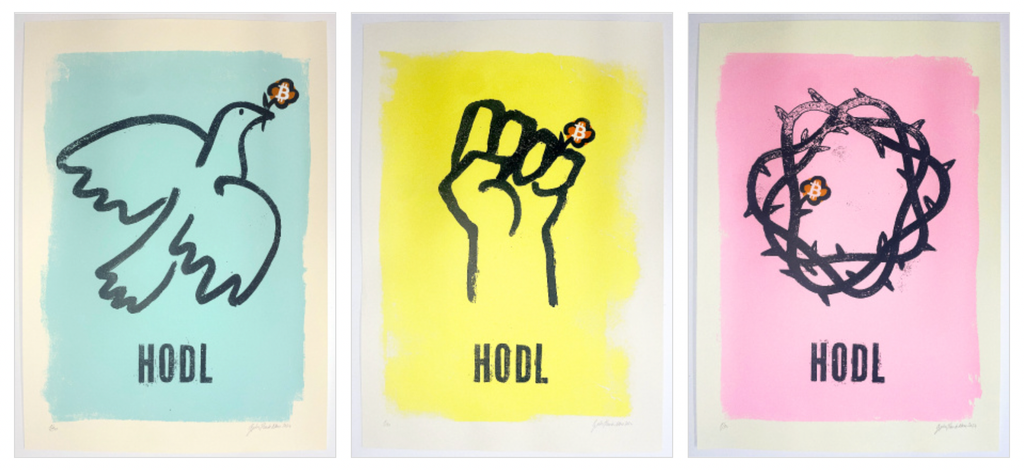
Martin Fischer joined the Prague art collective Ztohoven in 2003, a group known for inserting a fictional nuclear explosion into a live Czech Television broadcast. In 2014, the collective opened Paralelní Polis, a hackerspace whose café accepted only bitcoin, and Fischer designed its logo. As he told Bitcoin Magazine’s Aaron van Wirdum in 2020, the arrival of a screen-printing press the following year prompted him to produce his first prints. Since 2020, he has worked under the name Cypherpunk Now, developing a visual record of bitcoin’s evolving culture.
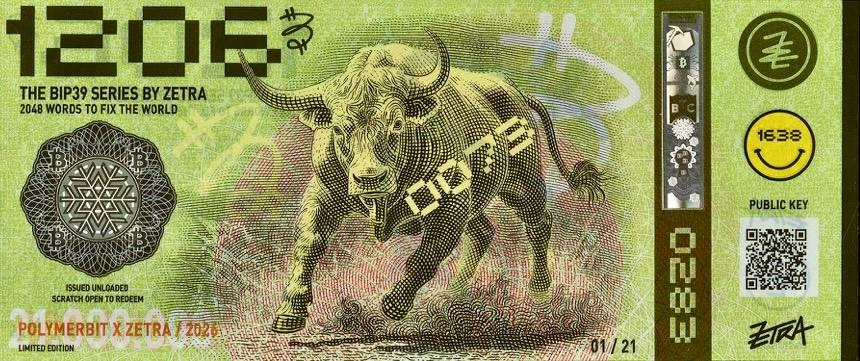
RYR and ZETRA both emerged from Germany’s graffiti scene but approach money from different directions. RYR uses currency itself as material, making paper from shredded banknotes, pigment from their ashes, and concrete grenades filled with shredded cash that he calls “artifacts from the future.” ZETRA, who began painting in the early 1990s and discovered bitcoin in 2017, examines what money can buy. His TOMATOSOUP paintings revisit Andy Warhol’s iconic Campbell’s Soup Cans to chart changing prices in dollars and bitcoin, while THE BIP39 SERIES explores the 2,048 words used in bitcoin wallet recovery phrases, including 1206/NOTE, a collaboration with Polymerbit.
Bitcoin has shaped these artists’ practices, their livelihoods, and the communities around them. Its growing acceptance by banks, investment funds, and corporations has also prompted some difficult questions about the movement’s original ideals and where its culture is heading.

BMAG: Andy Warhol turned Campbell’s soup into an icon of consumer culture, taking an ordinary commodity and elevating it into fine art. Your TOMATOSOUP series returns to that image but introduces something Warhol largely left outside the frame: the changing value of money itself. How did the idea of reworking Warhol’s Campbell’s Soup Cans first come about, and do viewers immediately recognize the commentary on inflation?
ZETRA: We frequently see iPhones and houses in our bitcoin Twitter timelines, showing how they become cheaper in BTC terms. I thought it would be fun to take something from art history instead, something more visually appealing, like Warhol’s iconic Campbell’s Soup Can.
For my TOMATOSOUP painting, I used real stickers placed on the can to show how the price of soup has increased in USD over the past decades, compared with the lower prices we might expect in BTC terms in the decades to come.
Bitcoiners looking at TOMATOSOUP generally understand it immediately. They know they’re in a better position as the purchasing power of fiat money continues to decline through inflation. Other viewers usually need a bit of explanation, and I’m always happy to help them understand.

BMAG: In THE BIP39 SERIES, you draw from the 2,048 words used to generate bitcoin wallet recovery phrases, turning ordinary words into artworks with a deeper significance for bitcoin holders. Can you unpack the different layers of inspiration behind the series and what they reveal about bitcoin, language, and the ownership of money for someone unfamiliar with these concepts?
ZETRA: Everyone who moves their precious sats into cold storage encounters 12 or 24 of these significant words, often early in their journey as a bitcoin newcomer. As mentioned, there are 2,048 words in a carefully curated list representing the power of self-custody.
I started going through the words one by one, imagining how each could be visualized in a physical form: the key visual for the word, its corresponding number, the style, and the medium I would choose. There are millions of possibilities for bringing these words to life through bitcoin art.
1044/LIST was the obvious choice to kick off THE BIP39 SERIES. Naturally, it features all 2,048 words presented as a list. As an ’80s kid, I had to choose 1638/SMILE as the second piece: a proper yellow smiley face, with the number 1638 in place of the eyes. It’s a fine art print on Alu-Dibond beneath a 6 mm acrylic glass cover. So clean.
Another work in the series is 0388/CORN, an obvious homage to Warhol once again. THE BIP39 SERIES will be an ongoing project for many years to come.
BMAG: You shred banknotes into paper and burn them to produce pigment. Artists have long manipulated currency to question where its value resides, but your work goes a step further by making destruction part of the creative process. Is there a contradiction in destroying money to create an artwork that may ultimately be worth much more?
RYR: Money is essentially a narrative system built on collective belief and obedience. It has worked for hundreds of years because we collectively agree on the story it tells and the value it represents. I’ve always been fascinated by that idea, particularly how something as ordinary as a banknote can carry so much meaning, authority, and perceived value.
I was looking for a different way to tell that story, both conceptually and physically. Back in 2017, I had an exhibition title in mind: To Cut a Long Story Short. I liked the cheekiness of it, especially in relation to money and the stories we attach to it. Shredding banknotes became a very literal interpretation of that title, but it also opened up an entirely new artistic medium for me.
Ultimately, I’m not simply destroying money. I’m taking an existing story, cutting it into pieces, and using those pieces to tell a new one.

BMAG: Your concrete weapons are presented as relics from a future in which the fiat wars have already ended. Yet bitcoin is increasingly held through the very financial institutions it was designed to circumvent. Is that a victory for the movement, or have the institutions simply absorbed the alternative?
RYR: I think that’s precisely what makes the story so interesting. When I created the concrete weapons, I imagined a future in which the traditional financial system had already fought its battle for survival. The weapons had become fossils, archaeological artifacts from a monetary conflict that future generations might struggle to understand.
My concrete weapons represent a future in which that battle is already history. Whether bitcoin ultimately wins or becomes part of the very system it challenged remains to be seen.

BMAG: Much of your work is made from the physical remains of money, at a time when currency is becoming increasingly digital and invisible. Do you think people are losing something in their understanding of money as it disappears from everyday physical experience?
RYR: I think we’re losing a physical connection to money, but not necessarily our understanding of it. Money has always been a narrative built on collective trust, whether printed on paper or represented by numbers on a screen. What fascinates me is how something as abstract as value can be represented by a physical object.
I don’t necessarily believe that art has to be authentic or entirely original. Almost everything has been done before. To me, art is a wonderfully human, almost plebeian way of expressing an opinion and giving ideas a physical voice.
Bitcoin will likely evolve into a much broader and increasingly regulated financial asset, but I hope its grassroots culture and artistic identity remain visible. That’s something my fellow artists and I will continue to contribute to, preserving the spirit of a movement that was cultural long before it became institutional.

BMAG: Paralelní Polis wasn’t just a place to discuss alternative monetary systems or a hacker meetup; its café was one of the first to adopt bitcoin as money. What were the early years of Paralelní Polis like, and what has your own experience been selling artwork for bitcoin?
Martin Fischer: Paralelní Polis was founded in 2014, during a bear market. The funny thing is, none of us who founded it even knew what a bear market was. We didn’t think of bitcoin as something that could make us rich. We saw it as uncensorable money and understood the changes it could bring to society. There was no speculation involved, and that’s what made those early days so great.
I sold my first screenprint for bitcoin in 2017, almost ten years ago, and many more since then. But practically every sale was a matter of survival. I spent most of the bitcoin I earned financing my next projects and continuing to make art.
I never managed to accumulate much bitcoin, but looking back, it gave me something far more valuable than investment returns: the freedom to remain an independent artist.
BMAG: Political printmaking has a long history in Europe, from Amsterdam’s financial satires of 1720 to twentieth-century protest posters. Your work emerged from Ztohoven, a collective that famously hacked a live television broadcast to show a fictional nuclear explosion—an audacious intervention, even by today’s standards. Ztohoven challenged institutions through disruption, while bitcoin uses game theory and economic incentives to create an alternative. Do you see bitcoin as a continuation of that same spirit of intervention, and your prints as an extension of it?
Martin Fischer: I think there’s a connection, but I wouldn’t say it’s exactly the same thing. With Ztohoven, we used art to question authority, challenge institutions, and expose how easily reality can be manipulated. Bitcoin doesn’t need to make a statement or provoke anyone. It simply offers an alternative that works without asking anyone for permission. That’s a much more interesting form of disruption to me.
But today, bitcoin has become so corporate and so intertwined with traditional banking that it’s hard to still see it as an anti-establishment movement. I don’t see this as a betrayal of its original ideals, but rather as a natural consequence of its success. That doesn’t mean I like where things are going.
What’s strange is that bitcoin’s fundamental principles haven’t really changed, but the way people perceive and use it certainly has.
And my screenprints? I still work with the original idea of separating money from the state while exploring the myths, memes, and legends of the bitcoin age. That’s what I enjoy most.
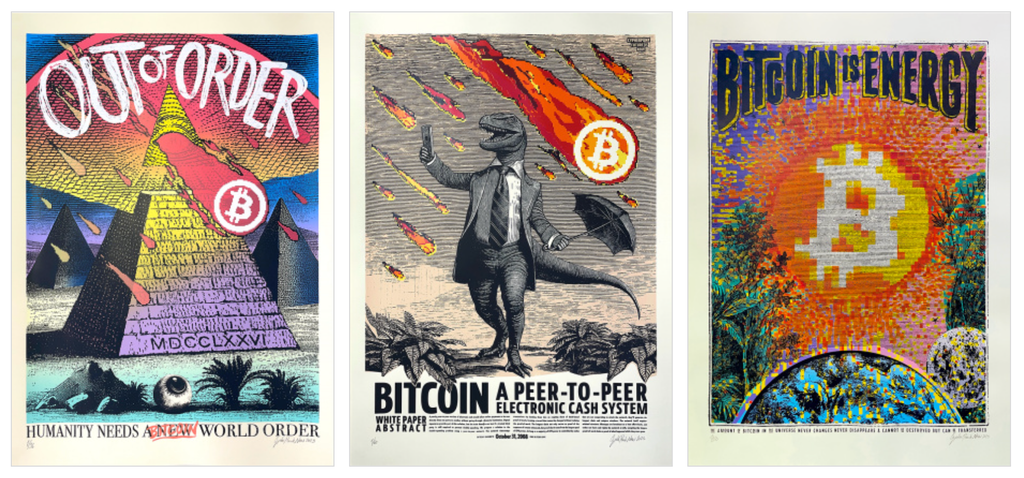
BMAG: Your Amsterdam presentation brings together more than a decade of work documenting bitcoin’s evolution from an underground movement to an increasingly institutionalized financial system. Looking across those prints today, has the movement changed more than you expected, or has your own perspective changed? Which of your prints are your favorites?
Martin Fischer: I like remembering the old days, when we were all part of the same tribe and our main enemy was Faketoshi.
Today? We have culture wars over JPEGs, Ordinals, BIPs, OP_RETURN, over what’s spam and what should or shouldn’t belong on bitcoin. What makes me saddest is that people who once fought together against censorship and for freedom now spend enormous amounts of energy fighting each other over what others should or shouldn’t be allowed to do with bitcoin.
Maybe it’s a natural consequence of bitcoin’s success. The bitcoin community has changed enormously, and so has my perspective on it. I’m definitely much more skeptical today of the idea that technology alone can automatically change society for the better.
As for my favorite works, Bitcoin Meteorite is definitely one of them. In this piece, I reworked the meme of banking dinosaurs watching their own extinction, incorporating the abstract from the Bitcoin white paper. It gave me my fifteen minutes of fame when Max Keiser and Stacy Herbert brought it into the spotlight.

Then there’s Cypherpunks of the World. This project is important to me not only as a celebration of the cypherpunks and their legacy, but also because of its complexity. It started as a series of original collages, continued through handmade screenprints, and eventually evolved into animated NFTs and a virtual gallery. It’s one of my most elaborate projects, connecting different techniques and media while staying true to the original idea.
Among my more recent works, I really like Out of Order from 2023. It’s an incredibly detailed screenprint, and the first one where I finally managed to make absolutely no printing mistakes. That alone makes it special to me.
I also love St. Satosius Contra Draconem (2025), which is inspired by the classic depiction of Saint George fighting the dragon, reimagined through bitcoin mythology.

Works by ZETRA, RYR, and Cypherpunk Now, alongside other European artists, will be presented at Bitcoin Amsterdam, November 4–6, 2026, as part of the Bitcoin Museum & Art Gallery (BMAG) programming. Additional artworks and editions will be available through https://shop.museum.b.tc.
Explore more work by the featured artists at ZETRA, RYR, Cypherpunk Now, and www.martin-fischer.cz.
The Bitcoin Museum & Art Gallery (BMAG) organizes international exhibitions, auctions, and artist collaborations exploring bitcoin and its cultural implications. Learn more at museum.b.tc.
Join us at Bitcoin Amsterdam, Get your tickets here and use code BA26-BMAG20 for discounted admission.
This post The Undercurrent: Three European Artists on Making Money Visible first appeared on Bitcoin Magazine and is written by Dennis Koch.
Bitcoin Magazine
Bitcoin Slips Below $83,000 After Hotter-Than-Expected US Inflation Data
The price of bitcoin slid Wednesday after data dropped showing that U.S. consumer prices shot up more than expected in September due to rising gasoline prices.
The biggest cryptocurrency by market cap was recently trading for close to $82,827 after dropping nearly 1% over a 24-hour period. At one point on Wednesday morning in New York, bitcoin fell as low as nearly $82,331.
Over the past seven days, the coin has dropped by more than 1%. Bitcoin’s price had its best quarter in years after rallying in August and September and leading many analysts to declare it to have exited a bear market.
But sticky inflation is still weighing — in the short-term — on the cryptocurrency.
Data Wednesday showed that the Consumer Price Index rose 0.6% in September after climbing 0.4% in August.
In the 12 months through September, the CPI advanced 3.7% after rising 3.4% in August, the Labor Department’s Bureau of Labor Statistics said.
High prices in the U.S., in part spurred by the Trump Administration’s decision to attack Iran with Israel this year, have led the Federal Reserve to hint it may keep interest rates higher for longer.
The central bank in September said getting inflation down was its number one priority and hiked rates.
Bitcoin’s price has been sensitive to interest rate hikes in the past because higher borrowing costs restrict the liquidity the digital coin needs to run — along with other “risk-on” assets like stocks.
Still, the price of bitcoin rose in September despite the Federal Reserve talking tough on inflation.
The central bank will reveal what it plans to do with interest rates on October 28. As of Wednesday, fed funds futures were pricing a 47% chance of a rate hike at the Fed’s October meeting, according to CME Group’s FedWatch tool.
This post Bitcoin Slips Below $83,000 After Hotter-Than-Expected US Inflation Data first appeared on Bitcoin Magazine and is written by Mathew Di Salvo.
Bitcoin Magazine

Capitalism is Broken and Bitcoin is the Great Equalizer | Natalie Brunell
Young people are angry at capitalism, billionaires, and even their parents, but Natalie Brunell says they’re blaming the wrong thing. The Bitcoin Is for Everyone author explains how our financial system has become “socialism for the banks,” with privatized gains and socialized losses. She shares why Bitcoin could be the greatest equalizer for a generation that’s lost hope of owning a home or starting a family.
Chapters:
0:00 – Natalie Brunell on Leaving Legacy News for Bitcoin
1:09 – Fleeing Communism in Poland and Chasing the American Dream
2:17 – Losing Everything in the Great Financial Crisis
3:37 – Why People Still Don’t Understand Bitcoin
7:01 – Bitcoin as a Savings Technology: Start Small, Stack Sats
9:40 – What “Broken Money” and the Cantillon Effect Really Mean
12:33 – Why Young People Are Losing Hope in Capitalism
14:40 – Socialism for the Banks: Privatized Gains, Socialized Losses
17:56 – Is Bitcoin Being Painted as Partisan?
20:46 – Decentralized Media and the Collapse of Trust in Legacy News
DISCLAIMER: The views and opinions expressed in this show are those of the participants and do not necessarily reflect the official policy or position of BTC Inc., Bitcoin Magazine, or any affiliated entities. This content is provided for informational and educational purposes only and should not be construed as investment, legal, tax, or accounting advice. Nothing contained in this show constitutes a solicitation, recommendation, endorsement, or offer to buy or sell any securities or financial instruments. Viewers should consult their own advisors before making financial or business decisions.
This post Capitalism is Broken and Bitcoin is the Great Equalizer | Natalie Brunell first appeared on Bitcoin Magazine and is written by Mark Mason.
CryptoSlate
Kraken's parent company, Payward, has agreed to acquire a European bank as it expands beyond cryptocurrency trading into traditional financial services. On Oct. 14, the company announced a definitive agreement to purchase Saldo Finance Oy, a Finnish holding company that owns Lithuania-based Saldo Bank. The acquisition would give Payward control of a licensed European banking…
Read the full story on CryptoSlate
Understand the crypto stories that matter and what to watch next. Get The Catalyst in your inbox
Ripple calls Meritz its fourth Korean institutional partner this year, with custody and tokenization cooperation to widen as regulation develops.
Read the full story on CryptoSlate
Understand the crypto stories that matter and what to watch next. Get The Catalyst in your inbox
ZkSync announced Airbender Prime, a prover that Matter Labs says handled 99% of 7,200 consecutive Ethereum mainnet blocks in under 10 seconds each on a single NVIDIA RTX PRO 6000 Blackwell GPU. The announcement came five days after Starknet said it is actively considering becoming an independent layer-1 (L1) blockchain, targeting full quantum resistance in…
Read the full story on CryptoSlate
Understand the crypto stories that matter and what to watch next. Get The Catalyst in your inbox
A hypothetical $500 million SATS financing assigns $387.5 million to Bitcoin, while actual pricing and capital deployment remain open.
Read the full story on CryptoSlate
Understand the crypto stories that matter and what to watch next. Get The Catalyst in your inbox
İhlas News Agency says the HEX and PulseChain founder was detained in a Beşiktaş police operation linked to an Interpol Red Notice requested by Finland.
Read the full story on CryptoSlate
Understand the crypto stories that matter and what to watch next. Get The Catalyst in your inbox
CryptoTicker.io
The XRP price stands at $1.33 on Wednesday evening, around 2.7 percent lower than 24 hours earlier. On the same day Ripple delivered what is probably the month's most tangible distribution news: Privy, a subsidiary of payment provider Stripe since last year, is bringing embedded wallets to the XRP Ledger. Developers will be able to create accounts directly inside their own app, without a user installing a separate wallet.
The news and the price tell different stories, and that is exactly what makes the day interesting. Anyone holding XRP gets a reach story in a market that is not paying for it today. This piece places both, recalculates the usage figures Ripple cites for it, and shows the two points at which the matter becomes concrete for investors in Germany.
XRP price at $1.33: where things stand on Wednesday evening
XRP trades at $1.33, around 1.20 euros. The daily high was $1.38 and the daily low $1.33. The price therefore sits at the lower edge of its own daily range, which makes the $1.33 level not just any round number but the point at which trading is fighting out the day.
Over a week XRP is down 6.9 percent, over a month 5.1 percent. Market capitalisation stands at $84.2 billion and trading turnover over the past 24 hours at $1.87 billion. The price is 63.4 percent away from its record of $3.65. All figures come from CoinGecko, as of October 14.
On Tuesday we described an additional 90 million XRP in the accounts of Upbit and Bithumb in this space, with the price at $1.36 at the time. Three cents have come off since then, around 2.2 percent. The $1.30 level named in yesterday's piece as the next support zone has not been tested so far. It has therefore held nothing yet; it simply has not had its turn.
The macro day belongs in the picture as well. US consumer prices rose to 3.7 percent on Wednesday and the core rate came in above expectations. The whole crypto market gave way in response, and Bitcoin slipped below $82,000. XRP's loss of 2.7 percent therefore falls within the market average and is not an XRP story of its own.
What Ripple and Privy announced
Privy builds what are known as embedded wallets. That means an app, say a payment service or a fintech, creates an account on a blockchain in the background, and the user notices nothing about it beyond a pay button. Stripe bought the company last year, and Privy continues to operate independently.
From now on this infrastructure also covers the XRP Ledger. Developers can create XRPL accounts through Privy and build them into their application. XRP, Ripple's stablecoin RLUSD and further assets of the network are supported. Anyone who wants to hold their own keys can export the private key. The target group is expressly payment providers and fintechs, not retail investors.
The second part of the announcement concerns AI agents. Software is to be able to pay independently in future, without a human approving every booking. The x402 protocol is intended for that. Spending limits and the app operator covering the network fees are in the works according to the two companies, but not yet generally available.
x402 is a payment standard with which a program pays for access to data or a service before it receives it. The name alludes to the HTTP status code 402, reserved for "Payment Required" since the early years of the web and until recently practically never used.

x402: how software pays software
The mechanism is simpler than the name sounds. An AI agent queries a data source, say a weather service or a search engine. Instead of a subscription or an API key, the provider charges a micro payment for precisely that one request. The agent settles it from its own wallet, the answer comes back, and the process is complete.
For a blockchain that is attractive business, because such payments arise in large numbers and with very small amounts. The XRP Ledger settles a transaction in a few seconds and for fractions of a cent, which makes it technically suitable for the purpose. That is exactly what Ripple has been aiming at since the summer: since June there have been tools with which agents create their own accounts, check balances and pay in XRP or RLUSD. In September support for the payment standard from Stripe and Tempo was added.
The Privy connection is the distribution step that goes with it and lowers the barrier for developers who would previously have had to build their own wallet infrastructure. Whether revenue comes out of it is decided not by the technology but by how many apps actually build it in.
14.3 million transactions, around $22,000 in value
Ripple cites usage figures alongside the announcement, and they are worth a calculation of their own. J. Ayo Akinyele, head of engineering at RippleX, wrote on X of more than 13 million agent payments via x402 and put their share at around 25 percent of ledger activity. The XRPL AI Hub, operated by infrastructure developer t54, reports more than 14.3 million cumulative transactions across 169 registered merchants as of October 14.
The second figure from the same source gets considerably less attention: the cumulative value of these payments comes to around 6,991 XRP and 12,752 RLUSD. Convert that at today's price and the order of magnitude becomes clear. At $1.33, 6,991 XRP corresponds to about $9,300. RLUSD is pegged to the dollar, which makes a further $12,750 or so. Together, then, roughly $22,050.
Spread across 14.3 million transactions, that is around $0.0015 per payment, about a seventh of a cent. That is technically impressive and economically small. Anyone who reads the 25 percent figure and infers demand for XRP from it is confusing the number of bookings with their value. CoinDesk, which compiled the figures, puts it cautiously in its report of Wednesday: it remains open how much real economic activity sits behind the transactions.
On where the numbers come from: the 13 million figure and the 25 percent share come from Ripple itself and are not independently verified. The hub figures come from t54. Neither value is wrong for that reason, but both describe a system whose operator has an interest in large numbers.
The 1 XRP reserve: what every new account costs
This is where the matter becomes concrete for the first time, for investors and for developers. The XRP Ledger requires a minimum reserve for every new account, which currently stands at 1 XRP. That is how Privy's documentation puts it, and it applies regardless of whether the account later moves XRP or only the stablecoin RLUSD.
This 1 XRP is not lost, it is blocked. It stays in the account as a balance and can only be moved again once the account is deleted. At today's price that is 1.20 euros per account created.
For a payment service with a million users that means a million XRP it has to hold, around $1.33 million at today's price. That is the point at which reach would actually create demand for XRP, and it would do so regardless of how small the individual payments are. Whether the operators put up that amount themselves or pass it on to users is open; the announced fee coverage by app operators points to the first variant.
If you use an app that offers you an embedded XRPL wallet, it is therefore worth a look at the terms: who bears the reserve, and do you get it back when you close the account? An app that deducts 1 XRP from your balance and does not explain it has a transparency problem, not a technical one.

RLUSD lacks MiCA authorisation in the EU
The second concrete point concerns the stablecoin that the new wallets expressly support. RLUSD is not authorised under the MiCA regulation in the European Union. Standard Chartered has just taken over custody of the stablecoin, as we described on Wednesday in a separate piece on the $2.41 billion of RLUSD. European authorisation does not come with that, however.
In practice that means an exchange or a payment service regulated under MiCA in Germany may not offer RLUSD to retail customers without further ado. The embedded wallets can technically hold the stablecoin, but the regulatory route to the German user is missing for now. Anyone wanting to get in from Germany therefore still goes via XRP itself and via an authorised trading platform, not via Ripple's stablecoin.
For judging the announcement, that is no aside. A large part of the benefit Ripple and Privy describe hangs on RLUSD as the unit of account for agent payments. In the EU that part is currently not available.
What of the deal is already running today, and what is not
Available since June is the toolkit with which agents create accounts, query balances and pay in XRP or RLUSD. Since September, support for the Stripe and Tempo standard belongs to it. Both run independently of this week's announcement.
Newly announced is the Privy integration itself, that is, the option of embedding XRPL wallets in any app. No start date has been named for it. Not yet available are the spending limits for agents and the operator covering the network fees. Both are announced, and both are missing today.
So anyone reading that AI agents now pay on the XRP Ledger is reading something that in parts has been true since June and that, in the part which is new this week, still has no date.
Our assessment: the number of payments says little about their value
From the newsroom's point of view the Privy connection is the more valuable half of this news, and it is the half discussed least. The reason is in the calculation above: 14.3 million transactions at around $22,050 in value works out at a seventh of a cent per payment. Agent payments are therefore proof today that the technology works, and not a source of demand.
What would actually create demand is the minimum reserve of 1 XRP per account. This reserve falls due once per user, not per payment, and it stays tied up. If Privy reaches meaningful user numbers through Stripe customers, a measurable need for XRP arises from it, independently of trading volume. That is the lever worth watching.
Three things speak against it. First, no start date has been named for the Privy integration. Second, RLUSD lacks MiCA authorisation, which means part of the benefit described falls away in the EU. Third, the usage figures come from Ripple and from the hub operator themselves. Anyone deriving a price move from that today is building on three open points. The market reacted accordingly on Wednesday, namely not at all: the loss of 2.7 percent matches the market average after the inflation data.
Tax: every agent payment in XRP is a disposal
One point missing from the discussion of agent payments so far concerns German users directly. If a program pays with XRP on your behalf, that is a disposal of those coins for tax purposes, exactly like a sale. The one-year holding period under section 23 of the German Income Tax Act applies unchanged, and the threshold for private disposal transactions stands at 1,000 euros a year.
With tiny amounts that sounds theoretical. The difficulty lies not in the size but in the number: thousands of micro payments mean thousands of individual events for which the acquisition date and acquisition cost have to be established under the FIFO order. Anyone using an app with an embedded wallet should therefore clarify in advance whether it offers an export of the events. Without that export, a clean tax return is practically unachievable with many bookings. A tax tool with an XRPL connection takes the allocation off your hands, but it does not replace the export from the app.
The same thought applies to self-custody. Privy allows the export of the private key, and that is the difference between a balance held with a provider and an account that belongs to you. Anyone who cannot find the export, or is not offered one, effectively holds a claim against the app and not XRP on the blockchain. Which wallet types separate this cleanly is shown by the software wallet comparison further below.
Privy wallets on the XRP Ledger: the 1 XRP reserve remains the catch
XRP stands at $1.33, the news of the day is a distribution step without a start date, and the best number in it is not the one with the most zeros. Three steps make sense now:
- Check the reserve before you use an app wallet. One XRP per account, currently 1.20 euros, stays tied up. Clarify who bears it and whether you get it back when the account is closed. Anyone who would rather buy in the ordinary way will find the terms in the crypto exchange comparison.
- Clarify the key export. Only with an export do you hold XRP yourself. The differences between the wallet types are set out in the software wallet comparison.
- Secure the export of events. Many micro payments mean many taxable events. Without an export function, the allocation under FIFO becomes laborious; a tax tool helps with the evaluation.
The next checkable date is the start date of the Privy integration, which both companies have so far left open. Until then the news stays what it is today: an access route that is being built, and a price that has not responded to it.
(As of October 14, 2026. This article is not investment advice. Prices and fee structures change; check the terms with the provider before you buy.)
US consumer prices rose 3.7 percent in September against the previous year. Economists had expected 3.6 percent. The core rate, which excludes energy and food, rose 2.6 percent and was therefore also above the forecast of 2.5 percent. For the crypto market this is the last inflation reading before the Federal Reserve's rate decision on October 28. Bitcoin trades at around $82,880 after the figure, barely moving from where it stood before publication.
What is decisive for the coming two weeks is not the 3.7 percent headline but the gap between the two readings. It comes to 1.1 percentage points, which is unusually wide. Anyone who wants to know what the Fed will do on October 28 looks at the smaller of the two numbers.
US consumer prices at 3.7 percent: the figures in detail
The Bureau of Labor Statistics, the statistical agency of the US Department of Labor, published the consumer price index for September at midday European time on Wednesday. Four readings are at the centre of it:
- Headline rate year on year: 3.7 percent, against a consensus forecast of 3.6 percent.
- Headline rate month on month: up 0.6 percent, seasonally adjusted. Here the forecast was accurate.
- Core rate year on year: 2.6 percent, where 2.5 percent had been expected.
- Core rate month on month: up 0.3 percent.
The Bureau of Labor Statistics consumer price index measures what households in the United States pay for a fixed basket of goods and services. It is the most important inflation figure for financial markets, even though the Fed prefers a different index for its own two percent target, the price index for personal consumption expenditures.
Core CPI at 2.6 percent: why central bankers look at this number
The core rate leaves energy and food out of the basket. The reason lies in what monetary policy can steer: the oil price responds to conflicts, production quotas and weather, not to the policy rate. A central bank that answers an energy shock with higher rates slows the economy without touching the cause. That is why the core rate counts as the better measure of the price pressure monetary policy can actually reach.
At 2.6 percent the core rate sits considerably closer to the Fed's target than the headline rate. According to our report of October 1 it previously stood at 3.0 percent, so the decline is continuing. At the same time the reading came in a tenth of a point higher than expected, and that tenth of a point is precisely the part of the release that gets discussed in the open market committee.
What a tenth of a point means in practice
A single monthly reading above forecast shifts no monetary policy. Three such readings in a row do. The Fed watches the trend over several months, because the index is seasonally adjusted anew each month and individual components such as airline tickets or used cars swing sharply. For you that means a reading like this one rarely changes the situation immediately; it changes the probabilities for the meeting after next.

Petrol up 9.1 percent: the energy shock behind the headline
Petrol prices rose 9.1 percent in September and thus accounted for roughly half of the entire increase in the headline rate. The energy index as a whole rose 5.2 percent. Behind it is the escalation of the conflict between the United States and Iran, which has pushed the oil price higher.
That origin explains the wide gap between 3.7 and 2.6 percent. A price surge that comes out of a geopolitical situation runs straight into the headline rate via the fuel pump, but does not touch the core rate. It only migrates in once freight firms, airlines and manufacturers factor the higher energy costs into their own prices. That transition takes months, and whether it comes depends on how long the oil price stays up.
Bitcoin at $82,880: the range of the past seven days
Bitcoin has not responded to the figure with a breakout so far. The price sits at around $82,880, about half a percent below its level 24 hours earlier and around one percent below where it stood a week ago. Over a month it is up 6.6 percent. It is 34.3 percent short of the record high of $126,080 of October 6, 2025.
For the levels that count in the coming days, cryptoticker.io analysed the price action of the past seven days itself, across 169 measuring points at hourly intervals. cryptoticker.io compiled this analysis itself on October 14, 2026. The result:
- Low of the week: $80,652, reached on October 8.
- High of the week: $84,154, reached on October 12.
- Width of the range: $3,502, or 4.3 percent.
The current price sits in the upper half of that range but below the high. As long as Bitcoin stays between those two readings, the inflation figure is priced in without setting a new direction. A close below $80,652 would be the first signal that the market assesses the Fed meeting differently than it has so far. A breakout above $84,154 would be the counterpart.
Ethereum is moving just as calmly and trades at around $2,482, 0.8 percent below yesterday's level. The large crypto assets are therefore reacting to this release in muted fashion, unlike some inflation readings of past years.
Fed target range of 3.75 to 4.00 percent: where things stand before October 28
One point is regularly turned around in German coverage, so it is stated here explicitly: the Fed is not cutting at the moment, it is raising. According to the Federal Reserve's summary of open market operations, the committee raised the target range for the federal funds rate by 25 basis points to 3.75 to 4.00 percent on September 17, 2026. There has been no cut at all in 2026 so far.
The next meeting runs on October 27 and 28, with the decision falling on the second day. After that one more meeting follows this year, on December 8 and 9. Today's inflation reading is therefore the last major data release that still feeds into the assessment before the October decision.

A rate rise instead of a rate cut: the difference for the crypto market
Rising policy rates act on Bitcoin through two routes. The first is comparison: if short-dated government bonds and overnight deposits yield four percent, an investment without interest has to make up for that sacrifice. The second route runs through financing: higher rates make borrowed money more expensive, and a large part of the short-term moves on the crypto market arises through leveraged positions.
A step up in rates is therefore a headwind for crypto assets at first, and a step down a tailwind. That explains why the market reads every inflation figure so closely. Bitcoin has gained over a month this year despite the September increase, so the relationship is no automatic mechanism. It describes a direction, not a formula.
Leverage and liquidation: how macro dates wear positions down
A liquidation occurs when the collateral behind a leveraged position is no longer enough to cover the paper loss. The exchange then closes the position by force. On days with macro releases that happens in clusters, because the price jumps further in a few minutes than it otherwise does in hours.
Anyone working with leverage checks, ahead of such dates, the distance between their entry and the liquidation price, which every exchange shows in the position overview. At a leverage of ten, a move of ten percent against the position is enough. Last week's range came to 4.3 percent, and a single price reaction to a Fed decision can exceed that. Which providers in Germany offer stop orders, partial closes and margin warnings, and what they cost, is set out in our overview of the best crypto brokers.
Holding period and tax in Germany: the framework does not change
An American inflation figure does not change German taxation. Gains from selling crypto assets remain tax-free in Germany after a holding period of one year; within the year they count as a private disposal transaction and are charged at the personal income tax rate. What matters, therefore, is that a reaction to macro news does not reset your own holding period unnoticed.
Anyone who sells in October and buys back in November starts the one-year clock afresh for the new holdings. For anyone whose anniversary is close at hand, the tax difference can be larger than the price move they wanted to avoid by selling. Specialised tools track the holding period for each purchase and generate a report for the tax return from it.
What is added for European investors
For the purchase itself, a uniform framework has applied across the EU since the MiCA regulation. Providers need an authorisation to sell crypto assets to retail customers, and they have to keep customer funds separate from their own assets. With a provider without EU authorisation that protection does not exist, regardless of what the fees look like. Whether a trading venue is authorised can be looked up in the register of the competent supervisory authority.
Our assessment: the core carries more weight than the headline
From the newsroom's point of view this release is less explosive for the crypto market than the 3.7 percent suggests. Three pieces of evidence for that: half of the increase comes from a petrol price that has risen 9.1 percent and on which rate policy has no effect. The core rate stands at 2.6 percent and is therefore lower than in the previous month. And Bitcoin has absorbed the figure without breaking out of the weekly range of $80,652 to $84,154.
Against it stands the direction of that tenth of a point: both readings came in above forecast, and the Fed raised in September rather than cutting. If the oil price stays at this level, the energy surge will migrate into the core rate via transport and manufacturing costs. The October reading, published on November 12, would then be the more important number. This is an assessment, not a recommendation: crypto assets can lose their value entirely.
US inflation and Bitcoin: until October 28 the core rate is what counts
The September reading gives the Fed no reason to turn its course, and it gives the crypto market no new direction. What counts now comes down to three steps:
- Note the levels. $80,652 as the weekly low, $84,154 as the weekly high. If Bitcoin leaves that range after the Fed meeting, the market's assessment has flipped. Current prices and inflows are available in the overview of the best crypto exchanges.
- Review your leverage before October 28. The distance to the liquidation price is in your exchange's position overview. Anyone who needs more buffer reduces the position or sets a stop. Which providers have which tools for that is set out in the comparison of the best crypto brokers.
- Look up your own holding period. Before a sale for macro reasons, it is worth a look at the purchase date. If the anniversary is close, the tax exemption often weighs more than the volatility avoided. The crypto tax tools track this for each purchase.
(As of October 14, 2026. This article is not investment advice. Prices and fee structures change; check the terms with the provider before you buy.)
Binance announced the delisting of Epic Chain (EPIC) and QuickSwap (QUICK) on Wednesday morning: spot trading in both tokens ends on October 28, 2026 at 03:00 UTC. For holders, though, that is not the most important date. October 20 is. On that day four deadlines expire, after which the exchange itself determines when and at what price a position is unwound. Which of them hits you depends on the product your tokens sit in: the spot account, futures, the margin account, copy trading or Simple Earn.
In total the announcement names fifteen dates between October 15 and December 29. Three of them cost money if you sleep through them, because they trigger automatic selling or settlement. The rest only cost you the option to trade. This article sorts the dates by what they mean for your balance, rather than by the order of the product sections at Binance. If you want to move your holdings to another platform anyway, the overview of crypto exchanges with authorisation in Germany will help you choose.
What Binance announced: spot trading ends on October 28
Binance reviews listed tokens at fixed intervals. In its delisting announcement of October 14, 2026 the exchange names eleven criteria on which it decides. They include trading volume and liquidity, the quality of development work, the network's stability against attacks, the project team's responsiveness to periodic review requests, and new regulatory requirements. Which criterion tipped the balance in the case of Epic Chain and QuickSwap, Binance does not say.
The core of the announcement is one sentence: as of October 28, 2026 at 03:00 UTC the exchange halts trading in all spot pairs of the two tokens. All open trading orders are removed automatically in the process. Trading bots running on these pairs are terminated by Binance at the same moment.
Delisting does not mean expropriation
A delisting is the removal of a token from trading on an exchange. The balance initially stays in the account; it simply can no longer be traded there. In this case Binance keeps withdrawals open for a further two months beyond the end of trading. That span is the real room for manoeuvre you have, and it is considerably larger than the few days some exchanges allow.
Four deadlines fall on October 20
On Monday, October 20, four mechanisms take effect one after another, each in a different product. All four share the same pattern: you can trade for yourself beforehand, and afterwards the system trades.
- 03:00 UTC — Binance Pool discontinues mining support for the tokens. The final payout is settled the following day. Binance Pay removes the tokens at the same time.
- 07:00 UTC — VIP Loan and Flexible Loan close all open loan positions in which the tokens serve as a borrowable asset or as collateral.
- 08:30 UTC — For the futures contracts of the two tokens you can no longer open new positions.
- 09:00 UTC — Binance Futures closes all open positions and settles them automatically. The Funding Rate Arbitrage Bot ends all arbitrage strategies on these symbols in the same minute.
- 10:00 UTC — Binance Margin takes the tokens out of Cross, Isolated and Portfolio Margin. The exchange calls this moment the "Margin Scheduled Delisting Time".
Counted strictly, then, there are five times on that day, four of which trigger an automatic unwinding. Anyone holding only a spot balance is not affected on October 20 at all and has until October 28.
Futures: forced settlement at 09:00 UTC, no selling of your own after that
For the futures contracts, October 20 is the end. Binance puts it like this: "Binance Futures will close all positions and conduct an automatic settlement on the contracts of the aforementioned token(s) at 2026-10-20 09:00 (UTC)." After settlement the contracts are removed. The exchange explicitly advises closing open positions yourself beforehand.
The difference is practical, not theoretical. If you close yourself, you pick the moment and therefore the price. If the system settles, you get the settlement level, and in a market environment where liquidity is thinning anyway because of the announcement. Binance also reserves the right to take protective measures beforehand, without further notice, in the event of sharp price swings: lowering the maximum leverage, capping the position value, raising the maintenance margin in the margin tiers, adjusting funding rates and carrying the mark price forward via the protected last price.
What the protective measures mean for a leveraged holder
If the maximum leverage in a margin tier is lowered, the collateral required for an existing position rises. If the balance is then not enough, liquidation comes before October 20 rather than on it. A leveraged position in a token with a delisting date is therefore the case that leaves the least time.
Margin, VIP Loan and Flexible Loan: collateral pays off the debt
In the margin account the mechanics are the most layered. Since the announcement you can no longer transfer the two tokens into the margin account, neither by hand nor via auto-transfer mode. One exception applies if you have open liabilities in that token: then you may top up at most the amount of that liability, less collateral already present. On October 15 at 06:00 UTC Binance additionally suspends borrowing on the affected cross-margin tokens and isolated-margin pairs.
At the Margin Scheduled Delisting Time on October 20 at 10:00 UTC, different things then happen depending on the state of the account. In Isolated Margin the exchange closes the positions, settles them, cancels all open orders and removes the pairs. In Cross and Portfolio Margin it first offsets collateral against liabilities in the same token. If a remainder is left after that, one of two procedures applies:
- If you hold the tokens only as collateral: Binance sells them into USDT or USDC, and the proceeds go to the margin balance. The exchange states that it accepts no liability for losses arising from this.
- If you hold the tokens only as a liability: all open orders in the cross-margin account are cancelled, then the system sells other collateral, buys the delisting tokens with it and repays the debt in full.
During this process you cannot change your positions, and according to the exchange it takes around three hours. Portfolio Margin users should top up their margin balance beforehand and keep an eye on the Unified Maintenance Margin Ratio: if a token drops out of the account's valuation, that alone can trigger a liquidation.

Copy trading on October 21: forced sale at the market price
Spot Copy Trading removes the pairs on October 21 at 03:00 UTC. The decisive sentence of the announcement reads: "After this time, any outstanding assets will be force-sold at market price or moved to the Spot Account if the amount is unsellable."
This deadline affects a group that often does not track its holdings individually at all. Anyone following a trader holds that trader's positions pro rata without having selected them. A look at the composition of your own copy portfolio is therefore worthwhile this week even if you have never heard of Epic Chain and QuickSwap.
Simple Earn: flexible and locked products are unwound automatically
Binance Simple Earn takes the tokens out on October 21 at 07:00 UTC. You can redeem flexible and locked positions yourself beforehand. If you do not, Binance unwinds them automatically at that moment and transfers the amount, together with accrued rewards, to the spot account.
With locked products that is the point at which a fixed-term commitment ends early. Whether the promised yield is credited in full or only the amount accrued up to that point depends on the terms of the individual product. The announcement speaks of "any accrued rewards". Anyone running a longer lock-up should look up the terms of their specific product in the app rather than budgeting for a full period.
Dual Investment and Convert Low-Value Assets
For Dual Investment the subscription window closes the following Friday at 08:00 UTC; unsettled subscriptions are refunded on that date and credited to the spot account within four hours, with the reward calculated on the actual term. Convert Low-Value Assets, the function for tiny holdings, removes the tokens on October 27 at 02:00 UTC, and Binance Convert itself on October 28 at 02:00 UTC, an hour before the end of spot trading.
Spot trading, trading bots and Convert: the dates between October 15 and 29
Three dates bracket the end of trading. As early as October 15 at 03:00 UTC, Binance takes the tokens out of "Buy & Sell Crypto", that is, out of the simple purchase route by card or balance. On October 28 at 03:00 UTC spot trading ends, all open orders are removed, trading bots on these pairs are terminated and gift cards with these tokens are cancelled. And on October 29 at 03:00 UTC deposits are no longer credited.
That last point is the least conspicuous trap in the whole sequence. Anyone who sends EPIC or QUICK from their own wallet or another exchange to their Binance address after October 29 is transferring to an address that no longer books the incoming amount. A deposit address does not disappear the moment an exchange stops serving it, and a transaction on the blockchain cannot be recalled.
The withdrawal deadline on December 28 is the hard limit
Binance will no longer support withdrawals of the two tokens after December 28, 2026 at 03:00 UTC. From today that is around eleven weeks away. It is the date to put a calendar entry on if you want to keep the tokens rather than sell them: after it, the balance sits in an account from which you can no longer move it yourself.
Eleven weeks sounds like plenty of time. In past delistings this deadline was nonetheless the most common reason for lost holdings, because it sits so far out that it slips from view. We have been through this with Binance twice already, with the delisting of ICX, SCRT and STORJ and with the removal of six tokens in August. In both cases the gap between the end of trading and the withdrawal cut-off likewise ran to a double-digit number of weeks.
Conversion into stablecoins: Binance explicitly does not promise it
After December 29, 2026 at 03:00 UTC, Binance may convert delisted tokens into stablecoins on behalf of users. The announcement, however, attaches a clear caveat: "Please note that the conversion of delisted tokens into stablecoins is not guaranteed." So this is not a commitment. If a conversion does happen, the exchange will announce it separately beforehand, and the stablecoins then land in the Binance account.
In the event that a conversion is not technically possible, Binance keeps withdrawals open as far as the network is available. That fallback is stated expressly in the announcement. I would not rely on it, because it hangs on the availability of a blockchain whose project is currently losing its largest trading venue.
Epic Chain and QuickSwap: what is behind the two tokens
QuickSwap is a decentralised exchange on Polygon. There, the QUICK token serves for voting on protocol changes and for a share in trading fees. A decentralised exchange, DEX for short, is a trading venue that matches orders not in a company's order book but through contracts on a blockchain. The protocol itself continues to run independently of Binance and is reachable via the QuickSwap project site. The delisting affects trading in QUICK on Binance, not the functioning of the decentralised exchange.
Epic Chain is a layer 1 blockchain of its own, and EPIC is its network token. A layer 1 blockchain is a blockchain with its own consensus layer that does not sit on top of another. Here too the same applies: the network continues to run, regardless of where the token is traded. What falls away is the largest venue on which it could be exchanged for euros or stablecoins. For a token with a small market capitalisation that is no minor loss, because liquidity is then spread across several smaller platforms.

The price before the cut-off: QUICK down 30 percent in a day
Both tokens reacted sharply to the announcement. On Wednesday midday, according to CoinGecko data, QUICK stood at $0.0069, around 30 percent below the previous day's level, and EPIC at $0.36, around 16 percent below. During the morning the decline in QUICK had still been around 23 percent, so it widened over the course of the day.
The scale of the holdings involved is modest. QUICK carries a market capitalisation of around $4.6 million, EPIC of around $12.1 million. The striking figure is EPIC's trading volume: at around $22.5 million in 24 hours it exceeded the market capitalisation, a sign that a large part of the circulating supply changed hands in a single day. For comparison with the wider market: Bitcoin traded at around $82,800 at the same midday, less than one percent below the previous day. The slump in EPIC and QUICK therefore does not come from the overall market.
A confusion of names that can cost money
Alongside Epic Chain there is the token Epic Cash, which has a similar name and is not affected by the delisting. Anyone sorting through their holdings should go by the ticker and not by the name alone. The one affected is Epic Chain, with the ticker EPIC.
Holding period and tax: a forced sale is a sale
For investors in Germany the automatic unwinding has a consequence that is not in the announcement. Under section 23 of the German Income Tax Act, crypto assets count as other economic assets. A gain from selling them stays tax-free if more than one year lies between purchase and sale. Within that year the gain is taxable, to the extent that the sum of all private disposal transactions in the year reaches the 1,000-euro threshold.
A forced sale by the exchange is, for tax purposes, a sale like any other. If Binance settles your position on October 20 or 21 and you only bought the tokens this year, a taxable event arises whose timing you did not decide. If your purchase is more than a year back, however, the date changes nothing for tax.
What you need for your tax return
In both cases the documentation is what matters: purchase date, purchase price, sale date and sale price for each position. Binance provides the transaction history for export, and it makes sense to download it before the end of trading, while the pairs are still shown in full in the account. Anyone using several exchanges is better off bringing the statements together in one document, because the threshold applies across all transactions in a year. Binding advice on your own case comes only from the tax office or a tax adviser.
Four cut-off dates in eight days: Kraken is delisting in parallel
Anyone trading on several exchanges has more than one calendar entry this week. Kraken is removing a package of tokens from trading at the same time, with its own withdrawal deadline at the end of October. Together with the Binance dates on October 20, 21 and 28, that makes four cut-off dates in eight days for an investor with accounts at both houses.
The pattern has been repeating for months with changing venues. At Bybit, too, there was a gap of weeks between the end of trading and the withdrawal cut-off, in which holdings could be left behind. In practice that means: a small residual holding in a token an exchange removes is the item most often forgotten, because it is too small to stand out and large enough to be annoying. For larger holdings you want to keep, self-custody via a hardware wallet is the route that makes you independent of delisting dates.
Binance delisting: on October 20 the exchange chooses for you
The list of dates is long, the decision behind it is short. Until October 20 you have the choice over timing and price; after that the system has it. Three steps are enough not to miss the deadline:
- By October 19: look up where the tokens sit. In your Binance account, open the overviews for spot, futures, margin, copy trading and Simple Earn separately from one another. A holding in futures, margin or copy trading has its cut-off on October 20 and 21, a spot balance only on the 28th. If you come across further tiny holdings while doing so, a look at the exchange comparison is worthwhile: consolidating several accounts at one house saves you exactly this search at the next delisting.
- By October 28: sell or move. Decide whether you turn the tokens into money or keep them. For a move you need the correct receiving address on the matching network beforehand, and after October 29 Binance no longer accepts deposits of these tokens. For self-custody over a longer period, a hardware wallet is the variant in which no third party sets the deadline.
- By December 28: withdraw the balance and document the sale. After that date Binance no longer supports withdrawals, and the conversion into stablecoins is expressly not promised. Download the transaction history beforehand; for consolidating across several exchanges, portfolio trackers with tax reporting help.
(As of October 14, 2026. This article is not investment advice. Prices and fee structures change; check the terms with the provider before you buy.)
The crypto market is still falling, but the driver has changed. The total capitalisation of all crypto assets stood at $2.76 trillion on Wednesday afternoon, 4.50 percent below its level 24 hours earlier. Bitcoin trades at $81,712 after a daily high of $84,025, Ether at $2,420 after $2,525. The trigger was the US consumer price index for September: it landed on Wednesday at 2:30 p.m. German time and came in above forecast.
What sets this day apart from the ones before it changes the outlook for the days ahead. On October 12 and 13 leverage was the driver, and forced selling on the futures market accelerated every downward move. That borrowed money is now largely out of the market, and liquidations have shrunk to less than a third. What weighs today is a reversed rate expectation meeting demand that has only just steadied.
The market loses 4.50 percent of its value in 24 hours
The move is broad. Of the 25 largest crypto assets, 20 remain once stablecoins and tokenised credit products are stripped out, and 17 of those are down. The median daily loss across those 20 is 3.37 percent. cryptoticker.io compiled this analysis itself on October 14, 2026, drawing on CoinGecko market data for the 25 largest crypto assets.
Five assets held up better than Bitcoin, three of them even in the green: Monero gained 3.90 percent, Tron 1.61 percent and LEO Token 1.56 percent. At the other end sits Canton with a 7.49 percent loss, followed by Rain at 7.42 percent, Chainlink at 5.65 percent and Stellar at 4.97 percent. Monero and Tron rising against the market is typical of a day with a macro trigger: assets with a demand story of their own hang less on the rate question.
Bitcoin dominance rises to 59.4 percent
When altcoins fall harder than Bitcoin, Bitcoin's share of total capitalisation rises. It now stands at 59.4 percent. That is the usual pattern for a phase in which investors cut risk rather than rotate: little is rotated, and less is held overall. Over seven days 18 of the 20 assets are down, Rain deepest at 13.03 percent.
Coinglass counts $140 million to $154 million in liquidations over 24 hours
The futures market supplies the number that describes the difference from the previous days. Snapshots of the Coinglass data differ depending on when they are taken: for the 24 hours to Wednesday morning, The Crypto Times reports $154.32 million in forcibly closed positions, while Coin Gabbar puts a slightly later window at $140.00 million across 60,290 affected accounts. Both figures are less than a third of the October 13 reading, when $488.61 million was unwound within 24 hours.
What matters is the direction of the ratio, and it has turned. On October 13, 83.2 percent of the liquidated sum sat on the buy side. In both Wednesday snapshots the split is close to even: once $80.38 million on short positions against $73.93 million on longs, once $81.16 million of longs against $58.84 million of shorts. A market that liquidates shorts and longs in similar size has lost its one-sided leverage load. That is precisely what separates this day from last week.
Bitcoin leads the list ahead of Ether
Broken down by individual asset, Bitcoin was hit hardest at $32.50 million, ahead of Ether at $26.36 million. The striking part is which side took it. Short positions accounted for 78.3 percent of Bitcoin liquidations and 59.8 percent of Ether's. Ahead of the price report, in other words, it was mainly bets on falling prices that lost money. The single largest forced closure was a Bitcoin short worth $3.95 million on the Binance exchange.

How a wave of liquidations feeds through to the price
The mechanism is simpler than it sounds, and it explains the speed of days like this. Anyone using leverage posts collateral with the exchange, the margin. If the price falls, that buffer melts away. Once it drops below a set threshold, the exchange closes the position itself and sells the underlying coins on the market. The customer is not asked.
Those sales push the price down further, which breaks the next buffer. The result is a chain reaction that runs in minutes and is completely invisible in calm phases. It only stops once the leveraged positions in a price zone are used up. The size of the liquidations therefore says nothing about the fair value of a coin, but a good deal about how much borrowed money was in the market beforehand.
For direction that means two things. A wave of liquidations that has worked itself out takes selling pressure out of the market in the short term, because the vulnerable positions are gone. That is the situation on this Wednesday: the decline is running without the accelerator of the previous days. But if new demand is missing, so is the counterparty that carries the price back up.
That leaves demand, and over the past two years it has come mainly from one direction: the exchange-traded funds in the United States. That is exactly where the sign has flipped most recently, and it flipped to the positive.
US Bitcoin ETFs took in a net $175.6 million on October 13
According to daily data from Farside Investors, the US spot Bitcoin ETFs recorded net inflows of $175.6 million on October 13, after an outflow of $65.4 million on October 12. The largest single contribution came from the FBTC fund at $103.1 million, followed by IBIT at $65.9 million. No daily data is available yet for October 14.
That is a genuine turn from the week of October 5 to 9, when the same funds gave up roughly $681 million net, including $487.1 million on October 7 alone and $244.1 million on October 8. Anyone who explained last week's decline with absent fund demand has to withdraw that explanation for the current day.
Why this feeds through to the price directly: a spot ETF holds real Bitcoin. If an investor returns shares, the issuer has to sell Bitcoin to service the redemption. Inflows therefore create actual buy orders, outflows actual sell orders. These funds are not a sideshow, then, but one of the largest daily sources of demand there is. Readers who want to read up on the structure and the German access routes will find them in the overview of crypto ETFs for investors in Germany.
The September consumer price index comes in above forecast
That leaves the data release as the explanation, and since Wednesday midday it is no longer an expectation but a number. The US Bureau of Labor Statistics reports a 0.6 percent rise in consumer prices for September against the previous month and 3.7 percent against the previous year, after 3.4 percent in August. The core rate excluding energy and food rose 0.3 percent and stands at 2.6 percent year on year; 0.2 and 2.5 percent had been expected. Around half of the monthly increase came from energy, with petrol up 9.1 percent. The figures are in the press release from the Bureau of Labor Statistics.
For the crypto market the core rate counts for more than the headline, because it measures price pressure without the volatile items. A core rate above forecast shifts expectations for the central bank away from easing. The Federal Reserve's rate decision falls on October 27 and 28, as the Fed's meeting calendar shows.
The link is indirect but reliable: higher expected rates make interest-bearing investments more attractive and borrowed money more expensive. Crypto assets pay no interest, which is why they regularly react more strongly to that shift than the equity market does. No exchange went down, no regulator banned anything, no large project failed. The trigger lies outside the crypto industry.
The comparison with the slump of October 8
A look back puts the scale in order. On October 8 and 9, liquidations across the crypto market ran to $1.191 billion in 24 hours, predominantly on the long side. Bitcoin fell below $81,000 then, and the English-language market report on that day was the most-read article on our site.
Against that yardstick the current day, at $140 million to $154 million, is the markedly smaller move, even though the price level is a similar one. That fits the picture of a third, flatter wave: a large part of the borrowed money was flushed out of the market six days ago and the rest on October 12 and 13, which is why the same price move barely triggers forced selling today. What has changed since then is the demand side, and it has changed in the market's favour.

Our assessment: a rate story, not a leverage accident
From the newsroom's point of view this day is a reduction of risk and not a flight, and it has a different cause than the previous days. Three sourced points support that. First, the composition of the liquidations: $140 million to $154 million with a near-even split between longs and shorts is the opposite of a leverage crisis, and it sits below a third of the previous day's figure. Second, the breadth without downside outliers: 17 of 20 large assets falling with a median loss of 3.37 percent is an even decline, not the collapse of a single segment. Third, the fund flows, which moved back into positive territory on October 13 for the first time in days.
Against it stands the calendar. With a core rate above forecast, the market heads into two weeks of uncertainty until the rate decision on October 28, and in that period it reacts more sensitively to every further data point than it otherwise would. A single day of inflows into the funds is also no trend reversal; whether it becomes one will show in the coming daily data. This assessment weighs up the situation and is not a recommendation to buy or sell; a total loss is possible with crypto assets at any time.
Support and resistance for Bitcoin and Ether
Levels are not a forecast, they are orientation. The ones below are grounded because they come out of trading over the past 24 hours and the past week.
Bitcoin
Bitcoin trades at $81,712. To the upside the first marker is $83,554, the price on Wednesday morning before the data release, and above that the daily high of $84,025. To the downside the zone around $81,000 is the next level, where the move of October 8 ended. Over seven days the loss is only 1.28 percent, so the weekly chart is far less damaged than the daily one.
Ether
Ether has lost the round number of $2,500 and trades at $2,420. To the upside that $2,500 is the first hurdle, and above it the daily high of $2,525. The weekly loss of 4.50 percent is more than three times Bitcoin's. That fits the distribution of leverage on the futures market: relative to market size, more borrowed money sits on Ether.
Leverage, the holding period and custody in Germany
For investors in Germany, three practical questions hang on a day like this that have nothing to do with the direction of the price.
Purchase route and MiCA
Since the European crypto regulation MiCA has applied in full, providers that address customers in the European Union need an authorisation. Anyone buying can check whether the exchange they use holds that authorisation for the EU and which company it settles through. Days of high volatility also show how robust a platform is: slow order execution and deviations in price are the first things to show up.
Holding period and loss offsetting
In Germany, gains from the sale of crypto assets remain tax-free after a holding period of one year, as long as the sale comes out of private assets. Within the year they are taxable as a private disposal transaction. Anyone who sells in a downward phase thereby triggers a loss in that category, and it can only be offset against gains in the same category. Unlike spot purchases, this one-year period does not apply to futures and contracts for difference; there, withholding tax is due from the first transaction.
Leverage and custody
The 60,290 liquidated accounts of this day are the argument against high leverage in phases like this one: what decides the loss there is not the direction of the price but the distance to the liquidation threshold. That short positions were mostly the ones hit this time shows this works in both directions. The custody question is separate from that. Coins that sit on an exchange are within the provider's reach, coins in your own custody are not. Which devices are suitable for that and how they differ is set out in the hardware wallet comparison.
Crypto selloff: the leverage is out, demand decides
The market is running towards the rate decision on October 28, and until then the bottleneck sits with demand from the funds, no longer on the futures market. Three steps make sense now:
- Check your own purchase route. Establish whether your exchange holds an EU authorisation under MiCA and which fees actually apply when volatility is high. An overview of the providers authorised in the EU is available among the regulated crypto exchanges.
- Measure your leverage against the distance to the threshold. If you use derivatives, note the price at which your position would be closed and compare it with the current level. Which platforms disclose their liquidation rules is shown by a look at the crypto broker comparison.
- Record purchase dates and holding periods. A down day creates losses that can only be offset with documented acquisition dates. Which tools log that automatically is covered under tax software and portfolio trackers.
(As of October 14, 2026. This article is not investment advice. Prices and fee structures change; check the terms with the provider before you buy.)
The Ethereum price stands at around $2,417 on Wednesday afternoon, roughly 2,179 euros. That is a good four percent less than 24 hours earlier, and the slide carries a timestamp: at 12:30 p.m. Central European time the US Labor Department published consumer prices for September. The headline rate rose to 3.7 percent year on year, where 3.6 percent had been expected. The core rate excluding energy and food came in at 2.6 percent.
With that, the level that had held twice this week has gone. On Monday the price turned higher at $2,495.93; yesterday it was still at $2,534. Today it sits below, and the daily high of $2,524.82 dates from the hours before the figure.
The inflation figure in detail: a 3.7 percent headline rate, a 2.6 percent core rate
Consumer prices are the single most important date for rate expectations in the markets. The September reading of 3.7 percent sits a tenth of a point above what economists had expected on average, and it sits clearly above the US Federal Reserve's two percent target. The core rate of 2.6 percent is the figure the central bank watches more closely, because energy and food prices swing sharply and are barely steerable by monetary policy. The numbers are in the press release of the Bureau of Labor Statistics.
A tenth of a point sounds like little. For the futures market it is not, because what trades there is not the figure itself but its deviation from expectations. That deviation fell today against every asset that lives on cheap money.
How an inflation figure feeds through to the Ethereum price
The route from an American price statistic to a price in euros runs through three stations, and it takes minutes, not days.
First, rate expectations. If inflation falls faster than thought, the market counts on earlier rate cuts. If it rises more than thought, as today, the market pushes that expectation back. Second, the discount rate. A higher expected rate makes safe assets more attractive and at the same time makes every position running on credit more expensive. Third, leverage. Positions in the futures market carry margin; if the price falls below a certain threshold, they are closed automatically, which triggers further sell orders.
That third station explains why price moves after data releases often turn out steeper than the news itself warrants. It is not only people with a view on inflation who sell. Systems that have no view at all also close positions.
Twelve months of Ethereum: 41 percent below the level of a year ago
Today is one frame. To place it, we pulled the daily readings of the past twelve months from CoinGecko and charted them ourselves. A year ago Ethereum stood at $4,126, the one-year high at $4,159, the one-year low at $1,566. From the level of twelve months ago, today's price is around 41 percent away.
The chart also shows that the recovery since the one-year low was no straight line. Between $1,566 and today's level lies a rise of a good 54 percent, interrupted by several pullbacks.
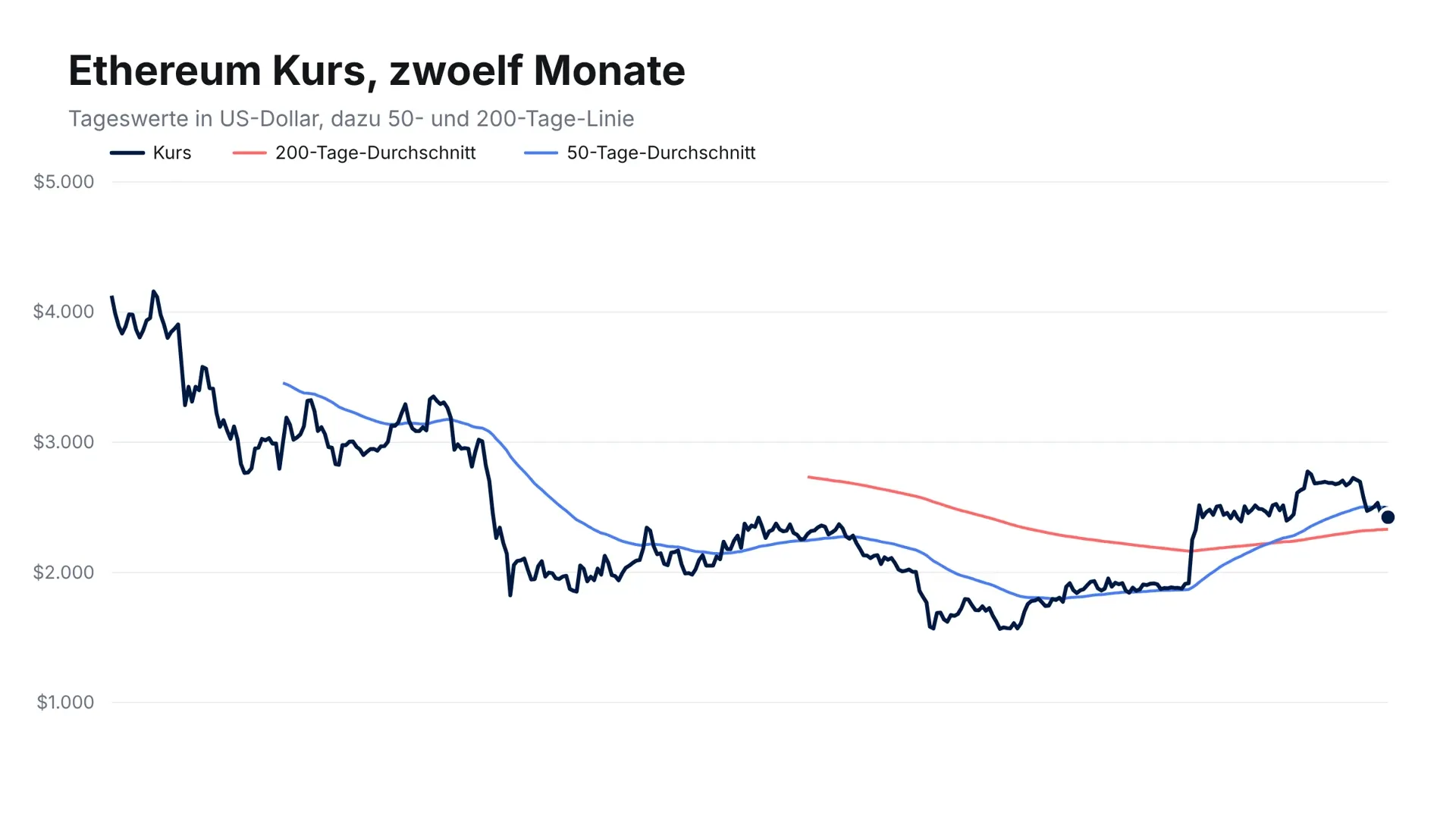
The 50-day line and the 200-day line: the Ethereum price sits in between
Two moving averages place the price. By our calculation the 50-day average sits at $2,497, the 200-day average at $2,331. A moving average is the mean of the past 50 or 200 daily closing prices; it smooths the daily swings and shows the direction of the longer move.
Today's price of $2,417 therefore sits below the short line and above the long one. For the coming days those are the two numbers from which it can be read whether today's slide stays a one-day move or becomes more. Should the price fall below $2,331, that would be the first close beneath the 200-day line in weeks. Should it climb back above $2,497, today will be smudged out of the chart.
Tuesday's deleveraging and what has happened to the Ethereum price since
On Tuesday we described in this space that open positions in the futures market had fallen by 16 percent within five days; the price stood at $2,534 at the time. That is set out in our analysis of the deleveraging of 13 October.
Two things have changed since. The price sits around $117 lower, and the $2,495 level, which on Monday still served as a turning point, has been breached. The deleveraging itself works in the other direction: fewer open positions mean fewer forced closures when things go down. Today's slide of a good four percent is therefore remarkably shallow for a data release of this size.
ETF inflows: $24.8 million on Tuesday
Beside the chart, the fund flows are worth a look, and right now they tell a different story from the price. Around $24.8 million net flowed into the American spot ETFs on Ether on Tuesday, according to market data. That is a small sum measured against the outflows of previous weeks, but it is a change of sign: in early October a single week showed $542 million of outflows on the books.
For investors in Germany these products are not directly accessible; comparable investments run here as ETNs or ETPs via the exchange. What works in Europe and what does not is covered in our overview of crypto ETFs and their European equivalents. The reason the American numbers count anyway: this data is the only daily published indicator of whether big money is flowing in or out.

28 October as the next date in the calendar for the Ethereum price
The Federal Reserve's next monetary policy meeting falls on 27 and 28 October 2026, with the decision published on the second day. The dates are in the official meeting calendar of the Federal Reserve. Until then, today's inflation figure is the most recent hard data point on which expectations rest.
In practice that means the market works with this one figure for two weeks. Anyone trading larger amounts in that time does better to reckon that 28 October will be a day of elevated swings, as this afternoon was.
Buying under MiCA: which exchanges are authorised in Germany
Since the European crypto regulation MiCA came into force, every provider addressing retail clients in Germany needs authorisation as a crypto asset service provider. Authorisation is the first check before any purchase: if the provider is in the register of BaFin or another European supervisor, the European rules on custody and client funds apply. If it is not there, they do not. Which houses hold the authorisation and what they charge for an Ethereum purchase is shown by our comparison of crypto exchanges for European investors.
The second point is custody. Ether sitting on an exchange belongs to you economically, but technically the exchange manages the keys. Anyone holding larger amounts and not trading them usually withdraws them to a wallet of their own.
Holding period and tax: what 31 December means for German investors
A price slide in Germany is also a tax question, and in both directions. Gains from selling Ether are tax-free under section 23 of the Income Tax Act if more than one year lies between purchase and sale. Within that year they are taxable as a private disposal transaction, with an exemption threshold of 1,000 euros per calendar year. Threshold means: if it is exceeded, the entire gain is taxable, not only the part above it.
That gives a concrete cut-off date. Losses from private disposal transactions can only be offset against gains of the same kind, and the calendar year ends on 31 December. Anyone who has realised gains within the one-year period this year and is currently sitting on loss positions has until then to bring both together in the same year. Anyone close to the end of the one-year period, by contrast, gives away the tax exemption with a sale now.
Which acquisition happened when can only be answered, with several purchases, from a clean record. The common tools for that are in our comparison of crypto tax software and portfolio trackers. These details place the legal position and replace no tax advice.
Staking: a 2.66 percent network yield and the question of the holding period
Stake your Ether, meaning put it to work securing the blockchain, and you receive a payment for it. The network most recently paid around 2.66 percent a year; at the providers, a good 2.2 percent arrives after fees. How the providers differ is broken down in our comparison of staking providers.
For tax purposes staking is to be viewed on its own: the running income is taxable as other income as soon as it is received. The one-year holding period for the staked Ether itself is untouched by that under the current view of the tax authorities.
Our assessment: the market is pushing back the rate turn, not the Ethereum story
In the editorial team's view today's move was a reaction to a tenth of a point, not to Ethereum itself. Three observations support that. First, the whole market fell with it: Bitcoin gave up around two percent the same afternoon, Solana a good four. Second, ETF flows have been slightly positive again since Tuesday, which argues against a flight out of Ether. Third, the level of leverage after last week's unwinding is lower than in the summer, and the daily loss still stayed in single digits.
Against it stands the fact that the $2,495 level has now been tested twice and breached on the third attempt. A level loses force the more often it is approached. As long as the market reckons with later rate cuts, the price lacks the fuel for the way back above the 50-day line at $2,497. This is an assessment of the situation and not a recommendation to buy or sell; crypto investments can lead to a total loss.
Ethereum at $2,417: without a rate turn the push above $2,500 is missing
Three things decide the price over the coming two weeks, and all three can be read off a single number.
- The $2,331 line. A daily close below it would be the first time in weeks that the price loses the long average line. If you want to buy, the authorised venues are among the authorised exchanges named above.
- 28 October. The Federal Reserve's rate decision is the next date that either confirms today's figure or devalues it.
- 31 December. The tax year ends, and with it the chance to offset gains and losses of the same year. The tools for that are in the tax software comparison.
(As of October 14, 2026. This article is not investment advice. Prices and fee structures change; check the terms with the provider before you buy.)
Decrypt
Sberbank now holds both custody and exchange status under Russia's new crypto law, and plans to bring Bitcoin, Ethereum and USDT to apps used by 110 million retail clients.
Solana's Alpenglow upgrade replaces the TowerBFT voting system on October 21, cutting finality from 12.8 seconds to a target of 150ms and pulling vote transactions out of blocks entirely.
The British bank won Dubai regulatory approval to let affluent clients buy BTC and ETH straight from their bank accounts, with custody and settlement kept in-house.
In a detailed technical post, the exchange argued Bitcoin’s multi-year migration to quantum-resistant cryptography must begin before any “Q-Day,” laying out requirements spanning block space, custody and dormant coins.
September CPI hit 3.7%, above forecasts, sending Treasury yields higher and dragging crypto down with stocks.
U.Today - IT, AI and Fintech Daily News for You Today
Ripple is making a major push into traditional finance through a new partnership with global brokerage infrastructure provider DriveWealth.
Phong Le, Strategy CEO, forecasts a historic surge in Bitcoin banking as AI agents and inflation push Wall Street integration to 34%.
Ancient Ethereum whale takes profits after selling nine-year-old Ether stash for $15.95 million, securing substantial gains.
Stellar taps Chainlink infrastructure to activate billions in dormant RWA reserves and challenge Ethereum in structural DeFi.
The latest setup comes amid a challenging stretch for SHIB, with its price dropping to trade below $0.000005.
Blockonomi
TLDR
- GlobalFoundries shares climbed approximately 4.5% after announcing a U.S.-Japan chip manufacturing agreement.
- Japan could provide up to $21 billion to finance two semiconductor factories in Malta, New York.
- The first facility targets operations in 2029, while funding for the second factory remains unconfirmed.
- Both factories could add a combined 1.8 million wafers in annual manufacturing capacity.
- The U.S. Commerce Department will receive approximately 4% equity in GlobalFoundries under a separate agreement.
GlobalFoundries (GFS) shares rose about 4.5% Wednesday after the chipmaker said Japan could provide up to $21 billion for two factories in Malta, New York. The Nasdaq-listed company will operate the plants under a U.S.-Japan agreement.
GLOBALFOUNDRIES Inc., GFS
GlobalFoundries shares rise after factory agreement
At 7:20 p.m. London time, GFS traded at $48.805, compared with Tuesday’s $46.70 close. The delayed quote was taken during Wednesday’s U.S. session, not at closing. GlobalFoundries trades on Nasdaq.
Japan will provide the funding, while GlobalFoundries supplies technology and manages production. The first plant would receive about $10 billion and begin operating in 2029. The company plans to begin construction later this year at its Malta site.
Another $10 billion could fund a second factory, but that funding remains unconfirmed. The $21 billion is a ceiling, not money already received. Meanwhile, Intel’s foundry business faces questions over losses and funding.
New factories target 1.8 million wafers annually
The first factory should add capacity for 900,000 wafers annually when fully running. A second plant would add the same amount, bringing combined potential to 1.8 million 300mm wafers. These silicon discs form the base for chips.
GlobalFoundries expects the project to support about 27,000 construction and related jobs, plus more than 1,000 manufacturing roles. Renesas CEO Hidetoshi Shibata said his company plans to use New York capacity as an extension of its production network.
The announcement comes during a mixed week for chipmakers. Applied Materials shares fell despite AI chip demand on October 13, while other semiconductor stocks moved sharply. GlobalFoundries says its new plants will serve automotive, industrial and connected technology customers.
U.S. takes equity as grants shift
A separate agreement gives the U.S. Commerce Department equity equal to about 4% of GlobalFoundries. The company will also redirect $955 million from a CHIPS Act award toward optical chips, silicon-germanium work and advanced chip packaging in New York and Vermont.
GlobalFoundries says those projects support data centers and communications equipment. The broader semiconductor market has faced uneven trading, including Micron shares falling after a Broadcom warning on October 13. Japan, rather than GlobalFoundries, provides the capital for the new factories.
GlobalFoundries shares remain below their July 10 closing price of $68.97, despite Wednesday’s gain. They have moved above their September 15 low close of $42.75. The company reported $6.791 billion in revenue for 2025, below the project’s funding ceiling.
The post GlobalFoundries (GFS) Shares Surge as U.S. Takes New Equity Stake appeared first on Blockonomi.
TLDR
- CoreWeave stock dropped approximately 16% on Wednesday as investors reviewed debt risks tied to AI infrastructure spending.
- CoreWeave’s bonds maturing in 2031 and 2032 yielded nearly 15%, reflecting falling bond prices.
- CoreWeave’s second-quarter net interest expense reached $640 million, more than double the previous year’s $267 million.
- Oracle, Nebius, and Dell shares also declined as concerns over AI borrowing spread across technology stocks.
- The IMF warned that an AI market correction could trigger tighter financial conditions as technology companies increase borrowing.
CoreWeave (CRWV) stock fell about 16% on Wednesday, October 14, as its bond yields approached 15%. The decline followed growing concern over debt used to finance artificial intelligence data centers. Several other AI-related stocks also came under pressure as investors reviewed the cost of expansion.
CoreWeave, Inc. Class A Common Stock, CRWV
CoreWeave Stock Falls as Bond Yields Climb
The company’s 9.625% bonds due in 2032 yielded 14.8% in Wednesday’s bond trading, CNBC reported. Its 9.75% notes due in 2031 yielded about 14.9%. Bond prices fall when yields rise.
Investor Chamath Palihapitiya said the 2032 bond yield reached 15% on Tuesday. He posted a chart on X. Elon Musk responded with the word “yikes,” according to CNBC.
Wednesday’s inflation report added another concern for borrowers. A recent report showed October Federal Reserve rate hike expectations rising after U.S. annual inflation reached 3.7% in September.
Debt Payments Draw Investor Attention
CoreWeave reported $640 million in net interest expense during the second quarter. That compared with $267 million in the same period last year. The increase added to questions about future debt payments.
During the quarter, CoreWeave raised more than $10 billion through unsecured debt and convertible bonds. It also secured a $3.1 billion term loan. These funds supported its expansion of AI computing capacity.
JPMorgan estimates large cloud providers will spend $800 billion on AI infrastructure this year and more than $1 trillion annually by 2027. Separately, 42 AI stocks drove 67% of S&P 500 price returns since early 2024, a recent analysis found.
Wider AI Selloff Reaches Other Stocks
Oracle shares fell nearly 7%, Nebius lost about 9%, and Dell dropped 10% during Wednesday’s selloff. The Nasdaq Composite also declined 1.4%. Oracle’s 6.25% bonds due in November 2032 yielded 7.24%.
Luis Alvarado of Wells Fargo Investment Institute told CNBC investors now demand higher returns for taking AI-related lending risks. Freedom Capital Markets analyst Paul Meeks said concerns over CoreWeave’s ability to pay its debts were unwarranted.
Other technology shares had already weakened. On Tuesday, Applied Materials stock fell more than 8% despite continued demand for AI chips and plans to increase manufacturing capacity.
The International Monetary Fund warned Tuesday that an AI market correction could tighten global financial conditions. It said large cloud providers now account for 10% of global investment-grade bond issuance, up from less than 1% in 2024. CoreWeave expects its next quarterly results in November.
The post CoreWeave (CRVW) Stock Falls as AI Borrowing Faces New Test appeared first on Blockonomi.
TLDR
-
Wolfspeed stock dropped 16% to $23.99, reaching an intraday low of $23.94.
-
The proposed $1.5 billion defense loan remains conditional, with no confirmed funding date.
-
Government warrants could cover up to 7.5% of Wolfspeed’s fully diluted equity.
-
Wolfspeed registered 58.15 million shares for potential resale, while quarterly revenue declined 24.1%.
-
A broader technology selloff added pressure as analysts maintained a Hold consensus and $25 average target.
Wolfspeed (WOLF) stock fell 16% to $23.99 Wednesday afternoon, reversing gains from last week’s defense financing announcement. Shares briefly touched $23.94 amid a broader technology selloff. The decline followed scrutiny of the chipmaker’s funding terms and weak financial results.
Wolfspeed Inc., WOLF
Wolfspeed Stock Reverses After Loan Announcement
On October 7, Wolfspeed announced a conditional commitment for a $1.5 billion loan from the U.S. Department of War. The proposed financing would run for 30 years and support U.S. production of silicon carbide power devices.
The company plans to upgrade gallium nitride production and develop radiation-resistant chips for defense uses. Meanwhile, Navitas introduced new NVIDIA-linked power technology this week for AI data centers.
The commitment does not guarantee payment. Wolfspeed must complete due diligence, reach final agreements, secure approvals and meet other conditions. No funding is assured.
Resale Filing and Warrants Raise Share Questions
Share sales are another issue for investors. A September Securities and Exchange Commission prospectus registered up to 58.15 million shares for possible resale by existing holders. Registration does not mean those shares have been sold.
Some registered shares relate to convertible debt and existing warrants, which can increase the share count when exercised or converted. Wolfspeed would also grant the government warrants covering up to 7.5% of its fully diluted equity if funding goes ahead. Broadcom’s recent valuation concerns offer another example of investors reviewing chip-sector financing risks.
Analysts remain guarded on Wolfspeed stock. MarketBeat data show a Hold consensus and a $25 average price target. In August, the company reported quarterly revenue of $149.6 million, down 24.1% from a year earlier, with a negative 25% gross margin.
Market Selloff Adds to Chipmaker Pressure
Wolfspeed’s decline came during a wider U.S. stock selloff on October 14. The Nasdaq dropped around 2%, while the S&P 500 lost about 1.3% during the session. Higher inflation data increased concerns about another Federal Reserve rate increase.
Chipmakers faced additional pressure amid questions about spending on artificial intelligence infrastructure. Micron shares faced fresh pressure earlier this week as investors assessed competition and future demand. Wolfspeed traded below its 200-day moving average, reflecting an extended decline from earlier prices.
Wolfspeed stock remained far below its 52-week high of $80.82. The company has not announced a final loan agreement or funding date. Its next financial report will give shareholders another update on revenue, factory costs, and cash needs.
The post Wolfspeed (WOLF) Stock Sinks Despite $1.5B Defense Loan Deal appeared first on Blockonomi.
TLDR:
- Polymarket’s October rate hike odds rose about 25 percentage points to 43%, while unchanged rates held 57%.
- U.S. CPI inflation climbed to 3.7% in September, exceeding the 3.6% forecast and August’s 3.4% reading.
- Core CPI gained 0.3% monthly and 2.6% annually, both exceeding forecasts of 0.2% and 2.5%, respectively.
- September PPI arrives October 15; the October 27–28 Fed decision comes before September PCE on October 29.
An inflation miss of just 0.1 percentage point triggered a much larger market repricing on October 14, lifting October rate-hike odds to 43%. September’s consumer price report delivered the catalyst, with annual U.S. CPI inflation reaching 3.7% against a 3.6% forecast. That comparison became a focal point for markets assessing whether inflation progress had stalled before the interest rate decision.
On Polymarket, the probability of a 25-basis-point increase climbed approximately 25 percentage points during Wednesday’s trading. However, unchanged rates retained a 57% probability ahead of the October 27–28 policy meeting. The figures captured a rapid shift in expectations without making another increase the favored outcome.
The report also showed core inflation running above forecasts, placing attention on price pressures beyond gasoline. The difference matters as energy-driven increases and broader inflation carry distinct implications for the central bank’s 2% inflation objective.
September CPI Hits 3.7% as Core Inflation Exceeds Forecasts
Headline prices increased 0.6% in September, accelerating from August’s 0.4% monthly gain. Similarly, gasoline costs jumped 9.1% and accounted for more than half the increase. Meanwhile, the broader energy index climbed 5.2%, explaining much of the immediate pressure on household budgets. That left other categories contributing to a report dominated, but not defined, by energy.
Yet the increase extended into other spending categories. Shelter prices rose 0.4%, alongside higher prices for used vehicles, airline fares, medical care, and apparel. Those movements showed that inflation was not confined to fuel. These increases showed price pressure outside energy, an important distinction when interpreting the core inflation figures.
Core consumer prices, excluding food and energy, advanced 0.3% monthly, above the expected 0.2%. Annual core inflation reached 2.6%, compared with forecasts of 2.5% and August’s 2.4%. Both annual inflation readings remained above the central bank’s target.
CME Hike Odds Reach 43.7% Ahead of PPI and October Meeting
The Fed had already increased its benchmark rate by 25 basis points to 3.75%–4.00% on September 16. Meeting minutes showed most policymakers considered another increase appropriate before year-end, while keeping decisions dependent on incoming economic data.
The shift was visible beyond Polymarket. CME FedWatch put the likelihood of an October increase at 43.7%, up from 22.1% before the inflation release. That represented a 21.6-percentage-point increase in expectations. Two-year Treasury yields climbed, the dollar strengthened, and U.S. equities declined as financial markets reacted.
Higher borrowing costs also affect liquidity conditions surrounding Bitcoin and Ethereum, although the inflation report provided no cryptocurrency price figures. Attention now turns to September’s Producer Price Index on October 15. September Personal Consumption Expenditures data are also scheduled for October 29, one day after the policy meeting concludes. For now, unchanged rates remain the leading October outcome.
The post October Fed Rate Hike Odds Surge to 43% as U.S. CPI Inflation Hits 3.7% appeared first on Blockonomi.
TLDR:
- Polygon completed its Coinme acquisition on October 14, extending its payments reach across 48 U.S. states.
- The acquired business operates with 37 state money transmitter licenses and 11 applicable exemptions.
- Coinme brings more than 1 million app users and access to roughly 50,000 U.S. retail locations to Polygon.
- Tazapay, Mesh, Toku and Kira are integrating services, but associated payment volumes remain undisclosed.
Polygon Labs completed its acquisition of Coinme on October 14, giving its U.S. payments operation regulated money-transfer infrastructure across 48 states. The deal extends its role beyond blockchain transactions into services connecting bank accounts, cash channels and stablecoins.
That footprint includes 37 state money transmitter licenses and 11 applicable exemptions. The acquired business is also registered with FinCEN as a money services business. However, federal registration is not an operating license, and specific payment services remain subject to state requirements.
The expansion addresses a practical gap in digital-dollar payments. Blockchain transfers alone do not handle every stage of customer funding or bank withdrawals. The transaction now places fiat access alongside wallets and settlement within a single payments framework. That distinction matters for companies sending funds across national borders, where recipients often require access to familiar, established local payment networks.
Polygon Adds Licensed Payment Infrastructure Through Coinme
Polygon first disclosed agreements to acquire Coinme and wallet provider Sequence in January. Together, the transactions were valued above $250 million, although no standalone price was disclosed for the payments acquisition.
Founded in 2014, Coinme developed digital-asset buying and selling channels through retail cash outlets, debit cards and banking connections. Before the deal, it had more than one million app users and access to roughly 50,000 U.S. retail locations.
These services fit into Open Money Stack, which combines customer deposits, stablecoin conversions, digital wallets, transaction routing and blockchain settlement. Businesses can receive funds, convert them into digital dollars and arrange local-currency payouts through one integration.
The arrangement connects regulated entry and exit points with token transfers, resolving a practical limitation of blockchain-only payment systems. That reach matters most when the payer and recipient rely on different payment methods or banking systems.
Four Payment Firms Join Polygon’s Stablecoin Payment Stack
Four initial customers cover cross-border payments, funding, payroll and banking. Tazapay serves over 1,000 clients across 30-plus countries. Its stablecoin services operate through a registered Canadian entity.
It is using wallet and conversion infrastructure to connect stablecoins with local payment networks. Meanwhile, Mesh is integrating fiat funding into its network of more than 300 wallets, exchanges and financial companies. The service adds a funding route.
Among the first customers adopting Polygon Open Money Stack:
Tazapay: cross-border business payments
See the full announcement: https://t.co/MXEsssJDt9
— Polygon (@0xPolygon) October 14, 2026
Toku is incorporating wallet and payout functions into payroll operations across more than 100 countries, allowing stablecoin earnings to be converted into local currency. Kira is expanding stablecoin options alongside U.S. bank accounts, ACH, Fedwire, FedNow and international transfers.
Although Open Money Stack is operating, its unified integration remains in technical preview for selected customers, according to independent reporting. Related transaction volumes, revenues and processing fees for the four integrations have not been publicly disclosed.
The post Polygon Completes Coinme Acquisition, Gains Payments Reach Across 48 U.S. States appeared first on Blockonomi.
CryptoPotato
The world’s leading cryptocurrency exchange announced it will end all services for two digital assets. The actual delisting is scheduled for October 28, but the news has already negatively affected the involved coins.
Additionally, Binance will briefly suspend key operations on the Ethereum (ETH) network to perform wallet maintenance.
The Delisting
The company said it regularly evaluates each listed cryptocurrency to determine whether it continues to meet rigorous criteria and industry standards.
“When a coin or token no longer meets these standards or the industry landscape changes, we conduct a more in-depth review and potentially delist it. Our priority is to ensure the best services and protections for our users while continuing to adapt to evolving market dynamics,” it explained.
Key factors Binance considers include trading volume, adequate liquidity, the team’s commitment to the project, network security against attacks, development activity, and more. Following its latest review, it decided to terminate all services for Epic Chain (EPIC) and QuickSwap (QUICK).
The company will delist the assets from its Copy Trading section on October 21 and remove all spot trading services a week later. After October 29, deposits of these tokens will not be credited to users’ accounts, while withdrawals will be supported until December 28.
Such announcements usually negatively impact the price of the involved cryptocurrencies. After all, Binance remains the largest crypto exchange, and withdrawing support can damage the assets’ reputation, reduce their liquidity, and limit their availability. That said, it is no wonder EPIC plunged 15% in a single day, while QUICK slipped 22%.

Something similar happened in August this year. Back then, Binance delisted Across Protocol (ACX), Hashflow (HFT), PIVX (PIVX), Vulcan Forged PYR (PYR), Vanar (VANRY), and Viction (VIC), triggering double-digit price declines for the affected tokens.
The Upcoming Disruption
In a separate announcement, Binance revealed that it will perform wallet maintenance for the Ethereum (ETH) network on October 15. To support the process, the exchange will temporarily suspend deposits and withdrawals on that specific blockchain.
The maintenance is expected to take about one hour, after which operations should be resumed. Binance clarified that token trading on the network will not be affected and promised to handle all technical requirements for users.
The company has carried out similar procedures multiple times in recent months, with no reports of major issues.
The post These Altcoins Plunge Hard After Binance Says Goodbye: Details appeared first on CryptoPotato.
Coinbase, the custodian holding about 5% of all BTC, published a technical blog on October 13 outlining what it wants from Bitcoin’s move to quantum-resistant security.
Its central point is that choosing a new digital signature scheme is only one piece of the job, since any plan also has to fit Bitcoin’s scarce block space and work for custodians and everyday wallets.
Work to Begin Before Quantum Threat Is Certain
In the blog post, the exchange said it is already preparing its own systems, convening talks with Bitcoin developers and backing open-source work through the Bitcoin Security Consortium.
The company pointed to P2MR, proposed in BIP-360, and P2TRv2 as possible output designs that could accommodate future post-quantum signature systems without requiring a complete redesign each time the cryptography changes.
It also proposed evaluating hybrid arrangements in which a wallet could spend funds through either a conventional ECDSA/Schnorr signature or a post-quantum key during the transition.
Coinbase raised particular concerns about stateful post-quantum signatures. Although these schemes can be smaller and faster than stateless alternatives, reusing signing state can make forgery possible. The company warned that recovering from failed updates or lost state could be difficult for exchanges running multiple signing servers, as well as individuals managing their own wallets.
Its suggested evaluation criteria include signature size, verification speed, transaction fees, full-node workload, hardware wallet compatibility, and multi-party computation, or MPC, which allows parties to produce signatures without relying on one complete private key held in a single place. Coinbase also named ML-DSA, the prospective FN-DSA standard, and SHRINCS as candidates for assessment.
Freeze Proposals and Exposure Estimates Frame the Debate
Wallets that migrate late are the last open item. If Bitcoin eventually limits or ends ECDSA and Schnorr spending, Coinbase wondered whether and how those users could move funds afterward.
The issue is already being considered, with BIP-361, fronted by Jameson Lopp and five other developers, proposing to first restrict sending to quantum-vulnerable addresses and later stop old-style signatures from spending, with an unconfirmed third phase that might let people recover funds after a missed deadline.
The plan has drawn objections that protocol-level freezes cut against censorship resistance and self-responsibility for funds. But in April, BitMEX Research floated a “canary” alternative, where a freeze would trigger only if funds leave a special address whose private key nobody knows, since such a spend would prove a quantum computer exists.
The post Coinbase Lays Out Post-Quantum Needs for Bitcoin Custody appeared first on CryptoPotato.
Amid weakening demand for Bitcoin and Ethereum exchange-traded funds, US-listed SUI ETFs are moving in the opposite direction.
The funds have recorded five consecutive weeks of inflows.
Fresh Catalysts
The funds have accumulated around 14 million SUI during that period. Several developments are adding to the momentum, according to the latest findings by Ali Martinez. These include AI agent payments, mobile USDC, Bitcoin finance, and cross-chain transfers, which are strengthening the network’s outlook.
With these catalysts gaining attention, the analyst said that “SUI appears to be preparing for its next leg higher.” This week, the SuperTrend indicator also flashed a buy signal on its 4-hour chart. The last time a similar signal appeared, SUI rallied over 77%.
Last week had a lot going on for Sui. One of the biggest highlights came at Basecamp, where the network reportedly handled over 40 million transactions per second during a live stress test, which is more than six times its previous record. The test simulated AI-agent activity using over 10,000 programmable tunnels, with transactions settled on Sui.
Sui also announced a collaboration with Alibaba Cloud to bring cloud and AI inference services into its Agent Payments system. This could allow AI agents to pay for services using stablecoins within set spending limits. Another development involves Samsung Wallet. Sui is being integrated into its USDC offering, which targets 82 million eligible Galaxy devices in the United States. The integration will support stablecoin transfers without gas fees.
Meanwhile, Sui’s Bitcoin finance project, Hashi, is preparing for a phased mainnet rollout this month. It has secured over $500 million in capital commitments, attracted more than 20 participating institutions, and named Anchorage Digital as a launch partner. Circle’s Cross-Chain Transfer Protocol V2 has also launched on Sui. This allows native USDC to move between Sui and 29 other supported blockchains, opening more options for payments and DeFi.
In yet another milestone, the network surpassed 5 billion total transactions. According to BSCN, the figure now stands at around 5.02 billion, putting it ahead of many major Layer 1 networks.
Outages
While the network has reported 100% uptime over the past 30 days, it did face a few major setbacks earlier this year. In May, for instance, Sui suffered three major outages within 48 hours, resulting in more than 15 hours of downtime.
Prior to that, a consensus bug halted block production and transaction processing for around five hours and 52 minutes in January. Validators eventually restored normal operations.
The post SUI Demand Explodes as US ETFs Rack Up Five Straight Weeks of Inflows appeared first on CryptoPotato.
Artificial Intelligence (AI) has emerged as one of the most popular and widely adopted technologies in recent years, and cryptocurrencies in that niche now have a combined market capitalization of nearly $25 billion.
Well-known altcoins in that sector include Bittensor (TAO), Internet Computer (ICP), and NEAR Protocol (NEAR). See which of these could post the most substantial price gains in the final quarter of 2026 (according to three AI-powered chatbots).
Those in Favor of NEAR
ChatGPT picked NEAR because it has several potential Q4 catalysts aligning together. First, the platform highlighted growing token usage and rising trading volume. Then, it moved to the new collaborations of the project, noting the integration of Robinhood Chain into near.com and its NEAR Intents cross-chain trading layer.
The chatbot also outlined that the cryptocurrency combines confidential AI, privacy, and cross-chain finance, positioning it for a strong rally in an eventual bull run and giving it an edge over competitors. Last but not least, it mentioned the launch of the first US spot NEAR ETF. The product saw the light of day toward the end of September and was introduced by Bitwise. The investment vehicle has generated a cumulative net inflow of almost $80 million so far, after a solid debut day and less impressive performance in the following weeks.

Perplexity shared ChatGPT’s thesis. It said NEAR has the strongest combination of an AI-agent narrative, concrete Q4 roadmap milestones, greater liquidity, and a less crowded valuation than TAO.
“TAO could outperform if its demand-based emission reforms and subnet activity accelerate sharply. ICP looks like the laggard of the three unless its inflation-reduction and enterprise/AI adoption story becomes more tangible,” it added.
At the same time, Perplexity reminded that NEAR has posted a 110% monthly price increase, raising the risk of a sharp correction. As of this writing, the asset trades around $4.95 (per CoinGecko), and the chatbot sees $6 as a major psychological and technical barrier.
“NEAR got rejected there, and analysts identify a weekly close above roughly $6 as the confirmation needed for a broader continuation; until that happens, the market is in a conservative or consolidation phase rather than a confirmed breakout,” it concluded.
Gemini Doesn’t Agree
Google’s chatbot didn’t align with the predictions above and picked Bittensor (TAO). It argued that it functions as a high-beta asset, which tends to deliver sharper percentage gains during bull markets.
According to Gemini, TAO holds a “distinct advantage” in institutional access, with Grayscale’s Bittensor Trust and certain European ETPs giving traditional capital a direct route into the asset’s ecosystem.
As of this writing, the token is worth just over $270, up 16% in the last month. Gemini said the most realistic bullish target for TAO in Q4 is a retest of the $350-$450 range, warning that such a rise would depend heavily on Bitcoin’s performance.
The post TAO vs. ICP vs. NEAR: Which AI-Related Altcoin Will Perform the Best in Q4? (3 AIs Speculate) appeared first on CryptoPotato.
XRP whale activity on Binance is picking up pace, at least compared with the rest of the exchange market.
CryptoQuant’s latest data revealed a sharp jump in the gap between whale and retail outflows over the past six days.
Whale Activity
From October 7 to 13, Binance’s seven-day average Whale vs Retail Spread rose from 53% to 63.5%. This is a 10.5-point jump. Across all centralized exchanges, the same reading increased from 46% to 47.7%, a much smaller 1.7-point rise. Binance’s increase was roughly 6.2 times larger. The spread tracks the relative difference between large and small XRP exchange outflows. A higher reading indicates that larger transfers are playing a bigger role.
However, it does not confirm that whales are accumulating XRP or withdrawing more coins in absolute terms.
The gap between Binance and the broader market now stands at 15.8 points. That puts it close to the 18-point difference seen on August 3. Back then, the crypto asset traded near $1.07 before climbing about 46% to $1.56. XRP is currently hovering around $1.38.
CryptoPotato had previously reported that spot volume across centralized exchanges fell by $1.943 billion between August 26 and October 11. On Binance, the spot-to-futures ratio slid from 31% to 12.7%, meaning futures activity now dwarfs spot trading. CryptoQuant explained that some traders could be waiting for a cheaper entry.
XRP sentiment, meanwhile, has slipped into negative territory as bullish comments trailed bearish ones at a ratio of 0.92 across social platforms. This growing pessimism could leave room for a rebound if market conditions improve and buying interest returns.
Despite the short-term struggle, a German analyst believes XRP could still hit a new all-time high before the year ends. He flagged that the crypto asset has tested a key resistance zone seven times but failed to break above it convincingly. That rejection sent XRP briefly back toward $1.29. The next major hurdle now stands at the $2.15-$2.20 range.
Institutional Demand Paused?
The institutional side of things looks less encouraging. Data compiled by SoSoValue revealed that US-listed spot XRP ETFs have recorded zero net flows for three consecutive days. October has seen just three days of inflows and one day of outflows so far, with total inflows sitting a little above $12 million.
While the monthly figure remains positive, the recent lack of fresh money shows that institutional interest has been fairly muted.
The post XRP Whales Are Making a Bigger Mark on Binance as Outflow Gap Nears August Levels appeared first on CryptoPotato.