Cryptocurrency Posts
Crypto Briefing
The decline in developer traffic may challenge OpenAI and Anthropic's market positions, affecting future competitiveness and industry perception.
The post OpenAI, Anthropic face declining developer traffic despite model improvements appeared first on Crypto Briefing.
The integration of embedded XRPL wallets could significantly enhance app usability, streamline crypto transactions, and boost AI-driven payments.
The post Ripple and Privy bring embedded XRPL wallets to app developers appeared first on Crypto Briefing.
The shift towards in-house solutions and cheaper alternatives may reshape AI development dynamics, impacting future innovation and market competition.
The post OpenAI and Anthropic face cooling developer traffic as models get smarter appeared first on Crypto Briefing.
Ledger's policy review highlights the critical need for robust supply chain security to protect consumer trust and prevent financial losses.
The post Ledger reviews device sales policies after $90 million spyware theft appeared first on Crypto Briefing.
Injective's partnership with Gulf Labs could significantly enhance its presence in Asia, potentially transforming Thai financial sectors.
The post Injective adds Thai conglomerate arm Gulf Labs as institutional validator appeared first on Crypto Briefing.
Bitcoin Magazine
Bitcoin Magazine
Trezor Reduces Number of Resellers Following Ledger Drainage Incident
Hardware manufacturer Trezor has said it has reduced the number of resellers it works with following supply-chain incidents related to its competitor Ledger.
The Prague, Czech Republic-based company added in a Tuesday post on X that it was in the process of checking which vendors it works with.
It added that there were no reports of any issues with Trezor devices. “Let us be very clear: there is not a single piece of evidence that Trezor devices have been compromised,” the company wrote.
“This is a preventive step, taken out of an abundance of caution.”
Signing device manufacturer Ledger last week said it had started an investigation after customers in South East Asia reported they’d lost funds after buying from Malaysia-based reseller, CryptoBilis.
Ledger then said that one of the impacted users’ devices contained an unauthorized hardware implant.
More reports of what appear to be tampered devices have since surfaced on social media but Ledger said Tuesday that only devices sold through CryptoBilis have been linked to lost funds.
It added that it had only confirmed an unauthorized hardware implant in one affected user’s device. The implant, according to Ledger, was able to read a seedphrase when it appeared on the device.
Ledger did not reveal how much money had been lost but blockchain investigator Specter said $86 million had been drained from devices.
“We have not confirmed the total number of affected users or the total value lost,” Ledger added on X. “Figures circulating online come from third parties and Ledger has not fully verified them.”
Ledger did not respond to Bitcoin Magazine’s questions.
CryptoBilis has also stopped selling devices, Ledger added, and advised customers who bought from CryptoBilis to not set up their devices and contact the Ledger support team.
Criminals have been targeting hardware wallets this year. Hackers in July were able to steal close to $120 million in bitcoin from Coldcard users due to a firmware bug in the devices.
Canadian company Coinkite, which makes the popular products, said that the bug led to faulty seed generation, allowing hackers to guess investor seedphrases.
In a separate incident, hardware wallet manufacturer Trezor last month reported that close to 81,000 customers had their details leaked after its third-party fulfillment partner had data stolen.
Scammers earlier this year were able to get hold of customer information via crypto wallet Ledger’s payment processor Global-e to send phishing emails.
This post Trezor Reduces Number of Resellers Following Ledger Drainage Incident first appeared on Bitcoin Magazine and is written by Mathew Di Salvo.
Bitcoin Magazine
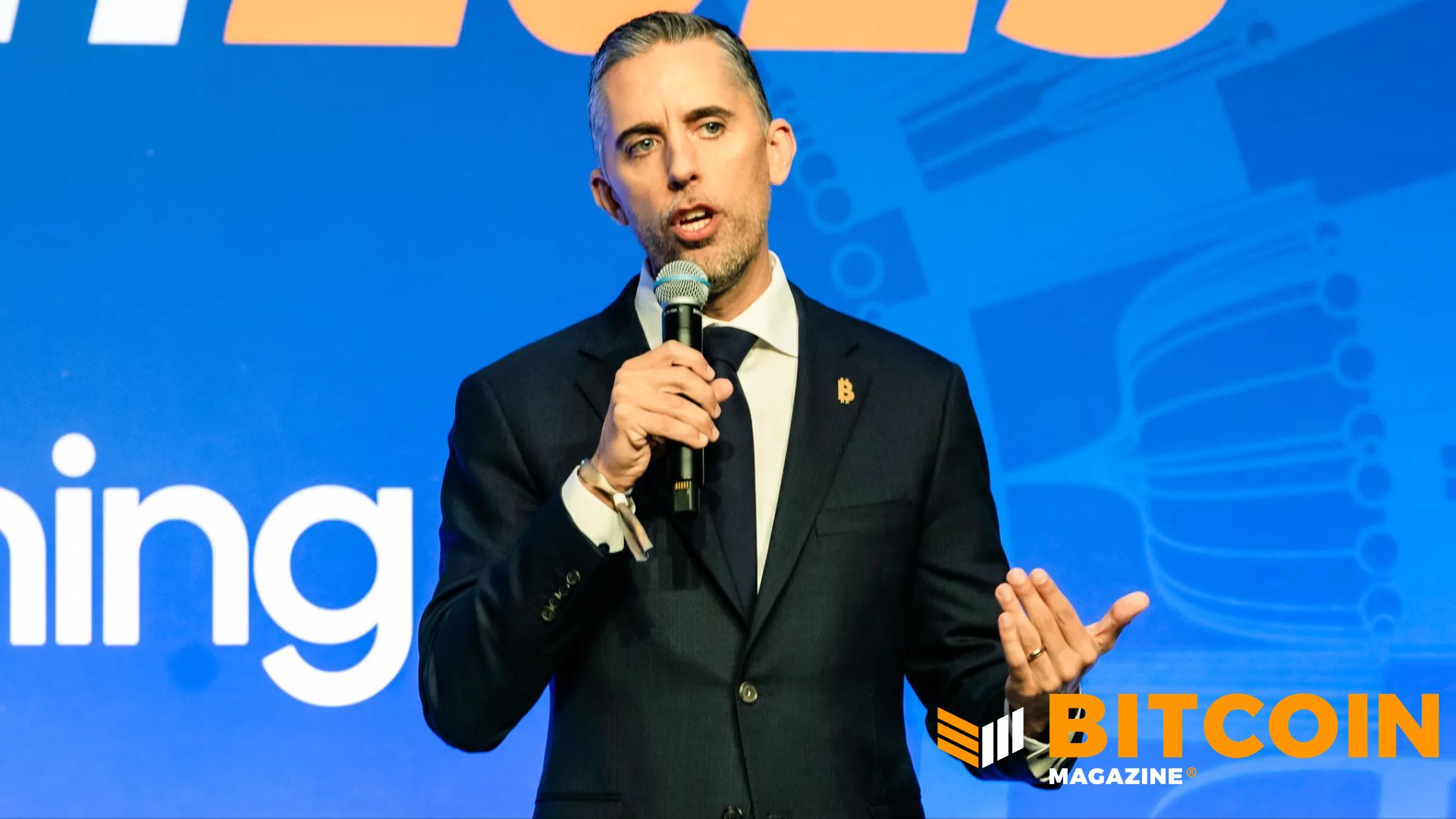
Strive Buys More Bitcoin, Crosses 30,000 BTC Mark
Nasdaq-listed Strive isn’t slowing down with its bitcoin buys.
The company now has more than 30,000 BTC after buying 3,311 coins last week, according to a Tuesday filing.
Strive now holds 32,773 coins worth $2.7 billion at today’s prices, keeping its position as the fifth biggest publicly traded bitcoin company, according to Bitcoin Treasuries.
Strategy, Twenty One, Metaplanet, and MARA all hold more bitcoin than Strive.
BREAKING:
— Bitcoin Magazine (@BitcoinMagazine) October 13, 2026Public company Strive purchases 3,311 Bitcoin worth $275 million!
This brings their total to 32,773 BTCpic.twitter.com/oNguyCU24N

Strive’s stock (ASST) was trading slightly lower on Tuesday. Unlike other treasuries, though, Strive shares are up significantly this year: year-to-date, ASST has risen by close to 60%.
A number of top bitcoin treasuries have seen their stock plummet this year since the price of bitcoin took a hit. Some top treasuries have had to sell bitcoin or rethink their model altogether.
Dallas, Texas-based Strive debuted as an official bitcoin treasury last year, following in the footsteps of software company Strategy, the biggest corporate holder of bitcoin.
Unlike Strategy, though, Strive hasn’t used debt to buy the cryptocurrency. CEO Matt Cole has described the company as debt-free with zero margin requirements and zero encumbered bitcoin.
Like with other digital asset treasuries, the idea is that investors can get amplified returns from Strive’s stock.
In January 2026, it completed the acquisition of Semler Scientific in an all-stock deal — the first instance of a publicly traded Bitcoin treasury company acquiring another such company.
The company was founded by former Ohio gubernatorial candidate and tech entrepreneur Vivek Ramaswamy.
This post Strive Buys More Bitcoin, Crosses 30,000 BTC Mark first appeared on Bitcoin Magazine and is written by Mathew Di Salvo.
Bitcoin Magazine
Alex Gladstein: How The Bitcoin-AI Convergence Impacts the Fight for Freedom
Is the biggest AI risk really the end of humanity? Alex Gladstein says no: the real danger is AI centralized in the hands of dictators, governments, and a few large corporations. In this interview, the HRF Chief Strategy Officer explains why “AI will kill us all” claims are largely propaganda, and why local AI on your own laptop and phone could be a huge win for human rights. Tune in to hear his vision for AI that’s in our control.
Chapters:
0:00 – Alex Gladstein on Freedom AI vs. Corporate AI
1:26 – How HRF Trains Human Rights Activists to Use AI
2:57 – The Freedom Stack: Encrypted Inference, Open Weights and Local AI
5:45 – The Real AI Risk: Centralization in the Hands of Dictators
8:20 – HRF and Bitcoin Park Hackathons for Activists
9:57 – Why CBDCs Are a Tool of Repression
12:35 – Living on Bitcoin in Kenya With Tando and M-Pesa
15:25 – Building Your Own Freedom Tech With AI Agents
17:39 – Venezuela After Maduro and Bitcoin as a Lifeline
20:25 – What “Freedom Money” Really Means
DISCLAIMER: The views and opinions expressed in this show are those of the participants and do not necessarily reflect the official policy or position of BTC Inc., Bitcoin Magazine, or any affiliated entities. This content is provided for informational and educational purposes only and should not be construed as investment, legal, tax, or accounting advice. Nothing contained in this show constitutes a solicitation, recommendation, endorsement, or offer to buy or sell any securities or financial instruments. Viewers should consult their own advisors before making financial or business decisions.
This post Alex Gladstein: How The Bitcoin-AI Convergence Impacts the Fight for Freedom first appeared on Bitcoin Magazine and is written by Patrick Green.
Bitcoin Magazine

Matt Dines: Why a Rising Dollar is Bullish for Bitcoin
The dollar is rising, and so is Bitcoin. Matt Dines says that’s a bullish signal. The Build Asset Management CIO explains how capital is leaving the old post-World War II offshore dollar system for a new U.S.-led Western Hemisphere financial system. He makes the case that Bitcoin is part of that system’s future, and covers what the DXY is really telling investors right now.
Chapters:
0:00 – Matt Dines on France’s Bond Crisis and the ECB’s Pontes CBDC Bridge
2:11 – How the Strait of Hormuz Disruption Rewired Global Trade
3:22 – French-German Spreads and European Contagion Risk
4:23 – Bank of England’s Digital Gilt and Tokenized Sovereign Debt
5:54 – Why Dollar Up, Bitcoin Up Is a Bullish Signal
7:47 – Signals to Watch Before Pressure Hits Bitcoin
10:25 – Treasury Buybacks and the Coming Bond Market Repricing
12:50 – Why Treasury Is Buying Back Old, Illiquid Bonds
14:28 – How Buybacks Pull Capital Into the Dollar and Bitcoin
15:40 – Why the Buybacks Aren’t QE and What It Means for Bitcoin
DISCLAIMER: The views and opinions expressed in this show are those of the participants and do not necessarily reflect the official policy or position of BTC Inc., Bitcoin Magazine, or any affiliated entities. This content is provided for informational and educational purposes only and should not be construed as investment, legal, tax, or accounting advice. Nothing contained in this show constitutes a solicitation, recommendation, endorsement, or offer to buy or sell any securities or financial instruments. Viewers should consult their own advisors before making financial or business decisions.
This post Matt Dines: Why a Rising Dollar is Bullish for Bitcoin first appeared on Bitcoin Magazine and is written by Patrick Green.
Bitcoin Magazine

Now Accepting Bitcoin: Moonflower Coffee and 300+ Colorado Bitcoin Merchants
Table of Contents
Exploring the growing network of Colorado Bitcoin merchants was an eye-opening trip that showed me both the immense promise and the friction points of real-world adoption in the Mile High State. Flying into Colorado, I was excited to experience the fall mountains, see my old friends, and dive into the local Bitcoin scene.
First Up: Moonflower Coffee Setup
The first stop on my list was Moonflower Coffee. Pulling up, I thought I had mistaken it for an auto-mechanic (FYI there’s a giant oil change sign and two bay garage look). Built inside a beautifully repurposed old auto body shop, Moonflower nails the ambiance: great coffee, a fantastic local vibe, and a spacious lounge area .
Like many modern registers, their Square terminal had native Bitcoin settings toggled on from the encouragement of local bitcoiners. Instead of selecting the “Pay with Bitcoin” option myself, I asked the barista to enable it on her side. That led to a nice 30-second conversation about Bitcoin before I enjoyed my Black Sesame Mocha Latte.
Another great option is Butcher Block Cafe, 3700 Franklin Street Denver 80205. They had a great breakfast and a classic diner feel, but be sure to go to this location. Apparently it’s family-run and their other location does not accept bitcoin… yet!
The Friction: Fifth House Coffee
The contrast between Moonflower Coffee and Fifth House highlighted just how uneven adoption remains.
Fifth House Coffee has a one screen Square register that doesn’t face the customer, so I couldn’t even select BTC on my own if I tried. When I asked if they accepted Bitcoin, the owner stated firmly that it was his shop and he would not take it. It was on the BTC Map, and has a Square register where the bitcoin acceptance feature likely was updated automatically in the background. I had to walk out without ordering. I still recommend to go stop by and ask about bitcoin.
Bitcoiners Can Lose
Reflecting on my time with Colorado Bitcoin Merchants, it forced a critical realization about where real-world adoption is heading. Some people may reject bitcoin on the surface and it’s up to us to dig deeper. We have a window before legacy banking rails step in to capture and monetize this infrastructure. If Bitcoiners want an open source, hard money world, we have the responsibility to create hyperbitcoinization.
Have a Story or a Local Merchant to Feature?
As always, a growing directory of over 300 verified Bitcoin-accepting merchants across Colorado is listed below. If you want your business added to the list, or if you have a new city and story to feature in an upcoming column, write directly to vagabond@b.tc.
Appendix: 300 Colorado Bitcoin Merchants
Cafes & Coffee Shops
- B’s Coffee — 257, Johnstown Center Drive, Johnstown, CO, 80534
- Bestslope Coffee — 129, North Peach Street, Fruita, CO, 81521
- Cinchona Coffee — 2, South Wahsatch Avenue, Colorado Springs, CO, 80903-3618
- Coffee Depot — 505, South Main Street, Breckenridge, CO, 80424-8744
- Coffee House 29 — 1039, Main Street, Windsor, CO, 80550
- Collbran Cafe — 108, Main Street, Collbran, CO, 81624
- Colorado Girl Coffee — 620, Clinton Street, Ridgway, CO, 81432
- FeelLove Coffee — 210, East 4th Street, Loveland, CO, 80537-5658
- Fifth Coffee House — 710, East 26th Avenue, Denver, CO, 80205-3120
- Garden Coffee Roaster — 7523, South Carr Court, Littleton, CO, 80128-5240
- Golden Pine Coffee Roasters — 12470, Black Forest Road, Colorado Springs, CO, 80908-4043
- Ichigo Matcha Boulder — 1313, College Avenue, Boulder, CO, 80302
- Jives Coffee Lounge — 16, Colbrunn Court, Colorado Springs, CO, 80904
- La Petite Crêperie — 19751, East Mainstreet, Parker, CO, 80138
- Monk & Mongoose Coffee — 5370, Greenwood Plaza Boulevard, Greenwood Village, CO, 80111
- Monk & Mongoose Coffee — 10920, High Note Avenue, Lone Tree, CO, 80124
- Monk and Mongoose Coffee — 9580, RidgeGate Parkway, Lone Tree, CO, 80124
- Moonflower Coffee — 4200, West Colfax Avenue, Denver, CO, 80204-1407
- Nara Visa Coffee — 612, 6th Street, Georgetown, CO, 80444-5028
- Ozo Coffee Roasters — 1015, Pearl Street, Boulder, CO, 80302
- Ozo Coffee Roasters — 5340, Arapahoe Avenue, Boulder, CO, 80303
- Ozo Coffee Roasters — 1521, Pearl Street, Boulder, CO, 80302
- Ozo Coffee Roasters — 1898, South Flatiron Court, Boulder, CO, 80301
- Ozo Coffee Roasters — 1232A, South Hover Street, Longmont, CO, 80501
- Peregrine Coffee Roasters — 610, Main Street, Westcliffe, CO, 81252-9557
- Prodigal Sons Coffee House & Eatery — 34, East Victory Way, Craig, CO, 81625
- The Long Table — 302, East Main Street, Buena Vista, CO, 81211
- Tiger Den Teahouse — 44, Springer Drive, Highlands Ranch, CO, 80129
- True Blue Coffee, Gelato & Cafe — 324, Dillon Ridge Road, Dillon, CO, 80435-5009
- Un Limon Cafe Tacos & Ice Cream — 18630, East Green Valley Ranch Boulevard, Denver, CO, 80249-6833
Food & Grocery
- AKCO Fisheries — CR 361, Buena Vista, CO, 81211
- Carniceria Las Delicas — 1705, South College Avenue, Fort Collins, CO, 80525
- Dippies — 9288, Dorchester Street, Highlands Ranch, CO, 80126
- Dippies — 8501, West Bowles Avenue, Highlands Ranch, CO, 80123
- Eagle Smoked Salmon — 452, Vicksburg Lane, Gypsum, CO, 81637-5150
- Eagle Smoked Salmon — 7th and Yampa, Yampa Street, Steamboat Springs, CO, 80487
- Eagle Smoked Salmon — 101, Midland Avenue, Basalt, CO, 81621-8305
- Early Bird Eats — 7561, North 49th Street, Longmont, CO, 80503-8846
- Hungry Gene Gourmet Shoppe — 1990, South Garrison Street, Lakewood, CO, 80227
- Hungry Gene Gourmet Shoppe — 9288, Dorchester Street, Highlands Ranch, CO, 80126
- Hungry Gene Gourmet Shoppe — 9077, West Alameda Service Road, Lakewood, CO, 80226
- Hungry Gene Gourmet Shoppe — 8501, West Bowles Avenue, Highlands Ranch, CO, 80123
- Littleton Meats — 3615, West Bowles Avenue, Littleton, CO, 80123
- Pump Central — 201, Carson Avenue, La Junta, CO, 81050
- Star View Farm — 622 S, County Rd, Berthoud, CO, 80513
- Sunflower Natural Foods — 405, Main Street, Westcliffe, CO, 81252
- Tonight We Dine — 16305, South Golden Road, Golden, CO, 80401
- Tuff’s Ranch — 5055, South Kiowa-Bennett Road, Bennett, CO, 80102
- Who Knows? Farm — 19235, US Highway 285, Nathrop, CO, 81236
- Wild Alaska Seafood Products — 9288, Dorchester Street, Highlands Ranch, CO, 80126
- Wild Alaska Seafood Products — 8501, West Bowles Avenue, Littleton, CO, 80123
- Wild Alaska Seafood Products — 2551, East Colfax Avenue, Denver, CO, 80206
- Wild Alaska Seafood Products — 1400-1500, South Pearl Street, Denver, CO, 80210
- Wild Alaska Seafood Products — 3210, West 32nd Avenue, Denver, CO, 80211
- Wild Alaska Seafood Products — 31880, Rocky Village Drive, Evergreen, CO, 80439
- Wild Alaska Seafood Products — 7301, South Santa Fe Drive, Littleton, CO, 80120
- Wrich Ranches — 36851, Fruitland Mesa Road, Crawford, CO, 81415
- Yates Heritage Farm — 6796, Nelson Road, Longmont, CO, 80503
Fast Food & Takeout
- A Touch of Sweet Bakery and Cafe — 9288, Dorchester Street, Highlands Ranch, CO, 80126
- A Touch of Sweet Bakery and Cafe — 8501, West Bowles Avenue, Highlands Ranch, CO, 80123
- Ana’s Gone Bananas — 107, East Main Street, Buena Vista, CO, 81211
- Big Tony’s Mini Donuts — 9288, Dorchester Street, Highlands Ranch, CO, 80126
- Cheesy Dogs — 6679, Camden Boulevard, Fountain, CO, 80817
- D’Maracuchos Cafe — 9288, Dorchester Street, Highlands Ranch, CO, 80126
- D’Maracuchos Cafe — 801, Brickyard Circle, Golden, CO, 80403
- Dad’s Food Trailer — 5141, North Franklin Street, Denver, CO, 80216-2109
- Eldest Daughter Sourdough Bakery — 209, East Main Street, Buena Vista, CO, 81211
- Hot Heads Chicken — 2017 1/2, North Poplar Street, Leadville, CO, 80461
- Juice Kitchen — 1050, 17th Street, Denver, CO, 80265-1050
- La Sirena — 415, East Main Street, Buena Vista, CO, 81211
- LiL Richards — 104, White Avenue, Grand Junction, CO, 81501
- Littleton KettleCorn Company — 9288, Dorchester Street, Highlands Ranch, CO, 80126
- Littleton KettleCorn Company — 8501, West Bowles Avenue, Highlands Ranch, CO, 80123
- Los brothers Hotdogs — 345, South Academy Boulevard, Colorado Springs, CO, 80910-2708
- Smokey Legend BBQ — 480, Forelle Street, Clifton, CO, 81520
- Steak ‘n Shake — 3502, River Point Parkway, Sheridan, CO, 80110
- The Dynamite Gal — 2322, Highway 6 and 50, Grand Junction, CO, 81505
- Wanderer Cafe Truck — 2895, North Fairfax Street, Denver, CO, 80207-2748
- Wanderer Cafe Truck — 3242, South Acoma Street, Englewood, CO, 80110-2414
- Wanderer Cafe Truck — 2920, Larimer Street, Denver, CO, 80205-2309
- Wanderer Cafe Truck — 11625, Reed Court, Broomfield, CO, 80020-2834
- Wanderer Cafe Truck — 3201, Walnut Street, Denver, CO, 80205-2328
- Wanderer Cafe Truck — 3851, North Steele Street, Denver, CO, 80205-3616
- Wanderer Cafe Truck — 9719, West Coal Mine Avenue, Littleton, CO, 80123-8004
- Wanderer Cafe Truck — 305, West 1st Avenue, Denver, CO, 80223-1509
Uncategorized
- Anupa I.V. Hydration Therapy – Buena Vista — 301, East Main Street, Buena Vista, CO, 81211
- Anupa I.V. Hydration Therapy – Salida — 130, West Sackett Avenue, Salida, CO, 81201
- Aquarian Uprising — 1000, Lions Ridge Loop, Vail, CO, 81657
- B-Well Regenerative Medicine and Wellness Clinic — 431, Colorado Avenue, Grand Junction, CO, 81501-2510
- Bodywork By Kevin — 2363, Eagle Drive, Pagosa Springs, CO, 81147
- Boulder East West Acupuncture Clinic — 3825, Iris Avenue, Boulder, CO, 80301
- Boulder Vision Associates — 5305, Spine Road, Boulder, CO, 80301
- Colorado Pro Inspect — 12650, West 64th Avenue, Arvada, CO, 80004
- Elevation Hydration — 4337, North Academy Boulevard, Colorado Springs, CO, 80918-6690
- Elevation Hydration — 9068, Forsstrom Drive, Lone Tree, CO, 80124
- Evergreen Massage — 4611, Plettner Lane, Evergreen, CO, 80439
- exploreRolfing — 190, East 9th Avenue, Denver, CO, 80203-2748
- From The Ashe — 1020, Liberty Lane, Pueblo, CO, 81001-2039
- Front Range Restaurant Supply — 4699, Nautilus Court South, Boulder, CO, 80301
- Gula Wellness — 15440, Highway 6, Eagle, CO, 81631
- Healthy Moose Chiropractic/Sleeping Llama Sleep & Wellness — 422, Fourth Street, Alamosa, CO, 81101
- Heritage Amusements — (no address on file)
- Integrated Wellness — 6860, South Yosemite Court, Centennial, CO, 80112
- Lighthouse Vision Clinic — 9400, East Hampden Avenue, Denver, CO, 80231
- Onyx Healing Collective — 2884, Bluff Street, Boulder, CO, 80301
- Pathway to Freedom Counseling — 111, South San Juan Avenue, Buena Vista, CO, 81211
- Rocky Mountain Sports Chiropractic — 66, Springer Drive, Highlands Ranch, CO, 80129
- Superhuman Academy — 3640, Walnut Street, Boulder, CO, 80301
- The Grounds — 545 1/2, US Hwy 24 N, Buena Vista, CO, 81211
- Wildquartz — 736, Whalers Way, Fort Collins, CO, 80525
Hair & Barber
- A-Co Barbers at Prime Time Barbers — 866, South Buckley Road, Aurora, CO, 80017
- Alpine Wellness @ Salon West — 502, West Main Street, New Castle, CO, 81647-5008
- Amy’s Hair Design — 28350, County Road 317, Buena Vista, CO, 81211
- Calavera Barbers — 7800, West Jewell Avenue, Denver, CO, 80232
- ClipperClark — 1740, Blake Street, Denver, CO, 80202-1226
- Corina’s Salon & Boutique — 153, Washington Street, Monument, CO, 80132-9237
- Deluxe Barbers — 515, Main Street, Longmont, CO, 80501
- Distinguished Barber Studio — 304, North Avenue, Grand Junction, CO, 81501
- Dr. J’s Barber Factory — 97, Main Street, Edwards, CO, 81632-8129
- Elm Barbershop — 1612, South 8th Street, Colorado Springs, CO, 80905
- Flashback Barbershop — 4761, North Carefree Circle, Colorado Springs, CO, 80917
- Glam Concepts — 1520, Wazee Street, Denver, CO, 80202
- Hair By Heidi Michelle — 2765, South Colorado Boulevard, Denver, CO, 80222
- Hunter Lumpkin at The Usual Barbershop — 2950, Welton Street, Denver, CO, 80205-3022
- Jades Fadez — 119, West Main Street, Florence, CO, 81226-1421
- Katie’s 5280 Pure Hair Salon — 2121, North Weber Street, Colorado Springs, CO, 80907
- Lemm1030 Hair Studio — 413, East Main Street, Buena Vista, CO, 81211
- Loc’d With Love — 3615, South Tamarac Drive, Denver, CO, 80237-1421
- North Town Beauty — 2889, North Avenue, Grand Junction, CO, 81501
- Speakeasy Barber Lounge — 1635, Blake Street, Denver, CO, 80202-6166
- Studio 828 – Phylesha Mirelez — 46C, Camino Baca Grande, Crestone, CO, 81131
- Sweezy’s Cuts — 3429, Dillon Drive, Pueblo, CO, 81008-1024
- True Grit Showroom & Grooming Lounge – Barbershop — 5505, W 20th Ave, Edgewater, CO, 80214
- With Love Hair Salon — 5550, South Parker Road, Aurora, CO, 80015
Restaurants
- Butcher Block Cafe — 5002, Washington Street, Denver, CO, 80216
- Butcher Block Cafe — 4605, East 74th Avenue, Commerce City, CO, 80022
- Dahlia Restaurant & Catering — 1750, 30th Street, Boulder, CO, 80301-1029
- Delicias Del Barrio — 3133, North Peoria Street, Aurora, CO, 80010
- Dragon Sushi Bar & Latinos Restaurant — 710, US Highway 24 North, Buena Vista, CO, 81211
- El Zacatenango — 2092, Greely Mall, Greeley, CO, 80631
- Fire-n-Smoke BBQ — 1772, County Road 27, Brighton, CO, 80603
- Frida Cafe Bar & Grill — 2903, 37th Street, Evans, CO, 80620-8780
- HipPOPs handcrafted gelato bars — 50, Mount View Lane, Colorado Springs, CO, 80907-4360
- Horse & Tiger — 321, East 45th Avenue, Denver, CO, 80216
- Mora Pizza — 2700, East Colfax Avenue, Denver, CO, 80206
- Mountain Oasis Bar & Grill — 215, US Highway 24, Buena Vista, CO, 81211
- Neko Ramen & Rice — 4030, Colorado Boulevard, Denver, CO, 80216
- Nonna’s Italian Bistro — 11877, East Arapahoe Road, Centennial, CO, 80112-3884
- Pizza Colóre — 1336, Pearl Street, Boulder, CO, 80302-5210
- Scalzotto Italian Restaurant — (no address on file)
- Supper Bell — 730, 17th Street, Denver, CO, 80202
- Sushi North Japanese Restaurant — 12010, Melody Drive
- TK’s Surf & Turf Kitchen — 10890, East Dartmouth Avenue, Denver, CO, 80014-4857
- Vinca Arista — 8001, Arista Place, Broomfield, CO, 80021-4134
Professional Services
- Appraisal Solutions — 700, Main Avenue, Durango, CO, 81301
- Audio/Video Assistance Group — 17870, East Hawaii Place, Aurora, CO, 80017
- Danielle Curtis Law — (no address on file)
- Eldir Earthworks — 33950, Vista Verde, Buena Vista, CO, 81211
- Evergreene Enterprises — 208, Main Street, Lyons, CO, 80540
- Exergy — 3700, Franklin Street, Denver, CO, 80205
- Fyin Digital Services — 1550, Larimer Street, Denver, CO, 80202
- Grand View Mountain Homes — 28350, County Road 317, Buena Vista, CO, 81211
- Imprint Digital — 815, 14th Street Southwest, Loveland, CO, 80537
- Independence Institute — 727, East 16th Avenue, Denver, CO, 80203
- Innovative Solutions — 301, West Central Avenue, Wiggins, CO, 80654
- JetVizor – Private Jet & Helicopter Charters — 7581, East Academy Boulevard, Denver, 80230
- Kawika Capitol — 3610, 35th Avenue, Evans, CO, 80620-9303
- Oppedahl Patent Law Firm — 8753, Yates Drive, Westminster, CO, 80031-6947
- Patriot Homes of Colorado — 5243, Galley Road, Colorado Springs, CO, 80915-2365
- Red Stag Inspections — 1471, Zenobia Street, Denver, CO, 80204
- The Space — 3700, Franklin Street, Denver, CO, 80205
- Volume Nine — 1660, South Albion Street, Denver, CO, 80222
Massage & Wellness
- Boulder Conscious Rolfing — 2299, Pearl Street, Boulder, CO, 80301
- Conscious Health Mechanics — 2130, Vickers Drive, Colorado Springs, CO, 80918
- Dragonfly Aura — 4340, East Kentucky Avenue, Glendale, CO, 80246-2079
- Fort Collins Massage — 2627, Redwing Road, Fort Collins, CO, 80526
- Kilted Paws Massage — 2163, South Waco Street, Aurora, CO, 80013
- Massage by Jess — 313, North Tejon Street, Colorado Springs, CO, 80903-1251
- New You Massage — 2727, Bryant Street, Denver, CO, 80211-4152
- Sage Wellness COS — 723, North Weber Street, Colorado Springs, CO, 80903-1039
- Serene Vitality — 1529, York Street, Denver, CO, 80206
- The Haven — 833, East Platte Avenue, Colorado Springs, CO, 80903-5522
- Tiffany J Marie, LMT — 10135, West Kentucky Drive, Denver, CO, 80226
- Wellspring Holistic Massage — 410, Jerry Street, Castle Rock, CO, 80104
Medical & Health
- Asa K. Marokus, M.D. — 2150, West 29th Avenue, Denver, CO, 80211
- Austin Brown Podiatry & Wound Care — 6025, South Quebec Street, Englewood, CO, 80111
- Denver Chiropractic Center — 1780, South Bellaire Street, Denver, CO, 80222-4351
- KaufCare Advanced Urgent Care — 2515, Eliot Street, Denver, CO, 80211
- Link Dental — 9085, East Mineral Circle, Centennial, CO, 80112
- Omnicare Health Solutions — 900, Indiana Avenue, Pueblo, CO, 81004-3767
- Rutledge Psychiatry — 8340, South Sangre de Cristo Road, Littleton, CO, 80127
- Scott King — 6059, South Quebec Street, Centennial, CO, 80111
- Sheep Draw Vet Hospital — 6297, West 10th Street, Greeley, CO, 80634
Auto Repair & Services
- Car and Truck Services — 2450, Glen Avenue, Glenwood Springs, CO, 81601-4336
- Elbow Grease Automotive — 522, 10th Street, Greeley, CO, 80631
- Galaxy Garage — 32, Silicon Drive, Pueblo, CO, 81007
- Hatten Enterprises — 561, Russell Street, Craig, CO, 81625
- J&j stereo — 1302, Meeker Street, Delta, CO, 81416-1937
- King Towing — 3505, North Garfield Avenue, Loveland, CO, 80537-7338
- PPR Automotive — 165, Baldridge View, Colorado Springs, CO, 80916
- Reliance Motor Works — 331, Gregg Drive, Buena Vista, CO, 81211
Tattoo & Piercing
- Durango Tattoo Company — (no address on file)
- Fedora Tattoo & Piercing — 2406a, West 17th Street, Greeley, CO, 80634
- Mod Body Arts — 3316, Tejon Street, Denver, CO, 80211
- Sharky’s Paradise — 1648, Main Street, Longmont, CO, 80501
- The Glory Hole Piercing — 6506, Highway 85, Fountain, CO, 80817-1010
- Tribal Rites Tattoo & Body Piercing — 628, South College Avenue, Fort Collins, CO, 80524
- We are one tattoo — 2099, North Wadsworth Boulevard, Denver, CO, 80214
- Wooten Tattoo at All Sacred Tattoo Studio — 7700, West 44th Avenue, Wheat Ridge, CO, 80033
Collectibles & Specialty
- Cloud City Toystore — 108, Linderman Avenue, Buena Vista, CO, 81211
- Diamond Valley Collectibles — 700, Automation Drive, Windsor, CO, 80550
- Dueling Land — 16070, East Dartmouth Avenue, Aurora, CO, 80013
- Elevated Metaphysical — 826, Santa Fe Drive, Denver, CO, 80204
- Hidden Gemz — 224, Front Street, Castle Rock, CO, 80104-2607
- Native Vibrations — 16, Mount Evans Boulevard, Pine, CO, 80470
- The Geode Guys — 28295, Valley View Lane, Steamboat Springs, CO, 80487-9642
Other Services
- Box Paper Ship — 5360, Arapahoe Avenue, Boulder, CO, 80303-8105
- Foothills Bible Church — 6100, South Devinney Way, Littleton, CO, 80127
- Hornbuckle Foundation — 10499, Bradford Road, Littleton, CO, 80127-6418
- Pro Shipping & Copy — 2500, Broadway, Grand Junction, CO, 81507-2767
- Stirner Tactical Concepts — 155, North College Avenue, Fort Collins, CO, 80524
- The Gun Room — (no address on file)
- Tony’s Saw Shop — 2838, North Prospect Street, Colorado Springs, CO, 80907
Repair Services
- CafeParts & Aristo Service — 4251, South Natches Court, Englewood, CO, 80110
- Genius Computer Repair — 789, Sherman Street, Denver, CO, 80203
- Mountain Mobile RV Repair — 514, County Road, Rifle, CO, 81650
- Paragon Geeks — 4664, South Yosemite Street, Greenwood Village, CO, 80111-1227
- Paragon Geeks — 8246, East Northfield Boulevard, Denver, CO, 80238-3118
- Sound Doctor — 2234, West 1st Street, Loveland, CO, 80537-6146
- TechBoy Media — 253, West 5th Street, Delta, CO, 81416-1706
Sports & Outdoor Gear
- High Altitude Adventures – OHV & ATV Rentals — 467, S Gunnison Ave, Lake City, CO, 81235
- Mountain Paddlers Kayak Rental — 1030, Lake Avenue, Grand Lake, CO, 80447
- Precision Ski and Sport — 1121, Dillon Dam Road, Frisco, CO, 80443
- Seagulls Cycles — 422, McIntire Street, Eagle, CO, 81631-6321
- Strategic Fitting — 791, Southpark Drive, Littleton, CO, 80120-6401
- Strategic Fitting — 2060, Broadway, Boulder, CO, 80302-5238
- UpRiver Fly Fishing — 107, US-24, Buena Vista, CO, 81211
Wine & Liquor Stores
- Aces High Spirits — 8763, East Northfield Boulevard, Denver, CO, 80238-3637
- Bon Vin — 3828, West 23rd Avenue, Denver, CO, 80211-4406
- Bonacquisti Wine Company — 4640, Pecos Street, Denver, CO, 80211
- First Liquors — 2960, South Federal Boulevard, Denver, CO, 80236-2770
- Gin & Bear It Liquor — 4340, Valverde Way, Colorado City, CO, 81019
- Purple Bee Wine Bar & Gift Shop — 213, Main Street, Palisade, CO, 81526
- Roaring Fork Wine and Liquors — 3120, Blake Avenue, Glenwood Springs, CO, 81601
Bakeries
- Eileen’s Colossal Cookies — 2201, West Wildcat Reserve Parkway, Highlands Ranch, CO, 80129-5490
- Joyful Bakery & Coffee — 801-1B, Front Loop Drive, Buena Vista, CO, 81211
- Little Blue Bakery — 301, Boulder Street, Minturn, CO, 81645
- Nothing Bundt Cakes — 1242, South Hover Street, Longmont, CO, 80501
- The Bundt Shoppe — 5910, South University Boulevard, Greenwood Village, CO, 80121
- The Dirty Islander — 3860, Tennyson Street, Denver, CO, 80212-2391
Bars & Pubs
- Mi Cantina Bar & Grill — 109, West Cranston Avenue, Fowler, CO, 81039-1153
- The Legendary Silver Dollar Saloon — 315, Harrison Avenue, Leadville, CO, 80461
- The Slammer Saloon — 412, East Main Street, Buena Vista, CO, 81211
- William Oliver’s Publick House — 201, North Public Road, Lafayette, CO, 80026
- William Oliver’s Publick House — 514, Main Street, Windsor, CO, 80550
- William Oliver’s Publick House — 2608, South Timberline Road, Fort Collins, CO, 80525-2803
Home & Furniture
- Boulder Custom Framer — 4720, Table Mesa Drive, Boulder, CO, 80305-5561
- Collegiate Peaks Paint & Supply — 16590, County Road 363, Buena Vista, CO, 81211
- Denver Gutter Company — (no address on file)
- Safe & Warm — 29650, CR 361, Buena Vista, CO, 81211
- Simon-Pure Amish Furniture — 18870, Plaza Drive, Parker, CO, 80134
- Transformation Windows — 16590, County Road 363, Buena Vista, CO, 81211
Ice Cream & Treats
- Alpenglow Treat — 630, Main Street, Ouray, CO, 81427
- Dante’s Serious Ice Cream — 6975, West 88th Avenue, Westminster, CO, 80021-7034
- Dante’s Serious Ice Cream — 9874, Grant Street, Thornton, CO, 80229-2156
- HipPOPs handcrafted gelato bars — 3119, West Hampden Avenue, Sheridan, CO, 80110-1823
- La Michoacana GJ — 2430, Patterson Road, Grand Junction, CO, 81505
- Scoops on the Corner — 1844, Hover Street, Longmont, CO, 80501
Art & Galleries
- AUM Framing & Gallery / Dry Creek Gold Leaf — 2227, East Colfax Avenue, Denver, CO, 80206
- Black In Bluhm — 1501, Dahlia Street, Denver, CO, 80220
- Joshua Been — 139, West 1st Street, Salida, CO, 81201
- Mabuhay — 404, Elk Avenue, Crested Butte, CO, 81224
Cleaning Services
- All Clean Window Cleaning — 401, Interlocken Boulevard, Broomfield, CO, 80021
- Andersen Cleaning — 29650, Pinon Lane, Buena Vista, CO, 81211
- Hello Clean & Company — 1905, West 8th Street, Loveland, CO, 80537-6669
- Movis Cleaning — 7232, Kalamath Street, Denver, CO, 80221
Transportation
- Cameron James Transportation — 4640, Vail Racquet Club Drive, Vail, CO, 81657
- Eagle Mountain Express — 4640, Vail Racquet Club Drive, Vail, CO, 81657
- Liquid Diving Adventures — 619, Main Street, Grand Junction, CO, 81501
- Palisade Trolley & Limousine Service — 117, Main Street, Palisade, CO, 81526
Breweries & Distilleries
- Brewery Rickoli — 4335, Wadsworth Boulevard, Wheat Ridge, CO, 80033
- Routt Distillery — 975, Captain Jack Drive, Steamboat Springs, CO, 80487
- St. Vrain Cidery — 350, Terry Street, Longmont, CO, 80501
Clothing & Boutiques
- 287 Ranch Supply, Boutique & Custom Designs — 120, North U.S. Highway 287, Fort Collins, CO, 80524-1345
- HardcoreDEN — 4916, East Colfax Avenue, Denver, CO, 80220
- Oak+Denim Boutique — 5314, Montebello Lane, Colorado Springs, CO, 80918
Jewelry & Gifts
- Castilleja Flowers — 322, East Main Street, Buena Vista, CO, 81211
- Matthew Thomas Jewelers — 2224, North Wahsatch Avenue, Colorado Springs, CO, 80907
- Rokt — 209, East Main Street, Buena Vista, CO, 81211
Lodging
- Westcliffe Suites on Main — 414, Main Street, Westcliffe, CO, 81252
- Wet Mountain RV Park & Cabins — 816, Main Street, Westcliffe, CO, 81252
Music & Instruments
- Greeley Guitar Lounge — 811, 8th Street, Greeley, CO, 80631
- Square Music Company — 2332, Vickers Drive, Colorado Springs, CO, 80918-1981
- Tenorio Werx — 525, East Ohio Avenue, Denver, CO, 80209
This post Now Accepting Bitcoin: Moonflower Coffee and 300+ Colorado Bitcoin Merchants first appeared on Bitcoin Magazine and is written by Vagabond.
CryptoSlate
A London judge rejected Chinese fraud victims' bid to use English law to claim more than 61,000 seized Bitcoin.
In an Oct. 12 ruling, High Court Justice Mark Turner sided with British prosecutors, determining that Chinese law must govern ownership claims over the cryptocurrency, currently worth approximately $5 billion.
“The applicable law is Chinese law,” Turner wrote in the judgment, rejecting arguments that English property and trust principles should determine the investors' entitlement.
The decision leaves thousands of victims facing a potentially difficult recovery battle, as proving they lost money to the fraud does not automatically establish ownership of the Bitcoin acquired with its proceeds.
How a Chinese investment fraud became a $5 billion Bitcoin dispute
The case stems from investment schemes operated by Zhimin Qian through Tianjin Lantian Gerui Electronic Technology and associated businesses between 2014 and 2017.
According to the judgment's agreed factual background, the schemes collected approximately 40.23 billion yuan (£4.1 billion) through at least 128,409 investment contracts.
However, the court cautioned that the number of contracts should not be mistaken for the number of individual victims.
The records also revealed substantial repayments to some participants. Approximately 34.1 billion yuan (£3.4 billion) flowed back to investors during the scheme's operation, although others received nothing.
Qian converted part of the proceeds into Bitcoin, including purchases of more than 100,000 BTC through an account on cryptocurrency exchange Huobi, alongside over-the-counter transactions conducted in China.
After fleeing China in 2017, she relocated to Britain, where authorities subsequently seized devices, private keys and other assets linked to more than 61,000 Bitcoin.
The recovered cryptocurrency became the subject of civil recovery proceedings initiated by Britain's Director of Public Prosecutions under the Proceeds of Crime Act 2002.
Chinese investors later sought to establish ownership of the coins, arguing that English legal principles could let them trace their stolen investments into the cryptocurrency Qian acquired.
They argued that fraudulent investment contracts could be rescinded, creating trust-based ownership interests that followed the money into Bitcoin.
British prosecutors opposed that approach, maintaining that the original transactions and alleged acquisition of ownership rights occurred in China.
Turner agreed, finding that the investors, perpetrators, payments and cryptocurrency purchases were overwhelmingly connected to China.
The judge also rejected the argument that Bitcoin's eventual presence in Britain should determine which country's property laws applied.
Instead, he focused on the legal relationships established when the investors collected the investments and later converted them into cryptocurrency.
That conclusion defeated the investors' attempts to rely on English law or combine English and Chinese legal principles to establish their claims.
Victims must now prove ownership as recovery battle enters next stage
The next proceedings will determine whether Chinese law recognizes the ownership interests investors assert in the recovered Bitcoin.
Under Section 281 of Britain's Proceeds of Crime Act, claimants must establish a proprietary interest in assets targeted for recovery, rather than merely demonstrate that criminals owe them compensation.
Turner emphasized that the provision “does not create any broader compensation scheme” for people who suffered financial losses through criminal conduct.
Consequently, investors may need to establish how Chinese law treats fraudulent investment contracts, whether ownership rights survive the conversion of stolen funds into cryptocurrency and whether those rights extend to the particular assets held by British authorities.
The scale and structure of Qian's operation could complicate those proceedings. The scheme involved multiple bank accounts, investment arrangements and repayments, leaving individual claimants with potentially different financial histories.
The judgment also leaves the precise operation of Chinese law unresolved.
Although Turner decided that Chinese law governs the underlying claims, the court has yet to receive evidence establishing its relevant provisions or the factual basis of each investor's asserted ownership.
The victims advanced an alternative argument that English law should apply until Chinese law was formally established.
Turner rejected that submission, distinguishing the choice of governing law from the evidence needed to establish its contents.
“The two should not be conflated,” he wrote.
The litigation also involves receivers appointed to Tianjin Lantian Gerui at the initiative of one alleged victim. Those receivers have asserted separate claims over assets held by British prosecutors.
Turner described the validity of that route as “a question for another day,” leaving another potential complication for the eventual distribution of the cryptocurrency.
Lawyers representing the fraud victims plan to appeal the ruling, according to the Financial Times, potentially prolonging the dispute over the seized assets.
For British authorities, the decision removes one proposed route investors sought to use to establish ownership under English law. It does not determine how much Bitcoin, if any, will ultimately remain available for government recovery.
Turner said he would hear further submissions on the precise order implementing his judgment.
The court will need to establish the applicable Chinese property rights and examine individual claims before it can determine which portions of the cryptocurrency belong to successful applicants.
The post A $5 billion Bitcoin fortune is at stake, but UK court says being defrauded isn’t enough to claim it appeared first on CryptoSlate.
Researchers have cut the estimated computing cost of a specialized quantum-safe Bitcoin transaction by 82% to $59.
Data from the Quantum-Safe Bitcoin Optimization Challenge showed that improvements in graphics processing software reduced the projected expense from approximately $320 during StarkWare's first mainnet demonstration in August to $67 in September and $59 as of Oct. 13.
The breakthrough could make a specialized Bitcoin protection method more affordable as developers seek ways to safeguard cryptocurrency holdings against future quantum computers without waiting for changes to the network's underlying protocol.
The public competition, organized by StarkWare, Yukon Research, and Eigen Labs, used AI-assisted coding tools to accelerate the computational searches required for the transactions.
Its latest benchmark recorded more than 1 billion verified candidates per second on an Nvidia RTX 4090 GPU, up from an initial rate of approximately 146 million.
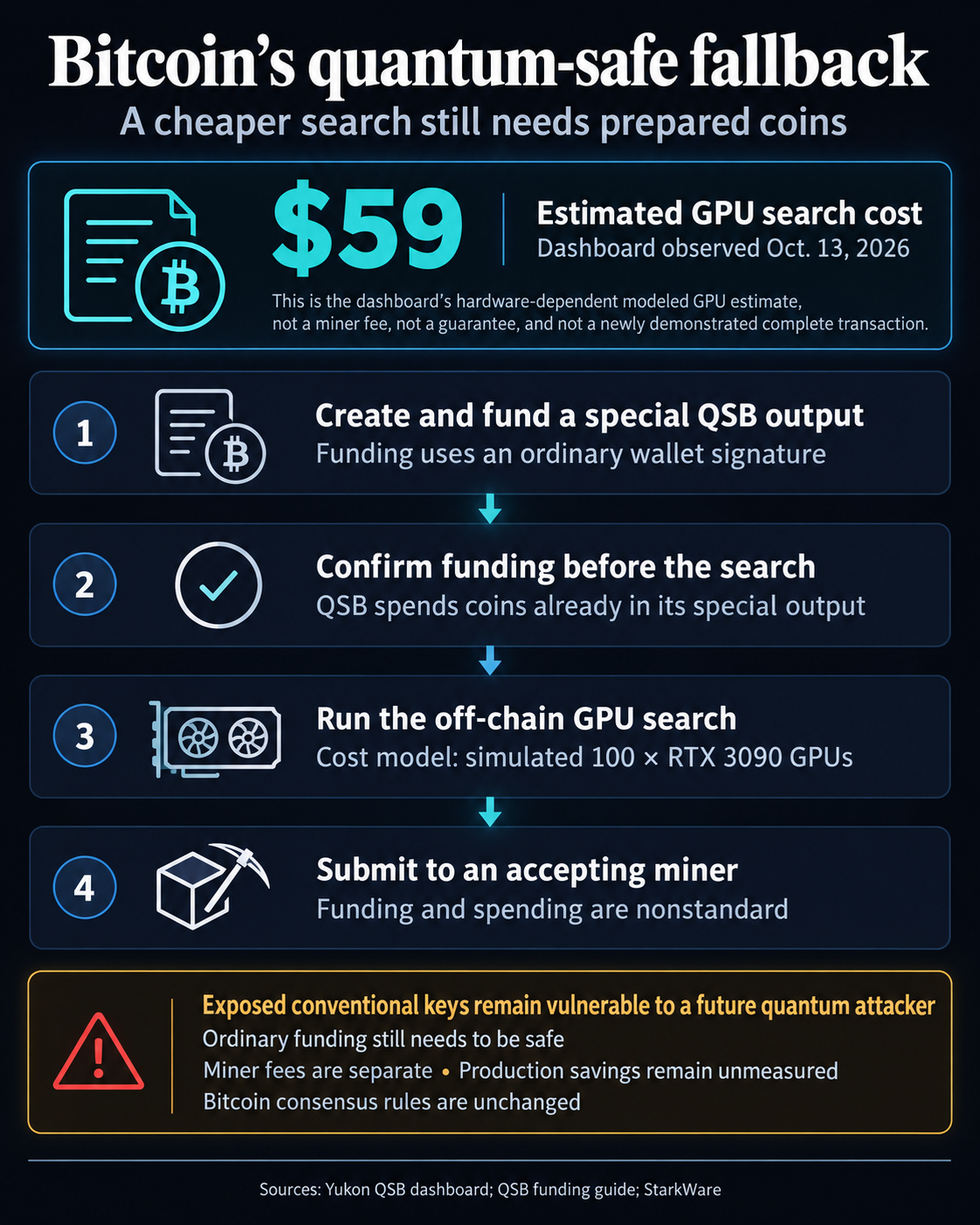
However, the $59 figure remains a hardware-dependent estimate based on simulated GPU workloads rather than a completed production transaction. Bitcoin network fees are separate, while some computing stages still rely on provisional assumptions.
StarkWare said the improvements make its proposed emergency protection method considerably cheaper to prepare, with researchers now targeting a computing cost below $10.
Quantum computing advances intensify Bitcoin security race
The development builds on research by StarkWare's Avihu Levy, who demonstrated in August that Bitcoin could support a quantum-resistant spending arrangement under its existing consensus rules.
Known as Quantum-Safe Bitcoin (QSB), the method uses hash-based cryptography and a computational puzzle to secure specially prepared Bitcoin holdings against attacks on conventional digital signatures.
The approach lets holders do the required calculations off-chain before spending their coins, potentially offering protection while developers work on broader changes to Bitcoin's cryptographic infrastructure.
That research has gained urgency as advances in quantum computing challenge previous estimates of how much computing power attackers would need to compromise cryptocurrency security.
In March, Google Quantum AI reported that future quantum computers could break the elliptic-curve cryptography used by Bitcoin with substantially fewer resources than previously estimated.
Its researchers calculated that certain attacks could theoretically complete in minutes using fewer than 500,000 physical qubits under specified hardware assumptions, a roughly 20-fold reduction from earlier estimates.
Although such machines remain beyond publicly demonstrated capabilities, the findings have increased pressure on blockchain developers to prepare before quantum attacks become practical.
The potential exposure is substantial.
According to a study by Glassnode, approximately 6.04 million BTC, representing 30.2% of Bitcoin's issued supply at the time, had public keys already visible on-chain.
The figure included 1.92 million BTC exposed through their underlying address structures and another 4.12 million BTC exposed through practices such as address reuse and previous spending activity.
A sufficiently powerful quantum attacker could theoretically derive private keys from those exposed public keys and gain control of the associated coins.
The threat has fueled debate over how quickly Bitcoin should adopt quantum-resistant cryptography, particularly given the complexity of introducing changes across a decentralized network.
QSB could offer an interim option, but it protects only eligible coins whose conventional public keys remain hidden until they are moved into specially constructed outputs.
That requirement leaves already-exposed holdings vulnerable if a capable quantum attacker emerges before owners can complete a secure migration.
The method also faces practical deployment restrictions. Although QSB transactions comply with Bitcoin's consensus rules, ordinary network relay policies reject them, requiring direct submission to miners willing to process them.
MARA's Slipstream service provided that route during the August demonstration.
Still, StarkWare continues to favor a broader Bitcoin protocol upgrade for long-term protection. Researchers must now demonstrate the latest computing savings in complete transactions and establish dependable miner access before QSB can become a practical fallback for holders.
The post Bitcoin’s quantum-safe protection gets 82% cheaper as researchers race to secure 6 million exposed BTC appeared first on CryptoSlate.
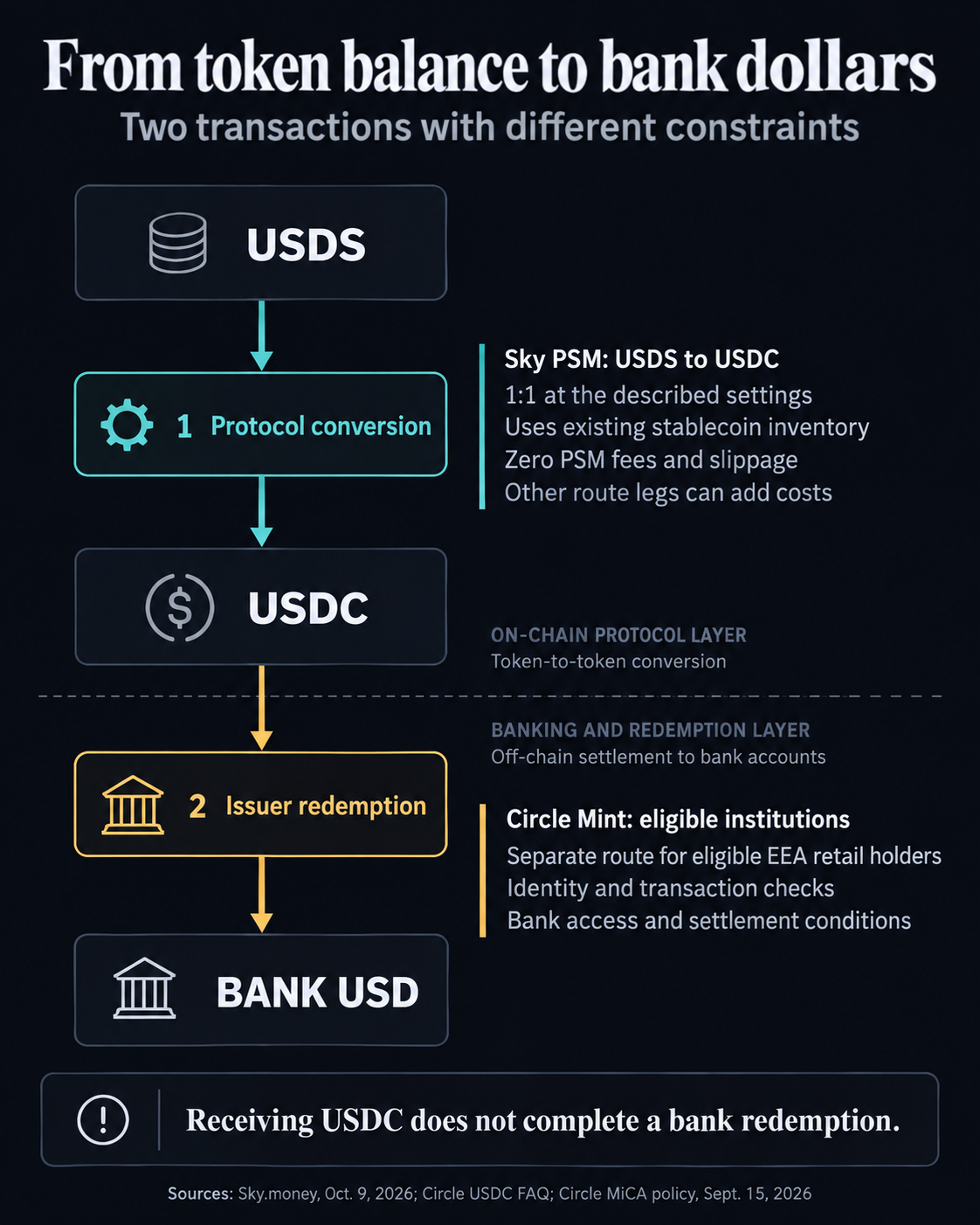
Sky.money reported more than $4.4 billion of stablecoin liquidity in its Peg Stability Module in an Oct. 9 explanation of the conversion mechanism. The PSM gives holders a direct route between USDS, Sky Protocol’s dollar-linked token, and USDC at a one-for-one rate.
Those measures answer different questions. Token circulation describes the stock of holdings. Conversion inventory describes what a holder can receive on a particular exit route. Fresh external dollar demand concerns money entering from outside the token system. Borrowing against collateral and upgrading an existing token can change individual token counts without establishing a matching inflow of bank dollars. A swap through existing inventory moves liquidity between holders or token forms; it does not by itself establish new issuance.
Sky describes direct USDS–USDC conversion in both directions through liquidity already held inside the protocol. The mechanism supplies the conversion itself, so it does not need to find another trader willing to take the opposite position.
At the settings described in the October explanation, the direct PSM leg has no protocol swap fee or slippage. A routed trade can still incur costs elsewhere: if it passes through another token pool before reaching USDC or USDS, that leg follows the pool’s own pricing, liquidity and fees.
The $4.4 billion figure describes aggregate stablecoin liquidity disclosed on Oct. 9. A USDS exit depends on the USDC inventory available on that route at the time of the transaction.
Sky also reported about $1.6 billion in cumulative USDC–USDS volume processed through Uniswap routing by Oct. 6, following its July 8 integration. Cumulative turnover can include movement in both directions and repeated conversions; it does not measure net USDS issuance or new dollars deposited into crypto.
Borrowing and migration change what a supply increase means
A separate Ethereum converter connects DAI and USDS. Sky’s developer documentation says the two tokens share an issuance source and that holders can convert between them in either direction without liquidity restrictions. That statement applies to the DAI–USDS converter, rather than to the availability of USDC in the PSM.
The accounting implication is straightforward: a holder can change an existing position’s denomination. An increase in USDS considered alone therefore need not represent additional money entering the wider system. Understanding the economic change requires following the DAI side of the conversion as well.
USDD is a separate collateral-backed stablecoin whose borrowing and migration routes add two more ways a token count can change. Its vault documentation describes depositing collateral, minting USDD debt and repaying the tokens plus stability fees to release collateral. Users can also withdraw collateral while maintaining sufficient coverage. This creates spendable liquidity for someone who wants to retain a collateral position, alongside an obligation to repay.
The borrower’s new ability to transact is economically useful. It can be created against assets already held, however, so each newly issued token does not require a corresponding new bank-dollar deposit. The pledged assets support the debt; their valuation is a different measure from the stablecoin inventory available to satisfy an immediate conversion request.
USDD also offers a migration route from USDDOLD into an equivalent amount of new USDD, with gas costs and no deadline. Here, a higher count in the new token can reflect an upgrade of an existing holding. Comparing old and new contracts separately can obscure whether the underlying economic position has increased.
A supply comparison needs consistent observation times and stated token coverage, including how it treats legacy tokens and holdings that back other tokens.
| Route | What the holder provides | What the transaction establishes |
|---|---|---|
| Circle Mint issuance | Bank USD through an eligible account | A direct fiat-funded issuance route |
| USDC–USDS PSM conversion | An existing stablecoin | A conversion through protocol liquidity |
| DAI–USDS conversion | An existing DAI or USDS holding | A change between linked token denominations |
| USDD vault issuance | Collateral supporting a debt position | Borrowing-created spending liquidity |
| USDDOLD migration | An existing legacy-token holding | An equivalent holding in the new token |
USDD’s PSM instructions make the immediate constraint explicit. The mechanism offers one-for-one conversion between USDD and supported stablecoins, with no service fee but network gas costs. Users must check the displayed quantity of the target token and keep their swap within that available amount.
A holder seeking USDT needs the inventory that can deliver USDT. An aggregate collateral valuation cannot substitute for that balance, just as a debt position’s backing cannot automatically be treated as an uncommitted pool of redemption cash.
Receiving USDC is a separate step from receiving bank dollars
USDC issuer Circle describes a more direct fiat connection in its USDC issuance and redemption process. Eligible businesses deposit dollars into Circle accounts to obtain newly minted USDC. Returning USDC for dollars removes the redeemed tokens from circulation. Circle says the backing consists of highly liquid cash and cash equivalents, with most reserves invested in the Circle Reserve Fund, whose portfolio can contain short-dated Treasuries, overnight Treasury repurchase agreements and cash.
A purchase on an exchange can instead draw on USDC already held by the exchange. Circle says an exchange may mint additional tokens when it needs more inventory. A buyer’s demand for USDC therefore need not trigger a new issuance transaction each time.
Access also differs between a protocol conversion and bank redemption. Circle Mint is an institutional product that is unavailable to individuals and small businesses through that service. Eligible retail holders in the European Economic Area have a separate direct route with Circle France.
Circle’s MiCA redemption policy, last updated Sept. 15, requires eligibility, identity and transaction checks, along with an EEA bank account that can accept USD for a USDC redemption. For eligible EEA retail holders, the policy gives a five-business-day timeframe unless discrepancies arise. It also permits deferrals during a stress event that prevents reserve rebalancing between Circle France and Circle LLC.
For a USDS holder seeking bank dollars, obtaining USDC through the PSM completes the token-conversion leg. The issuer and banking route still has to complete the cash leg. A stablecoin conversion balance and a bank payment are separate stages of access to dollars.
The post Sky’s $4.4 billion liquidity disclosure shows why USDS cash-outs need a separate bank route appeared first on CryptoSlate.
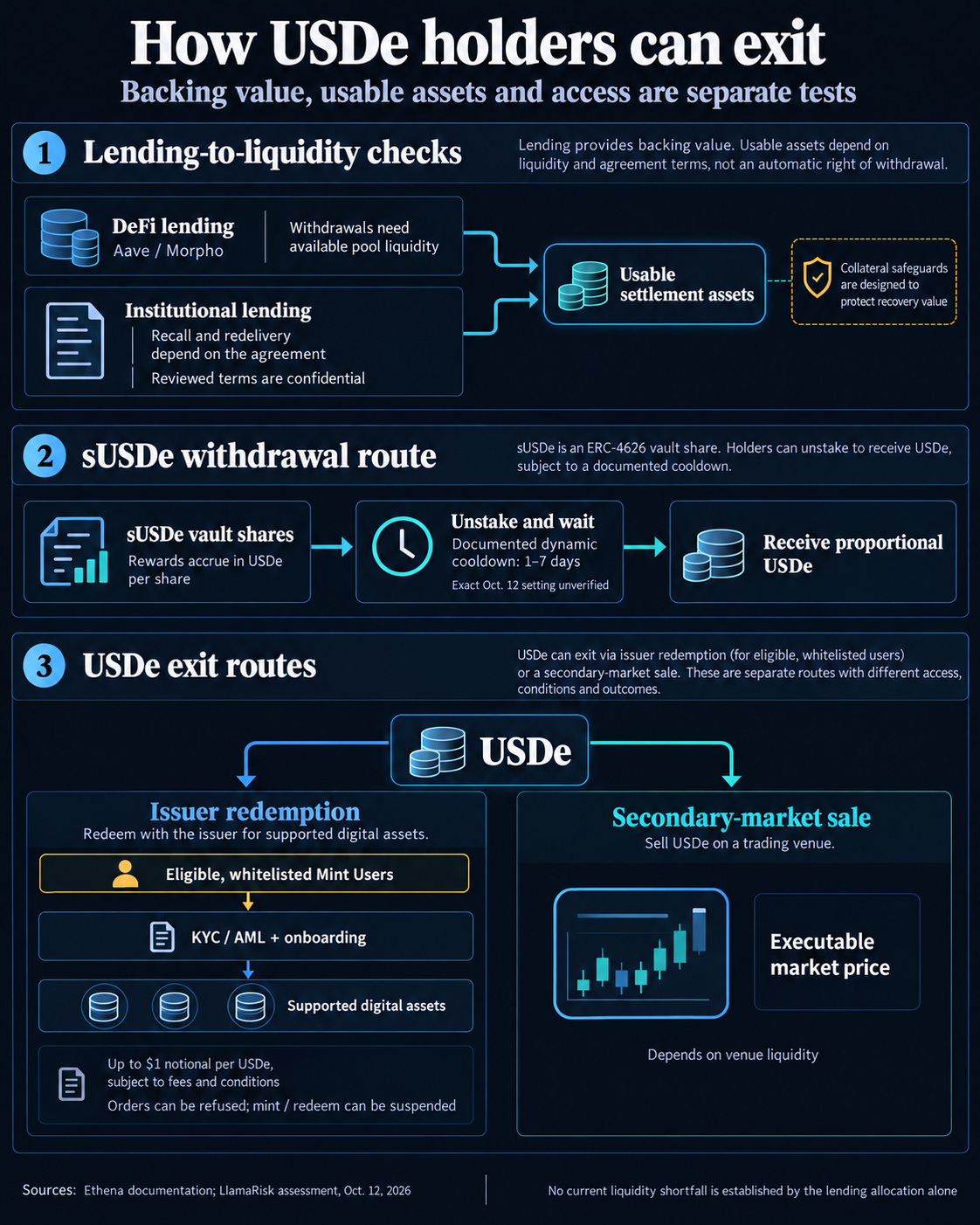
Ethena’s USDe, a synthetic dollar targeting $1, has 51.2% of its backing allocated to DeFi and institutional lending, according to risk assessor LlamaRisk’s October 12 assessment. The allocation figure does not measure actual borrower drawdowns or cash available for immediate withdrawal. For holders, usable reserve assets and access to an exit near the peg are separate tests.
Eligible counterparties can redeem USDe directly with Ethena, subject to its conditions. Other holders rely on secondary markets for an exit. Withdrawing USDe from sUSDe, its staking vault share, requires a separate unstaking process. A lending position can have excess collateral while supplied stablecoins remain borrowed. Recovering those assets depends on available pool liquidity or the applicable loan agreement’s recall and redelivery provisions.
The global snapshot reports $4.76 billion of backing against 4.76 billion USDe outstanding. Its lending allocations are 36.9% DeFi and 14.3% institutional, alongside 24.9% liquid stablecoins, 17.6% crypto basis and 6.0% real-world assets.
LlamaRisk discloses partial Aave DAO funding and its independent Ethena proof-of-reserves attestation role. It says it received no protocol or affiliated-entity compensation for this assessment.
The diversification itself predates this snapshot. Ethena’s March governance discussions already described lending deployments, and CryptoSlate covered the broader backing shift in August.
When lending assets become redemption assets
Ethena’s DeFi lending policy describes reviewed markets with excess borrower collateral, conservative loan-to-value parameters and exposure limits subject to governance and Risk Committee review. Those safeguards aim to limit losses. Aave and Morpho’s withdrawal mechanics determine whether underlying assets are available to recover.
Under Aave’s withdrawal rules, a supplier can take out only the amount available in a pool that has not been borrowed. Morpho’s market design also makes sufficient liquidity a condition for withdrawal.
| Lending category | Share of backing, Oct. 12 | Route back to settlement assets |
|---|---|---|
| DeFi lending | 36.9% | Withdraw supplied assets, subject to available market liquidity. |
| Institutional lending | 14.3% | Recover lent assets under the applicable agreement’s recall and redelivery provisions. |
For institutional lending, Ethena describes stable-asset loans backed by collateral worth more than the amount borrowed, including liquid BTC and ETH. Qualified custody and triparty arrangements, in which an independent agent holds and administers collateral, are designed to protect the protocol’s claim. Counterparty eligibility and aggregate exposure limits are subject to committee oversight.
LlamaRisk’s April review framework examines collateral ratios, custody segregation, enforceable security interests, liquidation rights, recall notice and redelivery timeframes. On Ethena Governance, its March review of the Maple and Anchorage agreements found no material contractual deficiencies. The individual terms and commercial thresholds remain confidential.
The Anchorage agreement reviewed in March was with A1, Ltd., a Cayman Islands group entity distinct from the OCC-chartered Anchorage Digital Bank. Maple’s agreement was through Delaware-based Protocol Pool Operations Alpha LLC.
The collateral, custody and legal safeguards are intended to mitigate credit risk. Their public descriptions do not establish the exact timetable for recovering lent assets under the reviewed institutional agreements. For a holder’s exit, protection of recovery value and the timing of delivery therefore need to be assessed together.
USDe redemption and sUSDe withdrawals
Holding USDe does not automatically provide access to Ethena’s primary redemption facility. Its published terms reserve that service for eligible Mint Users who have completed know-your-customer and anti-money-laundering checks, other onboarding procedures and whitelisting. An ordinary holder needs to become an eligible Mint User to redeem directly, or use a secondary-market exit.
The terms describe conditional redemption into supported digital assets representing a pro-rata portion of reserves, capped at $1 in notional value per USDe and subject to fees and other conditions. Receiving a backing asset is a different step from receiving dollars in a bank account. Ethena’s order process uses signed prices and operational acceptance checks, so a nominal redemption framework does not make every requested order executable.
LlamaRisk’s October 12 assessment of the Ethereum contract lists PYUSD, USDC, USDG, USDT, USDm and USDtb as enabled stablecoins, plus DAI with smaller limits. It reports an aggregate redemption ceiling of 20 million USDe per block, against 200 million for minting, and 2 million in each direction for DAI. These are contract ceilings, not available cash. The issuer can suspend minting and redemption without the controller’s 24-hour wait.
This access is central to Ethena’s peg-arbitrage mechanism. An authorized participant can buy USDe at a discount on an external market and redeem it for backing assets. The incentive to close that gap depends on being able to obtain a usable quote and receive the assets. Secondary-market sellers rely on that arbitrage channel, as well as the liquidity of the venue where they sell.
sUSDe adds another stage. It is an ERC-4626 vault share, representing a proportional claim on USDe in the staking contract. Rewards increase the USDe represented by each share. Its relevant exchange rate is USDe per share, rather than a fixed $1 target for sUSDe itself.
Ethena’s current staking guidance describes a governance-set dynamic cooldown between one and seven days. Its technical documentation places pending unstaked USDe in USDeSilo before withdrawal. The guide gives a range rather than establishing the active October 12 setting. Completing that process delivers USDe; selling or redeeming that USDe is a further step, with its own liquidity and eligibility conditions.
The reserve buffer and the checks that matter
Ethena’s reserve fund is intended to absorb negative protocol revenue and backing shortfalls. LlamaRisk’s September assessment put it at about $62.1 million. A loss buffer serves a different purpose from assets ready for immediate settlement.
Ethena’s reserve-fund policy says its ongoing allocation of protocol revenue is 0%, with revenue directed instead to incentives and promotional distributions. That allocation applies to new revenue; the fund’s existing balance is a separate measurement.
September’s position mapping identified Aave, Morpho, Jupiter Lend and Kamino exposures, alongside Maple, FalconX, Kraken, CBAM and Anchorage institutional positions. Those detailed venue weights remain historical.
Blockworks Advisory’s March cooldown analysis makes the liquidity-accounting distinction explicit. It separates withdrawable lending positions from those constrained by utilization, and explains that cycling USDtb already held as USDe backing through USDe minting and redemption creates no net liquidity.
Ethena’s institutional-lending policy describes committee-reviewed limits without specifying a numerical cap or floor.
For holders, the observable lending test is available unborrowed liquidity alongside the amount supplied to each market. Institutional recall and redelivery disclosures need to sit alongside collateral quality. A collateralized position and a position that can deliver settlement assets on demand answer different questions.
Redemption eligibility, accepted orders and the active sUSDe cooldown complete the exit test.
The post More than half of Ethena’s USDe backing is allocated to lending appeared first on CryptoSlate.
Strategy (formerly MicroStrategy) bought 250 Bitcoin for $21.5 million last week while spending $192.4 million to repurchase its STRC preferred shares.
On Oct. 12, the Michael Saylor-founded company disclosed that it acquired just 250 Bitcoin for about $21.5 million between Oct. 5 and Oct. 11, extending a slowdown that saw purchases fall to 334 BTC the previous week.
Meanwhile, Strategy repurchased 1,932,145 shares of its variable-rate STRC preferred stock for $192.4 million, nearly nine times its Bitcoin spending, as the company continued its STRC buybacks.
The spending gap highlights the competing demands on Strategy's capital: Bitcoin accumulation and support for its preferred securities.
STRC buybacks consume more capital
The latest acquisition lifted Strategy's holdings to 848,250 BTC, purchased for approximately $64 billion at an average price of $75,444 per coin.
Strategy paid an average of roughly $86,194 for its latest Bitcoin purchases, compared with $85,839 for the 334 BTC acquired during the previous reporting period.
The slowdown comes as Bitcoin struggles to sustain its recovery after last week's market downturn briefly pushed the cryptocurrency toward $80,000.
However, Strategy's preferred-stock repurchases have continued accelerating.
STRC repurchase spending rose from $176.3 million during Sept. 28–Oct. 4 to $192.4 million during Oct. 5–11.
The company reported $354.8 million of remaining authorization under its digital credit securities repurchase program.
The purchases have also become more expensive as STRC approaches its $100 stated amount.
Strategy paid an implied average price of approximately $99.58 per share in its latest buyback, representing a discount of less than 0.5% to the preferred stock's stated value.
That is notable because the company's July repurchase policy envisaged buying more aggressively at deeper discounts and reducing purchases as STRC approached $100.
The buybacks also reduce future dividend obligations by retiring outstanding preferred shares. At STRC's current 12% annual dividend rate, the latest repurchases would eliminate approximately $23.2 million in annualized dividend payments, assuming that rate remains unchanged.
However, Strategy's broader objective is to establish sufficient independent demand for STRC to trade consistently near $100 without requiring continued large-scale intervention.
Strategy's shrinking cash balance raises stakes for October vote
The accelerated repurchases are also drawing down the capital pool available for Strategy's broader treasury operations.
As of Oct. 11, the company held $4.88 billion in its dedicated USD Reserve and another $640.5 million in USD Cash, bringing total dollar-denominated liquidity to approximately $5.52 billion.
The USD Cash balance declined from $833.4 million a week earlier, down $192.9 million, nearly matching the amount spent on STRC repurchases.
Strategy separately raised approximately $21 million by selling 125,183 common shares during the week, while issuing no additional preferred stock under its at-the-market programs. Those common-stock proceeds funded $21 million of the Bitcoin purchases, with another $0.5 million coming from USD Cash.
The distinction between its two cash pools is significant.
Under Strategy's board-approved USD Reserve policy, the reserve is earmarked for preferred dividends and interest payments. Other uses require board authorization; the company says it is not authorized to use the reserve for STRC repurchases.
USD Cash, by contrast, can finance Bitcoin purchases, preferred-share repurchases and other capital management activities.
Consequently, sustained STRC spending reduces the unrestricted liquidity available for other uses unless Strategy raises additional funds.
As an illustration, the $354.8 million of remaining preferred-share repurchase authorization would cover about 1.84 weeks at the latest $192.4 million weekly pace if that pace and the authorization stayed unchanged.
Shareholders will vote on the daily-dividend proposal on Oct. 28.
The company is seeking approval to move its four US-listed preferred securities to daily dividend payments, with STRC transitioning first.
Under the proposal, dividends would accrue daily and be paid the next business day, replacing STRC's current semi-monthly schedule without increasing its annual dividend rate.
Strategy argues the change could improve liquidity, reduce reinvestment delays, and encourage more stable trading around STRC's $100 target.
If approved, STRC's first daily record date would be Nov. 1, with payment scheduled for Nov. 2.
Strategy is also scheduled to report third-quarter financial results on Oct. 29, a day after the vote, giving management another chance to address its preferred-stock strategy and the slowing pace of Bitcoin accumulation.
The post Strategy spent nearly nine times as much on STRC buybacks as Bitcoin last week appeared first on CryptoSlate.
CryptoTicker.io
A Bored Ape costs less today than it has in years. On October 13, 2026 the lowest asking price for the famous ape collection stood at 5.12 ETH, just under $12,900. In May 2022 it was 153.7 ETH. That is a fall of 97 percent, and the Bored Apes are no exception: almost all the large NFT collections on Ethereum sit far below their records, and several have lost another two thirds over the past year.
The timing is notable. On Saturday Yuga Labs celebrates ApeFest in Charleston; at the same time Blur, once the largest NFT marketplace on Ethereum, is announcing its closure, and Igloo, the company behind Pudgy Penguins, is shutting down its own blockchain Abstract. We queried the prices of the eight best-known collections at CoinGecko and show who is holding up, who is falling and what lies behind the decline.
NFT prices in October 2026: the large collections at a glance
What we measured is the so-called floor price, meaning the lowest price at which an NFT from the collection is currently offered. It is the usual yardstick for the value of a collection, because it shows what entry costs at a minimum. Retrieved on October 13, 2026 between 16:11 and 16:13 CEST through the interface of CoinGecko; the dollar values follow the ether price at that moment.
| Collection | Lowest price | in dollars | Record | Distance from record | 12 months (in ETH) |
|---|---|---|---|---|---|
| CryptoPunks | 31.29 ETH | $78,638 | 125.0 ETH (August 2021) | minus 75% | minus 34% |
| Bored Ape Yacht Club | 5.12 ETH | $12,880 | 153.7 ETH (May 2022) | minus 97% | minus 32% |
| Pudgy Penguins | 2.19 ETH | $5,495 | 36.3 ETH (December 2024) | minus 94% | minus 72% |
| Mutant Ape Yacht Club | 0.74 ETH | $1,856 | 40.0 ETH (May 2022) | minus 98% | minus 29% |
| Milady Maker | 0.72 ETH | $1,821 | 7.35 ETH (December 2024) | minus 90% | minus 58% |
| Azuki | 0.50 ETH | $1,246 | 31.8 ETH (April 2022) | minus 98% | minus 64% |
| Doodles | 0.22 ETH | $548 | 23.9 ETH (May 2022) | minus 99% | minus 74% |
| Moonbirds | 0.37 ETH | $929 | 38.5 ETH (April 2022) | minus 99% | minus 87% |
The column on the far right measures the price in ETH, not in dollars. That matters, because ether itself has fallen too: in dollar terms a Bored Ape has lost around 59 percent over twelve months, in ETH terms 32 percent. Anyone who paid for their apes in ether is therefore better off than someone counting in dollars or euros.

CryptoPunks hold up, Pudgy Penguins and Moonbirds fall furthest
The most stable are the CryptoPunks. At 31.29 ETH, just under $79,000, they sit 75 percent below their record from August 2021, markedly less than all the others. The punks of 2017 are among the oldest NFT collections on Ethereum, and many holders will not part with them. That supports the price, but it also makes the market thin: on the day of our query, punks worth a mere 70 ETH changed hands.
The younger favourites were hit hardest over the past year. Pudgy Penguins cost 36.33 ETH at their December 2024 peak. Today it is 2.19 ETH, down 72 percent in twelve months alone. Contributing to that were the end of the mobile game Pudgy Party in June and the news of October 6 that Igloo is switching off its blockchain Abstract on December 15. What holders there have to do now is set out in our guide to withdrawing funds from Abstract, and the consequences for the PENGU token in our PENGU price prediction.
Moonbirds and Doodles stand 99 percent below their records from the spring of 2022. A Moonbird cost around $930 on October 13, a Doodle around $550. For both, only a handful of NFTs changed hands on the day of our query, together not even 13 ETH.
Why NFT prices are falling: less trading, fewer marketplaces
The most important reason is simply absent demand. Nowhere is that clearer than at Blur. In 2023 the marketplace had overtaken incumbent OpenSea with zero fees and rewards in its BLUR token. According to CoinDesk, monthly trading volume fell from around $1.43 billion in March 2023 to less than $7 million in March 2026, a decline of more than 99.5 percent. On October 12 Blur announced it would close the website on November 12; the Blend lending product will then arrange no new loans. Everything on that is in our article Blur closes on November 12.
On top of that, the speculation has moved on. Anyone betting on ape pictures in 2021 is more likely today to be buying memecoins or trading with leverage. NFTs have become a market for collectors who genuinely want to own a collection. That fits with the restructuring at the big houses: Yuga Labs is concentrating on Bored Apes and the game world Otherside, and Igloo, after the end of Abstract, entirely on Pudgy Penguins. Which marketplaces still have trading worth mentioning after Blur's retreat is shown in our overview NFT marketplaces in 2026: who still trades.

ApeFest 2026: a ticket for 0.74 ETH
The low prices have an unusual side effect around ApeFest on October 17 in Charleston. Admission goes to anyone holding a Bored Ape or a Mutant Ape, with one ticket per NFT. A Mutant Ape cost just 0.74 ETH on October 13, around $1,860. A Yuga-adjacent post of October 11 even advertises that buyers from this week will get their ticket free of charge. Why hardly anyone from the German community is flying over all the same is written up in our article ApeFest 2026 in Charleston.
Buying an NFT at a low price: what matters
Low prices do not mean things cannot go lower still. An NFT produces no income; its price depends solely on whether somebody else will pay it later. Anyone who still wants to buy should know four points:
- Check the trading: the lowest asking price is of little use if there is barely any trading. Bored Apes and Pudgy Penguins each came to more than 200 ETH of turnover on the day of our query, Moonbirds to less than 4 ETH. In thin trading a sale can take weeks.
- Compare the fees: marketplaces charge different fees, on top of which come creator royalties and the network fee. Which platform costs what is shown in our NFT marketplace comparison.
- Clear out approvals: in September, attackers exploited old marketplace approvals connected with the Limit Break Payment Processor to drain NFTs. Anyone who used to trade on several marketplaces should revoke approvals they no longer need before their next purchase.
- Store them securely: valuable NFTs belong on a wallet whose keys have never been online, meaning a hardware wallet, ideally bought directly from the manufacturer. Why the purchase route matters is shown by the current case in which MediaMarkt and Saturn stopped selling Ledger devices; which devices exist is set out in our hardware wallet comparison.
For tax purposes there is no separate rule from the German authorities for NFTs. In practice tax advisers mostly treat sales like other private disposals under section 23 of the Income Tax Act: gains within one year of purchase are taxable, and after that as a rule tax free. This is not tax advice. Anyone with many purchases and sales gets to a clean statement faster with a crypto tax tool.
NFT prices in October 2026: what to take away
The NFT market in the autumn of 2026 is as cheap as it has been in years. Bored Apes, Mutant Apes, Azuki, Doodles and Moonbirds sit 97 to 99 percent below their records, Pudgy Penguins have lost almost three quarters in a year, and only the CryptoPunks are holding up comparatively well. At the same time the number of marketplaces is shrinking: Blur closes on November 12, Abstract on December 15. For collectors that is an opportunity, for speculators a warning sign. We will keep this overview going and update the prices at the turn of the month.
Blur is switching off its website on November 12, 2026. The marketplace, which at one point served more than seven out of ten NFTs traded on Ethereum, announced the step on October 12 via its channel on X; CoinDesk reported on it on October 13. For you that means open bids, listed collectibles and above all outstanding loans from the Blend lending product need a decision before that date. The contracts on the Ethereum blockchain keep running; the interface does not.
The BLUR token has reacted sharply to the announcement: $0.0123 on the morning of October 13, down 33.9 percent within 24 hours and 39.4 percent over seven days. The token's all-time low stands at $0.01228. The price is therefore sitting practically on it.
What Blur switches off on November 12 and what keeps running
What goes dark is the blur.io website, meaning the interface through which traders browse collections, place bids and list items for sale. The smart contracts on Ethereum stay in operation, according to the CoinDesk report. Smart contract refers to the program code on the blockchain that actually settles a trade and records the transfer of ownership. Front end refers to the website in front of it, which makes offers visible and matches orders.
That separation decides what you are left with after November 12. An NFT in your wallet belongs to you regardless of whether the marketplace still runs a website: ownership sits in a contract on the blockchain, not in a provider's database. When the interface disappears, what disappears with it is the convenient route to buying and selling in this one place. Anyone wanting to sell then needs a different venue.
Blur took no fees from traders. Token Terminal shows zero dollars of protocol revenue for the past three years, as CoinDesk reports. Whether the operator earned money through the lending business or by other routes cannot be read from that, and the report makes no statement on it. The website itself still carries the promise of zero marketplace fees and a lifetime volume of more than $7.4 billion.
Blend: why outstanding NFT loans have to be settled by November 12
Blend is Blur's lending product: a holder deposits an NFT as collateral and receives ether for it, while a lender earns interest on it. From November 12 Blend will no longer arrange new loans. Anyone who does not repay an outstanding loan by then lets it run into default. With a loan against collateral, default means the deposited collateral passes to the lender.
Blur intends to provide a tool of its own after the cut-off date with which balances can be withdrawn from Blend. The company has given no date for it, according to the CoinDesk report. The gap between the shutdown and a tool without a date allows only one conclusion: repayment before November 12 is the route that does not depend on an announcement.
A loan against a collectible is no sideshow. Anyone who deposited an NFT as collateral two years ago, and whose market price has fallen since, faces the question of whether repayment makes economic sense at all or whether default would be the cheaper option. That calculation depends on the item's current market value, on the size of the remaining debt and on your tax position, not on a general rule.

From market leader to run-off: Blur's trading volume since March 2023
Blur launched at the end of 2022 and took on the market leader of the day with a model that charged no trading fees and rewarded heavy traders with tokens. In March 2023 monthly trading volume stood at around $1.43 billion according to the DefiLlama data cited by CoinDesk, and more than 70 percent of Ethereum NFT trading ran through this one marketplace. In March 2026 it was less than $7 million a month. The decline amounts to more than 99.5 percent.
$22.9 million in the protocol: our assessment as of October 13, 2026
How far the marketplace has already emptied out can be read from the funds still sitting in its protocol. On October 13, 2026 that was $22.9 million. A week earlier there was still $26.8 million, a year ago $81.5 million, and at the peak on March 9, 2024 it was $215.9 million. Against that peak roughly 89 percent has flowed out, against the same day last year roughly 72 percent. cryptoticker.io gathered this assessment itself on October 13, 2026, based on DefiLlama's protocol data for Blur.
The figures show two different movements. The long outflow over twelve months is the drying up of NFT trading as a whole. The loss of just under four million dollars in the week of the announcement is the response to it: anyone with a loan outstanding is pulling their collateral out while the interface for doing so is still standing.
BLUR token at the level of its all-time low
After the announcement the token lost more than 20 percent and stood at around $0.015, as CoinDesk presents it; Coingape reported more than 30 percent. Our own query on the morning of October 13 produced $0.0123 and a loss of 33.9 percent over 24 hours. The spread between the figures is explained by the timing of each measurement; the price fell further over the course of the day.
Two metrics are more notable here than the percentage. First, market capitalisation stands at $35.7 million, while tokens worth $63.6 million changed hands in 24 hours. Turnover therefore exceeds total value by a wide margin, which points to a wave of selling rather than to calm trading. Second, the price is at the level of the all-time low of $0.01228. From its peak of $5.02 on February 14, 2023, the token is more than 99 percent away.
One peculiarity remains for token holders: according to the CoinDesk report they keep control of the so-called fee switch, meaning the vote on whether the marketplace charges trading fees in future. A voting right over the fees of a marketplace without a website is, however, a right with no discernible value as long as nobody runs a new interface for it.

Blast, Blur and the retreat of a whole team
The step does not stand alone. On October 2 the Blast network announced its wind-down; according to CoinDesk it was developed by the team behind Blur and goes back to founder Tieshun Roquerre. Blast managed more than two billion dollars at its peak and came to about $32 million at the time of the announcement. Users there have until October 26 to withdraw their funds through the familiar interface. Blast's developers cited operating costs exceeding revenues as the reason. For Blur itself, no such justification has been stated publicly.
Two shutdowns from the same circle within two weeks make a pattern with practical consequences for you: deadlines from different projects can overlap. Anyone with funds at both Blast and Blend has two dates, October 26 and November 12, and no shared interface to remind them. We described the same mechanics in October for another deadline, when Galxe's Gravity Alpha ended on November 1.
Token approvals: the underrated risk after a shutdown
Anyone trading through a marketplace will as a rule have granted its contracts an authorisation, a so-called token approval. That approval allows the contract to transfer a particular NFT out of the wallet as soon as a sale goes through. Such an approval stays granted even when the website disappears, because it sits on the blockchain and not on the website.
From that follows a task that applies to every old approval, quite apart from Blur: old approvals that are no longer needed should be revoked. Through an approval checker, of the kind common blockchain explorers offer, you can see which contracts still have access to your collection and revoke individual approvals. That attackers work deliberately with faked approval prompts is something we described last week in the case of the fake Shiba Inu airdrop of October 12.
Two points matter here. First, every revocation costs network fees on Ethereum, because it is a transaction. Second, around every announced shutdown there circulate messages that use a deadline as leverage and lead to a copied site. You revoke an approval only through an address you have typed in yourself, never through a link in a message.
NFT custody without a marketplace: wallet, keys, records
After November 12, access to your collectibles hangs on your wallet alone. Anyone who has managed their NFTs through a marketplace interface so far should therefore check three things: whether the wallet address holding the items belongs to you and not to a custodian, whether you can restore access to that wallet independently of any single app, and whether the backup of that access is kept somewhere you can reach it if it comes to that. For the custody of larger holdings we keep a separate overview of hardware wallets compared.
For reselling you need a different venue. Which marketplaces carry Ethereum collections, what fees they charge and how they handle creator royalties is set out in our overview of NFT marketplaces. One point that is regularly overlooked in Germany: the European MiCA regulation covers crypto assets, but not NFTs as individual items, as long as they really are unique and not interchangeable with one another. Authorisation under MiCA is therefore not a criterion you can take for granted at an NFT marketplace the way you can at an exchange.
Tax in Germany: holding period, default and records
For tax purposes the German authorities regularly treat gains from the sale of NFTs by private individuals as a private disposal under section 23 of the Income Tax Act, with the familiar one-year holding period. A default on a loan against collateral is not a neutral event in this context, because the collateral changes owner, and that can have the effect of a disposal. How your case is to be classified depends on holding period, acquisition cost and the structure of the contract.
In practice that means one thing above all: the records should be secured now, not at tax-return time. Once the website is switched off, trading history and loan overview will no longer be available there for download. Anyone who has not already recorded their purchases, sales and lending transactions in a portfolio tracker or tax tool should export the documents before November 12.
Our assessment: a retreat with notice
In the view of this newsroom, Blur's retreat is the consequence of a business model without a revenue source, not of a sudden collapse. The evidence is set out above: zero dollars of protocol revenue over three years according to Token Terminal, a trading volume that has fallen from $1.43 billion a month to under $7 million, and protocol funds that have shrunk by around 89 percent since the peak in March 2024. A marketplace without fees needs growth to justify token rewards; once the growth fails to appear, the case for running it falls away.
Against that, the market as a whole is not disappearing: the contracts on Ethereum keep running, the collections stay tradable, and other interfaces exist. What ends is an era of cheap trading incentives. We draw no valuation of the BLUR token from this; with a price at its all-time low and a voting right over a business that is no longer running, the risk of a total loss for investors is real.
Blur shutdown: bids and Blend loans run until November 12
- Settle loans and bids. Check by November 12 whether a loan in your name is outstanding at Blend, and decide deliberately between repayment and default. Open bids and listings are withdrawn in the same move. If you need a new venue for selling, the alternatives are in our overview of NFT marketplaces.
- Revoke approvals and sort out custody. Withdraw old token approvals through a blockchain explorer and make sure access to your wallet works independently of any single application. For larger holdings it is worth a look at the hardware wallet comparison.
- Export your records. Save trading history and loan overview before the shutdown and transfer them into a tax tool or a portfolio tracker, so that holding periods remain provable later on.
(As of October 13, 2026. This article is not investment advice. Prices and fee structures change; check the terms with the provider before you buy.)
Anyone opening Immutable's home page today finds no game characters and no NFT collection, but a marketing platform for game studios: 800 games, 35 billion data points, a tool for analysing Steam images. The blockchain the company became known for appears only as one product box among several. According to our own assessment, around $11.2 million sits on it, practically the same amount as in January.
The IMX token has nonetheless had a good month: a gain of 40.5 percent in thirty days, measured in euro. This piece sorts out both sides. It works through the blockchain, the token, the applications, the access route and the trading venues available in Germany. The figures on locked capital were gathered by cryptoticker.io itself on October 13, 2026 from DefiLlama's public data.
What Immutable is today: from NFT platform to toolkit for Steam studios
Immutable started out as a technology provider for games with blockchain items. The best known of them is the collectible card game Gods Unchained, in which cards exist as tradable tokens. That period is also the source of its reputation as the address for Web3 gaming.
Its own home page tells a different story today and advertises marketing and data tools for games companies: an audience analysis, a tool for measuring performance, an AI assistant for growth, plus a free analysis service for Steam thumbnails which, by its own account, has evaluated more than 25,000 such images. As the basis for this, the page cites 35 billion data points from more than 800 games across PC, Steam, consoles and mobile devices.
The customer examples given there are conventional games companies. Ubisoft is named with a title said to have reached 2.8 times the purchase rate on launch day, and a studio called 1047 Games with more than 300,000 Steam wishlist entries in under two months. Blockchain does not feature in those examples. The Passport and Chain products are still on the list, but without a single figure beside them.
That is the most important observation for anyone holding IMX: the company increasingly earns its money from tools for games without a blockchain. What that means for the token is set out further below. We attempted an assessment of the wider sector in our overview of the four companies in Web3 gaming.
Immutable zkEVM: the technology behind chain ID 13371
In the provider's technical documentation the blockchain is called Immutable zkEVM and described there as the blockchain for games built on Ethereum. The main network carries chain ID 13371, the test network 13473. The access point for programs is rpc.immutable.com, capped at 25 requests per second on the free tier.
zkEVM stands for a network that executes Ethereum contracts and secures its work with cryptographic proofs. For developers that means anyone working on Ethereum brings their tools and contracts with them. The connection to Ethereum runs through bridge contracts, which the documentation describes as audited and monitored.
What is missing from that documentation is notable. Immutable X, the company's older network, no longer appears there. Anyone reading the current papers finds only one blockchain. So anyone still holding items or tokens from the old environment should check where they now sit rather than rely on old instructions.
Sponsored network fees through Passport: why players pay no gas
The network's native currency is IMX, or tIMX on the test network. Players notice little of it, and that is deliberate. Immutable offers to take on the network fees: the documentation puts it as players never paying fees thanks to gas sponsoring. This is made possible by Passport, the in-house login and wallet solution, which creates an account without the usual recovery phrase.
For onboarding new players that is the obvious answer, because nothing keeps casual players away as reliably as being told to buy cryptocurrency first. For demand for IMX the same decision has a flip side: if the studio covers the fees, the player does not need the token. Use of the blockchain therefore grows independently of how many people hold IMX.
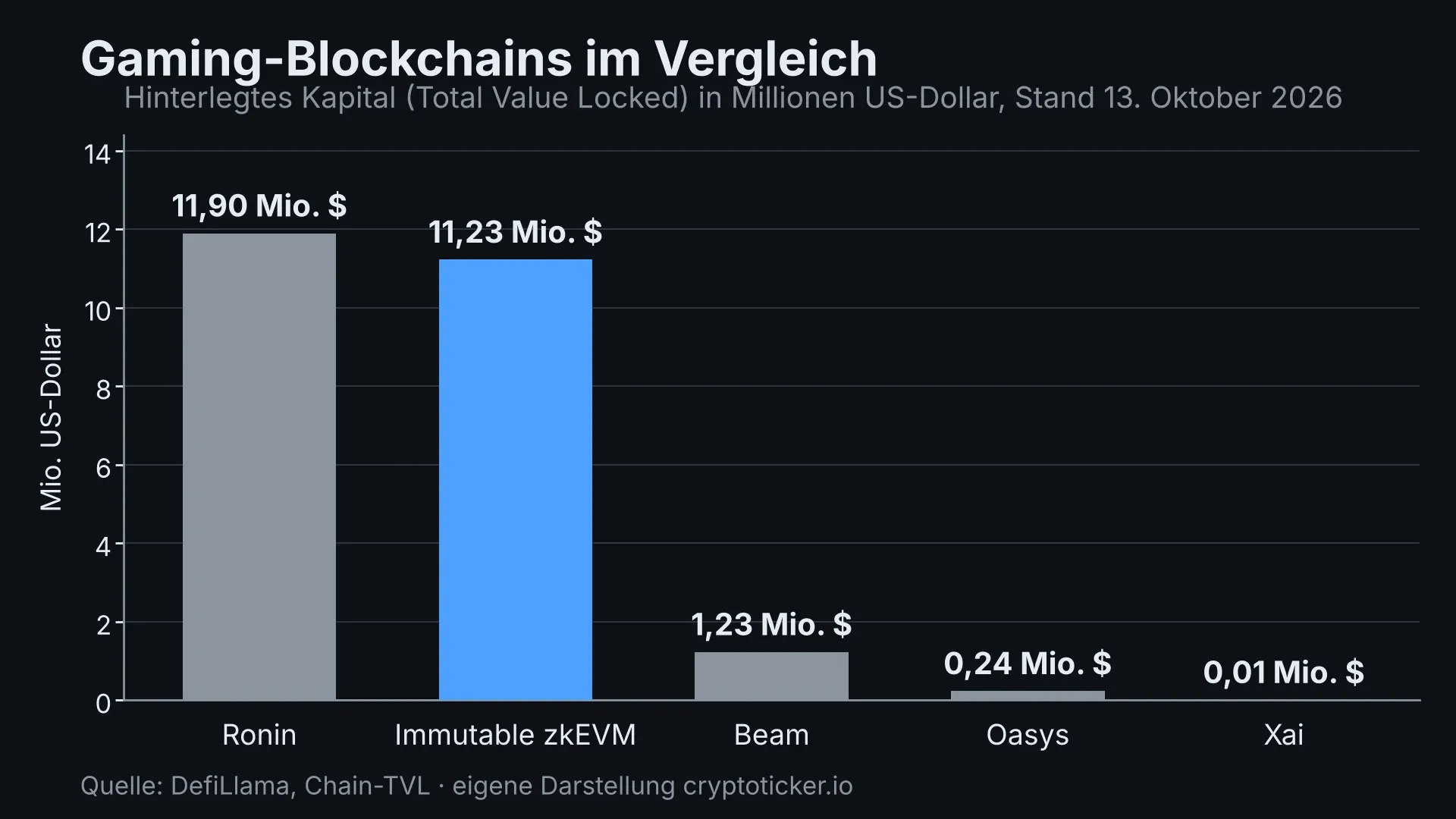
$11 million since January: the capital on the blockchain is standing still
Total value locked, or TVL, measures the capital deposited in a blockchain's applications. For Immutable zkEVM we assessed the trajectory from DefiLlama's public data, with three verified readings.
On January 1, 2026 it held $11.57 million. On April 1 it was $11.16 million, on July 1 $10.94 million, on October 1 $11.22 million, and on October 12 $11.22 million. Over more than nine months, then, the figure has moved by less than four percent. The highest level ever measured stands at $21.23 million in July 2025.
Such a trajectory is unusual. Most blockchains swing with the market, often by multiples. Here almost nothing moves, and that suggests the capital is held by a few fixed positions rather than by investors coming and going. In the ranking of blockchains by locked capital, Immutable zkEVM sits in 78th place.
Among the networks built for games that is still second place. Ronin comes to $11.90 million, Immutable zkEVM to $11.23 million, Beam to $1.23 million, Oasys to $0.24 million and Xai to $0.01 million. How that looks in detail at Ronin is broken down in our ecosystem piece on Ronin. The position of the whole category can be summed up in one sentence: gaming blockchains together move less capital than a mid-sized protocol on Ethereum.
Quickswap V3 and KAIO: the two applications with capital worth mentioning
Behind the $11.2 million there are essentially two applications, according to the DefiLlama data. The decentralised exchange Quickswap V3 holds $11.23 million, and KAIO, a provider in the field of tokenised real-world assets, $6.27 million. The fact that both figures together exceed the value of the blockchain is a counting effect: capital working in several protocols at once is counted only once for the value of a blockchain.
What follows from that is a thin layer of provision. As a DEX, meaning a decentralised exchange, there is effectively one available. A lending market with capital worth mentioning is absent, as is a launchpad of its own for new tokens. What does exist is what the blockchain was built for: trading in game items that exist as tokens. Marketplaces for them run on the in-house order book technology that studios build into their games.
For investors that is the most important limitation. Anyone looking for DeFi in the usual sense, meaning loans, interest or derivatives, finds little on Immutable zkEVM. Where NFT trading still takes place at all is written up in our overview of the NFT marketplaces in 2026.
IMX: 98 percent below the 2021 high and 40 percent up on the month
The token figures, gathered on October 13, 2026 from CoinGecko: IMX stands at €0.15. Market capitalisation is around €140 million, which means 214th place among all cryptocurrencies. There are 904,472,049 tokens in circulation out of a maximum of 2 billion, or 45.2 percent. Valuing the entire supply at today's price gives around €309 million.
The trajectory points both ways. Over thirty days there is a gain of 40.5 percent, over seven days a loss of 8.8 percent, over one year a loss of 69.7 percent. The price is 98.2 percent away from its peak of €8.49, reached on November 25, 2021. Around €7.8 million was traded within one day most recently.
Those 98.2 percent are not evidence of failure; they are a reminder of the starting point. The peak fell at the height of NFT enthusiasm, when collectibles dominated the news. More telling is the distance between market value and usage. Around €140 million of market capitalisation stands against $11.2 million of locked capital.
More than half of the tokens are, in addition, not yet in the market. When and how those roughly 1.1 billion IMX enter circulation will help decide whether a rising price holds.

Gods Unchained and the 800 games: what Immutable puts in the window
Gods Unchained is still running and can be reached through its own site. The collectible card game remains the best-known title built on Immutable, and it is also the oldest. The figure of 800 that the company advertises today, by contrast, refers to the data base of the marketing platform covering games of every kind, including those without a blockchain.
That distinction is decisive and often gets lost in summaries. A studio using Immutable's audience analysis tools never touches the blockchain. A number that mixes the two says little about the network. Anyone wanting to check the state of it is therefore better off looking at locked capital and at activity in the explorer.
A comparison over time shows the direction. Two years ago Immutable was synonymous with games on the blockchain, and Illuvium was among the most frequently named titles. What became of that generation is traced in our review of Web3 gaming. Today the blockchain comes last in Immutable's product list.
Bridge, explorer and network data: the route onto Immutable zkEVM
To do anything on the blockchain you enter the network with chain ID 13371 and the access point rpc.immutable.com in your wallet. Anyone playing via Passport can skip this step, because the login creates the account itself. For the standalone route, any wallet that permits custom networks will do.
Balances come across from Ethereum through the bridge contracts. explorer.immutable.com serves as the public register of all transactions and contracts. There you can check whether a transfer has arrived and which address sits behind a game item before you grant it an approval.
One peculiarity applies to game items: technically they belong to you, but they hang on the game that issues them. If a studio shuts down operations, the token stays in the wallet and loses its purpose all the same. That holds for such items generally and is not down to this blockchain.
IMX against the euro: which authorised exchanges run the trade
For investors in Germany what counts is whether a token can be bought against the euro and at a provider with European authorisation. cryptoticker.io checked this question itself on October 13, 2026 by querying the public trading registers of several exchanges.
The result is better than for many smaller tokens: Kraken lists IMX against the euro and against the US dollar, and Bitvavo lists the euro pair as well. At Coinbase, IMX is available only against the US dollar and against the stablecoin USDT; a euro pair is missing there. Anyone wanting to buy without a conversion step therefore has two authorised addresses to choose from. Which of them suits you and what the order costs in each case is shown in our exchange comparison.
A note on game items: they are bought in the game itself or on a marketplace, not on an exchange. Which marketplaces are worth considering for that today is set out in our marketplace comparison.
What argues against IMX: supply, dependency and a market without growth
Four points belong on the other side. First, supply: more than a billion IMX are not yet in circulation, and every release meets a market with around €7.8 million of daily turnover. Second, the dependency on a handful of applications, since the locked capital effectively hangs on a single exchange on the blockchain. Third, the gas sponsoring, which decouples usage from demand for the token. Fourth, the direction of the company, whose visible business today consists of marketing tools for games without a blockchain.
For tax purposes, German law treats IMX like other crypto assets as an other asset. Gains from a sale within one year of purchase fall under the private disposals of the Income Tax Act and are taxable above the exemption limit; after one year has passed the gain remains tax free. The same basic pattern applies to game items that exist as tokens, though valuation is harder there because no continuous price exists. Individual cases are a matter for tax advice.
And the fundamental point stands: a total loss is possible. A token whose network has been sitting at the same level of capital for nine months needs more than one good month to sustain higher prices.
Our assessment: the blockchain no longer carries the company on its own
Immutable has made a decision, and it stands openly on its own home page: growth is to come from data and marketing tools for game studios, not from game items on the blockchain. In business terms that is understandable, because 800 games as a data base is a larger market than the second-largest gaming blockchain with $11.2 million of locked capital.
For IMX the same decision cuts both ways. In favour: a company with a viable business can run its blockchain for longer than one without. Against: none of the advertised tools needs the token, and players' network fees are sponsored anyway. The 40.5 percent jump in thirty days changes none of that as long as locked capital stays at eleven million dollars. The direction can be checked against precisely that figure. This is expressly not a recommendation to buy or sell.
Immutable: $11 million in capital, 800 games in the window
Three steps if you want to look at IMX more closely:
- Choose a venue with a euro pair. Two authorised exchanges list IMX directly against the euro; at a third you need the detour via the dollar or a stablecoin. The terms are in the exchange comparison.
- Keep custody separate from the game login. A Passport account is meant for the game, a wallet of your own for your holdings. Which one is suitable is shown by the software wallet comparison.
- Record purchases and game items. With tokens from games in particular, the one-year period later becomes an arithmetic problem if the records are missing. Suitable programs are listed in the comparison of tax tools.
(As of October 13, 2026. This article is not investment advice. Prices and fee structures change; check the terms with the provider before you buy.)
Bitcoin stood at roughly $83,200 at midday on Tuesday, or $83,212.80 and €74,361.20 to be exact, according to Kraken data. That is a gain of 1.8 percent on Monday's close of $81,737.20. The striking part is not the number itself but its surroundings: Bitcoin is, at this moment, the only one of the eight largest coins trading higher over 24 hours.
Ethereum is down 1.3 percent over the same period, XRP 2.2 percent, Solana 3.6 percent, Dogecoin 2.6 percent, Shiba Inu 4.5 percent and Polkadot 7.2 percent (CoinGecko, as of October 13, midday). Over seven days the gap is wider still. That spread is the real reason for this article, and for private investors in Germany it carries a very specific tax consequence, set out further below.
Where the Bitcoin price stands at midday on Tuesday
The night was restless. Bitcoin fell as low as $80,951.20, marking the low of the day, recovered to $84,053.10 and settled just above $83,000 by midday. The distance between the daily low and the daily high is $3,101.90, or 3.8 percent. For a Tuesday without a major scheduled event, that is a wide range.
In euro terms BTC stands at €74,361.20, with a daily high of €75,146 and a low of €72,568.40. The price is 34 percent below its all-time high of $126,080. Trading volume on Kraken over the past 24 hours came to 2,409 BTC across 166,327 individual trades, with a volume-weighted average price of $82,667.32. The current price therefore sits above the daily average, which means buyers in the second half of the day paid above the mean.
Seven days compared: 2.8 percent versus 11.9 percent
For the weekly view we indexed Kraken's daily closing prices since October 6 to a common starting point. The result: Bitcoin is 2.8 percent below its October 6 level, Ethereum 7.4 percent, XRP 9.0 percent and Solana 11.9 percent. All four curves broke down together on October 7 and 8, but Bitcoin found its footing at a markedly higher level.
The gap between Bitcoin and Solana is therefore 9.1 percentage points over seven days. Anyone holding €10,000 of Solana on October 6 has around €8,810 today; the same amount in Bitcoin is worth around €9,720. That is no longer noise, it is a difference that shows up immediately in a portfolio overview.
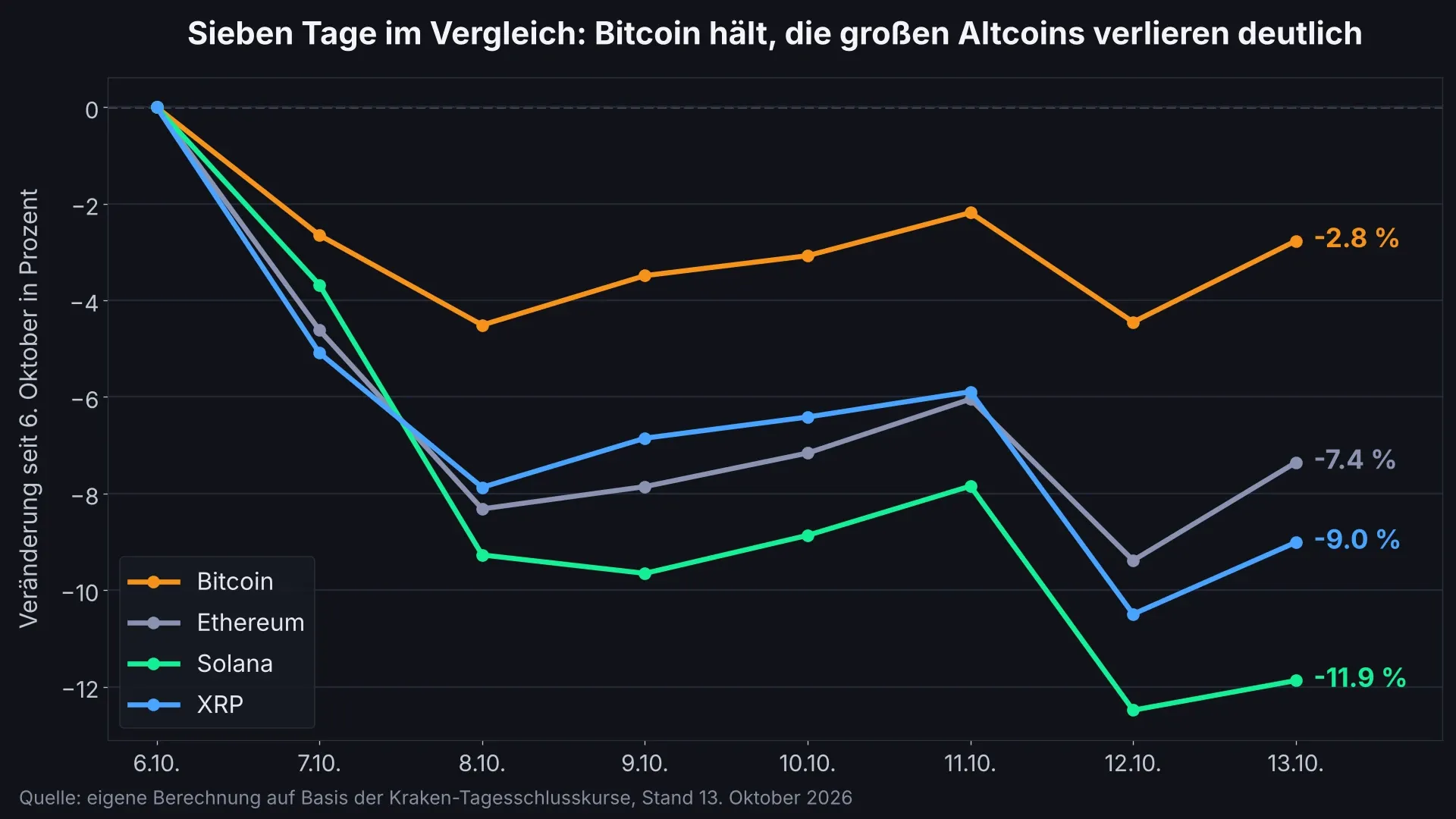
The mechanism behind Bitcoin's relative strength
In market analysis, relative strength simply means that an asset loses less than the rest during a downward phase. The pattern rarely arises from good news about a single coin. Almost always it comes from the structure of the buyer base.
For Bitcoin, a substantial part of that base has consisted of regulated fund products since the ETFs were approved. Their inflows and outflows move in daily steps and follow allocation decisions, not minute charts. Altcoins, by contrast, depend far more on leveraged trading on derivatives venues. When the market falls, positions there are liquidated by force, and every forced liquidation produces a sale that triggers the next. That is how two hours can deliver a loss that takes Bitcoin two days.
Then there is the direction of the money. US spot Bitcoin ETFs recorded a net outflow of around $485 million on October 7, according to consistent reports, and outflows over the week added up to roughly $681 million. Bitcoin is still holding up better than the rest. Above all, that says one thing: the altcoins are currently missing the buyer who is still there for Bitcoin even in a week of outflows.
What has changed since yesterday's article
Yesterday the question in this slot was whether Bitcoin would hold the $82,500 level (as set out in our Bitcoin forecast of October 12). The answer one day on: the level held, but only narrowly and not without interruption. The price fell overnight to $80,951.20, which is $1,548.80 below that level, and worked its way back from there.
A brief undercut followed by a quick return is read differently in the market than a close below. The October 12 daily close came in at $81,737.10, also below $82,500. Two touches from beneath in two days weaken a level rather than confirm it. For the coming days, $82,500 is therefore no longer support but a zone the price has only just reclaimed.
The levels that count now, and why
On the downside there is the daily low at $80,951.20. It is the point where buyers stepped in overnight, and at the same time the round $81,000 area that already held on October 8 (daily low back then: $80,328.60). Two lows in that neighbourhood within five days make it the first dependable support zone.
On the upside there is the daily high at $84,053.10. Above it sits the October 11 close at $83,675.60, which has already been passed, and beyond that the October 12 high at $84,250. The zone between $84,050 and $84,250 is therefore the next test. If it gives way, the October 4 and 5 level of $86,500 to $86,900 comes into view.
Wednesday's inflation print and the Fed on October 28
On Wednesday, October 14, the US Department of Labor publishes the consumer price index for September at 8:30 a.m. Eastern Time. It is the last inflation reading before the meeting of the Federal Open Market Committee, which according to the Federal Reserve's calendar takes place on October 27 and 28. The Federal Reserve Bank of Cleveland's nowcast most recently stood at around 3.6 percent headline inflation year on year and about 2.4 percent for the core rate.
In practical terms for you: the 3.8 percent range Bitcoin has already covered today can repeat itself within half an hour on Wednesday afternoon. Anyone holding an order close to the current price should know it can be triggered in that half hour without anything fundamental having changed in the underlying picture.
Switching into Bitcoin: what the holding period costs in Germany
This is where the most expensive mistake is being made right now. The reflex on seeing the chart above is: out of Solana, into Bitcoin. For tax purposes in Germany that swap is not a reallocation but two things at once, namely a sale of the altcoin and a purchase of Bitcoin.
Private disposals are governed by section 23 of the German Income Tax Act. For crypto assets held privately the rule is: if more than twelve months pass between acquisition and disposal, the gain is tax free. Below that it is taxed at your personal income tax rate, provided the gains from all private disposals in the calendar year together reach the exemption limit of €1,000. An exemption limit is not an allowance: at a gain of €1,001 the full amount is taxable, not just the one euro above the line.
For the swap that means two things at the same time. First: if you have held your Solana for more than a year, the sale is tax free, and that is the good part. Second: the Bitcoin you receive in exchange counts as acquired on that day. For those coins the twelve-month clock starts at zero. Anyone who already holds Bitcoin from 2024 and buys more now ends up with two positions on two different clocks. Which of them is sold first next time is determined by the first in, first out principle, which the German tax authorities apply separately for each wallet.

Loss offsetting: what altcoin losses are worth on your tax return
The flip side is the more interesting one for many. Anyone who sells Solana, XRP or Shiba Inu at a loss inside the twelve-month window can put that loss to use. Only against gains of the same kind, however, meaning other private disposals in the same year. Offsetting against employment income or against interest on a savings account is ruled out.
If a loss remains at the end of the year, it is not forfeited. It can be carried back to the previous year or carried forward into later years, again only against private disposals. The form matters here: the loss has to be declared in the Anlage SO schedule of the tax return, otherwise the tax office does not formally assess it, and a loss that has not been assessed is not available the following year.
In concrete terms for the current case: Shiba Inu is down 0.8 percent over 30 days and 12.7 percent over seven days, Dogecoin 12.5 percent over seven days. Positions dating from the summer are therefore partly in the red and still inside the window. Anyone intending to sell there anyway would sensibly first look at which realised gains have already accumulated this year. A portfolio tracker with a tax function works out that comparison position by position, holding periods included.
Buying route and custody under MiCA
Anyone who does buy Bitcoin in this situation has a clearer legal position than two years ago, thanks to the European regulation on markets in crypto assets. Providers targeting retail clients in the EU need authorisation as a crypto-asset service provider, granted and supervised in Germany by BaFin. Authorisation says nothing about the price, but a great deal about custody, complaint procedures and what happens to your coins if the provider becomes insolvent.
On the buying route itself, three items decide the actual cost: the trading fee, the distance between the buy and sell price, and the fee for withdrawing to a wallet of your own. The second of those appears in no fee table, yet in thin trading it quickly costs more than the fee itself. Which providers are authorised in Germany and how their terms look side by side is set out in our crypto exchange comparison.
For custody the old principle is unchanged: coins on an exchange are a claim against that exchange, coins on your own hardware wallet belong to you directly. Anyone planning to hold larger amounts for months in order to reach the twelve-month mark has the quieter route on a wallet of their own, but then has to document the acquisition dates themselves.
Our assessment of the relative strength
In the view of this newsroom, Bitcoin's relative strength is currently dependable, but it is not a buy signal. Three documented points support it: Bitcoin is down 2.8 percent over the week against 7.4 to 11.9 percent for the three large altcoins, it holds a gain of 8.6 percent over 30 days while Shiba Inu loses 0.8 percent over the same period, and it is today the only large coin up over 24 hours.
Against it, just as clearly: the strength is relative, not absolute. Bitcoin stands 34 percent below its all-time high and has lost ground over seven days as well, only less. Around $681 million flowed out of the ETFs in one week. A phase in which Bitcoin falls less than the rest has regularly been, in market history, a phase in which investors reduce risk, rather than the start of a new advance. What follows from that is an observation and not a recommendation: the gap between BTC and the altcoins is currently a statement about risk appetite in the market, not about the quality of individual projects.
Bitcoin at $83,200: Wednesday sets the next level
The picture at midday on Tuesday can be summed up in three steps, all of which come before Wednesday's inflation print.
- Keep the zone between $80,951 and $84,053 in view. Everything so far has played out inside that daily range. A daily close above or below it is the first real piece of information; everything in between is movement without a message.
- Look up the holding period for each position before swapping. Twelve months decide tax exemption under section 23 of the Income Tax Act, and a swap into Bitcoin resets the clock to zero for the new coins. A tax tool with a portfolio overview delivers that comparison position by position.
- Calculate the total cost of the buying route, not just the fee. Trading fee, price spread and withdrawal costs together make up the price you actually pay. The authorised providers and their terms are listed in the exchange comparison.
(As of October 13, 2026. This article is not investment advice. Prices and fee structures change; check the terms with the provider before you buy. Crypto assets are highly volatile and a total loss of the capital employed is possible. This text is no substitute for tax advice.)
XRP trades at $1.36, or 1.21 euros, on Tuesday morning. That is 3.4 percent below Monday and 9.7 percent below a week ago, while over 30 days the token still shows a small gain of 1.0 percent. The number on its own explains little. More revealing is where the coins have moved over the past three weeks, because that is what decides the question an investor in Europe can actually answer today: is my XRP sitting somewhere I can reach it if I have to?
Two reports, dated October 12 and 13, point the same way. The Korean exchanges Upbit and Bithumb now hold around 90 million more XRP than they did three weeks ago. And on October 12 Standard Chartered began offering institutional custody for Ripple's stablecoin RLUSD on the XRP Ledger. Both reports turn on the same thing, namely who holds the coins. For a private investor in Europe that is a more practical question than any price forecast.
XRP price at $1.36: day's low $1.31, day's high $1.40
The daily range ran from $1.31 to $1.40 according to CoinGecko data retrieved on Tuesday morning. At $1.31 the price turned higher. Market capitalisation stands at $85.7 billion and turnover over the past 24 hours at $2.15 billion. There are 63.13 billion XRP in circulation.
For context: the all-time high of $3.65 dates from July 17, 2025. The price sits about 37 percent above the twelve-month low of $0.99, and 95 percent below the twelve-month high of $2.65. XRP has spent months in the lower half of its annual range, and the past week has not changed that.
On October 11 we reported an XRP price of $1.39 and the state of the vote on the planned lending function for the XRP Ledger. The price has lost 2.2 percent since then. The lending function itself is still not active: our own query to the XRP Ledger network through the public node xrplcluster.com shows the LendingProtocol amendment still among the amendments that have not been enabled as of October 13. The network was running server version 3.4.1, and the last validated ledger was 107,626,781. Anyone who was waiting for the lending function to launch as a price driver is still waiting.
90 million more XRP on Upbit and Bithumb
The move that stands out this week is not in the chart but in the exchanges' reserve data. According to CryptoQuant figures reported by The Crypto Basic on October 13, XRP holdings at the Korean exchange Upbit rose from 6.39 billion to 6.45 billion XRP between September 23 and October 13. That is 60 million tokens more. Bithumb went from around 1.81 billion to 1.84 billion XRP over the same period, roughly 30 million more.
Together the two Korean venues have therefore taken in around 90 million XRP. They now account for about 76 percent of the observed XRP reserves across the three venues compared. On the other side of the ledger, Binance's XRP reserves fell by 101 million tokens between September 27 and October 13.
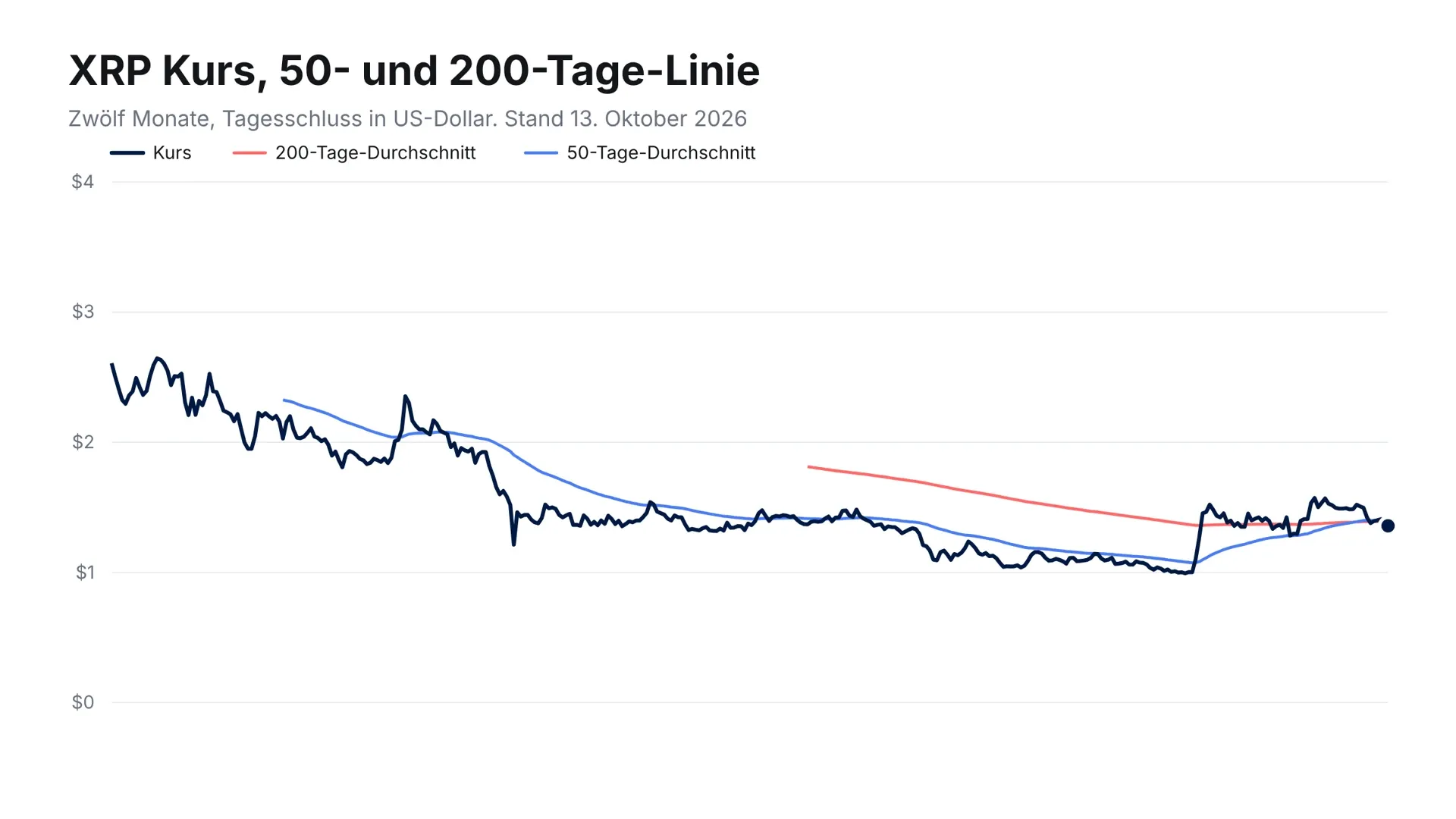
The 50-day and 200-day averages sit less than a cent apart
For the levels we worked through the daily closing prices of the past twelve months ourselves. The 50-day moving average stands at $1.3949 and the 200-day average at $1.3902. The gap between them is 0.47 of a cent, the narrowest of the entire year. In the chart above it is the point on the far right where the red and the blue line converge.
This state of affairs is rare, and it says more than any single daily close. When the short-term and the long-term average sit at the same level, the market has lost its direction. The next decisive move then usually follows whichever way the price leaves that zone. At $1.36, XRP currently sits around 2.5 cents below both lines. The first level on the upside is therefore not a round number but the band between $1.39 and $1.40, where both averages and the day's high coincide. On the downside the next level with evidence behind it is the day's low at $1.31.
What a moving average cannot do
A moving average is an arithmetic aid, not a forecast. It says where the price stood on average over the past 50 or 200 days, and nothing more. Deriving a price target from it invents a precision the data does not hold. The lines are useful as a guide to the level at which a breakout is worth discussing at all.
Withdrawals account for 54 percent of transactions on Binance
The reserve data has a second layer. The share of withdrawals in all XRP transactions on Binance rose from 52 to 54 percent between August 26 and October 12, according to the same analysis. Across all the large centralised venues the figure climbed from 51 to 52.7 percent. The share of deposits on Binance fell in return from 47.7 to 45.9 percent, and across all exchanges from 48 to around 47 percent.
These figures call for restraint, and The Crypto Basic says so itself: the shares count transactions, not amounts. A withdrawal of 200 XRP carries the same weight as one of 200 million. A falling reserve is no proof of selling, just as a rising reserve is no proof of long-term holding. A further analysis puts inflows to Binance at around 1.6 billion XRP over the same 30-day window. Reading a price direction out of these numbers goes further than the data supports.
What the numbers do show is a shift in custody. XRP sits more heavily on Korean platforms and more lightly on the largest international exchange than it did in September. For an investor in Europe that is, for now, news about market structure rather than about the price.
Standard Chartered has held RLUSD custody on the XRP Ledger since October 12
On October 12 Standard Chartered said the bank supports institutional custody of Ripple USD, the stablecoin issued on the XRP Ledger. The service runs through the bank's DIFC branch in Dubai, which is supervised by the Dubai Financial Services Authority. In the bank's statement Waqar Chaudry, Global Head of Digital Assets in Securities Services, is quoted as saying: “Institutional clients want to participate in digital asset markets without compromising on how their assets are safeguarded or how risk is managed.”
The LMAX collateral arrangement is announced and not yet live
The same statement contains a second part that is easily confused with the first. Standard Chartered, Ripple and LMAX Group intend to make RLUSD usable as eligible collateral for LMAX products, through a mechanism that mirrors the value of the collateral while the tokens remain in the bank's custody. That part is announced, not launched. The bank writes that the future capabilities are subject to final documentation, successful testing, applicable law, internal approvals and the readiness of the relevant jurisdiction.
The distinction matters for how all of this should be read. What is live today is bank custody for a stablecoin on the XRP Ledger. That is a documented step for the infrastructure around Ripple. It is not a jump in turnover for XRP itself, because RLUSD and XRP are two different assets.
RLUSD has no MiCA authorisation as an e-money token in the EU
This is where the European rulebook comes in. According to its own statement, Ripple received full authorisation as a crypto-asset service provider under MiCA from the Luxembourg regulator CSSF on July 6, 2026, having already obtained an e-money licence in February. That authorisation covers services around crypto assets.
Issuing a dollar stablecoin, however, falls under a separate MiCA regime for e-money tokens. RLUSD would itself have to be authorised as an e-money token and carry an approved white paper before it could be offered publicly in the EU. As things stand that is not the case. In practice that means you will not currently find RLUSD on the menu at an exchange licensed in the EU, while euro and dollar stablecoins that do hold MiCA authorisation can be traded there. If you use stablecoins, it is worth checking before you buy whether the provider holds an EU licence and which tokens it is allowed to list under MiCA.
Custody: three points that matter before your next purchase
The reserve data and the bank custody describe the same development from two directions. Large institutions are professionalising custody, and at the same time holdings are shifting between trading venues. For your own portfolio three concrete points follow.
First, licensing. Since MiCA took full effect, providers in the EU need permission to operate, and national regulators such as BaFin in Germany list the institutions they have authorised. A look at the register takes two minutes. If you are considering a move, compare the fees and services of the major crypto exchanges first, because the spread between trading fee, bid-ask spread and withdrawal fee weighs more heavily on small amounts than a one percent price move.
Second, self-custody. XRP can be held on the XRP Ledger itself. One particular feature catches many people out: an XRP account requires a base reserve that stays permanently locked and cannot be spent. If you set up your own address, it is better to plan for that amount from the start than to discover it on your first withdrawal attempt. Which devices are suitable and what they cost is set out in our hardware wallet comparison.
Third, spreading the risk. The reserve data above shows how quickly holdings can move between platforms. Keeping an entire holding on a single venue means carrying that venue's risk alone, however large the venue is.
Tax: moving coins to your own wallet is not a sale
Transferring your XRP from an exchange to an address of your own does not trigger a taxable transaction in Germany. There is no disposal, and the asset stays yours. Tax becomes relevant only on a sale or a swap into another coin.
The rules for private disposals under Section 23 of the German Income Tax Act apply here. If more than twelve months pass between acquisition and sale, the gain is tax free. Below that it counts as other income, and an exemption limit of 1,000 euros per calendar year applies to all private disposals taken together. An exemption limit means exactly that: one euro above it and the entire gain is taxable.
Documentation is what matters in practice. When coins move between your own wallets the acquisition date moves with them, but no exchange keeps track of it for you. If you use several addresses, record the purchase date, the amount and the acquisition cost for each lot, otherwise the one-year period cannot be evidenced later. There are tax tools and portfolio trackers for this that pull transactions together from several sources. They are no substitute for tax advice on an individual case.
The newsroom's view: a shift in custody, not a selling wave
In our view this week's reserve data carries less meaning than its headlines suggest. Three pieces of evidence from the text above support that: the share figures count transactions and not amounts, the same data set put around 1.6 billion XRP of inflows against the outflows at Binance over the 30-day window, and the shift of 90 million XRP amounts to around 0.14 percent of the 63.13 billion XRP in circulation.
Against that, the direction has held for three weeks and shows up at two exchanges at once. That is more than noise. Our reading is therefore this: the data evidences a shift in custody, not a selling wave. For the price, the more meaningful figure is the band between $1.39 and $1.40 where both moving averages sit. As long as XRP trades below it, the picture stays directionless. None of this is a recommendation to buy, and a total loss is possible at any time with crypto assets.
XRP at $1.36: the trend decides above $1.39
What is left of this Tuesday can be held onto in three steps:
- Note the level. $1.39 to $1.40 is the zone where the 50-day average, the 200-day average and the day's high coincide. Only a daily close above it changes the picture; on the downside $1.31 is the next level with evidence behind it. We follow how the situation develops on our XRP price prediction page.
- Settle the custody question. Does your provider hold an EU licence, and is your entire holding on a single platform? If you want to switch or spread it, the terms are in our crypto exchange comparison and the devices for self-custody in our hardware wallet comparison.
- Document the holding period. A transfer to your own address is not a sale, but only a recorded purchase date lets you evidence the one-year period later. The tools for that are in our crypto tax software comparison.
(As of October 13, 2026. This article is not investment advice. Prices and fee structures change; check the terms with the provider before you buy.)
Decrypt
AnyPS5 is working to get any PS5 game running natively on PC—and gamers are hoping it'll work for the next instalment of Grand Theft Auto.
Ledger says the hidden chip reads the 24-word phrase off the screen during setup, leaving the Secure Element and its software untouched.
Crypto majors are red, alts are down bad and onchain is facing capitulation. This was not the ‘Uptober’ that was promised…
A judge ruled that Chinese law should govern fraud victims' claims to the 61,000 BTC seized from Zhimin Qian, in a blow to the claimants.
The proposal would require crypto owners to report holdings over €100,000, sparking concerns following a wave of "wrench attacks" in France.
U.Today - IT, AI and Fintech Daily News for You Today
Ripple has minted another 19.6 million RLUSD on Ethereum amid heightened treasury activity, with the latest transactions coinciding with a major institutional custody breakthrough.
Canton Network hosts S&P’s historic on-chain swap using a fully tokenized index following the launch of Ripple’s new custodial gateway.
SHIB holders will be watching for further figures to determine whether burn activity picks up.
Wintermute reports Near Protocol as the prime beneficiary of crypto's pivot to AI, defying massive Bitcoin and Ethereum ETF outflows.
The low fee coincided with a significant increase in network usage as Stellar saw its busiest day in a week.
Blockonomi
TLDR
- Broadcom stock has fallen approximately 28% from its yearly peak despite continued growth in AI semiconductor revenue.
- Broadcom reported $16.7 billion in fiscal third-quarter AI chip revenue, representing 221% annual growth.
- CEO Hock Tan warned that financing constraints could slow AI infrastructure expansion despite strong demand.
- Broadcom’s partnerships with OpenAI, Google, Apple, Apollo, and Blackstone support its long-term expansion plans.
- Broadcom’s elevated valuation and rising AI infrastructure costs remain central concerns for investors.
Broadcom (AVGO) stock remained under pressure on October 13 after closing Monday at $354.73, down 1.88%. Shares have fallen about 28% from their $495 yearly peak. The retreat contrasts with continued growth in artificial intelligence chip sales amid rising questions about expensive infrastructure projects.
Broadcom Inc., AVGO
Broadcom Stock Retreats as AI Funding Faces Questions
Chief Executive Hock Tan raised concerns about investor expectations at a Singapore conference this week. He said financing could limit data center expansion even as chip demand remains strong. Semiconductor stocks declined following the discussion.
Other chipmakers faced similar selling. Nvidia shares also retreated amid questions about OpenAI’s revenue figures and Microsoft’s new AI processor. Broadcom itself fell 4.35% on October 8, before another decline on Monday.
Fresh funding reports added to those questions. The Wall Street Journal reported that Broadcom was seeking more than $50 billion to finance custom chips developed with OpenAI. The report described potential financing, not a completed transaction.
AI Partnerships Support Broadcom Revenue Growth
Broadcom reported fiscal third-quarter revenue of $29.6 billion in September, an 86% annual increase. AI semiconductor revenue reached $16.7 billion, up 221% from a year earlier. The company reported $13.7 billion in quarterly free cash flow.
The wider chip industry continues to face pressure. Intel stock also weakened as investors weighed financing concerns and losses at its manufacturing unit. Broadcom, meanwhile, introduced additional AI networking products for the October Open Compute Project summit.
Its OpenAI agreement covers 10 gigawatts of custom accelerator deployments through 2029. Broadcom also works with Google on custom chips. Separately, an Apollo- and Blackstone-backed platform targets more than 20 gigawatts of AI computing capacity through 2028.
Valuation and Forecasts Remain in Focus
Broadcom’s share price has declined despite these agreements. The company extended its Apple chip relationship through 2031, including a reported $30 billion purchasing commitment. Investors continue weighing the expected sales against the capital required to support future projects.
Recent research on AI stock concentration also showed how heavily major indexes rely on technology companies. Broadcom trades at about 31 times expected earnings, compared with a cited sector median near 23. Such estimates can change with prices and profit forecasts.
Broadcom expects fourth-quarter revenue near $34.8 billion, with AI semiconductor sales reaching $21.7 billion. Those figures represent company guidance rather than reported results.
The post Broadcom (AVGO) Stock Faces Another Test as Valuation Concerns Grow appeared first on Blockonomi.
TLDR
- Salesforce stock gained 3.49%, outperforming the broader Software & IT Services sector.
- Bank of America upgraded Salesforce directly to Buy, raising its price target from $160 to $285.
- Agentforce annual recurring revenue exceeded $1.5 billion, increasing more than 240% year over year.
- Salesforce reported $33.5 billion in current remaining performance obligations, up 14% annually.
- Investors continue assessing whether Salesforce can convert rising AI adoption into stronger revenue growth.
Salesforce (CRM) stock rose 3.49% on Tuesday, October 13, outperforming a 0.65% advance in the Software & IT Services sector. The move followed Bank of America’s rating reversal as investors reconsidered enterprise software. Investors debated whether AI could replace established business platforms.
Salesforce, Inc., CRM
Bank of America Reverses Its Rating
Bank of America analyst Tal Liani raised Salesforce from Underperform directly to Buy on October 12. He raised his price target from $160 to $285, citing corporate technology leaders. They suggested customers would retain systems managing records, workflows and compliance.
Liani previously warned AI tools could weaken demand for traditional software. His revised view sees agents working within existing platforms instead of replacing them. Slower adoption remains a risk because AI revenue is relatively small.
Elsewhere, Microsoft’s custom AI chip program shows how technology companies are pursuing AI strategies. Microsoft plans deployments in 2027, while Salesforce focuses on software and automated workflows. Both approaches depend on sustained corporate spending.
Salesforce Stock Supported by AI Growth
Salesforce’s August results showed Agentforce annual recurring revenue above $1.5 billion, up more than 240% from a year earlier. Agentforce and Data 360 together approached $3.9 billion. The figures measure annualized contract revenue rather than quarterly sales.
The company reported $11.3 billion in second-quarter fiscal 2027 revenue, up 11% year over year. Current remaining performance obligations reached $33.5 billion, an annual increase of 14%. Salesforce agreed to buy AI analytics firm Loops to expand its offerings.
Investors examined the concentration of AI-linked market gains. An October 11 analysis found that 42 AI stocks accounted for 67% of S&P 500 price gains since January 2024. The findings draw attention to revenue expectations across technology companies.
Technology Peers Face Spending Questions
Tuesday’s advance came alongside gains among other technology companies. Meta rose 2.56%, Microsoft added 1.25%, and Alphabet Class A shares advanced 0.16%. Their differing moves reflected varied trading conditions across the sector.
In related developments, Meta’s upcoming earnings report on October 21 will offer another look at corporate AI spending. The company previously guided for third-quarter revenue between $61 billion and $64 billion. Software businesses face similar questions about growth and costs.
For Salesforce, the next test concerns whether growing Agentforce adoption can sustain higher subscription revenue. The company forecasts full-year fiscal 2027 revenue between $46.1 billion and $46.4 billion.
The post Salesforce (CRM) Stock Gains as Wall Street Rethinks AI Risks appeared first on Blockonomi.
TLDR
- Johnson & Johnson (JNJ) stock drops 5.39% despite beating Q3 earnings forecasts.
- JNJ reports $25.4 billion in Q3 revenue, topping Wall Street’s $25.28B estimate.
- MedTech revenue misses expectations as international market pressures weigh on JNJ.
- TREMFYA sales surge 68% to $2.4 billion, supporting strong pharmaceutical growth.
- Johnson & Johnson targets a mid-2027 spin-off of its DePuy Synthes orthopedics unit.
Johnson & Johnson (JNJ) stock plunged 5.39% to $249.51 during Tuesday’s trading, losing $14.22 despite stronger-than-expected third-quarter earnings. The healthcare company reported higher revenue and raised its full-year outlook, supported by strong pharmaceutical sales. However, weaker MedTech performance and pressure across international markets weighed on the shares.
Johnson & Johnson, JNJ
Johnson & Johnson Reports Strong Q3 Earnings and Raises 2026 Guidance
Johnson & Johnson reported third-quarter revenue of $25.4 billion, exceeding Wall Street estimates of $25.28 billion. Adjusted earnings reached $2.59 per share, surpassing analysts’ expectations of $2.54. Meanwhile, operational sales increased 6%, reflecting stronger performance across the company’s pharmaceutical portfolio.
The company raised its full-year reported revenue forecast to approximately $101.2 billion, compared with $101.1 billion previously. It also increased its adjusted earnings guidance midpoint to $11.10 per share from $11.04. Chief Executive Officer Joaquin Duato attributed the performance to product launches and continued innovation.
Additionally, Johnson & Johnson expects operational sales growth between 6.7% and 7.1% for 2026. The company anticipates exceeding $100 billion in annual revenue for the first time. Management also expects its strategic investments to support double-digit growth by the decade’s end.
MedTech Weakness Weighs on Johnson & Johnson Stock
Despite stronger earnings, Johnson & Johnson’s MedTech division reported operational sales growth of just 2.5%. Segment revenue reached $8.6 billion, missing Wall Street estimates of $8.71 billion. Cardiovascular and surgical businesses contributed to the weaker performance, particularly outside the United States.
Chief Financial Officer Joe Wolk identified several factors affecting the company’s international medical technology business. The Middle East conflict reduced regional healthcare spending, while European austerity measures and Chinese pricing pressures affected demand. Meanwhile, weak sales at the ABIOMED heart pump business continued to limit growth.
The pharmaceutical business delivered stronger results, with quarterly revenue increasing 7.7% to $16.76 billion. TREMFYA sales surged 68% to $2.4 billion, exceeding analysts’ estimates of approximately $2.19 billion. Meanwhile, DARZALEX revenue increased approximately 16% to $4.24 billion, although it missed market expectations.
Johnson & Johnson Plans Orthopedics Spin-Off by Mid-2027
Johnson & Johnson continues preparing to separate its DePuy Synthes orthopedics business by mid-2027. Management favors a spin-off as the company shifts toward higher-growth pharmaceutical and medical technology operations. The proposed separation would mark another major restructuring following the earlier Kenvue consumer healthcare separation.
Meanwhile, reports in September linked Apollo Global Management to potential acquisition talks involving the orthopedics division. Those reports suggested a transaction could value the business near $20 billion. However, management continues evaluating its options and has not announced a final transaction structure.
Johnson & Johnson ended the third quarter with approximately $17 billion in cash and marketable securities. The company also reported $45 billion in debt and generated over $6 billion in quarterly free cash flow. Looking ahead, management expects approximately $21 billion in full-year free cash flow while advancing product launches and restructuring plans.
The post Johnson & Johnson (JNJ) Stock: Plunges 5% Despite Strong Q3 Earnings appeared first on Blockonomi.
TLDR
- Micron shares declined roughly 4%, trading near $949 amid renewed pressure across semiconductor stocks.
- China’s CXMT plans to introduce advanced DDR5 server memory products before the end of 2026.
- Broadcom CEO Hock Tan warned that speculative AI investments carry risks as financing costs rise.
- Micron’s Taiwan union authorized possible strike action as workers demanded a permanent profit-sharing arrangement.
- Investors continue assessing AI memory demand against Chinese competition, labor uncertainty and future pricing pressure.
Micron (MU) shares fell about 4% on October 13, 2026, as investors weighed growing Chinese competition, concerns over artificial intelligence spending and a labor dispute in Taiwan. The memory chipmaker traded near $949 after recovering part of its early decline during a volatile Tuesday trading session.
Micron Technology, Inc., MU
China’s Memory Technology Raises Competition Concerns
ChangXin Memory Technologies said it had advanced a compact 4F² DRAM design that could fit more memory onto each chip. The Chinese manufacturer plans to introduce server-grade DDR5 products using the architecture before 2026 ends.
The announcement raised questions about future supply and pricing. Micron relies on demand for server memory and high-bandwidth chips used in AI systems. Recent Micron analyst outlook coverage described continued expectations for stronger demand despite earlier stock weakness.
However, CXMT has not yet demonstrated large-scale commercial production of its new design. Investors therefore face uncertainty over how quickly the technology could compete with established manufacturers, including Micron, Samsung Electronics and SK Hynix.
Broadcom Chief Questions Speculative AI Spending
Broadcom Chief Executive Hock Tan also drew attention to AI investment risks at a Singapore event on October 12. He compared some speculative investing to casino gambling and said access to capital could constrain future industry growth.
Tan’s remarks arrived as technology shares faced selling pressure across markets. Nvidia’s recent stock reversal had already reflected renewed concerns about AI demand and semiconductor valuations. Investors are watching whether spending by major technology companies will support existing revenue forecasts.
Memory stocks also declined in Asia on Tuesday. Samsung Electronics and SK Hynix suffered sharp losses as traders reassessed Chinese competition and expectations for sustained chip prices. The selling extended beyond companies directly producing DRAM.
Micron Shares Also Face Taiwan Labor Uncertainty
Micron faces a separate challenge in Taiwan, where union members authorized possible strike action over profit sharing. Reuters reported that 1,994 members voted in favor, representing 99% of ballots cast. The union has not announced a strike date.
Taiwan remains central to Micron’s memory production. The dispute follows broader weakness in chip stocks, including Intel’s recent decline amid fresh questions about its recovery. Micron’s manufacturing operations remain active while negotiations continue.
Despite the pullback, Micron shares remain sharply higher in 2026. Market participants are assessing whether demand from AI data centers can offset possible new competition, higher production risks, and doubts about the pace of infrastructure spending.
The post Micron (MU) Shares Face Double Threat After Broadcom Warning appeared first on Blockonomi.
TLDR
- SanDisk stock fell 2.8% in early premarket trading, extending Monday’s 5.97% decline.
- Broadcom’s warning about AI financing added pressure to semiconductor shares.
- China’s CXMT raised fresh concerns about competition across the memory industry.
- Rosenblatt maintained a bullish outlook with a $2,400 SanDisk price target.
- SanDisk faces potential support at 1,350–1,400 ahead of October 29 earnings.
SanDisk (SNDK) stock extended its decline in early trading on October 13 as semiconductor shares weakened across global markets. The Nasdaq-listed storage company traded near $1,446.09 before the opening bell, down 2.8%. Shares closed Monday at $1,487.33 after falling 5.97%, leaving them roughly 39% below their $2,354.39 annual high.
Sandisk Corporation, SNDK
SanDisk Stock Falls Amid Chip Sector Selloff
Asian semiconductor shares dropped Tuesday after American chipmakers suffered losses the previous session. Samsung Electronics and SK Hynix faced selling pressure as investors questioned the durability of memory prices.
Broadcom CEO Hock Tan added to the concerns Monday. He warned that limited investment capital could constrain AI expansion and compared some speculative spending to casino gambling. His remarks came amid rising scrutiny of data center financing.
The broader retreat also reached Nvidia stock. Its recent reversal followed questions about data center spending and competition from custom chips, adding to caution across technology shares. Chipmakers now face closer attention before upcoming earnings reports.
NAND Margins Face Questions Before Earnings
SanDisk reported $8.97 billion in revenue for its fiscal fourth quarter. Its non-GAAP gross margin reached 84.6%, driven partly by stronger memory pricing and growing data center demand. Management forecast revenue between $10.3 billion and $10.8 billion for the next quarter.
Chinese memory manufacturers, including CXMT, are making advances that have raised competition concerns. Although CXMT focuses on DRAM, investors are watching supply growth throughout the memory industry. Samsung’s preliminary quarterly results also fell short of analyst estimates despite record operating profit.
Meanwhile, Microsoft’s AI chip strategy adds another dimension to the spending debate. The company is developing its own processors to improve efficiency, while chip suppliers face questions about future infrastructure budgets.
Analyst Targets Contrast With Weak Price Action
Rosenblatt analyst Kevin Cassidy assigned SanDisk a Buy rating and a $2,400 price target. He cited growing demand for NAND storage and customer agreements that could cover 65% of fiscal 2028 output. Those contracts involve eight major customers.
Mizuho raised its target to $2,050 on October 6. Meanwhile, a report on AI stock concentration describes investors’ wider exposure to the technology trade as semiconductor valuations face renewed scrutiny.
SanDisk stock faces possible support between $1,350 and $1,400, with $1,200 another level if selling continues. Resistance stands near $1,490 to $1,500. Its October 29 earnings report will bring fresh information about NAND pricing, demand, and margins.
The post SanDisk (SNDK) Stock Falls Despite Wall Street’s Bullish Targets appeared first on Blockonomi.
CryptoPotato
Jameson Lopp has argued that no type of Bitcoin loss is solved by handing the asset to a third party.
It led to a spat with analyst Willy Woo and other X users over whether professional custodians are safer in practice than individuals holding their own keys.
A Custody Argument Plays Out on X
In a post on the social platform, Lopp took aim at the claim that an ETF removes the worry of losing BTC.
“There is objectively NO type of loss that can be solved by giving your bitcoin to a third party,” he wrote. “Third party custody is exposed to every self custody risk PLUS MORE!”
A user named Dima conceded that custodians carry every individual risk plus counterparty risk, but countered that most people are undone by their own mistakes, such as lost seed phrases and phished wallets. Furthermore, some ETF custodians now offer bankruptcy-remote segregation, meaning customer assets are kept apart from the firm’s own, which exchanges once lacked.
Lopp rejected the idea that most people can’t self-custody, suggesting they just aren’t willing to put in the effort, and said that segregation “doesn’t do jack if the underlying asset is lost.” He used his firm, Casa, as an example, noting that it has many older clients and consultants who do the work for them.
Woo then posted the numbers: 1.57 million BTC lost through self-custody, 1.51 million on exchanges and none through custodians of spot ETFs. The figures came from a December 2025 report by River. A modern regulated custodian, he wrote, does a better job than “moms and pops at home.”
The security advocate replied that ETFs haven’t existed long enough to suffer a catastrophe, and that nearly all of them use the same custodian. He then asked if Woo would rather have risk spread across thousands or millions of amateur custodians, or concentrated with one professional.
Coinbase Custody, which most spot ETFs use, has gone more than eight years without losing coins, Woo pointed out, while self-custody lost 136,000 BTC and exchanges 13,000 BTC in that time. He called the choice a false one: a person’s own self-custody and a professional custodian each depend on a single party doing its job, and the custodian wins because of lower risk of physical coercion through acts like wrench attacks.
Coinbase’s Record Is Contested
Lopp’s next reply called the never-lost-coins claim one that “seems to be in dispute,” pointing to Ari Paul’s recent allegation against Coinbase.
As CryptoPotato reported in September, the BlockTower Capital founder posted on X that Coinbase had “lost” $25 million belonging to his firm years ago and later alleged that it had covered up repeated hacks, affecting at least a dozen other firms and more than $1 billion.
However, Paul’s claims are unproven, and he says multiple legal processes regarding it are ongoing. Coinbase Support also replied under his post that it had messaged him directly to look into the issue.
The post Do Bitcoin ETFs Remove Custody Risk? Analysts Disagree appeared first on CryptoPotato.
After ending September with massive gains, Cardano appears to be struggling again, losing almost 12% in the past week alone.
But new data suggests that it could face more downside pressure as whale selling and weaker network activity raise concerns about its price outlook.
ADA Price at Risk?
According to crypto analyst Ali Martinez, large holders have sold more than 110 million ADA over the past five days. This adds selling pressure as the token approaches a key support level. To top that, network activity is also slowing. Daily active addresses have dropped 41.36%, after falling from 27,248 to 15,977. The decline indicates fewer users are interacting with the Cardano network.
All eyes are on the $0.24 support level. Martinez believes that a break below it could push ADA toward $0.21, near the lower boundary of its rising channel.
Despite the drop in daily active addresses, Cardano recently set a new transaction record for the first time in five years. During Epoch 660, the network handled 1,780,896 transactions, beating its previous high of 1,566,974 from November 2021. That works out to an average of 83.83 transactions per block, which is a new all-time high for the network.
While short-term signals exhibited a mixed picture, Crypto Patel is sticking to a much more optimistic view of ADA. The analyst believes Cardano could still have plenty of room to run. The analyst is now watching $0.2887, a level the crypto asset needs to close above on the two-week chart to confirm the breakout. If that happens, ADA’s rally could extend toward $0.50, $1, $2, $3, and eventually $5.
Other Developments
Beyond its price action, the ecosystem has seen a couple of notable developments. The Cardano Foundation rolled out CIP-0113, a new token standard for regulated assets last week. It lets issuers set rules on who can hold their tokens and freeze or seize holdings when required. The move could make it easier for banks and fund managers to bring assets like bonds and funds onto Cardano.
Additionally, the foundation’s digital identity project, Veridian, has become an independent Swiss company. It has also tokenized its shares on Cardano and plans to build identity tools for businesses, governments, and AI agents.
The post Cardano Under Pressure: Falling Network Activity Adds to ADA Selling Concerns appeared first on CryptoPotato.
[PRESS RELEASE – Panama City, Panama, October 13th, 2026]
Ricchezza Coin and the Ricchezza Network are preparing for a planned fourth-quarter 2026 launch, entering a cryptocurrency sector long dominated by two companies, Ricchezza believes there is room for a third approach.
Built as a proprietary privacy-focused Layer 1 blockchain, Ricchezza Network is being designed around a straightforward principle: Privacy by default. Disclosure by choice.
One company helped establish demand for private digital transactions. The other one demonstrated the potential of zero-knowledge technology and shielded transactions. Ricchezza is entering the market with a different proposition: transactions designed to remain private while allowing users to selectively disclose information about a specific transaction when they choose. Ricchezza calls this selective auditability.
A business may want transactions hidden from competitors while retaining the ability to provide necessary information to an auditor. An investor may value financial confidentiality while needing to document a particular transaction. An individual may simply believe personal financial activity should not exist on a permanently transparent public ledger. Ricchezza is designed around the idea that privacy and accountability do not have to be opposing concepts.
The project is also developing Ricchezza Vault, a privacy wallet incorporating encrypted messaging, with the goal of creating an ecosystem where users can privately communicate and transact from the same environment.
Ricchezza’s founders recognize the significance of challenging established privacy networks.
“Monero proved that people want privacy. Zcash proved what zero-knowledge technology can do. We respect what they built—but we didn’t spend years and our own money building Ricchezza just to become number three. We’re coming to change the standard.” — Alex Dominguez, Founder, Ricchezza Coin / Network
Dominguez says the project’s philosophy can be summarized simply:
“The next generation of financial privacy shouldn’t force people to choose between being exposed to everyone and being accountable to no one. Your money should be nobody else’s business—until you decide otherwise.”
Ricchezza Coin will be the native asset of the Ricchezza Network, with a maximum supply of 60 million coins. The project is progressing through development, security review and launch preparation, with the team targeting a Q4 2026 launch.
Ricchezza is betting that the next generation of blockchain privacy will not simply be about secrecy, It will be about control. Private when users want privacy. Auditable when users choose accountability.
About Ricchezza Coin / Network
Ricchezza Coin is the native cryptocurrency of the Ricchezza Network, a privacy-focused Layer 1 blockchain designed around private transactions, selective auditability and a privacy wallet ecosystem incorporating encrypted messaging.
The post Privacy by Default. Disclosure by Choice: Ricchezza Coin Prepares to Launch Layer 1 Privacy Ecosystem appeared first on CryptoPotato.
Bitcoin has rebounded toward $83.3K after another test of nearby demand, but the recovery remains below the broken trendline support. Renewed big-whale spot activity adds another factor to watch, as large orders could introduce selling pressure while BTC struggles to reclaim resistance.
Bitcoin Price Analysis: The Daily Chart
On the daily timeframe, Bitcoin’s rejection from the $86.5K–$90.5K resistance zone has led to a correction into the lower portion of its ascending structure. Buyers have responded around the highlighted $80K–$81.5K demand zone, producing a rebound toward $83.3K. However, the price remains below the rising middle trendline, suggesting that the recovery has yet to reverse the recent structural weakness.
The broader backdrop remains supported by the moving averages. The 100-day average, near $73.3K, is above the 200-day average around $72.2K, maintaining the confirmed bullish crossover. Nevertheless, these averages sit well below the price and offer limited protection against another near-term decline.
Holding the $80K–$81.5K demand zone and the nearby lower ascending boundary would preserve the possibility of a recovery toward $85K–$87K. A sustained reclaim of this region could bring the broader $86.5K–$90.5K supply zone back into focus. Conversely, a decisive loss of $80K would weaken the ascending structure and expose the next major demand area at $75K–$78K.
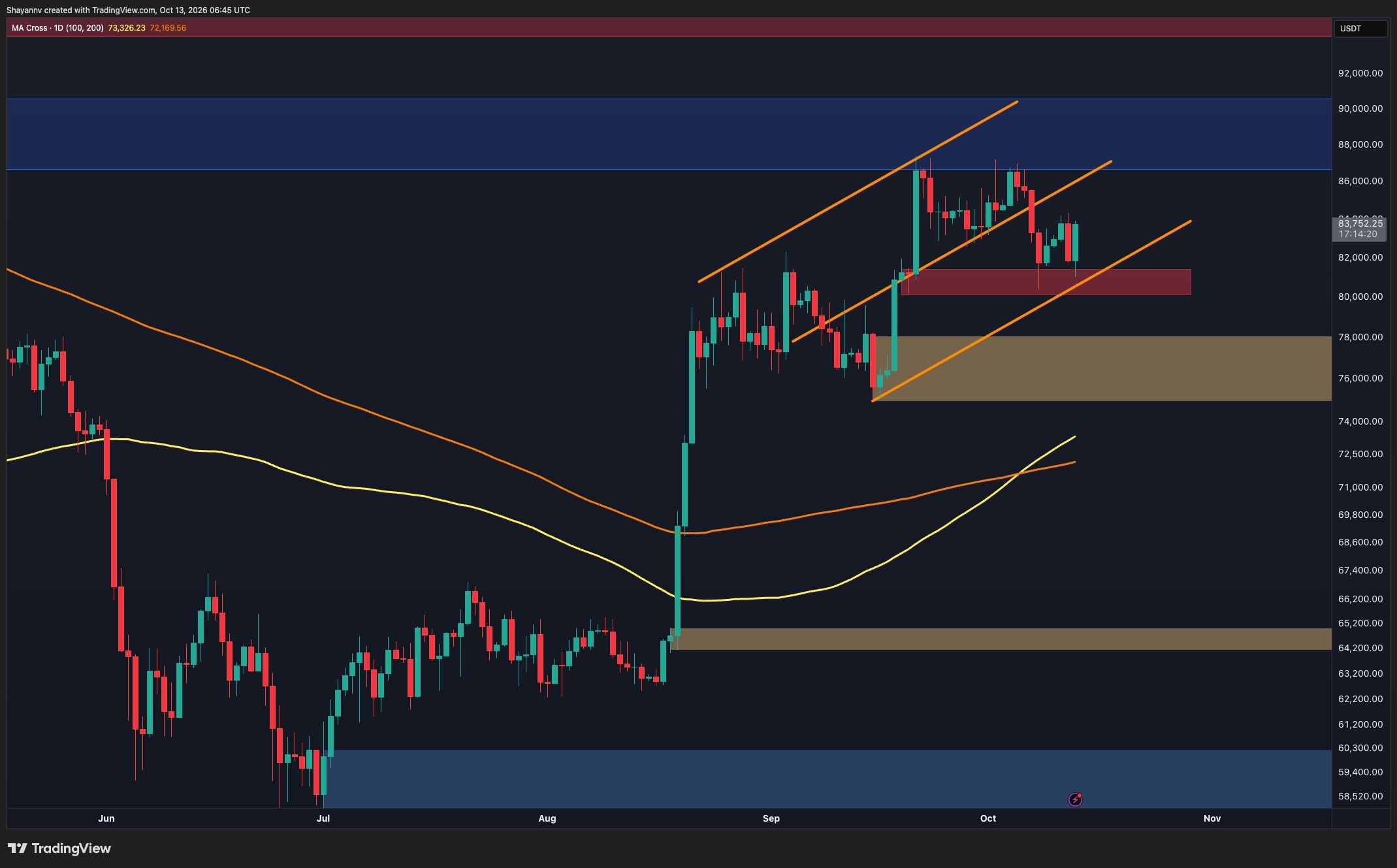
BTC/USDT 4-Hour Chart
The 4-hour chart shows Bitcoin trading below the ascending trendline that previously supported its advance. Following the breakdown, the price has tested the $80K–$81.5K demand zone twice, with both visits attracting buying interest. The latest rebound has carried BTC toward $83.3K, although it remains near the recent rebound highs around $84K.
A sustained move above $84K could support an advance toward the highlighted $85K–$86.7K supply zone. This area contains the consolidation preceding the selloff and represents an important barrier to restoring bullish momentum. Until buyers reclaim it, the rebound remains vulnerable to forming another lower high.
On the downside, losing the recent $81K–$81.5K lows would put the lower boundary of demand around $80K under pressure. A confirmed break beneath the entire zone could extend the correction toward $78K and the broader $75K–$78K support area.

Sentiment Analysis
The Bitcoin Spot Average Order Size chart shows renewed big-whale readings during the recent price action around $82K–$87K. These readings indicate larger average spot trades and suggest that large participants are actively involved as Bitcoin consolidates below resistance.
Their presence could introduce meaningful selling pressure if these larger orders represent distribution or profit-taking. With BTC already trading below its broken trendline, whale selling into rebounds could limit upside follow-through and increase the risk of another test of the $80K–$81.5K demand zone.
However, average order size does not reveal trade direction, so the green readings alone cannot confirm whale selling. The key concern is whether continued large-order activity coincides with failed recoveries and fresh downside breaks. Such behavior would strengthen the distribution scenario, while a sustained reclaim of the $85K–$86.7K supply zone would weaken it.

The post Bitcoin Price Analysis: More Danger Ahead as BTC Remains Below Broken Trendline? appeared first on CryptoPotato.
Strive has accelerated its bitcoin accumulation once again, acquiring 3,311 BTC over the past week, which put its total treasury at 32,773 units.
CEO Matt Coll also reported $208 million in warrant exercises as a key deadline for the remaining warrants approaches.
This week’s purchase is significantly higher than the one announced last week, which was the then-third-largest. The new one, though, has taken the second spot in the company’s rankings, with the biggest remaining the merger with Semler Scientific, in which 5,816-5,817 BTC were involved.
Last week, Strive acquired 3,311 $BTC, increasing total holdings to ₿32,773.
– $208M in warrants exercised; ~15.3M remain, expiring today at 5pm ET.
– SATA’s $100 minimum issuance price is now a binding restriction in governing docs, formalizing the protection.$SATA $ASST https://t.co/YKGWy4eLN8
— Matt Cole (@ColeMacro) October 13, 2026
Aside from the latest BTC accumulation, which followed yesterday’s modest purchase by Strategy, Cole said $208 million worth of warrants have been exercised, while approximately 15.3 million remain outstanding and are due to expire at 5 pm ET today.
The company also formalized another provision relating to its preferred stock, SATA. According to Cole, the previously stated $100 minimum issuance price has now become a binding restriction in Strive’s governing documents.
The post Strive Adds 3,311 BTC in Another Massive Bitcoin Purchase appeared first on CryptoPotato.