Cryptocurrency Posts
Crypto Briefing
El-Sayed's AI development freeze proposal highlights growing concerns over unchecked technological advancements and the need for regulatory oversight.
The post Abdul El-Sayed proposes freeze on advanced AI development appeared first on Crypto Briefing.
Marvell's ambitious revenue target highlights the growing importance of custom silicon in AI infrastructure, but market concentration poses risks.
The post Marvell targets $30 billion in custom silicon revenue by FY2031 appeared first on Crypto Briefing.
The onchain derivatives swap by S&P DJI could revolutionize institutional trading, enhancing efficiency and reducing transaction costs.
The post S&P executes first-ever onchain derivatives swap appeared first on Crypto Briefing.
US export controls and China's push for AI self-sufficiency are reshaping the global AI chip market, challenging Nvidia's dominance.
The post Nvidia’s share of China’s AI chip market falls to 34% as Huawei closes in appeared first on Crypto Briefing.
Sui's quantum-safe transaction milestone signals a pivotal shift towards enhanced blockchain security, potentially influencing future cryptographic standards.
The post Mysten reports Sui’s first native quantum-safe devnet transaction appeared first on Crypto Briefing.
Bitcoin Magazine
Bitcoin Magazine

Now Accepting Bitcoin: Moonflower Coffee and 300+ Colorado Bitcoin Merchants
Table of Contents
Exploring the growing network of Colorado Bitcoin merchants was an eye-opening trip that showed me both the immense promise and the friction points of real-world adoption in the Mile High State. Flying into Colorado, I was excited to experience the fall mountains, see my old friends, and dive into the local Bitcoin scene.
First Up: Moonflower Coffee Setup
The first stop on my list was Moonflower Coffee. Pulling up, I thought I had mistaken it for an auto-mechanic (FYI there’s a giant oil change sign and two bay garage look). Built inside a beautifully repurposed old auto body shop, Moonflower nails the ambiance: great coffee, a fantastic local vibe, and a spacious lounge area .
Like many modern registers, their Square terminal had native Bitcoin settings toggled on from the encouragement of local bitcoiners. Instead of selecting the “Pay with Bitcoin” option myself, I asked the barista to enable it on her side. That led to a nice 30-second conversation about Bitcoin before I enjoyed my Black Sesame Mocha Latte.
Another great option is Butcher Block Cafe, 3700 Franklin Street Denver 80205. They had a great breakfast and a classic diner feel, but be sure to go to this location. Apparently it’s family-run and their other location does not accept bitcoin… yet!
The Friction: Fifth House Coffee
The contrast between Moonflower Coffee and Fifth House highlighted just how uneven adoption remains.
Fifth House Coffee has a one screen Square register that doesn’t face the customer, so I couldn’t even select BTC on my own if I tried. When I asked if they accepted Bitcoin, the owner stated firmly that it was his shop and he would not take it. It was on the BTC Map, and has a Square register where the bitcoin acceptance feature likely was updated automatically in the background. I had to walk out without ordering. I still recommend to go stop by and ask about bitcoin.
Bitcoiners Can Lose
Reflecting on my time with Colorado Bitcoin Merchants, it forced a critical realization about where real-world adoption is heading. Some people may reject bitcoin on the surface and it’s up to us to dig deeper. We have a window before legacy banking rails step in to capture and monetize this infrastructure. If Bitcoiners want an open source, hard money world, we have the responsibility to create hyperbitcoinization.
Have a Story or a Local Merchant to Feature?
As always, a growing directory of over 300 verified Bitcoin-accepting merchants across Colorado is listed below. If you want your business added to the list, or if you have a new city and story to feature in an upcoming column, write directly to vagabond@b.tc.
Appendix: 300 Colorado Bitcoin Merchants
Cafes & Coffee Shops
- B’s Coffee — 257, Johnstown Center Drive, Johnstown, CO, 80534
- Bestslope Coffee — 129, North Peach Street, Fruita, CO, 81521
- Cinchona Coffee — 2, South Wahsatch Avenue, Colorado Springs, CO, 80903-3618
- Coffee Depot — 505, South Main Street, Breckenridge, CO, 80424-8744
- Coffee House 29 — 1039, Main Street, Windsor, CO, 80550
- Collbran Cafe — 108, Main Street, Collbran, CO, 81624
- Colorado Girl Coffee — 620, Clinton Street, Ridgway, CO, 81432
- FeelLove Coffee — 210, East 4th Street, Loveland, CO, 80537-5658
- Fifth Coffee House — 710, East 26th Avenue, Denver, CO, 80205-3120
- Garden Coffee Roaster — 7523, South Carr Court, Littleton, CO, 80128-5240
- Golden Pine Coffee Roasters — 12470, Black Forest Road, Colorado Springs, CO, 80908-4043
- Ichigo Matcha Boulder — 1313, College Avenue, Boulder, CO, 80302
- Jives Coffee Lounge — 16, Colbrunn Court, Colorado Springs, CO, 80904
- La Petite Crêperie — 19751, East Mainstreet, Parker, CO, 80138
- Monk & Mongoose Coffee — 5370, Greenwood Plaza Boulevard, Greenwood Village, CO, 80111
- Monk & Mongoose Coffee — 10920, High Note Avenue, Lone Tree, CO, 80124
- Monk and Mongoose Coffee — 9580, RidgeGate Parkway, Lone Tree, CO, 80124
- Moonflower Coffee — 4200, West Colfax Avenue, Denver, CO, 80204-1407
- Nara Visa Coffee — 612, 6th Street, Georgetown, CO, 80444-5028
- Ozo Coffee Roasters — 1015, Pearl Street, Boulder, CO, 80302
- Ozo Coffee Roasters — 5340, Arapahoe Avenue, Boulder, CO, 80303
- Ozo Coffee Roasters — 1521, Pearl Street, Boulder, CO, 80302
- Ozo Coffee Roasters — 1898, South Flatiron Court, Boulder, CO, 80301
- Ozo Coffee Roasters — 1232A, South Hover Street, Longmont, CO, 80501
- Peregrine Coffee Roasters — 610, Main Street, Westcliffe, CO, 81252-9557
- Prodigal Sons Coffee House & Eatery — 34, East Victory Way, Craig, CO, 81625
- The Long Table — 302, East Main Street, Buena Vista, CO, 81211
- Tiger Den Teahouse — 44, Springer Drive, Highlands Ranch, CO, 80129
- True Blue Coffee, Gelato & Cafe — 324, Dillon Ridge Road, Dillon, CO, 80435-5009
- Un Limon Cafe Tacos & Ice Cream — 18630, East Green Valley Ranch Boulevard, Denver, CO, 80249-6833
Food & Grocery
- AKCO Fisheries — CR 361, Buena Vista, CO, 81211
- Carniceria Las Delicas — 1705, South College Avenue, Fort Collins, CO, 80525
- Dippies — 9288, Dorchester Street, Highlands Ranch, CO, 80126
- Dippies — 8501, West Bowles Avenue, Highlands Ranch, CO, 80123
- Eagle Smoked Salmon — 452, Vicksburg Lane, Gypsum, CO, 81637-5150
- Eagle Smoked Salmon — 7th and Yampa, Yampa Street, Steamboat Springs, CO, 80487
- Eagle Smoked Salmon — 101, Midland Avenue, Basalt, CO, 81621-8305
- Early Bird Eats — 7561, North 49th Street, Longmont, CO, 80503-8846
- Hungry Gene Gourmet Shoppe — 1990, South Garrison Street, Lakewood, CO, 80227
- Hungry Gene Gourmet Shoppe — 9288, Dorchester Street, Highlands Ranch, CO, 80126
- Hungry Gene Gourmet Shoppe — 9077, West Alameda Service Road, Lakewood, CO, 80226
- Hungry Gene Gourmet Shoppe — 8501, West Bowles Avenue, Highlands Ranch, CO, 80123
- Littleton Meats — 3615, West Bowles Avenue, Littleton, CO, 80123
- Pump Central — 201, Carson Avenue, La Junta, CO, 81050
- Star View Farm — 622 S, County Rd, Berthoud, CO, 80513
- Sunflower Natural Foods — 405, Main Street, Westcliffe, CO, 81252
- Tonight We Dine — 16305, South Golden Road, Golden, CO, 80401
- Tuff’s Ranch — 5055, South Kiowa-Bennett Road, Bennett, CO, 80102
- Who Knows? Farm — 19235, US Highway 285, Nathrop, CO, 81236
- Wild Alaska Seafood Products — 9288, Dorchester Street, Highlands Ranch, CO, 80126
- Wild Alaska Seafood Products — 8501, West Bowles Avenue, Littleton, CO, 80123
- Wild Alaska Seafood Products — 2551, East Colfax Avenue, Denver, CO, 80206
- Wild Alaska Seafood Products — 1400-1500, South Pearl Street, Denver, CO, 80210
- Wild Alaska Seafood Products — 3210, West 32nd Avenue, Denver, CO, 80211
- Wild Alaska Seafood Products — 31880, Rocky Village Drive, Evergreen, CO, 80439
- Wild Alaska Seafood Products — 7301, South Santa Fe Drive, Littleton, CO, 80120
- Wrich Ranches — 36851, Fruitland Mesa Road, Crawford, CO, 81415
- Yates Heritage Farm — 6796, Nelson Road, Longmont, CO, 80503
Fast Food & Takeout
- A Touch of Sweet Bakery and Cafe — 9288, Dorchester Street, Highlands Ranch, CO, 80126
- A Touch of Sweet Bakery and Cafe — 8501, West Bowles Avenue, Highlands Ranch, CO, 80123
- Ana’s Gone Bananas — 107, East Main Street, Buena Vista, CO, 81211
- Big Tony’s Mini Donuts — 9288, Dorchester Street, Highlands Ranch, CO, 80126
- Cheesy Dogs — 6679, Camden Boulevard, Fountain, CO, 80817
- D’Maracuchos Cafe — 9288, Dorchester Street, Highlands Ranch, CO, 80126
- D’Maracuchos Cafe — 801, Brickyard Circle, Golden, CO, 80403
- Dad’s Food Trailer — 5141, North Franklin Street, Denver, CO, 80216-2109
- Eldest Daughter Sourdough Bakery — 209, East Main Street, Buena Vista, CO, 81211
- Hot Heads Chicken — 2017 1/2, North Poplar Street, Leadville, CO, 80461
- Juice Kitchen — 1050, 17th Street, Denver, CO, 80265-1050
- La Sirena — 415, East Main Street, Buena Vista, CO, 81211
- LiL Richards — 104, White Avenue, Grand Junction, CO, 81501
- Littleton KettleCorn Company — 9288, Dorchester Street, Highlands Ranch, CO, 80126
- Littleton KettleCorn Company — 8501, West Bowles Avenue, Highlands Ranch, CO, 80123
- Los brothers Hotdogs — 345, South Academy Boulevard, Colorado Springs, CO, 80910-2708
- Smokey Legend BBQ — 480, Forelle Street, Clifton, CO, 81520
- Steak ‘n Shake — 3502, River Point Parkway, Sheridan, CO, 80110
- The Dynamite Gal — 2322, Highway 6 and 50, Grand Junction, CO, 81505
- Wanderer Cafe Truck — 2895, North Fairfax Street, Denver, CO, 80207-2748
- Wanderer Cafe Truck — 3242, South Acoma Street, Englewood, CO, 80110-2414
- Wanderer Cafe Truck — 2920, Larimer Street, Denver, CO, 80205-2309
- Wanderer Cafe Truck — 11625, Reed Court, Broomfield, CO, 80020-2834
- Wanderer Cafe Truck — 3201, Walnut Street, Denver, CO, 80205-2328
- Wanderer Cafe Truck — 3851, North Steele Street, Denver, CO, 80205-3616
- Wanderer Cafe Truck — 9719, West Coal Mine Avenue, Littleton, CO, 80123-8004
- Wanderer Cafe Truck — 305, West 1st Avenue, Denver, CO, 80223-1509
Uncategorized
- Anupa I.V. Hydration Therapy – Buena Vista — 301, East Main Street, Buena Vista, CO, 81211
- Anupa I.V. Hydration Therapy – Salida — 130, West Sackett Avenue, Salida, CO, 81201
- Aquarian Uprising — 1000, Lions Ridge Loop, Vail, CO, 81657
- B-Well Regenerative Medicine and Wellness Clinic — 431, Colorado Avenue, Grand Junction, CO, 81501-2510
- Bodywork By Kevin — 2363, Eagle Drive, Pagosa Springs, CO, 81147
- Boulder East West Acupuncture Clinic — 3825, Iris Avenue, Boulder, CO, 80301
- Boulder Vision Associates — 5305, Spine Road, Boulder, CO, 80301
- Colorado Pro Inspect — 12650, West 64th Avenue, Arvada, CO, 80004
- Elevation Hydration — 4337, North Academy Boulevard, Colorado Springs, CO, 80918-6690
- Elevation Hydration — 9068, Forsstrom Drive, Lone Tree, CO, 80124
- Evergreen Massage — 4611, Plettner Lane, Evergreen, CO, 80439
- exploreRolfing — 190, East 9th Avenue, Denver, CO, 80203-2748
- From The Ashe — 1020, Liberty Lane, Pueblo, CO, 81001-2039
- Front Range Restaurant Supply — 4699, Nautilus Court South, Boulder, CO, 80301
- Gula Wellness — 15440, Highway 6, Eagle, CO, 81631
- Healthy Moose Chiropractic/Sleeping Llama Sleep & Wellness — 422, Fourth Street, Alamosa, CO, 81101
- Heritage Amusements — (no address on file)
- Integrated Wellness — 6860, South Yosemite Court, Centennial, CO, 80112
- Lighthouse Vision Clinic — 9400, East Hampden Avenue, Denver, CO, 80231
- Onyx Healing Collective — 2884, Bluff Street, Boulder, CO, 80301
- Pathway to Freedom Counseling — 111, South San Juan Avenue, Buena Vista, CO, 81211
- Rocky Mountain Sports Chiropractic — 66, Springer Drive, Highlands Ranch, CO, 80129
- Superhuman Academy — 3640, Walnut Street, Boulder, CO, 80301
- The Grounds — 545 1/2, US Hwy 24 N, Buena Vista, CO, 81211
- Wildquartz — 736, Whalers Way, Fort Collins, CO, 80525
Hair & Barber
- A-Co Barbers at Prime Time Barbers — 866, South Buckley Road, Aurora, CO, 80017
- Alpine Wellness @ Salon West — 502, West Main Street, New Castle, CO, 81647-5008
- Amy’s Hair Design — 28350, County Road 317, Buena Vista, CO, 81211
- Calavera Barbers — 7800, West Jewell Avenue, Denver, CO, 80232
- ClipperClark — 1740, Blake Street, Denver, CO, 80202-1226
- Corina’s Salon & Boutique — 153, Washington Street, Monument, CO, 80132-9237
- Deluxe Barbers — 515, Main Street, Longmont, CO, 80501
- Distinguished Barber Studio — 304, North Avenue, Grand Junction, CO, 81501
- Dr. J’s Barber Factory — 97, Main Street, Edwards, CO, 81632-8129
- Elm Barbershop — 1612, South 8th Street, Colorado Springs, CO, 80905
- Flashback Barbershop — 4761, North Carefree Circle, Colorado Springs, CO, 80917
- Glam Concepts — 1520, Wazee Street, Denver, CO, 80202
- Hair By Heidi Michelle — 2765, South Colorado Boulevard, Denver, CO, 80222
- Hunter Lumpkin at The Usual Barbershop — 2950, Welton Street, Denver, CO, 80205-3022
- Jades Fadez — 119, West Main Street, Florence, CO, 81226-1421
- Katie’s 5280 Pure Hair Salon — 2121, North Weber Street, Colorado Springs, CO, 80907
- Lemm1030 Hair Studio — 413, East Main Street, Buena Vista, CO, 81211
- Loc’d With Love — 3615, South Tamarac Drive, Denver, CO, 80237-1421
- North Town Beauty — 2889, North Avenue, Grand Junction, CO, 81501
- Speakeasy Barber Lounge — 1635, Blake Street, Denver, CO, 80202-6166
- Studio 828 – Phylesha Mirelez — 46C, Camino Baca Grande, Crestone, CO, 81131
- Sweezy’s Cuts — 3429, Dillon Drive, Pueblo, CO, 81008-1024
- True Grit Showroom & Grooming Lounge – Barbershop — 5505, W 20th Ave, Edgewater, CO, 80214
- With Love Hair Salon — 5550, South Parker Road, Aurora, CO, 80015
Restaurants
- Butcher Block Cafe — 5002, Washington Street, Denver, CO, 80216
- Butcher Block Cafe — 4605, East 74th Avenue, Commerce City, CO, 80022
- Dahlia Restaurant & Catering — 1750, 30th Street, Boulder, CO, 80301-1029
- Delicias Del Barrio — 3133, North Peoria Street, Aurora, CO, 80010
- Dragon Sushi Bar & Latinos Restaurant — 710, US Highway 24 North, Buena Vista, CO, 81211
- El Zacatenango — 2092, Greely Mall, Greeley, CO, 80631
- Fire-n-Smoke BBQ — 1772, County Road 27, Brighton, CO, 80603
- Frida Cafe Bar & Grill — 2903, 37th Street, Evans, CO, 80620-8780
- HipPOPs handcrafted gelato bars — 50, Mount View Lane, Colorado Springs, CO, 80907-4360
- Horse & Tiger — 321, East 45th Avenue, Denver, CO, 80216
- Mora Pizza — 2700, East Colfax Avenue, Denver, CO, 80206
- Mountain Oasis Bar & Grill — 215, US Highway 24, Buena Vista, CO, 81211
- Neko Ramen & Rice — 4030, Colorado Boulevard, Denver, CO, 80216
- Nonna’s Italian Bistro — 11877, East Arapahoe Road, Centennial, CO, 80112-3884
- Pizza Colóre — 1336, Pearl Street, Boulder, CO, 80302-5210
- Scalzotto Italian Restaurant — (no address on file)
- Supper Bell — 730, 17th Street, Denver, CO, 80202
- Sushi North Japanese Restaurant — 12010, Melody Drive
- TK’s Surf & Turf Kitchen — 10890, East Dartmouth Avenue, Denver, CO, 80014-4857
- Vinca Arista — 8001, Arista Place, Broomfield, CO, 80021-4134
Professional Services
- Appraisal Solutions — 700, Main Avenue, Durango, CO, 81301
- Audio/Video Assistance Group — 17870, East Hawaii Place, Aurora, CO, 80017
- Danielle Curtis Law — (no address on file)
- Eldir Earthworks — 33950, Vista Verde, Buena Vista, CO, 81211
- Evergreene Enterprises — 208, Main Street, Lyons, CO, 80540
- Exergy — 3700, Franklin Street, Denver, CO, 80205
- Fyin Digital Services — 1550, Larimer Street, Denver, CO, 80202
- Grand View Mountain Homes — 28350, County Road 317, Buena Vista, CO, 81211
- Imprint Digital — 815, 14th Street Southwest, Loveland, CO, 80537
- Independence Institute — 727, East 16th Avenue, Denver, CO, 80203
- Innovative Solutions — 301, West Central Avenue, Wiggins, CO, 80654
- JetVizor – Private Jet & Helicopter Charters — 7581, East Academy Boulevard, Denver, 80230
- Kawika Capitol — 3610, 35th Avenue, Evans, CO, 80620-9303
- Oppedahl Patent Law Firm — 8753, Yates Drive, Westminster, CO, 80031-6947
- Patriot Homes of Colorado — 5243, Galley Road, Colorado Springs, CO, 80915-2365
- Red Stag Inspections — 1471, Zenobia Street, Denver, CO, 80204
- The Space — 3700, Franklin Street, Denver, CO, 80205
- Volume Nine — 1660, South Albion Street, Denver, CO, 80222
Massage & Wellness
- Boulder Conscious Rolfing — 2299, Pearl Street, Boulder, CO, 80301
- Conscious Health Mechanics — 2130, Vickers Drive, Colorado Springs, CO, 80918
- Dragonfly Aura — 4340, East Kentucky Avenue, Glendale, CO, 80246-2079
- Fort Collins Massage — 2627, Redwing Road, Fort Collins, CO, 80526
- Kilted Paws Massage — 2163, South Waco Street, Aurora, CO, 80013
- Massage by Jess — 313, North Tejon Street, Colorado Springs, CO, 80903-1251
- New You Massage — 2727, Bryant Street, Denver, CO, 80211-4152
- Sage Wellness COS — 723, North Weber Street, Colorado Springs, CO, 80903-1039
- Serene Vitality — 1529, York Street, Denver, CO, 80206
- The Haven — 833, East Platte Avenue, Colorado Springs, CO, 80903-5522
- Tiffany J Marie, LMT — 10135, West Kentucky Drive, Denver, CO, 80226
- Wellspring Holistic Massage — 410, Jerry Street, Castle Rock, CO, 80104
Medical & Health
- Asa K. Marokus, M.D. — 2150, West 29th Avenue, Denver, CO, 80211
- Austin Brown Podiatry & Wound Care — 6025, South Quebec Street, Englewood, CO, 80111
- Denver Chiropractic Center — 1780, South Bellaire Street, Denver, CO, 80222-4351
- KaufCare Advanced Urgent Care — 2515, Eliot Street, Denver, CO, 80211
- Link Dental — 9085, East Mineral Circle, Centennial, CO, 80112
- Omnicare Health Solutions — 900, Indiana Avenue, Pueblo, CO, 81004-3767
- Rutledge Psychiatry — 8340, South Sangre de Cristo Road, Littleton, CO, 80127
- Scott King — 6059, South Quebec Street, Centennial, CO, 80111
- Sheep Draw Vet Hospital — 6297, West 10th Street, Greeley, CO, 80634
Auto Repair & Services
- Car and Truck Services — 2450, Glen Avenue, Glenwood Springs, CO, 81601-4336
- Elbow Grease Automotive — 522, 10th Street, Greeley, CO, 80631
- Galaxy Garage — 32, Silicon Drive, Pueblo, CO, 81007
- Hatten Enterprises — 561, Russell Street, Craig, CO, 81625
- J&j stereo — 1302, Meeker Street, Delta, CO, 81416-1937
- King Towing — 3505, North Garfield Avenue, Loveland, CO, 80537-7338
- PPR Automotive — 165, Baldridge View, Colorado Springs, CO, 80916
- Reliance Motor Works — 331, Gregg Drive, Buena Vista, CO, 81211
Tattoo & Piercing
- Durango Tattoo Company — (no address on file)
- Fedora Tattoo & Piercing — 2406a, West 17th Street, Greeley, CO, 80634
- Mod Body Arts — 3316, Tejon Street, Denver, CO, 80211
- Sharky’s Paradise — 1648, Main Street, Longmont, CO, 80501
- The Glory Hole Piercing — 6506, Highway 85, Fountain, CO, 80817-1010
- Tribal Rites Tattoo & Body Piercing — 628, South College Avenue, Fort Collins, CO, 80524
- We are one tattoo — 2099, North Wadsworth Boulevard, Denver, CO, 80214
- Wooten Tattoo at All Sacred Tattoo Studio — 7700, West 44th Avenue, Wheat Ridge, CO, 80033
Collectibles & Specialty
- Cloud City Toystore — 108, Linderman Avenue, Buena Vista, CO, 81211
- Diamond Valley Collectibles — 700, Automation Drive, Windsor, CO, 80550
- Dueling Land — 16070, East Dartmouth Avenue, Aurora, CO, 80013
- Elevated Metaphysical — 826, Santa Fe Drive, Denver, CO, 80204
- Hidden Gemz — 224, Front Street, Castle Rock, CO, 80104-2607
- Native Vibrations — 16, Mount Evans Boulevard, Pine, CO, 80470
- The Geode Guys — 28295, Valley View Lane, Steamboat Springs, CO, 80487-9642
Other Services
- Box Paper Ship — 5360, Arapahoe Avenue, Boulder, CO, 80303-8105
- Foothills Bible Church — 6100, South Devinney Way, Littleton, CO, 80127
- Hornbuckle Foundation — 10499, Bradford Road, Littleton, CO, 80127-6418
- Pro Shipping & Copy — 2500, Broadway, Grand Junction, CO, 81507-2767
- Stirner Tactical Concepts — 155, North College Avenue, Fort Collins, CO, 80524
- The Gun Room — (no address on file)
- Tony’s Saw Shop — 2838, North Prospect Street, Colorado Springs, CO, 80907
Repair Services
- CafeParts & Aristo Service — 4251, South Natches Court, Englewood, CO, 80110
- Genius Computer Repair — 789, Sherman Street, Denver, CO, 80203
- Mountain Mobile RV Repair — 514, County Road, Rifle, CO, 81650
- Paragon Geeks — 4664, South Yosemite Street, Greenwood Village, CO, 80111-1227
- Paragon Geeks — 8246, East Northfield Boulevard, Denver, CO, 80238-3118
- Sound Doctor — 2234, West 1st Street, Loveland, CO, 80537-6146
- TechBoy Media — 253, West 5th Street, Delta, CO, 81416-1706
Sports & Outdoor Gear
- High Altitude Adventures – OHV & ATV Rentals — 467, S Gunnison Ave, Lake City, CO, 81235
- Mountain Paddlers Kayak Rental — 1030, Lake Avenue, Grand Lake, CO, 80447
- Precision Ski and Sport — 1121, Dillon Dam Road, Frisco, CO, 80443
- Seagulls Cycles — 422, McIntire Street, Eagle, CO, 81631-6321
- Strategic Fitting — 791, Southpark Drive, Littleton, CO, 80120-6401
- Strategic Fitting — 2060, Broadway, Boulder, CO, 80302-5238
- UpRiver Fly Fishing — 107, US-24, Buena Vista, CO, 81211
Wine & Liquor Stores
- Aces High Spirits — 8763, East Northfield Boulevard, Denver, CO, 80238-3637
- Bon Vin — 3828, West 23rd Avenue, Denver, CO, 80211-4406
- Bonacquisti Wine Company — 4640, Pecos Street, Denver, CO, 80211
- First Liquors — 2960, South Federal Boulevard, Denver, CO, 80236-2770
- Gin & Bear It Liquor — 4340, Valverde Way, Colorado City, CO, 81019
- Purple Bee Wine Bar & Gift Shop — 213, Main Street, Palisade, CO, 81526
- Roaring Fork Wine and Liquors — 3120, Blake Avenue, Glenwood Springs, CO, 81601
Bakeries
- Eileen’s Colossal Cookies — 2201, West Wildcat Reserve Parkway, Highlands Ranch, CO, 80129-5490
- Joyful Bakery & Coffee — 801-1B, Front Loop Drive, Buena Vista, CO, 81211
- Little Blue Bakery — 301, Boulder Street, Minturn, CO, 81645
- Nothing Bundt Cakes — 1242, South Hover Street, Longmont, CO, 80501
- The Bundt Shoppe — 5910, South University Boulevard, Greenwood Village, CO, 80121
- The Dirty Islander — 3860, Tennyson Street, Denver, CO, 80212-2391
Bars & Pubs
- Mi Cantina Bar & Grill — 109, West Cranston Avenue, Fowler, CO, 81039-1153
- The Legendary Silver Dollar Saloon — 315, Harrison Avenue, Leadville, CO, 80461
- The Slammer Saloon — 412, East Main Street, Buena Vista, CO, 81211
- William Oliver’s Publick House — 201, North Public Road, Lafayette, CO, 80026
- William Oliver’s Publick House — 514, Main Street, Windsor, CO, 80550
- William Oliver’s Publick House — 2608, South Timberline Road, Fort Collins, CO, 80525-2803
Home & Furniture
- Boulder Custom Framer — 4720, Table Mesa Drive, Boulder, CO, 80305-5561
- Collegiate Peaks Paint & Supply — 16590, County Road 363, Buena Vista, CO, 81211
- Denver Gutter Company — (no address on file)
- Safe & Warm — 29650, CR 361, Buena Vista, CO, 81211
- Simon-Pure Amish Furniture — 18870, Plaza Drive, Parker, CO, 80134
- Transformation Windows — 16590, County Road 363, Buena Vista, CO, 81211
Ice Cream & Treats
- Alpenglow Treat — 630, Main Street, Ouray, CO, 81427
- Dante’s Serious Ice Cream — 6975, West 88th Avenue, Westminster, CO, 80021-7034
- Dante’s Serious Ice Cream — 9874, Grant Street, Thornton, CO, 80229-2156
- HipPOPs handcrafted gelato bars — 3119, West Hampden Avenue, Sheridan, CO, 80110-1823
- La Michoacana GJ — 2430, Patterson Road, Grand Junction, CO, 81505
- Scoops on the Corner — 1844, Hover Street, Longmont, CO, 80501
Art & Galleries
- AUM Framing & Gallery / Dry Creek Gold Leaf — 2227, East Colfax Avenue, Denver, CO, 80206
- Black In Bluhm — 1501, Dahlia Street, Denver, CO, 80220
- Joshua Been — 139, West 1st Street, Salida, CO, 81201
- Mabuhay — 404, Elk Avenue, Crested Butte, CO, 81224
Cleaning Services
- All Clean Window Cleaning — 401, Interlocken Boulevard, Broomfield, CO, 80021
- Andersen Cleaning — 29650, Pinon Lane, Buena Vista, CO, 81211
- Hello Clean & Company — 1905, West 8th Street, Loveland, CO, 80537-6669
- Movis Cleaning — 7232, Kalamath Street, Denver, CO, 80221
Transportation
- Cameron James Transportation — 4640, Vail Racquet Club Drive, Vail, CO, 81657
- Eagle Mountain Express — 4640, Vail Racquet Club Drive, Vail, CO, 81657
- Liquid Diving Adventures — 619, Main Street, Grand Junction, CO, 81501
- Palisade Trolley & Limousine Service — 117, Main Street, Palisade, CO, 81526
Breweries & Distilleries
- Brewery Rickoli — 4335, Wadsworth Boulevard, Wheat Ridge, CO, 80033
- Routt Distillery — 975, Captain Jack Drive, Steamboat Springs, CO, 80487
- St. Vrain Cidery — 350, Terry Street, Longmont, CO, 80501
Clothing & Boutiques
- 287 Ranch Supply, Boutique & Custom Designs — 120, North U.S. Highway 287, Fort Collins, CO, 80524-1345
- HardcoreDEN — 4916, East Colfax Avenue, Denver, CO, 80220
- Oak+Denim Boutique — 5314, Montebello Lane, Colorado Springs, CO, 80918
Jewelry & Gifts
- Castilleja Flowers — 322, East Main Street, Buena Vista, CO, 81211
- Matthew Thomas Jewelers — 2224, North Wahsatch Avenue, Colorado Springs, CO, 80907
- Rokt — 209, East Main Street, Buena Vista, CO, 81211
Lodging
- Westcliffe Suites on Main — 414, Main Street, Westcliffe, CO, 81252
- Wet Mountain RV Park & Cabins — 816, Main Street, Westcliffe, CO, 81252
Music & Instruments
- Greeley Guitar Lounge — 811, 8th Street, Greeley, CO, 80631
- Square Music Company — 2332, Vickers Drive, Colorado Springs, CO, 80918-1981
- Tenorio Werx — 525, East Ohio Avenue, Denver, CO, 80209
This post Now Accepting Bitcoin: Moonflower Coffee and 300+ Colorado Bitcoin Merchants first appeared on Bitcoin Magazine and is written by Vagabond.
Bitcoin Magazine
Moscow Exchange to Launch Bitcoin Trading, Testing Underway
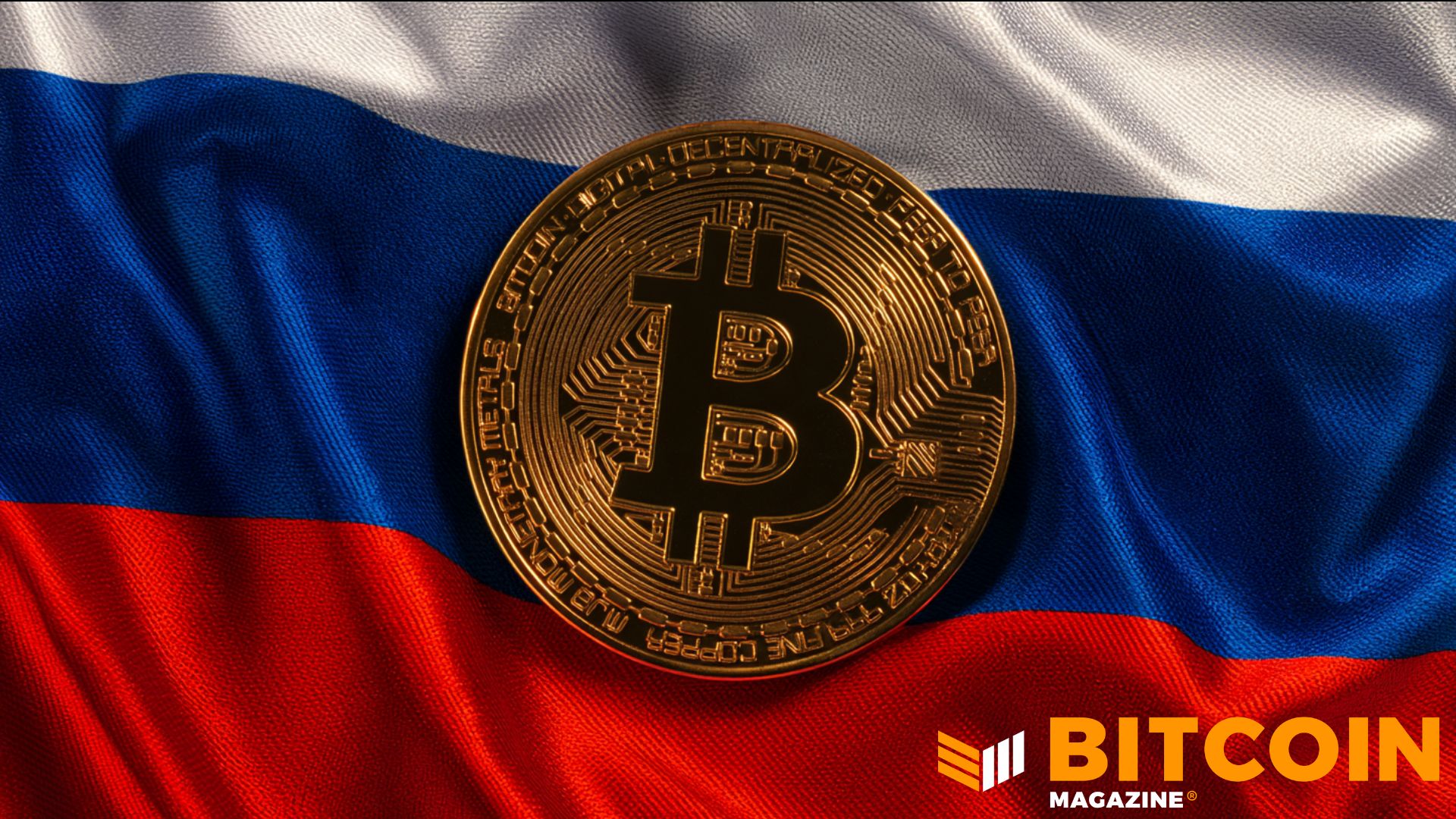
The Moscow Exchange plans to let clients trade cryptocurrencies starting in December and has begun testing operations with professional market participants, a senior executive said last week.
“We are actively testing. We started a week ago,” Boris Blokhin, the exchange’s senior managing director for sales and business development, told journalists on the sidelines of the Sber Investments forum, according to a Thursday Interfax report.
The exchange — the biggest in Russia — will work with a partner settlement digital depository, where market participants will open accounts. It won’t need any additional permits or licenses to launch trading, Blokhin added.
JUST IN:
— Bitcoin Magazine (@BitcoinMagazine) October 12, 2026Russia's Moscow Stock Exchange will allow its 40.1 million clients to invest in Bitcoin and crypto assets
pic.twitter.com/ZJOxEPWNNv
The plan follows Russia’s law on digital currencies and digital rights, which took effect in September and sets comprehensive rules for crypto in the country.
Trades can run through existing infrastructure such as exchanges, brokers and trust managers. New players will also join, including crypto exchangers, where assets are bought and sold, and digital depositories, which record ownership.
Russia’s largest bank, Sberbank, announced last month it was the first in the country to have been approved to custody bitcoin. The Bank of Russia gave it the green light for “digital currency record-keeping” and to facilitate the transfer of such assets, covering bitcoin and other, smaller cryptocurrencies.
Russia’s relationship with Bitcoin is complicated. President Vladimir Putin in 2024 seemed to praise the original cryptocurrency back in 2024. “For example, Bitcoin, who can ban it? Nobody,” he said at a forum at the time.
But the Kremlin keeps a tight grip on what citizens can do with it. Using crypto as a form of payment has been illegal in Russia since 2022; unqualified investors can buy bitcoin and stablecoins capped at 300,000 rubles ($3,556) a year through a single intermediary.
Qualified investors can buy any cryptocurrency traded on exchange and over-the-counter markets, with no limit.
President Putin in October signed a law to set in stone the regulation of digital currencies and digital rights in the country.
This post Moscow Exchange to Launch Bitcoin Trading, Testing Underway first appeared on Bitcoin Magazine and is written by Mathew Di Salvo.
Bitcoin Magazine

South Korean Lender Jeonbuk Bank to Offer Bitcoin-Backed Loans
Jeonbuk Bank has become the first bank in South Korea to offer won-denominated loans backed by bitcoin, according to reports.
The subsidiary of JB Financial Group has started offering the loans, according to exclusive Monday reporting by the country’s Edaily paper.
For now, the product is limited to corporate customers raising working capital, and bitcoin is the only eligible collateral. The bank said it may expand the service depending on regulatory changes and market demand, the report added.
JUST IN:
— Bitcoin Magazine (@BitcoinMagazine) October 12, 2026South Korea's Jeonbuk Bank will offer the first ever bitcoin-backed won loans for clients
Jeonbuk Bank won’t own or control the bitcoin itself. The collateral is held by a specialized custodian, limited to virtual asset service providers registered under Korea’s Act on the Reporting of Specific Financial Information, it further noted.
If a borrower defaults, the bank won’t take the coins but will rather liquidate them through enforcement procedures such as a court-ordered sale and recover the loan from the proceeds.
The bank said it chose bitcoin for its market capitalization and trading volume, the largest of any digital asset, and that its own stress tests showed bitcoin held up as collateral even during sharp price declines. To value the collateral, it uses an index based on a weighted average of prices across multiple global exchanges.
Similar products already exist abroad. JPMorgan Chase debuted bitcoin-backed loans for institutional clients in March, and Switzerland’s Sygnum Bank offers comparable credit.
The loan is the first concrete result of the “Crypto Bank” vision put forward by Jeonbuk Bank President Park Chun-won. The lender is the only regional bank to provide real-name verified accounts to crypto exchanges, and it is preparing an “all-in-one wallet” that combines fiat accounts and digital asset wallets.
“This loan is an example of designing a risk management and recovery structure that allows us to utilize existing bank lending and collateral management systems without directly holding virtual assets,” said Jeong Sang-hoon, executive vice president of the bank’s digital division.
This post South Korean Lender Jeonbuk Bank to Offer Bitcoin-Backed Loans first appeared on Bitcoin Magazine and is written by Mathew Di Salvo.
Bitcoin Magazine

Bitcoin Extends Slide — Can ‘Uptober’ 2026 Beat Last Year’s?
Bitcoin’s price dipped further on Monday, sliding 2% over a 24-hour period to trade at a little over $82,423.
The coin over the past week has dropped by 3%, and so far this month, it’s trading down.
October is usually a strong month for the OG cryptocurrency. Data from Coinglass shows that it has finished eight of the last 10 Octobers in the green.
Last year was one of the exceptions: while bitcoin’s price notched an all-time high of $126,080, it then started to enter a bear market after October 10 — when the biggest crypto liquidation event in history battered the asset’s price.
Markets across the board got hit hard following tariff threats from U.S. President Donald Trump. Crypto long positions got wiped out and over $19 billion in digital asset bets were liquidated.
Bitcoin then spent most of 2026 in a bear market.
The good news? That the coin just had its best quarter in years and a good September — historically a rough month for the cryptocurrency. Analysts now are saying that while it’s got off to a bad start so far in “Uptober”, signs of a bottom this month may already be in.
Writing for data firm CryptoQuant, Japanese asset management platform XWIN said it could be up from here.
“Now, signs of a potential bottom are emerging,” XWIN said in a note. “On October 12, markets priced roughly an 18% chance of an October Fed hike, while Brent crude had eased from nearly $110 to around $103.”
It added: “‘Uptober’ need not mean uninterrupted gains: a correction can build the foundation for the next advance.”
High oil prices have — at least in the short-term — hurt bitcoin’s price as investors then expect the Federal Reserve to hike interest rates in order to control inflation.
But while the U.S. central bank last month raised interest rates, bitcoin’s price was unfazed and rose following the news.
Other analysts have now said the biggest cryptocurrency is out of a bear market due to it crossing its 365-day moving average — a signal that has marked the start of its bull markets in past cycles.
This post Bitcoin Extends Slide — Can ‘Uptober’ 2026 Beat Last Year’s? first appeared on Bitcoin Magazine and is written by Mathew Di Salvo.
Bitcoin Magazine

Ledger Investigates Fund Losses Tied to Southeast Asian Reseller After Implant Found in Device
Ledger has said it is working with authorities after users last week reported losing funds and one received a tampered device. But the company reassured customers that the number of impacted products was “limited.”
The hardware wallet manufacturer added in an announcement on Sunday that it had reached out to affected customers.
Paris-based Ledger on Friday said it had started an investigation after customers in South East Asia reported they’d lost funds after buying from a reseller.
Then, on Saturday, Ledger said it confirmed that one of the impacted users’ devices contained an unauthorized hardware implant.
Ledger would not confirm the amount of money lost but blockchain investigator Specter said $86 million had been drained from devices.
“As the investigation continues, we are working with relevant authorities,” Ledger wrote on Sunday.
It added: “Also, we strongly advise users not to purchase from unauthorized resellers, where the risk of buying suspicious, counterfeit or modified devices is important as nothing operates under ledger security guidelines.
“Security isn’t static and this incident underscores why we continuously review and strengthen our distribution and anti-tamper processes.”
Customers in South East Asia last week reported losing funds after buying from Kuala Lumpur, Malaysia-based vendor CryptoBilis.
Ledger then advised customers who’d bought from CryptoBilis to not set up their devices.
CryptoBilis has since stopped selling its hardware wallets, Ledger said on Sunday.
People on social media posted picture evidence of devices implanted into Ledger products, claiming it could get users’ private keys. It isn’t clear how many of Ledger’s signing devices contained the implant.
Neither Ledger nor CryptoBilis immediately responded to questions from Bitcoin Magazine.
Hardware wallet security has been a hot topic ever since hackers in July were able to steal close to $120 million in bitcoin from Coldcard users.
The products, made by Canadian company Coinkite, contained a firmware bug which led to faulty seed generation, allowing hackers to essentially guess investor seedphrases.
In a separate incident, hardware wallet manufacturer Trezor last month reported that close to 81,000 customers had their details leaked after its third-party fulfillment partner had data stolen.
Criminals have been targeting data this year, with scammers getting hold of customer information via crypto wallet Ledger’s payment processor Global-e to send phishing emails.
This post Ledger Investigates Fund Losses Tied to Southeast Asian Reseller After Implant Found in Device first appeared on Bitcoin Magazine and is written by Mathew Di Salvo.
CryptoSlate
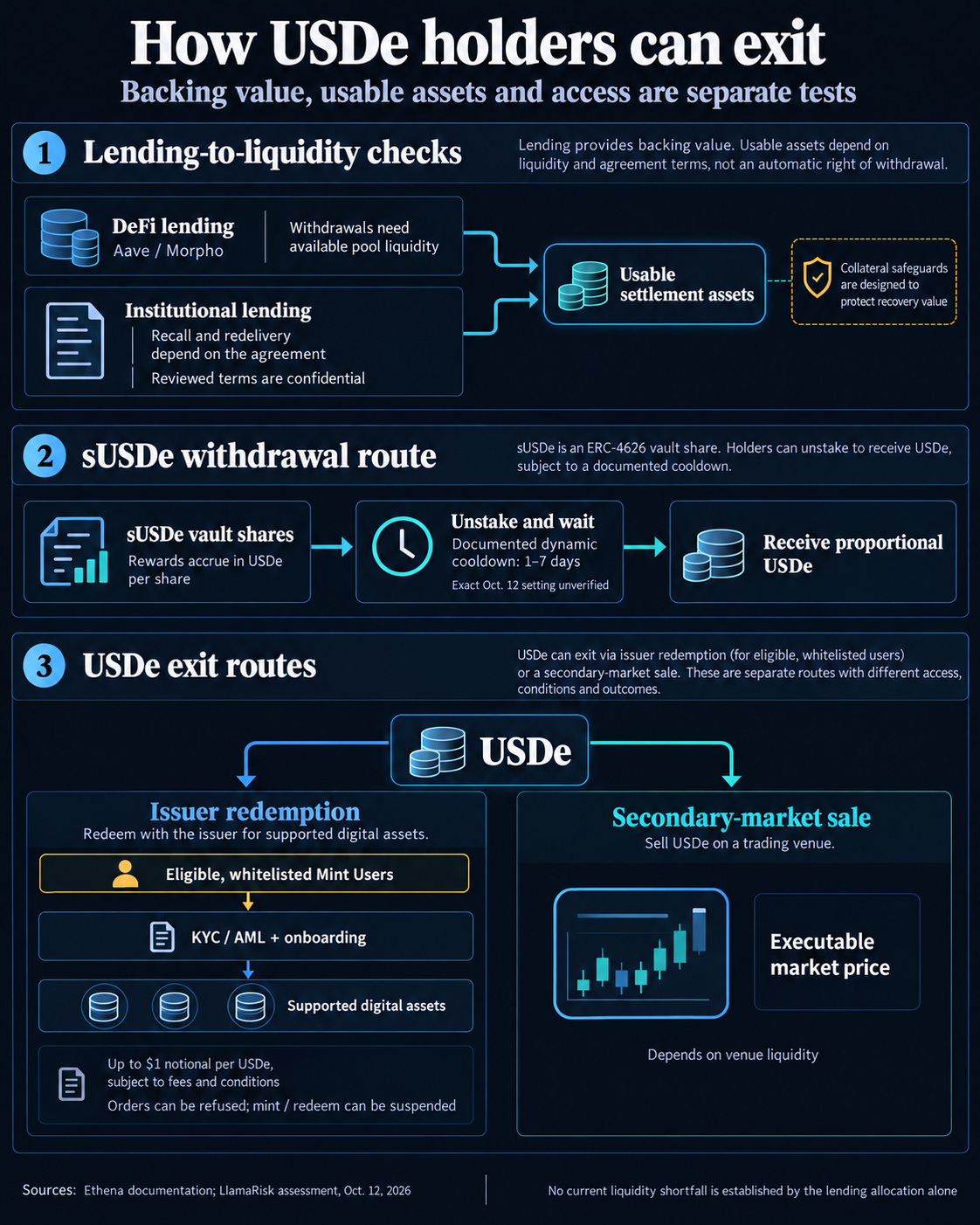
Ethena’s USDe, a synthetic dollar targeting $1, has 51.2% of its backing allocated to DeFi and institutional lending, according to risk assessor LlamaRisk’s October 12 assessment. The allocation figure does not measure actual borrower drawdowns or cash available for immediate withdrawal. For holders, usable reserve assets and access to an exit near the peg are separate tests.
Eligible counterparties can redeem USDe directly with Ethena, subject to its conditions. Other holders rely on secondary markets for an exit. Withdrawing USDe from sUSDe, its staking vault share, requires a separate unstaking process. A lending position can have excess collateral while supplied stablecoins remain borrowed. Recovering those assets depends on available pool liquidity or the applicable loan agreement’s recall and redelivery provisions.
The global snapshot reports $4.76 billion of backing against 4.76 billion USDe outstanding. Its lending allocations are 36.9% DeFi and 14.3% institutional, alongside 24.9% liquid stablecoins, 17.6% crypto basis and 6.0% real-world assets.
LlamaRisk discloses partial Aave DAO funding and its independent Ethena proof-of-reserves attestation role. It says it received no protocol or affiliated-entity compensation for this assessment.
The diversification itself predates this snapshot. Ethena’s March governance discussions already described lending deployments, and CryptoSlate covered the broader backing shift in August.
When lending assets become redemption assets
Ethena’s DeFi lending policy describes reviewed markets with excess borrower collateral, conservative loan-to-value parameters and exposure limits subject to governance and Risk Committee review. Those safeguards aim to limit losses. Aave and Morpho’s withdrawal mechanics determine whether underlying assets are available to recover.
Under Aave’s withdrawal rules, a supplier can take out only the amount available in a pool that has not been borrowed. Morpho’s market design also makes sufficient liquidity a condition for withdrawal.
| Lending category | Share of backing, Oct. 12 | Route back to settlement assets |
|---|---|---|
| DeFi lending | 36.9% | Withdraw supplied assets, subject to available market liquidity. |
| Institutional lending | 14.3% | Recover lent assets under the applicable agreement’s recall and redelivery provisions. |
For institutional lending, Ethena describes stable-asset loans backed by collateral worth more than the amount borrowed, including liquid BTC and ETH. Qualified custody and triparty arrangements, in which an independent agent holds and administers collateral, are designed to protect the protocol’s claim. Counterparty eligibility and aggregate exposure limits are subject to committee oversight.
LlamaRisk’s April review framework examines collateral ratios, custody segregation, enforceable security interests, liquidation rights, recall notice and redelivery timeframes. On Ethena Governance, its March review of the Maple and Anchorage agreements found no material contractual deficiencies. The individual terms and commercial thresholds remain confidential.
The Anchorage agreement reviewed in March was with A1, Ltd., a Cayman Islands group entity distinct from the OCC-chartered Anchorage Digital Bank. Maple’s agreement was through Delaware-based Protocol Pool Operations Alpha LLC.
The collateral, custody and legal safeguards are intended to mitigate credit risk. Their public descriptions do not establish the exact timetable for recovering lent assets under the reviewed institutional agreements. For a holder’s exit, protection of recovery value and the timing of delivery therefore need to be assessed together.
USDe redemption and sUSDe withdrawals
Holding USDe does not automatically provide access to Ethena’s primary redemption facility. Its published terms reserve that service for eligible Mint Users who have completed know-your-customer and anti-money-laundering checks, other onboarding procedures and whitelisting. An ordinary holder needs to become an eligible Mint User to redeem directly, or use a secondary-market exit.
The terms describe conditional redemption into supported digital assets representing a pro-rata portion of reserves, capped at $1 in notional value per USDe and subject to fees and other conditions. Receiving a backing asset is a different step from receiving dollars in a bank account. Ethena’s order process uses signed prices and operational acceptance checks, so a nominal redemption framework does not make every requested order executable.
LlamaRisk’s October 12 assessment of the Ethereum contract lists PYUSD, USDC, USDG, USDT, USDm and USDtb as enabled stablecoins, plus DAI with smaller limits. It reports an aggregate redemption ceiling of 20 million USDe per block, against 200 million for minting, and 2 million in each direction for DAI. These are contract ceilings, not available cash. The issuer can suspend minting and redemption without the controller’s 24-hour wait.
This access is central to Ethena’s peg-arbitrage mechanism. An authorized participant can buy USDe at a discount on an external market and redeem it for backing assets. The incentive to close that gap depends on being able to obtain a usable quote and receive the assets. Secondary-market sellers rely on that arbitrage channel, as well as the liquidity of the venue where they sell.
sUSDe adds another stage. It is an ERC-4626 vault share, representing a proportional claim on USDe in the staking contract. Rewards increase the USDe represented by each share. Its relevant exchange rate is USDe per share, rather than a fixed $1 target for sUSDe itself.
Ethena’s current staking guidance describes a governance-set dynamic cooldown between one and seven days. Its technical documentation places pending unstaked USDe in USDeSilo before withdrawal. The guide gives a range rather than establishing the active October 12 setting. Completing that process delivers USDe; selling or redeeming that USDe is a further step, with its own liquidity and eligibility conditions.
The reserve buffer and the checks that matter
Ethena’s reserve fund is intended to absorb negative protocol revenue and backing shortfalls. LlamaRisk’s September assessment put it at about $62.1 million. A loss buffer serves a different purpose from assets ready for immediate settlement.
Ethena’s reserve-fund policy says its ongoing allocation of protocol revenue is 0%, with revenue directed instead to incentives and promotional distributions. That allocation applies to new revenue; the fund’s existing balance is a separate measurement.
September’s position mapping identified Aave, Morpho, Jupiter Lend and Kamino exposures, alongside Maple, FalconX, Kraken, CBAM and Anchorage institutional positions. Those detailed venue weights remain historical.
Blockworks Advisory’s March cooldown analysis makes the liquidity-accounting distinction explicit. It separates withdrawable lending positions from those constrained by utilization, and explains that cycling USDtb already held as USDe backing through USDe minting and redemption creates no net liquidity.
Ethena’s institutional-lending policy describes committee-reviewed limits without specifying a numerical cap or floor.
For holders, the observable lending test is available unborrowed liquidity alongside the amount supplied to each market. Institutional recall and redelivery disclosures need to sit alongside collateral quality. A collateralized position and a position that can deliver settlement assets on demand answer different questions.
Redemption eligibility, accepted orders and the active sUSDe cooldown complete the exit test.
The post More than half of Ethena’s USDe backing is allocated to lending appeared first on CryptoSlate.
Strategy (formerly MicroStrategy) bought 250 Bitcoin for $21.5 million last week while spending $192.4 million to repurchase its STRC preferred shares.
On Oct. 12, the Michael Saylor-founded company disclosed that it acquired just 250 Bitcoin for about $21.5 million between Oct. 5 and Oct. 11, extending a slowdown that saw purchases fall to 334 BTC the previous week.
Meanwhile, Strategy repurchased 1,932,145 shares of its variable-rate STRC preferred stock for $192.4 million, nearly nine times its Bitcoin spending, as the company continued its STRC buybacks.
The spending gap highlights the competing demands on Strategy's capital: Bitcoin accumulation and support for its preferred securities.
STRC buybacks consume more capital
The latest acquisition lifted Strategy's holdings to 848,250 BTC, purchased for approximately $64 billion at an average price of $75,444 per coin.
Strategy paid an average of roughly $86,194 for its latest Bitcoin purchases, compared with $85,839 for the 334 BTC acquired during the previous reporting period.
The slowdown comes as Bitcoin struggles to sustain its recovery after last week's market downturn briefly pushed the cryptocurrency toward $80,000.
However, Strategy's preferred-stock repurchases have continued accelerating.
STRC repurchase spending rose from $176.3 million during Sept. 28–Oct. 4 to $192.4 million during Oct. 5–11.
The company reported $354.8 million of remaining authorization under its digital credit securities repurchase program.
The purchases have also become more expensive as STRC approaches its $100 stated amount.
Strategy paid an implied average price of approximately $99.58 per share in its latest buyback, representing a discount of less than 0.5% to the preferred stock's stated value.
That is notable because the company's July repurchase policy envisaged buying more aggressively at deeper discounts and reducing purchases as STRC approached $100.
The buybacks also reduce future dividend obligations by retiring outstanding preferred shares. At STRC's current 12% annual dividend rate, the latest repurchases would eliminate approximately $23.2 million in annualized dividend payments, assuming that rate remains unchanged.
However, Strategy's broader objective is to establish sufficient independent demand for STRC to trade consistently near $100 without requiring continued large-scale intervention.
Strategy's shrinking cash balance raises stakes for October vote
The accelerated repurchases are also drawing down the capital pool available for Strategy's broader treasury operations.
As of Oct. 11, the company held $4.88 billion in its dedicated USD Reserve and another $640.5 million in USD Cash, bringing total dollar-denominated liquidity to approximately $5.52 billion.
The USD Cash balance declined from $833.4 million a week earlier, down $192.9 million, nearly matching the amount spent on STRC repurchases.
Strategy separately raised approximately $21 million by selling 125,183 common shares during the week, while issuing no additional preferred stock under its at-the-market programs. Those common-stock proceeds funded $21 million of the Bitcoin purchases, with another $0.5 million coming from USD Cash.
The distinction between its two cash pools is significant.
Under Strategy's board-approved USD Reserve policy, the reserve is earmarked for preferred dividends and interest payments. Other uses require board authorization; the company says it is not authorized to use the reserve for STRC repurchases.
USD Cash, by contrast, can finance Bitcoin purchases, preferred-share repurchases and other capital management activities.
Consequently, sustained STRC spending reduces the unrestricted liquidity available for other uses unless Strategy raises additional funds.
As an illustration, the $354.8 million of remaining preferred-share repurchase authorization would cover about 1.84 weeks at the latest $192.4 million weekly pace if that pace and the authorization stayed unchanged.
Shareholders will vote on the daily-dividend proposal on Oct. 28.
The company is seeking approval to move its four US-listed preferred securities to daily dividend payments, with STRC transitioning first.
Under the proposal, dividends would accrue daily and be paid the next business day, replacing STRC's current semi-monthly schedule without increasing its annual dividend rate.
Strategy argues the change could improve liquidity, reduce reinvestment delays, and encourage more stable trading around STRC's $100 target.
If approved, STRC's first daily record date would be Nov. 1, with payment scheduled for Nov. 2.
Strategy is also scheduled to report third-quarter financial results on Oct. 29, a day after the vote, giving management another chance to address its preferred-stock strategy and the slowing pace of Bitcoin accumulation.
The post Strategy spent nearly nine times as much on STRC buybacks as Bitcoin last week appeared first on CryptoSlate.
South Korea has established procedures for courts to seize and sell debtors' cryptocurrency to satisfy civil claims.
On Oct. 12, the Supreme Court promulgated Rule 3280, introducing standardized procedures for freezing, transferring, and liquidating digital assets to recover unpaid debts. The regulations take effect on Nov. 1 and cover cryptocurrencies held on exchanges and in private wallets.
One provision allows court officers to take possession of directly held crypto before debtors receive formal notice of an attachment order, potentially limiting opportunities to move assets beyond creditors' reach.
The changes come as cryptocurrency holdings increasingly feature in South Korean debt-recovery proceedings, prompting authorities to establish consistent procedures for assets that can be transferred rapidly without relying on traditional financial intermediaries.
Crypto exchanges face new obligations under debt-recovery rules
Under the framework, creditors seeking repayment from cryptocurrency held on exchanges can obtain court orders attaching a debtor's right to receive those assets.
Once an attachment order is served, the exchange or other custodian must prevent the transfer of covered assets to the debtor, who is also prohibited from disposing of the claim or receiving the cryptocurrency.
Creditors can also ask courts to compel custodians to disclose information about the targeted holdings within one week of receiving the order.
The required information includes whether the custodian recognizes the debtor's claim, the type and quantity of cryptocurrencies held, and whether other creditors have existing claims or priority rights over the assets.
The disclosure obligation applies when creditors seek it through the prescribed court procedure, giving them a means to identify assets available for repayment and potential competing claims.
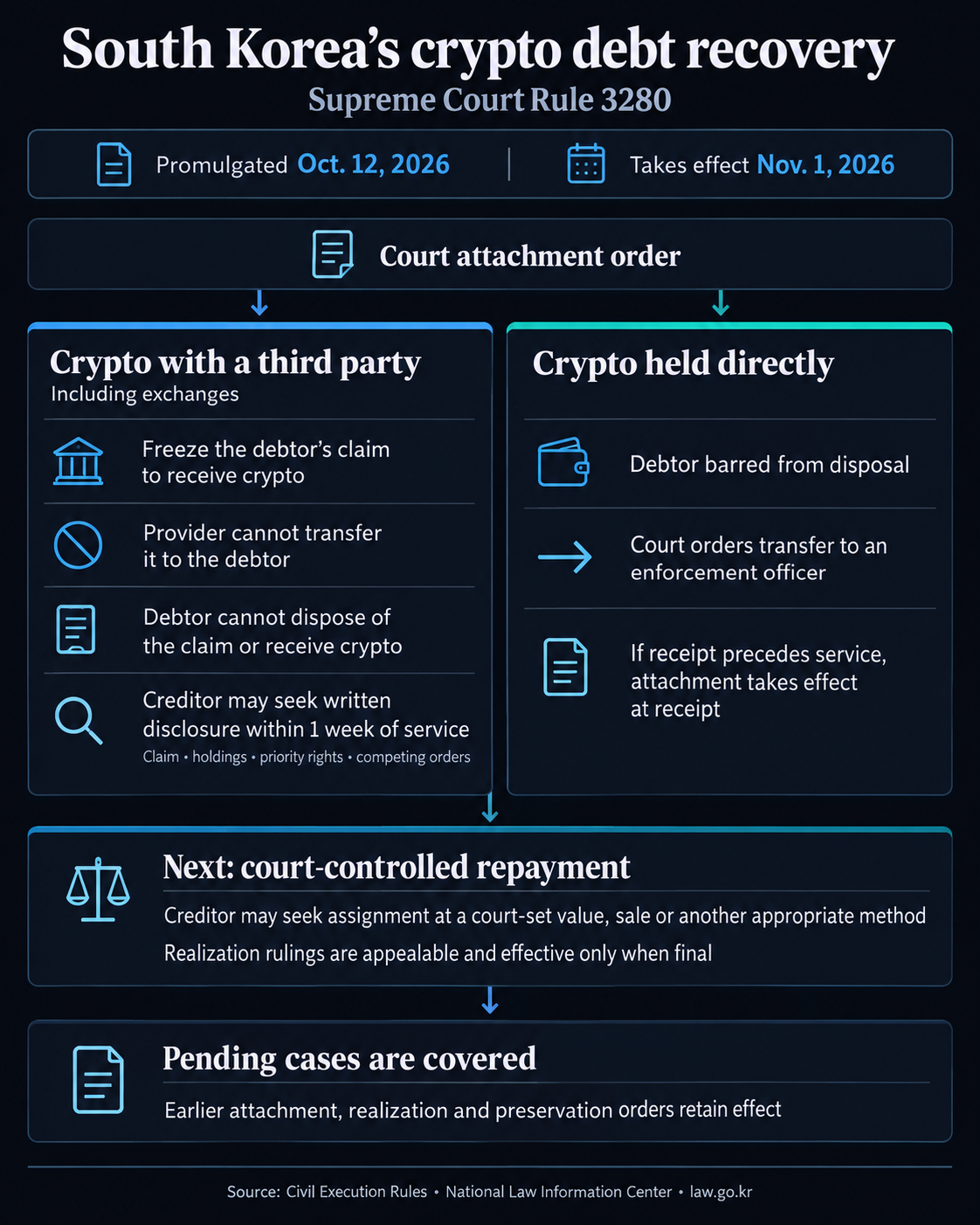
For cryptocurrencies held directly by debtors, courts can prohibit transfers and order the assets delivered to an enforcement officer.
The rules permit that transfer to occur before the attachment order is formally served on the debtor. If the officer receives the cryptocurrency first, the attachment becomes effective upon receipt.
However, enforcement against self-custodied assets could remain challenging where debtors control the private keys needed to authorize transfers.
Once creditors attach cryptocurrencies, they can seek additional court orders to recover their value.
Judges may authorize transfers to creditors at court-determined valuations or direct enforcement officers to arrange sales through virtual asset service providers.
For exchange-held crypto, the rules also permit sales through the existing custodian, transfers to accounts controlled by enforcement officers, or conversion into assets that can be more easily liquidated.
Sales must use the prevailing market price on the transaction date or another appropriate valuation, introducing a defined process for assets whose prices can fluctuate sharply during enforcement proceedings.
Debtors retain the ability to appeal decisions authorizing asset transfers or sales, which take effect only after becoming final. The regulations also establish procedures for restoring assets when enforcement is withdrawn or canceled.
The Supreme Court said the amendments are intended to improve legal certainty and consistency as courts handle a growing number of cryptocurrency-related enforcement cases.
The Nov. 1 implementation will also cover proceedings already before the courts, with existing attachment and preservation orders remaining valid. Exchanges and other custodians handling those cases will need to apply the new disclosure, transfer and sale procedures once the regulations take effect.
The post South Korea clears way for courts to seize and sell Bitcoin for unpaid debts under new November rules appeared first on CryptoSlate.
More than half of sampled tokenized US stock trading occurs outside Wall Street's regular hours, the International Monetary Fund (IMF) found.
The IMF's October Global Financial Stability Report also showed that approximately 80% of tokenized equity transactions involved less than one share, providing evidence of demand for fractional investments and around-the-clock access to American securities.
However, the study found that tokenized equities experienced roughly 50% higher realized volatility than their traditional counterparts, while fragmented trading venues offered significantly weaker liquidity.
The findings come as exchanges and financial institutions expand efforts to bring US equities onto blockchain infrastructure, potentially challenging conventional market hours and settlement arrangements.
Tokenized stock prices reflect overnight market activity
The IMF examined five of the most actively traded tokenized US equity products issued by Ondo and xStocks, covering exposure to the S&P 500, Nasdaq, Tesla, Alphabet and Nvidia.
The analysis covered 11 centralized and decentralized trading venues, with more than 2 million five-minute price and trading-volume observations collected over 365 trading days.
The sampled products represented approximately $345 million in market value, or 15% of the $2.3 billion tokenized equity market as of July 31.
The trading patterns showed that investors were actively using features unavailable during conventional US stock-market sessions.
More than half of trading volume occurred outside the regular 9:30 a.m. to 4 p.m. Eastern session, including overnight and weekend periods.
The IMF said the activity suggested demand from investors operating in different time zones and those seeking to respond to market developments without waiting for American exchanges to reopen.
The predominance of transactions smaller than one share also pointed toward a retail-oriented market, although the researchers inferred that participation from trade sizes rather than directly identifying individual investors.
More significantly, the study found that overnight tokenized-stock prices contained information subsequently reflected in conventional equity markets.
Using centralized-exchange data, IMF researchers compared overnight tokenized price movements with the performance of their underlying securities during the first five minutes of the next US trading session.
The estimated pass-through ranged from 87% to 99%, indicating a strong relationship between overnight tokenized returns and subsequent price adjustments in traditional markets.
The findings suggest that tokenized venues can reflect information while conventional exchanges are closed, although the analysis does not establish that on-chain trading causes the corresponding price movements.
Both markets may be responding to the same developments, with conventional shares adjusting rapidly once trading resumes.
Higher volatility threatens tokenized stocks' expansion
The growing activity outside Wall Street's operating hours comes with significant differences in market quality.
The IMF found that traditional exchanges remained substantially more liquid than tokenized trading platforms, with centralized crypto venues performing better than decentralized exchanges.
On decentralized platforms, relatively small transactions could produce disproportionately large price movements because of limited market depth and market-making activity.
Realized volatility across tokenized equities was about 1.5 times that of their traditional equivalents and rose further on decentralized venues.
The comparison partly reflects different trading windows, since tokenized products trade continuously while the traditional-market measure covers regular US hours.
Despite those differences, tokenized prices generally tracked their underlying securities during regular trading sessions. However, decentralized venues saw wider and more frequent price deviations, especially when trading volumes were low.
Those conditions could complicate expansion beyond the relatively small market currently served by tokenized equities.
The IMF estimated that public tokenized real-world assets, excluding repurchase agreements and stablecoins, had reached approximately $65 billion by July, compared with roughly $300 trillion in traditional capital-market assets.
The Fund said systemic risks remain limited at current adoption levels, but broader use of continuous trading and automated settlement could accelerate market stress.
Automated collateral management, for example, could trigger margin calls and forced liquidations outside conventional trading hours, potentially amplifying selling pressure when available liquidity is already thin.
The IMF identified legal certainty, regulatory clarity, interoperability between trading networks and reliable settlement assets as major constraints on further growth.
Questions also remain over the rights attached to tokenized securities, particularly whether holders receive direct ownership claims over underlying shares or contractual exposure to their prices.
To address the emerging risks, the IMF called for circuit breakers, trading halts and liquidity safeguards adapted to continuous markets, alongside stronger monitoring of connections between tokenized and traditional finance.
Regulators must also assess whether existing protections can operate during weekends and overnight trading, when automated liquidations may occur without the liquidity normally available during Wall Street's regular session.
The post IMF finds over half of tokenized US stock trading happens after Wall Street closes appeared first on CryptoSlate.
The Financial Stability Board (FSB) warned that stablecoins could face redemption crises if, during market stress, reserves become inaccessible across borders.
In an Oct. 12 report, the global financial watchdog said stablecoin issuers operating through affiliated entities in different countries could struggle to meet concentrated withdrawal demands when their reserve assets are held elsewhere.
The warning comes ahead of an Oct. 15 meeting of G20 finance ministers and central bank governors, as regulators confront growing risks from a stablecoin market valued at approximately $300 billion in mid-2026, with 99% of its value pegged to the US dollar.
FSB Chair Andrew Bailey said international regulatory coordination remains underdeveloped, leaving authorities without mature arrangements for managing cross-border stablecoin failures.
Stablecoin reserves face cross-border stress test
The FSB identified particular vulnerabilities in stablecoins issued by multiple affiliated companies that share liability for the same token while maintaining separate reserves.
Under such arrangements, holders may be able to redeem their tokens through any participating issuer, regardless of where the stablecoins were originally issued.
That flexibility can create liquidity mismatches when redemption demand concentrates in one jurisdiction while much of the collateral backing the tokens remains in another.
Moving reserves between entities could resolve the imbalance under normal conditions. However, banking restrictions, settlement delays and differences in national regulations could complicate those transfers during a market panic.
The speed at which stablecoins circulate amplifies the risks.
Digital tokens can move across borders and trade around the clock, while the Treasury securities, bank deposits and other traditional assets backing them remain subject to local financial-market operating hours and settlement arrangements.
The FSB warned that delays in meeting redemptions could push holders to sell stablecoins at discounts on secondary markets, potentially destabilizing their dollar pegs.
A sufficiently large run could also spill into traditional finance if issuers liquidate reserve assets rapidly or withdraw substantial deposits from banks to meet redemption requests.
For context, Circle's European stablecoin arrangements illustrate how cross-border reserve management can affect redemption procedures.
Under its redemption policy, updated in September, Circle co-issues USDC through its French entity for the European Economic Area and its US entity for markets outside the region.
The policy allows Circle France to adjust or defer certain redemption requests during a defined stress event when the two entities cannot complete reserve rebalancing.
Those measures could include temporary redemption limits for European crypto-asset service providers, while preserving holders' rights to redemption at par.
The provisions describe contingency arrangements rather than an existing liquidity failure. They also operate under Circle's specific jurisdictional redemption rules, which differ from the FSB's unrestricted cross-issuer redemption model.
Nevertheless, the regulator's concerns extend to affiliated issuers' legal responsibilities when a stablecoin faces distress.
The FSB noted that issuers may struggle to identify where their tokens are held because blockchain transactions can be pseudonymous, complicating efforts to determine which entities are responsible for particular redemption obligations.
Differences in national insolvency laws could create additional uncertainty over which regulator has authority to intervene and how remaining reserves should be distributed.
Those challenges are compounded by uneven regulatory development.
The FSB's 2025 assessment found substantial gaps in countries' implementation of its global stablecoin recommendations, increasing opportunities for issuers to structure operations across jurisdictions with different supervisory requirements.
FSB seeks stronger regulatory regime
In response, the watchdog is seeking stronger international information-sharing arrangements and closer monitoring of where stablecoins circulate, where redemptions occur and where reserve assets are held.
It also wants regulators to assess the depth of secondary-market liquidity and develop more coordinated approaches to handling stablecoin distress or insolvency.
However, regulators face significant information gaps. The FSB said blockchain analytics providers often use different methods to estimate stablecoin activity, and reliably establishing holders' geographic locations and cross-border transactions can be hard.
The proposed measures build on the FSB's 2023 recommendations and are non-binding, leaving national authorities responsible for implementing any changes.
At this week's G20 meeting, officials will receive the FSB's findings as part of discussions on financial stability.
The watchdog has identified further work on cross-border monitoring, information sharing and crisis planning, but has not established a timetable for common procedures governing a stablecoin issuer's failure across multiple jurisdictions.
The post Global watchdog warns the $300 billion stablecoin market could face bank runs even with full reserves appeared first on CryptoSlate.
CryptoTicker.io
XRP trades at $1.36, or 1.21 euros, on Tuesday morning. That is 3.4 percent below Monday and 9.7 percent below a week ago, while over 30 days the token still shows a small gain of 1.0 percent. The number on its own explains little. More revealing is where the coins have moved over the past three weeks, because that is what decides the question an investor in Europe can actually answer today: is my XRP sitting somewhere I can reach it if I have to?
Two reports, dated October 12 and 13, point the same way. The Korean exchanges Upbit and Bithumb now hold around 90 million more XRP than they did three weeks ago. And on October 12 Standard Chartered began offering institutional custody for Ripple's stablecoin RLUSD on the XRP Ledger. Both reports turn on the same thing, namely who holds the coins. For a private investor in Europe that is a more practical question than any price forecast.
XRP price at $1.36: day's low $1.31, day's high $1.40
The daily range ran from $1.31 to $1.40 according to CoinGecko data retrieved on Tuesday morning. At $1.31 the price turned higher. Market capitalisation stands at $85.7 billion and turnover over the past 24 hours at $2.15 billion. There are 63.13 billion XRP in circulation.
For context: the all-time high of $3.65 dates from July 17, 2025. The price sits about 37 percent above the twelve-month low of $0.99, and 95 percent below the twelve-month high of $2.65. XRP has spent months in the lower half of its annual range, and the past week has not changed that.
On October 11 we reported an XRP price of $1.39 and the state of the vote on the planned lending function for the XRP Ledger. The price has lost 2.2 percent since then. The lending function itself is still not active: our own query to the XRP Ledger network through the public node xrplcluster.com shows the LendingProtocol amendment still among the amendments that have not been enabled as of October 13. The network was running server version 3.4.1, and the last validated ledger was 107,626,781. Anyone who was waiting for the lending function to launch as a price driver is still waiting.
90 million more XRP on Upbit and Bithumb
The move that stands out this week is not in the chart but in the exchanges' reserve data. According to CryptoQuant figures reported by The Crypto Basic on October 13, XRP holdings at the Korean exchange Upbit rose from 6.39 billion to 6.45 billion XRP between September 23 and October 13. That is 60 million tokens more. Bithumb went from around 1.81 billion to 1.84 billion XRP over the same period, roughly 30 million more.
Together the two Korean venues have therefore taken in around 90 million XRP. They now account for about 76 percent of the observed XRP reserves across the three venues compared. On the other side of the ledger, Binance's XRP reserves fell by 101 million tokens between September 27 and October 13.
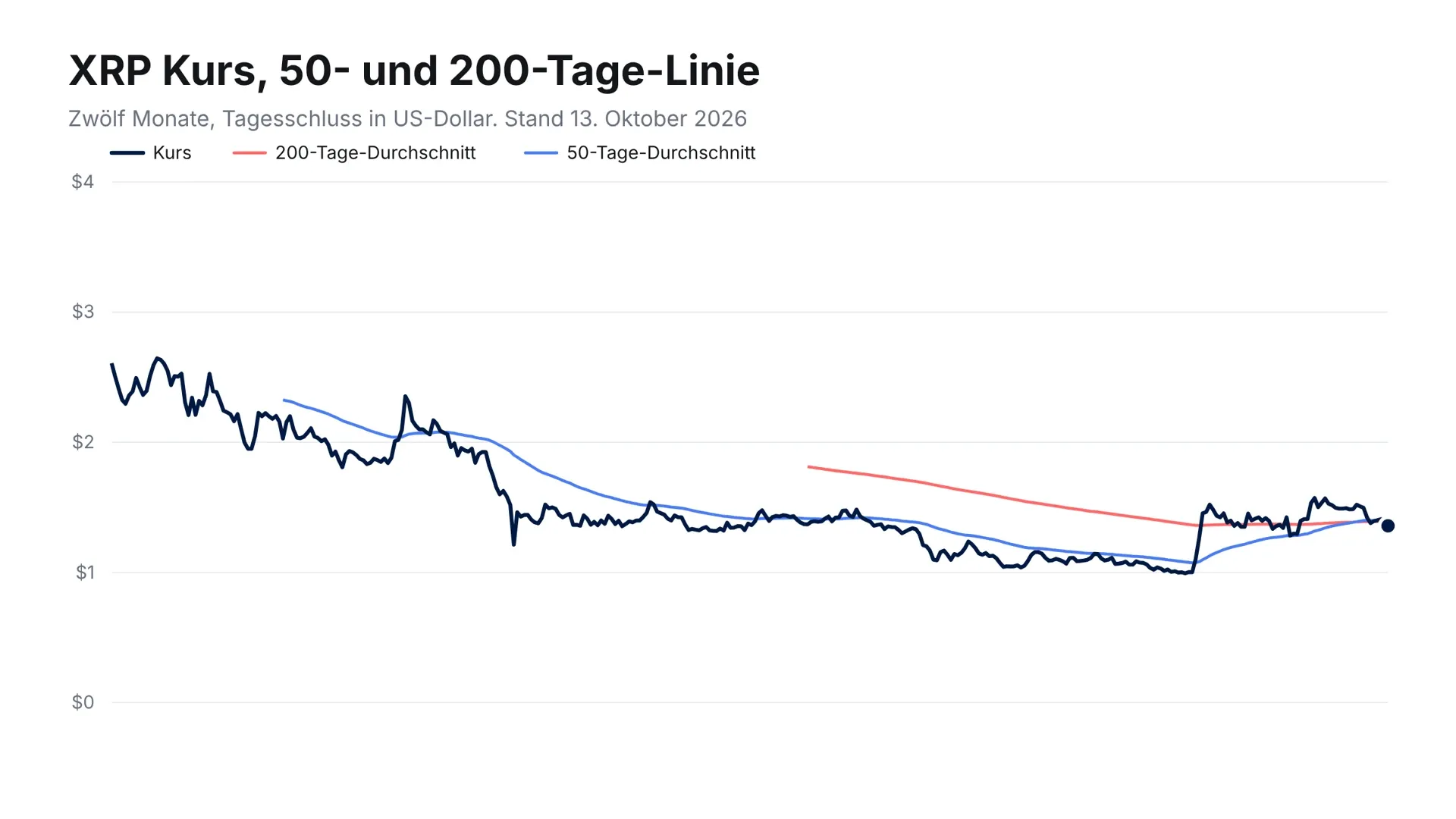
The 50-day and 200-day averages sit less than a cent apart
For the levels we worked through the daily closing prices of the past twelve months ourselves. The 50-day moving average stands at $1.3949 and the 200-day average at $1.3902. The gap between them is 0.47 of a cent, the narrowest of the entire year. In the chart above it is the point on the far right where the red and the blue line converge.
This state of affairs is rare, and it says more than any single daily close. When the short-term and the long-term average sit at the same level, the market has lost its direction. The next decisive move then usually follows whichever way the price leaves that zone. At $1.36, XRP currently sits around 2.5 cents below both lines. The first level on the upside is therefore not a round number but the band between $1.39 and $1.40, where both averages and the day's high coincide. On the downside the next level with evidence behind it is the day's low at $1.31.
What a moving average cannot do
A moving average is an arithmetic aid, not a forecast. It says where the price stood on average over the past 50 or 200 days, and nothing more. Deriving a price target from it invents a precision the data does not hold. The lines are useful as a guide to the level at which a breakout is worth discussing at all.
Withdrawals account for 54 percent of transactions on Binance
The reserve data has a second layer. The share of withdrawals in all XRP transactions on Binance rose from 52 to 54 percent between August 26 and October 12, according to the same analysis. Across all the large centralised venues the figure climbed from 51 to 52.7 percent. The share of deposits on Binance fell in return from 47.7 to 45.9 percent, and across all exchanges from 48 to around 47 percent.
These figures call for restraint, and The Crypto Basic says so itself: the shares count transactions, not amounts. A withdrawal of 200 XRP carries the same weight as one of 200 million. A falling reserve is no proof of selling, just as a rising reserve is no proof of long-term holding. A further analysis puts inflows to Binance at around 1.6 billion XRP over the same 30-day window. Reading a price direction out of these numbers goes further than the data supports.
What the numbers do show is a shift in custody. XRP sits more heavily on Korean platforms and more lightly on the largest international exchange than it did in September. For an investor in Europe that is, for now, news about market structure rather than about the price.
Standard Chartered has held RLUSD custody on the XRP Ledger since October 12
On October 12 Standard Chartered said the bank supports institutional custody of Ripple USD, the stablecoin issued on the XRP Ledger. The service runs through the bank's DIFC branch in Dubai, which is supervised by the Dubai Financial Services Authority. In the bank's statement Waqar Chaudry, Global Head of Digital Assets in Securities Services, is quoted as saying: “Institutional clients want to participate in digital asset markets without compromising on how their assets are safeguarded or how risk is managed.”
The LMAX collateral arrangement is announced and not yet live
The same statement contains a second part that is easily confused with the first. Standard Chartered, Ripple and LMAX Group intend to make RLUSD usable as eligible collateral for LMAX products, through a mechanism that mirrors the value of the collateral while the tokens remain in the bank's custody. That part is announced, not launched. The bank writes that the future capabilities are subject to final documentation, successful testing, applicable law, internal approvals and the readiness of the relevant jurisdiction.
The distinction matters for how all of this should be read. What is live today is bank custody for a stablecoin on the XRP Ledger. That is a documented step for the infrastructure around Ripple. It is not a jump in turnover for XRP itself, because RLUSD and XRP are two different assets.
RLUSD has no MiCA authorisation as an e-money token in the EU
This is where the European rulebook comes in. According to its own statement, Ripple received full authorisation as a crypto-asset service provider under MiCA from the Luxembourg regulator CSSF on July 6, 2026, having already obtained an e-money licence in February. That authorisation covers services around crypto assets.
Issuing a dollar stablecoin, however, falls under a separate MiCA regime for e-money tokens. RLUSD would itself have to be authorised as an e-money token and carry an approved white paper before it could be offered publicly in the EU. As things stand that is not the case. In practice that means you will not currently find RLUSD on the menu at an exchange licensed in the EU, while euro and dollar stablecoins that do hold MiCA authorisation can be traded there. If you use stablecoins, it is worth checking before you buy whether the provider holds an EU licence and which tokens it is allowed to list under MiCA.
Custody: three points that matter before your next purchase
The reserve data and the bank custody describe the same development from two directions. Large institutions are professionalising custody, and at the same time holdings are shifting between trading venues. For your own portfolio three concrete points follow.
First, licensing. Since MiCA took full effect, providers in the EU need permission to operate, and national regulators such as BaFin in Germany list the institutions they have authorised. A look at the register takes two minutes. If you are considering a move, compare the fees and services of the major crypto exchanges first, because the spread between trading fee, bid-ask spread and withdrawal fee weighs more heavily on small amounts than a one percent price move.
Second, self-custody. XRP can be held on the XRP Ledger itself. One particular feature catches many people out: an XRP account requires a base reserve that stays permanently locked and cannot be spent. If you set up your own address, it is better to plan for that amount from the start than to discover it on your first withdrawal attempt. Which devices are suitable and what they cost is set out in our hardware wallet comparison.
Third, spreading the risk. The reserve data above shows how quickly holdings can move between platforms. Keeping an entire holding on a single venue means carrying that venue's risk alone, however large the venue is.
Tax: moving coins to your own wallet is not a sale
Transferring your XRP from an exchange to an address of your own does not trigger a taxable transaction in Germany. There is no disposal, and the asset stays yours. Tax becomes relevant only on a sale or a swap into another coin.
The rules for private disposals under Section 23 of the German Income Tax Act apply here. If more than twelve months pass between acquisition and sale, the gain is tax free. Below that it counts as other income, and an exemption limit of 1,000 euros per calendar year applies to all private disposals taken together. An exemption limit means exactly that: one euro above it and the entire gain is taxable.
Documentation is what matters in practice. When coins move between your own wallets the acquisition date moves with them, but no exchange keeps track of it for you. If you use several addresses, record the purchase date, the amount and the acquisition cost for each lot, otherwise the one-year period cannot be evidenced later. There are tax tools and portfolio trackers for this that pull transactions together from several sources. They are no substitute for tax advice on an individual case.
The newsroom's view: a shift in custody, not a selling wave
In our view this week's reserve data carries less meaning than its headlines suggest. Three pieces of evidence from the text above support that: the share figures count transactions and not amounts, the same data set put around 1.6 billion XRP of inflows against the outflows at Binance over the 30-day window, and the shift of 90 million XRP amounts to around 0.14 percent of the 63.13 billion XRP in circulation.
Against that, the direction has held for three weeks and shows up at two exchanges at once. That is more than noise. Our reading is therefore this: the data evidences a shift in custody, not a selling wave. For the price, the more meaningful figure is the band between $1.39 and $1.40 where both moving averages sit. As long as XRP trades below it, the picture stays directionless. None of this is a recommendation to buy, and a total loss is possible at any time with crypto assets.
XRP at $1.36: the trend decides above $1.39
What is left of this Tuesday can be held onto in three steps:
- Note the level. $1.39 to $1.40 is the zone where the 50-day average, the 200-day average and the day's high coincide. Only a daily close above it changes the picture; on the downside $1.31 is the next level with evidence behind it. We follow how the situation develops on our XRP price prediction page.
- Settle the custody question. Does your provider hold an EU licence, and is your entire holding on a single platform? If you want to switch or spread it, the terms are in our crypto exchange comparison and the devices for self-custody in our hardware wallet comparison.
- Document the holding period. A transfer to your own address is not a sale, but only a recorded purchase date lets you evidence the one-year period later. The tools for that are in our crypto tax software comparison.
(As of October 13, 2026. This article is not investment advice. Prices and fee structures change; check the terms with the provider before you buy.)
The Solana price stands at $108.21 on Tuesday morning, around 3.4 percent below its level 24 hours earlier. The number alone explains little. More important is a condition that has been sitting in a corporate announcement since Sunday evening: US company SkyAI intends to buy back its own shares for up to $201 million, and under that announcement the offer holds only as long as the SOL closing price stays above $100 for the entire period. The buyback is funded by selling Solana. For the first time, then, the round number carries not just a chart line but the calculation of one of the largest listed SOL holders.
Solana price at $108.21: 7.6 percent of headroom above the $100 condition
There are 7.6 percent between the current price and the condition. Over the past trading night the range ran from $102.19 to $111.83, so the low sat only a good two percent above the threshold. Over the week SOL is down 9.4 percent; over the month the price is around 11 percent below the interim high of $122.08 on September 26. Market capitalisation is $63.7 billion, and turnover over the past 24 hours around $3.99 billion (CoinGecko figures, as of Tuesday morning).
The last daily close below $100 was on September 16, at $96.87. SOL has not touched the level in the 27 trading days since. That very quiet is what makes the condition interesting: the threshold sits close enough to the market to be reached in a bad week, and far enough away to cause no panic today.
The $201 million buyback offer and its conditions
SkyAI, listed on the Nasdaq under the ticker SKYA and known as Sharps Technology until May 2026, announced a cash offer to its own shareholders on October 11. It is offering $3.00 per share and per pre-funded warrant, for up to 46.37 million shares and around 20.72 million warrants. That is 95 percent of the outstanding paper in each class, at a maximum cost of around $201 million. The price is 65 percent above the closing price of October 9 and more than double the volume-weighted average of the past 60 trading days.
What a tender offer is
A tender offer is a company's invitation to its own shareholders to tender paper at a fixed price within a fixed window. It differs from a rolling buyback over the exchange: price and deadline are set in advance, and the offer may be tied to conditions. That is exactly where SOL comes in.
Under the announcement, the offer is to start on or around October 15 and run for ten trading days. The company names four conditions: at least 50 percent of each class must be tendered, the SOL closing price must stay above $100 throughout, there must be no court injunction and no general trading halt, and the buyback must not trigger a delisting from the Nasdaq. There is no financing condition, and SkyAI may waive individual conditions. Which price source and which closing time apply for the $100 is not stated in the announcement. That only becomes binding with the offer document, which must be filed with the US securities regulator by October 15 and will be available there under SkyAI, Inc. in the EDGAR register.

One million SOL have already been sold, around one million are still there
SkyAI says it has sold around one million SOL, roughly half its holding, worth approximately $107 million. Around one million tokens remain with the company, and the firm itself writes that it may keep selling depending on market conditions. In September SkyAI still reported 2,009,494 SOL worth around $207 million at the time, by its own account the fifth-largest listed Solana reserve, funded without debt.
The movements behind this can be followed publicly. Analyst Ember reported 468,000 SOL worth $51.1 million within 24 hours on October 10, of which 218,000 went to centralised exchanges and 250,000 to custodian BitGo. Analytics service Lookonchain counted 568,000 SOL for around $63.87 million moving to exchanges within three days on the same date. On October 12 a further 211,623 SOL arrived at Coinbase Prime, according to Ember, taking the total to around 1.25 million SOL worth some $138 million moved towards trading venues over five days. A transfer to an exchange is not yet a sale, and that holds here too. It is, however, the step before one, and it lands in the same order book you buy in.
How a treasury company turns into a permanent seller
A crypto treasury company raises money on the equity market and buys a coin with it. As long as its own share trades above the value of the tokens held, the model works: the company issues new shares, buys tokens with the proceeds, and the token holding per share rises. Reverse the ratio, so that the share trades below the value of the reserve, and the mechanism inverts. The fastest route to creating value per share is then buying back your own paper below its intrinsic value. That is paid for out of the reserve, which means with tokens.
At SkyAI the figures are in the open. Lookonchain estimates the average entry price at around $194 per SOL. On the remaining million or so tokens at a price of $108.21, that works out as a book loss of about $86 million. The buyback price of $3.00 per share also sits well below what early investors paid in August 2025, which was $6.50 per unit of share and warrants. Together the two numbers describe why the company would rather hand over tokens than keep waiting.
The arithmetic behind the $100 condition
This is where the threshold becomes tangible. The first sale raised around $107 million. The residual holding of roughly one million SOL is worth around $108 million at today's price. Together that is about $215 million against a maximum offer volume of $201 million, a buffer of a good $14 million. If SOL falls to $100, that buffer shrinks to around $6 million. The condition therefore does not protect the company against a price decline as such, but against the point at which the reserve no longer covers the offer. This calculation is derived from the figures named above and is not a company statement.
The rival belongs in the picture. Forward Industries had offered SkyAI 0.306 of its own shares per SkyAI share. The special committee unanimously recommended rejection and the board followed, reasoning that the offer valued the firm too low. Forward reported 8.5 million SOL at the end of September and describes itself as the largest Solana treasury. The buyback is therefore also a defensive measure: collect 95 percent of your own paper and you are harder to take over.
The 200-day line at $98.37: the condition meets an old level
Two moving averages place today's price. From 366 daily closes, our own calculation gives a 50-day average of $107.45 and a 200-day average of $98.37. The price therefore sits just above the short line and a good ten percent above the long one. What stands out is how close the long line is to the contractual condition: $98.37 against $100, less than two percent apart. Trade SOL below $100 and you are trading the coin below its annual average at the same time.
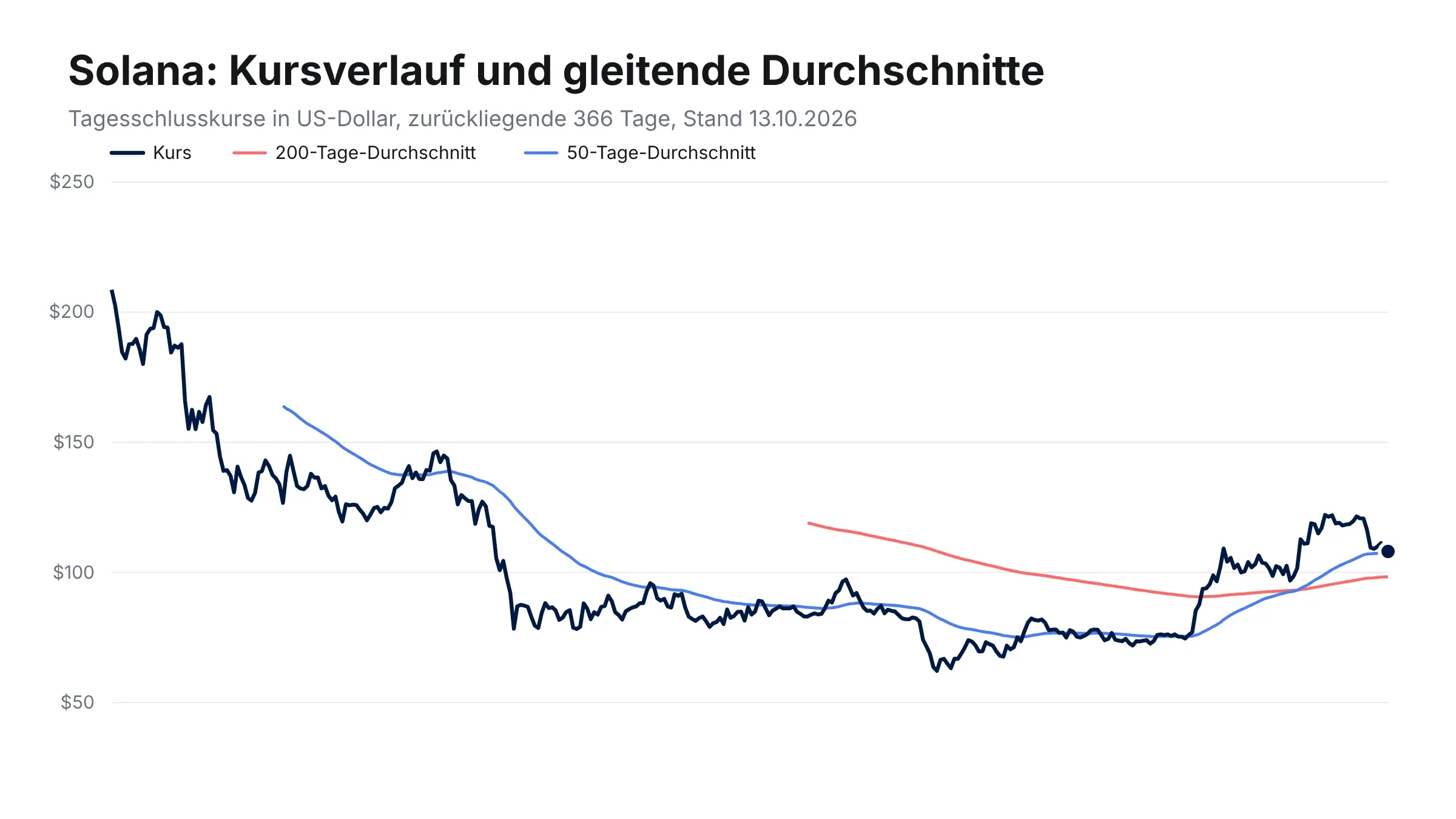
The range of the past twelve months runs from $62.18 to $208.61. Measured against the high, SOL is some 48 percent lower; measured against the low, some 74 percent higher. Three levels can therefore be justified for the coming days: $111.83 as Monday's daily high, $107.45 as the 50-day line, and the zone between $98.37 and $100, where the annual average and the offer condition coincide. The $117 target named in our October 12 article is unaffected by this; it lies above the current range.
ETF outflows on a sixth consecutive trading day
The second source of selling is the exchange-traded funds. On TokenPost data, the US spot Solana ETFs recorded a sixth consecutive trading day of net outflows on October 12. The sum was small at around $0.7 million, and it fell entirely on VanEck's VSOL; no fund took in money that day. Over the five trading days before, outflows added up to $16.5 million. Since launch, cumulative net inflows nonetheless stand at $1.574 billion.
The orders of magnitude show where the weight lies. A daily outflow of $0.7 million does not register against $3.99 billion of daily turnover. The 1.25 million SOL from a single company, by contrast, amount to around 3.4 percent of daily turnover and meet an order book that will not absorb them without trace on a weak day. Anyone watching the SOL price these days is watching a balance-sheet decision rather than a fund statistic.
What has changed since the Solana article of October 10
On October 10 SOL stood at $109.84, and the subject was a technical one: the 200-millisecond blocks after SIMD-0525 had gone live. Since then the price has moved 1.5 percent to $108.21, so almost not at all, while two things have been added below the surface. First the announced buyback with its price condition, second the continuation of the ETF outflows, which had begun on October 10 with the end of a 14-week inflow streak.
The level that counted back then was the interim low at $102. That low has held, because the lowest point of the past 24 hours was $102.19, exactly there. What is new is that a second level now waits below it, one that comes not from the chart but from a contract.
Selling pressure in the order book: limit order versus market order
A market order buys or sells immediately at the next best price in the order book. A limit order sets a price and is executed only if the market reaches it. In quiet phases the difference is small. When a large holder hands over hundreds of thousands of tokens in a few hours, it gets expensive: the market order then works its way through several price levels, and the actual execution price diverges from the one displayed. That gap is called slippage.
In practice that means two things. When buying, a limit order just below the current price caps the damage if a large sale comes through. When selling the same holds in the other direction, and it is also worth a look at trading hours: order books are thinner during the European morning than during the overlap with US trading in the afternoon. Move larger amounts and you split them up and avoid the minutes immediately after an announcement.
What matters when choosing an exchange in Germany
Since MiCA has applied in full, providers need authorisation as a crypto service provider to do business with investors in the EU. What counts for you there is less the marketing promise than the question of who holds the tokens and at what fees trading happens. The spread between the buy and sell price is the larger cost block at many providers than the stated fee. A look at the crypto exchange comparison shows where the differences lie.
Holding period, exemption threshold and staking: the German tax rules for SOL
For investors in Germany, SOL counts among other assets. A sale falls under private disposals pursuant to section 23 of the German Income Tax Act. After one year of holding, a gain is tax-free; before that it counts at the personal income tax rate. Within the one-year window, gains stay untaxed up to the exemption threshold of 1,000 euros per calendar year. Exemption threshold means one euro above it makes the entire amount taxable, not just the excess.
With staking things sit differently. The ongoing rewards are other income under section 22 no. 3 of the German Income Tax Act, with an exemption threshold of its own at 256 euros a year. They are valued at the price at the moment of inflow. The once-discussed extension of the holding period to ten years for staked coins was dropped by the tax administration in its May 2022 circular, so one year stands. Anyone with many small inflows needs clean records; the common tax tools and portfolio trackers take that on.
Staking ties the tokens up for around two days
SkyAI itself says it generated more than $12 million of staking proceeds up to June 30, with its own validator reaching 6.01 percent against 5.57 percent for the network average. The difference of 0.44 percentage points does little to the book loss of around $86 million. For private holders the second number matters more: stake SOL and you cannot reach it immediately. Unstaking takes effect only at the end of the current epoch, and an epoch lasts around two days on Solana. If you want to react in a fast move, leave part of the holding unbound. Which providers set which lock-up periods and yields differs considerably and belongs checked before staking.
Our assessment: the $100 level now carries a second meaning
From the newsroom's point of view, the condition is the real news value of this week, not the daily loss of 3.4 percent. Three pieces of evidence argue for that: the coverage calculation, under which the buffer between reserve and offer volume shrinks from $14 million to $6 million at $100; the closeness of the threshold to the 200-day average of $98.37; and the fact that around one million SOL still sit with the company and may expressly be sold. Against it stands the order of magnitude: against $3.99 billion of daily turnover, even a million tokens is no automatic move lower, and SkyAI can waive the condition. Whether the buyback happens or fails cannot be derived from this, and a price target even less so.
What can be derived: the zone around $100 will be watched more closely than usual during the ten trading days from October 15, because a company with a concrete sum is reading along there. Levels that many eyes are on are rarely passed unnoticed.

Solana buyback: the $100 condition runs to the end of October
- Settle the buying route and the costs. Before your next order, compare the spread between buy and sell price and the custody arrangements at a provider authorised in the EU. The exchange comparison sorts the fee models.
- Separate bound and free holdings. Work out which part of your SOL sits in staking and therefore needs around two days to unstake. Yields and lock-up periods are in the staking comparison.
- Record the purchase data. Note the date, quantity and price for every purchase, so that the one-year window and the 1,000-euro exemption threshold can be evidenced later. The tax tools in comparison take the bookkeeping off your hands.
(As of October 13, 2026. This article is not investment advice. Prices and fee structures change; check the terms with the provider before you buy. Crypto investments can lead to a total loss.)
The Meteora airdrop has an expiry date: the claim window for LP Stimulus Season 2 closes on October 21, 2026, and with it access to 20 million MET. Anyone who provided liquidity on Meteora over the preceding twelve months collects their share by then or not at all. Two thresholds decide whether anything lands in the wallet in the first place, and neither allows a partial payment.
Meteora is a liquidity infrastructure on Solana and therefore part of the blockchain's DeFi layer, the financial applications that work without a bank as counterparty. The protocol supplies the pools in which tokens trade after launch, and MET is the associated token. If this applies to you: the claim is a transaction on Solana, you need SOL in the wallet for it, and afterwards you hold a token you can sell, stake or leave where it is. In Germany the inflow also goes on the tax return.
Meteora closes the claim window for LP Stimulus Season 2
The project's governance post names the claim period verbatim: July 21, 2026 to October 21, 2026. Season 2 itself ran a full year, from July 1, 2025 to June 30, 2026, counted in UTC throughout. Meteora expressly describes the allocations as final following a review, so there is no adjustment and no appeal.
No time of day appears in the primary source. Trade publication CryptoBriefing wrote at the portal's launch in July that it would stay open until 10:00 UTC on October 21. That hour therefore rests on media reporting rather than on project confirmation. Rely on the day, not on the afternoon: anyone trying to claim at midday on October 21 may find the portal already shut.
Meteora is the third big claim deadline this month, after Sonic and Pharos. An overview of every running deadline is in the airdrop section.
Two thresholds decide all or nothing: 100,000 points and 10 MET
Under the governance post, only those who have collected at least 100,000 points and are due an allocation of at least 10 MET are eligible. Both conditions apply at once. Wallets that come in below 10 MET lose their claim, and the amount is distributed among the remaining eligible participants.
The allocation itself follows a simple formula the project discloses: your share is your point score divided by the total score of all participants, multiplied by two percent of the MET supply. 20 million MET from the ecosystem reserve are set aside, which is around two percent of the total supply. With a total supply of just under 998 million MET, the arithmetic works out.
What the 10-MET threshold is worth can be put in figures. MET trades at around $0.40 on Tuesday morning. Ten MET are therefore just under four dollars. Eligibility is decided by the point score ahead of it, barely by the minimum amount.
The arithmetic behind the 100,000 points: $100 of fees in a standard pool
Meteora publishes the points structure as a table, and the threshold can be converted into dollars from it. In a DLMM or DAMM v2 standard pool there were 1,000 points for every dollar of trading fees your position generated. 100,000 points therefore correspond to $100 of fees over the twelve months.
Two deviations shift the arithmetic considerably:
- Launch pools delivered only 200 points per dollar. There it took $500 of fees to reach the same threshold.
- Fees from the DAMM v2 beta window between April 10, 2025 and the start of Season 2 on July 1, 2025 counted double, at 2,000 points per dollar. There $50 was enough.
That spread is deliberate. Meteora justifies the reduced rate for launch pools by noting that Season 1 had put such pools in a separate bucket, and that the smaller points rate is now meant to create a fairer balance for private liquidity providers. The bonus in the beta window, conversely, was intended to reward those who used DAMM v2 at all in its early days.

DLMM and DAMM v2 count, limit orders and DAMM v1 do not
Season 2 inverted the logic of Season 1. In the first round there were points both for fees generated and for daily total value locked, or TVL. TVL is the total value of the capital sitting in a pool or protocol at a given moment. Season 2 counts trading fees only. How much money sat in a position no longer matters, only how much turnover ran through it.
Points were available in two products only. DLMM stands for dynamic liquidity market maker, a pool type that places liquidity in individual price bins and adjusts the fee to market volatility. DAMM v2 is the classic product pool with position NFTs and optionally bounded price ranges. Both pool types earn points, in the standard variant as well as the launch variant.
Expressly not eligible are limit orders and DAMM v1 pools. Keep your liquidity in DAMM v1 all year and you have zero points despite real fees. That one sentence decides eligibility for many wallets, and it sits in a single line of the primary source.
Five quote tokens qualify a pool, all others earn zero points
One more filter sits ahead of the points award, and it is easily missed. A pool counted only if its quote token was one of five: JupUSD, USDC, USDT, SOL or USD1. The quote token is the other side of a trading pair, the unit in which the other token's price is expressed.
If a pair was quoted against any other token, the fees generated in it earn zero points according to Meteora, regardless of their size. On top of that come three blocklists the project applies in sequence: one at token level, which includes M3M3, LIBRA and MELANIA, one at pool level for suspicious pools, and one at wallet level. Team treasury wallets were also taken out of the points system.
Two things Meteora deliberately left out: Sybil detection and the grouping of related wallets. The reasoning is comprehensible, because there were no flat amounts per wallet. Spread your activity across several addresses and you gain nothing under a purely fee-based score. In Season 1, grouping wallets wrongly flagged too many genuine users, on the project's account.
The primary source is silent on the fate of unclaimed MET
Here lies the real uncertainty of this deadline, and it is the reason waiting is not an option. On the claim period, the governance post says only that the allocations are final. Whether unclaimed MET are burned, returned to the ecosystem reserve or used some other way is not stated there.
Analysis site Phemex quotes the claim terms as saying that unclaimed MET would be handled by the company at its own discretion. That is a third-party account rather than primary evidence, so it stands here as an attribution and not as a fact. Only one case is documented: allocations below 10 MET lapse and are redistributed.
The contrast with the month's two other deadlines is therefore sharp. With Sonic it is known that unclaimed tokens are burned, with Pharos that they go back to the foundation. With Meteora an eligible holder does not know, and that is precisely why claiming is the only action whose outcome is settled.

MET stands at $0.40, 42 percent below its all-time high
The price gives the deadline extra weight. MET trades at around $0.40 on Tuesday morning, on a market capitalisation of roughly $221 million and at rank 176 among the largest crypto-assets by market value. Over the preceding seven days the token has gained a good 37 percent, and almost 58 percent over 30 days. It is nonetheless still some 42 percent away from its all-time high of around $0.69.
Value the 20 million MET at today's price and the claim window has just under eight million dollars behind it. Around 558 million MET are in circulation out of just under 998 million in total. What your personal share is worth hangs on your point score, and that is shown in the Meteora app as soon as you connect your wallet.
We are naming no price target alongside this, and nobody should derive one from an airdrop deadline. A claim window brings additional tokens into circulation, and what the market does with them is open.
Airdrops and tax: the inflow falls under section 22 no. 3 EStG
For investors in Germany, the claim triggers a tax event as well as a transaction. An airdrop that is consideration for an activity of your own counts as other income under section 22 no. 3 of the German Income Tax Act. That is exactly the case here: the points did not fall from the sky but came from trading fees generated, in other words from a service.
What counts is the market value at the moment of inflow, and with a claim, inflow means the day the tokens arrive in your wallet. Claim on October 20 and you use the October 20 price, not the price on the day you sell. For other income of this kind there is an exemption threshold of 256 euros per calendar year; above it the full amount is taxable. The detail, and the line against non-taxable free tokens, is set out in our piece on when airdrops are taxable in Germany.
A second point in time comes later. Sell the MET at a profit within a year of the inflow and the speculation period for private disposals applies on top. So note the date, the number of units and the price when you claim. That value is hard to reconstruct afterwards, and the tax office asks about the day of inflow, not the day of sale.
After the claim: staking, selling through an exchange or leaving it alone
The claim settles the deadline, but not the decision about the token. Meteora offers to stake claimed MET directly; the project has announced a referral staking program for this, intended to replace the old points system. To sell the MET you need somewhere to trade: a sale runs either through a pool on Solana itself or through a central crypto exchange, and there the fee structure decides the outcome.
More important than the direction, in these days, is the route to the portal. Around every well-known claim deadline, fake sites spring up that request a wallet approval and then empty the wallet. On October 12 the Shiba Inu team publicly called a purported airdrop a drainer. So reach the claim page only through the official Meteora domain, never through a link in a direct message. Check two things before confirming: which approval the transaction actually requests, and whether the contract address of the token you are due matches the officially documented one. A differing contract address is the clearest sign of a fake site.
Season 2 is the last points season, then comes the referral staking program
One sentence in the governance post matters beyond this deadline: Season 2 is, on the project's account, the last season of the points system. So anyone waiting to make up in a Season 3 what they missed in Season 2 is, as things stand, waiting for something Meteora is not planning. Instead, the referral staking program is meant to tie incentives to MET and the product in future.
For liquidity providers that changes the arithmetic fundamentally. A points system rewards a year of activity retrospectively in one lump; a staking and referral model pays continuously and asks in return that the token be held. Which of the two forms yields more in the end cannot be quantified today, because the terms of the new programme are not available as an annual figure.
Our assessment: of the three October deadlines, Meteora is the one with the poorest information and therefore the one with the greatest pressure to act. The evidence: the date is confirmed in the primary source, the time of day only in the media, the consequence of expiry not regulated in the primary source at all, and the allocations are final. Nothing argues against acting except the effort of one transaction and the network fee in SOL, which is low on Solana. Anyone eligible collects their share before October 21 arrives; what happens to unclaimed MET after that, no one can evidence from a source. No case for buying MET follows from this, and a total loss remains possible with any crypto-asset.
Meteora claim: without 100,000 points, nothing is left on October 21
Three steps give you a clear position ahead of the deadline:
- Check the allocation and claim. Connect the wallet you provided liquidity with in the Meteora app and read off the point score and the allocation. If both clear 100,000 points and 10 MET, claim before October 21. To put the MET to work afterwards, compare the staking platforms and their yields before settling on one.
- Record the inflow data. Note the date, the number of units and the price on the claim day, and do it before you sell anything. That value is the basis for the other income on the tax return. A crypto tax tool or portfolio tracker captures the inflow automatically and spares you the reconstruction next spring.
- Settle custody. Decide where the MET sit after the claim. A hot wallet you use to confirm approvals daily is the poorer place for a holding kept over a longer period; for larger amounts the hardware wallet comparison is worth a look.
(As of October 13, 2026. This article is not investment advice. Prices and fee structures change; check the terms with the provider before you buy.)
Hyperliquid lost 5.9 percent on Monday morning, Bitcoin only 0.8 percent over the same period. A look into the exchange's own books explains the gap: Hyperliquid carries $1.66 billion of open leveraged positions on its own token. That makes it the house's third-largest market after Bitcoin and Ethereum, and it is almost three times what trades there in a day.
cryptoticker.io compiled this analysis itself on October 13, 2026, from the exchange's publicly accessible data and from CoinGecko. What follows from it, and what an investor in Germany can check against it, is set out in the sections below.
HYPE falls to $82.61 while Bitcoin loses only 0.8 percent
HYPE trades at $82.61, or 73.95 euros, on October 13, 2026. Over 24 hours that is a loss of 5.9 percent, over seven days one of 11.5 percent. Over 30 days, by contrast, the token is still up 4.5 percent. The daily range ran from $79.52 to $88.00, a spread of 10.7 percent between low and high in a single day.
For comparison, the two largest coins over the same window: Bitcoin stands at $83,401 and is giving up 0.8 percent, Ether at $2,514.63 with a loss of 1.9 percent. The broad market is moving, in other words, but it is not breaking down. HYPE is falling roughly seven times as hard as Bitcoin.
The backdrop comes from last week. $681 million flowed out of the American spot ETFs on Bitcoin on a net basis, according to CoinDesk, the largest weekly withdrawal since June on figures from provider SoSoValue. Analysts there name $82,000 as an important support for Bitcoin. The next date that can move the whole market is the US inflation print on October 14.
A token such as HYPE hangs on that wider weather, but it amplifies it. A look into the books of the exchange it trades on shows why.
1.66 billion dollars: HYPE is the third-largest leverage market on its own exchange
Hyperliquid is a decentralised exchange for perpetual futures. A perpetual future, or perp, is a futures contract with no expiry date: you bet on a coin's price with leverage without owning it, and the position runs for as long as you can fund it. The exchange publishes its market data openly, and anyone can pull it.
The pull on October 13, 2026 gives $11.75 billion of open positions and $7.73 billion of turnover over 24 hours across all 234 perp markets. Open positions are known in the jargon as open interest: the sum of all contracts currently running and not yet closed.
The ranking by open interest looks like this:
- Bitcoin: $3.14 billion
- Ethereum: $2.79 billion
- HYPE: $1.66 billion
- Solana: $627 million
- Zcash: $554 million
- NEAR: $367 million
The exchange's own token therefore sits ahead of Solana, Zcash and NEAR, and ahead of all three combined. For a coin ranked 11th by market capitalisation, that is an unusually heavy position on a single venue. Maximum leverage on HYPE is 10, against 40 on Bitcoin.
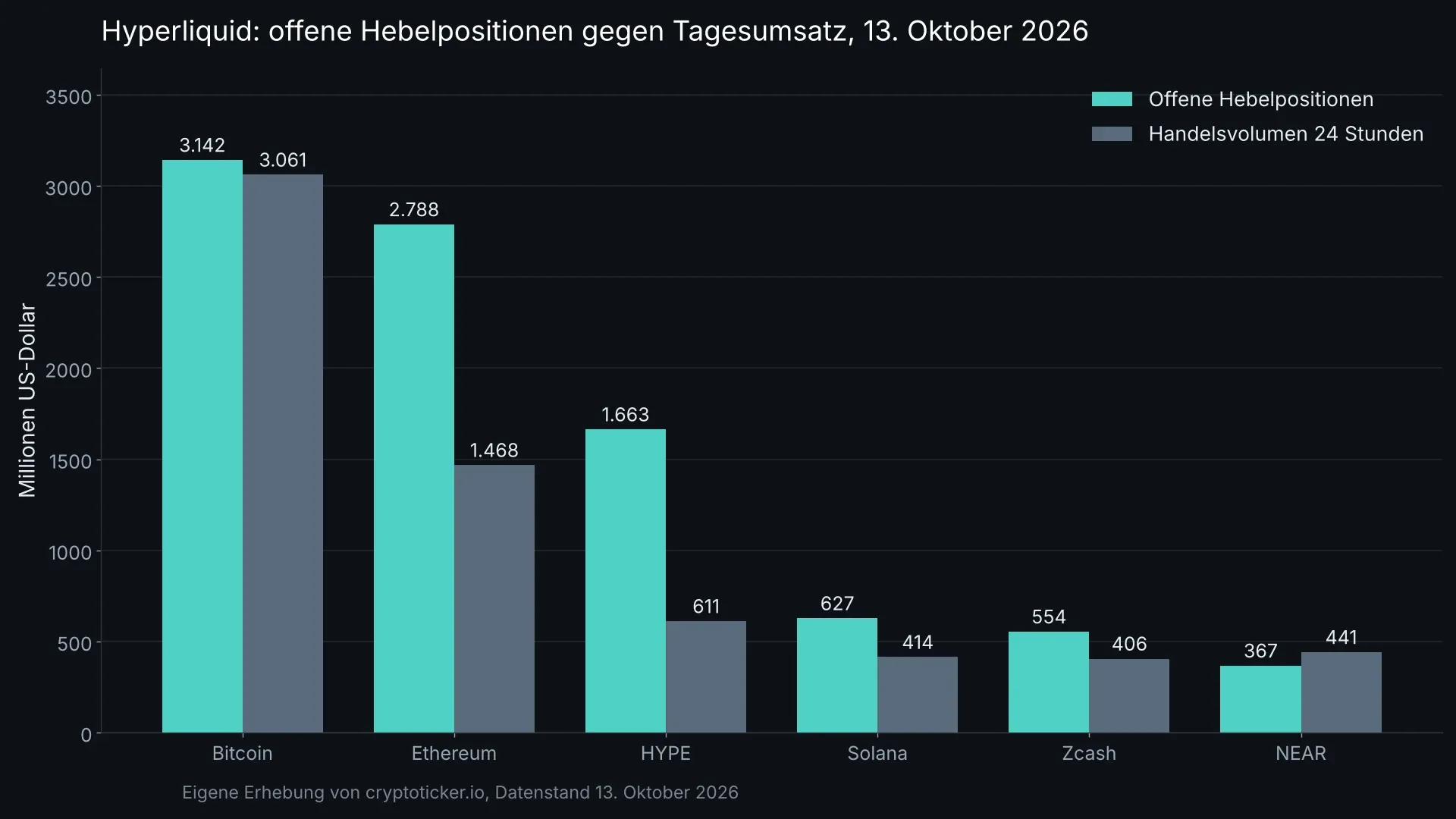
Open interest against daily turnover: the ratio explains the gap
The absolute figure says little on its own. It becomes meaningful in relation to turnover, because turnover shows how quickly positions can change hands.
On Bitcoin, $3.14 billion of open positions stand against $3.06 billion of daily turnover. The ratio is 1.03: on a normal day, roughly as much is traded in this market as is open in positions altogether. Anyone who wants out finds a buyer.
On HYPE, $1.66 billion of open positions stand against $611 million of daily turnover. The ratio is 2.72. There are therefore almost three times as many running bets in the market as are traded there in a day. If everyone wanted to close at once, the market would need just under three days of turnover to do it.
That is exactly what creates the difference in the price move. A market with plenty of open positions and little turnover reacts more strongly to the same piece of news, because every sale eats up a larger share of the available other side. The 5.9 percent decline in HYPE against 0.8 percent in Bitcoin is built into that number before any news arrives.
Funding rate and liquidation threshold: how forced selling pressure builds
Two mechanisms keep a perp market in balance, and both are currently working against the buy side.
The first is the funding rate. It is the payment that holders of long and short positions make to each other every eight hours so that the futures price does not detach from the spot price. On HYPE it stands at plus 0.00125 percent per eight hours on October 13. Positive means the long side pays the short side. The rate is low, but the direction is unambiguous. Bet on rising prices and you pay for every day you wait.
The second is liquidation. If the price falls far enough that the posted collateral no longer covers the losses, the exchange closes the position automatically and sells. With ten times leverage, a decline of around ten percent against the position is enough on paper. The daily range of $79.52 to $88.00 amounts to 10.7 percent. A move of that size was therefore enough on Monday to hit leveraged long positions.
Such forced sales hit further positions, which then close in turn. The bigger the pile of open positions relative to turnover, the longer that sequence runs.

Funding rate, fees and leverage caps differ from one perp exchange to the next
The three variables that decide the outcome of a leveraged position are each set by the exchange itself. The funding rate of plus 0.00125 percent per eight hours is at the lower edge of the band on Hyperliquid; at other venues the base rate of 0.01 percent per eight hours is eight times as high, which means markedly higher carrying costs on the same position. On leverage, Hyperliquid's 10 on its own token is on the low side for the industry, while 40 on Bitcoin is at the upper end.
Which platforms are candidates for trading perps, and how they differ on these points, is set out in the comparison of the best perp DEXs.
Only 22 percent of HYPE tokens are in circulation
Alongside leverage, a second item in the books weighs on the price over a horizon of months: the quantity of tokens not yet in the market.
Of a maximum supply of one billion HYPE, around 222.4 million units are in circulation on October 13, 2026. That is 22.2 percent. The remaining 77.8 percent sit in lock-ups, with core contributors, in the community fund and in reserves.
That gap shows up in two valuation figures. Market capitalisation, circulating supply times price, stands at $18.36 billion. The fully diluted valuation, or FDV, counts every token that will ever exist at today's price and comes to $78.83 billion. The factor between the two is 4.3.
This is not a peculiarity of Hyperliquid but the usual picture for young tokens with long lock-ups. It does mean, though, that every unlock releases new units into a market whose demand does not automatically grow to the same degree.
The monthly unlock on the 6th, and the buyback against it
A monthly distribution to core contributors, meaning the project's team and developers, has been running since January 2026. According to a report by Cryptotimes it falls on the 6th of each month and began with 1.2 million HYPE on January 6. The October 6, 2026 tranche comprised 3.75 million HYPE, worth around $340 million. Hyperliquid Labs is selling that tranche over the counter to a single institutional buyer, according to the same report; co-founder iliensinc confirmed this on Discord, and neither buyer nor price has been named.
If the pattern continues, the next distribution falls on November 6. No confirmed number of units exists for that date, and the public unlock calendars contradict each other on this point. The monthly pattern is documented; the coming quantity is not.
Against that stands a buyback programme. The exchange's assistance fund bought back $11.81 million of HYPE in the week before October 6, and $14.81 million in the week before that. Measured against the value of the October tranche, the weekly buyback amounts to around 3.5 percent. The buybacks are running, then, but they do not offset the unlocks. How the programme is built and where the money for it comes from is described in our article on the buyback out of USDC earnings.
Perpetual futures without a MiCA licence: deposit protection does not apply
This is where the situation becomes concrete for investors in Germany. The EU regulation on markets in crypto-assets, MiCA for short, has applied since December 30, 2024. Anyone offering crypto services in the EU needs a licence for it, and for providers based in Germany, BaFin runs the procedure.
Hyperliquid is a decentralised exchange with no EU base and no such licence. Three things follow from that which stand differently at a licensed provider:
- No supervisor to turn to. In a dispute over a liquidation, there is no German authority you can approach and no complaints body under German law.
- No segregation of client money to the EU standard. MiCA requires licensed providers to hold client assets separately. Without a licence that obligation does not apply.
- No leverage protection for retail investors. For contracts for difference on crypto-assets, EU-regulated brokers face a leverage cap of 2 for retail clients. On an unlicensed perp exchange it does not bite, and there ten times leverage on HYPE and forty times on Bitcoin are possible.
Anyone who wants to trade leveraged products inside the European framework will find the licensed addresses in the comparison of the best crypto brokers. The price for it is markedly lower leverage; the return is supervision.
Tax on perp gains: the one-year holding period does not apply here
One point is regularly overlooked and cannot be repaired after the fact. When you buy a coin directly, the one-year speculation period applies in Germany: hold for longer and you sell tax-free. With perpetual futures that rule does not bite, because the gain does not come from selling a held asset but from a futures transaction.
Gains from perps therefore count as investment income from the first minute and are subject to the 25 percent flat-rate withholding tax plus the solidarity surcharge and, where applicable, church tax. How the taxation works in detail, and which offsetting limits apply to losses from futures transactions, is set out in our piece on the tax on crypto futures and perps.
For record-keeping that means every closed position belongs in the log, including the small ones. An unlicensed exchange abroad transmits no data to the German tax office, and the duty to declare stays with the taxpayer.
Our assessment: leverage weighs more heavily than the unlock
From the newsroom's point of view, the unlock volume is the smaller of the two issues for the price over the coming weeks. The October 6 tranche went over the counter to a single buyer, according to Cryptotimes, so it did not pass through the order book. What does pass through the market is the $1.66 billion of open leveraged positions, and their ratio of 2.72 to daily turnover is the highest reading among the house's six largest markets.
The figures above argue for that. Against it stands the fact that the buyback keeps running and, at $11.81 million a week most recently, generates real demand, and that HYPE is still up 4.5 percent over 30 days despite the pullback. The token currently sits 15.7 percent below its high of $97.96 from September 23, 2026. This is a pullback in a market that has risen, not a collapse.
No buy or sell recommendation follows from this. With a token whose price hangs on the utilisation of a single exchange, a total loss is possible.
HYPE at $82: leverage decides before the inflation print
The US inflation print on October 14 is the next date that can move the whole market. If it meets a market carrying just under three days of turnover in open positions, the reaction in HYPE will be stronger than in Bitcoin. Three steps make sense ahead of that date:
- Hold the leveraged position against the daily range. $79.52 to $88.00 was Monday's range, 10.7 percent. Calculate your liquidation threshold against a move of that size rather than against the current price. To build such a position without leverage, the venues are in the comparison of the best crypto exchanges.
- Settle the venue's framework. Without a MiCA licence there is no supervision and no leverage protection. If you do not want to carry that, move the leveraged part to a licensed provider from the comparison of the best crypto brokers.
- Set up the tax records now. Perp gains are taxable from the first trade, and the one-year rule does not help. Every closed position belongs on file before the year draws to a close.
(As of October 13, 2026. This article is not investment advice. Prices and fee structures change; check the terms with the provider before you buy.)
Ether traded at $2,533.59 on Tuesday morning, 1.47 percent below its level of 24 hours earlier and 6.39 percent below where it stood a week ago. The more interesting number sits in the derivatives market rather than in the price: open interest in Ethereum contracts on the OKX exchange has fallen from $2.113 billion to $1.776 billion since October 7. That is $337 million, or almost 16 percent less leverage in five days. If you hold ETH, read the two numbers together, because a market without leverage falls more slowly and rises more slowly as well.
Ethereum price today: $2,533.59 after the low at $2,411
The range of the past 24 hours runs from $2,411.24 to $2,575.42 according to CoinGecko data. That is $164 between high and low, a good 6.4 percent of the range measured against the low. The current level of $2,533.59 sits above the midpoint of that range, which runs at $2,493. Ether worth $16.26 billion changed hands over the period.
Against the wider market, Ethereum stands out in neither direction. Bitcoin trades at $83,697 and has given up 2.31 percent in seven days, Solana stands at $108.59 and lost 9.73 percent over the same period. Ether sits between the two with a weekly loss of 6.39 percent. No coin-specific problem can be read from that.
The $2,495 level has gone, and what has happened since
On Sunday the question here was whether the $2,495 level would hold. Ether cost $2,504 at the time, and the network fee had dropped to a sixth of its September value; the detail is in our October 11 analysis of the Ethereum price and the collapsed base fee. The answer is that the level did not hold. At the low of the past 24 hours the price stood at $2,411.24, $84 below it.
The price has come back nonetheless. At $2,533.59 Ether trades almost $39 above the old level. For the chart picture, the support at $2,495 has turned into a waypoint rather than a floor or a ceiling. Only a second test will show what role it plays from here.
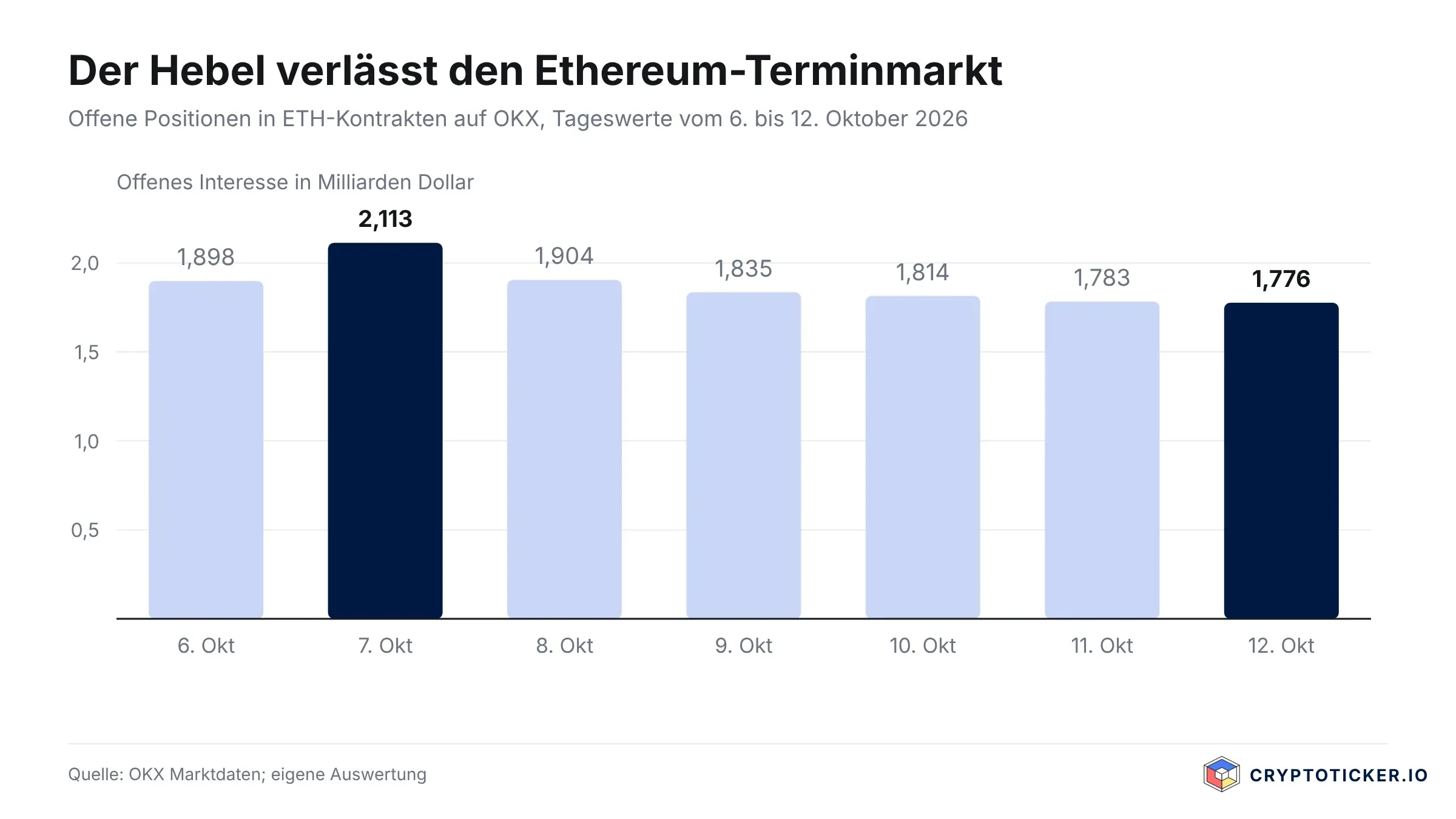
Open interest: $337 million less leverage in five days
Open interest is the sum of all futures contracts that are currently open and have not yet been closed out. The measure shows how much borrowed money sits in a market. When it rises, leverage is being added; when it falls, leverage is leaving, either because traders close positions voluntarily or because the exchange liquidates them.
According to the public OKX market data we reviewed on Tuesday, open interest in ETH contracts stood at $2.113 billion on October 7. It has fallen every single day since: $1.904 billion on October 8, $1.835 billion on the 9th, $1.814 billion on the 10th, $1.783 billion on the 11th and $1.776 billion on October 12. Six trading days down in a row, $337 million or 15.9 percent in total.
A second signal arrived on October 12. Trading volume in the same contracts jumped from $2.122 billion the previous day to $5.551 billion, a factor of 2.6. High volume alongside falling open interest is the classic pattern of a wave of position closures: a great deal is traded, but on balance positions are being closed rather than opened.
Long-short ratio falls from 2.30 to 1.73
The same data source tracks the ratio of accounts betting on rising prices to those betting on falling ones. On October 7 there were 2.30 long accounts per short account in ETH contracts. By October 12 the figure was 1.73. That is the lowest reading of the week under review and a decline of a quarter.
The number says nothing about the size of the positions, only about how many there are. As a price forecast it is therefore useless. What can be read from it is that the bet on a quick rally has thinned out. Those same positions generated the selling pressure of the past week as they were closed one after another.
Funding rate near zero: the derivatives market barely pays a premium
A perpetual is a futures contract with no expiry date. To stop its price drifting away from the spot price, holders on one side pay a fee to holders on the other at fixed intervals, the funding rate. When it is clearly positive, buyers are paying, and the market is crowded on the buy side.
On the ETH-USDT perpetual on OKX the rate stood at 0.00255 percent per eight-hour period on Tuesday morning. Annualised, that is around 2.8 percent, and the futures price was even 0.04 percent below spot. By comparison, in an overheated phase the rate sits at 0.05 percent or more per period. The market is currently asking almost no premium for a bet on rising prices.
How a liquidation happens: the mechanism in three steps
This sequence is responsible for last week's deleveraging, and it is the reason a single sell-off can grow larger than the news behind it would suggest.
Step 1: the margin shrinks
Buy $10,000 of Ether with five times leverage and you post $2,000 as collateral. If the price drops 10 percent, $1,000 of that collateral is gone. The buffer halves on a price move that would barely register without leverage.
Step 2: the exchange closes the position
Once the collateral falls below the maintenance margin, the exchange closes the position automatically and sells the underlying coins on the market. The selling is real rather than a book entry, and it hits the same order book as any other sale.
Step 3: one sale triggers the next
That selling pressure pushes the price lower, which breaks the maintenance margin on the next position. This is the chain reaction that produces more price movement in half an hour than a week of quiet trading. The volume spike of October 12 shows exactly that.
The reverse holds on the way up. The less leverage sits in the market, the fewer forced sales a pullback can trigger. A market with $1.776 billion rather than $2.113 billion of open interest is slower in both directions. If you use leveraged products, the terms and maintenance margins of the providers are set out in our comparison of perpetual exchanges.
A 2:1 leverage cap: what applies to retail investors in Germany
At a provider supervised in Germany, the numbers in the example above would not be permitted at all. BaFin has made permanent, by general administrative act, the restrictions on contracts for difference that the European Securities and Markets Authority introduced in August 2018. Cryptocurrencies fall into the strictest tier: a maximum of two times leverage for retail clients. For comparison, the cap is 30 for major currency pairs and 5 for equities.
Two further protections come with it that are often missing at exchanges outside the EU. An obligation for retail clients to add funds is prohibited, so the loss is limited to the money committed. And the position is closed at the latest when the collateral has shrunk to half of the initial margin. The detail is in BaFin's publication on the general administrative act covering contracts for difference. A perpetual on an exchange without an EU licence is not covered, and there 50 times leverage and margin calls are the norm.

Futures and tax: 25 percent from the first euro
The tax gap between a perpetual and a bought Ether is wider than the economic one, and it is regularly overlooked in leveraged trading. A gain from a futures transaction counts as investment income under section 20 of the German Income Tax Act. It attracts 25 percent capital gains tax plus the solidarity surcharge and, where applicable, church tax, so at least 26.375 percent in total. There is no holding period after which the tax falls away. We worked the case through in detail on October 12, in our piece on the tax on crypto futures and perpetuals.
One relief has applied since the 2024 Annual Tax Act. The separate loss-offsetting pool for futures transactions and the annual ceiling of 20,000 euros have both been scrapped, and for all open cases. Losses from perpetuals can therefore be set against other investment income again. The statutory text is at section 20 EStG on gesetze-im-internet.de. Whether your provider withholds the tax automatically depends on whether it is a domestic paying agent; with foreign exchanges you have to declare the income yourself.
Spot instead of perpetual: the holding period applies to the coins alone
Buy Ether directly and take it into your own custody and you fall under section 23 EStG. The one-year rule applies there: after twelve months of holding, the disposal gain is tax-free regardless of its size. Within the year the personal income tax rate applies, though there is a 1,000-euro exemption threshold covering all private disposals in a year.
That produces a decision which has nothing to do with a view on the price. Two investors with identical expectations for the Ethereum price pay different amounts of tax depending on whether they invest through a perpetual or through bought coins. For holding periods beyond a year, buying directly is the cheaper route in tax terms; over short periods the difference barely matters. Which venues are licensed in Germany and what they charge is set out in our comparison of crypto exchanges.
The ETF side: a tenth day of outflows in a row
Alongside the derivatives market, a second flow has been running against Ether. The American spot ETFs on Ethereum recorded a net outflow of $85.4 million on October 12, according to figures from data provider SoSoValue. It was the tenth trading day of outflows in a row. BlackRock's ETHA fund accounted for the bulk at $75.1 million, with a further $10.3 million from Grayscale's mini trust. None of the eleven funds took in money that day.
Net assets under management across all Ethereum ETFs now stand at $15.86 billion, with cumulative inflows since launch of $13.17 billion. At Bitcoin the outflow was smaller on the same day at $65.4 million. For the coming weeks this is the figure that shows whether new money is returning: as long as the ETFs are selling, the price lacks the demand that could offset the deleveraging.
Our assessment: less risk and less momentum at the same time
From the newsroom's point of view, the deleveraging is the better of the two pieces of news, even though it sounds like the worse one. The evidence: $337 million less open interest, a long-short ratio of 1.73 instead of 2.30 and a funding rate of 0.00255 percent per period together mean the crowded buy side has been cleared out. A sell-off from the current level meets far fewer forced sales than the one on October 8 did.
Against that stands the ETF side. Ten days of outflows in a row and $85.4 million on Monday alone show that the demand which carried the price through the summer is not there at the moment. A market with neither leverage nor inflows moves sideways until one of the two flows turns. We therefore read the situation as a calming rather than a turning point. This is an assessment of market conditions and not a recommendation to buy or sell Ether; with cryptocurrencies a total loss is possible.
Ethereum and leverage: without inflows, $2,575 stays the ceiling
The range the price has moved in since Monday is the framework for the days ahead: $2,411 at the bottom, $2,493 in the middle, $2,575 at the top. As long as open interest keeps falling and the ETFs keep selling, a break above the upper end is unlikely. Three steps follow from that:
- Recalculate your own leveraged position. At what price does the maintenance margin bite, and how far is that price from the low at $2,411? The providers' margin rules are in the comparison of perpetual exchanges.
- Settle on how you buy. For holding periods beyond a year, the one-year rule argues for buying directly rather than for a futures transaction. The venues licensed in Germany and their fees are in the comparison of crypto exchanges.
- Sort the paperwork for the tax return. Futures transactions belong in the KAP schedule, sold coins in the SO schedule. Tools that report the two pots separately are in the comparison of crypto tax software.
(As of October 13, 2026. This article is not investment advice. Prices and fee structures change; check the terms with the provider before you buy.)
Decrypt
Ledger says the hidden chip reads the 24-word phrase off the screen during setup, leaving the Secure Element and its software untouched.
Crypto majors are red, alts are down bad and onchain is facing capitulation. This was not the ‘Uptober’ that was promised…
A judge ruled that Chinese law should govern fraud victims' claims to the 61,000 BTC seized from Zhimin Qian, in a blow to the claimants.
The proposal would require crypto owners to report holdings over €100,000, sparking concerns following a wave of "wrench attacks" in France.
The shutdown comes as NFT trading volumes have collapsed from their 2021-2022 peak, with market revenue projected at $318 million this year.
U.Today - IT, AI and Fintech Daily News for You Today
Near is close to breaking yet another record thanks to an explosive performance of derivatives market.
A rare 4-year chart convergence reveals that Bitcoin has hit a major cyclical discount across independent macro models.
Cardano Visa Card which supports over 685 cryptocurrencies, including ADA, SOL, XRP set to be discontinued on this date.
Cryptocurrency investors are back at trading as XRP Ledger's payments volume and activity surges.
Ripple is conquering Wall Street with its new stablecoin, but leaving its own volatile token, XRP, completely out of the loop.
Blockonomi
TLDR
- CME Group shares slide 1.18% despite faster Globex cloud performance test results.
- Google Cloud testing delivers faster trading response times for CME Globex systems.
- Aurora Cloud Region construction advances ahead of schedule for 2027 testing.
- CME Group targets late 2027 for its livestock market migration to Aurora cloud.
- Dallas disaster recovery testing continues as CME drops interim relocation plans.
CME Group (CME) stock fell 1.18% to $277.24 on Monday, October 12, losing $3.32 despite progress on its cloud migration. The company completed initial performance testing for CME Globex on Google Cloud, achieving faster trading response times. Meanwhile, CME Group confirmed an accelerated construction schedule for its Aurora Cloud Region, supporting its planned market migration.
CME Group Inc., CME
CME Group Stock Declines Despite Cloud Trading Milestones
CME Group shares reversed earlier gains during Monday’s session as selling pressure increased throughout trading. The decline came as the company announced progress toward modernizing its global derivatives trading infrastructure. However, the announcement did not prevent the stock from ending the session lower.
CME Group completed initial performance tests for CME Globex, its electronic trading platform, using Google Cloud infrastructure. The tests achieved faster round-trip times, which measure how quickly trading systems process and return messages. Consequently, the results marked progress toward delivering ultra-low-latency trading through cloud technology.
The company also reported faster construction progress at its Aurora Cloud Region and co-location facility. Google Cloud will provide specialized infrastructure designed to support the trading requirements of CME Group’s markets. CME Group expects the Aurora facility to become available for client testing by mid-2027.
Google Cloud Migration Advances Toward 2027 Launch
CME Group Chairman and CEO Terry Duffy said the migration program continues to advance faster than initially expected. He attributed the accelerated schedule to construction progress and strong results from initial performance testing. Furthermore, the company expects its cloud infrastructure to support ultra-low-latency trading services ahead of its original schedule.
CME Group plans to move its livestock markets to the Aurora Cloud Region during late 2027. Previously, the company considered an interim relocation to Dallas before completing the transition to Aurora. However, faster construction progress eliminated that requirement and allowed CME Group to simplify its migration plans.
CME Group’s Dallas disaster recovery facility has supported client testing since June 2026. The facility remains part of the company’s broader infrastructure modernization program. Additionally, CME Group expects clients to access Google Cloud-managed services and co-location capabilities in Aurora during late 2027.
CME Group Expands Cloud Infrastructure for Global Markets
CME Group operates one of the world’s largest derivatives marketplaces, serving participants across several major asset classes. Its exchanges provide futures and options tied to interest rates, equities, currencies, cryptocurrencies, energy, agricultural commodities, and metals. The company also operates BrokerTec, EBS, and CME Clearing across its trading and clearing businesses.
CME Globex supports electronic futures and options trading, making reliable infrastructure essential to CME Group’s daily operations. The Google Cloud migration aims to combine specialized computing systems with the speed requirements of electronic markets. The transition will provide clients with managed cloud services and physical co-location options.
The latest milestones strengthen CME Group’s planned transition while establishing clearer testing and deployment targets for 2027. However, Monday’s stock decline contrasted with the operational progress outlined in the company’s announcement. CME Group will continue preparing its Aurora infrastructure as it advances the next stages of cloud migration.
The post CME Group (CME) Stock Falls as Google Cloud Migration Accelerates appeared first on Blockonomi.
TLDR
- HIMS stock drops 0.91% to $30.64 despite Hers launching across Australia nationwide.
- Hers expands into Australia with new treatments for weight loss and women’s health.
- Hims & Hers completes its Australian expansion following the Eucalyptus acquisition.
- Hers introduces round-the-clock care and personalized treatments for women nationwide.
- Australia’s growing telehealth market offers Hims & Hers new expansion opportunities.
Hims & Hers Health (HIMS) stock declined 0.91% to $30.64 on Monday, despite the company’s expansion into Australia’s women’s healthcare market. Shares lost $0.28 during regular trading before slipping another 0.13% to $30.60 in after-hours trading. Meanwhile, the company launched its Hers platform nationwide, expanding access to personalized healthcare services for Australian women.
Hims & Hers Health, Inc., HIMS
Hims & Hers Health Expands Women’s Healthcare Services Across Australia
Hims & Hers announced the official launch of Hers in Australia on October 12, expanding its international healthcare operations. The platform offers treatments covering weight management, hair regrowth, menopause, and perimenopause through digital consultations. Women can access healthcare professionals, medication support, and a dedicated care team available around the clock.
The expansion follows the company’s acquisition of Eucalyptus earlier this year, strengthening its position in Australia’s digital healthcare sector. Under the transition, Eucalyptus’ existing women’s healthcare platform, Juniper, will operate under the Hers brand. Meanwhile, the earlier rebranding of Pilot to Hims in August completed the company’s broader Australian platform rollout.
The company introduced specialized weight management programs that combine medical treatment with nutritional guidance and fitness support. Furthermore, Hers provides hair regrowth treatments and services addressing hormonal health concerns throughout different life stages. The platform also allows patients to request female practitioners and access a community exceeding 27,000 women.
Hers Targets Healthcare Access Gaps With Digital Treatment Programs
Hers plans to address healthcare access challenges affecting women across Australia’s metropolitan and regional communities. According to company research, 52% of surveyed Australian women reported experiencing weight-related judgment from healthcare professionals. Among those respondents, 72% subsequently avoided seeking clinical assistance, highlighting barriers to routine treatment.
The company also identified healthcare costs and geographic limitations as obstacles to accessing specialized medical services. Nearly 30% of Australians live in regional and rural communities, where specialist appointments can require extended waiting periods. Hers aims to connect patients with medical professionals through remote consultations and continuous digital support.
Rebecca Holdt, the company’s international product vice president, emphasized digital healthcare’s role in improving nationwide access to treatment. Meanwhile, Australian Chief Medical Officer Matt Vickers highlighted the need for evidence-based services addressing women’s broader healthcare requirements. Existing Juniper patients will retain their Australian practitioners while gaining access to additional treatment options.
Australia Expansion Strengthens Hims & Hers International Operations
The Australian launch extends Hims & Hers’ existing international presence across North America and Europe. Furthermore, the company enters a growing telehealth market with increasing demand for accessible digital healthcare services. Industry projections cited by the company estimate Australia’s telehealth market could reach $2.56 billion by 2034.
Gus Wood will oversee Australian operations as general manager, supported by Chief Medical Officer Matt Vickers. Hers Chief Medical Officer Jessica Shepherd will provide clinical oversight to maintain the company’s international healthcare standards. The leadership structure combines local medical expertise with the company’s wider technology and treatment infrastructure.
Despite the expansion, Hims & Hers Health stock ended Monday’s session lower, extending its losses into after-hours trading. The company’s latest rollout broadens its healthcare offerings beyond existing services and establishes a unified brand across Australia. However, Monday’s stock decline contrasted with the company’s continued expansion into international digital healthcare markets.
The post Hims & Hers Health (HIMS) Stock: Slides Despite Major Australia Expansion appeared first on Blockonomi.
TLDR
- IREN stock closes at $34.80 as Anthropic partnership reports drive market interest.
- Anthropic reportedly signed a multiyear cloud agreement with IREN Limited.
- IREN’s undisclosed AI customer could be Anthropic, according to new reports.
- IREN shares gain 0.86% after hours despite Monday’s 1.11% closing decline.
- Legacy data center concerns challenge IREN’s expanding AI cloud ambitions.
IREN Limited stock closed Monday at $34.80, down 1.11%, before recovering 0.86% to $35.10 in after-hours trading. The movement followed reports linking the company to an undisclosed multiyear cloud agreement with Anthropic. The development renewed market interest in IREN’s expanding artificial intelligence infrastructure business.
IREN Limited, IREN
The stock had gained approximately 8% in overnight trading on Sunday following speculation about the partnership. Monday’s regular session erased those early gains as shares finished below the previous closing level. The reported agreement could strengthen IREN’s position in the growing market for high-performance computing infrastructure.
IREN Limited Stock Gains Attention Over Anthropic Cloud Agreement
The Information reported that Anthropic maintains an unannounced multiyear cloud agreement with IREN, citing people familiar with the arrangement. The report examined Anthropic’s efforts to expand data center capacity and meet growing computing requirements. Neither company has publicly confirmed the partnership or disclosed its financial terms.
The report also connected Anthropic’s infrastructure expansion to several companies with backgrounds in Bitcoin mining. These included Hut 8, TeraWulf, IREN, and Nscale, which provide computing infrastructure and access to large power resources. Such providers can help technology companies expand capacity without developing every facility independently.
Anthropic’s reported relationship with IREN would support the company’s transition from cryptocurrency mining toward artificial intelligence cloud services. Growing demand for advanced computing infrastructure continues to create opportunities for specialized data center operators. A confirmed agreement would add another prominent customer to IREN’s expanding business network.
IREN’s Earlier Customer Disclosure Strengthens Anthropic Speculation
In August, IREN disclosed several multiyear cloud agreements during its fiscal fourth-quarter earnings call. CEO Daniel Roberts identified customers including Cohere, Prometheus, Perplexity, Figure AI, Fal AI, and Higgsfield AI. He also mentioned a separate agreement with a leading frontier artificial intelligence laboratory without naming the organization.
The earlier disclosure created a connection between IREN’s existing contracts and the latest Anthropic report. IREN has not established whether Anthropic represents that previously unnamed customer or a separate agreement. The reported partnership therefore remains an unconfirmed development rather than a newly announced company contract.
IREN has expanded its infrastructure business through agreements with technology companies seeking additional computing capacity. Its broader customer network and existing facilities support its move into specialized cloud services. The company also faces competition from CoreWeave, Nebius, and other operators expanding their artificial intelligence infrastructure businesses.
IREN Stock Faces Data Center Concerns Despite Bullish Sentiment
IREN has faced criticism concerning the operational quality of its older data centers in British Columbia. Research firm SemiAnalysis recently highlighted reported customer complaints involving facilities in Prince George and Mackenzie. These concerns introduced additional scrutiny of IREN’s infrastructure as the company expands its artificial intelligence operations.
Despite those concerns, retail sentiment strengthened following reports connecting IREN with Anthropic. The stock reached the top of Stocktwits’ trending list as traders discussed the possible partnership. Some market participants anticipated further gains, while others questioned the lack of official confirmation.
IREN shares have also struggled against several competing cloud infrastructure stocks during 2026. The company entered Monday’s session with a year-to-date decline of approximately 7%, according to the earlier market report. The Anthropic speculation lifted trading interest, Monday’s lower close showed that the initial rally had faded.
The post IREN Limited (IREN) Stock: Eyes Big Gains on Anthropic Deal Buzz appeared first on Blockonomi.
TLDR
- Navitas (NVTS) stock rebounds 6.21% after hours following a 7.33% daily decline.
- Navitas and NVIDIA introduce a 24 kW power board for next-generation AI data centers.
- The new power delivery board targets 97% efficiency to reduce AI energy losses.
- Navitas’ 800 V-to-12 V technology simplifies power conversion for advanced GPUs.
- Navitas plans to showcase its latest NVIDIA-linked power technology at OCP Summit.
Navitas Semiconductor Corporation (NVTS) stock fell 7.33% to $9.99 at Monday’s close before rebounding 6.21% to $10.61 after hours. The recovery followed developments surrounding its latest AI data center power technology, developed alongside NVIDIA. The company introduced a 24 kW power delivery board designed to improve efficiency across next-generation computing infrastructure.
Navitas Semiconductor Corp, NVTS
Navitas Expands NVIDIA Collaboration With New Power Technology
Navitas Semiconductor announced its latest 800 V-to-12 V power delivery board for NVIDIA’s MGX ecosystem. The technology uses GaNFast components to support advanced power systems across high-performance AI data centers. Furthermore, the development expands Navitas’ existing portfolio of power solutions for demanding computing applications.
The new board delivers 24 kW while targeting 97% efficiency under full operating loads. It also achieves power density exceeding 2,000 watts per cubic inch, supporting increasingly demanding AI hardware. Consequently, the system delivers substantial power within a compact design suited for modern computing infrastructure.
Navitas developed the board using NVIDIA’s latest 400 mm by 60 mm form factor. This configuration allows manufacturers to position power components closer to processors and reduce transmission losses. Additionally, the design supports higher computing demands without requiring larger power delivery systems.
New Architecture Targets AI Data Center Efficiency
The technology converts 800 VDC directly into 12 VDC through a single-stage power architecture. This approach removes an intermediate conversion stage commonly found in existing power delivery systems. As a result, operators can reduce energy losses, hardware requirements, and overall system complexity.
The board incorporates 16 NV6034 GaNFast transistors within its primary power conversion architecture. These components use a stacked half-bridge configuration and Navitas’ latest dual-cooled semiconductor packaging. Together, these features support efficient power delivery and improve thermal management during demanding computing operations.
Navitas previously introduced a 20 kW power board that converts 800 VDC into 6 VDC. The latest development extends that earlier collaboration with NVIDIA and introduces another option for system designers. Meanwhile, both solutions support the industry’s transition toward higher-voltage power infrastructure for AI computing.
Navitas Semiconductor Advances Its AI Infrastructure Strategy
The latest announcement supports Navitas’ broader transformation strategy, which focuses on advanced power semiconductor technologies. Through this initiative, the company aims to replace traditional silicon components with gallium nitride and silicon carbide alternatives. These materials support higher efficiency and greater power density across demanding electrical applications.
Navitas President and CEO Chris Allexandre identified efficient power delivery as an important requirement for expanding AI infrastructure. He also emphasized the company’s work with NVIDIA to simplify power conversion between electrical systems and GPUs. The new technology addresses growing energy requirements across increasingly powerful computing platforms.
Navitas plans to display the new board at the NVIDIA AI Factory MGX Wall during OCP Global Summit 2026. The presentation will highlight its latest power delivery capabilities within NVIDIA’s expanding computing ecosystem. Meanwhile, the stock’s after-hours rebound followed a difficult regular session as the company advanced its AI infrastructure strategy.
The post Navitas Semiconductor Corporation (NVTS) Stock: Rebounds as NVIDIA Unveils New AI Power Tech appeared first on Blockonomi.
TLDR
- Intel Corporation (INTC) stock drops 3.20% to $101.35 despite new AI GPU plans.
- Intel unveils GPU D-series with up to 480GB memory for large AI inference tasks.
- New Xeon 6+ rack designs support over 46,000 cores for enterprise AI workloads.
- Intel’s GPU D-series delivers 1.3 petaflops of compute within a 350-watt limit.
- Intel expands open AI infrastructure with new GPU designs and software upgrades.
Intel Corporation (INTC) stock fell 3.20% to $101.35 at Monday’s close before recovering 0.22% to $101.57 in after-hours trading. The decline came as Intel revealed new GPU specifications and Xeon server designs at the Open Compute Project Global Summit. The announcements highlighted Intel’s efforts to expand its data center business through efficient artificial intelligence infrastructure.
Intel Corp., INTC
Intel Unveils GPU D-Series for Large AI Workloads
Intel introduced further technical details for its GPU D-series, previously known as Crescent Island, during the OCP Global Summit. The new processor uses Intel’s Xe3P architecture and targets memory-intensive AI inference across enterprise data centers. Meanwhile, the company aims to improve processing efficiency while reducing infrastructure costs and power consumption.
The GPU architecture supports up to 480GB of LPDDR5X memory and delivers 1.5TB/s of memory bandwidth. Additionally, the design provides 1.3 petaflops of FP8 computing performance within a 350-watt power limit. These specifications support large language models, long-context processing, and multiple inference workloads running simultaneously.
Intel said a single GPU can support models containing up to 300 billion parameters. Furthermore, an eight-GPU configuration can handle models exceeding one trillion parameters. Customer sampling has started, while Intel continues collaborating with hardware manufacturers and software providers on deployment solutions.
Intel Expands Xeon Server Capacity for Agentic AI
Intel also presented new Xeon-based rack designs that support growing computing requirements across enterprise AI systems. The designs use open infrastructure standards, including Open Rack v3, to simplify integration into existing data centers. Consequently, organizations can expand processing capacity without completely replacing their current infrastructure.
Select Xeon 6+ configurations deliver more than 46,000 processor cores per rack. These systems operate at 133.45 kilowatts of total rack power while supporting high-density computing operations. Intel designed the configurations to handle data processing, workload coordination, and communication between specialized accelerators.
Agentic AI systems require processors to manage several connected tasks rather than complete isolated requests. Therefore, Intel positions Xeon processors alongside GPUs to handle workflow management and data movement. This approach supports concurrent AI applications while improving resource allocation across enterprise computing environments.
Intel Strengthens Open Software and Infrastructure Development
Intel outlined additional software improvements that support applications across its CPU and GPU product lines. The company continues integrating established AI frameworks, inference tools, and open development environments into its platforms. These efforts aim to simplify application deployment and reduce software compatibility barriers.
Intel also highlighted its contributions to the Open Compute Project, including standardized accelerator card designs. Since 2011, the company has submitted 116 contributions supporting open data center infrastructure. Its latest work focuses on improving hardware compatibility and giving system manufacturers greater design flexibility.
The announcements extend Intel’s strategy of combining general-purpose processors, specialized accelerators, and interoperable software. Meanwhile, the company plans further technical presentations during the OCP Summit on October 13. Its expanding hardware portfolio targets enterprise demand for scalable AI processing and more efficient data center operations.
The post Intel Corporation (INTC) Stock: Slides as New AI GPU Details Emerge appeared first on Blockonomi.
CryptoPotato
Strive has accelerated its bitcoin accumulation once again, acquiring 3,311 BTC over the past week, which put its total treasury at 32,773 units.
CEO Matt Coll also reported $208 million in warrant exercises as a key deadline for the remaining warrants approaches.
This week’s purchase is significantly higher than the one announced last week, which was the then-third-largest. The new one, though, has taken the second spot in the company’s rankings, with the biggest remaining the merger with Semler Scientific, in which 5,816-5,817 BTC were involved.
Last week, Strive acquired 3,311 $BTC, increasing total holdings to ₿32,773.
– $208M in warrants exercised; ~15.3M remain, expiring today at 5pm ET.
– SATA’s $100 minimum issuance price is now a binding restriction in governing docs, formalizing the protection.$SATA $ASST https://t.co/YKGWy4eLN8
— Matt Cole (@ColeMacro) October 13, 2026
Aside from the latest BTC accumulation, which followed yesterday’s modest purchase by Strategy, Cole said $208 million worth of warrants have been exercised, while approximately 15.3 million remain outstanding and are due to expire at 5 pm ET today.
The company also formalized another provision relating to its preferred stock, SATA. According to Cole, the previously stated $100 minimum issuance price has now become a binding restriction in Strive’s governing documents.
The post Strive Adds 3,311 BTC in Another Massive Bitcoin Purchase appeared first on CryptoPotato.
At the start of October, the primary cryptocurrency briefly exceeded $87,000, prompting many analysts to suggest that a new bull cycle had begun. Instead of a massive rally, though, the asset has seen increased volatility and has retraced to the current $83,500 (per CoinGecko).
However, this doesn’t necessarily mean that the bull run scenario is completely out of the question. Here’s what Ali Martinez thinks could trigger the next big move north.
The Key Level
The popular analyst paid close attention to $84,000, saying it marks the 50 SMA and could unlock the next rally. He noted that the last time BTC bounced from the bottom of its recent price channel, the 200 SMA held and a 4-hour close above the 50 SMA confirmed the uptrend.
“A 4-hour close above it could confirm the next leg higher to $93,000,” he projected.
Martinez’s take on Bitcoin follows another observation that supports a potential short-term price increase. Earlier this week, he said whales bought more than 16,000 BTC in about five days, raising their total holdings to about 5.26 million units.
“That buying puts a rebound in focus, but Bitcoin has a hurdle to clear first. On-chain data shows nearly 800,000 BTC were previously traded around $84,569. A break above this supply zone would strengthen the case for a move higher,” he added.
Other market observers who have recently weighed in on the asset include Scient and Toz. The former claimed BTC has formed “the cleanest cup and handle pattern you will ever see,” targeting $105,000. For their part, Toz assumed the cryptocurrency may mimic its late-2022 performance, which consisted of a substantial dip followed by a major ascent.
Golden Cross?
The well-known X user Crypto Rover shared an intriguing chart showing that BTC’s 50-day moving average has climbed above the 100-day MA.
“The last time Bitcoin flashed this Golden Cross, it marked the END of the bear market. BTC went on to rally over 500%.”
This is considered a bullish development, but one should keep in mind that a classic golden cross forms when the 50-day MA crosses above the 200-day MA. In September last year, BTC printed that signal while trading just south of $110,000. About a month later, the cryptocurrency hit a new historical peak above $126,000.
The post The Key Catalyst That Could Unlock Bitcoin’s Next Rally: Analyst appeared first on CryptoPotato.
Tom Lee warned on October 13 that South Korea’s stock market sell-off could spill into crypto as falling equities trigger brokerage margin liquidations and pressure investors who hold digital assets.
His warning came as the KOSPI extended its losses, Bitcoin fell to $81,000 before recovering, and leveraged crypto traders suffered hundreds of millions of dollars in liquidations.
South Korea Sell-Off Raises Crypto Contagion Fears
“This major decline in Korean equities likely spilling into crypto,” Lee wrote in a post on X, pointing to two potential channels: margin liquidations in brokerage and the fact that Koreans are major holders of crypto. He summed up the near-term risk in two words: “Short-term pain.”
The sell-off intensified during Tuesday’s Asian trading session, with the Korea Exchange triggering a five-minute sidecar, temporarily restricting program selling after the KOSPI fell 5%. Losses in South Korean equities hit around $150 billion as the index dropped 4.5% within minutes, with Samsung and SK Hynix, which together account for about half of the index, falling 5% and 6%, respectively.
As The Kobeissi Letter later noted, the market’s decline exceeded 6%, while the index was down more than 15% across five days. Nasdaq 100 futures were also down 1% in overnight trading, suggesting the sell-off was not confined to South Korea.
Lee’s concern is that losses in stocks can force investors to sell other assets to meet margin calls. If investors holding crypto face the same pressure, selling could spread into digital-asset markets even without a crypto-specific trigger.
Crypto Was Already Under Pressure
As CryptoPotato reported earlier, BTC hit an 18-day low around $80,000 late last week, climbed to $83,000 during the weekend, then was rejected at $84,000 on Monday. Tuesday morning brought a dip to about $81,000 before a bounce to within touching distance of $84,000 again at the time of writing.
ETH has gone back above $2,500 but is still 6% lower than where it was a week ago, while XRP bottomed at $1.31 and was trading near $1.37 at press time, down by about 3% in the last 24 hours. About $810 million in positions were liquidated in 24 hours, roughly 85% of them longs, which are bets on rising prices. The wipeout hit 173,611 traders.
Lee’s comments also come as his company, BitMine, holds 6,028,946 ETH, or 4.9% of supply, after buying 12,532 ETH, its third small weekly purchase in a row. He has described the buying as largely finished, with about 100,000 ETH still needed to reach a 5% target.
The post BitMine’s Tom Lee Warns KOSPI Slump Could Hit Crypto appeared first on CryptoPotato.
Bitcoin’s price nosedived once again on Tuesday morning, but this time it marked a higher low and rebounded quickly toward $84,000.
Most larger-cap alts have experienced more substantial declines, including ZEC, ADA, and NEAR. SOL is below $110, ETH is down by over 1%, while XRP lost the $1.40 level.
BTC Goes Wild
Bitcoin’s troubles began at the start of the previous business week when it was rejected at $87,000 for the fourth or fifth time in the past half a month. At first, it held at $85,500 before bears took complete control and pushed it down to $83,500; the final move came last Thursday, when the cryptocurrency slumped to $80,400.
After losing nearly $7,000 in days, the asset was bound for a bounce-off, which took place by Friday evening and during the weekend. Bitcoin spent the next few days trading sideways between $82,000 and $83,000 before it tried to break out on Monday. However, it was stopped at $84,000 once again.
More volatility ensued on Tuesday morning as BTC dumped to $80,850 (on Bitstamp) and then rebounded just as quickly to $84,000. Similar violent fluctuations harm over-leveraged traders, and the total value of liquidated positions on a daily scale skyrocketed to over $800 million.
As of press time, BTC remains about $500 away from the $84,000 mark. Its market capitalization stands still at $1.670 trillion on CMC, while its dominance over the alts is up to 59.7%.

Alts See Red
Ethereum dipped to $2,400 earlier this morning, before rebounding to over $2,500. However, it’s still 1.2% down on the day. BNB is down to $745, while XRP has slipped further away from the coveted $1.40 level. SOL is below $110, HYPE has slumped by 5%, and so has ADA. Cardano’s token is below $0.24 as of now.
ZEC has dropped by over 6% to $1,226, while NEAR has plummeted by 10% to under $5.20. HBAR, ONDO, ENA, AVAX, PUMP, and WLD are also deep in the red. STX and BTW are among the few exceptions in the green today.
The total crypto market cap is down by over $20 billion on a 24-hour scale to $2.810 trillion on CMC.

The post ZEC and NEAR Plummet Hard, BTC Recovers From Rollercoaster Ride: Market Watch appeared first on CryptoPotato.
Evernorth Holdings began trading publicly on October 12 after merging with Armada Acquisition Corp. II.
Its XRPN stock peaked above $19 before settling just under $17 on Nasdaq, giving investors a preview of how the market values a publicly traded company built around XRP as enthusiasm for crypto treasury stock has waned.
XRPN Gives Back Its Early Gains as Trading Begins
Data from Yahoo Finance shows XRPN opened at $16.68, then went up to $19.39 before falling to an intraday low of $16.39. It later finished regular trading at $16.91, up 1.38%, with volume reaching approximately 1.29 million shares. After-hours activity then lifted the stock to $17.49.
Analyst Scott Melker described the debut as the first major treasury-company test since the sector’s speculative boom faded.
“We really haven’t had a major treasury company launch to the public market in quite a long time,” Melker wrote. “We all know that the treasury bubble popped and massively cooled.”
The company completed its business combination on October 9, clearing the way for Monday’s Nasdaq debut. As CryptoPotato reported earlier on October 10, Evernorth entered the public market with approximately 473 million XRP and around $300 million in gross cash proceeds. The transaction and associated private placements had raised more than $1 billion, with backing from Ripple, SBI Group, Kraken, Pantera Capital and other investors.
XRP Weakness Adds Another Variable
The stock’s debut came as its underlying asset remained under pressure. CoinGecko priced XRP around $1.37, down nearly 9% across seven days. The token was also 46% lower than a year earlier and was trading 62% below its $3.65 all-time high.
Daily XRP trading volume reached around $2.17 billion, up 107% from the previous day. However, a CryptoQuant analysis found that centralized-exchange spot volume had fallen by $1.94 billion between August 26 and October 11, while futures trading accounted for a growing share of activity.
That backdrop complicates the case for XRPN. Investors are buying shares in a company whose assets and planned strategies are tied to an unsettled crypto market, rather than purchasing XRP directly. As Melker put it, the debut may show whether a more cautious second wave of treasury companies can find buyers after the first wave cooled.
“So now we’ll get to see how a wrapper of XRP in a specific merged company trading on public markets will perform versus XRP itself,” Melker had posted.
And the wrapper won the first session, closing 1.38% higher while XRP lost 3.5% in the same period.
The post XRP Hits Wall Street: Here’s How Evernorth’s XRPN Performed on Debut appeared first on CryptoPotato.