Cryptocurrency Posts
Crypto Briefing
Evernorth's Nasdaq debut highlights growing institutional interest in crypto, offering traditional investors a regulated entry into the XRP market.
The post Evernorth Holdings shares rise 5% in Nasdaq debut as XRP treasury firm goes public appeared first on Crypto Briefing.
USDC's weekend DEX trading highlights the growing shift towards decentralized finance, challenging traditional banking's operational limitations.
The post USDC traded $40.2 billion on DEXs during Q3 weekends while banks were closed appeared first on Crypto Briefing.
Bitfinex Securities' tokenized fund offerings could enhance digital asset market accessibility and diversification, impacting global investment strategies.
The post Bitfinex Securities launches tokenized fund offerings using Tether’s Hadron appeared first on Crypto Briefing.
The bullish EMA crossover suggests potential upward momentum for Bitcoin, but macroeconomic factors like ETF flows and inflation remain crucial.
The post Bitcoin records first bullish 13/34-week EMA crossover in 3.5 years appeared first on Crypto Briefing.
Meta's AI advancements could intensify competition, prompting strategic shifts and innovation in the AI sector, impacting market dynamics.
The post Meta’s Muse Wonder AI rivals OpenAI, Anthropic models: FT appeared first on Crypto Briefing.
Bitcoin Magazine
Bitcoin Magazine

Ledger Investigates Fund Losses Tied to Southeast Asian Reseller After Implant Found in Device
Ledger has said it is working with authorities after users last week reported losing funds and one received a tampered device. But the company reassured customers that the number of impacted products was “limited.”
The hardware wallet manufacturer added in an announcement on Sunday that it had reached out to affected customers.
Paris-based Ledger on Friday said it had started an investigation after customers in South East Asia reported they’d lost funds after buying from a reseller.
Then, on Saturday, Ledger said it confirmed that one of the impacted users’ devices contained an unauthorized hardware implant.
Ledger would not confirm the amount of money lost but blockchain investigator Specter said $86 million had been drained from devices.
“As the investigation continues, we are working with relevant authorities,” Ledger wrote on Sunday.
It added: “Also, we strongly advise users not to purchase from unauthorized resellers, where the risk of buying suspicious, counterfeit or modified devices is important as nothing operates under ledger security guidelines.
“Security isn’t static and this incident underscores why we continuously review and strengthen our distribution and anti-tamper processes.”
Customers in South East Asia last week reported losing funds after buying from Kuala Lumpur, Malaysia-based vendor CryptoBilis.
Ledger then advised customers who’d bought from CryptoBilis to not set up their devices.
CryptoBilis has since stopped selling its hardware wallets, Ledger said on Sunday.
People on social media posted picture evidence of devices implanted into Ledger products, claiming it could get users’ private keys. It isn’t clear how many of Ledger’s signing devices contained the implant.
Neither Ledger nor CryptoBilis immediately responded to questions from Bitcoin Magazine.
Hardware wallet security has been a hot topic ever since hackers in July were able to steal close to $120 million in bitcoin from Coldcard users.
The products, made by Canadian company Coinkite, contained a firmware bug which led to faulty seed generation, allowing hackers to essentially guess investor seedphrases.
In a separate incident, hardware wallet manufacturer Trezor last month reported that close to 81,000 customers had their details leaked after its third-party fulfillment partner had data stolen.
Criminals have been targeting data this year, with scammers getting hold of customer information via crypto wallet Ledger’s payment processor Global-e to send phishing emails.
This post Ledger Investigates Fund Losses Tied to Southeast Asian Reseller After Implant Found in Device first appeared on Bitcoin Magazine and is written by Mathew Di Salvo.
Bitcoin Magazine

Strategy Smash Buys $21.5M in Bitcoin as It Continues BTC Accumulation
Bitcoin juggernaut Strategy has bought more BTC as it pivots back to accumulating on a weekly basis.
The Nasdaq-listed bitcoin treasury spent $21.5 million on 250 bitcoins from October 5 and October 11, according to a Monday filing.
It added that it also spent $192.4 million repurchasing its STRC preferred stock.
Strategy now holds 848,250 bitcoins worth $70.2 billion at today’s prices. Its stock (MSTR) on Monday was trading nearly 2% higher.
The company — formerly MicroStrategy — has spent the past four weeks buying bitcoins after months of more sporadic buys or sometimes halting purchases for months altogether in order to build a bigger cash buffer.
Monday’s filing also shows that the company bought last week’s bitcoin using net proceeds from MSTR Stock sales with its USD Cash buffer. Strategy has two cash reserves: “USD Reserve”, used to support the payment of dividends on the company’s preferred stock offerings and interest on its outstanding indebtedness, and “USD Cash”, which it uses to buy bitcoin.
It first bought the cryptocurrency in 2020 to protect its shareholders from inflation. Since then, it has aggressively bought the asset and pivoted to being a bitcoin treasury.
Investors can now buy its shares to get heightened exposure to the cryptocurrency, or get paid a yield via its digital credit products.
The company is now focusing on products that pay investors yield via its STRF, STRC, STRK, and STRD preferred shares.
Its Nasdaq-listed stock is down over 50% over the past year after the price of bitcoin took a hit.
But since the company started buying bitcoin in August 2020, MSTR has appreciated by nearly 1,000%.
This post Strategy Smash Buys $21.5M in Bitcoin as It Continues BTC Accumulation first appeared on Bitcoin Magazine and is written by Mathew Di Salvo.
Bitcoin Magazine
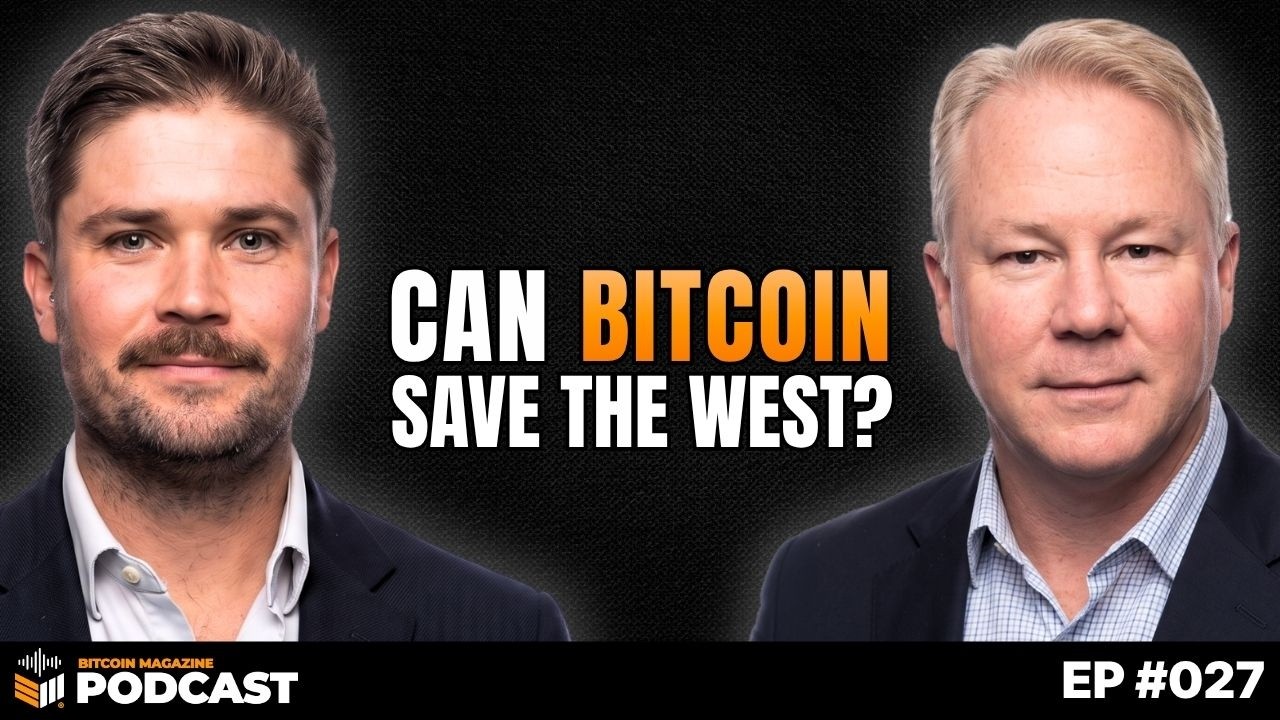
Congressman Warren Davidson: The Future of Money Will Decide Western Civilization
America is carrying $40 trillion in debt, and the dollar has lost about 30% of its purchasing power since 2020. Rep. Warren Davidson, founder of the Sound Money Caucus, explains why rising default risk and inflation are pushing rates higher, and why he believes people without real assets will lose purchasing power. He also warns that the future of Western civilization is centrally tied to the future of money.
Chapters:
0:00 – Why the Future of Western Civilization Is Tied to the Future of Money
0:40 – Clarity Act Cloture Vote Fallout and Section 305’s Threat to Self-Custody
3:48 – Will the Clarity Act Return After the Midterms?
6:22 – Open-Source Developer Protections and Trump Family Ethics Provisions
9:46 – The American Reserve Modernization Act and U.S. Government Bitcoin
13:58 – Has Bitcoin Become a Partisan Issue?
16:31 – CBDCs, Financial Surveillance and Bank Secrecy Act Reform
21:34 – Stablecoins as a “Hydra” CBDC and the GENIUS Act
25:02 – Bitcoin, $40 Trillion in Debt and the Dollar’s Reserve Status
29:37 – Why Bitcoiners Should Defend Freedom in the Midterms
DISCLAIMER: The views and opinions expressed in this show are those of the participants and do not necessarily reflect the official policy or position of BTC Inc., Bitcoin Magazine, or any affiliated entities. This content is provided for informational and educational purposes only and should not be construed as investment, legal, tax, or accounting advice. Nothing contained in this show constitutes a solicitation, recommendation, endorsement, or offer to buy or sell any securities or financial instruments. Viewers should consult their own advisors before making financial or business decisions.
This post Congressman Warren Davidson: The Future of Money Will Decide Western Civilization first appeared on Bitcoin Magazine and is written by Mark Mason.
Bitcoin Magazine

Ark Invest’s Lorenzo Valente: Bitcoin’s 5-Year Forecast – Stablecoin & Gold Impacts
Bitcoin has been flat to down this year, but ARK Invest isn’t changing its view. Lorenzo Valente, Director of Research for Digital Assets at ARK Invest, explains why the firm looks at Bitcoin on a five-year horizon and still believes it’s very early in the Bitcoin journey. He discusses ARK’s Big Ideas report, Bitcoin’s role as digital gold and permissionless money, and what still keeps institutional money on the sidelines.
Chapters:
0:00 – ARK Invest’s Lorenzo Valente on How Wall Street Sees Bitcoin Now
1:36 – ARK’s Big Ideas Bitcoin Price Target for 2030
2:51 – How Stablecoins Changed ARK’s Emerging Market Bitcoin Thesis
4:53 – The Rise of Tokenized Stocks and Real-World Assets
7:13 – What Tokenized Stocks Can Do That Brokerage Accounts Can’t
9:35 – Higher Rates, Inflation, AI and Bitcoin’s Macro Outlook
12:49 – Which Tokenization Business Models Will Win?
15:41 – Exporting U.S. Assets Offshore Through Tokenization
17:34 – ARK’s Bitcoin Outlook for the Next 12 to 18 Months
18:29 – The Four-Year Cycle and What to Watch Next
DISCLAIMER: The views and opinions expressed in this show are those of the participants and do not necessarily reflect the official policy or position of BTC Inc., Bitcoin Magazine, or any affiliated entities. This content is provided for informational and educational purposes only and should not be construed as investment, legal, tax, or accounting advice. Nothing contained in this show constitutes a solicitation, recommendation, endorsement, or offer to buy or sell any securities or financial instruments. Viewers should consult their own advisors before making financial or business decisions.
This post Ark Invest’s Lorenzo Valente: Bitcoin’s 5-Year Forecast – Stablecoin & Gold Impacts first appeared on Bitcoin Magazine and is written by Patrick Green.
Bitcoin Magazine
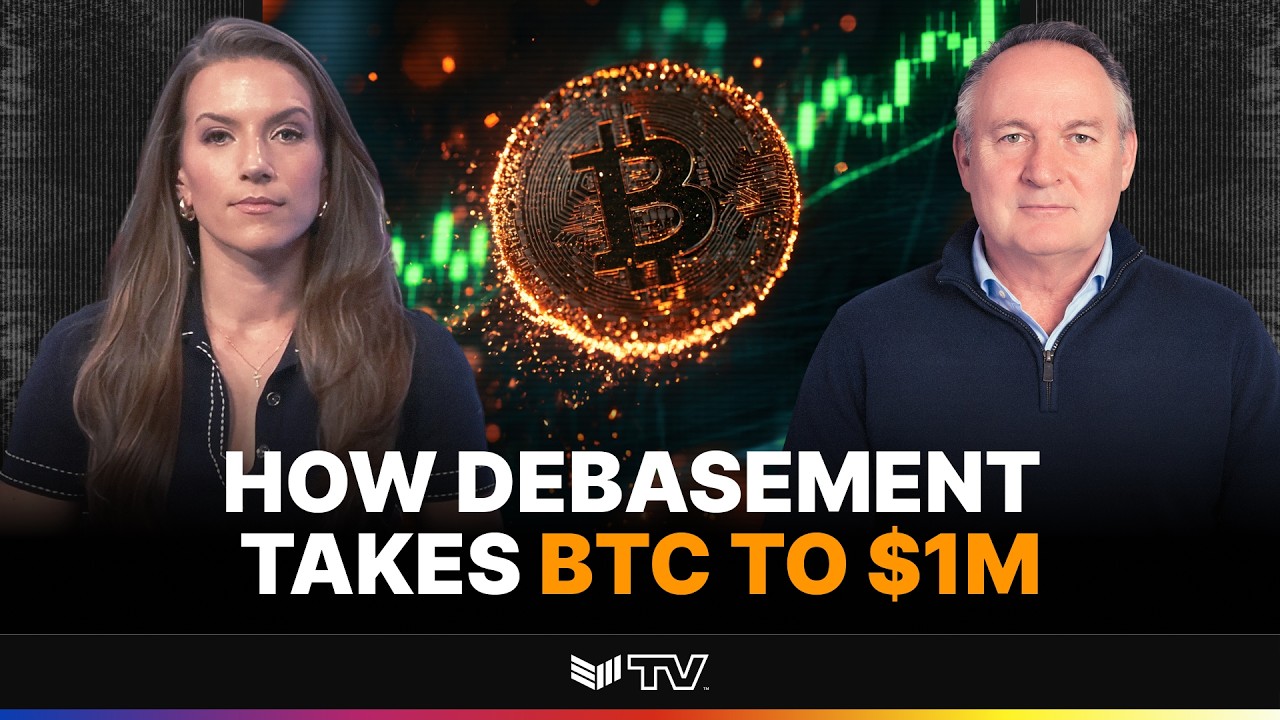
Willem Middelkoop: Bitcoin is the Fastest Horse – Why the Debasement Trade Takes it to $1M
Central banks are buying gold at a record pace, so why won’t they touch Bitcoin? Willem Middelkoop, founder of the Commodity Discovery Fund and author of The Big Reset, explains that central banks want assets they can control. Bitcoin’s price, supply, and market are beyond their reach. He also shares why institutional investors, including his own fund, have embraced Bitcoin through ETFs.
Chapters:
0:00 – Willem Middelkoop on Oil Prices, Iran and the Gulf
1:19 – The Debasement Trade: Bitcoin, Gold and the Commodity Bull Market
2:20 – The Big Reset: Is the Dollar System in Its Last Inning?
3:58 – BRICS, De-Dollarization and Falling Demand for U.S. Treasuries
5:15 – Central Bank Gold Buying and China’s Accumulation
6:14 – The 25% Portfolio Model: Real Estate, Gold, Equities and Bitcoin
7:49 – Why Central Banks Won’t Hold Bitcoin They Can’t Control
9:29 – Bitcoin vs. Gold: Is Bitcoin’s Correction Over?
11:57 – Bitcoin Amsterdam and the “Mad Max” Bitcoin Scenario
13:30 – Why Willem Middelkoop Targets $1 Million Bitcoin by 2030
DISCLAIMER: The views and opinions expressed in this show are those of the participants and do not necessarily reflect the official policy or position of BTC Inc., Bitcoin Magazine, or any affiliated entities. This content is provided for informational and educational purposes only and should not be construed as investment, legal, tax, or accounting advice. Nothing contained in this show constitutes a solicitation, recommendation, endorsement, or offer to buy or sell any securities or financial instruments. Viewers should consult their own advisors before making financial or business decisions.
This post Willem Middelkoop: Bitcoin is the Fastest Horse – Why the Debasement Trade Takes it to $1M first appeared on Bitcoin Magazine and is written by Patrick Green.
CryptoSlate
Bitcoin options expiring Friday carry substantial put exposure below the market price, while short-term volatility pricing has fallen ahead of Wednesday's US inflation report.
Data from Coinbase-owned Deribit, a crypto options exchange, showed that in an Oct. 12 snapshot the Oct. 16 settlement carried approximately 15,502 BTC in outstanding options, comprising 9,128 BTC in puts and 6,373 BTC in calls. The put-to-call ratio stands at 1.43, with about $451 million in underlying notional exposure concentrated in puts at $76,000, $78,000 and $80,000.
The snapshot put Bitcoin near $83,450 after last week's selloff, while derivatives platform Laevitas reports declining short-term volatility expectations ahead of the Consumer Price Index (CPI) release.
Bitcoin puts cluster between $76,000 and $80,000
Deribit's options data shows the largest concentration of puts at the $80,000 strike, with outstanding contracts carrying about $188 million in underlying notional exposure.
Another $162 million is concentrated at $78,000, while the $76,000 strike accounts for approximately $101 million.
Combined, the three levels represent nearly 35% of the $1.29 billion options expiry, highlighting the scale of downside positioning after Bitcoin briefly fell toward $80,000 during last week's market downturn.
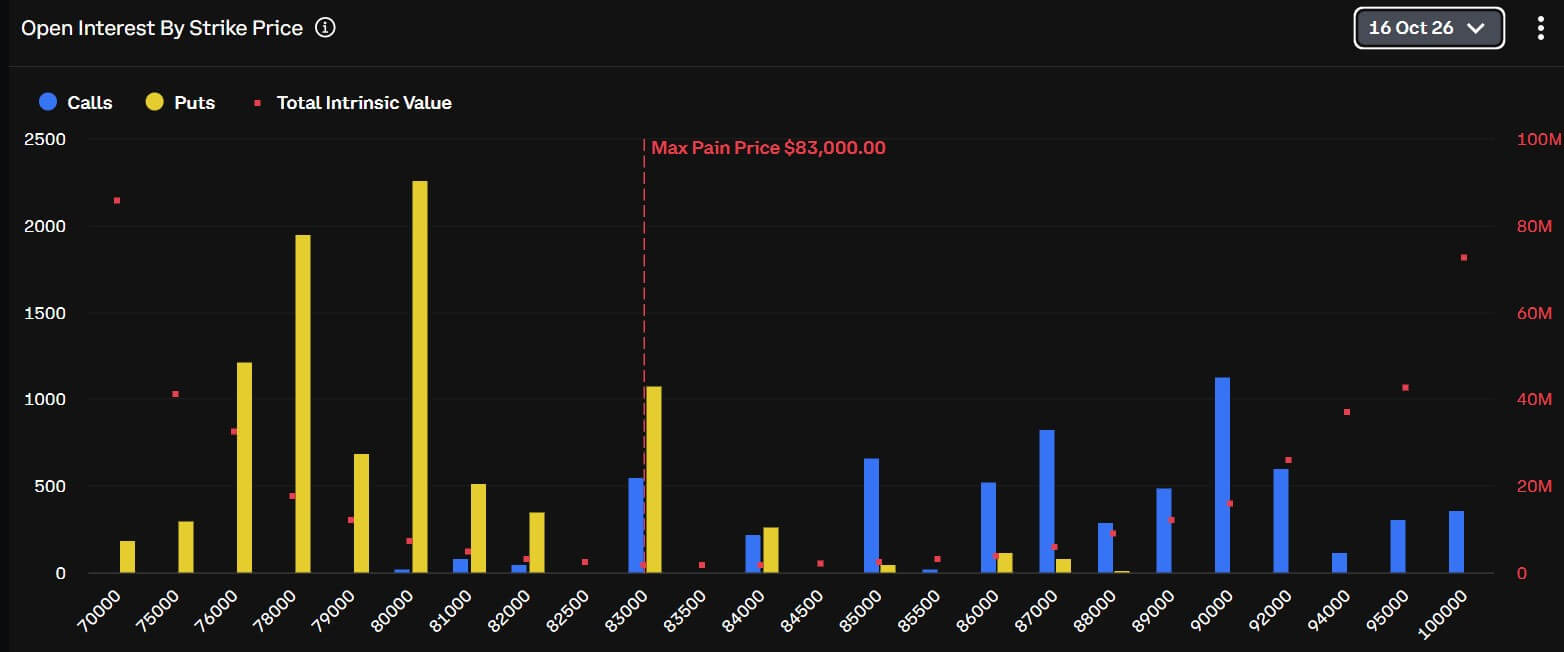
Additional put exposure worth about $89 million is concentrated at $83,000, near Bitcoin's current trading price.
The concentration suggests traders remain concerned about renewed selling pressure, although put open interest also includes contracts sold by investors seeking to collect premiums rather than exclusively buyers seeking protection.
Deribit data shows approximately $94 million in call exposure at $90,000, followed by $70 million at $87,000 and $55 million at $85,000.
Together, the three levels account for $219 million in outstanding notional exposure, less than half the amount concentrated at the three major downside put strikes.
The distribution leaves Bitcoin's largest downside positions relatively close to prices tested during the recent decline, while the $90,000 call strike requires an advance of nearly 8% from current levels.
Meanwhile, Deribit's maximum pain calculation stands at $83,000, indicating the settlement level that would minimize the aggregate intrinsic value of outstanding options based on current positioning.
Later-dated Bitcoin options also carry substantial upside exposure: Deribit’s Oct. 30 expiry has approximately $4.54 billion in call notional across the $90,000, $95,000 and $100,000 strikes.
Bitcoin volatility expectations retreat before Wednesday's CPI
Laevitas’s Oct. 12 brief described a volatility curve that prices Wednesday’s CPI as a non-event.
Bitcoin's seven-day at-the-money implied volatility declined to 32.01% from approximately 34.5% a week earlier.
That compares with 34.66% for 30-day contracts, 37.29% for 90-day options and 38.24% for 180-day maturities.
For illustration, converting the annualized seven-day implied volatility to a weekly move at the $83,450 snapshot price gives a one-standard-deviation move of roughly 4.4%, or $3,700, under conventional volatility assumptions.
That would place the modeled weekly range between approximately $79,750 and $87,150, encompassing the $80,000 put strike but falling short of the substantial call concentration at $90,000.
Meanwhile, Laevitas reported that Bitcoin's seven-day 25-delta options skew shifted from +1.98 to -2.40 over the past week, a 4.38-point reversal.
Laevitas characterized the move as an unwind from a call-bid extreme toward nominally put-bid pricing, with puts still cheaper relative to calls than their 52-week median.
Bitcoin perpetual-futures open interest fell 1.9% over the past week to approximately $29.33 billion, while annualized funding rates stood at 5.6%, according to Laevitas.
The positioning comes as investors assess whether US inflation could prompt the Federal Reserve to raise interest rates again at its Oct. 27-28 policy meeting.
MarketWatch’s Oct. 12 preview cited expectations for September headline inflation to accelerate to approximately 3.7% annually from 3.4% in August, partly reflecting higher energy costs. Monthly core inflation, which excludes food and energy, is forecast to rise 0.2%.
Laevitas described an October increase as close to priced out, with December pricing around an 85% probability of a hike.
However, elevated oil prices and Treasury yields continue to complicate the outlook for risk assets, with stronger-than-expected inflation potentially reviving expectations of another rate increase.
In illustrative price scenarios, hotter inflation could pressure Bitcoin toward the heavily populated $78,000–$80,000 put strikes, while softer inflation could encourage a recovery toward the higher call concentrations.
The CPI report arrives Wednesday, Oct. 14, at 8:30 a.m. Eastern Time, followed by producer-price inflation and retail-sales data Thursday, Oct. 15, giving traders two days of economic releases to absorb before Friday's $1.29 billion options expiry.
The post Bitcoin options price a quiet CPI week while shorts cluster at $76,000–$80,000 appeared first on CryptoSlate.
Solana’s plan to retire durable nonces, which let transactions be signed offline and broadcast later, would preserve cold-key approval while changing which addresses control the affected assets. For exchanges, custodians and treasury operators using that signing method, the proposed replacement adds a program between the cold key’s approval and execution.
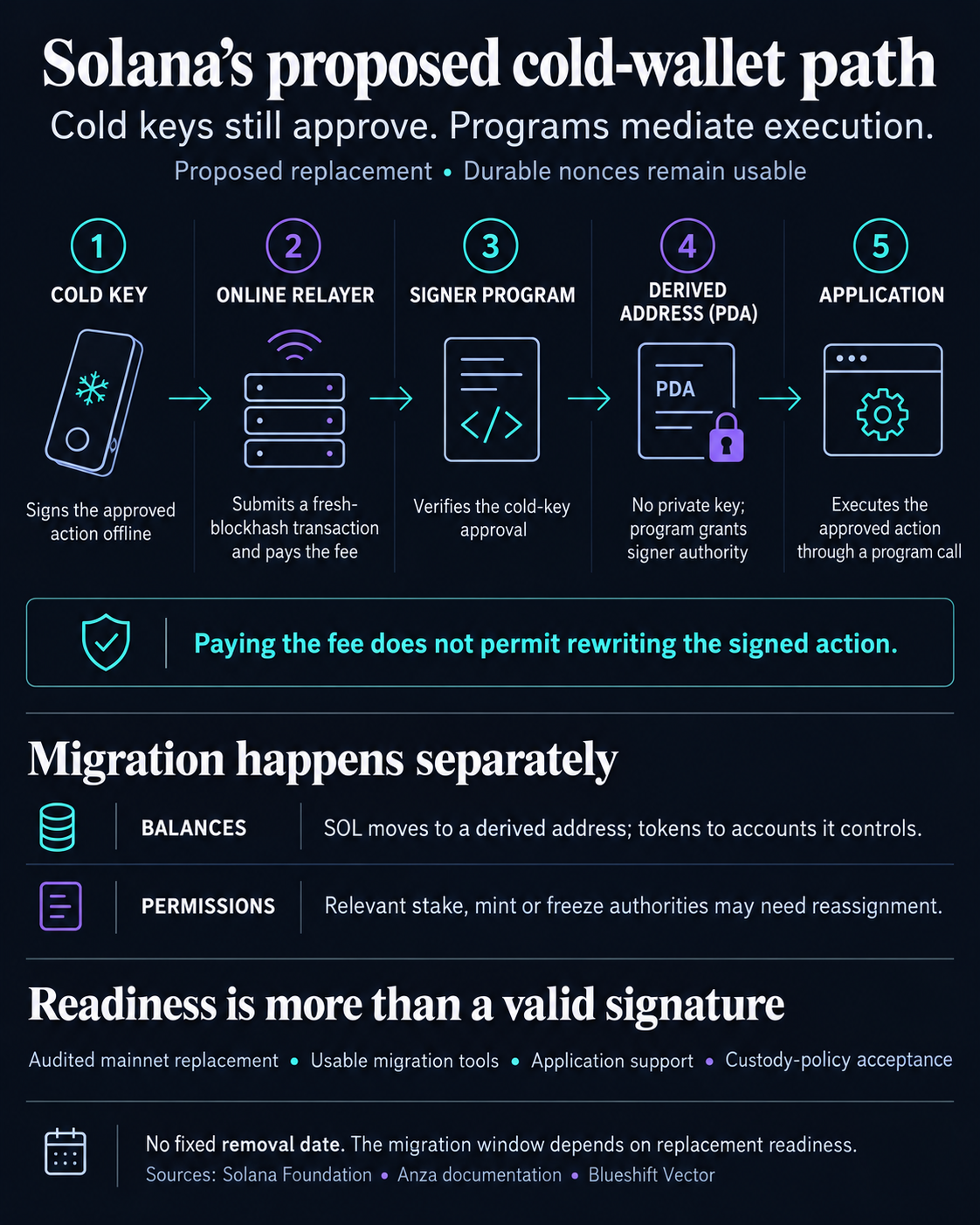
The Solana Foundation’s October deprecation plan points to onchain signer programs that verify an offline signature and execute its approved instructions. A program-derived address, or PDA, would control the affected accounts. The original key would still authorize actions, while a separate online operator submits them and pays the network fee.
The replacement creates a different custody architecture: operators must migrate the relevant assets or permissions, applications must accept actions arriving through another program, and risk teams must approve the new signing path.
Durable nonces remain usable. The Foundation has not set a removal date or made a final choice between Anza’s Programmatic Signer and Blueshift’s Vector. Its roughly six-month migration window is conditional on a suitable replacement being ready, audited and live on mainnet.
The key keeps approving, but the account changes
Durable nonces solve a timing problem. Instead of signing a transaction tied to a recent blockhash that soon expires, an offline signer can approve one using a stored nonce. That allows approval and broadcast to happen at different times.
Solana’s separate 200ms slot upgrade reached its final mainnet stage on Oct. 9. Faster block production leaves less wall-clock time for ordinary blockhash-based approvals, although expiry depends on block production rather than a guaranteed timer. CryptoSlate’s earlier coverage examined that timing change; the nonce proposal concerns the architecture used to avoid the short approval window.
Under Programmatic Signer, the cold key signs an authorization message rather than the transaction sent to the network. A relayer places that approval in a fresh-blockhash transaction. The signer program verifies the authorization and executes the approved instructions with the key’s derived address as signer.
The PDA has no private key of its own. Its ability to act comes from the signer program verifying the original key’s approval. Deriving the address does not move any assets or permissions: those must be transferred separately.
The migration guide describes moving native SOL into the derived address, transferring token balances into accounts controlled by it, and moving mint or freeze permissions to it. Stake accounts can move the staker authority, withdraw authority or both, depending on the permission being migrated. These are separate controls, rather than one universal wallet switch.
The Foundation proposes completing those handoffs while legacy durable nonces still work. For an affected treasury, approving the new signing software is therefore only part of the job. Its account inventory and the permissions each key currently holds determine what must change.
The two candidate designs also handle native SOL differently. Programmatic Signer’s derived SOL account is System-owned and can send SOL through an approved ordinary transfer. Vector initializes a program-owned account and releases SOL through its own authorized withdrawal or closing operation.
What the cold signature lets a relayer do
The implementation choice affects how tightly an approval constrains the transaction around it.
Programmatic Signer’s message documentation says the cold signatures bind the executor, nonce account and embedded execution message. A relayer cannot alter those authorized bytes while retaining valid signatures. It can, however, choose the outer fee payer and blockhash and add instructions before or after the submission.
Vector commits to the top-level instruction buffer, including the data and accounts used to pass approved actions into other programs. Instructions surrounding those actions must already be included when the cold key signs. A relayer cannot insert, remove or reorder them afterward without invalidating the approval.
Programmatic Signer allows an execution context to be assembled around an approved action; Vector requires the surrounding instruction sequence to be approved in advance. In both cases, paying for broadcast does not grant permission to rewrite the signed action.
| Control | Programmatic Signer | Vector |
|---|---|---|
| Cold approval covers | The authorization and embedded execution message | The committed top-level instruction buffer |
| Extra surrounding instructions | Relayer may add them outside the authorization | Must be included before signing |
| Replay state | A separate program nonce account | Nonce stored in the Vector account |
| Derived-address setup | No signer-address registration | Account initialized under the Vector program |
A failed execution attempt can leave a cold approval executable later. A current durable-nonce transaction that passes validation but fails during execution still consumes its nonce. Programmatic Signer’s architecture commits the nonce advance and application changes together, or rolls them back together. Vector documents the same ability to retry a failed action.
For operators, retryability means a failed submission has not necessarily invalidated the approval. Without an enforced deadline, it can remain available for later execution while its nonce is unchanged.
Vector explicitly warns that a relayer could withhold a transaction until conditions change, or that a signature exposed by a failed attempt could execute later. A timeout included in the signed instructions can reject execution after a deadline. Revocation requires a separately authorized nonce advance to land. A deadline rejection itself does not consume a nonce whose changes roll back with the failed transaction.
Application access is a separate custody test
The Foundation’s rationale is to simplify validator handling. Durable nonces require special replay-prevention rules, complicate asynchronous execution and make invalid transactions harder to filter. Moving approval and replay state into ordinary programs leaves validators processing normal blockhash transactions.
Applications then receive approved actions through cross-program invocation, or CPI: one program calls another. That can conflict with an application’s rule that an action must arrive directly as a top-level instruction. Checks that inspect only top-level repayment or signature-verification instructions can also miss an action nested inside the signer program.
More available call depth does not resolve a rule that rejects the call’s position or cannot inspect the nested instructions. The Foundation suggests supporting known signer programs or offering another execution path. Whether an application accepts a PDA’s signature is consequently a different question from whether the offline approval is cryptographically valid.
Token-2022’s CPI Guard shows why compatibility needs a precise account-level assessment. With the guard enabled, CPI transfers and burns require delegate authority; approvals through CPI are prohibited, and changing the owner is prohibited even outside CPI. Permanent delegates have transfer and burn exceptions.
Those rules are more specific than a blanket ban on every PDA action. A delegate-based transfer route may exist, but establishing or using that authority introduces its own permission and custody-policy decision.
Institutional concerns raised in March centered on application access and the controls under which funds may move. In the March 4 discussion, a participant identifying himself as Michael from Fireblocks supported nonce deprecation while objecting to CPI Passthrough’s migration, contract dependence and DeFi compatibility burdens. He favored transaction envelopes, with Sudo as an alternative, rather than the proposed CPI-based signing path.
Grant, who identified himself as being at Unit 410, said the same day that a small, auditable signer program might make authority migration acceptable. He rejected a workaround that temporarily moves assets to a hot signer, even for an atomic operation, because funds must remain associated with cold storage in its noncustodial model.
A testable design still needs a production migration path
Programmatic Signer’s current documentation reports devnet deployment and audits in progress, with remediation required before its v1 release and any mainnet deployment. Its interfaces may change. The usage documentation still marks simulation and relay submission as coming soon, while several migration operations are similarly unfinished in the guide.
Vector publishes implementation code and program IDs; its README does not state an audit or mainnet deployment status.
Meanwhile, Fireblocks’ current protocol onboarding kit still describes automatic durable-nonce injection for selected WalletConnect integrations, including Jupiter and Kamino, with a default provider-managed 15-minute validity window. That describes an existing approval workflow which a replacement must accommodate.
An operational migration needs an audited mainnet replacement, usable tools and application paths that retain each operator’s approval controls.
The post Solana’s offline-signing proposal would keep approvals valid after failed transactions appeared first on CryptoSlate.
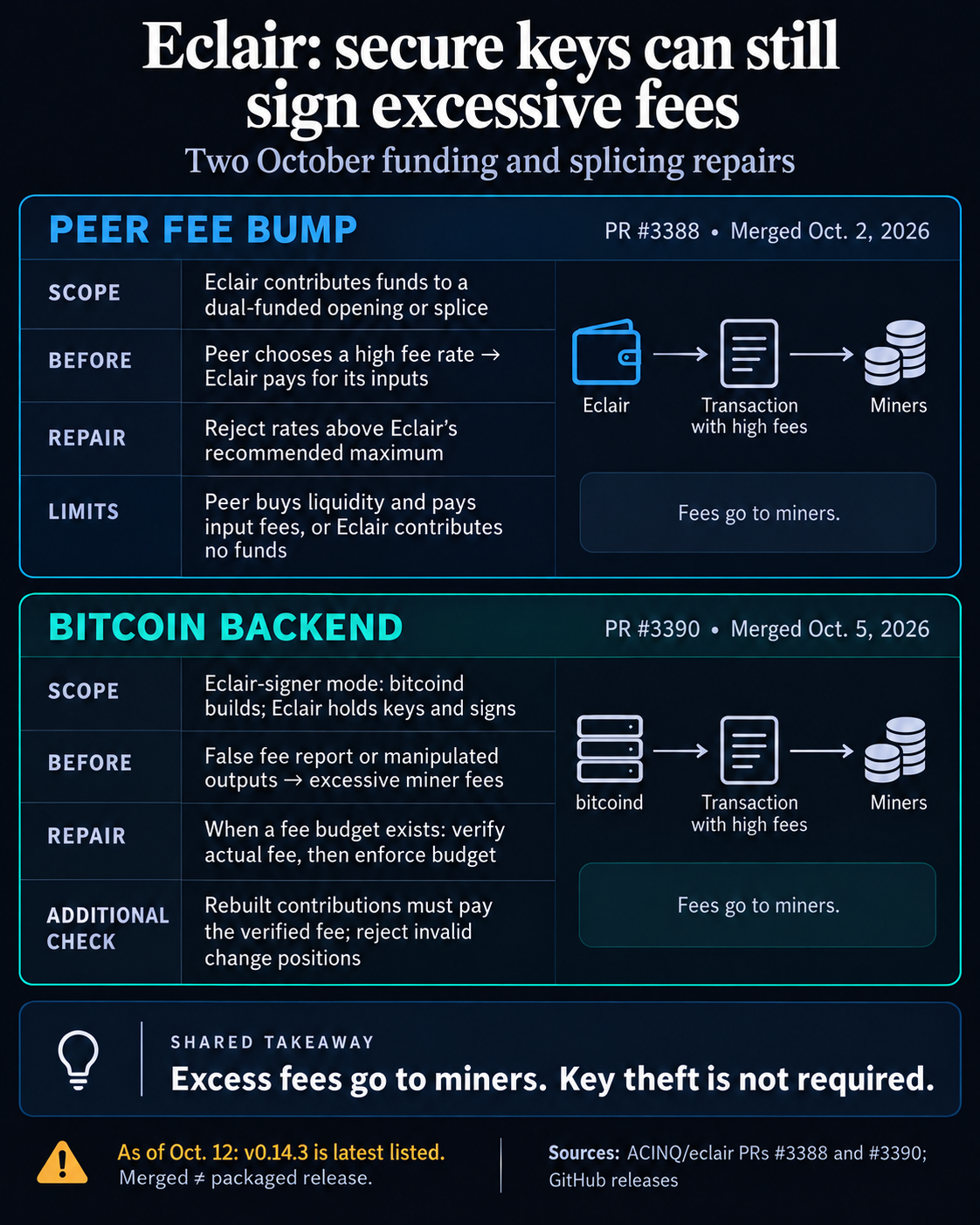
Eclair, ACINQ's Lightning node software, has merged two repairs for gaps that could make a node lose Bitcoin through excessive mining fees during channel funding and splicing. One limits a peer's fee-bump demands when Eclair contributes funds; the other checks transactions from a compromised Bitcoin backend while Eclair retains the signing keys.
The repairs merged into the project's master branch on Oct. 2 and Oct. 5. As of Oct. 12, its release page still listed September's v0.14.3 as latest. The two October fixes postdate that packaged release.
Bitcoin Optech's Oct. 9 newsletter highlighted both changes as closing protection gaps during dual funding and splicing.
The first repair, PR #3388, concerns peer-initiated replace-by-fee, or RBF, attempts during a dual-funded channel opening or a splice that adjusts a channel's funding. A peer could request a replacement transaction with a higher fee rate. Eclair kept its wallet contribution and paid for its inputs at that rate, without an upper bound or fee budget on this path.
That let a malicious peer impose an arbitrary mining fee rate on the contributing node while contributing nothing itself. The loss would be paid as fees to miners rather than transferred directly to the peer.
The repair rejects attempts above the maximum funding fee rate Eclair recommends to its peer. Two exceptions remain: the peer buys liquidity and pays the fees for Eclair's inputs, or the Eclair node contributes no funds to the transaction. In those cases, Eclair does not bear the cost addressed by this limit.
Keeping keys is only part of the defense
PR #3390 addresses a separate threat in Eclair-signer mode. Bitcoin Core's backend, bitcoind, selects coins and builds transactions, while Eclair retains the keys and signs.
A compromised backend could report a fee within budget while constructing a transaction that actually paid more, including by dropping the change output. Under Bitcoin's transaction accounting, input value not assigned to outputs becomes a miner fee. Missing change can therefore spend funds without paying an attacker's address.
When a fee budget is supplied, the repair calculates the actual fee from the amounts of the coins being spent, fetched by transaction ID to authenticate their values. It checks that the backend's reported fee matches and applies the budget to the actual fee. It also checks that Eclair's rebuilt contributions pay the same verified fee and rejects invalid change-output positions.
These are distinct from the cooperative-closing fee flaw covered in CryptoSlate's September report and the restart denial-of-service issues covered Oct. 2.
These repairs address Eclair's dual-funding, splicing and signer configurations. Operators should check that their installed build contains the October changes.
The post Eclair merges fixes for Lightning flaws that could burn Bitcoin in fees appeared first on CryptoSlate.
France’s proposed crypto tax changes would make a move from Bitcoin or Ether into certain stablecoins a taxable disposal, even if the investor never withdraws cash.
The National Assembly’s Finance Committee adopted amendment I-CF1826 on Oct. 7, adding that proposed exception to a broader overhaul of how private crypto gains are calculated. The provision would apply to disposals and exchanges from Jan. 1, 2027 if enacted.
For an investor selling Bitcoin exposure into USDC, the consequence would be a change in the tax timing of a risk-reduction trade. A gain could become reportable while the proceeds remain in a crypto wallet or exchange account. But the proposal also changes the cost deducted from those proceeds, and gives older holdings a transition choice.
Under French tax authority guidance, covered crypto-to-crypto exchanges without a cash balancing payment receive tax deferral. Converting into fiat or using crypto to obtain other goods or services can already be taxable under the private-disposal regime, subject to its applicable exemption.
CF1826 would remove the exchange deferral when the investor receives e-money tokens as defined by the EU’s Markets in Crypto-Assets regulation, or related rights. The operative wording targets the asset received. A swap out of Bitcoin into a qualifying token could therefore recognize a gain before any later cash withdrawal.
MiCA’s definition describes a crypto-asset that seeks to maintain stable value by reference to one official currency. That legal definition sets the exception’s scope. The amendment invokes it without an express issuer-licensing condition.
USDC provides a concrete example: Circle’s European white paper identifies it as an e-money token under the same MiCA provision. The illustrations below use native USDC, with transactions measured in euros.
The amendment’s sponsors justify the change by describing deferral on fiat-backed stablecoin conversions as a legislative loophole. For an investor using a swap to reduce market exposure, the practical effect would be earlier recognition of any gain.
The proposed tax calculation concerns the gain above cost. It subtracts the acquisition basis of the assets surrendered from the disposal price. That basis is the cost recognized for tax purposes; a transaction can produce a gain, no gain or a loss.
Two ways to value older holdings
France’s existing portfolio-based calculation allocates part of the acquisition price of the entire crypto portfolio to each taxable disposal. Current guidance deducts total portfolio acquisition price multiplied by the ratio of disposal price to portfolio value immediately before the transaction.
The proposed replacement would focus on the crypto-assets actually disposed of. For assets of the same nature purchased at different prices, it specifies weighted-average acquisition value.
For holdings acquired before 2027, the amendment offers two routes. An investor could use evidenced actual acquisition costs, determined under the new basis rules. Alternatively, the investor could allocate the portfolio acquisition price calculated under the old rules at Dec. 31, 2026 among the assets held then, in proportion to their values on that date.
The allocation option preserves a pool of acquisition cost and distributes it among holdings. The available cost pool remains the acquisition price calculated under the old rules, rather than the portfolio’s full market value. The text makes that choice irrevocable for the entire portfolio when the first return reporting a taxable disposal after Jan. 1, 2027 is filed.
Consider a hypothetical investor whose Bitcoin cost €20,000 and is worth €60,000, while their Ether cost €40,000 and is worth €40,000 at the transition date. The portfolio has €60,000 of acquisition cost and a €100,000 value. Assume no prior disposals, fees or cash balancing payments, no other holdings of the same tokens, and unchanged euro values through the transactions.
Under the allocation option, Bitcoin represents 60% of the portfolio value and receives €36,000 of basis. Ether receives the remaining €24,000. Using actual costs instead would leave their bases at €20,000 and €40,000, respectively.
The same Bitcoin-to-USDC transaction would then produce different first-disposal gains:
| Hypothetical transaction or basis | Proposed actual-cost route | Proposed allocation route |
|---|---|---|
| Bitcoin basis before the swap | €20,000 | €36,000 |
| Gain on swap into €60,000 of native USDC | €40,000 | €24,000 |
| Basis of the USDC received | €60,000 | €60,000 |
| Gain on later Ether disposal for €40,000 | €0 | €16,000 |
The table compares hypothetical gross gains under the proposal. Under the current rules, the qualifying swap itself would receive deferral. Under either proposed transition route, the Bitcoin-to-USDC swap would become a taxable event.
Changing only the historical costs to €50,000 for Bitcoin and €10,000 for Ether reverses the first-disposal comparison: actual cost would produce a €10,000 Bitcoin gain against allocation’s €24,000. The remaining Ether gain at unchanged values would be €30,000 under actual cost or €16,000 under allocation. Historical costs determine which method recognizes more gain first.
Basis resets and the cost of loss timing
The proposal expressly distinguishes exchanges that retain deferral from exchanges that become taxable. A deferred exchange carries the surrendered assets’ basis into the assets received. A taxable exchange gives the received crypto-assets a basis based on the consideration value already used to calculate the gain, adjusted for any cash balancing payment.
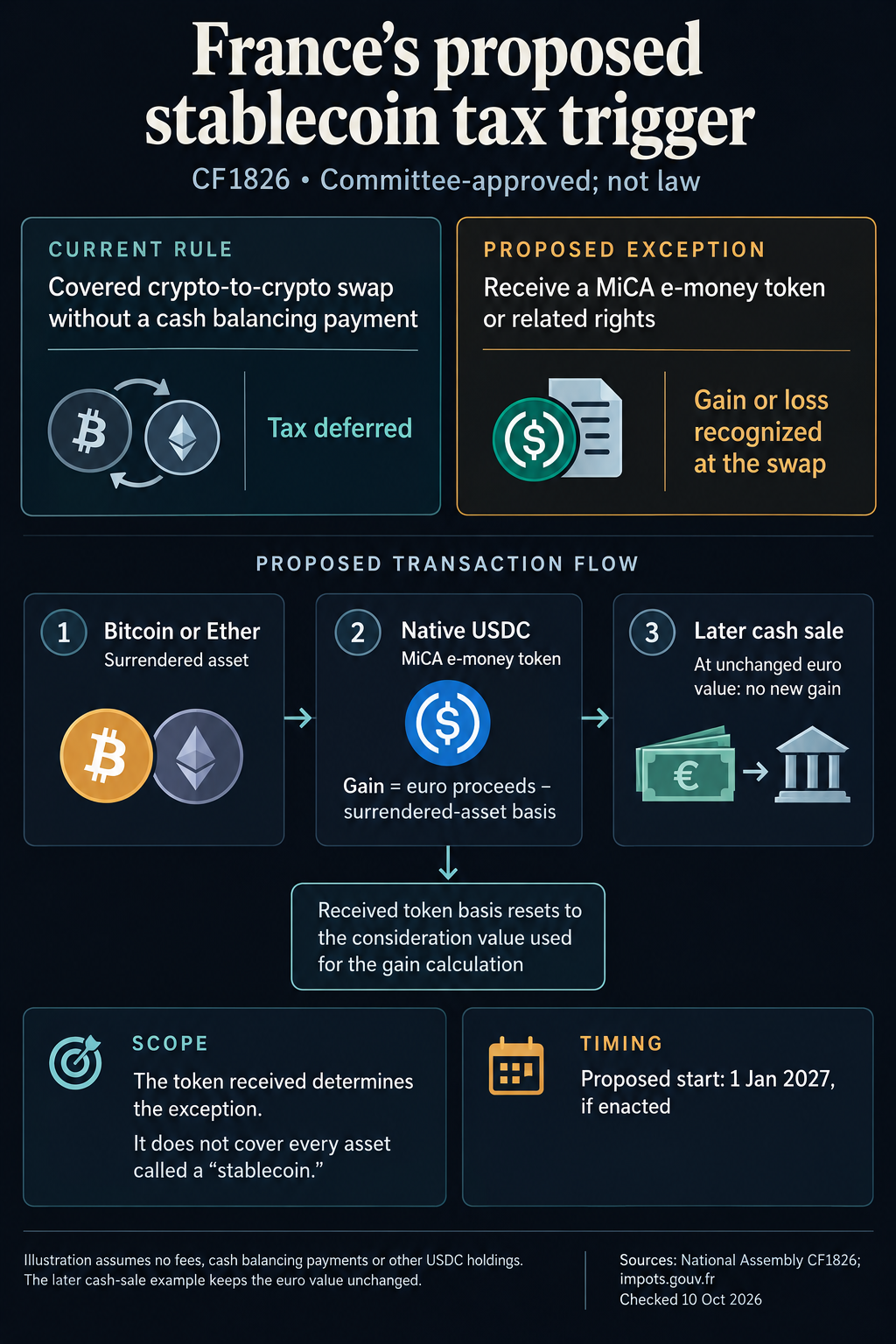
For the Bitcoin-to-USDC swap in the first example, the reset rule would give the USDC received €60,000 of basis under either transition route. Selling it later for the same €60,000 would produce no further gain. That reset would prevent repeat recognition of the original Bitcoin gain when the unchanged-value proceeds finally reached a bank account.
USDC references the dollar, so the unchanged-euro-value assumption is essential. A later disposal at a different euro value would require its own gain or loss calculation.
If the investor also sold the remaining Ether for €40,000, the first example would produce aggregate realized gains of €40,000 under either proposed transition route. Actual cost recognizes all of that in Bitcoin; allocation splits it between Bitcoin and Ether.
The amendment would change the swap exception and basis rules without rewriting the existing crypto loss restriction. The tax authority says crypto gains and losses offset within the same tax year, while a net crypto loss cannot be carried into later years or used against gains on other assets.
A separate hypothetical shows the effect of recognizing losses and gains in different years. Under the proposed actual-basis rules, a sole Bitcoin holding bought for €30,000 and swapped into €20,000 of native USDC would recognize a €10,000 loss. The USDC would receive €20,000 of basis.
If that USDC were later exchanged into Bitcoin without a cash balancing payment, the swap would retain deferral because Bitcoin is outside the received e-money-token exception. It would carry the €20,000 basis into Bitcoin. A subsequent taxable Bitcoin sale for €30,000 would recognize a €10,000 gain. Assume no fees, other token pools, cash adjustments or other gains and losses.
Those amounts could offset if realized in the same tax year. If the net loss arose in one year and the gain in a later year, the earlier loss would not shelter that later gain under the existing rule. Recognition in different years can therefore change the taxable result even when the transaction sequence returns the holding to its original value.
The reporting trade-off follows from the same mechanics. Asset-specific basis would remove the portfolio-wide allocation formula for new disposals, but investors would need to preserve acquisition evidence, weighted averages and the basis carried or reset through swaps. For older holdings, the proposed allocation route would also require a Dec. 31 valuation and a whole-portfolio decision that the text makes irrevocable.
The next legislative test remains ahead. The 2027 budget dossier, checked Oct. 12, lists National Assembly plenary discussion for Oct. 13.
The post France’s tax proposal would tax Bitcoin-to-USDC swaps before investors cash out appeared first on CryptoSlate.
Bitcoin and Ethereum extended their weekend recovery, although on-chain indicators and derivatives positioning suggest the rebound faces significant obstacles.
Data from CryptoSlate showed that Bitcoin briefly climbed above $84,000 after falling toward $80,000 during last week's selloff. Ethereum also recovered above $2,500, reversing part of its recent losses as buying activity returned to the cryptocurrency market.
However, Bitcoin's advance has brought it closer to a major concentration of investor acquisition costs between $84,000 and $85,000, where selling pressure could intensify. Meanwhile, Ethereum's recovery comes as larger derivatives traders appear to be reducing their bullish exposure despite substantial outstanding positions.
Bitcoin's $85,000 resistance threatens to stall recovery
Bitcoin's recovery gained momentum during Sunday's trading session as traders appeared to capitalize on a liquidity concentration above the prevailing market price.
CryptoQuant analyst J.A. Maartunn said on Oct. 11 that a liquidity cluster formed just above Bitcoin's trading level, giving traders an opportunity to push prices higher.
According to Maartunn, traders appeared to establish a substantial wall of buy orders beneath the market, providing support as Bitcoin advanced toward the overhead liquidity.
The spot Bid/Ask Ratio, which measures buying and selling liquidity within 1% of the prevailing price, rose to 0.3.
The increase indicated that visible buying interest had strengthened relative to selling orders. Such liquidity can also disappear if traders cancel their orders.
Checkonchain data highlighted by analyst Darkfost on Oct. 11 showed that approximately 53% of Bitcoin's invested capital had an estimated acquisition price above $83,000 when the cryptocurrency traded around that level.
The measure weights acquisition prices by invested capital, so larger positions carry more weight.
More importantly, the largest concentration of acquisition costs sits between $84,000 and $85,000, making the region a potential obstacle to further gains.
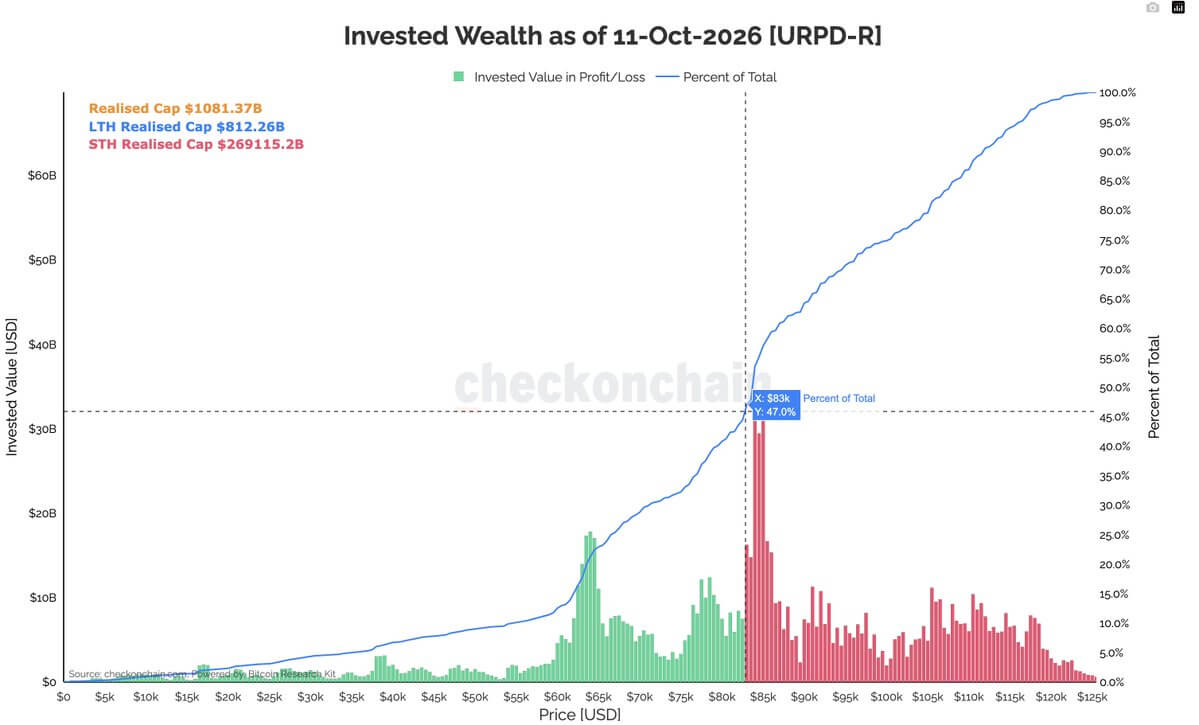
Investors who acquired Bitcoin around those levels could become more willing to sell as prices approach their estimated cost basis, increasing the supply that buyers must absorb.
A sustained move through the region would suggest buying demand is strong enough to overcome that potential selling pressure. If it fails to do so, Bitcoin could be vulnerable to another decline, with Darkfost identifying the $77,000 to $79,000 range as a possible support area.
Ethereum's $2,500 rebound faces risk from leveraged traders
Ethereum's recovery faces another challenge as derivatives positioning among larger market participants continues to deteriorate.
Alphractal CEO Joao Wedson noted on Oct. 10 that Ethereum's 30-day and 180-day open-interest deltas were both negative, along with weakening readings in its Whale vs. Retail Delta indicator.
He interpreted the combination as evidence that major traders have reduced their bullish exposure while increasingly favoring defensive or short positions.
The negative open-interest readings indicate that outstanding derivatives positions have contracted over the measured periods.
Despite the contraction, Ethereum's total futures open interest remained substantial at approximately 10.58 million ETH, indicating that considerable derivatives exposure was still outstanding.
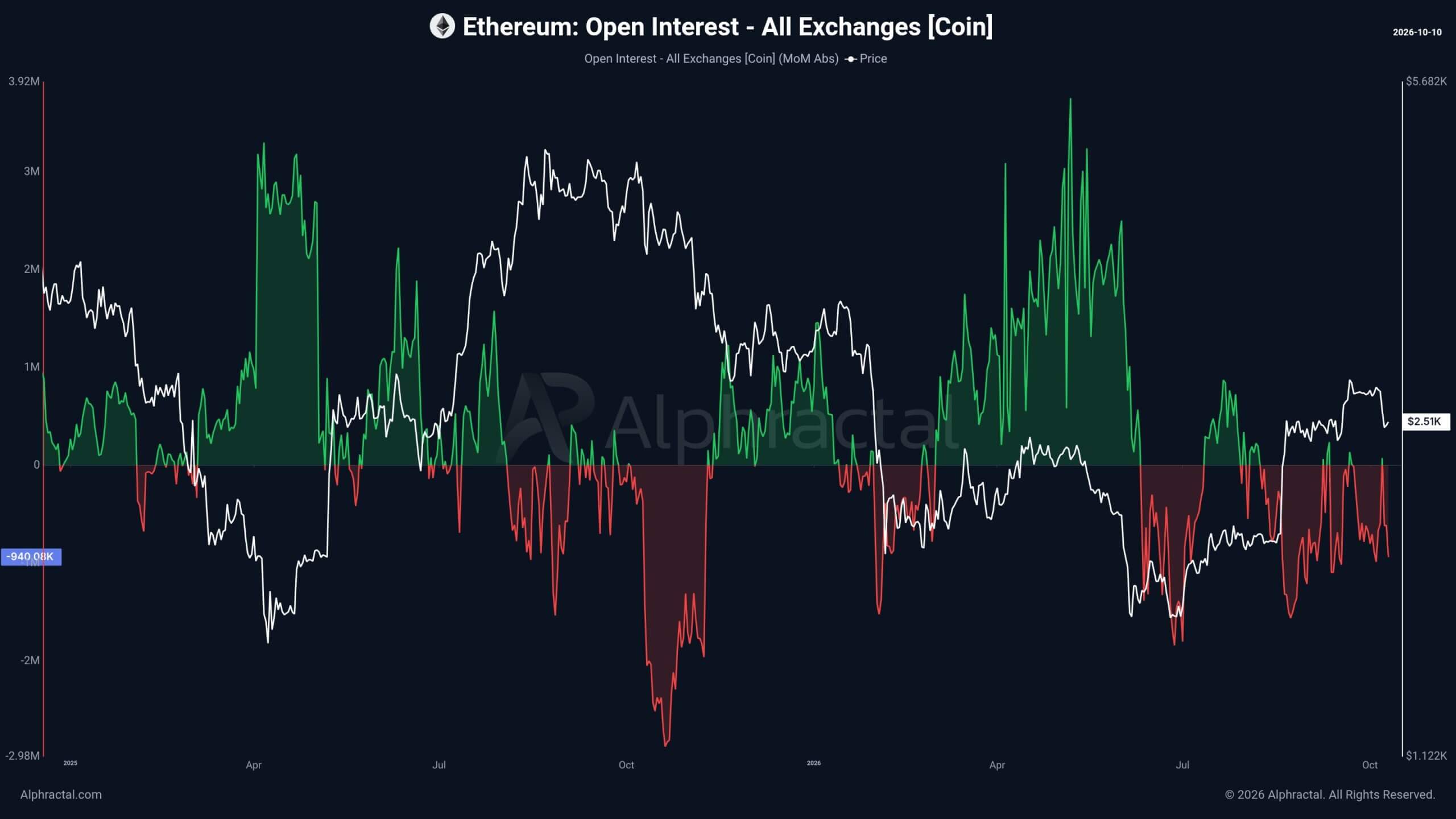
Valued at $2,500 per ETH, that represents roughly $26.5 billion in notional exposure.
The combination of weakening bullish positioning and substantial remaining exposure increases the potential for sharp price movements if volatility returns.
A renewed decline could push leveraged long positions toward forced liquidation, potentially adding selling pressure and accelerating losses. Conversely, a sustained recovery could force short sellers to close positions, contributing to further upward momentum.
Wedson warned that Ethereum's derivatives market remains vulnerable to further liquidations despite the recent reduction in outstanding positions.
The post Bitcoin’s rebound approaches the $85,000 zone where past buyers may sell appeared first on CryptoSlate.
CryptoTicker.io
Since October 8, 2026, the crypto exchange WhiteBIT has accepted Bitcoin over the Lightning Network and pays it out the same way. The fee is 0.25 percent on deposits and 0.15 percent on withdrawals. Both rates are percentages rather than flat amounts, and that is exactly what decides who is better off on the new route than on the Bitcoin main chain.
The exchange's own token, WhiteBIT Coin (WBT), stands at $81.55, or 72.95 euros, which is 4.9 percent below last Monday's level, according to CoinGecko at midday on Monday. The announcement did not carry the price: over the two days around October 8, WBT fell from $82.91 to $80.36, the weekly low.
What WhiteBIT Switched On on October 8: Lightning Channels via Voltage
The exchange has connected its Bitcoin deposits and withdrawals to the Lightning Network, using infrastructure from the provider Voltage. Founder and chief executive Volodymyr Nosov justified the move as making Bitcoin faster and more useful for customers who want to top up their accounts. Bitcoin Magazine reports this, citing the exchange's statement; The Cryptonomist gives the same fee rates.
The exchange's statement says nothing about processing times or minimum and maximum amounts. Anyone using the route will therefore see the applicable limits only in the withdrawal window of their own account.
Lightning Network Explained: Payment Channels Alongside the Bitcoin Main Chain
The Lightning Network is a second layer on top of Bitcoin. Two participants jointly lock an amount in a transaction on the main chain and then move it back and forth between themselves as often as they like, without writing each movement into a block of its own. Only when the channel closes does the final balance land back on the chain.
That is where the speed advantage comes from. A payment does not have to wait for the next block, which arrives on the Bitcoin network roughly every ten minutes, but is passed between channels in seconds. The price is the dependency: it works only as long as channels with enough capacity are open along the route to the recipient.
For an exchange this is above all a question of access. Deposit 40 euros worth of Bitcoin and you pay a network fee on the main chain that fluctuates with congestion and quickly eats a noticeable share of a small amount. Over a channel, that line item disappears.

0.25 Percent to Deposit, 0.15 Percent to Withdraw: The Fee Is a Percentage
The two rates are the real substance of the news. Within the Lightning Network itself, fees are usually tiny and depend on the channel fee charged by the forwarding nodes rather than on the amount. WhiteBIT instead bills a percentage, and with no published cap.
On a 50-euro deposit, 0.25 percent is twelve cents. On 5,000 euros it is 12.50 euros. The same pattern applies on the withdrawal side at 0.15 percent: 7.5 cents on 50 euros, 7.50 euros on 5,000 euros. The fee therefore grows in a straight line with the amount, while the technical effort in the channel does not.
The Maths for Small and Large Amounts: Where the Percentage Tips Over
Convert the rate into Bitcoin once and the difference becomes tangible. Bitcoin trades at $82,875 at midday on Monday, according to CoinGecko. A withdrawal of 0.01 BTC therefore comes to roughly 829 dollars, and 0.15 percent of that is about 1.24 dollars. At 0.1 BTC, or roughly 8,288 dollars, the fee rises to about 12.43 dollars. On a whole Bitcoin it would be around 124 dollars.
A withdrawal over the main chain, by contrast, costs a flat rate in Bitcoin that the exchange sets per network and adjusts with congestion. Review sites quote values for WhiteBIT between 0.00004 and 0.0005 BTC, but contradict each other by a factor of twelve, and no current figure from the exchange itself is publicly available. No reliable threshold at which one route beats the other can be derived from that. What is reliable is the direction: a flat rate becomes relatively smaller as the amount rises, a percentage rate does not.
Under this pricing, Lightning pays off where the technology was designed to work, on small and medium sums. Anyone pulling larger holdings off the exchange should compare the percentage against the main chain's flat rate, and do it in their own withdrawal window, because only there does the rate that applies at the moment of the order appear.
WBT Price This Week: $81.55, Weekly Low $80.36
The token ended the week weaker than it started it. On October 6 WBT stood at $85.70, the weekly high. On October 9 it fell to $80.36, the weekly low, and trades at $81.55 at midday on Monday. Over seven days that works out at minus 4.9 percent, over 30 days a gain of 1.4 percent. All figures come from CoinGecko, as of Monday around 1:00 p.m.
The all-time high of $87.91, which WBT reached on September 21, is 7.2 percent away. Market capitalisation stands at 9.69 billion dollars, which puts the token 16th among all crypto assets. There are 118.79 million WBT in circulation, against a cap of 400 million units.
On the upside the 85.70 from the weekly high is the first level, on the downside the 80.36 from the weekly low, with the round 80 line in between. These are observation points from the token's own price history, not price targets.
Why Trading Fees Feed the WBT Burn
There is a link between the Lightning connection and the token that goes beyond sentiment. According to the exchange, WhiteBIT uses 33 percent of its trading fees and 5 percent of its other revenue to take WBT off the market and burn it. The more trading on the exchange, the larger the amount flowing into that pot.
At the most recent weekly burn on October 1, 32,426 WBT worth around 2.72 million USDT were destroyed, equal to roughly 0.027 percent of the supply in circulation at the time. Those figures come from our own analysis of October 3, set out in our piece on the weekly WBT burn.
A low-friction deposit route can bring trading volume, and volume feeds the burn. Whether that effect materialises will only show in the burn amounts of the coming weeks, not in the announcement. WBT's 24-hour trading volume stood at 68.65 million dollars at midday on Monday.
WhiteBIT EU and the MiCA Licence: What the Authorisation Covers
For the route to buying from within the EU, the authorisation is what counts. The European entity WhiteBIT EU announced on June 19, 2026 that it had received a licence under the EU's MiCA regulation, granted by the supervisor in Austria. Such a licence applies across all member states through the EU passport, including for customers in Germany, without BaFin running a procedure of its own.
In practice that means complaints and supervisory questions go through the authority that granted the licence, not through BaFin. Which obligations a MiCA licence imposes on a provider, from capital requirements to the segregation of client funds, is covered in our overview of MiCA obligations for crypto companies. Anyone deliberately looking for a platform with an EU licence will find the authorised providers in our comparison of regulated crypto exchanges.

Custody and the Holding Period: What Applies When You Withdraw to Your Own Wallet
A Lightning withdrawal does not land in any Bitcoin wallet you like. The destination has to support Lightning and have a channel with sufficient capacity. Many hardware wallets do not speak the second layer directly, only through additional software. If you want to hold your own Bitcoin, check that compatibility first, because a withdrawal to an address that will not accept the channel fails rather than slows down.
For tax purposes, a withdrawal from the exchange to your own wallet changes nothing in Germany. Switching custodian is not a disposal, and the one-year holding period under Section 23 of the Income Tax Act keeps running. All that matters is that the acquisition data survives, because without a purchase record the period cannot be proven later.
One note on the fee side: the 0.15 percent applies to the withdrawal regardless of whether the transaction is relevant for tax. Fees connected with a sale can increase acquisition costs or deductible expenses, but moving coins to your own wallet is not a taxable event.
Our Assessment: An Access Advantage, Not a Price Driver
In our view the connection is a genuine step forward for small deposits and has so far had no effect on the WBT price. The evidence sits side by side: the price fell from $82.91 to $80.36 over the two days around the announcement and stands 4.9 percent lower seven days on. Against that reading stands the fact that an infrastructure change works through volume, and therefore over weeks rather than days. It becomes measurable in the weekly burn amounts, because 33 percent of trading fees end up there. If they rise noticeably in the coming weeks, the access route has delivered; if they stay at the level of October 1, it was a product announcement. No buy or sell recommendation follows from this, and with crypto assets a total loss is possible.
WBT and Lightning: 0.15 Percent With No Cap Hits Large Withdrawals
Three steps to put the change in context for yourself:
- Weigh the fee against the amount. Take your usual withdrawal size and check whether 0.15 percent of it comes to more or less than the main chain's flat rate in your withdrawal window. The providers' fee models sit side by side in our crypto exchange comparison.
- Check the destination wallet. Establish whether your custody solution accepts Lightning before you trigger a withdrawal. Which devices can handle it is shown in our hardware wallet comparison.
- Secure the acquisition data. Export the transaction history before you move holdings, so the holding period stays provable. A tax tool with portfolio tracking helps with that.
(As of October 12, 2026. This article is not investment advice. Prices and fee structures change; check the terms with the provider before you buy.)
Crypto futures and perpetuals are taxed in Germany under rules that have nothing to do with spot trading. A gain on a forward transaction counts as investment income and is charged at 25 percent income tax plus the solidarity surcharge. The one-year rule that makes a held Bitcoin tax-free after twelve months does not exist there. Trade a perpetual and you pay from the first closed position, and in return, since the Annual Tax Act 2024, you can again offset losses against other investment income without limit.
That split costs money if you only notice it when filing. Two separate loss-offsetting pools mean one thing: a loss on your leveraged account does not reduce the gain on coins you sold, even when both arose on the same platform and both were bets on the same price. What follows is the split in detail, with the sections of law your tax office relies on, and with a side-by-side calculation showing when the forward transaction actually comes out ahead of the spot purchase.
Two Tax Regimes: Section 20 EStG for Futures, Section 23 EStG for Spot
A coin you buy and the leveraged contract on that same coin are two different things for tax purposes. A crypto asset you buy and sell again is an other asset within the meaning of Section 23 (1) sentence 1 no. 2 of the German Income Tax Act. That is where the one-year rule sits: if no more than a year passes between acquisition and disposal, the gain is a private disposal transaction and taxable. Beyond that, it goes untaxed.
A future or a perpetual is not an asset you acquire and hold. It is a contract on a price difference, and it belongs in the catalogue of Section 20 (2) of the German Income Tax Act. Sentence 1 no. 3 letter a expressly names the gain “on forward transactions through which the taxpayer obtains cash settlement or a monetary amount or benefit determined by the value of a variable reference figure”. That describes a perpetual precisely: you receive or pay the difference between entry and exit price without ever owning the coin.
Forward transaction here means any contract whose performance lies in the future and whose value derives from a reference figure, in this case the price of the underlying. That the underlying is a cryptocurrency rather than a share changes nothing about the classification. How the European supervisor classifies perpetuals, and which leverage caps follow from that, we set out in our piece on the MiFID classification of perpetuals.
Cash Settlement Makes a Perpetual a Forward Transaction
A classic future has an expiry date. A perpetual has none, and that raises the question of whether the classification still holds. It does hold, because the law turns on cash settlement and not on an expiry date: what matters is the mechanism through which your gain arises. A perpetual tracks the spot price through the funding rate, a payment that flows between the long and short side at short intervals. The contract runs on, yet settlement is always in money and never in coins.
For your tax return that means every closed trade is a completed event with a result. There is no holding period that improves anything, and no point from which the gain becomes tax-free. A position closed after four minutes and one closed after four months are treated alike. To see how these platforms are built and who holds the keys, start with our explainer on what a perp DEX is.
25 Percent Flat Tax, Solidarity Surcharge and Church Tax
Section 32d (1) sentence 1 EStG sets income tax on investment income at 25 percent. On top comes the solidarity surcharge of 5.5 percent on that tax, which puts the total burden at 26.375 percent. One point matters here: the solidarity surcharge is still due on investment income, including for incomes that long ago fell below the threshold on wages.
If you are liable for church tax, the law calculates differently from what many expect. The 25 percent is reduced under sentence 3 by one quarter of the church tax, and sentence 4 provides the formula. At a church tax rate of 9 percent, a gain of 10,000 euros produces 2,444.99 euros in income tax, 134.47 euros in solidarity surcharge and 220.05 euros in church tax, together 2,799.51 euros, or roughly 28.0 percent. Without church tax it stays at 2,637.50 euros.

No Holding Period and No 1,000-Euro Exemption on Forward Transactions
Two reliefs that make spot trading attractive in Germany do not apply to leveraged trading. The first is the one-year rule in Section 23 EStG. The second is the 1,000-euro exemption threshold in Section 23 (3) sentence 5: gains from private disposal transactions stay tax-free if total gains in the calendar year came to less than 1,000 euros. Both apply solely to assets, meaning the coin you bought, and never to the contract on it.
Their place in the investment income regime is taken by the saver's allowance of 1,000 euros under Section 20 (9) EStG, or 2,000 euros for jointly assessed spouses. The difference is larger than the identical figure suggests. The spot exemption falls away entirely once you exceed it; at a gain of 1,000 euros the full amount is taxable. The saver's allowance, by contrast, survives as a deduction and is still subtracted at 50,000 euros of investment income. It does cost you the deduction of actual expenses, and for active traders that is the more painful half of the rule.
The 20,000-Euro Cap on Forward Transactions Has Gone From the Law
From 2021 to 2024 a rule applied that made leveraged trading dangerous in tax terms: losses from forward transactions could only be offset against gains from forward transactions up to 20,000 euros a year, with the remainder carried into future years. Anyone who made 100,000 euros and lost 100,000 euros in the same year paid tax on 80,000 euros, even though nothing was left at the end of it. The Federal Fiscal Court held this restriction to be constitutionally doubtful in a decision of 7 June 2024.
That cap is no longer in the law today. The Annual Tax Act 2024 deleted the former sentence 5 of Section 20 (6) EStG, and not only for the future. Section 52 (28) EStG has since carried the sentence that the old version “is no longer to be applied to any open cases”. The same goes for the then sentence 6, which capped losses from bad debts at 20,000 euros. If you still have an open assessment for a past year, through an appeal or a provisional review, the new rule covers you.
Today's Section 20 (6) EStG carries only two restrictions: losses on share sales stay in their own pool, and losses subject to withholding tax require a loss certificate under Section 43a. Forward transactions no longer appear there. For perpetual traders that is the most important change of recent years, and it regularly gets lost in the coverage of holding periods.
Losses on Perpetuals Never Meet Gains From Sold Coins
One hurdle remains, and it is higher than the one that was deleted. Section 20 (6) sentence 1 EStG prohibits offsetting losses from investment income against income from other categories. Gains on sold coins are such other income, namely other income under Section 22 in conjunction with Section 23 EStG. Between your leveraged account and your spot holdings stands a wall that is solid in both directions.
Take an example with round numbers. You lose 8,000 euros on perpetuals and in the same year sell Ethereum at a gain of 8,000 euros after a four-month holding period. In economic terms you are flat. In tax terms the 8,000 euros of spot gain remain fully taxable at your personal rate, and the loss on the forward transaction sits as a carry-forward within investment income until you make gains there again. The reverse holds too: a spot loss does not reduce your tax on perpetual gains. Which losses can be set against which gains, we broke down in detail for offsetting crypto losses against share gains.
Our assessment: the tax rate argues for the forward transaction more often than investors assume, but the offsetting rules argue against it. On a gain of 10,000 euros at a personal tax rate of 42 percent, the spot sale within the one-year period costs 4,200 euros and the perpetual gain 2,637.50 euros, a difference of 1,562.50 euros in favour of the leveraged product. Past the one-year mark the relationship flips completely: the held coin costs nothing, the contract still 26.375 percent. Against that stand the separate offsetting pools, which turn expensive in a losing year, and the fact that a leveraged contract wipes out the whole stake on liquidation. Long-term holders are better placed in spot for tax; traders who are short-term anyway and realise gains within weeks often pay less on forward transactions. Which platform charges what, our perp DEX comparison shows.
Funding Payments, Fees and the Lost Deduction for Expenses
Leveraged trading brings running costs that spot trading does not: funding payments, trading fees on both sides of the trade and, on margin positions, interest on borrowed capital. Section 20 (9) EStG governs these within investment income, and it is worded without mercy: the saver's allowance is deducted as expenses, and “the deduction of actual expenses is excluded”.
Pay 6,000 euros in funding and fees over a year and you cannot claim 6,000 euros; you get a flat 1,000 euros. This is the point where active traders fare worse on forward transactions than in spot, where incidental acquisition costs feed into the calculation of the gain. Trading venues usually net fees and funding directly into the result of the position, so that they reduce the taxable gain without being expenses at all. Whether your provider works that way decides several hundred euros a year, and it is set out in their settlement logic rather than in the statute. Capital borrowed against coins as collateral follows its own logic, because there the coin stays in your holdings.

Annex KAP Instead of Annex SO: Offshore Venues Withhold Nothing
If your provider has a domestic paying agent, it deducts withholding tax and remits it to the tax office. Most perpetual platforms do not. There the gain reaches you gross, and you owe the tax all the same. It is declared in Annex KAP of the income tax return, in the lines for investment income without tax deducted. Gains on sold coins belong in Annex SO instead.
Two forms for two regimes mean double care over records. For the spot side the tax office expects an allocation under the FIFO principle, under which the coins bought first count as sold first and determine the holding period. Forward transactions have no holding period and therefore no FIFO question, but you do need to document every closed position individually with its result. Since the national implementation of the European reporting obligation, crypto service providers report transactions to the tax authorities, which raises the odds that discrepancies get noticed. How to clean up an automated trading account for tax, we described for trading bots and their tax treatment.
Commercial Trading: When Private Trading Becomes a Business
Section 20 (8) EStG makes clear that investment income is attributed to a business where it belongs there. Neither the 25 percent nor the saver's allowance then applies; the personal tax rate does, plus trade tax and an obligation to keep accounts. The line runs between private asset management and trading that organises itself like a company.
Private investors deploying their own money on their own accounts normally stay within asset management, even with many trades a year. It looks different as soon as third-party capital is managed, infrastructure is run for others, or the trader presents itself outwardly as a service provider. Because the consequences are large and the dividing line turns on the individual case, this question belongs with a tax adviser rather than in a self-assessment.
Four Records for Your Trading Log
Your tax return is only as solid as the paperwork beneath it, and with perpetuals no German paying agent delivers a finished annual statement. What you should export from your account and keep:
- Every closed position individually, with opening and closing time, direction, size and realised result. A monthly total from the platform will not do when the tax office asks.
- Funding payments shown separately, because they reduce or increase your result, and that depends on whether they sit inside the position or alongside it.
- Trading fees per trade, for the same reason, and in case you have to justify treating them as part of the result.
- The conversion into euros at the relevant moment, if your account is denominated in dollars or a stablecoin. What is taxable is the euro amount, not the account balance in USDT.
- Liquidations with timestamps, because a forced close is a realised loss and belongs in the offsetting calculation, not in your memory.
For the spot part of your portfolio you also need the acquisition data for the FIFO principle. The two data sets drifting apart is the most common reason a clean return costs days rather than hours at year end.
Crypto Futures Tax: Two Pots the Tax Office Never Connects
The split between Section 20 and Section 23 EStG is the rule from which everything else follows: the flat 26.375 percent, the missing holding period, the separate offsetting and Annex KAP. Three steps to put this in order before the turn of the year:
- Pull your annual statement separately for both areas. Perpetual results belong in Annex KAP, coin sales in Annex SO. A tax tool with a portfolio tracker separates them if you import both accounts.
- Check your open losses from 2021 onwards. If an assessment for a year is still open, the deletion of the 20,000-euro cap applies retroactively, and a carry-forward may come out higher than previously determined. Where to trade in future and at what fees, our perp DEX comparison shows.
- Choose deliberately between contract and coin. Hold for more than a year and spot is tax-free; trade short term and the forward transaction often costs less than your personal rate. Interest on lent holdings follows a third rule again, set out in our lending comparison.
A leveraged contract can wipe out your stake completely, and the tax rule does nothing to change that.
(As of October 12, 2026. This article is not investment advice. Prices and fee structures change; check the terms with the provider before you buy.)
Kraken is officially in Dubai. Kraken’s parent Payward received Full Market Approval from Dubai’s Virtual Assets Regulatory Authority (VARA) on Monday, and the exchange plans to start serving clients in the UAE in the coming weeks. The approval follows the preliminary approval Payward received in May.
What does the Kraken Dubai licence cover?
VARA issued Payward FZCO VASP licence VL/26/10/002 on October 6, 2026, listed as active and permitting the entity to serve institutional, qualified and retail investors. That retail clause is the important part: Kraken can now market its platform directly to Dubai’s retail traders.
On the product side, Kraken plans AED-denominated spot and margin trading, staking, and tokenized equities for UAE clients, with direct deposit and withdrawal capabilities launching in the coming weeks. Crypto derivatives and additional yield products are planned for 2026 to 2027, subject to approval.
One structural detail worth knowing: VARA’s register lists Payward FZCO for broker-dealer and management and investment services, without the exchange services category held by Binance, OKX or Flipster. That fits a model where the Dubai entity passes client orders to Kraken’s global books instead of running a local order book of its own. In practice, UAE traders tap the same liquidity as everyone else on Kraken.
Why is Kraken arriving in Dubai so late?
Kraken arrives in Dubai after most of its global peers. Binance’s local entity already holds a full VASP licence, OKX operates with a full VARA licence and direct AED deposits, Crypto.com holds a VARA licence, and Bybit has run its global headquarters from Dubai since 2022.
Kraken did have a UAE presence before. It secured approval to operate from Abu Dhabi’s ADGM financial free zone in 2022, outside VARA’s Dubai jurisdiction, but wound that down in 2023. The approvals come from different authorities, yet the result is the same dirham product coming back, this time under Dubai’s regulator.
What does this mean for Dubai as a crypto hub?
Dubai keeps stacking licences. The VARA public register now lists 58 licensed providers, up from 49 in May. Kraken’s arrival puts another top-tier Western exchange inside VARA’s perimeter, and sets up a direct fight with Binance and OKX for retail dirham flows. The next test is derivatives: under VARA’s exchange rulebook, updated in March, a licensed platform needs the regulator’s explicit approval before it lists futures, options or perpetual contracts.
The American spot funds holding XRP together manage around $1.57 billion, the comparable Solana funds around $1.73 billion. Some $160 million still separates the two groups, and the gap has been shrinking for weeks. That is the real story behind the XRP price this Monday, because the price sheet itself does not show it: XRP traded at $1.38 at midday on Monday, a good 9 percent below where it stood a week earlier.
This contradiction is the heart of the forecast. Money has flowed into the XRP funds for thirteen consecutive weeks, most recently $11.31 million in the week to October 9. Over the same stretch the funds holding Bitcoin, Ethereum and Solana lost a combined $1.248 billion. Even so, the assets of the XRP funds fell from $1.66 billion to $1.57 billion. To see where the price can run by year end, start with why inflows and fund assets are pointing in opposite directions here.
Where the XRP price stands on October 12
XRP traded at $1.38 at midday on Monday. The day's low sits at exactly that level and the high at $1.42. Over 24 hours the move is a loss of 1.45 percent, over seven days a loss of 9.02 percent. A week ago, then, the price was still around $1.52.
Over 30 days the gain is 0.78 percent; over twelve months the loss is 42.11 percent. The price sits 62.2 percent below its record high of $3.65. Market capitalisation stands at roughly $87 billion, turnover over the past 24 hours at about $1.52 billion, and circulating supply at 63.13 billion XRP. All figures come from CoinGecko, as of around midday on October 12.
What stands out on this price sheet is that the day's low and the current price coincide. XRP is trading at the bottom of its daily range, and without any single piece of news to explain the slide. That is precisely why the fund flows are worth a look.
The ETF gap to Solana: $1.57 billion against $1.73 billion
According to data from the research firm SoSoValue, reported by 24/7 Wall St. on October 12, the American Solana funds hold around $1.73 billion and the XRP funds around $1.57 billion. The difference of some $160 million amounts to just under 10 percent of the XRP funds' assets.
The direction this convergence comes from is the interesting part. The Solana funds recorded outflows on six of seven trading days in October, with only October 2 adding money. The XRP funds, by contrast, took in fresh capital over the same period. The gap is closing not because XRP is surging, but because money is being pulled out on the other side.
That matters for how to read it. A product taking in money month after month builds demand that is independent of the day's business on the spot market. Fund providers have to buy and hold the underlying coins, and that holding is locked away. The larger it grows, the smaller the freely tradable share of supply becomes.
Thirteen weeks of inflows and a smaller fund base all the same
In the week to October 9 the XRP funds took in a net $11.31 million. It was the thirteenth consecutive week of inflows. Cumulatively, inflows since launch add up to around $1.80 billion, as CryptoSlate reports, citing SoSoValue.
The same report carries the second figure that matters: net assets of the XRP funds fell over that week from $1.66 billion to $1.57 billion, a drop of 5.4 percent. The funds took in money and shrank regardless.

Why $1.80 billion of inflows leaves only $1.57 billion in assets
A spot ETF is a container, and its value rests on two quantities: how many coins sit inside, and what a coin costs. Inflows change only the first. The price changes the second, and it acts on the entire holding, not just on the money newly paid in.
Set cumulative inflows of around $1.80 billion against today's fund assets of around $1.57 billion and a difference of about $230 million remains. That sum comes from the two figures above and shows the order of magnitude by which the fall in the price has eaten into investors' contributions. Every new dollar flowing into the funds meets a holding that is losing value.
That leads to a sober conclusion for the forecast: fund inflows signal demand, but they are no lever that automatically carries the price. Weekly inflows of $11.31 million stand against daily turnover of around $1.52 billion. The weekly inflow therefore amounts to less than one percent of what trades in a single day. Read the inflow streak as a driver of the price and you overstate its size many times over.
The value of the streak lies elsewhere. Thirteen weeks show that one group of buyers has not sold across three months, while Bitcoin and Ethereum saw $681.1 million and $542.07 million withdrawn in that same week. That persistence says something about those buyers' time horizon, not about next week's price.
What has changed since the last XRP article
On Sunday the focus here was the state of voting in the XRP Ledger, when the lending function stood at 17 of the 25 votes required and the price was $1.39. Little has happened to the price since; it sits one cent lower at $1.38.
On the ledger itself the position is unchanged: the LendingProtocol amendment still stands at 17 votes. An amendment needs more than 80 percent of the trusted validators and must hold that majority for two full weeks before it goes live. If support drops below the line in between, the clock restarts. An activation date for the lending function therefore remains out of sight.
What is new is a different amendment: fixCleanup3_4_0 has reached the required majority and stands at 26 of 32 validators. It goes live on October 23. Confuse the two and a housekeeping update looks like the launch of the lending business. For the price, fixCleanup3_4_0 is immaterial; for market expectations it is not, because it shows the voting process working.
The levels the price is carrying today
On the downside, $1.38 is the level of the day, because the daily low and the current price meet there. If the price gives up that area during the session, there is no intermediate step from recent trading days before the next round number at $1.30.
On the upside the first hurdle is $1.42, the day's high. Above it comes last week's level at around $1.52. That second mark is the more telling of the two, because it marks the starting point of the current decline. Only once the price takes it back is the move of the past seven days undone.
Higher still sits $2.80, and that level deserves an assessment of its own.

Standard Chartered's target and the case against it
Geoffrey Kendrick, head of digital asset research at Standard Chartered, cut his year-end 2026 target for XRP from $8 to $2.80 back in February, a reduction of 65 percent. He cited outflows from crypto funds, the high level of interest rates and geopolitical uncertainty. His longer-term target of $28 by 2030 he left unchanged.
From today's level that target demands a rise of 102.9 percent. Eighty days remain until December 31. XRP has managed to double in less than three months several times in its history, most recently in the upswing after the turn of 2024 into 2025. Those moves each needed an external trigger, however, and no such trigger is visible in the calendar before year end.
The case against the target is also the development Kendrick himself gave as his reason for cutting it. Fund inflows have not accelerated; at $11.31 million a week they have stayed small, and fund assets have fallen of late. The grounds for the cut therefore still hold.
Two dates that can move the price in the coming weeks
On Wednesday, October 14, the US Department of Labor publishes the consumer price index for September, at 8:30 a.m. New York time and so 2:30 p.m. in Germany. The inflation reading helps decide how the market prices the next rate decision.
That decision comes on October 28, the second day of the Federal Reserve's Open Market Committee meeting. For crypto assets the path of rates counts twice over: it sets how attractive interest-bearing investments look by comparison, and it steers the risk appetite of institutional investors, which is precisely the group buying through the funds.
Both dates fall before year end and therefore inside the period the $2.80 target refers to. Anyone following the forecast for XRP has in those two dates the most important junctions in the calendar.
What the US fund inflows mean for investors in Germany
The funds this article is about are American products. As a retail investor in Germany you cannot buy them, for a regulatory reason: the EU regulation on key information documents, PRIIPs Regulation (EU) No 1286/2014, requires a key information document in an official language of the relevant country before any sale to retail clients. Most American fund providers do not produce one, because they largely serve their home market. A broker supervised in the EU may then not sell the security to retail clients and either hides it or rejects the order. This block has applied since 2018.
Anyone already holding such a security may keep it and sell it, but not buy more. For everyone else two routes remain, and they differ considerably in tax terms. More on the products approved in Germany is in our overview of crypto ETFs in Germany.
The first route is buying the coins directly on a trading platform. Which platforms are licensed under the European crypto regulation MiCA and what they cost is set out in our comparison of crypto exchanges. The second route runs through exchange-traded debt securities, which in Europe trade as ETNs or ETPs and are available through any securities broker.
Holding period, ETNs and the December 31, 2026 cut-off
A direct purchase falls under section 23 of the German Income Tax Act. Sell your coins after a holding period of more than one year and the gain stays tax free. Sell within the year and the gain counts as other income and is taxed at your personal rate, with an exemption threshold of €1,000 a year.
With debt securities it depends on the product terms. If the security grants a genuine right to delivery of the coins, the tax authorities treat it like a direct investment under the Federal Ministry of Finance circular of May 10, 2022, because a claim to delivery in kind exists rather than a monetary claim. The one-year rule then applies. Without that right to delivery, the security falls under section 20 of the Income Tax Act and the 25 percent withholding tax applies plus the solidarity surcharge, regardless of how long you have held it. Which of the two regimes applies to your security is in the product terms and nowhere else. A tax tool with a portfolio tracker assigns the positions automatically after purchase.
There is also a date that matters directly for the forecast to year end. In early September 2026 the Federal Ministry of Finance published a draft bill under which gains on crypto assets would be taxed from 2027 as investment income at 25 percent regardless of the holding period, or 26.375 percent including the solidarity surcharge. The draft provides that holdings acquired up to December 31, 2026, remain under today's system and so keep the one-year rule.
A draft bill is not a law. It can still change in cabinet and in the parliamentary process, and the cut-off date for existing holdings is itself among the open points. That is exactly why this point is a reason to review your own timetable rather than postpone it.
Our assessment of the XRP price to year end
In the view of this desk, the $2.80 target for December 31, 2026, is not plausible on today's data. The evidence is above: weekly inflows into the funds come to $11.31 million, less than one percent of daily turnover of $1.52 billion. Fund assets fell 5.4 percent in that same week. And the path from $1.38 to $2.80 demands a doubling in 80 days for which no trigger is visible in the calendar.
Against that, crypto markets have regularly begun their largest moves with no visible cause beforehand, and the rate decision on October 28 could be such a turning point. The thirteen weeks of inflows also show a group of buyers that did not sell into falling prices. Anyone betting on that should adopt that group's time horizon rather than the horizon of a year-end target.
This assessment judges the situation and is not a recommendation to buy or sell XRP. With crypto assets, a total loss of the capital employed is possible.
XRP forecast: $2.80 demands 102.9 percent in 80 days
The inflow streak of the XRP funds is documented; its effect on the price is smaller than the headline suggests. To draw something from it for your own portfolio, work through it in this order:
- Settle the product type. Decide whether you want to hold the coins directly or hold a debt security. On a direct purchase the one-year rule under section 23 of the Income Tax Act applies. Which MiCA-licensed platform suits your plan and what trading costs there is in the comparison of crypto exchanges.
- With securities, read up on the right to delivery. Only a genuine right to delivery brings the one-year rule into play; otherwise it is the withholding tax. Which provider carries which securities and at what order fees is shown in the comparison of crypto brokers.
- Document the purchase date. Record the date, quantity and price of every position, because the one-year rule hangs on it, and possibly the classification as an existing holding too. A tax tool with a portfolio tracker takes that from your trading data.
(As of October 12, 2026. This article is not investment advice. Prices and fee structures change; check the terms with the provider before you buy.)
The largest remaining Dogecoin fund in the United States no longer keeps its coins in a single place. In a supplement to its prospectus dated October 5, 2026, Grayscale told the US Securities and Exchange Commission that Anchorage Digital Bank N.A. may serve as an additional custodian for the trust's DOGE holdings. Coinbase Custody remains the primary custodian. Two days earlier the same issuer had switched on in-kind creations, and the day after tomorrow its competitor Bitwise closes its Dogecoin fund for good. For investors in Europe this is not an American footnote, because the question underneath it applies to every German Dogecoin product in exactly the same way: who holds the keys, and what happens if that one custodian fails?
DOGE traded at $0.086 on Monday midday, up 0.9 percent over 24 hours and down 9.5 percent over the week (CoinGecko, as of October 12). Market capitalisation stands at $13.4 billion, with $522 million changing hands in the most recent trading day. The price here is only the frame. The subject of the day is the custody chain, and unlike the price, that can actually be checked.
Grayscale adds Anchorage Digital as a second custodian
The filing is titled Prospectus Supplement No. 1 and amends the prospectus of April 16, 2026. Its operative wording states that Anchorage Digital may serve as an additional custodian for the trust's DOGE holdings (SEC filing on Form 424B3). Coinbase Custody Trust Company, LLC expressly remains the trust's primary custodian, and Coinbase, Inc. remains prime broker. The fund trades on NYSE Arca under the ticker GDOG.
A custodian is the entity that holds the private keys to a fund's coins and moves those coins on instruction. Adding a second one spreads the failure risk: if one entity drops out, through a hack, an insolvency or an order from a regulator, the entire holding no longer hangs on it. How much of the DOGE will actually move is left open. The document says the sponsor has not currently determined the aggregate amount of the trust's DOGE it will transfer to Anchorage Digital.
144,871,236 DOGE in the fund, 117.33 per share
The size of the holding is what makes the filing interesting. As of October 5, 2026, Grayscale reported 144,871,236.7167 Dogecoin for the trust, equal to 117.33314709 DOGE per share at a net asset value of $11.20 per share and assets under management of roughly $13.8 million. The issuer's own overview from October 7 shows $10.38 per share and $12.81 million, which reflects last week's weakness in the price.
Set against the open market: 144.9 million DOGE are worth around $12.5 million at the current price, roughly 2.4 percent of the daily turnover CoinGecko reports for Dogecoin. The fund is therefore no driver of the price, but it is a useful lesson in how professional custody is built.
The sixth amendment to the custody agreement, signed September 29
Legally, the addition rests on a change of contract. The sixth amendment to the Master Custody Service Agreement was signed on September 29, 2026; the original agreement dates from August 8, 2025. Only that amendment creates the framework in which a second custodian can stand alongside Coinbase at all.
The timing next to the second change of the same date is striking. Also with effect from September 29, 2026, the trust may create and redeem shares in kind, that is against delivery of DOGE rather than cash. The authorised participants for this are Virtu Americas LLC and Macquarie Capital (USA) Inc. In-kind settlement means more coin movement between market participants and the fund, and more movement demands more custody capacity. Splitting across two institutions fits that rebuild.

A $5 million liability cap for the additional custodian
To understand what such a split is worth, read the liability clause. For the additional custodian, liability under the contract is capped at the greater of $5 million or twelve months of fees. Measured against trust assets of $12.81 million, that cap covers a substantial share, but not the entire holding, and certainly not every loss automatically.
Two further figures from the same filing set the frame. The custodian must maintain crime insurance or fidelity coverage of at least $100 million in aggregate, and a threshold of $100 million applies per cold storage address. Cold storage means keys that have never touched the internet. The threshold limits how much value may sit at a single address, and is thus the technical counterpart to splitting across two institutions.
Trading in the Bitwise fund ends on October 14
While one issuer builds out its custody, the other withdraws. Bitwise announced the liquidation of its Dogecoin fund on September 10, 2026. According to the issuer, Wednesday, October 14, 2026, is the last trading day on NYSE Arca. On that day the fund's DOGE will be converted into cash, and no new shares will be created from before the market open on October 15.
Remaining shareholders will be paid the net asset value of their shares as of October 21 in cash, on October 22 according to the issuer. The filing on Form 8-K is more cautious and speaks of the holdings being liquidated on or shortly after October 22, 2026. The date is therefore expected, not promised. Bitwise says shareholders need take no action in the process. The fund had become tiny: Decrypt put its net assets at around $722,000 as of September 8.
In our October 10 piece on the wind-down of the Bitwise fund, DOGE stood at $0.0862; a day later, at the $57.2 million exchange outflow, it was $0.0868. Today it is $0.086. The announced closure has therefore moved the price by less than one percent over those two days, which should surprise nobody given a fund size of $722,000. What is new since October 10 is not the price reaction but the custody question on the other side of the market.
The German Dogecoin ETP rests on a single custodian
In Germany nobody gets at a US fund such as GDOG without further ado. Anyone who wants DOGE in a brokerage account buys an exchange-traded product, an ETP, which here is a bearer debt security with assets deposited behind it. The best known is the 21Shares Dogecoin ETP with ISIN CH1431521033 and German security number A4A5WJ, tradable in euros on Deutsche Boerse. The issuer describes it as 100 percent physically backed, with custody handled by BitGo Europe GmbH. A second product came to the Frankfurt exchange from Valour, security number A4AK2K.
The difference from the American filing sits precisely here: the German product names one custodian, not two. That is no weakness of the house but the usual construction of European crypto ETPs, and it has worked for years. It does mean, though, that the question of spreading the risk stays open for German holders while the American competitor is answering it right now.
In-kind instead of cash: the rebuild since September 29
The mechanism behind in-kind settlement is worth two sentences, because it works the same way at an ETP. If new shares are created against cash, somebody has to buy DOGE on the market, and that purchase leaves a trace in the order book. If they are created against delivery of coins, the DOGE move straight from the trading firm into custody without a market order ever appearing. For the price that means less visible pressure in either direction; for custody it means more deliveries in and out each day.
The same filing names the practical limits: the order cut-off is 3:59:59 p.m. New York time, and settlement runs T+1 or T+2, one or two trading days later. A German investor holding an ETP will find the equivalent deadlines in the key information document for that product, and they are rarely identical.
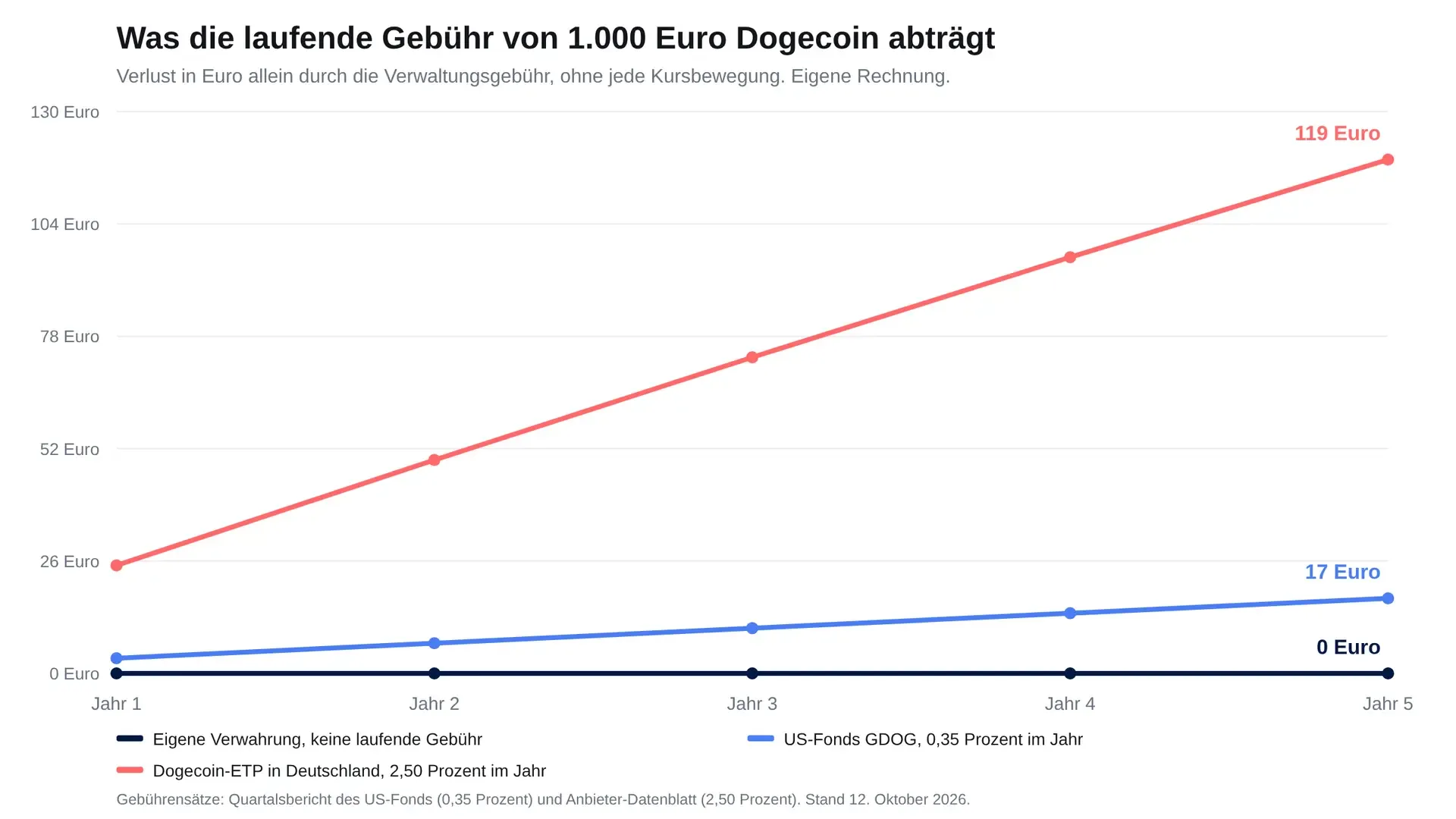
What custody costs per year, counted in euros
The convenience of a fund wrapper is paid for through the ongoing fee, and the spread between the routes is wide. For GDOG, the first-quarter 2026 report shows a sponsor fee of 0.35 percent annualised, once a temporary waiver has run out. The German 21Shares Dogecoin ETP costs 2.50 percent a year according to the issuer. Self-custody carries no ongoing fee, but a one-off cost for hardware and your own effort.
On a €1,000 stake, and with no price movement whatsoever, five years cost €0 under self-custody, around €17 in the US fund and around €119 in the German ETP. The fee is taken from the holding daily, so the share of coins behind each security keeps shrinking. GDOG makes that legible directly: 117.33314709 DOGE per share is a snapshot that gets smaller with every day.
Four entries in the key information document that put a number on your risk
The details that matter here are public in every product, just rarely in a prominent place. In the key information document and the prospectus for your ETP you will find four points that take minutes to look up: the name of the custodian and its domicile, whether there is one or several, the size of the insurance or of a liability cap, and whether there is a right to delivery of the coins. In a product with a single custodian, that custodian's creditworthiness decides your counterparty risk; with several, the risk is spread.
The benchmark from the American filing serves as a yardstick: insurance of at least $100 million, a cap per cold storage address, a quantified liability for the custodian. If your documents carry no figure for any of those points, that absence is the real information. If you are weighing the alternative and want to hold the keys yourself, the devices and their differences are in our hardware wallet comparison; the price of that route is that you secure the recovery phrase yourself and nobody can replace it for you.
Holding period for self-custody, withholding tax for the ETP
In tax terms the two routes diverge in Germany, and for most holders that difference is larger than any fee. Buying Dogecoin directly and holding it yourself falls under section 23 of the German Income Tax Act: after a holding period of more than one year, the gain from the private disposal is tax free, and within the year an exemption threshold of €1,000 applies.
For an ETP the classification is disputed. Because these are bearer debt securities, treatment as a capital investment under section 20 of the Income Tax Act is the obvious reading, which would mean 25 percent withholding tax regardless of the holding period. For physically backed products carrying a right to delivery of the coins, the specialist literature also argues for section 23. There is no ruling from the Federal Fiscal Court specifically on crypto ETPs. Anyone counting on the holding period should therefore ask the issuer or a tax adviser about the treatment before buying and document their acquisition data cleanly, for which the tools in our overview of tax software and portfolio trackers are suited.
What the switch says about the state of the Dogecoin market
Two filings within a few days draw the same picture from two directions. One issuer gives up because, after a good eleven months, barely any money sits in the product; another builds out its custody and opens share creation to in-kind delivery. That says nothing about the price, but something about the infrastructure: the number of products is falling, the quality of those left is rising.
For the price itself the picture stays thin. Dogecoin has lost 9.5 percent over the week and, at a market capitalisation of $13.4 billion, sits well below the large names. A change of custody creates no demand. It only lowers the probability that a technical or legal incident at a single service provider drags an entire fund down with it.
Our assessment of the split across two custodians
In the view of this desk, adding a second custodian is the more useful of the week's two events, for a reason that can be checked: the additional custodian's liability is quantified at a minimum of $5 million, the insurance requirement at $100 million, and the cold storage threshold caps concentration per address at $100 million. Three quantified figures an investor can hold up against their own product are worth more than any announcement without a number.
Against that stands the sponsor leaving open how much it will actually move. As long as the transferred share is not quantified, the split remains a possibility rather than a measured fact, and at assets under management of $12.81 million even a complete transfer would be a small matter financially. We therefore read the filing as a sign of the segment maturing, not as a reason to buy. Which route somebody picks depends on the holding period and on the willingness to secure keys personally, not on where the fund wrapper comes from.
Dogecoin custody: two addresses only lower custodian risk
Splitting across Coinbase Custody and Anchorage Digital changes a fund's counterparty risk, not the price risk of Dogecoin. If you want to take something from it for your own portfolio, work through it in this order. First: look up in the key information document for your product how many custodians are entered and whether a liability sum is quantified. Second: project the ongoing fee onto your intended holding period, because at 2.50 percent a year, five years take around €119 of €1,000 before the price has moved at all; the devices for the route without an ongoing fee are in the hardware wallet comparison. Third: settle the tax treatment of your route before you buy, and document the purchase date and acquisition cost from the outset, for instance with a tool from the overview of tax software and portfolio trackers.
(As of October 12, 2026. This article is not investment advice. Prices and fee structures change; check the terms with the provider before you buy. Crypto investments can lead to a total loss.)
Decrypt
Evernorth's XRPN shares began trading Monday after its SPAC merger closed, but 80% of SPAC investors cashed out first and its XRP stash is worth roughly 40% less than at signing.
The Crypto Fear and Greed Index has dropped to 56 from an August peak of 82, as oil, bond yields, and ETF outflows hit Bitcoin in October.
The wallet manufacturer said its own systems and direct sales are unaffected, and that the reseller has stopped selling hardware wallets.
Where event insurance deals with scrapped shows and what happens inside the venue, NEXTPredict is focusing on flight cancellations.
An integer overflow in the payment engine, dormant since 2015, could have let an attacker mint spendable XRP beyond the token’s total supply.
U.Today - IT, AI and Fintech Daily News for You Today
Peter Schiff has declared Michael Saylor’s Bitcoin strategy a failure in 2026.
Cardano logs a historic 1,780,896 transactions in Epoch 660, marking its highest network usage since late 2021.
Autonomous AI software drives record traffic on XRP Ledger, outspending human retail users via the new X402 standard.
Ethereum is posting extremely weak liquidity levels on Binance as its reserves on the exchange continue to decline despite market volatility.
Near Protocol's recovery might be complicated.
Blockonomi
TLDR
- Nokia (NOK) stock drops 4.15% to $9.93 despite launching new 50G fiber technology.
- Nokia unveils a multi-PON line card supporting 10G, 25G, and 50G fiber connections.
- New Quillion-powered technology enables flexible broadband upgrades for operators.
- Nokia’s latest fiber solution promises four times lower upstream network latency.
- Quantum-safe encryption and stronger network resilience enhance Nokia’s fiber technology.
Nokia (NOK) stock fell 4.15% to $9.93 during Monday’s intraday trading, losing $0.43 after an early rally faded. Nokia introduced a new fiber network solution that supports multiple broadband technologies through a single line card. The launch targets growing network demands as artificial intelligence drives higher data traffic and faster connectivity requirements.
Nokia Oyj, NOK
Nokia Introduces Multi-PON Fiber Technology for AI Networks
Nokia announced a new 50G/25G/10G/GPON line card designed to help telecommunications operators upgrade existing fiber networks. The technology supports several passive optical network generations without requiring operators to replace their existing fiber infrastructure. As a result, service providers can expand network capacity according to customer demand and changing market conditions.
The new equipment uses Nokia’s internally developed Quillion chipset alongside optical modules that support multiple PON technologies. Each port accommodates GPON, 10G, 25G, and 50G connections, allowing operators to deploy different broadband speeds. Furthermore, operators can introduce faster services without committing their entire network infrastructure to one technology standard.
Previous line cards often restricted operators to fewer network technologies, complicating upgrades and long-term capacity planning. Nokia’s latest design addresses these limitations by allowing different PON generations to operate across existing fiber connections. Consequently, providers can introduce new broadband services while maintaining compatibility with their established network equipment.
Nokia Targets Growing Broadband Demand and Network Flexibility
Artificial intelligence applications continue to increase network requirements through heavier data transfers, cloud services, and interactive digital platforms. These developments place greater demands on upstream bandwidth, connection reliability, and response times across telecommunications networks. Therefore, Nokia designed its latest equipment to support changing traffic patterns without requiring extensive infrastructure changes.
Nokia Fixed Networks executive Maryam Chaudry said operators face growing uncertainty when planning future broadband investments. She explained that the new line card allows providers to select technologies according to their immediate requirements. Additionally, operators can introduce other PON generations later as service demand increases across different markets.
Dell’Oro Group executive Jeff Heynen identified network flexibility as an important factor in expanding broadband infrastructure. He explained that supporting multiple PON generations offers operators a practical approach to managing future upgrades. The arrangement also allows telecommunications companies to adjust network investments as broadband requirements change.
New Nokia Line Card Adds Security and Performance Features
Beyond supporting multiple broadband standards, Nokia introduced performance improvements designed for data-intensive applications and essential connectivity services. The company reported that the equipment can reduce upstream latency by up to four times. Lower latency can improve responsiveness for applications that require rapid communication between connected devices and network infrastructure.
The solution also incorporates quantum-safe encryption and authentication to strengthen protection against emerging cybersecurity threats. Nokia designed the equipment with end-to-end resilience to eliminate single points of failure. These features support network reliability for businesses and organizations that depend on continuous connectivity.
Operators can initially deploy combinations such as 10G and 25G PON before introducing 50G services when required. Alternatively, providers using 10G and 50G technology can incorporate 25G connections as market requirements change. The launch expands Nokia’s fixed-network equipment portfolio as telecommunications companies prepare infrastructure for higher broadband speeds.
The post Nokia (NOK) Stock: Slides as New 50G Fiber Technology Debuts appeared first on Blockonomi.
TLDR
- Getty Images (GETY) stock crashes 69.46% to $0.0142 following restructuring news.
- Getty family and Koch Equity Development commit up to $533M in fresh funding.
- Bondholders agree to retire $270M in debt under Getty Images’ restructuring.
- Getty Images prepares a Chapter 11 filing as it plans to return to private ownership.
- Koch Equity Development pledges up to $143M to support restructuring operations.
Getty Images Holdings (GETY) stock plunged 69.46% to $0.0142 during Monday’s intraday trading, losing $0.0323 per share. The sharp decline followed the company’s announcement of a $533 million restructuring agreement involving major financial stakeholders. The agreement outlines debt reductions, fresh equity funding, and a transition from public trading to private ownership.
Getty Images Holdings, Inc., GETY
Getty Images Secures $533 Million Restructuring Agreement
Getty Images announced a restructuring support agreement with affiliates of the Getty family and Koch Equity Development. Both parties committed up to $533 million in new equity to strengthen the company’s financial position. The funding forms part of a broader agreement covering the company’s outstanding debt and future ownership.
Bondholders representing 83.5% of unsecured notes agreed to retire $270 million in outstanding debt. Secured creditors representing approximately 89% of bonds and term loans also supported revised borrowing terms. Furthermore, all revolving credit facility lenders agreed to lower interest obligations and extend debt maturities.
Following the restructuring, the Getty family and Koch Equity Development affiliates will control the reorganized company. The agreement grants these parties full ownership once Getty Images completes the proposed financial reorganization. Chairman Mark Getty said the transaction would strengthen the company’s capital structure and support future expansion.
Getty Images Plans Chapter 11 Filing as Stock Falls
Getty Images plans to seek creditor approval before launching a prepackaged Chapter 11 bankruptcy process. The company expects to begin proceedings within weeks and complete the restructuring before December ends. However, the filing will cover only certain United States entities rather than its entire global business.
Koch Equity Development will provide up to $143 million in financing to support the restructuring process. Getty Images will also use cash generated from its existing operations to maintain business activities. Management expects normal payments to vendors and continued services for customers, contributors, partners, and employees.
Chief Executive Craig Peters said the restructuring would give Getty Images greater financial flexibility for future investments. The company continues operating its global visual content business despite mounting financial obligations. Its services include licensed photography, editorial imagery, video content, and digital media assets.
Previous Shutterstock Merger Adds Background to Getty Images Restructuring
The restructuring follows Getty Images’ abandoned $3.7 billion merger proposal with rival Shutterstock earlier in 2026. Regulatory conditions imposed by Britain’s competition authority complicated the transaction and contributed to its cancellation. The latest agreement now provides Getty Images with a separate route toward private ownership.
Getty Images operates an extensive archive serving media organizations, businesses, and creative professionals worldwide. Its commercial activities depend on licensing visual content and maintaining relationships with photographers and distribution partners. Management intends to preserve those operations while reducing financial obligations through the restructuring.
The company will provide additional transaction details through a Form 8-K filing with the Securities and Exchange Commission. Creditors holding the required voting majority have already committed to supporting the proposed reorganization plan. Getty Images expects the completed transaction to reduce borrowing costs and establish a revised ownership structure.
The post Getty Images Holdings (GETY) Stock: Crashes 69% on $533M Restructuring Deal appeared first on Blockonomi.
TLDR
- Microsoft (MSFT) stock gains 0.88% as the company expands its AI chip strategy
- Microsoft’s Azure Maia 300 chips target lower AI costs and improved cloud efficiency
- Microsoft plans a multi-gigawatt rollout of its Maia 300 AI processors in 2027
- Azure Maia 300 targets 40% better energy efficiency and sevenfold higher throughput
- Microsoft’s custom AI processors aim to reduce reliance on Nvidia’s GPU hardware
Microsoft plans to expand its custom AI chip program as demand for computing power increases across its cloud business. The company expects to deploy its Azure Maia 300 processors globally starting in 2027 to reduce infrastructure costs. Meanwhile, Microsoft (MSFT) stock gained 0.88% to $539.79 during Monday’s intraday session, adding $4.72.
IonQ, Inc., IONQ
Microsoft Expands AI Infrastructure With Azure Maia 300
Microsoft announced plans to deploy its upcoming Maia 300 processors across global data centers at a multi-gigawatt scale. The company intends to power GitHub Copilot, Microsoft Foundry, and other enterprise applications through its proprietary hardware. This expansion supports Microsoft’s strategy to reduce dependence on external chip suppliers while managing growing computing requirements.
The announcement follows rising infrastructure expenses across the cloud computing industry as companies expand artificial intelligence services. Major technology companies continue investing in specialized processors because advanced AI models require substantial computing capacity and electricity. Consequently, Microsoft aims to improve operational efficiency and reduce exposure to graphics processor supply constraints.
The Maia 300 represents another stage in Microsoft’s development of specialized hardware for its Azure cloud platform. Its deployment will support inference workloads, which allow trained AI models to generate responses and process requests. Furthermore, the company expects these processors to handle increasingly complex applications while improving performance across its cloud infrastructure.
Maia 300 Targets Higher Efficiency and Processing Capacity
Microsoft plans to manufacture its Maia 300 processor using TSMC’s advanced N2P semiconductor production technology and chiplet architecture. The processor will incorporate eight HBM4 memory stacks to support faster data processing and demanding AI applications. According to company projections, the system will improve energy efficiency by 40% per megawatt against competing hardware.
Microsoft also expects the upcoming processor to deliver seven times greater rack-scale token throughput than its current system. Higher processing capacity could help Azure support more enterprise applications without proportionally increasing infrastructure power requirements. These improvements form part of Microsoft’s broader effort to control operating expenses as AI workloads expand.
Meanwhile, Microsoft continues deploying its Maia 200 processors across production environments in North America, Europe, and Australia. The company reports that Maia 200 delivers up to 1.7 times greater output per watt for selected workloads. These workloads include Microsoft Teams and Copilot applications, which already use the company’s expanding AI infrastructure.
Microsoft Strengthens Position Against Rival Cloud Providers
Microsoft’s custom processor strategy follows similar hardware investments by Google, Amazon, and Meta across their computing operations. These companies are developing specialized accelerators to reduce dependence on Nvidia’s widely used datacenter graphics processors. As competition increases, proprietary chip development has become central to managing performance, capacity, and infrastructure spending.
Microsoft expects its multi-gigawatt deployment to support continued growth across Azure and its enterprise software services. The company is designing its hardware for advanced reasoning tasks and applications that complete multiple automated steps. Therefore, its processor roadmap connects future computing capacity with efforts to improve cloud service economics and efficiency.
The planned 2027 expansion will require Microsoft to integrate new processors into its existing global infrastructure. Its experience operating Maia 200 provides a foundation for managing production workloads before the next processor generation arrives. Microsoft now aims to increase computing capacity while controlling energy consumption and supporting broader adoption of AI services.
The post Microsoft (MSFT) Stock: Gains as Azure Maia 300 Targets AI Costs appeared first on Blockonomi.
TLDR
- IonQ stock plunges 8.74% to $36.40 despite announcing a $1.3 billion acquisition.
- IonQ agrees to acquire Elisity to expand its quantum cybersecurity operations.
- The all-stock Elisity deal includes up to $150 million in performance-based payments.
- Elisity brings over 100 global deployments and strong enterprise security demand.
- IonQ targets a $10 billion cybersecurity market as its stock faces sharp declines.
IonQ (IONQ) stock plunged 8.74% to $36.40 during Monday’s intraday trading, losing $3.49 despite announcing a major acquisition. The quantum computing company agreed to acquire cybersecurity firm Elisity in an all-stock transaction worth up to $1.3 billion. The deal expands IonQ’s security business as the company targets growing demand for quantum-resistant cybersecurity solutions.
IonQ, Inc., IONQ
IonQ Announces $1.3 Billion Elisity Acquisition Deal
IonQ announced a definitive agreement to acquire Elisity, a company specializing in Zero Trust security technology. The acquisition combines IonQ’s post-quantum cryptography and quantum key distribution capabilities with Elisity’s enterprise security platform. Together, these technologies will help organizations protect sensitive data against existing cyberattacks and emerging quantum computing threats.
The transaction carries a maximum value of $1.3 billion, including $150 million in potential performance-based payments. IonQ will issue shares based on a predetermined pricing formula linked to its stock performance. The agreement establishes a share pricing range between $33.07 and $49.61.
IonQ expects to complete the acquisition during the fourth quarter of 2026, subject to regulatory approval. Following completion, Elisity will maintain its existing leadership team, including CEO James Winebrenner. Meanwhile, IonQ plans to expand its cybersecurity offerings across enterprise networks, government systems, and critical infrastructure.
Elisity Expands IonQ’s Enterprise Cybersecurity Business
Elisity brings an established enterprise security platform and more than 100 customer deployments worldwide. The company has doubled its revenue and customer base annually while reporting zero customer churn. Its customer relationships will provide IonQ with additional opportunities across the growing enterprise cybersecurity market.
Elisity’s IdentityGraph platform identifies devices, users, workloads, and artificial intelligence agents across connected networks. The technology applies identity-based access controls that restrict unauthorized communication and limit the spread of cyberattacks. IonQ plans to integrate cryptographic risk information into the platform to strengthen protection against future quantum threats.
The acquisition also opens opportunities within the enterprise microsegmentation market, which IonQ values above $10 billion. Additionally, the company expects to expand cross-selling opportunities across its existing cybersecurity and quantum computing products. IonQ reported 40% year-over-year growth in multiproduct revenue during the second quarter of 2026.
IonQ Strengthens Quantum Security Strategy Despite Stock Decline
IonQ has expanded its quantum security operations through computing, networking, sensing, and cryptographic protection technologies. The company already supports quantum-safe communications networks across Switzerland, Poland, Romania, and Slovakia. These deployments provide an established foundation for introducing additional enterprise cybersecurity services.
Furthermore, the Elisity acquisition follows IonQ’s broader strategy of expanding through strategic technology purchases. Its SkyWater Technology acquisition strengthened capabilities in semiconductor design, manufacturing, and advanced packaging. Elisity will extend that approach into enterprise network protection and security policy management.
IonQ shares declined sharply during Monday’s session despite the announcement of the proposed acquisition. The transaction introduces additional stock issuance as IonQ pursues expansion beyond its core quantum computing business. The company now targets stronger enterprise security operations while preparing to finalize the agreement before year-end.
The post IonQ (IONQ) Stock: Plunges 8.74% to $36.40 Despite $1.3 Billion Elisity Acquisition Deal appeared first on Blockonomi.
FUNToken has announced the addition of ENA to its growing list of supported tokens, further strengthening its commitment to improving token accessibility and simplifying participation across its ecosystem.
With this latest integration, users holding ENA can now deposit their tokens directly into the FUNToken platform, where they are automatically converted into $FUN with 0% conversion fees. The process eliminates the need for manual token swaps, offering users a straightforward way to access $FUN and explore its expanding range of utilities.
Making $FUN More Accessible Through Token Integration
As the digital asset landscape continues to evolve, users increasingly hold multiple tokens across different networks. FUNToken aims to simplify the experience of accessing its ecosystem by supporting a growing selection of tokens that can be converted into $FUN.
The addition of ENA (ERC-20) introduces another option for users looking to put their existing digital assets to use without navigating multiple conversion platforms.
Through FUNToken’s automatic conversion system, ENA holders can deposit their tokens and receive $FUN without incurring additional conversion fees.
This streamlined approach is part of FUNToken’s broader effort to reduce unnecessary steps, improve accessibility, and create a more connected experience for its users.
Expanding Utility Beyond Token Conversion
The integration of ENA goes beyond simply adding another supported asset. It creates an additional entry point into FUNToken’s growing ecosystem of gaming experiences, staking opportunities, and token-based rewards.
Once ENA is converted into $FUN, users can explore the different utilities available within the ecosystem.
FUNToken’s expanding Android gaming portfolio features nine titles designed around accessible, engaging gameplay, with no ads, no paywalls, and real $FUN rewards. The ecosystem also includes browser-based gaming experiences, staking features, and referral reward opportunities.
By connecting these experiences through a common token, FUNToken continues to build an environment where $FUN serves multiple purposes across different products and activities.
A Growing List of Supported Tokens
The addition of ENA reflects FUNToken’s ongoing strategy to expand the range of digital assets supported by its automatic conversion system.
Recent integrations have included ONDO, TRUMP, FARTCOIN, and JTO, alongside previously supported tokens such as USDT, USDC, SOL, LINK, UNI, AAVE, and others.
Each new integration provides users with additional flexibility in accessing $FUN while supporting the platform’s objective of making token conversion more convenient.
With 0% conversion fees remaining a central feature of the supported token system, FUNToken continues to focus on simplifying the transition from existing token holdings into its connected gaming and rewards ecosystem.
Continuing to Build a More Connected $FUN Ecosystem
The ENA integration represents another step in FUNToken’s ongoing ecosystem expansion.
Alongside its growing supported token list, FUNToken continues to develop new gaming experiences, expand token utility, and introduce additional opportunities for users to participate.
By combining accessible token conversion with an expanding range of products, FUNToken is working toward an ecosystem where users have greater flexibility in how they access, earn, hold, and use $FUN.
As further integrations and platform developments are introduced, the project remains focused on making participation simpler and creating more practical uses for $FUN.
About FUNToken
FUNToken is a blockchain-powered ecosystem built around $FUN, combining gaming, rewards, staking, and growing token utility within a connected experience.
With an expanding portfolio of Android and browser-based games, supported token integrations, multi-chain accessibility, and reward opportunities, FUNToken is focused on creating more ways for users to access, earn, hold, and use $FUN.
The ecosystem emphasizes accessible gaming experiences, including a growing selection of Android titles featuring no ads, no paywalls, and $FUN rewards.
Through continued product development and ecosystem expansion, FUNToken aims to strengthen the role of $FUN as a common token connecting its growing range of digital experiences.
Website: https://funtoken.io
The post FUNToken Expands Token Accessibility With ENA Integration and 0% Conversion Fees appeared first on Blockonomi.
CryptoPotato
The popular altcoin is among the best-performing cryptocurrencies today (October 12), posting a double-digit increase to around $3.40.
Its pump has caught the eye of well-known analysts who believe it could rise further soon. Moreover, key technical indicators reinforce the bullish case.
More Room for Growth?
X user Lucky highlighted ICP’s solid uptrend, saying it has plenty of room to run and projecting a potential jump above $8. The analyst also told their nearly two million followers that the altcoin has “definitely one of the loudest and most passionate communities in crypto.”
CW also weighed in. A few days ago, the analyst predicted that a break above $3.39 (as it happened) would shift ICP back to a bullish mode. For their part, EliZ claimed the price has moved exactly as previously forecasted, expecting a further ascent beyond $4.
For their part, WIZZ argued that Internet Computer tends to perform well in the last quarter of the year, saying they have exposure to the asset and do not plan to sell in the next few months.
A closer look at the statement, though, shows some divergence. ICP finished Q4 deep in the red three out of five times, while the final quarter of 2023 was indeed very successful for the token, with its price exploding by more than 320%.

Additional Factors
ICP’s Relative Strength Index suggests the price may move in line with the aforementioned analysts’ optimistic expectations. The technical analysis tool measures the recent speed and magnitude of price changes to give traders a potential idea about reversal points. It ranges from 0 to 100, where anything around or below 30 is typically interpreted as a buying opportunity, while ratios above 70 signal an impending correction. Currently, the RSI stands just north of the bullish mark.

The asset’s exchange netflow should also be mentioned. Over the past several weeks, outflows have dominated inflows, suggesting investors have shifted from centralized platforms to self-custody, effectively reducing immediate selling pressure.

The post Internet Computer (ICP) Pumps 14% Daily: More Gains Ahead? appeared first on CryptoPotato.
[PRESS RELEASE – Moscow, Russia, October 12th, 2026]
On 13 October, the Russian international settlement system A7, created by Bank PSB, is set to present A7 International, a service enabling payments for a foreign counterparty’s invoice in USDT, with the funds arriving via a standard SWIFT bank transfer in the required currency.
The service will cater primarily to foreign trade operators, but individuals are also eligible customers. The fee remains fixed at 0.3 percent.
Petr Fradkov, Chairman of PJSC Bank PSB, and Ilan Shor, CEO of A7, will provide a glimpse into its new offering on 13 October at 13:13.
To join the live broadcast and learn about the new project, follow the links:
https://a7.biz/live
About A7:
A7 is a global financial technology company specializing in international payments and settlement solutions for international trade. It was established in 2024 with the involvement of PSB Bank.
A7 is developing an independent global payment infrastructure across more than 100 countries, combining global financial expertise, advanced technology and regulatory compliance. The company’s products include international payments, digital financial assets and promissory notes.
A7 Group works with 15,000 clients, with around 2,000 transactions processed through the system every day. In 2025, approximately 19% of Russian companies’ cross-border trade settlements were processed through A7. In October 2025, A7 received an AA(RU) credit rating with a Stable outlook from ACRA.
The post A7 to unveil a service that will re-invent the international payments market appeared first on CryptoPotato.
XRP’s rebound has stalled near $1.40 after a sharp decline from its recent consolidation. Buyers have responded around a major demand zone, but the price remains beneath nearby resistance and within a corrective structure.
Ripple Price Analysis: The Daily Chart
On the daily timeframe, Ripple’s token has extended its correction following the rejection from the $1.61–$1.70 resistance zone. The latest selloff pushed the price below the $1.48–$1.50 consolidation area, with a long lower wick reaching approximately $1.32 before buyers stepped in. Subsequent candles show stabilization around $1.40, although the recovery has so far lacked strong follow-through.
The $1.25–$1.32 demand zone remains particularly important. It overlaps with the 100-day and 200-day moving averages, positioned near $1.265 and $1.281, respectively. The rising 100-day average is approaching the 200-day average from below, suggesting a potential bullish crossover, but confirmation is still pending. Meanwhile, the daily RSI sits around 45, indicating that momentum remains below neutral despite the bounce.
Holding the demand zone could preserve the broader recovery and support another attempt toward the $1.48–$1.52 resistance area. Beyond that, the $1.61–$1.70 supply zone remains the main upside barrier. Conversely, a sustained break below $1.25 would weaken the recovery structure and expose the next highlighted support zone at $1.11–$1.18.
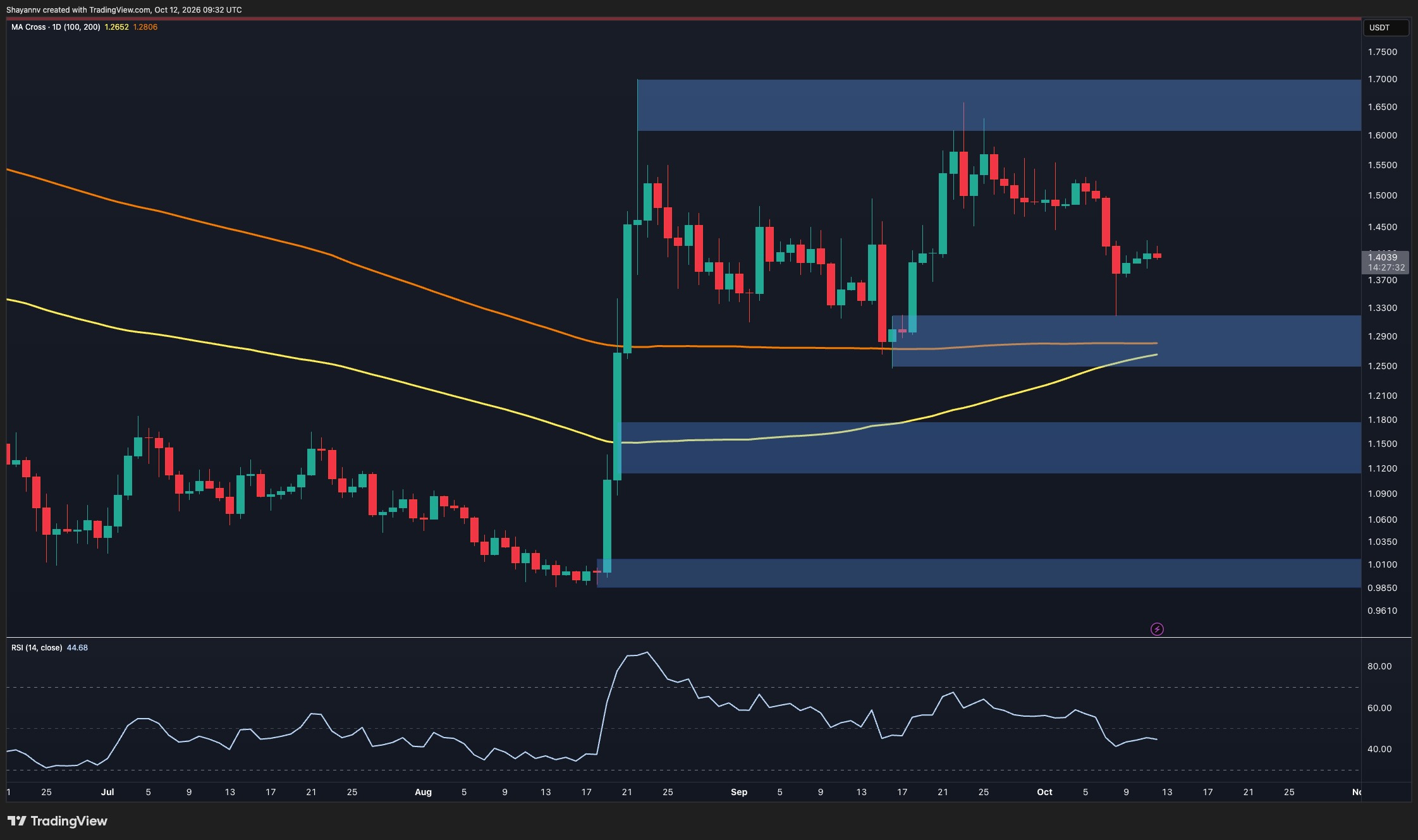
XRP/USDT 4-Hour Chart
The 4-hour chart shows XRP moving within a descending channel, with successive lower highs maintaining the corrective trend. The recent decline broke through the $1.43–$1.45 support zone before briefly reaching the channel’s lower boundary near $1.32. Buyers then drove a rebound toward $1.42, where the recovery encountered renewed selling pressure.
The former $1.43–$1.45 demand zone now represents an overhead resistance area. Its proximity to the descending channel’s upper boundary creates a significant obstacle for buyers. A sustained move above both would provide an initial signal that selling pressure is easing and could open the way toward the $1.48–$1.52 resistance region.
Until that breakout occurs, the rebound appears corrective. Losing nearby support around $1.38 would bring the $1.34–$1.35 area back into focus, followed by the broader $1.25–$1.32 demand zone. The reaction to the $1.43–$1.45 resistance area will therefore be important in determining whether XRP can escape the descending channel or remains vulnerable to another decline.

The post Ripple Price Analysis: What’s Next for XRP After Another Rejection at Key Resistance? appeared first on CryptoPotato.
Kraken is gearing up to launch its crypto services in the United Arab Emirates after receiving full market approval from Dubai’s Virtual Asset Regulatory Authority (VARA).
The approval clears the way for its parent company, Payward, to operate as a regulated virtual asset service provider in Dubai. The company will be able to serve retail, professional, and institutional investors in the region.
Kraken’s UAE Launch
Initially, UAE customers will get access to spot and margin trading, with trading pairs denominated in the UAE dirham (AED). Users will also be able to deposit and withdraw funds directly in dirhams. They may no longer need to rely on other currencies to fund their trading activity.
The launch lineup will also include on-chain staking, xStocks, and Krak, Kraken’s service for crypto transfers. Institutional clients will have access to over-the-counter (OTC) spot trading and Kraken Prime. The company also plans to introduce more products over time.
For instance, crypto derivatives and a wider range of yield opportunities are expected to arrive later in 2026 and into 2027. However, these services will depend on further regulatory approval. Payward also plans to offer its trading infrastructure to regional partners through an embedded trading-as-a-service model.
The latest approval is the final stage of VARA’s licensing process. It follows preliminary approval granted to Payward in May 2026, which allowed the company to complete its operational setup before bringing customers on board. Payward currently holds more than 100 licenses and registrations worldwide. Its regulatory footprint spans Europe, the Americas, Asia-Pacific and the Middle East.
Commenting on the development, Arjun Sethi, Co-CEO of Payward and Kraken, said,
“From launch, clients in the UAE get the same order book and multi-asset coverage we run in every other market, under one of the clearest regulatory frameworks in the world. Payward’s regulatory infrastructure now connects them directly to Kraken’s market-leading liquidity, along with a growing range of opportunities across digital assets.”
Other Major Deals
Kraken has had a busy year. Deutsche Börse kicked things off in April with a $200 million investment in the crypto exchange. In June, Kraken joined forces with Maple to bring institutional-style lending protections onto the blockchain through a facility for loans backed by digital assets.
Then came Nasdaq in September, which agreed to put another $100 million into Payward. That deal valued the parent company at $21 billion. The two entities are also working on tokenized stocks, and a launch is targeted for the second quarter of 2027.
The post Kraken Expands Into the UAE After Clearing Dubai’s Final Regulatory Hurdle appeared first on CryptoPotato.
Ethereum is recovering toward $2.55K after buyers responded to the latest selloff near a key demand area. The rebound preserves the broader ascending structure, but ETH still needs to reclaim overhead supply to demonstrate a more durable recovery.
Ethereum Price Analysis: The Daily Chart
On the daily timeframe, Ethereum’s correction extended into the $2.36K–$2.42K demand zone before producing a notable lower wick and several recovery candles. The price has since climbed toward $2.55K, suggesting that buyers are defending the region following the sharp decline from the recent consolidation.
ETH also remains within the broader ascending channel and above both major moving averages. The 100-day average sits near $2.24K, above the 200-day average around $2.14K, maintaining the bullish crossover established earlier. However, this supportive backdrop has yet to translate into a recovery of the lost resistance levels.
The highlighted $2.66K–$2.74K supply zone represents the main nearby barrier. Reclaiming this area would strengthen the recovery scenario and allow another challenge of the recent $2.8K high, followed by the $2.9K–$3K resistance region.
Conversely, renewed selling would bring the $2.36K–$2.42K demand zone and nearby channel support back into focus. A sustained break below this confluence would weaken the broader structure and expose the moving-average region around $2.14K–$2.24K.
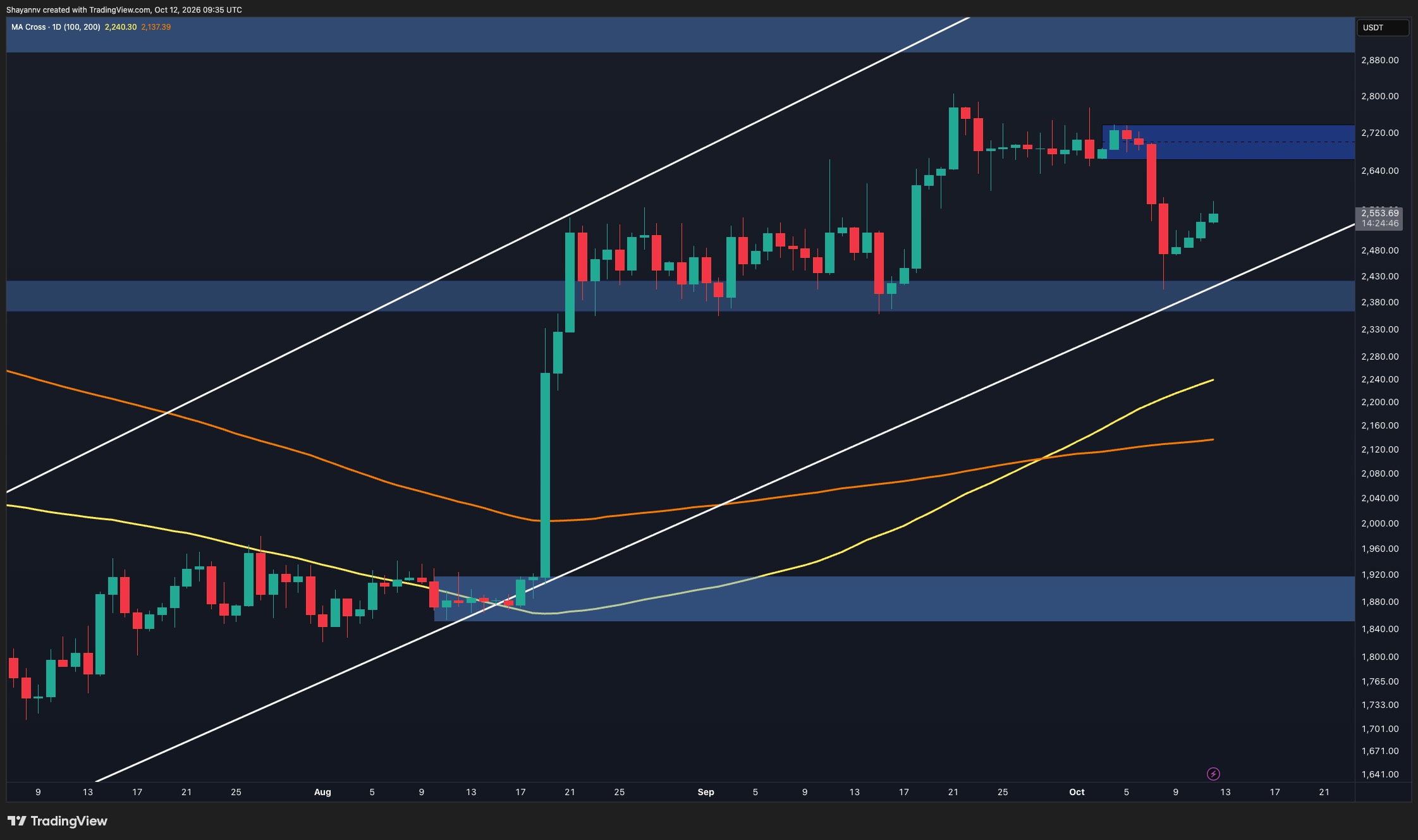
ETH/USDT 4-Hour Chart
The 4-hour chart shows Ethereum rebounding after briefly piercing the $2.43K–$2.48K demand zone and the lower ascending trendline. The subsequent recovery above both suggests rejection of lower prices, although the earlier selloff has left ETH trading beneath the rising structure’s middle trendline.
Holding the reclaimed trendline around $2.49K–$2.5K would support a continuation of the rebound toward the $2.6K area. Beyond that, the $2.66K–$2.74K supply zone overlaps with the broken middle trendline, creating an important resistance confluence where sellers could reappear.
Until Ethereum clears that region, the advance remains a recovery within a weakened short-term structure. Losing $2.49K would increase the likelihood of another test of the $2.43K–$2.48K demand zone. A decisive breakdown below the recent wick low around $2.4K could then expose the next highlighted support area at $2.22K–$2.28K.

Sentiment Analysis
The Ethereum Spot Average Order Size chart classifies spot activity by average trade size, distinguishing normal orders from retail-sized and whale-sized activity. It provides context for participant size, although it does not independently identify whether larger traders are buying or selling.
The latest observations remain predominantly in the normal-order category, including the recent advance toward $2.7K and the subsequent correction toward $2.5K. This contrasts with the frequent whale-sized readings visible during earlier periods, particularly around the June–August price base.
Consequently, the current rebound is not accompanied by a visible return of whale-sized average orders. This does not establish that large investors are absent or that the recovery must fail, but the metric offers limited confirmation of renewed large-order participation. A shift toward whale-sized readings alongside a sustained price recovery would provide additional context, while buying direction would still need confirmation from other data.

The post Ethereum Price Prediction: Relief Rally or Another ETH Dump Next? appeared first on CryptoPotato.