Cryptocurrency Posts
Crypto Briefing
The airstrikes highlight ongoing instability in Yemen, with potential shifts in conflict dynamics affecting regional security and market perceptions.
The post Yemeni forces conduct 8 airstrikes on Houthi positions near Taiz appeared first on Crypto Briefing.
The attack exacerbates regional instability, potentially influencing Houthi advances and altering geopolitical dynamics in the Middle East.
The post Saudi airport attack kills 12 as conflict with Houthis escalates appeared first on Crypto Briefing.
The alleged airstrike could reignite hostilities, destabilizing the region and impacting market perceptions and geopolitical dynamics.
The post Saudi Arabia allegedly strikes Sanaa airport amid rising tensions appeared first on Crypto Briefing.
The Bank of England's support for stablecoins could enhance financial stability and innovation, influencing global regulatory approaches.
The post Bank of England says it will be ‘the banker to the stablecoin’ appeared first on Crypto Briefing.
ON Semiconductor's ambitious growth targets could significantly impact the semiconductor industry's competitive landscape and innovation pace.
The post ON Semiconductor expects 12% to 14% revenue CAGR through 2030 appeared first on Crypto Briefing.
Bitcoin Magazine
Bitcoin Magazine
Bitcoin Life Insurer Meanwhile Raises $37.5M as Wealthy Families Look to Pass On Their BTC
Meanwhile, the first life insurer licensed to operate entirely in Bitcoin, has raised $37.5 million in new funding from its existing investors, the company announced.
Bain Capital Crypto led the round, with participation from Haun Ventures, Framework Ventures, Pantera Capital, Apollo, Northwestern Mutual Future Ventures and Morgan Creek Digital. The raise brings Meanwhile’s total funding to more than $180 million. Sam Altman is also among its backers.
The company said the round follows a surge in demand for its Bitcoin life insurance policies outside the US, particularly in Asia, Europe and the Middle East, amid broader macroeconomic instability.
“Wealthy families around the world already hold Bitcoin. What they haven’t had is a regulated way to pass it on,” Zac Townsend, Meanwhile’s co-founder and CEO, said in a statement.
“Brokers came to us because their clients kept asking. This round lets us keep up with them.”
In early 2026, Meanwhile launched BTC Life 1-Pay, a single-premium whole life policy aimed at high-net-worth clients outside the US. It is the company’s second product line, after BTC 10-Pay, which is designed for US taxpayers.
Under BTC Life 1-Pay, a client pays one premium in Bitcoin and receives a guaranteed death benefit in Bitcoin for life. The policy’s value grows in Bitcoin, and after the first year the owner can borrow up to 90% of it, with no repayment schedule and no margin calls.
Policies can be owned by individuals, trusts or companies, which the company says makes them suited to succession and estate planning.
Since launch, Meanwhile has signed 15 brokers serving wealthy families, including in Singapore, Hong Kong, the UAE and Switzerland. Partners include Lioner, an insurance, trust and family office group with offices in Hong Kong, Singapore and Zurich, and Apeiron Group, a marketplace for high-net-worth life insurance.
“We’re reaching a turning point where more high-net-worth clients are asking not just how to hold Bitcoin and digital assets, but how to plan around them and ultimately transfer that wealth to the next generation,” said Justin Man, CEO of Apeiron Group. Digital assets.
Meanwhile said its net long-term underwriting income has already passed last year’s total and is on track to more than double in 2026. The company did not disclose specific figures.
“Meanwhile owns every layer of a regulated life insurer and builds it like an AI-enabled startup,” said Stefan Cohen, partner at Bain Capital Crypto. “The growth this year proves the model, and we’re glad to back them again.”
The company’s operating entity, Meanwhile Insurance Bitcoin (Bermuda) Limited, holds the first Class IILT license granted by the Bermuda Monetary Authority. It received the license in July 2024 after two years in the regulator’s sandbox.
The insurer’s balance sheet, reserves and audited financial statements are all denominated in Bitcoin. Policyholder Bitcoin is held with regulated institutional custodians.
This post Bitcoin Life Insurer Meanwhile Raises $37.5M as Wealthy Families Look to Pass On Their BTC first appeared on Bitcoin Magazine and is written by Mathew Di Salvo.
Bitcoin Magazine

‘We Know Where It Is’: Treasury Secretary Threatens To Freeze $1B of Iran’s Crypto
U.S. Treasury Secretary Scott Bessent has said the American authorities will soon seize $1 billion in crypto from Iran.
Speaking on Newsmax’s NPolicy Summit in Washington, D.C. on Thursday, Bessent added that economic sanctions on the Middle Eastern country were working.
Iran has been using bitcoin — and other cryptocurrencies — to skirt around U.S. sanctions. The U.S. in April started targeting crypto wallets linked to the Iranian regime, Bessent said at the time.
“What we have done has never been seen before,” Bessent said Thursday on Iranian sanctions.
“We’re probably going to seize $1 billion of crypto this week,” he continued. “We know where it is. We are isolating them. We did have a maximum pressure campaign, now we have an absolute isolation campaign and it’s working.”
Bessent didn’t reveal what cryptocurrencies the U.S. will seize or how.
It would be very hard — if not impossible — for the U.S. to freeze Iran’s bitcoin unless it keeps it on a centralized exchange.
Bitcoin, being censorship resistant, cannot be frozen. But many other cryptocurrencies, including Tether’s USDT, can. Bessent previously said the feds had seized Iran’s crypto in the form of the popular stablecoin.
Iran started a bitcoin-backed insurance service for its counties shipping companies earlier this year.
The Financial Times last month reported that the Middle Eastern country was using bitcoin to settle cross-border transactions through Iranian crypto exchanges after the central bank advised its countrymen to do anything necessary to help the economy.
U.S. President Donald Trump revived his “maximum pressure” campaign weeks after returning to office. A national security memorandum signed in February 2025 put the Treasury on a sustained campaign against Iran’s shadow banking, money laundering and sanctions-evasion networks.
This post ‘We Know Where It Is’: Treasury Secretary Threatens To Freeze $1B of Iran’s Crypto first appeared on Bitcoin Magazine and is written by Mathew Di Salvo.
Bitcoin Magazine

Here’s How Not To Screw up Your Bitcoin Privacy
Just one transaction can compromise years of discreet Bitcoin activity, Cake Wallet’s chief operating officer has warned.
Speaking on the Bitcoin Rails podcast this week, activist Seth for Privacy talked about different ways of protecting one’s privacy when using Bitcoin and said that focusing on privacy was a must for the West.
Bitcoin privacy is a hot topic again ever since the developers of private coin mixer Samourai Wallet went on trial last year and were subsequently imprisoned.
But just this week, the U.S. Department of Treasury scrapped two long-stalled crypto surveillance proposals, handing a major win to privacy advocates and the digital asset industry.
“If you ever spend your no-KYC coins with one of your KYC coins — which if you just let the wallet do its thing, it could do because it doesn’t know the difference — you immediately connect all of the non-KYC Bitcoin that you spend in that with your identity,” Seth said, referring to UTXO management, also called “coin control” by some wallets.
Bitcoin wallets don’t hold a single balance but a collection of separate unspent transaction outputs — UTXOs — each one a discrete “coin” from a specific past transaction.
When you send a payment larger than any one UTXO, the wallet picks several and combines them as inputs to the same transaction — an easy mistake to make, Seth highlighted.
Seth added that unlike in the global South, where people have experienced more oppressive states, citizens in the West will need to “feel pain” in order to realize how important privacy is.
Still, he added that attitudes were changing and people were getting more serious about protecting their privacy.
“It has been shifting, in the last five or six years a lot of people — even in the West — are starting to think [privacy] really matters, we really need to think about this seriously now,” he said.
Cake Wallet is a privacy-oriented, self-custody, open-source wallet. The wallet earlier this year integrated Bitcoin’s Lightning Network into its platform.
Using the second layer solution is not only faster and cheaper, it also offers more privacy than Bitcoin’s main chain.
While Cake Wallet supports other cryptocurrencies, including privacy coin Monero, Seth for Privacy added that he’d love it if the digital coin didn’t exist.
“If Bitcoin’s privacy got good enough that you could use it and have at least almost as good privacy as Monero without massive hoops to jump through, and Monero ceased to exist, that’s fine,” he said.
“I would much rather the thing that more people use has better privacy than a more niche tool that has perfect privacy, and that’s something that less people are using because it’s less well known.”
This post Here’s How Not To Screw up Your Bitcoin Privacy first appeared on Bitcoin Magazine and is written by Mathew Di Salvo.
Bitcoin Magazine

Bitcoin ETFs Shed $729M in Two Days as Investors Reverse Course
U.S. investors this week reversed course, cashing out $729 million from spot bitcoin exchange-traded funds — putting downward pressure on the leading cryptocurrency’s price.
Funds managed by BlackRock, Fidelity, Morgan Stanley, and ARK 21-Shares all experienced significant outflows on Wednesday and Thursday, according to data from Farside Investors.
Investors had started the week by selling close to $90 million in shares but then bought nearly $119 million on Tuesday.
The rest of the week has seen outflows following news that the Federal Reserve may raise interest rates. Other negative news includes the price of Brent crude jumping following renewed attacks on tankers in the Strait of Hormuz.
U.S. President Trump also hinted that talks with Iran weren’t bearing fruit — a sign war in the Middle East could continue.
Bitcoin’s price recently stood at a little over $82,688, down more than 3% over a seven-day period. The leading cryptocurrency has rebounded slightly over the past day, jumping nearly 2% over 24 hours.
Still, the coin was fast closing in on $90,000 last week. Investors are expecting decent returns as the month dubbed “Uptober” has historically delivered for bitcoin speculators.
The price of bitcoin has been particularly sensitive to geopolitical headwinds this year — especially since the U.S. and Israel attacked Iran, leading to an oil price surge.
Oil prices going up tend to lead investors to bet on the Federal Reserve raising interest rates. And with higher interest rates comes less liquidity for the price of bitcoin to do well.
Still, that’s not always the case: the Fed last month talked tough on getting inflation down and raised interest rates by a quarter of a percentage point and bitcoin’s price rose in the following days.
Bitcoin’s price is 34% below the all-time high of $126,080 it touched in October. It has spent most of 2026 in a bear market but analysts are now increasingly pointing to evidence of a bull market following a rally in August and September.
This post Bitcoin ETFs Shed $729M in Two Days as Investors Reverse Course first appeared on Bitcoin Magazine and is written by Mathew Di Salvo.
Bitcoin Magazine

Ledger Warns Buyers Not to Set Up Wallets From Reseller After Users Report Losses
Hardware wallet manufacturer Ledger has said that it is investigating loss of user funds after customers in South East Asia reported issues with devices bought from a reseller.
The Paris-based company on Friday advised customers who’d bought from vendor CryptoBilis within the last 90 days to not set up their devices.
Ledger did not reveal how much money users had lost but one blockchain investigator, Specter, wrote on X that he’d traced theft addresses following social media posts and that over $86 million had been lost.
The issue comes following a number of data breaches this year in the crypto world and a huge hack of popular Coldcard hardware wallet devices in July.
“Ledger is investigating reports of loss of funds from users in South East Asia who purchased products from a reseller named CryptoBilis,” Ledger said via its support X account.
Ledger added that it had asked CryptoBilis to pause all sales and shipments of Ledger devices.
“If you have set up your Ledger device, consider moving assets to a new Ledger signer (with new seed). We will continue to inform customers of updates as the investigation progresses,” the company said.
In a statement to Bitcoin Magazine, Ledger said that based on the information to date, the incident is isolated specifically to this reseller in this specific market.
“No reports were made of products purchased directly from Ledger, and Ledger’s infrastructure, systems and services were not compromised,” the company added.
CryptoBilis is a Kuala Lumpur, Malaysia-based hardware wallet vendor, according to its website. The company did not immediately respond to questions from Bitcoin Magazine.
The crypto industry is still reeling after hackers in July were able to steal close to $120 million in bitcoin from Coldcard users.
The products, made by Canadian company Coinkite, had a firmware bug which led to faulty seed generation, allowing hackers to essentially guess investor seedphrases.
Galaxy Research said in the months following the attack various attackers were able to exploit the bug independently.
In a separate incident, hardware wallet manufacturer Trezor last month reported that close to 81,000 customers had their details leaked after its third-party fulfillment partner had data stolen.
Criminals have been targeting data this year, with scammers getting hold of customer information via crypto wallet Ledger’s payment processor Global-e to send phishing emails.
This post Ledger Warns Buyers Not to Set Up Wallets From Reseller After Users Report Losses first appeared on Bitcoin Magazine and is written by Mathew Di Salvo.
CryptoSlate
Researchers found a new iPhone spyware variant that can remotely extract cryptocurrency wallet data and sensitive credentials from compromised devices.
Security firm iVerify disclosed the malware, designated P7 DarkSword, on Oct. 8 after investigating an infection detected in August. The variant includes commands that specifically target cryptocurrency wallet apps and can collect passwords, photos, and personal information.
The discovery highlights an emerging risk for crypto holders who rely on mobile wallets: attackers who gain access to the underlying device could obtain sensitive information without exploiting a vulnerability in the wallet app itself.
How the spyware targets cryptocurrency wallets
According to iVerify's technical investigation, P7 includes two dedicated functions to identify and collect cryptocurrency-related information.
The first, wallet_scan, searches compromised devices for installed wallet applications, allowing attackers to identify potential targets.
The second, wallet_extract, is designed to collect data associated with imToken, a cryptocurrency wallet supporting multiple blockchain networks.
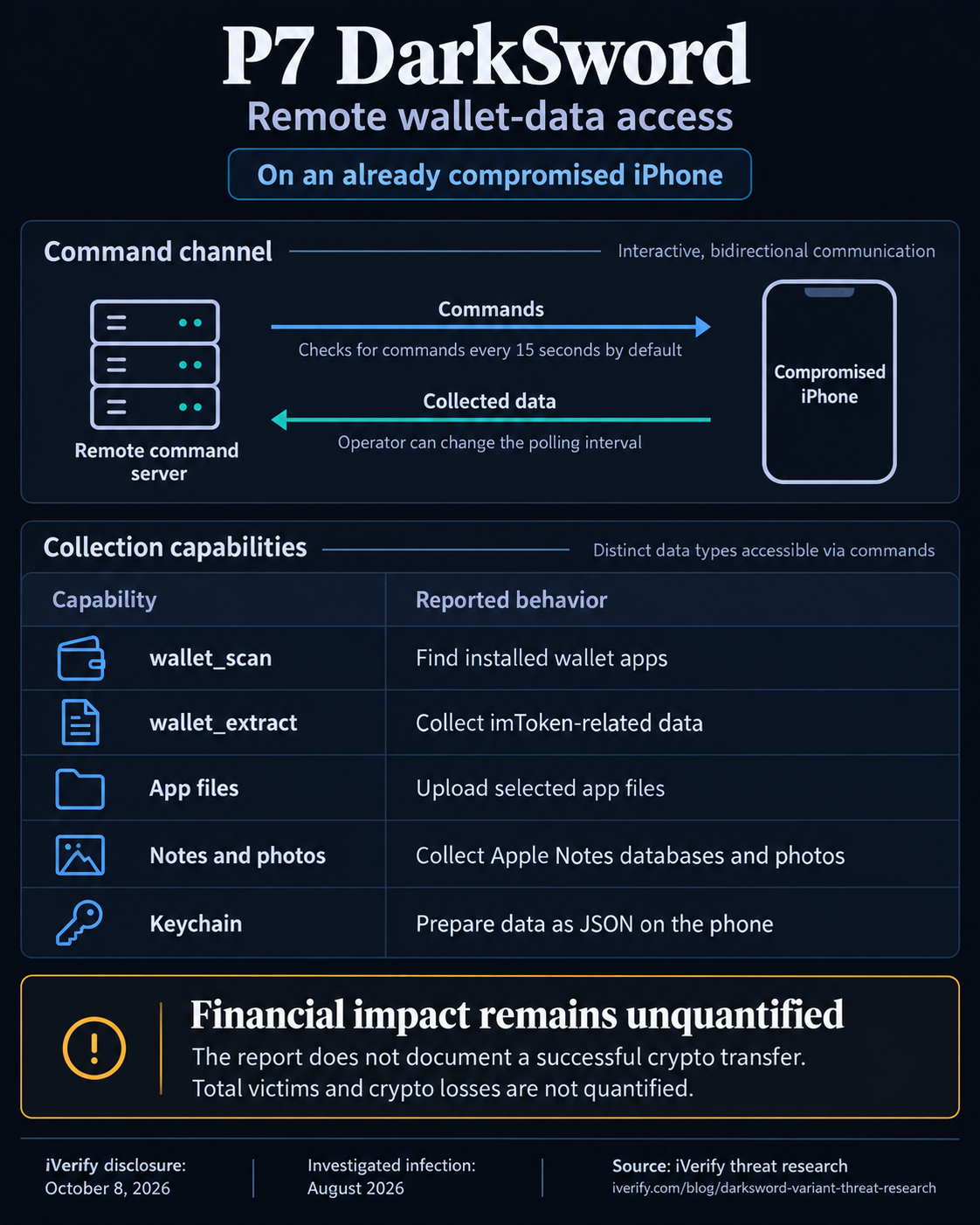
Together, the commands let attackers identify cryptocurrency users and retrieve wallet-related files after gaining access to their phones.
The spyware also targets Apple's Keychain, the system used to store passwords, authentication credentials, and other sensitive information.
Earlier DarkSword variants copied the Keychain database and transferred it to attacker-controlled infrastructure for processing.
P7 instead prepares extracted Keychain information as a JSON file directly on the compromised device before transmitting it.
This modification changes how the malware processes collected credentials and could give attackers more immediately usable information once the data reaches their servers.
The threat extends beyond crypto wallet applications themselves.
P7 can collect Apple Notes databases, photographs, and selected application files. These sources may contain sensitive financial information, including recovery phrases or wallet credentials if users have stored them there.
However, obtaining wallet files or discovering an installed application does not automatically establish control over its private keys. The potential for unauthorized transactions depends on what information the malware successfully retrieves and whether it is sufficient to authorize transfers.
A more consequential development is the spyware's expanded remote-control capability.
Rather than relying entirely on a predetermined collection process, P7 communicates with an attacker-controlled server every 15 seconds by default, requesting instructions that can be executed on the infected phone.
Operators can adjust that interval, search for specific files, and initiate additional collection activities without requiring another device compromise.
Researchers also identified modifications intended to make the spyware harder to detect and more reliable.
These include eliminating certain diagnostic logs, reducing the number of process injections, and using browser storage to prevent repeated exploitation attempts that could destabilize the infected device.
The changes indicate a shift toward more targeted, sustained collection of sensitive information, potentially allowing attackers to investigate a victim's financial activity after gaining access.
Still, iVerify did not disclose evidence of a completed cryptocurrency theft, identify how many wallet users were affected, or quantify any financial losses.
Apple's earlier security fixes face an evolving threat
The discovery follows months of efforts to contain DarkSword, an iPhone exploitation framework previously used by multiple surveillance operators.
In March, Google's Threat Intelligence Group reported that DarkSword combined six vulnerabilities to compromise iPhones running certain versions of iOS 18.4 through 18.7.
Google identified campaigns involving commercial surveillance vendors and suspected state-backed attackers targeting users in Saudi Arabia, Turkey, Malaysia, and Ukraine.
The framework allowed attackers to exploit vulnerable devices through malicious web content and subsequently deploy software capable of extracting personal and financial information, including cryptocurrency wallet data.
However, P7 represents an evolution of the spyware deployed after a successful compromise rather than confirmation of a new vulnerability in Apple's operating system.
Apple has already addressed the vulnerabilities associated with the documented DarkSword exploitation chain.
According to the company's security advisory, the relevant protections first became available in 2025.
Apple later released iOS 18.7.7 on March 24, 2026, expanding availability to additional devices on April 1 to protect users still on older operating-system versions.
Those protections matter because the capabilities iVerify uncovered depend on attackers first compromising a device.
The October investigation does not establish that P7 can bypass the latest iOS security updates, and researchers did not publish a variant-specific assessment identifying which patched versions remain vulnerable.
Still, Apple recommends installing the latest compatible software and enabling automatic updates, while Google's earlier DarkSword research also recommended Lockdown Mode when updating is not possible.
The post New iPhone spyware can hunt for crypto wallets and extract their data every 15 seconds appeared first on CryptoSlate.
Wall Street closes at 4 p.m., but apparently that's becoming more of a suggestion than a rule.
You can now spend the evening watching Netflix and making leveraged bets on American semiconductor companies while the exchange where their shares trade is closed.
Crypto has spent years making financial markets available at every hour of the day, and now it's extending the courtesy to stocks.
The appeal of after-hours trading is easy to understand. In the past six months, we've seen some of the most influential and consequential announcements and decisions happen after market close, ranging from offhand comments from the US President to Nvidia earnings.
You might have an opinion about what semiconductor stocks will do when trading resumes, and you'd rather back it immediately than wait until morning.
There's a complication, though. When you trade a stock or an index of stocks whose primary market is closed, you're trading an estimate of what those stocks are worth. That estimate isn't necessarily the price you'd get if you tried to buy or sell the underlying shares.
Usually, the difference is manageable, and most traders don't notice it. But sometimes, especially with leverage, it can become the entire trade.
The bets aren't closed
MarketVector has licensed its US semiconductor index, which is tracked by VanEck's SMH exchange-traded fund, to Paragon for a perpetual futures contract on Hyperliquid. The product uses an extended-hours index calculated with Pyth price data, letting traders speculate on semiconductor stocks outside the regular US trading session.
Paragon says it has launched 29 markets and handled nearly $500 million in trading volume since April 2026, though those figures don't show how much activity the semiconductor contract itself has attracted.
The contract works a lot like the perpetual futures crypto traders know and love.
You can bet on an asset's price without buying it, and unlike ordinary futures, the contract doesn't expire. You can hold the position as long as you have enough collateral, paying or receiving periodic funding payments that help keep its price connected to the reference market.
Bitcoin is perfect for this arrangement because it trades everywhere, all the time. Someone buying Bitcoin perps at 2 a.m. can compare the contract against actual Bitcoin prices on exchanges around the world.
Traders who notice a large discrepancy can buy one and sell the other, profit from the difference, and help bring prices back together.
Semiconductor stocks, on the other hand, aren't quite so accommodating.
Nvidia, Broadcom, AMD, and the other companies represented in semiconductor benchmarks trade on exchanges with established operating hours. While some shares are available through premarket, after-hours, or overnight services, that doesn't mean every constituent trades continuously with the depth of the regular session.
The companies don't stop being valuable when the exchange closes, of course. Their earnings prospects can improve or deteriorate overnight, and investors will adjust their expectations accordingly.
What disappears is the most liquid place to see what everyone else is willing to pay.
An extended-hours index tries to bridge that gap using prices available outside the regular session. The exact inputs, stale-price rules, and fallback procedures depend on its methodology. The specific MarketVector-Pyth calculation hasn't been independently established, so we can't assume precisely how it handles missing or thinly traded constituents.
But even with the best data, the index has to contend with a market that can look very different at midnight than at noon.
Everyone's trading the value of stocks
Imagine Nvidia closes at $200, and an hour later, the company announces earnings so good that traders immediately start pricing the shares at $215.
Semiconductor stocks can move sharply on earnings, especially when AI spending expectations make a quarterly report feel like a referendum on the entire technology industry.
Now imagine the announcement comes after conventional after-hours trading ends. Some overnight exchanges may still be operating, but the liquidity available to hedge a position in the actual shares is much thinner than during the regular session.
Someone who believes Nvidia is worth $220 might buy semiconductor-index exposure through a perpetual, while someone who thinks the enthusiasm has gone too far might sell it. Their trades establish a market price, even though neither participant needs to own a single share.
There's nothing inherently wrong with that, as futures markets have helped investors price expectations for decades. The problem is knowing how far the derivative can wander from the assets it's supposed to represent.
During regular trading hours, a professional trader who notices that a semiconductor-index derivative has become too expensive can sell it and buy the underlying stocks or a related ETF. If the prices converge, the trader profits from the difference.
But overnight, they may not be able to buy all the stocks they want in sufficient quantities. An ETF might provide a partial hedge if it's trading, while Nasdaq futures could offset broader market exposure, but neither necessarily replicates the index.
The trader has to decide whether the discrepancy is worth holding an imperfect hedge until the underlying market becomes more liquid.
Suppose the perpetual trades 4% above its reference index. Under ordinary conditions, that premium might attract sellers. Overnight, it could persist because the people best equipped to exploit it can't confidently lock in the other side. It might even get larger.
Crypto traders are accustomed to checking Bitcoin prices across several exchanges. Equity-index perpetuals introduce a situation where the derivative may be one of the few actively traded expressions of a particular market view at that hour.
Its price can reflect expectations about tomorrow's stock market and tonight's shortage of people willing to take the other side.
You predicted the rally and lost your money
Consider a trader who believes semiconductor stocks will rally when Nasdaq opens.
The trader deposits $2,000 and opens a $10,000 long position in a semiconductor-index perpetual, using 5x leverage. Every 1% move in the contract produces roughly a 5% gain or loss relative to the initial collateral, before fees and funding.
The trader expects the underlying stocks to open 3% higher because of a major overnight announcement.
The prediction might be perfectly reasonable, but while the stock market is closed, the perpetual sells off 15% as leveraged traders unwind positions, market makers pull back, and buyers become unwilling to pay the previous price.
The position has now lost $1,500 on paper, leaving only $500 of the original collateral before costs. Whether it gets liquidated depends on maintenance margin, the mark price used for risk calculations, and the exchange's liquidation rules.
A 15% move doesn't automatically liquidate every 5x position, but this particular trader has very little room left. If the position is liquidated, the trader can't wait for Nasdaq to open and prove the prediction correct.
Suppose the underlying semiconductor index subsequently opens 3% higher, exactly as expected. Someone holding the actual shares through the event might have made money. The perpetual trader could have lost most of the collateral because the derivative's overnight price went down.
This is a good example of what happens when leveraged positions are continuously marked against a market whose underlying assets aren't equally accessible.
Hyperliquid explains that mark prices are used for margin calculations and liquidations, while oracle prices provide external reference information. Its HIP-3 framework lets independent deployers define contracts, supply oracle prices, and set leverage limits.
The price at which traders transact, the external index value, and the mark price used to determine whether a position has enough collateral aren't necessarily identical. An extreme transaction price won't automatically trigger liquidation, but a sufficiently large move in the mark price can.
Funding payments also encourage perpetual prices to stay connected to their references. When a perpetual trades above its reference, longs generally pay shorts. When it trades below, payments can run the other way.
Yet someone collecting funding on a short position still has to survive any further price increase, and the promise of a payment offers little consolation if the trade gets liquidated first.
Everybody gets a reality check when trading starts
At 9:30 a.m. New York time, the regular equity session begins, bringing a much larger group of buyers and sellers into the market.
Overnight expectations can now be tested against transactions in the underlying stocks. Sometimes the overnight market gets the direction right. Other times, prices move sharply when regular trading begins because the overnight market overestimated the news or lacked enough liquidity to absorb large orders.
The opening price forms in a deeper market, with more participants able to transact in the underlying securities.
By then, the perpetual market may have already had its own trading session. Positions could have been liquidated, funding payments exchanged, and traders forced to reduce exposure. Even if the derivative and underlying index converge once regular trading resumes, those overnight losses won't be reversed.
The index itself makes this even more complicated. An overnight headline might be excellent for Nvidia but terrible for another chipmaker. Some constituents may trade actively outside regular hours while others barely trade at all, leaving the index provider to combine different kinds of price information into a single number.
Traders can end up comparing the published index, the ETF, the perpetual, and whatever overnight prices are available for the constituent shares. None is automatically wrong because it disagrees with another, but they don't necessarily represent equally executable prices.
Hyperliquid's HIP-3 framework doesn't establish that every index perpetual has identical safeguards or that its reference feed will always be available.
Without Paragon's contract-specific methodology, liquidation parameters, and historical trading data, we can't assess how often its semiconductor perpetual diverges from the reference index or how its safeguards performed during volatile periods.
Those details become more important as crypto venues offer products built around assets that don't trade on the same hours as the derivatives referencing them.
Wall Street has spent years extending equity trading beyond the traditional session. Crypto is taking that idea further by letting people trade synthetic exposure without waiting for the shares themselves to become available.
There's nothing irrational about wanting to react to news immediately. Waiting until morning doesn't make uncertainty disappear, and overnight derivatives give investors somewhere to transfer risk while the primary market is closed.
But being able to trade something at every hour doesn't mean you can value or hedge it equally well at every hour.
Someone buying a semiconductor-index perpetual at midnight is betting on the companies in the index, but also on the quality of the reference prices, the liquidity of the derivative, and whether other traders will hold risk until the underlying market opens.
That's considerably more to get right than deciding whether Nvidia had a good earnings report.
The stock exchange can be closed, and the underlying shares can be unavailable at the prices everyone is discussing, but the perpetual will still accept your order.
And if you've borrowed enough money to make that order interesting, it may also close your position long before Wall Street gets around to opening.
The post What happens when crypto trades stocks while Wall Street sleeps? appeared first on CryptoSlate.
An AI agent uncovered a decade-old bug in the XRP Ledger (XRPL) that could create trillions of XRP, prompting an emergency fix.
The vulnerability could have let an attacker generate about 18 trillion XRP through a single payment transaction, roughly 180 times the cryptocurrency's original 100 billion token supply, according to security firm Veria Labs.
Veria founder Cayden Liao said the flaw potentially threatened XRP's $94 billion market capitalization by undermining the cryptocurrency's fixed supply.
The vulnerability was reported on Sept. 22 and patched three days later. RippleX later confirmed that no unauthorized XRP was created, no funds were lost, and investigators found no evidence of exploitation on public networks. The incident was publicly disclosed on Oct. 9.
AI uncovers two interconnected flaws that survived a decade of audits
The discovery emerged from Veria's AI-powered security system, which analyzed rippled, the software underpinning XRPL, and identified two weaknesses that could be combined to bypass its monetary safeguards.
The first involved an integer overflow in the payment engine, where deliberately constructed trading offers could cause the system to miscalculate the amount a buyer owed.
Under the exploit, sellers would receive their full XRP payments while the buyer would be charged only a fraction of the actual amount. The difference would effectively create XRP that had never existed.
A second vulnerability affected the network's supply-protection mechanism. Because it relied on the same flawed arithmetic, it could fail to recognize that new XRP had been created.
The attacker would need to prepare hundreds of accounts and trading offers before submitting the payment. According to the official vulnerability report, the attack required only a few hundred XRP in largely refundable reserves and ordinary transaction fees.
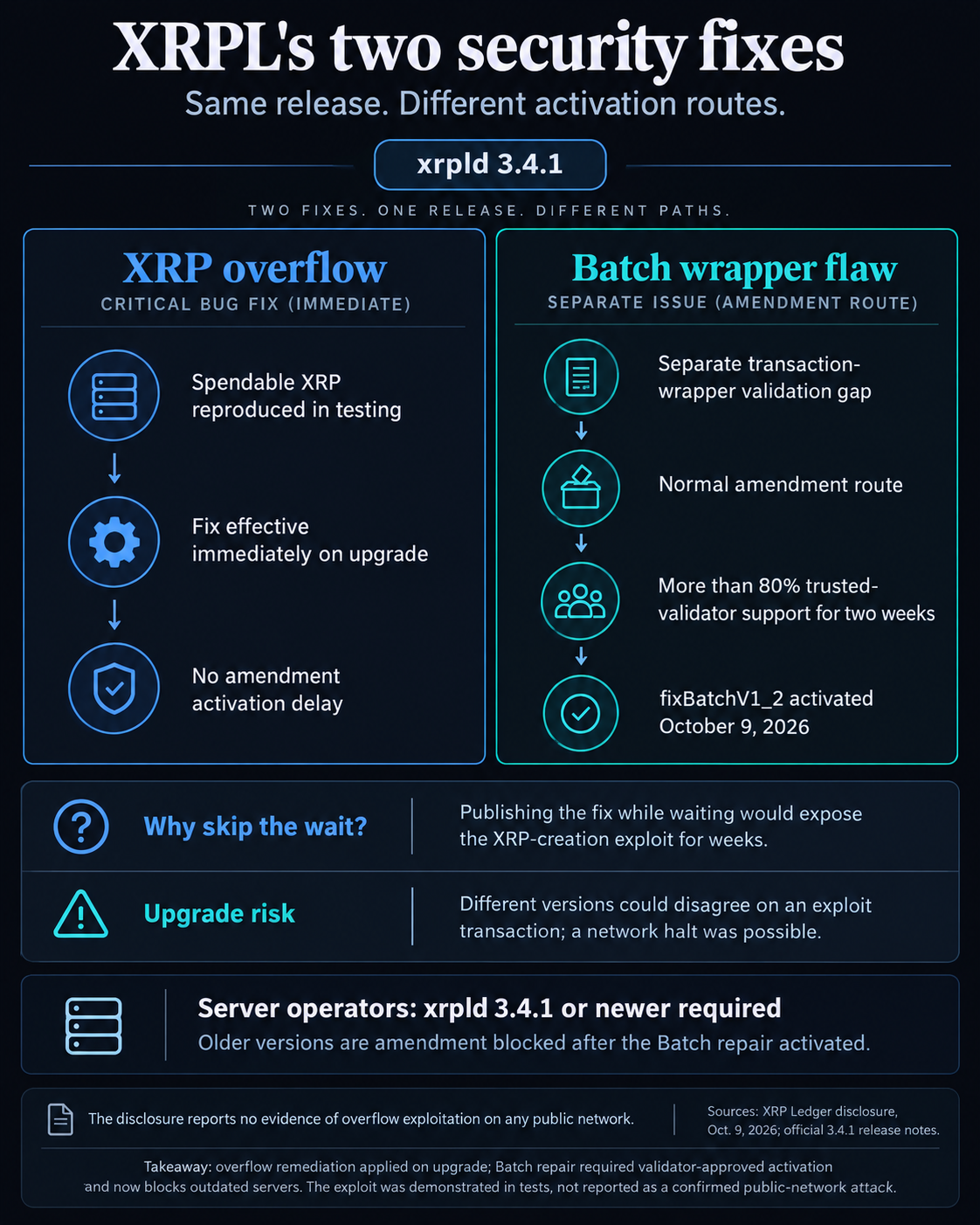
The underlying payment-engine code dates to 2015, while the affected supply safeguard was introduced in 2017.
That longevity is particularly significant given the network's security history.
Liao said the XRPL codebase had undergone more than a dozen audits and security contests since 2024, including one competition with a $550,000 prize pool. Its bug bounty programs had also distributed more than $1 million.
Despite those efforts, the combined vulnerability remained undetected until Veria's AI system identified it, assembled a working exploit, and demonstrated the problem on a local network.
RippleX engineers independently reproduced the exploit and confirmed that the newly generated XRP could be spent in subsequent transactions.
Veria received a $250,000 bounty, the program's maximum. Liao described it as the largest known reward for a vulnerability discovered entirely by an AI agent.
Emergency fix bypasses decade-old governance procedures
The severity of the discovery forced XRPL developers into an unusual decision: deploy a protocol-changing fix without waiting for the network's established amendment process.
Ordinarily, changes to transaction-processing rules require support from more than 80% of trusted validators for two consecutive weeks before activation.
However, developers determined that following this procedure would leave the vulnerability exposed while the network voted on its repair.
Because XRPL software is open source, publishing the fix could also reveal the exploit to potential attackers before the protection became effective.
Instead, RippleX, the XRP Ledger Foundation and validators coordinated an emergency upgrade that activated the protection immediately on servers running version 3.4.1.
The patch was initially distributed as binaries, temporarily withholding its source code to limit the risk of attackers reverse-engineering the vulnerability during deployment.
According to the disclosure, this marked the first deliberate bypass of the amendment activation process for a transaction-processing change in more than a decade.
The approach carried its own danger. Servers running different versions could disagree on whether an exploit transaction was valid, potentially disrupting consensus or halting the network.
Developers nevertheless concluded that a temporary network interruption was preferable to letting counterfeit XRP enter circulation.
More than 80% of validators on the default trusted-validator list had upgraded by Sept. 25, substantially reducing that risk.
XRPL Foundation contributor Vet said the coordinated response preserved network integrity and established version 3.4.1 as the new minimum software requirement following the activation of separate Batch-related amendments on Oct. 9.
RippleX turns to AI and formal verification after security scare
The incident has prompted RippleX to reassess how it protects critical infrastructure, particularly older software that has survived years of conventional security reviews.
J. Ayo Akinyele, RippleX's head of engineering, acknowledged that the vulnerability demonstrated the need to revisit longstanding assumptions about the network's design.
He outlined plans to expand AI-assisted vulnerability discovery, strengthen adversarial testing and increase scrutiny of legacy components, including the payment engine, consensus mechanisms and peer-to-peer networking.
The organization also plans to accelerate formal verification, a mathematical technique that proves whether software meets specific security properties.
That work will build on existing verification efforts involving XRPL's Lending Protocol and Single Asset Vault, alongside collaboration with CommonPrefix and the XRP Ledger Foundation.
Akinyele said AI is fundamentally accelerating vulnerability discovery, putting pressure on developers to find weaknesses before malicious actors deploy similar tools.
Vet echoed that concern, warning that increasingly capable AI systems could make previously obscure vulnerabilities easier to exploit.
The October 9 disclosure also introduced a specific procedural change: security findings previously classified as resolved must now be retested against release candidates before being formally closed.
The post AI discovers XRP Ledger flaw that could mint 18 trillion tokens and put $94 billion market at risk appeared first on CryptoSlate.
Metaplanet sold 10,000 BTC and bought back 11,000 at a higher average price to show it was willing to sell its Bitcoin.
The Japanese treasury company was pursuing a credit rating and better access to financing, and its Oct. 5 disclosure explained why turning coins into cash was part of that effort. Prospective creditors needed confidence that management could use its holdings to meet obligations, even if shareholders bought into the company because of those holdings.
Proving the point was expensive, with Metaplanet receiving ¥124.7 billion from the sale and spending ¥149.9 billion on the subsequent purchase, paying roughly 9.3% more per coin.
Applying that average purchase price to the 10,000 coins replaced produces a price difference of about ¥11.57 billion, before transaction costs and potential tax effects. That gives shareholders an expensive receipt for the demonstration.
The company didn't use the proceeds to repay borrowings or bonds, and it ended September with 44,000 BTC. Selling was part of an effort to improve the financing behind continued accumulation.
That brings us to the strange relationship underlying the corporate Bitcoin trade. Shareholders are usually happy to wait years for a higher price, but lenders have contracts that specify when they want their money back. The same reserve has to satisfy both groups.
Lenders would like their money back in dollars
A company that owns an asset as liquid as Bitcoin isn't quite the same as a company having cash available to pay a bill. Coins may be pledged against borrowing, or management may be unwilling to sell at the available price.
Either way, creditors need to know what happens when the payment date and the preferred selling price don't cooperate.
Metaplanet's June financial statement reported ¥67.49 billion in short-term borrowings and ¥8 billion in bonds payable within a year, against ¥1.09 billion in cash and deposits and ¥250 million in USDC.
The numbers exclude the company's much larger Bitcoin reserve and the financing it could access, so the gap explains why lenders want more than a coin count when assessing repayment.
The contracts give dates to that discussion, although the numbers below come from different reporting periods and shouldn't be read as a like-for-like comparison of current liquidity.
| Financing detail | Metaplanet | Strategy |
|---|---|---|
| Disclosed Bitcoin holdings | 44,000 BTC at Sept. 30 | 848,000 BTC at Oct. 4 |
| Cash information | June 30: ¥1.09 billion in cash and deposits, plus ¥250 million in USDC; a comparable September balance isn't established here | Oct. 4: $4.88 billion dedicated reserve, plus $833.4 million in separate USD cash |
| Identified 2027 repayment provision | ¥8 billion zero-coupon bond issued with an April 23, 2027 redemption date and an early-redemption right | Holders of $1.01 billion in notes can request cash repurchase on Sept. 15, 2027 |
| Qualification | Full ¥8 billion was reported in June; the balance still outstanding needs confirmation | Principal is based on June balances; payment depends on exercise of the holder right and intervening financing activity |
Sources: Metaplanet's bond terms, June accounts, and October disclosure; Strategy's June filing and October update.
Strategy's notes technically mature in September 2028, but the holder's right to demand repayment brings a potential cash obligation forward by a year.
Its June filing also lists roughly $4.9 billion of notes with similar holder repurchase rights during 2028, taking the principal associated with those 2027 and 2028 dates to about $5.91 billion.
Holders must exercise their rights, and conversions or repurchases could reduce those amounts before then, meaning the company has clear points when access to cash is more important than confidence in Bitcoin's eventual price.
This is why corporate Bitcoin has financing deadlines even though Bitcoin itself doesn't expire. Management can borrow again, issue securities, or use cash to meet obligations, but those options have their own costs, and they aren't equally attractive in every market.
Keeping Bitcoin takes money that isn't Bitcoin
Strategy has built a sizable dollar cushion, giving it more room. Its Oct. 5 filing reported a $4.88 billion dedicated reserve and another $833.4 million in separate dollar-denominated cash, totaling approximately $5.71 billion as of Oct. 4.
The dedicated reserve supports preferred-stock dividends and debt interest, and its policy requires board authorization for other uses. The separate cash balance provides a lot of flexibility, so adding the two together doesn't make the entire sum an unrestricted pot for future debt repayments.
The same filing shows how much work now goes into managing the coins' financing. Between Sept. 28 and Oct. 4, Strategy used $142.5 million from its reserve for dividends and interest, spent $154.1 million on repurchasing preferred shares, and bought $13 million of Bitcoin.
Strategy still held 848,000 BTC, bought for about $63.97 billion, so Bitcoin dominates the balance sheet. But the cash gives management breathing room when payments come due, helping it avoid selling coins simply because the market has chosen an inconvenient week to fall.
Its earlier Bitcoin sales and reserve-building already showed that supporting the securities financing the reserve could take precedence over buying more coins. Keeping some money in dollars can help the company retain Bitcoin through a downturn.
There's also a shareholder version of the same problem. When a treasury company's shares trade above the value of the assets behind them, issuing shares can bring in enough money to increase Bitcoin exposure per existing share.
When that premium disappears, the company must give away more ownership to raise the same amount, making the deal less attractive to existing investors.
Metaplanet's June results said its market-value-to-net-asset-value measure (mNAV) was below 1.0 for much of the period. Its policy generally avoids discretionary common-share issuance below that threshold, so the restriction prevented some fundraising, leaving financing below earlier expectations.
The company continued buying through other funding sources, but the experience demonstrates how dilution can complicate accumulation well before anyone faces a forced sale. The reserve can get bigger while an existing shareholder's economic interest becomes less attractive.
Selling some Bitcoin can be the better option when the alternative is issuing shares cheaply. Preferred shares are one way to do that, but they give investors claims ahead of common shareholders, with the exact payment rights depending on the terms.
Missing a preferred dividend isn't automatically a bond default, although disappointing those investors can make the next fundraising harder.
The decision is about how much Bitcoin shareholders can afford to keep exposed once everyone financing the company has been accounted for, a less photogenic number than total BTC holdings.
One Bitcoin company starts financing another
Metaplanet is also trying to generate income beyond holding coins, because Bitcoin by itself doesn't produce the dollars or yen needed to service financing. Its revised allocation policy targets roughly 85% to 90% of assets in Bitcoin and 10% to 15% in strategic investments, including income-producing securities.
Its Net Interest Income Strategy seeks to earn more from those investments than it pays to finance them. Possible investments include preferred securities issued by other Bitcoin treasury companies, meaning one company's plan to support its Bitcoin reserve could include collecting payments from another company facing a similar challenge.
That could provide recurring cash for financing costs or further purchases, but it also creates the possibility of exposure to the same weakness twice. Falling Bitcoin prices could reduce Metaplanet's core asset value, while securities issued by other treasury companies could lose value or become less dependable income sources.
The policy acknowledges potential correlation, and the actual risk depends on what the company buys and how it finances those investments. It shows how far the business can travel from the simple proposition of buying shares in a company that owns Bitcoin.
Across the rest of the market, these financing arrangements make corporate purchases less permanent than the accumulation announcements can make them feel. Companies can keep believing in Bitcoin while slowing purchases, building cash, or selling coins because the terms available to their shareholders have deteriorated.
Voluntary sales and forced liquidations are different events, and neither company's disclosures establish an imminent liquidation. The more immediate consequence can be a buyer spending its next dollar on financing obligations.
Metaplanet's round trip still has to earn its keep through better credit access or borrowing terms, since the disclosure doesn't prove a rating agency ordered the sale or that cheaper financing has been secured.
Strategy's cash cushion buys flexibility, but how much depends on the obligations it needs to cover and the capital it can raise later.
Both cases make the same point about holding Bitcoin through a corporate balance sheet: keeping the coins requires decisions about the money around them.
Management willing to sell some Bitcoin on sensible terms may do more for shareholders than management defending a never-sell promise by borrowing expensively or handing away too much ownership to keep it.
The post Bitcoin companies are learning that holding forever takes cash appeared first on CryptoSlate.
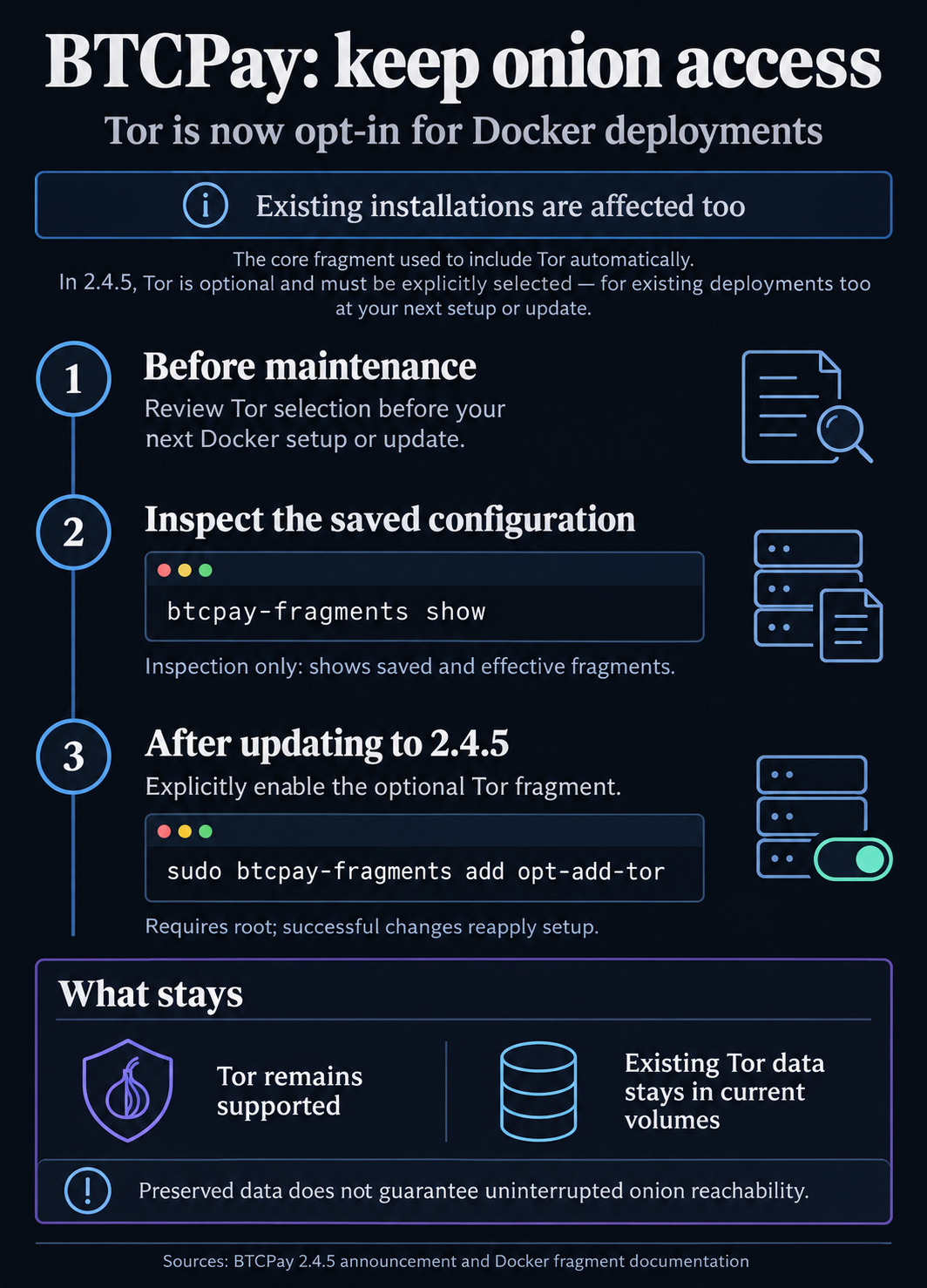
Operators running the Bitcoin payment software BTCPay Server through its standard Docker deployment must explicitly select Tor at their next setup or update if they want to retain onion access. The change removes Tor from the automatically included components, making a previously bundled service an administrator’s configuration choice.
BTCPay detailed the deployment change in its Oct. 5 announcement accompanying version 2.4.5. The official GitHub release page records the software release on Oct. 6. For existing installations, the relevant trigger is their next Docker setup or update.
The change matters to Docker operators who rely on Tor, including access through their server’s onion address, but previously received it through the core BTCPay Server fragment. Fragments are the configuration components used to assemble the Docker stack.
BTCPay advises administrators to review the deployment changes before updating. After updating to 2.4.5, its instruction for enabling Tor is:
sudo btcpay-fragments add opt-add-tor
Tor remains supported, and BTCPay says existing data stays in the current Tor volumes. That preserves stored data; continued onion access still depends on including and running Tor in the deployment.
BTCPay Server documentation describes the optional Tor fragment opt-add-tor as adding hidden services and selected onion connectivity. Operators can inspect configuration using btcpay-fragments show, which does not change configuration and reports saved additional and excluded fragments alongside the effective fragments from the last generated manifest.
Fragment-changing commands require root and reapply setup immediately.
Private services need separate exceptions
The 2.4.5 release notes also identify a breaking change for outbound HTTP requests: private-network destinations are blocked by default for Lightning connections, LNURL requests, invoice notification URLs and webhooks. The restriction is intended to prevent server-side request forgery, or SSRF.
With that protection enabled, operators intentionally using private services must allow the needed destinations through ssrfexceptions.
BTCPay’s operator guide says to restart the application and exercise the affected integration after changing the setting.
The post BTCPay Docker users must opt into Tor at their next update to keep onion access appeared first on CryptoSlate.
CryptoTicker.io
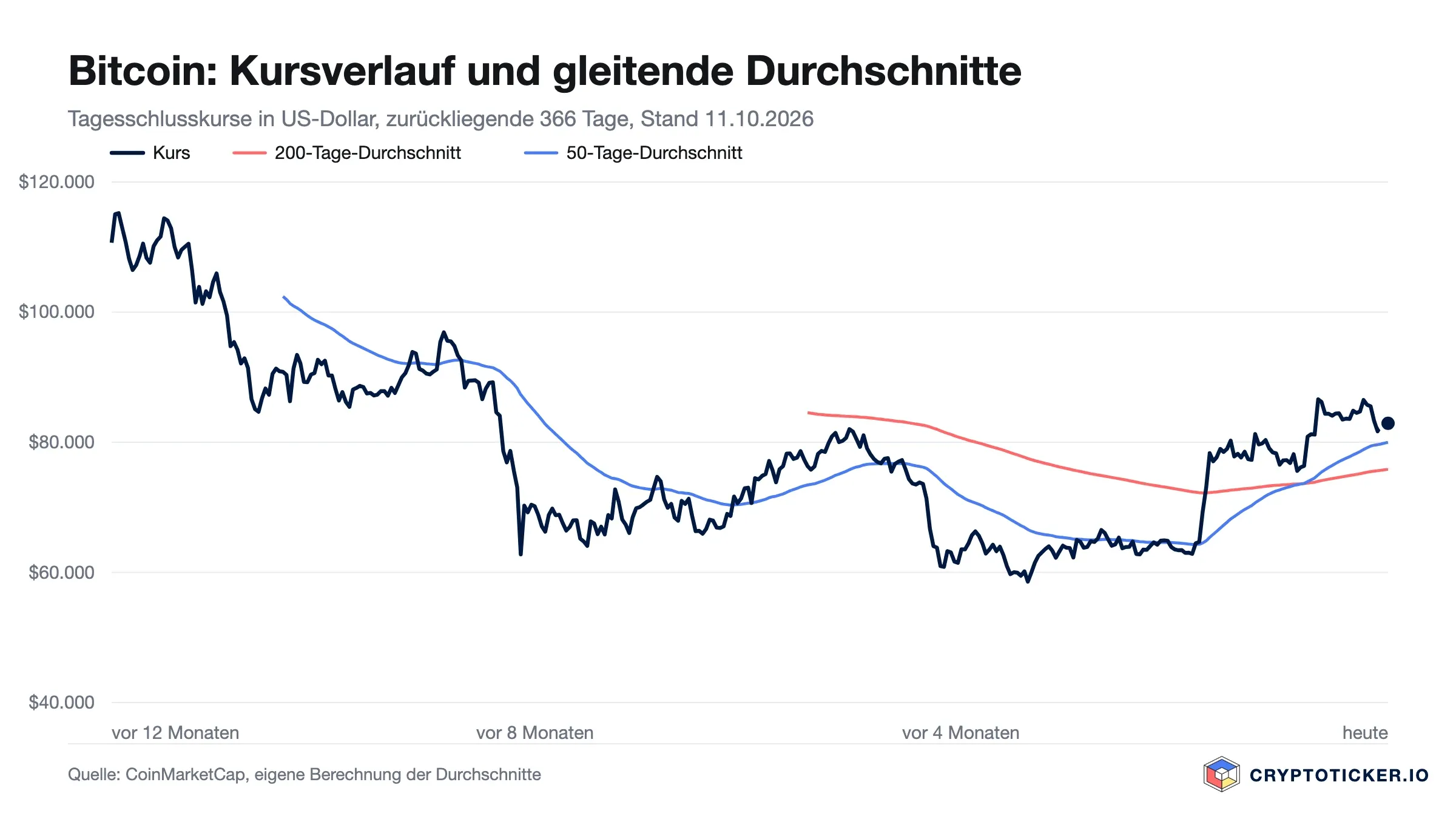
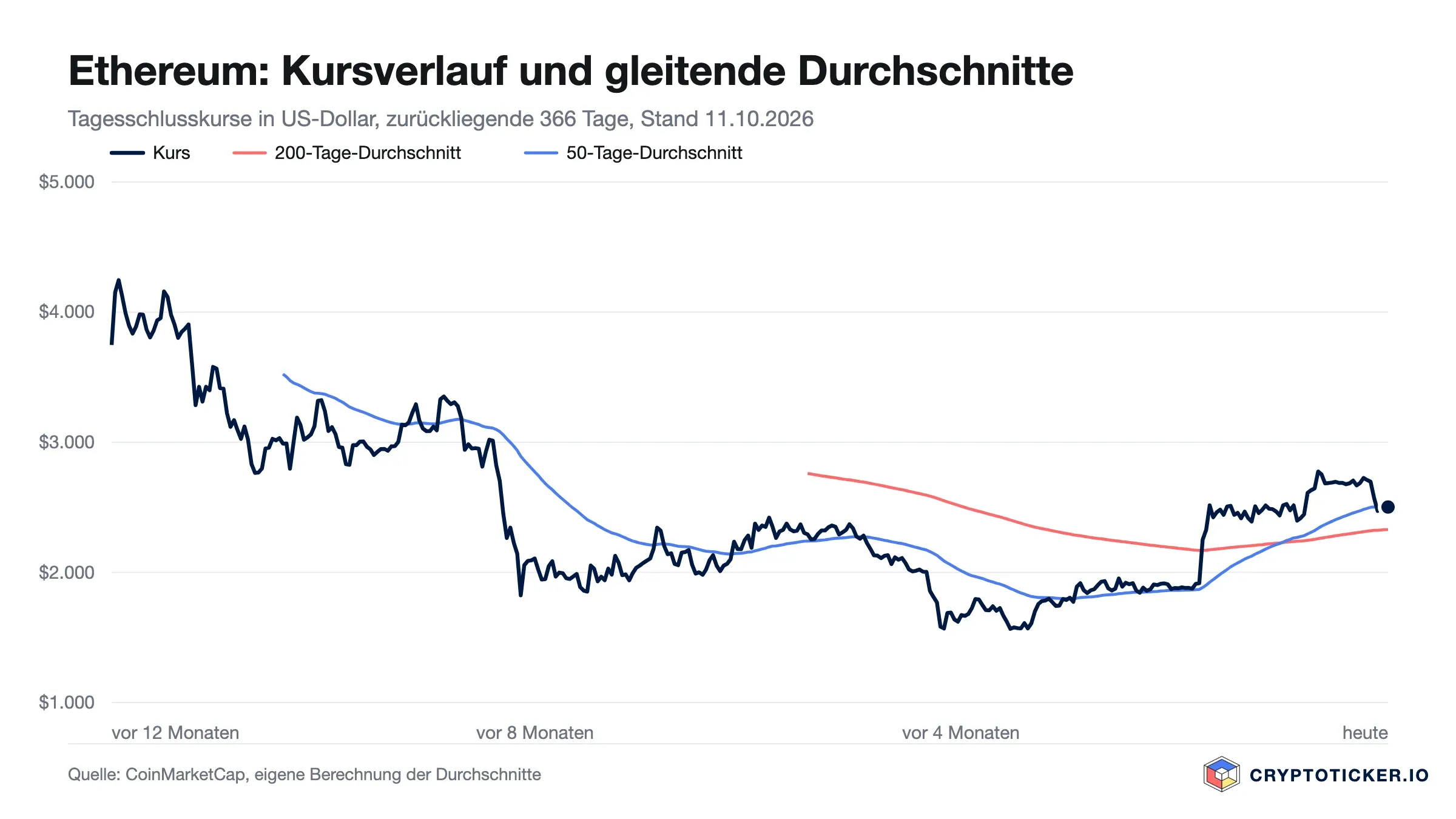
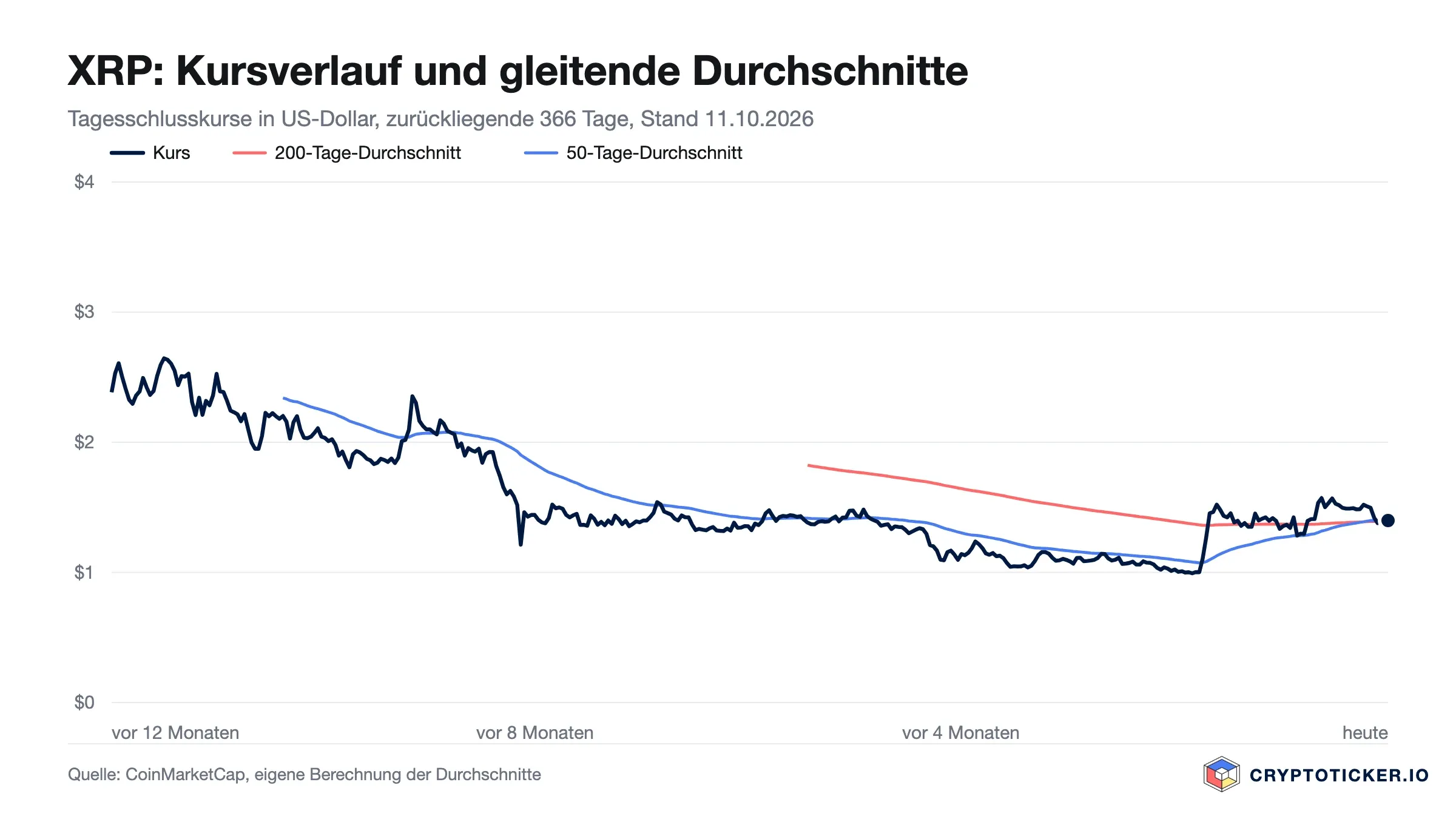
The new crypto week has a clear centre of gravity: on Wednesday, October 14, the US publishes the consumer price index for September at 8:30 a.m. in Washington, and on the same day the German federal cabinet is due to take up the crypto tax bill in Berlin. Bitcoin enters the week at $82,922, Ether at $2,504, XRP at $1.40 and Solana at $109.91, according to CoinGecko early on Sunday morning. For this outlook we analysed the daily prices of the past twelve months. The most striking result: Ether and XRP sit almost exactly on their 50-day moving averages, the line at which the direction will be decided over the coming days.
Why Wednesday counts for all four coins
In the minutes of its September meeting, the US Federal Reserve let it be known that most members consider a further rate rise appropriate before the end of the year. The next meeting falls on October 27 and 28. If Wednesday's inflation data comes in higher than expected, that rise becomes more likely, and last week that was already enough to push Ether, XRP and Solana down by between 6 and 8 percent. If it comes in lower, pressure comes off the market. For investors in Germany the cabinet adds a second date: the finance ministry's bill concerns the taxation of crypto assets, and the details are in our piece on the tax bill. Until a law is promulgated, the one-year holding period applies unchanged.
| Coin | Price Sunday | 50-day average | 200-day average | Previous week's range |
|---|---|---|---|---|
| Bitcoin | $82,922 | $79,989 | $75,840 | $80,652 to $86,636 |
| Ether | $2,504 | $2,501 | $2,329 | $2,414 to $2,731 |
| XRP | $1.40 | $1.40 | $1.39 | $1.33 to $1.52 |
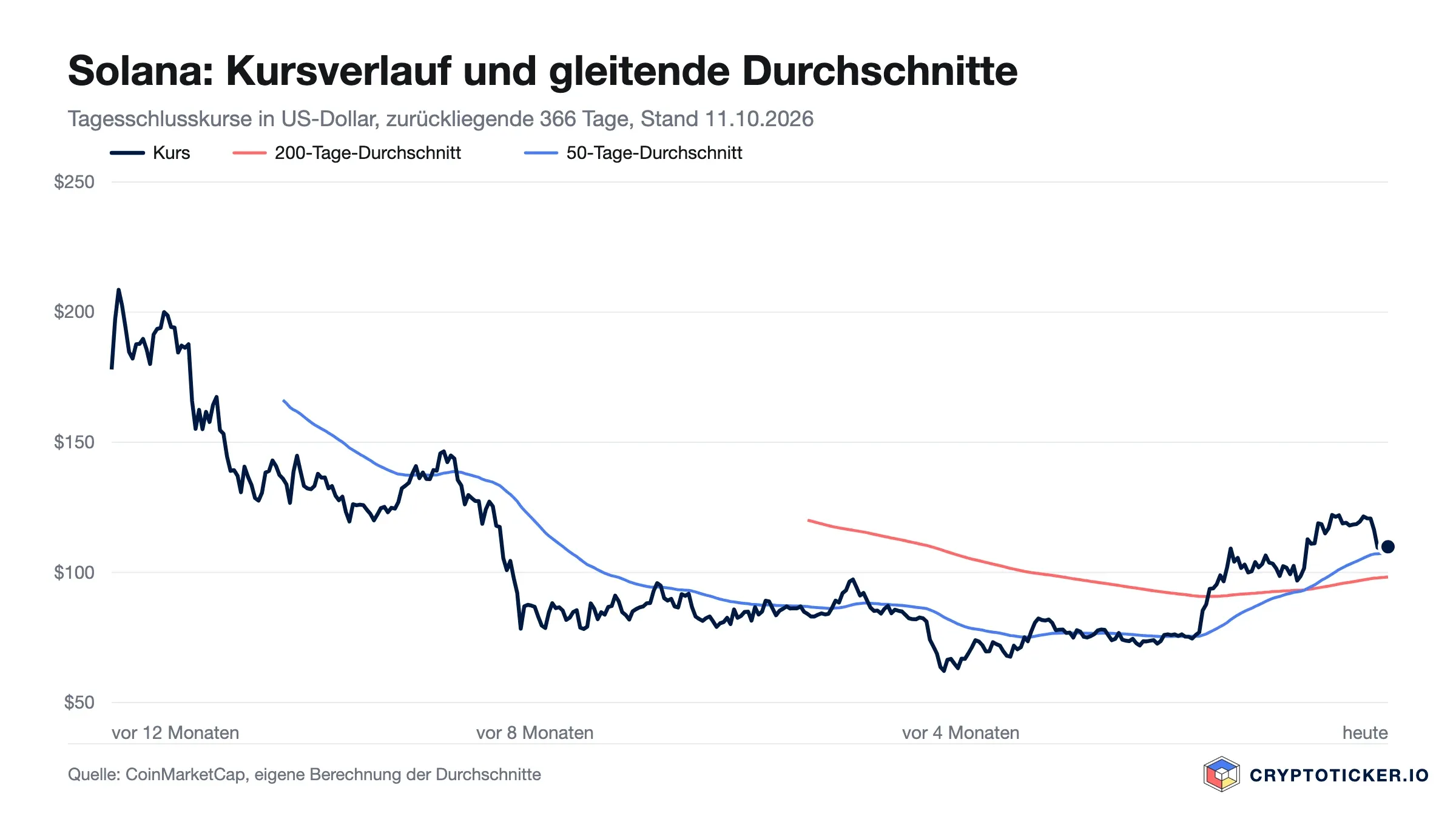
| Solana | $109.91 | $107.44 | $98.24 | $106.41 to $121.82 |
We calculated the averages from CoinMarketCap's daily closing prices and the ranges from CoinGecko's hourly prices between October 4 and 11. All four coins trade above their 200-day averages, so the long-term uptrend since the summer low is intact.
Bitcoin outlook for the week: $80,000 is the line
Of the four coins, Bitcoin has the largest distance to its averages. The 50-day average sits just below $80,000, almost exactly where the price turned on Thursday. If that zone holds, the weekly high of $86,636 is the obvious target to the upside. If it breaks, the next support only comes at the 200-day average around $75,800. Bitcoin options also expire in large volume on October 30, as our Bitcoin outlook on the options expiry shows. The long-term view is on our Bitcoin price prediction page.
Ethereum outlook: Ether sits exactly on the deciding line
Ether closes the week at $2,504 and therefore practically on its 50-day average of $2,501. ETF investors are working against the price: the Ether funds in the US have recorded outflows on nine consecutive trading days since September 29, as our analysis of the ETF flows shows. If Ether holds the line, the weekly high around $2,730 is the level to the upside. If the price falls below it, the weekly low at $2,414 and then the 200-day average at around $2,330 come into view. Our Ethereum price prediction supplies more background.
XRP outlook: three lines converge at $1.40
With XRP the picture is tighter still. Price, 50-day average and 200-day average all lie between $1.39 and $1.40. A constellation like this rarely lasts long; a clear move in one direction usually follows. To the downside the weekly low at $1.33 is the level, to the upside the weekly high at $1.52. What Ripple recently announced on its leveraged business is in our report on Ripple Prime, and the scenarios out to 2030 are on our XRP price prediction page.
Solana outlook: the biggest loser has the most buffer
Solana lost 8.1 percent over the week, the most among the four large coins. Even so, at $109.91 the price still stands above its 50-day average of $107.44 and a good 11 percent above its 200-day average of $98.24. Technically the network is running stronger than the price, now that blocks are produced at intervals of 200 milliseconds, as we described in our report on the Solana upgrade. The first level to the downside is the weekly low at $106.41, to the upside last Sunday's high at $121.82. The long-term view is on our Solana price prediction page.
How to get ready for the week of the inflation data
None of these levels is a promise. They show where the market bought and sold in recent days, and with that, where a move can gather pace or stall. Three things help ahead of Wednesday. Anyone trading with leverage keeps their liquidation price away from these levels, because at 8:30 a.m. in Washington they are often reached within minutes. Anyone looking to buy more can stagger buy orders across the supports named above instead of putting everything on one price. And for anyone investing regularly, a single week changes little; a Bitcoin savings plan smooths out exactly these swings. Where to buy Bitcoin cheaply is shown by our comparison of providers.
Hyperliquid buys back its own token, and since the start of October 2026 the protocol has no longer paid for those buybacks out of trading fees alone. Under the AQAv2 framework, around 90 percent of the cost-adjusted earnings from the USDC reserves flow into the same fund that collects HYPE on the open market. The first payment from this source came to around 14.58 million USDC. For holders, that does not move the price overnight; what it changes is the question of what demand for the token actually rests on.
The price itself offers little at the moment. HYPE trades at around $85.03, a good one percent above where it stood 24 hours earlier, but down 5.6 percent over seven days (price data from the OKX exchange and from CoinPaprika, as of Sunday morning). It sits about 13 percent below the record high of $97.93 set on September 23. With a market value of around $18.9 billion, the token ranks eleventh among the largest crypto assets.
What the Assistance Fund at Hyperliquid actually does
The Assistance Fund is a protocol-owned treasury that buys HYPE on the market with the exchange's revenue. It does not negotiate, it does not vote and it does not wait for a resolution: the revenue accrues, and the fund buys. According to DefiLlama, 99 percent of the fees from the perpetual and spot order books go into this fund, with certain builder and unit fees excluded; other analyses put it at around 97 percent. The range comes from the exclusions being drawn differently.
One point matters for understanding this: a buyback is not a promise about the price. It is standing demand whose size depends on revenue. If trading volume falls, the buyback falls. That is exactly where the change at the start of October comes in.
AQAv2: the earnings on the USDC reserves as a second source of money
AQAv2 stands for Aligned Quote Asset v2. Behind the name sits a simple mechanic: USDC reserves held on Hyperliquid earn interest. Around 90 percent of those earnings go to the Assistance Fund after costs, and the fund uses them to buy back HYPE. The network's validators approved the framework on June 12, 2026 with 69.08 percent in favour, the earnings have been accruing since August 26, 2026, and the first payout of around 14.58 million USDC was transferred to the fund at the start of October. crypto.news reports this, citing the project's own figures.
The rhythm here is not a detail for statisticians. The earnings accumulate in periods of around 30 days each and are then forwarded automatically. Anyone watching the inflows will therefore see no daily trickle. The amount arrives at longer intervals. A single payment accordingly says little about a trend.

HYPE price at $85, 13 percent below the record of September 23
The past week was not a good one for HYPE. The weekly high came on October 5 at $95.27, the weekly low on October 8 at $82.67 (daily candles from OKX). Around 13 percent lies between those two points, and the current price sits closer to the low than to the high. The all-time high of $97.93 dates from September 23 and is therefore just under three weeks old.
This is the contradiction that makes the case interesting: the protocol buys its own token day after day, and the price gives way anyway. That does not mean the buybacks have no effect. It means they are only one force among several. On the other side stand sales from unlocking holdings, the general state of the market, and a crypto market that went into October weaker overall.
$1.34 billion in protocol revenue: what the figures support
For a sense of scale, the cumulative values are worth a look. According to DefiLlama, Hyperliquid has taken in fees of around $1.65 billion since launch; as protocol revenue, meaning the share that goes to the protocol and therefore to the buyback, the analysis puts the figure at around $1.34 billion. Over the last 30 days it was about $71.4 million, over the last seven days around $14.2 million.
Set the 14.58 million USDC from the first AQAv2 payment alongside that, and the scale becomes tangible: this single transfer matches roughly what the trading business throws off in an average week. The second source of money is therefore no footnote, but it is no substitute for the core business either. What it does is broaden the base.
On the token itself, around 955.3 million HYPE are in issue, with a cap of one billion. Whatever the fund buys back is withdrawn from that circulating amount. How large that holding has now become is reported differently by different analyses, which is why no single figure stands here: the defensible statement is that cumulative revenue of around $1.34 billion marks the ceiling on what could have flowed into buybacks at all.
Buyback and burn are two separate steps
Precision pays here, because the terms get mixed up in reporting. A buyback means the fund acquires tokens on the market. A burn means those tokens are destroyed for good. The first takes supply out of trading temporarily, the second removes it from the total permanently. The available reports agree that buying is happening; whether and to what extent the holdings are subsequently destroyed rather than held, they present differently. Money flowing into the fund is therefore not yet evidence that a corresponding quantity of HYPE has been burned.
For holders the difference is a practical one: a holding that is kept can in theory come back to the market, a burned one cannot. Anyone building the buybacks into their assessment should therefore track the two separately.
Why trading volume remains the pacemaker
Both sources of money hang on the business. The fees hang directly on trading volume. The reserve earnings hang on the size of the USDC reserves and on the level of interest rates, and the reserves in turn grow when users bring capital onto the exchange. If the market cools, both streams shrink, only at different times. The buyback is thus no floor under the price. It mirrors the exchange's activity.

Buying HYPE from Germany: MiCA licence and exchange access
Hyperliquid is a decentralised exchange for perpetual contracts, that is, futures contracts with no expiry. The exchange does not operate in the EU as a provider licensed under the MiCA Regulation. Two things follow from that for you: there is no German investor protection in the sense of a supervised service, and there is no body with which you lodge a complaint in a dispute. Anyone wanting to hold HYPE as a token therefore usually takes the detour via a regulated trading platform that lists it. Which providers hold a European licence and how the fees differ is shown by our comparison of the best crypto exchanges.
If instead you want to trade on the infrastructure itself, you are moving in the territory of decentralised perpetual exchanges. These differ widely in fees, liquidity and liquidation rules; our comparison of the best perp DEXs gives an overview.
Custody of HYPE: your own wallet against an exchange account
If HYPE sits in an exchange account, the exchange holds the keys. You have a claim against the company, not direct access to the coins. That is convenient and saves work, but it concentrates the risk in one place, as the withdrawal freezes following exchange incidents in recent months have shown. In a wallet of your own the responsibility is yours, including the recovery phrase and the duty to secure it offline and in two separate places.
There is no real middle ground. The honest trade-off runs like this: amounts whose loss would genuinely hurt you belong in your own custody, and the rest may sit where you trade.
Leverage and liquidation on perpetual contracts on HYPE
Perpetual contracts are traded with leverage, and there the swing along the way decides, not the direction alone. With a weekly low of $82.67 and a weekly high of $95.27, the range over the past seven days came to around 13 percent. A position with tenfold leverage is wiped out by a move of that size, even if the direction had been right by the end of the week. Add to that the funding rate, the running payment between the long and short sides, which makes a held position more expensive over several days.
If you do not want to work through that in detail, you are better off trading without leverage. That is not caution on principle. It follows from the figures above.
Holding period and tax on gains with HYPE
In Germany the one-year holding period under the Income Tax Act continues to apply to crypto assets held privately: sell after more than a year and the gain stays tax-free; sell before that and it counts as a private disposal transaction and is charged at your personal tax rate. Gains from leveraged futures transactions do not fall under this period and are treated differently. Anyone mixing the two needs clean records of every transaction with date, quantity and value; which programs manage that is set out in our comparison of crypto tax tools.
A practical note on the buyback: a protocol buying its own tokens changes nothing about your tax position. For tax purposes, all that counts is when you bought and when you sold.
Levels between $82.67 and $95.27
As an observation, not a price target: to the downside, the weekly low of $82.67 marks the next point at which buyers were found in recent days, and below it lies the round $80 level. To the upside the weekly high of $95.27 stands in the way first, then the all-time high of $97.93 and the round $100 level. As long as the price oscillates between $82.67 and $95.27, last week's picture is unchanged.
HYPE buybacks: without trading volume the second source of money shrinks
The news is structural, not spectacular: the buyback now stands on two legs instead of one. Both legs only carry, though, as long as trading happens on the exchange and capital sits there. Three steps follow from this:
- Mark the next AQAv2 payment in the calendar. The earnings accumulate in periods of around 30 days; the first payment ran at the start of October. If the second comes in markedly smaller, that points to shrinking reserves or a lower level of interest rates, not to a one-off effect.
- Settle the purchase route before you buy. Without a European licence for the protocol, the platform decides on investor protection and costs; the comparison of the best crypto exchanges shows where HYPE is tradable under a MiCA licence.
- Plan leverage and the holding period separately. Different rules apply to trading perpetual contracts than to the token in a portfolio; an overview of the platforms is in the comparison of the best perp DEXs, and the tax record-keeping is handled by crypto tax tools.
(As of October 11, 2026. This article is not investment advice. Prices and fee structures change; check the terms with the provider before you buy.)
The US spot ETFs on Solana lost more money than they took in for the first time since their launch in the week of October 5 to 9, 2026: $24.8 million net. That ends a run of 14 consecutive weeks of inflows. The price stood at $110.28, or 98.44 euros, on the evening of October 10, up 1.26 percent on the day and down 7.90 percent over the week.
For investors in Germany, the headline number matters less than the question of what is carrying it. Fund flows are the most visible trace of institutional demand, and for a week now that trace has pointed the other way. What this means concretely depends on the route by which you hold Solana: a direct purchase on an exchange, a crypto ETN in a securities account, or not at all.
What flowed out of the Solana ETFs in the week of October 5 to 9
Net outflows from the US spot Solana ETFs added up to $24.8 million across those five trading days. The Block reports the figure on the basis of SoSoValue data; TokenPost puts the same week at around $25 million. The difference of roughly $200,000 comes down to rounding and different data cut-offs, not to a contradiction.
The sign weighs more heavily here than the sum. Before this, the funds had attracted capital for 14 weeks in a row. No other crypto ETF category in the US had a run of that length this year, and it has now snapped.
What a week of $24.8 million amounts to in proportion
Solana's market capitalisation stood at around $64.9 billion on October 10 (CoinGecko, evening of October 10). The weekly outflow therefore equals about 0.04 percent of that sum. As selling pressure in the spot market, that is small. As a signal about the mood of fund buyers it counts for more, because it marks a reversal of direction rather than a fluctuation within a trend.
How an outflow from a spot ETF acts on the Solana price
A spot ETF actually holds the coin, not a futures contract on it. When a large market participant hands back shares, the fund redeems them and parts with the underlying quantity of Solana. That sale reaches the market, usually through trading partners who spread the volume across the day.
Net outflow means redemptions minus new issuance. A day with $10 million of redemptions and $8 million of fresh money produces a $2 million outflow, not ten. The figure therefore says nothing about how many investors sold, only about which side carried more weight in the end.
The second transmission channel runs through expectations. Fund flows are published daily and read by trading systems. A broken run changes the assumption that reliable demand sits here, and that works on the price faster than the actual selling does.
Bitwise BSOL accounts for the largest single share of the outflow
Most of the weekly outflow came from a single fund: Bitwise's BSOL, at around $21 million, counted by Farside and reported as such by The Block. Roughly 85 percent of the category's outflow therefore traces back to this one product.
That is the normal state of affairs in a young market with few providers: a reallocation by one large holder moves the statistics for the whole category. Reading the figure as a mood reading across all Solana investors stretches it too far.

Bitcoin and Ether ETFs lost $1.22 billion in the same week
Solana is not alone with its outflow, and the proportions are stark: the US spot Bitcoin ETFs saw $681.1 million leave in the same week, ending an inflow run there too that had held for three weeks. The Ether ETFs lost $542.1 million. All three categories were in the red at once, for a combined total of around $1.25 billion.
With Ether the run is longer: nine consecutive trading days of outflows since September 29, totalling $697.2 million. BlackRock's ETHA accounted for about 88 percent of the weekly outflow according to SoSoValue data, including $201.9 million of redemptions on the day the fund's reverse share split took effect.
Set against that, the Solana outflow weighs little: $24.8 million versus $681.1 million at Bitcoin, roughly one twenty-seventh. The prices reflect that unevenly. Bitcoin stood at $82,973 and gave up 2.18 percent over the week, Ether at $2,506.94 with a 6.60 percent loss, and Solana fell hardest at 7.90 percent. An outflow, then, does not explain a weekly loss on its own.
Crypto ETNs instead of US spot ETFs: the access route in Germany
The funds named here are US products and are generally not tradable by retail investors in Germany. They lack the key information document required under the European PRIIP Regulation, which a broker must hold before selling a product to retail clients. Anyone wanting BSOL in their securities account will usually not find it there.
Two routes remain. The first is the exchange-traded crypto product from European issuers, legally most often an ETN, that is, a debt security backed by deposited coins. It trades through a securities account like a share, on Xetra or another venue. The second route is a direct purchase through a crypto exchange licensed under MiCA, where you hold the coins yourself or have them held in custody.
How ETNs and direct purchases differ technically
With an ETN you additionally carry the issuer's risk. Backing with real coins softens that but does not remove it; in an insolvency what counts is how the collateral is held and legally allocated. In exchange, key management falls away and the product runs alongside everything else in an existing securities account. With a direct purchase there is no issuer risk, but you take on responsibility for access to your coins, and you need an exchange licensed under MiCA.
Holding period and withholding tax: direct purchases and ETNs are treated differently
The two routes are not the same for tax purposes, and the difference often matters more to the return than any fee. For a direct purchase, section 23 of the German Income Tax Act applies: gains from selling cryptocurrencies remain tax-free if more than a year lies between purchase and sale. Below that period, the personal tax rate applies, with an exemption threshold for private disposal transactions.
With an ETN, the treatment hangs on how the security is structured. Products that securitise a claim to delivery of the coins are regarded by parts of the specialist literature as equivalent to a direct investment; under other constructions, gains fall under the 25 percent capital gains tax plus the solidarity surcharge, which the account-holding institution deducts directly, and the one-year period plays no role. This question cannot be answered across the board. Check the product documentation for your ETN and clarify the classification with a tax adviser before building a holding period on it.
Staking inside a Solana ETP: the yield lands in the net asset value
Several Solana funds stake the coins they hold, BSOL among them. The proceeds are not distributed to shareholders but raise the fund's net asset value: no Solana arrives in your account, your share becomes worth more. For tax purposes that is a different event from a distribution, and the same caveat as above applies to its classification.
With a direct purchase you can stake yourself and decide on the validator. Our comparison of staking providers shows which platform leaves what return after fees. On the scale of participation: our article of October 9, 2026 on the validator structure put the staking ratio at 74.6 percent of circulating Solana. A high share of the supply is therefore tied up and unavailable for short-term trading.

Levels on the Solana price: $108.56 at the low, the 120 line as a lid
On October 10, Solana moved between $108.56 and $110.63, a daily range of barely two percent. To the downside, the daily low of $108.56 is the next level on the record; it held during the day. Above lies the area around $120, which the price last reached on October 6, when our article at the time put it at $120.
Our piece from the morning of October 10 put Solana at $109.84, with the slots shortened to 200 milliseconds as the trigger. The price has moved 44 cents higher since then, which is to say barely at all. The technical change gave the price no push that day; the only thing added since the morning is the funds' weekly balance.
Our assessment: $24.8 million is not a collapse in demand
From the editorial team's point of view, the figure is unremarkable in size and notable in direction. Three pieces of evidence support that: the outflow equals 0.04 percent of the $64.9 billion market capitalisation, about 85 percent of it traces back to a single product, and it falls in a week in which Bitcoin and Ether ETFs together lost more than $1.2 billion. That points to a general pullback from crypto risk rather than to a Solana problem.
Against it stands the length of the run that snapped. Fourteen weeks of inflows were an argument for Solana in their own right, and that argument is missing until the next positive weekly balance. As long as the funds lose money on net, the price has to draw its drive from the chain itself, from fee income, user numbers or stablecoin volume. Taken together: the situation has not got worse, though one supporting pillar is gone. Cryptocurrencies can lose their entire value at any time.
Solana ETFs: without new inflows the price lacks the push above $110
The week ended a run, it did not turn a trend. Three steps follow from it:
- Settle the access route. Decide whether you hold Solana directly or through a security in your account. A direct purchase needs a venue licensed under MiCA; the terms are in the comparison of crypto exchanges.
- Clarify the tax classification before you buy. The one-year period under section 23 of the German Income Tax Act applies to a direct purchase. With an exchange-traded crypto product it hangs on the structure; the product documentation and a tax adviser give the answer, not the marketing page.
- Weigh the staking yield against the costs. In an ETP the yield sits in the net asset value, with a direct purchase in your own delegation. What is left after fees is shown by the comparison of staking platforms.
(As of October 10, 2026. This article is not investment advice. Prices and fee structures change; check the terms with the provider before you buy.)
Donald Trump is inviting the largest holders of his memecoin to dinner for a second time. On Sunday, November 22, 2026, the 185 wallets with the largest time-weighted TRUMP balance are to dine at his Trump National Washington D.C. golf club, according to the event page of the official TRUMP Coin Club. The scoring period runs from September 30 to November 12. After the announcement of the first dinner in spring 2025, the price shot up by roughly half in a single day. This time there is no sign of that: TRUMP traded at $1.89, or 1.68 euros, overnight into Sunday, around 7 percent below its level at the start of the scoring period.
What the Trump dinner on November 22 offers
The terms are set out on the Coin Club page, and they are drawn more tightly than the first time around. The 185 best-placed holders get a seat at the table. The top 29 are additionally invited to a VIP reception with the president and one of three announced but still unnamed celebrities, and they sit at the front during the meal. The top four receive a watch made of 18-carat gold. A one-to-one conversation is explicitly ruled out: “There will be no private meetings with The President”, the page states.
The ranking is based on the balance held at the cut-off on November 12 at 1 p.m. local time on the US East Coast, which is 7 p.m. in Germany. Anyone who drops below that balance afterwards stays invited to the dinner but can lose the VIP benefits. Anyone who sells all their coins falls out of every ranking. Invitations are not transferable, the organiser reserves the right to verify identities, and the gifts go only to guests who actually travel.

Dinner is served at the Trump National Golf Club Washington D.C., which despite the name does not sit in the capital but in Virginia, on the bank of the Potomac. The first dinner was held there in May 2025 as well. Back then there were 220 seats, and the scoring period ran for just under three weeks.
Why the TRUMP price does not jump this time
The April 2025 announcement landed on a coin that was still trading at around $9. Within hours it stood above $14, as heise online among others reported. Today that effect is missing. On September 30, TRUMP cost $2.03 according to CoinGecko, and $2.05 the following day. It has lost almost 8 percent since then. Over the past seven days alone the coin shed 7.4 percent, about as much as Ethereum and slightly less than Solana.
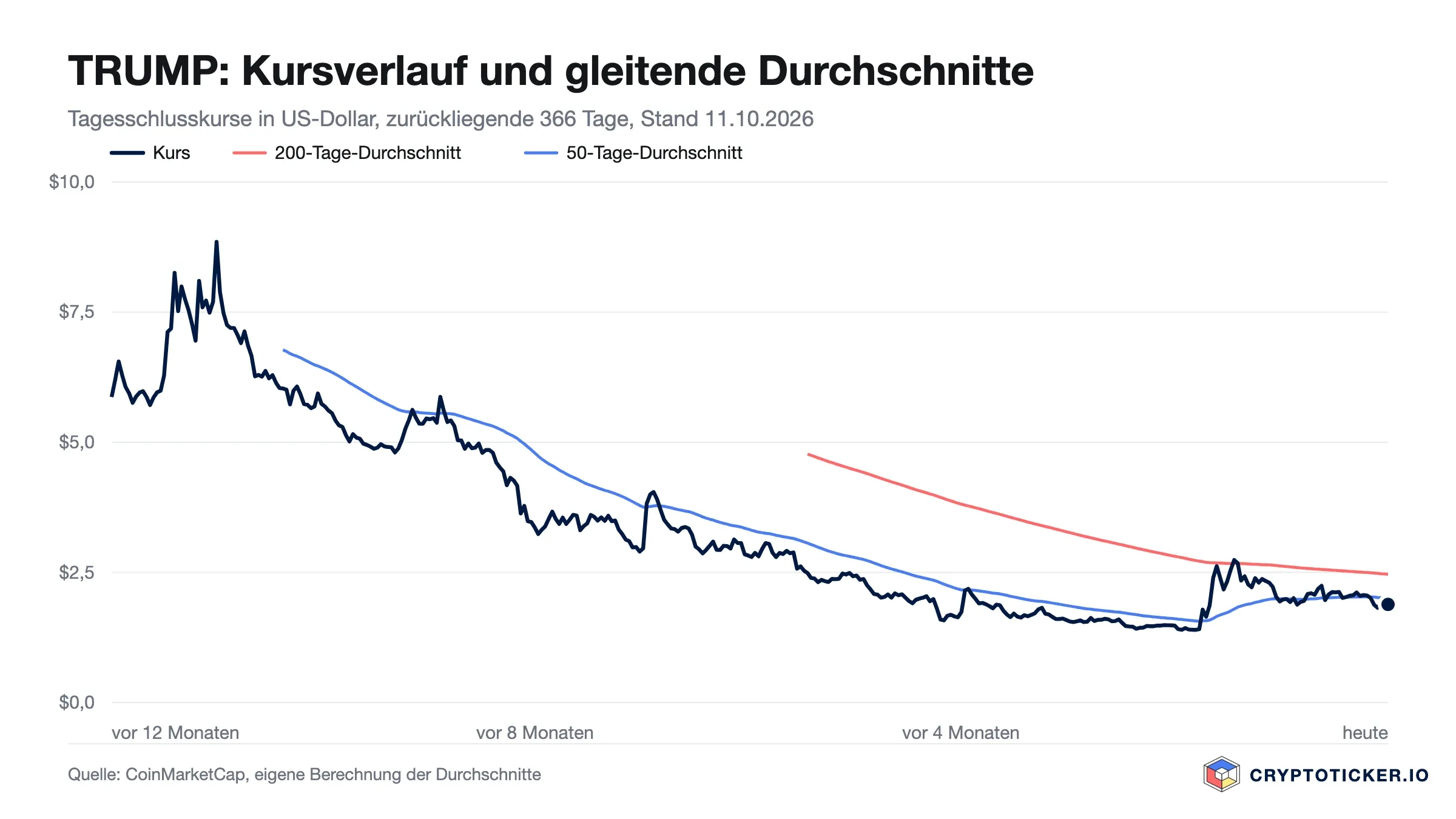
The gap to the record is vast. The all-time high came on January 19, 2025, the day before Trump's inauguration, at $73.43. That leaves 97.4 percent of the value gone. TRUMP hit its low so far on August 13, 2026 at $1.37 and has recovered by around 38 percent since. It still trades below its 50-day average of $2.00 and well below its 200-day average of $2.46. The downtrend, in other words, is intact.
One reason for the restraint lies in the supply figures. Of one billion TRUMP, only around 282 million are in circulation according to CoinGecko, or 28 percent. The rest sits with the companies behind the project and is released on a schedule. Every release is potential supply for sale, and a dinner does not change that. The market capitalisation stands at roughly $531 million, enough for rank 114 among cryptocurrencies.
How the ranking counts, and the handicap facing latecomers
The ranking measures the average balance across the whole period rather than the position on a single day. Holding for longer ranks you higher. That has a simple consequence for anyone still thinking of buying in: September 30 to November 12 is 43 days, and from this Sunday only 32 remain. A purchase made today reaches barely three quarters of the average that an equally large balance held since day one achieves. To overtake an early holder, a latecomer therefore needs considerably more coins.
Only wallets registered with the Coin Club count towards the scoring. Registration runs through an email address and a connected Solana wallet, and the dinner requires a separate sign-up, including for existing members. Coins sitting in an exchange account do not appear in the ranking. Participants in the previous event in Singapore can also receive a 10 percent bonus on their points once its result is final.
What investors in Germany should check before buying TRUMP
Whether a seat at the table is worth it is a matter of taste. Whether the purchase adds up can be checked. Four points belong before any order.
The real address. TRUMP is a token on Solana. The official contract carries the address 6p6xgHyF7AeE6TZkSmFsko444wqoP15icUSqi2jfGiPN, which is also how CoinGecko lists it. Imitators with similar names keep circulating around Trump. If you buy through a decentralised exchange, compare the address character by character.
Your own wallet. For the ranking, the coins have to sit in a self-custodied Solana wallet connected to the Coin Club. Our comparison of software wallets shows which programs qualify and how they differ on fees and security. If you only want to hold TRUMP as a price position, buy on an exchange licensed under MiCA; the comparison of crypto exchanges gives an overview.
The tax. Buying now and selling after the dinner keeps you well inside the one-year holding period under section 23 of the German Income Tax Act. A gain is then taxed at your personal rate once all private disposal gains for the year reach the 1,000-euro threshold. A loss can be offset within that period against other gains of the same kind. We summarised where the holding period stands politically after the vote in the Bundestag.
The risk. A memecoin has no earnings and no dividend; its price rests on attention. At the first dinner the attention arrived, and the price still fell afterwards. If you want to play, commit only money whose loss you can absorb. Our assessment of the memecoin rally covers what matters with memecoins more broadly.
What can still happen before the November 12 cut-off
A good four weeks remain until the cut-off, and the Federal Reserve's next rate decision at the end of October falls within that window. If the broader market drops, experience says a small coin such as TRUMP is dragged down harder. The dinners are also politically contested: critics speak of paid access to the president, as ABC News reports. The organiser expressly reserves the right to change, postpone or cancel the event. Anyone buying TRUMP in order to sit in Virginia on November 22 is therefore betting on two things at once: on a place among the 185 largest holders, and on the coin not losing further value before then.
The XRP price stands at $1.3937 on Sunday morning and has barely moved for the third day running. More interesting than the price this weekend is what is being voted on in the XRP Ledger: a clean-up update has reached the required majority of validators and arms itself automatically on Friday, October 23. The lending function, on which Ripple's business plan for 2027 hangs, by contrast still sits at 17 of the 25 votes needed.
Both figures come from the same source, namely the running amendment vote in ledger 107,580,127. You can look them up yourself without an account and without software, and that is exactly what this article sets out step by step further down.
XRP price at $1.39: three days without direction
Daily closing prices on the Kraken exchange were $1.3944 on October 9, $1.4010 on October 10 and most recently $1.3937 today, October 11. The high and low of the current day sit at $1.4104 and $1.3862, a spread of barely 1.8 percent. Over the average of the past 30 days, the daily range was 5.6 percent.
On a weekly view it looks different. Since the closing price of $1.5202 on October 4, XRP has lost 8.3 percent. The break came on October 7 and 8: from the October 6 close of $1.4970 the price fell to a daily low of $1.3177 on October 8, a drop of barely 12 percent in two days. Market capitalisation stands at around $88 billion according to CoinGecko, with trading turnover over the past 24 hours at about $708 million.
An amendment in the XRP Ledger: 25 of 32 votes and a two-week deadline
An amendment is a change to the rules of the XRP Ledger itself, comparable to a law that takes effect only once enough members of parliament approve it. Unlike a software update, it is not Ripple that decides when it applies but the validators, meaning those servers that confirm new blocks.
The procedure is hard-wired and runs without human involvement. If around 80 percent of the validators on the default list vote for a change, the ledger records the moment. If that majority holds for two weeks straight, the amendment switches itself active. Should support fall below the threshold even once during those two weeks, the clock starts over. The default list currently comprises 32 validators, which puts the threshold at 25 votes.
Two things follow from that for holders. You do not have to do anything, because your coins sit unchanged in the ledger. And you can read off the timetable of a function before a press release confirms it.
fixCleanup3_4_0 activates on October 23, two weeks after the majority
On October 9 the amendment with the unwieldy name fixCleanup3_4_0 reached the majority. The ledger has been running the clock since then, and 26 of 32 validators currently stand behind it. If the deadline runs through without a relapse, the change becomes active on the morning of October 23.
The name already says what it is about: tidying up. Fix amendments of this kind remove old code no longer needed since earlier versions and clear up small inconsistencies in the rulebook. For the price that has no consequences, but for placing the vote it is instructive. The validators decide on technical corrections in a matter of days. In the four days from October 8 to 9, three other amendments became active, among them PermissionDelegationV1_1 and BatchV1_1.

LendingProtocol at 17 votes: three more than on October 6
With the lending function it looks different. The LendingProtocol, which allows loans to be issued and collateralised directly through the ledger, sits at 17 of 32 validators. When we wrote about Ripple's lending plan and the lending amendment on October 6, it was 14 votes. So three have come in over five days, and eight are still missing.
Extrapolate that pace in a straight line and the missing eight votes would be together in a good 13 days, after which the two-week deadline would come on top. That is purely a projection, however, and not a forecast: validators often vote in bursts, for instance when a new server version appears or an operator changes its configuration.
SingleAssetVault at 19 votes: the building block lending hangs on
A second point is usually overlooked in the discussion around lending. Directly above it in the list sits SingleAssetVault at 19 votes. A vault in this context is a collective pot in the ledger into which several users pay the same asset and out of which a protocol passes it on.
That pot is exactly what the planned lending needs, because without it there is no place for the lent capital to sit. The corrected version LendingProtocolV1_1 also sits at 17 votes. Three votes therefore hang together, and the foremost of them is still six votes short of the threshold.
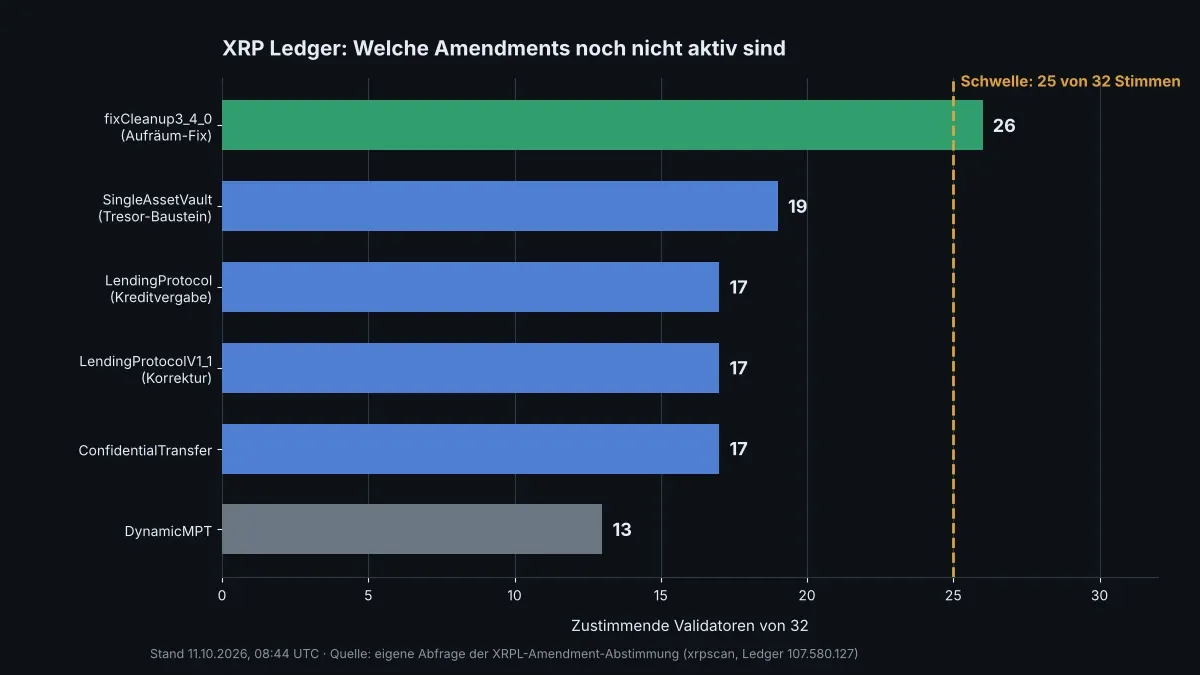
The vote count live: two sources with no account and no sign-up
You do not have to take anyone's word for this; you can fetch the figures yourself in a minute. Two routes lead there.
The first route is the explorer XRPScan. Its amendment page lists every change with three details: the number of approving validators, the threshold, and a note on whether the change is already active. To see how far the lending function has come, find the LendingProtocol row there and read the column with the votes.
The second route is the ledger itself, via a public node. A request using the feature method to an XRPL server returns every amendment with the fields enabled and supported; a request using ledger_entry with the amendments switch additionally delivers the Majorities entry. Where a change appears there with a timestamp, the two-week clock is running for it. That is exactly how October 23 came about in this article. Which names belong to which function is set out in the amendment overview in the XRPL documentation.
The difference from a price report is tangible. A vote count can be recounted and changes slowly; a price changes by the second. Holders of an XRP position who want to know whether the promised functions are drawing nearer have the more reliable guide in the vote count. If you are only looking to build a position in the first place, it pays to look at fees and custody beforehand, because those differ markedly between providers: our comparison of the best crypto exchanges sets that out for the European market.

From the October 8 slump to today: $1.4073 as the midpoint of the range
Back to the chart, and with levels that can be justified. The slump from October 6 to 8 led from $1.4970 to $1.3177. The midpoint of that stretch sits at $1.4073. The price has been stuck there for three days, currently barely one percent below it.
That midpoint is interesting because a market often runs back to it after a fast loss and then shows where it really wants to go. October 10 came just past it with a daily high of $1.4117, and today came close to it at $1.4104. On neither day did the price hold above that midpoint. Above it, the next justified level is the 50-day line at $1.4309, that is 2.6 percent above today's level.
Levels to the downside: $1.3177 and the 200-day line at $1.2797
To the downside the first level is the daily low of October 8 at $1.3177. Below that, at a clear distance, follows the 200-day line at $1.2797, calculated from the daily closing prices of the past 200 trading days. The current price sits 8.9 percent above it, so that buffer is there.
For context over a longer period: the monthly high was $1.5723 on September 22, the monthly low $1.2826 on September 15. Today's price sits almost exactly in the middle of that range.
Interest from lending and tax: a €256 exemption limit, one year holding period
Should the lending function actually go active, it pays to know the tax treatment beforehand, because it concerns two separate pots.
The first pot is the coins themselves. Under Section 23 of the German Income Tax Act, gains from the sale of privately held cryptocurrencies are tax-free where more than a year lies between purchase and sale. Within the year an exemption limit of €1,000 applies to all private disposals taken together. Whether lending extends the holding period to ten years was an open question for a long time. The Federal Ministry of Finance answered it in the negative with its letter of May 10, 2022, so the one-year period remains in place for lending and staking too.
The second pot is the interest. It counts as other income under Section 22 number 3 of the German Income Tax Act and is taxable at your personal rate as soon as it exceeds €256 in the year. That is an exemption limit, not an allowance: at €257 the full amount is taxable, not just one euro of it. Holders with several sources should note the inflows, because the total is what counts. A tax tool connected to the wallet takes that bookkeeping off your hands.
One point of context that is often missing: the European crypto regulation MiCA governs trading, custody and exchange by supervised service providers. Lending through a protocol does not fall under it. Anyone lending through such a protocol therefore has no investor protection under MiCA and carries the risk of the program code alone. Centralised providers are to be distinguished from that; depending on their structure they are subject to other rules. Which models exist and where the differences lie is shown in our comparison of crypto lending providers.
Our assessment: the vote currently weighs more heavily than the chart
In our editorial view, the vote count in the ledger is the more honest indicator for the coming weeks than the price action. The evidence sits above: three technical amendments became active in four days, and a fourth has a fixed date on October 23. The three building blocks of lending, by contrast, sit at 17, 17 and 19 of the 25 votes needed and have advanced by three votes in five days.
What follows for us: the ledger's technology is visibly moving on, while the business plan meant to turn it into revenue hangs on a vote that cannot be sped up. There is one serious argument against that. Votes in the XRP Ledger tip in bursts rather than linearly, and a single server update can switch several validators at once. The 13-day projection above is therefore a calculation and not a promise. No buy recommendation is meant in either direction: we assess the situation, the decision stays yours, and a total loss is possible at any time with cryptocurrencies.
XRP vote: until October 23 the counter decides, not the chart
Three things can be taken from today's situation, each with a figure behind it.
- October 23 is fixed, the lending function is not. fixCleanup3_4_0 activates on that Friday with 26 votes behind it. LendingProtocol needs eight further votes for the same, and there is no deadline for it so far. Followers of XRP's further development have the earlier signal in the vote count than in any announcement.
- The range between $1.3177 and $1.4309 is the frame. Between them, at $1.4073, sits the midpoint of October's slump, where the price has hung for three days. Only a daily close clearly above $1.4309 or below $1.3177 shifts the picture.
- Interest above €256 a year is taxable, the coins after one year are not. Keeping those two pots separate saves work in the spring. Holders wanting to keep the coins in permanent self-custody need a device for it as well; our comparison of hardware wallets places the models.
(As of October 11, 2026. This article is not investment advice. Prices and fee structures change; check the terms with the provider before you buy.)
Decrypt
Zakura, a Zcash full node developer, says it expects hash-based signatures to land in Zcash in January, and is rolling out a privacy tool for rotating transparent addresses this week.
A proposed rule would expressly fold event contracts tied to sports, politics, culture and weather into the “swap” definition, while an interim rule excludes casino-style gambling—sharpening the agency’s claim to exclusive jurisdiction.
The Bermuda-based insurer, which runs entirely on Bitcoin, drew the funding from existing backers led by Bain Capital Crypto after a record year driven by demand from wealthy families in Asia, Europe and the Middle East.
Physicists at George Washington University say a formula can estimate when an AI chatbot will flip from good answers to bad ones, and early tests on small models back it up.
A National Assembly committee adopted amendments taxing stablecoin swaps and crypto exits by wealthy holders, then rejected the 2027 budget's revenue section.
U.Today - IT, AI and Fintech Daily News for You Today
XRP holds its ground despite the shock disclosure of a 10-year-old code flaw that put the entire network at risk.
599% drop highlights notable change in Dogecoin’s spot-flow picture, with the market now watching what comes next.
The market is changing rapidly, but the composition of the market's top-10 is surprisingly stable.
Nasdaq CEO Adena Friedman highlights huge capital opportunity as tokenization gains ground.
An anonymous GTA 6 leaker is threatening to release the entire game if a Solana-based meme coin reaches a $30 million market cap.
Blockonomi
TLDR:
- XRP price remained near $1.39 on Sunday, holding above recent support as the disclosure failed to trigger an immediate sharp selloff.
- Veria Labs estimated the vulnerability could create approximately 18.45 trillion XRP, threatening confidence in the existing token supply.
- Developers released the emergency repair on September 25, before public disclosure, and investigators found no evidence of exploitation.
- Separate lending amendments still depend on validator support, while the recent price recovery leaves overhead resistance unchallenged.
XRP price held near $1.39 on Sunday after researchers disclosed a critical vulnerability that could have created unauthorized tokens. The flaw affected the XRP Ledger payment engine and had remained hidden since 2015. Developers released a fix before publishing details, and investigators found no evidence of exploitation on public networks.
According to TradingView market data, XRP traded around $1.39, with its daily change remaining below 1%. Buyers continued defending recent lows despite the security disclosure. The muted response followed a difficult week, leaving traders focused on nearby support and whether the recovery could extend beyond the narrow weekend trading range.
XRP price Defends Support as Buyers Hold Recent Lows
XRP price continued trading above the 1.32–1.37 support zone after buyers absorbed the latest decline. The weekly chart showed a lower wick near $1.32, indicating buying interest below current levels.
That rebound kept the ascending support line connecting earlier lows in focus. However, holding support does not establish a lasting reversal. A stronger recovery would require sustained demand above the current range.
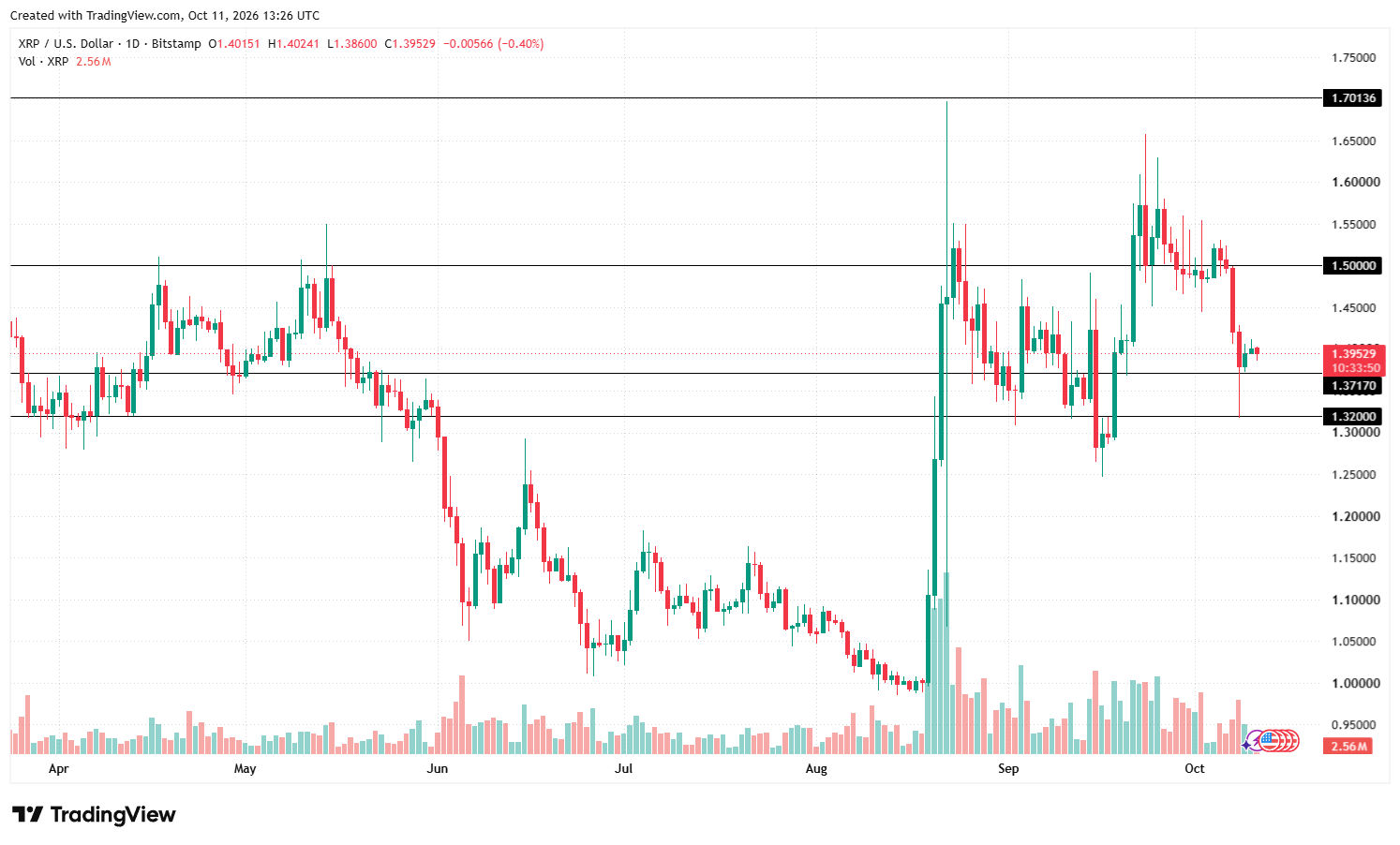
The broader resistance area remains between $1.50 and $1.70, where earlier weekly highs could attract selling. Until buyers reclaim those levels, the recent stabilization leaves the larger trading range intact.
XRP price also remained sensitive to broader cryptocurrency conditions. Bitcoin had retreated toward 80,000–83,000, adding pressure across digital assets. The limited weekend movement therefore offered evidence of stability, without proving that sellers had exhausted their positions.
The security report described a vulnerability already addressed, which may help explain the restrained reaction. That interpretation remains an inference, since price action alone cannot establish why individual traders bought or sold.
For XRP price, the immediate distinction is between defending support and clearing resistance. A brief recovery from the weekly low confirms buying occurred there. It does not guarantee that the same zone will hold during another selloff.
Ledger Security Fix Arrives Before Public Disclosure
Veria Labs said its AI system identified the flaw on September 21. Researcher Cayden Liao validated the finding, which entered the bug bounty program on September 22.
The firm estimated that one transaction could create approximately 18.45 trillion XRP, around 184 times the original supply. Its $94 billion exposure estimate referred to existing token value, rather than money stolen.
Veria also cautioned that an attacker could not sell such an enormous amount at prevailing prices. The central threat was unauthorized supply undermining confidence in the asset.
The official October 9 disclosure explained that arithmetic overflow affected payment calculations and a separate supply safety check. Both calculations could wrap around, allowing newly created XRP to escape detection.
RippleX engineers confirmed the issue and released xrpld 3.4.1 on September 25. More than 80% of relevant validators upgraded that day. The emergency protection took effect through software upgrades instead of the usual amendment activation process.
Veria reported receiving the maximum critical bounty of $250,000 on October 8. The official investigation found no evidence that attackers exploited the flaw on any public network.
Meanwhile, XRP price traded quietly as separate network amendments remained under review. Official documentation lists the lending feature as open for voting. Its activation depends on validator support, rather than a predetermined commercial launch schedule.
The proposed lending framework would add native borrowing functions, while associated vault amendments would support pooled assets. These changes are separate from the emergency overflow repair. Their voting status measures progress toward deployment, but does not measure future demand for XRP or establish how much lending activity the network will eventually attract commercially.
Ordinary amendments require sustained validator approval before activation. Losing the required support interrupts that process. The ledger records amendment status and majority timing, allowing observers to distinguish proposed functionality from features already available on the network.
The post XRP price Holds Near $1.39 After Critical Ledger Flaw Disclosure appeared first on Blockonomi.
TLDR:
- The Kalshi investigation examines three bets placed before Katie Zacharia was publicly identified as the next White House press secretary.
- Wagers of approximately $19, $74 and $80 carried expected payouts totaling $9,608, although those figures do not represent net profits.
- Kalshi has confirmed the inquiry but has not publicly established that the traders used confidential information or breached its rules.
- Employment disclosures and congressional scrutiny put prediction markets under closer review as platforms address risks involving nonpublic information.
The Kalshi investigation into bets on Katie Zacharia is examining trades placed before her White House appointment became public. At least three wagers could deliver substantial payouts from small stakes, according to reporting by The Wall Street Journal.
Traders backed Zacharia before news outlets identified her as President Donald Trump’s next press secretary on Friday. The market had previously assigned her roughly a 1% chance of securing the role.
Kalshi confirmed its inquiry but withheld details about the accounts involved. The timing has drawn scrutiny, although the reported bets alone do not establish that anyone traded using confidential government information.
Kalshi Investigation Examines Timing and Potential Payouts
The Kalshi investigation centers on one Thursday evening wager and two trades placed shortly before Friday’s reports. A $19 position carried an expected payout of $1,896.
Two further wagers, worth approximately $74 and $80, were placed at 1:41 p.m. Friday. Their expected payouts were $3,689 and $4,023, respectively. News reports identifying Zacharia began appearing around 2 p.m.
These figures describe potential settlement payouts rather than confirmed net profits. The amounts also exclude any adjustment for fees. A large percentage return can follow a successful bet on an outcome initially considered unlikely.
The Kalshi investigation has not publicly established how the traders chose their positions or whether they shared information. Publicly visible transactions show timing and amounts, but they cannot independently establish a trader’s knowledge or intent.
Trump subsequently announced Katie Zacharia as his choice through Truth Social. She previously worked as a Department of Homeland Security spokesperson and advised Trump Media on communications.
She will replace Karoline Leavitt, who left the press secretary position earlier this year. The White House referred Trump’s announcement when asked about the inquiry.
Trader identities remain confidential to the public, while Kalshi retains internal identification records for compliance purposes. Those records give the platform information unavailable to outside observers reviewing market activity.
No publicly announced finding in the Kalshi investigation has linked these accounts to officials involved in the appointment. Neither the size of the payouts nor the timing resolves that question.
Political Betting Faces Tougher Monitoring and Oversight
The Kalshi investigation follows a separate enforcement case involving former White House teleprompter operator Gabriel Perez. In August, the Commodity Futures Trading Commission settled charges over his use of advance access to presidential speeches.
The regulator ordered Perez to return $107,539.02 in trading profits and pay a $65,000 civil penalty. It also imposed a three-year trading ban. The repayment and penalty represent distinct components of the settlement.
That established case provides context for the Kalshi investigation without determining its outcome. The Zacharia traders have not been publicly shown to possess comparable access to nonpublic material.
Scrutiny of prediction markets has also prompted changes to platform controls. In June, Kalshi introduced employment disclosures for markets carrying heightened risks of insider trading or manipulation.
The company reported more than 150 investigations during the first quarter, alongside over 20 referrals to law enforcement. It also disclosed five disciplinary actions and screening tools that blocked more than 100 potential insider trades.
Those figures cover the broader enforcement program rather than findings about the appointment wagers. An investigation or referral does not itself establish a completed rule violation.
Its update introduced new tools for reporting suspected misconduct. Users can submit tips directly to the surveillance team through individual markets.
Congress is separately examining safeguards across prediction markets. House Oversight Committee Chairman James Comer launched an inquiry involving Kalshi and Polymarket in May.
The committee has requested information about identity checks and systems for detecting suspicious activity. In a subsequent update, it reported receiving nearly 1,000 documents and five briefings from representatives of the two platforms.
The post Kalshi Investigation Examines Bets on Katie Zacharia Selection appeared first on Blockonomi.
TLDR:
- Papertrade exploit allegations involve two wallets’ reported $20 million Hyperliquid orders, 10–20 basis points of ETH movement, and much larger Papertrade longs.
- Papertrade uses Hyperliquid’s best bid and offer midpoint for synthetic fills, creating a documented price-reference risk that remains an allegation in this case.
- Hyperliquid uses separate oracle and mark prices for its own margin and liquidation safeguards, so the claims do not establish a breach of its native systems.
- No independent wallet analysis, verified loss amount, compensation plan or Papertrade response was available in the October 11 reports reviewed.
Papertrade exploit allegations surfaced October 11. X user Boblob (@Dr_bobo54) claimed two wallets placed roughly $20 million each in Ether trades on Hyperliquid. He said the trades moved ETH quotes 0.1%–0.2%. The wallets allegedly held leveraged Papertrade positions worth hundreds of millions of dollars.
Trader Rune (@RuneCrypto_) shared the warning. No independent analysis had confirmed the manipulation, wallet identities, profits or losses. Papertrade had not issued a confirmed public response in reports published that day. Claims focus on its pricing design. Papertrade uses Hyperliquid’s best bid and offer midpoint to price synthetic trade entries and exits. The market impact remains unclear.
Papertrade Exploit Claims Center on $20M ETH Trades
The researcher said orders shifted ETH quotes roughly 10 to 20 basis points. A basis point equals 0.01%, making that move approximately 0.1% to 0.2%. He claimed the same wallets held long positions on Papertrade, with combined nominal exposure in the hundreds of millions. Long positions can magnify small quote changes when notional exposure far exceeds the margin posted by the trader.
Rune flagged the Papertrade exploit risk in its own published risk disclosures. However, initial reports did not include wallet addresses, transaction hashes or independent transaction analysis. The Papertrade exploit remains unverified; public claims have not established that any account profited from the price moves.
Papertrade launched recently on HyperEVM, the smart-contract environment connected to Hyperliquid. It uses synthetic swaps between each trader and its liquidity pool, rather than matching users through a Papertrade order book. When a position opens or closes, the protocol reportedly reads Hyperliquid’s best bid and best offer. It uses their midpoint as the fill price. The platform supports leverage up to 1,000 times on supported Bitcoin and Ethereum markets.
The Papertrade exploit theory centers on the use of another venue’s midpoint as a reference price. A new order can shift the best bid or offer before it executes. Rune argued that such a move could change Papertrade’s quoted price while a much larger position remains open. The documentation reportedly identifies manipulation of the best bid and offer as an unresolved risk. That risk disclosure does not prove the suspected wallets exploited it.
Hyperliquid Price Safeguards Differ From Papertrade BBO
The alleged Papertrade exploit concerns how the protocol uses external prices, not evidence of a Hyperliquid system breach. Hyperliquid’s native perpetuals use separate oracle and mark prices for trading safeguards. Its oracle price is a weighted median of centralized exchange prices and updates about every three seconds.
The mark price combines several inputs, including Hyperliquid order-book prices and data from other trading venues. Hyperliquid uses it to calculate unrealized profit and loss, determine margin requirements and trigger liquidations. Papertrade’s reported BBO midpoint serves a different function: it determines synthetic trade entries and exits. The distinction matters when assessing which system may have been affected.
A separate, unaffiliated PaperJet description says Papertrade’s liquidity pool starts at zero and grows from traders’ realized losses. It also says profitable closes may wait in a queue if the pool lacks funds. PAPER tokens can be minted after eligible trading losses, and stakers may receive USDC distributions. Those mechanics describe possible settlement constraints, not confirmed effects from the current allegations.
A Hyperliquid-linked SK Hynix perpetual contract dropped 17.9% in July. An unusual South Korean transaction then affected its external price reference. Trade.xyz later said it would cover qualifying liquidation losses. That case involved a different contract and pricing arrangement; it does not confirm the Papertrade allegations.
Reports published October 11 did not establish whether the Papertrade exploit affected the pool. They left withdrawals and queued claims unconfirmed. The reports also lacked verified wallet identities, a loss amount, compensation or a timetable for changing the midpoint-based pricing system.
The post Papertrade Exploit Claims Follow $20M ETH Trades on Hyperliquid appeared first on Blockonomi.
TLDR:
- Starknet price advanced more than 50% in 24 hours on Sunday, with one market update recording a 54.87% gain while Bitcoin remained nearly flat.
- StarkWare is considering an independent Layer 1 that could give Starknet control over security changes rather than depending on Ethereum’s migration schedule.
- Eli Ben-Sasson said Starknet could target full quantum resistance by 2027, while Ethereum’s published roadmap places core upgrades around 2029.
- Crypto Patel cited STRK targets at $0.22, $0.80 and $2.40, a 0.063–0.045 dip zone, and partial profit-taking as risk management.
Starknet price gained more than 50% in 24 hours on Sunday as traders reacted to StarkWare’s warning that quantum computing could threaten blockchain signatures sooner than expected. Coingecko data shows a 54.87% daily rise at 06:00 UTC, while Bitcoin added just 0.25%. That Starknet price move followed CEO Eli Ben-Sasson’s comments about accelerating defenses against quantum and AI advances.
StarkWare is considering whether the Ethereum Layer 2 should become an independent Layer 1. No transition has been approved; the roadmap remains a target, not a finished upgrade. The security question has also become an important catalyst for short-term trading in STRK.
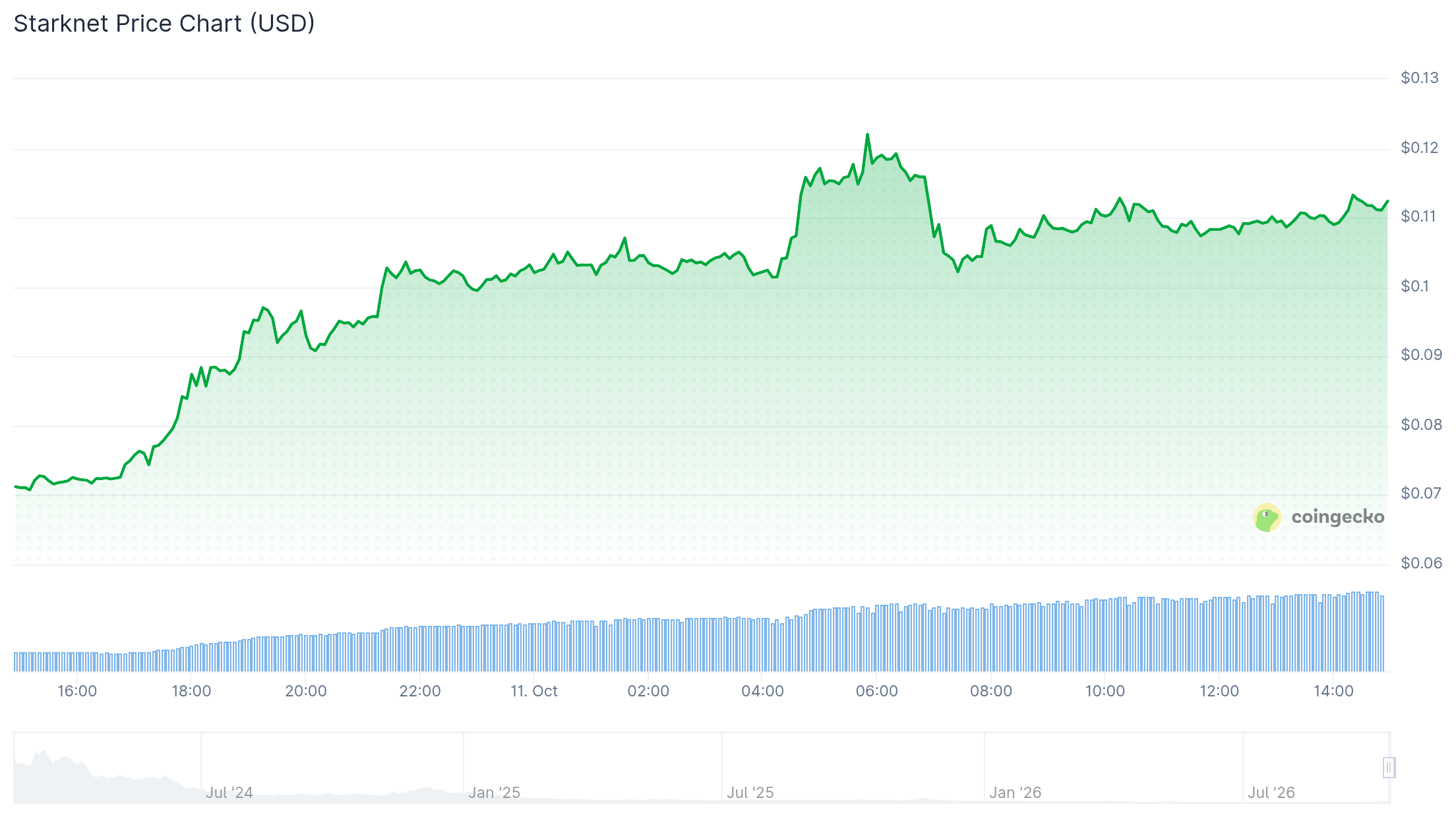
Starknet Price Rally Follows a Quantum Security Warning
Ben-Sasson said quantum threat “may be much closer than we think.” He argued that AI’s advances in mathematics could shorten the timeline for developing quantum computers capable of breaking wallet signatures. He did not say quantum computers can break signatures today; researchers still differ over when that capability may arrive.
Ben-Sasson’s “bunker mode” asks for suitable cryptography, frictionless upgrades, and possibly an independent L1. Starknet’s STARK proofs rely on hash functions considered quantum-resistant, but some elliptic-curve components remain on the roadmap. As an Ethereum L2, the network also relies on Ethereum’s security and upgrade timetable. The 2027 target does not mean every component is protected.
StarkWare has said it is actively considering an L1 transition, with 2027 as its target for becoming the first quantum-resistant network. Ethereum’s own stated goal for full L1 quantum resistance is around the end of 2029. Both dates remain targets. That two-year gap frames the debate. An independent L1 could give Starknet more control, but it would also make the network responsible for securing its own transactions.
An L1 switch would raise questions about how applications, users, bridges and liquidity would move. StarkWare has not disclosed a full migration plan, and the network has not formally adopted the change. The proposal must advance through Starknet governance before it becomes an implementation decision. The roadmap remains under development as security headlines affect trading.
Starknet price outpaced a mostly quiet market. On Sunday, Bitcoin held near $83,000 and its sentiment was bearish with low chatter; Ethereum was nearly flat, while sentiment for ETH reportedly turned extremely bearish. STRK drew stronger attention. Retail sentiment shifted from bullish to extremely bullish, and message activity stayed extremely high, according to the platform’s indicators.
Starknet Price Faces Volatility After a Fast STRK Rally
The Starknet price reaction mixes security concerns with speculative momentum; those forces can weaken independently as traders reassess the proposal and its execution timeline. Crypto Patel’s Starknet price analysis added a separate technical view on X. The commentator claimed STRK had advanced 437% from its cycle bottom and 215% from a breakout-zone retest, then listed targets of $0.22, $0.80 and $2.40. The analyst marked $0.063 to $0.045 as a possible buy-the-dip area and advised holders to consider partial profits. The levels are one trader’s thesis, not a StarkWare forecast.

Crypto Patel also cited a descending-channel breakout, a retest, and a change of character, or CHoCH, as signs he was watching for further entry. Chart patterns do not show whether buying will persist. A move far above a breakout zone can leave late buyers exposed if momentum fades or traders sell into strength.
For readers tracking the Starknet price, the mismatch between speculative targets and the token’s fast move matters. Technical analysis put STRK near $0.109 at 06:00 UTC, so the proposed dip zone sat materially below the reference price. That sat below the proposed buy-the-dip zone, while the analyst’s first upside target of $0.22 was about 102% above the Sunday reference price.
The post Starknet Price Rallies 52% as Quantum Security Sparks Demand appeared first on Blockonomi.
TLDR:
- The Bitcoin price fell 3.6% for the week after touching $80,400, then recovered above $83,000 following Thursday’s sharp decline.
- NEAR lost just 0.3% in the weekly comparison after a 91.7% monthly advance, then jumped more than 10% to about $5.25 on October 10.
- Monero’s 1.3% weekly decline beat Bitcoin’s loss, though price performance alone cannot show whether trading activity or buying demand drove the difference.
- Bitcoin ETF outflows reached $244 million in one day, while XRP funds saw $8.2 million in inflows even as XRP fell 9% for the week.
The Bitcoin price fell to a weekly low near $80,400 on October 8 as a crypto market selloff accelerated. By October 9, BTC had recovered to $83,247, leaving it 3.6% lower for the week. Most large tokens lost more over that same seven-day period.
NEAR Protocol and Monero were exceptions, down 0.3% and 1.3%, respectively, in the weekly comparison. Yet those figures capture only one point in a volatile stretch. NEAR had climbed 91.7% over the prior month, then rose more than 10% on October 10. The Bitcoin price and altcoin moves show resilience in the data, but not its cause.
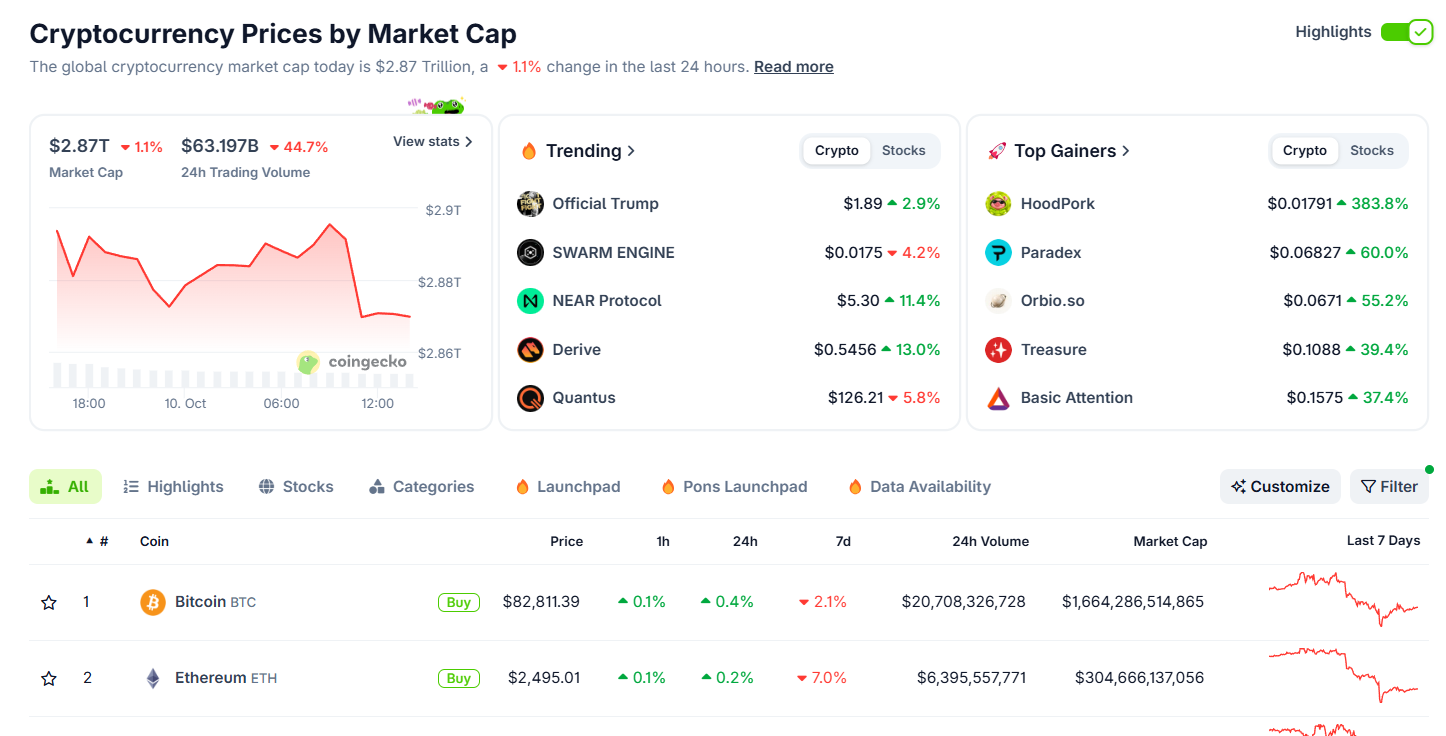
Bitcoin Price Slide Put NEAR and Monero Under Scrutiny
The selloff followed several failed attempts by BTC to reclaim $87,000. After slipping below $84,000 earlier in the week, Bitcoin fell to $80,400 on Thursday. The decline erased nearly $7,000 in a few days before buyers lifted BTC above $83,000. Bitcoin price weakness contrasted with the narrower weekly losses in NEAR and Monero.
NEAR’s small weekly drop deserves context. Its token price had climbed 91.7% in the previous month. That run can change how a weekly selloff appears. Even an intraday pullback may leave a token close to its starting price for the week. NEAR then gained more than 10%, reaching roughly $5.25 on October 10.
BTC price rebound shows how quickly the comparison shifted as prices recovered. Monero’s 1.3% loss also compared favorably with BTC. But a small decline alone cannot show whether buyers were accumulating, holders were inactive, or trading was thin.
ETF Flows and Weekend Recovery Point to Uneven Demand
Gains were not broad among large-cap coins. Thirteen of 16 tracked major tokens fell more than BTC during the measured week. Stellar posted the steepest decline at 13.5%. XRP lost 9%, despite XRP funds recording $8.2 million in inflows. Bitcoin ETFs, meanwhile, had $244 million in daily net outflows. Those flows complicate a simple demand narrative. Positive fund subscriptions did not protect XRP from falling. BTC declined despite its ETFs recording daily net outflows.
Bitcoin’s dominance increased to 59.5% as its market capitalization stood around $1.66 trillion. The total crypto market value rebounded to about $2.8 trillion after losing roughly $200 billion from its high to low. ETH recovered toward $2,500 after falling to $2,400, while XRP moved from $1.34 to around $1.41. The bounce restored some lost value but left several large tokens below recent levels.
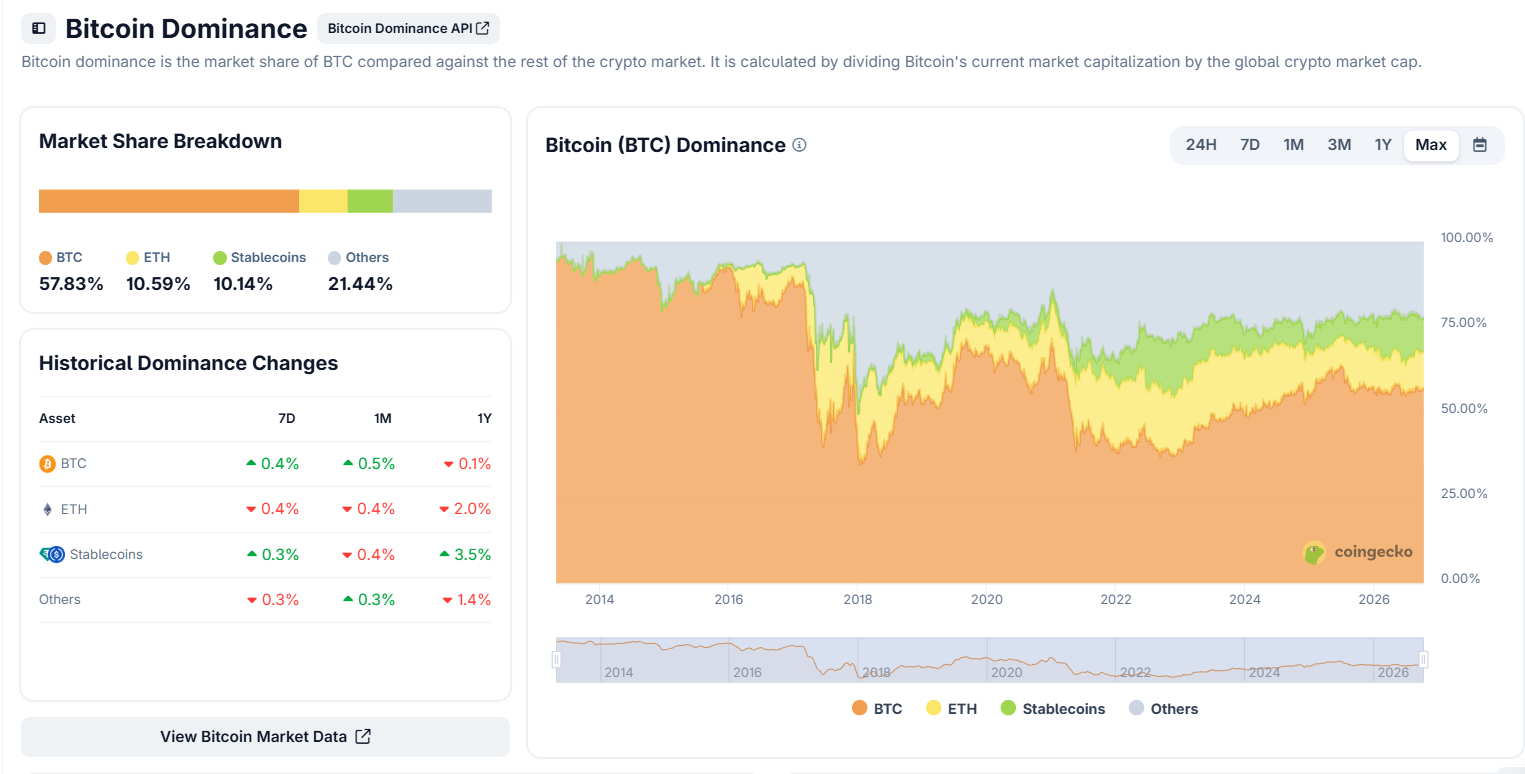
NEAR and ADA led the daily rebound among larger altcoins. Cardano rose about 7%, reclaiming $0.255, while NEAR’s advance outpaced peers. The Bitcoin price remained near $83,000 on October 10, below Monday’s $87,000 test and above Thursday’s low. This places the weekly outperformance beside a quick bounce, without confirming a lasting change in market leadership.
That matters for the Bitcoin price beside smaller tokens. Daily changes can look calm if trading is light, but weekly returns alone do not reveal activity. The same result can emerge from steady demand, limited selling, or a sharp drop followed by a rebound.
The post Bitcoin Price Holds Near $83K as NEAR and Monero Defy Selloff appeared first on Blockonomi.
CryptoPotato
Let’s start with a quick disclaimer – we used to write a lot of similar articles several years ago. The reason was simple: searches on Google typically show the demand for the cryptocurrency industry among retail investors. After all, institutions don’t go to the world’s largest search engine to ask about buying BTC or altcoins. They have their own methods.
However, the tide has turned since then, as retail investors have shown a different attitude. The charts we will display in this article prove that the actual Google queries about BTC or crypto as a whole plummeted, especially during bear market years. Now, though, there’s an interesting change.
Buy Crypto Is Back
The first chart below shows that ‘buy crypto’ searches plummeted at the end of 2021 – right at the time when BTC and the alts were charting then-ATHs, and went below 20 for over a year; yes, it coincided with the bear market. They picked up slightly in May 2024 (as prices soared), dropped again as the market cooled, and jumped high at year-end when BTC and the alts were booming after the US presidential elections.
Another decline followed in mid-2025 as the market experienced a fresh drop, and it surged to a five-year high in August. Shortly after, bitcoin marked a new (and its latest) all-time high of just over $126,000. After the October 2025 crash, the leading cryptocurrency went into a 10-11-month-long bear market, in which searches for ‘buy crypto’ decreased significantly.
The yearly bottom came in July when BTC slumped to under $58,000, and most alts struggled just as much. Since then, though, the searches have risen sharply and are projected to beat the 2026 record in October. Needless to say, prices have recovered, and we are far from the recent lows. In other words: the retail pattern has repeated perfectly again.

What About Bitcoin?
The landscape around BTC itself is less straightforward. The ‘buy bitcoin’ searches were below 40 on average for four straight years – from late 2021 to late 2025. Even the US elections couldn’t really break that negative streak. They finally picked up in August 2025, just a few months before BTC’s rise to $126,000, dipped again by January, before suddenly soaring to a new multi-year peak in February.
That was a one-month thing, as the queries quickly dropped to 40-50 for the next few months. Although they jumped again in September, the October projections are quite different than those for ‘buy crypto,’ as current Google Trends data shows a massive decline toward 20. As such, it’s somewhat safe to determine that even if retail is indeed coming back, they are not looking specifically for BTC.

The post ‘Buy Crypto’ Google Searches Hit Yearly Highs: Is Retail Coming Back? appeared first on CryptoPotato.
Bitcoin’s weekend sluggishness continues as the asset has barely moved from $83,000 over the past 36 hours, but more volatility is likely to hit later today or tomorrow morning.
The larger-cap alts have also failed to produce any significant moves in either direction in the past day, but there’s a new rockstar among the mid caps.
BTC Calms at $83K
The primary cryptocurrency started October with a bang, surging to over $87,000 on the second day of the month. However, the bears quickly interfered and pushed it south to under $84,000 on the same day. It rebounded last weekend toward $85,000 before it tried to break out again on Monday morning, only to be stopped at $86,600 this time.
The following legs down were a lot more painful. At first, bitcoin crashed to $83,600. It bounced to $84,400 before the bears took complete control of the market and drove it south to $82,400 on Wednesday and to a multi-week low of $80,400 on Thursday. After losing nearly $7,000 in just a few days, the cryptocurrency was due for a rebound, which took place on Friday.
However, the bulls’ attempt was stopped at $83,500. Since then, the asset has been trading sideways at around $83,000 without any major moves. More volatility is likely to ensue later tonight or tomorrow morning after the new attacks against Saudi Arabia and President Trump’s hint that the US could join the fight.
Bitcoin’s market cap remains at $1.660 trillion, while its dominance over the alts is at 59.5% on CMC.
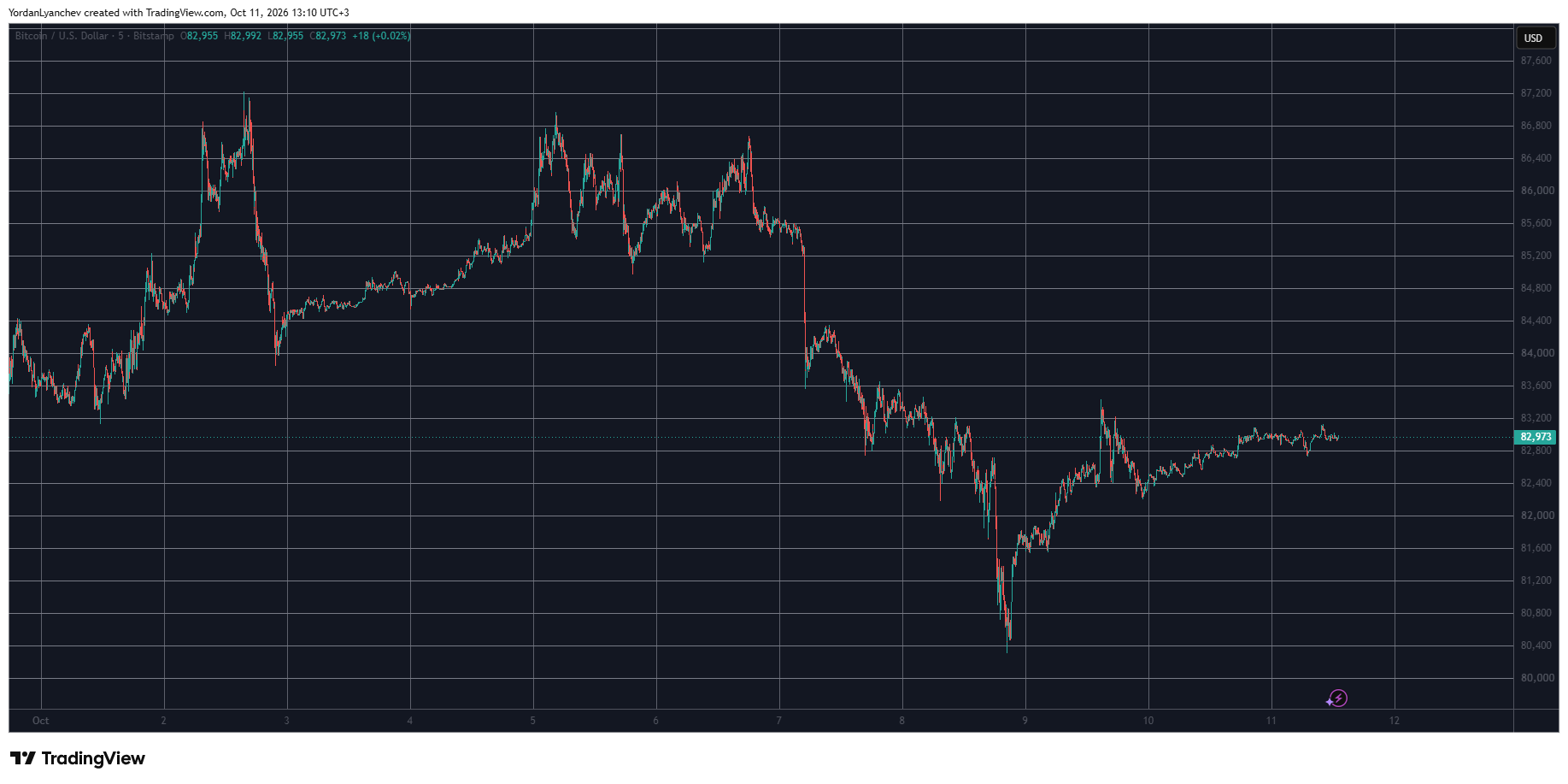
3 Double-Digit Gainers
As mentioned above, there’s little to no movement among the larger-cap alts. ETH is close to $2,500, XRP has dipped below $1.40, while ZEC and HYPE are up by around 1%. BNB, SOL, TRX, DOGE, XMR, LINK, and ADA are slightly in the red.
At the same time, STRK has stolen the show today, skyrocketing by over 53% to almost $0.11. The asset is up by over 105% in the past week. The other double-digit gainers are TIA (21%) and AERO (15%). The former trades at close to $0.60, while the latter is up to $1.
The cumulative market cap of all crypto assets stands still at $2.8 trillion on CMC.
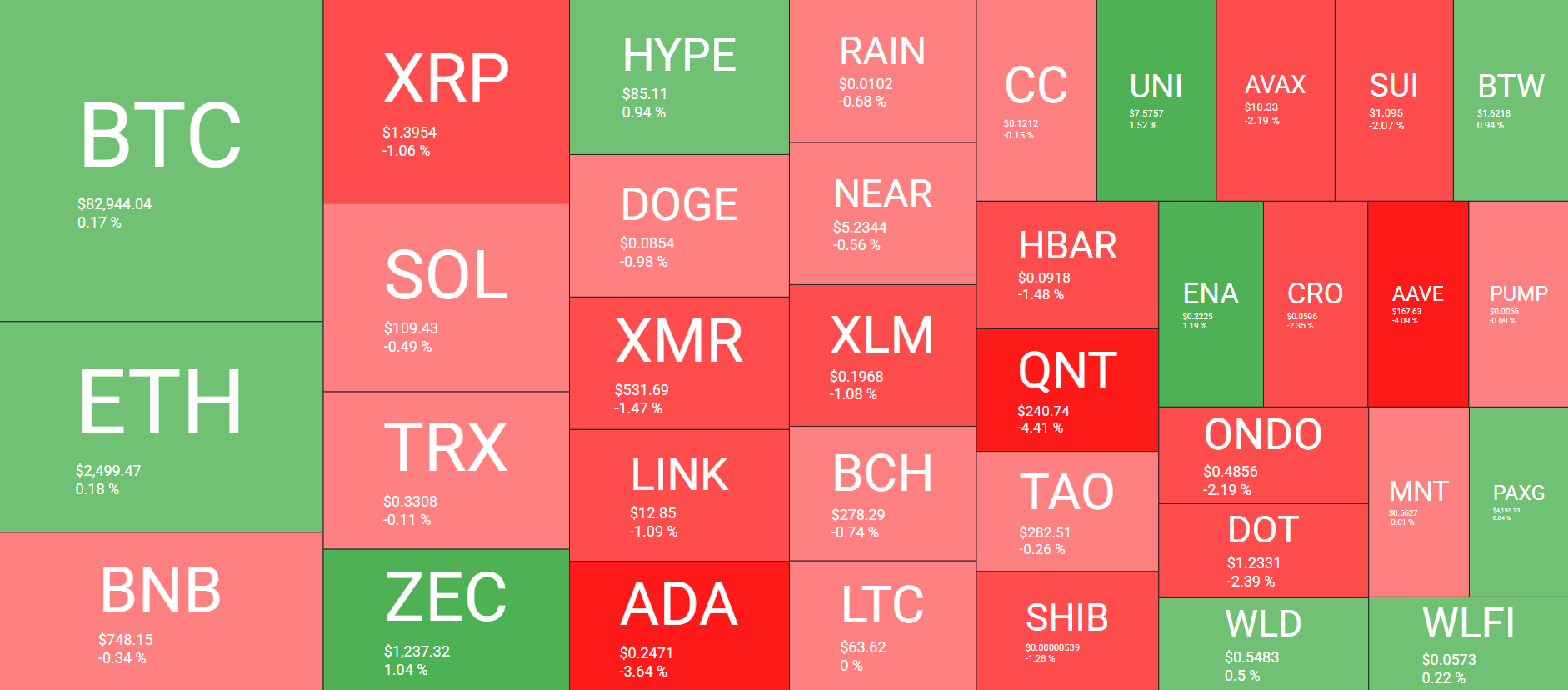
The post Viral Altcoin Defies Market Slumber With 53% Surge, BTC Calms at $83K: Weekend Watch appeared first on CryptoPotato.
The Asian country has added another 23 tonnes of gold to its reserves in September, which became its largest monthly purchase in roughly three years.
Other central banks, including those from Poland, Uzbekistan, and Kazakhstan, have been accumulating the precious metal as well in substantial portions over the year.
China Keeps Buying Gold
The Kobeissi Letter highlighted over the weekend that the People’s Bank of China purchased approximately 23 tonnes of gold in September, beating its previous 2026 record in terms of monthly purchases. This marked its 23rd consecutive month of buying and followed additions of roughly 20 tonnes in both July and August.
The world’s most populous country has bought more than 100 tonnes of the bullion in 2026, and its reported reserves have skyrocketed to 2,410 tonnes.
China has become the fifth-largest gold holder, trailing the US, Germany, Italy, and France. However, the analysts at the Kobeissi Letter said China is likely to surpass Italy and France as early as this year at this pace, as both European nations hold 2,452 tonnes and 2,437 tonnes, respectively.
BREAKING: China’s central bank officially bought +23 tonnes of gold in September, its largest monthly purchase since September 2023.
This follows +20 tonnes purchased in both August and July, and marks its 23rd consecutive monthly gold purchase.
So far in 2026, China has officially acquired +103 tonnes of gold, raising total holdings to a record 2,410 tonnes.
China is now the world’s 5th-largest gold holder, following the US, Germany, Italy, and France.
At this pace, it could surpass Italy and France as early as this year, which hold 2,452 tonnes and 2,437 tonnes, respectively.
China is aggressively buying the dip in gold.
— The Kobeissi Letter (@KobeissiLetter) October 9, 2026
The bullion’s price soared to $4,700/oz during the mid-August breakout rally, but it was rejected and dipped to $4,060 earlier in October. It recovered some ground to $4,194/oz as of Friday’s close.
Not Just China
Data from the World Gold Council shows that global central banks reported 39 tonnes of net purchases in August alone, following 23 tonnes in July. China led August with 20 tonnes, but several other countries followed suit.
The National Bank of Poland added 8 tonnes, taking its 2026 purchases to almost 100 tonnes and its total reserves to roughly 648 tonnes. Uzbekistan also purchased 8 tonnes in August, while Kazakhstan added 7 tonnes.
A WGC survey found that 84% of central banks expected gold to represent a larger share of global reserves five years from now.
The post China’s Gold Buying Spree Accelerates as Central Banks Keep Stockpiling Bullion appeared first on CryptoPotato.
The weekend is going relatively calmly for bitcoin and most of the crypto market, as is typical, but another macro event in the past several hours threatened to disrupt that.
Yemen’s Houthis reportedly attacked the King Khalid International Airport in Riyadh, Saudi Arabia, with at least 12 people killed and over 300 injured. Saudi Arabia’s authorities have vowed to respond to the attack, while the Houthis are yet to comment on it.
Fighting in the region has escalated in the past week or so, as another three people were killed in separate Houthi strikes on two different Saudi airports on October 6 and 7.
International authorities, as well as US Secretary of State Marco Rubio, strongly condemned the recent attacks. Rubio even confirmed an American citizen was killed. Meanwhile, US President Donald Trump suggested that his country is likely to join the strikes against the Houthis:
“We may. We’re going to look at it. We just found out about the recent attack, so we’ll make a decision. We move very quickly.”
The consequences for bitcoin and the altcoins are not evident yet. BTC has remained close to $83,000, while most alts have remained sideways over the past 24 hours. However, history has taught us that the real volatility arrives on Monday morning when most financial markets start to open.
Recall the events from last week. The tension in the Middle East skyrocketed over the weekend again, with Iran saying it has prepared for a fresh US bombing campaign after Trump’s top security officials met at Camp David on Friday in a meeting focused on that war.
BTC stood in a well-defined range over the weekend, before the fluctuations began on Monday morning with an unsuccessful breakout attempt and a violent rejection.
The post Bitcoin Price Under Pressure as Houthis Attack Saudi Arabia and Trump Signals US Involvement appeared first on CryptoPotato.
Most major cryptocurrencies tanked over the past several days, led by bitcoin’s nosedive from $87,000 to under $81,000, which became its lowest price tag in well over two weeks.
Large altcoins such as XRP and ETH were not spared, with the former posting a double-digit decline over the past seven-day period. The question now is what whales were doing during this time, and what’s next for the underlying assets.
The BTC Case
Some of the most probable reasons behind BTC’s crash include substantial ETF outflows, FUD initiated by big transfers from the US government, macro news, and profit-taking. It’s worth exploring what whales did during this time of distress, and Ali Martinez pointed to a growing accumulation spree.
In a recent video on X, the popular analyst said these large market participants pressed the buy button hard on bitcoin, adding over $1.2 billion worth of the asset to their holdings in 72 hours.
In another bullish post, he explained that the TD Sequential has finally flashed a buy signal for the cryptocurrency on the four-hour chart. This came after the asset crumbled by 7% in a few days and hints at a potential rebound.
2/5 The TD Sequential is flashing a buy signal on Bitcoin’s four-hour chart.
It comes after $BTC fell 5.55%, from $86,976 on October 5 to $82,150 today.
The signal suggests this pullback may be nearing an end, with a rebound now worth watching. https://t.co/o9ZS4Q1anl
— Ali Charts (@alicharts) October 8, 2026
Here’s ETH’s Situation
The leading altcoin crashed hard as well, tumbling from over $2,700 to $2,400 before it found some support. Although it rebounded to $2,500 on Friday, where it was stopped, it still remains well in the red on a weekly scale.
According to Martinez, Ethereum whales didn’t just stand on the sidelines. They increased their holdings by 0.64%: in other words, they purchased around 166,000 tokens as the asset’s price corrected.
ETH’s 8% decline also led to a change in the TD Sequential indicator. Similar to BTC, the four-hour chart flashed a buy signal once the asset slipped below $2,550, where it currently sits. Martinez noted that the recovery can take ETH to somewhere between $2,620 and $2,650.
What About XRP?
Ripple’s native token remains down by double digits on a weekly scale, even though it rebounded from the local low at $1.34. On the plus side, the rejection at $1.51 and the subsequent retracement allowed whales to resume their accumulation spree.
Martinez said these big market players bought over 45 million tokens, worth around $63 million, during the nosedive. And, not to be outdone by BTC and ETH, XRP’s four-hour chart also saw a new buy signal, according to the TD Sequential.
“An earlier sell signal aligned closely with XRP’s local high. Now, the question is whether this buy signal marks a local low,” added Martinez.
The post BTC, ETH, XRP Crash Sparks Whale Accumulation as Buy Signals Appear appeared first on CryptoPotato.