Cryptocurrency Posts
Crypto Briefing
The NBA's push for prediction market data access could reshape sports betting regulations, impacting market dynamics and league integrity.
The post NBA wants access to prediction market data to catch manipulation appeared first on Crypto Briefing.
AI-driven DeFi integration enhances automation and security, empowering users with greater control and developers with streamlined innovation.
The post Aave MCP now connects with MetaMask Agent Wallet for AI-driven DeFi actions appeared first on Crypto Briefing.
The incident underscores the critical need for robust supply chain security and transparency in the hardware wallet industry to maintain trust.
The post Ledger investigates significant fund losses tied to CryptoBilis reseller appeared first on Crypto Briefing.
Penguin Solutions' AI-driven growth highlights the increasing importance of high-performance computing in the evolving tech landscape.
The post Bank of America initiates buy rating on Penguin Solutions amid AI boom appeared first on Crypto Briefing.
Sabi's innovation could democratize brain-computer interfaces, potentially transforming human-AI interaction and accessibility in technology.
The post Sabi raises $50M to build a wearable brain-computer interface that converts thoughts into prompts appeared first on Crypto Briefing.
Bitcoin Magazine
Bitcoin Magazine

UTXO’s Loren Asmus: The $300T Bond Market Is Bitcoin’s Next Frontier
Bitcoin is not a trade, says Loren Asmus of UTXO Management. It is a structural allocation that deserves a place in a portfolio because of its risk-adjusted returns. He shares what he heard at the Bitcoin Treasuries conference, why institutions that get involved tend to stay in, and why education is the real barrier.
Chapters:
0:00 Bitcoin Treasuries Conference: The Mood and Takeaways
1:54 How Institutions Have Reframed Bitcoin Since the ETFs
2:55 From “Getting Laughed At” to a 2.5% Allocation Study
5:15 Volatility, Drawdowns, and Where Bitcoin Fits in a Portfolio
7:09 UTXO’s Hedge Fund and Preferred Income Strategy
8:33 Why the Bond Market Is the Bridge: Bitcoin as a Credit Default Swap on Debasement
9:52 The Real Barrier Is Education, and Where the Money Comes From
12:45 Buying Opportunity or Warning? A Long-Term Allocation View
14:14 Underwriting an Asset With No Cash Flows: The Denominator
16:10 Why Institutions Stay In Once They Buy, and Final Thoughts
This video is for informational purposes only and does not constitute an offer to sell or a solicitation of an offer to buy any securities. Past performance is not indicative of future results. Investments in digital assets involve significant risk and may result in loss of capital. Both UTXO Management and BTC Inc., producer of BMTV, are owned by Nakamoto Inc. (NASDAQ: NAKA)
DISCLAIMER: The views and opinions expressed in this show are those of the participants and do not necessarily reflect the official policy or position of BTC Inc., Bitcoin Magazine, or any affiliated entities. This content is provided for informational and educational purposes only and should not be construed as investment, legal, tax, or accounting advice. Nothing contained in this show constitutes a solicitation, recommendation, endorsement, or offer to buy or sell any securities or financial instruments. Viewers should consult their own advisors before making financial or business decisions.
This post UTXO’s Loren Asmus: The $300T Bond Market Is Bitcoin’s Next Frontier first appeared on Bitcoin Magazine and is written by Patrick Green.
Bitcoin Magazine

Bitcoin Core developer responds to AI & Quantum Risk
Has AI really changed Bitcoin’s address security, or is it just fear-mongering? Bitcoin Core contributor Antoine Poinsot of Chaincode Labs joins Grace Remington and Sean Hagan to respond to Justin Drake’s viral post. He explains why security researchers need evidence before making claims, and what’s actually at stake with quantum computing risk. He also shares why preparing early matters more than reacting out of fear.
Chapters:
0:00 – Antoine Poinsot Responds to Justin Drake’s Bitcoin Address Security Claims
1:05 – What the Failed Summer Soft Fork Taught Bitcoin
2:35 – BIP 54 Consensus Cleanup: Fixing Long-Standing Bitcoin Bugs
3:44 – Why Bundle Four Fixes Into One Soft Fork
4:53 – Building Consensus to Activate BIP 54
6:53 – How Quantum Theft or Frozen Coins Could Break Trust in Bitcoin
9:08 – BIP 360 vs. BIP 361 vs. P2TR v2
10:38 – Why Hiding Public Keys Behind Hashes Is a Red Herring
11:52 – Lessons From the Coldcard Incident
12:29 – Reducing Single Points of Failure With Multisig and Liana
DISCLAIMER: The views and opinions expressed in this show are those of the participants and do not necessarily reflect the official policy or position of BTC Inc., Bitcoin Magazine, or any affiliated entities. This content is provided for informational and educational purposes only and should not be construed as investment, legal, tax, or accounting advice. Nothing contained in this show constitutes a solicitation, recommendation, endorsement, or offer to buy or sell any securities or financial instruments. Viewers should consult their own advisors before making financial or business decisions.
This post Bitcoin Core developer responds to AI & Quantum Risk first appeared on Bitcoin Magazine and is written by Patrick Green.
Bitcoin Magazine

Building the Berkshire Hathaway of Bitcoin | Twenty One Capital CEO Rapha Zagury
Twenty One Capital holds roughly 43,000 Bitcoin but trades at a discount, and CEO Rapha Zagury is working to fix that. He breaks down how to calculate Twenty One’s mNAV, why he doesn’t love the metric for an operating company, and whether share buybacks could be on the table. He also explains how Tether’s backing gives Twenty One permanent capital, a key edge over other treasury companies.
Chapters:
0:00 – Twenty One CEO Rapha Zagury on Building the Berkshire Hathaway of Bitcoin
0:53 – What Twenty One Looks for in Bitcoin Acquisition Targets
3:10 – Twenty One’s Five Pillars and Tether’s Backing
6:57 – mNAV, the 30% Discount and Share Buybacks
9:38 – Would Twenty One Issue Preferred Stock Like Strategy?
11:01 – Building a Bitcoin Capital Markets and Energy Trading Arm
12:48 – Why Bitcoin Is the Best Collateral for Lending
15:49 – Bitcoin’s Strength vs. Gold Amid Macro Uncertainty
19:21 – Institutions as Bitcoin’s Next Big Buyers
21:30 – Hash Rate Bear Market, AI and Bitcoin Mining Opportunities
DISCLAIMER: The views and opinions expressed in this show are those of the participants and do not necessarily reflect the official policy or position of BTC Inc., Bitcoin Magazine, or any affiliated entities. This content is provided for informational and educational purposes only and should not be construed as investment, legal, tax, or accounting advice. Nothing contained in this show constitutes a solicitation, recommendation, endorsement, or offer to buy or sell any securities or financial instruments. Viewers should consult their own advisors before making financial or business decisions.
This post Building the Berkshire Hathaway of Bitcoin | Twenty One Capital CEO Rapha Zagury first appeared on Bitcoin Magazine and is written by Patrick Green.
Bitcoin Magazine
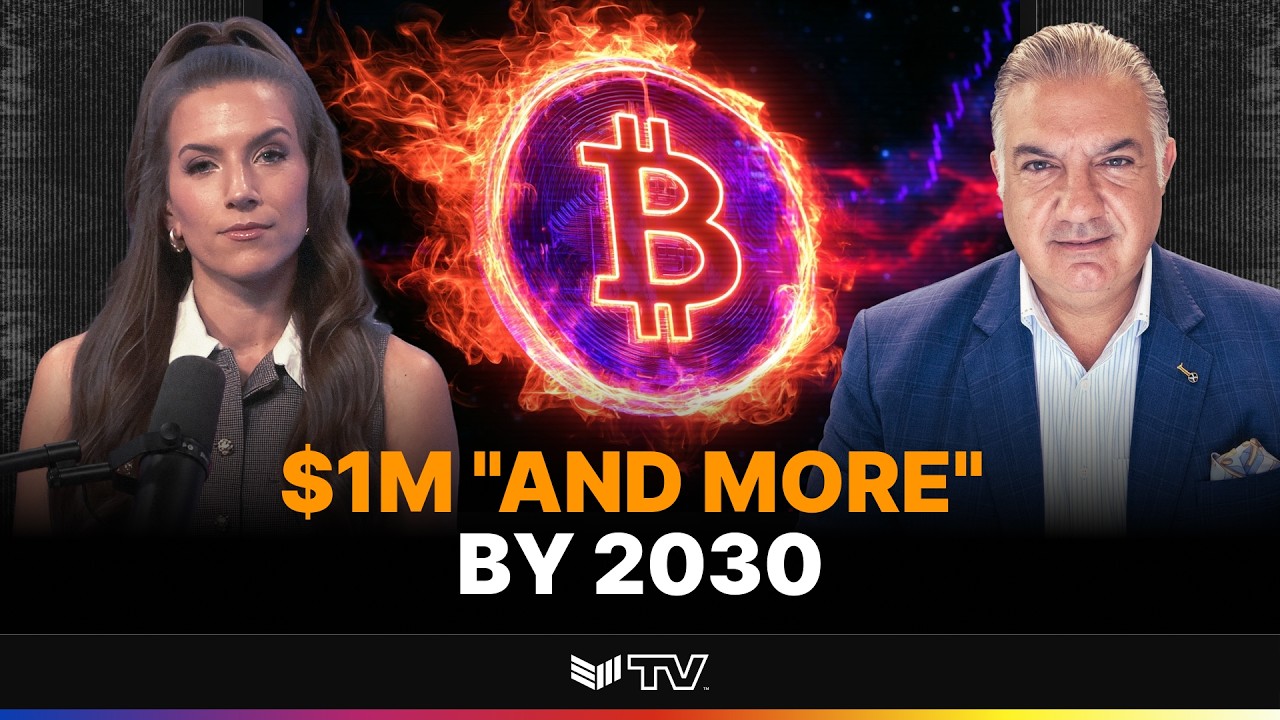
Calamos Investments CEO John Koudounis: Bitcoin Will Hit $1M by 2030
Is Bitcoin headed for a “huge awakening” through 2028? Calamos Investments CEO John Koudounis believes so, and he’s standing by his call of $1 million Bitcoin by 2030. He explains why banks lending against Bitcoin, falling volatility, and new ETF products could open the door to the world’s largest pools of advised capital. He also weighs in on the Clarity Act and Bitcoin’s commodity status.
Chapters:
0:00 – Calamos CEO John Koudounis on France Bond Stress and Greece’s Debt Crisis
1:05 – Why Calamos Researched Bitcoin for Eight Years Before Investing
2:34 – The World’s First Downside-Protected Bitcoin ETF
4:25 – Strategy’s Shift From Convertible Notes to Perpetual Preferreds
6:00 – Why Sovereign Wealth Funds and Big Banks Now Want Bitcoin
7:12 – 100%, 90% and 80% Protected Bitcoin ETFs Explained
9:11 – Why Financial Advisors Still Avoid Bitcoin
10:36 – Capital Controls, Cyprus and Debanking
13:16 – Bitcoin vs. Gold: Why Finite Beats Scarce
16:21 – Bitcoin Outlook Through 2028 and the $1 Million Call
DISCLAIMER: The views and opinions expressed in this show are those of the participants and do not necessarily reflect the official policy or position of BTC Inc., Bitcoin Magazine, or any affiliated entities. This content is provided for informational and educational purposes only and should not be construed as investment, legal, tax, or accounting advice. Nothing contained in this show constitutes a solicitation, recommendation, endorsement, or offer to buy or sell any securities or financial instruments. Viewers should consult their own advisors before making financial or business decisions.
This post Calamos Investments CEO John Koudounis: Bitcoin Will Hit $1M by 2030 first appeared on Bitcoin Magazine and is written by Patrick Green.
Bitcoin Magazine

AI Coding Agents Drive Surge in Bitcoin Integration Requests: Breez
Bitcoin software company Breez said demand for its developer tools has surged since AI coding agents went mainstream, with partnership inquiries rising roughly 14-fold as developers, and increasingly the agents they deploy, look to add bitcoin payments to their apps.
In a company blog post, it tied the jump directly to Anthropic’s Claude Code, which launched as a research preview in February 2025 and became generally available three months later.
Before 2025, Breez said, most prospective partners fell into three camps: committed bitcoin enthusiasts, crypto developers, and fintech firms that treat bitcoin as an asset class.
Since Claude Code arrived, the company said, it has heard from many developers with little or no bitcoin experience. Requests have come from fitness apps, messaging apps that want users to send each other money, an eSIM service for travelers, and the team behind a mushroom-identification app.
Breez said many of these developers pick bitcoin for speed. Setting up traditional payment acceptance, including a bank account and cross-border transfers, can take weeks or months, while the company says its SDK can be running within minutes.
Breez said a growing share of inquiries now come from software, not people. The company said it regularly fields requests from coding agents writing on behalf of the companies that deploy them.
The company argues agents favor bitcoin because it is permissionless. An agent can build an app and set up payments for users worldwide without opening a bank account, passing onboarding checks or signing forms.
“Bitcoin is agnostic about whether the code of its current owner and user is composed of DNA base pairs or weights in a neural net,” Breez wrote.
That same absence of gatekeeping has long drawn scrutiny from financial regulators, who require traditional payment providers to verify customers.
Breez said its newest SDK implementation, built on the Bitcoin scaling protocol Spark, handled the added volume without problems.
The company framed the shift as an update to investor Marc Andreessen’s 2011 essay arguing that software is eating the world, saying AI is now eating software. It compared Bitcoin’s role to background infrastructure like electrical sockets and subsea cables.
This post AI Coding Agents Drive Surge in Bitcoin Integration Requests: Breez first appeared on Bitcoin Magazine and is written by Mathew Di Salvo.
CryptoSlate
Polygon's surging USDT0 holder count masks shrinking balances and suspected scam activity amid its broader push into stablecoin payments.
An Oct. 7 investigation by blockchain analytics firm Bitquery found that addresses matching scam patterns accounted for 58% of the net growth in Polygon's USDT0 holders since August 2025, raising questions about the quality of adoption figures promoted by the network.
The findings challenge Polygon's recent celebration of surpassing 8.1 million USDT0 holder addresses, the highest among blockchains included in a Token Terminal comparison.
According to Bitquery, roughly 998,000 of the 1.71 million addresses added over the preceding 13 months exhibited patterns associated with address-poisoning scams.
The growth came as USDT0 supply on Polygon fell 41%, from $1.35 billion to $798 million. Addresses holding at least $10 also declined 42%, from approximately 1.24 million to 720,000.
Bitquery found that 48% of holders controlled less than one cent, while 65% had neither sent nor received the token during the preceding year.
The investigation also identified approximately 1.42 million addresses matching an address-poisoning pattern, with sample-based verification supporting an estimate of 1.1 million scam look-alikes.
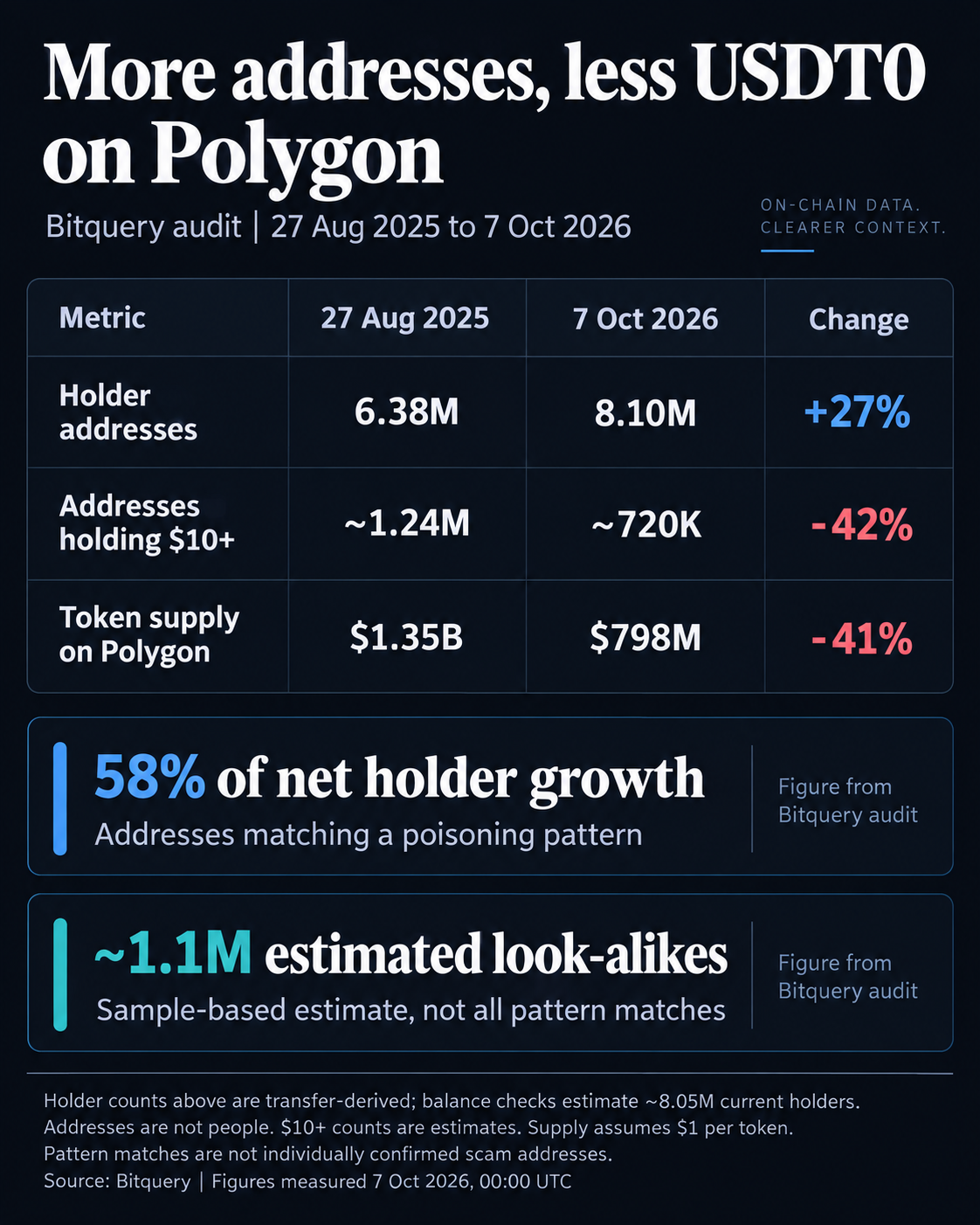
Address poisoning involves scammers creating wallet addresses that resemble legitimate payment destinations and sending tiny transactions to potential victims, hoping they mistakenly copy the fraudulent addresses when transferring funds.
These addresses can retain fractional token balances, allowing them to count as holders. Bitquery cautioned that its classification was probabilistic and did not quantify losses from the suspected scams.
The findings reflect Polygon's August 2025 upgrade from bridged USDT to native USDT0, which preserved existing token balances and contract addresses. About 67% of current holders first received Tether before the upgrade.
Polygon's payments ambitions face a measurement problem
The findings arrive as Polygon increasingly positions itself as a stablecoin payments network, competing for payment processors, institutional liquidity and cross-border settlement activity.
That strategy has coincided with significant transaction growth.
Blockchain analytics platform Growthepie recently reported that Polygon processed more wallet-to-wallet stablecoin transactions over seven days than Ethereum's mainnet, and more than Base and Arbitrum combined.
The metric excludes decentralized finance contracts, although transfers associated with automated activity, including address poisoning, could still contribute to transaction counts.
Meanwhile, DeFiLlama data shows Polygon holds approximately $2.93 billion in stablecoins, with Circle's USDC accounting for $1.62 billion, or 55.29% of the market.
Tether remains the network's second-largest stablecoin, with approximately $795 million in supply, representing about 27% of the total.
The figures suggest that Polygon's broader stablecoin activity has developed differently from Tether's shrinking capital base, although Bitquery's findings do not establish whether genuine USDT0 payment volumes have declined.
The post Polygon’s 8 million USDT0 holders face scrutiny as 58% of growth matches scam patterns appeared first on CryptoSlate.
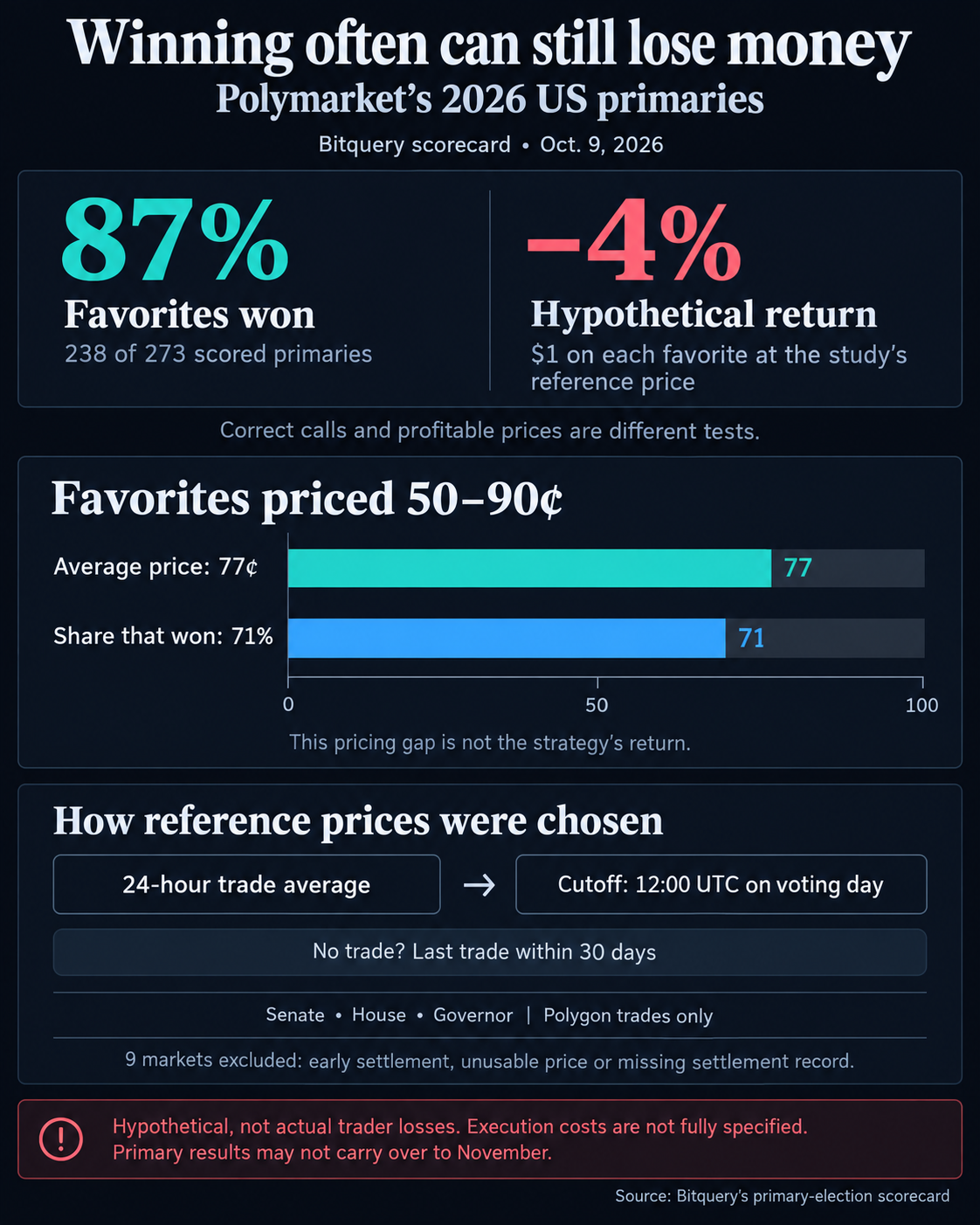
A hypothetical strategy of backing the favorite on prediction market Polymarket in every scored 2026 US primary would have lost 4%, even though those candidates won 87% of the time, according to blockchain data provider Bitquery’s scorecard dated Oct. 9. The result separates two questions for election bettors: who is most likely to win, and whether their contract is worth the price.
Bitquery found that the candidate with the highest study reference price won 238 of 273 Senate, House and governor primaries. But its hypothetical strategy of putting $1 on each favorite at the study’s reference price lost four cents per dollar.
The strongest favorites did much of the work behind the headline accuracy rate. Candidates priced at 90 cents or more won 177 of 182 races. Among favorites priced between 50 and 90 cents, however, 71% won despite an average price of 77 cents.
An outcome share pays $1 when it wins and nothing when it loses. Buying an expensive favorite therefore leaves little profit on a winning share, while a losing share wipes out its purchase cost. Enough losses can outweigh many correct calls.
Putting the same dollar amount into every race also buys different numbers of shares. A cheaper winner produces a larger payout for that stake than an expensive winner. Counting correct predictions treats every race equally; calculating returns must account for those different payouts.
Reference prices limit the betting conclusion
Bitquery averaged trades during the 24 hours before 12:00 UTC on voting day. When a candidate had no trade in that window, it used the last trade within the preceding 30 days. For races that went to a runoff, it used the runoff date.
Those averages, and potentially stale fallback trades, are reference prices rather than guaranteed buy quotes at the cutoff. The published methodology does not specify a full adjustment for spreads, slippage or fees. Polymarket’s current fee page lists a politics fee range of 0% to 1%, but does not establish the charges on the historical trades in this sample.
The study excluded nine markets because some settled before voting, some lacked usable prices and one lacked a settlement record. It covered primaries in the 50 states using Polygon trade data, leaving out Polymarket’s US app and other venues such as Kalshi.
For November’s prediction markets, the distinction between forecasting and pricing remains useful. The measured primary record itself may not carry over: Bitquery cautions that general elections attract more money and polling than small, local contests.
The post Backing Polymarket’s primary favorites would have lost 4%, new audit finds. appeared first on CryptoSlate.
Amazon's Bedrock AgentCore Payments, built with Coinbase and Stripe, lets AI agents discover paid services, authenticate, and pay with stablecoins and x402 under preset spending limits.
AI agents are getting wallets before merchants get a court, and shopping agents have started placing orders across the open internet.
The harder problem arrives once the payment clears, when a buyer's agent pays correctly, and the buyer wants the money back. The Reserve Bank of Australia (RBA) put that gap on the record Oct. 6, and Edgars Nemse, CEO of the GenLayer Foundation, argued it caps what agents can buy.
Nemse told CryptoSlate that payment “is the easy part, because it's deterministic: the money moved, or it didn't,” while “the outcome isn't.” Defining if work was delivered as promised is a judgment call.
| Transaction stage | What agents can increasingly do | What remains unresolved | Why it matters |
|---|---|---|---|
| Discovery | Find merchants, APIs, content, services | Whether merchants trust unknown agents | Controls who gets distribution |
| Authorization | Use mandates, credentials, spending limits | Whether the agent stayed within user intent | Determines who bears liability |
| Payment | Pay with cards, stablecoins, x402 or wallets | Payment success does not prove satisfaction | Settlement is deterministic |
| Fulfillment | Receive goods, services or API access | Was the outcome delivered as promised? | Requires judgment |
| Dispute | Submit complaints or refund requests | Who adjudicates outside a platform? | Determines whether open commerce can scale |
AI agents remove the friction disputes depend on
According to Nemse, every dispute system runs on a hidden assumption that disputing is tedious enough that most people skip it. AI is already eroding that friction, with people filing the complaints themselves for now.
Complaints to the Consumer Financial Protection Bureau doubled to 6.6 million in 2025, and the regulator warned that LLMs and autonomous software can flood complaint systems with duplicative submissions.
A Nature Human Behaviour study estimates that LLM use raises the probability of favorable relief at the CFPB by 6.9 percentage points.
These figures describe complaint systems, and the CFPB data covers mostly credit reporting.
Mastercard and Datos’s 2025 outlook projected 324 million chargebacks worldwide by 2028. Mastercard’s 2026 US merchant benchmark of $128 per chargeback covers internal costs and third-party fees, excluding the lost goods or services. Applying that US benchmark to the global volume as an illustrative assumption, a 5% increase would add 16.2 million chargebacks and about $2.1 billion in operational costs; a 15% increase would add 48.6 million and about $6.2 billion.
Nemse noted that every queue behind those cases is staffed by humans, “Amazon's included,” and they are “already bending.”
| Scenario | Increase in chargebacks | Added chargebacks vs. 324M baseline | Added operational cost at $128 each | What it shows |
|---|---|---|---|---|
| 2025 outlook baseline | 0% | 0 | $0 | No additional chargebacks in this scenario |
| +5% case | +5% | 16.2M | ~$2.1B | Even small automation effects become material |
| +15% case | +15% | 48.6M | ~$6.2B | Dispute automation could become a major merchant cost |
| +30% stress case | +30% | 97.2M | ~$12.4B | Human review queues could become the bottleneck |
Regulators put merchant costs on the record
The RBA's Oct. 6 summary of its payments consultation drew on written submissions from 75 stakeholders. Merchants, payment service providers and issuers said chargeback rules leave liability unclear when an agent acts outside its authority.
They said agentic commerce could raise merchant costs and that networks may struggle to tell whether an agent followed its customer's instructions. One stakeholder referred to reports of an additional 4% charge for AI-assisted purchases.
Submissions described adoption as early and evidence of harm as limited, generally favoring industry standards and monitoring. The RBA plans to announce regulatory priorities by the end of 2026.
A consumer's agent can file a dispute at negligible cost, while a merchant responds with evidence, including logistics records and processor workflows. Nemse expects agents to “dispute far more often, because disputing costs them nothing.”
Platforms keep the judge
Amazon blocked Meta's Muse shopping agent, citing unauthorized access and its own policies, and Nemse reads the block as a fight over the interface.
He said Amazon “has no doubt Meta's agent can buy something,” and it wants to keep the interface because becoming an API that another company's agent consumes would hand over the customer relationship, data, and advertising real estate worth billions.
Google faces the same problem, and in his view “they'll block outside agents and ship their own.”
Small merchants sit in the opposite position, because “an agent searches for whoever solves the problem best, not whoever bought the ad.” Shopify has moved toward admitting browser-based AI shopping agents into checkout.
Nemse argued that discovery covers half the job, since platforms own “the interface and the judge.” Agents can take the first, and the second needs a credible, neutral dispute process. He added:
“Without it, your agent finds the small merchant, and you still go back to Amazon.”
A CI&T survey of 1,011 US consumers found 27% comfortable with full AI shopping. Nemse puts the ceiling on agentic commerce at “the loss they'll accept with no recourse.”
API calls cost cents, so agents pay for API calls. For work, insurance claims, or refunds, “nobody lets an agent commit” unless recourse exists and someone is clearly liable. Nemse noted that “better payment rails don't move that ceiling.”
Who judges the machines
Google's AP2, Mastercard Agent Pay and Visa Intelligent Commerce focus on authorization, with signed mandates, tokenized credentials, spending controls and agent identity. A mandate proves what the buyer instructed and leaves the delivery judgment open.
Nemse's answer is validators running AI models that reach consensus on the outcome, with the decision enforced on-chain and open to appeal, a design his GenLayer Foundation is building.
| Model | Who controls the interface? | Who decides disputes? | Strength | Weakness |
|---|---|---|---|---|
| Amazon-style platform | Platform | Platform support/refund system | Buyer trust and clear recourse | Keeps merchants dependent on platform rules |
| Open merchant web | Agent or browser | Unclear | More distribution for small merchants | Weak recourse unless standards emerge |
| Card-network model | Merchant, agent, wallet or network | Existing dispute/chargeback rails | Familiar liability infrastructure | May struggle with agent intent and subjective fulfillment |
| On-chain escrow/adjudication | Agent-facing apps or protocols | Validators / arbitration process | Can enforce escrowed funds programmatically | Cannot automatically compel off-chain refunds |
| GenLayer-style AI consensus | Open agent ecosystem | AI validators with appeals | Targets subjective outcomes at machine scale | Must prevent frivolous disputes and bad model decisions |
GenLayer says common cases can finalize in roughly 30 minutes and fully escalated ones in about three hours.
Fees, bonds, or reputation penalties have to make frivolous disputes uneconomic when filing is free for an AI agent, and validators judge the evidence supplied, such as receipts, tracking, and task specifications.
Appeals protect against bad model outputs and add time and cost, and an on-chain verdict governs escrowed funds while an ordinary merchant's card refund sits outside its reach.
Where agentic commerce goes from here
If merchants and networks settle on standards, with verifiable mandates, merchant evidence records, and escrow that filters disputes before they become chargebacks, AI agents can move from API calls into services and unfamiliar counterparties. The long tail would gain the recourse that platforms enjoy today.
If disputes stay cheap to file and costly to resolve, merchants raise fees, restrict agent purchases, or send buyers back to trusted platforms.
The post AI agents can pay for your shopping. Who gets your money back? appeared first on CryptoSlate.
Strategy's $1.45 billion preferred-share buyback program is supporting a substantial share of trading in one of its key Bitcoin financing instruments.
According to a Keyrock research report, Strategy's repurchases accounted for more than 20% of weekly trading volume in its variable-rate preferred stock, STRC, during almost every week of September.
The company's share reached about 28% the week of Sept. 8 before falling to just under 20% in early October.
The findings raise questions about how much of STRC's market liquidity comes from independent investors and how trading conditions might change if Strategy reduces its purchases.
That question is becoming increasingly relevant as the Michael Saylor-founded company approaches the limit of its repurchase authorization.
Strategy had spent approximately $1.45 billion of its $2 billion authorization as of Oct. 4, leaving $547.2 million available. The program has helped support STRC as its shares recovered from the mid-$70s in June to approximately $99.50, approaching the security's $100 reference price.
However, the repurchases are discretionary, and Strategy can modify, suspend, or terminate the program.
For a company seeking to establish preferred securities as a recurring funding channel for Bitcoin accumulation, the concern is whether those instruments can sustain investor demand without continued intervention from their issuer.
Strategy's buying accounts for a fifth of STRC trading
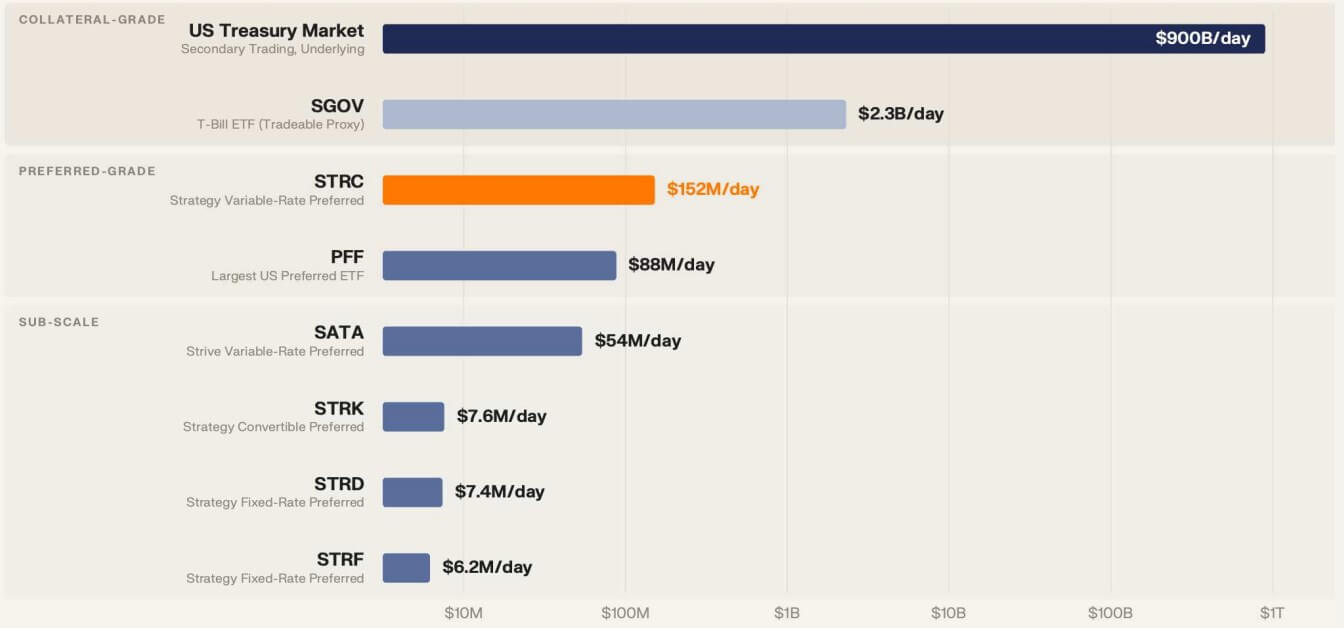
STRC is already among the most actively traded preferred securities in the market, averaging approximately $150 million in daily volume.
Keyrock found that the instrument can typically absorb about $28 million in trading before its price moves 10 basis points, or 0.1%.
That puts it well ahead of Strive's SATA and Strategy's fixed-rate preferred securities, each with less than $3 million in comparable market depth.
For institutional investors, that difference has practical consequences.
Using an illustrative execution rate equivalent to 20% of daily trading volume, Keyrock estimated that a $50 million STRC position could be liquidated in less than two trading days.
The same transaction would take approximately five days in SATA and six to eight weeks across Strategy's fixed-rate preferred instruments.
However, those estimates become less reassuring once Strategy's repurchases are considered.
Removing the company's buying activity reduces estimated trading capacity to approximately 80% of reported volume, implying that a $50 million exit could take longer than headline turnover suggests.
Keyrock cautioned that the calculation does not establish how much liquidity would disappear if Strategy stopped buying. Other market participants could also change their behavior in response.
A preferred-income manager interviewed for the report suggested that some trading around STRC's $100 reference price comes from arbitrage firms and high-frequency traders responding to the issuer's activity.
Such participants could reduce their involvement if Strategy withdraws, potentially leaving the market more dependent on longer-term investors and opportunistic buyers.
STRC liquidity weakens when prices fall below $100
The risk extends beyond the company's direct contribution to trading volume.
Keyrock found that STRC's market depth deteriorates sharply when the security moves away from its $100 reference price.
On the worst 10% of trading days, estimated depth within a 10-basis-point price move falls from about $28 million to $6.5 million.
The deterioration becomes more pronounced as the price discount widens.
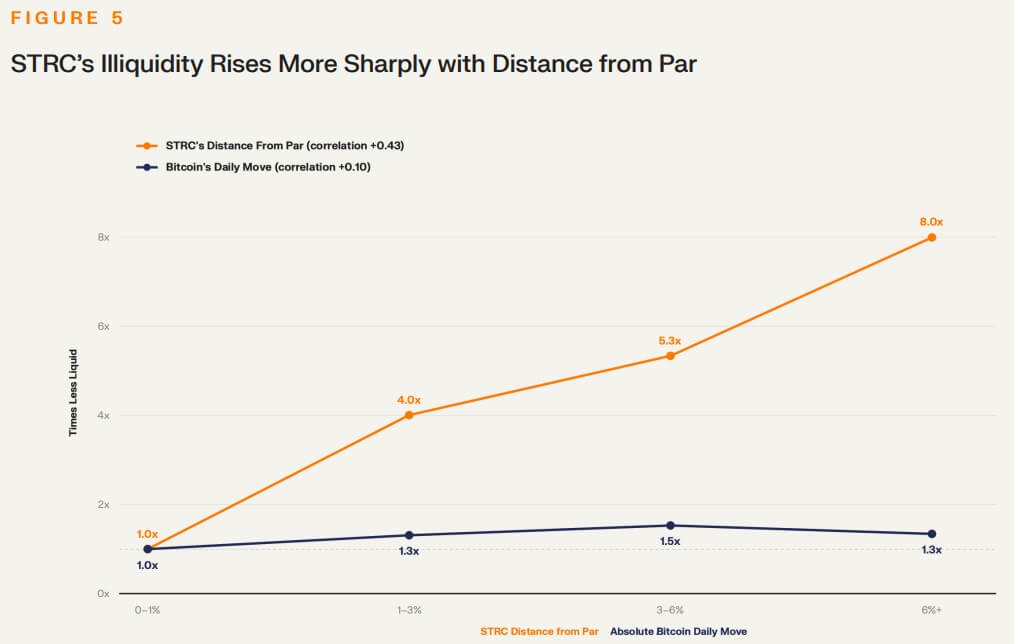
STRC is approximately four times less liquid when trading 1% to 3% away from par and roughly eight times less liquid when the deviation exceeds 6%, according to the report.
That creates a potential problem for investors expecting to exit large positions without accepting significant price discounts.
The relationship between STRC's distance from par and market illiquidity had a correlation of 0.43, compared with 0.10 for the magnitude of Bitcoin's daily price movements.
The findings suggest that STRC's tradability is more closely tied to how far its price has moved from $100 than to Bitcoin's immediate direction.
Keyrock also found that a typical decline from par represented approximately seven months of dividend income, while STRC's June drop toward the mid-$70s amounted to roughly two years of coupon payments.
Those discounts illustrate how quickly capital losses can outweigh the income investors expect to collect from the security.
Still, the research does not establish that Strategy's repurchases caused the observed relationship. Keyrock found a similar pattern before the buyback program began, and STRC remains substantially more liquid than competing preferred securities.
The unresolved concern is whether that advantage can persist under stress without significant support from Strategy.
Strategy faces a new test as its buyback capacity shrinks
The findings come as Strategy increasingly allocates capital to maintain its preferred-stock market.
Between Sept. 28 and Oct. 4, the company repurchased approximately $176.3 million of STRC, including $102.6 million during the final three days of September and $73.7 million in early October.
During the same reporting period, Strategy acquired 334 Bitcoin for approximately $28.7 million.
Of the preferred repurchases, $154.1 million came from the company's cash reserves, compared with $13 million used for Bitcoin purchases.
That allocation highlights growing tension between supporting the securities that finance Strategy's operations and deploying capital directly into Bitcoin.
If the company maintained its recent weekly repurchase pace, its remaining $547.2 million authorization would last approximately three weeks.
However, that is an illustrative estimate rather than a fixed deadline. Strategy previously doubled the authorization in September and could adjust the program again.
The company is also pursuing a separate measure intended to strengthen demand for its preferred securities.
Shareholders are scheduled to vote on Oct. 28 on amendments that would introduce daily dividends across Strategy's US-listed preferred stocks.
If approved and implemented, STRC would begin making payments under the new schedule on Nov. 2.
Strategy argues that more frequent distributions could improve price stability, reduce trading disruptions around dividend dates, and broaden institutional interest without increasing total regular dividend obligations.
However, the experience of Strive's SATA, which already uses a near-continuous payment structure, suggests that dividend frequency alone may not guarantee deeper liquidity.
Keyrock identified family offices, private-bank discretionary accounts and specialist credit funds as the most promising sources of larger allocations.
Those investors can commit tens of millions of dollars without necessarily facing the restrictions that prevent some pension and insurance funds from purchasing unrated perpetual preferred securities with deferrable dividends.
Their participation could determine whether STRC develops enough independent demand to support larger institutional positions.
For Strategy, the next disclosures will provide an indication of whether that transition is occurring.
A sustained decline in the company's share of STRC trading, alongside stable market depth and prices near $100, would suggest that independent investors are absorbing more activity.
If issuer participation remains elevated as the authorization approaches its limit, Strategy would face another capital allocation decision: extend the repurchase program, tolerate a potentially wider discount or redirect resources toward preferred dividends, debt obligations and Bitcoin accumulation.
The Oct. 28 vote and subsequent weekly repurchase disclosures will offer the first evidence of whether changes to STRC's dividend structure can attract sufficient demand to reduce that dependence.
The post Strategy’s $150 million-a-day STRC market has a hidden dependency on its own buybacks appeared first on CryptoSlate.
Coinbase streamed an in-person trading competition from Singapore on Oct. 8, advertising $150,000 for the trader crowned Coinbase Champion and presenting the event as a spectator tournament.
The company's Token 2049 Champions Cup page billed the contest as an esports-style perpetual-futures tournament featuring 10 traders and one winner. Its standings tracked the traders' profit and loss in dollars, while the broadcast mixed trading updates with walkouts, jokes and an invitation for viewers to pick a contestant.
At 6:54 p.m. UTC, the event page listed Intern first with $4,263.37 in profit and loss. Coinbase CEO Brian Armstrong promoted the contest as it went live, saying that “in an hour” one trader would be crowned Coinbase Champion and win $150,000.
Coinbase's announcement described the in-person competition as live, streamed from Singapore.
Coinbase's coverage identified several contestants: Ansem (@blknoiz06), @izebel_eth and @intern among its walkout and introduction posts. It also posted updates naming @Goupenguin, @osf_rekt and @insomniacxbt, with @osf_rekt making what the company called a high-energy entrance.
Coinbase joked that @Goupenguin was trading while watching cats, then said @intern had decided to make memes instead and was backing Jez to win. Intern, who later topped the displayed standings, was also a running joke.
During the action, Coinbase said @osf_rekt had moved into first place at 1:32 p.m. UTC. Seven minutes earlier, its @insomniacxbt update said there were 35 minutes left to win the prize.
A separate prize drawing for Coinbase cup viewers
Coinbase invited viewers to the Champions tab in its app to vote for a trader, but only in certain geographies. Its official rules describe a free promotion: no purchase was necessary, and spending or trading would not improve a participant's chance of winning.
Only votes for the winning trader would qualify for a random prize drawing. If traders tied for the highest total profit and loss, votes for any tied trader would qualify.
The rules called for three voting rounds, with one trader selected per round and up to three votes overall. Entry was limited to eligible app users at least 18 and the age of majority, with jurisdiction and, in some markets, onboarding requirements.
The post Coinbase streams $150,000 Singapore trading cup and crowns its first champion appeared first on CryptoSlate.
CryptoTicker.io
Coinbase is rebuilding its trading platform and bringing back an old name in the process: Coinbase Pro is due to relaunch by the end of 2026, this time as part of a new unit called Coinbase Global Exchange, built on the technology of the options venue Deribit. For investors in Germany the brand matters less than a single number: spot margin with leverage of up to ten times on large assets has been announced. How much of that arrives here depends not on Coinbase but on how European supervisors classify leveraged crypto derivatives.
Coinbase Global Exchange: What Was Announced on October 6
Coinbase has completed the Deribit acquisition on the technical side. On October 1, 2026 the customers of Coinbase International Exchange were migrated to Deribit, and the old platform has been read-only since. Coinbase Global Exchange emerges from the two parts, and in its statement of October 6 Coinbase describes it as joining the American and the international derivatives markets into a single regulated liquidity pool. That claim is the company's own account, not a finding by any supervisory authority.
The announcement fell on October 6, 2026, on the sidelines of the Token2049 industry conference in Singapore. Coinbase had already acquired the Dutch-founded options venue in August 2025 for around $2.9 billion. Fourteen months therefore passed between purchase and completion, spent largely on merging technology.
Coinbase Pro itself disappeared in 2022, in the rebuild that produced Coinbase Advanced. The new version is meant to bundle spot trading, futures, perpetuals, options and equities under one interface, along with a new matching engine, faster order routing and shorter onboarding. Coinbase names no precise launch date, only the end of the year as a target.
Deribit at the Core: $30 Billion in Open Options Positions
Deribit is the reason this rebuild carries any weight at all. By Coinbase's own figures, more than $30 billion of open interest in bitcoin options sat on the venue as of September 30, 2026, and more than a trillion dollars was traded there in the year to October 2026. Open interest is the sum of all contracts not yet closed: the larger it is, the more capital hangs on the prices formed at that venue.
That size feeds back into the spot market, even if you never touch an option. Market makers who sell options hedge themselves in the spot market. When the price of bitcoin moves toward large strike prices, those hedges often amplify the move. On Friday morning bitcoin stood at around $82,570 according to market data from CoinPaprika, and ether at around $2,500. Both therefore sit in a zone where many options expire.
For US institutions, Coinbase is opening access to the Deribit options and the perpetual futures through Coinbase Prime, by its own account in the coming weeks. US retail customers are to follow later in the year, and eligible traders outside the US likewise in the coming weeks. All of these figures are announcements, not functions that have been switched on.

Spot Margin at Coinbase: Ten Times on Large Assets, Five Times on the Rest
The part of the announcement that touches retail investors most directly is the spot margin offer. Coinbase cites leverage of up to ten times on selected large assets and up to five times on further supported assets, and does so shortly after October 6, meaning before the actual Pro return.
Spot margin means this: you buy real coins, but you pay for part of them with money borrowed from the venue. Unlike a futures contract, the underlying belongs to you, you pay borrowing interest for it, and the venue demands collateral. If the price falls far enough that the collateral no longer covers the position, the venue sells it to protect its loan. At ten times leverage a ten percent price decline is arithmetically enough for that, before fees and interest are counted at all.
Coinbase Advanced in Germany: Futures Have Been Running Here Since March 2026
Leveraged trading at Coinbase is nothing new for German users. Since the spring of 2026 the venue has offered futures through Coinbase Advanced in European countries. As the trade publication Decrypt reported at the launch, the offer rolled out in stages from March 9, 2026 across 26 European countries, among them Germany, France and the Netherlands, and runs through an entity licensed under the European markets directive MiFID II. Leverage of up to ten times is available there on selected contracts such as bitcoin and ethereum, fees start at 0.02 percent per contract, and accounts can be funded in euros or in USDC.
The offer covers three designs: contracts with monthly or quarterly expiry, so-called perpetual-style futures, and an index on large technology stocks combined with crypto-adjacent equities and iShares bitcoin and ethereum ETFs. When Coinbase Pro returns, it therefore meets an already running derivatives infrastructure in Europe, not an empty field.
Perpetual-Style Futures: A Five-Year Term Instead of No Term at All
Behind that unwieldy label sits a regulatory construction. Classic perpetuals, as traded on venues outside the EU, have no expiry date. The European variant at Coinbase carries a term of five years. Economically that feels almost identical to a trader, because five years lies far beyond any usual holding period. Formally, though, it is a futures contract with an expiry.
Funding Rate: What the Balance Between Long and Short Costs
Perpetuals and their European relatives hold their price at the spot rate through a balancing payment between the two sides of the market. This funding rate is paid by the stronger side to the weaker one. When many traders sit on the buy side, the buyers pay. On leveraged positions these running costs often decide the outcome more than the direction of the price does, because they accrue regardless of the price and add up over weeks.

The Supervisors' CFD Classification: Ten Times Leverage Can Become 2 to 1
This is the point where the American announcement and German law diverge. The European securities regulator ESMA published a public statement on February 24, 2026 (reference ESMA35-243228190-8024) under which derivatives marketed as perpetual futures are likely to fall within the national product intervention measures for contracts for difference. What matters under that statement is the economic design, not the trading name. Whether a product is traded on an exchange, uses a funding rate or voluntarily offers negative balance protection changes nothing about that, in the authority's view. Our newsroom described this classification in detail on October 3, 2026.
If those measures apply, the BaFin general order of July 23, 2019 governs in Germany. For contracts for difference whose underlying is a cryptocurrency, the order requires an initial margin of 50 percent of the notional value. That corresponds to leverage of 2 to 1. For comparison: with equities as the underlying the margin is 20 percent, and with the major currency pairs 3.33 percent. Crypto thus carries the strictest limit of any asset class.
What Else Belongs to the Leverage Cap
The BaFin order ties the admissibility of such products to further conditions that matter as much in practice as the leverage cap. Positions must be closed as soon as the funds in the account together with unrealized gains fall below half of the total initial margin. The customer's liability is limited to the balance of the respective trading account, so there is no obligation to top up beyond that account. Monetary incentives to enter into a contract are prohibited, with the exception of realized gains and of information and analysis tools. And every advertisement has to carry the prescribed risk warning.
In practical terms: a figure such as ten times leverage, taken from an American press release, says nothing about what your account in Germany will show in the end. Anyone who wants to use leveraged products is better off comparing the limits actually granted and the costs at each provider, for instance in our overview of the best crypto brokers, than relying on the headline of a product announcement.
MiCA Does Not Apply Here: Derivatives Run Under MiFID II
A widespread misunderstanding belongs cleared up at this point. Coinbase has held a MiCA licence from the Luxembourg supervisor CSSF since June 2025 and may therefore offer crypto-asset services across the EU. That licence covers the purchase, the sale and the custody of coins. It does not cover derivatives, because the European crypto regulation expressly does not apply to crypto assets that qualify as financial instruments under MiFID II.
Derivatives therefore sit in a different rulebook with different duties and a different supervisor. A product can come from a provider with a MiCA licence and still be judged under securities law. Anyone who wants to check which permission a provider actually holds looks in the register of the competent authority, not in the product advertising.
Liquidation and Margin Calls: What Really Happens at Ten Times Leverage
Leverage works in both directions, and the mechanics are more unforgiving than they sound. At ten times leverage a five percent rise in the price arithmetically produces a fifty percent gain on the stake. The same five percent downward costs fifty percent of the stake. At a ten percent move the wrong way the stake is gone, and that is before fees, borrowing interest and funding payments.
There is also the fact that liquidations do not happen one at a time. In strained market phases forced sales run through the order book in bundles and amplify the move that triggered them. The price at which your position is closed can then sit well below the liquidation price the venue displayed beforehand. That effect is precisely what explains why a market tolerates leverage on quiet days and not on a single bad morning.
In practice, that shapes the preparation: know the liquidation price before you enter, not afterwards. Project the funding costs over the holding period you have in mind. And keep the stake small enough that a total loss on that position does not tip your portfolio off balance.
Tax in Germany: Futures and Coins Are Treated Separately
For tax purposes a futures contract and a coin are two different worlds, and that surprises many people only at the tax return. Gains from futures count as investment income and are treated as forward transactions, regardless of how long you held the position. There is no holding period there after which the gain becomes tax-free.
With directly held coins, by contrast, the one-year holding period for private disposal transactions applies. The Bundestag rejected the abolition of that period only on October 9, 2026, by 445 votes to 132, so it remains in place. Anyone switching from spot holdings into leveraged contracts gives up a tax advantage that weighs more heavily over a long holding period than any saving on fees. Spot margin sits between the two worlds, because the coins belong to you while the borrowing interest has to be assessed separately. This distinction belongs in a conversation with a tax adviser, not in a rule of thumb.
Coinbase Pro: The Leverage Hinges on the CFD Classification
Until the new platform launches, more remains open than answered for investors in Germany. Three steps are worth taking already:
- Check which permission your provider holds for derivatives. A MiCA authorization alone is not enough for that; a securities licence is needed. Which venues in Europe work with which supervisor is set out in our overview of regulated crypto exchanges.
- Compare the real costs of a spot purchase before you reach for leverage. Spread, order fee and withdrawal costs matter more on long-term holdings than the maximum leverage does. The differences are set out in our comparison of the best crypto exchanges.
- Document every leveraged position from the start. Forward transactions and spot purchases run separately in the tax return, and exchange statements disappear after account migrations. How to bring the two together cleanly is shown by the crypto tax tools and portfolio trackers.
The decisive news of this week is therefore not the return of a brand name. It is the fact that the world's largest listed crypto trading venue is putting its derivatives business on a single infrastructure, while Europe is still settling which rulebook these products may be sold under at all. The answer to that determines whether ten times leverage becomes 2 to 1 here.
(As of October 9, 2026. This article is not investment advice. Prices and fee structures change; check the terms with the provider before you buy.)
Bitcoin trades at $82,558, or €73,577, on Friday morning. The all-time high of $126,080 was set on October 6, 2025, which leaves the price 34.5 percent below that mark. Measured in euros, the gap to the record of €107,662 is 31.7 percent, because the dollar has weakened since. Prices are from CoinGecko.
That date is the reason to talk about bitcoin and tax today. October 6, 2025 is now more than twelve months ago. Anyone who bought on that Monday, or in the days that followed, has passed the one-year holding period under Section 23 of the German Income Tax Act. A sale would be tax-free from today. That sounds like an advantage, and with the price down by roughly a third it becomes the opposite: tax-free also means the tax office no longer recognizes the loss.
Bitcoin and Tax: What Section 23 of the Income Tax Act Governs in October 2026
Germany treats crypto assets as other economic goods. They therefore fall under the private disposal transactions of Section 23 of the Income Tax Act, not under the flat-rate withholding tax that applies to equities and funds. That produces the rule almost every investor knows: hold a bitcoin for more than a year and the sale is tax-free. Sell within the year and the gain is taxed at your personal income tax rate.
A private disposal transaction is not triggered only by a sale for euros. Swapping into another crypto asset counts as a disposal as well, and the coin received counts as acquired at the same moment. Its one-year clock starts over. Anyone who swapped bitcoin into ether in May triggered two taxable events, even though no euro changed hands.
The period is counted to the day. A purchase on January 15 starts the clock on January 16 and ends it on January 16 of the following year. What matters is the date of the contractual transaction, not the day the coins arrive in the wallet. On exchange purchases the two usually coincide; on transfers between wallets they do not.
The All-Time High of October 6, 2025: Since October 7 the Paper Loss Is Worthless for Tax
The holding period works in both directions, and that second half tends to get lost. Once the year has run, the transaction is irrelevant for tax. A gain stays tax-free, and a loss becomes unusable in return. It enters neither the loss carry-back nor the loss carry-forward, and it reduces not a single euro of tax.
For someone who bought at the record price on October 6, 2025, that means something specific. Up to October 6, 2026 a sale would have produced a loss the tax office recognizes. Since October 7, 2026 the same sale produces nothing at all. On a €10,000 stake and a 31.7 percent decline measured in euros, that is €3,170 of loss position gone.
The loss also has to be realized. A price decline inside the wallet is nothing for tax purposes. Only a sale or a swap turns a paper loss into a loss that a tax return knows about. Waiting for better prices and letting the deadline pass is itself a decision, even when it does not feel like one.

The €1,000 Exemption Limit: One Euro Above It Makes the Entire Gain Taxable
Gains from private disposal transactions stay tax-free as long as they add up to less than €1,000 in a calendar year. The figure was raised from €600 and applies per person per year. The important word is limit: this is not an allowance from which only the excess would be taxed. Reach the threshold and the whole gain becomes taxable, from the first euro.
The threshold counts across all private disposal transactions in a year, not only crypto. Anyone who sold a coin collection or gold at a profit inside the one-year window alongside a bitcoin gain has to add both together. Spouses are assessed separately, and each has their own threshold.
One sequence is easy to miss: the exemption limit is tested before an assessed loss carry-forward from earlier years is deducted. An old loss will not retroactively push you under the threshold. It reduces the taxable amount only in a second step.
FIFO and Individual Attribution: The Finance Ministry Circular of March 6, 2025 Calculates per Wallet
Anyone who bought in tranches faces the question of which bitcoin actually leave the house on a sale. The Finance Ministry circular of March 6, 2025, file reference IV C 1 - S 2256/00042/064/043, settles this point. The principle is individual attribution: where the separate acquisitions can be told apart, the holding actually sold is the one that counts.
Where individual attribution is not possible, the crypto assets of a trading designation acquired first count as sold first for the purpose of the holding period. Under margin numbers 61 and following, this first-in-first-out method may also be assumed to simplify the valuation. The assessment is wallet-specific. Within one wallet you have to keep the method you chose until every bitcoin in that wallet has been disposed of. Only then may you calculate differently on a new acquisition.
In practice FIFO decides whether a sale produces a loss or a gain. Someone who bought cheaply in 2023 and expensively in October 2025 sells the old, cheap holdings first under FIFO. Those are long past the one-year mark, the sale stays tax-free, and the expensive 2025 holding stays put along with its loss. Anyone who wants to lift that loss instead needs individual attribution, and therefore a wallet structure that supports it. A separate wallet per purchase period is laborious and solves the problem at the root. A tax tool with wallet attribution takes the arithmetic off your hands, but it does not replace the records behind it.
Offsetting Bitcoin Losses: Which Gains a Loss Can Be Set Against
A loss realized inside the one-year window is no blank cheque. It can be offset only against gains from other private disposal transactions, meaning crypto gains in the same year or gains from other assets under Section 23 of the Income Tax Act. Offsetting against employment income, against investment income from equities or interest, and against current income from staking and lending is ruled out.
If a negative figure remains after that offset, the law knows two routes. The carry-back goes into the immediately preceding year and reduces positive income from private disposal transactions there. The carry-forward runs into the future without a time limit and waits for matching gains. Both require the loss to be declared in the tax return and assessed separately by the tax office. A loss nobody declared does not exist for tax purposes.
The planned reform adds weight to this point. Should future crypto gains fall under Section 20 of the Income Tax Act, old losses from Section 23 could not be offset against them, because the two categories of income stay separate. A loss carry-forward assessed today could then only wait for private disposal transactions that would barely exist in that form.
A Worked Example at €73,577: What a Sale Inside the One-Year Window Costs
Suppose you bought half a bitcoin for €45,000 on February 15, 2026. This Friday that same half bitcoin stands at €36,789, a shortfall of €8,211. The one-year period runs until February 16, 2027, so the loss can still be lifted.
If you made a €6,000 gain elsewhere in the same year on a crypto sale inside the window, realizing the loss cuts that gain to zero. At a marginal tax rate of 42 percent you save roughly €2,520. The remaining €2,211 goes into the assessment and is available next year, or in a carry-back to 2025.
The same transaction with a purchase dated October 6, 2025 looks different. On half a bitcoin the loss would be around €17,000, and it has been unusable since October 7, 2026. The tax saving is zero. The one consolation: a later gain on that holding is tax-free as well, however large it turns out to be.
Four Cases for Bitcoin Holders: Bought in 2024, Bought at the Peak, Bought in 2026, Savings Plan Across the Year End
| Acquisition | One-year period | Loss usable | Gain tax-free |
|---|---|---|---|
| Bought in 2024 | expired | no | yes |
| Bought on October 6, 2025 | expired since October 7, 2026 | no | yes |
| Bought in 2026 | still running | yes, until the period ends | only after the period ends |
| Savings plan instalment after December 31, 2026 | would cease under the draft | open, draft not adopted | no, flat-rate withholding tax planned |
That fourth row is why savings plans deserve particular attention this quarter. Under the draft, a savings plan running across the year end would split into two groups: instalments up to December 31, 2026 would stay under the old law with its one-year period, and instalments from January 2027 would fall under the new one. A single position in the exchange app would then hold two tax regimes.

Records for the Tax Office: Documentation Duties and the Reporting Regime Since January 2026
The 2025 Finance Ministry circular contains, for the first time, its own section on cooperation and documentation duties, margin numbers 87 to 112. For each transaction you have to document the date, the type, the quantity and the euro value, plus any fees incurred and the attribution method chosen. Anyone using FIFO records that; anyone using individual attribution does the same. In advisory practice the platform, the wallet address and the transaction hash are added.
Since January 1, 2026 the reporting duties under the EU directive DAC8 also apply. Providers report transaction data to the tax administration, which can then reconcile it with your return. The era in which a crypto position simply did not show up is over. The reverse holds too: whatever gets reported, you should be able to explain cleanly yourself.
It becomes awkward with exchanges that have ceased operating, or where you have lost access. Anyone who cannot document the acquisition date of a holding will struggle to invoke an expired one-year period. For missing acquisition data, the ministerial draft provides for a flat 50 percent of the disposal proceeds as the tax base under the future withholding regime. Documenting legacy holdings therefore secures an advantage that cannot be recreated later. Before a sale it is worth looking at the routes for swapping bitcoin into euros, along with the question of which records each platform issues.
Staking and Lending: A Separate One-Year Period From the Inflow
Staking income matters less for bitcoin than for ethereum or solana, but it is not without relevance. Anyone earning income through wrapped-bitcoin constructions or through lending receives income that has to be recognized at its euro value at the time of inflow. For the tokens received, a separate one-year period begins, counted from that inflow.
Sell such tokens within twelve months of the inflow and the gain falls under Section 23 of the Income Tax Act. After that it is tax-free. The ongoing income itself is unaffected: it has to be declared in the year of inflow, even if you sold nothing. This double assessment is the most common error in home-made spreadsheets.
The Ministerial Draft and December 31, 2026: What Changes for New Purchases
On October 8, 2026 the Bundestag rejected the Greens' bill on the taxation of crypto assets, printed paper 21/5752, by 445 votes to 132 out of 577 cast. A Left Party motion on the same subject, printed paper 21/5824, also failed; the Greens voted for it, while the CDU/CSU, the AfD and the SPD voted against. The details are in the Bundestag's text archive and in our report on the vote on the crypto holding period.
What matters for your planning, though, is the government's own draft. The Federal Ministry of Finance circulated it for consultation on September 30, 2026, associations had until October 6 to comment, and the cabinet is due to take it up on October 14, 2026. The plan is to assign bitcoin and other exchange crypto assets to investment income under Section 20 of the Income Tax Act. The one-year period would cease for newly acquired holdings, and tax would be charged regardless of holding period at 25 percent flat-rate withholding tax plus the solidarity surcharge, around 26.375 percent together. The ministry expects additional revenue of €350 million a year in the long run.
The draft puts the grandfathering cut-off at December 31, 2026. Anything acquired or received after that would fall under the new law. Older holdings would stay with Section 23 of the Income Tax Act and therefore tax-free after a year. Withholding at source by providers is not due to apply until January 1, 2028. None of this is settled: the Bundestag and the Bundesrat still have to pass the law, and cut-off dates have been pushed back more than once in the process. On October 12, 2026 the petitions committee also takes up the holding period in public.
Bitcoin Tax: Without a Sale by December 31 the Loss Expires
The one-year period is not a theoretical matter this autumn. It expires separately for every holding, and it takes the loss with it when it goes. Three steps make sense before the year ends:
- Sort your holdings by purchase date. Record the date, the quantity and the euro value for each acquisition, and mark which positions have not yet reached the one-year mark. A portfolio tracker with a tax function handles this through the exchange import; checking it stays your job.
- Go through your loss positions before the period ends. Anyone who bought in 2026 and is down can only realize the loss while the clock is still running. Which routes to a sale deliver the lowest fees and the best records decides the rest.
- Secure your records for grandfathering. Export the transaction history of every platform you have used and store it outside the exchange. When switching provider, exchanges with a complete tax report help you avoid later gaps.
(As of October 9, 2026. This article is not investment advice and not tax advice. Prices, draft legislation and fee structures change; check the terms with the provider before you buy, and check your own tax position with a tax adviser.)
Ethereum price under $2,500: where the market stands
$Ethereum is changing hands below $2,500, a level that has acted as a pivot for most of this cycle. Every time ETH lost it, the market treated the move as a warning sign; every time it reclaimed it, buyers came back quickly. That is what makes the current zone interesting rather than dramatic.
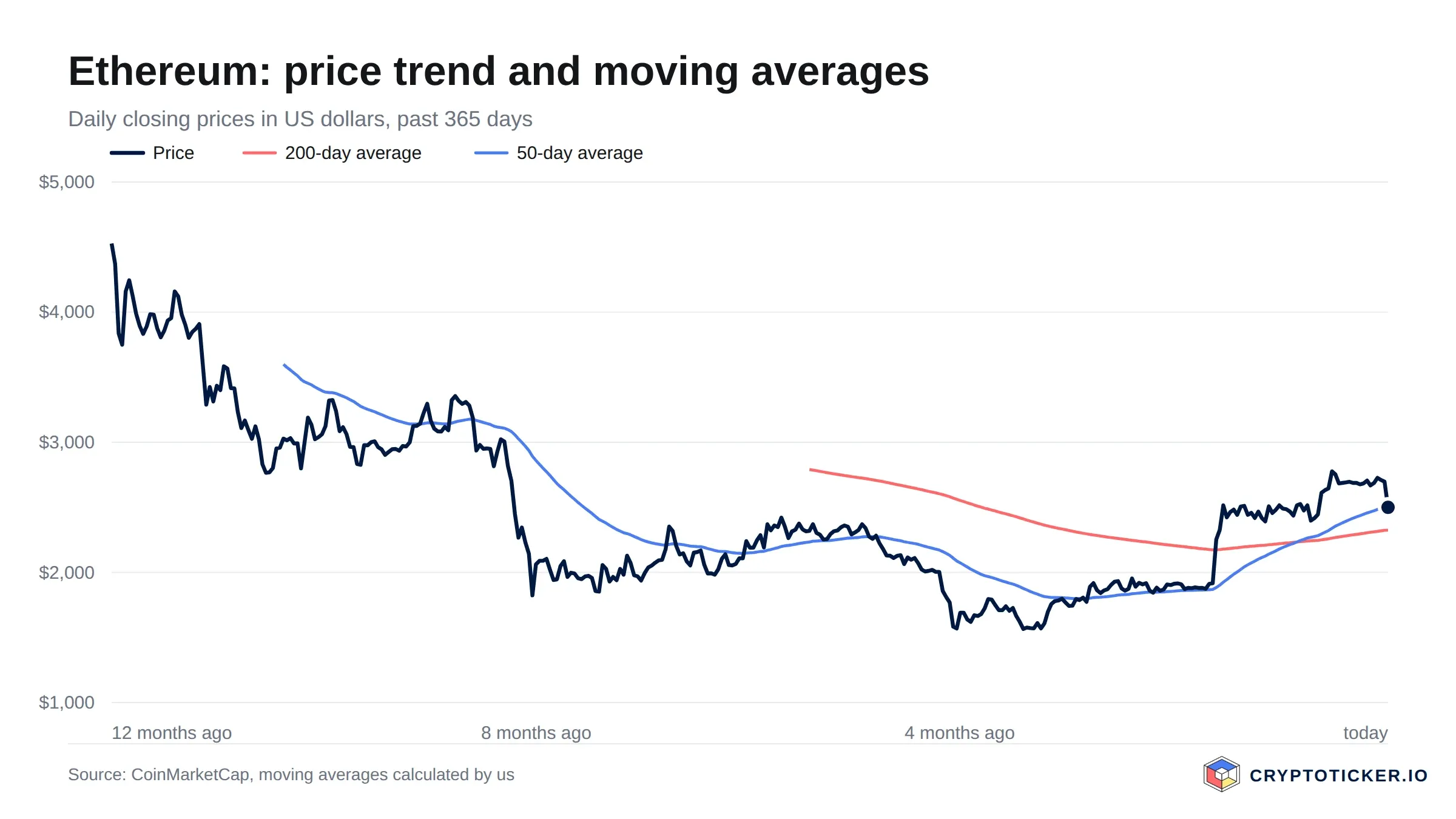
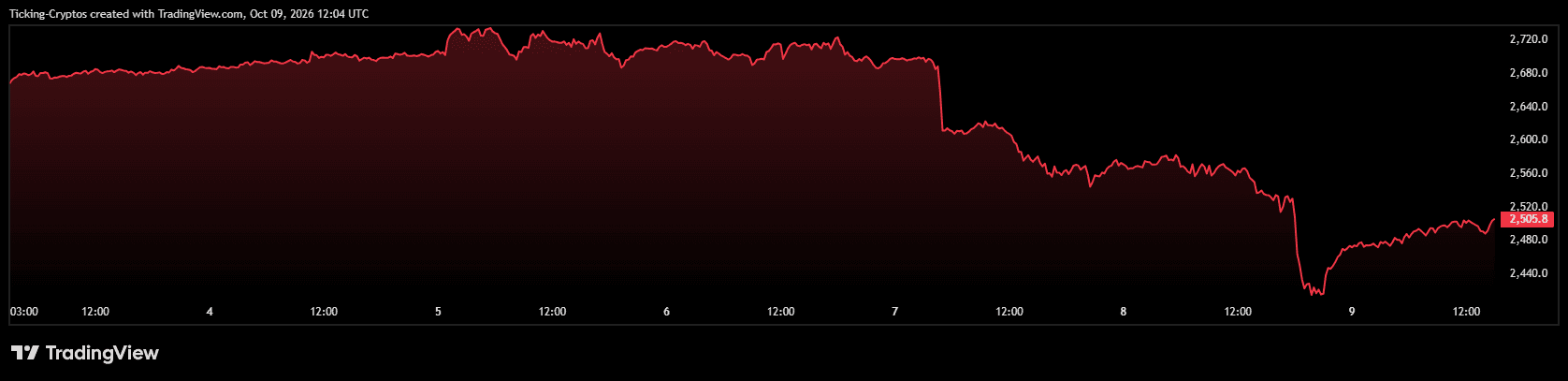
The important detail is how the level was lost. A slow drift lower on thin volume says something different from a sharp liquidation candle. If you are weighing an entry, look at whether the daily closes are stabilising just under the mark or whether each bounce is being sold into.
What is pushing the Ethereum price lower
Three forces usually explain moves of this size. The first is macro: when liquidity tightens and risk assets wobble, Ethereum reacts harder than Bitcoin because its buyer base is more speculative. The second is flows. Spot ETF demand and treasury-style buying have become a visible part of the order book, and when those flows slow, the bid thins out fast.
The third is Ethereum's own supply picture. Lower network activity means fewer fees burned, and the supply stops shrinking. None of this breaks the investment case, but it does explain why rallies have struggled to hold.
Is Ethereum a good buy right now?
The honest answer depends on your time horizon. For a trader, buying into a level that is still being defended means a tight invalidation point and a clear plan to exit if it breaks. For an investor with a multi-year view, sub-$2,500 is a price that looked unthinkable at the top of the last cycle, and accumulating in tranches rather than in one order has historically been the less painful route.
What you should not do is treat a round number as a reason on its own. ETH is cheap compared with its own history; it is not cheap because the chart has a nice figure on it. If you want to compare fees and spreads before you act, our crypto exchange comparison lists the venues we track.
Ethereum price forecast for the months ahead
In the near term, most desks frame the range in the same way. A sustained reclaim of the $2,500 area opens the path back towards the $3,000 region, where the heaviest supply from previous trading sits. Failure to hold puts the next liquidity pockets near $2,200 and then $1,900 in play.
Analysts who are constructive lean on the ETF channel staying open and on staking yields keeping a share of supply off exchanges. Those who are cautious point at the weak fee revenue and at layer-2 networks capturing activity that once paid for block space on the main chain.
Long-term Ethereum forecast
Over a multi-year window the argument for Ethereum is structural rather than technical. It remains the settlement layer for the bulk of stablecoin volume, tokenised assets and decentralised finance, and each of those categories has grown through two bear markets. If tokenisation keeps moving from pilot projects to production, the demand for block space follows.
The bullish long-term targets you will see quoted tend to assume that Ethereum keeps its share of that activity while supply growth stays near zero. The bearish ones assume the opposite: that competing chains and layer-2s keep the value, while the main chain settles for being plumbing. You can read the detailed scenarios in our Ethereum price prediction.
The risks you are taking
Regulation remains the largest single unknown, particularly around staking products and how they are treated in the United States and Europe. Competition is the second: faster chains have taken real market share in payments and consumer applications. And there is the simple fact that drawdowns of 70 percent or more have happened in every Ethereum cycle so far.
Position size is the defence against all three. An allocation you can hold through a bad quarter is worth more than a perfectly timed entry you panic out of.
On Thursday, 8 October 2026, the Bundestag rejected the Greens' bill to abolish the crypto holding period. In a recorded vote, 445 members voted against and 132 in favour, with no abstentions. The existing rule therefore continues to apply: anyone holding Bitcoin, Ether or other crypto assets for more than a year sells them tax-free. The holding period is not saved by this vote, however. The measure that actually decides its future sits as a draft bill at the Federal Ministry of Finance and has yet to reach parliament.
On the same morning, the Bundestag also rejected a motion from the Left party that sought to tax crypto gains as investment income and to allow trading bans on certain coins at EU level. Late in the evening, parliament then passed a law under which German tax authorities exchange data on crypto transactions automatically with other states. What the speakers said, why the SPD position in particular matters for investors, and what you should do now follows below.

Vote on the crypto holding period: how the parliamentary groups voted
The vote concerned the “Bill to close a fairness gap in the taxation of crypto assets” (Drucksache 21/5752) at second reading. The Greens had called for a recorded vote, so it is documented for every parliamentary group who voted which way. A total of 577 voting cards were cast. Because the bill fell at second reading, the rules of procedure dispense with a third reading, and the procedure is thereby closed.
| Parliamentary group | Yes | No | Abstention | Not cast |
|---|---|---|---|---|
| CDU/CSU | 0 | 198 | 0 | 10 |
| AfD | 0 | 134 | 0 | 16 |
| SPD | 0 | 112 | 0 | 8 |
| Bündnis 90/Die Grünen | 76 | 0 | 0 | 9 |
| Die Linke | 54 | 0 | 0 | 10 |
| independent members | 2 | 1 | 0 | 0 |
| Total | 132 | 445 | 0 | 53 |
The result follows party lines: the conservatives, the SPD and the AfD against as a bloc, the Greens and the Left in favour as a bloc. The figures come from the voting result on bundestag.de and from the plenary minutes of the 99th sitting. Back in May, the finance committee had already recommended rejection with the same majorities.
What the Greens' bill 21/5752 proposed for the holding period
At the heart of the bill of 5 May 2026 was a single sentence in section 23 of the Income Tax Act: the one-year period for private disposals would no longer apply to crypto assets. Crypto gains would thereby have become taxable regardless of the holding period, and at the personal income tax rate rather than the flat-rate withholding tax. It was to apply to crypto assets bought after 31 December 2025. The Greens reckoned with additional revenue of “at least around 5 billion euros”.
For investors that would have been the strictest of the variants under discussion: at high incomes, gains could have been taxed at up to 45 percent plus the solidarity surcharge, while losses would have remained offsettable only against gains from private disposals. How the holding period works today with recurring purchases and the order of sales is explained in our piece on Bitcoin savings plans, the holding period and the exemption threshold.
Video from the Bundestag: Olav Gutting (CDU/CSU) on the crypto holding period
The debate began at 10:15 and ran as part of a larger tax package from the Greens that also covered inheritance tax, property transfer tax and real estate. Olav Gutting answered for the conservatives from 10:21; the holding period comes up in the second half of his speech.
Speech by Olav Gutting (CDU/CSU) on 8 October 2026, 99th sitting, agenda item 8. Source: German Bundestag. The full debate is available in the Bundestag media centre.
Gutting defended the holding period as a basic decision of tax law rather than a special arrangement for crypto. Private crypto assets, he argued, are treated like other private economic goods: whoever speculates short term pays tax on the gain, whoever holds long term can in principle sell tax-free once the period has elapsed. Anyone who finds that unfair would have to put the question “openly and systematically for comparable cases” and not only for an asset class that happens to be “more politically visible” at the moment. For greater transparency he pointed to the new reporting obligations for crypto exchanges under the EU directive DAC 8.
Key statements from the debate: SPD for the withholding tax, conservatives with an open flank
Parsa Marvi (SPD) delivered the sentence investors should note. The SPD, he said, “expressly shares the aim of bringing more tax fairness to crypto assets” and does not find it “fair that gains from cryptocurrencies are tax-free today after a holding period of one year”. He rejected the Greens' route all the same: the existing flat-rate withholding tax is efficient, so subjecting crypto gains to it is the right course. He expressly welcomed the Finance Ministry's draft bill and said the SPD was willing to bring the project to a conclusion with the coalition in the Bundestag.
Lukas Krieger and Fritz Güntzler (both CDU/CSU) warned that a special rule for crypto would create new inequalities against foreign currencies, precious metals and securities. Güntzler recalled that shares and futures contracts once counted as speculative transactions too and later moved to investment income. “Now we are discussing doing something similar for crypto assets. It is also being discussed within the coalition,” he said. That is not a clear commitment to the holding period.
Isabelle Vandre (Die Linke) likewise called for an end to the holding period, but by a different route: crypto assets should move into section 20 of the Income Tax Act so that the exchanges remit the tax directly, coupled with exit taxation. By her account, only 3 percent of crypto users declare their gains correctly in their tax return. Max Lucks (Greens) countered that section 23 is the right place, and that the only pointless element is the tax exemption once the speculative period has elapsed.
The Left's motion 21/5824 rejected: section 20, exit tax and trading bans
The motion “Regulate crypto assets strictly and tax them fairly” went considerably further than the Greens' bill. Among other things it called for crypto assets to be brought into section 20 from the promulgation of a law, for an examination of a wealth-growth tax on the Dutch model for decentralised transactions, for identity requirements for self-custodied wallets at regulated service providers, and for an EU supervisor with the power to impose trading bans on coins causing high environmental damage, for instance through proof of work. The Bundestag followed the finance committee's recommendation and rejected the motion by a show of hands, with the votes of CDU/CSU, AfD and SPD against the Greens and the Left.
CARF reporting framework adopted: which crypto data the tax office receives from abroad
A decision taken late in the evening has more effect for many investors. The Bundestag approved the law on the Multilateral Competent Authority Agreement on automatic exchange of information under the Crypto-Asset Reporting Framework (Drucksache 21/7195), the OECD framework on which the EU directive DAC 8 also builds. CDU/CSU, SPD, the Greens and the Left voted in favour, the AfD against. The contracting states collect tax-relevant data on crypto trading and exchange it: users' names, addresses, countries of residence, tax identification numbers and dates of birth, plus the type of crypto asset, gross amounts, quantities and the number of transactions. Anyone holding coins on an exchange outside the EU should therefore not assume the tax office will remain unaware of it.
What changes for investors after the vote: holding period and exemption threshold still apply
In the short term, nothing changes. Gains from the sale of crypto assets held privately are taxable under section 23 of the Income Tax Act if no more than one year lies between purchase and sale. After that, the gain is tax-free. Within the period, a gain stays tax-free as long as all private disposal gains in a calendar year together remain below the exemption threshold of 1,000 euros. Once it is exceeded, the entire amount is taxable, not only the part above it.
Thursday's vote takes only one of several variants off the table, namely the deletion of the period with taxation at the personal rate from 2026 purchases onwards. For holdings you own today, that was the riskiest variant, because it would have reached back into the current year.
The Finance Ministry's draft bill: the 31 December 2026 cut-off decides
The future of the holding period will be decided by the draft bill on reforming the taxation of certain privately held crypto assets of 30 September 2026. It moves so-called exchange crypto assets such as Bitcoin and Ether into section 20 of the Income Tax Act, that is, to investment income, for which the separate tax rate of 25 percent plus the solidarity surcharge and, where applicable, church tax applies. That is to take effect for the first time from 1 January 2027, and only for crypto assets acquired after 31 December 2026. From 2028, platforms are to withhold the tax directly.
| Model | Tax rule | Holding period | Purchases affected | Status |
|---|---|---|---|---|
| Current law | section 23 EStG, personal tax rate, 1,000-euro exemption threshold | one year, tax-free thereafter | all | in force |
| Greens' bill 21/5752 | section 23 EStG, personal tax rate | abolished | after 31.12.2025 | rejected on 8 October |
| Left's motion 21/5824 | section 20 EStG, withholding by exchanges, exit taxation | abolished | from promulgation | rejected on 8 October |
| Finance Ministry draft | section 20 EStG, 25 percent plus surcharge, withholding by platforms from 2028 | abolished for new purchases | after 31.12.2026 | draft, cabinet still pending |
For existing holdings, the draft means this: whatever sits in a securities account or a wallet by the end of 2026 keeps the one-year holding period. The tricky part is the fallback rule for cases in which the platform does not know the purchase date and purchase price. It is then to assume a purchase after the cut-off and to base the tax withholding on 50 percent of the sale proceeds. What that means in euros is worked through in our piece on the substitute assessment in the crypto tax draft. The ministry estimates the additional revenue at 70 million euros for 2027 and, from 2029, at 350 million euros a year, a fraction of the 5 billion euros the Greens had reckoned with.

Next steps on crypto tax: petitions committee, cabinet, Bundesrat
On Monday 12 October, the Bundestag's petitions committee holds a public hearing from 12:00 on petition 201716, which calls for the holding period to be kept. The procedure and the livestream are set out in our piece on the petitions committee on 12 October. According to the timetable so far, the federal cabinet is to take up the draft bill on 14 October. If it adopts it, the draft becomes a government bill, on which the Bundesrat comments first. According to the draft, the law also needs the consent of the state chamber at the end. The Bundestag then debates it in three readings, and only with promulgation in the Federal Law Gazette does the legal position change. After Thursday's debate it is clear where the majority for it would have to come from: from the SPD, which openly supports the move to the withholding tax, and from a conservative group that, in Güntzler's words, is itself discussing it.
What you should do now: secure purchase records and sort holdings by purchase date
Whatever the law ends up looking like, one thing decides your tax bill in every variant: the evidence of when and at what price you bought. That helps you today with the holding period and tomorrow against a blanket substitute assessment.
- Export the complete transaction history of every exchange and every broker while the accounts still exist. Why that is urgent is set out in our piece on the tax records export at the exchanges.
- Sort your holdings by purchase date. Whatever you buy up to 31 December 2026 would keep the holding period under the draft; everything after that would not.
- Keep a complete record of transfers between wallets and exchanges, so purchase dates can still be documented after the coins have moved. A crypto tax tool does that automatically and calculates the periods per position.
- Do not sell in haste. The Bundestag tightened nothing on Thursday, and a sale inside the one-year period costs tax today that patience can avoid.
How to prepare the documents for the tax office in order is explained in our guide to the crypto tax return in seven steps. With larger holdings or gains, your own case belongs with a tax adviser.
Grayscale will have the TAO of its Bittensor trust held by two houses in future instead of one. The asset manager has added Coinbase Prime as a second custodian, with BitGo remaining primary custodian. The move is set out in an 8-K that the trust filed with the US Securities and Exchange Commission on 5 October 2026. For holders of Bittensor, this is not price news but news about the question of who holds the keys.
The price itself has a weak week behind it. TAO trades at $275.96, which is 10.7 percent below the highest daily value of the past seven days, according to CoinGecko as of Friday, 9:00. Over seven days it shows a loss of 11.99 percent, over 30 days a gain of 6.39 percent. Taken together, the two describe a pullback inside a month that is still in positive territory on balance.
What Grayscale reported in the 8-K on the custody of TAO
An 8-K is the mandatory filing with which an issuer registered with the SEC discloses a material event between two quarterly reports. In it, the Grayscale Bittensor Trust reports two contracts signed and one contract terminated, all dated to the end of the month.
On 29 September 2026, the sponsor signed an amendment to the Coinbase Prime Broker Agreement of 3 October 2025 on behalf of the trust. Coinbase will thereby hold a portion of the trust's TAO. A day later, on 30 September, an amendment followed to the revised custody agreement with BitGo Bank & Trust of 5 June 2026, which brings the trust into that agreement. The older BitGo agreement of 12 March 2025 was terminated on the same day.
One figure the document expressly does not name: how much TAO moves to Coinbase has not yet been determined by the sponsor, by its own account. Anyone reading a split in percent over the coming weeks should check where it comes from, because it does not come from this filing. What is recorded, by contrast, is that the custodians' fees are borne by the sponsor and that fees and expenses are taken in TAO.

BitGo stays primary custodian, Coinbase Prime will hold a portion
The division of roles remains clear. BitGo is and remains the trust's primary custodian; Coinbase joins as a second address. In the language of institutional custody that means a portion of the holdings will sit in a second infrastructure, with its own keys, its own approval paths and its own operations team.
Prime broker is not a synonym for custodian here. A prime broker agreement bundles trading, settlement and custody with one provider so an institutional client can move large quantities without maintaining a separate relationship for every step. The fact that the trust extended precisely that agreement points to trading capability, not storage alone.
Why a second custodian shifts the operational risk of a trust
With a single custodian, everything hangs on one operation. If it fails, the fund stands still, regardless of how healthy the assets inside it are. Two custodians spread that operational outage across two mutually independent houses. The risk has not vanished as a result; it is divided.
Set against that is the second route of attack. Every additional infrastructure brings its own keys, its own staff and its own software, and any of those can become the point of entry. The hacks of 2026 repeatedly hit the software around the edges rather than the cryptography itself. Whether the split is a gain is therefore decided by the quality of the second house, not by the number two.
GTAO is an OTC-traded trust and not yet an ETF
The Grayscale Bittensor Trust runs under the ticker GTAO and trades over the counter, not on a regular US exchange. Grayscale has set out on the road to an exchange-traded fund: the S-1 registration statement reached the SEC on 30 December 2025, and a first amendment followed on 2 April 2026. No approval has come of it to date.
The difference is practical for you rather than academic. A trust traded over the counter can sit permanently above or below the value of its holdings, because the mechanism that continuously creates and redeems shares in an ETF is missing. Anyone who equates such structures with a spot ETF is buying something other than what they think. How the product types diverge in Germany is unpicked in the overview of crypto ETFs for investors in Germany.
Then there is the distribution route. A trust registered in the US is not offered to retail investors in Germany; for distribution to retail clients in the EU, the PRIIPs Regulation requires a key information document, which such products do not carry. The news from the 8-K changes none of that and remains information about the market for you, not a way to buy.
Price of the week: $275.96, 10.7 percent below the weekly high
The daily values of the week trace a clear arc: $292.09 on 3 October, then four days between $304 and $309 with the peak of $308.88 on 7 October, after that $291.29 on 8 October and $268.40 at the start of 9 October. Over the past 24 hours the low stood at $254.82 and the high at $287.30. All values according to CoinGecko, as of Friday, 9:00.
For context: market capitalisation stands at around $3.13 billion, trading turnover of the past 24 hours at around $308 million. TAO is 63.6 percent away from its all-time high of $757.60 from March 2024. The week's pullback therefore falls into a phase that already runs far below the old record.
Circulating supply: 11.34 of 21 million TAO have been issued
Bittensor is capped at 21 million units, as Bitcoin is. Of those, 11,339,646 TAO are in circulation, or 54.0 percent of the maximum. Issuance declines in steps over time, and the timing of the next step depends on the quantity issued rather than on a calendar date. There is no documented date for it at present, and a forecast would be guesswork.

Subnets: what the network pays out its issuance for in the first place
A subnet on Bittensor is a self-contained competition in which providers deliver a particular service, a language model or data preparation for instance, and are rewarded according to assessed quality. The network's issuance is distributed across these subnets, and anyone holding or delegating TAO is economically tied to that distribution.
For the custody question this matters more than it sounds. Delegating TAO rather than merely holding it puts it into a process that requires active use of keys. Between “sitting in a custodian's vault” and “working in the network” lies a noticeable difference in risk profile, and that holds whether a fund or a private individual holds the tokens.
Buying TAO in Germany: a MiCA exchange instead of a US trust
If you want exposure to TAO in Germany, the route runs through a trading platform licensed under MiCA, or through a certificate on the token authorised in the EU. The US structure from the 8-K is not open to you. Which platforms can show a MiCA licence is set out in the overview of regulated crypto exchanges.
After the purchase comes the same question Grayscale has just answered for itself: who holds the keys. Leave the tokens on the exchange and you carry its operational risk. Withdraw them and you carry it yourself, but the counterparty risk disappears. Which device suits that depends on how much you hold and how often you move the balance.
Two further points belong in the review. Leveraged products on a token that gives up double digits inside a week liquidate quickly; on a decline of 10.7 percent from the weekly high, a ten-times leveraged position is already finished on paper. And for tax, the one-year holding period for private disposals still applies in Germany, whose abolition is under discussion but has not been decided. Spreading several purchases across the year calls for a clean record of the acquisition dates.
Levels above and below: $308.88 and $254.82
Above, the next documented point of orientation lies at the weekly high of $308.88, below that the round level of $300. On the downside, the 24-hour low of $254.82 marks the last place where buyers appeared again, followed by the round 250. These are observation points from this week's price data and not price targets.
What the custody news means for the price cannot be quantified in good faith. An amendment to agreements on custodians is a structural event with no immediate effect on supply or demand. Selling it as a price driver overstretches it.
Bittensor custody: without ETF approval, GTAO stays over the counter
- First establish whether you are looking for access at all: the US trust is not open to you, while buying directly through a licensed platform is. The licensing position of the providers is listed under regulated crypto exchanges.
- Settle the key question deliberately before the first purchase runs, not after it. For withdrawing from the exchange, the hardware wallet comparison helps with choosing a device.
- Set up the record for the holding period with the first purchase, or the acquisition dates will be missing later. Tools for that are in the comparison of crypto tax software.
(As of October 9, 2026. This article is not investment advice. Prices and fee structures change; check the terms with the provider before you buy.)
Primary sources: the 8-K of the Grayscale Bittensor Trust of 5 October 2026 and the amendment to the S-1 registration of 2 April 2026, both filed with the SEC.
Decrypt
Experts highlight several support levels, from $83,000 down to $72,000, that Bitcoin may need to test in a bearish start to Uptober.
The package hits five crypto and payment platforms, two of which handled transactions with Russia’s A7 network, the UK government said.
Is this the beginning of a bigger selloff with the anniversary of 10/10 looming? Or just a leverage flush before the next leg up?
Raheim Hamilton forfeited some 1,230 BTC. His co-creator Thomas Pavey, who agreed to forfeit 1,584 BTC, is due to be sentenced this month.
Ajay Shinjin helped steal nearly $265,000 in crypto after criminals hijacked BT customers' phone numbers in November 2021.
U.Today - IT, AI and Fintech Daily News for You Today
Crypto news this morning, Oct 9: XRP holds $1.39 as a $1.48 billion US gov transfer flushes Bitcoin to October lows.
XRP’s long-awaited day arrives, but the market remains quiet.
XRP Ledger payments volume suggest a substantial outflow of activity from the network.
Fidelity has increased its Bitcoin holdings significantly, accumulating up to $354 million of Bitcoin amid sustained ETF demand over the last month.
Permissionless smart contracts went live on the Midnight mainnet in major milestone for the network.
Blockonomi
TLDR
- Netflix (NFLX) stock gains 0.54% to $71.96 as reports of workforce cuts emerge.
- Netflix reportedly plans to cut 5% of its global workforce as early as next week.
- The proposed layoffs could mark Netflix’s largest workforce reduction since 2022.
- Growing competition from YouTube pushes Netflix to review its operating costs.
- Netflix’s October 20 earnings could provide more details on restructuring plans.
Netflix (NFLX) stock gained 0.54% to $71.96 on Friday morning, adding $0.39 after recovering from earlier lows near $70.40. The increase followed reports that Netflix plans to reduce its global workforce by approximately 5%. The reported restructuring comes as the streaming company faces stronger competition and prepares for its upcoming earnings report.
Netflix, Inc., NFLX
Netflix Plans Workforce Reduction as Restructuring Takes Shape
Netflix plans to eliminate approximately 5% of its workforce, with an announcement possible next week. Reuters reported the development on Friday, citing the original report and people familiar with the plans. Netflix declined to comment when Reuters requested confirmation of the proposed workforce reduction.
Netflix employed approximately 16,000 full-time workers at the end of 2025, according to company figures. Based on that headcount, the proposed reduction could affect approximately 800 employees across its global operations. The company has not disclosed which departments or locations would face reductions under the reported restructuring plan.
The potential cuts would mark Netflix’s largest workforce reduction since its restructuring efforts in 2022. During that period, the company eliminated hundreds of positions after subscriber losses disrupted its expansion plans. Those layoffs followed slower revenue growth and changes in consumer demand across the streaming industry.
Netflix Faces Growing Competition Across Streaming Services
Netflix continues to compete with established streaming platforms and digital entertainment services for audience attention. Meanwhile, YouTube has expanded its share of viewing activity and advertising spending across the entertainment market. Traditional media companies have also pursued consolidation as they seek stronger positions in digital distribution.
In response, Netflix has expanded its operations beyond traditional subscription streaming to diversify revenue sources. The company has increased its investment in advertising services, live programming, and gaming experiences. These businesses provide additional growth opportunities as competition places greater pressure on subscription-based services.
Netflix also pursued a reported $72 billion acquisition of Warner Bros. Discovery, although the proposed transaction collapsed. The unsuccessful deal marked a departure from the company’s longstanding focus on expanding through internal development. Its reported restructuring now places renewed attention on operating expenses and the efficiency of existing businesses.
Netflix Expands Technology Investment Ahead of Earnings
Netflix acquired InterPositive, an artificial intelligence filmmaking company founded by Ben Affleck, in March 2026. Bloomberg reported that the transaction could reach $600 million, including payments linked to future performance. The acquisition supports Netflix’s efforts to improve production workflows and expand its technical capabilities.
InterPositive develops tools that help filmmakers modify existing footage during the post-production process. Its technology supports background adjustments and object removal without requiring teams to recreate entire scenes. Netflix has not established any connection between this acquisition and the reported workforce reductions.
The company will release its next earnings report on October 20, providing another update on business performance. Management will also have an opportunity to address operating costs, growth priorities, and developments across its services. Until Netflix confirms the reported restructuring, the timing and final scale of the potential layoffs remain unannounced.
The post Netflix (NFLX) Stock: Rises as 5% Workforce Cuts Loom appeared first on Blockonomi.
TLDR
- Bitdeer Technologies Group (BTDR) stock rebounds 1.85% to $9.90 in pre-market trade.
- Bitdeer AI secures an eight-year agreement for a new 60MW data center in Malaysia.
- The new A103 facility will expand Bitdeer’s Malaysian AI Cloud capacity to 71.5MW.
- Bitdeer reaches 95% of its 350MW AI Cloud capacity target ahead of its 2028 goal.
- Bitdeer AI secures over 70% customer commitments for its upcoming Malaysian facility.
Bitdeer Technologies Group (BTDR) stock rebounded Friday after its AI division announced a major data center expansion in Malaysia. Shares gained 1.85% to $9.90 in pre-market trading, recovering $0.18 after Thursday’s 6.54% decline to $9.72. The company secured an eight-year agreement for a 60MW facility, expanding its infrastructure for high-performance computing services.
Bitdeer Technologies Group, BTDR
Bitdeer AI Secures 60MW Data Center Agreement in Malaysia
Bitdeer AI signed an eight-year data center services agreement covering its new A103 facility in Cyberjaya, Malaysia. The project will add 60MW of computing capacity to the company’s existing campus. Furthermore, the facility will support liquid-cooled NVIDIA systems designed for large-scale computing workloads.
The company plans to equip A103 with infrastructure supporting NVIDIA’s next-generation Vera Rubin platform. Bitdeer expects to energize the facility during the first quarter of 2028. Meanwhile, the project will use existing power, cooling, and networking infrastructure to support deployment.
A103 will operate alongside the company’s A101 and A102 facilities at the Cyberjaya campus. Together, the three facilities will provide approximately 71.5MW of cloud computing capacity. This expansion strengthens Bitdeer’s Malaysian operations while increasing infrastructure available for future customer contracts.
Bitdeer Technologies Group Expands Secured Capacity to 333.5MW
The latest agreement increases Bitdeer AI’s secured data center capacity to approximately 333.5MW. Its facilities span Malaysia, Norway, and the United States under ownership arrangements or executed service agreements. Consequently, the company has secured approximately 95% of its planned 350MW capacity target.
Bitdeer aims to deliver its targeted computing capacity by the first quarter of 2028. The company continues developing infrastructure to accommodate growing demand for advanced computing services. Its active pipeline for cloud capacity now exceeds an estimated $10 billion.
According to Chief Financial Officer Michael G. Potter, the Malaysian expansion supports the company’s infrastructure development schedule. Existing campus resources will help Bitdeer streamline construction and equipment deployment. The company also plans to reserve additional computing capacity for customers seeking next-generation systems in 2028.
NVIDIA Deployment Supports Malaysian Cloud Expansion
Separately, Bitdeer AI has secured customer commitments covering more than 70% of capacity at its upcoming Malaysian cloud facility. These agreements will support a multiyear revenue backlog linked to infrastructure services. The commitments provide contracted demand ahead of the facility’s planned operational launch.
Bitdeer AI is also procuring NVIDIA GB300 NVL72 systems for its Malaysian operations. The equipment will expand GPU computing resources and support larger customer workloads. Furthermore, the deployment forms part of the company’s broader effort to increase scalable computing capacity.
Bitdeer continues expanding beyond its existing operations into cloud infrastructure and advanced computing services. Its Malaysian projects combine contracted capacity, new equipment, and established infrastructure to support that expansion. The latest 60MW agreement advances its 2028 development target as BTDR stock recovers from Thursday’s decline.
The post Bitdeer (BTDR) Stock: Secures 60MW AI Cloud Expansion in Malaysia appeared first on Blockonomi.
TLDR:
- DELL stock reached $580 on October 9, extending its year-to-date gain to about 361%.
- Goldman Sachs maintained its Buy rating and $570 target despite ongoing AI hardware supply constraints.
- Dell booked $60.9 billion in AI server orders and ended the latest quarter with a $95 billion backlog.
- Trump’s brokerage account sold up to $1 million in Dell shares during August, according to disclosures.
Dell Technologies (DELL) stock rose to $580 on Friday as Goldman Sachs maintained its Buy rating and $570 price target. Shares gained 0.95% during early trading, extending their 361% year-to-date rally despite new disclosures showing President Donald Trump’s account sold Dell shares. The latest developments follow a period of strong AI server demand, which has supported Dell’s earnings growth and rising valuation.
DELL Stock Trades Above Goldman Sachs’ $570 Price Target
Goldman Sachs analyst Katherine Murphy reiterated her Buy rating on Dell Technologies, citing continued demand for artificial intelligence infrastructure. The bank maintained its $570 price target despite concerns about memory shortages and limited supplies of other computer components.
Murphy expects these constraints to continue into 2027, although Dell’s purchasing scale could help it manage supply pressures. At $580, DELL stock traded approximately 1.8% above Goldman’s target, following a gain of $5.45 from Thursday’s closing price.
The shares remained below their 52-week high of $595.51, while Dell’s market capitalization stood near $365.31 billion. The company’s latest financial results provide context for the rating, as demand for AI servers continues supporting revenue growth. Dell reported $60.9 billion in AI server orders during its fiscal second quarter, bringing its outstanding order backlog to $95 billion.
Quarterly revenue increased 58% from the previous year to approximately $47 billion, while adjusted earnings per share reached $7.04. The company also raised its annual revenue forecast to $192 billion, reflecting stronger demand across its infrastructure business. However, analysts remain divided on the stock’s valuation following its rally.
Recent Wall Street price target revisions show Susquehanna targeting $700, while RBC Capital maintains a $640 objective. TD Cowen has a Hold rating and a $550 target, placing its valuation below the current market price. Earlier analyst expectations for Dell stock also reflected confidence in AI demand, although concerns about valuation remained.
Trump’s Dell Stock Sales Draw Attention as AI Demand Grows
The latest DELL stock gains coincide with financial disclosures showing that President Donald Trump’s brokerage account sold Dell shares in August. According to a federal ethics filing released October 8, the account sold between $500,001 and $1 million in Dell stock on August 21. A second transaction on August 28 involved another $15,001 to $50,000 in shares.
The disclosures followed several public statements in which Trump encouraged Americans to purchase Dell computers. Trump’s account previously purchased between $1 million and $5 million in Dell shares during February, before the stock’s subsequent rally.
However, the White House said the president does not personally direct investment decisions within the accounts. Spokesman Davis Ingle said the holdings are independently managed through discretionary arrangements and computer-based trading models.
The Trump Organization also stated that neither Trump nor his family approves individual transactions. The disclosures follow earlier attention surrounding Trump’s public support for Dell, including statements made during the launch of Trump Accounts.
Meanwhile, Dell’s operating performance remains closely tied to spending on AI data centers and enterprise computing infrastructure. Recent Dell stock analyst upgrades have reflected expectations that the company’s AI server backlog will support future revenue.
For Dell stock, the next financial results will provide further evidence of how quickly those orders convert into sales. Memory shortages, delivery schedules, and profit margins will also remain important measures as Dell works through its outstanding orders.
The post DELL Stock Hits $580 as Goldman Sachs Maintains Buy Rating Despite Trump’s Share Sales appeared first on Blockonomi.
TLDR:
- Scott Bessent announced plans to seize approximately $1 billion in cryptocurrency linked to Iran this week.
- The Treasury secretary said U.S. authorities had located the assets but provided no seizure details.
- Washington is expanding restrictions on Iranian oil exports, international flights, and overland transportation routes.
- The planned crypto seizure forms part of the Trump administration’s broader campaign to isolate Iran economically.
U.S. Treasury Secretary Scott Bessent said Washington plans to seize approximately $1 billion in cryptocurrency linked to Iran this week. The proposed action forms part of a broader campaign targeting Iran’s financial networks, oil exports, and international transportation routes. The announcement follows earlier U.S. seizures of Iran-linked cryptocurrency, as Washington expands efforts to restrict Tehran’s access to international financial markets.
Scott Bessent Announces Planned $1 Billion Iran Crypto Seizure
Bessent disclosed the planned seizure during an interview with Greta Van Susteren at Newsmax’s NPolicy Summit in Washington on Thursday. “We’re probably gonna seize a billion dollars of crypto this week,” Bessent said, adding that authorities had identified the assets.
The Treasury secretary did not identify the cryptocurrency involved or explain how authorities intended to take control of the holdings. He also gave no details about the wallets, exchanges, or individuals connected to the proposed seizure.
The announcement follows several enforcement actions against cryptocurrency networks allegedly connected to Iran’s Islamic Revolutionary Guard Corps (IRGC). In September, the Treasury Department sanctioned Iranian cryptocurrency exchange BitBank over alleged Bitcoin transfers involving hundreds of millions of dollars.
U.S. officials accused the platform of facilitating transactions connected to the IRGC and maritime payments involving the Strait of Hormuz. Earlier, Treasury authorities also targeted cryptocurrency wallets associated with Iran’s central banking system.
In July, authorities froze more than $130 million in Iran-linked digital assets, including USDT held across several Tron wallets. The action followed earlier restrictions on cryptocurrency platforms accused of supporting Iranian financial activities. The freezing of Iranian cryptocurrency wallets formed part of Washington’s efforts to restrict financial transactions involving sanctioned entities.
However, Bessent’s latest statement concerned a planned seizure, and he did not confirm that the additional $1 billion had been recovered. The distinction matters because freezing cryptocurrency restricts access to assets, while seizure involves authorities taking legal control of them.
US Expands Iran Isolation Campaign Beyond Financial Sanctions
Bessent also described a broader shift in Washington’s approach toward Iran, moving beyond traditional economic sanctions and financial restrictions. “We did have a maximum pressure campaign. Now we have an absolute isolation campaign and it’s working,” he said.
According to Bessent, the administration is combining financial enforcement with maritime blockades, aviation restrictions, and efforts to close overland routes. He said the measures were intended to prevent Iran from accessing international markets while restricting the movement of government officials.
Bessent also claimed that the campaign was creating pressure within the IRGC, although he provided no independent evidence supporting that assessment. The Treasury secretary said Washington was working with the United Arab Emirates and Oman while engaging Pakistan and Turkey.
He described those efforts as part of a strategy to restrict transportation routes connecting Iran with neighboring countries. The administration is also targeting Iranian oil exports, with Bessent predicting that maritime restrictions could eventually halt overseas shipments.
The latest measures follow U.S. sanctions against Iranian maritime payment networks, including cryptocurrency transactions allegedly linked to shipping operations. Those restrictions targeted financial channels that U.S. authorities believe support Iran’s military and sanctioned commercial activities.
Bessent maintained that the expanded campaign was already limiting Iran’s economic options, although its full effects remain uncertain. The proposed cryptocurrency seizure represents another part of that strategy, but its execution and final value remain subject to confirmation.
The post US Plans $1 Billion Iran Crypto Seizure as Bessent Announces New Isolation Campaign appeared first on Blockonomi.
TLDR:
- DWF Labs affiliates DWF Maas and Falcon Digital sued BitGo for $141 million in London’s High Court.
- The lawsuit alleges BitGo sold Falcon Finance and ESPORTS tokens before their agreed lock-up periods expired.
- The agreements required a three-month lock-up followed by additional vesting restrictions on token sales.
- DWF Labs claims the early sales pushed token prices lower, while BitGo declined to comment.
Two DWF Labs-linked companies have sued crypto custodian BitGo for $141 million, alleging unauthorized sales of locked cryptocurrency tokens. The lawsuit concerns Falcon Finance and ESPORTS tokens, which were allegedly sold before contractual restrictions expired. The dispute comes as BitGo expands its institutional crypto custody services, including arrangements that allow clients to access digital assets through regulated infrastructure.
DWF Labs Accuses BitGo of Breaching Token Lock-Up Agreements
DWF Maas and Falcon Digital filed the lawsuit in London’s High Court, according to the Financial Times. Both companies are affiliated with Dubai-based crypto market maker DWF Labs and are seeking compensation for alleged financial losses. DWF Maas is registered in the British Virgin Islands, while Falcon Digital operates from Panama. The plaintiffs claim BitGo violated over-the-counter agreements involving Falcon Finance (FF) and ESPORTS tokens.
Under the agreements, BitGo allegedly received discounted tokens in exchange for accepting restrictions on their sale. The contracts included an initial three-month lock-up period, followed by additional vesting schedules controlling when tokens could enter circulation.
However, DWF Labs alleges that BitGo transferred the tokens to cryptocurrency exchanges approximately two months before their scheduled release. The plaintiffs argue that these transfers breached contractual obligations and introduced unexpected selling pressure into markets with limited liquidity.
According to the lawsuit, the alleged sales reduced token prices and lowered the value of assets DWF Labs continued holding. DWF representatives reportedly raised concerns with BitGo during April and May but failed to obtain satisfactory assurances.
The companies have nevertheless indicated they remain open to resolving the dispute through settlement. The disagreement concerns restrictions commonly included in private cryptocurrency transactions, where buyers receive discounts in exchange for delayed selling rights.
BitGo has continued expanding its digital asset operations, including custody and settlement services for tokenized assets. The company declined to comment on the lawsuit, and the allegations remain unproven in court.
DWF Labs Seeks $141 Million as BitGo Expands Institutional Services
DWF Labs claims the alleged early sales caused losses across its remaining Falcon Finance and ESPORTS holdings. The plaintiffs are seeking $141 million, although the precise calculation of damages remains unclear.
The lawsuit also raises questions about whether the disputed transfers directly caused the reported price declines. Establishing those losses would require examining transaction records, market conditions, and the contractual restrictions governing both tokens.
Falcon Finance operates within the decentralized finance sector, while ESPORTS is associated with South Korean blockchain gaming project Yooldo. Both assets were subject to agreements intended to control token circulation during their initial trading periods.
Meanwhile, BitGo has continued developing financial services for institutional cryptocurrency clients. In April, the company introduced portfolio-based crypto lending, allowing institutions to borrow against digital assets, including locked tokens.
The service enables clients to access financing while keeping supported collateral within BitGo’s custody infrastructure. BitGo also expanded its regulated international operations after receiving approval to provide crypto custody services in South Korea in August.
The company has also increased its institutional trading capabilities through acquisitions. In August, BitGo completed its $42.5 million acquisition of NYDIG’s institutional trading business, adding derivatives, financing, and capital markets services.
These developments form part of BitGo’s wider expansion following its public listing earlier in 2026. However, the London lawsuit concerns separate token transactions and the contractual obligations attached to those agreements.
The court will need to determine whether BitGo violated the agreed restrictions and whether the plaintiffs can establish their claimed losses. As of October 9, 2026, no ruling has established liability, and the case remains subject to legal proceedings.
The post DWF Labs Sues BitGo for $141 Million Over Alleged Early Token Sales appeared first on Blockonomi.
CryptoPotato
Today, we examine Ethereum, Ripple, Cardano, Binance Coin, and Hyperliquid in greater detail.
Ethereum (ETH)
This week, the broad crypto market entered a correction. ETH was no different, closing the week 9% lower. The price may also test the support at $2,400 soon if sellers continue to maintain the pressure.
This correction comes after Ethereum tested the resistance at $2,800 and failed to break above it. This highlights that the bullish momentum is losing its strength, which could provide bears with an opportunity to take over, even if for a short period.
Looking ahead, Ethereum may continue to correct in the near term, but on a macro scale the price action remains bullish with clear higher highs and lows. The only unknown is for how long sellers will control the price action before bulls make a return.

Ripple (XRP)
After another failed breakout at the $1.6 resistance, XRP entered a pullback and retraced by 10% this week alone. If nothing changes, then the price could easily return to the $1.3 support, which is the closest level where buyers could be interested again.
This cryptocurrency has to stay above $1.3 if it wants to maintain a bullish bias long term. Losing that support level would turn the chart bearish and see it fall back towards $1. Hopefully buyers will not allow it.
Looking ahead, wait for XRP to test and confirm $1.3 as support before taking any action, since buyers need to prove themselves again if they want this cryptocurrency to eventually break above $1.6.

Cardano (ADA)
After the recent breakout above $0.23, ADA tested this key level during its ongoing pullback, closing the week down by 7%. So far, this support held well, and buyers could consolidate here before their next major move.
If bulls continue to perform this month, then the next key target will be found at $0.33, which can act as a magnet for buyers. Since July, any pullback in Cardano’s price action has been a buy signal.
Looking ahead, ADA’s uptrend in the past few months has been consistent and is likely to continue in the future. However, as the price hits higher and higher targets, the likelihood of a significant correction also increases.

Binance Coin (BNB)
Binance Coin is down 5% this week as the price curved down with the rest of the market as soon as it reached $800. The current correction could see the price land on the support at $690.
While this correction is nothing out of the ordinary, bulls will have to hold the price above $690 if they want to maintain the uptrend which began at the end of August.
Looking ahead, BNB made steady gains in the past few months, and this momentum will remain intact as long as the key support is not lost. If so, the next major target for buyers will be found at $900. That’s also a key level where sellers may return in force.

Hype (HYPE)
Hyperliquid has been struggling to break the resistance at $97, and this week, sellers managed to take over and send the price into a correction towards $85. If nothing changes, the price may land on the key support at $76 in the coming weeks.
Due to this price action, HYPE also closed the week 6% lower. While this is nothing major considering its historical volatility, the price is slowly approaching the lower boundary of its uptrend.
Looking ahead, if HYPE fails to hold the price within the uptrend channel, a major correction could be waiting. For that to be confirmed, the support at $76 has to fall. To avoid that, buyers need to return and break the resistance at $97 to finally reach the key psychological level at $100.

The post Crypto Price Analysis Oct-09: ETH, XRP, ADA, BNB, and HYPE appeared first on CryptoPotato.
Bitcoin holders have taken profits worth $1.03 billion in a single day, in what appears to be the second-highest realized profit recorded in 2026.
According to Santiment, the figure came close to this year’s peak of $1.04 billion, following Bitcoin’s recent climb above $87,000.
Profit-Taking Surges
The spike suggests many investors are cashing in on recent gains. Santiment’s network realized profit and loss metric tracks the gains or losses investors lock in when Bitcoin moves on-chain. A sharp rise in realized profits can point to increased selling activity across the market.
Such spikes often appear before short- to medium-term market cooling periods. Heavy profit-taking can add pressure on prices, while a further decline may push more traders and leveraged positions to exit. But it is important to note that the latest reading does not confirm a major reversal. The large profit-taking wave suggests Bitcoin’s recent rally is facing a fresh test.
The September rally has lost steam. Bitcoin’s price briefly plunged near $80,300 on Friday. It has since recovered but continued to trade below $82,700. But the transfer of 12,267 BTC from a US government-linked wallet, worth around $1.01 billion, on October 8 further raised concerns about more selling. The stash was seized from the 2016 Bitfinex hacker and moved to unidentified addresses. However, there is no confirmation that the government sold any coins.
On the institutional side of things, US-listed BTC spot ETF flows tumbled as well. These products pulled in around $2.65 billion in net inflows last month, but the trend has reversed in October, and nearly $410 million has flowed out so far. The outflows have especially picked up pace over the past two days. Wednesday saw a significant $487 million leave the market, followed by another $244 million on Thursday.
Breathing Room?
Despite the short-term turbulence, BTC reserves on Binance have continued to drop. Data shows the exchange’s Bitcoin holdings fell from 705,520 on September 21 to 664,831 on October 9. That’s a decline of 40,689 BTC, or 5.77%, in just 18 days. Lower exchange reserves can mean fewer coins are readily available for trading, potentially easing selling pressure if the trend continues.
Meanwhile, Daan Crypto Trades believes that the crypto asset has flushed out a good chunk of leveraged positions. The trader has now identified $83,000 as a crucial level to watch. A move back above it could bring the mid-range and recent highs back into play, with plenty of liquidity still sitting above $87,000. But if it fails to break through $83,000, bears could stay in control.
The post Bitcoin Sees Second-Biggest Profit-Taking Day of 2026 After Climbing Past $87K appeared first on CryptoPotato.
Bitcoin tanked from $87,000 to under $81,000 in just a few days and dragged almost all altcoins with it. As typically happens, those with over-leveraged positions got the worst of it, as the excessive open interest was attributed to the quick price moves.
Lookonchain highlighted several large positions caught in the volatility, including an Ethereum whale that lost almost $70 million and AguilaTrades, whose trading return ended with losses on both sides.
$70M ETH Position Wrecked
Let’s begin with the biggest whale caught in the net of the market crash. An anonymous trader with a massive long position of 28,716 ETH was wiped out during the crash, with the greenback equivalent of $69.69 million. What’s even more impressive is that the whale has not abandoned the bullish bet.
According to the on-chain resource, the trader subsequently opened another ETH long and now holds 78,955 ETH (worth over $195 million) in a fresh leveraged position. The new liquidation levels sit at just under $2,300. It’s worth noting that the altcoin tanked from over $2,700 to $2,400 before it rebounded by around a grand and now sits at around $2,500.
Machi (Machi Big Brother) has lost $8.44 million over the past week, pushing his account value to under $1 million. As of press time, he still holds a 9,950 ETH long position worth over $24.6 million, with the liquidation price sitting at $2,431.
AguilaTrades’ Unsuccessful Return
Lookonchain further updated on the return of AguilaTrades. After more than six months on the sidelines, the trader opened a BTC long. However, he was caught by the market crash as well and closed the position at a $331,000 loss. He changed his mind and opened a 40x short on 200 BTC worth roughly $16.35 million.
The market, though, flipped the script. Shortly after he turned bearish, the short position was wrecked, leaving him caught on the wrong side of both market moves. The latest update from the analytics resource indicated that his total losses for the day stand at $545,000.
AguilaTrades(@AguilaTrades) returned to trading after more than 6 months of inactivity, only to get liquidated and lose $545K in just one day.
Poor guy!
https://t.co/2FywxlntZA https://t.co/j10B3v7brK— Lookonchain (@lookonchain) October 9, 2026
The post One Whale Lost Nearly $70M in ETH – Another Got Wrecked Long and Short appeared first on CryptoPotato.
Cardano founder Charles Hoskinson on October 9 rejected Vitalik Buterin’s warning that AI-accelerated math could weaken lattice-based cryptography.
At stake is whether Ethereum’s hash-only roadmap rests on better evidence than the lattice schemes it avoids, and Hoskinson argues that it does not.
Hoskinson Challenges Buterin’s Case Against Lattice Cryptography
In a lengthy post on X, Hoskinson challenged the mathematical reasoning behind Buterin’s earlier warning, arguing that the Ethereum co-founder has not identified a credible attack capable of breaking lattice-based cryptography.
“The case against lattices is the GNFS story, a.k.a. a hunch about ‘structure,’ and a multiplier pulled out of thin air,” the Cardano founder wrote.
Buterin’s argument draws on the history of integer factorization, where decades of research produced the General Number Field Sieve (GNFS), which made factoring large numbers far more efficient than initially expected. According to him, AI could discover comparable shortcuts for lattice problems, forcing developers to increase cryptographic parameters substantially.
Hoskinson rebutted by mentioning that lattices have already been attacked for decades now, including in the LLL attack in 1982 and further optimization of lattice sieving. He also pointed out that two post-quantum cryptographic systems, namely ML-KEM and ML-DSA, have taken into account these attacks.
He also challenged Buterin’s suggestion that hash-based cryptography is inherently safer because hashes lack exploitable mathematical structure. MD5 and SHA-1, Hoskinson noted, were both broken through attacks on their internal designs. He added that Poseidon and Poseidon2, hash functions used in Ethereum’s cryptographic research, are built from algebraic operations and have also attracted cryptanalysis research.
“SHA-256 has no theorem like that. Its security is that nobody has broken it yet,” Hoskinson argued, disputing the idea that hash-based systems deserve greater confidence simply because no successful attack is known.
The Cardano founder further rejected Buterin’s recommendation to multiply lattice-based key sizes by ten. In his view, parameter selection requires a specific attack-cost calculation, not a blanket multiplier based on a hypothetical breakthrough.
Ethereum’s Roadmap Faces a Cryptographic Trade-Off
As CryptoPotato reported yesterday, Buterin advised users against rushing to move funds from ECDSA-based wallets while warning that AI-assisted mathematical advances could threaten existing cryptographic assumptions sooner than expected.
Ethereum’s lean roadmap increasingly favors hash-based signatures, including WOTS and SPHINCS+, where applicable. However, Buterin has acknowledged that public-key encryption presents a harder problem because secure communications, websites, VPNs and privacy protocols require mechanisms that hashes alone cannot provide.
But in Hoskinson’s view, abandoning lattice-based systems before a concrete attack emerges could be counterproductive. He pointed to existing security research and standardization processes as the appropriate way to assess new threats, rather than abandoning a cryptographic family based on speculation.
The post Charles Hoskinson Disputes Vitalik Buterin’s Warning Against Lattice Cryptography appeared first on CryptoPotato.
It was just several days ago, on Monday morning, when bitcoin last challenged the $87,000 resistance, with analysts outlining the next major targets of up to $92,000 if it fell.
The reality was entirely different. BTC was rejected and plummeted by almost $7,000 in the following few days to bottom out (for now) at $80,400 on Thursday evening. Here’s why.
US Govt FUD
It all began on Wednesday morning with a sudden price drop of $2,000 within 20 minutes, and the most likely reason for this came from the US government. Popular on-chain resources reported that the authorities have started to move sizeable portions of their crypto holdings, including 834 BTC, to Coinbase Prime.
The transfers continued the following day or so. Ultimately, Lookonchain said that the government had deposited roughly $1.5 billion worth of bitcoin and $62 million in WBTC into Coinbase Prime over a 72-hour period. As the analysts said as well, BTC’s price dived by nearly 7% within this time.
The U.S. government deposited 17,733 $BTC ($1.48B) and 750 $WBTC ($62M) into #CoinbasePrime over the past 3 days.
During this period, the price of $BTC dropped 6.9%.
https://t.co/esJntewKzz https://t.co/g69x1ziB1K
— Lookonchain (@lookonchain) October 9, 2026
Different Selling Pressures
This one is rather obvious. If BTC’s price drops, someone has to be selling, right? Well, here’s who in particular. First, let’s start with the ETFs. The funds saw major net inflows since mid-August and September, but the tide turned this week. October 7 and 8 were particularly painful, with net outflows skyrocketing to $487 million and $244 million, respectively.
Secondly, some miners hoped on the selling bandwagon as well. Lookonchain noted that MARA Holdings had seemingly disposed of 996 BTC (worth over $81 million) on October 8.
And there was also profit-taking. According to data from Santiment, BTC recorded its “second-highest realized profit day of 2026” yesterday, with investors securing over $1 billion in profits. The yearly peak was slightly above this number at $1.04 billion.
“These spikes frequently appear around short- to mid-term market cooling periods. Heavy profit-taking adds sell-side pressure, while falling prices can trigger additional traders and leveraged positions to exit. It does not guarantee a major reversal, but $1.03B in realized profits is a clear sign that Bitcoin’s recent rally is being tested,” said the company.
Macro News
Although US President Donald Trump reassured late last night that his country won’t attack Iran ahead of the midterm elections on November 3, he had previously hinted that they were planning to do so. This major macro factor, along with secret meetings at Camp David with top security officials, led to a substantial uptick in tension. Similar news typically impacts BTC, and we can add it to the list.
Separately, US Federal Reserve Governor Christopher Waller said yesterday that the central bank would require additional rate increases to reach its 2% inflation target. Although he added that there was “flexibility” on the pace of hikes, leaving room for a pause at the upcoming late October meeting, risk-on assets felt immediate pressure.
Regular Correction?
Dropping by $7,000 in just days sounds painful, because it is, but it’s far from the first similar instance in BTC’s long and volatile history. As such, CryptoQuant’s CEO, Ki Young Ju, tried to calm his over 500,000 followers by saying this wasn’t anything out of the ordinary. Moreover, he remains a believer that the bull market has commenced and people should not be afraid of similar “bull market corrections.”
Don’t confuse a bull market correction with a bear market. Bitcoin is still in the early bull phase. BTFD. https://t.co/vmCbDXog1O
— Ki Young Ju (@ki_young_ju) October 8, 2026
The post 6 Reasons Bitcoin Crashed by $7K in 3 Days: Bull Market Over or Regular Correction? appeared first on CryptoPotato.