Cryptocurrency Posts
Crypto Briefing
China's tech hardware slump highlights the risks of overvaluation and market volatility, impacting investor confidence and sector stability.
The post China’s tech hardware shares slide as valuation worries mount appeared first on Crypto Briefing.
France's crypto tax measures could reshape market dynamics, influencing investor sentiment and potentially affecting Bitcoin's price trajectory.
The post France committee approves stablecoin tax, crypto exit tax for 2027 budget appeared first on Crypto Briefing.
Diminished enthusiasm among Trump voters may weaken Republican turnout, potentially shifting key races and influencing future political dynamics.
The post Trump voter enthusiasm wanes ahead of 2026 midterms: Reuters/Ipsos poll appeared first on Crypto Briefing.
The lawsuit against BitGo highlights the critical importance of trust and adherence to agreements in maintaining stability in the crypto market.
The post DWF Labs affiliates sue BitGo for $141M over alleged Falcon Finance, ESPORTS token sales appeared first on Crypto Briefing.
Rising CDS spreads for AI firms may signal broader market unease, potentially impacting investment strategies and tech sector growth.
The post AI company CDS spreads rise, signaling market caution on tech debt appeared first on Crypto Briefing.
Bitcoin Magazine
Bitcoin Magazine

AI Coding Agents Drive Surge in Bitcoin Integration Requests: Breez
Bitcoin software company Breez said demand for its developer tools has surged since AI coding agents went mainstream, with partnership inquiries rising roughly 14-fold as developers, and increasingly the agents they deploy, look to add bitcoin payments to their apps.
In a company blog post, it tied the jump directly to Anthropic’s Claude Code, which launched as a research preview in February 2025 and became generally available three months later.
Before 2025, Breez said, most prospective partners fell into three camps: committed bitcoin enthusiasts, crypto developers, and fintech firms that treat bitcoin as an asset class.
Since Claude Code arrived, the company said, it has heard from many developers with little or no bitcoin experience. Requests have come from fitness apps, messaging apps that want users to send each other money, an eSIM service for travelers, and the team behind a mushroom-identification app.
Breez said many of these developers pick bitcoin for speed. Setting up traditional payment acceptance, including a bank account and cross-border transfers, can take weeks or months, while the company says its SDK can be running within minutes.
Breez said a growing share of inquiries now come from software, not people. The company said it regularly fields requests from coding agents writing on behalf of the companies that deploy them.
The company argues agents favor bitcoin because it is permissionless. An agent can build an app and set up payments for users worldwide without opening a bank account, passing onboarding checks or signing forms.
“Bitcoin is agnostic about whether the code of its current owner and user is composed of DNA base pairs or weights in a neural net,” Breez wrote.
That same absence of gatekeeping has long drawn scrutiny from financial regulators, who require traditional payment providers to verify customers.
Breez said its newest SDK implementation, built on the Bitcoin scaling protocol Spark, handled the added volume without problems.
The company framed the shift as an update to investor Marc Andreessen’s 2011 essay arguing that software is eating the world, saying AI is now eating software. It compared Bitcoin’s role to background infrastructure like electrical sockets and subsea cables.
This post AI Coding Agents Drive Surge in Bitcoin Integration Requests: Breez first appeared on Bitcoin Magazine and is written by Mathew Di Salvo.
Bitcoin Magazine
WhiteBIT Integrates Lightning Network for Fast and Cheap Bitcoin Transactions
The Lightning Network continues to find use cases.
Crypto exchange WhiteBIT announced on Thursday that the platform has integrated the network to help users quickly and efficiently move funds.
Powered by BTC infrastructure provider Voltage, the Swiss exchange said that bitcoin withdrawals and deposits can be made over the network. A number of major exchanges — including Coinbase and Kraken — have integrated the second-layer solution in recent years.
— WhiteBIT (@WhiteBit) October 8, 2026
Lightning Transactions are now on WhiteBIT!
Faster $BTC transactions via the Lightning Network — using a QR code or payment details.
Deposit fee: 0.25%
Withdrawal fee: 0.15%
Move $BTC at Lightning speed. Learn more: https://t.co/nt0svdMqg5 pic.twitter.com/WHfmRKT6QI
“WhiteBIT’s mission is to make blockchain technology accessible and widely adopted by delivering practical, user-friendly solutions for digital assets,” WhiteBIT Founder and CEO Volodymyr Nosov said in a statement.
“Adding Lightning support brings us closer to this goal as we are making Bitcoin faster and more useful for customers who want to top up accounts, send and receive funds, and use Bitcoin across more real-world flows.”
Zug-based WhiteBIT, the 17th biggest exchange by transaction volume, according to CoinGecko data, added that the launch supports a faster Bitcoin rail with use cases for “remittances, exchange funding, merchant-style QR payments, and interoperability with Lightning-enabled wallets and applications.”
Transaction volume on Lightning has surged this year. The reason, broadly, is that exchanges are using the network to move funds because it’s so cheap and fast.
Launched in 2018, Lightning was previously pushed for smaller transactions like tipping or buying a cup of coffee.
The network also offers more privacy than Bitcoin’s main chain: because Lightning payments are settled off-chain rather than recorded on the public blockchain, individual payments are harder to trace.
This post WhiteBIT Integrates Lightning Network for Fast and Cheap Bitcoin Transactions first appeared on Bitcoin Magazine and is written by Mathew Di Salvo.
Bitcoin Magazine
Greece Plans Crypto Capital Gains Tax: Report
Greece is planning a law to tax crypto investors’ capital gains at a rate of 15%, according to reports.
According to Reuters and local media, the country’s Finance Ministry has drafted a bill with the proposal. Greece currently has no legal framework for taxing crypto.
Under the draft, the first €500 (about $580) of crypto gains each year would be exempt.
The bill would tax only the net gain when crypto is sold, after deducting trading fees. Swapping one cryptocurrency for another, such as bitcoin, would not trigger the tax. It would apply only when holdings are converted into euros or another fiat currency, or used to pay for goods and services.
Investors could carry losses forward against future crypto gains for up to five tax years, and tokens earned through staking or lending would be taxed only when sold.
The rules would apply retroactively from January 1, 2025, meaning gains from last year onward would be declared on tax returns filed in 2027.
The bill is due to be submitted to parliament in November.
Greece follows the EU’s Markets in Crypto-Assets Regulation. The Hellenic Capital Market Commission authorizes and supervises crypto service providers, and the Bank of Greece handles prudential oversight of stablecoin issuers.
Licensing has been slow: no Greek providers appeared on the EU’s register until September, about two months after MiCA’s transitional period ended on July 1.
Since January 2026, the EU’s DAC8 directive has required crypto exchanges to collect detailed data on their users and transactions and report it to national tax authorities, much like banks already do for ordinary accounts. Greece wrote those rules into national law in May.
Crypto tax treatment varies widely across the bloc. Rates range from 8% in Cyprus to 30% in France. Some countries are more lenient: Germany exempts crypto held for more than a year, and Portugal does the same after 365 days.
This post Greece Plans Crypto Capital Gains Tax: Report first appeared on Bitcoin Magazine and is written by Mathew Di Salvo.
Bitcoin Magazine
Bitcoin Falls Below $81,000 as Oil Spikes, Fed Talks Tough
Bitcoin’s price has dropped further, sliding with other assets as the oil price continued to climb and the Federal Reserve made a hawkish statement.
The price of the leading asset recently stood at $81,203 after dropping as low as nearly $80,922 at one point on Thursday morning in New York.
Over the past day, bitcoin’s price has shed nearly 3% of its value; over a seven-day period, it’s down by 4%.
Just last week, the coin seemed to be closing in on the $90,000 mark after a phenomenal September rally and one of its best quarters in years.
But so-called Uptober — the month of October typically gives bitcoin investors good returns — is starting slow on a surging oil price.
This week, the price of Brent crude has jumped following renewed attacks on tankers in the Strait of Hormuz. U.S. President Trump also hinted that talks with Iran weren’t going the way he wanted.
A surging oil price this year has — at least in the short-term — hurt the price of bitcoin and other “risk-on” assets because it increases the chances of the U.S. central bank raising interest rates. Bitcoin has in the past done well with low interest rates because of increased liquidity.
In a speech Thursday, Federal Reserve Governor Christopher Waller also said further interest-rate hikes will likely be needed to slow inflation. He did add that there was “flexibility” about the pace of increases.
Oil prices have jumped since the U.S. and Israel attacked Iran in February, which resulted in the closure of the Strait of Hormuz in retaliation by Iran. Higher oil prices have meant sticky and climbing prices around the world — including in the States.
But bitcoin’s price in September appeared to shrug off comments by the new Federal Reserve Chair, Kevin Warsh, and jumped despite the central bank raising interest rates.
Despite the bitcoin price dip, the coin, according to some analysts, has entered a bull market again. The biggest cryptocurrency spent most of 2026 in a bear market after reaching record highs in October 2025. It is currently more than 30% below its record of $126,080.
This post Bitcoin Falls Below $81,000 as Oil Spikes, Fed Talks Tough first appeared on Bitcoin Magazine and is written by Mathew Di Salvo.
Bitcoin Magazine
EDX Markets and VerifiedX Partner to Bring Verified Bitcoin (vBTC) to Institutional Markets
VerifiedX (verifiedx.io), a programmable layer for Bitcoin and other crypto assets, and EDX Markets (“EDX”), a Chicago-based digital asset technology firm that combines an institution-only trading venue with a central clearinghouse, announced a strategic partnership to bring Verified Bitcoin (vBTC), a tokenized form of Bitcoin, to EDX for institutional spot trading.
vBTC, VerifiedX’s flagship product, is designed to be a programmable, one-to-one backed Bitcoin asset, enabled by their layer-two protocol. As part of the partnership, EDX will join the VerifiedX network as a validator, providing EDX with direct participation in network validation and governance. The partnership will extend the relationship beyond asset trading into the underlying infrastructure supporting vBTC, while unlocking the asset for institutional traders and investors, according to a press release shared with Bitcoin Magazine.
“Bitcoin has become a globally recognized institutional asset, yet much of its financial utility remains fragmented across exchanges, custodians, wrappers, bridges and application-layer protocols,” they wrote. The press release explained how VerifiedX works to address that fragmentation by making the bitcoin backing vBTC verifiable on-chain at a more granular level, avoiding the pooling of funds and using more advanced Bitcoin technologies than other alternatives. In turn, this makes the asset easier to program for trading, payments, treasury management, lending, and other financial applications.
The partnership is expected to support a range of institutional strategies, including:
- Bitcoin trading and price discovery through institutional spot markets;
- Cross-market arbitrage and liquidity strategies between BTC and vBTC markets;
- Treasury and balance-sheet mobility, allowing Bitcoin capital to move between trading and programmable environments;
- Borrowing, lending and yield strategies built around Bitcoin-backed capital;
- On-chain liquidity and financial applications native to VerifiedX;
- EVM composability through vBTC.b, the canonical representation of vBTC for supported EVM environments, allowing Bitcoin capital to participate in broader decentralized financial markets while preserving a direct redemption path to underlying Bitcoin.
Through EDX, market participants will gain a new venue for trading vBTC within an institutional market structure designed around aggregated liquidity, central clearing and capital-efficient settlement.
“Bitcoin does not need another financial abstraction. It needs infrastructure that allows the asset itself to do more,” said Jay Pollak, Head of Strategy at the VerifiedX Foundation. “Bringing vBTC to EDX is important because it connects programmable Bitcoin capital with market infrastructure purpose-built for sophisticated institutions. An allocator should be able to trade Bitcoin, deploy it, move it across financial environments, and ultimately redeem back to Bitcoin without losing the fundamental ownership characteristics that made Bitcoin valuable in the first place.”
“EDX joining as a validator makes this partnership even more meaningful. This is not simply about adding another trading pair. It connects institutional trading infrastructure directly with the network infrastructure underneath the asset,” Pollak added. As a validator, EDX gets maximum sovereignty over the signing and governance of the vBTC they are responsible for, while also becoming a node in Bitcoin and the VerifiedX layer.
Aside from their home page at VerifiedX.io, the company has a dedicated block explorer as well as a Discord, X profile, and GitHub repo. They can also be contacted via email at info@verifiedx.io.
Bitcoin Magazine has a financial relationship with VerifiedX. This article was not commissioned or reviewed by VerifiedX and reflects the independent judgment of the author.
This post EDX Markets and VerifiedX Partner to Bring Verified Bitcoin (vBTC) to Institutional Markets first appeared on Bitcoin Magazine and is written by Juan Galt.
CryptoSlate
Core Lightning, software for running Bitcoin Lightning payment nodes, has released v26.06.9 with security fixes and a repair for a regression that could delay channel traffic on busy nodes running v26.06.8.
GitHub lists the new release as published Oct. 7, while its versioned changelog carries an Oct. 6 date.
The update gives operators who installed v26.06.8 a fresh decision on upgrading, following the Sept. 27 revoked-channel penalty flaw that was fixed in v26.06.7. The latest patch adds fixes and addresses a regression introduced by that later version.
Bitcoin payment delays and shutdown risk
In v26.06.8, routine gossip, pings, and onion messages counted toward a CPU budget intended for gossip queries. On busy nodes, that accounting could throttle peers and delay channel traffic, according to the maintainers.
V26.06.9 reserves that budget for gossip queries, so ordinary messages no longer consume it, removing the documented cause of this throttling. The regression described by maintainers concerns busy nodes running Core Lightning v26.06.8.
The changelog also describes a fix for a payment contract (HTLC) that reaches its deadline while a channel is shutting down. V26.06.9 now force-closes the channel in that situation, preventing forwarded funds from being lost if the payment is fulfilled late.
For an operator forwarding payments, this fixes a funds-protection problem when payment deadlines and channel shutdown overlap.
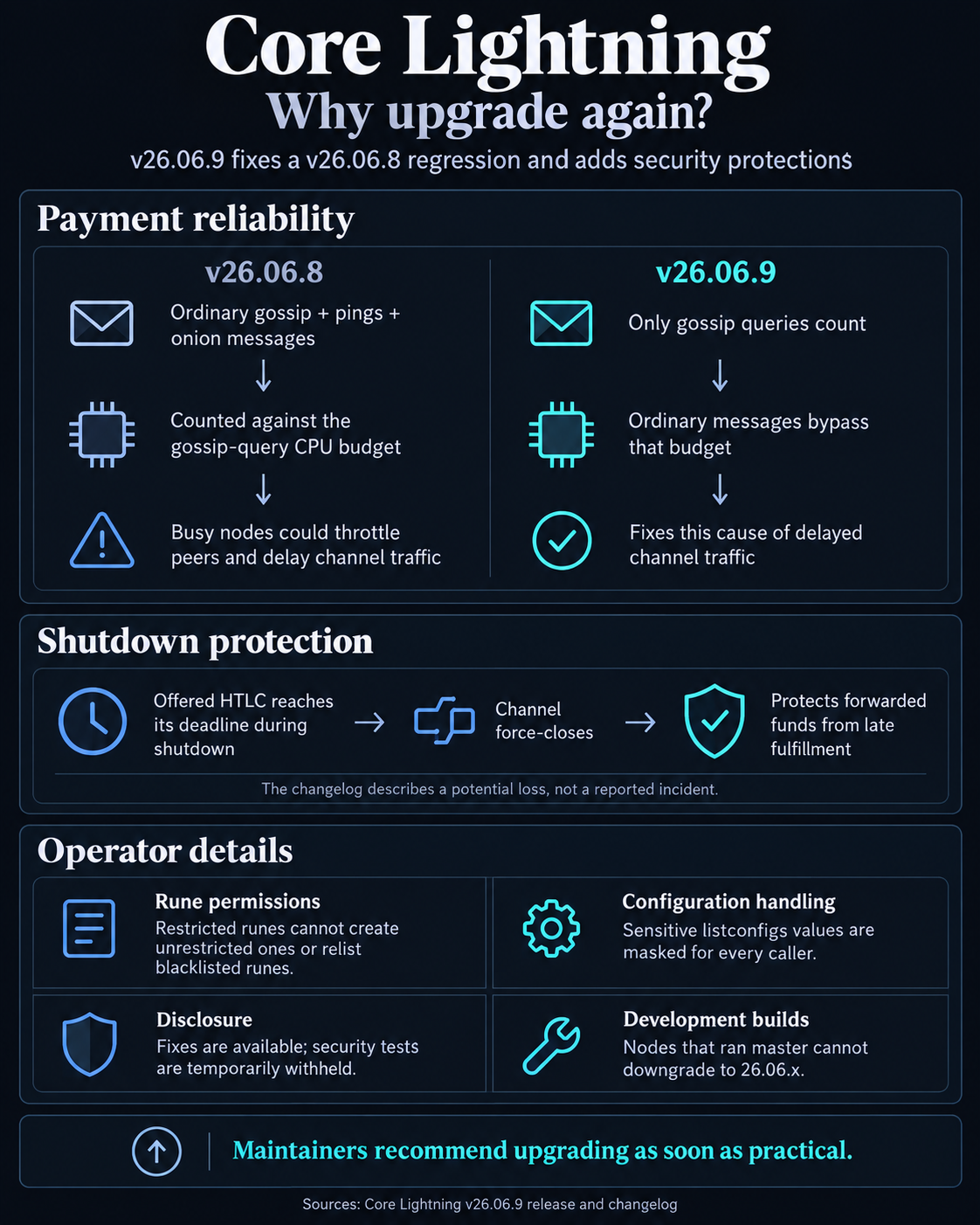
Other fixes enforce the limits carried by runes used to authorize calls, so a restricted rune can no longer create an unrestricted one or relist blacklisted runes. Restrictions on the corresponding creation and blocklisting methods now also cover the invokerune and destroyrune aliases.
The listconfigs command now masks several sensitive values, including recovery information and Bitcoin RPC passwords, for every caller. The setconfig command closes a path for injecting configuration lines through persistent option values.
The fixes are available immediately, but maintainers have temporarily held back security tests to make exploit development harder and give operators more time to upgrade.
Nodes that have run master cannot downgrade to a 26.06.x release because their database schema is newer. The release also reiterates that dual funding remains experimental and discourages zero-confirmation channels with untrusted peers.
Maintainers urge Core Lightning users, including those on v26.06.8, to upgrade to v26.06.9 as soon as practical.
The post Core Lightning patches critical security flaws and a Bitcoin payment bug appeared first on CryptoSlate.
Bitcoin miners are emerging from months of financial pressure as rising BTC prices lift daily industry revenue by 78%.
According to CryptoQuant's weekly report shared with CryptoSlate, total daily mining revenue climbed from approximately $27 million at July's lows to as much as $48 million, following Bitcoin's roughly 45% recovery from $58,000 to above $83,000.
The turnaround is also visible in hashprice, a closely watched measure of mining economics that tracks the expected daily revenue generated by a unit of computing power.
Data from Hashrate Index shows the metric recently climbed above $40 per petahash per second per day, its highest level since January. It has slightly declined to around $39 as of press time.
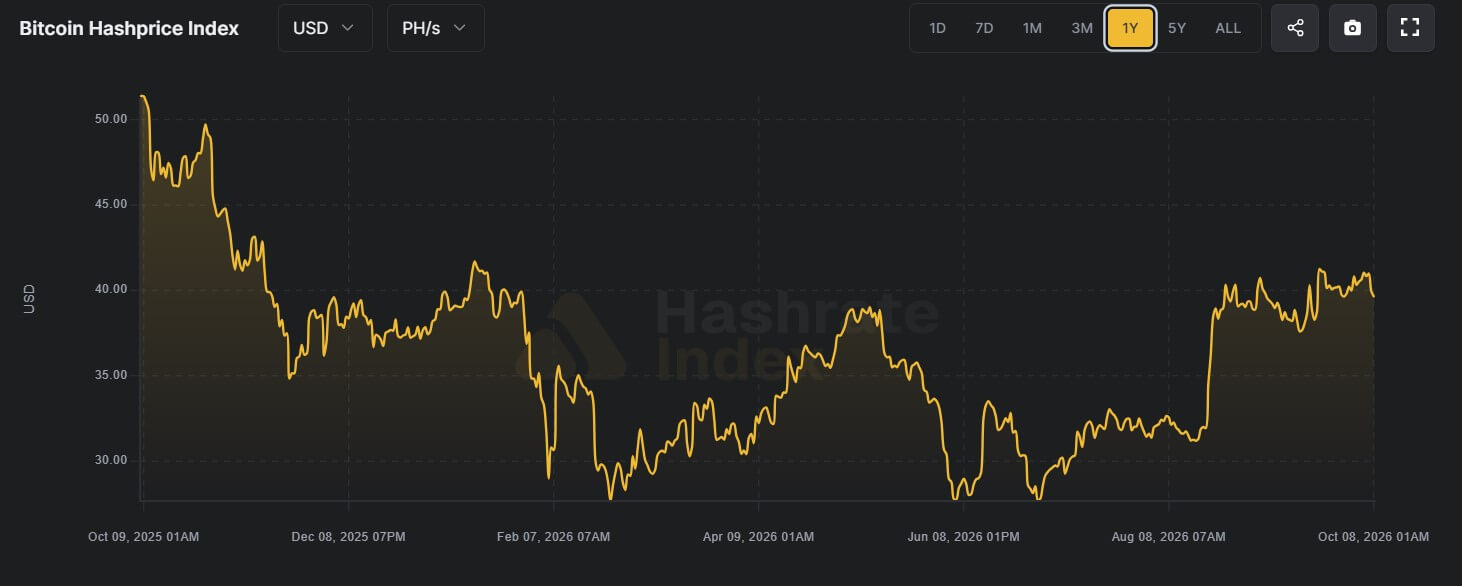
That marks a significant recovery from the industry's financial difficulties earlier this year. CoinShares previously reported that hashprice fell to approximately $27.70 in June, reflecting a combination of lower Bitcoin prices, persistently weak transaction fees, and mining difficulty that remained elevated relative to revenue.
The subsequent recovery has improved the economics of running mining equipment, although the gains vary considerably across operators depending on electricity costs, hardware efficiency and financing obligations.
Bitcoin's rally reverses months of mining distress
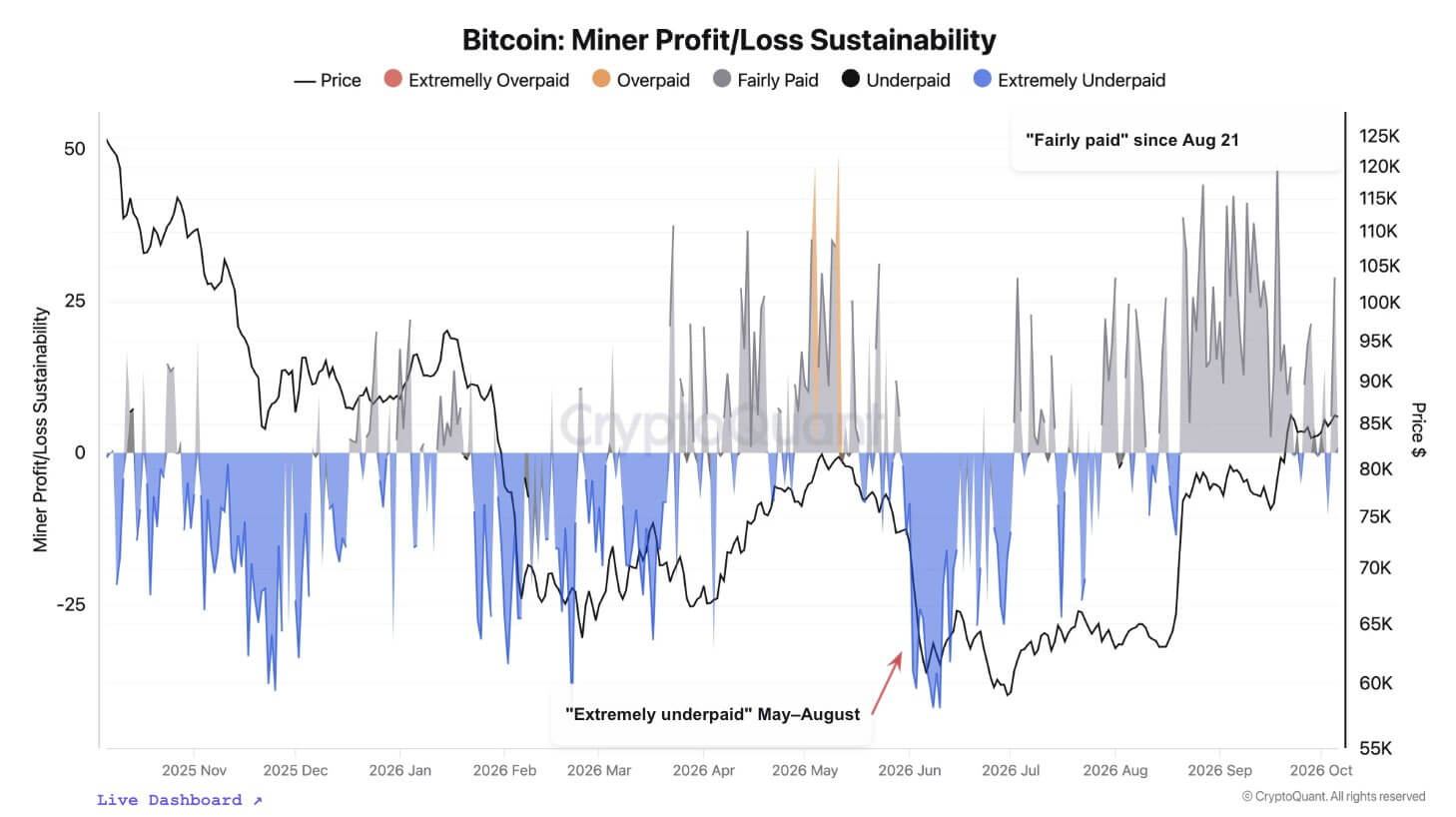
CryptoQuant's Miner Profit/Loss Sustainability indicator shows that the industry's financial position has improved substantially since August.
Between May and August, miners were largely classified as “extremely underpaid,” indicating that mining revenue was insufficient relative to the network's difficulty under the firm's methodology.
That changed on Aug. 21, when Bitcoin reached approximately $76,000. Since then, the indicator has generally remained in its “fairly paid” category, pointing out that mining revenue has recovered relative to the computational resources required to secure the network.
This improvement matters because mining operators receive Bitcoin-denominated rewards while electricity, equipment financing, and other operating expenses are generally paid in fiat currencies.
Higher Bitcoin prices therefore increase the dollar value of mining rewards without necessarily increasing operating costs immediately.
However, the higher hash price also reflects changes in network competition, since each unit of computing power is expected to generate more revenue when fewer miners compete for the same block rewards.
That dynamic helps explain why industry revenue and individual mining economics have improved even though Bitcoin's network hashrate remains below its previous peak.
CryptoQuant reported that network hashrate has recovered to about 962 exahashes per second (EH/s), up from 899 EH/s on July 31, when declining prices squeezed operators' margins.
The rebound has narrowed the network's drawdown from a peak of approximately 18% in late July to 13%, likely because improving returns are encouraging miners to bring more computing capacity back online.
Nevertheless, the financial recovery still depends heavily on Bitcoin's market value rather than increased transaction activity.
CryptoQuant found that daily transaction fees, measured using a seven-day average, rose from approximately $195,000 to $275,000. Those figures remain well below the $400,000 to $800,000 range recorded during parts of 2025.
Consequently, block subsidies still account for most mining revenue, leaving operators vulnerable to renewed pressure if Bitcoin prices retreat or network difficulty rises faster than earnings.
Miner selling pressure eases as profitability returns
Improved mining economics are also beginning to influence how operators manage their Bitcoin holdings.
CryptoQuant reported that extreme miner outflows have not occurred since Aug. 21, when approximately 29,000 BTC moved out of miner-associated wallets as Bitcoin advanced toward $76,000.
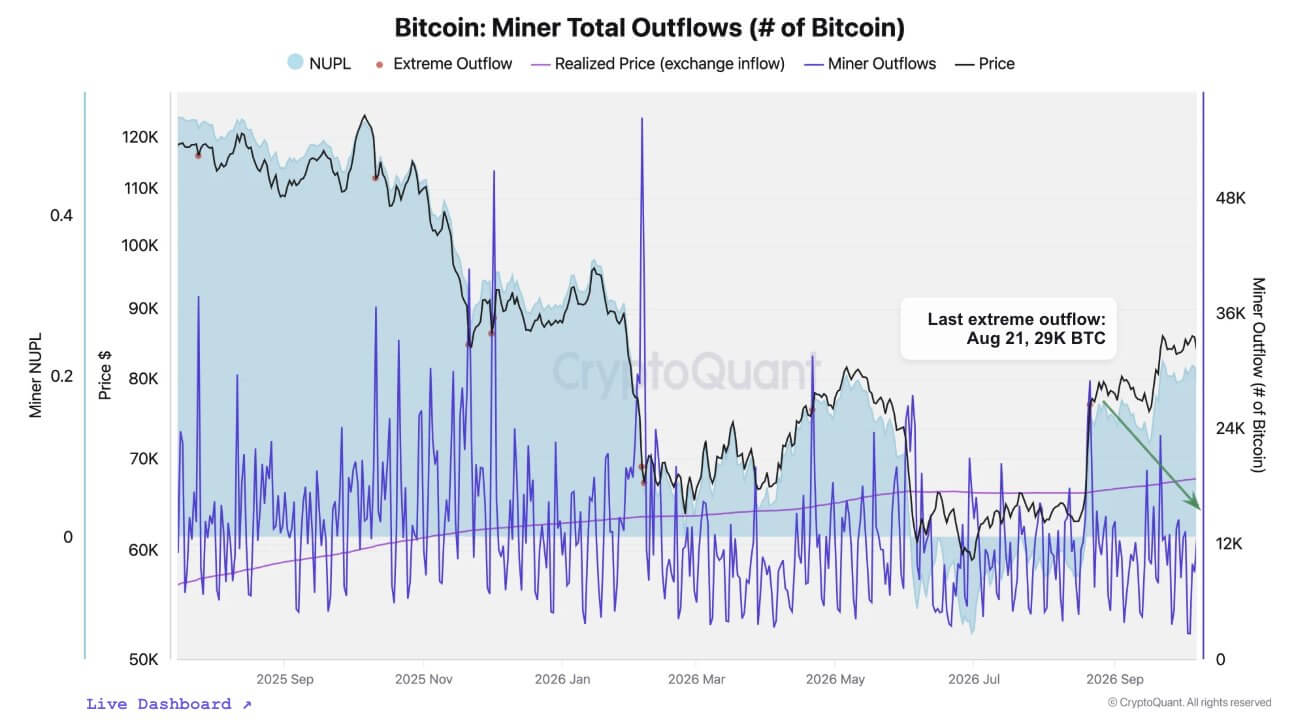
Since then, transfers have stayed within their normal range, with the latest daily reading at about 12,000 BTC.
Although wallet outflows don't necessarily translate into immediate market sales, the decline could be an indicator that miners face less pressure to move large amounts of Bitcoin after months of financial strain.
The change is also apparent among some of the network's oldest participants.
According to CryptoQuant, Satoshi-era miners, excluding addresses associated with Patoshi, transferred approximately 600 BTC out of their wallets in September. That was roughly a 70% decline from the approximately 2,000 BTC recorded in January.
Their combined holdings remain substantial at about 590,000 BTC, so changes in their spending activity matter for the market's potential supply outlook.
Meanwhile, addresses holding between 100 and 1,000 BTC have stopped reducing their aggregate balances after months of depletion.
The cohort's combined holdings declined approximately 20% from 64,000 BTC in December 2025 to roughly 51,000 BTC by early September. Since then, balances have remained relatively stable.
That stabilization could be a sign that miners have become less reliant on drawing down existing reserves as operating conditions improve.
For Bitcoin investors, the reduced selling pressure could remove one source of supply that weighed on the market during the downturn. However, the miners have yet to demonstrate a sustained return to accumulation.
Bitcoin's $80,000 support level emerges as a test for mining profits
Meanwhile, emerging constraints also limit how far the industry's financial recovery can extend.
As miners reactivate equipment and network competition intensifies, rising difficulty could compress hash price again unless Bitcoin's market value keeps climbing.
CryptoQuant identified Bitcoin's 365-day moving average near $80,000 as an important short-term support level, followed by its 200-day moving average around $71,000.
A sustained decline toward those levels could test the revenue gains miners have accumulated since July, particularly among operators using older, less efficient equipment.
A durable recovery would be marked by whether larger miners begin rebuilding their Bitcoin reserves while network hashrate continues to recover, suggesting that improving revenues are sufficient to cover operating expenses and support renewed accumulation despite increasing competition.
The post Bitcoin miners escape months of distress as daily revenue surges by 78% appeared first on CryptoSlate.
Bitcoin faces a new macro headwind from the artificial-intelligence boom as massive infrastructure spending competes for long-term capital.
Minutes from the Federal Reserve’s Sept. 15-16 meeting showed market participants citing heavy private debt issuance for AI infrastructure as one factor pushing Treasury yields and term premiums higher. Nominal yields rose about 35 basis points across maturities from two to 10 years between Fed meetings.
That complicates things for crypto investors focused primarily on when the Fed stops tightening. Policymakers raised the federal funds target by 25 basis points to 3.75%-4% in September, and most officials judged another increase would probably be appropriate before year-end.
Even when that cycle ends, continued competition for long-term financing could keep borrowing costs elevated independently of the overnight policy rate.
AI borrowing creates pressure beyond the Fed
The financing demands are already large enough to attract policymakers’ attention.
The Bank for International Settlements (BIS) estimates the five largest technology companies will spend more than $1 trillion on AI-related capital expenditure across 2025 and 2026. Industry projections cited by the BIS put global AI investment at roughly $500 billion today, potentially rising to between $3 trillion and $4 trillion by 2030.
Much of the earlier buildout could be funded from corporate cash flows. That balance is shifting as spending outpaces earnings and free cash flow at some companies, increasing reliance on bonds and private credit. The BIS said debt is becoming a larger part of the financing mix as firms build data centers, buy chips and secure energy infrastructure.
The Fed’s trading-desk manager said spreads on debt issued by major cloud providers remained wide because of the amount being borrowed and the long maturities involved. Market contacts also pointed directly to competition for capital from AI-related private issuance as one contributor to higher Treasury term premiums.
The minutes did not quantify how much of the roughly 35-basis-point rise in yields came from AI financing. Stronger economic data, expectations for additional Fed tightening, geopolitical developments and uncertainty around Treasury buybacks were also cited.
Still, the mechanism creates a potential problem for Bitcoin even after the policy-rate cycle turns.
Treasury data showed the 10-year Treasury par yield stood at 5.28% on Oct. 7, while the inflation-adjusted 10-year yield was 2.92%. Those levels give investors a substantial return from government securities before taking the volatility and drawdown risk associated with Bitcoin.
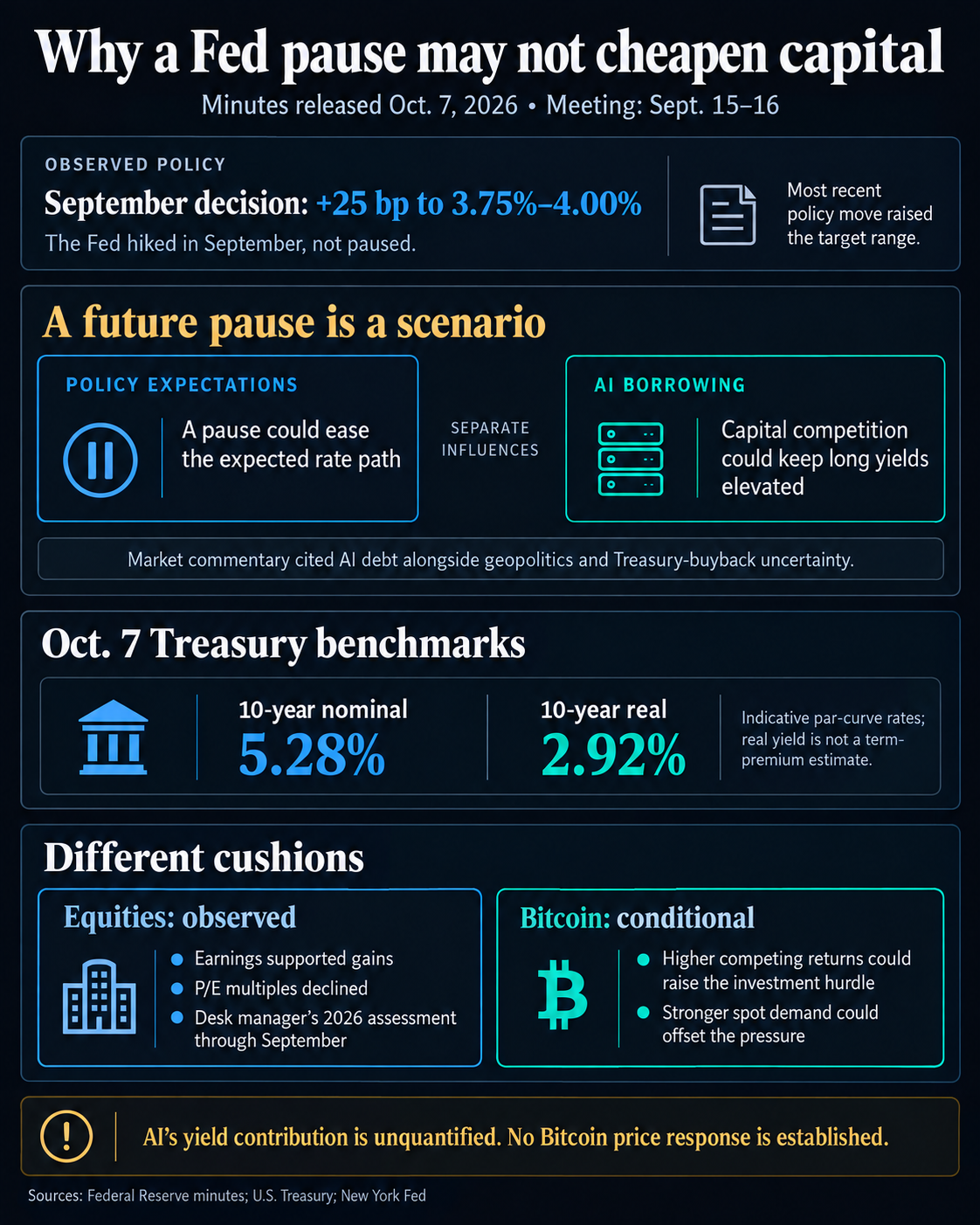
For crypto, that raises the required return on risk. A pause in Fed hikes could lower short-term rate expectations without providing the same relief at the long end of the curve if companies keep competing aggressively for financing.
The Fed also said changes in real rates accounted for most of the increase in longer-dated Treasury yields during the intermeeting period.
That distinction matters for Bitcoin because real yields reflect the return available after inflation, sharpening the competition between an asset with no contractual cash flow and securities that offer positive inflation-adjusted income.
AI-linked equities have so far absorbed the higher financing costs more comfortably. The Fed said companies benefiting directly from infrastructure spending outperformed the broader market, with stronger actual and expected earnings supporting equity prices even as valuation multiples declined.
The same boom could eventually reverse course
The longer-term risk is that the investment race becomes too successful at creating capacity.
The BIS has warned that the AI buildout ranks among the largest technology investment booms in US history. Its research argues that competition for future market share could push companies to commit more capital than eventual returns justify, while greater debt use increases the risk of financial stress and forced asset sales if revenue expectations disappoint.
That creates a second, very different Bitcoin scenario.
Arthur Hayes, the co-founder of the defunct BitMEX exchange, argues that the data-center race will ultimately produce excess computing capacity and a downturn.
Hayes has repeatedly pointed out that major technological rollouts have historically been overbuilt and expects financial stress to emerge as new capacity comes online, potentially around late 2027 or 2028.
His Bitcoin thesis begins where the current yield pressure ends. If an AI bust threatens heavily financed infrastructure owners, Hayes expects policymakers eventually to respond with liquidity support, creating conditions he believes would favor Bitcoin and other crypto assets.
That remains a speculative path. AI demand could grow rapidly enough to absorb the infrastructure under construction, while higher productivity and profits could validate the spending before debt burdens become problematic.
The BIS nevertheless sees the financing structure as a genuine vulnerability. Investment commitments increasingly exceed internally generated cash, making future returns more important to companies’ ability to service the capital raised for the buildout.
Bitcoin’s next macro test moves to the long end
For Bitcoin investors, the immediate signal is therefore less about the exact meeting at which the Fed stops raising rates and more about what happens to long-term real yields afterward.
A sustained decline in the 10-year yield and term premium would weaken the argument that AI capital demand is keeping financial conditions tight. Strong Bitcoin spot demand amid elevated yields would also show investors are willing to accept the higher opportunity cost.
The opposite combination would be harder for crypto markets. Continued AI-related borrowing alongside high real yields would leave Treasuries and corporate credit competing aggressively for marginal capital even after monetary tightening peaks.
The Fed’s next meeting is scheduled for Oct. 27-28, with officials still focused on inflation and the possibility of another increase by year-end.
For Bitcoin, however, the bigger test may come after the final hike. If the AI investment race keeps the long end of the Treasury curve elevated, traders' expected monetary relief from a Fed pause could prove weaker than in previous cycles. If the spending boom eventually breaks, investors will watch whether financial stress brings the liquidity response Hayes is already positioning for.
The post AI may be keeping Bitcoin’s biggest macro headwind alive after the Fed stops hiking appeared first on CryptoSlate.
Abstract, an Ethereum layer-2 network, says it will shut down on Dec. 15, 2026. In its Oct. 6 announcement, @AbstractChain told users to migrate their assets before that date or lose access to their funds.
The deadline tests a distinction that can disappear behind the phrase self-custody. A holder can retain ownership and the authority to approve transactions while losing the infrastructure needed to execute them. Cube, Inc., the company providing Abstract's services, makes that separation explicit in its updated terms: wind-down does not transfer assets to Cube or the other parties covered by its terms, but the end of normal processing ends transfer access through discontinued services.
A completed exit requires a supported asset route, access to the authorizing wallet, a controlled destination and every required processing or claim step.
A shutdown date is not every route's deadline
@AbstractChain's announcement directs users to the Migration Hub at migrate.abs.xyz or the native bridge at native-bridge.abs.xyz. The public Migration Hub repeats the Dec. 15 notice and lists Native Bridge, Stargate, Relay, Jumper and project-specific instructions.
The general terms identify migration.abs.xyz as the official Hub and bridge.abs.xyz as the existing bridge interface. The Hub at that address also displays the shutdown notice and alternative bridge links. However, the announcement and terms name different interfaces; their addresses alone do not establish interchangeable routes. The Hub links also do not supply a complete map showing which token, NFT or application position can use each one.
The existing bridge interface offers wallet connection, token selection, route priority, gas and slippage controls, with 0x attribution. A visible interface and selectable route still leave the user-specific questions: what can move, where it will arrive and what remains to be done after approval.
Timing also has several layers. @AbstractChain says native-bridge users should expect a three-hour delay. Abstract's bridge documentation describes native ETH and ERC-20 transfers between Abstract and Ethereum, while saying withdrawals can take up to 24 hours. L2BEAT's Oct. 2 contract update tracks an effective execution delay of three hours.
An execution delay and the time needed to finish a withdrawal are different measures. Neither estimate establishes that starting three hours before shutdown will produce a completed exit.
Cube's terms distinguish initiation, completion and claim deadlines, any of which may come before chain discontinuation. A transaction submitted in time can still require a waiting period, destination-chain claim, transaction or fee. The terms also say that any supported completion process continuing after discontinuation would follow its own disclosed conditions and cutoff; it would not provide a way to start new withdrawals for assets left on Abstract.
That makes Dec. 15 the announced chain shutdown date, rather than a universal last moment to click a bridge button.
Wallet access and settlement require different controls
Abstract Global Wallet, or AGW, is a smart contract wallet. Its architecture separates the contract holding assets from an approved signer that authorizes transactions.
The documented setup generates a signer key through Privy's embedded-wallet system and divides it into three shares: one on the user's device, an authentication share on Privy's servers and a recovery share in a backup location chosen by the user. Access to any two shares is required to reconstruct the key.
This design does not make Privy's normal login flow the only documented way to recover signing authority. Abstract describes combining the device and recovery shares if Privy is offline or the original login method becomes unavailable. That option depends on the user having access to those shares.
Recovering those shares restores signing authority, rather than the infrastructure that processes an exit.
Destination compatibility creates another boundary. The AGW FAQ says its contract code is EVM-compatible, but its SDK works only on Abstract. Cube's terms separately warn that an AGW address may not be usable or controlled by its user on another chain.
A familiar-looking address is consequently insufficient evidence that its user controls the receiving wallet.
The same inventory problem applies to the assets being moved. Cube's terms warn that an interface may not show every holding and identify NFTs, staked or locked assets, collateral, liquidity positions and application-held assets as categories requiring review.
Migration also covers only the assets and amounts authorized. Moving the balance visible today does not automatically forward assets received later or resolve another application's position.
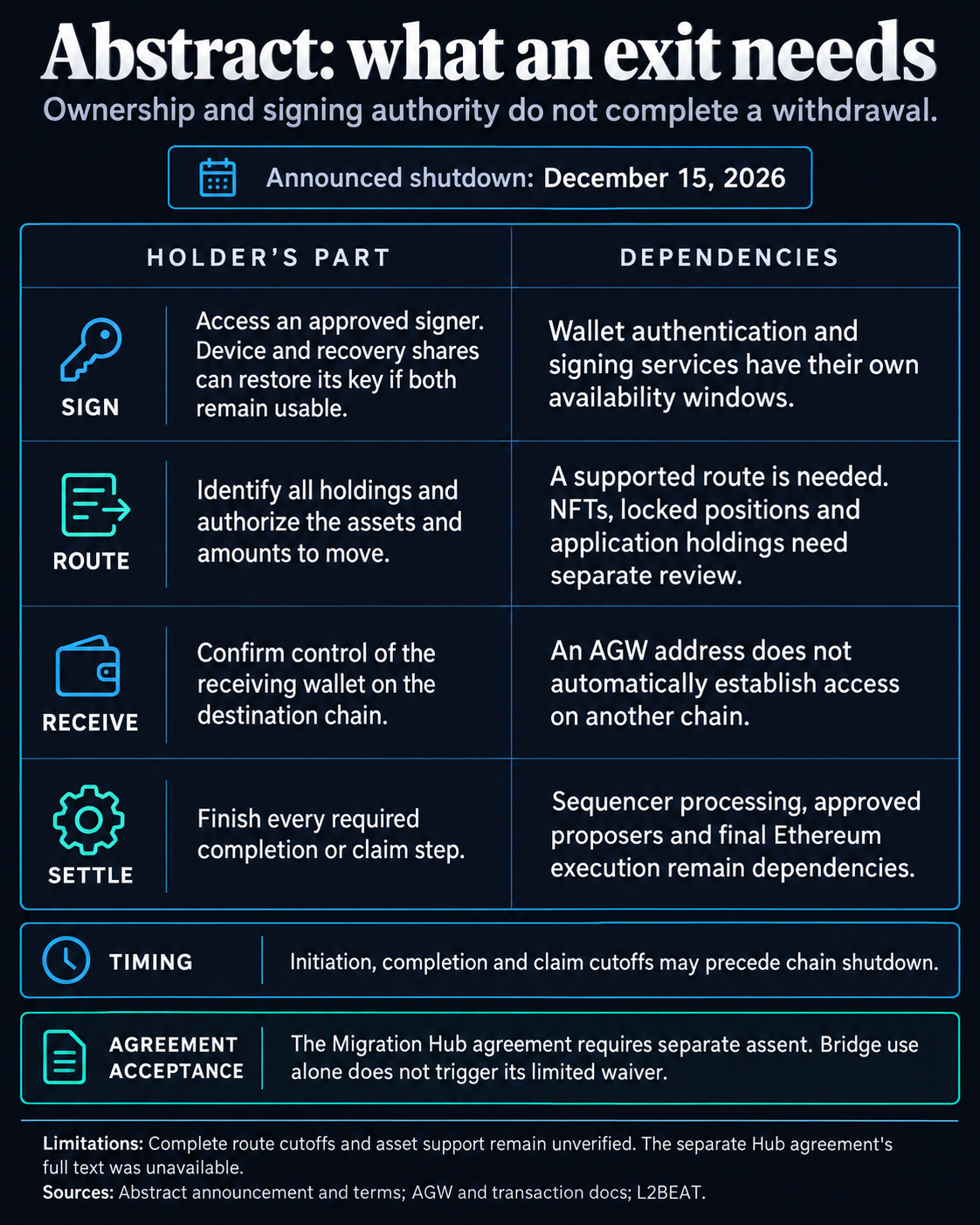
Abstract's transaction lifecycle shows why a source-chain success message is not the whole exit. A transaction first receives execution and soft confirmation on Abstract. Batches then proceed through commitment, proof verification and final execution on Ethereum.
L2BEAT's assessment identifies the operating dependencies behind that sequence. Users can submit transactions through an Ethereum queue, but they cannot force the chain's sequencer to process them if it stops. Only approved proposers can publish records of chain state to Ethereum; proposer failure freezes withdrawals, while governance can attempt a replacement through an upgrade.
They leave settlement dependent on continued processing even when a holder can sign.
The execution delay is also configurable. L2BEAT's Oct. 2 update says chain administrators can increase their chain's delay and the owner can set it, subject to a 30-day cap. The currently tracked three-hour delay is therefore a parameter, not an irrevocable completion guarantee.
Cube's terms describe support in similarly bounded language. They commit to commercially reasonable information, assistance and provider coordination during published support windows. An extension or alternative process depends on feasibility and provider or governance decisions, rather than becoming an automatic entitlement to a successful transfer.
What holders agree to
Authorizing a transfer also needs to be distinguished from accepting a contract. The Oct. 6 general terms require an initially unchecked agreement checkbox and affirmative confirmation. Holding assets, connecting a wallet, viewing information or signing a transaction does not by itself accept that version.
The Migration Hub agreement has separate acceptance requirements. Section 17.2 of the general terms describes its limited waiver as concerning actual or attempted use of migration functions after valid acceptance, within that agreement's scope and exceptions. Portal or bridge use alone does not trigger that waiver.
The separate agreement's full waiver scope remains unresolved; the general terms' description supplies only that limited distinction.
The general terms say acceptance does not itself extinguish existing claims. They separately address substantive rules for earlier conduct, dispute procedures and effective opt-outs, subject to mandatory consumer protections. Those provisions do not settle enforceability for every holder.
As the wind-down proceeds, the decisive information will be the supported routes and their initiation, completion and claim cutoffs, alongside availability windows for authentication and signing. Cube identifies @Abstract_Eco, @AbstractChain and the Abstract Discord as its official operational channels, and says wallet, recovery, export, explorer and support functions may end at different times.
The next operational notices will determine how long those parts of the exit remain available.
The post Abstract’s shutdown exposes the gap between owning assets and being able to move them appeared first on CryptoSlate.
Tracked stablecoins on the XRP Ledger totaled $1.338 billion on Oct. 7. For XRP holders, the critical question is how much activity uses the token as principal, and how long users or intermediaries need to hold it.
Fees and account reserves require XRP, the ledger's native token. Stablecoins, tokenized funds and securities records can keep their principal in other assets. Bridge routes and XRP-funded liquidity pools create a separate reason to hold XRP: inventory available to fill trades or payments.
DefiLlama's XRPL dashboard showed Ripple's dollar stablecoin RLUSD accounting for 93.17% of tracked stablecoins. The same snapshot reported $43.44 million in value locked in decentralized finance, $3.91 million in 24-hour decentralized-exchange volume and $528 in 24-hour chain fees.
Each reading measures a different part of the ecosystem. Stablecoin supply is a balance, trading volume is turnover, and fees are a cost. Adding them together would mix those units and could count the same assets more than once.
Ripple's Oct. 1 transparency figures put total RLUSD circulation at $2,509.8 million, backed by $2,633.8 million in reserve funds. These issuer-wide figures cover RLUSD across its supported blockchains. The backing consists of dollars and cash equivalents.
How XRPL activity uses XRP
XRPL's standard minimum transaction cost is 10 drops, equivalent to 0.00001 XRP, before load scaling. Fees are destroyed. Congestion and special transactions can require more, while an eligible key-reset transaction can be free.
The fee follows the transaction's processing cost. Moving a larger asset value does not, by itself, increase the XRP fee in proportion.
Reserve requirements create a different obligation: currently 1 XRP per account and generally 0.2 XRP per qualifying owned ledger object. The first two trust lines are exempt when an account is funded with just the 1 XRP base reserve; additional funding triggers normal charges.
These balances scale with accounts and objects. They represent XRP held to satisfy reserve rules; transaction fees consume XRP through burning.
| Activity | Where XRP enters the transaction | What can stay outside XRP |
|---|---|---|
| Stablecoins and tokenized assets | Network fees and applicable reserves | The asset principal |
| Decentralized exchange trades and cross-currency payments | An XRP bridge route when it offers better pricing | Trades using direct issued-token liquidity |
| Automated market maker liquidity | XRP inventory when XRP is one pool asset | Pools holding two issued tokens |
| Native lending design | Loan principal if the vault holds XRP | Principal in a trust-line token or Multi-Purpose Token |
Tokenized funds illustrate the distinction. Ondo's tokenized Treasury product OUSG went live on XRPL in June 2025 with subscriptions and redemptions using RLUSD. In its Aug. 3, 2026 ZILO and Licuido announcement, Ripple likewise described RLUSD as the cash leg for delivery-versus-payment transactions and tokenized funds as collateral.
Brazil's securities project makes the record-keeping role explicit. Ripple announced on Sept. 29, 2026 that the securities infrastructure operator CSD BR would initially mirror BTG Pactual fund-share records on XRPL. CSD BR's own systems remain official for registration, deposit and settlement. Native issuance and trading among authorized participants are envisioned later, after the mirroring phase is validated.
Ripple Payments has a broader scope than activity on XRPL. Its March 3, 2026 platform expansion included fiat and stablecoin collections and payouts, with Corpay using RLUSD for funding and settlement.
For lending, the documented Single Asset Vault design permits XRP, trust-line tokens or Multi-Purpose Tokens. The Lending Protocol describes fixed-term, uncollateralized loans. XRP-funded vaults would commit XRP as loan principal.
Inventory is the larger test
XRP's bridge role offers a route to larger liquidity demand. Auto-bridging can connect issued-token markets through XRP when that route is cheaper, while direct routes or combinations of both remain possible. Cross-currency payments can also use XRP conversion paths.
A bridge can buy XRP on one leg and sell it on another, creating a temporary need for the token during the transfer. The continuing inventory question is how much XRP intermediaries keep available between trades. Gross turnover leaves that balance unmeasured. A direct XRP payment also moves existing balances; the transfer alone establishes neither a fresh market purchase nor net accumulation.
XRP-containing AMM pools hold actual XRP inventory while it remains deposited. Liquidity providers can redeem their shares. Pools containing two issued assets keep their trading principal in those assets.
These ecosystem totals leave incremental XRP demand per dollar of activity unquantified. The decisive measurements are the share of activity routed through XRP, the XRP balances committed to liquidity, and how long those balances stay in place.
The post XRPL’s $1.34 billion stablecoin base doesn’t tell us how much XRP users need appeared first on CryptoSlate.
CryptoTicker.io
An Ethereum savings plan buys the same euro amount of Ether every month, whatever the price happens to be. A calculation over the past twelve months shows how much that matters: twelve instalments of 100 euros, each bought on the first of the month, worked out at an average price of 1,981 euros per Ether. Investing the same 1,200 euros in one go on the day of the first instalment would have cost 3,318 euros.
That is not a recommendation, because a single year proves nothing about the next one. What it does show is the mechanism: what a savings plan lives on, why it bites harder with Ether than with Bitcoin, and what twelve separate purchases a year mean for tax. All figures here come from daily euro prices, recalculated on October 8.
Ethereum savings plan: an average of 1,981 euros across twelve monthly instalments
A savings plan is a buying machine. You set the amount and the rhythm, the provider buys, and the price on the purchase day decides how much you get for your money. When the price falls, the same 100 euros buys more Ether; when it rises, less. The technical term is dollar-cost averaging: the average purchase price ends up below the mean of the prices, because the cheap months contribute more units than the expensive ones.
How strong that effect turns out depends entirely on how much the price swings over the savings period. For an asset that rises steadily, the savings plan loses against an early lump sum. For one that slumps and then recovers, it wins. Ether did the second of those over the past year.
The calculation in detail: 1,200 euros paid in, 0.6057 Ether in the portfolio
The basis is Ether’s daily euro prices from October 9, 2025 to October 8, 2026. The model buys on the first of each month in that window, twelve times, 100 euros each time and without fees. The result:
- Paid in: 1,200 euros across twelve instalments.
- Acquired: 0.6057 Ether.
- Average purchase price: 1,981.05 euros per Ether.
- Value of that position on October 8 at a price of around 2,300 euros: 1,393 euros.
- Result before tax and fees: plus 16.1 percent.
The average price therefore sits about 14 percent below today’s level. That gap is the whole advantage the savings plan built up in this window, and it comes purely from the path the price took.
The lump sum over the same period: a 3,318-euro entry, 30.7 percent down
The counterpart: the same 1,200 euros, invested on November 1, 2025, the day of the first instalment. The price that day was 3,318.20 euros, so the money bought 0.3616 Ether. Those Ether are worth around 832 euros today, 30.7 percent less than was paid in.
The two routes are 561 euros, or almost 47 percentage points, apart. The savings plan ended up holding 1.67 times as much Ether for exactly the same outlay. The reason lies in the path: Ether was trading near its one-year high on the starting day and fell sharply afterwards. A lump sum at the bottom would have beaten the savings plan just as clearly. Which route comes out ahead is decided by the entry point, and nobody knows that in advance. We ran the same question for Bitcoin in savings plan or lump sum.

A single year proves nothing: the limits of this calculation
Three caveats belong with it, otherwise a measurement turns into a claim. First, the window covers only twelve months, and it began near a high. A window that begins in a trough reverses the result. Second, the example ignores fees; depending on the provider, anything from a few cents to more than a euro goes per instalment, which is already noticeable on a 100-euro instalment. Third, a real savings plan rarely executes exactly on the first of the month; depending on the provider, execution falls on the next trading day or within a fixed window.
None of these caveats overturns the finding, but each shifts it. Only the direction is solid: in a year with a deep slump and a subsequent recovery, buying in instalments clearly beats an early lump sum.
Annualised volatility: 62.9 percent for Ether, 44.5 percent for Bitcoin
Because the savings plan lives on price swings, their size is worth a look. Volatility measures how widely a price scatters around its own trend; it is usually quoted as an annual figure. The same daily prices give Ether an average daily move of 3.29 percent, which annualises to 62.9 percent. For Bitcoin the figures are 2.33 percent a day and 44.5 percent a year.
The range tells the same story. Over the twelve months Ether moved between 1,361 and 3,914 euros, with the high at 2.87 times the low. Bitcoin ranged from 51,474 to 106,651 euros, or 2.07 times. Ether has been noticeably more restless over this period, which strengthens dollar-cost averaging and strains the nerves at the same time. The two go together.
Staking and a burned base fee: what sets an Ether savings plan apart from a Bitcoin one
Beyond the price moves there are two quirks that Bitcoin does not have.
The first is staking. Ether can be deposited in the network to confirm blocks, and it earns a reward for doing so. According to Ethereum’s own staking page, running your own validator takes at least 32 Ether and can hold up to 2,048 Ether; pool solutions exist for smaller amounts. Provable misbehaviour by a validator leads to slashing, in which part of the deposited Ether is destroyed. For a savings plan that means the accumulated holding can later earn something, which a Bitcoin holding does not do by itself. Which providers handle that, and on what terms, is in the comparison of staking platforms.
The second quirk concerns supply. Bitcoin has a fixed cap and an issuance schedule known in advance. On Ethereum, according to the project’s developer documentation, the base fee of every transaction is burned and thus taken out of circulation, while new Ether is issued to validators at the same time. Whether the circulating amount grows or shrinks therefore depends on network load and is not fixed in advance. For a savings plan running over several years, that is one more unknown.

Twelve instalments, twelve acquisitions: the one-year clock runs separately for each
This is where a savings plan becomes something different from a single purchase for tax purposes. In Germany, crypto assets count as other assets under section 23 of the Income Tax Act. A disposal is taxable if no more than one year lies between acquisition and sale.
What counts, then, is the acquisition, and every instalment is one of its own. The instalment from November 1, 2025 reaches its one-year mark on November 2, 2026; the instalment from October 1, 2026 not until October 2027. Selling half your holding in December 2026 therefore means facing holdings of quite different ages, instalment by instalment. Which Ether count as sold is the decisive question, and it cannot be evidenced without clean records for each instalment; for larger amounts it belongs with a tax adviser rather than in a rule of thumb.
The Federal Ministry of Finance restated the cooperation and record-keeping duties in its circular of March 6, 2025, which replaces the version of May 10, 2022. It tightened the position on foreign trading platforms: transaction statements must be retrieved and retained regularly and in full, and missing documents count against the taxpayer. For Bitcoin we broke the holding period under a savings plan down in a separate piece on the savings plan holding period.
Section 23 of the Income Tax Act: gains stay tax-free below 1,000 euros a year
The law names a threshold, and it is worded more sharply than it is usually reported. Gains from private disposals stay tax-free if the total gain achieved in the calendar year came to less than 1,000 euros. At exactly 1,000 euros the exemption no longer applies, and then the whole amount is taxable, not just the part above the threshold. An exemption threshold works differently from an allowance.
The count also runs across all private disposals in a year together, not per coin and not per venue. Selling other crypto assets within a year alongside the Ethereum savings plan puts those gains into the same pot. Keeping records as you go is therefore not paperwork but the basis of your own tax return.
Whether the one-year period survives is politically open. Abolition is under discussion; nothing has been decided so far. Until then the rule applies as it stands in the law.
ETP or real coins: what the difference means for your tax
A savings plan on Ether can be built two ways, and they are not the same for tax. Buying real coins through a trading platform falls under the section 23 framework just described. Buying an exchange-traded product on Ether, an ETP or ETN, means buying a security in a brokerage account, to which the rules for investment income apply.
The practical difference is large. With a security the broker usually withholds the tax itself, but there is no one-year period after which a gain becomes tax-free. With your own coin you handle it yourself, but can sell tax-free after a year. An ETP also carries issuer risk, because you hold a debt instrument and not a coin. Which structure suits what we took apart in certificate, ETN or coin; which brokerage accounts offer such savings plans at all is shown by the comparison of crypto brokers.
Instalment, rhythm, fees and custody: four settings where a savings plan fails
There is little to optimise about the mechanism itself, but plenty about the execution.
- The instalment has to be sustainable. A savings plan you suspend in the next slump loses exactly the part that makes it work: the purchases at low prices. Better 25 euros that stay than 200 euros that pause in March.
- The rhythm is secondary. Monthly, fortnightly or weekly changes little about the average price, as long as the period is long enough. More frequent buying does raise the number of fee items and the number of acquisition dates to document.
- Fees bite in percentage terms. A flat amount per execution hits small instalments harder. At one euro per instalment, a 25-euro instalment pays four percent and a 200-euro instalment half a percent. Over twelve years the difference adds up to a size of its own.
- Custody belongs settled before anything accumulates. A holding that grows over years eventually reaches a size at which the question of where to keep it is no longer a side issue.
Ethereum savings plan: every instalment starts its own one-year clock
The calculation above is a window, not a forecast. What remains are three points that hold regardless of the price path.
- Set the instalment and the term before you start. The effect builds over years and across slumps, not over months. Which providers run crypto savings plans and what they charge per execution is shown by the comparison of savings plan providers.
- Document every instalment from the first one. Date, price, amount, fee and platform, ideally automatically. Which programs pull that from the statements is in the comparison of crypto tax software.
- Decide on custody early. If you want to hold the position yourself, set that up while the sum is small, not once it has grown large. The devices for it are in the hardware wallet comparison.
(As of October 8, 2026. This article is not investment advice. Prices and fee structures change; check the terms with the provider before you buy.)
Ondo Finance launched a platform on October 6, 2026 that makes stakes in companies tradable before they reach the stock market. What trades are tokenised notes, not shares; their value is tied to the price of one common share in the company concerned. Payment comes only once that company has completed a listing, is taken over, or ten years have passed. For anyone holding ONDO or considering a purchase, a new line of business is thereby written into the project, and at the same time a product that meets different rules in Germany than a coin does.
One thing at a time, because three questions hang on this launch that the press release does not answer: what do you legally buy? Who may buy at all? And when does money come back?
What Ondo Private Markets sells: tokenised notes instead of shares
A note is a debt instrument: a paper by which an issuer promises the buyer a payment. At Ondo Private Markets the size of that payment follows the value of one common share in the company the note refers to. Ondo calls that company the reference company.
Ondo's product page states the difference from a share itself, and plainly: the tokens are “not themselves stocks” and give their holders no rights to hold or receive the underlying assets. Buying such a note therefore does not make you a shareholder. There is no voting right, no annual general meeting, no dividend and no claim to delivery of the share itself. What remains is economic participation in the price, mediated through the issuer's promise to pay.
This design is nothing new in finance. Certificates and warrants have worked on the same basic idea for decades, and their best-known risk carries the same name as here: issuer risk. If the issuer fails, it does not help the holder that the reference company is flourishing.
Which documents govern
Ondo names three documents that govern the relationship: the token terms, the subscription agreement and a declaration accepting the token terms together with the repayment claim. In case of doubt, the token terms prevail. For a buyer that means the marketing page is not the contract. What applies is in the terms, which are only available during the subscription process.
The issuer sits in the British Virgin Islands: PM Issuer Co (BVI) Limited
As issuer of the notes Ondo names PM Issuer Co (BVI) Limited, a company under the law of the British Virgin Islands. For tokenised products this is a widespread construction, and it has two tangible consequences for German buyers.
First, the counterparty's seat lies outside the European Union. A dispute over the terms will therefore not automatically be heard before a German court, and the deposit guarantee or investor compensation familiar from a German institution does not apply here. Second, according to Ondo the tokens are not registered under the US Securities Act of 1933. That lack of registration is the reason for the access restriction set out below.
The press release puts a figure in front of the product to explain its market: roughly 87 percent of US companies with annual revenue above $100 million are said to be in private hands. The figure comes from Ondo's own announcement and describes why pre-IPO stakes are attractive as a product. It says nothing about how well this particular product does its job.
Qualifying liquidity event: when the note actually pays out
The product's most important mechanism is its payout date. Ondo pays neither at the end of a term nor on the holder's demand, but upon a qualifying liquidity event. The product page names four triggers: a listing that has traded for six months; a majority takeover; an insolvency; and the expiry of ten years after issuance.
More hangs on that list than it shows at first glance. A funding round expressly does not trigger payment, nor does a takeover offer to individual existing shareholders, nor does a sale of stakes on the secondary market. Yet those are precisely the events at which private companies are most often revalued. A holder can therefore watch their reference company valued at a multiple without any payment falling due.
What is then paid out is the liquidity event price of one common share, less tax withholding and settlement fees. Ondo names no amounts for these. Whether an event has occurred and which price applies is decided by a calculation agent at its reasonable discretion. For an investor that is a valuation they cannot recalculate themselves.

Secondary trading on the Ondo Perps Spot Market: 24/7 without a reference price
Because the payout can be years away, the secondary market becomes the actual way out. Ondo sets it up on its own Ondo Perps Spot Market, open around the clock. Further venues may follow later. The tokens are freely transferable, can be self-custodied and used in DeFi applications, though only to other eligible holders.
Ondo itself notes three restrictions. Trading is subject to maintenance, risk controls and suspension by the issuer. Liquidity may be limited and the spread between bid and ask wide. And there is no public market price for the reference company and no generally accepted comparable value, which is why the secondary market price can deviate considerably from the last private valuation and from the later payout.
That sets the instrument apart from everything traded on an established perp DEX. With Bitcoin or Ether there is a worldwide reference price across dozens of venues. Here buyers and sellers set the price among themselves, on a market the issuer is allowed to halt.
Access for eligible investors only: what the US exclusion means for Germany
The product page carries a “Not Available in US” banner, and it puts the exclusion harshly: US persons are prohibited from subscribing for, acquiring or redeeming the tokens. Behind that stands the missing registration under US securities law. For all other countries Ondo opens the product only to eligible investors, without saying on the page who falls under that.
For German prospects that gap is the practical crux. Access to the primary sale runs, according to Ondo, through selected distribution partners and through Ondo Private Client, meaning a service that is usually tied to minimum amounts and to evidence of investor suitability. Whether a retail investor from Germany passes that test is decided only during the subscription process, and no publicly available document from Ondo answers it in advance.
Clearing that up takes two steps there is no way around: request the subscription documents and look in them for which countries and which investor status are listed. A look at the marketing page is not enough.
Why an exclusion is no substitute for a recommendation
That a product excludes US investors is neither a mark of quality nor a defect. It follows from how the issuer set up its paper legally. What is sold is the same risk, merely to a different circle.
MiCA does not apply to tokenised notes: the legal framework for German buyers
Since 2024 the EU's MiCA regulation has governed the market for crypto assets, bringing authorisation requirements for trading venues, custodians and issuers. That regulation is not the yardstick here, though. MiCA excludes crypto assets that qualify as financial instruments. A note whose value is tied to a share carries exactly the features of a financial instrument, so the rules for securities apply instead of those for crypto assets. We have set out what that means for companies in practice in our overview of the MiCA obligations to 2026.
For a buyer the question of protection thereby turns around. With a MiCA-regulated provider, they can look up whether an authorisation exists and which supervisor granted it. With a security from an issuer in the British Virgin Islands that is not publicly offered in the EU, there is no approved prospectus in which a European supervisor has checked the statements. The checking shifts entirely to the buyer.
A classification in the individual case can only be made by a lawyer or tax adviser with the specific token terms in hand. This article describes which questions to ask, not which answer is right for a particular instrument.

Tax on pre-IPO notes: capital gains tax instead of the one-year holding period
Here lies the difference that can cost or save German investors the most money. For crypto assets such as Bitcoin the one-year holding period under Section 23 of the German Income Tax Act applies: hold for more than a year and the gain is sold tax-free. That rule covers private disposals of other assets.
A note does not belong in that category. Capital claims fall under Section 20 of the Income Tax Act, and there is no holding period there after which the gain becomes tax-free. Gains are subject to withholding tax of 25 percent plus the solidarity surcharge and, where applicable, church tax, regardless of whether two months or seven years lie between purchase and sale. How the tax office classifies a specific tokenised instrument depends on the issuance terms; a foreign issuer also does not remit the tax automatically, so the declaration stays with the investor. Anyone holding several such positions over the year needs a schedule recording purchase, sale and deductions for each instrument.
The fact that, according to the product page, the issuer withholds tax before the payout changes none of this. A deduction at source abroad and the German tax liability are two separate matters, which in the best case can be set off against each other through a double taxation agreement.
ONDO price this week: $0.4822 and Thursday's weekly low
The token itself barely reacted to the launch, because the broader market set the tone for the week. ONDO trades at $0.4822, putting it 1.2 percent below the level of seven days ago, according to CoinGecko as of Thursday, 11:55 pm. The weekly high was $0.5106 on October 2, the weekly low $0.4437 on Thursday afternoon, the day of this article. By market capitalisation ONDO stands in 48th place.
The slide to the weekly low coincided with a broad sell-off in which Bitcoin dropped below $81,000 and several altcoins lost double digits. The reasons for that lie outside Ondo, with rising bond yields and outflows from the Bitcoin ETFs.
As an observation, not a price target: above, the weekly high at $0.5106 marks the first hurdle, along with the round $0.50 level. Below lies the weekly low at $0.4437, and beneath it the round $0.44 level. Whether a new line of business carries the token is decided over months, and by whether the notes generate revenue.
From Ondo Stocks to Private Markets: what Ondo has tokenised so far
Private Markets is the provider's third pillar. First came tokenised US Treasuries, then tokenised listed shares and funds. That equities business was called Ondo Global Markets until July 2026 and has run as Ondo Stocks since; in June 2026 the catalogue grew by 173 instruments to more than 430 positions across three blockchains. September brought the Intelligent Portfolios, three tokenised model portfolios following BlackRock model strategies. This offering is being rolled out step by step to further blockchains, most recently to NEAR.
Across these platforms together, Ondo reports by its own account a deposited value of $3.7 billion to $3.9 billion, with sources diverging on the figure, and more than one million holders over time. These numbers belong to the existing business, not to Private Markets, which began on October 6 with a single reference company from the AI sector.
Further sectors have been announced: biotechnology, robotics, defence, energy, space, quantum technology, aviation, logistics, digital assets and cybersecurity. A timetable for them is missing, and Ondo has not named the first reference company either. According to the announcement, secondary trading was due to start in the week after the launch.
How to recognise a legitimate route in
Tokenised pre-IPO stakes are a field in which dubious providers also advertise, because the values are inherently hard to verify. Three features separate a genuine offer from a scam: there is a named issuer with a legal form and a seat. There are subscription documents describing repayment, fees and risks. And there is a clear statement of which circle of investors is admitted. Ondo meets these three points on its product page. Anyone who instead finds only a yield promise and a payment window leaves the product alone and stays with a regulated provider.
Ondo Private Markets: no money flows until the liquidity event
The product extends what can be traded over a blockchain, and in doing so it shifts risks that do not arise with a share: onto the issuer, onto the valuation by a calculation agent and onto a secondary market without a reference price. Checking it for yourself goes in this order.
- Clarify access before you calculate. Request the subscription documents and look up whether investors resident in Germany are listed and which status is required. If you do not fall under it, everything else resolves itself. An overview of providers that accept German retail investors in the ordinary course is with the regulated crypto exchanges.
- Read up on repayment and costs. Look in the token terms for the list of liquidity events, for the role of the calculation agent and for the deductions applied before the payout. The ten-year period is the ceiling on your commitment. Whether you want to spread your portfolio more widely alongside it is settled by the comparison of crypto brokers.
- Get the tax classification in advance. Put the terms to a tax adviser and have them tell you whether the instrument falls under Section 20 of the Income Tax Act. A year of holding makes no gain tax-free here. For recording the positions over the year, the tax tools and portfolio trackers help.
The statements in this article come from the Ondo Private Markets product page and from the report on the launch of October 6, 2026.
(As of October 8, 2026. This article is not investment advice. Prices and fee structures change; check the terms with the provider before you buy.)
Bitcoin staking through Babylon does not earn you Bitcoin, but units of the protocol token BABY. Knowing that before delegating leads to a different decision than expecting a yield on a Bitcoin holding. The protocol currently holds 40,573 Bitcoin, worth roughly $3.34 billion according to DefiLlama's data. A year earlier the figure was $7.14 billion. Bitcoin itself trades at $81,394, or €72,636, on Wednesday evening, a good two percent below the previous day.
This article explains what technically happens in Bitcoin staking, what the yield depends on, which deadlines tie up your holding and how German tax law treats the rewards. Price targets for BABY are not part of it.
Bitcoin staking pays no interest in Bitcoin
Bitcoin staking means locking up Bitcoin as collateral for an external network, which pays a reward in its own token in return. The Bitcoin themselves do not multiply. The Bitcoin protocol has no mechanism that allocates anything to holders for holding; new Bitcoin arise exclusively through mining.
That makes the process fundamentally different from a savings account, even though the terms sound similar. You post collateral, and another network pays you for that collateral in its own coin. Whether it pays off depends on what that coin is worth and stays worth.
Babylon is the protocol that opened this route for Bitcoin. It consists of a locking mechanism on the Bitcoin chain and a proof-of-stake chain of its own called Babylon Genesis, which benefits from the locked Bitcoin collateral and distributes BABY in return. An overview of other providers and their terms is in our comparison of staking platforms.
How Babylon locks up Bitcoin without taking it off the Bitcoin chain
The technical core is a time lock on the Bitcoin chain itself. Your Bitcoin move into an output that, under the rules of Bitcoin script, can only be moved again after a deadline expires or through a route you have signed. Babylon calls this a self-custodial construction and writes on its own site that there is “no wrapping, no bridging to other networks”, the process taking place inside your own wallet.
Wrapping means a custodian retains real Bitcoin and issues a substitute token on another chain in return. A bridge transfers value between two chains and becomes a target for attack in the process. Both fall away at Babylon, and with them the question of whether a custodian stays solvent.
What remains is a different risk that many underestimate: you keep the keys, so you also carry the responsibility for them. If your access is lost, nobody can help you. Which devices come into question for that is set out in our hardware wallet comparison.
40,573 Bitcoin in the protocol: the capital has more than halved within a year
On October 7, 2025, Babylon held Bitcoin worth $7.14 billion, the highest level in the protocol's history. Today it is $3.34 billion, a fall of a good 53 percent. Both values come from DefiLlama's time series, which updates the locked holding daily.
Part of that decline is explained by the Bitcoin price, which fell over the same period. The rest is withdrawn capital. The low point came in mid-July 2026 at $2.63 billion; the holding has grown again since then, without coming anywhere near the level of a year ago.
For assessing the protocol, this movement says more than any yield figure. A protocol whose security capital shrinks by more than half within a year has not convinced its users. Entering today means entering a smaller network, not a growing one.

The yield comes in BABY, and BABY trades 92 percent below its peak
BABY is the token of the Babylon Genesis chain and the only means of payment in which Bitcoin delegators are rewarded. Babylon itself writes in its guide to the second protocol phase that delegators receive “BABY staking rewards” after the transition. There is no payout in Bitcoin.
The token trades at $0.0125, or €0.0112. Its peak dates from April 12, 2025 and stood at $0.1661. The gap to it comes to roughly 92 percent. The total market value of all circulating BABY adds up to $61.2 million, which puts the token in 402nd place by market capitalisation. These figures come from CoinGecko.
Two numbers beside the price matter more. In circulation are 4.89 billion BABY, with a total supply of 11.01 billion. More than twice as many units therefore sit on the books as are traded today, and the rewards for Bitcoin collateral are paid out of that issuance. A yield accruing in a token with a growing supply and a falling price is a different yield from one in euros.
We deliberately do not name a percentage here. The actual payout depends on the chain's issuance, on the number of competitors for that same issuance and on the commission of the provider you delegate to. Any fixed figure would be a snapshot that no longer holds by the time you read it.
Slashing capped at 0.1 percent: the penalty risk is small, but it is not zero
Slashing means the confiscation of part of the posted collateral as a penalty for misconduct in the network. In Bitcoin staking through Babylon, that penalty does not hit you personally but the provider you assigned your collateral to, and through them you as well.
The upper limit is stated in Babylon's own guide to the second protocol phase: the collateral becomes exposed “at a maximum slashing rate of 0.1%”. On one locked Bitcoin that would be a thousandth, so about €73 at today's price.
That order of magnitude puts the risk in perspective without removing it. Slashing is triggered by double signing, meaning contradictory signatures from the same provider on the same block. That is an error in their operation, over which you have no influence. Your only lever lies in the selection.
1,008 Bitcoin blocks of waiting: the unbonding period ties up your holding for seven days
Unbonding is the process by which you release locked collateral. It does not run immediately. In the same guide, Babylon states that after it is triggered, “1,008 Bitcoin blocks, approximately 7 days” must pass before the holding can be withdrawn.
Seven days is a long time in the crypto market. If the price falls ten percent during that week, you cannot react, because the Bitcoin are immobile. This waiting period is the real price of Bitcoin staking, and it appears in no yield promise. How long lock-up periods run at other networks is set side by side in our overview of staking lock-up periods.
The period runs in Bitcoin blocks, not in calendar days. If the network finds its blocks more slowly than average, it takes longer. Treat seven days as a guide value, then, and not as a commitment.
Finality providers: how to check commission and minimum amount before delegating
A finality provider is the operator you assign your Bitcoin collateral to and which uses it to confirm the finality of blocks on the Babylon Genesis chain. It retains a commission from the rewards before the remainder reaches you. Babylon puts the relationship briefly in its guide: a lower commission means more reward for the delegator.
Before a first delegation, three points are worth a look. First the commission, because it comes off every payout permanently. Second the operating history, because double signing happens exactly there. Third the minimum amount, because on small positions the Bitcoin transaction fee for locking and for later withdrawal eats a noticeable part of the return.
That last point decides everything on small amounts. Two Bitcoin transactions arise regardless of the sum you lock. On a fraction of a Bitcoin, that fee can exceed several months of rewards.

Liquid staking through LBTC puts a second layer of risk over your holding
Liquid staking describes offers that issue you a tradable substitute token for locked Bitcoin, so your capital does not lie idle. The best-known offer on Babylon is LBTC from Lombard, which currently holds $643.9 million according to DefiLlama's data.
The appeal is obvious: you keep a position you can sell or use elsewhere, and you sidestep the seven-day period. The price for that is an additional layer. To Babylon's protocol risk is added the risk of the contracts that issue and redeem LBTC, and the risk that LBTC trades below the value of a Bitcoin on the market when many want out at once.
If self-custody is your main argument for Babylon, such a substitute token partly gives it up again. Both routes are defensible, but they are not the same route, and they do not carry the same risk.
Tax in Germany: staking rewards are other income under Section 22 no. 3 of the Income Tax Act
For German tax law the BABY rewards are not a capital gain but income. The tax authorities generally classify passive delegation as other income under Section 22 no. 3 of the Income Tax Act. The authority is the Federal Ministry of Finance circular on crypto assets of March 6, 2025, which replaced the 2022 guidance.
Each reward is valued at its market value in euros at the time it accrues. An exemption threshold of €256 per calendar year applies to this income, covering all other income from services together. An exemption threshold is not an allowance: at €255 everything stays tax-free; at €256 the entire amount is taxable, not only the part above it.
The accrual value applied becomes your acquisition cost for those BABY at the same time. If you sell them later, a one-year period of their own under Section 23 of the Income Tax Act runs for them. That makes two transactions per reward, both of which have to be documented. What this looks like in practice is set out in our article on staking and taxes in Germany.
With a token in the tenth-of-a-cent range, that quickly turns into an accounting task. Thousands of small accruals, each with its own price and its own date, cannot be kept cleanly by hand.
Tax reform from 2027: the cabinet date of October 14 and the year-end cut-off
For the question of whether to enter now, a change in the law that has not yet been adopted matters. Our reporting of October 1 names October 14, 2026 as the cabinet date for a draft bill that would move gains from exchange crypto assets out of Section 23 and into Section 20 of the Income Tax Act and charge them 25 percent withholding tax from 2027. December 31, 2026 is envisaged as the cut-off date for existing holdings.
Three qualifications belong with that. It is not yet a law, because the Bundestag and Bundesrat follow the cabinet, and changes are possible at every step. For the current year the one-year holding period applies unchanged. And anyone buying by the end of the year stays under the old rules as the draft currently stands.
Staking rewards are affected only indirectly, because they are recorded as income and not as a disposal gain. What would be affected is the later sale of the tokens received. Until the draft is a law, that remains a planning figure and not a legal position.
MiCA and BaFin: authorisation as a crypto service provider does not automatically cover staking
MiCA is the EU regulation on markets in crypto assets, in force since 2024, which subjects service providers to an authorisation requirement. It covers custody, exchange, trading and several further services. It contains no separate permission category for staking as a service.
A widespread misunderstanding hangs on that gap: a provider can be authorised in Germany and still run a staking offer that this authorisation does not cover. What matters is whether it holds your keys in the process, because custody requires permission. At Babylon in its self-custodial form, nobody holds anything for you, which is why no supervision applies there for want of a custodian.
This position is uncomfortable, because it withdraws protection without issuing a prohibition. If a finality provider fails or behaves improperly, there is no German supervisor to turn to and no deposit guarantee. Which providers hold an authorisation in Germany at all is examined in our overview of staking under MiCA.
Bitcoin staking: 0.1 percent penalty risk, yield only in BABY
Bitcoin staking through Babylon is solved more cleanly in technical terms than the label suggests, and more weakly in economic terms than the headlines promise. Self-custody remains, the penalty risk is small at a thousandth, but the reward comes in a token trading 92 percent below its peak whose supply keeps growing. Three steps help with the decision:
- Work out the incidental costs before the yield. Two Bitcoin transactions and the operator's commission arise regardless of the sum. Enter the expected rewards into a tool that records accruals with date and price; the common programmes are in the comparison of tax and portfolio tools.
- Compare several routes before delegating. Rewards in a secondary token are not the only form of staking, and established networks pay in their own, more liquid currency. The terms are in the comparison of staking platforms.
- Secure the keys before you lock up. Without a custodian there is no recovery. A device that keeps the key offline is the precondition and not the extra; the selection is in the hardware wallet comparison.
(As of October 8, 2026. This article is not investment advice. Prices and fee structures change; check the terms with the provider before you buy.)
Chainlink switched on the CCIP Vault Adapters on October 8, 2026. A vault that sits on a single blockchain can now accept deposits from more than 80 networks, with one click instead of a bridge and a second transaction afterwards. The vault's strategy and accounting stay on its home chain. On the same day the price of Chainlink fell 5.47 percent to $12.62.
The real news of the day sits between those two sentences. The protocol delivered; the token followed the broader market down. Bitcoin gave up 1.90 percent over the same 24 hours and Ether 3.95 percent, so LINK lost considerably more than the market on the day its operators presented a finished product. All price data in this article was collected by cryptoticker.io from CoinGecko on the evening of October 8, 2026.
CCIP Vault Adapters: what Chainlink switched on October 8
A vault is a smart contract that collects deposits, invests them according to a fixed strategy and issues the depositor a share certificate in return. Until now a user whose balance sat on another blockchain had to cross a bridge first and then deposit: two operations, two fees, two opportunities for a mistake.
The adapters remove exactly that detour. Chainlink writes in its announcement post that vaults can now “accept deposits from over 80 supported blockchains with a single click”. According to that post, the adapters are in use with immediate effect. A vault's share certificate, a receipt token in the technical vocabulary, can additionally be issued as a cross-chain token, so a holder can later carry the position to another chain.
The foundation is the Cross-Chain Interoperability Protocol, or CCIP: a transfer standard with which a smart contract on one chain sends a message together with a value transfer to a smart contract on another. Technical details are set out in the provider's CCIP documentation.
ERC-4626: the vault standard behind the one-click deposit
ERC-4626 is the Ethereum standard for tokenised vaults. It sets out how a vault accepts deposits, calculates shares and settles withdrawals, so that any application can talk to any vault in the same pattern. Chainlink names this standard explicitly as the starting point: the first focus lies on deposits and redemptions under ERC-4626.
Everything beyond that is announced and not yet there. The post names asynchronous vault interactions, cooldown periods, multi-asset vaults and permissioned adapters as projects said to be under way. A vault with a notice period or with several deposit currencies cannot be served through the adapters today.
Programmable token transfers: how a deposit arrives across chains
The mechanism behind the single click is called a programmable token transfer. What travels is not only an amount but also an instruction: move this balance to the target chain and execute the deposit into the vault there straight away. Chainlink cites Lombard as an example, whose vault sits on Ethereum and accepts deposits in BTC.b from Avalanche through the adapters.
One point matters for understanding the risk: the message and the value transfer run over one provider's oracle and transfer network. If that route fails or is attacked, every deposit using it is affected, regardless of how securely the target vault itself is programmed.

Aave, Venus, Lombard: which protocols are adopting the adapter
Chainlink names a long line of partners in the announcement, and it breaks into groups of differing weight. On the protocol side stand Aave and Venus; Aave is using it to extend its sGHO vault beyond Ethereum. As asset issuers, the post lists Lombard, Maple, Huma Finance, United Stables, Tenbin, Tori Finance, Saturn, World Liberty Financial and USDX, among others.
Two figures from the post put the scale in context. Lombard holds roughly 70 percent of the market for yield-bearing Bitcoin, according to Chainlink. Veda, the platform that sets up vaults for third parties, has handled more than $32 billion of volume across more than 200 vaults. Both figures come from the provider itself and are not audited third-party numbers.
Reading such lists rewards close attention to the verb. Chainlink describes Veda as integrating, most of the others as adopting, and of the vault curator RockawayX it says expressly that it is live with the adapters. A statement of intent and a running operation sit side by side in the same list.
LINK at $12.62: the numbers of the trading day
The price stood at $12.62 on the evening of October 8, 2026. Within 24 hours it moved between a high of $13.36 and a low of $12.11, and the loss over the day came to 5.47 percent. On a weekly view LINK is down 12.76 percent.
Market capitalisation comes to roughly $9.44 billion, which corresponds to 16th place in the overall market; turnover for a single day was about $467 million. The price sits 76.1 percent away from its peak of $52.70, reached on May 9, 2021. This distance to the all-time high is the soberest finding of the day: five years of infrastructure work have not brought the token anywhere near its old valuation.
Product news against market conditions: why the price did not react
October 8 was not a good day for risk assets. Bitcoin traded below $82,000 after the Fed minutes of October 7 revealed a majority for a further rate rise by the end of the year, and a broad slide dragged almost the entire market along. In such an environment, product news barely moves the price of an infrastructure token.
The construction itself supplies a second reason. The adapters generate fees only once users use them, and no figures on that usage exist so far: the announcement post names partners, but no deposit volume and no fee schedule. Valuing the news therefore means valuing a possibility, not a revenue stream.
A plain rule for observation follows for the coming weeks: what carries the price is not the length of the partner list but the volume that actually flows through the adapters into the vaults. Solid figures on that would be a fresh trigger. Absent them, the launch remains an announcement with partner logos.
748 million of one billion LINK: where the circulating supply stands
In circulation are 748,099,970 LINK out of a total supply of one billion. Around 252 million tokens, about a quarter of the total, are therefore not yet in circulation. For an investor this is the most important figure after the price, because every token that enters circulation later meets demand against an unchanged supply.
The project does not publish a publicly fixed schedule for when and in which steps that amount reaches circulation. Circulation figures on individual movements circulate regularly in trade media without yielding a reliable calendar. Working solidly here means tracking the circulating supply over time rather than single reports about wallet movements.

Buying route in Germany: exchange, broker or ETP
Buying LINK is straightforward in Germany; the differences lie in the wrapper. Through a crypto exchange you acquire the token directly and can withdraw it to your own wallet. Since the EU's MiCA regulation, providers addressing retail customers in the EU need authorisation as a crypto service provider; an overview of authorised houses is in our comparison of the best crypto exchanges.
The second route runs through an exchange-traded product. An ETP on LINK sits in a normal securities account, trades on an exchange and spares you custody, but you pay a running fee and never hold the token itself. Which products are accessible in Germany and how they differ is set out in the overview of crypto ETFs and ETPs in Germany.
The decisive difference is a tax one rather than a fee one, and in Germany it is clear-cut. The one-year holding period for private disposals applies only to a direct purchase; an ETP is a security and falls under withholding tax no matter how long you hold it.
Vault returns and the holding period: the tax side in Germany
If you hold LINK directly, Section 23 of the German Income Tax Act applies: after a holding period of one year a gain on sale is tax-free, while within the year it is charged at your personal income tax rate as soon as the sum of all private disposal gains in a year exceeds the €1,000 exemption threshold.
With returns from a vault it gets more complicated, and caution is in order here. The tax authorities treat ongoing rewards from the deployment of crypto assets differently depending on the arrangement, for instance as other income under Section 22 no. 3 of the Income Tax Act with its own €256 exemption threshold. The German Federal Ministry of Finance's circulars on crypto assets are the authority, and whether a vault fed across several chains falls under them depends on the specific construction. If you earn vault returns, settle this with a tax adviser before the tax return is due.
Regardless of the classification, one practical duty applies: every deposit, every redemption and every reward needs a record with date, quantity and price. With a deposit across several networks, these records arise in several places at once, which makes documentation harder. A tool that brings the transactions from several networks together is not a convenience here but the precondition for the numbers adding up at all at year-end.
Custody and risk: what a smart-contract vault does not secure
A deposit into a vault is not a bank deposit. There is no deposit guarantee, no claim against an institution and no supervisor stepping in if something goes wrong: MiCA regulates service providers, not the smart contracts of decentralised applications. If a vault fails through a programming error, the balance is gone.
The adapters add a second layer. Alongside the risk of the target vault you now also carry the risk of the transfer route and of the adapter contract. A failure on that route can hit a deposit that is in transit, before it has even arrived at the target vault. The more chains involved in an operation, the more places have to work.
For holdings you do not actively deploy, self-custody remains the quieter choice. A hardware wallet keeps the keys beyond the reach of an exchange or a contract. If you are after yield on holdings, compare the terms beforehand and read the conditions closely instead of following the highest number on display.
CCIP Vault Adapters: without usage figures it stays a promise
The launch is documented; its economic return is not. Three steps put the situation in order:
- Yield only against checked conditions. Before a balance moves into a vault, what counts are notice periods, fees and the question of who controls the contract. A starting point for that comparison is the overview of staking and yield platforms.
- Collect records from the start. Note deposit, redemption and reward with date, quantity and price, ideally automatically through a crypto tax tool, because operations across several chains otherwise stay close to impossible to reconstruct.
- Separate your holdings. What you do not actively deploy belongs in self-custody; the differences between the devices are set out in the hardware wallet comparison.
The number that matters in the coming weeks is not the price but the deposit volume through the adapters. Once Chainlink names it, the launch can be assessed economically for the first time. The full wording of the announcement is in Chainlink's blog post of October 8, 2026.
(As of October 8, 2026. This article is not investment advice. Prices and fee structures change; check the terms with the provider before you buy.)
A US government wallet transferred roughly 264.863 Bitcoin, worth about $22.87 million, to Coinbase on Tuesday. The coins come from the holdings stolen from the crypto exchange Bitfinex in 2016 and secured by US authorities in 2022. For holders of the LEO Token this is no footnote: Bitfinex has committed in writing to spend at least 80 percent of the remaining net proceeds from this very reflow on buying back and destroying its own token.
The price has barely reacted. LEO trades at $8.90 and has moved 0.4 percent over seven days. The calm has a cause that has nothing to do with the Bitcoin reflow, and it is the real thing to examine for anyone looking to hold or buy the token in Germany.
LEO Token at $8.90: the week in numbers
According to CoinGecko, as of Thursday evening, one LEO costs $8.90. Over 24 hours that is a gain of 0.23 percent, over seven days a gain of 0.41 percent. The daily range ran from $8.88 to $8.98.
Across the week the high was $8.99 last Sunday, the low $8.86 on Thursday of the previous week. The entire swing of a full trading week therefore comes to 13 cents, or just under 1.5 percent. In the same week Solana lost 9.5 percent and Cardano 8.3 percent, while the broader market gave way after a wave of forced liquidations that we broke down in this week's market pullback.
The decoupling at LEO is neither coincidence nor a sign of strength. It follows from the way the token is traded, and we return to that further down with a count of our own.
264 Bitcoin to Coinbase: what moved on October 6
Tuesday's transfer is the largest in a series so far, according to CryptoBriefing. Back in April, roughly 8.2 Bitcoin had gone to a deposit address at Coinbase Prime. At 264.863 Bitcoin, the current transfer is many times larger.
The legal framework has been in place since 2025. A US federal court ruled that the confiscated Bitcoin goes back to Bitfinex in kind, meaning as Bitcoin and not as a dollar amount. One point matters for understanding the case: the same court found in January 2025 that Bitfinex and its users do not qualify as victims in the legal sense under the Mandatory Victims Restitution Act. The return therefore runs through voluntary restitution agreements that became part of the deals struck with the defendants.
For scale: around 119,754 Bitcoin disappeared in the 2016 breach. Authorities managed to secure about 94,636 of them in 2022. Tuesday's 264.863 Bitcoin are a fraction of what is meant to flow back in total. No timetable for the remaining tranches has been published.
Recovery Right Tokens first: the word “net” decides the burn total
The 80 percent pledge sounds like a clear calculation, but it carries a condition that can change the amount considerably. What gets burned is not 80 percent of the returned Bitcoin, but 80 percent of the remaining net proceeds. Deducted first are the Recovery Right Tokens, or RRT.
RRT are vouchers Bitfinex issued in 2016 to users who lost balances in the breach. They were handed out as compensation at the time and carry a claim to repayment should the stolen coins ever resurface. That case is now arriving. Only once the RRT have been redeemed and the costs of the proceedings covered does the calculation for the LEO buyback begin.
Bitfinex has not put a figure on the size of that deduction. For holders, the 80 percent number therefore says nothing yet about the sum that ends up back in the market. It says only which share of a so far unknown remainder has been pledged.

The 27 percent burn: how iFinex keeps shrinking the circulating supply
Alongside the one-off pledge from the hack reflow, a second mechanism runs at LEO, and it has been working continuously since May 2019. Token burn describes the permanent removal of tokens from circulation by sending them to an address without an access key. Nobody can move them afterwards.
Parent company iFinex has pledged to use at least 27 percent of its consolidated gross monthly revenues to buy LEO on the open market and destroy it afterwards. The purchases may also take place off-exchange, expressly including a direct swap of Bitcoin for LEO. A third pledge covers recoveries from the Crypto Capital case, where the share is 95 percent of the net amount.
$8.2 billion market value, $188,533 daily turnover: our own count
How far the running burn has come can be read off the circulating supply. At the May 2019 sale iFinex issued one billion LEO. On October 8, 2026 we pulled a circulating supply of 919,857,851.9 LEO from CoinGecko. The difference from the issued amount therefore comes to roughly 80.1 million tokens, or about 8 percent in a little over seven years. cryptoticker.io compiled this analysis itself on October 8, 2026.
The second figure from the same survey is the more important one. LEO ranks 18th among all cryptocurrencies with a market capitalisation of $8.19 billion. Trading turnover over the past 24 hours came to $188,533. The ratio works out at roughly 1 to 43,000: every dollar of daily turnover carries $43,000 of market value.
For comparison, from the same query: with a market capitalisation of a good $1.6 trillion, Bitcoin moves many times that in a single day. At LEO, the entire daily turnover equals the value of some 21,000 tokens. A larger position cannot be unwound on a normal trading day, because no counterparty is there for it.
Here lies the explanation for last week's quiet price line. A price that is barely traded barely moves. The stability is a side effect of thin markets, not a statement about the token's valuation.

Buying LEO in Germany: how to check access through a MiCA-licensed exchange
LEO is Bitfinex's house token, and trading takes place essentially there. For investors in Germany, the question of access therefore matters more than the question of price. Since the MiCA transition period ended on July 1, 2026, crypto service providers without authorisation under the EU regulation may no longer serve customers in the EU. We have set out the obligations that follow from it in our overview of the MiCA licence for crypto companies.
Before you place a buy order, check three points directly with the provider. First, whether it can show MiCA authorisation for customers resident in Germany. Second, whether the trading pair you want is enabled for your account at all. Third, which withdrawal routes stay open should trading in a token be discontinued. Which platform suits which trading style, and who is authorised in the EU, is shown by the comparison of the best crypto exchanges.
Early October showed in Germany that a missing authorisation is no theoretical risk: after 15 months of review, BaFin refused the operator of bitcoin.de authorisation under MiCAR. For LEO the venue question weighs more heavily than for broadly listed coins, because there is barely anywhere else to go.
Custody and the holding period: exchange account versus your own wallet
LEO runs as a token on Ethereum and on Bitfinex's own network. Both variants can be withdrawn and self-custodied. If the token sits in an exchange account, you also carry the custodian's risk, and that very risk materialised at the same exchange in 2016. Which devices come into question for self-custody differs above all in key management.
For tax purposes, the one-year holding period under Section 23 of the German Income Tax Act continues to apply to crypto assets held privately. If you sell LEO at a profit within a year of buying, that profit is taxable above the €1,000 annual exemption threshold. After a year has passed, the gain stays tax-free. A draft bill from the German Federal Ministry of Finance provides for flat-rate taxation without a holding period for crypto assets acquired from 2027, while the one-year period is meant to remain for existing holdings. None of it has been adopted, and a cabinet decision alone would not yet be a law.
In practice, that means: document the purchase date and purchase price of every entry. Under the draft, a purchase price you cannot prove later brings an estimate that works out considerably more expensive than the actual bill. Tools that track additional purchases and holding periods automatically take that work off your hands.
Levels at $8.86 and $10.61: the past week's range
The edges of the trading week serve as reference points. On the downside the weekly low sits at $8.86, below that the round $8.50 level. On the upside the weekly high of $8.99 caps the range, behind it the $9 threshold that LEO did not clear this week.
The all-time high dates from May 4, 2026 and stands at $10.61. Roughly 16 percent separates the token from it at the current price. These figures are observations from the week just ended and not a forecast; with daily turnover of $188,533, individual larger orders can leave the range anyway without anything having changed in the situation.
No date for the buyback: the gap that remains in the pledge
The commitment names a period of 18 months, counted from the point at which Bitfinex receives the recovered funds. This point is the open question. Tuesday's tranche went to Coinbase, not to a published Bitfinex address, and the company has not explained whether receipt in the sense of the pledge has thereby occurred.
The order of events in practice also remains open. Under the pledge, larger reflows are deployed spread across the full 18 months, smaller ones faster. The staggering is meant to dampen price jumps. For holders it means that a reflow, even in the favourable case, arrives in the market spread over many months rather than as a single buying impulse.
What is missing so far is a number. Bitfinex publishes buybacks and burns through a reporting page of its own; for the reflow from the hack, no figure has been given yet. As long as the size of the RRT redemption is unknown, the pledged burn total cannot be calculated from public information.
LEO burn: without numbers from Bitfinex it stays a statement of intent
Three concrete steps follow from this for the coming weeks.
- Clarify access before you trade. Check with the provider whether it may serve you as a resident of Germany under MiCA and whether LEO is enabled for your account. The authorised platforms are listed in the comparison of regulated crypto exchanges.
- Match position size to turnover. At $188,533 of daily turnover, liquidity decides whether a position can be unwound again. How venues differ in depth and fees is shown by the comparison of the best crypto exchanges.
- Keep purchase records and track the holding period. The date and price of every entry belong on file as long as the one-year period applies to existing holdings. Suitable tools are listed in the comparison of tax tools and portfolio trackers.
The return of the Bitcoin stolen in 2016 is the largest single impulse imaginable for LEO, and it has begun. It becomes solid only when Bitfinex names the size of the RRT redemption and the start of the 18-month period. Until then, a pledge covering 80 percent faces a market that turns over less in a whole day than some single trade on the stock market.
(As of October 8, 2026. This article is not investment advice. Prices and fee structures change; check the terms with the provider before you buy.)
Decrypt
Manus built a self-driving AI assistant before the hype, sold itself to Meta, then watched Beijing unwind the deal. Its first fresh money since: more than $500 million.
Google Cloud unveiled a single Gemini agent that takes goals instead of questions, works in the background for days, and can join a company as a staffer with its own inbox and calendar.
Ethereum's Sepolia test network activated Glamsterdam on October 6 with a block gas limit near 200 million, over three times mainnet's 60 million.
The NFL urged the Supreme Court to resolve a circuit split over whether states can regulate sports contracts on prediction markets, arguing they're gambling, not federally regulated swaps.
A batch of 100.02 BTC mined in July 2010 moved Wednesday after 16 years. It's worth about $8.3 million, but nothing in the transaction shows who owns it.
U.Today - IT, AI and Fintech Daily News for You Today
Cardano founder Charles Hoskinson has unleashed a scathing attack on Ethereum co-founder Vitalik Buterin over his warnings about AI-driven threats to lattice-based cryptography.
The market is in a deep correction and the possibility of a bullish reversal is certainly lower than before.
XRP is facing fresh centralization allegations as Cyber Capital founder Justin Bons accuses the network of forcing validators to adopt closed-source code, calling its decentralization claims "straight-up fraud."
Bitcoin dominance has surged to a one-month high of 60.05% as a brutal crypto market selloff sends major altcoins.
David Schwartz confirmed for Ripple's main stage comeback at Swell 2026 to present the next generation of XRP architecture featuring AI and privacy.
Blockonomi
TLDR:
- Thailand Bitcoin ETF listings will begin under a domestic framework on October 16, giving investors access to spot Bitcoin and Ethereum through the SET.
- The new rules require passive management, at least 80% net exposure to one digital asset, and custody through SEC-supervised providers.
- Thai securities firms cannot provide margin loans for purchases, while retail clients cannot access overseas digital asset ETFs through local brokers.
- Mutual funds and private funds may invest in Thailand-domiciled digital asset ETFs, but existing investment limits and the initial asset list remain unchanged.
Thailand has approved domestic listings for spot Bitcoin and Ethereum exchange-traded funds, with the framework taking effect on October 16. The Thailand Bitcoin ETF framework gives investors access through the Stock Exchange of Thailand (SET). It avoids direct use of cryptocurrency exchanges. The Thailand Securities and Exchange Commission (SEC) limited the first phase to Bitcoin and Ethereum.
It requires passive management, supervised custody, and risk disclosures. The decision creates a regulated route for digital asset exposure while restricting margin lending and retail access to overseas products. Thailand Bitcoin ETF listings will open gradually under rules designed to control custody risks.
Thailand Bitcoin ETF Rules Set Passive Exposure and Custody Standards
Under the Thailand Bitcoin ETF framework, eligible funds must track one underlying digital asset through passive strategies. Net investment exposure to that asset must equal at least 80% of average net asset value during the fiscal year. The rule keeps the products focused on their stated holdings and limits active portfolio changes.
The initial list contains Bitcoin and Ethereum. The SEC has not opened the SET route to other tokens. Each fund must operate as a Thailand-domiciled product and list exclusively on the SET. That structure gives investors a securities-market channel while keeping product oversight within Thailand.
Fund assets must remain with digital asset custodians supervised by the SEC. Managers must disclose the fund structure, investment method, service providers, and key risks. Investors must also receive an explanation of the product’s features and risks before trading.
The requirements place custody and disclosure duties on regulated parties. They also separate ETF access from direct exchange use. Investors can obtain exposure through brokerage accounts, but the funds still depend on the performance of the underlying assets. The rules do not remove volatility or other market risks associated with Bitcoin and Ethereum.
Thailand Bitcoin ETF Access Faces Limits on Overseas Products
Investor protections also shape the Thailand Bitcoin ETF rollout. Securities firms cannot extend margin loans for purchases. Investors must acknowledge product information before trading, adding a suitability and education step to the account process.
The rules also change how existing investment vehicles can participate. Thai mutual funds and private funds may invest in digital asset ETFs established in Thailand. They previously could invest only in overseas digital asset ETFs. Existing investment limits remain unchanged for these funds.
The SEC has restricted overseas access during the initial phase. Thai securities firms cannot broker overseas digital asset ETF investments for retail clients. Direct investment in overseas funds remains limited to institutional investors and ultra-high-net-worth individuals. Depositary receipts linked to overseas digital asset ETFs will also not be issued or sold at this stage.
Attakrit Chimphlapibul, co-founder of Bitkub Group, said the policy follows the path set by United States spot ETF launches. Those products created a regulated route for institutional and retail participation in that market.
Thailand’s SEC said market participants broadly supported regulated access during a public consultation earlier this year. The regulator said domestic infrastructure, investor protection, and education should come before wider public access.
The Thailand Bitcoin ETF framework therefore combines approval with a narrow opening. It permits domestic listings but excludes leverage, overseas retail brokerage, and alternative products. The approach allows the SEC to assess custody, trading, and investor understanding before expanding eligible assets or easing distribution rules.
The move also places Thailand among Asian markets building regulated digital asset channels. Hong Kong and the United States already host spot Bitcoin and Ethereum products. Thailand’s framework differs through its initial limits on overseas exposure and its requirement for passive funds. Further changes will depend on market conditions and infrastructure maturity.
Thailand Bitcoin ETF listings will remain domestic initially, while broader access will depend on regulatory review and infrastructure readiness.
The post Thailand Bitcoin ETF Listings Start October 16 After SEC Approval appeared first on Blockonomi.
TLDR:
- Gemini Custody now opens every net-new account on MPC infrastructure, with existing users to migrate.
- Withdrawals now typically complete in minutes, ending the wait for legacy daily runs for customers.
- Support expands to Tron, SUI, MON, Hype, Arbitrum and XRPL, along with newer signature schemes.
- Customers approve transfers with their own passkey while assets stay with Gemini Trust Company, LLC.
Gemini Custody has transitioned to a multi-party computation (MPC) protocol for its institutional custody service. The company announced that every new account now opens with MPC infrastructure.
Existing customers will move to the new system through a coordinated migration. According to Gemini, withdrawals now typically complete in minutes.
The upgrade also adds support for more blockchains and lets customers approve transfers with their own passkey. Gemini said the change keeps its regulated custodial structure in place.
Faster Withdrawals and Wider Blockchain Support
Gemini shared the update in a post on X. The company wrote that its new MPC technology means “withdrawals completed in minutes.”
The post also listed “support for more blockchains” and the ability to “approve transfers with your own passkey.” Gemini closed the post with “Faster access. More flexibility.” Gemini Custody serves institutional clients that require secure storage for digital assets.
Gemini Custody just got an upgrade.
Our new MPC technology means:
• Withdrawals completed in minutes
• Support for more blockchains
• Approve transfers with your own passkeyFaster access. More flexibility.
Read more
https://t.co/PxL6rEefy4
— Gemini (@Gemini) October 8, 2026
Gemini then published a longer post titled “Gemini’s Shift to Multi-Party Computation Marks a New Era in Crypto Custody.” The company said customers “no longer need to wait for legacy daily runs.”
Instead, Gemini Custody can now process withdrawals much faster. Gemini stated that adoption and transaction volumes continue to grow.
Its MPC system can handle near instantaneous withdrawals while maintaining custom policy approval logic for each team.
Customers can now transact on several new networks. These include Tron, SUI, MON, Hype, Arbitrum, and XRPL. Gemini added that the service now supports newer signature schemes. As a result, the platform can keep pace with changes across the crypto market.
How the MPC Design Works
In the MPC system used by Gemini Custody, key shares are distributed across several parties. Gemini wrote that the complete private key is never assembled, “not in storage, not during signing.” The company added that “each share alone reveals nothing.”
Every transfer is also verified end to end at the signer level. Furthermore, each MPC signer undergoes separate upgrades and operates under independent governance.
This process includes cryptographic attestations to the software running in the environment. Gemini said this gives customers the most secure experience possible.
The company noted that its current multi-signature setup already protects against any single point of failure. According to Gemini, MPC adds to that protection.
The firm also pointed to lower-cost transactions and custody addresses that look like any other. The company stated that this approach modernizes the technology behind its custody service while preserving the custodial relationship.
Passkey Approvals and What Stays the Same
Gemini Custody customers now authorize address-book changes and withdrawals with their own passkey. Gemini said this method is “phishing-resistant because it’s bound to the genuine Gemini site.”
A customer may sign in with one passkey and approve transfers with a separate hardware key. Gemini said the approval policy remains under the customer’s control.
Existing customers will move to new custody accounts. Each network will have new deposit addresses. Gemini said customers will receive details of the transition in a separate communication. Meanwhile, every net-new Gemini Custody account already opens on MPC infrastructure.
Several elements of the service remain unchanged. Assets stay with Gemini Trust Company, LLC, a New York State-chartered trust company and qualified custodian.
Client assets remain segregated on-chain in unique, independently verifiable addresses. Account policies such as Multi-User Approval also stay available and configurable.
In addition, the company said custody infrastructure must keep up with the market. Gemini described the update as the start of Gemini 2.0.
The post Gemini Custody Adopts MPC Technology to Speed Up Crypto Withdrawals appeared first on Blockonomi.
TLDR:
- BNY now offers regulated digital asset custody to select institutional clients in the European Union.
- BNY’s European entity joined the ESMA MiCA register in July 2026, enabling crypto-asset custody services.
- The platform supports BTC, ETH, SOL and USDC, with plans to add broader crypto-assets and stablecoins.
- Launched in 2022, the platform uses multiparty computation, segregated wallets and private key storage.
BNY Digital Asset Custody is now available to select institutional clients in the European Union under the Markets in Crypto-Assets (MiCA) framework. BNY announced the expansion on October 8 in Brussels.
The company is one of the first global systemically important banks to offer regulated digital asset custody in the region.
The service covers custody, administration, and transfer of crypto-assets. It is aimed at clients operating in one of the world’s largest regulated markets for digital assets.
MiCA Registration and Executive Comments
The expansion follows a registry update made in July 2026. The Bank of New York Mellon SA/NV, BNY’s European banking entity, joined the European Securities and Markets Authority MiCA register.
As a result, BNY can provide custody, administration, and transfer services for crypto-assets. These services are available to clients across one of the largest regulated digital asset markets.
Jennifer Barker, Head of Europe at BNY, described the demand behind the launch. She said, “Digital asset adoption is accelerating across Europe.”
She pointed to banks and broker-dealers that are expanding crypto-asset and stablecoin offerings. Asset managers and corporate treasurers are also exploring digital payments and tokenized securities.
Barker also spoke about the standards institutions expect. She said they need solutions with “the same resilience, oversight, and safeguards” they rely on across traditional operations.
In her words, BNY is providing clients with “institutional-grade infrastructure to navigate this transition with confidence.”
The announcement called the update breaking news. It referred to institutional-grade security, risk management, and operational expertise.
Additionally, the post said the platform supports digital cash, tokenized assets, payments, settlement, and collateral mobility.
Platform Security and Supported Assets
Launched in 2022, BNY Digital Asset Custody provides secure safekeeping and servicing of digital assets. The infrastructure includes multiparty computation technology, segregated client wallets, and storage of private keys. BNY designed these controls to support risk management and security across the service.
Through this model, clients can access regulated custody for BTC, ETH, SOL, and USDC. BNY also has ambitions to support broader crypto-assets and stablecoins. For now, the platform serves select institutions in the European Union under the MiCA framework.
Emily Portney, Global Head of Asset Servicing at BNY, explained how the platform was built. She said, “Our platform isn’t a standalone solution.”
According to Portney, it draws on the firm’s existing asset servicing expertise and controls. She added that the expansion equips clients to integrate operations with digital strategies “across the full asset lifecycle.”
Carolyn Weinberg, Chief Innovation and Market Transformation Officer at BNY, commented on the BNY Digital Asset Custody expansion.
She said BNY is “committed to building the financial infrastructure of the future in partnership with our clients.” Weinberg added that the expansion connects traditional and digital financial ecosystems. She also cited continued investment in BNY’s capabilities.
The post BNY Expands Digital Asset Custody in Europe Under MiCA Framework appeared first on Blockonomi.
TLDR:
-
- Extended will migrate its settlement network to Circle’s Arc blockchain during the week of October 19.
- Holders of over $1 in USDT or wBTC must convert to USDC or cirBTC by 12:00 UTC on October 21.
- Converting earns a 0.50% premium paid by Extended, with no swap fees and credit within 8 hours.
- Deposits and withdrawals pause for about two hours, while trading and sub-account transfers continue.
The Extended Arc migration will move its settlement network to Circle’s Arc blockchain during the week of October 19. Extended operates a perpetual DEX offering contracts on stocks, commodities, indices, and crypto.
Arc is a Layer 1 network built for financial markets, and it launched on September 16. Trading will continue throughout the process.
Users holding more than $1 in USDT or wBTC must convert those assets by 12:00 UTC on October 21. Neither asset exists on Arc.
Extended Arc Migration Plan and User Deadline
In a post on X, Extended announced, “Extended is migrating its settlement network to Arc.” The platform listed three improvements.
On infrastructure, it said trades “settle on Arc, with sub-second finality and stablecoin-denominated fees that make costs predictable.” Extended also expects broader real-world asset coverage and deeper liquidity across spot and perpetual markets.
Accounts, sub-accounts, positions, orders, history, points, and keys will carry across unchanged. However, users with more than $1 of USDT or wBTC in a sub-account must act before the deadline. They can convert in the app to USDC or cirBTC at a 1:1 rate plus a 0.50% premium.
Extended pays the premium and charges no swap fees. The premium will be credited within 8 hours after the migration.
One approval in the app covers both assets and every sub-account. Deposits of both assets were disabled as of 16:00 UTC on the day of the announcement.
ETH balances will convert automatically to wETH on Arc at a 1:1 ratio. USDC will migrate as native USDC. Vault and XVS balances, along with withdrawal rights, will be preserved. Other users need to take no action.
Process Risks and Arc Features
Deposits and withdrawals will pause for roughly two hours during the Extended Arc migration. Transfers between sub-accounts will keep working.
Extended advised users to “make sure that open positions are comfortably margined.” Precise timing will be shared closer to the date.
Under the Extended Arc migration rules, users who miss the deadline face account restrictions. Standard liquidation rules still apply, and they cannot add margin or close positions.
Affected sub-account positions close at the mark price with no fee, and open orders are cancelled. Extended returns the assets to the login wallet on Starknet or Ethereum and covers network fees.
Arc mainnet went live on September 16 with four features relevant to a trading venue. These are deterministic sub-second finality, gas paid in USDC, and EVM compatibility. The network also has an institutional validator set. Existing wallets and tooling will continue to work as they do today.
Extended is building a unified platform for trading perpetual contracts across asset classes with varied collateral. That plan requires a settlement layer built for markets and trusted by the institutions that distribute them. Arc launched with BlackRock, DTCC, ICE, Visa, and Mastercard among its founding validators.
The post Extended to Migrate Perpetual DEX Settlement to Circle’s Arc Blockchain appeared first on Blockonomi.
TLDR
- Walmart (WMT) stock jumps 2.22% to $110.56 following its California hub opening.
- Walmart opens its fifth advanced fulfillment center in Stockton, California.
- The new 900,000-square-foot California facility will create over 1,000 jobs.
- Advanced automation cuts Walmart’s warehouse fulfillment process to five steps.
- Walmart targets next-day or two-day shipping coverage for 95% of Americans.
Walmart (WMT) stock gained 2.22% to close Thursday at $110.56, adding $2.40 before slipping 0.03% to $110.52 after hours. The retailer opened a new fulfillment center in Stockton, California, expanding its West Coast delivery network. The facility will create more than 1,000 jobs and increase Walmart’s capacity to process online orders.
Walmart Inc., WMT
Walmart Expands California Fulfillment Network
Walmart opened its fifth next-generation fulfillment center, covering more than 900,000 square feet in California’s Central Valley. The new Stockton location strengthens the company’s distribution operations across California and neighboring western states. Its location also brings inventory closer to customers and supports faster shipping across the region.
The facility combines automated systems, machine learning, and warehouse employees to handle orders more efficiently. Its storage technology moves products directly to workers, reducing the traditional fulfillment process from 12 steps to five. Employees can process additional orders while spending less time on repetitive warehouse activities.
Walmart expects its advanced fulfillment network to support next-day or two-day shipping for 95% of Americans. The Stockton center also provides additional space for merchandise from independent businesses using Walmart Fulfillment Services. This expansion supports the retailer’s growing online marketplace and its existing network of stores and distribution facilities.
New Facility Creates Over 1,000 Jobs
The Stockton center will employ more than 1,000 associates as Walmart increases operations at the site. The company continues recruiting employees for warehouse operations, technology, and other positions supporting its automated systems. These roles offer opportunities to develop technical skills and pursue longer-term employment within the company.
Walmart provides eligible full-time employees with medical coverage, dental insurance, retirement benefits, and paid leave. Workers can also access its employee stock purchase program and tuition assistance through Live Better U. Meanwhile, the company continues accepting applications through its online careers platform as hiring progresses.
The opening also brings additional economic activity to Stockton and the surrounding San Joaquin County area. Walmart marked the occasion with $10,000 in grants supporting two local education and food assistance organizations. The contributions went to the Emergency Food Bank of Stockton and Unbound Stockton Community School.
Walmart Strengthens Its California Operations
Walmart already employs more than 102,900 associates throughout California across its retail and distribution operations. The company operates more than 300 stores, clubs, and supply chain facilities across the state. Its latest investment expands an established network serving customers through physical locations and online channels.
During 2025, Walmart spent $36.5 billion with California suppliers, supporting approximately 310,304 supplier jobs statewide.Walmart and its foundation contributed more than $84.2 million to California organizations during fiscal 2026. These contributions included cash donations and goods distributed through local community partnerships.
The Stockton opening forms part of Walmart’s broader effort to modernize fulfillment and improve delivery efficiency. Advanced storage systems allow the company to handle larger order volumes without relying entirely on traditional manual processes. The new center adds capacity as Walmart expands its shipping services across the western United States.
The post Walmart (WMT) Stock: Gains as New California Hub Creates 1,000 Jobs appeared first on Blockonomi.
CryptoPotato
Licensed EU crypto firms have until early January 2027 to wind down services for stablecoins that fail MiCA, the European Securities and Markets Authority (ESMA) said on Thursday.
ESMA set that three-month deadline in an opinion addressed to national supervisors. The opinion covers asset-referenced tokens (ARTs) and e-money tokens (EMTs) that do not meet MiCA’s conditions for a lawful offer or trading in the EU. It names no individual token.
Supervisors are told to check whether a firm lets EU clients buy, trade, hold, or add to such tokens. That check spans every service type, from trading platforms and order execution to advice and portfolio management. Firms offering those services should block new purchases by EU clients with technical and contractual controls.
Custody Comes Into Scope
ESMA first addressed non-compliant stablecoins in a statement on January 17, 2025. That statement told trading platforms to stop offering them, with sell-only access allowed until the end of March 2025. It also said mere custody and transfer of those tokens could continue. Binance kept to that timeline and delisted nine non-MiCA stablecoins, including Tether’s USDT, for European users on March 31, 2025.
After that date, Binance users could only sell those stablecoins through its Convert tool.
Thursday’s opinion brings custody and transfers into scope. Both now sit on the list of services supervisors should review. The opinion also rejects investor warnings as a fix. The 2025 statement had asked firms to run awareness campaigns for EU investors. ESMA now says warnings, disclosures and client acknowledgments would not address its concerns.
ESMA’s 2025 guidance turned on whether a service amounted to a public offer of the token. Thursday’s opinion keeps that public offer analysis and adds a second basis. It cites the MiCA duty for licensed firms to act honestly, fairly and professionally in their clients’ best interests. Serving a non-compliant token should be presumed to breach that duty, ESMA said.
Wind-Down Runs to January
Unlicensed firms hit an earlier cutoff this year. On June 23, ESMA told those unlicensed providers to stop onboarding new EU clients ahead of the July 1 end of MiCA’s transition period. By July 21, fewer than 300 of the more than 3,000 firms serving EU crypto clients held a license, according to CASP Tracker.
Thursday’s opinion targets the firms that made the cut. Those not yet in line may keep limited exit services running to avoid harming clients. The services cover selling, conversion, withdrawal, transfer and safekeeping of existing holdings.
Those exit services should not support new purchases, promotion or trading. They should be time-limited, clearly communicated to clients and closely supervised. ESMA itself will monitor, with each national supervisor, how promptly the opinion is applied.
The post ESMA Sets 3-Month Exit for Non-MiCA Stablecoins, Pulls Custody Into Scope appeared first on CryptoPotato.
Ripple is moving deeper into Wall Street’s leveraged ETF business, with its prime brokerage arm providing swap financing to funds that use derivatives to amplify bets on stocks and indexes.
A recent Wall Street Journal report shows how the crypto company is entering a fee-heavy part of traditional finance where banks have long dominated, while tighter capital rules are creating room for nonbank firms.
Ripple Takes Aim at Leveraged ETF Financing
Ripple entered the business last year through its $1.25 billion acquisition of Hidden Road, now known as Ripple Prime. The platform is already working with ETF providers and is seeking business from other investment managers, including hedge funds.
Additionally, on October 6, Ripple Prime announced its prime brokerage and clearing and financing service for Brevan Howard, which adds yet another hedge fund to the list of clients.
Leveraged ETFs use total return swaps and other derivative instruments in order to amplify the daily changes in individual stocks or indexes. The swap is provided by a bank or broker at a cost, and the risk is then hedged by purchasing the underlying security.
Morningstar Direct data quoted by the WSJ put the number of US leveraged ETFs at 593, with more than $256 billion in assets. Single-stock leveraged funds account for 426 of them, a category regulators first approved in 2022.
Noel Kimmel, president of Ripple Prime, described swap financing as a “growing and meaningful part” of the business. Nonbank firms such as Jane Street and Clear Street are also gaining ground as banks face tighter limits on the amount of risk they can take.
One example shows why the business can generate substantial fees. The Tradr 2X Long SDNK Daily ETF pays Ripple a fee tied to the overnight bank funding rate plus four percentage points. As of October 7, that worked out to roughly 8% of the fund’s assets on an annualized basis.
The Cost Falls on Leveraged ETF Investors
These financing charges are different from management fees and are captured in the net asset value of the fund. In a situation where leveraged ETFs are held by investors over long periods of time, the swaps costs will come together with daily compounding, and market movements will be very expensive for returns.
Swap financing also carries risk for providers. A sufficiently large one-day decline in an underlying stock could wipe out a leveraged ETF’s equity and leave its counterparty facing losses. Providers therefore hedge that exposure through other asset managers or market makers.
As CryptoPotato reported yesterday, Ripple Prime had expanded its relationship with Brevan Howard to include multi-asset prime brokerage, clearing and financing. The move follows Hidden Road’s earlier expansion into US institutional crypto OTC swaps, cross-margining and financing after Ripple acquired the brokerage.
Ripple’s latest push therefore reaches beyond crypto trading and payments, putting its prime brokerage operation into a financing business that has traditionally generated fees for Wall Street firms.
The post Ripple (XRP) Expands Wall Street Push With Leveraged ETF Swap Financing: Report appeared first on CryptoPotato.
Samsung is teaming up with Solana to allow users in the United States to send money across borders using USDC starting in the last week of October 2026.
The feature will be available through Samsung Wallet and Samsung Pay.
Major Mainstream Partner
According to the official press release, the launch will be available across 82 million US Galaxy devices. More markets are expected to follow depending on local regulatory requirements. Solana will run behind the scenes. Users will not need to manage a separate crypto tool to make the transfers. Samsung Wallet will also include integrated fiat on- and off-ramps, which will allow users to convert between local currency and stablecoins within the experience.
The tech giant said the goal is to make stablecoin transfers feel as familiar as other features already available in its wallet.
Woncheol Chai, EVP and Head of the Digital Wallet Team at Samsung Electronics’ Mobile eXperience business, said
“Samsung Wallet is about making useful experiences feel simple and intuitive. Stablecoins have the potential to make moving money around the world faster and easier, and we want Galaxy users to be able to take advantage of that without having to navigate the complexity of traditional crypto tools. Solana helps us bring that experience to Samsung’s scale.”
The partnership also comes as stablecoin activity on Solana continues to grow. Stablecoin supply on the network has increased nearly 20% year over year. Solana has also processed more than $5.25 trillion in stablecoin volume during 2026 alone. Companies such as PayPal and Western Union are already using Solana for stablecoin activity.
The latest development has yet to give SOL’s price much of a boost. The crypto asset was down around 3% over the past 24 hours. At the time of writing, it was trading near $115.
Other Developments
Separately, the Solana Foundation officially joined the x402 Foundation earlier in April as one of the founding members.
The following month, the Swiss non-profit organization and Google Cloud launched Pay.sh, a platform that lets AI agents pay for API services using Solana-based stablecoins. The service removes the need for accounts, API keys, and subscriptions, thereby allowing agents to access services independently while handling payments and billing automatically through the gateway.
The post 82 Million Samsung Galaxy Devices Could Soon Get Native Solana Stablecoin Transfers appeared first on CryptoPotato.
Hunter Biden has said that a forensic review of the LAPTOP launch found the token’s extreme rise and collapse were caused by unusually thin liquidity and later market-maker activity, while on-chain records showed the founders had not sold their allocation.
The account challenges the earlier perception of a rug pull, but the market makers remain unnamed (merely referred to as Market Maker 1 and Market Maker 2), and the investigation was commissioned by the project team.
LAPTOP Launch Exposed By Thin Liquidity
Biden said Groom Lake reviewed every recorded trade from the launch and found that a market maker given $500,000 deployed only about $5,200 into the initial pool. Fewer than 30,000 LAPTOP tokens were available there, creating a market where just $6 of buying could move the price 5%, compared with about $7,400 of selling needed for the same move.
Groom Lake compared 668 other launches and found none with a similar imbalance. LAPTOP then climbed from $0.05 to about $317 in under two minutes before ending the first hour 98% below its peak. Eighty-four seconds after the high, the liquidity position linked by the report to Market Maker 1 was withdrawn, reducing cash available to sellers near the quoted price from about $16,157 to zero.
The report also found gains associated with both market makers. The Market Maker 1-linked liquidity position ended up about $686,000 ahead, while activity linked to Market Maker 2 recorded more than $2.1 million in net USDC receipts under the report’s specified accounting.
Biden acknowledged responsibility for hiring the firms and called on the market maker he believes mishandled the launch to buy the tokens back and burn them.
Founder Wallet Remains Untouched
One point has stronger on-chain support. Groom Lake found that the wallet holding the 300 million LAPTOP founder allocation, equal to 30% of the original supply, made no outgoing token transfers through October 2. Biden also said his allocation is locked for six months and then vests over two years.
The token now trades near $0.08, up about 10% on the day, with a market cap around $29 million versus roughly $560 million on launch day. Daily volume is up 143% from a day earlier to $4.6 million, according to CoinGecko, signaling a rise in market activity that coincided with Biden’s report.
Reaction to the new accounting remains divided. Trader Crypto Bitlord argued that Biden may have been misled by inexperienced market makers, while lawyer Hailey Lennon dismissed the explanation as a post-mortem for what still looked like a rug pull.
However, Nicki Sanders, a crypto consultant, took a more cautious view, noting that the founder wallet claim can be checked on-chain but that the report was commissioned by Biden’s team and the market makers have not publicly responded.
The post Hunter Biden Blames Market Maker for LAPTOP Meme Coin Collapse appeared first on CryptoPotato.
[PRESS RELEASE – George Town, , October 8, 2026 —, Cayman Islands, October 8th, 2026]
THORChain, a decentralized exchange, announced that native Zcash (ZEC) swaps are now live, allowing users to exchange ZEC with assets across other supported blockchain networks without relying on wrapped tokens or a centralized exchange.
The launch follows THORChain update 3.20, which introduced support for Zcash and Monero to the protocol. The Zcash pool currently holds more than $50,000 in liquidity, allowing the network to begin processing live ZEC swaps.
The pool remains in a soft-launch phase while performance is monitored. Trading may be temporarily paused if bugs or other issues need to be addressed. The current pool size can easily support trades in the five-figure range, however larger trades will experience higher slippage and take longer to settle until liquidity grows in the pool.
Protocol-Owned Liquidity (POL) will be automatically added to the Zcash pool when the fees/depth ratio is high enough. POL, introduced as part of the 3.20 upgrade, gives the protocol a mechanism to deploy a portion of the liquidity fees (currently set at 20%) into supported liquidity pools. As more liquidity enters the ZEC pool, it will be better equipped to support larger swaps with lower price impact and faster execution.
The integration gives Zcash holders a direct route into the broader crypto market using native assets. Users can swap ZEC against supported assets including Bitcoin (BTC), Ethereum (ETH), and stablecoins without needing to deposit their Zcash with a centralized custodian or convert it into a wrapped representation on another network.
Zcash adds another native blockchain to THORChain’s cross-chain liquidity network, bringing the total to 14 blockchains. Rather than move assets through bridges or require users to give up custody to trade between otherwise disconnected networks, THORChain settles swaps using the native assets on their respective chains.
The soft launch will allow the network to test Zcash swaps under real market conditions while liquidity develops. The Zcash pool and its current liquidity can be tracked here.
About THORChain
THORChain is a decentralized exchange (DEX) that enables users to swap native digital assets across different blockchain networks without relying on wrapped assets or centralized custodians. It allows users to exchange assets including Bitcoin, Ethereum, and other supported cryptocurrencies while maintaining a self-custodial experience.
Users can swap assets here: swap.thorchain.org
Swap | Website | X | Telegram | LinkedIn
The post THORChain Launches Native Zcash Swaps appeared first on CryptoPotato.