Cryptocurrency Posts
Crypto Briefing
BNB Chain's dominance in tokenized equities highlights blockchain's potential to revolutionize traditional finance with 24/7 trading and low fees.
The post BNB Chain leads tracked chains in tokenized equities with 41% market value appeared first on Crypto Briefing.
The Glamsterdam upgrade could enhance DeFi efficiency, potentially boosting Ethereum's market appeal and influencing future price dynamics.
The post Curve Finance: Ethereum’s Glamsterdam upgrade may boost DeFi execution appeared first on Crypto Briefing.
Arc's integration of Morpho Vaults into its SDK could streamline DeFi adoption, but market risks and asset volatility remain critical concerns.
The post Arc plugs Morpho Vaults into its Earn Kit SDK for USDC yield appeared first on Crypto Briefing.
Aave's new token listing enhances DeFi liquidity and stability, but high leverage risks could trigger cascading liquidations if mismanaged.
The post Aave lists December AUSD principal token on Monad with 93% borrowing limit appeared first on Crypto Briefing.
The deal enhances US semiconductor manufacturing, bolsters AI supply chain resilience, and positions GlobalFoundries for future growth.
The post GlobalFoundries shares climb as much as 7% on $2 billion TSMC interposer deal appeared first on Crypto Briefing.
Bitcoin Magazine
Bitcoin Magazine

AI Coding Agents Drive Surge in Bitcoin Integration Requests: Breez
Bitcoin software company Breez said demand for its developer tools has surged since AI coding agents went mainstream, with partnership inquiries rising roughly 14-fold as developers, and increasingly the agents they deploy, look to add bitcoin payments to their apps.
In a company blog post, it tied the jump directly to Anthropic’s Claude Code, which launched as a research preview in February 2025 and became generally available three months later.
Before 2025, Breez said, most prospective partners fell into three camps: committed bitcoin enthusiasts, crypto developers, and fintech firms that treat bitcoin as an asset class.
Since Claude Code arrived, the company said, it has heard from many developers with little or no bitcoin experience. Requests have come from fitness apps, messaging apps that want users to send each other money, an eSIM service for travelers, and the team behind a mushroom-identification app.
Breez said many of these developers pick bitcoin for speed. Setting up traditional payment acceptance, including a bank account and cross-border transfers, can take weeks or months, while the company says its SDK can be running within minutes.
Breez said a growing share of inquiries now come from software, not people. The company said it regularly fields requests from coding agents writing on behalf of the companies that deploy them.
The company argues agents favor bitcoin because it is permissionless. An agent can build an app and set up payments for users worldwide without opening a bank account, passing onboarding checks or signing forms.
“Bitcoin is agnostic about whether the code of its current owner and user is composed of DNA base pairs or weights in a neural net,” Breez wrote.
That same absence of gatekeeping has long drawn scrutiny from financial regulators, who require traditional payment providers to verify customers.
Breez said its newest SDK implementation, built on the Bitcoin scaling protocol Spark, handled the added volume without problems.
The company framed the shift as an update to investor Marc Andreessen’s 2011 essay arguing that software is eating the world, saying AI is now eating software. It compared Bitcoin’s role to background infrastructure like electrical sockets and subsea cables.
This post AI Coding Agents Drive Surge in Bitcoin Integration Requests: Breez first appeared on Bitcoin Magazine and is written by Mathew Di Salvo.
Bitcoin Magazine
WhiteBIT Integrates Lightning Network for Fast and Cheap Bitcoin Transactions
The Lightning Network continues to find use cases.
Crypto exchange WhiteBIT announced on Thursday that the platform has integrated the network to help users quickly and efficiently move funds.
Powered by BTC infrastructure provider Voltage, the Swiss exchange said that bitcoin withdrawals and deposits can be made over the network. A number of major exchanges — including Coinbase and Kraken — have integrated the second-layer solution in recent years.
— WhiteBIT (@WhiteBit) October 8, 2026
Lightning Transactions are now on WhiteBIT!
Faster $BTC transactions via the Lightning Network — using a QR code or payment details.
Deposit fee: 0.25%
Withdrawal fee: 0.15%
Move $BTC at Lightning speed. Learn more: https://t.co/nt0svdMqg5 pic.twitter.com/WHfmRKT6QI
“WhiteBIT’s mission is to make blockchain technology accessible and widely adopted by delivering practical, user-friendly solutions for digital assets,” WhiteBIT Founder and CEO Volodymyr Nosov said in a statement.
“Adding Lightning support brings us closer to this goal as we are making Bitcoin faster and more useful for customers who want to top up accounts, send and receive funds, and use Bitcoin across more real-world flows.”
Zug-based WhiteBIT, the 17th biggest exchange by transaction volume, according to CoinGecko data, added that the launch supports a faster Bitcoin rail with use cases for “remittances, exchange funding, merchant-style QR payments, and interoperability with Lightning-enabled wallets and applications.”
Transaction volume on Lightning has surged this year. The reason, broadly, is that exchanges are using the network to move funds because it’s so cheap and fast.
Launched in 2018, Lightning was previously pushed for smaller transactions like tipping or buying a cup of coffee.
The network also offers more privacy than Bitcoin’s main chain: because Lightning payments are settled off-chain rather than recorded on the public blockchain, individual payments are harder to trace.
This post WhiteBIT Integrates Lightning Network for Fast and Cheap Bitcoin Transactions first appeared on Bitcoin Magazine and is written by Mathew Di Salvo.
Bitcoin Magazine
Greece Plans Crypto Capital Gains Tax: Report
Greece is planning a law to tax crypto investors’ capital gains at a rate of 15%, according to reports.
According to Reuters and local media, the country’s Finance Ministry has drafted a bill with the proposal. Greece currently has no legal framework for taxing crypto.
Under the draft, the first €500 (about $580) of crypto gains each year would be exempt.
The bill would tax only the net gain when crypto is sold, after deducting trading fees. Swapping one cryptocurrency for another, such as bitcoin, would not trigger the tax. It would apply only when holdings are converted into euros or another fiat currency, or used to pay for goods and services.
Investors could carry losses forward against future crypto gains for up to five tax years, and tokens earned through staking or lending would be taxed only when sold.
The rules would apply retroactively from January 1, 2025, meaning gains from last year onward would be declared on tax returns filed in 2027.
The bill is due to be submitted to parliament in November.
Greece follows the EU’s Markets in Crypto-Assets Regulation. The Hellenic Capital Market Commission authorizes and supervises crypto service providers, and the Bank of Greece handles prudential oversight of stablecoin issuers.
Licensing has been slow: no Greek providers appeared on the EU’s register until September, about two months after MiCA’s transitional period ended on July 1.
Since January 2026, the EU’s DAC8 directive has required crypto exchanges to collect detailed data on their users and transactions and report it to national tax authorities, much like banks already do for ordinary accounts. Greece wrote those rules into national law in May.
Crypto tax treatment varies widely across the bloc. Rates range from 8% in Cyprus to 30% in France. Some countries are more lenient: Germany exempts crypto held for more than a year, and Portugal does the same after 365 days.
This post Greece Plans Crypto Capital Gains Tax: Report first appeared on Bitcoin Magazine and is written by Mathew Di Salvo.
Bitcoin Magazine
Bitcoin Falls Below $81,000 as Oil Spikes, Fed Talks Tough
Bitcoin’s price has dropped further, sliding with other assets as the oil price continued to climb and the Federal Reserve made a hawkish statement.
The price of the leading asset recently stood at $81,203 after dropping as low as nearly $80,922 at one point on Thursday morning in New York.
Over the past day, bitcoin’s price has shed nearly 3% of its value; over a seven-day period, it’s down by 4%.
Just last week, the coin seemed to be closing in on the $90,000 mark after a phenomenal September rally and one of its best quarters in years.
But so-called Uptober — the month of October typically gives bitcoin investors good returns — is starting slow on a surging oil price.
This week, the price of Brent crude has jumped following renewed attacks on tankers in the Strait of Hormuz. U.S. President Trump also hinted that talks with Iran weren’t going the way he wanted.
A surging oil price this year has — at least in the short-term — hurt the price of bitcoin and other “risk-on” assets because it increases the chances of the U.S. central bank raising interest rates. Bitcoin has in the past done well with low interest rates because of increased liquidity.
In a speech Thursday, Federal Reserve Governor Christopher Waller also said further interest-rate hikes will likely be needed to slow inflation. He did add that there was “flexibility” about the pace of increases.
Oil prices have jumped since the U.S. and Israel attacked Iran in February, which resulted in the closure of the Strait of Hormuz in retaliation by Iran. Higher oil prices have meant sticky and climbing prices around the world — including in the States.
But bitcoin’s price in September appeared to shrug off comments by the new Federal Reserve Chair, Kevin Warsh, and jumped despite the central bank raising interest rates.
Despite the bitcoin price dip, the coin, according to some analysts, has entered a bull market again. The biggest cryptocurrency spent most of 2026 in a bear market after reaching record highs in October 2025. It is currently more than 30% below its record of $126,080.
This post Bitcoin Falls Below $81,000 as Oil Spikes, Fed Talks Tough first appeared on Bitcoin Magazine and is written by Mathew Di Salvo.
Bitcoin Magazine
EDX Markets and VerifiedX Partner to Bring Verified Bitcoin (vBTC) to Institutional Markets
VerifiedX (verifiedx.io), a programmable layer for Bitcoin and other crypto assets, and EDX Markets (“EDX”), a Chicago-based digital asset technology firm that combines an institution-only trading venue with a central clearinghouse, announced a strategic partnership to bring Verified Bitcoin (vBTC), a tokenized form of Bitcoin, to EDX for institutional spot trading.
vBTC, VerifiedX’s flagship product, is designed to be a programmable, one-to-one backed Bitcoin asset, enabled by their layer-two protocol. As part of the partnership, EDX will join the VerifiedX network as a validator, providing EDX with direct participation in network validation and governance. The partnership will extend the relationship beyond asset trading into the underlying infrastructure supporting vBTC, while unlocking the asset for institutional traders and investors, according to a press release shared with Bitcoin Magazine.
“Bitcoin has become a globally recognized institutional asset, yet much of its financial utility remains fragmented across exchanges, custodians, wrappers, bridges and application-layer protocols,” they wrote. The press release explained how VerifiedX works to address that fragmentation by making the bitcoin backing vBTC verifiable on-chain at a more granular level, avoiding the pooling of funds and using more advanced Bitcoin technologies than other alternatives. In turn, this makes the asset easier to program for trading, payments, treasury management, lending, and other financial applications.
The partnership is expected to support a range of institutional strategies, including:
- Bitcoin trading and price discovery through institutional spot markets;
- Cross-market arbitrage and liquidity strategies between BTC and vBTC markets;
- Treasury and balance-sheet mobility, allowing Bitcoin capital to move between trading and programmable environments;
- Borrowing, lending and yield strategies built around Bitcoin-backed capital;
- On-chain liquidity and financial applications native to VerifiedX;
- EVM composability through vBTC.b, the canonical representation of vBTC for supported EVM environments, allowing Bitcoin capital to participate in broader decentralized financial markets while preserving a direct redemption path to underlying Bitcoin.
Through EDX, market participants will gain a new venue for trading vBTC within an institutional market structure designed around aggregated liquidity, central clearing and capital-efficient settlement.
“Bitcoin does not need another financial abstraction. It needs infrastructure that allows the asset itself to do more,” said Jay Pollak, Head of Strategy at the VerifiedX Foundation. “Bringing vBTC to EDX is important because it connects programmable Bitcoin capital with market infrastructure purpose-built for sophisticated institutions. An allocator should be able to trade Bitcoin, deploy it, move it across financial environments, and ultimately redeem back to Bitcoin without losing the fundamental ownership characteristics that made Bitcoin valuable in the first place.”
“EDX joining as a validator makes this partnership even more meaningful. This is not simply about adding another trading pair. It connects institutional trading infrastructure directly with the network infrastructure underneath the asset,” Pollak added. As a validator, EDX gets maximum sovereignty over the signing and governance of the vBTC they are responsible for, while also becoming a node in Bitcoin and the VerifiedX layer.
Aside from their home page at VerifiedX.io, the company has a dedicated block explorer as well as a Discord, X profile, and GitHub repo. They can also be contacted via email at info@verifiedx.io.
Bitcoin Magazine has a financial relationship with VerifiedX. This article was not commissioned or reviewed by VerifiedX and reflects the independent judgment of the author.
This post EDX Markets and VerifiedX Partner to Bring Verified Bitcoin (vBTC) to Institutional Markets first appeared on Bitcoin Magazine and is written by Juan Galt.
CryptoSlate
For XRP buyers, available supply depends on the price they are willing to pay. The token's roughly 63.09 billion circulating supply gives the market's scale; sell orders show the quantities being offered at particular prices.
XRP Insights, a ledger-data tracker, counted 21.97 billion XRP in exchange-attributed wallets at 08:00 UTC on Oct. 8, across 699 wallets and 24 venues. Those balances include pooled customer assets and cold storage.
The purchasing question is the size of sell orders at different prices. In an Oct. 8 CoinGecko snapshot, the column labeled “+2% Depth” showed about $2.4 million for Binance XRP/USDT and $4.0 million for Coinbase XRP/USD. These provider-reported dollar figures cover two individual trading pairs and change as orders change. Order-book depth records orders across a price range, making price tolerance part of any estimate of buyable XRP.
How the supply figures fit together
CryptoSlate's XRP market page displayed approximately 63.09 billion circulating tokens on Oct. 8. XRP Insights' supply breakdown used a broader figure: 68.59 billion XRP outside Ripple escrow after burns, with 31.40 billion still escrowed.
The roughly 63 billion to 69 billion span therefore compares definitions. Calling it a range for buyable XRP would give it a meaning neither endpoint measures.
CoinGecko's circulation methodology excludes escrow and can also exclude unlocked team or foundation holdings. Starting with a provider's circulating figure and subtracting those categories again risks counting the same exclusion twice.
The following measurements include overlapping holdings and cover different parts of XRP's supply.
| Measurement | XRP | Data date | Scope |
|---|---|---|---|
| Market-reported circulation | 63.09 billion | Oct. 8 | Provider circulation estimate |
| Outside Ripple escrow after burns, XRP Insights definition | 68.59 billion | Oct. 8 | Broad non-escrow supply |
| Ripple escrow, XRP Insights measurement | 31.40 billion | Oct. 8 | Conditional protocol restriction |
| Tracked exchange-attributed wallets | 21.97 billion | Oct. 8 | Attributed custody, including reserves |
| Bitwise and Franklin issuer snapshots, summed | 715.79 million | Oct. 6 / Oct. 5 | Bitwise / Franklin; two redeemable funds only |
These rows use different definitions and dates. They cannot be added together or subtracted in sequence to produce a clean float total.
In its Oct. 8 snapshot, XRP Insights includes 477.4 million XRP of wrapped-token reserves and other funds in exchange balances. Within that, 140.4 million backing cbXRP, a token backed by XRP, also appears under decentralized finance, so subtracting both removes that backing twice.
XRP Insights excludes identified US spot ETF custody wallets without public exchange labels from its exchange total.
Same-wallet balances fell by 44.0 million XRP over the seven days to Oct. 8.
Issuer disclosures identify another pocket of custody. Bitwise's XRP fund held about 419.96 million XRP on Oct. 6, while Franklin XRPZ held about 295.83 million on Oct. 5. These differently dated snapshots sum to 715.79 million XRP and cover two funds, rather than the whole ETF market.
Which holdings can move
Fund holdings restrict ordinary investors' direct access while preserving a redemption route. Bitwise's Sept. 28 prospectus permits authorized participants, the firms allowed to exchange baskets directly with the fund, to redeem through delivery of XRP or cash from XRP sales. Retail investors cannot redeem individual shares directly.
Ripple's June 30, 2026, disclosure reported 37.656 billion XRP held overall, including 32.6 billion in escrow. Subtracting those figures gives approximately 5.056 billion outside escrow at that date. Treating that historical balance as today's sale inventory would overstate what the disclosure tells buyers.
Ownership and custody can intersect. Ripple's Q1 2025 report explained that certain XRP transferred to investment vehicles could remain classified as Ripple-held until the company expected it to enter the broader market. Separate labels do not guarantee separate coins.
Dormancy is another uncertain subtraction. XRP Radar lists founders' holdings at an estimated 4.60 billion XRP, dated Jan. 16, 2026, and an unverifiable 531 million lost or inaccessible estimate, dated Jan. 22, 2026, that includes long-dormant accounts. Neither figure demonstrates a current locked balance. Protocol escrow, by comparison, prevents use until its release conditions are met.
Sell orders specify quantities and prices. A defensible buyable-supply range would require a price limit, a time window and coverage of executable exchange and over-the-counter offers. Holdings would also need to be reconciled so the same coins are counted once. Circulating supply provides scale and custody data shows where coins sit; buyers need the offers available for the trade they intend to make.
The post Why XRP’s 63 billion circulating tokens don’t tell buyers what’s for sale appeared first on CryptoSlate.
Europol, the EU’s law enforcement agency, is urging the cryptocurrency industry to begin preparing wallet and protocol upgrades for quantum threats, warning that a coordinated migration could take years. Its report published Oct. 7 identifies the cryptographic keys controlling funds as the main point of exposure.
The agency recommends a phased transition to quantum-resistant cryptography, designed to withstand attacks from quantum computers, with blockchain developers, wallet providers and users taking different parts of the work. For users, its recommendation is to migrate funds to quantum-resistant wallets as those wallets become available.
The warning concerns a future capability. Europol’s European Cybercrime Centre (EC3) says quantum computers powerful and reliable enough to break the relevant cryptography do not yet exist, and their arrival remains uncertain. Early preparation matters because upgrading millions of wallets and nodes depends on both technical changes and agreement across decentralized networks.
The EC3 report separates the cryptography used to control funds from the hash functions supporting important aspects of blockchain integrity.
Wallets use a secret private key to authorize spending and a public key to let the network check that authorization. A sufficiently powerful, fault-tolerant quantum computer could derive a private key from an exposed public key, the agency says. That could allow an attacker to forge signatures and spend funds without the owner’s permission.
Hash functions have a different risk profile. Europol describes them as comparatively resilient to quantum attacks, while acknowledging that they are not entirely immune. That distinction helps explain the report’s emphasis on protecting ownership and control of assets without treating every part of a blockchain as equally vulnerable.
Europol argues that incremental upgrades and post-quantum cryptography give cryptocurrencies a path to adapt. Its proposed response depends on developers, providers and users completing the defensive changes.
Europol assigns responsibilities across the industry. Blockchain projects should prioritize integrating post-quantum cryptographic algorithms into their core protocols and support wallet providers in implementing those changes. Providers should begin testing and deploying compatible wallets and explain the risks and benefits to users.
Europol also recommends improving address and key management during the transition. Those measures can reduce exposure, but they complement adoption of quantum-resistant cryptography. Moving to a fresh address does not itself make the underlying signature technology resistant to quantum attacks.
The agency emphasizes understandable communication about risks, timelines and safeguards. Clear roadmaps and accessible explanations are part of its proposed response, helping users prepare for changes while reducing the risk of panic around an uncertain technological timetable.
Why migration can take years
The report describes deploying new cryptographic standards across millions of wallets and nodes as a resource-intensive, multi-year undertaking. Technical adoption must be matched by community consensus, making the organization of the transition a security concern in its own right.
Practical changes may extend beyond an ordinary software update. Europol says wallets could need hardware upgrades if existing devices become incompatible with the new arrangements. For holdings recorded as unspent transaction outputs, or UTXOs, migration also requires transactions registered on the blockchain.
Those demands add to deployment challenges associated with larger post-quantum signatures and the need for users to adopt new systems. Europol favors a phased approach and prioritizing holdings facing higher risk, allowing the ecosystem to work through compatibility, capacity and governance constraints.
The agency’s accompanying announcement calls for preparation before the threat becomes practical. For the cryptocurrency industry, the immediate task is to test upgrades, coordinate their deployment and explain future migration requirements. The timing of a capable quantum computer remains uncertain; the report’s rationale for starting now is the time needed to make those changes.
The post Europol says crypto’s quantum upgrade could take years and urges work to start now appeared first on CryptoSlate.
Bitcoin slid below $81,000 on Oct. 8, with an intraday low near $80,800, even as traders expect the Fed to hold in October.
The September FOMC minutes, released Oct. 7, said most participants viewed another rate increase by year-end as probable and left decisions dependent on data.
December remains an expectation inferred from the policy path, and Fed Governor Christopher Waller's Oct. 8 remarks showed how far that path extends.
A pause delays the next hike
Waller cited futures pricing as of Oct. 7 that assigned an 85% chance to at least one hike by December. The same pricing put nearly 80% on at least two hikes by March 2027 and 33% on three or more.
The probabilities are cumulative and market-implied, with Waller adding that further hikes are probable if data evolve as expected and that they can skip meetings. An October hold moves the next increase later on the calendar while the path into 2027 stays steep.
The 10-year Treasury yield reached 5.305%, and the 2-year was at 4.821% on Oct. 8, with Brent crude at $104.87. Oil keeps inflation risk alive, and higher yields keep the cost of capital elevated for risk assets even if the Fed skips a meeting.
Glassnode's Oct. 7 report found combined spot-exchange and US Bitcoin spot ETF volume near $6.8 billion a day, below roughly 90% of observations since January 2024. Estimated new money from ETFs, stablecoins, and corporate treasury buying totaled $4.9 billion, while realized cap rose $12.8 billion over 30 days, less than 40% of the total.
The prior move higher leaned on existing capital repricing coins, and the buying depth to absorb selling was shallow.
As of press time, CoinGlass registered over $1 billion in liquidations for the past 24 hours, with $930 million tied to longs.
Bitcoin's $81,000 zone gave way
A day earlier, Glassnode flagged a modeled cluster of long liquidations between $81,700 and $83,300, along with large Binance bids around $81,000 to $81,250.
The modeled zones show where positioning sat, and the low shows that price crossed them. Liquidations amplified the move, and macro forces as the initiating cause is a supported interpretation. Proving that sequence would take intraday spot-flow and liquidation data.
If buyers rebuild above the $85,500 reclaim threshold with higher spot volume, Bitcoin meets a sell-order concentration at $86,500 to $86,750.
Beyond it sits Glassnode's largest one-year cluster of liquidations above price, from $87,100 to $95,900 and heaviest near $92,000, where a reclaim could force short covering and turn the pause into a catalyst.
If buyers fail to rebuild, Glassnode's next modeled liquidation cluster sits near $75,000, a reference level for the downside. The next macro tests are September CPI on Oct. 14, the Oct. 27-28 FOMC meeting, and the Dec. 8-9 meeting.
An October pause delays the next hike, and Bitcoin has to hold its structure through CPI and two Fed meetings on a thin base of buyers.
The post Bitcoin’s slide below $81,000 exposes why a Fed pause may not save the crypto market appeared first on CryptoSlate.
US government-linked wallets moved over $1 billion in Bitcoin on Oct. 8 as BTC prices fell and more coins reached Coinbase Prime.
On Oct. 8, Galaxy Research flagged the transfer of 12,267 BTC, valued at approximately $1 billion, from a government-controlled address holding assets recovered from the 2016 Bitfinex hack.
The Bitcoin initially moved to an unidentified intermediary wallet before blockchain analyst EmberCN reported that 9,000 BTC, worth about $739 million, had reached Coinbase Prime, Coinbase's institutional trading and custody platform.
The transactions extended three consecutive days of government-linked Bitcoin movements, coinciding with a roughly $4,000 decline in the cryptocurrency's price. During the period, Bitcoin's price fell from about $86,500 when the transfers began late on Oct. 6 to around $82,500 on Thursday, according to EmberCN.
Meanwhile, the timing has renewed concerns about potential government selling.
However, transfers to Coinbase Prime do not prove the Bitcoin was liquidated or that the transactions contributed to the price decline. The platform provides custody and trading services, allowing assets to be deposited without an immediate sale.
Government transfers expose previously unidentified Bitcoin holdings
The Oct. 8 movement followed substantial transfers that Galaxy Research had documented over the preceding two days.
On Oct. 7, the firm reported that government-linked wallets sent approximately 8,428 BTC to Coinbase Prime, following another 834 BTC the previous day. Together, those transactions involved about 9,261 BTC, valued at roughly $770 million.
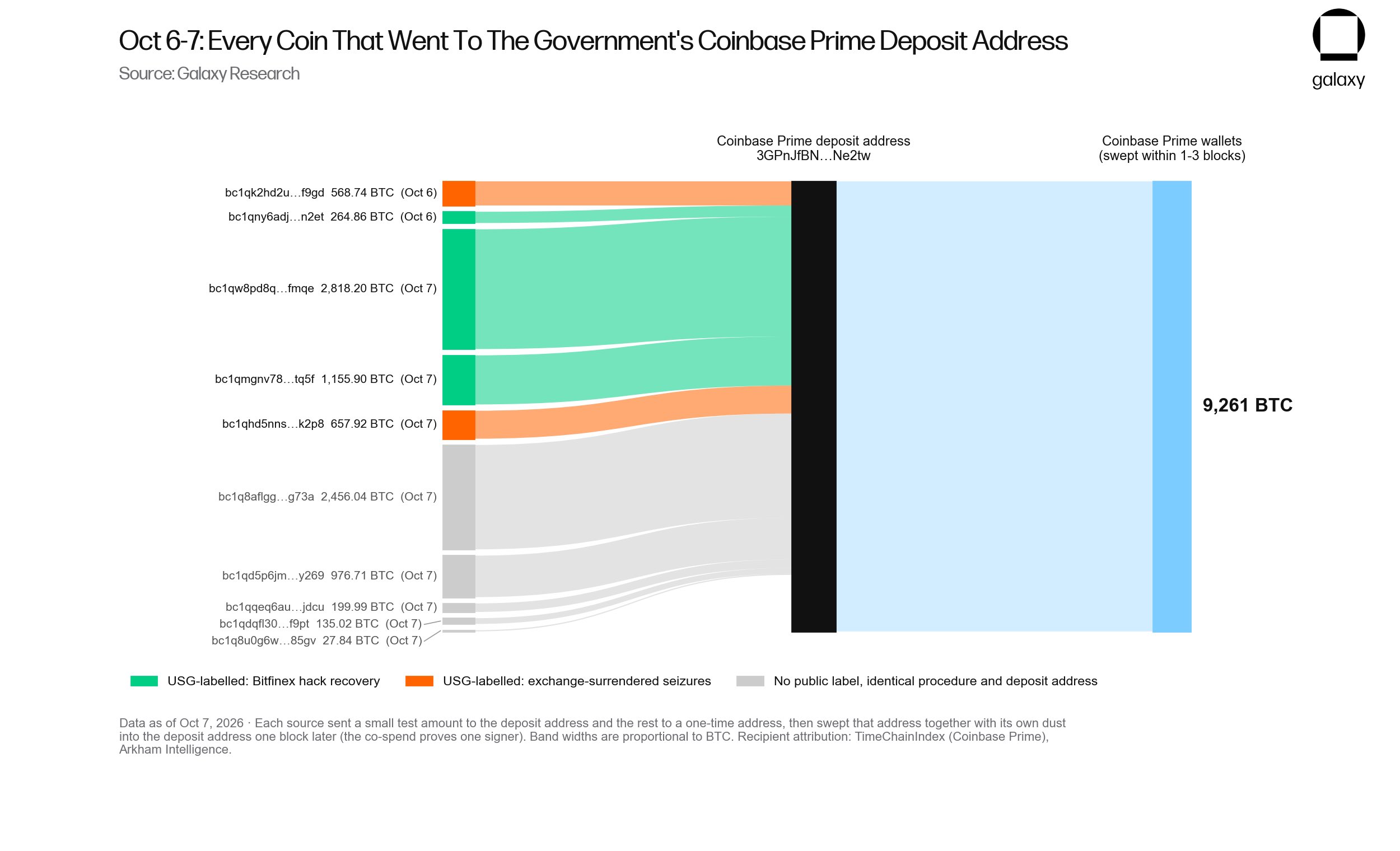
Nearly half of those assets originated from Bitcoin recovered following the Bitfinex hack, while another portion was linked to previously identified cryptocurrency seizures involving Binance.
However, Galaxy's analysis also identified 2,456 BTC originating from wallets not previously classified as government holdings.
The researchers attributed those assets to US authorities because they followed the same transfer procedures as known government wallets and reached an identified federal Coinbase Prime deposit address.
The discovery suggests that publicly labeled government wallets may understate how much Bitcoin Washington controls.
Galaxy said the Coinbase Prime deposit address had received approximately 11,567 BTC since its first recorded use in December 2025. About 6,406 BTC came from identified government wallets, while another 5,160 BTC originated from previously unlabeled addresses.
The firm also classified the Oct. 7 activity as the ninth-largest single-day Bitcoin outflow from identified US government wallets since 2013, excluding internal transfers, and the largest since Dec. 2, 2024.
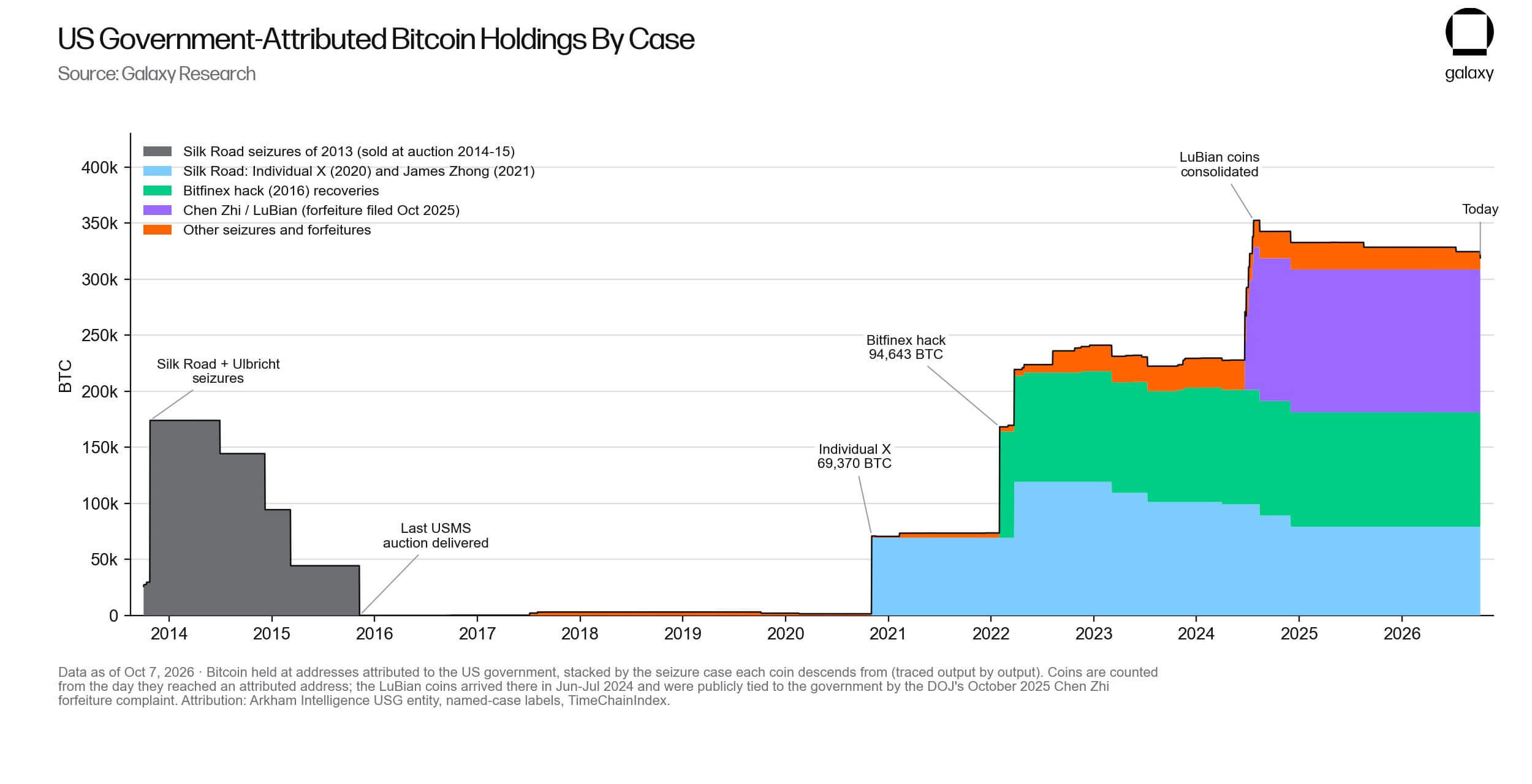
Galaxy estimated that government-attributed wallets held approximately 319,086 BTC in its earlier assessment, down from a peak of 352,587 BTC in August 2024.
The latest movements add to a series of transactions that have raised questions about Washington's cryptocurrency management practices.
As CryptoSlate previously reported, government-linked wallets had already moved about $470 million in seized digital assets to likely Coinbase Prime addresses, including funds tied to the Bitfinex hack and Alameda Research.
Bitfinex ownership dispute complicates Bitcoin reserve policy
The origin of the latest Bitcoin transfers adds another complication: some of Washington's largest cryptocurrency holdings remain tied to legal proceedings that could ultimately determine whether the government retains them.
Galaxy identified two particularly significant asset groups in its estimate of the government's holdings.
The first consists of approximately 94,643 BTC held in a principal wallet containing assets recovered from the Bitfinex hack. The second involves roughly 127,271 BTC associated with LuBian and Cambodian businessman Chen Zhi.
The Justice Department filed a civil forfeiture complaint in October 2025 seeking to permanently confiscate Bitcoin allegedly connected to cryptocurrency fraud and money laundering.
Together, the two groups represent more than 66% of the government's previously estimated holdings, although their legal status differs from Bitcoin definitively available for federal reserve purposes.
The Bitfinex recovery has faced competing ownership claims.
Federal prosecutors initially proposed returning recovered Bitcoin to the exchange through in-kind restitution. However, an April 2025 federal court ruling awarded Bitfinex no direct restitution in the criminal proceedings and directed competing claims over the forfeited assets into a separate ancillary proceeding.
Some former Bitfinex customers have asserted ownership claims against portions of the recovered cryptocurrency, challenging the exchange's entitlement to the full amount.
Galaxy said the principal Bitfinex recovery wallet, which holds about 94,643 BTC, remained untouched as of its assessment, leaving the latest movement involving another recovery address to be evaluated separately.
The dispute carries implications for President Donald Trump's Strategic Bitcoin Reserve.
Under the March 2025 executive order, Bitcoin finally forfeited to the government and meeting specified eligibility requirements can be transferred into the reserve, where it generally cannot be sold.
The order nevertheless permits certain disposals required by courts or law, including transfers involving verified crime victims and other specified forfeiture obligations.
That distinction means a government-controlled Bitcoin wallet is not automatically treated as part of the Strategic Bitcoin Reserve.
A confirmed sale of qualifying reserve assets outside the order's permitted exceptions would raise questions about compliance with the administration's policy. Transfers made to satisfy legitimate restitution or forfeiture obligations would carry different legal implications.
For the recovered Bitfinex assets, ownership proceedings could determine whether successful claimants receive substantial quantities of Bitcoin or the government retains them.
Meanwhile, where the remaining 3,267 BTC from Thursday's reported movement go, and how the government treats assets already deposited at Coinbase Prime, could provide further evidence of Washington's immediate intentions.
Any subsequent disposal would also renew scrutiny of how federal agencies classify recovered Bitcoin, particularly when assets held in government wallets remain subject to competing claims rather than being available for permanent retention in the reserve.
The post US government moves another $1 billion in Bitcoin as BTC slides $4,000 appeared first on CryptoSlate.
Bitcoin.de is rebuilding its operating model after German regulators rejected its MiCA authorization, forcing it to outsource trading and custody to outside partners.
BaFin refused the application filed by Futurum Bank AG, the Bitcoin.de operator, to become an authorized crypto-asset service provider under the European Union’s Markets in Crypto-Assets (MiCA) regime.
The decision also ended the regulator’s previous tolerance of Futurum Bank’s crypto services, while trading on the platform has already been largely suspended since June 12.
Customers can still withdraw crypto, though trading and euro deposits remain suspended. Futurum Bank will continue holding assets until they are transferred to a new custodian, while existing logins and customer claims remain unaffected.
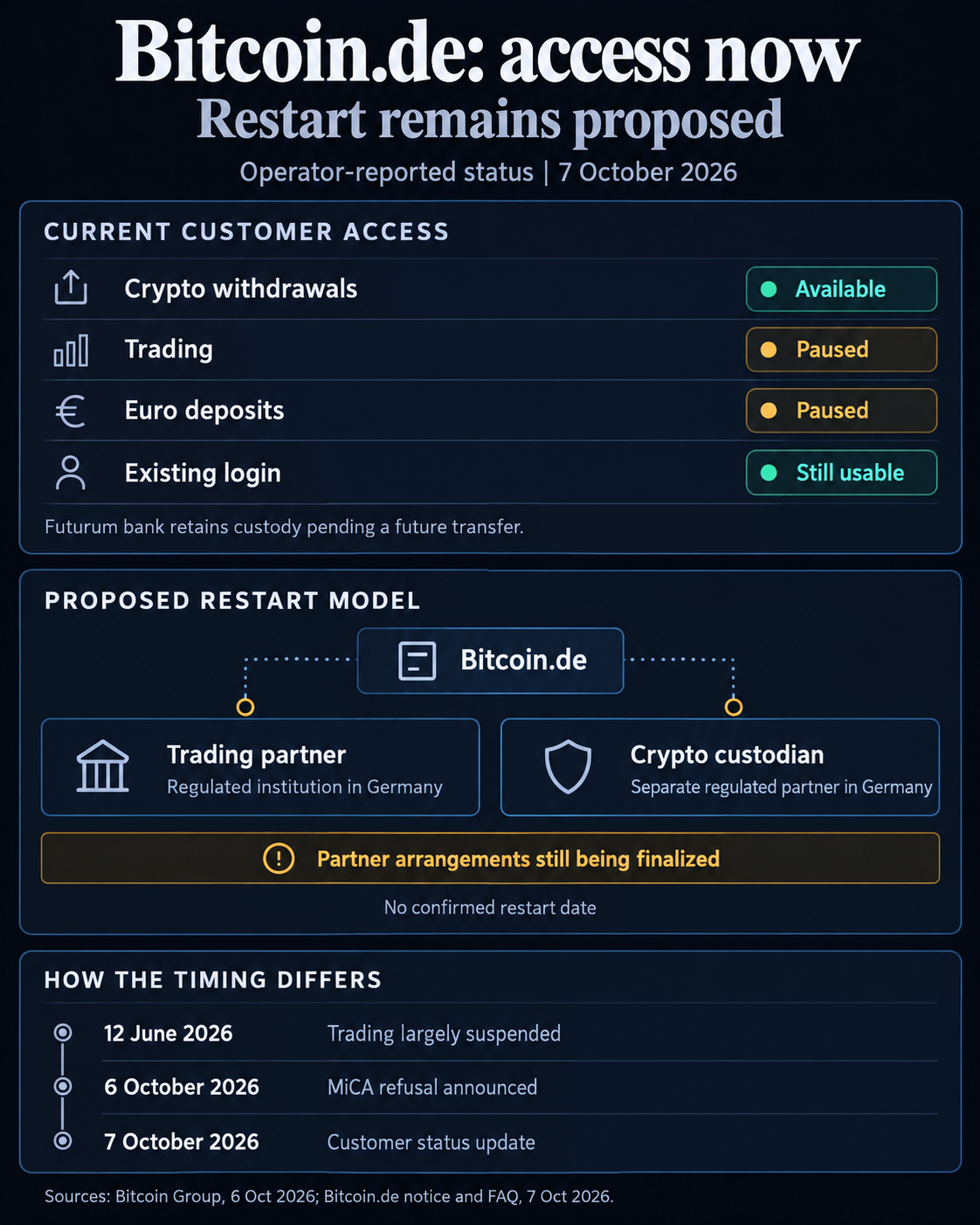
Bitcoin Group said Futurum Bank had applied for MiCA authorization in June 2025, leaving the process unresolved for more than 15 months.
MiCA rejection forces a structural reset
After BaFin's rejection, the firm's management said it had prepared an alternative structure that would let it move quickly.
As a result, Bitcoin.de plans to keep its platform running through two regulated German institutions, with one acting as customers’ trading counterparty and another taking over crypto custody. The platform would retain its app, brand and customer interface while the licensed partners handle the regulated functions.
The shift would leave Bitcoin.de focused more heavily on technology, distribution and customer relationships, while regulated partners take responsibility for execution and custody. That structure could preserve the marketplace without requiring Futurum Bank itself to perform the activities BaFin declined to authorize.
The company, which says it serves more than 1.1 million customers, has not identified either partner or given a firm date for trading to resume. It said the agreements are being finalized and restoring service remains a priority.
Bitcoin Group and Futurum Bank are still reviewing the regulator’s decision and can object within one month of formal notification. A fresh authorization application also remains possible.
For now, the commercial pressure is on completing the partner agreements before the prolonged trading halt pushes more users elsewhere. Bitcoin.de says the technical work for the relaunch is complete, leaving regulatory implementation as the main barrier to restoring full service.
The next milestones are a restart date, the return of euro deposits and the transfer of customer assets to the new custodian.
The post MiCA rejection forces German crypto platform into operational overhaul appeared first on CryptoSlate.
CryptoTicker.io
The Cardano Foundation activated the token standard CIP-0113 on the mainnet on October 7, 2026. It lets issuers write rules directly into a token: who may hold it, how much can be moved per transfer, and whether an authorised third party may freeze or seize it. The network enforces those rules itself on every transfer, every issuance and every burn.
The price of Cardano stands at $0.2294 at the same time, 10.32 percent below its level 24 hours earlier. The two have less to do with each other than the timing suggests. ADA itself does not fall under the new standard, and the daily loss fits into a market slide that has caught Bitcoin and Ether as well.
CIP-0113 on the mainnet: what the Cardano Foundation activated on October 7
What went live is a platform for so-called programmable tokens, together with the open standard CIP-0113. The specification defines programmable tokens as assets that "require the successful execution of a script in order to change owner". Behind that terse wording sits a shift: until now, enforcing rules was the job of whoever issued the token, or of the trading platform it ran through. In future it sits in the chain.
The step came without a hard fork. The specification explicitly describes the aim of modelling transfer logic with building blocks the protocol already has, rather than changing its rules. Programmable tokens remain native assets on Cardano and continue to run in the extended UTXO model. Wallets, explorers and applications therefore treat them technically like existing tokens.
The project is not new. The Cardano Foundation had already presented the platform and the standard on March 9, 2026, then connected to a preview environment on the preview testnet, without real funds. Between the March presentation and the October activation lie several independent security audits; the foundation has not named which auditors were involved. The Swiss Capital Markets and Technology Association has recognised the standard. On the tooling side, the wallets Eternl and GeroWallet, the block explorer CardanoScan and the developer library BloxBean are ready at launch.
Frederik Gregaard, chief executive of the Cardano Foundation, sums up the ambition in a quote carried by CoinCodex: "The rules have to travel with the asset and be enforced every time it moves."
Programmable tokens: how the network clears every change of owner
The mechanics are laid out in the specification. Programmable tokens sit at a shared script address, the programmableLogicBase. Every movement from there requires a call to a global logic, which passes the operation on to a responsible sub-function: one for ordinary transfers, one for third-party interventions, one for restructuring your own holdings.
Whether a transfer is permissible is decided by a token's own script, the transferLogicScript. The specification gives allow lists, per-transfer caps and compliance requirements as examples. Who may issue or burn tokens is governed by a second script, the issuanceLogicScript.
Registry proof: unregistered tokens continue to run like ordinary native assets
One point in the specification matters more to holders than any script name: a registration proof shows whether a token policy is registered at all. Only registered tokens have to execute the logic of their sub-standard. Unregistered tokens behave like ordinary native assets on Cardano, exactly as before. The new powers arise per token and only where an issuer has built them in. They do not apply across the board, nor retroactively.

Freeze and seize: the sub-standard that permits freezing, unfreezing and seizure
The core standard itself defines no freezing. Those functions sit in a sub-standard that the specification calls "Freeze and Seize" and that offers three operations: freeze, unfreeze and seize. The specification describes it as a simplified stablecoin contract with compliance functions. Such a sub-standard requires signatures from a defined circle of keys, called the "Substandard Admin" in the specification. Who sits in that circle is decided not by the standard but by the issuer.
For stablecoins and tokenized securities, that is the real purpose of the exercise. The specification's rationale names both groups explicitly and lists as a shortcoming that issuers using simple native tokens can neither enforce compliance requirements nor block balances.
thirdPartyLogicScript: when a third party moves tokens without the holder's consent
The most far-reaching power carries the name thirdPartyLogicScript in the specification. This power is optional and permits actions without the holder's permission. The specification explicitly lists seizure operations and forced transfers under it.
Partial seizure and wipe: partial confiscation, and seizure followed by burning
Several gradations are described. A partial seizure takes only a share of the holding. An operation designated "wipe" seizes and then burns. A "top-up" goes in the other direction and credits. One side condition in the specification is strikingly matter-of-fact: third-party interventions must actually change the balances concerned, so they may not pass through as an empty transaction.
Anyone who sees a resemblance here to familiar mechanisms on other chains is right. On Solana we described on September 13, 2026 how clawback and freeze functions work for tokenized assets there. The difference lies in the construction, not in the outcome: Cardano anchors the power in an open standard with sub-standards, rather than in extensions to a token program.
The BaFin standard in the specification: a compliance building block from FluidTokens
For German readers, the list of sub-standards contains an entry worth noting. The specification lists a "BaFin Standard" and describes it as a compliant token standard developed by FluidTokens. The name points to the Federal Financial Supervisory Authority as a benchmark, not to any involvement by the authority: the specification names FluidTokens as the developer, not BaFin.
In practice that means an issuer wanting to meet German requirements can take a ready-made rule set instead of writing its own logic. For the holder it means that a token on Cardano may in future sit behind a set of rules modelled on German supervisory law, complete with the blocking powers that go with it.
MiCA and anti-money-laundering rules: blocking functions are compulsory for issuers in the EU
Technical development is converging on the legal position here. Anyone issuing an asset-referenced token or an e-money token in the EU needs authorisation under the Markets in Crypto-Assets Regulation and must maintain procedures for implementing supervisory orders. European anti-money-laundering law additionally requires obliged entities to freeze funds connected with sanctions. A chain that cannot represent blocking powers in the first place turns both into a question of the issuer's goodwill.
The corollary is the more interesting one for holders: a token meant to be sound under supervisory law will as a rule be blockable. Blockability is no design flaw there; it is the condition of admissibility. Which stablecoins in Europe sit under which supervision is shown in our overview of stablecoins.
Portfolio position in Germany: which tokens on Cardano actually fall under CIP-0113
As of this article, the answer is manageable: almost none. The standard has been available on the mainnet for one day, and availability is not adoption. That Eternl, GeroWallet, CardanoScan and BloxBean support it says nothing about how many issuers will actually use it.
Three concrete questions follow for your holdings. First: if you hold ADA, there is nothing to do, because ADA is not a programmable token and remains freely transferable. Second: if you hold a stablecoin or a tokenized asset on Cardano, it pays to look into the issuer's terms to see whether it is switching to the new standard and which sub-standard it picks. Third: if a new tokenized fund or bond arrives on Cardano, the question of freezing and seizure powers belongs in your review before buying.
That your own keys only help so far is the uncomfortable part. Self-custody protects against a trading platform disposing of your holdings. It does not protect against a rule that sits inside the token itself, because the check happens in the protocol and not in the wallet. The limit of that protection is part of understanding the standard.
Loan collateral and lending: what the implementation documents recommend to platforms
One pointer from the foundation's documents should be read by anyone who pledges tokens as loan collateral or accepts them. Lending platforms are advised to check a token's rule sets before accepting it as collateral, because certain configurations allow authorised third parties to move tokens without the holder's consent.
The consequence for a lending business is obvious. Collateral that a third party can seize is not reliable collateral. The specification writes the fitting sentence itself: integrators have to check third-party powers per sub-standard, because compliance with CIP-0113 alone does not answer that question. No provider currently raises the question of whether a pledged token can be seized.

Status "Proposed": the standard is not formally final yet
One detail tempers the assessment, and it comes from the specification itself. CIP-0113 carries the status "Proposed" there, in the Tokens category, filed on January 14, 2023 and submitted in answer to the problem statement CPS-0003. In March the foundation had said it was continuing to work on refining CIP-0113 into a production-ready standard.
A gap therefore exists between a standard with the status "proposed" and a platform running on the mainnet. That is not a contradiction, because a CIP changes its status late in the Cardano process, but it is a reason to wait for issuer announcements rather than infer a wave of regulated tokens from the activation. It also remains open who may change the protocol parameters: the specification does not fix the amendment power and requires every deployment to document it itself.
ADA at $0.2294: a 10.3 percent daily loss in a broad market slide
The price section belongs apart. ADA trades at $0.2294, 10.32 percent below its level 24 hours earlier, 5.54 percent below the previous week and 4.55 percent above its level 30 days ago. Market capitalisation stands at $8.61 billion, trading turnover over the past 24 hours at $597.6 million, and the rank at 17. The daily high was $0.2579. All figures are as of Thursday afternoon and move continuously.
The daily loss is no solo effort. Bitcoin stood at $81,265 on Thursday afternoon, down 2.54 percent, and Ether at $2,428, down 5.36 percent. We described the connection between outflows from Bitcoin index funds, the US Federal Reserve's rate path and the slide separately this morning. That ADA gives up more ground than the two largest crypto assets is the usual pattern in a market with waning risk appetite, where smaller assets swing harder.
Seeing a cause between the activation and the price move would be an assertion without foundation. None of the reports reviewed makes that connection, and one of them explicitly records that the price move provides no evidence of any effect from the switch. An expectation can be argued on the facts, however: if Cardano succeeds in attracting regulated issuers, demand arises for block space and therefore for ADA to pay transaction fees. Whether that happens depends on issuers, not on code.
What comes next: these signals show whether the standard finds users
Three things can be observed without relying on anyone's assessment. The first is the number of registered token policies, because the registration proof is publicly recorded in the chain. The second is announcements from stablecoin issuers and fund providers about a switch. The third is the change of status of CIP-0113 from proposal to adopted standard.
Until then, nothing changes for holders of ADA. For anyone buying tokenized assets on Cardano, one question is added that did not exist before: who besides me may move this token?
CIP-0113: only registered tokens carry the new blocking rules
- Classify your holdings. Check whether, besides ADA, you hold any tokens on Cardano that an issuer administers, meaning stablecoins or tokenized assets. Pure ADA holdings are unaffected.
- Read the issuer's terms. Look through the terms for freezing, seizure and transfer clauses, and for which sub-standard is in use. For self-custody and its limits, the hardware wallet comparison helps.
- Double-check collateral. If you pledge crypto assets or lend them out, establish in advance whether the token can be seized. The providers' terms are in the lending comparison.
The sources for this article are the specification CIP-0113 in the Cardano CIP registry and the Cardano Foundation's account of programmable tokens.
(As of October 8, 2026. This article is not investment advice. Prices and fee structures change; check the terms with the provider before you buy.)
Programmable tokens move the enforcement of rules from the trading platform into the chain. For holders of ADA that changes nothing; for buyers of tokenized assets on Cardano one question is added that played no part before October 7, 2026: who besides me may move this token? The answer will from now on sit in the issuer's terms and in the sub-standard it picks.
Since October 8, 2026 the US provider Securitize has been trading twelve tokenized US stocks on the Solana blockchain. Behind each token sits a real share, dividends keep running, and settlement is in the stablecoin USDC. Whether you may use this offering from Germany is, however, not settled. Securitize speaks of "eligible investors" in the United States, the European Union and further approved markets, but does not define which investors it means. Your own due diligence begins at exactly that point, and only after that does it pay to look at tax, custody and trading hours.
Securitize Stocks: twelve tokenized US stocks on Solana since October 8
The product is called Securitize Stocks and launched on Wednesday, October 8, 2026. At the outset it covers twelve companies. Eleven of them are named consistently in the reports by Decrypt and CoinDesk: Apple, Microsoft, Nvidia, Alphabet, Tesla, Meta, Amazon, Netflix, Circle, Strategy and Palantir. The twelfth name is given in neither report, and anyone who needs the complete list will for now find it only at the provider itself.
Trading runs through the Securitize platform, which operates as a registered broker-dealer in the United States. Liquidity is supplied by an automated market on Solana, with CoinDesk naming the trading firm Jump Trading as market maker. Settlement, custody and clearing are handled by the service provider RQD, according to CoinDesk. For the onward use of the tokens in blockchain lending, Decrypt reports that Ripple Prime and Aave are envisaged, though the language there is one of review and intent rather than live operation.
Securitize is no newcomer to this field. The company is listed on the New York Stock Exchange under the ticker SECZ, has issued tokenized assets worth more than $4.5 billion to date according to CoinDesk, and brought BlackRock's first money market fund onto a blockchain. Around $300 million of its own listed shares already sit tokenized on Solana and Avalanche. For context: according to The Block, the value of tokenized stocks on blockchains recently passed $3 billion.
One-to-one backing: a real share sits in custody for every token
The technical core is quickly told. Each token is backed one-to-one by an actually existing share. Decrypt additionally reports that the deposited shares are not lent out. That commitment is no side note, because in securities lending the share moves temporarily to a third party, and if that third party becomes insolvent, clear backing turns into a claim.
Carlos Domingo, chief executive of Securitize, drew precisely that distinction on launch day. He told Decrypt: "Tokenized stocks should give investors more than a price on a wrapper that tracks a stock and is only offered offshore." Nick Ducoff of the Solana Foundation spoke in similar terms the same day, putting worldwide access at the centre.
Wrapper, certificate, backing: three terms that often get confused
A wrapper is a shell that merely replicates the price of an underlying asset, without the provider having to hold the share itself. Such a token can track the price and still convey no claim to the share. That differs from a structure with actual backing, where a share is held in custody for every token issued. Which variant you are dealing with is not something you can tell from the price chart, only from the provider's legal documents.

Security entitlement: why your name does not appear in the shareholder register
By its own account, Securitize issues the tokens as security entitlements. The term comes from the US Uniform Commercial Code and denotes a claim against an intermediary, not direct entry in the company's shareholder register. CoinDesk puts it in terms of the tokens precisely not establishing direct ownership in the register. Conversion into registered shares is to become possible once the respective issuer supports tokenization.
In practice that means a custody chain stands between you and Apple or Nvidia. As long as it holds, you notice nothing of it. If a link fails, the legal system of the custodian decides what remains of your claim, and in this case that is US law. This structure is entirely standard in the securities world; your German brokerage account also works through intermediaries. What is new is that the chain here runs via a US broker-dealer and a public blockchain rather than via the familiar combination of a house bank and Clearstream.
Settlement in USDC: the detour via a stablecoin and its currency risk
Trading and settlement are in USDC, the dollar stablecoin issued by Circle. Anyone coming from Germany normally holds euros and therefore needs two conversion steps: from euros into USDC, and back again on selling. Each of those steps costs fees, and between purchase and sale sits a currency risk that has nothing to do with the share. If Apple rises by five percent while the dollar gives up four percent against the euro, little of the price move survives.
A second point concerns the stablecoin itself. USDC is authorised in the European Union as an e-money token and is therefore one of the few dollar stablecoins that may be offered here as a matter of course. That does not resolve the currency question, though; it answers only the authorisation question for the means of payment. The dollar exposure remains part of your calculation either way.
Eligible investors: what Securitize leaves open about access from the EU
Both reports name "eligible investors" in the United States, the European Union and further approved markets as entitled to access. What that term means concretely remains open. Neither Decrypt nor CoinDesk says whether retail investors are meant or only professional and qualified investors, and on the requirements for identity verification and anti-money-laundering checks neither report offers any detail. In US securities law an "eligible" or "accredited investor" is typically tied to wealth or income thresholds, and those hurdles sit well above what an average private portfolio meets.
That sets a clear order of priority for you. Before tax, fees or trading hours matter at all, you need the answer to the access question, and you need it in writing from the provider: are retail investors resident in Germany admitted, what evidence does registration demand, and on what legal basis is a German customer accepted. A provider that actively directs investment services at retail clients in the EU needs an authorisation under European law to do so. One that instead relies on the customer's own initiative shifts the risk onto you. If you would rather hold the same share without these open questions, the route runs through a regulated broker; which providers are available in Germany is shown in our crypto broker comparison.
MiFID II rather than MiCA: tokenized stocks are financial instruments, not crypto assets
This is where the most common misconception about this product type lies. The European crypto regulation MiCA governs crypto assets but excludes instruments that already count as financial instruments. A tokenized share remains legally a share, even when it is transferred on a blockchain. What applies, therefore, are the securities rules under MiFID II and national provisions, not the MiCA authorisation that many providers point to.
In practical terms that means two things. A MiCA licence says nothing about whether a provider may sell tokenized stocks to you. And the protections you know from securities, such as the appropriateness assessment or the information duties on distribution, depend on whether the provider is authorised as an investment firm in the EU. On the US side, the Securities and Exchange Commission introduced an exemption described as an innovation exemption in September 2026, opening an orderly route for trading venues dealing in tokenized securities. That exemption applies to the US market and replaces no European authorisation.

Extended trading hours: the NYSE platform and OKXICE are announced, not live
At launch, trading runs in extended hours, so beyond regular exchange hours, but not yet continuously. Securitize names round-the-clock operation as a goal. Also planned is an extension to the New York Stock Exchange's announced round-the-clock platform, in whose construction Securitize is involved, and to the OKXICE trading venue, a joint venture of the exchange operators Intercontinental Exchange and OKX, which filed an application in the same week.
Both are subject to conditions. The venues first have to launch and meet the regulatory requirements. For your decision today, therefore, only the one figure that already applies counts: trading in extended hours on one platform. Thin trading hours have a side effect that occurs in every young market. The gap between the bid and the ask price widens, and an order without a price limit can be executed at a price you did not expect. A limit protects against that; a market order does not.
To place the surroundings on launch day: Solana trades at $108.52 on October 8, 2026, around 7.1 percent below the previous day's level. The broad crypto market also gave ground that day. For the stock tokens themselves that is initially irrelevant, because their value hangs on the deposited share and not on the price of the blockchain they sit on. It becomes relevant for transaction costs, and when you use tokens as collateral in lending.
Flat-rate withholding tax instead of a holding period: the tax break between share and coin
Anyone arriving from cryptocurrencies brings an expectation that does not hold here. With cryptocurrencies, section 23 of the German Income Tax Act on private disposals applies, and after a holding period of one year the gain stays tax-free. Shares do not fall under it. For them, section 20 of the Income Tax Act on income from capital assets applies: 25 percent flat-rate withholding tax, plus the solidarity surcharge of 5.5 percent on that tax, together around 26.4 percent, and church tax on top where applicable. The saver's allowance stands at 1,000 euros for single filers and 2,000 euros for joint assessment. There is no holding period after which it becomes tax-free.
Two further points arise with a foreign provider. Without a German paying agent, no capital gains tax is withheld automatically, and you declare the income yourself via the KAP schedule. And dividends from US companies first attract US withholding tax, which can be reduced to 15 percent under the double taxation treaty and credited against the German tax. For that you have to prove your tax residence to the provider. There is also an offsetting restriction: losses from the sale of shares may be offset only against gains from share sales, not against other investment income.
One caveat belongs here explicitly. Whether the German tax authorities treat a security entitlement under US law in the same way as a share, or classify it as another capital claim, depends on the specific structure and is not settled for this product. We have broken down the tax treatment of tokenized stocks in Germany in detail in a separate article. For an individual case, a tax adviser settles this before the first purchase takes place, not afterwards.
Dividends and voting rights: what the company commits to and where the limitation lies
According to Securitize, holders retain the economic benefits of their position, meaning dividends, and voting rights. Decrypt adds a limitation that is contained in the company's own wording: voting rights apply where applicable. That carries weight, because exercising a voting right presupposes that the chain from the token to the annual general meeting is organised. Whether and how that works in practice will only become clear in the first AGM season after launch.
The dividend is the easier part. As a payment process it can be passed along the custody chain, and USDC provides a settlement instrument for it. A voting right concerns the exercise of a membership right, and that depends on who stands in the register. According to CoinDesk, that is precisely where the tokens do not stand.
Tokenized stocks: without clarity on access, the rest is theory
The news is a genuine step: twelve well-known US names, backed one-to-one, on a public blockchain, through a broker-dealer registered in the United States. For investors in Germany, though, the decisive point remains unanswered, and it cannot be settled by reading, only by information from the provider. Three steps, in this order:
- Clarify access in writing. Ask Securitize whether retail investors resident in Germany are admitted and what evidence registration requires. If the answer comes back negative or unclear, your review ends here. For recording holdings and income across several platforms, a tracker helps, of the kind we set against each other in our overview of tax tools and portfolio trackers.
- Calculate the cost of the currency chain. Add up the conversion from euros into USDC, the trading fee and the way back, and hold the result against the cost of the same security in your existing brokerage account. Which trading venues offer USDC as a matter of course is set out in our crypto exchange comparison.
- Check the legal form of the position. Read in the contractual documents against whom your claim runs and what applies if the custodian becomes insolvent. Why entry in the register makes the difference is something we explained using the example of the transfer agent's role.
(As of October 8, 2026. This article is not investment advice. Prices and fee structures change; check the terms with the provider before you buy.)
XRP trades at $1.36 on Thursday evening, 5.25 percent lower than the day before. The short answer to whether the level holds: the daily low of $1.34 is the only fresh support line the market has formed in this downturn, and tonight it comes alongside an event that has nothing to do with the price. At 23:25 German time the XRP Ledger activates a protocol change that for the first time allows an account to grant another account tightly limited rights over it. The repair component that the developer documentation explicitly mentions in this context is not yet active at that point.
Neither figure comes from an announcement; both come from the ledger itself. Every amendment in the XRP Ledger carries a timestamp there, marking the moment it has the required validator majority behind it, and it goes live exactly two weeks later. For PermissionDelegationV1_1 that stamp fell on September 24, and the two weeks run out this evening.
XRP at $1.36: the daily low of $1.34 is the first support line
The day's range runs between $1.34 and $1.43, or 1.21 in euros. Over a week the loss stands at 8.8 percent, over 30 days at 5.38 percent. The all-time high of $3.65 from July 17, 2025 is 62.8 percent above the current price. Market capitalisation stands at $85.6 billion, keeping XRP in fifth place, on trading volume of $2.95 billion in 24 hours.
The decline is not an XRP story. Bitcoin stands at $81,316 the same evening, down 2.46 percent, Ethereum at $2,433, down 5.11 percent, Solana loses 6.76 percent and Dogecoin 6.15 percent. XRP therefore sits roughly in line with the large altcoins and weaker than Bitcoin. If you are looking for a level where something is decided, you will find it in the broader market rather than in XRP's own chart.
What the $1.34 is worth technically
A daily low is not a support level in the classic sense. It only becomes one once the price approaches it repeatedly without breaking below. Until then it merely describes where, on this particular day, there was last enough demand to absorb the selling pressure. On the upside the next visible hurdle sits at the daily high of $1.43, and after that at the zone around $1.50, which capped the price several times in early October.
Of 99.99 billion XRP, 63.09 billion are in circulation. The remainder sits largely in Ripple's monthly released escrow accounts, whose releases have followed a fixed rhythm for years and should therefore be factored into any supply calculation.
PermissionDelegationV1_1 in the XRP Ledger: what is unlocked at 23:25
Permission delegation, listed in the specification as XLS-75, lets one account grant a second account the right to send specific transactions on its behalf. The technical term is role-based permissioning: rather than the whole key being handed on, what moves is a list of narrowly defined powers.
The figures from the ledger on Thursday evening: 28 of the 33 validators currently casting votes support the amendment. Twenty-six are required. That majority has stood since September 24, and exactly two weeks later, at 23:25 German time tonight, the function goes live. Should support fall below the threshold before then, the clock starts again.
In practical terms the function targets two cases. A company wants routine payments triggered from an account without surrendering the master key. And a private holder wants a service to carry out a single task, such as placing a trading order, without giving it access to the holdings.
DelegateSet: how a delegation in the XRP Ledger is granted and revoked
The delegation is granted with a transaction called DelegateSet. The same transaction later changes the rights again or withdraws them entirely. One account can maintain several delegates with different packages of rights.

The limits are set out in the ledger's documentation and matter more in practice than the function itself:
- Each delegate can hold a maximum of ten rights.
- Rights that would allow keys to be changed or further rights to be granted are excluded from delegation. A delegate therefore cannot give itself more power.
- The rights are hard-wired and cannot be tailored freely.
- Each delegate occupies one item of the owner reserve. In the XRP Ledger that currently amounts to 0.2 XRP per object, on top of a base reserve of 1 XRP per account.
- The delegate needs a funded account of its own and pays the transaction fees itself.
- Pseudo-accounts, such as the ledger's automated market makers, cannot be delegated to.
- Delegated transactions never enter the queue. Send one at the wrong moment and you get an error rather than a delay.
The details are set out in the XRP Ledger developer documentation.
fixCleanup3_4_0 at 24 of the 26 votes needed: the open gap is called PaymentBurn
This is where a protocol note turns into something that concerns holders. The XRP Ledger documentation explicitly advises against granting the individual PaymentBurn right while a further amendment called fixCleanup3_4_0 is not active. Before that fix, a delegate holding this right can under certain circumstances create new fungible tokens.
And that fix is precisely what is not active on Thursday evening. In the ledger it stands at 24 votes, with 26 required. It has not reached a majority and consequently has no timestamp from which a two-week deadline could run. So delegation goes into service tonight while the matching repair sits two votes short of the line.

None of this is cause for panic, and it is not an attack on existing holdings. Nobody can take a delegation over your account by themselves. Such a delegation comes about solely because you sign a DelegateSet transaction yourself. The gap concerns whoever grants a delegation from tonight onwards and includes this one particular right in it.
How to spot a DelegateSet request
The practical danger of the coming weeks is not a protocol bug but habituation. Every new transaction type in the XRP Ledger gets replicated within days by fraudulent sites that collect a signature under a harmless-sounding pretext. If your wallet asks you to sign something called DelegateSet and you were not in the middle of granting a delegation, there is no benign reason for it.
BatchV1_1 and fixBatchV1_2 on October 9: eight transactions in one package
Two further changes follow on Friday afternoon. fixBatchV1_2 goes live at 16:12 German time and carries the full support of 33 votes in the ledger. BatchV1_1, XLS-56 in the specification, follows at 16:46 with 28 votes.
Batch bundles several transactions into one envelope that is either executed in full or not at all. For holders this is a convenience at first; for applications on the ledger it changes more. A swap together with the trust line that goes with it can now be handled in a single step, with no half-executed state left behind. If you use software that trades on the ledger, you are more likely to notice this over the coming weeks in the form of smaller fee bills than in the form of new buttons.
LendingProtocolV1_1 at 14 of 26 votes: the credit module stays on the shelf for now
The most widely discussed module is the one that is specifically not arriving tonight. LendingProtocolV1_1, listed as XLS-66, stands at 14 votes out of 33 cast in the ledger. Twelve are missing to reach the required majority of 26. An older version called LendingProtocol stands at 15 votes and is therefore equally far away.
The position has barely moved since the beginning of October, as our analysis of the lending amendment from October 6 shows. If you are pinning your expectations for the XRP price on a native credit module on the ledger, the timescale is months at the earliest, not days.
Exchange holdings or your own XRPL account: who the change actually affects
This distinction determines whether tonight concerns you at all.
If your XRP sits at an exchange, the ledger account belongs to the exchange, not to you. You can neither grant delegations there nor be granted them. Nothing changes for you, apart from the fact that the exchange has to update its own software. A short maintenance window around the activation is common at larger venues, and it is precisely in such windows that deposits and withdrawals cannot be processed for a while.
If instead you hold your own XRPL account, for instance in a software wallet with your own key or in a hardware device, then from tonight you are the one who can grant a delegation. In that case it is worth checking whether your wallet displays the new transaction type in plain language at all. If it shows you only a string of characters instead of a comprehensible notice, you are signing blind.
The one-year holding period: a delegation is not a disposal
For investors in Germany the function carries a tax question, and it runs: does a delegation reset the one-year holding period under section 23 of the Income Tax Act?
The obvious reading says no. A delegation transfers no beneficial ownership: the coins stay in your account, you can withdraw the rights at any time with a further DelegateSet transaction, and under the protocol rules the delegate can neither change your keys nor grant itself further rights. Without a change of ownership, the event that the law captures as a disposal is simply absent. No administrative guidance addressing the case explicitly exists so far, because the function comes into existence for the first time tonight. If you move larger holdings, you are better off having this confirmed by a tax adviser than relying on the logic.
It looks different as soon as the delegate actually trades. If a service triggers a swap on your behalf, every single swap is a disposal with everything that entails: calculating the gain, a holding period per acquisition, and the 1,000 euro exemption threshold for other private disposals in the calendar year. A delegation that is allowed to trade therefore produces exactly the flood of records that is currently becoming a problem in the ongoing legislative debate: the consultation period on the federal cabinet's crypto tax bill closed on October 6, and the bill is due to be adopted on October 14.
What belongs in your records
If you grant a delegation, note the date, the delegate's account address and the rights granted. It costs two minutes and later answers the question of who triggered which transaction. Every transaction does stand permanently in the ledger, but the purpose behind it does not.
Delegation in the XRP Ledger: what you can do now
If you hold XRP in self-custody, there are three things to settle before the activation, each of which takes a few minutes. First: check whether your wallet software offers an update that recognises the new transaction types. Second: for the time being, do not grant any delegation that includes the PaymentBurn right while fixCleanup3_4_0 is not active. Third: treat every unexpected request for a DelegateSet signature as an attempted fraud.
If your holdings sit at a trading venue, a glance at its status page is enough. Maintenance windows around protocol changes are usually announced there in advance.
XRP at $1.36: without fixCleanup3_4_0, PaymentBurn stays off limits
Thursday evening's position in three steps you can work through in order:
- Clarify custody. Decide first whether your XRP sits in your own ledger account or at a trading venue, because everything else follows from that. If you want to move or split the holding, the terms offered by the venues are in the crypto exchange comparison.
- Check key control. With self-custody, what counts from tonight is whether your wallet displays a DelegateSet transaction legibly. Which devices show how much in plain language is set out in the hardware wallet comparison.
- Secure your records. If you do grant a delegation, record the date and scope, and make sure every transaction it triggers ends up in your gain calculation. Tools for that are in the comparison of crypto tax tools.
The question in the headline can therefore be answered like this: the $1.34 holds or falls with the broader market, not with the amendment. A protocol change that unlocks an administrative function moves no price. What it does move is the number of routes by which a holder can lose their holdings, and the most important of those runs tonight through a signature nobody asked for. You can look up the current voting status of all amendments yourself at any time in the XRP Ledger amendment overview.
(As of October 8, 2026. This article is not investment advice. Prices and fee structures change; check the terms with the provider before you buy.)
Kraken is removing 14 more crypto assets. Trading in them ends on October 23, 2026 at 4 p.m. German time, withdrawals stay open until January 29, 2027, and after that the exchange liquidates whatever is still sitting in customer accounts. If you hold one of these tokens, two doors are open to you: sell while trading is still running, or withdraw while the payout window is still open. Let both pass and you end up with whatever the forced liquidation leaves behind, and Kraken itself writes that this proceed may be "significantly below recent reference prices" and "in some cases minimal or zero".
The affected tickers are BMB, ELX, APU, BDXN, DUCK, BOS, U, OBOL, IDEX, FIS, COPM, UXLINK, ALTHEA and NOBODY. Eleven of them have a euro pair on Kraken, which puts them directly in the accounts of European investors. We looked at how much is actually still traded in those euro pairs and which token can still be bought somewhere else after the cut-off date. The answer changes the order of the steps for several of the 14 assets.
The 14 crypto assets Kraken is removing on October 23
The exchange names fourteen tickers in its notice: BMB (Beamable), ELX (Elixir), APU (Apu Apustaja), BDXN (Bondex), DUCK (DuckChain), BOS (BitcoinOS), U, OBOL (Obol), IDEX, FIS (StaFi), COPM, UXLINK, ALTHEA and NOBODY. The notice carries an October 7 date, so it is current, and for that date it is the only authoritative source there is: an exchange decides for itself what it lists, and announces it on its own help page.
Delisting does not mean a token disappears. It continues to exist on its blockchain exactly as before. What disappears is only the one place where you could buy, sell and store it at Kraken. That distinction carries the whole decision you now face: from here on, the value of your holding depends on whether another trading venue exists, not on whether Kraken still lists it.
The mix is typical of a removal cycle. It includes two meme tokens, a staking protocol, a bridge infrastructure, an older decentralised exchange and several projects whose trading volume has melted away over months. Kraken does not justify each choice individually in the notice, but does point explicitly to "limited or inactive markets" for several of the assets.
Three dates, three consequences: trading halt, withdrawal deadline and forced liquidation
The sequence is staggered, and each of the three dates takes a different option away from you:
- October 23, 2026, 4 p.m. German time: deposits and trading are switched off. From that moment you can no longer sell the tokens at Kraken, nor deposit any more. Your holding stays visible in the account.
- January 29, 2027, 4 p.m. German time: withdrawals are switched off. Until then you can still send the tokens to your own wallet or to another exchange. After that you cannot reach them at all.
- February 1 to 12, 2027: Kraken liquidates all remaining holdings automatically and credits the proceeds.
A good three months sit between the first date and the second. That span is the real buffer, and it is routinely underestimated because the first date is so much closer. After October 23 you are not in trouble, you have only lost the option to sell at Kraken. The exchange itself advises moving affected holdings out "as early as possible", and for the assets with thin markets that is more than boilerplate.
We described what the last stage of this sequence looks like in practice during the previous cycle: how forced liquidation works at Kraken explains the mechanics step by step.
Eleven of the 14 tokens have a euro pair on Kraken
For European investors the first question is whether the token trades against the euro at all, or only against the dollar. A look at Kraken's trading pair list on Wednesday midday shows that eleven of the 14 assets have a euro pair, namely ELX, APU, BDXN, DUCK, BOS, U, OBOL, IDEX, FIS, ALTHEA and NOBODY. Only BMB, COPM and UXLINK trade exclusively against the dollar.
One detail stands out: the euro pair for BOS is already set to post only. In that state the exchange accepts only orders that will not execute immediately. Selling at the market price is therefore already impossible there, even though the official trading halt does not take effect until the end of October. If you wanted to sell BOS against the euro, you have to go through the dollar pair or withdraw the token.
All ten remaining euro pairs were still trading normally on Wednesday. That is the good news at this point, because it means the selling door is technically open. How far open it really stands only becomes clear in the next section.

22,300 euros in 24 hours: how thin the euro pairs really are
We added up a full trading day's turnover for all eleven euro pairs, as of Wednesday, October 8. Together they came to roughly 22,300 euros, spread across 436 individual trades. For comparison: that is the daily take of a single busy market stall, divided across eleven trading pairs on one of Europe's largest crypto exchanges.
The distribution behind that figure is even more lopsided than the total. The strongest pair, APU against the euro, contributed roughly 12,300 euros on its own, more than half. Behind it come BDXN at around 2,600 euros and FIS at around 2,550 euros. At the other end sits OBOL against the euro with about twelve euros of turnover from five trades across an entire day. BOS against the euro recorded not a single one.
These numbers answer the question behind every delisting notice: can I get rid of my holding at all before trading closes? In a pair where five trades come together in a day, a sale of a few hundred euros is no longer something that goes through at the quoted price. A larger order eats its way down the order book, and the closer October 23 comes, the more sellers meet the same thin demand. So if you plan to sell, sell early and in parts rather than dumping everything on the final day.
Which exchange is suitable for the move depends less on the name than on whether the token is listed there at all and whether the exchange is licensed in the EU. Our crypto exchange comparison ranks the providers by fees, licensing and withdrawal routes.
What forced liquidation means and why the proceeds can be "minimal or zero"
Forced liquidation means the exchange sells your remaining holding without your involvement and credits you the proceeds. Kraken has scheduled this for the period from February 1 to 12, 2027. Formally, then, you do get money, and that is exactly what misleads people.
Kraken itself puts it unusually plainly in the notice: the proceeds may be "significantly below recent reference prices" and "in some cases minimal or zero", because several of these assets have "limited or inactive markets". The figures from the previous section show why. When twelve euros change hands in a pair on a normal day, there will be no buyer in February 2027 who takes over the pooled remaining holdings of every customer at the quoted price. In that situation the price on your account overview is an accounting figure, not a price you can actually realise.
There is also a timing effect that is easy to overlook: the liquidation falls in February 2027, and therefore in a different tax year than a sale in October 2026. What that means for you is covered in the tax section further down.
U and COPM: why two of the 14 assets cannot be pinned down cleanly
For twelve of the fourteen tokens, market value, daily turnover and trading venues can be assigned unambiguously through the usual market data sites. For U and COPM that does not work, and that is a signal rather than an omission.
Several projects use the ticker "U". A search for it leads to a token with a market value in the billions that has nothing to do with the asset traded at Kraken. Kraken's own price for U stood at $0.000262 on Wednesday. At the unit volumes traded there, that works out to a daily turnover in the low four-figure dollar range. A micro-cap, in other words, not a billion-dollar project. For COPM the price is $0.00030 and the daily turnover under a thousand dollars.
The practical lesson is a simple one: with small-cap assets, always check the contract address and not the ticker before you send a token anywhere. Two projects sharing the same ticker is the rule in crypto markets, not the exception, and a transfer to the wrong contract address cannot be reversed.

ALTHEA, BMB and NOBODY: three tokens have no second centralised exchange
The follow-up question after every delisting is: where to, then? For the twelve assets that can be identified we checked which trading venues still listed them on Wednesday. For nine of them the answer is reassuring; for three it is not.
- ALTHEA is currently listed at exactly one trading venue, and that is Kraken. After October 23 no public market remains for this token at all, neither centralised nor decentralised.
- BMB and NOBODY each sit at two venues: Kraken and one decentralised exchange. Once Kraken drops out, the only route left runs through a decentralised exchange with your own wallet.
- ELX has a second centralised exchange in Gate, and DUCK likewise. IDEX, FIS and UXLINK reach three centralised venues, BDXN four, OBOL and BOS five. APU, with thirteen trading venues, is the broadest asset in the field.
That produces a clear order of priority. With ALTHEA you decide before October 23 whether to sell the holding at Kraken or keep it afterwards as a pure blockchain position with no market access. With BMB and NOBODY you have to plan a token move to your own wallet if you want to hold them, because the route via a decentralised exchange necessarily runs through a wallet you control yourself. For the other eight, a transfer to an exchange that already lists the asset is enough.
We already worked through exactly this gap between "removed" and "not tradable anywhere else" during the 21-token cycle in September: 16 of 21 Kraken assets had no fallback exchange at the time. At three out of twelve, the October cycle is considerably milder.
Your own wallet or another exchange: the difference for the holding period
There are two routes for the move, and they differ in effort, risk and tax treatment.
The route to another exchange is the more convenient one. You need a verified account there, the right deposit address and the correct network. The most common and most expensive mistake is the wrong network: a token issued on Ethereum is lost if you send it to an address on a different chain. So always send a small test amount first, and the rest only after it arrives. Check as well whether the destination exchange holds an EU licence, because with a provider lacking European authorisation you carry the enforcement risk alone in a dispute.
The route to your own wallet is the only one that preserves your ability to trade for BMB, NOBODY and every other asset with a decentralised market. It asks more of you: you hold the access yourself, and a lost recovery phrase means total loss. Which devices are suitable and what they cost is set out in our hardware wallet comparison.
For tax purposes both routes are identical and harmless: a transfer between accounts and wallets that belong to you is not a disposal. The holding period continues unbroken and the acquisition date stays the same. All that matters is that you document the transfer, so that you can later prove to the tax office that no sale took place here.
Sale, transfer and forced liquidation: the tax consequences under section 23 of the Income Tax Act
In Germany, crypto assets count as other assets. A sale within one year of purchase is a private disposal under section 23 of the Income Tax Act; once a year has passed the gain remains tax-free. For gains inside that window an exemption threshold of 1,000 euros per year has applied since 2024: stay below it and you pay nothing, go above it and the entire amount is taxable.
That leaves three distinct situations for the 14 removed assets:
- Selling at Kraken up to October 23, 2026. If you have held the token for less than a year, the result counts towards the 2026 tax year. For most of these small-cap assets that will be a loss, and losses from private disposals can be offset against gains from other private disposals in the same year. So if you realised gains inside the one-year window elsewhere in 2026, a sale now may well be worth using.
- Transferring to your own wallet or another exchange. Not a taxable event; the holding period keeps running. You postpone the decision without triggering anything for tax.
- Forced liquidation in February 2027. This counts as a disposal as well, but it falls in the 2027 tax year and at a price you do not set. If you want to offset a loss deliberately in the current year, do not wait for it.
Each of these situations needs documentation: acquisition date, acquisition cost and the transaction itself. Kraken makes the trading history available for export, and you should pull it before the account ends rather than after. A portfolio tracker takes the matching work off your hands by merging exchange exports and wallet addresses into one continuous history. For larger amounts or an unclear acquisition history, a tax adviser is the better investment than any piece of software.
July, August, October: three Kraken cycles running with their own deadlines
This cycle is not the only one currently running, and the deadlines are easy to mix up. Kraken has announced several removal rounds since the summer; they are being processed in parallel and each carries its own cut-off dates.
The July cycle and the August cycle covered 21 assets each; their withdrawal deadlines fall in November and December 2026. We described what the August cycle looks like in an individual case using one affected token: withdrawals for VANRY are already blocked. There is no September cycle; no separate notice falls in that month. The trading halt on September 11 belonged to the previous cycle, which we reported on here: Kraken removes 21 tokens.
So always check which cycle your token belongs to before you write down a deadline. October 23 applies exclusively to the fourteen tickers named here. An asset from an earlier round may well have a different cut-off date, and a glance at the exchange's notice costs less time than a missed withdrawal.
The full breakdown with all three dates is in Kraken's own notice on the October cycle.
Kraken delisting: after October 23, withdrawal is the only option
The selling door closes on October 23, the withdrawal door only on January 29. Miss the first and you lose the choice of price; miss the second and you lose access altogether. Work through it in this order:
- Check your holdings and decide, by October 23. Look in your Kraken account to see whether any of the fourteen assets is in there. If you decide to sell, place the order early, and in parts for the thin pairs. You will find another exchange for the later move in the exchange comparison.
- Prepare the move, by mid-January at the latest. Set up the destination account or the wallet, check network and address, send a test amount and only then the rest. Which providers hold an EU licence is shown in our overview of regulated exchanges; for the route into self-custody, the hardware wallet comparison helps.
- Secure your records before the account is empty. Export the trading history as a file from your account and assign an acquisition date and cost to every position. A tax tool brings exchange exports and wallet addresses together and saves you the manual work in the spring.
A total loss is possible with small-cap assets of this size, even without anyone making a mistake. A market in which five trades come together in a day can stop existing altogether at any time.
(As of October 8, 2026. This article is not investment advice. Prices and fee structures change; check the terms with the provider before you buy.)
Crypto Crash Reason Hunt: What Actually Happened Today?
The crypto market is deep in the red on Thursday, 8 October 2026, and almost nothing in the top 13 escaped. $Bitcoin is trading at $80,986, down 2.9% in 24 hours, 3.7% over seven days and now 7.5% below where it started the year. Total Bitcoin market cap has slipped to $1.62 trillion.
Altcoins took the harder hit. $Ethereum is at $2,432 after a 5.3% daily drop and a brutal 9.3% weekly slide, pushing its year-to-date loss to 18%. XRP is down 6.2% on the day and 27% for the year. Solana sits at $108, Dogecoin at $0.083, and Chainlink lost 7.9% in a single session. Even Zcash, the year's breakout privacy coin, gave back 15.6% in 24 hours and 18.6% on the week, though it remains up 119% since January.
The only green on the board is the stablecoin pair, with USDT and USDC flat as expected. That pattern, with Bitcoin falling less than everything around it, is the classic signature of a risk-off rotation rather than a Bitcoin-specific problem. So what is the crypto crash reason this time? There is not one answer but three, and they stack on top of each other. You can track all of these prices live on the CryptoTicker crypto prices page.
Crypto Crash Reason #1: Did the Fed Just Kill the Rate Cut Dream?
The biggest crypto crash reason sits in Washington, not on a trading screen. The Federal Reserve raised its target range by 25 basis points to 3.75% to 4.00% on 16 September, and the minutes of that meeting landed on Wednesday, 7 October. The message was not what risk assets wanted to hear: most participants expect another hike to be appropriate before year-end, depending on incoming data.
That single line reframes the whole year. Markets had spent months treating the September move as a one-off. The minutes suggest it could be the start of a tightening cycle instead. HashKey Group researcher Tim Sun warned that a second hike in October would make investors read September as the opening act rather than a blip.
Higher rates hit crypto through two channels. First, Treasury yields rise, and a risk-free 4%+ return makes a volatile, zero-yield asset like Bitcoin less attractive by comparison. Second, the dollar strengthens, and Bitcoin has historically moved inversely to the greenback. Add elevated oil prices driven by renewed US and Iran tensions, which feed inflation expectations and reinforce the case for tighter policy, and you get the macro cocktail that pushed every asset on your screen into the red.
The next checkpoints are already circled: the US CPI print on 14 October and the FOMC meeting on 27 and 28 October. Until those pass, the market is trading the fear of a hike as much as the hike itself.
Crypto Crash Reason #2: How Did Half a Billion in Leverage Vanish in 20 Minutes?
The macro news explains the direction. Leverage explains the speed. Bitcoin spent the first week of October trapped between $83,000 and $87,000, failing at the top of that range again and again. Each rejection stacked more leveraged long positions underneath the market, and traders kept betting on an Uptober breakout that never came.
On Friday, 3 October, a rejection at $87,000 wiped out $433 million in positions. Then early on Wednesday, 7 October, Bitcoin dropped roughly $1,765 in about 20 minutes, from $85,341 to $83,790, taking more than $400 million in longs with it in a single hour. Over the full 24 hours, CoinGlass counted around $546 million in liquidations across the market, with 88% of them longs and more than 100,000 traders wiped out.
This is what analysts call a leverage flush. LVRG Research's Dan Khus described it as crowded long bets being mechanically forced out rather than a genuine change in trend. The important detail from Bitfinex is that open interest stayed stable even as longs were liquidated, which means fresh short positions were opening at the same pace. The market did not just deleverage. It flipped net short.
The timing adds a psychological layer. Friday, 10 October, marks one year since the largest liquidation day in crypto history, and traders remember it. Liquidation heatmaps had already flagged a dense cluster of leveraged longs near $82,600 before Wednesday's drop. Thursday's slide to $80,986 ran straight through it, which is exactly why the second leg down was so sharp.
Crypto Crash Reason #3: Why Are ETFs and Uncle Sam Both Selling?
The third crypto crash reason is about who is on the other side of the trade. For most of 2026, spot Bitcoin ETFs have been the structural buyer that absorbed every dip. In late September they were still pulling in nearly $1 billion in a single day. That bid has now reversed.
US spot Bitcoin ETFs recorded roughly $487 million in net outflows on 7 October, their heaviest single-day withdrawal in weeks, according to SoSoValue data. ARK 21Shares and Fidelity led the redemptions, while BlackRock's IBIT was the only major fund still attracting money. Ethereum ETFs are bleeding too, with about $161 million leaving on the same day. When the institutional buyer steps back at the exact moment leveraged longs are being liquidated, there is nobody left to catch the falling knife.
On top of that came an unwelcome on-chain signal. Arkham data shows wallets linked to the US government moved more than 11,000 BTC, worth roughly $900 million at current prices, to Coinbase Prime over two days. Transfers to an exchange do not automatically mean a sale, but the market has learned to treat government wallet activity as a selling risk, and it reacted accordingly.
None of these three reasons would have produced a crash on its own. A hawkish Fed with no leverage in the system is a slow grind. A leverage flush with ETFs still buying is a 20-minute wick that recovers. It is the combination that turned a pullback into Thursday's broad-based selloff.
Crypto Crash Reason for Altcoins: Why Did Ethereum and XRP Fall Twice as Hard?
Look at the 24-hour column on your market table and a pattern jumps out. Bitcoin lost 2.9%. Ethereum lost 5.3%, XRP 6.2%, Solana 7.0%, Dogecoin 7.0%, Chainlink 7.9%. Almost every major altcoin fell roughly twice as far as Bitcoin, and the gap is even wider on the weekly and year-to-date numbers.
There are three mechanical reasons for this. Altcoins have thinner order books, so the same dollar amount of selling moves the price further. Altcoin perpetual markets carry proportionally more retail leverage, so liquidation cascades hit harder. And in a risk-off rotation, capital does not just leave crypto; it also consolidates within crypto, flowing from smaller tokens into Bitcoin and stablecoins first. Bitcoin dominance rises during a crash precisely because it is treated as the least risky crypto asset.
Ethereum carries an extra burden. ETH is now down 18% on the year while Bitcoin is down only 7.5%, and the ETH ETF outflows on Wednesday were proportionally larger than Bitcoin's. XRP, down 27% year-to-date, has been losing the $1.50 battle for weeks and failed there again before this drop. For anyone looking for the altcoin-specific crypto crash reason, it is simple: altcoins never built the institutional floor that Bitcoin did, so when that floor cracks, they fall through it faster. Track the dominance shift on the CryptoTicker charts page.
Which Coins Are Beating the Crypto Crash in 2026?
Not everything on the board is a loser. Four names in the top 13 are still green on the year, and they tell you where the market's conviction actually lives.
$Hyperliquid is the standout at +228% year-to-date, even after a 5.9% daily drop. HYPE is the native token of the dominant on-chain perpetuals exchange, and ironically a leverage flush is good for its business: more liquidations mean more fees.
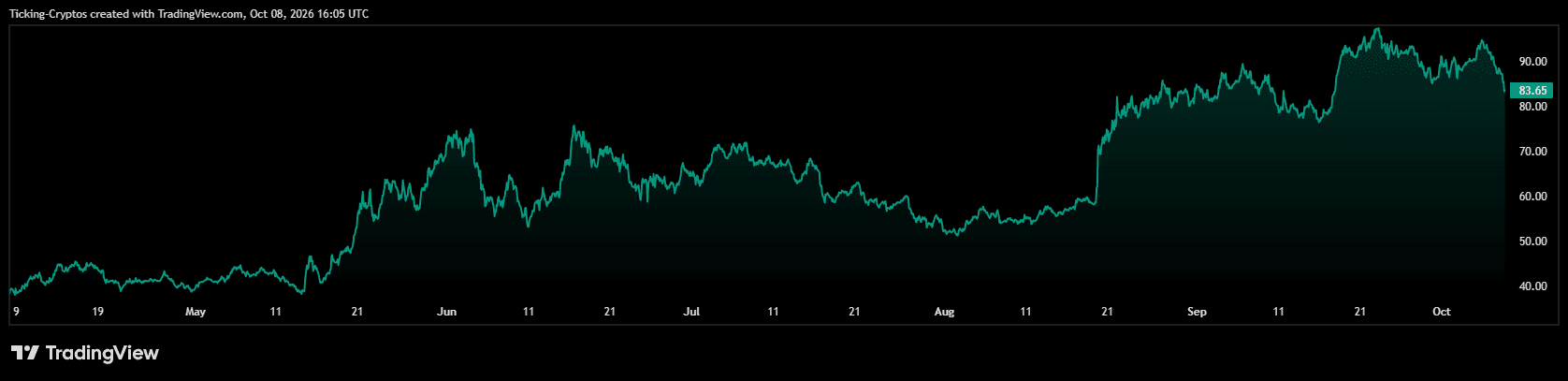
$Zcash is up 119% in 2026 on the privacy coin revival, though it is also the most volatile name here with an 18.6% weekly drop, a reminder that what rallies hardest also corrects hardest.
$Monero, the other privacy heavyweight, is up 22% and fell just 2.2% on the week, the smallest decline of any non-stablecoin in the table.
$TRON rounds out the list at +17% and down only 0.7% on the day. TRX benefits from stablecoin settlement volume, which does not care whether the market is up or down, and that makes it behave like a defensive asset in a crash.
The common thread is clear. The coins that held up are the ones with real, measurable revenue or a strong narrative independent of Bitcoin's price. The coins that fell hardest are the ones whose main story was "beta to Bitcoin." That is worth remembering the next time someone asks what the crypto crash reason is for their particular bag.
Decrypt
The NFL urged the Supreme Court to resolve a circuit split over whether states can regulate sports contracts on prediction markets, arguing they're gambling, not federally regulated swaps.
A batch of 100.02 BTC mined in July 2010 moved Wednesday after 16 years. It's worth about $8.3 million, but nothing in the transaction shows who owns it.
Solana DEX Orca and lending platform Loopscale will operate as Formation, a New York company aiming to finance AI, energy, robotics and defense assets and eventually reach regulated U.S. markets.
Investors yanked $484.9 million out of spot Bitcoin ETFs in a single day. Oil is near $100, bond yields are at their highest since 2002, and the Fed isn't done hiking.
Ethereum co-founder Vitalik Buterin thinks the crypto industry needs to make sure encryption is both quantum and AI-resistant.
U.Today - IT, AI and Fintech Daily News for You Today
Bitcoin dominance has surged to a one-month high of 60.05% as a brutal crypto market selloff sends major altcoins.
David Schwartz confirmed for Ripple's main stage comeback at Swell 2026 to present the next generation of XRP architecture featuring AI and privacy.
Solana has scored another major institutional win as Securitize launches tokenized shares of Apple, Nvidia, Tesla and other U.S. corporate giants.
XRP whale activity across all exchanges weakens as the asset begins to see massive sell-offs, dropping by 27% in eight days.
Jameson Lopp warns that crypto is fighting the wrong AI battle as code bugs trump math breaks.
Blockonomi
TLDR
- Amazon stock drops 1.99% as its trailing P/E ratio falls to multiyear lows.
- Amazon trades near 20 times earnings, far below its five-year average of 60.
- FTC lawsuit alleges Amazon overcharged advertisers by more than $20 billion.
- Amazon plans $220 billion in 2026 capital spending to expand AI operations.
- Analysts forecast negative free cash flow as Amazon’s AI investments surge.
Amazon.com, Inc. stock fell 1.99% to $254.74, losing $5.18 as its earnings valuation reached multiyear lows. The company’s trailing price-to-earnings ratio dropped near 20 times despite continued expansion across artificial intelligence and cloud computing. Meanwhile, rising infrastructure expenses and a federal advertising lawsuit have added pressure to the technology company’s market performance.
Amazon.com, Inc., AMZN
Amazon Stock Valuation Drops Below Historical Averages
Amazon shares have struggled to regain their previous highs despite continued market interest in artificial intelligence companies. The stock has declined approximately 8.5% from its early August 52-week high, reflecting weaker performance than several technology peers. By comparison, Microsoft shares have retreated approximately 4.2% from their own 52-week high over the same period.
Data from Yahoo Finance AlphaSpace places Amazon’s trailing price-to-earnings ratio near 20 times, well below its historical averages. The company recorded an average trailing multiple of 60 times over five years and 102.3 times over ten years. Its current valuation represents a substantial decline from the premium historically associated with its earnings growth.
Market analysis platform TrendSpider also identified Amazon’s earnings multiple as one of its lowest readings in several years. Uncertainty remains over whether the calculation fully accounts for gains associated with Amazon’s investment in Anthropic. Such investment gains can increase reported earnings and reduce the trailing multiple without directly improving recurring operating profits.
FTC Advertising Lawsuit Adds Pressure to Amazon Shares
Amazon also faces regulatory challenges involving its advertising business, a major source of revenue across its retail platform. The Federal Trade Commission and 22 states filed a lawsuit on August 31 over alleged unfair advertising auction practices. Regulators claim the company used undisclosed pricing methods to increase advertising costs for businesses using its marketplace.
The FTC alleges that Amazon’s practices generated more than $20 billion in additional advertising charges since 2019. The complaint concerns approximately 1.2 million advertisers and questions how Amazon determined prices for sponsored advertising placements. To regulators, the company introduced pricing mechanisms that increased costs beyond levels set through ordinary bidding competition.
Amazon disputes the allegations and maintains that its advertising platform delivers value to participating businesses. The legal proceedings could affect an important profit source if regulators secure changes to the company’s pricing practices. The unresolved dispute adds another challenge as Amazon balances retail operations, cloud expansion, and growing infrastructure commitments.
Amazon AI Spending Raises Free Cash Flow Concerns
Amazon continues directing substantial resources toward artificial intelligence infrastructure as competition intensifies among major cloud computing providers. The company raised its projected 2026 capital expenditure budget to approximately $220 billion during its second-quarter earnings update. These investments support computing capacity, data centers, and other infrastructure requirements across its expanding technology operations.
Evercore ISI analyst Mark Mahaney expects Amazon’s annual capital expenditures to increase further over the next two years. His estimates place spending at approximately $320 billion in 2027, followed by another increase to $370 billion in 2028. The projections highlight the financial demands of expanding computing infrastructure while maintaining investment across other business divisions.
Mahaney also forecasts negative free cash flow of approximately $50 billion annually during both 2027 and 2028. These estimates reflect substantial capital requirements that could exceed cash generation despite continued growth across Amazon’s major business segments. Meanwhile, the combination of lower earnings multiples and higher spending expectations underscores the changing financial outlook for Amazon stock.
The post Amazon.com, Inc. (AMZN) Stock: Hits Rare Valuation Lows appeared first on Blockonomi.
TLDR
- SoFi Technologies stock drops 1.44% to $15.44 despite its new Mastercard deal.
- SoFi joins Mastercard and Orbi to introduce crypto-linked payment cards in Mexico.
- The partnership enables crypto spending with instant conversion into fiat money.
- Stablecoins account for 40% of Bitso’s regional crypto purchases during 2025.
- SoFi Tech Solutions supports 135 million accounts and nearly 200 global clients.
SoFi Technologies (SOFI) stock fell 1.44% to $15.44 during Thursday’s intraday trading, despite announcing a new Mastercard partnership in Mexico. The shares lost $0.22 but recovered from midday lows near $15.27. Meanwhile, SoFi Tech Solutions partnered with Mexican fintech Orbi and Mastercard to introduce a crypto-linked payment card.
SoFi Technologies, Inc., SOFI
SoFi Technologies Expands Crypto Payments Through Mastercard Deal
SoFi Tech Solutions announced the partnership on October 8 to expand digital asset payments in Mexico. The program allows Orbi customers to spend traditional money or funds from their cryptocurrency balances. The service converts cryptocurrency into fiat currency during purchases, allowing merchants to receive conventional payments.
The partnership combines SoFi’s financial infrastructure with Mastercard’s payment network and Orbi’s digital financial services. SoFi Tech Solutions will manage card issuing, transaction processing, authorization, and compliance services. Mastercard will provide payment network access to support everyday purchases across participating merchants.
Orbi customers will access their digital assets through physical and virtual Mastercard cards. The cards will also support cash withdrawals through Mastercard’s domestic payment network in Mexico. Furthermore, the Mexico Domestic Switch will connect the program with existing payment infrastructure across the country.
Stablecoin Adoption Supports SoFi’s Expansion Into Mexico
Mexico’s large remittance market provides a commercial opportunity for companies developing digital payment services. Stablecoins offer another way to transfer funds across borders and access dollar-linked digital assets. Consequently, SoFi’s partnership targets customers who want to use cryptocurrency for regular financial transactions.
According to Bitso, stablecoins represented 40% of cryptocurrency purchases across four Latin American markets during 2025. Bitcoin accounted for 18% of purchases across Mexico, Argentina, Brazil, and Colombia. The figures marked the first time stablecoins exceeded Bitcoin in Bitso’s regional purchase data.
SoFi also plans to support additional stablecoin payment services through its financial technology platform. Its SoFiUSD stablecoin forms part of the broader infrastructure supporting the partnership. Furthermore, the companies aim to connect digital asset transactions with established payment systems and cross-border money movement.
SoFi Tech Solutions Builds on Existing Banking Infrastructure
SoFi Tech Solutions brings experience from Galileo and Technisys to support its financial technology operations across Latin America. Galileo contributes more than 30 years of payment processing experience, while Technisys provides core banking technology. Together, these capabilities support digital banking, transaction management, lending services, and payment processing.
The platform offers card issuing, real-time payment controls, digital banking services, and fraud management tools. Financial institutions can select individual services or combine several products within their existing operations. SoFi supports money transfers through traditional banking channels and newer digital asset settlement systems.
Nearly 200 clients currently use SoFi Tech Solutions to operate financial products and services. Its infrastructure supports approximately 135 million accounts and has processed billions of transactions. Over the past three years, the platform has also supported money movement totaling trillions of dollars.
Despite the Mastercard announcement, SoFi Technologies shares remained lower during Thursday’s trading session. The partnership expands the company’s presence in Latin America’s developing digital payments market. The session’s stock performance showed that the announcement did not reverse the intraday decline.
The post SoFi Technologies (SOFI) Stock: Falls Despite Mastercard Deal in Mexico appeared first on Blockonomi.
TLDR
- Jefferies maintains its Hold rating on Workday stock with a $210 price target.
- Workday cuts its 2028 growth forecast as subscription revenue loses momentum.
- Workday’s $600 million AI revenue highlights its growing software ambitions.
- SAP and Oracle widen competitive pressure as Workday struggles with growth.
- Three senior leadership departures raise concerns ahead of Workday Rising.
Workday Inc. stock traded at $185.00, gaining 0.40%, as Jefferies maintained its Hold rating and $210 price target. The investment bank cited weaker subscription growth, growing competition, and leadership departures as challenges facing the cloud software provider. Workday’s expanding artificial intelligence business has yet to reverse the slowdown in its core software operations.
Workday, Inc., WDAY
Jefferies Maintains Hold Rating as Workday Growth Slows
Jefferies maintained its neutral position on Workday stock as the company’s subscription revenue growth continued to face pressure. The bank wants annual subscription growth to exceed 11% before adopting a more positive view of the business. Its assessment highlights the widening performance gap between Workday and several major enterprise software competitors.
Workday recorded 13% revenue growth during calendar year 2025, slightly outperforming SAP and Oracle over the same period. Jefferies expects growth to decline to 10% by 2028, potentially placing Workday behind other major back-office software providers. The forecast reflects four consecutive years of slowing expansion and reduced expectations for the company’s longer-term financial performance.
Workday lowered its fiscal 2028 subscription revenue growth target from 13%–14% to 11%, reflecting weaker business momentum. Management also reduced its operating margin target from 35% to 33%, signaling narrower expectations for future profitability. Jefferies projects a Rule of 43 performance measure in 2027, combining expected revenue growth and operating margins.
Workday Faces Rising AI Competition From SAP and Oracle
Workday continues expanding its artificial intelligence products, although the emerging business contributes a relatively small share of total revenue. Its AI annual recurring revenue stands near $600 million, representing approximately 6% of the company’s overall revenue base. Workday launched general availability for Sana in March 2026, adding another product to its AI software portfolio.
Jefferies identified competitive challenges as SAP and Oracle continue expanding their positions across enterprise software markets worldwide. SAP benefits from customer migrations to its S/4HANA platform, while Oracle gains support from its growing cloud infrastructure operations. Workday has secured less than two percentage points of additional market share in key segments over four years.
The company’s backlog growth also slowed to 14% during the second calendar quarter, compared with 26% at SAP. Workday’s operating margin remains in the low 30% range, while several comparable software providers approach 40%. These differences place greater pressure on Workday to improve profitability while developing competitive products and defending existing customer relationships.
Leadership Departures Add Pressure Ahead of Workday Rising
Leadership turnover has introduced another challenge as Workday prepares for its upcoming Rising conference and future business expansion. The company experienced departures involving its chief executive, chief revenue officer, and chief technology officer within eight months. These changes affect several senior positions responsible for corporate strategy, commercial performance, and technology development during a period of slowing growth.
Workday faces opportunities and challenges across international markets, which account for half its estimated $160 billion addressable market. Overseas operations contribute approximately 25% of company revenue, despite representing a much larger share of potential demand. International growth has also slowed for seven consecutive years, limiting the contribution from markets beyond the company’s established customer base.
Workday shares have declined approximately 13% this year, while their valuation remains around 20% below comparable software companies. Jefferies attributes part of that discount to slower growth, with Workday trailing peers by approximately two percentage points. The upcoming Rising conference gives management an opportunity to outline its AI strategy, leadership priorities, and plans for subscription growth.
The post Workday Inc (WDAY) Stock: Faces AI and Leadership Challenges appeared first on Blockonomi.
TLDR
- US Government wallets transferred 12,267 Bitcoin worth approximately $1.01 billion to unidentified addresses.
- Arkham data showed no confirmed exchange deposit or sale linked to Thursday’s Bitcoin transfer.
- Galaxy Research tracked another $770 million in Bitcoin transfers to Coinbase Prime over two days.
- Government-linked cryptocurrency movements approached $1.87 billion, including transfers involving seized Bitcoin and USDT.
- Bitfinex restitution proceedings and Strategic Bitcoin Reserve rules remain relevant to the ownership of seized assets.
Wallets linked to the US Government transferred 12,267 Bitcoin, worth about $1.01 billion, on October 8. Blockchain tracker Arkham traced the funds to Bitcoin recovered from the 2016 Bitfinex hack. The transfers reached unidentified addresses, not exchange deposit wallets.
US Government Sends Bitcoin to New Addresses
Arkham recorded 12,267.02 BTC leaving a wallet holding seized Bitfinex funds. The coins reached new addresses without public ownership labels. A small additional transaction appeared around the same time.
The addresses do not identify their owners. Blockchain records show movement between addresses but cannot establish the purpose. No confirmed sale accompanied Thursday’s transfers.
The activity followed an earlier movement of seized Bitcoin and BNB reported on October 7. That transfer included approximately 833.6 BTC worth $71.56 million sent to Coinbase Prime. Another 40,285 BNB moved through separate addresses.
Coinbase Prime Received Earlier Transfers
Galaxy Research tracked roughly 9,261 BTC, worth $770 million, entering Coinbase Prime across October 6 and 7. The researchers linked many coins to past government seizures. They also identified 2,456 BTC from wallets not previously labeled as government holdings.
Coinbase Prime handles custody and trading, so deposits cannot confirm sales. FTX-linked wallets sent about $94.15 million in USDT to Coinbase Prime. Combined transfers reached approximately $1.87 billion over three days.
The transfers came as US Bitcoin ETFs recorded heavy withdrawals on October 7. The funds posted approximately $485 million in net outflows, their largest daily loss since June. Bitcoin traded near $82,000 on Thursday.
Bitfinex Restitution Complicates Bitcoin Sale Claims
The 2016 Bitfinex hack involved nearly 120,000 stolen Bitcoin. US authorities later recovered more than 94,000 BTC linked to the theft. In 2025, prosecutors sought to return recovered funds to the exchange.
Those proceedings distinguish recovered customer property from Bitcoin that the government can retain. A March 2025 order established the Strategic Bitcoin Reserve and restricted sales of forfeited Bitcoin held there. It does not automatically cover coins awaiting restitution.
A separate Bitfinex-linked Bitcoin transfer reached Coinbase earlier this week. That movement involved approximately 265 BTC, valued near $23 million. Authorities have not confirmed that Thursday’s larger transfer formed part of the same process.
Arkham estimates that government-linked wallets still hold about $25.5 billion in cryptocurrency. The latest activity remains visible on the blockchain, but the final destination and purpose remain unknown.
The post US Government Shifts $1B in Bitcoin Without Confirmed Sale appeared first on Blockonomi.
TLDR
-
AMD stock falls 3.92% to $620.52 despite reporting record quarterly revenue growth.
-
AMD’s data center revenue surges 107% annually to $6.7 billion on strong AI demand.
-
Global AI spending could reach $2.59 trillion in 2026, according to Gartner forecasts.
-
Microsoft reports $90 billion in quarterly revenue as Azure cloud growth hits 43%.
-
Broadcom’s AI semiconductor revenue jumps 221% as demand for computing expands.
Advanced Micro Devices (AMD) stock fell 3.92% to $620.52 during intraday trading, losing $25.34 despite strong quarterly results. The decline followed an afternoon selloff that pushed shares toward session lows before a modest recovery. Meanwhile, rising artificial intelligence infrastructure spending continues to support demand for advanced processors and data center equipment.
Advanced Micro Devices, Inc., AMD
AMD Reports Record Revenue as Data Center Sales Double
AMD reported second-quarter 2026 revenue of $11.5 billion, representing a 50% increase from the previous year. The company recorded strong demand for computing products as technology firms expanded their artificial intelligence operations. However, the positive financial performance failed to prevent Thursday’s decline in AMD shares.
The company’s Data Center segment generated $6.7 billion in revenue, marking a 107% annual increase. This growth reflected higher demand for processors and computing systems that support artificial intelligence workloads. Consequently, data center operations remained a major contributor to AMD’s quarterly financial performance.
AMD also projected third-quarter revenue of approximately $13 billion, with a possible variation of $300 million. The forecast followed record quarterly revenue and profitability as the company expanded its presence in data center computing. Meanwhile, growing infrastructure investment continued to create opportunities for semiconductor manufacturers supplying advanced computing equipment.
Global AI Infrastructure Spending Supports Chip Demand
Gartner forecasts worldwide artificial intelligence spending will reach $2.59 trillion in 2026, increasing 47% from $1.76 trillion in 2025. The research firm also expects global spending to climb further to $3.49 trillion in 2027. These projections reflect expanding technology budgets across cloud computing, enterprise software, and data center infrastructure.
AI infrastructure accounts for $1.43 trillion of projected spending this year, representing more than 45% of total expenditure. Large technology companies continue building computing facilities to train models and operate artificial intelligence services. As a result, demand continues growing for processors, networking systems, and specialized computing equipment.
Technology stocks also benefited from spending growth earlier this year, supporting gains across major market indexes. The Nasdaq Composite has advanced approximately 17% during 2026, reflecting strength across the broader technology sector. However, AMD’s latest decline showed that strong industry demand does not prevent individual semiconductor stocks from falling.
Microsoft, Meta, and Broadcom Expand AI Spending
Microsoft reported fiscal fourth-quarter 2026 revenue of $90 billion, representing an 18% increase from the previous year. Its cloud business generated $59.3 billion, while Azure and related cloud services recorded 43% revenue growth. Microsoft also surpassed $100 billion in annual Azure revenue as demand for cloud computing services expanded.
Meta Platforms reported second-quarter revenue of $60.80 billion, increasing 28% compared with the previous year. The company recorded $31.08 billion in quarterly capital expenditures and outlined substantial infrastructure investment plans. Meta expects full-year capital spending between $130 billion and $145 billion to support its technology expansion.
Broadcom reported fiscal third-quarter revenue of $29.6 billion, reflecting an 86% annual increase. Its artificial intelligence semiconductor business generated $16.7 billion, representing 221% growth from the previous year. Broadcom also projected fourth-quarter revenue of $34.8 billion, including $21.7 billion from artificial intelligence semiconductors.
The post AMD (AMD) Stock: Drops Despite Record Revenue and Surging AI Data Center Demand appeared first on Blockonomi.
CryptoPotato
[PRESS RELEASE – George Town, , October 8, 2026 —, Cayman Islands, October 8th, 2026]
THORChain, a decentralized exchange, announced that native Zcash (ZEC) swaps are now live, allowing users to exchange ZEC with assets across other supported blockchain networks without relying on wrapped tokens or a centralized exchange.
The launch follows THORChain update 3.20, which introduced support for Zcash and Monero to the protocol. The Zcash pool currently holds more than $50,000 in liquidity, allowing the network to begin processing live ZEC swaps.
The pool remains in a soft-launch phase while performance is monitored. Trading may be temporarily paused if bugs or other issues need to be addressed. The current pool size can easily support trades in the five-figure range, however larger trades will experience higher slippage and take longer to settle until liquidity grows in the pool.
Protocol-Owned Liquidity (POL) will be automatically added to the Zcash pool when the fees/depth ratio is high enough. POL, introduced as part of the 3.20 upgrade, gives the protocol a mechanism to deploy a portion of the liquidity fees (currently set at 20%) into supported liquidity pools. As more liquidity enters the ZEC pool, it will be better equipped to support larger swaps with lower price impact and faster execution.
The integration gives Zcash holders a direct route into the broader crypto market using native assets. Users can swap ZEC against supported assets including Bitcoin (BTC), Ethereum (ETH), and stablecoins without needing to deposit their Zcash with a centralized custodian or convert it into a wrapped representation on another network.
Zcash adds another native blockchain to THORChain’s cross-chain liquidity network, bringing the total to 14 blockchains. Rather than move assets through bridges or require users to give up custody to trade between otherwise disconnected networks, THORChain settles swaps using the native assets on their respective chains.
The soft launch will allow the network to test Zcash swaps under real market conditions while liquidity develops. The Zcash pool and its current liquidity can be tracked here.
About THORChain
THORChain is a decentralized exchange (DEX) that enables users to swap native digital assets across different blockchain networks without relying on wrapped assets or centralized custodians. It allows users to exchange assets including Bitcoin, Ethereum, and other supported cryptocurrencies while maintaining a self-custodial experience.
Users can swap assets here: swap.thorchain.org
Swap | Website | X | Telegram | LinkedIn
The post THORChain Launches Native Zcash Swaps appeared first on CryptoPotato.
NEAR Protocol’s native token has been on an absolute tear. While the rest of the crypto market’s momentum cooled, NEAR held on to its rally. It pushed into the top 20 cryptocurrencies by market cap this week after posting around 125% gains in the last 30 days before correcting earlier today.
According to Bitwise’s Matt Hougan, NEAR stands out because its big AI vision is backed by a business that is already generating real activity and revenue.
AI Ambition
NEAR rose 198% in the third quarter, well ahead of Bitcoin and Ethereum. But for Hougan, the bigger story is what the project is building and how that business is developing. NEAR calls itself “the blockchain for AI.” Its long-term goal is to become the infrastructure for AI agents that can transact with each other and interact with the wider world.
The main criticism is also clear. NEAR is not actually being used mainly by AI agents today. Its users are still mostly humans. But that has not stopped one of its products from gaining serious traction, Hougan said. NEAR Intents has now processed more than $30 billion in cumulative volume. The Bitwise CIO explained that the product is on track to generate around $45 million in fees this year. Some of those fees are returned to tokenholders through buybacks.
Intents allows users to move across crypto networks without having to deal with the usual complexity of wallets, bridges and exchanges. A network of market-making bots, known as solvers, handles the transactions behind the scenes. For Hougan, this is important because Intents is no longer just a product built around a future AI use case. He described it as a “real business” today.
“Even if AI agents never become a big deal, or if NEAR doesn’t capture all of that opportunity, I think NEAR is still positioned to do well. In other words, when I’m investing in NEAR, I’m buying an exciting blockchain business; the AI moonshot is gravy.”
Bitwise launched a spot NEAR exchange-traded fund, under the ticker NRR, on NYSE Arca last month, with Coinbase Custody as custodian.
$3.8 Million Exploit
NEAR Intents suffered a security exploit on Thursday that resulted in around $3.8 million in losses. The incident forced the platform to pause services and temporarily suspend deposits and withdrawals across several blockchains.
According to the official update, the issue came from a bug involving its Omni deposit and withdrawal system and the NEAR Intents smart contract. The vulnerability has since been patched, and the project said affected users will be fully reimbursed for their losses.
The post NEAR Cracks the Top 20: Why Bitwise’s Matt Hougan Is Paying Attention appeared first on CryptoPotato.
Ethereum’s prolonged consolidation beneath resistance has pushed the asset lower, sending it toward $2.42K. The breakdown has weakened short-term structure, while the broader recovery now depends on buyers defending the support areas below.
Ethereum Price Analysis: The Daily Chart
On the daily timeframe, Ethereum has fallen sharply after repeatedly failing to clear the $2.68K–$2.77K resistance zone. The large bearish candle marks a departure from the recent consolidation, suggesting that sellers have gained control of the immediate price action.
Momentum has also deteriorated, with the daily RSI dropping to approximately 44 and moving below neutral. Nevertheless, Ethereum remains above both major moving averages. The 100-day average, near $2.21K, has already crossed above the 200-day average around $2.13K, preserving a constructive longer-term backdrop despite the current correction.
The highlighted $2.36K–$2.42K demand zone is the next major daily support area. The ascending trendline approaches this region, creating a potential confluence where buyers may attempt to stabilize the price.
Holding this area would keep the broader recovery structure intact, while a sustained breakdown would expose the moving-average region around $2.13K–$2.21K. On the upside, reclaiming the $2.68K–$2.77K supply zone remains necessary to restore a stronger bullish outlook.
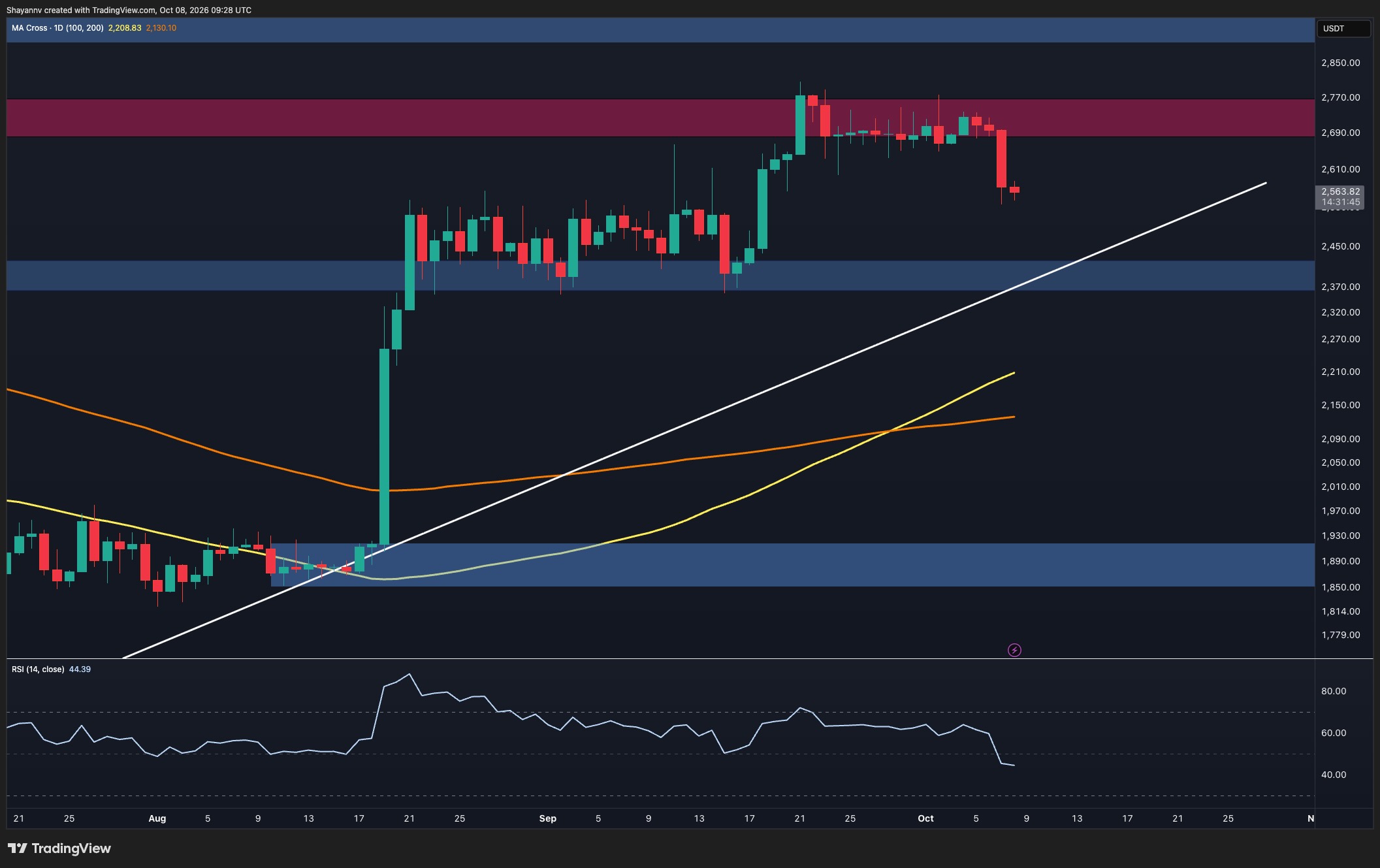
ETH/USDT 4-Hour Chart
The 4-hour chart shows a decisive bearish break from a symmetrical triangle. After compressing between descending resistance and ascending support, Ethereum fell beneath the lower boundary near $2.68K and extended its decline toward $2.42K. The limited rebound following the selloff suggests that buyers have yet to establish a convincing recovery.
The RSI is now around 26, placing short-term momentum in oversold territory. This could support a temporary relief bounce, although oversold conditions alone do not confirm a reversal. Any recovery would initially face resistance around $2.6K–$2.62K, followed by the broken triangle boundary and supply zone near $2.68K–$2.7K.
As selling pressure persisted, the highlighted $2.40K–$2.42K demand zone became the next important support area. Failure to defend it would increase the risk of a move toward the September lows around $2.36K–$2.38K. Conversely, sustained acceptance back above the triangle’s former support would weaken the bearish breakdown scenario and allow another challenge of $2.77K.

Sentiment Analysis
The two-week Binance ETH/USDT liquidation heatmap shows that the latest decline has moved through the previously dense estimated liquidation bands around $2.6K–$2.65K. These bands fade behind the falling price, consistent with leveraged positions being cleared as Ethereum moved lower, although the heatmap does not quantify actual executed liquidations.
With Ethereum now near $2.56K, the remaining nearby downside concentrations appear around $2.52K–$2.54K, with additional bands toward $2.48K–$2.5K. These areas could become relevant if the correction continues, particularly as the lower clusters approach the technical demand zone.
Above price, a nearby band remains around $2.63K–$2.64K, while the most prominent overhead concentration sits around $2.78K–$2.84K. A sustained recovery could bring these pools into focus, but the current technical breakdown favors caution until Ethereum reclaims its lost support. The liquidation distribution highlights potential areas of accelerated volatility rather than guaranteeing the next direction.

The post Ethereum Price Analysis: ETH Crashes 10% Weekly – How Low Can It Go? appeared first on CryptoPotato.
Bitcoin has nosedived again in the past hour or so, dumping below $81,000 for the first time since September 21, when it broke out.
The liquidations have skyrocketed once again, exceeding $480 million in the past hour alone. As expected, the majority is from long positions.
Cryptopotato reported yesterday that BTC crashed by $2,000 within 20 minutes, which was rather unexpected. It came after the US government transferred a portion of its crypto holdings to Coinbase Prime.
At the time, the cryptocurrency fell below $84,000 and managed to hold at around that level for hours.
However, the landscape worsened in the past several hours, with the asset tanking below $81,000. This also coincided with a new BTC transfer from the US government, according to data from Lookonchain. This one was even more interesting, as the moved bitcoin in question appears to have originated from the Bitfinex hack.
The altcoins have followed suit. ETH, which traded above $2,700 until 48 hours ago, is now down to $2,450.
XRP was rejected at $1.50 and has dumped to $1.34 as of now. Notable losses also come from SOL, HYPE, DOGE, and others.
Naturally, the total value of wrecked positions has jumped a lot. Data from CoinGlass shows that over $45wiped out has been wiped-out in the past hour alone. Almost all of it was from longs.
The amount is up to nearly $900 million on a 24-hour scale. The total number of liquidated traders is over 150,000.
The post Liquidations Hit $480M In an Hour as Bitcoin Plunges Below $81K appeared first on CryptoPotato.
Solana appears to be pulling in users at a much faster rate. Since early September, network growth has risen 124%, with about 1.71 million new wallets being created each day.
Activity is rising too.
Network Growth Accelerates
According to Santiment’s latest findings, daily active addresses are up 58% over the same period, having reached around 4.27 million unique wallets. In other words, more people are not just creating wallets but actually using the network. The growth gives SOL a stronger long-term case if the trend continues.
Santiment explained,
“Networks that attract more users and real utility have historically had greater potential to support higher market caps over time. If Solana keeps expanding its active user base, rising network value can eventually follow.”
At the time of writing, SOL is trading near $115 after a fresh 3% decline over the past day. The crypto asset broke its own channel support on the four-hour chart after a rejection near $120 this week. The breakdown has put $114 in focus. If that level fails, Ali Martinez believes that $111 could be next. According to trader ‘Wick,’ on the other hand, corrections can become opportunities.
Long-term projections remain firmly bullish. Tracer has projected a break above $300 during the bull market. Martinez is even more optimistic. He pointed to a possible cup-and-handle pattern on SOL’s monthly chart, with the neckline around $295. A monthly close above that level could strengthen the setup. Interestingly, the pattern points toward a potential target near $2,744.
Institutional Demand Takes a Hit
The institutional side of things has slowed down. September was a strong month for US-listed spot SOL ETFs, which collectively pulled in more than $271 million, making it their second-best month so far. October, however, has started on a very different note. The funds have seen just one day of inflows, with only $1.30 million entering on October 2. So far this month, more than $22 million has flowed out of these investment vehicles.
Separately, Solana’s stablecoin activity is hitting new highs as the network pushes further into institutional settlement. More than 14 million addresses now hold stablecoins on Solana, according to the data compiled by Blockworks. That’s a big jump from fewer than 4 million in late 2024.
The network now has over $15 billion in stablecoin supply.
The post Solana Network Growth Jumps 124%: Here’s Why It Could Matter for SOL appeared first on CryptoPotato.