Cryptocurrency Posts
Crypto Briefing
OpenAI's revenue discrepancies highlight the volatility and uncertainty in AI market valuations, impacting investor confidence and strategic planning.
The post OpenAI revenue claim puts a $20 billion question mark on AI’s growth story appeared first on Crypto Briefing.
Gnosis' integration of FCR enhances transaction speed, potentially boosting user engagement and cross-chain activity, despite security trade-offs.
The post Gnosis bridges cut Ethereum deposit waits to seconds with fast confirmation appeared first on Crypto Briefing.
Google's potential AI leadership by 2026 could reshape competitive dynamics, influencing market strategies and innovation across the tech industry.
The post Google leads AI race with 43% chance of top model by 2026 appeared first on Crypto Briefing.
Anthropic's massive investment signals a strategic push to dominate AI, potentially reshaping industry dynamics and influencing market valuations.
The post Anthropic to invest $518B in cloud and computing over next decade appeared first on Crypto Briefing.
Investors should focus on semiconductor companies as they provide a more stable and foundational investment in AI infrastructure growth.
The post Wall Street says chipmakers, not AI apps, remain the smart AI bet appeared first on Crypto Briefing.
Bitcoin Magazine
Bitcoin Magazine
Standard Chartered to Offer Digital Asset Custody in Singapore
Standard Chartered plans to offer crypto custody services for institutional clients in Singapore, the British multinational has said.
Institutional and corporate clients increasingly want secure, regulated, bank-grade custody for digital assets, the bank said Thursday. Standard Chartered already offers the service in the United Arab Emirates, Luxembourg, and Hong Kong.
“Singapore is an important centre for financial innovation, with a strong institutional ecosystem and growing demand for trusted digital asset solutions,” Patrick Lee, CEO, Singapore and CEO, ASEAN & South Asia, Standard Chartered, said.
JUST IN:
— Bitcoin Magazine (@BitcoinMagazine) October 8, 2026Standard Chartered Bank announced its plans to provide custody services for Bitcoin and digital assets today
pic.twitter.com/Ynmdd5VEtP
“Robust infrastructure will be critical to supporting the secure movement, safekeeping, and servicing of tokenised assets at an institutional scale.”
Banks worldwide are integrating or offering bitcoin-related products and services. A number of U.S. and European banks have started offering crypto-related services by custodying assets for institutions.
Standard Chartered added the custody service would be for “selected cryptoassets, stablecoins and tokenized real-world assets.”
Tokenization is a hot topic on Wall Street as a number of traditional finance firms do deals with crypto companies, mostly to bring stocks on the blockchain to allow for 24-7 trading. Other assets are also being considered or debuted.
In 2025, Standard Chartered set up a trading desk for bitcoin and other cryptocurrencies in London, making it one of the first global banks to enter spot cryptocurrency trading.
The crypto desk became part of the forex trading operation. The bank the same year launched a blockchain unit called Libeara to help institutions tokenize traditional assets.
Last month, the bank debuted bitcoin trading in the UAE for institutional clients.
Crypto custody is often a starting point for banks moving into the digital asset space. BNY Mellon in 2022 became the first major U.S. bank to offer digital asset custody services.
And last month, Germany’s Deutsche Bank said it plans to launch a custody service for bitcoin, ether and select stablecoins for European corporate and institutional clients later in 2026, pending regulatory approval.
This post Standard Chartered to Offer Digital Asset Custody in Singapore first appeared on Bitcoin Magazine and is written by Mathew Di Salvo.
Bitcoin Magazine

Understanding Digital Money and Digital Yield
The new business model of building on top of digital credit to create digital money and digital yield can be roughly categorized into two different architectures.
- Debt-based, tranching structures
- Full-reserve, spendable balance structures
This article gives a general overview of these models, with an analysis of economic implications.
Digital Credit, Digital Money and Digital Yield
To get started, I will define these terms. Digital Credit is the credit-like instruments issued by corporations with large Bitcoin balance sheets. Today they are five Nasdaq-listed perpetual preferred equity—STRC, SATA, STRK, STRF, STRD—and all five are the top five most liquid preferred equity securities in the United States. Digital Credit is L2 because it is built on top of Bitcoin, which is L1.
Digital Money and Digital Yield are the L3 products that could be built on top of Digital Credit.
Now obviously, Bitcoin is Digital Money. In this article I am using the terms popularized by Michael Saylor in corporate bitcoin discourse to describe the economic ecosystem that is emerging on top of public company issuance of Bitcoin-linked securities.
Under that paradigm, Digital Money refers to something that holds a very stable fiat-denominated value that is built on top of Digital Credit. And Digital Yield refers to something that concentrates and amplifies the yield of Digital Credit. Both Digital Money and Digital Yield are L3, since they exist on top of L2 Digital Credit.
Now that we know Digital Money and Digital Yield, we will move on to the different architectures for them.
Debt based tranching
The first and primary one is a debt-based tranching structure in which the digital credit is used as the base collateral asset. The junior tranche is effectively leveraged long digital credit, and the senior tranche is effectively principal protected via the junior tranche’s permanent capital. Right now this is by far the most common structure because we see quite a lot of AUM inside these types of systems. For example, Saturn is a tokenized protocol that holds a lot of STRC, and the financial engineering built on top of Saturn is Strata, which uses the same tranching approach (the name “Strata” likely refers to stratifying the different financial layers within the setup).
Another very important example is UTXO Management’s Preferred Income Strategies LP. This is a dual-class fund: a junior fund share class and a senior fund share class. The juniors are effectively leveraged long the underlying digital credit portfolio and the seniors receive a highly principal-protected 7.5% annual yield. Now, the caveat is the portfolio value cannot fall below the invested capital representing the senior’s original principal. Seniors must get all their principal back before the juniors can get paid. UTXO is able to run some other alpha-generating strategies which may reduce downside risk of the digital credit portfolio or employ relative value trades to capture market mismatches. Such actions increase the returns of the total portfolio. And since the juniors are leveraged long this portfolio, they have the potential to outperform. Meanwhile, the seniors have the entire principal protection cushion. Tranching using the two share classes therefore matches different parties’ risk preferences and desires for total return in a way that services both investor profiles.
You might notice that this basic structure is quite similar to what a digital credit issuer like Strategy or Strive does with their own capital structure. If the issuer raises capital using preferred equity or debt, they have created a more senior layer—that becomes the principal protected layer, albeit it is asset value coverage rather than encumbered, callable protection—while the common equity becomes the junior tranche that is effectively leveraged beyond the underlying asset. In other words, the digital yield and digital money products built on top of digital credit using this tranching structure is a higher order retelling of the same digital credit and digital capital maneuvering done one layer below.
Now, it’s important to realize that any kind of leveraged system that borrows money and then invests the borrowed money into digital credit, is effectively engaging in the Layer 3 methodology of tranching, because that person is now leveraged long, and his counterparty is another person who becomes principal protected. Outside of raw asset coverage ratios, the specific degree of principal protection depends on whether the collateral asset—in this case the digital credit instrument—is sitting in some kind of custody that can be enforced.
Put differently, should the digital credit position go underwater, the creditor is able to possess the assets, liquidate the collateral, and be made whole. Enforceability depends on the exact parameters of these structures. Within the case of something like Strata, it is enforced by a blockchain consensus dependent smart contract. The successful execution of that smart contract is where the trust resides. Within the UTXO Preferred Income Fund, you have an enforceable structure within the confines of a regulated hedge fund that all LPs partake in.
One key insight is that such a debt-based structure is far broader and more general than one might initially suspect. Let’s say somebody takes out a mortgage against their house and buys digital credit with it. They have somewhat created that L3 concept because money is being created via the traditional fractional reserve banking process, and collateral has been encumbered. Now, in this case, digital credit isn’t exactly the collateral because the house is the collateral. However, the entire economic setup would not be possible without the presence of digital credit serving as an investable asset and a location to deploy borrowed capital. In a sense, there is a bit of a shadow banking condition that emerges if a widespread group of people take out loans of various forms that might be secured by other assets or even unsecured, and then use the borrowed capital to invest in digital credit in order to be leveraged long digital credit.
The assets that emerge out of this type of behavior is basically conventional credit. It is not tokenized, and there is nothing special about it. It takes the form of an asset-backed security, and frankly, you wouldn’t even know that digital credit was on the other side of it most of the time. And for this reason, it’s not completely precise to call it the L3 digital yield concept, because it does not deal directly with digital credit. At the same time, it is a meaningful market mechanism which may emerge, and we should actively monitor the emergence of this behavior as digital credit scales.
Now I will go into the potential problems and current shortfalls of this type of debt-based, tranching method. The most obvious one is that there is no backstop besides the debtors’ own balance sheets and there is a constant need for debtors to take the leveraged long side for this to work. This is a persistent issue that caps the scalability of L3 digital money and digital yield solutions. If it is the case that you always need a leveraged long party in order to create the principal protection for the senior tranche, then you become constrained by the availability of leveraged long parties. First, there may be much better things to be leveraged long, so you might not have junior capital if there are more compelling opportunities out there. Second, there is always a push-pull relationship between the seniors and the juniors. Because the entire thing exists within a tranche structure, the total portfolio is a zero-sum game. Whatever the seniors gain, the juniors must lose, and vice versa. And because of this, the seniors can only demand yield up to a certain level before the juniors leave. Concurrently, the juniors must receive a return at least to a certain level before they would be willing to take the risk. This relationship needs to reach an equilibrium clearing price. But even at that clearing price, it is doubtful that there will be enough demand for leveraged long digital credit to persistently create the senior principal protected position.
This exact challenge is supported by the anecdotes of the tranching structures I am aware of: there appears to be a relative shortage of folks willing to be juniors and a relative surplus of folks willing to be seniors.
Now, the way the fiat system solves this problem actually presents a very interesting case study for L3’s current shortcomings. You see, fiat solves this problem by having an elastic public balance sheet behind the private credit system. Commercial banks can create credit and deposit money, while the central bank supplies the ultimate settlement asset (which is often called: M0, base money, or bank reserves). When systemwide deleveraging threatens the monetary system, the central bank can create reserves and replace disappearing private liquidity, while the Treasury, deposit insurer, or other public institutions can absorb or redistribute credit losses where policymakers choose to do so. This means the fiat system does not require a private actor to remain willing to be the marginal leveraged long investor during a panic: the public sector can temporarily take that role and prevent forced deleveraging. Thus fiat money can remain present even when the leverage behind it disappears. (Digital Money implemented via the tranching architecture cannot do this.)
Equity and creditors can still be wiped out in fiat. But the distinctive feature of fiat is that there is no hard nominal constraint on the public sector’s ability to manufacture the settlement asset needed to stabilize the financial system. The ultimate macroeconomic constraint on sustained use of that capacity is the availability of real resources and the ability for individuals to tolerate the inflationary impact of such currency debasement. This is the true limit of fiat’s debt-based system at a societal level; and indeed this is also the core conclusion of Modern Monetary Theory.
Now, it should be easy to see that digital credit does not have this type of backing today. It is doubtful that any central bank today would consider buying digital credit when it is underwater to make investors whole (even though central banks do this often with traditional forms of credit like mortgages and other bank loans). And so in that sense, the concept of a fiat-banking-like system that is constructed on top of digital credit to serve as widespread L3 digital money is dubious at best within the next few years. Certain things need to happen—the main one being better Basel risk weights for Bitcoin—and even then meaningful progress would likely be quite slow.
Lacking the support of the commercial banking system or the central banking system, the only capital that can come in as the leveraged Digital Yield juniors to support the creation of the Digital Money seniors is private capital willing to take the risk.
Full reserve, spendable balance
This now brings us to the second form of L3 digital money. These are full-reserve, spendable balances. (A quick disclaimer here is that just because this one is “full reserve” does not imply that the tranching structure is “fractional reserve”. Full reserve just means that the available spendable balance is fully supported by unencumbered shares held on the spot.)
This concept is to combine digital credit with a basket of other credit instruments to create a composite benchmark that is both highly liquid and yields over the risk-free rate (here the risk-free rate just means the short-term U.S. T-bill rate). And if this asset also had daily liquidity and could accrue interest on a daily basis, then you have what is like a money market fund with added risk premium and volatility. If this thing could then be tokenized or turned into a spendable balance, then you now have what could be considered a digital currency that pays higher yield. Note that the composite benchmark is not required: one could have only digital credit in the balance and make it spendable too. Since the volatility of digital credit is higher than short duration credit instruments like FLOT or FLTR (floating rate note ETFs) or JAAA or CLOA (AAA-rated CLO tranches), purely digital credit will be a more volatile albeit higher yielding spendable balance.
The real hurdle for this concept is regulatory acceptance. Consider the recent plight over stablecoins and the Clarity Act, and how banks rejected Clarity because stablecoins serve as a big competitor to them. One of the most contentious issues was stablecoins paying yield, which would compete with traditional bank deposits. Now if we had a spendable balance with relatively stable par value that pays a higher-than-risk-free yield due to a credit risk premium, then this would probably create even more of an issue. In that sense, the idea of using relatively-stable-value securities (of which digital credit is just one group) as spendable balances is something that is sensitive when considering the different parties that need to be satisfied for this to become legally possible.
A softer version of the spendable balance concept is something like Castle: businesses can hold reserves in STRC, liquidate STRC into cash on demand, and then use that cash for operating expenses. The conversion follows normal securities T+1 settlement. This is like a brokerage account connected to a payment provider. Neither the shares nor representation of the shares (like a token) are being transferred to the final recipient of the payment.
Of course, there are far less obstacles to creating a simple fund that holds digital credit without making the fund interests peer-to-peer transferable. OranjeBTC has done exactly this with their Digital Credit ETF launched in Brazil. In this specific case, OranjeBTC has even employed a currency hedge procedure to deliver yields denominated in Brazilian Real. Even though this return stream can probably be replicated without much difficulty, it is nevertheless far more convenient for most people to buy a single ticker that takes care of everything.
Conclusion
The existing developments and current regulatory parameters suggest that the debt-based tranching solution will likely be more of the activity within the L3 field. There are several different variations of both archetypes: within this article we’ve gone through a few different versions.
I aim to explore such models—existing and theoretical—in greater depth in the future. Stay tuned.
Disclaimer: This content was prepared on behalf of Bitcoin For Corporations for informational purposes only. It reflects the author’s own analysis and opinion and should not be relied upon as investment advice. Nothing in this article constitutes an offer, invitation, or solicitation to purchase, sell, or subscribe for any security or financial product.
This post Understanding Digital Money and Digital Yield first appeared on Bitcoin Magazine and is written by Allard Peng.
Bitcoin Magazine

Why Bitcoin’s Liquidity Advantage Matters as Institutions Move In
Bitcoin’s portability, divisibility and accessibility could increasingly distinguish it from traditional stores of value as more institutions enter the market, according to SALT Lending CEO and Co-Founder Shawn Owen.
Speaking on BMTV, Owen pointed to Bitcoin’s resilience while gold and other long-duration assets sold off, arguing that some of Bitcoin’s most basic characteristics give it advantages over competing assets.
“It is easier to buy Bitcoin than gold,” Owen said.
That advantage becomes even more apparent when mobility matters.
“It’s easier to move Bitcoin out of, say, somewhere where you need to leave quickly because there’s unrest in the area than gold,” Owen said. “It’s far more portable and divisible and easy to use than real estate.”
Bitcoin’s Liquidity Advantage
Gold, real estate and bitcoin can all serve as long-term stores of value, but accessing and moving that value looks very different.
Physical gold requires storage and transportation. Real estate is tied to a specific location and can take time to buy or sell. Bitcoin can be transferred globally and divided into small units without those same physical constraints.
Those characteristics can also give Bitcoin holders more flexibility when they need liquidity.
Rather than selling bitcoin to access dollars, holders can potentially use it as collateral and borrow against its value while maintaining exposure to the underlying asset.
That model becomes particularly relevant if Owen’s longer-term outlook for Bitcoin adoption proves correct.
Institutional FOMO Is Arriving
Owen believes the experience many individual Bitcoin holders have already gone through, discovering Bitcoin and wishing they had gotten involved earlier, may eventually play out among much larger institutions.
“Every human goes through this experience where you learn about Bitcoin and wish you’d been earlier,” Owen said. “I think that will be true of sovereigns and banks and institutions of all sizes.”
Banks have taken considerably longer to enter the market, but Owen believes that is beginning to change as many of the hurdles surrounding Bitcoin have been addressed.
“Banks have been slow, but are now getting in after all the boxes have been checked,” he said. “FOMO is real.”
JUST IN: Salt Lending CEO says sovereign wealth funds and banks are realizing the importance of Bitcoin
— Bitcoin Magazine (@BitcoinMagazine) October 7, 2026
"Every human goes through this experience where you learn about Bitcoin and wish you'd been earlier…I think that will be true of sovereigns and banks of all sizes."

Owen cautioned that adoption and price appreciation will not necessarily happen in a straight line. As Bitcoin matures and more capital enters the market, he expects some dampening of its historic volatility.
That does not change his longer-term outlook.
“Adoption depends on the time horizon we’re talking about,” Owen said. “Dampening of volatility, and we will continue to see that, but that doesn’t mean over the next decade we won’t see serious adoption and increase in price.”
“Never Sell Your Bitcoin”
That long-term view also shapes how Owen thinks holders should approach their bitcoin.
“I have always said never sell your bitcoin,” Owen said. “Long term we will continue to see prices increasing significantly in comparison to fiat currencies.”
For holders who share that outlook, selling bitcoin to cover a large purchase, business expense or other liquidity need means giving up future exposure to the bitcoin they sell.
Bitcoin-backed lending provides an alternative.
SALT allows eligible borrowers to use bitcoin as collateral to access cash without selling the underlying bitcoin. Once the loan is repaid, the collateral is returned to the borrower.
The model aligns closely with Owen’s broader thesis. If Bitcoin continues becoming easier to access and more widely adopted by banks, institutions and potentially sovereigns, long-term holders may become increasingly reluctant to sell simply because they need liquidity.
Instead, they can potentially maintain their bitcoin position while accessing the value stored within it.
As Bitcoin adoption expands, the conversation may increasingly move beyond how to acquire bitcoin and toward how holders can use the wealth they have accumulated without necessarily selling the asset.
SALT Lending is the Official Liquidity Sponsor of BMTV. Learn more about borrowing against your bitcoin and explore SALT’s BMTV offer at https://saltlending.com/bmtv/?utm_source=bmtv&utm_medium=article&utm_campaign=52783658-BMTV%20article&utm_term=BMTV
Disclaimer: SALT Lending is a paid sponsor of BMTV and serves as BMTV’s Official Liquidity Sponsor. This article is sponsored content and does not necessarily reflect the views or opinions of Bitcoin Magazine. The information provided is for promotional purposes and should not be considered financial advice. Readers are encouraged to conduct their own research before making any investment decisions related to Bitcoin or other financial products mentioned herein.
This post Why Bitcoin’s Liquidity Advantage Matters as Institutions Move In first appeared on Bitcoin Magazine and is written by Josh Plischke.
Bitcoin Magazine

Shawn Owen: Bitcoin’s First Institutional Cycle Has Arrived
Banks and credit unions are racing to adopt Bitcoin, and SALT Lending CEO Shawn Owen says the FOMO is real. In this interview, Shawn Owen joins Grace Remington and Sean Hagan to talk about Bitcoin as pristine collateral, compressing volatility, and why institutions can no longer ignore Bitcoin. He explains how the barriers holding back banks and registered investment advisors have finally come down. If you want to understand where Bitcoin-backed lending is headed, this conversation is a must-watch.
Chapters:
0:00 – SALT Lending CEO Shawn Owen on Bitcoin Volatility and Loan-to-Value
1:38 – Bitcoin as Pristine Collateral for Banks and Wealth Advisors
3:20 – Why Credit Unions and Banks Have Bitcoin FOMO
4:38 – Dampening Volatility and Bitcoin’s Long-Term Upside
6:16 – Bitcoin vs. Real Estate for Younger Generations
7:21 – Building a Secondary Market for Bitcoin-Backed Loans
8:56 – Bitcoin Regulation, the Clarity Act and Stablecoins
10:31 – Bitcoin Strength as Bonds and Gold Sell Off
13:11 – How Bitcoin ETFs Changed SALT’s Borrower Base
15:40 – Never Sell Your Bitcoin: When to Borrow Instead
DISCLAIMER: The views and opinions expressed in this show are those of the participants and do not necessarily reflect the official policy or position of BTC Inc., Bitcoin Magazine, or any affiliated entities. This content is provided for informational and educational purposes only and should not be construed as investment, legal, tax, or accounting advice. Nothing contained in this show constitutes a solicitation, recommendation, endorsement, or offer to buy or sell any securities or financial instruments. Viewers should consult their own advisors before making financial or business decisions.
This post Shawn Owen: Bitcoin’s First Institutional Cycle Has Arrived first appeared on Bitcoin Magazine and is written by Patrick Green.
Bitcoin Magazine

Josh Young: “Massive” Currency Debasement to Come From Oil’s Run Higher
Global oil inventories are running out faster than most people realize. Josh Young, founder and CEO of Bison Interests, says less than 10% of global stockpiles may be usable, and the market has almost no room left for another supply shock. He explains why WTI’s fair value sits near $105 a barrel, why an Iran peace deal might not bring lasting relief, and which part of the energy market he believes is deeply undervalued.
Chapters:
00:00 Saudi Aramco Warns Rebuilding Oil Stockpiles Could Take Two Years
02:00 Would an Iran Peace Deal Crash Oil? Why WTI’s Fair Value Is $105
04:03 How Long It Takes to Restore Damaged Middle East Energy Infrastructure
05:33 Strait of Hormuz Flows, Misleading Data and Wartime Propaganda
08:18 Diesel at $200 a Barrel: Why Refined Products Matter Most
10:40 Russia, China and the Real Drivers of the Diesel Squeeze
12:38 Why a US Diesel Export Ban Is Very Unlikely
14:41 Undervalued Small-Cap Oil Producers and Trump’s Midterm Price Promise
17:40 The Fed, Rate Hikes and What Milton Friedman Got Right
20:37 Kevin Warsh, Government Inertia and Massive Currency Debasement
DISCLAIMER: The views and opinions expressed in this show are those of the participants and do not necessarily reflect the official policy or position of BTC Inc., Bitcoin Magazine, or any affiliated entities. This content is provided for informational and educational purposes only and should not be construed as investment, legal, tax, or accounting advice. Nothing contained in this show constitutes a solicitation, recommendation, endorsement, or offer to buy or sell any securities or financial instruments. Viewers should consult their own advisors before making financial or business decisions.
This post Josh Young: “Massive” Currency Debasement to Come From Oil’s Run Higher first appeared on Bitcoin Magazine and is written by Patrick Green.
CryptoSlate
Bitcoin.de is rebuilding its operating model after German regulators rejected its MiCA authorization, forcing it to outsource trading and custody to outside partners.
BaFin refused the application filed by Futurum Bank AG, the Bitcoin.de operator, to become an authorized crypto-asset service provider under the European Union’s Markets in Crypto-Assets (MiCA) regime.
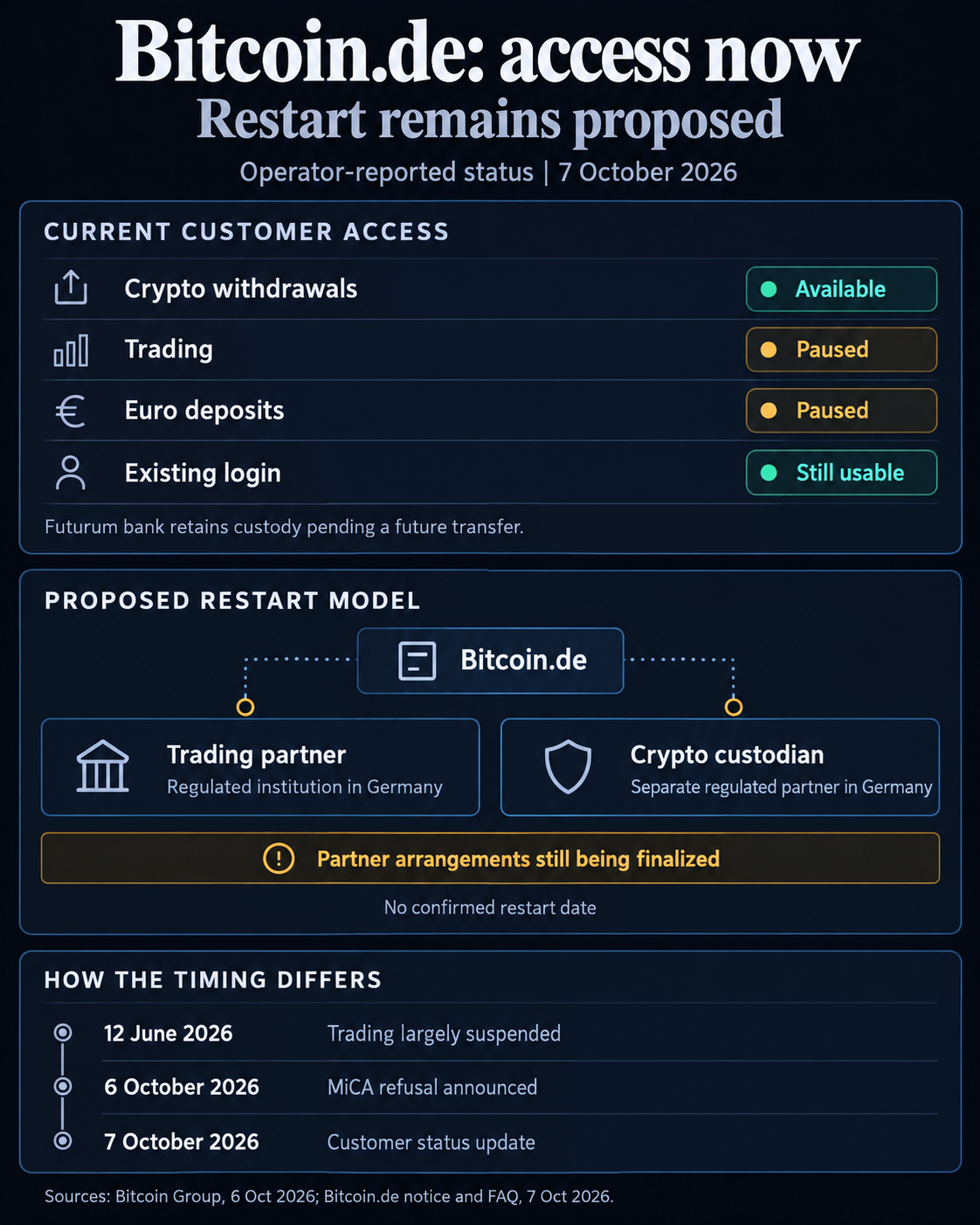
The decision also ended the regulator’s previous tolerance of Futurum Bank’s crypto services, while trading on the platform has already been largely suspended since June 12.
Customers can still withdraw crypto, though trading and euro deposits remain suspended. Futurum Bank will continue holding assets until they are transferred to a new custodian, while existing logins and customer claims remain unaffected.
Bitcoin Group said Futurum Bank had applied for MiCA authorization in June 2025, leaving the process unresolved for more than 15 months.
MiCA rejection forces a structural reset
After BaFin's rejection, the firm's management said it had prepared an alternative structure that would let it move quickly.
As a result, Bitcoin.de plans to keep its platform running through two regulated German institutions, with one acting as customers’ trading counterparty and another taking over crypto custody. The platform would retain its app, brand and customer interface while the licensed partners handle the regulated functions.
The shift would leave Bitcoin.de focused more heavily on technology, distribution and customer relationships, while regulated partners take responsibility for execution and custody. That structure could preserve the marketplace without requiring Futurum Bank itself to perform the activities BaFin declined to authorize.
The company, which says it serves more than 1.1 million customers, has not identified either partner or given a firm date for trading to resume. It said the agreements are being finalized and restoring service remains a priority.
Bitcoin Group and Futurum Bank are still reviewing the regulator’s decision and can object within one month of formal notification. A fresh authorization application also remains possible.
For now, the commercial pressure is on completing the partner agreements before the prolonged trading halt pushes more users elsewhere. Bitcoin.de says the technical work for the relaunch is complete, leaving regulatory implementation as the main barrier to restoring full service.
The next milestones are a restart date, the return of euro deposits and the transfer of customer assets to the new custodian.
The post MiCA rejection forces German crypto platform into operational overhaul appeared first on CryptoSlate.
US spot Bitcoin and Ethereum exchange-traded funds saw their steepest withdrawals in months as the cryptocurrency market continued to decline.
Data from SoSoValue shows that the 12 listed US Bitcoin ETFs lost $484.9 million on Oct. 7, their largest single-day outflow since June 25. BlackRock's iShares Bitcoin Trust (IBIT) led the withdrawals with $207.7 million, followed by Fidelity's FBTC at $105.1 million and ARK 21Shares' ARKB at $101.7 million.
Meanwhile, Ethereum ETFs recorded $160.9 million in withdrawals, bringing their five-session losses to $506.3 million, the largest since January.
BlackRock's ETHA accounted for $116.1 million of Wednesday's redemptions, while Grayscale's ETHE lost $25.8 million. The funds have now experienced seven consecutive trading sessions of outflows, totaling approximately $569 million.
Together, the two ETF categories lost about $646 million on Wednesday as Bitcoin fell to its lowest daily close in the last 20 days, below $83,000, while Ethereum retreated toward $2,500 during the reporting period.
Notably, the price action coincided with rising US Treasury yields, a stronger dollar, and elevated oil prices, adding to pressure on risk assets.
ETF demand was weakening before the latest withdrawals
The latest withdrawals followed signs of weakening institutional demand that Bitfinex analysts had identified before Wednesday's selloff.
In an Oct. 7 report, the analysts noted that Bitcoin ETF flows had become increasingly uneven, with investment slowing sharply after the buying spree that supported September's recovery.
Daily inflows averaged $341.7 million during Bitcoin's mid-September rally from $76,000 to $87,000. However, that figure fell to about $35 million per day over the five trading sessions through Oct. 6, totaling $172.9 million in cumulative net inflows.
The remaining demand was also heavily concentrated in BlackRock's IBIT, which attracted $536.2 million during those five sessions while competing Bitcoin ETFs collectively lost $363.3 million.
That divergence left the market increasingly reliant on a single fund to offset redemptions elsewhere, a source of support that weakened when IBIT joined Wednesday's selling.
The reversal comes as Bitcoin has fallen below the estimated average acquisition price of ETF investors.
Citing Checkonchain data, Bitfinex placed the flow-weighted average ETF cost basis at $84,318. The analysts observed that daily inflows historically moderated toward approximately $65 million as Bitcoin approached investors' aggregate breakeven level.
Wednesday's close under $83,000 has pushed Bitcoin below that threshold, raising the possibility that further declines could prompt additional redemptions as investors seek to limit losses.
Although the estimate does not reflect individual investors' entry prices, it gauges the profitability of capital deployed through the funds.
Ethereum is showing additional signs of weakening demand. Beyond its persistent ETF withdrawals, CryptoSlate previously reported growing demand for short exposure in the derivatives market, with traders holding short positions paying longs through negative perpetual futures funding rates.
The positioning suggests that bearish traders are increasingly willing to incur costs to maintain exposure to further price declines, adding to the pressure reflected in Ethereum ETF redemptions.
Bitfinex also warned that weaker institutional inflows were leaving the broader altcoin market increasingly dependent on capital rotating among existing cryptocurrency positions.
That could leave smaller tokens especially exposed if Bitcoin's decline accelerates, as investors seeking to reduce risk withdraw capital from altcoins instead of rotating into other digital assets.
The post Bitcoin ETFs suffer biggest exodus since June as Ethereum withdrawals hit nine-month high appeared first on CryptoSlate.
MetaMask's precautionary validator exits are turning a roughly $1,000 reward diversion into a test of Ethereum's staking capacity. Lido expects its affected ETH to return gradually to Ethereum staking; the entry backlog was worth about $3.59 billion in the Oct. 7 snapshot.
Lido had expected its final affected validators to exit by the end of October 7. The deadline covers exits, with full withdrawals and re-entry taking longer. The protocol estimates that the complete cycle could take up to about 45 days.
Bitquery measured 0.36 ETH in diverted block tips across 18 blocks on September 30. At the October 7 ETH price used below, that amounts to about $923.
Its October 1 snapshot identified 16,965 MetaMask-operated validators holding 565,056 ETH that had exited or joined the exit queue. MetaMask has not confirmed that total. The company said in its October 1 update that its investigation to date had found no indication wallets or customer funds were affected and described the exits as precautionary.
The larger economic exposure comes from withdrawing and restaking the balances behind the precautionary exits.
Bitquery's two Lido groups held 252,288 ETH, already included in the wider total. Lido expects that portion to return to its protocol; its statement does not establish what every other MetaMask client will do.
An October 5 contributor proposal would stop new deposit allocations to MetaMask operators in Lido's two curated modules. The forum describes calls intended for the next on-chain vote, without confirming adoption. Return to the protocol does not guarantee return to the same operator.
What a $5 billion workload would mean
Validator Queue showed 1,398,922 ETH awaiting entry at about 14:18 UTC on October 7, with an estimated wait of 24 days and seven hours. Another 822,405 ETH awaited exit. About 43.7 million ETH, or 35.78% of supply, was staked.
The dashboard's entry limit was 256 ETH per 6.4-minute epoch, equivalent to 57,600 ETH a day. At that throughput, fully restaking the identified Lido cohort would use 4.4 days of entry capacity. The wider 565,056 ETH cohort represents 9.8 days if all of it seeks fresh activation.
If the entire wider cohort returns as new demand beyond the observed backlog, the static combined workload is 1,963,978 ETH. At ETH's $2,564.19 price observed at the same time, it is worth about $5.04 billion.
The following scenarios hold that backlog fixed and assume returning ETH is entirely additional to it:
| Hypothetical net new return | Combined workload (ETH) | Value | Capacity days | Added capacity days |
|---|---|---|---|---|
| None: observed backlog | 1,398,922 | $3.59 billion | 24.29 | 0 |
| 25% of wider cohort | 1,540,186 | $3.95 billion | 26.74 | 2.45 |
| 50% of wider cohort | 1,681,450 | $4.31 billion | 29.19 | 4.91 |
| 75% of wider cohort | 1,822,714 | $4.67 billion | 31.64 | 7.36 |
| 100% of wider cohort | 1,963,978 | $5.04 billion | 34.10 | 9.81 |
Actual delays depend on the backlog clearing, the pace of Lido's gradual return and other deposits. How much of the wider cohort has already returned or is included in the entry queue remains unknown.
Ethereum's exit and activation queues are independent. Leaving does not directly consume entry capacity. The pressure on onboarding arises when withdrawn ETH is deposited again alongside other demand.
The cost depends on time spent inactive
Validators can keep earning while waiting to exit if they remain online and perform their duties. Rewards cease at the exit epoch; shutting down earlier can incur losses or penalties. Lido has warned of foregone rewards and possible downtime penalties.
Using the dashboard's 2.59% APR and the same ETH price, if the entire wider cohort were inactive, it would forgo about $1.54 million over 15 inactive days, $3.08 million over 30, or $4.63 million over 45. For the included Lido portion, those figures are about $0.69 million, $1.38 million and $2.07 million.
These simple-return estimates assume constant price and APR and exclude fees and alternative earnings. They model time spent inactive; actual incident losses depend on how long each validator stops earning during the exit, withdrawal and re-entry cycle.
CryptoSlate's October 1 coverage established the exit backlog. The recovery now depends on completed withdrawals, subsequent deposits and how much returning stake reaches the entry queue as new demand. Whether those deposits and other demand exceed 57,600 ETH a day will determine how quickly the entry backlog clears.
The post A $1,000 MetaMask incident could turn Ethereum’s staking queue into a $5 billion traffic jam appeared first on CryptoSlate.
Citi's $113,000 Bitcoin target would require a roughly 36% rise from the Oct. 7 reference price, keeping it below its previous record. The harder question is whether buying can sustain that recovery. Onchain analytics firm Glassnode's fresh analysis shows new money entering the market alongside unusually thin trading.
The bank raised its twelve-month Bitcoin forecast from $82,000 on Oct. 1, citing stronger activity, supportive macro conditions and renewed ETF inflows, Reuters reported. Citi also forecast $5 billion of crypto inflows over the following year as advisers and brokerages gradually increase allocations. That horizon points to approximately autumn 2027.
How large is the required move?
The calculation starts with the Bitcoin price quote on Oct. 7: $83,085. Reaching $113,000 requires a 36% gain, equivalent to approximately 2.6% compounded monthly over twelve months.
The target also sits about 10.5% below Bitcoin's prior $126,198.07 record. It would therefore be a recovery within a previously traded price range.
Holding the page's rounded circulating supply of 20.09 million BTC fixed, the target implies approximately $2.27 trillion in quoted market capitalization, an increase of about $601 billion. This approximate valuation comparison excludes subsequent coin issuance.
Market capitalization multiplies the latest price by circulating supply, revaluing coins that have stayed in holders' wallets. The $601 billion increase describes that change in valuation; the cash needed to move prices depends on actual trading.
Historical volatility supplies another scale check. Glassnode's point-in-time data put one-year annualized realized volatility at 43.97% as of Oct. 6. Using logarithmic returns to match the volatility measure, the required gain is about 30.8%, or 0.70 times that annualized scale. A probability or direction forecast would require additional assumptions.
What the ETF assumption can establish
Citi published a historical association in its January 2025 outlook: roughly 4.7% Bitcoin returns associated with each $1 billion of ETF inflows. The bank said flows explained about 46% of price-action variance in that analysis.
Its public summary leaves the observation frequency and complete regression equation undisclosed. Reuters' latest report also leaves the $5 billion flow category unspecified. Those gaps limit any calculation to an arithmetic illustration using an older relationship.
Assuming the entire reported $5 billion became Bitcoin ETF net inflows, applying the old association linearly to the Oct. 7 reference price gives 23.5% upside and a price near $102,600. This calculation cannot reproduce Citi's current model, establish that $5 billion is insufficient or identify a necessary annual inflow threshold.
Macro conditions and holders' willingness to sell can change how much a given amount of buying moves prices.
What the current data show
The Oct. 7 Glassnode report puts combined Bitcoin spot-exchange and US spot ETF trading volume at approximately $6.8 billion a day on a seven-day average. That is below the level on nine in ten days since January 2024. Volume measures trading activity; net flows measure the balance of money entering and leaving funds.
For the thirty days through Oct. 5, Glassnode estimated about $4.9 billion from ETF flows, stablecoin growth and corporate treasury buying. Bitcoin's realized capitalization rose about $12.8 billion over that period.
The inflow estimate combines several kinds of new money. Realized capitalization values coins at the prices when they last moved, so its increase measures a change in coins' aggregate cost basis. Both figures differ from the quoted market-cap increase calculated above.
US spot Bitcoin ETFs recorded net inflows of $118.8 million on Oct. 6, followed by net outflows of $484.9 million on Oct. 7, Farside's daily table shows.
The macro readings offer recent context rather than year-ahead thresholds. The Federal Reserve's broad dollar index, which differs from DXY, rose about 0.34% from Sept. 30 to Oct. 2. The ten-year Treasury yield increased seven basis points, from 5.24% on Oct. 1 to 5.31% on Oct. 5.
Meanwhile, DefiLlama's Oct. 7 dashboard showed about $308 billion of stablecoin capitalization and roughly 1% growth over thirty days. That stock of tokens has several uses, so its impact on Bitcoin depends on how holders deploy it.
Recurring net ETF purchases accompanied by stronger spot activity would strengthen the demand case for $113,000. Renewed fund redemptions would weaken that evidence of sustained buying. Glassnode's composite estimate shows new money arriving, while thin turnover leaves broad participation uncertain. The required price move has historical precedent; whether buyers can sustain it remains the open question.
The post Citi predicts Bitcoin going back to $113,000. Here’s what the buying data shows appeared first on CryptoSlate.
Bitcoin’s US-session weakness is deepening as BTC prices on Coinbase trade at a $64 discount to Binance, the largest global crypto exchange
Bitcoin has lost a compounded 3.24% during US stock-market hours since Sept. 21, while prices outside that window advanced 6.07%, according to a CryptoSlate analysis of Binance BTC/USDT trading.
During this period, CryptoQuant’s Coinbase Premium Gap fell to -$64, pointing to weaker demand or heavier selling on the US-focused exchange.
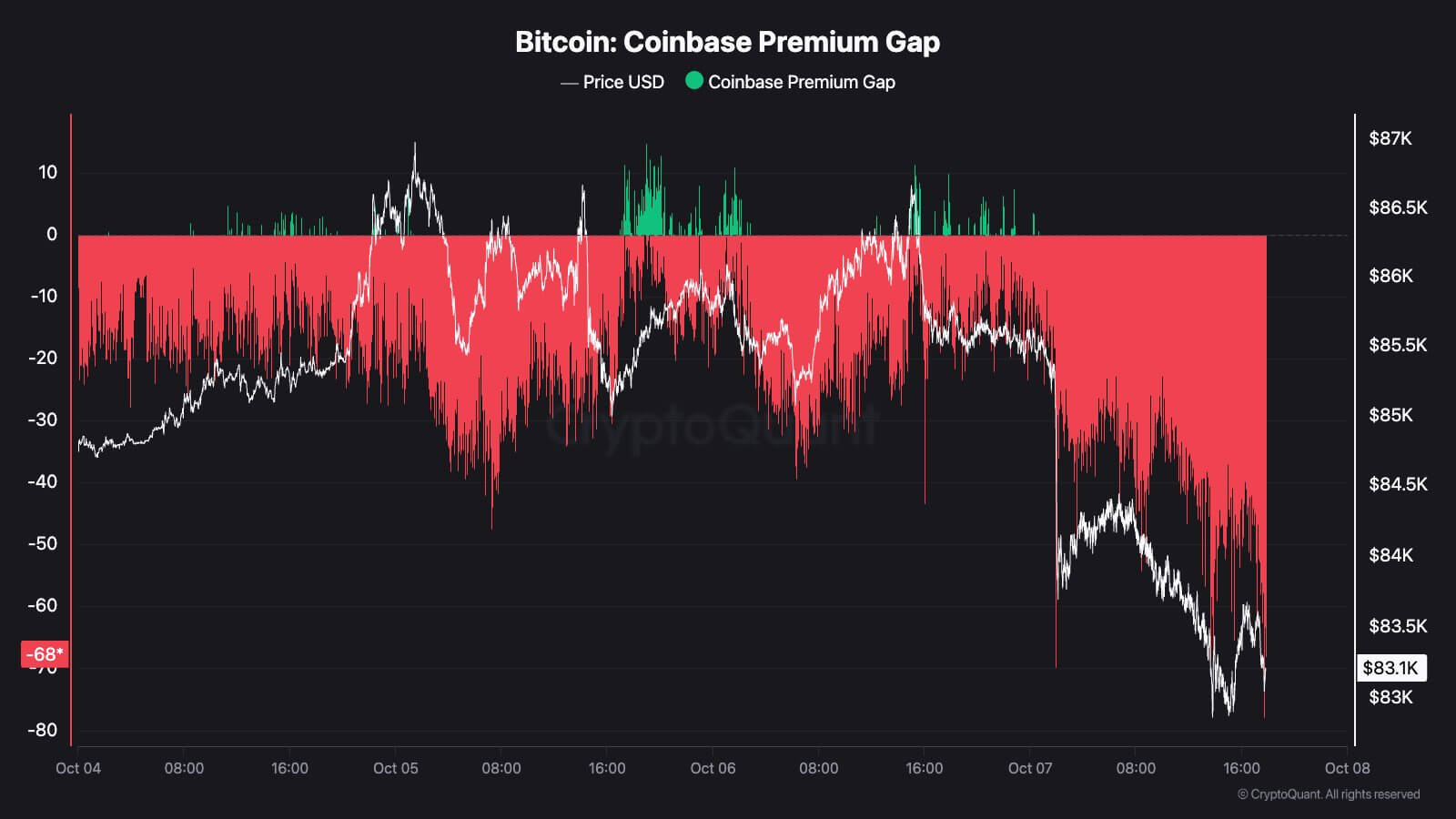
The pattern supports Glassnode’s view that the American trading session has become a source of pressure. But the losses were heavily concentrated in two sessions, while ETF flows on those dates moved in opposite directions, complicating claims of persistent institutional selling.
Two sessions drove most of the decline
Across 13 Wall Street cash sessions from Sept. 21 through Oct. 7, Bitcoin fell during eight. According to CryptoSlate's analysis of Binance's data, the largest declines came on Sept. 30 and Oct. 2, when prices dropped 1.86% and 2.65%, respectively, during the 9:30 a.m.-to-4 p.m. New York window.
Remove those two dates and the remaining 11 sessions produce a compounded 1.28% gain.
That influence matters because the headline 3.24% loss can otherwise suggest a steadier deterioration than the data shows. The US session was frequently weak, but much of the cumulative damage came from two sharp moves rather than a uniform pattern of selling.
The data also show that the result changes when the trading window shifts.
Starting the US session at 9 a.m. instead of 9:30 a.m. produces a compounded 4.94% loss through 4 p.m. over the same period. Starting at 10 a.m. results in a 5.41% decline.
After excluding Sept. 30 and Oct. 2, those alternative windows still show losses of 0.16% and 1.68%, respectively. That leaves the positive 1.28% remainder dependent on the exact 9:30 a.m. opening boundary.
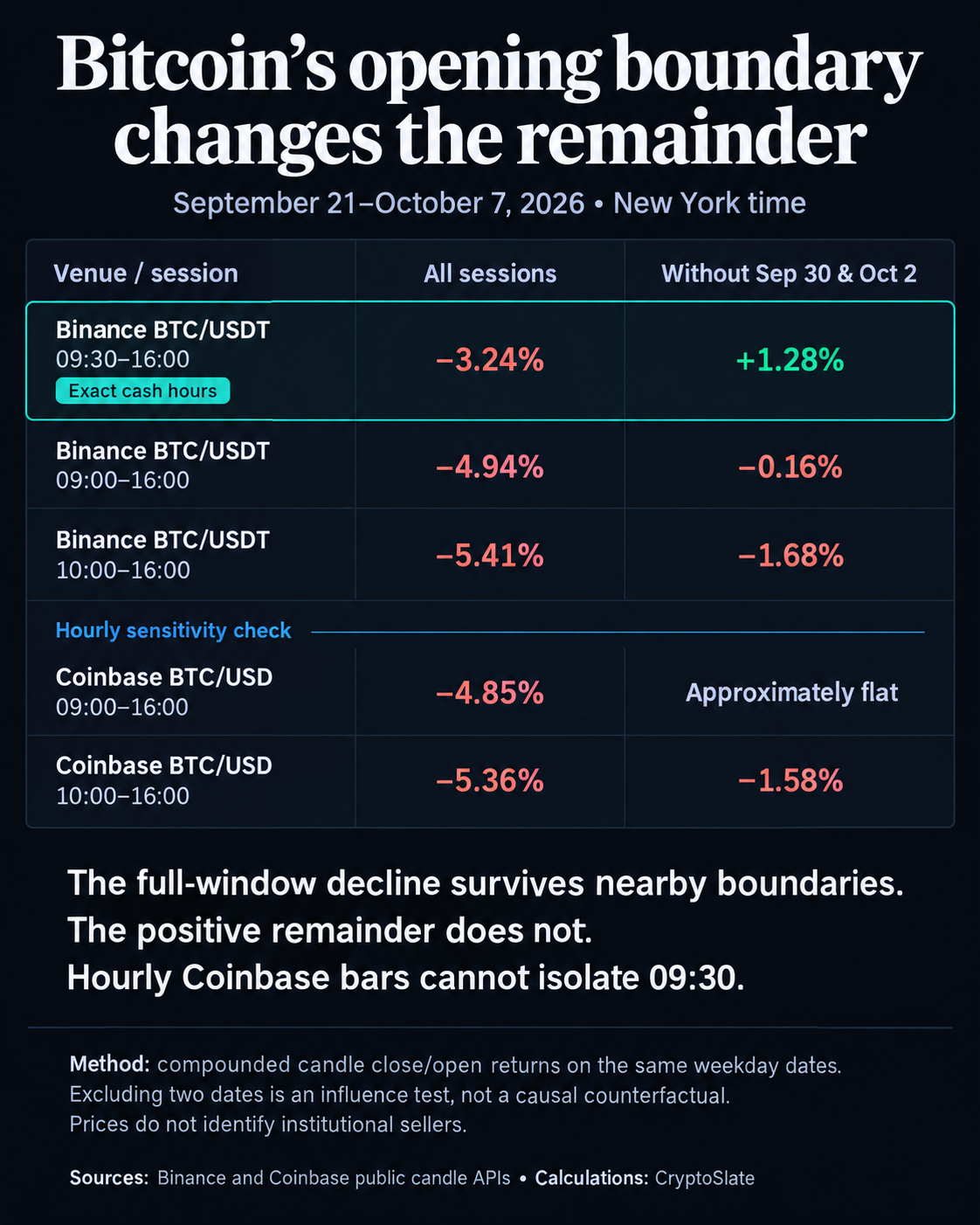
Coinbase price data points to a similar broader pattern. Bitcoin declined about 4.85% between 9 a.m. and 4 p.m. and 5.36% from 10 a.m. to 4 p.m. over the same period.
The agreement across Binance and Coinbase strengthens the timing signal while leaving participant identity unresolved.
Binance tracks Bitcoin against USDT and Coinbase against dollars, and neither venue reveals whether sellers are US institutions, retail traders, market makers or global investors active during American business hours.
Glassnode said this week that Bitcoin’s net gains since Sept. 21 have largely come outside the US session, reversing an earlier stretch when American trading hours contributed more strongly to the advance.
ETF flows fail to identify the seller
Fund flows provide the clearest challenge to a simple institutional-selling explanation.
US spot Bitcoin ETFs recorded $148.7 million of net outflows on Sept. 30, aligning with the first major US-session decline. Two days later, however, the funds attracted $189.9 million even as Bitcoin fell 2.65% during Wall Street hours.
The divergence suggests that ETF investors alone cannot explain the session weakness.
Outflows became more pronounced on Oct. 7, when the products recorded $484.9 million in net withdrawals. That shows demand from the funds has weakened at times, but daily totals still do not reveal when underlying Bitcoin was sold or which investors drove the market lower.
The mechanics of redemptions add another layer. Since regulators allowed in-kind creations and redemptions for crypto ETFs in 2025, withdrawals can involve transferring Bitcoin rather than an immediate cash sale.
That leaves the Coinbase discount as an important supporting signal rather than definitive proof of institutional selling. A sustained negative premium suggests weaker pricing on a venue closely associated with US investors, but it cannot identify the beneficial owners behind individual trades.
The next several sessions will test whether the pattern is becoming more persistent.
If Bitcoin continues to lose ground during Wall Street hours while the Coinbase discount remains deeply negative and ETF outflows build, the case for sustained deterioration in US demand would strengthen.
A recovery in US-session returns without a corresponding rebound in ETF flows would point elsewhere, potentially toward market makers, derivatives positioning, or other participants supplying Bitcoin during the American trading day.
The post Bitcoin keeps losing ground when Wall Street opens as Coinbase discount deepens appeared first on CryptoSlate.
CryptoTicker.io
Crypto Crash Reason Hunt: What Actually Happened Today?
The crypto market is deep in the red on Thursday, 8 October 2026, and almost nothing in the top 13 escaped. $Bitcoin is trading at $80,986, down 2.9% in 24 hours, 3.7% over seven days and now 7.5% below where it started the year. Total Bitcoin market cap has slipped to $1.62 trillion.
Altcoins took the harder hit. $Ethereum is at $2,432 after a 5.3% daily drop and a brutal 9.3% weekly slide, pushing its year-to-date loss to 18%. XRP is down 6.2% on the day and 27% for the year. Solana sits at $108, Dogecoin at $0.083, and Chainlink lost 7.9% in a single session. Even Zcash, the year's breakout privacy coin, gave back 15.6% in 24 hours and 18.6% on the week, though it remains up 119% since January.
The only green on the board is the stablecoin pair, with USDT and USDC flat as expected. That pattern, with Bitcoin falling less than everything around it, is the classic signature of a risk-off rotation rather than a Bitcoin-specific problem. So what is the crypto crash reason this time? There is not one answer but three, and they stack on top of each other. You can track all of these prices live on the CryptoTicker crypto prices page.
Crypto Crash Reason #1: Did the Fed Just Kill the Rate Cut Dream?
The biggest crypto crash reason sits in Washington, not on a trading screen. The Federal Reserve raised its target range by 25 basis points to 3.75% to 4.00% on 16 September, and the minutes of that meeting landed on Wednesday, 7 October. The message was not what risk assets wanted to hear: most participants expect another hike to be appropriate before year-end, depending on incoming data.
That single line reframes the whole year. Markets had spent months treating the September move as a one-off. The minutes suggest it could be the start of a tightening cycle instead. HashKey Group researcher Tim Sun warned that a second hike in October would make investors read September as the opening act rather than a blip.
Higher rates hit crypto through two channels. First, Treasury yields rise, and a risk-free 4%+ return makes a volatile, zero-yield asset like Bitcoin less attractive by comparison. Second, the dollar strengthens, and Bitcoin has historically moved inversely to the greenback. Add elevated oil prices driven by renewed US and Iran tensions, which feed inflation expectations and reinforce the case for tighter policy, and you get the macro cocktail that pushed every asset on your screen into the red.
The next checkpoints are already circled: the US CPI print on 14 October and the FOMC meeting on 27 and 28 October. Until those pass, the market is trading the fear of a hike as much as the hike itself.
Crypto Crash Reason #2: How Did Half a Billion in Leverage Vanish in 20 Minutes?
The macro news explains the direction. Leverage explains the speed. Bitcoin spent the first week of October trapped between $83,000 and $87,000, failing at the top of that range again and again. Each rejection stacked more leveraged long positions underneath the market, and traders kept betting on an Uptober breakout that never came.
On Friday, 3 October, a rejection at $87,000 wiped out $433 million in positions. Then early on Wednesday, 7 October, Bitcoin dropped roughly $1,765 in about 20 minutes, from $85,341 to $83,790, taking more than $400 million in longs with it in a single hour. Over the full 24 hours, CoinGlass counted around $546 million in liquidations across the market, with 88% of them longs and more than 100,000 traders wiped out.
This is what analysts call a leverage flush. LVRG Research's Dan Khus described it as crowded long bets being mechanically forced out rather than a genuine change in trend. The important detail from Bitfinex is that open interest stayed stable even as longs were liquidated, which means fresh short positions were opening at the same pace. The market did not just deleverage. It flipped net short.
The timing adds a psychological layer. Friday, 10 October, marks one year since the largest liquidation day in crypto history, and traders remember it. Liquidation heatmaps had already flagged a dense cluster of leveraged longs near $82,600 before Wednesday's drop. Thursday's slide to $80,986 ran straight through it, which is exactly why the second leg down was so sharp.
Crypto Crash Reason #3: Why Are ETFs and Uncle Sam Both Selling?
The third crypto crash reason is about who is on the other side of the trade. For most of 2026, spot Bitcoin ETFs have been the structural buyer that absorbed every dip. In late September they were still pulling in nearly $1 billion in a single day. That bid has now reversed.
US spot Bitcoin ETFs recorded roughly $487 million in net outflows on 7 October, their heaviest single-day withdrawal in weeks, according to SoSoValue data. ARK 21Shares and Fidelity led the redemptions, while BlackRock's IBIT was the only major fund still attracting money. Ethereum ETFs are bleeding too, with about $161 million leaving on the same day. When the institutional buyer steps back at the exact moment leveraged longs are being liquidated, there is nobody left to catch the falling knife.
On top of that came an unwelcome on-chain signal. Arkham data shows wallets linked to the US government moved more than 11,000 BTC, worth roughly $900 million at current prices, to Coinbase Prime over two days. Transfers to an exchange do not automatically mean a sale, but the market has learned to treat government wallet activity as a selling risk, and it reacted accordingly.
None of these three reasons would have produced a crash on its own. A hawkish Fed with no leverage in the system is a slow grind. A leverage flush with ETFs still buying is a 20-minute wick that recovers. It is the combination that turned a pullback into Thursday's broad-based selloff.
Crypto Crash Reason for Altcoins: Why Did Ethereum and XRP Fall Twice as Hard?
Look at the 24-hour column on your market table and a pattern jumps out. Bitcoin lost 2.9%. Ethereum lost 5.3%, XRP 6.2%, Solana 7.0%, Dogecoin 7.0%, Chainlink 7.9%. Almost every major altcoin fell roughly twice as far as Bitcoin, and the gap is even wider on the weekly and year-to-date numbers.
There are three mechanical reasons for this. Altcoins have thinner order books, so the same dollar amount of selling moves the price further. Altcoin perpetual markets carry proportionally more retail leverage, so liquidation cascades hit harder. And in a risk-off rotation, capital does not just leave crypto; it also consolidates within crypto, flowing from smaller tokens into Bitcoin and stablecoins first. Bitcoin dominance rises during a crash precisely because it is treated as the least risky crypto asset.
Ethereum carries an extra burden. ETH is now down 18% on the year while Bitcoin is down only 7.5%, and the ETH ETF outflows on Wednesday were proportionally larger than Bitcoin's. XRP, down 27% year-to-date, has been losing the $1.50 battle for weeks and failed there again before this drop. For anyone looking for the altcoin-specific crypto crash reason, it is simple: altcoins never built the institutional floor that Bitcoin did, so when that floor cracks, they fall through it faster. Track the dominance shift on the CryptoTicker charts page.
Which Coins Are Beating the Crypto Crash in 2026?
Not everything on the board is a loser. Four names in the top 13 are still green on the year, and they tell you where the market's conviction actually lives.
$Hyperliquid is the standout at +228% year-to-date, even after a 5.9% daily drop. HYPE is the native token of the dominant on-chain perpetuals exchange, and ironically a leverage flush is good for its business: more liquidations mean more fees.
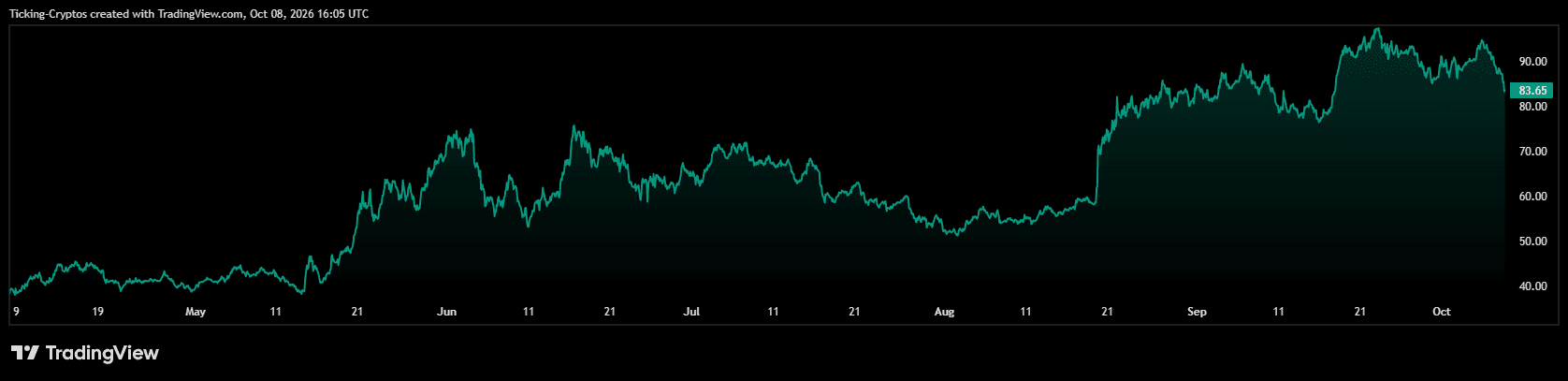
$Zcash is up 119% in 2026 on the privacy coin revival, though it is also the most volatile name here with an 18.6% weekly drop, a reminder that what rallies hardest also corrects hardest.
$Monero, the other privacy heavyweight, is up 22% and fell just 2.2% on the week, the smallest decline of any non-stablecoin in the table.
$TRON rounds out the list at +17% and down only 0.7% on the day. TRX benefits from stablecoin settlement volume, which does not care whether the market is up or down, and that makes it behave like a defensive asset in a crash.
The common thread is clear. The coins that held up are the ones with real, measurable revenue or a strong narrative independent of Bitcoin's price. The coins that fell hardest are the ones whose main story was "beta to Bitcoin." That is worth remembering the next time someone asks what the crypto crash reason is for their particular bag.
Dogecoin costs around $0.087 on Thursday afternoon. That puts the price 1.3 percent below the previous day and 8.1 percent below where it stood a week ago. The more important number is not on the price ticker but in the blockchain: over the past 24 hours, 13.55 million new Dogecoin came into existence, every day anew, with no cap and no end. This article works out what that issuance costs a holder, and which checks in Germany hang on it.
Dogecoin Price Now: $0.087 and 8.1 Percent Down Over Seven Days
On Thursday, October 8, Dogecoin trades at $0.0870. The day's range ran from $0.0852 to $0.0897, measured against data from the exchange OKX. Over seven days that is a loss of 8.1 percent, and over 30 days one of 2.7 percent. A week ago the price still stood at about $0.0946.
Market capitalisation comes to $13.62 billion. The price is 88.1 percent away from the all-time high of $0.7316 reached on May 7, 2021. Trading volume on OKX added up to 421.2 million DOGE within one day, equivalent to $36.9 million.
Reading only these figures, you see a quiet downtrend in a weak overall market. Bitcoin lost 2.0 percent in the same period and Ethereum 6.5 percent. Dogecoin therefore falls harder than both, and there is a structural reason for that which has nothing to do with the state of the day.
13.55 Million New DOGE per Day: How the Issuance Works
Dogecoin is mined, much like Bitcoin, but under different rules. Every block rewards the miner with 10,000 DOGE. The target time between two blocks is one minute, which arithmetically yields 14.4 million new coins a day.
Over the past 24 hours the miners found 1,355 blocks, somewhat fewer than the 1,440 of the target. The actual block time was 1.06 minutes. That gives 13.55 million new DOGE, worth around $1.18 million at the current price. The chain data comes from the block explorer Blockchair, and the most recent block carries the height 6,548,803.
By comparison, 17,896 transactions moved across the chain in the same period. That works out at roughly 757 freshly created DOGE for every transaction. The network's issuance therefore clearly exceeds its use, and it runs on regardless of whether anyone uses Dogecoin or not.
Issuance describes the quantity of new coins a network pays out under fixed rules. The process is neither a sale nor a market event but a protocol operation: the coins come into existence in the block and belong from then on to the miner who found it. Whether they hold or sell them is up to them.
Dogecoin Circulating Supply: Why Two Sources Are 15 Billion DOGE Apart
At this point the data gets messy, and that belongs in an honest article. The chain itself shows a circulating supply of 171.95 billion DOGE. The data service CoinGecko, by contrast, puts it at 156.24 billion. Between the two figures yawns a gap of 15.7 billion coins, around ten percent.
The difference arises because aggregators make assumptions of their own, for instance about lost or permanently unmoved balances, while the block explorer simply adds up what the protocol has paid out. Which number is the right one cannot be decided from outside. Only the range is therefore defensible, and that is exactly how this article goes on calculating.

2.9 to 3.2 Percent Dilution a Year: the Calculation for Holders
Extrapolated over a year, 13.55 million DOGE a day amounts to around 4.95 billion new coins. Measured against the chain's circulating supply that is 2.88 percent, and measured against the CoinGecko figure 3.17 percent. The honest statement is therefore: between 2.9 and 3.2 percent a year.
What does that range mean concretely? Anyone holding 10,000 DOGE today holds roughly 0.0000064 percent of all coins. In a year's time, with the same number of coins, it is only around 0.0000062 percent. The share shrinks although not a single coin was sold.
Counted in dollars, the market has to muster around $430 million in new demand every year just for the price to stand still. Daily that is $1.18 million, which corresponds to about 3.2 percent of the daily turnover on a large exchange such as OKX. Anyone expecting a stable Dogecoin price is implicitly expecting that inflow to arrive reliably.
Dogecoin Against Bitcoin and Ethereum: Three Issuance Models Compared
The figure alone says little, the comparison says more. Bitcoin has a hard cap of 21 million coins, of which 20.10 million have already been created, so 95.7 percent. The remaining issuance halves every four years and is therefore visibly running out.
Ethereum has no cap in the protocol but two counterweights: part of the transaction fees is destroyed, and anyone staking their coins gets a share of the newly issued quantity back. The circulating supply stands at 122.12 million ETH.
Dogecoin has neither a cap nor a halving nor any fee burning. The 10,000 DOGE per block have been fixed since 2015, as the network's project page describes it. In absolute terms the quantity stays the same, while in relative terms the inflation rate falls slowly, because the circulating supply grows. Going from three to under two percent will take roughly another two decades at this pace, though.
| Coin | Cap | Annual new issuance | Compensation for holders |
|---|---|---|---|
| Bitcoin | 21 million, 95.7 percent reached | falling, halving every four years | none needed |
| Ethereum | none | variable, partly offset by fee burning | staking |
| Dogecoin | none | around 4.95 billion DOGE, 2.9 to 3.2 percent | none |
No Staking on Dogecoin: the Difference From Ethereum and Solana
Dogecoin runs on proof of work, the same basic mechanism as Bitcoin. New coins go to miners who expend computing power, not to holders. The network's hash rate stood most recently at 3.40 petahashes per second.
Staking means depositing coins in the network to secure transactions and receiving part of the new issuance in return. With Ethereum and Solana the dilution can be offset partly or wholly along this route. With Dogecoin that route does not exist, because the protocol does not provide for it.
So anyone offered a Dogecoin yield somewhere is not getting protocol staking but a lending arrangement: a provider lends your coins on and gives you a share of the interest. You share in that provider's default risk, and it is not the same risk as holding the coin. This difference regularly disappears behind the word staking in advertising.
Holding Period Under Section 23 EStG: What Is Left of the Gain When You Sell Dogecoin
Suppose the calculation above convinces you and you want to reduce your holding. Then in Germany it is the calendar that decides first, not the price. Gains from selling crypto assets held privately fall under private disposal transactions in accordance with Section 23 of the Income Tax Act.
If you sell within a year of buying, the gain is taxable and carries your personal income tax rate. If more than a year lies between purchase and sale, the gain stays tax free. On top of that comes an exemption limit of 1,000 euros a year for all private disposal transactions together. An exemption limit is not an allowance: exceed it by one euro and you pay tax on the full amount, not only on the part above it.
In practice this means: before a sale, check which tranche you are actually selling and when you bought it. Anyone who has bought in instalments over years has holdings on both sides of the one-year line in their portfolio. A portfolio tracker that records purchases with dates settles that question in minutes, while searching through old exchange exports takes an evening.
Whether the one-year period will remain is under political discussion. Nothing has been decided so far, and as long as that is the case, the text of the law applies in its current form.

Buying Dogecoin Under MiCA: How to Recognise a Regulated Exchange
Since the European regulation on markets in crypto-assets took effect, providers addressing retail clients in Germany need authorisation as a crypto-asset service provider. BaFin lists the authorised companies in a public register, and the providers name their authorisation in their legal texts, usually under the imprint or legal notices.
How to recognise an authorised provider: it names the seat of the supervisory authority granting the licence, it holds client funds separately from its own assets, and it issues you an annual statement listing your purchases with date and price. That last point is underestimated until the tax return comes due. An overview of the trading venues authorised here is in the crypto exchange comparison.
Storing Dogecoin: Which Wallet Really Supports the Dogecoin Chain
Dogecoin runs on a chain of its own, not on Ethereum. A wallet that only handles Ethereum standards can do nothing with real DOGE. If you come across a Dogecoin entry in a pure Ethereum wallet, it is a token that tracks the price, and not the coin itself.
For self-custody you need either the project's reference software or a hardware device whose manufacturer explicitly lists the Dogecoin chain. Check that in the device's support list before you buy it, not afterwards.
The fees argue for moving on chain: a Dogecoin transaction most recently cost $0.0100 at the median and $0.0393 on average. Withdrawing from an exchange to your own wallet is therefore not a question of cost with Dogecoin, unlike on some other chains.
Leverage on Dogecoin: a Funding Rate of 0.01 Percent and the Liquidation Risk
Part of Dogecoin trading runs through perpetual futures contracts, known as perpetuals. Their price is tied to the spot price through the funding rate: a payment that flows between buyers and sellers every eight hours, depending on which side is driving the contract away from the spot market.
On OKX this rate stood most recently at 0.01 percent per period, the neutral standard value. Three times a day that makes 0.03 percent, extrapolating to just under eleven percent a year that a long position carries in running costs alone. The exchange's framework allows up to 0.75 percent per period when the market becomes one-sided.
More important than the costs is liquidation. At tenfold leverage a price decline of around ten percent suffices to close the position. Dogecoin has lost 8.1 percent in the past seven days alone, and that in a market without any particular event. Anyone working with leverage should know the relationship between leverage and weekly swing before opening the position; the terms of the trading venues are in the perp DEX comparison.
Levels at $0.085 and $0.09: What the Dogecoin Price Measures Itself Against Now
On the downside the next measured level sits at the daily low of $0.0852. If the price falls below it, the round level of $0.0800 is the next orientation that traders keep in their books.
On the upside the daily high of $0.0897 bounds the range, and behind it stands the round level of $0.0900. The week's starting point of $0.0946 would only be reached if the price gained 8.8 percent. These levels are observation points from the trading of the past few days, not a forecast; a reasoned outlook is carried by the prediction page further down.
Either way, none of these levels changes anything about the calculation in the fourth section. The issuance runs on independently of the price, 13.55 million coins a day, and it is the only part of this article that can be predicted with certainty.
Dogecoin Issuance: 4.9 Billion New DOGE a Year, No Staking
The question in the headline cannot be answered in general terms, but it can be sharpened. Anyone holding Dogecoin for the liquidity and the low fees has reasons that the issuance leaves untouched. Anyone holding it as a long-term store of value is calculating against 2.9 to 3.2 percent dilution a year, without a protocol that gives any of it back. Three steps help with the decision:
- Gather your purchase dates. Establish which of your tranches have already passed the one-year period under Section 23 EStG and which have not. Without that list, every sale is a bet on your own tax assessment. Tools that keep it automatically are in the comparison of crypto tax tools.
- Settle your custody. Check whether your wallet carries the Dogecoin chain itself or only tracks a price. At a median fee of $0.01, moving to your own keys is cheap; suitable devices are listed in the hardware wallet comparison.
- Check your trading venue. If you buy more, do it with a provider authorised under the European regulation and with a usable annual statement. The candidates are in the crypto exchange comparison.
(As of October 8, 2026. This article is not investment advice. Prices and fee structures change; check the terms with the provider before you buy.)
Justin Drake, a researcher at the Ethereum Foundation, wrote on X on October 7, 2026 that artificial intelligence may break the signatures of Bitcoin and Ethereum sooner than a quantum computer will. He called on the industry to plan a “bunker mode” for large holdings: an orderly move to addresses that have never signed a transfer.
The short answer to the question hanging on this: your coins are not under acute threat today. There is no demonstrated attack on the signature scheme, Drake is describing a worst case, and clear objections came out of the cryptography world within hours. The point matters all the same, because it touches a property of blockchains that most holders have never noticed: an address only reveals its public key once something leaves it for the first time. Knowing that, you can lower your risk without haste and without new technology.
“Bunker Mode”: What Justin Drake Wrote on October 7
Drake names a concrete yardstick in his post for what he counts as a break. For him the scheme is broken once a private key can be computed back in about a week on available hardware, for instance on a large cluster of graphics processors. That is a different threshold from the theoretical vulnerability cryptographers have been discussing for years, and it sits considerably lower.
He put the time frame in the formula that in the worst case this is a matter of months, not years. In the original he wrote of a break “in the worst case in months not years”. As the trigger he cited a series of 722 mathematical results that OpenAI had published the Tuesday before. His reasoning for why elliptic curves of all things should be susceptible, he put like this: “Elliptic curves feel especially vulnerable to superintelligence.” Decrypt has documented the wording of the post. Curves carry a rich mathematical structure, and structure is what clever attacks can work their way along. Hash functions are built precisely to offer as little of it as possible.
For Ethereum, Drake announced that he would push for “maximum defensive acceleration” in the switch to hash-based cryptography. He addressed a separate appeal to the custodians: Binance, Bitbank, Robinhood, Bitfinex and Tether should harden their cold storage. That is notable, because together these houses hold a substantial share of traded balances and have been signing from their addresses for years.
ECDSA: the Signature With Which Bitcoin and Ether Authorise Every Transfer
ECDSA stands for Elliptic Curve Digital Signature Algorithm. It is the scheme with which both Bitcoin and Ethereum check whether a transfer comes from the entitled party. Two numbers belong to every account: a private key that only you know, and a public key that can be computed from it. The computation works in one direction only. The public key follows from the private one in fractions of a second, while the reverse path is considered practically impossible as things stand.
That one-way street is the foundation. Were it to fall, anyone knowing an address's public key could derive the private one from it and move the coins. Neither a hardware wallet nor a passphrase nor an exchange with two-factor protection would change anything about that, because the attack would not take place at your device but at the mathematics behind it.
One restriction makes the difference between panic and planning. Your Bitcoin address is not the public key but a hash of it. A hash cannot be computed backwards, not even by a machine that cracks elliptic curves. As long as an address has only ever received, nothing but that hash stands in the blockchain. The public key becomes visible only when you send something away from it for the first time, because the signature carries it along.

Why an Address Becomes Attackable Only Through Its First Transfer
From this mechanism follows a division you can trace on your own holdings. Addresses that have never sent anything count as protected, because their public key sits behind the hash. Addresses that have already sent once count as exposed. There is nothing in between, and the line does not run along the question of how secure your wallet is, but along the question of whether it has already signed.
For Ethereum the picture is worse. There the account itself is derived from the public key, and every interaction with a smart contract involves signing. Anyone who has held Ether for years and swapped, staked or granted an approval even once is sitting on an exposed address. With Bitcoin the position is mixed: anyone who sent their coins to a fresh address once and has only held since then is on the better side.
The practical snag: spending necessarily exposes the address. A wallet you use regularly cannot be kept in the protected state permanently. Drake's proposal therefore targets the holdings that are going to sit still anyway, not the money you trade with. How to separate custody and use cleanly is shown in our hardware wallet comparison, which also ranks the devices by how well they manage several separate accounts under one seed.
Satoshi's Shield: 20,000 Old Addresses Holding 50 BTC Each as the First Target
Drake makes an argument that has drawn little attention in the debate so far and that sounds reassuring for small holders. Around 20,000 exposed addresses are attributed to the inventor of Bitcoin, each holding 50 BTC, the reward of the earliest blocks. These addresses have been untouched for a decade and a half and are visible to everyone.
An attacker who really could break ECDSA would face a question of sequence. Computing time is finite, every key costs about a week on a large cluster by Drake's own estimate, and at the top end of the field sit those twenty thousand addresses with the highest value per attack. He calls this, in effect, a shield: anyone holding less than 50 BTC on one address is not the first target, because the effort pays off better elsewhere.
This shield is a time buffer and not security. It assumes that the attacker thinks economically, that they do not parallelise, and that nobody would rather damage a chain for political reasons than enrich themselves. As a planning figure it serves all the same: it tells you that you have days and weeks to act cleanly, not hours.
Buterin Applies the Brakes: Botched Moves Cost Him More Than All Hacks Combined
The most prominent reaction came from Vitalik Buterin, and it fell into two parts. On substance he agrees with Drake that AI-driven advances in mathematics deserve more attention than the industry has given them so far. On the pace he clearly disagrees. Nobody, he says, should start shoving balances onto new wallets in a hurry today.
He draws his reasoning from his own experience, and it is the strongest argument against acting too fast: by his own account, botched moves have cost him more than all the hacks he has lived through put together. A mistyped destination, a clipboard manipulated by malware, a seed that ends up in a photo while the new wallet is being set up: these mistakes happen in haste, and unlike a mathematical breakthrough they are real today.
There is also a risk that surfaces in every wave of migration. As soon as a headline moves holders to switch, guides, helper services and supposed checking tools appear that harvest precisely what they promise to protect. Signing an approval in such a phase without having read it loses your money to a drainer, not to a superintelligence.
Objection From Cryptography: Coinbase's Chief Cryptographer Sees No Evidence
Yehuda Lindell, who runs cryptography at Coinbase, was more pointed than Buterin. In his own words he sees “no evidence whatsoever” that the assumptions behind elliptic curve cryptography are close to falling. The mathematical advances that AI systems have achieved this year are no argument against ECDSA, he says, because they concern different classes of problem.
Samson Mow, head of the company Jan3, likewise told his readership to stay calm and thought little of the warning. The specialist coverage classified the episode consistently as a risk scenario: OpenAI has presented no practical attack on ECDSA, and Drake's months-long horizon is an upper bound of the conceivable, not a forecast.
What remains notable is that the lines do not sort along the usual camps. In March of this year, after a widely noted paper from Google, Drake himself put the probability of a quantum breakthrough by 2032 at ten percent or more. That he now considers AI the faster route is a sharpening within his own argument, not a reversal.

Hash-Based Signatures: WOTS and SPHINCS as the Goal of the Ethereum Roadmap
The technical answer to the scenario has been on the table for years and is called a hash-based signature. Instead of relying on the structure of elliptic curves, it rests on hash functions alone, on exactly the components Drake considers comparatively robust. Buterin names WOTS and SPHINCS as candidates and argues for avoiding lattice-based schemes where alternatives exist.
What That Means for the Timetable
A switch of this kind is not a software update rolled out overnight. It affects the signature format of every transfer, every wallet, every exchange and every service that builds transactions. With Bitcoin, a change of this magnitude would come about only through a consensus of developers, miners and the industry, and that is exactly where it sticks: proposals that would invalidate old signatures after a deadline meet the charge that they expropriate everyone who does not move in time. The other side counters that unmoved old balances otherwise become a quarry for the first successful attacker.
For you this means the protocol layer will not rescue you in the coming months. What lies in your hands is the choice of the address your holding sits on.
What a Move to a Fresh Address Means for Your Holding Period
At this point a cryptography debate turns into a German tax question, and it is the reason many holders hesitate. The worry runs: if I send my coins to a new address, does the one-year holding period start again, and do I thereby lose the tax exemption on a gain?
The answer is reassuring. A transfer between two wallets that both belong to you is not a sale. No beneficial owner changes, no price is realised, and neither gain nor loss arises. The holding period on your coins therefore runs on as though nothing had happened. The case is different only if you take the detour of a swap for the move, by selling and buying anew: that is a disposal with all the tax consequences.
What really matters with a transfer between your own wallets is the documentation. The tax office sees a transfer in the blockchain and cannot tell whether two of your own wallets or a sale to a stranger stands behind it. So record which address you moved how much from, to which address, and when, and keep the original purchase receipt with it, because that carries the acquisition date that counts. With larger holdings or nested transactions, your tax adviser decides in the end, not a rule of thumb from an article.
Custody at an Exchange, on a Hardware Wallet or in Multisig: Where Your Public Key Sits
Whether you can act at all depends on who holds your keys. If your coins sit at an exchange, you own no address of your own but a claim against the house. Whether its cold storage sits on exposed addresses cannot be told from outside, and it was precisely these houses that Drake's appeal addressed. What is left to you is the choice between trust and self-custody.
With your own wallet the decision is in your hands. Every common hardware wallet generates any number of addresses from a single seed, and one of them can stay untouched while you trade with another. You need no second device and no new seed for that, only a fresh account in the software you already use.
With multisig constructions a closer look pays off, because several public keys are in play there and the setup alone can expose them. Anyone running such a solution should look at which of the participating keys have already signed.
Old Bitcoin Addresses: as Long as No Signature Is Out There, Time Remains
The finding of this day is unspectacular and therefore usable: a break of ECDSA has not occurred, has not been demonstrated and, in the judgement of several cryptographers, is not foreseeable either. What has occurred is an occasion to take a look at which addresses your own money sits on. That work costs half an hour, is useful for every future risk, and can be done without any haste at all.
- Look at which of your addresses have already sent. Every blockchain explorer shows you the outgoing transactions for an address. If none is to be seen there, your public key sits behind a hash. If you have no address of your own at all because everything sits at an exchange, the first step is the decision about custody: which software solutions are suited to it is set out in our software wallet comparison.
- Set up a separate account for the part that stays put. Separate the holding you do not touch from the one you trade with, and move it in a single, calmly checked operation to an address that has never signed. Document the date, the amount and both addresses while you are at it; a portfolio tracker takes that off your hands, and which of them carry the holding period correctly is in our overview of tax tools and portfolio trackers.
- Let your exchange know you are watching. If a substantial part of your holding sits at a trading venue, the question about its custody practice is a fair one, and it will be asked more often. How the large houses stand on custody, regulation and transparency is shown in our overview of the best crypto exchanges.
What remains is the sentence that sticks from this week, and it comes not from Drake but from Buterin: the most expensive part of a move is almost never the attack it is meant to protect against.
(As of October 8, 2026. This article is not investment advice. Prices and fee structures change; check the terms with the provider before you buy.)
The US central bank published the minutes of its September 15 and 16 meeting on October 7. They contain the sentence the crypto market has been pricing in since Wednesday evening: most participants considered a further increase in the target range for the federal funds rate by the end of the year to be appropriate. Bitcoin stood at $82,439, or 73,739 euros, on Thursday midday, down 1.51 percent within 24 hours.
What has changed since last week is not the price but the direction of expectations. At the start of October many market participants still read the weak US labour market report as an argument for a pause. The minutes now show that the majority on the committee thought otherwise in September. For holders in Germany, three very concrete things hang on this: the distance to liquidation on leveraged positions, the holding period for tax, and the question of where the coins sit.
The Fed Minutes of October 7: a Majority Considers a Further Rate Hike by Year-End Appropriate
The minutes of an FOMC meeting appear around three weeks after the meeting and are the most detailed public document on the committee's stance. They are neither a forecast nor a commitment, but a summary of the discussion.
The decisive passage, in the Fed's own wording, is that most participants judged a further increase in the target range by the end of the year to be likely appropriate. Alongside it, the document records that participants approach every meeting with an open outcome and that their decision depends on the incoming data. Both sentences belong together, and reading only the first overstates how far the committee has committed itself.
What the Minutes Say About Inflation
On prices the minutes note that inflation remains elevated relative to the committee's two percent objective. At the same time, market-based and survey-based expectations for the medium and longer term stood at levels consistent with precisely that objective. The central bank therefore sees a current price problem but no unanchored expectations. That is why the rest of the document is worded so cautiously.
Federal Funds Rate at 3.75 to 4.00 Percent: What the Unanimous 12-0 Decision of September 16 Tells You
On September 16 the committee raised the target range by a quarter point to 3.75 to 4.00 percent. The minutes record that all members agreed; the vote went 12 to 0, with no dissent.
A unanimous increase is a stronger signal than a narrow one. It means that the members who understood the step more as a precaution went along with it too. Both readings sat side by side in the discussion: some participants saw the September step as insurance against a risk, others as the beginning of a tightening cycle. That difference is the reason the minutes do not lay down a path.

Bitcoin at $82,439: the 24-Hour Range Between $82,318 and $83,713
On Thursday midday, Bitcoin stands at $82,439, or 73,739 euros. The daily low is $82,318 and the daily high $83,713. Over seven days that makes a loss of 1.28 percent, and within 24 hours one of 1.51 percent.
The range of around $1,400 between low and high is remarkably narrow for a day without a crypto event of its own, and it argues against a panic move. According to the specialist service bitcoinbasis.de, the price had already fallen on October 7 from around $85,500 to roughly $83,900, steadied briefly at about $83,400 after the release at 8 p.m. German time, and eased to around $82,800 by Thursday morning. The larger part of the move therefore ran ahead of the document, not after it.
Ethereum follows the pattern more weakly: Ether trades at $2,535.89, or 2,268.27 euros, in the same reading, down 1.64 percent in 24 hours and down 5.19 percent over seven days.
Real Interest Rates and Opportunity Cost: the Term That Ties Bitcoin to the Central Bank
The real interest rate is the nominal rate less expected inflation. It describes what an investor keeps after the loss of purchasing power when putting money into an interest-bearing investment instead of an asset that pays no interest.
This is exactly where a document from Washington connects to a Bitcoin holding in a German portfolio. Bitcoin pays neither interest nor a dividend. When the real interest rate rises, the amount a holder forgoes grows, and that opportunity cost is the channel through which rate policy works on the price. It is also why the market reacts more strongly to minutes than to many project-specific news items.
Why Minutes Move More Than an Analyst's Voice
A rate decision is already priced in the moment it is taken. What is new each time is the information about the next step, and the minutes deliver that. A price target from a research house, by contrast, changes nothing about opportunity cost.
Futures Markets Against the Minutes: an October Pause and a December Hike as the Base Case
The minutes describe the September meeting. The futures markets trade the future, and they contradict it in part. The available analyses cite different figures: FXStreet reports expectations for an October hike having fallen below 22 percent, while the provider Raisin cites a hold probability of around 81 percent for the October meeting, against roughly 54 percent a month earlier. The two values measure different questions and cannot be set against each other directly; they nevertheless point the same way.
Then there is the labour market. The most recently reported gain of 29,000 jobs with an unemployment rate of 4.2 percent suggests a cooling employment picture, which argues against a quick further increase. The bank ING, according to FXStreet, sees a December hike as its base case. Between the minutes and the market there is therefore no contradiction about the destination, but one about the timing.
Anyone buying regularly on fixed dates meets this uncertainty in any case: a savings plan on Bitcoin buys on its execution day at whatever price applies then, regardless of which meeting comes next.

Holding Period Under Section 23 EStG: One Year of Holding and the 1,000-Euro Exemption Limit
For private investors in Germany, the sale of crypto assets is a private disposal transaction under Section 23 of the Income Tax Act. If more than twelve months lie between purchase and sale, no income tax falls due on the gain. Within that period the gain is taxable, and at your personal rate rather than the flat withholding rate.
Alongside it stands an exemption limit: if the total gain from private disposal transactions in the calendar year comes to less than 1,000 euros, it stays tax free. An exemption limit is not an allowance. Once it is exceeded, the entire gain is taxable, not merely the part above the threshold.
The connection to the rate path is direct. A sale driven by fear of rates can destroy an almost expired one-year period and turn a tax-free gain into a taxable one. The purchase date of every single position is therefore a number that should be on the table before December 9.
Liquidation and Leverage: How to Check Your Distance to a Margin Call
A liquidation is the forced closing of a leveraged position as soon as the collateral no longer suffices. It affects positions on margin, not the holding in your own wallet.
At a price of $82,439 and a daily low of $82,318, the distance to the low is less than a sixth of a percent. Working with tenfold leverage, a fall of around ten percent wipes out the entire collateral; with twentyfold leverage five percent is enough. Two meeting dates with an open outcome are still ahead this year, and swings of several percent within minutes are documented on days like those.
The Three Numbers That Count on Leverage
First, the liquidation price, which every exchange shows for each position. Second, the percentage distance of that price from the current price. Third, the question of whether your platform permits a loss beyond the deposit or cuts off at zero. Under the European rulebook, retail clients enjoy negative balance protection on CFDs; on crypto derivatives on unregulated platforms it does not apply.
Custody in a Rate Cycle: Your Own Keys Against an Exchange Account
A rate cycle changes nothing about the custody question technically, but it does change its urgency. Phases with high trading volume and fast price moves are precisely the phases in which withdrawals are delayed and platforms come under load.
Holding your coins on a trading platform lets you react quickly but leaves you carrying the custodian's risk. Running your own keys removes that risk but requires time for a transfer, and on a volatile day that time is not always there. Splitting by purpose resolves the conflict in practice: the part that is traded stays reachable, the long-term holding does not.
October 27 and December 9: the Two Dates That Set the Rate Path
According to the Open Market Committee's calendar, two meetings remain in 2026: on October 27 and 28, and on December 8 and 9. The December meeting carries a note in the Fed's calendar, because an updated round of projections belongs to it.
That note makes the December date the more important of the two. A projection round publishes the individual participants' rate expectations and is therefore the next occasion on which the wording from the September minutes translates into figures. The decision itself falls on the second day of each meeting.
Fed Rate Path: December 9 Is the Next Hard Date
- Check the purchase date of every position against the one-year period and note which holdings drop out of taxability and when. An overview of tools that track purchase dates and holding periods automatically is in the comparison of crypto tax tools and portfolio trackers.
- Read off the liquidation price on every leveraged position and work out the percentage distance from the current price. Which providers offer which leverage and which loss protection is shown in the comparison of the best crypto brokers.
- Decide before December 9 which part of your holding has to stay tradable and which does not, and arrange custody accordingly. Which venues are licensed in Germany and how they settle is set out in the comparison of the best crypto exchanges.
The source for the wording and the decision is the minutes of the FOMC meeting of September 15 and 16, 2026.
(As of October 8, 2026. This article is not investment advice. Prices and fee structures change; check the terms with the provider before you buy.)
The price you read for Shiba Inu on a price page is set almost entirely in a market that you, as a private investor in Germany, do not trade in at all. Of the $73.89 million in daily turnover that ran across more than 100 trading pairs on Thursday midday, $63.24 million came from pairs against the dollar token USDT. That is 85.6 percent. Pairs against the euro accounted for $1.10 million, or 1.49 percent of global turnover. The figure your app shows you as the Shiba Inu price is therefore an average of books you neither reach nor should rely on.
It sounds like a technicality and it costs money in daily practice. Between the narrowest and the widest euro venue the spread differed by a factor of almost thirty at that same midday. Place the same order once on the narrow venue and once on the wide one, and on 1,000 euros you pay 21 cents in the first case and 6.24 euros in the second, purely for crossing the bid-ask spread. This article works out where the Shiba Inu price is actually made, how much of it reaches Germany, and which numbers you can see for yourself before you place an order.
Shiba Inu Price on Thursday Midday: $0.00000537 and 0.00000480 Euros
Shiba Inu traded at $0.00000537 and 0.00000480 euros around midday on October 8, according to market data from CoinGecko. That is 1.38 percent lower than the previous day, 7.03 percent lower over seven days and almost unchanged over thirty days at 0.90 percent down. Market capitalisation stood at $3.16 billion, placing the token 37th in the overall market.
The daily range was narrow. The high of the past 24 hours was $0.00000548, the low $0.00000536. Between the two values lies 2.24 percent. By comparison, on October 5 the price moved more than four percent higher in a single day. A quiet day actually helps the question this article asks, because the differences between venues are not masked by the move.
Why Two Prices Circulate for the Same Token
The dollar price and the euro price come from separate books. An order book is the list of all open buy and sell orders on a venue for a given pair. Every pair has its own book, and every book makes its own price. The euro price is formed from the orders actually standing in the euro book, and specifically not by converting the dollar price. The two values usually sit close together as a result of arbitrage, the practice of exploiting price differences by traders who work both sides at once. It only holds as long as there is enough money on both sides.
$63.24 Million of $73.89 Million: USDT Carries 85.6 Percent of Shiba Inu Trading
For this article we went through all 100 trading pairs that CoinGecko listed for Shiba Inu at midday on October 8 and sorted the reported 24-hour turnover by quote currency. The result:
- Pairs against USDT: $63.24 million, 85.59 percent
- Pairs against the Turkish lira: $4.22 million, 5.71 percent
- Pairs against the US dollar itself: $2.57 million, 3.48 percent
- Pairs against USDC: $1.99 million, 2.69 percent
- Pairs against the euro: $1.10 million, 1.49 percent
USDT is a stablecoin, a token that pegs its value to a currency, here the dollar. Its issuer is Tether. More than four fifths of Shiba Inu trading therefore runs through an instrument that licensed platforms in the European Economic Area may no longer trade against client funds under the European crypto regulation MiCA. The consequence for your purchase is twofold: you take no part in the largest share of this market, and the reference price you steer by is still made there.

A Single Venue Turns Over 21.3 Percent of the Volume
It gets tighter still when you sort by venue instead of by quote currency. The largest single item on Thursday midday was the exchange BitDelta with $15.70 million. That is 21.25 percent of all Shiba Inu turnover, more than a fifth, settled in one place. Behind it came KuCoin with $5.98 million and 8.09 percent, and Binance with $5.14 million and 6.95 percent.
The reported spread at this largest venue was 0.37 percent. The narrowest euro venue came in at 0.021 percent at the same moment. The venue carrying the most weight in the average price was therefore around eighteen times wider than the narrowest venue at which an investor in Germany can actually buy. Weighted average prices carry that skew along in silence.
What Reported Turnover Tells You and What It Does Not
Reported exchange turnover is self-declared. Price pages take it from the venues and weight it differently. Unusually high turnover alongside a comparatively wide spread proves nothing, but it is a reason not to read the figure as a mark of quality. What counts for your decision is how deep the book is at the venue where you place the order yourself. Where the most trading happens worldwide carries no weight here.
The Euro Book Stays a Sideshow: $1.10 Million, or 1.49 Percent
Seven venues listed a euro pair for Shiba Inu at midday on October 8. Together they came to $1.10 million in turnover. For scale: German retail as a whole turns over that sum in a matter of seconds. For a token with a market capitalisation of $3.16 billion, a euro market of that size is very thin, and it is split across seven books rather than one.
This was the distribution, ordered by turnover in dollars:
- Bitvavo: $465,000
- Kraken: $183,000
- Bit2Me: $180,000
- Niza.io: $92,000
- WhiteBIT: $88,000
- Coinbase Exchange: $64,000
- Bitstamp by Robinhood: $32,000
Which of these venues are open to you at all depends on licensing and on your account. An overview of the providers that serve retail clients in Germany is in our crypto exchange comparison. The turnover figure alone only hints at the depth of the book, not at the quality of the provider.
Spreads From 0.021 to 0.624 Percent: The Factor of 30 Across the Seven Euro Venues
The spread is the gap between the best bid and the best offer in the order book. It is the price you pay for immediate execution. At midday on Thursday the reported spreads of the seven euro venues stood as follows:
- Kraken: 0.0209 percent
- Niza.io: 0.0209 percent
- Bit2Me: 0.0417 percent
- Bitvavo: 0.0772 percent
- Coinbase Exchange: 0.2083 percent
- Bitstamp by Robinhood: 0.2083 percent
- WhiteBIT: 0.6237 percent
Between the narrowest and the widest value lies a factor of 29.9. The last traded euro price barely differed, sitting between 0.000004780 and 0.000004800 euros across all seven venues. The quoted price was therefore almost identical across the board, while the cost of execution was not. A price page cannot show that. Kraken publishes its own euro price together with the range on a dedicated price page, while other providers show the range only in the order book of the trading view.
0.21 Euros Against 6.24 Euros per 1,000-Euro Order: What the Spread Really Costs
Work it through on a number you can remember. A market order worth 1,000 euros crosses the spread once in full. At 0.0209 percent that costs you 21 cents. At 0.6237 percent the same order costs you 6.24 euros. The difference of 6.03 euros arises before a single fee has been charged, and it arises again when you sell.
On an amount of 10,000 euros we are talking about 2.09 euros against 62.37 euros per direction. That is in the region of what some providers charge in trading fees for an entire year. The fee appears in the price list, the spread appears nowhere in the price list, and that is why most people never notice it.

USDT Has Been Off the Table in the EU Since July 1, 2026: The Consequences for the Reference Price
With the end of the MiCA transition period on July 1, 2026, the platforms licensed under MiCA removed their USDT pairs for clients in the European Economic Area. The reason lies with the requirements placed on the issuer of the stablecoin, not with Shiba Inu. The effect on you is concrete all the same: the pair in which 85.6 percent of global Shiba Inu turnover takes place is no longer available to you on a licensed platform.
What remains are euro pairs and pairs against USDC, the stablecoin that meets the MiCA requirements. USDC carried 2.69 percent of Shiba Inu turnover at that midday. Add euro and USDC together and the share of the market open to you on a licensed platform comes to a good four percent. The remaining 96 percent set the price you pay without you taking part in it.
2.34 Percent Turnover per Market Capitalisation: Why a Market Order Can Get Expensive
Set the daily turnover of $73.98 million against the market capitalisation of $3.16 billion and the result is 2.34 percent. This ratio says what share of the circulating supply changes hands in a day. As a rough indication of how quickly a market absorbs a larger order, the figure is useful.
Dogecoin came to $865.45 million in turnover on the same day against a market capitalisation of $13.57 billion, so 6.38 percent. Measured against its size, the older meme coin turns over almost three times as much as Shiba Inu. The practical upshot for you: the same order size meets a thinner book at Shiba Inu, so it is more likely to run through several price steps and is filled worse on average. A limit order, where you set the maximum price yourself, takes that risk off you and costs you the certainty of being filled at all.
Shiba Inu Against Dogecoin: $73.98 Million Against $865.45 Million in Daily Turnover
The gap between the two largest meme coins is far wider in turnover than in market capitalisation. By market value Shiba Inu is roughly four fifths smaller than Dogecoin, but by daily turnover it is around twelve times smaller. Both values fell on October 8, Dogecoin somewhat more sharply at 2.18 percent than Shiba Inu at 1.38 percent.
This gap has a practical consequence that holds beyond the day. The smaller the running turnover relative to size, the harder a single large sale hits the price. Holders of Shiba Inu therefore carry a risk that comes from the structure of the market and not from a news item. It does not disappear on a quiet day either.
MiCA Licensing of the Venues: The ESMA Register as the Binding List
Whether a provider may legally serve you as a client in Germany is settled bindingly by a single list: the register of the European Securities and Markets Authority, ESMA. It lists the crypto-asset service providers licensed under MiCA, while the licence itself is granted by the relevant national supervisor. ESMA maintains the list and publishes it on its MiCA page. The obligations this brings for the providers are set out in our overview of the MiCA licence.
The difference is the decisive one in a dispute. With a licensed provider you have a complaints route and a supervisor with jurisdiction. With a venue that holds no EU licence you have the contract and little else. Which providers actually hold the licence can be looked up in the register before the first money goes into an account.
Why the Venue With the Best Price Is Not Automatically the Right One
A narrow spread on a venue without an EU licence is a shifted risk, not a good deal. There is also the effort of the transfer: Shiba Inu sits predominantly as an ERC-20 token on Ethereum, since the start of October there has been an issue on Solana as well, and there two verified tokens carry the same ticker. A withdrawal to the wrong network cannot be reversed.
The 24-Hour Range Is 2.24 Percent: Levels at $0.00000536 and $0.00000548
Two values provide the orientation for the coming days, and both follow from the trading of the past 24 hours. On the downside the daily low sits at $0.00000536. If the price falls below it and holds there, the next reference point is the level the week started from, around $0.00000578 less the seven percent run off since. On the upside the daily high sits at $0.00000548, and above it the round level at $0.00000600, last reached at the beginning of October.
Both values are observation points, not a forecast. With turnover at 2.34 percent of market capitalisation, breaking a level says less than it would in a deep market, because a single larger order is enough to push through it.
The Euro Price at the Moment of Purchase: What Belongs in Your Section 23 EStG Records
Gains from the sale of Shiba Inu are a private disposal transaction in Germany under Section 23 of the Income Tax Act, the EStG. After a holding period of one year the gain stays tax free, below that the exemption limit of 1,000 euros per calendar year applies, and above it the entire gain is taxed at your personal rate. The value in euros at the time of acquisition and of disposal is what counts in each case.
The question this article asks is therefore also a question of bookkeeping. If your purchase ran through a USDC pair, your statement shows no euro price but a stablecoin price. The euro value then has to be derived from the rate at that moment and documented. Keep your venue's statement with its timestamp and euro equivalent to hand and that calculation becomes unnecessary.
Shiba Inu Price: The Euro Price Is Made in 1.49 Percent of the Market
The situation fits into one sentence: the price you see is made in a market you have no access to as an investor in Germany, and the price you pay is formed in a book that makes up less than one and a half percent of that market. Three steps turn that into a decision:
- Read the spread at your venue before you place the order. In the trading view the best bid and the best offer sit directly one above the other. If the gap is wider than two tenths of a percent, execution alone costs you more than two euros on 1,000 euros. Which venues are available in Germany is set out in the crypto exchange comparison.
- Look up your provider's licence in the ESMA register. A venue without an EU licence leaves you without a supervisor and without a complaints route in a dispute. The licensed providers are listed in our comparison of regulated crypto exchanges.
- Work with limit instead of market orders on larger amounts. At 2.34 percent turnover per market capitalisation a large market order runs through several price steps. A limit order caps the price you accept, and you can split the order across several days if needed. Tools that make the order book and the execution visible are listed in our comparison of analytics platforms.
(As of October 8, 2026. This article is not investment advice. Prices and fee structures change; check the terms with the provider before you buy.)
Decrypt
A government wallet holding Bitcoin seized from the Bitfinex hacker sent 12,267 BTC to a new, unlabeled address, according to Arkham data.
Day traders are selling, leveraged longs are getting flushed and ETF money is heading for the door. The daily chart still holds the line, but its cushion is shrinking.
One self-custodial platform to power Earn, Swaps, Predictions and Perps on Decrypt, as it builds out its financial and intelligence market.
The new Securitize Stocks product launches with 12 names backed one-to-one by real shares—preserving dividends and voting rights—trading first on Solana, with NYSE and OKX-ICE venues planned.
Minecraft in Elden Ring, Skate in Call of Duty, and Spider-Man in Gotham. AI vibe coders are creating crazy video game mashup mods.
U.Today - IT, AI and Fintech Daily News for You Today
XRP whale activity across all exchanges weakens as the asset begins to see massive sell-offs, dropping by 27% in eight days.
Jameson Lopp warns that crypto is fighting the wrong AI battle as code bugs trump math breaks.
Bullish traders caught on wrong side of the market move as Dogecoin price drops.
The milestone comes as Cardano continues to work toward broader scaling improvements, with future upgrades expected to increase capacity.
Crypto news this morning, Oct 8: Bitcoin slips to $82,000 on US jobs data while Ripple shifts 200M XRP ahead of a major XRPL privacy upgrade.
Blockonomi
TLDR:
- ESMA has given EU crypto firms until January 8, 2027, to phase out services involving non-MiCA stablecoins.
- The restrictions cover trading, custody, transfers, investment advice, and portfolio management services.
- EU regulators will allow limited withdrawals, transfers, and liquidation to help customers exit affected tokens.
- ESMA’s new three-month deadline expands enforcement beyond the stablecoin restrictions introduced in 2025.
European Union regulators have given cryptocurrency firms until January 8, 2027, to discontinue services involving stablecoins that fail to meet regional requirements. The European Securities and Markets Authority (ESMA) established the deadline in an October 8 opinion, giving affected providers three months to address existing customer exposure.
The order specifically targets licensed firms handling asset-referenced tokens (ARTs) and e-money tokens (EMTs) that do not comply with the Markets in Crypto-Assets Regulation (MiCA). As a result, affected providers must take steps to prevent customers from increasing their exposure to these tokens.
Moreover, the restrictions extend beyond trading platforms to services involving custody, transfers, and other activities that maintain access to noncompliant stablecoins. However, regulators will allow limited activities to help customers close existing positions while preventing additional exposure.
EU Widens Non-MiCA Stablecoin Ban Across Crypto Services
Under the expanded restrictions, ESMA’s requirements cover cryptocurrency exchanges, order execution, investment advice, custody, transfers, and portfolio management. In addition, the rules apply to placing digital assets and receiving or transmitting customer orders, including arrangements that combine multiple services.
Consequently, providers must prevent customers from acquiring additional noncompliant tokens through any regulated service. Firms must also establish technical, contractual, and organizational safeguards to prevent existing holdings from increasing.
The restrictions address activities that could preserve access to unauthorized assets even after trading services have ended. However, affected firms can continue certain operations strictly to facilitate customer exits. These include liquidation, conversion, withdrawals, transfers, and temporary safekeeping of existing holdings.
Such arrangements cannot support fresh purchases, promotional activities, or continued active trading. Providers must also explain exit procedures to customers while operating under close regulatory supervision.
January 8 Deadline Allows Limited Stablecoin Withdrawals
The January deadline builds on ESMA’s January 2025 guidance, which required firms to discontinue certain noncompliant services by March 2025. The latest opinion broadens those supervisory expectations to activities beyond public offerings and trading admissions.
ESMA identified missing issuer safeguards as a central concern, including inadequate redemption protections, reserve requirements, and regulatory oversight. These protections determine how issuers maintain reserves and meet obligations to token holders.
Accordingly, customer warnings alone cannot substitute for the safeguards required under MiCA. National regulators must therefore identify affected providers, assess their remaining services, and supervise corrective measures before the deadline.
They must also coordinate with ESMA to maintain consistent enforcement across member states. For customers holding affected tokens, the transition preserves limited withdrawal and liquidation options rather than unrestricted trading access.
Meanwhile, licensed providers face a defined period to close remaining exposure without facilitating additional purchases. The January 8 deadline therefore marks the final date for winding down affected services under the latest supervisory requirements.
The post EU Orders Crypto Firms to Phase Out Non-MiCA Stablecoins by January 8 appeared first on Blockonomi.
TLDR:
- Retail investors raised stock allocations to 71.8% in September, the highest level since December 2017.
- Cash holdings fell to 13.3%, marking a nine-year low and remaining below the 22.5% historical average.
- Stock fund allocations climbed to 38.35%, while direct stock holdings remained nearly unchanged at 33.44%.
- AAII data showed 53.3% bearish sentiment on September 19, despite equity allocations reaching a nine-year high.
Retail investors are holding their largest share of U.S. stocks in nearly nine years, while cash reserves have fallen to their lowest level since December 2017. According to the American Association of Individual Investors (AAII), equity allocations rose 0.7 percentage points to 71.8% in September 2026.
The reading was the second-highest since July 2000, based on historical data highlighted by The Kobeissi Letter. Meanwhile, cash allocations dropped to 13.3%, reflecting a widening gap between money invested in stocks and funds held in reserve. The figures show how strongly surveyed investors favored equities entering the fourth quarter, despite prevailing market uncertainty.
Retail Investors Push Stock Holdings to 71.8%, a 9-Year High
The October 1 AAII report showed that stock allocations exceeded their historical average of 61.5% for the 76th consecutive month. Equity exposure has also increased approximately 3.3 percentage points since April.
According to The Kobeissi Letter, that represented the largest five-month increase since October 2025. However, the latest increase came primarily through stock funds rather than individual company shares. Stock fund allocations climbed 0.73 percentage points to 38.35% in September.
By comparison, direct stock holdings remained nearly unchanged at 33.44%. The breakdown shows that investment funds accounted for most of September’s increased equity allocation. Nevertheless, the survey cannot determine whether portfolio changes reflected fresh purchases, rising market valuations, or both.
Meanwhile, fixed-income holdings showed a smaller increase. Bond and bond fund allocations rose approximately 0.3 percentage points to 14.9%, remaining below their historical average of 16%.
Cash Falls to 13.3% as Bearish Sentiment Reaches 53.3%
Cash allocations declined approximately one percentage point to 13.3%, marking their lowest reading since December 2017. Additionally, September marked the 46th consecutive month that cash holdings remained below their historical average of 22.5%.
The latest allocation stood 9.2 percentage points below that benchmark. The positioning contrasted with investors’ stated market expectations. AAII’s separate September 19 sentiment survey showed bearish expectations reaching 53.3%, while bullish sentiment fell to 28.8%.
Consequently, the two surveys presented different pictures of investor behavior. Portfolio allocations showed substantial equity exposure, even as more respondents expected stock prices to decline. The divergence also emerged during a period of higher borrowing costs. In September, the Federal Reserve raised interest rates for the first time since 2023.
Still, historically elevated stock exposure does not establish that a market correction will follow. AAII’s findings represent surveyed members rather than every U.S. retail investor, limiting broader conclusions about market positioning.
The post Retail Investors Go All-In on Stocks as Cash Holdings Hit 9-Year Low appeared first on Blockonomi.
TLDR:
- A $12.5M loss hit 79thVault after an admin address was used without authorization on BNB Chain.
- One address held OPERATOR_ROLE with no multisig or timelock and made seven privileged calls in an hour.
- Proceeds became 16,249 BNB, and 14,394.92 BNB, about $11.03M, sits unmoved at a single address.
- The project called it a system upgrade and has not detailed the key compromise or the loss breakdown.
The 79thVault incident raises a central question: was it a hack or an insider action? The BNB Chain project lost about $12.5 million after a privileged admin address was used without authorization.
Close to 10,000 holders are affected. Security firm GoPlus Security reviewed the case on-chain. Its analysis leaves two explanations open, a leaked operator key or insider activity. The project has not confirmed either, and its public statement mentioned only a system upgrade.
What the On-Chain Data Shows About the Operator Role
GoPlus Security outlined the case in a post on X. It was titled “Hack or insider? Security analysis of the $12.5M loss at 79thVault.”
The firm said the 79AU contract has a function restricted to OPERATOR_ROLE. The source is unverified on BscScan. GoPlus stated that “centralized-control risk was high.”
Hack or insider? Security analysis of the $12.5M loss at 79thVault
BNB Chain project @79thVault lost about $12.5M after a privileged admin address was used without authorization. Close to 10,000 holders are affected. A leaked operator key and insider activity are both still… pic.twitter.com/eXIb3YwClW
— GoPlus Security
(@GoPlusSecurity) October 8, 2026
On-chain calls show the function can move 79AU from a chosen address to any recipient. Here, it pulled tokens from the 79AU/USDT pair. It then called sync() to update the pair’s recorded reserves. The firm wrote that the “effect is backdoor-like.”
The role was held by address 0x019bD8ED017D11AF0eB24d28DCdd0f9930c85cA3. On the missing safeguards, GoPlus wrote, “No multisig. No timelock.”
Between 07:25 and 08:19 UTC, that address executed seven privileged calls. The firm listed a leaked operator key and an insider as the two possible sources.
Those calls moved 2.01 million 79AU to 0xc3E90f78A918594a605d584887b2775F4b80A099. Transfers ranged from 10,000 to 500,000 tokens each. They coincided with a sharp rise in the 79AU price. The role was revoked after the incident.
Why the Hack or Insider Question Remains Open
GoPlus traced the full path from the pair to the final wallets. The receiving address sold the 79AU into the pool and drained the USDT.
It then converted the proceeds into 16,249 BNB. Those funds were consolidated at 0x629B368c6BF1a9f190e38f21235033FEcE8A6231.
Several smaller transfers of 10 to 15 BNB each followed, and their purpose is unclear. Most funds now sit at 0xa9537B40b02Af7Af8f1543aea3691992B2174F89.
That address holds 14,394.92 BNB, worth about $11.03 million. GoPlus reported that no further movement has occurred yet.
The on-chain bounty negotiation message adds another question. It was sent from the same privileged address used in the incident.
According to GoPlus, using that address to talk to an attacker “would be unusual.” The firm added that the message’s authenticity “is still in question.”
Meanwhile, the project’s X post called the event a system upgrade. GoPlus described the wording as a “vague” one.
The project has not shared details on the suspected key compromise, the role-revocation transaction, or the loss breakdown. GoPlus said this limited disclosure “leaves open whether users have been given enough information.”
The post Is 79thVault Hack or Insider Job? GoPlus Examines $12.5M BNB Chain Loss appeared first on Blockonomi.
FUNToken has expanded its growing list of supported tokens with the addition of FARTCOIN and JTO, giving users two more ways to access $FUN through its automatic conversion system.
With the latest additions, users can deposit FARTCOIN or JTO and have their tokens automatically converted into $FUN with 0% conversion fees. The process removes the need to manually swap tokens before accessing the FUNToken ecosystem.
The additions continue FUNToken’s focus on expanding token support and providing users with more flexible and convenient ways to access $FUN.
Two More Tokens, Another Route to $FUN
For users already holding FARTCOIN or JTO, accessing $FUN now requires fewer steps.
Instead of manually converting their holdings beforehand, users can deposit either supported token directly through the available deposit flow. The tokens are then automatically converted into $FUN with 0% conversion fees.
This approach is designed to simplify the journey from the tokens users already hold to $FUN, while reducing unnecessary conversion steps.
A Growing List of Supported Tokens
FARTCOIN and JTO join an expanding selection of tokens that can be deposited and automatically converted into $FUN.
FUNToken has continued to broaden its supported-token infrastructure as part of its wider focus on accessibility. By supporting a greater variety of assets, users have more flexibility to access $FUN using tokens they may already hold.
Each new addition strengthens this model by creating another route into the FUNToken ecosystem without requiring users to complete a separate manual swap first.
More Ways to Access, More Ways to Use $FUN
Expanding access to $FUN goes hand in hand with the continued development of its utility.
Once converted, $FUN can be used across the growing FUNToken ecosystem, which brings together gaming, staking, rewards and other token-based experiences.
FUNToken has continued to expand its gaming ecosystem across mobile and browser-based experiences while developing additional ways for users to earn and use $FUN.
As both accessibility and utility expand, the aim is to create a more connected experience where users have multiple ways to get $FUN and multiple ways to put it to use.
Continuing to Expand the $FUN Ecosystem
The addition of FARTCOIN and JTO marks another step in FUNToken’s ongoing expansion of its supported-token offering.
The process remains straightforward: users can deposit a supported token, have it automatically converted into $FUN with 0% conversion fees, and then use their $FUN across the wider ecosystem.
With the list of supported tokens continuing to grow, FUNToken is creating more routes for users to access $FUN while continuing to expand the utility available around the token.
About FUNToken
FUNToken is a blockchain-powered ecosystem built around $FUN, combining gaming, rewards, staking and growing token utility within a connected experience.
With an expanding range of products, supported tokens, multi-chain accessibility and reward opportunities, FUNToken is focused on creating more ways for users to access, earn, hold and use $FUN across its ecosystem.
As the ecosystem continues to evolve, FUNToken remains focused on expanding real utility, improving accessibility and building experiences that put $FUN at the centre of user participation.
The post FUNToken Adds FARTCOIN and JTO With 0% Conversion Fees appeared first on Blockonomi.
TLDR
- Daniel Rhyne, 59, of Kansas City, Missouri, was sentenced to 32 months in federal prison.
- He worked as a core infrastructure engineer at an industrial company based in New Jersey.
- In November 2023, he set up tasks to delete admin accounts, change passwords and shut down servers.
- He demanded about 20 bitcoin, then worth roughly $750,000, to stop the attack.
- Judge Michael A. Shipp imposed the sentence on September 28, 2026, in Trenton federal court.
A former employee of a New Jersey industrial company has been sentenced to prison for attacking his employer’s computer network. He also demanded a bitcoin ransom from the company’s staff.
Daniel Rhyne, 59, of Kansas City, Missouri, received a sentence of 32 months in federal prison. U.S. Attorney Robert Frazer of the District of New Jersey announced the sentence on October 5, 2026.
Rhyne had previously pleaded guilty to a two-count Information. The charges were extortion in relation to a threat to cause damage to a protected computer and intentional damage to a protected computer.
How the Bitcoin Extortion Scheme Worked
Rhyne worked as a core infrastructure engineer at a U.S.-based industrial company headquartered in New Jersey. Court documents refer to the company as Victim-1, and its name was not made public. At the time, Rhyne lived in New Jersey.
In November 2023, Rhyne began carrying out a plan to attack the company’s computer network. According to court filings, he started remote desktop sessions that he was not authorized to use.
He then scheduled tasks designed to damage the network. These tasks included deleting network administrator accounts and changing the passwords on other company accounts.
The scheduled tasks were also set to shut down several of the company’s servers. These steps were part of his preparation for the attack.
On November 25, 2023, Rhyne sent an email to employees of the company. In the email, he threatened to keep shutting down company servers until he was paid.
He demanded about 20 bitcoin. At the time, that amount was worth roughly $750,000, or about $37,500 per bitcoin. The release did not say whether any ransom was paid.
Guilty Plea and Sentencing in Federal Court
Rhyne entered his guilty plea before U.S. District Judge Michael A. Shipp. The same judge handled the sentencing.
Judge Shipp imposed the 32-month prison sentence on September 28, 2026. The hearing took place in federal court in Trenton, New Jersey.
The case was brought by the U.S. Attorney’s Office for the District of New Jersey. Rhyne is now a resident of Kansas City, Missouri.
The investigation was led by special agents of the FBI’s Newark Field Office. That office is under the direction of Stefanie Roddy.
Frazer also thanked the FBI’s Kansas City Field Office for its help with the case. That office is led by Special Agent in Charge Chris Ormerod.
The sentence was announced on October 5, 2026, one week after the hearing in Trenton. Rhyne will serve 32 months in prison for the network attack and the bitcoin ransom demand.
The post Former Insider Gets 32 Months in Prison Over 20 Bitcoin Ransom Demand appeared first on Blockonomi.
CryptoPotato
Bitcoin has nosedived again in the past hour or so, dumping below $81,000 for the first time since September 21 when it broke out.
The liquidations have skyrocketed once again, exceeding $480 million in the past hour alone. As expected, the majority is from long positions.
Cryptopotato reported yesterday that BTC crashed by $2,000 within 20 minutes, which was rather unexpected. It came after the US government transferred a portion of its crypto holdings to Coinbase Prime.
At the time, the cryptocurrency fell below $84,000 and managed to hold at around that level for hours.
However, the landscape worsened in the past several hours, with the asset tanking below $81,000. This also coincided with a new BTC transfer from the US government, according to data from Lookonchain.
The altcoins have followed suit. ETH, which traded above $2,700 until 48 hours ago, is now down to $2,450.
XRP was rejected at $1.50 and has dumped to $1.34 as of now. Notable losses also come from SOL, HYPE, DOGE, and others.
Naturally, the total value of wrecked positions has jumped a lot. Data from CoinGlass shows that over $450 million has been wiped-out in the past hour alone. Almost all of it was from longs.
The amount is up to nearly $900 million on a 24-hour scale. The total number of liquidated traders is over 150,000.
The post Liquidations Hit $480M In an Hour as Bitcoin Plunges Below $81K appeared first on CryptoPotato.
Solana appears to be pulling in users at a much faster rate. Since early September, network growth has risen 124%, with about 1.71 million new wallets being created each day.
Activity is rising too.
Network Growth Accelerates
According to Santiment’s latest findings, daily active addresses are up 58% over the same period, having reached around 4.27 million unique wallets. In other words, more people are not just creating wallets but actually using the network. The growth gives SOL a stronger long-term case if the trend continues.
Santiment explained,
“Networks that attract more users and real utility have historically had greater potential to support higher market caps over time. If Solana keeps expanding its active user base, rising network value can eventually follow.”
At the time of writing, SOL is trading near $115 after a fresh 3% decline over the past day. The crypto asset broke its own channel support on the four-hour chart after a rejection near $120 this week. The breakdown has put $114 in focus. If that level fails, Ali Martinez believes that $111 could be next. According to trader ‘Wick,’ on the other hand, corrections can become opportunities.
Long-term projections remain firmly bullish. Tracer has projected a break above $300 during the bull market. Martinez is even more optimistic. He pointed to a possible cup-and-handle pattern on SOL’s monthly chart, with the neckline around $295. A monthly close above that level could strengthen the setup. Interestingly, the pattern points toward a potential target near $2,744.
Institutional Demand Takes a Hit
The institutional side of things has slowed down. September was a strong month for US-listed spot SOL ETFs, which collectively pulled in more than $271 million, making it their second-best month so far. October, however, has started on a very different note. The funds have seen just one day of inflows, with only $1.30 million entering on October 2. So far this month, more than $22 million has flowed out of these investment vehicles.
Separately, Solana’s stablecoin activity is hitting new highs as the network pushes further into institutional settlement. More than 14 million addresses now hold stablecoins on Solana, according to the data compiled by Blockworks. That’s a big jump from fewer than 4 million in late 2024.
The network now has over $15 billion in stablecoin supply.
The post Solana Network Growth Jumps 124%: Here’s Why It Could Matter for SOL appeared first on CryptoPotato.
Managing your crypto taxes can become increasingly complicated as your activity starts spreading across multiple exchanges, wallets, blockchains, and DeFi protocols.
CoinTracking is designed to bring that activity into one place, combining crypto portfolio tracking with transaction analysis and tax reporting.
Launched in 2012, it’s one of the longest-running platforms in the market. It now serves over 2.2 million active users, supports over 400 integrations across exchanges, wallets, and blockchains, and offers dedicated tax reports for 22 countries.
The platform combines two main functions: portfolio management and crypto tax reporting.
On the portfolio side, users can import transaction histories from exchanges, wallets, and various networks to monitor balances, trades, realized and unrealized gains, and overall portfolio performance in a single unified dashboard.
On the tax side, CoinTracking analyzes that transaction history and then uses it to generate tax reports. It currently provides country-specific reports for 22 jurisdictions, including the United States, United Kingdom, Germany, France, Canada, Australia, and Switzerland. Users in other jurisdictions can use CoinTracking’s configurable General Tax Report option.
The platform supports 13 methods to calculate taxes, including FIFO, LIFO, HIFO, ACB, AVCO, and HMRC, alongside some additional options for selecting different calculation methods across tax years, giving users and CPAs plenty of flexibility.
One of the more distinctive areas of CoinTracking is transaction validation. Before the user generates their final tax reports, tools such as the Missing Transactions Report, ValiCheck, Account Check, and the Transaction Flow Report can help identify gaps or inconsistencies when it comes to the imported data. This matters because incorrect tax calculations often stem from inconsistent or incomplete transaction history.
CoinTracking Verdict at a Glance
CoinTracking is one of the most established crypto portfolio tracking and tax reporting platforms. It’s aimed at users who want detailed transaction records, tax calculations, and portfolio analysis in a single platform. It supports over 400 integrations across exchanges, wallets, and blockchains. It also provides country-specific tax reports for 22 jurisdictions.
One of its core strengths is the depth of its reporting and validation tools. Features such as Account Check, ValiCheck, the Missing Transactions Report, and the Transaction Flow Report are designed to help users identify incomplete or inconsistent data before generating tax reports.
The trade-off, however, is complexity. Because of the wide range of reports, settings, and tax methods supported by CoinTracking, it might not be immediately clear for beginners. However, the team has done a great job in providing all the necessary materials that will guide you through all features and processes.
Overall, the platform is best suited to investors and traders who have more detailed or complex crypto history and value reporting depth, accuracy, and data validation. CoinTracking has also devised various pricing options so that even those who have very scarce transaction histories can benefit from their reporting tools instead of having to crunch numbers manually.
CoinTracking Pros and Cons
Pros:
- Broad tax-report coverage
- Wide integration support
- Multiple tax calculation methods
- Built-in transaction validation tools
- Support for more complicated crypto activity
- Flexible import options
Cons:
- Can be a bit challenging for beginners
- No monthly billing
- Transaction limits are cumulative and not per fiscal year
- Automated daily sync is limited by plan
Who is CoinTracking Best For
CoinTracking is likely to be a much better fit for users who need detailed transaction records, tax reporting, and a unified portfolio view rather than a lightweight crypto portfolio tracking app.
Best for:
- Active crypto investors using multiple platforms: those of you who have transaction histories spanning several exchanges, wallets, and blockchains may benefit from the platform’s 400+ integrations and its various methods to import your data.
- Investors with complicated transaction histories: if you dabble in DeFi, automated market making, NFTs, meme coins, liquidity provision, and more, then CoinTracking’s tooling, which is designed to identify missing or inconsistent transaction data, can be a great fit.
- Users who need jurisdiction-specific tax reporting: CoinTracking provides dedicated tax reports for 22 countries, as we mentioned above. It also supports 13 calculation methods, which may be very useful for those of you whose jurisdictions have more specific reporting requirements.
Not ideal for:
- Users with small and straightforward portfolios: if you bought Bitcoin once this year and you’ve never sold, or you don’t have any other transaction history, even the basic plan of CoinTracking might be overkill.
- Beginners looking for the simplest interface: because CoinTracking attempts to provide all the necessary features, its interface can feel a bit challenging at first. It can take time to get used to everything the platform offers.
CoinTracking Pricing
CoinTracking offers a Free plan, alongside Starter, Pro, Expert, and Unlimited paid tiers. Additionally, those of you interested in corporate options can contact the team for custom pricing based on your needs.
One important point is that each transaction limit applies to the total number of transactions that are stored in the account over its lifetime – they do not reset at the start of each tax year. In practice, one subscription covers every tax year stored in the account, including previous years, which is especially useful if you are catching up on several years at once.
Two examples:
- Three tax years with around 1,000 transactions each (3,000 in total) fit into one Pro subscription at $169. Tools priced per tax year typically charge around $99 per year at this volume, so $297 for the same three years.
- Three tax years with around 3,000 transactions each (9,000 in total) fit into one Expert S subscription at $259. Per-tax-year pricing at this volume typically starts at $199 per year, so at least $597 for the same three years.

Free Plan
The free plan offers a view-only mode in the dashboard and can be used mainly for tracking your portfolio. You can import up to 200 transactions via manual entry, CSV files, blockchain addresses or exchange APIs, and use the mobile app. New accounts also start with a 7-day free trial with unlimited imports, although downloading a full tax report requires a paid plan.
Starter Plan
Tax reporting starts with this plan. It supports up to 200 transactions, but you can also rely on tax reports and backups. It also supports manual API imports, although the automatic daily sync is not included.
This plan starts at €39 per year, €69 for two years or a one-time payment of €199 for a lifetime subscription.
Pro Plan
The Pro plan includes everything the Starter plan does, but it includes 3,500 total transactions; you get 5 backups, automatic sync, access to the CoinTracking Data API, and source-of-funds tracking, a new feature.
It costs €129 per year, €209 for two years, or €569 for lifetime access.
Expert Plan
With the Expert plan you can customize how many transactions you need, starting with 20K, 50K, or 100K. You get 10 backups, everything included in the Pro plan but on top of it you also get a file converter, which allows you to convert any file you upload into a ready-to-import format.
The pricing starts at €219 per year
Unlimited Plan
As the name suggests, this plan gives you an unlimited number of transactions as well as all the features that CoinTracking has to offer.
It starts at €769 per year, €1,179 for two years, and €5,999 as a one-time payment for lifetime access.
How CoinTracking Works
In essence, CoinTracking works by allowing you to import transaction data from various sources such as exchanges, wallets, and blockchains. It then uses this data to enable portfolio tracking, performance analysis, and tax reporting.
The typical workflow is rather straightforward: you import your transactions (through one of many available means), review the data for errors, and then generate the reports you need for tax purposes.
Creating an Account
Creating an account is as simple as it gets. Once you are on the creation page, simply opt in to create an account with your Google or Apple profile, or generate one via email.

Importing Transactions
Once your account is created, you will land on a welcome screen which allows you to select a platform that you wish to import your data from. This could be an exchange, a wallet, a blockchain, and so forth. Use the search option if you cannot immediately find your provider. CoinTracking supports more than 400 different platforms, meaning that the odds of finding your particular one are rather high.

For the purpose of this demonstration, we have selected a MetaMask wallet connected to Ethereum. This is what the screen would look like:

As you can see, all you need to do is paste your wallet’s address. A cool feature of CoinTracking is that even if you’ve selected Ethereum (or any other network for that matter) as the one you want to import from, the platform detects if that address holds crypto on other blockchains and asks you if you want to import it as well.

API and CSV Imports
If a platform is not among the 400+ dedicated integrations, the Custom Exchange Importer lets you map the columns of almost any export file yourself, and Excel or bulk imports, a standard CSV format and the AI File Converter offer further ways to bring data in.
Naturally, the appropriate method is likely to vary based on your particular needs and the platform that you use.
Automatic Sync
As mentioned above, this is a feature that comes with the Pro plan. In essence, this feature will reduce the need for manual updates. That said, it is recommended that you continue reviewing the data for missing, duplicated, or incorrectly categorized transactions.
CoinTracking Data Validation Tools
CoinTracking also comes with multiple tools that allow you to check whether imported transaction data is complete and consistent before it is used to generate tax calculations.
This is important because the tax calculation itself depends entirely on the accuracy of the underlying transaction history. For example, if a relevant transaction is missing or gets duplicated during the importing process, the recorded cost basis is also going to be wrong.
Account Check
Account Check is designed to help identify potential issues with imported transaction data, including incorrect balances and inconsistencies.
Its main purpose is to serve as a diagnostic tool. It can flag entries that still need to be reviewed and, if necessary, corrected by the user.
ValiCheck
This one is designed to help the user compare imported transaction data with the records from their exchanges or wallets.
It can be very useful, and it is aimed at identifying missing or duplicated transactions, particularly when CoinTracking’s calculated balances do not match the balances that are shown on the original platform.
Missing Transactions Report
As the name suggests, the Missing Transactions Report feature focuses mainly on the transfers between wallets and exchanges. It looks for withdrawals and corresponding deposits that do not match correctly.
It can help you identify transfers where one side may be missing from the transaction history. It’s suitable for users who frequently move assets between exchanges and self-custody wallets.
Transaction Flow Report
This feature displays transactions chronologically and shows how balances change over time. It’s helpful to trace where a balance discrepancy or negative balance first appears. However, it’s most useful when applied alongside the platform’s other validation tools.
CoinTracking Tax Reports
It goes without saying that tax reporting is one of the platform’s main functions. Once the transaction data has been imported and checked for inconsistencies, CoinTracking can then transform that data and generate tax calculations based on your jurisdiction and selected accounting method.
Currently, CoinTracking provides dedicated tax reports for 22 countries, while users in other jurisdictions can use its configurable General Tax Report, which I will get to in a moment.
Country-Specific Tax Reports
CoinTracking provides country-specific reports for Austria, Australia, Belgium, Canada, Czechia, Denmark, Finland, France, Germany, India, Ireland, Italy, the Netherlands, New Zealand, Norway, Poland, Portugal, Spain, Sweden, Switzerland, the United Kingdom, and the United States.
For US filers, CoinTracking generates Form 8949, Schedule D, FBAR and Form 8938. It supports wallet-by-wallet cost basis under Rev. Proc. 2024-28 through its Reallocation Report, lets users assign transactions to the correct Form 8949 section to reconcile against broker-issued Form 1099-DA, and offers a direct TurboTax export. For UK filers, the dedicated HMRC method applies the same-day and 30-day rules before pooling the remaining assets at average cost.
It’s worth noting that the country coverage is constantly expanding, with France and the Czech Republic being the latest additions.
General Tax Report
If you reside outside of the 22 supported jurisdictions, you can use CoinTracking’s General Tax Report feature.
This is a configurable report that’s intended for exactly those jurisdictions where the platform doesn’t have a dedicated country-specific format. It allows users to apply the available calculation settings to their transaction history and produce tax-related data that can be then used for their records or reviewed with a local tax professional.
Supported Tax Calculation Methods
CoinTracking supports a total of 13 calculation methods. These include FIFO, LIFO, HIFO, ACB, AVCO, and HMRC. It also offers OPTI and MULTI options for selecting calculation approaches across different fiscal years.
This is an important consideration. Some countries have specific requirements as to the calculation method you have to use, and in certain cases using one over the other could result in some tax deductions and savings. You can read more about this in our article on the matter.
What the Tax Report Includes
At a high level, the tax reporting of CoinTracking is largely based on the transaction history that’s stored in the account and the calculation method that you’ve selected.
It’s critical to note that the output would heavily depend on the quality of the underlying data. Therefore, missing transfers, incorrect transaction types, duplicated entries or incomplete reports can significantly affect the calculations in the reports.
Fortunately, as I mentioned earlier, CoinTracking has quite the suite of tools that you can use to double check numbers, although manual review is always recommended.
CoinTracking Support for DeFi, NFTs and Complex Transactions
If you have been around for a while, chances are that at some point in your crypto journey, you have traded or minted NFTs, provided liquidity on Uniswap, or staked a token on-chain. Well, the bad news is that all of this activity also has to be accounted for in your annual tax reports. The good news is that CoinTracking offers plenty of tools for that too.
Decentralized Finance (DeFi)
CoinTracking supports a wide range of DeFi-related transaction types. These include loans, collateral, liquidity provision, liquidity-pool rewards, repayments, and whatnot. These transactions can be categorized so that they are treated appropriately within your portfolio and on the tax report.
DeFi activity can still require more manual review than standard exchange trades. This is because they involve multiple tokens, bridges, and liquidity pools, to name but a few.
For users with substantial DeFi activity, the transaction validation tools that I talked about earlier can become very relevant.
Non-Fungible Tokens (NFTs)
The platform can also record transactions related to NFTs, as well as display the NFTs within its NFT center. If a price is not assigned to your assets automatically, you can do that manually where necessary.
For instance, NFTs that were purchased with crypto can be record as trades so that the value of the crypto you used in the purchase is reflected in the transaction history.
Staking
You can record staking rewards and assign them to the relevant exchange or wallet within CoinTracking’s interface.
The platform also supports transaction types associated with staking and liquidity-pool rewards, allowing you to separate these activities in the transaction history.
The exact tax treatment of staking rewards varies a lot by jurisdiction. This is why correctly recording the transaction type doesn’t necessarily determine by itself how the activity should be reported for tax purposes.
Margin Trading and Futures
Undoubtedly one of the main concerns for many crypto users, CoinTracking supports dedicated transaction types for margin profits and losses, derivatives, and futures profits and losses.
Now, it’s very important to note that there is a certain limitation here: the data that CoinTracking handles is the one derived from the platform that you use. Some exchanges are known for not providing complete realized profit-and-loss data for margin and futures through their APIs or standard CSV exports. In those cases, CoinTracking won’t be able to reconstruct the result, so you might have to enter the information manually.
Fees and funding payments can also be recorded separately but, again, the way they ultimately appear in the tax report will depend on your reporting settings based upon your jurisdiction.
Portfolio Tracking
As I mentioned earlier, portfolio tracking was CoinTracking’s original core functionality before tax reporting was added. Today, users are able to monitor balances, gains, losses, transaction history, as well as portfolio performance across connected exchanges, wallets, and networks in a unified dashboard view.

The platform supports over 400 integrations, which makes it possible to consolidate activity from a bunch of different sources rather than having to review each one individually.
Portfolio tracking is also available in view-only mode on the Free plan.
Now, for users with relatively simple portfolios, the amount of data that’s being displayed could feel a bit unnecessary. The portfolio tools are definitely more useful for investors with activity that spreads across several platforms or have longer transaction histories.
CoinTracking’s Full-Service
CoinTracking also offers a separate full service for those of you who don’t want to manage the entire process yourself.
The service is available in more than 25 countries and it can include assistance with importing transactions, validating account data, and preparing tax reports. It is billed separately from the standard subscription plans. Filing is not part of the service. Users can submit the reports themselves or, in most countries, be referred to one of CoinTracking’s partner tax advisors. In the US, these are independent, US-based CPA partners.
There is no fixed public price list. The process starts with a free consultation, after which the team provides an individual quote based on factors such as the scope of work and transaction volume.
Is CoinTracking Safe in 2026?
Yes, CoinTracking is safe to use in 2026. The platform has put several security and privacy controls in place, including ISO/IEC 27001 certification, EU-based data hosting, GDPR compliance, encrypted API credentials, and support for read-only exchange API connections.
CoinTracking’s ISO 27001 Certification
First things first, CoinTracking is certified to ISO/IEC 27001:2017. This is an international standard for information security management systems. In essence, this certification covers areas including company processes, encryption, APIs, infrastructure, as well as internal security procedures.
The certification also means that the company has implemented and undergone audits of a formal information security management system. Of course, this doesn’t mean that it’s immune to security incidents, but it provides considerable insight into how security risks are managed.
EU Data Hosting and GDPR
User data is stored on servers within the European Union and it is handled in accordance with the rigorous standards set forth in the General Data Protection Regulation (GDPR).
Moreover, users are also able to create accounts without providing an email address, which reduces the amount of personal information required to use the service.
Account Privacy and Read-Only APIs
Another important thing to consider is the fact that the platform uses read-only APIs. This means that the permissions that are granted allow it to only retrieve transaction and balance information without allowing it to execute any further actions like executing trades or withdrawing cryptocurrency.
Moreover, CoinTracking states that it encrypts stored API secrets and that employees cannot view or decrypt them.
CoinTracking Limitations
CoinTracking offers a very broad range of portfolio and tax tools, but that depth might actually impose a few trade-offs.
For instance, the first thing that comes to mind is the ease of use. Now, don’t get me wrong, the software is not challenging to use and, by all means, no accounting software is actually easy to use. That said, the large number of report types, settings, transaction types, validation tools, and everything in between that is designed to optimize for as many possible user needs as there are also makes it a bit challenging for a beginner.
As I mentioned earlier, though, CoinTracking has done a good job posting various tutorials that explain most features in depth.
Naturally, as with most automated import systems, when you are uploading a list of transactions, especially if those transactions are actually coming from complex DeFi activity, manual verification is downright mandatory.
Remember, your final report is only as good as the data you support, so make sure that everything checks out.
Conclusion: Is CoinTracking Worth It?
If you’re a user who does hundreds of transactions regularly, if you trade on a daily basis or dabble in the intricate world of DeFi, CoinTracking is worth it. It provides all sorts of reporting capabilities, making it suitable for different types of crypto users, spanning from futures traders to margin users and DeFi aficionados.
The availability of 22 country-specific tax reports, 13 calculation methods, and dedicated validation tools also gives users a lot more control over how transaction data is reviewed before reports are generated.
If you’re a regular investor who buys something once a year and forgets about it, then CoinTracking might be rather unnecessary, as you can probably create the report on your own in a few minutes.
CryptoPotato readers get a special 10% discount using the following link.
The post CoinTracking Review 2026: Pricing, Features, Pros & Cons appeared first on CryptoPotato.
[PRESS RELEASE – Tallinn, Estonia, October 8th, 2026]
SaaS and eCommerce increased their combined share from 48.26% to 55.54%, while Trading moved from 14.07% to 13.15%.
Businesses can build stablecoin infrastructure around the wrong problem.
The mistake is treating stablecoins primarily as a coin-and-network decision. For a digital business, they may need to support a much broader set of operating workflows, including billing, checkout, settlement, payouts, and reconciliation.
Which of those workflows matters most depends on the business model.
New aggregated data from NOWPayments shows the industry mix shifting toward businesses that use payments as part of their day-to-day operations. Between January 16 and July 16, 2026, SaaS and web services accounted for 27.78% of classified partners. eCommerce Marketplaces followed at 27.76%. Together, the two sectors represented 55.54% of the sample. During the same period in 2025, their combined share was 48.26%. The increase of 7.28 percentage points represents a 15.08% year-over-year rise in their combined share.
Trading remained an important part of the sample, but its share moved in the opposite direction. It declined from 14.07% in 2025 to 13.15% in 2026, leaving trading in third place behind SaaS and eCommerce.
The clearest upward shift came from SaaS. Its share increased from 15.58% to 27.78% in one year, closing a gap of 17.10 percentage points with eCommerce. The emerging picture is not stablecoins replacing trading. It is stablecoin adoption expanding into the operating infrastructure of digital businesses.
Unless otherwise stated, industry-distribution figures compare January 16 to July 16, 2025, with January 16 to July 16, 2026.
The Partner Mix Is Shifting Toward Operational Use Cases
In 2025, eCommerce marketplaces led the dataset at 32.68%. SaaS and Web Services followed at 15.58%, with Trading close behind at 14.07%.
One year later, SaaS had increased its share by 12.20 percentage points to 27.78%. eCommerce stood at 27.76%, leaving only 0.02 percentage points between the two sectors. Their combined share rose from 48.26% to 55.54%. More than half of the classified partners in the 2026 sample therefore came from two sectors built around digital transactions, recurring services, and online customer relationships.
The rest of the partner mix changed more gradually.
Financial Services moved from 9.00% to 6.35%. Gambling and iGaming increased from 6.20% to 6.87%, and adult platforms rose from 4.99% to 5.89%. Charity declined from 2.27% to 1.40%, while TGE/Presale moved from 2.12% to 1.35%.
These figures measure changes in each industry’s share of the sample. They do not measure absolute partner growth. A category may lose share because another category expanded faster.
 Methodology: Each percentage represents an industry’s share of the full aggregated partner sample classified across the same nine categories. The comparison covers January 16 to July 16 in both 2025 and 2026. Each period was normalized independently. Absolute partner counts are not disclosed, and percentages are rounded to two decimal places. The findings describe partner distribution within the NOWPayments dataset, not payment volume, transaction value, or market-wide industry share.
Different Business Models Need Different Stablecoin Workflows
The industry data becomes useful when it is translated into the operating questions each business model may need to solve.
For a SaaS company, stablecoin payments may need to connect with recurring billing, invoice matching, account activation, renewals, settlement, and financial reconciliation.
A marketplace may need stablecoins to work across a longer flow. The payment can begin at checkout and continue through refunds, seller settlement, affiliate commissions, and other payouts.
Trading platforms face a different set of requirements. Their priorities may include asset and network coverage, confirmation policies, liquidity, and treasury controls.
These are potential workflow drivers, not a universal description of every company in each category. The point is that the same stablecoin can serve all three sectors while performing a different operational job in each one.
This is why a business should define the workflow before choosing the asset and network.
The Network Mix Also Changes by Industry
The successful-payment data shows that industry differences extend to network usage.
USDT on TRON accounted for 54.58% of the measured successful-payment sample within eCommerce marketplaces. Its share was 12.04% in trading and 9.60% in SaaS and web services.
Within this dataset, USDT TRC20 was about 4.5 times as prominent in eCommerce as in Trading and 5.7 times as prominent as in SaaS.
The corresponding shares were 4.76% in Gambling and iGaming, 1.85% in Financial Services, 1.49% in Other, and 0.60% in Charity. Adult Platforms and TGE/Presale each recorded a 0% share in the analyzed sample.
The difference supports the same conclusion as the industry data. A stablecoin setup that fits one business model may not fit another.
For an eCommerce business, USDT on TRON may play a visible role in checkout activity. A SaaS company may see a different asset and network mix. Trading platforms may need broader coverage across both.
Businesses should validate these decisions against their own successful-payment data instead of importing the preferences of another industry.

Methodology: Each percentage represents USDT TRC20’s share of the aggregated successful-payment sample within the corresponding industry. Absolute transaction counts are not disclosed. Failed, expired, refunded, and test transactions are excluded. The figures describe activity within the NOWPayments ecosystem and should not be interpreted as market-wide currency shares. A 0% result means that no successful USDT TRC20 payments were recorded in the analyzed sample for that category.
Build the Workflow Before Choosing the Rails
The five operating areas introduced at the beginning provide a practical framework for evaluating stablecoin infrastructure.
- Billing: Does the payment need to connect with invoices, subscriptions, renewals, or account access?
- Checkout: Which assets and networks produce completed payments for the company’s actual customers?
- Settlement: Which asset should the business receive, and when should funds become available?
- Payouts: Will funds need to move to sellers, affiliates, contractors, or customers?
- Reconciliation: How will the finance team match transactions with invoices, orders, and internal reporting?
Not every business needs all five. A SaaS platform may focus on billing and reconciliation. A marketplace may need checkout, settlement, and payouts. A trading platform may prioritize network coverage, liquidity, and treasury controls.
The company should first identify which workflows apply. Asset and network selection comes after that.
“The mistake is asking which stablecoin is best. The better question is: best for what?” said Kate Lifshits, Commercial Director at NOWPayments. “Businesses should define the billing, checkout, settlement, payout, and reconciliation flow first. The coin and network should serve that workflow – not the other way around.”
Lifshits explores the commercial side of crypto payments in her Cryptopolitan series, Crypto That Works for Business. The first column, The 22% Sales Boost Hiding in Your Crypto Checkout, examined how payment infrastructure can affect checkout performance. Future installments will continue looking at where crypto payments can increase revenue, lower costs, and remove operational friction.
Stablecoin strategy starts with the job the money needs to do. The coin and network come next.
About NOWPayments
NOWPayments is a crypto business ecosystem designed to help companies accept payments, automate mass payouts, manage stablecoin treasury, and scale global digital asset operations through a single infrastructure. The platform supports more than 350 cryptocurrencies, over 30 stablecoins, flexible settlement options, and enterprise-grade APIs.
The post Stablecoins Are Quietly Becoming Business Infrastructure, NOWPayments Data Shows appeared first on CryptoPotato.
[PRESS RELEASE – Singapore, Singapore, October 6th, 2026]
Travala has teamed up with BNB Chain and Binance Pay to launch a native AI travel booking agent directly on Travala that lets travellers search and book hotels using only a BNB Smart Chain (BSC) wallet with no setup required.
To use the agent, travellers simply open the AI travel agent widget on Travala, fund any BSC wallet address with USDT (turning the wallet into a universal API key), and book the desired hotel from the options presented by the agent.
In this three-way partnership, Travala supplies the hotel inventory, Binance Pay provides the settlement infrastructure, and BNB Chain brings the Machine Payments Protocol (MPP) Software Development Kit (SDK) standard, the agentic framework, and the distribution.
Travellers can receive 10% back on their first booking over US$400 made via the agent. The 10% incentive is split into two components: 7% in BNB is paid directly to the payment wallet after the stay is completed, and an additional 3% in AVA can be received when booking as an AVA Smart Member.
This agent functions independently of the Travala Travel MCP, providing travellers with a standalone option for agentic bookings on BNB Chain.
“By offering this browser-native, frictionless booking experience enabled by BNB Chain and Binance Pay, we’re streamlining agentic AI adoption at the intersection of blockchain and travel. Adding BNB Chain’s MPP standard gives our customers even more choice, making booking a vacation as simple as funding a BSC wallet and letting the travel agent do the rest,” said Juan Otero, CEO of Travala.
Travala’s entire hotel inventory of more than 2,200,000 accommodations is now available for booking via this agent, with additional travel products including flights expected to be integrated in the future.
Thomas Chen, CBO of BNB Chain, said: “The combination of AI agents, blockchain infrastructure and on-chain payments is opening the door to a new generation of products that can transact and operate on behalf of users. Travala is a great example of how this can simplify everyday experiences like travel while paving the way for entirely new on-chain use cases across industries.”
Binance Pay acts as the underlying settlement infrastructure for this new agentic experience. When travellers book with the agent, Binance Pay handles the payment process using the Permit2 facilitator.
- User signs one EIP-712 Permit2 authorisation off-chain. No gas, no broadcast.
- MPP SDK verifies the signature, checks balance and allowance, and confirms the Permit2 deadline and witness hash.
- MPP calls the Binance Pay settlement endpoint, passing the pre-verified Permit2 args.
- Binance Pay broadcasts the Permit2 call, paying gas. Funds move from the user wallet to Travala.
- MPP marks the payment complete and issues a cryptographic on-chain receipt, instantly confirming the booking.
This addition to Travala’s growing lineup of agentic travel booking options is another step in bridging the gap between Web3 capabilities and real-world utility through the power of AI.
About Travala
Founded in 2017 and now backed by industry giant Binance, Travala is the leading crypto-native travel booking service with 2,200,000+ properties across 230 countries, 600+ airlines, 400,000+ activities, and 50,000+ car rental locations globally. Travala is a champion of cryptocurrency adoption, accepting over 100 leading cryptocurrencies alongside traditional payment methods. In addition to unbeatable prices via its Best Price Guarantee, AVA Smart Members on Travala can also enjoy additional discounts and loyalty rewards for eligible bookings made on the platform. For more information, visit: www.travala.com
About BNB Chain
BNB Chain is one of the largest and most active blockchain ecosystems in the world. Its multi-chain architecture spans BNB Smart Chain (BSC), opBNB, and BNB Greenfield, giving developers the flexibility to choose the environment best suited to their application. With high throughput, low transaction costs, and full EVM compatibility, BNB Chain is built for high-speed trading, AI agents, privacy, and instant payments. It is the blockchain with superior distribution and deep liquidity, built for global markets and the next billion users. For more information, visit: www.bnbchain.org.
About Binance Pay
Binance Pay is a payment service within the Binance ecosystem that enables eligible users to make and receive payments through supported payment experiences. The service incorporates applicable user-verification, risk-management, transaction-monitoring, and account-security controls. For more information, visit: www.pay.binance.com
The post Travala Launches Native AI Travel Agent with BNB Chain & Binance Pay appeared first on CryptoPotato.