Cryptocurrency Posts
Crypto Briefing
The territorial gains could shift regional power dynamics, impacting strategic maritime routes and altering military and market perceptions.
The post Yemen government claims territory gains near Bab el-Mandeb strait appeared first on Crypto Briefing.
The shift towards call options suggests growing optimism in Bitcoin's future, potentially driving increased volatility and market speculation.
The post Bitcoin options traders lean into upside as short-dated calls gain favor appeared first on Crypto Briefing.
This milestone could enhance Ethereum's scalability and liquidity, fostering innovation but requires careful consideration of control trade-offs.
The post Ethereum Economic Zone executes first atomic L1-to-L2 transaction on mainnet appeared first on Crypto Briefing.
Ethereum's atomic L1-to-L2 transaction enhances scalability, potentially boosting investor confidence and unifying liquidity across layers.
The post Ethereum completes first atomic L1-to-L2 transaction on mainnet appeared first on Crypto Briefing.
Spiko's $90M raise signals a shift towards blockchain-based finance, challenging traditional giants and potentially reshaping cash fund markets.
The post Spiko raises $90M to take on BlackRock in tokenized cash funds appeared first on Crypto Briefing.
Bitcoin Magazine
Bitcoin Magazine

Bringin Opens Euro Business Accounts for Bitcoin Companies Across 30 European Countries
Bringin today opened an invite-only beta of euro business accounts that let companies hold, accept, and pay in Bitcoin and stablecoins, and run SEPA payments from a vIBAN in the company’s own name. The launch builds on Bringin’s consumer platform, which has processed more than €15 million according to a press release shared with Bitcoin Magazine.
More European businesses want what Bitcoin and stablecoins offer: instant settlement, global reach and lower costs. Buying Bitcoin in Europe is easy enough; the challenge is running a company on Bitcoin and stablecoin rails. Many Europeans face bank account restrictions and blocked transfers when they operate with Bitcoin or other virtual assets. Every conversion to euros adds friction, records sit across disconnected tools, and the Travel Rule requirements turn simple payments into paperwork. As a result, Bitcoin’s potential as money gets tangled up in bureaucracy.
Bringin for Business seeks to bridge Bitcoin and banking. According to the press release, companies can add Bitcoin to their treasury, accept Bitcoin, Lightning, or stablecoin payments, and pay suppliers and payroll in Bitcoin. Euro accounts and the company’s Bitcoin wallet sit in one place, with the governance and security a business needs. A dedicated virtual IBAN, a euro account number in the company’s own name, connects it to SEPA payments, with additional global payment rails planned.
Keys are generated and stored in a hardware security module rather than omnibus exchange wallets. Only designated company owners can move funds, make payments, and add approval policies, according to the press release.
Separately, Bringin plans APIs and MCP servers so companies can work with AI agents. With support for Lightning and stablecoins, companies can accept payments from artificial intelligence bots, building on Bringin’s 2025 demonstration of agent payments over the Lightning Network.
“Bitcoin is the first money native to the internet, and Lightning makes it fast enough for everyday commerce. I’ve seen that potential since I started building on it in 2018,” said Prashanth Chandrashekar, founder and CEO of Bringin. “We proved it with consumers first. Now companies can use Bringin to get paid, hold value and move money globally, with accounts designed around self-custody and a seamless payment experience.”
Built on the MiCA-authorized infrastructure of Lightspark Payments Europe AS, Bringin for Business is currently in pilot with 15 businesses, including Lightning payment tools, mining-rig sellers, and Bitcoin conferences, handling cross-border payments and instant Bitcoin-to-euro conversions. It is available to companies across 30 European countries.
This post Bringin Opens Euro Business Accounts for Bitcoin Companies Across 30 European Countries first appeared on Bitcoin Magazine and is written by Juan Galt.
Bitcoin Magazine
Coinbase’s Ryan VanGrack: CFTC Approval “Opens Many Doors” for Bitcoin
The SEC’s proposed custody rules could make it easier for investment advisors to help clients own Bitcoin directly. Coinbase’s Ryan VanGrack explains why institutional capital tends to flow where there are clearer rules, and why he sees direct ownership and ETFs as “both and, not either or.” He also shares why traditional finance is accelerating its push into Bitcoin and digital assets.
Chapters:
00:00 Coinbase Wins CFTC Approval for Its Own Clearinghouse
01:29 Can SEC Guidance Last Without the Clarity Act?
02:40 SEC Custody Proposal: Helping Advisors Hold Bitcoin Directly
04:14 Tokenization: The Biggest Upgrade Since Electronic Trading
05:41 How Tokenization Cuts Out Wall Street’s Middlemen
07:34 What Washington Still Needs to Fix for Bitcoin Holders
08:56 Institutional Adoption Accelerates After the Clarity Act Vote
11:07 How Coinbase Is Bringing Digital Asset Infrastructure to Community Banks
12:01 Sponsor: Square
12:34 Is Crypto Really a Tool for Illicit Finance?
DISCLAIMER: The views and opinions expressed in this show are those of the participants and do not necessarily reflect the official policy or position of BTC Inc., Bitcoin Magazine, or any affiliated entities. This content is provided for informational and educational purposes only and should not be construed as investment, legal, tax, or accounting advice. Nothing contained in this show constitutes a solicitation, recommendation, endorsement, or offer to buy or sell any securities or financial instruments. Viewers should consult their own advisors before making financial or business decisions.
This post Coinbase’s Ryan VanGrack: CFTC Approval “Opens Many Doors” for Bitcoin first appeared on Bitcoin Magazine and is written by Patrick Green.
Bitcoin Magazine

Coinbase Business Chief: Big Banks Increasing BTC Exposure | Shan Aggarwal
New SEC rules could open the door for financial advisors to hold Bitcoin for their clients, and Coinbase is already at the center of that custody story. Shan Aggarwal, Coinbase’s first-ever Chief Business Officer, explains how Coinbase custodies most of the Bitcoin ETFs and supports the advisor community. He sees the advisor rule as expanding the pie for Bitcoin access, with Coinbase providing the infrastructure behind it.
Chapters:
00:00 How the SEC’s New Advisor Rules Could Bring Bitcoin to Wealth Managers
01:13 What BlackRock and JPMorgan Want From Bitcoin Infrastructure
02:16 What Will Drive the Next Wave of Bitcoin Adoption
03:28 Can the Coinbase One Card Turn Spenders Into Bitcoin Owners?
04:22 Coinbase’s Trillion-Dollar Stablecoin Opportunity
05:14 Coinbase and Citi Bring Stablecoin Payments to Merchants
05:56 Sponsor: SALT Lending
06:26 How Coinbase Customers Are Using Bitcoin Lightning
07:37 Will AI Agents Pay in Bitcoin or Stablecoins?
08:30 Coinbase Expands Into Collectibles and Everyday Bitcoin Rewards
DISCLAIMER: The views and opinions expressed in this show are those of the participants and do not necessarily reflect the official policy or position of BTC Inc., Bitcoin Magazine, or any affiliated entities. This content is provided for informational and educational purposes only and should not be construed as investment, legal, tax, or accounting advice. Nothing contained in this show constitutes a solicitation, recommendation, endorsement, or offer to buy or sell any securities or financial instruments. Viewers should consult their own advisors before making financial or business decisions.
This post Coinbase Business Chief: Big Banks Increasing BTC Exposure | Shan Aggarwal first appeared on Bitcoin Magazine and is written by Patrick Green.
Bitcoin Magazine

TD Cowen’s Lance Vitanza: BTC to $132k in 2027 & MSTR Price Outlook
Institutions are no longer debating whether to own Bitcoin. Now the question is how. TD Cowen Managing Director Lance Vitanza explains why Bitcoin is evolving from a standalone asset into a capital markets ecosystem of common stock, preferreds, bonds and income products. He shares what he heard at the Bitcoin Treasuries conference in New York and why institutional investors increasingly evaluate Bitcoin within a portfolio.
Chapters:
00:00 Bitcoin Is Evolving From an Asset Into a Capital Markets Ecosystem
01:36 Bitcoin Preferreds, Bonds and Dividend-Paying Instruments
03:25 How Analysts Are Evaluating Digital Credit
05:23 Which Bitcoin Treasury Companies Survive a Downturn
07:28 Strive, Metaplanet and Nakamoto: Why Operating Businesses Matter
10:24 Could MSCI Index Removal Hurt Bitcoin Treasury Companies?
12:27 Blockchain Surveillance, Front-Running and Trust in Bitcoin Prices
14:20 Sponsor: Cash App
15:01 TD Cowen’s Bitcoin Price Target for 2027
16:38 Why Well-Run Bitcoin Treasury Companies Could Outperform Bitcoin
DISCLAIMER: The views and opinions expressed in this show are those of the participants and do not necessarily reflect the official policy or position of BTC Inc., Bitcoin Magazine, or any affiliated entities. This content is provided for informational and educational purposes only and should not be construed as investment, legal, tax, or accounting advice. Nothing contained in this show constitutes a solicitation, recommendation, endorsement, or offer to buy or sell any securities or financial instruments. Viewers should consult their own advisors before making financial or business decisions.
This post TD Cowen’s Lance Vitanza: BTC to $132k in 2027 & MSTR Price Outlook first appeared on Bitcoin Magazine and is written by Patrick Green.
Bitcoin Magazine

Lyn Alden: Nothing Stops This Train – BTC, AI Equities, Bond Market Analysis
Silicon Valley promises an AI-driven age of abundance, but does that mean an end to inflation? Lyn Alden separates AI price deflation from monetary inflation. AI can make white-collar services radically cheaper without slowing money printing or lowering the price of truly scarce assets like Bitcoin. She also explains how a peak in AI stocks could rotate capital back into Bitcoin.
Chapters:
00:00 Nothing Stops This Train: Why US Fiscal Deficits Can’t Be Stopped
01:30 Fiscal Dominance and Why the Fed Can’t Control Inflation
03:18 AI Age of Abundance vs. Monetary Inflation
07:00 What Would Force the Fed to Support the Treasury Market
09:10 Lyn Alden’s Gold Outlook After the Pullback From Record Highs
10:38 Why Bitcoin and Gold Trade Differently
13:17 Could a Peak in AI Stocks Rotate Money Into Bitcoin?
14:40 Lessons From Egypt’s 15% Inflation and Broken Money
16:03 Do Stablecoins Actually Strengthen the US Dollar?
17:49 Japanese Yen Intervention and Scott Bessent’s Edge
DISCLAIMER: The views and opinions expressed in this show are those of the participants and do not necessarily reflect the official policy or position of BTC Inc., Bitcoin Magazine, or any affiliated entities. This content is provided for informational and educational purposes only and should not be construed as investment, legal, tax, or accounting advice. Nothing contained in this show constitutes a solicitation, recommendation, endorsement, or offer to buy or sell any securities or financial instruments. Viewers should consult their own advisors before making financial or business decisions.
This post Lyn Alden: Nothing Stops This Train – BTC, AI Equities, Bond Market Analysis first appeared on Bitcoin Magazine and is written by Patrick Green.
CryptoSlate
Paolo Ardoino's ambition to cut companies' capital-raising costs by 80% faces a practical test at Bitfinex Securities: the platform's example of a $5 million, one-year bond carries a $100,000 issuer fee, equal to 2% of the raise.
Bitfinex Securities is a platform for raising capital through tokenized securities. An Oct. 5 Bitfinex account set out the Bitfinex CTO's five-year benchmark for the tokenization industry.
The question it raises is how businesses outside established financial centers can obtain affordable financing when issuing a security still involves a substantial minimum charge.
The economics point toward two routes: a business raising enough capital to spread those costs, or an intermediary pooling financing for smaller enterprises.
ALTERNATIVE, a Luxembourg securitization fund, offers a working example of the second route. Its bond records show completed funding and repayments, while leaving the effect on borrowers' loan prices unanswered.
Ardoino's benchmark covers the cost of navigating the regulatory process, listing, and raising debt or equity, an industry ambition over five years.
His illustration is a farming business in Buenos Aires generating $50 million in annual revenue, describing the business's size. The comparison is between its access to conventional and tokenized capital markets.
In an Oct. 5 X post, Ardoino also described tokenization's purpose as helping companies and entrepreneurs raise capital in markets underserved by traditional finance.
That makes the issuer's experience central to the argument. Easier trading can improve an investor's experience without telling a business whether it can fund expansion at an acceptable total cost.
The minimum changes the headline rate
Bitfinex's published fee schedule makes the distinction concrete. The one-year bond example produces $20,000 under its 0.4% formula, but the $100,000 minimum applies instead. The payable charge is five times the formula result.
This is an issuer platform fee, separate from a bond coupon or a small business borrower's annual interest rate.
Equity fees are progressive, starting at 4%, while bond fees depend on remaining time to maturity. Permanent equity and a one-year bond therefore carry different fee calculations.
The capital-raise package includes document review, tokenization, marketing materials, and secondary-market listing, with no additional listing charge. Issuers receiving proceeds pay no withdrawal fee.
Economically, a fee floor makes the amount raised consequential: while it binds, more capital spreads the fixed charge more widely. A low percentage formula can therefore coexist with a substantial entry cost for a smaller issuer.
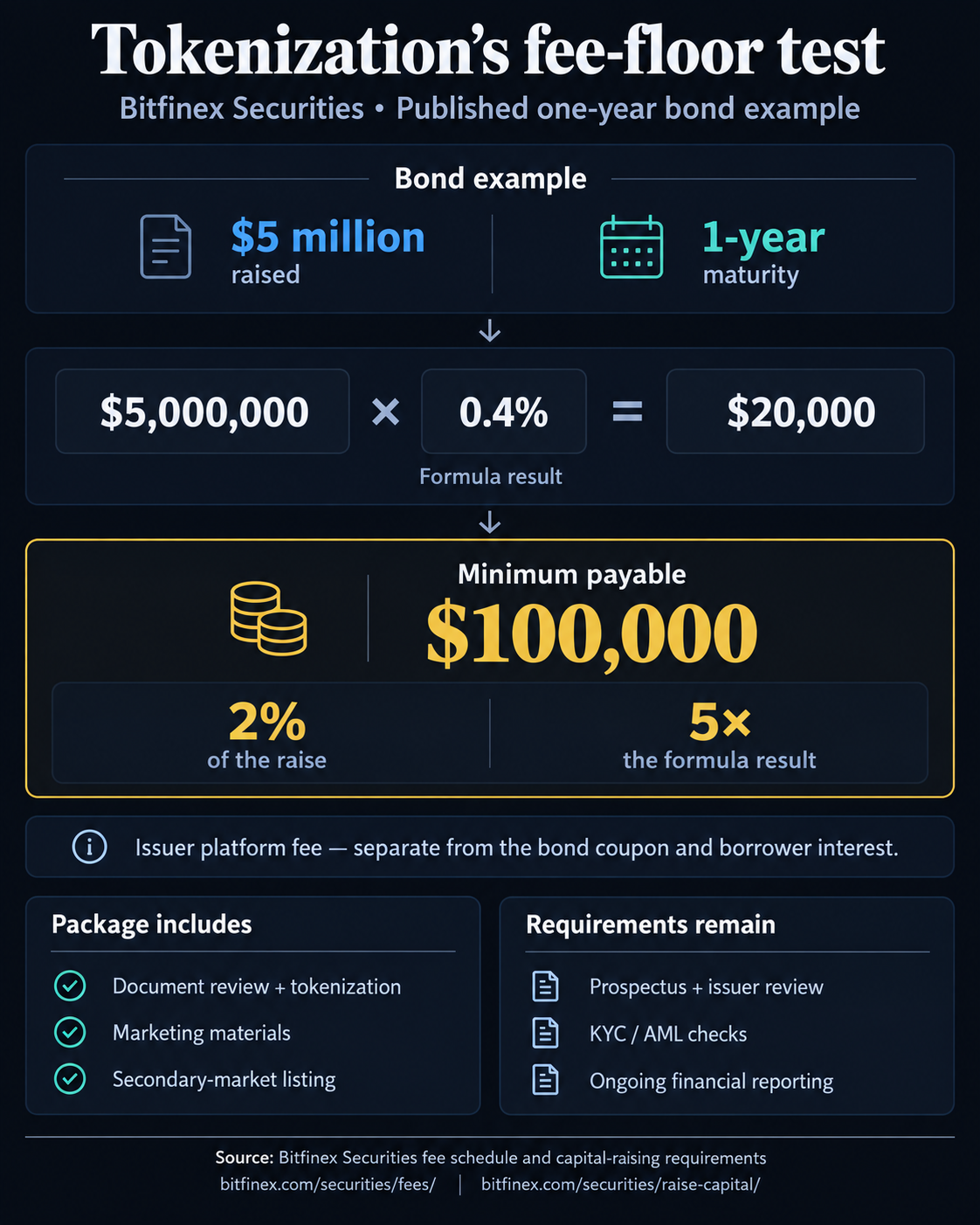
Bitfinex's capital-raising process still requires issuer review and acceptance, an offering prospectus and supporting documents, strong know-your-customer and anti-money-laundering checks, and continuing financial reporting.
The main page requires quarterly financial statements. Its AIFC-specific guide describes quarterly or yearly statements or reports, as applicable under the market rules. Moving ownership records onto a blockchain does not remove that continuing obligation.
The investor guide gives individuals participating in Astana International Finance Centre offerings minimum-investment or accreditation routes. El Salvador offerings and corporate accounts have different provisions.
The platform excludes US persons and participation where an offer would be unlawful.
For an underserved business, the relevant test is whether preparing an eligible offer and reaching eligible investors become simpler and less expensive together. A technology change that helps settlement addresses part of that task.
A meaningful comparison with conventional financing would need the same issuer, instrument, maturity, and financing objective, including the work of preparing documents and maintaining reporting.
ALTERNATIVE shows the pooled route in operation
ALTERNATIVE's structure changes who faces the capital market. Managed by MK Global Kapital, the fund sells debt to investors, with financing reaching businesses through its portfolio.
The manager says proceeds support lending, leasing, and mobility initiatives. This places the fund between securities investors and the entrepreneurs receiving finance, allowing smaller businesses to access that route without each preparing an exchange issuance.
The potential scale advantage is that one issuance can support financing across a portfolio. Whether an enterprise gains a cheaper loan still depends on the terms offered through that portfolio.
In a Dec. 20, 2023 announcement, Bitfinex reported that ALT2612 had raised 5,200,100 USDT and closed earlier that week. The bond had a 36-month tenor and a 10% coupon, and the program presented microfinance bond offerings in 2024.
The manager's July 2025 lifecycle report put the Bitfinex program at four issues totaling $6.2 million-equivalent as of July 1. One matured issue totaling $630,000-equivalent had been fully repaid, alongside 15 coupon payments exceeding $850,000-equivalent.
By March 2, 2026, the reported issuance total was still four bonds and $6.2 million-equivalent, while three matured bonds totaling $1 million-equivalent had been fully repaid. The reported coupon count reached 20, exceeding $1.1 million-equivalent.
The announcements describe different scopes, and the manager also describes a wider tokenized program exceeding $10 million. Bitfinex's March announcement separately expected future issuance to exceed $10 million.
A pooled route could spread issuance work across financing for many businesses and also leaves an intermediary to decide how capital is allocated and priced. That makes loan terms, underwriting, and access the next measures of whether the industry's efficiency gains reach entrepreneurs.
The next useful evidence would link lower issuance and compliance costs to comparable financing offers for businesses: total charges, amount available, maturity, and ongoing obligations. For pooled lending, it would also show what changed in the end borrower's terms.
Ardoino's benchmark puts a demanding economic standard behind tokenization's inclusion promise. Meeting it requires cheaper capital access at the business end of the transaction, whether the business issues directly or borrows through a fund.
The post Cheap crypto capital hits wall as Bitfinex fee rule binds appeared first on CryptoSlate.
Bitcoin’s aggregate futures exposure fell as recently active capital gained share through Oct. 4. Younger coin cohorts tend to spend more readily during volatility, so sustained buying remains the test of how readily the market can absorb active supply.
Glassnode’s Oct. 5 Market Pulse reported futures open interest declining from $38 billion to $36.6 billion. Hot Capital Share rose from 18.9% to 19.5%, while the short-term-to-long-term holder supply ratio increased from 13.7% to 14.2%.
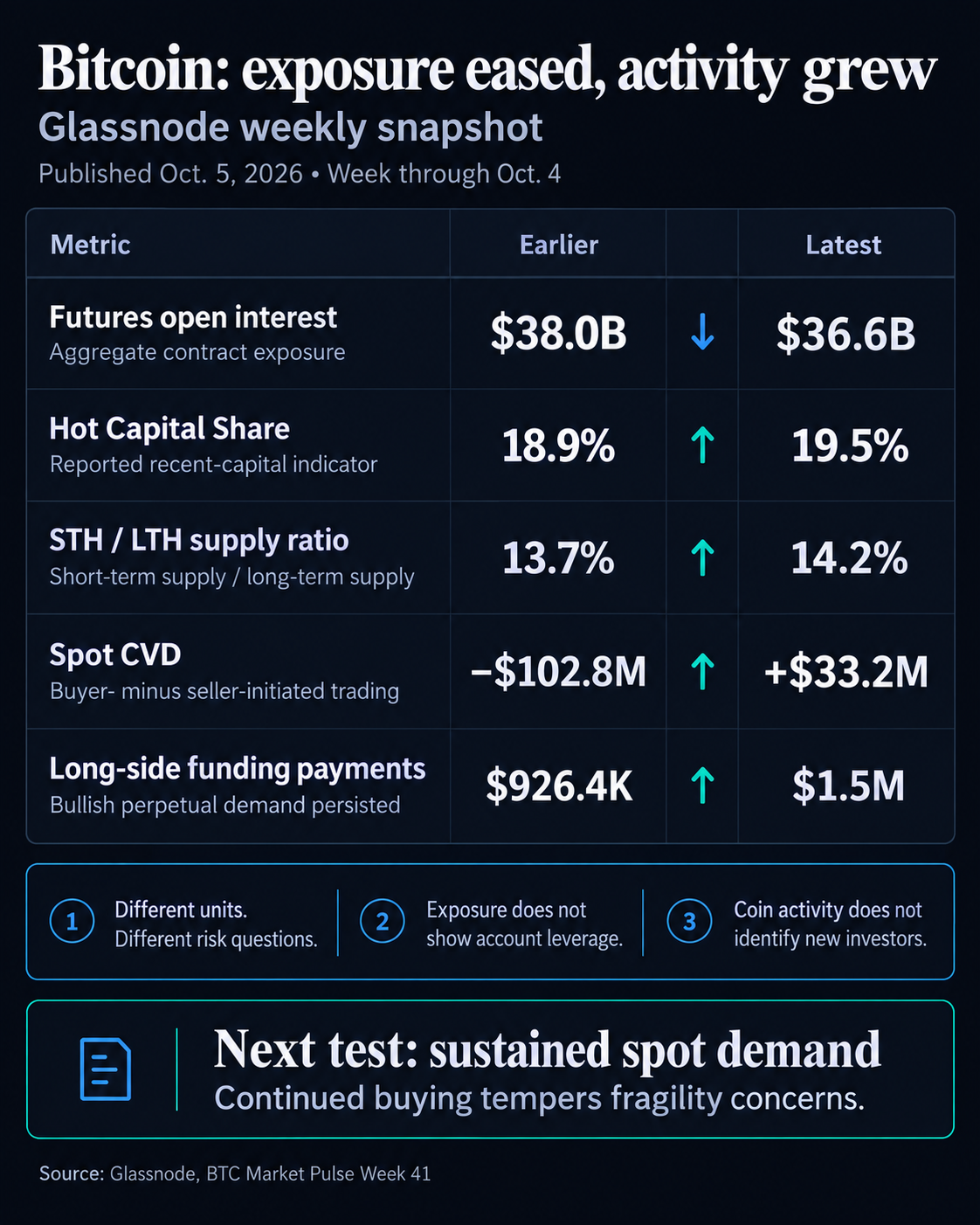
Open interest measures outstanding futures exposure, but assessing the vulnerability of those positions also requires information about account leverage and collateral.
The remaining exposure was still near the upper edge of Glassnode’s statistical range. Long-side funding payments rose from $926,400 to $1.5 million, showing that the contraction in open interest coexisted with stronger demand for bullish perpetual exposure.
How recent activity changes the risk picture
Glassnode’s March 2025 Market Pulse glossary describes Hot Capital Share over a three-month window.
Separately, its realized-cap age-band methodology values coins at the price when they last moved, and divides each band’s value by total realized capitalization. The denominator represents the combined last-movement value of the coin supply.
When older coins move, their age resets and their realized value updates, so an established holder can reactivate dormant coins and increase recent-coin economic weight. Activity alone cannot identify first-time investors or fresh fiat deposits.
The supply ratio divides short-term-holder coin supply by long-term-holder coin supply. At 14.2%, it means about 14.2 units of short-term supply for every 100 units of long-term supply.
Glassnode’s holder classification groups addresses into entities and smooths their entity-average holding-age classification around a 155-day midpoint, excluding exchange balances.
Younger cohorts tend to spend more readily during volatility. Their growing relative presence supports continued price sensitivity, while leaving the timing and direction of future spending open.
The report’s spot cumulative volume delta, the balance between buyer- and seller-initiated trades, changed from negative $102.8 million to positive $33.2 million. The measure tracks trading aggression, so its improvement indicates a shift toward buyers without quantifying new investor capital.
Whether continued demand absorbs active supply is the next test. Sustained spot buying would temper the fragility concern, while renewed taker selling alongside deteriorating holder profitability would strengthen it.
Futures exposure and holder activity therefore need to be read together. The October snapshot shows a smaller nominal derivatives footprint alongside more recently active capital, with improving spot buying providing a counterweight. Holder sensitivity remains a separate risk to watch.
The post Bitcoin futures drop $1.4B, but spot buyers step in to help appeared first on CryptoSlate.
Bitcoin treasury company Strive disclosed an optional program to repurchase up to $500 million of its variable-rate perpetual preferred stock, traded as SATA, on Oct. 5.
The program exceeds its reported $284.7 million cash balance and lets management weigh further Bitcoin purchases against retiring dividend-paying preferred shares.
The SEC filing gives management discretion to repurchase shares from time to time. The ceiling is $215.3 million above reported Oct. 2 cash, so immediate full use would require resources beyond that dated balance.
The optional cap creates no obligation to spend the maximum and does not establish a liquidity shortfall. The filing discloses no completed SATA repurchases, dedicated funding source, or timetable for using the full capacity.
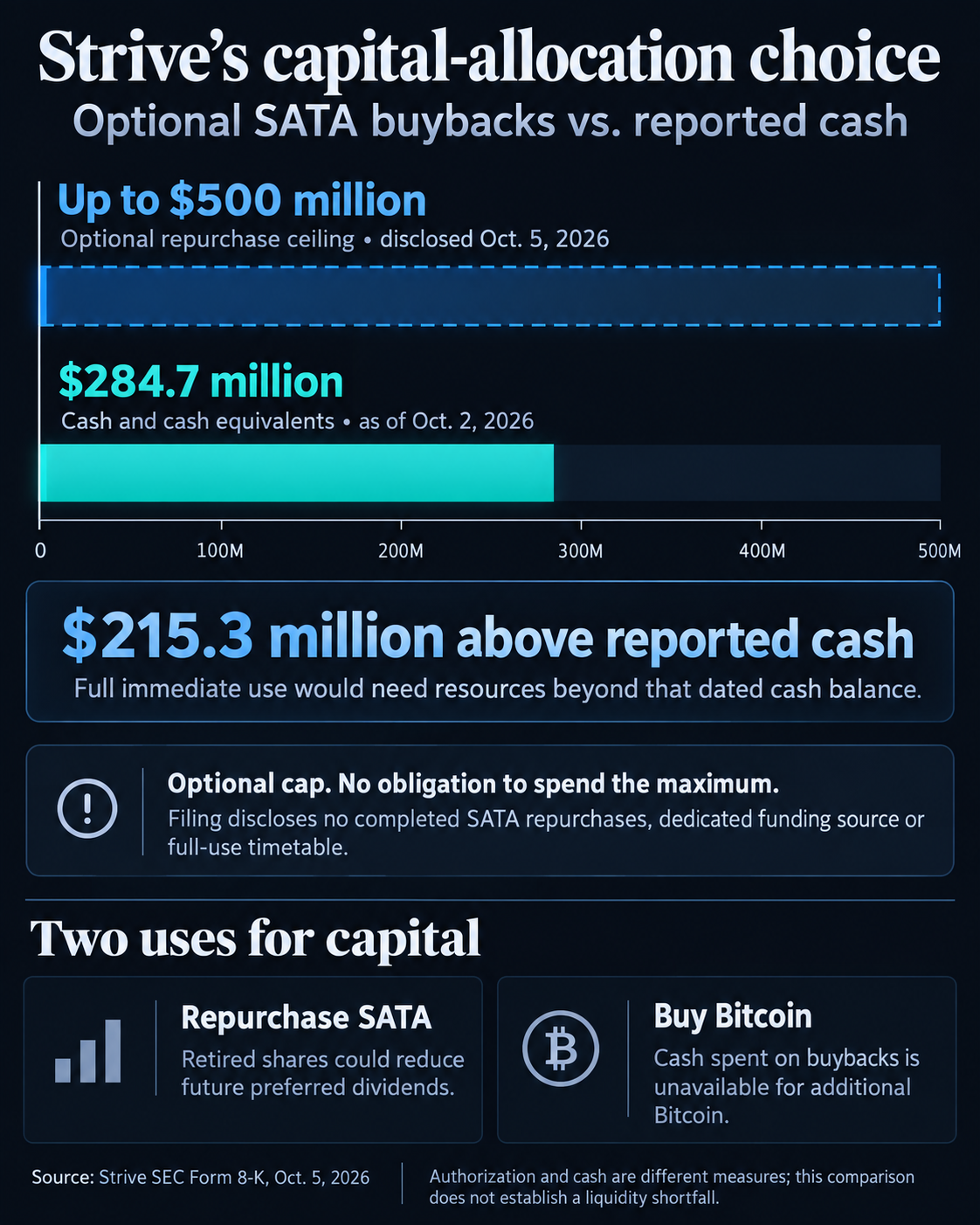
Strive reported 29,462 BTC as of Oct. 2 after buying 2,000 Bitcoin between Sept. 28 and Oct. 2 at an average price of approximately $84,422, including fees and expenses. Those holdings are separate from its preliminary, unaudited Sept. 30 figures, which showed 28,000 BTC and remained subject to change.
Buying Bitcoin or reducing dividends
Strive's preferred-funded Bitcoin strategy carries recurring cash costs. Its website presents SATA dividends at $13 per share annualized, equivalent to 13% of the $100 stated amount.
The rate can change, and cash payments require board declaration. Under SATA's terms, dividends accumulate even when they are not declared, while declared cash payments are divided across business days.
Strive reported 13,498,082 SATA shares as of Oct. 2, up from 12,193,180 on Sept. 25, including shares sold through the filing's 4 p.m. cutoff for issuance on the following business day.
Retiring shares could reduce future dividend commitments and the preferred claims that rank ahead of common shareholders.
The savings would depend on how many shares were retired and the applicable dividend rate, while the purchase price would determine the cash cost. Money spent buying back SATA would also be unavailable for additional Bitcoin purchases.
SATA's amended terms permit market repurchases separately from contractual optional redemption, which has a base price of $110 per share plus applicable unpaid dividends. The new facility does not set a $110 price for every buyback.
Strive says it intends to remain debt-free and may consider capital-allocation and financing alternatives.
Preferred equity still carries dividend commitments, and the company cautions that its Bitcoin-per-share metrics do not capture the additional senior claims created when preferred issuance funds Bitcoin purchases.
For common shareholders, the next useful disclosure is actual repurchase spending and shares retired, alongside updated cash and Bitcoin balances. Those figures will show whether the facility reduces the preferred dividend burden and how much capital remains for Bitcoin accumulation.
The post Bitcoin treasury Strive risks cash reserve to fund $500M buyback and trim dividends appeared first on CryptoSlate.
Kraken's parent company, Payward, has connected to Singapore Gulf Bank's SGB Net clearing network, opening round-the-clock US-dollar funding for selected institutional clients in Asia and the Gulf.
The companies say participating clients in eligible jurisdictions can deposit cash with Payward and use it immediately.
In their release dated Oct. 5, the companies describe an initial dollar settlement offering. SGB also plans to use Payward markets to price digital asset trades for its own customers over the coming months, giving the partnership a live funding service and a separate planned trading component.
Through SGB Net, participating SGB clients can fund Payward accounts at any hour, the companies say. The dollar connection is available 24 hours a day, seven days a week. Its immediate practical benefit is greater flexibility over when those institutions move cash for digital-asset activity.
The releases do not name participating clients or list eligible countries, so they do not provide an institution outside that group with a country-by-country guide to availability. The reference to Asia and the Gulf describes the regional focus, while the jurisdiction restrictions limit where the service can be used.
The companies intend to add more clients and currencies over time, but give no exact expansion date.
Although the connection is operating for some institutions, the rollout announced so far is confined to the initial clients and dollars. The expansion plans concern both who can use the connection and which money it can move.
Adding clients would extend participation, while adding currencies would expand the service beyond its initial US-dollar scope.
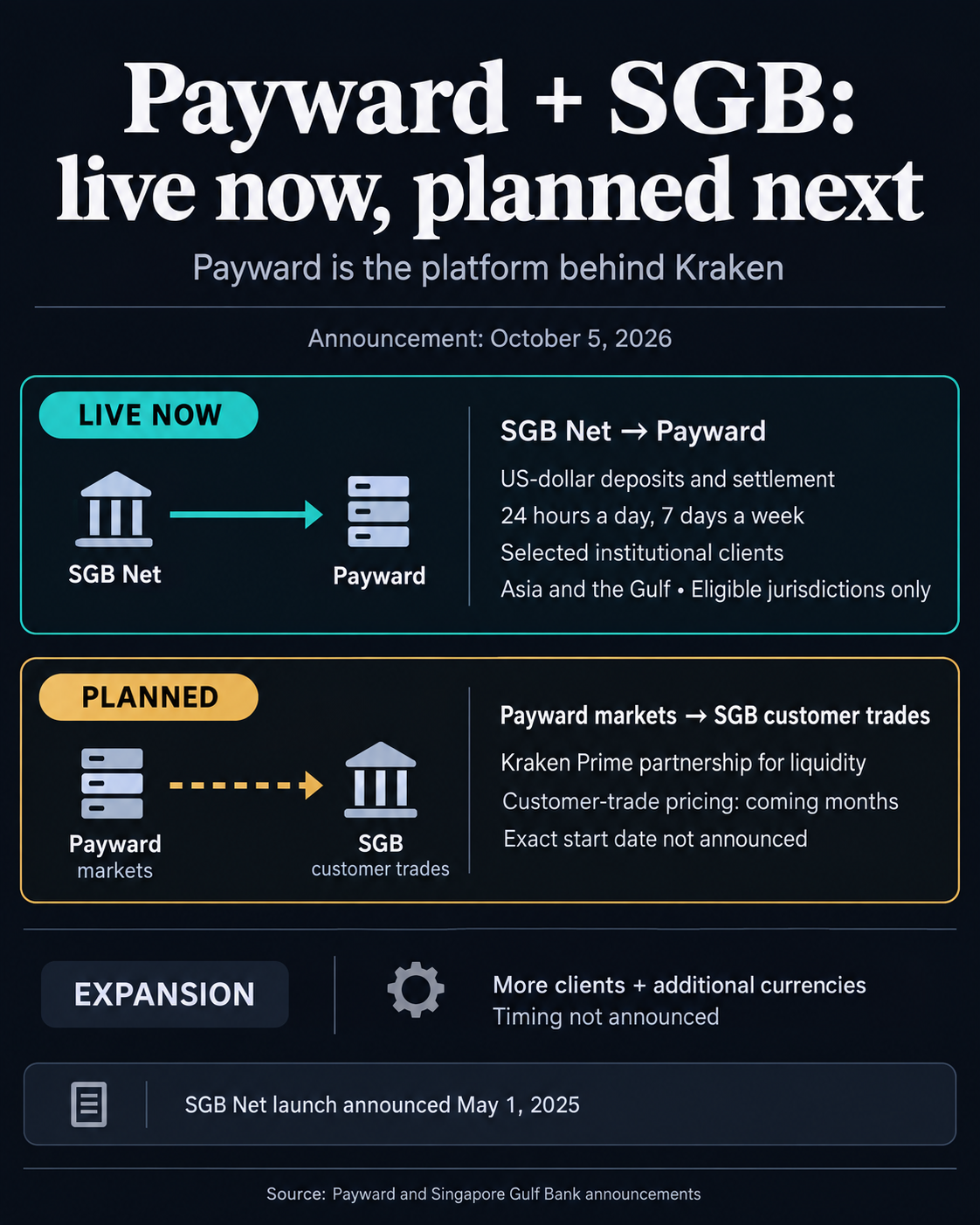
Singapore Gulf Bank announced the network's launch on May 1, 2025, and Payward is now connecting to that existing system, adding a funding route for the institutions included in the initial offering.
SGB expands partnership with Kraken
SGB is also partnering with Payward's Kraken Prime for digital asset liquidity. The bank plans to draw on Payward markets to price its customers' trades over the coming months. The announcement supplies that broad horizon but no specific date for starting the customer-pricing service.
The live connection lets participating institutions move their dollars into Payward and deploy them immediately. The planned pricing use concerns SGB sourcing liquidity for digital asset trades offered to its own customers.
The next developments to watch are the start of SGB's customer-pricing use and the addition of settlement clients and currencies. Pricing has a stated horizon of the coming months, while the wider funding rollout remains undated.
The post Kraken parent joins Singapore Gulf Bank, opening 24/7 institutional dollar rails appeared first on CryptoSlate.
The Commodity Futures Trading Commission (CFTC) is offering US crypto exchanges a federal route to retail leverage as Congress remains stalled on market-structure legislation.
On Oct. 5, the financial regulatory agency opened rulemaking for Regulation Crypto Asset Transactions (CTX) and Regulation Crypto Asset Markets (CAM), which would create a national framework for platforms offering retail customers margined, leveraged, or financed crypto trading.
Participation would remain optional for ordinary spot exchanges because the agency acknowledges it cannot compel the broader crypto market onto CFTC-regulated venues without congressional action. The incentive is access to leveraged products that state money-transmitter licensing alone does not provide.
The initiative gives the CFTC a way to use authority it says already exists under the Commodity Exchange Act while Congress has yet to enact comprehensive legislation governing crypto spot markets.
CFTC turns leverage into its regulatory carrot
The framework would effectively create three regulatory paths depending on what an exchange wants to offer US customers.
Ordinary spot exchanges could remain primarily under state licensing regimes, supplemented by the CFTC’s existing anti-fraud and anti-manipulation authority.
Platforms offering leveraged or financed retail crypto transactions could seek federal registration under the new framework, while venues offering futures, perpetuals and other derivatives would remain under the agency’s existing designated contract market regime.
CAM would sit in that middle category.
The structure would allow existing designated contract markets to offer CTXs under tailored rules while giving crypto platforms another route into federal supervision without requiring them to operate as conventional derivatives exchanges.
The CFTC is relying on Section 2(c)(2)(D) of the Commodity Exchange Act, which covers certain leveraged retail commodity transactions.
Hyperliquid Policy Center said the resulting structure could give market participants a clearer regulatory ladder, with state licensing covering ordinary spot activity, federal CFTC oversight applying where leverage is introduced, and the existing derivatives framework covering futures and perpetual contracts.
The proposal could also narrow one of the biggest product gaps between US exchanges and offshore rivals.
Leveraged trading and perpetual contracts have helped offshore venues attract active traders and generate substantial volumes. US platforms have generally operated with a narrower product menu because of regulatory constraints.
That creates the central commercial bargain.
Federal registration could give exchanges access to products that have historically strengthened the economics of offshore competitors, but accepting CFTC oversight could also force changes to the vertically integrated model through which many crypto venues combine exchange, brokerage and custody functions.
Larry Florio, deputy general counsel at synthetic-dollar developer Ethena Labs, described retail leverage as the proposal’s central attraction, arguing that it could be enough to draw exchanges voluntarily into a single federal framework.
Whether leverage generates enough additional volume and revenue to justify those constraints may determine how many major platforms enter the regime.
FTX shapes the cost of opting in
The regulatory bargain would extend well beyond permission to offer leverage.
CFTC Chairman Michael Selig framed the initiative around lessons from FTX's bankruptcy, arguing that regulators should establish preventive safeguards rather than rely primarily on enforcement after customers have suffered losses.
Selig said on Oct. 5 that “the lesson from FTX’s failure should have been obvious,” arguing that protecting customers from fraud should coexist with responsible crypto innovation.
CAM operators would face core requirements already associated with designated contract markets, including rules governing financial integrity, surveillance, conflicts of interest and operational safeguards.
The agency is also considering crypto-specific requirements.
Exchanges could have to assess token concentration, distribution methods, vesting schedules, lockups, programmatic issuance and buybacks when determining whether an asset can be traded without being readily susceptible to manipulation.
Platforms holding customer property in omnibus accounts could also face proof-of-reserves requirements, a safeguard Selig directly linked to risks exposed by FTX.
Customer CTX trades would meanwhile be intermediated through registered futures commission merchants, bringing customer accounts and property under requirements covering capital, disclosures and segregation.
FCM involvement would also bring customer-facing activity within applicable Bank Secrecy Act obligations, including anti-money laundering controls, customer identification and suspicious-activity reporting.
Those provisions raise the cost of opting into the federal framework beyond registration fees or compliance staffing. Exchanges could gain access to leverage while surrendering some of the structural flexibility that has allowed crypto platforms to keep trading, brokerage and custody under one roof.
That trade-off will be central to whether the framework attracts the large US exchanges whose participation would give it meaningful scale.
CFTC draws a boundary around onchain markets
The commission is also beginning to define where decentralized markets and software developers fit within federal commodities law, although that effort sits partly outside the CTX and CAM initiative.
The CTX proposal would clarify the Commodity Exchange Act’s “actual delivery” exception by treating transfers to a customer’s external non-custodial wallet within 28 days as generally satisfying the exemption from exchange-trading requirements for certain leveraged retail commodity transactions.
Separately, Selig said the agency is considering how to treat developers who publish software without taking customer orders, controlling execution or holding customer assets.
He said:
“A person should not have to register as an introducing broker simply because that person shipped code.”
The CFTC is consulting developers about where control resides in onchain venues and when software activity begins to resemble regulated financial intermediation.
However, the more immediate question is economic for centralized exchanges.
The Oct. 5 action is an advance notice of proposed rulemaking, and the agency is seeking public input before drafting detailed rules covering leverage, asset eligibility, custody, reserves and intermediary requirements.
That leaves major elements of the framework unresolved, including leverage limits, capital standards and the extent to which FCM intermediation could reshape existing exchange business models.
Agency rules also remain less durable than legislation, and a future commission could revise them.
The CFTC is testing a relatively simple proposition: whether access to federally regulated retail leverage is valuable enough to persuade crypto exchanges to accept substantially deeper oversight.
If major platforms decide that it is, the agency could begin pulling trading activity now concentrated on offshore venues into regulated US markets without waiting for Congress to settle the broader fight over crypto spot-market jurisdiction.
The post CFTC makes its biggest move yet to bring offshore crypto trading back to the US appeared first on CryptoSlate.
CryptoTicker.io
Swapping Bitcoin for a gift card is not a purchase for tax purposes, it is a sale. The moment you pay for a gift card, a good or a service with crypto assets, you hand over the coins and receive something else in return. The tax office treats that transaction exactly like a sale on an exchange: as a private disposal under section 23 of the German Income Tax Act, the EStG.
Whether tax actually falls due hangs on two numbers. If more than twelve months lie between the purchase and the gift card payment, the gain stays tax free. Below that it counts, and it counts together with every other private disposal of the year against the threshold of 1,000 euros. So if you buy Bitcoin in January and pay for a gift card with it in March, you have a tax relevant transaction on the books, even though not a single euro has landed in your account.
The gift card purchase is a disposal, not an exchange
A disposal within the meaning of section 23 EStG is any transfer of an asset for consideration. The fact that what you receive in return is a gift card rather than euros changes nothing: for consideration simply means that something flows the other way. On February 14, 2023, the Federal Fiscal Court confirmed that crypto assets are other assets in this sense and fall under the provision.
That is what sets the gift card purchase apart from a gratuitous transfer. Anyone who gives coins away or hands them to a charitable organisation is not disposing of them, because nothing flows the other way; different rules apply there, which we have written up under claiming Bitcoin donations against tax. A gift card is consideration with a quantifiable value, and the whole calculation hangs on that.
In practice that means there is no free pass for spending coins by way of a gift card in order to sidestep the tax. The opposite is true, because unlike with a sale on an exchange you are afterwards left without the exchange statement as evidence.
What counts as the disposal proceeds: the market value of the gift card
The disposal proceeds are the value of what you received for the coins. With a gift card that is its face value in euros, meaning the sum printed on the card that you can redeem with it. From that you deduct the acquisition cost, meaning the euro amount the coins you handed over cost you when you bought them, plus the incidental purchase costs at the time.
An example with round figures: you bought coins for 400 euros and eight months later pay for a gift card worth 700 euros with them. The taxable gain is 300 euros. Had you instead sold the same coins on an exchange for 700 euros, the result would be identical. The gift card merely stands in for the euro as consideration.
You need to pay attention when the provider takes a premium and you hand over coins with a market value of 730 euros for a gift card worth 700 euros. What then governs is what you actually received. The premium reduces your result, and you should be able to document it, because otherwise the higher market value of the coins can be used as the basis.
The one-year holding period decides the tax
The holding period begins on the day after the purchase and ends after twelve months. Redeem the gift card after that and the gain stays tax free, however large it is. Within the period it is taxable at your personal income tax rate.
What is decisive is the date of the payment, not the date on which you later use the gift card in a shop. The swap of coins for a gift card is the moment that counts for tax. Anyone who wants to see the mechanics of the period in context will find them in our comparison of the loss sale and buyback within the holding period.
The 1,000 euro threshold: why a gain of 1,001 euros is taxable in full
Private disposals are subject to a threshold of 1,000 euros per calendar year. A threshold is not an allowance: once it is reached or exceeded, the entire gain becomes taxable, not just the part above it. On a gain of 999 euros you pay nothing; on 1,001 euros you are taxed on 1,001 euros.
The limit applies to all private disposals of a year taken together, not per transaction and not per coin. Two gift card purchases with a gain of 600 euros each breach the limit jointly. Gains from other private disposals in the same year count towards it as well. Losses from such transactions reduce the total and therefore need documenting just as carefully as gains.

FIFO or specific identification: which coins the gift card purchase uses up
Anyone who has been adding over months holds coins with different acquisition dates. On the question of which of them the gift card purchase uses up, there are two routes. Under specific identification you demonstrate which particular coins were handed over, for instance because they sat in a wallet of their own. Where that cannot be allocated, the FIFO method comes into play: first in, first out, with the oldest holdings treated as handed over first.
FIFO often works against you when prices are rising, because the oldest holdings carry the lowest acquisition cost and therefore show the highest gain. In exchange, those holdings are also the most likely to be older than a year and therefore tax free. Which variant comes out cheaper depends on the individual case and belongs with a tax adviser, not in a rule of thumb.
Wallet separation matters here: anyone who keeps coins for everyday spending in a wallet of their own and the long term holdings separately from it can substantiate the allocation in the first place. That separation costs nothing and cannot be created after the fact.
The BMF circular of 6 March 2025 replaces the 2022 version
The tax authorities' position on the taxation of crypto assets is set out in a circular from the Federal Ministry of Finance dated March 6, 2025. It replaces the earlier circular of May 10, 2022, and classifies, among other things, airdrops, forks, transactions on decentralised platforms and the boundary between private asset management and commercial activity.
Two things about it matter for the gift card purchase. First, the classification of the payment as a disposal remains in place. Second, the circular expressly stressed the requirements for records and cooperation, and that bites precisely on transactions for which no exchange issues a statement. An administrative circular binds the tax offices, incidentally, not the courts.
Part of the legal position is also what does not currently apply: a bill to abolish the one-year tax exemption was rejected in the Bundestag. The discussion continues, but nothing has been decided. Until then the twelve-month period stands.
VAT stays out of it: the swap counts as a payment
Alongside income tax, the question of VAT comes up regularly. For private holders the answer is short: anyone using coins as a private individual to pay with is not supplying anything subject to VAT. The tax authorities treat crypto assets as equivalent to conventional means of payment for VAT purposes, in so far as they are purely means of payment.
The VAT on the good or service is still owed by the merchant, and it is already baked into the gift card value. You pay it along with everything else, just as with any other method of payment. The position is different for businesses holding crypto assets as operating assets; separate rules apply there, and this page deals with the private case.

Evidence for the tax office: price, date and gift card value
With a sale on an exchange the platform supplies a statement. With a gift card purchase nobody supplies one, and the burden of proof sits with you. So secure four details for every transaction: the date of the payment, the face value of the gift card in euros, the quantity of coins handed over, and the acquisition date together with the purchase price of those coins.
Add to that the records you do receive: the provider's confirmation, the transaction in your wallet or in the block explorer and, where there is one, the invoice for the premium. Evidence of the price on the day of the transaction belongs there too, because the market value of the coins handed over is the cross-check against the gift card value. Programs that keep track of these transactions and produce a report for the tax return are listed in our comparison of crypto tax software and portfolio trackers.
You should keep these records for as long as the tax office can examine the transaction. For private individuals that means, in practice, until the tax assessment for the year in question is final, and longer if in doubt.
Where you can pay for gift cards with Bitcoin, and what the premium costs
Gift cards against crypto assets are brokered by specialised providers, and in some cases by individual merchants directly. The process is similar everywhere: you choose the gift card, the provider quotes an amount in coins, you transfer, and the code arrives by email or in your customer account. Three items determine the price.
First, the premium on the face value, with which the provider covers its price risk and its margin. Second, the network fee for the transfer, which weighs heavily on small amounts. Third, the price the provider calculates with, and the window for which it guarantees that price. So always work the gift card out as a total price in euros and compare it with the route through a sale on an exchange and an ordinary card payment. What that detour costs on an exchange is set out in our comparison of the best crypto exchanges.
Check as well whether the provider offers returns or refunds at all. A redeemed gift card code is as a rule not revocable, and in a dispute you have no payment service provider chargeback available of the kind you know from a credit card.
The gift card itself triggers no further crypto tax later
After the swap you no longer hold a crypto asset, you hold a claim denominated in euros. When you redeem the gift card in a shop weeks later, that is not a private disposal, because no asset within the meaning of the provision is being disposed of any more. The transaction that mattered for tax was complete when the coins changed hands.
That has a practical consequence: if the price keeps rising after the gift card purchase, you have no share in it any more, and a later slide in the price does not shrink the tax that has already arisen. The gain is fixed as at the moment of the swap. Anyone planning the transaction shortly before the turn of the year should keep that in view, because the gain falls into the year of the payment.
If a gift card expires unused, the transaction still stands for tax purposes. The loss of the gift card value is a private financial loss and not a reduction of the disposal gain that arose back then.
Bitcoin for a gift card: How to proceed now
- Check the holding period before you pay. Look up when the coins you intend to hand over were bought. If the purchase is more than twelve months ago, the gain is tax free; below that you count it against the threshold of 1,000 euros. A tool from our comparison of crypto tax software carries those periods parcel by parcel.
- Work the total price out against the exchange route. Add up the premium, the network fee and the price gap and compare the sum with the route through a sale and an ordinary payment. What a sale on an exchange costs is shown by our comparison of the best crypto exchanges.
- Secure the records the same day. The date, the gift card value, the quantity of coins handed over, the price and the provider's confirmation belong together in one folder before the email sinks in your inbox. Anyone paying with crypto assets regularly will find solutions that document the transaction together with a statement in our comparison of crypto credit cards.
The legal position in this article rests on the circular of the Federal Ministry of Finance dated March 6, 2025, file reference IV C 1 - S 2256/00042/064/043, whose changes against the 2022 version are set out in detail by PwC, and on section 23 of the Income Tax Act. This article is no substitute for tax advice.
(As of October 6, 2026. This article is not investment advice. Prices and fee structures change; check the terms with the provider before you buy.)
Selling MemeCore currently only works by a detour: none of the 14 markets that CoinGecko lists for the token M trades against the euro. Every single pair runs through the stablecoin Tether or through USDC, with two pairs available only on decentralised exchanges on the BNB Smart Chain. Anyone who wants to unwind an M position therefore sells first into a dollar stablecoin and swaps that into euros afterwards. It is workable, but it costs an extra step, an extra fee and a second event that counts for tax.
The other half of the answer lies in the size of the market. According to CoinGecko data, M carried a market capitalisation of $2.32 billion on October 6, on daily volume of $2.39 million. That puts the ratio at roughly 971 to 1. On the thinnest days of the past two months it sat at about 3,500 to 1. For a small position that is of no consequence. For a large one it is the real question of this article.
Selling MemeCore today means Tether, not euros
A trading pair is the combination of the token you give up and the value you get for it. With M those pairs are, without exception, M/USDT, M/USDC or, on the two decentralised exchanges, M against a dollar stablecoin on the BNB Smart Chain. CoinGecko's ticker list carries no M/EUR pair, and no M/USD either.
In practice that means a two-stage exit. In the first step you sell M against USDT or USDC. In the second you move the stablecoin to a platform that pays out euros and sell it there. Which providers do that reliably in Germany, and what they charge for it, is set out in our comparison of the best crypto exchanges. Why the Tether detour is so widespread and where it costs money, we have written up at greater length using the case of the missing euro trading pairs.
An important point for tax: swapping M into USDT already counts as a disposal, and so does the later swap from USDT into euros. Both events count on their own, and both need documentation. More on that below.
What MemeCore is: a layer-1 chain with Proof of Meme as its consensus
MemeCore is not a conventional meme coin sitting on somebody else's chain. It is its own layer-1 blockchain, meaning a network with its own consensus mechanism and its own fees. The project says the mainnet has been running since February 12, 2025. The token M pays the transaction fees on the network and is staked by validators and delegators.
The project calls its consensus mechanism Proof of Meme: whoever secures the network should be rewarded not only for computing power or capital at stake, but also for measurable cultural contributions. Whether that promise holds is an open question, and for exiting a position it is of secondary importance. What counts for classification is this: M is a network token with meme positioning, and it sits in the risk class we report on continuously in our meme token section.
The all-time high came on July 2, 2026, at $5.64. At $1.02 today, M stands roughly 82 percent below that. Over seven days the price is down 11.4 percent, over 30 days 10.1 percent. From the interim high of $1.51 on September 20 it is 32.6 percent lower.
13 trading venues, one order book: HTX carries 75 percent of ticker volume
CoinGecko lists 14 markets for M across 13 trading venues. The distribution is the opposite of broad. HTX accounts for $1.80 million of the reported daily turnover, or 75.1 percent of the entire ticker volume. The three largest venues together carry 87.0 percent. The remaining ten share what is left, and the smallest reports less than $5,000 a day.
Those venues include Biconomy, BTCC, MEXC, Hotcoin, Bitget, Gate, Ourbit, Hibt, BitKan and WEEX, plus two decentralised markets on the BNB Smart Chain. The platforms through which German investors usually buy with euros are absent from that list: according to CoinGecko's ticker list, Bitpanda, Coinbase, Kraken and Bison do not carry M.
This concentration has two consequences. First, the tradable price hangs essentially on a single order book. If that venue goes down, stalls or suspends withdrawals, the bulk of the liquidity goes with it. Second, you cannot simply fetch a better price from a competitor, because the competition has barely any volume. Anyone moving from one venue to another should also know that a pure transfer between your own accounts is not a sale, but the acquisition data has to travel with it.
Market cap $2.32 billion against $2.39 million daily volume: a ratio of 971
Market capitalisation is the circulating supply multiplied by the current price, and it says what a position is worth on paper. Daily volume says how much of that actually changes hands in a day. With M, $2.32 billion of paper value stands against $2.39 million of turnover.
The volume series of the past 60 days swings widely: the weakest day came in at $0.66 million, the strongest at $7.08 million, the mean at $2.71 million and the median of the past 30 days at $1.35 million. Depending on which of those figures you apply, the market capitalisation equals between 971 and 3,493 times a single day's turnover. That spread is not imprecision, it is the risk itself: how quickly you get out of a position depends on which day you hit.
For comparison: with a heavyweight such as Bitcoin that ratio usually sits in the double or triple digits. The higher the number, the longer the market would need, on paper, to turn over the entire circulating supply once.
Slippage: why a large order in a thin book sets its own price
Slippage is the difference between the price you see when you send an order and the price at which it is actually filled. It arises when your order is bigger than what sits on the other side of the order book at the next best price. The order then works its way through ever worse price levels.
In a market that turns over less than a million dollars on a quiet day, a position in the mid five figures is enough to trigger that. A market order of $50,000 is no fringe event there, it is a noticeable share of the day's business. That is precisely why a limit order, where you set a minimum price, is the more important tool in thin markets: such an order fills more slowly or not at all, but it protects you from pushing your own price down. How to read the depth of an order book yourself before you hit send is described in our guide to checking slippage.

Eleven monthly tranches of 56.1 million M have landed without a price slump
An unlock or a tranche is the moment when locked tokens become freely available to the team, the foundation, investors or the community. The expectation behind it usually runs like this: more freely available tokens mean selling pressure and therefore a falling price. With M it is possible to test whether that has happened, because the series is long.
According to the vesting schedule at DefiLlama, eleven equally sized tranches of 56,111,111 M each have landed since December 2, 2025, month after month. Before those came two smaller events of 35,972,222 M each in October and November 2025, plus a one-off starting block of 1.4 billion M in July 2025. The cadence is impossible to miss.
The price reaction was muted all the same. Ahead of the tranche on September 2, M stood at $1.0950, on the day itself at $1.0623 and two days later at $1.0402, a combined 5.0 percent lower. Around the tranche on October 2 it went from $1.0403 to $1.0506 and then to $1.0328, so 0.7 percent lower. Between the two tranche days lies a monthly gap of 1.09 percent to the downside. A slump on the date is not to be found in these numbers.
One explanation for that lies in the order book itself. A tranche of 56.1 million M equals 2.46 percent of the circulating supply and, calculated at today's price, roughly $57.0 million. That is about 24 complete daily turnovers at today's volume and about 86 at the weakest day of the series. A quantity that a market of this size cannot absorb in a day does not get sold in a day either. The pressure works its way out over weeks, and that is exactly what makes it invisible on a daily chart.
The next tranche falls on 1 November per the vesting schedule, and only one source dates it
The vesting schedule at DefiLlama lists the next tranche for November 1, 2026, shortly before midnight UTC, which in Germany means the first hour of November 2. The quantity matches its eleven predecessors: 56,111,111 M, split across four pots with 24,305,556 M for the community, 12,500,000 M for investors, 11,666,667 M for the foundation and 7,638,889 M for the team.
Caution is warranted here, and explicitly so: that exact date rests on a single source. Other vesting registers list no releases for M or are not publicly viewable, and the project documentation itself contains no tokenomics table with dates. What is backed by two sources is the monthly cadence: eleven equally sized tranches in a row, dated in the vesting schedule and traceable in the volume series as spikes on the tranche days. Rely on the regularity, then, rather than on the calendar day as hard fact. We have written up the release calendar and the mechanics behind it in our article on the MemeCore unlock, and the distribution of supply among insiders in our onchain analysis of the insider share.
22.8 percent in circulation: 7.7 billion M are still to come
The circulating supply is the quantity of tokens that is freely tradable. With M that comes to 2,283,037,154 units. The maximum supply, the ceiling that is ever meant to exist, stands at 10 billion. That puts 22.8 percent in circulation. CoinGecko reports a total supply of 5.42 billion M, so considerably more than is circulating and considerably less than the maximum.
For a position that means the larger part of future supply has yet to reach the market. Every monthly tranche grows the circulating supply by a good two and a half percent, and it does so against an order book that is not growing with it. This calculation is the reason why the question of sellability matters more with M than the question of the next price target. This article deliberately names no price target.
The opposite direction matters too: a total loss is possible with a token of this size and market structure. Anyone holding a position should hold it in a size whose complete failure would not put their own portfolio into difficulty.

Holding period and the 1,000 euro threshold: what section 23 EStG means for your M position
Gains from the sale of crypto assets count in Germany as a private disposal under section 23 of the Income Tax Act, the EStG. The holding period is one year: if more than a year lies between acquisition and sale, the gain stays tax free. Sell within the year and the gain is taxable at your personal income tax rate.
On top of that comes a threshold of 1,000 euros per calendar year for all private disposals taken together. That limit is not an allowance: once it is reached or exceeded, the entire gain becomes taxable, not merely the portion above it. A sale with a gain of 1,050 euros is therefore taxable in full, one of 950 euros is not.
With M, two particulars come into play. First, swapping M into USDT already counts as a disposal, and the subsequent swap from USDT into euros as a second one. Second, each individually purchased parcel has its own holding period; anyone who has been adding over months has several periods running in parallel. Buying in over months therefore calls for a breakdown by parcel, not just a portfolio value.
A reform is under discussion: a bill to abolish the one-year tax exemption was rejected in the Bundestag, but the subject remains on the agenda. Until something is decided, the legal position above applies. Individual tax questions are for a tax adviser, not for an article.
From USDT proceeds to euros: the route through a regulated exchange
Once the proceeds sit in USDT or USDC, you need a way back into euros. Three steps are customary. First, transfer the stablecoin from the venue where you sold M to a platform that pays euros out to a bank account. Second, sell the stablecoin against euros there. Third, trigger the payout to your own account.
Before the first step, check three things at the receiving provider: whether it accepts the stablecoin in the form you hold it, meaning on the right network; what fee the deposit and the withdrawal cost; and whether it is authorised to trade crypto assets in the EU. Since the European regulation on markets in crypto assets, MiCA for short, took effect, providers need a licence for that. Whether a provider holds one is stated in its legal notice and in the register of the competent supervisor.
Mind the minimum amounts for withdrawals while you are at it. With small positions, the sum of the fees for transfer, swap and payout can eat a substantial share of the proceeds. Work that out beforehand, ideally with the provider's actual figures.
Total loss is possible: what a delisting does to a position
A delisting is a trading venue's decision to stop trading a pair. The platform usually announces a close of trading and a later deadline for withdrawing the tokens. After the close of trading you can no longer sell on that venue, and after the withdrawal deadline you can no longer move the tokens there; some platforms then liquidate remaining balances compulsorily.
With M this question is especially serious because of the concentration. If the largest venue drops the pair, three quarters of the reported turnover falls away at a stroke, and what remains are markets with daily volumes that in some cases run below $20,000. A sale at the displayed price is then no longer a given.
Three things help in concrete terms. First, subscribe to your own venue's announcement page, because delistings are published there first. Second, know which address and which network you would withdraw M to before you need it in a hurry. Third, size the position so that a total loss remains bearable. This article is explicitly not a recommendation to buy, hold or sell M.
Selling MemeCore: How to proceed now
- Fix the trading route and check the depth. Look up which venue your M position sits on and how much turns over there in a day. If your position exceeds one percent of daily volume, work with limit orders in partial steps rather than a market order. Which platform pays out euros and what it charges for that you will find in our comparison of the best crypto exchanges.
- Compile the holding periods parcel by parcel. Write down the date and the acquisition price for every parcel you bought before you sell. That shows which part is tax free after a year and which part eats into the 1,000 euro threshold. A tool from our overview of crypto tax software takes over that bookkeeping.
- Prepare the route back into euros. Decide which authorised provider is to take the USDT proceeds into euros and on to your bank account, and check the network, the fees and the minimum withdrawal in advance. The houses licensed for the EU market are listed in our overview of regulated crypto exchanges.
The data in this article comes from the vesting schedule at DefiLlama and the market data at CoinGecko.
(As of October 6, 2026. This article is not investment advice. Prices and fee structures change; check the terms with the provider before you buy.)
Virtune completed the monthly rebalancing of the Virtune Crypto Altcoin Index ETP on October 5, 2026. One line in it matters most for you: Gram (GRAM) has left the index and Litecoin (LTC) is newly in. All ten positions then stand at exactly 10.00 percent again.
This is not a product that concerns Scandinavian accounts alone. It trades on Deutsche Börse Xetra under ISIN SE0023260716 and German securities number A4AKW6, ticker VRTA, in euros. Anyone holding it has had a different mix in their account since the reporting date than in September. The reasons for that lie not in a market view but in the rules of the index itself.
What Virtune changed in the altcoin index on October 5, 2026
Virtune is a Swedish issuer of crypto ETPs based in Stockholm. The company publishes the composition of its altcoin index monthly, each time after the reporting date. This time two snapshots are available: the weighting as at September 29, 2026, before the rebalancing, and the one as at September 30, after it.
Before the rebalancing the basket looked like this: Bitcoin Cash 11.11 percent, Chainlink 11.08 percent, Solana 10.86 percent, Cardano 10.07 percent, Stellar 9.91 percent, XRP 9.79 percent, Canton 9.78 percent, Hyperliquid 9.47 percent, BNB 9.26 percent and Gram 8.68 percent.
After the rebalancing there are ten names with an identical share: Canton, Cardano, Bitcoin Cash, BNB, Solana, Stellar, XRP, Hyperliquid, Chainlink and Litecoin, each at 10.00 percent. Nine of the ten names were already there before. Exactly one position was swapped.
Important for placing the timing: the announcement is dated October 5, while the composition itself applies as at September 30. Several days therefore lie between the change taking effect in the index and its publication. Anyone reconciling the monthly figures of their account against the index should use the reporting date, not the date of the announcement.
Gram out, Litecoin in: the only change of position in the index
Before the rebalancing Gram sat in last place in the basket with 8.68 percent. That is no accident but a consequence of equal weighting: start the previous month at 10.00 percent, then run weaker than the other nine, and you slide down by the next reporting date. Gram, incidentally, is the name of the token that ran as Toncoin until it was renamed; cryptoticker.io described the change at the end of September 2026.
Litecoin takes that place. The coin belongs to the oldest networks in the market and stood at around $70 on October 5, 2026, down 0.9 percent within a day and up 0.8 percent over the week. That is a quiet picture, and it shows something important: inclusion in the index does not coincide with a jump in the price.
Why an index inclusion is not a recommendation
An index provider makes no investment decision in the individual case. It applies a rule. According to the issuer, the Virtune Crypto Altcoin Index takes in up to ten leading alternative crypto assets, expressly without Bitcoin and without Ethereum, and weights each of them equally. Whoever belongs to the leading ten by the index's measure in a given month is in; whoever drops out is out. No statement about the further course of the price lies in that.

Equal weighting at 10.00 percent: how the Virtune Crypto Altcoin Index calculates
Equal weighting means every position in the basket gets the same share, regardless of the size of the coin. A network with a market value of several hundred billion dollars therefore carries just as much weight as one worth a few billion. In Virtune's index, with ten positions, that is 10.00 percent each.
That equality does not hold by itself. As soon as trading resumes, the ten prices pull apart and the shares shift. This is why there is a monthly reset. The mechanism has a consequence many buyers underestimate: on the reset, the month's winners are systematically trimmed and the losers built up. In September that visibly affected Bitcoin Cash and Chainlink, which stood on top at over 11 percent and were brought back to 10.00 percent.
This is neither good nor bad, but it is a deliberate decision by the index provider. Anyone who believes an altcoin basket automatically bets on the strongest trends has it wrong: equal weighting works in the opposite direction to momentum.
ETN rather than fund: what sits in your account when you buy the Virtune ETP
A closer look pays off here, because the terms get muddled in everyday use. The trading venue data of Börse Frankfurt list the security as type: ETN. An ETN, an exchange traded note, is in law a debt security of the issuer and not a fund. No segregated fund assets arise, of the kind you know from a UCITS fund.
In practice that means for you: alongside the price risk of the ten altcoins you also carry a risk attached to the issuer. How that is secured in the individual case is not stated in a press release but in the base prospectus and the provider's product documents. Reading those documents before money moves is no formality with a debt instrument.
How exchange-traded crypto securities are classified in Germany in general, which structures exist and how they differ, we have put together in our overview of crypto ETFs and ETPs for investors in Germany. It also sets out why the term "crypto ETF" in German usage mostly means something other than a genuine fund.
Trading hours of 9:00 to 17:30: the weekend hole between Xetra and the crypto market
One point that rarely appears in product descriptions and gets expensive when it matters: the trading hours do not match. Regular Xetra trading runs from 9:00 to 17:30 according to Börse Frankfurt, with early and late trading from 8:00 to 22:00. The crypto market itself knows no break.
So if a piece of news moves one of the ten coins by 15 percent on a Saturday afternoon, you cannot sell the ETP. You see the move, but you cannot reach it. Only on Monday morning does the first price reflect the interval, and it does so all at once. Anyone sitting on a direct purchase through an exchange could have traded on the Saturday.
That gap is the strongest argument for getting clear about your route of access before buying. Which broker offers which trading hours, spreads and order fees for exchange-traded crypto securities differs considerably; our comparison of crypto brokers gives an overview.
What the spread has to do with trading hours
The thinner the trading in a security, the wider the bid and ask prices sit apart. In early and late trading the volume is as a rule lower than in the core session. Anyone placing a larger order in those fringe hours pays that difference. A limit instead of a market order is not a nicety for the advanced here but the obvious protection.

Litecoin in the index: the new entry is not a price signal
After every index inclusion, readings appear that put more into it than is there. Litecoin is by market value one of the smaller networks in the leading ranks and quoted at about $70 on October 5, 2026. The inclusion says the coin met the index criteria on the reporting date. It says nothing about October.
The same holds in reverse for Gram. Leaving the index is no verdict on the project but the result of a ranking on a given date. A token can drop out one month and slip back in the next without anything having changed in the network.
Tax and holding period: a security in your account or a coin in your own wallet
This difference is probably the most consequential for investors in Germany, and it is readily overlooked at the point of purchase. On the private sale of cryptocurrencies you hold yourself, the system of private disposals under section 23 of the German Income Tax Act applies, with its familiar one-year period. For a securitised instrument in a securities account, taxation follows a different logic.
How an individual crypto ETN is treated in concrete terms depends on its legal structure and cannot be answered across the board for every security. That is precisely why the question belongs before the purchase and not in the following year's tax return. Settle it with your tax adviser, and have the issuer's documents to hand for it.
What you can do in any case: document cleanly. Purchase date, quantity, price, trading venue and fees belong on the record, and with coins the wallet addresses as well. Tools that take this on spare you the reconstruction at the end of the year.
Canton, Hyperliquid, Gram: what ten equally weighted altcoins say about spread
The index deliberately leaves out Bitcoin and Ethereum. That is the core of the product, and it changes its risk profile markedly. The two largest networks carry the bulk of the market value and a large part of the liquidity. A basket without them is not a picture of the crypto market but a targeted bet on everything except the two heavyweights.
On top of that, the ten names are built very differently. Among them stand established payment networks such as Bitcoin Cash and Litecoin, large platform chains such as Solana and Cardano, the exchange token BNB, the oracle network Chainlink, and younger names such as Hyperliquid and Canton. Ten identical percentages conceal that the projects earn from quite different things and are tradable to quite different depths.
For spread that means: ten positions are more than one, but equal weighting alone creates no diversification across different kinds of risk. If the altcoins fall together in a weak market, an equal distribution helps little.
Plus 15.39 percent in September: what the monthly figure says and what it does not
Virtune reports a result for the ETP of 15.39 percent for September. That is a monthly figure for a single calendar month, and it describes a phase in which altcoins did well overall. Deriving an expectation for October from it would be exactly the error that monthly returns provoke so reliably.
The figure is useful all the same, as a gauge of the swing. A basket that can add a good 15 percent in one month can lose correspondingly in another. Anyone who cannot bear that range in their account solves the problem not through the choice of product but through the size of the position.
How to spot the next rebalancing
The rebalancing is monthly. You do not have to wait for it, but you should know that the composition of your security changes as a matter of course without your doing anything. If you want to know the basket you are holding right now, the issuer's current announcement is the only reliable source. A composition from the previous month is simply out of date.
Virtune altcoin ETP: your next three steps
- Reconcile your account and your watchlist. Check whether you hold the security under ISIN SE0023260716 or German securities number A4AKW6. If so, it now contains Litecoin instead of Gram. If you would rather hold the coins directly, the route runs through a regulated trading platform; the differences in fees and custody are in our comparison of crypto exchanges.
- Read the issuer's papers before you buy. Because this is an ETN, the legal structure counts. Take the base prospectus and the product documents in hand, and settle the tax treatment for your case. For documenting your purchases, a portfolio tracker with a tax function helps.
- Match your route of access to the trading hours. If you want to be able to react at the weekend, a security with Xetra trading hours is the wrong tool for it. Then the coins belong in your own custody, and the question of keys arises at once; which devices come into consideration is shown by our hardware wallet comparison.
You will find the announcement on the rebalancing at Virtune in the original, and the trading venue data including ISIN, German securities number, instrument type and trading hours at Börse Frankfurt.
(As of October 5, 2026. This article is not investment advice. Prices and fee structures change; check the terms with the provider before you buy.)
The US spot ETF on Zcash has lost money for the first time. In the week to October 5, 2026 investors pulled a net $94 million or so out of the Zcash products; at the level of the fund itself the figure is $93.56 million. It is the first weekly outflow since trading began on August 25, 2026. Nothing changes legally for you as a holder, but the demand side looks different from how it looked in September.
Zcash trades at $1,340.09 or €1,194.29 (October 6, 2026, CoinGecko). In dollar terms that is 0.98 percent below the previous day and 7.36 percent below a week ago. Over a month there is still a gain of 33.89 percent. The two figures belong together, and anyone who reads only one of them comes away with the wrong picture.
The first weekly outflow since the Zcash ETF launched on August 25, 2026
The fund is called the Grayscale Zcash ETF and trades under the ticker ZCSH on NYSE Arca. It is a spot product, so it holds real ZEC and does not track the price through futures contracts. Since the launch on August 25, 2026 the direction was unambiguous: money flowed in, week after week. That run has now broken.
A weekly outflow at a spot fund means more shares were redeemed than newly issued. To meet that, the issuer releases ZEC from the fund's assets and passes the proceeds on to the redeeming holders. This is part of the normal mechanism of an exchange-traded fund and is not a fault. It is simply working in the opposite direction from the six weeks before.
The figure sits in the context of a week in which the large crypto funds pulled apart. On the flow data of the provider SoSoValue, the Bitcoin products took in $241.1 million, their third consecutive week of inflows. The Ethereum funds gave up $138 million. Solana saw $2.4 million of inflows and XRP $4.7 million. That made Zcash the second largest outflow of the week after Ethereum, even though its fund is the youngest of the group.
$93.56 million in a week: how the individual trading days ran
The outflow did not arrive on one day and not as a single large sale. On the fund data, redemptions at the end of September and the start of October ran between $26 million and $30 million on several trading days. A pattern like that argues against the story of a single large investor heading for the exit and in favour of a broader reallocation over several days.
September 30 as the heaviest single day
The heaviest single day was September 30, 2026, with $30.25 million of outflows. The date is no accident: it is the last trading day of the quarter. Fund managers and asset managers square their books on that reporting date, and positions that have run hard during the quarter are frequently trimmed in the process. With a gain of more than 30 percent over the month, Zcash was exactly such a position.
$751 million in fund assets against $212.56 million of net inflows
Here lies the most interesting figure in the whole episode. Fund assets stand at around $751 million at the start of October. But the sum of all net inflows since launch comes to only $212.56 million. The difference of a good $538 million is not fresh money; it is the price gain on the ZEC already held.
Put another way: less than a third of the fund's assets is paid-in capital. The rest is valuation. A fund with this structure reacts sensitively to falling prices, because the assets shrink twice over when the price gives way and shares are redeemed at the same time.
Set the outflow against the inflows: before the outflow week, around $306 million net stood on the books. The $93.56 million amount to a good 30 percent of that. In a single week, then, close to a third of all the net capital ever gathered has gone back out. The peak in fund assets came in September, between $915 million and $979 million depending on the reporting date and the price level.

Zcash loses 7.4 percent in seven days while Bitcoin gains 2.9 percent
This weakness is not the weakness of the wider market. Bitcoin stands at $85,912 or €76,565 and has gained 2.92 percent in seven days. Ethereum is at $2,715.22 or €2,419.81, up 1.34 percent over the same week. Zcash lost 7.36 percent in that period. The gap to the market is therefore around ten percentage points.
Within the last 24 hours ZEC moved between $1,281.40 and $1,361.16. Trading turnover came to $820.67 million. That keeps Zcash in tenth place by market capitalisation. The price is 58.02 percent below the all-time high of $3,191.93 set in October 2016.
The monthly balance of 33.9 percent remains despite the weak week
Anyone who has only been watching for a week sees a falling price and a fund losing money. Anyone looking back a month sees a gain of 33.89 percent. Bitcoin managed 7.79 percent in the same month, Ethereum 9.71 percent. Over thirty days Zcash was therefore markedly stronger than the two large names and only fell back in the final week.
That spread is the honest description of the position. A rally that lifts an asset by a third in four weeks creates gains that get realised at some point. That this happens at quarter end is unsurprising. What the figures do not say is whether the outflows continue. Flow data describe the past; they say nothing about the week ahead.
One point often lost in the coverage: an outflow from a fund is not a sale on the crypto market in the usual sense. The issuer gives up ZEC, but the shareholder who redeems can just as easily put the money into another crypto product. Flow data show reallocation and demand, not automatically flight from the asset class.
ZCSH, ZCASH and ZEC: three names for three different things
The similarity of the names causes expensive mix-ups, so here is the difference in brief. ZEC is the coin itself, which you buy on a crypto exchange and transfer into your own wallet. ZCSH is Grayscale's US spot ETF, whose outflow this article is about. ZCASH is the ticker of a European security that tracks the same price.
ZCSH stays closed to German retail investors
The fund that saw the outflow is not available to you as a retail investor in Germany. US funds of this kind have no key information document under the European PRIIP regulation, and without that document a broker may not offer the security to retail clients in the EU. cryptoticker.io described this route to purchase in detail on August 29, 2026. In practice that means the outflow figure is information about demand for you, not a call to act on your own account.
The reverse conclusion holds too. That US investors are redeeming shares says nothing about how European investors are behaving. The European products are younger, smaller and listed on different exchanges.
21Shares and Valour: the European securities on Zcash
Since September 22, 2026 there has been an exchange-traded security on Zcash in Europe. The Swiss issuer 21Shares runs the 21Shares Zcash ETP under the ticker ZCASH, ISIN CH1608218801, German securities identification number A4AXHY. The annual fee is 2.50 percent. The paper is listed on Euronext Amsterdam and Euronext Paris, and at launch not on a German exchange.
Alongside it, Valour, a subsidiary of DeFi Technologies, launched a Zcash ETP at the end of September on Sweden's Spotlight Stock Market, settled in Swedish kronor, with an annual fee of 1.9 percent.
Two issuers, two fee models
The difference of 0.6 percentage points in the annual fee sounds small, and over a short holding period it is. Over five years, on an investment of €10,000, it comes to around €300 before any price gain has arisen at all. Whether your broker connects to the Euronext venues or to Spotlight decides which of the two papers is reachable for you. A query to the broker settles that before you place an order. Which routes exist for exchange-traded crypto products in Germany is set out in our overview of crypto ETFs and ETPs for German investors. cryptoticker.io examined broker access, fees and the holding period for the Zcash ETP in detail on September 22, 2026.

Holding period and capital gains tax: the consequences for your tax return
This is the point at which coin and security part company most clearly, and the decision falls before the purchase, not after it.
If you hold ZEC directly in your own wallet, section 23 of the German Income Tax Act applies. Sell within a year of buying and the gain is taxable as a private disposal, at your personal rate. Once a year has passed the gain is tax free. That holding period is the reason many investors in Germany prefer the coin to the security.
What runs differently with a security than with the coin
An ETP in a securities account is treated for tax purposes like a security. Gains are subject to the flat-rate withholding tax of 25 percent plus the solidarity surcharge and, where applicable, church tax, regardless of how long you have held. Your bank normally remits the tax directly. For physically backed crypto-asset ETPs with a delivery claim, the classification is contested in tax practice; do not rely on a blanket statement here and have the individual case examined. A tax tool or portfolio tracker documents purchase dates and holding periods in a way that lets you prove them if it comes to that.
July 1, 2027 and the EU ban on anonymity-enhancing crypto assets
There is one date that weighs more heavily for Zcash in Europe than any weekly flow figure. Regulation (EU) 2024/1624 on the prevention of money laundering prohibits credit and financial institutions as well as crypto service providers, in article 79, from maintaining accounts holding anonymity-enhancing crypto assets. The provision applies from July 1, 2027.
Zcash falls under that definition because the network permits shielded transactions. For licensed providers in the EU this means no listing, no custody, no brokerage for such assets. Monero, Dash and comparable projects are affected in exactly the same way.
Two things the regulation expressly does not prohibit. You may continue to hold ZEC in your own wallet, and transfers between self-custodied wallets are out of scope. The ban is addressed to supervised businesses, not to private individuals. In practice it still means that the convenient route through a regulated exchange in the EU falls away by mid-2027. Anyone intending to hold ZEC for the long run is therefore better off settling custody sooner rather than later.
How this deadline affects buying, selling and custody was written up by cryptoticker.io in detail on August 23, 2026.
NU7 on November 5: what to watch on old ZEC balances
The next network date comes before the regulatory one. On cryptoticker.io's reporting of September 18, 2026, the Zcash upgrade NU7 is scheduled for November 5, 2026; the consequences for old balances in the Sprout pool were described on September 23, 2026.
This is relevant for you if you have held ZEC for a very long time and never moved it. Balances in older shielded pools may under some circumstances have to be transferred into a current pool before the upgrade. Anyone holding their coins on an exchange or in an ETP is unaffected, because there the provider takes care of the technical side. Anyone self-custodying should check the pool type of their address in good time, not on the eve of the date.
Zcash ETF outflow: the key points for your decision
The record outflow is a demand figure, not a verdict on the network. It shows that US investors took profits after a strong September, and it coincides with the quarterly reporting date. Three steps that make sense independently of it:
- Settle your route of access before you trade. ZCSH is not available to you, the European ETPs depend on your broker's exchange connections, and the coin itself runs through a crypto exchange. Which regulated crypto exchanges are authorised in Germany under MiCA decides where you can get ZEC at all.
- Decide coin or security on the tax, not on the headline. One year's holding period on the directly held coin against flat-rate withholding tax on the ETP: that is a bigger lever on your return than 0.6 percentage points of fee difference. A tax tool records the deadlines in provable form.
- Set your custody up for July 2027. If licensed EU providers may no longer hold Zcash in custody from July 1, 2027, you will need your own arrangement for long-held ZEC. A hardware wallet is the route this deadline does not touch.
(As of October 6, 2026. This article is not investment advice. Prices and fee structures change; check the terms with the provider before you buy.)
Fifty euros a month is the figure most people start with when they first consider a Bitcoin savings plan. The short answer to whether it pays off: anyone who began in January 2017 and has bought 50 euros every month since has paid in €5,900 and holds 0.7137 Bitcoin for it. At the price on October 5, 2026 that is around €54,500, a good nine times the money paid in. Anyone who only started in January 2024 is up just 14.5 percent on the same instalments.
Both figures come out of the same calculation, and that is precisely the point: what a savings plan ends up delivering is decided above all by the entry date and the time in the market. This article works through five periods, sets each instalment plan against a lump sum of the same amount, and shows where fees and German tax law cut in. Bitcoin traded between €76,300 and €76,400 on Monday; every closing value below is calculated at that level.
What 118 instalments of 50 euros in Bitcoin since January 2017 produced
A savings plan buys a fixed amount on fixed dates, whatever the price. When Bitcoin is high, your 50 euros buy little; when it is low, they buy a lot. Across 118 monthly instalments since January 1, 2017 that works out at an average entry price of €8,267 per Bitcoin. Today a Bitcoin costs around €76,400, so 50 euros still buy 0.000655 BTC.
The table shows five entry dates. Each line assumes an instalment of 50 euros on the first of the month, and the value refers to October 5, 2026.
| Start | Instalments | Paid in | Bitcoin | Value today | Return | Average price |
|---|---|---|---|---|---|---|
| January 2017 | 118 | €5,900 | 0.71370 BTC | €54,514 | +824.0 percent | €8,267 |
| January 2021 | 70 | €3,500 | 0.08975 BTC | €6,855 | +95.9 percent | €38,998 |
| January 2022 | 58 | €2,900 | 0.07336 BTC | €5,603 | +93.2 percent | €39,531 |
| January 2024 | 34 | €1,700 | 0.02549 BTC | €1,947 | +14.5 percent | €66,689 |
| October 2025 | 13 | €650 | 0.00971 BTC | €742 | +14.2 percent | €66,909 |
The middle row stands out. Anyone who started in January 2022, shortly after the high of the time had broken, is almost exactly as well off today as someone who got in a year earlier. The reason is the average price: both sit at around €39,000, because the instalments paid during 2022 were executed at very low prices and dragged the average down.
Cost averaging: why the Bitcoin savings plan lands at an average price of €8,267
Cost averaging describes a plain mechanism: because the amount is fixed and the price moves, you automatically buy more units when prices are low than when they are high. Your average price therefore always sits below the arithmetic mean of every price in the period.
Across the 118 instalments since 2017 that difference is enormous. The average price of €8,267 did not exist on any single day. It comes about because the instalments paid between 2017 and 2019 bought at a few hundred to a few thousand euros per Bitcoin and still account for the bulk of the units held. The instalments from 2024 on cost ten times as much per unit and contribute correspondingly little to the quantity. We worked this effect through in detail on September 19, 2026, using an example with a 100 euro monthly instalment over twelve payments.
The effect has a flip side that rarely appears in marketing copy: it only lowers your entry price if the market actually falls along the way. In a market that rises from start to finish, the savings plan is the more expensive route, because every later instalment costs more than the first.
Bitcoin savings plan vs lump sum: when the monthly instalment is the worse route
The honest counter-test is the lump sum, where the same total is invested on the first day of the period instead of spread across months.
| Start | Same total | Savings plan today | Lump sum today | Ahead |
|---|---|---|---|---|
| January 2017 | €5,900 | €54,514 (+824.0 percent) | €475,019 (+7,951.2 percent) | Lump sum |
| January 2021 | €3,500 | €6,855 (+95.9 percent) | €11,063 (+216.1 percent) | Lump sum |
| January 2022 | €2,900 | €5,603 (+93.2 percent) | €5,283 (+82.2 percent) | Savings plan |
| January 2024 | €1,700 | €1,947 (+14.5 percent) | €3,245 (+90.9 percent) | Lump sum |
| October 2025 | €650 | €742 (+14.2 percent) | €491 (−24.5 percent) | Savings plan |
In three of the five periods the lump sum would have done better, in the longest one by a wide multiple. That is neither an accident nor an argument against savings plans. It follows from the fact that Bitcoin has risen steeply over ten years: invest everything early and you are invested for longer.
The catch in this comparison is that nobody in January 2017 knew it would turn out that way, and that hardly anyone puts €5,900 at once into an asset that had fallen by more than 80 percent twice in the years before. A savings plan does not buy you a higher return. It buys you the chance to start at all. We looked at the two routes side by side against the current market on October 3, 2026.

Since October 2025 the picture flips: plus 14.2 percent against minus 24.5 percent
The bottom row of the table is the most interesting case. On October 1, 2025 a Bitcoin cost around €101,100; today it is around €76,400. Anyone who had invested €650 in one go back then would be sitting on €491, a loss of 24.5 percent. Anyone who instead transferred 50 euros thirteen times holds €742 today and is up 14.2 percent.
The gap of almost 39 percentage points arises purely because the later instalments were executed at markedly lower prices. This is exactly the situation a savings plan is built for: a falling or sideways market. The reverse also holds. The lead melts away as soon as the price climbs back above the entry point.
What a 1.5 percent spread costs a savings plan over 118 instalments
Crypto savings plans often advertise free execution. You still pay, only through the spread. The spread is the difference between the price at which a provider buys and the price at which it sells; it sits inside the quote and never appears as a separate line on a statement. We pulled together the terms nine providers disclose on this from their own fee pages on August 14, 2026.
How hard that bites can be shown on the 118 instalments above. The higher the mark-up per execution, the less Bitcoin lands in the account, and that shortfall in quantity grows along with the price.
| Mark-up per instalment | Total fees | Value today | Difference against zero |
|---|---|---|---|
| 0.0 percent | €0 | €54,514 | – |
| 1.0 percent | €59 | €53,969 | −€545 |
| 1.5 percent | €88 | €53,696 | −€818 |
| 2.0 percent | €118 | €53,423 | −€1,090 |
€88 in fees turns into €818 less in final value over nine years. The reason is that every fraction of a Bitcoin not bought takes no part in the whole subsequent rise. On an instalment of 50 euros this is the single most important cost lever, more important than account charges or withdrawal fees.
The claim that execution is free, and what it leaves out
"Free execution" only means that no order fee is charged. What matters is whether the provider names a reference price its own quote can be measured against. Without that figure you cannot establish the actual mark-up. A high-street bank or a broker may also offer a certificate or a debt security instead of coins, which is a different thing in law. Comdirect, for instance, lists 29 certificates with no order charge in its savings plan but not a single genuine coin, as we read out of its price list on October 4, 2026.
Minimum instalment, interval and execution day: the levers on a crypto savings plan
Three settings determine how a savings plan runs, and all three have a measurable effect.
The minimum instalment sits between one and 25 euros at most providers. At 50 euros a month you clear that bar everywhere. The more relevant question is whether the provider trades fractions: without fractions, a 50 euro instalment simply could not be executed at a price of €76,400.
The interval can be weekly, fortnightly or monthly. More frequent instalments smooth the entry price somewhat more, but they raise the number of executions and with it the sum of the spreads. For a fixed annual amount the difference in return over long periods is small; the fee side argues for less often, the smoothing for more often.
The execution day is often overstated. The calculations above use the first of the month. There is no systematically better day for Bitcoin, because the market runs seven days a week and has no settlement dates around which patterns could form.
Which providers in Germany run a genuine coin savings plan, and what the terms are, is in our comparison of Bitcoin savings plans. Check as well whether the provider holds a MiCA authorisation in the EU, because since 2025 crypto service providers may only operate here with that permission.

Holding period under section 23 EStG: every instalment has its own purchase date
Here lies the difference between a savings plan and a lump sum that shows up in no return table. Under current law Bitcoin counts as one of the other assets, and for those section 23 paragraph 1 number 2 of the German Income Tax Act sets a period of one year: disposals are only taxable if no more than one year lies between acquisition and sale. Once that year has passed the gain is tax free, however large it is.
A savings plan creates a separate acquisition with its own date for every instalment. Of the 118 instalments since 2017, 106 are now more than a year old. Those instalments account for 0.70448 Bitcoin and therefore for around €53,800 of the total value. The twelve younger instalments are worth about €704 between them and would fall into the tax net on a sale today.
The €1,000 threshold and the order of sale
A threshold applies to taxable gains: under section 23 paragraph 3 sentence 5 EStG gains stay tax free if the total gain from private disposals in the calendar year comes to less than €1,000. That is a threshold, not an allowance. Reach €1,000 or more and the entire gain is taxable, not merely the excess.
Which instalments count as sold in a partial disposal is determined in practice by the order of acquisition: the units bought first count as sold first. For a savings plan running over years that means the oldest and therefore tax-free instalments go first. Documenting that allocation cleanly is barely possible by hand across 118 separate purchases; that is what tax tools and portfolio trackers are for, reading the purchase dates straight out of the exchanges. We set out in more detail on August 11, 2026 how the holding period and a savings plan interact.
The December 31, 2026 cut-off splits your Bitcoin savings plan in two
On September 30, 2026 the German Federal Ministry of Finance sent its draft bill on reforming the taxation of certain crypto assets held privately into interdepartmental consultation. The draft reassigns income from crypto assets to investment income, on which a tax deduction of 25 percent of the investment income is levied. Under article 2 of the draft the law is to take effect on January 1, 2027.
For a savings plan already running, the application provision is the decisive part. The explanatory note on item 7 reads: "The substantive changes in law are to be applied from January 1, 2027 and cover exchange crypto assets acquired or received after December 31, 2026." And further: "For legacy holdings, sections 22 and 23 EStG otherwise continue to apply unchanged."
Applied to an instalment of 50 euros on the first of the month, that means the instalments of October 1, November 1 and December 1, 2026 would be legacy holdings under the draft and would keep the one-year holding period. Every instalment from January 2027 would fall under the new rule. A savings plan that runs past the turn of the year would therefore consist of two tax-wise different parts inside the same holding, and that split would remain permanently.
The qualification matters: a departmental draft is not yet a law. The text passes through cabinet, Bundestag and Bundesrat and may change in its deadlines, cut-off dates and rates along the way. Basing a purchase decision on this cut-off alone would be a bet on a process whose outcome is open. We assessed on October 3, 2026 what the draft means for the choice between instalment, lump sum and certificate.
Custody: when 50 euros a month justify a move to your own wallet
A savings plan sits with the provider to begin with. As long as only a few hundred euros are held there, a withdrawal to your own wallet is often uneconomic, because the network fee for a Bitcoin transaction is charged regardless of the amount and weighs heavily in percentage terms on small sums.
A workable rule is not to withdraw every instalment separately but to bundle them at intervals. At 50 euros a month, transferring once a year moves €600 in one transaction instead of twelve. The holding at which a dedicated device pays for itself depends on what you are willing to spend on security; that class of device starts in the low double digits. Only one thing matters here: a transfer to your own address is not a sale and triggers no tax, as long as you remain the owner. The holding period of each individual instalment keeps running.
What argues against a 50 euro savings plan
Three objections deserve to be taken seriously. First, a standing order ties up money that is better kept as an emergency fund; anyone forced to sell in a bad market phase loses precisely the advantage the long run is meant to deliver. Second, the automation invites you never to review the position, even though providers, fees and the legal position all change. Third, Bitcoin remains an asset that has lost more than 70 percent several times in the past. The 14.5 percent gain on the 2024 instalments in the table above is a thin result after not quite three years, and it could just as easily have been a loss.
Bitcoin savings plan: the key points for your decision
Whether 50 euros a month pay off hangs on the time in the market, on the fees and on your own staying power. These three steps will take you further:
- Work out the mark-up before you set up the standing order. Compare a provider's execution price with a reference price and check whether it holds a MiCA authorisation. Our exchange comparison gives an overview of the authorised venues.
- Document every instalment with its date and price from the start. Across 118 separate purchases that is barely possible to reconstruct after the fact, and without those records the holding period cannot be proven. There are tax tools and portfolio trackers for it.
- Decide at what holding you will transfer out. Bundle the withdrawals instead of moving each instalment on its own, and settle beforehand where they go. The classes of device and how they differ are in our hardware wallet comparison.
(As of October 5, 2026. This article is not investment advice. Prices and fee structures change; check the terms with the provider before you buy.)
Decrypt
Built with input from J.P. Morgan, the open-source "DvP" program lets institutions settle trades atomically on Solana with finality in seconds instead of days.
The Nasdaq-listed bitcoin treasury company, co-founded by Vivek Ramaswamy, paid roughly $169 million for 2,000 coins last week and now holds 29,462 BTC.
Nasdaq-listed DeFi Development Corp's latest SEC filing shows its Solana stash grew 1%, to about 2.56 million SOL and SOL equivalents—roughly half the prior week's gain and well below mid-September's pace.
Investigators say a Bonita Springs woman's Claude "diary" tripped Anthropic's safety filters. A human review team sent it to police, and Anthropic's own terms allow exactly that.
An anonymous 4chan user called Bitcoin's October 2025 peak to the day way back in 2023. Could they be right again?
U.Today - IT, AI and Fintech Daily News for You Today
Veteran trader Peter Brandt has identified a potential path for XRP to rally to $2.16.
Ripple effect from growth on larger cryptocurrencies have reached smaller networks.
The XRP Ledger has moved a step closer to launching Smart Escrow after developers rolled out the ninth Devnet release.
The CFTC is moving to build a new federal rulebook for crypto markets, proposing purpose-built regulations that could bring leveraged retail crypto trading.
ADA outpaces the market in its deepest rally since May while Cardano founder Charles Hoskinson teases a major scalability upgrade.
Blockonomi
TLDR
- Cryptocurrency exchange OKX and Intercontinental Exchange, which owns the New York Stock Exchange, have created OKXICE as a joint venture to build a digital securities trading venue.
- More than 60 American companies are listed for potential tokenization, including major names like Nvidia, Tesla, Apple, and Microsoft.
- The proposed marketplace would operate continuously without closing, accepting stablecoins as the medium of exchange rather than traditional fiat currency.
- Digital tokens will maintain a one-to-one correspondence with actual equity shares held by a registered broker dealer.
- Financial analysts from TD Securities suggest institutional adoption may face headwinds due to unclear regulatory frameworks.
Shares of Nvidia, Tesla, Apple, and Microsoft might become available for trading at any hour through a blockchain-powered marketplace. This initiative emerges from OKXICE, a partnership linking cryptocurrency platform OKX with Intercontinental Exchange, the corporation behind the New York Stock Exchange.
JUST IN: Crypto exchange OKX and NYSE owner ICE have OFFICIALLY filed with the SEC to bring 63 NYSE stocks on-chain.
Their joint venture, OKXICE, wants to offer tokenized shares of the NYSE-listed companies, per Bloomberg.
It's one of the first major crypto exchanges to use… pic.twitter.com/E5JP0t8gKU
— Coin Bureau (@coinbureau) October 5, 2026
This week, OKXICE submitted documentation to the Securities and Exchange Commission. The submission outlined the operational mechanics of the proposed trading system and identified which equities would initially be available.
Which Companies Are on the List
The filing identifies over 60 corporations. Beyond prominent technology firms, the roster features Amazon, Alphabet, JPMorgan Chase, Walmart, Netflix, and Boeing.
Several businesses with cryptocurrency connections also made the cut. The list encompasses Coinbase, Circle, Robinhood, Strategy, and Securitize.
Inclusion on the filing doesn’t guarantee availability on the final platform. Corporations have a thirty-day period during which they can formally oppose the tokenization of their securities.
Cerebras has already submitted an objection to its inclusion in the proposal. Analysts at TD Securities emphasized that no ticker symbol should be considered confirmed at this stage.
The Mechanics Behind Token-Based Equity Trading
Rather than accessing securities through conventional brokerage channels, participants would acquire digital representations pegged to underlying stock positions. According to the regulatory filing, every digital token corresponds to one actual share maintained by a registered broker dealer.
Owners of these tokens would retain identical privileges as traditional equity holders. Dividend payments and shareholder voting rights remain intact.
Transaction settlement on the venue would occur through stablecoins rather than conventional U.S. currency. OKXICE intends to accept three specific stablecoins: USDC, USDT, and USDG.
The system will bypass the traditional order book model that pairs individual buyers with sellers. Digital tokens and stablecoins will instead reside in blockchain-powered liquidity pools where participants execute trades directly against pooled assets.
Purchasing tokens extracts them from the liquidity pool while depositing stablecoins, creating upward price pressure. Sales function inversely, applying downward pressure on valuations.
This infrastructure is known as automated market makers. Pricing mechanisms rely either on mathematical algorithms or active oversight from specialized trading entities.
According to TD Securities, the actively managed pools may prove more significant for equity trading than algorithm-driven alternatives. Professional trading operations using active management can recalibrate pricing and inventory levels in response to authentic market conditions.
All transactions will execute on XLayer, a blockchain infrastructure developed by OKX. The liquidity pool architecture will leverage technology from Uniswap, a decentralized exchange protocol.
One fundamental distinction from traditional securities markets is continuous availability. Activity would persist during evenings, weekends, and holidays, regardless of whether Nasdaq operations are suspended.
Valuations during non-standard hours would reflect trading dynamics within the platform’s liquidity pools. Prices wouldn’t merely replicate the most recent Nasdaq settlement figures.
User verification will be mandatory on the platform. Anti-money laundering protocols must be satisfied before participants gain trading privileges.
TD Securities suggested the platform might not immediately attract significant institutional participation. The financial institution cited existing streamlined access to listed securities and regulatory ambiguity as factors that may discourage early adoption.
The SEC exemption permitting this trading model extends for five years instead of establishing permanent regulatory clarity. This temporary status could discourage major financial institutions from investing resources in infrastructure for a framework that might undergo revision.
Harvey Li, who founded Tokenization Insight, commented that the genuine benchmark will be whether this venue can demonstrate which tokenization approach proves most effective for bringing equities onto blockchain networks. He suggested OKXICE might represent one of the earliest substantial experiments with this market design.
Andrew Cuomo, serving as OKXICE’s cochair, characterized the initiative as progress toward financial systems that operate globally without interruption. Star Xu, who founded OKX and serves as chief executive, stated that tokenization has the potential to make public equity markets more accessible and perpetually operational.
The post Blockchain Platform to Offer Round-the-Clock Trading for Tesla, Nvidia, and 60+ US Stocks appeared first on Blockonomi.
TLDR
- Rain submitted an application to the OCC for Rain National Trust Bank, which would be headquartered in New York.
- The proposed institution would provide digital asset custody, oversee stablecoin reserves, and facilitate dollar-backed token issuance under GENIUS Act provisions.
- The application arrives just three days after the Independent Community Bankers of America filed suit against the OCC regarding its crypto trust charter framework.
- Brandon Soto, who served as CFO at Square Financial Services, has been designated as the prospective president and CEO.
- Rain becomes the latest in a series of firms including Circle, Agora, and Zerohash pursuing federal trust charters.
Rain, a company focused on stablecoin payment infrastructure, has submitted a formal application for a national trust bank charter in the United States. The filing was lodged with the Office of the Comptroller of the Currency this past Monday.
Rain has filed with the @USOCC to establish Rain National Trust Bank.
If approved, the bank will:
1. Provide fiduciary custody of digital assets and dollars
2. Manage reserves for permitted stablecoin issuers
3. Issue and redeem USD-backed stablecoinsRain will stay a payments…
— farooq
(@rooqster) October 5, 2026
Should regulators grant approval, the institution will be designated Rain National Trust Bank. The bank will maintain its headquarters in New York and function under OCC regulatory oversight.
Rain will maintain its current corporate structure. The trust bank will operate as an independently capitalized subsidiary entity rather than converting the parent company itself.
Services Planned for the Trust Bank
The institution plans to provide fiduciary custody services for both digital assets and US dollars targeting institutional customers. Additionally, it will oversee reserve management for licensed stablecoin providers.
The bank intends to facilitate the issuance and redemption of dollar-pegged stablecoins in accordance with requirements outlined in the GENIUS Act. Customer assets will remain segregated from the bank’s proprietary holdings.
According to Rain, the bank will not accept traditional deposits or provide retail banking products such as checking and savings accounts. Commercial lending will also be excluded from its service offerings.
Consequently, the institution will not qualify for FDIC deposit insurance coverage. Its operations will be limited to those of an uninsured national trust bank.
Farooq Malik, Rain’s CEO and co-founder, explained that clients utilizing Rain’s platform infrastructure seek to hold their assets with a fiduciary subject to federal regulatory supervision.
Brandon Soto has been designated for the roles of president and CEO. His background includes serving as CFO at Square Financial Services and subsequently at Coastal Financial Corporation. His appointment remains subject to OCC approval.
Legal Challenge Targets Chartering Framework
Rain’s application was submitted just three days following a lawsuit filed by the Independent Community Bankers of America against the OCC. The legal action was initiated on October 2 in the US District Court for the District of Columbia.
The organization contends that the OCC’s March 2026 chartering framework permits cryptocurrency firms to access the banking system under less stringent regulatory oversight than traditional banking institutions. The group further argues that consumers may mistakenly associate the designation “national bank” with federal deposit insurance safeguards.
The legal complaint names both the OCC and Comptroller Jonathan Gould as defendants. The plaintiffs are seeking judicial nullification of the rule along with a related 2021 interpretive letter.
The OCC maintained in February that the rule merely provided clarification of its pre-existing statutory authority. The regulator emphasized that the rule neither broadened nor restricted its chartering jurisdiction.
An OCC representative declined to provide comment on pending litigation.
Rain is among several entities pursuing this charter category. Circle secured final regulatory approval earlier this year for its institution, designated Circle National Trust.
Agora obtained conditional approval in September. Zerohash resubmitted a modified application in August following the return of an initial filing by regulatory authorities.
Based on assertions in the community bankers’ legal complaint, the OCC has granted full or conditional approval to no fewer than 21 trust banks. At least 13 of these institutions are cryptocurrency-focused companies.
Rain’s application will enter a public comment phase as part of the standard OCC evaluation protocol. The company has not disclosed an anticipated timeframe for a regulatory determination.
Rain indicated that its existing card, wallet, and money transfer operations will continue without interruption during the review period. The company characterized the trust bank initiative as a long-term undertaking that will commence only after securing complete regulatory clearance.
The post Rain Applies for Federal Trust Charter as Community Banks Challenge OCC Crypto Rules appeared first on Blockonomi.
TLDR
- On-chain investigator ZachXBT invested $349,700 in an undercover operation to penetrate a suspected Chinese money laundering operation.
- The operation allegedly processed over $1 billion in stolen cryptocurrency for North Korea’s Lazarus Group.
- His investigation identified more than $12 million in digital wallets connected to the $1.5 billion Bybit breach.
- Tether subsequently froze 442,000 USDT tied to the wallet network he discovered.
- According to Chainalysis, North Korean-linked hackers took $2.02 billion in cryptocurrency throughout 2025, bringing their cumulative total beyond $6.75 billion.
Cryptocurrency investigator ZachXBT revealed he conducted an extensive undercover investigation to uncover a digital asset laundering operation connected to North Korean actors. He published his discoveries in a detailed post on X dated October 5.
According to ZachXBT, he began operating undercover in February 2025, shortly following the Bybit security breach. He located profiles on public Telegram and Discord channels offering services to transfer illicit cryptocurrency.
ZachXBT explained that he deposited $349,700 worth of stablecoins into an Ethereum wallet. He deliberately absorbed a 5% fee on every transaction to establish credibility with a contact using the pseudonym Jimmy Green.
Inside the laundering operation’s structure
The investigator characterized the organization as a Chinese-based criminal enterprise. He indicated its activities extended across Hong Kong and the Chinese mainland.
bro zachxbt is actually insane
this man went undercover as a money laundering client
spent $350K of his OWN money to gain the trust of a chinese launderer who was moving bybit hack funds for north korea
the guy started sharing everything. screenshots. wallet addresses. bridge… https://t.co/LPtopGfOAU
— Bala
(@BalaiBB) October 5, 2026
He asserted the network processed more than $1 billion from various cryptocurrency hacks for the Lazarus Group. The contact purportedly revealed that nearly all assets from the Bybit incident passed through their laundering infrastructure.
A specific transaction path provided ZachXBT with his initial breakthrough. He noted that a destination wallet had previously received funding from an address appearing on Bybit’s published blocklist.
Subsequent communications provided him with advance intelligence about upcoming fund transfers. He cross-referenced these messages with on-chain data to verify the information.
On March 12, the operator transmitted a screenshot depicting an exchange of 1.192 Bitcoin for 51.73 Ether. ZachXBT successfully linked this activity to a THORChain swap involving Bybit-related assets.
Blockchain tracking results in asset freezes
Three Solana wallet addresses disclosed during their exchanges revealed a cluster containing over $12 million in funds traced to Bybit. ZachXBT observed the assets flowing across Bitcoin, Ether, Solana and Tron networks.
He reported that Tether subsequently immobilized 442,000 USDT associated with these addresses. Tether has independently announced larger freezes related to the Bybit incident through its T3 Financial Crime Unit.
By October 2025, T3-connected actions had frozen $19 million linked to the Bybit attack, Tether disclosed. The specific 442,000 USDT amount was absent from those earlier public announcements.
ZachXBT additionally stated the same source provided intelligence on separate incidents. These encompassed assets from the 2023 Poloniex compromise and a portion connected to Huione Guarantee.
The FBI assigned responsibility for the Bybit attack to North Korean entities five days following the breach. The bureau identified actors it designates as TraderTraitor as having stolen approximately $1.5 billion worth of digital assets.
Bybit explained that stolen credentials from a developer enabled the attacker to penetrate its systems. The platform stated audits revealed no compromise of its primary infrastructure.
ZachXBT indicated he transmitted his evidence to investigators and law enforcement throughout the ongoing operation. He explained he delayed publishing until October 2026 because of the investigation’s sensitive nature.
Official documentation from the FBI, Treasury and Tether has not identified the individual known as Jimmy Green. No legal proceeding has validated the complete extent of the laundering network outlined in his disclosure.
Chainalysis reports North Korean-affiliated hackers extracted $2.02 billion in cryptocurrency during 2025. The analytics firm notes investigators continue tracing proceeds from the $387 million Bitget breach that occurred in September 2026.
The post ZachXBT’s $349K Undercover Operation Exposes Chinese Money Laundering Ring for Lazarus Group appeared first on Blockonomi.
Key Highlights
- ETH maintained stability between $2,700-$2,740, recording its first weekly settlement above $2,700 since nine months prior.
- Treasury firm BitMine acquired an additional 15,112 ETH tokens, bringing aggregate reserves to 6.016 million ETH.
- Technical analyst Ted Pillows identified $2,800 weekly close as pivotal threshold that could trigger rally toward $3,400-$3,500 range.
- Derivatives market showed momentum with open interest reaching $34.10 billion and options activity surging more than 33%.
- Spot Ethereum ETFs in the United States experienced $138 million in net redemptions following four consecutive sessions of withdrawals.
The Ethereum token maintained its position around $2,707 during Monday’s trading session, registering a modest 0.52% gain across the previous 24-hour window. This positioning kept the digital asset comfortably above the psychologically important $2,700 threshold as the new trading week commenced.
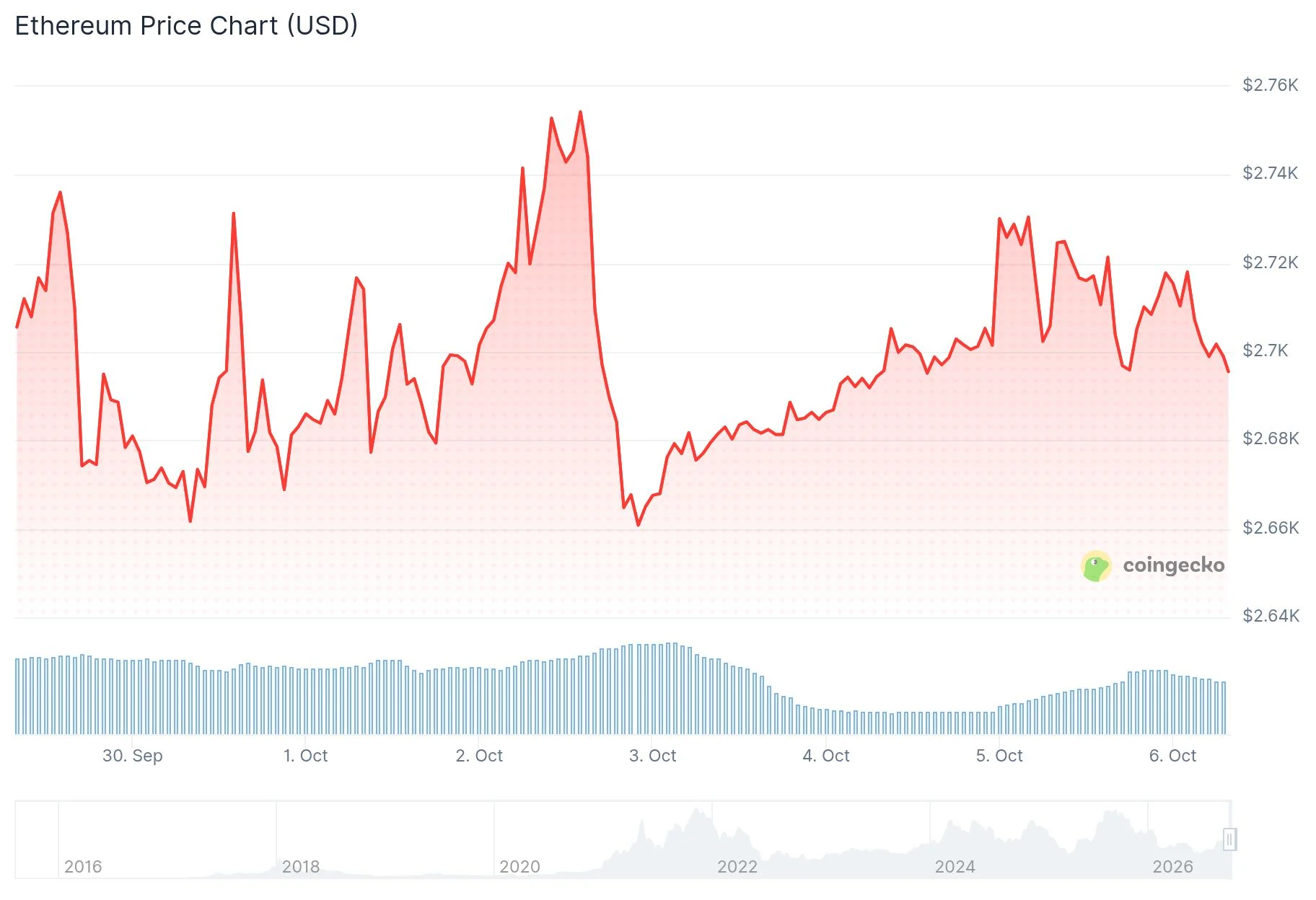
The wider cryptocurrency ecosystem demonstrated resilience with a 0.68% increase during the identical timeframe. Aggregate market valuation for digital assets touched $2.93 trillion.
Bitcoin sustained its position north of $85,000. Meanwhile, XRP remained anchored above the $1.50 level. These movements extended upward trends that originated in the middle of September.
The second-largest cryptocurrency by market capitalization secured a weekly settlement above $2,700 for the first time in nine months. Market observers highlighted this milestone as evidence of strengthening bullish sentiment.
Treasury Company BitMine Expands Ethereum Position
Corporate Ethereum accumulator BitMine executed a purchase of 15,112 ETH tokens during the preceding week. This strategic acquisition elevated the company’s cumulative position to 6,016,414 ETH.
The fresh acquisition carried an approximate valuation of $41 million, calculated at the referenced price point of $2,726 per token. BitMine’s current reserves represent approximately 4.9% of Ethereum’s circulating supply.
Market commentary platform Crypto Banter disseminated the information via social channels. Their analysis noted that Bitmine supplemented its treasury with 15,112 ETH during the seven-day period, representing $41 million in value, elevating aggregate holdings to 6,016,414 ETH or 4.9% of available supply, positioning the entity at 99% completion toward its 5% acquisition goal with combined cryptocurrency, fiat currency and staking positions valued at $17.4 billion.
BitMine’s Chairman Thomas Lee highlighted that ETH delivered superior returns versus the S&P 500 by 6,832 basis points throughout Q3. His observations emphasized this performance occurred amid challenging macro conditions including restrictive Federal Reserve policy, ascending crude oil valuations, and elevated sovereign debt yields worldwide.
Ethereum appreciated more than 70% during the third quarter. This represented its most impressive quarterly performance since Q1 2021.
Beyond Ethereum, BitMine maintains 214 Bitcoin tokens, a $180 million equity position in Beast Industries, plus a $117 million stake in Worldcoin treasury entity Eightco Holdings. Financial disclosures revealed $643 million in liquid assets and tradable securities.
Notwithstanding these accumulation efforts, Ethereum’s trading liquidity has deteriorated. Median order book depth contracted to 35-45% of Bitcoin’s liquidity levels, declining from minimum 60% ratios observed in 2025, per CoinGecko analytics.
Technical Analysts Identify Upside Targets Beyond $3,000
Market technician Ted Pillows drew attention to Ethereum’s most robust weekly candlestick formation in over eight months. His assessment stated that Ethereum recorded its highest weekly closing candle in 8+ months, and projected that a weekly settlement exceeding $2,800 accompanied by substantial spot buying pressure could propel Ethereum toward the $3,400-$3,500 territory.
His technical framework identified support zones near $2,550 and $2,200, with $1,965 serving as a more significant support floor should bearish momentum intensify.
Activity in Ethereum derivatives markets exhibited expansion. Trading turnover advanced 15.17% to $29.02 billion, while aggregate open interest increased 1.14% to $34.10 billion.
Options contract volume surged 33.58% to $1.15 billion. Outstanding options interest expanded 1.62% to $6.25 billion.
However, not all indicators suggested continuation upward. United States-listed spot Ethereum exchange-traded funds registered $138 million in net redemptions across the previous week, extending a four-day streak of capital outflows, based on SoSoValue tracking data.
From a charting perspective, Ethereum has defended support territory near $2,657, bolstered by its 20-day Exponential Moving Average. A breakdown beneath this technical floor could shift attention toward the 50-day EMA alongside $2,432.
Regarding upside potential, breaching $2,790 resistance might establish trajectory toward $2,880 initially, followed by $3,066. Liquidation data shows Ethereum triggered $36.6 million in forced position closures during the past 24 hours, with $20.4 million attributed to bearish wagers.
The post BitMine Expands Ethereum (ETH) Holdings to 6 Million Tokens as Price Holds Above $2,700 appeared first on Blockonomi.
TLDR
- Bitcoin faced resistance near $86,570 following Monday’s US market open.
- The 30-year US Treasury yield climbed to 5.67%, approaching 24-year peak levels.
- Bitget Wallet analyst Lacie Zhang projects BTC may target $90,000–$93,000 if bond yields decline and inflation moderates.
- Probability of an October rate increase dropped to approximately 23% from 64% following weak September employment data.
- Spot Bitcoin ETFs in the United States recorded nearly $2.65 billion in net inflows during September.
Bitcoin maintained levels around $86,000 on Monday following its strongest weekly closing price in eight months. The cryptocurrency encountered difficulty breaking above this threshold as American markets commenced trading.
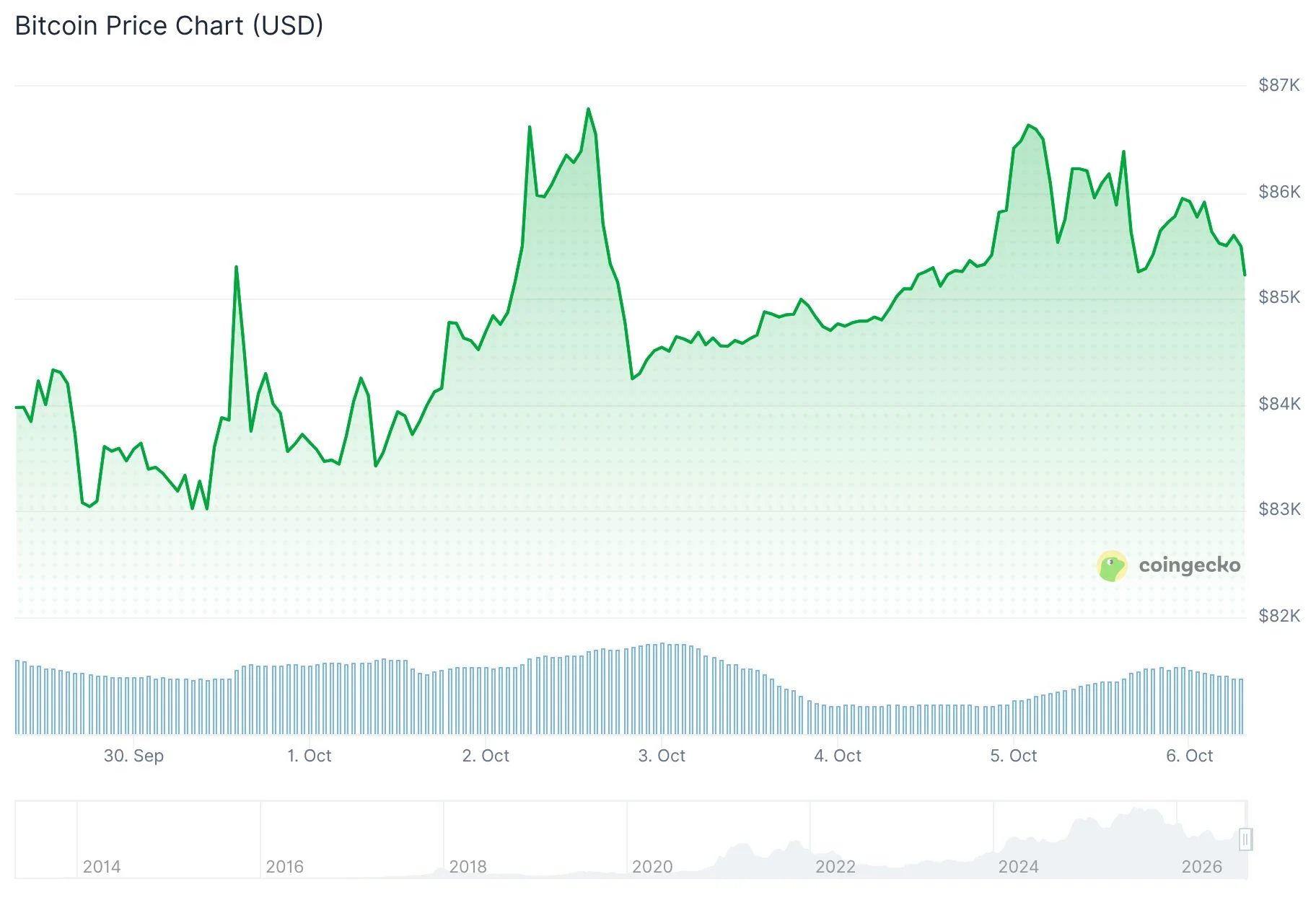
Treasury yields continued their upward trajectory throughout the session. The yield on 30-year bonds advanced to 5.67%, sitting merely two basis points beneath the previous week’s peak not seen in 24 years. Meanwhile, the 10-year note yield moved back to 5.31%.
QCP Capital, a trading firm, observed that bond markets remain volatile despite disappointing employment figures from the United States. The firm cited elevated crude oil prices and sustained long-duration yields as factors preventing risk assets from mounting significant advances.
American equity markets posted gains at Monday’s opening bell. The S&P 500 index advanced 0.5% while the Nasdaq Composite climbed 0.7%, driven by market participants anticipating the Federal Reserve will hold rates steady at its upcoming Oct. 28 policy meeting.
Deutsche Bank’s analytical team indicated that this week’s FOMC meeting minutes, scheduled for release Wednesday, carry greater significance than typical releases given the ongoing bond market volatility. The minutes may reveal how policymakers assess the current monetary tightening trajectory.
Analysts See a Path to $93,000
Lacie Zhang, who leads research at Bitget Wallet, suggested Bitcoin might climb toward $90,000 to $93,000 if Treasury yields retreat and inflation figures continue reflecting labor market weakness. She emphasized that declining rate expectations alone, or ETF capital flows in isolation, are insufficient to validate a sustained breakout.
According to Zhang, buyers must push price above $87,400 on either a daily or weekly closing basis to establish positive momentum. She identified $84,000 and $82,000 as key support zones should downward pressure emerge.
Michaël van de Poppe, recognized on X as @CryptoMichNL, drew parallels between current market conditions and the previous cycle. He suggested Bitcoin may reach $100,000 before entering a consolidation phase, with 2027 potentially delivering fresh record highs.
The likelihood of an October interest rate increase declined to roughly 23%, a substantial drop from the 64% probability recorded a week prior. Zhang attributed this shift to September’s payroll expansion of only 29,000 jobs, significantly below the 90,000 forecast by economists.
The August payroll figure also underwent downward revision to 133,000 from the originally reported 162,000. During this timeframe, the unemployment rate ticked higher from 4.1% to 4.2%.
ETF Inflows Continue But Resistance Holds
Zhang reported that US spot Bitcoin exchange-traded funds attracted approximately $2.65 billion during September, with an additional $134 million flowing in across the first two trading days of October. While she characterized these inflows as constructive, they have proven insufficient to propel Bitcoin beyond current resistance zones.
In a separate observation, Coin Bureau highlighted on X that long-term Bitcoin holders maintained profitability throughout the entire market cycle, citing Glassnode analytics. The account emphasized this represents an unprecedented occurrence across any bear market dating back to at least 2015, noting the holder profit metric is currently ascending once more.
Glassnode’s Weekly Market Pulse report identified declining buyer dominance relative to mid-September levels, when BTC/USD initially recovered to $87,000 for the first time in eight months. The analysis characterized this as reflecting “moderation in aggressive upward momentum” rather than signaling a trend reversal.
Zhang warned that firmer inflation readings, renewed price pressures stemming from oil markets, or hawkish rhetoric from Federal Reserve officials could revive October rate-hike speculation. She noted any of these scenarios might drive Bitcoin back toward the $84,000 level.
The Federal Reserve implemented a 25-basis-point increase to its target range on Sep. 16, bringing it to 3.75%–4.00%, with unanimous support from all 12 voting members. September’s economic projections positioned the median year-end rate at 4.1%, representing an increase from the 3.8% projection issued in June.
The post Bitcoin (BTC) Holds $86K as Treasury Yields Surge Near 24-Year Highs appeared first on Blockonomi.
CryptoPotato
Popular analyst Ali Martinez outlined the altcoins poised for a breakout as early as this week: Ripple’s XRP, Quant (QNT), and Injective (INJ).
His comments came shortly after BTC and most alts were rejected from their Monday peaks and before their correction deepened.
Three Alts Going Wild This Week?
Martinez began with Ripple’s cross-border token, indicating that it appears to “have broken above the descending resistance line of a triangle on the four-hour chart.” He made a similar claim a day prior and outlined the next target at $1.62 as long as it can hold $1.50 as support. However, XRP was stopped at $1.53 yesterday and has since dipped to just under $1.50. A decisive close below that level is likely to invalidate the analyst’s scenario.
Meanwhile, CryptoQuant’s CW reassured the XRP bulls that the positive trend remains intact despite this short-term drop. The analyst noted that the price has already reclaimed the Point of Control and the bullish trend persists even if the sideways movement continues.
Second on Martinez’s list was Quant’s QNT. Following major banking adoption news, the token exploded by 530% at one point within days, going from $59 to $370 before it was stopped and now trades at $255.
Despite its correction, the analyst predicted that an hourly close above $262 would “confirm the breakout” he is watching and put $315 and $344 in focus. Before this retracement, Martinez was even more bullish on the asset, indicating that a surge past $430 could open the door for a major expansion to $2,000.
Lastly, the analyst highlighted INJ, which experienced a few major legs up since mid-August. At the time, the token struggled at $4.00 before the market-wide revival sent it to $6.00. After a correction to $4.60, it surged twice in September and ultimately topped $8.50 for the first time in almost a year.
It has since slipped to $7.50 and has remained relatively stagnant over the past week or so. Martinez noted that as long as it can remain above the neckline of its cup-and-handle formation at $7.33, it could rocket to $13.40.
4/5 Finally, Injective $INJ appears to have broken out of a cup and handle and is now retesting its neckline near $7.33.
If buyers defend that level and momentum picks up, the pattern points toward $13.40. https://t.co/4awNhj1rlb
— Ali Charts (@alicharts) October 5, 2026
Market Update
Led by bitcoin, most alts tried to break out on Sunday evening, only to be rejected on Monday. The subsequent correction deepened in the following hours, with BTC sliding from its local top at $87,000 to $85,000. The altcoins are also slightly in the red now.
The total crypto market cap has declined by about $50 billion since yesterday morning, casting doubt on whether the three altcoins mentioned above can close above Martinez’s targets and head toward a breakout to new local peaks.
The post XRP, QNT, INJ: These 3 Altcoins Are Ready to Break Out This Week (Analyst) appeared first on CryptoPotato.
[PRESS RELEASE – Singapore, Singapore, October 6th, 2026]
Multi-chain stablecoin wallet combines simpler transfers, flexible gas-fee options, security features, and practical use cases with one ambition: to become the world’s easiest stablecoin wallet.
Changer+ today announced the launch of its self-custodial stablecoin wallet, built to make holding, moving and using stablecoins simpler.
Changer+ supports major stablecoins including USDT and USDC across Ethereum, TRON, BNB Chain and Solana, with more networks and stablecoins planned.
To celebrate its launch, Changer+ is offering new users three free transactions per device on each chain – Ethereum, Solana, and BNB Chain from October 6 to November 6, 2026.
Changer+ is built around a simple belief: people should not need to understand every blockchain, gas token, or transaction mechanic just to use the stablecoins they already have.
Stablecoins Should Just Work
Using stablecoins can still mean figuring out which network a token is on, choosing the right transfer route, sourcing a separate gas token, and navigating unfamiliar transaction steps. Changer+ is designed to move more of that complexity into the background.
“People should not have to become blockchain experts just to use stablecoins,” said Leon Gao, CEO of Changer+, with over a decade of experience in product development in the fintech and payment industry
“The technology underneath can stay sophisticated. What users see should feel simple, clear and dependable.”
Simplicity Without Giving Up Control
Making stablecoins easier to use should not mean taking control away from the user.
Changer+ is self-custodial, meaning users retain control of their private keys and authorize their own transactions.
For Yun Han Wong, CGO of Changer+, who has spent years working in Web3, preserving that principle is fundamental to trust.
“Trust is everything in Web3,” Yun Han said. “The early crypto idea of ‘being your own bank’ was really about ownership — having control over your own assets instead of simply handing that control to another intermediary.”
“We want to preserve that ethos while making stablecoins much easier to use. Convenience should not mean giving up control.”
Technology and Security Built around the User
Changer+ is designed to remove common friction from everyday stablecoin use.
On supported transactions, Changer+ lets users cover network-related transaction costs without first having to acquire the blockchain’s native gas token.
For example, a user holding stablecoins does not necessarily need to separately acquire ETH, TRX, BNB, or SOL before completing a supported transaction.
Changer+ has also completed an independent security audit, vulnerability assessment, and penetration testing (VAPT) conducted by Echo Pulse, a CREST-accredited and Singapore-licensed cybersecurity service provider.
These capabilities are led by Zack Chen, CTO of Changer+, an NUS-trained technopreneur with years of software development experience overseeing Changer+’s multi-chain architecture and security development.
“Good engineering should reduce the complexity users have to manage while keeping the experience clear and reliable,” Zack said.
Making Stablecoins More Useful
Changer+ goes beyond holding and transferring stablecoins by giving users more ways to put them to practical use.
Current capabilities include global eSIM data plans, a lifestyle ticket marketplace, and security risk signals that help users identify suspicious activity and potentially unsafe addresses, with more use cases planned.
“Our ambition is not to build another wallet people download and forget,” Leon said. “We want to make the whole stablecoin experience easier — from holding and transferring to actually using them.”
As stablecoins increasingly move beyond crypto trading into payments, remittances and everyday digital commerce, the experience of using them remains fragmented across networks and wallets.
Changer+ was built to close that usability gap.
Backed by a private family office, Changer+ is taking a long-term approach to building the product. Rather than centering the platform around a project token or speculative rewards, the company is focused on usability, self-custody, security, and practical stablecoin utility.
“Stablecoins should just work,” Yun Han added. “Fewer unnecessary crypto steps, more useful things you can do with them, and the user stays in control.”
Changer+ is available on iOS and Android.
Download IOS app:https://apps.apple.com/us/app/changer-stablecoin-wallet/id6744874111
Download Android app:https://play.google.com/store/apps/details?id=plus.changer.app&hl=en
Learn more: www.changer.plus
Join communities: https://linktr.ee/ChangerPlus
Contact: pr@changer.plus
Launch Special
Enjoy three free transactions on each chain – Ethereum, Solana, and BNB Chain from October 6 to November 6, 2026.*
Available only to new users who install the Changer+ app and register during the campaign period. Network fees are covered for three eligible transactions per device. Terms and conditions apply. Changer+ reserves the right to amend or withdraw the offer.
About Changer+
Changer+ is a Singapore-incorporated, self-custodial stablecoin wallet built to make stablecoins easier to use.
With multi-chain stablecoin support across major blockchain networks, including Ethereum, Solana, BNB Chain and TRON, Changer+ brings together simpler transfers, flexible gas-fee options, security risk signals and practical use cases — while users remain in control of their private keys.
Backed by a private family office, Changer+ combines payments experience, Web3 expertise and security-led engineering with one ambition: to become the world’s easiest stablecoin wallet.
The post Changer+ Launches Stablecoin-First Self-Custodial Wallet to Make Stablecoins Easier to Use appeared first on CryptoPotato.
US President Donald Trump doubled down on his promise to distribute a $5,000 “dividend” to every adult US citizen if Republicans retain control of Congress in November.
Popular analyst Crypto Rover outlined his take on the matter and why he believes the enormous liquidity injection, which is far from being certain at this point, could send tens of billions of dollars into BTC and other digital assets.
Billions Into BTC?
Before we dive into Crypto Rover’s statement, we need to start with a disclaimer. Trump’s promise continues to face significant political and economic hurdles, as even some Republicans have spoken out against it. However, he has proven to make unpopular decisions in the past, so we can’t really dismiss this one.
So, Crypto Rover noted that the potential impact on digital assets is being underestimated, even though many other analysts speculated recently that it could lead to major rallies, especially for alts. His thesis is pretty straightforward: households would undoubtedly use much of the money for bills, consumption, and debt, but even a relatively small portion finding its way into investments could represent substantial new demand for crypto.
He estimated that 5%-10% of a $1.7 trillion liquidity injection would amount to somewhere between $85 billion and $170 billion potentially entering the market. However, here’s the catch.
Trump promised the payment to adult US citizens, not every American. New estimates from major news organizations put the program’s likely cost at around $1.2-$1.3 trillion, rather than the initially considered $1.7 trillion.
But even with this lower figure, a hypothetical 5%-10% allocation would represent $60 billion-$130 billion. Rover argued that today’s market is considered better positioned to absorb retail capital than during previous stimulus cycles, pointing to spot ETFs, broader institutional infrastructure, improved access, and a much more developed regulatory framework.
Far From Guaranteed
This part is far too important to explain with just a few sentences in the first paragraph, as there are substantial obstacles before any such liquidity boosts can materialize. As noted above, several Republicans have expressed skepticism about Trump’s proposal, concerned that payments exceeding $1 trillion could worsen the federal deficit and further reignite inflation. According to Reuters, some GOP lawmakers instead want additional government revenue directed toward reducing debt.
Separately, Congress would have to authorize the spending if Republicans win in November. Consequently, Rover’s scenario involved several major assumptions: a GOP victory, congressional approval, actual distribution of the checks, and recipients subsequently allocating even a small portion of that amount to crypto.
The post Trump’s $5,000 Checks Could Send Billions Into Bitcoin and Crypto: But There’s a Catch appeared first on CryptoPotato.
Strive CEO Matt Cole is pitching his company as the likeliest “fastest horse” among Bitcoin treasury firms in the next bull market, and he backed it with seven principles on competition posted on X.
His broader argument, however, is that Strive and Strategy need each other to expand the market for Bitcoin-backed digital credit rather than simply fight for the same investors.
Strive Claims Twice Strategy’s Amplification
“I think Strive has emerged as the leading contender to be the fastest horse in the next bull market,” Cole told Podcaster Robin Seyr. “What will drive the highest total returns will be one, having a high amplification ratio; two, being able to maintain a high amplification ratio; and three, not giving up Bitcoin upside for that amplification ratio.”
Amplification compares a company’s preferred stock and debt with the value of its Bitcoin. Strive’s own tracker puts its ratio at 51.4%, all of it from SATA preferred shares, with no debt, while Strategy’s is roughly 25%, putting Cole’s firm at about twice the amplification of Michael Saylor’s.
According to him, the next bull run could see Bitcoin go anywhere from $400,000 to $500,000 by late 2029, tied to a US debt crisis that pushes long-term yields down and weakens the dollar, and he described that as conservative.
The Strive chief was equally keen to play down any feud with Saylor’s company, pointing to a long article in which Strategy’s co-founder pictured the two firms working together.
SATA trades at between 25% and 50% of STRC’s daily volume, he noted, which some Strategy investors read as lost market share, but he called that “a really bad argument,” considering that had Strategy captured all of SATA’s roughly $1 billion, STRC would be only about 10% bigger. According to Cole, what matters more is whether the pool of digital credit can grow exponentially over the next three and a half years.
Institutions face issuer limits, he added, so large buyers need several issuers. He also claimed each firm has copied the other, citing Strategy’s move to daily dividends and its cash reserve.
“I’m glad that they innovate based on what we do and we innovate based on what they do,” he told Seyr.
On X, Cole wrote that every management team owes its first duty to its own shareholders and that “competing and collaborating are not mutually exclusive.”
Strive Holds 29,462 BTC to Strategy’s 848,000
As CryptoPotato reported earlier, Strive bought 2,000 BTC for $169 million on October 5, the same day Strategy announced 334 BTC for $28.7 million. That leaves Strive with 29,462 BTC and Strategy with 848,000.
ASST was trading near $30 at the time of writing, up about 137% in three months and down about 42% over a year. Meanwhile, SATA is paying a 13% dividend daily, against 12% on Strategy’s STRC.
The post Strive CEO Says ASST Can Outrun Strategy in the Next Bitcoin Bull Market appeared first on CryptoPotato.
OKXICE LLC, a venture formed by cryptocurrency exchange OKX and NYSE parent company ICE, made a filing on October 4 with the US Securities and Exchange Commission (SEC) to launch a tokenized stock trading exchange.
The filing makes OKX one of the first crypto exchanges attempting to offer tokenized US stocks through a regulated exchange under the temporary SEC regulations.
OKXICE Seeks Approval for 63 NYSE Stocks
According to a report by Bloomberg, OKX plans to seek approval to offer tokenized shares of an initial 63 NYSE-listed companies. Under the SEC framework, those companies have 30 days to opt out before trading can begin, meaning the launch still depends on that notice period and other requirements.
OKX’s blockchain infrastructure would be paired with ICE’s market technology. ICE acquired a stake in OKX in March at a $25 billion valuation, and the companies have agreed to work together on US-regulated crypto futures.
The SEC introduced its temporary Innovation Exemption in September, allowing certain tokenized securities venues to facilitate secondary trading of tokenized US stocks through permissioned automated makers and liquidity pools.
Tokenized shares must carry the same shareholder rights as the underlying securities, including dividends and voting rights. Smart contracts must also be auditable and run on public, permissionless blockchains, while trading must stop if the underlying stock is suspended on its primary exchange.
OKX Joins a Growing Tokenized-Stock Race
As CryptoPotato reported, Coinbase announced in June that it planned to offer tokenized stocks to customers outside the US, with shares backed 1:1 by the underlying assets and carrying shareholder rights.
That move came before the SEC’s September exemption and showed how crypto exchanges were already pursuing ways to connect stock trading with blockchain infrastructure.
The SEC’s exemption followed stalled legislative progress around the CLARITY Act. The regulator had reportedly been working on the exemption for more than a year and had planned to release it in May before delaying it during negotiations over the bill.
For OKX, the filing gives a use to the relationship with ICE beyond its March investment. The two companies are now seeking to combine exchange infrastructure and blockchain-based trading under a framework that could let US-listed stocks trade around the clock, subject to the SEC’s conditions.
The post OKX and ICE File to Trade 63 Tokenized NYSE Stocks appeared first on CryptoPotato.