Cryptocurrency Posts
Crypto Briefing
Backpack launched tokenized EWZ on Solana as the Brazil ETF surged following a surprise presidential vote that sent local markets sharply higher.
The post Backpack launches tokenized Brazil ETF amid post-election market rally appeared first on Crypto Briefing.
Post-midterm support for data centers and the CLARITY Act may boost crypto and tech stocks, fostering a favorable risk-on market environment.
The post Midterm gridlock could clear the way for a risk-on rally, Tom Lee says appeared first on Crypto Briefing.
The integration of tokenized equities on BNB Chain democratizes access to US stocks, potentially reshaping retail investment and market dynamics.
The post 1inch lists 77 bStocks tokenized equities and ETFs on BNB Chain appeared first on Crypto Briefing.
The low recession odds suggest optimism in economic resilience, yet highlight potential volatility and the limitations of predictive markets.
The post Kalshi traders set 2027 recession odds at record low of 20% appeared first on Crypto Briefing.
Ethereum's proposal could enhance transaction security, reducing reliance on wallet interfaces and appealing to institutions seeking robust risk controls.
The post Ethereum proposes native transaction assertions to tackle blind signing appeared first on Crypto Briefing.
HTTP error 504 on https://bitcoinmagazine.com/feed/
Failed to fetch feed: https://bitcoinmagazine.com/feed/
Failed to fetch feed.
CryptoSlate
Strategy (formerly MicroStrategy) made its smallest positive Bitcoin purchase of 2026 even as a 43% quarterly rally in the cryptocurrency helped generate a $20.9 billion gain on its digital-asset holdings.
In an Oct. 5 filing with the US Securities and Exchange Commission (SEC), the Michael Saylor-founded company said it bought 334 Bitcoin for $28.7 million between Oct. 1 and Oct. 4 at an average price of $85,838.80, taking its holdings to 848,000 BTC. The acquisition fell below the previous yearly low of 520 BTC bought in June.
The slowdown contrasts with the performance of Strategy’s existing Bitcoin position. Bitcoin gained about 43% during the third quarter, lifting the carrying value of the company’s holdings to $70.82 billion as of Sept. 30.
Strategy estimated a $20.91 billion digital-asset gain for the quarter under fair-value accounting. The gain does not represent realized trading profit, but the rally pushed its Bitcoin value above its roughly $63.97 billion aggregate acquisition cost.
Chaitanya Jain, Strategy’s head of investor relations, said:
“Every $1,000 increase in BTC price [during the third quarter represented] a $848 million fair market value gain to Strategy.”
Yet comparatively little new capital went toward adding to that position during the past week.
Strategy sold 92,894 MSTR shares for $15.7 million to help finance the latest purchase and supplied another $13 million from cash. It acquired 848,000 BTC at an average cost of $75,440.70 each.
At the same time, the company continues to commit considerably more capital to STRC, its variable-rate perpetual preferred stock.
STRC support enters another phase
Strategy spent $176.3 million repurchasing about 1.77 million STRC shares between Sept. 28 and Oct. 4, more than six times what it spent buying Bitcoin during the latest reporting period.
The purchases pushed total spending under its preferred-stock repurchase authorization to roughly $1.45 billion, leaving $547.2 million available under a program that Strategy doubled to $2 billion in September.
Despite that intervention, STRC has yet to return sustainably to its $100 stated amount.
Strategy's own investor materials say its objective is for STRC to trade over time between $99 and $100. The preferred security last closed at $100 in mid-May and has remained below that level for nearly 100 consecutive trading sessions, even after recovering sharply from its summer lows.
The company has already taken several steps to close that gap.
It raised STRC's annual dividend rate to 12%, began systematic repurchases and shifted dividend payments from monthly to semi-monthly earlier this year. Strategy said that June change was intended to improve the product's trading characteristics.
It is now proposing another redesign.
In a definitive proxy filed Monday, Strategy asked MSTR shareholders to approve daily dividends across its four US-listed preferred securities. STRC dividends would accrue on every calendar day, including weekends and holidays, and be payable on the next business day.
The annual dividend rate would not increase solely because of the amendment. Instead, Strategy argues that shortening the gap between earning and receiving dividends could reduce price fluctuations, improve liquidity, and attract additional demand.
For STRC specifically, the company says the proposal is intended to support trading at or near its $100 stated amount. Its September investor presentation reiterated that the company's objective remains for STRC to trade between $99 and $100 over time.
That makes the proposal the latest step in an increasingly expensive effort to establish STRC as a stable funding instrument for Strategy's broader Bitcoin strategy.
Oct. 28 vote tests Strategy’s preferred-stock funding model
The stakes extend beyond whether STRC can close the remaining gap to $100.
Strategy has increasingly relied on preferred securities as another route to raise capital without issuing only common stock or debt.
The company told shareholders that improving liquidity and demand across those securities could make future preferred-equity issuance more efficient, potentially expanding the pool of capital available for Bitcoin purchases.
That puts the Oct. 28 vote directly into Strategy’s Bitcoin-financing strategy.
MSTR shareholders of record as of Sept. 25 will decide whether STRC and Strategy’s three other US-listed preferred securities can move to daily dividend accruals. STRC holders themselves will not vote on the amendment.
If approved, STRC would begin accruing dividends daily on Nov. 1, with the first payment under the revised schedule due Nov. 2.
The proposal arrives after an earlier recovery benchmark passed without STRC returning to par. Strategy had highlighted the roughly 70 trading days the security needed to reach $100 after its original launch, a comparison that pointed to early September during the latest rebound.
STRC has since moved much closer to that level but remained below $100 after nearly 100 consecutive trading sessions.
The vote therefore gives Strategy a near-term test of whether changes to STRC’s market structure can reduce the amount of company capital required to support the security.
Failure to establish STRC sustainably around $100 would leave Strategy with a harder choice: continue using cash for repurchases, tolerate a persistent discount that could make future preferred issuance less attractive, or adjust the product's economics again.
Any of those outcomes would affect how efficiently Strategy can finance the next phase of its Bitcoin accumulation.
The post Strategy buys just 334 Bitcoin as preferred-share buybacks reach $1.45 billion appeared first on CryptoSlate.
Metaplanet sold 10,000 Bitcoin and later bought back 11,000 BTC to strengthen its credit profile and expand beyond accumulation during the third quarter.
The Tokyo-listed company said it converted enough Bitcoin into cash during the third quarter to exceed the outstanding principal of its bonds, borrowings, and other interest-bearing debt. It subsequently rebuilt the position at a higher Bitcoin price, ending Sept. 30 with 44,000 BTC, up a net 1,000 for the quarter.
The transaction forms part of a broader attempt to convince rating agencies and fixed-income investors that Metaplanet's Bitcoin reserves can be monetized when obligations come due.
The company plans to seek a credit rating and use a stronger financing profile to support a new business that borrows through bonds, preferred stock and Bitcoin-backed facilities before investing in higher-yielding assets.
The liquidity demonstration came at a price
Bitcoin rose between Metaplanet's sale and repurchase, leaving the company paying substantially more to rebuild the position it had sold.
According to the preliminary, unaudited figures in its statement, Metaplanet disposed of 10,000 BTC at an average price of ¥12.47 million per coin, generating ¥124.7 billion in proceeds. It later purchased 11,000 BTC at an average price of ¥13.63 million per coin, spending ¥149.9 billion.
The roughly ¥1.16 million difference between the sale and repurchase prices implies an adverse price differential of about ¥11.57 billion on the 10,000 BTC needed to replace the original position. Metaplanet said the higher reacquisition price reflected Bitcoin's rise between the two transactions.
The company said it conducted the transactions separately rather than as a simultaneous exchange. It first sold the Bitcoin, held the proceeds in cash, and only later repurchased the asset, a sequence intended to demonstrate that its reserves could actually be converted into cash rather than merely pointing to Bitcoin's market liquidity.
That distinction is central to Metaplanet's push into credit markets. The company said rating agencies and fixed-income investors can discount Bitcoin's liquidity value if an issuer is unwilling to sell it when required. Metaplanet wants the Q3 transaction to show creditors that its long-term accumulation strategy does not prevent management from monetizing Bitcoin to meet financial obligations.
The sale also produced a US capital-loss carryforward. Metaplanet estimates subsidiaries of its US holding company could recognize a deferred tax asset of about $97 million, potentially available to offset future capital gains. The estimate remains subject to closing procedures and auditor review, and the company said the asset may ultimately be smaller or not recognized at all.
Metaplanet said the tax treatment could offset some or all of the effect of the gap between its sale and repurchase prices and transaction costs if it recognizes the deferred tax asset.
Metaplanet wants to turn cheaper funding into recurring income
The company plans to use any improvement in credit access for more than financing additional Bitcoin purchases.
Its newly announced Net Interest Income Strategy plans to raise capital through instruments including perpetual preferred stock, corporate bonds known as BitBonds and Bitcoin-collateralized credit facilities. Metaplanet would deploy that money into assets carrying yields above its all-in financing costs, retaining the difference as net interest income.
The company expects preferred securities issued by Bitcoin treasury companies and similar issuers to be among its principal investment targets. Those investments will sit inside a strategic allocation that Metaplanet expects to represent about 10% to 15% of total assets, with Bitcoin remaining about 85% to 90%.
That would move Metaplanet closer to a financial intermediary inside the growing Bitcoin treasury market. Rather than relying predominantly on rising Bitcoin holdings and equity issuance, the company wants to raise money at one cost, invest it at a higher yield, and recycle the resulting cash flow into debt service, preferred dividends, and further Bitcoin purchases.
Metaplanet sees Japan as one potential source of that funding advantage. It said yen-denominated financing generally carries lower interest rates than dollar funding, while Metaplanet Securities gives it direct distribution to Japanese investors seeking Bitcoin-linked yield products.
The company also expects its pending investment in Super League Enterprise to expand its access to US capital markets, potentially allowing it to choose between jurisdictions, maturities and financing structures depending on market conditions. The transaction has not yet closed and remains subject to conditions including regulatory procedures and shareholder approval.
Metaplanet's new income strategy keeps Bitcoin risk close
Metaplanet's attempt to diversify its earnings base could still leave much of the balance sheet exposed to the same underlying asset.
The company acknowledges that securities issued by Bitcoin treasury companies may move with Bitcoin, creating correlation between its core reserves and some investments intended to provide recurring income. Metaplanet said credit, issuer concentration, currency and leverage risks will be managed within limits approved by its board.
Its revised capital policy also distinguishes between borrowing used to acquire Bitcoin and leverage used for strategic investments. Bitcoin-related borrowings are generally targeted below about 10% of BTC net asset value, while financing attached to the strategic investment portfolio will be managed separately under an asset-liability framework.
Metaplanet expects the new net interest income strategy to have an immaterial effect on its 2026 consolidated results, leaving the credit-rating effort and future financing terms as the more immediate tests. The company has cautioned that it has no assurance it will receive a rating, what level it would receive, or whether it can issue future bonds and preferred shares on the terms it wants.
The next phase will therefore depend on whether creditors reward Metaplanet for proving it is willing to sell Bitcoin when necessary. A lower cost of capital would give the company room to scale its spread strategy; without it, the economics of borrowing to buy yield-bearing Bitcoin-linked securities become considerably tighter.
The post Metaplanet sold 10,000 Bitcoin in a credit-rating bid, only to buy back 11,000 BTC at a higher price per coin appeared first on CryptoSlate.
Intercontinental Exchange and OKX are preparing an always-open market where tokenized US stocks could keep repricing after Wall Street closes.
On Oct. 4, OKXICE, the companies' 50-50 joint venture, notified the Securities and Exchange Commission (SEC) that it intends to launch a Tokenized Securities Venue under the regulator's new Innovation Exemption. The proposed platform would initially support 63 securities, including Nvidia, Tesla, Apple, Microsoft, JPMorgan, Goldman Sachs, Coinbase and Circle.
The structure would create a parallel trading venue for some of America's most actively traded companies that remains open 24 hours a day, seven days a week. Tokenized shares could continue absorbing information during nights and weekends when their underlying stocks are unavailable on traditional cash markets, potentially providing a reference for where prices may move when regular exchanges reopen.
ICE's involvement gives the experiment added significance. The owner of the New York Stock Exchange is directly participating in infrastructure that tests whether US equity trading can extend onto blockchain rails beyond conventional market hours.
“This is a landmark step toward a truly global, 24/7 Wall Street,” OKXICE co-chair and former New York Gov. Andrew Cuomo said. OKX founder and CEO Star Xu described the filing as a market-structure experiment worth testing at scale, adding that “Wall Street is moving onchain.”
Onchain prices could fill Wall Street's dead hours
The market structure becomes more consequential once traditional exchanges close because OKXICE's smart contracts will not rely on the prevailing NYSE or Nasdaq price to determine where a tokenized stock trades.
Instead, prices will be set by the ratio of assets held in automated market maker liquidity pools. External stock-market data can be used for displays and trading-halt checks, but it will not feed directly into the smart contracts determining executable prices.
If market-moving news involving Nvidia or Tesla emerges on a Saturday, investors could continue trading their tokenized shares against stablecoins. The resulting price would not determine where the underlying stock opens Monday, but a sufficiently liquid market could give traders a continuously updated indication of how investors are responding before conventional equity trading resumes.
Liquidity will determine how useful that signal becomes. Thin pools could produce larger swings or wider deviations from the value investors eventually assign to the underlying shares once traditional markets reopen.
The SEC has already identified that tension. In granting the exemption, the regulator sought public comment on how overnight tokenized-stock trading could affect liquidity, pricing and the opening, reopening and closing processes of conventional exchanges. It also cited potential price dislocations between tokenized and underlying shares as a concern for public companies whose stocks may be tokenized by third parties.
Arbitrage would provide a mechanism for closing those gaps once the traditional market is available. OKXICE's filing says third-party tokenizers must maintain one underlying share for each token outstanding, with minting and redemption channels available to eligible participants. The tokens must also carry equivalent economic and governance rights, including dividends, voting rights and claims on residual assets.
That linkage could turn differences between the onchain and conventional price into opportunities for market makers rather than permanent divergences. Weekend shocks, however, would leave arbitrageurs without an open cash market in which to immediately hedge or acquire the underlying shares.
Uniswap mechanics come to US equities
OKXICE also proposes replacing the traditional exchange order book with decentralized finance infrastructure.
Its permissioned markets will use Uniswap v4 liquidity pools deployed on X Layer, OKX's blockchain network. Tokenized stocks will trade against USDC, USDT, or USDG, placing stablecoins directly on the cash side of transactions involving some of America's largest public companies.
Investors will retain assets in self-custodial wallets, but access will be restricted. Prospective users must pass identity, anti-money-laundering, and sanctions screening before receiving a non-transferable credential that allows their wallet to interact with the venue. The platform will not operate an order book, take custody of customer assets or extend credit.
The structure combines regulated securities ownership with crypto-native market plumbing. Investors would hold fully backed instruments with shareholder rights, while settlement, liquidity, and custody operate through stablecoins, smart contracts, and self-hosted wallets.
Authorized participants would also be able to mint or redeem tokens using underlying shares during traditional trading hours, connecting the AMM pools to the conventional equity market. Once the cash market closes, however, those pools can continue repricing without an executable underlying stock market.
SEC limits how far the experiment can run
The SEC has capped the number of securities and trading volume under its temporary exemption.
Under the SEC exemption, Tier 1 securities are limited to 75 symbols on each venue, while trading in an individual stock cannot exceed 0.25% of its prior month's average daily volume. Tier 2 securities face a 250-symbol limit and a higher 2.5% volume ceiling. A venue that breaches the applicable threshold for a security must halt trading in that token for three months.
Those limits make it unlikely that OKXICE will immediately capture enough volume to rival the NYSE or Nasdaq. They instead give regulators a contained market in which to observe whether continuous onchain trading develops enough liquidity to affect pricing elsewhere.
The exemption runs through Sept. 17, 2031, although the SEC can modify it earlier as regulators assess whether a more permanent framework is warranted.
OKXICE also cannot begin operating immediately. The SEC requires prospective venues to publish notice at least 30 calendar days before opening, making an early-November launch the earliest possible timing after its Oct. 4 notice.
Third-party tokenized stocks face another constraint. Companies must receive at least 30 days' notice before their shares are offered and can object during that window, preventing the venue from listing their tokenized stock under the exemption.
That power has already been used. Cerebras Systems objected to having its shares traded through OKXICE, meaning the venue cannot offer its tokenized stock under the current framework.
The next month will therefore test which proposed listings face issuer objections and whether liquidity providers are prepared to make prices during the hours when Wall Street itself cannot.
The post NYSE owner and OKX plan 24/7 tokenized stock trading using Uniswap appeared first on CryptoSlate.
Coinbase says it can now complete a support-testing cycle of roughly 90 cases in 30–45 minutes, work that previously took one to two weeks of manual setup and execution. The figure, disclosed by its engineers on Sept. 21, gives Coinbase CEO Brian Armstrong’s push for an AI-native company a concrete example of automation reducing repetitive work.
The system, called Autopilot, tests the procedures that support bots follow when handling customer problems. It also retains human approval before procedure changes reach production. The next test for Armstrong’s operating model is whether faster procedure development produces reliable support and accountable actions on customer accounts.
Customers need their account problems resolved correctly and their data accessed only with proper authority. Coinbase’s disclosures describe work to address both needs, while leaving the effect on customers unmeasured. Approving changes, restricting permissions and measuring real results remain operating responsibilities as the company automates more work.
Where the time saving comes from
Armstrong announced an approximately 14% workforce reduction in his May 5 memo, citing both a weak crypto market and AI changing how employees work. He proposed fewer management layers, leaders who also contribute directly, smaller AI-native teams and experiments with one-person teams.
The September engineering account moves that operating argument into a specific support process. Coinbase says its bots look up account state, take bounded actions and escalate problems requiring greater judgment to a person. Autopilot helps maintain the procedures those bots follow.
Its testing service creates isolated test users and mock account states, simulates conversations, records transcripts and tool results, and grades what happened against expected behavior. Agents can help generate tests; a repeatable runner executes them. Coinbase says it shipped a hybrid system combining the service, GitHub Actions release gates and a user interface that engineering and non-engineering teams can use.
That division explains why the time comparison is useful. Repeatedly setting up test accounts, driving conversations and collecting results is work a shared service can perform consistently. Faster validation could make it practical to check procedure changes more often, provided the cases and expected outcomes remain appropriate.
The reported comparison measures the validation cycle, leaving customer response times and staffing savings outside its scope. Connecting that cycle to the workforce reduction would require evidence of which tasks were displaced and the resulting costs.
A shorter testing cycle gives Coinbase more capacity to evaluate changes. Whether that capacity produces better support depends on what the tests cover, what reviewers do with their findings and how the resulting procedures perform after deployment.
Autopilot uses adversarial conversations as well as tests of expected behavior. Coinbase says an AI model scores those conversations, but acknowledges that the judge can be wrong. Scores feed human review and release gates rather than independently deciding that a procedure is ready.
The release boundary separates a proposed procedure from one that a support bot can use with customers. Agents can suggest changes, while a person must approve production writes and enablement.
That is a safeguard against an automated quality loop promoting its own work without review. It also means review remains an operating responsibility as the system accelerates.
The approval scope should be read precisely. Coinbase’s statement concerns changes to the support procedures and their enablement. It does not say a human approves every action a deployed bot takes on an individual customer’s account.
Further automation remains unfinished. Coinbase says discovery, authoring, testing and analysis exist, while orchestration from an identified performance gap to a promoted procedure is still being developed. A fully shared contract for conversation summaries also remains unfinished.
That leaves integration work alongside the automation gain. A system that identifies a weak flow, generates a revision and tests it still needs reliable information passed between those steps and an accountable decision about release.
Permission to act is a separate control
Coinbase’s Aug. 18 internal-operations disclosure addresses another part of customer protection: who can access customer data and who can change it.
The company describes Control Center as a separate shared platform for support, compliance, legal, risk and engineering. Coinbase has not specified its coverage of Autopilot. Within the platform, authorization, audit records, approvals and rate limits sit in front of the underlying services.
Its permission checks consider both the requested action and the particular customer. Missing customer context on a customer-scoped operation means denial. Access is tied to assigned cases, limited to the customers involved and set to expire.
For designated sensitive changes, including refunds, account-state changes and limit overrides, the platform separates proposing a change from executing it. The proposal enters review, the required approvals must arrive, and a separate executor then performs the change. Failures are reserved for human handling.
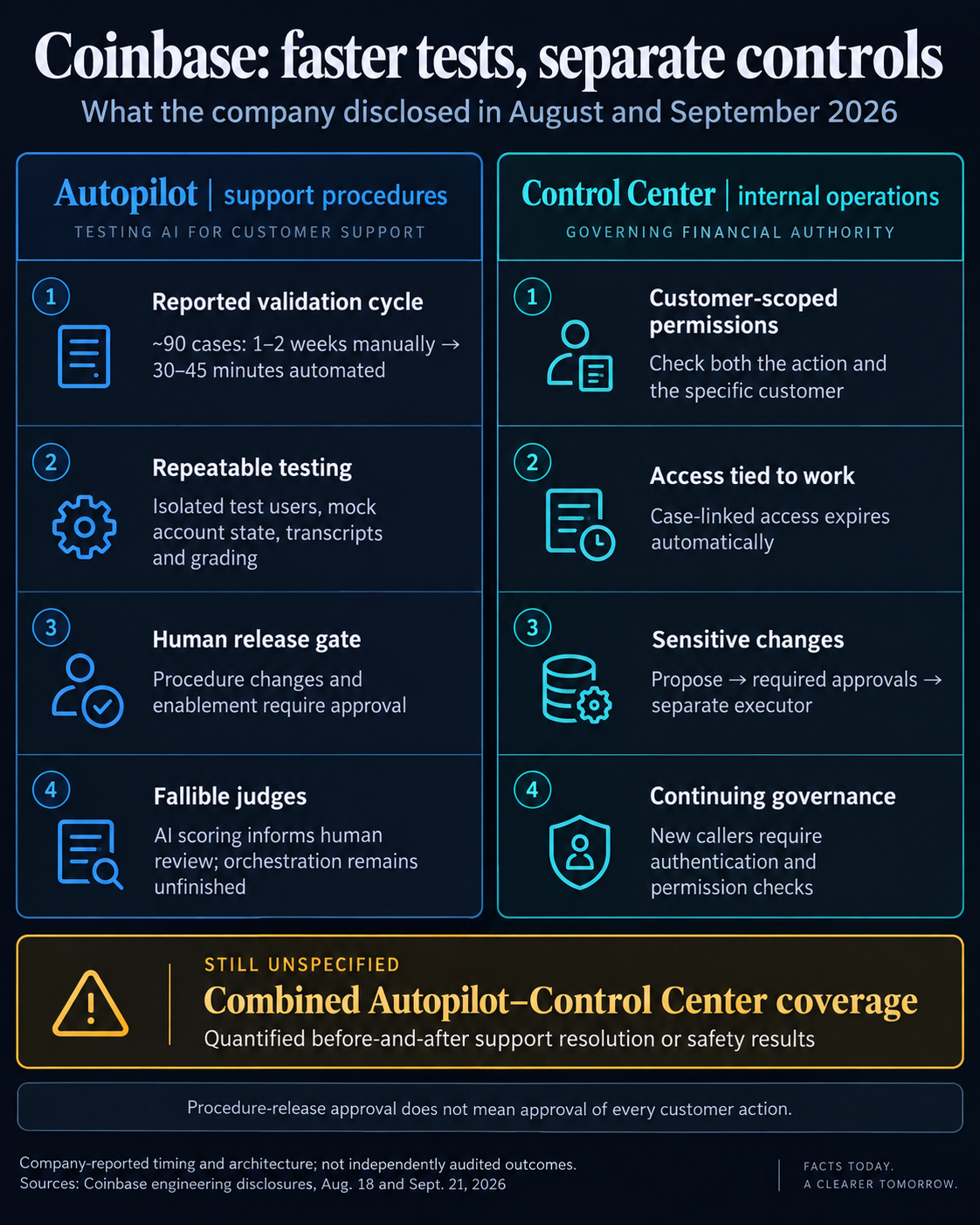
Those controls answer questions that conversational testing cannot answer on its own. A procedure can describe the expected response, while an authorization system determines whether the caller may reach the relevant customer data. Approval rules determine whether a sensitive change can proceed.
Control Center also makes the continuing work explicit. Coinbase says new client types, including automated agents, must be brought under the authorization, audit and rate-limiting rules, with authentication boundaries revalidated as callers change.
Establishing how these controls apply to support automation would require a clearer account of which bots and actions pass through the permission and approval checks. The relevant coverage measure is the set of customer operations governed by those rules.
For the AI-native operating model, the consequence is straightforward: adding automated callers still requires someone to maintain the rules governing their authority. The architecture can make that work more consistent. Its effectiveness still depends on keeping each new caller within the rules.
Case-linked access provides a concrete example: permissions must continue to match the assigned work as cases and callers change. The account boundary needs to hold alongside faster procedure development.
More testing needs an outcome measure
The same need to connect activity to outcomes extends to Coinbase’s separate Continuous Adversarial Testing (CAT) security platform. On Sept. 15, Coinbase reported more than 150,000 scans of its production estate since mid-2026, including over 128,000 pull-request reviews, and more penetration-test findings being fixed. Those reported activities and fixes provide security context.
The distinction between testing and deployed performance is also central to the National Institute of Standards and Technology’s (NIST) July 2024 generative-AI risk profile. The voluntary framework recommends evaluating systems in real-world scenarios because controlled testing may miss problems and discusses measurement gaps between laboratory and deployment conditions. The framework offers a general standard for evaluating these claims.
Autopilot already points toward customer measures. Coinbase says customer-intent labels, resolution and customer-satisfaction signals help identify weak high-volume support flows. That suggests the company recognizes that completing tests and solving customer problems are different measures.
Yet the September disclosure does not publish quantified before-and-after customer-resolution or safety results. The useful next evidence would connect the deployed procedures to those outcomes, alongside the share of relevant support activity covered by the testing and permission systems.
Resolution quality would help show whether automation solves the customer’s problem. Escalation performance would help show whether cases requiring human judgment reach it. Evidence about unauthorized actions and errors would address protection more directly than the time required to run a test suite.
The reported 30–45-minute validation cycle is a concrete example of work being automated. The disclosed approval gates and access restrictions make accountability part of the operating model. Demonstrating the value to customers requires connecting both to results in live support, while carrying the review and governance work that the disclosed systems still require.
The post Coinbase says it cut a 90-case AI support test from 1–2 weeks to 30–45 minutes appeared first on CryptoSlate.
The G7’s emergency diesel plan has created a near-term test of whether cheaper energy can ease pressure on Bitcoin.
Leaders on Oct. 2 agreed to accelerate releases from emergency fuel reserves, including a substantial amount of diesel within 20 days, as governments try to contain shortages and elevated prices that have added to inflation pressures.
The group said the International Energy Agency would make 100 million barrels available over four months, beginning immediately. It did not specify how much of the initial release would be diesel or how supplies would be divided among countries.
For crypto markets, the significance lies less in the barrels themselves than in whether they can push refined-fuel prices low enough to shift inflation and interest-rate expectations. Bitcoin remains sensitive to changes in Treasury yields, the dollar and broader liquidity conditions after the Federal Reserve raised rates last month.
The Sept. 16 increase lifted the Fed’s target range by 25 basis points to 3.75% to 4%, with policymakers again citing elevated inflation. A sustained decline in energy costs could weaken one source of price pressure, though the G7 plan alone gives investors little basis to expect a reversal in monetary policy.
The headline supply figure also requires caution. The latest agreement implements commitments first made in March, when the IEA’s 32 member countries pledged to make 400 million barrels available from emergency reserves following disruption linked to the Middle East conflict.
That means the 100 million barrels scheduled under the October plan cannot simply be added to the March commitment as entirely new supply. The incremental volume remains unclear.
Diesel prices set the next test
US diesel prices were already retreating before the G7 announcement. The Energy Information Administration put the average on-highway price at $6.382 a gallon on Sept. 28, down 14.7 cents from a week earlier.
That decline predates the Oct. 2 agreement, making subsequent readings more useful for assessing whether the coordinated intervention is having an additional effect. Diesel remained $2.628 a gallon above its year-earlier level, leaving fuel costs elevated enough to remain relevant for transportation and goods inflation.
The G7 is also seeking to increase refinery utilization where possible and coordinate maintenance schedules to prevent simultaneous shutdowns. Those measures could prove more important for diesel availability than crude releases if refining capacity remains the binding constraint.
Investors will get the first fresh US price reading on Oct. 6. The IEA has also been asked to report within 20 days on implementation and market impact, including whether further action or eventual stock replenishment is needed.
For Bitcoin, the clearest signal would come if falling fuel prices begin pulling inflation expectations and bond yields lower. Without that transmission, cheaper diesel would remain largely an energy-market development rather than a meaningful liquidity catalyst for crypto.
The next several weeks will therefore give traders two separate checks: whether physical diesel supply reaches the market as promised, and whether any resulting price relief is large enough to alter the rate outlook that has tightened financial conditions since the Fed’s September increase.
The post Bitcoin gets a 20-day window to see whether energy relief can move the Fed appeared first on CryptoSlate.
CryptoTicker.io
At 11:37:12 UTC on October 17, 2026, the lock-up on 618,333,333 DBR ends at deBridge. That is roughly 10.4 percent of the amount in circulation today and, at the price on October 5, a value of about $11.9 million. The figure a holder can really read the size from, though, is a different one: the tranche equals around ten and a half days of total worldwide DBR trading turnover.
This piece works through the date, shows the six pots the tranche comes from, and explains why different data services quote very different percentages for exactly the same event. On top of that comes what matters in practice for investors in Germany: where DBR can be traded in euros and how the tax office treats a sale. Nobody here claims a price direction.
What exactly happens at deBridge on October 17, 2026
A token unlock is the end of a contractually fixed lock-up period. Tokens that have existed since the project launched but could not be transferred until now become movable at a fixed point in time. No new tokens are created, and nobody has to sell them. Only one thing changes: from that moment they can be moved.
At deBridge that point falls on a Saturday, October 17, 2026, with the minute stamp 11:37:12 UTC. The odd time is neither a coincidence nor a typo, because the minute stamp derives from the moment of the original token launch on October 17, 2024, and every quarterly tranche has shifted by a few hours since.
This tranche is the eighth in a series. The mechanism behind it is set out in deBridge's project documentation and summed up there in one sentence: the remainder of an allocation is subject to a "3 year quarterly vesting, starting 6 months after TGE". TGE stands for Token Generation Event, the day a token first exists and becomes tradable.
The project document names the mechanism and the amounts, but no date for the individual tranche. The day and the time come from the public release schedule attached to the contract. The two can be checked against each other, and that is exactly why this date can count as established: the amounts of the first two releases match the percentages from the project documentation precisely.
What deBridge does and what role the DBR token plays in it
deBridge is a protocol for transfers between different blockchains. Anyone wanting to move value from one chain to another needs a bridge, because blockchains do not talk to each other on their own. deBridge runs a network for that, taking orders on one chain and executing them on the other.
The DBR token itself lives as what is called an SPL token on Solana. SPL is that chain's token standard, comparable to ERC-20 on Ethereum. Anyone holding DBR therefore needs a wallet that can hold Solana tokens.
What function the token has is described in the project documentation above all through the governance of the protocol: it is about "handing power over to the community through a thriving governance system". DBR is therefore first and foremost a governance token, that is, a voting right. One of the six allocations, the validators' one, also comes with a condition attached: the tokens are released quarterly as long as the operators continue to show reliable performance. Whether that condition was checked for an individual tranche is not apparent from the release schedule.
Six pots, one tranche: where the 618 million DBR come from
The 618,333,333 DBR are not a single position but the sum of six separate allocations that fall due at the same moment. This is how the tranche breaks down:
- Ecosystem: 191,666,667 DBR
- Core Contributors: 133,333,333 DBR
- Strategic Partners: 113,333,333 DBR
- Community & Launch: 83,333,333 DBR
- deBridge Foundation: 83,333,333 DBR
- Validators: 13,333,333 DBR
These six pots correspond to the split of the total supply of ten billion DBR as the project documents it: Ecosystem 26 percent, Community & Launch 20 percent, Core Contributors 20 percent, Strategic Partners 17 percent, deBridge Foundation 15 percent and Validators 2 percent.
For placing the event, a summary is more useful than the individual lines. Three of the pots belong to the project and its orbit: Ecosystem, Community & Launch and the foundation. Together those come to 358,333,333 DBR, or 58 percent of the tranche. The remaining 259,999,999 DBR, or 42 percent, go to Core Contributors, Strategic Partners and Validators, that is, to the team, to early backers and to the operators of the infrastructure.
The difference is not a detail. Tokens in a foundation or ecosystem treasury are typically spent over months on incentive programmes, liquidity or partnerships. Tokens in the hands of team members and early backers, by contrast, can land on an exchange at any time and in one piece. Anyone assessing the tranche should look at the two halves separately.

Why the same date carries three percentages at three data services
Anyone looking up October 17 finds figures that lie far apart depending on the source: a good ten percent of the circulating supply in one place, around seventeen percent elsewhere, and the dollar value swings by several million too. All of these figures can be arithmetically correct. The reason lies in two quantities that no two data services set the same way.
First: which circulating supply sits in the denominator
The percentage of a tranche is nothing more than the tranche divided by the circulating supply. Only the circulating supply is not an objective number. Some services count every unlocked token, others deduct holdings that demonstrably sit in project and foundation addresses and do not move. For DBR the reported circulating supply on October 5 is around 5.93 billion tokens out of ten billion in total. With that denominator, 618 million is exactly 10.43 percent. If a service instead uses 3.6 billion because it strips out project holdings, the identical tranche suddenly reads around 17 percent.
Second: at which price the calculation is made
The dollar value of a tranche is a snapshot. DBR traded at about $0.0193 on the morning of October 5 and about $0.0192 at midday. That movement alone shifts the value of the tranche by roughly $100,000. A figure such as "$11.9 million" is therefore not a property of the unlock but a property of the moment someone looked.
In practice that means a percentage without a stated denominator is worthless, and so is a dollar value without a price level. How to recalculate both yourself in a few minutes is set out step by step in our method article token unlock math.
The metric for holders: tranche against daily turnover
Percent of the circulating supply sounds precise and still says little about whether a market can absorb an amount. There is a more robust measure for that, and it needs only two numbers: the value of the tranche and the daily trading turnover.
For DBR the calculation on October 5 looks like this. Worldwide turnover across all trading venues came to about $1.13 million in twenty-four hours. The tranche was worth around $11.9 million at the same moment. Divided, that gives roughly ten and a half trading days: that is how long all worldwide DBR trading would have to run to move a volume the size of the tranche.
This metric swings with turnover, and markedly so. Early on the morning of the same day, daily turnover still stood at around $1.01 million; the same tranche then came to just under twelve trading days. Realistically the value therefore moves in a range of about ten to twelve trading days. Anyone recalculating on the day before the date gets a different number again, and that is not a flaw in the method but its point.
For comparison: with large tokens and high turnover, a quarterly tranche often equals only a fraction of a single trading day. A value in the double-digit day range means that even a small part of the released amount would be visible on the market. We last ran the same calculation for the releases at CARV and RAIN, both in October.
Unlocked does not mean in circulation: where the tokens go after the cut-off
A common misunderstanding is that unlocked tokens automatically reach the market. In fact they first move only into the control of those they are allocated to. What happens after that is for each recipient to decide.
With DBR that can be read off the overall arithmetic. Adding up all releases since October 2024 produces considerably more tokens than are reported as the circulating supply. The difference sits in addresses assigned to the project and the foundation, from which nothing has flowed to trading venues so far. In pure arithmetic the reported circulating supply rises after October 17 to about 6.55 billion DBR, so to around 65 percent of the total supply, assuming the data services book the full tranche immediately.
For your own assessment that means: after the date, watch the movements rather than the calendar. Public blockchain data shows whether tokens move from vesting addresses to exchange addresses. Only that step is the signal that counts. A blockchain explorer or an analytics tool that watches vesting addresses is enough for it.
October 17 is not a one-off date, the series runs to January 2028
Anyone treating the date as a one-off event measures too short. Under the quarterly schedule, four further tranches of identical size follow, 618,333,333 DBR each:
- January 16, 2027
- April 18, 2027
- July 18, 2027
- October 17, 2027
The series closes on January 17, 2028 with a smaller remaining tranche of 260,000,000 DBR. That remaining tranche comes out smaller because the three pots assigned to the project will have run out entirely by then; only Core Contributors, Strategic Partners and Validators are left.
From that follows a sober perspective. Over the coming fifteen months, around 2.7 billion DBR come out of lock-up in arithmetic terms, on top of the October tranche. Anyone planning an entry or an exit is planning against a known calendar and not against a surprise. That is precisely what separates a vesting schedule from a news event.

Where DBR can be traded in euros and what a MiCA authorisation means for that
DBR is listed on around two dozen trading venues. The large majority of them quote exclusively against the dollar stablecoin USDT. A direct euro pair is distinctly rarer and found only at individual providers; alongside those there are dollar pairs and, on Solana itself, decentralised trading venues.
For investors in Germany that has two practical consequences. First, without a euro pair every purchase and every sale brings an additional exchange step that costs fees and spread. Second, swapping one cryptocurrency for another is a separate transaction for tax purposes and not merely a technical way station.
Since the European MiCA regulation, providers that actively address customers in the EU need authorisation as a crypto-asset service provider from a member state. Whether a particular trading venue holds that authorisation can be looked up in the public register of the European securities regulator ESMA; what counts there is the company you actually enter the contract with, and that is named in the terms of use. Which providers carry a European authorisation, what trading costs there and which deposit routes are open is in the comparison of crypto exchanges.
One point that becomes concrete on October 17: the date falls on a Saturday. Crypto trading runs around the clock, but many providers' customer service does not. Anyone wanting to trade that weekend should have sorted out verification, two-factor protection and withdrawal limits beforehand, not during the event.
Tax on DBR gains: the holding period under Section 23 of the Income Tax Act and the €1,000 exemption limit
First the reassurance: a token unlock in itself triggers no tax for a private holder who does nothing. What becomes relevant for tax is a disposal, that is, a sale for euros or a swap into another cryptocurrency.
The framework for that is in Section 23 of the Income Tax Act, under private disposals. Three points decide the outcome.
The one-year period
If more than twelve months lie between acquisition and sale, the gain stays tax-free in private assets. Within the period it is charged at the personal income tax rate, not at the flat withholding rate. For calculating the period, the day the particular tokens were acquired counts, not the day of an unlock.
The exemption limit
If the total gain from all private disposals in a calendar year stays below €1,000, no tax arises. That is an exemption limit and not a tax-free allowance: if it is exceeded by even one euro, the entire gain becomes taxable.
The order of sales
Anyone who bought DBR at different times needs a traceable allocation of which tokens were sold. The usual method, and one the tax administration accepts, is "first in, first out": the tokens bought first count as the ones sold first, and that applies per wallet. Anyone using several wallets and exchange accounts needs clean records across all of them.
This account is no substitute for tax advice. With larger sums, with staking income or with tokens from an airdrop, a trip to a professional is worth it.
Is the date already in the price?
There is no provable answer to that question, but there are two comprehensible readings, and both deserve their place.
The first reading: the calendar has been public for two years, the quarterly rhythm is known, and professional market participants know it. What everyone knows tends to be worked into prices already. Seven tranches of the same size have already fallen without a recurring pattern becoming readable in the price.
The second reading: the market's capacity to absorb is limited. With daily turnover around a million dollars, even a small sold share of the tranche is enough to become visible. And the 42 percent that go to the team, partners and validators are subject to no spending mandate.
None of that is established, and anyone naming you a price target for October 17 has invented it. What can be established is the amount, the time, the split and the ratio to turnover. A decision of your own needs no more than that, and less is not enough.
deBridge release: your next three steps
- Recalculate the tranche on the day before the date. Divide the value of the 618,333,333 DBR by the daily turnover at that point. If the result is well below ten trading days, the market has gained depth; if it is above, the opposite has happened. You can read the daily turnover at any trading venue or in a tool from the comparison of analytics platforms.
- Sort out before the weekend where you could trade at all. Account status, two-factor protection and a possible euro pair belong sorted beforehand, not on Saturday morning. Which trading venues carry a European authorisation and what they cost is in the comparison of regulated crypto exchanges.
- Know your own holding period before a sale is even up for discussion. A sale within twelve months of the purchase is taxable, beyond that it is not. Anyone unsure of the purchase date will find it in the trading venue's transaction overview or can have it read out by a tax tool.
(As of October 5, 2026. This article is not investment advice. Prices and fee structures change; check the terms with the provider before you buy.)
Cardano rose 10.61 percent on October 5, 2026 and trades at $0.27121. That is the highest level in three months and the only daily gain above five percent among the 25 largest cryptocurrencies. Bitcoin managed 0.83 percent on the same day, ether 0.43 percent.
The trade press names a golden cross as the reason: the 50-day line is said to have crossed the 200-day line for the first time in 14 months. We recalculated it, and two points stand out that the reports leave out. First, the crossing did not happen today but on October 1. Second, Cardano last produced this signal on August 13, 2025, and anyone who bought in afterwards was 42.4 percent down 83 days later.
This article places both in context: what the price actually did today, what a golden cross says and what it does not, and which level decides whether the signal holds. On top of that comes what an investor in Germany can check on the buying route, the holding period and leverage.
The basis for our own figures is 721 daily candles for the ADA against US dollar pair on the Kraken trading platform, from October 15, 2024 to October 5, 2026, together with market data from CoinGecko on the 25 largest cryptocurrencies. cryptoticker.io compiled this analysis itself on October 5, 2026.
Three-month high at $0.2749: what ADA did on October 5
The daily range ran from $0.244191 to $0.274928. The high comes out marginally differently depending on the venue; on the Kraken platform the daily candle stood at $0.275337. In both cases it is the highest point ADA has reached in the past 90 days, which establishes the three-month high. It is not a six-month high: on May 10, 2026, Cardano stood at $0.2885, roughly five percent above today's daily high.
Turnover carries the jump. Within 24 hours, ADA worth $1.12 billion changed hands. Against a market value of $10.19 billion and 37.54 billion units in circulation, that equals a turnover of eleven percent of market capitalisation in a single day. Cardano therefore sits at rank 15 among the largest cryptocurrencies.
Measured over the year, the picture nevertheless stays unfriendly. On January 1, 2026, ADA cost $0.3560. Today that has become $0.2715, a loss of 23.7 percent. The high for the year is $0.4215 from January 13, the low for the year $0.1435 from June 25. From the low the price has almost doubled; from the high it is 35.6 percent away.
Anyone wanting to place the move needs both figures. A three-month high sounds like a breakout, a yearly loss of 23.7 percent like a recovery inside a downtrend. Both are true at once.
Golden cross on ADA: the 50-day line crossed the 200-day line on October 1
By our calculation, the 50-day line stood at $0.2150 on October 1, 2026 and the 200-day line at $0.2136. On that day the shorter line cut through the longer one from below. The closing price at the time was $0.2462.
Since then the gap has widened. On October 5 the 50-day line stands at $0.2211 and the 200-day line at $0.2131. The shorter one is therefore 3.75 percent above the longer one. Between the crossing day and today ADA has added 10.3 percent, spread over four trading days, of which today carries the largest share.
This is the point where the account in the reports and the finding part company. Anyone reading on October 5 that the golden cross triggered the rally is told a sequence the data does not support. The signal was already in place when the price still stood at $0.2462. What happened today is a ten percent daily jump on a four-day-old signal.
The gap to the previous golden cross is 414 days, or 13.6 months. The figure of 14 months in the coverage is therefore within range; the crossing day itself was August 13, 2025.

The last golden cross, on August 13, 2025, ended 42.4 percent lower
On August 13, 2025, ADA closed at $0.9041, the 50-day line stood at $0.7216 and the 200-day line at $0.7203. Four days later, on August 17, the price ran up to $0.9614. That was the high of that episode.
After that the move turned over. Measured from the crossing day, ADA traded 2.6 percent lower after a week, 6.0 percent lower after two weeks, 1.5 percent higher after a month and 22.4 percent lower after two months. On November 4, 2025, the 50-day line cut back below the 200-day line, the so-called death cross. The price stood at $0.5207 that day, 42.4 percent below the level at the golden cross.
Eighty-three days lay between the two crossings. Within that window ADA moved between $0.9614 and $0.5207. Anyone who took the signal as an entry marker had four good days and then nearly three months of losses.
What a single precedent tells you
One case is not a statistic. Our data series reaches back two years and therefore contains exactly two golden crosses. No hit rate can be derived from that, and anyone claiming the signal never works on Cardano goes beyond the data. All that is established is this: the last time this signal appeared on ADA, it did not hold. That precedent is absent from today's reports, even though it concerns the same data series.
What a golden cross is and why it lags the price
A golden cross is the moment when the average of the last 50 closing prices rises above the average of the last 200 closing prices. There is nothing more behind it. It is an arithmetic operation on past prices, not information about supply, demand or project progress.
From that follows the most important property: the signal lags the price. By the time the 50-day average reacts, the price must long since have made the move. On ADA the price had already recovered 71.6 percent between the yearly low of June 25 and the crossing day of October 1. The cross confirmed that recovery; it did not announce it.
The counterpart, the death cross, works the same way and with the same delay. Neither line says anything about whether a move continues; they only condense what has been.
For placing the signal, that means a golden cross is a descriptive tool. It marks that the medium-term average has pushed above the long-term one. Whether that becomes a trend is decided by buyers and sellers in the weeks that follow, not by the lines.
$0.2131: the 200-day line as the boundary for the signal
Anyone wanting to watch the golden cross needs no forecast, just two figures from their own calculation. The 200-day line sits at $0.2131, the 50-day line at $0.2211. As long as the shorter one stays above the longer one, the signal stands. If it falls below, the signal is done.
The buffer between the two lines is 3.75 percent today. Because averages are slow-moving, that does not take a one-day slump but a run of weak closing prices. In the 2025 case, exactly that took 83 days.
On the upside the trade press names $0.28 and $0.30 as the next hurdles. The Crypto Times cited those two levels on October 5, 2026, along with the account that the golden cross is driving the rally. They are assessments by market observers, not measured quantities. Our own series produces a third, harder number: $0.2885 from May 10, 2026. Only above that would it be more than a three-month high.
On the downside, today's daily low of $0.244191 marks the range the move came out of. Below it, the next established level is the closing price from the crossing day, $0.2462, and only then the area around the two average lines.

ADA in euros at 0.2424: the euro figure sits below the dollar figure
Anyone buying in Germany pays in euros and settles the gain in euros. Today ADA costs €0.242448, after a daily range of €0.216985 to €0.245999. Euro trading turned over 26.75 million ADA.
The difference is not a rounding error. A dollar price of 0.27121 and a euro price of 0.242448 produce a ratio of roughly $1.12 per euro. If the exchange rate moves, your result shifts without ADA having risen or fallen by a cent. On a ten percent move in a day that barely registers; over a holding year it can amount to several percentage points.
For the tax office only the euro figure counts anyway. Anyone noting purchases in dollars has to convert them for the tax return at the rate on the purchase day and the sale day. Anyone buying directly in euros is spared that step.
Buying through a MiCA-authorised exchange: spread, order fee and custody
Since January 1, 2026, only providers authorised under the EU regulation MiCA may supply crypto-asset services in Germany, and BaFin supervises them. The first check before a purchase is therefore always the same: does the provider hold that permission. A look at the comparison of crypto exchanges shows which platforms carry it and what they cost.
On price, two items matter that often get confused. The order fee is in the fee schedule and easy to find. The spread, the gap between the buy and sell price, usually is not, and on smaller assets like ADA it is regularly the larger item. A spread is the distance between the price at which you can buy immediately and the price at which you could sell at the same moment.
At a price of $0.27, spreads quickly reach a range that eats up several days of price movement. That is checkable before buying: put the buy and sell price side by side and divide the difference by the buy price. The result is the spread in percent.
On custody there are two routes. If the ADA stays on the exchange, you carry that provider's risk. If they go into your own wallet, you carry the risk of your own key custody. ADA can still be delegated in either case; staking does not depend on the coins sitting on an exchange.
Twelve-month holding period: buying in today sets the tax clock to October 5, 2027
In Germany, gains from selling crypto assets are free of income tax after a holding period of more than twelve months. If you sell sooner, the gain counts as a private disposal under Section 23 of the Income Tax Act and is charged at your personal tax rate, to the extent that all such gains in the year together exceed the exemption limit of €1,000.
For an entry that reacts to a price signal, that is the most awkward figure in the whole article. A golden cross is a medium-term signal; the window the trade press talks about is weeks. The holding period spans twelve months. Anyone buying today and selling when $0.30 is reached pays tax on the gain, because October 5, 2027 has not yet arrived.
Anyone already holding ADA has the reverse question: from when is which part of the position free. That hangs on the individual purchase dates and not on the average price the exchange app displays. Anyone who has bought in over months therefore keeps a separate date for each tranche.
Since January 1, 2026, the reporting obligation under DAC8 also applies. Providers report their clients' transactions to the tax administration; the first report, for the year 2026, is due by July 31, 2027. That changes nothing about the tax rules themselves, but a great deal about visibility.
Leverage on ADA: liquidation price, funding rate and the missing holding period
A daily jump of 10.61 percent attracts leveraged positions. Three figures decide the outcome there, and none of them is the price.
The liquidation price is the price at which the exchange force-closes your position because the collateral is used up. At five times leverage it sits roughly 20 percent below the entry, at ten times roughly ten percent. ADA ran through a daily range of $0.244191 to $0.274928 today, so 12.6 percent between low and high. A ten-times leveraged position would not necessarily have survived that day, depending on when it was opened.
The funding rate is the running payment between buyers and sellers of a perpetual futures contract. If a price rises quickly, it becomes expensive for the buy side, because more money pushes onto the rising side. Over several days that costs return, even when the direction is right. Which platforms carry which rates is in the comparison of perp DEXes.
The third point is a tax one. A gain from a leveraged product is not a private disposal subject to a twelve-month holding period; it is recorded differently. The tax exemption after a year that applies to held ADA does not bite there. Anyone mixing the two needs two sets of calculations.
Bitcoin carried twelve of these signals since 2014: what our measurement found there
Cardano supplies two data points; Bitcoin supplies more. Two weeks ago we ran the same calculation across the entire Bitcoin history and found twelve golden crosses since 2014. The analysis is in the article on the Bitcoin golden cross.
The comparison has a limit that has to be stated. Bitcoin is more liquid, older and held by different groups of buyers. A hit rate from there cannot be transferred to ADA. What can be transferred is the method: note the crossing day, record the price on that day, and only look weeks later at what came of it.
That is exactly what is not yet possible with Cardano today. The cross is four days old. Any statement about its outcome would be guesswork, and guesses about quantities do not belong in an article built on figures.
Golden cross on Cardano: your next three steps
- Check the permission before you trade. Buy ADA through a platform with MiCA authorisation and put the spread and the order fee side by side beforehand. Which providers carry the permission is shown in the overview of regulated crypto exchanges.
- Note the two lines, not the headline. $0.2211 for the 50-day line, $0.2131 for the 200-day line. If the shorter one falls below the longer one, the signal is done, regardless of what is written about price targets.
- Record the purchase date. Every additional purchase starts its own twelve-month period. Anyone not writing that down miscalculates later; a tool from the comparison of tax and portfolio tools takes it over.
(As of October 5, 2026. This article is not investment advice. Prices and fee structures change; check the terms with the provider before you buy.)
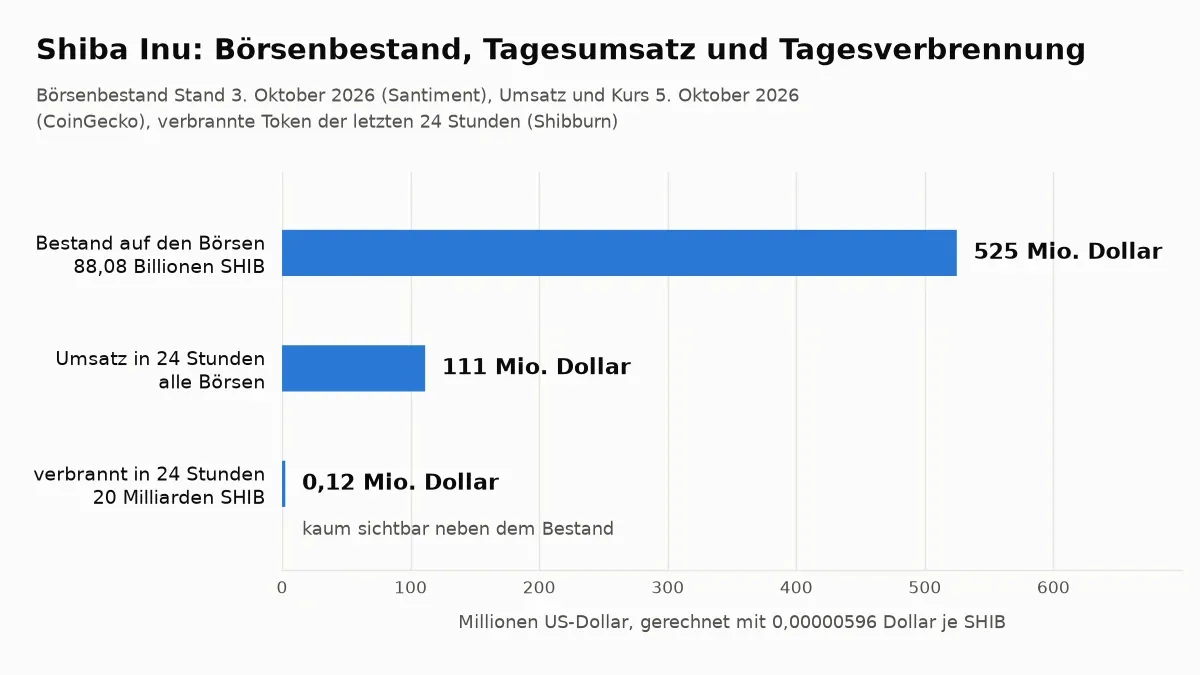
Shiba Inu trades at $0.00000596 at midday on Monday, or €0.00000531. That is 4.4 percent more than 24 hours earlier, and on the day it is the strongest reading among the six largest names on the market. The more important figure, though, is not the one in the price window: according to data from the analytics firm Santiment, 88.08 trillion SHIB sit on trading venues, counted as of October 3. At the current price that is roughly $525 million that could be sold at any moment. Total trading turnover for a full day comes to $111 million.
This article sets the three figures that regularly get mixed up around Shiba Inu against one another: the balance held on exchanges, the daily turnover and the volume of tokens burned. After that it turns to what an investor in Germany can actually do with it, from custody through the holding period to the question of which provider is even allowed to sell SHIB.
Shiba Inu price on October 5: $0.00000596 and €0.00000531
Over the past 24 hours the price moved between $0.00000568 and $0.00000602. That is a 6.0 percent span between the daily low and the daily high; the figures come from CoinGecko as of midday on October 5, 2026. One million SHIB therefore costs €5.31.
Over longer windows the picture looks calmer than the day suggests. On a seven-day view there is a gain of 5.0 percent, over 30 days 10.2 percent, over 60 days 26.1 percent. Measured over a year, by contrast, there is a loss of 53.3 percent. From the record set in October 2021, then $0.00008616, the price is 93.1 percent away. Getting back there would require the price to multiply fourteenfold.
Why the daily gain says little about SHIB's direction
Turnover of $111 million equals 3.2 percent of market capitalisation. For an asset quoted that far down in the decimals, comparatively small buy orders are enough to move a percentage figure that looks impressive on screen. Four percent on $0.00000571 works out at $0.00000025. Anyone wanting to place the move therefore looks not at the percentage but at the volume that carried it.
88.08 trillion SHIB on exchanges: $525 million hanging over the market
Santiment counts the balances held on the trading venues it tracks. On October 3 the figure was 88,076,900,000,000 SHIB. Measured against the circulating supply of 589.24 trillion tokens, that is 14.95 percent. The last time this reading stood at that level was in early June.
The number matters for a simple reason: tokens on an exchange are ready to be sold. Tokens in a self-custody wallet are only ready after a transfer that costs time and network fees. The balance on trading venues is therefore an upper bound on how much supply can reach the market at short notice, and at $525 million it is 4.7 times what changes hands in an entire day.
No forecast follows from this. What follows is an order of magnitude: if even one fifth of that balance came to market within a day, it would match the whole of the current daily turnover. Anyone working in SHIB with larger sums should therefore pick a trading venue not on fees alone, but on the depth of its order book.
20 billion tokens burned a day: 4,404 days until the exchange balance would be gone
Burning tokens is the best-known argument among Shiba Inu's followers. Burning means that tokens are sent to an address nobody holds the key to, and are therefore permanently out of circulation. On Shibarium, the project's second layer, that runs automatically through ShibTorch, which swaps the base fees paid in BONE into SHIB and burns them.
Shibburn keeps the counter. For October 3 the dashboard shows around 20 billion SHIB burned within 24 hours, after the burn rate rose by more than 17,000 percent against a quiet previous day. The percentage sounds enormous; the absolute figure puts it in perspective. Twenty billion tokens are 0.0034 percent of the circulating supply and worth roughly $119,200 at the current price.
The arithmetic that follows is something anyone can work through. If 20 billion SHIB were burned every day, it would take 4,404 days before today's exchange balance of 88.08 trillion tokens alone had disappeared. That is a good twelve years. For the full circulating supply of 589.24 trillion tokens it would come to more than 80 years. Burns do tighten supply, but on a scale that carries no weight next to daily trading.
What the burn rate does show
The counter is useful as a measure of activity. Because ShibTorch is fed from transaction fees, the amount burned rises when more happens on Shibarium. A jump in the burn rate is therefore first a statement about network usage and only secondarily one about supply. Reading the figure as a price driver confuses the two.
Rank 34 and $3.51 billion market capitalisation: where Shiba Inu stands in the field
Shiba Inu's market capitalisation stands at $3.51 billion, or €3.13 billion, which is rank 34 in the overall market. For comparison, the daily moves on October 5: SHIB is up 4.4 percent, Dogecoin up 2.3 percent, Bitcoin up 0.7 percent, XRP up 0.5 percent, Ethereum up 0.3 percent and Solana down 0.9 percent.
That the smallest of the six shows the largest daily swing is neither coincidence nor strength. It is the usual consequence of thinner market depth. The same property works in both directions, as the yearly comparison of minus 53.3 percent makes plain.
ERC-20 instead of its own chain: where your SHIB actually sits
SHIB is not a standalone network but an ERC-20 token on Ethereum. An ERC-20 token is an entry in a contract on someone else's chain, not a balance in a blockchain of its own. In practice that means anyone withdrawing SHIB from an exchange pays the network fee in ether, not in SHIB, and therefore always needs a small amount of ETH in the same wallet to be able to move the tokens again later.
For custody the same logic applies as for any other Ethereum token. A hardware wallet does not store the tokens themselves but the private key used to address the contract. The recovery phrase of twelve or 24 words is the actual backup; the device is replaceable. Anyone who photographs those words or puts them in cloud storage cancels the protection again.
Transferring from an exchange into your own wallet is not a sale in Germany and therefore triggers no tax. The holding period also keeps running, because it attaches to the time of acquisition, not to the place of custody. What it does require is a clean note, because proving the acquisition later rests with you.

One-year holding period, €1,000 exemption limit: the tax rules for SHIB in Germany
Gains from selling crypto assets count in Germany as private disposals under Section 23 of the Income Tax Act. Two figures decide the outcome. First the holding period: anyone who holds SHIB for longer than a year and then sells pays no income tax on the gain. Second the exemption limit: if the sum of all private disposal gains in a calendar year stays below €1,000, no tax arises either. The increase to that amount is set out in Section 23 paragraph 3 sentence 5 and has been carried over into the Federal Ministry of Finance circular of March 6, 2025 on the income tax treatment of crypto assets.
An exemption limit is not a tax-free allowance. If the limit is exceeded by one euro, the entire gain becomes taxable, not just the part above it. This is exactly where SHIB becomes practically relevant, because the unit counts are large and a gain adds up faster than the decimal places suggest.
A worked example with real prices
Suppose you bought 500 million SHIB at €0.00000400 and sell at today's price of €0.00000531. The gain comes to €655 and therefore stays below the exemption limit, provided you had no other private disposal gains in the same year. At 763 million tokens the €1,000 limit would be reached, and from there the full gain is taxable. If instead you sell the same position only after a year has passed, the limit no longer matters.
FIFO at 589 trillion tokens: why documentation weighs more heavily with Shiba Inu
For matching purchases to sales, the first in, first out method generally applies: the holding bought first counts as the one sold first. That determines which holding period runs for which part of the position. For an asset held in hundreds of millions of units and often bought in several tranches, this matching decides whether a sale is tax-free or not.
The Federal Ministry of Finance circular of March 6, 2025 contains, for the first time, a dedicated section on cooperation and record-keeping duties. What is required is traceable documentation of acquisitions and disposals. For SHIB that means four details per transaction in practice: date, number of units, price in euros and the platform. Anyone spread across several exchanges and a self-custody wallet is better off keeping that list as they go than reconstructing it from account statements in the spring.
How SHIB differs from Bitcoin
The difference is the unit count, not the legal position. A bitcoin purchase can be noted to eight decimal places and stays manageable. With SHIB the same line carries twelve-digit quantities and a price with six zeros after the decimal point. Rounding errors that stay harmless with other assets quickly shift three-figure euro amounts here.
MiCA since the end of 2024: which providers may legally sell SHIB in Germany
The European regulation on markets in crypto-assets has applied in full since December 30, 2024. Anyone exchanging or holding crypto assets commercially in Germany needs authorisation as a crypto-asset service provider for it; in Germany the Crypto Markets Supervision Act implements the framework, and supervision sits with BaFin. We have put together an overview of the obligations MiCA imposes on providers elsewhere.
For you as a buyer of SHIB that has two tangible consequences. First, an authorised provider must inform you about risks and costs before the purchase and disclose its fees. Second, BaFin keeps a public register of supervised firms in which a provider can be looked up before any money moves. A provider that cannot be found there and still advertises actively in Germany is not worth the risk.
$111 million in daily turnover: leveraged positions on SHIB and the liquidation threshold
SHIB is also offered on many platforms as a futures contract with leverage. For an asset whose daily range is 6.0 percent, as it is today, leverage of 17 is arithmetically enough to run a position against its margin within a single day. Liquidation then happens automatically as soon as the posted collateral falls below the required minimum rate.
On top of that comes the funding rate, which on perpetual contracts flows between the two sides of the market every four or eight hours depending on the platform. That rate is not a fee paid to the exchange but a balancing payment between the long and the short side, and it can make a position more expensive even when the price stands still. Anyone using the instrument works out before entering at which price liquidation bites, not afterwards.
Shiba Inu price: your next three steps
- Sort your holdings and holding periods. List your SHIB purchases with date, number of units and euro amount, and mark which tranches already satisfy the one-year period. A portfolio tracker with a tax function takes over the FIFO matching once you connect your exchanges.
- Review custody. Decide for each part of the position what has to stay on the exchange and what belongs in self-custody. For the latter you need a device and a separately stored backup of the recovery phrase; the overview of hardware wallets shows the differences.
- Turn leverage down deliberately, or off. If you work with futures contracts, set the leverage, the liquidation price and the funding rate down in writing before you enter. Which platforms offer which terms is in the overview of perp DEX platforms.
(As of October 5, 2026. This article is not investment advice. Prices and fee structures change; check the terms with the provider before you buy.)
The report on the World Liberty Financial US Trust Bank ties an alleged investment from Abu Dhabi to a planned regulated US trust structure. The subject is in focus because World Liberty Financial is treated as potential stablecoin infrastructure, and the public attention around Trump crypto gives it additional reach. One qualification matters: the stake itself cannot be independently confirmed from the available sources, whereas the regulatory side can at least be partly traced through published OCC filings. This article therefore keeps three levels apart on purpose: the reported transaction, the actual state of the charter process, and the business model that might be attached to it.
What the reports actually say
On August 28, 2026, Cointelegraph wrote about a stake in WLTC Holdings LLC, citing the Wall Street Journal and people familiar with the matter. According to that account, StringZ Holding RSC, in places also referred to as StringZ Holdings RSC (DE) LLC, holds 49 percent of the holding company behind the World Liberty Trust Company. That is a reported figure, not a confirmed fact. The actual percentage, the purchase price, a possible closing date, the voting rights, the beneficial owners and the precise link to Abu Dhabi all remain open.
The comparison with the OCC decision is instructive: StringZ is indeed named there as an investor, together with passivity commitments covering its indirect stake. A specific 49 percent figure, or a particular ultimate backer, is not disclosed in the OCC decision Corporate Decision #1385. It is exactly that gap which makes the Cointelegraph report a story to be placed in context rather than equated with the official record.

The decisive difference: capital, charter and opening for business
A holding company owns stakes in subsidiaries. Capital at holding level can fund build-out, staff, technology and compliance, but it does not replace a supervisory permission. That is where the confusion starts: on August 14, 2026, the OCC granted the World Liberty Trust Company, N.A. a preliminary conditional approval. That is not a final authorisation to begin operations. Only once every pre-opening condition has been met can a final clearance follow.
The label crypto bank is therefore too loose. Depending on the charter and the conditions attached, custody, fiduciary administration, payment or exchange services may be permitted without the institution offering the full range of a conventional commercial bank. Anyone wanting to verify the licensing status should cross-check Corporate Decision #1385, later final OCC publications and the list of active, nationally regulated institutions. For state-chartered institutions, the relevant state regulator, the FDIC or the Federal Reserve would matter as well.
What the planned institution could do
A national trust company is a specialised institution for fiduciary, custody and settlement services, not a conventional deposit-taking and lending bank. The public charter application and the conditional approval provide for USD1 issuance and redemption, reserve management, digital custody and exchange services for custody clients. That is a planned, or conditionally approved, range of services, not business already under way.
One point matters for consumer protection: according to the application, the company is not to carry FDIC deposit insurance. The word "bank" therefore implies neither automatic deposit insurance nor permission for every kind of banking business.
Why reserves and custody are at the centre
A stablecoin is a digital token designed to track a value, typically the US dollar. A stablecoin bank would therefore matter above all at the intersection of issuance, reserve management, redemption and custody. Stablecoin reserves are meant to back the tokens outstanding, and client money and client crypto assets have to be kept separate from them in legal, accounting and operational terms.
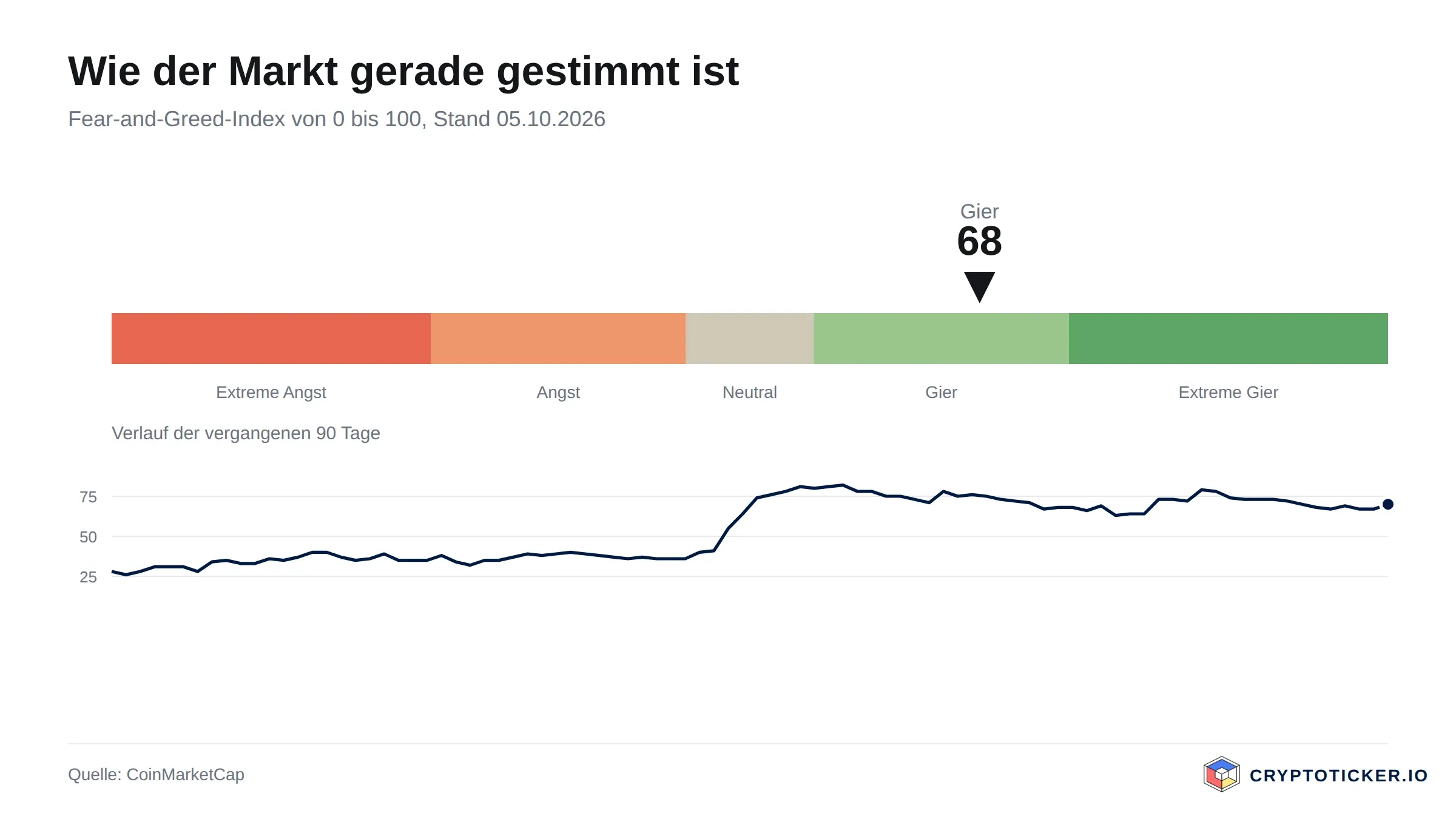
Issuers of payment stablecoins must, under 12 U.S.C. § 5903, hold identifiable reserves on at least a one-to-one basis, disclose their redemption procedures and meet requirements on liquidity, risk, IT, sanctions and anti-money-laundering. Payment stablecoins are also not FDIC-insured and may not be marketed as if they were. On custody itself, what counts is who controls the private keys, which access rights exist, whether client holdings are separated from company assets, and how recovery works after a loss or a cyberattack.
The checklist before any assessment
Before the report can support a firm view, a structured run-through is worth the effort, with none of the points counting as already answered either way:
- Transaction: Is there a company announcement, a register entry or another primary document covering the stake, the price, the date and the voting rights?
- Ownership: Who is the direct shareholder, who is the beneficial owner, and what concrete role does Abu Dhabi play as a fund, as a company, or merely as a reported source of capital?
- Regulation: Which company holds which permission? Have the OCC pre-opening conditions been met, and is a final authorisation to operate documented publicly?
- Business model: Are USD1, reserves, exchange and custody actually on offer, and which services are expressly permitted?
- Safeguards: Are there audited reserve reports, a separation of client assets, security arrangements and procedures for BSA/AML and sanctions?
The Bank Secrecy Act is what establishes the central US reporting and record-keeping duties aimed at money laundering and financial crime.

World Liberty Trust Bank: attention is not evidence
The combination of World Liberty Financial, reported capital from Abu Dhabi and a planned piece of US financial infrastructure is a genuinely relevant theme. Trump crypto also explains the high level of public attention, but it is evidence of neither political influence nor commercial success. At the World Liberty Financial US Trust Bank the transaction details are still open, while the regulatory interim position is clearer: a conditional OCC approval, no final authorisation to operate. Anyone following the story should keep the report in view but assess the stake, the licence and the operating stablecoin business strictly apart.
Why Is October 2026 a Big Month for Altcoins?
$Bitcoin is back above $86,000 after three straight weekly gains, spot ETFs just logged a third week of inflows, and a soft September jobs report has taken an October Fed hike off the table. That is the kind of backdrop altcoins love: a steady Bitcoin, cheaper money expectations and a market that is starting to look past the big one for its next move.
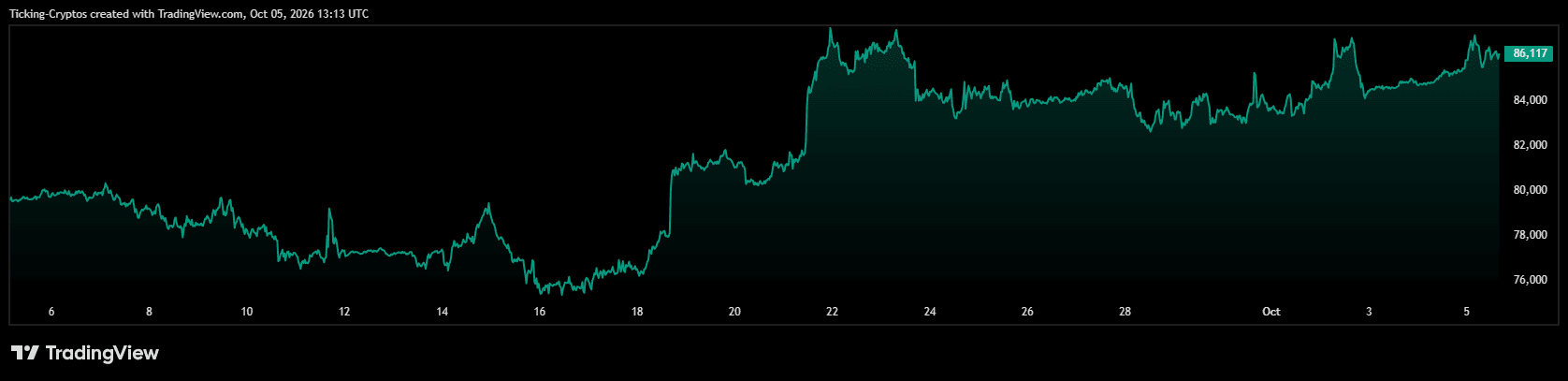
The rotation has already started. Quant ripped more than 300% in a week after The Clearing House picked it for tokenized deposit settlement, AAVE jumped from around $159 to above $180 in the first three days of the month, and Sui is pressing into resistance ahead of its Basecamp conference. Chasing a coin that already tripled is a quick way to lose money, though, so this list focuses on five altcoins with liquidity, real catalysts dated inside October and prices that still sit well below their all-time highs.
Here are the top 5 altcoins to buy in October 2026, with current prices as of 5 October. You can track all of them live on the CryptoTicker crypto prices page.
1. Ethereum (ETH): Is the Glamsterdam Upgrade the Catalyst Ethereum Needs?
Ethereum price today: around $2,720
Ethereum opened Monday at $2,727 and is trading just under that level, roughly 1.5% higher than Sunday. ETH beat Bitcoin in the third quarter, yet it has now been rejected three times at $2,800, so the chart is coiled and waiting for a reason to break out.
That reason has a date. Glamsterdam, the biggest Ethereum upgrade since the Merge, goes live on the Sepolia testnet on 6 October, with mainnet targeted for the fourth quarter of 2026. The upgrade bundles two heavy hitters: enshrined proposer-builder separation (EIP-7732), which pulls block building into the protocol and cuts reliance on MEV-Boost middleware, and Block-Level Access Lists (EIP-7928), which let clients process transactions in parallel. The Ethereum Foundation says testing supports a gas-limit floor of 200 million after the fork, more than three times today's capacity.
Add a growing tokenization pipeline (ARK just put tokenized fund shares on Ethereum via Securitize) and spot ETH ETFs that keep absorbing supply, and you get the one large cap with a hard, scheduled event this month. The risk is the usual one: upgrade timelines slip, and a messy Sepolia fork would push the mainnet date and the narrative into 2027.
What to watch: a daily close above $2,800. Below $2,600 the breakout thesis is on hold.
2. Solana (SOL): Can Solana Reclaim $150 After a 60% Discount?
Solana price today: around $121
Solana trades at roughly $121, up about 2% on the day and still almost 60% below its all-time high of $295. That gap is the whole pitch. Solana is one of only a handful of networks where the ecosystem kept growing while the token went nowhere: DEX volumes remain among the highest in crypto, consumer apps keep launching, and in late August Charles Schwab added SOL alongside Avalanche and Chainlink for its 39 million clients.
Spot Solana ETFs exist, but their inflows have cooled, which is why the rally has stalled around $120 for weeks. Note the quirk for European readers: SOL is up for the year in euros and down in dollars, so your entry currency matters more than usual.
Solana does not have a single hard-dated catalyst in October the way Ethereum does. Its case is cheaper beta on a broad altcoin recovery, backed by the strongest on-chain activity of any large-cap alternative to Ethereum. If capital rotates out of Bitcoin, SOL has historically moved first and hardest.
What to watch: ETF flow data turning positive again, and a weekly close above $130. Support sits around $109, the level SOL bounced from in late September.
3. Chainlink (LINK): Is Chainlink the Best Tokenization Play for 2026?
Chainlink price today: around $11.40
Chainlink changes hands near $11.40 after a quiet grind higher from the $8 to $9 range it spent most of the summer in. Of the five coins here, LINK has the strongest institutional story and the weakest price action, which is exactly the combination contrarians look for.
The story: Chainlink is the plumbing behind tokenized finance. Its network now counts the US Department of Commerce, S&P Global Ratings, FTSE Russell, Deutsche Börse and Tradeweb among data providers, it signed a deal with Switzerland's SIX Group, and CCIP 2.0 added the compliance and configurable settlement features banks asked for before moving real assets across chains. Charles Schwab's August decision to list LINK next to SOL and AVAX put it in front of a mainstream US brokerage audience for the first time.
The catch is well known: network adoption and token price have decoupled for years. LINK needs the tokenization boom to show up in fee revenue and staking demand, not just press releases. With Bitcoin steady and the Quant deal reminding everyone that banks are actually settling tokenized deposits on-chain now, October is as good a month as any for that gap to start closing.
What to watch: $12 is the level LINK has failed at repeatedly. A clean break opens the door to $13 to $14; losing $10.20 would put it back in the summer range.
4. Sui (SUI): Will Sui Basecamp Push SUI Past $1.30?
Sui price today: around $1.23
Sui is the momentum pick. SUI trades near $1.23, up around 5% in 24 hours and more than 60% in a month, after a strong support zone sent it on an 80% run. It is still 77% below its all-time high of $5.37, so there is room to run, but it is also the most stretched chart on this list.
The catalyst is two days away. Sui Basecamp 2026 takes place on 7 and 8 October at Marina Bay Sands in Singapore, and Mysten Labs has been loud about what comes next: global payments, stablecoins and AI-agent transactions. The numbers back the pitch. The Sui Foundation says the network has processed more than $1 trillion in stablecoin transfers since August 2025, USDsui launched in March through Stripe-owned Bridge as a native dollar for payments apps, and the Hashi protocol recently enabled Bitcoin as collateral on Sui, which triggered the latest leg up.
Two caveats. A token unlock landed on 3 October and the market absorbed it, but more are scheduled, and SUI has a habit of selling off once a conference ends and the announcements are priced in. Buying into Basecamp is a trade, not a long-term thesis, unless DeFi TVL finally catches up with the payments volume.
What to watch: $1.27 is the immediate hurdle and $1.34 the one that matters. A rejection there with a close under $1.10 would signal the Basecamp pop has faded.
5. Aave (AAVE): Why Are Whales Buying Aave in October 2026?
Aave price today: around $180
Aave is the DeFi pick, and it enters October with the strongest on-chain signals of any blue-chip protocol token. AAVE trades near $180 after climbing from roughly $159 on 1 October, with a single 13.8% candle on 3 October. It sits about 73% below its all-time high of $670, with a hard-capped supply of 16 million tokens, more than 96% of which are already circulating. There is no unlock overhang here.
The interesting part is who is buying. Wallets holding between 100,000 and 1 million AAVE added around 190,000 tokens since 28 September, worth roughly $30 million. Weighted sentiment turned positive alongside price rather than lagging it, and renewed DeFi borrowing activity, helped by Bitcoin's recovery and Fed hike bets fading, is lifting protocol revenue. Aave remains the largest lending market in crypto by a wide margin, so when DeFi wakes up, AAVE is where the money goes first.
The risk is correlation. A sharp Bitcoin pullback would trigger liquidations across lending markets, and AAVE tends to fall harder than ETH in those moments. The token has also doubled since July, so a cooling phase between $160 and $180 would be healthy rather than alarming.
What to watch: holding $170 keeps the uptrend intact. A move through $200 would be the first time since the spring and would likely pull the rest of DeFi with it.
Which Altcoin Should You Buy First in October 2026?
| Altcoin | Price (5 Oct 2026) | Below ATH | October catalyst | Risk level |
|---|---|---|---|---|
| Ethereum ($ETH) | ~$2,720 | ~44% | Glamsterdam Sepolia fork, 6 Oct | Low |
| Solana ($SOL) | ~$121 | ~59% | Altcoin rotation, Schwab access | Low to medium |
| Chainlink ($LINK) | ~$11.40 | ~78% | CCIP 2.0, bank tokenization deals | Medium |
| Sui ($SUI) | ~$1.23 | ~77% | Basecamp, 7 to 8 Oct | High |
| Aave ($AAVE) | ~$180 | ~73% | Whale accumulation, DeFi revival | Medium to high |
If you only pick one, $Ethereum is the anchor: biggest market, a dated catalyst and the least chance of a surprise. Solana and Chainlink are the recovery plays for anyone who thinks the next leg of this cycle rewards fundamentals that the price has ignored. Sui and Aave are the momentum names, best sized small and watched daily.
A note on what is missing: Quant, XRP and Avalanche all have October stories too. Quant is excluded because a 300% weekly move is not an entry point, and XRP at around $1.39 lacks a specific catalyst this month. Both belong on a watchlist.
All prices in this article are snapshots from 5 October 2026. Check the live numbers on the CryptoTicker crypto prices page and market-wide metrics such as altcoin season and Fear and Greed on the CryptoTicker charts page before making any decision.
Decrypt
The CFTC is seeking public comment on a framework that would create a new federal license for crypto exchanges, with leverage offers as the trigger for oversight.
The Bitcoin rally keeps bumping into the same wall, but a classic bullish signal suggests the trend is built to last.
Reporters from CNBC and CNN are on the program beside the exchanges, two weeks before the midterms put the sector on air.
The purchase lifts Bitmine's stash past 6 million ETH—4.9% of supply and 99% of the way to its "Alchemy of 5%" goal—as chairman Tom Lee says Ethereum is "dwarfing" other macro assets.
The firm's Bitcoin holdings hit a record 848,000 BTC, while the quarterly gain is a fair-value mark carrying $1.88 billion in deferred tax.
U.Today - IT, AI and Fintech Daily News for You Today
ADA outpaces the market in its deepest rally since May while Cardano founder Charles Hoskinson teases a major scalability upgrade.
Barry Silbert flags his 2011 market prophecy as RWA tokenization and 24/7 trading transforming Wall Street.
Strategy’s STRC preferred stock is closing in on the critical $100 level.
Morgan Stanley emerges as one of the fastest-growing Bitcoin ETFs ever launched as it continues to accumulate Bitcoin without selling.
The countdown for Glamsterdam hard fork testnet launch is nearing its final hours.
Blockonomi
TLDR:
- CFTC crypto regulations would address retail crypto transactions involving leverage, margin, or financing, rather than ordinary direct cash purchases.
- The agency is considering a crypto asset market registration category designed for venues that list qualifying retail commodity transactions.
- Public comments will help shape potential rules under the Commodity Exchange Act, as Congress has not completed a wider market-structure law.
- The initiative could establish clearer compliance expectations, but it cannot settle authority over every spot crypto transaction or exchange activity.
The Commodity Futures Trading Commission has begun a new rulemaking process for crypto transactions using leverage, margin, or financing. CFTC crypto regulations would address qualifying retail commodity transactions involving crypto assets. Ordinary cash purchases would remain outside this narrow proposal.
The agency issued an Advanced Notice of Proposed Rulemaking on October 5. The CFTC announcement requests public input before any final rules are written. It relies on existing authority under Section 2(c)(2)(D) of the Commodity Exchange Act.
The notice explores a dedicated crypto asset market registration category. That category could offer a clearer path for platforms handling leveraged crypto trading. It would not create blanket federal oversight for every token trade.
CFTC Crypto Regulations Set Framework for Retail Trades
The proposal centers on retail commodity transactions that use borrowing, margin, or leverage. Those transactions can expose users to rapid losses and counterparty risks. The CFTC wants comments on rules that could address those exposures before misconduct occurs.
BREAKING:
CFTC proposes its first-ever rules to regulate the U.S. crypto market.
The rules would focus on:
1. Stopping abusive practices across crypto markets.
2. Setting clear standards for common crypto industry practices.
3. Creating a crypto-specific market…
— Ash Crypto (@AshCrypto) October 5, 2026
Chairman Michael S. Selig said the process aims to deliver clarity and consumer protections. He also framed the work as part of a broader federal market-structure agenda. The commission emphasized that its approach rests on authority Congress already granted.
The CFTC crypto regulations would seek a uniform national regime for qualifying transactions. The agency asked how it could prevent abusive practices across these markets. It also wants views on disclosures and compliance practices tailored to crypto assets.
That focus matters because crypto platforms often combine trading, custody, and financing services. A leveraged transaction can create different risks than a direct asset purchase. Rules would need to distinguish those products without treating every crypto activity identically.
The notice also asks about industry practices that can inform compliance expectations. Some safeguards may already be common among established market operators. The commission wants to identify which practices deserve clearer regulatory treatment.
CFTC Crypto Regulations Leave Direct Spot Trades Open
The agency is considering a subcategory of designated contract market registration called a crypto asset market. That status would be purpose-built for qualifying retail commodity transactions. It could give eligible venues a defined supervisory framework.
For crypto exchanges, CFTC crypto regulations may clarify registration expectations for margin products. They may also raise operational costs for platforms serving U.S. customers. The details will depend on the final definitions and scope of any later rulemaking.
The proposal does not settle the wider spot-market question. Simple, fully paid crypto purchases do not automatically fall within the retail commodity transaction provision. This leaves a significant policy gap for lawmakers and other federal regulators.
The Securities and Exchange Commission retains separate responsibilities where crypto assets meet securities-law tests. The CFTC process therefore adds an important piece, rather than a single rulebook. Venue operators may still face overlapping obligations based on each product.
The CFTC crypto regulations also remain at an early consultation stage. Public comments will shape whether the commission proposes detailed requirements later. Comments must arrive within 60 days after publication in the Federal Register.
Any eventual framework would begin with notice-and-comment procedures. It would not take effect merely because the agency requested views. Market operators would have another opportunity to examine formal rule text and implementation dates.
CFTC crypto regulations do not resolve Congress’s broader market-structure debate. They instead test how far the agency can act under present law. The next phase will depend on the feedback received from exchanges, investors, and consumer advocates.
Market participants will likely focus on definitions, registration thresholds, and customer protections. They may also assess how a crypto asset market category would interact with existing exchange models. The agency has invited written submissions through Regulations.gov.
The post CFTC Joins SEC in Crypto Rule Push, but Spot Trading Is Excluded appeared first on Blockonomi.
TLDR:
- South Korea led East Asia with a $449.1B crypto economy and strong AI-token trading.
- Hong Kong’s institutional platforms captured 16% of service inflows during 2026.
- Japan’s DEX market share reached 34.5%, led by growing retail participation.
- China’s unique stablecoin P2P wallets grew 43x between Q1 2024 and Q2 2026.
East Asia’s crypto economy exceeded $1.2 trillion, with South Korea leading at $449.1 billion during 2026. Chainalysis found sharply different market structures across South Korea, Japan, Hong Kong, China, and Taiwan.
The region contracted modestly overall during the period, aligning with the global bear market. Yet individual markets moved in different directions, shaped by regulation, taxation, institutional access, and local trading preferences.
South Korea Leads East Asia’s Crypto Economy
South Korea recorded a $449.1 billion crypto economy, growing 12.3% period over period. Exchange-related flows also increased by $51.1 billion, reflecting the strength of its retail-driven market.
The Chainalysis blog report found that South Korean traders showed an unusually strong preference for AI-related cryptocurrencies. By June 2026, AI cryptocurrencies represented the largest defined thematic category by won-denominated trading volume.
Worldcoin (WLD) led the category with $7.41 billion in volume. SAHARA recorded $3.2 billion, followed by VIRTUAL at $2.7 billion, BIO at $2 billion, and NEAR at $1.7 billion.
AI-crypto activity was far stronger in South Korea than comparable markets. AI assets accounted for a 19.5-times larger share of won trading than yen trading.
Japan’s $228.3 billion crypto economy showed a different pattern. DEX activity reached 34.5% of its services market, while DEX engagement rose more than 200% since 2022.
Chainalysis also found that roughly one in four Japanese exchange users later deposited funds into DeFi protocols. Smart contract tokens increased their share of yen trading volume from 10% to 15.4%.
Tax treatment remains a major factor for both markets. Japan’s maximum marginal crypto tax rate reached 55% during the study period, while South Korea had no crypto profits tax.
South Korea has a 22% crypto profits tax scheduled for 2027. Japan also advanced tax reforms in July 2026 that could shift eligible crypto gains toward roughly 20% separate taxation.
Hong Kong and China Show Opposite Crypto Trends
Hong Kong’s $192.2 billion crypto economy stood out for its institutional activity. Institutional platforms captured 16% of service inflows, nearly three times higher than any regional neighbor.
That share rose from around 9% two years earlier. Custody providers, prime brokers, and market-making desks represented 85% of the institutional category.
Hong Kong also received nearly $24 billion in inbound service-to-service transfers. Cumulative net business-to-business inflows reached $17.4 billion by mid-2026.
China presented the opposite model. Despite its longstanding ban on crypto services, Chainalysis estimated its crypto economy at least $176.3 billion.
Domestic peer-to-peer activity represented 59.1% of China’s crypto economy. Unique wallets sending stablecoin P2P transactions grew 43 times between Q1 2024 and Q2 2026.
Stablecoin activity accelerated from March 2025, with monthly additions rising from roughly $240 million to nearly $5 billion a year later. However, Chainalysis described the potential connection with China’s expanded social credit system as a working hypothesis.
China’s self-custodied stablecoins also showed unusually high turnover. Holdings circulated at 33.2 times annually, compared with a global average of 9.3 times.
East Asia has no single crypto-market model. South Korea remains retail-led, Japan combines retail and institutional activity, Hong Kong concentrates regulated institutional flows, while China relies heavily on P2P stablecoin transactions.
The post East Asia’s $1.2T Crypto Economy Splits Between Retail and Institutions: Chainalysis appeared first on Blockonomi.
TLDR:
- Plume launched nBND, a tokenized vault primarily backed by Fidelity’s FBND bond ETF.
- FBND provides exposure to investment-grade, high-yield, and emerging markets debt.
- The launch expands tokenized fixed income beyond short-duration Treasury products.
- Plume says institutional allocators increasingly want duration and active bond management.
Plume has launched nBND, a tokenized vault primarily backed by Fidelity Total Bond ETF (FBND), expanding onchain fixed-income access.
FBND is an actively managed ETF focused on investment-grade, high-yield, and emerging markets debt. The launch moves tokenized fixed income beyond short-duration Treasuries and money market equivalents.
The product targets capital allocators seeking longer duration and actively managed strategies onchain. It also brings traditional fixed-income exposure into Plume’s infrastructure for institutional assets.
Why is Plume Expanding Tokenized Fixed Income With nBND?
Plume said nBND responds to demand from capital allocators seeking longer duration and actively managed products. The vault gives allocators onchain exposure to a bond strategy managed by a major financial institution.
Chris Yin, Plume’s CEO and co-founder, said short-duration Treasuries were an initial step for onchain fixed income. He added that institutional allocators now want duration and active management.
The distinction matters because bond portfolios can carry different maturity profiles and credit exposures. Short-duration products generally focus on assets with limited interest-rate sensitivity.
nBND instead uses FBND as its primary reserve asset, bringing broader fixed-income exposure into Plume’s onchain environment. The structure connects traditional portfolio management with blockchain-based infrastructure.
Plume describes itself as an Open Finance platform for institutional assets. Its EVM-compatible chain provides infrastructure for tokenized financial products and related applications.
The launch also reflects a broader shift in how real-world assets can be represented onchain. Instead of focusing only on Treasury products, issuers are adding diversified financial assets.
That expansion gives the tokenized fixed-income market a wider range of potential portfolio building blocks. It also creates a bridge between established asset managers and crypto-native infrastructure.
nBND Adds Institutional Bond Exposure to Plume’s Tokenized Fixed-Income Market
The launch comes as tokenized U.S. Treasuries continue to expand. According to Plume’s press release, the market grew from $12 billion in April 2026 to $15 billion in June.
That $3 billion increase occurred over two months, while the global fixed-income market exceeds $100 trillion in assets. Plume said this highlights the potential scope for broader fixed-income tokenization.
The company is positioning nBND as part of a wider fixed-income market rather than another isolated yield product. That distinction centers on access to established financial assets through programmable blockchain infrastructure.
Fidelity’s Cynthia Lo Bessette said tokenized assets and onchain applications are becoming more integrated with mainstream market infrastructure. She said collaboration can expand investment access and enable greater portfolio programmability.
She also pointed to potential collateral utility and access to capital. Those functions could make tokenized assets useful beyond simply holding an investment product.
For traders and investors, the key development is the expansion of tokenized fixed income into actively managed bond exposure. nBND links an established ETF structure with an onchain vault.
The post Plume Brings Fidelity’s Bond ETF Onchain With New nBND Vault appeared first on Blockonomi.
TLDR:
- Bitmine holds 6,016,414 ETH, about 4.9% of total supply, and now sits 99% of the way to its 5% ETH goal.
- Strategy bought 334 BTC at an average of $85,839 from October 1-4, lifting total holdings to 848,000 BTC.
- Bitmine has staked 5,067,309 ETH worth $13.8 billion and projects $363 million in yearly staking revenue.
- Strategy repurchased $176.3 million of STRC shares and estimates a $20.91 billion Q3 digital asset gain.
Bitmine is now 99% of the way to owning 5% of all ETH. The firm added 15,112 ETH last week. Its total stands at 6,016,414 ETH, or about 4.9% of the 122.1 million supply.
Strategy, the world’s largest crypto treasury, kept stacking BTC at the same time. It bought 334 BTC for $28.7 million between October 1 and 4, bringing its total to 848,000 BTC. It also repurchased about $176.3 million of STRC shares between September 28 and October 4.
Crypto Treasury Leaders Bitmine and Strategy Add to Their Stack
Bitmine’s holdings now equal about 4.9% of Ethereum’s 122.1 million supply. The firm says it is 99% of the way toward owning 5% of all ETH.
Bitmine has bought ETH every week since launching its ETH treasury strategy on June 30, 2025. Chairman Tom Lee called that record unmatched among public companies.
According to the company’s release, 5,067,309 ETH is staked. That stake is worth $13.8 billion at $2,726 per ETH. Staking means locking ETH to help secure the network in return for rewards.
Lee said annualized staking revenue is now projected at $363 million. Bitmine’s total crypto, cash, marketable securities and other investments stand at $17.4 billion.
Its portfolio also includes 214 BTC, a $180 million stake in Beast Industries and a $117 million stake in Eightco Holdings. Cash and marketable securities total $643 million.
Strategy took a different route. As reported by WuBlockchain, it bought 334 BTC between October 1 and 4 at an average price of $85,839. Total holdings now cost about $63.97 billion.
The purchase was funded with $15.7 million from MSTR share sales and $13 million in cash. Strategy also repurchased about $176.3 million of STRC preferred shares between September 28 and October 4.
Why the Crypto Treasury Model Matters for Markets
Strategy’s 8-K filing estimates a $20.91 billion gain on digital assets for Q3. Its bitcoin was valued at $70.82 billion as of September 30.
Bitmine’s release ranks Strategy as the top global treasury and itself as number two. It cites Strategy’s holdings at 847,666 BTC, worth roughly $78 billion.
Lee argues that crypto is entering a bull market. He said ETH fell 10% in the first nine months of 2026, while BMNR fell 3%. He also said ETH beat the S&P 500 by 6,832 basis points in the third quarter. These are the company’s claims, not independent findings.
The two strategies differ in one key way. Bitmine stakes its ETH to earn yield. Strategy holds bitcoin, which does not generate staking rewards, and leans on equity sales and buybacks.
Liquidity is another signal. Fundstrat data shows BMNR averaged $827 million in daily dollar volume over five days to October 2. That ranks it 125th among 5,704 US-listed stocks.
Lee will give a keynote at Token2049 on October 7 at 10 a.m. in Singapore. Traders will watch for any update on the 5% goal.
Bitmine is nearly at its 5% ETH target, and Strategy keeps stacking BTC while buying back preferred stock. The crypto treasury race is still running at scale.
The post Crypto Treasury Giants Keep Buying: Bitmine Nears 5% of All ETH as Strategy Hits 848,000 BTC appeared first on Blockonomi.
TLDR:
- Payward will offer 24/7 instant settlement through SGB Net to selected institutional clients.
- The service initially supports U.S. dollar transactions across selected Asian and Gulf markets.
- SGB Net now processes more than $20 billion in fiat transactions each month.
- SGB will use Kraken Prime for digital-asset liquidity and pricing for its customers.
Payward, the parent company of Kraken, has partnered with Singapore Gulf Bank (SGB) to provide 24/7 instant settlement for institutional digital asset clients in selected Asian and Gulf markets.
The partnership connects Payward to SGB Net, SGB’s real-time, multi-currency clearing network. The service will initially support U.S. dollar transactions for a select group of clients, with more clients and currencies planned.
How Payward’s 24/7 Settlement Network Works
SGB Net allows institutional clients to move funds between banking and digital asset infrastructure without waiting for traditional banking cut-off times.
Historically, bank settlement has followed business hours and fixed processing windows. Digital asset markets, however, operate continuously throughout the week.
Under the new arrangement, an SGB client can deposit funds with Payward and deploy them instantly. This could reduce delays between funding an account and accessing digital asset markets.
The initial rollout covers U.S. dollar transactions for selected clients in specific jurisdictions across Asia and the Gulf region. Payward and SGB plan to expand the service over time.
SGB Net launched in 2025 for digital asset businesses with increasing operational requirements. According to the companies, the network now processes more than $20 billion in fiat transactions each month.
The partnership also links SGB with Kraken Prime, Payward’s full-service prime brokerage platform. SGB will use Kraken Prime as an additional source of digital asset liquidity and pricing for its customers.
Payward Banking Expansion Connects Settlement and Liquidity
The partnership extends Payward’s broader effort to strengthen its banking infrastructure for institutional clients.
Payward Banking serves as the money layer supporting deposits, payments, cards, custody, and lending across the platform. Adding regulated banking partners can help connect traditional financial services with continuously operating digital asset markets.
For institutional traders, the key change is the timing of capital movement. Faster settlement can allow eligible clients to fund digital asset activity without waiting for the next banking window.
SGB is regulated by the Central Bank of Bahrain and is backed by Bahrain’s sovereign wealth fund Mumtalakat and Singapore’s Whampoa Group.
SGB Chief Executive Officer Shawn Chan said liquidity becomes more useful when clients can move funds when needed. The partnership therefore combines two important parts of institutional crypto infrastructure: access to liquidity and access to settlement.
For traders and institutions, the immediate offering remains limited to selected clients and U.S. dollar transactions. Its broader significance depends on whether Payward expands access across additional jurisdictions and currencies.
The SGB Net handles real-time fiat clearing while Kraken Prime provides digital asset market access. Together, the infrastructure will bring banking settlement closer to the continuous operating model of crypto markets.
The post Kraken’s Parent Payward Taps SGB for Instant Crypto Settlement appeared first on Blockonomi.
CryptoPotato
Bitcoin is approaching a key resistance area again after recovering from its late-September pullback. The price structure remains constructive, but nearby technical resistance and holder cost bases suggest that buyers still face a meaningful barrier to further gains.
Bitcoin Price Analysis: The Daily Chart
On the daily timeframe, BTC is trading around $85.2K, near the lower boundary of the $86K–$90K resistance zone. Following the initial rejection around $87K, buyers defended the $83K–$84K area and pushed the price back toward the recent highs. This relatively shallow correction suggests that demand remains resilient, although a sustained breakout has yet to materialize.
Meanwhile, the two displayed moving averages are converging around $71.5K, with the rising yellow average approaching the orange average from below. The highlighted potential bullish crossover would reinforce the broader recovery backdrop, but confirmation is still needed, and the asset remains well above both averages.
A sustained move above the recent $87K–$87.5K highs could allow Bitcoin to advance further into the $88K–$90K resistance area. Clearing that broader zone would open the way toward the next major supply region at $94K–$98K. Conversely, another rejection followed by a loss of the $83K support area would increase the risk of a deeper correction, with the $75K–$78K demand zone serving as the main highlighted support below.
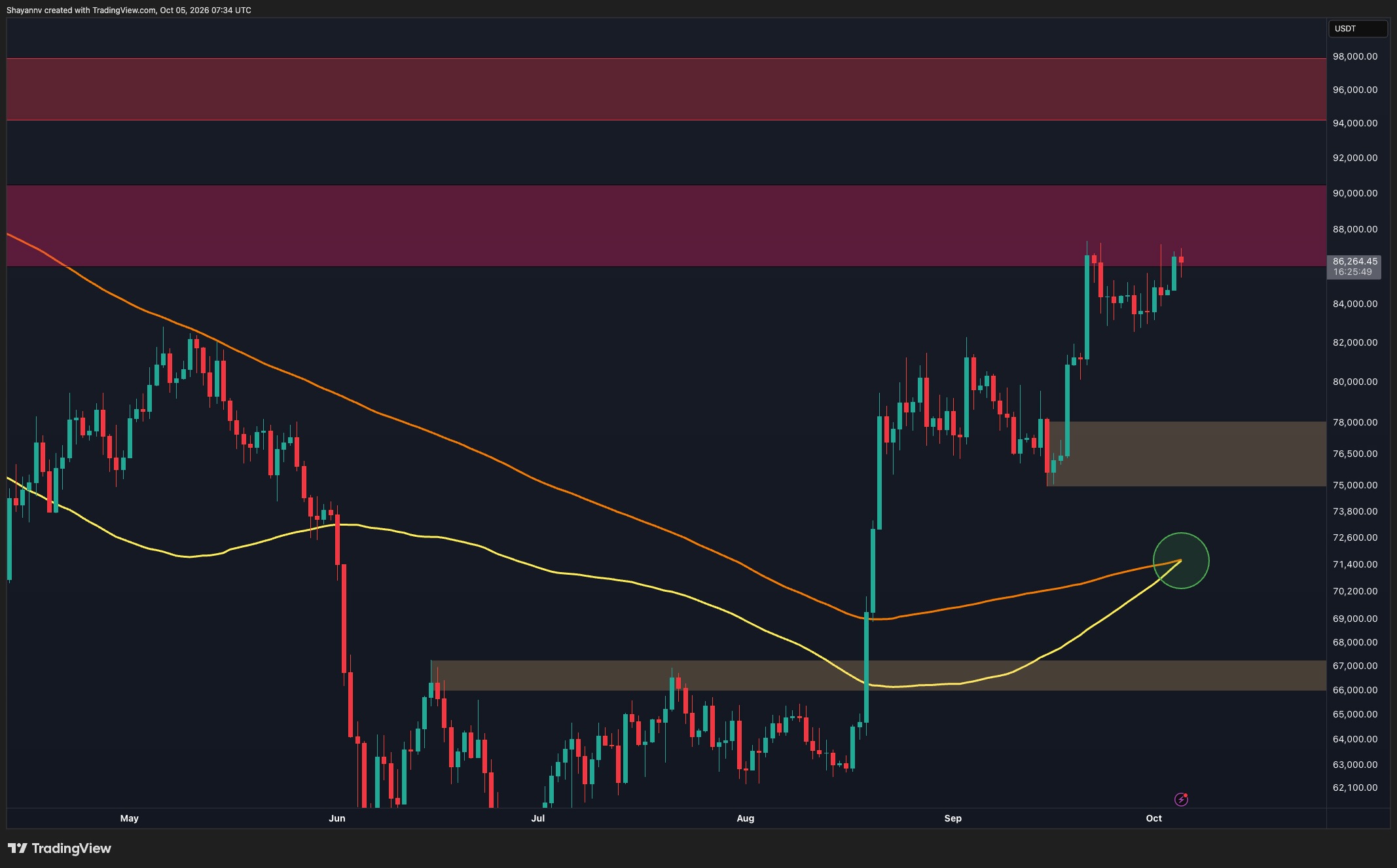
BTC/USDT 4-Hour Chart
The 4-hour chart shows an ascending triangle developing within the broader rising channel. Repeated highs around $87K–$87.3K form a relatively flat resistance boundary, while the ascending white trendline supports progressively higher lows. Bitcoin is currently trading near the upper portion of this formation after another test of overhead resistance.
This compression suggests that buyers continue to challenge supply, but the pattern requires a confirmed breakout. A decisive 4-hour close above $87.3K, followed by sustained acceptance above that level, could support a move toward $89K–$90K, where the broader supply zone and upper channel boundary would become relevant.
On the downside, the ascending triangle support currently sits around $84.5K–$85K. Losing this trendline would weaken the continuation setup and expose the recent lows around $82.5K–$83K. Further selling could then bring the broader channel midpoint near $81K into focus, followed by the $75K–$78K demand zone.

Sentiment Analysis
The Realized Price UTXO Age Bands chart tracks the average on-chain cost basis of coins grouped by age, providing context for the profitability of different holder cohorts.
With Bitcoin around $85K, the price remains above the realized prices of the 1-to-3-month and 3-to-6-month cohorts, positioned near $69K and $71K, respectively. These cohorts are therefore in aggregate unrealized profit. However, Bitcoin is still below the closely aligned realized prices of the 18-month-to-2-year and 6-to-12-month cohorts, both near $88K–$89K.
This cost-basis cluster overlaps with the daily resistance zone, adding significance to the $88K–$90K area. As price approaches these levels, some holders may use a return toward breakeven to reduce exposure, potentially increasing selling pressure. The metric alone does not confirm that such selling will occur, but it identifies a region where supply could emerge.
A sustained move above $89K–$90K would place Bitcoin above both cohort cost bases and strengthen the bullish continuation scenario. Until then, the convergence of technical resistance and realized prices remains an important hurdle for the recovery.

The post Bitcoin Price Analysis: Is BTC Running Out of Steam After Another Rejection at $87K? appeared first on CryptoPotato.
BitMine has acquired 15,112 ETH in the week to October 4, taking its treasury to 6,016,414 tokens, though that purchase was smaller than the 17,362 ETH BitMine bought a week earlier.
It was also the company’s smallest weekly buy since the week to August 16, when it added 9,926 ETH, according to its SEC filings. The treasury now equals 4.9% of the 122.1 million ETH in supply, short of BitMine’s 5% target.
Buyback Total Matches August Figure
BitMine valued its ETH at $2,726 per token, using Coinbase prices. At that price, its ETH, other crypto, cash and equity stakes total $17.4 billion. The total also covers 214 Bitcoin (BTC), a $180 million stake in Beast Industries and $117 million of Eightco Holdings (ORBS).
Cash and marketable securities account for $643 million of that total. That figure fell from $672 million a week earlier and from $714 million on September 20.
“We believe that as crypto enters a cycle we view as a bull market, what is notable is Bitmine’s share price outperformance of ETH during the bear market of 2025-2026,” said BitMine Chairman Tom Lee.
Lee said the company’s shares fell 3% in the first nine months of this year, while ETH fell 10%, and he tied that gap partly to BitMine’s share buyback. He said the company has acquired 21 million of its own shares this year, and called it the largest equity buyback by any crypto treasury.
Moreover, BitMine’s August 17 update put repurchases since July 1 at 20.8 million shares, which they ran under a $4 billion authorization. None of the six weekly updates filed from August 24 to September 28 reported a repurchase.
New Staking Deal Sets 1.5% Fee
Ethereum Towers had managed BitMine’s staking operations since March, in return for a share of net staking revenue. The two companies ended that agreement on September 3, as BitMine disclosed in a September 8 filing, with the company stating it incurred no material early termination penalty.
Likewise, since September 4, Ethereum Towers affiliate American Validator has advised MAVAN, the staking platform BitMine launched in March. The affiliate earns 1.5% of the rewards on ETH that BitMine stakes.
BitMine reported 5,067,309 ETH staked, or 84% of its Ether. That staked count has not moved in nine weekly updates, starting August 9.
The post BitMine Lifts ETH Treasury to 6.02 Million With Smallest Buy Since Mid-August appeared first on CryptoPotato.
AI agents are moving beyond support tools in cybersecurity and financial-crime investigations, according to a new Intel3D report by blockchain security firm CertiK. The paper, shared with CryptoPotato, says newer systems can reason through steps, use tools, gather evidence, act in live environments, and review results with limited human input.
For years, machine-learning systems mainly supported analysts by flagging unusual logins, scoring transactions, and preparing reports. CertiK says newer agents can perform wider tasks, shifting their role from identifying problems to helping execute responses.
AI Agents Take on More Security Tasks
In a security operations center, an agent could investigate a suspicious login by checking device records, location data, and threat feeds before acting. It could suspend an account and record its steps for human review.
CertiK says similar systems are emerging across Web3 security, including contract triage, transaction risk scoring and tracing stolen funds. The firm expects humans to focus more on supervision as agents handle routine investigations.
One reason for this shift is the speed of some attacks. Flash-loan exploits can drain protocols within seconds, while stolen crypto can move across bridges and mixers within hours. This leaves human teams with little time to investigate and respond.
A shortage of cybersecurity and compliance professionals is another factor, while regulatory pressure is increasing workloads. The security firm cites more than $900 million in AML penalties during the first half of 2025, showing the consequences firms can face when controls fail.
AI Autonomy Raises New Risks
CertiK argues that companies should treat autonomous agents as workforce participants rather than ordinary software. Their actions do not remove human accountability, so deploying companies remain responsible for outcomes.
That accountability becomes more important as agents take on tasks across financial and crypto operations. In finance, agents could handle AML tasks, while in crypto, they could detect exploits, trace funds, and monitor transactions.
However, the report highlights risks from incorrect outputs, weaker human scrutiny, and deliberate attacks against AI systems. CertiK recommends records of inputs and actions, clear limits on autonomous decisions, adversarial testing, and a named owner for every agent.
As AI systems gain greater authority over security and compliance tasks, firms will need controls that match their expanded role. CertiK says that without strong oversight, automation could replace familiar problems with failures that are harder to explain.
The post AI Agents Take on Bigger Role in Cybersecurity, CertiK Says appeared first on CryptoPotato.
One of the largest corporate holders of bitcoin sold 10,000 units during the third quarter of the year, according to the company’s most recent filing, only to buy more back.
This rather surprising move was designed to prove that its massive bitcoin treasury can be converted into cash when needed.
The filing reveals that the company sold 10,000 BTC for ¥124.7 billion (approximately $790 million) and held the proceeds temporarily in cash. Shortly after, it purchased 11,000 BTC for almost ¥150 billion and ultimately increased its holdings by an additional 1,000 units.
Consequently, its total stash grew to 44,000 BTC as of September 30. The purchase, the firm explained, was completed to demonstrate to credit-rating agencies and fixed-income investors that its bitcoin fortune is genuinely liquid.
The cash raised from the sale exceeded the company’s roughly ¥122.4 billion in net bonds, borrowings, and other relevant liabilities. It’s worth noting that those debts were not repaid. Instead, Metaplanet wanted to show that it could monetize enough BTC to cover its obligations if necessary.
The move was a part of a broader plan to obtain a credit rating and expand financing options through bonds and preferred stock.
On the downside, Metaplanet sold at slightly lower prices and had to repurchase its stash at higher levels. The stash also generated a US tax capital loss that could potentially create a deferred tax asset of approximately $97 million. Nevertheless, the firm stressed that this remains preliminary and unaudited.
Aside from its accumulation, Metaplanet recently made another BTC move, investing 2,100 BTC and $2.5 million to transfer from Super League Enterprise into Superplanet, a US Bitcoin treasury platform.
The post Metaplanet Sold 10,000 BTC – Then Bought Back Even More: Here’s Why appeared first on CryptoPotato.
Strive CEO Matt Cole just announced that the company spent $169 million to acquire 2,000 BTC last week at an average price of $84,422.
This brings its total holdings to 29,462 units, accumulated at an average price of somewhere between $90,400 and $90,700.
Strive acquired 2,000 $BTC for $169M at an average cost of $84,422 per bitcoin, bringing total holdings to ₿29,462.
61.5% of capital raised came from SATA, with warrants generating $56.7M.
Today’s 8-K also highlights key metrics and KPIs through 3Q26.
$ASST $SATA https://t.co/HS4ADPQ8mJ
— Matt Cole (@ColeMacro) October 5, 2026
This rather impressive weekly purchase, significantly larger than the one from the previous week, is actually the third-largest in the company’s history according to on-chain data.
The single biggest was actually not a direct buy, but came from the merger with Semler Scientific, in which 5,816-5,817 BTC (worth $675 million) were involved. Then came the 2026 record of 2,500 BTC, accumulated for $185.2 million in late May and early June.
Thus, the company has ramped up its accumulation spree at times when the largest corporate holder of bitcoin has slowed down. Although Strategy has extended its consecutive weekly purchase streak to three now, its actual buy was a lot lower than Strive’s at just 334 BTC.
The post Strive Completes Its Third-Largest Bitcoin Purchase, Adding 2,000 BTC appeared first on CryptoPotato.