Cryptocurrency Posts
Crypto Briefing
Robinhood's significant crypto holdings highlight retail investors' influence on market volatility and the growing importance of meme assets.
The post Robinhood holds about $25B in crypto across 12 chains, Arkham data shows appeared first on Crypto Briefing.
The surge in USDC minting on Solana highlights its growing role in crypto finance, potentially boosting its ecosystem and institutional appeal.
The post Circle mints about 13.50 billion USDC on Solana in September appeared first on Crypto Briefing.
xAI's rapid data center construction sets a new industry benchmark, potentially reshaping AI infrastructure development standards globally.
The post Elon Musk explains how xAI built its data centers so fast appeared first on Crypto Briefing.
Pharaoh Exchange's record performance on Avalanche highlights the growing influence and potential profitability of decentralized finance platforms.
The post Pharaoh Exchange posts record monthly volume and fees on Avalanche appeared first on Crypto Briefing.
Halluminate's funding highlights the growing demand for AI infrastructure, but reliance on few large clients poses significant business risks.
The post Halluminate raises $30M to train AI agents for Wall Street work appeared first on Crypto Briefing.
Bitcoin Magazine
Bitcoin Magazine

The Quantum Issue: Quantum Isn’t Coming For Your Bitcoin
For as long as Bitcoin has existed, new forms of FUD (fear, uncertainty, and doubt) have been used to predict its demise. Despite this, Bitcoin has grown into a multi-trillion dollar asset and begun to take its place in the global monetary order. In recent months, the specter of a cryptographically relevant quantum computer (CRQC) enabling an attacker to recreate secret keys from public keys and sign Bitcoin transactions moving other people’s coins has returned as an evolved form of FUD. Is this a realistic threat to Bitcoin’s continued growth? In a word, no. There is no evidence that a CRQC will be built within a decade, and it remains unknown whether such a machine will ever be built. The quantum threat remains FUD.
State of the Art
To date, no quantum computing machine has computed anything out of reach of a precocious 6-year-old (confirmed empirically). Quantum computers are remarkable technology and showcase the truly science fiction worthy capabilities of the modern world. These devices harness foundational technologies such as optical tweezers, laser cooling, superconducting flux qubits, electromagnetic traps, dilution refrigerators, and many more. Within these devices individual qubits are coerced into specific subatomic states (different for each candidate technology), entangled into superpositions, manipulated to represent computations, and then their subatomic properties are read and interpreted. The astounding truth is that these devices exist, and can be manipulated to produce meaningful computations across a handful of inputs. The cold reality check is that (for an example candidate tech.) to do a computation that a small child can do requires enough power to air condition a Texas high school, many hours of setup, and further hours of post-processing.
Reading the Future
I know what you’re thinking, “but there’s so much money flowing into quantum computing”. Does money flowing into a field correlate with the rate of real-world technological progress in that field? Not really. In fact, it can be argued that until the correct underlying technology has been developed and the product-market fit confirmed, money flowing into an area has a negative correlation with the likelihood of applicable technology being developed. This can be clearly seen by comparing NASA’s Space Shuttle program to SpaceX’s Falcon 9. SpaceX took (mostly) known science and reduced it to practice to satisfy a demonstrable market need for reliable and lower cost access to space, at a program cost of less than $5 billion to first crewed mission. The Space Shuttle cost roughly $50 billion to reach its first crewed mission. Not only did Falcon 9 cost an order of magnitude less to develop, but it has a perfect crew safety record to date. There are many reasons for these differences, but it goes to show that no amount of money makes a technology that is not ready practicable. Translating this to quantum computing: we can see that with tons of money being thrown at the problem, technology demonstrations at massive cost are possible. But this tells us nothing about whether more money will bring us the holy grail of stable, low-error qubits (like the reliability of the Falcon 9). No amount of continued development on the Space Shuttle program would ever have produced the low cost, high reliability of Falcon 9, and it’s entirely probable that no amount of continued development, at any cost, will ever make any of the current quantum computing technologies reliable enough to break a single key pair.
Now, you might be thinking, “but what about all the recent advancements?” There are two important things to keep in mind about recently published advancements. First, many of these advancements have been advancements in pure mathematics only. For example, the recent Google paper which had such an important result that they chose to redact the theoretical quantum circuit rather than risk it being used to break important cryptographic systems. This may seem like massive progress toward the future of CRQCs, but in fact it changed nothing. Unless (or until) the quantum hardware has its Falcon 9 moment, there simply is no device which comes anywhere near the stability and scale needed to run the redacted circuit. It’s pure theater to hide a circuit designed for a device which may never exist. Second, on the hardware side itself, we see many new results and bits of progress published in a given year, but how many of these relate to the same quantum computing candidate technology? How many represent merely a starting over after a prior result ended in a dead end? The reality is that these advancements do not represent some linear track toward eventual success. They represent the breadth-first search of an infinite possibility space within which quantum researchers are hoping to find a path along which they can proceed for even a modest distance without reaching yet another dead end.
When we look at the reality of the future of quantum computing, it’s hazy at best. There are promising technological developments. Especially, to my eye, in the area of neutral atom devices. But it’s far too early to tell if there’s a path open toward an eventual CRQC along any of the currently known branches or if more restarts are in our future. If, at some point, we see many iterations of the same candidate technology implementing progressively more capable devices, and computing meaningful results that a precocious child cannot also compute, we can revisit this discussion with different evidence.
In Theory
There are two possible explanations for the repeated failure of quantum research to develop a CRQC over many decades. It’s possible that it’s just a hard problem and we’re continuing to apply science and engineering to solve it and one day the ingenuity of the human species will prevail as it has in the development of the Internet, the smart phone, social media, and Bitcoin (left to the reader to decide which of these are positive developments). On the flip side, it may be that developing a CRQC is either impossible or will remain forever outside our grasp. Consider what it would mean for a CRQC to exist: the machine would have to represent within its superposition a field of possibilities the same size as the complexity of the cryptographic problem to be solved. I.e. to break the 128-bit security of the elliptic curve discrete log on Bitcoin’s secp256k1 curve, the quantum superposition would have to represent all possible values of a 128-bit number. In classical computing, representing all such values would require more computer storage (by many orders of magnitude) than humans have ever produced. If there is even the slightest granularity to the quantum superposition (i.e. the quantum superposition is not perfectly continuous across all possible values) then the quantum computer cannot ever become cryptographically relevant. If the energy required to hold a superposition scales with the complexity of the field being represented then a quantum computer cannot ever be cryptographically relevant. The contemporary understanding of quantum physics does not rule out either of these possibilities.
Conclusion: Bitcoin Cannot Rest
Despite all of the preceding, Bitcoin development toward new cryptographic algorithms must continue. While a quantum attack on Bitcoin’s cryptography is not imminent by any means, it’s entirely possible that another flaw could be found through other means. We know that certain elliptic curves have been found to have weaknesses, and secp256k1 could be next. Bitcoin has survived as long as it has because attacks on the system have strengthened it and that will continue to be true as the quantum FUD attack plays out. The development of P2MR or P2TRv2, of SHRINCS, SPHINCS, IBC, ML-DSA, and more post-quantum signature schemes will eventually lead to improvements to Bitcoin’s resilience in the face of future attacks even if an actual CRQC is never developed.

This piece is featured in the latest Print edition of Bitcoin Magazine, The Quantum Issue. We’re sharing it here as an early look at the ideas explored throughout the full issue.
This post The Quantum Issue: Quantum Isn’t Coming For Your Bitcoin first appeared on Bitcoin Magazine and is written by Brandon Black.
Bitcoin Magazine

Bitcoin Privacy Breakthrough a Zcash Killer? | Misha Komorov, Alloc Innit
Researchers have proposed a way to make Bitcoin private without changing Bitcoin itself. Misha Komarov, co-founder of alloc/init, explains Shielded Bitcoin: zero-knowledge proofs that hide the sender, receiver, and amount of a Bitcoin transfer, with no soft fork, no custodians, and no bridges. He covers how Bitcoin PIPEs make it possible and what the proposal still needs. It is a research proposal, not a finished product.
Chapters:
0:00 Shielded Bitcoin: Private Bitcoin Transactions With Zero-Knowledge Proofs
0:38 How Bitcoin PIPEs Make Privacy Possible Without a Soft Fork
1:42 Do Indexers and ZK Rollups Require Trust?
3:16 Shielded Bitcoin vs. Monero and Zcash
4:21 What Privacy Shielded Bitcoin Protects
5:59 How Private Are Early Users? The Small Privacy Set Problem
7:37 Is Shielded Bitcoin an Altcoin Killer?
9:12 Fees, Block Space, and Larger Shielded Transactions
10:50 Who Needs Private Bitcoin? Wrench Attacks and Corporate Treasuries
12:20 Dark Pools, Governments, and the Next Wave of Bitcoin Buyers
DISCLAIMER: The views and opinions expressed in this show are those of the participants and do not necessarily reflect the official policy or position of BTC Inc., Bitcoin Magazine, or any affiliated entities. This content is provided for informational and educational purposes only and should not be construed as investment, legal, tax, or accounting advice. Nothing contained in this show constitutes a solicitation, recommendation, endorsement, or offer to buy or sell any securities or financial instruments. Viewers should consult their own advisors before making financial or business decisions.
This post Bitcoin Privacy Breakthrough a Zcash Killer? | Misha Komorov, Alloc Innit first appeared on Bitcoin Magazine and is written by Patrick Green.
Bitcoin Magazine

Bitcoin’s Institutional Era Has Arrived | Robinhood VP of Crypto Institutions Nicola White
Robinhood is bringing crypto perpetual futures to US customers, with up to 10x leverage on Bitcoin and Ether. Nicola White, Robinhood’s vice president of institutional crypto, explains how the CFTC no-action letter, the Bitstamp exchange, and Robinhood Derivatives made it happen, and why the company wants markets to be always on.
Chapters:
0:00 Robinhood’s Hood Summit: 24/7 Stock Trading and US Crypto Perps
0:40 Why Robinhood Wants Markets That Never Close
1:32 Bitstamp Perps and the CFTC No-Action Letter
2:19 Tokenized Stocks, the Basis Trade, and the Path for US Perps
3:20 Bitstamp’s Volume and the Retail–Institutional Merger
4:54 What Institutions Want to Do With Bitcoin
6:00 Institutional Bitcoin Depth and Large Block Trades
6:49 AI Trading Agents and Robinhood’s Sub-Account Controls
8:29 Lessons From the 2022 Meltdown and US Leverage Limits
10:12 How Bitcoin Changes Finance in 10 Years and What’s Next for Tokenized Stocks
DISCLAIMER: The views and opinions expressed in this show are those of the participants and do not necessarily reflect the official policy or position of BTC Inc., Bitcoin Magazine, or any affiliated entities. This content is provided for informational and educational purposes only and should not be construed as investment, legal, tax, or accounting advice. Nothing contained in this show constitutes a solicitation, recommendation, endorsement, or offer to buy or sell any securities or financial instruments. Viewers should consult their own advisors before making financial or business decisions.
This post Bitcoin’s Institutional Era Has Arrived | Robinhood VP of Crypto Institutions Nicola White first appeared on Bitcoin Magazine and is written by Patrick Green.
Bitcoin Magazine

Mark Moss: The Bitcoin Endgame – BTC to $1 Million by 2030
The Fed just raised rates, yet Bitcoin keeps climbing. Mark Moss, host of the Market Disruptors podcast, explains why he thinks most people are misreading why long-term rates are rising, how a booming economy could be part of the answer, and why he says Bitcoin benefits from both the debasement trade and a bullish technological future.
Chapters:
0:00 Mark Moss on the Fed’s “Token Raise” and an October Pause
1:54 The Flat Yield Curve, Bank Lending, and the 5.1% 10-Year
2:56 Why Bitcoin Is Rising as Rates Rise: “Price Is Truth”
5:40 Bitcoin vs. Gold: The Debasement Trade and a Bullish Future
6:19 Can the US Grow Its Way Out of $40 Trillion in Debt?
10:30 The Monetary Reset Is a Process, Not an Event
13:33 Four Ways Out of the Debt Problem and What Happens in 2029–2030
16:27 Stablecoins, the Genius Act, and Why 6 Billion People Want Dollars
20:14 Institutions Are Buying Bitcoin While Retail Sells
24:29 Bitcoin’s S-Curve, Its CAGR, and a $1 Million Price Target
DISCLAIMER: The views and opinions expressed in this show are those of the participants and do not necessarily reflect the official policy or position of BTC Inc., Bitcoin Magazine, or any affiliated entities. This content is provided for informational and educational purposes only and should not be construed as investment, legal, tax, or accounting advice. Nothing contained in this show constitutes a solicitation, recommendation, endorsement, or offer to buy or sell any securities or financial instruments. Viewers should consult their own advisors before making financial or business decisions.
This post Mark Moss: The Bitcoin Endgame – BTC to $1 Million by 2030 first appeared on Bitcoin Magazine and is written by Patrick Green.
Bitcoin Magazine
UK Brings Crypto Under Full FCA Oversight for the First Time
The UK’s Financial Conduct Authority has opened applications for crypto firms to become authorized, bringing the sector under full regulation for the first time.
In a Wednesday announcement, the watchdog said companies can apply so that the crypto industry has “clarity and legitimacy.”
The UK is in the process of drafting a sweeping new crypto bill. The FCA finalized its regulatory framework for cryptoassets in June, and the regime is due to take effect in October 2027.
“The UK’s new crypto regime will give consumers greater protections and firms a clear framework to operate in. Firms can now apply for authorisation and start preparing for regulation,” Dominic Cashman, director of authorisation at the FCA, said in a statement.
The statement added that firms will have to demonstrate that they meet requirements covering consumer protection, customer-asset safeguarding, market integrity and financial resilience.
Britain is pushing ahead with digital asset legislation since last year recognizing bitcoin and other digital assets as property. The reform came from a 2023 recommendation by the Law Commission, which argued that digital assets did not fit neatly into existing legal categories.
Despite the FCA’s announcement, the UK currently is trailing behind Brussels and Washington with digital asset regulation.
The EU’s Markets in Crypto-Assets regulation has applied to service providers since 30 December 2024.
And the U.S. under President Donald Trump signed the GENIUS Act into law in July 2025, establishing a federal framework for dollar-backed tokens.
Despite lawmakers blocking landmark legislation the Clarity Act last month, U.S. regulators like the Securities and Exchange Commission have pushed ahead with rulemaking regardless.
This post UK Brings Crypto Under Full FCA Oversight for the First Time first appeared on Bitcoin Magazine and is written by Mathew Di Salvo.
CryptoSlate
Treasury's Sept. 30 rule lets states preserve a path toward stablecoin-regime approval while their rules remain unfinished, by filing an initial certification on time and completing the work before substantive review.
The interim final rule sets forms and review procedures for the Stablecoin Certification Review Committee, the federal body that reviews state stablecoin regimes. The Committee says conditional or incomplete certifications can satisfy the initial filing timeframe, even when additional state legislative or regulatory action is planned.
The rule took effect Sept. 30, but says certifications will not be accepted until after Paperwork Reduction Act approval of the information collection. Treasury will post a notice announcing when acceptance begins.
The flexibility matters for state-qualified payment stablecoin issuers with no more than $10 billion in consolidated outstanding payment stablecoin issuance. They may opt for state regulation if the state regulator certifies that its regime meets Treasury's substantial-similarity criteria and the Committee unanimously approves it as meeting or exceeding the standards and requirements in section 4(a) of the GENIUS Act.
Treasury's separate proposal on substantial similarity addresses the standards used to compare state and federal regimes. The September procedural rule does not finalize those principles.
How a filing reaches substantive review
A conditional filing can be amended at any time. It does not begin substantive review or start the Committee's 30-day approval-or-denial clock. That clock applies only once a certification has been submitted in accordance with the procedures.
For that purpose, a state must provide an unconditional attestation signed by an authorized representative, a detailed explanation of how its regime meets Treasury's similarity principles, supporting legal materials and information the Committee deems necessary.
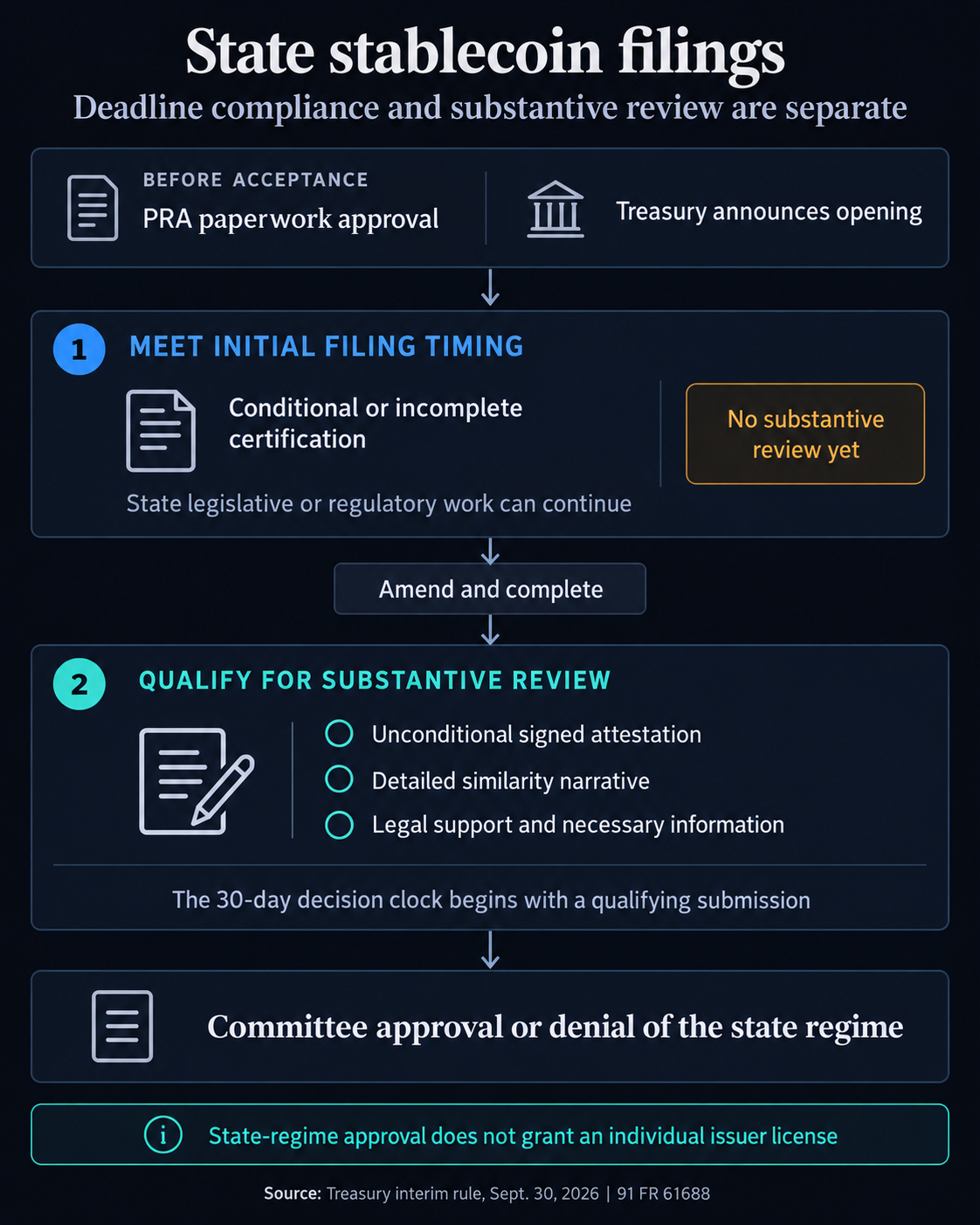
The distinction gives states room to finish their legislative or regulatory work after meeting the initial timeframe. It does not automatically approve their regimes or grant licenses to individual stablecoin issuers.
CryptoSlate's July deadline coverage described the difficulty of assessing state equivalence while federal, Treasury and OCC rules were unfinished. The new rule provides forms and review procedures, including initial filing flexibility, while retaining substantive approval requirements.
The rule uses Jan. 18, 2028 for initial certifications, based on its expected Jan. 18, 2027 effective date for the GENIUS Act. The statutory filing deadline is one year after the Act takes effect.
The Act can take effect earlier. Section 20 sets the earlier of 18 months after enactment or 120 days after primary federal payment stablecoin regulators issue any final regulations implementing it.
Comments on the interim procedures are due Nov. 30.
The post Treasury will let states file for stablecoin approval before finishing their rules appeared first on CryptoSlate.
MetaMask is pulling thousands of Ethereum validators after a security breach redirected rewards, creating a network-wide backlog for stakers trying to exit.
Onchain security researcher Kaden said about 17,000 MetaMask-operated validators holding roughly 523,000 ETH were proactively exited after an analysis found that transaction-fee rewards from 18 of 19 validators that proposed blocks had been diverted to an address funded through Tornado Cash, an Ethereum-based privacy protocol that allows crypto transactions to be mixed and anonymized.
The attacker appears to have captured only about 0.36 ETH, according to Kaden. The bigger concern is how the attacker gained enough access to alter fee recipients and whether that access extended to validator signing keys, which could trigger slashable behavior.
MetaMask has not confirmed those figures or disclosed the cause of the incident. Instead, the company said that part of its infrastructure had been compromised and that it was exiting affected validators as a precaution while working with clients, partners and security advisers. It said it had identified no immediate threat to MetaMask wallets.
The company also said its staking operation is non-custodial and that it does not control clients' withdrawal keys. That separation would prevent an attacker with only validator-level access from withdrawing the underlying stake, but it would not eliminate the possibility of penalties if signing keys were compromised and misused.
Kaden said 821 potentially affected validators had not yet exited, including three among those whose fee rewards were allegedly diverted. It remains unclear why they are still active or whether the attacker retained access to change additional fee recipients.
MetaMask has yet to disclose how many validators were affected, whether signing keys were exposed or whether any slashing has occurred.
Ethereum’s withdrawal backlog spikes to 9-month high
Meanwhile, the security incident and the exits are already rippling through Ethereum's staking infrastructure.
About 773,447 ETH was waiting to leave the validator set on Wednesday, according to Validator Queue data, implying a 13-day, 10-hour wait before an exiting validator clears the queue. A further withdrawal sweep delay was estimated at 7.6 days.
That is the largest exit backlog since December 2025 and above the roughly 476,000 ETH waiting during a previous surge in May, according to Validator Queue's historical data.
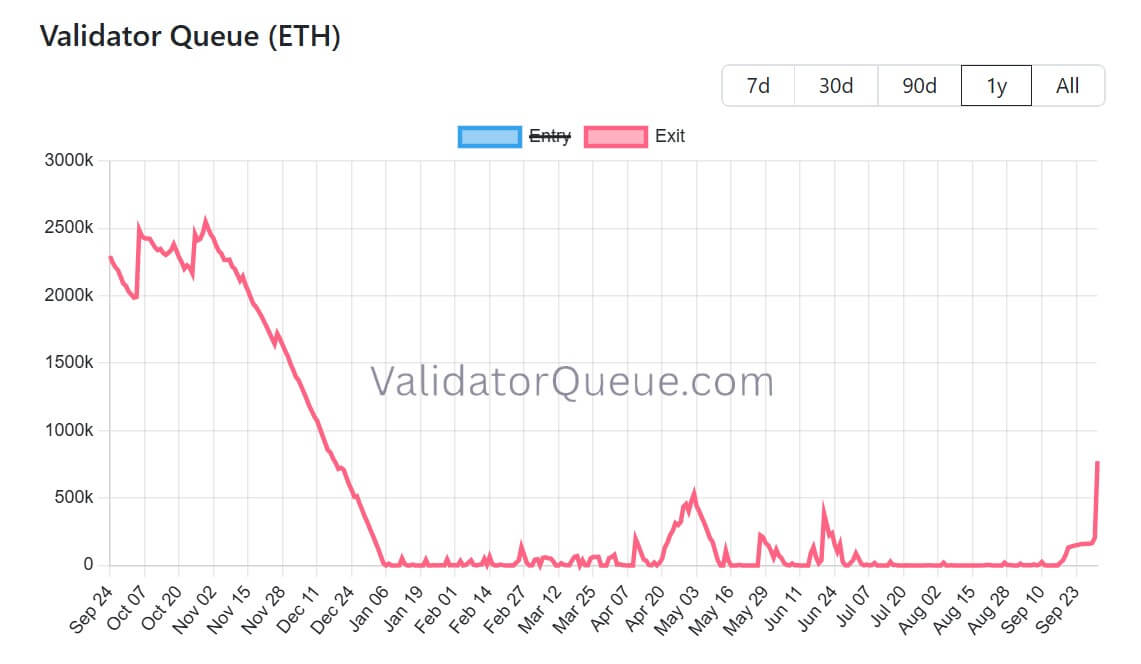
The bottleneck reflects a safeguard built into Ethereum rather than an inability to process transactions.
Ethereum limits how quickly stake can enter or leave its validator set to prevent abrupt changes from destabilizing its proof-of-stake consensus. The Validator Queue showed a churn rate of 256 ETH per epoch, with each epoch lasting about 6.4 minutes. At that rate, a large burst of exits must be processed gradually rather than simultaneously.
The additional 7.6-day sweep period begins after validators clear the exit queue and become withdrawable. Ethereum then cycles through eligible validators and transfers balances to their designated withdrawal addresses.
For MetaMask-linked stake, the disruption could last longer still. Lido, where MetaMask operates validators, estimates the full exit, withdrawal, and eventual re-entry process could take up to 45 days, partly because validators returning to Ethereum must also contend with a lengthy entry queue that is currently 27 days long.
The post MetaMask security scare pushes Ethereum validator exits to a nine-month high appeared first on CryptoSlate.
A coffee bought with a qualifying dollar stablecoin would avoid gain-or-loss recognition under the ADAPT Act that Sen. Steve Daines released Sept. 30. The same coffee bought with Bitcoin would still trigger the cost-basis calculation and capital gain or loss reporting that attach to spending digital assets.
Bloomberg Law reported Sept. 25 that Daines had circulated a draft and expected to introduce it the next week. The 56-page text released Sept. 30 carries the title Aligning Digital Assets with Principles of Taxation Act and lists Sens. Cynthia Lummis, Bernie Moreno and Tim Scott of South Carolina as cosponsors.
Under current IRS guidance, paying for goods or services with digital assets in any amount is a disposition. Holders of personal or investment assets must calculate and report capital gain or loss, which depends on the asset's value and cost basis.
A payment can produce a gain, a loss, or a break-even result, and the IRS uses a cup of coffee as its own example. A $5 Bitcoin purchase with an allocated basis of $3 produces a $2 capital gain that belongs on the return.
What qualifies as a covered stablecoin
New section 1034 of the tax code would treat the disposition of covered payment stablecoins to buy products or services as a nonrecognition event. The relief covers gain or loss on the token itself, and sales taxes and other purchase obligations stay in place.
The token must be a qualified US dollar stablecoin, meaning one issued by a permitted payment stablecoin issuer under the GENIUS Act.
A foreign issuer qualifies through OCC registration or a Treasury finding that its home regime is comparable. It must appear in Treasury's most recent report before the payment, and the taxpayer must have acquired it at a price within 3% of $1.00.
Treasury would publish that report at least every three months, listing each qualified stablecoin actively traded within 3% of $1.00 during the 12 months ending the prior month. Users and payment companies would check the latest list when making a purchase.
Traders, brokers, and dealers in qualified dollar stablecoins are excluded, along with taxpayers using a functional currency other than the dollar, and Treasury could extend the trade-or-business exclusion to similar businesses.
Taxpayers must keep records that distinguish eligible payments from other transactions. Covered payments would be exempt from broker information returns under section 6045(i)(1), and brokers could rely on customer certifications and skip verifying the 3% acquisition test for tokens bought elsewhere. The stablecoin provision applies to transactions entered into starting Jan. 1, 2027.
Bitcoin keeps its paperwork, with one fee carve-out
Section 1034 covers stablecoins, so a Bitcoin payment at checkout remains a taxable disposition, while Section 11 adds a narrower rule for fees.
Under new section 1044, coins disposed of to pay digital asset transaction costs would escape gain-or-loss recognition when the aggregate value of the assets used for those costs is $10 or less. Base, gas, and priority fees count as costs, and related transactions are aggregated.
Exclusions apply to traders, brokers and dealers, businesses that batch transactions or help validate them for others, and assets under mark-to-market accounting. Anyone who initiated more than 5,000 digital asset transactions in the prior taxable year is also excluded.
The fee exception takes effect for dispositions starting Jan. 1, 2027, the same date as the stablecoin relief. On a Bitcoin coffee, the sliver of BTC paid as a network fee could qualify, and the coins sent to the merchant remain a taxable disposition.
The bill also exempts qualified dollar stablecoins from the wash-sale and constructive-sale rules it extends to other digital assets.
Earlier bills used dollar thresholds
Earlier proposals sought to reduce tax friction for qualifying personal crypto transactions through monetary thresholds.
Sen. Ted Budd's S.4171, introduced March 24, would require both transaction value and otherwise recognized gain or loss to be $200 or less. Related transactions would be aggregated, with exclusions including business-property and cash-equivalent exchanges.
Lummis's S.2207, unveiled in July 2025, sets a $300 ceiling on both transaction value and recognized loss and ends further exclusions once qualifying annual gains exceed $5,000.
The House PARITY Act proposed a $200 threshold for stablecoin transactions. Lummis now cosponsors a text that ties relief to eligible stablecoins at any purchase size.
The House has a separate proposal. H.R.10357 was introduced Sept. 14, and Ways and Means announced committee approval by 38-5 on Sept. 16. Its stablecoin redemption-value accounting and qualifying $10 fee relief are distinct mechanisms, and committee approval is a step before any House vote.
What happens next for stablecoin and Bitcoin
These remain proposals, and current IRS treatment stays in force. The text leaves Treasury to set the mechanics, including the quarterly list, recordkeeping, and broker reporting rules. It borrows its issuer definitions from the GENIUS Act, so which tokens qualify will follow issuer approvals under that law.
For everyday users, the Daines text draws its line around the asset a customer pays with, at any purchase size. A $5 coffee on a qualifying stablecoin would fall outside gain-or-loss recognition, and the same coffee on Bitcoin would stay in the capital-gains system.
The post Senate tax bill frees stablecoin spending while Bitcoin stays on IRS forms appeared first on CryptoSlate.
Ethereum validators face a configuration choice next week that could determine how aggressively the network tests its next major scaling push.
The Glamsterdam upgrade is scheduled to activate on the Sepolia testnet on Oct. 6 at 13:53:36 UTC, bringing changes designed to increase Ethereum's execution capacity. Node operators must update both execution and consensus clients before the fork, while stakers must also upgrade their beacon node and validator software.
But simply installing compatible software will not necessarily move Sepolia toward the 200 million gas preference scheduled for the test.
Prysm 7.2.0 and Teku 26.9.1 both support Glamsterdam but will continue using a 60 million gas preference after activation unless validators explicitly change their settings, according to the Ethereum Foundation. Prysm operators must use version 2 proposer settings or the keymanager API, while Teku validators can override the default through their validator configuration.
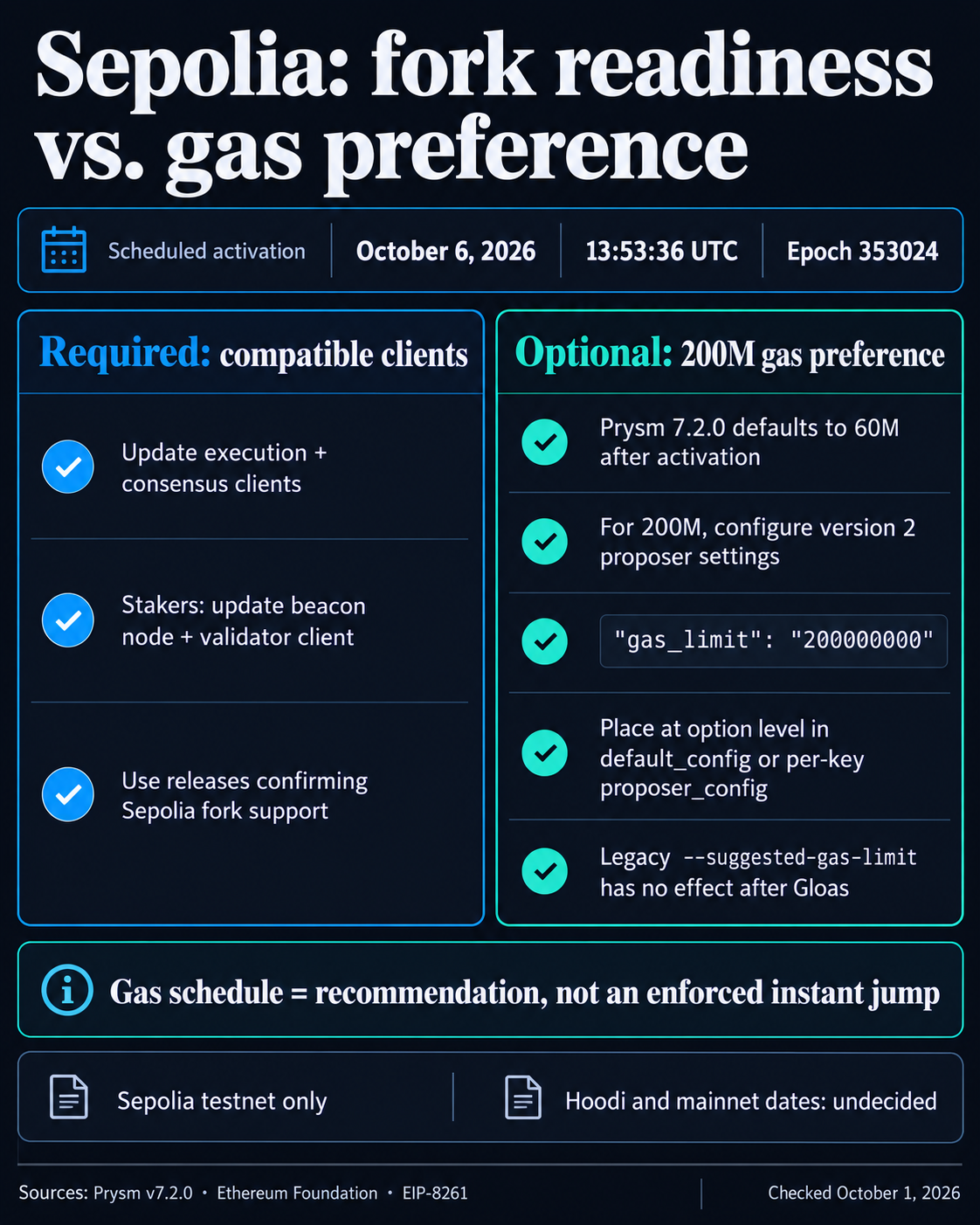
The distinction turns Sepolia into a coordination test for Ethereum's effort to substantially expand Layer 1 capacity.
A higher block gas limit allows more aggregate computation to fit into each block, creating room for more transactions and high-demand applications such as decentralized exchanges and other DeFi protocols. Additional capacity can ease congestion and reduce pressure on transaction fees when demand rises, though it does not make Ethereum's underlying block times faster.
Ethereum has already been moving in that direction. Its block gas limit began rising from 30 million toward 36 million in February 2025, the first adjustment since the network moved to proof-of-stake. It subsequently climbed to 45 million before Fusaka client releases adopted 60 million as their default.
Ethereum's 200 million ambition meets a 60 million default
Glamsterdam would push that scaling experiment considerably further, but 200 million should not be interpreted as an automatic new gas limit.
EIP-8261 introduces an optional gas-limit schedule that lets consensus clients coordinate recommended preferences at specific epochs. The proposal does not alter Ethereum's consensus-validity rules, and blocks remain valid whether their gas limit sits above or below the scheduled value. Validators can also explicitly choose their own preference.
That means Sepolia's realized gas limit will move gradually as validators propose blocks rather than jumping immediately to 200 million when Glamsterdam activates.
The higher target is part of a broader effort to increase the amount of work Ethereum can process without making validation impractical.
Glamsterdam combines the Amsterdam execution upgrade with Gloas on the consensus layer and introduces enshrined proposer-builder separation alongside block-level access lists, which allow clients to parallelize state reads and transaction validation. The Foundation says the changes lay the groundwork for higher Layer 1 throughput.
Ethereum has also added safeguards as capacity rises. Fusaka introduced a 16.7 million gas cap for individual transactions, limiting how much of a block any single operation can consume even as the overall block budget increases. That means higher block limits primarily create room for more aggregate activity rather than allowing individual smart-contract transactions to expand without restraint.
Sepolia will provide the first scheduled test of Glamsterdam before Ethereum developers decide how to proceed elsewhere. Hoodi and mainnet activation dates remain undecided, leaving validator participation in the 200 million preference among the signals developers can observe before taking the upgrade closer to production.
The post Ethereum is preparing a 200 million gas push as its Layer 1 scaling strategy accelerates appeared first on CryptoSlate.
Ripple's Brazilian foothold spans cross-border payments and securities records in a country Chainalysis ranked first for grassroots crypto adoption.
Ripple and CSD BR, a regulated financial market infrastructure operator, announced a first phase on Sept. 29 to mirror ownership records for BTG Pactual investment fund shares on the XRP Ledger (XRPL). CSD BR's systems will remain the official record for registration, deposit, and settlement.
The announcement follows a Sept. 28 interview in which RippleX executive Markus Infanger told Estadão's E-Investidor that about $2.7 billion of the $6.7 billion in tokenized real-world financial assets he counted on XRPL was in Brazil.
That puts roughly 40% of the reported asset value in one country, although the measure reflects assets rather than payment activity.
Together, the developments show how Ripple's years of expansion have connected it to several parts of Brazil's financial system. The opportunity spans institutions moving money, platforms distributing stablecoins, and firms managing investment assets, with different measures of success for each.
Ripple was building there before the ranking
Ripple opened its Brazilian office in 2019 and announced XRP-enabled payments with Travelex Bank in August 2022. Those relationships predate the new adoption ranking by years.
In October 2024, its Mercado Bitcoin payments partnership initially targeted internal treasury transfers between Brazil and Portugal. The release described corporate and retail international payments as future plans, rather than services already available to those customers.
By March 2026, Ripple was expanding its Brazilian institutional offering across payments, custody, prime brokerage and treasury management. It named Banco Genial, Braza Bank and Nomad among payments users, while Mercado Bitcoin, Foxbit and Ripio were among platforms listing or supporting its dollar stablecoin, RLUSD.
Alongside that expansion, Ripple announced plans to seek a Brazilian virtual asset service provider license.
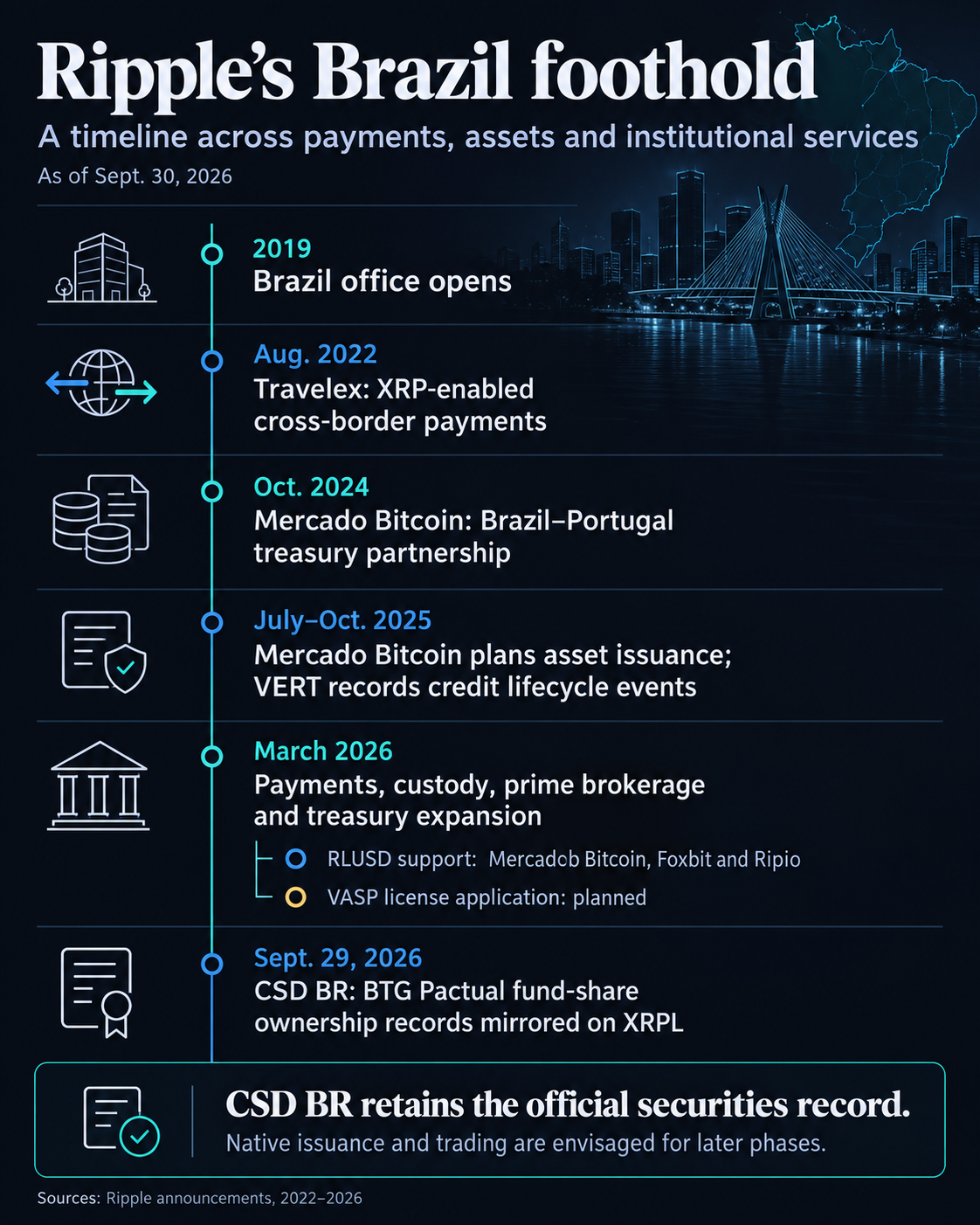
The same companies can connect several parts of the strategy. Mercado Bitcoin, for example, announced plans in July 2025 to tokenize more than $200 million in permissioned real-world assets on XRPL. The planned issuance adds an asset relationship to its payments and stablecoin connections.
Chainalysis's 2026 adoption index puts Brazil first overall, second for cross-border flows, third for service flows and domestic peer-to-peer activity, and fourth for balances.
Its revised methodology rewards broad performance across those four measures. First place does not mean Brazil has the world's largest crypto market by raw dollar volume, and the methodological change limits comparisons with earlier rankings.
Chainalysis estimated $252.5 billion in Brazilian crypto activity between July 1, 2025, and June 30, 2026. Its Latin America report also found that Brazil's crypto economy contracted 1.6% during that period, so adoption leadership coexisted with a slowdown.
For Ripple, the more useful connection is what businesses do with crypto. The report describes Brazilian companies using stablecoins for liquidity management and cross-border transfers, purposes that overlap with its institutional offering.
Brazil's Oct. 1 restrictions will bar virtual assets from settling aggregated eFX flows between providers and foreign counterparties, while individual international virtual-asset transfers remain permitted.
From represented assets to financial infrastructure
Infanger's reported XRPL asset total gives the Brazilian footprint a reported scale. The $2.7 billion figure describes tokenized real-world asset value represented on XRPL.
In October 2025, Ripple said VERT's credit platform recorded lifecycle events, documentation and payments on XRPL and its EVM sidechain. Its pension-receivables fund then held more than R$200 million in net assets.
The CSD BR announcement extends that approach into securities infrastructure. Its first phase mirrors BTG Pactual fund-share ownership records using XRPL tokens and Ripple custody, with access restricted to authorized Brazilian corporate and banking participants subject to identity and anti-money-laundering checks.
Native issuance and trading are envisaged for later phases after mirroring is validated. For now, the project gives Ripple a place inside existing financial processes without making the public blockchain the authoritative securities register.
That makes Brazil a practical test of Ripple's wider institutional strategy. Its announcements show relationships across payments, stablecoins, custody and investment records, but provide no comparable aggregate Brazil-only payment volume, RLUSD circulation or active institutional usage.
Sustained transactions and broader use of the CSD BR system would show how far those connections develop beyond the reported asset values.
The post Ripple quietly made Brazil the center of its XRPL tokenization push appeared first on CryptoSlate.
CryptoTicker.io
Ripple released one billion XRP from its escrow accounts on Thursday morning, spread across four transfers of 400, 300, 200 and 100 million tokens. Measured at Thursday afternoon's price, that is worth around $1.49 billion. The price itself barely reacted: XRP traded at $1.48 to $1.49 on Thursday afternoon, just under one percent below the previous day, according to CoinGecko data. Anyone wanting to derive a forecast from this release therefore needs less of the chart and more of an understanding of what this money actually does over the next 24 hours.
The escrow is no secret compartment, but a series of trust accounts on the XRP Ledger that Ripple set up in 2017. At the start of each month part of it expires, and the company can dispose of the amount that comes free. What matters is that Ripple has put most of this monthly release back into new trust accounts in recent years. That return is the number which decides supply pressure, not the billion in the headline.
1 billion XRP out of escrow: what actually happened on October 1
It was the tenth monthly release of 2026 and it followed the familiar pattern. Four transactions, one billion tokens together, settled over the course of the morning. The specialist service U.Today puts the holding that remained in the trust accounts afterwards at 31.845 billion XRP. With a total supply of 100 billion tokens, just under 32 percent therefore remains locked.
Escrow explained briefly
An escrow on the XRP Ledger is a payment fitted with a time lock: the tokens sit on the ledger but cannot be moved until a set point in time. That is not a promise of trust and not a bank's undertaking, but a function of the protocol. Anyone can read which locks exist and when they expire.
31.85 billion XRP stay locked: the arithmetic behind the circulating supply
This is where it gets uncomfortably precise for investors, and for a good reason. The figures for the circulating supply differ markedly depending on the source. U.Today gives a circulating supply of 68.126 billion XRP for the point after the release. CoinGecko, by contrast, reports around 63.09 billion XRP as the circulating amount on Thursday afternoon. The gap of about five billion tokens is not sloppiness on either side.
Why two sources give different circulating supplies
The difference arises at the definition. Count everything that is not in escrow as circulating and you arrive at the higher figure. If a data provider additionally deducts holdings that demonstrably sit with Ripple itself and are not on the market, the figure comes out lower. For your assessment that means market capitalisation and any metric built on the circulating supply carry an uncertainty of several percent in the case of XRP. See two services with different market capitalisations and you have not necessarily found an error.
The second number in this arithmetic is the distance to the peak. The all-time high stands at $3.65 from July 17, 2025. From Thursday afternoon's level, around 59 percent is missing before that value would be reached again. The quarterly comparison looks friendlier: XRP traded at $1.05 at the end of June, which means the third quarter ended with a gain of about 41 percent, calculated on the CoinGecko values for June 30 and October 1.

Return to escrow within 24 hours: where the state of play sits in the ledger
This is the one point in this story you can work out for yourself, without waiting for a report. The XRP Ledger is public, and the escrow holdings of the Ripple accounts can be inspected there. The balance overview at XRPSCAN lets you follow how much of the released billion goes back into new trust accounts within the next day.
As an order of magnitude for placing it: in recent months the return has typically been 700 to 800 million tokens, leaving 200 to 300 million XRP for ongoing purposes and ecosystem programmes. If the return stays in that range, the actual increase in supply is small against a daily turnover that stood at around $2.3 billion on Thursday. Should the return come out markedly smaller, that would be the real story of the month, and it was in none of the morning's headlines.
XRP at $1.49: the next price target sits at $1.70
The range the price has moved in for days is narrow. On Thursday the daily high was $1.51 and the daily low $1.48, with a gain of 0.6 percent over the week and 8.8 percent over the month. In euros that came to about €1.31 per token on Thursday afternoon.
On the upside, the common market commentaries name two levels. The nearer one sits at $1.50 and is the threshold XRP failed at repeatedly through September. The further one sits at $1.70 and counts as the resistance capping October's range. On the downside the area around $1.25 is named. The forecast ranges of the data services diverge, and that is part of the picture: DigitalCoinPrice expects an average of around $1.37 for October, LongForecast month-end prices around $1.13, and CoinDCX a channel between $1.48 and $1.94. These are the respective providers' model calculations and not undertakings.
What you can practically take from this is less a direction than a size. A range of $1.25 to $1.70 means, at an entry of $1.49, around 16 percent of room on the downside and around 14 percent on the upside. Anyone working with leverage should set that width against their own liquidation distance before the next monthly release falls due on November 1.
US spot ETFs hold 1.18 billion XRP: why fund assets are shrinking all the same
On the demand side something shifted in September that has nothing to do with the escrow. The seven American spot ETFs on XRP hold around 1.18 billion tokens between them, which is about 1.18 percent of total supply. In the week from September 21 to 25, a net $75.59 million flowed in, $58.99 million of it into Bitwise's product alone, which with around 413.1 million XRP is the largest holder among the funds. Across September as a whole, net inflows added up to $121.4 million.
The apparent contradiction in this: despite those inflows, the funds' assets under management fell in September. That is no arithmetic error, but a consequence of valuation. A fund that buys new tokens while the price of those tokens falls can be worth less on balance than before. Inflows and fund assets are two different measures, and only the first says anything about institutional investors' willingness to buy. Cumulatively since the products launched at the end of 2025, net inflows stand at about $1.79 billion.

Fed decision on October 28: the date that decides October's range
The date the market commentaries point to most often for October is the US Federal Reserve's interest rate decision on October 28. For XRP that is no coin-specific event, but the usual connection: a market that lives strongly off risk appetite reacts to the rate path. That the commentaries put the date so clearly in the foreground has an uncomfortable side effect for the forecast. It means that expectations for XRP in October are barely driven by XRP itself.
For you this yields a sober order of dates in this quarter: the return to escrow over the coming 24 hours, the Fed decision on October 28, the next monthly release on November 1, and, as the last and most important date for your tax bill, December 31, 2026.
XRP ETN versus direct purchase: 25 percent withholding tax or free of tax after a year
Before the deadline itself, the difference many only notice on selling. There are two ways to bet on XRP in Germany, and they are treated completely differently for tax.
On a direct purchase you hold the tokens yourself, at an exchange or in your own wallet. The sale is a private disposal under section 23 of the Income Tax Act. If more than twelve months lie between purchase and sale, the gain is free of tax, whatever its size. Under one year, a threshold of 1,000 euros a calendar year applies to all private disposals together. The word threshold is to be taken literally: one euro over, and the entire gain becomes taxable, not merely the part above the limit.
An exchange-traded certificate on XRP, so an ETN or ETP at a German trading venue, works differently. The gain from it is investment income. On that, 25 percent withholding tax plus the solidarity surcharge and church tax where applicable fall due, and from the first day. There is no holding period there after which anything becomes free of tax. In return the saver's allowance of 1,000 euros applies, and the custodian usually remits the tax automatically. The running costs of such products are also to be considered, given as 0.95 to 2.50 percent a year depending on the provider. Which products are tradable in Germany and what they cost is set out in the overview of crypto ETFs and ETNs in Germany.
The American spot ETFs are not available to you
The US funds named above, with their 1.18 billion XRP, are in practice not accessible to you as a retail investor in Germany. These funds are not UCITS funds and supply no key information document under the PRIIPs regulation that a broker would have to present to retail clients in the EU. The inflow figures are therefore a sentiment indicator for you, not a route to investing.
Deadline of December 31, 2026: the draft bill and the one-year holding period
This is the number that decides more about your return this quarter than any price level. Since September 8, 2026 a draft bill from the federal finance ministry has been on the table that would bring the taxation of crypto assets closer to that of shares. The one-year holding period would fall away, and withholding tax would apply instead. The draft names a deadline for this: crypto assets acquired after December 31, 2026 are to be covered. For holdings acquired earlier, the existing rule is to continue to apply.
The placing of this matters, and in both directions. A draft bill is not a law. None of it is decided, and the deadline and its design can change in the further process or fall away entirely. At the same time the deadline, should it arrive as described, cannot be made up later. An XRP holding you buy in December 2026 would be free of tax after a year; the same holding bought in January 2027 would not. That is no argument for buying now, and none against it either. It is the point that with XRP this quarter the purchase date has a meaning of its own that the chart does not show.
What you have to document for it
The burden of proof for the time of acquisition and the acquisition cost falls on you. Without a purchase receipt the tax office can estimate the acquisition cost, and such estimates regularly turn out to your disadvantage. In practice that means saving the exchange's transaction overviews as a file rather than leaving them sitting in the account, keeping the order traceable where there are several part purchases, and noting the transaction identifiers when transferring between your own wallets. Tools that keep this record as you go are in the overview of tax tools and portfolio trackers.
Destination tag and MiCA licence: two stumbling blocks when buying XRP in Germany
Two things go wrong more often with XRP than with other coins, and neither has anything to do with the price.
The first is the destination tag. Exchanges keep many customers' XRP at a shared address and distinguish the accounts by a number attached to the transfer. If that tag is missing on a deposit, the payment lands in the pooled account without an allocation. The money is usually recoverable, though it takes a support case with evidence, and that takes time. On a withdrawal from the exchange to your own wallet the tag is as a rule not needed.
The second is the reserve on the XRP Ledger. An XRP address of your own has to keep a minimum balance that is not transferable. Set up a new wallet and transfer exactly the amount you want to hold, and you cannot activate the address with it. That is protocol design and not a fault of the wallet.
One point of context that has applied since MiCA: trading venues offering crypto assets in the EU need an authorisation as a crypto-asset service provider. Whether a provider holds that licence is in the supervisor's registers and not in the provider's advertising. And one more distinction, because it is regularly confused with XRP: the XRP Ledger has no protocol staking. Anyone offering you a yield on XRP is lending out your tokens or deploying them some other way, with the counterparty's corresponding default risk. There is no network reward here as there is with Ethereum or Solana.
XRP price prediction: The key points for your decision
The release of one billion XRP is the occasion of this day, but not the number that determines your result. Three steps follow from it:
- Read the return before you judge the release. If it stays at 700 to 800 million tokens, the supply effect is small. If you need an account at a regulated trading venue for that anyway, compare the terms beforehand in the overview of crypto exchanges, because the fee on the purchase costs you something for certain, while the monthly release only might.
- Decide the route before the timing. Direct purchase and ETN differ for tax by 25 percent withholding tax and on an ongoing basis by up to 2.50 percent in costs a year. What is tradable in Germany is set out in the overview of crypto ETFs and ETNs.
- Save the receipts from today, not in March. Should the December 31, 2026 deadline become law, your purchase date decides the taxation of your entire holding, and you have to prove it yourself. How to keep that record as you go is shown in the overview of tax tools.
(As of October 1, 2026. This article is not investment advice. Prices and fee structures change; check the terms with the provider before you buy. Tax information is not tax advice; the draft bill mentioned is not law in force.)
The token of the layer-1 blockchain Sui (SUI) cost €1.028 on Thursday, October 1, according to CoinGecko. Seven days earlier it was €0.843, a gain of 21.9 percent. Over 30 days SUI is up around 60 percent. With a market capitalisation of around €4.2 billion, Sui sits at number 28 on CoinGecko.
The week is remarkable for two reasons. On September 24 the Phantom wallet, through which many users managed their SUI, ended its support for the network, and the price rose all the same. And on October 7 and 8, Sui Basecamp in Singapore brings the project's most important conference, together with a publicly announced speed test.
The SUI price over the week: from €0.83 to €1.03
The low of the week was €0.828 on Wednesday, September 24, at around 12:00, according to CoinGecko's hourly data, so on the day Phantom pulled out. From there SUI climbed to the weekly high of €1.119 in the night into Sunday, September 28. Since then the price has given back around 8 percent of that, and over the past 24 hours it has barely moved.
The long view helps with placing all this: the all-time high of €5.19 dates from January 4, 2025. Today's price sits around 80 percent below it. The recovery of recent weeks therefore starts from a low base.
The capital in Sui applications is growing again
A second number is moving in the same direction as the price. The capital locked in Sui applications, known as total value locked, stood at $551 million on September 30 according to the data service DefiLlama. At the end of August it was $440 million, a rise of around a quarter in a month.
The distance to the peak remains large, however. In October 2025 the figure stood at $2.64 billion, and today's level is around 79 percent below that. Part of that decline goes back to fallen prices, because the value is measured in dollars, and part to capital withdrawn. September's recovery is therefore a first sign and not yet a return to the old level.

Phantom left Sui on September 24
Phantom announced the step on August 24 and described it as a joint decision with Sui, saying the door remains open for later cooperation. Since September 24 the wallet no longer displays Sui balances, and sending and swapping are no longer possible there. The details are in Phantom's help article, and our report on the announcement is in the piece on the end of Sui support in Phantom.
Important for anyone who missed the date: the tokens are not lost. They sit on the Sui blockchain and depend on the recovery phrase, not on the app. Enter the same phrase in another wallet with Sui support and you see the same addresses and balances. Phantom itself names Slush, the Sui Foundation's wallet, as an alternative.
The price marked its weekly low on the day of the exit and rose again afterwards. A month lay between the announcement on August 24 and it taking effect on September 24. Whether the market priced the step in during that time cannot be read from the price history alone.
Sui Basecamp on October 7 and 8 in Singapore
The in-house conference takes place on October 7 and 8 at Marina Bay Sands in Singapore, alongside the large industry conference TOKEN2049. According to Sui's programme, the focus is on automated payments by AI agents, along with instant settlement, private transactions and stablecoins.
A public speed test is announced for October 7. Kostas Chalkias, co-founder and chief cryptographer of the developer firm Mysten Labs, intends to push the network to its limit live on the main stage. Sui gives its existing record as 6,086,766 transactions per second, reached on July 4, 2026. Figures like that arise under test conditions and say little about everyday life on the network, but they are a date on which a lot of attention rests on Sui.
21Shares pays staking income for its Sui fund
A smaller signal came out of the United States on September 30. The provider 21Shares paid a distribution of $0.052939 per unit for its Sui staking fund TSUI, with September 29 as the ex-date. For investors in Germany the product is as a rule not available to buy, because a key information document is missing. Why that is and which routes exist via Xetra is explained in our piece on the 21Shares distributions.

These levels show the course of the week
The round level of one euro lies directly below the current price, and SUI crossed it in the second half of the week. Below that comes the weekly low at €0.828. On the upside, the weekly high at €1.119 is the first level. These values describe where the price last turned. Price targets they are not, and a conference with announced news can shift the course in either direction.
Buying and holding SUI in Germany
SUI is listed on large exchanges that operate in the EU with an authorisation under the MiCA regulation, among them Coinbase, Kraken, Bitvavo and Bybit EU according to CoinGecko's venue list. An exchange without EU authorisation is an additional risk with a token that rises 60 percent within a month, and it is a risk that can be avoided.
Anyone wanting to hold SUI themselves needs a wallet that explicitly supports the network after Phantom's exit. That is the real lesson of the week: a wallet can drop a network at any time, while the recovery phrase stays valid. Keep it safe and you can move at any time.
On tax in Germany: gains from selling SUI are free of tax after a holding period of one year. Sell earlier and you pay tax on the gain at your personal rate, provided all private disposal gains of the year together reach the threshold of 1,000 euros. Staking rewards are taxable on receipt but do not extend the holding period.
Perpetual futures on SUI exist on many exchanges. Ahead of a conference date with announced news, leverage is especially risky, because expectations can reverse quickly. At five times leverage, the margin is used up by a counter-move of 20 percent.
The risk behind the recovery
Around 4.1 billion of the 10 billion SUI in total are in circulation according to CoinGecko, so 41 percent. The remaining tokens are released under a plan running to 2030, and according to the data service Tokenomist the next release was due on October 1, in favour of the community reserve. Every release brings additional supply that the market has to absorb.
On top of that comes the distance to the peak in locked capital. A price gain of 60 percent in a month with a total value locked that sits around 79 percent below its high shows a change in mood, but not yet a broad return of users. Whether that follows can be checked week by week in DefiLlama's figures.
Sui showed in May 2025 how sensitive a young network can be. Back then the decentralised exchange Cetus, the largest trading venue in the Sui ecosystem, was relieved of around $223 million. A large part of the haul could be frozen, because the network's validators jointly blocked the affected addresses. For those harmed that was good news, and at the same time it showed how much influence a manageable group of validators has over the network. Both belong to the picture when SUI rises as quickly as it has in these weeks.
Sui: Your next three steps
- Check whether your exchange holds a MiCA authorisation and lists SUI, in the comparison of regulated crypto exchanges.
- If your SUI were still in Phantom, move them with your recovery phrase into a wallet with Sui support. Suitable apps are in the comparison of software wallets.
- Record the purchase date and the purchase price so that you can document the one-year holding period. The programmes in the comparison of crypto tax tools help with that.
(As of October 1, 2026. This article is not investment advice. Prices and fee structures change; check the terms with the provider before you buy.)
The Solana price prediction for October hangs on one number from the previous day: the US spot ETFs on Solana lost money on net on September 30 instead of taking any in. That ends a run which carried the price through September. The price stands at $117.66, or €104.21, at around 14:47 German time on October 1, after a daily high of $122.60. Over seven days there is still a gain of 4.1 percent, and over 30 days one of 15.3 percent. That contradiction is the real question of the day.
What is behind it can be pinned down in three places: the figures from the fund houses, the rhythm of a network that is switching its consensus in October, and the question of what an investor in Germany can actually do with any of it. All three have a date, and all three have a number.
ETF outflow of $11.1 million: Solana's run of inflows has snapped
On September 30, investors pulled a net $11.10 million out of the American spot ETFs on Solana. The figure comes from SoSoValue and was reported by Chaincatcher among others. The largest single item was the Bitwise Solana Staking ETF with an outflow of $8.94 million, while the Fidelity Solana Fund ETF took in $2.77 million. A second tally for the same day arrives at around $12.5 million and additionally names outflows of roughly $3.2 million each at the VanEck and Morgan Stanley products. The range of $11.1 million to $12.5 million stands here as it is, because the two houses draw their boundaries differently.
Spot ETF means the fund holds the coin itself and not merely a futures contract on it. An outflow therefore means the fund has redeemed units and given up SOL to do so. That is genuine selling pressure and not a bookkeeping entry.
The contrast with the preceding days is what makes the number interesting in the first place. In the week to September 29, the same products took in a net $188 million, their highest weekly figure since launch. On September 25 alone, $86.7 million flowed in, the strongest single day of the year. Cumulatively, around $1.6 billion in net inflows stand on the books since trading began, and assets under management come to just under $1.96 billion. Measured against that, $11 million is tiny. The message lies in the sign rather than the size: the first red day after a run forces anyone who bet on the run to examine their assumption.
Anyone wanting to understand how these products can be reached from Germany at all will find the market overview in our guide to crypto ETFs in Germany. Further down is the reason an American spot ETF is as a rule out of reach for a German brokerage account.
Solana price between $117 and $122: the 120 mark as the seam
The daily range on October 1 runs from $117.08 to $122.60 according to CoinGecko. The price has therefore touched 120 and given it up again, repeatedly in this week. The 24-hour loss comes to 3.0 percent. Market capitalisation stands at $69.2 billion, and turnover over the past 24 hours at $3.9 billion.
The price is 59.9 percent short of the all-time high of $293.31 from January 19, 2025. That number belongs in every Solana price prediction, because it sets the yardstick: the current advance is a recovery inside a multi-year decline and not a continuation of the old trend. Anyone counting on a swift return to triple-digit percentage gains is counting against that gap.
In practical terms: 120 is no magic line, but the place where supply met demand three times most recently. A daily close above it would make the area around 122.60 the next test. Should the price fall below the daily low of $117.08, the next notable floor lies where the price stood before the advance of the past four weeks, so in the area around $110.
Alpenglow in October: finality from 12.8 seconds to 150 milliseconds
The second half of the answer lies in the network itself. Solana is switching to the new Alpenglow consensus in October with version Agave 4.3. Finality is the point from which a transaction can practically no longer be reversed. Today that takes around 12.8 seconds; with Alpenglow it is meant to become around 150 milliseconds. The official overview sits on Solana's upgrade page.
The date is softer than it sounds. Cryptoticker reported on September 28 that the activation did not come about on that day; the head of research at Anza spoke there of a rush that failed to materialise. The switch runs over epoch boundaries in October rather than over a date in the calendar. For the price question that matters, because every participant who bet on a fixed date has to readjust their plan.

Frankendancer loses support: the migration window hits validators
The switch ends support for Frankendancer, the transitional client from the Firedancer team at Jump Crypto. A validator client is the software an operator uses to take part in consensus and confirm blocks. Firedancer is meant to support Alpenglow from the start, with one exception: the client does not cover the brief migration window of a few thousand slots. Operators have to switch to the Agave client for that span and back again afterwards.
On top of that comes the Validator Admission Ticket, or VAT. It checks an operator's key before that operator may vote under the new procedure. As long as too few operators have deposited their keys, the switch does not happen.
Anyone who has delegated their SOL runs no validator themselves, but depends on one. If the chosen operator drops out during the window or misses the switch, the rewards stop for that time. A look at your own validator's readiness is therefore worth more over the coming weeks than it usually is.
Epoch 1046 was 97 percent through: when a stake really comes free
For this article, the state of the network was queried directly at the public mainnet node at around 12:48 UTC on October 1. The result: the network stood in epoch 1046, of which 419,958 of 432,000 slots had been worked through, so 97.2 percent. Around 12,000 slots, or about 80 minutes, remained until the epoch change.
An epoch is the network's accounting period and covers 432,000 slots, in practice a good two days. That size is the reason staking on Solana does not work like an instant-access savings account: deactivate your stake and the coins only come free at the end of the current epoch, not immediately. Anyone who wants to sell on a particular date therefore has to allow for the lead time and not the day itself.
The same mechanics explain why Alpenglow has no calendar date. The switch happens at an epoch boundary, and that boundary moves with the actual block time. For October's milestones, the epoch number is therefore the more precise quantity than the date.
Staking yield of 4.8 percent gross: 440 million SOL are staked
The same query supplies the order of magnitude of the yield. 671 active validators took part in consensus, and twelve more counted as delinquent. Together, 440.5 million SOL stood staked. With 588.0 million SOL in circulation, that corresponds to a stake ratio of 74.9 percent, one of the highest figures among the large networks.
The network's emission rate in the same epoch was 3.62 percent a year. That emission is distributed across the staked amount and not across the whole circulating supply. From this follows a gross yield of around 4.8 percent a year, from which the validator's fee is deducted; single-digit percentages of the reward are usual there. What arrives at the end therefore sits closer to 4.4 than to 5 percent.
That number is the quiet counterpart to the price. Hold SOL and stake it, and you earn something even when the price moves sideways. Invest through a product on an exchange, by contrast, and you have to check whether the staking rewards land in the product or stay with the issuer. Our comparison of the best staking platforms gives an overview of providers and terms.

Staking rewards on the tax return: the 256 euro threshold and the moment of receipt
For investors in Germany, a duty hangs on those 4.8 percent. The tax authorities treat income from passive staking as other income under section 22 number 3 of the Income Tax Act. The authoritative text is the federal finance ministry's circular of March 6, 2025. Tax falls due at the moment of receipt, at the market value of the coins received on that day, at your personal tax rate.
A threshold of 256 euros a year applies to this. A threshold is not an allowance: break it and you pay tax on the full amount and not merely on the excess. At a gross yield of 4.8 percent, the limit is arithmetically reached at around 5,300 euros of stake volume, so at a SOL price of €104.21 at about 51 SOL.
A different provision applies at a later sale. Private disposals are governed by section 23 of the Income Tax Act: after a holding period of more than one year the gain stays free of tax, and below that a threshold of 1,000 euros a calendar year applies to all private disposals taken together. On the current view of the authorities, staking does not extend that one-year period.
In practice this means the date of receipt, the amount and the price of every single reward belong in your records, and on an ongoing basis. Reconstruct it in March of the following year and you are estimating. Our comparison of crypto tax tools shows which tools keep that ledger automatically.
US spot ETF versus crypto ETP on the German exchange
The ETF figures from the United States move the price, but they are not a route to buying for a German brokerage account. An American spot ETF does not come with a key information document under the European PRIIPs regulation, and without that document brokers in the EU are as a rule not allowed to sell the product to retail investors. The record week changes nothing about that.
The route in Germany therefore runs through two doors. One is exchange-traded notes that track the price and trade on Xetra and other German venues. There, the total expense ratio, the spread and the question of whether staking rewards are credited to the product are what count. The other door is direct purchase through a trading venue licensed in the EU, since the MiCA regulation with a single authorisation. Which providers charge which fees is set out in our comparison of the best crypto exchanges.
The difference is not only a question of cost. The one-year period from section 23 applies only to a direct purchase, and only there can you stake yourself. A note in a brokerage account follows the rules for investment income instead, with withholding tax on sale and without the holding-period privilege. Compare the two routes and you are weighing two different tax logics against each other, not just two fee models.
Two scenarios for October: what hangs on $122 and on $110
The following levels come from the daily data measured above and not from somebody else's price target. In the friendly case the ETF inflows return, the switch to Alpenglow runs without a major outage, and the price closes above today's daily high of $122.60. The next area then lies where the price last traded for a longer stretch before this year's correction.
In the unfriendly case the redemptions continue, the migration window brings visible outages at validators, and the price loses today's daily low of $117.08. Attention then falls on the area around $110, where the advance of the past four weeks began. Half of the 15.3 percent gain over 30 days would be given up with it.
Both cases hang on the same observation. The price currently follows the direction of fund flows more closely than the news from the network. The daily flow figure is therefore the quantity that carries a Solana price prediction in October, and the epoch number the quantity that sets the technical date.
Solana price prediction: Your next three steps
- Read the flow figure daily. A single red day is noise, three red days in a row are a pattern. If you hold Solana through an exchange-traded product, also look at the spread and the total expense ratio; the market overview for that is in our guide to crypto ETFs in Germany.
- Keep your validator and the epoch in view. Ahead of the migration window it is worth checking whether the chosen operator is running and when the next epoch boundary falls. Anyone wanting to sell on a fixed date deactivates the stake at least one epoch beforehand. Providers' terms and minimum amounts are in the comparison of the best staking platforms.
- Book the rewards straight away. Every staking credit needs a date, an amount and a price, because the 256 euro threshold hangs on the value at receipt and not on the sale proceeds. Our comparison of crypto tax tools shows which tools handle that as you go.
(As of October 1, 2026. This article is not investment advice. Prices and fee structures change; check the terms with the provider before you buy.)
MetaMask confirmed a security incident in parts of its infrastructure on September 30, 2026 and has since been pulling the affected validators of its staking operation out of the network. For you as an ordinary wallet user, nothing changes on the company's account: it says it has found no immediate threat to MetaMask wallets. Anyone who has staked Ethereum through an operator, however, should know which part of their balance will earn nothing over the coming weeks, and why the stake itself is still not at risk.
The case is unusual because the quantified loss is tiny and the countermeasure is enormous. On one security researcher's analysis, less than a thousand dollars in rewards was siphoned off. What is being taken offline in response is a stake that runs into the hundreds of thousands of ether on the same estimate. That imbalance follows from the way Ethereum staking is built, and it is the real lesson of this incident.
What MetaMask disclosed on September 30
The notice on the company's own site is short. MetaMask says it is responding to an ongoing security incident affecting part of its infrastructure and is working on remediation internally, together with external partners and security advisers. As of the notice, no immediate threat to MetaMask wallets was apparent. As a precaution, the company says it is actively exiting the affected validators of its non-custodial staking operation, in coordination with customers and partners.
One sentence in the notice matters most for placing the case: the staking operation is non-custodial, and MetaMask does not manage the withdrawal keys for its customers' stake. Non-custodial means the company runs the machines that do the work on the network, while control over the staked balance stays with the customer. The withdrawal key is the key that determines where a validator pays out its balance when it leaves the network.
What MetaMask did not disclose is just as notable. There is no information on which systems were compromised, by what route that happened, how many validators are affected, or whether user data was taken. The company announced further updates without naming a date. Until then, every concrete figure on this incident comes from outside analysis rather than from the operator.
0.36 ETH redirected: the finding of security researcher Kaden
The only quantified trail so far comes from Ethereum security researcher Kaden, who published his analysis on X. On his account, 18 of 19 MetaMask-operated validators that received a reward for producing a block in the period in question sent that payment to an unexpected address. He puts the sum at roughly 0.36 ETH, which at the price of about $2,695 per ether on October 1, 2026 works out to just under a thousand dollars.
Several reports add that the receiving address had been funded through the Tornado Cash mixer. That is a strong sign of outside access rather than a configuration error. All that is established, though, is the redirection of the payments. Neither MetaMask nor Lido has reported that any balance beyond that was moved.
The order of magnitude is almost insignificant in itself. Its weight lies elsewhere: it shows that someone had the permissions to change a setting on the validators. Which setting that is, and what else it allows in the worst case, decides how hard the response has to be.

Fee recipient: how block rewards can be redirected without touching the stake
A validator is the machine that checks and confirms transactions and is paid by the network for doing so. For that payment, Ethereum keeps two entirely separate addresses, and that separation is what explains this case.
The address for the running rewards
The fee recipient is the address that transaction fees flow to when a validator produces a block. It is set by whoever operates the software and it can be changed. Change that setting and you redirect the running reward, from the moment the next block is produced.
The address for the stake itself
Where the staked balance goes when the validator leaves the network is held in the withdrawal credentials. Ethereum manages that entry independently of the fee recipient. An attacker who controls only the fee recipient can take the rewards but cannot redirect the stake. That is why MetaMask talks about wallets not being under immediate threat, and why the reported loss has stayed so small.
The catch in that reassurance: whoever controls a validator's signing keys can make it attest to contradictory statements. The network has a penalty for that, and the penalty hits the stake.
17,000 validators and 523,000 ETH: an estimate, not a confirmation
Kaden's analysis puts the precautionary exit at roughly 17,000 validators holding about 523,000 ether. At the price on October 1, 2026 that would be worth something in the order of $1.4 billion. MetaMask had neither confirmed nor denied these figures as of the afternoon of October 1.
So treat them as what they are: an extrapolation from publicly visible network data, made by a third party. It is plausible, because a validator's data is there for anyone to see, and it is the only figure on the scale so far. Firmly confirmed it is not. For your own position the total hardly matters anyway. What matters is whether your stake ran through this operator.
Slashing: why the harshest penalty is not an issue so far
Slashing is the penalty Ethereum imposes on a validator that demonstrably behaves in contradictory ways, for instance by attesting to two mutually exclusive blocks. The network destroys part of the staked balance and removes the validator from service. It is the only mechanism through which an attacker with access to the signing keys could actually harm the stake without ever owning it.
Neither MetaMask nor Lido has reported that this happened. The precautionary exit is exactly the measure that ends the risk: a validator that leaves the network properly can no longer be penalised afterwards. That an operator will idle a nine-figure sum in rewards for weeks to achieve this says something about how it reads the risk, and in this case it is the conservative call.

October 7 and the 45 days after: what Lido says about the exit
Lido, the service that pools many users' ether for staking, has made the timetable public. The validators operated by MetaMask have begun to leave the system, and the last of them are to cease staking by October 7, 2026. The balance is not yet paid out on that date, however.
For the full path from exit through withdrawal and back into staking, Lido gives a range of up to around 45 days. The reason lies with the network rather than the parties involved: Ethereum admits new validators only at a throttled rate, and this entry queue is currently long. In the meantime the affected stake earns nothing, and if a validator is switched off before its exit has fully completed, downtime penalties can accrue on top.
For holders of stETH, the token that represents the pooled stake along with accrued rewards, Lido states explicitly that no action is required. Rewards across the whole pool come out slightly lower during this phase, because some of the validators are paused. That is not worth acting on.
Three routes to staked ether: where your stake sits in this case
Whether the incident touches you at all depends on the route by which your ether is staked. Three routes are common in Europe, and they differ in exactly the point at issue here.
Through an exchange or a provider
Anyone staking their ether on a trading platform holds no validator relationship of their own. Here the balance sits with the provider, and the MetaMask incident touches you only if that provider used the same operator. How providers differ on rewards and lock-up periods is set out in our comparison of staking platforms.
Through a pooled protocol
Anyone holding stETH is affected indirectly, but has nothing to do. The pool spreads the work across many operators. If one drops out, the reward falls for a while and the balance remains.
With your own validator
Anyone who has staked 32 ether themselves and runs the software themselves is untouched by this incident, but carries the same structural risk on their own account. Key management then belongs in an environment that does not sit on the same machine as the validator. How that can be solved with a separate device is set out in our comparison of hardware wallets.
Phishing after the incident: the trick with the supposed security warning
Every significant security report pulls a second wave behind it that has nothing to do with the original attack. The pattern is always the same. A message invokes the incident that has become known, warns of a supposed risk to your own balance and offers a quick way to secure it. At the end comes the demand to enter the recovery phrase or approve a transaction in the wallet.
Two points help reliably here. First, no reputable provider ever asks for the recovery phrase, for any reason and through any channel. Second, MetaMask's notice contained no call to action for wallet users at all, so anyone who receives one did not get it from the company. Reports on this incident are best read on the company's own site, not through a link in a message.
Running your own validator: the fee recipient as a recurring weak point
The incident exposes a gap that exists independently of this operator. The address for the running rewards is a setting in the operating software, not a cryptographically protected property. It is set during setup, rarely looked at afterwards, and a change does not stand out in day-to-day running because the validator keeps working as if nothing had happened. Only a reconciliation between the blocks produced and the payments actually received reveals a discrepancy.
Anyone running their own should do that reconciliation at regular intervals rather than rely on the software's success display. The data for it is public, and every block produced and every payment is traceable. That is precisely the route Kaden took, and it is why the incident was visible from outside before any company said anything about it.
What the incident says about the operator model in staking
The separation between signing and disposal worked on this day. An attacker with access to the infrastructure of one of the largest operators got at the running rewards and not at the stake. That is no side note, but the difference between a thousand dollars of damage and damage in the billions.
At the same time the case shows the price of this design. Because the stake only leaves the danger zone through an orderly exit and the network throttles re-entry, a precautionary measure costs weeks of rewards. That price is priced in once you know it, and it surprises only those who take staking for an account with an interest rate. For your own records it mainly means this: during the exit phase there simply are no rewards to log.
One further point belongs to the picture. Other market participants reacted to the report before any details were known. Ethena, the company behind the dollar-pegged token USDe, is reported to have pulled funds from the lending platform Morpho as a precaution, among them about $75 million from a vault holding Ripple's RLUSD and $60 million from a vault holding PayPal's PYUSD. Once the situation was clarified, on-chain data shows the funds were deployed again. Such reflexes are normal in a closely interlinked market and say little about the incident itself.
The two sources to read in full: the MetaMask notice in its own words and the CoinDesk write-up with Lido's statements and Kaden's analysis.
MetaMask staking: The key points for your decision
- Establish your staking route. Work out which provider your ether is staked through. If it runs through a platform, the answer is in that platform's status notice; how the providers differ on rewards and lock-up periods is shown in the comparison of staking platforms.
- Separate key custody from operation. Anyone running a validator or holding larger amounts keeps the recovery phrase on a device that is not connected to the network. The device classes for that are set out in the comparison of hardware wallets.
- Record the reward gap. Note the period in which your stake is paused, so that your annual overview does not flag the missing rewards as an error. Tools that carry this through are in the comparison of tax and portfolio tools.
(As of October 1, 2026. This article is not investment advice. Prices and fee structures change; check the terms with the provider before you buy.)
Open USD has been in circulation since September 30, 2026. Behind the dollar stablecoin stand Coinbase, Mastercard, Shopify, Stripe and Visa, and it is issued by Bridge, Stripe’s stablecoin subsidiary. For you in Europe, though, a different question counts more than the partner list: may this token be offered publicly here? On October 1, 2026 the answer is no. The issuer holds its European authorisation; the token itself is not notified in the MiCA register.
This is not a detail for lawyers. It decides whether an exchange regulated in the EU may offer you Open USD, what rights you would hold against the issuer, and whether you will ever see a yield for holding it. This article separates three things that blur together in the launch coverage: what actually went live, what MiCA demands of a dollar stablecoin, and how much of that was in place on October 1, 2026.
Open USD (OUSD): the dollar stablecoin from Stripe’s subsidiary Bridge
A stablecoin is a crypto token whose price is pegged to a currency. Open USD, ticker OUSD, is pegged to the US dollar and stood at $0.9995 on October 1, 2026 according to CoinGecko. The peg therefore held at launch; a deviation of 0.05 percent is unremarkable for a stablecoin.
OUSD is issued by Bridge. Stripe acquired the company in 2024 for $1.1 billion. The organisation behind the token is called Open Standard; Coinbase, Mastercard, Shopify, Stripe and Visa hold equal founding stakes there as the five founding partners and have jointly pledged more than $1 billion to build liquidity over the coming months.
How many companies are involved in total differs between sources. Reports from July 2026 named more than 140 partners, while Open Standard’s own launch statement spoke of over 200 financial institutions, fintechs, banks and companies. Both figures stand here side by side deliberately, because it cannot be established which counting method each follows.
Technically OUSD runs on four networks from the outset: Ethereum, Solana, Base and Tempo. According to the launch announcements the token traded at Coinbase, Kraken and Uniswap from the start, with Coinbase support due to begin on October 1.
E-money tokens under MiCA: why a dollar stablecoin needs authorisation in the EU
The EU regulation MiCA has a category of its own for stablecoins. A token that references a single official currency is an e-money token, EMT for short. Open USD references the US dollar and therefore falls into this category, even though the issuer is based in the United States.
E-money tokens face a double hurdle. Under Article 48 MiCA, an e-money token may be offered publicly or admitted to trading in the Union only if the offeror is the issuer of the token, is authorised as a credit institution or as an electronic money institution, and has notified and published a crypto-asset white paper with the competent authority for this precise token. Both conditions have to be met, not one of the two.
In practice that means an exchange with a MiCA licence in the EU cannot simply list a dollar stablecoin because it is successful in the United States. It is on exactly this rule that several large dollar tokens have come unstuck in the European market in recent years. The obligations the regulation places on companies are set out at length in our overview of the MiCA licensing duties for crypto companies.
The MiCA register on October 1, 2026: the issuer is listed, Open USD is not
On October 1, 2026 we went through the register of electronic money institutions authorised under MiCA and the e-money tokens they have notified, and compared it against the MiCA page of ESMA. All 25 issuers listed there were checked, with 50 notified white papers from 14 countries between them, each entry individually for a token named Open USD or OUSD. This analysis was carried out by cryptoticker.io itself on October 1, 2026.
The result has two sides. The issuer is present: Bridge Building S.A., registered in Luxembourg, authorised by the Luxembourg supervisor CSSF as an electronic money institution, entered since July 23, 2026. This company is the European entity of the Stripe-owned Bridge, and the legal entity identifier reads 254900MVWQXMF77YZP65.
The second side is the decisive one. Exactly one notified white paper was recorded for this issuer, and it concerns a euro token with the ticker EURR. No white paper for Open USD was entered, and OUSD appeared under none of the 50 notified tokens.
One discrepancy belongs in the picture: reports from July 2026 described Bridge as the forty-second authorised issuer of e-money tokens. The register we examined lists 25 issuers. The figures evidently follow different counting methods, for instance because authorisations as a crypto-asset service provider and as an electronic money institution are combined. For the question about Open USD this is immaterial, because there the token decides and not the issuer’s place in a ranking.
Whitepaper notification: the difference between an authorised issuer and an authorised token
This distinction is the most important insight for you, and launch coverage blurs it regularly. The authorisation attaches to the company. The white paper attaches to the individual token.
An authorised electronic money institution can issue several tokens, and for each one it has to notify and publish a white paper of its own. Bridge Building has done so for a euro token. The fact that the same group is launching a dollar token in the United States does not automatically extend the European permission. Anyone who reads that Bridge is MiCA-licensed and concludes from it that Open USD is tradable in the EU is drawing an inference the register does not support.
How to spot it yourself
You need no legal database for this. The ESMA register lists for every issuer the notified tokens together with the publication date of the white paper. If the token you want to buy is not there, it is not notified as an e-money token in the EU. That is a two-minute look, and it answers more than any partner list.
Reserves at BlackRock, Lead Bank and BNY: monthly attestation as the only evidence
According to the issuer, the backing for OUSD sits with BlackRock, Lead Bank and BNY. Bridge has undertaken to publish confirmations on the reserves monthly.
An attestation is an auditor’s confirmation as at a reporting date, not an annual audit. It says that certain funds were present on a particular day. About the days in between it says nothing, and about the quality of the internal processes it says less than a full audit does. That is customary in the industry and is nonetheless the point at which you should keep apart what you demand of a regulated euro stablecoin and what you demand of a US dollar token.
Under MiCA the standard would be tighter. An electronic money institution has to hold the corresponding value in full and separately from its own assets, and holders have a claim to redemption at par. As long as a token is not notified, that framework does not apply to it, and what remains is the issuer’s contractual promise.
Article 50 MiCA: holders get no interest, the yield goes to the merchants
The economics of Open USD are unusual and are readily sold as an advantage. After deduction of a small management fee, the income from the reserves goes to the participating companies, measured by the circulation and transaction activity they contribute. Equity is distributed to founders and network participants over four to five years. The five founding partners receive no separate preferential share of the proceeds.
Read that sentence again and note who does not appear in it: you. The yield flows to merchants and platforms that generate circulation, not to private holders. Anyone who leaves OUSD sitting in a wallet gets nothing for it under this model.
Under MiCA they could not either. Article 50 prohibits issuers of e-money tokens from granting interest, and prohibits the same for the crypto-asset service providers that offer services relating to such tokens. Interest here covers every remuneration and every other benefit tied to the length of holding, even when it comes from third parties. The legislator wanted to prevent stablecoins from becoming interest-bearing savings deposits and competing with bank deposits.
For you that yields a clear classification: an e-money token is a means of payment and a parking space, not an investment with a return. Anyone looking for dollar income inevitably ends up with other products carrying other risks. Anyone wanting to use the token for paying will find the routes actually available in Europe in our comparison of crypto credit cards.

Coinbase, Kraken and Uniswap: the trading launch and the open EU question
The launch announcements name Coinbase, Kraken and Uniswap as the first venues. These are globally active providers, and it does not follow that a customer in Germany sees the same offering as one in the United States. Large exchanges maintain separate listings for the European market, because MiCA compels them to.
We did not examine in this round whether and where OUSD is shown to German customers, and so we assert nothing in either direction. What you can look at yourself is quickly done: search for the token in your account’s trading list, and look in your exchange’s asset overview to see whether it is enabled for customers in the European Economic Area. If you do not find it, that is the expected state for a non-notified e-money token and not a fault in your app.
Which providers hold European authorisation at all is shown by our overview of regulated crypto exchanges. With a token whose European status is open, a look at the venue’s licence is worth twice as much.
Swapping into a stablecoin and the holding period: when the German tax office sees a disposal
This is where it gets expensive for many people, and it concerns every stablecoin, not just this one. If you swap Bitcoin or another coin into a stablecoin, that is not a pause for tax purposes but a disposal. Under the law as it stands the swap triggers a private sale transaction, with everything that hangs on it: calculating the gain as at the time of the swap, and the question whether the coin given up had completed the one-year holding period.
Anyone moving into a stablecoin and back several times during volatile weeks creates a chain of tax-relevant events that has to be documented by the end of the year. This is precisely where self-declarations regularly fail, because the records are scattered across several platforms. Which tools keep that chain traceable is set out in our comparison of crypto tax tools and portfolio trackers.
There is also a caveat with a date on it. The German finance ministry has put forward a draft bill on the taxation of certain crypto assets which, according to our report of October 1, 2026, is due to go before the cabinet on October 14, 2026 and provides among other things for a substitute assessment where a purchase record is missing. Whatever is decided there shifts the legal position for the years from 2027. We have written up the details and the state of the procedure in our article on the substitute assessment without a purchase record. We deliberately name no figure for the exemption threshold here, because it can only be stated reliably with reference to the particular assessment year.
Custody and depeg: the redemption right is the real protection
With a stablecoin the first thing people think of is the price. The real protection lies elsewhere, namely in the claim against the issuer. MiCA gives holders of an e-money token a claim against the issuer and the right to return the token at par at any time. That right is why the peg holds under pressure with regulated tokens: someone who can redeem does not sell in a panic below value.
Where that framework is absent, what remains is the issuer’s promise and the reserve structure it discloses. With OUSD that means three well-known custodians and a monthly confirmation. That is respectable and still something other than an enforceable redemption claim under European law.
Where you hold the token
If a stablecoin sits in an account at an exchange, you additionally carry the risk of that house. If it sits in a wallet of your own, you carry responsibility for the keys but not the default risk of the exchange. With a token whose European status is still open, the question carries extra weight: if a venue discontinues the offering for EEA customers, a position in self-custody is not directly affected by that.
40 working days’ notice: the earliest possible date for an EU offering
Anyone waiting for Open USD to arrive in Europe can work out the time frame. MiCA requires the issuer of an e-money token to notify the competent authority of its intention at least 40 working days before the planned public offer or admission to trading. The white paper itself has to be notified at least 20 working days before publication.
Forty working days is around eight weeks. Even if Bridge Building were to file the notification for Open USD immediately, a European offering would therefore not be in place before the end of November 2026. On October 1, 2026 no such notification was recorded in the register. Whether and when it comes is a decision for the company, and nothing can be demonstrated about it here.
That the issuer already holds the Luxembourg authorisation does, however, shorten the path considerably. The laborious part, authorisation as an electronic money institution including supervision by the CSSF, is done. What is missing is a procedural step for a further token, and that is a different order of magnitude from an authorisation procedure started from scratch.
Open USD in Germany: How to proceed now
- Look at the status instead of the headline. Check in the ESMA register whether a notified white paper is entered for Open USD, and look in your venue’s asset list to see whether the token is enabled for EEA customers. Whether your provider holds European authorisation at all is shown by the overview of regulated crypto exchanges.
- Reckon with the tax consequences before you swap. Every move into a stablecoin and back is a separate event with a date and a value. Set up the documentation beforehand, not in May of the following year; the suitable tools are in the comparison of crypto tax tools.
- Expect no income from holding. The revenue model of Open USD serves merchants and platforms, and MiCA forbids interest on e-money tokens in any case. If your aim is paying, compare the available routes among the crypto credit cards.
(As of October 1, 2026. This article is not investment advice. Prices and fee structures change; check the terms with the provider before you buy.)
Decrypt
Near Intents froze its cross-chain swaps after a bug let an attacker drain about $3.8 million. The company promised to repay every user.
The guidelines exclude cryptocurrencies, leaving tokens outside a regime written for currencies bought with real money inside games.
Plus, a major MetaMask security event has crypto natives on edge as details trickle out.
The bank has revised its 12-month target for BTC up from $82K, though it remains about 10% below Bitcoin's October 2025 record.
The wallet says it has found no immediate threat to user wallets, but the ETH it is pulling out of Lido could take 45 days to return.
U.Today - IT, AI and Fintech Daily News for You Today
Wall Street banking giant Citi has dramatically raised its 12-month Bitcoin price target to $113,000, reversing a major bearish revision made only three months ago as renewed ETF inflows.
NEAR Intents isolates 11 blockchains for emergency fixes following a $3.8 million exploit that caused a 7.5% token drop.
Ripple returns 700 million XRP to escrow wallets after unlocking up to a billion tokens from escrow a few hours earlier.
Zcash cofounder names an unexpectedly positive development in the aftermath of the AI bug crisis.
Midnight (NIGHT) token is extending a stunning rally, rising for the eighth straight day.
Blockonomi
Key Takeaways
- SNPS shares surged 11% to reach $483.59, leading the Nasdaq 100 index during Thursday’s trading session.
- The chip design software firm introduced GPT-Synopsys, an AI-driven design model created through a multiyear revenue-sharing agreement with OpenAI.
- A custom chip development contract with Amazon valued at over $1 billion was announced.
- Synopsys elevated its revenue growth forecast to midteens annually through the end of fiscal 2030.
- Analysts at Rosenblatt Securities increased their price objective to $620, suggesting 43% potential upside from previous trading levels.
Shares of Synopsys advanced 11% to $483.59 during early Thursday trading, positioning it as the strongest performer within the Nasdaq 100 for that session.
Synopsys, Inc., SNPS
This significant move followed Wednesday’s 4.8% increase. Combined, these two consecutive sessions marked the company’s strongest two-day performance since September 2025.
The momentum originated from the company’s Investor Day presentation held in New York on Wednesday, where Synopsys unveiled two significant AI-focused strategic partnerships.
The first collaboration involves OpenAI. Together, they’re introducing GPT-Synopsys, a purpose-built artificial intelligence model designed specifically for semiconductor design applications.
While specific financial terms weren’t disclosed, both organizations confirmed the arrangement operates on a multiyear revenue-sharing framework.
According to Synopsys, discussions are already underway with leading semiconductor manufacturers regarding adoption of this innovative design tool.
Amazon Partnership Details
The second major announcement centers on Amazon. Synopsys secured an agreement valued above $1 billion to collaborate with Amazon on proprietary chip development.
This arrangement builds upon Amazon’s current utilization of Synopsys software platforms and intellectual property assets. It also represents a fundamental change in the company’s compensation structure.
The contract employs a license-plus-royalty framework, meaning revenue will scale proportionally with manufacturing volume rather than remaining static.
Both collaborations address a persistent concern that has shadowed Synopsys recently. Market participants had expressed anxiety that AI capabilities might enable chip manufacturers to internalize more design functions, potentially reducing demand for Synopsys services.
CFO Shelagh Glaser dismissed these concerns in a conversation with Barron’s. “Everybody’s building their own chips, and we have insatiable demand,” she said.
Elevated Growth Projections
Synopsys also upgraded its forward-looking financial targets. The organization now anticipates midteens compound annual revenue expansion through fiscal 2030, representing an increase from its earlier double-digit projection.
For fiscal 2027 in particular, Synopsys forecasts approximately 15% revenue growth. The company also projects adjusted operating margin will climb to roughly 50% by fiscal 2030, compared to 44% expected in fiscal 2027.
Management announced plans to repurchase approximately $1 billion worth of shares in upcoming months, contingent upon market conditions.
StoneX analyst Gary Mobley maintained his Buy recommendation and $570 price objective, noting that AI agents are designed to assist engineers rather than displace fundamental design platforms.
Rosenblatt Securities elevated its price target to $620 from $575 following the investor presentation. This target represents 43% upside potential from the stock’s pre-rally price of $434.94.
Rosenblatt also highlighted Synopsys’ recent operational performance, noting 46% revenue growth over the trailing twelve months alongside an 83% gross margin.
Despite Thursday’s rally, Synopsys stock remained down 7.4% year-to-date entering the session. Competitor Cadence Design Systems has posted a 5.6% gain during the same period and also climbed 6.1% Thursday.
Glaser attributed the stock’s previous underperformance to concerns about AI-driven disruption and the ongoing integration of Ansys, which Synopsys acquired last year in a $35 billion transaction.
“We had said 2026 was going to be a transitional year,” Glaser explained, citing the Amazon partnership as evidence of that strategic plan materializing.
Additional analysts have recently adopted more optimistic positions as well. HSBC elevated the stock to Buy with a street-leading $700 price target, while both Morgan Stanley and Baird upgraded their ratings during the current year.
The post Synopsys (SNPS) Stock Surges 11% on OpenAI Partnership and Amazon’s $1B+ Chip Deal appeared first on Blockonomi.
Key Takeaways
- Shares of Kimberly-Clark (KMB) declined approximately 3% following the disclosure of significant executive transitions related to the forthcoming Kenvue acquisition.
- Chief Operating Officer and President Russell Torres announced his departure, effective November 2, 2026, to accept a chief executive position at another organization.
- Shares of Kenvue (KVUE) also experienced a decline of approximately 2% following the announcement.
- Chief Financial Officer Nelson Urdaneta and Chief Strategy Officer Jeff Melucci have been assigned expanded responsibilities for merger integration.
- Multiple Kenvue regional executives will assume leadership of North America and EMEA divisions following the transaction’s anticipated completion in Q4 2026.
Shares of Kimberly-Clark Corporation (KMB) experienced a roughly 3% decline on Wednesday after the company disclosed significant executive restructuring linked to its forthcoming acquisition of Kenvue (KVUE). Kenvue’s stock similarly retreated, falling approximately 2% during the same trading session.
Kimberly-Clark Corporation, KMB
These organizational changes arrive as Kimberly-Clark advances toward completing its acquisition of Kenvue, the consumer health products company. The transaction is projected to reach closure during the fourth quarter of 2026.
On September 29, President and Chief Operating Officer Russell Torres informed the organization of his decision to depart. His tenure will conclude on November 2, 2026, as he transitions to assume a chief executive position at another company.
Torres became part of Kimberly-Clark in 2020. He also served as head of the Integration Management Office responsible for overseeing the Kenvue transaction.
Executive Restructuring Details
Following Torres’ departure, two senior executives will assume expanded responsibilities. Jeff Melucci, serving as Chief Strategy, Business Development and Administrative Officer, will now direct integration planning and execution.
Nelson Urdaneta, the Chief Financial Officer, will assume responsibility for synergy realization initiatives. This encompasses monitoring the financial benefits and operational improvements anticipated from the merger.
Kimberly-Clark has also announced the regional leadership structure for the merged entity following deal completion. These appointments predominantly feature executives from Kenvue’s current management team.
Regional Management Appointments
Carlos De Jesus, presently serving as Kenvue’s Group President for North America, will assume leadership of the merged company’s North America division. John Carmichael, who currently occupies this position at Kimberly-Clark, will depart shortly following the transaction’s completion.
De Jesus had previously been designated to become Chief Growth Officer as part of earlier succession planning. He will continue managing the Global Growth Organization throughout this leadership transition.
Leonardo Curado, Kenvue’s Group President for Latin America, will transition to leading the EMEA division beginning January 1, 2027. He had previously been designated as the future general manager for Latin America within the combined organization.
Carlton Lawson, currently heading EMEA operations at Kenvue, will conclude his tenure at year-end. Anindya Dasgupta, designated to become President of Enterprise Growth Markets, will assume direct management of Latin America operations.
Analysts maintain an overall Buy rating on KMB shares, establishing a price target of $120. This objective represents a substantial premium to current trading levels following the recent decline.
Kimberly-Clark typically trades approximately 3.88 million shares daily. Near-term technical indicators suggest a Sell signal, despite maintaining favorable long-term analyst sentiment.
The company maintains a market capitalization of approximately $32.92 billion. Kimberly-Clark manufactures tissue products, paper goods, and personal care items, operating in markets where consistent leadership proves critical for ongoing operations.
Torres’ departure represents the most immediate organizational change affecting investor sentiment. The remaining leadership transitions will not become effective until the Kenvue acquisition reaches completion later this year.
The post Kimberly-Clark (KMB) Stock Drops 3% Following Leadership Restructuring Tied to Kenvue Merger appeared first on Blockonomi.
Key Takeaways
- MSFT shares climbed 37.5% during Q3 2024, marking the strongest quarterly performance since 1998 and boosting market capitalization by $1 trillion.
- Wells Fargo elevated its price target from $700 to $725 while including MSFT on its Tactical Ideas list for Q4.
- The surge came after July earnings revealed Azure cloud expansion accelerated to its quickest rate in four years.
- Starting fiscal Q1 2027, Microsoft will reorganize into two divisions: Agents and Infra, plus Devices and Consumer.
- Bloomberg data shows 69 of 72 analysts recommend buying the stock, with zero sell ratings.
Microsoft’s shares just delivered their most impressive quarterly showing in more than a quarter-century. The stock climbed 37.5% across three months, adding approximately $1 trillion to the company’s overall market valuation.
Microsoft Corporation, MSFT
Wells Fargo analyst Michael Turrin placed Microsoft on the bank’s Tactical Ideas roster for the fourth quarter while simultaneously increasing his price objective to $725, up from his previous $700 target.
Turrin highlighted several factors supporting his optimistic stance. He emphasized Microsoft’s comprehensive AI capabilities across its entire technology ecosystem, alongside the company’s forthcoming Ignite conference scheduled for November.
Maintaining his Overweight recommendation, Turrin stated: “We maintain a positive outlook heading into year-end, particularly with the stock trading around 25x P/E.”
Much of the quarterly momentum materialized following Microsoft’s end-of-July financial results. Those figures revealed cloud infrastructure expansion reaching its most rapid pace in four years, powered by artificial intelligence adoption.
Shares surged 16% in one trading session following that announcement. This represented Microsoft’s most significant single-day gain in approximately twenty years, dating back to October 2008, and generated $450 billion in added market capitalization alone.
Dramatic Turnaround From Summer Weakness
The impressive rally stands in stark contrast to conditions just months earlier. During June, Microsoft experienced its poorest monthly showing in roughly a quarter-century as concerns mounted regarding AI capital expenditures.
Chad Morganlander from Washington Crossing Advisors explained to Bloomberg that the company has since refined its communication strategy. He noted Microsoft is demonstrating “a transparent route to AI profitability” while maintaining positive cash flows.
This financial discipline distinguishes Microsoft among major AI investors. Alphabet, Amazon, and Meta have each witnessed annual free cash flow dip into negative territory. Microsoft has avoided this outcome.
JoAnne Feeney from Advisors Capital Management provided Bloomberg with a straightforward interpretation of the rally. She suggested investors had underestimated the company’s capabilities, and recent gains primarily reflect the market’s reassessment.
Overwhelming Analyst Support
Professional analyst opinion has shifted decisively positive. Among 72 analysts monitored by Bloomberg covering Microsoft, 69 assign buy ratings. Remarkably, no analyst currently recommends selling the stock.
Stifel’s Brad Reback elevated his rating to buy during the previous week. His assessment stated Microsoft had “definitively reached an inflection point.”
Turrin identified Microsoft’s upcoming organizational restructuring as an additional positive catalyst. Beginning with fiscal first-quarter 2027 reporting this October, the company will consolidate from three segments into two divisions.
This revised framework distinguishes Agents and Infra operations from Devices and Consumer businesses. Importantly, investors will gain enhanced transparency into Azure performance, as Microsoft plans to disclose Azure revenue in dollar amounts while excluding non-consumption components.
Turrin characterized this modification as creating “possible upside” for Azure’s market valuation moving forward.
He anticipates Microsoft’s Ignite conference in mid-November will carry greater significance than typical years. His expectations include expanded product reveals and additional information regarding the company’s proprietary model approach and specialized silicon initiatives.
Notwithstanding the quarter’s impressive gains, Microsoft’s year-to-date performance stands at merely 6.1%. This lags behind the Nasdaq 100’s 20% climb during the identical period.
The post Microsoft (MSFT) Stock Delivers Strongest Quarter in 26 Years as Analysts Boost Outlook appeared first on Blockonomi.
Key Highlights
- AVAX One Technology (AVX) acquired 333,500 shares during September 2026 at an average cost of $5.36 per share.
- Cumulative share repurchases have reached 836,743 shares since the program launched in November 2025.
- Approximately $33.9 million in buyback capacity remains from the authorized $40 million program.
- The stock experienced volatility Thursday, climbing nearly 1.7% in pre-market before declining roughly 6% during regular hours.
- Company leadership attributes the repurchase activity to strong conviction in underlying business fundamentals.
Shares of AVAX One (AVX) experienced significant volatility Thursday following the company’s announcement of additional share repurchase activity. While the stock climbed approximately 1.7% during pre-market hours, it reversed course during regular trading, declining around 6%.
Avax One Technology Ltd, AVX
According to the disclosure, AVAX One acquired 333,500 common shares throughout September. The company paid an average of $5.36 per share, a figure that accounts for transaction fees and commissions.
This latest purchase activity elevates total share repurchases to 836,743 since the initiative began in November 2025. These figures have been adjusted to reflect a reverse stock split executed in June 2026.
The company operates under a board-authorized $40 million share repurchase program. Current utilization leaves approximately $33.9 million available for future buyback transactions.
Interim CEO and COO Pete Wylie explained the strategy centers on what management perceives as a valuation disconnect. He emphasized the company’s financial position provides flexibility to maintain repurchase activity.
“As long as this dislocation persists, we intend to continue leaning in,” Wylie stated. He emphasized that management will deploy capital toward opportunities offering the strongest potential for long-term shareholder value creation.
Understanding AVAX One’s Business Model
AVAX One Technology positions itself as a digital infrastructure enterprise. The firm concentrates on developing infrastructure supporting the emerging onchain financial ecosystem.
Central to its operations is a treasury of Avalanche digital assets designed to generate onchain yield. Additionally, the company operates bitcoin mining facilities and develops modular data center infrastructure.
This diversified approach offers shareholders simultaneous exposure to cryptocurrency-related financial services and the underlying physical infrastructure supporting these networks. The infrastructure portfolio extends to hardware utilized in artificial intelligence applications and high-performance computing environments.
What Analysts Are Saying About AVX
TipRanks’ AI-powered analyst platform, Spark, currently assigns AVX a Neutral rating. The assessment highlights concerns around weak financial metrics, including substantial ongoing losses and significantly negative free cash flow generation.
The analysis acknowledges some positive developments, including strengthening revenue trends and improved gross margin performance. However, technical indicators suggest the stock has entered overbought territory, potentially increasing near-term correction risk.
Spark’s evaluation identified conflicting signals within recent financial results and corporate developments. Positive factors included growth in digital-asset-related revenue streams and strategic balance sheet management.
Offsetting these strengths were declining liquidity metrics and earnings volatility driven by noncash accounting charges. Additional concerns centered on increasingly restrictive debt covenant requirements and ongoing leadership transition uncertainty.
Management retains full discretion to modify or suspend the buyback program without advance notice. Share acquisitions occur through open market transactions or alternative compliant methods.
AVX maintains an average daily trading volume of 150,686 shares. The company’s market capitalization currently stands at approximately $50.23 million.
Technical sentiment indicators currently flash a Sell signal for the stock. This contrasts with Spark’s broader Neutral rating on the company’s overall investment profile.
The post AVAX One (AVX) Stock: Company Accelerates Share Repurchase Program with September Buyback appeared first on Blockonomi.
Key Takeaways
- Blackstone unveils Falcata, a new defense technology venture backed by $1 billion in capital.
- The new company merges two existing Blackstone portfolio firms: Technology Service Corporation and Applied Systems Engineering.
- Shares of BX have declined 25% in 2025 despite this strategic defense initiative.
- Analysts maintain a Moderate Buy stance with an average target price of $145.50, suggesting 30% potential gains.
- The asset manager has deployed $20 billion across defense and aerospace investments in the last five years.
Shares of Blackstone (BX) declined during pre-market hours today, even as the investment giant announced plans to establish a $1 billion defense technology enterprise. The new company, dubbed Falcata after an ancient Iberian blade, represents the firm’s latest push into the defense sector.
Blackstone Inc., BX
The market response has been muted. BX shares have dropped 25% year-to-date, and today’s strategic announcement hasn’t reversed that downward trajectory.
The Falcata platform will emerge from the merger of two existing Blackstone portfolio companies: Technology Service Corporation and Applied Systems Engineering.
These entities specialize in producing radar technology, electronic warfare equipment, guided weapons systems, and unmanned aerial vehicles. The firm intends to pursue additional acquisitions to expand the platform’s capabilities.
Falcata’s Strategic Mission
David Kaden, who oversees Blackstone’s defense portfolio, informed Bloomberg that Falcata’s primary focus will be interceptor technology. This encompasses defensive systems designed to neutralize missiles, drones, and various aerial threats.
Kaden identified a critical challenge facing the defense sector. He explained that interceptor supply constraints, particularly regarding navigation and guidance components, represent one of the industry’s most significant obstacles.
He emphasized that merging these two companies enables Blackstone to deliver more cost-effective navigation and guidance solutions. This capability is essential for producing interceptors at scale while maintaining affordability.
Modern conflicts have highlighted this challenge. Unmanned systems have become central to military operations in the Russia-Ukraine conflict and throughout the Gulf region.
According to Blackstone’s official statement, these conflicts have demonstrated the urgent requirement for defensive technologies that combine effectiveness with mass production capability. Falcata aims to address this market need.
Blackstone’s Extended Defense Strategy
This initiative marks another chapter in Blackstone’s growing defense involvement. The investment firm has allocated $20 billion toward defense and aerospace transactions over the past half-decade.
Notable investments include an ownership position in Anduril, a cutting-edge defense technology firm specializing in autonomous systems and artificial intelligence for military applications. Blackstone President Jon Gray indicated in July that investment activity in this sector would accelerate.
Gray delivered these remarks at Pennsylvania’s Defense & Innovation Summit. He characterized national security investments as particularly attractive for capital deployment, noting alignment with broader U.S. strategic objectives.
Blackstone isn’t the only private equity player pursuing defense opportunities. Carlyle Group (CG) established a dedicated aerospace, defense, and industrials division earlier this year.
This strategic unit targets investment opportunities throughout the United States and Europe. Government defense spending has surged across the Atlantic, driven by Russian aggression and pressure from President Trump regarding NATO financial commitments.
Regarding Blackstone’s equity performance: Despite this year’s significant decline, Wall Street analysts maintain a constructive view on BX.
TipRanks data shows BX holds a Moderate Buy rating, supported by 10 Buy recommendations and 6 Hold ratings. The consensus price target stands at $145.50.
This target represents a 30% potential return from present trading levels. The most bullish analyst projects a price of $184.
The post Blackstone (BX) Launches $1B Defense Venture as Stock Tumbles 25% appeared first on Blockonomi.
CryptoPotato
The altcoin market is showing signs of overheating, as spot trading volume is now four times higher than that of Bitcoin. The sharp rise in activity has also pushed leverage higher across the market.
This has prompted one trader to take profits and reduce exposure to altcoins.
Bitcoin Over Altcoins?
Doctor Profit said ONDO was sold with a 73% profit, while HBAR was closed with a smaller gain. XRP remains on watch, with a possible entry planned at a better price. The trader said there is no interest in buying altcoins while market conditions remain this hot. He also called altcoins a “great distraction and liquidity grab” and went on to add,
“This is why I’m out of Alts!”
Instead, the trader is betting on a Bitcoin correction, reiterating his previous stance. A short position was opened at $86,200, and additional short orders were placed between $86,500 and $89,500.
While he remains bullish overall, Doctor Profit had previously pointed to a potential pullback toward $79,000, near the 50-week moving average, before the broader uptrend continues. The analyst had flagged bearish signals across RSI, MACD/PPO, and MFI, while ADX showed weaker trend strength.
Warning Signs Emerge
A few days earlier, Darkfost also identified a few warning signs. According to the analyst, Total2, which tracks the altcoin market cap including Ethereum, absorbed more than $371 billion in inflows since June 2026. This is a 45% increase in just a few months.
The shift is also visible across Binance, where 87% of listed altcoins are trading above their 200-day moving average. That is a major change from August, when 80% were still below the crucial trend level. Darkfost explained that the move is indicative of a growing euphoria around altcoins, something that has historically been difficult to sustain for long.
Another signal is the rise in altcoin deposits to exchanges. Weekly deposit transactions have climbed above 22,700 on Binance and 8,300 on Coinbase, with another 32,000 or so across other platforms. The numbers are still below the levels seen early in the previous bull cycle. However, Darkfost also pointed to a developing bearish divergence on Total2’s RSI, which suggests that the altcoin momentum could be starting to cool after the recent surge.
The post Altcoin Trading Volume Hits 4x Bitcoin as One Trader Says He’s Out appeared first on CryptoPotato.
October is here, and so are fresh expectations that Bitcoin (BTC) and the broader cryptocurrency market can continue their upward momentum and enter a sustained bull run.
We asked three of the most popular AI-powered chatbots whether the meme coin sector will thrive this month and which token in that space has the best chance to outperform. Here are the interesting answers.
PENGU?
ChatGPT picked Pudgy Penguins (PENGU) as a potential October breakout, warning that this is a speculative judgment, not a certainty. OpenAI’s platform noted its solid performance over the past few weeks, which makes it a candidate to attract further momentum buying if the market remains bullish.
It also outlined that PENGU’s market capitalization sits slightly above $600 million, giving it more scope for large percentage moves. Last but not least, ChatGPT pointed out that the meme coin is built on Solana, arguing that recognizable tokens within the ecosystem could benefit if traders increase their exposure to the network in October.
PENGU also received support from Google’s Gemini, which identified it as the month’s most promising candidate. According to the chatbot, the meme coin stands out because it bridges Internet jokes with real-world sales.
“Most meme coins run strictly on X chatter and speculation; PENGU has a physical brand selling toys and trading cards in major stores like Target,” it added.
Gemini later claimed the token offers a balance of viral meme energy, massive retail presence, and strong trading momentum, which could play a vital role in further price gains.
It is worth noting that several renowned analysts are also quite bullish on PENGU. Ali Martinez recently claimed the token might be preparing for a bull run, citing key factors such as the Tom DeMark Sequential indicator flashing two consecutive buy signals and the SuperTrend indicator supporting a rally.
At the same time, he revealed that PENGU’s Bollinger Bands have squeezed on the weekly chart. Usually, this precedes a major move, although the exact direction (up or down) remains unclear.
How About DOGE?
Perplexity argued that the OG meme coin is most likely to explode this month because it combines the deepest liquidity with a clearer near-term technical setup than its rivals.
“Its advantage is not that it has the biggest possible upside – it is that it is the meme coin most likely to catch a broad market rally first,” it said.
The chatbot noted that Bitwise recently closed its spot DOGE ETF, but reminded that other products of this type remain live, meaning a potential spike in institutional interest could lift the price. It also highlighted recent whale activity, with large coin purchases showing strong conviction among this cohort of investors and perhaps setting the stage for a serious rally. As CryptoPotato reported, these market participants accumulated over 1.14 billion DOGE in about 96 hours.
The post The Meme Coin Most Likely to Explode in October, According to 3 AIs appeared first on CryptoPotato.
Bitcoin is consolidating around $83.5K after bouncing from the mid-$70K area. The charts show a constructive higher-timeframe structure, but BTC is now facing a significant resistance cluster while short-term momentum has cooled. At the same time, the Apparent Demand Growth metric on CryptoQuant has recently leaned negative, suggesting that the demand backdrop has not yet confirmed another sustained leg higher.
Bitcoin Price Analysis: The Daily Chart
Bitcoin’s daily chart shows a substantial recovery from the $76K region. BTC first reclaimed the $66K area and then accelerated above the $70K and $78K levels, eventually reaching the $88K resistance zone. This area previously acted as a rejection zone, and the latest rally stalled just below it. A valid move above $88K would therefore represent an important structural development, potentially opening the way toward the higher resistance zone around $96K shown on the chart.
On the downside, the first notable support is around $76K, where the latest rally originated. The chart also highlights a deeper support zone around the $66K area, which remains the most important structural level located at the top of the previous consolidation range.
The 100-day and 200-day moving averages have also improved considerably. BTC has reclaimed both after spending much of the earlier part of the year below them. The 100-day moving average is now turning upward aggressively toward the 200-day average, which is pointing to a potential bullish crossover in the coming weeks. Still, BTC needs to clear the $88K resistance area to demonstrate stronger continuation.
The daily RSI has also recovered from its earlier weakness but is no longer near its recent highs. A bearish divergence is visible between the latest price advance and the RSI, with price making a higher high while momentum failed to establish a comparable high. This does not necessarily signal an immediate reversal, but it indicates that upside momentum has become less convincing while the price is stalling just below a major resistance zone.
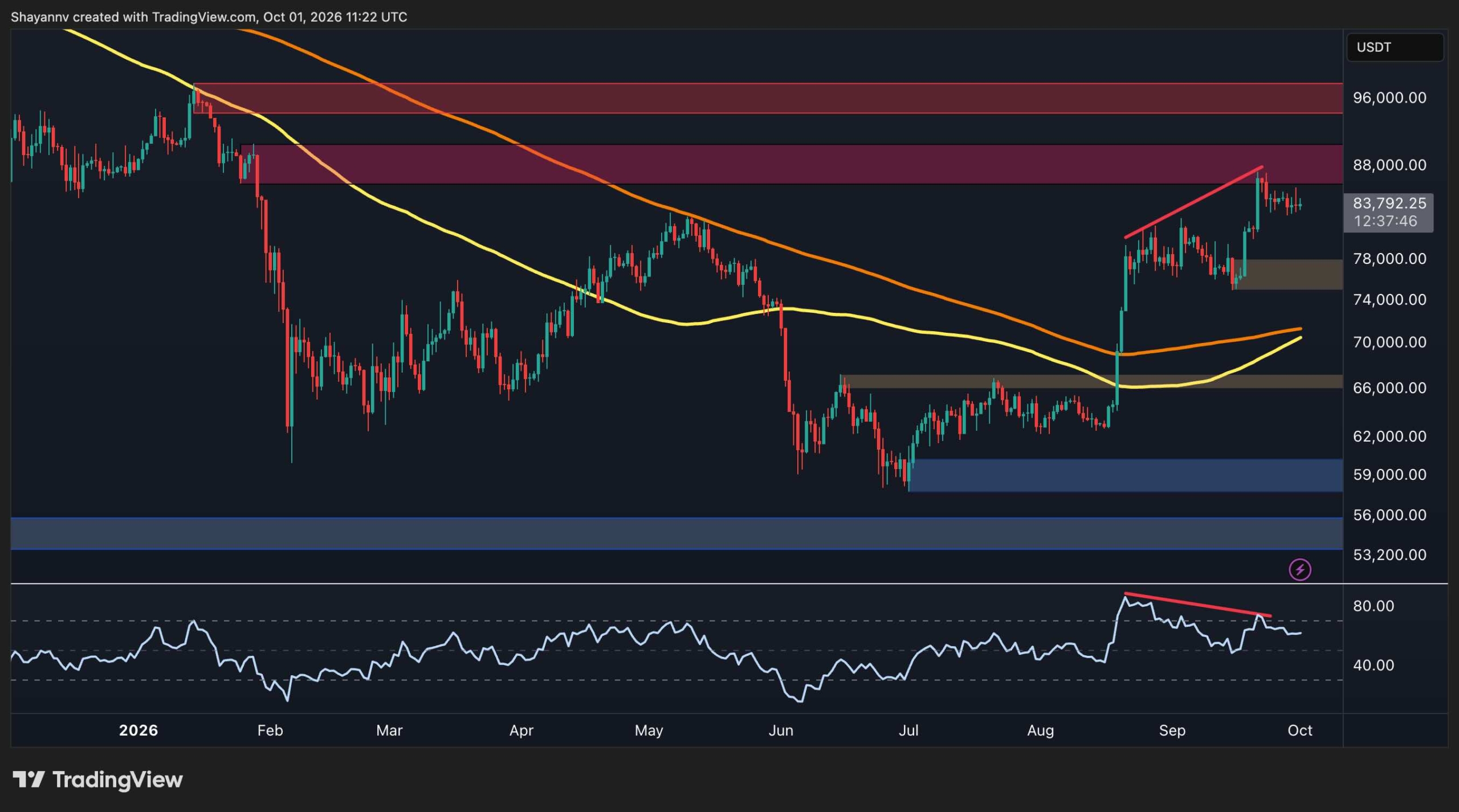
BTC/USDT 4-Hour Chart
The 4-hour chart provides a clearer picture of the consolidation visible on the daily chart. After surging from roughly $75K to above $86K, Bitcoin entered a sideways-to-slightly bearish formation bounded by two descending yellow trendlines.
BTC is currently trading near $83.8K, roughly in the middle of this short-term range. The upper trendline is approaching the $85K area, while the lower boundary is currently around $82K.
This creates a relatively well-defined short-term structure. A breakout above the descending upper trendline, followed by a move through the $88K resistance zone, would signal that buyers are attempting to resume the preceding advance.
Conversely, a breakdown below the lower trendline could expose the $81K bullish order block. A loss of this zone would weaken the current bullish structure and could bring the broader $76K demand area back into focus.
In the near term, BTC therefore appears to be coiling beneath resistance. The key technical question is whether the current consolidation resolves through the upper trendline and the $88K level, or whether sellers force a deeper retracement toward $80K.

On-Chain Analysis
The Apparent Demand Growth chart on CryptoQuant provides a less supportive signal than the recent price action. The metric measures the net change in Bitcoin supply that has remained inactive for more than one year, adjusted for newly issued coins. Positive readings indicate that apparent demand is absorbing more BTC than the amount of supply entering the market through issuance, while negative readings indicate the opposite.
Historically, the chart shows periods of sustained positive Apparent Demand Growth coinciding with strong advances in Bitcoin’s price. Conversely, prolonged negative readings have appeared during periods when price struggled to establish durable upside momentum. Sharp reversals from deeply negative readings have also preceded recoveries.
The most recent portion of the chart shows that Apparent Demand Growth has been relatively unstable, with repeated negative readings and intermittent positive spikes. More recently, the metric has leaned toward negative territory even as Bitcoin recovered toward the mid-$80K range.
This creates an important divergence between price and the underlying demand signal. Bitcoin has managed to recover significantly from its summer lows, but the Apparent Demand Growth data shown here does not yet display the sustained positive expansion that accompanied some of the market’s stronger historical advances.
As a result, the on-chain data suggests that the latest price recovery has not yet been accompanied by a decisive improvement in apparent demand. If the metric turns persistently positive while BTC holds above $80K and challenges the $88K zone, that would provide stronger confirmation for the continuation scenario. However, if negative readings persist while price fails to break $88K, the current consolidation could remain vulnerable to a deeper correction, which could soon materialize if things fail to change for the better.

The post Bitcoin Price Analysis: Is BTC’s Consolidation the Calm Before the Storm? appeared first on CryptoPotato.
Bitcoin analyst Frank Cappelleri says the OG cryptocurrency’s chart resembles the setup that preceded a 400% rally last cycle.
According to the CappThesis founder, the same technical base could support another leg higher.
Chart Mirrors the 2022 to 2023 Recovery
Speaking on CNBC, Cappelleri compared Bitcoin’s current structure with the period spanning 2022 and 2023, when BTC suffered a decline of about 70%.
He pointed to a chart of Bitcoin’s roughly 54% decline this cycle and set it beside the 70% drop mentioned above. “This also looks like a bullish pattern to me,” he said. That earlier slide ended in a large breakout, and he argued that BTC can move up hard once momentum takes hold.
“Bitcoin can really rally,” the analyst said. “It’s a 400% gain.”
However, he was careful not to project the same return this time. “Not calling for that,” Cappelleri stated, adding that he was instead looking for “a very similar foundation” that could eventually take Bitcoin back to new highs.
Cappelleri also pointed to BTC’s historical response to technical signals, saying, “Bitcoin really does well with technicals,” and arguing that its past price behavior makes those signals difficult to ignore.
BTC was valued at about $84,000 at the time of writing. The cryptocurrency experienced an increase of just over 1% in the last 24 hours and has remained more or less stable during the week. In addition, it has appreciated by about 10% in 14 days and 7% in 30 days but is 27% lower than where it was around the same time last year. Meanwhile, the asset’s third-quarter gain came to about 42%, its best Q3 since 2017.
Other Market Signals Point to a Contested Setup
As CryptoPotato reported yesterday, larger Bitcoin holders have been adding to their balances while smaller wallets have remained relatively unchanged. According to Santiment, wallets holding between 10 and 10,000 BTC added 41,025 BTC over 10 days, taking their combined balance to 13.64 million BTC, with such scenarios in the past often leading to stronger market conditions.
BIT Research has also argued that the bear market ended after Bitcoin held above $62,900 in late July. Its analysis puts the True Market Mean, an estimate of the average holder cost, at around $76,900, thus taking away another source of selling pressure. The firm outlined a bullish scenario of $185,000 to $215,000, while acknowledging that the timing and path remain uncertain.
But other analysis is less straightforward, such as from Ali Martinez, who noted that BTC had fallen after each of the four previous US midterm elections, with declines ranging from 27% to 72%, adding another source of uncertainty as November approaches.
The post Bitcoin Chart Echoes Cycle That Delivered 400% Gains: Analyst appeared first on CryptoPotato.
MetaMask is investigating an undisclosed security incident affecting part of its infrastructure, but it says it has found no immediate threat to user wallets.
The crypto wallet provider said it is working with external security advisers and partners to contain and fix the issue.
MetaMask Exits Affected Validators
As a precaution, MetaMask is exiting affected validators linked to its non-custodial staking operations. The company asserted that it does not control withdrawal keys for client stakes. This means customer assets remain under the control of the respective clients.
Lido separately confirmed the infrastructure compromise and revealed that precautionary steps were taken to protect client assets related to its operated Ethereum validators.
“These steps include exiting its Ethereum (ETH) validators in the Lido protocol, and will likely incur foregone rewards as well as possible downtime penalties should validators be taken offline in the near future to reduce risks related to potential network penalties. Relevant validators have begun the exit process, with the final validators expected to be exited (but not fully withdrawn) by the end of October 7th, 2026.”
The incident comes as a large amount of ETH was moved from a wallet linked to Ethereum co-founder Joseph Lubin. Blockchain tracker Lookonchain reported that the wallet transferred 133,298 ETH, worth over $356 million, to a new wallet. The transfer took place around the same time as MetaMask’s security announcement. However, there is no information showing that the ETH movement is connected to the MetaMask incident.
Potential Risks
There’s already some back-and-forth over how serious the incident really is. For instance, Andy Cavanaugh of The Rollup suggested the situation could be “far worse than people are expecting,” including the possibility of ETH being stuck through a liquid staking provider.
Security researcher Taylor Monahan wasn’t buying it. She called the claim a “crackhead set of assumptions” while arguing that MetaMask’s response looks more like a normal security precaution.
The disruption comes just weeks after Consensys announced a major split that will turn MetaMask into a separate company focused on consumer finance. The restructuring is expected to be completed by the end of 2026, ending more than a decade of MetaMask operating under the Consensys umbrella.
The post MetaMask Confirms Security Incident and Begins Validator Exits to Protect Client Assets appeared first on CryptoPotato.