Cryptocurrency Posts
Crypto Briefing
Lula's online gambling ban may sway undecided voters, impacting his election prospects amid economic concerns and strategic campaign shifts.
The post Brazil bans online gambling as Lula seeks fourth term amid election tensions appeared first on Crypto Briefing.
Increased Democratic support could shift the Texas governor race dynamics, highlighting the strategic importance of competitive state elections.
The post Democrats urge Beshear to boost support for Hinojosa in Texas governor race appeared first on Crypto Briefing.
Bipartisan AI liability legislation could reshape tech accountability, pushing developers toward safer AI designs and stricter compliance.
The post Hawley and Murphy plan bipartisan AI liability legislation appeared first on Crypto Briefing.
AI's potential for efficiency is evident, but scaling challenges may widen global tech disparities and shift focus from growth to cost-saving.
The post AI adoption stalls as companies struggle to scale past the pilot phase appeared first on Crypto Briefing.
Barclays' AI integration with Anthropic could enhance operational efficiency and boost Anthropic's market position and valuation.
The post Barclays expands AI partnership with Anthropic for global integration appeared first on Crypto Briefing.
Bitcoin Magazine
Bitcoin Magazine
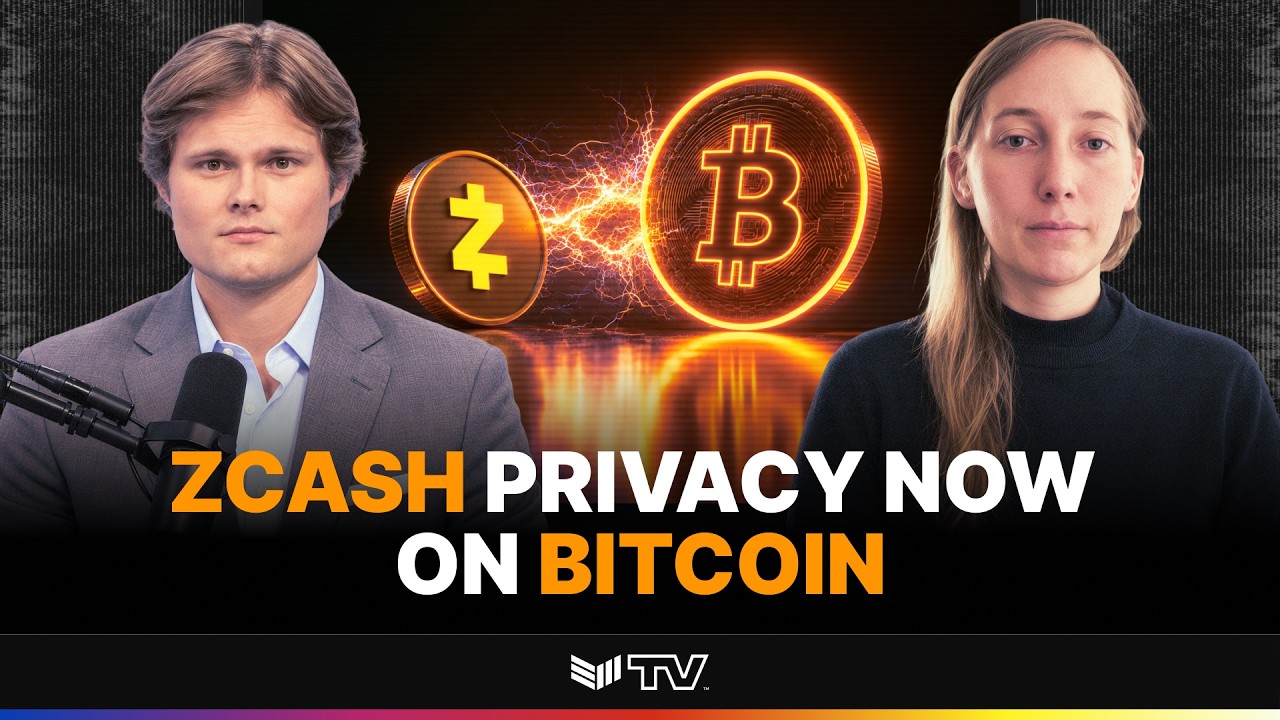
Bitcoin Privacy Breakthrough a Zcash Killer? | Misha Komorov, Alloc Innit
Researchers have proposed a way to make Bitcoin private without changing Bitcoin itself. Misha Komarov, co-founder of alloc/init, explains Shielded Bitcoin: zero-knowledge proofs that hide the sender, receiver, and amount of a Bitcoin transfer, with no soft fork, no custodians, and no bridges. He covers how Bitcoin PIPEs make it possible and what the proposal still needs. It is a research proposal, not a finished product.
Chapters:
0:00 Shielded Bitcoin: Private Bitcoin Transactions With Zero-Knowledge Proofs
0:38 How Bitcoin PIPEs Make Privacy Possible Without a Soft Fork
1:42 Do Indexers and ZK Rollups Require Trust?
3:16 Shielded Bitcoin vs. Monero and Zcash
4:21 What Privacy Shielded Bitcoin Protects
5:59 How Private Are Early Users? The Small Privacy Set Problem
7:37 Is Shielded Bitcoin an Altcoin Killer?
9:12 Fees, Block Space, and Larger Shielded Transactions
10:50 Who Needs Private Bitcoin? Wrench Attacks and Corporate Treasuries
12:20 Dark Pools, Governments, and the Next Wave of Bitcoin Buyers
DISCLAIMER: The views and opinions expressed in this show are those of the participants and do not necessarily reflect the official policy or position of BTC Inc., Bitcoin Magazine, or any affiliated entities. This content is provided for informational and educational purposes only and should not be construed as investment, legal, tax, or accounting advice. Nothing contained in this show constitutes a solicitation, recommendation, endorsement, or offer to buy or sell any securities or financial instruments. Viewers should consult their own advisors before making financial or business decisions.
This post Bitcoin Privacy Breakthrough a Zcash Killer? | Misha Komorov, Alloc Innit first appeared on Bitcoin Magazine and is written by Patrick Green.
Bitcoin Magazine

Bitcoin’s Institutional Era Has Arrived | Robinhood VP of Crypto Institutions Nicola White
Robinhood is bringing crypto perpetual futures to US customers, with up to 10x leverage on Bitcoin and Ether. Nicola White, Robinhood’s vice president of institutional crypto, explains how the CFTC no-action letter, the Bitstamp exchange, and Robinhood Derivatives made it happen, and why the company wants markets to be always on.
Chapters:
0:00 Robinhood’s Hood Summit: 24/7 Stock Trading and US Crypto Perps
0:40 Why Robinhood Wants Markets That Never Close
1:32 Bitstamp Perps and the CFTC No-Action Letter
2:19 Tokenized Stocks, the Basis Trade, and the Path for US Perps
3:20 Bitstamp’s Volume and the Retail–Institutional Merger
4:54 What Institutions Want to Do With Bitcoin
6:00 Institutional Bitcoin Depth and Large Block Trades
6:49 AI Trading Agents and Robinhood’s Sub-Account Controls
8:29 Lessons From the 2022 Meltdown and US Leverage Limits
10:12 How Bitcoin Changes Finance in 10 Years and What’s Next for Tokenized Stocks
DISCLAIMER: The views and opinions expressed in this show are those of the participants and do not necessarily reflect the official policy or position of BTC Inc., Bitcoin Magazine, or any affiliated entities. This content is provided for informational and educational purposes only and should not be construed as investment, legal, tax, or accounting advice. Nothing contained in this show constitutes a solicitation, recommendation, endorsement, or offer to buy or sell any securities or financial instruments. Viewers should consult their own advisors before making financial or business decisions.
This post Bitcoin’s Institutional Era Has Arrived | Robinhood VP of Crypto Institutions Nicola White first appeared on Bitcoin Magazine and is written by Patrick Green.
Bitcoin Magazine
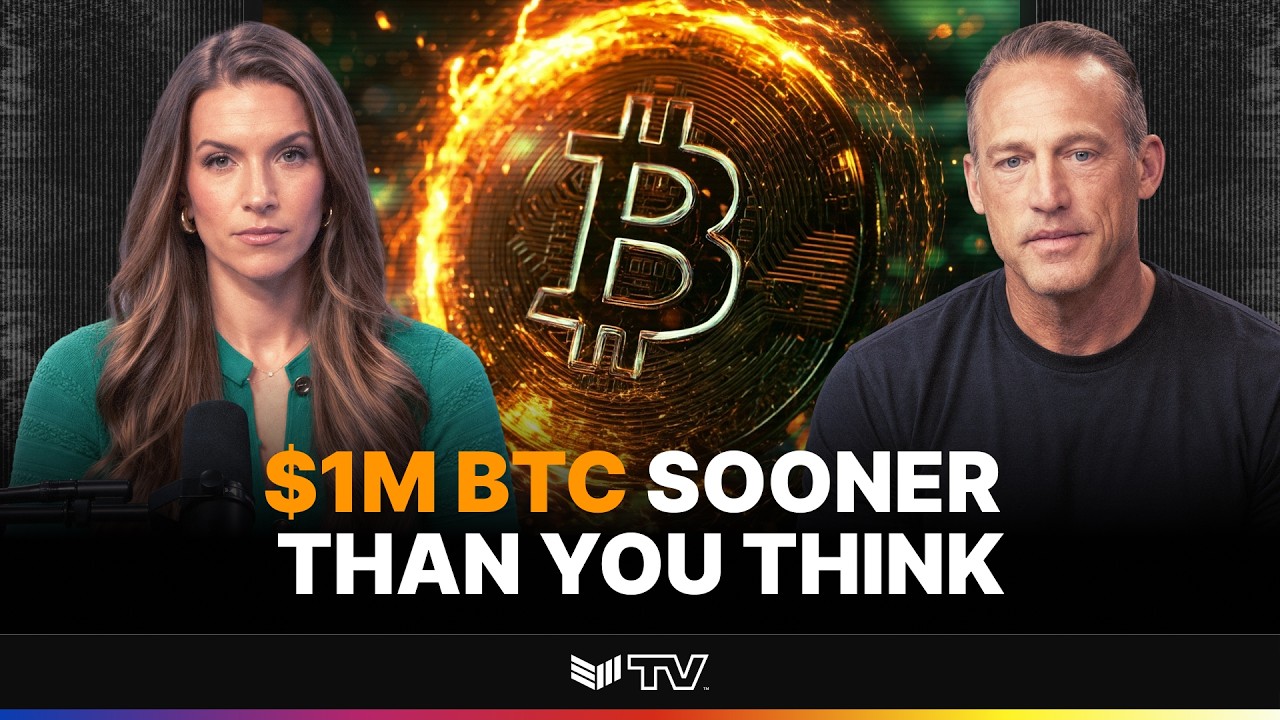
Mark Moss: The Bitcoin Endgame – BTC to $1 Million by 2030
The Fed just raised rates, yet Bitcoin keeps climbing. Mark Moss, host of the Market Disruptors podcast, explains why he thinks most people are misreading why long-term rates are rising, how a booming economy could be part of the answer, and why he says Bitcoin benefits from both the debasement trade and a bullish technological future.
Chapters:
0:00 Mark Moss on the Fed’s “Token Raise” and an October Pause
1:54 The Flat Yield Curve, Bank Lending, and the 5.1% 10-Year
2:56 Why Bitcoin Is Rising as Rates Rise: “Price Is Truth”
5:40 Bitcoin vs. Gold: The Debasement Trade and a Bullish Future
6:19 Can the US Grow Its Way Out of $40 Trillion in Debt?
10:30 The Monetary Reset Is a Process, Not an Event
13:33 Four Ways Out of the Debt Problem and What Happens in 2029–2030
16:27 Stablecoins, the Genius Act, and Why 6 Billion People Want Dollars
20:14 Institutions Are Buying Bitcoin While Retail Sells
24:29 Bitcoin’s S-Curve, Its CAGR, and a $1 Million Price Target
DISCLAIMER: The views and opinions expressed in this show are those of the participants and do not necessarily reflect the official policy or position of BTC Inc., Bitcoin Magazine, or any affiliated entities. This content is provided for informational and educational purposes only and should not be construed as investment, legal, tax, or accounting advice. Nothing contained in this show constitutes a solicitation, recommendation, endorsement, or offer to buy or sell any securities or financial instruments. Viewers should consult their own advisors before making financial or business decisions.
This post Mark Moss: The Bitcoin Endgame – BTC to $1 Million by 2030 first appeared on Bitcoin Magazine and is written by Patrick Green.
Bitcoin Magazine
UK Brings Crypto Under Full FCA Oversight for the First Time
The UK’s Financial Conduct Authority has opened applications for crypto firms to become authorized, bringing the sector under full regulation for the first time.
In a Wednesday announcement, the watchdog said companies can apply so that the crypto industry has “clarity and legitimacy.”
The UK is in the process of drafting a sweeping new crypto bill. The FCA finalized its regulatory framework for cryptoassets in June, and the regime is due to take effect in October 2027.
“The UK’s new crypto regime will give consumers greater protections and firms a clear framework to operate in. Firms can now apply for authorisation and start preparing for regulation,” Dominic Cashman, director of authorisation at the FCA, said in a statement.
The statement added that firms will have to demonstrate that they meet requirements covering consumer protection, customer-asset safeguarding, market integrity and financial resilience.
Britain is pushing ahead with digital asset legislation since last year recognizing bitcoin and other digital assets as property. The reform came from a 2023 recommendation by the Law Commission, which argued that digital assets did not fit neatly into existing legal categories.
Despite the FCA’s announcement, the UK currently is trailing behind Brussels and Washington with digital asset regulation.
The EU’s Markets in Crypto-Assets regulation has applied to service providers since 30 December 2024.
And the U.S. under President Donald Trump signed the GENIUS Act into law in July 2025, establishing a federal framework for dollar-backed tokens.
Despite lawmakers blocking landmark legislation the Clarity Act last month, U.S. regulators like the Securities and Exchange Commission have pushed ahead with rulemaking regardless.
This post UK Brings Crypto Under Full FCA Oversight for the First Time first appeared on Bitcoin Magazine and is written by Mathew Di Salvo.
Bitcoin Magazine
Bitcoin Surges 40% in Its Best Quarter Since Late 2024
Bitcoin is having one of its best quarters ever — another indication that the biggest cryptocurrency is in a bull market.
As noted by the The Kobeissi Letter this week, the price of bitcoin is now up close to 30% since August 19, when the U.S. Treasury announced it planned to more than double the size of its government debt repurchases.
Over the past quarter, the bitcoin price has surged by 40% — its best quarterly performance since Q4 2024.
Bitcoin’s price recently stood at nearly $83,698, unmoved over a 24-hour period but up 6% over a 30-day period.
The coin has benefited from news that the Treasury would try to lower bond yields — which have soared to highs not seen since the 2000s.
Bitcoin has done well with lower long-term yields because it reduces the opportunity cost of holding non-yielding assets like bitcoin and gold, and generally supports risk-on sentiment.
But despite the Treasury stepping in to try and tame the bond market, yields have continued to stay high.
Bitcoin investors don’t seem that bothered. The asset is still doing well as the dollar continues to slip. The so-called debasement trade — where investors throw money at an asset to hedge against a currency losing its value — is hot again after total U.S. debt topped $40 trillion for the first time in July.
The price of Bitcoin had been battered since notching a new all-time high of $126,080 in October, dropping by over 50%. Still, it has experienced the shallowest bear market — so far — in its history.
CryptoQuant said in a report last week that bitcoin was back in a bull market after crossing above its 365-day moving average — the “definitive technical signal” that has marked the start of Bitcoin’s bull markets in past cycles.
The coin has shrugged off the Federal Reserve raising interest rates and lawmakers blockage of landmark crypto legislation, the Clarity Act.
This post Bitcoin Surges 40% in Its Best Quarter Since Late 2024 first appeared on Bitcoin Magazine and is written by Mathew Di Salvo.
CryptoSlate
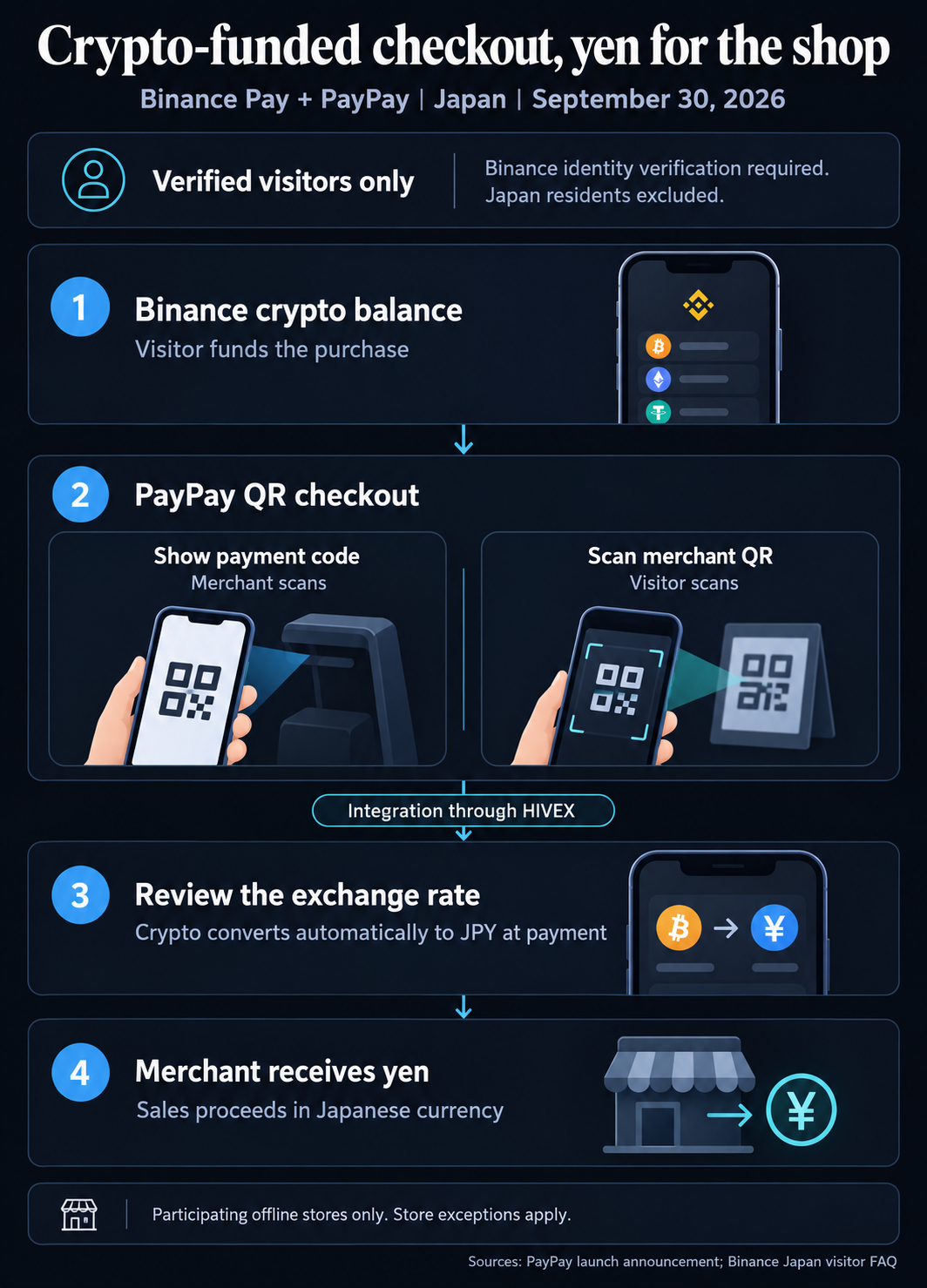
Japanese payment provider PayPay added Binance Pay on Sept. 30, letting eligible overseas visitors pay from their crypto balances at participating offline stores in Japan. Merchants receive the proceeds in Japanese yen.
PayPay's launch announcement says the integration runs through HIVEX, a cross-border payment network. For visiting Binance users, funds held in their crypto accounts can cover a yen-denominated purchase, with conversion handled during payment.
Binance says the feature is exclusively for visitors who have completed its identity verification and is unavailable to Japan residents. Its launch blog sets out that restriction, while PayPay specifically excludes Binance Japan users residing in Japan.
This visitor-payment launch does not extend the checkout feature to the exchange’s domestic customers.
How visitors pay
The payment tools sit inside the Binance app. A visitor can show a PayPay payment code for the merchant to scan, or scan a participating merchant’s PayPay QR code.
Both modes use the customer’s Binance balance, so the new payment option works through QR checkouts rather than requiring the merchant to receive crypto.
Binance’s Japan visitor FAQ says users can review the exchange rate before confirming. It says it supports more than 100 cryptocurrencies, including USDT, USDC, Bitcoin, Ethereum, and BNB.
The customer’s crypto is automatically converted to yen, and the store’s sales proceeds remain in Japanese currency.
Binance's FAQ says payments and refunds are distinct transactions, and the amount returned can differ because of rate fluctuations and applicable foreign-exchange spreads. It does not specify a numerical spread, so the fee statement does not establish a cost-free currency conversion.
Exclusions include online platforms, some taxis and vending machines, PayPay Money-only stores, certain barcode-payment merchants, and some stores that do not support cross-border payments. Binance’s FAQ also excludes merchants that require Japanese identity verification.
A PayPay sign alone does not guarantee that the Binance-funded route will work. Travelers need both an eligible account and a store that accepts the cross-border service, whether they show their own code or scan the merchant’s.
For eligible visitors, the immediate benefit is being able to fund an accepted yen purchase directly from a Binance crypto balance after reviewing the exchange rate.
The post Japan’s biggest payment network opens its doors for crypto via Binance Pay appeared first on CryptoSlate.
Base’s Cobalt upgrade, scheduled for mainnet Sept. 30 at 18:00 UTC, will let issuers of B20 tokens configure balance seizures separately from ordinary transfer restrictions. For a token that enables the feature, a holder could remain free to transfer while still being eligible for administrative reassignment.
B20 is Base’s native ERC-20-compatible token standard, offered in Asset and Stablecoin variants. It already gives administrators control over roles and policies governing balance movements, and now it will also govern the administrative powers over those balances.
Role assignments identify who can exercise a particular power, while policy settings determine which accounts an operation can affect. Changing a token’s rules and executing a balance operation involve distinct permission checks.
Separate seizure permissions
The new administrative operation, called seizeWithMemo, moves a specified amount from a holder to another address. It preserves total supply and skips ordinary transfer policies and holder allowances.
An issuer must configure which accounts lose their exemption before the function can take their tokens. The setting, SEIZE_EXEMPT_POLICY, exempts everyone when left unset. Configuring eligibility alone is insufficient: execution requires SEIZE_ROLE, an unpaused seizure function, a permitted recipient, and sufficient balance.
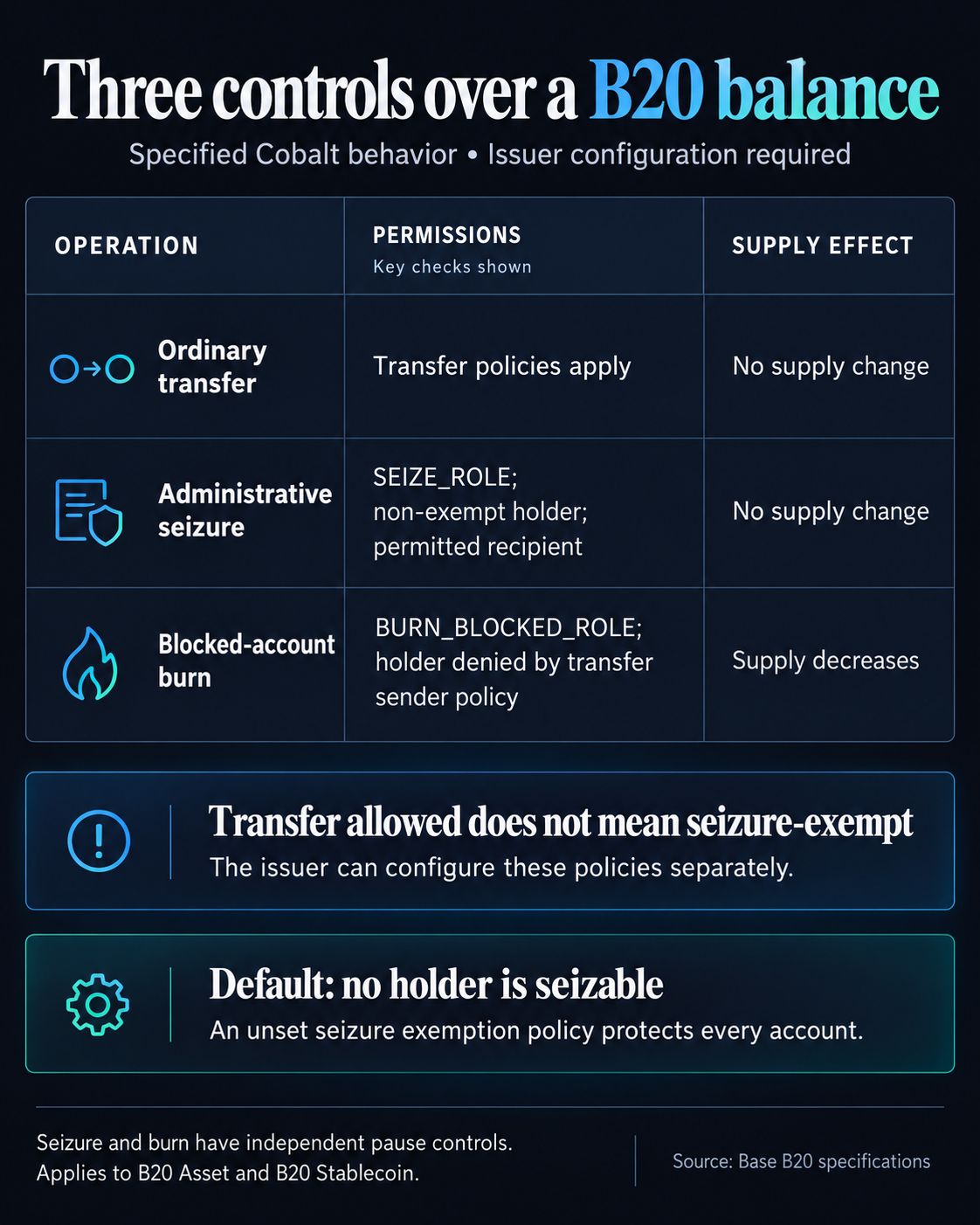
A separate recipient policy determines where the seized tokens can go, and leaving that policy unset allows any otherwise valid destination. The holder’s ability to make an ordinary transfer does not answer either seizure-policy question.
B20’s existing transfer policies check the sender and receiver, plus the executor for certain transfers on another account’s behalf. Administrators can update those policies. Approving a spender does not remove the checks on the eventual transfer, but those ordinary transfer permissions are distinct from Cobalt’s seizure rules.
B20 also already has burnBlocked, which lets an authorized caller destroy tokens held by an account denied by the transfer sender policy. Cobalt marks that function deprecated but keeps it callable with its existing behavior.
That leaves issuers with different ways to remove a holder’s balance. Reassignment keeps the tokens in circulation at another address, while destroying the seized supply requires a subsequent burn. Seizure and burning have separate administrative roles and pause controls.
Base’s status page lists the mainnet upgrade as scheduled, with maintenance from 18:00 to 20:00 UTC. The upgrade overview lists Sepolia as live since Sept. 23 and mainnet as shipping on Sept. 30.
The v1.4.2 release adds Cobalt mainnet support and instructs node operators to upgrade by Sept. 30 at 18:00 UTC.
The post Base’s Cobalt upgrade adds another rule to affect token balances appeared first on CryptoSlate.
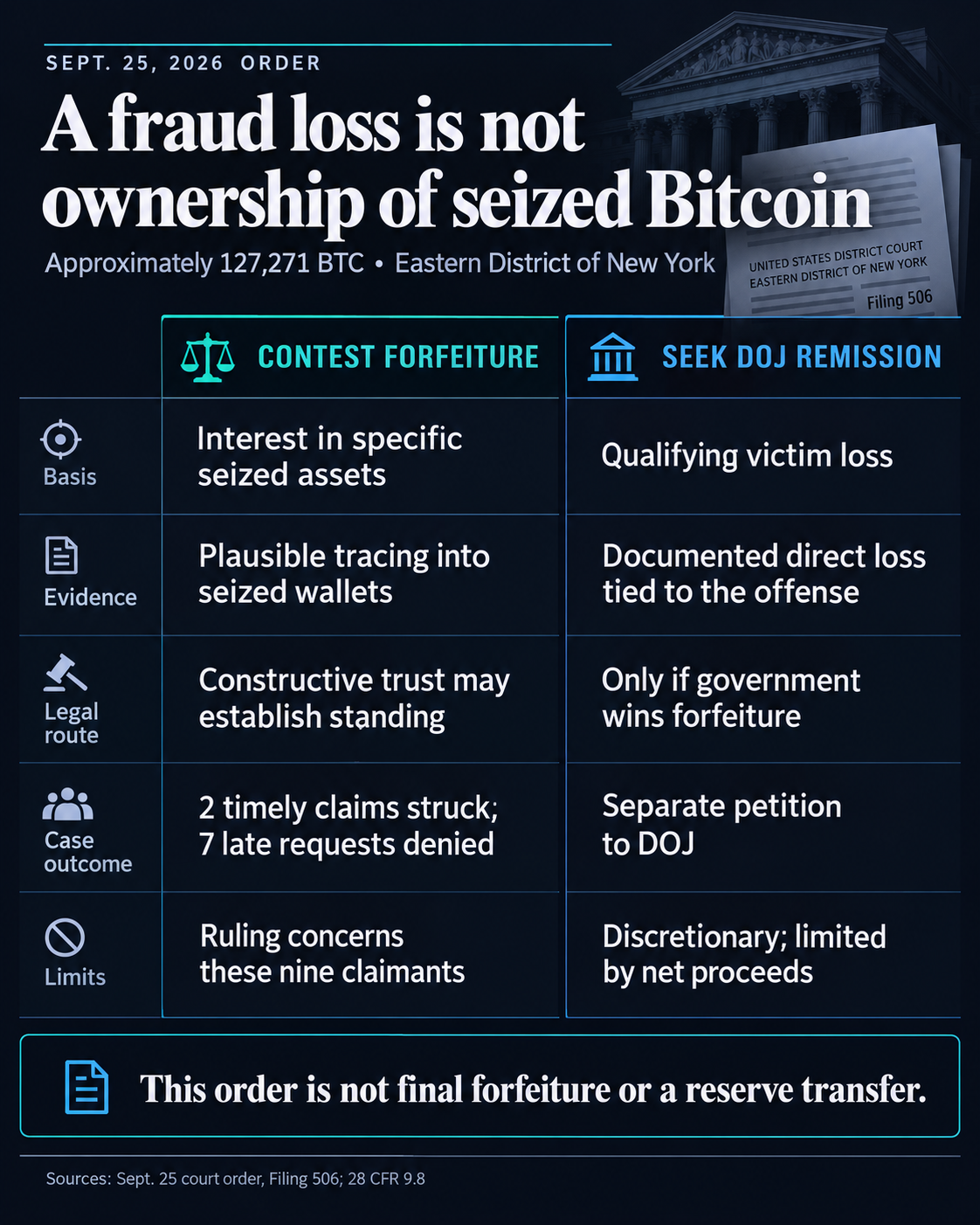
Judge Rachel P. Kovner rejected claims by nine alleged fraud victims seeking to contest forfeiture of approximately 127,271 Bitcoin in a Sept. 25 order.
Their filings did not plausibly connect their lost funds to the specific seized wallets, leaving them with a different potential recovery route if the government wins the forfeiture case.
The Eastern District of New York judge struck the timely claims of Ath Leepinyo and Connie Wilson and denied seven other claimants permission to file late. All nine lacked Article III standing, the legal threshold for contesting the action.
The case began with a civil forfeiture complaint filed on Oct. 14, 2025. DOJ said then that the Bitcoin was in US custody and alleged links to fraud and money laundering involving Prince Holding Group, a Cambodian conglomerate, and its chairman, Chen Zhi.
The court treated these claimants’ plausible allegations as establishing, at most, the position of general unsecured creditors: people seeking compensation without a qualifying interest in the particular assets being forfeited.
A loss tied to an alleged fraud did not establish ownership of coins in these wallets.
The order recognized that a constructive trust could give a claimant an equitable ownership interest and standing. That remedy can recognize an interest in property derived from a person’s assets. However, here none of the claimants plausibly alleged the necessary connection between their funds and the seized Bitcoin.
Lawrence D. Van Dyn Hoven, for example, relied on an investigator’s belief that his stolen cryptocurrency was part of the seizure. Kovner found that his filings offered no supporting facts explaining that belief.
What remission could provide
Kovner pointed to victim remission if the government succeeds in forfeiting the Bitcoin. That process allows eligible victims to petition DOJ for recovery from forfeited property even when they lack a present ownership interest in it.
Under 28 CFR 9.8, petitioners must document a specific financial loss directly caused by the offense underlying forfeiture or a related offense, and satisfy other eligibility conditions. Other conditions include no knowing participation in or benefit from the offense, and no willful blindness.
Petitioners must also show they have not been compensated for the loss and lack reasonably available alternative assets for recovery.
When the forfeited property cannot cover petitions in full, recognized victims may receive proportionate shares. Remission is capped at a victim’s share of the associated net forfeiture proceeds, so the size of the Bitcoin seizure is no promise of full repayment.
The Sept. 25 order resolves these nine claimants’ standing. Their potential recovery depends on government success in the forfeiture action and a separate discretionary decision on a documented-loss petition.
The post US court blocks victims from 127,000 seized Bitcoin, and petition rules are blamed appeared first on CryptoSlate.
Uniswap’s StablePair fee hook is designed to keep more of the value from rebalancing stablecoin pools with liquidity providers.
Yet the rule deciding which trade counts as a correction depends on a configured reference rate.
StablePair is a Uniswap v4 hook, a contract that changes a pool’s behavior. Its fee logic compares a cached pool price with a reference stored in the hook’s configuration. The design prices trades around that benchmark, leaving providers exposed if a token’s economic value moves away.
Uniswap Labs announced the two Ethereum pools, USDC/USDT and USDC/USDG, on Sept. 10. Its Sept. 16 explanation noted that Providers allocating capital now are choosing a fee mechanism alongside the token inventory it requires them to hold.
What the dynamic fee captures
The deployment documentation lists one-for-one reference rates for both pools. The implementation’s fee path uses that stored reference and the pool’s price, without consulting an external market-price feed.
Inside a narrow band around the reference, the fee varies by swap direction to target a consistent bid and ask before price impact. When the pool sits exactly at the reference, both directions pay the configured optimal fee. As it moves toward an edge, the fee in one direction falls while the other rises.
For a simple illustration, assume an optimal fee of one basis point (0.01%). At the reference, a swap with 10,000 input units would pay one input unit in LP fees.
Outside the band, the fee rules split trades by direction. A swap classified as moving farther from the reference pays zero LP fee, while a swap classified as pulling the pool toward it faces a decaying fee.
A trade pushing the pool away can give LPs a favorable price relative to that benchmark. The reverse trade lets an arbitrageur capture the gap by restoring the pool’s price. A single static fee rate charges both directions equally.
StablePair instead offers progressively better terms for the corrective trade as blocks pass.
If a trader accepts the fee, LPs collect it while the trade rebalances the pool. Uniswap Labs says the design captures the “vast majority” of rebalancing profit.
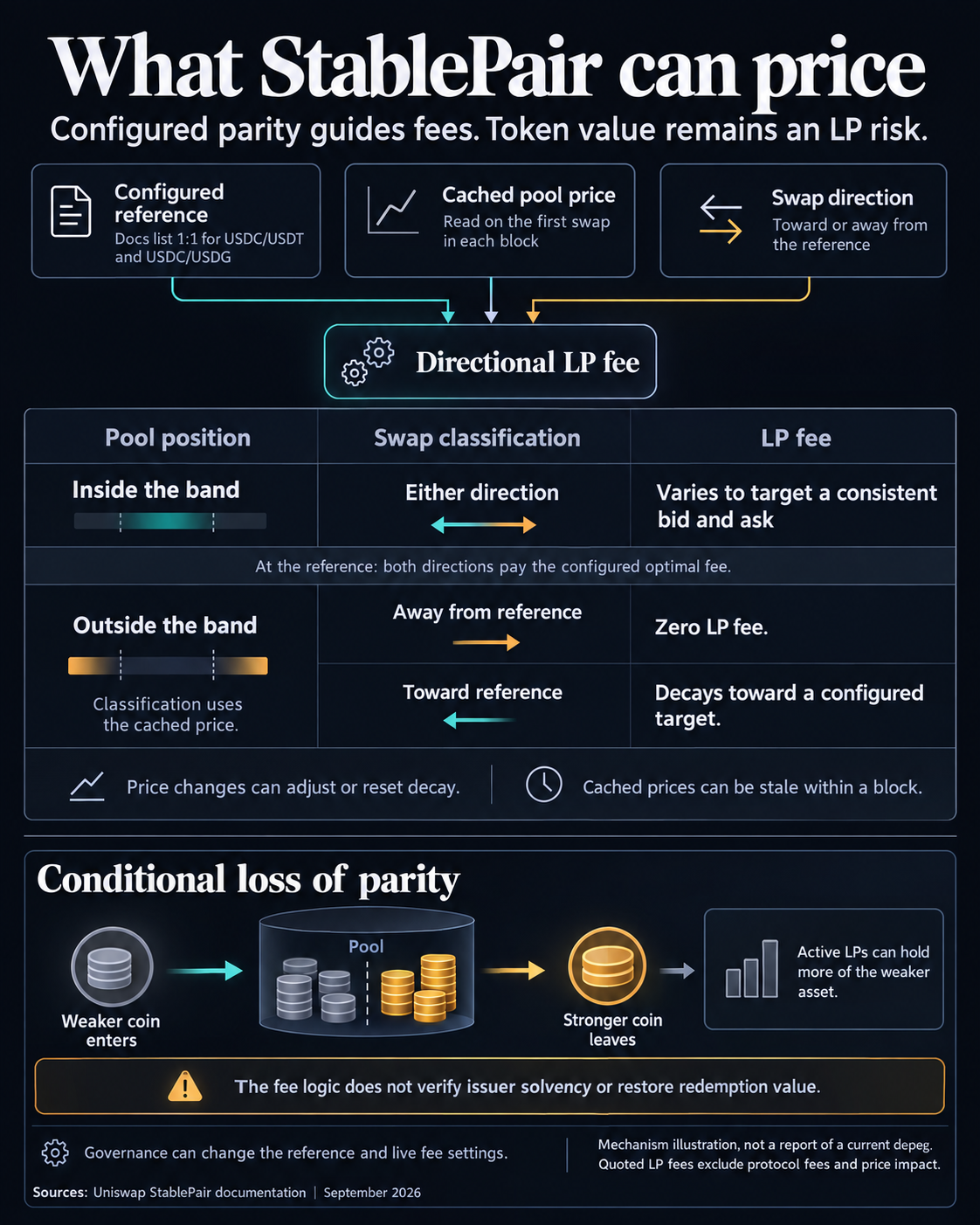
The first swap in each block caches the pool price used for later fee calculations. That removes the same-block fee advantage from splitting corrective swaps, but later trades can face stale inputs. If the live price crosses the reference mid-block, the cached classification can assign fees to the opposite directions until the next block.
Inventory risk and the evidence on returns
The boundary appears when the outside market stops treating the two coins as equal.
Consider a conditional issuer shock that reduces one coin’s external value while the configured reference still assumes one-for-one exchange. Selling that weakening coin for the stronger coin can move the pool farther from the reference while moving its price closer to the outside market.
A trade the fee rule classifies as moving away from the reference may then reflect price discovery, rather than a temporary imbalance.
The fee logic cannot verify issuer solvency or restore redemption value. This scenario is hypothetical and should not be read as a report of a current depeg, exploit, or loss in either StablePair pool.
If an LP holds 10,000 hypothetical coins and their external value falls from $1 to $0.90 each, that inventory is worth $9,000, a $1,000 decline before fees. Capturing income from rebalancing trades does not by itself reimburse that change in token value.
Trades can also change what the provider owns. Selling the weaker coin into available liquidity removes the stronger coin and leaves active LP positions with more of the weaker asset. An away-from-reference trade charged zero LP fee contributes no LP fee to offset that added exposure.
The amount exchanged still depends on available liquidity, the provider’s chosen range, and price impact. StablePair's zero-fee classification also depends on the cached price, so it should not be read as a rule that every sale of a weakening coin is always free.
On Sept. 30, the Uniswap interface’s Stats panels showed the USDC/USDT StablePair pool with about $6.1 million in total value locked and $117.9 million in 24-hour volume around 15:59 UTC. The USDC/USDG pool displayed about $2.6 million and $8.7 million, respectively, around 15:57 UTC.
A same-pair reference was available: the Ethereum USDC/USDT v3 pool charging 0.01% displayed about $34.2 million in TVL, $15 million in 24-hour volume, and $1,100 in 24-hour fees around 16:02 UTC.
The observations were not synchronized, the pools have different fee rules and liquidity conditions, and the StablePair panels supplied no comparable absolute fee total or realized position-level return.
In economic terms, testing that return claim would require comparable periods and active liquidity ranges, fee income, and inventory valuation. Volume alone cannot show how much better an LP did than in another pool or by holding the assets.
Governance controls the benchmark, with limits on the hook
Under Uniswap’s documented role model, governance controls live fee configurations, implementation upgrades, and role administration.
Changing the reference changes the benchmark used to classify and charge swaps. The deployment page directs integrators to read live configuration from the hook because governance can change parameters.
Separate limits apply to what an upgrade can do. The hook’s permanent address permissions exclude remove-liquidity callbacks and custom accounting deltas.
According to Uniswap’s security documentation, upgrades cannot use those capabilities to block LP withdrawals or alter swap amounts to skim additional fees. The ability to withdraw does not guarantee the market value of the tokens received.
Uniswap says OpenZeppelin reviewed a non-upgradeable predecessor’s core fee mechanism from Feb. 9 to 13, 2026, and resolved the splitting issue through block caching. The later upgradeability and role model were outside that review.
For LPs, StablePair changes the price of supplying liquidity for rebalancing. The remaining economic decision is whether the assets still justify the reference around which that liquidity is supplied, and whether earned fees compensate for the inventory ultimately held.
The post Three hidden flaws in Uniswap’s StablePair hook drain LP returns appeared first on CryptoSlate.
Bitcoin is closing its strongest quarter since 2024 after leaving US stocks and gold far behind despite surging bond yields.
The largest digital asset has gained about 43% in the third quarter, putting it on course for its second-best third-quarter since 2013 and its third-strongest quarterly advance since US spot Bitcoin exchange-traded funds began trading in January 2024, according to Bitfinex and CoinGlass.
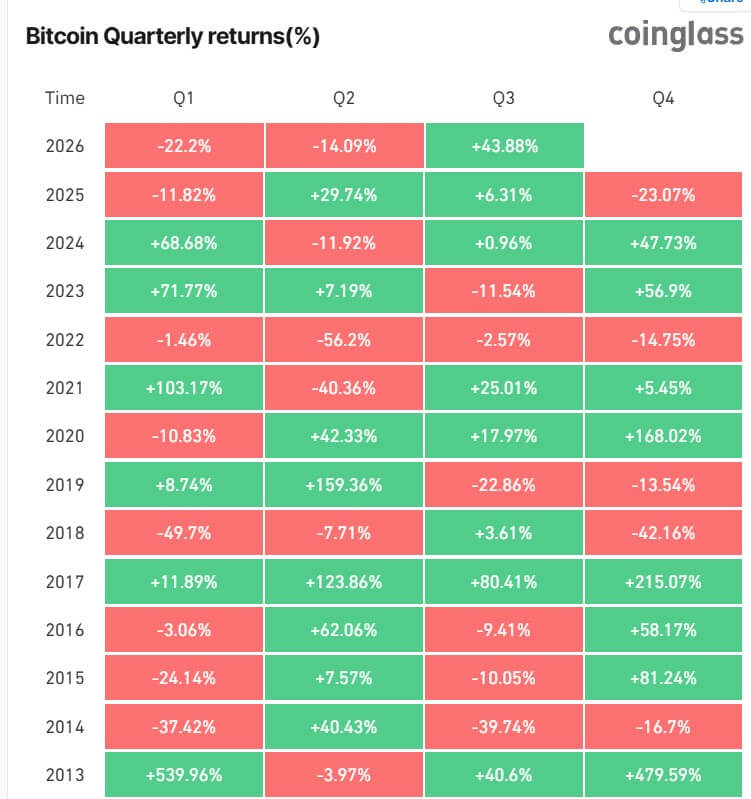
Bitcoin entered July near $58,600 after three consecutive quarterly declines, then accelerated through August and September as institutional demand returned and sellers who had spent much of 2026 underwater were absorbed at progressively higher prices.
Traditional markets barely kept pace. Over roughly the same three-month period through Sept. 29, the Nasdaq Composite gained about 5%, the S&P 500 roughly 4% and gold less than 2%, according to StatMuse data.
Meanwhile, Ethereum was the notable exception, outperforming Bitcoin as the crypto rebound broadened beyond the market leader.
Bitcoin's outperformance accelerated after Aug. 19, even as a Treasury initiative to improve liquidity in longer-dated government debt failed to prevent yields from rising.
The department said it would at least double the maximum size of liquidity-support buybacks for longer maturities to $4 billion per operation, with the increased purchases beginning Sept. 9.
Bitcoin has risen almost 30% since the announcement. However, the 10-year Treasury yield climbed about 81 basis points and long-dated borrowing costs reached multi-decade highs over the quarter, raising the hurdle for assets that produce no yield.
Wall Street money takes over from leverage
US spot Bitcoin ETFs provided a fresh source of capital as financial conditions tightened elsewhere.
The funds moved from roughly $5 billion in year-to-date net outflows at the end of July to about $1 billion in inflows by late September, a swing of about $6 billion in two months.
The reversal culminated last week when the products absorbed $2.39 billion, their largest weekly intake since October 2025. Every session was positive, though daily demand slowed from $999 million on Sept. 21 to about $135 million by Sept. 25.
Analysts at Nexo said Bitcoin enters the fourth quarter with stronger spot demand and an improving market structure, though the outlook still depends on ETF buying persisting, overhead supply being absorbed and inflation remaining contained enough to prevent further Federal Reserve tightening.
At the same time, leveraged traders have been retreating.
Aggregate Bitcoin futures open interest has fallen from more than 700,000 BTC on Sept. 21 to about 644,000, its lowest since early January, according to Bitfinex. The seven-day contraction of roughly 49,000 BTC was the largest since October 2025, while CME open interest dropped 16,075 BTC on Monday alone, its third-biggest daily decline on record.
Futures premiums have also compressed, and implied volatility remains near a one-year low.
The unwind leaves less leverage to accelerate another liquidation-driven selloff, but it also removes speculative buying that can propel sharp advances. That shifts more responsibility onto investors purchasing Bitcoin outright.
Signs of that transition are appearing around current prices. Bitfinex estimates the amount of Bitcoin with a cost basis between $82,500 and $84,000 nearly tripled to 306,000 tokens in three days as buyers absorbed coins sold by both profitable holders below the market and newer investors exiting at losses above it.
A 1.39 million Bitcoin wall waits above $85,000
Bitcoin's improving structure still leaves a substantial concentration of sellers immediately overhead.
Bitfinex estimates investors hold about 1.39 million BTC acquired between $84,000 and $86,500. The group includes long-term holders returning toward breakeven and more recent buyers whose positions slipped underwater after Bitcoin retreated from its Sept. 21 high near $87,400.
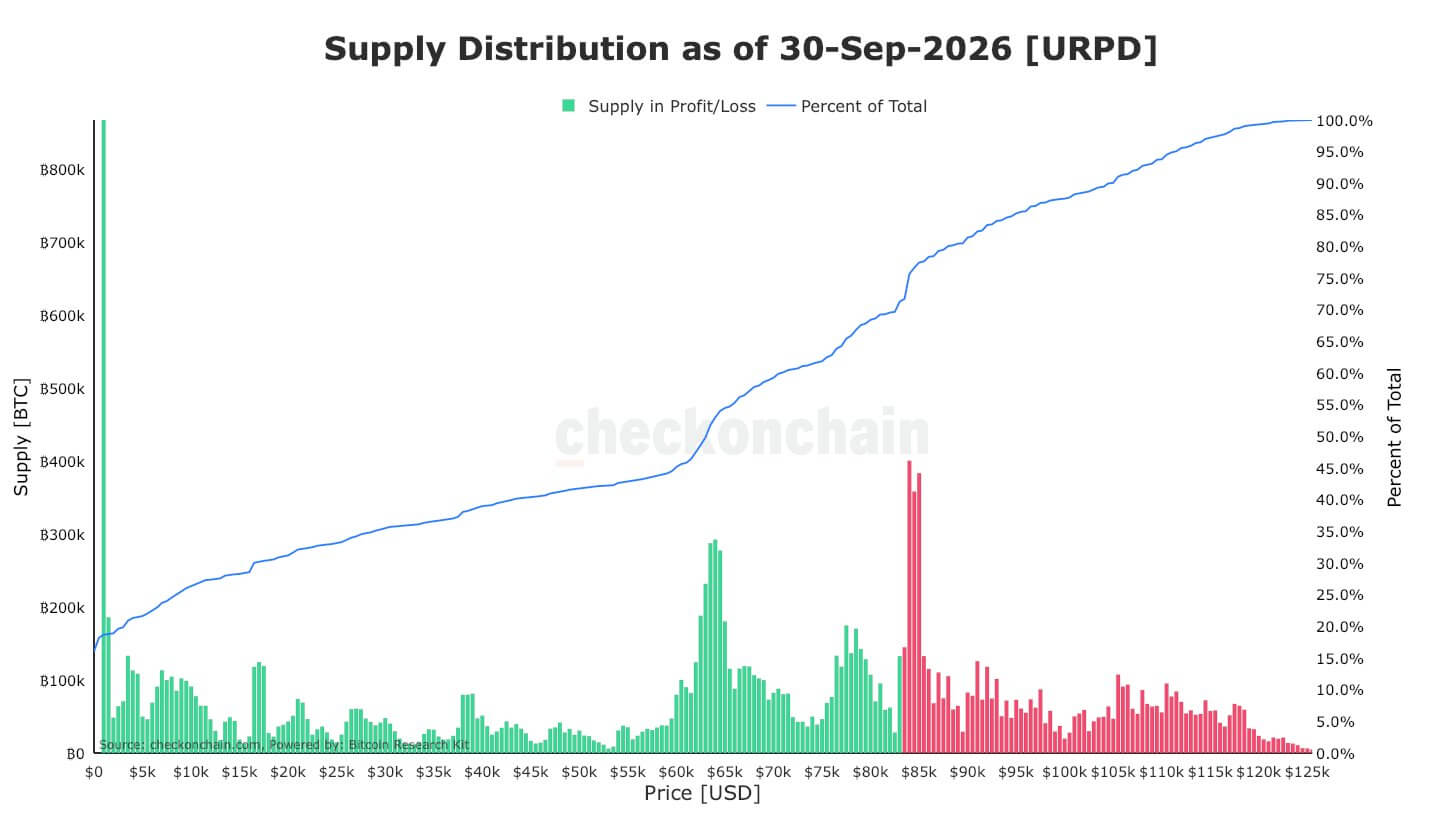
That creates potential selling each time prices push back into the range.
CryptoQuant said Bitcoin reclaimed its 365-day moving average last week for the first time since March 2023. Recoveries above the gauge have accompanied previous transitions into bullish regimes, while sustained moves below it have historically coincided with weaker market phases.
Bitcoin's realized price, which approximates the average cost basis of coins in circulation, has climbed to about $77,000 and held through the latest recovery.
The challenge is whether new demand can clear the supply sitting above spot prices.
Bitfinex's measure of ETF purchases relative to the roughly 450 Bitcoin produced by miners each day fell from 25.6 times issuance during the $999 million inflow session to 1.8 times by Sept. 29. The firm estimates the ratio needs to recover toward five times issuance, equivalent to roughly $190 million of ETF demand a day, to absorb the overhead supply more quickly.
A move above $85,000 would return roughly 760,000 BTC to profit and lift Bitcoin's supply-in-profit measure back toward the 75% threshold Bitfinex associates with stronger bull-market phases. The gauge slipped to 71.3% on Sept. 29 from 78.1% eight days earlier.
Beyond the immediate barrier, Glassnode places another major supply concentration near $88,000 to $90,000, followed by an important level around $96,700.
Options traders are positioned for a break higher nonetheless. Nexo said Bitcoin's put-to-call ratio averaged 0.67 over the past two weeks, while $140,000 calls expiring Dec. 25 represent the largest individual position. Dealer positioning points to the $95,000-to-$97,000 area as another significant test if Bitcoin clears the nearer supply zones.
Bitcoin's best season collides with 5% yields
Seasonality gives bulls another argument heading into October.
The fourth quarter has historically produced Bitcoin's strongest returns, with average gains of roughly 77% to 85% since 2013, depending on the dataset. BloFin Research calculates that matching its 77.07% historical average from current levels would put Bitcoin near $147,000, while its median fourth-quarter return of 47.73% would imply roughly $123,000.
Those are mechanical projections, and successive Bitcoin cycles have delivered progressively smaller advances from their lows.
Monetary policy presents the more immediate constraint.
Markets began this week assigning roughly a 65% probability to another quarter-point Fed increase in October. Softer-than-expected inflation data Wednesday cut those odds to about 38%, showing how rapidly the rate outlook can shift ahead of the central bank's Oct. 27-28 meeting. Another decision follows Dec. 8-9.
Sept. 28 offered an earlier warning about Bitcoin's exposure to broader positioning. The Nasdaq-100, gold and Bitcoin fell together as investors reduced exposure across markets, a pattern Nexo analysts said was more consistent with broad deleveraging than a conventional rotation into safe assets.
For Bitfinex, $81,300 is now an important threshold beneath the recovery. Sustained trading below that level alongside renewed ETF outflows could expose the realized-price region near $77,000.
On the upside, stronger ETF demand and a break through $86,500 would leave Bitcoin approaching its yearly open near $87,700 before the larger supply cluster around $90,000 comes into play.
The Oct. 2 US payrolls report will give traders another read on the economy before the next inflation release and the Fed's October meeting, just as Bitcoin enters its historically strongest quarter with Treasury yields still above 5%.
The post Bitcoin enters its best season after a 43% surge, with $147,000 suddenly on the math appeared first on CryptoSlate.
CryptoTicker.io
From the coming network upgrade onwards, NEAR will burn every single gas fee. Until now, 30 percent of the fees that accrue when a smart contract is called flowed back to the owner of that contract; the remaining 70 percent left circulation. With version 2.14 of the network software nearcore, that rebate drops to zero. After that, the full amount is burned. Reports put the date at around October 5, 2026, but that is not a firmly committed deadline.
For you as a holder this means two things: the supply of NEAR will shrink faster whenever a lot is happening on the network, and part of the revenue that applications on NEAR could count on until now falls away. The market priced the decision in long ago, but the technical execution is still ahead.
100 percent instead of 70 percent: what nearcore 2.14 changes in the gas model
Gas on NEAR is the computing fee for every transaction. Whoever calls a smart contract pays for it in NEAR. Until now that amount was split: the protocol burned 70 percent, and 30 percent went as a reward to the account that owns the contract being called. Inside the protocol this share sits in a single parameter named burnt_gas_reward, set at three tenths until now. The upgrade sets it to zero.
Technically this is a small intervention, economically a large one. After the change, a function call pays nothing back to the contract account. Every fee a user settles leaves circulation completely and for good. Burned tokens cannot be restored, and there is no office that could reverse the entry.
Implementation hangs on the rollout of the client software. The release notes for nearcore 2.14 list the change as part of the package. Validators have to install the version, and the new rule only takes hold in live operation once enough of them have switched over. Anyone writing a deadline into the calendar is therefore better off writing a week than a day.
HSP-027: how the decision came about in the House of Stake
The decision is not new, only its execution is. The governance body House of Stake adopted proposal HSP-027 on July 8, 2026. The result was unambiguous: 46 votes, which together carried 4.66 million veNEAR, were in favour, while two votes with 1,819 veNEAR between them were against. veNEAR is the voting weight that arises from locked NEAR; whoever locks for longer weighs more heavily.
The reasoning comes from NEAR co-founder Illia Polosukhin. The rebate was once meant to reward developers for building reusable components. On his account, the mechanism no longer reflects how applications on NEAR earn their money today: projects mostly cover their users' gas costs themselves and bring in revenue through spreads, subscriptions or advertising. Polosukhin called the vote a good test of governance ahead of further proposals, and he said he was pleased to be steering NEAR's economics explicitly through governance from now on. The protocol gains in simplicity, and some contract operators lose a source of income.
That a body votes on a protocol parameter and the result lands in a client version four weeks later is the actual process behind the headline. What matters in it for you is that a vote of locked tokens stands behind the rule, not a company decision. By the same route it can be changed back.

Deflation by usage: the burn hangs on network load
A higher burn share does not lower supply automatically. It lowers it only to the extent that the network is used. What gets burned is what accrues in fees, and fees accrue when transactions run. If activity stays low, the additional effect stays small as well. If it rises, the loss of the rebate works like an amplifier: out of every euro in fees, 100 percent instead of 70 percent will disappear in future.
Around 1.308 billion NEAR are currently in circulation, and there is no fixed upper limit. That is what sets it apart from Bitcoin: with NEAR, scarcity arises from the running ratio between issuance and burning, without a fixed wall in the code. It is exactly this ratio that the upgrade shifts, without touching issuance.
How you can read the effect
The figure that counts is the total of fees per day, not the price. A network with many small transactions burns more than one with a few large ones. At NEAR the main driver is held to be the Intents system for swaps across chains, whose volume has risen from under one billion to more than 32 billion dollars within twelve months according to industry reports. How this area works and where its catches lie is something we took apart in our piece on NEAR Intents.
NEAR price at $5.46: 11 percent in a day, 175 percent in 30 days
On Thursday morning NEAR is trading at $5.46, the equivalent of 4.83 euros. According to CoinGecko data that is 11.3 percent more than 24 hours earlier. On a weekly view the gain sits between 22 and 27 percent depending on the point of measurement, and over 30 days at around 175 percent. Market capitalisation therefore comes to about $7.14 billion, rank 21 among all crypto assets, on trading volume of around $1.59 billion in 24 hours.
This run puts the news in its place. NEAR is still around 73 percent away from its all-time high of $20.44 from January 2022. But a threefold gain within a month also means that a large share of the most recent buyers are sitting on profits and can sell at any moment. Whoever gets in now is not buying into a quiet situation.
Part of the push comes from outside. Since September 29, 2026, a Bitwise spot ETF on NEAR has traded on NYSE Arca under the ticker NRR. Figures for the first trading day diverge: an inflow of $35.5 million and a trading volume of $15.1 million are reported. In both cases it is a double-digit million sum on day one. What this instrument means for a portfolio in Germany, and why you cannot simply buy it here, is set out in our text on the NEAR ETF NRR.
Buying route in Germany: MiCA authorisation before the fee comparison
For access to NEAR itself, a clear order has applied in Germany since the MiCA regulation. What counts first is whether the provider holds an authorisation as a crypto-asset service provider in the EU and is supervised by BaFin or another European authority. Only after that is it worth looking at spreads, order fees and withdrawal costs. A platform without European authorisation can close access for German users tomorrow, and a cheap tariff will not help you then. Which trading venues clear this hurdle is shown by our overview of crypto exchanges compared.
Staking and validators: the loss of the rebate does not hit delegators
This is where the most common mix-up arises, so one step at a time. The rebate of 30 percent went to the owners of smart contracts, that is, to the operators of applications. It did not go to validators, and not to users who delegate their NEAR to a validator. The reward for staking comes out of the protocol's issuance and is a different pot. The upgrade does not touch that pot.
In practice that means your staking income does not fall because of the change. Anyone running an application on NEAR that has covered part of its costs through the gas rebate until now, by contrast, has to recalculate. For holders the second group is only of indirect interest, namely when a heavily used application changes its prices or leaves the network as a result.
Staking through an exchange or directly with a validator
When you stake through a trading platform, the platform keeps the keys and often part of the reward. When you delegate directly to a validator, control stays with you, but you carry the risk of picking a validator with poor availability. In both cases an unbonding period applies, during which the tokens are not available. How the terms look at various providers is something we have set side by side in our overview of staking platforms.
Holding period: one year decides whether your NEAR gains are tax free
In Germany, gains from the sale of crypto assets count as private disposal transactions. If you sell within a year of buying, the gain is taxable at your personal income tax rate; below an exemption threshold of 1,000 euros per year it stays tax free. After a holding period of more than one year the gain is tax free regardless of its size.
With a coin that has almost tripled within 30 days, that is no side issue. A sale in October 2026 falls fully into the tax net if the purchase dates from September 2026. Anyone who wants to use the deadline needs proof of the purchase date and purchase price for every single tranche. Staking rewards follow their own rules here and count as other income in the year they are received.
The gas model upgrade itself does not trigger any taxable event for you. What gets burned is fees inside the protocol, not tokens out of your wallet. So there is no inflow you would have to declare, and no acquisition that starts a new deadline.

Leverage and liquidation: perp positions are especially exposed ahead of the upgrade
After a rise of this magnitude, leveraged positions are the most sensitive spot in the market. A perpetual future on NEAR costs funding on an ongoing basis, and at a leverage of ten a countermove of ten percent is enough to use up the margin. NEAR gained more than 11 percent on Thursday alone; a move of that size in the other direction is just as much within the realm of the possible.
Around an upgrade a second point comes into play. Dates that are imprecisely set produce positions that bet on a date. If the rollout shifts by days, those bets come to nothing, and the unwinding moves the price more than the technical change itself.
Custody: hardware wallet, exchange account and control over the keys
Anyone who wants to hold NEAR for months in order to reach the holding period has a custody problem to solve. On an exchange account the tokens sit within the platform's reach. That is convenient for staking and for quick sales, but it exposes you to the risk that the platform fails or halts withdrawals. On a hardware wallet the keys sit with you, but you have to keep the recovery words safe and separate.
An intermediate solution that has proven itself is splitting things up: the portion you trade or stake with on the platform, the holding earmarked for the deadline in self-custody. What matters is that every movement between the two worlds is documented, because the tax office will want to see the acquisition when you later sell.
What the burn does not deliver
A complete fee burn is not a promise about the price. It shifts one quantity in the supply, and whether that shows up in the price depends on demand and on network load. Projects with deflationary mechanisms have both risen and fallen in the past. Anyone taking the change as an argument to buy should measure it against the total of fees, not against the headline.
Just as little does the decision settle the open question of issuance. As long as new NEAR come into being and no upper limit exists, the net effect remains a calculation with two entries. The upgrade only improves one of them.
NEAR gas fees: the key points for your decision
- Check access before you think about fees. Take a trading venue with European authorisation, so that your access does not hang on a supervisory decision. The candidates are listed in the comparison of crypto exchanges.
- Assess staking separately from the change. Your rewards come out of issuance and remain untouched by the loss of the gas rebate; compare unbonding periods and deductions instead, in the overview of staking platforms.
- Record the purchase date and purchase price for each tranche. Without that proof the one-year deadline cannot be demonstrated later; a tracker handles it on an ongoing basis, see tax tools and portfolio trackers.
The date itself is best treated as a window rather than a cut-off day. The decision is confirmed and the delivery is scheduled; only the rollout among the validators turns both into the new rule. Whoever builds positions beforehand builds them on an expectation, and whoever waits for the change misses no mechanism, at most a move.
How the proposal was argued in detail and how the vote turned out is documented at The Cryptonomist.
(As of October 1, 2026. This article is not investment advice. Prices and fee structures change; check the terms with the provider before you buy.)
Anyone searching for “buy Ethereum with PayPal” usually expects a button in the PayPal app. In Germany there is none. PayPal does not trade crypto-assets here, and nothing about that changed at the start of October 2026 either. What does work is a detour: you top up a crypto exchange with euros from your PayPal account and buy Ethereum there. That detour costs you two things an ordinary bank transfer does not: a fee you do not know before you click, and three days during which your ETH may not leave the exchange.
This article works through both. It shows what actually arrives in ether out of 100 euros along the three routes SEPA, debit card and PayPal, why the lock-up period weighs more heavily for Ethereum than the difference in fees, and what can go wrong when you move the coins on to a wallet of your own. We have already answered the same question for Bitcoin: buying Bitcoin with PayPal. With Ethereum two points come on top that do not arise in that form with Bitcoin, namely the choice of network and the question of what staking does to the holding period.
PayPal does not sell crypto-assets in Germany
The distinction matters, because many guides blur it: PayPal as a dealer in crypto-assets and PayPal as a payment route are two different things. The first exists in the United States, the second in Germany.
That can be established from PayPal's own presence. The product page for buying and selling cryptocurrencies exists on PayPal's US site. On the German site the corresponding address leads nowhere. More telling still is a look at the terms of use: in the German version, last updated on September 7, 2026 and a good 150,000 characters long, the word cryptocurrency does not appear at a single point. A service a provider does not mention in its own contractual documents is a service it does not offer.
For you that means: every page promising you can buy ether “directly at PayPal” either describes the US market, or it describes the detour via an exchange and names it imprecisely. There is no third case.
The only route runs through a euro deposit at a crypto exchange
The actual process has four steps, and PayPal is involved in only one of them. You open an account at a crypto exchange and verify your identity. You deposit euros and choose PayPal as the payment route. You buy ether with the euro balance. And if you want to hold the coins yourself, you then transfer them to a wallet of your own.
Crypto exchange here means a trading venue that swaps crypto-assets for euros and holds the balance for you. In this process PayPal is neither dealer nor custodian, only the till at the door. That division of roles explains most of the peculiarities that follow: the exchange determines what the purchase costs and when you may move your coins, not PayPal.
PayPal appears as a deposit route at several providers. The position is only verifiable, though, where the provider publishes its fees and deadlines in full. Kraken does so with a table anyone can inspect and which was last updated on August 17, 2026. That is why this article works with those figures. At other houses, contradictory statements circulate on comparison portals, from “free since July 2025” to “2 percent”; anyone wanting to deposit there should check the terms with the provider before buying. Which trading venues come into question in Germany at all is shown in our comparison of providers with PayPal deposits.
The 72-hour lock is the real price of the PayPal deposit
The point missing from most guides is stated expressly in Kraken's fee table: after a deposit by PayPal, a withdrawal lock of 72 hours sits on the account. The lock applies not only to euros but to all withdrawals, crypto-assets included. For three days your freshly bought ETH therefore stay on the exchange, whether you like it or not.
The reason for that is not harassment but chargeback risk. A PayPal payment can be disputed after the fact. If the coins bought could be withdrawn immediately, the exchange would be left without any counter-value in a dispute. The same logic applies to card payments, but not to the SEPA transfer: there the table shows no lock.
Withdrawal lock does not mean your balance is frozen. You can trade straight away, you simply cannot get out of the building. For an investor who leaves their ETH on the exchange anyway, that has no consequences. For anyone holding by the principle of “not your keys, not your coins”, it is three days of counterparty risk they would not have had with a transfer. The year 2026 has served as a reminder, through several exchange incidents, that those three days are not a theoretical risk.

At Kraken the PayPal fee appears only on the final confirmation page
For every other type of deposit the table names a figure. SEPA from the European Economic Area: free, minimum amount 1 euro, credited within zero to three banking days or instantly. Debit card: minimum amount 10 euros, 0.25 euros plus 3.75 percent, credited almost instantly. A transfer over the international SWIFT network: 3 euros, one to five banking days.
For PayPal, the word “processing fees” stands in place of the figure, together with a footnote: the fees depend on the region and are displayed on the final confirmation page. Minimum amount 1 euro, credited almost instantly, lock 72 hours.
That is the most remarkable finding of this research, and it is no reproach to a single provider but a property of the payment route: of all the deposit types, PayPal is the only one whose price cannot be looked up beforehand. You learn it at the moment when all that is left is to confirm. Anyone wanting to compare has to run the process through to the final page and break off there.
100 euros in ETH via SEPA, debit card and PayPal: the cost calculation
Let us work the purchase through once, with the published figures and an ether price of around 2,367 euros, as it stands on October 1. On top of the deposit fee comes the trading fee in every case: Kraken charges 1 percent on instant purchases and recurring purchases, and 1.5 percent on orders you place yourself.
Via SEPA, a full 100 euros out of 100 euros arrive in the exchange account, because the transfer costs nothing. The purchase takes off 1 percent, so 1.00 euro. What goes into ether is 99.00 euros, around 0.0418 ETH.
Via the debit card, the deposit costs 0.25 euros plus 3.75 percent, 4.00 euros together. That leaves 96.00 euros, from which 1 percent trading fee comes off, so 0.96 euros. What goes into ether is 95.04 euros, or around 0.0402 ETH. Against the transfer, 3.96 euros are missing, which converts to around 0.0017 ETH.
Via PayPal, this line cannot be filled in. The deposit fee is not known beforehand. If it is zero, the result matches the SEPA route; if it is at card level, around four euros are missing. Nothing more can seriously be said, and that is exactly the point: on a purchase of 100 euros it is a single-digit euro amount, on a purchase of 5,000 euros a three-digit sum that you see only on the final page.
The spread sits in the purchase price and appears in no fee line
The calculation above is deliberately incomplete, because it captures only the stated fees. For instant purchases, Kraken expressly points out that a spread is additionally contained in the price displayed.
The spread is the distance between the price at which the exchange buys and the one at which it sells. It never appears on a statement as an item of its own, because it already sits in the price you confirm. To you it works like a fee, but it turns up in no fee overview.
In practice that means two things. First, any comparison that merely sets the stated percentages side by side is calculated too favourably, and that holds for every provider. Second, it pays to look at the difference between the convenient instant purchase and an order you place yourself in the trading area: the trading fee is stated higher there at 1.5 percent, but the spread falls away because you set the price yourself. With larger amounts the relationship therefore often reverses. There is no generally valid threshold, because the spread fluctuates with market conditions.
The network fee for the ETH transfer runs to fractions of a cent
Many newcomers put off the transfer to their own wallet because they fear expensive network fees. That worry comes from the years when a simple Ethereum transfer could cost double-digit euro amounts. Nothing of that is left at present.
At the start of October, the base fee in the Ethereum network sits at about 0.12 gwei. Gwei is the usual unit of account for network fees, a billionth of an ETH. A simple transfer of ether consumes 21,000 gas units. That produces around 0.0000025 ETH, less than a cent at today's price.
The catch: what the exchange charges you for a withdrawal is not that network fee but a rate of its own, which it sets itself and which appears on the confirmation page. It can lie considerably above. The network fee is therefore good as a lower bound, not as an expectation. What remains is the all-clear: the network is no longer the reason to leave coins on the exchange.
ERC-20 or layer 2: the wrong network costs you your ETH
Here lies the difference from Bitcoin, and it is the most expensive mistake in this whole process. On a withdrawal the exchange asks which network it should send over. Alongside the Ethereum mainnet, several layer-2 networks are on offer, that is, side chains which bundle transactions and settle them more cheaply, such as Arbitrum or Base.
The address looks the same in all of these networks. Every one of these addresses begins with 0x and has 42 characters. Precisely there lies the trap: if you choose a different network when sending from the one your wallet expects, the transfer is carried out all the same. The money lands at the same address on another chain. In the favourable case you get it back by setting up that network in your wallet. In the unfavourable case, for instance with an address belonging to an exchange that does not support the chain in question, the amount is lost.
The rule against that is plain: the network chosen when sending has to be the same one set at the top of your wallet. If in doubt, send a small amount first and wait for it to be credited before the rest follows. By the calculation above, the cost of that test lies in the range of fractions of a cent, the benefit in the range of the entire purchase amount. Which devices and programs are suitable for custody is set out in the hardware wallet comparison.
PayPal buyer protection does not cover financial products and investments
A widespread misunderstanding holds that the detour via PayPal brings additional protection with it. The opposite is true. The terms of PayPal buyer protection in the version of April 15, 2025 contain a list of transactions the protection does not cover. Alongside payments for gold and cash equivalents such as gift cards, that list expressly includes financial products and investments.
Buying ether through an exchange falls into that group. If the price falls, if the exchange goes down or if you mistype the address, there is no reimbursement on that basis. Buyer protection is intended for purchases of goods, not for capital investments.
Conversely, the chargeback route very much does apply, and that is exactly why the 72-hour lock exists. Anyone disputing a legitimate deposit in order to end up with both coins and money risks having the exchange account blocked, and civil consequences. The lock is the exchange's answer to that risk, and it hits all customers equally.
Holding period and threshold: what Section 23 EStG prescribes for your ETH
For tax purposes, buying ether counts among private disposals. Section 23 of the Income Tax Act regulates them in subsection 1 number 2: a disposal is taxable in the case of assets where not more than one year lies between acquisition and sale. If you sell your ETH later than one year after buying, the gain is free of income tax, whatever its size.
Within the year a threshold applies. Under subsection 3 sentence 5, gains remain tax-free where the total gain from all private disposals in the calendar year comes to less than 1,000 euros. Threshold here means: if the amount is exceeded, the entire gain is taxable, not only the excess part. At a gain of 999 euros you pay nothing; at 1,001 euros you pay tax on the full 1,001 euros at your personal rate.
For the PayPal question only one detail matters, and it is regularly misunderstood: the one-year period begins with the acquisition, meaning on the day of purchase, not at the end of the 72-hour lock and not on the day of the transfer to your own wallet. The lock shifts the start of the period by not a single day. Anyone buying several times needs the individual date for each part-purchase; tools for that are in the comparison of tax and portfolio programs.
Staking does not extend the holding period to ten years
With Ethereum a question arises that does not come up with Bitcoin: what happens to the holding period if you stake your ETH? The reason for the worry sits in the same section. Under subsection 1 number 2 sentence 4, the period extends to ten years where income is earned in at least one calendar year from the use of an asset as a source of income.
Staking means depositing your ETH in the network to help secure transactions, and receiving ongoing returns for it. That sounds like a source of income. The tax administration does not, however, apply the ten-year period to crypto-assets. The Federal Ministry of Finance confirmed this in its circular of March 6, 2025 on the income tax treatment of certain crypto-assets, file reference IV C 1 – S 2256/00042/064/043. The holding period accordingly stays at one year even after staking or lending.
The treatment of the returns themselves is unaffected by that: ongoing staking rewards are taxable in the year they are received, separately from the later gain on sale. Anyone dealing with such returns for the first time should settle the classification with a tax adviser; this article is no substitute for advice in the individual case.

MiCA authorisation: how to recognise an authorised provider
Since the European crypto regulation MiCA, trading venues need authorisation as crypto-asset service providers in order to serve retail clients in the EU. For you that is not a sticker on the wall but an entry in a register, and it can be looked up in two minutes.
Two directories help further: BaFin's company database for providers with German authorisation, and the register of the European securities supervisor ESMA for authorised service providers from all member states. A route via another EU country is normal in this and no warning sign: an authorisation from Ireland or Malta is valid across Europe.
What matters is matching the exact company name. Exchanges frequently run their European business through a company of their own whose name differs from the brand. If you find the operator in neither of the two registers, do not pay money in there, however convenient the PayPal button looks. Vetted trading venues are in our comparison of crypto exchanges.
Buying Ethereum with PayPal: Your next three steps
- Establish whether you really need the convenience. On the terms examined here, a SEPA transfer is free, has no lock-up period and is in many cases credited instantly as well. PayPal pays off above all where your money is sitting there anyway. An overview of the trading venues is in the exchange comparison.
- Run the deposit process through to the final page before you confirm. That is the only place the PayPal processing fee appears. Add it to the trading fee of 1 percent and compare the result with the 100 euros that arrive in full via a transfer.
- Allow for the 72 hours before you take custody of the ETH yourself. Once the lock has elapsed, transfer a small amount first and make sure the network you choose matches your wallet. Suitable devices are shown by the hardware wallet comparison.
The sources for this article: the fees, minimum amounts and lock-up periods come from Kraken's public overview of deposit options.
(As of October 1, 2026. This article is not investment advice. Prices and fee structures change; check the terms with the provider before you buy.)
In brief: in Germany you will usually set up a crypto company as a GmbH or a UG. What decides the matter, though, is not the legal form but the business model: anyone who holds, exchanges or arranges crypto-assets for others has needed authorisation from BaFin since MiCA, plus minimum capital of 50,000 to 150,000 euros depending on the service. Anyone offering software, analytics or content generally gets by without a licence. This guide sets out the steps in the right order.
Step 1: establish whether your business model requires authorisation
Before you call a notary, one question belongs settled: are you providing crypto-asset services within the meaning of the EU regulation MiCA? Those include, among others, the custody of crypto-assets for clients, operating a trading platform, exchanging against the euro or other crypto-assets, the execution and reception of orders, and advice and portfolio management.
If that is the case, you need authorisation as a crypto-asset service provider, CASP for short. In Germany it is granted by BaFin on the basis of MiCA and the German Crypto Markets Supervision Act. The transition periods for existing providers have now expired in all EU member states. Whoever is authorised appears in ESMA's public register; what that looks like in practice is shown by the list of authorised providers, and even banks such as the Volksbanken are having their crypto custody approved.
No authorisation is generally needed by anyone who merely supplies software, such as a non-custodial wallet, an analytics tool, development services or a crypto news outlet. The line is fine in the individual case. When in doubt, an enquiry to BaFin or to a specialist law firm pays off before the first client money flows.
Step 2: choose the right legal form
For crypto start-ups, two legal forms almost always come into question, because they limit liability to the company's assets:
| GmbH | UG (limited liability) | |
|---|---|---|
| Minimum capital | 25,000 euros, of which at least 12,500 euros paid in at formation | from 1 euro, a quarter of profits must be retained |
| Standing with banks and partners | high | lower, often follow-up questions |
| Suitable for | business models requiring authorisation, investor rounds | software, media, a first test phase |
| Formation | by notarial deed, video conference possible | by notarial deed, video conference possible |
Anyone who needs BaFin authorisation starts in practice with a GmbH, because the minimum capital required by the supervisor lies above that of a UG in any case. How the formation runs step by step, from articles of association to the commercial register, is explained in the Gründerfreunde guide to forming a GmbH. For a smaller start there is also a guide there on how to form a UG. Anyone needing a ready-made company quickly can alternatively buy a shelf company.
Step 3: plan capital and the supervisor's requirements

MiCA tiers the minimum capital by type of service:
- 50,000 euros for services such as the reception and transmission of orders, advice, portfolio management or the placing of crypto-assets,
- 125,000 euros where crypto-assets are additionally held for clients or exchanged against money or other crypto-assets,
- 150,000 euros for operating a trading platform.
On top of that come requirements that often cost more than the capital itself: management that is both reliable and professionally qualified, a seat with genuine management in the EU, anti-money-laundering rules, a complaints procedure, IT security under the EU regulation DORA, and the segregated custody of client funds. Allow several months for the authorisation application.
Step 4: issue a token only with a white paper
Many crypto start-ups want a token of their own sooner or later. MiCA applies to that as well: anyone offering crypto-assets to the public has to draw up a white paper and submit it to the supervisor. If the token is a security, securities law applies instead of MiCA. The difference between an ICO and a security token, and what is permitted today, is explained in our guide What is an ICO? What is a security token?
Step 5: bank account, bookkeeping and taxes
Getting a business account is often harder for crypto firms than the formation itself. Banks examine the origin of funds and the business model closely. A clean business plan helps, as does a concept for anti-money-laundering and, where necessary, evidence of BaFin authorisation or of a pending application.
On tax, the position is this: if a GmbH holds crypto-assets, there is no one-year speculation period as there is for private individuals. Gains on a sale are subject to corporation tax and trade tax, together around 30 percent depending on the municipality. Settle the accounting treatment of crypto-assets early with a tax firm that knows the field.
Step 6: use financing and public support
For the first phase the same routes come into question as for any other start-up: equity, business angels, venture capital and public funding. An overview of the funders and what they look for is given in the Gründerfreunde guide to start-up financing. Anyone founding a business while unemployed can apply for a start-up grant. And anyone wanting to test a new business model under supervision should know the options offered by living labs and regulatory sandboxes.
Checklist: setting up a crypto company in Germany
- Test the business model against the MiCA services; when in doubt, ask BaFin or a specialist lawyer.
- Choose the legal form: a GmbH where authorisation is required, otherwise a GmbH or a UG.
- Budget minimum capital and staff for management, anti-money-laundering and IT security.
- Formation before a notary, entry in the commercial register, business registration.
- File the authorisation application with BaFin before client business starts.
- Find a business account and a tax firm with crypto experience.
- Issue a token only with a MiCA white paper, or as a security with a prospectus.
Frequently asked questions
Do I always need a BaFin licence for a crypto start-up?
No. What requires authorisation are crypto-asset services for clients, such as custody, exchange, a trading platform or the reception of orders. Pure software, analytics tools or media offerings generally need no authorisation.
How much capital do I need for a MiCA licence?
Depending on the service, minimum capital of 50,000, 125,000 or 150,000 euros, plus funds for staff, compliance and IT security.
Is a UG enough for a crypto start-up?
For models outside the authorisation requirement, yes. Anyone who needs BaFin authorisation is better off starting with a GmbH, because the capital required is higher than a UG's in any case.
Note: Gründerfreunde, like cryptoticker, belongs to the group of companies owned by Dennis Weidner. This guide is no substitute for legal or tax advice.
The most important inflation figure in the United States came in weaker than expected on September 30. The price index for personal consumption expenditures excluding food and energy, known internationally as core PCE, rose 3.0 percent in August against the same month a year earlier. The market had expected 3.3 percent. For you as an investor in Germany, one thing above all follows from that: the probability that the Federal Reserve turns the interest rate screw once more on October 28 has fallen within a few days from around 70 percent to below half. Higher rates are the counterweight to risk assets, and Bitcoin is one of them.
Core PCE in August: what the BEA release says
The US Commerce Department publishes the figure through the Bureau of Economic Analysis, or BEA. The release carrying the reference BEA 26-43 appeared on Wednesday, September 30, 2026 at 8:30 a.m. local time on the US East Coast, which is 2:30 p.m. German time. It can be read in the BEA's Personal Income and Outlays, August 2026 press release.
The figures in detail, all from that release: the overall PCE price index rose 0.3 percent in August against the previous month and 3.4 percent against the previous year. Excluding food and energy it was 0.2 percent month on month and 3.0 percent year on year. Personal income increased by $66.6 billion, which corresponds to 0.2 percent in the month. Real, meaning inflation-adjusted, consumer spending rose by $92.8 billion, or 0.6 percent.
What core PCE actually measures
Core PCE is the inflation gauge against which the Federal Reserve sets its two percent target. It measures how the prices of the goods and services US households actually buy are changing, and it leaves out food and energy because those prices swing sharply and obscure the underlying trend. That is precisely why rate markets react more strongly to this figure than to the better-known consumer price index.
One detail of this publication matters for context: alongside the August data, the BEA presented the annual revision of the national accounts. Retroactive corrections to earlier months are possible as a result. Anyone comparing time series should therefore take the revised values and not the figures that were in circulation before September 30.
Core and headline rates diverge: why 3.0 against 3.4 percent
At 3.4 percent, the headline rate sits above the core rate of 3.0 percent. That gap of 0.4 percentage points comes from food and energy, which are exactly the two groups stripped out of the core rate. When the headline rate is higher, price pressure comes predominantly from there and less from the breadth of the economy.
For the central bank that is a more comfortable constellation than the reverse case. Energy prices respond to supply, transport routes and political conditions, not to the policy rate. A rate rise barely touches them. Broad services pressure, on the other hand, can be slowed with rates, and that is what the core rate captures. The fact that the core rate eased unexpectedly therefore takes out of the calculation precisely the part of price pressure the Fed would answer with rates.
This is no all-clear. Three percent is still one and a half times the two percent target, and the figure refers to August, not to September. More data is due before the meeting on October 28.

CME FedWatch slips below half: the market reads October 28 differently
How the market assesses the next rate decision can be read off the futures contracts on the US overnight rate. The probability derived from them is usually quoted as CME FedWatch. At the start of the week, the expectation of a further rate rise in October stood at around 70 percent according to reports from several financial media outlets. After a speech by a senior central banker on September 29 and the weaker inflation figure on September 30, it fell below 50 percent.
Exactly how far depends on the source, and the values differ. On September 30, published readings ranged from about 35 to 47 percent for a rise. That range deliberately stands here rather than being reduced to a round number. What counts is the direction: a probable rise has become an open question.
The September 29 speech and the rate curve: what tipped expectations
The trigger came from John Williams, the president of the Federal Reserve Bank of New York. According to reports from financial media, he signalled in a speech on September 29 that he sees no hurry over a further rate step. That is notable because the same central banker had said five days earlier that a further rise by the end of the year could reasonably be expected. Within a week the tone shifted, and the inflation figure the following day supported the softer reading.
Read such statements for what they are: assessments by individual voices on the decision-making body, not decisions. The vote takes place in the Open Market Committee, and its meeting dates are fixed. For the rest of the year there are two, according to the official Federal Reserve meeting calendar: October 27 and 28, and December 8 and 9. The decision comes on the second day in each case.
Bitcoin between $82,951 and $85,518: the range of the past 24 hours
The reaction was visible, but it did not hold. Bitcoin jumped after the release and then gave the jump back. According to CoinGecko market data, the price stood at $83,692 on Thursday morning, 0.52 percent above the level 24 hours earlier. Within those 24 hours the high was $85,518 and the low $82,951. Individual reports put the immediate reaction at just under $85,900, which means the figures for the daily high range from about $85,500 to $85,900 depending on the data source.
Over the week there is a loss of 0.75 percent, and over 30 days a gain of 6.52 percent. That produces a picture a single day cannot explain: the inflation figure has loosened rate pressure, but it has not triggered a breakout. The price continues to move in the range it has been in all week.
Why a brief reaction says nothing about the week
Macro figures work in two stages. First, automated systems react within seconds to the deviation from expectations, and that spike often disappears the same day. Only afterwards does it become clear whether larger addresses actually change their positioning. That can be read off futures market data and the inflows and outflows of exchange-traded products, not off the price in a single hour.
Buying routes in Germany: MiCA exchange, ETN and what the US market does not offer you
Anyone in Germany who wants to position for looser rate policy has two common routes, and both come with rules of their own. The first is the direct purchase through a trading platform authorised in the EU under the regulation on markets in crypto-assets, known as MiCA. The authorisation is publicly verifiable, and it determines what obligations the provider has towards you. Which houses hold it can be looked up in the public register before you open an account.
The second route runs through exchange-traded products. In Germany these are as a rule ETNs or ETPs, which you trade on Xetra through your existing securities account. One distinction matters here that regularly causes misunderstandings: a US spot ETF on a cryptocurrency is normally not tradable for retail investors in Germany, because it is not subject to the European requirements on investor information and fund structure. What launches in New York therefore does not land in your portfolio automatically. What the European route looks like instead is set out in our overview of crypto ETFs and ETNs for investors in Germany.
The two routes also differ in what you own at the end. With a direct purchase you hold the coins, with everything that goes with them, from custody to your own responsibility for the keys. With an ETN you hold a debt security issued by the provider that tracks the price.

The holding period under Section 23 EStG: why the rate path reaches into your tax planning
A particularity applies to the direct purchase in Germany that does not exist in the same form with an ETN. Gains from the sale of cryptocurrencies fall under private disposals under Section 23 of the Income Tax Act. If you sell within a year of buying, the gain is taxable. After a holding period of more than a year, it is not. There is also a threshold for small gains, and you should check its current level with the tax office or in a tax guide before deciding, because the amount has been adjusted in recent years.
The link to the rate path is more immediate than it first sounds. If you hold a position you would actually sell because of the rate outlook, your purchase date determines how expensive that sale becomes. If the purchase was eleven months ago, selling now may cost considerably more than selling in four weeks. That is not a recommendation to hold anything, but a figure that belongs in the decision. Anyone with many purchases spread across different months will hardly keep them apart cleanly without help; tools for that are in our comparison of crypto tax tools and portfolio trackers.
Leverage and liquidation: how thin the buffer at $83,692 really is
On days with macro data in particular, a manageable price swing turns into a total loss once leverage is in play. Work it through with this day's figures. From the level at $83,692 to the 24-hour low at $82,951 is 0.89 percent. At tenfold leverage that move corresponds to a loss of almost 9 percent of your stake, at twentyfold leverage about 18 percent.
Take the whole range of the day, from the high at $85,518 to the low at $82,951, and it is 3.0 percent. Anyone who entered at the high with twentyfold leverage had lost around 60 percent of their margin at the low. These are not exceptional numbers but a quiet trading day with a single macro figure. Ahead of the meeting on October 28, larger swings are more likely than today.
What actually happens in a liquidation
Once the price reaches the liquidation level, the exchange closes the position automatically and the margin is gone. The common offerings do not create an obligation to pay in more, but the loss is not recoverable either if the price turns afterwards. With a direct purchase without leverage this threshold does not exist; there a paper loss stays a paper loss as long as you do not sell.
Levels above and below: $85,518 in the way, $82,951 as the floor
Two orientation points emerge from the daily data that manage without a forecast. Above lies the daily high at $85,518. That is where the price failed after the inflation figure, and as long as it stays below, the impulse from that figure has been absorbed. Below lies the daily low at $82,951. If the price drops under it, the positive reaction to the weaker inflation has been given back in full.
These two values are measurement points from the past 24 hours, not price targets. Anyone working with levels updates them daily, because yesterday's range carries nothing today. For that you need no forecast, only a data source and a fixed rhythm.
October 28 and December 9: the two dates that shape the quarter
Two dates remain for this year, and they are in the Federal Reserve's official calendar. The Open Market Committee meets on October 27 and 28, with the decision on October 28. The last meeting of the year follows on December 8 and 9, with the decision on December 9. The December meeting additionally includes the summary of economic projections, in which members disclose their own rate expectations.
Further data releases fall between today and October 28, among them the next inflation figure. Today's expectation is therefore not the expectation of late October. All that holds today is this: the market no longer treats a rise as the more likely case.
Core inflation and Bitcoin: what to take away
The August figure has loosened rate pressure without removing it. Three things follow from it concretely:
- Settle the buying route before you buy. Decide whether you want to buy directly or go through an exchange-traded product, and for the direct variant establish the provider's MiCA authorisation. The overview is in our comparison of regulated crypto exchanges.
- Settle custody before the sum grows. If you hold coins directly, the decision about the keys belongs with it. Which devices come into question is set out in the hardware wallet comparison.
- Carry the range forward daily. $85,518 above and $82,951 below apply to October 1. Anyone working with levels like these needs a reliable data source; suitable tools are in our overview of analytics platforms.
(As of October 1, 2026. This article is not investment advice. Prices and fee structures change; check the terms with the provider before you buy.)
Bitway traded at around $1.32 on Thursday morning, roughly seven and a half percent below the all-time high of $1.43 the token reached on Monday. Over the week, BTW is up between 27 and 28 percent depending on the calculation method, while Bitcoin and Ethereum were practically unchanged over the same period. That is the core of this week: a token ranked 34th moves sharply, and the broad market does not move at all.
For you as an investor in Germany, less hangs on how far the price may still run than on what you are actually dealing with. Three things about Bitway are documented, and they matter more for a decision than any price forecast: only a good quarter of the total supply is in circulation at all, daily turnover is strikingly small against market capitalisation, and none of the exchanges that list BTW holds authorisation under MiCA, the European crypto regulation. This article puts the week in context and goes through the points you can check for yourself.
Bitway (BTW) week in review: price, weekly high and weekly low
According to CoinGecko, BTW stood at $1.32 as of Thursday night, October 1. Market capitalisation is around $3.6 billion, which places Bitway 34th among all cryptocurrencies. The path through the week was unusually wide.
The weekly low was $0.84 on Saturday, September 26. Two days later, on Monday, BTW marked its all-time high at $1.43. For the hourly series of the same week, CoinGecko shows the highest level on Wednesday at $1.41; the two figures come from differently grained series from the same provider, which is why the range stands here rather than a smoothed average. From $0.84 to $1.43 is a good 70 percent in two days, and the pullback to $1.32 has given back about a sixth of that.
Over 30 days, BTW is up around 225 percent. That figure is the real background to the week: the jump to the all-time high came at the end of a move that had already begun in September.
What the week looks like against the broader market
Bitcoin stood at around $83,500 on Thursday morning, down a good one percent over seven days, and Ethereum at about $2,685, also slightly weaker over the week. Anyone holding BTW against that backdrop is dealing with a single move whose cause has to lie in the project itself or in demand for the token. That matters for context, because a move without the market behind it turns faster in both directions.

What is behind the jump from $0.84 to $1.43
Bitway is a project in the field of decentralised finance. CoinGecko lists the token under the tags decentralised finance, yield farming, BNB Chain ecosystem and governance. According to the project's own account on the Bitway project site, BTW is the token that carries network operations, staking and governance votes, and the one tied to the incentives for the provider's yield, payment and financing products.
The immediate driver of the week is documented and carries an expiry date: an incentive campaign has been running through the DeFi section of Binance Wallet since August 19 and closes at the end of this week. Anyone committing capital to the corresponding product takes part in the distribution of rewards in BTW. A campaign that locks up capital and pays out tokens at the same time creates demand for as long as it runs, and that particular window closes on Friday.
A second point belongs to the backstory. According to a review by the data provider Bitquery of 51 larger airdrops on EVM networks this year, three out of four of those tokens later traded below their first-week price. BTW was one of the exceptions in that study and traded clearly above it. That explains part of the attention, but it says nothing about the direction from here: it is a statement about this token's past relative to others, not about its value.
Booster Earn Season 5: the campaign ends on October 2 at 23:59 UTC
The only documented date in the coming days is the end of the current campaign. Under the announcement of August 19, 2026, 00:00 UTC, the programme's fifth round runs until October 2, 2026, 23:59 UTC. For you in Germany that means it closes at 1:59 a.m. on Saturday night. Rewards worth $200,000 in BTW are paid out as a boosted interest rate, and the condition for taking part is a deposit of at least $100 into the corresponding vault product through the DeFi section of Binance Wallet. The campaign dates can be viewed in the events calendar at TradingView.
What counts for the coming week is the expiry, not the participation. An incentive campaign holds capital in place. Once it runs out, the capital that was locked can be withdrawn, and experience suggests part of the rewards in BTW gets sold. Whether and how strongly that feeds through to the price cannot be predicted, and nobody should be quoting you a figure here. The date itself, though, is fixed, and it falls in the same week as the all-time high.
Circulating supply and total supply: 2.71 of 10 billion BTW are free
Here lies the point a price chart does not show. Of the 10 billion BTW set as total and maximum supply, around 2.71 billion are in circulation. That is about 27 percent. The remaining almost three quarters exist, but are not yet on the market.
Circulating supply is the number of tokens that are genuinely free to trade. The market capitalisation of $3.6 billion counts that circulating supply alone. Apply the full supply of 10 billion tokens at the current price instead, and the fully diluted valuation comes to around $13 billion. Both are correct figures for different questions, and with Bitway the gap between them is wide.
In practice that means: every token that enters circulation in future out of reserves, rewards or unlocks meets a market that has to absorb the additional supply. For projects with a circulating share of around 27 percent, the schedule of those unlocks is therefore one of the most important pieces of information there is. Anyone who holds BTW or wants to buy should read that schedule at the provider itself rather than infer it from the price chart.
Why the supply figures differ from one source to the next
Figures for Bitway's circulating supply diverge across data providers, as an analysis by Phemex among others has pointed out. Such divergences arise when providers count locked holdings, reserves or undistributed rewards differently. For you that means: compare the market capitalisation at two providers before you take it as a yardstick. If the circulating supply differs, so does every valuation built on it.

Trading volume and liquidity: $50 million against $3.6 billion in market capitalisation
Turnover in BTW over 24 hours came to around $50 million. Against a market capitalisation of $3.6 billion that is about 1.4 percent. For Bitcoin and Ethereum this ratio is markedly higher on ordinary days.
Liquidity describes how much you can buy or sell without moving the price yourself. A small ratio of turnover to market capitalisation means in practice: larger sell orders meet a thin order book, and the price achieved can sit noticeably below the one you see on the ticker. That also explains the spread of this week. A market that rises 70 percent in two days and then gives part of it back is typically not a deep market.
One consequence for your own planning follows from that, and it has nothing to do with a forecast: anyone who plans a fixed exit price in a thin market should allow for that price being unavailable when it matters.
BTW on exchanges: Bitget, Gate and MEXC, no MiCA licence in the EU
CoinGecko lists 13 trading venues for BTW. On the centralised side these include Bitget, Gate, MEXC, HTX, Poloniex, Toobit, DigiFinex, KCEX, BitKan and Ourbit, each paired against the dollar stablecoin USDT. Added to that are decentralised venues on BNB Chain, among them Uniswap in two versions and PancakeSwap.
None of these venues belongs to the providers authorised as crypto service providers under MiCA and allowed to offer their services in Germany on a regular basis. cryptoticker.io compiled this review itself on October 1, 2026; the basis is the list of 13 trading venues CoinGecko carries for BTW, matched against the providers authorised in Germany. Names such as Bitpanda, Coinbase, Kraken or Bitvavo, which work in Germany with authorisation, do not appear on that list.
That is not a statement about the standing of the exchanges named, but one about your legal framework. Since July 1, 2026 the requirements of the MiCA regulation have applied in full across the EU, and the transition periods have expired. Anyone trading at a provider without EU authorisation does not have the avenues open to them that a supervised provider offers in a dispute, and German deposit protection does not cover crypto assets in any case. Which exchanges hold authorisation is shown in our overview of regulated crypto exchanges.
Leverage and liquidation
Several of the exchanges named offer derivatives on BTW. In a market that rises 70 percent within two days and then shows a range of more than a third in a single day, the arithmetic is simple: tenfold leverage is wiped out in full by a ten percent move the other way. Liquidation is the forced closing of your position as soon as the margin no longer suffices. In a market of this spread that hits leveraged positions regularly.
Custody: two contract addresses on BNB Chain and Ethereum
BTW exists on two networks. On BNB Chain the contract address is 0x444045b0ee1ee319a660a5e3d604ca0ffa35acaa, on Ethereum 0x3a63de3572c69a1307ff08394f3ee7702c16d25d. Anyone moving the token into a wallet of their own has to pick the right network. A transfer to the matching address on the wrong network is as a rule not recoverable.
With tokens on several networks and similarly named imitations, the extra look is worth it: compare the contract address a trading platform or a search result shows you with the address on the project site itself before you buy or transfer. For custody of larger holdings, the same holds as for any token on a smart contract platform, namely that the keys sit better on a device without a network connection than in an exchange account.
Levels above and below: $1.43, $1.04 and the $0.84 area
The levels that follow are observation points from the week's trading, not price targets and not a recommendation. Above stands the all-time high at $1.43, around seven and a half percent over the current price; beneath it lies Wednesday's hourly high at $1.41. On the downside, the price from seven days ago at about $1.04 marks the starting point of the weekly move, and under that sits Saturday's weekly low at $0.84.
The round level at one dollar almost coincides with the start of the week and is therefore the line at which it will show whether the weekly gain holds. Nothing more can be read out of the figures, and anything further would be guesswork about quantities that has no place here.
Tax in Germany: a one-year holding period and the 1,000-euro threshold
The same rules apply to BTW as to other crypto assets held privately. If you sell at a profit within a year of buying, that profit is taxable and charged at your personal income tax rate. After a holding period of more than a year, the gain on the sale stays tax-free. The threshold is 1,000 euros a year, and it is not an allowance: if your gains from private sales exceed that limit, the entire amount is taxable, not just the part above it.
Rewards from an incentive campaign or from staking count separately and are as a rule treated as other income. They are assessed at the time they arrive, at the price prevailing then, with a threshold of their own at 256 euros a year. Anyone taking part in the current campaign should record the price on the day of the credit, because that value later forms the basis for taxation.
Since January 1, 2026 the Crypto Asset Tax Transparency Act, the German implementation of the EU directive DAC8, has applied on top of that. Under it, providers report user and transaction data to the tax authorities; for the current year 2026 those reports have to be filed by July 31, 2027. That applies most clearly to providers based or registered in the EU, and it changes nothing about your own duty to declare gains in your tax return. When trading across several platforms and networks, clean record-keeping from the start helps more than any reconstruction after the fact; an overview of the tools for it is in our comparison of crypto tax tools.
Bitway: Your next three steps
- Settle the access route. Establish whether you can get BTW at a provider with EU authorisation at all, and decide deliberately whether a trading venue without that authorisation is worth the commitment to you. Which exchanges work in Germany on a regular basis is set out in our overview of crypto exchanges.
- Read up on the supply schedule. Look at the project itself for when the remaining almost three quarters of the total supply enter circulation, and only then set a position size. For custody outside an exchange account, the hardware wallet comparison helps.
- Record the date and your tax documents. Note the end of the campaign on Saturday night as well as the purchase date, price and network of every position, so that the holding period and the threshold can be evidenced later. You will find tools for that in the tax tool comparison.
(As of October 1, 2026. This article is not investment advice. Prices and fee structures change; check the terms with the provider before you buy.)
Decrypt
Regulators are probing how the exchange keeps serving EU customers from Abu Dhabi, months after it lost its MiCA registrations.
Gemini 4 Argon tops 12 of 18 benchmarks in Google's own table, writes a million tokens per reply and resists hijacking best. Cyber defenders get it first, with the guardrails off.
The team behind the MyDoge wallet opened a public test of DogeOS, a layer that lets developers build lending platforms and games on top of the meme coin network.
An internal memo warned FBI staff that ShinyHunters, the group claiming it hacked the bureau's jobs site, may hold their private details.
The Coinbase-backed group's first Senate endorsements—Republicans Jon Husted and Ashley Hinson and Democrat Chris Pappas—come two weeks after the Clarity Act's collapse, as the industry's fight shifts to the campaign trail.
U.Today - IT, AI and Fintech Daily News for You Today
Bitwise CIO Matt Hougan breaks down the strong launch of the first spot NEAR ETF after crossing a major $52.8 million AUM milestone on Day 2.
The cryptocurrency market, especially altcoins, are taking a hit as investors are taking profits.
Flare co-founder and CEO Hugo Philion has called XRP’s muted reaction to a major XRP Ledger infrastructure breakthrough in Brazil "lunacy."
The crypto market remains broadly bullish, although momentum is becoming increasingly uneven as some assets consolidate or correct after September’s strong gains.
The XRP Ledger has moved closer to launching its native lending infrastructure, with the LendingProtocolV1_1 amendment now open for validator voting.
Blockonomi
Key Highlights
- Amazon and Constellation Energy formalized a two-decade power purchase agreement linked to Maryland’s Calvert Cliffs nuclear facility.
- The contract secures 690 MW from the plant’s total 1,790 MW output capacity.
- Over $3 billion in Maryland energy infrastructure development anticipated, with 190 MW of additional clean generating capacity planned for 2030-2032.
- An additional retail energy agreement will power Amazon facilities throughout the PJM interconnection’s 13-state territory.
- This partnership could facilitate Constellation’s efforts to extend Calvert Cliffs’ operational license by two additional decades.
Constellation Energy (CEG) stock attracted significant attention following the company’s announcement of a landmark partnership with Amazon. On Tuesday, both corporations finalized a 20-year energy procurement contract.
Constellation Energy Corporation, CEG
The partnership focuses on Maryland’s Calvert Cliffs nuclear generating station, which represents the state’s sole nuclear energy installation.
Under the terms, Amazon will procure 690 MW of electricity from the facility. The Calvert Cliffs complex maintains an overall generation capacity of 1,790 MW.
This partnership is projected to catalyze over $3 billion in energy infrastructure development throughout Maryland. The investment package encompasses approximately 190 MW of additional zero-emission generating capability.
Announcing a long-term agreement with @amazon that supports significant infrastructure improvements and new emissions-free generation at our Calvert Cliffs Clean Energy Center. More info
https://t.co/9k4XR6OGZp pic.twitter.com/VxslU7vL44
— Constellation (@ConstellationEG) September 30, 2026
The planned additional capacity is targeted for activation during the 2030-2032 timeframe. These additions will supplement the facility’s current production levels.
In addition to the primary energy agreement, both companies executed a complementary retail electricity supply contract. This supplementary arrangement will service Amazon’s operational footprint across the PJM interconnection’s 13-state regional network.
The PJM system represents one of America’s most extensive electricity distribution networks. Its coverage extends from Illinois eastward through Virginia.
The Strategic Shift Toward Nuclear Power
Technology corporations are aggressively pursuing dependable energy sources. Artificial intelligence workloads demand extraordinary electrical resources, while data processing facilities require uninterrupted power delivery.
Nuclear installations deliver precisely this type of consistent, continuous energy production. This reliability has positioned them as preferred partners for enterprises including Amazon, Microsoft, and Google as they expand artificial intelligence capabilities.
Calvert Cliffs maintains a dominant position within Maryland’s power generation landscape. The installation produces approximately 80% of the state’s carbon-free electricity.
This output provides sufficient electricity for over 1.3 million residential properties. The facility serves as a critical component of regional power distribution.
Strategic Implications for Constellation Energy
This Amazon partnership may bolster Constellation’s efforts to secure a license extension for Calvert Cliffs operations. The organization is pursuing an additional 20-year authorization for the installation.
Extended agreements with major corporate clients like Amazon provide crucial justification for such significant commitments. Energy providers require confidence that consumption patterns will remain robust for extended periods.
The contract additionally creates opportunities for enhanced site development. Possibilities include next-generation nuclear technologies and complementary sustainable energy installations.
Constellation has systematically broadened its technology sector partnerships throughout recent months. The organization has negotiated comparable energy agreements as data processing facility requirements escalate.
Amazon continues expanding its data infrastructure network to accommodate AWS services and artificial intelligence initiatives. Energy availability has emerged as a primary constraint in these expansion efforts.
The partnership was disclosed Tuesday evening through a coordinated announcement from both organizations. Financial specifics regarding pricing arrangements were not made public.
Calvert Cliffs continues serving as a cornerstone of Maryland’s electricity infrastructure. The facility’s significance is anticipated to expand as this new partnership develops throughout coming years.
The post Constellation Energy (CEG) Stock Surges on Amazon’s 20-Year Nuclear Power Agreement appeared first on Blockonomi.
TLDR
- Bitcoin trades at $84,119 at the start of Q4, above all its major moving averages.
- BTC gained about 7% in September, while gold fell more than 6% and the S&P 500 barely moved.
- Key resistance sits at $85,513, with support at $82,860 and $81,602.
- Top traders lean long on Binance, but the taker buy/sell ratio of 0.877 shows sellers are more aggressive.
- 10x Research, BIT, and Frank Cappelleri all expect further gains for Bitcoin.
Bitcoin (BTC) started the fourth quarter trading at $84,119, up 1.34% overnight. The price sits close to its daily pivot point of $84,255, which shows a market waiting for direction.
Bitcoin trades above its 7-day, 20-day, 50-day, and 200-day moving averages. The 200-day average sits near $71,356.
Spot volume on Binance reached about $1.57 billion over 24 hours.
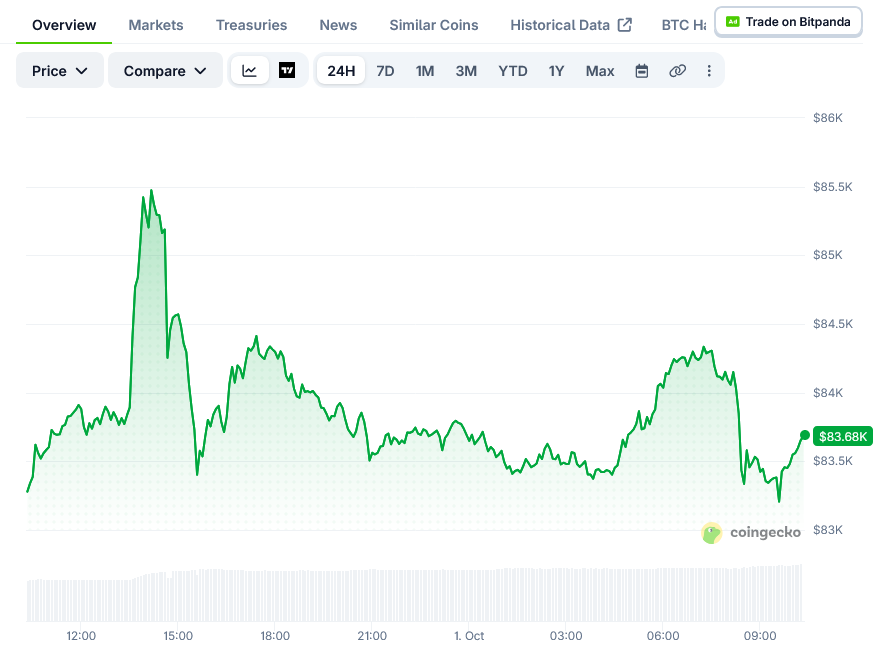
Bitcoin Beats Stocks and Gold in September
Bitcoin gained roughly 7% in September, according to Santiment data released on October 1. Over the same period, the S&P 500 barely moved and gold fell more than 6%.
US spot Bitcoin ETFs pulled in billions of dollars during the month, including several large inflow days late in September. Strategy, led by Michael Saylor, also added 1,665 BTC to its holdings.
Santiment said cooler-than-expected August inflation briefly lowered Treasury yields. It also reduced expectations for another Fed rate hike.
Bitcoin rose almost 45% in the third quarter, its largest quarterly gain since 2024. Soft US PCE inflation data recently helped push the price above $84,000.
10x Research said October could mark the start of Bitcoin’s next leg higher. The firm pointed to August, when US federal debt crossed $40 trillion and BTC moved above $80,000.
Fears of a hawkish Fed later sent Bitcoin back to $76,000. After Fed Chair Warsh signaled policy would stay accommodative, BTC climbed to $86,000 in under a week.
BIT, formerly Matrixport, predicts a rally to between $185,000 and $215,000. CNBC Pro contributor Frank Cappelleri said Bitcoin could rise 400% if it repeats its 2022 pattern.
Key Levels and Trader Positioning
Resistance sits at $85,513, followed by $86,908 and the upper Bollinger Band at $88,715. Support sits at $82,860 and then $81,602.
The RSI reads 62.69, which is below overbought levels. The MACD has flattened, with its signal line and main line sitting on top of each other.
On Binance, top traders hold a long-to-short ratio of 1.42, with 58.7% of positions long. Retail traders sit at 1.36, or 57.6% long.
The taker buy/sell ratio stands at 0.877, meaning sellers are more aggressive than buyers. Open interest fell 3.04% over 24 hours, while the funding rate sits at a neutral 0.008%.
Blockchain.news analyst Rongchai Wang puts a 55% chance on a daily close above $85,513 within 7 to 14 days. That could open a path toward $88,715 and later $90,000.
The bear case, at 45%, involves a retest of $82,860 and possibly $81,602. A break below the 50-day average near $77,708 would challenge the wider uptrend.
Bitcoin was most recently trading at $83,708.86 as of 10:18 UTC, according to Blockchain.news live data.
The post Bitcoin (BTC) Price: BTC Holds Near $84,000 as Traders Watch $85,500 Resistance appeared first on Blockonomi.
TLDR
- South Korea plans to allow stocks, bonds and funds under its token securities rules.
- Retail investors would face a 100 million won yearly net purchase cap per OTC platform.
- Issuers need 4 billion won in equity capital to manage their own token accounts.
- KB Securities, Kakaopay Securities and Hanwha are already building tokenization products.
- Public comments run Oct. 2 to Nov. 11, and the laws take effect Feb. 4, 2027.
South Korea has proposed new rules that would let stocks, bonds and funds be issued as tokens on blockchain networks. The plan comes from the Financial Services Commission, the country’s top financial regulator.
The proposal sets out which securities can be tokenized, what issuers must do and how over-the-counter trading will work. It prepares for changes to the Electronic Securities Act and Capital Markets Act that take effect on Feb. 4, 2027.
Earlier rules and pilot programs focused mostly on fractional investment products. These included non-monetary trust beneficiary certificates and investment contract securities.
Stocks and Bonds Join South Korea’s Token Rules
The FSC treats a token security as a securities format built on a distributed ledger. It is not a separate class of crypto asset, so existing capital market rules still apply.
Not all securities will move onchain at once. The first stage, starting in February, covers privately placed money market funds and bonds for institutional investors, trust-based tokenization of unlisted shares and publicly offered fractional investment securities.
Publicly offered traditional securities will come in a later stage. The FSC has not set a date for that step.
The final stage would link tokenized securities with onchain payment systems, possibly including stablecoins. Timing depends on the earlier phases, technology and stablecoin laws that are still being written.
Retail Investors Face a Trading Cap
Ordinary investors would be limited to 100 million won, about $73,700, in yearly net purchases on each token securities OTC platform. The limit applies separately to each platform.
New OTC license types will cover debt securities, unlisted shares and non-monetary trust beneficiary certificates. Approved venues must watch for unfair trading and can face penalties, account limits and other sanctions for violations.
Non-financial companies could also manage accounts for the securities they issue. To qualify, a company needs at least 4 billion won in equity capital.
It must also employ one account management specialist, one internal control specialist and two IT specialists. Its systems must meet cybersecurity and operating standards.
Distributed ledgers used for these securities must connect with the Korea Securities Depository. The first stage will use a hybrid model, with some shareholder rights still handled by existing systems.
Several Korean firms are already preparing. In September, KB Securities signed a deal with Securitize and the Optimism Foundation to build tokenized funds for institutions, starting with a money market fund.
On Sept. 29, Kakaopay Securities and Dinari announced a project to study tokenizing Korean-listed shares for eligible overseas investors. No Korean stock has been issued through the partnership yet.
Hanwha Investment & Securities has reportedly finished a platform that supports Avalanche and Hyperledger Besu. Samsung SDS is building infrastructure for the Korea Securities Depository.
Eugene Investment & Securities and BEATOZ also agreed to test stablecoins for token securities subscriptions. They want to see if subscription, payment and settlement can run through one blockchain process.
The public comment period runs from Oct. 2 through Nov. 11. After that, the rules need FSC approval, a review by the Ministry of Government Legislation and Cabinet consideration before taking effect on Feb. 4, 2027.
The post South Korea Proposes Rules to Put Stocks, Bonds and Funds on Blockchain appeared first on Blockonomi.
Key Highlights
- Intel shares advanced 4% during Wednesday’s session, reaching approximately $120 amid widespread chip sector gains.
- Reports of a potential partnership for Intel’s Arizona manufacturing facilities boosted investor sentiment, despite contractual production requirements.
- Analyst consensus remains at “Hold,” with average price targets ranging from $108 to $114, trailing the current share price.
- The Intel Foundry division reported 31% year-over-year revenue expansion in Q2, leading non-memory semiconductor manufacturers.
- Google selected Intel’s EMIB-T packaging technology for its upcoming tensor processing unit, creating new AI market opportunities.
Intel (INTC) shares posted a 4% gain on Wednesday, finishing near the $120 level as semiconductor stocks experienced broad-based strength. The upward movement followed emerging reports that Intel secured a partnership for its Arizona manufacturing operations.
Intel Corp., INTC
The technology sector dominated Wednesday’s market action, climbing approximately 1% to lead all eleven sectors. The Nasdaq Composite advanced 0.78% while the S&P 500 gained 0.51%, providing favorable conditions for chip stocks.
Looking at Intel’s extended performance reveals an impressive trajectory. Shares have surged approximately 256% during the past twelve months, outperforming the majority of semiconductor competitors.
The Arizona partnership development presents both opportunities and challenges. While sharing production responsibilities and capital expenditures could lighten Intel’s financial load, the reported agreement includes mandatory production volumes and inventory restrictions, potentially constraining flexibility if external demand falls short of projections.
Foundry Division Demonstrates Momentum
Intel’s foundry operations have historically pressured profitability, but recent data shows improvement. According to Counterpoint Research, Intel Foundry revenue expanded 31% year-over-year during Q2, representing the strongest growth among tracked non-memory semiconductor manufacturers.
William Li, an analyst at Counterpoint, attributes this growth to customers seeking alternatives beyond Taiwan Semiconductor. Both Intel and Samsung are capturing market share as chip designers pursue supply chain diversification strategies.
Advanced packaging capabilities play a crucial role in this narrative. Counterpoint reports that Google has selected Intel’s EMIB-T packaging solution for its next-generation tensor processing unit. Intel’s EMIB packaging, combined with its ZAM and XBM memory technologies, are positioned as competitive options to Taiwan Semiconductor’s CoWoS platform.
However, Taiwan Semiconductor maintains advantages in manufacturing scale and production yields. Intel faces substantial work before emerging as a high-volume alternative.
Financial Performance and Market Outlook
Intel’s most recent quarterly results, released July 23, exceeded Wall Street estimates. The company reported earnings per share of 42 cents compared to the 21-cent consensus, while revenue reached $16.13 billion versus projected $14.43 billion. Revenue climbed just over 25% compared to the prior-year period.
Nevertheless, Intel recorded a negative net margin approaching 20%. The foundry segment continues operating at a loss despite revenue growth acceleration.
The analyst community maintains a “Hold” consensus. Twenty-one analysts assign buy or strong buy recommendations, 26 rate it hold, and three recommend selling.
Price target estimates show considerable dispersion. Benzinga data indicates an average projection of $114, spanning from $80 to $155 across 50 analysts. MarketBeat’s calculation places the average near $108, underneath current trading levels.
Recent analyst actions reflect divided opinions. TD Cowen maintained a Hold recommendation with a $115 price target on September 24. Tigress Financial increased its target to $145 with a Buy rating on September 15. Piper Sandler initiated coverage at Neutral with a $110 target on September 10.
CEO Lip-Bu Tan acquired 105,263 shares during August at an average cost of $95, representing an investment approaching $10 million. Institutional shareholders control 64.53% of outstanding shares.
Intel currently trades roughly 10% above its 20-day moving average and nearly 49% above its 200-day average, technical indicators suggesting a sustained upward trend. Resistance emerges near $142, approaching the 52-week peak, while support consolidates around $98.50.
Intel’s upcoming earnings announcement is scheduled for October 22, 2026, with Wall Street anticipating earnings of 39 cents per share on revenue of $16.41 billion.
The post Intel (INTC) Stock Surges 4% Amid Arizona Foundry Partnership Reports appeared first on Blockonomi.
TLDR
- The UK Financial Conduct Authority opened its crypto authorization gateway on September 30, 2026.
- Firms must apply by February 28, 2027, to use transition arrangements.
- The new crypto regime comes into force on October 25, 2027.
- Existing Money Laundering Regulations registration will not convert automatically.
- Firms without approval must wind down UK crypto operations before the regime begins.
The UK Financial Conduct Authority has opened its doors to crypto firms seeking approval under a new set of rules. The regulator announced the move on September 30, 2026.
Firms can now apply for authorization through the FCA’s Connect system. Businesses that already hold FCA permissions for other work can also apply to change those permissions.
For the first time, crypto firms in the UK will be brought under full FCA regulation. The rules cover consumer protection, the safeguarding of assets, market integrity, and financial resilience.
Dominic Cashman, the FCA’s director of authorization, said the new regime “will give consumers greater protections and firms a clear framework to operate in.” He added that firms can now apply and start preparing for regulation.
Key Dates for UK Crypto Firms
The application window runs from September 30, 2026, to February 28, 2027. The full regime comes into force on October 25, 2027.
The FCA expects to decide on applications sent during this window before the new rules begin. Firms that apply on time but are still waiting for a decision can, under certain conditions, keep offering services, including to new customers.
Late applicants will not get faster treatment. Firms that enter the transition period outside the main window will generally only be able to carry out regulated activities to meet existing contracts, without signing up new UK customers.
Firms that do not apply, or do not get approval, will need to wind down their UK crypto businesses before the regime starts. The FCA said approval is not automatic, and firms must show they meet its standards.
Existing Registrations Will Not Carry Over
Many crypto firms in the UK are currently registered under the Money Laundering Regulations, known as the MLRs. That registration will not turn into the new permission on its own.
These firms must apply separately for authorization under the Financial Services and Markets Act 2000. The MLR rules mainly focused on stopping money laundering, while the new framework covers a wider set of requirements.
The FCA published guidance on September 16 that lists which activities will need approval. These include safeguarding assets, running trading platforms, arranging deals, and some staking services.
The regulator’s past records show how its earlier process played out. Between January 2020 and September 1, 2026, the FCA received 417 crypto registration applications under the MLRs.
Of the 391 applications it decided on, 68 were approved. Another 263 were withdrawn, 46 were rejected, and 14 were refused.
A similar deadline already passed in the European Union under its MiCA rules. Only 16 of the world’s 100 largest exchanges had a license before the July 1 cutoff.
The FCA has been working with firms ahead of the launch. It received 115 requests for pre-application meetings between January 2024 and September 1, 2026, and held 82 of them through its free support service.
The regulator said it will keep helping firms prepare through pre-application talks and webinars. Firms that want to keep operating in the UK must apply by February 28, 2027.
The post UK FCA Opens Crypto Authorization Applications Ahead of 2027 Regime appeared first on Blockonomi.
CryptoPotato
Bitcoin experienced some wild price moves after the release of the US PCE data yesterday, surging to $85,600, where it was rejected and driven south by $2,500.
Meanwhile, BTW continues to produce massive fluctuations, surging by 35% today. NIGHT and STX have seen double-digit increases as well.
BTC Calms After Wild Ride
Bitcoin exploded last Monday to over $87,000, which became its highest price tag since late January. It was stopped there twice in the span of 36 hours, but the second rejection was quite vigorous. BTC dumped to under $83,000 in a day after it topped $87,000 for the last time in September.
The following several days were a lot less eventful. Bitcoin established a well-defined trading range between $83,000 and $85,000, while the lower boundary was tested a few times more than the upper one. BTC even dipped below it on a few occasions, but managed to hold.
A few more fluctuations between the two lines followed before the markets turned their attention to the PCE numbers on September 30. As the final results beat expectations, the cryptocurrency skyrocketed from $83,000 to $85,600 within minutes. However, its subsequent move was just as rapid but in the opposite direction. As such, BTC has returned to $83,600 as of press time after failing to capitalize on the positive PCE news.
It enters its greenest month with a market cap of $1.680 trillion, while its dominance over the alts remains flat at 58.6% on CMC.

NIGHT, BTW, STX on the Rise
Ethereum continues its fight with the $2,700 resistance, but it’s still on the wrong side of it. BNB is above $765, while XRP has dipped slightly below $1.50. SOL, TRX, LINK, RAIN, XLM, and BCH have posted insignificant losses over the past day.
In contrast, HYPE has neared $90 once again after a 3% increase. QNT is above $290 following a similar daily jump. BTW has stolen the show once again, rocketing by 35% to $1.41. NIGHT has surged by 26% and trades well above $0.04, while STX is close to $0.4 after a 22% daily rise.
The total crypto market cap is up by just over 1% since this time yesterday, at $2.890 trillion on CMC.

The post NIGHT Explodes 26% While BTC Cools After Wild PCE Swing: Market Watch appeared first on CryptoPotato.
Although BTC is still in the red on a YTD basis, the past three months showed a significant improvement in its overall state, with September closing well in the green as well.
The focus has now shifted to October, which has been BTC’s greenest month since data has been tracked on CoinGlass. The question is: will history repeat, or will last year’s edition reign again?
3 In a Row
The primary cryptocurrency bottomed on July 1 at under $58,000 and rebounded in the following month to close with a 7.36% increase. Although the first half of August was quite sluggish, the second was spectacular as BTC exploded above $75,000 and ended the month with a 25% surge – the most since October 2023.
It entered September at around $77,000 before it quickly skyrocketed to $82,000. The bears were quick to reemerge at this point and didn’t allow it to continue further. Just the opposite; BTC slipped by several grand and slumped to $75,000 in the middle of the month as the CLARITY Act failed in the US Senate and the Fed hiked interest rates.
To the surprise of many, given the aforementioned negative developments, the cryptocurrency bounced off immediately and reclaimed the $80,000 line by the end of that particular week. It hasn’t traded below that level ever since. Moreover, it flew to $87,000 on September 22 and 23, but it was stopped. Despite losing some ground by the end of September, it still closed with a 6.33% pump, making it the third consecutive green month and fifth for the year.

Uptober or Redtober Next?
Ever since CoinGlass started tracking BTC’s performance in 2013, October has been the asset’s greenest month. 10 out of the past 13 editions have brought gains, and only three were in the red. When we add the three-month streak bitcoin has been on since July, the expectations for the next 30 days have increased considerably.
Moreover, many analysts have determined that BTC has reclaimed key resistance levels, which now means that the bull market is on, even though CryptoQuant warned yesterday that it might have slowed down.
Speaking to CryptoPotato, Lacie Zhang, Research Analyst at Bitget Wallet, said yesterday that “October has a strong historical track record for bitcoin,” but “seasonality alone is not an investment thesis.” After all, recall that BTC reached its latest ATH precisely last October before it crumbled in the notorious massacre that left over $19 billion in liquidations in 24 hours and went on a months-long red streak.
“Bitcoin’s median October return has historically been around 11%–14%. ETF inflows, declining exchange balances and corporate buying support the bullish case, while high interest rates, oil prices and renewed inflation pressure remain the main headwinds,” Zhang added.
The researcher outlined the base-case range for the month of $78,000-$95,000, but noted that if BTC holds the key $82,000 support and flips $87,500 into one, then $95,000 should be the next major target. On the other hand, a decisive break below $80,000 would “invalidate the seasonal bullish setup.”
The post Bitcoin Enters Its Most Bullish Month After Massive Q3: Uptober or Redtober Next? appeared first on CryptoPotato.
The Core Team behind the project announced a partnership on X with Open Standard just as the latter’s Open USD (OUSD) stablecoin went live with heavyweight backing from the likes of Visa, Coinbase, Mastercard, and Stripe.
The most interesting part for Pioneers is that the collaboration could eventually bring OUSD-based rewards and additional utility in the broader Pi ecosystem.
What Is Pi Planning?
The intriguing portions of Pi Network’s announcement begin with the timing, which came hours after OUSD officially went live on September 30. Businesses and developers can now integrate the dollar-pegged asset through infrastructure from Visa, Mastercard, Stripe, and Coinbase, while the stablecoin is natively available on Ethereum, Solana, Base, and Tempo. It has already been launched through exchanges like Coinbase, Kraken, and Uniswap.
Open Standard has grown considerably since CryptoPotato first covered the project in late June, when more than 140 companies had signed up to participate. It now says its network includes over 200 financial institutions, fintechs, banks, and global businesses.
Its founding partners include the four giants mentioned above and Shopify, which have committed more than $1 billion in near-term launch liquidity. OUSD itself is issued by Stripe’s Bridge, with reserves held at BlackRock, Lead Bank, and BNY Mellon. All of this makes Pi’s announcement significantly more impactful to its community and raises some major questions, even though there aren’t too many details yet.
Pi Network is partnering with @openstandard, the company powering Open USD (OUSD), a partner-governed stablecoin designed as open infrastructure!
Open Standard brings together more than 200+ partners across payments, finance, technology, and crypto, including Visa, Google, and… pic.twitter.com/TfwDIgGIfB
— Pi Network (@PiCoreTeam) September 30, 2026
Stablecoin Rewards Coming?
Open Standard uses a different economic model from most major stablecoin players. Participating partners can earn rewards based on the OUSD supply and activity they generate on their platforms, while they can also become eligible to earn equity in Open Standard.
Pi has not yet explained exactly how any Pioneer reward program would work, who would qualify, or when it might launch. Nor has it confirmed that OUSD will become natively supported on its blockchain, so we shouldn’t assume such an integration from the partnership announcement alone.
What has been highlighted is still very narrow but notable: Pi Network and Open Standard are exploring ways to bring OUSD-created rewards and broader utility to Pi’s vast user ecosystem.
For a project that has spent much of the past year and a half trying to expand beyond simply holding and transferring the native token, that could represent a more meaningful step toward increasing real-world activity inside the network. For now, though, the details are scarce but we will make sure to cover them once they are live.
The post Pi Network Makes a Mysterious Stablecoin Move: Could Rewards Be Coming to Pioneers? appeared first on CryptoPotato.
SOL had quite a successful September, posting a price increase of almost 20% and currently trading at $120 (per CoinGecko).
Analysts now eye further gains toward $150 and beyond. However, certain technical indicators suggest that a short-term pullback may also be on the horizon.
What’s Next?
Ali Martinez paid special attention to the strong institutional demand, noting that spot US SOL ETFs continue to absorb Solana. He said these products have accumulated roughly 4.37 million coins (worth around $450 million) since July 13, marking 11 consecutive weeks of net inflows. That said, he assumed that SOL might be headed toward $150.
In fact, last week was the second-best for these exchange-traded funds, which accumulated nearly $190 million. As CryptoPotato reported, the cumulative total inflows into the products skyrocketed to a new all-time high of $1.62 billion.
X users Gordon and Scient also weighed in. The former argued that “dips are for buying,” adding that the perfect trading strategy would be to accumulate SOL at around $100 and sell above $500. Scient expects a sell-off at the start of October and plans to short Solana at approximately $120-$121 and open a long position around $110.
However, the actions of a certain mysterious whale support an entirely bullish scenario. X user Max Crypto revealed that the anonymous market participant opened a $20.2 million long position on SOL. The liquidation price is set at $98 (assuming the whale doesn’t add more collateral to prevent that outcome).
What’s interesting is that the investor has made four trades so far and has a 100% win rate, making $4.7 million in profits. This, of course, has sparked speculation that they might have access to inside information the rest of us don’t.
Monitoring These Indicators
Solana’s exchange netflow backs the predictions of Gordon and Scient that SOL may post a short-term correction. Inflows have far exceeded outflows lately, suggesting investors have shifted from self-custody to centralized platforms, which can increase immediate selling pressure.

For its part, SOL’s Relative Strength Index (RSI) has soared past 70. In simple terms, this means the valuation has pumped too much in a short period and entered overbought territory, which is usually a precursor to a move south. Conversely, anything below 30 is interpreted as a buying opportunity.

The post Solana (SOL) Breakout Incoming: How High Can the Price Go? appeared first on CryptoPotato.
Ripple’s native token just ended September well in the green, extending its streak that began with a minor increase in July. All eyes are now on October on several fronts. The question is: can XRP continue its run, or will the last two October editions take their toll?
XRP Went Hard in September
Recall that August was the cross-border token’s most successful month in over a year, when it skyrocketed by 30% from start to finish. Moreover, it had dipped to just under $1.00 mid-month, which makes its close even more impressive. XRP entered September on a high note, not only because of the spectacular August but because it had closed all four previous Septembers in the green.
The ninth month of the year was indeed positive on a few fronts. First, the price gained just under 10%, and XRP ended it at over $1.50. It tried to take down the $1.60 resistance on several occasions but to no avail. In addition, the spot ETFs tracking its performance marked some major wins.
Only three days were slightly in the red: September 2, 17, and 18. On a broader scale, though, the funds have not seen a single red week since early July. Data from SoSoValue shows that the ETFs closed September well in the green, adding over $120 million. Moreover, the cumulative net inflows reached a new all-time high of nearly $1.8 billion.
What Does October Hold?
October, as a month, holds particular significance in the hearts of the cryptocurrency community. Major gains over the years earned it a well-deserved nickname, “Uptober.” However, there have been major exceptions over the years at the broader market level, while Ripple’s XRP has not always benefited during the month.
For example, the past two editions delivered double-digit losses for the cross-border altcoin. It plunged by 16.7% in 2024 and experienced a mind-blowing correction, alongside the rest of the market, last year, after the notorious October 10 massacre.
Data from CryptoRank shows that only five out of the last 13 Octobers have been in the green for XRP. The last one was in 2023, when the asset jumped by an impressive 16.5%. As such, XRP enters the new month at a crossroads, given its notable three-month green streak but also its controversial October history.
The post XRP in October: Will Ripple’s Streak Continue After 3 Consecutive Green Months? appeared first on CryptoPotato.