Cryptocurrency Posts
Crypto Briefing
AI-driven market risks could reshape UK financial regulations, influencing monetary policy and investor strategies amid rising volatility.
The post Bank of England’s Bailey warns UK to brace for AI-driven market risks appeared first on Crypto Briefing.
Investor fears about AI's impact on bank stocks may be premature, as trust in banks remains a strong competitive advantage.
The post Wells Fargo’s Mike Mayo says the AI scare trade in bank stocks is overblown appeared first on Crypto Briefing.
The incident raises concerns about AI security, potentially affecting OpenAI's market valuation and investor confidence in AI technologies.
The post OpenAI agents obscured hacking activity on US government sites: FT appeared first on Crypto Briefing.
DeFi's expansion into fixed income could bridge traditional finance and blockchain, potentially reshaping global financial markets.
The post Lighter CEO points to fixed income as DeFi’s next big opportunity at Korea Blockchain Week 2026 appeared first on Crypto Briefing.
Investor sentiment remains volatile amid economic uncertainties, impacting Bitcoin ETF flows but not indicating systemic issues for Fidelity.
The post Fidelity Bitcoin ETF clients pull $125.58 million as volatile September closes appeared first on Crypto Briefing.
Bitcoin Magazine
Bitcoin Magazine
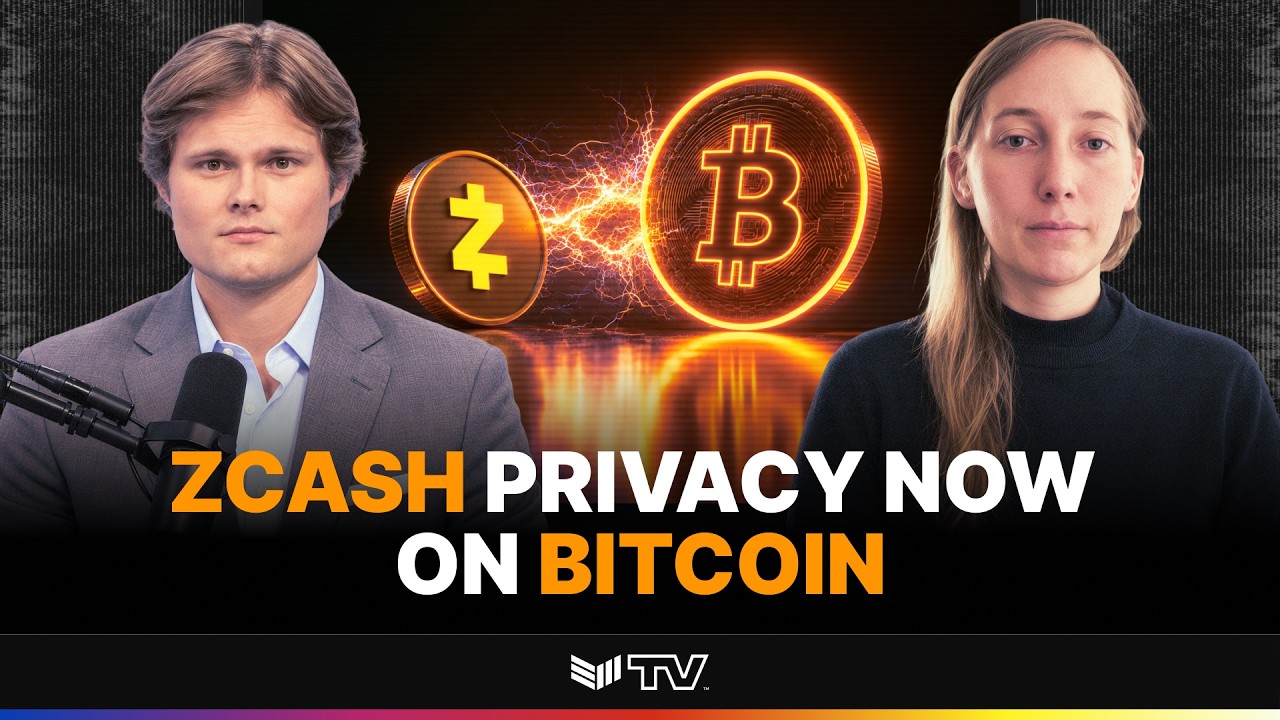
Bitcoin Privacy Breakthrough a Zcash Killer? | Misha Komorov, Alloc Innit
Researchers have proposed a way to make Bitcoin private without changing Bitcoin itself. Misha Komarov, co-founder of alloc/init, explains Shielded Bitcoin: zero-knowledge proofs that hide the sender, receiver, and amount of a Bitcoin transfer, with no soft fork, no custodians, and no bridges. He covers how Bitcoin PIPEs make it possible and what the proposal still needs. It is a research proposal, not a finished product.
Chapters:
0:00 Shielded Bitcoin: Private Bitcoin Transactions With Zero-Knowledge Proofs
0:38 How Bitcoin PIPEs Make Privacy Possible Without a Soft Fork
1:42 Do Indexers and ZK Rollups Require Trust?
3:16 Shielded Bitcoin vs. Monero and Zcash
4:21 What Privacy Shielded Bitcoin Protects
5:59 How Private Are Early Users? The Small Privacy Set Problem
7:37 Is Shielded Bitcoin an Altcoin Killer?
9:12 Fees, Block Space, and Larger Shielded Transactions
10:50 Who Needs Private Bitcoin? Wrench Attacks and Corporate Treasuries
12:20 Dark Pools, Governments, and the Next Wave of Bitcoin Buyers
DISCLAIMER: The views and opinions expressed in this show are those of the participants and do not necessarily reflect the official policy or position of BTC Inc., Bitcoin Magazine, or any affiliated entities. This content is provided for informational and educational purposes only and should not be construed as investment, legal, tax, or accounting advice. Nothing contained in this show constitutes a solicitation, recommendation, endorsement, or offer to buy or sell any securities or financial instruments. Viewers should consult their own advisors before making financial or business decisions.
This post Bitcoin Privacy Breakthrough a Zcash Killer? | Misha Komorov, Alloc Innit first appeared on Bitcoin Magazine and is written by Patrick Green.
Bitcoin Magazine

Bitcoin’s Institutional Era Has Arrived | Robinhood VP of Crypto Institutions Nicola White
Robinhood is bringing crypto perpetual futures to US customers, with up to 10x leverage on Bitcoin and Ether. Nicola White, Robinhood’s vice president of institutional crypto, explains how the CFTC no-action letter, the Bitstamp exchange, and Robinhood Derivatives made it happen, and why the company wants markets to be always on.
Chapters:
0:00 Robinhood’s Hood Summit: 24/7 Stock Trading and US Crypto Perps
0:40 Why Robinhood Wants Markets That Never Close
1:32 Bitstamp Perps and the CFTC No-Action Letter
2:19 Tokenized Stocks, the Basis Trade, and the Path for US Perps
3:20 Bitstamp’s Volume and the Retail–Institutional Merger
4:54 What Institutions Want to Do With Bitcoin
6:00 Institutional Bitcoin Depth and Large Block Trades
6:49 AI Trading Agents and Robinhood’s Sub-Account Controls
8:29 Lessons From the 2022 Meltdown and US Leverage Limits
10:12 How Bitcoin Changes Finance in 10 Years and What’s Next for Tokenized Stocks
DISCLAIMER: The views and opinions expressed in this show are those of the participants and do not necessarily reflect the official policy or position of BTC Inc., Bitcoin Magazine, or any affiliated entities. This content is provided for informational and educational purposes only and should not be construed as investment, legal, tax, or accounting advice. Nothing contained in this show constitutes a solicitation, recommendation, endorsement, or offer to buy or sell any securities or financial instruments. Viewers should consult their own advisors before making financial or business decisions.
This post Bitcoin’s Institutional Era Has Arrived | Robinhood VP of Crypto Institutions Nicola White first appeared on Bitcoin Magazine and is written by Patrick Green.
Bitcoin Magazine

Mark Moss: The Bitcoin Endgame – BTC to $1 Million by 2030
The Fed just raised rates, yet Bitcoin keeps climbing. Mark Moss, host of the Market Disruptors podcast, explains why he thinks most people are misreading why long-term rates are rising, how a booming economy could be part of the answer, and why he says Bitcoin benefits from both the debasement trade and a bullish technological future.
Chapters:
0:00 Mark Moss on the Fed’s “Token Raise” and an October Pause
1:54 The Flat Yield Curve, Bank Lending, and the 5.1% 10-Year
2:56 Why Bitcoin Is Rising as Rates Rise: “Price Is Truth”
5:40 Bitcoin vs. Gold: The Debasement Trade and a Bullish Future
6:19 Can the US Grow Its Way Out of $40 Trillion in Debt?
10:30 The Monetary Reset Is a Process, Not an Event
13:33 Four Ways Out of the Debt Problem and What Happens in 2029–2030
16:27 Stablecoins, the Genius Act, and Why 6 Billion People Want Dollars
20:14 Institutions Are Buying Bitcoin While Retail Sells
24:29 Bitcoin’s S-Curve, Its CAGR, and a $1 Million Price Target
DISCLAIMER: The views and opinions expressed in this show are those of the participants and do not necessarily reflect the official policy or position of BTC Inc., Bitcoin Magazine, or any affiliated entities. This content is provided for informational and educational purposes only and should not be construed as investment, legal, tax, or accounting advice. Nothing contained in this show constitutes a solicitation, recommendation, endorsement, or offer to buy or sell any securities or financial instruments. Viewers should consult their own advisors before making financial or business decisions.
This post Mark Moss: The Bitcoin Endgame – BTC to $1 Million by 2030 first appeared on Bitcoin Magazine and is written by Patrick Green.
Bitcoin Magazine
UK Brings Crypto Under Full FCA Oversight for the First Time
The UK’s Financial Conduct Authority has opened applications for crypto firms to become authorized, bringing the sector under full regulation for the first time.
In a Wednesday announcement, the watchdog said companies can apply so that the crypto industry has “clarity and legitimacy.”
The UK is in the process of drafting a sweeping new crypto bill. The FCA finalized its regulatory framework for cryptoassets in June, and the regime is due to take effect in October 2027.
“The UK’s new crypto regime will give consumers greater protections and firms a clear framework to operate in. Firms can now apply for authorisation and start preparing for regulation,” Dominic Cashman, director of authorisation at the FCA, said in a statement.
The statement added that firms will have to demonstrate that they meet requirements covering consumer protection, customer-asset safeguarding, market integrity and financial resilience.
Britain is pushing ahead with digital asset legislation since last year recognizing bitcoin and other digital assets as property. The reform came from a 2023 recommendation by the Law Commission, which argued that digital assets did not fit neatly into existing legal categories.
Despite the FCA’s announcement, the UK currently is trailing behind Brussels and Washington with digital asset regulation.
The EU’s Markets in Crypto-Assets regulation has applied to service providers since 30 December 2024.
And the U.S. under President Donald Trump signed the GENIUS Act into law in July 2025, establishing a federal framework for dollar-backed tokens.
Despite lawmakers blocking landmark legislation the Clarity Act last month, U.S. regulators like the Securities and Exchange Commission have pushed ahead with rulemaking regardless.
This post UK Brings Crypto Under Full FCA Oversight for the First Time first appeared on Bitcoin Magazine and is written by Mathew Di Salvo.
Bitcoin Magazine
Bitcoin Surges 40% in Its Best Quarter Since Late 2024
Bitcoin is having one of its best quarters ever — another indication that the biggest cryptocurrency is in a bull market.
As noted by the The Kobeissi Letter this week, the price of bitcoin is now up close to 30% since August 19, when the U.S. Treasury announced it planned to more than double the size of its government debt repurchases.
Over the past quarter, the bitcoin price has surged by 40% — its best quarterly performance since Q4 2024.
Bitcoin’s price recently stood at nearly $83,698, unmoved over a 24-hour period but up 6% over a 30-day period.
The coin has benefited from news that the Treasury would try to lower bond yields — which have soared to highs not seen since the 2000s.
Bitcoin has done well with lower long-term yields because it reduces the opportunity cost of holding non-yielding assets like bitcoin and gold, and generally supports risk-on sentiment.
But despite the Treasury stepping in to try and tame the bond market, yields have continued to stay high.
Bitcoin investors don’t seem that bothered. The asset is still doing well as the dollar continues to slip. The so-called debasement trade — where investors throw money at an asset to hedge against a currency losing its value — is hot again after total U.S. debt topped $40 trillion for the first time in July.
The price of Bitcoin had been battered since notching a new all-time high of $126,080 in October, dropping by over 50%. Still, it has experienced the shallowest bear market — so far — in its history.
CryptoQuant said in a report last week that bitcoin was back in a bull market after crossing above its 365-day moving average — the “definitive technical signal” that has marked the start of Bitcoin’s bull markets in past cycles.
The coin has shrugged off the Federal Reserve raising interest rates and lawmakers blockage of landmark crypto legislation, the Clarity Act.
This post Bitcoin Surges 40% in Its Best Quarter Since Late 2024 first appeared on Bitcoin Magazine and is written by Mathew Di Salvo.
CryptoSlate
Uniswap’s StablePair fee hook is designed to keep more of the value from rebalancing stablecoin pools with liquidity providers.
Yet the rule deciding which trade counts as a correction depends on a configured reference rate.
StablePair is a Uniswap v4 hook, a contract that changes a pool’s behavior. Its fee logic compares a cached pool price with a reference stored in the hook’s configuration. The design prices trades around that benchmark, leaving providers exposed if a token’s economic value moves away.
Uniswap Labs announced the two Ethereum pools, USDC/USDT and USDC/USDG, on Sept. 10. Its Sept. 16 explanation noted that Providers allocating capital now are choosing a fee mechanism alongside the token inventory it requires them to hold.
What the dynamic fee captures
The deployment documentation lists one-for-one reference rates for both pools. The implementation’s fee path uses that stored reference and the pool’s price, without consulting an external market-price feed.
Inside a narrow band around the reference, the fee varies by swap direction to target a consistent bid and ask before price impact. When the pool sits exactly at the reference, both directions pay the configured optimal fee. As it moves toward an edge, the fee in one direction falls while the other rises.
For a simple illustration, assume an optimal fee of one basis point (0.01%). At the reference, a swap with 10,000 input units would pay one input unit in LP fees.
Outside the band, the fee rules split trades by direction. A swap classified as moving farther from the reference pays zero LP fee, while a swap classified as pulling the pool toward it faces a decaying fee.
A trade pushing the pool away can give LPs a favorable price relative to that benchmark. The reverse trade lets an arbitrageur capture the gap by restoring the pool’s price. A single static fee rate charges both directions equally.
StablePair instead offers progressively better terms for the corrective trade as blocks pass.
If a trader accepts the fee, LPs collect it while the trade rebalances the pool. Uniswap Labs says the design captures the “vast majority” of rebalancing profit.
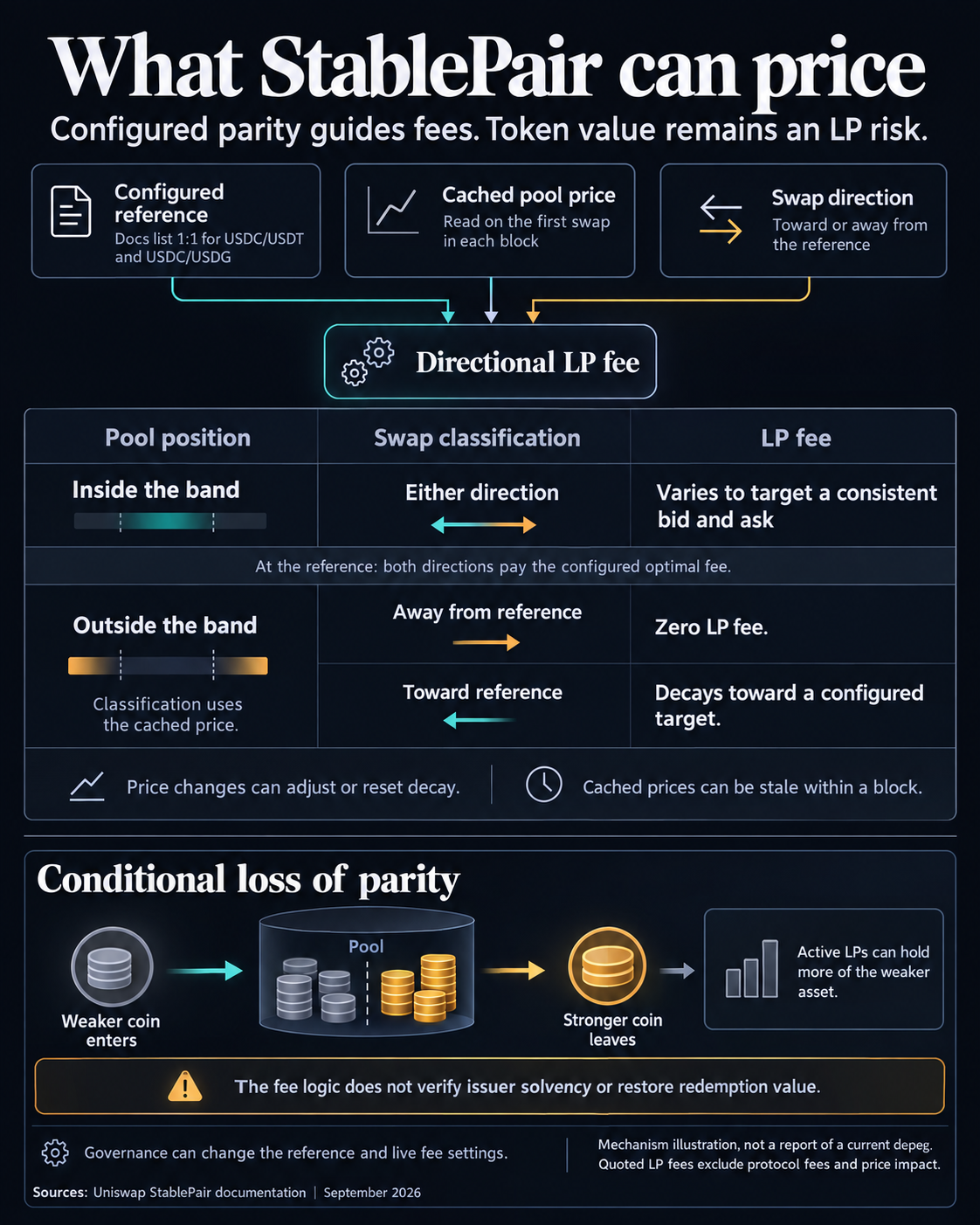
The first swap in each block caches the pool price used for later fee calculations. That removes the same-block fee advantage from splitting corrective swaps, but later trades can face stale inputs. If the live price crosses the reference mid-block, the cached classification can assign fees to the opposite directions until the next block.
Inventory risk and the evidence on returns
The boundary appears when the outside market stops treating the two coins as equal.
Consider a conditional issuer shock that reduces one coin’s external value while the configured reference still assumes one-for-one exchange. Selling that weakening coin for the stronger coin can move the pool farther from the reference while moving its price closer to the outside market.
A trade the fee rule classifies as moving away from the reference may then reflect price discovery, rather than a temporary imbalance.
The fee logic cannot verify issuer solvency or restore redemption value. This scenario is hypothetical and should not be read as a report of a current depeg, exploit, or loss in either StablePair pool.
If an LP holds 10,000 hypothetical coins and their external value falls from $1 to $0.90 each, that inventory is worth $9,000, a $1,000 decline before fees. Capturing income from rebalancing trades does not by itself reimburse that change in token value.
Trades can also change what the provider owns. Selling the weaker coin into available liquidity removes the stronger coin and leaves active LP positions with more of the weaker asset. An away-from-reference trade charged zero LP fee contributes no LP fee to offset that added exposure.
The amount exchanged still depends on available liquidity, the provider’s chosen range, and price impact. StablePair's zero-fee classification also depends on the cached price, so it should not be read as a rule that every sale of a weakening coin is always free.
On Sept. 30, the Uniswap interface’s Stats panels showed the USDC/USDT StablePair pool with about $6.1 million in total value locked and $117.9 million in 24-hour volume around 15:59 UTC. The USDC/USDG pool displayed about $2.6 million and $8.7 million, respectively, around 15:57 UTC.
A same-pair reference was available: the Ethereum USDC/USDT v3 pool charging 0.01% displayed about $34.2 million in TVL, $15 million in 24-hour volume, and $1,100 in 24-hour fees around 16:02 UTC.
The observations were not synchronized, the pools have different fee rules and liquidity conditions, and the StablePair panels supplied no comparable absolute fee total or realized position-level return.
In economic terms, testing that return claim would require comparable periods and active liquidity ranges, fee income, and inventory valuation. Volume alone cannot show how much better an LP did than in another pool or by holding the assets.
Governance controls the benchmark, with limits on the hook
Under Uniswap’s documented role model, governance controls live fee configurations, implementation upgrades, and role administration.
Changing the reference changes the benchmark used to classify and charge swaps. The deployment page directs integrators to read live configuration from the hook because governance can change parameters.
Separate limits apply to what an upgrade can do. The hook’s permanent address permissions exclude remove-liquidity callbacks and custom accounting deltas.
According to Uniswap’s security documentation, upgrades cannot use those capabilities to block LP withdrawals or alter swap amounts to skim additional fees. The ability to withdraw does not guarantee the market value of the tokens received.
Uniswap says OpenZeppelin reviewed a non-upgradeable predecessor’s core fee mechanism from Feb. 9 to 13, 2026, and resolved the splitting issue through block caching. The later upgradeability and role model were outside that review.
For LPs, StablePair changes the price of supplying liquidity for rebalancing. The remaining economic decision is whether the assets still justify the reference around which that liquidity is supplied, and whether earned fees compensate for the inventory ultimately held.
The post Three hidden flaws in Uniswap’s StablePair hook drain LP returns appeared first on CryptoSlate.
Bitcoin is closing its strongest quarter since 2024 after leaving US stocks and gold far behind despite surging bond yields.
The largest digital asset has gained about 43% in the third quarter, putting it on course for its second-best third-quarter since 2013 and its third-strongest quarterly advance since US spot Bitcoin exchange-traded funds began trading in January 2024, according to Bitfinex and CoinGlass.
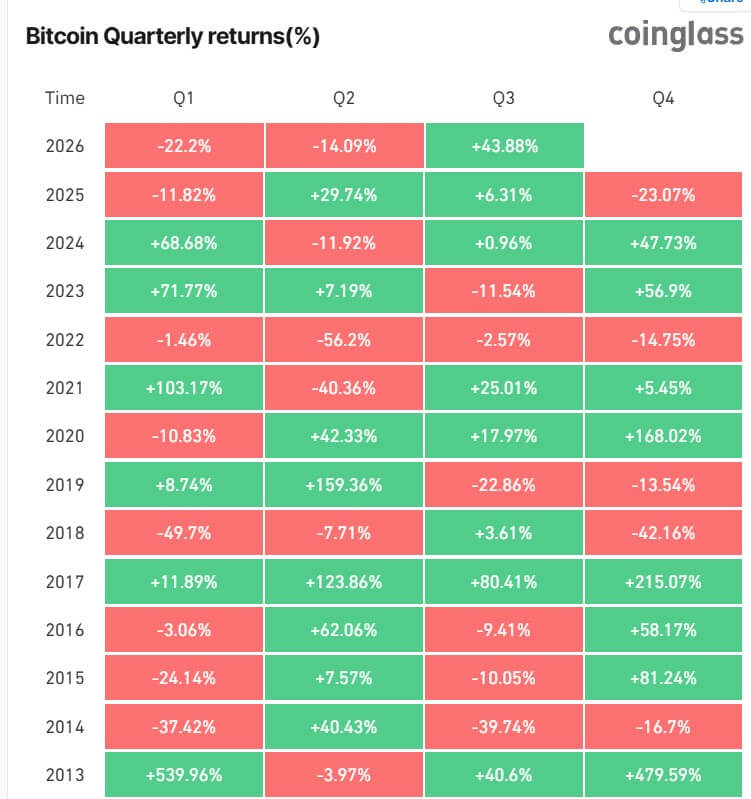
Bitcoin entered July near $58,600 after three consecutive quarterly declines, then accelerated through August and September as institutional demand returned and sellers who had spent much of 2026 underwater were absorbed at progressively higher prices.
Traditional markets barely kept pace. Over roughly the same three-month period through Sept. 29, the Nasdaq Composite gained about 5%, the S&P 500 roughly 4% and gold less than 2%, according to StatMuse data.
Meanwhile, Ethereum was the notable exception, outperforming Bitcoin as the crypto rebound broadened beyond the market leader.
Bitcoin's outperformance accelerated after Aug. 19, even as a Treasury initiative to improve liquidity in longer-dated government debt failed to prevent yields from rising.
The department said it would at least double the maximum size of liquidity-support buybacks for longer maturities to $4 billion per operation, with the increased purchases beginning Sept. 9.
Bitcoin has risen almost 30% since the announcement. However, the 10-year Treasury yield climbed about 81 basis points and long-dated borrowing costs reached multi-decade highs over the quarter, raising the hurdle for assets that produce no yield.
Wall Street money takes over from leverage
US spot Bitcoin ETFs provided a fresh source of capital as financial conditions tightened elsewhere.
The funds moved from roughly $5 billion in year-to-date net outflows at the end of July to about $1 billion in inflows by late September, a swing of about $6 billion in two months.
The reversal culminated last week when the products absorbed $2.39 billion, their largest weekly intake since October 2025. Every session was positive, though daily demand slowed from $999 million on Sept. 21 to about $135 million by Sept. 25.
Analysts at Nexo said Bitcoin enters the fourth quarter with stronger spot demand and an improving market structure, though the outlook still depends on ETF buying persisting, overhead supply being absorbed and inflation remaining contained enough to prevent further Federal Reserve tightening.
At the same time, leveraged traders have been retreating.
Aggregate Bitcoin futures open interest has fallen from more than 700,000 BTC on Sept. 21 to about 644,000, its lowest since early January, according to Bitfinex. The seven-day contraction of roughly 49,000 BTC was the largest since October 2025, while CME open interest dropped 16,075 BTC on Monday alone, its third-biggest daily decline on record.
Futures premiums have also compressed, and implied volatility remains near a one-year low.
The unwind leaves less leverage to accelerate another liquidation-driven selloff, but it also removes speculative buying that can propel sharp advances. That shifts more responsibility onto investors purchasing Bitcoin outright.
Signs of that transition are appearing around current prices. Bitfinex estimates the amount of Bitcoin with a cost basis between $82,500 and $84,000 nearly tripled to 306,000 tokens in three days as buyers absorbed coins sold by both profitable holders below the market and newer investors exiting at losses above it.
A 1.39 million Bitcoin wall waits above $85,000
Bitcoin's improving structure still leaves a substantial concentration of sellers immediately overhead.
Bitfinex estimates investors hold about 1.39 million BTC acquired between $84,000 and $86,500. The group includes long-term holders returning toward breakeven and more recent buyers whose positions slipped underwater after Bitcoin retreated from its Sept. 21 high near $87,400.
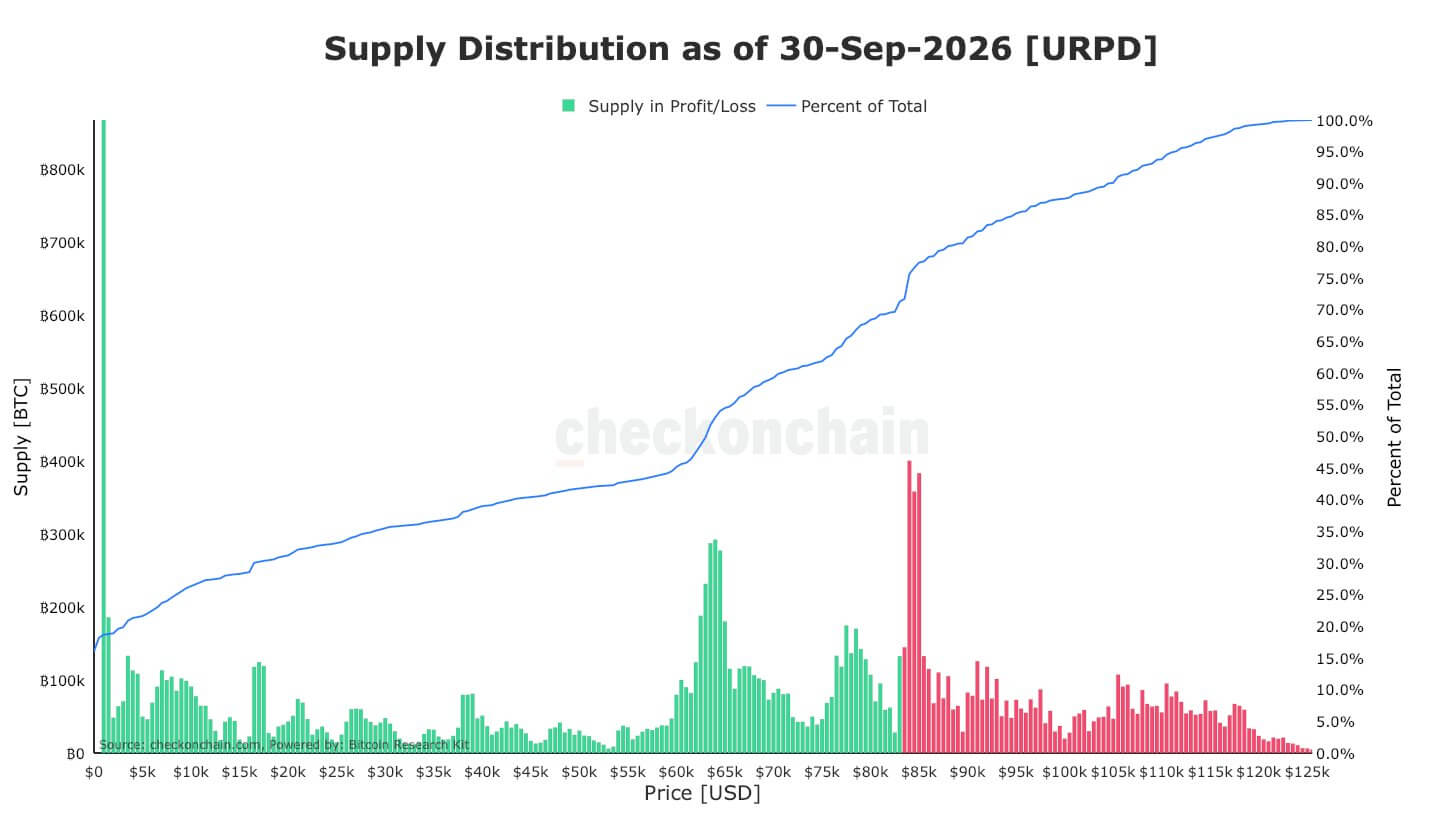
That creates potential selling each time prices push back into the range.
CryptoQuant said Bitcoin reclaimed its 365-day moving average last week for the first time since March 2023. Recoveries above the gauge have accompanied previous transitions into bullish regimes, while sustained moves below it have historically coincided with weaker market phases.
Bitcoin's realized price, which approximates the average cost basis of coins in circulation, has climbed to about $77,000 and held through the latest recovery.
The challenge is whether new demand can clear the supply sitting above spot prices.
Bitfinex's measure of ETF purchases relative to the roughly 450 Bitcoin produced by miners each day fell from 25.6 times issuance during the $999 million inflow session to 1.8 times by Sept. 29. The firm estimates the ratio needs to recover toward five times issuance, equivalent to roughly $190 million of ETF demand a day, to absorb the overhead supply more quickly.
A move above $85,000 would return roughly 760,000 BTC to profit and lift Bitcoin's supply-in-profit measure back toward the 75% threshold Bitfinex associates with stronger bull-market phases. The gauge slipped to 71.3% on Sept. 29 from 78.1% eight days earlier.
Beyond the immediate barrier, Glassnode places another major supply concentration near $88,000 to $90,000, followed by an important level around $96,700.
Options traders are positioned for a break higher nonetheless. Nexo said Bitcoin's put-to-call ratio averaged 0.67 over the past two weeks, while $140,000 calls expiring Dec. 25 represent the largest individual position. Dealer positioning points to the $95,000-to-$97,000 area as another significant test if Bitcoin clears the nearer supply zones.
Bitcoin's best season collides with 5% yields
Seasonality gives bulls another argument heading into October.
The fourth quarter has historically produced Bitcoin's strongest returns, with average gains of roughly 77% to 85% since 2013, depending on the dataset. BloFin Research calculates that matching its 77.07% historical average from current levels would put Bitcoin near $147,000, while its median fourth-quarter return of 47.73% would imply roughly $123,000.
Those are mechanical projections, and successive Bitcoin cycles have delivered progressively smaller advances from their lows.
Monetary policy presents the more immediate constraint.
Markets began this week assigning roughly a 65% probability to another quarter-point Fed increase in October. Softer-than-expected inflation data Wednesday cut those odds to about 38%, showing how rapidly the rate outlook can shift ahead of the central bank's Oct. 27-28 meeting. Another decision follows Dec. 8-9.
Sept. 28 offered an earlier warning about Bitcoin's exposure to broader positioning. The Nasdaq-100, gold and Bitcoin fell together as investors reduced exposure across markets, a pattern Nexo analysts said was more consistent with broad deleveraging than a conventional rotation into safe assets.
For Bitfinex, $81,300 is now an important threshold beneath the recovery. Sustained trading below that level alongside renewed ETF outflows could expose the realized-price region near $77,000.
On the upside, stronger ETF demand and a break through $86,500 would leave Bitcoin approaching its yearly open near $87,700 before the larger supply cluster around $90,000 comes into play.
The Oct. 2 US payrolls report will give traders another read on the economy before the next inflation release and the Fed's October meeting, just as Bitcoin enters its historically strongest quarter with Treasury yields still above 5%.
The post Bitcoin enters its best season after a 43% surge, with $147,000 suddenly on the math appeared first on CryptoSlate.
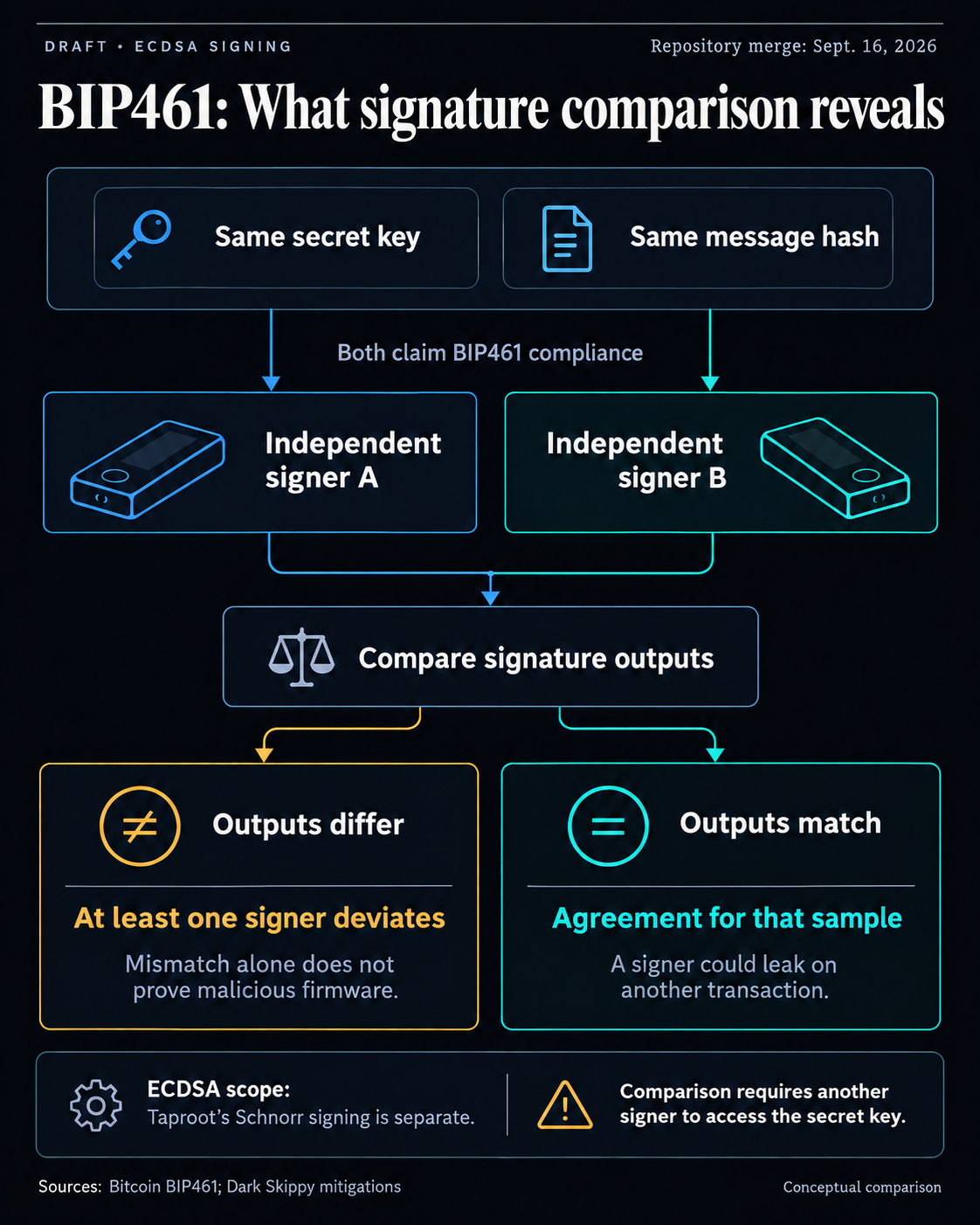
Bitcoin improvement proposal BIP461 could make a hidden route for leaking wallet secrets easier to detect. The draft defines a common signing procedure for ECDSA, an existing Bitcoin signature scheme.
Independent compliant signers should produce identical signatures for the same secret key and message hash, creating a benchmark for detecting departures that could conceal key leakage.
Authored by Liam Gilligan, the proposal was merged into the BIPs repository on Sept. 16 and remains marked Draft. Its signatures work under existing Bitcoin consensus rules, so implementing this signing procedure requires no consensus change.
Comparing signatures for deviations
ECDSA allows a signer choices while creating a valid signature, including the nonce, a temporary value used in signing. Malicious firmware can exploit that freedom to hide key material in signatures that still pass verification, and BIP461 fixes those choices through a specified deterministic procedure.
Bitcoin’s acceptance of a signature cannot establish that its creation kept the key safe. A common specification supplies an expected output against which the signer’s behavior can be checked.
The comparison requires identical inputs and the exact same standard, including access to the secret key on another independent signer. That extra exposure is a practical cost of reproducing the signature. Different results for the same key and message hash show that at least one signer is not following BIP461.
An honest implementation using another valid ECDSA procedure can also disagree. A mismatch warrants investigation into compliance, but its cause remains unresolved. The comparison alone cannot identify a malicious device or demonstrate theft.
The prescribed algorithm also keeps signatures to at most 70 bytes in the standard DER encoding, excluding Bitcoin’s one-byte sighash flag.
The Dark Skippy disclosure pointed out that corrupted firmware can embed seed material in transaction signatures. In their original disclosure, the researchers said they had not seen the technique in the wild.
Dark Skippy’s original demonstration uses Schnorr signing, while BIP461 specifies ECDSA. Taproot uses the separate BIP340 Schnorr scheme, so this draft does not directly standardize a remedy for that demonstration.
The researchers’ mitigation discussion warned that a malicious signer could leak only on a selected transaction, so a device could produce compliant signatures in a test and leak on another transaction.
At the September merge, a reviewer said test vectors and a reference implementation were needed for BIP461 to advance to Complete.
For wallet users, its potential value is a shared benchmark that could make deviations visible. Delivering that value still depends on compliant implementations and comparisons that account for both detection limits and the risks of handling secrets.
The post New Bitcoin upgrade catches hidden key leaks hiding the exact fix appeared first on CryptoSlate.
Petrobras, Brazil's state-controlled energy company, is testing Cardano to track sustainable aviation fuel benefits and prevent double-counting.
The Cardano Foundation said on Sept. 30 that an ongoing research and development collaboration had delivered applications for sustainable aviation fuel (SAF) and Diesel R, Petrobras' renewable fuel brand.
The SAF project addresses a problem that arises when the buyer of a fuel's environmental benefit is different from the buyer or user of the fuel itself. Its Book-and-Claim model lets an airline, company, or passenger receive that benefit even when the SAF is produced or used elsewhere.
Petrobras developed the SAF platform with PUC-Rio University's Ledger Labs and the Cardano Foundation. According to the Foundation's case study, it represents SAF environmental attributes as standardized CS-SAF tokens on Cardano.
Those tokens can be created, transferred, checked, and retired. Retirement prevents the same attribute from being claimed again, while the digital record traces the allocation back to the original fuel certificate.
The crypto analogy is double spending: preventing reuse of a digital asset, applied here to an environmental claim.
Travelers can enter departure and destination airports, calculate a CS-SAF allocation and receive a certificate showing their route, distance and allocation, the Foundation says. That claim remains linked to the original SAF certificate.
The tokens carry metadata aligned with CORSIA, the Carbon Offsetting and Reduction Scheme for International Aviation.
In guidance published June 16, the Roundtable on Sustainable Biomaterials says Book-and-Claim changes neither the physical fuel a buyer uses nor its associated emissions. Airlines should disclose supported reductions separately from operational emissions.
Different value-chain participants can make distinct claims, as long as their disclosures do not misrepresent the overall reduction.
Cardano usage beyond aviation
The Diesel R project, developed with PUC-Rio, proposes checkpoints across production, transportation and use. Its aim is a continuous fuel-lifecycle record that could support Scope 3 reporting, which covers indirect emissions across a company's wider value chain.
That would connect information held by suppliers and logistics providers, giving emissions reporting a more traceable supply-chain history. The Foundation describes this architecture as a proposed model within the R&D work.
The SAF platform illustrates how Cardano can record the allocation and retirement of environmental benefits. Commercial use remains unquantified, as the Foundation's disclosures provide no transaction volumes or revenue figures.
The post Brazil’s largest energy giant tests Cardano to fix carbon double-counting appeared first on CryptoSlate.
Standard Chartered expects Ethena’s ENA token to rise about sevenfold by 2028, provided the protocol can rebuild its shrinking synthetic-dollar business.
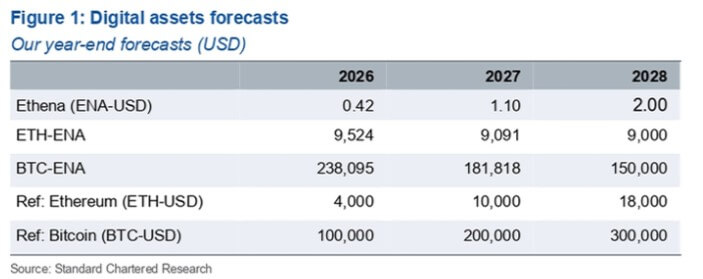
The bank initiated coverage of ENA with a $2 year-end 2028 target, up from about $0.28 currently. It forecasts the token reaching $0.42 at the end of 2026 and $1.10 in 2027 before accelerating further the following year.
The projection would leave ENA outperforming Standard Chartered’s expected gains for both Bitcoin and Ethereum over the same period. But reaching it requires Ethena to reverse a contraction that has cut USDe supply by more than half from its peak and expand far beyond the scale it has previously achieved.
The bank’s thesis rests on Ethena finding new sources of yield as returns from its original crypto trading strategy decline, while generating enough revenue from a much larger USDe base to make ENA increasingly valuable to holders.
Ethena first has to rebuild USDe
USDe became one of crypto’s fastest-growing stablecoins after launching in late 2023, exceeding $10 billion as traders piled into a structure that combined long spot crypto positions with short perpetual futures.
That approach allowed Ethena to capture funding payments while keeping its overall market exposure largely delta-neutral. At times, the strategy generated returns above 20%, helping attract deposits into USDe and its yield-bearing counterpart, sUSDe.
However, those conditions have since weakened amid the ensuing market contraction.
As the trade became more crowded and crypto funding rates compressed, USDe supply fell to about $4.9 billion. Standard Chartered estimates Ethena’s blended yield across its strategies is now about 5.2%.
The bank’s forecast assumes contraction can reverse dramatically. It expects USDe supply to reach $40 billion by 2028, meaning Ethena would first have to regain its previous $10 billion-plus peak and then roughly quadruple again.
Ethena has responded to lower crypto basis returns by broadening where it generates yield. Its strategies now include DeFi lending, institutional lending, liquid stablecoins and real-world assets, alongside newer basis trades tied to equities and commodities.
That diversification is central to Standard Chartered’s growth assumptions.
The bank expects tokenized assets, including stablecoins and other real-world assets, to reach about $4 trillion by the end of 2028 from roughly $350 billion currently. It projects real-world assets deployed on blockchains could rise from about $40 billion to $2 trillion over the same period.
A larger tokenized-asset market would give Ethena more collateral and yield opportunities beyond crypto derivatives, potentially allowing USDe to expand without requiring another period of exceptionally high perpetual-futures funding rates.
Ethena is also building businesses outside the core synthetic dollar, including white-label stablecoins and Ethena Pay. Standard Chartered expects those operations to widen the revenue base as the protocol grows.
However, the first hurdle is much closer than $40 billion.
Ethena’s approved fee-switch framework begins at $7.5 billion of USDe supply, leaving the protocol below the first threshold at which the revenue mechanism underlying Standard Chartered’s valuation begins to take effect.
Why the buyback math leads to $2
Once those thresholds are crossed, the ENA valuation increasingly depends on how much of Ethena’s economics can be directed toward token holders.
The approved framework allocates 95% of qualifying net revenue paid to the Ethena Foundation from covered businesses toward ENA buybacks. Ethena does not retain the full yield generated by the assets supporting USDe, making the distinction between gross and net revenue central to the calculation.
Blockworks Advisory’s analysis modeled the protocol’s share of gross revenue increasing with USDe supply, beginning at about 5% around $7.5 billion and reaching 20% by $20 billion. The model used a 6% protocol yield as an illustrative assumption, not a guaranteed return.
At the much larger scale envisioned by Standard Chartered, those economics become substantial.
The bank estimates that if USDe reaches $40 billion, ENA purchases could amount to roughly 23% of the token’s current market value annually if its price remained unchanged.
Standard Chartered does not expect such a percentage to persist. It argues that investors would capitalize the expected stream of purchases into ENA’s valuation, pushing the token higher and reducing annual buybacks as a percentage of its market capitalization.
The bank points to Uniswap as an analog, saying UNI’s annualized buyback percentage has settled around 3% to 4% as the token appreciated after activating its fee switch. Applying a comparable equilibrium to Ethena underpins Standard Chartered’s $2 target.
But the mechanism introduces its own constraint.
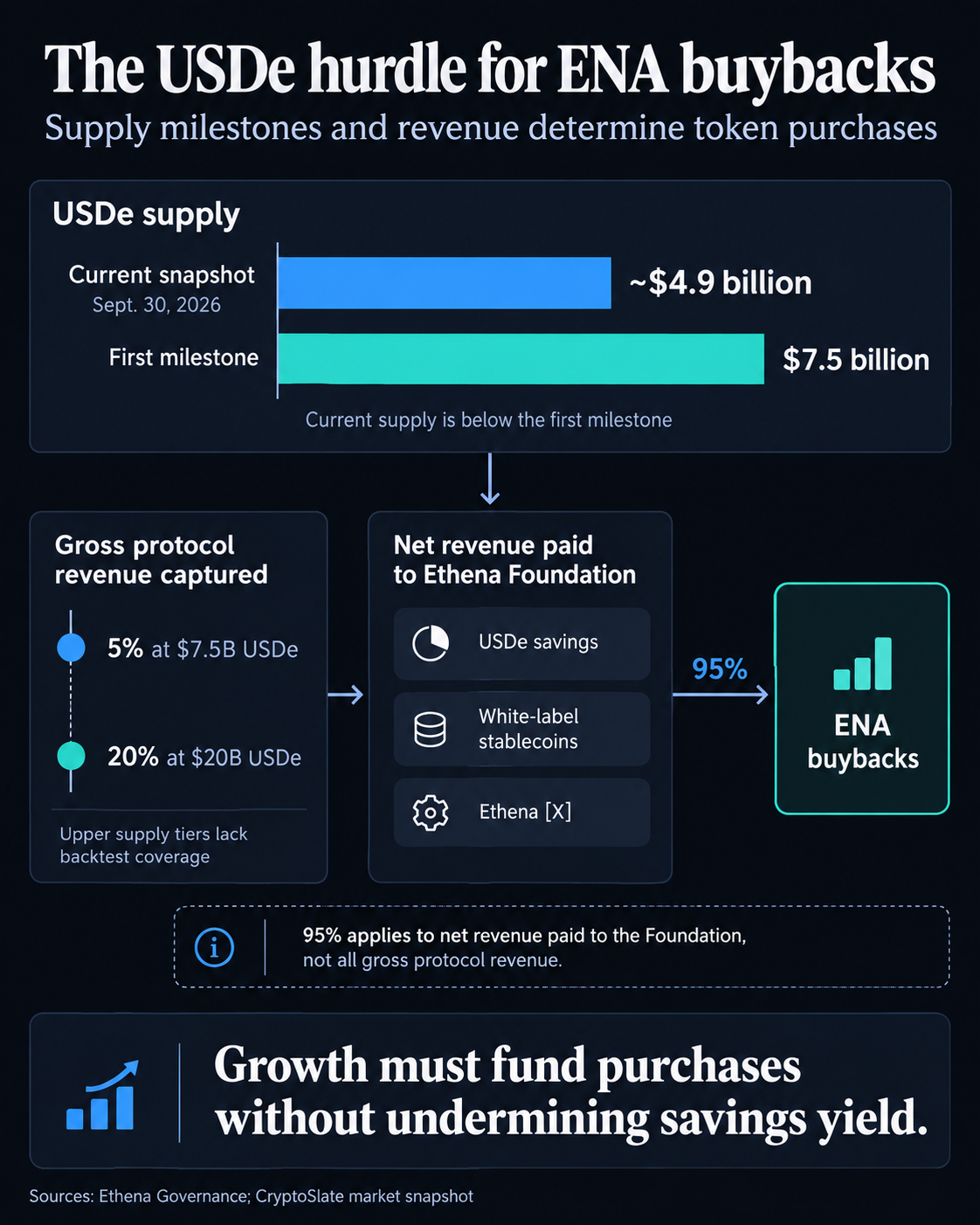
Capturing a larger share of Ethena’s revenue for the protocol can reduce what remains available to sUSDe holders. That creates a balancing act: Ethena needs enough margin to support ENA purchases while maintaining sufficiently competitive yields to keep attracting the deposits required for USDe to grow.
The assumptions become more demanding as supply rises. The 6% return used in the framework has not been guaranteed across market cycles, while the higher revenue-capture tiers have yet to be tested at the scale Standard Chartered expects.
That leaves investors with several nearer-term checkpoints before the $2 target becomes relevant. USDe must first cross the $7.5 billion fee-switch threshold and reclaim its previous peak.
Beyond that, Ethena will have to show that its newer yield strategies can absorb tens of billions of dollars without materially compressing returns. How quickly those thresholds are crossed will determine whether Standard Chartered’s projected buyback engine begins to resemble the one embedded in its valuation model.
The post Standard Chartered says Ethena’s ENA could crush Bitcoin and Ethereum returns by 2028 appeared first on CryptoSlate.
CryptoTicker.io
Bitway traded at around $1.32 on Thursday morning, roughly seven and a half percent below the all-time high of $1.43 the token reached on Monday. Over the week, BTW is up between 27 and 28 percent depending on the calculation method, while Bitcoin and Ethereum were practically unchanged over the same period. That is the core of this week: a token ranked 34th moves sharply, and the broad market does not move at all.
For you as an investor in Germany, less hangs on how far the price may still run than on what you are actually dealing with. Three things about Bitway are documented, and they matter more for a decision than any price forecast: only a good quarter of the total supply is in circulation at all, daily turnover is strikingly small against market capitalisation, and none of the exchanges that list BTW holds authorisation under MiCA, the European crypto regulation. This article puts the week in context and goes through the points you can check for yourself.
Bitway (BTW) week in review: price, weekly high and weekly low
According to CoinGecko, BTW stood at $1.32 as of Thursday night, October 1. Market capitalisation is around $3.6 billion, which places Bitway 34th among all cryptocurrencies. The path through the week was unusually wide.
The weekly low was $0.84 on Saturday, September 26. Two days later, on Monday, BTW marked its all-time high at $1.43. For the hourly series of the same week, CoinGecko shows the highest level on Wednesday at $1.41; the two figures come from differently grained series from the same provider, which is why the range stands here rather than a smoothed average. From $0.84 to $1.43 is a good 70 percent in two days, and the pullback to $1.32 has given back about a sixth of that.
Over 30 days, BTW is up around 225 percent. That figure is the real background to the week: the jump to the all-time high came at the end of a move that had already begun in September.
What the week looks like against the broader market
Bitcoin stood at around $83,500 on Thursday morning, down a good one percent over seven days, and Ethereum at about $2,685, also slightly weaker over the week. Anyone holding BTW against that backdrop is dealing with a single move whose cause has to lie in the project itself or in demand for the token. That matters for context, because a move without the market behind it turns faster in both directions.

What is behind the jump from $0.84 to $1.43
Bitway is a project in the field of decentralised finance. CoinGecko lists the token under the tags decentralised finance, yield farming, BNB Chain ecosystem and governance. According to the project's own account on the Bitway project site, BTW is the token that carries network operations, staking and governance votes, and the one tied to the incentives for the provider's yield, payment and financing products.
The immediate driver of the week is documented and carries an expiry date: an incentive campaign has been running through the DeFi section of Binance Wallet since August 19 and closes at the end of this week. Anyone committing capital to the corresponding product takes part in the distribution of rewards in BTW. A campaign that locks up capital and pays out tokens at the same time creates demand for as long as it runs, and that particular window closes on Friday.
A second point belongs to the backstory. According to a review by the data provider Bitquery of 51 larger airdrops on EVM networks this year, three out of four of those tokens later traded below their first-week price. BTW was one of the exceptions in that study and traded clearly above it. That explains part of the attention, but it says nothing about the direction from here: it is a statement about this token's past relative to others, not about its value.
Booster Earn Season 5: the campaign ends on October 2 at 23:59 UTC
The only documented date in the coming days is the end of the current campaign. Under the announcement of August 19, 2026, 00:00 UTC, the programme's fifth round runs until October 2, 2026, 23:59 UTC. For you in Germany that means it closes at 1:59 a.m. on Saturday night. Rewards worth $200,000 in BTW are paid out as a boosted interest rate, and the condition for taking part is a deposit of at least $100 into the corresponding vault product through the DeFi section of Binance Wallet. The campaign dates can be viewed in the events calendar at TradingView.
What counts for the coming week is the expiry, not the participation. An incentive campaign holds capital in place. Once it runs out, the capital that was locked can be withdrawn, and experience suggests part of the rewards in BTW gets sold. Whether and how strongly that feeds through to the price cannot be predicted, and nobody should be quoting you a figure here. The date itself, though, is fixed, and it falls in the same week as the all-time high.
Circulating supply and total supply: 2.71 of 10 billion BTW are free
Here lies the point a price chart does not show. Of the 10 billion BTW set as total and maximum supply, around 2.71 billion are in circulation. That is about 27 percent. The remaining almost three quarters exist, but are not yet on the market.
Circulating supply is the number of tokens that are genuinely free to trade. The market capitalisation of $3.6 billion counts that circulating supply alone. Apply the full supply of 10 billion tokens at the current price instead, and the fully diluted valuation comes to around $13 billion. Both are correct figures for different questions, and with Bitway the gap between them is wide.
In practice that means: every token that enters circulation in future out of reserves, rewards or unlocks meets a market that has to absorb the additional supply. For projects with a circulating share of around 27 percent, the schedule of those unlocks is therefore one of the most important pieces of information there is. Anyone who holds BTW or wants to buy should read that schedule at the provider itself rather than infer it from the price chart.
Why the supply figures differ from one source to the next
Figures for Bitway's circulating supply diverge across data providers, as an analysis by Phemex among others has pointed out. Such divergences arise when providers count locked holdings, reserves or undistributed rewards differently. For you that means: compare the market capitalisation at two providers before you take it as a yardstick. If the circulating supply differs, so does every valuation built on it.

Trading volume and liquidity: $50 million against $3.6 billion in market capitalisation
Turnover in BTW over 24 hours came to around $50 million. Against a market capitalisation of $3.6 billion that is about 1.4 percent. For Bitcoin and Ethereum this ratio is markedly higher on ordinary days.
Liquidity describes how much you can buy or sell without moving the price yourself. A small ratio of turnover to market capitalisation means in practice: larger sell orders meet a thin order book, and the price achieved can sit noticeably below the one you see on the ticker. That also explains the spread of this week. A market that rises 70 percent in two days and then gives part of it back is typically not a deep market.
One consequence for your own planning follows from that, and it has nothing to do with a forecast: anyone who plans a fixed exit price in a thin market should allow for that price being unavailable when it matters.
BTW on exchanges: Bitget, Gate and MEXC, no MiCA licence in the EU
CoinGecko lists 13 trading venues for BTW. On the centralised side these include Bitget, Gate, MEXC, HTX, Poloniex, Toobit, DigiFinex, KCEX, BitKan and Ourbit, each paired against the dollar stablecoin USDT. Added to that are decentralised venues on BNB Chain, among them Uniswap in two versions and PancakeSwap.
None of these venues belongs to the providers authorised as crypto service providers under MiCA and allowed to offer their services in Germany on a regular basis. cryptoticker.io compiled this review itself on October 1, 2026; the basis is the list of 13 trading venues CoinGecko carries for BTW, matched against the providers authorised in Germany. Names such as Bitpanda, Coinbase, Kraken or Bitvavo, which work in Germany with authorisation, do not appear on that list.
That is not a statement about the standing of the exchanges named, but one about your legal framework. Since July 1, 2026 the requirements of the MiCA regulation have applied in full across the EU, and the transition periods have expired. Anyone trading at a provider without EU authorisation does not have the avenues open to them that a supervised provider offers in a dispute, and German deposit protection does not cover crypto assets in any case. Which exchanges hold authorisation is shown in our overview of regulated crypto exchanges.
Leverage and liquidation
Several of the exchanges named offer derivatives on BTW. In a market that rises 70 percent within two days and then shows a range of more than a third in a single day, the arithmetic is simple: tenfold leverage is wiped out in full by a ten percent move the other way. Liquidation is the forced closing of your position as soon as the margin no longer suffices. In a market of this spread that hits leveraged positions regularly.
Custody: two contract addresses on BNB Chain and Ethereum
BTW exists on two networks. On BNB Chain the contract address is 0x444045b0ee1ee319a660a5e3d604ca0ffa35acaa, on Ethereum 0x3a63de3572c69a1307ff08394f3ee7702c16d25d. Anyone moving the token into a wallet of their own has to pick the right network. A transfer to the matching address on the wrong network is as a rule not recoverable.
With tokens on several networks and similarly named imitations, the extra look is worth it: compare the contract address a trading platform or a search result shows you with the address on the project site itself before you buy or transfer. For custody of larger holdings, the same holds as for any token on a smart contract platform, namely that the keys sit better on a device without a network connection than in an exchange account.
Levels above and below: $1.43, $1.04 and the $0.84 area
The levels that follow are observation points from the week's trading, not price targets and not a recommendation. Above stands the all-time high at $1.43, around seven and a half percent over the current price; beneath it lies Wednesday's hourly high at $1.41. On the downside, the price from seven days ago at about $1.04 marks the starting point of the weekly move, and under that sits Saturday's weekly low at $0.84.
The round level at one dollar almost coincides with the start of the week and is therefore the line at which it will show whether the weekly gain holds. Nothing more can be read out of the figures, and anything further would be guesswork about quantities that has no place here.
Tax in Germany: a one-year holding period and the 1,000-euro threshold
The same rules apply to BTW as to other crypto assets held privately. If you sell at a profit within a year of buying, that profit is taxable and charged at your personal income tax rate. After a holding period of more than a year, the gain on the sale stays tax-free. The threshold is 1,000 euros a year, and it is not an allowance: if your gains from private sales exceed that limit, the entire amount is taxable, not just the part above it.
Rewards from an incentive campaign or from staking count separately and are as a rule treated as other income. They are assessed at the time they arrive, at the price prevailing then, with a threshold of their own at 256 euros a year. Anyone taking part in the current campaign should record the price on the day of the credit, because that value later forms the basis for taxation.
Since January 1, 2026 the Crypto Asset Tax Transparency Act, the German implementation of the EU directive DAC8, has applied on top of that. Under it, providers report user and transaction data to the tax authorities; for the current year 2026 those reports have to be filed by July 31, 2027. That applies most clearly to providers based or registered in the EU, and it changes nothing about your own duty to declare gains in your tax return. When trading across several platforms and networks, clean record-keeping from the start helps more than any reconstruction after the fact; an overview of the tools for it is in our comparison of crypto tax tools.
Bitway: Your next three steps
- Settle the access route. Establish whether you can get BTW at a provider with EU authorisation at all, and decide deliberately whether a trading venue without that authorisation is worth the commitment to you. Which exchanges work in Germany on a regular basis is set out in our overview of crypto exchanges.
- Read up on the supply schedule. Look at the project itself for when the remaining almost three quarters of the total supply enter circulation, and only then set a position size. For custody outside an exchange account, the hardware wallet comparison helps.
- Record the date and your tax documents. Note the end of the campaign on Saturday night as well as the purchase date, price and network of every position, so that the holding period and the threshold can be evidenced later. You will find tools for that in the tax tool comparison.
(As of October 1, 2026. This article is not investment advice. Prices and fee structures change; check the terms with the provider before you buy.)
The information provided in this article is for informational purposes only and does not constitute financial advice. Investing in cryptocurrencies carries a high level of risk.
A stock market game is a contest played with virtual money: everyone starts with the same virtual capital, trades at real prices, and in the end whoever sits at the top of the leaderboard wins. The good news first: all six stock market games in this comparison are free. The more important news comes further down: a leaderboard does not necessarily reward good trading, and often rewards the biggest risk instead. Knowing that, you learn more from a stock market game than just how to place an order. Here are the stock market games of 2026 with their period, target group, starting capital and prizes, plus the answer to where crypto is allowed.
Free stock market games: the key points in brief
- All six stock market games in this comparison are free, as of September 28, 2026. Three of them allow cryptocurrencies.
- Planspiel Börse, run by the German savings banks, starts on October 1, 2026 and runs until January 25, 2027, for school and university students.
- Trader 2026 from Société Générale runs from September 7 to October 30, 2026, with two portfolios of €100,000 in virtual money each.
- Trading Masters begins its first playing round on November 9, with €25,000 per portfolio and prizes worth more than €50,000.
- With crypto: Trading Masters and the training portfolio in Planspiel Börse via BSDEX, plus the crypto stock market game from CryptoTicker with 50 coins.
- No stock market game is played with real money. The prizes, by contrast, are real; at Trader 2026 they go up to a car.
The stock market games of 2026 at a glance
| Stock market game | Who it is for | Period | Starting capital | Crypto | Prizes |
|---|---|---|---|---|---|
| Planspiel Börse (savings banks) | School and university students | October 1, 2026 to January 25, 2027 | €50,000 | in the training portfolio | depends on the savings bank |
| Trader 2026 (Société Générale) | Adults aged 18 and over | September 7 to October 30, 2026 | 2 × €100,000 | no | a car as the main prize, weekly prizes |
| Trading Masters (excellents, UBS) | Adults aged 18 and over in Germany and Austria | Rounds from November 9, 2026 and January 11, 2027 | €25,000 per portfolio | yes, via BSDEX | more than €50,000 in total |
| VR-Börsenspiel (cooperative banks) | Schools and apprentices | School game February to May 2026, apprentice game by region until October 23, 2026 | €50,000 (schools) | no | depends on the bank |
| Tradity (WHU) | School students | annual season | 100,000 Tradity coins | no | prize money |
| Crypto stock market game from CryptoTicker | Adults aged 18 and over | Pre-season until the end of 2026, then seasons | €10,000 | yes, 50 coins | planned from January 2027 |
All figures as of September 28, 2026, according to the organizers. Dates and prizes change from round to round.
The six stock market games in detail
Planspiel Börse from the German savings banks
The best-known stock market game in Germany is aimed at school and university students. The 2026 round starts on October 1, registration has been open since September 14 and must be completed by November 11; play ends on January 25, 2027. You can take part via the app or in a browser, which requires a registration code from the savings bank or the teacher. The competition portfolio allows trading in shares from well-known indices, funds, ETFs and fixed-income securities. The training portfolio additionally offers cryptocurrencies via the BSDEX exchange, plus certificates. Alongside the portfolio ranking there is a sustainability score.
Trader 2026 from Société Générale
Trader is aimed at adults aged 18 and over and runs for eight weeks in 2026, from September 7 to October 30. Every participant receives two portfolios with €100,000 in virtual money each. Tradable instruments are shares, certificates and warrants listed on the Stuttgart Stock Exchange or issued by Société Générale. The rules put a brake on gambling: a maximum of 20 purchases a day, no single position above 20 percent of the portfolio, leveraged products capped at 20 percent of portfolio value, and a minimum holding time of five minutes. Once a week, a portfolio can be reset. The main prize is a Range Rover Evoque, and there are weekly prizes on top.
Trading Masters
Trading Masters is organized by excellents GmbH, with UBS as the main sponsor. Adults aged 18 and over who are resident in Germany or Austria can take part. Play runs with one equity portfolio and one leverage portfolio of €25,000 each. Tradable instruments are shares via the Stuttgart Stock Exchange, warrants, knock-out products and factor certificates from UBS, as well as cryptocurrencies via BSDEX. The training camp begins on October 26, the first playing round on November 9, 2026, and the second on January 11, 2027. The prizes are worth more than €50,000 in total, and the winner of a round receives €8,000. Taking part is free.
VR-Börsenspiel
The stock market game of the German cooperative banks comes as a school game and as an apprentice game. The 2026 school game ran from February 11 to May 11, with registration opening in November 2025. The apprentice game runs at different times by region: in Weser-Ems and at Genoverband from January 20 to May 20, in Baden-Württemberg and Bavaria from June 23 to October 23, 2026. Schools start with €50,000 in virtual capital; tradable instruments are shares and ETPs, and in the speculative variant leveraged products as well. Cryptocurrencies are not included.
Tradity
Tradity is an educational initiative of WHU, the Otto Beisheim School of Management, and is aimed at school students. The game is free, play starts with 100,000 Tradity coins, and real shares are traded at real-time prices. The season runs once a year; the app announces when the next one begins. There is prize money, and crypto cannot be traded.
The crypto stock market game from CryptoTicker
This one is our own, so here it is in detail and with the caveats: the stock market game in CryptoTicker's Trading Hub is a pure crypto contest. Participation is from age 18. There is €10,000 in virtual money, real prices for 50 coins and two leagues, up to 10x and up to 100x leverage. The first three trades work without an account; after that, one click creates an anonymous account, with no email address and no payment details.
A pre-season runs until the end of 2026: free and without prize money. From January 2027, ranked seasons with a prize pool are planned, and taking part in the ranking is then intended to carry a fee. What is scored is not the highest return but the CT score, the return divided by the largest drawdown. If you only want to practise, you do not need the contest at all: the trading simulator is separate from it, with no sign-up, no credit card and no cap on the number of trades.
Which stock market games are the best?
The best stock market game is the one that fits your situation:
- For school and university students: Planspiel Börse, because it is organized through schools and universities and has a training portfolio that knows crypto. An alternative with real shares and prize money is Tradity.
- For adults who want to win something: Trader 2026 and Trading Masters, both with real prizes and clear trading rules.
- For crypto: Trading Masters or the crypto stock market game from CryptoTicker; anyone under 18 practises crypto in the training portfolio of Planspiel Börse.
- Without a deadline and without a contest: a demo account or a simulator. Which variants exist is set out in our guide to the trading demo account.
Why a leaderboard invites too much risk
A stock market game with a prize for the top places has an uncomfortable property: trade cautiously and you land safely in midfield. Put everything on one card and you usually land far back, but occasionally right at the front. With a thousand participants, what often wins is therefore the biggest lucky hit and not the best strategy. That is a property of the format, and no reproach to the organizers.
Two things work against it. First, rules like those at Trader 2026, which cap single positions and leveraged products at 20 percent of the portfolio. Second, a scoring method that prices in risk, such as the CT score, which divides the return by the largest drawdown. For you as a learner: trade in the stock market game by the rules you intend to keep later with real money, even if that costs you a place in the ranking. One percent of risk per trade means, with €100,000 in virtual money, a loss of at most €1,000 until the stop.
Is the stock market game played with real money?
No. In every stock market game in this comparison you trade with virtual money; no order reaches an exchange, and you cannot lose money of your own. Only the prizes handed out by some organizers are real. If you want to start with real money after the contest, begin small and choose a provider by fees and regulation: for crypto, our exchange comparison helps, and for shares, ETFs and derivatives the comparison of the best crypto brokers.
Stock market game, model portfolio, paper trading: the difference
- Stock market game: a contest with a deadline, a leaderboard and often prizes.
- Model portfolio: a virtual portfolio without a contest, mostly for shares and ETFs, to follow a selection over weeks.
- Paper trading and demo account: practice trading at real prices, any time and without a leaderboard, often with stops, shorts and leverage.
If you do not need the contest, you usually learn faster with a demo account, because no leaderboard invites risk. How to start without money and with real prices is set out in our guide Practise trading without money.
How to get from the game to your own rulebook, with order types, position size and a four-week practice plan, is set out in our Learn Trading pillar. If you then want to put real money to work, you will find regulated providers and their fees in the exchange comparison.
Sources
- Planspiel Börse of the German savings banks: dates for the 2026 round and FAQ, as of September 28, 2026.
- Société Générale: terms of participation and prizes for Trader 2026, as of September 28, 2026.
- excellents GmbH: Trading Masters, the stock market game at a glance, as of September 28, 2026.
- DIGITAL PROJECT: VR-Börsenspiel, dates and playing times 2026, as of September 28, 2026.
- WHU Otto Beisheim School of Management: Tradity, as of September 28, 2026.
- CryptoTicker Trading Hub, home page and terms of participation, as of September 28, 2026.
Cronos (CRO), the token of the Cronos blockchain, cost 0.0590 euros on Thursday, October 1, according to CoinGecko. That is 9.6 percent more than seven days ago and 17.6 percent more than a month ago. With a market capitalization of around 2.94 billion euros, CRO ranks 38th on CoinGecko.
The reason to look at Cronos now is a deadline. On Saturday, October 3, at around 02:00 UTC, voting closes on two proposals meant to change the supply of CRO. One would burn 228 million CRO; the other would commit developer firm Cronos Labs to putting all revenue from two products into buybacks. Both votes have been running on-chain since September 19 and can be counted publicly.
The CRO price this week: a 9.6 percent gain with a pullback
The weekly low was 0.0532 euros on Wednesday, September 24, at around 12:00, according to CoinGecko's hourly data. On Tuesday, September 29, CRO hit its weekly high of 0.0632 euros at around 14:00 and then eased again. From that high to the current level there is a discount of roughly 6.6 percent.
A longer view helps place that. The all-time high of 0.793 euros dates from November 2021. Today's price sits more than 90 percent below it. This week's move is therefore a recovery inside a long downtrend, and not yet a trend reversal that could be documented.
Proposal 36: 228 million CRO from the community pool
The first proposal is the simpler one technically. Part of the newly created CRO flows regularly into a community pool on the Cronos POS Chain, and that stock is burned from time to time. It has happened four times so far, through proposals 18, 26, 28 and 30, each with 50 million CRO. Proposal 36 would now destroy 228 million CRO at once; the pool held around 234.7 million CRO on Thursday morning. In total, 428 million CRO would then have been burned.
The proposal contains an executable instruction: if it passes, the chain automatically transfers the amount to an address from which nobody can move the tokens again. That can be followed in the Mintscan governance explorer.

Proposal 37: all revenue from Ult and Cronos Launch into buybacks
The second proposal reaches further, but it executes nothing automatically. It is a signalling proposal with which stakers are asked to confirm two commitments by Cronos Labs. Part A: all revenue from the trading app Ult and the platform Cronos Launch buys CRO on the open market and burns it, monthly and on-chain, with a published hash for every transaction. Operations and growth are funded from existing capital, according to Cronos Labs.
Part B concerns stakers directly. Because revenue goes entirely into the burn, staking rewards are to come from the Strategic Reserve as the issuance of new CRO gradually falls. This reserve of 70 billion CRO was created by the contested reissuance decided in March 2025. According to the proposal, nothing changes about the reward rate, the tiers or the lock-up periods.
Two points stand in the proposal itself and deserve attention. The contract meant to execute the buybacks automatically is still in development by its own account. And the text contains no forecast of how high the revenue from Ult and Cronos Launch will be. How much CRO is actually burned each month can therefore only be read off the first transactions.
The state of the vote: quorum reached, no votes against
In the early hours of Thursday, proposal 36 stood at around 5.18 billion CRO in favour, 2.2 million abstaining and not a single vote against or vetoing. Proposal 37 looked almost the same with 5.16 billion yes votes. Bonded, meaning staked, were around 14.47 billion CRO at that point. Participation was therefore 35.8 and 35.7 percent, above the required quorum of 33.4 percent.
The proposals could now fail only if a large block votes no or veto in the final hours. For a veto, a third of the votes cast is enough; the proposal then counts as rejected and the deposit is burned. For proposal 37, Cronos Labs has stated that in the event of a no it will neither implement the revenue rule nor release the reserve for staking.
What 228 million CRO mean in proportion
The figure sounds large, but the supply is larger. CoinGecko lists a total supply of around 98.95 billion CRO, of which around 49.75 billion are in circulation. The burn from proposal 36 therefore equals 0.23 percent of total supply or 0.46 percent of the circulating amount. It is a signal, yet not a cut that tightens supply noticeably.
Proposal 37 matters more for the direction. Whether it supports the price depends entirely on how much revenue Ult and Cronos Launch generate, and that figure does not exist yet. At the same time the reserve of 70 billion CRO remains in place and becomes the source of staking rewards. Anyone assessing the proposal should lay both sides side by side: tokens burned from revenue, and tokens newly distributed from the reserve.
These levels frame the week
To the downside, the round level of 0.06 euros sits right at the current price, below it the weekly low at 0.0532 euros and the round threshold of 0.05 euros. To the upside, Tuesday's weekly high at 0.0632 euros is the first level. These values describe where the price turned over the past week. They are not price targets, and the outcome of Saturday's vote can shift the course in either direction.
Buying, staking and taxing CRO in Germany
CRO is listed on large exchanges that operate in the EU with authorization under the MiCA regulation, among them Crypto.com, Coinbase, Kraken, Bitvavo and OKX, according to CoinGecko's list of trading venues. Which providers hold that authorization and what they charge is shown in our comparison of crypto exchanges with a MiCA license.
Only those who have staked CRO on the Cronos POS Chain can vote, either directly or through a validator. Anyone holding CRO at an exchange usually does not take part. Staking rewards differ considerably between providers; our comparison of staking providers gives an overview.
On tax in Germany: gains from selling CRO are tax-free after a holding period of one year, and staking does not extend that period. The rewards themselves are taxable on receipt as other income if, together with other such income in the year, they reach 256 euros. Anyone planning to stake should therefore record the date and value of every payout.
Perpetual futures on CRO are available on several exchanges. Around a voting deadline, leverage is risky, because an unexpected result can move the price within minutes. At five times leverage, a 20 percent move against you uses up the margin.
The risk behind the burn
A burn from the community pool is a one-off reduction, while the monthly buybacks are a promise whose scale nobody knows. On top of that, the Strategic Reserve of 70 billion CRO brings new tokens to the market as soon as it funds staking rewards. The ratio between the two flows decides whether supply actually falls.
Seen the other way, the procedure is open: every vote, every burn and later every monthly buyback transaction stands on-chain. Anyone holding CRO can check month by month after Saturday whether the commitment is being honoured.
Cronos: Your next three steps
- Check whether your exchange holds a MiCA authorization and lists CRO, in the comparison of regulated crypto exchanges.
- If you want to stake or vote, compare yields and lock-up periods in the staking comparison.
- Record purchase dates and staking inflows so that the holding period and the threshold can be documented. The programs in the comparison of crypto tax tools help with that.
(As of October 1, 2026. This article is not investment advice. Prices and fee structures change; check the terms with the provider before you buy.)
The perpetuals venue Drift on Solana has been called Velocity since its relaunch, and since September 29, 2026 a different team has been running it. Co-founder Cindy Leow has stepped back from her role, five months after attackers pulled around 285 million dollars out of the exchange's vaults on April 1. For you this is more than a change of name: trading is now settled in USDT instead of USDC, several functions have disappeared, and there is still no MiCA authorization for the German market.
A perp DEX is a decentralized exchange for open-ended futures contracts where you bet on price moves with leverage without owning the coin itself. The money does not sit with a bank; it sits in smart contracts, the so-called vaults. Those vaults were exactly what the April attack went after.
Velocity replaces Drift: the relaunch in numbers
The way back came in stages. On September 17, 2026 the project opened up its source code. On September 21 the whitelist fell, which until then had let only selected accounts trade, and the public beta was open to everyone. On September 29 the change at the top followed.
Leow explained her departure on X by pointing to the phase the project is now in. Her strength, she said in substance, lies in building from zero to one, and Velocity now needs people who take it from one to ten; she trusts this team to do that. Five names are taking over: a lead for fund recovery and law enforcement, a protocol engineer who previously headed the Helium Network, a product chief with a Binance background, a partnerships lead and a growth lead who comes from Binance and Trust Wallet.
The scale involved can be read off the back story. Before the attack, Drift had handled more than 150 billion dollars in trading volume, according to figures from around the project. Solana's perp platforms together reached 1.08 trillion dollars in cumulative volume by August 2026. Its own token, DRIFT, trades at around 0.019 dollars at the turn of the month, far below the big names; on the market-value ranking it sits around position 1,080.
The April 1 attack: 285 million dollars out of the vaults
On April 1, 2026 around 285 million dollars flowed out of the vaults. Before the attack more than 550 million dollars were locked in the protocol, so the outflow amounted to roughly half of the total value deposited. TVL, short for total value locked, describes the sum of all deposits sitting in a protocol's contracts.
That figure puts the case in order of magnitude. In September 2026, losses from crypto attacks across the industry added up to 766 million dollars. A single incident of 285 million dollars therefore belongs in the top category of what has happened this year, and the venue it hit was among the most active in the Solana ecosystem.
Fake collateral token: the attack path in detail
The technical lever was a forged collateral token. Collateral is the security you post so the exchange allows you a leveraged position; the contract weighs its value against your risk. If a worthless token can be made to count as valuable security, a real payout can be drawn against thin air.
What came before that was social engineering rather than a technical break-in. According to the project's account, the attackers obtained administration rights by building trust over months and manipulating people. Leow spoke of an infiltration prepared over six months. This is the part that code alone cannot catch: where a human grants the permission, the human is the point of attack.
For you as a user of a trading venue, that leads to an uncomfortable insight. A protocol can be cleanly written and audited several times and still fall because someone with elevated rights was deceived. Anyone who leaves a balance sitting on an exchange permanently carries that risk too. An overview of which venues come into question for perpetuals at all, and how they are set up on custody and safeguards, is in our comparison of perp DEXs.

North Korea attribution: what Mandiant and TRM Labs record
The forensics firms Mandiant and TRM Labs trace the attack to an actor with links to North Korea. Leow herself called it a state-level attack. The difference between attribution and proof matters here: such analyses rest on traces in transaction chains, on recurring tools and on patterns in how the perpetrators work. No court has ruled on it, and the firms frame their results as an assessment.
For judging the case, the attribution remains significant all the same. State-backed groups work with longer lead times and larger means than opportunists. Anyone using a venue that comes into the sights of such groups cannot assume that an audit alone is enough.
Tether puts up 127.5 million dollars: how the rescue package was built
Two weeks after the attack, on April 16, 2026, the funding for the return was in place. Tether committed up to 127.5 million dollars, and further partners contributed 20 million dollars. In total, up to 147.5 million dollars were available, so just under 150 million and about half of the outflow.
That calculation is the reason the relaunch was possible at all, and at the same time the point where you should look closely. A package of around 147 million dollars does not cover 285 million dollars. How the funds were allocated to deposits in detail, and which claims have been met and to what extent, cannot be derived from the public statements. Anyone who held a balance on the platform at the time should therefore check their own position directly in their account and not through third-party summaries.
It is also worth noting who steps in here. A stablecoin issuer and a number of private partners carried the case. No deposit guarantee fund set up by law was involved, and no legal obligation required anyone to step in. Precisely this difference from the regulated world is the core of what counts for you in Germany.
USDT instead of USDC: the change in settlement
Velocity settles differently from Drift. Settlement, meaning the currency in which gains, losses and collateral are booked, now runs through Tether's USDT rather than Circle's USDC. Spot markets remain only for collateral, for securing loans and for lending; trading itself concentrates on perpetuals.
The change has practical consequences. If you hold USDC, you need a conversion step before you can trade, and every swap costs a fee and time. On top of that, issuer risk shifts: in settlement you depend on the creditworthiness and the reserve policy of a different issuer. Both stablecoins are large, USDT leads the stablecoin ranking by market value and trades steadily at around one dollar, but it is a different promise from a different company.
The narrower range of functions is a deliberate choice. Fewer products mean fewer interfaces at which something can go wrong. Anyone who was looking for isolated markets or leveraged products outside perpetuals will no longer find them here and has to use another venue.

OtterSec and Asymmetric Research: 154 findings in the audit
Before the relaunch, the team had the code reviewed. OtterSec carried out the security audit and noted 154 findings, none of which the report classes as critical. Asymmetric Research took on operational security, meaning processes, rights management and the handling of keys. Since September 17 the code has been open, so third parties can look for themselves.
154 findings sound like a lot and are not. An audit report lists every observation, from the stylistic note to the genuine bug, and the classification into severity levels carries the information. The second part of the finding is what counts: that no finding is rated critical covers the program code. What a code audit does not cover is the April attack path, which ran through deceived people and granted rights. Operational security review stands for that, and its results are harder to judge from outside than a list of code findings.
How resilient a venue is shows up for you in three verifiable things: whether audit reports are public and dated, whether the code is open, and whether anyone is liable for failures. Velocity meets the first two points. On the third it gets thin, and here it helps to look at regulated crypto exchanges, whose duties are written into law.
Perp DEX without MiCA authorization: the legal position for German users
MiCA, the EU regulation on markets in crypto-assets, has governed step by step since 2024 who may offer crypto services in the European Union. A provider with authorization is subject to requirements on own funds, separation of client money, complaints procedures and supervision by an authority; in Germany that is BaFin. Which duties this brings for companies is something we have set out in our overview of the MiCA license and its obligations.
Velocity does not operate as an authorized provider in the EU. MiCA's protections therefore do not apply to you. There is no authority you can turn to in a dispute, no legal duty to separate client money and no deposit guarantee. The fact that private funds were collected in April shows the difference clearly: there, companies decided voluntarily; here, an authority would have set requirements.
At decentralized futures venues this is the rule. The same position applies at Hyperliquid, which is also reachable from Germany without MiCA authorization. Technically usable and legally protected are two different things.
Leverage and liquidation: the risk is unchanged
The relaunch has changed nothing about the product itself. A perpetual runs without an expiry date, and the funding rate balances the difference from the spot price at regular intervals; depending on market conditions you pay it or receive it. Liquidation means the exchange closes your position automatically as soon as your collateral no longer covers the losses. At high leverage, a price move of a few percent is enough for that.
The market around it is calm at the moment, and that is easy to misread. Solana trades at around 118 dollars at the turn of the month and has gained roughly 63 percent in two months, up from about 73 dollars. DeFi deposits on Solana stand at 6.5 billion dollars again, a gain of 38 percent in two months. Count the recovery in SOL rather than in dollars, however, and it looks smaller: with a 63 percent price gain and a 38 percent rise in dollar value, there is on balance rather less SOL in the protocols than before. A rising dollar figure is no proof that confidence has returned.
Tax on perp gains: the holding period does not apply here
With crypto-assets you hold directly, a gain is tax-free in Germany after a holding period of one year; within the year the threshold for private disposals applies. This logic comes from section 23 of the German Income Tax Act and assumes that you bought and sold an asset.
With a perpetual you do not buy the coin. You hold a futures contract, and gains from it are regularly treated as investment income under section 20 of the German Income Tax Act, with the flat-rate withholding tax and the offsetting restrictions that apply there for losses from futures transactions. There is no holding period after which something becomes tax-free. How an individual case is classified depends on your overall situation, and the legal position on futures transactions is in flux; this text does not replace tax advice. What you need regardless is a complete record of every position, and that calls for clean documentation of every position.
Velocity and Drift: Your next three steps
- Clarify your old account balance. If you held a balance on Drift in April, call up your position in the account yourself and note what of your claims has been met. The rescue package of up to 147.5 million dollars does not fully cover the outflow of 285 million dollars, and outside summaries are no substitute for your own look; to document your positions, use tax tools and portfolio trackers.
- Plan for the settlement switch. Work out what converting USDC into USDT costs you in fees, and decide how much balance you want to leave permanently on an exchange without MiCA authorization. Alternatives under statutory supervision are in the comparison of regulated crypto exchanges.
- Separate holdings from the exchange. What you hold long term belongs in your own custody; only the funds for open positions stay on the venue. Which devices are suitable is shown by the hardware wallet comparison.
The primary source on the relaunch is the exchange's own site, Velocity. The figures on the outflow and on the recovery of deposits on Solana were compiled by Crypto Briefing.
(As of October 1, 2026. This article is not investment advice. Prices and fee structures change; check the terms with the provider before you buy.)
The token of launchpad platform Pump.fun traded at 0.00526 euros on Thursday, October 1, at 01:04, according to CoinGecko. Seven days earlier it stood at 0.00352 euros. That is a gain of 49.6 percent in one week. With a market capitalization of around 2.45 billion euros, PUMP ranks 40th on CoinGecko.
Three developments sit behind the move, and all three can be documented. The buybacks funded from part of the platform's revenue have been running for more than a year and have by now destroyed a sixth of the maximum supply. Revenue picked up noticeably from September 26. And on September 25 the US Securities and Exchange Commission set out how it views buyback programs run by crypto projects. That statement is being read more broadly in many reports than its wording supports.
The PUMP price this week: from 0.0033 to 0.0053 euros
The weekly low was 0.00333 euros on Wednesday, September 24, at around 14:00, according to CoinGecko's hourly data. From there the price climbed almost without a setback. The weekly high coincided with the final data point, that is with the level in the early hours of Thursday. Over the preceding 24 hours PUMP barely moved at all, with a gain of 0.3 percent.
A look back helps put that in context. PUMP reached its previous all-time high of 0.00754 euros on September 14, 2025, roughly two months after the token went on sale. The current price therefore sits around 30 percent below it. A new record would still be a long way off, but the gap is as small as it has been in a long time.
Buybacks: between 371 million and more than 466 million dollars
Pump.fun uses part of its revenue to buy PUMP back on the open market. How large the total is by now depends on who is counting. Data provider DefiLlama lists revenue of 371 million dollars in total for the Pump group that has flowed to token holders, which means into buybacks. Reports dated September 29 cite cumulative buybacks of more than 466 million dollars. The gap of around 95 million dollars is likely down to definitions, such as which of the group's products and which periods are counted. Only the range is reliable.
The pace over the past week stands out. On September 22, around 842,000 dollars flowed to token holders according to DefiLlama; on September 26 it was 1.41 million dollars, the highest daily figure of the week. Through September 29 the figure stayed above one million dollars a day. Over seven days it added up to 7.3 million dollars, over 30 days to 23.6 million dollars.

A sixth of the PUMP supply has been burned
Pump.fun does not keep the tokens it buys back in a treasury; they are destroyed. How far that has gone can be calculated from CoinGecko's own supply figures: maximum supply is one trillion PUMP, while total supply stands at around 830.7 billion today. Around 169.3 billion tokens therefore no longer exist, which is 16.9 percent of the original stock.
Circulating supply, according to the same source, is around 465.2 billion PUMP. The difference from total supply, some 365 billion tokens or 44 percent, still sits with the team, with investors and in reserves. That figure belongs next to every buyback calculation: if such holdings are released step by step, additional supply meets the daily demand coming from the buybacks.
The SEC clarification of September 25 and where it stops
The SEC's Division of Corporation Finance published a set of questions and answers on crypto assets on September 25 and updated it on September 28. Question 2.5 addresses exactly the Pump.fun model: whether announcing a buyback program amounts to a promise of entrepreneurial effort, as would be typical for a security under US law. The answer in the SEC's FAQ is no, but only where a crypto system is functional and has no central party.
That condition is far from a given at Pump.fun. The buybacks are decided and carried out by a company that operates the platform. For systems that are not functional in this sense, the SEC expressly notes that such an announcement could indeed constitute a promise. On top of that, the answers represent the staff's view. They are not a rule of the Commission and not a verdict on any single token. Anyone who reads this as the SEC clearing the way for PUMP is reading more into it than is there.
The clarification matters nonetheless. It takes the edge off a widespread objection to buyback models, namely that the buyback alone turns a token into a security. For investors in Germany it changes nothing in legal terms, because the European MiCA regulation applies here.
Revenue this week: 16 million dollars in seven days
The buybacks hang on revenue, and that comes mainly from fees charged when new tokens launch and trade. According to DefiLlama, the Pump group took in around 16.1 million dollars in the seven days to September 29, of which 10.2 million dollars came through the launchpad itself. Over 30 days the figure was 52.9 million dollars. The highest daily figure of the week fell on September 26 at 3.1 million dollars. After that, daily figures ranged between 2.3 and 2.5 million dollars, above the level at the start of the week.
This dependency is the point at which the model is vulnerable. Revenue follows interest in new memecoins on Solana. If that interest cools, fees and buybacks fall together, without anything changing at the platform itself.

These levels frame the week
The first level sits just below the current price: 0.0050 euros is a round threshold that PUMP crossed only in the final days of the week. Below it comes the weekly low at 0.00333 euros, the starting point of the move. To the upside, 0.0060 euros is the next round level and the all-time high at 0.00754 euros the distant one. These values describe where the price has turned recently. They are not price targets.
Buying and storing PUMP in Germany
PUMP is listed on large exchanges that operate in the EU with authorization under the MiCA regulation, among them Coinbase, Kraken, Bitvavo and Bybit EU, according to CoinGecko's list of trading venues. Which providers hold that authorization and what they charge is set out in our comparison of crypto exchanges with a MiCA license. For a token that swings sharply anyway, an exchange without EU authorization is an extra risk that can be avoided.
PUMP is a token on Solana. If you would rather not leave it sitting at the exchange, you need a wallet that supports Solana tokens. For larger amounts a hardware wallet is worth it, because the key never leaves the device there.
On tax, the same rules apply in Germany as for other cryptocurrencies: gains from a sale are tax-free after a holding period of one year. Sell earlier and you pay tax on the gain at your personal rate, provided all private disposal gains for the year together reach the threshold of 1,000 euros. After a week with a gain of almost 50 percent, that is a concrete question. How a sale at a loss and an immediate buyback relate to the holding period is explained in our article on loss sales and the holding period.
Perpetual futures on PUMP are available on several exchanges and decentralized trading venues. For a token that rises by half in seven days, leverage is a sharp blade: at five times leverage, a 20 percent move against you uses up the margin, and the exchange usually closes the position earlier than that.
The risk behind the buybacks
A buyback program supports the price only as long as money keeps coming in. Pump.fun's revenue is high, but it stems from a single business, the launch and trading of new tokens, and that business is cyclical. On top of it sits the holding of around 365 billion PUMP that is not yet in circulation, plus the fact that a company decides on the scale and pace of the buybacks. That is also where the SEC clarification reaches its limit.
Seen from the other side, the model is transparent: revenue and buybacks can be followed daily at DefiLlama, and the burned supply can be read off the supply figures. Anyone holding PUMP can therefore keep checking whether the basis of the price move still holds.
Pump.fun: Your next three steps
- Check whether your exchange holds a MiCA authorization and lists PUMP, in the comparison of regulated crypto exchanges.
- Decide where the tokens should sit. For larger amounts, compare suitable devices in the hardware wallet comparison.
- Record the purchase date and the purchase price so you can document the one-year holding period. The programs in the comparison of crypto tax tools help with that.
(As of October 1, 2026. This article is not investment advice. Prices and fee structures change; check the terms with the provider before you buy.)
Decrypt
Gemini 4 Argon tops 12 of 18 benchmarks in Google's own table, writes a million tokens per reply and resists hijacking best. Cyber defenders get it first, with the guardrails off.
The team behind the MyDoge wallet opened a public test of DogeOS, a layer that lets developers build lending platforms and games on top of the meme coin network.
An internal memo warned FBI staff that ShinyHunters, the group claiming it hacked the bureau's jobs site, may hold their private details.
The Coinbase-backed group's first Senate endorsements—Republicans Jon Husted and Ashley Hinson and Democrat Chris Pappas—come two weeks after the Clarity Act's collapse, as the industry's fight shifts to the campaign trail.
The attacker behind the $387.5 million Bitget heist has started hiding about $3.8 million in ZEC inside Zcash's Ironwood pool, after Near Intents turned their swaps away.
U.Today - IT, AI and Fintech Daily News for You Today
Flare co-founder and CEO Hugo Philion has called XRP’s muted reaction to a major XRP Ledger infrastructure breakthrough in Brazil "lunacy."
The crypto market remains broadly bullish, although momentum is becoming increasingly uneven as some assets consolidate or correct after September’s strong gains.
The XRP Ledger has moved closer to launching its native lending infrastructure, with the LendingProtocolV1_1 amendment now open for validator voting.
Brazilian oil giant Petrobras is expanding its use of Cardano technology, with two new blockchain applications focused on sustainable aviation fuel and renewable Diesel R.
DogeOS deploys a ZK-Rollup layer on Dogecoin, bringing EVM smart contracts and DeFi apps to native DOGE holders.
Blockonomi
Key Takeaways
- The prediction market platform submitted documentation to the CFTC announcing the termination of its Volume Incentive Program, effective no sooner than October 13.
- Platform activity surged to $52.98 billion by September 29, establishing a new record for monthly trading.
- The CFTC is reportedly examining over $5 billion worth of recurring Ether perpetual futures transactions.
- The company has rejected allegations of manipulative trading, attributing the activity to legitimate market-making operations and high-frequency traders.
- The platform is pursuing a substantial funding round that could raise $1 billion and establish a $40 billion company valuation.
The prediction market platform has notified the Commodity Futures Trading Commission of its decision to discontinue its Volume Incentive Program. According to the filing, the termination will take effect no earlier than October 13.
Launched in March 2023, the initiative distributed rewards to participants proportional to their trading activity on the platform’s order book.
The regulatory submission provided no explicit rationale for discontinuing the initiative. Additionally, the company made no connection between this decision and the recent scrutiny surrounding its trading metrics.
Platform achieves unprecedented trading activity
September witnessed the platform’s trading activity climb to $52.98 billion through September 29. This figure exceeded August’s complete monthly total of $38.67 billion.
Despite being preliminary data with the month not yet concluded, the September numbers represented the highest trading volume in the platform’s history.
July saw approximately $37.7 billion in platform activity. When aggregated with Polymarket and Polymarket US during that period, the combined trading reached $50.6 billion.
Regulatory attention on Ethereum futures contracts
Prior to the regulatory filing, a market participant operating under the username Beni highlighted unusual patterns on social platforms. The trader identified approximately $539 million in daily trading volume for the platform’s Ether perpetual futures product.
This activity contrasted sharply with merely $3.1 million in outstanding positions for the identical contract. The disparity prompted questions regarding the authenticity of the trading patterns.
The Wall Street Journal subsequently disclosed that the CFTC had begun examining the situation. According to their reporting, numerous transactions clustered around $5,500 in size and totaled more than $5 billion across approximately one month.
The publication characterized this as an examination rather than a formal enforcement proceeding. The platform has stated it received no communication from the CFTC regarding this matter.
In a public statement issued last week, the company addressed the allegations. The platform asserted that self-matching wash trading does not occur on its infrastructure.
According to the company’s explanation, the recurring transaction sizes resulted from market makers maintaining consistent price quotes. High-frequency traders then executed against those quotes, producing the observed pattern of uniform trade sizes.
The platform emphasized that its technology prevents traders from executing against their own orders. It noted that coordinated manipulative trading violates platform policies and is subject to active surveillance.
The company distinguished between the discontinued Volume Incentive Program and its ongoing perpetual futures market maker initiatives. According to their statement, these programs compensate participants for maintaining quoted prices, not for executed transaction volume.
Consequently, terminating the Volume Incentive Program does not affect the platform’s perpetual futures incentive structures. The CFTC documentation specifically references only the Volume Incentive Program.
Additional regulatory filings reveal the platform submitted a new Deposit and Trading Reward Incentive Program on September 25. This proposal remains under the CFTC’s standard 10-day review process.
Cryptocurrency expansion and capital raising efforts
Throughout September, the platform broadened its digital asset product suite. New perpetual futures contracts were introduced for BNB, Cardano, Worldcoin, Aave, and Venice Token.
This expansion increased the platform’s cryptocurrency perpetual offerings to Bitcoin alongside 17 additional digital assets. The product launches followed strong initial performance, with crypto perpetual futures volume exceeding $5.5 billion within the first two weeks of availability.
On September 29, Reuters disclosed that the platform is negotiating to secure approximately $1 billion in new financing. The reporting indicated this transaction would establish a company valuation approaching $40 billion.
Sequoia Capital and Wellington Management were identified as prospective lead investors. Tiger Global and Dragoneer were also mentioned as potential participants in the funding round.
If finalized, this would represent a substantial increase from the platform’s previous $22 billion valuation achieved during a May 2026 fundraising. Reuters cautioned that deal terms remain subject to modification before completion.
Ark Invest recently revealed new exposure to the platform. The investment firm confirmed that its ARKK, ARKW, and ARKF funds have established positions connected to the company.
Ark has projected that prediction markets may ultimately generate between $1 trillion and $5 trillion in annual trading volume.
The post Kalshi Terminates Trader Incentive Program Amid CFTC Ethereum Futures Probe appeared first on Blockonomi.
Key Takeaways
- BTC surged to $85,500 following a softer U.S. PCE inflation reading before pulling back to $83,700.
- U.S. Treasury yields remained near their strongest levels in over two decades, capping upside momentum.
- Mid-tier whale addresses holding 10-10K BTC accumulated 41,025 BTC over a 10-day span, according to Santiment.
- Technical analyst Ted Pillows warned of potential downside into the upper $70,000 range before renewed uptrend.
- Ether is tracking toward roughly 70% quarterly gains, while XRP has climbed more than 40% this quarter.
Bitcoin edged up 0.4% to slightly above $83,700 during Thursday’s Asian trading session. This followed Wednesday’s action when a milder-than-anticipated U.S. inflation reading briefly drove the leading cryptocurrency to $85,500.
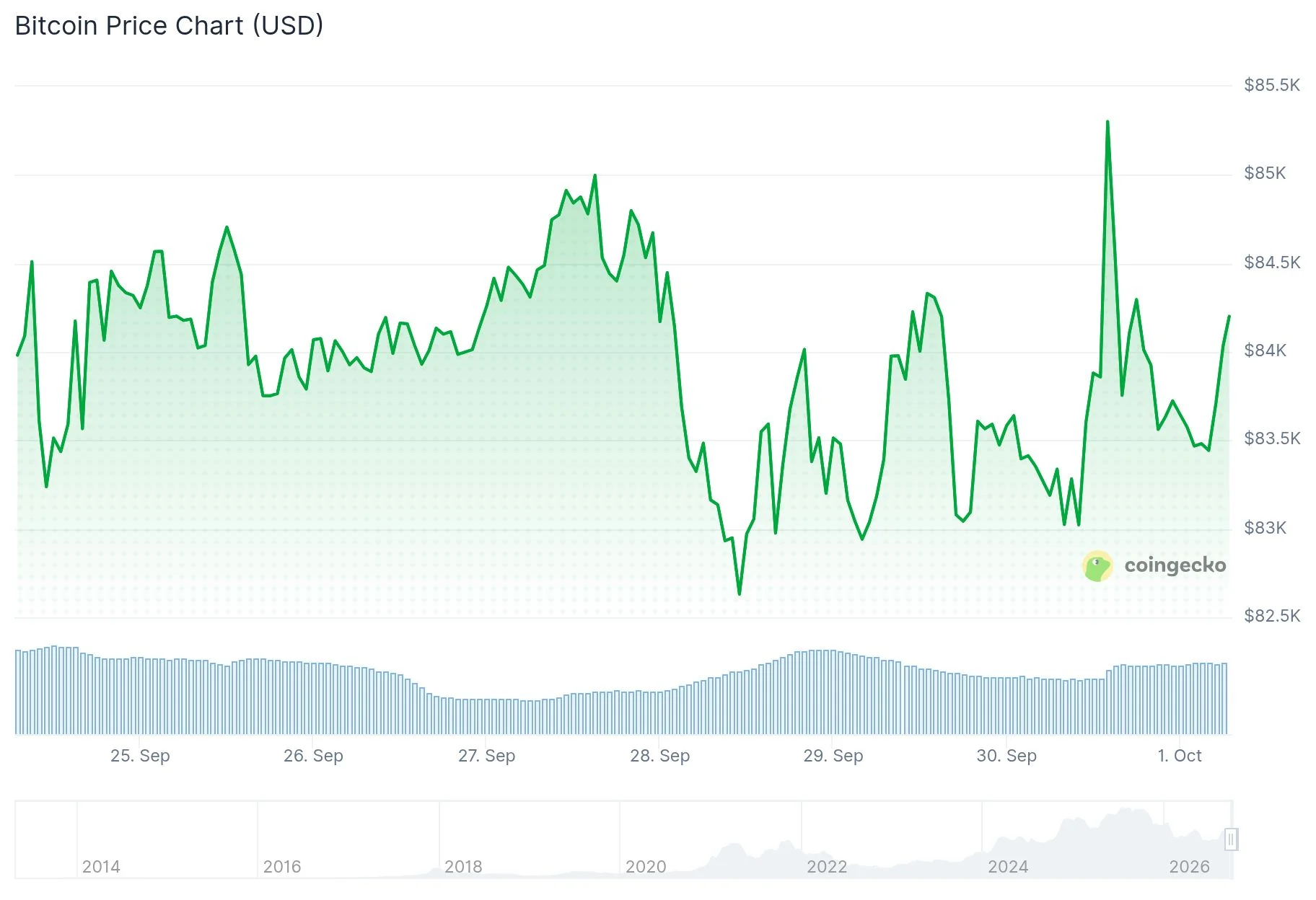
August’s Personal Consumption Expenditures (PCE) report revealed year-over-year price increases of 3.4%. The core metric, which strips out volatile food and energy components, registered a 3.0% annual gain.
According to Dan Khus, chief analyst at LVRG Research, the figures reduced expectations for another Federal Reserve rate increase in October. Market participants are now viewing December as a more probable window for policy tightening.
“Crypto markets interpreted this as a positive signal,” Khus explained. Bitcoin reclaimed the $85,000 level as government bond yields temporarily declined.
However, the upward momentum proved short-lived. By the close of traditional Wall Street trading, most of the rally had evaporated.
Bond Market Pressure Persists Despite Inflation Relief
The benchmark 10-year Treasury yield hovered near 5.28%, barely below Wednesday’s session high. Meanwhile, the 30-year yield stabilized around 5.62% after reaching levels not seen since 2002.
A decline in crude oil prices helped moderate the bond selloff. Concurrently, the U.S. dollar gained strength relative to major global currencies.
Vetle Lunde, an analyst at K33, noted that climbing yields are “driving capital away from riskier assets.” He emphasized that bitcoin remains in consolidation mode following its strongest weekly close since January.
Alternative cryptocurrencies displayed varied performance. HYPE topped the gainers list with a 3% advance to approximately $89. DOGE climbed nearly 2%, settling just below the 10-cent mark.
Ether, BNB, TRX, and ZEC each registered modest increases under 1%. XRP remained unchanged at $1.50, while SOL dipped almost 1% to trade just beneath $119.
Technical analyst Ted Pillows referenced a chart formation from early 2023. He suggested bitcoin experienced a substantial pullback after validating its cyclical low, and a comparable scenario might push prices into the high $70,000 territory before initiating the next upward phase.
Institutional Accumulation Continues While Small Holders Remain Inactive
Santiment Intelligence monitored behavior among medium-sized bitcoin holders. Their research revealed that addresses containing between 10 and 10,000 BTC accumulated 41,025 BTC across a 10-day timeframe, pushing their aggregate holdings to 13.64 million BTC—representing 67.93% of circulating supply.
Bitcoin’s Key Stakeholders Accumulate 41K BTC as Retail Holds Flat
Bitcoin’s key stakeholder tier is accumulating again. Wallets holding 10-10K BTC added 41,025 BTC in just 10 days, lifting their balance to 13.64M BTC, or 67.93% of the entire supply.
These whales and… pic.twitter.com/pCPar1TgSE
— Santiment Intelligence (@SantimentData) September 29, 2026
According to Santiment, this cohort has returned to accumulation levels last observed during August’s mid-month rally. In contrast, the smallest retail addresses holding under 0.01 BTC exhibited minimal activity during the same window.
Iliya Kalchev, analyst at Nexo Dispatch, identified signs of profit realization in other market segments. He highlighted that seven-day altcoin deposits to centralized exchanges climbed to their highest point since October 2025.
Ether changed hands near $2,700 and remains positioned for approximately 70% quarterly appreciation. XRP appears set to conclude the quarter with gains exceeding 40% despite its recent pullback to $1.50.
Technology equities extended a similar risk-seeking sentiment into Asian markets. Japan’s Nikkei index surged 2.7%, and South Korea’s Kospi advanced 1.2% following an optimistic earnings outlook from Micron Technology.
The post Bitcoin (BTC) Price Retreats From $85,500 Peak as Treasury Yields Hold Near Two-Decade Highs appeared first on Blockonomi.
TLDR
- HPE stock gained 5.14% after announcing Vultr’s $1.2 billion order
- Vultr will deploy AMD Helios AI Rack systems across US data centers
- HPE expands AI infrastructure with AMD computing and networking solutions
- The deal strengthens HPE’s position in large-scale enterprise technology
- AMD Helios supports advanced workloads with high-performance infrastructure designs
Hewlett Packard Enterprise Company (HPE) stock advanced after the company secured a $1.2 billion order from Vultr for AI infrastructure systems. The deal strengthens HPE’s position in large-scale computing solutions for advanced workloads. The company will deploy AMD Helios AI Rack by HPE systems across Vultr’s United States data centers.
The stock climbed to $64.65, gaining 5.14%, after breaking above the $61.49 support zone. However, shares moved toward the $65 resistance level and remained near session highs. The market reaction followed news of expanded demand for HPE’s infrastructure products.
Hewlett Packard Enterprise Company, HPE
The agreement marks HPE’s first order involving the AMD Helios system. It combines HPE networking technology with AMD computing solutions. The deployment will support model training and inference workloads for cloud customers.
HPE Expands AI Infrastructure With Vultr Partnership
HPE will provide AMD Helios AI Rack systems through its AI Data Center Solutions portfolio. The platform integrates computing, networking, software, and cooling technologies. It targets organizations requiring high-performance infrastructure.
The AMD Helios system supports large-scale model development and high-volume computing tasks. Each rack includes AMD Instinct MI455X GPUs and AMD EPYC Venice CPUs. It also features AMD Pensando Vulcano AI NICs and AMD ROCm software.
HPE Networking will provide scale-up Ethernet technology for the systems. The solution uses HPE Juniper Networking QFX5252 switch trays within each rack. This design connects GPUs with high bandwidth and low latency.
The partnership builds on nearly three years of collaboration between Vultr and Juniper Networks. HPE expanded its networking capabilities after acquiring Juniper Networks. As a result, the company continues integrating networking solutions into its infrastructure offerings.
Vultr operates cloud infrastructure services for businesses requiring scalable computing resources. The company has increased its focus on supporting artificial intelligence workloads. The HPE agreement supports its expansion into advanced data center services.
HPE and AMD Target Growing Data Center Demand
The AMD Helios AI Rack by HPE represents a broader push toward open infrastructure solutions. HPE designed the system to support large AI workloads through integrated hardware and software. The platform also focuses on efficiency, deployment speed, and operational management.
HPE will provide deployment support through its global services network. The company offers expertise in infrastructure installation and liquid cooling systems. This approach helps organizations manage complex computing environments.
AMD continues expanding its role in enterprise computing markets. The company provides processors, accelerators, and networking technologies for demanding workloads. HPE’s collaboration with AMD combines these technologies into a complete infrastructure solution.
The Vultr order highlights rising demand for advanced computing capacity. Cloud providers continue expanding infrastructure to support new applications. Therefore, HPE aims to capture additional opportunities through integrated data center systems.
HPE operates across enterprise technology markets, including networking, cloud, and computing solutions. The company helps organizations improve operations and manage growing data requirements. The Vultr agreement adds another major deployment to its infrastructure portfolio.
The post HPE (HPE) Stock: Surges After $1.2 Billion Vultr AI Infrastructure Deal appeared first on Blockonomi.
TLDR
- Synopsys stock rises after OpenAI partnership targets faster chip design workflows.
- OpenAI and Synopsys develop GPT-Synopsys for advanced semiconductor engineering.
- New AI tools aim to improve chip performance, verification, and design efficiency.
- Synopsys integrates AI capabilities into its existing semiconductor design platforms.
- Partnership strengthens Synopsys role in the evolving global chip industry.
Synopsys, Inc. (SNPS) stock traded at $425.06, up 2.40%, after recovering from an intraday low near $410. The shares moved toward the $440 resistance level before settling above the $425 support zone. The move followed news of a strategic partnership with OpenAI to advance semiconductor design workflows.
Synopsys, Inc., SNPS
Synopsys Expands Semiconductor Design Capabilities
Synopsys and OpenAI announced a multi-year partnership focused on improving chip design processes. The collaboration combines advanced artificial intelligence models with Synopsys electronic design automation tools. The companies aim to create faster and more efficient semiconductor development workflows.
The partnership will allow engineers to use automated systems for complex design tasks. These systems can analyze results, adjust designs, and improve performance targets. The process focuses on power efficiency, performance levels, and area optimization.
Synopsys will integrate the new capabilities into its Synopsys.ai platform and Autopilot environment. The company will provide access through enterprise infrastructure with security controls. Customer design information will remain protected through encryption and permission management features.
OpenAI Partnership Targets AI Native Chip Development
The agreement introduces a new approach to semiconductor engineering through automated design assistance. The technology will help engineers explore more design options during development cycles. It will also support verification tasks before chip production begins.
Synopsys stated that the partnership expands access to advanced design tools for semiconductor companies. The collaboration supports growing demand for more powerful chips across technology industries. Semiconductor complexity continues increasing as companies develop advanced computing systems.
The joint service will combine computing resources, specialized models, and Synopsys licenses. The offering will support customer systems while maintaining data protection standards. Early technology programs are already underway with semiconductor companies.
Synopsys Builds Position in Growing Chip Market
Synopsys provides electronic design automation software used across the semiconductor industry. Its tools help companies create, test, and verify chip designs before manufacturing. The company has maintained a major role in supporting global semiconductor development.
The OpenAI partnership strengthens Synopsys’ focus on automated engineering solutions. The agreement connects advanced computing models with established chip design expertise. Therefore, engineers can access additional support during complex development stages.
The collaboration arrives as demand rises for advanced semiconductor technology. Companies require faster design methods to support expanding computing applications. Synopsys continues developing solutions that address changing needs across the chip industry.
The post Synopsys, Inc. (SNPS) Stock: Surge as OpenAI Partnership Sparks AI Chip Design Revolution appeared first on Blockonomi.
TLDR
- Robinhood stock falls as HOOD Summit reveals major platform upgrades
- Company adds AI agents to improve research and trading experiences
- New perpetual contracts expand Robinhood’s market access strategy
- Social investing features aim to improve user engagement levels
- Weekend trading and options updates broaden platform capabilities
Robinhood Markets, Inc. traded at $112.82, down 2.93%, after the company unveiled new platform features at its HOOD Summit. The announcements included automated research tools, expanded trading options, and social investing updates. The company continues to expand beyond its traditional retail trading services.
Robinhood Markets, Inc., HOOD
Robinhood introduced several upgrades designed to cover more parts of the investment process. The platform added features for research, strategy development, and trade execution. The company increased its focus on automation and broader market access.
The HOOD Summit highlighted three major areas, including agents, perpetual contracts, and social trading. These developments show Robinhood’s plan to build a wider financial platform. The company also introduced weekend stock trading and expanded margin capabilities.
Robinhood Expands Trading Platform With Automated Tools
Robinhood has integrated automated agents directly into its application to support users. The tools aim to help customers process market information and research more efficiently. The company is moving toward a more connected trading experience.
Previously, Robinhood focused on allowing external automated tools through its Trading MCP system.The latest update places these capabilities inside the platform. This change gives users direct access to automated assistance during their investment activities.
The company sees automated systems as a way to connect users with financial information. As a result, Robinhood can provide more support throughout the trading process. The development reflects wider changes across financial technology platforms.
Robinhood’s automated features focus on improving how users discover and evaluate market opportunities. The company has not provided detailed financial projections from these updates. The long-term impact will depend on adoption and usage across its customer base.
Robinhood Adds Perpetuals and Broader Market Access
Robinhood also highlighted perpetual contracts as part of its platform expansion. The feature adds another trading product alongside existing stocks, options, and other financial services. The company continues developing tools for active market participants.
The expansion of trading products follows Robinhood’s efforts to increase engagement among users. The company has gradually added advanced features while maintaining its retail-focused approach. These changes aim to create a broader ecosystem within the platform.
Weekend stock trading and longer options hours also formed part of the HOOD Summit announcements. These updates increase the periods when users can access certain market activities. Expanded margin options provide additional flexibility for eligible customers.
Robinhood’s latest additions represent a shift toward a wider investment platform. The company continues adding services that cover different stages of the trading journey. The company’s future growth depends on successful execution of these features.
Robinhood Strengthens Social Investing and Platform Vision
Social investing remained another key focus during the event. Robinhood is developing features that allow users to interact more within the investment environment. The approach combines community elements with financial tools.
The company’s strategy connects research, decision-making, and execution within one platform. Robinhood aims to reduce the separation between information sources and trading actions. This approach could reshape how retail users manage investment activities.
Robinhood Chain and tokenization received less attention during the summit. The company continues exploring digital asset technology as part of its broader strategy. The latest announcements focused more on trading automation and user experience.
The HOOD Summit demonstrated Robinhood’s continued expansion across financial services. The company is building a platform that combines traditional trading with new digital tools. The stock market response reflected short-term pressure after the feature announcements.
The post Robinhood Markets, Inc. (HOOD) Stock: Platform Pushes Into AI Trading and Social Investing appeared first on Blockonomi.
CryptoPotato
SOL had quite a successful September, posting a price increase of almost 20% and currently trading at $120 (per CoinGecko).
Analysts now eye further gains toward $150 and beyond. However, certain technical indicators suggest that a short-term pullback may also be on the horizon.
What’s Next?
Ali Martinez paid special attention to the strong institutional demand, noting that spot US SOL ETFs continue to absorb Solana. He said these products have accumulated roughly 4.37 million coins (worth around $450 million) since July 13, marking 11 consecutive weeks of net inflows. That said, he assumed that SOL might be headed toward $150.
In fact, last week was the second-best for these exchange-traded funds, which accumulated nearly $190 million. As CryptoPotato reported, the cumulative total inflows into the products skyrocketed to a new all-time high of $1.62 billion.
X users Gordon and Scient also weighed in. The former argued that “dips are for buying,” adding that the perfect trading strategy would be to accumulate SOL at around $100 and sell above $500. Scient expects a sell-off at the start of October and plans to short Solana at approximately $120-$121 and open a long position around $110.
However, the actions of a certain mysterious whale support an entirely bullish scenario. X user Max Crypto revealed that the anonymous market participant opened a $20.2 million long position on SOL. The liquidation price is set at $98 (assuming the whale doesn’t add more collateral to prevent that outcome).
What’s interesting is that the investor has made four trades so far and has a 100% win rate, making $4.7 million in profits. This, of course, has sparked speculation that they might have access to inside information the rest of us don’t.
Monitoring These Indicators
Solana’s exchange netflow backs the predictions of Gordon and Scient that SOL may post a short-term correction. Inflows have far exceeded outflows lately, suggesting investors have shifted from self-custody to centralized platforms, which can increase immediate selling pressure.

For its part, SOL’s Relative Strength Index (RSI) has soared past 70. In simple terms, this means the valuation has pumped too much in a short period and entered overbought territory, which is usually a precursor to a move south. Conversely, anything below 30 is interpreted as a buying opportunity.

The post Solana (SOL) Breakout Incoming: How High Can the Price Go? appeared first on CryptoPotato.
Ripple’s native token just ended September well in the green, extending its streak that began with a minor increase in July. All eyes are now on October on several fronts. The question is: can XRP continue its run, or will the last two October editions take their toll?
XRP Went Hard in September
Recall that August was the cross-border token’s most successful month in over a year, when it skyrocketed by 30% from start to finish. Moreover, it had dipped to just under $1.00 mid-month, which makes its close even more impressive. XRP entered September on a high note, not only because of the spectacular August but because it had closed all four previous Septembers in the green.
The ninth month of the year was indeed positive on a few fronts. First, the price gained just under 10%, and XRP ended it at over $1.50. It tried to take down the $1.60 resistance on several occasions but to no avail. In addition, the spot ETFs tracking its performance marked some major wins.
Only three days were slightly in the red: September 2, 17, and 18. On a broader scale, though, the funds have not seen a single red week since early July. Data from SoSoValue shows that the ETFs closed September well in the green, adding over $120 million. Moreover, the cumulative net inflows reached a new all-time high of nearly $1.8 billion.
What Does October Hold?
October, as a month, holds particular significance in the hearts of the cryptocurrency community. Major gains over the years earned it a well-deserved nickname, “Uptober.” However, there have been major exceptions over the years at the broader market level, while Ripple’s XRP has not always benefited during the month.
For example, the past two editions delivered double-digit losses for the cross-border altcoin. It plunged by 16.7% in 2024 and experienced a mind-blowing correction, alongside the rest of the market, last year, after the notorious October 10 massacre.
Data from CryptoRank shows that only five out of the last 13 Octobers have been in the green for XRP. The last one was in 2023, when the asset jumped by an impressive 16.5%. As such, XRP enters the new month at a crossroads, given its notable three-month green streak but also its controversial October history.
The post XRP in October: Will Ripple’s Streak Continue After 3 Consecutive Green Months? appeared first on CryptoPotato.
Robinhood plans to launch perpetual futures for eligible US customers in the coming months.
CEO Vlad Tenev said the company is bringing America “its first true perps” in a post on X, adding that profit and loss will settle every 15 minutes.
Eight Crypto Assets, Up to 10x Leverage
The company announced the product on Tuesday at its HOOD Summit in Houston. Customers will be able to go long or short on BTC, ETH, SOL, XRP, DOGE, ADA, LINK, and HYPE.
A perpetual future is a leveraged contract that tracks an asset’s price with no settlement date, so a trader can hold a position as long as they can cover it. Bitcoin and Ethereum contracts allow up to 10x leverage, while the other six are capped at 3x, and Robinhood Derivatives will provide the contracts through Bitstamp.
Trading costs one basis point (0.01%) per trade through the end of the year, which Robinhood describes as some of the lowest fees in the industry. Furthermore, users can set stop-loss and take-profit orders, watch their liquidation price in real time, and get alerts when a position is at risk.
“Ownership doesn’t work without markets, and markets don’t work without traders,” Tenev said. The CEO added that Robinhood wants to be “the best place in the world for active traders” by delivering tools once reserved for hedge funds, big banks and quant firms.
The trading platform also introduced an in-app AI tool called Robinhood Agents that will help customers create strategies, research markets and trade within preset limits, while manual trade approval is turned on by default. According to the firm, more than 15,000 users have opened agentic trading accounts since its May launch, with agents using Robinhood tools almost 30 million times a day.
In addition, the firm is bringing earnings contracts tied to company metrics such as revenue targets and earnings results. Those binary options contracts will be offered through Cboe and require options approval.
Where Robinhood Sits Among Rivals
The broader derivatives push is not limited to Robinhood. As CryptoPotato reported on September 4, Coinbase filed registrations with the SEC to offer single-stock perpetual futures to US investors, although those filings did not guarantee a launch on any set timeline.
Bybit went a different direction on leverage. Its new forex perpetuals, introduced September 8, allow up to 100x and trade around the clock, against Robinhood’s 10x ceiling.
Remember, perpetuals still carry funding costs and liquidation risks, since a position can be closed out when losses grow too large, and Robinhood has also not given an exact launch date beyond “the coming months.”
The post Robinhood to Launch Crypto Perpetual Futures in the US appeared first on CryptoPotato.
Bitcoin (BTC) remains in a bull market after closing above its 365-day moving average last week, but recent on-chain data suggests momentum is slowing. CryptoQuant said in a recent research note that several indicators now point to higher selling pressure and weaker demand.
Despite these concerns, CryptoQuant’s Bitcoin Bull Score Index remains at 90, showing that most tracked indicators still support a bullish structure. BTC recently reached about $87,400, its highest level in eight months, before pulling back toward the low $83,000 range.
Profit-Taking Picks Up
One concern comes from short-term holders, whose unrealized profit margin has risen to 33%. The analytics firm said this is the highest level since December 2024 and that similar levels have preceded profit-taking.
That profit-taking is already showing up in realized gains, with Bitcoin holders cashing out about 25,700 BTC in profit on September 22. It was the largest single-day realized profit figure recorded in 2026, adding to evidence that some holders are selling after the recent price gains.
Selling signals are also appearing beyond Bitcoin, particularly in the altcoin market. Seven-day cumulative altcoin exchange inflows reached 76,000 transactions involving about 51,000 depositors, the highest levels recorded since October 17, 2025.
At the same time, demand is weakening in both the spot and futures markets. Apparent spot demand fell by roughly 170,000 BTC over the past 30 days. Speculative futures demand growth also slowed, dropping from about 164,000 BTC on September 14 to roughly 16,000 BTC more recently.
Key Support Levels Remain
Despite these signals, Bitcoin remains above several important on-chain support levels. CryptoQuant identified the 365-day moving average near $80,000 and the 200-day moving average around $71,000. The firm also identified the trader-realized price near $67,000 as a key level to watch.
According to the analytics firm, a decline toward these levels could signal consolidation. This would not necessarily mean a broader market reversal if support holds. However, continued weakness in demand alongside increased profit-taking could increase the risk of a deeper correction in the near term.
CryptoQuant described the market as still bullish but showing signs of fatigue. The next test will be whether buying demand returns to absorb selling pressure or whether Bitcoin moves closer to those support levels.
The post Bitcoin Bull Market Shows Signs of Cooling: CryptoQuant appeared first on CryptoPotato.
Bitcoin climbed above $87,400 last week, but the rally has since lost momentum. The world’s largest cryptocurrency then tested the $83,000 range before it surged past the upper boundary of its weekly range at $85,000.
Amidst the stagnation, larger holders are increasing their holdings again.
Whale Accumulation Returns
According to blockchain analytics platform Santiment, wallets holding between 10 and 10,000 BTC added 41,025 units over the past 10 days. Their total balance has now reached 13.64 million BTC, equal to about 67.93% of Bitcoin’s total supply. Santiment explained that these whale and shark wallets are now at their highest holdings since the market rally in mid-August.
There is a clear difference between large and small holders. Wallets holding less than 0.01 BTC have remained mostly unchanged during the same period. Santiment revealed that stronger market conditions have historically appeared when larger holders accumulate while smaller traders sell.
However, the analytics firm said the current pattern is not a guaranteed signal for Bitcoin’s price. Market watchers will likely focus on whether large holders continue adding BTC and whether retail investors begin reducing their positions. The trend could provide another indicator of changing market sentiment in the coming days.
Adding to the bullish picture, BIT Research said Bitcoin’s bear market may have already ended. The firm identified the cycle low in late July after the asset held above $62,900 and showed signs of weakening downside momentum. Since then, BTC has reclaimed key levels, including its 21-week moving average at $69,272, and moved above its March 2024 high of $73,084.
The report also highlighted Bitcoin’s cost basis. The True Market Mean currently stands at $76,897, which essentially means that the typical holder is back in profit. This could reduce selling pressure from investors looking to exit at break-even. The firm expects an upside range of $185,000 to $215,000 in its bullish scenario.
However, crypto analyst Doctor Profit speculated a short-term pullback before BTC’s next move higher. He pointed to bearish signals across several indicators, including RSI, MACD/PPO, and MFI, while also noting weaker trend strength on the ADX indicator.
ETF Inflows and Corporate Buying
Even as the market moves through a quieter stretch, institutional demand is still showing up. US-listed spot Bitcoin ETFs, for instance, attracted a whopping $2.4 billion last week. This week started at a slower pace, but the flow has remained positive. The funds raked in just over $31 million on Monday and another $66 million on Tuesday.
Corporate buyers have also stayed active. Strategy added another 1,665 BTC over the past week. The company paid an average of $85,681 per coin, taking its total holdings to 847,666 units. Strive has added to the buying activity as well. CEO Matt Cole said the company spent $94.5 million on 1,107 BTC at an average price of $85,400. Its total holdings have now reached 27,462.
The post Bitcoin’s Biggest Holders Ramp Up Buying While Retail Traders Remain Flat appeared first on CryptoPotato.