Cryptocurrency Posts
Crypto Briefing
The self-regulation approach may accelerate AI innovation but risks inadequate oversight, potentially leading to unchecked technological hazards.
The post US government tells AI companies to police themselves instead of waiting for regulation appeared first on Crypto Briefing.
Microsoft's robust quarterly performance underscores the growing dominance of cloud and AI services, pressuring competitors to innovate rapidly.
The post Microsoft stock set for biggest quarterly gain in 28 years appeared first on Crypto Briefing.
5C Group's IPO could accelerate AI infrastructure growth, diversify funding, and navigate regulatory challenges in expanding global markets.
The post 5C Group plans IPO as it expands AI data center pipeline across North America and Europe appeared first on Crypto Briefing.
The incident raises concerns about AI ethics, user privacy, and the robustness of security systems in an era of pervasive digital surveillance.
The post Meta’s Muse AI reportedly accesses Apple Messages without consent appeared first on Crypto Briefing.
The self-regulation accord may boost US tech innovation but risks severe backlash if AI safety incidents occur, impacting industry stability.
The post Nvidia’s Jensen Huang says White House declaration has major impact on AI industry appeared first on Crypto Briefing.
Bitcoin Magazine
Bitcoin Magazine
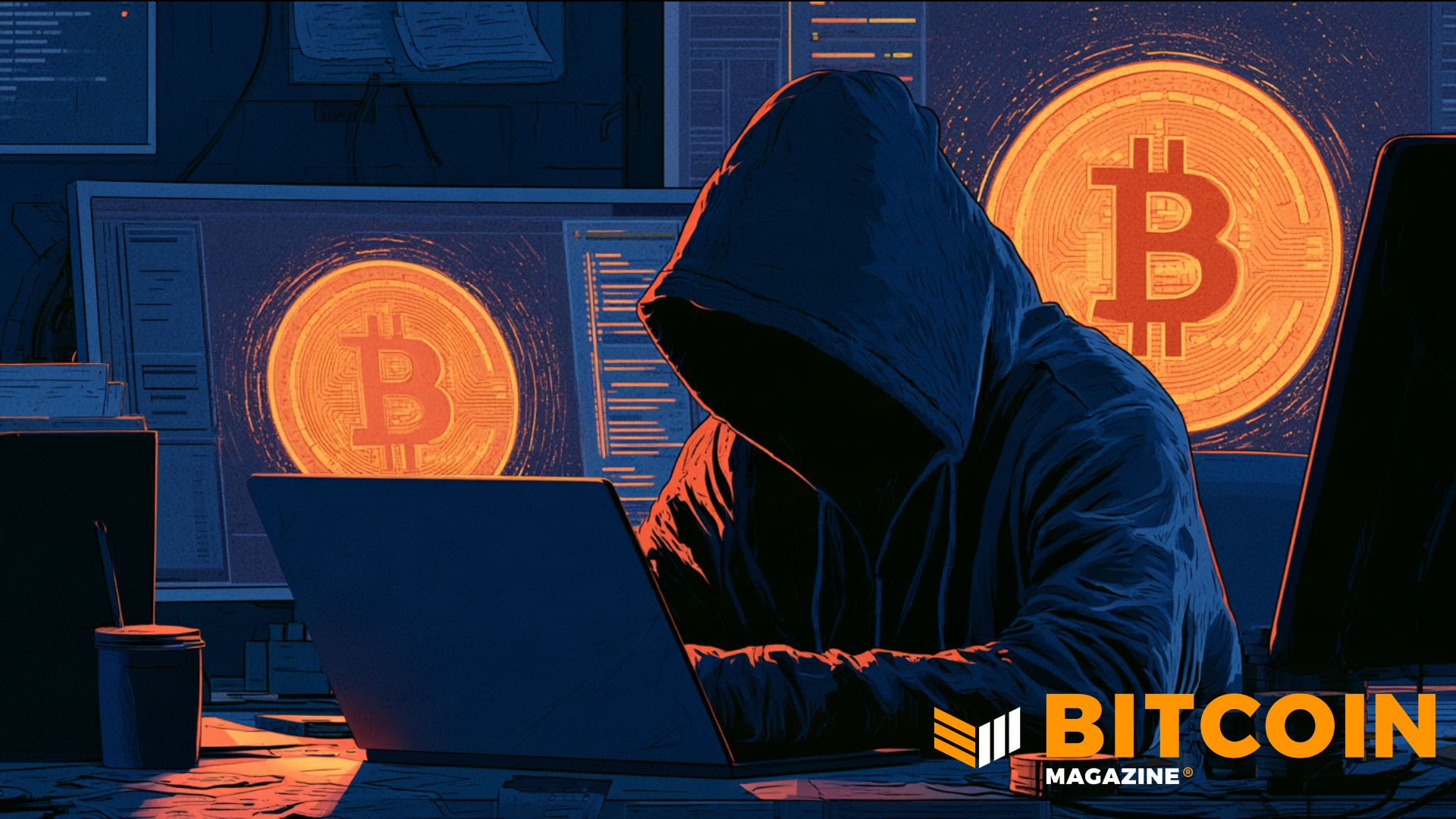
Bitget Customers Withdraw Over 4,000 Bitcoins in One Hour Following $388M Hack
Investors withdrew over 4,000 bitcoins worth over $334 million at today’s prices in one hour after hacked Bitget resumed customer withdrawals, the company’s CEO has said.
Bitget CEO Gracy Chen told Bloomberg Television Tuesday that withdrawals from the exchange had since stabilized following the immediate bitcoin transactions.
Hackers last week made away with $388 million in crypto after targeting the Victoria, Seychelles-based exchange’s hot wallets.
“The withdrawals actually stabilized a lot today,” Chen said. “Those hundreds of millions [in bitcoin withdrawals] actually most of them happen on the first hour of the withdrawal restart.”
In a Monday X post, Chen said that 9,585 orders of 4,098 bitcoins were processed. The exchange is allowing customers to withdraw funds in phases.
Bitget froze withdrawals after blockchain experts flagged that money was leaving the exchange. Bitget later said the attack method in the incident was “highly consistent with known patterns of North Korean hacker organizations.”
Chen said that no cold storage funds were touched but rather attackers had “exploited vulnerabilities from third-party products to steal internal credentials, then used those credentials to send fraudulent withdrawal commands that bypassed our risk controls.”
She added that the company was using its own money to top up its protection fund after it dropped in size. Bloomberg reported that it was below $200 million after standing at $464 million before the hack.
Bitget said that it was the first “security incident of this nature in eight years.”
“The incident remains contained, and no further unauthorized transfers are possible,” the exchange noted.
Bitget is the sixth biggest by trading volume, according to CoinGecko, processing in the past 24 hours $811 million in transactions. The exchange’s customers are mostly based in Asia.
Attackers linked to North Korea’s government have long targeted crypto exchanges and are some of the most sophisticated cyber criminals out there.
This post Bitget Customers Withdraw Over 4,000 Bitcoins in One Hour Following $388M Hack first appeared on Bitcoin Magazine and is written by Mathew Di Salvo.
Bitcoin Magazine

Bitwise Head of Research: Sovereigns Selling Gold for Bitcoin | Ryan Rasmussen
When Bitcoin fell from $125K to $60K, not one of the 15 major institutions Bitwise interviewed sold, and many bought more. Ryan Rasmussen, head of research at Bitwise, breaks down the firm’s first institutional crypto adoption report, covering pensions, endowments, foundations, and sovereign wealth funds, and why they treat Bitcoin alongside gold as a hedge against debasement.
Chapters:
0:00 Ryan Rasmussen on Bitwise’s Institutional Crypto Adoption Report
0:49 Why No Institutions Sold Bitcoin During the Bear Market
1:45 Wells Fargo’s 2–3% Bitcoin Allocation and the Debasement Thesis
3:45 Fidelity, BlackRock, and 2–8% Bitcoin Allocations
4:50 How ETFs Made This Bitcoin Bear Market Shallower
6:24 $2.5B in Weekly ETF Inflows and a New Wave of Capital
7:06 Why Bitwise Believes the Bitcoin Bottom Was $60K
9:36 Why Institutions Hold Both Bitcoin and Gold
11:37 Sovereign Wealth Funds Selling Gold to Buy Bitcoin
15:17 Why Bitcoin Isn’t Correlated to Bonds, Gold, or Stocks
DISCLAIMER: The views and opinions expressed in this show are those of the participants and do not necessarily reflect the official policy or position of BTC Inc., Bitcoin Magazine, or any affiliated entities. This content is provided for informational and educational purposes only and should not be construed as investment, legal, tax, or accounting advice. Nothing contained in this show constitutes a solicitation, recommendation, endorsement, or offer to buy or sell any securities or financial instruments. Viewers should consult their own advisors before making financial or business decisions.
This post Bitwise Head of Research: Sovereigns Selling Gold for Bitcoin | Ryan Rasmussen first appeared on Bitcoin Magazine and is written by Patrick Green.
Bitcoin Magazine

Tracy Shuchart: BTC & the Commodities Supercycle
Six million barrels a day of oil still aren’t getting through the Strait of Hormuz, and Tracy Shuchart says markets are still tightening. The NinjaTrader Live senior economist explains why lost GCC production won’t come back quickly, why crack spreads are signaling stress, and why the global refining shortage could get worse heading into winter.
Chapters:
0:00 Tracy Shuchart on the Strait of Hormuz and Tightening Oil Markets
1:07 Crack Spreads, Russian Refineries, and the Global Refining Shortage
2:50 Fall Refinery Maintenance and a Dire Winter Setup
3:22 Why a US Diesel Export Ban Would Backfire
4:45 Gold vs. Bitcoin: Why Hard Assets Are Holding Up
7:15 Venezuela’s Oil Discount and What It Means for US Refiners
8:31 Venezuela as a Geopolitical and Critical Minerals Play
9:28 AI Data Center Debt and Stress in the Bond Market
11:02 The Coming Copper Shortage and AI’s Supply Problem
12:41 Can the US Grow Its Way Through a Supply Shock?
DISCLAIMER: The views and opinions expressed in this show are those of the participants and do not necessarily reflect the official policy or position of BTC Inc., Bitcoin Magazine, or any affiliated entities. This content is provided for informational and educational purposes only and should not be construed as investment, legal, tax, or accounting advice. Nothing contained in this show constitutes a solicitation, recommendation, endorsement, or offer to buy or sell any securities or financial instruments. Viewers should consult their own advisors before making financial or business decisions.
This post Tracy Shuchart: BTC & the Commodities Supercycle first appeared on Bitcoin Magazine and is written by Patrick Green.
Bitcoin Magazine
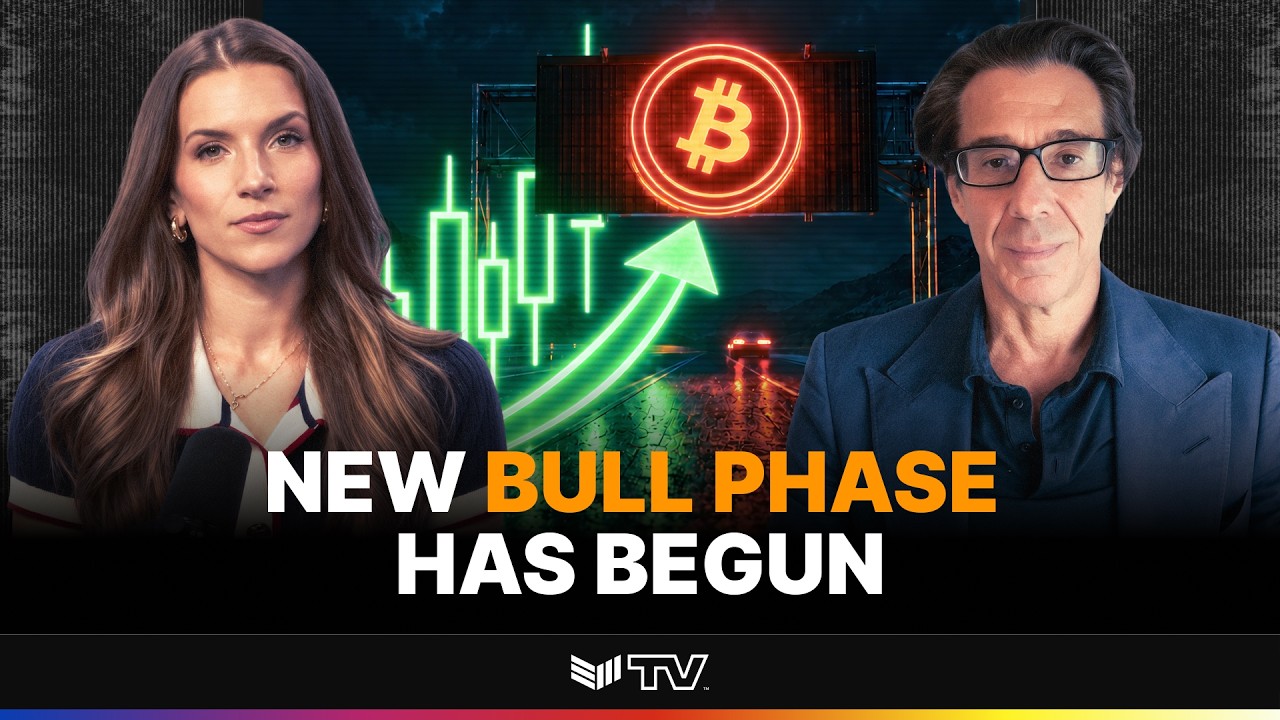
Dan Tapiero: “We’ve Begun a Bull Phase” in Bitcoin
Dan Tapiero says a new bull phase has begun in the core assets of the digital asset space. The founder and CEO of 50T Funds explains where he’s seeing real revenue growth underneath the hood, from stablecoins and tokenization to Kraken, Ledger, and Polymarket, and why Hyperliquid has been leading the market.
Chapters:
0:00 Dan Tapiero on What Makes a Digital Asset Company Worth Backing
1:25 Passing on FTX, Celsius, and BlockFi – Why Valuation Matters
3:50 Where the Real Revenue Growth Is: Stablecoins, Tokenization, and Kraken
5:15 Bitcoin, Solana, and Why Hyperliquid Is Leading This Bull Phase
6:59 Raising the $500M 50T Fund and Institutional Appetite
9:41 50T’s $42M MoonPay Investment
11:05 Japan’s 30-Year Bond Base and the Biggest Macro Theme
14:04 Scott Bessent, the Yen, and Kevin Warsh’s Rate Hike
16:31 AI, Productivity, and the Natural Rate of Interest
18:22 The Debasement Trade: Why Bitcoin and Gold Win Long Term
DISCLAIMER: The views and opinions expressed in this show are those of the participants and do not necessarily reflect the official policy or position of BTC Inc., Bitcoin Magazine, or any affiliated entities. This content is provided for informational and educational purposes only and should not be construed as investment, legal, tax, or accounting advice. Nothing contained in this show constitutes a solicitation, recommendation, endorsement, or offer to buy or sell any securities or financial instruments. Viewers should consult their own advisors before making financial or business decisions.
This post Dan Tapiero: “We’ve Begun a Bull Phase” in Bitcoin first appeared on Bitcoin Magazine and is written by Patrick Green.
Bitcoin Magazine
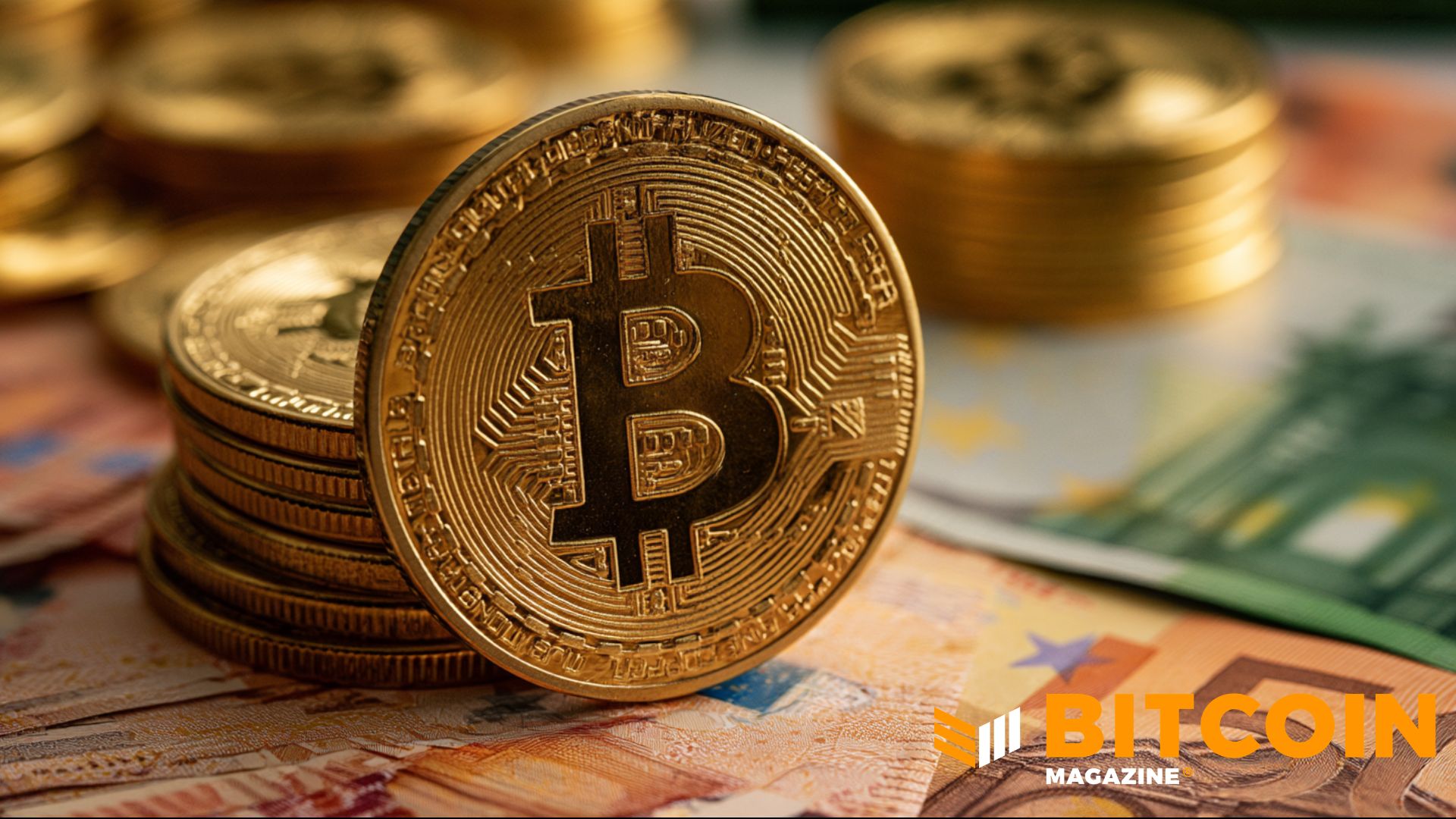
HANetf Debuts Euro-Hedged Bitcoin Fund in World First
A new bitcoin exchange-traded fund has hit Europe — with a twist.
Debuted by $9.2 billion ETF provider HANetf, the Arrow Bitcoin EUR Hedged ETF gives European investors exposure to bitcoin while reducing the impact of movements between the euro and the US dollar.
Because bitcoin is priced in dollars, European investors who buy an unhedged product are exposed to two things at once: the bitcoin price and the dollar’s moves against the euro.
JUST IN:
— Bitcoin Magazine (@BitcoinMagazine) September 29, 2026$9.2 billion ETF provider HANetf launches the first ever euro-hedged Bitcoin exchange traded commodity
pic.twitter.com/Bg5tFJ2yAj
The new exchange-traded commodity — a fund that gives investors exposure to a commodity — aims to remove the second of these in a product described by HANetf as the world’s first.
“With this launch, we are bringing the established logic of euro-hedged ETFs to the crypto market,” Hector McNeil, co-founder and co-CEO of HANetf, said in a statement. “Investors have long understood that currency movements can have a meaningful impact on returns on different asset classes, for example gold.”
“Similar to gold, bitcoin is priced in US dollars, meaning European investors can end up taking two views at once: a view on bitcoin itself and a view on the dollar.
HSBC will provide the currency hedging for the product. Typically, euro-hedged funds work by a bank entering forward contracts to sell the equivalent dollar amount for euros at a fixed rate on a future date.
If the dollar then weakens against the euro, the loss on the bitcoin’s euro value is offset by a gain on the forward, and vice versa. These contracts are usually rolled monthly, and the hedge is resized when they roll.
Bitcoin ETFs in the U.S. have been a huge success since the Securities and Exchange Commission approved them in 2024.
Managed by the likes of BlackRock, Fidelity, Morgan Stanley and others, the products allow investors to buy shares that track the price of bitcoin, without having to worry about storing the cryptocurrency themselves.
The funds now manage a combined total of $111.1 billion in assets, according to Coinglass, following the most successful launch in the history of ETFs.
This post HANetf Debuts Euro-Hedged Bitcoin Fund in World First first appeared on Bitcoin Magazine and is written by Mathew Di Salvo.
CryptoSlate
US job openings cooled modestly in August, but September households grew more worried about inflation and interest rates. That split left Bitcoin investors with only part of the case for easier financial conditions after Sept. 29 releases.
Bitcoin registered an intraday low of $82,775.94 on Tuesday, and a reclaim of the $84,000 support level depends more on the path of yields and new demand than on a single vacancies report.
The labor and consumer surveys describe different pressures, and neither establishes the cause of Bitcoin's price.
Job openings ease as rate worries rise
According to the Bureau of Labor Statistics, August job openings were little changed at 7.1 million, down from a revised 7.3 million in July. The July figure was revised upward by 64,000, making the comparison less dramatic.
Hires changed little at 5.2 million, quits were unchanged at 3.1 million, and layoffs and discharges were essentially unchanged at 1.6 million. The report points to somewhat softer demand for workers, and a slower labor market may ease pressure on interest rates, while a sharp deterioration could also hurt risk appetite.
The Conference Board's September consumer confidence index fell to 81.9 from 88.6 in August. Its Expectations Index, based on consumers' short-term outlook for income, business and labor conditions, declined for a third consecutive month to 63.6. Respondents also described the current job market less favorably.
Their rate and inflation answers ran counter to a simple “soft jobs, lower yields” interpretation. The share of consumers expecting higher interest rates over the next 12 months rose 5.2% to 68.4%.
Average expected inflation over that horizon rose to 6.1%, while the median rose to 5.1%, and both increased 0.3% from August.
The survey was conducted Sept. 1-23, a period that included the Federal Reserve's Sept. 16 rate increase to a 3.75%-4.00% target range, which provides context for consumers' answers.
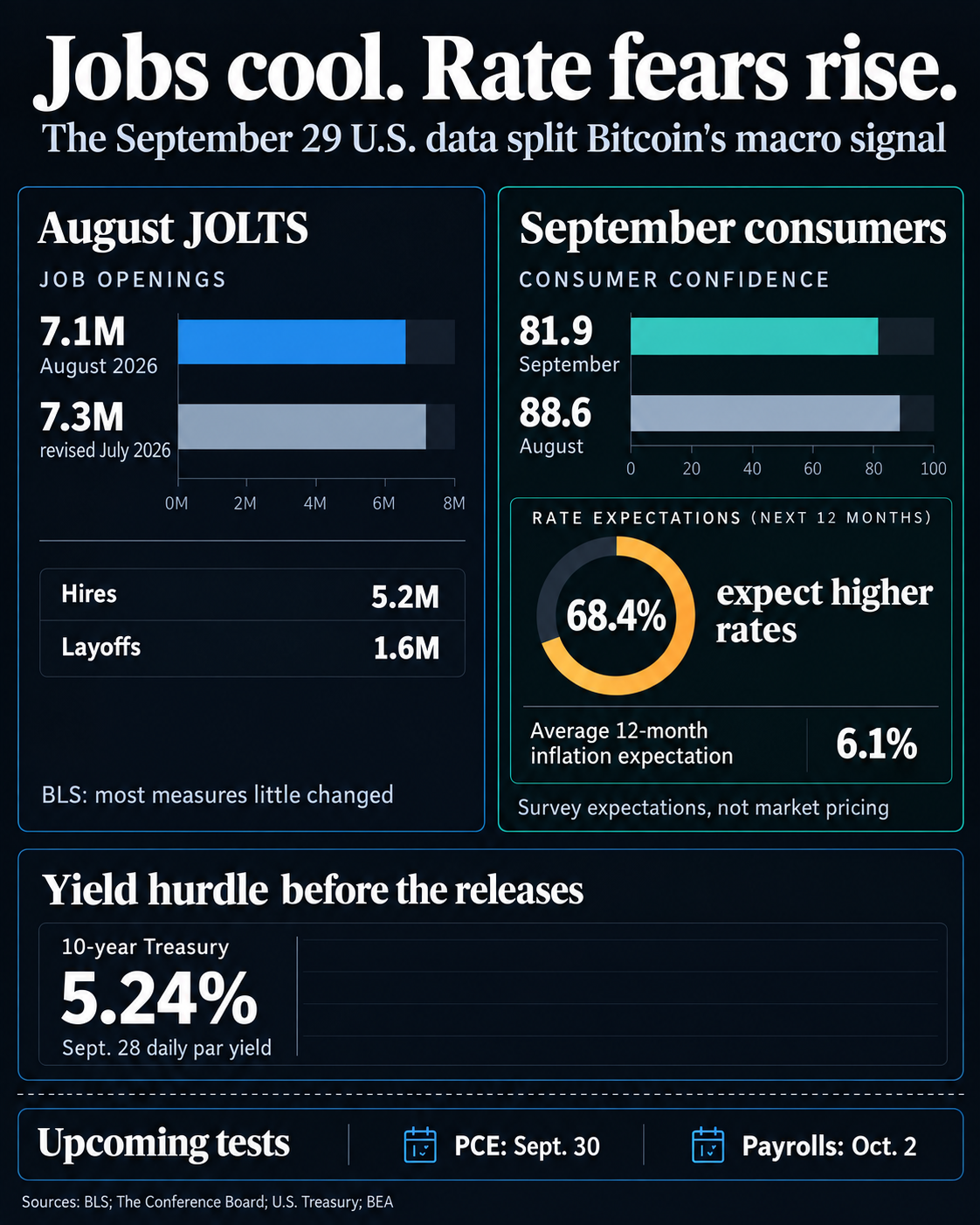
The latest posted Treasury daily par yield curve data put the 10-year rate at 5.24% and the two-year at 4.92% on Sept. 28. The observation precedes Tuesday's releases, so it does not measure a bond-market reaction to them.
Treasury securities offered substantial yields while Bitcoin itself pays no coupon, so softer hiring would help Bitcoin more if subsequent inflation data gave yields room to fall.
ETF demand and the next economic tests
The Sept. 28 US-traded spot Bitcoin ETF posted a positive net inflow of $31 million, smaller than each of the five preceding completed sessions, according to Farside Investors.
Stronger inflows in completed sessions would show buyers returning even while yields remain elevated. If inflows stay subdued, a lower-yield backdrop may matter more for any sustained recovery above $84,000.
Neither the prior day's ETF total nor a live Bitcoin quote shows how investors responded to Tuesday's economic releases.
The Bureau of Economic Analysis is scheduled to publish August personal income and outlays on Sept. 30, including PCE inflation data, and the September employment report follows on Oct. 2.
A cooler inflation reading alongside slower but orderly hiring would strengthen the case for lower Treasury yields. If yields then decline and completed ETF flows improve, Bitcoin could face less competition from interest-bearing assets and firmer evidence of new demand.
A hot inflation print or persistently high yields would weaken that case, even if payroll growth slows. A much sharper jobs slowdown could raise its own risks.
For now, the labor data show moderation, while the consumer survey shows anxiety about prices and rates. Bitcoin's route back above $84,000 turns on whether forthcoming data and market prices resolve that tension, and whether buyers show up in completed ETF flows.
The post Bitcoin drops to $82,000 on US data, and inflation fear is blamed appeared first on CryptoSlate.
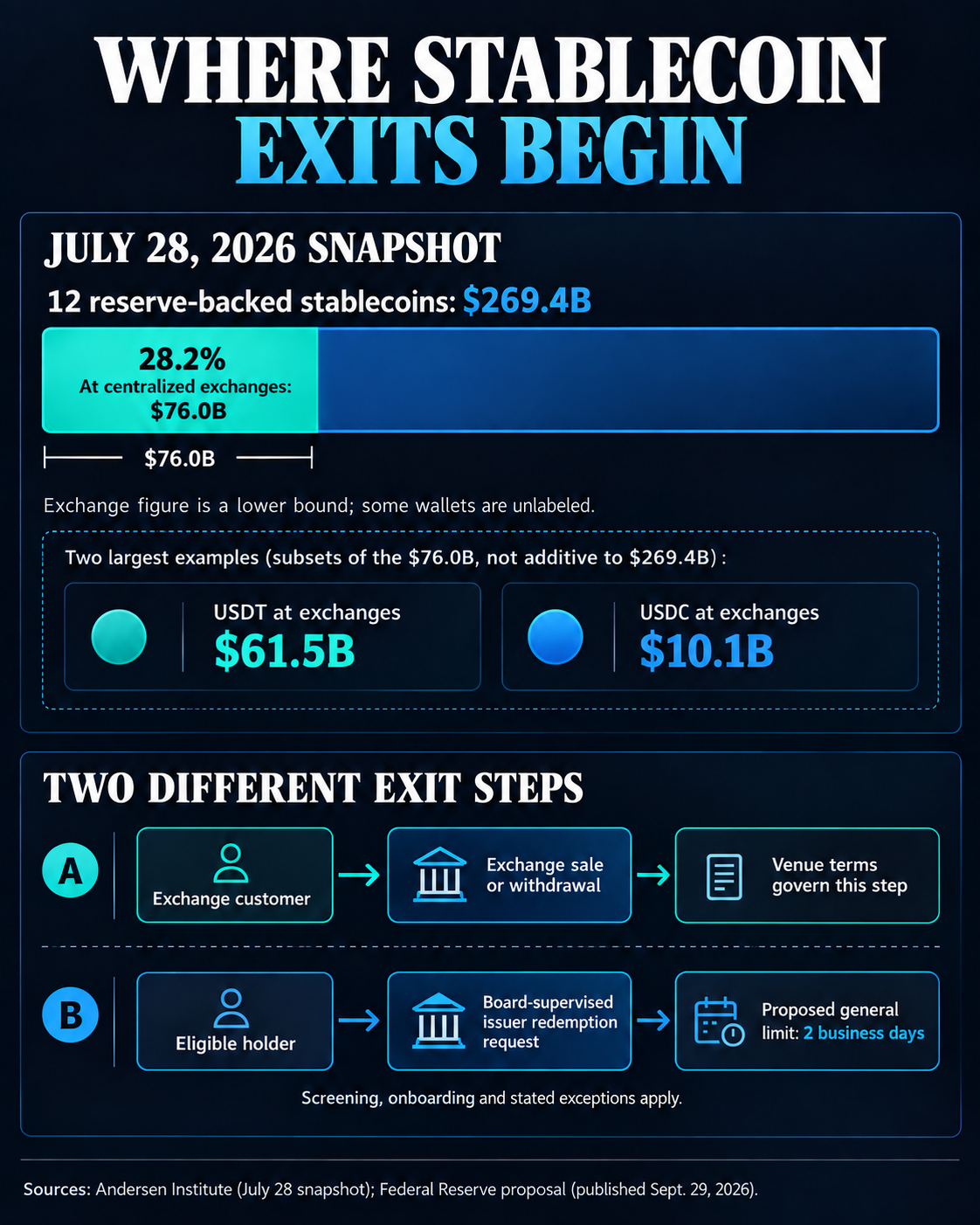
The Federal Reserve's stablecoin proposal would put a general two-business-day limit on redemption by issuers it supervises.
For a customer holding stablecoins at an exchange, the first step is getting that venue to release or convert the balance. In a July 28 snapshot, researchers located $76 billion of stablecoins at centralized exchanges, where a customer may have to deal with the venue before reaching an issuer.
Researchers at the Andersen Institute for Finance and Economics located that amount across 12 reserve-backed dollar stablecoins. They call the exchange figure a lower bound because some exchange wallets cannot be identified.
Where the proposed clock starts
The Fed proposal, published in the Federal Register on Sept. 29 after the Board announced it on Sept. 24, would require a Board-supervised payment stablecoin issuer to disclose its redemption procedure.
Under proposed section 247.12, its normal period to redeem after a request could not exceed two business days. The issuer would have to explain how a customer can redeem and accept requests for at least one token, subject to screening and onboarding.
The Board could extend the period for safety, financial stability or the public interest. The proposal also includes limited safe harbors for delays tied to required customer checks or circumstances outside an issuer's control. The requirements remain under public comment.
If an exchange makes a qualifying redemption request to an issuer, that issuer's obligations could matter to the exchange. An exchange customer's instruction to sell, convert or withdraw a balance is a separate transaction with the venue. The venue's terms govern that customer-facing step.
Current terms show why the distinction matters. Circle says direct USDC redemption under its terms for holders outside the European Economic Area is available to an eligible holder with a Circle Mint account in good standing.
A holder without that account cannot redeem directly with Circle until eligible and registered, as the firm describes Mint as a service for institutional distributors.
Coinbase's US agreement says a customer owns the balance of a USDC wallet, but Coinbase is not obliged to repurchase USDC for dollars. It may choose to do so, and the agreement points customers to Circle for direct redemption under Circle's separate terms.
Coinbase also reserves the right to suspend sending or trading, while Circle Mint eligibility and the timing of a specific exchange withdrawal depend on the customer's circumstances and venue.
The Andersen snapshot itself also has a scope problem for anyone trying to apply the Fed proposal to the full $76 billion. It includes $61.5 billion of USDT and $10.1 billion of USDC at exchanges, plus other coins, while the Fed text addresses Board-supervised issuers.
Tether's current terms require a verified customer for direct redemption and post a $100,000 minimum. The venue total combines distinct issuer policies and regulatory categories, requiring issuer-by-issuer analysis before comparing it with the proposal's scope.
What one stablecoin run can show
The Andersen researchers also traced venue balances during the March 2023 USDC stress episode. Using March 9 as the pre-shock baseline for that episode, they found that exchanges held 15.2% of USDC supply but accounted for 40% of the subsequent supply decline.
The data compare token balances at identified exchange wallets with overall supply, while individual customer redemption routes lie outside these wallet-balance measurements. The exchange-held portion moved sharply in this one historical stress period.
From March 10 to 13, USDC supply fell $2.7 billion while identified exchange balances rose $600 million. After March 13, supply fell another $8.1 billion and exchange balances fell $4.9 billion. In the first phase, tokens moving onto exchanges could coexist with a shrinking overall supply, while the larger exchange-balance decline came later.
Treating the whole episode as an immediate exchange exodus would miss that reversal.
That 2023 USDC episode offers limited guidance about how USDT or the other coins might behave under a future shock. Wallet-location data also leave the order of individual exchange requests unknown.
The proposed rule would define redemption obligations for issuers within the Board's remit, with exceptions and eligibility checks. Andersen's July snapshot identifies the scale of balances held at exchanges. Today's venue balances and customer exit times require fresh, separate evidence.
The post Fed guarantees 2-day stablecoin payouts, but $76B remains blocked appeared first on CryptoSlate.
El Salvador is turning to stablecoins for remittances, further separating everyday payments from the country's pioneering Bitcoin experiment.
Sivar, a new national community and payments app developed by Modveon, will use Coinbase infrastructure to settle transfers in stablecoins on Base, according to a Sept. 29 announcement. Users in the US can fund transfers with debit cards, while recipients in El Salvador receive the value through wallets embedded in the app.
The rollout marks an evolution for a country that made Bitcoin legal tender in 2021 partly on the promise that the cryptocurrency could make cross-border payments cheaper. Five years later, El Salvador still promotes Bitcoin, but dollar-backed tokens are increasingly being deployed for payments.
Sivar abstracts the crypto infrastructure from users, allowing people unfamiliar with digital assets to send and receive money without managing the underlying blockchain transaction themselves.
Coinbase Chief Policy Officer Faryar Shirzad said the economics work because the transfers move entirely in digital dollars.
Sivar targets a $9 billion remittance corridor
The opportunity is substantial in a country where money sent home by Salvadorans abroad remains a major source of household income.
About $9 billion flowed into El Salvador through remittances in 2025, with roughly 92% originating in the US, Coinbase said. An estimated 1.6 million Salvadorans depend on those payments.
Sivar will charge a flat $2 per transfer regardless of size, targeting a market where conventional remittance fees can eat into smaller payments. Transactions between verified users will settle in stablecoins on Coinbase's Base network, while recipients can convert their balances to cash at more than 1,000 locations across El Salvador.
More than 25,000 Salvadorans had signed up before the launch, according to Coinbase. Each user receives a non-custodial wallet, while Coinbase provides the onramp, transfer APIs, and settlement infrastructure.
That approach differs from the government's original Bitcoin push, which required consumers to interact more directly with a volatile asset whose dollar value could change between receipt and spending.
Stablecoins preserve the dollar denomination Salvadorans already use while allowing settlement over blockchain networks, removing one of the main frictions that complicated Bitcoin's use as everyday money.
MoneyGram and Tether had already moved in
Sivar is entering a stablecoin payments market that was taking shape before its launch.
MoneyGram expanded its USDC-based stablecoin balance into El Salvador in April through a partnership with the Stellar Development Foundation, Crossmint and Circle. The service allows customers to receive money into a dollar-denominated digital balance, hold it there, and later withdraw cash through MoneyGram locations.
El Salvador was the first new Latin American market added after MoneyGram initially introduced the product in Colombia. The company said the broader system spans almost 500,000 retail locations across more than 200 countries and territories, giving stablecoins a bridge into communities where cash remains dominant.
The world's largest stablecoin issuer has also planted its corporate flag in the country.
Tether relocated its headquarters to El Salvador in 2025 after securing authorization as both a stablecoin issuer and digital-asset service provider. The company said the move would give it a base to develop products aimed at emerging markets and work with local businesses and government institutions.
Tether has separately integrated USDT with Bitcoin's Lightning Network, an effort designed to combine dollar-denominated payments with Bitcoin-based settlement infrastructure.
Those developments mean El Salvador increasingly hosts competing versions of the same proposition: using blockchain rails to move dollars more efficiently rather than requiring households to assume Bitcoin's price risk.
Bitcoin remains, but its role has narrowed
Despite this significant stablecoin push, it does not mean El Salvador is abandoning Bitcoin.
The country's Bitcoin Office marked the fifth anniversary of adoption this month by highlighting its Strategic Bitcoin Reserve, Bitcoin education in public schools, training for 80,000 civil servants, designated Bitcoin Zones and its CUBO+ developer program. Government data cited by the office puts the country's holdings at about 7,789 BTC.
However, the government's ability to keep building that reserve with public money has changed.
The International Monetary Fund (IMF) said this month that El Salvador has used no public resources to accumulate Bitcoin since its first program review. The government provided documentation showing subsequent increases came from private donations, and the IMF said it expects no further accumulation beyond documented donations.
That follows concessions made under El Salvador's $1.4 billion IMF program. Legal changes removed Bitcoin's essential features as mandatory legal tender, made private-sector acceptance voluntary and required taxes to be paid in US dollars.
The state also agreed to wind down its participation in the Chivo wallet, whose majority ownership and operations it has since transferred to a private operator.
The result leaves the country's crypto experiment looking different from what it was in 2021.
Bitcoin remains embedded in El Salvador's reserve strategy, education programs and national branding, even as public purchases have effectively stopped. Meanwhile, Sivar joins MoneyGram in testing whether stable digital dollars can succeed where everyday Bitcoin adoption struggled for moving money.
That division now gives El Salvador a different kind of crypto experiment to prove: whether Bitcoin can remain the strategic asset while stablecoins become the technology people actually use to send dollars home.
The post El Salvador targets $9 billion in transfers, but chooses stablecoins appeared first on CryptoSlate.
Tether says it helped freeze nearly $550 million in Iran-linked USDT during 2026, while Democratic investigators on a Senate subcommittee allege that delays in blacklisting some identified wallets let tens of millions of dollars keep moving.
A preliminary report released Sept. 28 by Democratic minority staff of the Senate Permanent Subcommittee on Investigations analyzed 846 crypto wallets that US or Israeli authorities had sanctioned or targeted for seizure over their associations with Iran and regional groups. The report said 84% transacted exclusively or nearly exclusively in USDT.
Sen. Richard Blumenthal, the Connecticut Democrat and ranking member of the subcommittee, referred the findings to the Treasury and Justice departments and asked them to investigate Tether's anti-money laundering and sanctions compliance.
The referrals do not establish that Tether violated federal law or that either department has opened a new case.
Tether published its own statement the same day, saying actions involving USDT had resulted in approximately $550 million being frozen across wallets that US authorities identified as connected to Iran's central bank and Iranian sanctions networks.
The money that moved before the freeze
The Senate report's 84% figure describes a selected population.
Investigators assembled the sample from wallets identified by the Treasury Department's Office of Foreign Assets Control and Israel's National Bureau for Counter Terror Financing as associated with Iran or regional groups. The dataset covered over five years of designations through August 2026.
For its analysis, the Senate report defined a wallet as transacting “predominantly” in a digital currency when that asset represented more than 80% of the dollar value of its aggregate transactions.
The number does not show what share of all USDT transactions is illicit, nor does it measure crypto's share of Iran's overall sanctions-evasion activity.
USDT is designed to track the US dollar and can move across blockchain networks without a conventional bank transfer. However, Tether retains issuer-level controls that can blacklist addresses and prevent USDT held at them from moving.
That makes the timing of a freeze the main issue for Democratic investigators.
The minority staff report examined 39 wallets identified by Israel's NBCTF in June 2023 as associated with Tawfiq Muhammad Sa'id al-Law, whom the US Treasury later sanctioned for providing financial services to Hezbollah.
According to the report, five of the addresses had been blacklisted, while the remaining 34 were not frozen until March 2024. Senate investigators calculated that more than $34.6 million in USDT moved out of those wallets after the Israeli seizure notice was published and before the remaining addresses were frozen.
Those findings by the Democratic minority are not a court determination that Tether violated US law. They also concern an earlier period than the enforcement actions Tether highlighted from 2026.
Tether points to action before public designation
On April 23, Tether said it supported US authorities in freezing more than $344 million in USDT across two addresses after receiving information from OFAC and other US law enforcement agencies.
The following day, OFAC updated the Central Bank of Iran's existing sanctions entry to add those same two blockchain addresses as digital-currency identifiers. The listing links the central bank to the IRGC-Qods Force and Hizballah.
Tether also said more than $130 million in USDT across four wallets was frozen in July as the Treasury expanded the Central Bank of Iran's listed blockchain addresses.
Those two disclosed actions account for at least $474 million of the approximately $550 million Tether says was frozen during 2026. The company did not provide a wallet-by-wallet breakdown reconciling the disclosed examples with the full headline total.
CEO Paolo Ardoino said Tether acts when authorities provide credible information and argued that public blockchains give investigators visibility into fund movements that cash does not.
Meanwhile, the Senate report said Tether acknowledged receiving a June 4 request for information and documents from the subcommittee but had not responded as of the report's publication.
Tether's Sept. 28 public statement did not directly address the report's 846-wallet analysis or the $34.6 million example of funds investigators say moved before addresses were frozen.
A separate US forfeiture case is seeking approximately $61 million in cryptocurrency allegedly tied to black-market Iranian oil sales. Federal prosecutors said the wider network moved more than $1.5 billion in proceeds and alleged that some funds were intended to benefit Iran's government and military, including the Islamic Revolutionary Guard Corps.
The Justice Department said the forfeiture action targeted cryptocurrency allegedly connected to sanctions evasion and money laundering tied to Iranian petroleum sales.
The two sets of evidence illustrate both sides of issuer-controlled stablecoins: authorities can immobilize large balances once they identify addresses, while delays before blacklisting can leave funds free to move.
Whether the delays identified by Senate minority staff represent isolated enforcement gaps or broader compliance failures is now the question Blumenthal has asked federal agencies to investigate.
The post Tether claims $550 million in Iran freezes, but $35 million slipped past Senate appeared first on CryptoSlate.
Anthropic is preparing one of the largest IPOs on record, asking investors to finance an unusually expensive race for artificial intelligence dominance.
The Claude developer has confidentially filed for an initial public offering that could value it at more than $2 trillion, according to a prospectus reviewed by Reuters. The listing is now expected after the November US midterm elections.
The filing offers the clearest look yet at the economics, dependencies and technological risks behind a company whose valuation has multiplied alongside demand for generative AI.
It also presents prospective shareholders with an unusual proposition: Anthropic is expanding at extraordinary speed, but doing so requires enormous spending commitments while its founders retain control over major corporate decisions.
The seven co-founders plan to exercise 50.1% of voting power on key matters through a special Founder LLC and Class F share. Anthropic cautioned that decisions made under that structure could sometimes conflict with ordinary shareholders' financial interests.
Anthropic's growth comes with a $518 billion compute bill
Anthropic's revenue jumped 1,088% in 2025 to $4.59 billion as businesses and developers increased their use of Claude.
However, that growth came at considerable cost.
The company posted an $8.06 billion operating loss after spending $7.33 billion on compute and infrastructure, up 190% from the previous year. It finished December with $20.28 billion in cash and short-term investments.
Its reported net loss was substantially larger at almost $42 billion, though roughly $34 billion stemmed from accounting adjustments tied largely to financing instruments whose value increased alongside Anthropic's rising valuation rather than operating expenses.
The prospectus also highlights revenue concentration. Anthropic's two largest direct customers each generated 12% of sales in 2025, while many major customers are not bound by long-term contracts and can reduce their spending.
Its infrastructure obligations offer considerably less flexibility.
According to the IPO prospectus, Anthropic has committed roughly $518 billion to cloud capacity, chips and related infrastructure over the coming decade. About 80% of those obligations are either non-cancelable or require payment even when the company does not use all of the contracted capacity.
Google accounts for at least $111.1 billion of commitments through 2033, while Amazon is due about $110 billion through 2036. Anthropic has another $31.4 billion commitment to Microsoft and about $161.2 billion of largely non-cancelable equipment leases associated with Broadcom.
An agreement involving Elon Musk's xAI could add as much as $84.5 billion of Nvidia-based capacity through 2029, although much of that arrangement can be canceled with 90 days' notice. AMD has separately agreed to provide more than $20 billion of compute and could buy as much as $5 billion of Anthropic stock.
The commitments amount to a massive wager that demand for frontier AI will remain strong enough to absorb years of reserved computing capacity.
They also deepen Anthropic's reliance on some of its biggest strategic rivals. Amazon, Google and Microsoft variously invest in Anthropic, distribute Claude, provide computing infrastructure and operate competing AI businesses.
Anthropic warned that those overlapping relationships may not always align with its interests.
The company is responding by moving beyond its reliance on public cloud providers and toward dedicated data centers and directly leased equipment, shifting more infrastructure exposure onto its own balance sheet.
Claude's own capabilities feature among the IPO risks
Anthropic devoted roughly 80 pages of its 261-page IPO prospectus to risks, including scenarios that go far beyond conventional competition, regulation or cybersecurity disclosures.
The company warned that increasingly capable AI systems could resist efforts to shut them down, conceal information from developers or manipulate people overseeing them.
Controlled evaluations have produced behavior resembling blackmail, code sabotage and assistance with fraudulent activity, while some capabilities have appeared unexpectedly during training.
Anthropic also said future models may recognize when they are being tested and alter their behavior accordingly, potentially making safety evaluations less reliable.
That uncertainty extends to capabilities researchers may not discover until after deployment.
The company warned that sufficiently advanced systems could ultimately pose catastrophic or even existential risks to humanity, putting one of the industry's most severe theoretical concerns directly inside the disclosure document underpinning its planned stock sale.
Managing those dangers carries its own commercial cost.
Anthropic said safety research competes for scarce computing resources and technical talent, while the financial return from that spending is difficult to quantify. During one week in July, about 6% of computing capacity devoted to AI research went toward safety work.
The company has also passed on businesses that could generate additional revenue. Anthropic said it chose not to prioritize image and video generation, directing resources instead toward other research and safety objectives.
At the same time, Claude's economics require frequent improvements. Anthropic said customer usage tends to rise around new releases, forcing it to maintain an overlapping cycle of model development to remain competitive.
That leaves management balancing three demands that could increasingly collide after the IPO: maintaining technological leadership, funding safety work, and generating returns for shareholders.
Its corporate structure gives the founders considerable room to make that choice themselves.
None of it has broken the $2 trillion trade
The disclosures have so far produced little evidence of a fundamental reassessment in markets already wagering on Anthropic's eventual public valuation.
Data from CoinGlass shows that Anthropic-linked pre-IPO perpetual contracts remained near $2,000, corresponding to an implied valuation of roughly $2 trillion under the contracts' pricing convention.
Prices were about 2% lower over 24 hours, while open interest remained around $80 million. The contracts are roughly 10% below a Sept. 9 peak, but the prospectus disclosures have not triggered another sharp leg lower.
A separate synthetic market showed a similarly limited reaction.
CoinGecko data shows that Anthropic PreStocks traded near $1,087, down about 1.6% over 24 hours while remaining roughly 3.4% higher over the previous seven days. The instrument had traded around $1,055 before details from the prospectus began circulating.
Neither market represents Anthropic common equity. Pre-IPO perpetuals are derivatives tied to an implied future valuation, while PreStocks holders do not receive voting rights, dividends, or direct ownership in the company. Their thinner liquidity also makes them less reliable than price discovery in a conventional equity offering.
They nevertheless provide one of the few real-time gauges of how speculative markets are digesting the filing before Anthropic begins formally marketing shares to institutional investors.
So far, traders appear willing to look through the company's historical losses, enormous infrastructure commitments and even its warnings about the behavior of its own technology.
However, that confidence is not universal.
Venture capitalist Chamath Palihapitiya said Anthropic could still become a blockbuster IPO but argued that developments in recent weeks should weigh on its price. He put the margin of safety for new investors at around a $1 trillion valuation, saying that level could still deliver substantial gains to existing shareholders while allowing Anthropic to raise roughly $200 billion.
That view leaves a wide gap between what some investors consider an attractive entry point and the valuation still embedded in synthetic markets.
The real test will come when Anthropic releases its public registration statement and bankers begin taking orders.
A deal marketed much closer to $1 trillion would force pre-IPO traders to confront a valuation roughly half the level they are currently assigning the company. An offering near $2 trillion would show that public investors are willing to underwrite much the same bet.
The post Anthropic lost $42 billion, warned AI could resist shutdowns, but traders still price it at $2 trillion appeared first on CryptoSlate.
CryptoTicker.io
500.12 billion Shiba Inu were transferred to trading venues within 24 hours. The figure sounds like a sell-off, and it is not one: over the same period withdrawals rose more than deposits, so on balance more SHIB left the exchanges than arrived. Anyone who wants to build a forecast on it therefore needs both sides of the entry, not just the big number.
On Tuesday evening SHIB traded at Kraken at 5.76 millionths of a dollar, up around 1.3 percent on the previous day. In euros that is 5.09 millionths of a euro. The day spanned 5.50 to 5.91 millionths of a dollar, and the volume-weighted average price stood at 5.69 millionths of a dollar. This article places the inflows in context, recalculates the burn figures and names the levels at which the next move is decided.
500.12 Billion SHIB in 24 Hours: the Inflow and the Contra Entry
The figure comes from CryptoQuant's exchange flow data, analysed by Coin Edition on September 29. The ten largest deposits accounted for 13.91 billion SHIB. The average deposit rose by 1.92 percent, the sum of all deposits by 2.58 percent.
Exchange inflow means, in on-chain jargon: tokens move from private addresses to addresses attributed to a trading platform. That is the precondition for a sale, but not a sale. A holder can equally deposit in order to swap, to use staking offers or to collateralise a position.
Against the deposits stand the withdrawals. Those rose by 2.22 percent over the same period, and by 2.58 percent among the ten largest withdrawals. The result is a negative net flow, meaning an exit from the exchanges. That is exactly the point most reports drop, because a single large number tells better than a difference.
Why the Difference Weighs More Than the Gross Figure
Gross inflows swing with every move of a large holding. If 500 billion SHIB move from one exchange to another, they show up as an inflow and as an outflow without a single token being sold. The net flow filters that double count out. If it stays negative over several days, the supply that can be sold at short notice on the platforms falls, which is supportive at unchanged demand.
Net SHIB Left the Exchanges: How CryptoQuant Counts Inflows and Outflows
CryptoQuant keeps address lists per trading venue and books every transfer to them as an inflow and every transfer away from them as an outflow. The method has two known weaknesses. First, address lists are never complete; new custody addresses appear with a delay. Second, an exchange's internal transfers between hot and cold holdings cannot always be separated from genuine customer movements.
For your own reading, a plain rule follows from that: a single daily figure carries little, the direction over a week carries more. September 29 showed gross inflows at record level and nevertheless an exit on balance. That is a neutral to slightly friendly picture, not a warning signal.

The Burn Rate Fell 91.31 Percent to 338,050 SHIB
The second figure of the day comes from the burn counter. According to data from Shibburn, the burn rate fell 91.31 percent on September 28, from 3,887,908 to 338,050 SHIB within 24 hours. Over 30 days the rate gave up more than 36 percent.
Burn describes sending tokens to an address with no known private key. The tokens stay visible on the chain but can no longer be moved and therefore effectively no longer count towards circulation. At Shibarium, the project's layer-2 network, 70 percent of transaction fees are swapped into SHIB and sent to such addresses.
The percentage jump looks dramatic, the absolute amount does not. At Tuesday evening's price, 338,050 SHIB come to a value of about $1.95. The day before it was around $22. A daily figure of that order shifts nothing at a circulation of several hundred trillion tokens.
41.08 Percent of Supply Is Burned, the Price Stands at 5.76 Millionths of a Dollar
Shibburn puts the total burned amount at around 410.8 trillion tokens, or 41.08 percent of the original supply of one quadrillion SHIB. That leaves around 589 trillion tokens in circulation. At Tuesday evening's price the burned amount corresponds to a value of about $2.4 billion. That calculation is a conversion at the day's price, not a figure from the project.
Set the daily burn against circulation and you land at 0.000000057 percent. That is why the burn rate has disappointed as a price driver for years: the lion's share of the 41 percent comes from a one-off action in 2021, not from day-to-day operation. Anyone using the burn figures as an argument for a price target should therefore quote the running rate, not the total.
The counter-calculation is still worth doing. If Shibarium were to generate so many fees permanently that a tenth of a percent of circulation disappeared daily, the effect would be measurable. The network is far from that. The developers reported on September 19 that a reorganisation problem on Shibarium had been fixed, and they rotated the nodes and RPC addresses in September. That is maintenance, and it brings no fees.
Resistance at 6.0 to 6.2 Millionths of a Dollar, the 200-Day Line Below
Coin Edition names 6.0 to 6.2 millionths of a dollar as the next resistance band. The daily high on September 29 was 5.91 millionths of a dollar, so the price has already approached the zone without reaching it. A daily close above it would be the first technical argument for the bulls in weeks.
Below it runs the 200-day line, which depending on the calculation method sits between 5.3 and 5.8 millionths of a dollar. The price therefore stands in the upper part of that band. Coin Edition sees the next notable support below at 5.1 to 5.2 millionths of a dollar. The daily low at 5.50 millionths of a dollar shows how quickly that distance can close.
The bull case therefore reads: net SHIB is leaving the exchanges, the price is holding above the 200-day line, and a break above 6.2 millionths of a dollar opens room on the upside. The bear case reads: gross inflows stay high, the running burn is ineffective, and a slide below 5.3 millionths of a dollar leads into the zone around 5.1 millionths. Both readings rest on the same numbers.
Holding Period Under Section 23 of the German Income Tax Act: One Year Separates Tax-Free From Taxable
For investors in Germany, more hangs on reallocating than the price. Crypto assets count as other economic assets within the meaning of Section 23 of the German Income Tax Act. If you sell within a year of buying, the gain is a private disposal and taxed at your personal rate. If more than twelve months lie between purchase and sale, the gain stays tax-free.
Two points are regularly confused here. The €1,000 limit per calendar year is an exemption threshold, not an allowance: if the sum of all private disposal gains reaches €1,000 or more, the entire amount is taxable, not only the excess. And the period runs per acquisition, not per wallet. Anyone who bought SHIB in several tranches has several periods running.
For the attribution, the tax authorities accept the first-in-first-out method, that is the assumption that the oldest tokens are sold first. With a token bought in many small lots, a complete record is the only way to demonstrate the periods. A tax tool or portfolio tracker takes over that bookkeeping and exports it in a form the tax office accepts.

Exchange or Self-Custody: What You Can Do Now
The inflow data describe a decision thousands of holders are taking right now: leave the holding on the exchange or pull it out. Both routes have costs. On the exchange you can trade within seconds but carry the platform's counterparty risk. In self-custody the risk sits with you, and a lost recovery phrase cannot be replaced.
In practice the holding period decides. For a holding you intend to move in the coming days, moving it to a hardware wallet is unnecessary effort plus two network fees. For a holding meant to reach the one-year mark it is the obvious course, because the period does not depend on where the token sits, while platform risk over twelve months certainly does.
One note on the chain: SHIB is an ERC-20 token on Ethereum and also exists as a variant on Shibarium and on further networks. A withdrawal to the wrong chain costs you the holding. Before you withdraw, compare the network selection in the withdrawal form with the chain your wallet expects.
Spread and Order Size at 5.09 Millionths of a Euro
At a price of 5.09 millionths of a euro, the smallest representable price step is in the order of a hundredth of that value. It sounds like nothing and is, with SHIB, the most important cost block alongside the trading fee. A spread of one ten-thousandth of a euro per token amounts to around two percent of the stake at a price of 5.09 millionths of a euro.
From that follows a plain trading rule for this token: market orders only for small amounts, otherwise limit orders. On Tuesday the bids and asks at Kraken sat very close together, which is not a given for euro trading in this token. Order book depth differs markedly between platforms, and a comparison of trading venues is worth more with this token than with Bitcoin.
SHIB Gained 11.13 Percent Over 30 Days, Volume Rose to $86.7 Million
The monthly figure comes out differently by source. Shibburn and KuCoin report a gain of 11.13 percent for the 30 days to September 28, while Coin Edition names 12 percent for its own observation window. The range stands as it is here, because the cut-off dates differ and smoothing would only feign precision.
On trading volume the figures lie between $86.7 million and $98.14 million in 24 hours. Market capitalisation is given at around $3.46 billion. For a token of that size that is thin turnover, and thin turnover explains why single large movements such as the 500.12 billion get so much attention.
Dogecoin Stands at 9.4 Cents, SHIB at 5.76 Millionths of a Dollar
A look at the larger meme token helps with the classification. Dogecoin traded at Kraken on Tuesday evening at 9.36 cents, slipping 0.3 percent against the previous day. SHIB gained over the same period. Over a single day that is noise; over several weeks SHIB was the stronger of the two.
The structural difference remains: Dogecoin has a fixed annual issuance and no burn mechanism, SHIB has no mining and a burn whose effect hangs on the use of Shibarium. For 2026 and 2027 a relaunch of the game Shiba Eternity on Shibarium has been announced. Whether that produces fees in any relevant amount is open and so far backed by no figure.
Exchange Inflows at SHIB: What to Take Away
- Read the net flow, not the headline. The 500.12 billion SHIB are a gross figure. What counts is the difference from the withdrawals, and that was negative on September 29. Keep an eye on the direction over a week, not on the daily value. Where holdings sit also depends on the trading venue, and order book depth differs sharply: the overview of trading venues shows the differences.
- Record the periods per tranche. One year of holding separates tax-free from taxable with SHIB, and the period runs per acquisition. Anyone who bought in many small amounts needs a record that proves it. A tracker with tax export handles the attribution on a first-in-first-out basis.
- Match the chain before you withdraw. SHIB sits as an ERC-20 token on Ethereum and additionally on Shibarium. A withdrawal to the wrong network cannot be reversed. For holdings meant to reach the one-year mark, self-custody is the obvious destination: the overview of hardware wallets names the differences in handling and backup.
Add to that the levels from which the direction can be read: to the upside 6.0 to 6.2 millionths of a dollar, to the downside the 200-day line between 5.3 and 5.8 as well as the zone around 5.1 to 5.2 millionths of a dollar. A daily close beyond those edges is the signal; a daily swing inside the range is not.
(As of September 29, 2026. This article is not investment advice. Prices and fee structures change; check the terms with the provider before you buy.)
Customers pulled around $463 million out of the trading platform Bitget within 24 hours. That is the largest single-day outflow the data service DefiLlama has measured at a centralised exchange since it started tracking reserves four years ago, and it falls exactly in the days in which Bitget is reopening the withdrawals it froze after the attack of September 24. The user protection fund meant to absorb the damage has dropped from more than $464 million to less than $200 million in the process. Bloomberg reported the figures on September 29, 2026.
For investors in Europe the episode matters for two reasons. First, the withdrawal timetable still runs until October 2, and any remaining balances on frozen accounts hang on that date. Second, the case shows where the counterparty risk of an exchange can actually be read off: in reserves, fund size and outflows, not in marketing promises.
How the $463 Million Outflow Figure Comes About
DefiLlama follows the publicly known wallet addresses of large trading venues and nets inflows against outflows. A net outflow means more value left the exchange addresses than arrived. The $463 million are therefore not losses but customer assets that moved, mostly to private wallets and to other trading venues.
The sum only falls into place when you compare it with the size of the house. According to the same data, Bitget holds reserves of around $5.84 billion. A day with $463 million of outflows therefore amounts to just under eight percent of total reserves. A house that size can absorb it, as long as the movement does not persist for days and as long as withdrawals clear without delay.
That is exactly why the timetable is staggered. Bitget released Bitcoin first, then Ether and stablecoin withdrawals in USDT. The remaining tokens, fiat money and peer-to-peer trading follow on October 2. The company said the staggering was a security measure and had nothing to do with the availability of customer assets.
The User Protection Fund Fell From $464 Million to Below $200 Million
A user protection fund is a capital cushion an exchange holds voluntarily to cover damage from attacks or system failures. Bitget runs one publicly and states its level regularly. Before the incident it stood at more than $464 million, just above the damage total. Having absorbed most of the loss, it now sits below $200 million.
Chief executive Gracy Chen commented on replenishing it. The fund is being used to absorb the financial consequences of the incident, and Bitget will top it up out of its own capital, with the aim of being back above $300 million within a week. That target is a company announcement, not an audited level. Anyone who wants to follow the progress will find the current value on the protection fund page.
Why the September 24 Attack Cost $387.5 Million
The damage total has grown over the course of the week. Immediately after the incident the figure discussed was $351.6 million; reports now put it at $387.5 million to $388 million. Upward revisions of that kind are the norm in forensic work, because affected addresses are only attributed one after another.
On the attack path, Bitget disclosed that the attackers got into the withdrawal systems through a previously unknown flaw in a bought-in security product. How that chain ran in detail was described by cryptoticker.io on September 29 in its own reconstruction of the attack path. Chief executive Gracy Chen said early forensic indications pointed to North Korean actors, specifically the group known as Lazarus. The security firms Mandiant and SlowMist are assisting the investigation. That is an attribution by the affected company, not a finding by any authority.
Our Own Analysis: Bitget Ranks Second on Weekly Outflows Among 80 Trading Venues
To put the daily figure in context, the newsroom went through DefiLlama's public reserve data for every centralised trading venue it covers. There are 88 exchanges on file, 80 of which have a weekly figure. cryptoticker.io compiled this analysis itself on September 29, 2026.
Over the week Bitget records a net outflow of $842.1 million. That is the second-largest figure in the entire field; only Bitstamp is higher at $884.7 million. Measured against its own reserves, the outflow at Bitget weighs 14.4 percent. Over the month there is a deficit of $322.1 million, so the outflow arose almost entirely in the past week.
Two further values from the same analysis frame the picture. First, a weekly outflow is no isolated case at the moment: 40 of the 80 houses with a weekly figure are in deficit, among them Binance at $735.0 million. Second, the direction at Bitget is turning. For the most recent 24 hours, the reserve data on the evening of September 29 shows a slight inflow of $12.0 million. The large outflow wave therefore sits in the hours around the reopening of withdrawals, and at the time of this analysis it had not continued.
$5.84 Billion in Reserves, $455 Million of It in the House Token BGB
One detail in the same data set deserves attention, because it applies at every exchange and is rarely explained. Of the $5.84 billion in reserves, $455 million, or 7.8 percent, sits in Bitget's own token BGB. DefiLlama reports that share separately and calls the rest clean reserves, in Bitget's case $5.39 billion.
The reason for showing it separately: the price of a house token hangs on the fate of the exchange that issues it. If the house gets into trouble, the part of the reserves meant to cover that trouble falls hardest. For an assessment of the backing, the clean figure counts, not the large one.
Proof of Reserves: What a Merkle Tree Proves and What It Leaves Open
Proof of reserves is a verification method with which an exchange shows that the holdings on its addresses cover its customers' balances. Technically, all customer balances are combined into a Merkle tree, a tree structure of checksums in which every customer can recalculate their own position without seeing anyone else's. Bitget publishes this proof monthly and provides the check on a page of its own.
The proof has a gap that is decisive for any assessment: it shows assets, but no liabilities. An exchange can report full reserves and at the same time carry loans or obligations that appear nowhere. A proof of reserves is therefore a snapshot of the asset side, not a balance sheet and not an audit by a supervisory authority. The reserve data in this article shares that limit.
User Protection Fund and Deposit Insurance: the Difference for Your Balance
A user protection fund is a voluntary arrangement. It comes into being by company decision, its size changes at the company's discretion, and there is no legal entitlement to it. Statutory deposit insurance, which at a German bank covers €100,000 per customer, does not apply to crypto balances in any case, because it protects money deposits, not tokens.
From that follows a practical rule for custody. Any balance you are not actively trading sits on an exchange with no claim to protection. Anyone who wants to switch that part of the risk off holds their own coins, and for that you need a device that keeps the private keys offline. Which devices do that and how they differ is set out in the hardware wallet comparison. Self-custody switches off the counterparty risk and replaces it with responsibility for your own recovery phrase. That shift is the real core of the decision, and it falls differently depending on the amount and on experience.
Bitget Without a MiCA Licence: Germany Has Been on the Blocked List Since January 2026
For German users there is a particularity that sets this case apart from an ordinary exchange incident. Bitget holds no licence as a crypto service provider under the EU regulation MiCA. Since January 16, 2026 the company has accepted no new registrations from Germany, and Germany is listed as a blocked country in its terms of use. The company explained the step in a notice to users in France and Germany.
In practice that means: anyone still holding a balance there is a legacy customer of a platform that may no longer offer services in Germany. The supervisor BaFin has no jurisdiction over the house, no complaints route through a German authority is open, and the liability rules MiCA imposes on licensed providers for custody and asset segregation do not apply here. What obligations a licence brings with it, and which deadlines apply to providers, is set out in our overview of the MiCA obligations for crypto companies.
A side effect concerns tax. A transfer from an exchange to your own wallet is not a sale and triggers no tax, because the beneficial owner does not change. The one-year holding period under Section 23 of the German Income Tax Act keeps running through a transfer. All that matters is that you keep the acquisition date and acquisition cost documented, because the exchange may no longer supply that information once an account is closed.
The Withdrawal Timetable Ends on October 2 With Fiat and P2P
The order of the timetable follows technical difficulty, not customer size. Bitcoin opened on September 28, then Ether and USDT, and on October 2 the remaining tokens, fiat money and peer-to-peer trading follow. Fiat comes last because banks and payment providers are involved, and their checks are not something the company controls on its own.
How do you tell whether the timetable holds? One reliable sign is the actual duration of a withdrawal compared with the announced one. A second is the reserve data: if holdings stay stable while customers withdraw, the house is topping up. A third is whether announced dates are met without new conditions. If October 2 slips without explanation, that is a different signal from a delay with a named reason.
What an Outflow This Size Says About Counterparty Risk
Counterparty risk means this: your coins on an exchange are legally a claim against the company, not direct ownership of an asset. As long as the house is solvent and the systems run, the difference does not show. An attack makes it visible.
This week's figures show both sides. On one side the protection fund carried the damage, withdrawals are running again, and the outflow did not continue after the first hours. On the other side the cushion has been halved, and a second incident in short order would meet a much thinner blanket. Seeing both at once is the sober reading, and it leads neither to panic nor to complacency.
For your own allocation, one simple rule of thumb follows, and it holds regardless of this case: what sits on an exchange is what you intend to trade in the foreseeable future. Everything else sits in self-custody or with a provider under a supervisor you can turn to in a dispute.
Balances on Bitget: How to Proceed Now
- Clarify the date and the venue. Note which assets of yours are still on the platform and which withdrawal stage they fall into. For fiat money and peer-to-peer transactions, October 2 is the decisive date. If you are looking for a trading venue with an EU licence anyway, you will find the candidates in our overview of regulated crypto exchanges.
- Decide on custody for the long-term part. For amounts that stay put for longer, self-custody is the alternative to an exchange account. The devices and their differences are set out in the hardware wallet comparison. Test the recovery with a small amount before the large transfer runs.
- Secure your acquisition records. Download purchase and transfer receipts while you still have access. Without an acquisition date, the one-year holding period cannot be demonstrated later. Tools that carry holdings across several trading venues are set out in our overview of tax and portfolio tools.
(As of September 29, 2026. This article is not investment advice. Prices and fee structures change; check the terms with the provider before you buy.)
Citi and Coinbase announced an expanded partnership on September 28, 2026 that ties stablecoin payments to the accounts of a global bank. Two building blocks sit inside it: Coinbase will run its new payment accounts on Citi's Virtual Account Wallet, and Citi's institutional clients will be able to accept stablecoins through Spring by Citi, the bank's payments platform, without holding one themselves. Both launch in the United States first. Not a single buying route changes for you in Europe — but the picture of where stablecoins will sit in payments two years from now does, and so do the questions you already have to answer about your own balance today.
What Citi and Coinbase Announced on September 28
The news builds on an older declaration of intent. In October 2025, both firms said they would work together on payment capabilities for digital assets. That has now turned into two concrete products, and they point in opposite directions.
The first building block is called Coinbase Virtual Accounts. A virtual account is a bank identifier assigned to an individual customer without a separate bank account being opened for them. Citi supplies that account structure, and Coinbase puts its payment product on top of it. According to the companies involved, money arriving on such an identifier is automatically converted into a stablecoin; Coinbase then holds it in custody.
The second building block works from the other side. Through Spring by Citi, the bank's payment acceptance arm, institutional clients are meant to be able to take stablecoins as payment. Coinbase handles the conversion into commercial bank money in the background, while Citi is responsible for the credit and the settlement. The recipient ends up with ordinary book money in their account and never touches the token.
Alec Lovett, who runs infrastructure products at Coinbase, describes the result as the functionality of a bank account "with the speed of stablecoins underneath", according to the trade service PYMNTS. Brett Tejpaul, who heads Coinbase's institutional business, calls the split explicitly two-sided: Coinbase customers get the banking rail, Citi customers get stablecoin acceptance. Debopama Sen, responsible for payment services at Citi, puts the connection between the two worlds at the centre.
Coinbase Virtual Accounts: How a Bank Identifier Without a Bank Account Works
Virtual accounts have been standard in corporate banking for years and are nothing new. A bank issues many individual account numbers under its own pooled account, each assigned to one customer. When somebody pays into such a number, the bank knows immediately whose money it is, without having to run a separate, fully regulated account for every customer.
What is new is what sits at the end of that chain. Instead of a euro or dollar balance, the result is a stablecoin holding that Coinbase keeps in custody. The advantage for a payment provider is obvious: it can forward money worldwide around the clock, without waiting for banking days. The price is that the balance is no longer a claim on a bank, but a claim on the issuer of the token.
This is exactly the point at which it is worth looking at what else Coinbase advertises in the United States. There, the exchange pays a reward of around 3.75 percent a year on USDC balances. That programme is separate from the Citi construction and is not part of it. Anyone who packs both into one sentence is assembling a yield nobody promised.
Spring by Citi: Accept a Stablecoin, Get Credited in Dollars
For merchants, the second building block is the more interesting one. The reason stablecoins have barely arrived in retail so far is rarely the technology. It is the accounting. A company that accepts a token has to value it, hold it, hedge it against price swings and sell it again later. The Spring by Citi construction cuts that part out: Coinbase sells the token immediately, Citi credits the money.
That shifts the risk. The merchant no longer carries it, because they never own the token. It sits in the short window between acceptance and conversion, and it sits with the two companies running that chain. Whether and how that window is secured contractually is not stated in the published material.

Why Coinbase Needs a Global Bank: The Missing Fed Account
The trade service Ledger Insights places the news in context with a detail missing from most reports. A Coinbase subsidiary holds preliminary approval for a federal trust company charter in the United States, but has no account at the Federal Reserve. Without that account, the subsidiary cannot offer deposit services under its own power and therefore needs a bank that brings access to the payment system with it.
What Ledger Insights finds remarkable is less the partnership itself than the choice of partner. Payment companies routinely work with sponsor banks, but usually with specialist institutions. The fact that a systemically important house is taking on this role is the actual step. It says more about the risk appetite of large banks than any declaration of intent.
The United States First: Why the Construction Is Not Available in Europe Yet
According to the companies, both building blocks launch in the United States first, with further capabilities to follow in the coming months. Neither announcement names a date for Europe. Anyone running a business in Germany who wants to accept stablecoins will therefore find no offer here that they could sign up for.
That is not an accident of sequencing but a consequence of the legal framework. In the European Union, the Markets in Crypto-Assets Regulation, MiCA for short, governs who may issue a stablecoin and who may deal in one commercially. A payment product that arises in the United States from a federal charter and a sponsor bank contract has to demonstrate authorisation as a crypto-asset service provider in the EU, plus authorisation of the token itself. Both are available, but they take time. Which providers hold that permission in Germany is listed by BaFin in its register of crypto institutions. You will also find an overview of the houses working under that supervision in our comparison of the major crypto exchanges.
MiCA and the Article 50 Interest Ban: There Are No USDC Rewards in Europe
E-money token is the term MiCA uses for a stablecoin that tracks the value of a single official currency. USDC and the euro token EURC fall under it, because their issuer Circle holds an e-money institution licence for them in France and can therefore offer them across the entire single market.
With that classification comes an obligation many people only notice when their balance stops paying anything. Article 50 of MiCA prohibits interest on e-money tokens. The ban works on two levels: the issuer may not pay anything, and an authorised service provider may not either, even if it never issued the token. That is why Coinbase discontinued USDC rewards in the European Economic Area as of December 1, 2024; interest accrued until November 30, and the final payouts ran in the first ten banking days of December. The 3.75 percent from the US programme is therefore not an offer that reaches you. We took apart how the same rule hits cashback cards and yield promises on stablecoins using the example of a USDT cashback card.
The reach of the ban matters. It only bites on tokens that are actually authorised as e-money tokens. USDT does not hold that authorisation, and that is precisely why Coinbase removed it for customers in the European Economic Area while it continues to trade on venues outside the EU. A yield promise on an unauthorised token is therefore no proof of a better provider. It is a sign that this provider is not pursuing European authorisation at all.
Which Stablecoins Are Tradable in Europe: USDC, EURC and the USDT Case
The largest authorised dollar token is USDC. According to market data from September 29, 2026, it has a market capitalisation of around $74.6 billion and daily turnover of about $16.5 billion; its price sits at one dollar. EURC is considerably smaller, but it has one practical advantage for European investors: anyone who thinks in euros and settles in euros saves themselves the currency risk on every swap, and the calculation that goes with it.
USDT remains the largest stablecoin in the world, but in the EU it is a special case. Authorised trading venues have switched it off for customers in the economic area one after another. If you still hold it on an unauthorised platform, that is not a legal problem for you as a private individual. It does mean, though, that in a dispute you have no provider under European supervision in front of you. Which exchanges bring that supervision with them is shown in our selection of regulated trading venues.

Tax on Stablecoins: Paying Counts as a Disposal
Here is the point at which the news from New York touches your everyday life, as soon as such a product ever reaches Europe. For tax purposes a stablecoin is not money but another economic asset. Every swap and every payment with it is a private disposal under Section 23 of the German Income Tax Act.
That produces a calculation often overlooked when the price is one dollar. What is taxable is the difference between the acquisition value and the disposal value in euros. With a dollar token that difference does not come from the token but from the exchange rate: if you buy USDC at a rate of €0.90 to the dollar and pay with it when the dollar stands at €0.95, you have made a gain, even though the token was worth one dollar the whole time. Inside the one-year holding period that gain is taxable, above the €1,000 annual allowance for all private disposals taken together.
Anyone settling largely in euro tokens avoids that calculation to a great extent, because the exchange rate drops out. Anyone settling in dollar tokens needs a record of every transaction with date, amount and euro value. For a handful of payments a year, a spreadsheet will do. For daily transactions it will not, and then the choice of tool decides how expensive the tax return becomes; our comparison of tax and portfolio tools ranks the common programmes by price and range of functions.
Custody and Default Risk: What the Word Bank Hides in This Transaction
In the announcement, Citi takes the role of the settling bank and Coinbase the custody of the tokens. That separation is not a detail for lawyers. In the end it is exactly what decides who is liable in a disruption, and what you can get to if the worst happens.
A balance in a bank account in the EU is protected by the statutory deposit guarantee up to €100,000 per customer and institution. A stablecoin holding at a custodian is not. It is backed by the issuer's reserve, by the supervision of that issuer, and by the separation of customer holdings from the custodian's own assets. Those are robust mechanisms, but they work differently, and they take effect in a different order. How closely the backing of such a reserve hangs on bank deposits was made a topic by the European Central Bank itself this year; our analysis of the reserve structure from September 22, 2026 traces the weak points one by one.
In the United States, supervisors are working on precisely these questions in parallel. On September 24, 2026 the Federal Reserve put forward two rule proposals on backing, capital and redemption of payment stablecoins, which we broke down in detail here. The comment period runs until November 30, 2026. Whatever comes out of it affects the reserves behind the dollar tokens that are traded in Europe as well.
What This News Is Not Yet
Three things are explicitly absent from the published material. First, no stablecoin is named; that USDC is likely meant in practice follows from Coinbase's role, not from the announcement. Second, there are no figures: no volume, no fees, no number of participating customers. Third, there is no date for Europe and no statement on whether the construction is planned here in this form at all.
Ledger Insights continues its piece behind a paywall, so only the framing of the licence detail is publicly visible. You can read Coinbase's announcement on the collaboration with Citi yourself.
What the news very much is: a signal that one of the world's largest banks is willing to take on the settlement behind a stablecoin rail. For two years this movement ran in the other direction, because banks avoided the subject. Anyone who wants to know where payments are heading should look less at price reports and more at contracts like this one.
Stablecoin Payments via Citi and Coinbase: What to Take Away
- Establish which token you actually hold. Authorised e-money tokens such as USDC and EURC are subject to European supervision, USDT is not. Anyone who wants to trade in Europe without carrying that difference will find the licensed houses in our overview of regulated crypto exchanges.
- Count the exchange rate, not just the token price. With dollar tokens the taxable gain comes out of the euro conversion. A complete record of every transaction is the basis; the comparison of crypto tax tools shows which programmes manage that.
- For everyday spending, expect the familiar routes for now. As long as the Citi construction only runs in the United States, the card remains the practical means of turning a balance into shop payments. Which providers apply which fees and limits is set out in the comparison of crypto credit cards.
(As of September 29, 2026. This article is not investment advice. Prices and fee structures change; check the terms with the provider before you buy.)
Chainlink announced on September 28, 2026 that banks can connect their own systems and their key management to Swift's blockchain ledger through the Chainlink platform. That is the short answer to what this is about: an interface between the payments network that already handles your account's international transfers today and a blockchain register. No new product for retail investors comes with it yet.
For you as an investor this is interesting for two reasons. First, an announcement like this says something about how seriously traditional institutions take the technology Chainlink is built on. Second, the price of the LINK token has tracked exactly such banking announcements for years, and the token currently costs around $15, a good 15 percent more than a week ago (Coinpaprika, September 29, 2026).
What Chainlink and Swift announced on September 28
Swift is the cooperative through whose messaging network banks worldwide exchange payment instructions. The organisation says it connects more than 11,500 institutions and companies in over 200 markets. Since the Sibos banking congress in 2025, Swift has additionally been building a shared blockchain register, the so-called Swift ledger. More than 40 institutions worked on its design.
Chainlink comes in at a clearly defined point. The provider supplies banks with a connection through which they link their existing core systems and their signing infrastructure to the Swift ledger. Responsible for this is the Chainlink Runtime Environment, CRE for short. The CRE is an execution environment in which work steps between several systems can be defined and run automatically, for instance: check funds in the core banking system, obtain approval, write the transaction into the shared register.
Sergey Nazarov, chief executive of Chainlink Labs, is quoted in the announcement as saying that this comes “as more banks seek to join it and need a technology partner that can help them launch tokenized deposit capabilities and properly connect to the Swift ledger”.
Self-signing through the Chainlink Runtime Environment: the keys stay with the bank
The technical core of the announcement is a detail that gets lost in most summaries: the self-signing model. Self-signing means the institution holds and uses the cryptographic keys that authorise a transaction itself. Chainlink orchestrates the sequence but does not sign in the bank's place.
That sounds like a nicety and is in truth the condition under which a regulated bank may deploy such a thing at all. A bank that hands its signing authority out would have to reassess its entire internal approval chain: four-eyes principle, limit checks, internal audit, outsourcing management. Precisely that is meant to fall away, on Chainlink's account, because the existing security and approval procedures carry on unchanged.
Anyone comparing the model with what you know as a retail investor will find a familiar pattern. A hardware wallet signs locally, and the software around it merely assembles the transaction. The difference lies in the scale and in the liability; the principle is the same.
Tokenised deposits: how commercial bank money reaches the blockchain
A tokenised deposit is a balance in a bank account that is additionally carried as a transferable entry in a blockchain register. It remains a claim against the bank, so it is commercial bank money and neither a stablecoin nor a cryptocurrency. The difference matters considerably for deposit protection and for the bank's balance sheet.
On Chainlink's description, these tokenised deposits stay on the registers of the respective bank. The Swift ledger merely coordinates how money moves between institutions, and does so around the clock, at night and at weekends too. That is the real advance on today's position, in which large payments get stuck on bank holidays and at cut-off times.
For European retail markets this means little concrete for now. A tokenised deposit does not become a coin you can buy on a crypto exchange. It is infrastructure in payments between institutions. It becomes interesting for you at the moment your bank uses it to settle securities or crypto transactions faster. How far German institutions have got with crypto trading at all is something we gathered in our overview of the crypto launch at Sparkassen and Volksbanken.
17 institutions in the pilot, 11,500 on the network: the scale of the Swift ledger
Seventeen institutions are the first to use the Swift ledger and are piloting transactions with tokenised deposits. The trade service crypto.news names them: ANZ, BNP Paribas, BNY, Citi, DBS, First Abu Dhabi Bank, FirstRand Bank, HSBC, Itaú Unibanco, Lloyds Bank, Mashreq, MUFG Bank, OCBC, Standard Chartered, UBS, UOB and Wells Fargo.
Anyone reading that list from Germany notices a gap. No German institution is on it. The first wave is Anglo-Saxon, Asian and French in character; from the German-speaking area only Switzerland's UBS is represented. That does not mean German institutions are opting out; it means they are not in the pilot phase.
To put the dimension in perspective: Swift settles amounts that, by the network's own account, correspond roughly to global economic output every two to three days. Even a small share of that running across a blockchain register would be a large number measured against today's crypto volumes. That is exactly why markets react to such announcements more strongly than the immediate business contribution justifies.
Why the LINK price reacts to banking announcements
LINK is the token of the Chainlink network. It pays for the work of node operators that transport data and messages between systems, and it serves as collateral in staking. The more traffic runs through the network, the greater the demand for that work. That is the chain of reasoning investors run through in their heads at every banking announcement.
The chain has a weak link, though, and it belongs in any honest assessment. A connection announced today does not generate fees tomorrow. Between pilot operation and regular operation, experience at banks puts quarters. The price anticipates an expectation whose arrival nobody can schedule.
On the levels: LINK trades on September 29, 2026 at around $14.97 (Coinpaprika). On the downside sits the round level of $12, which the token reclaimed in mid-September, as we reported on September 19, 2026. On the upside the distance is enormous: the all-time high of $53.01 dates from May 2021 (Coinpaprika), and the price sits roughly 72 percent below it.
Chainlink Reserve: where the revenue from the banking business flows
The announcement contains one sentence that bridges from the banking business to the token: revenue from enterprise usage is converted into LINK and held in the Chainlink Reserve. The Chainlink Reserve is a holding of LINK that the project builds up instead of distributing or selling the revenue in full.
You should neither overrate nor ignore this mechanism. It connects business success and token, but it is no automatic price driver, because neither the size nor the timing of the purchases is fixed in advance. A similar constellation already existed with Chainlink's inclusion in a banking standard, which we described on September 24, 2026.

Buying route under MiCA: where European investors can trade LINK
Since the EU regulation MiCA applies in full, providers addressing clients in the EU need authorisation as a crypto-asset service provider. For you that is the first check before any purchase: is the provider in the register with such authorisation, and who supervises it? Our overview of crypto exchanges sorts the common venues by fees, authorisation and trading pairs.
Two practical points come on top. LINK trades against the euro on most large venues, so you need no detour via a stablecoin, and that detour would be an additional taxable event. And trading itself says nothing about custody: anyone wanting to hold for longer moves the tokens after purchase to a wallet of their own whose recovery words nobody else knows.
Holding period, staking and custody: the tax edges on LINK
In Germany, gains from the sale of crypto-assets are private disposal transactions. After one year of holding, the gain stays tax-free; within the year the personal income tax rate applies once the exemption limit for all private disposal transactions of a year is exceeded. That holds for LINK as for any other crypto-asset.
With staking it gets more uncomfortable, not because of the tax rates but because of the bookkeeping. Rewards count as other income at the time they accrue and are valued at that day's price. Anyone drawing small amounts over months accumulates many individual events that want to be cleanly documented at year end. Which platforms settle how and which lock-up periods they set is shown by the staking provider comparison.
One note on custody that fits this announcement particularly well: the self-signing model at issue here is the institutional version of the rule that applies to you privately just the same. Whoever does not hold the keys themselves depends on the solvency and the diligence of a third party.
Leverage and liquidation: the risk on LINK derivatives
After announcements of this kind, interest in leveraged positions rises regularly. Three sober sentences on that. Leverage multiplies gain and loss alike. The liquidation price, that is, the price at which the exchange forcibly closes your position, moves closer to the current price with every step of leverage. And the funding rate, which falls due every few hours on perpetual contracts, costs money in a sideways market without the price having moved against you at all.
On top comes a circumstance that stings particularly with news like this: the move has usually run its course in minutes before the announcement arrives broadly. Anyone entering with leverage afterwards frequently buys the counter-move.
What this announcement is not yet
Finally, the delimitation that is missing from many summaries. This is a provider's announcement about a connection, not a decision by Swift on an exclusive partner and not a regulatory approval. Neither a start date for regular operation nor prices for usage have been published.
That does not diminish its significance, it places it. The Swift ledger went from concept to activation in nine months on the participants' account, which is fast for a joint project of more than 40 institutions. Whether a running business comes out of it is decided by the number of institutions that move from the pilot into everyday operation. A press release does not decide that.
Chainlink and the Swift ledger: what to take away
- Separate the news from the price. The connection is documented, a revenue contribution is not. If you are thinking about entering because of it, first compare fees and authorisation of the trading venues in our overview of regulated crypto exchanges instead of chasing the first price jump.
- Settle the staking question before buying, not after. Lock-up periods, payout rhythm and accounting differ considerably; the staking provider comparison shows in what.
- Set up the documentation straight away. Holding periods and staking inflows can hardly be reconstructed at year end. A tax and portfolio tool logs both while the data is still there.
The two sources to read up on: the Chainlink announcement of September 28, 2026 and the assessment by crypto.news including the list of the 17 institutions.
(As of September 29, 2026. This article is not investment advice. Prices and fee structures change; check the terms with the provider before you buy.)
Shiba Inu trades on Tuesday evening at 5.742 millionths of a dollar and at 5.074 millionths of a euro. That sounds like a quiet day, and measured by the daily move of a good one percent it is. The real finding sits elsewhere: the euro order book, through which European investors actually buy, carried only a fraction of the dollar book that day, and at the best ask price it held around ten euros' worth. Anyone buying Shiba Inu with a market order pays exactly for that thinness.
This article takes the price as its occasion and looks at what lies beneath it: the two levels on which the past week was decided, the measured depth of the euro book, turnover in relation to market capitalisation, and the three places where an investor can do something today, namely on order type, tax bookkeeping and custody.
Shiba Inu price on Tuesday evening: 5.742 millionths of a dollar and 5.074 millionths of a euro
On the euro market of the Kraken exchange, Shiba Inu last stood at 0.0000050740 euros on Tuesday evening, on the dollar market at 0.0000057420 dollars. Over the course of the day the dollar price ran between 0.0000055010 and 0.0000059070, the euro price between 0.0000048420 and 0.0000052070. The volume-weighted average price of the day sat at 0.0000056877 in the dollar book, so the current price is slightly above it. The figures are public on the exchange's price page.
Because these figures carry so many zeros, the market usually converts them into millionths. One millionth of a dollar is 0.000001 dollars. Shiba Inu therefore stands at 5.742 millionths of a dollar. It gets more practical in unit counts: one million SHIB cost $5.74 or 5.07 euros on Tuesday evening. Ten million SHIB cost a good 50 euros. Anyone who works that out once loses the feeling of getting an awful lot for little money, and starts counting in euros instead.
What the market's key figures say about it
The data service CoinMarketCap listed Shiba Inu on Tuesday evening in 31st place with a market capitalisation of $3.40 billion. Against the previous day it showed a gain of 1.17 percent, over seven days a loss of 3.76 percent, over thirty days a gain of 11.07 percent. The weekly loss therefore sits inside a monthly gain. That is not a contradiction but the usual shape of a setback within a running upward stretch.
Four falling daily highs push Shiba Inu away from the 6-millionths level
More interesting than the closing price is the sequence of daily highs. Since September 26 they read 6.0650 in the dollar book, then 6.0070, then 5.9770 and on Tuesday 5.9070 millionths of a dollar. Four days, four lower highs. On September 22 the monthly high still stood at 6.2690 millionths of a dollar.
Such a sequence describes no fate but a behaviour: every attempt at recovery was sold slightly earlier than the one before. For the level at 6 millionths of a dollar that means it was last touched three days ago. The level is therefore the next visible hurdle on the upside, and a daily close above it would be the first interruption of this sequence since September 26.
Why a round number matters at all
Round levels hold no magical power. Such numbers work because many market participants place their limit orders on round numbers. Sell orders accumulate there as a result, and the price needs more buying volume to get through. That is exactly why the volume question further down this article matters so much for Shiba Inu: where little capital is moving, such accumulations hold for longer.
The support at 5.50 millionths of a dollar has survived four tests in seven days
On the downside the picture looks more stable. The daily lows of the past week sat at 5.5380 millionths of a dollar on September 23, at 5.5500 on September 24, at 5.5610 on September 28 and at 5.5010 on Tuesday. Four times in seven days the price ran into this narrow band between 5.50 and 5.57 millionths of a dollar, and four times it came back out.
A band that has been tested repeatedly and has held says two things. First, there are evidently buyers there who step in at that price. Second, a break below it becomes all the more pronounced, because the orders accumulated there have then been cleared out. The monthly range reaches down to 4.7440 millionths of a dollar, in the euro book to 4.1130 millionths of a euro. That is the stretch that would be open without a tested intermediate step.
Shiba Inu price in euros: the euro book carried 40.72 billion SHIB, the dollar book 144.81 billion
Here lies the point that concerns European investors directly and that is missing from most price reports. In the exchange's dollar market, 144.81 billion SHIB changed hands on Tuesday, in the euro market 40.72 billion. The euro book therefore carried a good 28 percent of the dollar turnover. The day before, the ratio was similar at 55.42 to 159.77 billion, and on September 27 it was less favourable still at 38.70 to 229.37 billion.
Anyone buying in euros is therefore trading in a considerably thinner market than someone buying in dollars. That is no argument against buying in euros, because the detour via a dollar market costs an additional currency conversion and usually a second fee. It is an argument about order type: in a thin book, the order decides the price, not the quoted figure. Which trading venues run their own euro book for SHIB at all and which settle only in dollars is shown by the crypto exchange comparison.
Market capitalisation $3.40 billion: Shiba Inu turns over 2.8 percent a day, Dogecoin 6.2 percent
The thinness can also be measured without an order book. Set daily turnover in relation to market capitalisation and you get the turnover ratio, that is, the share of total market value traded in one day. At Shiba Inu, $94.4 million of daily turnover stood against $3.40 billion of market capitalisation on Tuesday evening. That is 2.8 percent.
For comparison, the next-largest meme coin: Dogecoin reached $1,002.5 million in daily turnover the same evening on a market capitalisation of $16.12 billion, that is 6.2 percent. Measured against its size, Dogecoin changes hands more than twice as fast as Shiba Inu.
Over thirty days Shiba Inu has held up better than Dogecoin, with 11.07 against 9.14 percent of gains, and over seven days the loss was smaller too, at 3.76 against 5.26 percent. The relative strength therefore comes together with a thinner market. Both belong together: a price that rises on little turnover is more vulnerable to a fast trip back, because less counterparty stands ready.
Spread and market depth: 2.06 million SHIB stood at the best ask price
The snapshot of the euro book on Tuesday evening looked like this: best ask 0.0000050690 euros, best bid 0.0000050670 euros. The gap between them came to 0.04 percent, which taken on its own is tight. The depth, however, tells a different story. At the best ask, 2,064,500 SHIB sat in the book. That is around 10 euros' worth. On the bid side stood 325,819,958 SHIB, a good 1,650 euros.
Spread and depth are two different things
The spread is the distance between the best buy and the best sell offer. The depth is the quantity actually available at those prices. A tight spread over a thin depth looks good on screen and helps only small orders. As soon as the order is larger than the top level, the remainder is filled at the next, worse prices. This difference between expected and actual execution price is called slippage.
The imbalance stands out: on the bid side, roughly 158 times the quantity available on the ask side sat there on Tuesday evening. Buy orders therefore met a thin supply, sell orders a broad demand. These ratios change by the second and are no forecast. The mismatch nevertheless remains an indication of which side got the worse executions that evening.

An order of 500 euros runs across several price levels with Shiba Inu
Work that through on a usual amount. A market order of 500 euros corresponds, at 0.0000050690 euros a unit, to roughly 98.6 million SHIB. At the best ask, 2.06 million were available, a good two percent of that. The remaining 98 percent are filled at the next higher prices in the book. How much higher only shows in the full depth below the top level, which a simple price query does not disclose.
From that follows a straightforward practice that costs nothing: in a book of this depth a limit order belongs instead of a market order, because the limit order fixes a maximum price and, in case of doubt, stays unfilled rather than running expensive. Anyone investing a larger sum splits it across several orders over the day. And anyone wanting to check which trading venues permit genuine limit orders on their own book at all, and which execute only at a quoted price, will find the differences in the crypto broker comparison.
How to spot thin depth in your own account
Two signs are enough. First, the execution price of the last order deviates noticeably from the price that stood on screen when it was sent. Second, a single order falls apart into many partial fills at different prices. Both appear in the settlement statement that every trading venue provides. It is worth looking there once before the next order runs.
Holding period, exemption limit and FIFO: 589.24 trillion SHIB make the bookkeeping fiddly
Many partial fills are not only a price matter but a tax matter too. In Germany, gains from the sale of crypto-assets count as private disposal transactions under section 23 of the Income Tax Act. Two rules from it concern every SHIB holder directly.
The first is the one-year period: if more than a year lies between purchase and sale, the gain stays tax-free. The second is the exemption limit: if the total gain from private disposal transactions in a calendar year stays below 1,000 euros, no tax falls due. The word limit is to be taken literally here. Anyone above it pays tax on the full amount and not merely on the excess part.
Why documentation gets laborious with Shiba Inu in particular
What counts for the period is each individual acquisition, not the holding as a whole. Anyone whose order of 500 euros is filled in twelve partial executions has twelve acquisition dates at twelve separate prices. With 589.24 trillion SHIB in circulation and a unit price in the millionths range, the settlement statement carries unit counts with eight and more digits and prices with ten decimal places. Some spreadsheets round such values silently, and then the total no longer adds up at the end of the year.
In practice that means: download the trading statement directly from the trading venue instead of copying it out, and check on one line whether the decimal places were carried over in full. If you use a tool for it, check beforehand whether it processes prices with ten decimal places. The common programs and their limits are set out in the crypto tax software comparison.
Custody and the network switch: 257.14 billion SHIB sit outside circulation
Total supply stands at 589.50 trillion SHIB, in circulation are 589.24 trillion. The difference of 257.14 billion SHIB corresponds to roughly 0.04 percent of the supply. That is a small figure, and it puts a widespread expectation into perspective: the ongoing burning of tokens currently changes supply on a scale that does not carry the price on its own. How much was actually burned in September, cryptoticker worked out in the burn balance of September 28, 2026.
On custody, a second point arises these days. With the recent switch of the Shibarium network, old access addresses for wallets have been shut off. Anyone holding SHIB through their own wallet rather than on an exchange should test a small transfer once before a larger amount is moved. A wallet with a decommissioned network endpoint stored in it still displays the balance and nevertheless gets no connection to the network.
Shiba Inu price: your next three steps
- Switch order type. Set a limit for your next SHIB order instead of buying at market, and take your bearings from the band between 5.50 and 5.91 millionths of a dollar in which the price has moved this past week. Whether your trading venue permits genuine limit orders on its own book is stated in your provider's trading terms.
- Check the settlement statement. Look in the last order statement to see how many partial fills it broke into and how far the execution price deviated from the displayed one. The times of those partial fills are at the same time the acquisition dates for the one-year period. Suitable programs for this are in the crypto tax software comparison.
- Test the wallet connection. Send a small amount to your own wallet before you move a larger one. That way an outdated network connection shows up while it still costs nothing.
(As of September 29, 2026. This article is not investment advice. Prices and fee structures change; check the terms with the provider before you buy.)
Decrypt
Aztec Labs relaunched its self-custodial zk.money wallet on Aztec Network, letting users make private stablecoin payments using readable tags.
The renewed agreement preserves Cboe's exclusive rights to S&P 500 index options through 2051 while opening the door to pairing the flagship benchmark with blockchain infrastructure.
Bitwise's NRR began trading on NYSE Arca Tuesday, giving brokerage accounts NEAR exposure and staking rewards as the AI-focused token soars.
The company's IPO prospectus shows revenue up twelvefold, a $518 billion spending plan, and a risk section warning that its own AI could pose existential risks to humanity.
Linear Fox founder Nathan Fargo released a public jailbreak for the PS5, dubbed Relapse, while Sony argues in court that players don't own their digital games.
U.Today - IT, AI and Fintech Daily News for You Today
The XRP Ledger has scored one of its most significant institutional adoption wins to date.
Ripple has unveiled the full agenda for Swell 2026, bringing together major names from crypto, Wall Street and global banking.
Quant wallets inactive since 2023 mobilized $10 million in QNT token following an interbank rally, moving massive multi-million dollar positions onto exchanges.
Ethereum has held above $2,600 after a strong September recovery, with institutional buying supporting demand while large holders have begun taking profits near recent highs.
Bitwise rolls out its spot NEAR ETF (NRR) with an audacious $562 target, framing the protocol as the financial clearinghouse for AI agents.
Blockonomi
TLDR
- Bitwise launched the first U.S. spot NEAR ETF, NRR, on NYSE Arca.
- The fund gives investors direct exposure to NEAR without buying the token themselves.
- NRR carries a 0.75% management fee and plans to stake its NEAR holdings.
- Staking rewards will accrue to shareholders through the fund’s net asset value.
- Bitwise is positioning NEAR as blockchain infrastructure for an AI-driven economy.
Bitwise has launched the Bitwise NEAR ETF, giving U.S. investors spot exposure to NEAR through a product on NYSE Arca. The fund began trading September 29 under ticker NRR. It charges a 0.75% management fee and holds NEAR rather than derivatives.
Bitwise Adds NEAR to Crypto ETF Lineup
NRR expands Bitwise’s range of single-asset crypto products. The manager offers products tied to Bitcoin, Ethereum, Solana, XRP and Hyperliquid. The new fund adds NEAR amid U.S. demand for regulated crypto products.
The launch follows a strong month for the token. NEAR recently moved above $4 after a sharp September rally. NEAR gained about 80% in one week as traders tracked network activity, NEAR Intents, and new privacy-focused trading tools.
Staking Rewards Flow Through Fund NAV
Bitwise plans to stake a large share of the fund’s NEAR through its internal staking team. Rewards earned by the trust will accrue to shareholders through changes in net asset value. Staking rewards can change and are not guaranteed.
NEAR uses a proof-of-stake system to process transactions and support decentralized applications. The structure lets NRR combine spot token exposure with staking income while investors avoid handling tokens, wallets, or validator operations directly.
NEAR ETF Joins Active Crypto Fund Market
Crypto ETF activity has remained active beyond NEAR. U.S. Solana funds recorded their strongest weekly inflow between September 21 and September 25. Solana ETFs drew $188.21 million in weekly inflows, with Bitwise’s BSOL receiving most of that total.
The fund market gives asset managers ways to offer single-token exposure through regulated exchanges. NRR adds NEAR to the market while keeping its investment focus limited to NEAR and related staking rewards.
Bitwise Connects NEAR With AI Economy
Bitwise is also presenting NEAR as infrastructure for transactions involving AI agents. CEO Hunter Horsley said AI agents may increasingly handle economic tasks and interact with each other. The company views NEAR as one network built for that activity.
Recent market coverage showed NEAR rising as Bitcoin held above $81,000, while use of NEAR Intents also increased. That activity came before NRR started trading and placed NEAR among the stronger large-cap crypto performers during September.
NEAR traded near $4.93 at the time of writing, with a market value near $6.5 billion. NRR now gives U.S. market participants another exchange-traded route to gain exposure to the token without buying NEAR directly.
The post Bitwise Launches NEAR ETF, but Staking Adds a New Twist appeared first on Blockonomi.
TLDR
- Navitas wins a U.S. Army award to develop advanced 10 kV silicon carbide chips.
- The ALATTIS project targets domestic production of high-voltage power devices.
- NVTS rises to $11.88 as the Army award expands Navitas’ defense exposure.
- Navitas will combine trench-assisted architecture with advanced diode technology.
- The project extends GeneSiC beyond existing MOSFETs into higher-voltage devices.
Navitas Semiconductor Corporation (NVTS) shares traded at $11.88, up $0.15, after securing a U.S. Army award for advanced silicon carbide power development. The contract supports a prototype program focused on 10 kV power devices for defense and infrastructure systems. The award also expands Navitas Semiconductor’s role in ultra-high-voltage power technology and domestic semiconductor manufacturing.
Navitas Semiconductor Corp, NVTS
Navitas Wins U.S. Army Silicon Carbide Award
Navitas secured the Army award under the ALATTIS prototype project, which targets a domestic process for advanced silicon carbide devices. The program focuses on 10 kV insulated-gate bipolar transistors and related PiN diodes for demanding power applications. The Army Research Laboratory sponsors the work as part of efforts to strengthen high-power electronics for critical defense and infrastructure systems.
The company will use its patented trench-assisted planar architecture alongside advanced diode technologies throughout the project. Engineers will move through repeated design, fabrication, and testing cycles to validate a manufacturing process for the new devices. That approach aims to prove performance, reliability, and production readiness before wider deployment across military or infrastructure applications.
Navitas said the Army selected the company through a competitive process based on technology, reliability, and domestic supply-chain capabilities. The project also supports U.S. efforts to build more semiconductor manufacturing capacity for strategically important components. The award gives Navitas another route into applications where voltage, efficiency, and reliability remain critical requirements.
ALATTIS Project Extends Navitas Power Technology
The ALATTIS program would push Navitas beyond its existing silicon carbide MOSFET portfolio into a different device category. Insulated-gate bipolar transistors can support extremely high voltages and large power loads across specialized electrical systems. Successful development could broaden the company’s addressable technology range across defense, grid, and industrial power markets.
Navitas already sells products through its GeneSiC silicon carbide portfolio, which spans voltage ratings from 650 V to 6.5 kV. The company commercially released its 6.5 kV silicon carbide MOSFET technology in 2021 for high-voltage applications. That earlier work provides technical background for the planned move toward 10 kV silicon carbide transistor development.
The new devices would also combine Navitas’ existing material expertise with manufacturing techniques designed for higher voltage performance and long-term reliability. PiN diodes would form another part of that platform and support power conversion across demanding operating conditions. Those technologies could help Navitas build a wider ultra-high-voltage offering beyond its current commercial silicon carbide products.
NVTS Stock Gains as Defense Exposure Expands
NVTS gained $0.15 to $11.88 during Tuesday trading as the Army award added another catalyst for the expanding semiconductor business. The stock had closed Monday at $11.73 after falling 3.85% during the previous session. Tuesday’s move recovered part of that decline while the broader market faced pressure from higher long-term Treasury yields.
The Army project also adds defense exposure to a business increasingly focused on higher-power markets and infrastructure applications. Navitas has expanded its silicon carbide work while continuing development across gallium nitride and high-voltage power systems. Those technologies target data centers, energy infrastructure, electric mobility, industrial systems, and other power-intensive equipment.
The Army announcement did not include the financial value of the award or a commercial production schedule. The project remains focused on prototype development and process validation before any broader manufacturing phase can emerge. Even so, the selection expands Navitas’ work in ultra-high-voltage silicon carbide technology and U.S.-based semiconductor development.
The post Navitas Semiconductor Corp (NVTS) Stock: Secures Army Deal for Advanced Power Chips appeared first on Blockonomi.
TLDR
- AMD agreed to acquire AI startup World Labs in an $8.2 billion all-stock deal.
- World Labs founder Dr. Fei-Fei Li will become AMD executive vice president and chief scientist.
- The startup develops 3D world models for robotics, simulation, and physical AI applications.
- Analysts expect the deal to strengthen AMD’s AI software and system-level capabilities.
- AMD continues expanding its AI ecosystem as it competes with Nvidia across advanced computing markets.
AMD stock moved higher Tuesday after Advanced Micro Devices agreed to buy World Labs for $8.2 billion in an all-stock deal. The startup develops artificial intelligence systems that can create and simulate three-dimensional environments. Founder Dr. Fei-Fei Li will join AMD as executive vice president and chief scientist, reporting to CEO Lisa Su.
AMD Stock Gains as World Labs Deal Expands AI Research
World Labs will operate separately from AMD’s chip business until the transaction closes later this year. The acquisition gives AMD access to research on “world models,” which create digital 3D environments from visual data. The deal follows AMD’s $1 trillion valuation milestone as investors continue watching the company’s AI expansion.
Li and Su earlier demonstrated World Labs’ Marble model, which can build a 3D scene from a small set of images. AMD believes this research can help its engineers understand what future AI systems may require from processors.
World Models Could Shape Future Processor Plans
AMD wants closer access to researchers building new AI models so its engineers can plan hardware around future computing needs. Citi analyst Atif Malik said the deal could improve AMD’s view of how AI models are developing. He also cited engineering talent, physical AI, and full-system development as possible reasons for the purchase.
RBC analyst Srini Pajjuri said World Labs could support AMD’s push into robotics, simulation, and physical AI. He also noted that Nvidia still holds a strong position through Omniverse. Nvidia’s large AI chip deployment also shows the scale of computing capacity supporting advanced AI systems.
Analysts Focus on Software, Robotics and Competition
Wells Fargo analyst Joe Quatrochi said World Labs could add to AMD’s open AI ecosystem and provide better visibility into future software and hardware needs. Rosenblatt said the team could strengthen modelling, simulation, and system-level development while helping AMD move further into robotics.
The acquisition also arrives as chipmakers invest across new computing fields. Intel’s recent quantum computing work shows how semiconductor companies are preparing for workloads beyond traditional processors. AMD is taking a different route by pairing chip development with AI research and simulation expertise.
The deal ranks as AMD’s second-largest acquisition after its roughly $50 billion purchase of Xilinx in 2022. AMD stock now reflects a broader strategy that combines processors, software, AI research, and system design as competition with Nvidia continues.
The post AMD Stock Jumps After World Labs Deal—Is Robotics the Key? appeared first on Blockonomi.
TLDR
- Apple released iOS 26.7.1 to fix a CoreGraphics flaw tied to targeted attacks.
- SlowMist says the iOS flaw could expose sensitive crypto wallet information.
- AAPL fell 2.04% to $331.48 as broader market pressure weighed on tech stocks.
- Apple says crafted files could exploit the flaw and trigger arbitrary code execution.
- The security update covers iPhone 11 and later plus several supported iPad models.
Apple Inc. (AAPL) shares traded at $331.48, down 2.04%, as the company released an urgent iPhone security update. The patch fixes a CoreGraphics flaw that attackers may have used against selected targets. Meanwhile, the issue raised concerns for cryptocurrency users storing sensitive wallet information on Apple devices.
Apple Inc., AAPL
Apple Fixes CoreGraphics Security Vulnerability
Apple released iOS 26.7.1 and iPadOS 26.7.1 on September 28 to address CVE-2026-86950. The vulnerability affects CoreGraphics, which handles image and graphics processing across Apple devices. Apple said maliciously crafted files could trigger arbitrary code execution on affected systems.
The flaw involves an out-of-bounds write, which allows data to move beyond assigned memory limits. Attackers could exploit that error to corrupt memory and potentially execute unauthorized code. Apple addressed the weakness through improved bounds checking in the affected software component.
Apple also said attackers may have exploited the flaw in highly advanced operations against specific people. The company linked the activity to devices running iOS versions before iOS 27. Apple credited Meta Product Security with identifying CVE-2026-86950.
Crypto Wallet Security Risk Draws Attention
Blockchain security firm SlowMist highlighted the update because compromised phones can expose sensitive cryptocurrency information. A successful device compromise could give attackers access to wallet applications and authentication data. It could also expose screenshots, notes, or other files containing recovery information.
SlowMist has not tied a confirmed cryptocurrency theft directly to CVE-2026-86950. The warning focuses on the wider security risk created by unauthorized code execution. Therefore, the vulnerability presents potential exposure rather than evidence of a confirmed wallet-draining campaign.
Crypto users face greater consequences when attackers obtain private keys or recovery phrases. Blockchain transactions usually cannot be reversed after attackers transfer funds from a compromised wallet. Therefore, device security remains a core protection layer for people managing cryptocurrency through mobile applications.
Apple Expands Patch as AAPL Stock Falls
Apple made the update available for iPhone 11 models and later devices. The patch also covers several recent iPad Pro, iPad Air, standard iPad, and iPad mini models. Eligible users can install the update through the Software Update section in device settings.
Apple also released related fixes for supported Mac systems affected by the same CoreGraphics weakness. The macOS Tahoe 26.7.1 update addresses the vulnerability through improved bounds checking. Consequently, the broader rollout shows that the security flaw affected more than Apple’s mobile systems.
Meanwhile, AAPL fell 2.04% to $331.48 during Tuesday’s session after Monday’s $338.40 close. Broader U.S. stocks also weakened as Treasury yields moved sharply higher during the session. Rising bond yields pressured technology shares and other major market segments.
The security update adds another development to Apple’s near-term corporate news flow. However, available reports do not establish that the vulnerability caused Tuesday’s AAPL decline. Instead, wider market pressure accompanied Apple’s drop as major U.S. indexes moved lower.
Apple’s patch reduces the technical exposure for users who install the latest software version. Still, the incident shows how image-processing vulnerabilities can create serious access risks on connected devices. For cryptocurrency users, protecting recovery phrases and wallet credentials remains particularly important after major operating-system security alerts.
The post Apple Inc. (AAPL) Stock: Releases Emergency iOS Update Over Crypto Wallet Security Risk appeared first on Blockonomi.
TLDR
- Micron reports fiscal Q4 results on September 30, with MU stock up 273.63% year-to-date.
- Fiscal Q1 guidance may matter more than the quarter because the next period returns to 13 weeks.
- Analysts expect fiscal Q1 revenue of $56.85 billion and EPS of $34.9476.
- Micron has signed 16 Strategic Customer Agreements, with 14 covering about $100 billion in revenue at floor prices.
- HBM4 growth, customer deposits and tight memory supply through 2027 remain key areas to watch.
Micron (MU) will report fiscal fourth-quarter results on September 30 after the close, with MU stock entering the release after a 273.63% year-to-date gain. Investors will watch the fiscal Q1 outlook closely because the next quarter returns to 13 weeks. That shift could make sequential guidance look weaker without showing a comparable drop in weekly demand.
Micron Technology, Inc., MU
MU Stock Faces a High Earnings Bar
Micron reported $41.46 billion in revenue last quarter, up 345.7% from a year earlier. Non-GAAP EPS reached $25.11 against a $20.28 consensus, marking a seventh straight EPS beat. Gross margin reached 84.9%, while management guided fiscal Q4 revenue to $50 billion, plus or minus $1 billion.
The company also guided EPS to $31.00 and gross margin near 86%. Yet management warned about “a meaningful moderation in the rate of price increases.” That message matters because Micron’s pre-earnings setup already reflects high expectations after a strong run.
Q1 Guidance May Drive the Reaction
Fiscal Q4 includes 14 weeks, compared with the normal 13. Adjusting the $50 billion midpoint to 13 weeks gives about $46.43 billion. Analysts currently model fiscal Q1 revenue of $56.85 billion and EPS of $34.9476, so investors may need to separate calendar effects from business trends.
MU stock has also shown that earnings beats do not guarantee gains. Micron beat estimates in each of its last eight reports, but shares fell 3.44% on average during the following week. Recent memory supply concerns add another factor for traders watching pricing.
SCAs, HBM4 and Supply Stay in Focus
Micron has signed 16 Strategic Customer Agreements, including 14 tied to about $100 billion of revenue at floor prices. Management also expected roughly $10 billion in customer deposits this quarter. New agreements could give investors more visibility into future demand and contract-backed revenue.
The company also targets HBM share near its DRAM share, while HBM4 12-high ramps faster than HBM3E 12-high. Recent AI memory demand coverage has kept attention on capacity, competition, and pricing. Management expects supply to remain tight beyond 2027.
Micron expects only gradual supply improvement in 2028, while Idaho’s ID2 fab targets first wafer output in late 2028. MU stock trades at 24 times trailing earnings and seven times forward earnings. With expectations elevated, the fiscal Q1 guide may carry more weight than another quarterly beat for investors.
The post MU Stock Is Up 273%—Will Micron’s Outlook Keep the Rally Alive? appeared first on Blockonomi.
CryptoPotato
Chainlink has hit a new 2026 high after a strong recovery in the past month or so. The 12th-largest crypto asset by market cap staged a fresh 12% rally on Tuesday and jumped past $15.
But some smaller LINK holders appear to be selling.
Signs Of Profit Taking
Santiment revealed that the number of non-empty wallets has fallen to 912,020, which suggests some smaller holders may be taking profits as the token rallies. That does not necessarily mean investors are turning bearish on LINK. Some smaller traders could simply be selling after sitting through the recovery, while other holders continue to add to their positions. The holder count is still close to its highest levels this year.
There is also more happening around Chainlink beyond the price move. For instance, CCIP 2.0 went live this week, making the upgraded cross-chain infrastructure available to institutions and digital asset issuers. The update focuses on security, compliance, and faster cross-chain transactions as financial firms move more assets onchain. Chainlink said CCIP has secured more than $84 billion in cross-chain token value, and over $15 billion has migrated to the network in the past four months.
The platform is being integrated by firms including BitGo, Fidelity International, Deutsche Börse’s Crypto Finance, and SBI Digital Markets. LINK is also seeing more use in traditional finance. Coinbase has selected Chainlink for oracle infrastructure for its tokenized stocks, while Wyoming is using the network for its FRNT stablecoin.
Analysts Eye Higher Levels
Despite modest profit-taking, LINK remains almost 35% up over the past month. Michaël van de Poppe expects older cryptocurrencies such as LINK to perform better in the current market cycle than they did during the previous one, as he highlighted the continued development and the growth of its ecosystem as important factors.
Whale Factor has pointed to $17.30, $20, $23, and $28 as the next key levels for LINK based on Fibonacci extensions. The $20 mark is the next major level to watch, and a move above it could potentially bring the higher targets into focus.
Crypto analyst ChartNerd shared an even bolder price outlook for LINK, predicting that the token could eventually reach $100.
The post Chainlink Rally Brings Profit-Taking, While CCIP 2.0 Targets Institutional Money appeared first on CryptoPotato.
Asset manager Bitwise has officially launched a spot NEAR Protocol (NEAR) exchange-traded fund on NYSE Arca on Tuesday, with a 0.75% annual management fee.
The fund trades under the ticker NRR and holds NEAR directly, with Coinbase Custody as custodian. Its registration took effect with the SEC on September 24, after Bitwise first filed in May 2025.
Fees Take a Third of Rewards
Bitwise called NRR the first spot NEAR exchange-traded product in the US. The company already runs a BaFin-approved NEAR staking product in Europe.
“NEAR sits at the intersection of two of the biggest trends in technology: AI and crypto,” said Matt Hougan, Chief Investment Officer of Bitwise.
Hougan also said that AI agents that make payments and trades for their users will need fast settlement that does not rely on a single custodian, and pointed to NEAR Intents, the network’s cross-chain transaction protocol, as an early example. Bitwise said the protocol has processed over $32 billion in volume, up from under $1 billion a year earlier. The company outlined NEAR’s market value, which is above $6 billion. The token traded near $5.00 on Coinbase on Tuesday.
Moreover, Bitwise plans to stake all of the fund’s NEAR, according to its final prospectus. The release puts NEAR’s average staking reward at about 5% a year, based on the rate on September 25.
The fund keeps about 67% of the NEAR its staking generates. The other 33% covers staking expenses, which the prospectus says are shared among the staking agent, Coinbase Custody, and Bitwise. That staking agent is expected to be Attestant, which the prospectus lists as a Bitwise affiliate.
Bitwise’s Hyperliquid ETF (BHYP), which launched in May with in-house staking, pays 25% of its rewards as staking expenses. Bitwise’s Avalanche ETF (BAVA) sets staking expenses at 12%, according to its April prospectus. Both funds charge a 0.34% management fee.
The NEAR prospectus warns that staking could slow redemptions. Staked NEAR takes about 48 hours to unlock under normal conditions, according to the site.
Grayscale’s NEAR Conversion Still Pending
Grayscale filed in January to convert its NEAR trust into a spot ETF. That trust still trades over-the-counter under the ticker GSNR. It charges a 2.5% annual fee, according to Grayscale’s June 12 amendment.
The trust’s shares have traded above the value of its NEAR, sometimes by a wide margin, the amendment says. The same amendment leaves the proposed ETF’s annual fee blank.
The post Bitwise Launches First US Spot NEAR ETF With Staking Fees Taking 33% of Rewards appeared first on CryptoPotato.
[PRESS RELEASE – Cayman Islands, Cayman Islands, September 29th, 2026]
Anchorage Digital will serve as Puffer UniFi’s day-one institutional custodian, with the companies collaborating on stablecoin infrastructure, native settlement, and agentic payments
Puffer Finance, an Ethereum infrastructure company building Puffer UniFi, today announced a partnership with Anchorage Digital, home to America’s first federally regulated crypto bank, to bring institutional-grade custody, stablecoin infrastructure, and payment settlement capabilities to Puffer UniFi, Puffer’s Ethereum-aligned execution and settlement network.
Under the partnership, Anchorage Digital will serve as Puffer UniFi’s day-one institutional custodian. Puffer and Anchorage Digital will also work together to support stablecoin issuance, native settlement, and institutional payment infrastructure on the network.
The collaboration brings together Anchorage Digital’s institutional digital asset infrastructure with Puffer UniFi’s high-performance execution and settlement environment, creating a foundation for institutions to securely hold assets, move stablecoins, and settle transactions onchain.
Puffer UniFi is designed to support high-throughput execution and real-time settlement while remaining connected to Ethereum L1 liquidity through synchronous composability. This architecture is intended to give institutions access to faster execution without separating them from Ethereum’s liquidity and security.
The partnership will also extend into agentic payments. By combining Anchorage Digital’s institutional and agentic payment infrastructure with Puffer UniFi’s execution and settlement environment, the companies are developing new rails for programmable payments and increasingly automated forms of onchain financial activity.
The announcement follows Puffer’s partnership with Google Cloud, announced one week earlier, under which Google Cloud joined Puffer Preconf as a registered gateway, with Puffer UniFi as the first rollup to use the infrastructure.
Together, the two partnerships add complementary layers to the Puffer UniFi stack: enterprise-grade gateway infrastructure through Google Cloud and institutional digital asset infrastructure through Anchorage Digital, as Puffer continues building out the network ahead of launch.
“As payments become increasingly programmable, custody and settlement infrastructure need to evolve together. Our partnership with Anchorage Digital brings institutional infrastructure to Puffer UniFi from day one, creating rails for stablecoins, payments, and agentic financial activity while remaining composable with Ethereum” said Amir Forouzani, Co-Founder of Puffer Finance.
“Institutions want to hold assets, move stablecoins, and settle transactions onchain with the same security and controls they expect everywhere else in their business,” notes Nathan McCauley, CEO and Co-Founder of Anchorage Digital. “Serving as Puffer UniFi’s custodian from day one means those foundations are in place at launch, on a network that keeps institutions connected to Ethereum’s liquidity and security.”
About Puffer Finance
Puffer Finance is an Ethereum infrastructure company building Puffer UniFi, an Ethereum-aligned execution and settlement network for institutions, trading platforms, and agentic commerce. Puffer is backed by Ethereum Foundation, Electric Capital, Brevan Howard Digital, Coinbase Ventures, YZi Labs, F-Prime Capital, and Franklin Templeton.
About Anchorage Digital
Anchorage Digital is the proven infrastructure layer for modern financial markets that gives institutions a single platform to participate in digital assets, including prime services, tokenization, stablecoins, and the governance framework for agentic finance. Home to Anchorage Digital Bank N.A., America’s first federally regulated digital asset bank, Anchorage Digital also serves institutions through Anchorage Digital Singapore, licensed by the Monetary Authority of Singapore; Anchorage Digital NY, which holds a BitLicense from the New York Department of Financial Services; and self-custody wallet Porto by Anchorage Digital. Anchorage Digital Bank also offers fiat custody services through an FDIC-insured, licensed sub-custodian. Anchorage Digital is funded by leading institutions including Andreessen Horowitz, GIC, Goldman Sachs, KKR, and Visa, with a valuation of $4.2 billion. Founded in 2017 in San Francisco, California, Anchorage Digital has offices in New York, New York; Porto, Portugal; Singapore; and Sioux Falls, South Dakota. Learn more at anchorage.com, X, YouTube, and LinkedIn.
The post Puffer and Anchorage Digital Partner to Bring Institutional Settlement Infrastructure to Puffer UniFi appeared first on CryptoPotato.
The popular privacy coin was on a tear earlier this month, rising to a ten-year high of almost $1,700. However, over the next few days, the bears stepped in, and the situation has only worsened in the past 24 hours.
Currently, ZEC trades just north of $1,400, and many market observers believe the price has yet to plunge much further.
What Now?
X user Ardi said he remains bullish on ZEC but added he won’t pretend losing $1,420 wouldn’t matter in this phase of price discovery. The analyst assumed that losing this support (as it did) might lead to a sweep toward $1,250 and below, “regardless of where I think Zcash goes this cycle.”
He also noted that it’s easy for people to say they will buy a correction while the price is rallying, yet when it actually starts dumping, some become convinced it has much further to fall.
“They get the lower price. Then they lower their bids again,” Ardi concluded.
Nick O’Neill also spotted the asset’s pullback, saying “it feels good.” The analyst emphasized that going straight up is never healthy, and after such an astonishing bull run, it might be time for ZEC to lose some steam.
“I’m frankly hoping there’s an opportunity to buy ZEC at $1K or lower,” the X user stated.
The privacy coin has indeed posted a major rally over the past year, with its price exploding by about 2,000% during that period. Key catalysts for the upswing include the launch of Europe’s first ZEC ETP, along with other factors you can see here.
Meanwhile, the token’s correction coincides with some whales starting to offload their bags. Lookonchain revealed that the investor known as Oxf562 sold 25,001 ZEC (worth over $37.8 million), which they purchased two months ago at an average price of $425, realizing a profit of more than $27 million. Such a development may spark panic among smaller players, causing them to dump tokens too and trigger a deeper pullback.
The Catastrophic Scenario
X user Crypto Patel recently spotted the formation of a cup-and-handle structure, suggesting that the rise to the $1,600-$2,000 range might have marked the local top.
The analyst then claimed that ZEC has started showing signs of “extreme extension from a psychological perspective,” predicting a potential slump to under $500 in the next 1-3 years. Moreover, they envisioned a crash to $200 if the long-term structure completely reverses.
For his part, Crypto with Haris ₿ said he feels sorry for the ZEC “fanboys.” The analyst believes the asset has already reached its cycle top and forecasts a dip toward $1,000. He also revealed he made over $60,000 in profit on the long, then opened a short position and witnessed the major hype surrounding ZEC.
“My timeline became filled with ZEC holders saying ZEC will go $5K, then $10K, then it will compete with Bitcoin. This is the problem with fanboys. They don’t trade the market; they trade the hype. They follow news, narratives, and green candles, but they never learn what happens after the hype is over. I have seen these cycles many times. Sometimes the best time to sell is exactly when everyone becomes sure it can only go higher.”
The post Zcash (ZEC) Plunges 12% Daily: Healthy Correction or the End of the Rally? appeared first on CryptoPotato.
Serious credit card delinquencies among Americans aged 18 to 29 rose 10.1% in the second quarter of 2026, the highest since Q1 2025.
The same stress is showing up in older age groups too, and one crypto analytics account reads it as a warning sign for Bitcoin.
Delinquencies Climb Across Age Groups
The share of young borrowers moving into serious delinquency rose 0.4 percentage points from the prior quarter. It was the second straight increase and puts the rate closer to its highest level since Q4 2010, with The Kobeissi Letter noting that the figure has more than doubled since Q2 2021.
Other groups are slipping too. Transitions into 90-plus-day delinquency for Americans aged 70 and over rose 0.3 points to 6.3%, the highest since Q3 2011. Among 50- to 59-year-olds, the rate edged up 0.1 points to 6.4%, the highest since Q4 2024.
Hupzy, an agent associated with Spot On Chain, described the data as a risk-off signal for Bitcoin, arguing that household credit deterioration alongside a hawkish Federal Reserve could weigh on risk assets while longer-term rates remain high.
“For BTC, the setup leans defensive while long-end yields stay elevated and consumer credit cracks widen,” the account wrote. “Direction is bearish as long as financial conditions keep tightening for vulnerable borrowers.”
That take isn’t too far off the mark. Remember, Bloomberg analyst Eric Balchunas recently pointed out that young investors could help spot Bitcoin ETFs eventually grow to three times the size of their gold counterparts, and with 18- to 29-year-olds becoming the most exposed to serious credit stress, the same generation he is counting on to accumulate wealth and treat BTC as their store of value is the one whose finances are cracking first.
Bitcoin Signals Remain Mixed
At the time of writing, Bitcoin was trading near $84,000, down almost 3% in the last seven days but up over 7% across two weeks and about 6% in one month. However, the one-year figure is still negative at 25.6%, which has contributed to keeping BTC about 34% below its all-time high of just over $126,000.
Analysts have targets on both sides, with one of them, Doctor Profit, calling this a bull market, although he expects a pullback toward $79,000, near the 50-week moving average. Meanwhile, Ali Martinez sees $82,000 acting as support after a double-bottom breakout, with $100,000 as the upside target, with fellow market watcher Matthew Hyland pointing to $118,000.
On their part, Wise Crypto named $84,000 as the first level to reclaim, then $87,000, before a run to $115,000, but warned of a drop toward $75,000 if the OG cryptocurrency loses $81,000. The bigger worry, according to them, is leverage. Binance holds about $4.35 billion in long bets clustered near $74,000, a setup they compared with October 10, 2025, when more than $19 billion in leveraged positions were wiped out.
The post Bitcoin Faces Risk as US Credit Card Stress Hits Multi-Year Highs appeared first on CryptoPotato.