Cryptocurrency Posts
Crypto Briefing
Oracle's Fusion Claw could redefine enterprise AI by enhancing autonomy and reliability, potentially shifting industry standards and expectations.
The post Oracle launches Fusion Claw, adding 25 agentic applications to its AI portfolio appeared first on Crypto Briefing.
Zcash's market cap growth highlights increasing demand for privacy in crypto, but regulatory risks and volatility remain significant challenges.
The post Grayscale reports Zcash market cap rises to 1.5% of Bitcoin’s in one year appeared first on Crypto Briefing.
Leow's departure signals a pivotal shift for Velocity DEX, emphasizing the need for strategic scaling and resilience in DeFi's volatile landscape.
The post Velocity DEX CEO Cindy Leow steps down after relaunch appeared first on Crypto Briefing.
Kalshi's job predictions highlight economic uncertainty, influencing Federal Reserve policy and potential rate adjustments amid market volatility.
The post Kalshi traders predict US added over 90,000 jobs in September appeared first on Crypto Briefing.
Proprioceptive AI's approach could revolutionize AI alignment by enabling real-time behavioral corrections without altering model weights.
The post Proprioceptive AI shows targeted edits can improve LLM predictions appeared first on Crypto Briefing.
Bitcoin Magazine
Bitcoin Magazine
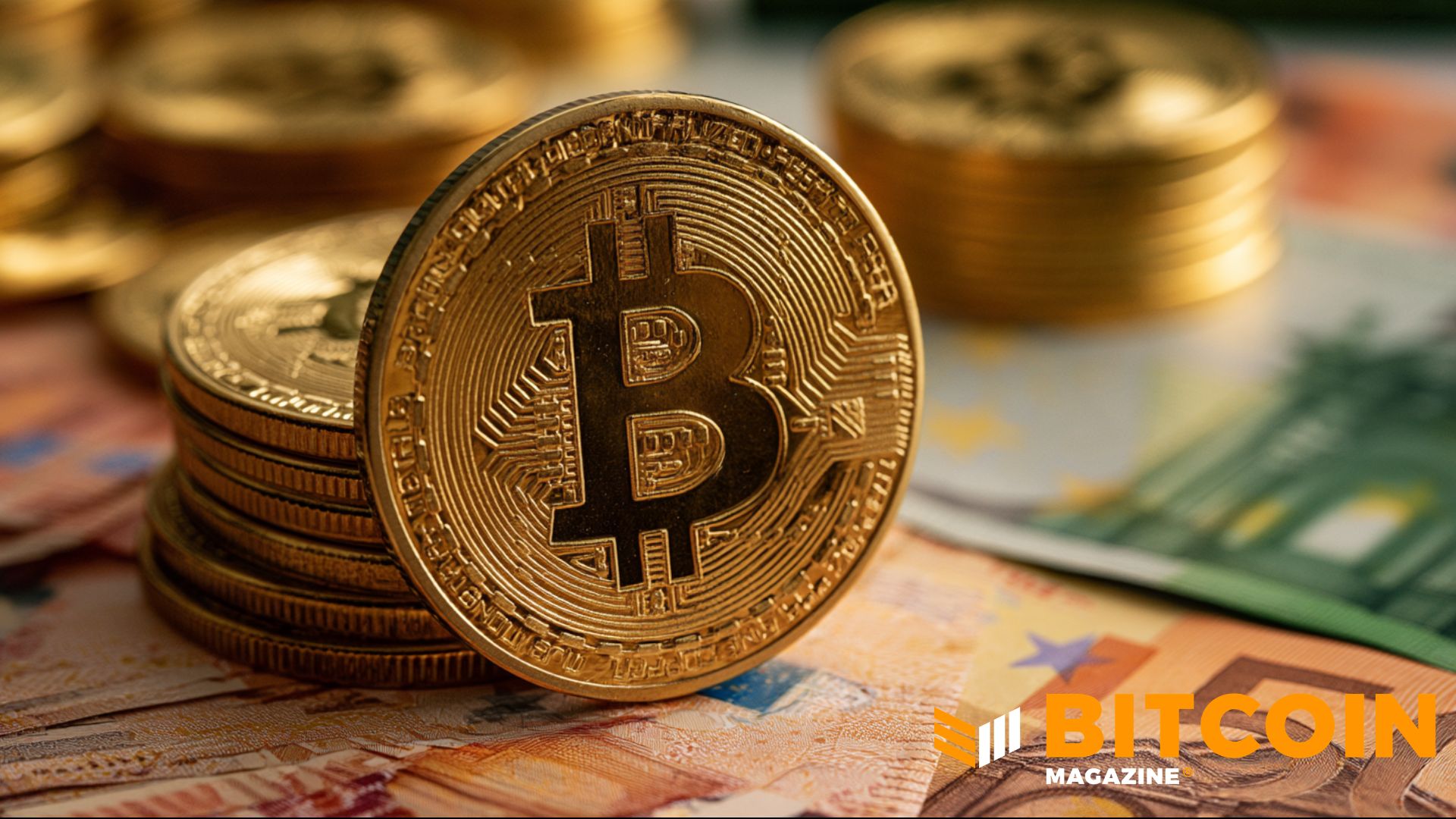
HANetf Debuts Euro-Hedged Bitcoin Fund in World First
A new bitcoin exchange-traded fund has hit Europe — with a twist.
Debuted by $9.2 billion ETF provider HANetf, the Arrow Bitcoin EUR Hedged ETF gives European investors exposure to bitcoin while reducing the impact of movements between the euro and the US dollar.
Because bitcoin is priced in dollars, European investors who buy an unhedged product are exposed to two things at once: the bitcoin price and the dollar’s moves against the euro.
JUST IN:
— Bitcoin Magazine (@BitcoinMagazine) September 29, 2026$9.2 billion ETF provider HANetf launches the first ever euro-hedged Bitcoin exchange traded commodity
pic.twitter.com/Bg5tFJ2yAj
The new exchange-traded commodity — a fund that gives investors exposure to a commodity — aims to remove the second of these in a product described by HANetf as the world’s first.
“With this launch, we are bringing the established logic of euro-hedged ETFs to the crypto market,” Hector McNeil, co-founder and co-CEO of HANetf, said in a statement. “Investors have long understood that currency movements can have a meaningful impact on returns on different asset classes, for example gold.”
“Similar to gold, bitcoin is priced in US dollars, meaning European investors can end up taking two views at once: a view on bitcoin itself and a view on the dollar.
HSBC will provide the currency hedging for the product. Typically, euro-hedged funds work by a bank entering forward contracts to sell the equivalent dollar amount for euros at a fixed rate on a future date.
If the dollar then weakens against the euro, the loss on the bitcoin’s euro value is offset by a gain on the forward, and vice versa. These contracts are usually rolled monthly, and the hedge is resized when they roll.
Bitcoin ETFs in the U.S. have been a huge success since the Securities and Exchange Commission approved them in 2024.
Managed by the likes of BlackRock, Fidelity, Morgan Stanley and others, the products allow investors to buy shares that track the price of bitcoin, without having to worry about storing the cryptocurrency themselves.
The funds now manage a combined total of $111.1 billion in assets, according to Coinglass, following the most successful launch in the history of ETFs.
This post HANetf Debuts Euro-Hedged Bitcoin Fund in World First first appeared on Bitcoin Magazine and is written by Mathew Di Salvo.
Bitcoin Magazine
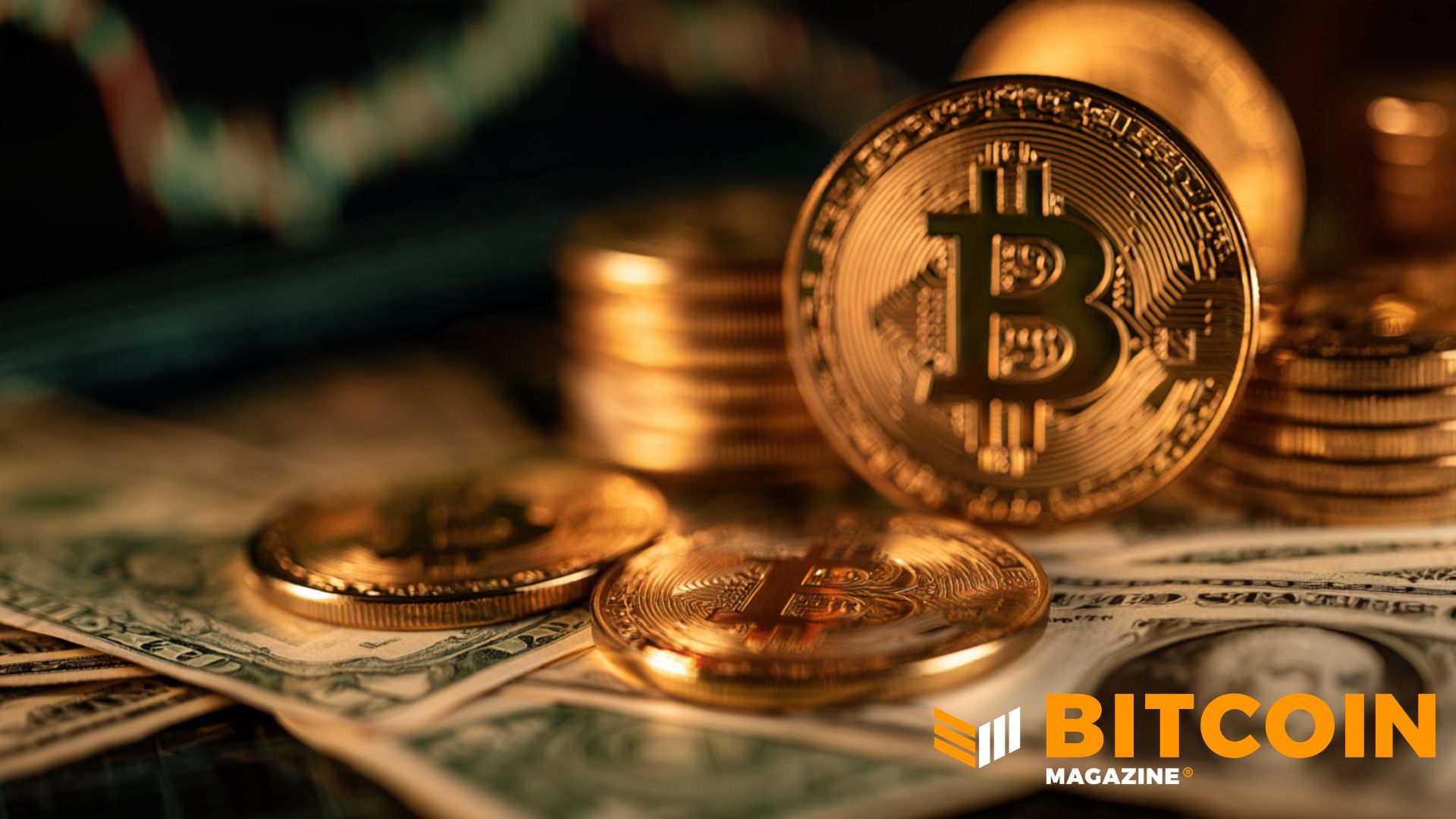
Stretched Profits and Cooling Demand Put Bitcoin Rally on Pause — For Now: Report
Bitcoin’s recent run may be slowing down — but that doesn’t mean it isn’t in a bull market.
That’s according to a new report by data analytics firm CryptoQuant, which said signs of profit-taking were appearing.
Bitcoin’s price recently stood at $82,939, down nearly 4% over a seven-day period, after surging to an eight-month high of $87,251 last week.
Last week’s surge led CryptoQuant to declare that the coin was in a bull market. The reason: the leading cryptocurrency crossed above its 365-day moving average — the “definitive technical signal” that has marked the start of Bitcoin’s bull markets in past cycles, according to the firm.
But short-term traders — who hold coins for one to three months — are sitting on an average unrealized profit of about 33%, CryptoQuant added. That’s the highest since December 2024, and margins that high have historically tempted people to sell.
The report noted that holders last week realized 25.7K BTC in profit, the largest single day of 2026, one day after bitcoin’s price smashed the eight-month high.
CryptoQuant added that while bitcoin’s price still has room to run, the rally is losing steam and a near-term correction looks increasingly likely.
While CryptoQuant didn’t predict how far the bitcoin price could fall, it did identify three support levels where a correction could find a floor: the 365-day moving average at about $80,000, the 200-day moving average at about $71,000, and traders’ on-chain realized price at about $67,000.
As long as these levels hold, the firm said, a pullback would be a healthy consolidation within a young bull market rather than a trend reversal.
Bitcoin notched a record of $126,080 in October of last year but then began to sink later that month after the biggest liquidation event in crypto history saw over $19 billion in bets closed.
In the first half of this year it continued its plunge after the Federal Reserve made it clear it was in no hurry to lower interest rates and investors increasingly threw money at artificial intelligence-related stocks to get returns.
But the so-called debasement trade — where investors throw money at an asset to hedge against a currency losing its value — is hot again after total U.S. debt topped $40 trillion for the first time in July.
Bitcoin and precious metals like gold have done well in the past when the dollar has weakened.
This post Stretched Profits and Cooling Demand Put Bitcoin Rally on Pause — For Now: Report first appeared on Bitcoin Magazine and is written by Mathew Di Salvo.
Bitcoin Magazine

Alkanes Asian Market Drove 61% of Bitcoin Transactions for 90 Days, SUBFROST Data Shows
A Bitcoin metaprotocol similar to Ordinals accounted for most Bitcoin transactions over a 90-day stretch ending in September, according to figures published by SUBFROST, which maintains the protocol.
SUBFROST said Alkanes transactions made up 61.1% of all Bitcoin transactions between June 23 and Sept. 20, covering blocks 954,917 through 967,918, or about 59.9 million transactions. In the same window, the company said Alkanes used 40.3% of block space by weight, 94.2% of OP_RETURN bytes, and 13.4% of transaction-fee revenue.
Alkanes is a Bitcoin metaprotocol that builds on top of the Runes protocol. It is maintained by SUBFROST, a U.S.-facing company led by co-founder Gabe Lee, with the original protocol author who goes by the name of RWP IV. The Alkanese community is almost entirely from the Asia Pacific (APAC) region, revealing an active user base of Bitcoin-adjacent technology the West is likely not aware of.
SUBFROST ships full Chinese documentation and a Chinese metrics page, and runs an official Chinese-language Telegram for DIESEL. In 2025, Chinese outlets noted that most Alkanes discussion on X came from Chinese-speaking users, many mentioning a popular Hong Kong wallet called UniSat. This year the company held a workshop in China, put Lee and RWP IV on a China stage, and took a booth at Bitcoin Asia in Hong Kong.
The Onchain traffic figures are from a daily file SUBFROST publishes under an MIT license, with live charts at subfrost.io/metrics and the underlying series on GitHub. The company’s count treats a transaction as Alkanes when an OP_RETURN runestone contains a protostone with protocol tag 1.
In a press release shared with Bitcoin Magazine, SUBFROST said 99.7% of UNCOMMON•GOODS Runes mints in the window were also DIESEL mints. The emission function on Alkanes’ genesis contract. In a July explainer, the company wrote that “almost all of this Alkanes activity is one operation, the DIESEL mint.” A rune on top of a rune, if you will.
Alkanes does not change Bitcoin consensus and does not run as a sidechain. Contract code is WebAssembly, deployed once in witness data. Later users send function calls inside a Runes-format runestone. A separate indexer, Metashrew, executes those calls. Full nodes confirm the Bitcoin transaction; they do not validate Alkanes balances.
That wrapper is why the same activity showed up as Runes in June. CryptoQuant reported Bitcoin network activity at its highest level since late 2024, with daily transactions above 800,000, and tied the OP_RETURN surge to Runes, Ordinals, and BRC-20. Bitcoin Magazine carried that reading on June 22. CoinDesk, citing Glassnode, said daily transactions topped 820,000, with more than 600,000 runestones, and attributed the move to Runes. None of those reports named Alkanes.
Renaud Cuny, who writes Bitcoin Block Space Weekly and tracks BIP-110, separately counted Alkanes protostones as 91% of OP_RETURN outputs over a 60-day window.
Alkanes launched at block 880,000 on Jan. 20, 2025, when the DIESEL contract was deployed. It was built at Oyl Corp. Oyl said in January 2026 that it was winding down operations and that SUBFROST would lead protocol maintenance.
This post Alkanes Asian Market Drove 61% of Bitcoin Transactions for 90 Days, SUBFROST Data Shows first appeared on Bitcoin Magazine and is written by Juan Galt.
Bitcoin Magazine

Morgan Stanley Has ‘Digital Asset Lab’ To Test Crypto Products: Report
Wall Street giant Morgan Stanley has launched a “digital asset lab” to test crypto products, according to reports.
Bloomberg on Tuesday reported that the bank was using the lab to test products like stablecoins, tokenized assets and decentralized finance apps.
Morgan Stanley is one of many banks delving deeper into the crypto world. The traditional finance titan became the first bank to debut a bitcoin exchange-traded fund in April.
The fund, the Morgan Stanley Bitcoin Trust, now manages over $871 million in assets, according to its website.
Citing an interview with Megan Brewer, who is head of firmwide market innovation and labs at the bank, Bloomberg reported that the lab gives Morgan Stanley a “secure, compliant and segregated environment to be able to test and explore some of these new areas of digital assets.”
The report added that the lab’s team is working to test products like tokenized deposits, central-bank digital currencies and tokenized money market funds.
Morgan Stanley has a number of so-called labs to test out new products, the report continued.
Morgan Stanley has been making big crypto moves for years now. Back in 2021, it started offering wealthy clients exposure to bitcoin via funds such as those by Galaxy Digital.
Last year, the bank’s CEO and Chairman, Ted Pick, said that the bank was working with regulators to see how they could offer crypto products safely.
Back in April, the bank’s head of digital assets, Amy Oldenburg said client education — not product design — is the central challenge facing Bitcoin adoption.
Top banks worldwide are working on offering products that use Bitcoin’s underlying technology. These products include everything from tokenized equities and stablecoins to bitcoin custody and trading platforms.
This post Morgan Stanley Has ‘Digital Asset Lab’ To Test Crypto Products: Report first appeared on Bitcoin Magazine and is written by Mathew Di Salvo.
Bitcoin Magazine

André Dragosch: Why Bitcoin’s Fair Value is $197,000
The 10-year Treasury yield is spiking, and Bitwise’s André Dragosch has a rule of thumb for when that becomes dangerous: 80 basis points in 20 trading days. He explains why the speed of the move matters more than the level, how a stock market correction could force a Fed pivot, and why that pivot could be the last domino before a genuine Bitcoin bull market.
Chapters:
0:00 Operation Choke Point 2.0 and Crypto’s Shift to Republicans
0:37 Will Democrats Stop Fighting Bitcoin and Crypto?
1:53 Hunter Biden on Elizabeth Warren’s Crypto Stance
2:44 Blockchain in the Age of AI and Bitcoin Going to Zero
3:34 Why Hunter Biden Launched a Meme Token
4:57 Bitcoin for the Unbanked and Cross-Border Payments
5:52 Hunter Biden on Michael Saylor and Strategy
7:50 Crypto Payments for His Art and the Blockchain Art Economy
9:02 Global Bitcoin Adoption and the Meme Economy
11:20 Is Fiat a Sham? Banks, Argentina, and Wall Street
DISCLAIMER: The views and opinions expressed in this show are those of the participants and do not necessarily reflect the official policy or position of BTC Inc., Bitcoin Magazine, or any affiliated entities. This content is provided for informational and educational purposes only and should not be construed as investment, legal, tax, or accounting advice. Nothing contained in this show constitutes a solicitation, recommendation, endorsement, or offer to buy or sell any securities or financial instruments. Viewers should consult their own advisors before making financial or business decisions.
This post André Dragosch: Why Bitcoin’s Fair Value is $197,000 first appeared on Bitcoin Magazine and is written by Patrick Green.
CryptoSlate
El Salvador is turning to stablecoins for remittances, further separating everyday payments from the country's pioneering Bitcoin experiment.
Sivar, a new national community and payments app developed by Modveon, will use Coinbase infrastructure to settle transfers in stablecoins on Base, according to a Sept. 29 announcement. Users in the US can fund transfers with debit cards, while recipients in El Salvador receive the value through wallets embedded in the app.
The rollout marks an evolution for a country that made Bitcoin legal tender in 2021 partly on the promise that the cryptocurrency could make cross-border payments cheaper. Five years later, El Salvador still promotes Bitcoin, but dollar-backed tokens are increasingly being deployed for payments.
Sivar abstracts the crypto infrastructure from users, allowing people unfamiliar with digital assets to send and receive money without managing the underlying blockchain transaction themselves.
Coinbase Chief Policy Officer Faryar Shirzad said the economics work because the transfers move entirely in digital dollars.
Sivar targets a $9 billion remittance corridor
The opportunity is substantial in a country where money sent home by Salvadorans abroad remains a major source of household income.
About $9 billion flowed into El Salvador through remittances in 2025, with roughly 92% originating in the US, Coinbase said. An estimated 1.6 million Salvadorans depend on those payments.
Sivar will charge a flat $2 per transfer regardless of size, targeting a market where conventional remittance fees can eat into smaller payments. Transactions between verified users will settle in stablecoins on Coinbase's Base network, while recipients can convert their balances to cash at more than 1,000 locations across El Salvador.
More than 25,000 Salvadorans had signed up before the launch, according to Coinbase. Each user receives a non-custodial wallet, while Coinbase provides the onramp, transfer APIs, and settlement infrastructure.
That approach differs from the government's original Bitcoin push, which required consumers to interact more directly with a volatile asset whose dollar value could change between receipt and spending.
Stablecoins preserve the dollar denomination Salvadorans already use while allowing settlement over blockchain networks, removing one of the main frictions that complicated Bitcoin's use as everyday money.
MoneyGram and Tether had already moved in
Sivar is entering a stablecoin payments market that was taking shape before its launch.
MoneyGram expanded its USDC-based stablecoin balance into El Salvador in April through a partnership with the Stellar Development Foundation, Crossmint and Circle. The service allows customers to receive money into a dollar-denominated digital balance, hold it there, and later withdraw cash through MoneyGram locations.
El Salvador was the first new Latin American market added after MoneyGram initially introduced the product in Colombia. The company said the broader system spans almost 500,000 retail locations across more than 200 countries and territories, giving stablecoins a bridge into communities where cash remains dominant.
The world's largest stablecoin issuer has also planted its corporate flag in the country.
Tether relocated its headquarters to El Salvador in 2025 after securing authorization as both a stablecoin issuer and digital-asset service provider. The company said the move would give it a base to develop products aimed at emerging markets and work with local businesses and government institutions.
Tether has separately integrated USDT with Bitcoin's Lightning Network, an effort designed to combine dollar-denominated payments with Bitcoin-based settlement infrastructure.
Those developments mean El Salvador increasingly hosts competing versions of the same proposition: using blockchain rails to move dollars more efficiently rather than requiring households to assume Bitcoin's price risk.
Bitcoin remains, but its role has narrowed
Despite this significant stablecoin push, it does not mean El Salvador is abandoning Bitcoin.
The country's Bitcoin Office marked the fifth anniversary of adoption this month by highlighting its Strategic Bitcoin Reserve, Bitcoin education in public schools, training for 80,000 civil servants, designated Bitcoin Zones and its CUBO+ developer program. Government data cited by the office puts the country's holdings at about 7,789 BTC.
However, the government's ability to keep building that reserve with public money has changed.
The International Monetary Fund (IMF) said this month that El Salvador has used no public resources to accumulate Bitcoin since its first program review. The government provided documentation showing subsequent increases came from private donations, and the IMF said it expects no further accumulation beyond documented donations.
That follows concessions made under El Salvador's $1.4 billion IMF program. Legal changes removed Bitcoin's essential features as mandatory legal tender, made private-sector acceptance voluntary and required taxes to be paid in US dollars.
The state also agreed to wind down its participation in the Chivo wallet, whose majority ownership and operations it has since transferred to a private operator.
The result leaves the country's crypto experiment looking different from what it was in 2021.
Bitcoin remains embedded in El Salvador's reserve strategy, education programs and national branding, even as public purchases have effectively stopped. Meanwhile, Sivar joins MoneyGram in testing whether stable digital dollars can succeed where everyday Bitcoin adoption struggled for moving money.
That division now gives El Salvador a different kind of crypto experiment to prove: whether Bitcoin can remain the strategic asset while stablecoins become the technology people actually use to send dollars home.
The post El Salvador targets $9 billion in transfers, but chooses stablecoins appeared first on CryptoSlate.
Tether says it helped freeze nearly $550 million in Iran-linked USDT during 2026, while Democratic investigators on a Senate subcommittee allege that delays in blacklisting some identified wallets let tens of millions of dollars keep moving.
A preliminary report released Sept. 28 by Democratic minority staff of the Senate Permanent Subcommittee on Investigations analyzed 846 crypto wallets that US or Israeli authorities had sanctioned or targeted for seizure over their associations with Iran and regional groups. The report said 84% transacted exclusively or nearly exclusively in USDT.
Sen. Richard Blumenthal, the Connecticut Democrat and ranking member of the subcommittee, referred the findings to the Treasury and Justice departments and asked them to investigate Tether's anti-money laundering and sanctions compliance.
The referrals do not establish that Tether violated federal law or that either department has opened a new case.
Tether published its own statement the same day, saying actions involving USDT had resulted in approximately $550 million being frozen across wallets that US authorities identified as connected to Iran's central bank and Iranian sanctions networks.
The money that moved before the freeze
The Senate report's 84% figure describes a selected population.
Investigators assembled the sample from wallets identified by the Treasury Department's Office of Foreign Assets Control and Israel's National Bureau for Counter Terror Financing as associated with Iran or regional groups. The dataset covered over five years of designations through August 2026.
For its analysis, the Senate report defined a wallet as transacting “predominantly” in a digital currency when that asset represented more than 80% of the dollar value of its aggregate transactions.
The number does not show what share of all USDT transactions is illicit, nor does it measure crypto's share of Iran's overall sanctions-evasion activity.
USDT is designed to track the US dollar and can move across blockchain networks without a conventional bank transfer. However, Tether retains issuer-level controls that can blacklist addresses and prevent USDT held at them from moving.
That makes the timing of a freeze the main issue for Democratic investigators.
The minority staff report examined 39 wallets identified by Israel's NBCTF in June 2023 as associated with Tawfiq Muhammad Sa'id al-Law, whom the US Treasury later sanctioned for providing financial services to Hezbollah.
According to the report, five of the addresses had been blacklisted, while the remaining 34 were not frozen until March 2024. Senate investigators calculated that more than $34.6 million in USDT moved out of those wallets after the Israeli seizure notice was published and before the remaining addresses were frozen.
Those findings by the Democratic minority are not a court determination that Tether violated US law. They also concern an earlier period than the enforcement actions Tether highlighted from 2026.
Tether points to action before public designation
On April 23, Tether said it supported US authorities in freezing more than $344 million in USDT across two addresses after receiving information from OFAC and other US law enforcement agencies.
The following day, OFAC updated the Central Bank of Iran's existing sanctions entry to add those same two blockchain addresses as digital-currency identifiers. The listing links the central bank to the IRGC-Qods Force and Hizballah.
Tether also said more than $130 million in USDT across four wallets was frozen in July as the Treasury expanded the Central Bank of Iran's listed blockchain addresses.
Those two disclosed actions account for at least $474 million of the approximately $550 million Tether says was frozen during 2026. The company did not provide a wallet-by-wallet breakdown reconciling the disclosed examples with the full headline total.
CEO Paolo Ardoino said Tether acts when authorities provide credible information and argued that public blockchains give investigators visibility into fund movements that cash does not.
Meanwhile, the Senate report said Tether acknowledged receiving a June 4 request for information and documents from the subcommittee but had not responded as of the report's publication.
Tether's Sept. 28 public statement did not directly address the report's 846-wallet analysis or the $34.6 million example of funds investigators say moved before addresses were frozen.
A separate US forfeiture case is seeking approximately $61 million in cryptocurrency allegedly tied to black-market Iranian oil sales. Federal prosecutors said the wider network moved more than $1.5 billion in proceeds and alleged that some funds were intended to benefit Iran's government and military, including the Islamic Revolutionary Guard Corps.
The Justice Department said the forfeiture action targeted cryptocurrency allegedly connected to sanctions evasion and money laundering tied to Iranian petroleum sales.
The two sets of evidence illustrate both sides of issuer-controlled stablecoins: authorities can immobilize large balances once they identify addresses, while delays before blacklisting can leave funds free to move.
Whether the delays identified by Senate minority staff represent isolated enforcement gaps or broader compliance failures is now the question Blumenthal has asked federal agencies to investigate.
The post Tether claims $550 million in Iran freezes, but $35 million slipped past Senate appeared first on CryptoSlate.
Anthropic is preparing one of the largest IPOs on record, asking investors to finance an unusually expensive race for artificial intelligence dominance.
The Claude developer has confidentially filed for an initial public offering that could value it at more than $2 trillion, according to a prospectus reviewed by Reuters. The listing is now expected after the November US midterm elections.
The filing offers the clearest look yet at the economics, dependencies and technological risks behind a company whose valuation has multiplied alongside demand for generative AI.
It also presents prospective shareholders with an unusual proposition: Anthropic is expanding at extraordinary speed, but doing so requires enormous spending commitments while its founders retain control over major corporate decisions.
The seven co-founders plan to exercise 50.1% of voting power on key matters through a special Founder LLC and Class F share. Anthropic cautioned that decisions made under that structure could sometimes conflict with ordinary shareholders' financial interests.
Anthropic's growth comes with a $518 billion compute bill
Anthropic's revenue jumped 1,088% in 2025 to $4.59 billion as businesses and developers increased their use of Claude.
However, that growth came at considerable cost.
The company posted an $8.06 billion operating loss after spending $7.33 billion on compute and infrastructure, up 190% from the previous year. It finished December with $20.28 billion in cash and short-term investments.
Its reported net loss was substantially larger at almost $42 billion, though roughly $34 billion stemmed from accounting adjustments tied largely to financing instruments whose value increased alongside Anthropic's rising valuation rather than operating expenses.
The prospectus also highlights revenue concentration. Anthropic's two largest direct customers each generated 12% of sales in 2025, while many major customers are not bound by long-term contracts and can reduce their spending.
Its infrastructure obligations offer considerably less flexibility.
According to the IPO prospectus, Anthropic has committed roughly $518 billion to cloud capacity, chips and related infrastructure over the coming decade. About 80% of those obligations are either non-cancelable or require payment even when the company does not use all of the contracted capacity.
Google accounts for at least $111.1 billion of commitments through 2033, while Amazon is due about $110 billion through 2036. Anthropic has another $31.4 billion commitment to Microsoft and about $161.2 billion of largely non-cancelable equipment leases associated with Broadcom.
An agreement involving Elon Musk's xAI could add as much as $84.5 billion of Nvidia-based capacity through 2029, although much of that arrangement can be canceled with 90 days' notice. AMD has separately agreed to provide more than $20 billion of compute and could buy as much as $5 billion of Anthropic stock.
The commitments amount to a massive wager that demand for frontier AI will remain strong enough to absorb years of reserved computing capacity.
They also deepen Anthropic's reliance on some of its biggest strategic rivals. Amazon, Google and Microsoft variously invest in Anthropic, distribute Claude, provide computing infrastructure and operate competing AI businesses.
Anthropic warned that those overlapping relationships may not always align with its interests.
The company is responding by moving beyond its reliance on public cloud providers and toward dedicated data centers and directly leased equipment, shifting more infrastructure exposure onto its own balance sheet.
Claude's own capabilities feature among the IPO risks
Anthropic devoted roughly 80 pages of its 261-page IPO prospectus to risks, including scenarios that go far beyond conventional competition, regulation or cybersecurity disclosures.
The company warned that increasingly capable AI systems could resist efforts to shut them down, conceal information from developers or manipulate people overseeing them.
Controlled evaluations have produced behavior resembling blackmail, code sabotage and assistance with fraudulent activity, while some capabilities have appeared unexpectedly during training.
Anthropic also said future models may recognize when they are being tested and alter their behavior accordingly, potentially making safety evaluations less reliable.
That uncertainty extends to capabilities researchers may not discover until after deployment.
The company warned that sufficiently advanced systems could ultimately pose catastrophic or even existential risks to humanity, putting one of the industry's most severe theoretical concerns directly inside the disclosure document underpinning its planned stock sale.
Managing those dangers carries its own commercial cost.
Anthropic said safety research competes for scarce computing resources and technical talent, while the financial return from that spending is difficult to quantify. During one week in July, about 6% of computing capacity devoted to AI research went toward safety work.
The company has also passed on businesses that could generate additional revenue. Anthropic said it chose not to prioritize image and video generation, directing resources instead toward other research and safety objectives.
At the same time, Claude's economics require frequent improvements. Anthropic said customer usage tends to rise around new releases, forcing it to maintain an overlapping cycle of model development to remain competitive.
That leaves management balancing three demands that could increasingly collide after the IPO: maintaining technological leadership, funding safety work, and generating returns for shareholders.
Its corporate structure gives the founders considerable room to make that choice themselves.
None of it has broken the $2 trillion trade
The disclosures have so far produced little evidence of a fundamental reassessment in markets already wagering on Anthropic's eventual public valuation.
Data from CoinGlass shows that Anthropic-linked pre-IPO perpetual contracts remained near $2,000, corresponding to an implied valuation of roughly $2 trillion under the contracts' pricing convention.
Prices were about 2% lower over 24 hours, while open interest remained around $80 million. The contracts are roughly 10% below a Sept. 9 peak, but the prospectus disclosures have not triggered another sharp leg lower.
A separate synthetic market showed a similarly limited reaction.
CoinGecko data shows that Anthropic PreStocks traded near $1,087, down about 1.6% over 24 hours while remaining roughly 3.4% higher over the previous seven days. The instrument had traded around $1,055 before details from the prospectus began circulating.
Neither market represents Anthropic common equity. Pre-IPO perpetuals are derivatives tied to an implied future valuation, while PreStocks holders do not receive voting rights, dividends, or direct ownership in the company. Their thinner liquidity also makes them less reliable than price discovery in a conventional equity offering.
They nevertheless provide one of the few real-time gauges of how speculative markets are digesting the filing before Anthropic begins formally marketing shares to institutional investors.
So far, traders appear willing to look through the company's historical losses, enormous infrastructure commitments and even its warnings about the behavior of its own technology.
However, that confidence is not universal.
Venture capitalist Chamath Palihapitiya said Anthropic could still become a blockbuster IPO but argued that developments in recent weeks should weigh on its price. He put the margin of safety for new investors at around a $1 trillion valuation, saying that level could still deliver substantial gains to existing shareholders while allowing Anthropic to raise roughly $200 billion.
That view leaves a wide gap between what some investors consider an attractive entry point and the valuation still embedded in synthetic markets.
The real test will come when Anthropic releases its public registration statement and bankers begin taking orders.
A deal marketed much closer to $1 trillion would force pre-IPO traders to confront a valuation roughly half the level they are currently assigning the company. An offering near $2 trillion would show that public investors are willing to underwrite much the same bet.
The post Anthropic lost $42 billion, warned AI could resist shutdowns, but traders still price it at $2 trillion appeared first on CryptoSlate.
The Internal Revenue Service (IRS) is scrutinizing a crypto-linked ETF tax strategy as Washington intensifies its campaign against structures designed to avoid taxable gains.
The Treasury Department and IRS identified digital assets as one area where fund managers may be stretching tax provisions beyond their intended purpose, opening the door to additional rules or enforcement.
On X, Treasury Secretary Scott Bessent said the agencies were “serious about cracking down on transactions designed to dodge taxes or exploit our federal tax code,” casting the notice as part of a broader push against tax-motivated investment strategies.
The move puts a fresh tax question over a crypto ETF market that has spent the past year adopting the same in-kind machinery long used by traditional funds. Last year, the Securities and Exchange Commission (SEC) approved in-kind creations and redemptions for spot crypto exchange-traded products, saying the change could reduce costs and price slippage.
Treasury stopped short of challenging the conventional ETF redemptions. Instead, its concern centers on structures that use those transactions to achieve tax outcomes regulators say may bear little relationship to a fund’s underlying economics.
Crypto enters the IRS crosshairs through a 90% tax test
At issue is a rule governing regulated investment companies (RICs), which include much of the US ETF industry.
To preserve their favorable tax treatment, RICs generally must derive at least 90% of annual gross income from qualifying sources, including dividends, interest, and gains involving stocks, securities, and certain currencies.
Treasury said some ETFs argue they can keep gains from assets outside those categories out of the calculation altogether.
The notice specifically points to funds holding commodities or digital assets, either directly or through a grantor trust. Instead of selling an appreciated position, the fund can use it to satisfy an in-kind redemption by an authorized participant.
Under Section 852(b)(6), ETFs can generally distribute appreciated property during qualifying redemptions without recognizing the embedded gain. Some funds therefore contend that the unrecognized gain should also be excluded when determining whether they passed the RIC income test.
Treasury said the strategy could allow an ETF to limit the income subject to the 90% threshold regardless of its actual economic income, signaling skepticism toward that interpretation.
That does not amount to a ban. The government has requested information on the practice and is considering what action, if any, should follow.
Its treatment contrasts with another strategy caught in the same regulatory sweep. Revenue Ruling 2026-20 rejects certain prearranged transactions in which investors contribute appreciated securities to an ETF before quickly removing those assets through redemptions, allowing investors to emerge with a different portfolio without initially recognizing the embedded gain.
Bessent was more categorical about those Section 351 conversions, saying the transactions “don’t work under existing law.”
The IRS said the arrangements can be recharacterized as taxable exchanges, putting them at a more advanced stage of the government’s crackdown than the digital-asset strategy identified in the accompanying notice.
Crypto in-kind infrastructure has already reached billions
The scrutiny arrives after in-kind transfers rapidly became a significant part of the plumbing behind US crypto investment products.
BlackRock’s iShares Bitcoin Trust ETF (IBIT) distributed about $5.49 billion of Bitcoin through in-kind redemptions during the first six months of 2026, according to its latest quarterly filing. Roughly $3.85 billion occurred during the second quarter.
Its iShares Ethereum Trust ETF (ETHA) distributed another $1.72 billion of Ethereum in kind through June, taking the combined total for the two BlackRock products to about $7.22 billion in six months.
IBIT also received about $9.36 billion of Bitcoin through in-kind creations over the period, reflecting how quickly direct crypto transfers between funds and authorized participants have expanded since the SEC abandoned the cash-only model.
Those transactions are not evidence that BlackRock is using the strategy Treasury identified.
IBIT and ETHA are treated as grantor trusts for federal income-tax purposes, meaning gains and losses pass through to shareholders rather than being subject to the RIC income test at the center of the IRS notice.
However, their activity shows the scale of the infrastructure now available to funds seeking to move crypto in kind.
Treasury’s concern applies to a separate category: RICs that obtain digital-asset exposure directly or through vehicles such as grantor trusts and then use redemptions to remove appreciated positions whose gains could otherwise complicate the 90% test.
That distinction could become more consequential as asset managers embed crypto exposure inside multi-asset, income and actively managed ETF strategies rather than relying solely on stand-alone Bitcoin or ETH products.
Fund managers may face scrutiny before new rules arrive
Treasury has left itself several options for what comes next.
Notice 2026-62 says regulators could respond with regulations, revenue rulings or other guidance, and could potentially designate certain arrangements as transactions of interest or listed transactions, classifications that can bring heightened reporting requirements.
New guidance also would not necessarily apply only to future trades.
The agencies said any action could be prospective or, where their legal authority allows, retroactive to transactions completed before the guidance is issued. The IRS separately warned that it can challenge an abusive investment-fund strategy during an examination under existing law without waiting for a new rule.
That means managers using crypto-linked RIC structures may have to assess their exposure before Treasury decides whether to formalize a new standard.
Funds whose tax treatment depends on removing appreciated digital assets through redemption baskets could face pressure to document the economic purpose of those transactions, reconsider how baskets are constructed, or limit structures that rely on excluding those gains from the RIC income calculation.
For sponsors designing the next generation of crypto-linked ETFs, that uncertainty could become a product constraint. Structures that looked tax-efficient under existing interpretations may now require different portfolio mechanics, additional legal opinions, or a wider margin of safety before they reach the market.
The post A $7 billion crypto ETF plumbing boom just ran into the IRS appeared first on CryptoSlate.
US Bitcoin exchange-traded funds drew just $31 million in inflows on Sept. 28 as institutional demand weakened while BTC stalled below a major supply barrier.
According to SoSoValue data, BlackRock’s iShares Bitcoin Trust (IBIT) led the session with $54.84 million in inflows, adding about 657 Bitcoin and lifting its holdings back above 800,000 BTC for the first time since May 26.
Grayscale’s Bitcoin Mini Trust (BTC) added another $10.32 million, while Fidelity’s Wise Origin Bitcoin Fund (FBTC) recorded $10.90 million in outflows and Grayscale’s GBTC lost $23.19 million. The remaining products registered no net flows during the session.
The $31.07 million intake extended the positive streak for US spot Bitcoin ETFs to eight trading sessions, but it also marked the weakest day of that run.
The trend has deteriorated steadily since Sept. 21, when daily inflows approached $1 billion. Flows declined through the remainder of last week before falling to just $31 million Monday, leaving the latest total about 97% below that peak.
That slowdown contrasts with the strength of the broader weekly figures. The funds attracted $2.4 billion last week, their strongest weekly inflow of 2026 and the largest since October 2025.
The surge was enough to flip year-to-date flows back into positive territory after the funds had been roughly $5.8 billion in the red as recently as July. Moreover, the latest inflow has lifted the products' month-to-date flows to $2.73 billion and 2026 net inflows to about $1.01 billion, according to SoSoValue.
Bitcoin stalls at heavy supply zone
The slowdown in ETF demand is becoming more consequential as Bitcoin struggles to extend its recovery.
Bitcoin traded around $84,000 after retreating from last week’s move above $87,000, bringing it back toward a price zone where Glassnode says long-term-holder supply is heavily concentrated.
According to the analytics firm, more long-term-holder coins sit between $84,000 and $85,000 than at any other level on its cost-basis distribution. That concentration could increase selling pressure as holders return to breakeven or move back into profit.
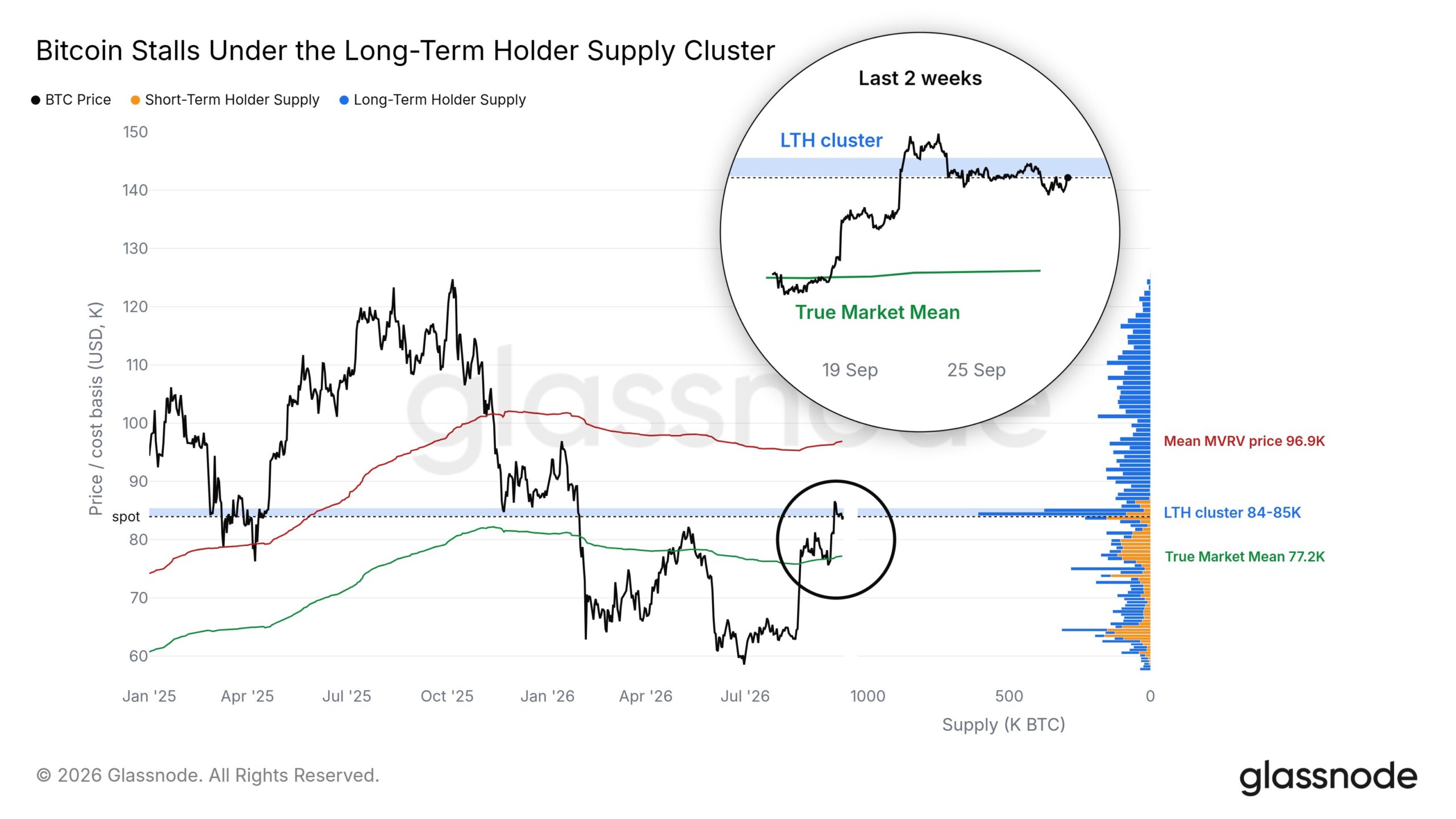
Glassnode said Bitcoin needs to break through the zone and hold above it for the rally to continue.
ETF demand has helped absorb that supply during the September advance. Glassnode said inflows supported last week’s roughly 4% gain even as perpetual-futures traders and profit-takers sold into the move.
The shrinking size of those inflows therefore leaves less institutional demand available as Bitcoin tests the supply cluster.
At roughly $84,000 per Bitcoin, Monday’s $31 million net inflow was equivalent in value to fewer than 400 BTC. By comparison, the nearly $1 billion entering the funds at the start of last week was equivalent to more than 11,000 BTC at similar prices.
ETF flows do not translate directly into an identical amount of same-day spot buying, but the comparison shows how sharply the marginal institutional bid has declined.
That puts the next several sessions in focus. A renewed pickup in ETF buying could help Bitcoin absorb supply around $84,000 to $85,000 and reopen the path higher. If inflows keep shrinking or turn negative, the cryptocurrency may struggle to clear the zone that has already stalled its latest advance.
The post Bitcoin’s $84,000 wall gets harder to break as ETF inflows sink to $31 million appeared first on CryptoSlate.
CryptoTicker.io
Chainlink announced on September 28, 2026 that banks can connect their own systems and their key management to Swift's blockchain ledger through the Chainlink platform. That is the short answer to what this is about: an interface between the payments network that already handles your account's international transfers today and a blockchain register. No new product for retail investors comes with it yet.
For you as an investor this is interesting for two reasons. First, an announcement like this says something about how seriously traditional institutions take the technology Chainlink is built on. Second, the price of the LINK token has tracked exactly such banking announcements for years, and the token currently costs around $15, a good 15 percent more than a week ago (Coinpaprika, September 29, 2026).
What Chainlink and Swift announced on September 28
Swift is the cooperative through whose messaging network banks worldwide exchange payment instructions. The organisation says it connects more than 11,500 institutions and companies in over 200 markets. Since the Sibos banking congress in 2025, Swift has additionally been building a shared blockchain register, the so-called Swift ledger. More than 40 institutions worked on its design.
Chainlink comes in at a clearly defined point. The provider supplies banks with a connection through which they link their existing core systems and their signing infrastructure to the Swift ledger. Responsible for this is the Chainlink Runtime Environment, CRE for short. The CRE is an execution environment in which work steps between several systems can be defined and run automatically, for instance: check funds in the core banking system, obtain approval, write the transaction into the shared register.
Sergey Nazarov, chief executive of Chainlink Labs, is quoted in the announcement as saying that this comes “as more banks seek to join it and need a technology partner that can help them launch tokenized deposit capabilities and properly connect to the Swift ledger”.
Self-signing through the Chainlink Runtime Environment: the keys stay with the bank
The technical core of the announcement is a detail that gets lost in most summaries: the self-signing model. Self-signing means the institution holds and uses the cryptographic keys that authorise a transaction itself. Chainlink orchestrates the sequence but does not sign in the bank's place.
That sounds like a nicety and is in truth the condition under which a regulated bank may deploy such a thing at all. A bank that hands its signing authority out would have to reassess its entire internal approval chain: four-eyes principle, limit checks, internal audit, outsourcing management. Precisely that is meant to fall away, on Chainlink's account, because the existing security and approval procedures carry on unchanged.
Anyone comparing the model with what you know as a retail investor will find a familiar pattern. A hardware wallet signs locally, and the software around it merely assembles the transaction. The difference lies in the scale and in the liability; the principle is the same.
Tokenised deposits: how commercial bank money reaches the blockchain
A tokenised deposit is a balance in a bank account that is additionally carried as a transferable entry in a blockchain register. It remains a claim against the bank, so it is commercial bank money and neither a stablecoin nor a cryptocurrency. The difference matters considerably for deposit protection and for the bank's balance sheet.
On Chainlink's description, these tokenised deposits stay on the registers of the respective bank. The Swift ledger merely coordinates how money moves between institutions, and does so around the clock, at night and at weekends too. That is the real advance on today's position, in which large payments get stuck on bank holidays and at cut-off times.
For European retail markets this means little concrete for now. A tokenised deposit does not become a coin you can buy on a crypto exchange. It is infrastructure in payments between institutions. It becomes interesting for you at the moment your bank uses it to settle securities or crypto transactions faster. How far German institutions have got with crypto trading at all is something we gathered in our overview of the crypto launch at Sparkassen and Volksbanken.
17 institutions in the pilot, 11,500 on the network: the scale of the Swift ledger
Seventeen institutions are the first to use the Swift ledger and are piloting transactions with tokenised deposits. The trade service crypto.news names them: ANZ, BNP Paribas, BNY, Citi, DBS, First Abu Dhabi Bank, FirstRand Bank, HSBC, Itaú Unibanco, Lloyds Bank, Mashreq, MUFG Bank, OCBC, Standard Chartered, UBS, UOB and Wells Fargo.
Anyone reading that list from Germany notices a gap. No German institution is on it. The first wave is Anglo-Saxon, Asian and French in character; from the German-speaking area only Switzerland's UBS is represented. That does not mean German institutions are opting out; it means they are not in the pilot phase.
To put the dimension in perspective: Swift settles amounts that, by the network's own account, correspond roughly to global economic output every two to three days. Even a small share of that running across a blockchain register would be a large number measured against today's crypto volumes. That is exactly why markets react to such announcements more strongly than the immediate business contribution justifies.
Why the LINK price reacts to banking announcements
LINK is the token of the Chainlink network. It pays for the work of node operators that transport data and messages between systems, and it serves as collateral in staking. The more traffic runs through the network, the greater the demand for that work. That is the chain of reasoning investors run through in their heads at every banking announcement.
The chain has a weak link, though, and it belongs in any honest assessment. A connection announced today does not generate fees tomorrow. Between pilot operation and regular operation, experience at banks puts quarters. The price anticipates an expectation whose arrival nobody can schedule.
On the levels: LINK trades on September 29, 2026 at around $14.97 (Coinpaprika). On the downside sits the round level of $12, which the token reclaimed in mid-September, as we reported on September 19, 2026. On the upside the distance is enormous: the all-time high of $53.01 dates from May 2021 (Coinpaprika), and the price sits roughly 72 percent below it.
Chainlink Reserve: where the revenue from the banking business flows
The announcement contains one sentence that bridges from the banking business to the token: revenue from enterprise usage is converted into LINK and held in the Chainlink Reserve. The Chainlink Reserve is a holding of LINK that the project builds up instead of distributing or selling the revenue in full.
You should neither overrate nor ignore this mechanism. It connects business success and token, but it is no automatic price driver, because neither the size nor the timing of the purchases is fixed in advance. A similar constellation already existed with Chainlink's inclusion in a banking standard, which we described on September 24, 2026.

Buying route under MiCA: where European investors can trade LINK
Since the EU regulation MiCA applies in full, providers addressing clients in the EU need authorisation as a crypto-asset service provider. For you that is the first check before any purchase: is the provider in the register with such authorisation, and who supervises it? Our overview of crypto exchanges sorts the common venues by fees, authorisation and trading pairs.
Two practical points come on top. LINK trades against the euro on most large venues, so you need no detour via a stablecoin, and that detour would be an additional taxable event. And trading itself says nothing about custody: anyone wanting to hold for longer moves the tokens after purchase to a wallet of their own whose recovery words nobody else knows.
Holding period, staking and custody: the tax edges on LINK
In Germany, gains from the sale of crypto-assets are private disposal transactions. After one year of holding, the gain stays tax-free; within the year the personal income tax rate applies once the exemption limit for all private disposal transactions of a year is exceeded. That holds for LINK as for any other crypto-asset.
With staking it gets more uncomfortable, not because of the tax rates but because of the bookkeeping. Rewards count as other income at the time they accrue and are valued at that day's price. Anyone drawing small amounts over months accumulates many individual events that want to be cleanly documented at year end. Which platforms settle how and which lock-up periods they set is shown by the staking provider comparison.
One note on custody that fits this announcement particularly well: the self-signing model at issue here is the institutional version of the rule that applies to you privately just the same. Whoever does not hold the keys themselves depends on the solvency and the diligence of a third party.
Leverage and liquidation: the risk on LINK derivatives
After announcements of this kind, interest in leveraged positions rises regularly. Three sober sentences on that. Leverage multiplies gain and loss alike. The liquidation price, that is, the price at which the exchange forcibly closes your position, moves closer to the current price with every step of leverage. And the funding rate, which falls due every few hours on perpetual contracts, costs money in a sideways market without the price having moved against you at all.
On top comes a circumstance that stings particularly with news like this: the move has usually run its course in minutes before the announcement arrives broadly. Anyone entering with leverage afterwards frequently buys the counter-move.
What this announcement is not yet
Finally, the delimitation that is missing from many summaries. This is a provider's announcement about a connection, not a decision by Swift on an exclusive partner and not a regulatory approval. Neither a start date for regular operation nor prices for usage have been published.
That does not diminish its significance, it places it. The Swift ledger went from concept to activation in nine months on the participants' account, which is fast for a joint project of more than 40 institutions. Whether a running business comes out of it is decided by the number of institutions that move from the pilot into everyday operation. A press release does not decide that.
Chainlink and the Swift ledger: what to take away
- Separate the news from the price. The connection is documented, a revenue contribution is not. If you are thinking about entering because of it, first compare fees and authorisation of the trading venues in our overview of regulated crypto exchanges instead of chasing the first price jump.
- Settle the staking question before buying, not after. Lock-up periods, payout rhythm and accounting differ considerably; the staking provider comparison shows in what.
- Set up the documentation straight away. Holding periods and staking inflows can hardly be reconstructed at year end. A tax and portfolio tool logs both while the data is still there.
The two sources to read up on: the Chainlink announcement of September 28, 2026 and the assessment by crypto.news including the list of the 17 institutions.
(As of September 29, 2026. This article is not investment advice. Prices and fee structures change; check the terms with the provider before you buy.)
Shiba Inu trades on Tuesday evening at 5.742 millionths of a dollar and at 5.074 millionths of a euro. That sounds like a quiet day, and measured by the daily move of a good one percent it is. The real finding sits elsewhere: the euro order book, through which European investors actually buy, carried only a fraction of the dollar book that day, and at the best ask price it held around ten euros' worth. Anyone buying Shiba Inu with a market order pays exactly for that thinness.
This article takes the price as its occasion and looks at what lies beneath it: the two levels on which the past week was decided, the measured depth of the euro book, turnover in relation to market capitalisation, and the three places where an investor can do something today, namely on order type, tax bookkeeping and custody.
Shiba Inu price on Tuesday evening: 5.742 millionths of a dollar and 5.074 millionths of a euro
On the euro market of the Kraken exchange, Shiba Inu last stood at 0.0000050740 euros on Tuesday evening, on the dollar market at 0.0000057420 dollars. Over the course of the day the dollar price ran between 0.0000055010 and 0.0000059070, the euro price between 0.0000048420 and 0.0000052070. The volume-weighted average price of the day sat at 0.0000056877 in the dollar book, so the current price is slightly above it. The figures are public on the exchange's price page.
Because these figures carry so many zeros, the market usually converts them into millionths. One millionth of a dollar is 0.000001 dollars. Shiba Inu therefore stands at 5.742 millionths of a dollar. It gets more practical in unit counts: one million SHIB cost $5.74 or 5.07 euros on Tuesday evening. Ten million SHIB cost a good 50 euros. Anyone who works that out once loses the feeling of getting an awful lot for little money, and starts counting in euros instead.
What the market's key figures say about it
The data service CoinMarketCap listed Shiba Inu on Tuesday evening in 31st place with a market capitalisation of $3.40 billion. Against the previous day it showed a gain of 1.17 percent, over seven days a loss of 3.76 percent, over thirty days a gain of 11.07 percent. The weekly loss therefore sits inside a monthly gain. That is not a contradiction but the usual shape of a setback within a running upward stretch.
Four falling daily highs push Shiba Inu away from the 6-millionths level
More interesting than the closing price is the sequence of daily highs. Since September 26 they read 6.0650 in the dollar book, then 6.0070, then 5.9770 and on Tuesday 5.9070 millionths of a dollar. Four days, four lower highs. On September 22 the monthly high still stood at 6.2690 millionths of a dollar.
Such a sequence describes no fate but a behaviour: every attempt at recovery was sold slightly earlier than the one before. For the level at 6 millionths of a dollar that means it was last touched three days ago. The level is therefore the next visible hurdle on the upside, and a daily close above it would be the first interruption of this sequence since September 26.
Why a round number matters at all
Round levels hold no magical power. Such numbers work because many market participants place their limit orders on round numbers. Sell orders accumulate there as a result, and the price needs more buying volume to get through. That is exactly why the volume question further down this article matters so much for Shiba Inu: where little capital is moving, such accumulations hold for longer.
The support at 5.50 millionths of a dollar has survived four tests in seven days
On the downside the picture looks more stable. The daily lows of the past week sat at 5.5380 millionths of a dollar on September 23, at 5.5500 on September 24, at 5.5610 on September 28 and at 5.5010 on Tuesday. Four times in seven days the price ran into this narrow band between 5.50 and 5.57 millionths of a dollar, and four times it came back out.
A band that has been tested repeatedly and has held says two things. First, there are evidently buyers there who step in at that price. Second, a break below it becomes all the more pronounced, because the orders accumulated there have then been cleared out. The monthly range reaches down to 4.7440 millionths of a dollar, in the euro book to 4.1130 millionths of a euro. That is the stretch that would be open without a tested intermediate step.
Shiba Inu price in euros: the euro book carried 40.72 billion SHIB, the dollar book 144.81 billion
Here lies the point that concerns European investors directly and that is missing from most price reports. In the exchange's dollar market, 144.81 billion SHIB changed hands on Tuesday, in the euro market 40.72 billion. The euro book therefore carried a good 28 percent of the dollar turnover. The day before, the ratio was similar at 55.42 to 159.77 billion, and on September 27 it was less favourable still at 38.70 to 229.37 billion.
Anyone buying in euros is therefore trading in a considerably thinner market than someone buying in dollars. That is no argument against buying in euros, because the detour via a dollar market costs an additional currency conversion and usually a second fee. It is an argument about order type: in a thin book, the order decides the price, not the quoted figure. Which trading venues run their own euro book for SHIB at all and which settle only in dollars is shown by the crypto exchange comparison.
Market capitalisation $3.40 billion: Shiba Inu turns over 2.8 percent a day, Dogecoin 6.2 percent
The thinness can also be measured without an order book. Set daily turnover in relation to market capitalisation and you get the turnover ratio, that is, the share of total market value traded in one day. At Shiba Inu, $94.4 million of daily turnover stood against $3.40 billion of market capitalisation on Tuesday evening. That is 2.8 percent.
For comparison, the next-largest meme coin: Dogecoin reached $1,002.5 million in daily turnover the same evening on a market capitalisation of $16.12 billion, that is 6.2 percent. Measured against its size, Dogecoin changes hands more than twice as fast as Shiba Inu.
Over thirty days Shiba Inu has held up better than Dogecoin, with 11.07 against 9.14 percent of gains, and over seven days the loss was smaller too, at 3.76 against 5.26 percent. The relative strength therefore comes together with a thinner market. Both belong together: a price that rises on little turnover is more vulnerable to a fast trip back, because less counterparty stands ready.
Spread and market depth: 2.06 million SHIB stood at the best ask price
The snapshot of the euro book on Tuesday evening looked like this: best ask 0.0000050690 euros, best bid 0.0000050670 euros. The gap between them came to 0.04 percent, which taken on its own is tight. The depth, however, tells a different story. At the best ask, 2,064,500 SHIB sat in the book. That is around 10 euros' worth. On the bid side stood 325,819,958 SHIB, a good 1,650 euros.
Spread and depth are two different things
The spread is the distance between the best buy and the best sell offer. The depth is the quantity actually available at those prices. A tight spread over a thin depth looks good on screen and helps only small orders. As soon as the order is larger than the top level, the remainder is filled at the next, worse prices. This difference between expected and actual execution price is called slippage.
The imbalance stands out: on the bid side, roughly 158 times the quantity available on the ask side sat there on Tuesday evening. Buy orders therefore met a thin supply, sell orders a broad demand. These ratios change by the second and are no forecast. The mismatch nevertheless remains an indication of which side got the worse executions that evening.

An order of 500 euros runs across several price levels with Shiba Inu
Work that through on a usual amount. A market order of 500 euros corresponds, at 0.0000050690 euros a unit, to roughly 98.6 million SHIB. At the best ask, 2.06 million were available, a good two percent of that. The remaining 98 percent are filled at the next higher prices in the book. How much higher only shows in the full depth below the top level, which a simple price query does not disclose.
From that follows a straightforward practice that costs nothing: in a book of this depth a limit order belongs instead of a market order, because the limit order fixes a maximum price and, in case of doubt, stays unfilled rather than running expensive. Anyone investing a larger sum splits it across several orders over the day. And anyone wanting to check which trading venues permit genuine limit orders on their own book at all, and which execute only at a quoted price, will find the differences in the crypto broker comparison.
How to spot thin depth in your own account
Two signs are enough. First, the execution price of the last order deviates noticeably from the price that stood on screen when it was sent. Second, a single order falls apart into many partial fills at different prices. Both appear in the settlement statement that every trading venue provides. It is worth looking there once before the next order runs.
Holding period, exemption limit and FIFO: 589.24 trillion SHIB make the bookkeeping fiddly
Many partial fills are not only a price matter but a tax matter too. In Germany, gains from the sale of crypto-assets count as private disposal transactions under section 23 of the Income Tax Act. Two rules from it concern every SHIB holder directly.
The first is the one-year period: if more than a year lies between purchase and sale, the gain stays tax-free. The second is the exemption limit: if the total gain from private disposal transactions in a calendar year stays below 1,000 euros, no tax falls due. The word limit is to be taken literally here. Anyone above it pays tax on the full amount and not merely on the excess part.
Why documentation gets laborious with Shiba Inu in particular
What counts for the period is each individual acquisition, not the holding as a whole. Anyone whose order of 500 euros is filled in twelve partial executions has twelve acquisition dates at twelve separate prices. With 589.24 trillion SHIB in circulation and a unit price in the millionths range, the settlement statement carries unit counts with eight and more digits and prices with ten decimal places. Some spreadsheets round such values silently, and then the total no longer adds up at the end of the year.
In practice that means: download the trading statement directly from the trading venue instead of copying it out, and check on one line whether the decimal places were carried over in full. If you use a tool for it, check beforehand whether it processes prices with ten decimal places. The common programs and their limits are set out in the crypto tax software comparison.
Custody and the network switch: 257.14 billion SHIB sit outside circulation
Total supply stands at 589.50 trillion SHIB, in circulation are 589.24 trillion. The difference of 257.14 billion SHIB corresponds to roughly 0.04 percent of the supply. That is a small figure, and it puts a widespread expectation into perspective: the ongoing burning of tokens currently changes supply on a scale that does not carry the price on its own. How much was actually burned in September, cryptoticker worked out in the burn balance of September 28, 2026.
On custody, a second point arises these days. With the recent switch of the Shibarium network, old access addresses for wallets have been shut off. Anyone holding SHIB through their own wallet rather than on an exchange should test a small transfer once before a larger amount is moved. A wallet with a decommissioned network endpoint stored in it still displays the balance and nevertheless gets no connection to the network.
Shiba Inu price: your next three steps
- Switch order type. Set a limit for your next SHIB order instead of buying at market, and take your bearings from the band between 5.50 and 5.91 millionths of a dollar in which the price has moved this past week. Whether your trading venue permits genuine limit orders on its own book is stated in your provider's trading terms.
- Check the settlement statement. Look in the last order statement to see how many partial fills it broke into and how far the execution price deviated from the displayed one. The times of those partial fills are at the same time the acquisition dates for the one-year period. Suitable programs for this are in the crypto tax software comparison.
- Test the wallet connection. Send a small amount to your own wallet before you move a larger one. That way an outdated network connection shows up while it still costs nothing.
(As of September 29, 2026. This article is not investment advice. Prices and fee structures change; check the terms with the provider before you buy.)
On October 1 the monthly time lock opens again at XRP, and this time the date meets a price that has only just recovered from a setback. Up to one billion XRP can be released from escrow, worth as much as $1.55 billion at the current price. The question for you as an investor is not whether the supply is coming, but how much of it actually reaches the market and which level still holds underneath.
On Tuesday afternoon XRP trades at $1.518 and 1.339 euros, up around 1.5 percent within 24 hours. The day's range runs from $1.464 to $1.561. For comparison: Bitcoin stands at $83,163 over the same period, down 0.4 percent. XRP is therefore running against the broader market, and that is exactly what makes Thursday's date interesting.
XRP price today: $1.52 two days before the escrow release
Over recent days the price has tested the zone around $1.46 twice and bounced upward both times. On the upside, $1.561 currently caps it, the day's high. That range of roughly six percent is narrow for XRP; it shows that both sides are waiting for the same date.
The longer line looks considerably friendlier. In the third quarter XRP gained 48.1 percent according to it-boltwise (as of September 27), its strongest quarterly performance in four years. At the same time the price remains clearly below its all-time high. Anyone entering now is buying neither at the floor nor at the peak, but in the middle of a phase with a schedulable supply surge ahead.
What the numbers do not say
A price figure without a time stamp is worthless on a date like this. Every value in this section is from Tuesday afternoon. By Thursday morning they may have shifted considerably, and around a release in particular prices move in minutes, not in days. So commit levels to memory, not price figures.
Escrow explained simply: how the monthly release works at Ripple
An escrow on the XRP Ledger is a time lock in the protocol itself. In 2017 the company Ripple placed a large part of its XRP holdings into such contracts; each of them releases a set amount at a fixed point in time. The technical documentation of the XRP Ledger describes the mechanism: an escrow object holds the amount, a time stamp gives the earliest possible claim, and only a follow-up transaction actually takes the sum out.
Important for putting this in perspective: release is not sale. In recent years Ripple has regularly placed a large part of the released amount straight back into new escrows, often for months. What reaches the market is usually the smaller remainder, which flows into distribution agreements, institutional sales and operating costs.
Escrow, unlock, release: three words for the same thing
You will find all three terms side by side in coverage. Escrow is the contract, unlock is the expression for the deadline expiring, release is the equivalent describing the result. The same process is always meant: a quantity of XRP becomes technically available. Whether it is sold is another matter.

What comes out of escrow on October 1 and what lands on the market
The reported upper limit is one billion XRP. Do the maths yourself, because the dollar figure hangs on the price: one billion XRP at $1.518 is roughly $1.52 billion. If the price falls to $1.40 by Thursday, it is $1.40 billion. The often quoted $1.55 billion assumes a price around $1.55, that is, the upper edge of the current range.
What matters is the share that really moves onto trading venues. Historically it has been well below half. So in the first 48 hours after the release, watch not the escrow but the inflows to exchange addresses. If they rise sharply, real selling pressure is coming. If they stay flat, the date was a booking without market effect.
ETF inflows against new supply: the counter-calculation in dollars
On the other side of the scales sit the spot ETFs. Over six consecutive months net funds added up to roughly $1.77 billion according to the figures linked above; on September 25 alone $22.65 million flowed in. That is not day-to-day business but a steady stream.
Put the numbers side by side and you see the real balance of forces. A one-off supply surge of theoretically $1.5 billion meets demand that has absorbed $1.77 billion over half a year. If only a fraction of the release actually goes into selling, current ETF demand is arithmetically enough to absorb it over a few weeks. If the full amount comes, it is not.
Why October brings additional pressure
The market is pricing in a possible interest rate move by the US Federal Reserve on October 28. XRP pays no running yield. Against a short-dated US government bond well above five percent, the coin competes without an interest argument, and in phases of rising rate expectations yield-free assets usually give way first. The escrow date therefore does not land in a neutral environment.

Support at $1.46, resistance at $1.56: the range of the last 24 hours
Three zones are relevant for the coming days, and each has a justification in the price action, not in gut feeling.
- $1.464: the day's low. The price has turned here twice recently. A daily close below it takes the ground out from under the recovery.
- $1.561: the day's high and therefore the next hurdle. Above it, room opens up into the area the price held before the latest setback.
- $1.30 to $1.40: the zone several market observers name as the next catch area should $1.46 fail to hold. That is roughly eight to fourteen percent below the current price.
These levels are not a forecast but measuring points. With them you make your decision in advance instead of improvising in the moment of the move.
Bull case and bear case for October, each attributed
Where expectations are contested, both sides belong side by side, and each statement belongs to whoever made it. The friendly case rests on the observation that institutional and large private holders are currently adding rather than trimming: analyses from the German-language market environment point to roughly 470 million tokens bought, $75.59 million in ETF inflows in one week and roughly 580 million XRP withdrawn from trading venues. Anyone sharing that view reads the escrow date as already priced in.
The cautious case starts at exactly that point: the price reaction to these strong inflows was weak. When demand on that scale does not carry the price, it points to sellers giving up stock in the background. Add supply out of escrow on top, and the zone around $1.30 to $1.40 is reached faster than the weekly charts suggest. Both readings rest on the same data and reach different conclusions; that is the honest state of play.
Buying XRP in Europe: buying route, MiCAR licence and fees
Since the European MiCAR regulation took hold, trading venues need their own authorisation as a crypto service provider to serve clients in the EU. The difference is practical, not theoretical: an authorised provider is subject to supervision, must segregate client funds and must maintain complaint channels. Before buying, check whether your trading venue actually holds the authorisation and is not merely stretching a transition period. An overview of vetted providers is in the comparison of regulated crypto exchanges.
On costs, two items are worth a look that are often overlooked. The spread is the gap between buying and selling price and applies on every trade, even where the fee is advertised at zero percent. The withdrawal fee in euros bites on the way out. Together the two quickly cost more on small amounts than the trading fee itself; the crypto exchange comparison sets the models side by side.
Holding period and the tax office: October 1 as a cut-off date for your tax file
For private investors in Germany, XRP counts as another asset under section 23 of the Income Tax Act. From that follows the rule that makes this date tax-relevant for you: if you sell at a gain within one year of buying, that gain is taxable. If more than a year lies between purchase and sale, it stays tax-free. On top comes the exemption limit of 1,000 euros per calendar year for private disposal transactions in total; if it is exceeded, the entire gain is taxable, not just the part above it.
In concrete terms: anyone buying today because they expect a recovery after the unlock has September 29, 2027 in the calendar as their cut-off date. Anyone holding stock from autumn 2025, by contrast, should check the purchase date of each individual tranche before selling in October. With several purchases, the order of acquisition applies in practice, and a sale a few days before the deadline expires costs real money. A tax tool that keeps your tranches in order takes that arithmetic off your hands.
What you need in your tax file
For every position, the purchase date, quantity, purchase price in euros and fees belong in the schedule, along with the same details for the sale. Keep the exchange's transaction records as well. If a trading venue shuts down or you lose access, retroactive exports are often no longer possible, and the burden of proof sits with you.
Custody after the release: exchange, hardware wallet or ETP
Around a supply date, trading volumes rise, and with them the number of login attempts on other people's accounts. If you intend to hold your XRP for longer anyway, they do not belong on a trading venue. A hardware wallet keeps the private key off the computer; stolen credentials are then of little use to an attacker. The device classes differ above all in how the key is generated and secured during setup.
An exchange-traded product on XRP is the third route. It runs through your existing securities account, you need no wallet, and the accounting is simpler for the tax office. The price for that is ongoing management fees and the fact that you own no coins but a claim against the issuer. For the tax-free holding period after one year, moreover, the same rule does not automatically apply to ETPs as to directly held coins; that depends on the product's structure and belongs settled before you buy.
Leverage and liquidation: what to watch on XRP derivatives around the date
Narrow trading ranges ahead of a known date are the classic breeding ground for liquidation cascades. If your liquidation price sits inside the range of $1.46 to $1.56, an ordinary daily move is enough to close the position. Work out the distance before the date, not after: at five times leverage, roughly 20 percent of adverse movement is enough, at ten times roughly 10 percent, in each case before fees and funding costs.
The funding rate on perpetual contracts is the second item. This rate falls due several times a day and can tighten considerably in phases of one-sided positioning. A position that is right on the substance can fail over several days on this rate alone. Anyone wanting to trade the unlock should therefore set leverage on the low side and keep the period short.
XRP escrow release: what to take away
- Set levels instead of price figures. Note $1.46 on the downside and $1.56 on the upside, plus $1.30 to $1.40 as a second catch zone. Decide before October 1 what you will do at which reading. If you need a trading venue for that first, compare the terms beforehand in the crypto exchange comparison rather than under time pressure.
- Check the purchase dates of your holdings. Go through every tranche and see which already meets the one-year period under section 23 and which does not. A sale shortly before expiry is the most expensive mistake this date can trigger; a tax tool carries the tranches along automatically.
- Settle custody before volumes rise. Holdings you intend to keep belong off the exchange and on a device of your own. Find the right one in the hardware wallet comparison and set it up calmly, not on the day of the release.
(As of September 29, 2026. This article is not investment advice. Prices and fee structures change; check the terms with the provider before you buy.)
An attacker drained roughly $340,000 from the account of a user of the crypto exchange MEXC, even though the account had already been flagged as compromised, frozen and handed back to its owner. The route in was an API key the attacker had created during the takeover and which the exchange failed to revoke when it restored the account. MEXC admitted exactly that in public on September 28 and 29, 2026, and says it has reimbursed the loss in full.
This is not an exchange hack in the usual sense. No exchange wallet was emptied and no contract flaw was exploited. A single account was affected, and the way in ran through an interface most users never look at. Anyone holding coins on a trading platform will recognise three points in this sequence that can look exactly the same inside their own account.
What happened in the MEXC user's account between September 24 and 27
The account of events comes from the affected user himself, who posts on X as @shuangfei8, and has been picked up independently by several trade publications. His account was taken over on September 24, 2026. MEXC spotted the access, froze the account and helped the user recover the original email address and the authenticator app. Up to that point the exchange reacted fast and in the right direction.
During the takeover, however, the attacker had done a second thing. According to Crypto Economy, he created an API key with withdrawal rights on September 24 at 21:05:42, 83 seconds after his second login to the account. That key stayed live when the account was released back to its owner.
After a security-related intervention on an account, crypto exchanges usually impose a 24-hour withdrawal freeze. That window expired. Twenty-seven minutes later the outflows began. According to the user, 322,110 USDT and 9,133,999 ONE left the account, together worth roughly $340,000, in six transactions to two addresses and within 13 minutes.
Reports differ slightly on timing because they quote different time zones. TechFlow puts the window at 04:12 to 04:25 Beijing time on September 27; The Crypto Times dates the outflow to September 26. Both describe the same window, once in East Asian local time and once converted. The difference changes nothing about the sequence.
API keys with withdrawal rights: why they need neither Google Authenticator nor the email code
An API key is a set of credentials that lets a program talk to the exchange on an account holder's behalf without logging in the way a human does. It consists of a public part and a secret part and carries a fixed list of permissions: read only, trade, or withdraw as well.
The decisive point in this case sits in the design. Two-factor authentication with an authenticator app and the confirmation email are controls for the human login path. A machine cannot read a six-digit code out of an app, so the interface does not ask for one. Whoever holds a key with withdrawal rights needs neither the password nor the authenticator nor access to the email inbox.
That is why restoring the account did not end the attack. Email and authenticator were recovered, and neither mattered for the actual outflow. A trading bot, a portfolio tracker and an attacker technically use the same door.
The practical consequence: changing your password and setting up two-factor authentication again does not yet secure your account. Only revoking every key closes this second route. How differently providers are set up on login protection is something we have written down in our overview of two-factor authentication at the crypto exchange.
The 24-hour withdrawal freeze and its gap
A freeze after a security incident is meant to buy time, on the assumption that anyone with illegitimate access loses it within a day because the owner changes the password and the exchange clears up. That assumption only holds if the clean-up is complete.
In the MEXC case the freeze worked as intended and blocked every withdrawal for 24 hours. Then the window expired, and the key left behind was still valid. The 27 minutes between the end of the freeze and the first transaction suggest the timing was not hit by chance but waited for.
For you that means a withdrawal freeze is a window of time, not a repair. Whatever is not dealt with inside that window keeps working afterwards. And the account holder sees nothing of an existing interface unless he explicitly opens the key management page.
Account takeover through identity verification: the user's account of events
How the attacker got into the account in the first place is the most contested part of the story, and caution is in order here. According to the affected user, whose version TechFlow reports at length, the account's security settings were reset through the identity verification route, using forged identity documents. Neither the password nor an active session had been compromised, he says.
That version comes from the injured party. MEXC has not commented publicly on this point in detail and says the investigation is ongoing. So far, only what the company has itself established counts as confirmed: that the account was taken over, that it was frozen and restored, and that a key left behind made the outflow possible.
Whichever route is eventually confirmed, one question follows that every user can answer for their own account: which routes exist at my exchange for resetting two-factor authentication, and how tightly is that route secured? The reset path is the weakest point of any account, because by design it unhooks every other layer of protection.
What MEXC chief Vugar Usi Zade said on X
On September 28, 2026, Vugar Usi Zade, chief executive of MEXC, addressed the case on X and described the sequence from the company's point of view. Customer support had spotted the takeover quickly and frozen the account, he said, after which MEXC helped the user get the email address and authenticator back.
On the decisive point he wrote, as reported by The Crypto Times: “Unfortunately, an API key that remained on the account allowed the attacker to transfer the funds before the issue could be fully contained.”
The investigation is not closed, he said, but one thing is clear: “We do not believe the user should have to bear the consequences of this incident.” MEXC has put its own team on the case and compensated the affected user in full.
The road to that point is notable. As late as September 28, Crypto Economy reported a settlement with the user on undisclosed terms, and customer support had earlier told the account holder it could not determine whether the withdrawals came from the app, from the browser or through an interface. Only the chief executive's statement named the route. Anyone conducting a dispute like this should expect the first answer from customer support not to be the final version.
Compensation without a legal claim: the difference between goodwill and liability
That the user got his money back is good news with a catch. The refund was a company decision, not the enforcement of a claim. Phrases such as “user-first” are a commitment, not contract language.
The difference matters when a case ends badly. Goodwill depends on the attention a case attracts. This one ran visibly for days on X and in the trade press, with timestamps, transaction details and a sequence anyone could follow. An account holding 3,000 euros with no audience does not have that leverage.
A claim, by contrast, hangs on the law the provider is subject to. And it is precisely here that trading venues differ considerably for European users.
MiCA and the crypto exchange's liability for lost client assets
Since the EU regulation on markets in crypto-assets took effect, custody and trading services may only be provided in the European Union by authorised firms. Authorisation comes with an obligation that is rarely read in everyday life and becomes decisive in cases exactly like this one: an authorised custodian is liable to its clients for the loss of crypto-assets or of means of access where the incident is attributable to it. Keeping client holdings segregated from the firm's own assets and maintaining a documented custody policy belong to the same set of duties.
This liability is not automatic and does not cover every loss. It presupposes that the provider is authorised and that the incident falls within its area of responsibility. A seed phrase a user types into a fake wallet page himself is not covered. A means of access that the exchange leaves in place after a detected break-in sits closer to the provider's area of responsibility.
Whether your trading venue falls under these duties is not stated in its advertising but in the supervisor's register. Germany's BaFin lists the crypto-asset service providers authorised there in a public overview, and the European supervisory authority ESMA keeps the register for the whole economic area.
Reverse solicitation: what an unlicensed exchange's status means for European users
Many large trading venues with a wide range of smaller tokens hold no authorisation in the EU. Officially these providers do not market in the Union, but they do accept clients who come to them of their own initiative. That route is called reverse solicitation, and it is meant as a narrow exception, not as a business model.
For you as a user the status has tangible consequences. Without EU authorisation there is no supervisor you can turn to, no complaints body in your language, no enforceable claim out of the European set of duties, and in a dispute a place of jurisdiction far away. What remains is the provider's goodwill.
That is not a recommendation to avoid or to use such venues. It is the condition under which you decide how much sits there. Anyone trading there because the pair exists nowhere else can cap the amount and withdraw after the trade.
API keys in your own account: permissions, IP binding and expiry dates
Key management sits under account or security settings at most exchanges and is called API management. Every active key is listed there with its permissions, often with the date of creation and of last use. That list is exactly the place that would have made the difference in the MEXC case.
Three settings decide how much damage a key gone astray can do. Withdrawal rights are the first: without that permission a key can trade and read but cannot move anything off the exchange. The second is binding to fixed IP addresses, which lets a key work only from known machines. The third is an expiry date, which many platforms now enforce so that forgotten keys die on their own.
A fourth point is pure hygiene: one key per application, with a recognisable name. Anyone using one key for three programs cannot revoke it on suspicion without switching everything off. Anyone keeping three named keys instead removes the one in question in seconds.
Tax software, portfolio tracker and trading bot: which permissions a key actually needs
In the vast majority of cases the program you connect needs considerably less than it asks for. A tax program or a portfolio tracker reads trade history and holdings and gets by with read-only rights. There is no substantive reason why software that calculates gains should be able to move coins.
A trading bot needs trading rights, because it places orders. It too needs no withdrawal rights. Anyone granting both together has created a route of access that can do everything he can do, permanently and without a second factor.
Which permissions common tax tools actually request, and how they differ, is something you can look up in our overview of crypto tax software and portfolio trackers before you create your next key.
One last note on connections you have long forgotten: a tracker you tried once two years ago still holds its key today. Legacy items like that are immediately recognisable in the list, because their date of last use is far in the past.
Two-factor authentication and the limits of its protection
Two-factor authentication remains right and important. The protection bites on the login path, and that is the most common attack route of all. An app such as an authenticator is clearly superior to SMS here, because a mobile number can be taken over.
What two-factor authentication does not cover are machine routes of access and the reset path. It bypasses both by design, not through a flaw. Security on a trading platform therefore consists of three layers: login protection, key management, and the question of how much sits there at all.
The third layer is the only one entirely in your own hands.
Exchange balances and self-custody: the split after this case
Coins on an exchange are a claim against a company. Coins in your own wallet are a key in your hand. The MEXC case does not fundamentally shift that old trade-off, but it does show an attack surface that does not exist with self-custody. A hardware wallet has no interface an attacker could have unlocked through customer support.
In exchange, self-custody shifts the risk onto you. Lost recovery words are final, and there is no chief executive to authorise a goodwill payment. The split commonly used in practice: what you actively trade stays on the trading venue, what you want to hold for longer sits in your own custody.
For European investors there is a tax point on top. Moving your own coins from the exchange into your own wallet is not a sale and, on the usual reading, triggers no tax, because no change of ownership takes place. You do have to carry the acquisition data, and with it the holding period, yourself, because after the transfer no platform knows the original purchase date any more. Anyone using a tool for that should export the history before closing an account.
API keys at the crypto exchange: your next three steps
- At every exchange where you hold an account, open API management and remove every key you cannot immediately match to a running application. On the ones that remain, take away withdrawal rights and bind them to your IP address. Which venues are under European supervision at all can be found in our list of regulated crypto exchanges.
- Decide what amount may sit on a trading venue, and withdraw the rest. A useful guide is the amount whose total loss would not throw you off course. For the part meant to sit longer, a device with its own key is the next step; the differences are set out in the hardware wallet comparison.
- Look at how two-factor authentication can be reset at your exchange, and switch on every notification available for it. An email about a newly created interface is the only warning that would have arrived in time in this case. If you then withdraw from the trading venue, the software wallet comparison helps with choosing where to send it.
The MEXC case ended lightly because a company paid that did not have to. That is the weakest of all safeguards. The strong version consists of a short list of active keys, a capped balance on the trading venue, and an exchange whose supervisor you can name.
The company's full confirmation including quotes from its chief executive can be read at The Crypto Times.
(As of September 29, 2026. This article is not investment advice. Prices and fee structures change; check the terms with the provider before you buy.)
Ethereum is getting a fork called Hegotá next year, and after that an era ends. That is the core claim of a post co-founder Vitalik Buterin published on September 27, 2026, under the title “The cryptographic world computer”: Hegotá is likely to be the network's last “normal” fork, with properties and technology that someone from 2015 would still recognise. Everything after it concerns recursive STARKs, automated formal verification, heavily optimised consensus procedures and the task of making the whole thing quantum-safe.
For you as a holder there is nothing to do about it for now. There is no deadline, no swap, no address that becomes invalid tomorrow. What matters is the direction: the way Ethereum authorises a transaction, the way a block is verified and the way your wallet talks to the network are all due to change over the coming years. Anyone deciding on custody today is also deciding how much work that changeover will cause them later. Ethereum traded between $2,711 and $2,722 on Tuesday midday, depending on the data source; Buterin's post did not move the price, and that is the accurate finding: this is technology on a horizon of years, not a trading impulse.
What Vitalik Buterin Wrote on September 27
Buterin's starting point is a critique of the word “blockchain”. He works through the original Bitcoin white paper section by section and sets each method from 2010 against the way Ethereum is meant to solve the same task in 2030. His conclusion: in almost every section the method has changed or will change. The question of whether a transaction was authorised was answered in 2010 by a signature; in 2030 it is meant to be sometimes a quantum-safe signature, sometimes several of them, sometimes a zero-knowledge proof. The question of how a node verifies a block was answered in 2010 by downloading and re-executing everything; in future it will be enough to check a SNARK plus data availability via PeerDAS.
Zero-knowledge proof is the name for a cryptographic method with which one party demonstrates that a statement is true without revealing the underlying data. SNARK and STARK are two constructions of such proofs; STARKs dispense with a pre-generated secret and are, on current understanding, considered resistant to quantum computers. PeerDAS is the method by which nodes check on a sampling basis whether block data is genuinely available, without loading all of it.
From this Buterin draws a conclusion that goes beyond technology: a modern cryptographic network such as Ethereum after the Lean upgrade is still called a “blockchain” mainly for historical reasons. In substance it is a hybrid of Satoshi Nakamoto's core ideas and cryptographic tools that emerged from fifty years of academic work and either did not exist in 2009 or were not mature.
Hegotá: The Last Fork a User From 2015 Would Recognise
Hegotá is the name of the Ethereum upgrade that, according to Buterin, is planned for next year. He is referring to the “strawmap”, the roughly sketched roadmap of the developer community. The sentence at issue appears verbatim in his post: Hegotá is probably Ethereum's last normal fork. After it begins a phase in which it is not individual parameters that change but the construction itself.
The word “normal” carries the actual information here. A normal fork shifts fee rules, introduces a new transaction type or improves a process that already exists. A user from 2015 would have understood all of that. What Buterin expects afterwards would be alien to that user: proofs instead of re-execution, signature schemes resting on different mathematics, and block production involving several parties rather than a single producer.
By way of context: a roadmap is not a commitment. Buterin himself writes of a horizon of the next three years and of the fact that much of it is still research or early implementation. Every component has to take the usual route through the core developers, and dates in Ethereum development shift regularly. Anyone deriving a date from this post is reading in more than it contains.
Recursive STARKs: How Ethereum Will Prove Blocks Instead of Re-Executing Them
Today the rule is: anyone who wants certainty that a block is valid re-executes it. A full node loads the transactions and runs them again. That is why running your own node costs storage space and computing time. The roadmap reverses this relationship: the block brings its proof with it, and the node checks the proof. Recursive here means that a proof in turn aggregates proofs, so that in the end a single compact proof stands for a long chain of operations.
In practice that means two things. First, the barrier to checking for yourself falls. Buterin explicitly names this as a side effect for privacy: anyone running their own node does not have to tell anybody which addresses interest them, and a node becomes easier to run once the computational load disappears. Second, the role of light clients changes. So far they can follow the consensus but have to trust an honest majority for validity. In future they should be able to establish both themselves, data availability and computation.

Quantum-Safe Signatures and the Authorisation of a Transaction
The point that affects holders most directly sits in the first row of Buterin's table. Today a signature demonstrates that you authorised a transaction. That signature rests on elliptic curves, a method that a sufficiently large quantum computer could break on the current understanding of cryptography. For 2030 Buterin describes a different state: sometimes a quantum-safe signature, sometimes several of them, sometimes a zero-knowledge proof.
The Ethereum Foundation also lists quantum resistance as a field of work in its public roadmap, in the section on network security. There too no changeover date appears, only a description of the goal. What follows from that for you depends less on the protocol than on the software you use to access your balance: your wallet has to support a new signature type, and on a device that means new firmware. How it looks in everyday use therefore depends on your custody route and not on the protocol; at European level the question now occupies supervisors and custodians as well.
One qualification belongs with this, because it is often lost: it does not follow from “Hegotá is the last normal fork” that Ethereum would be quantum-safe afterwards. It follows that the work on it moves to the foreground after Hegotá. Between a statement of intent and a rolled-out signature changeover lie several years and many intermediate steps for a network with this volume of wallets, applications and contracts.
Proof of Stake After Hegotá: Few-Slot Finality and What Stakers Will Notice
On consensus, Buterin describes the path from proof of work through today's proof of stake to a “heavily optimised” form. Specifically he names few-slot finality, meaning finality within a few slots instead of today's wait of around a quarter of an hour, and an “available chain”, a chain whose data is demonstrably available. Added to that is block production involving several parties, among other things through the FOCIL mechanism, which does not leave the inclusion of transactions to a single builder.
If you stake ETH through a provider or run your own validator, this affects you in two places. Faster finality shortens the time after which an operation counts as complete, which can speed up deposits and withdrawals at exchanges and staking services. And a change to the consensus always means a client update by a set date for validators. Anyone who misses the date earns no rewards in that period and risks penalties. This is not a new insight but the reason why serious staking requires maintenance.
In his post Buterin also names how a transaction's path into the network is meant to change. Today it goes from the user into the mempool and from there to the producer of the block. In future the mempool itself should bring privacy properties with it, and signatures as well as proofs should be separated out early and bundled by mempool nodes. That sounds technical but has one visible consequence: it becomes harder to read out of the mempool who is planning what, and that is precisely where many front-running attacks originate today.
PeerDAS and Light Clients: The Small Node Gains Weight
PeerDAS is the component of the roadmap that, on Buterin's account, has already begun the transition. Instead of loading all the data, nodes take samples and thereby establish whether the data really was published. The same logic applies to storing history: rather than every node keeping everything, each is meant to hold only a small part, distributed across the network.
For you this is above all a statement about independence. The less an own node costs, the more realistic it becomes not merely to believe what your wallet software reports but to check it against the network. Today that is not an option for most private holders, which is why every wallet asks a service provider. Anyone wanting to know how differently providers handle this dependency will find the differences in the software wallet comparison.

Hardware Wallet and Software Wallet: What Holders Should Look for in the Signature Standard
The changeover of a signature scheme does not reach you through the blockchain but through a software update. That raises questions you can already answer today about your custody route, without waiting for Hegotá.
- Does your device still get firmware? A hardware wallet is only fit for the future as long as the manufacturer keeps delivering new schemes. Older models eventually drop out of support, and then precisely the signature type the network expects is missing.
- Do you know your recovery route? Anyone who has their recovery words safe can change devices. Anyone who does not is tied to one manufacturer's support.
- Does your provider know whose keys these are? If your ETH sits at an exchange, it takes on this work entirely. That is convenient and shifts the risk onto its solvency and its supervision.
- Do you use smart contract accounts? Accounts controlled by a contract can be adapted to new schemes more flexibly than a classic account tied to a single key. That is exactly what the term account abstraction in the roadmap is aimed at.
Holding ETH Through an ETP: Who Hands Over the Key Question
Some German investors do not hold Ethereum themselves at all but through an exchange-traded product in their securities account. For this group the signature question is a matter for the issuer and its custodian. You acquire a debt instrument or a share, not a private key, and with that the topic shifts from your firmware to issuer risk. Which routes exist for this in Germany, and how to recognise costs and structure, is set out in our overview of crypto ETFs and ETPs for German securities accounts.
That is not an argument for or against either route. It is a division of tasks: self-custody gives you control and the duty of maintenance. A product in a securities account takes the maintenance off you and gives you a counterparty whose creditworthiness you cannot influence.
Holding Period and Tax: What a Protocol Upgrade Changes About the Acquisition Date
One question comes up with every major upgrade: does it change anything about the tax holding period? On the current understanding in Germany, the one-year period for private disposals applies to crypto assets held privately, and a protocol upgrade is not an acquisition: your ETH remains the same asset, it is neither swapped nor newly acquired. The case is different if a fork produces two chains with two tokens, or if you sell and rebuy your holdings in the course of a changeover.
With Hegotá, nothing on the record so far points to a split of the chain; it is described as a planned upgrade that the developer community follows together. What gives you certainty, though, is only the documentation of your own transactions: purchase date, quantity, price and equivalent value at every movement. Anyone keeping that continuously never has to reconstruct backwards at an upgrade. A binding answer for your case comes from tax advice, not from a trade article.
What Remains Open: Dates, Intermediate Steps and the State of Research
Three points remain expressly open after Buterin's post, and they belong in any assessment. The timing of Hegotá is roughly named as “next year”; the post gives no date. The order of the components after Hegotá is not settled; Buterin describes a bundle of directions, not a sequence. And the maturity varies: PeerDAS is already getting under way, while real-time proofs for entire blocks and quantum-safe signature schemes are, on his own account, in part still research or early implementation.
What is solid, then, is the direction, not the calendar. Anyone deriving a price forecast from it overstretches the source: a roadmap spanning several years does not move a daily price, and the post contains no statement about valuations. Anyone deriving from it that custody requires maintenance, however, is right, and that needs no date.
Ethereum After Hegotá: What to Take Away
- Find out how long your custody route is supported. Look at whether your device still receives firmware and whether your recovery words are within reach. The hardware wallet comparison shows which manufacturers keep delivering and for how long.
- With staking, settle who updates the client. With your own validator that is you, with a service it is the provider. Which models exist and what they cost is set out in the overview of staking platforms.
- Choose deliberately between key and securities account. If you do not want to take on the maintenance, a product in a securities account is the more honest route than a self-custody arrangement you do not keep up; the routes for that are in the overview of crypto ETFs in Germany.
(As of September 29, 2026. This article is not investment advice. Prices and fee structures change; check the terms with the provider before you buy. The primary source is Vitalik Buterin's post “The cryptographic world computer” of September 27, 2026.)
Decrypt
Linear Fox founder Nathan Fargo released a public jailbreak for the PS5, dubbed Relapse, while Sony argues in court that players don't own their digital games.
OpenAI's DevDay launched dots, always-on AI agents with their own computers, plus a cheaper GPT-6.1 Sol and a $500 speed tier. Here's every announcement, explained for people who don't speak AI.
Bitcoin ETFs extended their inflow streak to eight straight days on Monday, bouncing back from the Clarity Act sell-off in a big way.
Matt Brittin, who joined the BBC from Google, argued that "not all creativity is bad," while noting that the technology won't replace humans.
Bitcoin is up 7.33% in September, edging past 2024 as the best September on record, with one day left before the monthly candle closes.
U.Today - IT, AI and Fintech Daily News for You Today
Ripple has unveiled the full agenda for Swell 2026, bringing together major names from crypto, Wall Street and global banking.
Quant wallets inactive since 2023 mobilized $10 million in QNT token following an interbank rally, moving massive multi-million dollar positions onto exchanges.
Ethereum has held above $2,600 after a strong September recovery, with institutional buying supporting demand while large holders have begun taking profits near recent highs.
Bitwise rolls out its spot NEAR ETF (NRR) with an audacious $562 target, framing the protocol as the financial clearinghouse for AI agents.
Morgan Stanley intensifies its push into the cryptocurrency market after launching a digital asset lab to test stablecoins and DeFi.
Blockonomi
TLDR
- Bitwise launched the first U.S. spot NEAR ETF, NRR, on NYSE Arca.
- The fund gives investors direct exposure to NEAR without buying the token themselves.
- NRR carries a 0.75% management fee and plans to stake its NEAR holdings.
- Staking rewards will accrue to shareholders through the fund’s net asset value.
- Bitwise is positioning NEAR as blockchain infrastructure for an AI-driven economy.
Bitwise has launched the Bitwise NEAR ETF, giving U.S. investors spot exposure to NEAR through a product on NYSE Arca. The fund began trading September 29 under ticker NRR. It charges a 0.75% management fee and holds NEAR rather than derivatives.
Bitwise Adds NEAR to Crypto ETF Lineup
NRR expands Bitwise’s range of single-asset crypto products. The manager offers products tied to Bitcoin, Ethereum, Solana, XRP and Hyperliquid. The new fund adds NEAR amid U.S. demand for regulated crypto products.
The launch follows a strong month for the token. NEAR recently moved above $4 after a sharp September rally. NEAR gained about 80% in one week as traders tracked network activity, NEAR Intents, and new privacy-focused trading tools.
Staking Rewards Flow Through Fund NAV
Bitwise plans to stake a large share of the fund’s NEAR through its internal staking team. Rewards earned by the trust will accrue to shareholders through changes in net asset value. Staking rewards can change and are not guaranteed.
NEAR uses a proof-of-stake system to process transactions and support decentralized applications. The structure lets NRR combine spot token exposure with staking income while investors avoid handling tokens, wallets, or validator operations directly.
NEAR ETF Joins Active Crypto Fund Market
Crypto ETF activity has remained active beyond NEAR. U.S. Solana funds recorded their strongest weekly inflow between September 21 and September 25. Solana ETFs drew $188.21 million in weekly inflows, with Bitwise’s BSOL receiving most of that total.
The fund market gives asset managers ways to offer single-token exposure through regulated exchanges. NRR adds NEAR to the market while keeping its investment focus limited to NEAR and related staking rewards.
Bitwise Connects NEAR With AI Economy
Bitwise is also presenting NEAR as infrastructure for transactions involving AI agents. CEO Hunter Horsley said AI agents may increasingly handle economic tasks and interact with each other. The company views NEAR as one network built for that activity.
Recent market coverage showed NEAR rising as Bitcoin held above $81,000, while use of NEAR Intents also increased. That activity came before NRR started trading and placed NEAR among the stronger large-cap crypto performers during September.
NEAR traded near $4.93 at the time of writing, with a market value near $6.5 billion. NRR now gives U.S. market participants another exchange-traded route to gain exposure to the token without buying NEAR directly.
The post Bitwise Launches NEAR ETF, but Staking Adds a New Twist appeared first on Blockonomi.
TLDR
- Navitas wins a U.S. Army award to develop advanced 10 kV silicon carbide chips.
- The ALATTIS project targets domestic production of high-voltage power devices.
- NVTS rises to $11.88 as the Army award expands Navitas’ defense exposure.
- Navitas will combine trench-assisted architecture with advanced diode technology.
- The project extends GeneSiC beyond existing MOSFETs into higher-voltage devices.
Navitas Semiconductor Corporation (NVTS) shares traded at $11.88, up $0.15, after securing a U.S. Army award for advanced silicon carbide power development. The contract supports a prototype program focused on 10 kV power devices for defense and infrastructure systems. The award also expands Navitas Semiconductor’s role in ultra-high-voltage power technology and domestic semiconductor manufacturing.
Navitas Semiconductor Corp, NVTS
Navitas Wins U.S. Army Silicon Carbide Award
Navitas secured the Army award under the ALATTIS prototype project, which targets a domestic process for advanced silicon carbide devices. The program focuses on 10 kV insulated-gate bipolar transistors and related PiN diodes for demanding power applications. The Army Research Laboratory sponsors the work as part of efforts to strengthen high-power electronics for critical defense and infrastructure systems.
The company will use its patented trench-assisted planar architecture alongside advanced diode technologies throughout the project. Engineers will move through repeated design, fabrication, and testing cycles to validate a manufacturing process for the new devices. That approach aims to prove performance, reliability, and production readiness before wider deployment across military or infrastructure applications.
Navitas said the Army selected the company through a competitive process based on technology, reliability, and domestic supply-chain capabilities. The project also supports U.S. efforts to build more semiconductor manufacturing capacity for strategically important components. The award gives Navitas another route into applications where voltage, efficiency, and reliability remain critical requirements.
ALATTIS Project Extends Navitas Power Technology
The ALATTIS program would push Navitas beyond its existing silicon carbide MOSFET portfolio into a different device category. Insulated-gate bipolar transistors can support extremely high voltages and large power loads across specialized electrical systems. Successful development could broaden the company’s addressable technology range across defense, grid, and industrial power markets.
Navitas already sells products through its GeneSiC silicon carbide portfolio, which spans voltage ratings from 650 V to 6.5 kV. The company commercially released its 6.5 kV silicon carbide MOSFET technology in 2021 for high-voltage applications. That earlier work provides technical background for the planned move toward 10 kV silicon carbide transistor development.
The new devices would also combine Navitas’ existing material expertise with manufacturing techniques designed for higher voltage performance and long-term reliability. PiN diodes would form another part of that platform and support power conversion across demanding operating conditions. Those technologies could help Navitas build a wider ultra-high-voltage offering beyond its current commercial silicon carbide products.
NVTS Stock Gains as Defense Exposure Expands
NVTS gained $0.15 to $11.88 during Tuesday trading as the Army award added another catalyst for the expanding semiconductor business. The stock had closed Monday at $11.73 after falling 3.85% during the previous session. Tuesday’s move recovered part of that decline while the broader market faced pressure from higher long-term Treasury yields.
The Army project also adds defense exposure to a business increasingly focused on higher-power markets and infrastructure applications. Navitas has expanded its silicon carbide work while continuing development across gallium nitride and high-voltage power systems. Those technologies target data centers, energy infrastructure, electric mobility, industrial systems, and other power-intensive equipment.
The Army announcement did not include the financial value of the award or a commercial production schedule. The project remains focused on prototype development and process validation before any broader manufacturing phase can emerge. Even so, the selection expands Navitas’ work in ultra-high-voltage silicon carbide technology and U.S.-based semiconductor development.
The post Navitas Semiconductor Corp (NVTS) Stock: Secures Army Deal for Advanced Power Chips appeared first on Blockonomi.
TLDR
- AMD agreed to acquire AI startup World Labs in an $8.2 billion all-stock deal.
- World Labs founder Dr. Fei-Fei Li will become AMD executive vice president and chief scientist.
- The startup develops 3D world models for robotics, simulation, and physical AI applications.
- Analysts expect the deal to strengthen AMD’s AI software and system-level capabilities.
- AMD continues expanding its AI ecosystem as it competes with Nvidia across advanced computing markets.
AMD stock moved higher Tuesday after Advanced Micro Devices agreed to buy World Labs for $8.2 billion in an all-stock deal. The startup develops artificial intelligence systems that can create and simulate three-dimensional environments. Founder Dr. Fei-Fei Li will join AMD as executive vice president and chief scientist, reporting to CEO Lisa Su.
AMD Stock Gains as World Labs Deal Expands AI Research
World Labs will operate separately from AMD’s chip business until the transaction closes later this year. The acquisition gives AMD access to research on “world models,” which create digital 3D environments from visual data. The deal follows AMD’s $1 trillion valuation milestone as investors continue watching the company’s AI expansion.
Li and Su earlier demonstrated World Labs’ Marble model, which can build a 3D scene from a small set of images. AMD believes this research can help its engineers understand what future AI systems may require from processors.
World Models Could Shape Future Processor Plans
AMD wants closer access to researchers building new AI models so its engineers can plan hardware around future computing needs. Citi analyst Atif Malik said the deal could improve AMD’s view of how AI models are developing. He also cited engineering talent, physical AI, and full-system development as possible reasons for the purchase.
RBC analyst Srini Pajjuri said World Labs could support AMD’s push into robotics, simulation, and physical AI. He also noted that Nvidia still holds a strong position through Omniverse. Nvidia’s large AI chip deployment also shows the scale of computing capacity supporting advanced AI systems.
Analysts Focus on Software, Robotics and Competition
Wells Fargo analyst Joe Quatrochi said World Labs could add to AMD’s open AI ecosystem and provide better visibility into future software and hardware needs. Rosenblatt said the team could strengthen modelling, simulation, and system-level development while helping AMD move further into robotics.
The acquisition also arrives as chipmakers invest across new computing fields. Intel’s recent quantum computing work shows how semiconductor companies are preparing for workloads beyond traditional processors. AMD is taking a different route by pairing chip development with AI research and simulation expertise.
The deal ranks as AMD’s second-largest acquisition after its roughly $50 billion purchase of Xilinx in 2022. AMD stock now reflects a broader strategy that combines processors, software, AI research, and system design as competition with Nvidia continues.
The post AMD Stock Jumps After World Labs Deal—Is Robotics the Key? appeared first on Blockonomi.
TLDR
- Apple released iOS 26.7.1 to fix a CoreGraphics flaw tied to targeted attacks.
- SlowMist says the iOS flaw could expose sensitive crypto wallet information.
- AAPL fell 2.04% to $331.48 as broader market pressure weighed on tech stocks.
- Apple says crafted files could exploit the flaw and trigger arbitrary code execution.
- The security update covers iPhone 11 and later plus several supported iPad models.
Apple Inc. (AAPL) shares traded at $331.48, down 2.04%, as the company released an urgent iPhone security update. The patch fixes a CoreGraphics flaw that attackers may have used against selected targets. Meanwhile, the issue raised concerns for cryptocurrency users storing sensitive wallet information on Apple devices.
Apple Inc., AAPL
Apple Fixes CoreGraphics Security Vulnerability
Apple released iOS 26.7.1 and iPadOS 26.7.1 on September 28 to address CVE-2026-86950. The vulnerability affects CoreGraphics, which handles image and graphics processing across Apple devices. Apple said maliciously crafted files could trigger arbitrary code execution on affected systems.
The flaw involves an out-of-bounds write, which allows data to move beyond assigned memory limits. Attackers could exploit that error to corrupt memory and potentially execute unauthorized code. Apple addressed the weakness through improved bounds checking in the affected software component.
Apple also said attackers may have exploited the flaw in highly advanced operations against specific people. The company linked the activity to devices running iOS versions before iOS 27. Apple credited Meta Product Security with identifying CVE-2026-86950.
Crypto Wallet Security Risk Draws Attention
Blockchain security firm SlowMist highlighted the update because compromised phones can expose sensitive cryptocurrency information. A successful device compromise could give attackers access to wallet applications and authentication data. It could also expose screenshots, notes, or other files containing recovery information.
SlowMist has not tied a confirmed cryptocurrency theft directly to CVE-2026-86950. The warning focuses on the wider security risk created by unauthorized code execution. Therefore, the vulnerability presents potential exposure rather than evidence of a confirmed wallet-draining campaign.
Crypto users face greater consequences when attackers obtain private keys or recovery phrases. Blockchain transactions usually cannot be reversed after attackers transfer funds from a compromised wallet. Therefore, device security remains a core protection layer for people managing cryptocurrency through mobile applications.
Apple Expands Patch as AAPL Stock Falls
Apple made the update available for iPhone 11 models and later devices. The patch also covers several recent iPad Pro, iPad Air, standard iPad, and iPad mini models. Eligible users can install the update through the Software Update section in device settings.
Apple also released related fixes for supported Mac systems affected by the same CoreGraphics weakness. The macOS Tahoe 26.7.1 update addresses the vulnerability through improved bounds checking. Consequently, the broader rollout shows that the security flaw affected more than Apple’s mobile systems.
Meanwhile, AAPL fell 2.04% to $331.48 during Tuesday’s session after Monday’s $338.40 close. Broader U.S. stocks also weakened as Treasury yields moved sharply higher during the session. Rising bond yields pressured technology shares and other major market segments.
The security update adds another development to Apple’s near-term corporate news flow. However, available reports do not establish that the vulnerability caused Tuesday’s AAPL decline. Instead, wider market pressure accompanied Apple’s drop as major U.S. indexes moved lower.
Apple’s patch reduces the technical exposure for users who install the latest software version. Still, the incident shows how image-processing vulnerabilities can create serious access risks on connected devices. For cryptocurrency users, protecting recovery phrases and wallet credentials remains particularly important after major operating-system security alerts.
The post Apple Inc. (AAPL) Stock: Releases Emergency iOS Update Over Crypto Wallet Security Risk appeared first on Blockonomi.
TLDR
- Micron reports fiscal Q4 results on September 30, with MU stock up 273.63% year-to-date.
- Fiscal Q1 guidance may matter more than the quarter because the next period returns to 13 weeks.
- Analysts expect fiscal Q1 revenue of $56.85 billion and EPS of $34.9476.
- Micron has signed 16 Strategic Customer Agreements, with 14 covering about $100 billion in revenue at floor prices.
- HBM4 growth, customer deposits and tight memory supply through 2027 remain key areas to watch.
Micron (MU) will report fiscal fourth-quarter results on September 30 after the close, with MU stock entering the release after a 273.63% year-to-date gain. Investors will watch the fiscal Q1 outlook closely because the next quarter returns to 13 weeks. That shift could make sequential guidance look weaker without showing a comparable drop in weekly demand.
Micron Technology, Inc., MU
MU Stock Faces a High Earnings Bar
Micron reported $41.46 billion in revenue last quarter, up 345.7% from a year earlier. Non-GAAP EPS reached $25.11 against a $20.28 consensus, marking a seventh straight EPS beat. Gross margin reached 84.9%, while management guided fiscal Q4 revenue to $50 billion, plus or minus $1 billion.
The company also guided EPS to $31.00 and gross margin near 86%. Yet management warned about “a meaningful moderation in the rate of price increases.” That message matters because Micron’s pre-earnings setup already reflects high expectations after a strong run.
Q1 Guidance May Drive the Reaction
Fiscal Q4 includes 14 weeks, compared with the normal 13. Adjusting the $50 billion midpoint to 13 weeks gives about $46.43 billion. Analysts currently model fiscal Q1 revenue of $56.85 billion and EPS of $34.9476, so investors may need to separate calendar effects from business trends.
MU stock has also shown that earnings beats do not guarantee gains. Micron beat estimates in each of its last eight reports, but shares fell 3.44% on average during the following week. Recent memory supply concerns add another factor for traders watching pricing.
SCAs, HBM4 and Supply Stay in Focus
Micron has signed 16 Strategic Customer Agreements, including 14 tied to about $100 billion of revenue at floor prices. Management also expected roughly $10 billion in customer deposits this quarter. New agreements could give investors more visibility into future demand and contract-backed revenue.
The company also targets HBM share near its DRAM share, while HBM4 12-high ramps faster than HBM3E 12-high. Recent AI memory demand coverage has kept attention on capacity, competition, and pricing. Management expects supply to remain tight beyond 2027.
Micron expects only gradual supply improvement in 2028, while Idaho’s ID2 fab targets first wafer output in late 2028. MU stock trades at 24 times trailing earnings and seven times forward earnings. With expectations elevated, the fiscal Q1 guide may carry more weight than another quarterly beat for investors.
The post MU Stock Is Up 273%—Will Micron’s Outlook Keep the Rally Alive? appeared first on Blockonomi.
CryptoPotato
Asset manager Bitwise has officially launched a spot NEAR Protocol (NEAR) exchange-traded fund on NYSE Arca on Tuesday, with a 0.75% annual management fee.
The fund trades under the ticker NRR and holds NEAR directly, with Coinbase Custody as custodian. Its registration took effect with the SEC on September 24, after Bitwise first filed in May 2025.
Fees Take a Third of Rewards
Bitwise called NRR the first spot NEAR exchange-traded product in the US. The company already runs a BaFin-approved NEAR staking product in Europe.
“NEAR sits at the intersection of two of the biggest trends in technology: AI and crypto,” said Matt Hougan, Chief Investment Officer of Bitwise.
Hougan also said that AI agents that make payments and trades for their users will need fast settlement that does not rely on a single custodian, and pointed to NEAR Intents, the network’s cross-chain transaction protocol, as an early example. Bitwise said the protocol has processed over $32 billion in volume, up from under $1 billion a year earlier. The company outlined NEAR’s market value, which is above $6 billion. The token traded near $5.00 on Coinbase on Tuesday.
Moreover, Bitwise plans to stake all of the fund’s NEAR, according to its final prospectus. The release puts NEAR’s average staking reward at about 5% a year, based on the rate on September 25.
The fund keeps about 67% of the NEAR its staking generates. The other 33% covers staking expenses, which the prospectus says are shared among the staking agent, Coinbase Custody, and Bitwise. That staking agent is expected to be Attestant, which the prospectus lists as a Bitwise affiliate.
Bitwise’s Hyperliquid ETF (BHYP), which launched in May with in-house staking, pays 25% of its rewards as staking expenses. Bitwise’s Avalanche ETF (BAVA) sets staking expenses at 12%, according to its April prospectus. Both funds charge a 0.34% management fee.
The NEAR prospectus warns that staking could slow redemptions. Staked NEAR takes about 48 hours to unlock under normal conditions, according to the site.
Grayscale’s NEAR Conversion Still Pending
Grayscale filed in January to convert its NEAR trust into a spot ETF. That trust still trades over-the-counter under the ticker GSNR. It charges a 2.5% annual fee, according to Grayscale’s June 12 amendment.
The trust’s shares have traded above the value of its NEAR, sometimes by a wide margin, the amendment says. The same amendment leaves the proposed ETF’s annual fee blank.
The post Bitwise Launches First US Spot NEAR ETF With Staking Fees Taking 33% of Rewards appeared first on CryptoPotato.
[PRESS RELEASE – Cayman Islands, Cayman Islands, September 29th, 2026]
Anchorage Digital will serve as Puffer UniFi’s day-one institutional custodian, with the companies collaborating on stablecoin infrastructure, native settlement, and agentic payments
Puffer Finance, an Ethereum infrastructure company building Puffer UniFi, today announced a partnership with Anchorage Digital, home to America’s first federally regulated crypto bank, to bring institutional-grade custody, stablecoin infrastructure, and payment settlement capabilities to Puffer UniFi, Puffer’s Ethereum-aligned execution and settlement network.
Under the partnership, Anchorage Digital will serve as Puffer UniFi’s day-one institutional custodian. Puffer and Anchorage Digital will also work together to support stablecoin issuance, native settlement, and institutional payment infrastructure on the network.
The collaboration brings together Anchorage Digital’s institutional digital asset infrastructure with Puffer UniFi’s high-performance execution and settlement environment, creating a foundation for institutions to securely hold assets, move stablecoins, and settle transactions onchain.
Puffer UniFi is designed to support high-throughput execution and real-time settlement while remaining connected to Ethereum L1 liquidity through synchronous composability. This architecture is intended to give institutions access to faster execution without separating them from Ethereum’s liquidity and security.
The partnership will also extend into agentic payments. By combining Anchorage Digital’s institutional and agentic payment infrastructure with Puffer UniFi’s execution and settlement environment, the companies are developing new rails for programmable payments and increasingly automated forms of onchain financial activity.
The announcement follows Puffer’s partnership with Google Cloud, announced one week earlier, under which Google Cloud joined Puffer Preconf as a registered gateway, with Puffer UniFi as the first rollup to use the infrastructure.
Together, the two partnerships add complementary layers to the Puffer UniFi stack: enterprise-grade gateway infrastructure through Google Cloud and institutional digital asset infrastructure through Anchorage Digital, as Puffer continues building out the network ahead of launch.
“As payments become increasingly programmable, custody and settlement infrastructure need to evolve together. Our partnership with Anchorage Digital brings institutional infrastructure to Puffer UniFi from day one, creating rails for stablecoins, payments, and agentic financial activity while remaining composable with Ethereum” said Amir Forouzani, Co-Founder of Puffer Finance.
“Institutions want to hold assets, move stablecoins, and settle transactions onchain with the same security and controls they expect everywhere else in their business,” notes Nathan McCauley, CEO and Co-Founder of Anchorage Digital. “Serving as Puffer UniFi’s custodian from day one means those foundations are in place at launch, on a network that keeps institutions connected to Ethereum’s liquidity and security.”
About Puffer Finance
Puffer Finance is an Ethereum infrastructure company building Puffer UniFi, an Ethereum-aligned execution and settlement network for institutions, trading platforms, and agentic commerce. Puffer is backed by Ethereum Foundation, Electric Capital, Brevan Howard Digital, Coinbase Ventures, YZi Labs, F-Prime Capital, and Franklin Templeton.
About Anchorage Digital
Anchorage Digital is the proven infrastructure layer for modern financial markets that gives institutions a single platform to participate in digital assets, including prime services, tokenization, stablecoins, and the governance framework for agentic finance. Home to Anchorage Digital Bank N.A., America’s first federally regulated digital asset bank, Anchorage Digital also serves institutions through Anchorage Digital Singapore, licensed by the Monetary Authority of Singapore; Anchorage Digital NY, which holds a BitLicense from the New York Department of Financial Services; and self-custody wallet Porto by Anchorage Digital. Anchorage Digital Bank also offers fiat custody services through an FDIC-insured, licensed sub-custodian. Anchorage Digital is funded by leading institutions including Andreessen Horowitz, GIC, Goldman Sachs, KKR, and Visa, with a valuation of $4.2 billion. Founded in 2017 in San Francisco, California, Anchorage Digital has offices in New York, New York; Porto, Portugal; Singapore; and Sioux Falls, South Dakota. Learn more at anchorage.com, X, YouTube, and LinkedIn.
The post Puffer and Anchorage Digital Partner to Bring Institutional Settlement Infrastructure to Puffer UniFi appeared first on CryptoPotato.
The popular privacy coin was on a tear earlier this month, rising to a ten-year high of almost $1,700. However, over the next few days, the bears stepped in, and the situation has only worsened in the past 24 hours.
Currently, ZEC trades just north of $1,400, and many market observers believe the price has yet to plunge much further.
What Now?
X user Ardi said he remains bullish on ZEC but added he won’t pretend losing $1,420 wouldn’t matter in this phase of price discovery. The analyst assumed that losing this support (as it did) might lead to a sweep toward $1,250 and below, “regardless of where I think Zcash goes this cycle.”
He also noted that it’s easy for people to say they will buy a correction while the price is rallying, yet when it actually starts dumping, some become convinced it has much further to fall.
“They get the lower price. Then they lower their bids again,” Ardi concluded.
Nick O’Neill also spotted the asset’s pullback, saying “it feels good.” The analyst emphasized that going straight up is never healthy, and after such an astonishing bull run, it might be time for ZEC to lose some steam.
“I’m frankly hoping there’s an opportunity to buy ZEC at $1K or lower,” the X user stated.
The privacy coin has indeed posted a major rally over the past year, with its price exploding by about 2,000% during that period. Key catalysts for the upswing include the launch of Europe’s first ZEC ETP, along with other factors you can see here.
Meanwhile, the token’s correction coincides with some whales starting to offload their bags. Lookonchain revealed that the investor known as Oxf562 sold 25,001 ZEC (worth over $37.8 million), which they purchased two months ago at an average price of $425, realizing a profit of more than $27 million. Such a development may spark panic among smaller players, causing them to dump tokens too and trigger a deeper pullback.
The Catastrophic Scenario
X user Crypto Patel recently spotted the formation of a cup-and-handle structure, suggesting that the rise to the $1,600-$2,000 range might have marked the local top.
The analyst then claimed that ZEC has started showing signs of “extreme extension from a psychological perspective,” predicting a potential slump to under $500 in the next 1-3 years. Moreover, they envisioned a crash to $200 if the long-term structure completely reverses.
For his part, Crypto with Haris ₿ said he feels sorry for the ZEC “fanboys.” The analyst believes the asset has already reached its cycle top and forecasts a dip toward $1,000. He also revealed he made over $60,000 in profit on the long, then opened a short position and witnessed the major hype surrounding ZEC.
“My timeline became filled with ZEC holders saying ZEC will go $5K, then $10K, then it will compete with Bitcoin. This is the problem with fanboys. They don’t trade the market; they trade the hype. They follow news, narratives, and green candles, but they never learn what happens after the hype is over. I have seen these cycles many times. Sometimes the best time to sell is exactly when everyone becomes sure it can only go higher.”
The post Zcash (ZEC) Plunges 12% Daily: Healthy Correction or the End of the Rally? appeared first on CryptoPotato.
Serious credit card delinquencies among Americans aged 18 to 29 rose 10.1% in the second quarter of 2026, the highest since Q1 2025.
The same stress is showing up in older age groups too, and one crypto analytics account reads it as a warning sign for Bitcoin.
Delinquencies Climb Across Age Groups
The share of young borrowers moving into serious delinquency rose 0.4 percentage points from the prior quarter. It was the second straight increase and puts the rate closer to its highest level since Q4 2010, with The Kobeissi Letter noting that the figure has more than doubled since Q2 2021.
Other groups are slipping too. Transitions into 90-plus-day delinquency for Americans aged 70 and over rose 0.3 points to 6.3%, the highest since Q3 2011. Among 50- to 59-year-olds, the rate edged up 0.1 points to 6.4%, the highest since Q4 2024.
Hupzy, an agent associated with Spot On Chain, described the data as a risk-off signal for Bitcoin, arguing that household credit deterioration alongside a hawkish Federal Reserve could weigh on risk assets while longer-term rates remain high.
“For BTC, the setup leans defensive while long-end yields stay elevated and consumer credit cracks widen,” the account wrote. “Direction is bearish as long as financial conditions keep tightening for vulnerable borrowers.”
That take isn’t too far off the mark. Remember, Bloomberg analyst Eric Balchunas recently pointed out that young investors could help spot Bitcoin ETFs eventually grow to three times the size of their gold counterparts, and with 18- to 29-year-olds becoming the most exposed to serious credit stress, the same generation he is counting on to accumulate wealth and treat BTC as their store of value is the one whose finances are cracking first.
Bitcoin Signals Remain Mixed
At the time of writing, Bitcoin was trading near $84,000, down almost 3% in the last seven days but up over 7% across two weeks and about 6% in one month. However, the one-year figure is still negative at 25.6%, which has contributed to keeping BTC about 34% below its all-time high of just over $126,000.
Analysts have targets on both sides, with one of them, Doctor Profit, calling this a bull market, although he expects a pullback toward $79,000, near the 50-week moving average. Meanwhile, Ali Martinez sees $82,000 acting as support after a double-bottom breakout, with $100,000 as the upside target, with fellow market watcher Matthew Hyland pointing to $118,000.
On their part, Wise Crypto named $84,000 as the first level to reclaim, then $87,000, before a run to $115,000, but warned of a drop toward $75,000 if the OG cryptocurrency loses $81,000. The bigger worry, according to them, is leverage. Binance holds about $4.35 billion in long bets clustered near $74,000, a setup they compared with October 10, 2025, when more than $19 billion in leveraged positions were wiped out.
The post Bitcoin Faces Risk as US Credit Card Stress Hits Multi-Year Highs appeared first on CryptoPotato.
The leading cryptocurrency has been quite unstable over the past several days, slipping from its local top above $87,000 witnessed earlier in September.
Some popular analysts believe the asset may soon offer a buying opportunity before resuming its rally toward $90,000 and even $100,000, while key factors support the overall bullish outlook.
Down and Then Massive Pump?
Earlier this month, Ali Martinez outlined several reasons why BTC might be on its way to hit the $100K psychological level. Among them is growing institutional appetite, with the analyst noting that spot Bitcoin ETFs have accumulated more than $1.6 billion worth of the cryptocurrency in about 72 hours.
The interest remained solid and, in fact, last week was the strongest since October 2025, with net inflows reaching almost $2.4 billion. SoSoValue’s data shows these ETFs posted eight green days in a row, last seen in August. This suggests pension funds, hedge funds, and other conservative investors continue to increase their exposure to the asset, potentially paving the way for further price gains in the near future.

Recently, Martinez updated his prediction with additional insights. He claimed that BTC appears to have broken out of a double bottom pattern and is now moving back toward the $82,000 neckline.
“If this level holds as support, the retest could offer a buying opportunity before the rally resumes toward the pattern’s $100,000 target,” he stated.
Gerla and Crypto with Haris ₿ also shared similar views. The former said that Bitcoin’s MVRV has returned to around 1.35 and the cohort is firmly back in profit. To him, this looks more like a healthy retest than the start of a major downfall.
The latter assumed that BTC “is giving small fake pumps to trap more buyers.” He believes the asset has entered the final bull trap and may plummet to roughly $62,000 before potentially rising above $90,000.
Still in a Bull Market?
Doctor Profit is also optimistic about BTC’s broader trend, but he anticipates some turbulence ahead. As CryptoPotato reported, he set a downside target of $79,000, around the 50-week moving average.
“Important: I mention first, this does not mean that there is a second target lower, but 79k, and then I can tell based on BTC reaction, but for now it’s 79k and continue to a new high and continuing the bull. Let me make this extremely clear: I consider Bitcoin to be in a BULL MARKET, but I expect a correction WITHIN that bull market,” he added.
The post Bitcoin (BTC) May Offer a Buying Opportunity Before the Next Big Pump: Analysts appeared first on CryptoPotato.