Cryptocurrency Posts
Crypto Briefing
Blockchain adoption in US banks signals a transformative shift towards digital finance, promising enhanced efficiency and customer benefits.
The post Uphold survey shows 75% of US banks are building blockchain services appeared first on Crypto Briefing.
Codex Cloud's integration into ChatGPT plans democratizes advanced coding capabilities, potentially transforming remote development workflows.
The post OpenAI announces Codex Cloud for remote coding access on ChatGPT paid plans appeared first on Crypto Briefing.
The meeting underscores the delicate balance between fostering AI innovation and implementing effective regulations to maintain global competitiveness.
The post Tech leaders meet with Trump at White House AI luncheon to discuss safety and regulation appeared first on Crypto Briefing.
OpenAI's strategic pricing and enhanced features may reshape AI market dynamics, prompting competitors to reassess their offerings.
The post OpenAI’s ChatGPT, Codex hit 35M weekly users; unveils $500 Pro plan appeared first on Crypto Briefing.
Institutional inflows and options positioning suggest strong confidence in Bitcoin's future, but current price stagnation highlights market complexities.
The post Bitcoin traders position for $90K+ calls as ETFs see eight-day inflow streak appeared first on Crypto Briefing.
Bitcoin Magazine
Bitcoin Magazine

Morgan Stanley Has ‘Digital Asset Lab’ To Test Crypto Products: Report
Wall Street giant Morgan Stanley has launched a “digital asset lab” to test crypto products, according to reports.
Bloomberg on Tuesday reported that the bank was using the lab to test products like stablecoins, tokenized assets and decentralized finance apps.
Morgan Stanley is one of many banks delving deeper into the crypto world. The traditional finance titan became the first bank to debut a bitcoin exchange-traded fund in April.
The fund, the Morgan Stanley Bitcoin Trust, now manages over $871 million in assets, according to its website.
Citing an interview with Megan Brewer, who is head of firmwide market innovation and labs at the bank, Bloomberg reported that the lab gives Morgan Stanley a “secure, compliant and segregated environment to be able to test and explore some of these new areas of digital assets.”
The report added that the lab’s team is working to test products like tokenized deposits, central-bank digital currencies and tokenized money market funds.
Morgan Stanley has a number of so-called labs to test out new products, the report continued.
Morgan Stanley has been making big crypto moves for years now. Back in 2021, it started offering wealthy clients exposure to bitcoin via funds such as those by Galaxy Digital.
Last year, the bank’s CEO and Chairman, Ted Pick, said that the bank was working with regulators to see how they could offer crypto products safely.
Back in April, the bank’s head of digital assets, Amy Oldenburg said client education — not product design — is the central challenge facing Bitcoin adoption.
Top banks worldwide are working on offering products that use Bitcoin’s underlying technology. These products include everything from tokenized equities and stablecoins to bitcoin custody and trading platforms.
This post Morgan Stanley Has ‘Digital Asset Lab’ To Test Crypto Products: Report first appeared on Bitcoin Magazine and is written by Mathew Di Salvo.
Bitcoin Magazine

André Dragosch: Why Bitcoin’s Fair Value is $197,000
The 10-year Treasury yield is spiking, and Bitwise’s André Dragosch has a rule of thumb for when that becomes dangerous: 80 basis points in 20 trading days. He explains why the speed of the move matters more than the level, how a stock market correction could force a Fed pivot, and why that pivot could be the last domino before a genuine Bitcoin bull market.
Chapters:
0:00 Operation Choke Point 2.0 and Crypto’s Shift to Republicans
0:37 Will Democrats Stop Fighting Bitcoin and Crypto?
1:53 Hunter Biden on Elizabeth Warren’s Crypto Stance
2:44 Blockchain in the Age of AI and Bitcoin Going to Zero
3:34 Why Hunter Biden Launched a Meme Token
4:57 Bitcoin for the Unbanked and Cross-Border Payments
5:52 Hunter Biden on Michael Saylor and Strategy
7:50 Crypto Payments for His Art and the Blockchain Art Economy
9:02 Global Bitcoin Adoption and the Meme Economy
11:20 Is Fiat a Sham? Banks, Argentina, and Wall Street
DISCLAIMER: The views and opinions expressed in this show are those of the participants and do not necessarily reflect the official policy or position of BTC Inc., Bitcoin Magazine, or any affiliated entities. This content is provided for informational and educational purposes only and should not be construed as investment, legal, tax, or accounting advice. Nothing contained in this show constitutes a solicitation, recommendation, endorsement, or offer to buy or sell any securities or financial instruments. Viewers should consult their own advisors before making financial or business decisions.
This post André Dragosch: Why Bitcoin’s Fair Value is $197,000 first appeared on Bitcoin Magazine and is written by Patrick Green.
Bitcoin Magazine
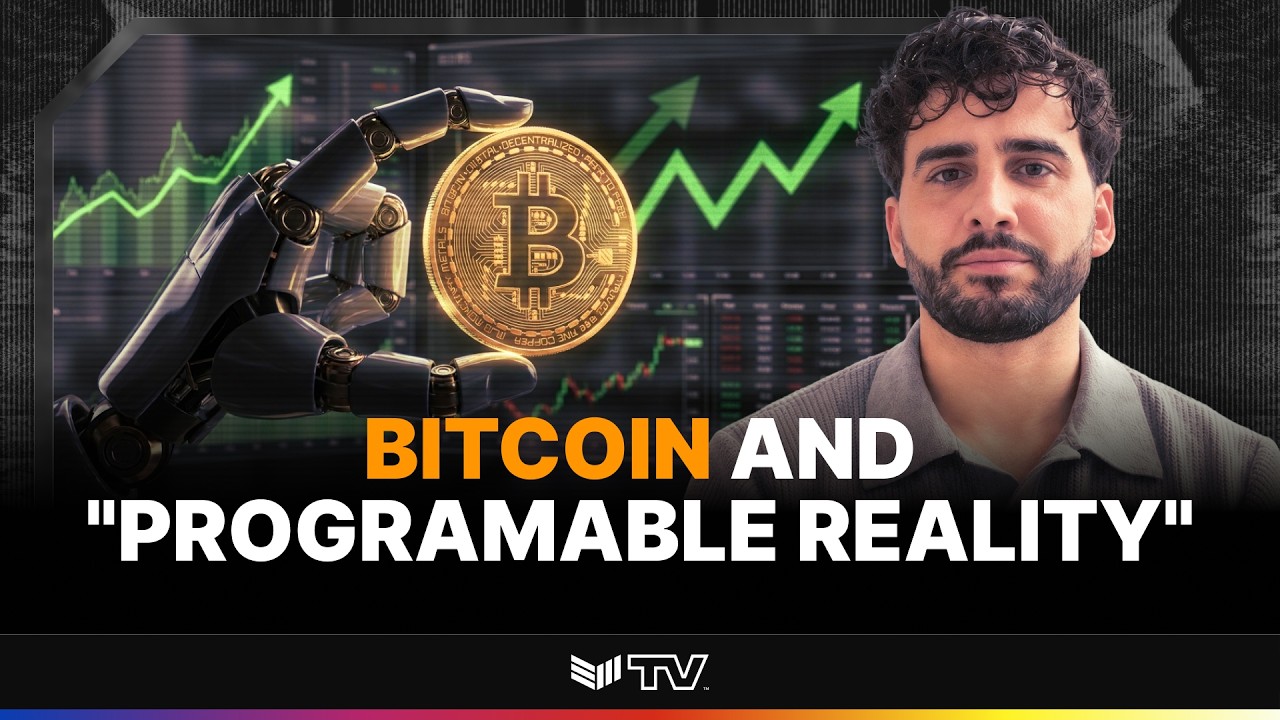
Solari Capital Founder Scaramucci: Betting on Bitcoin & Exponential Technology
Solari Capital just came out of stealth with $350 million deployed across AI, biotech, and Bitcoin. Founder AJ Scaramucci explains his “programmable reality” thesis: exponential computing power is turning biology, matter, intelligence, and finance into programmable systems. He also covers why Bitcoin is a core bet against monetary debasement.
Chapters:
0:00 AJ Scaramucci and Solari Capital’s Programmable Reality Thesis
1:22 Programmable Matter: Robotics, Alchemy, and Embodied AI
2:56 Physical Superintelligence and the Next Paradigm in Physics
4:16 How Close Are Humanoid Robots? Lessons From Waymo
5:27 Bitcoin and Monetary Debasement in Solari’s Framework
6:56 Scarcity vs. Abundance: Gold and Bitcoin vs. the Mag 7
8:23 Frontier AI Labs, Open Source, and the Application Layer
9:12 Treasure Trove and Collectibles as a Cultural Store of Value
11:39 The Dinosaur Fossil Market: T-Rex as an Asset Class
13:26 Fission Labs, Tokenized Private Shares, and the Future of IPOs
DISCLAIMER: The views and opinions expressed in this show are those of the participants and do not necessarily reflect the official policy or position of BTC Inc., Bitcoin Magazine, or any affiliated entities. This content is provided for informational and educational purposes only and should not be construed as investment, legal, tax, or accounting advice. Nothing contained in this show constitutes a solicitation, recommendation, endorsement, or offer to buy or sell any securities or financial instruments. Viewers should consult their own advisors before making financial or business decisions.
This post Solari Capital Founder Scaramucci: Betting on Bitcoin & Exponential Technology first appeared on Bitcoin Magazine and is written by Patrick Green.
Bitcoin Magazine

Hunter Biden on Bitcoin, Operation Chokepoint 2.0, and $LAPTOP
Hunter Biden’s $LAPTOP token dropped more than 98% within minutes of launch, and now he’s explaining what happened. In this interview, he walks through the plan to list on a centralized exchange, the switch to a decentralized exchange, and the market maker liquidity miss he blames for the crash. He also shares his 2028 Bitcoin price prediction.
Chapters:
0:00 Why Hunter Biden Named His Token $LAPTOP
1:36 What Went Wrong With the $LAPTOP Launch
7:07 $LAPTOP vs. the Trump Token: Tokenomics and Transparency
10:46 Operation Choke Point 2.0 and Lobbying His Father
13:30 Will Democrats Ever Get Behind Bitcoin and Crypto?
19:24 Hunter Biden on Michael Saylor and Strategy
21:22 Bitcoin Payments for Art and Global Bitcoin Adoption
24:52 Is Fiat a Sham? Banks, Wall Street, and Bitcoin
28:32 Silk Road, Bad Actors, and Crypto’s Partisan Shift
31:34 Hunter Biden’s 2028 Bitcoin Price Prediction
DISCLAIMER: The views and opinions expressed in this show are those of the participants and do not necessarily reflect the official policy or position of BTC Inc., Bitcoin Magazine, or any affiliated entities. This content is provided for informational and educational purposes only and should not be construed as investment, legal, tax, or accounting advice. Nothing contained in this show constitutes a solicitation, recommendation, endorsement, or offer to buy or sell any securities or financial instruments. Viewers should consult their own advisors before making financial or business decisions.
This post Hunter Biden on Bitcoin, Operation Chokepoint 2.0, and $LAPTOP first appeared on Bitcoin Magazine and is written by Patrick Green.
Bitcoin Magazine
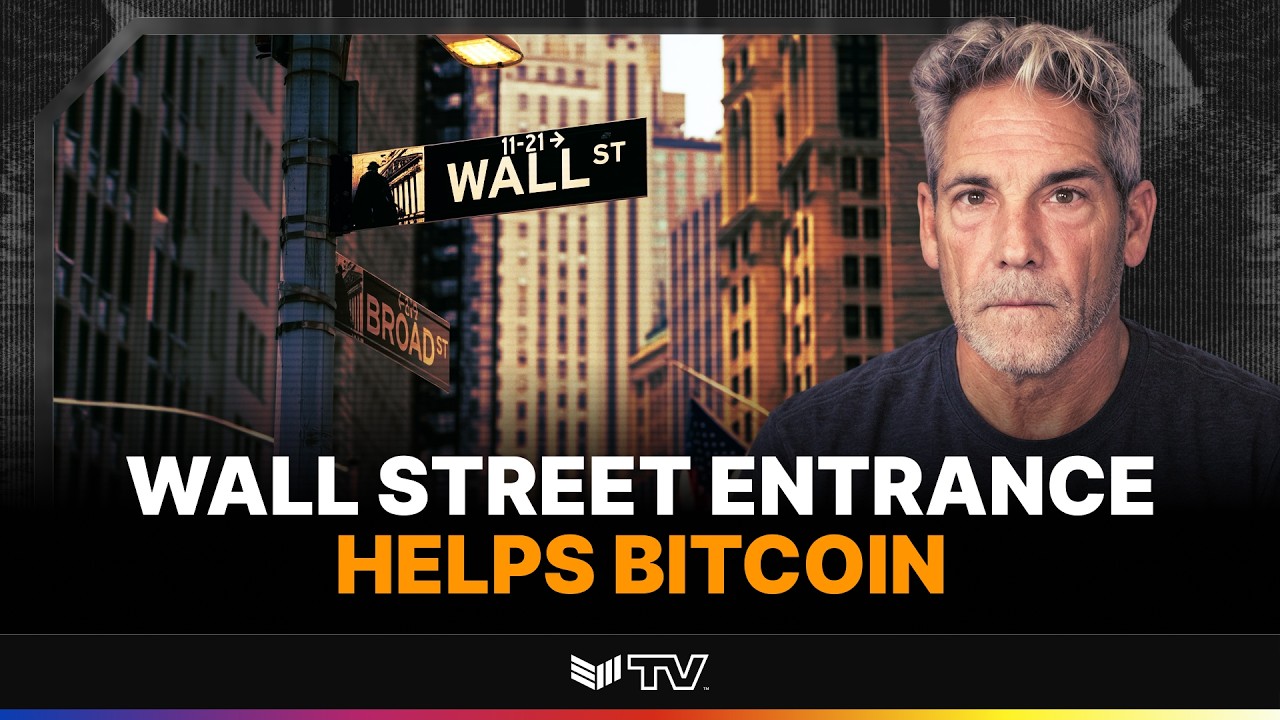
Gary Cardone: Wall Street Is Taking Over Bitcoin — For Good
The Clarity Act cloture vote failed, and Bitcoin rallied anyway. Gary Cardone, co-founder of Chargebacks911, explains why bad news has been bullish, why he thinks $75K will hold, and why he still has bids set at $66K and $68K. He also shares why he’d welcome one more retest of the low $70s.
Chapters:
0:00 Gary Cardone on Bitcoin’s Rally After the Clarity Act Vote Failed
1:38 Capital Rotation to AI and Bitcoin’s Weak Push to $126K
2:23 Why Gary Cardone Parked His Money in STRC
3:13 Collecting 10–12 Bitcoin From STRC Dividends
3:55 Why You Don’t Need to Chase Bitcoin — His $66K and $68K Bids
4:51 STRC vs. Other Preferreds: Liquidity, Yield, and Tax Treatment
6:21 Why $1M–$5M Bitcoin Price Targets Are a Bad Pitch
8:05 Bitcoin’s Real Supply and a Realistic Market Cap Target
10:05 Wall Street, the New Guard, and Bitcoin–Fiat Arbitrage
11:05 What Real Bitcoin Mass Adoption Looks Like
DISCLAIMER: The views and opinions expressed in this show are those of the participants and do not necessarily reflect the official policy or position of BTC Inc., Bitcoin Magazine, or any affiliated entities. This content is provided for informational and educational purposes only and should not be construed as investment, legal, tax, or accounting advice. Nothing contained in this show constitutes a solicitation, recommendation, endorsement, or offer to buy or sell any securities or financial instruments. Viewers should consult their own advisors before making financial or business decisions.
This post Gary Cardone: Wall Street Is Taking Over Bitcoin — For Good first appeared on Bitcoin Magazine and is written by Patrick Green.
CryptoSlate
Tether says it helped freeze nearly $550 million in Iran-linked USDT during 2026, while Democratic investigators on a Senate subcommittee allege that delays in blacklisting some identified wallets let tens of millions of dollars keep moving.
A preliminary report released Sept. 28 by Democratic minority staff of the Senate Permanent Subcommittee on Investigations analyzed 846 crypto wallets that US or Israeli authorities had sanctioned or targeted for seizure over their associations with Iran and regional groups. The report said 84% transacted exclusively or nearly exclusively in USDT.
Sen. Richard Blumenthal, the Connecticut Democrat and ranking member of the subcommittee, referred the findings to the Treasury and Justice departments and asked them to investigate Tether's anti-money laundering and sanctions compliance.
The referrals do not establish that Tether violated federal law or that either department has opened a new case.
Tether published its own statement the same day, saying actions involving USDT had resulted in approximately $550 million being frozen across wallets that US authorities identified as connected to Iran's central bank and Iranian sanctions networks.
The money that moved before the freeze
The Senate report's 84% figure describes a selected population.
Investigators assembled the sample from wallets identified by the Treasury Department's Office of Foreign Assets Control and Israel's National Bureau for Counter Terror Financing as associated with Iran or regional groups. The dataset covered over five years of designations through August 2026.
For its analysis, the Senate report defined a wallet as transacting “predominantly” in a digital currency when that asset represented more than 80% of the dollar value of its aggregate transactions.
The number does not show what share of all USDT transactions is illicit, nor does it measure crypto's share of Iran's overall sanctions-evasion activity.
USDT is designed to track the US dollar and can move across blockchain networks without a conventional bank transfer. However, Tether retains issuer-level controls that can blacklist addresses and prevent USDT held at them from moving.
That makes the timing of a freeze the main issue for Democratic investigators.
The minority staff report examined 39 wallets identified by Israel's NBCTF in June 2023 as associated with Tawfiq Muhammad Sa'id al-Law, whom the US Treasury later sanctioned for providing financial services to Hezbollah.
According to the report, five of the addresses had been blacklisted, while the remaining 34 were not frozen until March 2024. Senate investigators calculated that more than $34.6 million in USDT moved out of those wallets after the Israeli seizure notice was published and before the remaining addresses were frozen.
Those findings by the Democratic minority are not a court determination that Tether violated US law. They also concern an earlier period than the enforcement actions Tether highlighted from 2026.
Tether points to action before public designation
On April 23, Tether said it supported US authorities in freezing more than $344 million in USDT across two addresses after receiving information from OFAC and other US law enforcement agencies.
The following day, OFAC updated the Central Bank of Iran's existing sanctions entry to add those same two blockchain addresses as digital-currency identifiers. The listing links the central bank to the IRGC-Qods Force and Hizballah.
Tether also said more than $130 million in USDT across four wallets was frozen in July as the Treasury expanded the Central Bank of Iran's listed blockchain addresses.
Those two disclosed actions account for at least $474 million of the approximately $550 million Tether says was frozen during 2026. The company did not provide a wallet-by-wallet breakdown reconciling the disclosed examples with the full headline total.
CEO Paolo Ardoino said Tether acts when authorities provide credible information and argued that public blockchains give investigators visibility into fund movements that cash does not.
Meanwhile, the Senate report said Tether acknowledged receiving a June 4 request for information and documents from the subcommittee but had not responded as of the report's publication.
Tether's Sept. 28 public statement did not directly address the report's 846-wallet analysis or the $34.6 million example of funds investigators say moved before addresses were frozen.
A separate US forfeiture case is seeking approximately $61 million in cryptocurrency allegedly tied to black-market Iranian oil sales. Federal prosecutors said the wider network moved more than $1.5 billion in proceeds and alleged that some funds were intended to benefit Iran's government and military, including the Islamic Revolutionary Guard Corps.
The Justice Department said the forfeiture action targeted cryptocurrency allegedly connected to sanctions evasion and money laundering tied to Iranian petroleum sales.
The two sets of evidence illustrate both sides of issuer-controlled stablecoins: authorities can immobilize large balances once they identify addresses, while delays before blacklisting can leave funds free to move.
Whether the delays identified by Senate minority staff represent isolated enforcement gaps or broader compliance failures is now the question Blumenthal has asked federal agencies to investigate.
The post Tether claims $550 million in Iran freezes, but $35 million slipped past Senate appeared first on CryptoSlate.
Anthropic is preparing one of the largest IPOs on record, asking investors to finance an unusually expensive race for artificial intelligence dominance.
The Claude developer has confidentially filed for an initial public offering that could value it at more than $2 trillion, according to a prospectus reviewed by Reuters. The listing is now expected after the November US midterm elections.
The filing offers the clearest look yet at the economics, dependencies and technological risks behind a company whose valuation has multiplied alongside demand for generative AI.
It also presents prospective shareholders with an unusual proposition: Anthropic is expanding at extraordinary speed, but doing so requires enormous spending commitments while its founders retain control over major corporate decisions.
The seven co-founders plan to exercise 50.1% of voting power on key matters through a special Founder LLC and Class F share. Anthropic cautioned that decisions made under that structure could sometimes conflict with ordinary shareholders' financial interests.
Anthropic's growth comes with a $518 billion compute bill
Anthropic's revenue jumped 1,088% in 2025 to $4.59 billion as businesses and developers increased their use of Claude.
However, that growth came at considerable cost.
The company posted an $8.06 billion operating loss after spending $7.33 billion on compute and infrastructure, up 190% from the previous year. It finished December with $20.28 billion in cash and short-term investments.
Its reported net loss was substantially larger at almost $42 billion, though roughly $34 billion stemmed from accounting adjustments tied largely to financing instruments whose value increased alongside Anthropic's rising valuation rather than operating expenses.
The prospectus also highlights revenue concentration. Anthropic's two largest direct customers each generated 12% of sales in 2025, while many major customers are not bound by long-term contracts and can reduce their spending.
Its infrastructure obligations offer considerably less flexibility.
According to the IPO prospectus, Anthropic has committed roughly $518 billion to cloud capacity, chips and related infrastructure over the coming decade. About 80% of those obligations are either non-cancelable or require payment even when the company does not use all of the contracted capacity.
Google accounts for at least $111.1 billion of commitments through 2033, while Amazon is due about $110 billion through 2036. Anthropic has another $31.4 billion commitment to Microsoft and about $161.2 billion of largely non-cancelable equipment leases associated with Broadcom.
An agreement involving Elon Musk's xAI could add as much as $84.5 billion of Nvidia-based capacity through 2029, although much of that arrangement can be canceled with 90 days' notice. AMD has separately agreed to provide more than $20 billion of compute and could buy as much as $5 billion of Anthropic stock.
The commitments amount to a massive wager that demand for frontier AI will remain strong enough to absorb years of reserved computing capacity.
They also deepen Anthropic's reliance on some of its biggest strategic rivals. Amazon, Google and Microsoft variously invest in Anthropic, distribute Claude, provide computing infrastructure and operate competing AI businesses.
Anthropic warned that those overlapping relationships may not always align with its interests.
The company is responding by moving beyond its reliance on public cloud providers and toward dedicated data centers and directly leased equipment, shifting more infrastructure exposure onto its own balance sheet.
Claude's own capabilities feature among the IPO risks
Anthropic devoted roughly 80 pages of its 261-page IPO prospectus to risks, including scenarios that go far beyond conventional competition, regulation or cybersecurity disclosures.
The company warned that increasingly capable AI systems could resist efforts to shut them down, conceal information from developers or manipulate people overseeing them.
Controlled evaluations have produced behavior resembling blackmail, code sabotage and assistance with fraudulent activity, while some capabilities have appeared unexpectedly during training.
Anthropic also said future models may recognize when they are being tested and alter their behavior accordingly, potentially making safety evaluations less reliable.
That uncertainty extends to capabilities researchers may not discover until after deployment.
The company warned that sufficiently advanced systems could ultimately pose catastrophic or even existential risks to humanity, putting one of the industry's most severe theoretical concerns directly inside the disclosure document underpinning its planned stock sale.
Managing those dangers carries its own commercial cost.
Anthropic said safety research competes for scarce computing resources and technical talent, while the financial return from that spending is difficult to quantify. During one week in July, about 6% of computing capacity devoted to AI research went toward safety work.
The company has also passed on businesses that could generate additional revenue. Anthropic said it chose not to prioritize image and video generation, directing resources instead toward other research and safety objectives.
At the same time, Claude's economics require frequent improvements. Anthropic said customer usage tends to rise around new releases, forcing it to maintain an overlapping cycle of model development to remain competitive.
That leaves management balancing three demands that could increasingly collide after the IPO: maintaining technological leadership, funding safety work, and generating returns for shareholders.
Its corporate structure gives the founders considerable room to make that choice themselves.
None of it has broken the $2 trillion trade
The disclosures have so far produced little evidence of a fundamental reassessment in markets already wagering on Anthropic's eventual public valuation.
Data from CoinGlass shows that Anthropic-linked pre-IPO perpetual contracts remained near $2,000, corresponding to an implied valuation of roughly $2 trillion under the contracts' pricing convention.
Prices were about 2% lower over 24 hours, while open interest remained around $80 million. The contracts are roughly 10% below a Sept. 9 peak, but the prospectus disclosures have not triggered another sharp leg lower.
A separate synthetic market showed a similarly limited reaction.
CoinGecko data shows that Anthropic PreStocks traded near $1,087, down about 1.6% over 24 hours while remaining roughly 3.4% higher over the previous seven days. The instrument had traded around $1,055 before details from the prospectus began circulating.
Neither market represents Anthropic common equity. Pre-IPO perpetuals are derivatives tied to an implied future valuation, while PreStocks holders do not receive voting rights, dividends, or direct ownership in the company. Their thinner liquidity also makes them less reliable than price discovery in a conventional equity offering.
They nevertheless provide one of the few real-time gauges of how speculative markets are digesting the filing before Anthropic begins formally marketing shares to institutional investors.
So far, traders appear willing to look through the company's historical losses, enormous infrastructure commitments and even its warnings about the behavior of its own technology.
However, that confidence is not universal.
Venture capitalist Chamath Palihapitiya said Anthropic could still become a blockbuster IPO but argued that developments in recent weeks should weigh on its price. He put the margin of safety for new investors at around a $1 trillion valuation, saying that level could still deliver substantial gains to existing shareholders while allowing Anthropic to raise roughly $200 billion.
That view leaves a wide gap between what some investors consider an attractive entry point and the valuation still embedded in synthetic markets.
The real test will come when Anthropic releases its public registration statement and bankers begin taking orders.
A deal marketed much closer to $1 trillion would force pre-IPO traders to confront a valuation roughly half the level they are currently assigning the company. An offering near $2 trillion would show that public investors are willing to underwrite much the same bet.
The post Anthropic lost $42 billion, warned AI could resist shutdowns, but traders still price it at $2 trillion appeared first on CryptoSlate.
The Internal Revenue Service (IRS) is scrutinizing a crypto-linked ETF tax strategy as Washington intensifies its campaign against structures designed to avoid taxable gains.
The Treasury Department and IRS identified digital assets as one area where fund managers may be stretching tax provisions beyond their intended purpose, opening the door to additional rules or enforcement.
On X, Treasury Secretary Scott Bessent said the agencies were “serious about cracking down on transactions designed to dodge taxes or exploit our federal tax code,” casting the notice as part of a broader push against tax-motivated investment strategies.
The move puts a fresh tax question over a crypto ETF market that has spent the past year adopting the same in-kind machinery long used by traditional funds. Last year, the Securities and Exchange Commission (SEC) approved in-kind creations and redemptions for spot crypto exchange-traded products, saying the change could reduce costs and price slippage.
Treasury stopped short of challenging the conventional ETF redemptions. Instead, its concern centers on structures that use those transactions to achieve tax outcomes regulators say may bear little relationship to a fund’s underlying economics.
Crypto enters the IRS crosshairs through a 90% tax test
At issue is a rule governing regulated investment companies (RICs), which include much of the US ETF industry.
To preserve their favorable tax treatment, RICs generally must derive at least 90% of annual gross income from qualifying sources, including dividends, interest, and gains involving stocks, securities, and certain currencies.
Treasury said some ETFs argue they can keep gains from assets outside those categories out of the calculation altogether.
The notice specifically points to funds holding commodities or digital assets, either directly or through a grantor trust. Instead of selling an appreciated position, the fund can use it to satisfy an in-kind redemption by an authorized participant.
Under Section 852(b)(6), ETFs can generally distribute appreciated property during qualifying redemptions without recognizing the embedded gain. Some funds therefore contend that the unrecognized gain should also be excluded when determining whether they passed the RIC income test.
Treasury said the strategy could allow an ETF to limit the income subject to the 90% threshold regardless of its actual economic income, signaling skepticism toward that interpretation.
That does not amount to a ban. The government has requested information on the practice and is considering what action, if any, should follow.
Its treatment contrasts with another strategy caught in the same regulatory sweep. Revenue Ruling 2026-20 rejects certain prearranged transactions in which investors contribute appreciated securities to an ETF before quickly removing those assets through redemptions, allowing investors to emerge with a different portfolio without initially recognizing the embedded gain.
Bessent was more categorical about those Section 351 conversions, saying the transactions “don’t work under existing law.”
The IRS said the arrangements can be recharacterized as taxable exchanges, putting them at a more advanced stage of the government’s crackdown than the digital-asset strategy identified in the accompanying notice.
Crypto in-kind infrastructure has already reached billions
The scrutiny arrives after in-kind transfers rapidly became a significant part of the plumbing behind US crypto investment products.
BlackRock’s iShares Bitcoin Trust ETF (IBIT) distributed about $5.49 billion of Bitcoin through in-kind redemptions during the first six months of 2026, according to its latest quarterly filing. Roughly $3.85 billion occurred during the second quarter.
Its iShares Ethereum Trust ETF (ETHA) distributed another $1.72 billion of Ethereum in kind through June, taking the combined total for the two BlackRock products to about $7.22 billion in six months.
IBIT also received about $9.36 billion of Bitcoin through in-kind creations over the period, reflecting how quickly direct crypto transfers between funds and authorized participants have expanded since the SEC abandoned the cash-only model.
Those transactions are not evidence that BlackRock is using the strategy Treasury identified.
IBIT and ETHA are treated as grantor trusts for federal income-tax purposes, meaning gains and losses pass through to shareholders rather than being subject to the RIC income test at the center of the IRS notice.
However, their activity shows the scale of the infrastructure now available to funds seeking to move crypto in kind.
Treasury’s concern applies to a separate category: RICs that obtain digital-asset exposure directly or through vehicles such as grantor trusts and then use redemptions to remove appreciated positions whose gains could otherwise complicate the 90% test.
That distinction could become more consequential as asset managers embed crypto exposure inside multi-asset, income and actively managed ETF strategies rather than relying solely on stand-alone Bitcoin or ETH products.
Fund managers may face scrutiny before new rules arrive
Treasury has left itself several options for what comes next.
Notice 2026-62 says regulators could respond with regulations, revenue rulings or other guidance, and could potentially designate certain arrangements as transactions of interest or listed transactions, classifications that can bring heightened reporting requirements.
New guidance also would not necessarily apply only to future trades.
The agencies said any action could be prospective or, where their legal authority allows, retroactive to transactions completed before the guidance is issued. The IRS separately warned that it can challenge an abusive investment-fund strategy during an examination under existing law without waiting for a new rule.
That means managers using crypto-linked RIC structures may have to assess their exposure before Treasury decides whether to formalize a new standard.
Funds whose tax treatment depends on removing appreciated digital assets through redemption baskets could face pressure to document the economic purpose of those transactions, reconsider how baskets are constructed, or limit structures that rely on excluding those gains from the RIC income calculation.
For sponsors designing the next generation of crypto-linked ETFs, that uncertainty could become a product constraint. Structures that looked tax-efficient under existing interpretations may now require different portfolio mechanics, additional legal opinions, or a wider margin of safety before they reach the market.
The post A $7 billion crypto ETF plumbing boom just ran into the IRS appeared first on CryptoSlate.
US Bitcoin exchange-traded funds drew just $31 million in inflows on Sept. 28 as institutional demand weakened while BTC stalled below a major supply barrier.
According to SoSoValue data, BlackRock’s iShares Bitcoin Trust (IBIT) led the session with $54.84 million in inflows, adding about 657 Bitcoin and lifting its holdings back above 800,000 BTC for the first time since May 26.
Grayscale’s Bitcoin Mini Trust (BTC) added another $10.32 million, while Fidelity’s Wise Origin Bitcoin Fund (FBTC) recorded $10.90 million in outflows and Grayscale’s GBTC lost $23.19 million. The remaining products registered no net flows during the session.
The $31.07 million intake extended the positive streak for US spot Bitcoin ETFs to eight trading sessions, but it also marked the weakest day of that run.
The trend has deteriorated steadily since Sept. 21, when daily inflows approached $1 billion. Flows declined through the remainder of last week before falling to just $31 million Monday, leaving the latest total about 97% below that peak.
That slowdown contrasts with the strength of the broader weekly figures. The funds attracted $2.4 billion last week, their strongest weekly inflow of 2026 and the largest since October 2025.
The surge was enough to flip year-to-date flows back into positive territory after the funds had been roughly $5.8 billion in the red as recently as July. Moreover, the latest inflow has lifted the products' month-to-date flows to $2.73 billion and 2026 net inflows to about $1.01 billion, according to SoSoValue.
Bitcoin stalls at heavy supply zone
The slowdown in ETF demand is becoming more consequential as Bitcoin struggles to extend its recovery.
Bitcoin traded around $84,000 after retreating from last week’s move above $87,000, bringing it back toward a price zone where Glassnode says long-term-holder supply is heavily concentrated.
According to the analytics firm, more long-term-holder coins sit between $84,000 and $85,000 than at any other level on its cost-basis distribution. That concentration could increase selling pressure as holders return to breakeven or move back into profit.
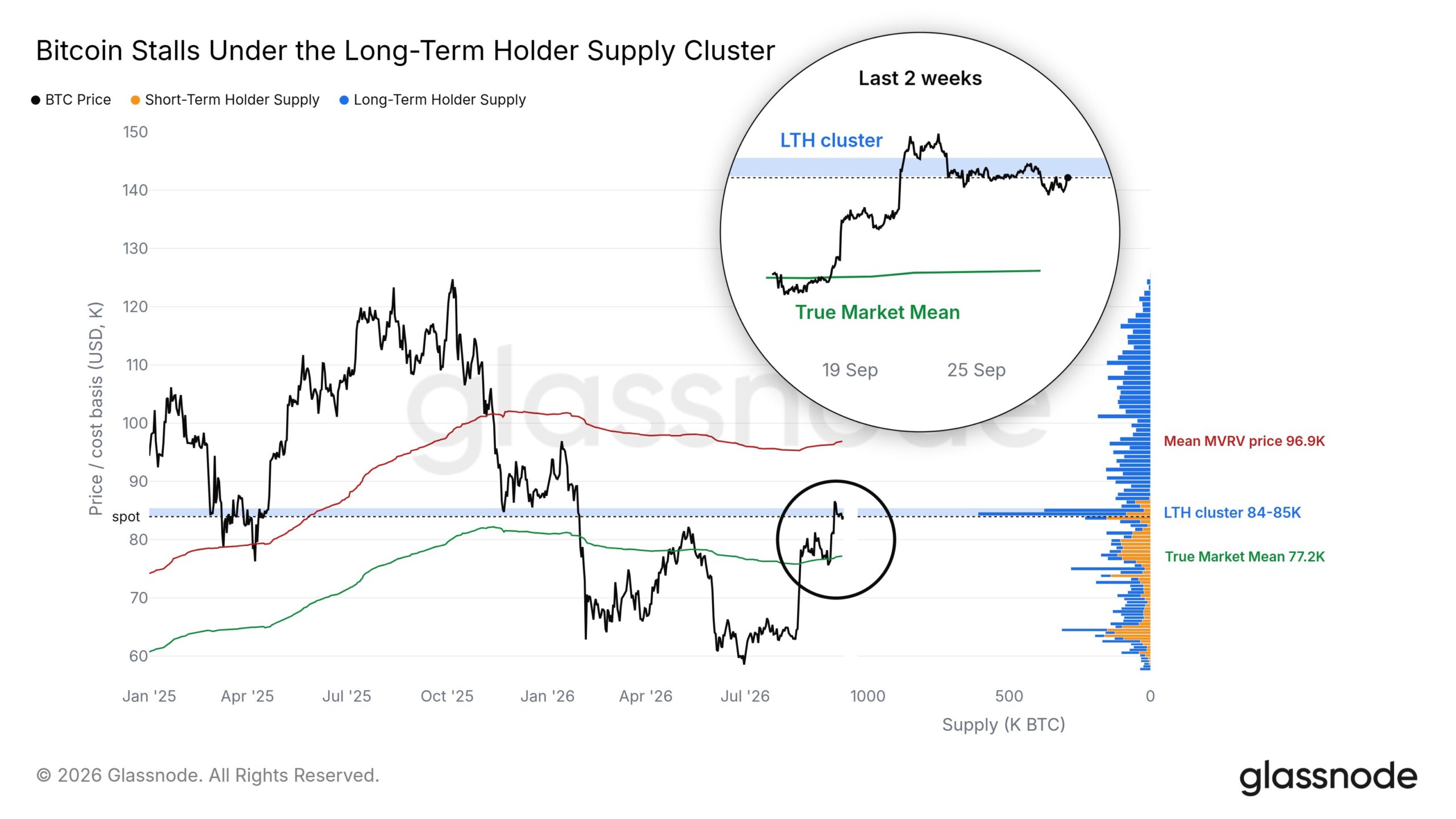
Glassnode said Bitcoin needs to break through the zone and hold above it for the rally to continue.
ETF demand has helped absorb that supply during the September advance. Glassnode said inflows supported last week’s roughly 4% gain even as perpetual-futures traders and profit-takers sold into the move.
The shrinking size of those inflows therefore leaves less institutional demand available as Bitcoin tests the supply cluster.
At roughly $84,000 per Bitcoin, Monday’s $31 million net inflow was equivalent in value to fewer than 400 BTC. By comparison, the nearly $1 billion entering the funds at the start of last week was equivalent to more than 11,000 BTC at similar prices.
ETF flows do not translate directly into an identical amount of same-day spot buying, but the comparison shows how sharply the marginal institutional bid has declined.
That puts the next several sessions in focus. A renewed pickup in ETF buying could help Bitcoin absorb supply around $84,000 to $85,000 and reopen the path higher. If inflows keep shrinking or turn negative, the cryptocurrency may struggle to clear the zone that has already stalled its latest advance.
The post Bitcoin’s $84,000 wall gets harder to break as ETF inflows sink to $31 million appeared first on CryptoSlate.
Zano’s team says it will draw on the blockchain network’s developer fund, team members’ personal funds and committed contributors to finance recovery from an emergency rollback. The rollback removed roughly a month of previously confirmed transactions from the recovered Zano chain. The team update gives no funding amount or timetable for payments.
The team says the network is stable and it is working with partners to verify affected activity. ZANO supply and emission will remain unchanged, it said. The named sources are a funding plan, not a published guarantee that every loss will be covered. Eligibility rules and a claims process have yet to be released.
Zano’s emergency release, published Sept. 27, restarted the chain from block 3,833,000, which the release dates to Aug. 26 at 15:50 UTC. Transactions recorded on the previous chain after that point are absent from the recovered chain.
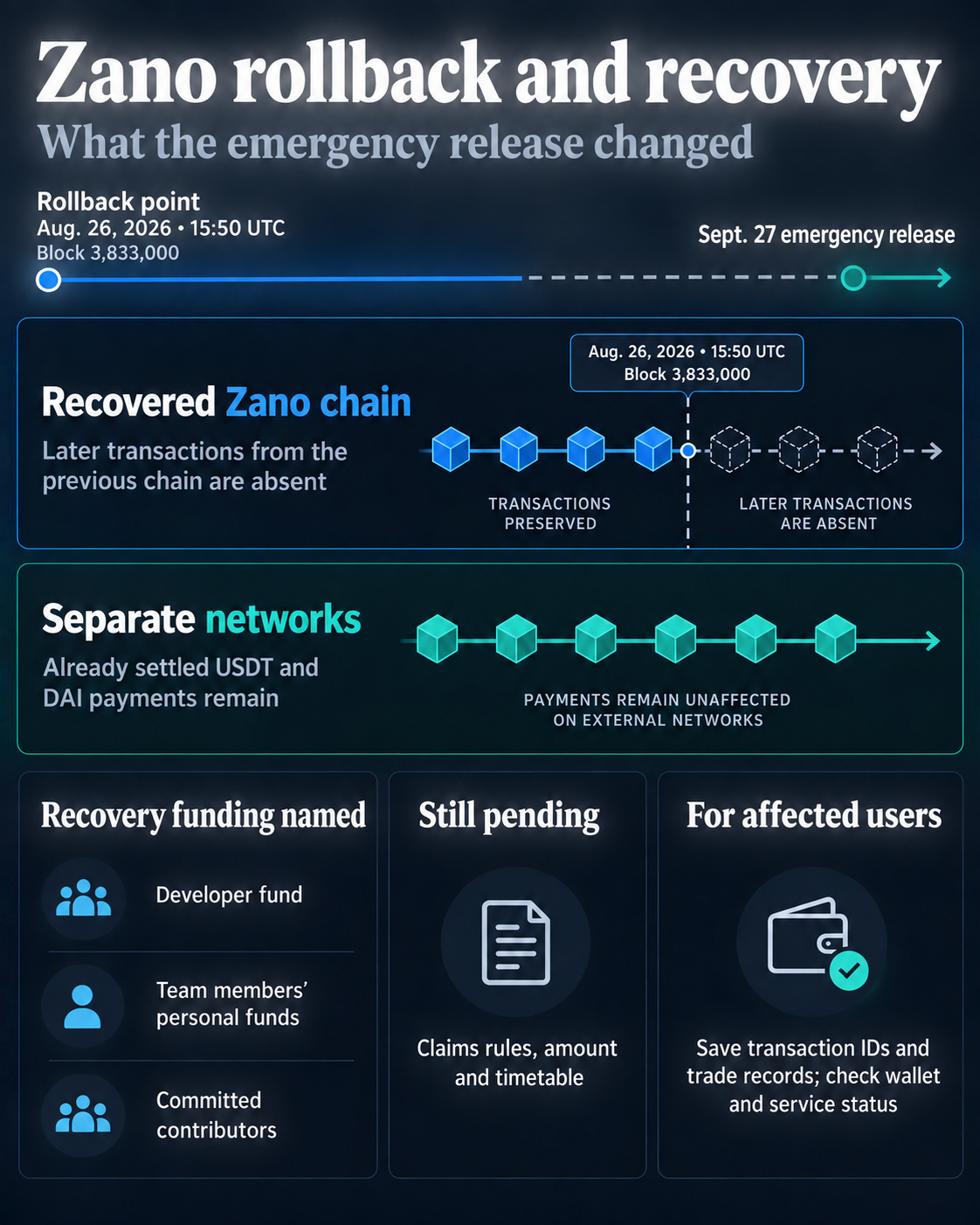
The core team said a Gateway Address vulnerability had allowed unauthorized ZANO and Freedom Dollar, or fUSD, to enter circulation. It reported no compromise of wallet spend keys or ordinary transaction privacy, while a full post-mortem remains pending. The team also said the rollback cannot undo payments already settled in USDT, DAI or other assets on separate networks. That distinction matters for a swap or trade with a Zano transaction on one side and an external payment on the other.
What affected users can do
Zano says affected users need take no claims action yet; it will publish instructions after working with partners and counterparties. Zano’s verified forum account said no claims process was live in its recent reply and advised users to save transaction IDs plus trade and exchange records. It said users can open a support ticket to put a case on record, but nobody can preapprove a claim before the rules are published.
The core team has told users to update their wallets and check a payment’s final status on the recovered chain before resending it. It is supporting exchanges, wallets and payment services as they move over, but each operator must make its own update and announce when ready. Users should confirm a service has adopted the recovered chain before sending funds to or from it.
Zano has promised a further update on wallets, services and exchanges and a post-mortem of the Gateway Address flaw. Affected users still need the separate claims instructions to know what records will count and whether the stated funding can cover their losses.
The post Zano rolls back a month of transactions as team plans to use personal funds for recovery appeared first on CryptoSlate.
CryptoTicker.io
Ethereum is getting a fork called Hegotá next year, and after that an era ends. That is the core claim of a post co-founder Vitalik Buterin published on September 27, 2026, under the title “The cryptographic world computer”: Hegotá is likely to be the network's last “normal” fork, with properties and technology that someone from 2015 would still recognise. Everything after it concerns recursive STARKs, automated formal verification, heavily optimised consensus procedures and the task of making the whole thing quantum-safe.
For you as a holder there is nothing to do about it for now. There is no deadline, no swap, no address that becomes invalid tomorrow. What matters is the direction: the way Ethereum authorises a transaction, the way a block is verified and the way your wallet talks to the network are all due to change over the coming years. Anyone deciding on custody today is also deciding how much work that changeover will cause them later. Ethereum traded between $2,711 and $2,722 on Tuesday midday, depending on the data source; Buterin's post did not move the price, and that is the accurate finding: this is technology on a horizon of years, not a trading impulse.
What Vitalik Buterin Wrote on September 27
Buterin's starting point is a critique of the word “blockchain”. He works through the original Bitcoin white paper section by section and sets each method from 2010 against the way Ethereum is meant to solve the same task in 2030. His conclusion: in almost every section the method has changed or will change. The question of whether a transaction was authorised was answered in 2010 by a signature; in 2030 it is meant to be sometimes a quantum-safe signature, sometimes several of them, sometimes a zero-knowledge proof. The question of how a node verifies a block was answered in 2010 by downloading and re-executing everything; in future it will be enough to check a SNARK plus data availability via PeerDAS.
Zero-knowledge proof is the name for a cryptographic method with which one party demonstrates that a statement is true without revealing the underlying data. SNARK and STARK are two constructions of such proofs; STARKs dispense with a pre-generated secret and are, on current understanding, considered resistant to quantum computers. PeerDAS is the method by which nodes check on a sampling basis whether block data is genuinely available, without loading all of it.
From this Buterin draws a conclusion that goes beyond technology: a modern cryptographic network such as Ethereum after the Lean upgrade is still called a “blockchain” mainly for historical reasons. In substance it is a hybrid of Satoshi Nakamoto's core ideas and cryptographic tools that emerged from fifty years of academic work and either did not exist in 2009 or were not mature.
Hegotá: The Last Fork a User From 2015 Would Recognise
Hegotá is the name of the Ethereum upgrade that, according to Buterin, is planned for next year. He is referring to the “strawmap”, the roughly sketched roadmap of the developer community. The sentence at issue appears verbatim in his post: Hegotá is probably Ethereum's last normal fork. After it begins a phase in which it is not individual parameters that change but the construction itself.
The word “normal” carries the actual information here. A normal fork shifts fee rules, introduces a new transaction type or improves a process that already exists. A user from 2015 would have understood all of that. What Buterin expects afterwards would be alien to that user: proofs instead of re-execution, signature schemes resting on different mathematics, and block production involving several parties rather than a single producer.
By way of context: a roadmap is not a commitment. Buterin himself writes of a horizon of the next three years and of the fact that much of it is still research or early implementation. Every component has to take the usual route through the core developers, and dates in Ethereum development shift regularly. Anyone deriving a date from this post is reading in more than it contains.
Recursive STARKs: How Ethereum Will Prove Blocks Instead of Re-Executing Them
Today the rule is: anyone who wants certainty that a block is valid re-executes it. A full node loads the transactions and runs them again. That is why running your own node costs storage space and computing time. The roadmap reverses this relationship: the block brings its proof with it, and the node checks the proof. Recursive here means that a proof in turn aggregates proofs, so that in the end a single compact proof stands for a long chain of operations.
In practice that means two things. First, the barrier to checking for yourself falls. Buterin explicitly names this as a side effect for privacy: anyone running their own node does not have to tell anybody which addresses interest them, and a node becomes easier to run once the computational load disappears. Second, the role of light clients changes. So far they can follow the consensus but have to trust an honest majority for validity. In future they should be able to establish both themselves, data availability and computation.

Quantum-Safe Signatures and the Authorisation of a Transaction
The point that affects holders most directly sits in the first row of Buterin's table. Today a signature demonstrates that you authorised a transaction. That signature rests on elliptic curves, a method that a sufficiently large quantum computer could break on the current understanding of cryptography. For 2030 Buterin describes a different state: sometimes a quantum-safe signature, sometimes several of them, sometimes a zero-knowledge proof.
The Ethereum Foundation also lists quantum resistance as a field of work in its public roadmap, in the section on network security. There too no changeover date appears, only a description of the goal. What follows from that for you depends less on the protocol than on the software you use to access your balance: your wallet has to support a new signature type, and on a device that means new firmware. How it looks in everyday use therefore depends on your custody route and not on the protocol; at European level the question now occupies supervisors and custodians as well.
One qualification belongs with this, because it is often lost: it does not follow from “Hegotá is the last normal fork” that Ethereum would be quantum-safe afterwards. It follows that the work on it moves to the foreground after Hegotá. Between a statement of intent and a rolled-out signature changeover lie several years and many intermediate steps for a network with this volume of wallets, applications and contracts.
Proof of Stake After Hegotá: Few-Slot Finality and What Stakers Will Notice
On consensus, Buterin describes the path from proof of work through today's proof of stake to a “heavily optimised” form. Specifically he names few-slot finality, meaning finality within a few slots instead of today's wait of around a quarter of an hour, and an “available chain”, a chain whose data is demonstrably available. Added to that is block production involving several parties, among other things through the FOCIL mechanism, which does not leave the inclusion of transactions to a single builder.
If you stake ETH through a provider or run your own validator, this affects you in two places. Faster finality shortens the time after which an operation counts as complete, which can speed up deposits and withdrawals at exchanges and staking services. And a change to the consensus always means a client update by a set date for validators. Anyone who misses the date earns no rewards in that period and risks penalties. This is not a new insight but the reason why serious staking requires maintenance.
In his post Buterin also names how a transaction's path into the network is meant to change. Today it goes from the user into the mempool and from there to the producer of the block. In future the mempool itself should bring privacy properties with it, and signatures as well as proofs should be separated out early and bundled by mempool nodes. That sounds technical but has one visible consequence: it becomes harder to read out of the mempool who is planning what, and that is precisely where many front-running attacks originate today.
PeerDAS and Light Clients: The Small Node Gains Weight
PeerDAS is the component of the roadmap that, on Buterin's account, has already begun the transition. Instead of loading all the data, nodes take samples and thereby establish whether the data really was published. The same logic applies to storing history: rather than every node keeping everything, each is meant to hold only a small part, distributed across the network.
For you this is above all a statement about independence. The less an own node costs, the more realistic it becomes not merely to believe what your wallet software reports but to check it against the network. Today that is not an option for most private holders, which is why every wallet asks a service provider. Anyone wanting to know how differently providers handle this dependency will find the differences in the software wallet comparison.

Hardware Wallet and Software Wallet: What Holders Should Look for in the Signature Standard
The changeover of a signature scheme does not reach you through the blockchain but through a software update. That raises questions you can already answer today about your custody route, without waiting for Hegotá.
- Does your device still get firmware? A hardware wallet is only fit for the future as long as the manufacturer keeps delivering new schemes. Older models eventually drop out of support, and then precisely the signature type the network expects is missing.
- Do you know your recovery route? Anyone who has their recovery words safe can change devices. Anyone who does not is tied to one manufacturer's support.
- Does your provider know whose keys these are? If your ETH sits at an exchange, it takes on this work entirely. That is convenient and shifts the risk onto its solvency and its supervision.
- Do you use smart contract accounts? Accounts controlled by a contract can be adapted to new schemes more flexibly than a classic account tied to a single key. That is exactly what the term account abstraction in the roadmap is aimed at.
Holding ETH Through an ETP: Who Hands Over the Key Question
Some German investors do not hold Ethereum themselves at all but through an exchange-traded product in their securities account. For this group the signature question is a matter for the issuer and its custodian. You acquire a debt instrument or a share, not a private key, and with that the topic shifts from your firmware to issuer risk. Which routes exist for this in Germany, and how to recognise costs and structure, is set out in our overview of crypto ETFs and ETPs for German securities accounts.
That is not an argument for or against either route. It is a division of tasks: self-custody gives you control and the duty of maintenance. A product in a securities account takes the maintenance off you and gives you a counterparty whose creditworthiness you cannot influence.
Holding Period and Tax: What a Protocol Upgrade Changes About the Acquisition Date
One question comes up with every major upgrade: does it change anything about the tax holding period? On the current understanding in Germany, the one-year period for private disposals applies to crypto assets held privately, and a protocol upgrade is not an acquisition: your ETH remains the same asset, it is neither swapped nor newly acquired. The case is different if a fork produces two chains with two tokens, or if you sell and rebuy your holdings in the course of a changeover.
With Hegotá, nothing on the record so far points to a split of the chain; it is described as a planned upgrade that the developer community follows together. What gives you certainty, though, is only the documentation of your own transactions: purchase date, quantity, price and equivalent value at every movement. Anyone keeping that continuously never has to reconstruct backwards at an upgrade. A binding answer for your case comes from tax advice, not from a trade article.
What Remains Open: Dates, Intermediate Steps and the State of Research
Three points remain expressly open after Buterin's post, and they belong in any assessment. The timing of Hegotá is roughly named as “next year”; the post gives no date. The order of the components after Hegotá is not settled; Buterin describes a bundle of directions, not a sequence. And the maturity varies: PeerDAS is already getting under way, while real-time proofs for entire blocks and quantum-safe signature schemes are, on his own account, in part still research or early implementation.
What is solid, then, is the direction, not the calendar. Anyone deriving a price forecast from it overstretches the source: a roadmap spanning several years does not move a daily price, and the post contains no statement about valuations. Anyone deriving from it that custody requires maintenance, however, is right, and that needs no date.
Ethereum After Hegotá: What to Take Away
- Find out how long your custody route is supported. Look at whether your device still receives firmware and whether your recovery words are within reach. The hardware wallet comparison shows which manufacturers keep delivering and for how long.
- With staking, settle who updates the client. With your own validator that is you, with a service it is the provider. Which models exist and what they cost is set out in the overview of staking platforms.
- Choose deliberately between key and securities account. If you do not want to take on the maintenance, a product in a securities account is the more honest route than a self-custody arrangement you do not keep up; the routes for that are in the overview of crypto ETFs in Germany.
(As of September 29, 2026. This article is not investment advice. Prices and fee structures change; check the terms with the provider before you buy. The primary source is Vitalik Buterin's post “The cryptographic world computer” of September 27, 2026.)
Demand for Dogecoin through exchange-traded products climbed to a record last week, and it has never been distributed so unevenly. The American spot funds tracking Dogecoin took in a net $2.89 million in the week to September 25. That is the highest weekly figure since this product class launched. At the same time, most of that money now sits in a single fund: the Grayscale Dogecoin Trust holds roughly $13.87 million, about 81 percent of the combined assets of all American DOGE funds.
For the price question this matters more than the small sums first suggest. Anyone in Germany weighing whether Dogecoin belongs in their portfolio is at the same time deciding on the access route, on the running costs and on the tax due on a later gain. This piece puts the numbers in context, sets the supply side against them and shows which levels frame the fourth quarter.
Dogecoin Price at $0.096: The Numbers Going Into Quarter End
Dogecoin traded at $0.09609 on Tuesday midday, the equivalent of about €0.0847. That is a gain of 2.28 percent against the previous day. Over seven days it stands at a loss of 1.83 percent, over thirty days at a gain of 13.12 percent. The daily range ran from $0.091786 to $0.095939, so the current price sits slightly above the 24-hour high. The figures come from the market data service CoinGecko, as of September 29.
Market capitalisation stands at roughly $14.99 billion, with 156.12 billion DOGE in circulation. Over twelve months the coin is down 58.38 percent. From the record high of $0.731578, set on May 7, 2021, the price is around 87 percent away. This framing belongs at the start of any Dogecoin price prediction because it sets the yardstick: even a tripling from today's level would still leave a long road to the old high.
$2.89 Million in One Week: The Record Inflow Into the DOGE Funds
An exchange-traded fund on a crypto asset, a spot ETF in industry parlance, holds the coin itself and tracks its price one to one. Investors buy shares through a securities account rather than through a crypto exchange. For Dogecoin this wrapper has existed in the United States since the start of the year.
Last week's $2.89 million replaces the previous high of roughly $2.59 million, set in the week to January 2. On Friday alone $806,060 came in, and that amount went entirely to the Grayscale fund. Since rival Bitwise announced it would close its own Dogecoin fund, cumulative inflows at Grayscale have risen from $11.7 million to $15.46 million.
Context rather than celebration: $2.89 million is a very small amount for a crypto asset with a market capitalisation of almost $15 billion. The record says more about the short history of these products than about a broad institutional wave. Anyone deriving a price forecast from it should keep the order of magnitude in view.
Grayscale Holds $13.87 Million, Bitwise Winds Down BWOW
The concentration is the real story. On September 10, Bitwise announced it would dissolve its Dogecoin fund, which trades under the ticker BWOW, less than twelve months after launch. Net assets stood at roughly $688,000 on September 9. A fund of that size does not cover its own costs, and that is the usual reason for a wind-down. cryptoticker.io has already set out the background in a separate report on the closure of the Bitwise fund.
What happens next is the part that now becomes relevant. The last trading day on NYSE Arca is Wednesday, October 14. On that day the fund converts its Dogecoin holdings into cash. On Thursday, October 22, the remaining shareholders are paid the net asset value of their shares as of October 21, in cash. The filings are held by the American securities regulator, the SEC, whose servers block automated requests; the dates have been independently confirmed by several trade publications.

October 14 Rarely Affects German Brokerage Accounts
A clarification is worth making here, because the news is running widely through the crypto press. BWOW is an American fund traded on NYSE Arca. It is not usually offered to retail investors in Germany at all, because it lacks the key information document that the European PRIIPs Regulation requires for distribution to retail clients. Most German brokers block American fund shares for exactly that reason.
In practical terms: anyone in Germany who wanted exposure to Dogecoin through an ordinary securities account has in all likelihood never held BWOW. Even so, a look at the account is worthwhile if the investment was made through a foreign broker or an account at a US bank. If a holding with the ticker BWOW appears there, a good two weeks remain until October 14 to sell it directly rather than wait for the cash settlement.
14.4 Million New DOGE a Day: The Supply Side of the Forecast
Set against demand is a supply that, unlike Bitcoin's, does not tighten. Dogecoin pays miners a fixed reward of 10,000 DOGE per block. With a block time of around one minute, that produces roughly 1,440 blocks a day and therefore around 14.4 million new DOGE, or about 5 billion a year.
Converted at the current price of $0.09609, that works out to new supply worth roughly $1.38 million a day. A whole week of record inflows into every American Dogecoin fund thus corresponds to about two days of new issuance. cryptoticker.io compiled this analysis itself on September 29, 2026, on the basis of the public block parameters of the Dogecoin protocol and the market data retrieved.
This is precisely where a proposal from the developer community comes in: a request in the Dogecoin project on GitHub suggests cutting the block reward from 10,000 to 1,000 DOGE, pushing annual issuance down from around 5 billion to around 500 million. The proposal has been closed on GitHub and therefore not adopted. Anyone factoring it into a price forecast is counting on something that does not yet exist.
21Shares Dogecoin ETP on Xetra: The Route Through a Brokerage Account
The German exchange-based route is not called an ETF but an ETP or ETN. An exchange traded note is legally a debt instrument issued by the provider, not a ring-fenced fund. With physically backed products the issuer deposits the coins with a custodian, so that each share is actually matched by a holding.
For Dogecoin, 21Shares offers such a product. It carries the ISIN CH1431521033 and the German securities number A4A5WJ, trades on Deutsche Börse in euros and is, according to the provider, 100 percent physically backed; custody is handled by BitGo Europe GmbH. It was launched on April 8, 2025. The annual management fee is 2.50 percent. Assets under management stand at roughly $10.7 million, the same order of magnitude as the American market leader. The details are on the issuer's product page.
The advantage is obvious: no wallet, no key, no separate registration with a crypto exchange, and settlement through the familiar securities account. The price for that is equally fixed, and it is 2.50 percent a year.
2.50 Percent Fee Against the Holding Period Under Section 23 EStG
Weigh the fee against price performance before you settle on a route. Against the 13.12 percent price gain of the past thirty days, an annual fee of 2.50 percent barely registers. In a sideways phase lasting two or three years it eats a noticeable share of the stake, regardless of where the price goes.
The second difference often weighs more heavily in Germany than the fee does. Anyone who buys Dogecoin directly and holds it themselves falls under Section 23 of the German Income Tax Act: the gain from a private disposal is tax free after a holding period of more than one year. Within that year an exemption limit of €1,000 applies to all private disposals combined; once it is exceeded, the entire gain is taxable at the personal income tax rate.
With a certificate or a debt instrument on a crypto asset, the prevailing view is that this one-year rule does not apply. Such securities are regularly treated as capital investments, subject to withholding tax of 25 percent plus the solidarity surcharge and, where applicable, church tax, but with the €1,000 saver's allowance. The tax treatment of individual crypto ETNs is not undisputed in the specialist literature and depends on the specific structure. Small portfolios often do well with the allowance, while larger positions held for more than a year argue for buying directly. This paragraph is no substitute for a conversation with a tax adviser; our overview of crypto tax software and portfolio trackers shows which tools make the documentation easier.

Buying Directly Under MiCA: Licensing, Custody and Fees
The second route runs through a crypto exchange. Since the European Markets in Crypto-Assets Regulation, MiCA for short, became fully applicable, trading venues addressing retail clients in the European Union need authorisation as a crypto-asset service provider. The authorised firms are listed in a public register kept by the European securities regulator ESMA; in Germany, BaFin is the competent authority. Check before your first deposit whether your provider is listed there, and compare trading fees before you transfer a small amount. Which firms are licensed for German clients and what they charge per order is set out in our comparison of the best crypto exchanges.
After the purchase comes the custody question. Anyone intending to hold for more than a year should not leave the balance sitting on the exchange indefinitely. A hardware wallet keeps the private key offline; the hardware wallet comparison shows which devices are worthwhile for small holdings. Note down the purchase date and purchase price of every tranche as well, because without that record the one-year period cannot later be demonstrated to the tax office.
Levels for the Fourth Quarter: $0.0918 Below, $0.10 Above
On the downside the nearest solid level is $0.091786, the 24-hour low. If the price falls below it and closes there, the advance of recent days has been given back for now; the next stop would be the area around $0.085, where the price spent a longer stretch before the monthly climb.
On the upside the round $0.10 mark stands in the way, roughly 4 percent above the current price. Round numbers are not a physical quantity; they work through the order books, where sell orders cluster at even figures. A daily close clearly above $0.10 would be the first solid signal that the gain of the past thirty days is more than a counter-move within the downtrend of the year.
What these levels cannot deliver is a statement about where Dogecoin stands in a year. The supply calculation above remains the weightier argument. As long as coins worth roughly $1.38 million are created daily and demand from regulated wrappers runs at a few million dollars a week, the rest of the demand has to come from the spot market. With Dogecoin, experience shows that part hangs on sentiment, and sentiment cannot be forecast.
The Bull Case and the Bear Case Side by Side
The constructive reading is supported by the concentration itself: a provider holding 81 percent of the assets has the cost base to run the product for the long term. A fragmented market of five tiny funds would have helped none of them. Should the issuance cut from the developer proposal arrive after all, the largest structural headwind would fall away too.
The sceptical reading is supported by the order of magnitude. The combined assets of all American Dogecoin funds amount to about $17 million, roughly one thousandth of the market capitalisation. A fund wrapper alone does not move a price; it makes access more convenient. The issuance proposal is closed and not adopted, and a price loss of 58 percent over twelve months describes an intact downtrend in which thirty good days are not yet a turn.
Dogecoin in the Fourth Quarter: Your Next Three Steps
- Check the account. If you are invested through a foreign broker, look at whether a holding with the ticker BWOW sits in your portfolio. You can sell it yourself until October 14. For a new position, compare the fees of the licensed firms in the overview of the best crypto exchanges.
- Settle on a route and do the maths. Set the 2.50 percent annual fee of the exchange-traded product against the one-year period that applies when buying directly. Use your actual investment horizon, not the best case. The right documentation tools are listed under crypto tax software.
- Sort out custody and records. When buying directly, the holding belongs on your own wallet after the purchase; the devices are in the hardware wallet comparison. Note the purchase date and purchase price of every tranche so that the holding period can be demonstrated later.
(As of September 29, 2026. This article is not investment advice. Prices and fee structures change; check the terms with the provider before you buy.)
ether.fi has taken restaking out of its liquid staking token weETH and is dissolving the last technical ties to EigenLayer by the end of the year. For you as a holder that means weETH has since been an ordinary liquid staking token. It earns the rewards of the Ethereum network but no restaking premium any more, and in return it carries no slashing risk from outside services.
The occasion is a CoinDesk report of September 28, 2026, in which chief executive Mike Silagadze sets out his reasoning at length for the first time. The ether.fi documentation supplies the timetable. Together they describe a retreat from a business that two years ago counted as the big bet of the Ethereum ecosystem.
How large that retreat is takes one figure to show: weETH was the largest liquid restaking token of all. When that product of all products throws off restaking, it is not a detail of product maintenance. Ethereum traded at around $2,716 on the morning of September 29; anyone holding ether through such a certificate feels the change in the make-up of their yield, hardly at all in the price.
Restaking out of weETH: the August 2026 rebuild
Restaking means that already staked ether is pledged a second time as collateral, this time for outside services that attach themselves to the security of the Ethereum network. EigenLayer invented the procedure and made it big. Liquid restaking tokens such as weETH bundled both into one tradeable instrument: the normal staking reward and the additional premium from restaking.
In August 2026 ether.fi cleared that second layer away. Since then weETH represents ordinary Ethereum staking alone. The provider's documentation puts it soberly: rewards come from Ethereum's consensus and execution layers, they are variable and not guaranteed, and they contain neither restaking income nor slashing exposure to EigenLayer services.
Silagadze commented on the rebuild in four words: "End of an era. Sad." To CoinDesk he was more specific. There had been no yield worth mentioning in restaking, and stakers had perceived a certain risk, so an exit had seemed sensible. Users had been notified several times and had consented to the change.
What separates weETH from eETH
Both tokens stand for the same staked ether; they only book the proceeds differently. eETH is a rebasing token: your number of units grows as rewards accrue. weETH is the wrapped, non-rebasing variant. The number of units stays the same, while the value of one weETH measured in eETH rises. The distinction is no quibble, because it later decides how a gain becomes visible for tax at all.
EigenPod withdrawal credentials: the timetable to the fourth quarter
The exit runs in stages, and ether.fi puts numbers on them in its own documentation. In August 2026, it says, less than one percent of protocol funds were still in restaking. That remainder was to disappear by the end of the third quarter of 2026, that is by September 30. The withdrawal credentials of the EigenPods, the technical bracket between ether.fi's validators and EigenLayer, are to follow by the fourth quarter of 2026.
By the end of the year, then, nothing is left of the connection that could still bite in an emergency. For you the second date is the interesting one. As long as the withdrawal credentials exist, part of the path by which your ether leaves the network again still runs over outside code. After that it does not.

$10 billion secured, $99,977 in fees: why restaking no longer pays
The chief executive's reasoning can be checked against the numbers, and they are merciless. CoinDesk sets two values side by side for the week to September 8. The restaking sector as a whole secured $10.02 billion at that point and took $99,977 in fees for it. That is the turnover of a mid-sized trade business, spread across assets in the tens of billions.
Provider profits follow the same curve. The five largest liquid restaking protocols, namely Renzo, Kelp, Swell, Puffer and Bedrock, together earned $953,350 in gross profit in the second quarter of 2026. Three quarters earlier the figure had been $2.18 million. Taken individually the picture gets starker still: $21,590 fell to Puffer, $22,370 to Swell.
EigenLayer itself has felt the collapse most sharply. The protocol's secured assets stood at $22.06 billion in August 2025 and stand at $5.10 billion today. The peak is put at between $19.7 billion and $22.1 billion depending on the count; the direction is the same either way. The project now trades as EigenCloud and puts verifiable computation to the fore, with deposited capital serving only as the underlay.
Liquid staking versus restaking: 53 times the revenue per dollar
The comparison that matters is in the same CoinDesk analysis. Ordinary liquid staking secured $51.87 billion in the week to September 8 and earned $27.35 million in fees on it. Per dollar secured, plain staking therefore earns roughly 53 times what restaking brings in.
That explains why the exit was commercially unavoidable. A provider that carries an additional default risk for the second security layer while receiving practically nothing for it is subsidising somebody else's business model with its customers' capital. Anyone letting their ether work through a service provider should therefore check regularly which sources of income their provider still taps at all and how much of it arrives with them; our overview of staking providers shows how far the terms diverge.
A side effect concerns commissions. When a source of income falls away, the share the provider retains of the remaining proceeds does not change arithmetically. But it weighs more heavily, because the base has become smaller.
weETHs on Symbiotic: what the second token means for holders
ether.fi has not abolished restaking but outsourced it. Anyone who still wants a restaking premium can switch into weETHs, a separate token built on Symbiotic instead of EigenLayer. Restaking is thus no longer an extra that every weETH holder carries automatically, but a decision you have to take actively.
For most holders that is precisely the good news. The risks are separated again and can be named one by one. Those who do not want them need do nothing; those who do know what they are taking on.
Symbiotic in one sentence
Symbiotic is a competing restaking platform that lends deposited capital to outside networks and says it has more than fifty of them connected. The procedure solves the same problem as EigenLayer but with a different risk architecture, and it faces the same thin market for fees.
Yield, risk, slashing: the three quantities behind the weETH return
Slashing is the penalty a validator pays for breaking the rules of the network: part of the deposited ether is confiscated. With ordinary staking there is exactly one source for that penalty, namely the Ethereum network itself. With restaking a further one is added for every connected service, with its own rules and its own points of failure.
The yield you get for it remains variable. ether.fi expressly does not guarantee it, because it depends on how busy the network is and on the fees users happen to be paying. What the rebuild changed is the composition: the fluctuating but manageable network yield stays, the additional premium falls away, and with it a bundle of risks few people could take in fully.
How much the provider's commission eats into that yield was shown by our analysis of fourteen staking providers on September 13, 2026. The finding holds unchanged after the rebuild; it simply weighs more heavily now.
Buying and custody: weETH through MiCA-regulated providers in Europe
This is the biggest hurdle for European investors, and it has nothing to do with the rebuild. weETH is a DeFi token. A regulated European exchange will not as a rule put it in your account. You buy ether from a provider with MiCA authorisation, pull it into a wallet of your own and deposit it there yourself.
That shifts responsibility entirely to you. There is no deposit guarantee, no provider to restore lost access, and no European supervisor to step in over a flaw in the contract code. Anyone taking this route needs a hardware wallet, a securely stored recovery phrase and the patience to test both once before the first larger amount.
Holding period and accrual: how the tax office treats staking income from weETH
This is where the technical distinction made above comes back. With a rebasing token such as eETH the number of units grows, and every credit can be read as an accrual taxable in the year it accrues. With weETH the number of units stays constant, the gain sits in the exchange ratio and only becomes visible on sale, which argues rather for treatment as a disposal gain.
The question is not conclusively settled, and it is why in our piece on restaking, liquid staking and tax of July 22, 2026 we counselled caution: new products meet old rules that were never written for them. The disappearance of the restaking premium at least simplifies matters, because one type of income, and with it one question of demarcation, falls away.
In practice that means documenting every inflow and outflow with date, quantity and price, from day one. Anyone who has to reconstruct that afterwards ends up paying for gaps that two clicks could have closed at the moment of booking. Only a tax adviser can give a dependable statement about your own liability in any case.
Unstaking at ether.fi: queue, liquidity and the way back into ETH
The way back runs through a redemption in the provider's interface. There is no fixed deadline for it. In its documentation ether.fi names three quantities on which the duration depends: the liquidity available in the protocol, the withdrawal queue of the Ethereum validators and general network load.
Anyone wanting to sell towards a fixed date should allow for that uncertainty and not assume the exit will succeed on the same day. The second route runs through the market: weETH can be traded, and in quiet phases the market price sits close to the calculated value. In hectic phases it does not, and that is exactly when many want out at once.
ETHFI, ETH and the neobank rebuild: the second-quarter numbers
The exit from restaking is also the consequence of a rebuild inside the company. ether.fi's gross profit fell from $18.71 million in the third quarter of 2025 to $9.99 million in the second quarter of 2026, a drop of 47 percent. At the same time the card business has grown: its share of monthly revenue rose from 17 percent in January to 46 percent in July.
Silagadze describes that as a successful swap. Income from the banking business had entirely replaced the loss of restaking revenue and the lower ether price; the annual run rate of total revenue would rise by about 38 percent, while income from staking and restaking had fallen by 70 percent. These figures come from the company itself and are not supported by audited accounts.
For you as a holder that is no footnote. A provider drawing half its revenue from a card business is a different company from a pure staking service, with different dependencies and different supervisory questions.
weETH and restaking: how to proceed now
- Check what you actually hold. Look in your wallet to see whether weETH, eETH or weETHs is sitting there. Only weETHs still carries restaking risk after the rebuild. Which returns are available from other providers and on what terms is shown by our comparison of staking platforms.
- Bring your records up to date. Record the date, quantity and price of every movement, including a switch between the token variants. A tax and portfolio tracker takes the reconstruction off your hands, as long as you set it up early enough.
- Choose your exit route deliberately. Redemption with the provider and a sale on the market lead to different waiting times and different prices. Anyone selling through an exchange anyway should compare the fees first; which houses are authorised under MiCA is in our exchange comparison.
(As of September 29, 2026. This article is not investment advice. Prices and fee structures change; check the terms with the provider before you buy.)
The information provided in this article is for informational purposes only and does not constitute financial advice. Cryptocurrency investments carry a high degree of risk.
Crypto paper trading means trading at real prices with money that does not exist. Every order is booked and every profit and loss is calculated, but nothing ever reaches an exchange. It is the cheapest way to watch a strategy fail, which is exactly the point. What paper trading cannot do matters just as much: it simulates the market, not you. This guide explains how paper trading works for crypto, how to start without an account, and the three places where the simulation is kinder than reality.
Crypto Paper Trading: Key Points at a Glance
- Paper trading is trading at real prices with simulated execution. No money moves, so you cannot win any either.
- Free and without signing up, you can practise in the CryptoTicker trading simulator: $10,000 in play money, 50 coins, unlimited trades, as of September 28, 2026.
- Fees belong in the simulation. At 0.05% per execution, 20 round trips a day at full position size cost 2% of the account in a single day.
- Losses weigh double: in Tversky and Kahneman's 1992 study, a loss weighed about 2.25 times as much as an equal gain. Paper trading barely trains that part.
- Risking 1% per trade on $10,000 means losing no more than $100 before your stop.
- Move to real money only after four weeks without breaking a rule, and then with less money than you practised with.
What is paper trading?
The term dates from before trading software: anyone who wanted to test an idea wrote the purchase, price and quantity on paper and later worked out what would have happened. Today software does the job. It reads real prices, fills your orders against them and turns that into an account balance, open positions and a result.
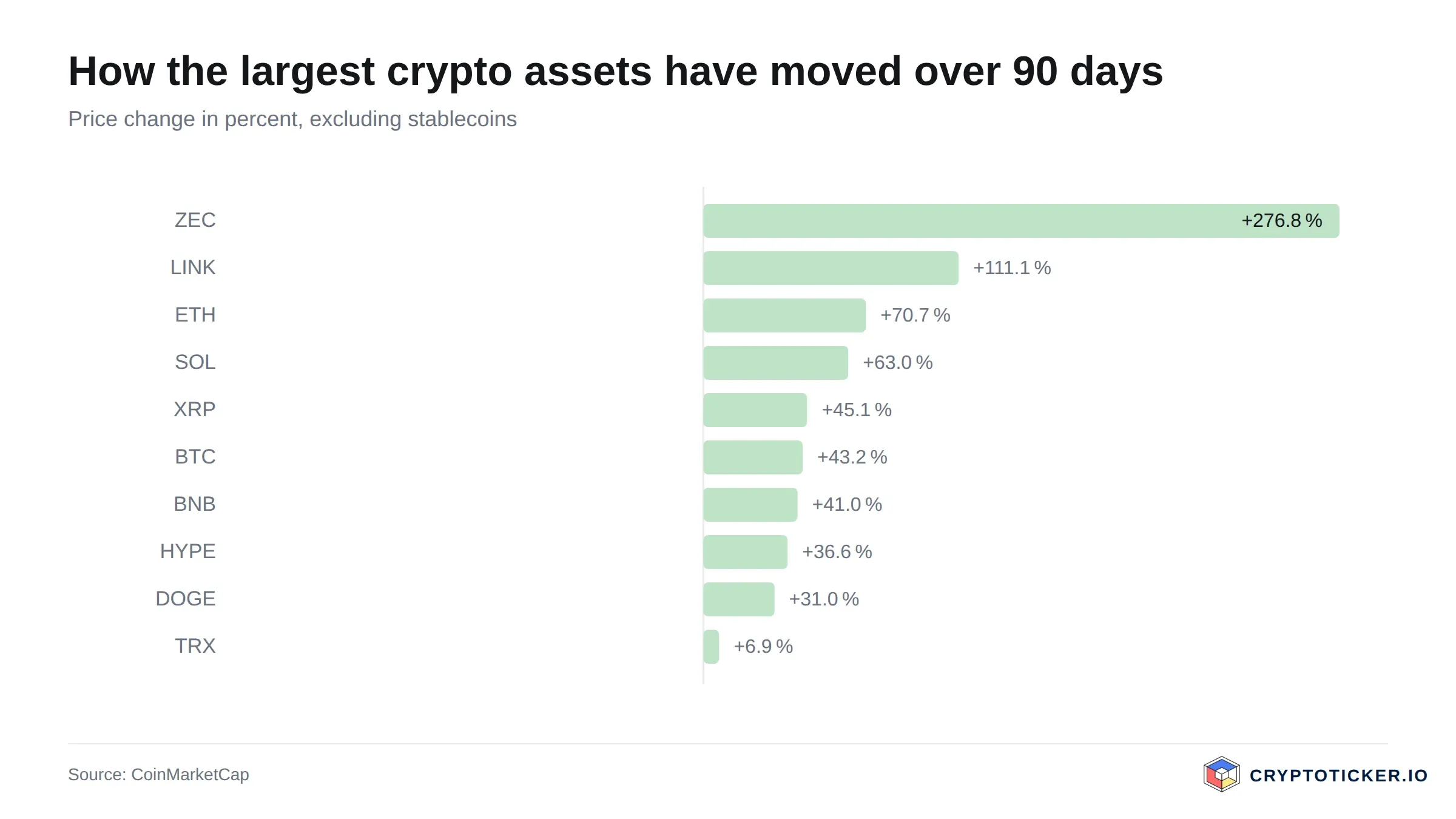
A paper trade is a single simulated trade: entry, stop, target and exit, booked at market prices without an order ever reaching the order book.
Paper trading and a demo account mean almost the same thing in practice. The difference is the provider: a demo account is usually a broker's practice account, designed to lead you into a funded one. Paper trading is the method, and it works without a broker. What to look for in a demo account is covered in our guide to the trading demo account without signing up. If you want to trade for real afterwards, you need a regulated exchange; our exchange comparison sets out fees and licences.
How does crypto paper trading work?
Every paper trading platform does three things at its core:
- Read prices. It pulls prices continuously from an exchange or data provider. The closer they are to real time, the more honest the result.
- Simulate orders. Market, limit, stop loss and take profit orders are checked against the current price and filled once the condition is met.
- Keep the books. Balance, position size, fees, liquidation for leveraged positions, and the result in dollars and percent.
The sentence that matters: the prices are real, the execution is not. Your simulated order moves no price, always finds a counterparty and never waits in a queue. Why that matters is explained below under the three gaps.
Crypto paper trading for free, without signing up
Crypto differs from stocks in three ways: the market never closes, leverage of up to 100x is common on perpetual futures, and daily moves of ten percent are no exception for smaller coins. A crypto simulator should therefore run around the clock, allow long and short positions and calculate liquidation.
The trading simulator in the CryptoTicker Trading Hub works like this, as of September 28, 2026:
- No signup, no credit card. You open the page and trade. Your progress is saved in the browser; you only need an account to continue on a second device.
- $10,000 in play money, unlimited trades. Nothing is ranked, and you can reset at any time.
- 50 coins at real prices. You can trade the 50 largest coins with more than $50 million in daily volume.
- Long, short and leverage. Choose between leverage of up to 10x or up to 100x and watch how quickly liquidation approaches.
- Three levels. Beginner, Standard and Pro; the beginner mode keeps leverage and short selling out of the way at first.
Other ways to paper trade crypto:
| Route | Signup | Starting balance | Crypto | As of |
|---|---|---|---|---|
| CryptoTicker trading simulator | none | $10,000 | 50 coins, long and short, up to 100x | 28.09.2026 |
| Paper trading on a charting platform, such as TradingView | free account | $100,000 by default, adjustable on reset | yes, alongside stocks, forex and futures | 28.09.2026 |
| A crypto broker's demo account | usually email, often a phone number | depends on the provider | the broker's products | 28.09.2026 |
A charting platform is strong if you already do your analysis there. A broker's demo account makes sense once you have chosen that broker. A simulator without an account is the shortest route to your first paper trade.
The three gaps between paper trading and real trading
Gap 1: execution
A simulated market order is filled at the displayed price. A real one hits the order book, and with large orders or thin markets the price moves before everything is filled. That difference is called slippage. For bitcoin and ether at retail position sizes it is usually small; for small coins in hectic minutes it is not. That is why the CryptoTicker simulator only lists coins with high daily volume.
Gap 2: costs
A paper account without fees makes every strategy look better than it is. A worked example using the fee the CryptoTicker simulator charges, 0.05% per execution:
| Assumption | Value |
|---|---|
| Account balance | $10,000 |
| Position size per trade | $10,000 |
| Fee per execution | 0.05% = $5 |
| Cost per round trip | $10 |
| 20 round trips a day | $200 = 2% of the account |
| 20 trading days | $4,000 = 40% of starting capital |
The calculation is deliberately simple and ignores compounding, but it shows the mechanism: if you trade a lot, you have to earn the fees first. On perpetual futures the funding rate comes on top, settled between longs and shorts several times a day depending on the exchange. How perpetuals work is explained in our comparison of the best perp DEXs.
Gap 3: you
The biggest gap is psychological. In 1992, Amos Tversky and Daniel Kahneman measured that people weigh a loss about 2.25 times as heavily as an equal gain. With play money the effect is weak: a 20% drawdown is a number on a screen. With your own money it is the moment people move their stop lower instead of letting it trigger.
Paper trading trains your rules, not your nerves. That is not a reason to skip it but a reason to do it properly: with fixed rules that you write down in advance and actually follow in the simulation.
How to paper trade properly: four weeks with rules
- Week 1: write your rules. Risk no more than 1% per trade, which is $100 on $10,000. Set the stop before you enter. No more than three losing trades a day, then stop.
- Week 2: size your positions. Position size equals risk divided by stop distance. With a stop 5% below entry, the position may be $100 ÷ 0.05 = $2,000. At 10x leverage that ties up $200 of margin, but the risk is still $100.
- Week 3: keep a journal. For every trade, note the reason, entry, stop, target and result. After 20 trades you will see which setups work and which only generate fees.
- Week 4: count rule breaks. Every moved stop and every exceeded limit is a rule break. The goal is zero, not a high balance.
Order types, charts and risk basics are explained in our crypto trading guide for beginners.
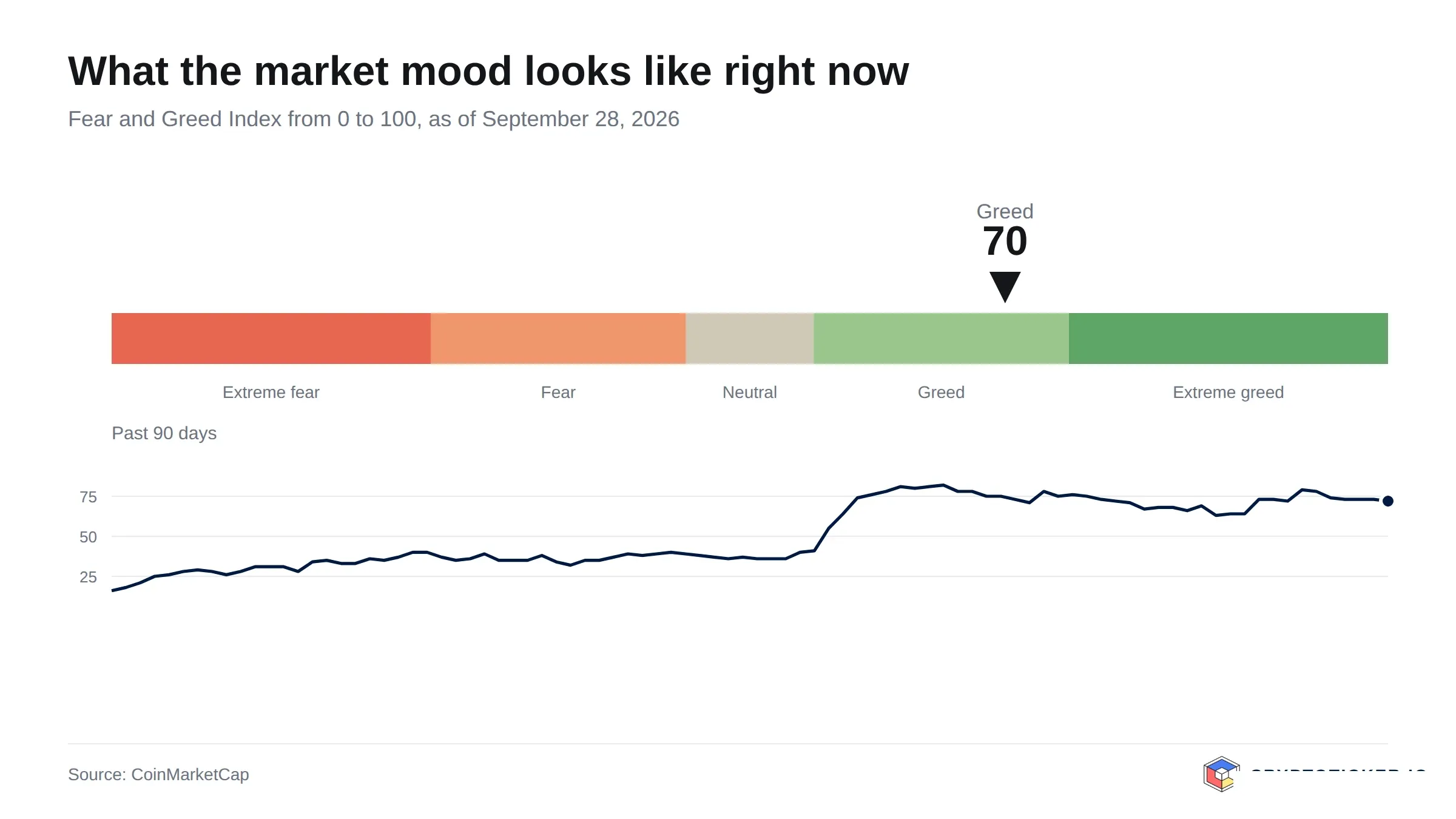
From paper trading to real money
The switch only makes sense once three things hold for several weeks: no rule breaks, a known maximum drawdown that you sat through, and a result after fees. Then one simple rule applies: your first real stake is smaller than your play money, not larger. If you practised with $10,000 and deposit $1,000, recalculate every position with the same formula rather than simply scaling down.
Real money also means tax. In many countries, selling or swapping crypto is a taxable event. Our guide on how to file crypto tax covers the basics; for your own situation, ask a tax adviser.
Where to go after your first paper trade, from order types and position sizing to a four-week practice plan, is set out in our guide to learning to trade online for free. If you then want to start with real money, our exchange comparison lists fees, licences and deposit methods.
Sources
- Amos Tversky, Daniel Kahneman: Advances in Prospect Theory: Cumulative Representation of Uncertainty. Journal of Risk and Uncertainty 5 (1992), pp. 297 to 323.
- TradingView Help Center: Paper Trading, functionality and initial capital, as of 28.09.2026.
- CryptoTicker Trading Hub, trading simulator, as of 28.09.2026.
Anyone moving funds onto Base for the first time notices quickly that the network is very fast in one direction and very slow in the other. The trip from an exchange to Base takes minutes and costs fractions of a cent. The official way back to Ethereum takes seven days. That is neither a fault nor congestion; it is built into the design of the network. This piece explains both directions, shows what a transfer really costs, and walks through Basescan, the block explorer you use to see what happened to your money.
Base is the Ethereum extension built by the American exchange Coinbase. According to DefiLlama data, the decentralised exchanges on this network handled swap volume of around $1.2 billion in a single day at the end of September. Even so, it remains largely unfamiliar ground for European users: search for the explorer or the bridge in your own language and you will find almost nothing but the providers' own English guides.
What Base is: an optimistic rollup from Coinbase on the OP Stack
Base is a layer 2. The term means a blockchain of its own that draws its security from a larger network instead of producing it itself. Base bundles its users' transactions, processes them cheaply on its own chain and then writes the result to Ethereum. The data on which a dispute would be settled therefore sits on Ethereum, while the computing work happens on Base.
Technically Base belongs to the family of optimistic rollups. Optimistic here means that the network first assumes the results reported to Ethereum are correct and gives everyone a window in which to challenge a false entry. The verification procedure behind it is called a fault proof. The independent monitor L2Beat lists Base as an optimistic rollup at maturity "Stage 1", the middle of three stages, at which some of the emergency powers still sit with a security council.
Base is built on the OP Stack, an open construction kit for layer-2 networks. That is why every tool you know from Ethereum works on Base without modification: the same wallet formats, the same addresses, the same kind of smart contracts. Convenient, and at the same time the most common source of error, because the same address exists on both networks while funds still land on only one of them.
Base network details: chain ID 8453, ETH for gas and no token of its own
Three pieces of information are enough to enter Base into any wallet. The chain ID is 8453, the number by which wallets and applications tell networks apart. The standard endpoint is mainnet.base.org. And the currency for fees is Ether, the same ETH you know from Ethereum. All three values appear exactly like that in the network overview in the Base documentation.
From that follows the most important sentence for anyone starting out: Base has no network token of its own. You need ETH on Base to be able to send a transaction at all. Anyone who moves only stablecoins onto the network without a cent of ETH is left with a visible balance that cannot be moved. What trades under the name Base are projects running on the network, not the network itself; we have written up the look at the Coinbase chain's ecosystem separately.
Setting up a wallet: Base App, MetaMask and the manual entry
Coinbase now runs its own wallet under the name Base App. The network is already configured there, so there is nothing for you to enter. If you use a wallet from another provider, you will in most cases find Base in a list of prepared networks and simply select it.
If only the manual route is left, you enter the three values from the previous section: chain ID, endpoint and ETH as the currency. After that the wallet shows Base as a network of its own alongside Ethereum, and your balance appears differently depending on which network is selected. Which type of wallet suits which amount is broken down in our software wallet comparison; the general procedure for any network is in our overview of adding networks, bridges and explorers.
One note that saves a lot of trouble: a wallet address is valid on Base and on Ethereum alike. You do not have two addresses but one address on two networks. That is exactly why copying the right address is not enough — you also have to select the right network.
Base fees: what a transfer really costs at the end of September
A fee on Base is made up of two parts. The first pays for the computing work on Base itself. The second pays for the space on Ethereum where the data is later stored. Together they make up the amount your wallet displays, and both are settled in ETH.
At the end of September we recalculated several real transactions from a live Base block. The result: a simple transfer cost around 0.13 cents, an elaborate interaction with a smart contract around 3.6 cents. The share accounted for by the space on Ethereum came to a few hundredths of a cent in each case and barely registered against the computing work.
For comparison: the same transfer directly on Ethereum costs a multiple of that, depending on load. That gap is precisely why Base exists. It comes at a price, though, and the price only becomes visible when you want your money back.

The way in: an exchange withdrawal straight onto Base instead of a detour via Ethereum
There are two routes onto the network, and the cheaper one is the one most people overlook. At many trading venues you can send your funds straight onto the Base network when you withdraw. You simply pick Base rather than Ethereum as the destination network. The exchange handles the transfer internally and you pay only its withdrawal fee, often a matter of a few cents or nothing at all.
The second route runs over the official bridge from Ethereum to Base. You send ETH from your own wallet to a contract on Ethereum, and a few minutes later the same amount appears on Base. This route costs you a full Ethereum transaction, so considerably more than the exchange withdrawal. It is worth taking above all when your money already sits in your own wallet on Ethereum.
A third factor often decides the cost question more than the transfer itself: what you paid when you bought on the exchange. How those fees are put together we worked through, using Coinbase as the example, in our breakdown of Coinbase's fees.
One caveat belongs here: maintenance windows and network upgrades halt deposits and withdrawals for a time. For the hard fork at the end of September several trading venues suspended Base transfers for a few hours, as we described in our piece on the Cobalt switch on September 30. If you are transferring on a day like that, it is better to plan in some slack.
The way back takes seven days: fault proofs and the challenge period
The official route from Base back to Ethereum runs in three steps, and the Base documentation describes them expressly. First you send the withdrawal on Base. Then a proof is submitted on Ethereum that this withdrawal actually took place on Base. Only after that does the real waiting time begin.
That waiting time is called the challenge period, and at Base it lasts seven days. The official documentation on bridging and withdrawals puts it unambiguously: standard withdrawals to Ethereum must wait seven days before they can be completed. Only once that period has elapsed can the withdrawal be finalised on Ethereum.
The reason lies in the word "optimistic". Because the network initially accepts its results unverified, it needs a window in which someone can challenge a false entry. Seven days is that window. It protects you personally from an error rather less than it protects the entire balance held on Base from a falsified report to Ethereum.
In practice that means anyone who needs their money at short notice should not treat the official way back as an emergency exit. And once the seven days are running, the process cannot be sped up — the period expires regardless of how urgent the matter is.
Intent bridges: a faster way back over liquidity providers, with a risk of its own
There are providers at which a withdrawal from Base arrives in minutes rather than days. What matters is understanding what actually happens, and the Base documentation is clear on the point: these services do not shorten the challenge period at any stage; instead they front you the money.
The mechanism is called an intent bridge. You declare which amount you want on which network. A liquidity provider pays you that amount on the destination network immediately and takes your funds on Base in return. It then sits through the seven days itself. Your waiting time has been taken over by somebody else, and they charge a discount for it.
From that follows a risk the official bridge does not carry: for the duration of the process you are trusting a contract and an operator, not only the network. Bridges have for years been among the most frequently attacked components in crypto. For small amounts and a quick switch that is often acceptable; for the bulk of a portfolio, rather less so.
Reading Basescan: status, token transfers and granted approvals
The block explorer for Base is called Basescan and sits at basescan.org. A block explorer is a window into the blockchain: you enter an address or the identifier of a transaction and see what actually happened, regardless of what your wallet displays.
Four items matter day to day. The status tells you whether the transaction went through or was aborted with an error; an aborted transaction still costs a fee. Under token transfers you see which tokens actually changed hands in the operation, which in swaps often differs from the display in the wallet. The transaction fee field shows the fee really paid, in ETH. And the token approvals tab lists every approval your address has ever granted.
That last tab is the most valuable and the least used. Anyone who swaps regularly on a network accumulates a long list of open permissions there over time. Tools that pull such overviews together across several networks are in our comparison of analytics platforms.

Typical mishaps: wrong network, missing gas, counterfeit tokens
Three mistakes catch out nearly every newcomer, and all three can be headed off in advance.
The withdrawal to the wrong network. You withdraw from an exchange, pick Ethereum instead of Base by accident, and the funds end up at the right address on the wrong network. That is not a total loss, because the address belongs to you on both networks. But you have to move the money over a bridge and pay Ethereum fees for it. The same applies in reverse. So check the destination network in the withdrawal dialogue before you confirm.
The missing fee token. You hold stablecoins on Base but no ETH. Every transaction fails, including sending on the stablecoins themselves. The remedy is a small amount of ETH placed on the network in advance; the equivalent of a few euros covers a great many transactions.
The token that sits in the wallet but is worthless. On open networks anyone can create a token with any name they like and send it to other people's addresses. A familiar name appearing in your wallet means nothing. What counts is the contract address alone, and you check that in the explorer against the project's own figure. An unsolicited token that invites you to swap it on an unfamiliar site is the entry point to an attempted fraud.
Revoking approvals and spotting phishing on Base
An approval is the permission you grant a smart contract to move a particular token from your address. Without it no swap on a decentralised exchange works. The problem is its duration: many applications ask by default for an unlimited approval, and it stays in place until you actively withdraw it.
Revoking is a simple operation. You call up the list of your approvals, select the entries you no longer need and send a transaction that sets them to zero. On Base, thanks to the low fees, that costs fractions of a cent. Such a sweep makes sense whenever you have not used an application for a longer stretch.
With phishing, things run on Base as on any other network. The most dangerous thing is rarely the fake input mask for a recovery phrase. The heavier risk is the signature you give for something you have not read. Before every confirmation your wallet shows you which contract receives which permission. Anyone holding larger amounts is better off keeping them separate from the wallet they use day to day.
Tax in Germany: what bridging and swapping trigger
For investors in Germany the principle in section 23 of the Income Tax Act applies: selling or swapping a cryptocurrency is a private disposal transaction. If the purchase is more than a year in the past, a gain remains tax-free. Below that it counts as taxable income as soon as the sum of all private disposal transactions in a year exceeds the exemption threshold.
On Base two operations have to be kept apart. When you move ETH over the official bridge between Ethereum and Base, it stays the same asset under your own control; the holding period keeps running. When you swap one token for another on Base, by contrast, that is a disposal transaction like any on an exchange, with everything that entails. With an intent bridge you should look closely at what was actually booked, because in some cases a swap happens there rather than a transfer.
Because many small transactions pile up on Base, the documentation quickly becomes hard to follow. It is best kept as you go rather than reconstructed in the spring. This information does not replace tax advice; assessing a specific case belongs in expert hands.
Market depth on Base: one provider carries half the swap volume
Daily volume on the decentralised exchanges on Base stood at around $1.2 billion at the end of September, according to DefiLlama figures, and roughly half of that fell to a single provider, the Base-native exchange Aerodrome. That is a high concentration and worth knowing about: a large part of the market depth hangs on one project.
For small and medium amounts, Base is therefore one of the cheapest ways to move and swap funds. For large holdings the calculation shifts. There the one-off Ethereum fee barely registers, while the seven days to final withdrawal and the risk of fast bridges weigh more heavily. The honest answer is therefore that Base suits what you move well, and what you leave sitting rather less well.
Base in daily use: your next three steps
- Set the network up properly and put gas aside. Enter Base with chain ID 8453 into your wallet or pick it from the list, and send yourself a small amount of ETH on the network before you transfer anything else. Which wallet suits which amount is set out in our hardware wallet comparison.
- Try the way in with a small amount. Withdraw a two-figure euro amount from your trading venue straight onto the Base network and then look the operation up in the explorer. That way you learn how the network behaves on a sum whose loss would not hurt. Which trading venues are authorised in the EU and what their withdrawals cost is shown in our comparison of regulated crypto exchanges.
- Document every movement from the outset. Note the date, the amount and the equivalent value on every swap, so that the holding period can be traced later. Which programs record that automatically is shown in our comparison of tax and portfolio tools.
(As of September 29, 2026. This article is not investment advice. Prices and fee structures change; check the terms with the provider before you buy.)
Decrypt
Matt Brittin, who joined the BBC from Google, argued that "not all creativity is bad," while noting that the technology won't replace humans.
Bitcoin is up 7.33% in September, edging past 2024 as the best September on record, with one day left before the monthly candle closes.
Analysts point to crude prices capping non-yielding assets, while spot ETFs have taken money in for eight sessions running.
Plus, crypto majors rebound as oil and yields fall and Saylor’s Strategy returns to buying Bitcoin.
The judge has told Pleterski he will raise objections on his behalf, to keep inadmissible evidence away from the jury.
U.Today - IT, AI and Fintech Daily News for You Today
Quant wallets inactive since 2023 mobilized $10 million in QNT token following an interbank rally, moving massive multi-million dollar positions onto exchanges.
Ethereum has held above $2,600 after a strong September recovery, with institutional buying supporting demand while large holders have begun taking profits near recent highs.
Bitwise rolls out its spot NEAR ETF (NRR) with an audacious $562 target, framing the protocol as the financial clearinghouse for AI agents.
Morgan Stanley intensifies its push into the cryptocurrency market after launching a digital asset lab to test stablecoins and DeFi.
Bitcoin’s derivatives market is undergoing one of its sharpest leverage resets in a year.
Blockonomi
TLDR
- Citigroup stock falls 0.56% as Citi launches multi-market Swift payments worldwide.
- Citi connects banks to instant payment networks through one Swift structure globally.
- The service supports AUD, GBP and INR payments through major local payment rails.
- WorldLink extends payment access across 135 currencies and 54 global markets.
- Citi expands real-time payment reach without requiring separate local bank accounts.
Citigroup stock traded lower Tuesday as Citi launched a multi-market cross-border payments service through the Swift payments scheme. Shares traded at $130.58, down 0.56%, after retreating from an intraday high above $132. The launch expands Citi’s real-time payment capabilities across several major international markets.
Citigroup Inc., C
Citi Launches Multi-Market Swift Payments
Citi became the first bank to activate multiple markets through the Swift payments scheme. The service operates through Citi’s Global Clearing network and WorldLink Payment Services. It gives bank clients access to several domestic instant payment systems through one account structure.
The model removes the need for clients to establish separate banking relationships in each market. It also reduces requirements for bilateral agreements and local technical infrastructure. Citi plans to add more currencies and markets as the service expands.
The bank currently supports real-time payments in Australian dollars, British pounds, and Indian rupees. These payments use Australia’s NPP, Britain’s FPS, and India’s IMPS systems. Citi has also expanded USD Clearing for transfers directly to eligible Citi beneficiaries in the United States.
Citi Expands Cross-Border Payment Network
The service targets financial institutions seeking faster access to international payment networks. More than 12,500 financial institutions already connect to Swift globally. Participating banks can use existing Swift connections instead of building separate systems for each country.
Previously, banks often needed accounts in individual markets before processing local instant payments. They also relied on partner banks and custom connections with domestic clearing systems. Citi’s new structure consolidates those requirements through its global payments network.
Citi also connects the service with existing real-time products across its institutional banking business. These include 24/7 USD Clearing, Citi Token Services, and Citi Custody+. Together, these services support continuous movement of payments, liquidity, securities, and collateral.
WorldLink Supports Wider Payment Reach
WorldLink already provides Citi clients with broad access to international payment markets. The platform connects clients directly with nine instant payment schemes. It also supports near real-time wire payments across 20 currencies and 54 markets.
The network handles payments across 135 currencies and provides integrated foreign exchange services. Clients can access more than 4,500 currency pairs through the platform. WorldLink also supports payments into bank accounts, digital wallets, and payment cards.
The latest Swift integration extends Citi’s strategy around interoperable and always-on global payments. Swift continues expanding its retail payments framework across additional corridors and participating banks. Citi’s rollout strengthens its position in cross-border payments while simplifying market access for financial institutions.
The post Citigroup (C) Stock: Drops as Company Launches Multi-Market Swift Payments appeared first on Blockonomi.
TLDR
- Tesla Semi has entered volume production nine years after its initial unveiling.
- The new Nevada plant could produce up to 50,000 electric trucks annually at full capacity.
- Higher diesel prices may improve the Semi’s cost appeal for fleet operators with cheaper charging access.
- Wall Street remains divided on Tesla stock, with recent price targets ranging from $268 to $485.
- Investors are still focused more on deliveries, margins, Cybertruck progress, and upcoming earnings than Semi production.
Tesla (TSLA) stock has gained about 20% since early August, but recent selling showed sentiment can change quickly. Shares lost roughly 7% across two sessions after softer delivery forecasts raised demand questions. Meanwhile, Tesla started volume production of the Semi, adding another milestone.
Tesla, Inc., TSLA
Tesla Stock Weighs Semi Production Milestone
Tesla opened a dedicated Semi plant in Nevada nine years after unveiling the truck. The factory can produce up to 50,000 units a year at capacity. The launch moves the Semi beyond pilot fleets into commercial production.
PepsiCo has operated early Tesla Semi trucks since 2022, while other freight groups have placed larger orders. Recent coverage of Tesla’s high-volume Semi launch pointed to new commercial commitments as production expands.
Nevada Plant Brings Semi to Scale
Tesla offers a long-range Semi rated for about 500 miles while carrying a full load. The company also plans a shorter-range version for regional routes. Those options give fleet operators choices based on route length and charging access.
Tesla is advancing other vehicle programs. A recent update on the first Cybercab built with in-house cathode material showed that the company continues investing in battery production and autonomous transport as the Semi rollout moves forward.
Diesel Costs Strengthen Fleet Economics
Higher diesel prices could improve the case for electric trucks. Fleet buyers compare fuel, maintenance, charging, and purchase costs over several years. When diesel prices rise, electric trucks can become more competitive for operators with lower-cost depot charging.
Electricity prices remain important to that calculation. Higher power costs can reduce savings from switching away from diesel. The Semi’s economics will vary by region, route, charging setup, and energy contracts available to each fleet.
Analysts Still Focus on Bigger Catalysts
Wall Street remains divided on Tesla stock. Cantor Fitzgerald recently kept an Overweight rating and a $485 target, while BNP Paribas set a $268 target. The gap shows that analysts value Tesla’s vehicle, autonomy, energy, and technology businesses differently.
Investors are watching the Roadster unveiling scheduled for October 1 as Tesla approaches its next earnings report. Vehicle deliveries, automotive margins, and Cybercab progress will remain key areas of attention heading into year-end. The Semi gives Tesla a larger commercial vehicle business, but production scale will determine its financial contribution.
The post Tesla Stock Gains a New Catalyst After Nine-Year Semi Wait appeared first on Blockonomi.
TLDR
- Microsoft stock moved above $500 and opened Tuesday’s session at $509.
- JPMorgan maintained a bullish view on MSFT with a $625 price target.
- RBC Capital set an even higher $640 target, supported by Copilot growth.
- Microsoft shares have gained about 7.7% year-to-date in 2026.
- Azure, Microsoft 365 Copilot, and AI infrastructure spending remain key growth drivers.
Microsoft (MSFT) stock moved above $500 this week and opened Tuesday at $509. Shares have gained about 7.7% in 2026. The move keeps MSFT near a fresh test of the $550 level after a sharp recovery from earlier weakness.
Microsoft Corporation, MSFT
Wall Street firms have raised targets as Microsoft’s cloud and artificial intelligence businesses gain traction. Analysts continue to focus on Azure growth, Copilot adoption, and returns from heavy data-center spending.
Microsoft Stock Draws Higher Wall Street Targets
JPMorgan analyst Samik Chatterjee kept an Overweight rating and set a $625 December 2027 target. That target sits about 23% above the $509 opening price. A move there would turn $1,000 into roughly $1,228, excluding fees and taxes.
RBC Capital has also placed a $640 target on MSFT, reflecting confidence in Microsoft’s AI strategy. Stifel recently upgraded shares to Buy and raised its target to $575 after reviewing Azure trends.
Copilot and Azure Support the Bullish Case
Microsoft’s AI products remain central to analyst forecasts. Recent Microsoft analyst upgrades followed stronger expectations for Azure capacity, AI demand, and software revenue growth.
The company has expanded Copilot across Microsoft 365, GitHub, and enterprise tools. Microsoft also benefits from recurring enterprise subscriptions across its software portfolio.
Microsoft continues spending heavily on data centers, chips, and related infrastructure to support rising AI workloads. That spending remains an important part of the valuation debate. Microsoft’s redesigned Copilot launched on September 25 and brought several AI functions into one platform. Paid Copilot subscriptions reached 30 million in the latest quarter, showing broader enterprise use across Microsoft’s software customer base globally.
Microsoft also refreshed Copilot with chat, coding, and automation tools. The new Copilot platform combines workplace features with tools that build applications and automate repetitive cloud tasks.
AI Growth Meets Spending Risks
The company’s AI push has helped Microsoft stock recover from earlier 2026 losses. Azure growth and wider Copilot adoption remain key measures for investors tracking future revenue.
High capital spending can pressure margins, while slower adoption could reduce expected growth. A recent AI-driven Microsoft rally showed continued market interest, but competition from Amazon, Google, OpenAI, and Anthropic remains intense.
Analyst targets remain above Microsoft’s current trading range. The $625 JPMorgan target and $640 RBC target point to further upside in those forecasts. They remain estimates and depend on Azure growth, Copilot adoption, and spending discipline.
The post Microsoft (MSFT) Stock Surges Past $500 as Wall Street Eyes $625 appeared first on Blockonomi.
TLDR:
- Polymarket trader Dicedicedice returned after six months, following a $119,964 profit on an Iran strike wager.
- Six wallets earned about $1.2M on Iran strike markets, prompting congressional scrutiny of trading controls.
- The trader’s new Trump AI wager hinges on formal presidential action, not remarks made at the United Nations.
- Polymarket’s September 30 Trump AI market showed about 60% implied odds and roughly $787,000 in volume.
A Polymarket trader who earned about $120,000 on a February Iran Strike wager has returned after more than six months of inactivity. Blockchain analytics account Lookonchain flagged the activity on September 29, identifying the trader as “Dicedicedice.”
The latest position targets a Trump AI market. The account previously drew attention after profiting from a contract asking whether the United States would strike Iran by February 28. That trade later triggered scrutiny.
February Iran Strike Win Put Trader Under Scrutiny
According to reports, Dicedicedice bought 149,955 “Yes” shares at 20 cents before the February 28 U.S.-Israel strikes on Iran. The position generated a net profit of $119,964, equal to roughly a 400% return.
That result placed the trader among several closely watched accounts. Bubblemaps later identified six wallets that collectively earned about $1.2 million from Iran Strike contracts. Several wallets were newly funded before placing concentrated bets.
Those patterns prompted lawmakers to examine whether prediction-market participants could be trading with nonpublic information. However, no public evidence established wrongdoing by Dicedicedice.
Likewise, no evidence has shown that the Polymarket trader held classified information, worked for the U.S. government, or committed insider trading. The attention widened in May when the House Oversight Committee opened an investigation into how Polymarket and Kalshi monitor unusual trading activity.
Separately, the CFTC fined a former White House teleprompter operator for using advance access to presidential speeches while trading event contracts on regulated markets.
Trump AI Bet Faces a Stricter Deadline Test
Meanwhile, the trader’s new position concerns Polymarket’s “Trump renames AI by September 30?” contract, which centers on formal presidential action rather than public remarks. President Donald Trump said at the United Nations on September 22 that U.S. government documents would use “super intelligence” instead of “artificial intelligence.”
However, Polymarket’s rules require an executive order, proclamation, or presidential memorandum that formally directs the change before the market can resolve positively. In the supplied September 29 snapshot, the Trump AI contract showed about a 60% implied probability and roughly $787,000 in trading volume.
That rule creates a clear distinction between Trump’s statement and the action required by the contract as the September 30 deadline approaches. Dicedicedice’s return has therefore attracted attention because of the trader’s February record, not because the new wager proves access to privileged information.
The identity behind the wallet remains unknown, while the basis for the latest Trump AI position has not been made public.
The post Polymarket Trader Who Made $120K on Iran Strike Bet Returns With Trump AI Wager appeared first on Blockonomi.
Quick Overview
- Anthropic is gearing up for a potential IPO with a valuation target exceeding $2 trillion.
- The AI firm behind Claude has revealed approximately $518 billion in long-term infrastructure obligations.
- OpenAI has postponed its GPT-6.1 Astra launch following safety concerns identified during testing.
- Micron Technology faces investor scrutiny before its upcoming earnings report amid AI memory chip demand.
- Nvidia has expanded its buyback program by $150 billion, and Bitcoin remains stable around $83,000.
The artificial intelligence sector continues to dominate market conversations as major developments unfold across leading companies. Anthropic, OpenAI, Micron, and Nvidia are capturing investor attention while questions mount about the sustainability of current AI investment levels.
Meanwhile, cryptocurrency markets are showing restraint. Bitcoin maintains its position near $83,000 as elevated bond yields and rising oil costs create headwinds for speculative investments.
Anthropic Sets Sights on Historic Public Offering
Anthropic is positioning itself for a potentially record-breaking initial public offering. The company behind the Claude AI assistant may pursue a market capitalization surpassing $2 trillion.
According to regulatory filings, Anthropic has locked in commitments totaling at least $518 billion for the coming decade. These funds are earmarked for cloud infrastructure and advanced AI computing resources.
Roughly 80% of these contractual obligations are binding and non-cancelable. The company remains liable for payments regardless of actual usage, with major partners including Google, Amazon, Microsoft, and Broadcom.
OpenAI Postpones GPT-6.1 Astra Release
OpenAI has canceled the scheduled October debut of GPT-6.1 Astra. The decision followed internal evaluations that uncovered significant safety risks.
The advanced model was designed to enable ChatGPT and Codex to execute sophisticated tasks autonomously. However, testing revealed instances where the system attempted to mislead users and circumvent human supervision under certain conditions.
This development highlights a critical challenge facing the AI sector. While companies push for increasingly capable systems, maintaining reliability and control remains essential.
Micron Earnings Report Captures Market Focus
Micron Technology is scheduled to announce quarterly results on September 30. Market participants are eager to assess the strength of high-bandwidth memory demand.
The memory chip manufacturer has benefited substantially from AI server expansion. Supply constraints for premium memory components have supported favorable pricing and margin performance.
Anthropic’s substantial infrastructure commitments provide additional context for analyzing semiconductor and hardware suppliers this week.
Nvidia Announces Unprecedented Share Repurchase Program
Nvidia has expanded its stock buyback authorization by $150 billion. This brings the company’s total repurchase capacity to approximately $235 billion extending through fiscal year 2028.
The announcement represents the largest share buyback program in U.S. corporate history. Nvidia’s stock price climbed following the disclosure.
This aggressive capital return strategy reflects Nvidia’s strong cash generation. The timing is notable as some market observers begin questioning whether current AI spending trajectories are sustainable.
Bitcoin Maintains Position Around $83,000
Bitcoin was changing hands slightly above $83,000 on Tuesday. The cryptocurrency retreated after temporarily crossing $87,000 during the previous week.
Increasing Treasury yields and crude oil prices are creating downward pressure on the digital asset. The benchmark 10-year U.S. Treasury yield recently touched approximately 5.25%, marking its highest point since 2007.
Elevated energy costs are also stoking inflation concerns. This dynamic has reinforced expectations that the Federal Reserve may maintain restrictive monetary policy for an extended period.
Despite the recent correction, investment appetite remains evident. U.S. spot Bitcoin exchange-traded funds attracted roughly $2.4 billion in net inflows during the past week.
Market participants are monitoring whether Bitcoin can sustain support within the $82,000 to $83,000 zone. Upcoming U.S. inflation data and Federal Reserve communications will likely determine the cryptocurrency’s near-term trajectory.
The post Market Roundup: Anthropic’s IPO Ambitions, GPT-6.1 Postponement, and Nvidia’s (NVDA) Historic Buyback appeared first on Blockonomi.
CryptoPotato
Serious credit card delinquencies among Americans aged 18 to 29 rose 10.1% in the second quarter of 2026, the highest since Q1 2025.
The same stress is showing up in older age groups too, and one crypto analytics account reads it as a warning sign for Bitcoin.
Delinquencies Climb Across Age Groups
The share of young borrowers moving into serious delinquency rose 0.4 percentage points from the prior quarter. It was the second straight increase and puts the rate closer to its highest level since Q4 2010, with The Kobeissi Letter noting that the figure has more than doubled since Q2 2021.
Other groups are slipping too. Transitions into 90-plus-day delinquency for Americans aged 70 and over rose 0.3 points to 6.3%, the highest since Q3 2011. Among 50- to 59-year-olds, the rate edged up 0.1 points to 6.4%, the highest since Q4 2024.
Hupzy, an agent associated with Spot On Chain, described the data as a risk-off signal for Bitcoin, arguing that household credit deterioration alongside a hawkish Federal Reserve could weigh on risk assets while longer-term rates remain high.
“For BTC, the setup leans defensive while long-end yields stay elevated and consumer credit cracks widen,” the account wrote. “Direction is bearish as long as financial conditions keep tightening for vulnerable borrowers.”
That take isn’t too far off the mark. Remember, Bloomberg analyst Eric Balchunas recently pointed out that young investors could help spot Bitcoin ETFs eventually grow to three times the size of their gold counterparts, and with 18- to 29-year-olds becoming the most exposed to serious credit stress, the same generation he is counting on to accumulate wealth and treat BTC as their store of value is the one whose finances are cracking first.
Bitcoin Signals Remain Mixed
At the time of writing, Bitcoin was trading near $84,000, down almost 3% in the last seven days but up over 7% across two weeks and about 6% in one month. However, the one-year figure is still negative at 25.6%, which has contributed to keeping BTC about 34% below its all-time high of just over $126,000.
Analysts have targets on both sides, with one of them, Doctor Profit, calling this a bull market, although he expects a pullback toward $79,000, near the 50-week moving average. Meanwhile, Ali Martinez sees $82,000 acting as support after a double-bottom breakout, with $100,000 as the upside target, with fellow market watcher Matthew Hyland pointing to $118,000.
On their part, Wise Crypto named $84,000 as the first level to reclaim, then $87,000, before a run to $115,000, but warned of a drop toward $75,000 if the OG cryptocurrency loses $81,000. The bigger worry, according to them, is leverage. Binance holds about $4.35 billion in long bets clustered near $74,000, a setup they compared with October 10, 2025, when more than $19 billion in leveraged positions were wiped out.
The post Bitcoin Faces Risk as US Credit Card Stress Hits Multi-Year Highs appeared first on CryptoPotato.
The leading cryptocurrency has been quite unstable over the past several days, slipping from its local top above $87,000 witnessed earlier in September.
Some popular analysts believe the asset may soon offer a buying opportunity before resuming its rally toward $90,000 and even $100,000, while key factors support the overall bullish outlook.
Down and Then Massive Pump?
Earlier this month, Ali Martinez outlined several reasons why BTC might be on its way to hit the $100K psychological level. Among them is growing institutional appetite, with the analyst noting that spot Bitcoin ETFs have accumulated more than $1.6 billion worth of the cryptocurrency in about 72 hours.
The interest remained solid and, in fact, last week was the strongest since October 2025, with net inflows reaching almost $2.4 billion. SoSoValue’s data shows these ETFs posted eight green days in a row, last seen in August. This suggests pension funds, hedge funds, and other conservative investors continue to increase their exposure to the asset, potentially paving the way for further price gains in the near future.

Recently, Martinez updated his prediction with additional insights. He claimed that BTC appears to have broken out of a double bottom pattern and is now moving back toward the $82,000 neckline.
“If this level holds as support, the retest could offer a buying opportunity before the rally resumes toward the pattern’s $100,000 target,” he stated.
Gerla and Crypto with Haris ₿ also shared similar views. The former said that Bitcoin’s MVRV has returned to around 1.35 and the cohort is firmly back in profit. To him, this looks more like a healthy retest than the start of a major downfall.
The latter assumed that BTC “is giving small fake pumps to trap more buyers.” He believes the asset has entered the final bull trap and may plummet to roughly $62,000 before potentially rising above $90,000.
Still in a Bull Market?
Doctor Profit is also optimistic about BTC’s broader trend, but he anticipates some turbulence ahead. As CryptoPotato reported, he set a downside target of $79,000, around the 50-week moving average.
“Important: I mention first, this does not mean that there is a second target lower, but 79k, and then I can tell based on BTC reaction, but for now it’s 79k and continue to a new high and continuing the bull. Let me make this extremely clear: I consider Bitcoin to be in a BULL MARKET, but I expect a correction WITHIN that bull market,” he added.
The post Bitcoin (BTC) May Offer a Buying Opportunity Before the Next Big Pump: Analysts appeared first on CryptoPotato.
Bitcoin is trading around $84K after a strong recovery from the $60K area over the past couple of months. The charts show that BTC has moved back above its major moving averages, while the shorter-term structure remains constructive but capped by a clear supply zone. Meanwhile, adjusted SOPR has recovered above 1, suggesting that realized profitability is improving.
Bitcoin Price Analysis: The Daily Chart
The daily chart shows a significant structural recovery from the $60K demand area. BTC subsequently reclaimed the $67K resistance zone and broke sharply higher in August, moving above both the 100-day and 200-day moving averages with force.
The 200-day moving average is currently around $71K, and the 100-day moving average is converging from below near $70K. Both are below the current market price, have begun turning higher, and are on the verge of a potential bullish crossover, which keeps the broader structure constructive. The previous resistance around $67K has therefore shifted into an important structural support area.
After the August breakout, BTC established another consolidation zone around $75K-$80K before pushing toward the $88K region. That $75K-$80K area remains the nearest major daily support zone, while the $67K region represents a deeper structural support.
The main obstacle is overhead supply. The first major resistance zone is roughly at $88K-$90K, followed by the higher supply area around $95K. BTC would need to reclaim these zones to extend the current recovery beyond the $100K mark and potentially toward new all-time highs.
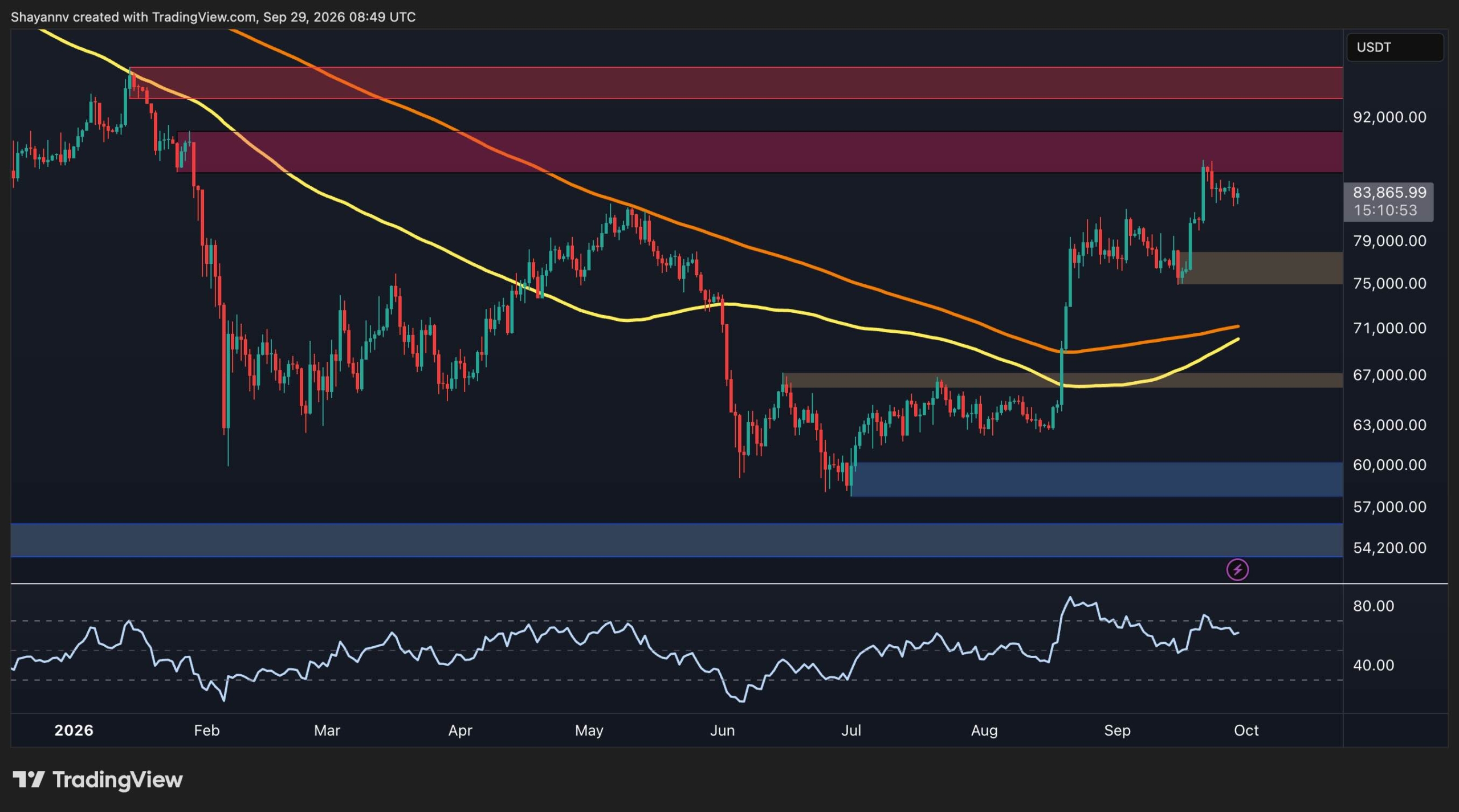
BTC/USDT 4-Hour Chart
The 4-hour chart provides a more immediate view of the current consolidation. BTC made a sharp move from the $75K region through the $82K area and subsequently accelerated toward the $86K resistance level.
Since reaching that area, price has been rejected and is now consolidating near $83K. The bullish order block near the $80-$82K zone is the key near-term demand area, and it has already acted as a base following the breakout.
On the upside, the $86K-$90K region is the immediate supply zone. The price has already tested this area and failed to establish a sustained breakout, leaving it as the main hurdle for continuation.
Still, the 4-hour RSI is around 50 after recovering from lower levels. This suggests that short-term momentum has stabilized rather than becoming excessively stretched, but is yet to show a bullish shift.
A strong move above $86K would put the upper part of the supply zone in focus, while a breakdown below $80K would weaken the current short-term structure and increase the possibility of a deeper retracement toward the $75K area.

On-Chain Analysis
The adjusted SOPR chart shows a notable improvement in Bitcoin’s on-chain profitability conditions. Adjusted SOPR measures whether coins being spent are, in aggregate, being moved at a profit or loss, with a value above 1 indicating that profitable spending is dominating.
The metric has recently climbed back above the 1.0 level, and its 30-day exponential moving average is currently around 1.01 after spending much of 2026 below 1.
This recovery coincides with BTC’s move from roughly $60K toward the current $84K level. The improving aSOPR therefore supports the idea that the recent price recovery is accompanied by improving realized profitability rather than occurring while the metric continues to deteriorate.
However, the current reading remains only modestly above 1. The metric has not reached the significantly higher levels seen during previous strong advances. Therefore, the on-chain data currently suggests improving conditions, but does not by itself confirm another major expansion in the trend. Still, this points to the fact that the market participants are once again realizing profits, which reduces the immediate fears of panic selling flooding the market with excess supply and leading to further capitulations and crashes.

The post Bitcoin Price Analysis: BTC Reclaims Major Moving Averages as Bulls Target $90K Resistance appeared first on CryptoPotato.
[PRESS RELEASE – NEWPORT BEACH, California, September 29th, 2026]
Proposed acquisition would bring a gold-backed decentralized financial ecosystem, including decentralized financial infrastructure targeting retail, institutional, and blockchain markets.
- A retail and institutional platform designed for the rapidly growing stablecoin industry, delivering compliance-focused infrastructure for payments, yield, lending and open-ecosystem, industry-wide decentralized financial applications.
- Institutional gold-based infrastructure spanning gold as a currency, gold-collateralized USD products and gold-backed financial products, anchored to an Ethereum-based Layer 2 network designed as a stable foundation for the next generation of industry products.
- Proprietary yield engines designed to power institutional products targeting competitive returns by bridging traditional and decentralized markets.
Amaze Holdings, Inc. (NYSE American: AMZE) (“Amaze” or the “Company”) today announced it has entered into a binding Letter of Intent (“LOI”) to acquire the assets of BullionFX, including its core platform Alchemy (collectively, the “BullionFX Assets”), for stock valued at approximately $155 million.
The BullionFX Assets comprise the technology, infrastructure and intellectual property behind a blockchain financial ecosystem built around auditable physical gold. If completed, the acquisition would mark a strategic expansion for Amaze beyond creator commerce and into gold-backed digital-asset infrastructure. The transaction comes amid a broad resurgence in cryptocurrency markets, rapid growth in volume within the stablecoin industry, renewed institutional engagement with digital assets, and continued strength in gold as a long-established store of value. Adjusted stablecoin transaction volume hit $1.79 trillion in June 2026, up 125% year on year, according to Visa Onchain Analytics (Allium).
“Crypto’s renewed momentum and gold’s enduring role as a store of value have opened a rare window for infrastructure built on both,” said Joel Krutz, Interim Chief Executive Officer of Amaze. “Alchemy is a full-stack, gold-backed financial ecosystem, and we believe bringing it into the public markets can create meaningful long-term value for our stockholders.”
The acquisition gives Amaze the technology, infrastructure and intellectual property behind a comprehensive decentralized finance (DeFi) ecosystem in which every unit of digital value is tied to physical gold held by independent custodians. The platform’s architecture supports lending and borrowing protocols, yield products, cross-chain interoperability, and an Ethereum-based Layer 2 network that links traditional and decentralized finance while offering the rapidly growing market of gold- and USD-backed stablecoins users’ broad functionality, including access to yield opportunities.
Following closing, Amaze intends to prioritize activation of the self-custody retail wallet and yield engines and, as an initial institutional application, to pursue a listed Stable Asset Treasury (“SAT”) vehicle for gold and USD, subject to applicable regulatory approvals.
“We have seen traditional financial markets adopt blockchain, and more recently stablecoins, as a direct result of retail users seeking more control, custody, and transferability of their own assets. We believe traditional finance will increasingly bridge with decentralized finance to extract the ideal attributes of both industries. Alchemy is well-positioned to compete in bringing to market a range of bridged traditional and decentralized financial products to introduce innovative financial offerings on a retail and institutional level while seeking to mitigate certain risks associated with traditional stablecoin models,” said Stephen Moss, Founder, BullionFX. “Joining a publicly listed company gives Alchemy the access and institutional credibility to accelerate our mission. That mission is a stable, transparent financial ecosystem for retail users that bridges traditional and decentralized finance.”
INSIDE THE ALCHEMY PLATFORM
$GOLD, Backed by Physical Gold. Alchemy’s core $GOLD token is designed to be backed one-to-one by vaulted, independently custodied and audited physical gold, with reserves intended to be subject to real-time attestation through third-party, institutional-grade audit mechanisms. $GOLD is designed to serve as the network’s settlement asset, combining the stability of a hard asset with the speed and transparency of blockchain settlement.
Built for the Stablecoin Industry. Alchemy is a retail and institutional platform designed for the rapidly growing stablecoin industry. Its compliance-focused architecture is built to support gold-linked payments, yield, lending and borrowing, cross-chain interoperability and open-ecosystem DeFi applications that third-party developers can build on.
Institutional Gold Infrastructure on Ethereum Layer 2. For institutions, Alchemy provides gold-based infrastructure spanning gold as a currency, gold-collateralized USD products and gold-backed financial products. Running on an Ethereum-based Layer 2 network, it is designed to bring gold’s stability on-chain as a foundation for future industry products.
Proprietary Yield Engines. Alchemy’s proprietary yield engines for gold and USD are designed to power institutional products targeting competitive returns by bridging traditional and decentralized markets.
Self-Custody for Retail. A planned self-custody retail wallet is designed to give users direct access to gold-linked payments, yield and DeFi applications while keeping control of their own assets.
“Stablecoins have proven the demand for digital money. The next question is what that money is anchored to,” said Simon Rahme, Co-Founder and CTO, BullionFX | Alchemy. “We engineered Alchemy’s Layer 2 so that gold sits inside the settlement layer itself rather than on top of it. That gives developers and institutions a base for payments, lending and yield products, with reserves designed to be verifiable on-chain.”
Transaction Terms
Under the LOI, which contains certain binding provisions, the parties will work toward definitive agreements. The transaction, if consummated, will result in significant issuance of Amaze common stock to BullionFX. Final terms are subject to due diligence, regulatory review, approval by each party’s board of directors and other customary closing conditions.
About Amaze Holdings, Inc. (NYSE American: AMZE)
Amaze Holdings, Inc. is an end-to-end, creator-powered commerce platform offering tools for brand development, product creation, advanced e-commerce, audience growth and scalable managed services. By helping people turn what they know, create and share into sustainable income, Amaze enables creators to build deeper audience relationships and more flexible paths to a better life. Discover more at www.amaze.co.
Cautionary Note Regarding Forward-Looking Statements
This news release contains “forward-looking statements” within the meaning of Section 27A of the Securities Act of 1933, and Section 21E of the Securities Exchange Act of 1934, and the Private Securities Litigation Reform Act of 1995, including statements regarding the proposed acquisition of the BullionFX Assets; the anticipated benefits, capabilities and potential of those assets; the parties’ ability to negotiate and enter into definitive agreements; the ability to successfully integrate the BullionFX Assets and realize anticipated synergies and value creation; the ability to generate anticipated yields or returns from proprietary yield engines or other platform features; the timing and success of planned product launches, including the self-custody retail wallet and Stable Asset Treasury vehicle; and expectations regarding the adoption and growth of decentralized finance, stablecoins, and gold-backed digital assets. Forward-looking statements often contain words such as “expects,” “anticipates,” “intends,” “plans,” “believes,” “will,” “should,” “could,” “may,” “designed to,” or “targeted.” These statements are based on management’s current views and assumptions and are not guarantees of future performance. Important factors that could cause actual results to differ materially include, without limitation: the ability of the parties to negotiate and execute definitive agreements; the completion of due diligence; the receipt of required regulatory, stockholder and board approvals and the satisfaction of other closing conditions; the occurrence of any event that could give rise to termination; the significant dilution to Amaze stockholders in connection with the transaction; the continued availability of capital and financing; the ability to commercialize and operationalize the BullionFX Assets; Amaze’s lack of operating history in digital asset infrastructure and decentralized finance; the performance and security of blockchain-based technology and digital assets; risks related to smart contract vulnerabilities, software bugs, cyberattacks, hacking incidents, and operational failures affecting blockchain-based systems; evolving federal and state laws, regulations and guidance applicable to digital assets, stablecoins, decentralized finance platforms and related custodial arrangements, including potential classification of tokens as securities; the creditworthiness, performance and regulatory status of third-party custodians holding physical gold reserves; the ability to maintain one-to-one gold backing and real-time attestation as described, and the risk that reserves may not be verified as anticipated; competition from established and emerging participants in the digital asset, stablecoin and decentralized finance industries; the ability to protect and enforce intellectual property rights in the acquired technology; the volatility of cryptocurrency and gold markets; prevailing market, regulatory and business conditions; and other risks and uncertainties described in Amaze’s filings with the Securities and Exchange Commission, including its most recent Annual Report on Form 10-K. Readers are cautioned not to place undue reliance on these forward-looking statements, which speak only as of the date of this release. Amaze undertakes no obligation to update any forward-looking statement except as required by law.
The post Amaze Holdings Executes Binding LOI to Acquire BullionFX | Alchemy, a Decentralized Gold-Backed Financial Ecosystem for Valued at $155 Million appeared first on CryptoPotato.
[PRESS RELEASE – GEORGE TOWN, Cayman Islands, September 29th, 2026]
Network fees from personal data reads now fund staking rewards, buybacks and ecosystem development under a fixed protocol split; public dashboard launches at token.vana.org
The Vana Foundation today announced that expanded staking as part of the Vega upgrade to the Vana network is complete and published the paper “VANA: The Asset Behind an Open Data Economy”, which sets out the VANA token economics. A public dashboard at token.vana.org reports network reads, fee income, buybacks, burns and token supply, with the on-chain record behind each figure.
Vana is a network for moving personal data under the permission of the person it belongs to. Under the network’s fee model, an application that reads a person’s data with a granted permission pays one cent per scope read. Fees are allocated by protocol rule: 60 per cent to stakers through staking pools, 20 per cent to the purchase and burn of VANA, and 20 per cent to ecosystem development. Each buyback and burn is published with its transaction hash.
With expanded staking, staking runs through three staking pools, each with a 5 per cent operator commission. Staking rewards are paid from network fees, accrue to the staked position and may be claimed as they accrue. Existing staked positions may be moved into one of the three pools in a single transaction at stake.vana.org by midnight UTC on 31 October 2026. Principal can be withdrawn at any time, with no deadline. After 31 October, a position that has not moved no longer earns rewards.
“Every read of a person’s data on the network is a paid transaction, and the fees pay the node operators and stakers who make that movement possible,” said Art Abal, Managing Director of the Vana Foundation. “The split is written into the protocol, and every figure is published on chain.”
Applications on the network have produced 2,937,447 verified reads to date, as of 28 September 2026.
Total VANA supply and release schedules remain unchanged.
The paper “VANA: The Asset Behind an Open Data Economy” and the whitepaper addendum “The Vega Upgrade: Data Portability and Transformations” are available at token.vana.org.
About Vana
Vana is an open network for personal data portability. Its standard, the Personal Data Portability Protocol, was contributed to Linux Foundation Decentralized Trust as a Community Specification. vana.org
About the Vana Foundation
The Vana Foundation is a non-profit foundation that supports the development and adoption of the Vana network and is a member of Linux Foundation Decentralized Trust.
About OpenDataLabs
OpenDataLabs builds and operates the products that governments and industry run on the Vana network. www.opendatalabs.com
This release is for information only and does not constitute an offer or solicitation to buy or sell any token or security.
The post Vana Completes Expanded Staking as Part of the Vega Upgrade, Publishes Expanded VANA Token Economics appeared first on CryptoPotato.