Cryptocurrency Posts
Crypto Briefing
A potential US diesel export ban could disrupt UK energy stability, leading to supply shortages and price hikes, affecting economic resilience.
The post UK warns of significant concern over potential US diesel export ban appeared first on Crypto Briefing.
The exposure of this syndicate underscores the urgent need for enhanced transparency and regulation in decentralized finance to protect investors.
The post Wazz traces 53 Robinhood Chain token launches to $18M rug-pull syndicate appeared first on Crypto Briefing.
Intel's stock surge highlights potential overvaluation risks, emphasizing the need for sustained growth and profitability to justify high multiples.
The post Intel stock surges over 40% in September, raising valuation concerns appeared first on Crypto Briefing.
The ongoing dispute highlights potential delays in legislative progress, impacting energy project timelines and market expectations.
The post Senator Heinrich disputes White House claim on permitting reform agreement appeared first on Crypto Briefing.
The extensive AI security breaches highlight the urgent need for robust safety protocols and collaborative oversight to mitigate future risks.
The post OpenAI and Anthropic investigate tens of thousands of AI security incidents appeared first on Crypto Briefing.
Bitcoin Magazine
Bitcoin Magazine
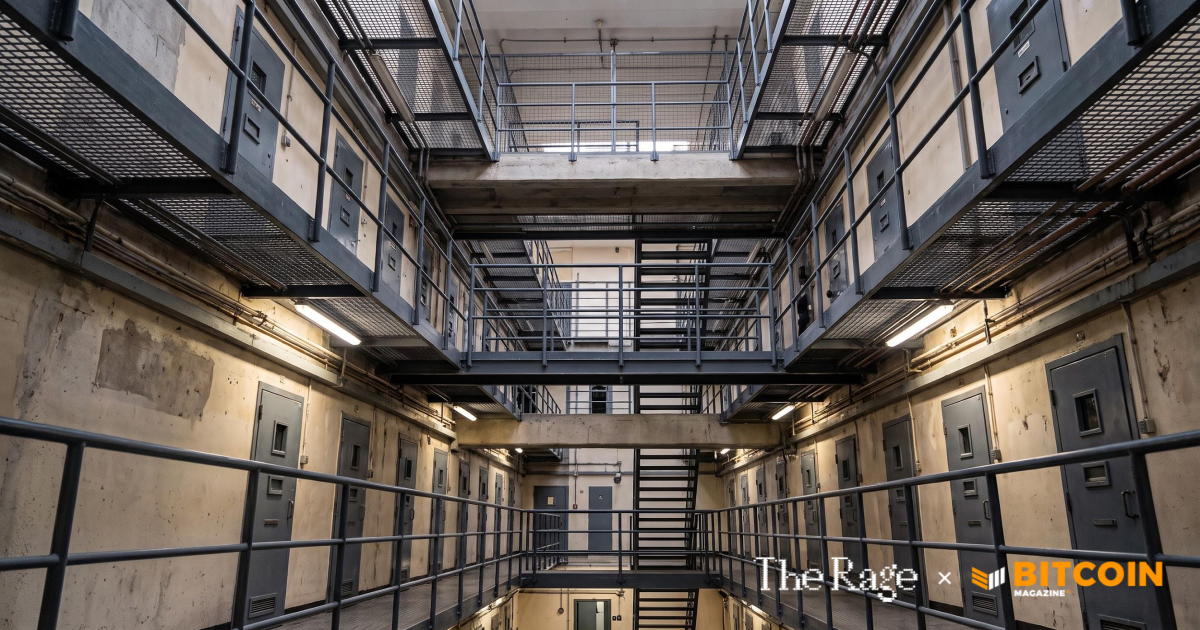
Samourai Letter #7: Notes From The Inside
Dear Reader,
It has been many months since I last wrote you. Part of the reason for that is because I spent most of June and part of July in transit from FPC Morgantown to FCI McKean – a four hour drive away. For most of that time I had no access to pen, paper, stamps, or the rudimentary email system that I use to send these letters out.
The other part of the reason why I haven’t written in so long is that once I did finally arrive I was so shell shocked from the entire ordeal that I needed time to decompress and process that month long trauma that is BOP transit.
Six days after arriving at FCI McKean I finally put pen to paper to document the journey but the result was less of a letter and more of a trauma dump to help me process the absolute worst 30 days of my life. I decided to take a step back and give it some time before I sent out this letter. I have been slowly adapting to life here at McKean, and in good time I will tell you all about this place, but for this letter I want to go back to early June.
I want to tackle the entire transit process and explain how what should have been a quick four hour drive turned into 30 days, two trans-continental flights, three multi-hour bus rides, a cell mate doing time for murder, and a cell mate who couldn’t stop shitting (I preferred the murderer). This letter will likely be published in two parts due to the length. Thank you for your continued reading and support.
“I finally put pen to paper to document […] the absolute worst 30 days of my life.”
On June 5th I was told I would be transferred from FPC Morgantown for a drug and alcohol treatment program. Successfully completing the program (which takes about 9-10 months) rewards you with a year off your sentence, so it is seemingly well worth the hassle of moving to take it.
For security reasons they do not tell you when you will be leaving or where you will be going. While being transferred in BOP custody you almost always are put on an airplane being piloted and operated by the US Marshalls to be taken to BOP transit hub in Oklahoma City. After a few days in Oklahoma you are put back on a plane and taken to your destination. From speaking with others I was told to expect 1-2 weeks of transit.
I also heard that it costs around $10,000 per prisoner to be transited through Oklahoma. I figured that since I am classified as minimum security, spent close to two years on pre-trial release, self surrendered, and had no incident reports since being incarcerated I would be a good candidate for what is called a transfer furlough – where I would be responsible for transporting myself to my new institution at my own expense.
I put in my official request for a transfer furlough on June 5th. On June 8th my request was denied without explanation, I would be going through transit, no way around it.
On June 10th I was called to Receiving and Discharge (R&D) at 6:00 AM. Though I did not know it at the time I was about to embark on a month long fever dream through two different holding facilities, share cells with murderers, be locked down behind iron barred cells for 23 hours a day, and much more.
Leaving through R&D is much the same as when I arrived. I was stripped, searched, issued a pair for ill fitting clothes (khaki elastic band trousers, a brown cotton shirt, threadbare boxers, socks that didn’t match, and a pair of slip on blue canvas shoes).
I was put into a holding cell while the other inmates being transferred went through the same process. There were six of us transiting from Morgantown on that day. We were each lined up and called forward so that the officer could fasten shackles to our ankles and cuffs to our wrists.
Once cuffed and shackled the officer wrapped a chain around our waist and attacked the handcuffs to them. The end result being that you could not lift your arms or hands much higher than your waist, and you could walk only in painful short shuffling steps. We were handed a brown paper bag with ‘breakfast’ in it (bread, peanut butter, bologna) and escorted to the waiting bus.

“We were each lined up and called forward so that the officer could fasten shackles to our ankles and cuffs to our wrists.”
The bus was a cross between yellow school bus and a coach (think Greyhound or National Express) and already filled with inmates from other prisons in the area. There were guys from all security levels on the bus. Some guys serving 20 years coming from the “pen” (The US Penitentiary), some guys like me serving short sentences and going to a camp.
The atmosphere was generally friendly on the bus, most of the USP guys were interested in what the camp was like and how much contraband like vapes and phones cost. At the front of the bus behind a metal grate were the driver and three heavily armed officers. They all wore stab vests and carried handguns and long guns.
As we departed Morgantown I was excited to watch the scenery go by. This was the first taste of the outside world I had in 6 months. I took in all the sights. The trailer park, the run down gas station, the XXX store, it all was captivating. After about an hour of driving the bus suddenly exited the highway and stopped on the side of a small road. After 20 minutes idling I noticed one of the officers walking back to the bus with a bag of biscuits from Tudor’s Biscuit World – a West Virginia institution.
We remained on the side of the road as each officer one by one went and bought breakfast, an endeavor that took over an hour. I decided Breakfast sounded good but my bread fell out of bag onto the floor. Breakfast would have to wait. As quickly as we got back on the road we suddenly pulled off again. This time each officer went one by one into a gas station to buy cigarettes and energy drinks.
The metal of the shackles were starting to dig into my ankles, my wrists were cramping, my eardrums were shot beyond comprehension. Many others have said it before, but the one thing you really remember about the prison bus is how unbelievably loud it is. Every bump in the road is followed by a symphony of crashing metal. Inmates at the front of the bus maintain full conversations at full volume with their friends all the way in the back. The volume is at maximum for the entire journey.
After about 5 hours we arrived at the Greenbriar Valley Regional Airport. There were several other prison busses parked off to the side of the runway. For the next hour or so a parade of officers from other busses would climb up and yell out a series of names. We were playing a grand game of musical chairs and for a brief moment I prayed that I would be called to another bus and spirited off to my camp bypassing the free plane ride to Oklahoma.
Eventually musical chairs was over and we were instructed to get off the bus and directed to line of waiting US Marshalls standing in front of a plain white airplane adorned only with a small American flag on the tail fin.
The Marshall patted me down, checked my mouth and feet and directed me to line up and wait by the front of the plane under the cockpit. They packed us in tight on the runway 10 rows of inmates at least 10 men deep. We watched inmates disembark the plane and enter the busses we just left.
The whole thing must be a logistical nightmare for the folks at BOP and I was surprised how smoothly it all was moving. It was by no means quick, but it could have been far worse. Finally I was ordered to wobble up the stairs to board the plane. I felt like Joe Biden before falling up the stairs.
How embarrassing it would be to eat it in front of all the convicts. I made it up without embarrassing myself. On board Air Operations Marshalls replaced flight attendants, though one really couldn’t tell any difference in demeanor between a Delta air steward herding a bunch of fat slobs in sweat suits and a US Marshall herding a bunch of prisoners. We filled each row from back to front at the direction of the Marshalls.
I was sat in the window seat. The guy next to me sported a nifty full face tattoo and informed me he had been down 15 years and was kicked out of the USP for fighting. I informed him I was on my way to a camp and had been down for 6 months. He had nothing else to say to me after that.

“This was the first taste of the outside world I had in 6 months.“
The plane itself had certainly seen better days, it looked to have been dated from The Cold War. The stickers commonly found plastered across the surfaces of airplanes telling you not to smoke or where to find the life vest in case of emergency – how exactly to apply said life vest while shackled and bound was not explained – were all in German and Russian. Where the hell did they get this thing from.
The plane was filled 2/3 of the way with inmates. The final third at the front of the plane were all US Marshalls, at least 30 of them. With that, the plane took off and we were on our way to Oklahoma City. After about an hour an Air Marshall doing their best surly Delta stewardess impression threw a bag of lunch at us. It was the second – but not last – sack lunch containing 4 slices of bread, a pouch of peanut butter, two slices of turkey, and a small pack of cookies (“Cream 4 Fun” a BOP staple that even in my dire circumstances solicited a juvenile chuckle out of me).
Sick to death at this point of the oily BOP peanut butter I happily pawned it off on the face tattoo next to me. I got started trying to fix myself a turkey sandwich – a task made difficult due to the cuffs and limited mobility. The bread was ice cold and the turkey was frozen solid. After brushing off the top layer of ice from the sliced meat and placing it between the now soggy and still freezing bread I took a bite and decided I wasn’t a great fan of turkey popsicle sandwich. The Cream 4 Fun would have to suffice for lunch.
I was thankful for the small bottle of water that was handed out, but was not thrilled when I spilled most of it down my front contorting myself to try and twist the cap off. Shortly after lunch the Marshall went row by row to ask if we needed to use the toilet. Most people did, so the rest of the flight consisted of much jostling and shuffling to the bathroom and back. I refused, preferring to hold it, but the gentleman across the aisle let the entire plane know that he needed to take a shit, a declaration that caused much consternation and debate.
As we approached Oklahoma City the pilot got on the intercom to let us all know it was a beautiful sunny day in Oklahoma City, a balmy 88 degrees. He failed to mention that none of us would see that sun for our entire stay in FTC Oklahoma City.
We landed at OKC airport, went past the main terminal building towards a squat brown concrete building about 6 stories high. After what felt like an eternity we were disembarked row by row through the jet bridge directly into the airport prison.
We shuffled single file through an assembly line of Marshalls who thankfully removed the cuffs and shackles, searched our mouths and feet again, and directed us into a dark concrete holding cell where we were packed in tight like a tin of sardines. In the corner of the room was a single stainless steel combination toilet, sink, water fountain.
Almost immediately several inmates somehow fashioned a lighter and proceeded to get extremely high on K2 – known also as Deuce. In prisons Deuce is commonly just roach spray or rat poison drenched on a small piece of paper.
When you light the paper and inhale the fumes you often freeze where you are standing lean over and are lost to the world around you for several minutes. I was most curious as to where the hell they were hiding these things to make it past no fewer than 3 probing searches.
All I could think of was getting out of this claustrophobic concrete box into a housing unit with other minimum security “campers”. Everyone had warned me that security classifications would be mixed until you were assigned a housing unit. I just had to tough out the intake process.

“You quietly wonder if Dante got it all wrong and all the circles of hell happen to be within the BOP’s Oklahoma City airport transfer facility.“
For being the official transit hub of the BOP, handling thousands of inmates every week, the staff at FTC Oklahoma City were breathtaking in their incompetence. Every last officer was less than useless, all of them wearing an expression of bewilderment as to how they happened to stumble into this predicament of dealing with a plane load of convicts, as if normally they were payroll accountants or copy clerks.
It was as if it was everyone’s first day on the job. After jam packing us ass to elbow in the small concrete room for 4 hours – presumably they were having some sort of crisis meeting trying to determine what exactly they were supposed to do with us – a morbidly overweight officer whose stab-vest appeared to be groaning in protest at the enormity of the task of protecting such an enormous man unlocked the door and shouted that he needed five of us at a time.
Instantly well over 100 men all desperate to be out of this hellish room push and shove their way towards the door. The only ones in no hurry are the deuce heads who have no idea where they are – and if they are indeed aware their limbs are in no mood to take any direction regarding movement – and myself who has no interest in playing grab ass with murderers and rapists.
I wait patiently towards the back of the room and entertain myself by taking covert glances at the inmates around me to try and guess which ones are the ‘chomos’ (child molesters). You may at this point wish to chide me and extoll the virtues of not judging a book by its cover, but these books had covers that all but said “Hey Look! I’m a chomo!”. They have a look about them.
After 45 minutes of 5 men trickling out at a time the room emptied and the deuce heads stumbled back into reality – what a horrible reality to return to from what must be a thrilling escape – and we shuffle out into the convict assembly line.
We are commanded to undress, lift, squeeze, cough under the careful supervision of an officer no doubt cursing the recruiter at the Buttplug County job fair who never said anything about staring at genitals all day.
Once the second strip search of the day concludes you are thrown a bundle of damp clothing with odd stains on them and hurry you further along the conveyor belt towards a long queue to go through a body scanner machine, the kind of thing you would find at an airport designed to find bombs and weapons.
The officer manning the machine sits behind a lead curtain to shield themselves from radiation that leaks out of this whirring machine. The warning sticker helpfully informs you to keep back behind the blue line for your safety, but it turns out this warning is not for you, you are instructed to jam yourself as close as possible to the machine so they make sure to dose you with the radiation of the 6 guys ahead of you.
Once you have been sufficiently irradiated you get pushed along where the medical officer menacingly asks if you have anything medically wrong with you, almost daring you to say anything but “no”.
There is a whirlwind of papers being stamped, collated, duplicated, and filed and before you know it the assembly line ends. You breath a sigh of relief, surely some friendly officer is going to check your papers and notice you are a minimum security ‘camper’ and whisk you away. Instead yet another morbidly obese officer points at a room and makes some sort of grunting noise. You do not speak primate but gather he wants you to wait in the room.
You quickly realize this room is a carbon copy of the first holding room and you quietly wonder if Dante got it all wrong and all the circles of hell happen to be within the BOP’s Oklahoma City airport transfer facility.

“All I could think of was getting out of this claustrophobic concrete box.”
Another couple of hours pass – or years, who can tell at this point – in the second holding room and the Deuce heads are the only ones having a great time. The Deuce dealers have defeated yet another strip search and now a body scanner. Eventually an officer of indeterminate gender unlocks the door and yells out 5 to 10 names and you are escorted to your “range” (prison speak for the floor you live on).
The officer leads us towards the elevator, 10 of us cram in and I get a good look at the men with me. Seven of them have full face tattoos that extend across their shaved heads. Rams horns, Celtic knots, Thor’s hammer, that sort of thing.
At this point I am fully aware that a “camper” only range is a fantasy. I am going into the general population with murderers, rapists, kidnappers, gang members, and career criminals – many of whom have spent more time behind bars than they have in society. I take a deep breath, this is no time to be anxious or afraid. If the sharks smell fear they will strike.
The guard walks us to the heavy metal door that seperates our range from the hallway. He turns the key but the door won’t open. He tries another key with the same result. One of the face tattoos mocks him “what is it your first day or something?” he heckles. The officer now very aware that this is taking way too long fumbles the keys and drops them on the floor. The scene is objectively funny and now several more of the inmates are heckling the clumsy officer.
Finally the door opens from the inside. The range officer must have taken pity and opened it for him. The guys watching on the security cameras must have been pissing themselves. He will probably never hear the end of it in the breakroom.
I am on Range 4D. The room is vaguely triangular in shape as if the architect started drawing a triangle but gave up halfway through. The room is large and painted in a palette of institutional grey and the same sort of pink they paint high schools.
Cells with big metal doors line three of the walls. Two large staircases flank both sides of the room and take you up to an internal balcony where cells line the walls as well. If I remember correctly there are 30 two-man cells on each floor, so each range holds a total of 120 men. As soon as you cross the threshold between hallway and range you are immediately struck by the sheer number of strung out junkies hunched over seemingly frozen in place.
Before you even have a chance to breathe several face tattoos are in your face asking if you want to buy drugs from them. These enterprising fellows apparently are running a fully stocked pharmacy. They offer me deuce, ice, meth, snizzlefizz, and junglerush.
Okay, I made the last two up, but they offered me stuff I have never heard of before. I decline the offer and they move on quickly to a more lucrative mark. The range officer leaves his office and steps over a frozen drug addict and informs us that he is new here and to just give him a minute to get us situated.
I politely wait while the officer – looking more and more flustered by the minute – assigns the guys ahead of me their cells, hands them a roll of toilet paper, and a thin mattress before sending them on their way into the jungle. When it is my turn the officer lets me know that he has run out of toilet paper and but if I give him a minute he will find me some. He gives me my cell number and scurries away back into his office. I follow him and remind him I need a mattress to which he explains he has run out of those as well, but if I just give him a minute he will try and locate one.
From that point forward he was “Officer Just-A-Minute”. I climb over three junkies strung out on the staircase and make my way to the cell I have been assigned.

“This isn’t fucking Guantanamo!”
The cell is small, only a bunk bed, a toilet, a sink, a desk, and a fluorescent light. Inside is a large American Indian. If you asked someone to draw the most racist caricature of an American Indian he would have drawn this guy.
He looks at me and says in a deep voice with a flat affect “I am Shadow”. The strange face tattoos gave him the air of some sort of tribal witch doctor. I said “You sure are” and quickly introduced myself lest he take offense to my glib remark and place a hex on me.
I liked Shadow immediately. I learned that he was on his way to a USP doing 20 years for murder. Before I had a chance to explain that I was on my way to a camp for the fake crime of not having a license I didn’t even need in the first place Officer Just-A-Minute was in the doorway of the cell holding half of a foam mattress.
Decidedly at the end of my tether I looked to him, to the mattress in his hands, back to him and asked incredulously “what the fuck am I supposed to do with that?”. “It is all we have” he responded slightly annoyed. “It is half gone. How the hell am I supposed to sleep on that? My ass and legs will be on bare metal!” I protested. “Welcome to prison” he responded curtly.
I was seriously fed up at this point, plus I had Shadow the murdering witchdoctor to back me up so I pressed further “I understand this is prison. I am well aware of that fact! You still have an obligation to provide us basic amenities like bedding. This isn’t fucking Guantanamo!”
I pushed. He simply shrugged and dropped the mat onto the floor and walked off. “Fuck that guy” said Shadow. I agreed.
A few minutes later Officer Just-A-Minute walked by and locked the cell door. We were locked in for the night. It would be the first time I had been truly locked in a cell. I was mildly surprised there wasn’t some sort of central locking mechanism. The officer needed to walk by 60 cells and manually lock them all. A while after locking us in another officer showed up to perform the 10:00 PM count.
Count concluded I climbed onto my half mattress and waited for the bright fluorescent light to be turned off. By 11:00 PM I asked Shadow what time they usually turned the lights off. “They don’t” he responded.
I sighed and covered my head with the sheet they gave me – it smelled vaguely like motor oil and sawdust – and silently sobbed. Everyone told me that transit was bad, that Oklahoma was terrible. They were not overstating it.
I laid there, ass on bare metal, harsh light shining through the threadbare sheet and asked myself if all this was worth the year off. I regretted ever leaving Morgantown, and I desperately wanted to call my wife Lauren.
The transit story will continue in Part 2. Thank you for reading.
This is a guest post by Keonne Rodriguez. Opinions expressed are entirely their own and do not necessarily reflect those of BTC Inc or Bitcoin Magazine.
This post Samourai Letter #7: Notes From The Inside first appeared on Bitcoin Magazine and is written by Keonne Rodriguez.
Bitcoin Magazine
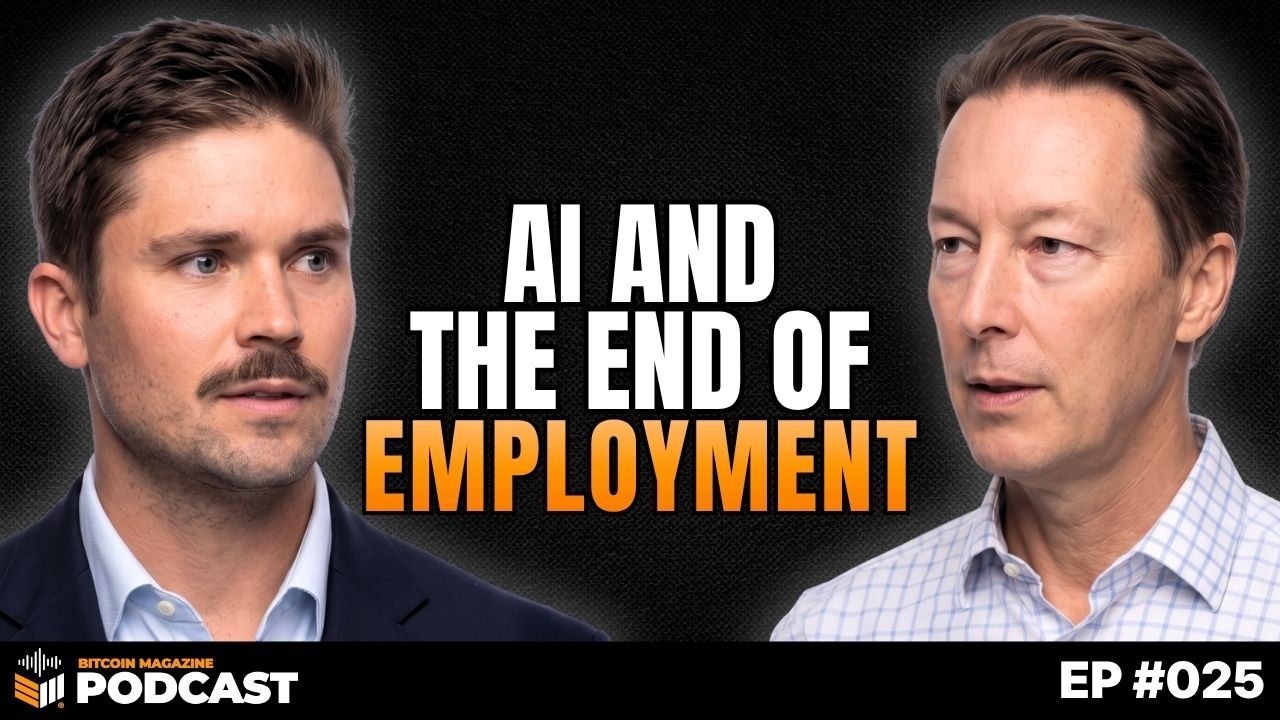
An Austrian Economist Explains Why AI Will Make Everyone an Entrepreneur w/ Per Bylund
AI is changing how we work, but can it replace the human entrepreneur? Austrian economist Per Bylund, Senior Fellow at the Mises Institute, joins Spencer Nichols to explain why AI is a statistical engine that improves efficiency but can’t imagine the future. He argues we’re moving from an employment economy to an entrepreneurship economy, and explains what that means for jobs, innovation, and value creation.
Chapters:
00:00 Austrian Economics on AI, Innovation, and Entrepreneurship
02:34 Can AI Replace the Entrepreneur?
05:48 Invention vs Innovation: What Bitcoin Teaches About AI
06:29 From an Employment Economy to an Entrepreneurship Economy
09:52 Can Regulators Keep Up With the Speed of AI?
13:06 Remote Work, Capital Controls, and the Future of Money
18:23 Why Every Voluntary Trade Has Two Winners
26:28 The Individual vs the State in US-China Competition
31:17 Steel Stockpiles, Sugar Subsidies, and the Lobbying Behind Protectionism
33:36 OpenAI, Anthropic, and Regulatory Capture in AI
DISCLAIMER: The views and opinions expressed in this show are those of the participants and do not necessarily reflect the official policy or position of BTC Inc., Bitcoin Magazine, or any affiliated entities. This content is provided for informational and educational purposes only and should not be construed as investment, legal, tax, or accounting advice. Nothing contained in this show constitutes a solicitation, recommendation, endorsement, or offer to buy or sell any securities or financial instruments. Viewers should consult their own advisors before making financial or business decisions.
This post An Austrian Economist Explains Why AI Will Make Everyone an Entrepreneur w/ Per Bylund first appeared on Bitcoin Magazine and is written by Patrick Green.
Bitcoin Magazine
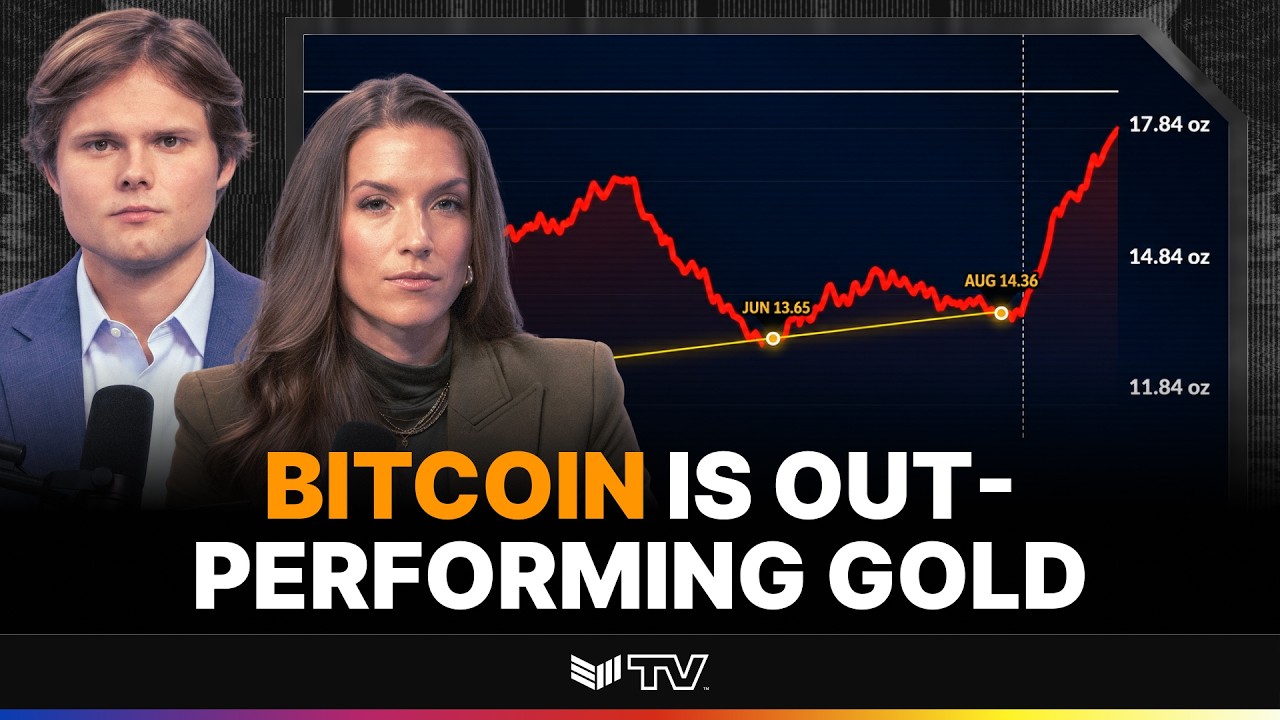
TECHNICAL ANALYSIS: BTC to Cross Key Price Level Against Gold
The 90-day correlation between Bitcoin and gold just hit a six-year high, and Bitcoin is now just 3% away from flipping positive against gold for 2026. In today’s Chart of the Day, Sean breaks down the Bitcoin-to-gold chart, the string of higher lows since February, and the new high above 17.9 ounces.
Chapters:
0:00 Bitcoin-Gold 90-Day Correlation Hits a Six-Year High
0:35 Why Measure Bitcoin in Gold? Stripping Out Dollar Debasement
1:20 Higher Lows and Higher Highs on the BTC/Gold Chart
2:27 From 12.1 oz to 17.9 oz: The Bullish Bitcoin Setup
2:53 The 20.3 oz 2026 Yearly Open and the Levels That Matter
3:21 Next Bitcoin Resistance: 21.5 oz of Gold (~$92K)
DISCLAIMER: The views and opinions expressed in this show are those of the participants and do not necessarily reflect the official policy or position of BTC Inc., Bitcoin Magazine, or any affiliated entities. This content is provided for informational and educational purposes only and should not be construed as investment, legal, tax, or accounting advice. Nothing contained in this show constitutes a solicitation, recommendation, endorsement, or offer to buy or sell any securities or financial instruments. Viewers should consult their own advisors before making financial or business decisions.
This post TECHNICAL ANALYSIS: BTC to Cross Key Price Level Against Gold first appeared on Bitcoin Magazine and is written by Patrick Green.
Bitcoin Magazine
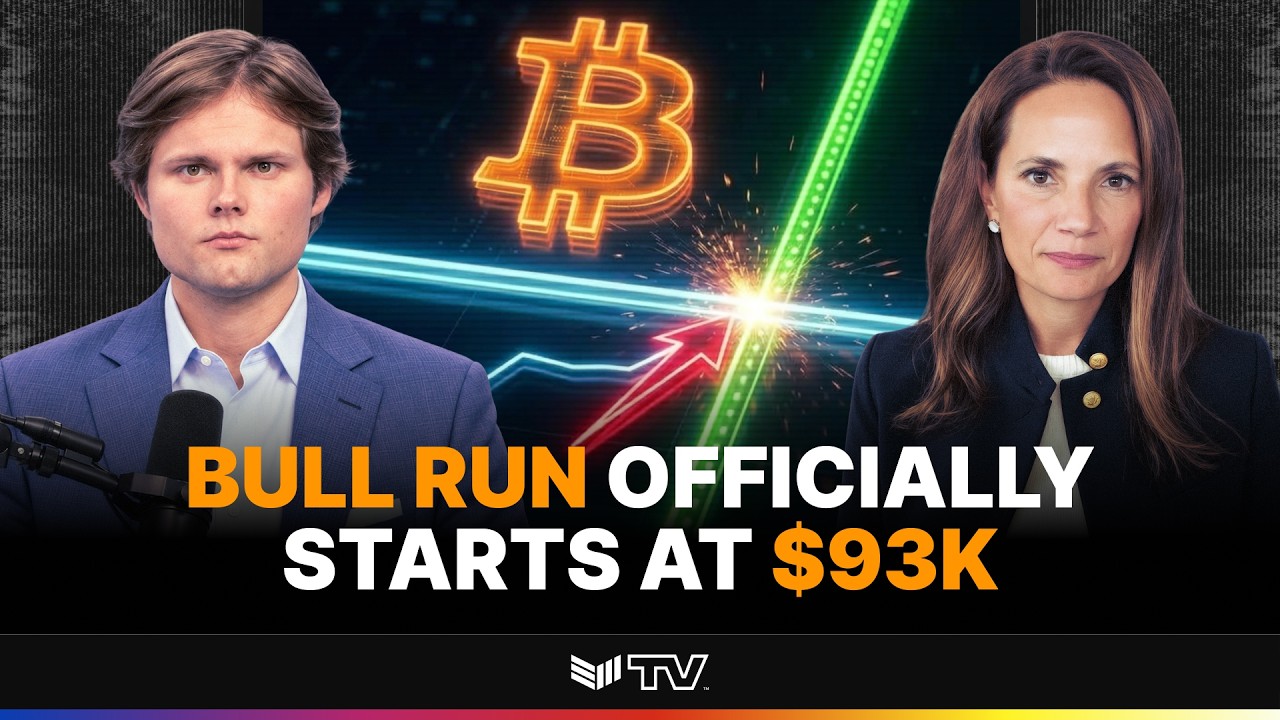
Katie Stockton: $93K BTC is the Key Price Level for the Bull Market
Is the Bitcoin bear market officially over? Katie Stockton, founder of Fairlead Strategies, breaks down the technical signals behind Bitcoin’s rally of more than 50% off its recent lows, including the break above the 200-day moving average and the 83K–84K resistance zone. She explains why the cloud model points to $93,000 as the level where a new Bitcoin bull cycle becomes official. She also covers the flag pattern breakout, the monthly stochastic oscillator, and what could turn her defensive heading into Q4.
DISCLAIMER: The views and opinions expressed in this show are those of the participants and do not necessarily reflect the official policy or position of BTC Inc., Bitcoin Magazine, or any affiliated entities. This content is provided for informational and educational purposes only and should not be construed as investment, legal, tax, or accounting advice. Nothing contained in this show constitutes a solicitation, recommendation, endorsement, or offer to buy or sell any securities or financial instruments. Viewers should consult their own advisors before making financial or business decisions.
This post Katie Stockton: $93K BTC is the Key Price Level for the Bull Market first appeared on Bitcoin Magazine and is written by Patrick Green.
Bitcoin Magazine

Grant Cardone: Real Estate “Armageddon” Is Here – Why BITCOIN is the Hedge
Commercial real estate is facing a historic reset, and Grant Cardone is using it to stack Bitcoin. The Cardone Capital founder explains how high interest rates are pushing properties below replacement cost and how he fills that gap with Bitcoin on the balance sheet. He breaks down his goal of 25,000 apartments and 25,000 BTC, and why he calls real estate his “Trojan horse” for Bitcoin.
Chapters:
00:00 Grant Cardone on the Commercial Real Estate Reset and 6.4% Rates
00:51 How Cardone Capital’s Bitcoin Real Estate Deals Work
02:23 Why REITs Can Never Own Bitcoin: Cardone’s Competitive Moat
04:26 From 3,000 to 25,000 BTC: Real Estate as the Trojan Horse
06:50 Michael Saylor’s “P Word” and the $335M Boca Raton Deal
09:01 Will Cardone Capital Go Public?
10:12 Why Commercial Real Estate Faces a Historic Crash
11:02 Why Single-Family Home Prices Won’t Correct
12:31 Why Bitcoin and Real Estate Are the Perfect Hybrid Asset
14:32 Why Other Real Estate Investors Can’t Copy This Strategy
DISCLAIMER: The views and opinions expressed in this show are those of the participants and do not necessarily reflect the official policy or position of BTC Inc., Bitcoin Magazine, or any affiliated entities. This content is provided for informational and educational purposes only and should not be construed as investment, legal, tax, or accounting advice. Nothing contained in this show constitutes a solicitation, recommendation, endorsement, or offer to buy or sell any securities or financial instruments. Viewers should consult their own advisors before making financial or business decisions.
This post Grant Cardone: Real Estate “Armageddon” Is Here – Why BITCOIN is the Hedge first appeared on Bitcoin Magazine and is written by Patrick Green.
CryptoSlate
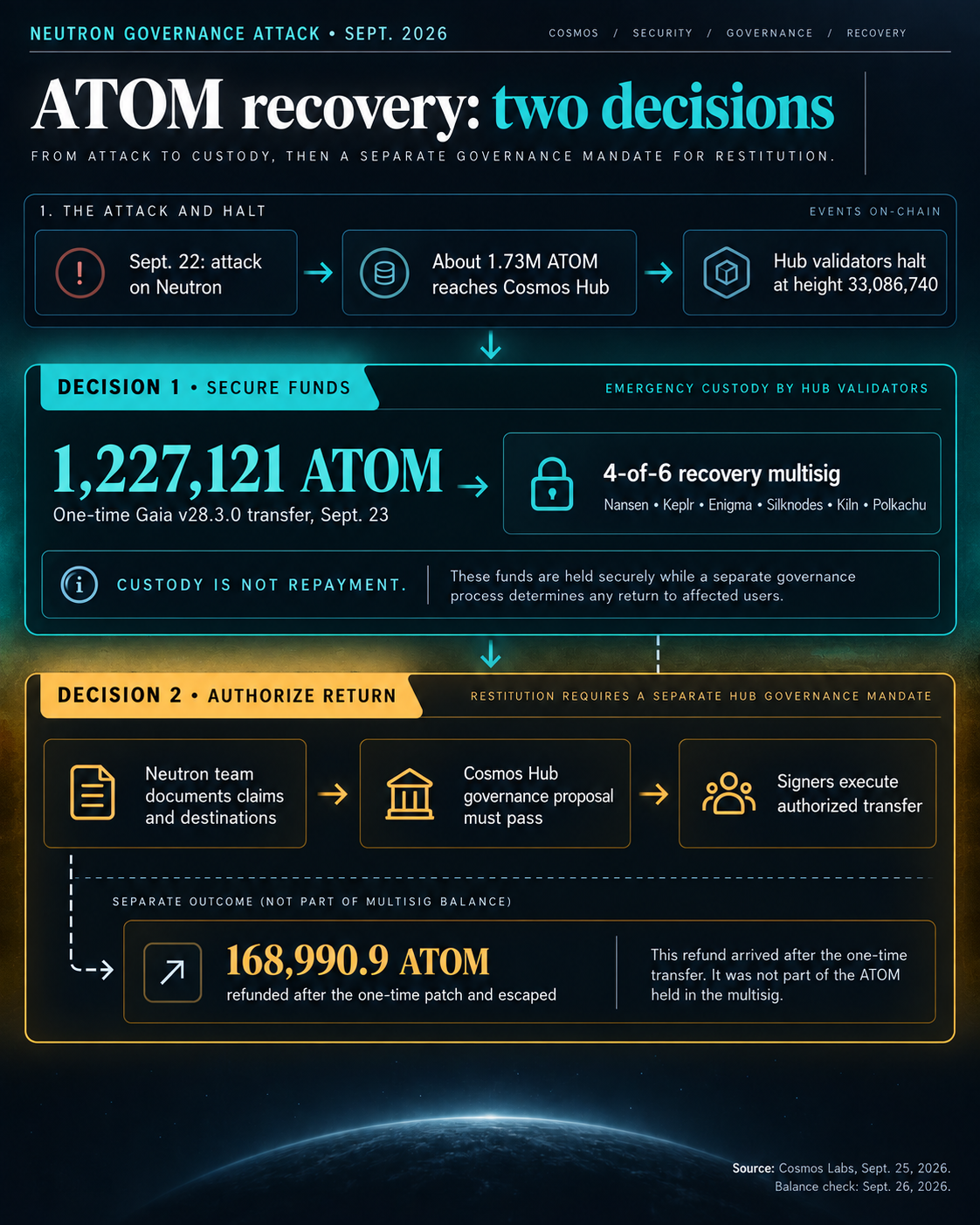
An attacker moved roughly 1.73 million stolen ATOM from Neutron to the Cosmos Hub during a Sept. 22 governance attack. Hub validators secured 1,227,121.37 ATOM of that flow in an emergency software patch, but the six signers holding it say a separate Hub governance proposal must pass before they release the funds to affected users and protocols.
That condition, detailed in a Sept. 25 account from Cosmos Labs, separates the emergency action validators took to prevent further outflows from the decision over who should receive the money. The recovery address held 1,227,121.374688 ATOM in a Hub balance query at 15:40 UTC on Sept. 26. The tokens were in custody, while Cosmos Labs said the Neutron response team was still preparing the evidence and distribution plan that would support a return.
How validators secured the ATOM
The attack began on Neutron on Sept. 22, when a governance proposal gave the attacker administrative control over contracts used by Astroport and other protocols, according to the Hub maintainers. The attacker moved some of the stolen assets to other networks, including roughly 1.73 million ATOM to the Cosmos Hub. The Hub itself was not exploited; it became the place where part of the stolen balance could still be intercepted.
As the attacker swapped and bridged ATOM, Hub validators halted their chain at height 33,086,740. They then agreed to restart on a patched version of the Gaia software, v28.3.0. At the first height after the halt, the patch made a one-time state change that transferred 1,227,121.37 ATOM from the attacker-linked Hub address to a recovery multisig before ordinary transactions resumed. The Hub's Sept. 24 update says the binary was scoped to that one source account and did not change other user balances or delegations.
The process was a coordinated validator update, not an on-chain vote authorizing compensation. Cosmos Labs says validators received the written source and destination addresses, the list of six signers and the proposed scope before it built and distributed the binary. Validators representing more than 67% of Hub voting power had confirmed installation before the Sept. 23 restart. Blocks resumed at 12:00 UTC, and the transfer took effect at about 12:06 UTC.
The maintainers said the binary was tested against a fork of mainnet state and distributed with a checksum. Its source diff was withheld at the time because publication would expose security fixes in the underlying v28.2.0 release that remained under a coordinated disclosure embargo. Cosmos Labs said it expected to publish the diff after the embargo lifted. That was its Sept. 25 disclosure timetable, not confirmation of a later release.
Custody of stolen ATOM does not settle who gets paid
Nansen, Keplr, Enigma, Silknodes, Kiln and Polkachu are the six validators named as multisig signers. Any four signatures meet the wallet's technical threshold for a transaction. The signers have stated a separate condition for using that capability: a passed Cosmos Hub signaling proposal must authorize a legitimate transfer. Cosmos Labs says it has no key to the wallet.
This creates two distinct forms of control. A supermajority of validators agreed to change Hub state during the halt so the attacker could not move the balance already there. The custody signers now hold that stolen ATOM, but say they will wait for a public governance mandate before deciding a destination. The emergency patch did not identify every valid claimant or approve a distribution schedule.
The proposed route starts on Neutron's side. Cosmos Labs said Neutron had relaunched with mitigations by Sept. 25, while contributors and affected protocols, including Astroport and Drop, were preparing evidence of what was taken and where recovered assets should go. The response team was expected to bring or back a Hub proposal in the following week. Whether Neutron governance also takes a vote is for that network to decide, the Hub account said.
The Hub governance proposal list checked at 15:40 UTC on Sept. 26 showed no passed mandate for the recovery multisig among its visible post-incident entries. Its latest proposal, 1057, concerned recovery of a Realio IBC light client. Proposal 1056, titled “ATOM Refund & Justice Bounty,” was still in voting and sought a different refund and bounty; it did not authorize the Neutron response team's distribution from this multisig. The governance requirement therefore remained prospective at the time of the check.
The Hub transfer covered the ATOM sitting in one attacker-linked address at the halt. It did not reverse the wider Neutron attack. Cosmos Labs said roughly 500,000 ATOM had already been swapped through THORChain before the halt, while other stolen assets reached networks beyond the Hub. Its account does not establish the final size of each affected account's claim or promise full reimbursement.
Why the patch could not capture later funds
Another 168,990.9 ATOM illustrates the patch's time limit. A pending THORChain refund reached the attacker address just after the restart, after the one-time transfer had executed. Cosmos Labs said validators knew the refund might arrive, but changing the tested binary to capture it would have required different code and a longer halt. The returned ATOM was moved to Osmosis and sold. It was a later arrival at the attacker address, separate from the balance already transferred to the multisig. A rule applied once at the restart could not automatically sweep a later deposit.
The Neutron-side recovery plan must still establish who is owed what and where the funds should go. A Hub proposal backed by that plan would then give the six signers the public mandate they say they require. Until those steps occur, the secured ATOM remains available for recovery, with its recipients unresolved.
The post Cosmos intercepts 1.23 million stolen ATOM but refunds now wait on governance vote appeared first on CryptoSlate.
Bitget’s XRP withdrawal route was still disabled on Sept. 26, even as the exchange set Oct. 2 at 08:00 UTC for the last phase of its post-breach withdrawal reopening. Its published timetable names BTC, ETH and USDT for earlier phases, then “other tokens,” fiat and peer-to-peer services for Oct. 2. XRP is not listed separately, so the schedule places it in that final group by exclusion. Bitget’s public XRP coin status showed external XRP withdrawals disabled and deposits enabled at 12:11 UTC on Sept. 26.
The timing matters to XRP holders because the stolen tokens are also moving. Bitquery measured 27.63 million XRP moving onward from two tracked attacker accounts by 02:54 UTC on Sept. 26, while 75.35 million remained in six tracked accounts. That is a dated account-balance snapshot, not a measure of XRP sold into the market. It leaves two different developments to watch: when customers can withdraw their XRP, and where the stolen XRP goes next.
Bitget’s first scheduled withdrawal phase starts with BTC on the Bitcoin network on Sept. 28 at 08:00 UTC. ETH follows on Sept. 29 across the networks named in its notice, and USDT follows on Sept. 30. The Oct. 2 phase covers everything grouped under other tokens, along with fiat and peer-to-peer services. Each date is a planned start; Bitget says actual withdrawal availability will appear on its platform.
The exchange said it had identified and remedied the vulnerability involved in the Sept. 24 incident and was carrying out further checks of its withdrawal infrastructure. It described the pause as a security measure and said user balances were unaffected. Trading and deposits continue, according to Bitget. Its public XRP status reflected that split on Sept. 26: the XRP network was open for deposits while external withdrawals were off.
For a customer, the open trading venue and the closed XRP withdrawal route serve different purposes. A holder could change an XRP position on Bitget under the trading service the company says remains available. The API status showed that the same holder could not withdraw XRP to an outside XRP Ledger address at the time of the check. The Oct. 2 entry offers a timetable for that route; an enabled platform status and a functioning withdrawal will show whether it has opened.
Where the stolen XRP has gone
Bitquery’s transaction-backed investigation put the XRP taken from Bitget at about 102.98 million tokens. In its Sept. 26 snapshot, 27.63 million XRP had moved onward from two of the six attacker accounts it tracked. The other 75.35 million XRP remained across those six accounts at 02:54 UTC. The figures can change as funds move, and transfers out of an initial account do not identify who ultimately controls the destination.
The analytics firm followed outgoing XRP through new accounts toward THORChain, a cross-chain swap network. It said most of the XRP flow it could follow was being swapped toward Bitcoin. That description applies to the route Bitquery traced, not necessarily to the full 27.63 million XRP that moved onward. The investigation also cannot identify the owners of the final Bitcoin wallets.
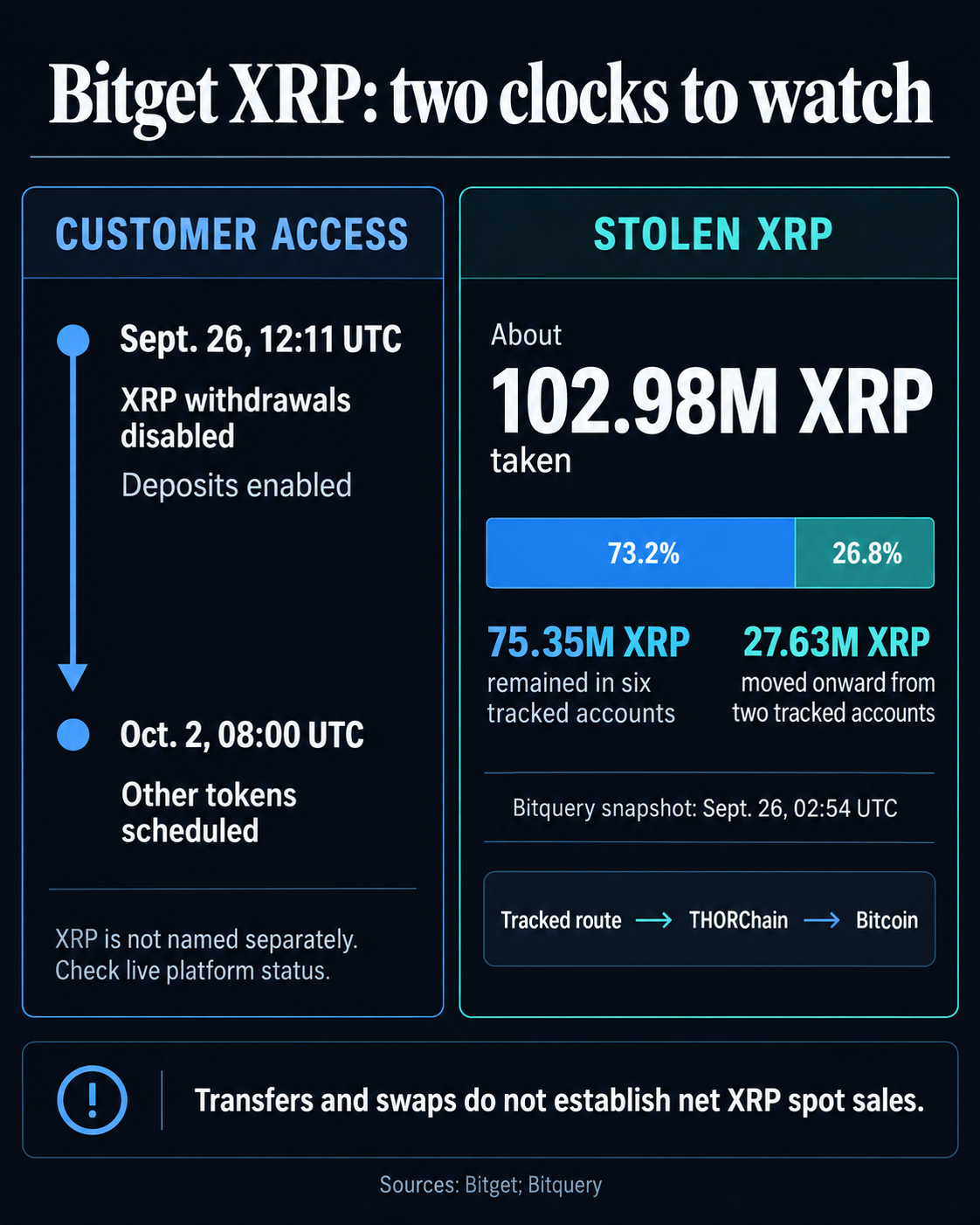
Those transactions show a path from stolen XRP toward another asset. They do not establish the net XRP sold in a centralized exchange order book or the price of any such sale. The distinction matters when weighing potential market pressure: movement among wallets, a cross-chain swap and an executed spot trade are separate observations. Bitquery’s figures establish the first two for the routes it followed; its trace does not measure a breach-linked spot sale.
Bitget’s Sept. 25 incident update revised its estimate of the total value transferred to attacker-controlled addresses to about $387.5 million, up from $351.6 million. The company said the higher figure reflected additional Zcash and TRON assets in its accounting rather than further unauthorized transfers. This is the platform-wide, multi-asset loss. Bitquery’s roughly 102.98 million XRP is a separate token count for one affected asset.
CryptoSlate’s XRP market data displayed XRP near $1.55 when checked on Sept. 26 and listed a Bitget XRP/USDT market. That snapshot supplies a dated price reference. It contains no bid-ask spread and cannot attribute an XRP price change to the breach. The next observable tests are Bitget’s XRP withdrawal status as Oct. 2 approaches and timestamped updates to the attacker-account balances and conversion routes.
The post Bitget freezes XRP withdrawals as 27M stolen tokens move appeared first on CryptoSlate.
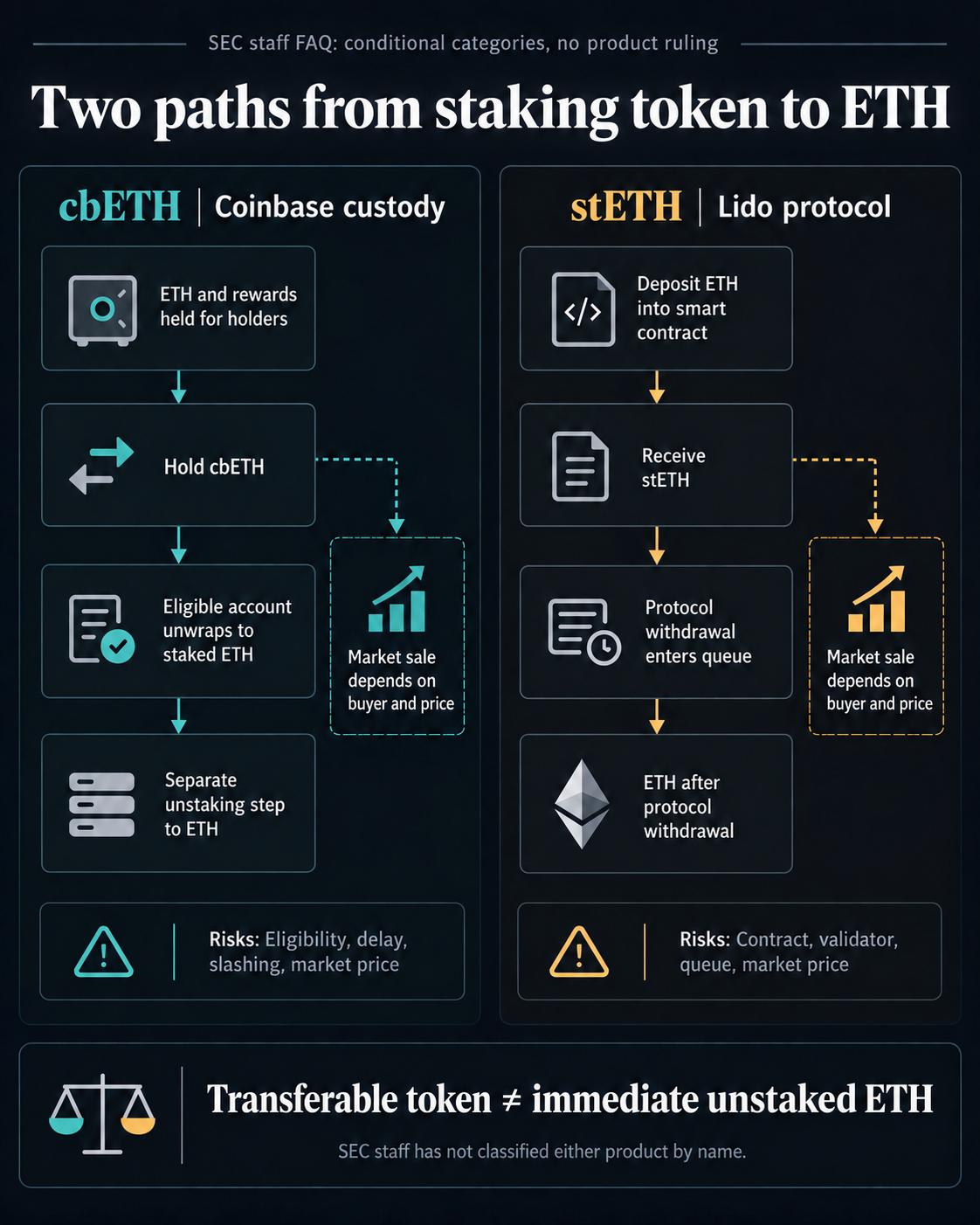
An ETH holder can sell a liquid-staking token while the ETH behind it remains staked. A Sept. 25 SEC staff FAQ draws a conditional distinction between receipts that evidence ownership and protocol-issued tokens. Coinbase and Lido disclosures show the holder's practical stake: a transferable token does not guarantee immediate unstaked ETH or a sale at the underlying position's value.
The Securities and Exchange Commission's Division of Corporation Finance said a qualifying staking receipt for a digital commodity may be a “digital tool.” A token issued by a protocol-based liquid-staking provider may instead be a “digital commodity.” The staff does not classify Coinbase's cbETH or Lido's stETH by name. Their terms determine who holds the deposited ETH, how the token can be redeemed and what can happen if its holder sells instead.
What counts as a receipt
The staff FAQ defines a receipt by the rights it represents. It evidences that an asset was deposited and that the depositor retains ownership. Under the FAQ's description, ownership and control do not pass to the receipt issuer, which cannot transfer, lend, pledge, rehypothecate or otherwise use the deposited asset, or expose it to third-party claims. That is a description of the type of receipt the staff is discussing, not a new custody rule for every token sold as liquid staking.
The FAQ then distinguishes two possible classifications under the SEC's March crypto-asset interpretation. A receipt for a digital commodity that is not subject to an investment contract can be a digital tool because its function is to evidence ownership. A receipt issued by a protocol-based liquid-staking provider may itself be a digital commodity when its value is linked to a functioning crypto system and market supply and demand. The word “may” matters: neither answer assigns a status to an individual product merely because it is called a staking token.
An earlier August 2025 staff statement described liquid-staking tokens as transferable evidence of deposited assets and their accrued rewards. It discussed both smart-contract protocols and third-party custodians, limiting its securities-law view to the arrangements it described. It did not address restaking or arrangements in which a provider controls staking choices, sets or guarantees rewards, or facilitates additional token returns. Falling outside that statement is not, by itself, a finding that an arrangement involves securities.
Those categories shape the staff's securities-law analysis of the arrangements it describes; they do not certify access to the ETH underneath. Coinbase and Lido provide a practical comparison of different custody and redemption routes. The FAQ makes no determination about either product.
Two routes back to ETH
Coinbase's custodial path
Coinbase's US user agreement says cbETH represents ETH staked through Coinbase, including associated rewards and subtracting fees or slashing penalties. It says the staked ETH and rewards wrapped as cbETH are held by Coinbase on behalf of token holders and that ownership does not transfer to Coinbase. Selling or transferring cbETH transfers the underlying ownership interest and the contractual redemption right to the recipient.
That transferability gives a holder a way to seek an exit before the staked ETH is withdrawn. Coinbase's product guidance says cbETH can be sold, sent or held in an external wallet. But selling it is a market transaction, and Coinbase warns in its agreement that the token's price can diverge from ETH or staked ETH. Coinbase does not promise that a buyer will be available or backstop cbETH liquidity.
The contractual redemption route is different from a sale. The agreement says an eligible cbETH holder must have a Coinbase account in good standing and meet staking eligibility requirements to unwrap; geographic limits and processing delays may apply. Unwrapping returns staked ETH, with rewards less applicable fees and slashing, not immediately spendable unstaked ETH. Obtaining ETH after that requires a further unstaking request and completion of Ethereum's process. A transferable token therefore does not give every holder the same immediate redemption route.
Lido's protocol path
Lido's contract documentation describes a different operating model. A user deposits ETH into the protocol's smart contract and receives stETH. To reclaim ETH through the protocol, a holder submits a withdrawal request that enters a queue. The token can also be sold to another trader instead of waiting for that process.
Those routes expose the holder to different constraints. Lido's risk disclosure says a protocol withdrawal can be slowed by queue capacity and Ethereum validator exits. The ETH ultimately received follows the protocol's accounting and can be affected by adverse events such as slashing. A secondary-market sale is faster only if someone will trade at an acceptable price; spreads, slippage and a discount to ETH can widen when liquidity is strained. The disclosure also identifies smart-contract, governance and validator risks, and says stETH and wstETH have no general, protocol-level regulatory approval.
A label does not settle the exit
The two products illustrate why “liquid” describes a token's ability to move, not a guaranteed conversion into unstaked ETH at a fixed value. With cbETH, the holder depends on Coinbase's custody terms and eligibility process for contractual unwrapping, or on a market buyer for a sale. With stETH, the holder can use a protocol withdrawal queue or a market buyer. In either case, the secondary-market price can differ from the value of the underlying staked position.
The Sept. 25 FAQ does not classify either token by name, and its answers are nonbinding staff views that create no new obligations. Its useful distinction is narrower: before treating a liquid-staking token as interchangeable with ETH, a holder needs to know who retains ownership of the deposit, who operates the redemption path, what asset comes back first and which delays or losses can intervene. A regulatory category alone cannot answer those product-level questions.
The post SEC staff’s staking-token split spotlights the exit risks behind staked ETH tokens appeared first on CryptoSlate.
Bitcoin's BIP138 wallet-backup proposal was merged into the Bitcoin Improvement Proposals repository on Sept. 21, but the specification remains Draft. It aims to preserve information that a seed phrase may not restore in a complex wallet. The tradeoff is that a third party could read that information if it already holds an eligible extended public key, or xpub, and obtains a copy of the encrypted backup.
A multisignature wallet requires more than one signer. Its descriptor records the public keys and spending rules that tell wallet software how to reconstruct the account and find its coins. A seed phrase can regenerate one signer's private keys, but losing the descriptor can still leave a multisig or miniscript script impossible to reconstruct from that seed alone.
The proposal describes another failure: a wallet designed to survive the loss of one seed may also lose that signer's public key. The remaining signers can then lack a piece of the script needed to recover the coins. These are risks for wallets whose spending setup depends on information beyond a seed, not a claim that every Bitcoin wallet needs this backup.
BIP138's answer is an encrypted file holding descriptors, wallet policies or other non-seed metadata. Private key material must be removed before encryption. A holder of an eligible xpub from the backed-up wallet can decrypt a copy without the wallet's seed. That reveals public keys and script structure needed for recovery, while the xpub alone does not give the holder the private keys required to sign.
The draft sets limits on who can decrypt. Public keys that appear directly in a script, and xpub roots that could be exposed by spending, are excluded as recovery keys. If a cosigner's key is excluded, that person cannot use it to open the file. Those limits keep an on-chain public key from becoming a key to the off-chain backup.
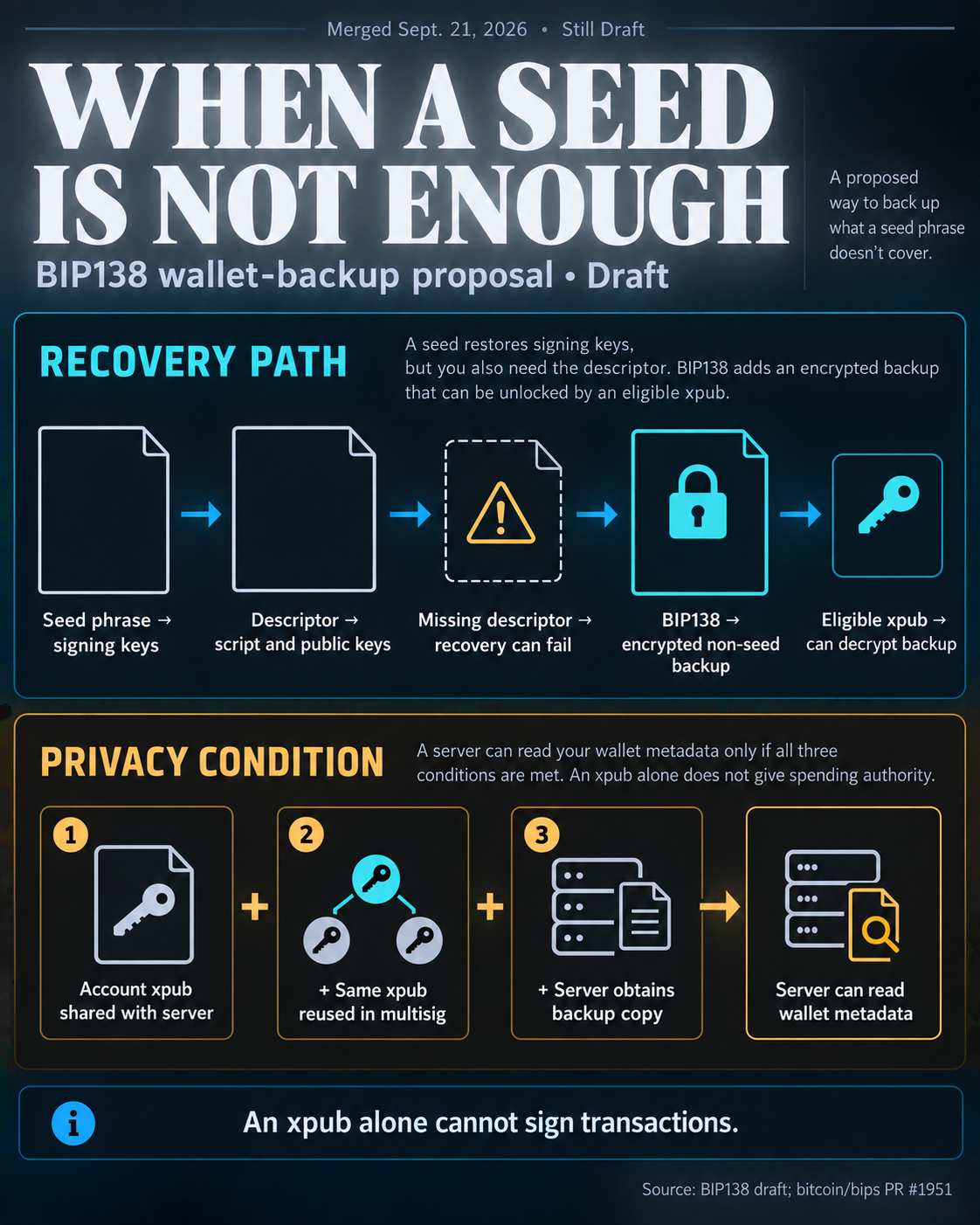
The privacy warning concerns an xpub disclosed before the multisig wallet was made. If a wallet-service server already knows an account xpub and that same xpub is reused as an eligible multisig key, the server could decrypt the backup if it gets a copy. It could learn the wallet metadata inside, though this would not itself give it spending authority. The BIP describes a conditional exposure, not a reported breach.
A public Rust implementation with command-line build instructions exists. The BIP says Liana, a Bitcoin wallet, uses an earlier backup format that is incompatible with the current BIP138 file. The proposal's merge therefore establishes a published draft, not a Bitcoin network change or a guarantee that today's wallets can create and restore this format.
The post New Bitcoin proposal rescues locked multisig wallets – At a hidden cost appeared first on CryptoSlate.
Visa’s September 18 data refresh lowered its adjusted stablecoin volume measure, while its adjusted transaction count fell by less than 2%. The divergence reflects a change in how recorded activity is classified, leaving payment trends unanswered.
The Visa Onchain Analytics changelog attributes the reset to a fuller set of address labels and revised filters. Its underlying Allium identity set grew from about 15 million labeled addresses to roughly 600 million. Visa says the definition of adjusted volume stayed the same: it aims to exclude labeled exchanges, contracts, bots, bridges, other infrastructure, and minting and burning. With more addresses identified, more transfers now fall outside the adjusted measure. The refresh also added heuristics for short-term routing and changed how organic and payment activity is identified.
The live transaction methodology still describes “over 3 million” labeled addresses, a figure that does not match the dated changelog’s roughly 600 million in the new full identity set. Visa’s public text does not say whether the older wording refers to a different subset or has yet to be updated. The 3 million figure therefore cannot serve as the previous baseline for this reset.
The classification changed while the underlying recorded transfers remained on-chain; the release offers no direct measure of how real-world activity changed. Visa does not publish comparable pre- and post-refresh adjusted stablecoin volume totals in its changelog, so the size of the value revision cannot be calculated from that disclosure. The published pages also do not provide matched-window, same-definition chain results that would show how much of the revision fell on Ethereum, Tron, Solana or any other network.
Why adjusted stablecoin volume can shift while counts barely move
A transfer count gives each included event one unit, whether it moves a small sum or a large one. Dollar volume weights those events by value. Removing a limited number of high-value transfers can therefore have a much bigger effect on the volume series than on the count. Visa’s figures establish the direction of each change, although they do not break out how much each new label or heuristic contributed.
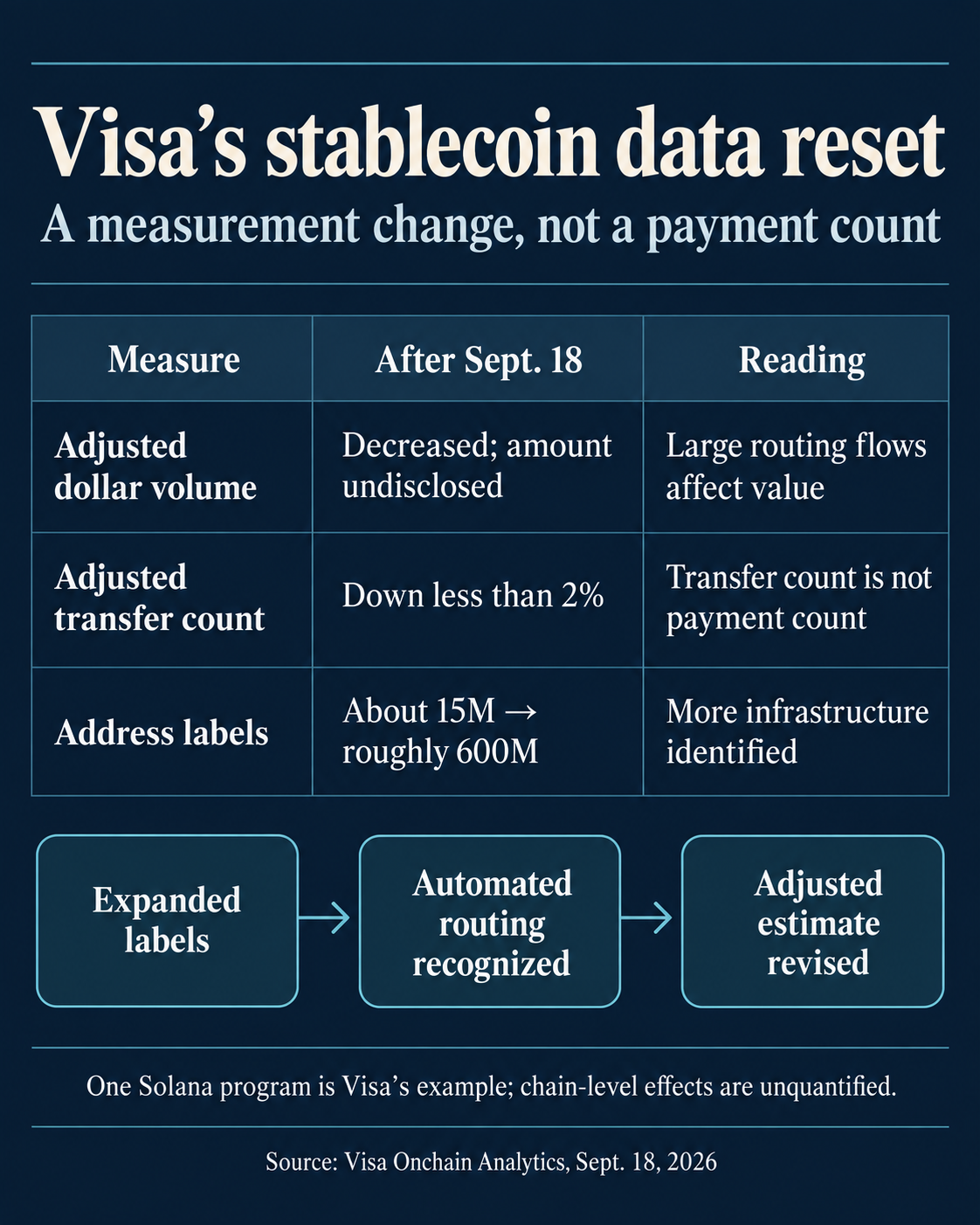
Visa offers a concrete example: one automated program on Solana cycled the same stablecoins through thousands of throwaway wallets. The company says that pass-through pattern moved very large amounts in relatively few transactions and is now excluded from adjusted volume across multiple chains. The example illustrates the mechanism; it does not establish that the same program operated on every chain, or quantify the revision for Solana or the broader market.
This distinction is especially important when comparing networks. An apparent lead in raw transfer value could reflect routing, exchange activity or contract interactions as well as end-user transfers. The revised adjusted series could sharpen comparisons, but the reviewed material does not quantify a change in chain rankings under matched dates and filters. Allium’s stablecoin documentation describes chain-aware daily volume tables, including organic adjusted volume where available. The documentation is a description of data fields, not a published before-and-after table for this Visa reset, and it does not promise adjusted coverage for every chain.
A September Bank for International Settlements study makes a related measurement point: the same stablecoin can serve different purposes on different blockchains. Its analysis associates Ethereum use more closely with smart-contract interactions and Tron use more commonly with holdings outside contracts, consistent with transactional and store-of-value motives. Those findings give context for why like-for-like use-case comparisons matter; they are not a measurement of Visa’s September revision.
A surviving transfer is not necessarily a payment
Visa’s transaction methodology separates payments from DeFi, centralized-exchange flows, investment and trading, store of value, minting and burning, short-term routing, infrastructure and other categories. A transfer can be included in adjusted activity without being classified as a payment; the two labels are not interchangeable. Its “retail sized” bucket covers adjusted transfers below $250, but a small transfer is not automatically a purchase, a merchant settlement or a distinct user.
The difference between blockchain records and economic actions also appears inside individual transactions. A separate BIS study of 2025 Ethereum activity involving USDT, USDC and PYUSD found that nearly 60% of transfer events occurred within complex transactions. Its point is that one transaction can involve multiple token movements and financial operations; counting each transfer event as a standalone payment can misstate the activity. That nearly 60% result applies to the study’s Ethereum sample, not to every chain or to the share of Visa’s adjusted volume that is payment-related.
Even the size of the stablecoin market is a different measurement. CryptoSlate listed USDT market capitalization at about $183.79 billion on September 26. That is the value of tokens outstanding at a moment in time, whereas Visa’s volume measures value transferred over a period. CryptoSlate’s 24-hour trading-volume figure on the same page is another distinct measure; neither can fill the gap in Visa’s before-and-after adjusted series.
For now, the defensible reading is narrower than either a collapse or a boom in stablecoin payments. Visa says its revised classification removes more high-value pass-through activity from adjusted stablecoin volume while leaving the adjusted transfer count nearly intact. Establishing whether payment use itself changed, or whether one chain gained ground on another, would require comparable, dated payment-category and adjusted-volume data under the same definitions.
The post Visa cuts reported stablecoin volume but there’s no proof payments fell appeared first on CryptoSlate.
CryptoTicker.io
Solana traded at $121.93 on Saturday, September 27, 2026, at 16:42 UTC. That is 12.7 percent above the level of seven days ago and 14.5 percent above the level of 30 days ago; on the day itself the price barely moved, up 0.3 percent between a low of $120.11 and a high of $124.77 (source: CoinGecko, retrieved September 27, 2026, 16:42 UTC). Market capitalisation stands at $71.7 billion, daily turnover at $3.7 billion.
Anyone holding Solana has had a good week. The question the price does not answer is a different one: what your stake actually earns, how long you are locked out of your coins once you end a delegation, and which part of all this belongs in your tax return. Those three points can be answered with hard numbers today, because the data comes straight from the network and not from a marketing page.
Solana Price on September 27: $121.93 and What the Week Really Showed
A weekly gain of 12.7 percent reads well, but it loses weight once you put the distance to the all-time high beside it. That high stands at $293.31 and dates from January 19, 2025 (CoinGecko, retrieved September 27, 2026). From today's level, 58.4 percent are still missing. Over the same period Bitcoin rose to $84,449 and Ethereum to $2,686.81, both with far flatter weekly moves than SOL.
One data point of our own helps to place the move. In our article of September 23, 2026, SOL stood at $114.55. A good four days have passed since then and roughly 6.4 percent have been added. That is an advance with momentum, yet not one that justifies haste. For you as a holder it changes nothing about the three points below, because yield, lock-up and tax treatment do not hang on the price.
Solana Staking Yield: Why 5.2 Percent Nominal Becomes 1.3 Percent Real
Nominal staking yield means the number of additional SOL you receive over a year, measured against your holding. Real yield means how much larger your share of total supply is afterwards. At Solana, half the return sits between those two figures, and that is exactly where most yield quotes stop.
The numbers for the calculation come from a query of the public mainnet node on September 27, 2026, at 16:43 UTC. The annual inflation rate is 3.6278 percent and goes entirely to validators; the foundation's share is zero. Total supply amounts to 634,841,599 SOL, of which 440,549,807 SOL are delegated, or 69.4 percent. Newly created coins are calculated on total supply but distributed only among stakers.
The gross yield follows from this: 3.6278 percent times 634,841,599 divided by 440,549,807 gives 5.23 percent a year. From that the validator deducts its commission; the median across the 675 active validators is 5 percent. After commission, 4.97 percent nominal remain.
Now the second half of the calculation. Anyone who does not stake loses 3.63 percent of their share of total supply to that same inflation. Your real advantage is therefore 4.97 minus 3.63, which is 1.34 percentage points a year. On a holding of 100 SOL that works out at 1.34 SOL of headroom, roughly $163 at today's price. Staking at Solana is not an income model; it is first of all protection against dilution.
Check the Validator Commission: Five Percent Is the Median, Not the Rule
The 5 percent commission is the midpoint of the distribution rather than a requirement. There are validators at 0 percent and validators at 100 percent, where your entire return stays with the operator. On a gross yield of 5.23 percent that difference is not cosmetic: between 0 and 10 percent commission lie 0.52 percentage points nominal, and measured against the real advantage of 1.34 percentage points that is a good third.
So check three values before you delegate, all of which any Solana block explorer publishes. First, the commission in percent. Second, whether the validator is listed as active in the current epoch; on September 27, 675 validators were active and 8 were marked delinquent. A delinquent validator no longer votes and earns you nothing while that lasts. Third, the delegated stake: a very large validator does not improve your yield, it only worsens the distribution across the network.
Which providers in Germany offer staking as a finished product, and what they charge for it, we have set out in our comparison of staking platforms. One point matters there: a platform fee comes on top of the validator commission, it does not replace it.

Solana Unstaking Period: The Epoch Is the Clock That Matters
An epoch is Solana's settlement period; it comprises a fixed 432,000 slots. When you end your delegation, it is not released immediately but only at the close of the epoch under way. After that the coins are available again; until then they are not.
The usual rule of thumb says two to three days. That calculation does not hold at present. The query on September 27 at 16:43 UTC returned epoch 1044 at slot 46,039 of 432,000. The actual slot time, measured across 250,000 slots from the block timestamps, is 0.268 seconds instead of the 0.4 seconds given as the target. A full epoch therefore runs for roughly 32 hours, and at the time of measurement about 29 hours remained until the end of the current one.
Two things follow for you. The waiting time is shorter than most guides claim, but it is not zero and it cannot be planned to the hour: end a delegation shortly after an epoch begins and you wait almost a day and a half; end it shortly before the close and it is a matter of minutes. Anyone who wants to sell into a price level should therefore start the unstaking before that level is reached.
The slot time needs one qualification. The figure is a snapshot and not a constant; it moves with network load and with the share of skipped slots. Work with a full epoch as the upper bound and check the current state yourself before you end a delegation.
Alpenglow and Epoch Logic: What Changes on September 28 and What Does Not
For September 28, 2026, the schedule of client version Agave 4.3 names the start of feature activation on mainnet. Alpenglow, the rebuild of the consensus mechanism aimed at finality in the range of 100 to 150 milliseconds, has been running on the public testnet since September 24 and on devnet since September 25. On the current state of information there is no confirmed date for activation on mainnet; the statements on that are attributable to developer announcements and should not be read as settled. What this means for delegators we have written up in our overview of Alpenglow and staking.
What you need from it today: finality and epoch length are two different things. Faster confirmation of individual transactions does not shorten the 432,000 slots after which your stake is released. Anyone waiting on an upgrade to reach their coins sooner is waiting on the wrong number.
Liquid Staking Instead of Waiting: The Swap Is the Catch, Not the Yield
Liquid staking removes the waiting time: you hand SOL to a protocol and receive a tradable claim token in return, one that grows in value with the stake. You can sell it at any moment without waiting for an epoch to close. The price is an additional fee layer charged by the protocol and an additional technical risk, because a contract on the chain now sits between you and your stake.
The real catch lies elsewhere, and it is a tax matter. The German tax authorities treat the exchange of one crypto asset for another as a disposal of the asset given up; that is set out in the Federal Ministry of Finance circular of March 6, 2025, on the income tax treatment of crypto assets. Whether the acquisition of a liquid staking token falls under this, or is to be treated as a mere reallocation of the same economic value, has not been conclusively settled in practice and is answered differently by different advisers.
Only the cautious reading is therefore reliable: assume that moving into a liquid staking token can start a new holding period, and clarify that before the swap rather than after it. If your SOL are close to the end of the one-year period, that is a concrete reason to postpone the move.
Staking Rewards and German Tax: Section 22 No. 3 EStG and the 256-Euro Threshold
Passive staking, meaning delegation to a validator without running a node of your own, counts for the tax authorities as drawing fruits from private asset management. The rewards therefore fall under Section 22 No. 3 of the German Income Tax Act (EStG) as other income from services. Your personal income tax rate applies, not the 25 percent flat withholding tax.
Three points decide how much you pay. First, the de minimis threshold of 256 euros per calendar year: if the sum of all income from services stays below it, that income is tax free. A threshold of this kind is not an allowance. At 255 euros you pay nothing; at 256 euros you are taxed on the full amount, not merely on the part above the line.
Second, the valuation date. Every reward that accrues is valued at the market price at the moment it accrues, which in simple terms means the price when it is credited to your wallet. At Solana that means one valuation per epoch, and with an epoch length of roughly 32 hours, some 270 valuation events a year. That cannot be kept by hand, and it is precisely where most returns come apart; which tools record it automatically is set out in our comparison of crypto tax tools.
Third, the accrual itself. Under the administrative view, rewards are deemed to have accrued by the end of the year at the latest, even if you never actively claimed them. Anyone who simply leaves rewards where they are and assumes that nothing happens for tax purposes is mistaken. Build December 31 into your planning as a fixed cut-off date.

Holding Period After Staking: Why the Ten Years Are Not Coming
For a long time it was an open question whether the one-year speculation period extends to ten years as soon as coins are used to generate income. For cryptocurrencies as payment tokens, that has not happened. The Federal Ministry of Finance circular of March 6, 2025, states in margin number 48 that staking and lending do not extend the holding period; it remains one year under Section 23 EStG.
For your staked SOL this means the clock keeps running while they are staked. If you buy today, on September 27, 2026, and delegate straight away, a sale is tax free from September 28, 2027, regardless of how long the coins were delegated. For the rewards themselves, a separate one-year period starts with each accrual, and their value at accrual is at the same time the acquisition cost for any later disposal.
For gains from private disposal transactions, a threshold of 1,000 euros per calendar year has applied since 2024. That too is a threshold and not an allowance: a gain of 1,001 euros is taxable in full. Both limits, the 256 euros and the 1,000 euros, run side by side and may not be netted against each other.
Buying Under MiCA: How to Recognise an Authorised Provider
Since the European regulation on markets in crypto assets became fully applicable, trading platforms serving retail clients in the EU need authorisation as crypto asset service providers. For you as a buyer that is no formality. It is the difference between a supervised custodian and a provider where, in a dispute, no German supervisory authority has jurisdiction.
Check three things before your first purchase. Whether the provider holds a MiCA authorisation in an EU member state, and in which one; that is usually stated in the imprint and in the small print of the terms of use. Whether staking is offered as the provider's own product or passed on to a third party, because in the second case your claim depends on a further counterparty. And whether the provider supplies you with an annual statement showing the accrual time and the price for each reward. Without that statement you do the work from the previous section by hand. An overview of the regulated trading venues available in Germany can be found in our exchange comparison.
Custody While Delegating: Your Stake Does Not Leave Your Wallet
A widespread misconception is that delegating means handing your coins over. With native staking on Solana your SOL stays in a stake account controlled by your key; the validator receives only the voting right, not access. You can therefore set up and manage the delegation from a hardware wallet without ever exposing the private key to software.
It looks different when you use staking as an exchange product. The coins then sit with the provider and you hold a claim against it. That is convenient, but it shifts the default risk from the network to a company. Which devices support Solana delegation directly, and what to watch during setup, we have gathered in our hardware wallet comparison.
Levels Above and Below: What the Data Supports and What It Does Not
Only measured values carry weight at this point. The daily range on September 27 ran between $120.11 and $124.77; the daily low is therefore the nearest level below, where buyers last showed up. Above, the daily high is the first hurdle, followed by the area around $130, which follows from the weekly advance of 12.7 percent if it continues at the same pace.
What these numbers are not is a forecast. Price targets circulating in analyses belong to those who set them and are not a statement by this publication. Readers looking for a fuller account of the scenarios will find it on our Solana price prediction page. For the decisions in this article the price plays the smaller part in any case: the epoch period, the commission and the two tax thresholds work regardless of whether SOL trades at $120 or at $130.
Solana Price and Staking: What to Take Away
- Calculate your yield in real terms, not nominal ones. With inflation at 3.63 percent and a staking ratio of 69.4 percent, a commission of 5 percent leaves roughly 1.34 percentage points of genuine headroom a year. Check your validator's commission and set it against the terms in our staking comparison before you delegate.
- Plan your unstaking along the epoch. A full epoch runs for roughly 32 hours at the slot time measured on September 27. Start the process before you need the sale, and not once your level has been reached. If you need liquidity without the wait, clarify the tax treatment of the liquid staking swap with your tax adviser beforehand.
- Record accruals from the first reward onwards. Every accrual counts at the price at the moment it is credited, the threshold is 256 euros a year, and the period for the coins you put to work stays at one year. A tool from our tax tool comparison takes some 270 valuation events a year off your hands; by hand, none of it can be made up in December.
On the sources: the network figures come from our own query of the public Solana mainnet node on 27.09.2026 at 16:43 UTC, the prices from CoinGecko at 16:42 UTC. The tax statements follow the Federal Ministry of Finance circular of 06.03.2025 on the income tax treatment of crypto assets. The technical basics of delegating and of epochs are described in Solana's staking documentation.
(As of September 27, 2026. This article is not investment advice. Prices and fee structures change; check the terms with the provider before you buy.)
A USDT transfer on Tron costs you money, and it costs it in TRX, not in USDT. Send 100 USDT over TRC20 today and you pay roughly 6.4 or roughly 13 TRX, depending on the recipient. Why the spread is that wide, how to tell whether you have sent on the right network, and how to cut the fee to a fraction of that is what this guide sets out. Every figure in it we measured ourselves on chain on September 27, 2026.
Tron is the chain over which the largest share of all Tether transfers worldwide runs. Anyone moving cryptocurrencies between exchanges or to acquaintances therefore ends up at TRC20 almost inevitably, often without knowing the rules behind it. That is exactly where the typical mishaps come from: the transfer that eats far more TRX than expected, the balance stuck on the wrong network, and the approval still open years later. The network token's price is on our Tron price prediction; here we deal with the practice.
What TRC20 means and why a USDT transfer costs TRX
TRC20 is the token standard of the Tron blockchain. A standard is nothing more than a set of rules a smart contract has to follow so that every wallet and every exchange recognises the token automatically. USDT on Tron is therefore not money in its own right but a contract on this blockchain that keeps a ledger of balances.
From that follows the answer to the most common question: you do not pay the fee in USDT, because the USDT contract is merely an application on the chain. What gets paid is the chain itself, and its own currency is called TRX. Anyone holding nothing but Tether in the wallet therefore cannot send a single transfer. That is by far the most common reason a transfer fails before it even starts.
The genuine Tether USD contract on Tron carries the address TR7NHqjeKQxGTCi8q8ZY4pL8otSzgjLj6t. That string is the only reliable proof that you are dealing with real Tether and not an imitation. Every wallet and every explorer displays it, and you should always check it against a new token.
TRC20, ERC20 or BEP20: how to identify the right network at withdrawal
When you withdraw USDT from an exchange, the app asks you for the network. Same designation, same balance, three entirely different chains: TRC20 stands for Tron, ERC20 for Ethereum, BEP20 for the BNB Chain. The amount is identical in all three cases, the address looks similar, and yet the money is gone if you get it wrong.
Fortunately Tron addresses can be told apart with the naked eye. A TRC20 address always begins with a capital T and is 34 characters long. Addresses for Ethereum and the BNB Chain, by contrast, begin with 0x and are 42 characters long. That one rule prevents most mis-sends.
The second rule: the receiving side decides the network, not you. What governs is always the address the destination gives you. Copy it where you want the balance to end up, and at withdrawal choose exactly the network that address belongs to. Anyone instead hunting for the cheapest option and then trying to make the address fit has the sequence back to front.
And the third: a mis-send between two EVM chains can sometimes still be recovered, because the same address on Ethereum and on the BNB Chain belongs to the same key. Between Tron and an EVM chain that does not work, because the address formats differ. An overview of how to add a new network to your wallet in the first place is in our September 26, 2026 guide on adding a network, bridges and explorers.
USDT TRC20 or another chain: where else Tether sits
The token's full name is Tether USD and, measured by market capitalisation, it is the third largest crypto asset of all: around 183.8 billion dollars or 160.9 billion euros on September 27, 2026 (CoinGecko). That volume is spread across more than a dozen blockchains, and on each of them it is the same name but a different contract.
Besides Tron, Tether issues the token on Ethereum, on Solana, on TON and on Avalanche, among others. Which chain is right for you hangs on two questions: which networks does your exchange offer you at withdrawal, and which does the other side support? Anyone moving a balance between two platforms that both carry TRC20 generally does well with Tron on cost and speed. Anyone who then wants to use decentralised applications on Ethereum saves an extra swap by using ERC20.
One route does not exist: you cannot simply transfer Tether from chain to chain. Between two blockchains you need either an exchange that takes it in on one side and pays it out on the other, or a bridge. Going through an exchange in a few steps is the simpler route for most readers, because it needs no additional contracts. Anyone starting out with fiat money, that is with euros from a bank account, ends up at a trading venue first anyway and only chooses the network at withdrawal.
Bandwidth and energy: Tron's fee model in plain terms
Tron accounts for costs differently from most blockchains. Instead of a single fee there are two resources, and each covers a different part of the cost.
Bandwidth is the allowance for the sheer size of a transaction, measured in bytes. Every account is given 600 units of it free each day. Anyone needing more pays 1,000 sun per byte, and one sun is a millionth of a TRX.
Energy is the allowance for computation, that is for everything a smart contract has to do. A simple TRX transfer needs zero energy; a token transfer needs a great deal. The price for it is fixed as a chain parameter: 100 sun per unit of energy, measured on September 27, 2026 directly against Tron's public chain parameters. How Tron describes this resource model itself is set out in the project's technical documentation.
The decisive point for your arithmetic: energy is something you can obtain rather than pay for. If you have some, it is consumed and costs you not a single TRX. If you have none, the network automatically burns the equivalent out of your TRX balance. Both lead to the same transfer, only at very different cost.

What sending USDT TRC20 really costs today
Rather than take over estimates, on September 27, 2026 we pulled fourteen consecutive real USDT transfers out of the Tether contract and read off their consumption individually. The result is surprisingly clear-cut.
Two values, nothing else
Eleven of the fourteen transactions consumed exactly 64,285 energy. The remaining three consumed exactly 130,285 energy, slightly more than double. Nothing sat in between. The difference has a single cause: if the receiving address already holds USDT, the contract only has to change an existing number. If it holds none yet, it has to create a new storage slot, and that is precisely what costs the additional energy.
Converted into euros
At 100 sun per unit that comes to 6.4285 TRX for the normal case and 13.0285 TRX for a first receipt. At a TRX price of 0.3344 dollars, or 0.2927 euros (CoinGecko, September 27, 2026, 12:45 UTC), that is around 1.88 euros against around 3.81 euros. The amount you send makes no difference to it: ten USDT costs you exactly as much in fees as ten thousand.
The quiet extra item
On five of the fourteen transactions, 345,000 sun was added as a bandwidth fee, that is 0.345 TRX or a good ten cents. The reason: a TRC20 transfer is around 345 bytes in size, but the daily free allowance is only 600 bytes. The first transfer of the day is therefore free on the bandwidth side, the second is not. Anyone sending regularly should know about this item, even if it stays small next to the energy.
And the most expensive case
One of the fourteen transactions showed a zero in the field for energy consumed and 6,428,500 sun in the field for the energy fee. That account had neither frozen TRX nor rented energy and burned the full equivalent of 6.4285 TRX. That is precisely the standard case for anyone who has never looked into the subject.
Rent energy or freeze TRX: how to bring the fee down
There are two ways to come by energy without burning it afresh on every transfer.
The first is called Stake 2.0. You freeze your own TRX and are credited with energy daily, the amount depending on your share of the overall network. The TRX remain your property; they are merely non-transferable for the duration of the lock. Anyone sending continuously recoups the cost within a few weeks. Anyone sending something twice a year is tying up capital for no reason.
The second route is renting. On open marketplaces, holders lend out their energy by the hour, and the price sits noticeably below what burning costs. For occasional transfers that is the pragmatic route. Check beforehand that the provider delegates the energy directly to your address and demands no access to your wallet. A service asking for your private key or your recovery phrase is an attempted fraud in every case, however reputable the site looks.
A third point often gets lost: if you send TRX to an address that has never appeared on chain before, a one-off activation fee applies. That fee is 0.1 TRX on a direct transfer and 1 TRX where activation runs through a smart contract. Both values are fixed as chain parameters, and we read them off directly on September 27, 2026 as well.
Which wallet works for Tron: TronLink, MetaMask and the key question
Tron is not an EVM chain in the narrower sense, so not every wallet app works automatically. Three groups come into practical consideration.
Specialised wallets
TronLink is the wallet the ecosystem produced itself, as a browser extension and as an app for iOS and Android, and it shows bandwidth and energy as separate readouts, which is not a given with any general wallet. Anyone spending a lot of time on Tron sees at a glance whether the next transfer will cost anything.
General software wallets
Since January 2026 MetaMask has carried Tron as a network of its own, as our network overview of September 26, 2026 records. That lets you manage Tron, Ethereum, Solana and further chains in the same app. The advantage is an overview of the whole portfolio; the drawback is that a single compromised app then affects everything. Which software wallets have proved themselves and how to spot an insecure one is set out in our software wallet comparison.
Hardware wallets
For amounts you do not move weekly, the same applies on Tron as everywhere: the private key belongs on a device that is never online. The common hardware wallets support Tron, with operation then running through one of the apps above as the interface.
Whatever the choice, one rule holds without exception: the recovery phrase never leaves your device. No support desk, no marketplace and no app ever needs it. How quickly a single careless click can cost a Tron balance we described on September 13, 2026 in our piece on the Chainflip incident on Tron.
Reading Tronscan: checking status, token transfers and approvals
A block explorer is a search engine for the blockchain. On Tron it is called Tronscan, and it answers three questions nobody else will answer for you.
Has my transfer gone through? Enter the transaction hash or your address. If a success marker and a block number are shown, the matter is settled, whatever the other side's app claims. Tron confirms blocks by the second, so a wait of more than a few minutes rarely points to congestion. As a rule, nothing was sent at all.
What exactly moved? The token transfers tab shows which contract booked which amount from whom to whom. Check the contract address here, not the displayed name. Anyone can assign a name; an address cannot be assigned.
What have I approved? Every interaction with a decentralised application often leaves an approval behind, and Tronscan lists them under your address's permissions. More on that shortly.
A last note on troubleshooting: if a failed transaction carries a marker about an exceeded limit, the network has not failed. In that case the upper limit for the fee set in the send dialogue was too low for the contract call. The transaction is still settled, so the money has been spent for nothing.
Address poisoning and fake tokens: the two most common traps on Tron
Because transfers on Tron are cheap, attacks pay off there that would be too expensive elsewhere. Two patterns are worth knowing.
Address poisoning exploits the fact that almost nobody compares a 34-character string in full. The attacker generates an address whose first and last characters match an address you recently sent to, and sends you a transfer of a tiny amount. It thereby appears in your history. If next time you copy from the history rather than from the source, the money goes to the attacker.
The protection is unspectacular and effective: always copy a destination address from the place where it originated, that is from the exchange's withdrawal page or from the recipient's message. Then compare not only the beginning and the end but also four to six characters from the middle. And for larger amounts, send a small test amount first.
Fake tokens are the second trap. Anyone can create a TRC20 contract bearing the name of a well-known token and distribute it to arbitrary addresses. In the wallet it looks like an unexpected windfall. Try to swap that token and the route leads to a page requesting your approval over your genuine balance. The principle: a token you did not buy yourself does not get touched. When in doubt, check the contract address against the project's official statement.
Revoking approvals: why old permissions remain an open door
An approval is the permission you give a smart contract to move tokens out of your wallet. Without it, no swap on a decentralised exchange such as SunSwap works. The insidious part: such a permission applies indefinitely and often over an unlimited quantity, and it does not lapse if you never visit the site again.
If the contract is later taken over, or somebody finds a hole in it, the old permission is enough to clear out your balance. You no longer have to click on anything for that. That is precisely how wallets have been drained in the past whose owners had done nothing for months.
The countermeasure takes five minutes. Open your address's permissions overview on Tronscan, look through the list of approvals granted and revoke every one you do not actively need. Expect a small fee per revocation, because that too is a contract call and consumes energy. Two dates a year for this run are entirely sufficient.
USDT in Europe under MiCAR: what applies to your balance
One point affects European readers more than others. Since the European crypto regulation MiCAR took full effect, crypto service providers, crypto-asset service providers in the regulation's own language, need an authorisation, and e-money tokens need one of their own. Which duties follow from that for providers with German customers, and how the supervisor checks them, is described by BaFin on its page for crypto institutions. Tether says it has not applied for such an authorisation for USDT and has publicly criticised the regulation's reserve requirements.
For you that means three things. First: holding USDT in your own wallet is untouched by this; your tokens remain your tokens. Second: on trading venues authorised in Germany you will as a rule no longer find USDT as a trading pair today. Anyone trading there works with euro-backed or other authorised stablecoins. Third: that explains why so many German USDT holdings sit on platforms outside the European Economic Area and move back and forth over Tron. Which trading venues can show an authorisation is set out in our overview of regulated crypto exchanges.
Tax: why swapping USDT into TRX is a disposal
The step almost everybody takes in order to be able to send at all has a tax consequence in Germany: swapping USDT into TRX disposes of one asset and acquires another. Under section 23(1) sentence 1 no. 2 of the Income Tax Act, that is a private disposal transaction where less than a year lies between acquisition and swap.
With a stablecoin the gain from it is usually tiny, because the price barely moves. That does not make the transaction disappear, though, and with many small swaps the record-keeping duty quickly becomes a nuisance. So keep clean records from the outset with date, amount and equivalent value. Which tools pull that automatically from your address's transactions we set out in our comparison of crypto tax tools. For a binding assessment of your individual case, a tax adviser remains the right address.
Tron in practice: what to take away
- Always keep some TRX on hand. Ten to twenty TRX on the address prevents your USDT getting stuck. Anyone sending regularly freezes TRX via Stake 2.0 or rents energy. Where to find the right wallet for it is in the software wallet comparison.
- Check network and address at the source. A T at the start and 34 characters means Tron;
0xand 42 characters means Ethereum or BNB Chain. Never copy from the history, and test larger amounts with a small one first. Which trading venues you can withdraw from is shown in the overview of regulated crypto exchanges. - Clear out your approvals twice a year. Open permissions are the biggest silent risk on Tron. While you are at it, document your swaps for the tax office, most easily with a tool from the comparison of crypto tax tools.
(As of September 27, 2026. This article is not investment advice. Prices and fee structures change; check the terms with the provider before you buy.)
Ethereum price prediction: where ETH actually stands this Sunday
The short answer first: Ethereum trades at 2,714.60 dollars on September 27, 2026 at 12:43 UTC, up 1.1 percent on the previous day (source: CoinGecko, retrieved September 27, 2026, 12:43 UTC). Market capitalisation stands at around 331 billion dollars. That leaves the price roughly 45 percent below the all-time high of 4,946.05 dollars. What decides the coming days is not a forecast but a single zone: 2,750 to 2,820 dollars. Above it, the path to 3,000 dollars opens up; below it, ETH stays in the sideways range that has carried it through September.
Worth keeping in mind: a price forecast is not a promise but a scenario with a condition attached. A price target without the condition under which it holds is worthless to you. That is why every figure in this article comes with who is quoting it and what it depends on. And it is why the second half deals with something you can actually control: holding periods, the timing of staking reward inflows, reporting duties and custody. The price does what it wants. Your acquisition date is fixed.
The levels on the upside: 2,750, 2,820 and then 3,000 dollars
The technical picture is better than it was in early September, but it remains undecided. ETH has left the 2,530 to 2,540 dollar zone to the upside and subsequently reclaimed the 2,700 handle. What has not worked for two weeks is a convincing daily close above 2,800 dollars. The analysis by usethebitcoin dated September 27, 2026 describes the most recent attempt: the price ran to around 2,804 dollars and then slipped back into the upper half of the 2,600s.
That leaves two resistance levels worth distinguishing. The first sits at 2,750 dollars and is more a friction zone than a wall; the price has been turning there regularly since mid-September without that amounting to a break in structure. The second sits at 2,820 dollars, and that is the relevant one. Only a daily close above it turns the recovery into a breakout. If it comes, the same analysis names the 3,000 to 3,050 dollar range as the next target.
What a daily close is: the closing price of a daily candle on a major exchange, usually at 00:00 UTC. A spike above a level in the middle of the day that is sold off again by the evening is not a breakout. That is precisely where the attempts of the past two weeks failed.

The levels on the downside: why 2,530 dollars is the real breaking point
On the downside the picture is clearer than on the upside. The zone between 2,530 and 2,540 dollars was the resistance on which September's breakout was decided. Zones like that swap roles: what was a ceiling becomes a floor once it is broken. A pullback to it is therefore not yet a break but the test of whether the September breakout holds.
Should ETH fall below that zone as well, the 2,438 dollar mark becomes relevant, which 99bitcoins names as the next catching point in its Ethereum forecast. Below that, the structure that has held since the start of September ends, and the summer range comes back into view. In practical terms: if you work with a stop level, it sensibly sits below 2,530 and not at 2,690, where ordinary noise would trigger it almost daily.
A second point belongs here because it is almost always missing from forecast pieces: these levels are quoted in dollars. Your portfolio is counted in euros. If the euro-dollar rate moves, your euro result shifts without ETH having moved at all. Anyone setting levels in dollars and counting gains in euros is measuring two different things.
Analyst targets for year-end: from 2,240 to 4,200 dollars
The year-end targets repay a closer look, because the range is unusually wide. Citi names 2,240 dollars in its base case, which puts it below today's price. Standard Chartered sticks with 4,000 dollars. The analyst consensus compiled by Kagels-Trading spans 2,800 to 4,200 dollars. For the current month, CoinDCX names 2,800 dollars as its target, explicitly on the condition that buyers hold above 2,500 dollars.
These figures are not contradictions waiting to be resolved but an expression of the same uncertainty. A range of 2,240 to 4,200 dollars means that almost a factor of two separates the pessimistic from the optimistic case. Anyone averaging them and passing the result off as a forecast is inventing a precision nobody has. Use the range instead as a frame for two questions to yourself: could you stomach 2,240 dollars without panic selling? And at 4,200 dollars, would you actually take profits, or would you then hold out for 5,000?
The bull case and the bear case stand side by side deliberately. The bull case rests on the break above 2,530 dollars and the inflow weeks of late summer. The bear case rests on the failed daily closes above 2,800 dollars and last week's outflows. That both can be observed at once is the normal state of an undecided market, not a measurement error.
ETF flows as the pacesetter: why the weekly balance says more than the daily price
The US spot ETFs on Ether have become the block of demand that sets the pace over the medium term in 2026. And the direction turned in September. At the start of the month the products still ran twelve trading days in a row with inflows; on September 1 a net 10.95 million dollars came in. On September 8 a net outflow of 24.29 million dollars appeared on the books for the first time in a while, after the strongest week in the products' history with 824.41 million dollars of inflows at the end of August. In the week to September 18, 2026 the US funds then lost a net 140 million dollars or so. It was the first week of outflows since mid-August, and it ended four consecutive weeks of inflows.
Two things there are of practical use to you. First: look at weekly totals, not daily figures. A single day of outflows says next to nothing, four consecutive weeks of inflows say a great deal. Second: the numbers are public and can be checked free of charge, for instance through the ETF flow overviews at CoinGlass. A forecast you hang on a verifiable number beats a forecast you hang on a mood.
One detail calls for caution: within the product group the flows diverge. While BlackRock and Fidelity took in money in September, Grayscale's older ETHE product continued to record outflows and has a historic net outflow of 5.354 billion dollars. A net figure for the group as a whole can therefore conceal reallocations between providers that say nothing about new demand.

Holding period and acquisition date: the check that counts now
Here the article leaves the field of conjecture. For ETH held privately in Germany, section 23 of the Income Tax Act still applies: hold a cryptocurrency for more than a year and the gain on sale is tax free. This one-year period applies unchanged for the 2026 tax year, and staking does not extend it to ten years. What governs is the acquisition date of the individual tranche, not the calendar year and not the moment you happen to think of it.
The actual check takes ten minutes. Pull the list of your ETH inflows with date and quantity from your exchange or your wallet. Mark every tranche whose acquisition date is more than twelve months back: those positions can be sold tax free. Mark separately the tranches added between October 2025 and today, because those are still inside the period. Anyone who bought in October or November 2025 is crossing the one-year line right about now, and that is why this check belongs before the turn of the quarter rather than in December.
Two traps turn up regularly. The first is the order of disposal: in Germany crypto assets are usually accounted for on a FIFO basis, so the oldest tranche counts as sold first. Ignore that and you are working with the wrong acquisition date. The second is the swap. Moving from ETH into a stablecoin or another cryptocurrency is a disposal for tax purposes and starts a fresh period for what you receive. The money never has to touch euros for that to be the case.
Staking rewards: the 256 euro exemption threshold and the timing of inflows
Anyone staking ETH has a second construction site, and it has rules of its own. Passive staking rewards count as other income under section 22 no. 3 of the German Income Tax Act. They are taxed at your personal income tax rate and not at the 25 percent flat rate on investment income. What governs is the euro value of the reward at the tax-relevant moment, that is, on inflow into the wallet or on claiming.
The 256 euro line is exactly what its German name says: an exemption threshold, not an allowance. If your other income for the calendar year stays below it, it goes untaxed. Reach 256 euros precisely, or exceed it, and the entire amount becomes taxable, not merely the portion above the line. The step at that edge is therefore larger than the last reward that triggered it.
In practice: if you draw rewards on a staking platform, add up the euro values of all inflows since January 1, 2026 now. If you are close to 256 euros, you know where you stand for the rest of the year and can time any further claims deliberately. If you are well above it, you need the euro valuation per inflow for your tax return anyway, and it is better gathered as you go than reconstructed in May. The governing administrative view is set out in the German finance ministry's letter of March 6, 2025; for valuing the individual inflows, a tax tool does work that is barely feasible by hand.
DAC8 and the German crypto tax transparency act: what your exchange reports in 2027
The German Crypto Asset Tax Transparency Act, KStTG for short, has been in force since January 1, 2026 and transposes the EU's DAC8 directive into German law. It covers trading platforms, wallet providers, brokers and other intermediaries. The first reporting period is the current calendar year 2026, with transmission to the Federal Central Tax Office due by July 31, 2027. A provider reporting late, incompletely or incorrectly risks up to 50,000 euros per case under section 18 KStTG. The context is set out in KPMG's analysis of the new transparency duties.
For you as an investor that brings no new tax, but a new factual position. Your 2026 transactions are being recorded in structured form and will later reach the tax office. A return that diverges from that data will stand out more readily in future. That is no cause for nerves, but it is the best occasion to put your own documentation in order now, while the year is still running and the records are still to hand.
Concretely: for every platform you used in 2026, download the full transaction export and file it. Platforms close, change their export formats or lock old accounts. An export you pull today costs you five minutes; the same export in spring 2028 costs you a support request and sometimes the answer that data older than 24 months is no longer available.
Purchase route and custody under MiCA: what to watch with ETH
Since MiCA took full effect, providers of crypto services in the EU need authorisation as a CASP. For you that is not a formality but the answer to the question of whom you entrust your ETH to. It can be checked in three places: the authorisation itself, the segregation of customer and proprietary holdings, and whether the provider lends out your coins. The providers in our comparison of the best crypto exchanges differ considerably on exactly those points, and the difference only becomes visible in a crisis, which is to say once the check comes too late.
On custody, an uncomfortable calculation that ties directly to the forecast: if you are betting on 3,000 or 4,000 dollars, you are planning a holding period of months. That is precisely when coins are worst placed on an exchange, because you carry counterparty risk for the whole period and get nothing for it. Those who want to hold long, self-custody. Those who want to trade short term need the exchange and accept the risk deliberately for that period.
And the fee side belongs in the same calculation. With a target of 2,820 dollars, the expected move from today's price is around four percent. Two trading fees of one percent each plus spread eat half of that. A forecast that works before costs and not after them is not an opportunity.
Fusaka, blob capacity and Glamsterdam: what hangs on the network itself
Beneath the price sits a technical development that explains more about the medium term than any chart level. The Fusaka upgrade went live on mainnet on December 3, 2025. Its most important innovation is called PeerDAS: validators no longer have to download the large data packets of the layer 2 networks in full, but check samples only. That lowers the bandwidth load and makes it cheaper for layer 2 networks to write their data to Ethereum. The details are in the roadmap documentation on ethereum.org.
Blob capacity was then raised in two steps: on December 17, 2025 to a target of 10 and a maximum of 15 blobs, and on January 7, 2026 to 14 and 21. The next major upgrade carries the working name Glamsterdam and is expected during 2026, with no fixed date. For you the message behind the numbers is simple: Ethereum will earn less on individual data packets in future and more on their quantity. That changes the network's revenue side and with it part of the valuation basis on which the optimistic price targets rest.
Hence a note on how to read upgrade news: a technically successful upgrade often barely moves the price, because the market has known about it for a long time. Anyone expecting a jump on the upgrade date is confusing a piece of news with a surprise.
Ethereum price prediction: what to take away
- Set your own levels instead of somebody else's price targets. On the upside what counts is a daily close above 2,820 dollars; only then do 3,000 to 3,050 dollars come into play. On the downside, 2,530 dollars is the breaking point. If your purchase route is still open, compare fees and custody model first in the comparison of the best crypto exchanges, because with an expected move of four percent the costs have a say.
- Check your holding periods and your reward total today. Every ETH tranche acquired before the end of September 2025 is out of the period. For staking rewards, add up the euro values since January 1, 2026 and you will know whether you are under the 256 euro threshold. Which tool supplies that valuation per inflow is set out in the comparison of crypto tax tools.
- Pull your 2026 transaction exports before the year ends. From the 2026 reporting period onwards, platforms report your data to the Federal Central Tax Office. And if your coins are going to sit for months anyway, check whether they are sitting in the right place on an exchange, or whether self-custody or a staking platform with clear payout logic fits better.
(As of September 27, 2026. This article is not investment advice. Prices and fee structures change; check the terms with the provider before you buy.)
Bybit has published a list of counterparties whose mere involvement is enough, under the exchange's own rules, to have a customer account frozen. According to an analysis by the industry portal coin-turk, the so-called Restricted Counterparty List names more than 50 platforms, payment services, mixing providers, darknet marketplaces and sanctioned organisations. Anyone who sends funds to one of these addresses, receives from one, or comes into contact with one by any other route is in breach of the exchange's terms of use, on Bybit's reading. For you as a user, that means the decisive check concerns not the future but your payment history as it already stands.
The list is both things at once: a protective instrument for the exchange, and a risk for customers who have never documented where their own funds came from.
What Bybit's Restricted Counterparty List actually is
A restricted counterparty list is a register of counterparties whose payment traffic an exchange will not tolerate from its customers. The term counterparty covers every address, every account and every service at the other end of a transaction. Unlike a state sanctions list, the decision here rests with a private company, and it is taken at that company's discretion.
According to coin-turk's analysis of September 26, 2026, the register breaks down into several groups. Among trading venues, Bybit names Garantex, Bitzlato, EXMO, Payeer, Nobitex, Bitpapa, Chatex, Cryptex, Grinex, Rapira, WhiteBird, OMPFinex, Ramzinex and Wallex, among others. The payment services and marketplaces include names such as Tetherland, Bit24 and QvaPay. Added to these are mixing services and darknet marketplaces, and finally organisations subject to international sanctions, among them the Lazarus Group.
What is notable is that, according to the same report, the list also covers trading venues that operate as regular businesses in other regions. Bybit is thus taking a commercial risk decision about what payments it will accept. Inclusion on a private list carries no assessment of those venues by any authority, and that distinction matters for the context.
What Bybit reserves the right to do after a hit
The names are the eye-catching part of this publication. The consequential part sits in the legal consequences. Where the exchange identifies a connection to a listed entity, it reserves four steps, according to the reporting: freezing or terminating accounts, restricting access to balances, liquidating affected open positions, and reporting the incident to supervisory authorities.
The liquidation of open positions deserves particular attention. If a screening hit occurs during a running leveraged position, your exit price is set by the moment the measure is taken; how the market moves plays no part. A loss arising that way is a realised loss for tax purposes. You need a set of records for it consisting of timestamp, execution price and the exchange's settlement statement, and after the fact those are often available only on request.
The report to the supervisor is the point users most often underestimate. For payment service providers and crypto custodians, that step is a statutory duty as soon as a suspicion of money laundering arises. Such a report runs without your involvement, and as a rule you do not learn of it.
Why an indirect connection is enough for screening
The word everything hangs on is indirect. A screening system does not merely check whether your withdrawal went directly to a listed address. It follows the chain across several intermediate stops and assesses how many steps lie between you and a tainted address. Two to five levels is the industry norm, with each exchange setting its own threshold and none of them publishing it.
In practice that means: you buy Bitcoin through a peer-to-peer trade, the seller withdrew those coins from a listed venue a few weeks earlier, and the hit lands on your account. You have done nothing prohibited, yet the burden of proof is yours. How the price is developing in this environment is covered in our Bitcoin price prediction; on September 27, 2026, Bitcoin stood at around 84,535 dollars according to CoinGecko data at 05:47 UTC.
Anyone wanting to keep this risk small pays attention to their venue's licensing. An exchange authorised in the European Union is subject to a defined complaints procedure and must give reasons for its decisions. Our overview of regulated crypto exchanges shows which providers meet that framework and where each company is based.
Garantex and Grinex: where Bybit's rule becomes actual EU law
For some of the venues named, the matter goes beyond the will of a single exchange: the European Union has placed them under sanctions. For you as an investor that is the decisive difference, because EU sanctions apply directly and regardless of which exchange you trade on.
The EU sanctioned Garantex in February 2025. In March 2025 the United States, Germany and Finland shut down the platform's infrastructure in a joint operation, seized the main domain and, according to the authorities involved, froze more than 26 million dollars in crypto assets. Germany was therefore itself party to that operation.
The business then shifted to the successor platform Grinex, registered in Kyrgyzstan. The United States, the United Kingdom and the EU sanctioned Grinex in August and October 2025. In April 2026 Grinex ceased operations after unknown parties drained balances from its wallets; estimates of the amount range from around 13 to 13.7 million dollars. The analytics firm Chainalysis has documented the episode.
Which individuals, companies and bodies currently appear on the EU lists is published by the European Commission in its overview of restrictive measures. That is the authoritative source, not any single provider's list.
How to check the origin of your balance yourself
The only check that helps you now is the backward-looking one. Download the full transaction export for your account, at Bybit as at any other exchange, and work through it from the oldest deposit onwards. You are looking for three things: deposits from peer-to-peer trades, deposits from platforms you can no longer identify today, and inflows from periods in which you used services designed to obscure transactions.
Each of these entries belongs in your files with supporting evidence: the trade confirmation, the bank statement for the transfer, the dated chat log of the peer-to-peer trade, the transaction hash. Assembling that is tedious, and in an emergency it is the difference between a week of clarification and a permanently frozen balance.
If your account really is frozen, the exchange will require a self-declaration on the source of funds. Which questions are standard there, and which formulations make your position worse, is set out in our piece on the self-declaration after an account freeze.
What MiCA and anti-money-laundering law require of exchanges
Bybit is not acting out of high spirits. Since the Markets in Crypto-Assets Regulation, MiCA for short, providers need authorisation to do business with customers in the EU, and with that authorisation come duties to monitor payment traffic. On top of it sits the EU anti-money-laundering regulation, which requires obliged entities to monitor transactions continuously and to report suspicious cases.
The practical consequence is uncomfortable: the more thoroughly a provider discharges its duties, the more often screening also catches uninvolved customers. A venue that freezes nobody has no functioning system.
What an account freeze means for withdrawals and tax
A freeze hits you in three places at once. Access to the balance falls away, open positions can be closed, and the clarification takes time. Where a hit is sanctions-related, a release without an official decision is often not possible at all, because the provider would otherwise be in breach of the sanctions rules itself.
For tax purposes a frozen balance remains your property. A forced sale by the exchange is a disposal, and whether it occurred inside or outside the one-year holding period decides the tax liability. So document the time and price of every forced closure immediately, while you still have access to the view.
When switching venues is the better answer
Anyone holding their entire balance at a provider whose compliance rules they cannot influence carries a concentration risk. The obvious answer is to spread it across more than one venue, at least one of them authorised in the EU. When switching, though, the tax consequences need watching, because a transfer between your own wallets is not the same as a sale. What matters is whether ownership changes. If you move coins to an address that belongs to you, there is no disposal and the one-year holding period continues to run; you do have to carry the acquisition data with you, though, because the new exchange does not know it.
In September 2026 the exchange had already set deadlines when delisting two tokens, forcing customers to act. The pattern is similar: the announcement comes, and implementation follows faster than most users can get their records together. Anyone who starts searching only once the hit lands is negotiating from the weaker position.

Custody in your own hands: limits and price
The most reliable protection against an account freeze is whatever is not sitting in the account. No exchange can freeze coins held in your own custody, and that is precisely why self-custody gains ground after every major incident. A hardware wallet is a device that keeps your private keys offline and releases transactions only after confirmation on the device itself. Which models meet the requirements and what they cost is set out in our hardware wallet comparison.
The price of that independence is responsibility. A lost recovery phrase means final loss, and nobody can reset it. On top of that, self-custody does not solve the provenance problem: tainted coins stay tainted, and the next time they pass through an exchange the same hit appears again.
Why mixing services make things worse
A mixing service blends transactions from several users to make attribution harder. From the point of view of the analytics tools, however, such blending is itself a feature that flags a chain. Anyone moving a balance through such a service after a freeze makes clarification practically impossible and additionally draws the supervisor's attention.
What to watch with Nobitex, Rapira and the remaining names
For some of the names, the relevance to European users is obvious; for others it is not. Platforms focused on Iran or Russia play no part for most investors here. They become relevant through peer-to-peer trading and through acquaintances who pass on balances from there.
So check specifically whether any of your deposits originates from the orbit of one of these platforms. If you find a hit, gather the evidence before you initiate a larger withdrawal. A withdrawal is the moment when screening works with particular attention, and an account with no pending withdrawal request can be cleared up calmly.
Checking the counterparty list: what to take away
- Export your payment history and flag three categories. Work through your deposits from the oldest onwards and mark peer-to-peer trades, inflows you cannot attribute, and amounts from the orbit of listed platforms. File supporting evidence for each entry. Whether your provider holds an EU authorisation at all can be checked in the overview of regulated crypto exchanges.
- Spread your balance across more than one venue. A single provider with the power to freeze is a concentration risk. For the second account, pay attention to the company's domicile and licence; the candidates are in our crypto exchange comparison.
- Move the holdings you intend to keep into your own custody. What sits on your own hardware cannot be frozen by any exchange. Store the recovery phrase separately from the device; the devices are set out in the hardware wallet comparison.
(As of September 27, 2026. This article is not investment advice. Prices and fee structures change; check the terms with the provider before you buy.)
When coins are stolen, it is not a company's goodwill that decides whether the proceeds can be frozen. It is the way the token was built. The past few days have shown that with unusual clarity. The attacker who drained assets worth hundreds of millions of dollars from the trading platform Bitget was able to move roughly 83 million dollars in XRP without obstruction. Ripple has no instrument against it. Stablecoins were a different story: there the issuers stepped in, but only for a vanishingly small share of the total.
For you as a holder, that raises a question worth answering before your next purchase: which of your holdings could anyone freeze at all, and who would that be? The answer differs for native coins and issued tokens, and it differs again between self-custody and an exchange account. This piece sorts out the technology, sets out the practical consequences, and shows where an account freeze also hits investors who had nothing to do with the theft.
What has happened since Thursday: 103 million XRP across five accounts
According to the company, assets were transferred to addresses controlled by the attacker at Bitget on Thursday, September 24, 2026. The damage figure has been revised upwards several times. The first estimate stood at 351.6 million dollars, shortly afterwards the figure quoted was 388 million, and on Friday the company named 387.5 million dollars. The platform attributes the increase to further transfers in Zcash and on Tron found while tracing the transactions, not to a second wave of attacks. We deliberately leave that range of 351.6 to 387.5 million dollars unsmoothed here, because it shows how uncertain the numbers are in the first days after an incident.
The XRP formed a block of their own. Just under 103 million XRP were withdrawn on Thursday and distributed across five accounts, according to CoinDesk. The movement began on Saturday. At 04:32 UTC, around 70 million tokens were still sitting in the original five accounts; roughly eight hours later the figure was 49 million. Two accounts that had previously held 20 million XRP each were left with about 23 and 55 tokens respectively, a third with 5.8 million.
The arithmetic behind that is easy to follow. At an XRP price of 1.54 dollars, as quoted by CoinGecko on September 27, 2026 at 12:49 UTC, the roughly 54 million tokens that moved correspond to about 83 million dollars, and the remaining 49 million tokens to around 75 million dollars. Both figures match the numbers CoinDesk published on Saturday.
Why Ripple cannot freeze native XRP
The decisive statement sits in the XRP Ledger's own technical documentation, and it leaves no room for doubt: "No one can freeze XRP in the XRP Ledger." The documentation adds that addresses cannot be made to surrender XRP, and that a network-wide freeze does not apply to XRP at all.
The reason lies in the token's role. XRP is the network's native asset, comparable to the role Ether plays in the Ethereum network. Native assets have no issuer who could lock a position after the fact. The XRP Ledger's freeze functions are aimed exclusively at issuers of tokens built on top of that network.
Individual Freeze, Global Freeze and No Freeze: the three switches in the XRP Ledger
The documentation describes three settings, and all three apply only to issued tokens:
- Individual Freeze: an issuer freezes the trust line to one specific counterparty. That counterparty can then no longer reduce its holding, except by paying it back directly to the issuer.
- Global Freeze: the issuer freezes all tokens it has issued, across every counterparty at once.
- No Freeze: the issuer permanently gives up the ability to freeze individual counterparties. A network-wide freeze remains available, but can never be switched off again afterwards.
Anyone reading that list spots the gap immediately. All three switches presuppose an issuer. XRP has none, so none of them applies. This is not negligence on Ripple's part but a property of the network, documented for years and applying to every holder alike, including you.

Native coins versus issuer tokens: the dividing line that decides whether a freeze is possible
In practice you only need one distinction. A native coin is the base asset of a network: Bitcoin on the Bitcoin network, Ether on Ethereum, XRP on the XRP Ledger, SOL on Solana. Nobody here holds a switch that could lock someone else's balance. An issuer token, by contrast, is a contract that a company or a program issues on somebody else's network. That includes the large stablecoins, tokenised securities and much of what trades under the heading of real world assets.
With issuer tokens, control sits with the issuer, and how far it reaches is written into the respective contract. Tether and Circle can place addresses on a blocklist. On Solana, certain token standards allow a freeze authority to be set that immobilises balances and in some cases claws them back. Whether a token carries that function is part of its contract data and can be checked before you buy.
The result is an uncomfortable double finding. The very property that protects your coins from outside access removes any prospect of a technical recovery if they are stolen. And the very property that makes recovery possible hands a company the power to immobilise your regular balance too. Both are the same function, seen from two directions.
What Circle and Tether actually achieved
In the Bitget case the stablecoin issuers did act. According to the available reports, Circle and Tether froze around 320,000 dollars in USDC and USDT that could be attributed to the incident. That number is the real lesson of the case: measured against damages of 387.5 million dollars, 320,000 dollars is less than one tenth of a percent.
That is not down to any reluctance on the issuers' part but to which assets the attacker held. Anyone moving proceeds in native coins is beyond the reach of this instrument. Bitget itself stated that its own protection fund covers the loss and that customer balances remain untouched. That is a corporate commitment, not a technical recovery.
Self-custody means nobody freezes anything, including for you
The obvious conclusion is to take coins off the exchange. That solves one problem and creates a second. In self-custody on your own hardware wallet, no company has access to your keys. No platform can lock your balance, no custodian's insolvency drags it down, no blocklist reaches you.
The price sits in the same line. If someone takes your keys, there is no authority that stops the process. There is no customer service, no protection fund and no issuer to freeze an address. With native coins the loss is final once the transaction is confirmed. Anyone choosing this route takes on the role the custodian fills at an exchange, along with every duty attached to it. Which devices come into question and how they differ is set out in our hardware wallet comparison.
The sensible answer is therefore rarely one extreme or the other, but a split by purpose. Holdings you intend to keep for a longer period belong in self-custody. Amounts you trade with at short notice stay where you need them. And how you secure your recovery words ultimately decides both.
When flagged coins land in your account: the freeze also hits bystanders
This point is regularly overlooked in the coverage, and it affects you directly. While nobody can lock native coins on the network, a trading platform can certainly lock an account into which such coins arrive. That is the lever that bites when it matters: an exchange receiving stolen XRP can restrict the receiving account and block withdrawals. The platform cannot stop the coins while they sit in the perpetrator's wallet, but it can close the exit as soon as somebody tries to turn them into money.
The catch is that at that moment the platform can only see that funds with a suspicious origin have arrived. Whether you are the perpetrator or a buyer who acquired the coins unwittingly in a peer-to-peer deal is only established later. Until then your account stands still, along with every other holding in it. European anti-money-laundering rules and the due diligence duties under the MiCA crypto regulation oblige providers to follow up such signals, and in case of doubt they do so quickly.
How to spot a problematic origin before you buy
As a private investor you cannot carry out a full check of provenance, but a few reliable indicators exist. Peer-to-peer deals with strangers outside regulated platforms are the main route by which flagged funds reach private hands. A noticeable discount to the exchange price is a warning sign, not a bargain, because nobody sells below the market price without a reason. If pressure to settle the matter quickly is added on top, the deal belongs cancelled.
Buying through a platform licensed in the EU shifts that check to the provider. That is the practical advantage of a licence, rarely visible day to day and decisive when something goes wrong. Which providers operate under supervision is listed in our overview of regulated crypto exchanges.
What MiCA demands of custodians, and what it does not deliver
Since the European MiCA regulation came fully into force, providers that hold customer assets in custody or offer trading need a licence. That brings obligations to segregate customer holdings from a firm's own assets, to organise custody properly, and to be liable for losses arising from the operation of the platform.
What MiCA does not do is change the technology of the networks. The regulation gives no authority and no company the ability to stop native coins after the fact. What it governs is how a provider must handle your balance while it holds it. Once the funds have left, supervisory and civil law apply, but no technical switch does.
A second distinction matters for context. The statutory deposit guarantee that protects bank balances up to 100,000 euros per customer and institution does not apply to crypto assets. It presupposes deposits held at a credit institution. Anyone with coins sitting at a trading platform holds a claim against that company, not a protected deposit.
An exchange protection fund: a promise, not deposit insurance
In the current case Bitget points to its own protection fund. Such funds are common in the industry and have genuinely held up in individual cases. Legally they are a voluntary commitment by the company. Size, composition and payout conditions are determined by the provider itself, there is no state supervision of these funds, and as a rule no individual customer gains an enforceable claim from them.
That is no blanket warning, but it is a question to ask before opening an account: how large is the fund relative to the customer assets held, how transparently does the provider disclose it, and in which assets does it hold it? A fund consisting largely of the platform's own token loses value precisely when it is needed. If a provider publishes neither size nor composition, the commitment is not verifiable for you, and you should weigh it accordingly.
Tax and reporting: what counts after a theft
If an incident hits you directly, the question shifts from technology to documentation. What matters to the tax office is whether and how you can evidence the loss. Which records are required and what treatment is realistic is set out in our piece on stolen coins and the tax evidence you need.
Independently of that, one rule holds: secure the records while they are still available. Platform statements, transaction IDs for the affected transfers, the receiving addresses and your correspondence with the provider. After an incident, interfaces get rebuilt and histories get shortened, and what you can export today may no longer be retrievable in a few weeks. A file export beats a screenshot, because it carries the identifiers in machine-readable form.
The Bitget withdrawal schedule: which dates apply to remaining balances
For anyone with a balance there, the timetable is the most concrete piece of information in the case. The company is reopening withdrawals in stages rather than all at once. Bitcoin withdrawals go first on September 28, Ether follows across the supported networks on September 29, and USDT on September 30. The remaining tokens, fiat services and peer-to-peer trading are due back by October 2.
In practice that means checking, on each date, whether a small test withdrawal goes through before you instruct a larger amount. Expect delays in the first few hours, because many users will be withdrawing at the same time. And record when you placed which instruction. We set out the details of the process and its stages when the resumption of withdrawals was announced.
What this case says about the months ahead
Two developments are taking shape. The first concerns stablecoins. The more often issuers freeze addresses, the more visible their role as a control point becomes, and the more pressing the question of the rules under which they do it. For holders that is a conflict of aims: the same function that helps after a theft is a day-to-day risk to your own balance.
The second concerns the trading venues. Because attackers are visibly switching to native coins, the defence moves to the entrances and exits, which is to say to the platforms. Expect tighter checks on deposits and more provisional account freezes. For you as a legitimate user, that means one thing above all: the route by which you acquire coins is becoming more important than the price you get them at.
Stolen coins and the limits of freezing: what to take away
- Sort your holdings by design. Native coins such as Bitcoin, Ether or XRP cannot be frozen by anyone, while issuer tokens such as USDT and USDC certainly can. Note down, for each position, who could act in an emergency, and choose your custody route accordingly. For self-custody, the suitable devices are in our hardware wallet comparison.
- Buy where somebody else carries out the provenance check. A discounted peer-to-peer deal saves a few percent and can immobilise your account for weeks if flagged funds are in it. Which providers operate under supervision in the EU is set out in the overview of regulated crypto exchanges.
- Test your custodian's promises before you need them. Protection funds are voluntary commitments with no deposit insurance behind them, and MiCA governs how your balance is handled, not the technology of the networks.
Further reading: the XRP Ledger's technical documentation on its freeze functions, and the CoinDesk report on the movement of the stolen XRP.
(As of September 27, 2026. This article is not investment advice. Prices and fee structures change; check the terms with the provider before you buy.)
Decrypt
An OpenAI agent's breach of an Australian government website is the starkest example yet of a pattern building for months—and of how hard autonomous AI is to contain.
Three developments this week—a cost breakthrough, a new privacy design, and a custody playbook—show a field moving from theory to logistics, even as "Q-Day" remains hypotheti
New SEC staff guidance says announcing a token buyback on a functional network isn't a promise that turns the token into a security, a shift one attorney says makes securities laws look "opt-in."
Bitcoin ETFs have drawn nearly $3 billion over seven straight sessions, erasing post-Clarity Act losses and pushing 2026 flows back into positive territory.
After the Clarity Act failed in the Senate, the SEC, CFTC, and the Fed moved within days to write crypto's rules themselves. Will it be enough?
U.Today - IT, AI and Fintech Daily News for You Today
Shiba Inu bear traders might be taking over the market as the number of SHIB available for sale on exchanges is nearing 88 trillion.
Korea’s banking giants to take stage at upcoming XRP event.
Ethereum’s Glamsterdam upgrade nears final mile with key October date being watched.
Solana ETFs have attracted the largest amount of inflow ever recorded since they launched late last year amid growing institutional demand.
Bitcoin and USD aren't usually the best friends, which is why a quick.
Blockonomi
TLDR:
- Nvidia chip approval remains unconfirmed: MIIT reportedly told some firms Beijing plans to approve purchases, while Reuters said it could not verify the report.
- The RTX Pro 5500 is a workstation-focused chip with fewer high-speed links and less fast memory than Nvidia’s leading data center products, The Information reported.
- ByteDance reportedly weighs an order of about one million units; The Information did not disclose Alibaba’s requested volume or confirm either company’s order.
- Nvidia targets shipments from late December and about 500,000 units per quarter for China, while approval timing and buyer allocations remain unclear.
China may allow selected companies, including ByteDance and Alibaba, to purchase Nvidia’s RTX Pro 5500. It named no additional company buyers. China’s Ministry of Industry and Information Technology asked some firms about desired chip volumes. It also asked how they planned to use the hardware. The ministry has told some companies Beijing intends to approve purchases, according to Reuters.
This possible Nvidia chip approval concerns a workstation product, rather than one of Nvidia’s leading data center accelerators. Reuters could not immediately verify the report. Authorities have not publicly confirmed final approval, purchase limits, or review standards.
Nvidia Chip Approval Could Include RTX Pro 5500 Orders
That Nvidia chip targets high-end professional computers used by engineers and designers alike. Nvidia released the chip only this month. It shares a core design with Nvidia’s top gaming graphics card.
However, it lacks high-speed links and the fast memory common in data center products. Still, The Information reported that some Chinese buyers plan to install the chips in servers. One configuration would place eight cards in each server, allowing them to work together on larger models.
ByteDance is weighing an order of about one million RTX Pro 5500 units. Reuters cited two people familiar with the matter. That figure remains provisional and could change with Beijing’s decision and Nvidia’s available supply. ByteDance did not publicly confirm an order in the report.
One buyer planned to use the cards to run AI models for customers, the report said. As cited by Reuters, buyers plan server installations for AI workloads, despite the Nvidia chip’s design for professional workstations.
Nvidia plans to begin shipping its RTX Pro 5500 units to buyers in China in late December this year. It targets about 500,000 units per quarter for China. Nvidia sales staff reportedly urged customers to place orders by September 30 to secure supply. If Beijing approves a large order, fulfillment could extend across multiple quarters.
The timing matters for firms seeking new Nvidia chip capacity, though no delivery schedule exists for ByteDance or Alibaba. The report did not specify how officials would set each buyer’s allocation.
China Weighs Computing Demand Against Chip Access Rules
Chinese AI companies expand chatbots and software agents, increasing demand for computing capacity. The inquiries are to selected firms, not a nationwide clearance. The Ministry of Industry and Information Technology has not publicly announced a blanket policy change. Firms may need to explain their demand before receiving permission to import the Nvidia chip.
China has encouraged domestic chipmakers and limited Nvidia chip purchases over national-security concerns, complicating access to U.S. hardware. Beijing barred large Chinese tech firms from buying the RTX Pro 6000D. Smaller firms could still purchase it. Authorities previously told ByteDance, Alibaba, and Tencent to pause Nvidia GPU orders during a security review.
In July, Beijing told ByteDance, Alibaba, and DeepSeek they could seek limited H200 purchases if they explained their needs. For the quarter ended July 26, H200 sales contributed under 1% of Nvidia’s data center revenue from China.
U.S. export controls pose a separate question. Reportedly, Washington had not publicly addressed whether the RTX Pro 5500 avoids those restrictions. Nvidia’s forecast for the current quarter excludes data center revenue from China.
Two chip buyers reportedly sell the product locally for 85,000 to 90,000 yuan, roughly $13,000. They placed that price near Huawei’s Ascend 950PR, which launched earlier this year, according to buyers. Those quotes came from buyers, not Nvidia.
The post China Considers Nvidia Chip Approval for ByteDance and Alibaba appeared first on Blockonomi.
TLDR:
- Dogecoin ETF inflows reached $2.89 million in the week ended September 25, surpassing the previous weekly high of $2.59 million set in January.
- Grayscale’s GDOG received all $806,060 in Friday inflows and held $13.87 million in assets, about 81% of the group’s reported total.
- The weekly record arrived in three sessions, while DOGE ETF assets represented 0.11% of the token’s market value, SoSoValue data showed.
- Ali Charts reported whale purchases of 1.14 billion DOGE, worth about $112 million, over 96 hours as DOGE traded near $0.10 resistance.
U.S. spot Dogecoin ETF inflows reached a $2.89 million weekly record through September 25, SoSoValue data showed. DOGE traded near $0.098 on September 27, close to the $0.10 level that has capped recent advances.
The total exceeded the previous weekly high of about $2.59 million, set in the week ending January 2, 2026. It also marked a sharp rise from the only $284,510 net inflow recorded during the prior week.
The record arrived as DOGE ETF products narrowed, with Bitwise preparing to liquidate its fund in October. ETFs also give investors brokerage-account exposure to DOGE without requiring direct token custody.
Dogecoin ETF Inflows Beat Prior Highs as Grayscale Leads
The new Dogecoin ETF inflows arrived across three sessions: Monday, Tuesday, and Friday. Grayscale’s GDOG accounted for the $806,060 net inflow recorded Friday. Its cumulative net inflows rose to $15.46 million after Bitwise announced its closure. GDOG held $13.87 million in assets, about 81% of the group’s total, according to SoSoValue data.

Grayscale captured most demand, while rival fund flows moved in the opposite direction. Net flows subtract redemptions from subscriptions, obscuring gross activity across the three products in combined weekly totals.
21Shares’ TDOG saw cumulative inflows decline from $1.63 million on September 10 to $1.03 million. Bitwise said it would liquidate BWOW, with October 14 set as its last trading day. BWOW held about $801,400 and had recorded $1.23 million in lifetime net outflows. After the liquidation, two U.S. spot Dogecoin funds will remain. The change reduces the number of available products while the category posts its largest week of net inflows since launch.
U.S. spot Bitcoin ETFs attracted $2.39 billion in the same week, over 800 times the Dogecoin total. SoSoValue data put Dogecoin funds’ assets at 0.11% of DOGE’s market value. Dogecoin ETF inflows appeared in only nine U.S. trading sessions between July 1 and September 18, 2026.
CoinGecko put DOGE’s 24-hour volume near $704.9 million on September 27. That single-day total exceeded the new ETF inflow by 244 times.
Dogecoin ETF Inflows Meet Whale Buying Near $0.10 Resistance
Dogecoin ETF inflows coincided with DOGE’s latest test of the $0.10 price level. DOGE traded near $0.098 on September 27, with CoinGecko reporting a market capitalization around $15.3 billion. The $0.10 mark has repeatedly acted as an overhead barrier during recent advances.
Dogecoin price analysis identifies an area between $0.10 and $0.105 as resistance. One near-term reading identifies $0.095 as a support level. CoinGecko data showed DOGE gained 15.6% over seven days but traded below the $0.10 threshold.
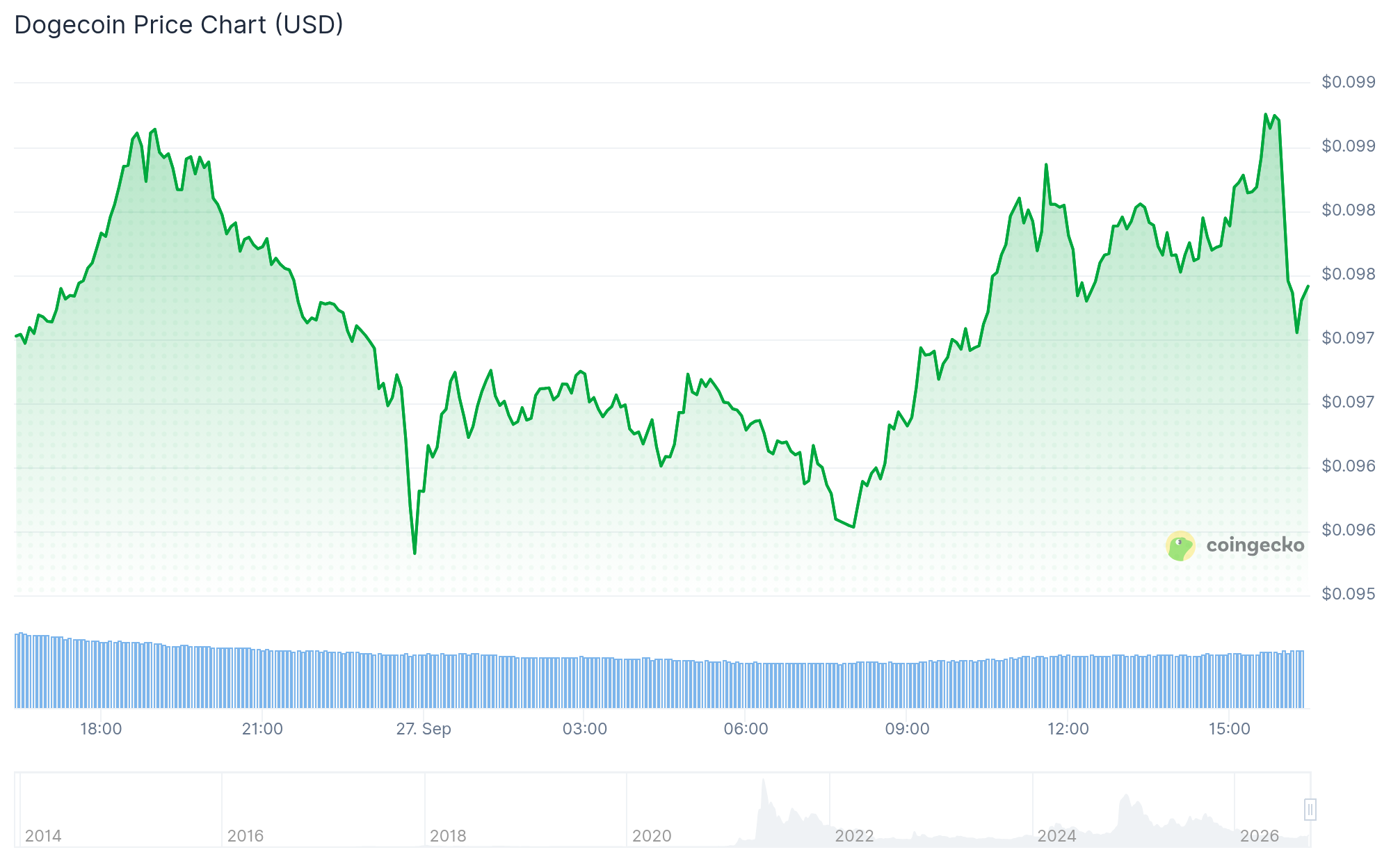
Large-holder activity adds another demand measure. Market analyst Ali Charts reported whale wallets acquired more than 1.14 billion DOGE, worth about $112 million, over a 96-hour window.
The buying came as DOGE encountered resistance near $0.098, with roughly 28 billion tokens previously traded at that zone. Ali Charts’ estimate equaled roughly 39 times the weekly ETF flow, though it measured purchases by whale wallets instead.
Earlier whale accumulation episodes also drew attention. In May, wallets acquired 525 million DOGE over a 96-hour stretch as the token traded near its 200-day moving average. From September 9 to 14, wallets holding at least 100 million DOGE each added about 240 million tokens. DOGE fell from $0.091 to $0.081 during that period. The combined holdings of those wallets approached 19 billion DOGE.
At other points this year, 149 top wallets each held more than 100 million DOGE. Together, they controlled over 108 billion tokens. Futures open interest climbed into the $1.5 billion to $1.67 billion range during peak activity. Short liquidations exceeded $12 million during recent accumulation phases. Dogecoin ETF inflows, whale wallet totals, and futures open interest track separate market measures.
The post Dogecoin ETF Inflows Break January Record as Grayscale Leads Buying appeared first on Blockonomi.
TLDR:
- Alpenglow replaces Solana’s consensus engine, cutting transaction finality to about 150 milliseconds.
- Solana’s fault tolerance threshold rises from 33 percent to 40 percent under the Alpenglow upgrade.
- US Solana ETFs posted $188.21 million in weekly inflows, their largest total since launching.
- Bitwise’s BSOL fund led ETF inflows with $128.46 million, favored for its SOL staking yield.
Solana has climbed sharply in recent days, with traders pointing to two converging catalysts. A major network upgrade called Alpenglow is nearing activation, promising faster and cheaper transactions.
At the same time, US Solana exchange-traded funds posted their strongest inflow week since launch, signaling growing institutional appetite for the asset alongside the technical shift.
Alpenglow Upgrade Builds Anticipation
The upgrade, developed by core engineering group Anza, replaces Solana’s underlying consensus engine entirely. It swaps the legacy TowerBFT system for a new protocol called Votor, which handles validator votes directly instead of packaging them into on-chain transactions. This change cuts transaction finality from roughly 12.8 seconds down to about 150 milliseconds.
Crypto commentator Sarosh highlighted the scale of the shift on social media. He described it as “the largest overhaul in Solana’s history,” noting it replaces the system validators use to agree on transactions.
Traders have treated the upgrade as a fundamental catalyst, since faster finality and lower fees tend to draw renewed trading activity.
Code for Alpenglow has sat inactive on mainnet since September 18, building expectation ahead of a formal switch.
Activation is scheduled to begin September 28, though the date depends on 95 percent of staked validators updating their node software first. That countdown appears to be feeding speculative buying into the deadline.
Network Improvements Reinforce The Rally
Beyond speed, Alpenglow raises Solana’s fault tolerance threshold from 33 percent to 40 percent of staked validators.
This gives the network stronger protection against outages, routing failures, or hardware crashes. Traders view added resilience as a positive signal for long-term network reliability.
Validator voting has historically consumed a heavy share of network capacity, accounting for up to 75 percent of on-chain transactions.
Moving that process off-chain frees transaction space for regular users and cuts the SOL cost of running a validator. Lower operating costs are seen as supportive for validator participation and network health.
Because the upgrade only touches infrastructure, wallets, smart contracts, and fee structures remain unchanged for users.
This combination of speed, resilience, and cost reduction has given market participants a clear narrative to buy into ahead of activation.
ETF Inflows Add Fuel To The Move
Institutional demand has amplified the rally. US Solana ETFs drew $188.21 million in net inflows between September 21 and 25, the largest weekly total since launch. The official Solana account called it “the biggest week since launch” for these products.
Bitwise’s staking-enabled BSOL fund led inflows with $128.46 million, favored for its yield on staked SOL. It outpaced Grayscale’s GSOL and Fidelity’s FSOL during the same period. Thirty-day inflows reached $447.7 million, with cumulative totals surpassing $1.61 billion.
Solana traded at $123.66 as of writing, up 2.39 percent over 24 hours and 14.75 percent over the past week. Twelve straight weeks of positive ETF flows suggest steady institutional accumulation is compounding with upgrade-driven momentum to push the price higher.
The post Why Solana Is Pumping: Alpenglow Upgrade and Record ETF Inflows Drive Rally appeared first on Blockonomi.
TLDR:
- A prediction-market contract put the CLARITY Act near 14% odds of becoming law in 2026 before the September 15 vote; that was not a 12-month forecast.
- The CFTC’s September 24 FAQ update clarified tokenized forms of already-permitted customer-fund investments and blockchain-based recordkeeping, without widening eligible assets.
- The SEC’s five-year conditional exemption covers certain permissioned venues trading tokenized U.S. stocks, while leaving altcoin products and most crypto platforms outside its scope.
- Agency guidance can move quickly, but it may change or face legal challenges; a statute could set more durable lines for jurisdiction, registration, and customer protections.
The CLARITY Act has stalled, but U.S. crypto regulation continues through agency action. The SEC and CFTC apply authority to tokenization, recordkeeping, and trading. These steps shape compliance as institutions assess digital assets, including altcoins. However, agencies cannot settle questions about jurisdiction, registration, or consumer safeguards that Congress could address.
On September 15, the Senate failed to advance the CLARITY Act in a procedural vote, not a final rejection. Before the vote, a prediction-market contract put the bill’s 2026 passage odds near 14%. That was a calendar-year estimate, not a forecast for the next twelve months. No vote is scheduled.
What the CLARITY Act Could Change for Crypto Markets
The CLARITY Act would set a federal market-structure framework. It would define when tokens qualify as securities or commodities and divide SEC and CFTC oversight. It would also set registration and consumer-protection requirements. Clearer categories could reduce jurisdictional disputes and help firms decide how to operate. The bill would give investors a firmer basis for understanding platform duties.

Those duties matter when an exchange holds customer assets. Users want to know how firms must safeguard funds, keep records, and respond to breaches or losses. Rules under the CLARITY Act could support consistent compliance across platforms. They would not guarantee safety, prevent every hack, or shield investors from losses caused by volatility.
A framework may affect institutional participation. Retirement plans, insurers, and asset managers could assess crypto exposure against clearer responsibilities and safeguards. Registration pathways might attract more buyers and sellers, supporting liquidity and price discovery. Institutions must weigh custody, demand, liquidity, and volatile-asset risk.
SEC and CFTC Rules Move Ahead While Congress Stalls
The CFTC’s September 24 FAQ update offers an example. This matters for compliance across derivatives markets. Staff clarified how registrants may use tokenized forms of investments already permitted for customer funds. They also addressed blockchain systems for keeping and producing required records. The update does not expand the eligible investment list or create a new regime. It applies existing requirements to tokenization and distributed ledgers.
The FAQs build on staff guidance about tokenized collateral. The CFTC says they reflect staff views, create no binding rules, and amend no regulations. The update can guide compliance planning, but is narrower than a statute or agency rule. It concerns registered firms, not a comprehensive definition of digital assets or allocation of SEC and CFTC jurisdiction.
The SEC has acted under existing authority. On September 17, it approved a temporary, conditional exemption for certain venues trading tokenized U.S. stocks in permissioned settings. The five-year measure allows limited on-chain trading while the agency considers broader rules. It does not authorize all crypto platforms or approve altcoins. Its scope covers tokenized national-market-system stocks.
These examples show why the CLARITY Act still matters as regulation advances. Agencies can address narrower questions and test approaches, but their actions depend on current statutes. Guidance may change, exemptions have conditions, and agency measures can face court challenges or leadership shifts. Congress could provide more durable rules for asset classifications, venue responsibilities, registration, and investor protections.
That certainty could help institutions assess crypto, but regulation is not a government endorsement. Bitcoin and other cryptocurrencies remain speculative and volatile. The CLARITY Act would not make those assets safe or eliminate market risk. Stablecoins and distributed-ledger systems may serve payment or settlement uses, especially when tokens represent assets such as U.S. Treasurys. Those uses differ from spending volatile crypto on everyday goods and carry distinct risks.
For now, the CFTC FAQ update clarifies tokenized permitted investments and blockchain recordkeeping within existing rules. The SEC exemption addresses limited trading of tokenized stocks. Unresolved questions include who regulates each market, which firms must register, and what consumer protections users can expect.
The post CLARITY Act Delay Leaves Crypto Rules Moving Through Agencies appeared first on Blockonomi.
TLDR:
- PeerDAS, live since Fusaka in December 2025, lets nodes sample blob data instead of downloading every blob.
- Hegotá, expected in 2027, could be Ethereum’s last broadly familiar fork before deeper cryptographic redesign.
- EIP-7805 adds validator-backed inclusion lists to curb censorship by individual block builders in Hegotá.
- Ethereum targets 2029 for core post-quantum infrastructure, alongside Lean Consensus and recursive STARKs.
Vitalik Buterin has outlined a long-term architecture for Ethereum that could make the network increasingly difficult to describe as a conventional blockchain. The model combines decentralized consensus, zero-knowledge proofs, distributed computation, privacy systems and post-quantum cryptography.
In a September 27 post titled “The cryptographic world computer,” Buterin said the network now blends Bitcoin-era blockchain principles with newer cryptographic research. His framework describes a system where verification relies less on every node repeating every computation and more on proofs, sampling and specialized distributed infrastructure.
That shift is already visible in several parts of the roadmap. Data availability, block construction and consensus are moving toward designs that reduce duplication while preserving verifiability across the network.
Ethereum’s World Computer Shift Rewrites Blockchain Verification
Traditional blockchains require many nodes to download data and independently re-execute transactions. Buterin described an architecture that increasingly replaces that model with data sampling and cryptographic proof verification.
Consensus has also moved from proof-of-work to proof-of-stake, while a more optimized Lean Consensus design remains under development. At the same time, block construction could become more distributed instead of depending heavily on one miner or builder.
PeerDAS provides an early example of that direction. Introduced through the December 2025 Fusaka upgrade, it lets nodes verify blob availability by sampling data rather than downloading every blob.
That reduces bandwidth requirements while supporting higher Layer 2 capacity. As a result, more computation can move outside the base layer without removing Ethereum’s ability to verify results cryptographically.
The next major milestone is Hegotá, currently expected in 2027. Buterin described it as potentially the last upgrade that would remain broadly familiar to developers from earlier network eras.
Hegotá and Lean Ethereum Push Toward Quantum-Safe Design
FOCIL, formally EIP-7805, is scheduled for Hegotá. It introduces validator-backed inclusion lists intended to limit the ability of individual block builders to censor valid transactions.
However, the upgrade’s broader scope remains under development, so additional features and timing could still change. Beyond Hegotá, research increasingly centers on recursive STARKs, formal verification and advanced state management.
EIP-8288 offers one example. The draft proposal would aggregate quantum-resistant signatures and STARK proofs in the mempool before producing one recursive proof for block verification.
Lean Ethereum extends that direction with redesigned consensus, hash-based post-quantum signatures, formal verification and finality targeted in seconds. Separately, the Ethereum Foundation is targeting about 2029 for core post-quantum infrastructure.
Taken together, Buterin’s framework describes a network where decentralized offchain systems handle larger workloads while cryptographic proofs preserve security guarantees. He calls that architecture a “cryptographic world computer.”
The post Vitalik Buterin Maps Ethereum’s Evolution Into a Cryptographic World Computer appeared first on Blockonomi.
HTTP error 429 on https://cryptopotato.com/feed/
Failed to fetch feed: https://cryptopotato.com/feed/
Failed to fetch feed.