Cryptocurrency Posts
Crypto Briefing
Starknet's strkBTC faucet enhances user privacy and engagement, potentially increasing adoption of privacy-focused blockchain solutions.
The post Starknet strkBTC faucet claims go live as registration reopens on the 29th appeared first on Crypto Briefing.
Rising bond yields and energy prices may signal a shift in investment dynamics, potentially increasing recession risks and market volatility.
The post Wall Street veteran warns bond market is flashing the same signal it sent before Black Monday appeared first on Crypto Briefing.
A quieter Fed may heighten market uncertainty, prompting cautious investor behavior and impacting risk assets like Bitcoin.
The post Warsh suggests quieter Fed may increase market volatility, impact Bitcoin outlook appeared first on Crypto Briefing.
The Houthi control over Yemen's Red Sea coast, bolstered by Iran, heightens geopolitical tensions and risks disrupting vital global trade routes.
The post Houthi rebels seize Yemen’s Red Sea coast with Iranian support, threatening global shipping chokepoint appeared first on Crypto Briefing.
Heightened U.S. oversight on China signals strategic caution, impacting diplomatic and economic relations while avoiding military escalation.
The post US increases oversight on China amid non-compliance concerns: Miller appeared first on Crypto Briefing.
Bitcoin Magazine
Bitcoin Magazine
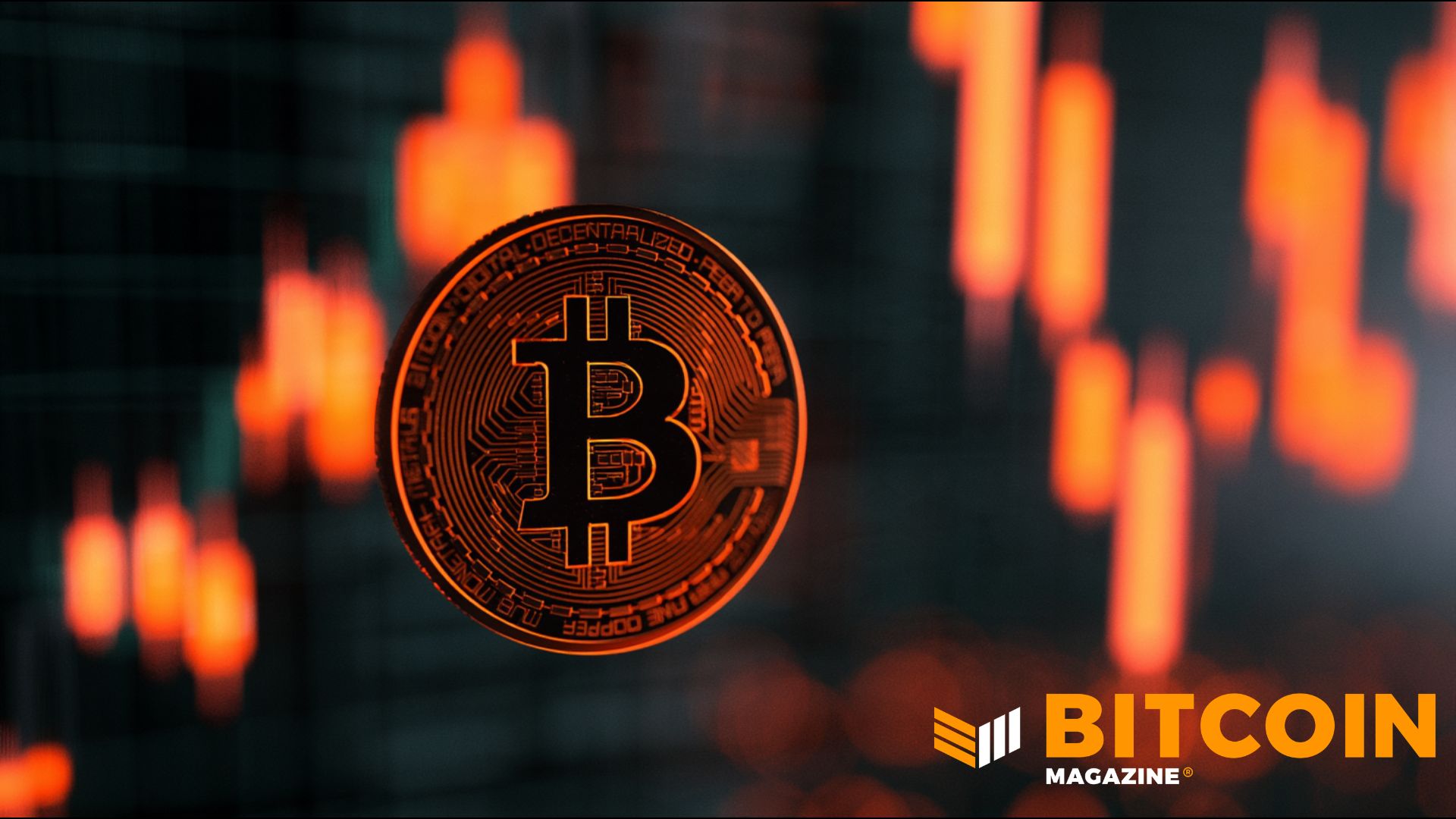
Bitcoin Price Slips While US Treasury Yields Soar, Oil Prices Climb
Bitcoin’s price slid on Wednesday, just as U.S. Treasuries surged, with the 10-year yield climbing above 5% and reaching — its highest level since 2007.
The price of the leading cryptocurrency was down 2% over a 24-hour period Wednesday afternoon in New York, and was trading hands for $84,357.
Bitcoin’s price had surged earlier in the week as investors piled into exchange-traded funds. At one point, it soared as high as nearly $87,330.
JUST IN:
— Bitcoin Magazine (@BitcoinMagazine) September 23, 2026U.S. Treasury Department to buy back up to $6 billion in longer-term debt tomorrow.
Buy Bitcoinpic.twitter.com/nZm3BNqiVH

But its rally has since cooled. It dropped further on Wednesday afternoon around the time the U.S. Treasury said it will purchase up to $6 billion of longer-dated government debt on Thursday.
Bitcoin previously benefited from the Treasury Department’s announcement of buybacks — having its best run in months — but this time dropped.
The 10-year Treasury yield climbed above 5% on Wednesday for the first time in 19 years, after September’s flash PMI data came in well ahead of forecasts and pushed the composite index to a five-year high.
Inflation details added to the pressure: input costs across manufacturing and services rose to their highest level since October 2022, driven largely by fuel and transportation, while wage pressure also strengthened.
Rising yields are typically a headwind for bitcoin’s price. When safe government bonds pay 5%, holding an asset that generates no income becomes more expensive.
Higher rates also tend to strengthen the dollar and dampen appetite for risk-on assets. Bitcoin has repeatedly retreated this year when yields rose on inflation fears, often with ETF outflows and forced selling by leveraged traders amplifying the move.
This post Bitcoin Price Slips While US Treasury Yields Soar, Oil Prices Climb first appeared on Bitcoin Magazine and is written by Mathew Di Salvo.
Bitcoin Magazine
CFTC Chair Selig Says Regulator Is Preparing for ‘24-7, On-Chain’ Markets
Commodity Futures Trading Commission Chair Mike Selig has said that the regulator was preparing for the transition of markets moving “24-7, on-chain.”
Speaking to CNBC on Wednesday, the regulator said that it was an exciting time to be regulating markets related to crypto and artificial intelligence.
The CFTC is fast pushing ahead with rulemaking for the crypto space, despite lawmakers last week blocking the long-awaited Clarity Act. Following the vote on the landmark crypto legislation, Selig said that the watchdog would still help U.S. President Trump “get the job done” in regulating digital assets.
“Our markets are rapidly evolving,” Selig said. “We really have to reevaluate all of our rules and regulations to make sure that we’re ready and prepared for this transition to 24-7 on-chain and these automated markets that are facilitated through the use of algorithms and agentic finance.”
The Clarity Act wants to formally divide oversight between regulators, distinguishing which digital assets are securities, commodities or stablecoins.
But the bill stalled and stumbled this year as the banking lobby had issues with crypto companies paying customers stablecoin rewards and some lawmakers — mostly Democrats — were concerned about the ethics side of the legislation.
Trump received backing from major industry players while campaigning and since becoming president, his family has made money from digital asset ventures.
Some lawmakers have alleged conflicts of interest; the White House has always denied any wrongdoing.
Despite lawmakers blocking the Clarity Act, the CFTC and Securities and Exchange Commission have charged ahead with rulemaking. The CFTC last week sent a proposal to the White House to regulate crypto transactions and markets.
And the SEC went ahead and approved tokenized stocks trading the same week. In August, it also proposed its own framework for crypto asset offerings, pressing ahead while the landmark legislation stalled.
Formerly chief counsel at the SEC’s Crypto Task Force, Selig was described by White House’s Crypto and AI Tsar, David Sacks, as “instrumental in driving forward the President’s crypto agenda”
President Trump in August urged lawmakers to get the Clarity Act over the line, referring to the legislation as “very, very powerful.”
This post CFTC Chair Selig Says Regulator Is Preparing for ‘24-7, On-Chain’ Markets first appeared on Bitcoin Magazine and is written by Mathew Di Salvo.
Bitcoin Magazine

NYSE and Blockchain.com Working Together To List Tokenized Stocks
The New York Stock Exchange and crypto exchange Blockchain.com have signed a memorandum of understanding to debut tokenized stocks.
According to a Wednesday statement, if approved, Blockchain.com users would be able to trade tokenized U.S.-listed stocks and exchange-traded funds on NYSE’s planned digital alternative trading system.
It comes as Wall Street increasingly eyes up Bitcoin and its related infrastructure. NYSE’s parent company, Intercontinental Exchange, earlier this year announced it had invested in crypto exchange OKX.
“People shouldn’t be limited in owning stocks based on where they happen to live or the brokerage and information they may or may not have access to,” Peter Smith, Blockchain.com’s executive chairman and CEO, said in a statement.
“Connecting to the NYSE digital alternative trading system will enable us to extend the opportunity to invest in these digital assets to tens of millions of Blockchain.com users around the world.”
And NYSE Group President Lynn Martin added: “The future of capital markets belongs to institutions that unite the trust of traditional finance with the innovation and accessibility of digital assets.”
In January, the NYSE said it was building a platform allowing traders to buy and sell tokenized versions of U.S.-listed equities and exchange-traded funds and settle those trades on the blockchain, 24/7.
Wall Street has been eying up crypto companies and their infrastructure particularly because it’s interested in tokenizing assets like stocks. Traditional finance titans like BlackRock and Franklin Templeton for years have used blockchain rails to tokenize money funds.
But things have accelerated since the U.S. elected pro-crypto president Donald Trump and regulators have taken a more friendly stance to watchdogging the space. The U.S. Securities and Exchange Commission last week approved tokenized stocks trading.
In January, the S&P 500 gave crypto platform Trade[XYZ] the green light to debut a new derivative contract on decentralized exchange Hyperliquid, giving traders the ability to trade the stock index 24-7.
And Last month, Payward, the parent company of crypto exchange Kraken, and fintech company SoFi Technologies, announced a deal to route SoFi customers’ crypto orders through Kraken’s institutional trading platform and list SoFi’s stablecoin on the exchange.
This post NYSE and Blockchain.com Working Together To List Tokenized Stocks first appeared on Bitcoin Magazine and is written by Mathew Di Salvo.
Bitcoin Magazine

The Quantum Issue: You Never Really Know The Future
People have been debating whether a quantum computer presents a realistic threat to the Bitcoin network for over a decade. It was a serious topic of conversation over 13 years ago when I first discovered Bitcoin myself.
There has been quite a lot of progress, both in terms of theory and real-world engineering, since long ago when I was just a bumbling idiot trying to figure out what was going on here.
Two major milestones have been reached since then that make a material difference in the likelihood of a viable quantum computer actually being produced sometime in the next decade or so. That doesn’t inherently mean that it will reach a point of ubiquity, or even relative ease of access for those with large amounts of capital.
But it is very possible that a number of viable machines will be produced in the near future.
Error Correction Improvements
The first major improvement has been in error correction. To account for the inherent noise in working with things at this kind of tiny scale, to get a logical qubit that is useful in computation in practice requires the use of multiple redundant physical qubits.
The prior state of the art way of doing this was surface codes, a way of bundling multiple physical qubits together in a grid and using some of them as check qubits that periodically “check on” their neighbors to ensure no internal errors in the superposition have occurred (without collapsing the superposition). Each grid’s empty spaces need to be filled with check qubits.
This check qubit requirement creates an extra overhead that can get close to 1,000 physical qubits per logical qubit in total, and it gets bad at scale because check qubits can only check on the qubits immediately next to them. So every grouping of qubits needs to have checkers in equidistant spacing.
Quantum low-density parity-check (qLDPC) codes remove this bottleneck, allowing check qubits to check other qubits at large distances (either through traces interwoven to communicate across chip sections, or by physically moving atoms like with the neutral atom design) across the device. This has allowed a 10x reduction in the amount of physical qubits necessary to produce a reliable logical qubit.
That is not something to sneeze at. While it might not be a fully functional machine making progress at gaining more efficiency, it is material efficiency gains in the engineering processes that underlie the production of a fully functional quantum computer.
Progress In Proving Fundamentals
The second has to do with a more fundamental question around the assertion that adding more physical qubits leads to a reduction in overall noise in the system rather than an increase. This is really at this point still theory, and you have to keep in mind that to this day there has never been a fully functional quantum computer that has end-to-end performed a computation a classical computer is incapable of.
Google performed an experiment using their Sycamore (and later Willow) chips to experimentally verify the effect of adding more physical qubits. To be very clear, this was not a demonstration of performing computations, but simply a demonstration of storing information in memory without it decaying.
They demonstrated through the use of logical qubits composed of a bundle of 17 physical qubits, a bundle of 49 physical qubits, and a bundle of 101 physical qubits that the logical error rate, the frequency of data corruption, decreased as the physical qubit count went up. This test passed a critical threshold, where the logical qubit being created out of the independent physical qubits maintained coherence longer than any individual physical qubit it was composed of.
Now again, this is not a jump to a fully functional quantum computer performing computations that classical machines are incapable of, but it is material progress proving one of the fundamental assumptions underlying quantum computers.
AI
These aren’t the only things that we are finding better solutions to in this problem space either. Artificial intelligence has become a big component in these systems. It is being used in the actual process of reading and decoding information from a quantum computer, a big bottleneck for actually making use of it at scale.
AI is also being used in the development of new quantum algorithms optimized for these types of machines, and given the recent spate of AI helping to solve (or even disprove existing conjectures) major problems in the field of mathematics, this isn’t really that crazy of a leap to consider the possibility of major breakthroughs brought about by AI.
They are being put to the same use in actually designing the actual physical quantum circuits that are built using different architectures. This is a very complex problem, actually, finding the optimal way to lay out quantum gates in a physical space to minimize noise at the quantum level, without creating so much empty space that you introduce latency, inefficiency, and other problems to solve.
This is a factor that very well could hypercharge progress at solving the necessary fundamental problems.
Outlook Ahead
Ultimately, in my opinion, this comes down to one question: does the assumption that adding more physical qubits reduce noise actually hold when it comes to computation and the active manipulation of quantum information.
If that assumption does hold, and isn’t experimentally disproven sometime in the near future, then I think there is a very realistic case for a viable quantum computer being produced in the next ten years.
There is a massive amount of resources being thrown at this problem, significant (but not overwhelming) progress at solving pieces of the problem, and if there fundamentally is a way to do something, human beings usually figure it out.
I’m not saying that it’s time to panic, but don’t discount the possibility.

This piece is featured in the latest Print edition of Bitcoin Magazine, The Quantum Issue. We’re sharing it here as an early look at the ideas explored throughout the full issue.
This post The Quantum Issue: You Never Really Know The Future first appeared on Bitcoin Magazine and is written by Shinobi.
Bitcoin Magazine

Raiffeisen Bank International to Roll Out Bitcoin Services Across Europe in Expanded Bitpanda Deal
Austrian banking group Raiffeisen is rolling out bitcoin trading for its 18 million customers.
The firm said in a Wednesday statement that it was working with brokerage Bitpanda as part of the initiative.
Raiffeisen’s announcement comes as top banks worldwide launch crypto trading and custody services. BBVA, Santander’s Openbank, Germany’s cooperative and savings banks, SoFi, PNC, Charles Schwab and Morgan Stanley have all either launched or announced retail crypto trading over the past 18 months.
RBI chief executive Michael Höllerer pointed to customer demand as the driving force. “We are seeing growing demand for crypto assets in our markets, which we are addressing with a strong, reputable partner,” he said, adding that the bank is committed to “meeting our customers’ needs in the best possible way.”
The deal builds on an arrangement that began in Austria. In 2024, Raiffeisen Landesbank Niederösterreich-Wien (RLB NÖ-Wien) became the first traditional bank in the European Union to offer crypto trading within its existing banking environment, using Bitpanda’s technology.
The new agreement moves away from striking separate integrations market by market and instead sets up a single approach for the whole group.
Bitpanda Enterprise provides banks, fintechs, brokers, trading firms and family offices with the tools to offer digital asset products to retail and corporate clients. Its services include investment infrastructure, liquidity, custody, payments, stablecoins and tokenisation, with an emphasis on compliance and scalability.
RBI treats Austria and Central and Eastern Europe as its home market, with subsidiary banks in 11 countries in the region. The group has about 42,000 employees serving 18.8 million customers through roughly 1,300 branches, most of them in CEE. Its shares trade on the Vienna Stock Exchange, and the regional Raiffeisen banks own about 61.2 per cent of the company, with the rest in free float.
This post Raiffeisen Bank International to Roll Out Bitcoin Services Across Europe in Expanded Bitpanda Deal first appeared on Bitcoin Magazine and is written by Mathew Di Salvo.
CryptoSlate
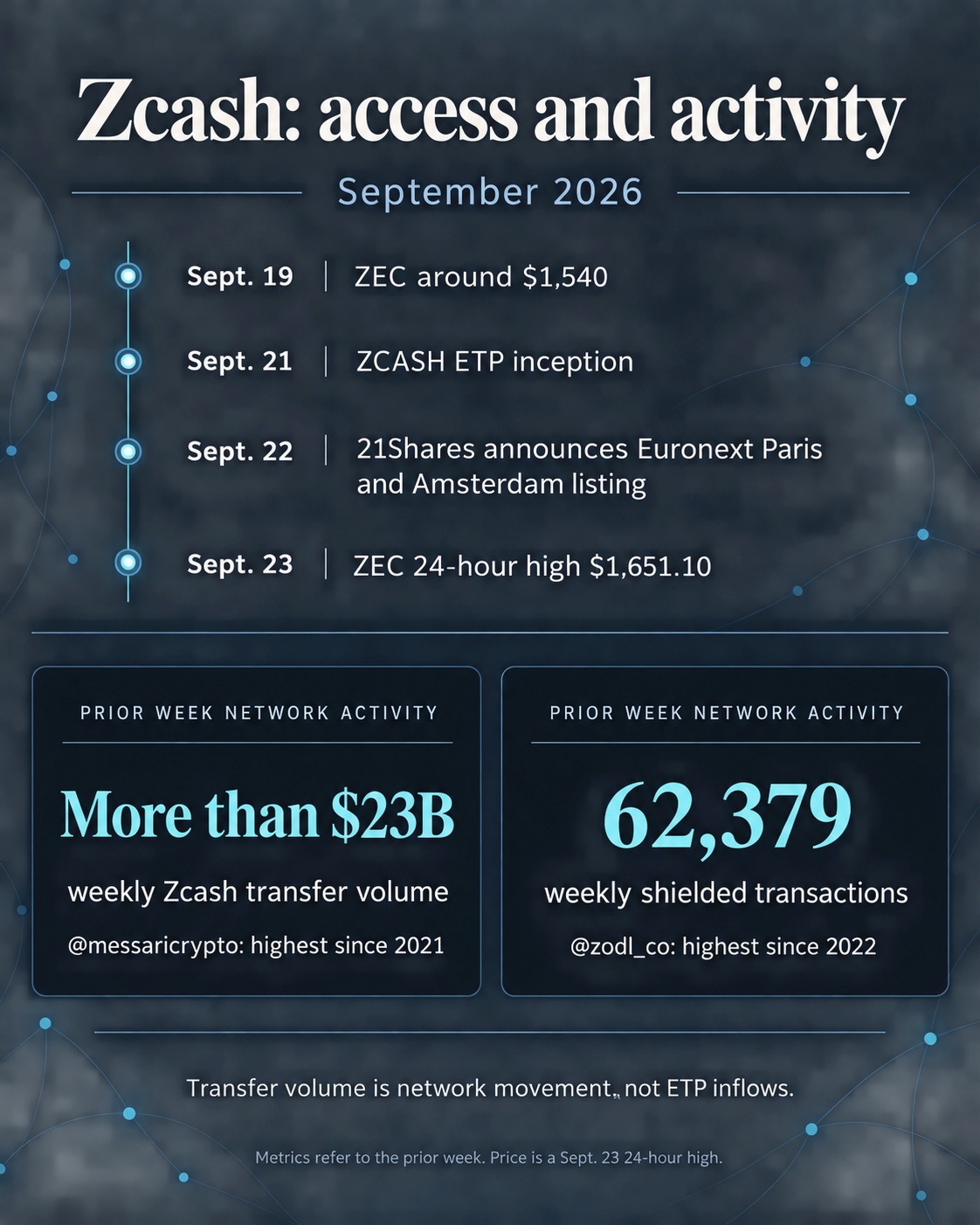
21Shares has launched a Zcash ETP, a physically backed exchange-traded product, on Euronext Paris and Amsterdam, opening a brokerage route to ZEC for European investors. The issuer announced the listing on Sept. 22 as Zcash rallied, but the price advance began before the product arrived.
The 21Shares Zcash ETP trades as ZCASH, with a euro listing in Paris and a dollar listing in Amsterdam. Its ISIN is CH1608218801. The product holds ZEC through its structure, giving investors price exposure without requiring them to buy or custody tokens directly. Its annual fee is 2.5%, and brokerage charges may add to the cost. The investor holds the listed product while the underlying ZEC is kept within its custody structure, a different experience from acquiring coins and moving them between personal wallets. In its launch post, 21Shares called it the first Zcash ETP available to European investors.
The distinction between product inception and public launch matters here. The issuer's product page gives Sept. 21 as the inception date, while its listing announcement came Sept. 22. ZEC was already trading around $1,540 on Sept. 19, when CryptoSlate covered a rally tied to growing attention on Grayscale's separate U.S. Zcash ETF. The European product therefore adds a new access point to an established price move.
On Sept. 23, Zcash recorded a 24-hour ZEC high of $1,651 before retracing to around $1,487 as of press time.
Weekly activity reaches multiyear highs
Messari reported more than $23 billion in Zcash transfer volume last week, its highest weekly total since 2021 and second-highest on record. That measure counts value moving on the network. Capital flows into ZEC or the new ETP require different data, so the $23 billion figure describes network movement rather than fresh investment.
On X, Zodl reported 62,379 shielded transactions last week, the highest weekly reading since 2022. Shielded transactions conceal details that would otherwise be visible on the public chain. The count measures transactions rather than distinct users. Subsequent weekly readings will show whether that level of shielded activity persists.
The new European listing and the two activity readings give investors fresh ways to assess Zcash beyond its price. Changes in ZCASH's assets will offer a separate gauge of take-up through European brokerage accounts. Those signals will develop on different timelines as the product begins trading.
The post Why Zcash soared to $1,600 as Europe unlocks new ETP access appeared first on CryptoSlate.
Bitcoin registered an intraday low at $83,500 on Sept. 23, the same day the US 10-year Treasury yield closed at 5.11%, up 15 basis points in a single session, as a hotter-than-expected business activity survey pushed investors to reprice interest rates.
Bitcoin now sits inside the $84,000 to $85,000 zone Glassnode identifies as its nearest on-chain support.
Real yields carried most of the move
The 10-year real yield, which strips out expected inflation, climbed from 2.63% to 2.76% on Treasury's curve, accounting for 13 of the 15 basis points added to the nominal yield. Implied 10-year inflation compensation, the gap between the two, edged from about 2.33% to 2.35%.
| Metric | Sept. 22 | Sept. 23 | One-day move | Why it matters for Bitcoin |
|---|---|---|---|---|
| 10-year Treasury yield | 4.96% | 5.11% | +15 bps | Raises the benchmark return available in government debt |
| 10-year real yield | 2.63% | 2.76% | +13 bps | Increases the inflation-adjusted opportunity cost of holding BTC |
| Implied inflation compensation | 2.33% | 2.35% | +2 bps | Shows the move was mostly real-rate driven |
| S&P Global composite PMI | 56.0 | 58.4 | +2.4 pts | Triggered the repricing by showing stronger business activity |
Investors demanded a higher inflation-adjusted return on government debt, which raises the opportunity cost of holding Bitcoin, an asset that pays no yield of its own.
The trigger came from S&P Global's September Purchasing Managers' Index. The composite reading jumped to 58.4 from 56.0, with services at 58.7 and manufacturing at 57.0, the strongest expansion in the survey since July 2021.
An economy running that hot leaves the Federal Reserve less room to ease, one week on from its Sept. 16 hike to a 3.75% to 4.00% target range. Intraday reports put the 10-year near 5.058% within minutes of the PMI release, and Treasury's end-of-day curve settled at 5.11%.
Bitcoin's decline played out in the same session, with roughly $280 million in long liquidations as price broke below $84,000, according to CoinGlass.
Glassnode's map puts support at $84,000 to $85,000
Glassnode's Sept. 23 report places the largest cluster of long-term holder supply between $84,000 and $85,000, the price range where the biggest block of patient holders acquired their coins.
Bitcoin also trades above the short-term holder cost basis and above the True Market Mean at $77,000, which Glassnode describes as the main downside reference if the market loses $84,000.
On the upside, the report puts the next major resistance at $96,700, derived from the mean MVRV price.
| Level | Glassnode marker | Distance from ~$84,282 | Editorial meaning |
|---|---|---|---|
| $77,000 | True Market Mean | -8.6% | Main downside reference if $84K fails |
| $84,000–$85,000 | Long-term holder supply cluster | Current zone | Nearest support and key daily-close battleground |
| $96,700 | Mean MVRV resistance | +14.7% | Upside test if buyers absorb the macro shock |
From the current quote near $84,282, the $77,000 level sits about 8.6% lower and the $96,700 level about 14.7% higher. Glassnode's framework rests on sustained trading beneath the supply zone, so daily closes carry the weight in reading the Sept. 23 dip.
An intraday wick through $84,000 leaves the structure intact, while a run of closes below it would bring the $77,000 reference into play.
The buyers who returned before the bond move
Glassnode's demand data shows spot Bitcoin ETFs took in about $1.3 billion over the five days since the recent squeeze began, ending two weeks of outflows.
Over the same stretch, 24-hour spot volume across exchanges climbed 121% from its August trough. Farside Investors' figures show $999 million of ETF inflows on Sept. 21 and $714.7 million on Sept. 22 and $346.9 million on Sept. 23. IBIT led the second day with $350.3 million, with FBTC at $257.4 million and MSBT at $99 million.
Glassnode’s on-chain and ETF observations run mostly through Sept. 21, and its spot-volume data through Sept. 22. Farside’s Sept. 23 figures show inflows persisted during Wednesday’s bond selloff, though at a slower pace than Tuesday.
Friday brings roughly $16 billion in Bitcoin options expiring on Deribit, US durable goods and consumer sentiment data a few hours later, and CME's September Bitcoin futures settlement in the afternoon.
Whether $84,000 holds or $77,000 comes into view
The bull case has the 10-year real yield retracing below roughly 2.65% while ETF inflows stay positive and spot volume expands on up days. Bitcoin holds daily closes inside the $84,000 to $85,000 zone, and buyers who returned last week absorb the macro hit.
Under that path, attention moves from defending support toward the $95,000 to $97,000 region, with Glassnode's $96,700 resistance as the test that would confirm the recovery has room to run.
The bear case has real yields extending toward 2.85% to 2.90% as markets price a longer stretch of restrictive Fed policy. Bitcoin loses the $84,000 to $85,000 zone on sustained daily closes while ETF flows slow or turn negative.
| Scenario | Real-yield signal | BTC price signal | ETF / spot demand signal | Next level in focus |
|---|---|---|---|---|
| Bull case | 10-year real yield retraces below ~2.65% | Daily closes hold $84K–$85K | ETF inflows stay positive; spot volume rises on up days | $96,700 |
| Bear case | 10-year real yield extends toward 2.85%–2.90% | BTC loses $84K–$85K on sustained closes | ETF flows slow or turn negative; spot volume rises on selloffs | $77,000 |
In that scenario, the $77,000 True Market Mean becomes the active downside reference, and the long-term holders clustered at $84,000 turn into overhead supply for any rebound that follows.
Bitcoin's next few daily closes and the 10-year real yield's next moves will decide which of Glassnode's two reference points, $77,000 or $96,700, the market reaches first.
The post Why surging US real yields are quietly forcing Bitcoin under $84,000 appeared first on CryptoSlate.
Neutron voters passed proposal #9 on Sept. 22, with 11 “Update Admin” actions listed on the chain explorer. The same day, security tracker SlowMist recorded estimated losses of $4.9 million at Astroport and $4.4 million at Drop.
The tracker’s combined estimate of $9.3 million reflects the reported incidents.
Neutron’s governance documentation calls its DAO the network’s highest governing authority and describes its power to execute messages through governance. “Update Admin” is the action identified on the proposal index.
In practical terms, the network’s governance process can change control of a contract’s administrator, even when users experience Astroport or Drop as separate services.
The proposal was titled “AIATO: AI Agent Takeover. Phase 1: Agent Admin Registration.” The explorer marks it as passed and lists 11 administrator updates.
That count describes the proposal’s administrative scope. SlowMist names Astroport and Drop in its Sept. 22 records.
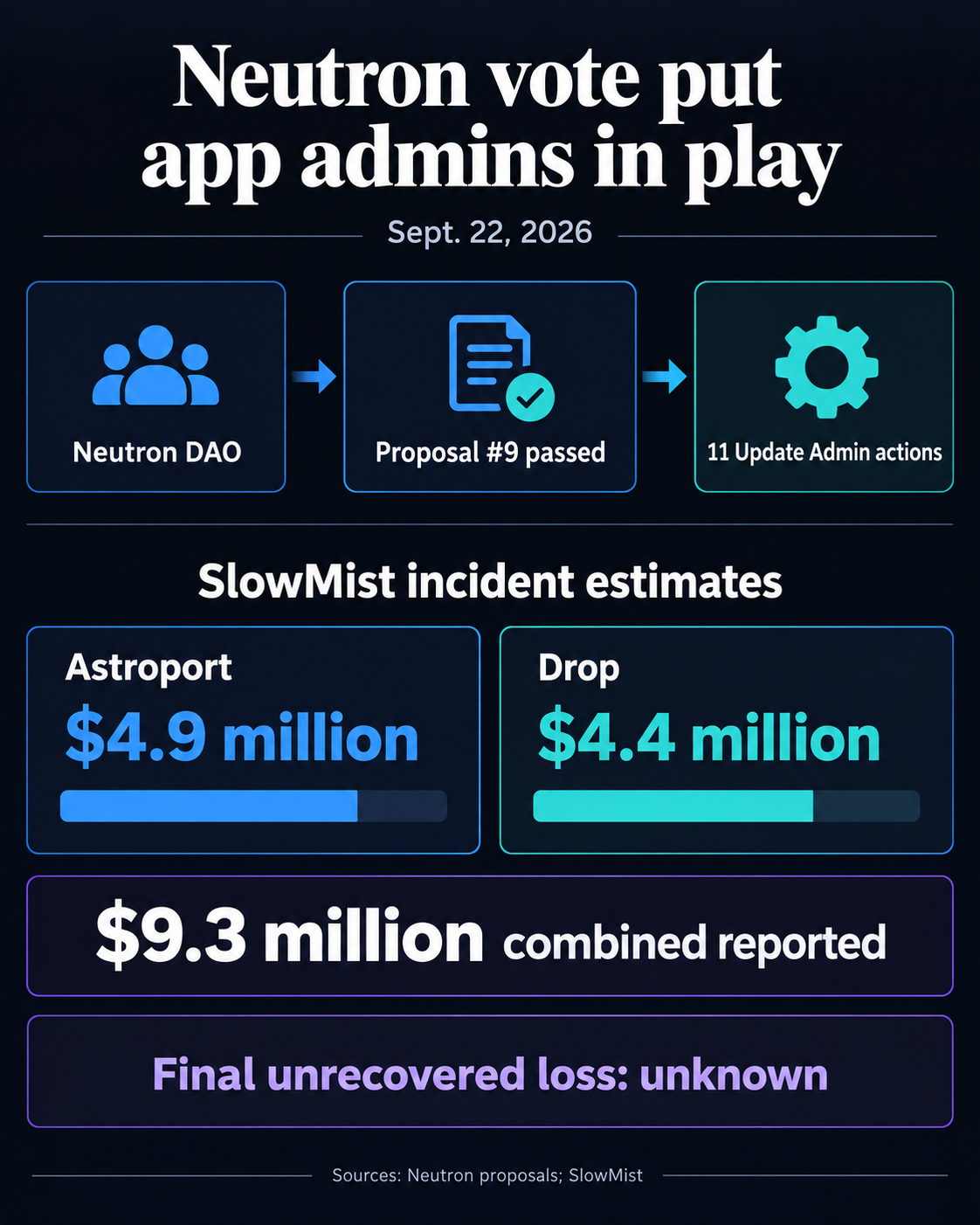
The proposal shows the chain-level route to changing administrators, while the SlowMist entries show the reported financial impact at two applications. Together they point to a risk that is easy to overlook when assessing an application only by its procedures: network governance may retain consequential authority over the software it hosts.
What remains recoverable
The incident estimates leave the final loss unsettled. Protos reported on Sept. 23 that network halts stranded most of the initially affected assets and that the attacker had extracted around one-fifth at the time of its report.
A network halt can contain assets without returning them to users. The reported extraction share measures movement beyond halted networks, but it gives a different view from the incident estimates for application funds.
A final recovery figure requires knowing which assets remain contained, which have been restored, and which have left defenders’ reach. Withdrawal from an application, movement between networks, containment during a halt, and eventual return to a user account are key steps.
For affected users, the unresolved issue is how much of that reported value can actually be returned.
The post Neutron DAO passes a new proposal, and $9.3M in crypto disappears appeared first on CryptoSlate.
MoonPay has signed a definitive agreement to buy North Capital Investment Technology, a deal that would bring an existing private-securities trading venue into the crypto payments company's group if it closes.
The companies announced the agreement on Sept. 23, and said both boards had approved it. Regulatory approvals and other closing conditions still stand between the agreement and a completed acquisition.
For MoonPay customers, the announcement changes nothing about stated access to private-securities trading. It gives no launch date, eligibility rules, or path into the venue.
The question for customers is whether MoonPay will eventually offer access to North Capital, and under what terms.
What the MoonPay deal would bring
North Capital supplies technology and regulated services to private securities issuers, professional intermediaries, fund managers and investors. Its business spans investor onboarding, transaction processing, custody and secondary trading.
The subsidiary North Capital Private Securities Corporation is a registered broker-dealer and, according to the company's announcement, operates PPEX, an alternative trading system where eligible securities can trade outside a traditional stock exchange.
The SEC's June 30 ATS list named the firm and PPEX before this proposed acquisition.
The deal would add an operating securities venue and brokerage business to MoonPay's existing infrastructure for moving money between conventional and digital assets. North Capital also has an investment-advisory business.
The companies have yet to describe a MoonPay customer-facing securities product. The regulated entities, trading system and customer interface are distinct pieces of that potential offering, and the announcement describes the first two as existing North Capital capabilities.
The deal announcement calls for North Capital to become a wholly owned MoonPay subsidiary upon completion. Until then, its businesses remain the target of a proposed transaction. The companies did not disclose the purchase price or provide a firm closing date.
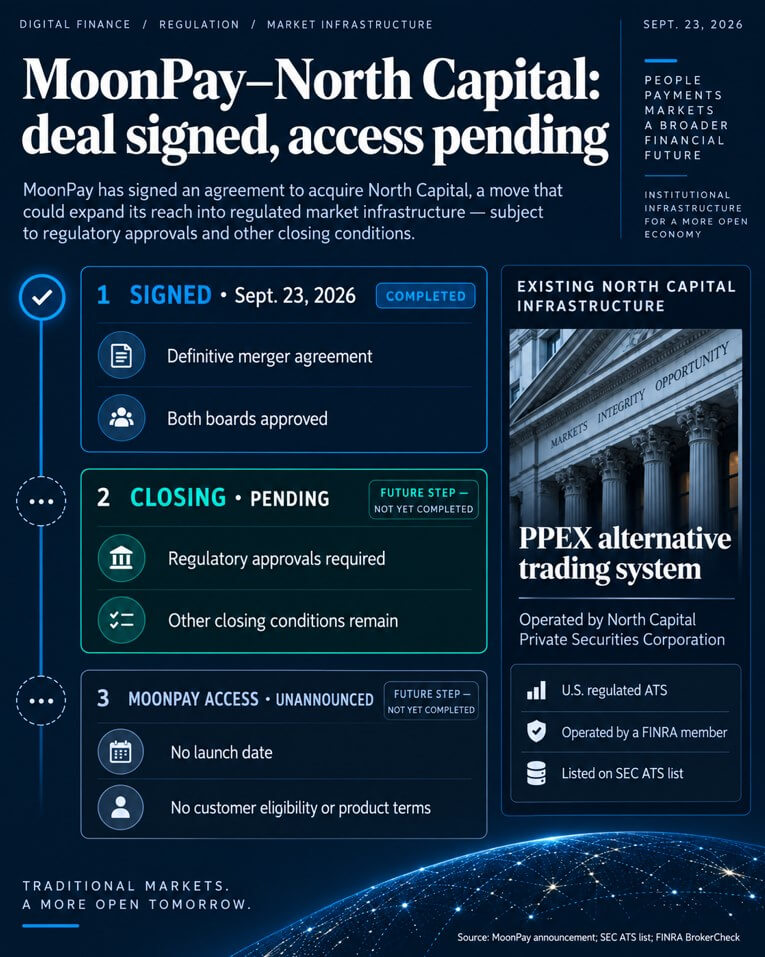
The key near-term milestone is regulatory clearance and merger completion. MoonPay and North Capital said the transaction also depends on other customary conditions and cautioned that there is no assurance it will close, or when.
Even after a close, customers would need a separate announcement explaining what securities could be offered, through which entity, to whom and when.
PPEX shows what MoonPay may add to its platform if the deal succeeds: infrastructure for secondary trading in private and other exempt securities, including tokenized securities.
The announcement describes existing capability and a plan to combine businesses. MoonPay user access remains a prospective step, with no announced terms.
The post MoonPay targets $8.7B trading venue, but the features remain unrevealed appeared first on CryptoSlate.
Galaxy Digital has added $100 million of sUSDS, Sky Protocol's yield-bearing savings token, to its corporate treasury and approved it as collateral for institutional clients, the companies said Sept. 23.
Galaxy and Sky described the treasury position as complete, but their announcement gave no figure for client lending secured by sUSDS or the first completed loan. The decision makes the token eligible across Galaxy's institutional trading business, with actual client uptake still undisclosed.
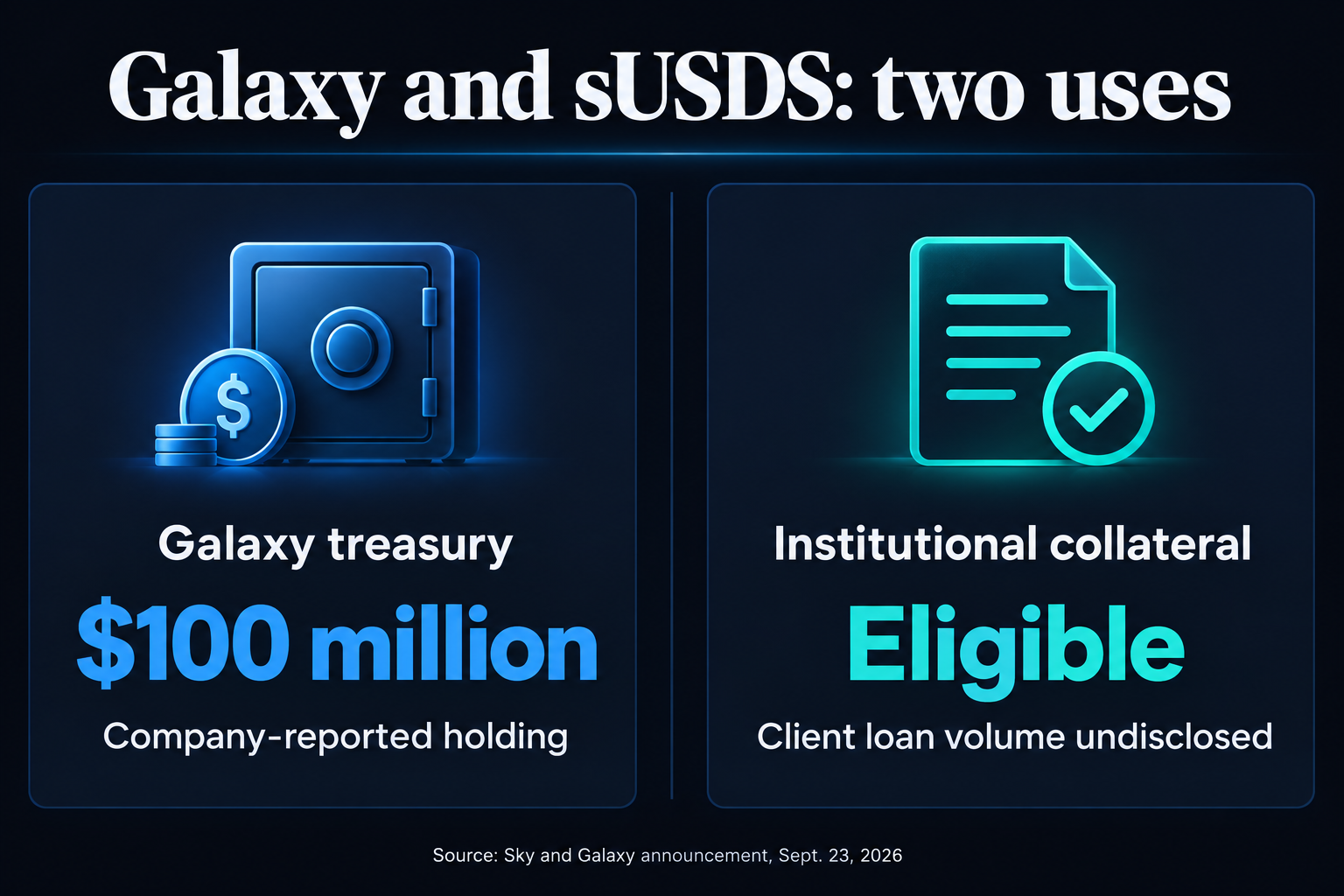
The attraction is a token that continues to accrue a savings return when pledged. Under the announced arrangement, clients who post sUSDS against a loan keep accruing the Sky Savings Rate on the full position while the loan runs.
Sky says governance sets that rate and funds it from aggregate protocol surplus, and that holders keep the same number of sUSDS tokens as the amount of USDS redeemable for each token increases as it accrues. The savings rate can change, so future accrual is not fixed.
For a borrower, that design could offer access to credit while retaining a savings position. The financial result would depend on the loan terms and the rate available over its life. The announcement does not provide those details for any completed sUSDS-backed borrowing, and it also leaves open how much collateral clients might eventually post.
The earlier Galaxy and Sky lending link
The companies' relationship already includes credit financing through Grove, a Sky ecosystem agent. In July, Grove announced a $500 million warehouse facility that supplies capital for institutional loans Galaxy originates.
Grove is the warehouse lender, supplying USDS capital, while Galaxy originates and services the loans. Borrower collateral in that facility is limited to Bitcoin and Ethereum, including staked forms of Ethereum.
A Sky Frontier Foundation update published Sept. 17 said Sky agents held about $304 million with Galaxy as of Sept. 1, driven by the Grove facility. That figure describes Sky-side exposure to Galaxy before the new announcement.
The treasury allocation gives the partnership a stated balance-sheet footprint today. The collateral approval could extend sUSDS into Galaxy's client lending, where an identified loan or disclosed outstanding balance would show whether institutions use the token beyond Galaxy's own holdings.
The post Galaxy adds $100M Sky token and institutional adoption is tested appeared first on CryptoSlate.
CryptoTicker.io
The most important date for the crypto market in the coming weeks is October 28. That is when the US Federal Reserve decides on the policy rate again, and since September 23 the futures markets have held a further increase to be more likely than a pause. One economic figure caused that turn: the flash purchasing managers' index for the United States jumped to 58.4 points, its highest level since July 2021.
For you as an investor in Germany, what counts is less the figure itself than the chain it sets off. Rising rate expectations make credit more expensive, lift the return on safe assets and therefore weigh on everything that throws off no running income. On the morning of September 24, Bitcoin was trading around 2.8 percent below the previous day's level, with individual names in the top 25 considerably weaker. This piece places the data in context and then works through what there is to check in concrete terms: leveraged positions, the one-year deadline under Section 23 EStG, the buying route and custody.
US PMI Jumps to 58.4: What the Purchasing Managers' Index Actually Measures
The purchasing managers' index, or PMI, is a monthly survey of company purchasing managers that puts every answer on a scale around 50 points: readings above 50 mean growth against the previous month, readings below it contraction. The index therefore measures the direction and pace of change; it says nothing about the absolute size of the economy.
The flash reading for September 2026, published on September 23, took the composite index for the United States to 58.4 points. In August it had stood at 56.0. The jump of 2.4 points carries the index to its highest value since July 2021. S&P Global converts the survey readings into annualised growth of roughly 5 percent. That is the relevant order of magnitude: not a mild pick-up but a pace that makes a central bank with inflation concerns sit up.
A second finding from the same survey is often overlooked. Supplier delays were as widespread as at any time since July 2022. S&P Global attributes that to a lack of operating capacity, meaning that companies can no longer serve demand with the plant and workforces they have. Whoever is short on supply has pricing power. That finding therefore leads straight to the second part of the survey.
Input Prices at Their Highest Since October 2022
Alongside activity, the survey also records how companies' input prices are developing. That sub-index came in at 66.4 points in September, and the rate of input price inflation derived from it reached its highest level since October 2022. S&P Global names higher fuel and transport costs along with wage pressure as the drivers. The figures are in the S&P Global press release, which is blocked to automated retrieval but reads normally in a browser.
Why that matters for crypto prices can be said in one sentence: costs that rise at the input stage travel into consumer prices with a lag, and consumer prices are the measure against which the Fed has its 2 percent target judged. A survey nonetheless remains a leading indicator: available earlier than an official price index, and more volatile for it. Reading it as inflation already settled stretches it too far.
Fed Funds Rate at 3.75 to 4.00 Percent: What Was Decided on September 16
The starting point for the current expectation lies a week back. On September 16, 2026, the Fed's Open Market Committee raised the target range for the overnight rate by a quarter point to 3.75 to 4.00 percent, the first increase since July 2023. The decision was unanimous at twelve votes to none. In the text the committee records that inflation remains elevated and justifies the step on the grounds that it supports a more timely return to the 2 percent target. You can read that in the FOMC decision of September 16, 2026.
The direction is what stands out. For two years the question was when the Fed would cut. Since September the question has been how much further it will raise. That reversal is the frame in which the PMI data is read: a central bank that has just raised and expressly calls inflation elevated is handed two arguments for a further step by a jump in activity and firming input prices.
A Rate Hike on October 28: What the Futures Market Prices In Under CME FedWatch
The CME FedWatch tool is not a bank's forecast but a derivation: it works back from the prices of futures contracts on the US overnight rate traded on the CME to establish which rate decision the market is pricing in for each meeting date. The value is a market opinion in percent, and it changes with every trading day.
Following the PMI release, the daily market report of the KuCoin exchange dated September 24 gives a probability of 69.7 percent for an increase of 25 basis points in October. A German-language analysis of the same futures market data most recently put the October 28 meeting at 41.1 percent. Both values were read off at different moments, and the tool updates continuously. What is reliable is therefore the range: the market moved within a few days from a good 40 to almost 70 percent. Treating either figure as settled confuses a snapshot with a decision.
The next meeting falls on October 28, 2026. Several official data releases lie before it, among them the final PMI reading and US consumer prices. Any of them can turn the priced-in probability back the other way.
Crypto Market Falls Broadly: Bitcoin, Ether and the Top 25 Over 24 Hours
We counted for ourselves how broad the reaction is. This analysis was compiled by cryptoticker.io on September 24, 2026. Method: a single pull of the list of the 25 largest cryptocurrencies by market capitalisation from CoinGecko at 06:48 UTC, response HTTP 200, followed by a count of the 24-hour change for each asset excluding stablecoins and the tokenised credit products in the list.
Of the 18 assets remaining, 17 were in the red. Seven lost at least 5 percent, the weakest 10.51 percent. Exactly one gained, by 5.83 percent. Bitcoin traded at $84,160 and therefore 2.75 percent below the previous day, within a daily range of $83,654 to $86,459. Ether stood at $2,688, down 2.53 percent, with a daily range of $2,643 to $2,754. What we could not check is what share of that move came from the spot market and what share from futures positions; the list retrieved does not yield that split.
The picture is therefore clear: the move hits the whole market, not individual projects, and it hits the smaller names harder than the two large ones. The weekly comparison puts it in perspective at the same time. Despite the pullback, Bitcoin stood 9.85 percent above its level seven days earlier, Ether 9.97 percent. The decline gives back part of a strong week.
Inflows into exchange-traded crypto products run the other way. On one trading day of the current week, market reports put $925.82 million into US crypto ETFs, of which $714.7 million went into Bitcoin products; BTC-Echo puts the two trading days of September 21 and 22 together at around $1.7 billion and speaks of the strongest days in months, expressly not of an all-time record. For you in Germany the access route is what matters here: the US spot ETFs cannot be traded here, and the exchange route runs through debt securities on crypto, that is ETNs and ETPs. What that means for your account, fees and taxation is set out in our overview of crypto ETFs in Germany.
Why Rising Rates Weigh on Crypto Prices
The relationship holds for any asset without a running distribution and is therefore no crypto peculiarity. If the yield on short-dated government bonds rises, so does the return an investor receives without price risk. Everything that draws its return solely from a future price gain has to compete against that. Financing becomes more expensive at the same time: anyone holding positions on credit pays more for them, and part of those positions is closed as soon as the arithmetic no longer holds.
That second channel explains why a moderate decline in Bitcoin coincides with considerably larger swings in smaller names. In thinner order books the same amount sold moves the price further. An analyst's view of how much further this runs deliberately has no place here; the mechanism is evidenced, its end point is not.
Leverage and Liquidation: How a Rate Shock Closes a Position Early
Liquidation means that an exchange closes a position held on credit of its own accord, because the collateral lodged no longer covers the loss. The position then ends at the market price at that moment, regardless of what you had expected. In a market-wide pullback such as the one on September 24, that is the point at which a paper loss becomes a realised one.
Liquidation Price, Funding Rate and Margin Call: The Three Numbers That Count
The liquidation price is shown in your exchange's position overview and shifts as soon as you add or withdraw collateral. Check it against the measured daily range: if Bitcoin's daily low was $83,654 and your liquidation price sits close to it, the question is not theoretical. The funding rate is the payment that flows at fixed intervals between the long and short side on perpetual futures; it is the running price of your leverage and accrues regardless of whether the price moves. The margin call, finally, is the collateral you have to supply to avert a liquidation, and the deadline for it is shorter than a trading day at many houses.
In practice that means: note down your liquidation price, the current funding rate and the distance to the collateral threshold before the next data release comes up. Which venues for perpetual contracts set which fees, leverage limits and liquidation rules you will find in our comparison of perp DEX platforms. The rules differ considerably from house to house and are set out in the respective contract terms.
Holding Period and Tax: What Selling Into the Pullback Triggers With the Tax Office
Section 23 EStG applies in Germany to privately held cryptocurrencies. Gains from a sale within a year of purchase are taxable as a private disposal transaction and charged at your personal income tax rate; once a year has passed since acquisition, the gain remains tax free. The deadline runs per acquisition, not per holding, and that is the point at which a pullback can become expensive.
Anyone selling in September 2026 disposes, under the sequence usually applied, of the oldest acquisitions first. With purchases made in the summer of 2026 the one-year deadline cannot arithmetically have been met. A sale made out of nerves ahead of a rate decision can therefore trigger a tax charge that would not have arisen had you sat still. For that you need an unbroken record for each acquisition: date of acquisition, quantity, acquisition cost and venue.
The exemption limit of Section 23(3) EStG also has to be borne in mind. If that amount is exceeded, the entire gain is taxable and not just the excess. The amount in force is best checked against the statutory text or with a tax adviser, because it has been adjusted several times in recent years. Which tools carry acquisitions, deadlines and sequence along automatically is set out in our comparison of crypto tax software.
Buying Route and Custody: Exchange, ETN or Your Own Keys Under MiCA
Since the EU regulation on markets in crypto assets, MiCA for short, has been in application, providers addressing customers in the EU need authorisation as crypto asset service providers. For you that has two practical consequences. First, it is visible who operates under supervision and who does not; the authorisation can be traced with the provider and in the supervisor's registers. Second, the authorisation changes nothing about the question of ownership: a balance in an exchange account is a claim against that company, not direct access to the coins.
Three routes are open to you, and they differ in cost, tax treatment and access. Buying directly on a supervised trading platform and then withdrawing to a wallet of your own gives you the keys and keeps the one-year deadline under Section 23 EStG open. Holding on the exchange account is convenient and lets you act quickly if in doubt, but ties you to the solvency and the trading rules of the house. The exchange route through ETNs and ETPs runs in your usual securities account but follows the taxation of investment products and not the private one-year deadline. Ahead of a rate decision it is worth looking above all at two points: how long a withdrawal takes at your provider, and up to what time of day trading happens at all.
Levels Above and Below: Which Price Levels Are in View Now
Levels here are measured values, not price targets. To the downside sits Bitcoin's daily low of September 24 at $83,654; below that begins territory the retrieved daily range no longer covers. To the upside, the daily high of $86,459 marks the zone in which the week had begun, and market reports place the price on September 24 close to its highest level of the past eight months. For Ether the day spans $2,643 to $2,754.
The frame for that is the calendar. Until October 28 it is the data rather than the chart that decides: final PMI figures, US consumer prices, statements from the board of governors. Anyone setting markers in this phase sensibly sets them against dates and not against prices alone.
Fed Rate Hike and the Crypto Market: What to Take Away
- Check leverage first. Open your position overview and note the liquidation price, the funding rate and the distance to the collateral threshold. Compare the liquidation price against the daily low. Which platform sets which leverage limits and liquidation rules is set out in the perp DEX comparison.
- Settle the buying route and trading hours. Check before October 28 how quickly your provider pays out and takes deposits and whether it is authorised under MiCA. A side-by-side of supervised venues with fees and withdrawal routes is under best crypto exchanges.
- Document acquisitions and deadlines. Record the date, quantity, cost and venue for every acquisition, so that a sale does not fall unintentionally within the one-year deadline of Section 23 EStG. Tools that carry this along continuously are in the tax tool comparison.
(As of September 24, 2026. This article is not investment advice. Prices and fee structures change; check the terms with the provider before you buy.)
If your bank terminates your account after money has arrived from a crypto exchange, that one banking relationship ends, but your participation in the payment system does not. The German Payment Accounts Act (Zahlungskontengesetz, ZKG) gives every consumer lawfully resident in the European Union a right to a basic payment account, and Section 35(1) sentence 3 ZKG expressly forbids a bank from refusing that right on the grounds that another account still exists, when that very account has been terminated. Everything that follows turns on that sentence.
This piece explains what happens legally when an institution ends a banking relationship over crypto payments: which notice period applies, why the letter usually gives no reason, which documents actually bring an anti-money-laundering review to a close, and in what order you approach the consumer arbitration body, the supervisor and the courts. The details relate to German law and to institutions based in Germany.
A Frozen Account and a Terminated Account Are Two Different Things
The two words get mixed up in everyday use, but they lead to completely different steps. A freeze is a temporary measure: the contract continues to exist, the institution merely holds payments or blocks transactions while an internal review runs. A termination ends the payment services framework contract itself. In both cases the balance remains your money; ownership is never in dispute, only access to it.
In practice that means: with a freeze you work towards release and give the bank the documents it lacks. With a termination that route is closed, because nobody can force an institution to continue an ordinary business relationship. Your objective then shifts to two other things: full payout of the balance, and a replacement account that is ready in time.
Often the two come one after the other. First a credit is held up, then a query follows, and if the answer does not come or the institution considers it inadequate, the termination letter arrives weeks later. Taking that first query seriously often prevents the second step.
Why Crypto Payments in Particular Trigger a Review
The trigger sits in the German Anti-Money Laundering Act (Geldwäschegesetz, GwG), and it is not one case handler's discretionary decision. Section 10(1) no. 5 GwG obliges banks to carry out continuous monitoring of the business relationship including transactions and requires a comparison with the information held on business activity and customer profile and, where necessary, on the source of the assets. A credit that does not fit the existing picture of a current account has to stand out under that rule.
Customer profile here simply means the pattern the bank has known from you over the years: salary, rent, direct debits, the occasional saving. A six-figure credit from a payment institution elsewhere in Europe does not fit that pattern, even if it is entirely lawful. It is precisely that deviation that triggers the review, not the word crypto on the statement.
Section 15 GwG comes on top. The provision requires enhanced due diligence as soon as an institution identifies a higher risk of money laundering in the individual case or in its own risk analysis. The extent of the measures follows that risk; the statute sets out no fixed list. That is why the response differs from house to house: one bank asks once, another freezes immediately.
With Bitcoin there is a technical detail that sharpens the problem. If you self-custody, you may have moved a holding across several addresses over years without that producing any evidence in the sense a bank means. The blockchain shows transfers, but neither purchase price nor counterparty, and without supplementary documents an institution can do little with it.
What Section 10(9) GwG Requires and What It Does Not Say
This provision is often cited in blanket terms in termination letters, and a look at the wording is worth the trouble. Subsection 9 sentence 1 states that a business relationship may not be entered into or continued if the obliged entity cannot fulfil the general due diligence obligations under subsection 1 nos. 1 to 4; sentence 2 then requires termination by notice or by other means. What is named there is identification, clarification of the beneficial owner, the purpose of the business relationship and classification as a politically exposed person.
Continuous monitoring including the source of assets sits in no. 5 and therefore outside that list. A missing answer to a source-of-funds question does not, then, automatically trigger the statutory duty to terminate under subsection 9. That does not make a termination ineffective, since the contractual route is sufficient for that in any case. But it shifts the weight in a conversation, because the institution is then relying on its contract law and not on a statutory duty that, at this point, is no duty at all.
Two Months: What Section 675h BGB Requires of the Bank
For an ordinary current account the notice period sits in the German Civil Code. Under Section 675h(2) BGB a payment service provider may terminate the framework contract only where the contract was concluded for an indefinite period and the right of termination has been agreed; the notice period may not fall short of two months. Subsection 4 also forbids the institution from agreeing a charge for the termination.
Two months is the statutory minimum, not a guideline. If your letter states a shorter period, it is worth looking into your institution's general terms and into the question of whether ordinary termination is meant at all. Alongside it, the general right remains to terminate a continuing obligation without notice for good cause under Section 314(1) BGB, where continuation cannot reasonably be expected of the terminating party after weighing the interests on both sides.
The practical consequence of that split matters more than the statutory references. Termination without notice requires a serious individual reason and is therefore open to challenge. Ordinary termination on two months' notice, by contrast, needs no reason, and as a rule you will not get anywhere against it. Your energy therefore belongs not in the fight over the old account but in the new one.

Why the Termination Letter Usually Gives No Reason
For an ordinary current account there is simply no statutory duty to give reasons. With the basic payment account the position is different, and looking there explains the silence in the first case too. Section 43(2) ZKG requires the reason for termination to be stated, but its second sentence expressly provides that this is omitted where it would endanger public security, in particular the rules on preventing money laundering, or would breach a prohibition on disclosure.
A termination letter without a reason is therefore neither an oversight nor a discourtesy but a case the statute provides for. Section 43(5) ZKG closes the circle: if the institution withholds the reason on those grounds, it must inform the competent authority of the termination and the reason. Under Section 46(2) ZKG the competent authority is the Federal Financial Supervisory Authority, BaFin.
For you one thing above all follows from that: pressing the point achieves nothing in this configuration, and irritation at the missing explanation takes you no further. The question you settle instead is whether a working replacement account is in place within the notice period and whether your balance arrives on it in full.
Proof of the Source of Funds Decides More Often Than Any Letter of Objection
As long as the account is merely frozen, the situation can almost always be resolved with documents. Proof of the source of funds is the unbroken account of where the money arriving in the account comes from. With crypto gains that requires a chain beginning with the euro you once transferred to the exchange and ending with the euro now coming back.
That chain can be assembled from:
- the exchange's complete transaction export covering the entire period, not just the year in question
- the bank statements showing your original deposits to the exchange
- purchase and sale confirmations for the individual positions
- a list of your own wallet addresses, where amounts were self-custodied in between
- evidence for special cases such as mining, staking, airdrops or a gift
- your tax return or the tax assessment for the year concerned, in so far as the gains are already recorded there
- a short covering letter that tells the chain in a few sentences and refers to the annexes
The last item is left out most often and works hardest. A stack of uncommented exports generates follow-up questions; one page of prose with clear references ends them. If you buy from the outset through a venue that supplies a clean export across all years, you have that evidence together in a few minutes; our comparison of crypto exchanges shows which providers make history and withdrawal routes available in a form a bank will accept. What a bank checks on the way in we have broken down in our analysis of source of funds on crypto deposits.
Where Proof Fails in Practice
The typical gap rarely sits where investors suspect it. Problems arise where an exchange has closed in the meantime and the export can no longer be retrieved, where holdings were bought over a peer-to-peer platform or privately, or where part of the assets dates from a time when nobody kept records. A reconstructed proof is better than none in such cases, and an openly stated break in the chain reads as more credible than a smoothed-over account.
The second common mistake is timing. If you only react when the termination arrives, you have missed the moment at which documents could still achieve something. The bank's query is the real deadline, not the date in the termination letter.
Your Right to a Basic Payment Account Under Section 31 ZKG
Here lies the most robust lever in the whole subject. Under Section 31(1) ZKG an institution that offers payment accounts to consumers is required to conclude a basic payment account contract with an entitled person, provided the application meets the conditions of Section 33. Entitled is every consumer lawfully resident in the European Union. Subsection 2 sets the institution a deadline: the offer must be made without undue delay, at the latest within ten business days of receipt of the application.
Under Section 34(1) ZKG an institution may refuse such an application only on the grounds named in Sections 35 to 37. That list is exhaustive, and two points within it are decisive for crypto investors:
- Section 35(1) ZKG permits refusal where the applicant already holds a usable payment account. Sentence 3 expressly excepts from that the case where the account has been terminated or the entitled person has been notified of its closure. The termination of your current account is therefore not an obstacle to the basic payment account but precisely the reason why the refusal falls away.
- Section 37 ZKG permits refusal where the same institution lawfully terminated an earlier basic payment account of the same customer within the past year under Section 42(3) no. 2. That bar applies only in relation to that one house.
The charge is not arbitrary either. Section 41(2) ZKG requires the charge for the services provided for by statute to be reasonable, measured against customary market charges and against user behaviour; a contractual penalty in connection with the basic payment account contract is impermissible under subsection 3. And the basic payment account itself is harder to terminate than an ordinary current account: Section 42 ZKG allows termination only on the conditions listed there, for instance after 24 consecutive months without an instructed payment transaction, and even then on at least two months' notice.
What is striking about the situation is that many of the same institutions now offer crypto themselves. The launch of crypto trading at the German savings banks shows how far sales and anti-money-laundering review have drifted apart within a single house.

The BaFin Procedure Under Section 48 ZKG and the Order That Matters
If an institution refuses you the basic payment account, you do not have to go straight to court. Section 48(1) ZKG opens an administrative procedure before the Federal Authority in three cases: where the application is refused, where no decision is taken on it within ten business days, or where the account is not opened within ten business days of the contract being concluded. The Federal Authority confirms receipt and conclusion of the procedure in writing or electronically.
If it concludes that the refusal does not hold, it orders the conclusion of the contract or the opening of the account under Section 49(1) ZKG. The burden of proof sits with the institution: it has to make out the conditions for a permissible refusal to the satisfaction of the supervisor. The Federal Authority may charge the institution a fee for the order. How the procedure runs from a consumer's point of view is described by BaFin on its basic payment account page.
Now the point at which most mistakes happen. Section 48(2) ZKG declares the application inadmissible where proceedings have already been brought before the ordinary courts on the same grounds and are still pending or have been finally decided, or where proceedings are pending before the consumer arbitration body competent under Section 14(1) UKlaG. Whoever goes to arbitration or to court first thereby closes off the fast route through the supervisor. The order is therefore a genuine fork in the road and not a formality.
Equally important is the limit of this procedure: it concerns the basic payment account alone. There is no procedure under Section 48 ZKG against the termination of an ordinary current account, and the supervisor will not get that account back for you either.
Arbitration or Court: What Is Left for the Terminated Current Account
Two routes remain for the old account, and both are limited in effect. The first runs through consumer arbitration. For the basic payment account, Section 43(3) ZKG even obliges the institution to point out in the termination the competent authority under Section 46(2) and the consumer arbitration body competent under Section 14(1) UKlaG, and to give the contact details. Where the house provides its own complaints procedure, the same duty to inform applies under subsection 4.
The second route is an action before the ordinary courts. That rarely makes sense with an ordinary termination on two months' notice, because no reason is required for it. With a termination without notice, with a withheld balance or with loss arising from a delayed payout, the calculation looks different. Both routes bar the administrative procedure on the basic payment account under Section 48(2) ZKG, which is why the replacement account sensibly comes first.
What to Change Before Your Next Withdrawal
The most effective part of this subject is the preventive one. An account that has been terminated is hard to get back; a withdrawal that is explicable from the outset is usually not held up at all.
- Announce larger withdrawals to your bank in advance, informally and in text form, with a line on the source.
- Do not break a large sale into many small transfers. Structuring looks like an attempt at concealment in anti-money-laundering monitoring and generates exactly the attention you want to avoid.
- Download the complete transaction export from your venues at least once a year and keep it outside the platform. Exchanges that have closed supply no history any more.
- Keep a second current account at another institution that serves solely as a fallback and is used regularly.
- Prefer venues with authorisation under the European crypto regulation and with a withdrawal route through an account in the euro area. Which providers meet that is set out in our comparison of regulated crypto exchanges.
- Keep your acquisition records as you go rather than retrospectively. A portfolio and tax tool produces the same history that later serves as proof of source; the selection is in our comparison of crypto tax software.
Frequently Asked Questions on Account Termination Over Crypto
May a bank terminate the account without giving reasons?
With an ordinary current account, yes, provided the contract is open-ended and a right of termination has been agreed; the period is at least two months under Section 675h(2) BGB. With the basic payment account, Section 43(2) ZKG requires reasons, which are however omitted where the anti-money-laundering rules or a prohibition on disclosure would otherwise be affected.
Will I get my balance paid out?
The balance is yours and is to be paid out once the contract ends. Delays almost always arise where an anti-money-laundering review is running in parallel or where no recipient account has been named. A second account at another institution resolves that point in advance.
Do I have to tell the bank I trade crypto?
There is no general duty of disclosure. You should, however, answer specific queries raised in the course of due diligence, because unanswered queries are the most common route from a freeze to a termination.
Will BaFin help against the termination of my current account?
The administrative procedure under Section 48 ZKG applies only to the basic payment account and only in the three cases named there. A general complaint to the supervisor is possible alongside it, but gives you no right to continuation of the old account.
How long does it take for a basic payment account to be in place?
The statute gives the institution ten business days for the offer after receipt of the application. If that period passes without a decision, that is already one of the cases in which Section 48(1) ZKG opens the procedure before the Federal Authority.
Can I simply switch to a direct bank?
That is possible, but it solves the underlying problem only if the new bank assesses the same payment flows differently. The due diligence obligations under the Anti-Money Laundering Act apply equally to every institution; what differs is solely the internal risk classifications.
Account Terminated Over Crypto: What to Take Away
- Answer the query, not the termination. The moment at which documents work lies before the termination letter. Put the proof of source together from the exchange export, bank statements and a short covering letter; which venues supply a history usable for that is shown in the exchange comparison.
- Secure the replacement account immediately. The right under Section 31 ZKG exists regardless of why the old account ended, and Section 35(1) sentence 3 ZKG takes away from the bank precisely the argument that you still have an account. Set up your ongoing documentation correctly at the same time, for instance with a tool from the comparison of crypto tax software.
- Keep to the order. First the application for the basic payment account, then, on refusal or expiry of the period, the procedure under Section 48 ZKG, and only after that arbitration or court, because both bar the supervisory procedure. For future withdrawals you cut the risk most effectively through a regulated venue from our comparison of regulated crypto exchanges.
(As of September 24, 2026. This article is not investment advice and not legal advice. The state of the law, terms and fee structures change; check the terms with the provider before you buy.)
Uniswap lost eleven percent of its value on Wednesday morning, and even so the price stands higher than on any day of the summer. Anyone who bought UNI over the past four weeks is sitting on a paper gain that has shrunk by more than a tenth within a single trading day. The question that follows is not a price question but a tax one: selling now almost inevitably triggers a taxable private disposal transaction in Germany, because the one-year deadline cannot possibly have been met on a purchase made this summer.
The UNI Price on September 24: Numbers, Daily High and Low
This analysis was compiled by cryptoticker.io on September 24, 2026. Market data was pulled from CoinGecko at 05:47 UTC and, as an independent cross-check, from the public ticker of the Kraken exchange at 05:49 UTC. Both pulls returned HTTP 200.
CoinGecko reports a price of $9.31 for UNI, down 11.75 percent against the level 24 hours earlier. The daily high was $10.55, the daily low $9.07. Kraken arrives at a last price of $9.30 for the same period, with a high of $10.56 and a low of $9.04. The divergence between the two sources is in the cents and is the usual difference between a volume-weighted index across many venues and the order book of a single exchange.
Two further values from the same pull put the pullback in context. Over seven days UNI is up 37.66 percent, over 30 days up 113.85 percent. The price has therefore more than doubled within a month. Working the 30-day change backwards, UNI stood at around $4.35 at the end of August. Market capitalisation is $5.78 billion on a circulating supply of 620.66 million UNI, which corresponds to rank 23 by market capitalisation. Trading turnover over the past 24 hours was $1.44 billion. The price remains 79.27 percent below its all-time high of $44.92.
What we did not check is how turnover splits across individual venues and what share falls on derivatives. Both would be needed to judge how much of the decline comes from spot selling and how much from closed futures positions.
The pullback does not stand alone. Bitcoin gave up 2.95 percent over the same window, Ethereum 2.81 percent. UNI therefore fell roughly four times as hard as the wider market, which is an ordinary pattern for a coin that has doubled over the course of a month: where the largest paper gains sit, selling comes first.
Uniswap Fee Switch: Why UNI Rose 114 Percent in the First Place
The fee switch is a decision of Uniswap governance to stop paying part of the protocol's trading fees out to liquidity providers in full and to direct it to the protocol itself instead. On Ethereum it has been live since December 28, 2025; votes in March and June 2026 extended it to several layer-2 networks.
In economic terms this is the point at which UNI stopped being a pure governance token. Before that, UNI conferred the right to take part in votes and nothing else. Since then the token carries a measurable stream of payments from the trading business of the largest decentralised exchange.
The order of magnitude can be quantified. According to an analysis by Crypto Briefing, around $23.15 million in protocol revenue has accrued since activation, of which roughly $4.9 million came in the past 30 days, at a recent run rate of about $129,000 a day. The decisions themselves can be inspected publicly in the Uniswap governance forum.
Extrapolations to a full year vary between $26 million and around $58 million depending on the time window and the data provider. You should leave that range as it is rather than smoothing it into a single number. The spread arises because trading fees move with market activity, and a month of high volatility throws off a multiple of a quiet one.
TokenJar and Firepit: How the Revenue Reaches UNI Holders
Here lies the point many investors misread, and it has immediate tax consequences. Around 17 percent of swap fees flow into protocol revenue. That revenue is not, however, distributed to holders. It accumulates in a contract called TokenJar and can only be released by burning UNI through the Firepit mechanism.
For you as a holder that means: nothing is transferred to you. The benefit arises solely through a tightening of supply, and therefore through the price of the coins you already hold. A token burn is the permanent destruction of coins by sending them to an address from which nobody can ever move them again.
For tax purposes that is a distinction that can be worth several thousand euros. Ongoing income from crypto assets, from lending for instance, is regularly treated in Germany as income from other services and taxed at your personal income tax rate as soon as it accrues to you. With Uniswap, nothing accrues to you. The entire economic benefit sits in the price of the coin itself and therefore only becomes relevant on a sale, as a private disposal transaction under Section 23 EStG. That is the cheaper variant for you, because it becomes tax free after a year of holding.

Crypto Holding Period Under Section 23 EStG: Why Taking Profits on UNI Gets Expensive Now
A private disposal transaction under Section 23 EStG arises when you sell a crypto asset again within a year of acquiring it. The gain is then taxable in full at your personal income tax rate, not at the 25 percent flat withholding tax that applies to shares and interest. If more than a year lies between purchase and sale, the gain stays tax free.
Work that through for your own situation before you place a sell order. A purchase from August 2026 carries a holding period of a good month. If you sell today on a gain of 100 percent, a marginal rate of 42 percent leaves you a little over half of it after tax. If you wait until the anniversary of your purchase, you keep all of it, provided the deadline is met and you do nothing in the meantime that interrupts it.
This comparison is not an argument for waiting at any cost. It is an argument for knowing the tax effect before the order rather than after it. A price decline of eleven percent costs less than a tax charge carelessly triggered on a gain of more than a hundred percent. If you have documented your purchases cleanly you can set out this calculation in a few minutes; if you have not, our overview of crypto tax software and portfolio trackers lists the programs that pull purchase dates and holding periods out of exchange data automatically.
FIFO and the Exemption Limit: How to Work Out Your Taxable Gain on UNI
If you have bought UNI at several points you need a rule for which coins you give up on a sale. In Germany the consumption sequence method applied in practice is FIFO: first in, first out, meaning the coins bought first also count as the ones sold first. With a coin that has doubled that is an advantage, provided your oldest holdings really are older than a year, because the sale then falls into the tax-free bracket.
The calculation is also made wallet by wallet and exchange by exchange. If you spread your UNI across several accounts, you have to consider each position on its own. That is exactly where many self-declarations to the tax office come apart: the total is right, the attribution of the individual acquisition dates is not.
On top of that there is an exemption limit for private disposal transactions. If the sum of all gains from such transactions in a calendar year stays below the limit, it remains tax free. Note the difference between an exemption limit and an allowance: once the limit is exceeded, the entire gain is taxable, not just the excess. You should check the amount currently in force against the statutory text in Section 23(3) EStG before filing, because it has been raised in recent years.
Losses from such transactions can only be offset against gains from transactions of the same kind, not against your employment income and not against gains on shares. If you have realised losses elsewhere this year, you can set them against a UNI gain.
Buying and Selling UNI in Germany: Which Buying Route Counts Under MiCA
Since the European regulation on markets in crypto assets, MiCA for short, became fully applicable, providers addressing retail customers in the EU need authorisation as crypto asset service providers. For you that is the practical filter when choosing a venue.
Check three things specifically at your exchange: whether the operator holds a European authorisation and under which supervisory authority, whether your contract is concluded with the European entity and not with an offshore sister company, and whether the exchange supplies you with a complete transaction export containing purchase date, quantity and euro value. The third point decides later how hard your tax return will be. If you want to change venue for that reason, our overview of the best crypto exchanges lists the houses with European authorisation and a usable data export.
Changing exchange in the middle of a running gain has a side effect that is often overlooked. A transfer of your own coins from one exchange to another is not a sale and triggers no tax. Nor does it interrupt the holding period. It does tear up your chain of evidence if the receiving exchange does not carry over the original acquisition data, and without that data your tax office cannot trace the holding period. Export your history before the transfer, therefore, not after it.
Leverage and Liquidation: What the Pullback Means for Leveraged UNI Positions
The span between the daily high and the daily low came to $1.48 on our pull, or around 14 percent of the high. For an unleveraged position that is a bad day. For a leveraged position it is the order of magnitude at which forced liquidation takes hold.
A liquidation is the forced closure of your position by the exchange as soon as the collateral you have lodged no longer covers the loss. At five times leverage a decline of about 20 percent is arithmetically enough, and correspondingly less once fees and funding costs are deducted. The actual threshold is set out in your provider's terms and depends on the maintenance margin rate for the trading pair in question.
With perpetual futures the funding rate is added, a periodic payment between buyers and sellers that holds the contract price to the spot price. After an upward move like the one in UNI it is typically positive, so long positions pay the other side continuously. These costs run on regardless of whether your position is currently in profit, and they are one reason leveraged positions are closed unusually often after a rally. Check the maintenance margin rate and the current funding rate at your venue before you leave a leveraged position open through the pullback.
For tax purposes derivatives are a chapter of their own and do not follow Section 23 EStG. Gains from futures transactions are subject to different rules, and the offsetting of losses is separately restricted there. If you mix spot holdings and derivatives, document the two separately.
Custody After the Rally: Exchange Account, Software Wallet or Hardware Wallet
A holding that has doubled in thirty days is a different item in your wealth after the move than it was before. Someone who held 2,000 euros of UNI in August is now keeping a good 4,000 euros in the same place. The question is whether the form of custody still fits the size.
In an exchange account your coins sit in the provider's care. That is convenient for active trading and practical for tax documentation, because the exchange supplies the export. The counterpart is counterparty risk: in an insolvency, the separation of client and proprietary holdings is a legal question and not a technical certainty.
When Moving to Self-Custody Is Worth It
A hardware wallet is a standalone device that generates your private key and never passes it to a computer connected to the internet. For amounts whose loss would genuinely hurt, that is the more robust solution; the price is that you have to secure the recovery phrase yourself and nobody can replace it for you. When choosing a device, make sure the model supports UNI as an ERC-20 token on Ethereum.
Moving to self-custody is tax neutral. It is not a sale, it does not interrupt the one-year deadline, and it costs you only the network fee. Document the transfer all the same, with date, quantity and destination address, so the chain from purchase to eventual sale stays unbroken.
UNI Levels: Which Documented Price Levels Count Now
There are no forecasts of future price levels here, but there are levels that follow from the data collected and that you can anchor your own decision to.
To the downside sits the daily low at $9.07 (Kraken: $9.04). Below that begins the range in which last week's buyers move into the red, because seven days ago UNI stood at roughly $6.76 on the same calculation. The price crossed the $9 mark for the first time in this move on September 18, as we reported at the time.
To the upside the daily high of $10.55 is the next documented level. Beyond it there is nothing close by: 79.27 percent separates the price from the all-time high of $44.92, and that level dates from a different market cycle. A further date sits in the calendar for October 19, when the CME derivatives exchange adds futures on Uniswap. What effect that has on the price cannot be evidenced today; that the date changes liquidity in derivatives trading can be.
We deliberately leave analyst views on price targets out here. Where they are quoted, a name and a date belong with them, and the assessments of UNI available to us date from before the pullback and are therefore out of date.
Reading the Uniswap Pullback: What to Take Away
- Purchase date before sell order. Look up when you bought your UNI before you decide on taking profits. If the purchase is less than a year old, the entire gain is charged at your personal tax rate. The fastest way to pull purchase dates together from several exchanges is with one of the programs in our comparison of crypto tax software.
- Check the venue and the data export. Satisfy yourself that your exchange holds a European authorisation and supplies you with a complete transaction export including euro values. If the export is missing, change venue before you next trade, and export the history before the transfer. The houses with authorisation and a usable export are listed in our overview of the best crypto exchanges.
- Match the form of custody to the new sum. Work out how many euros your UNI holding is worth after the doubling, then decide afresh whether it belongs in the exchange account. For amounts whose loss would hurt, it belongs in self-custody; the suitable devices are in our hardware wallet comparison.
(As of September 24, 2026. This article is not investment advice. Prices and fee structures change; check the terms with the provider before you buy.)
XRP has fallen between 9.3 and 9.7 percent over the past 24 hours, depending on when the data was pulled, and trades at around $1.49, or roughly €1.31, on the morning of September 24, 2026. The wider market gave up far less over the same period: Bitcoin lost 3.8 percent. Anyone minded to act today is not really deciding on the price level. Three things settle the matter independently of the price: the day you bought, the route you bought through, and whether an open leveraged position sits in the way.
This article places the pullback in context using our own figures, then sets out what you can actually check. The current price action and the chart levels are tracked continuously on our XRP price prediction.
XRP Falls 9.7 Percent: The Numbers for September 24, 2026
Pulls from the public CoinGecko interface on September 24, 2026 at 04:48 and 04:50 UTC give the following picture. XRP trades at $1.49. The daily range runs from $1.48 at the low end to $1.64 at the high end, which puts the price close to its daily low. Volume over 24 hours stands at $5.46 billion and market capitalisation at $93.94 billion, leaving XRP in fifth place among the largest crypto assets.
Two figures take the edge off the first shock. Over seven days XRP is up between 14.8 and 14.9 percent. Over 30 days the figure is minus 1.2 percent, which is effectively where it stood at the end of August. The pullback therefore claws back part of a strong week, but it does not turn the month around.
XRP sits 59.0 percent below its all-time high of $3.65, set on July 17, 2025. That number matters more for the tax discussion further down than it first appears: it shows that a substantial share of the holdings sitting in German brokerage accounts and wallets comes from purchases that are underwater today.
XRP Against the Top 25: Our Count of 18 Coins
To establish whether XRP is simply falling with the market or giving up more than its share, we counted the daily change across every asset in the top 25 by market capitalisation. We stripped out stablecoins along with exchange and platform tokens that have no free market price; 18 coins remained.
The result: the median of the 18 assets checked is minus 4.87 percent. XRP, down 9.7 percent, is falling roughly twice as hard as the typical member of that group. Only three of the 18 coins fell further, namely Uniswap at 12.0 percent, Dogecoin at 9.9 percent and Stellar at 9.9 percent. Of the 18 assets, 15 are in the red on the day, while 17 of the 18 are up on the week.
This analysis was compiled by cryptoticker.io on September 24, 2026. Method: a pull of the public CoinGecko market data interface for the 25 largest crypto assets including 24-hour and 7-day change, response code HTTP 200, followed by a count and a median across the 18 remaining assets. What we could not check: we have no data on liquidation volumes at the derivatives venues, no order book depth and no attribution of selling to individual addresses. Statements about the cause of the pullback would be speculation, so we make none.
Why a Pullback After a Positive Week Works Differently From a Crash
The distinction matters for what you should do. A price loss that follows a losing stretch hits holdings that were already underwater. A price loss that follows a positive week hits mainly those who bought during that week. That is precisely the group that has spent the past seven days building positions whose holding period has only just started.
From that follows a practical point that often gets lost: selling quickly out of nerves costs you, in Germany, not only the possible recovery but also the tax treatment that kicks in after a year. If you sell at a loss today, you may well have good reason to. If you sell at a profit today because you got in long ago, do the arithmetic first.
Weekly and Daily Performance Are Two Different Metrics
Price reports almost always quote the 24-hour change, because it produces the biggest number. For a buying decision it is the least reliable of the three time frames. The 7-day figure shows whether a move has staying power; the 30-day figure shows whether anything has changed at all. For XRP all three values are available at the same time this morning, and they tell three different stories.
Crypto Capital Gains Holding Period Under Section 23 EStG: Why Your Purchase Date Decides Your Tax
In Germany, crypto assets held in private wealth count as other economic goods. A sale is a private disposal transaction under Section 23 of the German Income Tax Act. The central variable is the one-year holding period: if more than twelve months lie between acquisition and disposal, the gain is tax free. If fewer than twelve months lie between them, the gain is taxed at your personal income tax rate.
On top of that sits an exemption limit. If total gains from all private disposal transactions in a calendar year stay below 1,000 euros, no tax is due. The term exemption limit is to be read literally: once the amount is exceeded, the entire gain becomes taxable, not just the excess. A sale that nudges you narrowly over that threshold can therefore cost more than you expect.
In practice, for this morning, that means: before you react to the price level, look up when you bought. Purchases made during last week's rally carry a holding period that ends in September 2027. Purchases from the summer of 2025, when XRP was running towards its all-time high, are long past the one-year mark.

FIFO: Which Coins Count as Sold
If you have bought XRP several times at different points, the question is which units a sale affects. For crypto assets the tax authorities accept the first in, first out method, or FIFO: the units acquired first count as the ones sold first. In a situation like today's that means a partial sale typically hits the oldest and therefore possibly tax-free holdings, not the freshly bought ones. Anyone who wants to shed the young positions specifically will get nowhere with a single wallet address.
Documentation Is the Real Work
Proving the acquisition date and the acquisition cost is on you. If you trade across several exchanges and wallets, there is no way round a clean set of records. Which tools read in a transaction history and produce a usable statement is something we have broken down in our comparison of crypto tax software and portfolio trackers.
Loss Offsetting: What Selling at a Loss Actually Buys You
If your position is underwater after the pullback and the purchase is less than a year old, a sale counts for tax purposes as a loss from a private disposal transaction. Such losses cannot be offset against employment income, interest or dividends. They reduce gains from other private disposal transactions in the same year and nothing else; beyond that, a carry-back to the previous year and a carry-forward to coming years are possible.
The converse matters: a loss realised after the one-year deadline has expired is worthless for tax purposes, because the transaction behind it is no longer taxable at all. If you have held a position deeply underwater for more than a year, selling gains you nothing on the tax side. Hardly anyone is aware of that asymmetry, and after a year like the last one it applies to a great many XRP holdings.
Buying XRP Under MiCA: Exchange, Custody and Destination Tag
If you want to use the pullback to buy more, the first decision is the route. Since Regulation (EU) 2023/1114 on markets in crypto assets, known as MiCA, became applicable in the parts covering service providers, firms addressing customers in the EU need authorisation as a crypto asset service provider. For you this is not a formality: authorisation brings obligations on segregating client assets, on handling complaints and on disclosing fees.
Which houses can evidence that authorisation, and how fees, spreads and deposit routes differ, is set out in our overview of the best crypto exchanges; if you want to filter specifically by supervisory status, the list of regulated crypto exchanges sits alongside it.
Destination Tag: The One Mistake That Costs Money With XRP
XRP has a quirk that Bitcoin and Ethereum lack. Many exchanges pool customer balances on a single XRP address and allocate incoming payments using a numeric code, the destination tag. If that code is missing from a deposit, the balance lands on the pooled address without being assigned to your account. Recovery is possible, but it takes time and depends on support playing along. Check the tag before every transfer, including a repeat transfer to the same address.
Minimum Reserve on the Ledger
A second peculiarity concerns self-custody. An address on the XRP Ledger has to hold a reserve in XRP for it to be active at all; that amount is locked and cannot be spent. If you are sending small sums to a freshly created wallet of your own, factor that in, or a noticeable share of the transfer will be tied up.
Leverage and Liquidation: Why XRP Positions Break Sooner Than BTC Positions
The numbers from our count have a direct consequence for leveraged positions. If the median of the large crypto assets sits at minus 4.9 percent and XRP at minus 9.7, then with XRP half the leverage is enough to produce the same loss. A position at ten times leverage is arithmetically wiped out by a ten percent move against it, before fees and funding costs are taken into account at all.
Then there is the funding rate on perpetual futures, the so-called perpetuals. It is settled at short intervals between the long and the short side and typically runs against the long side after a phase of gains. If you hold a long position open over several days in that configuration, you pay continuously, whichever way the price goes.

Derivatives Are a Separate Tax Chapter
Gains from futures transactions do not fall under the one-year deadline of Section 23 EStG but are treated as investment income. Separate and narrower rules apply to offsetting losses from futures transactions. If you hold spot positions and derivatives in the same account, you are effectively running two distinct tax calculations. That is one reason not to mix the two where it can be avoided.
Levels Above and Below: Which Price Zones XRP Now Has in View
To the downside the first zone is the daily low at $1.48, which the price came close to on the morning of September 24. To the upside the first zone is the daily high at $1.64; the distance there from the current level is around ten percent. Both figures come from the same pull as the rest of the numbers in this article and are not a forecast but the documented range of the past 24 hours.
For the medium-term picture the 30-day figure of minus 1.2 percent is the soberest number: XRP stands roughly where it stood a month ago. What happened in between was movement without net change. If you are looking to build a position, the inference is that timing and haste have bought little over the month.
For a sense of market breadth it is worth a look at the largest asset: Bitcoin trades at $83,860 and has given up 3.8 percent; we track the action and the relevant levels there continuously in our Bitcoin price prediction.
What the Pullback Does Not Prove
An interpretation is only worth as much as its limits. What follows from the figures to hand is that XRP is losing more on this day than the typical large crypto asset. What does not follow is that a particular event is responsible, that a trend has been broken, or that the move will continue. If you come across an explanation online that names a single cause, ask what data supports it. We had no such data this morning, and we therefore assert nothing about it.
XRP Price Drop: What to Take Away
- Look at your purchase history first, not at the price. Note the acquisition date for every XRP position and check which holdings have already passed the one-year deadline under Section 23 EStG. A tool that reads in your transactions and tracks the deadlines is in our comparison of crypto tax software and portfolio trackers.
- Check the buying route before you buy more. Establish whether your provider can evidence MiCA authorisation as a crypto asset service provider, how large the actual spread is when you buy, and whether deposits and withdrawals in euros work without a detour. The side-by-side sits in our overview of the best crypto exchanges.
- Keep holdings and leverage apart. Check whether an open futures position is forcing a decision on you that you would not have to take on the holding alone. If you hold spot only, a ten percent daily loss brings no liquidation pressure. Which providers offer which products is shown in the overview of regulated crypto exchanges.
(As of September 24, 2026. This article is not investment advice. Prices and fee structures change; check the terms with the provider before you buy.)
Litecoin is the only larger crypto asset in positive territory this Thursday morning, while almost everything else is losing ground. Anyone holding Litecoin or about to buy in should read the move not as a buy signal but as a prompt to check three things: which route you actually use to obtain LTC in Germany, what happens to holdings that sit in the MWEB privacy layer, and which deadline European anti-money laundering law sets from July 10, 2027. This article works through exactly those three points.
Litecoin up 5 percent: the only gainer in a field of losses
We pulled the market data ourselves twice on September 24, 2026, at 03:47 and at 03:56 UTC, each time from the public CoinGecko market list for the 25 largest crypto assets. After stripping out the stablecoins and two special cases without a free market price, 19 positions remained for scoring. Of those 19, exactly one carried a gain of more than one percent: Litecoin, up 5.0 to 5.4 percent over 24 hours at a price of roughly $66.80 to $67.20. Bitcoin Cash hovered around the flat line in the same window, between minus 0.4 and plus 0.3 percent. The remaining 17 assets were in the red.
This assessment was compiled by cryptoticker.io itself on September 24, 2026. Method: two retrievals of the market list for the 25 largest crypto assets by market capitalisation, both answered with HTTP 200, followed by manual removal of the stablecoins and of the two assets without a freely tradable price. What we could not check is how prices moved after 03:56 UTC, or whether individual exchanges quote different levels. The figures are a market average, not an execution price.
The counterpart to Litecoin is the breadth of the decline. Uniswap lost 13.5 percent over the same 24 hours, Dogecoin 10.2 percent, Stellar 9.3 percent and Cardano 8.1 percent. Bitcoin gave up 3.2 percent to around $83,900, Ether 3.6 percent to around $2,675. The contrast with the weekly balance is striking: over seven days almost all of these assets are firmly higher, Uniswap by some 38.6 percent, Cardano by 22.3 percent, Bitcoin by 10.5 percent. So the market is handing back part of a very strong week.
Litecoin falls outside that pattern because it leads on the weekly view as well, up 26.1 percent, and over a month by around 25.4 percent. Market capitalisation stood at about $5.19 billion, with 24-hour turnover of roughly $815 million. Trading volume on that scale against that market capitalisation suggests the move is carried by real flow rather than resting on a few thin order books.
Why a single winning day is not yet a turning point
A day on which one asset runs against the market means only that its buyers are acting on a different motive from everyone else right now. That motive can be structural, and it can equally be a short-term reallocation that disappears again within days. What is solid here is the observation itself, and not the interpretation placed on it. What follows therefore keeps the two apart: first the documented figures on the MWEB layer, then the legal position, then the points you can check against your own holdings.
MWEB explained: what Litecoin's optional privacy layer actually does
MWEB stands for Mimblewimble Extension Blocks. It is an extension of the Litecoin network, live since 2022, into which you can deliberately move LTC so that the amounts and addresses of a transaction are no longer readable in plain text on the public blockchain. The decisive word is optional. The ordinary Litecoin blockchain remains as transparent as it ever was. If you do nothing, your balance stays in the open chain and is as traceable as before.
Technically, two operations are involved that are worth knowing, because they matter later for tax and at exchanges. The peg-in is the transfer from the open chain into the MWEB layer. The peg-out is the way back. Both are ordinary Litecoin transactions and both appear on the blockchain. What is therefore visible is that something moved into or out of the layer, but not which amounts moved between which addresses inside it.
From that follows a property often lost in the debate. MWEB does not automatically turn Litecoin into an anonymous coin. It gives it a switchable confidentiality layer that the holder activates. For the legal assessment, precisely that distinction is the heart of the matter, and it becomes important again further down.
How to tell whether your own balance sits in MWEB
The simplest test is the address. MWEB addresses are noticeably longer than ordinary Litecoin addresses and carry their own prefix. If your wallet shows you two separate balances for the same holding, one normal and one labelled MWEB or confidential, then part of your funds sits in the layer. If your wallet shows a single balance and you have never actively triggered an MWEB transfer, your holding is in the open chain. Hardware wallets still support MWEB only partially, which gives you a check of its own.

MWEB holdings at a record high: which figures are documented and which are not
The reason most often given for the Litecoin move is the growth of funds held in the MWEB layer. The figures come from the specialist analytics service MWEB Explorer, and they differ depending on the cut-off date. For September 11, 2026, a balance of 563,117 LTC is reported, worth around $29.5 million at the time. More recent summaries cite roughly 519,000 LTC. We are deliberately not smoothing that over: the documented range for September 2026 lies between about 519,000 and 563,117 LTC, with an interim high on September 11.
For context, the comparison with earlier years says more than the daily figure. Through most of 2024 the balance in the MWEB layer sat below 100,000 LTC. Even at the lower end of today's range, the amount has more than quintupled since then. The number of addresses holding MWEB balances also reached a record in September 2026.
One caveat belongs with this. The analytics service that maintains the series does not answer automated requests; our own retrieval of the balance chart was refused with HTTP 403. For readers the page loads normally in a browser, and the figures quoted are confirmed by several independent reports. So we did not compute them from the chain ourselves, and you should know that before you base an investment decision on them. The source is linked here: MWEB Explorer, balance history of the MWEB layer.
What the figure does and does not say is equally a question of precision. A rising MWEB balance shows that more LTC are parked in the confidentiality layer. It does not show that a corresponding number of people have bought afresh, because a peg-in shifts existing holdings and creates no demand in the market. Reading the balance curve as a demand indicator confuses two different things.
Peg-in and peg-out: why some exchanges refuse deposits from the MWEB layer
This is the point that matters most in practice for anyone who moves LTC rather than simply leaving it alone. A trading platform has to be able to check the origin of incoming funds. Where a deposit arrives from the MWEB layer, the platform sees the peg-out but not the chain before it. Some providers solve this by declining deposits from MWEB addresses outright at the technical level, or by holding them after arrival for manual review.
The consequences are unpleasant and avoidable. In the better case a rejected deposit is returned; in the worse case it hangs in a review queue for days, precisely when you wanted to sell. So the rule is this: check your platform's deposit terms before you send LTC there from an MWEB address, not afterwards.
The three questions to put to your platform in advance
- Does the platform accept Litecoin deposits from MWEB addresses at all? The answer is usually in the help page on deposits and withdrawals, not in the fee schedule.
- Will the platform pay out to an MWEB address on request, or only to ordinary Litecoin addresses? Both practices exist, and this determines whether you can reach the layer at all after buying.
- What evidence does it require for a deposit whose history is invisible on the blockchain? A platform that answers this clearly up front is the better choice at this point.
If you still need a suitable venue: our overview of the best crypto exchanges puts fees, deposit routes and withdrawal terms side by side, so you can work through the three questions above against specific providers.
Buying Litecoin in Germany: checking MiCA providers, purchase route and fees
Since the European regulation on markets in crypto-assets came into full effect, crypto-asset service providers in Germany may only deal with retail clients under an appropriate authorisation. For you as a buyer that is a relief, because it narrows the field to supervised providers, and an obligation, because you ought to know your provider's status. Anyone wanting to know which duties sit behind that and by when they bite will find the background in our overview of MiCA licensing obligations for crypto companies.
On the purchase route itself, what matters is less the headline trading fee than the sum of the fee and the spread between the bid and the ask. For an asset such as Litecoin with daily turnover of around $815 million, that spread is tight at large venues and noticeably wider at small platforms and on instant-buy functions. A surcharge of one percent on a purchase of 2,000 euros is 20 euros that you have to earn back before your first gain on the price.
If you move larger sums, it is also worth checking the public register of Germany's Federal Financial Supervisory Authority: it shows whether your provider actually holds the authorisation it claims on its website.
What a crypto ETP changes at this point, and what it does not
An exchange-traded product tracking the price now exists for Litecoin too. Convenient access through a securities account comes with two catches worth knowing. First, a product of that kind holds the coins for you, so you get neither a wallet nor access to the MWEB layer. Second, different tax rules apply to ETPs than to directly held coins, particularly around the holding period. The existence of such a product also does not mean it is being used: inflows have so far stayed small.

Article 79 of the EU anti-money laundering regulation: what applies to anonymity-enhancing crypto-assets from July 10, 2027
Regulation (EU) 2024/1624, the European anti-money laundering regulation, contains a rule in Article 79(1) that bears directly on this subject. It states that credit institutions, financial institutions and crypto-asset service providers may keep neither anonymous crypto-asset accounts nor any other accounts that otherwise allow the holder of the customer account to be anonymised or transactions to be anonymised or, in the wording used, highly obfuscated, expressly including through anonymity-enhancing coins. Under Article 90 the regulation applies from July 10, 2027. You can read both in the official text: Regulation (EU) 2024/1624 on EUR-Lex.
What matters is what the text says and what it does not. The provision addresses supervised service providers, not you as a private individual. It does not prohibit a private individual from owning a coin, and it contains no list of banned crypto-assets either. What it forbids service providers to do is keep accounts that anonymise holders or transactions or heavily obscure them.
How a supervisor will classify a coin with a switchable confidentiality layer under that wording is the open question. Two readings stand side by side, and both are assessments rather than settled law. The first looks at the coin as a whole and would place Litecoin close to the category named, because the MWEB function exists. The second looks at the individual account: a balance in the open, transparent Litecoin chain anonymises nothing, so the rule would bite only on deposits whose origin has been obscured. The second reading fits the wording better, since it speaks of accounts and of the ability to anonymise by means of them. No binding interpretation from the competent authorities exists so far.
In practice what matters most to you is how the platforms react, because they decide earlier than any court. With crypto-assets that have anonymity built in permanently, European venues have repeatedly delisted as a precaution in recent years, long before any deadline ran. For Litecoin no such step has been announced, and there is no documented indication that one is planned. None of this calls for panic. It calls for a monitoring task: keep an eye on your platform's notices, and do not rely on a delisting being announced with plenty of warning.
Holding period and tax: what a peg-in means for your one-year clock and your FIFO records
In Germany, crypto-assets held as private wealth count as other economic goods. A sale within one year of acquisition is a private disposal transaction, the resulting gain is taxable, and an exemption threshold of 1,000 euros applies to all private disposal transactions in a given year taken together. Once the threshold is exceeded, the whole gain is taxable, not merely the excess. After one year has passed, a sale out of private wealth is tax free.
For MWEB the decisive question is whether a peg-in restarts the clock. On the prevailing view, moving funds between your own addresses is neither an acquisition nor a disposal, because the beneficial owner does not change; the holding period therefore continues to run. We are not aware of any explicit statement from the tax authorities specifically on MWEB, and for an individual case this article is no substitute for tax advice.
The real problem lies elsewhere, and it is a documentation problem. The tax authorities expect a traceable record of which unit was acquired when, usually on a first-in-first-out basis per wallet. That traceability is exactly what the MWEB layer removes from the public chain at the moment of the peg-in. A tax tool that would otherwise reconstruct your history from the blockchain cannot see the movements inside the layer.
The records you have to keep yourself
- Date, time, amount and euro value for every peg-in and every peg-out, each with the transaction ID from the open chain.
- The mapping of which originally acquired tranche you moved into the layer, so that the acquisition data can still be matched up after the peg-out.
- Purchase and sale confirmations from your trading platform evidencing the acquisition date, irrespective of where the coins travelled afterwards.
- An export of your wallet history at year end, because wallet software does not necessarily restore the full record after a reinstallation.
Anyone who fails to keep this running log reconstructs it later from memory, and that rarely survives a query. Which tools maintain and export these histories is covered in our overview of crypto tax software and portfolio trackers; pay particular attention there to whether a tool permits manual correcting entries, because without them you cannot record MWEB operations cleanly.
Storing LTC: hardware wallet, MWEB support and the seed as your only way back
A balance in the MWEB layer hangs on the same recovery phrase as the rest of your Litecoin holdings, but it is not handled identically by every wallet application. This is where custody and privacy meet: a wallet that does not know MWEB will simply not display that part of your holdings after a recovery. The funds are not lost in that case, but you cannot see them, and without suitable software you cannot reach them.
Three things to check before your next peg-in:
- Does your wallet support MWEB today, and does it also support it in the version you would reinstall if the worst happened? For hardware wallets this is the most common gap.
- Have you ever practised the recovery, with a small amount and on a second device? An untested backup is an assumption.
- Is your recovery phrase kept away from every device connected to the internet? A photo in the cloud is not a backup. It is a second route of attack.
Which devices cover which functions and what they cost is set out in our hardware wallet comparison. Check Litecoin support explicitly before buying, because on some devices it is loaded through an additional application.
Levels above and below: which Litecoin price marks decide the next few days
The starting points of the move can be worked back from the measured rates of change, and those serve as orientation better than round wish-list levels. The daily move started at around $63.60. Seven days ago Litecoin stood at about $52.90, and 30 days ago at about $53.30. The entire upward move of the past month therefore rests on a zone around $53.
On the downside that gives two steps: first the starting point of the day at around $63.60, and below it the zone around $53, a break of which would mean the monthly move had been given back in full. On the upside the next notable mark is the round threshold at $70, which Litecoin has yet to reach in the current advance. These are orientation points drawn from the measured price action and no forecast; where the price actually goes, nobody can tell you responsibly.
For practical handling, the level itself matters less than what you do at it. Anyone setting a sell threshold should know in advance whether the sale would fall within the one-year period, because a taxable gain changes the arithmetic. Anyone planning to add should check the value of the fee and the trading spread before splitting an order into parts.
Privacy rotation in the market: what Zcash and Monero reveal about the Litecoin move
The rise in Litecoin is frequently explained by a rotation into assets with privacy features. Our own measurements do not support that for the day itself. Zcash lost 6.6 percent over the same 24 hours to around $1,503, and Monero gave up 2.8 percent to around $553. Had money been flowing deliberately into the privacy narrative this morning, those two would hardly have had to give ground at the same time.
Over a longer horizon the picture differs. Across 30 days Zcash is up around 82 percent, from about $826, and Monero around 25 percent. So there is indeed a privacy theme in the market; it simply does not explain Litecoin's move on the day. Anyone looking for an explanation for today will find it closer to Bitcoin Cash, which has gained 54 percent over seven days and also barely slipped this morning. Both are old, large-capitalisation networks with long histories, and both have recently outperformed the broad market.
For you as a holder, one sober conclusion follows. A narrative that explains a move after the fact is still no reason to send money after it. What is documented this morning: Litecoin is the only one of the 19 scored top assets with a meaningful gain, and the balance in the MWEB layer stands at a historically high level. Everything beyond that is interpretation.
Checking Litecoin and MWEB: what to take away
- First establish where your LTC sits and whether your platform accepts it. Check in your wallet whether part of your holdings is carried as an MWEB balance, and read your venue's deposit terms before you transfer anything. Suitable providers with the associated deposit and withdrawal routes are in our overview of the best crypto exchanges.
- Start logging your peg-in and peg-out operations today. Date, amount, euro value and transaction ID are enough as long as you keep the log complete; that keeps your holding period evidenced even when the chain no longer shows the route. Tools that maintain and export such histories are in the comparison of crypto tax software and portfolio trackers.
- Test your recovery before you move more into the layer. Restore your wallet with a small amount on a second device and see whether the MWEB balance appears there. Which devices cover Litecoin and the layer is shown in the hardware wallet comparison.
(As of September 24, 2026. This article is not investment advice. Prices and fee structures change; check the terms with the provider before you buy.)
Decrypt
He posed as support staff, emptied about 100 accounts, then lost $6 million of the proceeds gambling, according to his own messages.
Anthropic says Claude autonomously found a new CRISPR-like enzyme system. Even Dario Amodei admits nobody knows what it actually does.
Anthony Albanese said the agent accessed public and non-public files on a Medicare statistics portal in June, calling OpenAI's three-month delay in disclosing the breach "unacceptable."
OpenAI is giving Ukraine's government access to Daybreak, its AI vulnerability-hunting system, as the country's cyber defenders face a record wave of attacks on hospitals, power grids, and government networks.
China's internet regulator is investigating DeepSeek and Moonshot AI after Anthropic accused both of secretly routing millions of user exchanges through Claude to train their own models.
U.Today - IT, AI and Fintech Daily News for You Today
Uniswap’s 72% rally has pushed UNI to multi-month highs, but a sharp increase in Binance reserves could introduce additional selling pressure.
Smart money pushes XRP ETFs toward $2 billion, locking over 1.1 billion tokens as Bitwise and Franklin buy the dip.
Shiba Inu erased most of its latest breakout with a sharp 10% reversal, putting the crucial 200-day moving average back under pressure.
A 23-year-old Brooklyn man who stole nearly $16 million from roughly 100 Coinbase users in a sprawling social engineering scheme has been sentenced to four to 12 years in prison.
Bitcoin ETFs are refusing to lose momentum even as the cryptocurrency itself comes under renewed pressure.
Blockonomi
Key Takeaways
- Shares of Stellantis declined over 1% Thursday following disappointing European market share figures.
- The company’s European market presence contracted to 14.0% in August compared to 14.2% in the same period last year.
- Heritage brands including Jeep, Alfa Romeo, and DS experienced significant year-to-date contractions.
- Shares reached a new 5-year bottom at €4.13 this week, representing a quarterly drop exceeding 26%.
- Both CIC and Evercore ISI established €5.50 price targets, suggesting substantial upside from present trading levels.
Shares of Stellantis retreated more than 1% during Thursday’s trading session. The decline followed the release of new market data revealing the manufacturer’s weakening position in European markets.
Stellantis N.V., STLA
According to figures released by the European Automobile Manufacturers’ Association, Stellantis commanded 14.0% of the EU market during August. This represents a contraction from the 14.2% share captured twelve months prior, occurring despite a 4.5% expansion in total EU vehicle registrations during the month.
The erosion wasn’t uniformly distributed throughout the brand portfolio. Peugeot, serving as the conglomerate’s primary nameplate, remained essentially unchanged in August with a modest 2.2% year-to-date reduction.
Meanwhile, Jeep, Alfa Romeo, and DS experienced more pronounced contractions during this timeframe. For the year-to-date period, the collective EU market presence stabilized at 15.9%, aligning with overall industry momentum, though the August contraction drew particular attention.
The Electric Transition Accelerates Across Europe
Appetite for electrified powertrains continued its upward trajectory throughout EU markets. Pure battery-electric vehicles secured 21.7% market penetration, advancing from 15.8% during the comparable period last year.
France, Germany, and Denmark spearheaded this expansion, with 1,641,333 battery-electric registrations recorded during the initial eight months. Hybrid powertrains maintained their position as the dominant choice, commanding a 36.6% market share.
Plug-in hybrid vehicles similarly expanded their footprint, climbing to 10% from the previous 8.8%. Traditional petrol and diesel powertrains continued their retreat, contracting to a combined 29% from 37.5% year-over-year.
France witnessed the most dramatic petrol contraction, plummeting 35.8%. This transformation carries greater significance for Stellantis compared to competitors, considering its concentrated exposure to internal combustion platforms throughout France and Italy.
Technical Deterioration Intensifies
The price erosion represents an ongoing trend. Stellantis bottomed at €4.13 during Wednesday’s session, penetrating its prior five-year floor of €4.16 established on September 18.
Shares settled 1.76% lower at €4.15, breaching the €4.20 support threshold. Monthly losses now stand at 10.76%, with quarterly declines reaching 26.55%.
This performance positions Stellantis at 35th among the CAC 40’s 40 constituents. Renault, a comparable competitor, similarly retreated 1.69% that session, highlighting sector-wide headwinds.
Analyst perspectives mirror the challenging environment. CIC Market Solutions maintained a “hold” recommendation Tuesday with a €5.50 objective, implying potential appreciation exceeding 32% from present valuations.
Evercore ISI reduced its objective from €7.00 to €5.50 Monday, transitioning to “market perform.” The convergence on the identical €5.50 figure indicates skepticism regarding rapid recovery, though the distance to current pricing hasn’t escaped notice.
From a valuation perspective, shares trade approximately 3.9 times projected earnings for the upcoming fiscal period. This compressed multiple reflects persistent uncertainty surrounding future profitability.
Certain positive developments emerged within the data. During its H1 2026 earnings announcement on July 30, Stellantis highlighted a 7% expansion in its Pro One segment alongside a successful European introduction of the Smart Compact Van.
Neither development proved sufficient to halt the equity’s descent. The closest technical barrier resides at €4.80, representing a gap exceeding 15% above current trading levels.
The post Stellantis (STLAM) Shares Plunge to Five-Year Low Amid Shrinking European Market Share appeared first on Blockonomi.
Key Takeaways
- Unity Software shares surged nearly 5% in extended trading Wednesday after Meta’s Connect 2026 hardware showcase.
- Meta introduced new virtual reality glasses carrying a $1,299 price tag, alongside updates on AI and wearable technology.
- The two companies renewed their multi-year platform collaboration agreement in April 2026.
- Analysts maintain a Strong Buy rating on U stock, with projections indicating approximately 10% potential upside.
- Shares of Unity have surged more than 140% in the last half-year period.
Shares of Unity Software (U) jumped over 5% during after-hours trading on Wednesday. The rally occurred immediately following Meta Platforms’ (META) Connect 2026 conference, where the company showcased several significant hardware releases.
Unity Software Inc., U
Meta introduced its Meta VR Glasses with a $1,299 retail price and a planned spring 2027 release date. During the presentation, CEO Mark Zuckerberg showcased additional Ray-Ban innovations and outlined the company’s vision for achieving “personal superintelligence.”
This is exactly what I’ve been waiting for
Meta just announced its new VR Glasses. Basically an Apple Vision Pro-like experience, but MUCH smaller and lighter.
• Only 100g
• Micro-OLED displays
• Snapdragon Reality Elite
• Eye + hand tracking
• External compute/battery… pic.twitter.com/Qs8zXDJXHn— Ben Geskin (@BenGeskin) September 23, 2026

While Unity doesn’t manufacture physical devices, the company provides essential software infrastructure that powers game development and immersive content creation across virtual reality, mobile devices, personal computers, and gaming consoles.
The Connection Between Unity and Meta’s Hardware Strategy
Unity and Meta have maintained a collaborative relationship spanning multiple years in virtual reality development. Creators leverage Unity’s development engine in combination with Meta’s extended reality software to design and deploy immersive applications for Meta’s hardware ecosystem.
This collaboration received an extension in April 2026 through a renewed multi-year platform support and enterprise partnership. According to Unity, over 70% of the bestselling virtual reality titles available on the Meta Store were developed using its technology platform.
The expansion of Meta’s hardware portfolio potentially signals increased developer activity in the VR space. This expectation appears to be fueling Wednesday’s positive market reaction.
Meta has also enhanced the technical integration between the platforms. The Meta XR Unity MCP Extension enables developers to utilize artificial intelligence agents for creating and modifying Meta VR environments directly within Unity’s development environment.
The Connect 2026 conference spans September 23 through 24. Day two focuses primarily on developer resources, featuring software development kit announcements and technical workshops.
Unity’s Impressive Market Performance
Wednesday’s gains represent just one chapter in Unity’s broader success story. The stock has skyrocketed more than 140% during the past six months.
The rally gained significant traction in late March 2026 following Unity’s introduction of its Vector AI platform. This solution targets enhanced mobile advertising performance and improved game monetization capabilities.
The company simultaneously upgraded its revenue projections beyond Wall Street’s consensus estimates. This announcement provided initial momentum entering the second quarter.
Second-quarter results maintained the positive trajectory. Unity delivered $546 million in quarterly revenue, representing a 24% increase compared to the previous year.
The company posted an adjusted loss of $0.05 per share. Wall Street analysts had projected a larger deficit of $0.11 per share.
Based on TipRanks data, Unity maintains a Strong Buy consensus rating. This assessment reflects 15 Buy recommendations and three Hold ratings from analysts over the most recent three-month period.
The consensus analyst price target stands at $48.69. This projection suggests potential upside of approximately 10% from present trading levels.
Meta’s shares also appreciated on Wednesday, climbing between 1% and 3% across different trading sessions as market participants digested the Connect 2026 announcements.
The post Unity Software (U) Stock Surges 5% as Meta Reveals Next-Gen VR Headset appeared first on Blockonomi.
TLDR
- 21Shares listed Europe’s first Zcash exchange-traded product on Euronext Paris and Amsterdam on Sept. 22.
- The physically backed fund charges a 2.5% annual fee and uses BitGo as its custodian.
- The fund launched with about $100,000 in assets and a net asset value of $20.04 per unit.
- Zcash hit an intraday high near $1,680 on Wednesday before falling about 6.6% to roughly $1,522.
- Grayscale’s US Zcash ETF holds close to $890 million and completes a 3-for-1 share split on Sept. 30.
21Shares has listed Europe’s first Zcash exchange-traded product. The fund began trading on Euronext Paris and Euronext Amsterdam on Sept. 22.
The product charges a 2.5% annual management fee. That is higher than what most Bitcoin and Ether products charge on the same exchanges.
21Shares also listed a second product on the same day. It tracks ETHFI, the governance token of the restaking protocol ether.fi, and carries the same fee.
How the New Zcash Fund Works
Both funds are physically backed. This means they hold the actual tokens with institutional custodians instead of tracking futures contracts.
21Shares named BitGo as the custodian for the Zcash product. The fund trades in euros in Paris and in dollars in Amsterdam.
The fund started small. It had 5,000 securities outstanding, a net asset value of $20.04 per unit, and about $100,000 in assets on its first day, according to the 21Shares factsheet.
The product lets investors buy Zcash exposure through a regular brokerage account. They do not need to open a crypto exchange account or manage private keys.
Losing private keys can mean losing coins for good. The fund avoids that risk, but its fee also covers custody of an asset that custodians handle less often than Bitcoin or Ether.
Zcash is a privacy coin. Users can shield their balances and transfers, while Bitcoin and Ethereum are transparent by default.
Zcash is built on Bitcoin’s code. It keeps the 21 million coin cap, proof-of-work mining and halving schedule, but adds optional shielded transactions that hide the sender, receiver and amount.
Last week, coinholders voted 98.9% to keep the Bitcoin-style halving model. The other option was a smoother issuance schedule.
Zcash Price and Grayscale ETF
Zcash has gained more than 2,700% this year. The token pushed past $1,600 after the listing on Tuesday.
On Wednesday, it hit an intraday high near $1,680. It then fell back to about $1,522, a drop of about 6.6% on the day.
Zcash has a market value near $27.5 billion. That makes it the ninth-largest crypto asset.
The European listing follows Grayscale’s Zcash ETF, which launched Aug. 25 on NYSE Arca. Grayscale converted its nine-year-old Zcash Trust into the ETF.
The Grayscale fund has pulled in more than $233 million and holds close to $890 million in assets. It will complete a 3-for-1 share split on Sept. 30.
The post Zcash Gets First European ETP as 21Shares Lists Fund in Paris and Amsterdam appeared first on Blockonomi.
TLDR
- Treasury officials discussed lending excess cash into the overnight repo market at a New York Fed conference on September 22.
- No program, dollar amount or timetable was announced at the event.
- Treasury expects its cash balance to hit $950 billion at the end of September and about $1.05 trillion in late October.
- An advisory committee estimated the government might earn just 0 to 2 basis points and urged more study.
- Any effect on Bitcoin would be indirect, with the price near $83,231, down 3.04% in 24 hours.
The U.S. Treasury is weighing whether to lend some of its extra cash into the overnight repo market. The idea came up at a conference hosted by the New York Fed on September 22.
Treasury did not announce a program, a dollar amount or a start date. Officials and market participants only discussed the concept.
The event was the 12th annual U.S. Treasury Market Conference. It is co-hosted by the Treasury, the Federal Reserve Board, the New York Fed, the Securities and Exchange Commission and the Commodity Futures Trading Commission.
Reuters reported that several private-sector panelists welcomed the idea. The Treasury Borrowing Advisory Committee first looked at it in May and asked for more study.
How the Treasury Repo Plan Would Work
The Treasury General Account, or TGA, holds the government’s cash at the Federal Reserve. The repo market is where firms borrow cash overnight using Treasury securities as collateral.
Under the idea, Treasury would lend some TGA cash overnight against Treasury securities. Money would leave the TGA, and bank reserves held at the Fed would rise.
Treasury would earn the repo rate on that lending. The Fed, however, would have to pay interest on the extra reserves.
Because of this, the net gain for the government depends on the gap between those two rates. The plan involves Treasury lending cash, not the Fed buying bonds.
Treasury’s August cash plan expects a balance of $950 billion at the end of September. It said the account could reach about $1.05 trillion, give or take $50 billion, in late October.
Those figures reflect the government’s payment needs. Treasury has not set aside any of that money for repo lending.
The committee’s May report estimated the government might earn only 0 to 2 basis points on excess cash while reserves stay ample. It called the likely benefits marginal and recommended more design work.
What It Could Mean for Bitcoin
Roberto Perli, who manages the Fed’s System Open Market Account, spoke at the conference. He said overnight money-market rates had averaged slightly below the rate paid on reserves.
That suggests bank reserves remain at the higher end of the Fed’s ample range. Perli also said about $400 billion in net Treasury bill issuance before the Fed’s August purchase decision put only very modest pressure on repo rates.
If Treasury adopted the plan and it made short-term borrowing cheaper, it could eventually improve conditions for riskier assets. Bitcoin, however, is several steps away from the actual transaction.
Higher bank reserves alone do not mean cheaper funding or new demand for Bitcoin. None of the Treasury or Fed research measured any effect on crypto prices.
The first real test would be a formal Treasury decision with set terms. After that would come actual lending volumes and visible changes in repo rates and reserves.
For now, Bitcoin is trading at about $83,231. It is down 3.04% over the past 24 hours but up 9.01% over the past week.
The post New York Fed Conference Explores Treasury Repo Plan, No Program Announced appeared first on Blockonomi.
TLDR
- Hsin-Ju Chuang, a former partner at crypto venture firm Hack VC, has died at age 37.
- She was pronounced dead on Aug. 24 on southbound Interstate 15 in San Bernardino County, California.
- Authorities have not released a cause of death.
- Chuang founded Dystopia Labs and once served as head of growth at Stellar and Solana.
- Hack VC said it was “shocked and saddened” and had not spoken with her in more than 10 months.
Hsin-Ju Chuang, a former partner at crypto venture capital firm Hack VC, has died. She was 37 years old.
The San Bernardino County Sheriff-Coroner confirmed her death. The office shared the information in a public notice.
Chuang spent years working in the crypto industry. Her LinkedIn profile lists several senior roles at blockchain projects.
She served as head of growth at Stellar. She later held the same role at Solana.
Chuang also founded Dystopia Labs. Her profile does not give many details about the company.
In 2021, she joined Hack VC as a venture partner. The firm invests in crypto and blockchain startups.
She was promoted in 2025. Her new title was partner and head of platform.
What Authorities Have Said
California Highway Patrol officers responded to a call on Aug. 24. The location was southbound Interstate 15, south of Field Road.
Chuang was pronounced dead at the scene. Officials have not shared a cause of death.
Cointelegraph reached out to the California Highway Patrol for more details. The agency did not respond before the story was published.
No other details about the event have been made public. It is not known what led to her death.
Hack VC Responds
Before her death, Chuang made public claims against Hack VC. In a post on X, she said the firm mistreated her while she worked there.
She also said she planned to release evidence to support her claims. It is unclear whether that evidence was ever shared.
On Wednesday, Hack VC co-founder and managing partner Alexander Pack posted a statement on X. He said the firm was “shocked and saddened” by the news.
Pack offered condolences to Chuang’s family, friends and others who were close to her. He said the firm had not spoken directly with her in more than 10 months.
He added that Hack VC did not know the circumstances of her death. “We have no further information, and only wish to ask everyone to be respectful of those who are grieving,” Pack said.
The post Former Hack VC Partner Hsin-Ju Chuang Dies at 37 appeared first on Blockonomi.
CryptoPotato
The S&P 500 is hovering near record highs, but a majority of its constituents are trading below their 200-day moving averages, according to data shared by analyst Scott Melker on X.
On the other hand, 88 of the top 100 cryptocurrencies are above their MAs, highlighting the contrast in market breadth, with Melker arguing that crypto’s technical position looks healthier even though many major tokens are still well below their all-time highs.
Most of the S&P 500 Sits Below Its 200-Day Line
In his post, the trader reported that 257 S&P 500 stocks were below their 200-day averages as of Wednesday, leaving roughly 49% of the index above that widely watched trend measure. He described the market’s internal condition as bearish despite the index’s proximity to record levels.
Crypto presented a different picture. Bitcoin and Ethereum were among the 88 top-100 tokens above their 200-day simple moving averages, and most of those assets were also holding above their 50-day and 100-day averages.
Melker called the combination a “clean, bullish configuration across the board.” He also pointed to the distance between current crypto prices and previous highs, contrasting them with equities that, in his view, have already priced in substantial good news.
“Weak breadth in stocks near highs has historically been a yellow flag,” stated the market watcher. “Strong breadth in crypto while prices remain far from peaks is the opposite setup.”
Remember, the figures measure how many assets are trading above a long-term average, rather than how far prices have risen or whether gains are sustainable, so they only offer a snapshot of market participation, not a guarantee that either market will continue in its current direction.
Top Cryptocurrencies See Red
Bitcoin’s recent price behavior can add context to the comparison, having rebounded from around $75,000 after setbacks including the failed CLARITY Act vote and the Federal Reserve raising interest rates for the first time since July 2023, to briefly move above $87,000 before facing renewed selling.
At the time of writing, CoinGecko data put BTC around $84,000, down nearly 3% over 24 hours, but up by about 10% in the last seven days. Ethereum was trading near $2,700, also down close to 3% in one day while having gained 10% in a week.
XRP’s 6.5% drop in 24 hours was only beaten by Dogecoin’s nearly 7% plunge in the same period and was nearly matched by Zcash, which also shaved more than 6% from its price. The dips pushed the broader crypto market capitalization to around $2.96 trillion, nearly 3% lower than where it was yesterday, with Bitcoin dominance at just over 57%.
Meanwhile, Santiment data shows Bitcoin’s correlations with stocks, gold, and the dollar have weakened, and that shift complicates any assumption that crypto will simply follow equities.
The post Crypto vs Stocks: What the 200-Day Moving Average Shows Now appeared first on CryptoPotato.
After the explosive start to the business week, in which BTC gained $7,000 in 12 hours or so, the asset was primed for a correction, which began yesterday evening and culminated today with a price drop to under $84,000.
The altcoins have followed suit as they usually do, with ETH slumping below $2,700 and Ripple’s XRP plunging by more than 7% to under $1.50. LTC is among the few exceptions today.
BTC Dips Below $84K
After the seemingly negative week in terms of macro developments, in which the CLARITY Act was voted down and the Fed hiked rates in the US, BTC had dropped to $75,000 last Wednesday, and the overall sentiment had flipped. However, the asset ended the week on a strong note, surging past $80,000 on Friday to the surprise of many.
It climbed to $82,000 on Saturday, where it was stopped, and slipped to $80,300 after the new escalations on the two major war fronts. Bitcoin couldn’t be contained on Monday, though. In the span of just 12 hours or so, the asset blasted through a few major resistance levels and skyrocketed to an eight-month peak of over $87,000.
It pulled back to $85,000 on Tuesday but went on the offensive again on Wednesday morning and topped $87,000 for the second time in 48 hours. However, another rejection followed that drove it south to under $84,000, where it currently struggles while analysts debate whether this is just a healthy correction or there’s more to the story.
For now, its market cap has dropped to $1.680 trillion on CMC, while its dominance over the alts stands flat at 59%.

Alts See Red
Ripple’s native token is among the poorest performers in the past 24 hours. The asset flew to over $1.60 just yesterday, but the subsequent rejection has pushed it south hard, and it now struggles below $1.50. Other major losers include DOGE, ADA, XLM, BCH, UNI, CRO, ZEC, NEAR, and RAIN.
ETH, BNB, SOL, TRX, HYPE, and XMR are also in the red, albeit in a less painful manner. In contrast, LTC has rocketed by almost 8% to $68. BTC and MORPHO are also slightly in the green among the larger-cap alts.
The total crypto market cap has shed nearly 3% daily and it’s down to $2.850 trillion on CMC.

The post XRP Slumps Hard After Another $1.60 Rejection, BTC Slips Below $84K: Market Watch appeared first on CryptoPotato.
The primary cryptocurrency rallied strongly earlier this week, briefly exceeding $87,000 for the first time since January. However, bulls couldn’t sustain the momentum, and BTC retraced to the current $83,800 (per CoinGecko).
While some might fear the bears are about to regain full control, three key factors suggest the asset remains positioned for further upside.
Whales and More
BTC lost over $3,000 in value over the past 24 hours, yet institutional interest remains quite solid. Data shows that spot Bitcoin ETFs have posted five green days in a row, attracting more than $2.5 billion during that period. September 21 was the strongest day, when the financial vehicles accumulated almost $1 billion.

This development suggests pension funds, hedge funds, and other conservative investors have increased their exposure to the asset, setting the stage for further gains.
Next on the list is the declining amount of BTC sitting on cryptocurrency exchanges. According to CryptoQuant, the figure has dropped to a four-month low of around 2.7 million, indicating that many investors have shifted from centralized platforms to self-custody solutions. This is considered a bullish sign since it reduces immediate selling pressure.

Last but not least, we shall mention the whale activity. The analytics platform Santiment revealed that large investors (holding between 100 and 1,000 BTC) have purchased almost 114,000 units since mid-July. Their collective holdings have grown by 2.22% to roughly 5.24 million BTC, representing 26% of the asset’s circulating supply.
This aggressive accumulation matters because it leaves fewer coins available on the open market, which, combined with steady or rising demand, should trigger a price pump. It also signals strong confidence among these market participants and may encourage smaller players to follow suit, bringing fresh capital into the ecosystem.
The Bull Market Has Begun?
Earlier this week, renowned analyst Ali Martinez outlined several factors, such as rising activity on the BTC network and growing appetite for spot Bitcoin ETFs, suggesting the asset’s price may continue its uptrend all the way to $100,000.
Shortly after, he spotted a double-bottom formation on the price chart, which signals that the $82,500 neckline is likely to hold as support, meaning that the $100K target remains in the cards.
CryptoQuant’s analysts have also weighed in. They noted that BTC recently closed above its 365-day moving average (around $80,500) for the first time since March 2023. According to them, the development confirms the start of a new bull run, reminding that similar breaks in 2019 and 2023 have been precursors to major rallies.
The post 3 Reasons Bitcoin’s Bullish Trend Remains Intact Despite the Drop Below $84K appeared first on CryptoPotato.
Earlier this week, Bitcoin briefly tapped $87,000 for the first time since January before retracing and stabilizing near $84,000.
But the “smart money” tier has continued to build its positions.
Heavy Accumulation
According to Santiment, Bitcoin’s whale wallets are stepping up accumulation. Wallets holding between 100 and 1,000 BTC have added 113,950 units since July 15. Their total holdings have increased 2.22% to around 5.24 million. Santiment has tracked this wallet group for five years and found that its activity has often aligned closely with the broader crypto market. In the past, periods of heavy accumulation have appeared before or during stronger Bitcoin price moves.
This trend has continued as the crypto asset climbed sharply from mid-August. The data not only indicates that large holders have continued buying during the rally but also shows that the recent surge is not being driven only by retail traders.
The recovery and the subsequent rise in optimism come as Bitcoin cleared an important level after moving back above its 365-day moving average, which was around $80,500. The last time it made a similar move was back in March 2023, when the price later pushed much higher. The latest break could be a sign that the longer-term trend is turning positive.
Bitcoin also climbed through a heavy supply zone between $76,000 and $81,000. The next area to watch is $88,000 to $90,000. A large amount of BTC is concentrated there, which makes it the next major test for the rally.
Still, the current cycle may not produce the kind of extreme fluctuations Bitcoin became known for previously. Ki Young Ju expects the current cycle to bring a 3-to-5x rally, rather than another huge 10x surge. CryptoQuant founder recently said that he sees a softer bear market ahead while adding that the growing market and rising institutional interest are reducing extreme price swings.
Behind BTC’s Rally
But not everyone sees the latest move as a broad return of risk appetite. While speaking to CryptoPotato, Trace Finance co-founder Bernardo Brites said that the speed of the recovery was partly driven by a short squeeze. The bigger question, he said, is where the new money is coming from.
It is important to note that US spot Bitcoin ETF inflows attracted almost $1 billion on Monday. Smaller inflows were also recorded in the two trading sessions that followed. This suggests that much of the fresh capital is entering through traditional financial markets rather than directly through crypto.
“I wouldn’t read this as a broad return of risk appetite. Bitcoin rallying through a rate hike, $100 oil, and elevated yields suggests some investors are treating it as a hedge against inflation, fiscal and geopolitical risk rather than as a bet on easy money.”
For Brites, the next test is whether ETF inflows continue. If demand stays strong and stablecoin supply starts growing again, the exec anticipates a stronger base for the rally.
“If ETFs remain the only engine, the move is vulnerable, and Bitcoin could give back a good part of these gains as positioning normalizes.”
The post Bitcoin Whales Bought the Dip – Now They’re Doubling Down on the Rally appeared first on CryptoPotato.
The latest market resurgence has greatly benefited Ripple’s native cryptocurrency, whose price has spiked 22% over the past week. Meanwhile, Pi Network’s PI has risen 8% over the same period but remains below $0.10.
We wanted to see which of these tokens could perform better in the final quarter of the year, so we consulted three of the most popular AI-powered chatbots. Here are their answers.
PI is Like a Lottery Ticket
According to ChatGPT, XRP looks better positioned for steady performance in Q4, while PI has more room for a sharp percentage gain if sentiment turns. OpenAI’s platform noted that the cross-border token has already amassed a substantial valuation, meaning a strong market alone doesn’t guarantee that it will outperform smaller altcoins.
Specific factors that could fuel an XRP rally during that timeframe include increased adoption, growth in Ripple’s broader ecosystem, and sustained demand through XRP-related investment products. Spot XRP ETFs are a perfect example of such financial vehicles. These funds have posted 10 consecutive green weeks, with total cumulative inflows surpassing $1.7 billion.
On PI, ChatGPT said its potential bull run in the final quarter of the year will depend heavily on further Mainnet migrations and milestones reached by the Core Team.
In conclusion, the chatbot said XRP is the more defensible pick for Q4 performance, while PI is the higher-volatility bet and could win on percentage returns if its ecosystem gains traction.
Perplexity shared a similar thesis. It described XRP as the more likely relative outperformer in the last quarter, whereas PI has the higher lottery-ticket upside.
“PI is cheaper and smaller, so a successful DeFi bootstrapping phase could produce a much larger percentage move.”
At the same time, the chatbot warned that Pi Network continues to struggle with serious issues, such as constant delays, which is fueling growing distrust among community members.
“PI’s user base is large, but its near-term price problem is supply: around 11% of supply is circulating, while daily unlocks create persistent sell pressure. Protocol 27 and the DEX are genuine positives, but they must create real transaction volume, liquidity, and app usage before PI can sustain a re-rating. Without that shift, PI is more likely to remain range-bound near $0.08-$0.12 than to follow XRP higher in a broad market recovery,” it concluded.
Gemini’s Take
Google’s chatbot argued that XRP is “structurally and fundamentally” positioned to outperform PI in the fourth quarter of 2026. It noted that both tokens attract passionate communities, but their market depth, institutional backing, and liquidity profiles create completely different environments.
First, Gemini reminded that XRP is listed on almost every major global exchange, but PI remains unavailable on heavyweights such as Binance and Coinbase.
Second, Ripple has positioned itself as a solid entity with global reach after inking strategic deals with banks, payment providers, and prominent companies over the years, while this is not the case for Pi Network.
Last but not least, Gemini warned that PI faces ongoing sell pressure from continued token unlocks, which could lead to a price pullback in Q4.
The post Ripple (XRP) vs Pi Network (PI): Which Will Perform Better in Q4? (3 AIs Weigh in) appeared first on CryptoPotato.