Cryptocurrency Posts
Crypto Briefing
Meta's Muse Voice AI in smart glasses enhances real-time communication, potentially transforming user interaction and accessibility globally.
The post Meta rolls out Muse Voice AI to all smart glasses, showcases low latency appeared first on Crypto Briefing.
Meta's AI advancements under Wang could redefine industry standards, intensifying competition and innovation in AI technology development.
The post Meta’s AI chief Alexandr Wang teases the company’s most capable model yet appeared first on Crypto Briefing.
Meta's AI integration with major retailers could disrupt traditional e-commerce giants, shifting consumer shopping habits and market dynamics.
The post Meta integrates Walmart, Gap, and Best Buy into Muse AI agent appeared first on Crypto Briefing.
Zuckerberg's vision of accessible superintelligence could democratize AI, challenging centralized control and reshaping global tech dynamics.
The post Meta Platforms CEO Mark Zuckerberg claims personal superintelligence is within reach appeared first on Crypto Briefing.
Anthropic's AI-driven discovery in bacteriophages could revolutionize biological research, highlighting AI's potential in scientific breakthroughs.
The post Anthropic’s AI Claude identifies intriguing DNA stretch in bacteriophages appeared first on Crypto Briefing.
Bitcoin Magazine
Bitcoin Magazine
Bitcoin Price Slips While US Treasury Yields Soar, Oil Prices Climb
Bitcoin’s price slid on Wednesday, just as U.S. Treasuries surged, with the 10-year yield climbing above 5% and reaching — its highest level since 2007.
The price of the leading cryptocurrency was down 2% over a 24-hour period Wednesday afternoon in New York, and was trading hands for $84,357.
Bitcoin’s price had surged earlier in the week as investors piled into exchange-traded funds. At one point, it soared as high as nearly $87,330.
JUST IN:
— Bitcoin Magazine (@BitcoinMagazine) September 23, 2026U.S. Treasury Department to buy back up to $6 billion in longer-term debt tomorrow.
Buy Bitcoinpic.twitter.com/nZm3BNqiVH

But its rally has since cooled. It dropped further on Wednesday afternoon around the time the U.S. Treasury said it will purchase up to $6 billion of longer-dated government debt on Thursday.
Bitcoin previously benefited from the Treasury Department’s announcement of buybacks — having its best run in months — but this time dropped.
The 10-year Treasury yield climbed above 5% on Wednesday for the first time in 19 years, after September’s flash PMI data came in well ahead of forecasts and pushed the composite index to a five-year high.
Inflation details added to the pressure: input costs across manufacturing and services rose to their highest level since October 2022, driven largely by fuel and transportation, while wage pressure also strengthened.
Rising yields are typically a headwind for bitcoin’s price. When safe government bonds pay 5%, holding an asset that generates no income becomes more expensive.
Higher rates also tend to strengthen the dollar and dampen appetite for risk-on assets. Bitcoin has repeatedly retreated this year when yields rose on inflation fears, often with ETF outflows and forced selling by leveraged traders amplifying the move.
This post Bitcoin Price Slips While US Treasury Yields Soar, Oil Prices Climb first appeared on Bitcoin Magazine and is written by Mathew Di Salvo.
Bitcoin Magazine
CFTC Chair Selig Says Regulator Is Preparing for ‘24-7, On-Chain’ Markets
Commodity Futures Trading Commission Chair Mike Selig has said that the regulator was preparing for the transition of markets moving “24-7, on-chain.”
Speaking to CNBC on Wednesday, the regulator said that it was an exciting time to be regulating markets related to crypto and artificial intelligence.
The CFTC is fast pushing ahead with rulemaking for the crypto space, despite lawmakers last week blocking the long-awaited Clarity Act. Following the vote on the landmark crypto legislation, Selig said that the watchdog would still help U.S. President Trump “get the job done” in regulating digital assets.
“Our markets are rapidly evolving,” Selig said. “We really have to reevaluate all of our rules and regulations to make sure that we’re ready and prepared for this transition to 24-7 on-chain and these automated markets that are facilitated through the use of algorithms and agentic finance.”
The Clarity Act wants to formally divide oversight between regulators, distinguishing which digital assets are securities, commodities or stablecoins.
But the bill stalled and stumbled this year as the banking lobby had issues with crypto companies paying customers stablecoin rewards and some lawmakers — mostly Democrats — were concerned about the ethics side of the legislation.
Trump received backing from major industry players while campaigning and since becoming president, his family has made money from digital asset ventures.
Some lawmakers have alleged conflicts of interest; the White House has always denied any wrongdoing.
Despite lawmakers blocking the Clarity Act, the CFTC and Securities and Exchange Commission have charged ahead with rulemaking. The CFTC last week sent a proposal to the White House to regulate crypto transactions and markets.
And the SEC went ahead and approved tokenized stocks trading the same week. In August, it also proposed its own framework for crypto asset offerings, pressing ahead while the landmark legislation stalled.
Formerly chief counsel at the SEC’s Crypto Task Force, Selig was described by White House’s Crypto and AI Tsar, David Sacks, as “instrumental in driving forward the President’s crypto agenda”
President Trump in August urged lawmakers to get the Clarity Act over the line, referring to the legislation as “very, very powerful.”
This post CFTC Chair Selig Says Regulator Is Preparing for ‘24-7, On-Chain’ Markets first appeared on Bitcoin Magazine and is written by Mathew Di Salvo.
Bitcoin Magazine
NYSE and Blockchain.com Working Together To List Tokenized Stocks
The New York Stock Exchange and crypto exchange Blockchain.com have signed a memorandum of understanding to debut tokenized stocks.
According to a Wednesday statement, if approved, Blockchain.com users would be able to trade tokenized U.S.-listed stocks and exchange-traded funds on NYSE’s planned digital alternative trading system.
It comes as Wall Street increasingly eyes up Bitcoin and its related infrastructure. NYSE’s parent company, Intercontinental Exchange, earlier this year announced it had invested in crypto exchange OKX.
“People shouldn’t be limited in owning stocks based on where they happen to live or the brokerage and information they may or may not have access to,” Peter Smith, Blockchain.com’s executive chairman and CEO, said in a statement.
“Connecting to the NYSE digital alternative trading system will enable us to extend the opportunity to invest in these digital assets to tens of millions of Blockchain.com users around the world.”
And NYSE Group President Lynn Martin added: “The future of capital markets belongs to institutions that unite the trust of traditional finance with the innovation and accessibility of digital assets.”
In January, the NYSE said it was building a platform allowing traders to buy and sell tokenized versions of U.S.-listed equities and exchange-traded funds and settle those trades on the blockchain, 24/7.
Wall Street has been eying up crypto companies and their infrastructure particularly because it’s interested in tokenizing assets like stocks. Traditional finance titans like BlackRock and Franklin Templeton for years have used blockchain rails to tokenize money funds.
But things have accelerated since the U.S. elected pro-crypto president Donald Trump and regulators have taken a more friendly stance to watchdogging the space. The U.S. Securities and Exchange Commission last week approved tokenized stocks trading.
In January, the S&P 500 gave crypto platform Trade[XYZ] the green light to debut a new derivative contract on decentralized exchange Hyperliquid, giving traders the ability to trade the stock index 24-7.
And Last month, Payward, the parent company of crypto exchange Kraken, and fintech company SoFi Technologies, announced a deal to route SoFi customers’ crypto orders through Kraken’s institutional trading platform and list SoFi’s stablecoin on the exchange.
This post NYSE and Blockchain.com Working Together To List Tokenized Stocks first appeared on Bitcoin Magazine and is written by Mathew Di Salvo.
Bitcoin Magazine

The Quantum Issue: You Never Really Know The Future
People have been debating whether a quantum computer presents a realistic threat to the Bitcoin network for over a decade. It was a serious topic of conversation over 13 years ago when I first discovered Bitcoin myself.
There has been quite a lot of progress, both in terms of theory and real-world engineering, since long ago when I was just a bumbling idiot trying to figure out what was going on here.
Two major milestones have been reached since then that make a material difference in the likelihood of a viable quantum computer actually being produced sometime in the next decade or so. That doesn’t inherently mean that it will reach a point of ubiquity, or even relative ease of access for those with large amounts of capital.
But it is very possible that a number of viable machines will be produced in the near future.
Error Correction Improvements
The first major improvement has been in error correction. To account for the inherent noise in working with things at this kind of tiny scale, to get a logical qubit that is useful in computation in practice requires the use of multiple redundant physical qubits.
The prior state of the art way of doing this was surface codes, a way of bundling multiple physical qubits together in a grid and using some of them as check qubits that periodically “check on” their neighbors to ensure no internal errors in the superposition have occurred (without collapsing the superposition). Each grid’s empty spaces need to be filled with check qubits.
This check qubit requirement creates an extra overhead that can get close to 1,000 physical qubits per logical qubit in total, and it gets bad at scale because check qubits can only check on the qubits immediately next to them. So every grouping of qubits needs to have checkers in equidistant spacing.
Quantum low-density parity-check (qLDPC) codes remove this bottleneck, allowing check qubits to check other qubits at large distances (either through traces interwoven to communicate across chip sections, or by physically moving atoms like with the neutral atom design) across the device. This has allowed a 10x reduction in the amount of physical qubits necessary to produce a reliable logical qubit.
That is not something to sneeze at. While it might not be a fully functional machine making progress at gaining more efficiency, it is material efficiency gains in the engineering processes that underlie the production of a fully functional quantum computer.
Progress In Proving Fundamentals
The second has to do with a more fundamental question around the assertion that adding more physical qubits leads to a reduction in overall noise in the system rather than an increase. This is really at this point still theory, and you have to keep in mind that to this day there has never been a fully functional quantum computer that has end-to-end performed a computation a classical computer is incapable of.
Google performed an experiment using their Sycamore (and later Willow) chips to experimentally verify the effect of adding more physical qubits. To be very clear, this was not a demonstration of performing computations, but simply a demonstration of storing information in memory without it decaying.
They demonstrated through the use of logical qubits composed of a bundle of 17 physical qubits, a bundle of 49 physical qubits, and a bundle of 101 physical qubits that the logical error rate, the frequency of data corruption, decreased as the physical qubit count went up. This test passed a critical threshold, where the logical qubit being created out of the independent physical qubits maintained coherence longer than any individual physical qubit it was composed of.
Now again, this is not a jump to a fully functional quantum computer performing computations that classical machines are incapable of, but it is material progress proving one of the fundamental assumptions underlying quantum computers.
AI
These aren’t the only things that we are finding better solutions to in this problem space either. Artificial intelligence has become a big component in these systems. It is being used in the actual process of reading and decoding information from a quantum computer, a big bottleneck for actually making use of it at scale.
AI is also being used in the development of new quantum algorithms optimized for these types of machines, and given the recent spate of AI helping to solve (or even disprove existing conjectures) major problems in the field of mathematics, this isn’t really that crazy of a leap to consider the possibility of major breakthroughs brought about by AI.
They are being put to the same use in actually designing the actual physical quantum circuits that are built using different architectures. This is a very complex problem, actually, finding the optimal way to lay out quantum gates in a physical space to minimize noise at the quantum level, without creating so much empty space that you introduce latency, inefficiency, and other problems to solve.
This is a factor that very well could hypercharge progress at solving the necessary fundamental problems.
Outlook Ahead
Ultimately, in my opinion, this comes down to one question: does the assumption that adding more physical qubits reduce noise actually hold when it comes to computation and the active manipulation of quantum information.
If that assumption does hold, and isn’t experimentally disproven sometime in the near future, then I think there is a very realistic case for a viable quantum computer being produced in the next ten years.
There is a massive amount of resources being thrown at this problem, significant (but not overwhelming) progress at solving pieces of the problem, and if there fundamentally is a way to do something, human beings usually figure it out.
I’m not saying that it’s time to panic, but don’t discount the possibility.

This piece is featured in the latest Print edition of Bitcoin Magazine, The Quantum Issue. We’re sharing it here as an early look at the ideas explored throughout the full issue.
This post The Quantum Issue: You Never Really Know The Future first appeared on Bitcoin Magazine and is written by Shinobi.
Bitcoin Magazine

Raiffeisen Bank International to Roll Out Bitcoin Services Across Europe in Expanded Bitpanda Deal
Austrian banking group Raiffeisen is rolling out bitcoin trading for its 18 million customers.
The firm said in a Wednesday statement that it was working with brokerage Bitpanda as part of the initiative.
Raiffeisen’s announcement comes as top banks worldwide launch crypto trading and custody services. BBVA, Santander’s Openbank, Germany’s cooperative and savings banks, SoFi, PNC, Charles Schwab and Morgan Stanley have all either launched or announced retail crypto trading over the past 18 months.
RBI chief executive Michael Höllerer pointed to customer demand as the driving force. “We are seeing growing demand for crypto assets in our markets, which we are addressing with a strong, reputable partner,” he said, adding that the bank is committed to “meeting our customers’ needs in the best possible way.”
The deal builds on an arrangement that began in Austria. In 2024, Raiffeisen Landesbank Niederösterreich-Wien (RLB NÖ-Wien) became the first traditional bank in the European Union to offer crypto trading within its existing banking environment, using Bitpanda’s technology.
The new agreement moves away from striking separate integrations market by market and instead sets up a single approach for the whole group.
Bitpanda Enterprise provides banks, fintechs, brokers, trading firms and family offices with the tools to offer digital asset products to retail and corporate clients. Its services include investment infrastructure, liquidity, custody, payments, stablecoins and tokenisation, with an emphasis on compliance and scalability.
RBI treats Austria and Central and Eastern Europe as its home market, with subsidiary banks in 11 countries in the region. The group has about 42,000 employees serving 18.8 million customers through roughly 1,300 branches, most of them in CEE. Its shares trade on the Vienna Stock Exchange, and the regional Raiffeisen banks own about 61.2 per cent of the company, with the rest in free float.
This post Raiffeisen Bank International to Roll Out Bitcoin Services Across Europe in Expanded Bitpanda Deal first appeared on Bitcoin Magazine and is written by Mathew Di Salvo.
CryptoSlate
Circle has switched on 24-hour stablecoin foreign-exchange settlement on Arc, targeting a global FX market that moves nearly $10 trillion daily.
The service, called StableFX, allows screened businesses to request competing quotes from multiple liquidity providers and settle both sides of a stablecoin currency trade simultaneously on Circle’s newly launched blockchain. Users can choose near-instant settlement or defer completion to an agreed window, extending institutional FX activity beyond conventional banking hours.
Circle said much of the global currency market still relies on infrastructure designed around banking schedules even as payments, crypto trading and digital commerce increasingly operate continuously. StableFX is its attempt to move part of that market onto programmable settlement rails.
The system separates trade execution from settlement. Businesses submit a currency pair, amount, and preferred settlement window through a request-for-quote process, allowing approved liquidity providers to compete for the order. Execution happens off-chain before counterparties fund a smart-contract escrow on Arc.
Settlement then occurs on a payment-versus-payment basis: both stablecoin legs transfer together, or neither does. That structure is designed to reduce settlement risk while allowing businesses to contract with Circle once and access multiple vetted counterparties through the same venue.
Circle Chief Executive Jeremy Allaire described StableFX as a “strong emerging primitive” for atomically settled, real-time onchain foreign exchange, pointing to the stablecoin issuers and market participants being assembled around the service.
Arc pushes beyond payments into institutional FX infrastructure
The launch gives Arc an immediate institutional use case less than a week after Circle brought the blockchain to mainnet on Sept. 16.
Circle's developer documentation currently names USDC and euro-denominated EURC, including an example of an exchange between the two tokens. Circle has said it will add additional local stablecoin pairs, though it has not published a complete list of pairs already available for live StableFX trading.
That distinction could determine how quickly the service expands beyond dollar-euro transactions. Circle listed a wider group of stablecoins as active or onboarding to Arc at mainnet launch, but blockchain participation does not automatically make each token available through StableFX.
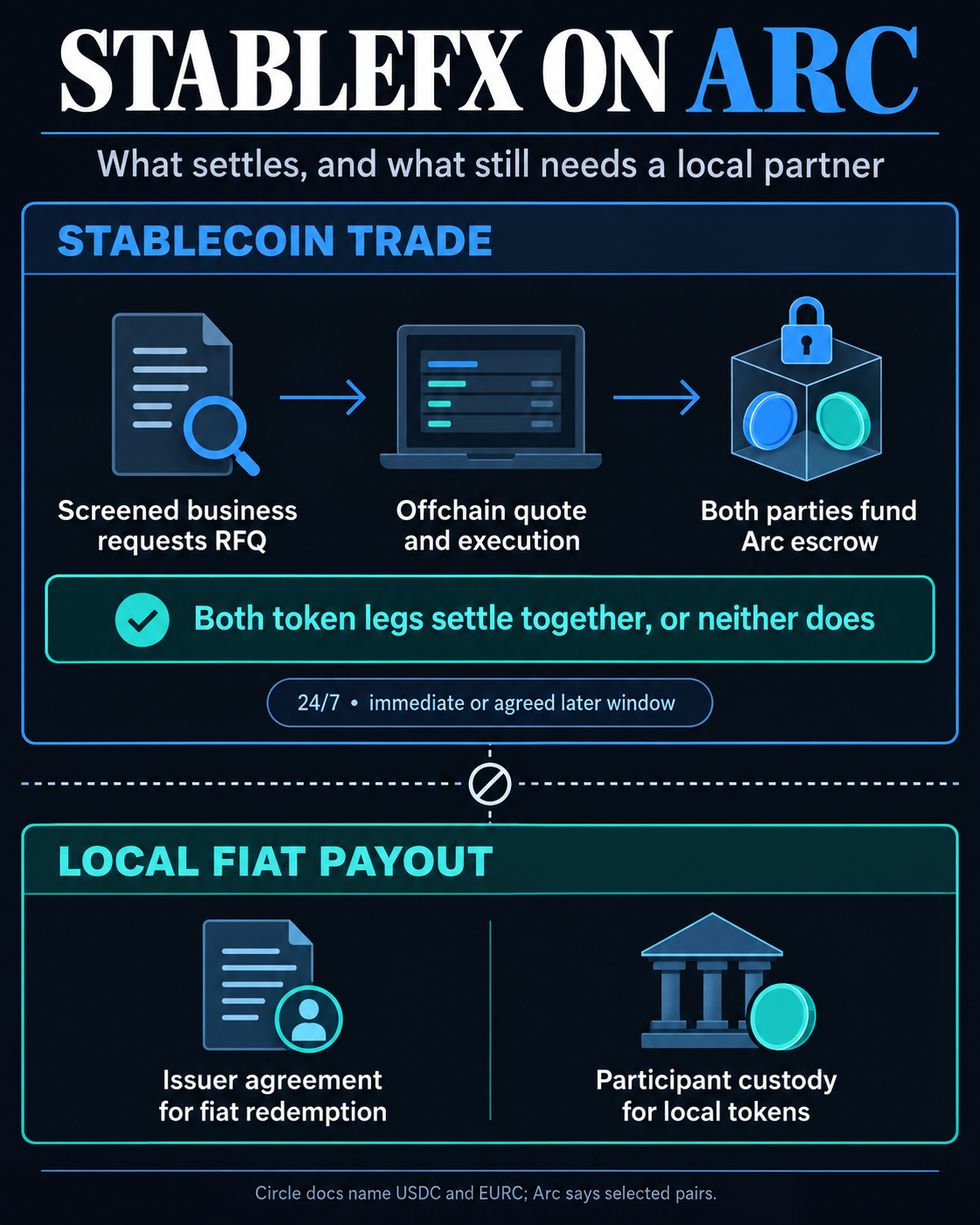
Access is also restricted. Circle screens counterparties and limits StableFX to eligible incorporated businesses, positioning the service for payment companies, financial institutions and corporate treasury desks rather than retail traders.
For those firms, the attraction is partly operational. A payments company needing to rebalance stablecoin liquidity across currencies could execute the trade overnight or during a weekend rather than wait for traditional banking rails to reopen. Deferred settlement also gives treasury teams flexibility to match execution with their funding schedules.
The harder part begins after settlement.
StableFX exchanges digital currencies but does not automatically turn a local-currency stablecoin into cash in a recipient’s bank account. Firms using partner-issued stablecoins still need arrangements with their issuers for deposits and redemptions, suitable custody, and local payout infrastructure.
Circle Mint can provide USDC and EURC liquidity and fiat conversion in supported markets, but that access does not extend automatically to tokens issued by other companies.
The post Circle launches 24/7 stablecoin FX engine as it chases a slice of the $10 trillion currency market appeared first on CryptoSlate.
BlackRock says AI could create a new class of stablecoin customer: machines that spend continuously without human approval.
The world’s largest asset manager sees increasingly autonomous AI systems purchasing data, accessing software, and acquiring computing resources on their own, potentially adding a new source of transaction demand to digital assets beyond trading and human payments.
That prospect sits at the center of BlackRock’s new report, The Machine-Native Economy, which argues that artificial intelligence could eventually change who initiates economic activity. Instead of people making individual payment decisions, software could execute thousands of small transactions to complete a task.
Stablecoins enter that market with more than $300 billion already in circulation and about $11.2 trillion of adjusted transaction volume in 2025, according to BlackRock. The firm calculated that volume grew at an 80% compound annual rate between 2020 and 2025, compared with roughly 8.5% for the US Automated Clearing House (ACH) network.
ACH still processed about $93 trillion last year, reflecting how far stablecoins remain from the largest traditional payment rails. BlackRock also cautioned against directly comparing stablecoin activity with Visa and Mastercard because the networks measure transactions differently.
The potentially bigger shift, however, is in transaction behavior rather than existing volume.
An AI agent searching for information or computing capacity could pay repeatedly for individual API calls, data feeds, or units of processing power. Those transactions may be worth fractions of a cent and occur around the clock, creating a payment pattern markedly different from card purchases or bank transfers designed primarily around human customers.
That gives stablecoins an opening because software can hold them in programmable wallets and settle transactions without requiring a person to approve each payment.
Stablecoins may win the machine wallet before blockchains win the economics
Payment companies are already competing over how those transactions will move.
Coinbase’s x402 protocol uses the web’s HTTP 402 “Payment Required” status to let a service demand payment before returning data or another resource. An agent can request an API, receive payment instructions, transfer USDC, and get the service without a human completing checkout.
Stripe and Tempo are developing the Machine Payments Protocol, which can settle transactions through stablecoins or traditional payment methods. Stripe and OpenAI’s Agentic Commerce Protocol connect AI agents with existing merchant systems, while Google and Visa are working on separate standards around agent identity and authorization.
The competing approaches complicate any assumption that machine commerce will automatically migrate on-chain.
Traditional payment networks can adapt to autonomous software, particularly where agents transact with established businesses and consumers. Stablecoins appear better positioned where payments become especially small, frequent, or native to software.
That leaves a second contest over where the value from those payments eventually accrues.
If agents generate more stablecoin transactions on Ethereum, greater usage could increase demand for blockspace and validator services. ETH is used in the network’s fee and staking system, providing one route through which higher transaction activity can affect the native asset.
But transaction growth and token demand do not necessarily rise together.
BlackRock said the amount captured by native crypto assets will depend on fee structures, staking economics and gas-sponsorship models. Networks can process large volumes while charging very little, while applications can also shield users and agents from holding the underlying gas token themselves.
Circle’s Arc presents a different model. The payments-focused blockchain uses USDC as its native gas asset, meaning additional activity could strengthen the stablecoin’s role without producing the same transmission mechanism to a separate native token such as ETH.
For investors, that distinction could matter more if machine payments scale. Stablecoin issuers may gain transaction demand while the networks processing those transfers compete separately to turn higher throughput into economic value.
AI compute could make the machine customer considerably larger
BlackRock expects the same payment architecture to eventually reach one of AI’s biggest expenses: computing power.
Cumulative investment in AI infrastructure could exceed $5 trillion between 2025 and 2030, while Bloomberg consensus forecasts cited by BlackRock put combined revenue from Amazon Web Services, Microsoft’s Intelligent Cloud business and Google Cloud at about $1.1 trillion by 2030.
That would create a large resource market for increasingly autonomous agents to navigate.
An agent could compare computing providers by price, hardware, location, latency, or performance; purchase capacity for a specific task; and settle the cost automatically. Payments could occur per job, per use, or potentially per model token.
AI inference would then become a recurring machine-to-machine transaction loop: software finding compute, buying it, consuming it, and paying for the resource without a person intervening at each stage.
BlackRock sees an even larger financial market potentially forming around that activity.
Standardized claims on computing capacity could eventually be traded or pledged as collateral, while futures markets could allow buyers and sellers to hedge changes in compute costs. Such markets would require standards that account for major differences between chips, energy prices, locations, and performance.
That part of the thesis remains largely prospective. Agentic payment activity is still nascent, and traditional financial companies are building their own infrastructure for autonomous commerce alongside crypto firms.
The nearer competition is over the machine’s wallet.
Stablecoin issuers need their tokens to become the default settlement asset for software. Payment protocols need to become the standard agents use to request and pay for resources. Ethereum and rival blockchains face the harder task of ensuring that higher stablecoin throughput translates into demand for their own economic assets.
Traditional payment networks, meanwhile, have an incentive to keep that activity on existing rails.
As AI systems gain more authority to spend, those competing infrastructures will increasingly fight over a customer that never sleeps, can transact thousands of times in the background, and may care more about price, settlement speed, and programmability than which financial network sits underneath the payment.
The post BlackRock sees a new $5 trillion AI trade emerging for stablecoins appeared first on CryptoSlate.
At a New York Fed conference on Sept. 22, Treasury officials and market participants discussed whether the government should lend excess cash into the overnight repo market, which finances Treasury trades. Such a move could raise bank reserves. Treasury announced no repo-lending program, amount or timetable at the conference, and any benefit for Bitcoin would be indirect.
Reuters reported that several private-sector panelists welcomed the idea. The Treasury Borrowing Advisory Committee had considered it in May and urged further study. For now, the discussion is about how Treasury might manage its cash, rather than an operating program.
How a Treasury repo investment would work
The Treasury General Account, or TGA, holds government operating cash at the Federal Reserve. In a May presentation, the advisory committee modeled what would happen if Treasury lent some of that cash overnight against Treasury securities. Money would leave the TGA, while bank reserves, the balances banks hold at the Fed, would rise. Treasury would earn a repo rate, and the Fed would pay interest on the additional reserves.
The two public institutions have to be considered together. Treasury’s interest earnings alone would not be the full government benefit, because additional reserves also bring an interest cost at the Fed. The economic result depends on the repo rate Treasury earns compared with the rate the Fed pays on reserves, after costs. The modeled transaction is Treasury cash lending, not Federal Reserve bond buying.
The size of the TGA is therefore a poor shortcut for the size of any possible operation. Treasury’s August cash plan assumed a $950 billion balance at the end of September and said the account could reach about $1.05 trillion, plus or minus $50 billion, in late October. Those figures are cash-balance plans around government payment needs. Treasury did not present either as money earmarked for repo lending.
The committee’s May report also tempered the economic case. A presenting member estimated that, with ample bank reserves, investing excess cash might produce only 0 to 2 basis points of economic return for the government on a consolidated basis. The committee saw likely benefits as marginal against the challenges of setting up a program and recommended more design work. That small, regime-dependent estimate is not a promised return.
Current funding conditions matter as much as the accounting. In remarks at the conference, Roberto Perli, who manages the Fed’s System Open Market Account, said overnight money-market rates had averaged slightly below the rate paid on reserves. That suggested reserves were in the higher part of the Fed’s ample range. He also said roughly $400 billion of net Treasury bill issuance in the weeks leading up to the Desk’s August purchase decision put only very modest upward pressure on repo rates.
Perli’s observations do not predict the effect of a Treasury lending program. They show that money markets had absorbed a large recent supply of bills without signs of acute repo funding pressure. Whether Treasury cash would meaningfully lower borrowing costs would depend on the amount offered, the timing and how repo rates responded.
What Bitcoin would need to see
If Treasury adopted the proposal and its lending materially eased short-term financing, that could eventually improve conditions for risk-taking. Bitcoin is several steps removed from the initial transaction, however: higher bank reserves do not by themselves establish cheaper funding, fresh Bitcoin demand or a price effect. None of the cited Treasury or Fed work measures such an effect.
The practical test would begin with a Treasury decision and operating terms, then move to actual lending volumes and observable changes in repo rates and reserves. Until then, a discussion about where Treasury holds and lends its cash is not evidence of a trillion-dollar Bitcoin stimulus.
The post Treasury’s cash balance nears $1 trillion while Bitcoin awaits a crucial market signal appeared first on CryptoSlate.
Nearly $20 million of XRP was drained from thousands of hardware wallets in six waves spanning nearly a week.
Blockchain analysis firm XRPL.to traced 11.75 million XRP leaving 6,678 distinct wallets between Sept. 15 and Sept. 20, including several collection waves after DCENT warned users of unauthorized transfers involving its mobile App Wallet.
At XRP’s current price of about $1.59, the tokens are worth roughly $18.68 million.
XRPL.to dates the first identified sweep to 15:35 UTC on Sept. 15. DCENT said it received its first customer report in Korea on Sept. 16 and began notifying users through its app and official channels that day.

The draining then resumed.
Another collection wave began at 07:05 UTC on Sept. 17, according to XRPL.to, while the final sweep captured in its investigation occurred at 20:56 UTC on Sept. 20.
The investigator counted 4,208 wallets swept through payment transactions and another 2,470 emptied through account deletion without a preceding payment in the dataset it traced. It also identified 5,001 AccountDelete transactions originating from 4,950 wallets, including accounts that had already been partially emptied.
Account deletion allowed whoever controlled the keys to extract balances that ordinary payment sweeps could leave behind. XRP Ledger (XRPL) accounts maintain a reserve while they remain open, but an AccountDelete transaction can close an eligible account and forward its remaining XRP, minus the deletion fee, to another address.
One such deletion moved 107,507 XRP, worth about $171,000 at current prices.
XRPL.to said the payment and deletion transactions were validly signed with the affected accounts’ keys. The blockchain trail does not reveal how those keys were obtained, and DCENT has yet to disclose the technical cause of the incident.
More than 5.6 million XRP moved through THORChain
Much of the stolen XRP had already begun leaving the XRP Ledger by the time investigators mapped the flows.
XRPL.to traced 5.67 million XRP through THORChain as of 11:26 UTC on Sept. 21, including about 5.59 million XRP sent from two collection waves through transactions whose memos specified Ethereum destination addresses.
Another 3.24 million XRP flowed to unionchain.ai, which XRPL.to described as an exchange, while about 546,080 XRP reached NEAR Intents and 535,666 XRP moved into Binance deposit tags.
Around 1.31 million XRP remained in wallets linked to the operation at the investigator’s snapshot.
The destinations complicate attempts to recover the assets. THORChain and NEAR Intents can move value between networks, creating additional trails investigators must follow once XRP has been exchanged for assets on another blockchain.
Meanwhile, transfers to exchange-linked addresses could offer potential intervention points, though a deposit address alone does not establish whether the funds were sold or remain accessible.
DCENT said it has been working with Korean law enforcement, outside security specialists, blockchain projects and exchanges to trace the money and request freezes where possible.
The company has not announced a completed freeze or recovery. It has said any such action depends on law enforcement, exchanges and other third parties controlling the services through which funds traveled.
DCENT urges holders to abandon exposed recovery phrases
The continuing sweeps prompted DCENT to escalate its warning on Sept. 20, asking the broader blockchain and crypto community to help reach App Wallet users who might not have seen its earlier notices.
“The most important step to prevent further damage is moving assets out of the DCENT App Wallet,” the company said, urging users and crypto communities to spread its guidance directly to anyone known to use the app.
DCENT told affected users to update the app from an official app store before taking further action and move their holdings to a wallet created with an entirely new recovery phrase.
That requirement also extends to some hardware-wallet users.
DCENT said anyone who previously entered or restored a hardware wallet’s recovery phrase inside its App Wallet should follow the same migration procedure. Moving the same phrase back onto a hardware device does not generate new private keys, meaning any prior exposure follows the phrase into the new device.
The company’s potential-impact criteria also include addresses whose recovery phrase was used in the App Wallet and that signed transactions using an app version earlier than 8.1.0, released Nov. 5, 2025. Users who later upgraded the software are still being asked to consider which version was installed when they previously signed transactions.
DCENT says hardware users who never entered their recovery phrase into the App Wallet and never used the software wallet to sign transactions do not need to migrate under its current criteria.
The company has also warned users against a second wave of potential losses from impersonators exploiting the incident. DCENT said it will never ask for a recovery phrase, private key, or PIN and will not provide a wallet address to which users must send assets for recovery or compensation.
For users who have already suffered unauthorized transfers, DCENT said on Sept. 20 that it was still developing a process for determining the scope of impact and the status of affected assets.
The post Nearly $20 million in XRP drained from 6,678 wallets across six attack waves appeared first on CryptoSlate.
More than $1 billion in reported trading makes Coinbase's stock tokens look active. For a holder looking to sell, the question is how much the market can absorb now, and at what price, particularly outside US equity hours.
A Sept. 23 premarket check found indicative buy and sell routes for about $100,000 of each of Coinbase's ten stock tokens on Base. The estimated proceeds from selling were 0.06% to 0.71% below KyberSwap's own dollar valuation of the tokens offered. The routes price individual orders at one instant; they do not establish capacity for a simultaneous selloff.
The ten principal Aerodrome stock/USDC pools held about $12.97 million in combined displayed balances during the check. Individual pools ranged from roughly $818,700 for MSFTc to $2.11 million for NVDAc. Those balances include both the stock token and USDC. The total alone leaves the amount available to absorb a sale within a specified price range unknown.
Dromos Kitchen's stock-token dashboard put cumulative trading volume at about $1.02 billion and total tokenized value at $19.82 million on Sept. 23. Its community-built data carries a warning that it may be incomplete. Turnover accumulates across trades; it cannot be read as a fresh pool of buyers waiting for a large sell order.
What the $100,000 quotes show
The table pairs each displayed Aerodrome pool balance with KyberSwap's estimated routes for selling a stock token into USDC and buying it with USDC. The quote gap measures how far the router's estimated output dollar value fell below its own dollar valuation of the input. It does not compare the token with the underlying share's exchange price or record a completed trade.
| Token | Aerodrome stock/USDC pool | $100,000 sell quote gap | $100,000 buy quote gap |
|---|---|---|---|
| NVDAc | $2.11 million | 0.13% | 0.16% |
| AAPLc | $1.50 million | 0.06% | 0.10% |
| GOOGLc | $1.66 million | 0.10% | 0.09% |
| METAc | $2.10 million | 0.13% | 0.22% |
| AMZNc | $1.03 million | 0.30% | 0.22% |
| MSFTc | $818,700 | 0.39% | 0.43% |
| TSLAc | $861,985 | 0.42% | 0.51% |
| MSTRc | $940,283 | 0.71% | 0.76% |
| SNDKc | $952,629 | 0.61% | 0.69% |
| SPCXc | $1.00 million | 0.50% | 0.25% |
Method: Pool balances are from the ten matching Aerodrome Slipstream 3 stock/USDC records at about 08:00 UTC. KyberSwap GET route summaries were captured from 08:02:01 to 08:02:42 UTC. Sell quantities approximated $100,000 at displayed token prices; KyberSwap's own input marks varied slightly. Values are rounded, gas is separate, and no trades were sent. Its API requires a separate step to build a transaction.
At roughly $10,000 per token, sell-side quote gaps were 0.01% to 0.12%. The $100,000 orders generally widened those gaps. Some routes combined Aerodrome with other liquidity sources, so their estimated prices reflect the router's reach beyond any one pool. That extra access may change quickly as market makers and liquidity providers adjust their offers.
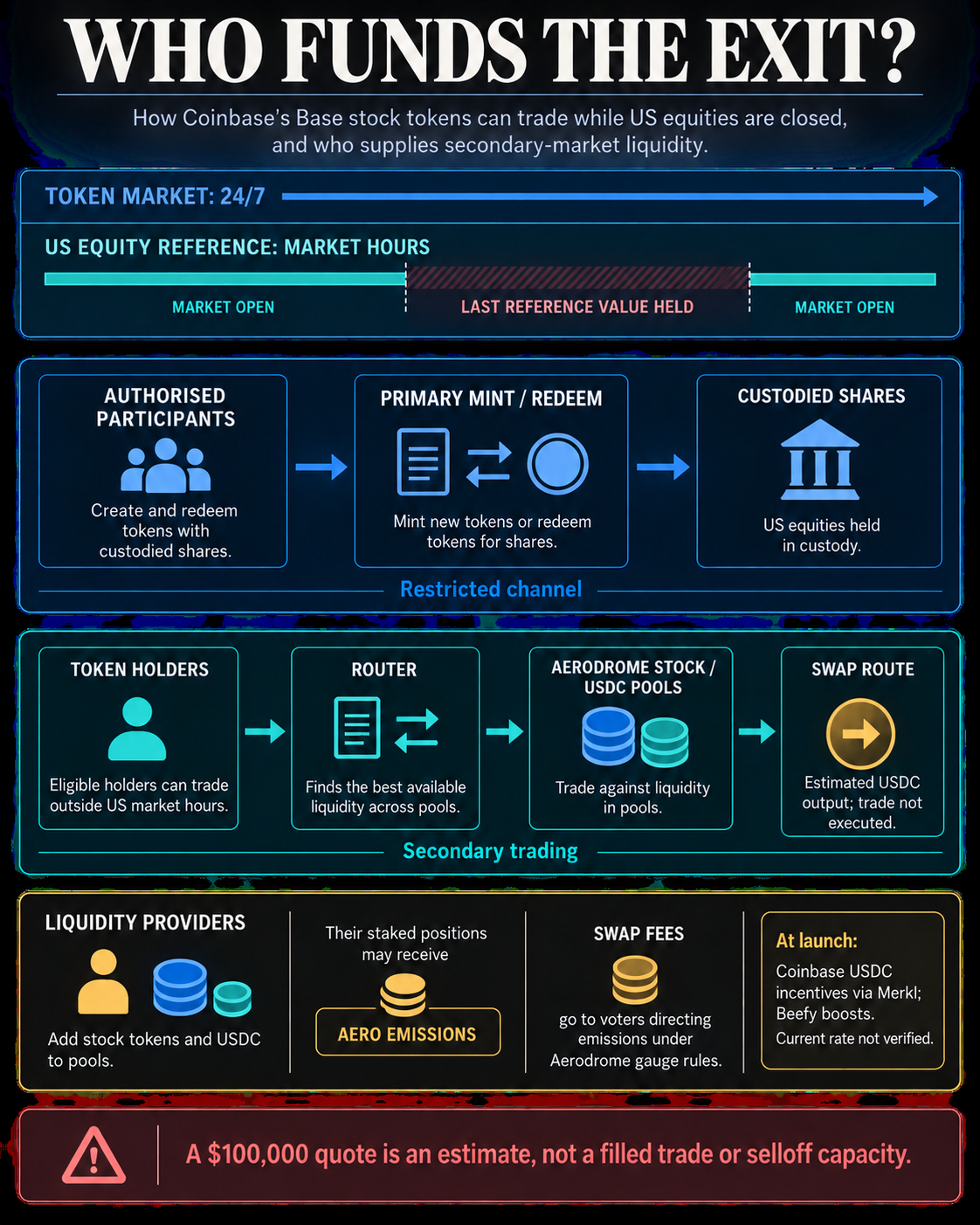
The displayed balances depend partly on what liquidity providers are paid to keep capital in the market. Under Aerodrome's gauge rules, providers who stake their pool positions for AERO emissions give up their direct swap-fee rewards, which go to voters directing the emissions. Fee generation and the AERO stream are separate parts of the pool's economics.
At the August launch, Beefy said Coinbase was supplying USDC incentives through Merkl in two-week periods and Beefy was adding its own boosts alongside Aerodrome emissions. That describes how liquidity was encouraged at launch, not a verified current return for every stock pool. If incentives or votes move elsewhere, providers can reassess their positions regardless of how much the tokens have traded historically.
The funding structure matters most when token trading outlasts the underlying share market.
Base says Coinbase's tokens are backed by underlying shares held in regulated custody and are available only in eligible jurisdictions outside the United States. Its developer documentation describes secondary token trading as permissionless, subject to address controls, while primary minting and redemption of the underlying shares are restricted to authorized participants.
The tokens can change hands while the US stock market is closed. The same Base documentation says the Chainlink equity feed holds its last value outside market hours while onchain token trading can continue. A holder selling after hours therefore faces a live token market whose underlying equity reference may still reflect the prior session. Authorized participants control the separate share-creation and redemption channel, leaving secondary-market liquidity providers to set the price of an immediate exit.
The Sept. 23 routes show that $100,000 individual orders received indicative prices despite modest displayed pools. A change in AERO votes, provider capital or after-hours stock news could alter those routes while the equity feed holds its last value.
The post $1 billion in trading volume masks hidden liquidity risks for Coinbase stock token holders appeared first on CryptoSlate.
CryptoTicker.io
Anyone who holds bitcoin or other crypto assets and gets divorced usually asks the wrong question first, namely this one: do I now have to split my coins? Under German law the answer is, in the overwhelming majority of cases, no, your coins remain your coins. What gets divided is something else, namely the increase in assets accumulated during the marriage, and it is divided as a sum of money. That sounds like a technicality, but it decides whether you have to sell or not, and whether tax falls due when you do.
This piece explains how the equalisation of accrued gains works when part of the assets sits in a wallet: which key dates apply, what you have to disclose, who bears the price risk between the key date and payment, and at which point a family law question turns into a taxable disposal. All the provisions come from the German Civil Code and the Income Tax Act and can be read in the original wording.
One framing note that belongs here: this is a general explanation of the legal position and not legal advice for your case. Family law is decided case by case, and with larger holdings a lawyer’s advice is no luxury.
Community of accrued gains does not mean joint assets
The error is already in the term. Anyone who marries without a prenuptial agreement lives under the statutory matrimonial property regime of the community of accrued gains. Section 1363 paragraph 2 of the Civil Code makes that expressly clear: “The assets of each spouse do not become their joint assets; this also applies to assets acquired by a spouse after the marriage.”
Translated into practice: if you bought bitcoin in 2019 and married in 2021, those bitcoin continue to belong to you alone. The wallet does not become joint property through the marriage, and your spouse acquires no ownership in it. Equalisation happens only at the end, and it happens as a calculation.
The exception is holdings that were genuinely acquired jointly, such as a joint account at an exchange or a wallet to which both hold the keys. There, the additional question arises of who owns which share of the holding, and that is answered not through the equalisation of accrued gains but through ordinary property law.
How the accrued gain is calculated: initial assets, final assets, equalisation claim
The calculation consists of three figures, and each one is defined in the statute.
The initial assets are, under Section 1374 of the Civil Code, the assets belonging to you when the property regime begins, that is on the day of the marriage, after deduction of debts. The final assets are, under Section 1375, the assets at the end of the property regime. The accrued gain is, under Section 1373, simply the amount by which the final assets exceed the initial assets.
From that follows the actual claim. Section 1378 paragraph 1 of the Civil Code: “If the accrued gain of one spouse exceeds that of the other, half of the excess is due to the other spouse as an equalisation claim.” The equalisation claim is a claim for payment in euros and is not directed at handing over particular objects, and therefore not at handing over coins.
A worked example with crypto assets
Suppose you had 10,000 euros in bitcoin at the time of the marriage and nothing else. By the key date at the end of the marriage that has grown to 90,000 euros, and there are no other assets. Your accrued gain therefore comes to 80,000 euros. Your spouse had nothing at the start and savings of 20,000 euros at the end, so their accrued gain is 20,000 euros. The excess is 60,000 euros, and half of that, 30,000 euros, is what you owe by way of equalisation. Whether you sell coins for it, take out a loan or pay from savings is your decision.
One detail often overlooked with crypto assets: under Section 1374 paragraph 2 of the Civil Code, assets acquired by a spouse during the marriage through inheritance or gift are added to the initial assets. Inherited or gifted coins therefore do not increase your equalisable accrued gain by their full amount. Their increase in value during the marriage does, however, feed into the calculation. Anyone who received coins as a gift should be able to evidence the transaction together with its date and the value at the time.
Duty of disclosure under Section 1379: what you must reveal about your wallets
Here lies the point at which crypto assets differ from a savings account. A bank can be questioned by the court, a self-custodied wallet cannot. That is precisely why the duty of disclosure is framed so sharply.
Under Section 1379 paragraph 1 of the Civil Code, each spouse may demand information from the other about their assets, in so far as it is relevant to calculating the initial and final assets, and in addition about their assets at the time of separation. The statutory wording is terse and effective at this point: “On request, supporting documents are to be produced.” It can also be demanded that the schedule be drawn up by a notary or a public authority.
In practice, for crypto assets that means the schedule covers holdings in exchange accounts just as much as self-custodied holdings. Supporting documents may include account statements and transaction overviews from the venues, plus the records of purchases, sales and transfers. Disclosure that names an exchange and stays silent about your own hardware wallet is not complete disclosure.
The fact that the legislator does not use the word wallet changes nothing. The duty attaches to the assets, not to the form of safekeeping.
Three key dates instead of one: marriage, separation, service
One peculiarity of the procedure regularly causes confusion, because three different days play a role and each measures something different.
- Day of the marriage: decisive for the initial assets under Section 1374 of the Civil Code.
- Day of separation: decisive for the additional disclosure under Section 1379 paragraph 1 number 1. This day has a function of its own that is underestimated, and we come to it shortly.
- Day the divorce petition is served: decisive for the final assets. Section 1384 provides that, in a divorce, the end of the property regime is replaced by “the point in time at which the divorce petition becomes pending”.
Pending means the day on which the petition is served on the other spouse. With a volatile asset, that is a date with considerable effect: the value of your holding on precisely that day feeds into the calculation. A price jump a week later no longer counts, and neither does a slump.
Which price applies? Valuing a volatile asset
The statute prescribes no valuation method for crypto assets. What matters is the market value on the key date, that is the price that could be obtained in the market. With an asset quoted differently at dozens of venues, that becomes a question of presentation.
A record stands up when it can be followed: the price on the key date at an established venue, better still the average across several, in each case in euros and stating the time of day. With a holding spread across several wallets and exchanges, complete capture of the quantities comes on top. Anyone reconstructing this only months later has an evidence problem, and it is one that software can solve: portfolio trackers keep holdings and price history together and produce key-date valuations. Our comparison of crypto tax software gives an overview of the usual tools.
It gets harder with holdings that have no functioning market, such as barely traded tokens or locked holdings from staking programmes. There the market value itself is contentious, and there are no blanket answers.
A price slump between the key date and payment: who carries the risk
This is the most uncomfortable feature of the rules, and it hits precisely the person holding crypto assets. Between the key date and the day on which payment actually happens, months frequently pass in practice. The equalisation claim, however, is fixed as a euro amount, calculated on the key date.
If the price halves in that time, your holding shrinks and the debt remains. If it rises, you keep the gain. The price risk over that period therefore sits with whoever holds the coins. Section 1378 paragraph 2 of the Civil Code does cap the claim at the value of the assets present when the property regime ends, but that cap too is measured by the key date and not by the day of payment.
Anyone who can foresee a larger equalisation payment should therefore think early about how to raise it. Shifting part of the holding into a less volatile asset is one option. The tax consequences of that shift are in the next section, and they are the reason this step is not a pure arithmetic exercise.
What happens if a wallet is concealed
The notion that a self-custodied wallet is invisible is persistent. In law it is risky, and that is because of a rule many do not know.
Section 1375 paragraph 2 of the Civil Code adds back to the final assets amounts by which the assets were reduced through gratuitous transfers not made out of a moral duty, through dissipation, or through “acts performed with the intention of disadvantaging the other spouse”. What matters is the sentence that follows: if the final assets fall below the assets stated in the disclosure as at the time of separation, the spouse concerned must set out and prove that the reduction does not rest on such acts.
That reverses the burden of proof, and it is exactly here that disclosure as at the time of separation becomes important. Anyone who states 100,000 euros in coins at separation and only 40,000 euros on the day of service has to be able to explain where the rest went. With a volatile asset that showing is often possible, because a price slump can be evidenced from public data. With a transfer to an unknown address it is not.
On top of that, blockchain analysis has long removed part of the anonymity, and venues in the EU are subject to identification duties. Anyone who has bought at a regulated exchange leaves a trail that can be matched to a name. A deliberately false schedule of assets can moreover carry criminal consequences where it has been affirmed under oath.
Tax: when transferring coins triggers a disposal
Now to the point at which a family law question becomes a tax one. Crypto assets held privately fall, on sale, under private disposal transactions in Section 23 of the Income Tax Act. Within one year of acquisition the gain is taxable, and after that tax-free. An exemption threshold of 1,000 euros per calendar year applies, and once it is exceeded the entire gain counts.
Selling in order to pay the equalisation claim
If you sell coins in order to pay the equalisation in euros, that is an entirely ordinary sale. If the acquisition was less than a year ago, tax falls due. The fact that you are selling because of court proceedings changes nothing. Anyone who has a choice therefore checks which holdings have already completed the one-year period before selling.
Handing over coins instead of money
Some couples agree to satisfy the equalisation claim by transferring coins rather than remitting euros. That is possible under civil law but by no means neutral for tax. On the view prevailing in tax law, performance in lieu is a transaction for consideration, because the coins are given up against the extinction of a claim. A disposal therefore takes place, with the same consequences as a sale. This arrangement accordingly belongs on a tax adviser’s desk before the signature, not after it.
Transfer without consideration: gift tax and the allowance
The position is different where coins are transferred without consideration, that is, not in satisfaction of an equalisation claim. In that case it is a gift. Between spouses, under Section 16 paragraph 1 number 1 of the Inheritance and Gift Tax Act, an allowance of 500,000 euros applies, and it becomes available afresh every ten years.
The allowance applies to spouses for as long as the marriage exists. After the divorce, the parties are unrelated third parties for tax purposes and the allowance falls to 20,000 euros. The timing of a voluntary transfer is therefore anything but arbitrary. How gifts between spouses are treated in detail is something we set out in our piece on gifting bitcoin to your spouse of September 22, 2026.
What a prenuptial agreement can change
Everything described so far applies to the statutory property regime. A prenuptial agreement can change a great deal about it, and for people with highly volatile assets that is a serious thought.
Separation of property excludes the equalisation of accrued gains entirely. More common and milder is the modified community of accrued gains, under which individual assets are taken out of the equalisation or valuation rules are laid down. It is conceivable, for instance, to carve out a particular holding, or to agree for volatile assets an average value over a longer period instead of a key-date price. A prenuptial agreement requires notarial recording.
For proceedings already under way, that comes too late. Anyone who is only now considering it, however, still has the better moment ahead of them.
How to prepare without hiding assets
Between full disclosure and careless unpreparedness lies a lot of room, and that room is lawful. The following points help regardless of which side of the calculation you are on.
Keep a clean schedule of your holdings with acquisition dates and acquisition costs. You need that for your tax return anyway, and if it comes to it, it is the basis of every negotiation. Secure the transaction history of your venues as an export while you still have access. An account at an exchange that leaves the market takes its history with it.
Document the origin of inherited or gifted holdings. Under Section 1374 paragraph 2 of the Civil Code they improve your position, but only if you can evidence them. And record when the separation took place: that day triggers the disclosure under Section 1379 paragraph 1 number 1 and is the reference point for the burden-of-proof rule in Section 1375 paragraph 2.
If holdings have so far sat in exchange accounts, the question of safekeeping is worth a thought in any case. For keeping separated holdings over the long term, your own keys are the cleaner route. What to bear in mind there is shown in our comparison of hardware wallets. Anyone who wants to think through the event of death at the same time will find the parallel questions in our piece on passing on crypto assets.
The most common misconceptions at a glance
Four assumptions crop up particularly often in this context, and none of them withstands scrutiny.
The first misconception holds that the wallet becomes joint property through the marriage. Section 1363 paragraph 2 of the Civil Code says the opposite. The second holds that the equalisation is directed at handing over half of the coins. It is a monetary claim under Section 1378. The third holds that self-custodied holdings are exempt from the duty of disclosure. Section 1379 attaches to the assets, not to the form of custody. The fourth holds that handing over coins instead of money is harmless for tax. On the prevailing view it is a disposal.
Crypto in a divorce: what to take away
- Establish the key date first, then the value. For the final assets, what counts under Section 1384 of the Civil Code is the day the divorce petition is served. Record that day’s price, in euros, with the source and the time of day. Tools that keep holdings and price history together can be found in our comparison of crypto tax software.
- Disclose in full and evidence the origin. The duty of disclosure under Section 1379 of the Civil Code covers exchange accounts and self-custodied holdings alike. Inherited and gifted coins improve your calculation under Section 1374 paragraph 2, but only with evidence.
- Check the holding period before you sell to pay. Holdings held for more than a year are tax-free on sale, more recent ones are not, and handing over coins instead of money counts as a disposal. For keeping holdings separately afterwards, our comparison of hardware wallets will help.
You can read the provisions cited in their original wording, for instance Section 1379 of the Civil Code on the duty of disclosure and Section 23 of the Income Tax Act on private disposal transactions.
(As of September 23, 2026. This article is not investment advice. It is not legal advice either. Prices and fee structures change; check the terms with the provider before you buy.)
OKX is removing five crypto assets from trading: DORA, ICX, STORJ, ZEUS and ELF. If one of them sits in your OKX account, one date matters above all, and it is not the one in the headline of the exchange’s notice. On September 30, 2026 at 08:00 UTC, that is 10:00 in central European summer time, the euro pairs ICX/EUR, STORJ/EUR and ELF/EUR come to an end. After that you can only sell via USDT, and even that only until October 3. You can withdraw for longer, until December 23, 2026. Anyone who does nothing at all will be left at the end of the year with a balance that can neither be traded nor paid out.
A delisting is the removal of a trading pair from an exchange: the pair disappears from the order book, the token itself continues to exist. That distinction alone decides whether you have to sell or merely to move. This piece sorts out the four deadlines, uses our own measurement of the order book to show why a hurried sale in the euro pair can turn expensive, and explains the tax fork between selling and withdrawing.
What OKX announced on September 23, 2026
The exchange published the notice on September 23, 2026 at 10:00 UTC. Five crypto assets and eleven trading pairs are affected. A trading pair is the combination of the token and the currency it is traded against, STORJ against the euro for instance. The same token can run in several pairs at one exchange and be removed from each of them separately.
As its reason, OKX states that the affected pairs no longer meet its own listing criteria. In its words, it is removing pairs that “do not fulfill our listing criteria”. Which specific metric was breached the notice does not say, and the exchange does not usually give reasons for individual removals. What can be evidenced is therefore only the fact of the removal along with the dates, not the assessment behind it.
These are the pairs affected:
- On September 30, 2026, 08:00 to 10:00 UTC: ICX/EUR, ICX/USDC, STORJ/EUR, STORJ/USDC, ELF/EUR and ELF/USDC.
- On October 3, 2026, 08:00 to 10:00 UTC: DORA/USDT, ICX/USDT, STORJ/USDT, ZEUS/USDT and ELF/USDT.
The sequence stands out. The euro pairs fall first, the USDT pairs three days later. For the German market that is the unfavourable order, because the euro is the currency most people here settle in.
The four key dates of the delisting at a glance
The notice carries four dates rather than a single one. These four hit different groups of readers, and three of them sit closer together than the headline suggests. All times in the notice are given in UTC; central European time is two hours later until October 25, and one hour later after that.
- September 23, 2026, 10:00 UTC (12:00 CEST): deposits of the five crypto assets have been stopped. This date has already passed.
- September 30, 2026, 08:00 UTC (10:00 CEST): trading halt for all euro and USDC pairs. On top of that, OKX is discontinuing the attached services from that moment, explicitly naming buying and selling via the express function as well as Convert, and doing so for every affected pair.
- October 3, 2026, 08:00 UTC (10:00 CEST): trading halt for the USDT pairs. That is the last moment at which any of the five assets can still be sold at OKX at all.
- December 23, 2026, 08:00 UTC (09:00 CET): withdrawals are suspended. In the exchange’s words: “Withdrawals for the affected crypto will be suspended.” After that the holding sits in the account with no way out.
The third date is the one many will overlook, because it looks like an extension. It is, however, tied to a condition that falls away three days earlier.
Why September 30 is the real deadline for you as a euro customer
At first glance, three days of trading remain after September 30. That is true, but it holds only for the bare order book of the USDT pairs. The convenient routes close earlier: the express function for buying and selling, and the Convert function that swaps one token directly into another without an order book, are both being discontinued by OKX on September 30 at 08:00 UTC, according to its own notice, for all affected pairs, the USDT pairs included.
In practice that means anyone unfamiliar with order books who has worked through Convert or the buy-and-sell screen until now does not have three extra days. For that group of users, everything ends on September 30 at 10:00 German time. The remaining 72 hours until October 3 are open only to those who can place an order into an order book in spot trading, and who have swapped their euro balance into USDT beforehand.
There is a second, unpleasant point on top of that: anyone selling via USDT after September 30 is making two transactions instead of one. Why that counts for tax purposes is set out further below.
Deposits have been blocked since September 23
The first key date has already passed, and it affects a group that features in no other delisting piece: people who are in the middle of sending tokens to OKX. Since September 23, 10:00 UTC, the exchange has accepted no further deposits of DORA, ICX, STORJ, ZEUS and ELF.
If you hold these five assets at another exchange or in your own wallet and intended to send them to OKX to sell, that route is closed. The notice does not say what happens to a transfer triggered regardless. So do not count on a credit still going through. Sell where the tokens already sit, or find another venue. A transfer that runs into the void is, at best, a support case dragging on for weeks.

A look into the order book: why a market order in ICX/EUR is dangerous
Now comes the part that appears in no exchange notice and that you should know before selling. On September 23, 2026 at 18:41 UTC we queried OKX’s public programming interface ourselves, once for daily turnover and once for the order books of the three euro pairs. The result explains why a panicky sale shortly before the deadline can be the most expensive route.
Three terms for clarity: the order book is the list of all open buy and sell offers for a trading pair. The spread is the gap between the highest bid and the lowest ask. A market order is executed immediately at whatever the best available counter-offer happens to be, whereas a limit order is executed only up to a price you set yourself.
Turnover in the euro pairs is very small
Measured over 24 hours, turnover in ICX/EUR came to around 30 euros, in ELF/EUR to around 368 euros and in STORJ/EUR to around 2,279 euros. For comparison: over the same period STORJ/USDT turned over about 640,600 USDT, ICX/USDT around 269,900 USDT and DORA/USDT around 799,200 USDT. Trading in these assets therefore takes place almost entirely in USDT, and the euro pairs have for some time been remnants rather than a market.
In ICX/EUR there is only a single bid in the book
The finding from the ICX/EUR order book is unambiguous: at the time of measurement there was exactly one bid on the buy side, namely 0.002 euros for 500 ICX. Together that comes to about one euro. The best ask stood at 0.03091 euros at the same moment. A market order to sell would therefore have executed in this book at 0.002 euros per ICX, while the price in the USDT pair converted to about 0.0126 euros. Anyone selling that way gives away most of the value without anyone having defrauded them.
For completeness: the other two euro pairs looked normal at the same moment. STORJ/EUR had a spread of 0.62 percent, ELF/EUR of 0.28 percent, with several thousand tokens on each side in both cases. The problem is therefore confined to ICX/EUR.
The last traded price is no help there either. ICX/EUR stood at 0.0261 euros at the time of measurement, twice as high as the converted USDT price. With daily turnover of 30 euros, a quotation like that comes from a single old transaction and says little about the price you could actually get.
The practical consequence: in these pairs, use a limit order, set the price at the converted USDT rate and give the order time. Anyone who only starts at nine in the morning on September 30 no longer has that time.
Sell or withdraw? The tax fork of Section 23 of the Income Tax Act
A delisting does not force you to sell, and that is the most important news for everyone holding their tokens for the longer term. In Germany, crypto assets held privately count as other economic assets, and selling them is a private disposal transaction under Section 23 of the Income Tax Act. Two things follow from that, and here they collide.
First: after a holding period of one year, the gain from a sale is tax-free. Within the year it is taxable, with an exemption threshold of 1,000 euros per calendar year. Exemption threshold means that with a total gain of one euro above it, the full amount counts and not just the excess.
Second: a transfer to your own wallet is not a sale. Only the place of safekeeping changes, and the holding period keeps running. Anyone who has held their STORJ for eighteen months loses nothing by withdrawing. Anyone who has held them for three months and now sells in a panic triggers a taxable transaction that would not have happened without the exchange’s deadline.
Swapping into USDT already counts as a disposal and is not treated as a mere intermediate step. Anyone selling via the USDT pair after September 30 therefore realises the gain with the swap into USDT, not only with the later exchange into euros. Anyone who has not completed the holding period and does not want to break it withdraws the tokens rather than converting them. How a change of exchange affects the holding period is something we set out in more detail in our piece on switching crypto exchange and the holding period of September 23, 2026.
One note that belongs here: this is the general legal position and not tax advice for your individual case. Anyone moving larger amounts or looking to offset losses should clear it with a tax adviser. You will need the documentation of your transactions yourself in any event, and before the exchange switches off the trading pair and the exports become hard to follow.
What “untradable assets” in the funding account means
For the case where you do nothing, OKX describes the process itself. Once the delisting is complete, holdings are consolidated into the funding account. At OKX, the funding account is the area for deposits and withdrawals, separate from the trading account where trading takes place. During this consolidation, withdrawal and internal transfer are temporarily blocked; afterwards you will find the holding again among the untradable assets.
Untradable in this state means: the holding is there, it is displayed, you can withdraw it, but you can no longer do anything with it inside the exchange. This state lasts from the trading halt until December 23, 2026. That is a generous window, and that is precisely why it is dangerous, because a date two and a half months out reliably disappears from memory.
So set yourself a reminder now if you are not acting immediately. After December 23, according to the notice, there is no route out any more, and what happens to the remaining holding then is not stated there.
Open orders and trading bots: why you should end them yourself
Two details of the notice concern people with more than a simple buy order in the system. Both cost money if they are overlooked.
Open orders in the affected pairs are cancelled automatically by the system as soon as the pair is switched off. OKX expressly advises doing this yourself beforehand, and puts the duration of automatic cancellation at one to three working days. During that time, the balance behind the order is tied up. Anyone still holding an old limit order in the book on September 30 who has other plans for the balance behind it may end up waiting into October.
For trading bots, meaning automated trading strategies that place orders independently, OKX writes that they will be closed in stages between 07:00 and 08:00 UTC on the respective delisting day. The exchange itself recommends stopping them manually beforehand if you want to avoid fees or price discounts from the automatic closure. Given the ICX/EUR order book, that warning should be taken seriously: an automatic closure is, in substance, a market order.
ICX holders face two deadlines at once on September 30
One group is hit twice on that day, and that has nothing to do with OKX. On May 25, 2026, the ICON Foundation set out the roadmap for the end of the ICON network: the migration from ICX to SODA becomes one-way from September 30, 2026, and from that day only conversions from ICX to SODA will be supported. The final cut-off for the migration is December 31, 2026, after which the network will be halted permanently and will remain in place as an archive for reference.
Anyone holding ICX at OKX is therefore watching two clocks at once on September 30. At 08:00 UTC the euro pair ends at the exchange, and on the same day the way back in the migration closes. Both have the same practical consequence: whatever needs doing belongs before that day, not on it. The details of the migration, including the question of what applies when assets are held at an exchange, are in our piece on the ICX-to-SODA migration and its deadlines. You can read the dates themselves directly at the ICON Foundation.
Where to take the tokens? Other venues and your own wallet
There are two directions for the move, and they answer different questions.
To another exchange if you want to sell
That route is only worth it if the destination venue lists the token at all and enough turnover takes place there. Check that in the destination’s order book beforehand, not after the transfer. Pay attention to authorisation as well: since the EU’s MiCA regulation, crypto service providers need a licence as a CASP, a crypto-asset service provider, to operate in the EU. OKX serves the European market through OKX Europe Limited under a licence granted by the Maltese regulator MFSA in January 2025. If you switch, do not switch by accident to a provider without that authorisation. Which houses are available and regulated in Germany is shown in our comparison of crypto exchanges.
Into your own wallet if you want to hold
Self-custody means the private keys sit with you and not with a company. For holding across deadlines, that is the clean route, because no external deadline decides over your holding any more. One point matters more here than the choice of wallet: before withdrawing, check which network the payout runs over and whether your wallet supports exactly that network. Several of the affected tokens can be withdrawn over different networks, and a withdrawal into a network the receiving address does not know is the most common way of losing a balance for good. Test the route with a small amount before you send the rest.
Why ICX and STORJ are disappearing from one exchange after another
This delisting does not stand alone. On August 21, 2026 we reported on the removal of ICX, SCRT and STORJ at Binance, and on August 30 on the trading halt for STORJ and BADGER at Coinbase. Now OKX follows, and with the same two names in the package. Within five weeks, three large venues have therefore sorted out the same assets.
For OKX itself the process has become routine. On August 22, 2026 it was MAJOR and J, on September 9 GODS, PRCL and DUCK, as set out in our piece on the OKX delisting of GODS, PRCL and DUCK. This is the same exchange’s third round of removals in five weeks. Anyone holding older secondary assets there should subscribe to the exchange’s notices rather than rely on news sites: at the time of writing, no German-language outlet had picked the matter up.
On the cause, only one thing can be said from the data, and cautiously at that: turnover in the removed euro pairs is very small, as the measurement above shows. A trading pair turning over 30 euros a day costs an exchange more in surveillance and market maintenance than it brings in. Whether that was the reason in this particular case OKX does not say, and we therefore do not claim it either.
What a delisting does not mean
Finally, the context that is usually missing from excitable reports. A removal at one exchange is no verdict on the project behind the token. STORJ, ELF, DORA and ZEUS continue to trade at other venues, and the networks behind them carry on regardless. With ICX the situation is different, but not because of OKX: there the network itself ends at the turn of the year, on the strength of a decision by its own community.
Nor is a delisting a buy signal. Prices do sometimes swing sharply in such phases, because selling pressure meets thin order books. Deriving a forecast from that would be guesswork. What can be evidenced is solely the list of dates and the depth of the order books at the time of measurement. Everything beyond that you decide for yourself, and best of all before September 30.
And one last clarification on the order of your own steps: selling, withdrawing and doing nothing are three different decisions with three different deadlines. The mistake that costs money is almost never the wrong decision, but the late one.
The OKX delisting: what to take away
- Check today whether one of the five assets sits in your account. DORA, ICX, STORJ, ZEUS and ELF are affected, and deposits of these assets have been running into the void since September 23. If you want to change venue for the sale anyway, compare the available houses beforehand in our comparison of crypto exchanges.
- Decide between selling and withdrawing before September 30. Within the one-year holding period a sale triggers a taxable transaction, a transfer to your own wallet does not. If you want to keep track of acquisition dates and deadlines, you will find suitable tools in our comparison of crypto tax software.
- Sell with a limit rather than at market, and test the withdrawal with a small amount. The ICX/EUR order book carried a single bid worth around one euro at the time of measurement. For long-term safekeeping after the withdrawal, our comparison of hardware wallets will help.
The full list of dates including all eleven trading pairs is in the OKX delisting notice.
(As of September 23, 2026. This article is not investment advice. Prices and fee structures change; check the terms with the provider before you buy.)
As of 04:00 UTC this morning, BitMEX no longer accepts trading orders. The exchange, which launched in 2014 and brought the perpetual swap with hundredfold leverage to the market, has ceased operations for good after eleven years. Anyone still holding an open position at that moment did not have to close it themselves: the exchange force-closed it. And anyone still holding a balance on the account now pays for the privilege.
The decisive question today is therefore no longer whether you withdraw in time. That deadline has passed. The question is what applies now: which amounts end up in your 2026 tax return, which documents you need to secure while the account is still reachable, and what the account fee on a residual balance actually costs.
What actually happened on BitMEX at 04:00 UTC on September 23
BitMEX announced the closure on July 23, 2026. The operator is HDR Global Trading Limited, based in the Seychelles; it cites a strategic review of the business as the reason for the step. New account openings were stopped when the announcement was made.
The process ran in two stages. From August 26, 2026, also at 04:00 UTC, tightened risk limits applied: new positions could no longer be opened, and existing ones could only be reduced. In the period up to the cut-off date, BitMEX says it force-closed open positions on a rolling basis in order to wind the market down in an orderly fashion. For contracts with thin liquidity, early settlement was used.
Trading ended with the closure itself. What remains after it is explicitly no longer exchange operation, but custody alone: you can still log in, see your wallet holdings and your transaction history, and initiate withdrawals. The exchange has unstaked all staked BMEX tokens across the board, and they have been sitting free in the respective accounts ever since.
Force-closure: why open positions were closed without any action from you
A force-closure is the closing of a derivatives position by the exchange rather than by its holder. At BitMEX, in this case, it was not a liquidation for lack of collateral but a wind-down measure: every position still open at the moment of closure was closed immediately, regardless of whether it stood at a profit or a loss.
That has a consequence many underestimate. The timing of the closure was not freely chosen but dictated. Anyone who was waiting for a better price did not get that price. The bitcoin price moved sharply over the course of today: our own call to the CoinGecko interface at 18:48 UTC showed $84,210, down 2.63 percent within 24 hours. How the bitcoin price develops from here changes nothing about your settlement: the profit or loss was realised at the moment of force-closure.
In its notice, BitMEX states explicitly that the exchange accepts no responsibility for trading losses arising from users being unable to close their positions themselves by the cut-off date. Anyone who held a position that was settled late and at an unfavourable price therefore has no claim.
Account fee on residual balances: 1 percent per year or $50, charged monthly
For verified accounts that still carried a balance at the moment of closure, an account fee applies with immediate effect. BitMEX puts it at one percent per year, charged monthly, or at the equivalent of $50 for accounts whose holdings do not exceed that amount. It runs until the balance has been withdrawn in full, and the exchange reserves the right to raise it later; it says it will announce any increase in advance.
The tiering is the point at which this becomes unpleasant for small holdings. One percent per year on a large balance is bearable. On a residual holding of $200, by contrast, the minimum fee applies, and $50 a month eats through such a holding entirely within a few months. Our own analysis of withdrawal routes from September 11 already laid the groundwork for exactly this calculation: at the time, 14 of 62 open withdrawal routes carried a network fee at or above the minimum withdrawal amount. Anyone stuck on one of those routes now faces a choice between a fee that eats the holding and a withdrawal that eats it too.
Withdrawals after the closure: what still works and what is delayed
Withdrawals remain possible, but they run more slowly than in normal operation. BitMEX has announced additional checks for all withdrawal requests and does not rule out that individual networks may be restricted if demand spikes. For bitcoin, the exchange points to blockchain confirmation times and to a fixed pool of withdrawal addresses: as long as a withdrawal carries the status Processing, it is in the queue and will be sent as soon as the next address frees up.
In practice that means an order that does not appear on-chain within a few hours is no cause for concern yet, provided the status is right. An order without a status, by contrast, deserves another look. For queries, BitMEX points to its own support and to its page on reserves and liabilities, where it states that it holds a surplus of assets over liabilities.
What you should secure while the account is still reachable
The login remains in place, but nobody has promised for how long. Download your complete transaction history while it is still retrievable, and in the broadest possible form: all deposits and withdrawals, all contract settlements, all funding payments and the fee charges. This data is the basis for everything that follows in the next section, and it cannot be reconstructed later once the interface is eventually switched off.
Futures transaction or crypto asset: how the tax office classifies your BitMEX gains
For German taxation, a BitMEX account falls into two entirely different parts, and anyone who mixes them up will get the sums wrong.
The first part is the contracts. A perpetual swap is a futures transaction: a transaction in which you do not receive an underlying asset but a cash settlement of the difference, or one settled in bitcoin. The wording of the law is unambiguous here. Section 20 paragraph 2 sentence 1 number 3 letter a of the German Income Tax Act covers the gain from futures transactions through which the taxpayer obtains a settlement of differences or a monetary amount or advantage determined by the value of a variable reference figure. These are investment income, and they are subject to the 25 percent flat-rate withholding tax plus the solidarity surcharge and, where applicable, church tax. There is no one-year holding period here.
The second part is the bitcoin holding itself, in which BitMEX settles. It is not a futures transaction but an economic asset, and it falls under private disposal transactions under Section 23 of the German Income Tax Act. There, the one-year period applies, and there an exemption threshold applies: under Section 23 paragraph 3 sentence 5, gains remain tax-free if the total gain from private disposal transactions in the calendar year came to less than 1,000 euros. The important thing about an exemption threshold is that it is not an allowance: anyone who exceeds it by one euro pays tax on the full amount.
Withdrawing your balance to your own wallet is not in itself a taxable event. You are not selling anything, you are only moving where it is kept. The acquisition dates keep running, and that is precisely why the history is so valuable: without it, you cannot later prove when the individual holdings were acquired.
Offsetting losses on futures transactions: what today's wording of the law says
Many accounts are likely to end the closure in the red, and here the situation has changed in investors' favour compared with previous years. For years, losses from futures transactions were subject to their own offsetting pot with a cap in monetary terms; that restriction sat in Section 20 paragraph 6 of the German Income Tax Act.
This editorial team pulled up the applicable text of the law itself on September 23, 2026. Paragraph 6 today carries five sentences. Sentences 1 and 2 provide that losses from investment income may not be offset against other categories of income, only against future investment income. Sentence 4 contains the familiar special rule for share losses, which remain offsettable only against gains on shares. Sentence 5 requires, for losses subject to withholding tax on investment income, a certificate under Section 43a paragraph 3 sentence 4. A separate cap in monetary terms for futures transactions no longer appears in this wording.
For you, the substance of this is: a loss from the force-closed contracts is, under today's wording, offsettable against other investment income and is not confined to a capped special pot. What it cannot do is reduce your income from employment or from letting; the separation of income categories in sentence 1 remains in place. This analysis was carried out by cryptoticker.io itself on September 23, 2026, and exclusively on the text of the law. Whether your specific case is classified this way is for your tax office to decide, and the classification of an individual contract may differ.

Anlage KAP without a tax certificate: why a foreign exchange puts the duty on you
A German bank withholds the flat-rate tax automatically and issues a tax certificate. BitMEX does neither. HDR Global Trading Limited is based in the Seychelles, is not a domestic paying agent and does not withhold tax on investment income. The consequence is that the income does not show up in your tax assessment by itself: you have to declare it yourself, in the Anlage KAP of your income tax return, on the line for foreign investment income without tax deducted at source.
The point about the certificate in sentence 5 tends to relieve you rather than burden you: it concerns losses subject to withholding tax on investment income, meaning those arising at a domestic paying agent. At a foreign exchange with no tax deducted at source there is no certificate you could produce, and the losses are declared as part of the assessment. What you need instead is documentation that stands up to scrutiny. That is exactly what portfolio and tax tools are built for, reading in trading data and producing an auditable statement from it; which of them are any good is set out in our comparison of crypto tax software and portfolio trackers.
You will need a currency conversion as well. BitMEX settles in bitcoin, the tax office calculates in euros. Every single settlement event therefore has to be converted at the rate applicable at the relevant moment, and the conversion rate belongs in your documentation. A blanket conversion of the closing balance at the year-end rate is not a sound basis.
BMEX tokens and unstaked holdings: holding period and exemption threshold under Section 23
One detail of the wind-down is lost in the headlines: BitMEX has unstaked all staked BMEX tokens, and they have been sitting free in accounts since the moment of closure. That ends a staking arrangement many users had long forgotten about.
For tax purposes, the BMEX token is a crypto asset and falls under Section 23. Unstaking alone is not a sale and does not trigger tax in itself. If you do sell the tokens, though, what matters is the acquisition date and whether you are inside the one-year period. Together with all other private disposal transactions in the year, the 1,000-euro exemption threshold from Section 23 paragraph 3 sentence 5 applies.
In practice that means: check whether there are any BMEX holdings in your account at all. With small residual positions, the withdrawal route may cost more than the holding is worth, and the account fee keeps running alongside it. You should do this calculation explicitly once rather than ignore the position.
Phishing after the closure: how to spot fake withdrawal help
In its own notice, BitMEX warns unusually clearly about fraud attempts around the wind-down, and the warning is well founded: an exchange closure creates exactly the uncertainty in which such attacks work.
Two features are enough to tell them apart. First, the exchange says it never asks for private keys, seed phrases or any payment in connection with the withdrawal of balances. Anyone who does ask is not a member of staff. Second, there is no expedited or preferential withdrawal route. Any offer to move a withdrawal up the queue for a fee is therefore identifiable as a fake, however genuine the sender address may look.
Because your account remains reachable and carries a balance, it stays a worthwhile target. Active two-factor protection and a password you use nowhere else are not general advice here but aimed at the coming weeks.
Where to take your derivatives trading: perp DEXs, regulated brokers and the MiCA question
BitMEX takes with it one of the oldest addresses for leveraged crypto derivatives. Anyone who wants to continue that trading faces a decision that comes out differently than it used to under European regulation.
BitMEX was an offshore exchange without European authorisation. Since the MiCA regulation applies in full, crypto services in Germany may only be provided by authorised firms; the duties that follow from that are set out in our overview of MiCA licensing obligations for crypto companies. For you as an investor, that has two sides. An authorised provider brings supervision, segregated custody and a point of contact in the EU. It also brings leverage limits and product requirements that did not apply on an offshore platform.
If you want to stay with decentralised perpetual trading, you will find the differences in fees, liquidation mechanics and custody in our comparison of the best perp DEXs. If you want to go the other way and apply leverage at a supervised house instead, the regulated addresses are in our comparison of the best crypto brokers. Both routes share one tax feature worth taking with you: derivatives remain futures transactions under Section 20 regardless of the platform you trade them on, and they never become private disposal transactions with a one-year period.
Checking the BitMEX closure: what to take away
- Secure the history before the interface disappears. Log in, download all settlements, funding payments and deposits and withdrawals, and file them somewhere you will still find them in two years. Without this data you can prove neither your acquisition dates nor your losses. You will find a tool that reads the data in and produces an auditable statement in our comparison of crypto tax software.
- Weigh the account fee against the withdrawal route. One percent per year, or at least $50 a month, eats through small holdings quickly. Check for each holding individually whether the network fee of the withdrawal route sits below its value, and withdraw whatever can be withdrawn. If you are stuck on an expensive network, check whether the holding can be moved out via a different one; the fee models of the destination platforms are set out in our comparison of the best perp DEXs.
- Separate contracts from holdings in your tax return. The force-closed positions are investment income under Section 20 and belong in the Anlage KAP with no tax deducted at source. The bitcoin holding itself follows Section 23 with its one-year period and the 1,000-euro exemption threshold. If you want to keep trading with leverage, choose the platform deliberately on supervision and custody, for instance from our comparison of the best crypto brokers.
The primary source on the wind-down is the exchange's own notice, which you can read in the BitMEX closure announcement. The wording of the law on offsetting losses is in Section 20 of the German Income Tax Act.
This article is no substitute for tax advice. For larger amounts or unclear contract types, a trip to a tax adviser is the cheaper route.
(As of September 23, 2026. This article is not investment advice. Prices and fee structures change; check the terms with the provider before you buy.)
The Solana price stood at $114.55, or 100.56 euros, at 18:45 German time on September 23, 2026. That is 2.2 percent less than the day before and still 17.7 percent more than seven days ago. Anyone holding Solana therefore has a strong week and a weak day behind them. The more important question arises regardless: in five days the feature gate opens for the largest overhaul the network has prepared in years, and the tax clock on every SOL bought in September has been running anew since this week. Both are things you can check today. The price merely supplies the occasion.
Solana price on September 23: $114 after 17.7 percent in seven days
The figures come from the CoinGecko market database, retrieved on September 23, 2026 at 16:45 UTC, which is 18:45 German time. SOL is quoted at $114.55. The daily high was $119.66, the daily low $113.31. Market capitalisation stands at $67.3 billion, trading turnover over the past 24 hours at $5.33 billion.
Over one week there is a gain of 17.7 percent, over one month one of 18.7 percent. Working the weekly gain backwards puts the price seven days ago at around $97. The entire move of this week therefore plays out in a range of roughly $97 to $119.66. SOL remains 60.9 percent away from its all-time high of $293.31. That last figure is the most uncomfortable one in this article, and it belongs at the start: a weekly gain of 17.7 percent sounds like a turn, but it shortens the distance to the record by only a few percentage points.
Today's pullback of 2.2 percent is not a standalone event. Bitcoin gave up 2.5 percent over the same period, Ethereum 2.7 percent, XRP 3.3 percent. SOL is therefore falling somewhat less than the rest of the field and stays ahead over the week. Anyone deriving an action from a single daily loss is measuring noise.
What has carried the SOL price this week
Two things are running in parallel. One is the network side: Anza, the development firm behind the widely used Agave client, published the release plan for version 4.3 in August and named September 28 in it as the target for activating the new consensus procedure on mainnet. That is a date market participants have been counting down to for weeks.
The other is the supply side. The network's inflation rate stands at 4.9 percent according to the analytics service Staking Rewards, with a staking ratio of 69.32 percent of circulating supply. Almost seven out of ten SOL are therefore locked up and unavailable to the market in the short term. At the same time, the developer community is discussing a doubling of the disinflation rate from minus 15 to minus 30 percent per year under the identifier SIMD-0411. That would shorten the path to the target inflation of 1.5 percent to roughly three years instead of six. Important for context: this switch was not yet active on mainnet as of September 17. It is a proposal, not a network rule in force.
One term that comes up in both contexts deserves a brief definition. A feature gate is a switch in the protocol that arms an already shipped function at a set point in time. The software sits on validators' machines beforehand; it takes effect only once enough stake weight flips the switch.

Alpenglow opens on September 28: what delegators should check beforehand
Alpenglow is the name of the consensus overhaul. It replaces the previous TowerBFT procedure with a new voting protocol called Votor. The tangible effect: the finality of a transaction is meant to drop from around 12.8 seconds to roughly 150 milliseconds. Finality describes the moment from which a transaction can practically no longer be reversed. At the same time, the network's fault tolerance rises from 33 to 40 percent. The network can therefore cope with a larger share of failed or malicious validators before it stalls.
For you as a delegator, meaning someone who makes their own SOL available to a third-party validator, one concrete check follows from this. First: is your validator already running a client version that supports the switch? Validators running an outdated version on the cut-off date can miss blocks, and missed blocks mean lower rewards for everyone delegating to them. You will find the version details on your validator's page in any common network explorer.
Second: how high is your validator's commission, and has it been changed recently? A commission raised at short notice is the most common silent drag on returns. Third: how much stake weight does your validator bundle? Very large validators are convenient, but they concentrate the network. We described the details of the timetable and the requirements more fully in our assessment of the Alpenglow activation from September 1.
What this date explicitly is not: a price forecast. A protocol upgrade with a date known for weeks is largely priced in. Anyone buying today because September 28 is approaching is buying information everyone else has had for a long time.
Holding period under Section 23 of the Income Tax Act: buying into the September rally restarts the clock
This is where the price move turns into a tax question. In Germany, gains from selling crypto assets held as private assets are tax-free under Section 23 of the Income Tax Act if more than one year lies between acquisition and sale. Sell earlier and the gain is taxable, at your personal income tax rate and not at the 25 percent flat withholding tax.
This week's advance has very probably triggered purchases. Each of those purchases sets its own one-year clock running. Anyone who bought on September 18 is free on September 19, 2027, not earlier. That sounds trivial and is regularly overlooked in practice, because many investors think of their holdings as one block rather than as a series of individually dated additions.
There are two things you should record today, while the figures are fresh. First, the acquisition date of each tranche, to the day. Second, the acquisition price in euros at the time of purchase, not in dollars. The tax office calculates in euros, and anyone back-calculating from dollar prices later builds in a source of error that can hardly be resolved cleanly after the fact. A portfolio tracker takes this bookkeeping off your hands; which tools deliver German reports is set out in our overview of crypto tax software and portfolio trackers.
For the order of sales, the rule is generally individual attribution per wallet, or failing that the first in, first out method. Which tranche you sell therefore co-determines whether a gain falls into the tax net. Anyone holding an old position kept well beyond a year alongside a fresh one from this week should settle that before a sale rather than after.

Staking yield at 6.0 to 6.7 percent: when the 256-euro exemption threshold breaks
For tax purposes, staking rewards are something different from price gains. Under Section 22 number 3 of the Income Tax Act they count as other income from services. An exemption threshold of 256 euros per calendar year applies to them. Exemption threshold means: stay below it and the entire amount is tax-free. Reach or exceed it and the entire amount becomes taxable, not merely the excess. The difference from an allowance is the whole point here.
Each reward is valued at the moment it accrues, in euros. And this is exactly where this week's price advance reaches into your tax return. Work it through on today's figures. One SOL costs 100.56 euros. The 256-euro threshold is therefore reached after around 2.55 SOL of rewards. Staking Rewards reports a reward rate of 6.67 percent on September 23; other surveys from the same week came in at a good 6.0 percent. So take the range: at an annual yield of 6.0 to 6.7 percent you need roughly 38 to 42 SOL staked to break the threshold within a year.
A month ago the same calculation looked different. With SOL 18.7 percent lower, that worked out at roughly 85 euros a piece, assuming an unchanged euro-dollar relationship. The threshold would then only have been reached at around three SOL of rewards, and for that you would have had to stake roughly 45 to 50 SOL. The price advance therefore lowers the bar by about seven to eight SOL without your having done anything at all. That is exactly why this check belongs in a price article and not in the week before the filing deadline.
Two additions that are often missing. The 256 euros apply to all income under Section 22 number 3 taken together, not per coin and not per exchange. Anyone staking or lending assets besides SOL has to add them up. And the coins received start a one-year holding period of their own from the moment they accrue. In its circular of March 6, 2025, the Federal Ministry of Finance confirmed that an extension to ten years does not apply to staking and lending. That question was considered open for years and has not been since.
Validator commission: what is really left of the staking yield
The reward rate quoted is a gross figure. Your validator's commission comes off it, a percentage of the reward that the operator retains for running the node. Values between zero and ten percent are common. Work it through on the upper estimate: at a five percent commission, 6.67 percent becomes roughly 6.34 percent; at a ten percent commission, roughly 6.0 percent.
That difference looks small and, calculated over a year, it is. It becomes relevant once the gross yield falls anyway. That is exactly what lies ahead: rewards are fed by network inflation, and that is declining as planned. What the decision on the falling payout means in concrete terms is written up in our analysis of the falling Solana staking yield. Anyone paying a ten percent commission today will still be paying it when the gross yield is four percent. An overview of providers and their terms can be found in the comparison of the best staking platforms.
A note on the distinction: staking through a centralised exchange and delegating yourself from a wallet are the same category of income for tax, but they differ considerably in counterparty risk. At the exchange, the provider holds the keys. When delegating yourself, the key stays with you and the validator receives only the voting right, never control over the coins.
Buying under MiCA: how to recognise an authorised exchange
When the price rises, people buy, and in doing so investors regularly end up with providers that are no longer permitted to operate in Germany at all. The European Markets in Crypto-Assets Regulation, MiCAR for short, has applied directly since December 30, 2024. Germany shortened the available transition period through its Crypto Markets Supervision Act: under Section 50 of that act it ended on December 31, 2025. Since January 1, 2026, crypto service providers without MiCAR authorisation may no longer provide services in Germany.
The check takes two minutes. Look the provider up in BaFin's company database or in ESMA's European register. If it is not listed there as an authorised crypto service provider, that is not a detail for lawyers but your problem: in a dispute you have no supervisory route, and deposit protection does not apply to crypto assets in any case. Which trading venues hold European authorisation is compiled in our overview of regulated crypto exchanges.
Pay attention to the execution route as well. A purchase through a contract for difference or a certificate does not deliver you SOL but a claim against the issuer. You cannot stake with it, and different tax rules apply, namely those for investment income with flat withholding tax. Anyone buying because of the holding period has to actually own the coins.
Custody and unstaking: why your SOL is not immediately ready to sell
Delegated SOL is not available instantly. Deactivating a delegation only takes effect at the end of the current epoch, and an epoch on Solana usually lasts about two to three days. So anyone wanting to sell at the high cannot readily do so with staked holdings. Between your decision and the available balance lies the remainder of the epoch.
A simple split follows from this, one many investors run anyway: part of the holdings staked for yield, part liquid for the ability to act. How large those parts are depends on your own situation and not on a rule of thumb from the internet.
On custody itself: anyone holding larger amounts does not belong on an exchange. A hardware wallet separates the private key from the internet-connected computer, and delegating is possible from a hardware wallet too. The recovery phrase remains crucial: keep it offline, in two physically separate places, and never as a photo or a text file on a device.
Levels above and below: $119.66 against $113.31
The levels that count today are measured values and not drawn lines. On the upside, the next relevant figure is the daily high at $119.66. It sits just below the round $120 mark, and the price has not taken that one yet in the current attempt. As long as that remains the case, the move of the past seven days is a forceful recovery within a range and not a confirmed breakout.
On the downside, the first figure is the daily low at $113.31. Below that lies the middle of the weekly range at roughly $108, and below that the starting point of the move at around $97. A fall back to there would erase the entire weekly gain without anything having had to change on the network side. That, too, belongs to an honest reading of a 17.7 percent gain over seven days.
The basis for these three values is deliberately narrow: the daily high and daily low are collected figures from live trading, and the weekly starting point is back-calculated from the weekly change. Anything beyond that would be an expectation, and expectations belong attributed by name rather than presented as fact.
Checking the Solana price: what to take away
- Record this week's tranches with their date and euro price. Every purchase starts its own one-year clock under Section 23 of the Income Tax Act. Capturing that today spares you the reconstruction next year. Tools for it are in the comparison of crypto tax software and portfolio trackers.
- Measure your staking rewards against the 256-euro exemption threshold. At a price of 100.56 euros and a yield of 6.0 to 6.7 percent, roughly 38 to 42 SOL staked will break the threshold within a year. Check your validator's commission at the same time, because it comes off the gross yield. Provider terms can be found in the comparison of the best staking platforms.
- Before September 28, check your validator's client version and your exchange's authorisation. A validator on an outdated version costs rewards, and a provider without MiCAR authorisation has not been allowed to serve you in Germany since January 1, 2026. Authorised trading venues are listed in the overview of regulated crypto exchanges.
You can read the legal basis yourself: the exemption threshold for other income in Section 22 of the Income Tax Act and the treatment of staking and lending in the Federal Ministry of Finance circular of March 6, 2025.
(As of September 23, 2026. This article is not investment advice. Prices and fee structures change; check the terms with the provider before you buy.)
The crypto market gave back its move above $87,000 on September 23, 2026. Bitcoin lost 2.59 percent over 24 hours. That sounds like a quiet session, and for Bitcoin it was one. For leveraged altcoin positions it was not: Uniswap travelled 17.04 percent between its daily high and its daily low and still ended almost exactly where it had started, at minus 0.97 percent.
Anyone who sized their distance to liquidation against the daily loss used the wrong number for this session. This analysis was compiled by cryptoticker.io on September 23, 2026. It measures two quantities separately across the top 25: the change over 24 hours, and the daily range, meaning the distance between high and low. The result looks different from what the day's headlines suggest.
What happened in the crypto market on September 23, 2026
Bitcoin reached a high of $87,283 in the 24 hours before the reading and then fell back to $83,856. At the time of measurement the price stood at $84,155. The move above the $85,000 mark was the first since January, and it did not hold.
A pullback after a fast advance is the normal case, not a break. It becomes interesting only once you break it down into 16 individual moves. That is exactly what this analysis does. A retail investor typically holds two or three positions rather than the whole market. For that investor a different question matters: how far did their own holdings swing along the way?
The measurement: 16 top-25 assets, daily loss against daily range
All spot tickers on the OKX exchange were pulled on September 23, 2026 at 15:54 UTC. From them, the USDT pairs of the non-dollar-pegged assets in the CoinGecko top 25 were extracted, 16 in total: Bitcoin and 15 altcoins. For each one, the change over 24 hours and the daily range, measured as the distance between high and low relative to the daily high, were calculated. The ranking was cross-checked against coinlore.net.
| Asset | Price in USD | 24 hours | Daily range |
|---|---|---|---|
| Bitcoin | 84,154.80 | -2.59 % | 3.93 % |
| Dogecoin | 0.0927 | -7.29 % | 11.48 % |
| Chainlink | 12.19 | -6.52 % | 8.67 % |
| Cardano | 0.2376 | -5.68 % | 10.18 % |
| Stellar | 0.2025 | -5.22 % | 10.25 % |
| XRP | 1.5059 | -4.39 % | 9.37 % |
| BNB | 761.90 | -3.30 % | 5.08 % |
| Ethereum | 2,658.39 | -3.19 % | 5.06 % |
| Litecoin | 59.46 | -3.18 % | 9.05 % |
| Solana | 113.95 | -2.94 % | 5.62 % |
| Hyperliquid | 92.90 | -2.19 % | 5.49 % |
| NEAR Protocol | 4.295 | -2.05 % | 12.09 % |
| Uniswap | 9.106 | -0.97 % | 17.04 % |
| TRON | 0.3395 | -0.59 % | 1.68 % |
| Zcash | 1,557.01 | +0.86 % | 10.92 % |
| Bitcoin Cash | 340.60 | +4.99 % | 13.25 % |
The median of the 15 altcoins came in at minus 3.18 percent over 24 hours. Bitcoin stood at minus 2.59 percent. The ratio is therefore 1.22 to 1. Under the common narrative that altcoins fall by a multiple in a pullback, a far larger figure would have to appear there. It does not.
With the daily range the picture flips. Bitcoin swung by 3.93 percent. The median altcoin swung by 9.37 percent, which is 2.4 times as much. The extremes sit well above that: Uniswap at 17.04 percent, Bitcoin Cash at 13.25, NEAR Protocol at 12.09 and Dogecoin at 11.48 percent.
Why daily loss and daily range measure two different things
The daily loss is a difference between two points in time. It says where an asset stood 24 hours ago and where it stands now. What happened in between is invisible to it. The daily range describes precisely that in-between: the furthest point up and the furthest point down.
For an unleveraged investor who simply holds a position, the daily loss is the more relevant number. Their portfolio value follows the current price, and a swing that has since retraced has cost them nothing. As soon as leverage, a stop order or a margin threshold enters the picture, the relationship inverts. These mechanisms do not check the closing price; they check every price along the way. They are triggered by the low, not by the finish.
A stop-loss order at a price that is touched once during the day is executed. It is not reversed because the price ran back afterwards. The same applies to a liquidation, only harder: there the position disappears along with the collateral behind it.

The Uniswap case: 17 percent range on a one percent daily loss
Uniswap is the clearest case in the measurement. The asset ran from $10.944 at the high down to $9.079 at the low and stood at $9.106 when the data was pulled. Calculated over 24 hours, that is a loss of 0.97 percent. In every price table of the day, Uniswap therefore appears as all but unmoved.
Anyone who entered at the previous day's high with five-times leverage was long liquidated by a 17 percent decline, before the price ran back. The table shows that investor a quiet day while their position no longer exists. This is neither an exception nor a quirk of a single exchange. It is the normal consequence of confusing two different quantities.
NEAR Protocol shows the same pattern in weaker form: a 12.09 percent range on a daily loss of 2.05 percent. Zcash belongs in the group too, with a 10.92 percent range and a gain of 0.86 percent at the close. An asset that ends the day higher can have given up eleven percent along the way.
Calculating your liquidation distance: which reference figure is the right one
The liquidation price is the price at which the collateral behind a leveraged position is exhausted and the exchange closes the position by force. On a long position with five-times leverage it sits roughly 20 percent below entry, at ten-times leverage roughly 10 percent, in each case before fees and funding. What the exact calculation looks like, and what role the maintenance margin plays in it, depends on the provider.
What matters is what you hold that distance against. Set it against the average daily loss, meaning three to four percent, and ten-times leverage looks comfortable. Set it against the measured daily range and it looks different: with Uniswap, ten-times leverage would not have survived this single day, with Dogecoin, NEAR Protocol and Bitcoin Cash it would have been close, and all of that on a day nobody would call a crash.
The practical consequence is unspectacular: leverage belongs calibrated to the swing width of the asset actually traded, not to that of the broader market. Leverage that is defensible on Bitcoin with its 3.93 percent daily range is a different bet on the median altcoin at 9.37 percent. On TRON with a 1.68 percent range, the same leverage would in turn be far more cautious than the market allows for. The number sits in every price overview under high and low and costs you ten seconds.
Funding rate, margin calls and licensing: where investors get leverage
For investors in Germany, the question of where leverage may lawfully be offered at all comes before the arithmetic. Since the European crypto regulation MiCA became fully applicable, trading platforms may provide services to German retail clients only with the corresponding authorisation. For derivatives, the securities-law framework is added on top, and the leverage cap it imposes on retail clients trading contracts for difference is considerably stricter than what unregulated platforms offer.
Three different routes with three different risk profiles follow from this. With a regulated broker offering contracts for difference, the supervisory leverage cap applies, and in return protection against a margin-call obligation generally applies too. On a decentralised perpetual exchange there is no such cap, but there is also no deposit protection and no complaints body; an overview of the providers in this segment can be found in our comparison of the best perp DEXs. The third route is to forgo leverage altogether, and on a day like this one it is the route on which the daily range stays without consequence.
With open-ended futures contracts, known as perpetuals, the funding rate is added. It is the payment that flows between the long and the short side at fixed intervals so that the contract price does not detach from the spot price. In phases where many investors are positioned for rising prices, the long side pays. This running payment reduces the collateral posted and pushes the liquidation price closer to the current price over the holding period. Anyone holding a position for several days needs to factor it in.
Holding period and loss offsetting: what a forced sale triggers for tax
A liquidation is not a neutral event for tax purposes; it is a sale. In Germany, the one-year holding period under Section 23 of the Income Tax Act continues to apply to crypto assets held as private assets. An asset that is closed by force before that year is up therefore falls into the taxable range, regardless of whether you wanted the sale.
Where there is a loss, that is not only bad news. Losses from private disposal transactions can be offset against gains in the same category in the same year, and carried forward beyond that. So anyone who realised gains within the one-year window in the same year can set a forced loss against them. The precondition is documentation that evidences the acquisition date, the acquisition cost and the disposal date for each position.
That is precisely where things regularly fail after a liquidation, because the position was not closed by you and the event appears differently in the trading history than a normal sale. It pays to secure the statement on the same day, while it is still retrievable in the account. With derivatives, a different framework applies than with holding the coin directly: gains and losses from futures transactions fall under investment income and are subject to their own offsetting restrictions there. Anyone using both is better off keeping the records separate.
Bitcoin Cash and Zcash in the green: why this was not a broad sell-off
Of the 15 altcoins measured, 13 ended lower and two higher. Bitcoin Cash gained 4.99 percent, Zcash 0.86 percent. Both are at the same time among the assets with the widest daily range, at 13.25 and 10.92 percent respectively.
That argues against reading the day as a broad, top-to-bottom sell-off. A sell-off of that kind usually catches the entire field and leaves little room for exceptions. What the measurement shows instead is a market in which part of the field has its own drivers and detaches from the overall picture. For assessing an individual asset, that means inferring your own position from the market's daily picture misleads you at both ends.
Part of the context is that the weekly balance looks nothing like the day. Over seven days, most of the assets measured stood clearly higher. The pullback on September 23 gives back a portion of that week; it does not reverse it.
Levels above and below: what the market is orienting itself on
On the upside, the level at which the move failed is Bitcoin's daily high of $87,283. As long as that area is not reclaimed durably, the move above $85,000 remains a swing and not an establishment. On the downside, the daily low of $83,856 marks the first point at which it becomes clear whether the pullback ends there.
For the altcoins, the corresponding levels are the daily highs and daily lows from the table above. For an existing position, the lower level is the more practically significant one, because it names the point that has already been reached once during the ongoing pullback. A distance to liquidation that is smaller than the distance to that low is used up on a comparable day.
Anyone looking for a view on the direction from here will deliberately find none in this measurement. It says nothing about whether prices rise or fall. It says something about how far they move on an ordinary day, and that is the quantity against which leverage is measured.
Limits of the measurement: what this analysis does not show
The data comes from a single trading venue. On other exchanges, highs and lows can differ, particularly on the smaller assets and during short spikes. Anyone checking their own liquidation price should take the price series of the venue on which the position actually sits.
Monero could not be measured because no corresponding trading pair is listed there; the analysis therefore covers 16 rather than 17 of the eligible assets. Also not collected were the actual liquidation volumes per asset, since there is no open and verifiable source for them, and the order book depth at the trading venues available in Germany. The daily range of a single day is also not a volatility measure over longer periods; it describes this one day.
Putting the altcoin pullback in context: what to take away
- Calculate your leverage against the daily range, not against the daily loss. On September 23 the two figures were a factor of 17 apart on Uniswap. The high and low of the past 24 hours sit next to the price at every provider. Which platforms are authorised for investors in Germany and what leverage limits apply there is set out in our comparison of the best crypto brokers.
- Secure the statement when a position has been closed by force. A loss within the one-year holding period can be offset against gains from the same year, but only with evidence of acquisition and disposal. Tools that keep these records automatically can be found among the crypto tax software and portfolio trackers.
- Check the swing width per asset rather than for the market as a whole. Between TRON at 1.68 percent and Uniswap at 17.04 percent lies a factor of ten on a single day. Where you can trade which assets and on what terms is shown in the overview of the best crypto exchanges.
The raw data behind this analysis is publicly accessible: the price pages for Uniswap and Bitcoin at OKX carry the high, the low and the 24-hour change on a running basis.
(As of September 23, 2026. This article is not investment advice. Prices and fee structures change; check the terms with the provider before you buy.)
Decrypt
Anthropic says Claude autonomously found a new CRISPR-like enzyme system. Even Dario Amodei admits nobody knows what it actually does.
Anthony Albanese said the agent accessed public and non-public files on a Medicare statistics portal in June, calling OpenAI's three-month delay in disclosing the breach "unacceptable."
OpenAI is giving Ukraine's government access to Daybreak, its AI vulnerability-hunting system, as the country's cyber defenders face a record wave of attacks on hospitals, power grids, and government networks.
China's internet regulator is investigating DeepSeek and Moonshot AI after Anthropic accused both of secretly routing millions of user exchanges through Claude to train their own models.
A tech columnist declined to give Meta's new AI agent access to his messages. It read them anyway, then invented an explanation for how it knew.
U.Today - IT, AI and Fintech Daily News for You Today
Coinbase has disabled trading for IoTeX (IOTX), dealing another blow to the struggling blockchain token after a brutal 85% plunge over the past year.
Coinbase Markets has flagged unusually strong bullish demand in XRP options.
Bitcoin ETFs have staged a stunning comeback.
Zcash cofounder Eli Ben-Sasson names two features that could eventually become baseline requirements across the crypto industry.
A 3,049% liquidation imbalance slams overheated BTC, XRP, and ETH buyers as global markets pivot to $101 Brent oil.
Blockonomi
TLDR
- XRP’s one-week 25-delta call-minus-put skew climbed to 9.3 volatility points.
- The reading sits in the 95th percentile, showing unusually strong demand for calls.
- XRP options had mostly negative skew during late 2025 and early 2026.
- The skew briefly moved above 15 volatility points in late August before cooling.
- XRP has gained about 18% over the past seven days, supporting renewed demand for upside exposure.
XRP options traders are paying a higher premium for calls as demand for upside exposure rises. Coinbase Markets said XRP’s one-week 25-delta call-minus-put skew reached 9.3 volatility points, placing the reading in the 95th percentile. The move shows traders are paying more for comparable calls than puts after XRP gained about 18% over seven days.
$XRP options are leaning toward upside convexity.
At the 1w 25Δ point, calls trade 9.3 vol points above comparable puts, a 95th percentile reading.
Sensible positioning, or crowded demand? pic.twitter.com/lLq1cbBfKy
— Coinbase Markets
(@CoinbaseMarkets) September 23, 2026
XRP Options Skew Turns Strongly Positive
Coinbase Markets described the market as leaning toward upside exposure. The +9.3 reading means implied volatility for selected calls stands 9.3 points above comparable puts. It does not mean traders expect XRP’s price to rise by 9.3%, and it does not provide a direct price forecast.
The change follows a period when short-term XRP options favored downside protection. During late 2025 and much of early 2026, the one-week skew stayed negative and sometimes fell below -10 points. More recently, XRP rebounded toward $1.55 after falling near $1.39, while options demand shifted toward calls.
Calls Gain Premium After XRP Rebound
The shift has developed quickly. XRP’s one-week skew briefly moved above 15 volatility points in late August before easing. It has returned toward double-digit territory, showing traders accept higher prices for short-term upside exposure.
A 25-delta risk reversal compares implied volatility of calls and puts with similar sensitivity to price moves. A positive reading means calls carry a higher premium. A negative reading means puts cost more on a comparable basis, reflecting stronger demand for downside protection.
Recent market activity has included changes outside derivatives. XRP Ledger Batch V1.1 moved closer to activation after gaining support from 30 of 35 tracked validators. The update groups linked transactions so several actions can settle together or fail together.
Bullish Positioning Does Not Guarantee Gains
Options skew can show where traders are paying more for protection or exposure, but it cannot confirm what XRP will do next. Strong call demand may reflect bullish positioning, hedging, or traders seeking exposure after a fast price move.
XRP surged above $1.60 during the latest rebound as large-holder activity and new wallet creation increased. That move provides context for renewed call demand, although options premiums can change quickly when volatility, positioning, or spot prices shift.
For now, the 9.3-point skew shows a strong preference for calls relative to puts. Traders will watch whether the skew stays elevated as XRP’s spot market responds to gains and changing demand.
The post XRP Options Turn Bullish After Sharp Price Rebound appeared first on Blockonomi.
TLDR
- Kalshi said the CFTC has not contacted the company and denied knowledge of any formal investigation.
- Reports questioned repeated trade sizes across Kalshi’s Bitcoin and Ether perpetual markets.
- Researcher Beni found $5,500 Ether trades made up a large share of notional volume on several September days.
- Kalshi said its liquidity incentive program can explain repeated trade patterns across its markets.
- The company said it uses surveillance tools and a dedicated team to detect wash trading and self-trading.
Kalshi said the Commodity Futures Trading Commission has not contacted the company and that it does not believe any formal investigation has started. The statement followed reports questioning unusual trading patterns across its Bitcoin and Ether perpetual markets.
Kalshi Pushes Back on CFTC Scrutiny Reports
Spokesperson Elisabeth Diana said Kalshi sends trading data to the CFTC every day. She said routine reviews would not be unusual because the regulator already receives the platform’s market information.
Reports focused on repeated trade sizes across crypto contracts. CoinDesk found many Ether trades near $5,500 and Bitcoin trades near $2,500 or $5,000. Recent wash trading concerns had already drawn attention to the platform’s volume data.
Repeated Trade Sizes Draw Attention
The Wall Street Journal reported that the CFTC was reviewing activity before deciding whether to start an enforcement investigation. It cited nearly one million Ether trades that appeared in similar amounts.
Researcher Beni also questioned the activity after comparing about $539 million in daily Ether perpetual volume with $3.1 million in open interest. His figures came from Kalshi’s public API.
Kalshi Points to Liquidity Incentives
Diana said Kalshi’s liquidity incentive program can produce repeated trade sizes. Such programs reward participants who place orders and help other customers buy or sell contracts more easily. Broader interest in stock perpetual futures has also increased as exchanges seek regulatory approval for new products and compete for new users and trading activity.
Kalshi also said it uses surveillance tools and a dedicated team to detect self-trading and wash trading. Wash trading creates the appearance of activity without changing a trader’s real market exposure. The company said its controls monitor that behavior.
Regulatory Focus Follows Market Growth
Prediction markets have expanded quickly, bringing more attention to reported volume, market surveillance, and trading controls. The CFTC had not responded to the request for comment cited in Tuesday’s report.
Other firms are also seeking approval for new derivatives, including Coinbase’s U.S. perpetual futures filing. That activity shows how regulated crypto-linked products continue to broaden across American trading platforms.
Diana also rejected social media claims about Kalshi and said competitors had fueled some rumors. The company maintains that the trading patterns reflect its incentive structure rather than improper activity, while market participants continue debating the reported data across markets.
The post Is Kalshi Under CFTC Review? Company Responds appeared first on Blockonomi.
TLDR:
- Bitwise found none of 15 institutions cut crypto exposure during the market’s roughly 50% drawdown period.
- Several institutions increased crypto allocations, while most respondents kept exposure between 1% and 2%.
- Bitcoin was held by every surveyed crypto investor and was usually their largest and longest-held asset.
- Farside logged $691.7M of ETF outflows on June 25 and another $444.5M on June 26 during the sell-off.
Institutional crypto investors did not retreat during the market’s roughly 50% drawdown, according to Bitwise’s first Institutional Crypto Adoption Report. The firm interviewed 15 large allocators and found none reduced crypto exposure between October 2025 and April 2026.
Several instead increased allocations. That finding complicates the narrative around heavy Bitcoin ETF outflows. Public fund data showed substantial selling, yet longer-term institutional allocators largely stayed invested.
Bitcoin ETF Allocators Held Firm Through 50% Drawdown
The institutions included endowments, foundations, pension funds, sovereign wealth funds, multi-family offices and public companies. Their portfolios ranged from hundreds of millions to tens of billions.
Crypto allocations ranged from 0.5% to 13% of investable assets, although most respondents held between 1% and 2%. Exposure extended beyond ETF products. Institutions also used directly held crypto, venture investments and hedge funds, giving them several ways to maintain market exposure.
Bitcoin was the common holding across every institution already invested in crypto. It was usually their first, largest and longest-held digital asset. Some allocators paired Bitcoin with gold within broader store-of-value strategies. Ethereum and Solana, however, received less consistent support.
Those assets were generally treated as smaller, shorter-duration technology investments. Continued ownership depended on network adoption translating into token value. Importantly, falling prices alone were not cited as an exit trigger. Respondents instead pointed to thesis failure, regulatory reversals or an industry credibility crisis.
ETF Outflows Masked Longer-Term Institutional Crypto Holding
Market data still showed heavy ETF withdrawals during the downturn. Bitwise described the second quarter as the worst quarter for spot Bitcoin ETF outflows. Farside Investors recorded $691.7 million of withdrawals on June 25 and another $444.5 million on June 26.
Bloomberg ETF analyst James Seyffart said ETF flows and Form 13F filings broadly supported Bitwise’s findings. He said hedge funds and retail investors accounted for much of the selling, while longer-term allocators generally remained invested.
Still, Form 13F data offers only a partial view. Qualifying managers report covered securities quarterly, generally within 45 days. Those filings do not capture every investment vehicle or retail position. Bitwise also found some institutions intentionally used structures that avoided 13F visibility.
The firm therefore argued that reported institutional crypto ownership should be treated as a floor, not a complete measure. The sample was small and anonymized, covering only 15 institutions. Even so, the data draws a clear distinction between ETF outflows and institutional exits.
That distinction matters when interpreting headline fund flows. During the 50% drawdown, surveyed allocators largely held their positions, and some bought more rather than reducing exposure.
The post Bitcoin ETF Allocators Bought the Dip During 50% Drawdown, Bitwise Finds appeared first on Blockonomi.
TLDR
- Intel stock fell nearly 2.5% despite strong gains over the past year.
- IonQ tested a quantum error-correction decoder using a standard CPU.
- The test covered 408 logical qubits and more than 31.5 million operations.
- IonQ said the decoder added only 0.02% to execution time in simulated workloads.
- Intel will cut 52 jobs across four South Bay locations from September 30.
Intel (INTC) stock moved lower Wednesday as investors reviewed quantum research and another round of job cuts. Intel shares fell nearly 2.5% during afternoon trading, despite a 296.73% rise over the past year. The development links Intel’s processor strategy with IonQ’s work on quantum error correction.
Intel Corp., INTC
Intel Stock Faces Quantum Test
Intel CEO Lip-Bu Tan said CPUs, GPUs, and quantum processors could work together in future computing systems. He also identified error correction as one challenge that developers must solve before quantum machines can handle larger tasks reliably.
Recent trading followed Intel’s 12% chip rally earlier this week, when investors responded to stronger interest in server CPUs and other developments. The quantum update adds another area to watch as Intel builds technology across traditional and emerging computing markets.
IonQ Tests Error Correction on CPU
IonQ said it tested a real-time quantum error-correction decoder using one standard CPU. The company used simulated workloads covering 408 logical qubits and more than 31.5 million quantum operations. IonQ reported that the decoder added only 0.02% to execution time under standard noise conditions.
The results came from simulations rather than a live fault-tolerant quantum computer. That distinction matters because simulated performance does not confirm commercial readiness. Intel continues to study quantum processing alongside its established CPU and GPU businesses.
Intel Reduces South Bay Workforce
Intel will cut 52 jobs across four South Bay locations, according to a report. The workforce move follows a Barclays upgrade to Overweight during a busy week for Intel. The company will remove 22 positions from its Mission College Boulevard site and one from its Laurelwood Road office.
The report did not identify the other locations. The cuts will take effect on September 30, and Intel described them as permanent. Intel has completed several workforce reductions as it restructures operations and controls costs.
Quantum Work Joins Wider Intel Strategy
Intel has also attracted attention through SK Hynix partnership talks involving its Ohio manufacturing operations. Reports said the discussions could include leasing space or creating a broader arrangement around the facility as Intel reviews ways to use manufacturing capacity.
For Intel stock, the latest news places quantum research, manufacturing plans, and workforce changes in focus at the same time. IonQ’s CPU decoder test offers a new data point for hybrid computing, while Intel continues adjusting operations across its chip business and future product planning.
The post Intel Stock Falls Despite Fresh Quantum Computing Breakthrough appeared first on Blockonomi.
TLDR
- GOOG stock reversed toward $340 after failing to hold above $360.
- Gemini now serves more than 1 billion monthly active users.
- Google Cloud revenue reached $24.8 billion in Q2 2026.
- Alphabet expects $175 billion to $185 billion in 2026 capital spending.
- The $350 level remains important after the latest share-price reversal.
Alphabet shares reversed from above $360 toward $340 on Tuesday, weakening the recovery. GOOG stock now faces attention as investors balance Gemini expansion with rising infrastructure costs, competition, and regulatory pressure. The move follows a rebound from below $330 that failed to hold near resistance.
Alphabet Inc., GOOG
GOOG Stock Faces Fresh Technical Pressure
Alphabet previously climbed toward $384 after strong earnings and Search and Cloud performance. Shares later fell below $330 before recovering toward $364. The latest rejection above $360 shows buyers have struggled to maintain momentum.
The chart also shows pressure around moving averages. Alphabet slipped below its 50-day and 100-day averages earlier this year before finding support near the 200-day average around $270. Shares later rebounded, but resistance has slowed the recovery.
Gemini Growth Raises Spending Demands
Alphabet continues expanding Gemini across its products, including a desktop version that gives users access without opening a browser. Gemini can answer questions, check information, draft content, and create images or videos. Alphabet says the assistant now serves more than 1 billion monthly users.
A Googlebook launch centered on Gemini AI added a consumer channel for the assistant. Wider adoption supports usage growth, but it also raises demand for chips, networking equipment, and data-center capacity.
Cloud Expansion Keeps Capital Costs Elevated
Google Cloud remains a major growth area after second-quarter revenue reached $24.8 billion, up 82% from a year earlier. Alphabet reported quarterly revenue of $119.8 billion and earnings per share of $9.11.
Infrastructure spending remains central to that strategy. A $22 billion financing deal tied to Google TPUs showed the scale of investment surrounding AI computing. Alphabet expects 2026 capital spending of about $175 billion to $185 billion.
Search and Regulation Remain in Focus
Google Search still generates a share of Alphabet’s advertising revenue. The company must add AI features while protecting its core search business. Growing use of conversational tools adds another competitive factor as users change how they find information.
Regulation remains another issue for GOOG stock. A recent federal court decision required ad-tech reforms but stopped short of ordering a breakup. Alphabet continues facing scrutiny across Search, advertising, and its digital operations.
Traders are watching the $350 area. A sustained move above $360 would strengthen the technical picture, while a break below $350 would leave the rebound more exposed as markets assess spending, competition, regulation, and Gemini’s expanding role.
The post GOOG Stock Recovery Stalls Near Key Resistance appeared first on Blockonomi.
CryptoPotato
The Commodity Futures Trading Commission (CFTC) is reportedly reviewing unusual trading on Kalshi’s Ethereum perpetual futures market. This is according to The Wall Street Journal (WSJ), which found close to one million trades clustered around the same $5,500 order size since August.
The pattern, which the WSJ said accounted for more than $5 billion in volume, has drawn allegations of wash trading that Kalshi flatly denies, arguing the repeated sizes stem from ordinary market-making activity.
What the Trading Data Shows
In a September 22 report, the WSJ said it had found that more than a third of trades in the market over recent weeks clustered around that same $5,500 figure, although Kalshi’s public data does not disclose who is behind individual trades. According to them, the CFTC is reviewing the activity before deciding whether to open a formal enforcement investigation.
Wash trading, which is the practice of making trades with no real economic purpose in order to create a misleading activity, is the specific concern the clustering pattern has raised. However, per the report, Kalshi did respond, saying hundreds of distinct traders took part and that the repeated order sizes reflect market makers keeping fixed resting orders that faster traders keep hitting.
Additionally, the company said self-trading is mechanically blocked and coordinated, while wash trading is barred and monitored. Also, its liquidity programs pay market makers for holding orders at set sizes and spreads rather than for raw volume.
Meanwhile, a separate, temporary program refunds trading fees to qualifying self-clearing members, though never more than what they paid in.
The report identified Jump Trading and Wintermute as among the firms involved in the rapid trades, although Jump said it trades its own profit and uses self-match prevention tools. Furthermore, the firm insisted that it does not coordinate activity with other traders.
A Pattern of Regulatory Friction
The scrutiny has come at a time when Kalshi is pushing further into perpetual futures, a business it opened to crypto in May and is now trying to extend to contracts tied to individual US stocks.
As CryptoPotato has reported numerous times, the company is already fighting legal battles on several fronts. For one, Baltimore sued Kalshi and Polymarket in August over allegedly offering unlicensed sports betting dressed up as event contracts.
New York Attorney General Letitia James also sought to shut down the firm’s operations in the state before the CFTC used emergency powers to keep the platform running there.
Kalshi has also shown it will police its own users when it catches them gaming contracts tied to themselves. It handed former Congressman George Santos a lifetime ban and a $71,356 penalty in late August after finding he traded on whether he would attend the State of the Union, and it separately banned three political candidates for five years each earlier this year after they bet on their own races.
The post Report: CFTC Eyes Unusual $5B Trading Pattern on Kalshi ETH Perpetuals appeared first on CryptoPotato.
Ethereum co-founder Vitalik Buterin has welcomed Trueo’s planned migration from Base to Ethereum mainnet, describing it as a new prediction-market contender focused on decentralization and ethical design.
The move puts Trueo’s dispute-resolution system and plans for wider DeFi integration at the center of its pitch as prediction markets face legal scrutiny and competition.
Trueo Says Ethereum Fits Its Long-Term Plans
In a post on X, Buterin praised the project for being “dedicated to decentralization, and being ethical and not corposlop,” adding that he was glad to see a team trying to do “interesting and meaningful things” with prediction markets.
Trueo announced the move on September 21, explaining that it first launched on Base in March 2025. The team described the Layer 2 network as a useful environment for early experimentation, when the Ethereum mainnet gas costs were higher and parts of the application were still experimental.
But Trueo now wants to build a platform that is “widely adopted, broadly integrated, fully permissionless, mostly immutable, and highly credible.” It believes Ethereum is a better fit for that goal because of its network effects and global integrations, as well as alignment with the project’s philosophy.
The team’s immediate priorities after migration are to attract liquidity in major market categories and release the next generation of its oracle. Trueo argues that prediction markets depend heavily on how outcomes are resolved, and that existing systems lack adequate due process when disputes arise.
Its oracle is designed to process evidence from a broad range of legitimate data sources to reach outcomes. Trueo says user feedback has reinforced its view that this system is one of the application’s main attractions for traders.
The project also sees Ethereum as a route to integrations involving oracle services and yield opportunities for its TYD asset. According to Trueo, the migration will not interrupt trading on Base, and TYD will continue accruing yield.
Existing Base markets that expire after migration will still be accessible through the official app and will use the current resolution system. However, the team advised Base users not to create additional markets expiring after January 31, 2027, and instead to create them on Ethereum once its mainnet instance goes live.
TRUE Skyrockets Following Buterin’s Endorsement
TRUE, which will remain the protocol’s native token, saw its market cap jump from around $1.7 million to more than $12 million in the hours after Buterin’s post.
At the time of writing, CoinGecko data put it around $0.15, up 699% over the past day and nearly 750% across one week, although it is still nearly 50% below the $0.26 all-time high it hit in August 2025.
The announcement has come at a time when rival prediction market operators are facing legal disputes and uneven trading activity, with well-known trader Machi Big Brother declaring “Kalshi dead. Long live $TRUE.”
As CryptoPotato reported in August, Baltimore officials sued Kalshi and Polymarket over alleged unlicensed sports betting. Meanwhile, the former is also facing a separate lawsuit by the New York attorney general, who argued its event contracts violated state gambling laws.
The post Vitalik Buterin Endorses Trueo as Prediction Market Moves to Ethereum appeared first on CryptoPotato.
Cardano’s native token has been thriving amid the latest green environment, with its valuation climbing to a peak not seen since May.
Naturally, the major ascent has drawn multiple bullish predictions from analysts, but certain elements suggest a correction could also be in the cards.
The Next Upward Move?
As of press time, ADA is worth around $0.25, up about 30% in a week. X user CW claimed that the asset is showing an accumulation signal while gradually rising.
“Accumulation is taking place at the current level. It is gathering energy for its next upward move. MACD and EMA trends are forming a bullish momentum,” they added.
For his part, Jesse Olson argued that Cardano’s cryptocurrency has flipped “ultra bullish” on the daily chart, with the price breaking above a vital zone and continuing to make higher highs and higher lows. Shortly after, the analyst estimated that ADA has a pending buy signal on the weekly chart, noting that it hasn’t been bullish on the seven-day timeframe in 14 months.
More Crypto Online also weighed in, saying the token continues to follow a specific bullish price channel and setting $0.315 as the next target to watch.
Somewhat expected, X user Sssebi, who has issued optimistic price predictions even when ADA traded at much lower levels over the past several months, couldn’t stay silent amid the rally. They simply claimed the token could do “something really crazy” without providing a specific target.
Those who want to explore additional forecasts can read our detailed article here.
Short Setup?
X user Mork differentiated themselves from the overall bullish sentiment, describing ADA as one of their favorite short setups right now. The market observer noted the asset’s strong recent performance but said they won’t rush to chase the first move away from resistance.
“I’m waiting for another move into the level. If buyers don’t step in there, I’ll take a closer look at the short,” they said.
Meanwhile, ADA’s Relative Strength Index (RSI) suggests that the asset may indeed experience a short-term correction. The ratio has risen into overbought territory above 70, meaning the price has soared too much in a short period, and it might be time to cool off. Conversely, readings below 30 are usually interpreted as buying opportunities.

The post Top Cardano Price Predictions as ADA Explodes 30% in a Week appeared first on CryptoPotato.
Bitcoin has moved above a key long-term technical level that CryptoQuant says has historically marked major shifts in the cryptocurrency’s market cycle. BTC closed above its 365-day moving average, which stood near $80,500, for the first time since March 2023.
At the time, the asset was trading around $86,000 when it closed above the average. The analytics firm said the move confirms the start of a new bull market. The firm cited similar breaks above the average that preceded major advances in 2019 and 2023.
Bitcoin’s Market Signals Turn Positive
CryptoQuant also pointed to earlier periods when Bitcoin fell below the same average, including the end of the 2021 market peak and the downturn in November 2025. Rather than treating the indicator as a short-term trading tool, analysts described the 365-day average as a marker of broader market cycles.
Bitcoin had remained below the level for an extended period before the latest move, making the reclaim a notable change in its longer-term structure. The move also follows signals from CryptoQuant’s internal market indicators, which had already turned more positive several weeks earlier.
Those indicators, including the firm’s Bull Score Index and Bull-Bear Market Cycle Indicator, both moved toward an early bull-market phase by mid-August. The latest price action has now aligned with those earlier on-chain signals.
BTC Clears Key Supply Zone
Bitcoin has also cleared a major supply barrier between $76,000 and $81,000, held by long-term investors and wallets inactive for over seven years. According to the analytics firm, many of those coins were sold earlier this year, creating significant overhead supply that BTC has now cleared.
The next major supply area sits between $88,000 and $90,000, where another large group of coins is concentrated. That range also lines up with the upper end of traders’ realized price, making it an important level to monitor as BTC moves higher.
Below the current price, support remains around the 200-day moving average near $70,600 and the recently reclaimed 365-day average. CryptoQuant warned that pullbacks can still occur even after a broader market-cycle signal turns positive.
Against this backdrop, the latest move follows months of consolidation after Bitcoin’s decline last year. Market participants will watch whether BTC holds above the 365-day average and approaches the $88,000 to $90,000 supply zone.
The post Bitcoin Just Cleared a Crucial Level – Has the New Bull Market Begun? appeared first on CryptoPotato.
The primary cryptocurrency has climbed roughly 15% over the past week and briefly reached an eight-month high above $87,000. As of this writing, it trades just below $86,000, but overall bullish sentiment remains.
Popular analyst Ali Martinez set $100,000 as the next target, and here’s why it might come sooner than you think.
The Positive Factors
The renowned X user started his bullish observation by noting that BTC has risen more than 50% since bottoming below $58,000 in July. He claimed that even after this evident resurgence, large investors seem reluctant to take profits.
“Yesterday alone, the BTC network recorded more than 2,722 transactions, each worth over $1 million, showing that large entities remain active during the rally,” he said.
Martinez then turned to the ETF front, highlighting that spot Bitcoin exchange-traded funds have accumulated more than $1.6 billion worth of the cryptocurrency over the past 72 hours, adding significant buying pressure.
The analyst claimed that BTC continues trading above strong support at $84,569, where nearly 600,000 coins previously changed hands. The second major demand zone sits near $77,000, he added.
“With strong support below, overhead resistance is thinning out. The next major URPD resistance sits near $104,765, where roughly 283,000 BTC were traded,” Martinez revealed.
Last but not least, he paid attention to the MVRV Pricing Bands, which tell a similar story. Martinez said the mean band near $100,670 is the next key resistance for BTC, while the -0.5 band around $74,361 acts as a major support.
“As long as demand remains strong, $100,000 is in focus,” he concluded.
Don’t FOMO Here?
Bitcoin’s $10,000 price increase in less than a week has undoubtedly sparked huge enthusiasm across the crypto world and has led to the highest FOMO (Fear of Missing Out) since 2024.
This phenomenon happens when traders rush to buy the asset after a strong rally, fearing they will miss the chance to make substantial profits. It is worth noting that such crowded positioning often leaves the market vulnerable, and even a small wave of profit-taking can trigger a pullback, sending prices significantly lower.
X user Gerla recently advised traders and investors not to FOMO at current levels, expecting BTC to potentially correct to roughly $80,000 or higher, which could offer another buying opportunity.
“If we get that chance, I’d rather DCA there than chase $95K-$100K,” he concluded.
The post Bitcoin (BTC) Eyes $100K as Key Bullish Signals Emerge appeared first on CryptoPotato.