Cryptocurrency Posts
Crypto Briefing
Musk's advocacy for AI regulation and trade openness could reshape US-China tech dynamics, impacting global AI leadership and economic policies.
The post Elon Musk praises China’s leadership, advocates for AI regulation appeared first on Crypto Briefing.
The integration could amplify Robinhood Chain's influence in DeFi, but also heightens systemic risk due to concentrated trading activities.
The post Robinhood Chain integrates with Zerion as DEX volume reaches $1.88B appeared first on Crypto Briefing.
The ongoing conflict and lack of ceasefire progress highlight the challenges in achieving peace, impacting geopolitical stability and market expectations.
The post Russia attacks kill six in Ukraine after Zelenskyy-Trump ceasefire talks appeared first on Crypto Briefing.
LayerZero's formal verification of Jolt bytecode expansion enhances trust in zkVMs, potentially setting new standards for blockchain security.
The post LayerZero Research completes formal verification of Jolt bytecode expansion appeared first on Crypto Briefing.
NG.CASH's funding boost could accelerate fintech innovation in Brazil, potentially reshaping financial access and crypto adoption in the region.
The post NG CASH raises $15M led by Blockchain Capital to expand credit and crypto services in Brazil appeared first on Crypto Briefing.
Bitcoin Magazine
Bitcoin Magazine

BitGo CEO Mike Belshe: Why Dollar Debasement Fuels the K-Shaped Economy
Mike Belshe says tokenization isn’t really about trading — it’s about access. The BitGo CEO walks through how the current system dates back to the 1960s paper crisis, when the New York Stock Exchange had to shut down weekly just to settle physical share certificates, and why the structure built to fix it still caters to the largest players. He explains why retail’s inability to borrow against assets, rather than sell them, is what drives the K-shaped economy. In this BMTV interview he describes what ghost stocks and tokenized equities change about that.
Chapters:
00:00 — Does Custody Concentration Create a New Centralization Risk
00:35 — Multisig, MPC, and Eliminating Single Points of Failure
01:49 — What the US Regulatory Framework Still Needs Beyond Clarity
02:39 — How Boardrooms Actually Decide Without a Legislative Path
04:17 — Ghost Stocks and Tokenized Equities
04:51 — The 1960s Paper Crisis and the System Built to Fix It
05:31 — The K-Shaped Economy and Who Can Borrow Against Assets
06:54 — Proof of Reserves and Time-Locking Shares to Show Conviction
08:18 — Where AI Agents Fit Into Managing Assets
10:04 — What He Actually Meant About the Dollar Going to Zero
DISCLAIMER: The views and opinions expressed in this show are those of the participants and do not necessarily reflect the official policy or position of BTC Inc., Bitcoin Magazine, or any affiliated entities. This content is provided for informational and educational purposes only and should not be construed as investment, legal, tax, or accounting advice. Nothing contained in this show constitutes a solicitation, recommendation, endorsement, or offer to buy or sell any securities or financial instruments. Viewers should consult their own advisors before making financial or business decisions.
This post BitGo CEO Mike Belshe: Why Dollar Debasement Fuels the K-Shaped Economy first appeared on Bitcoin Magazine and is written by Patrick Green.
Bitcoin Magazine
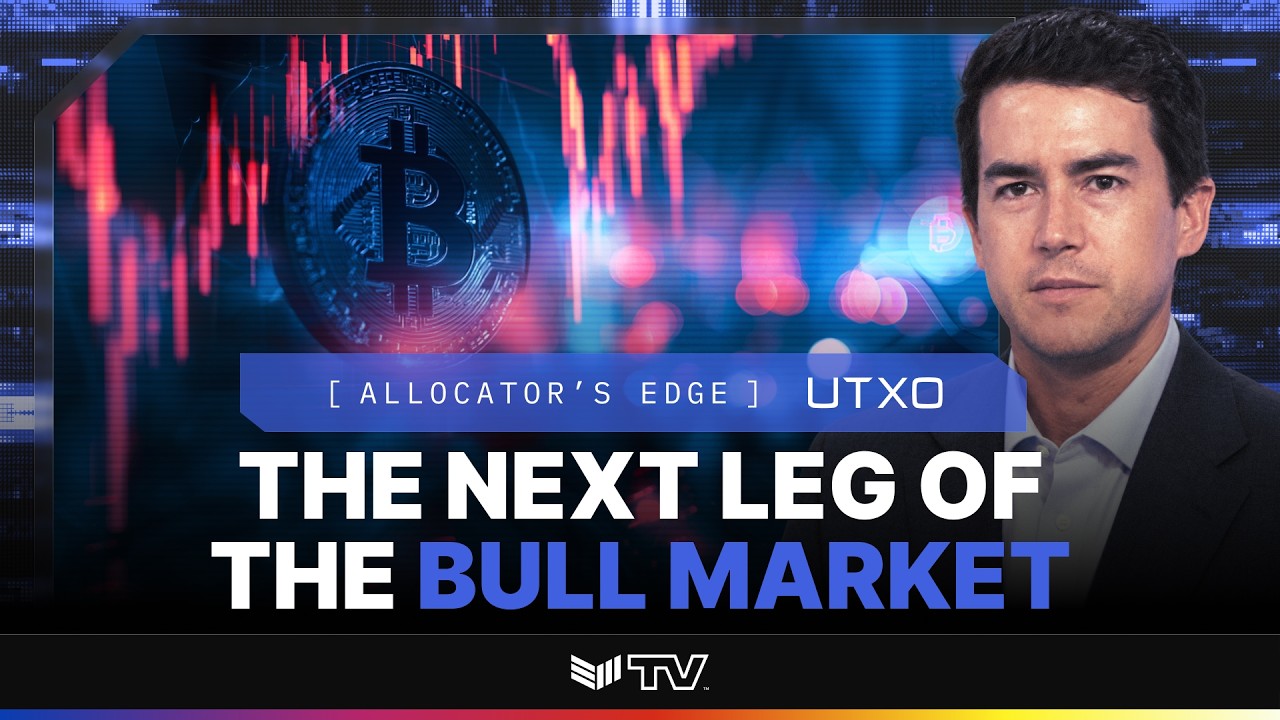
BTC Market & Institutional Adoption Forecast with UTXO’s Daniel Hinton
“Bitcoin plays on hard mode.” Daniel Hinton spent years managing global liquidity relationships at SFOX, and he explains why a 24/7 global market with no clearinghouse outside the blockchain itself is so hard to keep efficient. He describes the multi-percentage-point dislocations that were routine between exchanges in 2018, why they’ve largely disappeared, and how the recent BitMEX wind-down still produced a perp market wick above $150,000 on thin liquidity. Hosts Grace Remington and Sean Hagan dig into what that means for anyone running margin or stop losses.
Chapters:
00:00 — Where the Most Sophisticated Bitcoin Capital Is Going Right Now
01:41 — Exchange Dislocations, OTC Desks, and Why Bitcoin Plays on Hard Mode
03:18 — The BitMEX Wind-Down and a Perp Wick Above $150,000
04:01 — Why Custody Is Back on the Underdeveloped List
05:30 — Building the UTXO Oracle for a Market With No Single Price
07:25 — Running Free Open Source Price Software Next to Your Node
08:21 — Sustainable Balance Sheets Versus Pure Leverage
10:20 — Hunting Dislocated Assets Across a Dozen Global Markets
12:02 — What Has to Be Built for Institutional Mandates to Allow Bitcoin
14:18 — Rounded Bottoms, the Honey Badger, and Resistance Priced in Gold
This video is for informational purposes only and does not constitute an offer to sell or a solicitation of an offer to buy any securities. Past performance is not indicative of future results. Investments in digital assets involve significant risk and may result in loss of capital. Both UTXO Management and BTC Inc., producer of BMTV, are owned by Nakamoto Inc. (NASDAQ: NAKA)
DISCLAIMER: The views and opinions expressed in this show are those of the participants and do not necessarily reflect the official policy or position of BTC Inc., Bitcoin Magazine, or any affiliated entities. This content is provided for informational and educational purposes only and should not be construed as investment, legal, tax, or accounting advice. Nothing contained in this show constitutes a solicitation, recommendation, endorsement, or offer to buy or sell any securities or financial instruments. Viewers should consult their own advisors before making financial or business decisions.
This post BTC Market & Institutional Adoption Forecast with UTXO’s Daniel Hinton first appeared on Bitcoin Magazine and is written by Patrick Green.
Bitcoin Magazine
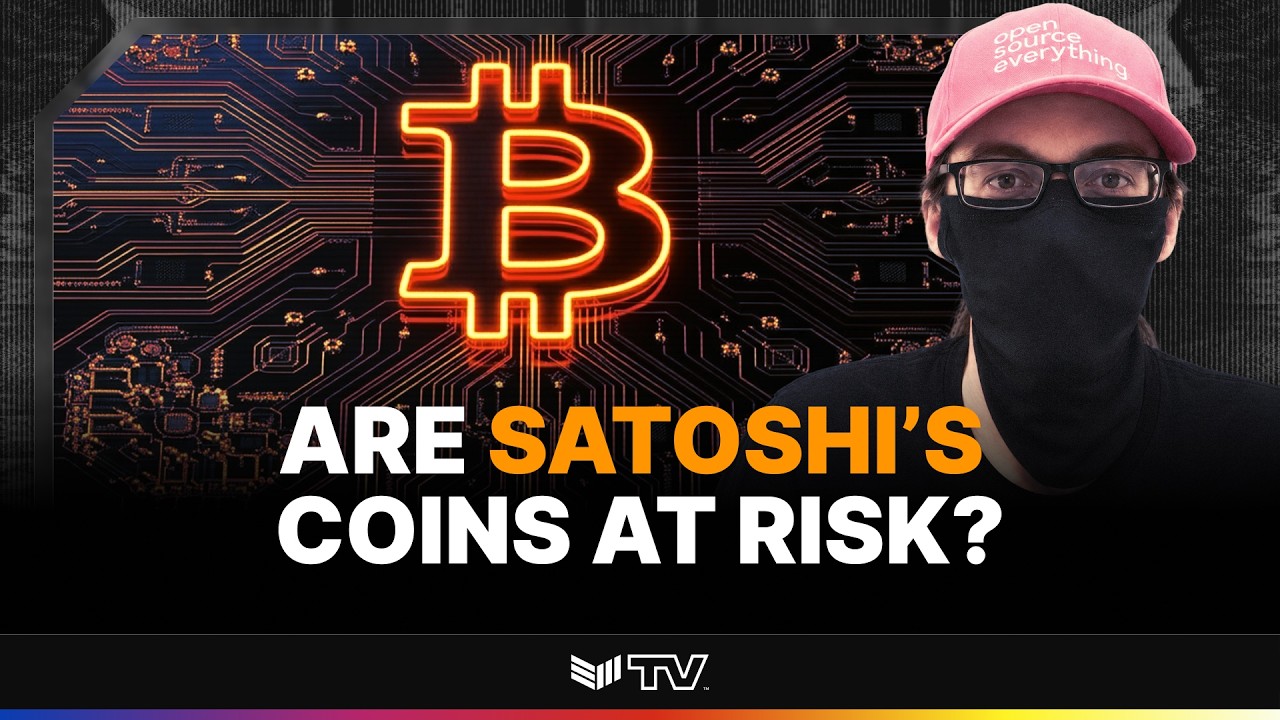
Assessing the Quantum Threat to Bitcoin w/ Shinobi
The quantum threat to Bitcoin is no longer purely theoretical, so what would an actual attack look like on chain? Bitcoin Magazine technical editor Shinobi says you likely wouldn’t get much warning, just movement people slowly realize is illegitimate, either a fast grab at major exchanges and the ETFs or a quiet drain of Satoshi-era coins moved in chunks. In this conversation with Grace Remington and Sean Hagan, he breaks down the real exposure numbers and why an attacker’s motivation determines everything about how it plays out.
Chapters:
00:00 — What a Quantum Attack on Bitcoin Would Look Like On Chain
01:19 — Whether an Attacker Wants Profit or Wants to Cause Damage
01:52 — How Many Coins Are Vulnerable and How Fast They Could Move
03:07 — Why Exchanges Would Be Negligent Not to Migrate Immediately
03:57 — The Assumption That Dormant Coins Are Lost Coins
05:00 — Migration, Satoshi’s Coins, and the Coins That Won’t Move
06:35 — Post-Quantum Signature Work and Taproot Optionality
07:58 — Three Things That Put You in Control of Your Exposure
09:25 — Why Consensus Changes Wait for Audits
10:11 — Inside Bitcoin Magazine’s Quantum Issue and Its Contributors
DISCLAIMER: The views and opinions expressed in this show are those of the participants and do not necessarily reflect the official policy or position of BTC Inc., Bitcoin Magazine, or any affiliated entities. This content is provided for informational and educational purposes only and should not be construed as investment, legal, tax, or accounting advice. Nothing contained in this show constitutes a solicitation, recommendation, endorsement, or offer to buy or sell any securities or financial instruments. Viewers should consult their own advisors before making financial or business decisions.
This post Assessing the Quantum Threat to Bitcoin w/ Shinobi first appeared on Bitcoin Magazine and is written by Patrick Green.
Bitcoin Magazine
Dave Weisberger on Why Bitcoin FOMO Hasn’t Even Started Yet
Bitcoin’s biggest remaining unlock isn’t an ETF or a treasury company it’s collateral treatment. Dave Weisberger, co-founder of CoinRoutes, explains that the haircut banks face on Bitcoin is close to 100%, and that once it’s treated like any other asset based on volatility and liquidity, everything changes for lenders and for companies like Strategy Inc (formerly MicroStrategy). He calls it the final boss, and notes the Basel committee and rulemakers have all described it as inevitable without it actually happening yet. In this conversation with Grace Remington and Sean Hagan, he also covers tokenization, Hyperliquid, and the Fed.
Chapters:
00:00 — Why Every Asset Gets Tokenized and Wall Street Is Backing It
02:00 — Bitcoin, Gold, and Equities as One Global Liquidity Pool
03:53 — Hyperliquid’s Rise and the Appeal of Controlling Your Own Assets
05:27 — Perpetual Swaps, Segregated Accounts, and What Liquidations Really Mean
06:39 — Waves of Disruption From Program Trading to Citadel and Jane Street
08:06 — Tokenized Stocks, Walled Gardens, and the Open Source Alternative
10:05 — Why Every 25 Basis Points Adds $100 Billion to the Deficit
13:19 — Why ETF Money Lowered Bitcoin’s Volatility
15:24 — Covered Call Replacement Buying and Why FOMO Hasn’t Started
18:18 — Bitcoin as an Asymmetric Option and the Pristine Collateral Problem
DISCLAIMER: The views and opinions expressed in this show are those of the participants and do not necessarily reflect the official policy or position of BTC Inc., Bitcoin Magazine, or any affiliated entities. This content is provided for informational and educational purposes only and should not be construed as investment, legal, tax, or accounting advice. Nothing contained in this show constitutes a solicitation, recommendation, endorsement, or offer to buy or sell any securities or financial instruments. Viewers should consult their own advisors before making financial or business decisions.
This post Dave Weisberger on Why Bitcoin FOMO Hasn’t Even Started Yet first appeared on Bitcoin Magazine and is written by Patrick Green.
Bitcoin Magazine
Bitcoin Investors Buy Nearly $1B in BTC ETFs as Bull Market Returns
The Bitcoin bulls are back — if ETF flows are to be believed.
U.S. bitcoin exchange-traded funds received $999 million in new investment on Monday, according to Farside Investors data.
That’s the most in one day since October 6, when the funds received over $1.2 billion and the price of the leading cryptocurrency hit a new all-time high of $126,080.
Bitcoin’s price recently stood at $86,552 after scraping $87,330 on Monday. Over the past seven days, the coin’s price has surged by nearly 13%.
Bitcoin ETFs in the U.S. — approved by the SEC in 2024 — have helped investors get exposure when they couldn’t before. Now, Wall Street firms can quickly buy shares of funds managed by the likes of BlackRock, Fidelity, Morgan Stanley, and others.
When big investment hits the funds, the price often moves significantly — as what happened on Monday.
Bloomberg ETF analyst James Seyffart on Monday said that the average ETF buyer is now in profit after the estimated ETF cost basis surged above $81,72 for the first time since January.
The ETF to receive the most of Monday’s investment — $381.4 million — was BlackRock’s iShares Bitcoin trust. The ARK 21Shares Bitcoin ETF received $289.1 million; Fidelity’s Wise Origin Bitcoin Fund took in $238.8 million.
Investors have a renewed interest in Bitcoin after the artificial intelligence stock rally cooled and the U.S. Department of the Treasury in August said it would at least double the size of its liquidity-support buyback operations.
Analysts said the move pushed 30-year Treasury yields down, weakened the dollar, and made assets like bitcoin more attractive. Following the announcement, the bitcoin price had its best run in years.
A Tuesday report from crypto market data firm CryptoQuant said that the leading cryptocurrency crossed above its 365-day moving average, a signal that the asset has finished being in a bear market.
This post Bitcoin Investors Buy Nearly $1B in BTC ETFs as Bull Market Returns first appeared on Bitcoin Magazine and is written by Mathew Di Salvo.
CryptoSlate
Bitcoin exchange-traded funds (ETFs) have erased their 2026 flow deficit after a sharp buying revival, even as the top crypto struggles to hold its latest gains.
Data from SoSoValue shows that the US-listed funds have attracted more than $1.7 billion in fresh capital this week, with the products drawing $999 million on Sept. 21 and $715 million on Sept. 22.
At the current pace, the funds are positioned to surpass their strongest inflow week of the year, when they drew about $1.92 billion during the week ended Aug. 21.
BlackRock has captured a disproportionate share of the latest demand, with its iShares Bitcoin Trust (IBIT) attracting roughly $1.02 billion over four trading sessions, according to Arkham Intelligence.
ETF buying repairs a $5.7 billion hole
The latest inflows cap a sharp reversal for a market that had accumulated a $5.69 billion year-to-date deficit by July 13.
Askthetape data show roughly $6.04 billion has flowed back into the products since that trough, pushing the annual tally to about $349 million in net inflows. About $3.17 billion of the recovery came during the past 30 days.
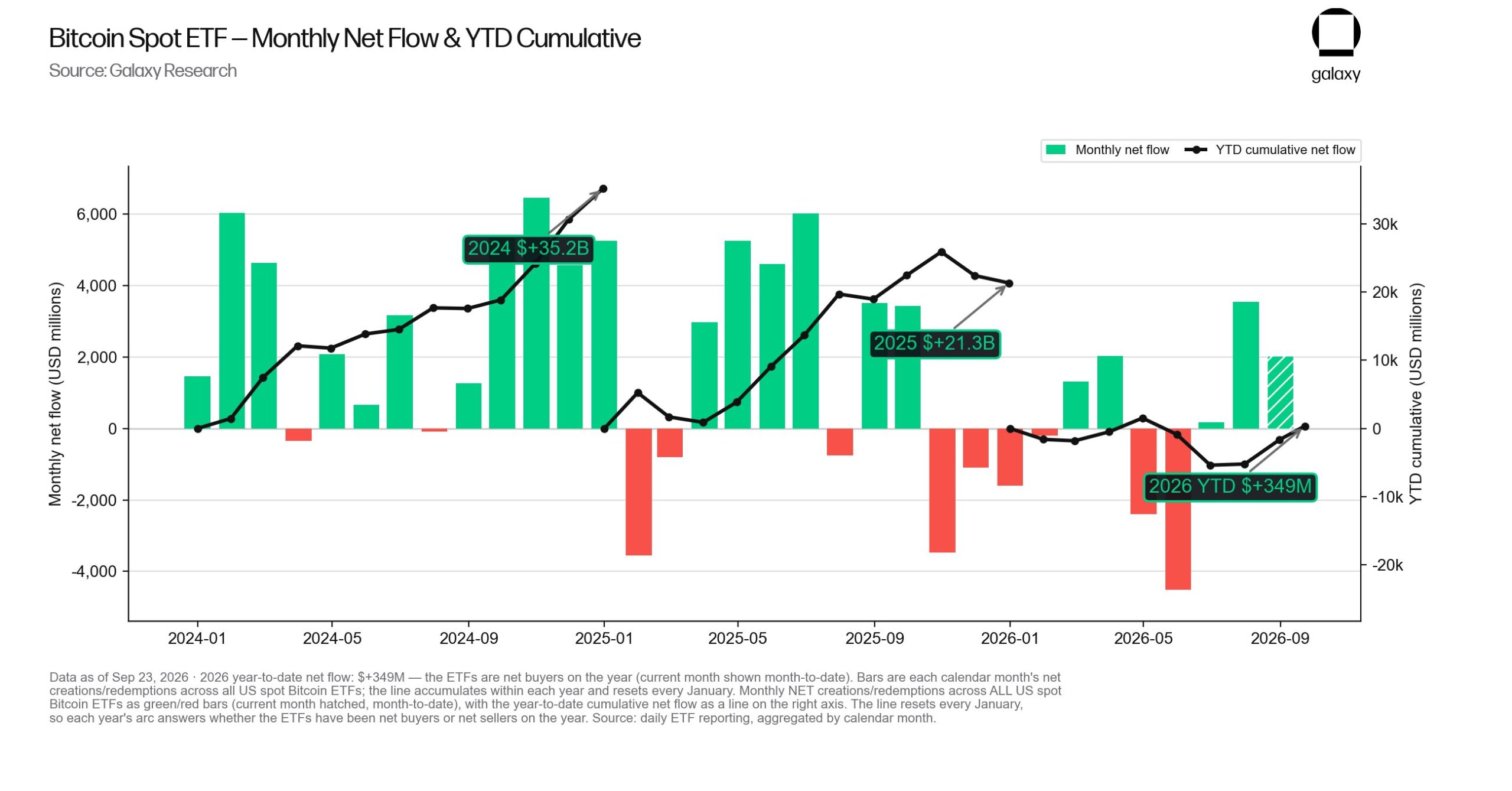
Bloomberg Intelligence ETF analyst Eric Balchunas said the renewed demand began gathering pace in August after Treasury Secretary Scott Bessent signaled increased purchases of longer-dated government bonds, a development some market participants interpreted as evidence of mounting pressure in long-duration debt markets.
Bitcoin has risen about 35% since then, climbing from roughly $64,100 to above $85,000, while the ETFs absorbed about $4.6 billion over the same period, Balchunas said.
The rebound has also repaired losses for investors who spent parts of 2026 holding ETF positions below their purchase price. The average cost basis of Bitcoin held through the funds is estimated near $82,000, leaving the cohort back in unrealized profit with BTC trading above $85,000.
That marks a clear shift from July, when persistent redemptions were adding pressure to an already weak market. ETF investors are now increasing exposure after a roughly one-third rally, with fresh creations arriving as Bitcoin trades near eight-month highs.
Profit-taking absorbs the ETF bid as Bitcoin slips below $85,000
That stronger demand helped push Bitcoin as high as $87,265 over the past 24 hours, but the rally has since lost momentum. Data from CryptoSlate shows the cryptocurrency traded at $84,589 as of press time as investors increasingly took profits in the advance.
CryptoQuant data show short-term holders sent about 47,600 BTC held at a profit to exchanges as Bitcoin approached $88,000, one of the largest spikes in the series. At prices near $85,000, the coins were worth more than $4 billion, highlighting the scale of potential supply moving toward trading venues as ETF demand accelerated.
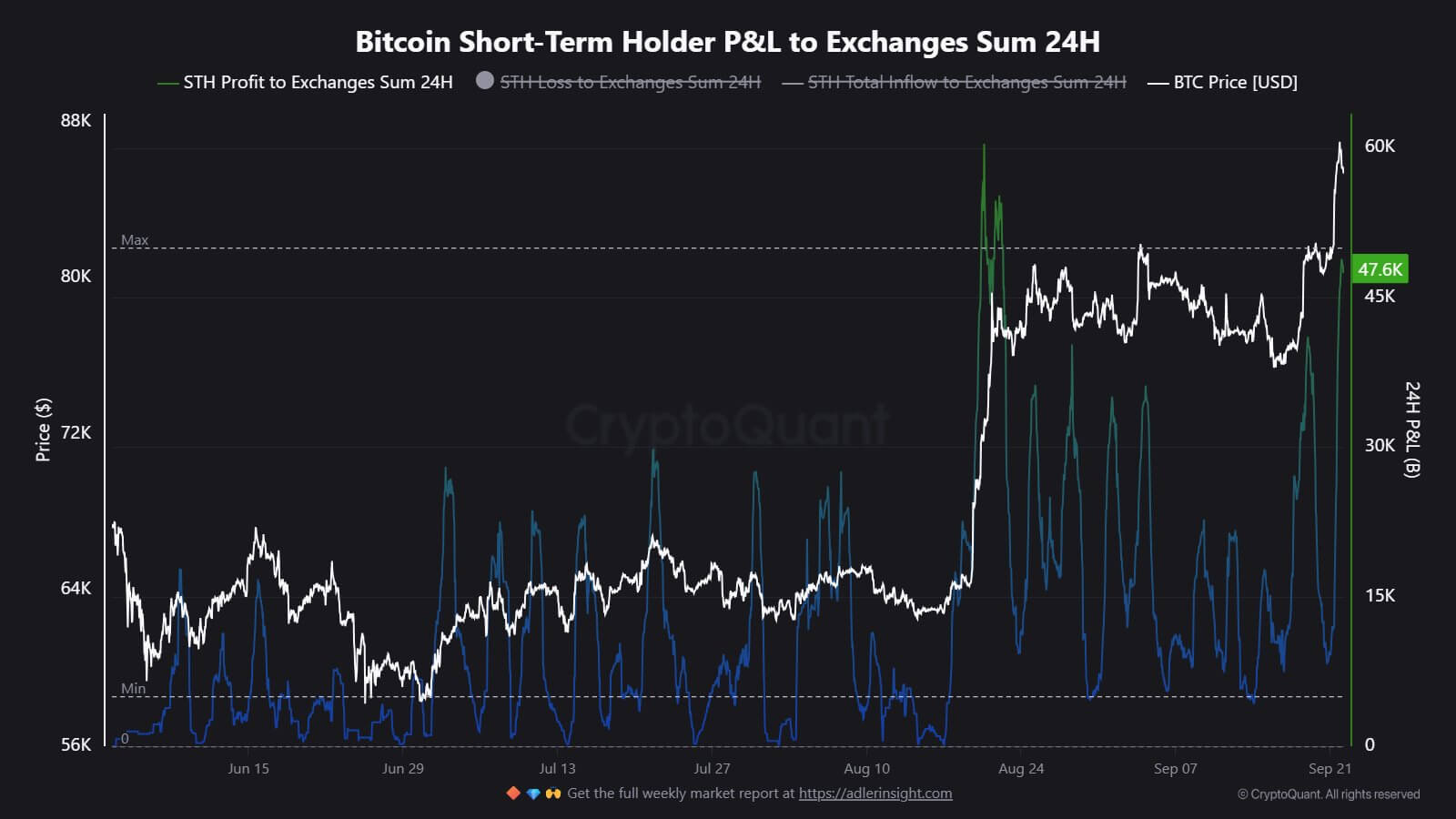
Exchange deposits do not mean every transferred coin was sold. Still, the surge shows that profitable short-term holders became considerably more active around the local high.
That supply helps explain why more than $1.7 billion of ETF inflows this week has not produced an uninterrupted advance. Fresh institutional money continues to enter through the funds, while investors who accumulated Bitcoin at lower prices are using the rebound to lock in gains.
However, Santiment warned that strong ETF demand could itself become a source of caution.
The analytics firm said unusually large ETF inflows have repeatedly clustered around local market turning points, as investors tend to chase exposure after Bitcoin has already made a substantial move. The latest surge fits that pattern, with ETF demand reaching an extreme after Bitcoin climbed about 35% over the past month.
Santiment stressed that such inflows do not guarantee an immediate reversal. Strong buying can continue to carry prices higher, but past episodes suggest exceptionally large creations can coincide with rising euphoria and leave the market more vulnerable once marginal demand begins to fade.
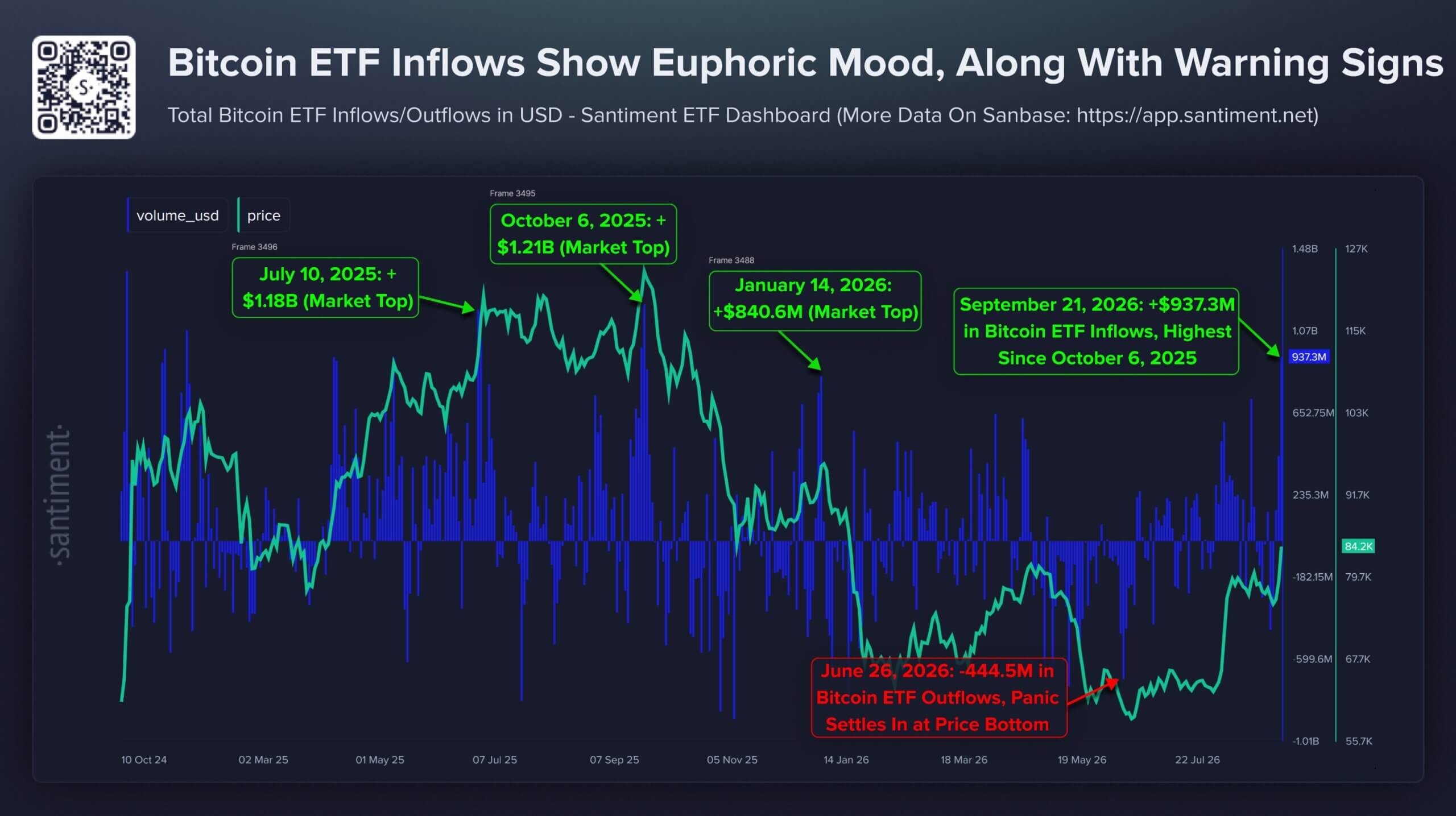
That risk is now developing alongside heavier profit-taking. Bitcoin’s rally has returned the average ETF investor to unrealized profit while also giving short-term holders acquired at lower prices an opportunity to distribute coins into strength.
Continued ETF creations would give the market more capacity to absorb that supply. A slowdown in fund demand while short-term-holder exchange deposits remain elevated would leave Bitcoin increasingly reliant on other spot buyers to sustain a rally that has already brought a large share of recent investors back into profit.
The post Bitcoin ETFs just erased a $5.7 billion hole, but profit-taking is swallowing the new demand appeared first on CryptoSlate.
Solana has begun rolling out Alpenglow on testnet, moving its planned blockchain consensus overhaul into a public testing environment.
The upgrade targets finality of about 150 milliseconds, down from roughly 12.8 seconds under TowerBFT, the system Solana validators currently use to agree on blocks. Alpenglow replaces that consensus layer while leaving the Solana Virtual Machine, transactions, programs, and fees unchanged.
Its first phase introduces Votor, which replaces the vote transactions validators currently put onchain with votes sent directly between validators. Those votes are combined into certificates that can finalize a block within one or two voting rounds, cutting the wait for an irreversible transaction by about 99%.
Anza, the developer behind Solana’s Agave validator software, said that testnet was entering the rollout process, ahead of deployments on devnet and eventually mainnet-beta. The migration builds on months of preparation across validators and infrastructure providers, which must adjust systems that stream blocks, track votes, or rely on Solana’s existing commitment structure.
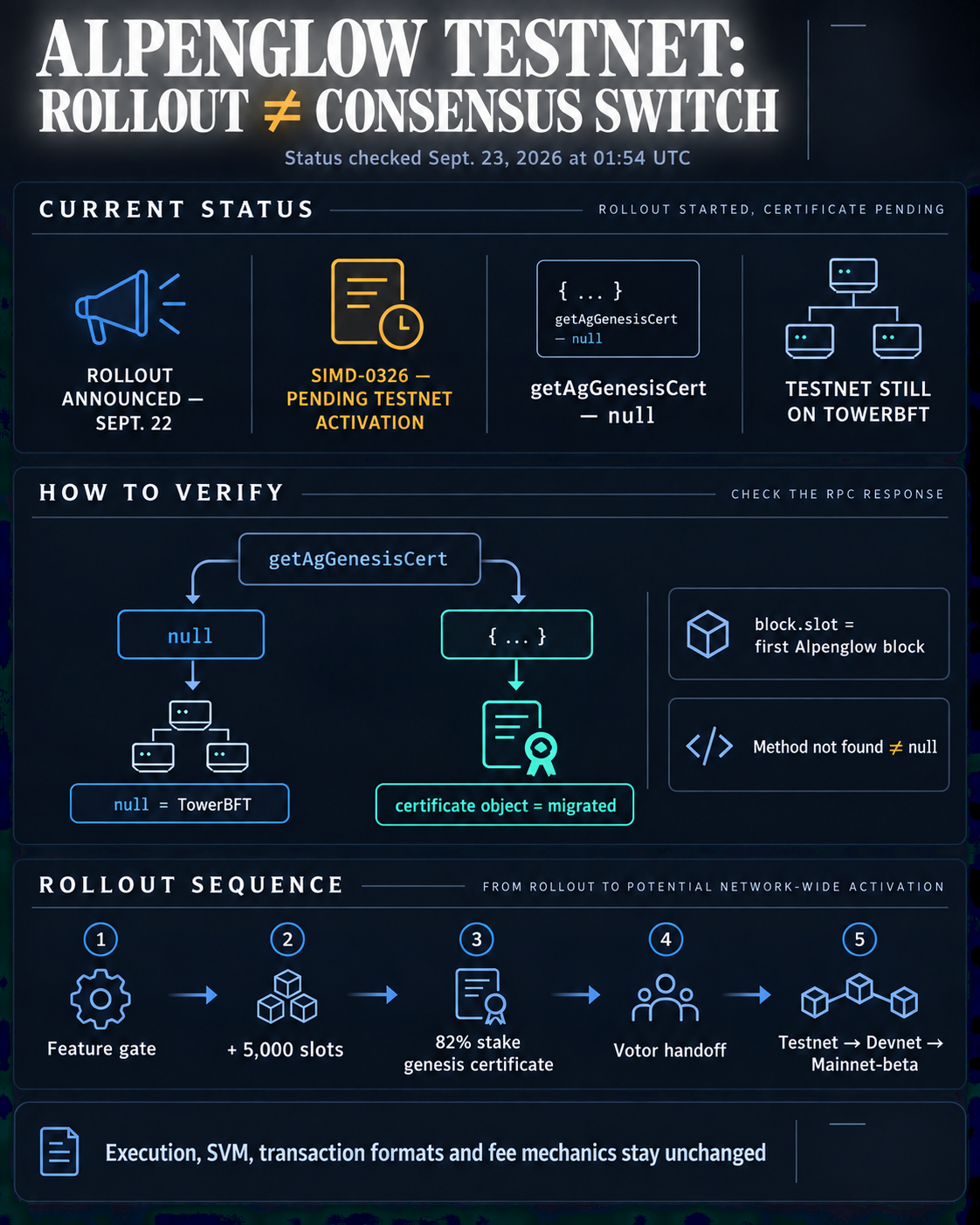
Alpenglow will later add Rotor, a replacement for Turbine, Solana’s system for distributing block data across the network. Rotor is scheduled separately, leaving Votor and faster finality as the rollout's immediate focus.
The consensus overhaul follows another wave of performance upgrades. Solana activated Transaction V1 this month, lifting maximum transaction size to 4,096 bytes from 1,232, while its slot-time roadmap has progressively cut the target from 400 milliseconds toward 200 milliseconds.
SOL approaches January levels as network activity expands
The technical push is arriving alongside a recovery in SOL and expanding activity across several parts of the ecosystem.
SOL traded around $117 as of press time after reaching almost $120 this week, putting the token around its strongest level since late January. It has gained roughly 25% over the past month, CryptoSlate's data shows.
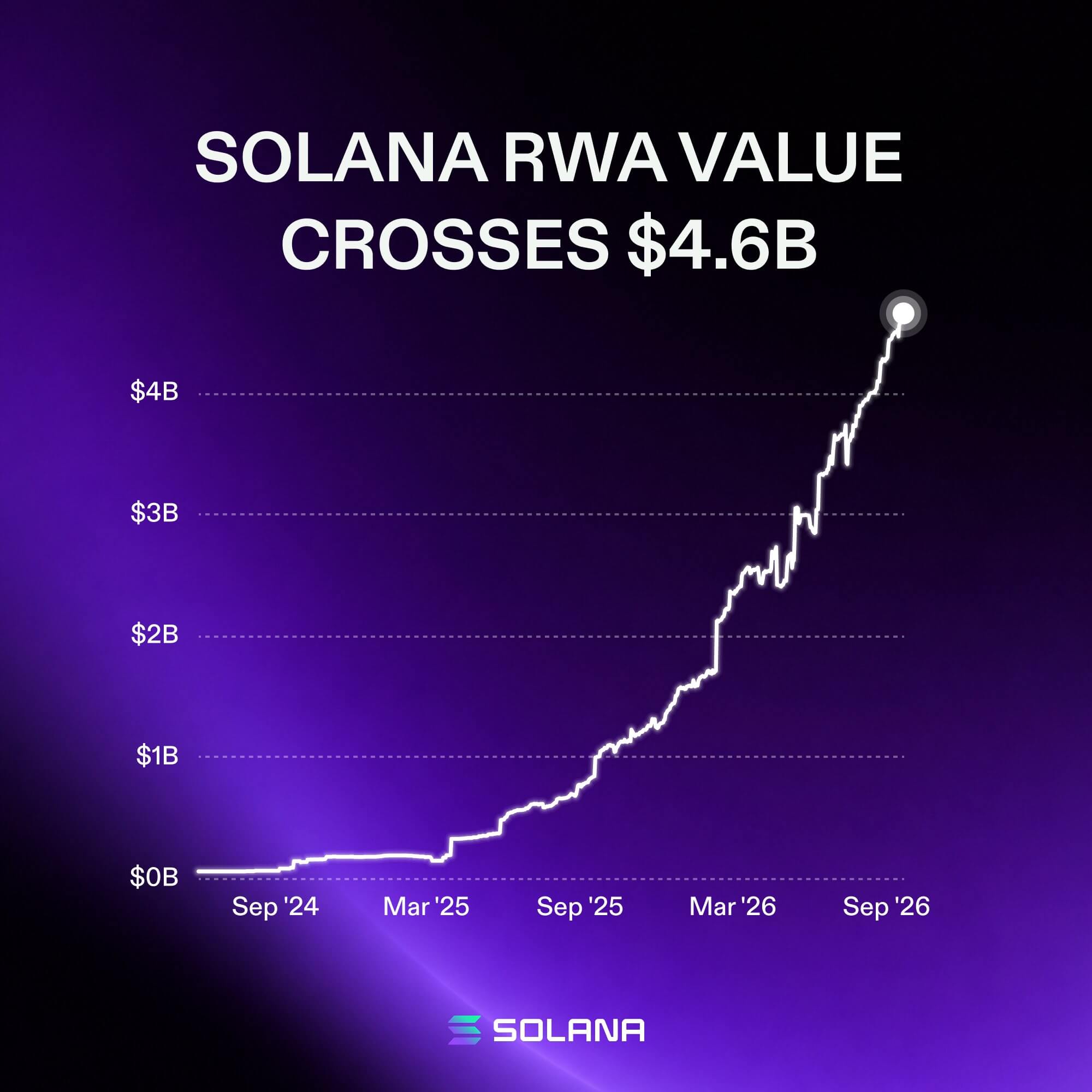
Solana has also been drawing more tokenized traditional assets. Real-world assets on the network reached about $4.6 billion in early September, extending a climb that took the sector through $4 billion for the first time in August.
Trading activity has accelerated alongside it. Solana decentralized exchanges recorded about 208 million individual spot trades in the week ending Sept. 13, compared with roughly 190 million on the New York Stock Exchange, according to data cited by the Kobeissi Letter. The gap with Nasdaq narrowed to about 47 million trades. Jupiter accounted for more than 80 million trades during September, up 38% from the previous month.
That growth has strengthened an increasingly aggressive investment case from some of Solana’s longtime backers. Multicoin Capital co-founder Kyle Samani reportedly said that he expects SOL’s market capitalization to surpass Ethereum's during the current market cycle, arguing that developers are increasingly choosing Solana and pointing to its recent lead over Ethereum in network fees.
The gap remains substantial: Samani’s comparison put Solana near $58 billion against about $293 billion for ETH.
For Solana, the more immediate test now moves back to the network itself. Testnet gives validators and infrastructure providers the first broad environment to run Alpenglow before the consensus system advances to devnet and, ultimately, the mainnet that will carry Solana’s growing trading and tokenized-asset economy.
The post Solana moves Alpenglow into testnet as SOL nears January highs appeared first on CryptoSlate.
In the markets Talos tracked, daily volume in RWA perpetual futures tied to equities, commodities and indices rose from less than $1 billion in January to $18.8 billion during Sept. 3-9. That represented 18.5% of futures volume across those venues.
Crypto exchanges built their derivatives businesses around perpetual futures, and the same contract structure now wraps exposure to oil, gold, stocks, indices, and pre-IPO companies.
The Talos data show that crypto-perpetual volume declined over the comparison period while total futures activity in its sample remained roughly flat, with traditional-asset contracts filling the volume gap.
The changing product mix creates a real competitive threat for altcoins. Traders no longer need a new token to find leverage, volatility, or a market that stays open around the clock.
Wallet behavior on Hyperliquid points to mostly separate customer groups, with a smaller group trading across both markets.
Hyperliquid’s traders mostly stay in their lanes
Talos found that traditional asset perps represented 28% of futures volume on Hyperliquid and 24.8% on Binance in its sample. Oil led the weekly increase as Brent crossed $100, showing how crypto venues can capture trading around an event unrelated to cryptocurrency.
CoinDesk Research reported that centralized-exchange volume rose 12.7% month over month to $4.29 trillion in August. Spot increased 18.7%, derivatives rose 11.3%, and traditional-asset perpetual volume increased 2.37% to $602 billion.
Both traditional-asset and crypto activity expanded during that month. Substitution could still occur within a specific venue or account, while the aggregate figures show that the two categories can also grow together.
Hyperliquid's HIP-3 framework lets outside builders deploy markets, including contracts linked to stocks and commodities. DefiLlama divided new wallets into RWA-first and “Other-first” cohorts based on the market of their first Hyperliquid trade.
From Jan. 1 through June 30, DefiLlama classified 169,514 new wallets as RWA-first. They represented 31.7% of new wallets and generated $111.6 billion (31.5%) of the trading volume produced by new users.
The economics of this acquisition cohort differed sharply from its share of activity: RWA-first wallets generated only 8.3% of the main trading fees paid by new users in the study.
RWA-first wallets kept 83.6% of their volume in RWA markets, while Other-first wallets, whose first trade was in crypto or another non-RWA market, sent 22.8% of their volume into RWA markets and produced roughly 40% of RWA-market volume.
| Group | Trading behavior | Reader takeaway |
|---|---|---|
| RWA-first wallets | 31.7% of new wallets, 31.5% of new-user volume | Traditional-asset markets attracted a substantial new cohort, though its capital source remains unknown |
| RWA-first wallets | 83.6% of volume stayed in RWA markets | Most traded primarily in the product category they entered through |
| Other-first wallets | Roughly 40% of RWA-market volume | Existing crypto-platform users crossed into traditional assets, with changes to their crypto positions unmeasured |
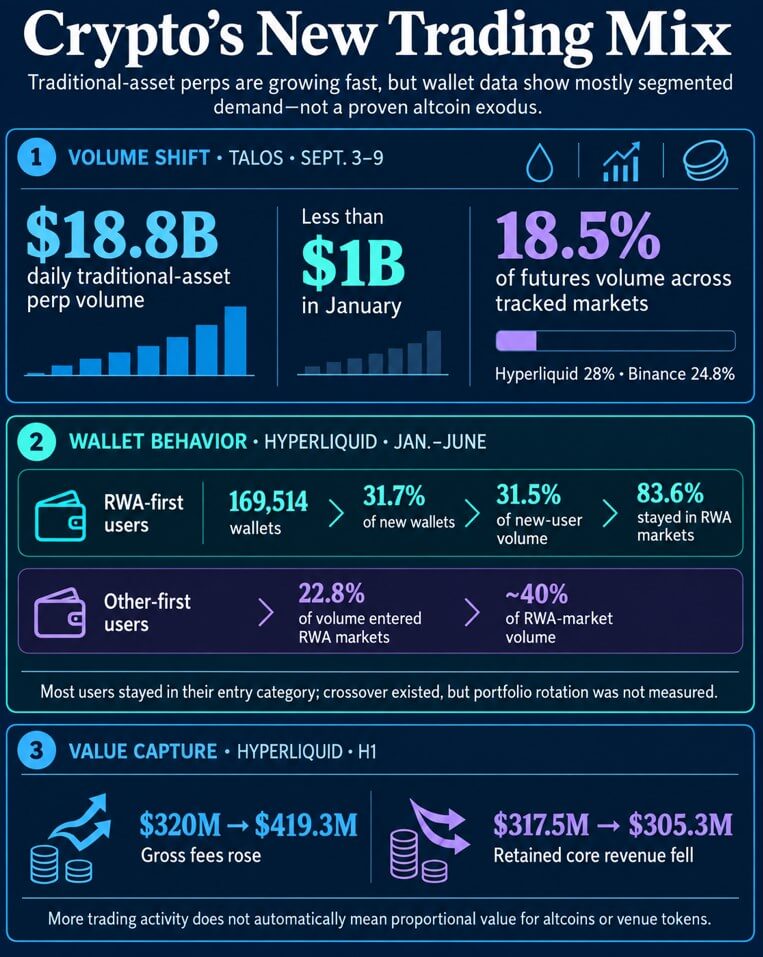
A DefiLlama follow-up found that 80.9% of RWA-first wallets never crossed into the other market, while 82% of Other-first wallets never crossed into RWA markets.
Cross-market activity increased among the most frequent traders who did cross. The user base divides into three broad groups: RWA-first wallets that mostly stay with those products, crypto-first wallets that mostly stay with crypto, and a smaller high-frequency core that treats both as trading opportunities.
Altcoins face a tougher contest for attention
CryptoRank counted 351 new listings across 10 major centralized exchanges in the second quarter, the fewest since the third quarter of 2023. Tokenized assets accounted for 42 additions, while categories associated with the previous speculative cycle lost momentum.
Gate was responsible for 573 removals, nearly 60% of delistings in the first half. MEXC rarely reported delistings and was effectively excluded from that part of the analysis.
Inside CryptoRank's sample, exchange priorities changed as one venue's cleanup dominated removals and reporting gaps limited the cross-exchange picture. RWA trading cannot be blamed for those delistings.
Binance's tokenized-stock figures also show overlap but do not reveal portfolio rotation. Binance Research reported that 58.5% of early bStocks users also used perpetuals, direct equities, or both.
For altcoin holders, the practical risk is competition at the margin. Market makers have finite balance sheets, exchanges have limited promotional capacity, and traders have limited attention. Familiar stocks and commodities now compete with them inside the same apps and collateral systems.
Altcoins have a new competitor for speculative demand. Another example is the HIP-3, which lets outside builders deploy perpetual markets.
Hyperliquid's fee documentation says deployers may retain up to 50% of trading fees generated by their assets. Trading fees directed to the protocol's Assistance Fund are converted automatically into HYPE, Hyperliquid's native token, and the acquired HYPE is burned.
Only a portion of builder-market activity reaches HYPE-related mechanisms. Assistance Fund burns can reduce token supply, while market price still depends on demand, liquidity and the broader market.
Activity and retained economics can move apart
The divergence appeared in first-half figures calculated by 21Shares, which estimated that Hyperliquid's gross fees rose from $320 million in the first half of 2025 to $419.3 million in the first half of 2026. Its measure of core protocol revenue, the fee share flowing back to the platform treasury, fell from $317.5 million to $305.3 million.
Gross fees and core revenue moved in opposite directions as builder-deployed markets captured a larger share of activity.
Crypto perps led the next monthly expansion, as Hyperliquid's total open interest rose from $6.6 billion to $8.8 billion in September. Meanwhile, HIP-3's share declined from 34% to 25%.
Traditional asset trading can fill a crypto-volume gap in one period and grow alongside crypto in another. It can bring in new wallets, give existing users more products, and create fee streams divided among the protocol, builders, and token-linked mechanisms, making exchanges less dependent on crypto's cycles.
For altcoins, the outcome is more ambiguous. Crypto's trading rails can thrive even when demand for the assets that built them grows more slowly.
The post Altcoin demand meets $18B threat as flows move into RWA perps as just 19% of traders keep alts appeared first on CryptoSlate.
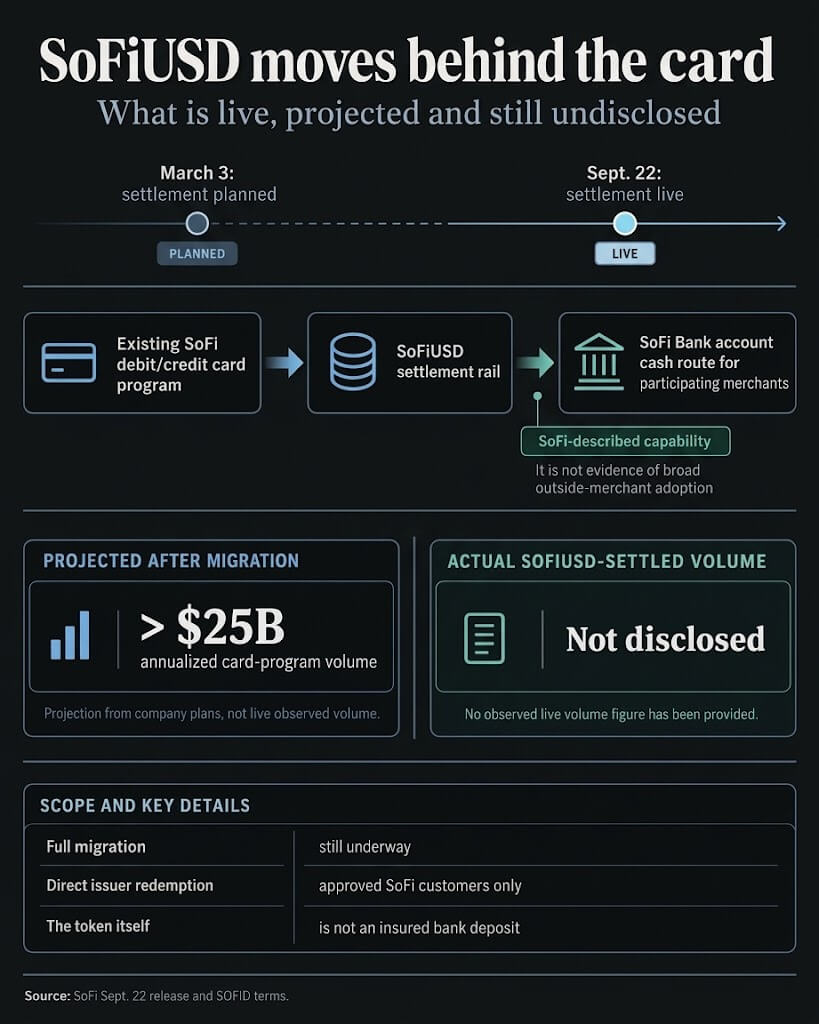
SoFi Bank and Mastercard have announced SoFiUSD settlement is live for the bank's debit and credit card program, moving their March plan into production.
The rollout puts a token-based settlement route behind familiar card payments and, according to SoFi, gives participating merchants a way to receive dollars in a bank account without holding the token. SoFi expects more than $25 billion in annualized card-program volume after migration; it has not disclosed how much has actually settled in SoFiUSD.
The migration remains underway. Cardholders can keep using existing cards, while SoFi describes a bank-account cash route for merchants and separate redemption rules for token holders. Those groups encounter different parts of the arrangement, so a live blockchain transaction alone says little about the scale of merchant benefit or token-holder access.
From a planned rail to live settlement
The March partnership announcement described SoFiUSD settlement as a future option. The companies' September release says transactions are now occurring on a blockchain for SoFi Bank's card program. The full-program migration is still in progress, and SoFi has not given a completion date.
SoFi expects the program to process more than $25 billion annually using SoFiUSD after that migration. The figure is a projection of card activity at an eventual run rate. SoFi has not disclosed the amount or share of transactions already settled in the token. That missing denominator prevents readers from treating the projected program size as the stablecoin's observed throughput.
The token operates behind cards people already carry. SoFi says merchants need no stablecoin holdings or new infrastructure to use its proposed route, and the companies describe no requirement for consumers to acquire crypto at checkout. The visible card payment and the settlement path can therefore change on different schedules.
For merchants, the useful measure is when settlement becomes spendable cash. The September release offers no measured before-and-after comparison of that timing or of cost for this program. A working transaction establishes operating status; merchant-level results would establish the economic effect.
SoFi says businesses using its Big Business Banking platform can receive settlement funds immediately in a SoFi Bank account and access cash around the clock without holding SoFiUSD. That is the bank's product claim. The September release names no live outside merchant settlement customer and says discussions with large US merchants continue. Its April platform announcement described business deposit accounts, continuous fiat and token transfers, and mint-and-burn conversion as capabilities the platform would include.
In the arrangement SoFi describes, the merchant's usable balance is held in a bank account while the stablecoin moves value through settlement. That division could spare a business from managing a token wallet. Actual outside-merchant use and measured cash-availability gains would show how far the capability extends beyond SoFi's own card program.
Account dollars and token rights
A merchant paid into a bank account and a party receiving SOFID on-chain hold different claims. The issuer's redemption and risk terms govern the token holder; the card transaction itself does not make the shopper or merchant a direct redemption customer.
SoFi Bank, a nationally chartered bank regulated by the Office of the Comptroller of the Currency, issues SoFiUSD and describes it as intended for one-for-one dollar redemption. Under SOFID's terms, direct redemption is available only to approved SoFi customers with separate agreements, subject to conditions and fees. Receiving the token on-chain does not transfer that issuer claim. The terms also allow delays or suspensions under specified conditions.
Bank deposits and tokens carry different protections. SoFi's product disclosure says SoFiUSD itself is not a deposit, lacks FDIC and SIPC insurance and may be subject to delay, disruption or permanent loss. A bank-account payout may be useful precisely because the merchant can receive dollars without taking those token-holder risks.
The reserve terms add another distinction. SoFi's September release describes the token's reserves as primarily cash. The issuer's terms also permit cash equivalents and other legally allowed liquid instruments, with no fixed composition promised at every point. The release describes the backing policy but provides no point-in-time reserve breakdown.
The terms also exclude people and entities located in, resident in or subject to UK or European Economic Area laws from acquiring, holding, transferring or using SOFID. Token eligibility and ordinary card acceptance follow different rules. That restriction concerns token participation; it does not establish a ban on card purchases in those markets.
The scale the networks can actually show
Mastercard outlined a broader settlement menu in June: regulated stablecoins alongside additional fiat timing options. It said USDC had supported early on-chain settlement in select markets and named Paxos-issued coins, RLUSD and SoFiUSD for planned support across multiple networks. SoFi's launch puts one bank-issued coin into use within that wider strategy. Mastercard has not disclosed the eventual traffic share of each token or said every planned pairing is live.
Visa offers a separate measure of scale. It reported on Sept. 8 that stablecoin settlement volume had recently exceeded a $20 billion annualized run rate. That reported run rate tracks stablecoin settlement activity. SoFi's projected figure covers future annualized card-program volume after migration, so the two figures cannot rank the networks' current stablecoin settlement volumes.
SoFi and Mastercard have moved a named bank-issued stablecoin from a proposed card-settlement option to a live one. The next evidence that would establish its wider consequence is actual token-settled volume, outside-merchant adoption and measured access to spendable cash. Until those results are disclosed, the working route is clearer than its commercial scale.
The post Why Mastercard’s $25 billion crypto expansion isn’t what it seems appeared first on CryptoSlate.
EU rules require stablecoins issued by electronic-money institutions to keep at least 30% of their reserves in commercial-bank deposits, rising to 60% for significant tokens. Britain's policy for systemic sterling stablecoin reserves excludes those deposits from coin backing. European central banks now want to remove the EU requirement, bringing the two approaches closer on the risk banks pose to stablecoin reserves.
Reuters reported on Sept. 22 that the European System of Central Banks, comprising the European Central Bank and EU national central banks, recommended replacing the compulsory bank-deposit share under the Markets in Crypto-Assets regulation with minimum reserve percentages in assets maturing within one and five working days. The proposal would change where issuers must keep redemption money; MiCA's existing requirements remain in force.
The same day marks the Bank of England's consultation deadline for its draft systemic stablecoin Code of Practice. Its June policy already ruled out commercial-bank backing because of financial, operational and contagion risks. The Bank intends to finalize the code by the end of 2026.
The regimes cover different types of issuer and are at different stages of implementation. Yet the recommendation points toward a shared concern: putting stablecoin reserves in banks can connect two sources of financial stress.
A stablecoin reserve can protect a coin and expose a bank
MiCA's deposit requirements make commercial banks part of the mechanism for meeting redemptions. Cash that backs a token also becomes funding for the bank where the issuer holds it, tying the coin's ability to repay holders to that bank's ability to return the money.
The problem runs in both directions. In a June speech, the ECB explained that bank failure can damage confidence in the quality and availability of stablecoin reserves. USDC's March 2023 loss of its peg, when some backing sat at failing Silicon Valley Bank, illustrated that exposure.
Reverse the sequence and the risk moves into the banking system. If holders rush to redeem a stablecoin, the issuer may withdraw large deposits from its banks to repay them. Money held as a reserve for token holders becomes funding that a bank can lose abruptly.
The reserve can therefore transmit a run as well as help meet one. An issuer's attempt to honor its promise to token holders can force its banks to replace funding at precisely the moment confidence is weakening.
The recommendation reported by Reuters would focus requirements on short-maturity assets. Its proposed relaxation of a compulsory bank allocation differs from Britain's outright exclusion of commercial-bank backing.
The Bank of England's steady-state policy allows up to 70% in short-term UK government debt with no more than six months remaining to maturity, with 30% in central-bank deposits that pay no interest. Eligible issuers deemed systemic at launch can initially hold up to 95% in government debt as they scale.
Central-bank deposits give the UK model a different source of redemption cash, alongside its securities holdings.
The regime primarily covers sterling stablecoins widely used in payments, jointly regulated by the Bank and Financial Conduct Authority after Treasury recognition. CryptoSlate covered the June policy when it was announced, ahead of the consultation ending today.
There is a reason to retain a substantial cash buffer. An ECB analysis of sovereign-bond markets argues that significant stablecoins issued by electronic-money institutions could meet redemptions equal to 60% of supply by drawing down deposits, without immediately selling sovereign bonds.
That benefit depends on the deposits being available. It nevertheless captures the trade-off: avoiding commercial-bank credit exposure can leave issuers needing to turn securities into cash when holders want repayment. Even short-dated securities can fluctuate in value or prove difficult to turn into cash under stress.
Britain's policy includes financial risk reserves and a planned central-bank liquidity backstop. Those protections address the difficulty of producing redemption cash under stress, when securities must be sold or financed to meet withdrawals.
For EU issuers, the next decisive step would be a change to MiCA's statutory floors. Removing the floors requires legislative amendment through the EU's lawmaking process. Until then, the deposit requirements remain the operating constraint.
For token holders, the comparison exposes what a stablecoin reserve percentage cannot answer by itself: whether the backing remains accessible, and how quickly it can become cash when redemptions accelerate.
The post Europe’s central banks want to scrap this stablecoin reserve safeguard appeared first on CryptoSlate.
CryptoTicker.io
If you hold FET, AGIX or NTX, two things need to be kept apart right now. The tokens in your own wallet were not attacked. What was attacked is the bridge used to convert legacy AGIX holdings into FET. That conversion has been frozen since September 19, and anyone who still has it ahead of them cannot get through at the moment.
On the evening of September 19, 2026, the TokenConversionManagerV3 contract on Ethereum was drained of its entire FET liquidity. In the hours that followed, the same address minted hundreds of millions of new tokens belonging to three further projects. Here is the sequence, with the figures that can be evidenced, and what it means for you as an investor in Germany.
What happened in TokenConversionManagerV3 on September 19
The TokenConversionManagerV3 is the Ethereum side of the official SingularityNET bridge. A token bridge is a contract that collects tokens on one chain and releases a matching amount on the other. This bridge connected Ethereum with Cardano and also served to swap legacy AGIX holdings into FET.
According to the available on-chain analysis, a single call to the conversionIn function went through at 20:21:47 UTC in block 26,013,913, paying out 8,721,530.40 FET to an address controlled by the attacker. Depending on the source, the value is put at roughly $1.53 million to $1.55 million. Less than half an hour later, at 20:50:11 UTC, came the minting of 408.53 million NTX, the token of the NuNet project, with a reported value of about $462,730.
One point matters for the interpretation: no wallet was cracked here and no seed phrase was harvested. The attacker used a valid authorisation signature. Analytics firm SlowMist concludes that the infrastructure's signing keys had been compromised.
Why a single signature was enough: the flaw in conversionIn()
The technical core is quickly told and worth understanding, because it recurs across bridges. On SlowMist's analysis, the conversionIn() function accepted the signature of a single external account as sole authorisation. An external account, an Externally Owned Account or EOA in the jargon, is an ordinary address with exactly one private key behind it. Whoever holds that key is, as far as the contract is concerned, the legitimate counterparty.
A second point is what made the damage large: the counterpart function conversionOut() checks an amount limit, and conversionIn() did not. There was therefore no ceiling to cap any single call. A compromised key plus a missing amount check add up to a drain in one step.
The comparison with earlier cases is close at hand. In the two perp DEX incidents on Arbitrum over the summer, the decisive question was likewise who holds the keys, rather than whether a protocol calls itself decentralised. A single trust assumption is enough to bring an otherwise cleanly built system down in one move.
Unauthorised minting: 408m NTX, 260m AGIX, 53.8m WMTx
On September 20 the incident widened. According to PeckShield, the same address additionally minted 260 million AGIX and 53.838 million WMTx on Ethereum. WMTx is the token of World Mobile Chain; the project has confirmed that WMTx was minted without authorisation via the SingularityNET bridge.
PeckShield put the attacker cluster's holdings at about $16.77 million as of 09:21 UTC on September 20. The breakdown on that analysis: roughly 198.3 million AGIX worth about $14.42 million, 649 Ether worth about $1.67 million, and 33.538 million WMTx worth about $627,350. An analysis by Bitquery the same day, at 17:20 UTC, arrived at roughly 2.3 billion units created without authorisation across AGIX, NTX, CGV and WMTx combined.
The gap between the two figures is not a contradiction but a question of what is being measured. The $16.77 million is a market value at a point in time; the 2.3 billion is a unit count. And a unit count out of nowhere means the same thing for every existing holder: the share their stack represents of total supply has shrunk overnight.

What Fetch.ai halted: AGIX-to-FET conversion and the Ethereum bridge
By its own account, Fetch.ai flipped two switches. First, the conversion of AGIX into FET was paused until further notice. Second, the Ethereum-side bridge was halted as a precaution, alongside the statement that there is no indication its own contract is vulnerable. In coordination with SingularityNET, affected wallets and contracts were disabled.
In practical terms for you: if you still hold legacy AGIX and have been putting off the swap into FET, you cannot execute it at the moment. No date has been given for when the conversion reopens. Anyone who has treated the deadline as open-ended should start watching the process rather than leaving it to sit.
Are you affected? How to check your wallet and exchange in five steps
The honest answer for the large majority is: probably not directly. What is affected in the narrow sense is the bridge liquidity, not your holdings. Even so, there are five things that can be settled in a few minutes.
- Check what you actually hold. FET, AGIX, NTX, WMTx and CGV are the tokens in question. If none of them is in your stack, the case is a lesson for you rather than an event.
- Check for open conversions. If you hold AGIX that has not yet been swapped into FET, that route is closed for now.
- Check the status at your exchange. Trading venues routinely suspend deposits and withdrawals for individual tokens after incidents like this. It appears in the provider's status notice, not in the price window.
- Revoke old approvals. If you ever granted the bridge contract an unlimited token approval, it deserves a review. That is good practice independently of this incident.
- Expect phishing now. Every major incident is followed by fake reimbursement forms and supposed support channels. No reputable project will ask you by direct message to enter a seed phrase or connect a wallet for a refund.
FET, NTX and WMTx price reaction: what the numbers show
The prices reacted very differently, and the difference is instructive. FET was trading near $0.18 at the time of the drain and was quoted at $0.172 on September 20, down about 5 percent over 24 hours. For NTX the move was dramatic: the figures range from 65 percent to about 95 percent down, depending on the window and the source, with a reported all-time low of $0.00004075 on September 20. WMTx lost about 43 percent on the same analyses.
The reason for the spread lies in the mechanics. With FET, existing liquidity was withdrawn and supply stayed the same. With NTX, new tokens were created and supply grew abruptly. A drain costs confidence; an unauthorised mint costs confidence and dilutes every existing share on top. That is why smaller tokens are hit harder in such cases than an ecosystem's main asset.
Buying in Germany: FET, MiCA and regulated trading venues
Anyone trading from Germany has bought these tokens through licensed providers since the MiCA transition period expired. MiCA is the EU regulation on markets in crypto-assets; serving customers here requires a CASP licence. In practice that means the choice of trading venues has narrowed and status communication has as a rule become more binding. Which houses hold a licence is set out in our overview of regulated crypto exchanges.
Two things should be kept apart on the buying side. Whether a token is tradable on a regulated exchange says nothing about the security of the bridges its project operates. And suspended deposits or withdrawals are not a sign that your exchange was attacked, but as a rule a precaution while units minted without authorisation may be in circulation.

German tax: holding period, losses and loss offsetting on FET
Under current German law, crypto-assets held privately are private disposal transactions under Section 23 of the Income Tax Act. Three points follow that become practical in this situation.
If you sell at a loss within one year of acquisition, that loss can be used for tax purposes, but only against gains from other private disposal transactions in the same year, against a carry-forward or in a carry-back. If you hold the tokens for more than a year, a gain is tax free, and by the same token the loss is then irrelevant for tax. The exemption threshold for gains from private disposal transactions is 1,000 euros per calendar year; once it is exceeded, the entire gain is taxable.
Anyone now considering realising a loss and buying back shortly afterwards should know the side effects: the repurchase restarts the holding period for the new units. So if you want to buy back in the short term, you are pushing out the point from which a later gain would be tax free again. And regardless of that: document acquisition dates and unit counts cleanly, because the burden of proof is on you.
Custody after a bridge hack: what self-custody really protects
One uncomfortable lesson can be drawn from this incident. A hardware wallet would have protected nobody here who swapped via the bridge, because the target was not the user keys but the infrastructure's signing keys. Self-custody protects your holdings for as long as they sit with you. The moment you hand tokens to someone else's contract, that contract's security level applies, and no longer yours.
In practice: separate holdings you are keeping from holdings you are moving. A hardware wallet for the long-term stack and a separate address for contract interactions cost little effort and limit the damage to what you actually put at risk. For day-to-day interaction a properly set up software wallet is often enough, as long as only small amounts sit there.
Putting bridge risk in context: what this case shows about token bridges
Bridges have been the most vulnerable part of the token landscape for years, and the reason is structural. A bridge has to collect something on one side and release something on the other. In between sits an authority that authorises the process. The narrower that authority, the greater the leverage when it falls. A single signature with no amount cap is the narrowest conceivable end of that scale.
For assessing a project, that means asking a question that rarely appears in the marketing: who may authorise a payout, how many keys are needed for it, and is there a ceiling per transaction? Where the answer is "one key, no cap", that is a risk that exists independently of the quality of the rest of the technology. This is not a statement about the integrity of the people involved, but about architecture.
The question of what comes afterwards matters just as much. Projects able to identify and freeze units minted without authorisation limit the damage. Projects that cannot carry it in circulation permanently. That distinction will be readable off the three affected tokens over the coming weeks.
Fetch.ai exploit check: what to take away
- Settle your own holdings before you look at the price. Check whether you hold FET, AGIX, NTX, WMTx or CGV, whether a conversion is open on your side, and whether your trading venue has suspended deposits and withdrawals. Where you can trade under a licence in Germany is shown by our comparison of crypto exchanges.
- Separate your long-term stack from contract interaction. What you intend to hold for years belongs on an address that has granted no approvals to third-party contracts. Which devices cover that is set out in the hardware wallet comparison.
- Decide on tax deliberately, not in a hurry. Before selling, check whether your units sit inside or outside the one-year period, and what a repurchase does to that period. Clean records of those dates spare you the discussion with the tax office later; tools for it are listed under crypto tax software.
Sources on the incident: the analysis of the mints and the cluster holdings at The Crypto Times, and the account of the compromised signing keys and the official statement at Cryptopolitan.
(As of September 23, 2026. This article is not investment advice. Prices and fee structures change; check the terms with the provider before you buy.)
As of today, September 23, 2026, an exchange-traded product on the LIT token is trading on the Deutsche Börse in Frankfurt: the Bitwise Lighter Staking ETP, ticker BLIT, ISIN DE000A4AV9T5. You buy it through an ordinary securities account, you need neither a wallet nor an account at a crypto exchange, and you pay a total expense ratio of 0.85 percent a year. One point is worth knowing before you open the order screen: although the word staking appears in the product name, no staking income is flowing at present. Bitwise states on its own product page that the LIT holdings behind the product are currently not being staked.
This article sets out what the launch means for investors in Germany: what sits inside the product, what Lighter actually is, what buying through a securities account costs, who holds the tokens, and why the holding period is a different question for an ETP than it is for a directly held token.
Bitwise Lighter Staking ETP: the key facts from ticker to expense ratio
The issuer is Bitwise Europe GmbH, based in Germany. The product carries the ticker BLIT, the ISIN DE000A4AV9T5 and the German security number A4AV9T. It trades in euros on Xetra, the electronic trading venue of the Deutsche Börse. The minimum investment is one unit. The reference is the Kaiko Lighter Reference Rate, a price index on the LIT token.
One point matters for understanding the structure: in legal terms an ETP is a debt security issued by the provider, not ring-fenced fund assets. In a fund, your holding would be legally separated from the company’s own assets should the provider fail. In an ETP, the collateral protects you instead: Bitwise backs the notes with LIT tokens physically and in full. Both structures can work, but they work differently, and the distinction is one of the things a product name does not reveal.
The key facts at a glance:
- Name: Bitwise Lighter Staking ETP
- Ticker / ISIN / WKN: BLIT / DE000A4AV9T5 / A4AV9T
- Issuer: Bitwise Europe GmbH, Germany
- Venue: Deutsche Börse Xetra, trading currency euro
- Launch: September 23, 2026
- Total expense ratio: 0.85 percent a year
- Reference index: Kaiko Lighter Reference Rate
- Collateral: 100 percent physically backed with LIT tokens
- Custodian: BitGo Europe GmbH, cold storage
Why staking is in the name while no staking income is flowing yet
Staking means locking tokens in a blockchain network, for which the protocol pays an ongoing reward. That reward is exactly what BLIT is meant to pass on to investors later: according to the Bitwise announcement, the product is designed so that staking income is earned on the Lighter network and credited daily to the individual ETP units.
The conditional here is no accident. On its product page, Bitwise explicitly notes that the Bitwise Lighter Staking ETP does not currently stake its LIT holdings. The announcement adds that the staking function is intended to start once assets under management reach a sufficient size. The company gives no date for that.
For you this simply means that anyone buying BLIT today is buying pure price exposure to the LIT token for now, and paying 0.85 percent a year for it. The yield component the product is named after is an announcement, not a running feature. If the staking income were the reason for your purchase, that is an argument for waiting until it starts and checking the product page again from time to time.

What Lighter is: perpetual futures on Apple, Amazon and Tesla around the clock
Behind the underlying sits a trading venue that is still little known in Germany. Lighter is a decentralised derivatives platform settled entirely on the blockchain. Alongside cryptocurrencies, it also lists large equities as perpetual futures contracts, among them Apple, Amazon and Tesla.
A perpetual future, or perp, is a futures contract without an expiry date: it runs indefinitely for as long as the position is held and the margin is served. It is tied to the spot price through the funding rate, a payment exchanged between the long and the short side. The practical difference from conventional brokerage lies in the trading hours: a share trades on its home exchange only during market hours, while a perp on it can be traded around the clock.
Lighter says it charges retail clients no trading fees, earning instead through market making, liquidations and its own treasury. Technically the platform relies on zero-knowledge proofs. Founder and chief executive Vladimir Novakovski is quoted in the announcement as saying that Lighter enables institutional perpetual trading fully on-chain and delivers fair, verifiable execution without giving up speed. That is the provider’s account, not a verified property.
In the announcement, Bitwise explicitly positions Lighter as a fast-growing challenger to Hyperliquid, currently the best-known name in this product class. For how this market segment is set up overall, which platforms can be used from Germany, and how to tell a sound one from a risky one, see our overview of the best perp DEX platforms.
How to buy BLIT through your securities account, and what can block the trade
The decisive advantage of the ETP wrapper is the route in. Because BLIT is a security with an ISIN listed on a German exchange, the purchase works exactly as it does for a share: open your account, put the ISIN into the search field, select Xetra as the venue, place the order. You need no wallet, no seed phrase and no registration at a crypto exchange, and the position appears in the same portfolio overview as your other securities.
Two things can still block the trade. First, not every bank offers every ETP: some branch banks and individual direct banks exclude crypto ETPs across the board, or release them only after a separate opt-in. The most reliable way to see whether your provider carries BLIT is whether the ISIN returns a tradable result in the securities search. Second, a freshly listed product is rarely liquid on day one. Until regular trading settles in, the spread between the bid and the offer can be noticeable.
In practice that means using a limit order rather than a market order, and setting the limit deliberately instead of being filled at any price. Trade within Xetra hours of 9:00 to 17:30 where possible, when the market makers are active. The LIT token itself trades around the clock; the ETP does not, and the exchange price catches up with overnight moves only at the open.
The reason the route runs through an ETP rather than a spot ETF lies in European fund regulation: a UCITS fund has to be diversified and therefore cannot track a single crypto underlying. For which exchange-traded crypto products are available in Germany and how they differ, see our guide to crypto ETFs and ETPs in Germany.
A 0.85 percent expense ratio: what the product actually costs you a year
The total expense ratio, usually shortened to TER, is the annual management fee taken continuously from the product’s assets. It is not billed separately; it reduces the value of your unit on a daily pro-rata basis. For BLIT it is 0.85 percent a year.
In numbers: on 5,000 euros invested that is roughly 42.50 euros a year, on 10,000 euros roughly 85 euros, in each case measured against the market value and therefore variable. On top come your broker’s order fees on the way in and out, plus the trading spread. There is no front-end load.
You give up those costs in exchange for something harder to put a number on: you do not have to secure private keys, manage a wallet backup or arrange access to a venue that lists the LIT token. Holding LIT directly costs no ongoing fee, but custody is then your own responsibility. Whether 0.85 percent a year is a fair price for that convenience depends on how much you invest and for how long; over a long holding period the ratio adds up noticeably.
Cold storage at BitGo Europe: who actually holds the LIT tokens
Custody of the tokens behind the product sits with BitGo Europe GmbH, and in cold storage: the private keys are kept offline, separated from the internet, which closes off the attack route over the network. This is the industry standard for institutional custody, and the reason you do not have to organise your own wallet security with an ETP.
The flip side: you never hold tokens yourself at any point. What sits in your account is a collateralised debt security, not LIT. According to the product documents, units can in principle be redeemed in kind, meaning you receive the underlying LIT, or in cash where delivery in cryptocurrency is not permitted for regulatory reasons. In practice this route is usually handled by authorised participants, not by retail investors through their custodian bank.
Assessing the risk therefore still requires a double look: at the creditworthiness and diligence of the issuer, and at the quality of the collateral. Full physical backing exists for precisely that purpose. It does not, however, replace the legal separation a fund would bring with it.
Holding period and tax: why an ETP is not certain to be treated like the token
This is where investors in Germany most often go wrong. For a directly held token the legal position is settled: cryptocurrencies count as other economic assets within the meaning of section 23 of the German Income Tax Act, and the Federal Fiscal Court has confirmed the tax authorities’ view. After a holding period of more than one year, a disposal gain is tax-free.
For a crypto ETP that read-across is precisely not automatic. If section 20 of the Income Tax Act applies instead, because the note is classified as a capital claim, withholding tax of 25 percent plus the solidarity surcharge and, where applicable, church tax falls due, regardless of the holding period. The argument for the more favourable treatment under section 23 rests on the full physical backing and the claim to delivery of the underlying. The question has not been settled conclusively for crypto ETPs; the tax literature continues to judge it differently.
Three things follow in practice. First, do not carry the one-year logic over from the direct investment to the ETP without checking. Second, document the purchase date, the number of units and the price from the outset, because you need those details under either reading. Third, settle the classification for your own case with a tax adviser before you sell, not afterwards. Once staking income actually starts to flow, a second question is added, namely how the daily credits are to be treated at ETP level. That one cannot be answered today, because the product is not yet staking.
Slashing, lock-ups and liquidity: the risks Bitwise names itself
The product documents set the risks out openly, and they are worth a look of their own. They name price swings, liquidity risk, custody risk, regulatory risk, lock-up periods in staking, slashing risk and risks arising from changes to the underlying protocol.
Slashing is a penalty a blockchain network imposes on a validator that breaches its duties, through downtime or contradictory attestations for example. Part of the locked tokens is withheld in the process. This risk only reaches you once the product actually stakes, but it belongs in the assessment, because staking is exactly what has been announced. The same applies to lock-up periods: staked tokens cannot be moved freely again straight away, which can make redemption harder in a hectic market.
The most tangible risk from today’s vantage point is a different one: LIT is a young token with a comparatively thin market. The liquidity of an ETP can never be better than that of its underlying. If trading in the token becomes tight, the spread in the exchange price of the ETP widens too, and it does so precisely when many want to sell at once. That is not a design flaw but a property of niche assets.
ETP or LIT directly: when each wrapper suits you
Both routes lead to the same underlying, and neither is generally the better one. They differ in what they take off your hands and what they load onto them.
In favour of the ETP is access: a familiar securities account, an ISIN, settlement through your own bank, plus professional custody in cold storage and a counterparty based in Germany and subject to a prospectus regime. Anyone who could not otherwise buy LIT at all, because no accessible venue lists the token, gets a route in for the first time.
Against the ETP are the ongoing fee of 0.85 percent, the unsettled tax classification and the fact that the staking yield it is named after does not yet exist. Holding the token directly costs no management fee, allows you to stake yourself and leaves you on firmer ground on the holding period, but the key management and the risk of ending up at an unsuitable venue are then yours.
A sober rule of thumb: the larger the intended position and the longer the horizon, the more the fee and the tax question weigh. The smaller the position and the more you value settlement in a familiar account, the more the ETP wrapper carries.
Checking the Bitwise Lighter Staking ETP: what to take away
- First establish whether your account trades the note at all. Enter the ISIN DE000A4AV9T5 in the securities search and check whether Xetra is offered as a venue. If your provider does not carry crypto ETPs, it is worth looking at alternatives: our overview of the best crypto brokers shows which providers list exchange-traded crypto products and what trading costs there.
- Open the tax file before you buy, not in the following year. Record the purchase date, the number of units, the price and the fees, because the classification of the ETP between sections 20 and 23 of the Income Tax Act is not conclusively settled and you need the same evidence either way. For what records this cleanly and automatically, see our overview of crypto tax tools and portfolio trackers.
- Decide deliberately whether to wait for the staking yield. Today you pay 0.85 percent a year for pure price exposure, because the product does not yet stake. If running income is what you are after, compare that with what direct staking currently pays: our overview of the best staking platforms sets out the terms and the respective lock-up periods.
Sources: the Bitwise announcement of the Lighter Staking ETP launch of September 23, 2026 and the product page for the Bitwise Lighter Staking ETP, with fees, custody and a note on the current staking status.
(As of September 23, 2026. This article is not investment advice. Prices and fee structures change; check the terms with the provider before you buy.)
Anyone sending their coins from one trading platform to another, or to their own wallet, loses neither the holding period nor triggers a tax. A transfer between addresses that belong to you is not a disposal, because nobody pays anything for it and the asset does not change owner. The one-year period of Section 23 of the German Income Tax Act keeps running without interruption.
The switch still gets expensive, just in a different place: the acquisition data breaks off during the transfer. The new platform does not know when you bought and at what price. Anyone not securing that beforehand faces, come the following spring, a holding with no provenance and has to explain to the tax office why the holding period is supposed to have elapsed. This article shows you what really happens for tax purposes, where the wallet-based approach bites, and which records to pull before you hit send.
Switching exchange: what the transfer triggers for tax
The short answer: nothing. Neither on sending nor on arrival does a taxable event arise, as long as sender and recipient are the same person. That follows directly from the structure of the private disposal transaction.
In its circular of March 6, 2025 on individual questions of the income tax treatment of certain crypto assets, the German Federal Ministry of Finance describes in margin number 54 what an acquisition and what a disposal is. An acquisition is the acquisition from third parties for consideration. Mirroring that, the transfer of the acquired asset to third parties for consideration constitutes a disposal. Both features are absent in a transfer to your own address: there is no third party, and no consideration flows.
Under the same margin number, a disposal arises from the exchange of crypto assets into units of a state currency such as the euro, into goods or services, and into other crypto assets. That is exactly where the distinction that matters lies. Anyone sending Bitcoin from one platform to the next has exchanged it for nothing at all. Anyone switching into a different coin along the way has sold.
Why the blockchain entry is not the moment that counts for tax
A widespread misunderstanding holds that every movement on the blockchain is relevant for tax because it is publicly visible. In margin number 20 the ministry expressly clarifies that the recorded inflow and outflow of crypto assets need not coincide with the acquisition or disposal date relevant for income tax.
The same margin number supplies the background: crypto assets are regularly traded via central trading platforms, being first transferred to the platform's personalised account and only booked back into the user's own wallet at a later point. What is then decisive is the time of the trade via the platform, not the time of the booking. The same applies where you use no wallet of your own at all and hold and trade exclusively via a platform.
For a change of platform that means: the deposit booking on the new exchange is not an acquisition date. Your acquisition date remains the day on which you originally bought the coins, and that holds even where the new platform's tax report claims otherwise.
The holding period keeps running: what that means for your year
Under Section 23 (1) sentence 1 no. 2 of the Income Tax Act, a private disposal transaction in other assets is taxable where no more than one year lies between acquisition and disposal. Once that year has elapsed, the gain remains tax free, no matter its size.
Because the transfer is not a disposal, it does not reset that period. An example makes it tangible. You buy coins on platform A on February 4. On September 20 you send them to platform B, and on December 3 onward to a hardware wallet. If you sell on February 10 of the following year, the sale falls outside the one-year period and the gain remains tax free. February 4 is the only date that counts.
Within the one-year period the threshold of Section 23 (3) sentence 5 of the Income Tax Act applies on top: gains from all private disposal transactions of a calendar year remain tax free if their total comes to less than 1,000 euros. Up to and including the 2023 assessment period this limit stood at 600 euros. Here too: once the amount is reached, the entire gain is taxable.

Ten-year holding period: why the extension does not bite with coins
A stubborn rumour says that anyone lending out their coins or earning income with them extends the holding period from one year to ten. That worry keeps many from moving their holdings at all.
Margin number 63 of the BMF circular clears it up: with currency or payment tokens, the extension of the disposal period under Section 23 (1) sentence 1 no. 2 sentence 4 of the Income Tax Act does not apply. The tax authorities took that position in the predecessor circular already and confirmed it in March 2025. For the common coins it therefore stays at one year, even where income was earned in the meantime.
The real trap: the wallet-based approach
If the transfer itself is harmless, why all the care? Because the ministry prescribes how it is to be determined which coins you actually sold. And that rule is tied to the individual wallet.
Individual identification comes first
Margin number 61 names the principle: for determining the order of use of the crypto assets disposed of, individual identification applies. So where you can attribute precisely which unit you bought when and sold again when, that is the governing route.
Where individual identification is not possible, the crypto assets of a trading designation acquired first are deemed to have been disposed of for the purposes of the holding period, and for the valuation the average method is to be applied. The ministry relies here on a judgment of the Federal Fiscal Court of November 24, 1993. For reasons of simplification it may be assumed for the valuation that the crypto assets acquired first were disposed of first, in other words the familiar FiFo method.
Where the wallet boundary runs
Then comes the sentence that becomes decisive when changing platform: a wallet-based approach applies. Within a wallet the chosen method must be retained until all crypto assets of that trading designation in that wallet have been disposed of in full. Only after a complete disposal and a subsequent fresh acquisition may the method be changed. Where crypto assets with differing trading designations are held via one wallet, a separate election exists for each.
In practice that means: spread the same coin across three addresses and you have three separate accounting circles. The order of consumption is not formed across your total holding, but per wallet. Anyone shifting holdings back and forth builds themselves a set of books that can later only be reconstructed with software and complete exports.

What really gets lost in the transfer: the acquisition data
A trading platform knows only what happened on it. When a holding arrives from outside, it sees a deposit with no prior history. Purchase price, purchase date and the order of consumption applied so far do not travel with it.
The ministry has seen this problem. On the plausibility of tax reports, margin number 90 states that adjustments and corrections do not as a rule stand in the way of plausibility where they are marked as such and substantiated comprehensibly, expressly naming as an example: because of missing acquisition costs or acquisition data on transfers to other trading platforms.
That is a relief with a condition. You may add the data later, but you have to mark the correction and be able to substantiate it. Without documents from the old platform only an estimate remains, and an estimate rarely falls in your favour. A tax tool only helps if you feed it the exports from both platforms; an overview of the providers is given by our comparison of crypto tax tools and portfolio trackers.
What to download before you send
Pull the complete transaction export from the old platform as a structured file, not as a PDF. That includes all purchases with date, quantity and price, all sales, all fees, and the withdrawal itself with transaction hash and destination address. Also secure the balance at year end: margin number 104 expressly names wallet holdings on key dates such as December 31 of the assessment period and of the previous year as details the tax authority can request.
The reason for the haste is mundane. Platforms close accounts after inactivity, withdraw from regions or disappear altogether. The export you pull today with two clicks can be a support case in a foreign language two years from now.
The special case: when the switch is a sale after all
Three variants of a platform change are taxable events after all, and to the user they look almost exactly like a harmless transfer.
The detour via a stablecoin. Anyone selling the coin on the old platform, transferring the proceeds as a stablecoin and swapping back on the new platform has triggered two disposals. Both exchanges are disposals under margin number 54, and the holding period starts afresh for the repurchased holding.
The change of wrapper. Where a coin is swapped into a wrapped variant or a network representation during the transfer, an exchange into a different crypto asset regularly exists. Whether asset identity holds in the individual case is a question of the specific design, and in case of doubt the tax authorities will assume an exchange.
The sale on delisting. Where a platform removes an asset from trading and you sell at short notice instead of transferring, that is an entirely ordinary sale with all its consequences. How tight those windows can be is something our editorial team worked through using the example of transferring delisted tokens to a fallback exchange.
Network, fees and minimum amounts: the technical part
The tax side is one half. The other is the transfer itself, and that is where the losses happen that can no longer be corrected.
The network first, then the address
The same coin often exists on several networks, and the address formats look confusingly alike. Anyone sending to the wrong network gets their balance back at best after a support case, and at worst not at all. So check first which network the destination platform supports for that asset, and select it explicitly on the sending side. Which mistakes happen most often is shown in our article on why the wrong network when sending so frequently leads to total loss.
The test transfer
Send a small amount first, wait for it to be credited, and only then send the rest. The double network fee is the cheapest insurance premium you can pay in this context. Watch the minimum withdrawal amount on the sending side and the minimum deposit amount on the receiving side, because amounts below the threshold vanish without comment into the accounting on some platforms.
What transaction fees are for tax purposes
Fees incurred on purchase form part of the incidental acquisition costs. Transaction fees expended in connection with a disposal are to be taken into account as income-related expenses under margin number 59. The plain network fee for a transfer between your own addresses, by contrast, is attributed to neither event, because nothing is bought or sold in between. Record it all the same, so that your holding adds up arithmetically after the transfer.
Where you also change the type of custody
Many change platform not because of the fees, but because they want to get their holdings off a platform altogether. That step markedly changes the legal position in the event of insolvency, because with self-custody you hold the keys yourself and depend on no segregation claim.
For tax purposes what was said above still holds: the route to a hardware wallet is also a transfer without consideration and without a third party. What changes is the evidence. On a platform the history sits in the account; with self-custody it sits with you. From that day on you are the bookkeeping yourself, and margin number 103 expressly requires documentation of reallocations within wallets for the wallet-based application of the average or FiFo method.
The checklist for the switch
Work through the points in this order and nothing gets left behind.
- Pull the complete transaction export from the old platform as a structured file and store it outside the platform.
- Note the year-end holdings of the assets concerned, for the current and the preceding year.
- Match the network on both sides and check the minimum amounts.
- Send a test transfer, wait for it to be credited, then transfer the rest.
- Record the transaction hash, destination address, date and network fee of every transfer.
- Document the chosen order of consumption for the new wallet and do not change it again while a holding of that trading designation sits there.
- Reconcile the holding after the transfer against the export before the old platform is closed.
Switching exchange and the holding period: what to take away
The transfer costs you neither tax nor holding period. It costs you traceability if you trigger it unprepared.
- Secure the history before you send. The old platform's export is the only evidence of when you bought. Without it you cannot demonstrate that the one-year period has elapsed. Which platforms deliver usable exports is shown in our exchange comparison.
- Keep the order of consumption per wallet and stick with it. The wallet-based approach is not a recommendation but the requirement from margin number 61. A tax tool calculates that cleanly if you read in both sides, see our comparison of tax tools.
- If you are moving anyway, move properly. Holdings you intend to keep for more than a year belong at an address whose keys you control yourself. Which devices are suitable for that is set out in our hardware wallet comparison.
(As of September 23, 2026. This article is not investment advice. Prices and fee structures change; check the terms with the provider before you buy.)
Whether you have to pay tax on an airdrop hangs on a single question: did you do something for the coins? If you had to post on a social network, fill in a form or hand over data going beyond your wallet address, you have other income from services, and that is subject to income tax from 256 euros in a calendar year. If, by contrast, the coins landed in your wallet without any action on your part, the inflow itself is not worth any income tax, but it can fall under gift tax law. That distinction does not come from a law firm's reading, it is set out word for word in the current circular of the German Federal Ministry of Finance on crypto assets.
This article takes you through both cases, shows you which price to use for the valuation, what happens on a later sale, and which records the tax office has expected of you since the 2025 assessment period.
Airdrop and tax: the short answer first
For tax purposes an airdrop is not a category of its own. The Income Tax Act has no word for it. Instead every airdrop is sorted into one of the existing drawers, and which one it is depends solely on the relationship between you and the project handing out the coins.
Three outcomes are possible. First: you rendered a service, in which case the coins are recorded on receipt as other income under Section 22 No. 3 of the Income Tax Act, valued at the market price at the time of acquisition. Second: you did nothing, in which case a gift comes into consideration, governed by inheritance and gift tax law rather than income tax. Third: the airdrop belongs to a business, in which case it is business income. For private investors the first two cases are the rule.
The second step is the important one, and many overlook it. Selling the coins is a separate event with its own rules. Whether it becomes a taxable private disposal transaction depends on whether the inflow was an acquisition at all. That switch is thrown on receipt, not on sale.
What an airdrop is: the German finance ministry's definition
Airdrop denotes the free distribution of crypto assets to a large number of addresses. The Federal Ministry of Finance describes this in its circular of March 6, 2025 on individual questions of the income tax treatment of certain crypto assets (margin number 29) as a marketing exercise whose design can vary widely.
The circular expressly names four variants there. Participants must fill in several online forms so that customer data can be collected. Or they are meant to promote the project on social networks. With larger airdrops, sometimes only a portion of those who meet all the conditions actually receive coins, for instance after a random selection. And finally, an airdrop can take place entirely without any action by the holder of a public key.
Those four variants are not there for illustration; they form the map by which the tax office sorts your case. If you are later asked to show which variant your airdrop fell into, you will need exactly the conditions that applied at the time. This article returns to that in the section on record-keeping obligations.
The circular of March 6, 2025 replaced the older BMF circular of May 10, 2022, incidentally, and is the first to use the term crypto assets instead of virtual currencies and other tokens. Anyone still working with the 2022 version is working from a superseded text. An overview of all current airdrops and the conditions of the individual projects can be found in our airdrop overview.
The key question: did you have to do anything for the airdrop?
The term everything hangs on is service. In tax law it is drawn more widely than everyday usage suggests. Any active, passive or non-economic conduct of whatever kind can qualify as a service. A reciprocal contractual relationship between you and the project is expressly not required.
Active conduct on social media
In margin number 70 the ministry names the clearest case: where interested parties have to render a service, in particular active conduct such as naming the airdrop or the project's initiator in social media posts, other income arises. The marketing character of the exercise changes nothing about that. Anyone posting, working through a task list or recommending a project is rendering a service within the meaning of the law.
The same paragraph covers a second case that is often overlooked in practice: anyone uploading their own images, photos or videos to a platform and receiving crypto assets for it is likewise rendering a service. That applies even where ownership of those images stays with you.
Personal data beyond the public key
Margin number 71 draws a line that is easy to remember. For the mere allocation of an airdrop, your wallet's public key is technically enough. Everything beyond that is a service. If the allocation depends on you making data about yourself available that goes beyond the information required for the technical allocation, that handing over of data is your service, for which you receive crypto assets in return.
That is to be assumed at any rate where you are obliged, or have to declare yourself willing, to make personal data available. The ministry expressly distinguishes this from classic discount schemes and prize draws, where a postal address is needed for identification purposes anyway. With an airdrop it is not.
In practice that means: the email address in the sign-up form, filling in a profile, linking a social media account, stating your country and date of birth. Every one of those steps turns the supposed gift into consideration.

Airdrop in return for something: other income under Section 22 No. 3 of the Income Tax Act
Once it is established that you rendered a service, Section 22 No. 3 of the Income Tax Act applies. The coins are to be recorded in the year in which they accrued to you, in other words the moment at which you can dispose of them. The sale plays no role in this first act of taxation. That is the point at which airdrops regularly become an unpleasant surprise: the tax arises on a value that you do not yet hold in euros at that time.
The value to be applied is the market price at the time of acquisition. That amount goes into your income tax return and is charged at your personal tax rate. At the top rate that can be well over forty percent of the inflow value, while the token itself may lose value in the weeks that follow. Precisely this divergence between the moment of taxation and the moment of sale is the real risk with airdrops.
The 256 euro threshold and why it breaks sooner than you think
Section 22 No. 3 sentence 2 of the Income Tax Act contains a relief: income from services is not subject to income tax if, together with other income from services, it amounts to less than 256 euros in a calendar year.
Two features of that limit are regularly misunderstood. First, it is an exemption threshold and not an allowance. Stay below it and everything remains tax free. Reach 256 euros and the entire amount is taxable, not merely the excess. A single euro decides here whether the complete amount is taxed.
Second, it applies to all service income of a year taken together. Several airdrops add up. And they also add up with service income that has nothing to do with crypto, such as the occasional letting of movable property or other occasional intermediary services. Anyone taking part in five airdrops spread over the year and receiving coins worth sixty euros each time lands at 300 euros and is therefore fully within the scope of taxation.
Airdrop with nothing given in return: a gift rather than income tax
The second basic case is the airdrop that appears in the wallet without any action on your part. Where the allocation is not economically connected to a service, margin number 74 of the BMF circular states that a gift comes into consideration, for which the gift tax rules are to be observed.
For income tax that means: nothing happens. No inflow of service income, no 256 euro limit, no line in the annex for other income. Gift tax follows different rules with allowances of its own, which depend on the relationship between donor and recipient and apply for a period of ten years at a time. At the usual amounts of a marketing airdrop this remains practically without consequence, but the inflow has not thereby fallen into a legal vacuum.
This case is rarer than it appears in forums. The vast majority of airdrops are tied to some condition or other, even if only the linking of an account. The classic unconditional case is the token that an unrelated project distributes unprompted to a large number of active addresses without the recipients knowing about it beforehand.
Caution with tokens sent unprompted
If an unknown token turns up in your wallet with no recognisable occasion, the tax question is usually the smaller problem. Such deliveries are a common lure: the attempt to sell or swap the token leads to a doctored interface or demands an approval that makes your remaining holdings reachable. Leave tokens sent unprompted untouched and check them via a blockchain explorer first.
The element of chance: why a draw changes the calculation
Between the two basic cases lies a constellation that the ministry regulates separately. Many large airdrops work with a random selection among everyone who met the conditions. So not every participant receives coins.
On this, margin number 72 says: where the airdrop is designed so that, alongside a service, chance also decides on the receipt of crypto assets, the attribution link between service and consideration is interrupted or overlaid by the element of chance.
Translated: where chance has a say, the straight line between your conduct and the inflow that Section 22 No. 3 of the Income Tax Act presupposes is missing. That can mean that no other income arises despite a service having been rendered. Whether that holds in your case depends on how the exercise was specifically designed, which is exactly why you should secure the terms of participation while the project page is still online.
Which price to value at, and when zero euros is permissible
Where other income arises, the crypto assets are to be recognised at the market price at the time of acquisition. That is a snapshot, not an average and not a year-end closing price.
Which price source the tax office accepts
Under margin number 43, the price of a trading platform or of a web-based price list may be applied as the market price. The ministry names as examples the Börse Stuttgart Digital Exchange, Kraken, Coinbase and Bitpanda, as well as the price lists of CoinMarketCap and CoinGecko. What matters is that you document the source you choose and do not switch from one transaction to the next depending on which price happens to look more favourable.
The special case: no ascertainable market price
Freshly distributed tokens often have no tradable price at all at the moment of inflow. For that case, margin number 73 contains an express non-objection rule: where no market price can be ascertained at the time of acquisition, no objection is raised if the crypto assets received in the course of an airdrop are recognised at zero euros.
That is the most important practical relief in the whole section. Anyone receiving coins before they are listed anywhere applies a value of zero, and the later rise in value only becomes relevant on sale. The condition, however, is that you can evidence the state of affairs: the time of the inflow, the time of the first listing, a screenshot or an export file. Without that evidence, your assertion later stands against the price list the tax office calls up itself.

The sale afterwards: holding period, acquisition costs and the 1,000 euro threshold
The second moment of taxation arrives when you sell the coins, swap them into Bitcoin or another crypto asset, or pay for something with them. Each of those events is a disposal. Whether it becomes a taxable private disposal transaction is decided by a prior question: was the inflow an acquisition?
Airdrop with a service: an acquisition exists
Margin number 75 is unambiguous here. Where the allocation is made on the basis of a service within the meaning of Section 22 No. 3 of the Income Tax Act, an acquisition also exists. The acquisition costs are to be recognised at the value of the data given up or the action carried out, whereby it may be rebuttably presumed that this value corresponds to the market price of the consideration.
From the inflow onwards, the one-year holding period of Section 23 of the Income Tax Act therefore runs. Sell within a year and the gain is taxable, in other words the difference between the sale proceeds and the acquisition costs applied. Sell after the year has elapsed and the gain remains tax free. The first act of taxation under Section 22 No. 3 is unaffected by that; it already happened on inflow.
The threshold of Section 23 (3) sentence 5 of the Income Tax Act applies on top here: gains from private disposal transactions remain tax free if the total of all gains realised in the calendar year comes to less than 1,000 euros. Up to and including the 2023 assessment period this limit stood at 600 euros. This too is an exemption threshold, not an allowance.
Airdrop without a service: acquisition free of charge
Where the inflow was not consideration, you acquired the coins free of charge. In that case, under the same subsection and Section 23 (1) sentence 3 of the Income Tax Act, the acquisition by the legal predecessor is decisive. For tax purposes you step into the position of whoever acquired the coins before you, together with their acquisition date and acquisition costs.
In the practice of a marketing airdrop those details about the predecessor are next to never ascertainable. That is precisely why the question of the service is not merely a formality at the outset, but determines whether you can present a clean tax base at all when you sell. Anyone without records here ends up negotiating an estimate with the tax office.
Record-keeping obligations: what you have had to document since the 2025 assessment period
The BMF circular of March 6, 2025 contains, for the first time, a section of its own on obligations to cooperate, to keep records and to retain them. Under the application rule in margin number 106, the circular applies from its publication in the Federal Tax Gazette Part I to all open cases. Records that depart from the new requirements are no longer objected to only for assessment periods up to and including 2024. For the current year the new standard applies.
Margin number 103 lists what the tax offices can request. For airdrops there is one point there that follows directly from everything set out above: to be stated are the time of acquisition, the quantity acquired and the nature of the acquisition process, and specifically, in the case of an airdrop, expressly for the purpose of determining whether a service exists, a description of the conditions that were decisive for the allocation of the crypto assets.
The evidence list for every single airdrop
From that requirement a list can be derived which you should draw up on the day you take part, and not in the spring of the following year. The compilation comprises the name of the project and the address of the smart contract, the terms of participation in their wording as a screenshot or saved page, a note of which data or actions were demanded of you, the time of the inflow with the transaction hash, the wallet address used, and the market price together with the source, or the evidence that no price was available at that time.
In addition, margin number 103 requires documentation of the chosen order of use, in other words whether you apply individual identification, the average method or FiFo, and that for the respective wallet. Anyone who has chosen a method once should not switch it from year to year. Software takes the arithmetic off your hands; an overview of tested providers is given by our comparison of crypto tax tools and portfolio trackers. No software, however, can reconstruct the conditions of the airdrop for you once the project page has been taken down.
Where airdrop income ends up in the tax return
Other income from services under Section 22 No. 3 of the Income Tax Act belongs in Annex SO of the income tax return, in the section for services. There you enter the total of the values that accrued; you can set costs against it, such as transaction fees you incurred in collecting the coins.
Private disposal transactions from the later sale likewise belong in Annex SO, but in a different section. Both events stand side by side and concern the same holding at different points in time. A frequent error consists in forgetting the inflow and declaring only the sale, or conversely in recognising the inflow value a second time as a gain although it already forms the acquisition costs.
Losses from private disposal transactions may be offset only against gains from the same type of income, not against your employment income. Something similar applies to losses from services under Section 22 No. 3.
Four mistakes that get expensive with airdrops
The inflow is ignored because nothing was sold. The tax under Section 22 No. 3 arises at the moment of inflow. Anyone waiting until they sell declares the wrong year and risks a correction plus interest.
The terms of participation are not secured. Projects disappear, announcement pages are deleted, channels are closed. Without the conditions you can later show neither that no service was rendered nor that chance had a say.
The 256 euro limit is treated as an allowance. With 260 euros of service income it is not four euros that are taxable, but 260.
The coins are left on a trading platform with no usable export. If you cannot later pull the movements as a file, every review turns into manual work. Anyone taking part in airdrops regularly should use a platform that provides complete transaction overviews as a structured file for download, and should not try the export for the first time in the spring of the following year.
Airdrop tax: what to take away
The rules are more complicated than the picture of a gift that many projects paint. They remain manageable all the same, provided you do three things in this order.
- Settle the service question for every airdrop and put it in writing. Note on the day you take part what was demanded, and secure the conditions as a screenshot. That single note decides income tax, holding period and acquisition costs. Which trading platform will let you sell the coins at all later is best clarified beforehand, for instance via our exchange comparison.
- Record the inflow value in the year of the inflow, not in the year of the sale. Apply the market price from a source you use consistently, or document that there was no price yet. A tax tool takes over the valuation and the order of use automatically, see our comparison of tax tools.
- Move the holdings to where you can evidence them. Put coins you intend to hold for more than a year into a wallet whose keys you control yourself, and document the transfer. Which devices are suitable for that is set out in our hardware wallet comparison.
(As of September 23, 2026. This article is not investment advice. Prices and fee structures change; check the terms with the provider before you buy.)
Bitcoin Cash gained around 29 percent in a single trading day on September 22, 2026, closing at 301.19 euros against 232.97 the day before on Kraken. The question everyone then asks is: buy in or wait? We did not guess at it, we recalculated it. Over the past two years there were 49 such jump days among the largest coins. Thirty days later the median case stood at minus 6.7 percent, and only 19 of 45 assessable cases were up at all. The average of plus 23.7 percent looks friendlier, but comes almost entirely from a single coin.
This analysis was compiled by cryptoticker.io on September 23, 2026. What came out of it, what the numbers do not support, and what you can actually check before buying in, is set out below.
Bitcoin Cash up 29 percent: what happened on September 22
The trigger is known. On September 22 the derivatives exchange CME Group announced that it will list futures on Bitcoin Cash and Uniswap from October 19, subject to regulatory review. Standard contracts of 250 BCH and 10,000 UNI are planned, alongside micro contracts of 25 BCH and 1,000 UNI. This follows from the CME Group announcement of September 22, 2026. We reported the announcement the same day and set out the contract details there.
A future is an exchange-traded forward contract: buyer and seller agree a price today for delivery or a cash settlement at a later date. For professional investors it is above all a hedging instrument, and that is precisely where the expectation that moved the price lies: anyone holding large positions will be able to hedge them on a regulated US exchange from October.
On the morning of September 23, Bitcoin Cash is quoted at 302.12 euros on Kraken. The range over the past 24 hours runs from 230.35 to 317.87 euros, measured at 07:20 UTC. Uniswap stands at 9.14 euros. In dollar terms, CoinGecko shows Bitcoin Cash up 30.8 percent over 24 hours at the same moment, and Uniswap up 16.8 percent. The small divergences from our figures are no contradiction: we work with daily closing prices in euros, CoinGecko with a rolling 24-hour window in dollars.
Method: where the data comes from and what was counted
The data base is the daily closing prices of the euro trading pairs on Kraken, retrieved on September 23, 2026 via the exchange's public OHLC interface. OHLC stands for open, high, low and close of a given period. The request delivers up to 721 daily candles per trading pair and therefore reaches back to October 3, 2024.
Nineteen trading pairs were examined. They cover the coins in the current top 25 by market capitalisation for which Kraken runs a euro pair, stablecoins excluded. A jump day is any day on which the closing price was at least 20 percent above the previous day's close. For each of those days we set the closing price 7 and 30 calendar days later against the close of the jump day itself.
Two things we could not check. First, coins without a euro pair on Kraken are missing, which in the current field means Dogecoin and LEO. Second, the history is not equally long everywhere: BNB reaches back to April 2025, Hyperliquid to January 2026, Whitebit Token to March 2026. A coin that only became tradable later can simply contribute fewer jump days within this window. Four of the 49 jump days sit too close to the present to have a complete 30-day window; they feed into the overview, but not into the 30-day analysis.
49 jump days in two years: which coins were affected at all
A 20 percent gain in a single day is no everyday event among the large coins, but no rarity either: 49 cases in just under 24 months works out at a good two per month, spread over 13 different coins.
The distribution is anything but even. Zcash alone accounts for 14 of the 49 jump days, Uniswap and Stellar for six each, NEAR for four, and Cardano, Bitcoin Cash, Dogecoin and XRP for three each. Ethereum, Solana and Tron come to one apiece. And six coins in the field had no jump day at all during their respective observation period: Bitcoin, BNB, Monero, Litecoin, Hyperliquid and Whitebit Token.
That is already a finding in itself. Anyone waiting for large daily moves waits in vain with Bitcoin. The jumps happen in the second tier, and there they cluster in a handful of assets that happen to have a story of their own.

Seven days after the jump: a coin toss
For 46 of the 49 jump days the price can be measured a week later. The result is remarkably unspectacular: the median stands at plus 0.1 percent. The median is the middle value of a sorted series, in other words the case where one half does better and the other worse. Unlike the average, it barely reacts to individual outliers.
In 23 of 46 cases the price stood higher seven days on than on the evening of the jump day, and lower in 23 cases. Exactly half. Anyone buying a week after a jump day in the hope of a continuation is betting on a coin toss.
Thirty days after the jump: the median case loses
After 30 days the picture turns negative. This window can be assessed for 45 jump days. The median stands at minus 6.7 percent, and only 19 of the 45 cases were up at all. In 11 cases the price had after a month fallen even below the level that applied before the jump. The whole move had therefore not merely fizzled out, but turned negative.
The spread is enormous. The bottom quarter of cases stood at minus 23.3 percent or worse after 30 days, the top quarter at plus 44.9 percent or better. The weakest single case lost 47.2 percent, the strongest gained 266.6 percent. That dispersion is precisely why an average figure misleads here.
Why the average deceives: a single coin carries the entire gain
The arithmetic mean across all 45 cases is plus 23.7 percent. That sounds like a durable continuation. Break the sample apart and little of it survives.
Excluding Zcash, 32 cases remain. Their median is minus 12.5 percent, their mean minus 0.4 percent, and only 10 of 32 stood higher after 30 days. The 13 assessable Zcash cases, by contrast, come to a median of plus 77.4 percent, 9 of them up. The reason is the coin's run in the autumn of 2025: after the jump day of October 8, 2025, Zcash stood 266.6 percent higher 30 days later, after October 1 it was 241.5 percent, and after October 4 it was 182.6 percent.
Such runs exist, and they are why the story of the jump as a starting gun survives so stubbornly. Statistically they mean the opposite of what they suggest: an average carried by a single episode describes no normal case, but an exception.
The bigger the jump, the worse the outcome
One pattern withstands the breakdown, and it is uncomfortable for anyone hunting large moves. Sort the jump days by size and the result deteriorates as the jump grows.
The 21 cases between 20 and just under 25 percent come to a median of minus 11.5 percent after 30 days, with 7 of 21 standing higher. The 12 cases at 30 percent and above sit at minus 20.8 percent in the median, 5 of 12 up. Bitcoin Cash's jump of 29.3 percent lies right on the boundary between the two groups.

Bitcoin Cash and Uniswap: what their own history shows
For the two coins at issue today, a look into their own past is worthwhile. Bitcoin Cash had two jump days in the observation period before September 22. On March 5, 2025 the price gained 20.0 percent and stood 24.2 percent lower 30 days later. On August 21, 2026 it was 29.2 percent, and a month later the price lay 10.8 percent below that. On both occasions the jump had not held after a month.
Uniswap brings six jump days with it, and here the picture is split. The jump day of November 6, 2024, at plus 31.6 percent, led to a further 92.0 percent within 30 days. The one of November 10, 2025, at plus 41.2 percent, ended 40.3 percent lower. The remaining four lay between minus 13.6 and plus 2.1 percent.
No forecast can be derived from this, and this article does not attempt one. What can be derived is the order of magnitude of the risk you have to reckon with if you buy in after a day like that.
Check the buying route: MiCA licence, euro pair and fees
If you want to buy after a jump day, the route decides the outcome first. Since January 1, 2026, providers of crypto asset services in Germany need authorisation from BaFin or a valid MiCA licence from another EU state with passporting. MiCA stands for Markets in Crypto-Assets, the EU regulation that governs trading in crypto assets on a uniform basis.
In practice that means: check whether your provider is licensed, whether it runs a euro pair for the coin in question at all, and what the purchase ends up costing. Without a euro pair the purchase runs through an intermediate step in dollars or a stablecoin, and a fee hangs on every step. Which exchanges are licensed for German customers and what they charge for trading can be found in our comparison of the best crypto exchanges.
On a day with 30 percent of movement, a second block of costs is added that many overlook: the spread, in other words the difference between the buying and selling price. It widens in fast markets. The 24-hour range for Bitcoin Cash ran from 230.35 to 317.87 euros. Anyone reaching for a market order inside a band that wide pays the price currently in the book, not the one seen on screen.
Leverage and liquidation: why a jump day shifts financing costs
Large daily moves shift the cost of leveraged positions. With perpetual futures, the perpetuals, the funding rate keeps the contract price anchored to the spot market: if there are more buyers than sellers in the market, the buyers pay the sellers on a running basis. After a jump upwards this rate is typically positive, and it runs against you for as long as you are long.
The second point is liquidation, the forced closure of a position once the margin no longer suffices. A pullback of 20 percent sits, on the numbers of this analysis, within the normal range. At fivefold leverage a counter-move of 20 percent is arithmetically enough to wipe out the deposit entirely. Anyone working with leverage should therefore know what financing costs and what liquidation thresholds their provider applies; an overview is set out in our comparison of the best perp DEX.
Holding period and tax: what a quick trade triggers in Germany
For tax purposes the difference between a quick trade and a long holding period is considerable in Germany. Gains from the sale of crypto assets fall under private disposal transactions pursuant to Section 23 of the Income Tax Act. Anyone selling within a year of buying pays tax on the gain at their personal income tax rate, provided the exemption threshold is exceeded. After twelve months of holding, the sale is tax free.
Anyone buying in after a jump day and selling again a few weeks later therefore always lands in the taxable range. That applies to a swap into another coin as well, since a swap is also a disposal. Since January 1, 2026, crypto asset service providers additionally report their customers' identity and transaction data to the Federal Central Tax Office; the first report for the 2026 period follows in 2027. Clean records of every transaction are no longer optional. Which tools automate that is shown in our comparison of crypto tax tools.
Custody after the jump: exchange account or your own wallet
A third point often gets lost in the excitement of a jump day. Coins you leave sitting in an exchange account belong to you economically, but lie within the provider's power of disposal. Anyone who wants to trade needs them there. Anyone who wants to hold a position for longer can transfer it to their own wallet and keep the keys themselves.
The transfer costs a network fee and is not a sale for tax purposes, as long as the coins continue to belong to you. For the holding period, the original acquisition date counts, not the date of the transfer. All that matters is that you carry the acquisition data with you and can evidence it.
Levels up and down: which marks now count for Bitcoin Cash
No forecast, but measured levels: on the downside, the closing price before the jump is the first relevant mark, which for Bitcoin Cash means 232.97 euros from September 21. If the price falls back there, the jump has been given up in full. That is exactly what happened within 30 days in 11 of the 45 cases assessed.
On the upside, the 24-hour high of 317.87 euros is the next mark, with the jump day's close at 301.19 euros as an intermediate level. The current price of 302.12 euros sits practically on that close. The date that actually matters lies in October in any case: the CME contracts are due to start on October 19, subject to regulatory review.
Limits of the analysis: what these numbers do not show
Honesty about the limits is part of running your own survey. Forty-five assessable cases are a small sample, and it comes almost entirely from a market phase of rising prices. A different market phase can deliver different results.
The analysis also says nothing about the cause of a jump. Whether an exchange listing, a protocol upgrade or pure positioning sits behind a given day, it does not distinguish. And it measures daily closing prices: what happened between two closes remains invisible. Anyone deriving a rule for the individual case from this overstretches the data. What the numbers deliver is a sense of the order of magnitude.
Putting a price jump in context: what to take away
- Work with the median, not the average. After 30 days the median case stood at minus 6.7 percent, and without the Zcash anomaly at minus 12.5 percent. If you still want to buy, first check your provider's licence, euro pair and fees in the comparison of the best crypto exchanges.
- Treat leverage after a jump day as its own risk class. A pullback of 20 percent is normal on this data, and at fivefold leverage it is arithmetically enough for liquidation. Which funding costs and liquidation rules apply is set out in the comparison of the best perp DEX.
- Keep the tax question clean from the outset. Buying now and selling a few weeks later is a taxable private disposal transaction in Germany. Record every transaction with date, quantity and price; that can be automated with the tools from our comparison of crypto tax tools.
(As of September 23, 2026. This article is not investment advice. Prices and fee structures change; check the terms with the provider before you buy.)
Decrypt
Crypto majors continue their climb while alt leaders hit new ATHs. What’s driving the recent run up?
A seven-agency advisory ties the WaterPlum hacking crew and Pyongyang's remote IT worker scheme to the same bureau.
Three weeks after fining a teleprompter operator who traded on speeches he had already read, regulators set out what exchanges must show.
Investigators are combing the site where the exchange's founder was last seen in 2022, using experts and forensic equipment.
DeepSeek will address the UN Security Council on AI risks this week, sharing a stage with Dario Amodei—who has spent a year calling China's government the industry's biggest threat.
U.Today - IT, AI and Fintech Daily News for You Today
Cardano's Genesis block was created on September 23, 2017, marking the beginning of the network.
Shiba Inu coin finishes its most bullish Q3 in history, paving the way for October’s hidden 167% historical price pattern.
XRP is gaining momentum amid sustained demand from institutional investors as Bitwise buys over $19 million worth of XRP in one day.
Chainlink’s Infosys partnership opens the door to enormous banking exposure, but its immediate impact on LINK remains difficult to quantify.
Bitcoin Cash (BCH) and Uniswap (UNI) surged sharply after derivatives marketplace CME Group announced new futures contracts listing.
Blockonomi
TLDR
- Major US equity indexes declined Wednesday amid a surge in government bond yields.
- The benchmark 10-year Treasury yield broke above 5%, marking its highest point in seventeen years.
- Technology shares experienced significant selling pressure following consecutive record closes for the Nasdaq.
- Market participants are focused on Thursday’s scheduled summit between President Trump and Chinese President Xi Jinping.
- Crude oil prices continued their ascent as geopolitical tensions involving Iran and inflation worries persisted.
US stocks experienced losses Wednesday as government bond yields surged dramatically, creating headwinds for technology companies while market participants anticipated the upcoming meeting between President Donald Trump and Chinese President Xi Jinping.
The Dow Jones Industrial Average retreated approximately 0.3%, while the S&P 500 shed roughly 0.4%. The Nasdaq Composite declined around 0.8% following its achievement of back-to-back all-time highs during the previous sessions.
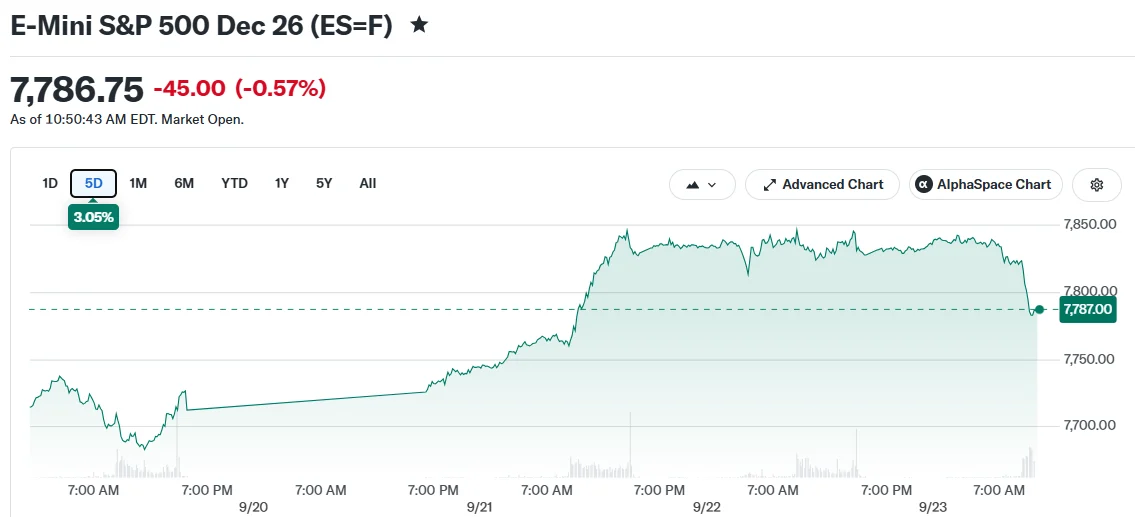
Benchmark Treasury Yield Breaches Critical 5% Level
The primary source of market pressure originated from fixed-income markets. The 10-year Treasury yield advanced past 5.05%, representing its most elevated reading since 2007, after crossing back above the psychologically significant 5% threshold.
Elevated yields typically create substantial headwinds for growth-oriented and technology equities because they diminish the calculated present value of anticipated future profits. The upward movement occurred as market participants continued evaluating inflationary risks connected to energy commodity prices and the continuing strength of the US economic environment.
S&P Global’s preliminary US composite PMI indicated business activity expansion exceeded forecasts, while simultaneously highlighting elevated input costs associated with energy expenses. This data strengthened concerns that inflationary pressures could prove challenging to contain.
Crude oil prices amplified these concerns. Brent crude advanced beyond $101 per barrel, while West Texas Intermediate approached $92 following recent volatility related to the conflict in Iran and expectations for potential diplomatic progress.
Trump-Xi Summit Commands Market Attention
Financial markets are positioning themselves for Thursday’s scheduled dialogue between Trump and Xi in Washington. Reuters has indicated that discussions will likely encompass trade relations, rare earth element supplies, artificial intelligence development, Taiwan issues, and Iran diplomacy.
LATEST:
President Xi Jinping just left Beijing to meet President Trump in Washington, his first state visit to the US capital since 2015.
AI is on the agenda, but expectations for a major deal are low.
So far, the US has proposed a way for both countries to alert each other… pic.twitter.com/NLZGeK8c9A
— Coin Bureau (@coinbureau) September 23, 2026
Xi is conducting his US visit from September 23 through September 25, representing his first American state visit in several years. Market participants generally aren’t anticipating comprehensive breakthrough agreements, but any statements regarding tariff policies, semiconductor export restrictions, or rare earth mineral trade could significantly impact technology and chip manufacturing equities.
Artificial intelligence topics will receive particularly intense scrutiny following competition between Washington and Beijing becoming a defining element of their economic relationship. Reuters noted that investors maintain exposure to AI development ecosystems in both nations despite mounting political tensions and expanding technology transfer limitations.
Iran continues to factor into market calculations. Trump indicated that US-Iran negotiations were progressing and expressed optimism that an eventual settlement could materialize, though geopolitical risk factors remain substantially elevated.
For market participants, the immediate market trajectory may hinge less on Wednesday’s equity declines than on whether yields maintain levels above 5%, oil prices remain at elevated levels, and Thursday’s Trump-Xi discussions yield any unanticipated policy announcements.
The post Markets Tumble as Treasury Yields Break Through 5% Barrier appeared first on Blockonomi.
Key Highlights
- Micron shares dipped approximately 0.3% on Wednesday, trading around $1,093.
- Citi elevated its price objective from $1,150 to $1,300.
- Analysts anticipate robust DRAM and NAND price momentum will bolster financial performance.
- The company’s fiscal Q4 earnings announcement is scheduled for September 30.
- SEMICON West in October may serve as an additional tailwind for memory market sentiment.
Micron Technology (MU) shares experienced a modest 0.3% decline Wednesday, hovering near $1,093 after settling at $1,096.16 the previous session. This minor retreat came after four consecutive sessions of gains, including a notable 5% surge on Tuesday.
Micron Technology, Inc., MU
Citi upgraded its price objective for Micron to $1,300 from its previous $1,150 mark, sustaining an optimistic stance on the memory semiconductor manufacturer. This revised forecast suggests approximately 19% potential appreciation from Tuesday’s close.
Analysts at the financial institution anticipate Micron will capitalize on better-than-projected memory chip valuations alongside persistent artificial intelligence-fueled demand. Citi further projects that capacity limitations may maintain tightness across both DRAM and NAND sectors through 2027.
Analyst Projections Rise Before Quarterly Report
Citi adjusted its financial projections for Micron’s August and November reporting periods following an upward revision to blended DRAM pricing assumptions. The firm currently anticipates fiscal fourth-quarter revenue reaching approximately $51 billion with earnings of $31.45 per share, surpassing prevailing market consensus.
Micron has confirmed its fiscal fourth-quarter financial release for September 30. This announcement represents the company’s nearest significant market-moving event, arriving roughly fourteen days ahead of SEMICON West.
Citi projects both reported figures and forward guidance will exceed current market expectations. These remain analyst projections rather than official company forecasts, meaning market participants will closely monitor whether Micron’s actual pricing dynamics and profitability metrics align with the bank’s assumptions.
Memory chip valuation trends form the cornerstone of this bullish perspective. Citi projects blended DRAM average selling prices will climb 20% sequentially in the present period, followed by an additional 13% increase in the subsequent quarter, while NAND pricing advances 34% initially, then 15%.
These forecasts reflect a marketplace where artificial intelligence infrastructure deployment continues absorbing substantial volumes of high-performance memory products. Citi additionally anticipates enterprise solid-state drive demand linked to AI inference workloads will help counterbalance softer consumer NAND activity.
Industry Conference May Underscore Capacity Limitations
Citi identifies SEMICON West as an additional potential catalyst for Micron’s valuation. The industry gathering takes place October 13-15 in San Francisco, assembling semiconductor equipment vendors, materials providers and fabrication companies.
Analysts expect equipment manufacturers at the conference to address shortages affecting various components including DRAM, multilayer ceramic capacitors, printed circuit boards and optical elements. These bottlenecks could restrict how rapidly memory producers expand production capacity.
Citi projects DRAM and NAND capacity expansion may hold steady in the low-20% range. Should demand continue outpacing this growth trajectory, memory valuations could sustain elevated levels into the coming year, with Citi forecasting peak pricing around the second quarter of 2027.
Micron has already delivered substantial returns throughout 2026, positioning the stock vulnerable to any negative surprises. MU currently trades near $1,100 after reaching a 52-week peak of $1,255, with Tuesday’s 5% advance pushing market capitalization above $1.2 trillion.
Primary downside considerations include a more rapid deterioration in memory pricing than anticipated, weakening artificial intelligence expenditures, accelerated capacity additions and lofty expectations that have climbed alongside the stock price. Citi’s $1,300 objective also provides reduced upside potential compared to earlier stages of the rally should earnings disappoint.
Presently, MU is consolidating following four consecutive positive sessions. The next confirmed milestone is Micron’s September 30 earnings disclosure, followed by SEMICON West spanning October 13-15, where Citi anticipates industry dialogue will validate the constrained memory supply environment.
The post Micron Technology (MU) Target Lifted to $1,300 by Citi on Memory Market Strength appeared first on Blockonomi.
Key Takeaways
- HSBC maintains its strongest possible overweight allocation to global stocks.
- U.S. and Asian technology sectors receive the bank’s highest conviction ratings.
- The firm prioritizes U.S. tech investments over small-cap stocks while supporting European financials.
- The Nasdaq 100 reached an all-time closing high on Tuesday before retreating Wednesday.
- Elevated energy costs, rising yields, and elevated tech multiples pose significant challenges.
HSBC continues to advocate for its most aggressive positioning in global equities, recommending that investors maintain substantial exposure to the technology sector. Max Kettner, the bank’s chief multi-asset strategist, confirmed that HSBC remains at “maximum overweight” on stocks, with particular emphasis on U.S. and Asian technology companies.
The recommendation arrives as tech shares experienced a pause on Wednesday. The Nasdaq Composite dipped approximately 0.1% at the opening bell amid climbing oil prices and ascending Treasury yields, while the S&P 500 traded near unchanged levels.
This follows robust performance earlier in the week. The Nasdaq 100 surged 2.8% on Monday and added another 0.8% on Tuesday, achieving a record closing level of 30,732.40, buoyed by renewed confidence in artificial intelligence investment and revenue generation potential.
Technology Remains HSBC’s Primary Focus
HSBC expresses clear preference for U.S. and Asian technology equities and ranks American tech higher than small-capitalization companies. The banking institution also maintains constructive views on European financial stocks and holds modest overweight positions in emerging-market and high-yield fixed income.
Kettner contends that macroeconomic indicators have demonstrated resilience despite elevated energy costs and higher bond yields. According to HSBC’s assessment, these pressures have already been reflected in equity and credit market pricing, diminishing the likelihood that investors are completely overlooking these factors.
Technology continues to represent the bank’s most confident equity call. The sector has recaptured positive momentum following Monday’s AI-driven rally, with semiconductor manufacturers and Meta providing significant upward thrust.
Tuesday delivered another milestone for the Nasdaq as market participants remained focused on AI implementation, strengthening corporate profitability, and expectations for enhanced returns from infrastructure investments.
HSBC’s current allocation therefore presumes the recent AI-fueled advance has additional upside rather than marking its conclusion.
The institution holds more cautious views on certain fixed-income segments. HSBC maintains underweight stances on eurozone sovereign debt and Japanese government bonds, particularly at extended durations, while upgrading U.K. gilts to overweight.
Energy Prices, Interest Rates, and Political Factors May Dictate Future Direction
HSBC identifies energy market developments as a potential market catalyst. Kettner highlighted positive oil-supply news, including Saudi Arabia’s East-West pipeline infrastructure, as factors that could alleviate inflationary pressures and reduce financial market stress.
The bank also addressed November’s U.S. midterm elections. Kettner noted that shifting dynamics in election prediction markets might shape expectations for American policy direction, though he emphasized this represents HSBC’s market analysis rather than an electoral forecast.
Markets continue confronting tangible risks. Oil prices advanced again on Wednesday, while elevated Treasury yields applied pressure on equities, particularly interest-rate-sensitive technology names.
Valuation presents another area of concern following the Nasdaq’s swift rebound. Robust earnings performance would need to persist in justifying current price levels, especially if financing costs remain elevated or excitement surrounding AI capital expenditure diminishes.
Nevertheless, HSBC remains positioned for additional equity market appreciation. Its current asset allocation maintains stocks at maximum overweight, with technology serving as the cornerstone of the strategy despite Wednesday’s moderate retreat.
The post HSBC Maintains Maximum Bullish Stance on Equities with Tech as Leading Choice appeared first on Blockonomi.
Key Highlights
- BENF shares climbed approximately 194% on Wednesday following premarket gains exceeding 250%.
- The financial services firm revealed plans to eliminate approximately $130 million in contested debt obligations.
- The proposal includes canceling all remaining equity and governance interests held by ex-CEO Brad Heppner.
- An additional $88 million in disputed claims could be eliminated under the restructuring plan.
- With no binding agreement yet finalized, significant implementation challenges remain.
Beneficient (BENF) shares rocketed approximately 194% during Wednesday’s session following the company’s disclosure of a comprehensive restructuring plan designed to eliminate contested liabilities and sever all financial connections to ex-CEO Brad Heppner. During premarket hours, BENF shares had spiked over 250%, positioning the stock among the session’s most dramatic movers.
Beneficient, BENF
The dramatic price movement came after Beneficient disclosed its intention to eradicate approximately $130 million in principal and accumulated interest allegedly owed to HCLP Nominees. The financial services company characterizes these claimed debts as fraudulent, asserting they lack validity and enforceability.
Heppner received a criminal conviction in May 2026 on charges including securities fraud, wire fraud, and associated offenses. Beneficient maintains this conviction bolsters its legal standing as it pursues complete financial and governance separation from the disgraced former executive and his associated business entities.
Comprehensive Restructuring Extends Beyond Debt Elimination
The contemplated settlement would encompass far more than simply wiping out the HCLP obligations. Beneficient is pursuing the cancellation of Heppner-connected equity holdings with a combined liquidation preference approaching $850 million.
According to the restructuring framework, these holdings would be exchanged for 162,132 shares of Class A common stock. Additionally, the company aims to void all outstanding contracts with Heppner and his affiliated organizations, while declaring approximately $88 million in amounts claimed under those arrangements as invalid.
Should the restructuring proceed as currently outlined, it would also strip Heppner of his Class B shares and the accompanying super-voting privileges, board appointment authority, and consent powers. This transformation would fundamentally reshape Beneficient’s ownership structure and corporate governance framework.
Beneficient indicated it is working toward a negotiated settlement ahead of Heppner’s October 21 sentencing date. Should negotiations collapse, company officials stated they stand ready to initiate all available legal proceedings against Heppner and his business affiliates.
The magnitude of this potential restructuring is particularly striking given Beneficient’s modest size. BENF finished Tuesday’s trading at merely $0.5383 per share, with the company’s total market capitalization standing at only several million dollars before Wednesday’s explosive rally.
Dramatic Price Surge Carries Substantial Uncertainties
The market’s enthusiastic response underscores how dramatically transformative this proposed restructuring could prove if successfully implemented. Erasing the bulk of Beneficient’s disputed liabilities and eliminating legacy financial burdens could substantially strengthen its balance sheet positioning.
Neverthstanding, this remains a proposal rather than a concluded transaction. Beneficient specifically acknowledged it has not executed any binding definitive agreement, meaning ultimate terms could shift materially or negotiations could collapse altogether.
This distinction carries particular weight following such an extraordinary price movement. BENF had already exhibited extreme volatility throughout the current month, including numerous double-digit percentage swings during individual sessions preceding Wednesday’s surge.
Beneficient additionally confronts broader operational and financial headwinds, including ongoing operating losses, constrained cash positions, and capital-raising requirements. While removing disputed obligations would enhance balance sheet metrics, it would not automatically resolve these fundamental operational challenges.
Investors must also consider the stock’s exceptionally small market capitalization and historically thin trading liquidity. These characteristics can dramatically amplify both upward and downward price swings when trading activity suddenly intensifies.
For the present, the proposed separation from Heppner stands as the unmistakable catalyst behind BENF’s extraordinary rally. The critical next milestone will be whether Beneficient successfully negotiates a binding definitive agreement prior to the former chief executive’s October 21 sentencing hearing.
The post Beneficient (BENF) Stock Skyrockets 194% Following Debt Elimination Strategy Announcement appeared first on Blockonomi.
Quick Summary
- BFRG shares climbed approximately 18% in premarket hours Wednesday, reaching $0.71.
- Vininder Singh, the company’s CEO, acquired 75,000 shares through open-market transactions.
- CFO Joshua Blacher purchased an additional 50,000 shares valued at approximately $26,425.
- Combined, both executives committed around $71,000 to acquiring company stock.
- Despite executive confidence, BFRG continues to exhibit high volatility as a micro-cap security.
BullFrog AI (BFRG) shares experienced an approximately 18% surge during Wednesday’s premarket session, trading near $0.71 after Tuesday’s close at $0.60, which itself represented a 21.7% gain. The upward momentum came after Securities and Exchange Commission filings revealed open-market stock acquisitions by the company’s top two financial executives.
Bullfrog AI Holdings, Inc. Common Stock, BFRG
On September 22, CEO Vininder Singh acquired 75,000 BFRG shares at a weighted-average price of $0.5989 per share, representing an investment of approximately $44,918. Following this transaction, Singh’s direct ownership stake expanded to roughly 2.44 million shares.
On the same date, CFO Joshua Blacher purchased 50,000 shares at a weighted-average price of approximately $0.5285 per share. Blacher’s transaction totaled around $26,425 and brought his direct holdings to 65,000 shares.
Executive Purchases Generate Market Enthusiasm
Collectively, Singh and Blacher acquired 125,000 shares for a combined investment of approximately $71,000. These transactions represented discretionary open-market purchases using personal funds, rather than compensation-based equity grants.
Market participants typically view open-market insider purchases favorably, as executives are deploying personal capital at current market valuations. However, the SEC filings do not provide insight into the specific motivations behind Singh’s or Blacher’s decisions to expand their equity positions.
The purchases came on the heels of an exceptionally turbulent Tuesday trading session. BFRG reached an intraday peak of approximately $0.81 before settling at $0.60, while trading volume exploded to tens of millions of shares compared to just 218,000 shares in the previous session.
This spike indicates that Wednesday’s premarket gains are extending momentum that had already materialized before the insider purchase disclosures gained broader visibility. BFRG has experienced substantial appreciation from its September 16 closing price near $0.43.
BullFrog AI specializes in developing artificial intelligence-powered solutions designed for pharmaceutical development and precision medicine applications. Earlier this year, the company revealed a feasibility collaboration with one of the world’s five largest pharmaceutical companies, focusing on its bfLEAP platform and prospective therapeutic targets for major depressive disorder.
Significant Risks Persist for Micro-Cap Investment
While the insider acquisitions offer a tangible near-term positive signal, BFRG remains a remarkably small enterprise. According to Benzinga’s recent analysis, the company’s market capitalization stands at approximately $11 million, meaning relatively limited trading activity can trigger substantial percentage fluctuations.
The equity has also demonstrated extreme volatility across extended timeframes. Even with this week’s appreciation, BFRG remained down more than 50% over the trailing twelve-month period based on Wednesday’s early trading levels.
This volatility represents a critical consideration for investors. While insider stock purchases often receive positive interpretation, they offer no assurance of improved financial results or sustained price appreciation.
BullFrog AI continues to face capital requirements, clinical development uncertainties, commercialization challenges, and the inherent difficulties of transforming AI-focused drug development collaborations into substantial revenue streams. Limited liquidity characteristic of small-cap stocks can magnify both upward and downward price movements.
Currently, the most evident catalyst remains the synchronized open-market purchases by senior leadership. Recent SEC filings confirm Singh and Blacher collectively acquired 125,000 BFRG shares on September 22, coinciding with continued upward price action Wednesday morning.
The post BullFrog AI (BFRG) Stock Surges 18% Following Executive Share Purchases appeared first on Blockonomi.
CryptoPotato
CryptoQuant founder Ki Young Ju has said that he expects Bitcoin’s current cycle to deliver a 3-to-5x rally rather than another 10x-plus parabolic run, followed by a milder bear market than past cycles produced.
His case rests on how much the market has grown, with a larger base of institutional buyers dampening both the euphoric highs and the brutal drawdowns that defined BTC’s early years.
Ki Young Ju’s Case for a Calmer Cycle
The analyst pointed to the PnL Index, which tracks aggregate holder profitability, as evidence that the extremes are already narrowing, with cycle tops and bottoms forming at higher profitability levels than before. MVRV never fell below 1 this cycle, he noted, meaning holders as a whole never went underwater even at the lows.
He also cited a rising realized cap and OG whales who have stopped selling, as well as futures whales who built large long positions near the bottom.
“None of this means Bitcoin has a ceiling. It means the trade-off has changed,” he wrote. “Giving up the 10x parabola also means giving up the 80% crash.”
Additionally, he argued that the trade-off is what will draw patient, long-horizon capital instead of hot money.
CryptoQuant’s own research backs the bullish read: Bitcoin closed above its 365-day moving average near $80,500 for the first time since March 2023, a level that previously marked the 2019 and 2023 bull markets.
On-chain indicators turned bullish in mid-August, and BTC has since cleared the $76,000-$81,000 zone where long-term holders had been selling heavily. The firm has put the next resistance at $88,000 to $90,000.
Technician Jamie Coutts flagged the same $80,000 area as the market’s biggest cluster of long-term resistance, citing ETF cost basis and long-term holder averages, and noted his volatility breakout model found seven of eight similar setups since 2016 up a median of 41% six months later.
How Bitcoin Got Here
Bitcoin was trading near $86,500 at the time of writing, up 1.5% over 24 hours and 14% in the past week. It had also gained over 12% over the last month, although it is still down more than 23% from where it was a year ago.
That run started after a rough stretch that saw the CLARITY Act fail a Senate vote and the Federal Reserve raise rates for the first time since July 2023.
That pressure pushed BTC down to $75,000 more than once, but it recovered through last week, then broke higher on Monday as ETF inflows accelerated, adding about $7,000 to its price in under a day and pushing past $87,000 for the first time since late January.
Market watchers at Bitfinex believe the next test will land on September 25, when a large options expiry could add volatility, while US real yields near 2.68% remain a headwind for risk assets broadly.
The post Bitcoin Could Still Explode 5x, but the 10x Days Are Over: CryptoQuant CEO appeared first on CryptoPotato.
Bitcoin’s latest leg up has carried the price directly into a major overhead supply region, putting the rally at an important test. Momentum remains constructive, but the reaction around the $86K-$89K area could determine whether the move develops into another bullish leg or pauses for a deeper retest.
Bitcoin Price Analysis: The Daily Chart
On the daily timeframe, Bitcoin has extended its recovery significantly after breaking out of the previous corrective structure. The asset is now trading around $86K and has entered the major $86K-$89K resistance zone highlighted on the chart.
The broader structure remains bullish. BTC is comfortably above both moving averages, while the sharp recovery from the $75K area has established a clear sequence of higher prices. However, the current resistance zone is substantial, and the latest candles show some hesitation after reaching it.
There is also a notable momentum divergence developing. While the price has pushed to a higher high, the RSI has failed to confirm that strength and remains below its previous peak. This bearish divergence does not necessarily signal an immediate reversal, but it suggests that upside momentum is not expanding at the same rate as price.
As a result, a rejection from the $86K-$89K resistance could trigger a corrective move toward the first demand zone around $80K-$82K. Below that, the $75K-$78K area represents the next major support. Conversely, a decisive daily breakout above $89K would invalidate the immediate bearish divergence concern and strengthen the case for continuation.
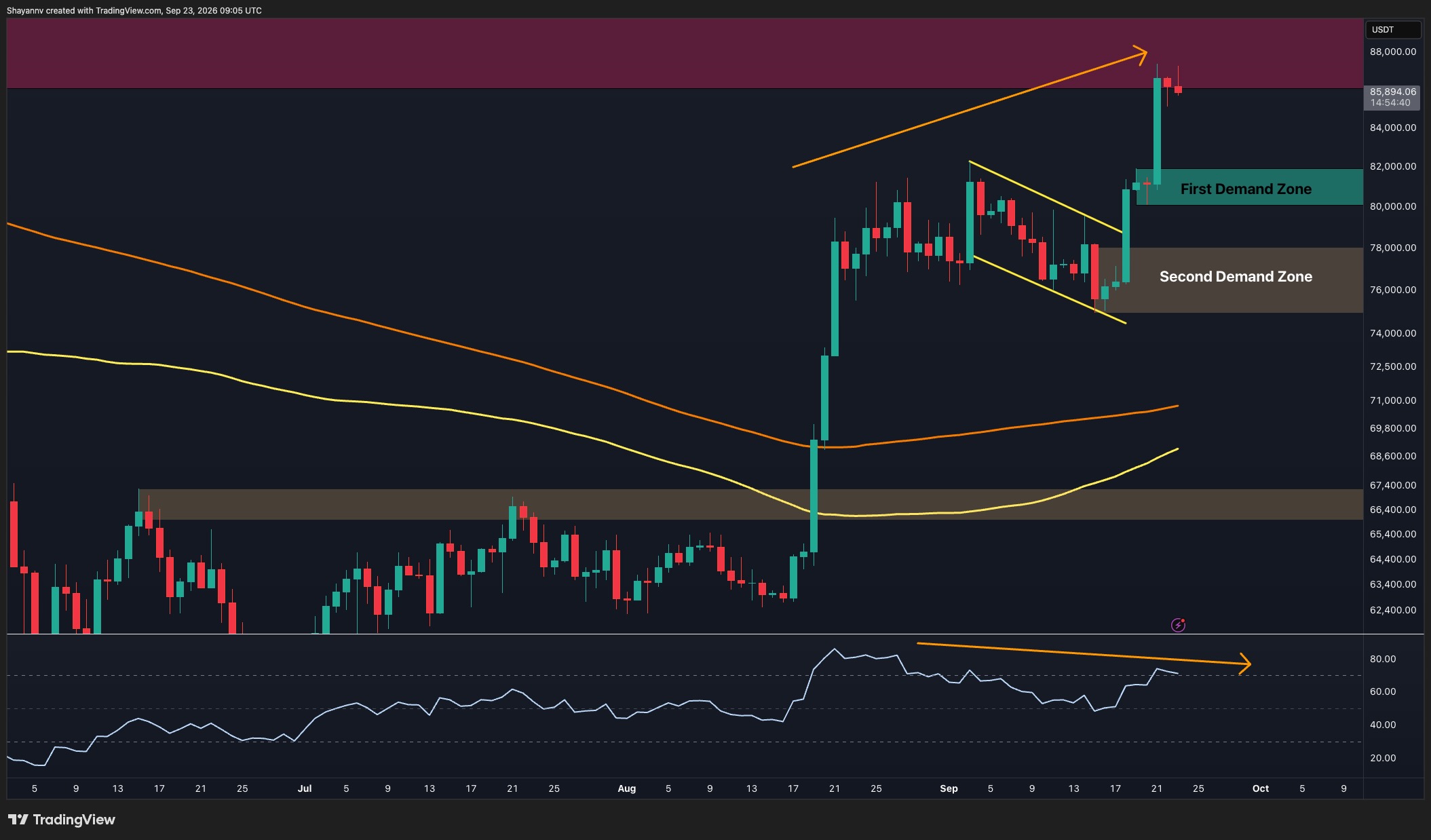
BTC/USDT 4-Hour Chart
The 4-hour chart emphasizes just how aggressive the latest move has been. After consolidating around the $80K-$82K demand zone, Bitcoin broke higher with a large impulsive candle and quickly reached the $86K region.
The price is now consolidating just inside the $86K-$89K supply zone rather than immediately reversing, which suggests buyers are still attempting to absorb the available selling pressure. The rising trendline from the $75K low also remains intact, supporting the short-term bullish structure.
Nevertheless, BTC is extended from its nearest demand area. If sellers gain control at the current resistance, the $80K-$82K zone would be the most important initial area to monitor for a pullback. Holding that region would preserve the breakout structure and could provide the foundation for another attempt at $89K.
A breakdown below $80K would weaken the short-term setup and increase the probability of a deeper correction toward the $75K-$78K demand zone.

Sentiment Analysis
The Realized Price UTXO Age Bands chart provides additional context for Bitcoin’s current position by showing the average acquisition prices of different holder cohorts.
BTC, currently around the mid-$80K region on this chart, has moved above the realized prices of several younger and intermediate cohorts. Most notably, price is approaching the 18-month-to-2-year cohort’s realized price, which sits around $88K. The 6-to-12-month cohort is also positioned near $90K.
These levels closely overlap with the $86K-$89K technical resistance identified on the price charts, creating an important confluence. Investors belonging to these cohorts may be approaching their aggregate cost basis, potentially increasing selling or breakeven supply as BTC moves higher.
At the same time, Bitcoin trading above the realized prices of several other active cohorts indicates that a larger portion of those holders has returned to unrealized profit. Therefore, the $88K-$90K region appears particularly important. A sustained move through it would place Bitcoin above another significant cluster of holder cost bases and could reinforce the bullish continuation scenario, while rejection would leave the current resistance confluence intact.

The post Bitcoin Price Analysis: BTC Faces First Major Test After 13% Weekly Rally appeared first on CryptoPotato.
Ripple’s XRP climbed above $1.60 on Tuesday for the first time since early February, aside from a brief uptick in August, as network activity increased alongside the price move. Data from blockchain analytics firm Santiment showed a rise in large transactions and the creation of thousands of new XRP addresses during the latest advance.
The firm recorded 1,917 XRP transactions worth at least $100,000, the highest level of such activity in roughly a month. While the figure points to increased activity among larger holders, Santiment noted that the transfers do not reveal whether whales were buying or selling.
XRP Network Activity Picks Up
The network also added 3,647 new XRP addresses during the period tracked by the analytics firm. That increase suggests participation extended beyond existing users, although new addresses do not necessarily represent new investors or independent individuals.
Santiment’s data covering mid-April to late September showed both whale transaction activity and network growth rising as XRP moved above $1.60. At its latest snapshot, XRP traded near $1.60, with 2,479 new addresses and 1,281 whale transactions.
Beyond wallet and whale activity, the XRP Ledger has also continued to expand across tokenized assets and stablecoins. Tokenized assets and RLUSD balances on the network recently reached about $4.26 billion. Ripple has reported roughly $2.4 billion of RLUSD in circulation.
Interest in XRP has also extended into investment products. Bitwise filed an updated registration for an XRP exchange-traded fund with the U.S. Securities and Exchange Commission on September 18. The filing adds to a market that already includes several XRP exchange-traded products.
Whale Activity Gets Mixed Readings
The whale data has drawn different interpretations from market observers. One view is that 1,917 large transactions remain relatively small compared with XRP’s market capitalization of about $99 billion. Others see the increase in new addresses as a broader sign of network participation.
The 12.6% rise in XRP over seven days when the data was assessed also makes the increase in large transfers harder to interpret as clear accumulation. Santiment said the combination of price growth, address creation, whale activity and expanding infrastructure could remain important if those trends continue.
The post XRP Pushes Above $1.60 as Network Activity Picks Up appeared first on CryptoPotato.
The second-largest cryptocurrency has rallied by double digits over the past week amid the broader market’s resurgence, surging to well above $2,700.
Most analysts are optimistic the revival could turn into a full-blown bull run, with some projecting a move to a new all-time high.
The Next Targets
X user Wealthmanager believes ETH should reach $3,000 “relatively soon.” They claimed there is little resistance between $2,750 and $3,000, adding that “the next impulse up is just a matter of time.”
Popular analyst Michael van de Poppe argued that Ethereum is entering an “interesting zone,” stressing that rising above its current levels could lead to a completely new phase.
“If this area breaks, the next area of resistance is likely $3,400, and that would mean that we’re back into a new range. I don’t think we’ll see anything sub $2,000 in the near future again,” he said.
Trader Tardigrade spotted an inverse head-and-shoulders setup on ETH’s 3-day chart, assuming the asset is primed for a massive breakout, and projecting a rally to $4,100.
X user Gerla appears to be among the biggest optimists, maintaining that the cryptocurrency is still “ridiculously early in this move” and forecasting a potential explosion to a new historical peak of $10,000.
“The next Ethereum run could surprise a lot of people,” he added.
Meanwhile, ETH investors have been abandoning Binance at a pace not seen in three years. The development reduces immediate selling pressure, reflects a longer-term holding strategy, and strengthens the bullish price scenario.
Bull Trap?
Of course, not everyone is certain that the cryptocurrency will keep pumping. Earlier this month, X user DANNY claimed ETH is setting up for “a huge trap” and envisioned potential capitulation to $1,500 and reaching a cycle bottom by the end of the year. The analyst who goes by Midas echoed a similar prediction, envisioning a retest of the $1,700-$1,800 range and then a drop to as low as $1,400.
“But I still don’t expect ETH to make the same kind of new cycle lows as BTC. ETH has been showing much stronger relative structure, and I still think it will outperform once this correction is finished. There is just one major downside target left to clear before the real expansion starts. So, short-term, I’m bearish on ETH. Long term this setup can become one of the strongest opportunities of the cycle,” they added.
The post Ethereum (ETH) Soars 15% Weekly and Now Enters an ‘Interesting Zone:’ Analyst appeared first on CryptoPotato.
Zcash (ZEC) climbed above $1,600 for the first time since 2016 after 21Shares launched Europe’s first Zcash exchange-traded product (ETP) on Euronext Paris and Amsterdam.
The rally coincides with the privacy coin expanding access through traditional investment markets, while heady short liquidations and leveraged trading add another layer to the price action.
21Shares Launches Europe’s First Zcash ETP
CoinGecko reported the price milestone on September 23, with ZEC trading around $1,600 after reaching an intraday high of approximately $1,643. The listing gives investors another way to gain exposure to the cryptocurrency without holding ZEC directly.
The physically backed product trades on Euronext Paris and Amsterdam. Investors can buy it through traditional brokerage accounts, avoiding the need to manage crypto wallets or take direct custody of the tokens. Its annual management fee is 2.5%.
21Shares also launched a physically backed ETP tracking ETHFI, the governance and utility token of the Ether.fi decentralized finance protocol. That product carries the same 2.5% annual fee as its ZEC counterpart.
The European listing follows Grayscale’s launch of its spot Zcash ETF, which trades on NYSE Arca under the ticker ZCSH. Together, the products give investors in the United States and Europe regulated investment vehicles tied to ZEC.
The price move has also caught the attention of leveraged traders, with Lookonchain reporting that a trader identified as 0xE34E opened a 50x long position on 140 ZEC, worth around $224,000. With the token breaking above $1,600, the position showed an unrealized profit of approximately $70,700, representing a reported return of 1,581%.
ZEC Outpaces the Broader Crypto Market
CoinGecko’s latest figures put ZEC just slightly above $1,600, up more than 10% over 24 hours, 43% in seven days, and over 91% across 30 days. Its one-year gain stands at 3,266%. The weekly performance comfortably exceeds the broader crypto market’s 14.1% increase in the same period.
Trading activity has also picked up. ZEC recorded around $1.77 billion in 24-hour volume, a 61.1% increase from the previous day, with its price moving between roughly $1,456 and $1,643 during that period.
ZEC cleared $1,500 last week after climbing 190% in a month, and analysts at the time did not agree on what would happen next. One of them, Ali Martinez, wrote that “momentum remains strong” and pointed to $1,800 as his next target, a call he first made in late August when the asset was trading near $820.
Picolas Cage, another trader on X, predicted Zcash could eventually reach $14,000, arguing that investors have not properly placed where the token sits in the current market cycle.
But others have leaned bearish, including Crypto with Haris ₿, who opened a $100,000 short earlier this month, insisting that the rally had relied heavily on short liquidations rather than new buying and that most of the bullish catalysts were already priced in by the time ZEC passed $1,500.
Interestingly, data from CoinGlass shows Zcash’s jump past $1,600 caused about $21.62 million in liquidations in 24 hours, with $19.39 million of that hitting short positions.
The post Zcash Tops $1,600 After Europe’s First ZEC ETP Debuts appeared first on CryptoPotato.