Cryptocurrency Posts
Crypto Briefing
The restructuring may streamline operations but risks diluting Xbox's brand identity and altering the creative direction of iconic franchises.
The post Xbox cuts 268 jobs and hands Halo development to Activision in major studio shakeup appeared first on Crypto Briefing.
C2C's direct model communication could revolutionize AI efficiency, but scaling across diverse models poses significant engineering challenges.
The post C2C improves AI model communication, reducing latency and errors appeared first on Crypto Briefing.
Snorkel AI's rapid growth highlights the increasing demand for AI infrastructure, positioning it as a key player in the evolving AI ecosystem.
The post Snorkel AI triples valuation to $3.5B with $350M Series E funding appeared first on Crypto Briefing.
The surge in Bitcoin Cash highlights the potential for increased institutional adoption, which could drive broader market interest and investment.
The post Bitcoin Cash leads top 100 crypto assets with 28% gain in 24 hours appeared first on Crypto Briefing.
East Texas A&M's quantum-proofing of Bitcoin's Lightning Network could set a precedent for future cryptographic defenses in blockchain technology.
The post Bitcoin’s Lightning Network receives first quantum-proof defense from East Texas A&M University appeared first on Crypto Briefing.
Bitcoin Magazine
Bitcoin Magazine
Bitcoin Investors Buy Nearly $1B in BTC ETFs as Bull Market Returns
The Bitcoin bulls are back — if ETF flows are to be believed.
U.S. bitcoin exchange-traded funds received $999 million in new investment on Monday, according to Farside Investors data.
That’s the most in one day since October 6, when the funds received over $1.2 billion and the price of the leading cryptocurrency hit a new all-time high of $126,080.
Bitcoin’s price recently stood at $86,552 after scraping $87,330 on Monday. Over the past seven days, the coin’s price has surged by nearly 13%.
Bitcoin ETFs in the U.S. — approved by the SEC in 2024 — have helped investors get exposure when they couldn’t before. Now, Wall Street firms can quickly buy shares of funds managed by the likes of BlackRock, Fidelity, Morgan Stanley, and others.
When big investment hits the funds, the price often moves significantly — as what happened on Monday.
Bloomberg ETF analyst James Seyffart on Monday said that the average ETF buyer is now in profit after the estimated ETF cost basis surged above $81,72 for the first time since January.
The ETF to receive the most of Monday’s investment — $381.4 million — was BlackRock’s iShares Bitcoin trust. The ARK 21Shares Bitcoin ETF received $289.1 million; Fidelity’s Wise Origin Bitcoin Fund took in $238.8 million.
Investors have a renewed interest in Bitcoin after the artificial intelligence stock rally cooled and the U.S. Department of the Treasury in August said it would at least double the size of its liquidity-support buyback operations.
Analysts said the move pushed 30-year Treasury yields down, weakened the dollar, and made assets like bitcoin more attractive. Following the announcement, the bitcoin price had its best run in years.
A Tuesday report from crypto market data firm CryptoQuant said that the leading cryptocurrency crossed above its 365-day moving average, a signal that the asset has finished being in a bear market.
This post Bitcoin Investors Buy Nearly $1B in BTC ETFs as Bull Market Returns first appeared on Bitcoin Magazine and is written by Mathew Di Salvo.
Bitcoin Magazine

Bitcoin’s Bull Run Is Back — and the Data Agrees
Bitcoin’s run this weekend would have observers believing that the bull market is back. But the data also backs it up.
A new report from data firm CryptoQuant shows that the leading cryptocurrency crossed above its 365-day moving average — a signal that the asset has finished being in a bear market.
Bitcoin’s price surged in August and had its best run in years, spurred by an announcement from the U.S. Treasury saying it would at least double the size of its liquidity-support buyback operations. Its run cooled but then last week shot up again and was recently trading for $86,598 after trading as high as nearly $87,330 on Monday.
JUST IN: $87,000 Bitcoin
— Bitcoin Magazine (@BitcoinMagazine) September 21, 2026pic.twitter.com/Vgl0wCA7uY
“This crossover is the definitive technical signal that has marked the start of Bitcoin’s bull markets in past cycles, and it is the first time price has reclaimed the 365-day moving average since March 2023,” the report read.
It added that the moving average is a “cycle-defining” line and confirmed the start of bull runs in previous years.
“Its track record across cycles is why this reclaim carries real weight rather than being a routine bounce,” the report added.
The report continued that long-term holders appear to have finished selling, making the way for new investors to enter the market.
Bitcoin notched a record of $126,080 in October of last year but then began to sink later that month after the biggest liquidation event in crypto history saw over $19 billion in bets closed.
In the first half of this year it continued its plunge after the Federal Reserve made it clear it was in no hurry to lower interest rates and investors increasingly threw money at artificial intelligence-related stocks to get returns.
But the so-called debasement trade — where investors throw money at an asset to hedge against a currency losing its value — is hot again. Bitcoin and precious metals like gold have done well when the dollar has weakened.
And the Federal Reserve last week raised interest rates to get sky-high inflation in the U.S. under control. Investors shrugged the central bank’s move off and bought up the asset.
Now, people seem more interested in buying an asset that can protect them from government debt and deficit. In August, total U.S. debt topped $40 trillion for the first time.
This post Bitcoin’s Bull Run Is Back — and the Data Agrees first appeared on Bitcoin Magazine and is written by Mathew Di Salvo.
Bitcoin Magazine
White Hats Move Over $4.5 in Bitcoins From Coldcard to Recovery Trust
White hats have moved bitcoin from the hacked Coldcard signing devices to a trust for would-be victims to reclaim, Galaxy Digital’s Alex Thorn has said.
Writing on X on Monday, Thorn said that the funds were taken by white hats to protect potential victims. They are now apparently sitting in an address controlled by Crypto Recovery Trust, a Wyoming Trust created to help white hats return funds to victims.
A total of 52.37 of the bitcoins — worth over $4.5 million at today’s prices — were moved. Thorn added that the funds represented 2.8% of the coldcard exploit.
Criminals started taking bitcoin stored using Coinkite’s popular Coldcard hardware wallet on July 31.
Canadian company Coinkite said that a firmware bug in Coldcard devices caused seed generation to fall back to a weak software Pseudorandom Number Generator instead of the hardware true random number generator, allowing hackers to essentially guess investor seedphrases.
Galaxy Digital tracked the movement of funds and said 1,789.28 bitcoins were lost in the attacks. That’s $154.1 million in bitcoin at today’s prices.
Earlier this month, Nick Bax of universal market protocol Ump Labs said that he was involved in helping recover the funds.
“Finally able to say that at the end of July, I was involved in the rescue of ~50 BTC which were “imminently going to be stolen due to the COLDCARD entropy flaw,” Bax wrote on X.
He added: “The funds are currently held by a Wyoming trust, which will ensure that funds are returned to their rightful owners.”
Since the attack, cautious investors have been moving their coins to other storage solutions — including exchanges.
Coinkite said in a statement that the bug in its software “silently went unnoticed” and “its potential impact grew with every release” of its products.
Days after the first hack, the company urged investors to update their software or move their funds off the popular hardware wallet.
This post White Hats Move Over $4.5 in Bitcoins From Coldcard to Recovery Trust first appeared on Bitcoin Magazine and is written by Mathew Di Salvo.
Bitcoin Magazine
Feds Probing Binance Over Iran’s Bitcoin Use: Report
Federal prosecutors — including the U.S. Department of Justice — are investigating whether Binance has allowed Iran to dodge sanctions by using its platform, according to a report from Bloomberg.
The outlet, citing people familiar with the matter, reported Tuesday that feds were investigating whether Binance Holdings Ltd., which operates the world’s biggest crypto exchange, knowingly allowed Iran-linked entities to trade.
It comes after the U.S. Department of Justice last week said it is seizing and seeking to forfeit $61 million in cryptocurrency that it alleges came from black-market sales of sanctioned Iranian oil. The funds, according to the DOJ, were laundered through Binance by Chinese entities.
Iran has been using bitcoin — and other cryptocurrencies — to skirt around U.S. sanctions. The U.S. in April started targeting crypto wallets linked to the Iranian regime, Treasury Secretary Scott Bessent said in a statement.
Bessent went on to say that the Iranian regime’s crypto had been frozen — mostly in the form of Tether’s USDT stablecoin.
And last week, the Treasury designated BitBank, an Iranian crypto exchange, as part of Operation Economic Outcast — the Trump Administration’s whole-of-government economic campaign against the Islamic Republic of Iran and its enablers.
Iran started a bitcoin-backed insurance service for its counties shipping companies earlier this year. Bitcoin cannot be frozen, unlike many other cryptocurrencies.
The Financial Times this month reported that the Middle Eastern country was using bitcoin to settle cross-border transactions through Iranian crypto exchanges after the central bank advised its countrymen to do anything necessary to help the economy.
Binance, which has no headquarters but is incorporated in the Cayman Islands, ran into trouble with U.S. authorities after it allegedly allowed funds linked to virtual theft and terrorism to flow through its exchange undetected.
It exited the U.S. market and agreed to pay $4.3 billion. Its CEO and founder Changpeng Zhao stepped down after pleading guilty to anti-money laundering violations but was later pardoned by President Trump.
This post Feds Probing Binance Over Iran’s Bitcoin Use: Report first appeared on Bitcoin Magazine and is written by Mathew Di Salvo.
Bitcoin Magazine
No Bitcoin Payments in Russia — But the Digital Ruble Is Open for Business
While bitcoin is banned for making payments in Russia, the government is keen on one type of digital money: its own central bank digital currency.
The digital ruble has been available for transactions in the country since September 1, according to a Tuesday report from Tass.
Citing a talk given by Prime Minister Mikhail Mishustin, the news agency said that it was all part of “developing a convenient, fast, and independent payment infrastructure” in Russia.
JUST IN:
— Bitcoin Magazine (@BitcoinMagazine) September 22, 2026Russian Prime Minister Mikhail Mishustin says:
"The circulation of cryptocurrencies has also become legal in the country starting from September 1. The relevant law was signed by the president."

Russia has been fast regulating digital assets this year. President Vladimir Putin in August signed a law regulating the circulation of digital currencies and digital rights in the country.
The law states that only registered entities can operate as exchanges, and puts limits on the amount of crypto retail investors can use.
But what about Bitcoin?
President Putin in 2024 seemed to praise the OG cryptocurrency. “For example, Bitcoin, who can ban it? Nobody,” he said at a forum at the time.
“And who can prohibit the use of other electronic payment instruments? Nobody, because these are new technologies.”
The president has also spoken about how the country has “competitive advantages” when it comes to Bitcoin mining due to the abundance of cheap energy in Russia.
Though the Kremlin still has a tight grip on what its citizens can do with it: Retail investors are limited to trading bitcoin and other liquid cryptocurrencies, capped at 300,000 rubles ($3,556) per year, according to the August law. Qualified investors have no restrictions.
And using crypto as a form of payment has been illegal in Russia since 2022.
Central bank digital currencies — or CBDCs — are a centralized form of digital money, issued by a central bank. Bitcoiners have long criticized the idea of such a product because it can be used by governments to surveil its citizens and ultimately even control their spending.
U.S. President Donald Trump even signed an executive order in 2025 prohibiting federal agencies from establishing, issuing, or promoting a CBDC.
But in Russia, a digital ruble is the best way for keeping citizens in check. The Bank of Russia settled early on an architecture that mixes a centralized ledger it controls with distributed-ledger components. The 2021 concept described the preferred model as hybrid — distributed ledgers combined with centralized components — and the full technical details have never been published.
Bitcoin payments, on the other hand, are being used by companies in international payments to counter Western sanctions, Finance Minister Anton Siluanov admitted in 2024.
This post No Bitcoin Payments in Russia — But the Digital Ruble Is Open for Business first appeared on Bitcoin Magazine and is written by Mathew Di Salvo.
CryptoSlate
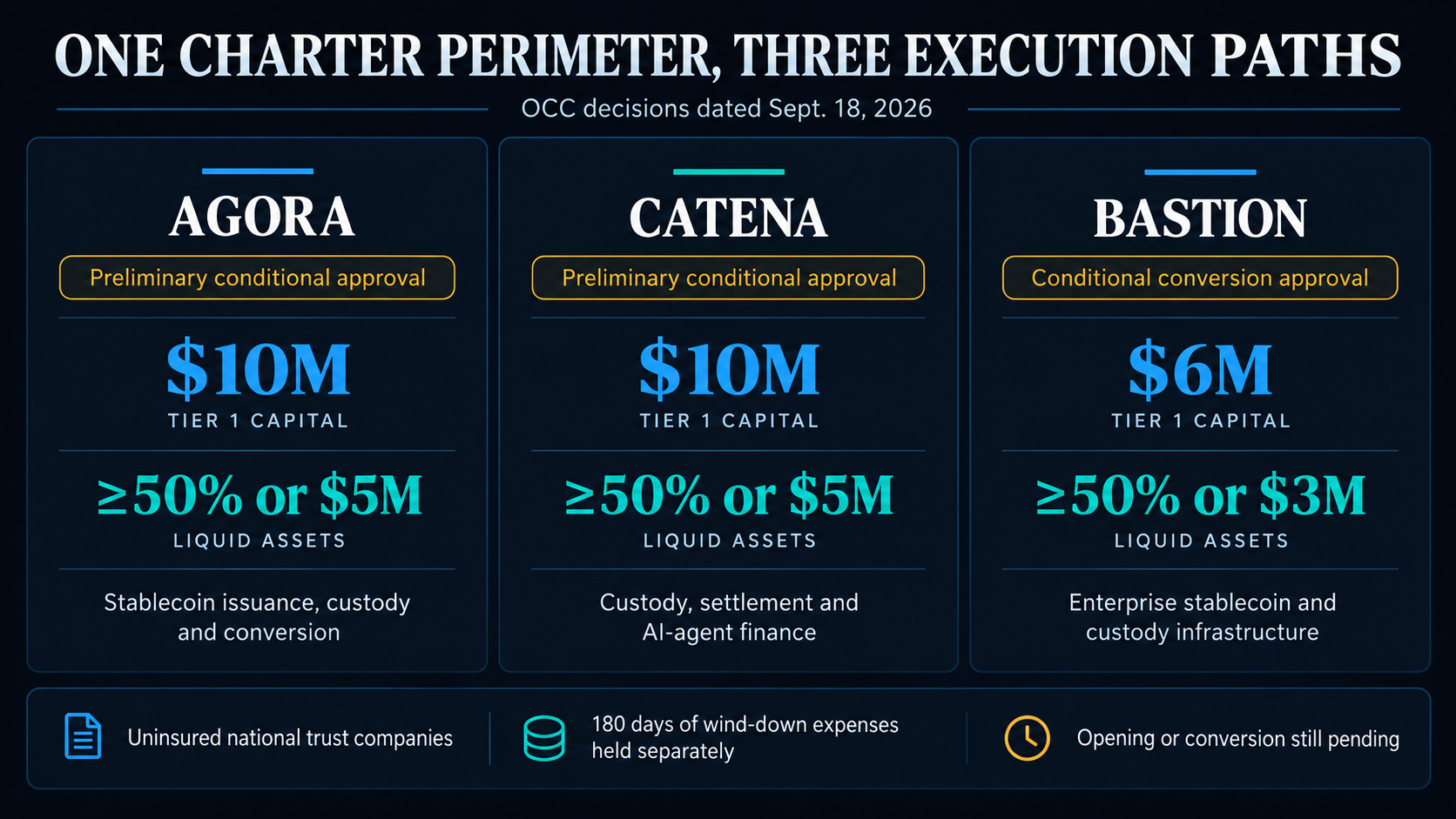
The Office of the Comptroller of the Currency advanced three stablecoin-focused firms toward federal trust-bank status on Sept. 18, using a recognizable regulatory perimeter across the decisions for Agora, Catena and Bastion.
The decisions strengthen the case that the OCC is building a repeatable pathway for narrow, uninsured trust banks. That pathway still carries execution and legal risk: Agora and Catena need final approval before opening, Bastion must complete a conversion, proposed stablecoin rules remain unfinished, and state supervisors continue to contest the breadth of the OCC’s approach.
The competitive significance follows from that combination. Federal trust status can reduce regulatory fragmentation and bring related services under one supervisor, but repeated conditional approvals make the charter itself less likely to be a self-sufficient moat. Final approval, distribution, capital, reserve relationships and operating performance become the harder tests.
What the OCC actually approved
The Agora decision and Catena decision grant preliminary conditional approval for de novo national trust banks. Both applicants remain in organization and must complete pre-opening work before the OCC grants final approval and permission to commence business.
The Bastion decision follows a different route. Bastion Platforms Trust Company already operates under a New York trust charter. The OCC conditionally approved its conversion into Bastion Platforms National Trust Company, subject to conditions and a conversion completion acknowledgement before it begins operating under the national charter.
The distinction separates regulatory progress from operational authority. Agora and Catena are organizing new federal institutions. Bastion is converting an existing state trust company. The cited materials do not state firm opening dates for any of the three.
Agora and Catena must send OCC chartering staff a letter at least 60 days before a scheduled opening. Their approvals expire if they fail to raise capital within 12 months or open within 18 months. Bastion’s approval automatically terminates if the conversion is not completed within six months, unless the OCC grants an extension under extenuating circumstances.
Across the three decisions, the OCC applies a shared trust-company framework rather than granting identical business permissions. Each institution must limit its operations to trust-company activities and related services, and each must stay outside the Bank Holding Company Act definition of a bank.
The resulting institutions are not ordinary insured commercial banks. Bastion’s decision expressly says it will not take deposits and will not be insured by the Federal Deposit Insurance Corporation. Agora’s letter says the proposed bank will not be an insured depository institution. Catena’s decision treats the institution as an uninsured national bank and states that payment stablecoins are not deposits and cannot be represented as FDIC-insured.
The capital requirements show both the common architecture and applicant-specific calibration. Agora and Catena must each maintain at least $10 million in tier 1 capital, with the greater of 50% of tier 1 capital or $5 million held in eligible liquid assets. Bastion must maintain at least $6 million in tier 1 capital, with the greater of 50% or $3 million liquid. Each institution must reassess its capital and liquidity quarterly and hold more if its risk profile requires it.
A separate condition requires all three to maintain eligible liquid assets equal to 180 days of fixed and variable operating expenses applicable to a distressed wind-down. Those assets cannot be double-counted against the liquidity supporting the capital condition. The requirement applies during the first three years of operation under the relevant federal charter.
| Applicant | OCC action | Capital and liquidity floor | Proposed focus | Status in cited materials |
|---|---|---|---|---|
| Agora | Preliminary conditional approval for a new national trust bank | $10 million tier 1; greater of 50% or $5 million liquid | Stablecoin issuance and reserves, custody, payments and advisory services | Final approval pending; no firm opening date stated |
| Catena | Preliminary conditional approval for a new national trust bank | $10 million tier 1; greater of 50% or $5 million liquid | Custody, trust and investment management, plus linked conversion, clearing and execution | Final approval pending; no firm opening date stated |
| Bastion | Conditional approval to convert a New York trust company | $6 million tier 1; greater of 50% or $3 million liquid | Custodial wallets, conversion, white-label issuance and issuer services | Conversion completion pending; no firm opening date stated |
The OCC also requires advance notice and a written determination of no objection before significant changes to each business plan. Compliance, audit, information-security and governance work remains part of the path to opening or conversion completion.
Why charter access looks more repeatable
The Sept. 18 decisions sit inside a larger pattern. The OCC’s decision index records digital-asset trust-bank actions involving Bridge, Foris DAX, Coinbase, Laser Digital, Wise, World Liberty and others. The agency’s digital-asset applications page shows additional applicants in the pipeline.
In August, Comptroller Jonathan Gould said 23 of 40 new-charter applications received over roughly 18 months involved digital assets. That volume does not predict final approval for any applicant, but it shows the Sept. 18 trio belongs to a cohort rather than standing as an isolated experiment.
The agency’s 2026 trust-bank rule, effective April 1, further clarified that national trust banks may conduct permissible non-fiduciary activities alongside fiduciary services. The OCC continues to assess the statutory authority for proposed activities case by case, so a recognizable pathway still produces applicant-specific decisions.
Proposed GENIUS Act implementing rules point toward more common reserve, capital and liquidity expectations for federal stablecoin issuers. Those rules remained proposed as of Sept. 22. They describe a possible standardized federal layer rather than a final operating regime.
The legal foundation also remains contested. The Conference of State Bank Supervisors has challenged the breadth of the OCC’s trust-charter and preemption approach and discussed possible future litigation if states conclude that charters exceed the National Bank Act’s limits. That statement does not establish a filed case, but it shows why a repeatable administrative process should not be confused with settled law.
The baseline thesis is therefore comparative. The three decisions repeat core boundaries, capital concepts, wind-down liquidity, supervisory notice and pre-opening controls. The wider decision record and pending pipeline show the OCC applying that framework to more firms. A federal trust charter remains costly and demanding, yet the permission set increasingly resembles infrastructure that multiple qualified applicants can seek.
A common perimeter leaves ample room for different businesses.
Agora proposes to combine dollar-backed stablecoin issuance and reserve maintenance with digital-asset custody, custody-linked payments and settlement, and fiduciary investment advice for institutional and business custody customers. The OCC decision says Agora intends to move AUSD issuance from Agora Bermuda only after the bank is established. The planned cutover would transfer underlying assets and accounts, with the bank acquiring and assuming reserve assets and associated liabilities.
The transition remains prospective. Agora’s AUSD product page continued to identify Agora Bermuda as issuer as of Sept. 22. The page also describes reserve management, custody and partner relationships that help define Agora’s route to distribution. Agora’s approval announcement states that final approval remains pending.
Catena’s proposed bank targets another customer set. Its approved plan includes fiduciary and non-fiduciary custody, fiduciary investment management and trust services, and non-fiduciary conversion, clearing and execution linked to assets held in those relationships. Catena’s company announcement positions the stack around AI agents and the businesses deploying them. The AI focus is Catena’s strategy, not an OCC characterization.
Bastion’s model centers on enterprise infrastructure. The approved conversion perimeter includes fiduciary custodial wallets, conversion for custody customers, white-label stablecoin issuance, and technology and operational services for other authorized issuers. Bastion says enterprise clients can use custody, payments and issuance tools while third-party firms may remain issuer of record. Its announcement describes a federal conversion that would consolidate capabilities now delivered through an existing state trust charter, other licenses and partnerships.
These differences identify the remaining sources of competitive advantage. A charter can create national regulatory reach and combine permissible services under one supervisor. It cannot supply customers, liquidity, reserve partners, enterprise integrations or a successful launch.
Earlier CryptoSlate analysis treated federal trust charters as potentially scarce strategic assets. Coverage of Agora’s then-pending application and the rise of narrow crypto banks emphasized both national reach and the structure’s limits. A separate look at the GENIUS Act’s competitive effects argued that early federal access could favor well-capitalized issuers.
The Sept. 18 evidence narrows the scarcity argument. Three same-day decisions share a familiar perimeter, a common supervisory architecture and defined routes toward opening or conversion. They also preserve differences in capital calibration, customer focus and business model.
Execution now carries more weight. Agora and Catena must turn preliminary approval into permission to open. Bastion must finish its conversion. All three must maintain capital and wind-down liquidity while persuading customers that their particular combination of custody, issuance, settlement and controls is worth adopting.
The federal trust charter remains valuable in that market. Its role increasingly resembles an entry requirement, while the durable moat has to be built through distribution, liquidity and execution.
The post Why newly granted federal approval won’t save these 3 crypto banks appeared first on CryptoSlate.
Even if Bitcoin eventually adopts post-quantum protections for on-chain outputs, five parts of the Lightning Network’s off-chain payment system would still need separate upgrades, according to a Sept. 12 research preprint.
The paper proposes PQLN, a hybrid post-quantum extension implemented as a rust-lightning research prototype. It targets gossip, which distributes node and channel information; encrypted peer connections; signed invoices and reusable payment offers; and onion packets that conceal payment-routing details.
Lightning currently uses secp256k1-based ECDSA, Schnorr signatures or ECDH across those functions. PQLN keeps the classical mechanisms while adding ML-DSA signatures to gossip, invoices and offers. It adds hybrid ML-KEM key exchange to transport, payment onions and BOLT 12 privacy paths.
The authors built a feature-gated rust-lightning fork and a modified ldk-sample node. Their 12-scenario matrix found that post-quantum and vanilla binaries built from the same rust-lightning base could coexist. Depending on the route and settings, mixed setups used classical protection or failed closed.
That compatibility does not establish network-wide readiness. The repositories describe the software as a research artifact, and the study deferred tests against other Lightning implementations.
Communication, rather than raw cryptographic computation, dominated the authors’ results. During static synchronization of a full network graph, the default ML-DSA-44 and ML-KEM-768 design increased gossip downloads 10.2 times and stored graph data 8.8 times compared with vanilla Lightning.
A smaller Falcon-derived FN-DSA configuration reduced the download multiple to 4.2 times, but NIST still lists that scheme as under development rather than a final standard.
Private payment routing carried another bandwidth penalty. A fixed 21.8-kilobyte post-quantum ciphertext list added 19 to 53 milliseconds per hop on an emulated 10 Mbit/s link and 160 to 187 milliseconds per hop at 1 Mbit/s.
By contrast, ML-DSA-44 signing averaged 327 microseconds on the authors’ 16-core AMD Ryzen Threadripper PRO 3955WX workstation with 64 GB of RAM. That author-run, hardware-specific primitive measurement should not be read as end-to-end payment latency.
PQLN also leaves Bitcoin-rooted risks untouched. It does not secure the on-chain keys protecting funding, commitment and HTLC outputs or penalty transactions, so safeguarding channel funds still requires Bitcoin-layer post-quantum changes.
The preprint assumes a future cryptographically relevant quantum adversary; it does not report a present-day quantum compromise of Bitcoin or Lightning. Its prototype suggests Lightning’s off-chain defenses can be tested independently of a Bitcoin upgrade, but not that the network is ready to migrate. In these experiments, the hard operational question was how much extra gossip, storage and payment traffic node operators could absorb.
The post Bitcoin may go quantum-safe while Lightning privacy stays exposed appeared first on CryptoSlate.
Animoca Brands, a digital asset venture, has suspended merger talks with Nasdaq-listed Currenc Group after the companies failed to reach definitive terms on schedule.
On Sept. 22, the companies said they mutually agreed to pause discussions after reviewing projected closing timelines and changing market conditions, concluding that the additional time needed to complete the transaction no longer aligned with their short- and medium-term priorities.
Currenc said in a regulatory filing that its exclusivity period with Animoca had expired without a definitive agreement. Suspending negotiations gives the company greater flexibility to seek financing for growth and operations while preserving the option to restart talks later.
The proposed reverse merger, first outlined in a non-binding term sheet on Nov. 2, 2025, would have provided Animoca with a route back to public markets. Animoca shareholders were expected to own about 95% of the combined company, leaving existing Currenc investors with roughly 5%.
The transaction remained subject to due diligence, definitive documentation and a series of corporate, regulatory and court approvals. The preliminary ownership split could also have changed before closing.
Expired timetable frees Currenc to pursue financing
Animoca co-founder and Executive Chairman Yat Siu said the company was prioritizing flexibility as it works toward a public listing.
“While we hold our proposed merger with Currenc Group in high regard, our corporate agility must take precedence,” Siu said, adding that Animoca was advancing audit work and other compliance requirements needed for a major public exchange.
The companies were still pursuing the transaction in May, when they extended exclusivity through June 30 and maintained a target of closing in the third quarter. The additional time was meant to allow for due diligence and definitive documentation, but the parties never reached a binding merger agreement.
By September, the exclusivity period had expired, and key transaction terms remained unresolved. Animoca cited projected closing timelines and evolving market conditions, while Currenc said suspending discussions would give it greater flexibility to seek financing for growth and operations.
That leaves Currenc free to raise capital without waiting for the merger process to advance, while preserving the option to return to negotiations later.
Animoca is continuing separately with its broader plan to return to public markets. The company said it remains committed to relisting on a major exchange and is preparing its FY2024 audited financial statements as part of a wider compliance push.
The Currenc transaction had offered Animoca a direct route into a Nasdaq-listed company, but no replacement deal, exchange or timetable has been disclosed since talks were suspended.
Both sides have left open the possibility of restarting negotiations if conditions improve. Currenc cautioned, however, that there is no assurance talks will resume or ultimately produce a transaction.
The post Animoca Brands suspends Currenc deal that would have taken it public appeared first on CryptoSlate.
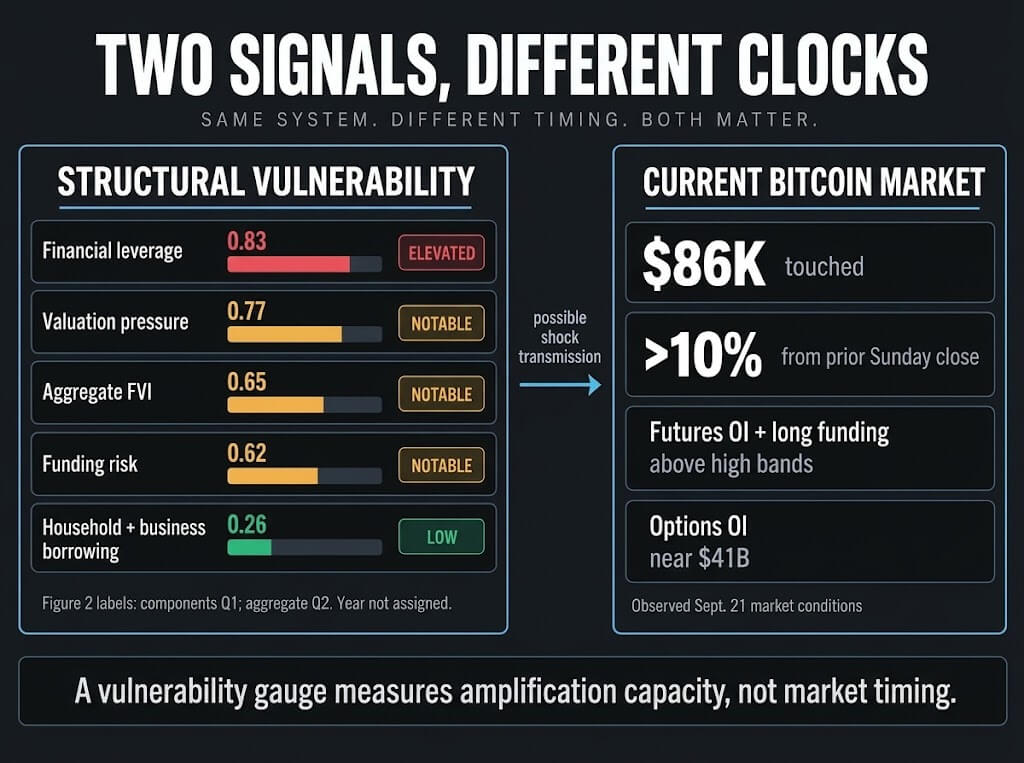
Bitcoin’s rally and the Federal Reserve’s new financial-risk gauge describe two different time horizons. BTC reflects demand and positioning in today’s market. The Fed’s measure tracks structural weaknesses that could magnify the next shock.
The Financial Vulnerability Index is built to capture slow-moving vulnerability rather than coincident market stress. In Figure 2, the final financial-leverage annotation is 0.83, inside the “elevated” band of its historical distribution. The aggregate index is labeled 0.65, valuation pressure 0.77 and funding risk 0.62, all “notable.” Household and business borrowing is lower at 0.26.
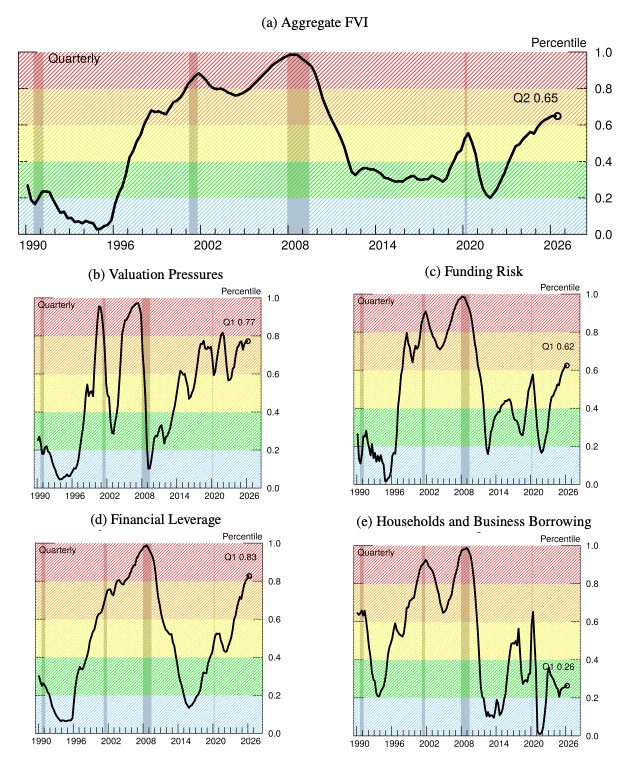
The chart labels the four components Q1 and the aggregate index Q2, with 2026 as the last axis mark. The working paper separately says its dataset and several estimation samples end in 2025:Q4, without explaining whether the endpoints are later-vintage observations, nowcasts or a labeling issue. That limits the safe description to Figure 2’s quarter labels and values, without assigning them a verified 2026 observation date.
The distinction between vulnerability and current conditions explains the apparent split. Conventional financial-conditions indexes rise as credit tightens and visible stress emerges. The FVI can build through calmer periods as leverage and risk-taking accumulate.
Bitcoin’s current move has its own drivers. On Sept. 21 BTC touched $86,000, more than 10% above the prior Sunday close, as spot taker flow turned positive and volume rose. Short liquidations helped Monday’s leg higher. Futures open interest and funding paid by longs were above Glassnode’s high bands, options open interest was near $41 billion, and options were pricing less movement than the market delivered.
How funding stress could reach Bitcoin
A June analysis, “Decomposing Hedge Funds’ U.S. Treasury Exposures,” estimated that large hedge funds had $4 trillion of gross Treasury exposure and $3 trillion of repo borrowing as of September 2025. Its proxy estimates included about $830 billion in cash-futures basis trades and $305 billion in swap-spread trades.
The Fed’s separate review of government bond-backed repo markets found that short-term funding, dealer intermediation, collateral reuse and low haircuts can carry stress across funding, cash and derivatives markets. Higher margin calls or tighter dealer capacity could force liquid-asset sales, weaken crypto spot demand and liquidate leveraged BTC positions. That cross-market sequence remains a scenario; the cited evidence has not observed the full chain.
The working paper’s historical model shows why the vulnerability reading matters. In high-FVI periods, the same modeled business-cycle shock produced deeper declines in consumption and long-term investment than in low-FVI periods. The index is therefore best read as an amplifier gauge: it describes the system’s capacity to turn a shock into wider damage, while Bitcoin’s immediate path remains tied to flows, liquidity and positioning.
The working paper reflects its authors’ analysis and does not indicate concurrence by the Federal Reserve Board.
The post Why Bitcoin’s rally is dangerous according to new Fed data appeared first on CryptoSlate.
Aave governance has advanced a proposal that would give Bitcoin-backed borrowers materially more leverage while leaving less room before liquidation.
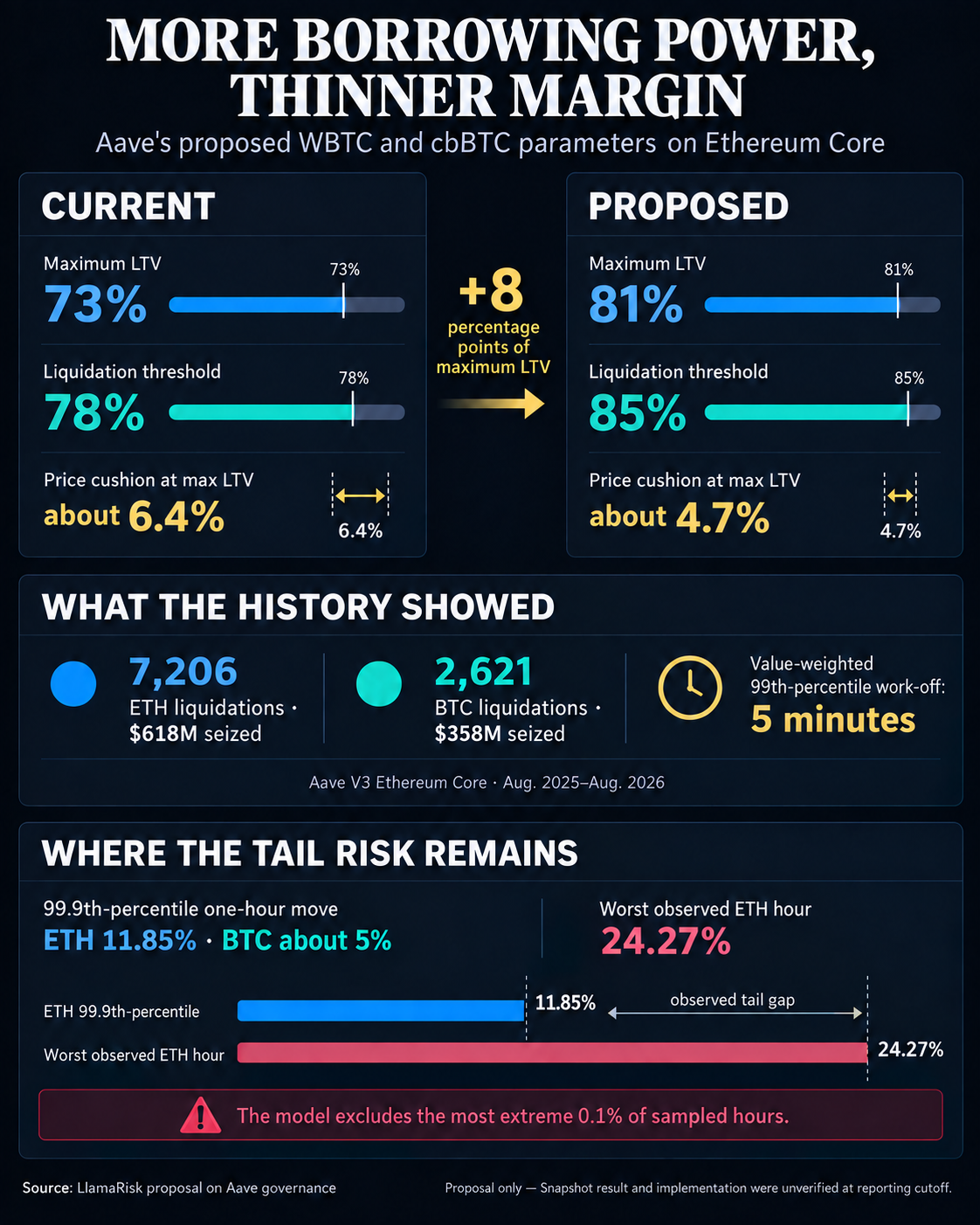
The proposal from risk service provider LlamaRisk would let users on Aave V3 Ethereum Core borrow as much as $0.81 against each $1 of WBTC or cbBTC collateral, up from $0.73. The liquidation threshold would rise from 78% to 85%.
LlamaRisk said on Sept. 21 that the proposal had advanced to Snapshot and voting would begin in less than 24 hours. The vote result and any implementation remained unverified at the reporting cutoff, so the higher limits are proposed parameters rather than live settings.
The case rests on one year of liquidation data showing that economically meaningful positions generally cleared within minutes. That history was recorded under existing parameters. It supports an argument for greater capital efficiency but cannot establish how the proposed settings would perform during the next extreme move.
Eight more cents of Bitcoin borrowing power
Loan-to-value, or LTV, sets the maximum debt that collateral can support. At 73% LTV, $100 of WBTC or cbBTC can support up to $73 of debt before reserve caps, available liquidity, asset eligibility and account-level constraints. At 81%, the same collateral could support up to $81.
The liquidation threshold marks the point where a position becomes eligible for liquidation. On Ethereum Core, the proposal would raise that threshold for WBTC and cbBTC from 78% to 85%.
| Ethereum Core BTC parameter | Current | Proposed |
|---|---|---|
| Maximum LTV | 73% | 81% |
| Liquidation threshold | 78% | 85% |
| Collateral-price decline from maximum LTV to liquidation | About 6.4% | About 4.7% |
The raw distance between LTV and the liquidation threshold would fall from five percentage points to four. The last table row expresses that distance as a collateral-price decline relative to the threshold, assuming debt remains unchanged and Bitcoin is the moving leg. Raising both parameters still narrows the borrower’s price cushion because the borrowing limit moves closer to the new liquidation line.
The changes extend beyond Ethereum Core. The proposal would raise Arbitrum WBTC’s ordinary LTV by five percentage points and Base cbBTC’s by eight points. Ethereum Core WETH, wstETH and weETH would each receive a 0.5-point LTV increase. Selected liquidation thresholds would also rise, while Base cbBTC’s liquidation bonus would fall from 7.5% to 6%. A separate Base cbBTC stablecoin E-Mode would move to 82% LTV and an 85% liquidation threshold.
These figures describe maximum capacity per dollar of eligible collateral. They do not quantify how much debt users would add. The proposal does not disclose a complete current dataset of collateral-enabled balances, debt attributed to each affected asset and account health factors. Total reserve supply would overstate usable collateral because some supplied tokens may be ineligible, disabled as collateral or unconnected to debt. Historical seized volume likewise does not reveal the live distribution of positions.
Minutes of liquidation history meet an hour-long tail model
LlamaRisk studied liquidation behavior from August 2025 through August 2026 across Ethereum Core, Arbitrum and Base.
On Ethereum Core, the analysis counted 7,206 ETH liquidations that seized $618 million and 2,621 BTC liquidations that seized $358 million. For both collateral families, the value-weighted 99th-percentile time a liquidation call spent at or below its execution price was five minutes.
That statistic measures a liquidation work-off window. It is different from saying that 99% of transactions executed within five minutes of an oracle update. Large positions can require several calls because a single liquidation generally repays only part of the debt.
The study separately measured processing after price-feed publications during the February and October 2025 stress windows. Its table reports that 100% of seized volume cleared within five minutes of the feed publication that made liquidation profitable in every listed market during those two events.
February produced no recognized deficit. October produced $0.39 million of event-level bad debt against roughly $128 million, although LlamaRisk said none affected the ETH- or BTC-family collateral analyzed for this proposal. The result suggests that liquidator response was not the binding constraint in those episodes; it does not recreate those events under the proposed higher leverage.
The model then combines a one-hour price excursion with each reserve’s liquidation bonus to derive a ceiling for the liquidation threshold. In the detailed table, the 99.9th-percentile adverse one-hour move was 11.85% for ETH and about 5% for BTC.
That percentile omits the most extreme 0.1% of one-hour observations in the two-year sample. The same record contained much larger moves: a worst one-hour ETH decline of 24.27% and a worst BTC decline of 10.72% in the detailed table. The proposal’s summary gives 11.15% for the BTC worst hour, an internal discrepancy, but either BTC figure is more than twice the roughly 5% percentile input.
The gap defines the residual risk. LlamaRisk’s framework assumes that regular oracle publications and responsive liquidators prevent a maximally leveraged position from sitting untouched for a full hour. A move beyond the percentile can become more damaging if price feeds stall, liquidation activity slows or market depth deteriorates at the same time.
The percentile therefore calibrates a protocol bad-debt buffer rather than a borrower protection level. A maximally borrowing BTC position could reach the proposed liquidation threshold after an approximately 4.7% collateral-price decline under the simplified single-asset calculation, even though the protocol model uses a roughly 5% BTC excursion plus the liquidation bonus to assess post-liquidation coverage.
The proposal leaves BTC thresholds below the model ceiling to account for depth, caps and concentration risks that price history does not capture. ETH receives less room: WETH is set at the model ceiling, while wstETH and weETH sit one point inside their ceilings.
The Bitcoin LTV vote weighs speed against leverage
Aave’s governance choice is whether observed liquidation performance under current parameters justifies allowing future positions to run closer to liquidation.
For Bitcoin collateral on Ethereum Core, the exchange is clear at the borrower level. Maximum LTV would rise eight percentage points, while the simplified collateral-price cushion at maximum leverage would shrink from about 6.4% to 4.7%. Existing borrowers would not automatically add debt, but the new limits would permit new or adjusted positions to carry more.
The protocol-level case is more favorable than the borrower-level cushion alone suggests. In LlamaRisk’s sample, economically meaningful liquidations were processed quickly, and the two studied stress windows left no bad debt on the reviewed ETH- and BTC-family collateral. The model also incorporates the liquidation bonus and keeps recommended BTC thresholds below its calculated ceiling.
Its limits are equally specific. Historical execution does not measure an outage that coincides with an exceptional price move. The worst one-hour declines in the same dataset exceeded the percentile inputs by a wide margin, and the model cannot remove liquidity, concentration or oracle risk.
The aggregate credit effect also remains unknown. Calculating it would require current collateral-enabled balances for every affected asset and market, the debt those positions already carry, their collateral settings and their health-factor distribution. The published proposal supplies the parameter change, not that full position-level dataset.
The forum says an implementation AIP would follow only after a positive Snapshot result. Until a vote and AIP establish the final values, the 81% Bitcoin LTV remains a governance proposal.
LlamaRisk’s study makes a measurable case that fast liquidation work-off can support greater collateral efficiency. The unresolved question is how much confidence Aave should place in that history when the danger lies in the hour that combines an unusually large market move with impaired pricing, liquidation or market depth.
The post Narrowing price cushions leave Bitcoin loans vulnerable to 4.7% price dips as Aave weighs higher leverage appeared first on CryptoSlate.
CryptoTicker.io
Binance has taken a $100 million stake in Circle, the company behind the stablecoin USDC, and extended the cooperation between the two firms by five years. Circle announced the move on September 22, 2026 in its own pressroom. For you as an investor in Germany, this changes neither the price of your holdings nor the route by which you buy them. Something else has shifted: who earns money from stablecoins sitting idle.
Binance and Circle: what the $100 million stake actually involves
The transaction consists of two separate parts published on the same day. The first is an equity investment: Binance subscribed for Class A shares in Circle through a private placement, around 1.24 million of them at $80.84 each according to CoinDesk. Circle’s own statement puts the purchase price 5 percent below the market price of the share before completion. The sale closed on September 17, 2026, five days before the public heard about it.
The second part is a five-year supply and marketing agreement. It replaces two earlier arrangements between the two companies dating from November 2024 and August 2025. Binance may not resell, pledge or hedge its shares for up to two years; Circle cites the customary industry exceptions, such as transfers within the group.
Jeremy Allaire, co-founder and chief executive of Circle, speaks in the statement of using USDC to broaden access to the dollar and to reach people and businesses in emerging markets. Richard Teng, co-chief executive of Binance, puts it this way: a stable, reliable digital dollar should not be a privilege but should be open to anyone who owns a phone. Both sentences promote the same goal, and neither says anything about what the contract means commercially.
The monthly incentive fee: why Circle pays for USDC balances
The commercial core sits in the filing with the US Securities and Exchange Commission that CoinDesk quotes. Under it, Circle pays Binance a monthly incentive fee calculated as a percentage of the USDC held through Circle’s wallet service. The more digital dollars sit idle in that environment, the more money flows to the trading platform.
Behind this lies a business model that many stablecoin users underestimate. An issuer such as Circle holds backing for every USDC in issue in short-dated US government bonds and bank balances. The interest on that is kept by the issuer. The holder of the token receives none of it; what the holder receives is stability, not a return. Part of that interest stream is now passed on to whoever gathers the balances.
The sober conclusion for you: a stablecoin sitting in an exchange account is a source of income for the exchange. That is neither disreputable nor new, but it explains why trading venues advertise so persistently for balances to be left with them between two trades.
USDC against USDT: how market shares stand in September 2026
A look at the relative sizes puts the deal in context. According to CoinGecko data from September 22, 2026 at 19:53 UTC, USDC had a market capitalisation of around $74.8 billion on daily turnover of some $20.8 billion. At the same moment Tether stood at around $183.4 billion in market capitalisation and roughly $81.7 billion in daily turnover. USDT therefore remains a good two and a half times the size of USDC.
That gap is precisely why Circle is prepared to pay for distribution reach. Binance is the largest trading venue in the industry, and in many emerging markets access to the dollar runs through platforms of this kind rather than through banks. Whoever sets the standard there sets it for years.
For a sense of scale: Bitcoin traded at $86,263 on the same reference date and reached a market capitalisation of around $1.73 trillion. The entire USDC supply therefore amounts to roughly 4 percent of what sits in Bitcoin.

Buying USDC in Germany: which routes MiCA leaves open
This is where the news and your own reality part company. Binance has withdrawn from retail business in the European Union; the new agreement with Circle expressly targets emerging markets rather than Europe. For an investor resident in Germany, the route to a purchase therefore remains unchanged.
In practice that means you obtain USDC through trading venues and brokers authorised for the European market. The Federal Financial Supervisory Authority maintains registers of authorised providers, and authorisation under the EU regulation on markets in crypto-assets has been the entry ticket since the German transition period ended. Which firms actually hold that authorisation is shown in our comparison of regulated crypto exchanges.
Check three points before your first purchase: whether the provider appears in the register of the competent supervisor, which currency the account is settled in, and what spread between the buying and selling price you are charged when converting euros into USDC. In practice the third point often costs more than the stated trading fee.
The MiCA interest ban under Article 50: why you earn no interest on USDC
The incentive fee Circle pays Binance would not be possible in this form towards a European retail customer. EU Regulation 2023/1114 on markets in crypto-assets expressly prohibits, in Article 50, issuers of e-money tokens and crypto-asset service providers from granting interest to holders of such tokens. For asset-referenced tokens the same prohibition sits in Article 40.
E-money tokens are, under that regulation, crypto-assets intended to maintain a stable value by referencing a single official currency. USDC falls into this group because it is pegged to the US dollar.
The ban is addressed to issuers and service providers, not to a counterparty in wholesale business. A payment from Circle to a trading platform is not interest paid to a token holder. So the position for you stands: within the authorised European framework there is no stablecoin variant on which anyone may pay you a running yield. How providers try to work around this ban through reward and cashback schemes is something we took apart using the example of the USDT cashback card.
If you come across an offer quoting a fixed percentage on stablecoin balances, read up on who the counterparty is and where it is based. As a rule the service is then provided not by the issuer but by a company outside the European supervisory framework, and your balance is lent out in return.
Tax on stablecoins: what Section 23 EStG triggers when you swap USDC
A widespread misconception holds that a stablecoin is cash for tax purposes. It is not. From the perspective of German tax law, USDC is another economic asset, and every swap is a disposal within the meaning of Section 23 of the Income Tax Act.
Three things follow for your records. First: if you swap Bitcoin into USDC, you realise a gain or a loss at that point, even though you never saw a euro. Second: if more than a year lies between acquisition and disposal, the gain remains tax-free. Third: an exemption limit of 1,000 euros applies to the total of all private disposal transactions in a year; once it is exceeded, the entire amount is taxable, not merely the excess.
The dollar exchange rate against the euro runs alongside all of this. Holding USDC over months means carrying a currency risk that shows up in the euro result even though the token stays stable against the dollar. The only way to keep this clean is a gapless record of every swap.
Issuer risk and custody: what happens if the issuer fails
A stablecoin is a claim. Its value depends on the issuer maintaining the backing and redeeming the token at par at any time. In March 2023, USDC briefly lost its peg to the dollar because part of the reserves sat at a US bank in difficulty. The price recovered within days, yet the episode remains the clearest lesson available in what issuer risk means.
The MiCA regulation drew conclusions from it and requires issuers of e-money tokens to hold the backing separately and to deposit part of it with credit institutions. How contested the precise design of that reserve duty currently is can be seen in the running debate about the bank deposit requirement for stablecoin reserves.
For your own arrangements, the question that remains is where the token sits. In an exchange account you additionally carry the platform risk; in a self-managed wallet you carry responsibility for the key. Both have a price, and both should be a deliberate decision rather than a state of affairs that simply came about.

Binance without EU access: why the deal does not change how you buy
The reach Circle is buying lies outside Europe. Binance no longer serves European retail customers on the former scale, and the five-year agreement names emerging markets expressly as its target. Anyone holding USDC in Germany will notice nothing of this partnership day to day.
Indirectly the step still matters. A stablecoin lives on liquidity: on there being counterparties everywhere willing to take it at par. If USDC keeps growing through the world’s largest trading venue, it also becomes tradable in greater depth on European venues, because market participants balance globally. That is a slow effect rather than an event that shows up in the price on any single day.
Three markers that will show you what happens next
A stablecoin has no price to point the direction. The matter can still be watched, and it comes down to three figures.
The first is the market capitalisation of USDC, around $74.8 billion as of September 22, 2026. A marked rise over the coming months would mean the distribution agreement has worked. The second is the gap to Tether, currently around $183.4 billion; if it narrows, the industry is shifting. The third is the deviation from the dollar: USDC traded at $0.9999 on the reference date. A lasting discount of more than half a percent would be the signal that genuinely deserves attention.
All three figures come from CoinGecko and can be looked up there at any time. For the European part of the story, the list of authorised providers says more than any price: who gains authorisation and who loses it decides where you will still be able to buy in a year’s time.
Checking the USDC deal: what to take away
The news itself requires nothing of you. The episode does serve as an occasion to look at three things that are due anyway.
- Check where your stablecoin sits and who earns from it. If the balance sits permanently in a trading account between two trades, you carry the platform risk and the venue takes the income. Whether your provider is authorised for the European market is shown in the overview of crypto exchanges.
- Put your records for Section 23 EStG in order. Every swap into and out of USDC is a disposal with an acquisition date of its own. Reconstructing that in the spring usually costs money; a suitable tool can be found in the comparison of crypto tax software.
- Decide on custody deliberately. For amounts you will not move for some time, self-custody is the more sober choice, provided you are confident handling the key. Which devices are up to the job is set out in the hardware wallet comparison.
Sources for further reading: the Circle statement of September 22, 2026 and Regulation (EU) 2023/1114 in full text on EUR-Lex.
(As of September 22, 2026. This article is not investment advice. Prices and fee structures change; check the terms with the provider before you buy.)
On September 22, 2026, the European System of Central Banks published its response to the European Commission’s review of MiCA. The core of the 61-page opinion concerns anyone holding a euro or dollar stablecoin directly: the central banks consider the obligation to park a fixed share of reserves as a bank deposit a design flaw, and propose replacing it with liquidity requirements.
One point up front, so the context is right. No rule changes on September 30. That date merely marks the end of the window in which the Commission accepts responses to the MiCA review. What you can check on your own stablecoin today is already settled, and that is what this article is about.
What the ESCB submitted to the MiCA review
The European System of Central Banks, or ESCB, is the network formed by the European Central Bank and the national central banks of the EU, which in Germany means the Bundesbank. Its contribution to the consultation is a technical opinion rather than legislation: the ESCB sets out what it regards as problematic in the current wording of the regulation, and it names alternatives.
We downloaded the document ourselves and read it in full. It sits as a PDF on the ECB’s website. The section at issue here asks what the deposit requirement means for banks, for financial stability and for monetary policy. The ESCB draws an explicit distinction between stablecoins that track the euro or another EU currency and those referencing non-EU currencies, because the consequences differ in each case.
We set out the framework of this consultation, and what you can submit yourself before the deadline, in the MiCA consultation that closes on September 30. This article takes on the weightiest substantive contribution received since then.
The 30 percent rule: what MiCAR requires today
An e-money token, EMT in the language of the regulation, is a crypto asset that tracks the value of a single official currency. An asset-referenced token, or ART, refers instead to a basket of currencies, commodities or other assets. Under the regulation, both have to hold a reserve that covers redemption at par at all times.
The decisive requirement is quoted verbatim in the opinion. At least 30 percent of reserve assets must be held as deposits with credit institutions, rising to 60 percent for tokens classified as significant. The remainder has to go into safe, low-risk assets that qualify as highly liquid instruments with minimal market, credit and concentration risk, and those assets must be capable of being sold quickly without a large price impact.
“Significant” here is not a matter of judgement but a classification by the supervisor, based on thresholds such as user numbers, the amount in circulation and transaction volume. That classification doubles the deposit share, and this is where the central banks’ criticism begins: the larger a stablecoin grows, the more tightly it is chained to the banking system. Which issuers are authorised in Europe at all is covered in our piece on the MiCA register of stablecoin issuers.

Why central banks consider the deposit requirement risky
The ESCB argument fits into a single sentence: the obligation to hold a set share of the reserve as a bank deposit creates a direct link between issuers and credit institutions, and that link transmits stress in both directions.
The first direction runs from the stablecoin to the bank. If a run develops on a single token, the issuer has to pull its deposits quickly in order to meet redemption requests. With a large token, the sudden withdrawal of a substantial sum can put the bank concerned in difficulty. The opinion records that such effects first hit individual institutions and can then turn systemic. On top of that, deposits from stablecoin issuers are considered less stable and react more sensitively to changing conditions than ordinary customer deposits.
The second direction runs from the bank to the stablecoin, and there is a documented case for it, which the next section deals with.
SVB and USDC: how the coupling worked in March 2023
The ESCB cites the events of March 2023 as evidence. Silicon Valley Bank, and with it part of the US regional banking sector, ran into trouble at the time. The issuer of the dollar stablecoin USDC held part of its reserve at that bank. Once that became known, it triggered a run on the token, which slipped well below a dollar for a period.
The lesson the central banks draw from it is the decisive one: a bank deposit is not a risk-free parking space. A deposit is a claim against a credit institution, and in a crisis the supposedly safest part of the reserve becomes the most contagious. Holders who want to understand how close the link between euro stablecoins and banks has become will find it in our piece on euro stablecoins and the banks behind them.
At the same time, the ESCB concedes that deposits do achieve something. The amount held forms a liquidity buffer that can be tapped in periods of stress, and it spares the issuer a forced sale of securities below book value. The question is therefore not whether liquidity is needed, but in what form it is held.
What should replace it: repos and short-dated government bonds
This is where the opinion becomes concrete. The ESCB names three ways for an issuer to achieve the same liquidity, or better, without a fixed deposit ratio.
First, reserve assets can be pledged in repo transactions: the security is handed over against cash and bought back later, which creates short-term liquidity without disposing of the holding. Second, the ESCB names overnight reverse repos as an alternative to the deposit. These transactions are concluded overnight and therefore mature daily, which secures a continuously available pool of funds for redemption requests. Third, it points to short-dated government bonds, which issuers can buy in the secondary market or directly at auction; large euro area countries routinely issue paper with maturities of three to twelve months.
The common denominator: instead of a rigid ratio, thresholds tied to the availability of funds should apply, such as what share of the reserve can be turned into cash within one business day and what share within five. That is the logic familiar from banking supervision, transferred to stablecoin issuers.

The two missing standards: why parts of the rules do not yet bite
One finding in the opinion gets lost in the headlines, although in practice it is the most important. Two technical regulatory standards drawn up by the European Banking Authority under the mandate of the regulation have so far not been endorsed by the European Commission. The ESCB writes that certain aspects of the liquidity requirements are therefore not yet applicable or not sufficiently clear, and it explicitly supports the adoption of those standards.
Two obligations are affected that you feel directly as a holder when they are absent: the requirement to limit concentration risk, and the issuer’s duty to monitor the creditworthiness of the banks where it maintains its deposits. Those two points are precisely what would have made the difference in the 2023 case. For as long as the standards are not in force, the rule relies on the issuers’ own initiative.
For context, that means the regulation applies but is unfinished at this point. Anyone wanting to read up on the changes to MiCA already planned will find the overview in our guide to the obligations the regulation imposes on crypto firms.
What this means for you as a holder of EURC or USDC
None of these questions changes anything about your balance today. Taken together, though, they change what you look at when you park a larger amount in a stablecoin.
The first point is the composition of the reserve. An issuer with 60 percent sitting at banks depends on the health of those banks; one with a high share of short-dated government bonds carries interest rate and market risk instead, which stays small at short maturities. The second point is spread: does the deposit sit with a single institution or with several? The third is whether you can demand redemption at par directly from the issuer, or only exit through the trading venue, where the price can deviate in periods of stress.
Holders who keep their stablecoins with a provider authorised in the EU have the shorter route to an answer on these questions, because the reporting duties apply there. Which houses hold a MiCA authorisation is shown in our comparison of regulated crypto exchanges.
How to check your stablecoin’s reserve yourself
This sounds like work for supervisors, but it takes a quarter of an hour. Issuers that fall under the regulation have to publish a crypto-asset white paper and report regularly on the composition of the reserve. Both sit on the issuer’s website, usually under transparency or reserve.
What to look for: how large is the share held as a bank deposit, and is it spread across several institutions? What residual maturities do the securities in the reserve carry, and are they government bonds or other paper? How old is the most recent report, and who audited it? If you cannot find the figures, or they date from the quarter before last, that is an answer in itself.
A second point, often forgotten: check which version of a token you actually hold. Some dollar stablecoins exist in an EU-compliant and a non-European variant, in part issued on different networks. The reserve rules of the regulation apply only to the version issued in the EU.
The September 30 deadline: what happens afterwards and what does not
The targeted consultation on the review of the MiCA regulation has been running since May 20, 2026. The Commission accepts responses until September 30, 2026 at 23:59 CEST; the deadline was originally set to expire at the end of August and was extended. Both details sit on the Commission’s consultation page, which we called up ourselves.
Any individual and any company may take part, not only trade associations. So if you are affected yourself, because you use stablecoins or settle payments in them as a business, that is the route by which your experience feeds into the review. Eight days is tight, but enough for a considered answer to individual questions.
What does not happen afterwards matters just as much: no new rule applies on October 1. The responses feed into the reports the Commission has to deliver under Articles 140 and 142 of the regulation, and those reports are due by mid-2027. A change in the law would then require the ordinary procedure involving Parliament and Council. Anyone telling you the deposit requirement is about to fall is selling you an expectation as a fact.
How likely is it that the rule really falls?
That question cannot be answered today, and we will not pretend otherwise. What can be said: an opinion from a central bank carries weight in a procedure of this kind, but it does not bind the Commission. Other participants in the consultation hold opposing positions, and alongside the stability argument the deposit requirement has a monetary policy one: reserves held at European banks stay within the European circuit.
A middle path is the realistic outcome: a lower ratio, combined with liquidity thresholds and the two technical standards still outstanding. For you as a holder, that changes little in daily use, but a fair amount about how resilient a stablecoin is under stress. Which is exactly why it pays to keep an eye on the reserve reports rather than wait for the legislator.
Stablecoin reserves: what to take away
- Look at the most recent reserve report for your stablecoin. Note the share of bank deposits, the number of institutions and the residual maturities of the securities. If you want to check at the same time whether your own provider is authorised in the EU, the context is in our comparison of regulated crypto exchanges.
- Spread larger stablecoin holdings instead of keeping everything in one token. The link to individual banks is the weak point the central banks name themselves; spreading your holdings makes you independent of any single issuer. Where each token can be traded in euros is shown in the exchange comparison.
- Use the deadline if the subject affects you. The Commission accepts responses until September 30 at 23:59 CEST; after that, how the reserve rules look in future is decided without you. The framework and the questions are set out in our overview of MiCA obligations.
Sources for further reading: the ESCB opinion on the MiCAR review as a PDF, and the European Commission consultation page with the deadline and the questionnaire.
(As of September 22, 2026. This article is not investment advice. Prices and fee structures change; check the terms with the provider before you buy.)
Ether costs $2,735.96 at 18:41 German time on September 22, 2026. That puts the price around half a percentage point below the $2,750 mark and a good two percent below $2,800, in other words right underneath the zone at which Ethereum has bounced off repeatedly over the past weeks. Anyone looking for a serious ETH price prediction gets no target number here but a to-do list: which purchase date sits in your account, which buying route carries your tax logic, how far your position is from the liquidation price, and what happens to your holding period if you reshuffle now.
The figures in this article come from our own query of CoinGecko market data on September 22, 2026 at 16:41 UTC, which corresponds to 18:41 German time. Prices change by the minute; the calculations underneath them do not.
Where the Ethereum price really stands on September 22, 2026
In the query, Ether is quoted at $2,735.96, down 0.66 percent from its level 24 hours earlier. The daily range runs from $2,716.11 to $2,804.42. That is the single most important finding of the day: the price has already touched the $2,800 mark today and failed to hold it. Market capitalisation sits at roughly $334 billion, trading volume over the past 24 hours at just under $18 billion.
For perspective on the upside: the all-time high of $4,946.05 dates from August 24, 2025. From the current level, that is roughly 81 percent away. Anyone reading a forecast that treats the high as an interim target for the coming weeks should place this figure alongside it.
On September 21, Ether was quoted at $2,703.62 according to market reports, a good five percent above the previous day. The move of the past few days is therefore pointing upwards, but it has not yet cleared the decisive zone.
Why a daily range of 3.2 percent is a metric
Between the daily low and the daily high lie $88.31, or 3.23 percent of the current price. You need that number twice further down: once to judge what a break above $2,800 would actually prove, and once to work out which level of leverage survives a normal day's move.
The zone between $2,750 and $2,800: why analysts are watching exactly there
Resistance is a price area in which, in the past, enough sell orders repeatedly sat to stop an advance. Support is its counterpart on the downside. Neither is a law of nature; they are observations about how market participants behave at familiar prices.
In the coverage by German and international financial portals, among them wallstreet-online and invezz, the zone between $2,750 and $2,800 is consistently named as the next reference point after the price cleared the long-capped $2,600 mark. On the downside, the same assessments name $2,550 and the area around $2,350, along with the moving averages EMA50 and EMA200 at roughly $2,282 and $2,269. A moving average is the mean of the closing prices of the last 50 or 200 periods respectively and serves as a rough trend line.
These levels are quoted analyses, not commitments. They are good for exactly one thing: you decide in advance what you will do if the price reaches one of them, instead of deciding in the moment of the move. From the current level it is 6.8 percent down to $2,550 and 2.3 percent up to $2,800.
ETF inflows from the US: what the contradictory numbers really say
A spot ETF is an exchange-traded fund that holds the coin itself rather than a futures contract. Such products on Ether have been approved in the US since 2024; in the EU they do not exist in that form, more on which below.
The figures of recent days are contradictory, and that is exactly how they belong in a report. According to assessments cited among others by kryptoszene.de, US spot ETFs on Ether lost roughly $140 million on balance in the trading week to September 18, 2026. It was the first negative week since the week to August 14, and it ended a run of four inflow weeks that together had gathered $1.94 billion. Other assessments of the same period cite a single day's inflow of $143.8 million for September 18, of which roughly $114 million went to BlackRock.
Both can be true, because one strong day does not cancel a negative weekly balance. Whoever reads only the daily figure sees demand. Whoever reads only the weekly figure sees selling. For your decision, that means a single ETF day is not a signal; only a run is a direction.
For you in Germany there is the added point that these inflows influence your price but are not your product. US spot ETFs cannot normally be bought by retail investors in Germany, because they lack the European investor information documents.

Holding period under Section 23 of the Income Tax Act: which date in your account counts
The holding period is the span between the acquisition and the disposal of a crypto unit. Under Section 23 of the German Income Tax Act, a gain from a sale is tax-free if more than a year lies between purchase and sale. Below that threshold the gain counts as a private disposal transaction and is charged at your personal income tax rate.
Two details decide matters in practice more often than the tax rate itself. First the exemption limit: if the sum of all private disposal gains in a calendar year stays below 1,000 euros, it remains tax-free. An exemption limit is not an allowance; it falls away entirely once exceeded, and then the whole gain is taxable, not only the part above the limit. Second the allocation: if you sell part of your holdings, the order of acquisition governs which units count as sold, colloquially FIFO, first in, first out. The unit bought first counts as sold first.
The check that takes ten minutes
Export your exchange's purchase history as a CSV file and sort it by date. Mark every tranche whose purchase date lies less than twelve months back. Those tranches are exactly the ones on which a sale at the $2,800 mark would be taxable. If a tranche turns up whose one-year deadline expires in a few weeks, you have a concrete figure for your decision instead of a gut feeling. Tools that keep this allocation automatically can be found in the overview of crypto tax tools and portfolio trackers.
The tax reform planned from 2027: why your purchase date becomes a variable
On April 29, 2026, German finance minister Lars Klingbeil announced that he intends to tax crypto assets differently in future. According to consistent specialist reporting, the model under discussion is a flat withholding tax of 25 percent plus the solidarity surcharge, from the 2027 assessment period at the earliest. A coordinated draft bill had not been tabled as of the reports assessed here.
That is explicitly a plan and not applicable law. For 2026 the one-year deadline under Section 23 of the Income Tax Act continues to apply, and nobody should bring a sale forward on the strength of an announcement alone. What you can do is a piece of date arithmetic: a unit you buy today reaches its one-year deadline on September 22, 2027. Whether a later law will protect existing holdings is open; German constitutional law recognises the protection of legitimate expectations, but its concrete shape is a matter for the legislator.
The practical consequence is unspectacular and useful all the same: document every purchase with date, quantity and euro equivalent, regardless of what the price is doing. If the legal position changes, the quality of your records will decide whether you can demonstrate a favourable transitional rule at all.
Staking on Ethereum: what a 2.6 percent yield leaves after tax
Staking means that you deposit Ether as collateral in the network and receive rewards for it, because your units contribute to securing block production. Current assessments most recently put the yield on Ether at around 2.62 percent a year.
For tax purposes the rewards run into a different line from the price gain. Under the administrative view in the Federal Finance Ministry circular of March 6, 2025, which replaces the version of May 10, 2022, income from passive staking generally counts as other income under Section 22 number 3 of the Income Tax Act. It is taxed at the time it accrues, at the market value on that day, not only on a later sale. This type of income carries an exemption limit of its own, 256 euros per calendar year.
Two points are regularly confused here. First: under the current administrative view, staking does not extend the one-year holding period of the staked units to ten years. That worry stems from an older debate and is off the table for the normal case. Second: the rewards received are themselves newly acquired units, and a one-year deadline of their own begins for them on the day they accrue.
A worked example with round numbers
Anyone staking Ether worth 1,000 euros receives roughly 26 euros a year at 2.6 percent. That sits below the exemption limit of 256 euros, so the amount remains tax-free, but it still has to be recorded. Only from a staked equivalent of about 9,850 euros is the exemption limit breached at this yield, and then the full amount is taxable, not only the part above it. Which providers offer staking at which fees and with what payout logic is shown in the overview of staking platforms.

Coin, ETN or savings plan: what the buying route changes for you under MiCA
MiCA is the EU regulation on markets in crypto-assets, which regulates the operation of trading platforms and custodians uniformly across Europe. Germany brought its national transition period under Section 50 of the Crypto Markets Supervision Act forward to December 31, 2025, six months ahead of the EU-wide cut-off on July 1, 2026. Since January 1, 2026, providers without a licence may no longer render crypto services in Germany. According to a survey published in June 2026, 56 of the licences granted across Europe went to Germany, ahead of the Netherlands with 26 and France with 21.
For you this is a check with one outcome: your provider is in the licence register or it is not. BaFin lists the authorised institutions in its company database. A provider without a licence that continues to serve German clients is not a bargain but a legal risk at the point of withdrawal and proof. An overview of regulated venues and their fee models can be found in the crypto exchange comparison.
The difference that decides your tax
An ETN is an exchange-traded debt security that replicates the price of an underlying. In Europe, crypto products are mostly offered in this form, because under EU fund law a classic fund may not hold only a single asset. For tax purposes one detail in the base prospectus decides the matter: physically backed crypto ETPs with a delivery claim on the coin are treated like a direct investment under the administrative view and therefore fall under Section 23 of the Income Tax Act, one-year deadline included. Products without a delivery claim, by contrast, are classified as a monetary claim, and there the flat withholding tax of 25 percent applies regardless of the holding period.
The check takes a few minutes: search the base prospectus or the key information document of your product for the terms delivery claim and physical backing. Anyone holding the same amount once as a coin and once as an ETN without a delivery claim has two different tax outcomes after a year, with identical price performance.
Leverage and liquidation at the edge of resistance: what to calculate before the order
Liquidation means that the exchange forcibly closes your leveraged position because the collateral posted no longer covers the loss. The distance to that point can be calculated in advance, and it is precisely at a resistance level that the calculation is worth doing, because false breakouts are particularly frequent there.
From the level of $2,735.96, the rough liquidation threshold of a long position at five times leverage sits around 20 percent lower, at about $2,189. At ten times leverage it is around $2,462, at twenty times around $2,599. Fees and financing costs push these values upwards, so the threshold is reached earlier than the pure percentage calculation suggests.
Now set the daily range next to it, 3.23 percent today. A position at twenty times leverage has a buffer of roughly five percent and therefore survives barely one and a half normal daily moves. That is no longer a risk assessment but a coin toss with fees. Anyone trading derivatives should also know the funding rate, the periodic balancing payment between the long and short sides of perpetual futures: when positioning is heavily one-sided, the dominant side pays the other continuously, and those costs run on regardless of the price.
Levels above and below: how to recognise a confirmation
Today's trading session provides an object lesson: the daily high of $2,804.42 was already above the round mark, yet at the time of the query the price stands at $2,735.96. A brief overshoot is therefore not a confirmation.
Three criteria to fix in advance
First, a closing price rather than a wick: what matters is where the price stands at the close, not which peak it brushed along the way. Second, volume: a breakout on markedly elevated turnover carries further than one on thin trading, and the current daily turnover of roughly $18 billion is the benchmark for that. Third, confirmation from outside: if ETF inflows turn positive again in the same week, there is capital behind the move and not merely positioning in the derivatives market.
On the downside the same discipline applies in reverse. If the price falls back below $2,550, the advance of the past few days is arithmetically used up. Anyone who has noted in advance what they will do in that case is spared the decision at the least convenient moment.
Putting an ETH price prediction in context: what to take away
The short-term direction of Ether is open, and every forecast claiming otherwise is selling you a certainty that does not exist. What is not open are the four things you can check today.
- Sort your purchase dates. Export your purchase history and mark every tranche held for less than twelve months. Only then do you know what a sale at the $2,800 mark really costs. The right tools are in the comparison of crypto tax tools and portfolio trackers.
- Check your buying route and its licence. Establish whether your provider has been licensed in Germany since January 1, 2026, and whether your product is a coin or an ETN without a delivery claim. Both change your tax outcome at identical price performance. The overview is provided by the crypto exchange comparison.
- Calculate staking separately. Record every reward with its accrual date and euro value and check the 256-euro exemption limit separately from the 1,000-euro limit for sale gains. Which platform stakes on which terms is shown by the comparison of staking providers.
(As of September 22, 2026. This article is not investment advice. Prices and fee structures change; check the terms with the provider before you buy.)
CME Group announced on September 22, 2026 that it will list futures on Bitcoin Cash and Uniswap from October 19. If you are a retail investor in Germany, the decisive detail is not the start date but a BaFin order from 2022: futures may be sold to retail clients in Germany only under narrow conditions. Anyone who wants to trade the new contracts therefore has to check with their own broker first whether the obligation to post additional margin is contractually excluded, or whether a written hedging declaration is required.
The market priced the news in immediately. In our own query of CoinGecko market data on September 22, 2026 at 15:48 UTC, Bitcoin Cash stood at $327.15, up 23.75 percent on the previous day and the strongest reading among the 25 largest crypto assets. Uniswap traded at $9.29, a gain of 4.51 percent. Over seven days, Bitcoin Cash is up 41.30 percent and Uniswap 38.02 percent.
CME Group lists Bitcoin Cash and Uniswap futures: contract sizes and launch date
A future is an exchange-traded contract in which two parties commit to buying or selling a set quantity of an underlying asset at a fixed price on a fixed date. CME Group runs the world's largest derivatives exchange and has listed crypto futures since December 2017.
According to the company's statement, the expansion covers four contracts. The standard Bitcoin Cash contract represents 250 BCH, the micro contract 25 BCH. For Uniswap the figures are 10,000 UNI in the standard contract and 1,000 UNI in the micro contract. The launch is scheduled for October 19, 2026 and remains subject to regulatory review. Trading takes place on the exchange's round-the-clock platform.
Giovanni Vicioso, Global Head of Cryptocurrency Products at CME Group and responsible for the segment, justifies the move in the statement by pointing to the maturity of the market: participants need a broader set of regulated tools to manage price risk in digital assets. That assessment is a corporate statement, not an independent read on the market.
With the two new assets, the line-up of crypto futures listed at CME grows to eleven underlyings. Contracts on Bitcoin, Ether, XRP, Solana, Cardano, Chainlink, Stellar, Avalanche and Sui are already tradable. In the first half of 2026, an average of 279,800 contracts changed hands daily in the crypto segment according to the exchange, equivalent to a notional value of $8.3 billion; open interest averaged 264,600 contracts, or $15.4 billion notional. The five assets added in 2026 together account for more than $1 billion in notional volume since the start of the year.
Why Bitcoin Cash gains 24 percent and Uniswap only 4.5 percent
The difference in the price reaction comes down to the size of the two markets. Bitcoin Cash ranks 21st by market capitalisation and is the smaller of the two, but it has always reacted sharply to institutional news, because the asset is treated as a highly liquid Bitcoin offshoot by traders who wait for exactly this kind of trigger.
Industry service CoinCodex puts the rise in Bitcoin Cash trading volume around the announcement at 153.8 percent, to roughly $801 million within a day. The peak price it cites, $321.74, sits slightly below our own query value of $327.15; both figures come from different moments of the same trading day and are left side by side here rather than smoothed over.
A second factor is the broader market backdrop. On September 22, Bitcoin opened at $86,597.82 according to Yahoo Finance data, 6.7 percent above the previous day, with Ether at $2,775.96. In that kind of environment, single news items are amplified, because hedges against rising prices have to be closed out. Part of the move in Bitcoin Cash is therefore down to this market mechanism rather than the announcement alone.
For Uniswap, the news lands on a move that has already run. The governance token of the largest decentralised exchange gained 38 percent over the preceding seven days and reclaimed the nine-dollar mark in the process. An additional push of 4.5 percent looks smaller against that backdrop, but it is spread across a considerably larger capitalisation.
Future, perpetual and CFD: how the three leveraged routes are built
It is worth looking at the three product types that allow leveraged bets on crypto prices. They differ less in their economic outcome than in maturity, supervision and settlement.
A classic future has a fixed expiry date and is settled centrally on a supervised derivatives exchange through a clearing house that steps in as counterparty for both sides. A perpetual future, as offered by crypto exchanges and decentralised venues, has no expiry; it is held close to the spot price through a funding rate paid at regular intervals. A contract for difference, or CFD, is by contrast an over-the-counter agreement between you and your broker, with the broker taking the other side itself.
The regulatory treatment follows that split. All three forms count as derivatives under German securities trading law, but they are subject to different BaFin product interventions. Anyone who understands the difference also understands why a CME contract is harder for a German retail investor to access than a perpetual on a crypto exchange. Which platforms come into question for perpetuals at all, and how to assess their fee models, is set out in our overview of perp DEX platforms.

BaFin general order on futures: why you cannot simply buy the CME contract
On September 30, 2022, BaFin issued a general order on product intervention for futures, based on Article 42 of EU Regulation 600/2014 (MiFIR). It took effect on January 1, 2023 and remains in force unchanged. The core of it: investment firms are in principle prohibited from marketing, distributing and selling futures to retail clients.
The supervisor justified this with the obligation to post additional margin. If a position moves against the investor far enough for the posted margin to be used up, a future can create a claim that goes beyond the capital committed. BaFin saw significant investor protection concerns in that, particularly in periods of sharp swings. Crypto assets are not a special case in this respect; they are the area in which the problem becomes visible fastest.
The ban is not absolute. The order names exceptions, and it is precisely at those exceptions that it is decided whether you get a Bitcoin Cash contract into your account from October 19.
Additional margin or hedging declaration: the two routes for retail clients
The first route, and the one that matters most in practice: the investment firm contractually excludes the obligation to post additional margin. Your loss is then limited to what you have posted as margin. In technical language this commitment is called negative balance protection, the contractual safeguard against a negative account balance. If your broker offers the contracts on that basis, you are allowed to trade them as a retail client.
The second route is aimed at investors with a concrete hedging need. Here the retail client confirms in writing before each individual transaction that the contract is being acquired exclusively for hedging purposes. If you want to protect an existing Bitcoin Cash position against a price decline, you fall under it; if you want to speculate on rising prices, you do not. The declaration is not a formality but a precondition, and the investor is bound by its truthfulness.
As a third case, the order names the acquisition of futures to close existing positions opened before the order took effect. That plays no role for the new contracts.
In practice this leads to a simple order of checks before October 19. Ask your broker whether it offers the CME crypto futures at all, whether the obligation to post additional margin is excluded, and what margin it requires. The answers differ widely, because the houses have tailored their offering for German retail clients in different ways. An assessment of the providers active here and their terms can be found in our broker overview.
250 BCH per contract: why the micro future is the realistic size
Contract size decides whether a product is suitable for a private account at all. A standard Bitcoin Cash contract represents 250 BCH. At the price of $327.15 on September 22, that corresponds to a notional value of roughly $81,800 per contract. The micro contract covering 25 BCH comes to about $8,180.
For Uniswap the difference is similar: 10,000 UNI in the standard contract works out at roughly $92,900 notional at a price of $9.29, with the micro contract of 1,000 UNI at about $9,290. These figures are snapshots of September 22 and shift with every move in the price.
What you have to post is not the notional value but the collateral, known as margin in derivatives trading. For crypto futures it typically sits in the double-digit percentage range of the notional value, depending on exchange and broker, and is set by the derivatives exchange in line with volatility. The specific rates for the new contracts are still outstanding at the time of writing; they are usually published only shortly before trading starts.
Margin and liquidation: what actually ends a leveraged position
Liquidation is the forced closure of a position by the trading venue once the posted margin falls below a defined threshold. It is the mechanism on which most leveraged positions end, and it does not ask whether the investor's view of the market was right over a horizon of weeks.
With an asset that gains 24 percent in a day, the counter-move is just as possible. Bitcoin Cash has shown double-digit daily moves in both directions several times this year. A position with five times leverage is arithmetically wiped out by a 20 percent decline, before the question of additional margin even comes up.
Why liquidations rarely happen one at a time
There is a further point that is often underestimated in crypto trading: liquidations cluster. When many similarly positioned trades are closed out at the same time, the resulting sales create further pressure that reaches the next group. That is precisely why price swings on such days are larger than the news that triggered them.

Tax on derivatives: the 20,000-euro cap is gone since the 2024 Annual Tax Act
For investors who trade derivatives, the tax situation has improved noticeably over the past two years. Until then, Section 20 (6) sentences 5 and 6 of the German Income Tax Act created a separate loss-offsetting pool: losses from derivatives could only be set against gains from derivatives, and only up to 20,000 euros a year.
The Annual Tax Act 2024 of December 2, 2024, promulgated in the Federal Law Gazette on December 5, 2024, deleted those two sentences without replacement. The background was constitutional concerns raised by the Federal Fiscal Court in its decision of June 7, 2024 (case number VIII B 113/23) in proceedings on the suspension of enforcement. Under Section 52 (28) of the Income Tax Act, the deletion applies retroactively to 2024 and to all open cases.
For you this means: losses from a crypto future can be set against all investment income, including interest or dividends, and the annual cap is gone. Implementation by custodian institutions in the withholding of capital gains tax became mandatory on January 1, 2026. Whether your institution reflects this properly is visible in your tax certificate; for older loss carry-forwards it is worth looking at the income statement. For ongoing documentation of your positions, a portfolio tracker helps, of the kind we compare in our overview of crypto tax tools.
Future or coin in the wallet: two separate tax worlds
The distinction from a directly held coin matters. A future is an investment product and falls under the flat-rate withholding tax. A Bitcoin Cash held in your own wallet is by contrast another asset within the meaning of Section 23 of the Income Tax Act, for which the one-year holding period applies. These two worlds cannot be offset against each other for tax purposes. Which legal consequence applies in an individual case belongs in the hands of a tax adviser.
Spot instead of leverage: holding period, custody and the route through a licensed exchange
For most retail investors, buying directly remains the obvious route, especially with an asset whose news flow turns within hours. Since the end of 2024, the EU Markets in Crypto-Assets Regulation, MiCA for short, has been in force; it requires trading venues to hold a licence and governs obligations on custody, own funds and client information. We have set out which obligations those are in detail, and by when they apply, in our overview of the MiCA licensing requirements.
Three checks before the buy order
With a spot purchase, you check three things before the order goes out: whether the trading venue runs its own order book for euro trading or routes through an intermediate currency, how deep that order book is at your order size, and how custody is arranged. A list of the venues licensed here can be found in our exchange overview.
The tax difference is substantial. If you hold Bitcoin Cash in your own possession for more than a year, a disposal gain is tax-free under current law. That option does not exist with a future, because it counts as an investment subject to the flat-rate withholding tax and ends at its expiry date in any case.
Levels above and below: how to measure the next move in BCH and UNI
October 19 is a scheduled event date, and such dates are regularly anticipated in crypto markets. Experience with earlier CME listings shows two patterns that can rule each other out: part of the move runs ahead of the launch, and the launch day itself can come with profit-taking. Which pattern applies cannot be predicted, and any figure attached to it would be invented.
Three measures are observable, though. First, open interest in CME's existing crypto contracts, which the exchange publishes daily and which shows whether institutional money is actually flowing into the segment. Second, trading volume in Bitcoin Cash, which with the reported jump of 153.8 percent currently sits far above its normal level and whose return to that level would mark the end of the impulse. Third, whether the regulatory review the listing is subject to is completed on schedule.
On the price side, the round numbers are the reference points where orders gather: for Bitcoin Cash the area around $300 on the downside, which served as the starting point before the news, and for Uniswap the nine-dollar mark reclaimed over the past week. If the price falls back below those starting points, the market has digested the news.
What is still open on October 19
Three points are not settled at the time of writing and cannot be anticipated seriously. The exchange has not yet published margin requirements for the new contracts. Whether and which brokers active in Germany will offer the contracts to retail clients with the obligation to post additional margin excluded is equally open. And the regulatory review the announcement is subject to has not been completed.
Anyone who wants to act now therefore works with what is documented: the announcement itself, the contract sizes and the law as it stands for retail clients in Germany.
Checking CME futures on Bitcoin Cash: what to take away
- Sort out your access before trading starts. Ask your broker whether it carries the new CME contracts for retail clients and whether the obligation to post additional margin is contractually excluded. Without that exclusion, all that remains is the route via the written hedging declaration, and that presupposes an existing position you are hedging. Which houses come into question for leveraged trading at all is shown in the broker overview.
- Convert the contract size into euros before you look at the margin. 250 BCH in the standard contract are worth roughly $81,800 notional at the current price; the micro contract over 25 BCH is the only realistic size for a private account. If the leverage is too much for you, buying directly through a licensed crypto exchange with the one-year holding period remains an option.
- Check your loss carry-forwards from derivatives. Since the deletion by the Annual Tax Act 2024 they can be set against all investment income, and banks have had to reflect this in withholding since January 1, 2026. A look at your tax certificate is worth it; the ongoing documentation is handled by a tax and portfolio tool.
Sources: The announcement in full is in the CME Group press release of September 22, 2026. The conditions for selling futures to retail clients in Germany are set out in the BaFin general order of September 30, 2022.
(As of September 22, 2026. This article is not investment advice. Prices and fee structures change; check the terms with the provider before you buy.)
$XRP spent three weeks getting rejected by the same falling line. Today it stopped asking politely. The daily candle opened at $1.5361, ran to $1.5955 and is holding $1.5699 at the time of writing, up 2.20% on the session. More importantly, it did that by closing above the descending trendline that has capped every rally attempt since the late August spike to $1.70.
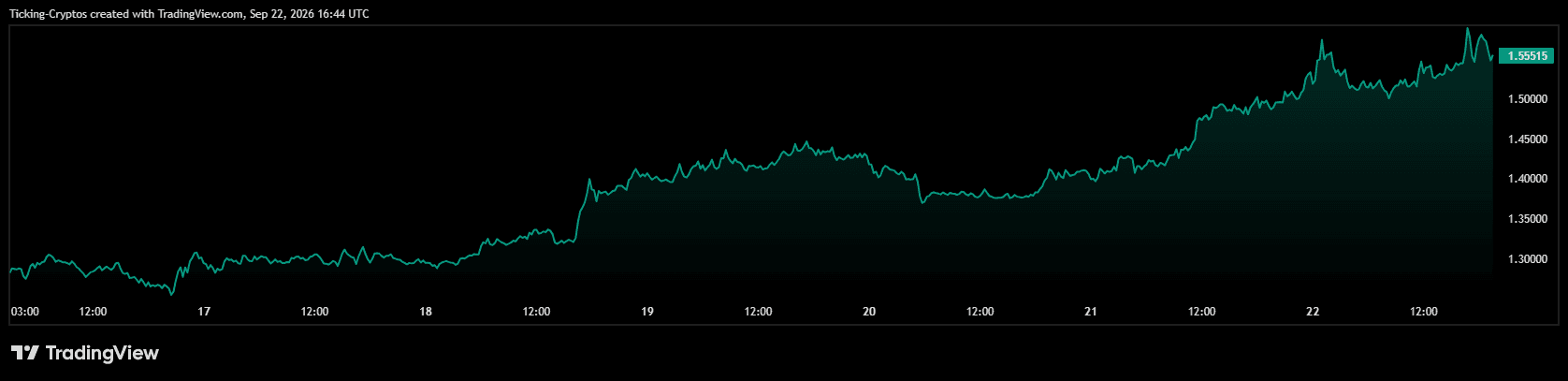
Why Did The XRP Price Break Out Today?
Three things lined up on the daily.
- The descending trendline drawn from the August high finally gave way. Price had been compressing against it since early September, with each rejection landing a little higher. That is textbook coiling, and coils resolve.
- The $1.50 level flipped. It acted as resistance through the entire September range, capping the mid-month push. XRP is now trading above it with room to spare, which turns the old ceiling into the first line of defence.
- The 200 EMA at $1.3589 sits well below price and is flattening out after months of decline. XRP reclaimed it during the August move and has not lost it since, including on the dip to $1.30 in mid-September. A rising market above a flattening 200 EMA is a different animal to a bounce inside a downtrend.
The backdrop helps. Large holders added roughly 1.54 billion tokens during the recent rally, worth around $2.2 billion, although some of that flow also moved toward exchanges. US spot XRP funds also pulled in $153.55 million during August according to SoSoValue data, with the vast majority of that arriving in the final two weeks of the month. Flows do not move an asset of this size on their own, but they do explain why every dip since $1.00 has been bought quickly.
What Is The Next XRP Price Target?
The first real obstacle is $1.80.
There is nothing meaningful between current price and that level, which is exactly why the move can be fast if momentum holds. The August spike stalled at $1.70, so expect some friction there, but $1.70 is a wick level rather than a zone with volume behind it. $1.80 is the horizontal that has actually been defended.
Above $1.80, the chart opens into the $1.80 to $1.95 band highlighted on the daily. That is the pocket where the previous distribution happened, and it is the logical destination if XRP clears the breakout with conviction into October.
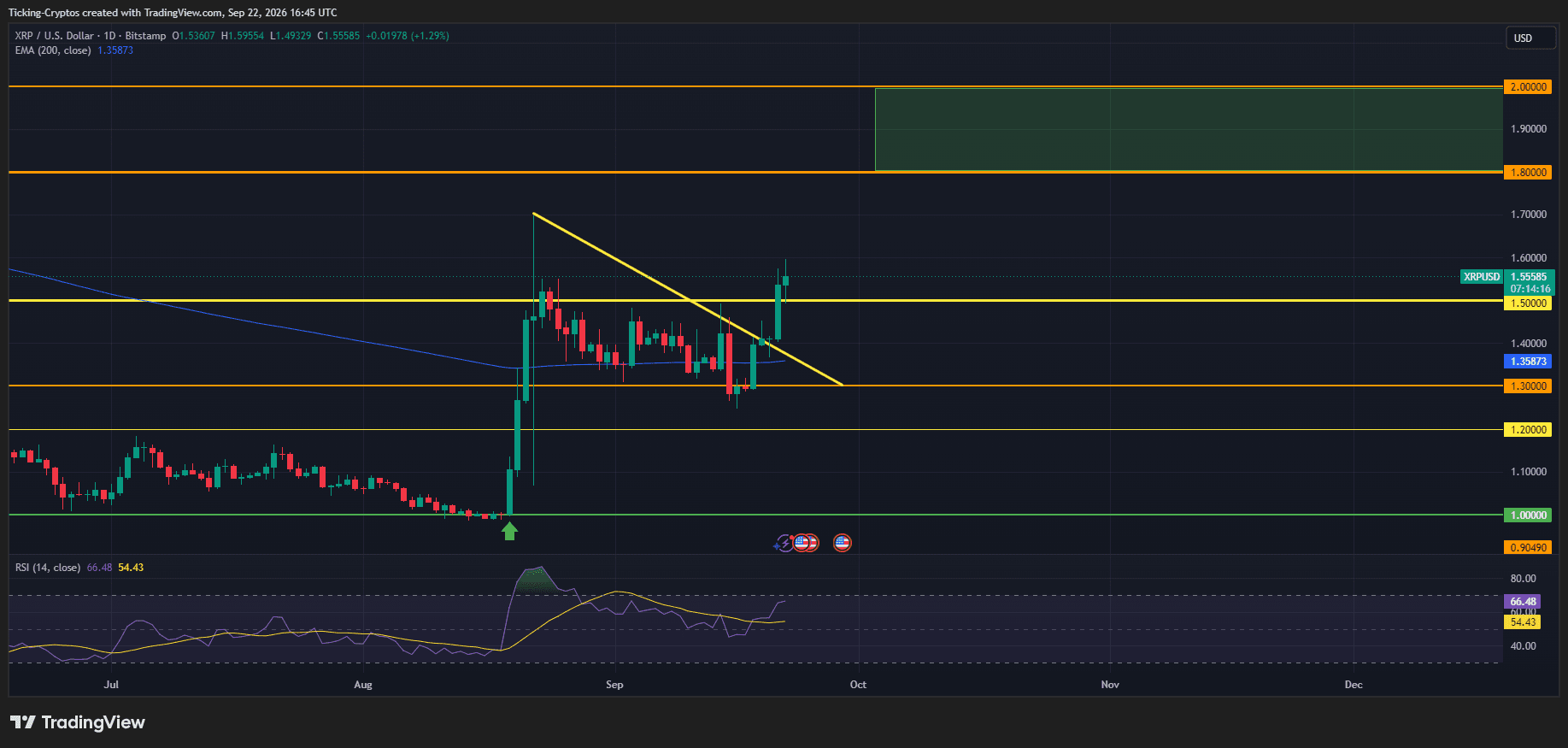
RSI backs the setup without screaming at anyone. It sits at 67.25 with its moving average at 54.49, so momentum is expanding but has not tipped into the overbought exhaustion that marked the top of the August candle. There is room to run before the indicator becomes a problem.
Where Is XRP Support If The Breakout Fails?
This is where discipline matters, because breakouts fail all the time.
The immediate line is $1.50. A daily close back below it would put this move firmly in the failed-breakout bucket, and the natural target from there is the $1.40 shelf where September spent most of its time.
Below that, $1.30 is the one that counts. It has held as support twice in the last month and lines up closely with the 200 EMA at $1.3589. Losing $1.30 on a daily close would hand the trend back to the sellers and reopen $1.20, with $1.00 as the structural floor that produced the entire August rally.
Track the levels live on the CryptoTicker XRP chart.
XRP Price Prediction: What Happens Into October?
Three scenarios, ranked by what the chart currently supports.
- Bullish (most likely while above $1.50): XRP consolidates between $1.55 and $1.60 for a few sessions, absorbs the profit taking, then pushes into $1.70. A clean break of $1.70 puts $1.80 on the table within weeks, with $1.90 to $1.95 as the extended target into late October.
- Neutral: The breakout stalls and XRP chops between $1.50 and $1.60 while RSI cools off. Frustrating, but healthy, and it builds the base for a second attempt at $1.80.
- Bearish: A daily close back under $1.50 traps the breakout buyers. Price slides to $1.40, then tests $1.30 and the 200 EMA together. That level decides whether the August recovery was a trend change or a relief rally.
The line to watch is simple. As long as XRP closes days above $1.50, the path of least resistance points at $1.80.
Decrypt
Four ancient wallets moved 1,971 BTC between Sept. 6 and Sept. 22, including a 600 BTC transfer worth $51.9 million just hours ago, with three of the four carrying "Noah Doe" lawsuit tags.
The exchange operator is adding standard and micro contracts for BCH and UNI, extending a pattern of altcoin rollouts that already covers Cardano, Chainlink, Stellar, Avalanche, and Sui.
Head of cryptography Yehuda Lindell says the exchange is designing custody that can adapt to whatever post-quantum signing scheme Bitcoin adopts.
Galaxy Research says white-hat actors consolidated coins tied to the exploit into a fresh address tagged for a "Crypto Recovery Trust," though the funds represent just 2.8% of the total haul.
OpenAI cut prices 50% on its mid-tier models the same day Anthropic shipped a cheaper flagship, escalating a rivalry now measured in minutes.
U.Today - IT, AI and Fintech Daily News for You Today
Bitcoin is having its best September in 14 years, defying the cryptocurrency’s historically weak seasonal trend as its powerful recovery pushes the price toward the $90,000 level.
Elon Musk has revived one of the strangest moments of the NFT boom, laughing at a throwback to his brief 2022 stint with a Bored Ape Yacht Club profile picture that sent ApeCoin soaring.
For the first time in 3 years, Bitcoin breaks above $80,500, flashing the rare long-term on-chain signal behind the 2019 and 2023 bull markets.
XRP has recovered sharply from its September low, while renewed ETF flows and improving technical momentum have brought the "Uptober" narrative back into focus.
Bitcoin holders are showing little appetite for profit-taking even after BTC surged 47% from its July low.
Blockonomi
TLDR:
- Pyth Network is now an approved external distributor of Nasdaq Basic’s real-time equity data.
- Nasdaq Basic covers best bid, offer, and last sale data for all U.S. exchange-listed securities.
- Clients must get Nasdaq’s written approval before accessing the feed through Pyth’s platform.
- The deal extends Nasdaq’s reach into software and blockchain-native financial applications.
Nasdaq Basic data is now available through Pyth Network after the oracle provider secured approval as an external distributor.
Pyth announced the news on September 22, 2026, stating it is now approved to distribute Nasdaq’s real-time quote and trade product for U.S. equities.
The move gives software and blockchain-native applications a new path to access top-of-book pricing data that brokerages, banks, and fintech platforms have relied on for over a decade.
What Nasdaq Basic Covers
Nasdaq Basic delivers real-time top-of-book data for U.S. equities. In a follow-up post, Pyth described the product as carrying the best bid and offer, with size, from liquidity in the Nasdaq market center. This gives users a live view of market depth without added cost.
The announcement noted that the product also carries the last sale price and size. This information comes from Nasdaq’s U.S. venues and from trades reported to the FINRA/Nasdaq Trade Reporting Facility. Together, these data points give a full picture of recent trading activity.
BREAKING: Pyth is now an external distributor of Nasdaq Basic.@Nasdaq's real-time quote and trade product for U.S. equities, distributed through the Pyth Data Marketplace
pic.twitter.com/1Xfg7mmYdE
— Pyth Network
(@PythNetwork) September 22, 2026
Pyth also posted that coverage is not limited to Nasdaq-listed securities. All U.S. exchange-listed securities are included, regardless of which venue a security is listed on. This broad scope makes the product useful across many types of trading desks.
Nasdaq Basic also includes the Nasdaq Official Opening and Closing Prices. These reference prices come from Nasdaq’s Opening, Closing, and IPO/Halt Crosses. Much of the industry uses them to value positions at the start and close of each trading day.
How Pyth’s Data Marketplace Fits In
Clients of the Pyth Data Marketplace can now license Nasdaq Basic directly through Nasdaq via Pyth. Prior written approval from Nasdaq is required before any client may consume the feed. This keeps distribution controlled while expanding its reach.
In one of its posts, Pyth quoted Michael Cahill, a Core Contributor to Pyth, saying that more of the market runs on software every year and that data therefore has to reach a wider and more varied set of applications. His comment points to a shift already under way across finance.
The same post quoted Cahill adding that Nasdaq has been ahead of that curve for a long time, noting that Nasdaq Basic exists because Nasdaq wanted its data in more hands. He called the addition of Pyth’s Data Marketplace a natural extension of that approach.
The Data Marketplace works as Pyth’s main channel for datasets that fall outside its other offerings. It lets institutions distribute proprietary data directly to the applications that need it. Nasdaq Basic becomes the latest addition to that growing list.
The post Pyth Network Becomes External Distributor of Nasdaq’s Real-Time Equity Data Feed appeared first on Blockonomi.
TLDR:
- Binance RWA perpetuals captured 97% of post-FOMC U.S. stock opening gaps across 16 tracked companies.
- About $1.02B traded outside regular U.S. market hours following the Federal Reserve’s September decision.
- TradFi-linked perpetuals generated $7.25B during the latest S&P index rebalance market closure period.
- Binance Research found bStocks priced in 92% of Monday opening gaps across seven weekends and $1.5B volume.
RWA-linked perpetual futures captured most of the price adjustment that appeared when U.S. stocks reopened after the Federal Reserve’s September policy decision. Binance Research found the median equity-linked perpetual captured 97% of the subsequent U.S. stock opening gap across 16 companies following the FOMC decision.
During the same period, about $1.02 billion traded outside regular U.S. market hours, showing substantial activity before Wall Street reopened. The September 16 FOMC meeting raised the benchmark interest rate by 25 basis points to 3.75%-4.00% in a unanimous decision. That policy change gave global traders new macroeconomic information to price while the underlying U.S. shares were approaching their next regular session.
RWA Perpetuals Capture 97% of Post-FOMC Stock Gaps
The data shows how RWA derivatives are taking on a larger role when traditional equity markets cannot immediately react to major developments. Unlike regular stocks, these contracts trade continuously, allowing investors to respond to policy announcements, company news, and index changes outside exchange hours.
The same pattern appeared around the latest S&P index rebalance, when 198 TradFi-linked perpetual contracts generated $7.25 billion during the market closure. S&P indices regularly rebalance in March, June, September, and December, creating concentrated trading activity around changes that can alter index-linked positioning.
Earlier Binance Research data showed TradFi perpetual coverage had expanded from one ticker in January to 149 by August. At that point, the category represented about 28% of Tier-1 crypto-exchange futures volume, while Binance held roughly 59% of that segment. The growth indicates that off-hours demand is no longer limited to isolated contracts or individual macro events.
Always-On Equity Products Draw Billions After Market Close
A similar pattern has also appeared in tokenized equities, extending the broader shift toward continuous markets beyond perpetual futures. Binance Research previously found that bStocks processed $1.5 billion while U.S. markets were closed across seven weekends.
Those instruments priced in a median 92% of the subsequent Monday opening gap, again showing that significant price discovery occurred before regular trading resumed. The figures quantify repricing before cash equities reopened, rather than simply showing traders remained active.
They also clearly distinguish continuous derivatives activity from direct ownership of underlying securities. However, perpetual contracts differ from owning shares because they track underlying equities without providing stock ownership.
They settle in USDT, trade continuously, and can use leverage of up to 10x, increasing capital efficiency while also raising liquidation risk. Taken together, the latest figures show RWA-linked perpetuals capturing measurable off-hours demand around macro and index events.
The 97% post-FOMC gap capture also places these contracts within a growing market structure where pricing increasingly continues beyond traditional U.S. stock sessions.
The post Binance RWA Perpetuals Capture 97% of Post-FOMC U.S. Stock Opening Gaps appeared first on Blockonomi.
TLDR
- Ionis shares rise 2.58% after positive Phase 3 ulefnersen trial results emerge.
- Ulefnersen meets the FUSION primary endpoint with strong statistical significance.
- The FUS-ALS study also records improvements across several key secondary endpoints.
- Otsuka plans FDA discussions and explores expedited regulatory approval pathways.
- Ionis remains eligible for milestone payments and royalties under the Otsuka deal.
Ionis Pharmaceuticals shares rose 2.58% to $46.06 after the company announced positive Phase 3 results for ulefnersen. The experimental medicine met its primary endpoint in patients with a rare genetic form of amyotrophic lateral sclerosis. The outcome strengthens Ionis’ neurological pipeline and supports the next regulatory steps for the treatment.
Ionis Pharmaceuticals, Inc., IONS
Phase 3 FUSION Trial Meets Primary Endpoint
Ionis and Otsuka Pharmaceutical reported positive topline results from the Phase 3 FUSION study evaluating ulefnersen. The trial involved patients with ALS caused by mutations in the fused in sarcoma gene, known as FUS-ALS. Researchers developed ulefnersen to target the genetic cause of this rare and rapidly progressing form of ALS.
The study met its primary endpoint after showing statistically significant improvements against placebo across function and survival measures. Researchers assessed death, permanent ventilation, rescue treatment, and changes in the ALS Functional Rating Scale Revised. The primary analysis produced a p-value of 0.0005, supporting the statistical significance of the findings.
Ulefnersen also delivered statistically significant improvements across several important secondary endpoints included in the trial. These measures included serum neurofilament light chain levels and time to death, ventilation, rescue, or disease-related withdrawal. The companies also reported favorable safety and tolerability, while most adverse events remained mild or moderate.
Positive Results Advance Ulefnersen Toward Regulatory Review
The successful trial gives Ionis and Otsuka important clinical evidence as they prepare for discussions with global regulators. Otsuka plans to review the FUSION findings with the U.S. Food and Drug Administration. The company will also discuss possible expedited submission pathways with other health authorities.
Both companies plan to present detailed FUSION results at a future medical meeting. They also intend to submit the complete findings for publication in a peer-reviewed medical journal. Additional prespecified and exploratory analyses will further examine ulefnersen’s effects across the study population.
Ionis licensed ulefnersen to Otsuka in 2024 through a collaborative development and licensing agreement. Ionis received an upfront payment and remains eligible for additional regulatory and commercial milestone payments. The agreement also gives Ionis tiered royalties on future net sales if the treatment reaches the market.
FUSION Expands Ionis’ Genetic ALS Program
FUSION used a global, randomized, double-blind, placebo-controlled design to assess ulefnersen’s safety and effectiveness in FUS-ALS. Participants received either ulefnersen or placebo during a 72-week blinded treatment period. They later entered an open-label extension where all participants received ulefnersen.
The primary analysis included 73 participants and combined clinical function with several survival-related outcomes. Researchers also evaluated respiratory function, muscle strength, quality of life, and key biological markers. These additional measures will help define the treatment’s wider clinical profile during further analysis.
The program expands Ionis’ work in genetically targeted treatments for rare forms of ALS. Its earlier neurological development work also included QALSODY, which targets a different genetic cause of the disease. Ulefnersen now adds a successful Phase 3 program focused specifically on patients with FUS-related ALS.
The post Ionis Pharmaceuticals, Inc. (IONS) Stock: Surges as Phase 3 ALS Trial Delivers Positive Results appeared first on Blockonomi.
TLDR
- White hats rescued 52.37 BTC worth more than $4.5 million from the Coldcard exploit.
- Crypto Recovery Trust now holds the rescued Bitcoin for verified victims to reclaim.
- Galaxy Digital tracked 1,789.28 BTC, worth about $154.1 million, lost in the attacks.
- Coinkite linked the exploit to weak seed generation caused by a firmware flaw.
- Coldcard advised users to update their firmware or move funds from vulnerable devices.
The Coldcard hack has entered a recovery phase after white-hat researchers secured 52.37 Bitcoin in a Wyoming trust. Galaxy Digital researcher Alex Thorn said the funds exceed $4.5 million. Crypto Recovery Trust now controls the address and plans to return claims.
COLDCARD WHITE HAT MOVES FUNDS TO TRUST
52.37 BTC comprised of coins from Wave 2, Footprints AA, AU, AX consolidated into a fresh address with an OP_RETURN "claim:cryptorecoverytrust dot com" in block 967,948
these white hatted funds represent 2.8% of the coldcard exploit pic.twitter.com/c5eYeQMxHQ
— Alex Thorn (@intangiblecoins) September 21, 2026

Coldcard Hack Funds Enter Recovery Trust
Thorn said the rescued Bitcoin represents about 2.8% of funds connected to the exploit. Nick Bax of Ump Labs confirmed he helped protect about 50 BTC. He said thieves were close to taking the funds.
The transfer gives affected Coldcard users a route to recover losses. Another security case saw an MEV bot stop an Ethereum wallet exploit before an attacker could drain $7.8 million. KelpDAO froze the destination address for 24 hours.
Firmware Bug Exposed Wallet Seeds
The attacks began on July 31 and targeted Bitcoin held through Coinkite’s Coldcard hardware wallets. CoinKite traced the weakness to a firmware bug affecting seed generation. The flaw forced some devices to rely on a software random generator.
Attackers could use predictable seed data to identify wallet credentials and access funds. Galaxy Digital tracked 1,789.28 BTC lost during the attacks. That amount equals about $154.1 million at Bitcoin prices.
Users Shift Bitcoin After Attacks
CoinKite urged users to update affected software or transfer funds away from vulnerable devices. Some users moved Bitcoin to other storage services, including exchanges. The company said the bug remained unnoticed as more product releases carried the faulty code.
Crypto firms have faced other security cases this month. A Revolut customer data breach exposed information from 680 customers after fraudulent requests bypassed verification checks. The company reported the incident to regulators during a security review.
Trust Starts Victim Recovery Process
Crypto Recovery Trust now holds the rescued assets while it verifies ownership claims from affected users. The Wyoming structure provides a legal process for safeguarding funds during recovery. White hats can use that process while investigators continue tracing stolen Bitcoin.
Security threats also continue across the wider crypto market. A North Korean crypto theft campaign used fake job offers to compromise more than 30,000 devices. Researchers linked the operation to theft from over 7,000 cryptocurrency wallets.
Investigators continue reviewing the Coldcard hack and tracing addresses tied to stolen funds. CoinKite has urged affected users to follow security guidance. The recovery trust may return rescued Bitcoin after it confirms rightful ownership.
The post White Hats Rescue $4.5M Bitcoin From Coldcard Exploit appeared first on Blockonomi.
TLDR
- Dogecoin gained nearly 20% over the past week and briefly touched the $0.10 level.
- Analysts are watching $0.10 as a key resistance zone before targets near $0.1175 and $0.15.
- Some market analysts have issued much higher DOGE targets between $1 and $3.
- Whales bought more than 240 million DOGE earlier this month, adding to bullish market activity.
- Rising exchange inflows could increase short-term selling pressure and weaken DOGE’s recent recovery.
Dogecoin has climbed nearly 20% over the past week and briefly touched $0.10, a level last seen in early June. The interbank Dogecoin price trend has drawn attention as traders watch whether DOGE can hold recent gains. Its market value has also risen to about $15.2 billion, placing it among the largest cryptocurrencies.
DOGE now trades close to the $0.10 level after recovering from weaker prices earlier this month. Several market analysts see the area as an important test. Their forecasts vary widely, ranging from modest gains above current resistance to much larger long-term targets. Trading volume has also increased, giving market participants more activity to assess as DOGE approaches levels that previously limited gains.
Analysts Map Dogecoin Resistance Levels
Analyst Cyriptoman4 said a clear move above $0.10 could open a path toward $0.1175 and $0.15. Recent Blockonomi coverage also tracked Dogecoin whale accumulation, reporting that large wallets bought more than 240 million DOGE during a recent pullback.
BSC Gems Alert pointed to a higher-low price structure and said DOGE is pressing against the top of a descending pattern. The analyst said a break and hold above $0.22 could support a move toward higher resistance. A loss of support, however, would weaken that setup.
$1 Dogecoin Targets Remain Speculative
Other analysts have published much higher targets. X user Bark said Dogecoin has started a move toward $1. MikybullCrypto also expects a stronger advance and cited a possible $1 to $3 range. These projections remain analyst forecasts rather than confirmed price outcomes.
Recent market data provides a more measured reference point. As reported earlier, DOGE resistance near $0.09 remained a key hurdle last week, while buyers repeatedly defended the $0.08 area. DOGE later moved above that resistance as market demand improved.
Whale Buying Meets Exchange Selling Risk
Large holders bought more than 240 million DOGE earlier this month. That activity reduced the amount held outside major whale wallets and attracted attention from traders. Moreover, a Dogecoin breakout setup near $0.0885 to $0.09 is forming as buying activity strengthens.
Selling risk remains present. CoinGlass data shows exchange inflows exceeded outflows during recent sessions. Transfers to centralized exchanges can increase the amount of DOGE available for sale. Traders are therefore watching whether the interbank Dogecoin price can stay near $0.10 while buying demand absorbs any added supply.
The post Dogecoin Price Nears $0.10, Can Bulls Push Higher? appeared first on Blockonomi.
CryptoPotato
Bitcoin (BTC) slipped toward $85,000 on Tuesday after briefly climbing above $87,000, putting its latest recovery under pressure. The move came after a sharp rebound from last week’s low near $75,000, when BTC fell below its September trading range.
That recovery followed a period of weakness. According to the latest Bitfinex Alpha report, Bitcoin had spent much of September between roughly $77,100 and $81,300 before breaking lower. The market then reversed sharply, with Bitcoin gaining 5.9% on September 18 as strong buying and ETF inflows pushed prices higher.
Spot Buying Supports Rally
The rebound carried BTC above the previous range and brought $85,000 into focus as an important level. Bitfinex analysts had identified that price as the first major test for the recovery.
Bitcoin later moved toward $87,000 before giving back some of its gains. Spot buying drove much of the move, but several indicators linked to sustained rallies remain weak. Trading volume has yet to show strong follow-through, while open interest remains relatively subdued.
Short covering also contributed to the rally as traders who had bet on lower prices bought Bitcoin back. Such buying can accelerate a recovery, but its effect may fade if fresh demand does not continue.
Corporate Demand Adds to Bitcoin’s Recovery
Corporate Bitcoin holdings are also receiving attention as the price moves above the estimated average purchase cost of about $80,500. Recent disclosures from Strategy and Strive showed additional Bitcoin purchases. This suggests corporate demand could become more active after slowing earlier this year.
Beyond corporate buying, investors are watching whether broader demand can support the recovery. Coin-denominated open interest remains subdued, while short-term holder exchange transfers stay below roughly 20,000 BTC daily. A sustained level below that threshold could point to lower selling pressure.
The next major test comes on September 25, when a large options expiry could add volatility and selling pressure. A sustained move above $85,000 would keep the recovery in focus, while a drop below $81,300 could return BTC to its previous range.
If selling intensifies, $77,100 remains an important lower boundary. Higher U.S. real yields also remain a challenge, with the yield recently near 2.68%. This keeps broader financial conditions relevant as the apex coin attempts to hold its recovery.
The post Bitcoin’s Rally Above $87,000 Faces Fresh Tests: Bitfinex Alpha appeared first on CryptoPotato.
Cardano has joined the x402 payment standard through an official SDK integration, allowing applications and AI agents to pay for API calls and other online services using ADA or Cardano native tokens.
The rollout puts the network alongside Solana and XRP Ledger in the emerging market for automated internet payments, while ADA’s price has climbed about 6% in 24 hours.
Cardano Adds x402 Support for AI Agent Payments
The Cardano Foundation announced on September 21 that the x402 integration was available through npm, giving developers a way to build applications and AI agents that send and receive ADA or Cardano native tokens over HTTP.
The integration makes Cardano part of the official x402 SDK, allowing an application or agent to pay for an API request without creating an account, obtaining an API key, or using a checkout page.
According to the foundation, Cardano’s specification was merged in June. Its engineers subsequently developed the client, server, and facilitator components. Working with the Masumi Network team, they also added Masumi as a transfer method and completed a three-month review.
Developers can install the package using npm install @x402/cardano. The demo and facilitator are open source, and TypeScript is the first supported language, with Python support planned next.
The x42 standard uses HTTP’s existing “402 Payment Required” status code to initiate payments. When a request arrives without payment, a server can return a 402 response, prompting the client to pay and retry.
ADA Rises as x402 Adoption Expands
Cardano’s jump onto the x402 bandwagon follows Ripple’s joining of the Linux Foundation-hosted x402 Foundation in July, alongside other companies working on the protocol, including Coinbase and Circle. The XRP Ledger already supports x402, with XRP and RLUSD available for agent transactions.
However, in August, analyst Jamie Coutts measured x402 settlement volume as down 93% from the beginning of the year to that point, with its seven-day average having fallen to around $41,800, despite continued development of infrastructure for automated payments.
But at the time of writing, the x402 website reported 75.41 million transactions and $24.24 million in volume over the previous 30 days, with 94,060 buyers and 22,000 sellers.
ADA, meanwhile, was trading around $0.24, up nearly 6% in 24 hours and over 20% in the last seven days, as the broader crypto sector turned green, with several large altcoins marking huge gains, including XRP (6.8%), SOL (4.9%), and DOGE (13.5%).
The post Cardano Joins Solana, XRPL in AI Agent Payments Race as ADA Gains 6% appeared first on CryptoPotato.
[PRESS RELEASE – Miami, FL, USA, September 22nd, 2026]
Kaplan Rothstein Prüss Peraza (KRP2), a prominent cybersecurity and data privacy litigation firm, has announced the expansion of its specialized legal practice focused on recovering digital assets lost to SIM swap fraud. The firm is scaling its plaintiff-side litigation efforts across Florida, New York, and California to pursue civil recovery claims against major telecommunications carriers and cryptocurrency exchanges that fail to protect user accounts from preventable security breaches.
SIM swap attacks occur when malicious actors exploit vulnerabilities in mobile carrier verification processes to hijack a victim’s phone number, allowing them to bypass SMS-based two-factor authentication (2FA). According to the FBI Internet Crime Complaint Center (IC3) annual report, US victims suffered nearly $21 million in losses from SIM swapping in 2025. Furthermore, blockchain analyst ZachXBT documented the theft of over $82 million in SIM swap incidents in 2024, underscoring the severe risk facing retail and institutional investors alike.
As a result of these institutional vulnerabilities, KRP2’s expanded practice provides a direct civil litigation route for victims who have lost cryptocurrency due to a SIM swap attack. Rather than focusing solely on anonymous hackers, the firm targets the corporate entities whose weak identity verification or inadequate account recovery protocols enabled the theft. This litigation model asserts that both telecom providers and cryptocurrency platforms can be held legally accountable under consumer protection, negligence, and data privacy laws when their systemic failures lead to user asset depletion.
Legal precedents increasingly support this institutional liability approach. In a landmark March 2025 arbitration ruling, T-Mobile was ordered to pay $33 million to a customer whose high-security account was breached via a fraudulent SIM transfer, resulting in a massive crypto theft. Globally, judicial bodies are mirroring this stance; India’s Karnataka High Court recently held a major telecom provider liable for negligence following a similar mobile-enabled cybercrime.
To protect claims and ensure evidence preservation immediately following an attack, KRP2 advises victims to take swift action:
- Immediate Carrier Escalation: Report the fraudulent transfer to the mobile carrier to freeze the number and document port-out logs.
- Exchange Lockdown: Notify affected cryptocurrency exchanges to freeze remaining assets, change credentials, and remove SMS-based 2FA.
- Data Preservation: Request and secure all transaction hashes, IP login records, and communication transcripts from both telecom and crypto platforms.
By standardizing recovery protocols across its Miami, New York, and Los Angeles offices, KRP2 aims to bridge the gap between complex blockchain forensics and civil litigation, ensuring that corporations are held financially accountable for infrastructure-level security gaps.
About Kaplan Rothstein Prüss Peraza (KRP2)
Kaplan Rothstein Prüss Peraza (KRP2) is a premier litigation law firm specializing in data privacy, cybersecurity breaches, and digital asset recovery. Operating out of Miami, New York City, and Los Angeles, the firm champions consumer rights by holding major corporations accountable for systemic technical vulnerabilities.
The post KRP2 Law Firm Expands Specialized SIM Swap Crypto Recovery Litigation Across Major US Jurisdictions appeared first on CryptoPotato.
The OG meme coin has been on a tear lately, with its price tapping $0.10 for the first time since the beginning of June.
Analysts have spotted highly bullish signals, and some think the token could be gearing up for a rally to a new all-time high.
Realistic and Wild Predictions
DOGE has risen by almost 20% over the past week, with its market capitalization surging to roughly $15.2 billion and making it the 12th-largest cryptocurrency.
Currently, it trades just below the $0.10 psychological mark, but according to X user Cyriptoman4, it seems well positioned to attack higher levels. The analyst claimed that if DOGE decisively breaks above that zone, the upward move could continue toward the $0.1175-$0.15 region.
For their part, BSC Gems Alert claimed that the price has started forming a higher-low structure and is pushing against the upper boundary of the latest descending pattern.
“If DOGE can break and hold above $0.22, momentum could accelerate toward the higher resistance zones. The setup is simple: Breakout → Retest → Continuation,” they said.
At the same time, the analyst warned that a loss of support would invalidate the bullish setup and could trigger a pullback.
Others, like X user Bark, are much more optimistic. The analyst argued that the breakout to $1 has begun, expecting the potential explosion to happen faster than most people think.
MikybullCrypto issued a similar forecast, maintaining that the bullish move is about to kick off and setting the $1-$3 range as the bullish target.
Key Factors to Consider
Earlier this month, whales purchased more than 240 million DOGE in about a week. Many interpret such accumulations as bullish for several reasons.
First, the development reduces the tokens available on the open market, which, combined with steady or rising demand, is supposed to trigger a price pump.
Second, whales are experienced investors who make calculated moves and usually aren’t driven by pure instinct. Smaller players closely monitor their moves and might get encouraged to jump on the bandwagon, too, thus distributing fresh capital into the ecosystem.
However, some elements suggest that DOGE may be gearing up for a short-term correction. CoinGlass data shows exchange inflows have surpassed outflows over the past few days, suggesting some investors have moved from self-custody to centralized platforms. This, in turn, increases immediate selling pressure.

The post Dogecoin (DOGE) Rises to a 3-Month High: The Breakout to $1 Has Begun? appeared first on CryptoPotato.
Binance is facing a new investigation in the United States over possible violations of sanctions on Iran, Bloomberg News reported on Monday.
Investigators are examining whether Binance allowed certain trading activity linked to Iran on its platform. Authorities are also looking into whether the crypto exchange knowingly allowed the activity to take place, Bloomberg reported.
Another Probe
Binance maintained that it has a zero-tolerance policy toward sanctions violations. The company also asserted that it works closely with law enforcement agencies and remains focused on identifying and removing bad actors from its platform.
This isn’t the first time Binance has faced major scrutiny from US authorities. Its former CEO, Changpeng Zhao, stepped down in November 2023 after the Justice Department accused him of violating US financial laws, including the Bank Secrecy Act and the International Emergency Economic Powers Act. Zhao pleaded guilty and was sentenced to four months in prison in April 2024. He also paid a $50 million fine.
Binance agreed to plead guilty and pay $4.3 billion in penalties as part of the case. Zhao completed his sentence in September 2024. The following year, US President Donald Trump granted him a presidential pardon.
Iran Crypto Crackdown
The latest investigation comes as Washington continues to increase pressure on Iran. The US sanctioned firms and individuals it accused of supporting Hezbollah and other Iranian-backed groups in the Middle East.
Just last week, the Treasury Department added BitBank to its sanctions list. The Office of Foreign Assets Control (OFAC) said that the crypto exchange is controlled by Iranian financier Babak Zanjani, who is already under US sanctions. It was accused of helping move money connected to sanctioned Iranian entities. OFAC said BitBank transferred payments received by the Hormuz Safe Marine Services Authority, which was previously designated by the US.
The platform also allegedly moved hundreds of millions of dollars in Bitcoin to the Islamic Revolutionary Guard Corps between June and July. The sanctions cover BitBank’s developer, Pishtaz Simorgh Electronic Trade Company, and three executives linked to Zanjani.
The post Binance Under US Investigation as Prosecutors Examine Iran-Linked Trading appeared first on CryptoPotato.