Cryptocurrency Posts
Crypto Briefing
The CFTC's initiative could redefine regulatory frameworks, fostering innovation while addressing jurisdictional challenges in emerging tech markets.
The post CFTC Innovation Task Force launches Frontier Forum Series on financial technologies appeared first on Crypto Briefing.
Collins' vote may polarize voters, potentially impacting her re-election bid by swaying moderates and undecideds in a tight Senate race.
The post Susan Collins confirms anti-abortion judge ahead of tight Senate race appeared first on Crypto Briefing.
Boyaa's strategic Bitcoin accumulation and Web3 initiatives highlight a shift towards diversified crypto engagement, impacting corporate treasury norms.
The post Boyaa Interactive acquires 152 Bitcoin, pushing total holdings to 4,468 BTC appeared first on Crypto Briefing.
Agency rules offer temporary relief in crypto regulation, but lack the permanence and stability that only legislative action can provide.
The post TD Cowen: SEC and CFTC rules more durable than orders, but both lag behind legislation appeared first on Crypto Briefing.
The merger reshapes the media landscape, intensifying competition among major players and potentially altering content distribution dynamics.
The post Paramount settles lawsuits, clears path for Warner Bros. acquisition appeared first on Crypto Briefing.
Bitcoin Magazine
Bitcoin Magazine

Billionaire Investor Tim Draper: “Irresponsible” for Apple & Meta NOT to Hold BTC
Government spending hasn’t slowed, and Tim Draper says that leaves only two real outcomes: hyperinflation or interest rates high enough to break banks. In this Bitcoin Magazine Podcast conversation with host Spencer Nichols, the Draper Associates founder makes the case that every business should hold at least four weeks of operating expenses in Bitcoin, every individual about six months, and every government a Bitcoin hedge. He explains why he considers boards that hold zero Bitcoin to be exposed — legally and financially — when a bank holding their cash goes under. Draper also maps his $250,000 Bitcoin price target to the next halving and the supply shock that follows.
 Host: Spencer Nichols — Bitcoin Magazine Tim Draper — Draper Associates
Chapters:
00:00 — Why Apple and Facebook Should Hold Bitcoin on the Balance Sheet
01:56 — Decentralization and the Speed of Innovation
04:06 — Is AI a Centralizing or Decentralizing Force?
06:31 — AI Versus Big Law, Big Banks, and the Bureaucracy
09:05 — Government Spending, Hyperinflation, and Bitcoin as a Safe Harbor
11:21 — The Confederate Million Dollar Bill and Three Paths for the Dollar
13:58 — Open Borders, Pandemic Fear, and the Marketplace of Governments
16:56 — Governance as a Service and Governments That Compete for You
20:00 — Voting on Phones, Estonia, and Bitcoin’s Road to Retail
23:28 — The $250K Target, Two More Halvings, and an All-Bitcoin Fund
DISCLAIMER: The views and opinions expressed in this show are those of the participants and do not necessarily reflect the official policy or position of BTC Inc., Bitcoin Magazine, or any affiliated entities. This content is provided for informational and educational purposes only and should not be construed as investment, legal, tax, or accounting advice. Nothing contained in this show constitutes a solicitation, recommendation, endorsement, or offer to buy or sell any securities or financial instruments. Viewers should consult their own advisors before making financial or business decisions.
This post Billionaire Investor Tim Draper: “Irresponsible” for Apple & Meta NOT to Hold BTC first appeared on Bitcoin Magazine and is written by Patrick Green.
Bitcoin Magazine

Strategy Founder Michael Saylor Argues Clarity Act Collapse Is a Win
Bitcoin treasury founder and pioneer Michael Saylor has said that the blockage of the Clarity Act is actually good for the digital asset space.
Writing on X on Saturday, the Strategy founder and chair said that legislation can make restrictions permanent just as easily as rights.
Lawmakers this week blocked long-awaited crypto legislation, the Clarity Act, which aims to formally divide oversight between regulators. The digital asset industry had long called for such rules to be in place.
Despite the hurdle, regulators like the Securities and Exchange Commission and the Commodity Futures Trading Commission are pushing ahead with rulemaking.
“We have an administration willing to modernize financial markets. We should use the next two years to put better financial products into people’s hands,” Saylor wrote.
He continued: “Let the Digital Assets industry innovate rapidly in a free market and create the greatest possible value for the U.S. and global economy.”
Saylor, whose company Strategy started buying bitcoin in 2020, argued that watchdogs going ahead to make rules anyway — like the SEC’s conditional relief for onchain trading of certain tokenized stocks and the CFTC Chairman stated willingness to act without the bill — would give crypto companies the regulation they need.
Saylor went on to argue that proposals in the act — such as limits on paying customers for holding payment stablecoins — wouldn’t benefit the crypto space anyway.
Senators on Tuesday mostly voted against advancing the legislation — 49 for and 50 against — that the digital asset industry has long called for.
The bill aims to formally divide oversight between regulators, distinguishing which digital assets are securities, commodities or stablecoins.
President Donald Trump last month urged lawmakers to pass it, helping spur a bitcoin rally. But Republicans warned for months that Democrats were deliberately holding it back.
Crypto industry bigwigs had long called for rules to be in place after regulators during the Biden Administration penalized companies in the digital asset space with fines for allegedly selling unregistered securities.
This post Strategy Founder Michael Saylor Argues Clarity Act Collapse Is a Win first appeared on Bitcoin Magazine and is written by Mathew Di Salvo.
Bitcoin Magazine
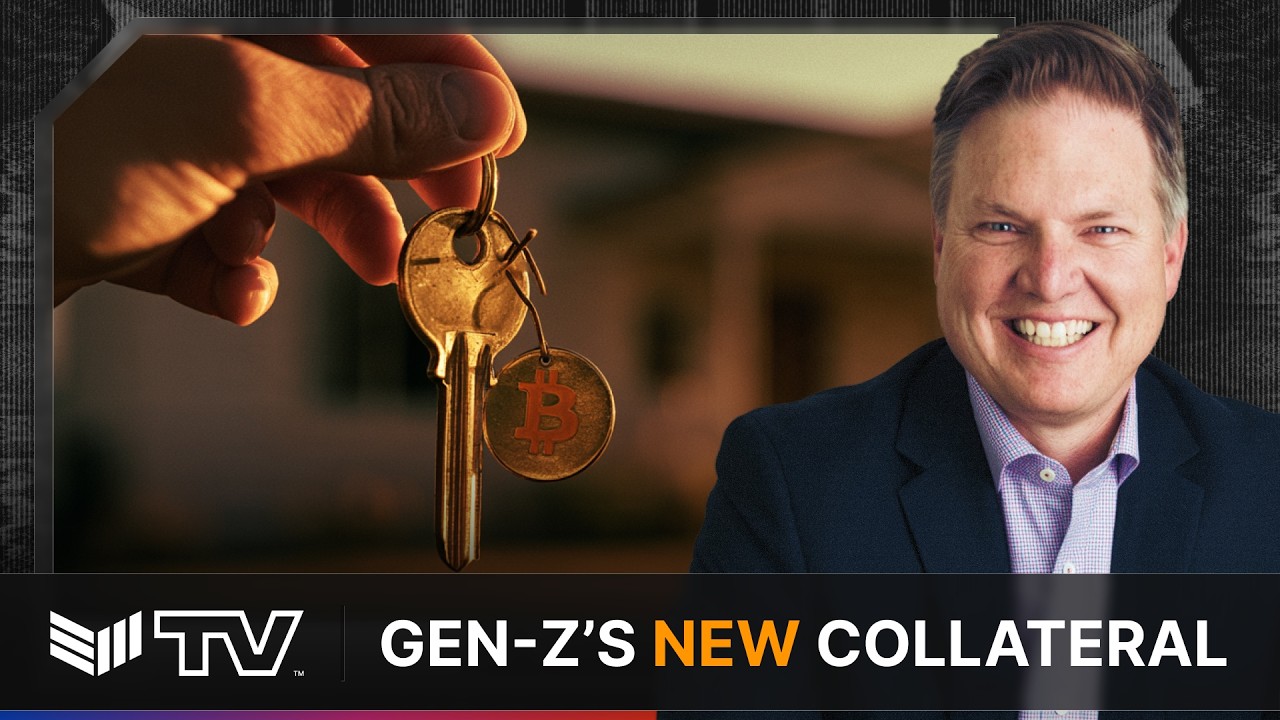
Move Over Housing – Bitcoin is Gen Z’s New Wealth Building Asset
Gen Z now makes up less than 5% of the new home market and Hunter Albright of SALT Lending thinks that changes what assets an entire generation chooses to build wealth with. In this conversation he connects housing affordability, Bitcoin as collateral, and the rise of borrowing against Bitcoin for down payments without locking your coins up for 30 years. Albright also covers Fannie Mae and Freddie Mac recognizing Bitcoin, SALT’s five-year loan terms, and what a Bitcoin-powered life actually looks like in practice.
DISCLAIMER: The views and opinions expressed in this show are those of the participants and do not necessarily reflect the official policy or position of BTC Inc., Bitcoin Magazine, or any affiliated entities. This content is provided for informational and educational purposes only and should not be construed as investment, legal, tax, or accounting advice. Nothing contained in this show constitutes a solicitation, recommendation, endorsement, or offer to buy or sell any securities or financial instruments. Viewers should consult their own advisors before making financial or business decisions.
This post Move Over Housing – Bitcoin is Gen Z’s New Wealth Building Asset first appeared on Bitcoin Magazine and is written by Patrick Green.
Bitcoin Magazine

T. Rowe Price’s Blue Macellari: Bitcoin is Now Core to the Debasement Conversation
Blue Macellari spent 20 years investing in emerging market sovereign and distressed debt before building T. Rowe Price’s digital assets business — which makes her read on the Treasury market unusually worth hearing. She discusses the return of the bond vigilantes, the shift from foreign to domestic financing of US debt, and why the Japan and Italy comparisons don’t map cleanly onto America’s buyer base. She also assesses whether GENIUS Act stablecoin demand for T-bills is a material change or wishful thinking.
Chapters:
0:00 — How the Digital Asset Conversation Changed Inside T. Rowe Price
1:15 — Why T. Rowe Price Built an Actively Managed Multi-Token ETF
2:43 — Tokenization at Scale and the Automation of Asset Management
4:22 — Bifurcated Liquidity and the Risks of 24/7 Trading
6:11 — The Brazil Mortgage Story That Became a Bitcoin Origin Story
7:04 — Global Liquidity, Fiscal Concerns and the Bond Vigilantes Return
8:26 — Foreign vs Domestic Treasury Buyers and the Japan Comparison
10:15 — Can GENIUS Act Stablecoins Create Real Demand for T-Bills?
11:16 — Why the Debasement Trade Actually Drives Institutional Allocations
13:02 — Volatility as a Portfolio Tool and the Generational Allocation Split
DISCLAIMER: The views and opinions expressed in this show are those of the participants and do not necessarily reflect the official policy or position of BTC Inc., Bitcoin Magazine, or any affiliated entities. This content is provided for informational and educational purposes only and should not be construed as investment, legal, tax, or accounting advice. Nothing contained in this show constitutes a solicitation, recommendation, endorsement, or offer to buy or sell any securities or financial instruments. Viewers should consult their own advisors before making financial or business decisions.
This post T. Rowe Price’s Blue Macellari: Bitcoin is Now Core to the Debasement Conversation first appeared on Bitcoin Magazine and is written by Patrick Green.
Bitcoin Magazine
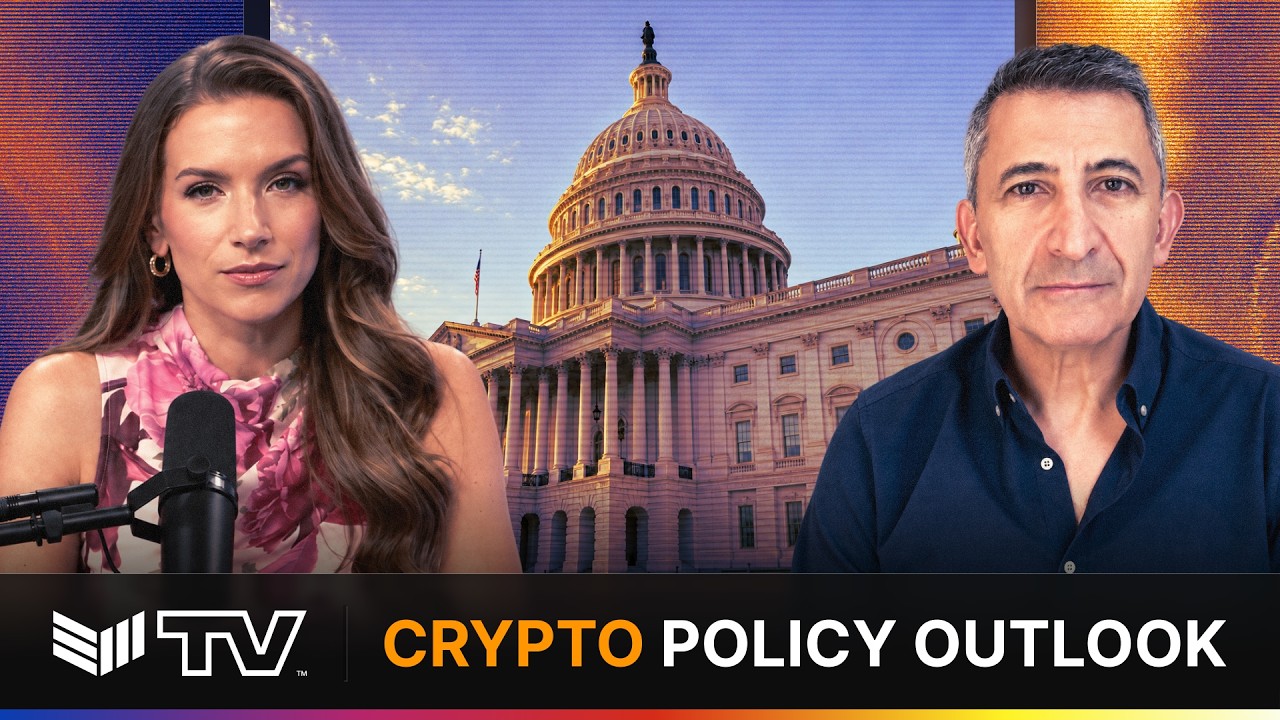
Coinbase Policy Chief: Strategic Bitcoin Reserve Bill Outlook
The Clarity Act’s cloture vote failed this week, and Coinbase Chief Policy Officer Faryar Shirzad has the clearest post-mortem yet on why. He points to an electoral calendar that caught the bill late in the cycle and a roughly $200 million campaign by big banks that created serious drag on the process. Shirzad explains why he believes Congress has had its shot and why the real action now moves to the SEC, CFTC and bank regulators under Paul Atkins. He also lays out the three-track policy strategy — legislation, regulation and international — that he says still has strong momentum.
DISCLAIMER: The views and opinions expressed in this show are those of the participants and do not necessarily reflect the official policy or position of BTC Inc., Bitcoin Magazine, or any affiliated entities. This content is provided for informational and educational purposes only and should not be construed as investment, legal, tax, or accounting advice. Nothing contained in this show constitutes a solicitation, recommendation, endorsement, or offer to buy or sell any securities or financial instruments. Viewers should consult their own advisors before making financial or business decisions.
This post Coinbase Policy Chief: Strategic Bitcoin Reserve Bill Outlook first appeared on Bitcoin Magazine and is written by Patrick Green.
CryptoSlate
Bitcoin’s post-retarget relief for miners was real, but narrow.
Using a BTC price of $84,751, the completed difficulty increase and the latest gross hashprice is about $40.31 per petahash per second per day. That is roughly 2.65% above the prior modeled baseline.
However, the next difficulty estimate is pointing 2.48% lower. The estimate came after only 14.43% of the new epoch, making it an early signal from slower blocks rather than a result or proof that miners were switching off.
The two readings are compatible. Price had restored a modest amount of gross revenue per unit of computing power after the Sept. 19 retarget. The early block pace showed that the network’s next adjustment remained unsettled.
Bitcoin mining economics improved versus the prior model
A Sept. 15 CryptoSlate analysis calculated that BTC would need to reach about $82,877 to neutralize the revenue-per-hash impact of the difficulty increase then forecast for Sept. 19. That was a modeled network threshold, not an industry-wide production cost.
The realized adjustment was less severe than projected. Mempool’s completed difficulty history shows difficulty rose 4.1634% at block 967,680 on Sept. 19, from 127.451 trillion to 132.757 trillion. At press time, CryptoSlate’s Bitcoin market page showed $84,751, which was about 2.26% above the prior model threshold.
Relative to the Sept. 15 model inputs, BTC’s price had risen about 7.07% while realized difficulty increased 4.16%. The price-to-difficulty ratio improved roughly 2.79%. Including the lower recent fee average, theoretical gross hashprice was about 2.65% above the prior baseline.
| Indicator | Frozen value | Comparison | Interpretation |
|---|---|---|---|
| BTC price | $84,751 | 2.26% above the $82,877 model threshold | Price cleared the prior revenue-per-hash hurdle |
| Mining difficulty | 132.757 trillion | Up 4.16% on Sept. 19 | Competition for each unit of reward increased |
| Theoretical gross hashprice | About $40.31 per PH/s per day | About 2.65% above the prior model baseline | Gross network revenue per unit of hash improved modestly |
| Fees in the 144-block sample | 0.01422626 BTC per block | 0.45% of total rewards | Fees added little support in this window |
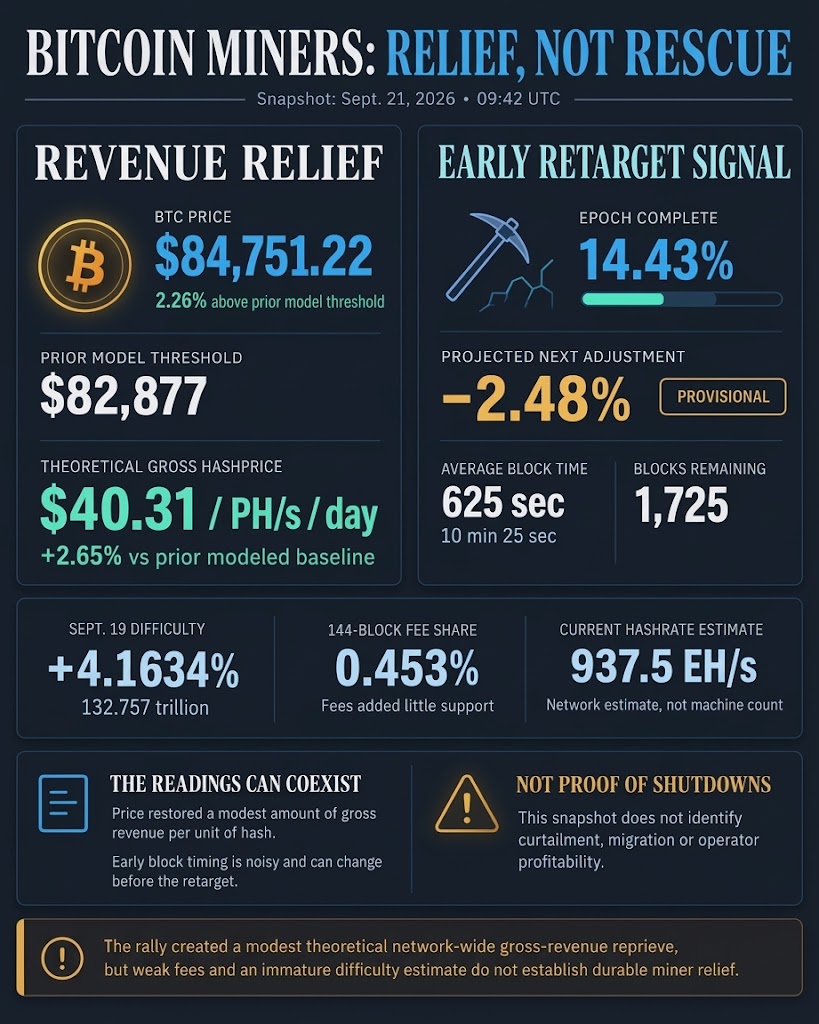
The hashprice estimate uses the 3.125 BTC subsidy, the observed average fee, the frozen BTC price and the network difficulty. It is a theoretical gross revenue benchmark, not reported realized revenue or profit.
Fees offered little extra protection in the measured window. Mempool’s reward statistics show that blocks 967,828 through 967,971 generated 2.04858206 BTC in fees, averaging 0.01422626 BTC per block. Fees were about 0.45% of the 452 BTC total reward across those 144 blocks.
That figure should not be extended into a durable fee regime. It says only that miner revenue in this sample remained overwhelmingly dependent on the block subsidy and BTC price.
Network hashprice also cannot determine which operators were profitable. Fleet efficiency, power contracts, financing, staffing and other costs differ across businesses. As prior CryptoSlate mining analysis documented, the same network revenue level can affect operators differently because their cost structures differ.
The projected difficulty decline is an early signal, not a result
The frozen Mempool difficulty snapshot placed the new epoch at 14.43% complete. Blocks had averaged 625.3 seconds, or about 10 minutes and 25 seconds, with 1,725 blocks remaining. On that pace, the estimate pointed to a 2.48% difficulty reduction around Oct. 3.
Bitcoin recalibrates difficulty every 2,016 blocks to bring average production back toward one block every 10 minutes, as the Bitcoin developer guide explains. Slower-than-target blocks therefore push the next estimate lower.
But a difficulty projection is not a direct count of active machines. Block discovery is stochastic, so short samples can change sharply even if underlying computing power has not made an equally sharp move. Hashrate Index research found that constant-block-time forecasts are especially inaccurate near the beginning of an epoch.
Technical work by Pieter Wuille and academic research on Bitcoin block arrivals support the broader point that early block timing is a noisy hashrate signal. The evidence does not justify treating the Mempool estimate as a diagnosis of shutdowns, curtailment or equipment migration.
Mempool’s one-month estimated hashrate series ranged from roughly 826.1 EH/s to 1.053 ZH/s, while its current estimate was about 937.5 EH/s. Within that observation window, the series showed no sustained, obvious cliff.
Those figures are estimates inferred from block production, not direct readings from every mining machine. They cannot rule out changes at individual operators, and the current estimate should not be confused with the latest daily observation. They show only that the available network series did not display the kind of persistent collapse that would make a broad shutdown claim defensible.
The early retarget reading still matters. If slower blocks persist as the sample grows, the projected decline becomes more informative and a lower completed difficulty would reduce the amount of work competing for each block reward. If blocks accelerate, the estimate can shrink or reverse before the retarget.
What would make the improvement durable
The next test has three parts: BTC price, transaction fees and the maturing block sample.
Price remaining above the prior modeled hurdle would preserve the relief created by the rally. A larger fee contribution would add a second source of revenue instead of leaving miners almost entirely dependent on subsidy and price. A downward retarget that survives a much larger share of the epoch would provide stronger evidence that effective network hashrate had softened.
Even then, network data would not identify the operational cause. Previous CryptoSlate reporting has tracked large AI infrastructure commitments across public miners, but that sector shift does not explain this snapshot’s slower blocks without operator-level evidence.
For now, the strongest conclusion is narrower. Bitcoin’s rally more than offset the finalized difficulty increase in a theoretical network-wide calculation, producing a modest gross-revenue reprieve. Weak fees and an immature next-retarget estimate leave the durability of that relief unresolved.
The post Bitcoin’s $84K rally isn’t saving miners as difficulty signals already flash caution appeared first on CryptoSlate.
ZetaChain's on-chain governance has approved retiring the network’s standalone blockchain and moving ZETA to Solana as the project pivots toward private AI.
Proposal 68 passed after voting ended Sept. 20, with about 99.44% of ballots supporting the plan. The on-chain tally showed 263.65 million ZETA voting in favor, 744,658 voting against, and 752,300 abstaining, giving core contributors a mandate to prepare the migration.
The vote does not immediately move tokens or shut down the network.
ZetaChain says its own L1 no longer fits
The planned shutdown marks a sharp strategic shift for a project founded in 2021 to connect otherwise separate blockchains.
ZetaChain spent years building a Cosmos SDK-based layer-1 designed to let applications interact with assets and contracts across networks including Bitcoin, Ethereum and Solana. Earlier this year, however, the project began concentrating resources on Anuma, a private multi-model AI application built around what it calls a Private Memory Layer.
ZetaChain now says maintaining its own blockchain no longer helps that effort. In Proposal 68, the project said operating a Cosmos-based network requires coordinating upstream security advisories and patches across dozens of independent validators, an operational burden it expects to increase as AI tools make vulnerabilities easier to find.
Moving to Solana would replace that validator infrastructure and let contributors focus on Anuma and the AI application layer. ZetaChain said “every contributor hour” would shift toward ZETA, Anuma and development on Solana.
The project says Anuma has attracted more than 300,000 users since February and processed more than 1 million requests across 35 AI models. Each Anuma account also includes a wallet, meaning the migration could bring those users into the Solana ecosystem alongside the token.
ZetaChain argues Solana offers the transaction speed, low fees, liquidity, and emerging agent-payment infrastructure needed for AI applications that may make frequent payments or model calls. It cited confirmations of about 400 milliseconds, more than $15 billion of stablecoins on the network and roughly $70 billion in monthly decentralized-exchange volume.
ZETA shifts from securing a chain to accessing AI
The imminent token migration would also change ZETA's economic role within the project's ecosystem.
Native balances on ZetaChain would convert 1:1 into a Solana-native SPL token under the same ticker. Total supply would remain unchanged, and no additional tokens would be created. Once the migration is completed, the Solana token would become the canonical version of ZETA and ZetaChain’s own L1 would wind down.
The company is positioning ZETA as an access token for its AI products rather than primarily as the asset underpinning an independent proof-of-stake network.
Anuma already lets users lock ZETA in exchange for credits they can spend on AI usage, removing those tokens from circulating supply. ZetaChain wants other AI applications and agents on Solana to use the same system.
That strategy depends on whether Anuma can convert its early user growth into sustained demand and whether outside developers adopt ZetaChain’s memory layer.
The migration would give the token access to Solana’s larger trading and payments ecosystem, but it also removes the independent blockchain that previously formed the center of ZETA’s utility.
ZETA held on Ethereum and BNB Chain is outside Proposal 68, while existing vesting schedules would remain unchanged. Native balances moving from ZetaChain will shift from 18 decimal places to Solana’s nine and be rounded down, though the first proposal does not specify how fractional remainders will ultimately be treated.
Exchanges now hold part of the timetable
The next step depends heavily on centralized exchanges that list ZETA.
Core contributors said they will submit the second governance proposal only after those venues confirm how they intend to support the swap. Major exchanges require advance notice for token migrations, leaving the shutdown timetable dependent on those negotiations rather than a predetermined date.
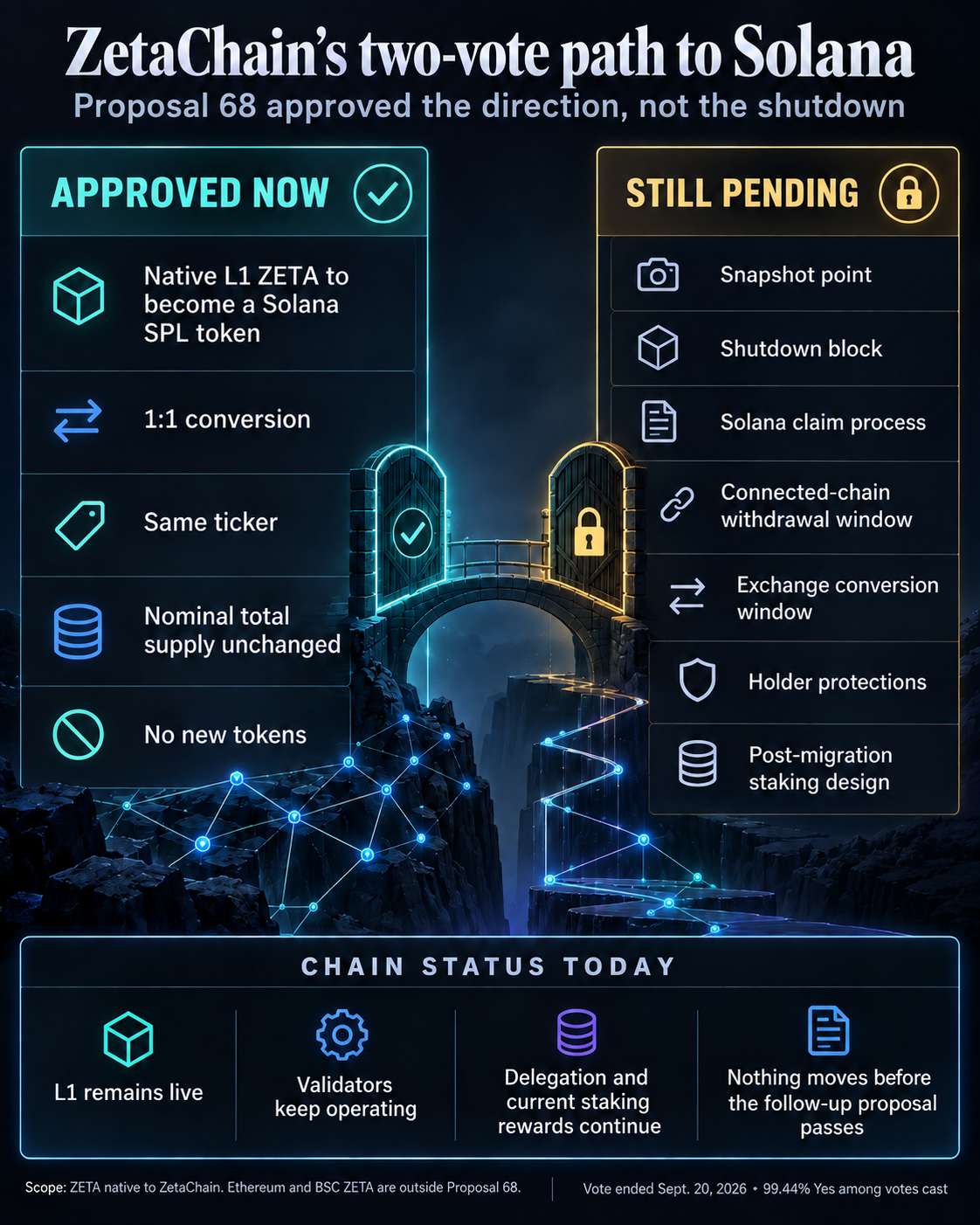
That follow-up proposal is expected to establish the withdrawal window for assets still connected to ZetaChain, the snapshot and halt heights, when Solana claims begin, and how exchange-held balances convert. It will also spell out holder protections and the validator wind-down process.
The future of staking remains unresolved. Rewards will continue until the L1 shuts down, while ZetaChain says it is still exploring what staking could become after ZETA moves to Solana.
Until exchanges agree on those mechanics and token holders approve them, ZetaChain will continue operating the infrastructure it has voted to retire.
The post This blockchain just voted to shut itself down for a Solana-powered AI pivot appeared first on CryptoSlate.
Bitcoin surged above $85,000 as a wave of short liquidations accelerated the cryptocurrency’s strongest advance since January.
Data from CryptoSlate showed BTC gained more than 5% over the past 24 hours to reach $85,193, extending its advance over the past 35 days to about 29%. The asset had eased to $84,545 as of press time after breaking through levels that had constrained its recovery for much of the year.
The rally caught bearish traders heavily exposed. CoinGlass data showed about $750.5 million of leveraged crypto positions were liquidated over the past 24 hours, with more than $648 million, or roughly 86%, coming from shorts. About 137,386 traders were liquidated during the period.
Bitcoin accounted for roughly $360 million of the liquidations, while Ethereum contributed nearly $171 million. The largest single liquidation was an $11.29 million BTC-USDT position on Binance.
The forced unwinding coincided with a sharp increase in aggressive buying across Bitcoin derivatives markets. CryptoQuant data showed net taker volume on Binance jumped from about $11 million to $618 million within an hour as European trading opened, signaling a sudden imbalance toward market buyers.
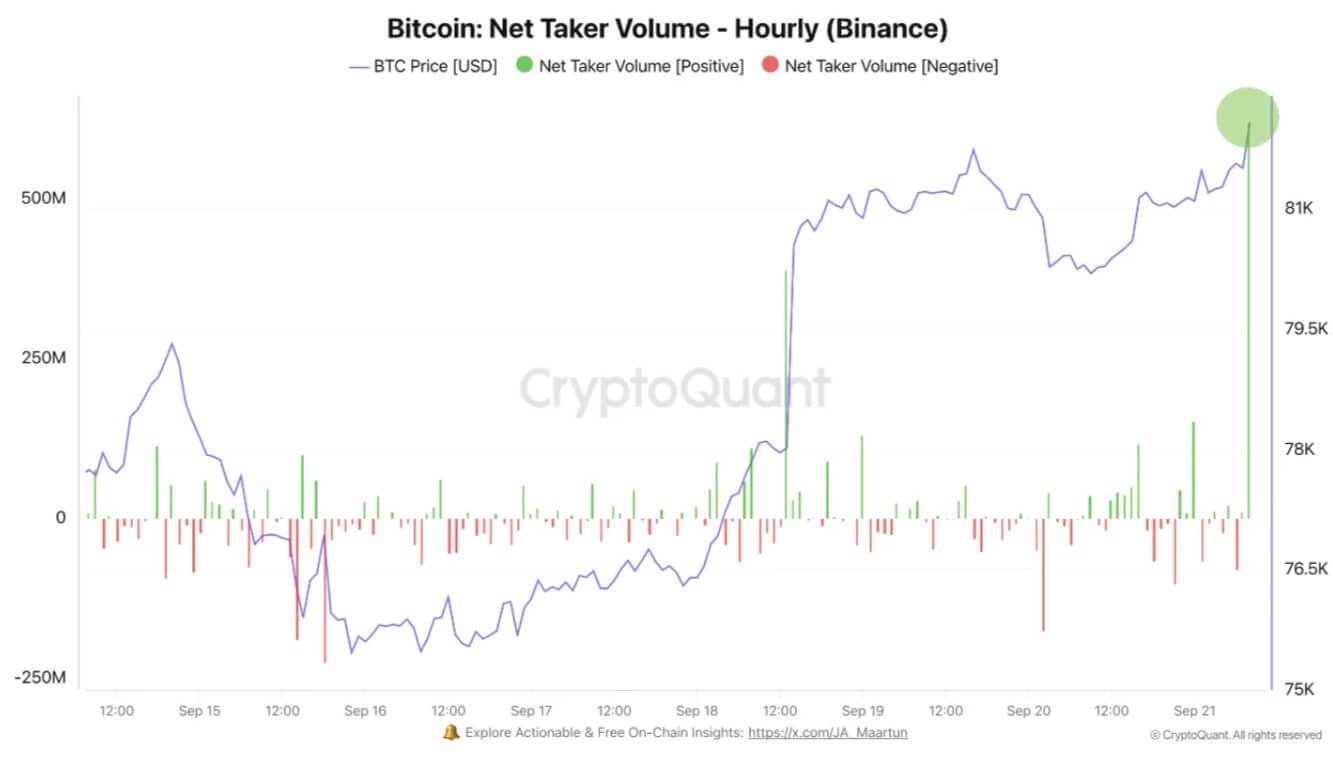
CryptoQuant attributed the shift partly to improving geopolitical sentiment, as investors responded to signs of potential diplomatic progress between the US and Iran. Oil prices also declined as markets weighed the prospect of talks, helping support a broader return of risk appetite despite continued tensions in the region.
Meanwhile, elevated leverage also amplified BTC's price movement. Bitcoin open interest stands at about $28.83 billion, close to its May record, leaving a large pool of derivatives positions vulnerable to further price swings.
That positioning can continue to work in Bitcoin’s favor if prices rise and additional short sellers are forced to cover. It also leaves the market exposed to a sharper reversal.
However, if Bitcoin loses momentum, leveraged long positions could unwind rapidly, turning the same mechanics that accelerated the rally into a source of selling pressure.
Bitcoin clears long-term bear-market markers
The move above $85,000 has also pushed Bitcoin through technical levels traders have watched for months as evidence that the downturn is ending.
Bitcoin closed above its 50-week moving average last week for the first time since November 2025, ending a 45-week stretch below the threshold. Galaxy Digital Head of Firmwide Research Alex Thorn said previous recoveries of the measure have often provided strong confirmation that Bitcoin had already established its bear-market low.
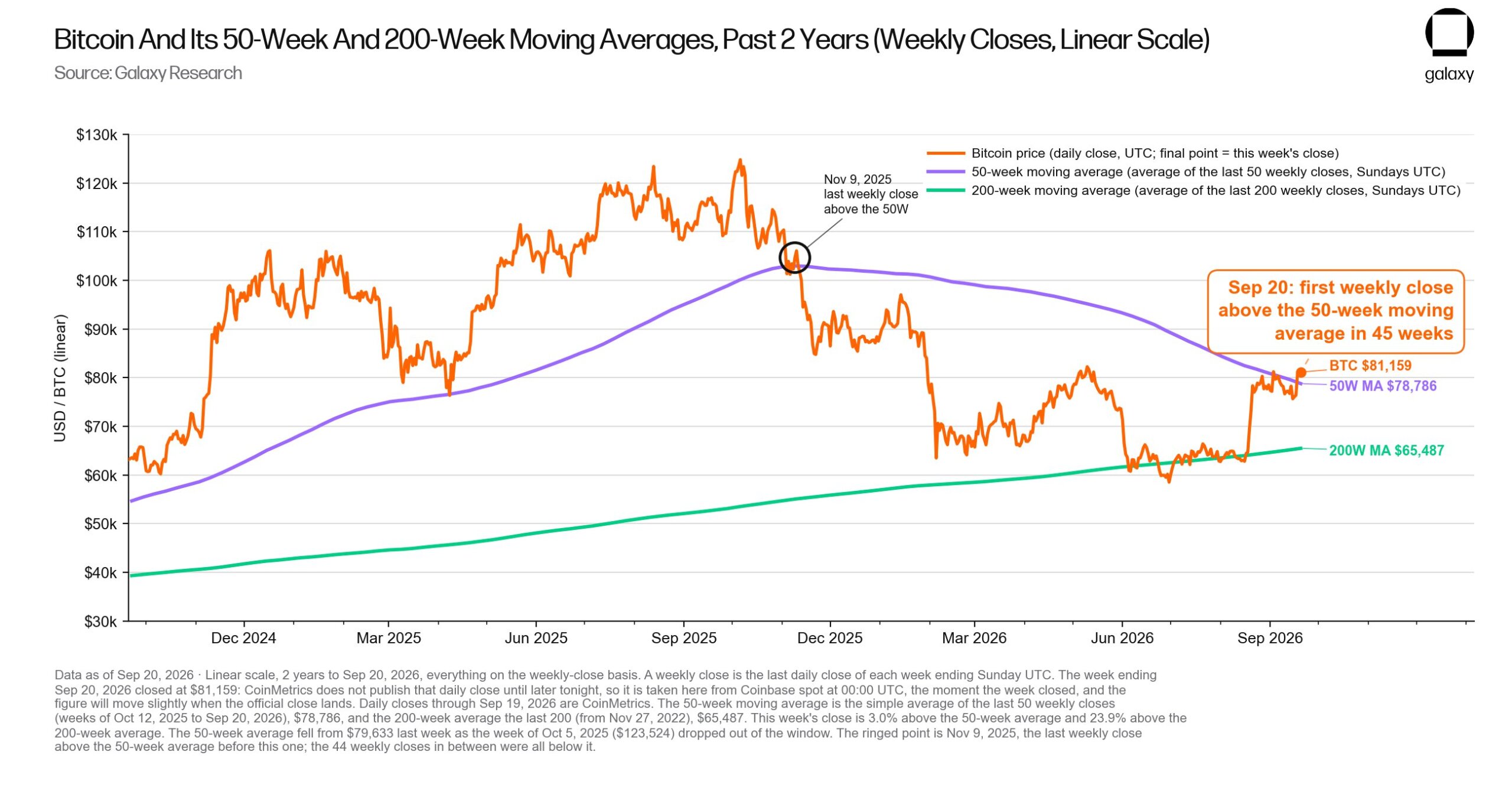
The signal has not been flawless. Galaxy research shows Bitcoin has previously reclaimed the 50-week average only to fall back below it, including during the 2021-2022 bear market.
CryptoQuant Chief Executive Ki Young Ju highlighted another closely watched level after Bitcoin moved back above its 365-day moving average near $83,000. He said holding that threshold could encourage momentum traders and institutional investors who had remained on the sidelines during the decline to return.
In view of this, Bitcoin analyst Joe Consorti argued the market was tentatively entering a “bull market.”
However, the breakout's strength has yet to produce a comparable increase in underlying network activity.
Blockchain analysis firm Santiment said new and active Bitcoin addresses remained near their median levels between July 24 and Sept. 20, even as the price broke higher. Social activity rose to 1.23 times its baseline and transactions worth more than $100,000 climbed to 1.18 times normal levels, but neither reached a two-month high.
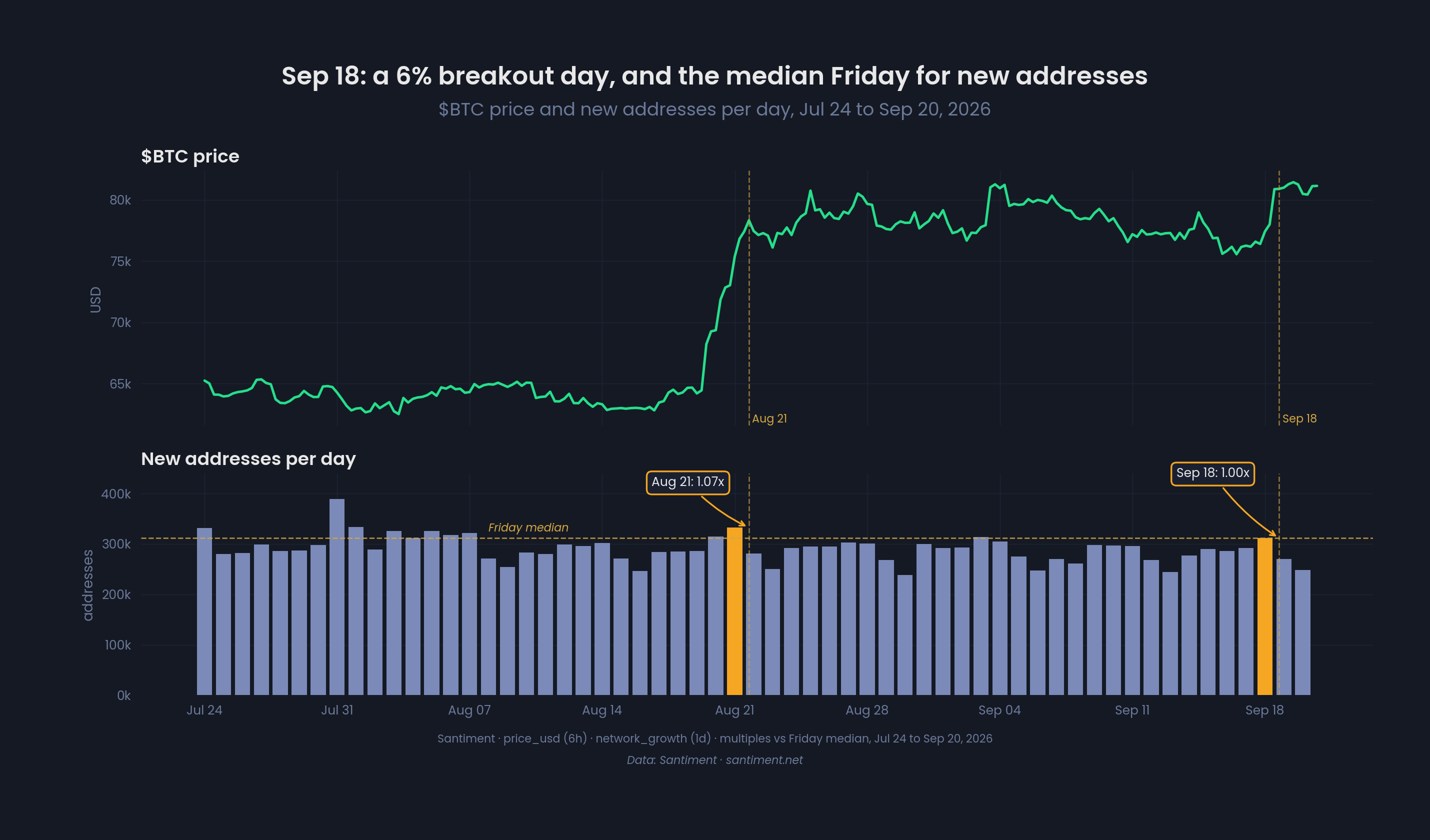
The contrast was visible against Bitcoin’s Aug. 21 rally, when the asset gained almost 7%. That move generated more wallet activity despite producing a less significant technical breakout, with new addresses reaching 1.07 times their baseline and active addresses climbing to 1.14 times.
Santiment said 10 weekdays over the past two months produced more new wallets than the latest Sept. 18 breakout session.
Derivatives activity has been much stronger. Open interest jumped about 9% on Sept. 18 and has remained elevated, reinforcing the gap between leveraged market participation and activity on the Bitcoin network itself.
That divergence makes the rally's durability increasingly dependent on whether fresh spot demand emerges. Forced buying from short liquidations can propel Bitcoin through resistance, but its impact diminishes as bearish positions are cleared. Holding above $85,000 will require new capital to replace traders forced to buy back losing bets.
The post Bitcoin hits $85,000 after $648M wipeout forces mass buying appeared first on CryptoSlate.
A flaw in Bitcoin Lightning software Eclair could let malicious peers wipe out a node’s local channel balance through fees.
ACINQ released Eclair 0.14.3 on Sept. 14 to patch three peer-triggered vulnerabilities that could cause operators to lose or lock funds during channel closures, splicing, and on-the-fly funding.
The Bitcoin technology company, a contributor to Lightning Network development and maker of Eclair and Phoenix Wallet, strongly recommended operators upgrade because malicious nodes could exploit these issues.
Eclair's patched vulnerabilities
The most direct attack involved cooperative channel closures. When Eclair was responsible for the closing fee, an adversarial peer could propose a charge larger than the victim’s local balance. Eclair’s fallback negotiation could accept the proposal, eliminate the operator’s output and effectively send the entire local balance to Bitcoin miners as transaction fees.
The patch now rejects closing-fee proposals above an operator’s configured maximum. Bitcoin Optech described 0.14.3 as a security release addressing vulnerabilities involving channel closing, splicing and on-the-fly funding.
A second weakness could strand funds during an unfinished splice, a process that changes the transaction funding a Lightning channel without closing it. If Eclair signed first and the peer withheld its signature, the latest channel state could depend on a transaction the victim could not publish.
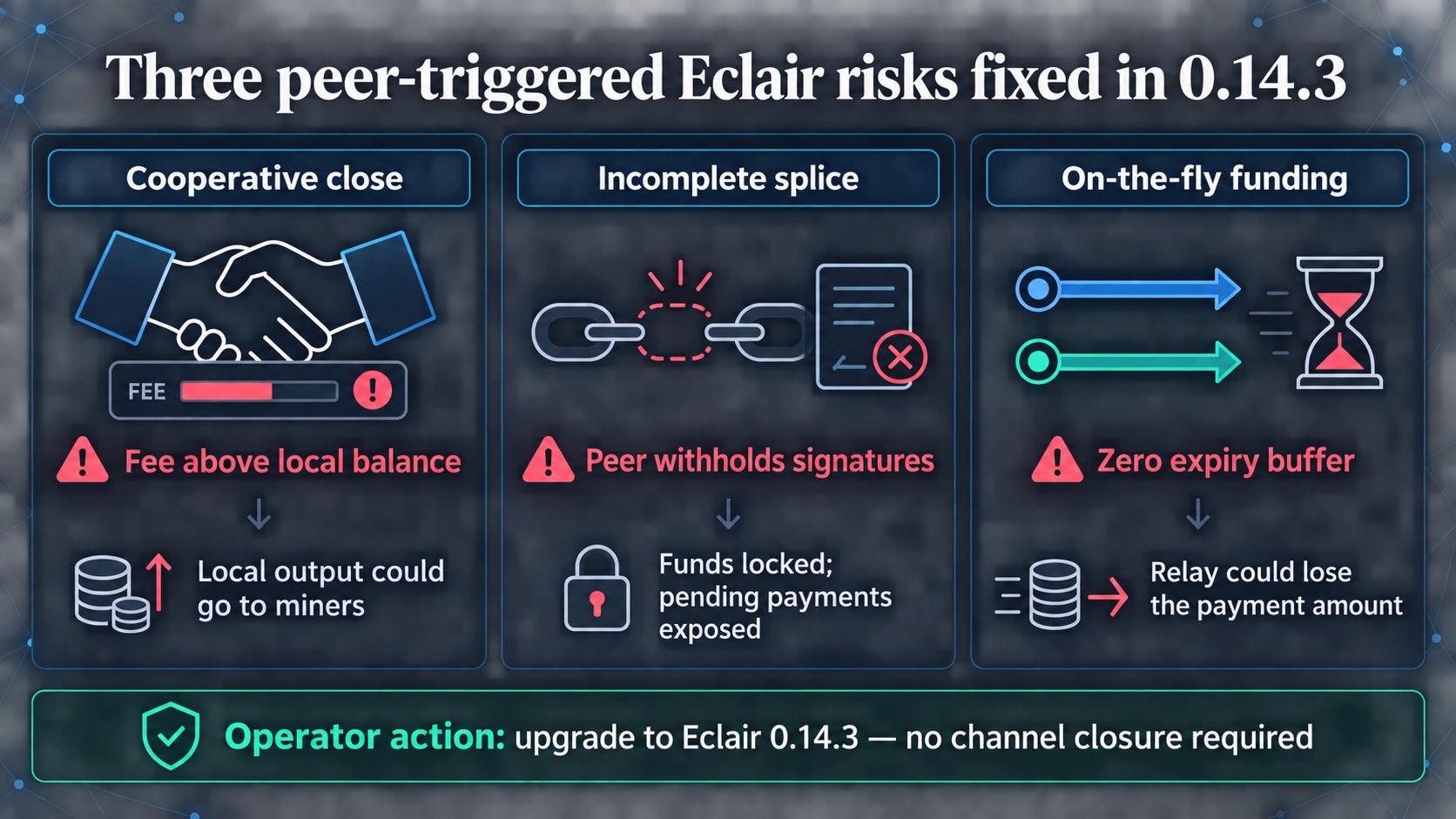
That setup also created a path for losses on payments still in flight. An attacker could allow the incoming side of a relayed payment to expire, publish an older channel state, and use the payment secret to collect the outgoing leg. Eclair will now force-close using the newest state backed by a fully signed funding transaction.
The third vulnerability affected Eclair’s on-the-fly funding feature, which can open a channel while forwarding a payment. A malicious wallet could manipulate payment-expiry timing to collect the outgoing payment on-chain while the incoming payment expired, leaving the relay operator to absorb the loss.
Eclair now checks relay fees and expiry buffers before committing funds. The release also adds a default 50 satoshis-per-vByte ceiling for automatically estimated channel-opening and splice fees, limiting exposure to bad external fee data.
Bitcoin Lightning operators face widening security pressure
The fixes arrive as operators of other Lightning software confront separate attempts to compromise exposed infrastructure.
Earlier this month, Bitcoin payment processor BTCPay Server said that it had observed bots repeatedly probing servers where administrators had manually re-enabled external access to LND, another Lightning implementation.
The attackers targeted an unauthenticated password-change endpoint during a brief window when an LND wallet was locked. If successful, they could replace the wallet password and request an administrator macaroon that could control the node.
BTCPay responded by introducing unique passwords for LND wallets and blocking unauthenticated wallet-management routes at its network edge. It also advised operators not to manually expose the LND API.
The incidents point to mounting security pressure across Bitcoin’s Lightning ecosystem as attackers search for software weaknesses they could use to seize or redirect funds.
The post A Bitcoin Lightning flaw could send a node’s entire balance straight to miners appeared first on CryptoSlate.
Bitcoin climbed above $80,000 after a $148 billion US Treasury cash build failed to destabilize overnight funding markets.
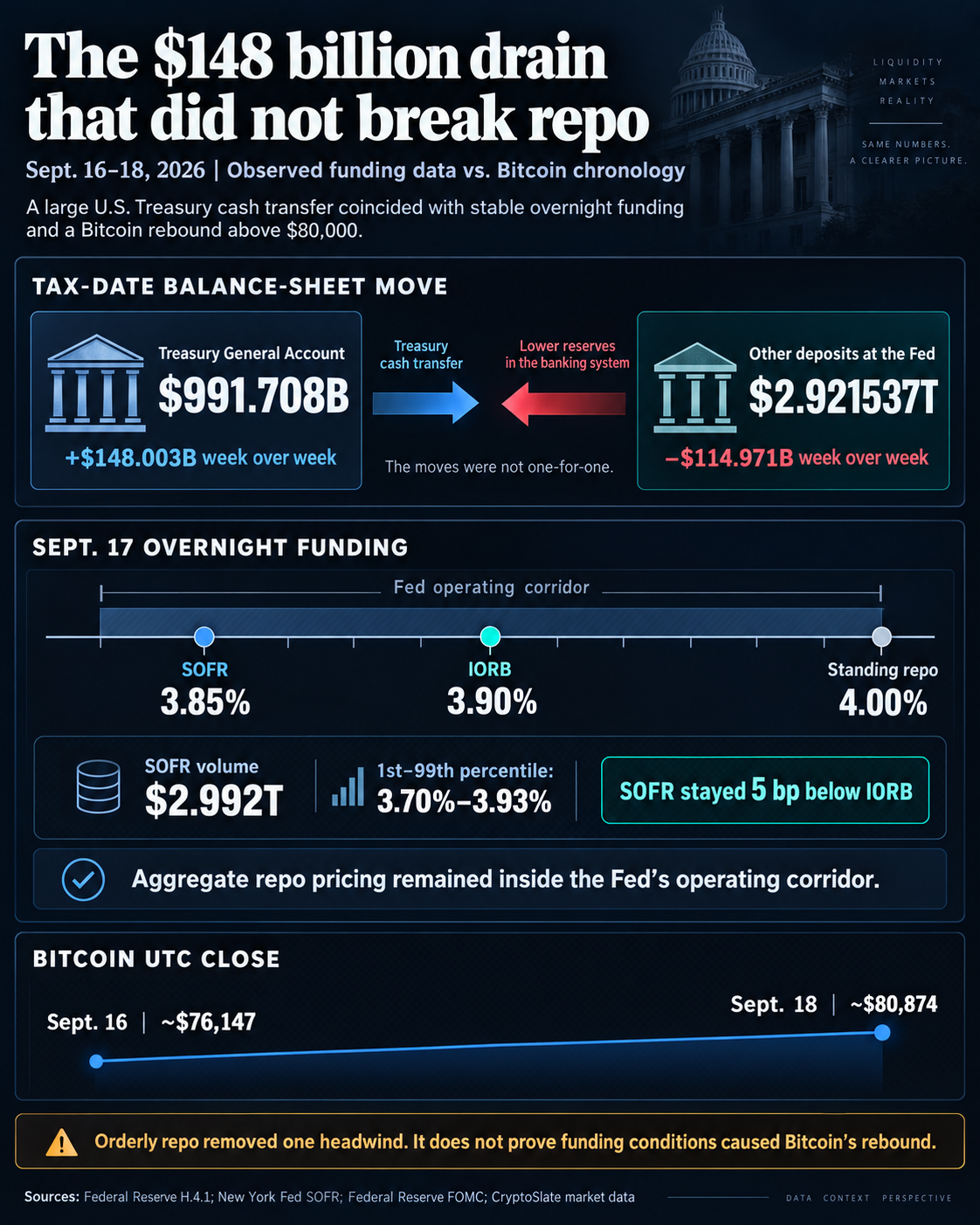
The Treasury General Account rose by $148.003 billion through Sept. 16 to $991.708 billion, Federal Reserve data showed, as tax payments shifted cash into the government’s account at the central bank.
Deposits held by commercial banks at the Fed fell by $114.971 billion over the same period to $2.922 trillion, tightening the pool of reserves available to the financial system. The gap between the two moves shows the Treasury increase did not translate into a one-for-one reserve drain because other balance-sheet flows were also at work.
The transfer had been closely watched because large tax-date inflows into the Treasury can temporarily pull cash from private markets and make short-term funding more expensive. That risk took on added significance after the Fed raised its benchmark interest-rate range by 25 basis points to 3.75% to 4% on Sept. 16.
So far, the strain has remained contained.
The Secured Overnight Financing Rate, the main benchmark for borrowing cash against Treasury securities, printed at 3.85% on Sept. 17 across almost $3 trillion of transactions. That was five basis points below the Fed’s new 3.90% interest rate on reserve balances.
Trading also remained concentrated around the central bank’s policy settings. The 25th and 75th percentiles were 3.83% and 3.90%, while even the 99th percentile reached only 3.93%, seven basis points below the Fed’s 4% standing repo facility rate.
Repo markets absorb the shock
The figures suggest the tax-date withdrawal tightened funding conditions without forcing broad money markets outside the Fed’s operating corridor.
SOFR rose 23 basis points from 3.62% after the Fed’s rate increase took effect, closely tracking the scheduled policy reset. That makes the change in official rates the clearest explanation for most of the repricing, while leaving open the possibility that tax-related cash demand added pressure at the margin.
The absence of a wider funding squeeze removed one potential source of stress for risk assets as Bitcoin recovered from a sharp pullback.
During the period, Bitcoin rose from about $76,147 to more than $80,000. It was trading around $82,000 at press time, according to CryptoSlate data.
The rebound coincided with renewed inflows into spot Bitcoin exchange-traded funds, a technology-led equity rally and weakness in the yen, while the role of short covering remains unresolved.
The funding data provide little evidence that the Treasury transfer itself generated demand for Bitcoin. Instead, they show that one liquidity risk hanging over the market passed without developing into a broader disruption.
That distinction will matter as traders assess whether Bitcoin can extend the recovery. With repo markets still behaving normally, attention shifts back toward ETF demand, positioning and the durability of the broader risk-asset rebound.
A renewed rise in short-term funding costs would quickly change that calculus. For now, the next test is whether fresh buyers continue to support Bitcoin after the temporary tax-date pressure has passed.
The post Bitcoin shattered $80,000 after a $148 billion US liquidity shock failed to break markets appeared first on CryptoSlate.
CryptoTicker.io
US funds holding ether lost a net $140 million in the week to September 18, 2026. It is the first week of outflows since mid-August, and it ends a run of four consecutive weeks of inflows. At the same time the Ethereum price stands at $2,703 on Monday morning, a good 5 percent above the previous day. Price and capital flows are pointing in different directions.
If you hold ether, this is less a question about the price than a question about the wrapper: which structure your ether sits in, what that means for tax, and which deadlines are currently running. This article puts the numbers in context and names the points you can check against your own holdings.
Ether ETFs: $140 Million of Outflows in One Week
The figure comes from The Block's weekly flow review published on September 19, 2026. It shows that US spot ETFs on ether recorded a net outflow of $140 million for the trading week to September 18. That is the first negative week since the one that ended on August 14.
What happened inside that week is worth noting. On Friday, September 18, ether funds still took in $143.8 million. The weekly loss was therefore built up on the days before it and was almost, though not quite, recovered on the final trading day. Anyone reading the Friday number alone gets a different picture from someone looking at the full week.
The four weeks before that looked very different. Taken together, ether funds gathered $1.94 billion over that run. Measured against it, an outflow of $140 million is a small amount; it marks an interruption, not a collapse.
One term that is often confused: net flow is the difference between fund shares created and shares redeemed over a period, converted into dollars. It measures how much fresh money goes into the wrapper or comes out of it, and it says nothing about how the value of the ether already held has developed.
Why the ETH Price Is Rising Despite the ETF Outflows
On Monday morning, September 21, 2026, ether trades at $2,703.62 according to CoinGecko. That is 5.10 percent more than 24 hours earlier and 5.80 percent more than a week ago. The price remains a good 45 percent below its all-time high of August 24, 2025.
The move is not confined to ether. Bitcoin stands at $83,650 over the same window, up 4.27 percent, XRP gains 7.30 percent and Solana 7.17 percent. When practically the entire top of the market rises at once, the cause usually lies not with any single asset but with general risk appetite.
That leads to a distinction worth keeping in mind. The previous week's ETF flows and this morning's price describe different periods. The flow data ends on Friday; the price is from today. A weekly outflow therefore does not explain what the price does on the following Monday.
Bitcoin ETFs for Comparison: $433 Million in a Day, $6.2 Million Over the Week
For the bitcoin funds the contrast in the same week was sharper still. On Friday, September 18, they took in $433 million. For the week as a whole, a net inflow of $6.2 million was left. The four days before it had therefore consumed almost all of the Friday inflow.
At fund level, Fidelity's FBTC led on Friday with $310.7 million, while BlackRock's IBIT reached $108.4 million. Over the full week the order reversed: IBIT took in $120.7 million, FBTC $79.9 million. Here too, a single strong day says little about where the money travels over longer stretches.

US Spot ETF or ETP: What You Can Actually Buy in Europe
This is the point at which many reports out of the United States mislead. The funds whose flows are described above are US spot ETFs. As a retail investor in Europe you generally cannot buy them. They are not set up under European law and do not provide a key information document under the PRIIPs regulation, which brokers in the EU must supply before selling to retail clients.
What you find instead on European exchanges are crypto ETPs, often structured as ETNs. An ETN is legally a debt security issued by the provider that tracks the price of the underlying asset and in practice is usually backed physically with real ether. Which of these products are tradable in Germany and how they differ is collected in our overview of crypto ETFs in Germany.
The third route is buying the coin directly on a trading platform, with custody either at the platform or in your own wallet. Which platforms are available on a regulated basis for this is shown in our crypto exchange comparison. All three routes lead to the same underlying asset, but they are treated differently for tax.
The Holding Period Under Section 23 EStG: Why the Wrapper Decides the Tax
When you buy and hold ether directly in Germany, Section 23 of the Income Tax Act applies, which governs private disposal transactions. If more than twelve months pass between acquisition and sale, the gain is tax free. Within the year there is an exemption threshold of 1,000 euros per year covering all private disposal transactions together. The text of the law is freely available from the Federal Office of Justice.
With an ETN the position is different and depends on how the paper is constructed. What matters is whether it grants you a claim to delivery of the actual coins. Papers carrying a delivery claim are in practice often treated as an asset under Section 23, while those without one count as a monetary claim subject to the 25 percent flat capital gains tax plus solidarity surcharge and, where applicable, church tax. In the second case there is no deadline after which the gain becomes tax free.
This is not an academic difference. On a gain of 10,000 euros after more than a year, one side carries a tax bill of zero and the other a burden of roughly 2,600 euros. Which case applies to your paper is set out in the issue terms and the key information document. Check that before you buy, not in the year you sell. Because the classification can be contested in an individual case, it belongs with your tax adviser and not in a forum.
Anyone who has bought at several different times also needs clean records of the acquisition dates in order to prove the deadline at all. Without that evidence the rule does you little good, because the burden of proof sits with you.
ETH Staking and the Holding Period: What Applies After the Ministry Guidance
Many ether holdings do not simply sit there but are committed to staking. Staking means putting up ether as security in the network and receiving rewards on an ongoing basis. For tax, those rewards are other income at the moment they accrue and are taxed at your personal rate, valued at the price on the day of receipt.
The once widespread worry that staking would extend the holding period of the staked balance to ten years has been cleared up by the German Federal Ministry of Finance. Twelve months continue to apply, even if the coins were staked in the meantime. The rewards received, however, start their own deadline from the day they accrue, which makes bookkeeping laborious where payouts are continuous.
If you invest through an ETP, the topic falls away for you, because staking there happens at most at the level of the issuer. Whether and how the issuer passes on the proceeds is set out in the product terms and differs from provider to provider.
Custody: Your Own Wallet, a Trading Platform or a Securities Account
The three routes also differ in who holds the keys. With your own wallet you carry the responsibility alone, with everything that follows: a lost access is final, a well secured one is hard to attack from outside. With a trading platform the counterparty risk sits with the provider, who in return takes on the technical security.
With an ETP your ether sits with the issuer's custodian and you hold a security in your bank's securities account. The practical advantage is settlement in the familiar account including a tax certificate, provided a German custodian bank is involved. The drawback is that in the end you hold a claim against an issuer rather than the coin itself.

Levels Above and Below: What the ETH Price Is Measured Against Now
To the upside the next notable zone is the area around $2,750 to $2,800, where ether has failed several times in recent weeks. Above that sits the round $3,000 mark, which the price has not seen since the spring.
To the downside the zone around $2,600 is the first reference point, because last week it turned from a barrier into a springboard. If the price falls back there, the breakout was a short-lived move. These levels are orientation points taken from the price history so far and expressly not a forecast.
For the tax question they are secondary in any case. Anyone close to the end of the twelve-month deadline has a different calculation to make from someone who holds for the long term regardless. Selling two weeks before the cut-off date can end up more expensive than a slightly worse price after it.
What Inflows and Outflows Are Really Worth as a Signal
ETF flows are one of the few robust figures published daily. They show how demand out of the regulated fund wrapper is developing. What they do not show is demand outside it, meaning on trading platforms, through European ETPs, or at companies buying directly.
A single week is therefore of little use as a direction indicator. The sequence says more: four weeks of inflows totalling $1.94 billion, then one week with $140 million of outflows, and on the final day of that week a clear inflow of $143.8 million again. That describes a pause whose continuation is open.
Anyone wanting to derive an action from it should tie that action to their own situation rather than to the weekly number. The questions that actually save or cost you money are those about wrapper, deadline and custody.
Checking Ethereum ETF Outflows: What to Take Away
- Establish which wrapper your ether sits in. Direct holding, ETN, or both side by side. If an ETN sits in your securities account, look in the key information document for the delivery claim, because the tax treatment depends on it. Which products are tradable in Germany is set out in the overview of crypto ETFs in Germany.
- Write down the acquisition dates of your direct holdings. Without evidence of acquisition, the twelve-month deadline cannot be demonstrated to the tax office. Anyone with many individual purchases is better served by a tool than by a spreadsheet; the common ones are in the crypto tax software comparison.
- Check your custody before you change anything. If you hold directly and are considering a move, first compare the terms and the licensing status of the platform in the exchange comparison. Moving coins between your own addresses is not a disposal; a sale followed by a repurchase certainly is.
The flow figures in this article come from the weekly review by The Block of September 19, 2026, the price data from CoinGecko, retrieved on September 21, 2026 at 08:49 UTC.
(As of September 21, 2026. This article is not investment advice. Prices and fee structures change; check the terms with the provider before you buy.)
Where Is The XRP Price Right Now?
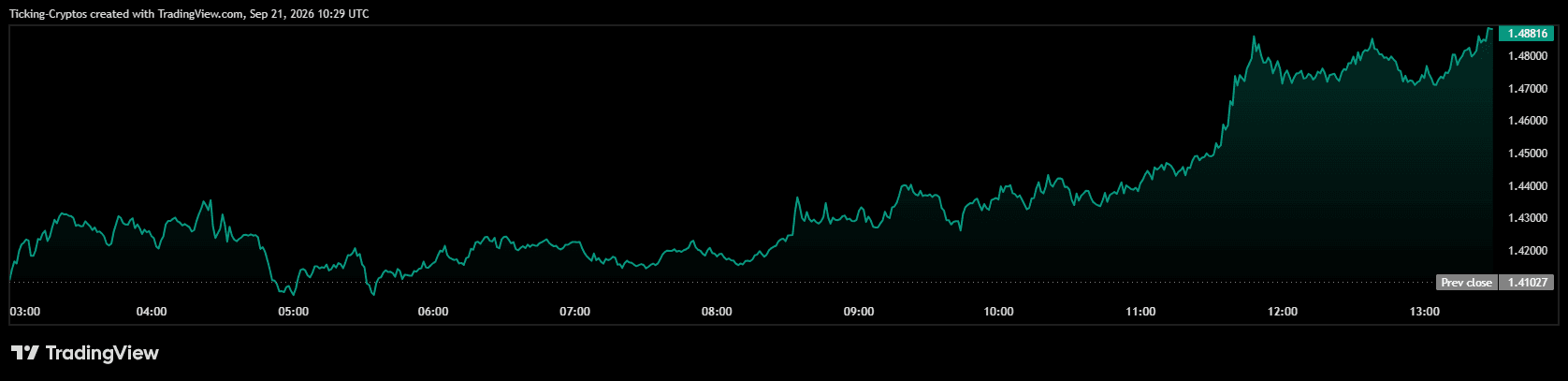
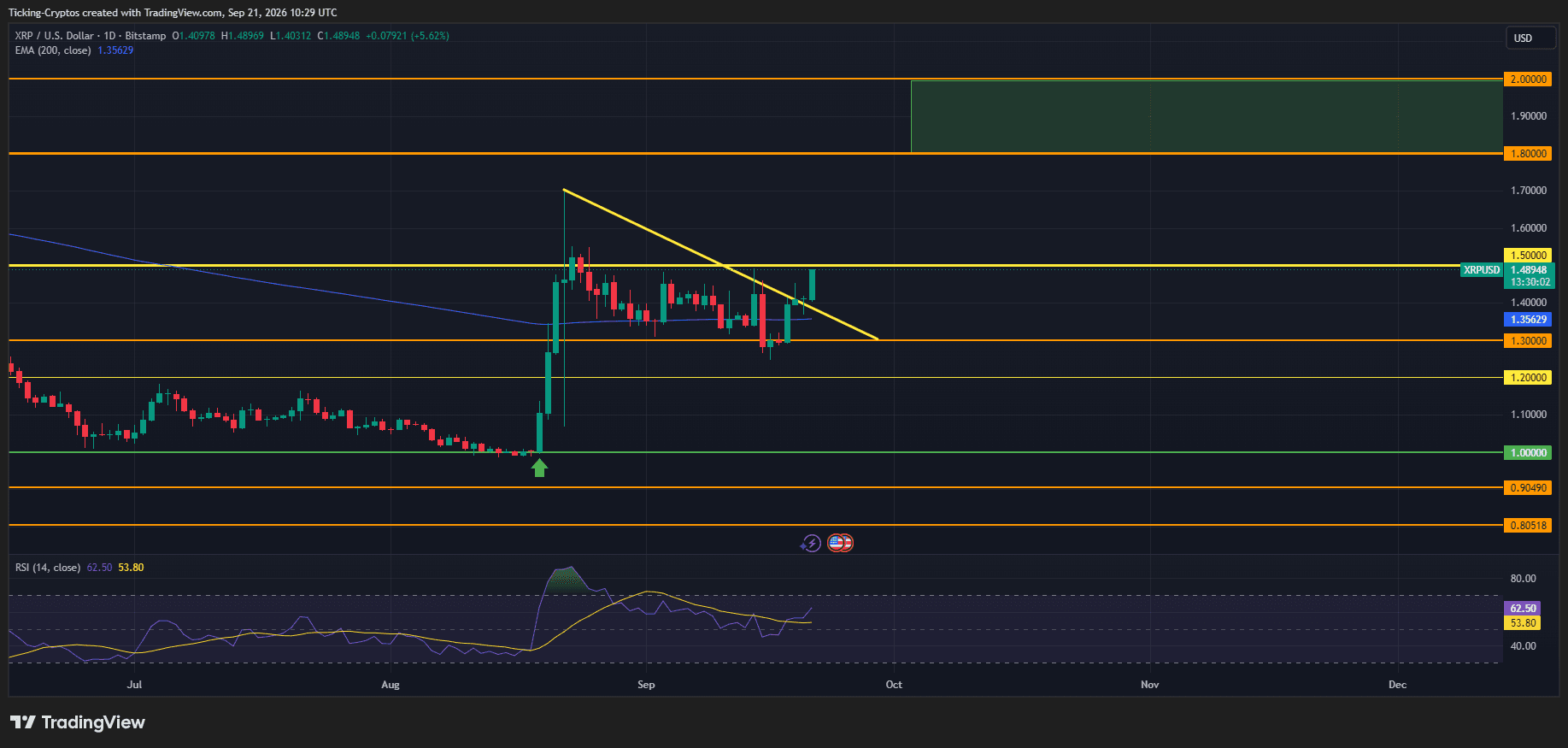
$XRP is trading at $1.4895, up 5.62% on the session from a previous close of $1.4103. The move came in one clean burst at roughly 11:30 UTC, the same minute $Bitcoin ripped through $84,000, so this is the majors moving together rather than anything Ripple-specific. XRP is leading them, though: CoinDesk data had XRP up 7.43% on the day against 4.42% for Bitcoin. Zoom out and XRP has gained roughly 27% over the past 30 days, though it is still down around 58% over a year.
What Does The XRP Chart Actually Show?
The important line just broke. Since the late-August spike to $1.70, every rally was capped by a descending trendline, and today's candle closed above it with conviction. Underneath that, the structure has been quietly improving for weeks: the $1.00 floor from mid-August held, the $1.30 support held on the September dip, and price reclaimed the 200-day EMA at $1.3563 and has stayed above it. Daily RSI sits at 62.50 with its signal line at 53.80, so momentum is rising and there is still headroom before overbought territory near 80.
Why Did XRP Move So Fast?
Positioning. Market data showed a wave of new short bets building on XRP from September 18 onward, with those shorts not yet forced to close because funding rates were still positive. A vertical move into that setup does the forcing for you. Add a market-wide risk bid after last week's Fed meeting and you get a 5% candle with no XRP headline attached to it.
XRP Price Prediction: Is $2 Realistic For XRP?
Not yet, and the chart is blunt about why. There are two doors to get through first. $1.50 is immediate, and price is sitting right underneath it. Above that, the next real shelf is $1.80, and only a sustained move through $1.80 opens the $1.80 to $2.00 zone. From here that is roughly 34% of upside, so $2 is a target for a continued trend, not for this week. Analysts treat a sustained break above $2.00 as the single most important level in any XRP forecast, which is exactly why it will be defended.
What Could Stop The XRP Rally?
Supply, mainly. Ripple unlocks 1 billion XRP from escrow on the first of every month and typically re-escrows 600 to 800 million, leaving 200 to 400 million to enter circulation. That is structural selling that arrives regardless of sentiment, and ETF demand has so far been modest against it: the seven US spot XRP ETFs hold about 977.92 million XRP, worth roughly $1.064 billion. On the chart, a failure at $1.50 that drops price back under the broken trendline would be the classic fakeout, and $1.30 becomes the level to defend.
How Far Has The Bitcoin Price Moved?
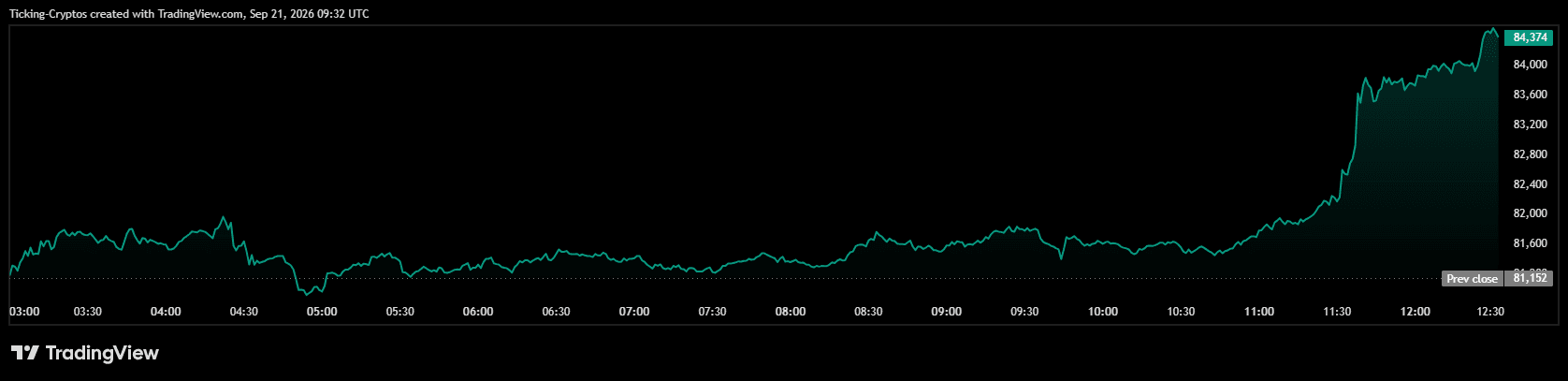
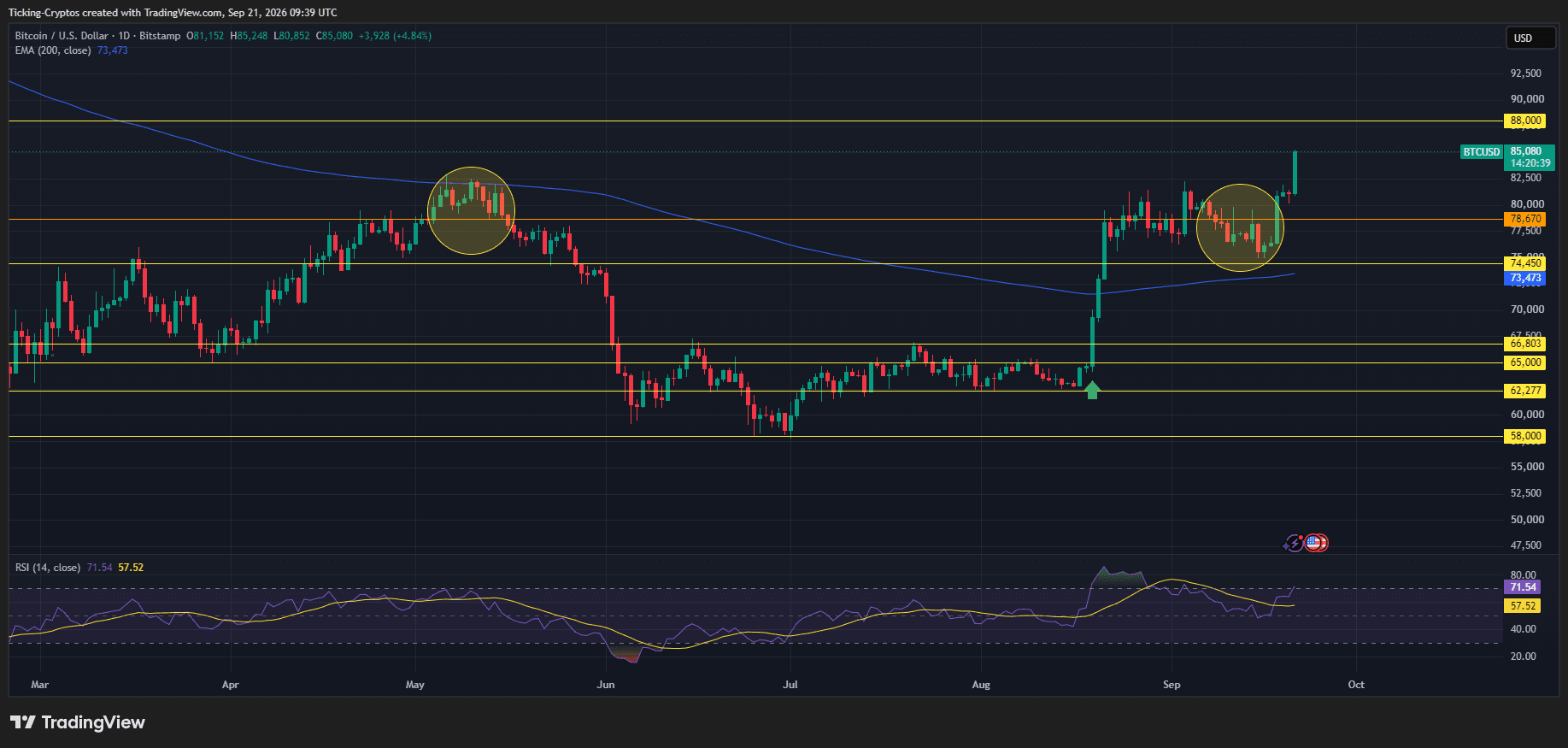
$Bitcoin is trading at $84,374 after a sharp vertical move that started around 11:30 UTC. Previous close was $81,152, which puts BTC up roughly 4% on the day and through a ceiling that had rejected buyers repeatedly since spring. Bitcoin peaked above $121,000 earlier in 2026 before grinding lower through the summer into the mid-$60,000s, so this is a recovery leg with real room above it, not a blow-off top.
Why Did Bitcoin Break Out Now?
The fuel was loaded on Friday. The Fed raised rates by 25 basis points, but the projected path was less hawkish than markets feared, which sent risk assets higher. $BTC jumped more than 6% and over $445 million in crypto shorts were wiped out, with more than $230 million of that in Bitcoin positions alone. That cleared out the bears sitting under the range. When price pushed into thin territory above $82,000 today, there was very little resistance left to absorb it.
Are ETF Buyers Backing The Bitcoin Rally?
Yes, and that is the difference between this move and a pure leverage squeeze. US spot Bitcoin ETFs pulled in $593 million across Thursday and Friday, fully reversing the outflows earlier in the week. Funding rates have stayed low, signalling spot-driven demand rather than overheated leverage. Real buyers, not just liquidated shorts.
Bitcoin Price Analysis: What Do The Charts Say About BTC?
The technical picture flipped bullish before the breakout. Bitcoin's 50-day moving average crossed above its 200-day for the first time in 2026, the classic golden cross, and price reclaimed Glassnode's True Market Mean near $76,660 along with the corporate treasury cost basis around $80,421. Translation: the average corporate Bitcoin buyer is back in profit, which removes a wall of would-be sellers.
Bitcoin Price Prediction: What Is The Next Level For Bitcoin?
$85,000. Glassnode pegs that as the ETF cost basis, the average entry price of spot ETF buyers, and it is the last major overhead level before the market opens up. Analysts had flagged $84,100 and $85,000 as the key weekly obstacles, with sustained acceptance above $85,000 pointing toward $88,000 to $90,000. On the downside, losing $77,500 would undo the breakout.
If you hold ZETA, the short answer is that in most cases you do not have to do anything yourself. One thing is still worth settling over the next few days, namely whether the exchange where your ZETA sits will take part in the swap at all. On September 20, 2026, ZETA holders voted with 99.4 percent approval to move the token 1:1 to Solana as an SPL token and to shut down the project's own blockchain afterwards. There is still no date for it.
This article sets out what the decision means for investors in Germany: what Proposal 68 actually allows, what role your exchange plays in it, what happens to staked balances and to ZETA on Ethereum and BNB Chain, how a swap like this can look for tax purposes, and which three steps make sense now. The basis is the project's announcement of September 17, 2026 and the voting result, which we pulled straight from the governance interface of the ZetaChain blockchain on September 21, 2026 at 06:37 UTC and recalculated ourselves.
What did the ZETA community decide in Proposal 68?
In a blockchain such as ZetaChain, a proposal is a governance motion: a request that all token holders vote on with their balance and that applies to the entire network once it is accepted. Proposal 68 carries the title "Migrate ZETA to Solana" and closed on September 20, 2026 at 14:58:18 UTC. Its status has read PROPOSAL_STATUS_PASSED ever since, so the motion is accepted.
The count, which we recalculated ourselves, was clear-cut: around 263.65 million ZETA voted yes, roughly 744,658 ZETA voted no, and a further 752,300 ZETA abstained. That puts the yes share at 99.4 percent of all votes cast. This was nothing like a narrow result, and that is precisely why the direction is now set.
A word on the mechanics of this vote: ZetaChain is built as a Cosmos EVM chain and uses the governance module of that toolkit. Motions are filed directly on the blockchain, voting weight follows the balance held, and a quorum sets the minimum participation required. We therefore did not take the result from a news report but queried the chain's own governance endpoint and recalculated the count.
What has been decided is the direction, not the schedule. The text of the motion says so explicitly: acceptance confirms "the direction and proposed approach", and a second motion is to supply the specific mechanism and the dates of the migration afterwards. For you that means the move is coming and the dates come later. Still open are the migration mechanism, any cut-off block for balances, known in the jargon as the snapshot height, and the timetable.
In substance, the decision provides for ZETA to exist as a native SPL token in future. An SPL token is a token built to the token standard of the Solana blockchain, comparable to what ERC-20 is on Ethereum. The ticker stays ZETA, the swap runs at a ratio of 1:1, the total supply remains unchanged, and no new tokens are created in the process. ZetaChain's own layer 1, meaning the project's standalone blockchain, is to be wound down once the balances have moved.
Do ZETA holders have to do anything now?
The project puts it this way in its announcement: "Most holders should not need to do anything." That reassurance comes with one clearly named exception, and it concerns the very place where most German investors keep their coins: the exchange.
According to the announcement, what stays unchanged is the ticker and the 1:1 swap ratio, the total supply with no new tokens, the vesting schedules with their original dates, and your balance including locked and staked positions. ZETA on Ethereum and BNB Chain is likewise untouched. Vesting refers to the staggered release of tokens to the team, investors or early backers over time; the fact that these dates stand means for the market that the move triggers no additional wave of selling.
What will change is the blockchain ZETA runs on, the token standard, the validators and the ecosystem around it: Solana's infrastructure instead of a validator set of its own, and the trading venues, wallets and payment rails there instead of the project's own environment. For you as a holder this is above all a technical switch, as long as your balance really does travel with it.
The sentence that matters comes a little further down in the same announcement: "Exchange conversions depend on each exchange confirming the swap." And the list of participating venues is to be published before anything moves at all. That is exactly where your only real task over the coming weeks comes from.
How to check whether your exchange supports the ZETA swap
The sequence is always the same with token conversions: the exchange announces the swap, halts deposits and withdrawals of the affected token for a few hours or days, rebooks the balances, and reopens trading afterwards. Anyone sitting at a venue that does not take part has a limited window in which to react. How tight such windows can become is something we traced most recently in the swap from STG into ZRO and in the one-way street from ICX to SODA.
In practice that means three things. First, check the status page or the announcements section of your exchange to see whether ZETA appears there. Second, if nothing is stated there, ask support in writing whether the exchange supports the swap, and keep the reply. Third, if no confirmation comes, you have two routes, namely selling before the switch or withdrawing to a wallet of your own that supports Solana. Either is a decision with consequences, and you should take it calmly while no date is on the table.
A word on choosing a venue: if you are thinking about a change anyway, it is worth looking at our comparison of the best crypto exchanges, which sets fees, deposit routes and licensing status side by side.
ZETA on Ethereum and BNB Chain: what the decision does not change there
This is the point where English-language coverage becomes imprecise, so here is the wording of the primary source: ZETA on Ethereum and BSC appears in the announcement under the heading "What stays", and there it says in as many words that the proposal does not touch these balances. So the decision does not exclude them from the swap; it simply does not deal with them.
For you that is an important distinction. Anyone holding ZETA as an ERC-20 token in an Ethereum wallet is not directly affected by the shutdown of the ZetaChain layer 1. What happens to those balances in the medium term is one of the points the announced second motion will have to settle. Until then the rule is: no panic, but no assumption that this sorts itself out either.
So check first where your ZETA technically sits. A look at the block explorer of the chain in question, or at the network display in your wallet, will show you whether you hold native ZETA on the ZetaChain blockchain, an ERC-20 token on Ethereum or a BEP-20 token on BNB Chain. That answer decides which part of the decision applies to you.
What happens to staked ZETA and to the validators?
Staking means locking up tokens in support of network security, for which holders receive an ongoing reward. At ZetaChain this staking continues for the time being: until the layer 1 is shut down, the validators will keep validating as before according to the project, and staking works unchanged.
What is open, by contrast, is what becomes of staking on Solana. The project writes that the question of how staking, and in particular the transition of staking rewards to Solana, is to be solved is "under active exploration"; the formal motion is to set the mechanism. Anyone with larger amounts staked today should keep an eye on this, because a gap can open up between the end of the old rewards and the start of a new model.
Important for your own bookkeeping: staking rewards are treated differently in Germany from the sale of a coin. As a rule such rewards count as other income at the point at which they are received. So keep a running note of the date, amount and price of the rewards received, regardless of how the migration is ultimately designed.
Why there is no bridge route to the SPL token
A bridge connects two blockchains by locking the original token on the source chain and issuing a wrapped copy on the target chain. That route is ruled out here, and the reasoning in the announcement is technically compelling: a wrapped token needs the original, locked on a chain that will no longer exist in future.
It follows that the SPL token on Solana is meant to end up as the only ZETA still in existence, and that the formal motion will have to define how the balances transfer. For investors that is rather good news, because bridge constructions are among the most vulnerable components in the crypto market. A native token on an established chain saves that attack surface.

When will the ZETA migration come? What is known about the date
The primary source is terse on the question of timing: "There is no date yet." The schedule, it says, depends on the exchanges confirming the swap, and the formal motion is to carry the dates.
Anyone who gives you a specific migration date today has made it up. What you can watch instead are two solid signals: the announced list of participating exchanges, and the second governance motion with the mechanism and the dates. Both will run through the project's official channels, and both come before the switch itself.
A look at comparable cases helps to place the time frame. With the shutdown of the Harmony mainnet, weeks passed between announcement and execution, and exchanges followed one after another. That is not a fixed rule, but it does suggest that haste in the first few days is rarely necessary.
What the price jump since the vote says about the risk
The market acknowledged the decision emphatically. On September 21, 2026 at around 06:37 UTC, ZETA was quoted between 0.057 and 0.058 euros depending on the source: 0.0573 euros on CoinGecko, 0.0578 euros in the ZETA-EUR pair at Bitvavo and 0.0582 euros at Kraken. CoinGecko showed a gain of around 70 percent within 24 hours and a market capitalisation of some 92 million euros, while the daily range at Kraken ran from 0.0332 to 0.0705 euros.
Swings like this are a risk warning and not a buy recommendation. A price doubling within a single day shows above all how thin the order book of a token of this size is. Buying into a move like that means paying for the expectation that the move will go through smoothly; selling means giving up the possibility that the larger market on Solana brings the token lasting usage.
To place the target network, it is worth looking at its own constitution: Solana processes transactions in around 400 milliseconds at fees in the region of a tenth of a cent, according to the project, and it is precisely this cost structure that ZetaChain cites as the reason for the switch.
Part of the background to the move is the product ZetaChain brings with it: Anuma, a private AI application with, according to the project, more than 300,000 users since February 2026 and over a million requests across 35 models. Anuma sits on top of the project's Private Memory Layer, an encrypted memory layer that several AI models can access without any one provider receiving the full history. It is exactly this application layer that is to be opened up on Solana to further AI apps and agents. ZETA serves there as an access token that users lock in order to receive credit for AI usage. Whether that usage holds up is the real bet behind the switch to Solana's application layer.
Tax in Germany: is a 1:1 swap a disposal under Section 23 EStG?
For private investors in Germany the rule is this: gains from the sale of crypto assets are tax-free under Section 23 of the German Income Tax Act if more than a year lies between acquisition and disposal. Within that holding period, an exemption threshold of 1,000 euros has applied since the 2024 assessment period, covering all private disposal transactions of a year taken together. If it is exceeded, the entire gain is taxable, not just the part above it.
Swapping one coin for another generally has the same tax effect as a sale followed by a fresh purchase. Why that is so and what consequences it has for the holding period is something we have explained in detail in our article on why a coin swap can have the tax effect of a sale.
That does not, however, answer whether a chain migration at a ratio of 1:1 falls under the same provision. The authoritative circular of the German Federal Ministry of Finance of March 6, 2025, which replaced the version of May 10, 2022, covers acquisition, disposal, swaps, staking and record-keeping duties, but does not expressly govern the case of a chain change with an identical token. In practice two readings stand opposed: one sees no disposal in the mere switch of technical standard, because economically the same asset continues to exist in an unchanged quantity. The other treats every change of token as a swap with a new holding period.
As long as that question is open, what protects you above all is clean documentation. For every holding, record when you acquired it and at what price, how large the amount was on the day of the switch, which route it was switched through, and what notice your exchange sent about it. A tax tool or portfolio tracker takes that chronology off your hands, and with larger holdings the assessment belongs in the hands of a tax adviser. This assessment is no substitute for tax advice.
Where ZETA can be traded in Germany and what MiCA has to do with it
ZETA is regularly tradable in euros for German investors. We asked the trading venues directly on September 21, 2026 at 06:33 UTC: Bitvavo lists the ZETA-EUR pair with the status "trading", Kraken lists the pairs ZETA/EUR and ZETA/USD. Both houses operate under the European crypto regulation MiCA, Bitvavo with an authorisation from the Dutch supervisor AFM dating from June 2025, Kraken with an authorisation via the Irish central bank.
MiCA stands for "Markets in Crypto-Assets" and is the EU regulation that has set uniform rules for trading platforms, custodians and issuers since the end of 2024. A MiCA authorisation is not a seal of quality for an individual token and no protection against price losses. The status means that the provider has to comply with requirements on own funds, custody of client money and complaint procedures, and that a European supervisor is responsible.
For the upcoming swap that means two things. An authorised exchange is obliged to inform customers about material changes, which increases the chance that you receive an announcement in good time. An obligation to follow every token migration technically does not follow from it. Each venue takes that decision for itself, which is why asking support remains the quickest route to certainty.
Custody: how to prepare a Solana wallet without falling for phishing
If you want to hold your ZETA yourself, you need a wallet that supports Solana. With a hardware wallet the private key sits on a device with no internet connection, and every transaction has to be confirmed there physically. Which models suit which purpose is shown by the comparison further down in step two.
Token migrations are a favourite occasion for fraudsters, because they supply a plausible excuse for haste. The pattern is always similar: an email or a post on social media announces a "migration portal", demands the recovery phrase or a signature, and then empties the wallet. Remember the counter-rule: for a 1:1 swap carried out by the exchange and the protocol, you never have to enter your recovery phrase, and a swap that demands an upfront payment from you is not one.
Two further habits help. Get information on the state of the migration exclusively through the official channels of the project and of your exchange, rather than following links from search ads or direct messages. And before the first transfer to a new address, check with a small test amount that the route works, before the whole holding goes.
ZETA migration: what you take away from it
- Establish where your ZETA sits, and ask your exchange. Native ZETA on the ZetaChain blockchain is affected by the shutdown; balances on Ethereum and BNB Chain are not touched by the decision. If your venue's status page says nothing about the swap, ask support in writing. Anyone planning to change venue anyway will find fees and licences in the exchange comparison.
- Prepare your own custody before a date is set. Setting up a Solana-capable wallet and testing it with a small amount costs half an hour and takes the time pressure off you should your exchange not take part in the swap. Which devices are up to it is shown by the hardware wallet comparison.
- Document your holdings and acquisition data now, not later. Amount, acquisition date, acquisition price and your exchange's notice about the swap belong in a file, so that the holding period remains traceable later on. A portfolio tracker with a tax function does that on an ongoing basis.
(As of September 21, 2026. This article is not investment advice. Prices and fee structures change; check the terms with the provider before you buy.)
Crypto Airdrops in Week 39: The Deadlines Running Now
This week holds one date that is final, and it is four days away. Anyone holding Beldex or Humanity at the crypto exchange Kraken was credited the respective replacement token automatically by airdrop. It can only be withdrawn until September 25, 2026 at 14:00 UTC. After that the exchange liquidates the remainder itself, and it states in its own notice that the proceeds may come to little or nothing.
A second closing date falls into this week as well, one that was missing from this list until now and is harder than any exchange deadline. Sonic burns roughly 32.69 million unclaimed S tokens from Season 1 and Season 2 on October 15, 2026. The tokens are destroyed on chain rather than merely withheld, and in such a way that afterwards any address at all can trigger the burn. Anyone sitting on an old Sonic allocation has a good three weeks left.
This overview lists the airdrops for which a claim window is open this week or a date is fixed. Every figure comes from the source linked at that point, retrieved on September 21, 2026. Where a project has published no end date, that is said explicitly; estimated deadlines have no place here. Last week’s status is in our piece on the week 38 airdrops.
The Deadlines at a Glance
| Project | Status | Date / Deadline |
|---|---|---|
| Beldex and Humanity (at Kraken) | Airdrop credited, withdrawal required | until September 25, 2026, 14:00 UTC |
| Sonic (S), Seasons 1 and 2 | Claim open, burn afterwards | until October 15, 2026 |
| Grass (Stage 2) | Claim open | until January 22, 2027 |
| GRVT | Tranches keep running | 30 days per tranche; date of the next unlock not published |
| Plume (Season 2) and dappOS (DOS) | Claim open | no end date published |
1. Beldex and Humanity at Kraken: Four Days Until the Airdrop Expires
This entry is the most urgent on the list and at the same time the most unusual, because nobody had to claim anything here. Both projects were attacked in June 2026, both rolled out a new token contract in response and distributed the replacement one for one to holders as of the snapshot. Kraken handled the distribution for its customers and credited it automatically. An airdrop that nobody had to claim can expire all the same.
The key data differ by project, which is why there are two separate notices. For Humanity the snapshot was taken on June 8, 2026 at 17:25 UTC, set by the project team itself; the new $HUMANITY was credited on July 1, 2026 at 14:00 UTC. For Beldex the snapshot was taken on June 10, 2026, and the new $BELDEX was credited on July 10, 2026 at 14:00 UTC. Anyone who bought the respective token only after the snapshot has no entitlement according to the exchange; for Beldex it explicitly names neither an application portal nor any other route.
Kraken lists four affected tickers rather than two: the old $H and $BDX and the new $HUMANITY and $BELDEX. Trading and deposits are switched off permanently, and only withdrawals are still supported. Withdrawals close on September 25, 2026 at 14:00 UTC. Whatever is still in the account after that goes into a liquidation phase running from September 28 to October 2, 2026. The exchange writes itself that the proceeds could fall well below the reference prices last seen and, depending on liquidity, may be minimal or zero.
Anyone who held both tokens has two separate jobs to do. The details are in the exchange’s notices on Humanity (H) and on the Beldex migration. We wrote up the background to the Humanity case in more detail in our piece on the Kraken deadline for $H.
2. Sonic (S): 32.69 Million Tokens Will Be Burned on October 15
This is the new addition of the week, and it belongs here because it has something that is rare in this field: a hard end date, published for months, with a clear consequence. Sonic Labs announced on April 2, 2026 that all unclaimed airdrop shares from Season 1 and Season 2 would be released for burning after October 15, 2026. According to the project, around 32,690,000 S are affected.
The mechanism is remarkable and it is the reason why no renegotiation is possible here: once the deadline has passed, the contract allows any address at all to trigger the burn. No decision by the team is needed any more, and no announcement of a date. The date is October 15, and after that it can happen at any time. Anyone hoping for a quiet extension of the kind common at many claim portals is hoping for something the contract does not provide for.
Important for context: since April 18, 2026 the claim has been possible without a penalty, before that it came with a reduction. Anyone who waited out of fear of the penalty has been waiting for no reason for months. The claim runs through the project’s portal at my.soniclabs.com/airdrop, and for positions held as fNFTs additionally through the marketplace set up for that purpose. The announcement with all the details is in the Sonic Labs blog.
A word on expectations: the fact that so many tokens are still unclaimed after a year and a half is the rule rather than an oversight by users. A substantial share of every allocation is never collected, because the wallet was forgotten, the amount was small or the announcement went unnoticed. If you were active on Sonic in 2024 or 2025, the look into the portal is due now, in September rather than in October.
3. Grass (Stage 2): The Only Window With a Clean Closing Date
Grass has been distributing its Stage 2 rewards since July 22, 2026 and has given the claim a six-month window: until January 22, 2027. Whatever has not been claimed by then expires according to the project and stays with it. That makes Grass the counterpart to the three entries further down, with an end date that stood there from the start.
Eligible are wallets that contributed bandwidth between October 14, 2024 and June 8, 2026 (epochs 1 to 19) and linked a Solana wallet as part of Stage 2. The allocation is visible after signing in to the dashboard; a separate application is not required. Two of the six months have now passed, leaving four.
The only legitimate place to check and claim is the dashboard at app.grass.io. The project points out explicitly that it never contacts anyone of its own accord and never asks for a seed phrase or a private key. Those are exactly the patterns at work around every larger airdrop.
4. GRVT: 30 Days per Tranche, and the Calendar Sits Only in Your Account
The derivatives exchange GRVT held its token generation event on July 30, 2026 and is distributing 280 million GRVT in total. The distribution runs in tranches over twelve months, and each unlocked tranche carries a claim window of 30 days. Once it expires, the tranche is permanently lost according to the project, and it does not roll into the next one.
This is the most awkward entry on the list, because there is no published unlock schedule. When the help page was retrieved again this week, it still carried no date for the next tranche. For allocation and timing the project refers exclusively to the reward portal of your own account. The calendar is therefore individual, and there is no public place where you could look it up.
There is also a distinction that is easily missed: only the first tranche due is paid out automatically, and only for registrations made before July 17, 2026. Anyone who signed up later has to claim every tranche themselves according to the wording of the help page, within 30 days in each case. Practical advice: take one look at the reward portal, enter the end date given there in your calendar, with a reminder a few days ahead.
5. Plume and dappOS: Open, but Without a Published End
Two entries carry over unchanged from previous weeks, and both share the same problem. At Plume (Season 2) the points programme ended on March 31, 2026 and registration ran until May 27, 2026; anyone who missed it is excluded, and that cannot be made up. The claim has been running through the official portal since the end of May, and Plume has at no point named an end date. Secondary reports circulate a period of roughly three months that would have run out at the end of August. That figure does not come from the project, and we carry it here only because it circulates, explicitly not as a deadline.
At dappOS, phase 2 has been running since August 11, 2026, in which eligible wallets can claim transferable DOS. Here too the project has published no end for any of the phases so far. The only correct route is the claim portal on the project domain.
The conclusion is the same for both and it matters more than any assessment of token value: a claim without a published end date is not a claim with unlimited time. It is one whose closure does not have to be announced. Anyone eligible should claim instead of waiting.
Not Included, and Why
This section is the more important part of the research. The following candidates were checked this week and deliberately left out:
- LAPTOP (Hunter Biden’s memecoin) at Bitvavo: the deadline cannot be evidenced at the source. For customers with losses of more than 1,000 euros in the TRUMP token, a registration deadline of October 10, 2026, 23:59 CEST is circulating. We cannot get it confirmed: the project page names only a claim window of “30 days” without a calendar date, the project’s claim portal shows neither start nor end, and the exchange’s own pages could not be read when retrieved on September 21, 2026 (HTTP 403). Thirty days from a date that has not been published do not add up to an end date, and we do not calculate one here. Two things should be said anyway, in case you see an invitation in your account: under its own terms the campaign is a promotional reward programme and explicitly not compensation, reimbursement or redress for TRUMP losses, and a memecoin stays a memecoin even when it is distributed through a regulated exchange.
- Fireplace: a wind-down, not an airdrop. September 30, 2026 is a real and important deadline, but it is the cut-off by which users of the discontinued Polymarket trading terminal have to withdraw their balances and migrate open positions. A platform wind-down is not a token distribution.
- XDAO ($DAO): deadline passed, never confirmed at the source. The snapshot cut-off circulating for September 20, 2026 at 14:00 UTC appeared exclusively on aggregator sites; the project page and the documentation mentioned neither a snapshot nor a TGE. The date has now passed and a TGE date is still unpublished. Last week’s decision to leave it out was right and stands.
- Meteora (MET): from last year. Unchanged: the widely shared announcement of “September 10” dates from September 10, 2025, and the TGE took place on October 23, 2025.
- AVANT: TGE without a date. The token generation event was last targeted “for September”, and the claim is meant to open “around the TGE”. A period is not a date.
- Arcium (ARX): open, but without a deadline. The retroactive token grants continue in rolling waves, without any point by which the claim has to be made.
- Canopy (CNPY), RISEx, mint.io (MNTD), Ink (INK), OpenSea (SEA): points programmes or TGE without a date. At OpenSea the launch originally expected for the end of March 2026 has been postponed without a replacement date being named.
- ARC (Circle): a mainnet launch is no airdrop. The public launch on September 16, 2026 carries neither a TGE date nor a confirmed community allocation.
- Exchange dates with no airdrop link. Trading closures and delisting deadlines are real, yet they remain something other than airdrops, with the exception of the Kraken case above, where the token to be withdrawn itself comes from a distribution.
On top of that comes the standing rule of this format: projects listed as “live” on aggregator sites but naming neither a snapshot nor a claim window at the project source do not get in. “Airdrop confirmed, date open” is no deadline.
What to Watch Out for With Every Claim
Airdrops are the preferred hunting ground for wallet drainers, and the patterns repeat:
- Check the year first. For several weeks running this column carried a prominently traded “current” airdrop that in truth dated from the previous year, and an expired claim is the perfect template for a cloned scam page.
- Always open the claim page through the official project domain, never through links in direct messages, comments or search ads.
- No serious airdrop asks for your seed phrase or your private key.
- Check which permission you are granting before you sign. An unlimited token approval is never needed for a claim.
- Weigh the network fee against the value of the allocation. With very small amounts the claim can cost more than it brings in.
- Put every deadline in your calendar, and with staggered distributions such as GRVT’s, every single tranche rather than only the first.
- And the point that carries this week too: a published end date is the only thing that makes the closure of a claim predictable. Without one, that closure never has to be announced at all.
And Afterwards? The Token Sits in the Wallet
The question that comes after every successful claim is a practical one: what do you do with an allocation that is not listed on any large exchange? Most freshly distributed tokens are low-cap assets with a thin order book, and that is exactly where the gap between looking and acting is widest. Tools such as Dexscreener or TradingView show you prices and liquidity, but you cannot execute anything there. An app like FOMO Family takes the other route: meme and low-cap tokens can be discovered, swiped through and traded directly in the app, with fast deposits. Download the app through the link and secure yourself ten percent off trading fees. The necessary warning belongs right next to it: trading meme and low-cap tokens is highly risky, volatility is extreme, and a total loss is possible at any time. Do not put anything in here whose loss would hurt you.
If you want to read into the subject instead of just working through deadlines: how airdrops work, who is typically eligible and how dubious campaigns can be recognised is covered in our guide to crypto airdrops.
Think About Tax Straight Away
An airdrop is not a tax-free gift by definition. Whether the allocation has to be treated as other income under section 22 number 3 of the German Income Tax Act depends above all on whether you provided something in return, which is also how the still authoritative circular of the German Federal Ministry of Finance of March 6, 2025 draws the line. Two cases from this week show why that is more than theory. In the Kraken case the inflow of the replacement token in July and the later withdrawal or sale have to be kept apart, and a forced liquidation by the exchange is a transaction you have to document even though you did not trigger it. In the Sonic case the question runs the other way: a burn of unclaimed tokens is neither a sale nor a loss you could claim.
So secure the time, amount, market value, price source, transaction hash and the terms of participation right at the moment of the claim. Experience shows the terms are the first thing to disappear when a campaign page is switched off. Which details count individually is set out in our guide “Receiving airdrops: save this data immediately”. That unsold tokens can trigger a tax liability as well is explained under “Unsold airdrops: tax liability even without a sale”.
Conclusion
Week 39 carries two tasks and three observation posts. The first task is September 25, 14:00 UTC: anyone who held Beldex or Humanity at Kraken has had the replacement token in the account for a long time and four days to withdraw it, twice over where both tokens are affected. After that the exchange decides on the liquidation, and it says itself that the proceeds may come to little or nothing.
The second task is October 15 and it concerns considerably more people than are aware of it: 32.69 million unclaimed Sonic tokens will be released for burning after that date, triggerable by anyone. This is no portal you can still reach later if it comes to it. A look into the Sonic portal costs five minutes and is the most worthwhile action of the week if you were active there in 2024 or 2025.
The remaining entries are for observation: Grass with the only clean closing date on January 22, 2027, GRVT with a 30-day window per tranche whose calendar sits only in your own account, plus Plume and dappOS with open windows and no published end.
The methodological finding of the week sits in the section above. The most prominent new deadline of this week, the LAPTOP campaign through a large European exchange, did not make the list because the date could not be evidenced at any project or exchange source. A date that appears only in reports about the date is no documented date. And the necessary sobering note stands: most allocations move in the double to low triple digits, and the fee for claiming eats a noticeable part of that. The effort pays off above all where you are already eligible anyway.
Disclosure: some of the providers named in this article work with us through partner programmes. This has no influence on the editorial assessment.
(As of September 21, 2026. This article is not investment advice. Prices and fee structures change; check the terms with the provider before you buy.)
Decrypt
Meanwhile, Bitcoin pushed up to $85,000 and a new local high and altcoins soared in a huge overnight rally.
The Bitcoin treasury firm’s holdings bottomed at 840,447 BTC in August. They have since climbed 5,553 BTC, to within 0.2% of the high.
A short squeeze started the move, but spot buyers have sustained it, and one measure of selling pressure is near a record low.
France is the worst-hit country in the world for these attacks, with more than 70 logged in the first eight months of 2026.
After banks lost their push for tighter stablecoin rules in the failed Clarity Act, JP Morgan scored a narrower win as Visa moves to stop meme coin purchases from being coded as ordinary "digital media" and earning card rewards.
U.Today - IT, AI and Fintech Daily News for You Today
Ledger CTO Charles Guillemet has warned crypto holders to update their iPhones after highlighting DarkSword.
October set to be significant for XRP community with two events ahead.
Ripple has entered a major partnership with Absa Corporate and Investment Banking (CIB) to launch Absa Digital Asset Custody in Africa.
XRP breaks its downtrend to hit $1.48 as big buyers snap up $2.2 billion in tokens.
Shiba Inu crossed critical resistance level that used to dictate the price dynamic for the last 2 months.
Blockonomi
Key Takeaways
- MARA shares climbed approximately 5% Monday following Bitcoin’s surge past $85,000, marking the crypto’s strongest level since January.
- The uptick continues MARA’s recovery from last week, fueled by growing attention to its artificial intelligence and data-center initiatives.
- H.C. Wainwright initiated coverage with a Buy recommendation and set a $20 price objective.
- Analysts pointed to MARA’s Starwood collaboration and pending Long Ridge Energy deal as key elements of its AI infrastructure expansion.
- MARA’s share price continues to track Bitcoin closely, though Wall Street remains split on whether its data-center pivot will succeed.
MARA Holdings (MARA) shares climbed roughly 5% during Monday’s session, reaching approximately $13.90 as Bitcoin broke through the $85,000 mark. The digital currency hit its strongest level in months, providing a tailwind for cryptocurrency-related equities as the week began.
Marathon Digital Holdings, Inc., MARA
The primary driver behind Monday’s advance is Bitcoin’s renewed strength. MARA generates the bulk of its revenue through Bitcoin mining operations and maintains Bitcoin holdings on its corporate balance sheet, creating a direct connection between the stock and cryptocurrency price movements.
When Bitcoin prices rise, mining profitability typically improves since operational costs are denominated in fiat currency while mining rewards fluctuate with Bitcoin’s dollar value. This dynamic often amplifies MARA’s stock movements relative to Bitcoin during periods of cryptocurrency strength.
Monday’s advance follows an already positive week for the shares. MARA posted an 8.3% gain Friday as market participants digested fresh analyst commentary and the company’s strategic pivot toward artificial intelligence and high-performance computing operations.
Cryptocurrency Strength Powers MARA Advance
Bitcoin’s climb beyond $85,000 capped multiple days of gains and boosted sentiment throughout the cryptocurrency equity sector. Coinbase, Strategy and Robinhood also posted advances as capital flowed back into digital-asset stocks.
For MARA, Bitcoin’s price movement carries outsized importance because mining profitability hinges on the market value of each Bitcoin mined. Fixed costs including electricity, equipment depreciation and facility expenses don’t automatically scale with Bitcoin prices.
This creates operational leverage during Bitcoin rallies. Conversely, declining Bitcoin prices can squeeze mining margins and reduce the value of MARA’s cryptocurrency holdings.
MARA has been working to diversify beyond pure Bitcoin mining activities. The company increasingly positions itself as a digital infrastructure and energy enterprise with growing exposure to AI data centers and high-performance computing facilities.
H.C. Wainwright recently launched coverage with a Buy rating and established a $20 price objective. The firm believes MARA stands to gain from repurposing portions of its energy assets toward AI infrastructure applications.
Artificial Intelligence Infrastructure Provides Additional Momentum
H.C. Wainwright emphasized MARA’s collaboration with Starwood Capital alongside its proposed acquisition of Long Ridge Energy. The analyst suggests these assets could position MARA to secure AI data-center leasing agreements in the years ahead.
Morgan Stanley has adopted a more reserved stance. The firm recently increased its MARA target to $11 from $6 while maintaining a bearish outlook, and J.P. Morgan similarly maintains an $11 price objective.
J.P. Morgan has previously questioned MARA’s execution on its data-center transition and raised concerns about the feasibility of converting certain mining facilities. This divergence highlights Wall Street’s uncertainty regarding the ultimate value creation potential of the AI strategy.
MARA’s sharp rebound also underscores the importance of considering volatility. Despite recent gains, the stock trades well below its 52-week peak, and price swings can accelerate when Bitcoin shifts direction.
The AI strategy also introduces execution challenges since data-center projects demand significant capital investment, appropriate power infrastructure and long-term customer commitments. Any setbacks in asset conversion or tenant acquisition could undermine the valuation thesis.
For Monday’s session, though, the primary catalyst remains Bitcoin’s breakout above $85,000. MARA’s cryptocurrency exposure combined with fresh analyst attention to its AI ambitions delivered another day of gains.
The post MARA Holdings (MARA) Stock Surges 5% on Bitcoin’s Push Past $85K appeared first on Blockonomi.
Key Takeaways
- BMNR shares advanced approximately 6% on Monday amid rising cryptocurrency valuations.
- BitMine’s Ethereum treasury now stands at 5,983,940 ETH, representing roughly 4.9% of total circulating supply.
- Combined holdings including crypto, cash, and investments hit $17.1 billion.
- Over 5 million ETH tokens are staked, generating approximately $357 million in annual revenue.
- The company’s valuation remains heavily dependent on Ethereum price movements, creating downside risk if ETH declines.
BitMine Immersion Technologies (BMNR) shares gained approximately 6% during Monday’s session as digital asset markets rallied and the firm announced continued expansion of its Ethereum reserves. The stock traded near $27.30, up from Friday’s close of $25.99.
Bitmine Immersion Technologies, Inc., BMNR
Bitcoin surged past $85,000 while Ethereum broke above $2,700 in Monday’s trading session. This widespread crypto market strength boosted companies holding substantial digital asset positions.
According to BitMine’s latest disclosure, the company’s Ethereum holdings reached 5,983,940 ETH as of September 20. This quantity equals approximately 4.9% of Ethereum’s total circulating supply, estimated at 122.1 million tokens.
The firm added 27,562 ETH to its portfolio over the previous week. Management stated the company has achieved 98% progress toward its objective of controlling 5% of Ethereum’s total supply.
Ethereum Treasury Expansion Continues
BitMine disclosed total assets of $17.1 billion across cryptocurrency holdings, cash, marketable securities, and strategic investments. This figure represents an increase from the $15.8 billion reported on September 14.
The company’s portfolio also includes 212 Bitcoin tokens and approximately $714 million in cash and marketable securities. Additional investments include positions in Beast Industries and Eightco Holdings.
Currently, more than 5.07 million ETH tokens are deployed in staking operations. This represents about 85% of BitMine’s entire Ethereum position.
Management estimates the staking program generates roughly $357 million in annualized revenue. The seven-day annualized staking yield measured 2.62%.
Chairman Tom Lee commented that Ethereum has performed as one of the strongest macro assets throughout the third quarter. His remarks reflect management’s perspective and don’t constitute a guarantee of future performance.
BitMine’s Ethereum accumulation has accelerated significantly throughout 2024. Holdings were reported at 5.85 million ETH in late August before climbing to nearly 5.98 million tokens this week.
Market Momentum Supports BMNR Gains
The stock entered Monday’s session with considerable recent strength. BMNR advanced 8.79% on Friday following a 4.73% gain on Thursday.
Analyst attention has contributed additional interest in the stock. Both Cantor Fitzgerald and B. Riley have published favorable ratings on BitMine, though price targets have fluctuated alongside changes in Ethereum valuations and the company’s asset base.
BMNR’s stock price remains extremely correlated to ETH movements because Ethereum constitutes the majority of the company’s holdings. A significant ETH price drop could substantially reduce treasury valuations, even if the company continues acquiring tokens and generating staking revenue.
Investors should consider additional risk factors, including potential shareholder dilution, financing expenses, and discrepancies that may emerge between BMNR’s market capitalization and its net asset value. Staking returns can also fluctuate as network yields change.
BitMine’s most recent update confirms its Ethereum position at 5,983,940 ETH with total reported assets of $17.1 billion. The company now stands just below its declared target of holding 5% of Ethereum’s circulating supply.
The post BitMine Immersion (BMNR) Stock Climbs 6% on Growing Ethereum Treasury appeared first on Blockonomi.
Key Takeaways
- COIN shares gained approximately 6% on Monday amid Bitcoin’s rise beyond $85,000 and broader crypto stock momentum.
- The exchange unveiled IPO access capabilities for qualified U.S. retail users, debuting with the Oura offering.
- Users can submit requests for shares at IPO pricing prior to market debut, though receiving allocations isn’t assured.
- The service operates via Coinbase Capital Markets, the company’s FINRA-registered brokerage entity.
- This IPO offering represents another step in Coinbase’s expansion into equities, derivatives, and prediction platforms.
Coinbase (COIN) shares climbed roughly 6% Monday as Bitcoin broke through the $85,000 threshold and cryptocurrency-related equities experienced widespread gains. COIN changed hands above $205 during premarket trading following Friday’s double-digit percentage increase.
Coinbase Global, Inc., COIN
The exchange simultaneously unveiled a new offering targeted at everyday U.S. investors. Qualified Coinbase users now have the ability to request shares in upcoming initial public offerings directly through the platform.
The service launches with Oura’s IPO scheduled for this week. Oura plans to offer 50 million units within an anticipated price band of $40 to $44, per Reuters reporting.
Coinbase users can browse available IPOs, deposit funds into their accounts, and place a Conditional Offer to Buy after the pricing range becomes public. Requests remain adjustable or cancellable throughout the open submission window.
Exchange Expands Equity Market Presence
Receiving an allocation isn’t guaranteed. Users might obtain their complete request, a partial fill, or no shares whatsoever based on overall demand and the quantity of units accessible to Coinbase.
After an allocation gets confirmed, shares become available for trading on Coinbase when the stock begins public market trading. Coinbase Capital Markets, the company’s FINRA-licensed broker-dealer, powers the functionality.
Coinbase Capital Markets doesn’t serve as an underwriter for these offerings. Instead, it operates as a selling-group participant and channels aggregated customer demand through Apex Clearing.
The platform has implemented safeguards against flipping. Users who liquidate IPO shares within 30 days face potential exclusion from subsequent IPO opportunities for 60 days.
Continued early sales may also result in reduced future allocations. Coinbase indicates this framework aims to prioritize users who maintain IPO positions over extended timeframes.
This latest feature aligns with Coinbase’s comprehensive “Everything Exchange” vision. The platform previously introduced U.S. equity trading with 24/5 availability for select securities.
Cryptocurrency Momentum Fuels Additional Gains
Monday’s COIN rally stems from multiple catalysts beyond just the IPO feature. Bitcoin achieved an eight-month peak exceeding $85,000, propelling Coinbase, Robinhood, and Strategy higher in premarket action.
Coinbase additionally submitted filings last week seeking approval for perpetual futures contracts linked to approximately 50 to 60 individual U.S. equities. Apple, Microsoft, Tesla, and Nvidia represent some of the companies expected for inclusion pending regulatory clearance.
This regulatory submission provides further evidence of Coinbase diversifying beyond conventional cryptocurrency trading. The platform continues integrating stock-related products alongside its foundational digital asset operations.
Investors should maintain perspective regarding the current rally. COIN demonstrates continued correlation with Bitcoin valuations, crypto trading activity, and regulatory shifts, while emerging products like IPO access and equity perpetuals must demonstrate their capacity to generate substantial revenue.
The confirmed product expansion centers on the IPO service beginning with Oura. Coinbase indicates additional IPO opportunities will appear when allocations become accessible through selling group arrangements.
The post Coinbase (COIN) Stock Surges 6% Following Launch of Retail IPO Access Platform appeared first on Blockonomi.
The team-based competition begins on September 21, rewarding squad profit rate, trading volume, and community popularity across three separate rankings
Zoomex, a global cryptocurrency trading platform focused on derivatives, has opened regular registration for the ZWTC 2026 Squad Competition, moving its annual trading championship from the launch phase into the active squad formation stage.
Traders can now select and join participating squads, with regular registration remaining open until October 3, 2026, at 10:00 UTC. Captain registration will close on September 21 at 10:00 UTC, when the official Squad Competition begins. The competition will run until October 11 at 10:00 UTC.
The Squad Competition carries a prize pool of up to 2,500,000 USDT, accounting for half of the maximum 5,000,000 USDT prize pool announced for ZWTC 2026. Rather than using a single ranking to determine team performance, the competition divides rewards across three categories:
- Up to 1,500,000 USDT for the Squad Profit Rate ranking
- Up to 700,000 USDT for the Squad Trading Volume ranking
- Up to 300,000 USDT for the Squad Popularity category
The three-part structure gives squads different ways to compete, whether through trading results, sustained eligible trading activity, or their ability to build an active community around the competition.
Three Rankings, Three Ways for Squads to Compete
The Squad Profit Rate ranking places trading performance at the center of the competition. Participating squads will be ranked according to the profit-rate calculation and eligibility requirements set out in the official ZWTC 2026 rules.
The Squad Trading Volume ranking rewards teams based on eligible aggregate trading activity during the competition period. This creates a separate route for squads whose members maintain consistent participation throughout the event.
The Squad Popularity category extends the competition beyond account-level results by recognizing the ability of captains and members to build support and engagement around their teams.
By separating these categories, ZWTC 2026 does not require every squad to compete in exactly the same way. A team may distinguish itself through performance, activity, community reach, or a combination of all three.
“A strong trading squad is not built around one account or one result. It requires leadership, active members, and a structure that keeps the team engaged throughout the competition,” said Fernando Lillo, Marketing Director at Zoomex. “For this stage of ZWTC, we wanted profit rate, trading volume, and community participation to each have a clear role and an independent reward track.”
Captains Take a More Active Role in ZWTC 2026
Squad captains serve as the organizers of the team competition. Their role includes forming a squad, bringing together eligible participants, maintaining team activity, and helping members understand the competition schedule and requirements.
Eligible captains may receive 20% of their squad’s competition prize, with captain rewards reaching up to 125,000 USDT, subject to the applicable leaderboard results and official campaign rules. Captain registration remains available until the official competition begins on September 21.
This captain-led structure adds a community dimension to the event. While final rankings remain tied to the defined competition criteria, captains also contribute through organization, communication, and member participation.
For traders who prefer to compete as team members rather than lead a squad, regular registration remains open after the official start of the competition, allowing eligible users to join participating squads until October 3.
From Registration to Live Competition
The opening of regular squad registration marks the next phase of ZWTC 2026.
The broader championship was introduced earlier in September as a multi-stage competition spanning squad trading, individual contests, and interactive reward activities. This latest phase focuses specifically on team participation and the formation of squads ahead of the official September 21 start.
The key Squad Competition dates are:
| Stage | Date and Time |
| Captain Registration Closes | September 21, 2026, at 10:00 UTC |
| Regular Squad Registration | September 17 to October 3, 2026, at 10:00 UTC |
| Official Squad Competition | September 21 to October 11, 2026, at 10:00 UTC |
All dates and times are stated in UTC.
How Traders Can Join a Squad
Eligible users can participate by logging in to or registering for a Zoomex account, visiting the official ZWTC 2026 campaign page, and entering the Squad Competition section.
Participants can then review available squads, select the team they wish to join, and complete the required registration steps. Users should review the official eligibility requirements, trading rules, ranking calculations, and regional restrictions before participating.
Captains who have not yet created a squad must complete their captain registration before September 21 at 10:00 UTC.
ZWTC 2026 Squad Competition Page
A Team-Based Test of Performance and Participation
Trading competitions have traditionally focused on individual profit or volume rankings. The ZWTC 2026 Squad Competition adds another layer by connecting individual trading activity with team-level outcomes.
A participant’s eligible activity can contribute to the wider squad result, while captains are responsible for maintaining a team that remains active throughout the competition period. At the same time, the separation of profit rate, volume, and popularity categories prevents the event from relying on only one definition of team success.
For Zoomex, the squad stage also reflects the broader role that trading communities play in helping users discover strategies, exchange market perspectives, and participate in platform activities.
ZWTC 2026 brings these community dynamics into a defined competitive structure, with transparent categories, dedicated reward allocations, and a clear competition timeline.
About Zoomex
Founded in 2021, Zoomex is a global cryptocurrency trading platform focused on derivatives trading. The platform serves over 3 million users across 35+ countries and regions, offering access to 590+ trading pairs. Built around easy to use, transparency, fairness, and speed, Zoomex provides a clear and efficient trading experience for users worldwide.
Through its high-performance matching engine, clear asset and order displays, and transparent fee and rule mechanisms, Zoomex helps users better understand their account status, order execution, trading costs, and results. Zoomex maintains registrations, licenses, and regulatory statuses across multiple jurisdictions, including the U.S. MSB, Canada MSB, U.S. NFA, and Australia AUSTRAC, and has completed security audits conducted by blockchain security firm Hacken. The platform also continues to strengthen its trust framework through Proof of Reserves, Security & Transparency, Compliance Information, and Fees / Rules Transparency initiatives.
Beyond trading, Zoomex builds a refined brand experience through elite sports partnerships, including the TGR Haas F1 Team, World Cup-winning goalkeeper Emiliano Martínez, and world-class tennis events such as Wimbledon. The values of speed, precision, discipline, fair play, and rule-based execution are closely aligned with Zoomex’s approach to derivatives trading.
At Zoomex: Easy to Use. Transparent balance. Fair access to your earnings.
Media Contact
Contact: Catherine
Company: Zoomex
Address: 306 Victoria House, Victoria, Mahé, Seychelles
Website: www.zoomex.com
Email: catherine.shi@zoomex.com
Publication Partner: ZM Newswire – Powered By Zeest Media
The post ZWTC 2026 Enters Squad Stage as Zoomex Opens Registration for Competition With Up to 2.5 Million USDT in Prizes appeared first on Blockonomi.
TLDR:
- Coinbase now lets eligible US retail users request IPO shares at the offer price through its app.
- Allocations may be filled in full, in part, or not at all, based on underwriter supply and demand.
- Selling IPO shares within 30 days may bar a user from other IPOs for the following 60 days.
- Oura’s 50 million-share offering carries an estimated price range of $40.00 to $44.00 per share.
Coinbase IPO access is now open to eligible US retail investors through the Coinbase app. The company announced the launch on September 21, 2026, starting with Oura’s initial public offering.
Users can request shares at the offering price before open-market trading begins. However, allocations may be filled in full, in part, or not at all.
Coinbase Capital Markets, a FINRA-registered broker-dealer, provides the service, while Apex Clearing Corporation handles execution, clearing, and custody.
How Coinbase IPO Access Works for Retail Investors
Coinbase framed the launch as the next step for its Everything Exchange. The company described the exchange as a “trusted platform to trade any asset at any stage of its lifecycle.” Eligible customers can now request shares at the offer price before open-market trading starts.
Now you can participate in IPOs on Coinbase
We’re giving US retail customers more access to primary financial markets.
This is the next step toward building the Everything Exchange, a trusted platform to trade any asset at any stage of its lifecycle. pic.twitter.com/uNXRWIdjwk
— Coinbase
(@coinbase) September 21, 2026
Users begin by opening the new IPOs page inside the app and selecting an active deal. Next, they fund their accounts to cover the cost of the requested shares. Once the expected price range becomes public, they can submit a Conditional Offer to Buy.
After the order book closes, Coinbase allocates available shares using an established methodology. The shares are then booked into the customer’s account at the IPO price.
Final allocations depend on underwriter supply and total customer demand. Customers can trade the shares once public trading begins.
Under Coinbase IPO access, customers can edit or cancel offers while the request period stays open. The allocation algorithm favors investors who plan to hold shares longer.
Selling within the first 30 days may bar a user from IPOs for the following 60 days. Meanwhile, Coinbase Capital Markets acts only as an agent and participates as a best-efforts selling-group member.
Oura’s Offering Terms and Financial Results
For Coinbase IPO access users, Oura set an estimated price range of $40.00 to $44.00 per share. The amended Form S-1 covers 50 million common shares.
The company offers 13.5 million shares, while selling stockholders offer 36.5 million. Oura will not receive proceeds from the stockholder sales.
Oura applied to list its stock on the Nasdaq Global Select Market under the symbol OURA. In addition, underwriters reserved up to 7.5% of the offered shares for a directed share program.
Goldman Sachs, Morgan Stanley, J.P. Morgan, Allen & Company, and Jefferies are listed first among the underwriters.
Eli Lilly has indicated interest in buying up to $100 million of shares. Funds affiliated with Dragoneer Investment Group indicated interest in up to $300 million.
In each case, the indicated purchase would occur at the IPO price. The filing states these indications are not binding commitments.
Oura reported revenue of $1,214.5 million for the nine months ended June 30, 2026. That compares with $697.6 million a year earlier, a 74% increase.
Net income was $60.8 million, versus $1.6 million. As of June 30, 2026, Oura reported 5.0 million Paid Members across 56 markets.
The post Coinbase IPO Access Opens to US Retail Investors, Starting with Oura appeared first on Blockonomi.
CryptoPotato
Ripple’s XRP is approaching a technically important inflection point after rebounding sharply from its recent lows. The recovery has brought the price back to the upper boundary of its declining structure, where a confirmed breakout could shift short-term momentum further in favor of buyers.
Ripple Price Analysis: The Daily Chart
On the daily timeframe, XRP continues to recover from the sharp August rally and subsequent consolidation. The asset is currently trading around $1.48, comfortably above the major moving averages shown on the chart.
The recent correction found support near the 200-day moving average around $1.27-$1.28. Buyers responded aggressively from this region, preventing a deeper retracement and pushing XRP back toward the upper portion of its recent range.
However, the major overhead supply zone remains considerably higher at $1.61-$1.70. This area marks the principal resistance that buyers would ultimately need to reclaim before a broader bullish continuation becomes more convincing.
For now, holding above the $1.27-$1.30 region keeps the larger recovery structure intact. A renewed rejection and breakdown below this support would weaken the setup and could expose the lower moving average near $1.18, while the major demand zone around $0.93-$0.97 remains the deeper structural support.
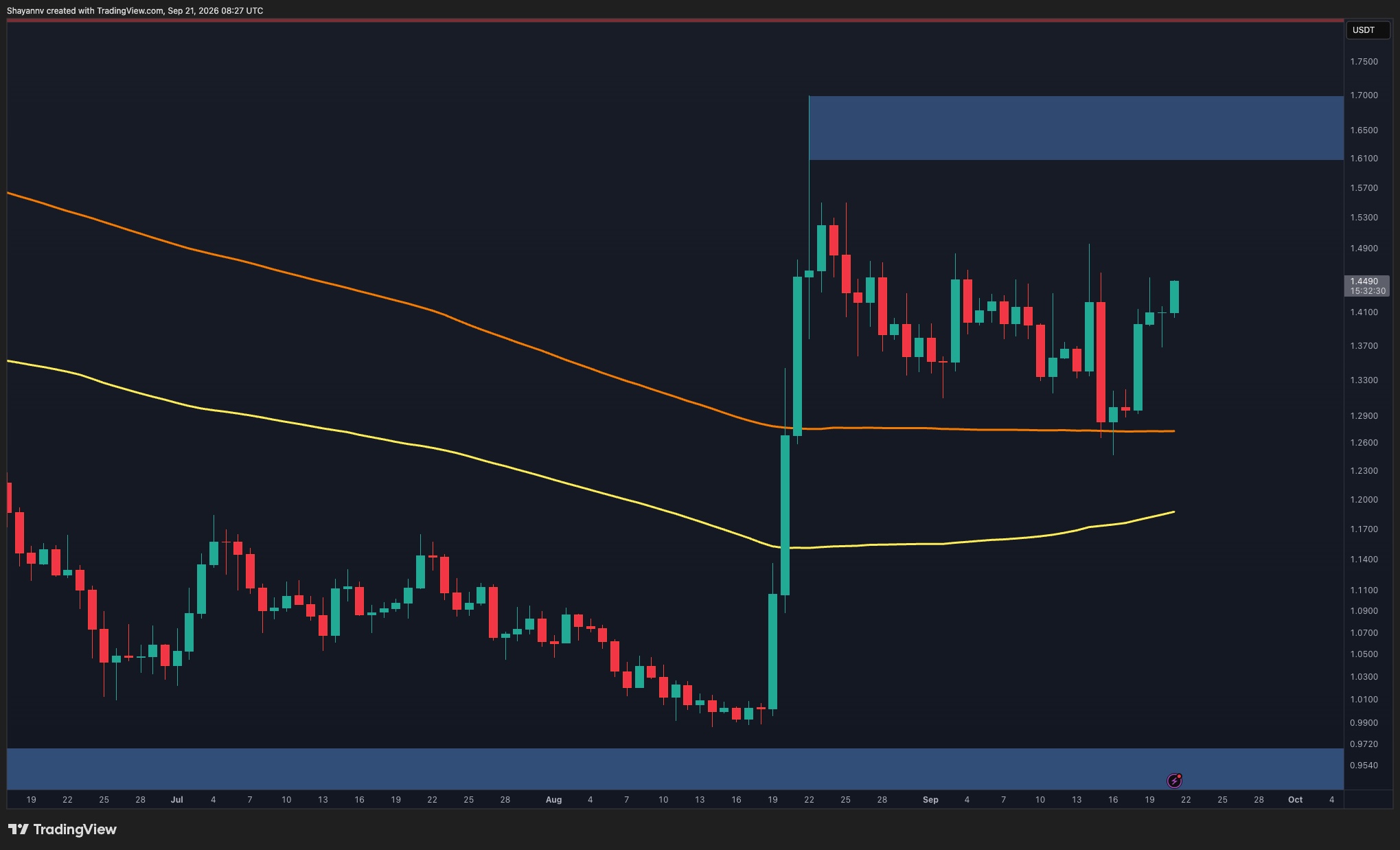
XRP/USDT 4-Hour Chart
The 4-hour timeframe highlights the immediate decision point more clearly. XRP has been trading within a descending channel, but the latest rebound from the $1.22-$1.28 demand zone has driven the price all the way back toward the channel’s upper boundary around $1.43-$1.45.
Importantly, the recovery also reclaimed the $1.33-$1.36 zone, which had previously acted as a key short-term barrier. As long as the asset remains above this region, buyers retain control of the latest recovery leg.
The next challenge is a confirmed breakout above the descending trendline. A sustained move beyond roughly $1.45 would invalidate the immediate bearish channel structure and could allow XRP to target the $1.51-$1.55 resistance zone. Beyond that, the larger $1.61-$1.65 supply region would become the next major objective.
On the other hand, another rejection from the descending trendline would indicate that the corrective structure remains active. In that scenario, the reclaimed $1.33-$1.36 zone would be the first key support to watch. Losing it could shift attention back toward the major $1.22-$1.28 demand area, where the latest recovery originated.

The post Ripple Price Analysis: XRP Approaches a Critical Breakout Level After 8% Daily Surge appeared first on CryptoPotato.
Bitcoin has reclaimed the $80K area and broken out of the descending structure that had contained price throughout the bearish trend. With BTC trading at $85K, momentum has accelerated, while the latest miner reserve data suggests that the aggressive distribution seen over the previous period has started to ease.
Bitcoin Price Analysis: The Daily Chart
The daily chart shows a notable improvement in Bitcoin’s broader market structure. After spending much of the year below the major moving averages, BTC has reclaimed both the 100-day and 200-day moving averages and is now trading around $85K.
The move above the $74K support zone marked an important structural shift. Bitcoin subsequently consolidated for a couple of weeks, largely between $74K and $80K, before breaking higher in recent days. The latest move has now pushed BTC above the upper boundary of that consolidation and toward the $85K area.
The next major resistance is located around the $88K bearish order block. A sustained breakout above this region could expose the $95K area, which represents the next significant resistance visible on the chart.
On the downside, the $80K region has become an important level to watch following the breakout. If BTC holds above this area during a potential retest, it would support the continuation structure. Conversely, a decisive move back below it could signal a failed breakout and bring the $74K range back into focus.
The daily RSI has also strengthened considerably and is approaching the 75 region. This confirms the improvement in momentum, although it also indicates that the market is becoming increasingly stretched in the short term.
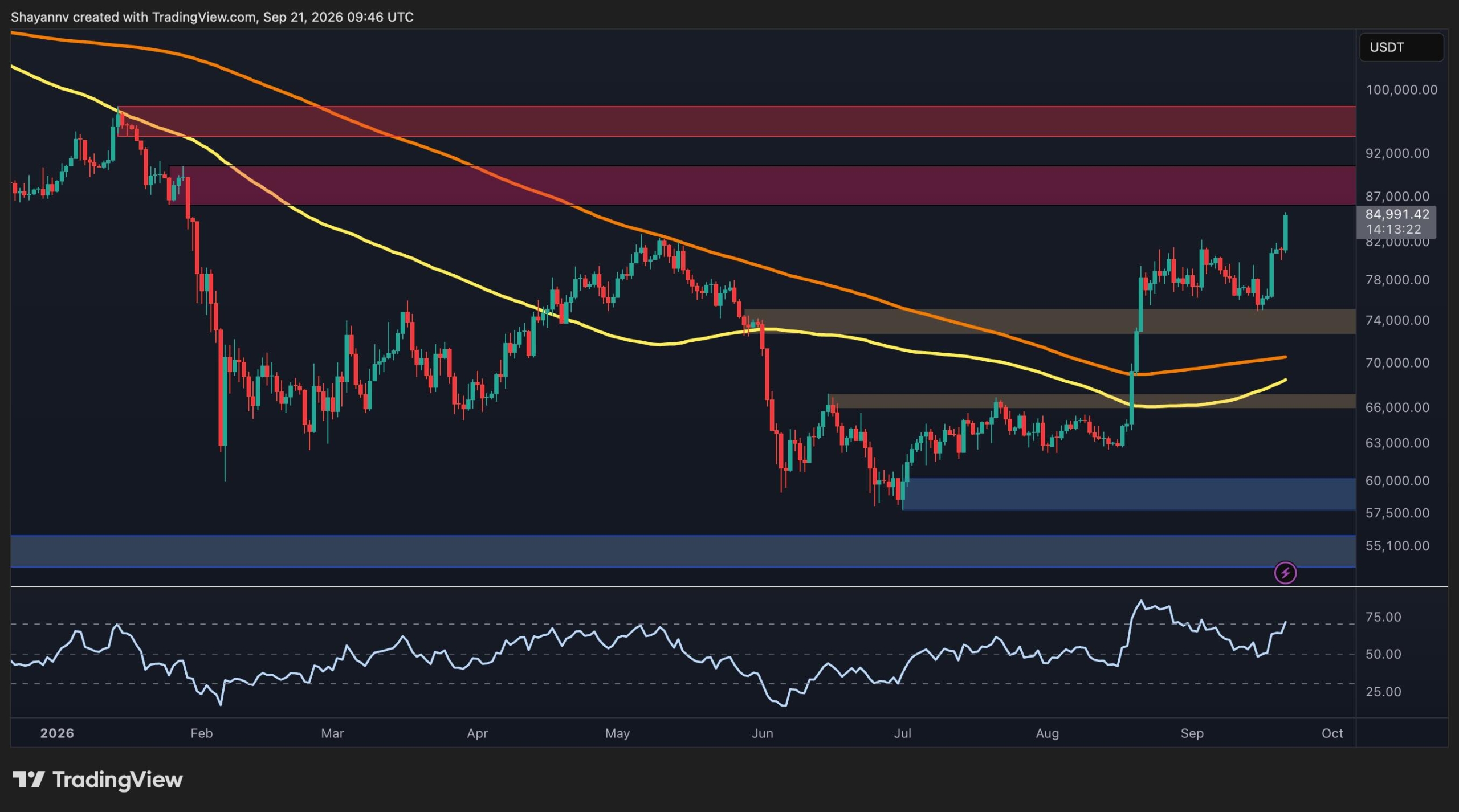
BTC/USDT 4-Hour Chart
The 4-hour chart provides a clearer picture of the recent breakout. BTC had been trading inside a descending channel, with both the upper and lower boundaries gradually moving lower. The price eventually broke above the channel and reclaimed the $80K-$82K resistance zone.
The breakout has since accelerated, with BTC reaching approximately $85K. The immediate focus is now on the $88K area, which is a visible order block on the higher-timeframe chart.
Momentum is particularly strong, with the 4-hour RSI around 80. While elevated RSI readings do not necessarily invalidate a breakout, they do increase the possibility of short-term consolidation or a retest after the sharp advance.
The $80K-$82K zone is therefore likely to be the key near-term support. Holding this area would keep the recent breakout structure intact, while a sustained move back below it could indicate that BTC needs a deeper correction before attempting another move higher.

On-Chain Analysis
Bitcoin’s miner reserve chart shows a clear change in the pace of miner distribution. Reserves declined aggressively throughout much of 2024 and continued trending lower into 2025 and the earlier part of 2026. The miner reserve 30-day EMA also followed a persistent downward trajectory during this period, reflecting a prolonged reduction in the amount of BTC held by miners.
However, the trend has become noticeably more stable in recent months. The miner reserve has largely moved sideways around the $1.19M BTC area, with the 30-day EMA having flattened considerably compared with its earlier decline.
This stabilization suggests that the aggressive distribution from miners has slowed. Rather than continuing to reduce reserves at the same pace seen previously, miners appear to be maintaining a relatively more stable level of BTC holdings.
The timing is notable as Bitcoin has simultaneously recovered toward the $85K area. A combination of improving price action and slowing miner distribution could remove some of the persistent sell-side pressure that characterized the earlier period. While the chart alone does not confirm outright miner accumulation, the stabilization in reserves represents a meaningful change from the aggressive depletion observed previously.
For Bitcoin’s broader market structure, continued stabilization or a reversal higher in miner reserves would therefore be an important development to monitor.

The post Bitcoin Price Prediction: Is $90K Next After BTC’s Explosive $10K Rally? appeared first on CryptoPotato.
NEAR has been in a massive uptrend lately, gaining an additional 25% over the past 24 hours to briefly surpass $4.40. As of this writing, it trades at roughly $4.30 (per CoinGecko), up about 120% on a monthly basis.
Most analysts think the asset is ready to pump even more in the short term, with some anticipating a jump to a new all-time high. On the other hand, two important factors suggest a pullback may also be approaching.
How Much More?
The cryptocurrency market saw another sharp uptick today (September 21), with Bitcoin (BTC) climbing to nearly $2,500 and Ethereum (ETH) clearing $2,700. The green wave is perhaps the main catalyst for NEAR’s price ascent, but not the only one.
Recently, American President Donald Trump vowed to create a so-called “AI Force” and appoint an AI czar. Although details are still unclear, the announcement has boosted cryptocurrencies tied to Artificial Intelligence, with NEAR no exception. Prior to that, NEAR Protocol revealed on X that users trade perpetual futures by default, a feature provided by Hyperliquid.
X user Lucky said that NEAR holders deserve the latest pump since they have been waiting for such green days for a long time. For his part, Michael van de Poppe described the asset’s rise as “fantastic” and stated that he will be “very pleased” if it breaks through here.
“In the short term, I doubt it. I think that liquidity will flow towards other narratives that are going to follow NEAR in its footsteps,” he added.
The analyst expects the price to consolidate at current levels and even head south to $3 if BTC corrects. After that, though, he anticipates a fresh rally in Q4. In a previous post, van de Poppe described the digital asset “as one of the easiest ones to hold in this bull market,” saying he has been “happily accumulating” at $1.20-$1.50.
CryptoBullet was much more bullish, arguing that NEAR’s macro structure resembles “a giant double bottom.” The X user set $8 and $20 as the next targets, claiming the token could even skyrocket to a new historic peak of as high as $40.
The Bearish Factors
Earlier today, NEAR’s Relative Strength Index (RSI) spiked above 91, reaching a record high. Such levels signal that the asset has reached extreme overbought territory and could be gearing up for a move south. Later on, the RSI retraced to the current 74, which is still in the bearish zone.

- NEAR RSI, Source: CryptoWaves
The token’s recent exchange netflow also suggests that a correction could be on the way. Over the past several days, inflows have surpassed inflows, hinting that some investors have shifted from self-custody to centralized platforms, thereby increasing immediate selling pressure.

- NEAR Exchange Netflow, Source: CoinGlass
The post Near Protocol (NEAR) Soars 25% Daily: Is That the Easiest Crypto to Hold? appeared first on CryptoPotato.
Matt Cole, the Chairman and CEO of Strive, just announced that his firm has completed another BTC purchase over the past week, accumulating 1,355 units for $107.7 million. This means that the average cost was just inches below $79,500.
Moreover, Strive’s total holdings have grown to 26,355 BTC. The company has been on an impressive accumulation spree, announcing new purchases on Mondays in line with its strategy of buying bitcoin using non-dilutive preferred equity financing rather than traditional debt.
Strive acquired 1,355 $BTC for $107.7M at an average cost of $79,475 per bitcoin, bringing total holdings to ₿26,355.
Warrant exercises began last week, generating $21.2M in gross proceeds. Including those proceeds, 57.7% of total capital raised came from SATA.$ASST $SATA pic.twitter.com/UfrI1mRw3f
— Matt Cole (@ColeMacro) September 21, 2026
This week’s purchase is significantly bigger than last week’s, when the firm splashed $36.6 million to acquire 469 BTC. Moreover, it was also larger than Strategy’s. Recall that the Saylor-spearheaded company returned to the bitcoin accumulation scene after a three-week hiatus, spending $75.7 million to buy 950 BTC.
Given bitcoin’s impressive resurgence today, as its price rocketed past $85,000 for the first time since January, Strive’s total position value has grown to well over $2.2 billion.
It’s worth noting that the cryptocurrency’s price has risen by $10,000 in less than a week after it dipped to $75,000 following the failed Senate vote on the CLARITY Act and the subsequent rate hike by the Federal Reserve.
The post Strives Buys 1,355 BTC as Bitcoin’s Price Crosses $85K appeared first on CryptoPotato.
After hinting on X about a new purchase, Strategy’s co-founder and former CEO, Michael Saylor, announced minutes ago that his company has resumed its BTC purchases by accumulating another 950 units for $75.7 million at an average price of $79,670.
Consequently, the largest corporate holder of the cryptocurrency has rounded its fortune to 846,000 BTC, acquired for $63.8 billion at an average price of $75,416 per unit. Strategy has also repurchased $174 million worth of STRC, and its USD reserve remains above $6 billion.
Perhaps most notable, its bitcoin holdings’ value has skyrocketed to $71.7 billion as of press time, given the asset’s price surge to $84,800. This means that Strategy is well in the green of almost $8 billion after it had dropped to an unrealized loss of over $11 billion just a few months ago.
Strategy has acquired 950 $BTC and repurchased $174M of $STRC. As of 9/20/26, we hold 846,000 BTC and $6.09B of USD Assets. $MSTR https://t.co/hP4yLlKlOE
— Michael Saylor (@saylor) September 21, 2026
Today’s statement might not be a surprise to most, as Saylor posted a big hint on X yesterday, containing all of the company’s purchases completed over the past six years, with the text “a little more orange.”
Nevertheless, this was the first Strategy accumulation in the past three weeks, as the last one was announced on August 31. Since then, the firm’s primary focus has been on repurchasing its STRC stock, which has recovered from the drop to $75 and closed on Friday at $98.51 – close to its par price of $100.
The post Strategy’s Bitcoin Stash Hits 846,000 After Fresh 950 BTC Purchase appeared first on CryptoPotato.