Cryptocurrency Posts
Crypto Briefing
Morgan Stanley's MSBT ETF's success highlights growing mainstream acceptance of Bitcoin, potentially influencing broader financial market dynamics.
The post Morgan Stanley’s MSBT ETF buys $52M in Bitcoin, sees no outflows appeared first on Crypto Briefing.
Jorge Jesus's merit-based selection policy signals a shift towards performance-driven team dynamics, challenging legacy-based favoritism.
The post Jorge Jesus warns Cristiano Ronaldo: past accolades won’t secure starting spot appeared first on Crypto Briefing.
Netanyahu's proposal could strain Israel's global relations, impact free speech perceptions, and affect his political stability amid tensions.
The post Netanyahu proposes stripping citizenship from Israelis criticizing IDF appeared first on Crypto Briefing.
The surge in Bitcoin and Ethereum ETF inflows highlights growing institutional interest, potentially stabilizing and legitimizing the crypto market.
The post Bitcoin ETFs see $433M in inflows as Ethereum ETFs add $144M in single-day surge appeared first on Crypto Briefing.
Anthropic's strategic AI model release could significantly enhance its market valuation and competitive edge ahead of its IPO.
The post Anthropic may release new AI model before IPO to boost valuation: Reuters appeared first on Crypto Briefing.
Bitcoin Magazine
Bitcoin Magazine
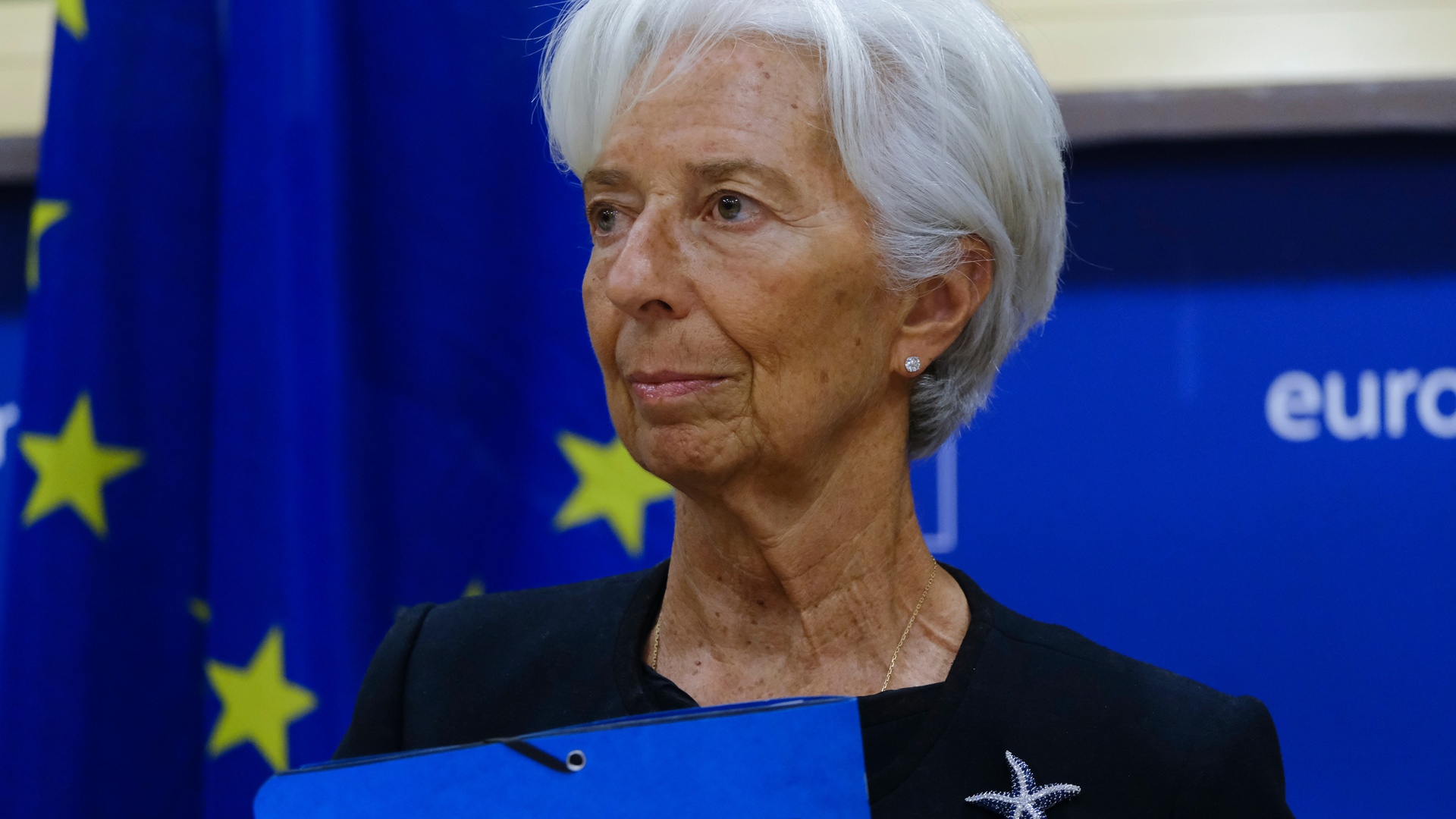
European Central Bank President Blocked Binance’s EU Entry: Report
European Central Bank President Christine Lagarde stopped Binance from operating in the European Union, according to a Wall Street Journal report.
The newspaper on Thursday reported that the top crypto exchange was on the cusp of operating in the trading bloc but then was told it couldn’t after the central bank chief waded in.
EU law requires that local Crypto-Asset Service Providers (CASP) have a MiCA license. Binance does not. Binance in June withdrew its MiCA application in Greece.
“Lagarde wanted to keep the controversial crypto exchange, which pleaded guilty to financial-crime violations in the U.S., out of the European Union,” the newspaper report said, citing interviews with officials.
Lagarde has long been anti-Bitcoin and pro-central bank digital currencies. Back in 2021, Lagarde said that the leading cryptocurrency was “a highly speculative asset” used for money laundering. She also criticized cryptocurrencies as a whole and said central banks would never hold bitcoin.
On CBDCs, though, Lagarde takes a different approach. A CBDC is a digital form of fiat money, like the US dollar or euro; nations around the world are in different stages of researching and releasing them.
The EU under Lagarde is fast moving forward with a digital euro. Lagarde has described the digital euro as key to Europe’s financial autonomy while taking aim at privately issued stablecoins.
CBDCs have been criticized by bitcoiners and others in the crypto industry who think they could be used to surveil citizens. U.S. President Donald Trump signed an executive order banning CBDCs when he took office.
The WSJ report added, citing various interviews, that Lagarde was worried Binance would embed the dominance of dollar-based stablecoins in Europe, instead of encouraging euro counterparts.
Binance is the world’s biggest crypto exchange and billions of dollars in stablecoins are traded on its platform daily.
A controversial company, Binance and its CEO, Chanpeng Zhao, in 2023 pleaded guilty to anti-money-laundering violations and paid a record $4.3 billion fine.
Binance in June said it was still working to pursue MiCA authorization in another EU Member State.
This post European Central Bank President Blocked Binance’s EU Entry: Report first appeared on Bitcoin Magazine and is written by Mathew Di Salvo.
Bitcoin Magazine
CFTC Sends Proposal To Regulate Crypto Transactions Following Clarity Act Fail
The Commodity Futures Trading Commission on Thursday sent a proposal to the White House to regulate crypto transactions and markets.
It isn’t clear what the regulations will look like from the post on the Office of Management and Budget’s website. The proposal is titled “Regulation Crypto Asset Transactions and Regulation Crypto Asset Markets.”
The CFTC’s move comes after lawmakers blocked the long-awaited crypto legislation Clarity Act on Tuesday. Despite the law not advancing, both the CFTC and Securities and Exchange Commission have said they would go ahead with crypto rulemaking anyway.
CFTC Chair Mike Selig said on Wednesday that while the Clarity Act didn’t move forward, the watchdog would still help U.S. President Trump “get the job done” in regulating the crypto space.
“The outcome of yesterday’s Senate vote was unfortunate,” Selig wrote on X, adding that the CFTC was “locked in and ready to ship its rules for the new frontier of finance.”
Before the procedural vote on the legislation this week, Selig had said would proceed with rulemaking whether or not the Clarity Act is enacted — with the aim of finalizing rules before the administration’s term is out.
Senators last year approved Selig as the regulator’s chair. Formerly chief counsel at the SEC’s Crypto Task Force, Selig was described by White House’s Crypto and AI Tsar, David Sacks, as “instrumental in driving forward the President’s crypto agenda”
President Trump campaigned on a ticket to help the crypto space after regulators under the previous administration hit digital asset businesses with lawsuits — mostly for allegedly selling unregistered securities.
Since Trump became president, the SEC and CFTC have taken a much friendlier approach to watchdogging the space.
The CFTC isn’t the only regulator going ahead with rulemaking: the SEC earlier this week approved tokenized stocks trading. In August, it also proposed its own framework for crypto asset offerings, pressing ahead while the landmark legislation stalled.
President Trump last month urged lawmakers to pass the Clarity Act, calling the legislation “very powerful” — but Republicans said that Democrats were deliberately holding it back.
Democrats mainly took issue with the ethics side of the bill. Trump received backing from major industry players while campaigning and since becoming president, his family has made money from digital asset ventures.
Some lawmakers have alleged conflicts of interest. The White House has always denied any wrongdoing.
A new draft of the bill started circulating in July tackling the issue of ethics and banning officials from making money from crypto. But some Democrats said it didn’t go far enough.
The Clarity Act wants to formally divide oversight between regulators, distinguishing which digital assets are securities, commodities or stablecoins.
This post CFTC Sends Proposal To Regulate Crypto Transactions Following Clarity Act Fail first appeared on Bitcoin Magazine and is written by Mathew Di Salvo.
Bitcoin Magazine
Bitcoin Price Surges Over $81,000 Despite Clarity Act Fail and Interest Rate Hike
Bitcoin’s price on Friday shot above $81,000 — despite a week of setbacks for the crypto industry.
The biggest coin was recently trading for $80,982, after jumping as high as $81,055 at one point Friday morning in New York. Over the past 24 hours, it has risen by nearly 6%.
Its surge comes after lawmakers on Tuesday blocked long-awaited crypto legislation, the Clarity Act, and the Federal Reserve on Wednesday hiked interest rates.
JUST IN: Bitcoin surges to $81,000
— Bitcoin Magazine (@BitcoinMagazine) September 18, 2026pic.twitter.com/EQi5apUlxU
Digital asset industry bigwigs had long called for clear rules to regulate the crypto space and the Clarity Act — which wants to divide oversight between regulators — aimed to do that. But lawmakers blocked the landmark digital asset market structure bill in a procedural vote.
And the Federal Reserve increased borrowing costs for the first time due to skyrocketing inflation in the U.S. The central bank’s chair, Kevin Warsh, said that price stability in the U.S. was the Fed’s number one priority.
“The plain fact is that inflation is too high, and has been for too long,” Warsh said. “This summer’s inflation readings do not tell me that underlying trends have meaningfully improved.”
Bitcoin has in the past done well in a low interest rate environment because it means there is more liquidity to trade the asset.
While Bitcoin’s price dipped initially news of the Clarity Act blockage and Fed’s move, it shot up on Friday.
Bitcoin exchange-traded funds in the U.S. have so far this week experienced net negative flows, with investors cashing out nearly $427 million from the vehicles, according to Farside Investors data.
Flows on Thursday turned positive, with investors chucking nearly $160 million at the funds following two days of consecutive outflows.
In a research note Thursday, asset manager Grayscale said that it didn’t expect bitcoin’s price to be hurt by the Fed’s decision because the move reflects a mid-cycle adjustment, not a cyclical change.
And despite lawmakers blocking the Clarity Act, regulators like the SEC are already pushing ahead with pro-crypto regulation.
This post Bitcoin Price Surges Over $81,000 Despite Clarity Act Fail and Interest Rate Hike first appeared on Bitcoin Magazine and is written by Mathew Di Salvo.
Bitcoin Magazine

Bitcoin Community Recognizes Quantum Computing Risk: VanEck
Quantum computing is a risk to Bitcoin but the community recognizes the issue, according to asset manager VanEck’s Head of Digital Assets Research.
Speaking to CNBC on Friday, Matthew Sigel said that while progress on addressing the issue may be slow because of the crypto network’s decentralized nature, the community was working on it.
The crypto community has sounded the alarm about hypothetical advancements in quantum computers that could in the future be able to break Bitcoin’s cryptography.
Some in the space — including Bitcoin developers — have started preparing for a post-quantum future by testing quantum-resistant signatures on live sidechains.
“It’s a risk,” he said. “But the community has recognized the scope of the issue. There’s a lot of talent that’s now come together with a framework of how to upgrade the system.”
He added: “The upgrades don’t happen as fast because there’s no CEO who can tell the devs, ‘hey, do it now.’ There’s a governance process — it takes more time, it’s a little bit messier, but there are technological paths for quantum resistance, and I think you’ll see more of that over the next couple of years.”
Quantum computers do exist but make mistakes and a machine that can break Bitcoin’s cryptography currently does not exist. Bitcoin currently is the biggest computer network in existence.
Major companies in the space — including America’s biggest crypto exchange, Coinbase, and Bitcoin infrastructure firm, Blockstream — are already working on solutions.
Back in July, Coinbase said it plans to deliver a post-quantum signing pipeline using secure enclaves and threshold cryptography.
A Bitcoin Security Consortium — made up of BlackRock, Fidelity Digital Assets, Block, and others — formed in July and donates funds and dedicates engineers to open-source work supporting proposals like BIP-360, which aims to introduce a new transaction output type to reduce long-exposure quantum computing risks.
This post Bitcoin Community Recognizes Quantum Computing Risk: VanEck first appeared on Bitcoin Magazine and is written by Mathew Di Salvo.
Bitcoin Magazine
The Next 3-5 Years of Bitcoin Lending
SALT Lending CRO Hunter Albright says a growing number of Bitcoin holders may eventually borrow against their bitcoin rather than sell it, creating a new relationship between bitcoin, credit and stablecoins.
Bitcoin-backed lending could become an increasingly important part of how holders access the value of their bitcoin without selling it, according to Hunter Albright, Chief Revenue Officer of SALT Lending.
Speaking on BMTV, Albright said he expects borrowing against bitcoin to become more common as the market matures and holders become more comfortable using bitcoin as collateral.
“I’d like to think we will see a growing percentage of the population of bitcoin holders borrow against it,” Albright said.
For Albright, that shift could also change how bitcoin and stablecoins function alongside one another.
“I do believe people borrowing against their bitcoin and leveraging stables is the difference between money in motion and money at rest,” he said. “The speed of conversion really creates a utility and advantage for people willing to operate in that ecosystem.”
In that framework, bitcoin increasingly becomes “money at rest” – an asset held for the long term – while stablecoins serve as “money in motion,” providing liquidity that can be transferred and used more easily without requiring holders to sell their bitcoin.
A Behavioral Shift for Bitcoin Holders
Getting there, however, will require more than simply building lending products.
Albright said greater education around both Bitcoin itself and the mechanics of borrowing against bitcoin will be necessary before the behavior becomes mainstream – something SALT Lending has made part of its own efforts in the market.
It also requires a change in how Bitcoin holders think about the value stored in their assets.
Instead of viewing bitcoin only as something to accumulate and eventually sell, holders can potentially use it as collateral to access liquidity while maintaining their bitcoin exposure.
That model is already common elsewhere in finance, where owners of real estate, equities and other assets regularly borrow against their holdings rather than liquidating them.
For Bitcoin holders, there can also be tax advantages. In the U.S., borrowing against an asset generally does not itself constitute a taxable sale, whereas selling appreciated bitcoin can trigger capital gains taxes. Individual tax consequences depend on the structure of the transaction and the borrower’s circumstances, readers should consult a tax advisor.
Albright sees that combination – long-term bitcoin holdings, growing stablecoin adoption and easier access to credit – as part of a broader shift in how Bitcoin holders may eventually use their wealth.
Rather than bitcoin needing to move every time its value is put to use, bitcoin can remain at rest while liquidity moves around it.
SALT Lending is the Official Liquidity Sponsor of BMTV. Learn more about borrowing against your bitcoin and explore SALT’s BMTV offer at https://saltlending.com/bmtv/?utm_source=bmtv&utm_medium=article&utm_campaign=52783658-BMTV%20article&utm_term=BMTV
Disclaimer: SALT Lending is a paid sponsor of BMTV and serves as BMTV’s Official Liquidity Sponsor. This article is sponsored content and does not necessarily reflect the views or opinions of Bitcoin Magazine. The information provided is for promotional purposes and should not be considered financial advice. Readers are encouraged to conduct their own research before making any investment decisions related to Bitcoin or other financial products mentioned herein.
This post The Next 3-5 Years of Bitcoin Lending first appeared on Bitcoin Magazine and is written by Josh Plischke.
CryptoSlate
Ethereum co-founder Vitalik Buterin says laptop AI is approaching a practical turning point. Wallet software still needs a much higher bar before it can hand an AI control over crypto assets.
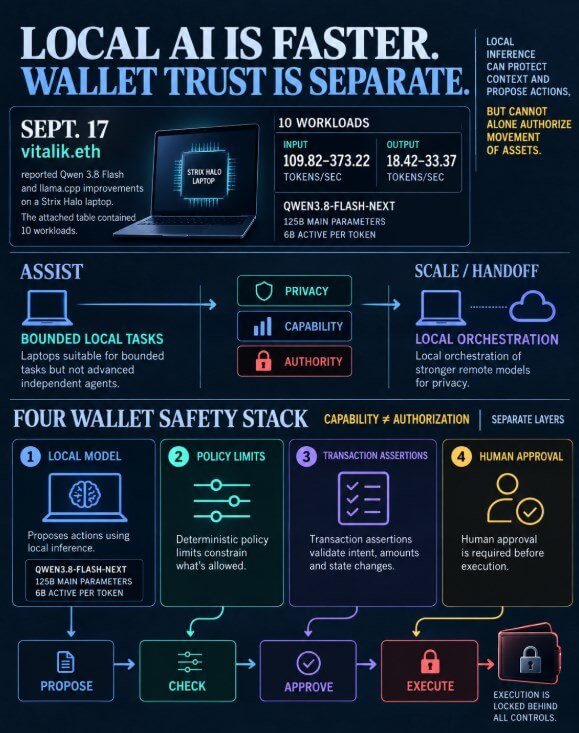
He said on Sept. 17 that Qwen 3.8 Flash and recent improvements in llama.cpp had brought local models close to handling a “large share” of tasks on his Strix Halo laptop.
For more advanced work, he described a local model coordinating requests to stronger remote systems while withholding the user's full personal context.
The benchmark image attached to the post showed 10 workloads. Its reported input-processing rates ranged from 109.82 to 373.22 tokens per second, while output generation ranged from 18.42 to 33.37 tokens per second.
Those figures support a practical claim about responsiveness on one high-end laptop. They leave model judgment, resistance to malicious instructions, and transaction authorization unanswered.
Local inference can improve privacy while the power to move funds remains behind separate, enforceable controls.
Ethereum co-founder shows what changed between April and September
In an April account of his local AI setup, Vitalik described a narrower role for laptop models.
He wrote that Qwen3.5:35B could handle bounded tasks and familiar programming work, while advanced independent agents that could keep working on a codebase remained beyond laptops' practical reach. Harder coding and intellectual work still called for stronger remote models.
The September post changes his assessment of where the practical boundary sits. A local model no longer appears limited to transcription, summarization, or other tightly bounded work. In the newer description, it can become the main interface for a larger share of activity and decide when a remote model is necessary.
A remote service receives only the question or context the local model selects, rather than every file, message, and wallet detail needed to understand the user's wider situation. The local system becomes both an information gatekeeper and an assistant.
April and September involved different model generations and different tasks. The September post provides token counts and throughput, but it omits prompt contents, quantization choices, and the full runtime configuration.
Qwen3.8-Flash-Next, released by Alibaba's Qwen team, is an open-weight multimodal mixture-of-experts model. Its main model has 125 billion parameters, plus another 51 billion in n-gram embedding tables, while 6 billion parameters are activated per token.
The official repository documents local text and vision inference through llama.cpp using quantized GGUF builds.
Activating a fraction of the model for each token lowers the compute burden. The user still needs enough memory for the chosen build and context, and the official materials provide no single hardware minimum that applies across quantization levels and workloads.
Capability benchmarks leave wallet authority unresolved
Qwen's technical report evaluates the base model across 14 benchmarks covering general knowledge, mathematics, science, reasoning, coding and multilingual understanding.
The Qwen team reported that Flash-Next beat the larger Qwen3.7-Plus base model on eight of those tests while using fewer activated parameters and less training compute.
The report covers model capability, efficiency, and training stability. Prompt-injection resistance, policy enforcement, wallet authorization, and the correctness of autonomous financial actions sit outside that benchmark set.
An assistant can privately explain a transaction, prepare calldata, or suggest a route. A signer can make an irreversible request that transfers assets or grants another contract permission to move them.
Better reasoning reduces some errors, yet a malicious instruction hidden in a website, message, or transaction description can still redirect the model's plan.
The Ethereum ecosystem is already testing an on-device version of the assistant concept. In its second-quarter allocation update, the Ethereum Foundation listed Steward, a fully local macOS smart-account wallet whose light client and AI assistant are intended to run on-device.
The disclosure establishes funding and project scope, but leaves production deployment, independent audit status, and autonomous transaction authority unestablished.
Vitalik's April wallet guidance placed that policy outside the language model. He described a human-confirmation firewall for risky actions, deterministic limits on transaction amounts, calldata, and transaction counts, and a human-plus-model 2-of-2 rule.
model may recognize a scam pattern that a distracted person misses, while a person may reject an action after malicious content manipulates the model. Requiring both approvals for risky transactions prevents either participant from quietly becoming the sole trust anchor.
Low-risk automation can remain available within software-defined permissions. Reading balances, preparing unsigned transactions, or operating under tightly capped limits can make an assistant useful without giving it open-ended spending power.
Wallet trust depends on rules the model cannot rewrite
EIP-7906, which remains a draft, proposes post-transaction assertion frames that inspect the final state differences produced by a transaction. An assertion can reject the application outcome when those changes violate a specified condition.
A wallet could use that mechanism to require that a swap changed only approved balances, that a hidden token approval never appeared, or that a protected account's state stayed untouched. Those checks compare the transaction's actual effects with explicit rules.
The draft also describes the edges of the protection. An assertion that checks too little can create false confidence. Wallet validation logic must require the intended assertion frame, and the assertion itself must cover every relevant state change for the protected operation.
Local inference and transaction assertions solve different parts of the wallet-agent problem.
The local model protects context and turns natural-language intent into a proposed action, deterministic permissions restrict recipients, contracts, value, and frequency, assertions inspect final state changes. Human confirmation remains the second factor for risky actions.
September's laptop result makes the first layer more credible. It suggests a private local model can respond quickly enough to coordinate daily work and selectively use remote intelligence. The remaining layers still carry the authority that protects assets.
A crypto wallet can treat the model as a capable interface, planner, and monitor. Trust belongs to controls the model cannot alter and to an approval path that keeps the user meaningfully in charge.
The post Ethereum co-founder Vitalik Buterin argues that local AI can protect your privacy without losing speed appeared first on CryptoSlate.
A roughly $5.15 million outflow from US spot XRP exchange-traded products on Sept. 17 interrupted a $192 million inflow month. The reversal creates the first clean test of whether recent demand is cooling, yet the broader flow pattern still favors the buyers.
Maketo's five-fund series remained about $10 million positive for the rolling week through Sept. 17. Its rolling month contained 16 inflow days and two outflow days, and Canary Capital's official fund table showed that only part of the daily reversal coincided with a confirmed contraction in shares.
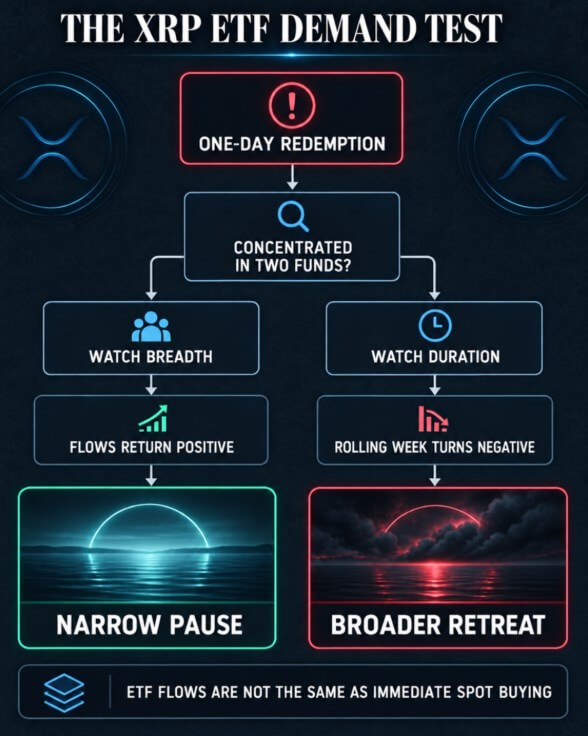
The base case is a narrow, one-session reset inside a positive trend. A broader multi-session wave that turns the weekly total negative would materially change that reading.
The reversal was concentrated in two funds
Maketo's cumulative net-flow total declined from $1,715,570,157 on Sept. 16 to $1,710,416,747 on Sept. 17. The exact change was negative $5,153,410, displayed by the tracker as a rounded $5 million outflow.
The tracker attributed about $1 million of redemptions to Canary's XRPC and about $4 million to 21Shares' TOXR. Bitwise's XRP fund, Franklin Templeton's XRPZ and Grayscale's GXRP were flat.
| Fund | Sept. 17 flow | Issuer-data status |
|---|---|---|
| Bitwise XRP | $0 | Official holdings available through Sept. 16 |
| Franklin XRPZ | $0 | Maketo tracker reading |
| Canary XRPC | About -$1 million | Shares fell by 100,000 on Sept. 17 |
| Grayscale GXRP | $0 | Maketo tracker reading |
| 21Shares TOXR | About -$4 million | Maketo tracker reading |
Maketo says it compiles the flow figures from published fund disclosures, making same-day issuer data the best available cross-check.
XRPC shares outstanding fell from 23.4 million on Sept. 16 to 23.3 million on Sept. 17. Canary's prospectus defines a basket as 10,000 shares, so the 100,000-share decline equaled 10 baskets.
The issuer also reported $319.86 million of net assets and a $13.73 net asset value per share on Sept. 17.
The share-count contraction confirms the direction of the XRPC move while leaving its settlement form and market effect unresolved.
As of Sept. 16, one day before the aggregate outflow, Bitwise's official snapshot for its XRP ETF reported 33.69 million shares outstanding, 376.29 million XRP in trust, and about $486.85 million in net assets.
That snapshot establishes the fund's scale, while its earlier date prevents a same-day check of the Sept. 17 reading.
Maketo showed about $10 million entering the covered funds over the rolling week through Sept. 17 and roughly $192 million over the rolling month. Money arrived on 16 days during that monthly window and left on two.
Maketo estimated that the five products held about 1.08 billion XRP worth a combined $1.39 billion, which is inventory associated with outstanding ETF shares. Creations and redemptions can change the inventory, while XRP price moves can change its dollar value even when net subscriptions are quiet.
The decisive signal is breadth over several sessions
ETF flows measure demand for fund shares, but they are an imperfect proxy for immediate XRP buying and selling.
In a cash creation, an authorized participant delivers cash and the trust or a liquidity provider may acquire XRP to back new shares. A cash redemption can prompt XRP sales to fund the withdrawal, so cash-settled baskets can add demand or supply to the underlying market.
In-kind baskets transfer XRP into or out of a trust without requiring a contemporaneous trust-level market order, while authorized participants may still trade or hedge elsewhere. The fund filings show why flow data alone cannot establish the timing, execution venue, underlying XRP transactions, or price impact for a particular day.
XRP price registered an intraday high of $1.41 for Sept. 18 and traded at $1.30 when checked on Sept. 17. Price and fund flows can be observed side by side, while the retained evidence supplies no causal bridge between them.
The Sept. 17 outflow followed the Senate's 49-50 rejection of cloture on the motion to proceed to the CLARITY Act by two calendar days.
The next useful signal is a shift from concentration to breadth. Additional outflows that push the rolling week below zero and spread beyond XRPC and TOXR would offer stronger evidence of a wider institutional retreat.
That framework is an analytical test: a negative week would strengthen the reversal case, while a longer series would still be needed to judge the monthly trend.
A return to positive sessions, particularly across several funds, would reinforce the current reading of Sept. 17 as a pause inside a strong inflow month. The five products had absorbed about $192 million across the rolling month and still held an estimated 1.08 billion XRP at the cutoff.
For now, the data show a concentrated redemption day against positive weekly and monthly totals. The next several sessions will determine whether the institutional bid broadens into a trend.
The post XRP ETFs hit a speed bump, but big investors aren’t dumping their tokens yet appeared first on CryptoSlate.
Anthropic’s Claude helped three security researchers breach OpenAI accounts and reach an internal code repository within 72 hours.
Researchers at cybersecurity startup Hacktron chained an image-processing vulnerability with a flaw in OpenAI’s identity infrastructure in July to gain access to multiple employees’ ChatGPT and Codex accounts.
One compromised Codex account was connected to OpenAI’s GitHub organization, giving the researchers a path into the company’s internal software environment.
The team stopped after instructing the compromised employee’s Codex account to create a harmless pull request inside OpenAI’s private openai/openai monorepo. Hacktron said the researchers did not inspect proprietary source code.
This week, Hacktron disclosed the vulnerabilities and ended further testing.
OpenAI reportedly fixed the identity-side flaw roughly 14 hours after receiving the report and later paid the company a $6,500 bounty.
Anthropic's Opus 5 cleared a hurdle its predecessor could not
The OpenAI attack accelerated after Anthropic released Claude Opus 5, which overcame an exploitation hurdle that its predecessor had repeatedly failed to solve.
Hacktron began examining the image-upload pipeline used by OpenAI’s Discourse community forum on July 23. HEIC and HEIF files were processed through ImageMagick and the underlying libheif decoding library, giving attacker-controlled images a path into vulnerable code.
The researchers supplied Claude Opus 4.8 with a Discourse Docker image and asked it to inspect the installed libheif package for security weaknesses. The model identified missing fixes that left a heap buffer overflow, enabling out-of-bounds reads and writes.
By July 24, Opus 4.8 had produced an exploit that achieved code execution when address space layout randomization (ASLR) was disabled. But repeated attempts to make the exploit work reliably against Discourse’s normal configuration with ASLR enabled failed.
Anthropic released Opus 5 later that day, giving the researchers another route.
Hacktron opened a fresh session with the new model, which produced a working ARM64 exploit for a local Mac within about three hours. The researchers then asked it to adapt the exploit to the x86-64 architecture and jemalloc memory configuration used by Discourse.
By 6 a.m. on July 25, the team had a working exploit that could execute code through a malicious image upload.
With that foothold established, the researchers next tested whether Claude could reproduce the attack against a remote environment with less human intervention.
Hacktron placed the model in an autonomous loop against its own Discourse Cloud instance. The company said Claude initially refused to develop an exploit directly against a remote system, prompting the team to proxy the test environment so it resembled a capture-the-flag security challenge.
Four hours later, the agent had reproduced the attack against the remote test environment.
The researchers then used the resulting exploit against OpenAI’s community forum, where they gained administrative access. A separate weakness in OpenAI’s single-sign-on system allowed them to move from the forum into ChatGPT and Codex accounts.
One compromised employee had connected Codex to OpenAI’s GitHub organization, creating the path the researchers later used to demonstrate access to the company’s internal repository.
Hacktron co-founder Mohan “s1r1us” Pedhapati said the episode showed how quickly AI was compressing exploit-development timelines that once required far more specialized labor.
He said:
“Our main takeaway from hacking OpenAI: AI is reducing the amount of scarce expertise needed to develop exploits. Work that once took months can now take days. Even leading AI labs can be vulnerable.”
However, Hacktron stressed that the operation still depended on experienced human researchers. The company noted:
“This was not completely autonomous hacking, and skilled human guidance remained important.”
Robert Reith, founder of blockchain security firm Accretion, said experienced researchers still supplied much of the judgment needed to turn AI-generated work into a successful attack, but warned that the advantage may erode as models improve.
According to him:
“There’s still a large gap between what skilled researchers + AI can do vs. general population + AI. The scary part is that this gap may become smaller as AI absorbs this knowledge and intuition over time.”
AI Coding agents expand the blast radius of a compromised account
The same coding agents that accelerated the exploit also increased its potential reach once the researchers gained control of an OpenAI employee account.
ChatGPT and Codex can connect to external services, meaning a compromised account may expose whatever integrations a user has authorized. Hacktron cited GitHub, Slack, and email as services that could become reachable, depending on an account’s configuration.
In this case, the employee’s GitHub connection provided the path into OpenAI’s internal repository.
Security agents warned that this concentration of permissions around AI coding tools could make them increasingly attractive targets as Codex, Claude Code and similar agents become more deeply embedded in corporate development workflows.
Codey Blakeney, research lead at Arcee, said:
“The more popular Codex and Claude Code get, the more people are going to try and target them.”
Blakeney said the risk could grow if software development becomes concentrated around a small number of AI providers, creating broader points of failure across engineering teams.
He noted that if regulation moves us to fewer players, it means less choice and more single points of failure. Blakeney added:
“The entire way software engineering works at most places has completely changed with coding agents, and if just one company has a bad day, it’s going to mess up your roadmap and timelines.”
Maxime Fournes, CEO of AI safety advocacy group PauseAI, said the breach also highlighted a longstanding imbalance between attackers and defenders that could become more consequential as AI lowers the cost of developing sophisticated exploits.
According to him, attackers need to find one overlooked weakness, while defenders must secure a much broader attack surface. He noted:
“It’s massively harder and more expensive to defend against all possible flaws than to exploit a single one.”
OpenAI tightened access after the disclosure, while Discourse prepared a patch by July 27 and added further sandboxing around its image-processing system.
The post Anthropic’s Claude helped 3 researchers breach OpenAI in under 72 hours appeared first on CryptoSlate.
Binance lowered the collateral ratio for six tokens on Sept. 18, while Coinbase International Exchange says 29 assets will leave its eligible-collateral list on Sept. 29. That ratio determines how much of an asset’s market value an exchange recognizes for borrowing or margin calculations.
The exchanges operate separate products and account systems, but both changes show how an affected token can keep the same market price while contributing less to a trader’s borrowing limit or margin cushion.
Binance’s Sept. 18 update cut collateral ratios for AUCTION, BLUR, GALA, HYPER, S and SYRUP from 30% to 10%. The same update raised ARB, TAO and WLD from 50% to 60%.
How exchange rules shrink usable token collateral
A hypothetical trader holding $100,000 of one of Binance’s six affected assets illustrates the change. A 30% collateral ratio gives the holding $30,000 of recognized collateral value, while a 10% ratio gives it $10,000.
The holding’s assumed market value stays at $100,000, while the amount the exchange recognizes falls by $20,000. The ratio falls by 20%, equivalent to a 66.7% relative reduction.
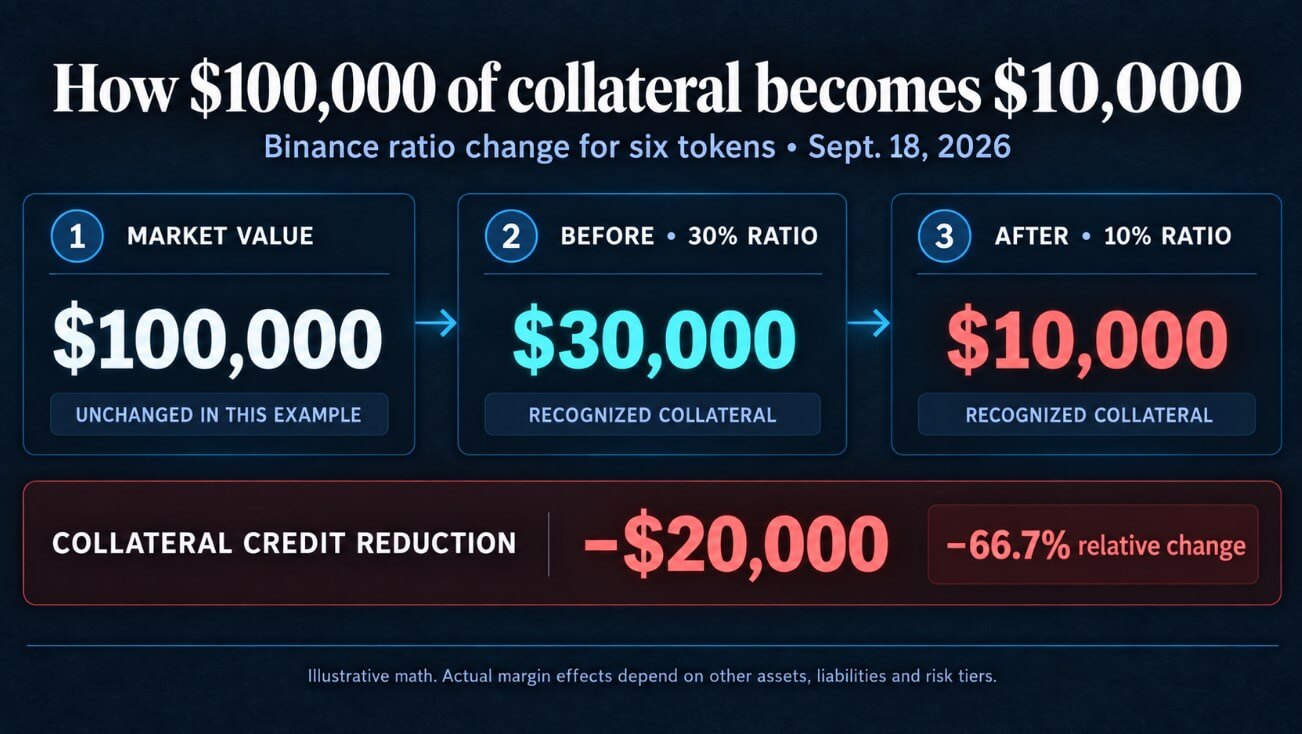
Binance said its Cross Margin change affects the amount a customer can borrow or transfer out. In Portfolio Margin, collateral ratios feed the unified maintenance margin ratio, or uniMMR, which measures whether the combined portfolio has enough margin to support its positions.
A lower recognized value can reduce that cushion, but the outcome depends on the account’s other assets, liabilities, and applicable risk tiers.
Coinbase International Exchange’s collateral page says 29 assets will no longer count as eligible collateral on Sept. 29. The list includes BNB, AVAX, ARB, ONDO, PEPE, SHIB, and UNI.
The notice changes collateral eligibility within Coinbase’s derivatives system. Customers whose accounts rely on those assets may need to add other collateral or reduce exposure, depending on their individual margin position.
SYRUP shows how quickly a venue can reverse an internal risk weight. Binance raised SYRUP’s ratio from 10% to 30% on Sept. 4, then returned it to 10% on Sept. 18, a total of 14 days apart.
Selective repricing sets the limits of the story
Binance adjusted higher ratios for ARB, TAO and WLD usage as collateral in the Sept. 18 update. A Sept. 11 change also raised ratios for tokenized gold and equity-linked assets, including PAXG, XAUT, QQQB and SPYB, while cutting seven cryptoassets.
Those mixed changes support a conclusion of selective risk repricing within Binance’s system. Aggregate borrowing capacity could rise or fall depending on the balances held in each asset.
A report by Glassnode and Bybit said coin-margined collateral lost the majority of the tracked Bitcoin futures book and never regained it. Coin-margined positions expose a trader to a losing contract and weakening collateral during the same market move.
That report describes a longer-running shift in Bitcoin derivatives market structure. The September notices address current rules at Binance and Coinbase, and the available evidence shows no link indicating the exchanges coordinated their decisions.
Binance also removed five cross-margin pairs on Sept. 18: ENJ/USDC, GENIUS/USDC, CVX/USDC, GUN/USDC and VANA/USDC. It removed the GENIUS/USDC isolated-margin pair and automatically settled remaining positions.
The next measurable effects would appear in pledged collateral, borrowing utilization, margin calls, position reductions, or liquidations.
Exchange disclosures covering those figures would show whether the parameter changes caused material deleveraging. For now, the notices demonstrate that exchange-set collateral rules can tighten usable leverage independently of token prices.
The post Exchanges lower token risk values, leaving leveraged traders with less breathing room appeared first on CryptoSlate.
The Bank of England has committed to remove £368 billion of gilts held for monetary-policy purposes by September 2034, even as the first market response pointed toward easier conditions in long-dated UK debt.
The figure covers the portfolio left after the Bank separated £120 billion of longer-dated gilts to back banknotes. The Monetary Policy Committee said the remaining stock will fall by an average £46 billion a year through bond maturities and £20 billion of annual active sales.
Quantitative tightening shifts bonds from a central bank's balance sheet toward private investors. That can lift the extra yield investors demand to hold longer-dated debt, tightening financial conditions even when the policy rate stays unchanged.
The rate and balance-sheet decisions were separate votes. Six MPC members kept Bank Rate at 3.75%, while Megan Greene, Catherine Mann and Huw Pill preferred an increase to 4%. All nine members backed the multi-year gilt unwind.
Bitcoin and the slow-burn tightening channel
Implementation begins with fewer active sales to the market. The Bank's market notice said APF auctions will pause while it reviews a possible arrangement involving HM Treasury and the Debt Management Office. Operational details are due by April 2027, and the sales-to-Government model remains subject to a final decision. Gilts will continue to mature.
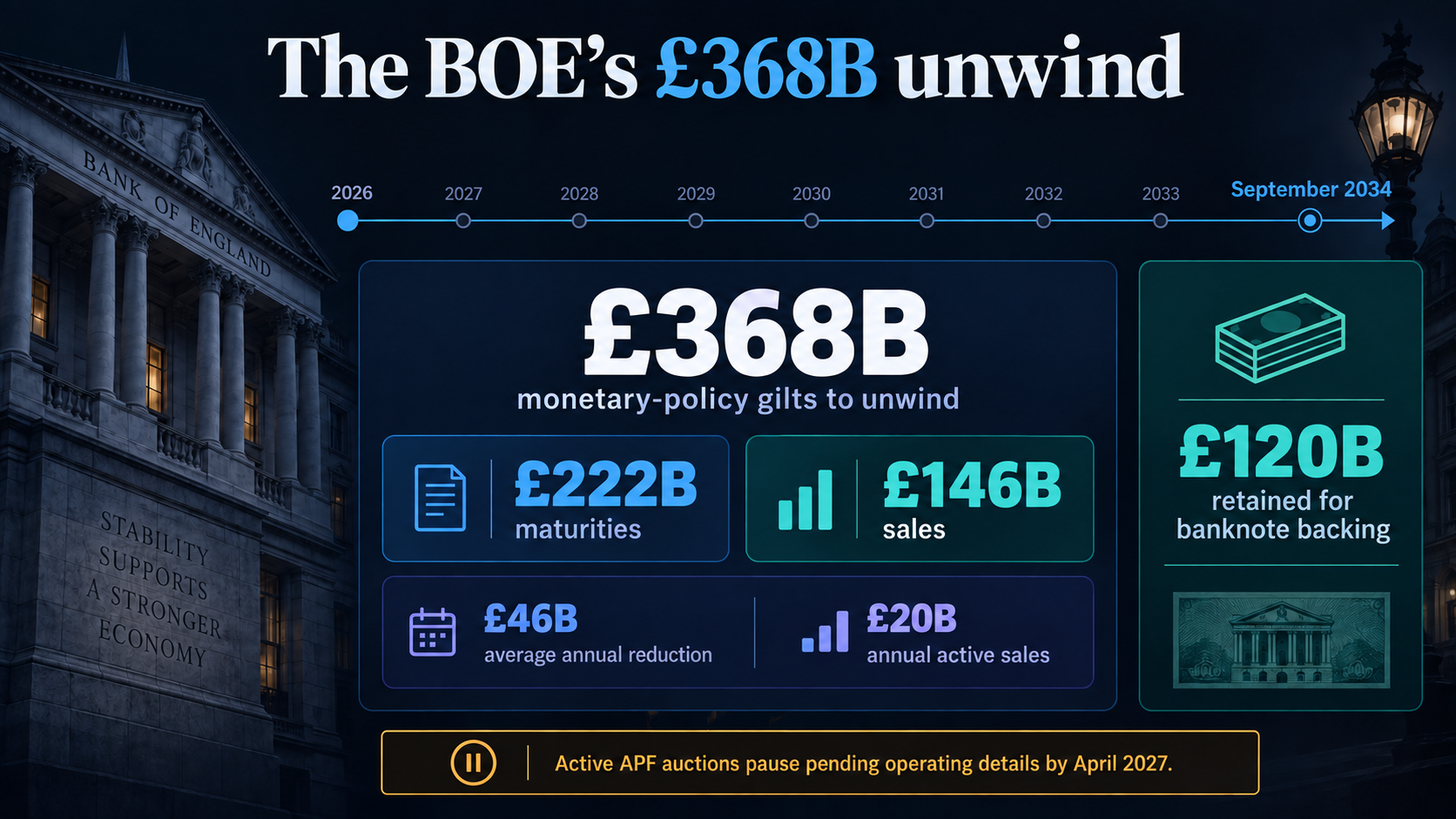
The planned sales pace is close to recent practice. The Bank sold £21 billion over the previous 12 months, compared with £20 billion a year under the new plan. Average total runoff, including maturities, falls to £46 billion from the previous year's £70 billion reduction.
Reuters reported that the 10-year gilt yield fell more than 7 basis points and the 30-year yield nearly 10 basis points by early Thursday afternoon. The Bank's yield-curve data provide the broader rates backdrop, though one trading session cannot identify how much each policy detail contributed.
The BOE also sees the cumulative QT effect as modest. Its July assessment estimated that QT accounted for 20 to 30 basis points of an approximately 200-basis-point rise in long-term gilt term premia since 2022. Global uncertainty, heavy sovereign issuance and structural changes in UK demand explained most of the increase.
Bitcoin's connection runs through the same broad rates and risk-appetite channel. IMF research found that US monetary tightening can depress a common crypto-market factor. The finding concerns US shocks, so it offers a limited analogy for the BOE plan rather than evidence of a UK-driven Bitcoin move. Earlier CryptoSlate analysis similarly described the opposing pressures from tighter liquidity and demand for assets outside sovereign finance.
Bitcoin traded near $78,000 on CryptoSlate on Friday, with Coinbase showing a similar level. Both were rolling snapshots and cannot isolate a reaction to Thursday's announcement.
The BOE's decision therefore creates a long-run test: whether predictable central-bank withdrawal adds enough pressure to global yields and risk appetite to reach Bitcoin, while the auction pause and falling gilt yields make the first response comparatively mild.
The post Bitcoin faces an eight-year rates test as the BOE unwinds £368 billion appeared first on CryptoSlate.
CryptoTicker.io
Monero rose 11.19 percent to $575.12 on Friday evening and into the early hours of Saturday, which puts it among the strongest assets in the top 25. For investors in Germany, though, the decisive question is not how far the price still runs, but whether they will be able to sell their holdings through a European exchange at all in two years' time. The answer sits in the text of the EU anti-money-laundering regulation, and it is more precise than most headlines suggest.
This article places the price jump in context and then works through the points you can actually check as a holder: the trading route, custody, the holding period and the duty of proof towards the tax office. All price data were retrieved by cryptoticker.io on September 19, 2026 at 00:49 UTC directly through CoinGecko's public programming interface.
Monero Price Today: What Happened on September 18, 2026
Monero was quoted at $575.12 at the time of the 00:49 UTC call. That is 11.19 percent more than 24 hours earlier. Within those 24 hours the high stood at $605.00 and the low at $514.04, so the range comes to around 18 percent measured from the low. Trading volume added up to $231.6 million, market capitalization to $10.81 billion. That places XMR at rank 13 among the largest crypto assets by market capitalization.
Over one week the gain stands at 9.4 percent, over one month at 31.5 percent. Monero is a long way from its own all-time high all the same: the peak of $797.73 dates from January 14, 2026, and 27.91 percent are currently missing to get back there. Anyone reading the jump as a breakout to new records is confusing a vigorous counter-move with an all-time high.
The comparison with the market as a whole is what makes the move interesting. Bitcoin gained 6.39 percent to $81,271 in the same 24-hour window, and 16.9 percent over 30 days. Monero comes to 31.5 percent over the monthly window, almost double. The premium over Bitcoin is the actual finding here, not the daily move.
Why Privacy Coins Like Zcash and Dash Are Outrunning the Market
Monero is not moving alone. Zcash stood at $1,577.93 in the same call, a gain of 8.58 percent in 24 hours, 34.6 percent over seven days and 177.7 percent over 30 days. Dash came to $63.40, up 4.8 percent on the day and up 100.8 percent over the month. Three assets in the same category rising by double to triple digits within a few weeks are no coincidence but a sector rotation.
The trigger lay with Zcash. After ZEC passed the $1,000 mark in August and advanced as far as ninth place in the ranking by market capitalization, traders looked for the asset in the category that had not yet moved. Monero was that asset. Anyone who knows the sequence also understands the risk: a rotation that lives off laggard logic ends as soon as the capital moves on to the next category. A fundamental reason arguing specifically for Monero is not discernible in this move.
Independently of that, a regulatory clock is running in the background that carries considerably more weight for German holders than the daily move. It determines the routes by which XMR may still be traded in the EU in future.
Anonymity-Enhancing Coins: What the Term Means in EU Law
The legal term at the center of all this is not privacy coin. The EU anti-money-laundering regulation, Regulation (EU) 2024/1624, speaks in Article 2 number 25 of anonymity-enhancing coins and defines them as crypto assets with built-in features designed to anonymize information about crypto asset transfers either systematically or optionally.
Two words of that definition are decisive in practice. The first is built-in: what is meant are properties of the protocol, not services that can be layered on top afterwards. The second is optional: the definition expressly also captures crypto assets where the obfuscation can be switched off. Monero obscures sender, recipient and amount by default and therefore clearly falls under it. Zcash offers shielded and transparent addresses and is likewise captured by the definition, because the word optional covers precisely that case.
Article 79 of the EU Anti-Money-Laundering Regulation: What Exchanges Are Barred From as of July 10, 2027
The actual rule sits in Chapter VIII of the regulation, headed measures to mitigate risks from anonymous instruments. Article 79 paragraph 1 reads, in the official German wording: credit institutions, financial institutions and crypto asset service providers may not keep anonymous bank or payment accounts, anonymous passbooks, anonymous safe deposit boxes or anonymous crypto asset accounts, nor any other accounts that otherwise make it possible to anonymize the holder of the customer account in question, or to anonymize or highly obfuscate transactions, including through anonymity-enhancing coins.
The date of application is set out in Article 90: the regulation applies from July 10, 2027. That year often circulates with July 1, 2027; the regulation text says the 10th. For one single group of obliged entities, named in Article 3 number 3 letters n and o, the regulation only applies from July 10, 2029. For crypto service providers it takes effect on the earlier date.
The provision is addressed exclusively to obliged entities, meaning banks, financial institutions and crypto asset service providers. In EU terminology those are the companies that need an authorization under the MiCA regulation in order to offer trading, exchange and custody. We have broken down the obligations that come with it in our overview of the MiCA duties for crypto companies. In practice, Article 79 means for these companies that they can neither keep Monero tradable nor hold it in custody for clients without breaching the regulation. We have already described the wider legal framework in our analysis of the EU ban from July 2027.
Will Monero Be Banned in Germany? What the Regulation Says About Self-Custody
No. The regulation prohibits nobody from owning Monero, and it does not prohibit holding XMR in your own wallet or sending it directly to another person. That is not an interpretation but is stated in recital 160 of the regulation text. On the reach of the prohibition it says, in so many words, that this prohibition does not apply to providers of hardware and software or providers of self-hosted wallets, provided they have neither access to nor control over those crypto wallets.
That draws the dividing line clearly. What is prohibited is the regulated intermediary, not the asset. What falls away in the EU from July 10, 2027 is the convenient route: the account at an authorized exchange through which XMR can be bought, held and exchanged back into euros. What remains is self-custody. If you are looking for a provider for that route, our hardware wallet comparison helps with the choice; for pure software solutions there is a separate overview of software wallets.
In practice that means anyone wanting to hold XMR over the long term has to be capable of custody themselves, including securing the recovery words and a robust arrangement for inheritance. Anyone who does not want that or cannot do it should understand the remaining time as a deadline for exiting and not as a reprieve.

Where You Can Still Buy and Sell Monero Today
The retreat of the large trading venues began long before the regulation. Binance removed XMR from trading worldwide on February 20, 2024. Kraken delisted Monero for the entire European Economic Area as of October 31, 2024 and explains this on a dedicated help page on support for Monero in Europe. Anyone looking today in Germany for an exchange with European authorization carrying XMR in euro trading will as a rule not find one.
What remains are trading venues outside the European authorization framework as well as decentralized exchange routes. Both are legally permissible, but they shift the risk onto you: with a provider without EU authorization, neither the custody rules of the MiCA regulation nor the complaint channels provided for there apply. Which trading venues are authorized in Germany and which are not is set out in our overview of regulated crypto exchanges. Always check a venue's availability on its own status page before transferring funds, because listings change monthly.
Selling Monero: Why the Exit Is the Bigger Risk Than the Entry
With an asset whose trading routes are shrinking for regulatory reasons, the decisive question is not the purchase price but the route out. The 24-hour volume of $231.6 million is spread across considerably fewer venues than with comparably large crypto assets, and the European ones fall away by mid-2027. The narrower the market, the wider the gap between the price you see on a quote page and the price you achieve in an actual sale.
From this follows a sober planning rule: settle the exit route before you build or add to the position. That includes the question of which venue you intend to exit through, whether that venue offers euro payouts to a German account, and what proof it requires for them. A venue where entry works smoothly but payout founders on a source-of-funds check is no help to you in the end.
Holding Period and Tax: What Applies to Gains on XMR in Germany
For tax purposes, German law treats Monero like other crypto assets. Gains from a sale fall under private disposal transactions pursuant to Section 23 of the German Income Tax Act. Anyone holding a position for longer than a year can take the gain tax free. Within the first year the gain is taxable and charged at the personal income tax rate.
For short-term gains an exemption threshold of 1,000 euros per calendar year applies, raised from 600 euros previously. The word threshold is to be taken literally: once it is exceeded, the entire gain is taxable and not merely the part above it. Anyone wanting to keep the annual limit in view and document acquisition dates cleanly will find suitable programs in our comparison of crypto tax tools and portfolio trackers.
One point often overlooked when an exit is planned: changing wallet is not a sale. If you transfer XMR from an exchange to your own wallet, that changes nothing about the holding period, because no disposal transaction takes place. The acquisition date remains, and that is exactly why you should document it before the exchange closes your access.

Proof for the Tax Office: Why Monero Is Particularly Demanding Here
With Bitcoin or Ethereum, the path of a payment can in case of doubt be traced through a public block explorer. With Monero that is not possible, because the protocol blocks out precisely that traceability. For the tax return, the property that makes the asset attractive to many therefore turns into its opposite.
The duty to cooperate lies with you. The tax office can demand evidence for the acquisition date, the acquisition costs and the disposal proceeds, and a chain of on-chain data is not available to you with XMR. What remains are the exchange's trade statements, account statements for deposits and withdrawals, and your own records. Secure these documents while you still have access to your exchange account. A venue leaving Europe tends to switch off access to the trading history along with everything else, and a subsequent reconstruction is practically impossible with this crypto asset.
Anyone who acquired Monero through a decentralized exchange route should keep the documentation themselves from the outset: date, euro equivalent, venue and fees. It is tedious, but it is the only proof you can present in case of doubt.
Placing the Monero Price Jump: What to Take Away
- Separate the move from the trigger. The 11.19 percent come from a rotation into privacy coins that began with Zcash, and not from any news about Monero itself. Anyone wanting to buy in because of it should first check through which authorized venue that is possible in Germany at all. Our comparison of regulated crypto exchanges provides the overview.
- Decide before July 10, 2027 whether you want to hold your own keys. Owning XMR remains permitted; the route via an EU exchange falls away. Anyone wanting to hold needs functioning self-custody by then, including secured recovery words; our hardware wallet comparison shows the devices that come into question.
- Secure your documents now, not later. Download trade statements and acquisition data while your exchange account is open, and keep the one-year period under Section 23 EStG in view. A crypto tax tool takes over the deadline arithmetic and files the evidence in a structured way.
(As of September 19, 2026. This article is not investment advice. Prices and fee structures change; check the terms with the provider before you buy.)
Cardano rose 10.8 percent on September 18, 2026 and was trading at $0.2245 at 23:50 UTC. Several market reports explain the jump with an ongoing vote on the Cardano treasury. Anyone looking into the blockchain, however, finds the opposite of a signal of approval there: on the evening of September 18, the proposal in question stands at 2.14 percent approval among the elected representatives. What is required is 67 percent.
For you as an ADA holder, two practical questions hang on this. The vote runs until October 11, 2026, and your ADA vote along during that time whether you attend to it or not. And the proposal contains a clause that would act directly on the market: the greater part of the requested sum is to be converted into a US dollar stablecoin upon signature of the contract. You will find the running price history and its assessment in our Cardano price prediction.
Cardano Jumps 11 Percent: What Happened in the Market on September 18
The figures come from our own call to the CoinGecko interface on September 18, 2026 at 23:50 UTC. ADA cost $0.2245, a gain of 10.8 percent within 24 hours. Over seven days the gain stands at 10.6 percent, over 30 days at 19.0 percent. The trading range of the past 24 hours ran from $0.2015 to $0.2268.
With a market capitalization of $8.42 billion, Cardano sits at rank 18. Trading volume over the past 24 hours came to $707.34 million, or 8.4 percent of market capitalization. For a day with a double-digit gain that is an unremarkable figure, one that points more to a broad market move than to an ADA-specific rush. In circulation are 37.52 billion out of a maximum of 45 billion ADA, that is 83.4 percent. The price is 92.7 percent away from the all-time high of $3.09 set on September 1, 2021.
The most important part of the assessment is the look next door. In the same call Bitcoin stood at $80,874 and 5.9 percent up, Ethereum at $2,610.94 and 6.7 percent up. The entire market turned on that day. Cardano rose about twice as strongly as Bitcoin, which is an above-average move but not an isolated one. Anyone attributing the ADA rise to a governance vote alone is leaving out the larger part of the explanation.
The OpenZeppelin Proposal for 11,787,063 ADA: What Is to Flow Out of the Cardano Treasury
Cardano has a treasury fed by a share of transaction fees and block rewards. Money only flows out of it when a so-called treasury withdrawal proposal is submitted on chain and accepted by those entitled to vote. No authority and no board decides on it.
The proposal dealt with here carries the title "Withdraw 11,787,063 ada for the OpenZeppelin Stack administered by Intersect" and was submitted on September 8, 2026 at 16:27 UTC in epoch 654. The amount requested is 11,787,063 ADA, around $2.65 million at the September 18 price. Measured against the circulating supply, that is 0.031 percent. A deposit of 100,000 ADA was lodged for the submission, around $22,445 at the current price. It flows back to the deposited address once the proposal has been decided.
What the Money Is to Be Used For
According to the proposal description stored on chain, OpenZeppelin, a provider of audited smart contract libraries in business since 2015, is to build a development kit for Cardano over twelve months. Three workstreams are named: ready-made reference implementations for a liquid staking protocol, for self-repaying loans and for a tokenized money market fund, plus an audited contract library for Cardano's eUTXO model and accompanying security work. The undertaking would be administered by Intersect, the membership organization that already administers several budgets in the Cardano ecosystem.
How the Payout Would Be Staggered
This part is the most interesting one for investors, and it too is set out in the proposal description. Of the total sum, 11,443,750 ADA fall to the delivery portion. That sum is to be exchanged into a US dollar denominated stablecoin upon signature of the contract, via Intersect's conversion service. After that, 20 percent of the delivery budget is released as an initial payment, the remaining 80 percent in four equal milestone payments disbursed in stablecoin over four quarters.
In practice that means the switch from ADA into stablecoin would take place once and in full at the start, not spread over the term. The difference between the total sum requested and the delivery portion amounts to 343,313 ADA. What exactly this remainder is intended for does not emerge unambiguously from the proposal text at this point, and it is therefore not interpreted here.
67 Percent Approval: How a Cardano Treasury Vote Works Arithmetically
A treasury proposal needs two majorities on Cardano. First that of the delegated representatives, DReps for short. A DRep is an elected voting representative to whom other holders transfer their voting weight; that weight corresponds to the amount of ADA delegated to them. Second that of the constitutional committee, a small body that examines whether a proposal is compatible with the Cardano constitution. Block producers do not vote on treasury proposals.
The required threshold sits in the blockchain as a protocol parameter. Our own call of the epoch parameters for epoch 656 returned the value 0.67 for the treasury withdrawal parameter. So 67 percent approval is needed on the DRep side. The lifetime of a proposal is six epochs; an epoch on Cardano lasts five days.
The Counting Rule That Surprises Many
What is decisive is how the denominator is formed. Only those who expressly abstain or have set their vote permanently to abstain drop out of the calculation. All other delegated voting weight that does not cast a yes counts against the proposal. Anyone who has transferred their ADA to a DRep who then does not vote has the same effect as a no. Silence is not a neutral stance in this system.

Counted On Chain: Why the Proposal Stands at 2.14 Percent Approval
cryptoticker.io collected this analysis itself on September 18, 2026. Method: a call of the proposal's voting overview and of the epoch parameters via a public Cardano interface on September 18, 2026 at around 23:50 UTC, each returning HTTP status 200. Sixty most recently submitted governance proposals were examined, from which the one dealt with here was identified, along with its complete voting overview in epoch 656.
The state of play at that moment: seven DReps have voted yes, bringing 111.15 million ADA of voting weight with them. Twenty-nine DReps have voted no, with 930.77 million ADA actively cast. One DRep has expressly abstained with 40.21 million ADA. Under the counting rule described above, the counted no weight adds up to 5.09 billion ADA, because delegated weight that was not cast counts along. That yields an approval of 2.14 percent.
To reach the threshold of 67 percent, around 3.37 billion ADA of additional voting weight would have to switch to the yes side. The picture in the constitutional committee is similar: one yes vote has been cast there, which corresponds to 14.29 percent of the seven-member body.
Important for the assessment: nothing is decided by this. The proposal runs until the end of epoch 660, and the vote closes on October 11, 2026 at 21:44 UTC. Votes can be changed until then, and with earlier Cardano budget proposals the picture has shifted more than once in the final days before the deadline. Only the state of play at the time of the call is documented. It could not be checked how the 29 opposing representatives justify their decision, because those justifications sit outside the blockchain in forums and community calls; their motives are therefore not assessed here.
Permanent Abstention: Why 10.3 Billion ADA Do Not Vote at All
The largest single position in the voting overview is neither a yes nor a no vote. 10.30 billion ADA sit on the "abstain permanently" option. That is 27.46 percent of the entire circulating supply. Anyone choosing this option takes their weight out of every ballot entirely until they change the setting. A further 139.04 million ADA sit on the "permanent no confidence" option, which works like a no.
This figure explains why treasury proposals have a hard time passing on Cardano. More than a quarter of all ADA is taken out of play, and the rest has to muster the 67 percent on its own. For you as a holder it is an indication of the actual distribution of power: anyone who has delegated their ADA and never looks again leaves the decision to a comparatively small, active group. That holds in both directions and regardless of whether you think this particular proposal is a good one.
Treasury Proposal Rejected: What Then Happens to the 11.8 Million ADA
A rejected or expired treasury proposal has no mechanical effect on the ADA price. Simply no money flows out, the treasury remains unchanged, and the deposit goes back to the submitter. Anyone speculating on a price reaction is speculating on the market's interpretation, not on a flow of capital.
The reverse direction is more interesting. If the proposal were to pass, 11.44 million ADA would be exchanged into stablecoin upon signature of the contract. Measured against the September 18 daily volume of $707 million, that would correspond to around 0.4 percent of one trading day, spread across the conversion service. That is not an order of magnitude that moves a price, and it is a good example of how quickly a governance figure sounds larger than it is in market terms. For judging the proposal, the substantive question of what is delivered in return is therefore the more relevant one.
Buying ADA Under MiCA: Which Route Is Compliant in Germany
Since the European regulation on markets in crypto assets applies in full, providers addressing retail clients in the EU need an authorization as a crypto asset service provider. For you this is not a formality but the difference between a provider under European supervision and one where you are on your own in a dispute.
This can be checked in a few minutes. An authorized provider names the competent supervisory authority and the domicile of the supervised company in its legal information. If a company outside the European Economic Area appears there while the interface advertises in your own language, that is a warning sign. An overview of the venues that meet these requirements is in our comparison of the best regulated crypto exchanges.
When buying, watch the spread as well rather than only the stated fee. With an asset like ADA priced around 22 cents, a wide spread weighs more heavily in percentage terms than with a high-priced coin, because the difference is spread across a great many units.

Checking Your DRep Delegation: How to See What Your ADA Are Currently Voting For
This is the part you can deal with today regardless of the price. Your ADA carry a voting weight, and that weight is either transferred to a DRep, set to one of the two permanent options, or not assigned at all. In every common Cardano wallet you will find this setting in the governance area, usually next to the choice of stake pool.
Three things are worth a look there. First, whether a delegation is set at all. Second, whether the chosen representative has actually voted in recent months; their voting record is publicly viewable and can be traced through the ecosystem's governance interface. Third, whether your ADA sit on an exchange. In that case you generally hold a claim against the exchange, and the voting weight of the underlying coins is managed by the provider, not by you. You can view the running proposal and its current vote count directly on Cardano's governance interface.
If you change the setting, it takes effect from the following epoch, so after five days at the latest. There is still time for that before the deadline on October 11.
Staking and Governance: Why Your ADA Do Both at the Same Time
On Cardano, staking and voting rights are separate settings on the same coins. You delegate your balance to a stake pool and receive rewards for it, and you delegate your voting weight to a DRep. Both run in parallel, both can be changed at any time, and in neither case does your balance leave your wallet. There is no lock-up period.
That sets Cardano apart from networks where staking means a fixed commitment period. Anyone deploying their ADA through a third party rather than out of their own wallet usually gives this advantage away again, because withdrawal periods and the provider's counterparty risk then come on top. How differently these models are structured is shown in our overview of staking platforms and rewards.
Storing ADA: Exchange Account, Your Own Wallet and the Governance Rights
The usual trade-off applies to custody, but here with an additional point. On an exchange, access is convenient and buying is quick, but the keys sit with the provider, and your voting weight is effectively not yours. In your own wallet you carry responsibility for the recovery words, but you keep staking and voting rights in full.
Anyone choosing their own wallet should know the difference between a software wallet on a phone and a hardware solution. For amounts that would hurt you, separating the key from the internet-capable device is the single most effective step. A software wallet on a phone is convenient and defensible for small amounts; the key sits there on a device that is permanently online, though.
Tax on ADA Gains: The Holding Period Under Section 23 EStG and Staking Rewards
In Germany, crypto assets held privately count as other economic goods. Gains from a sale fall under private disposal transactions pursuant to Section 23 of the German Income Tax Act. From this follows the rule that counts for a day like September 18: if you sell within one year of buying, the gain is taxable and charged at your personal rate. If more than a year lies between purchase and sale, the gain remains tax free.
An exemption threshold of 1,000 euros applies to the sum of all private disposal transactions in a calendar year. An exemption threshold is not an allowance: once it is exceeded, the entire gain is taxable, not merely the part above it.
What Runs Differently With Staking
Staking rewards are not a disposal transaction. They count as other income under Section 22 number 3 of the German Income Tax Act and are to be recognized in the year they accrue at the price value at that time; a separate exemption threshold of 256 euros a year applies to them. If you sell these rewards later, a separate one-year period starts for them from the moment of accrual. The extension of the holding period to ten years where income is generated, once under discussion, is not applied by the tax administration following its circular of May 10, 2022.
In practice a tax return rarely founders on the tax rate and almost always on the allocation of individual purchases to individual sales. Anyone trading across several wallets and exchanges and also receiving staking inflows will not get far without clean records.
Leverage and Liquidation: Why an Eleven Percent Day Shifts Funding Costs
A double-digit day tends to attract leveraged positions. A measured figure on that: our own call to the public interface of a large derivatives exchange on September 18, 2026 at 23:58 UTC returned a funding rate of 0.01 percent per settlement period for the ADA perpetual contract against the US dollar. That is exactly this exchange's neutral base value, within a possible range of minus to plus 0.75 percent. Open interest there stood at 128.75 million ADA, the equivalent of $28.93 million.
The reading of that is undramatic: at this venue, buyers are paying no premium beyond the normal case for their leveraged positions at that moment. A market driven by aggressively leveraged buyers looks different. This applies to the venue examined and cannot simply be transferred to all others.
Anyone working with leverage all the same should know the liquidation price before entering, not after. With an asset that has swung between $0.2015 and $0.2268 within 24 hours, there is a range of around 12 percent between the daily low and the daily high. Fivefold leverage means a move of that size can arithmetically consume the stake before the original assumption could even be tested.
Levels Above and Below: Which ADA Price Marks Count Now
Instead of naming price targets, here are the measured points from our own call of the daily closing prices of the past 30 days. On the downside, the starting point of the current move is $0.1954 from September 16, followed by $0.1962 on the 17th and $0.2025 on September 18. The low of the past 30 days is $0.1870 from August 20.
On the upside, the nearest measured mark is the daily high of $0.2268 from the past 24 hours. Immediately above it, at $0.2291 from August 22, lies the high of the past 30 days. These two values are only around one percent apart and thus form a narrowly bounded zone at which it will become clear whether the move holds.
For a sense of scale: even after this rise, ADA is around 92.7 percent short of the all-time high from September 2021. Anyone deriving a trend reversal from the daily gain should be aware of that distance.
Checking the Cardano Treasury Vote: What to Take Away
- Look up what your ADA are currently voting for. Open the governance area of your wallet and check whether a DRep delegation is set and whether your representative votes at all. If your ADA sit on an exchange, you have effectively given this right away; whether that suits you is best decided deliberately and not in passing. If you are changing provider anyway, the comparison of the best crypto exchanges helps with the choice.
- Separate the price trigger from the governance story. The rise on September 18 coincided with a broad market gain, and the vote cited as the reason stands at 2.14 percent approval on chain. Anyone buying on that basis should know they are betting on the market move. For holdings kept over the longer term, the custody question matters more than the trigger of the day, and for that a look at the hardware wallet comparison pays off.
- Keep the tax period in view before you take gains. A sale within one year of buying is taxable, after that it is not. With several purchases, the allocation of the individual tranches decides which part of the gain is taxable at all. Ongoing records are the only reliable route for that; which tools cover it is shown in our overview of crypto tax tools and portfolio trackers.
(As of September 19, 2026. This article is not investment advice. Prices and fee structures change; check the terms with the provider before you buy.)
Bitcoin Cash gained double digits on September 18, 2026, and the trigger sits with the US securities regulator: Grayscale wants to convert its existing Bitcoin Cash Trust into an exchange-traded product. The decisive piece of news for you, though, is in the filing itself, and the price stories leave it out. There the issuer states expressly that the basis for the listing has not been approved so far and that it cannot name a date.
For investors in Germany there is a second point that regularly drowns in the excitement. Even if the US regulator agrees, you will in all likelihood not be able to buy this product through a German broker. What remains are other routes, and they differ markedly from one another on tax and on custody. This article sorts out what is documented, what remains open and what you can actually check.
Bitcoin Cash Jumps by Double Digits: What Happened in the Market on September 18
Our own call to the CoinGecko interface on September 18, 2026 at 22:52 UTC shows Bitcoin Cash at $261.47. Four minutes earlier the same endpoint stood at $262.29. The gain over 24 hours comes to 11.9 percent there, over seven days to 12.9 percent and over 30 days to 23.0 percent.
Other providers arrive at different figures for the same day: market reports quote 10.2 percent, 11.4 percent and 14.2 percent at a price of $252.39. The range of roughly 10 to 14 percent is explained by the moment of measurement and the reference price chosen in each case. Anyone selling you a single exact daily change is hiding that spread.
For a sense of scale: market capitalization stands at $5.26 billion, which corresponds to rank 22. In circulation are 20,090,875 BCH out of a maximum of 21 million, a good 95 percent of the quantity that will ever be possible. Trading volume over the past 24 hours amounts to $292.36 million, about 5.6 percent of market capitalization. The price remains a good 93 percent away from the all-time high of $3,785.82 set on December 19, 2017.
One oddity belongs here because it shows how fresh the move is: CoinGecko reports a daily high of $258.85 against a daily low of $232.85, while the current price in the same data set sits above it. The daily range is lagging the move, in other words. For you that means metrics from automated overviews run with a delay on a day like this, and an order decision based on them rests on poor ground.
Grayscale's S-3/A of September 11: What the SEC Filing for BCHG Actually Says
The document is publicly available. It is Amendment No. 1 to Form S-3, filed with the Securities and Exchange Commission on September 11, 2026 under registration number 333-290128. The registered entity is the Grayscale Bitcoin Cash Trust (BCH), domiciled in Delaware, ticker BCHG.
One point matters for the dating: the filing carries September 11, while much of the coverage names September 16. Both can be reconciled, because the market only picked the document up a few days later. The date in the regulator's register is the authoritative one.
On substance, the filing sets out three things that would change the character of the product. The sponsor intends to rename the trust Grayscale Bitcoin Cash Trust ETF upon effectiveness and listing. The shares are to be listed on NYSE Arca instead of trading over the counter as they do now. And there is to be an ongoing creation and redemption procedure under which so-called authorized participants can create and return shares in blocks of 10,000 each.
That redemption procedure is the real lever. Without redemption, the market price of such a vehicle can diverge from its intrinsic value by any amount, because nobody is able to exploit the difference. With redemption, a mechanism arises that closes the gap.
The trust itself describes the record here with unusual candor. The filing states that the shares listed on OTCQX have historically traded at premiums and discounts to the value of the BCH held, net of costs, and that these deviations were at times considerable. Anyone holding BCHG over the US over-the-counter market today therefore knows this problem from experience.

Rule 8.201-E: Why the Bitcoin Cash ETF Does Not Launch Without the Generic Listing Standards
Here lies the point most price stories omit. The listing on NYSE Arca hangs on a rule change that the exchange filed with the SEC under Rule 19b-4 on July 30, 2025: the new Rule 8.201-E, the so-called generic listing standards for commodity-based exchange-traded products.
Generic listing standards are general admission criteria that an exchange has approved once; after that, any product meeting those criteria can be listed without a separate individual procedure. That is exactly what the filing builds on.
On this the trust writes, in so many words, that these standards are not approved by the SEC as of the filing date, that it makes no statement about when or whether approval will follow, and that it will not seek effectiveness of the registration and will not offer any shares as long as the approval is absent. The entire prospectus is expressly written on the assumption that the standards will be approved.
A second reservation concerns settlement. Creation and redemption are to run in cash at first. Settlement in BCH itself would only be possible after a separate regulatory clearance, and here too the filing records that there is no assurance as to when or whether the exchange will even apply for or obtain such a clearance.
On top of that comes a blank that is decisive for costs: at the place where the annual sponsor fee should appear, this version of the document carries only the percent sign without a figure. The ongoing fee is therefore not yet quantified in this amendment. Since the amount of BCH per share falls over time by precisely that fee, one of the two figures you need for a cost comparison is missing.
From OTCQX to NYSE Arca: What the Move Changes About the Premium and Discount to NAV
The NAV, the net asset value, is the calculated value of the BCH held in the vehicle, net of costs, divided by the number of shares. The market price can sit above or below it. If it sits above, you are paying a premium for assets you could also buy directly; if it sits below, you receive more substance than you pay in price.
As long as there is no redemption, this deviation can grow large and persistent. The best-known episode of this kind concerned the same issuer's Bitcoin equivalent, which traded for years first at a high premium and later at a deep discount. The trust names this risk expressly in its filing for BCHG and lists several routes by which a discount can arise or persist, for instance if the redemption program is suspended or if the trading hours of the exchange and of the underlying crypto market fall apart.
The point is relevant to you even if you never touch a US share. It describes a general property of packaged products: between what you buy and what is inside sits a price that follows rules of its own. With any product that promises you crypto through a securities account, it is therefore worth asking whether a working redemption mechanism exists.
Buying a US Spot ETF From Germany: Why the Key Information Document Stands in the Way
Suppose the SEC approves the standards and BCHG lists on NYSE Arca. That would be a US product for US investors. For retail clients in the EU, Regulation (EU) No 1286/2014 on key information documents for packaged retail investment products, PRIIPs for short, applies. The regulation requires a standardized key information document in an official language of the country concerned before any sale to retail investors.
US fund providers as a rule do not produce this document, because it plays no role in their home market. You may know the consequence already from American equity ETFs: the German broker displays the security but accepts no buy order from retail clients. An approval in the United States changes nothing about that, because the hurdle sits in European law and not in the American authorization.
Which exchange-traded crypto products are actually reachable in Germany and how they differ, we have set out in a separate overview on buying crypto ETFs in Germany. The short version: what is tradable here is as a rule not called an ETF.
Crypto ETP Instead of ETF: How to Recognize a Physically Backed Product
The reason is legal. A European investment fund under the UCITS directive has to diversify and may not sit almost entirely in a single asset. A product that tracks Bitcoin Cash alone does not meet that test. Such products are therefore issued in Europe as debt securities, usually labeled ETN or ETP, and listed on venues such as Xetra.
The Three Features to Look Up in the Factsheet
First, the backing. A physically backed product deposits the coins with a custodian; a synthetic one replicates the price through counterparties. Second, the issuer and its collateral structure, because a debt security is a claim against a company. Third, the ongoing costs and the trading spread, which turns out noticeably wider with thinly traded single-coin products than with Bitcoin or Ether.
You can check this concretely: search by ISIN or WKN in your account, open the key information document and see whether it is available in German, whether a physical deposit is described there and which custodian is named. If the key information document is missing, you will not be able to buy the product as a retail client in any case.

Buying Bitcoin Cash Directly: Which Route Is Compliant Under MiCA
The second route bypasses the securities account. Since the European regulation on markets in crypto assets took effect, providers addressing customers in the EU need an authorization as a crypto asset service provider. Authorized providers are entered in the public register of the European securities regulator ESMA, and that is exactly where a claim from an advertisement can be checked in two minutes.
What matters in practice when choosing are three things: the authorization and the domicile of the provider, the actual trading depth for the euro pair, and the question of whether you can withdraw the coins. An overview of the venues authorized here is in our comparison of regulated crypto exchanges.
Trading depth is no side issue with Bitcoin Cash. With daily turnover of $292 million across all venues worldwide, BCH moves in an order of magnitude where a single larger order at a thin venue already shifts the price visibly. On a day with a double-digit gain, the spread between buying and selling price is wider than usual on top of that. A limit order rather than a market order is what decides here how far the price you saw sits from the one you end up getting.
Storing BCH: Exchange Account, Your Own Wallet and Custody Inside the ETP
The three routes differ in who holds the keys. In an exchange account you hold a claim against the provider; the coins sit in its custody. In your own wallet you hold the keys yourself and carry the entire risk for backup and recovery. In the ETP you hold a security, and the coins sit with the issuer's custodian, to whom you have no direct relationship.
Bitcoin Cash has a practical peculiarity here. Because the network emerged from a split from Bitcoin, the address formats resemble one another, and older hardware or software can run both networks side by side. That is precisely where the most common expensive mistake comes from: a transfer intended for one network that goes to an address on the other. A small test transfer before the large amount costs a few cents in fees and rules this mistake out.
If you buy BCH through an exchange and leave it there, check as well whether the provider offers withdrawals in BCH at all. Several European platforms have removed individual coins from their range in recent years and converted holdings into euros or another crypto asset. A holding you cannot move out depends on the provider's decision.
Tax on Bitcoin Cash Gains: The Holding Period Under Section 23 EStG Versus Withholding Tax
This is where the two routes part most clearly, and the difference often matters more for the return than the product costs do.
Directly Held Coins
If you buy BCH directly, the sale counts as a private disposal transaction under Section 23 of the German Income Tax Act. If more than twelve months lie between purchase and sale, the gain remains tax free. Within that period the gain is taxable at your personal rate, with an exemption threshold of 1,000 euros per calendar year applying to all private disposal transactions taken together. An exemption threshold is not an allowance: one euro above it makes the entire amount taxable.
Packaged Products
With debt securities and certificates, by contrast, the taxation of investment income under Section 20 of the German Income Tax Act applies in principle, meaning withholding tax of 25 percent plus the solidarity surcharge and, where applicable, church tax, regardless of the holding period. Whether a physically backed crypto ETN carrying a claim to delivery of the coins can be treated differently is disputed and depends on the specific structure of the individual product. Have your specific product checked for tax before you count on a holding period that may not exist at all.
For your records the same thing counts in both cases: purchase date, quantity, price and fees for each position. Anyone buying across several platforms quickly loses that allocation.
Leverage and Liquidation: Why a Twelve Percent Day Shifts Funding Costs
Anyone trading BCH with leverage gets two effects at once on a day like this. The funding rate on perpetual futures rises, because more capital is betting on rising prices than on falling ones; the side in the majority pays the other side continuously. And volatility picks up, which is why the distance between entry and liquidation threshold is covered faster than in quiet weeks.
The liquidation threshold follows from leverage, posted collateral and the platform's maintenance rate, and your own wishes play no part in it. With a move of twelve percent in a day, eightfold leverage is arithmetically enough to end a position without any additional margin. If you work with leverage, the number you need to know before the order is not the price target but the distance to liquidation in percent.
Levels Above and Below: Which Price Marks Count Now
On the upside the next visible zone is the area around $290 to $300. That is the round hundred range where order books tend to thicken, and it sits roughly 12 percent above the current price. On the downside the daily low at $232.85 marks the edge at which today's breakout would arithmetically be given back again; that is about 11 percent of distance downwards.
Both marks are observation points and not a forecast. The reason lies in the nature of the trigger: the price jump hangs on an administrative decision whose timing the applicant itself does not know. A move of this kind can run on for weeks and collapse on the day an approval fails to arrive or is delayed. Anyone buying in solely because of the ETF news is buying an open-ended deadline.
It is also worth placing realistically how much of today's move is down to Bitcoin Cash at all. The market as a whole ran clearly higher on the same day, after nervousness following the latest rate step had eased, and several other assets in the upper ranks gained similarly or more. Part of the rise is market movement, not a BCH signal.
Checking the Bitcoin Cash ETF: What to Take Away
- Separate the news from the approval. A filing has been submitted; nothing has been approved. As long as NYSE Arca's generic listing standards are not cleared, there is no product and no date. If you want to add to BCH because of it, do so through a venue you would use anyway; an overview is in our comparison of the best crypto exchanges.
- Choose deliberately between security and coin. An ETP sits in your securities account and is convenient; a directly held coin can be withdrawn and stored yourself. If you opt for the second, set up the backup before the purchase and make a test transfer; which devices come into question is shown by our hardware wallet comparison.
- Settle the tax consequence before buying, not in May. Directly held coins can be tax free after twelve months; packaged products as a rule cannot. Record the purchase date, quantity and fees for each position; suitable tools for that are under crypto tax tools and portfolio trackers.
(As of September 18, 2026. This article is not investment advice. Prices and fee structures change; check the terms with the provider before you buy.)
The exchange token WBT, issued by the trading platform WhiteBIT, reached a new all-time high on September 18, 2026. The highest price ever paid was $83.64, recorded at 19:49 UTC. That is the reading returned by our own call to the CoinGecko interface at 21:50 UTC. A record changes nothing about the value of your holdings. It is a good moment, though, to check three things that work differently for an exchange token than they do for Bitcoin: which provider you buy through, what the token's value actually depends on, and how the tax office treats a sale.
WBT at $83.64: What Exactly Happened on September 18
WBT stood at $83.31 at the time of the call, or 72.51 euros. Over the preceding 24 hours the range ran between $78.51 and $83.64, a gain of 5.7 percent. Over seven days the figure is 3.7 percent, over 30 days 40.4 percent, over twelve months 88.9 percent. Market capitalization stands at $9.90 billion, which places WBT 14th among all crypto assets on that ranking. cryptoticker.io collected this data itself on September 18, 2026.
The record falls on a day when almost the entire market is gaining. The US Federal Reserve raised its benchmark rate for the first time in three years, the Bank of Japan lifted its own rate to 1.25 percent, and the CLARITY Act under discussion in the United States has failed. Prices rose all the same: Bitcoin was trading back above $80,000 by the evening. A record set in the middle of a broad advance says less about the individual token than a record set on a quiet day. That belongs in the assessment.
One point matters for scale: the gap to the previous record was small. The high stood at $64.11 in December 2025, at $72.70 in August 2026, and at around $82.50 in early September. The jump on September 18 is the continuation of a series, then, and not a single breakout.
Buyback-and-Burn and Whitechain: Why the WhiteBIT Token Is Rising
An exchange token is a crypto asset that a trading platform issues itself and that confers benefits on that particular platform, such as discounts on trading fees or access to selected offers. WBT belongs to this group.
Two developments sit behind the increase, and both are documented. The first is a buyback-and-burn program. What that means is that the exchange uses part of its revenue to buy its own tokens back on the market and then permanently removes them from circulation. According to an analysis by the trade service Cryptonomist published on August 24, 2026, 33 percent of trading fee revenue and 5 percent of revenue from other exchange activities flow into it. The stated aim is to push the total supply down to 200 million WBT.
How far that road still runs can be worked out. Our own call shows a total supply of 293.46 million WBT against a maximum supply of 400 million. Free float amounts to 118.89 million units, a good 40 percent of the total supply. The market capitalization of $9.90 billion refers to that float. Applying the current price to the full total supply would put the value at roughly $24 billion. This gap is not a criticism but a property of the token distribution, and one you should know about before you take the ranking as a yardstick.
The second development is technical. Whitechain, the blockchain belonging to the provider, is being moved from a standalone layer 1 to an Ethereum layer 2 built on the OP Stack. Layer 2 here means that the chain settles transactions itself but anchors the result on Ethereum. A public testnet has been reachable since August 18, 2026, and the mainnet is announced for a later point in 2026. WBT remains the token used to pay transaction fees on that chain.
Exchange Tokens Explained: Why WBT Hangs on Its Exchange's Business
With Bitcoin, value rests on a network that belongs to no company. With an exchange token the position is different. Its utility arises on the issuer's platform, and the buyback is paid for out of that platform's revenue. If trading volumes fall, so does the amount flowing into buybacks. That is the design, not an accusation.
A case from the industry's history shows how strong the effect can be. When the exchange FTX collapsed in November 2022, its associated exchange token FTT lost most of its value within a few days, because utility and demand hung on that single company. This is not a statement about WhiteBIT and not a suggestion of any imbalance there. It is a description of a risk that every exchange token carries by its nature and that a broadly held crypto asset does not carry in the same way.
What This Means for Tradability
A second point stands out when you look at the numbers. Trading volume over the past 24 hours came to $155.41 million. Measured against the market capitalization of $9.90 billion, that is around 1.6 percent. By way of comparison, among the largest crypto assets this ratio is regularly far higher on an active day. A low ratio does not mean something is wrong. It means larger orders can move the price more than they would with more liquid assets, and in both directions. Anyone working with a larger sum should know that before the purchase rather than after it.
WhiteBIT's MiCA Authorization: What the EU Licence Covers and What It Does Not
For German investors the regulatory part is the genuinely interesting one. The EU company within the WhiteBIT group obtained an authorization under the EU regulation on markets in crypto assets in June 2026, granted by the Austrian financial market authority. Under the passporting mechanism provided for in MiCA, such an authorization applies throughout the European Economic Area, Germany included, without a second permission being required there. The provider has announced that it will build a dedicated European platform on that basis.
Passporting means this, in one sentence: a permission granted once is recognized by the supervisory authorities of the other member states, so the provider may operate in those countries as well. We have set out the obligations that come with it in our overview of the MiCA duties for crypto companies.
What matters is what such an authorization delivers and what it does not. Among other things, it obliges the provider to hold client assets separately from its own, to maintain a complaints procedure, to meet information duties and to remain under continuous supervision. It is not a deposit guarantee, not a guarantee against losses, and certainly not a statement by the supervisor about the quality of an individual token. The price of WBT is not supported by an authorization.
You can check for yourself whether a provider actually holds one. The European securities regulator maintains a public register of all authorized crypto asset service providers, the ESMA MiCA CASP register. It states which legal entity holds the permission and which services it covers. Brand names and the names of the companies behind them regularly differ from one another, which is why a look at the register pays off.
Buying WBT in Germany: Which Route Is Compliant Under MiCA
Since the transition period ended on July 1, 2026, only authorized providers may offer crypto trading in the EU. In practice that means this for you: before buying, check whether the platform you want to trade on holds an authorization and whether your account is held with that group's European company or with an entity outside the Economic Area. This distinction appears in the terms of use and in the account confirmation, not on the home page.
Anyone wanting to compare which trading venues hold a European permission and what fees they charge will find the current overview in our comparison of regulated crypto exchanges. Look not only at the trading fee but at the withdrawal fee and the spread, because with a thinly traded token the difference shows up there.
What Applies With a Provider Without an EU Permission
If you use a platform without an authorization in the Economic Area, trading is not automatically prohibited for you as a private individual. You do lose the protections MiCA provides, however, and in a dispute the law of your country of residence usually does not apply. So clarify before your first deposit which company is your contractual partner and which law the terms of use specify.

Storing WBT: Exchange Account, Wallet and the Gas Token on Whitechain
The most convenient place for an exchange token is the account at that same exchange, because the benefits apply there. The most convenient place is also the one where both risks coincide: the risk of the token and the risk of the custodian. Anyone wanting to separate the two moves the holding into a wallet of their own.
One question is decisive here that never even comes up with Bitcoin: which chain is the token meant to arrive on? WBT exists in several network versions, and the ongoing migration of Whitechain to an Ethereum layer 2 will change the selection in the withdrawal dialogue. If you pick a network on withdrawal that your wallet does not support, the holding is in the worst case recoverable only with effort, or not at all. So check which chains your wallet handles before your first withdrawal, and test with a small amount.
A second point concerns the fees on the chain itself. Because WBT serves as the gas token on Whitechain, you always need to keep a small residual balance there in order to send a transaction at all. Anyone moving their entire holding may end up locking themselves out.
Tax on WBT Gains: The Holding Period Under Section 23 EStG and the 1,000 Euro Exemption Threshold
For private investors subject to unlimited taxation in Germany, crypto assets fall under the private disposal transaction rules of Section 23 of the German Income Tax Act. The principle: if you sell within one year of buying, the gain is taxable and is charged at your personal income tax rate. If more than twelve months lie between purchase and sale, the gain remains tax free.
On top of that comes an exemption threshold of 1,000 euros per calendar year for the sum of all private disposal transactions. Exemption threshold means this: everything up to that amount stays tax free, and once it is exceeded the entire gain is taxable, not merely the part above it. A record price tempts people into selling, which is precisely why it pays to look up your own purchase date before the order goes out.
Something else counts too: swapping WBT for another crypto asset is a sale and a purchase in one for tax purposes, even though no euro changes hands. Anyone trading across several venues quickly loses track of the acquisition dates. Software that tracks every position by acquisition date and produces a report for the tax return from it takes that allocation off your hands. With larger amounts or unclear cases, none of this replaces professional tax advice.
Measuring Concentration Risk: Three Metrics Before Buying an Exchange Token
Instead of an opinion, three numbers help with an exchange token, all of which you can look up yourself and all of which change daily.
The first is the ratio of daily volume to market capitalization. For WBT our own call puts it at about 1.6 percent. The lower this figure, the more individual large orders move the price.
The second is the float ratio, meaning the share of freely tradable supply in the total supply. For WBT that is 118.89 million out of 293.46 million units, around 40 percent. The rest can come to market over time or be burned. Either changes the calculation.
The third is the question of how much of the price increase is carried by the issuer's own business and how much by the market at large. On a day when almost all large crypto assets gain between 5 and 12 percent, a rise of 5.7 percent is no proof of particular strength. Over 30 days, however, WBT's 40.4 percent sits visibly above what the broad market managed in the same period.
Levels Above and Below: Which Price Marks Count Now
On the upside there is no history left, because an all-time high is by definition the highest price ever paid. The next point of orientation is therefore the high itself at $83.64. A price that holds above it for several days counts in classical chart theory as a confirmed breakout, a quick fall back as a false one.
On the downside, three levels can be read off the token's own price history: the daily low at $78.51, the August high at $72.70 and the December 2025 high at $64.11. Old peaks often serve as a catch line when a price comes back down. That is no guarantee.
Those taking the optimistic view point to the running buyback program and to the Whitechain migration, which anchors the token permanently as the fee currency. Those who are cautious point to the dependence on the provider's trading volume, to the 60 percent of total supply still outstanding, and to the fact that the record came on a day of market-wide gains. Both arguments rest on the same numbers and reach different conclusions. This article deliberately offers no price forecast.
Checking the WBT All-Time High: What to Take Away
- Establish first which company holds your account. Look in the ESMA register to see whether the provider holds a European authorization, and check the account confirmation to see whether you are registered with the European entity. Anyone wanting to switch can compare the terms in the overview of the best crypto exchanges.
- Separate token risk from custody risk. If you do not need the holding for fee discounts, move it off the exchange, and check first which chain your wallet supports. Which devices handle which networks is set out in the hardware wallet comparison.
- Look at the acquisition date before selling. Under twelve months of holding, the gain is taxable; above that it is tax free, and the 1,000 euro exemption threshold applies to all private disposal transactions in the year taken together. The programs for the job are listed in the comparison of crypto tax tools.
(As of September 18, 2026. This article is not investment advice. Prices and fee structures change; check the terms with the provider before you buy.)
The price of Uniswap (UNI) rose to $9.05 on September 18, 2026, a gain of 18.67 percent within 24 hours and of 48.8 percent over a week. Two things lie behind the jump that have nothing to do with each other and yet coincide on the same day: a rebuild of the protocol's fee logic that has been running for months and burns UNI by design, and an exemption granted by the US securities regulator the day before that lets tokenised stocks into automated trading pools for the first time. Which of that matters to you depends less on the price than on three practical questions: where you can buy UNI in Germany in a compliant way at all, how the tax office treats a swap on a decentralised exchange, and what you actually hold as a holder.
The UNI price at a glance: these are the figures currently on the screen
All the values that follow come from our own query of the CoinGecko API on September 18, 2026 at 20:51 UTC. UNI is quoted at $9.05, or 7.87 euros. Over the past 24 hours the high was $9.39 and the low $7.52. That is a range of around 25 percent within a single day, and it says more about the state of the market than the closing level does.
Over seven days there is a gain of 48.8 percent, over 30 days one of 155.59 percent. Market capitalisation stands at $5.62 billion, which puts UNI in 21st place among the largest crypto-assets. Trading volume over the past 24 hours was $2.13 billion. There are 621.0 million UNI in circulation out of a total of 888.2 million.
One figure is missing from most reports of the day, and it puts the rest in perspective: UNI's all-time high is $44.92 and dates from May 2, 2021. At the current level that is 79.9 percent away. This week's jump is therefore a strong recovery out of a very deep valley, not a return to old record levels.
Why the daily range matters more than the daily gain
Anyone who bought today at the high of $9.39 and sells tomorrow at the low of a similar day loses around a fifth without anything having changed in the news. With moves of this magnitude, the moment of entry within a single trading day decides more money than the entire fundamental story. That is no argument against buying, but it is an argument against a market order at the peak of a move.
What the fee switch at Uniswap actually does
The term fee switch describes a switch in the Uniswap protocol with which holders of the UNI token can decide by vote that part of the trading fees flows to the protocol itself instead of remaining entirely with the liquidity providers. The switch has existed since the launch of Uniswap v2 but was turned off for years.
The specific split is described in the proposal named UNIfication, which Uniswap Labs and the Uniswap Foundation published on November 10, 2025. For v2 pools the fee for liquidity providers falls from 0.30 to 0.25 percent, with the remaining 0.05 percent going to the protocol as a protocol fee. Anyone providing liquidity therefore earns slightly less per trade after the change than before.
On top of that comes a one-off item: a retroactive burn of 100 million UNI from the protocol's treasury. The amount is an estimate of what would have been burned had the fee switch been in force since the token launched. A burn is the permanent disabling of tokens by sending them to an address from which nobody can ever move them again.
Uniswap governance voted on the proposal. According to CoinDesk reporting of December 26, 2025, the result was practically unanimous, with more than 125 million votes in favour and 742 against. The changeover has been proceeding step by step since then: according to the UNIfication document, the feeds for v2, v3 and Unichain are in operation, while the connections for v4, aggregator hooks and the bridges to further networks are still open and have to pass governance individually.

TokenJar and Firepit: why fees only come out against burned UNI
The mechanism behind it is unusual enough to be worth knowing before you credit the token with a valuation. The fees collected do not land directly in a till that somebody could draw on. They flow into an immutable contract named TokenJar and accumulate there.
They can only be taken out through a second contract named Firepit, and exclusively in exchange for the destruction of UNI. Anyone who wants the accumulated fees has to burn tokens for them. The circulating supply therefore falls to the extent that the protocol earns fees and somebody collects them.
For the valuation of the token this is the real difference from before. A pure governance token entitles the holder only to vote, and voting has no calculable value. A token whose circulating supply shrinks with the use of the protocol, by contrast, can be modelled like a security with a buyback programme. That is precisely why the market has valued it 155 percent higher over the past 30 days.
What this model does not deliver
A burn is not a distribution. No money flows to you, and you have no claim to anything. The value arises purely arithmetically from the fact that fewer tokens represent the same protocol value. If usage falls, the effect disappears immediately, without any notice period. Ethena operates a comparably built model for its ENA buyback; there, too, the entire effect hangs on the protocol's ongoing revenue.
The SEC exemption for tokenised stocks and what it has to do with Uniswap
The second trigger dates from September 17, 2026. The US Securities and Exchange Commission issued an exemption which its own announcement calls an innovation exemption. The core of it: trading venues for tokenised securities may trade tokenised US stocks through automated market makers and liquidity pools for five years without counting as an exchange within the meaning of the Securities Exchange Act of 1934.
An automated market maker, AMM for short, is a program that forms prices from the inventory of a liquidity pool according to a fixed formula and manages without an order book. Uniswap is the best-known representative of this design, which is why the market reads the decision as a tailwind for precisely this business model.
The exemption comes with conditions. It includes caps on the number of tradable symbols and on volume, requires auditable smart contracts, synchronised trading halts, public announcements, record-keeping duties and technical safeguards. Holders of tokenised stocks are to have the same rights as holders of the original share. Liquidity providers who put their own capital into such pools are at the same time exempted from the duty to register as dealers. The SEC combined the arrangement with a request for comment.
For you as an investor in Germany little follows from this for now. The exemption applies to US trading venues and US stocks under US law. It opens no access for you and changes nothing about your tax position. How a tokenised security is treated for tax here depends on its specific structure and should be clarified in advance if in doubt. What the SEC decision actually moves is the expectation of future trading volume on AMM infrastructure. Expectation is the right word for it: volume that does not yet exist generates no fees yet either, and without fees nothing burns.
Our own count: this is how large Uniswap's share of DEX trading really is
On days like this, market share figures circulate that hardly anyone recalculates. We therefore counted for ourselves. cryptoticker.io compiled this analysis itself on September 18, 2026.
Method: query of the public DefiLlama interface for the overview data set of decentralised exchanges on September 18, 2026 at around 20:55 UTC, HTTP status 200, followed by summing the 24-hour volumes per protocol. All 1,365 protocols listed in that data set were checked.
Result: the total 24-hour volume of all recorded decentralised exchanges was $10.06 billion. Of that, $3.06 billion fell to Uniswap across all versions, split into 1.64 billion on v3, 1.36 billion on v4, 56.2 million on v2 and $103,641 on v1. That gives a share of 30.44 percent. The next largest single competitor in the data set came to 5.42 percent.
Uniswap is therefore by a clear margin the largest decentralised exchange, but it does not hold a majority of total volume. Almost 70 percent of trading runs elsewhere, spread across a great many small venues. Anyone basing a valuation on the assumption that Uniswap captures the lion's share of DEX trading is calculating with too large a slice of the cake.
What this count cannot deliver: it rests on the figures of a single data provider, it does not capture centralised exchanges, and it cannot strip out artificially inflated trading volume. An independent check against a second source is outstanding.

Buying UNI from Germany: regulated exchange or directly onchain
There are two routes, and they differ in almost every respect. The first runs through a centralised exchange with an authorisation under the EU Markets in Crypto-Assets Regulation, MiCA for short. That authorisation obliges the provider, among other things, to separate client assets from its own assets, to operate complaints procedures and to publish an information sheet for the crypto-asset concerned. Which providers hold this authorisation for the German market can be found in our continuously maintained overview of the best crypto exchanges.
The second route leads straight to the protocol, that is, into the wallet and into a pool. There is no provider there who is liable for anything. There is no deposit protection, no support, no reversal in the event of a mistake. If you send to a wrong address or hit a cloned contract, the money is gone. In exchange you get direct access with no intermediary, and your tokens sit in your own custody.
How to recognise a cloned interface
The most common damage on the protocol route arises not from price losses but from fake trading interfaces that rank high in search engines. Check the address of the contract your wallet is to work with before you sign an approval, and never grant an unlimited spending allowance for a token when you only intend a single swap. The same applies by analogy to trading venues without EU authorisation: where no regulator has jurisdiction, there is also no body you could turn to in a dispute.
Tax on UNI: why every swap is a sale in Germany
This is the point at which a rally of 155 percent in 30 days can become expensive. Crypto-assets count as other assets in Germany. Gains from their sale fall under private disposal transactions within the meaning of Section 23 of the Income Tax Act. If more than a year lies between acquisition and disposal, the gain is tax free. If it is less, it is taxable at your personal income tax rate as soon as the sum of all private disposal gains in a year reaches the exemption threshold of 1,000 euros.
The decisive term is disposal. Swapping one crypto-asset for another is, for tax purposes, a sale of the first and an acquisition of the second. Anyone swapping Ether for UNI on a decentralised exchange has thereby sold the Ether, even though no euro ever moved. Swapping back later is another sale. With several switches inside a week, twenty tax-relevant events quickly arise, none of which appears on a bank statement.
Unlike at a German broker, nobody withholds tax. There is no capital gains tax at source and no annual statement. Working out the figures and declaring them in the Anlage SO is entirely down to you, as is the duty to provide evidence. Anyone not recording the transactions as they happen reconstructs them laboriously from transaction hashes later. Tools that automate exactly that and track holding periods for each individual lot are compared in our comparison of crypto tax tools.
The special case of providing liquidity
Anyone putting UNI or other tokens into a pool does more than hold. They generally swap them for proof of a share in the pool and receive a running share of the fees. The tax treatment of these events has not been conclusively settled on points of detail to this day, and the classification of the income depends on the specific structure. If you are considering this step, that is the point at which tax advice pays for itself, and before you act rather than after.
Governance and custody: what you actually hold as a UNI holder
UNI is a governance token. It carries a voting right in the protocol's votes and nothing else. No claim to profit, no pool of liability, no share in a company. Even after the switch to the fee switch, no income flows to you as a holder; the mechanism works through the reduction of the circulating supply.
In practice, a say means little for small holders. The vote on UNIfication passed with more than 125 million votes. Against a large address holding millions of tokens, a holding of a few hundred carries no weight. Anyone buying UNI is in practice buying a bet on the use of the protocol and on the effect of the burn mechanism, hardly on their voting right.
For custody the same applies as for any token based on a smart contract. If it sits on an exchange, it belongs to you in an insolvency only as the legal system of the provider concerned allows. If it sits in your own wallet, everything hangs on securing your recovery words. For longer holding periods, and the one-year holding period suggests a longer holding period, self-custody is the obvious choice.
What argues against the rally: three points that can be documented
First, the basis of the valuation. The burn mechanism only works as long as fees accrue. Our own count above shows a Uniswap volume of $3.06 billion in 24 hours. A decline in overall crypto trading drags that figure down immediately, and with it the arithmetical effect on the circulating supply.
Second, the scope of the changeover. According to the UNIfication document, the feeds for v2, v3 and Unichain are in operation, while v4, aggregator hooks and the bridges to further networks are still outstanding. v4 in particular contributed $1.36 billion of daily volume in our measurement. A considerable part of the trading therefore does not yet feed the mechanism, and every further step needs a governance vote of its own.
Third, the reach of the SEC decision. It applies for five years, under conditions, with caps on symbols and volume, and it is combined with a request for comment. Whether appreciable trading volume on AMM infrastructure arises from it is an open question. The price has priced in an expectation whose fulfilment will only be readable from figures in the coming quarters.
On top of that comes the obvious: an asset that has risen 155.59 percent in 30 days and whose daily range today was 25 percent can give a considerable part of that back in an equally short time.
Fee switch and the UNI rally: what you should take away
- Separate the trigger from the mechanism. The SEC exemption of September 17 is an expectation of future volume, whereas the fee switch is a running mechanism with documented figures. Only the latter can be recalculated today. If you want to buy on that basis, do it through a provider with EU authorisation; which ones those are is in our comparison of regulated crypto exchanges.
- Settle the holding period before you swap. Every swap on a decentralised exchange is a sale with a period of its own. Set up your record-keeping before you trigger the first transaction, not next spring. The tools for it are in the comparison of crypto tax tools.
- Do not buy into the daily peak. There were 25 percent between today's low and high. An order split into partial amounts over several days costs a few fees more and takes precisely this risk out. Where those fees are lowest is shown by the comparison of the best crypto exchanges.
(As of September 18, 2026. This article is not investment advice. Prices and fee structures change; check the terms with the provider before you buy.)
Primary sources: the UNIfication proposal by Uniswap Labs and the Uniswap Foundation and the SEC announcement on the innovation exemption of September 17, 2026.
Decrypt
The filing seeks CFTC approval for contracts giving US traders 24/5 leveraged exposure to individual stocks without ownership.
A new upgrade would cut Zcash block time from 75 seconds to 25, while quietly rewriting how the network pays for its own security after 2031.
Kevin O'Leary believes Bitcoin could hit $1 million if crypto beats its quantum computing problem, and explained why he's ditching Ethereum.
XRP is roaring back as Bitcoin claws its way above $800,000 again, but the charts continue to give traders mixed signals.
The agency submitted a prerule on crypto asset transactions and markets to the White House for review, signaling it will build a derivatives framework on its own authority after the Clarity Act's collapse.
U.Today - IT, AI and Fintech Daily News for You Today
XRP eyes a $2 target as buyers absorb a 1.6B whale inflow on Binance and a daily breakout above $1.55 triggers a 35% rally.
Exchange flows and SHIB’s daily price structure are beginning to stabilize after another turbulent week.
UNI and NEAR extend powerful breakouts while HYPE tests record territory and Bitcoin pushes back toward a critical resistance zone.
XRP surged more than 8% to reclaim the $1.40 level, triggering over $8 million in short liquidations as bearish traders were caught off guard by the sharp move higher.
Solana jumped 11% to $112 on Thursday, hitting its highest level since January as strong ETF activity, a massive short squeeze and growing institutional adoption added fuel to the rally.
Blockonomi
NEW YORK, September 18, 2026 – Can established networks like Solana maintain their critical technical thresholds, or is the smartest capital already migrating toward early ground floors? While SOL navigates a crucial test around the $100 battleground alongside shifting market sentiment, savvy participants are shifting their focus to a new crypto presale where exponential growth remains mathematically possible.
The answer lies in securing positions before foundational pricing windows close for good. Right now, this high-octane movement is turning heads across the Ethereum network as momentum accelerates into Stage 4. Entering this active movement at current pricing secures an allocation before subsequent tier increases push costs higher toward the targeted public launch.
Apeing: Unleashing the Power of a New Crypto Presale on Ethereum
The market moves at a blistering pace, and right now, attention is firmly fixed on a high-octane new crypto presale unfolding on the Ethereum network. The Apeing presale is officially LIVE, and current allocations are vanishing faster than late-cycle market pumps. Operating as an ERC-20 powerhouse with a strictly capped supply of 16.75 billion tokens, the project bypasses tired tropes to deliver a robust economic design built for serious participants.

Stage 4, known as the Banana Hoarders tier, is actively underway, but this window is rapidly narrowing as volume floods in. What makes this phase unmissable is the combination of aggressive tokenomics and community-driven utility. Participants are actively locking down tokens to tap into tiered staking rewards ranging from 10% up to 85% APY, while simultaneously leveraging a 10% buyer bonus paired with a 10% referrer reward. With unsold stage tokens permanently burned upon closure and a targeted listing price set at $0.01, the momentum driving this movement is undeniable.
$APEING Presale Records $97K+ in Funding
The operational mechanics are straightforward, designed to get participants positioned before the next tier triggers a price hike. Stage 4 meme coin presale is currently live at a price of $0.0005, offering a stark contrast to the upcoming Stage 5 price of $0.00055 and the eventual $0.01 listing target.
| Metric | Current Data |
| Active Stage | Stage 4 (Banana Hoarders) |
| Current Token Price | $0.0005 |
| Next Stage Price | $0.00055 |
| Tokens Sold | 455M+ |
| Total Raised | $97K+ |
| Holder Count | 360+ |
| Stated Listing Price | $0.01 |
Consider a targeted position: securing a $5,000 allocation at the current $0.0005 stage price translates to approximately 10,000,000 tokens before network fees. At the stated $0.01 listing price, those holdings point to a theoretical value of $100,000 once public trading commences.
How to Buy Apeing Presale
Participating in the movement of buying Apeing is streamlined and direct for anyone ready to secure their allocation.
- Connect Your Wallet: Link a standard Ethereum-compatible wallet like MetaMask or Trust Wallet. Keep in mind that smart or passkey wallets are not supported.
- Choose Payment: Fund your transaction using supported cryptocurrencies or a Visa/Mastercard. Card transactions still require an active Ethereum wallet connection.
- Enter Your Amount: Input the desired fiat spend or the specific quantity of tokens you wish to acquire.
- Buy: Double-check your payment currency, connected wallet, and transaction details, then click Buy Now to confirm the transfer.
- Activate Referrals: Qualifying purchases of $25 or more instantly unlock a personal referral code to share with others.
Sol Price Today: SOL Holds $100 as Bullish Trend Meets Fading Momentum
Sol price today is trading near $100.08, with the $100 level emerging as a key battleground between an intact daily uptrend and weakening momentum. SOL remains above its 20-day EMA at $99.54, 50-day EMA at $93.08, and 200-day EMA at $89.39, maintaining a technically bullish structure. However, the daily MACD histogram has slipped to -1.3, signaling that momentum is cooling, while the RSI14 reading of 53.15 remains broadly neutral. The broader crypto market is also offering limited support, with total market capitalization down 1.36% and Bitcoin dominance rising to 58.3%.
SOL Faces Key Resistance Near $100–$102
The immediate technical picture is centered on the $99.64 daily pivot, with resistance at $100.80 and support at $98.91. SOL is also trading below the daily Bollinger mid-band at $101.78, while the upper and lower bands sit at $106.48 and $97.07, respectively. On the one-hour chart, SOL remains below the $100.52 EMA200, despite a positive MACD reading and RSI14 of 63.66. The 15-minute chart shows a bullish structure but an almost flat MACD, suggesting limited short-term momentum. Meanwhile, Solana’s on-chain activity remains notable: reported 30-day DEX fees have risen 206.79% on Raydium and 176.31% on Orca, while HumidiFi, BisonFi and PumpSwap have also recorded increases.
The broader market remains mixed, with the Fear & Greed Index at 50, indicating neutral sentiment, while SOL accounts for roughly 2.23% of total crypto market capitalization. A move above the $100.80–$101.78 zone would put the focus on higher technical levels, including the $106.48 Bollinger upper band, while a loss of the $98.91 support could bring the $93.08 daily EMA50 into focus. With daily ATR14 at 4.09, SOL continues to face the potential for sizeable daily swings. Overall, the data presents a market with conflicting signals: the longer-term daily structure remains positive, while momentum indicators point to a cooling phase around the $100 level.

Conclusion
While mainstream networks like Solana navigate crucial technical checkpoints, capital is rapidly flowing toward high-velocity ground-floor opportunities where structural growth potential remains wide open. Established assets experience natural consolidation ranges, but early-stage positioning offers an entirely different magnitude of participation.
The new crypto presale event for Apeing is moving at an exceptional pace, driven by strict allocation scarcity and a tiered pricing structure that rewards swift action. Built around high-yield staking, aggressive community mechanics, and a fixed supply framework, this movement is designed to capture maximum market attention. Secure your Solana News perspective insights and lock down your $APEING allocation today before the current stage sells out and the price increases!

For More Information:
Website: Visit the Official Apeing Website
Telegram: Join the Apeing Telegram Channel
Twitter: Follow Apeing ON X (Formerly Twitter)
FAQs About New Crypto Presale and Sol News
What is driving interest in the current digital asset market?
Traders are closely monitoring key support levels on major tokens while rotating capital into early-stage ground floors for maximum positioning upside.
How does Solana perform in the current market environment?
SOL continues to hold critical technical thresholds near $100, supported by surging on-chain DEX volume across key protocols despite cooling short-term momentum indicators.
What network is Apeing built on?
Apeing operates securely on the Ethereum network as an ERC-20 utility asset with a fixed total supply of 16.75 billion tokens.
What stage is the Apeing presale currently in?
The Apeing presale is live in Stage 4, offering early participants an entry price of $0.0005 before subsequent stages push the price upward.
How do participants benefit from Apeing’s tokenomics?
Holders can access tiered staking rewards up to 85% APY, earn extra tokens via the referral system, and benefit from automatic token burns on unsold stage allocations.
The post [Solana News] Apeing Meme Coin Presale Blasts Past 455M+ Tokens Sold with $97k+ Raised as Solana Fights to Hold the $100 Line appeared first on Blockonomi.
Zoomex, the global cryptocurrency derivatives exchange known for its Easy to Use interface and Transparent by Design fee structure, has relaunched its popular Zero-Fee TradFi campaign, giving traders a fresh opportunity to access global markets at no cost. Running from September 11, 2026, 10:00 AM UTC through October 11, 2026, 10:00 AM UTC, the event rebates 100% of actual trading fees paid on eligible TradFi products, capped at 100 USDT per account, reinforcing Zoomex’s commitment to Fair Access & Rule-Based Execution for every trader on the platform.
The campaign covers three categories of assets available directly on Zoomex: Stock Contracts spanning more than 200 global stocks, indices, and ETFs; Commodity Contracts on gold, silver, crude oil, and other widely traded raw materials; and Stock Tokens offering flexible exposure to popular US equities and ETFs. All three product lines now sit inside the upgraded TradFi Hub, live on the Zoomex app, which brings stocks, indices, ETFs, gold, and crude oil together in a single, streamlined venue built around Zoomex’s Refined Brand & Trading Experience.
How the Zero-Fee TradFi Event Works

Participation follows three simple steps, consistent with the straightforward, no-friction design traders have come to expect from Zoomex:
- Register for the Event. Users complete registration directly on the campaign page during the promotional window to qualify for the 0% fee rebate.
- Trade TradFi. Once registered, traders can open positions across any Stock Contract, Commodity Contract, or Stock Token available on Zoomex, going long or short with leverage, 24/7.
- Collect the 100% Fee Rebate. All eligible trading fees incurred during the campaign period are refunded in full, up to the 100 USDT cap per account.
Rebates are calculated and settled every Sunday, with funds credited back to eligible accounts within three business days of settlement. That weekly cadence keeps the process visible and predictable rather than leaving traders guessing when a rebate will land, reflecting the same rule-based, transparent settlement logic that underpins Zoomex’s broader derivatives offering, where balances, funding, and execution follow clearly published mechanics rather than opaque, discretionary adjustments.
Why It Matters for TradFi Traders on Zoomex
Traditional finance instruments such as stocks, commodities, and ETFs have become one of the fastest growing corners of the crypto native trading world, and Zoomex has positioned its TradFi Hub as a direct bridge between the two. By letting traders go long or short on more than 200 global stocks, indices, and ETFs with leverage, around the clock, Zoomex extends market access well beyond the limited hours of traditional exchanges. Commodities traders get the same continuous flexibility on gold, silver, and crude oil, all from a single account and a single, unified interface, without needing to juggle separate brokerage platforms for equities and raw materials exposure.
The Zero Fee TradFi campaign removes one of the most common frictions in active trading, the cost of simply placing trades, and lets users test Zoomex’s TradFi offering at effectively no cost up to the rebate cap. For a platform built around Fair Access & Rule Based Execution, a rebate that applies uniformly to every eligible, registered participant, rather than being reserved for a select group of high volume accounts, is a natural extension of that philosophy. It also gives newer traders a lower risk way to explore Stock Contracts, Commodity Contracts, and Stock Tokens side by side before committing larger positions.
Key Terms of the Campaign
A few conditions are worth noting for anyone planning to participate:
- Eligibility requires completing registration on the campaign page during the promotional period. Only registered accounts qualify for rebates.
- The 100% rebate applies to actual trading fees paid on Stock Contracts, Commodity Contracts, and Stock Tokens, capped at 100 USDT per user. Fees beyond the cap are not rebated.
- For Stock Token trades, on chain gas fees are excluded from the rebate and remain the trader’s responsibility.
- Fees already waived or offset through bonus vouchers, discount coupons, or other promotions do not qualify for the rebate.
- Zoomex reserves the right to disqualify accounts and forfeit rewards where fraudulent activity is detected, including batch account registration, wash trading, self dealing, or volume manipulation, keeping the event aligned with fair, rule based participation for genuine traders.
- Campaign timing and task schedules may be adjusted based on operational needs, with updates communicated through official Zoomex channels. Zoomex retains final interpretation rights over the event.
About Zoomex
Founded in 2021, Zoomex is a global cryptocurrency trading platform focused on derivatives trading. The platform serves over 3 million users across 35+ countries and regions, offering access to 700+ trading pairs. Built around easy to use, transparency, fairness, and speed, Zoomex provides a clear and efficient trading experience for users worldwide.
Through its high-performance matching engine, clear asset and order displays, and transparent fee and rule mechanisms, Zoomex helps users better understand their account status, order execution, trading costs, and results. Zoomex maintains registrations, licenses, and regulatory statuses across multiple jurisdictions, including the U.S. MSB, Canada MSB, U.S. NFA, and Australia AUSTRAC, and has completed security audits conducted by blockchain security firm Hacken. The platform also continues to strengthen its trust framework through Proof of Reserves, Security & Transparency, Compliance Information, and Fees / Rules Transparency initiatives.
Beyond trading, Zoomex builds a refined brand experience through elite sports partnerships, including the TGR Haas F1 Team, World Cup-winning goalkeeper Emiliano Martínez, and world-class tennis events such as Wimbledon. The values of speed, precision, discipline, fair play, and rule-based execution are closely aligned with Zoomex’s approach to derivatives trading.
At Zoomex: Easy to Use. Transparent balance. Fair access to your earnings.
Frequently Asked Questions
- What is Zoomex?
Zoomex is a global crypto derivatives platform founded in 2021, serving over 3 million users across more than 35 countries and regions with 700+ trading pairs. - How does Zoomex work?
Zoomex operates through a high-performance matching engine with transparent asset and order displays, allowing users to execute trades and track outcomes with full visibility into their balances and results. - What can you trade on Zoomex?
Zoomex offers 700+ trading pairs spanning cryptocurrencies such as BTC, ETH, and SOL, as well as stock-linked contracts like NVDA and AAPL and gold exposure through XAUT. - How does Zoomex compare to other exchanges?
Zoomex differentiates itself by not issuing a platform token, avoiding venture capital or incubation deals, and holding security certifications from Hacken alongside regulatory licenses in multiple jurisdictions, positioning the platform around transparency and fund safety rather than token incentives. - Where is Zoomex headquartered?
Zoomex operates as a global cryptocurrency exchange with regulatory registrations including Canada MSB, U.S. MSB, U.S. NFA, and Australia AUSTRAC, reflecting its multi-jurisdictional compliance approach. - Is Zoomex available in my country?
Zoomex serves users across more than 35 countries and regions. Availability can vary by local regulation, so traders should check the official Zoomex website for country-specific access and requirements.
The Upgraded TradFi Hub
Alongside the fee rebate campaign, Zoomex has rolled out an upgraded TradFi Hub inside the Zoomex app, unifying stocks, indices, ETFs, gold, and crude oil into one dedicated section. The redesign is meant to make moving between crypto derivatives and TradFi assets feel seamless, so traders don’t need to switch platforms or manage separate accounts to diversify across asset classes. It’s a further step in Zoomex’s push to be Focused on Derivatives while still giving users a genuinely broad set of markets to trade from a single login.
Media Contact
Contact: Catherine
Company: Zoomex
Address: 306 Victoria House, Victoria, Mahé, Seychelles
Website: www.zoomex.com
Email: catherine.shi@zoomex.com
Publication Partner: ZM Newswire – Powered By Zeest Media
The post Zoomex Relaunches Zero-Fee TradFi Campaign for Traders appeared first on Blockonomi.
TLDR:
- Bitcoin rebounded above $80K after regulatory, rate, and security fears pressured market sentiment.
- The Fed raised rates 25 bps to 3.75%-4.00%, adding fresh pressure to crypto risk assets.
- BTC faces key resistance at $82K-$84K, while $75K remains a critical support zone.
- A sustained move above $85K-$86K could shift attention toward the $88K-$95K range.
Bitcoin has rebounded above $80,000 after three major fear narratives dominated crypto markets this week.
BTC now trades at $81,137.97, up 6.05% over 24 hours and 4.30% over seven days. Its 24-hour trading volume stands at $42.20 billion, according to the latest CoinGecko data.
The rebound follows heavy market pressure around U.S. crypto legislation, interest rates, and security incidents. Santiment Intelligence said these themes dominated crypto-related social discussions as Bitcoin fell toward the mid-$75,000 region.
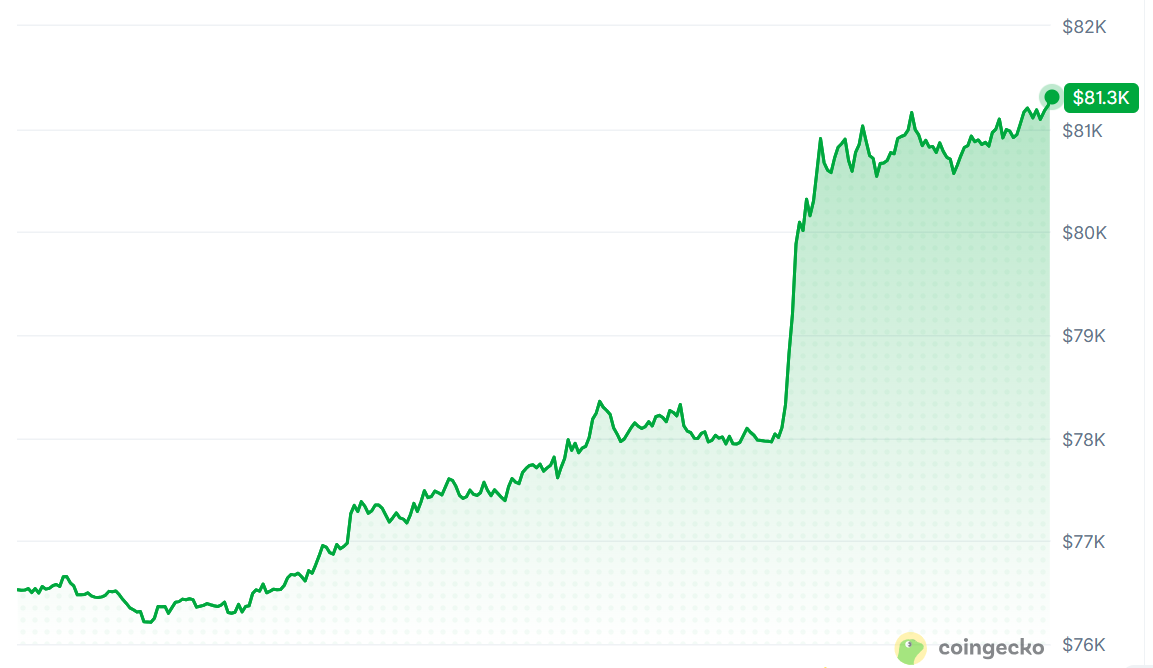
Bitcoin Price Rebound Follows a Wave of Market Fears
The first major catalyst was the Senate’s failure to advance the CLARITY Act on September 15. The procedural vote on H.R. 3633 failed 49-50, leaving the legislation unable to move forward at that stage.
The setback added regulatory uncertainty for the crypto industry. However, Bitcoin’s subsequent recovery suggests traders absorbed the news without extending the sell-off indefinitely.
Crypto spent the week digesting three dominant fear narratives.
CLARITY Act disappointment, higher interest rates, and fresh hack/security concerns all surged across social channels while Bitcoin slid toward the mid-$75K area.
The policy shocks were real. The Senate… pic.twitter.com/5vuy4iFkqq
— Santiment Intelligence (@SantimentData) September 18, 2026
Interest rates added another source of pressure one day later. The Federal Reserve raised its benchmark rate by 25 basis points to 3.75%-4.00% on September 16. The move marked a return to rate hikes after the previous increase in July 2023.
Higher rates can tighten financial conditions by increasing borrowing costs across markets. They can also reduce the appeal of riskier assets when safer yields become more attractive.
Security concerns further weighed on sentiment. Santiment pointed to the Symbiosis Bitcoin Bridge exploit and the Revolut breach involving personal information from crypto customers.
Despite those narratives, Bitcoin moved back above $80,000. Santiment suggested that larger buyers may have entered as fear became widespread.
That interpretation remains market analysis rather than confirmed evidence of specific buying activity.
What Bitcoin Price Action Suggests Around $80K?
Bitcoin’s current structure remains closely tied to several technical levels identified by market analysts.
Crypto Patel described an 8-hour bullish flag, with $80,000 serving as the key breakout trigger. The analyst identified $82,250 and $98,000 as potential upside levels after confirmation.
The bearish setup begins below $75,000, according to Patel. A breakdown could expose Bitcoin to $71,000 and then $68,000.
Bitcoin Bullish Flag Pattern: Could $BTC Rally Toward $98,000 Next?
8H TECHNICAL STRUCTURE: #BTC Is Currently Trading Inside A Bullish Flag, A Classic Continuation Pattern Following The Previous Impulsive Move.
BULLISH SCENARIO: Break + 8H Close + Hold Above $80,000 → Flag… pic.twitter.com/8HVDDAWlLQ
— Crypto Patel (@CryptoPatel) September 18, 2026
KillaXBT presented a different risk-management approach around the same range. The analyst said a move toward $82,000-$84,000 could trigger a 50% hedge against a continuation long.
Killa also identified $85,000-$86,000 as an important area. A sustained reclaim could leave the $88,000-$95,000 region as the next area under consideration.
These levels represent individual trading frameworks rather than established market outcomes. Bitcoin’s next move, therefore, depends on whether price confirms a breakout or returns toward range support.
The broader mechanism is straightforward: negative headlines can accelerate selling, but that pressure can weaken once sellers become exhausted. Bitcoin’s move above $80,000 shows that sentiment can shift quickly when price absorbs adverse news without breaking key support.
The post Bitcoin Price Hits $81K as BTC Shrugs Off Regulatory and Rate Fears appeared first on Blockonomi.
TLDR
- Disney stock drops 2.52% as Karandeep Anand joins as chief technology officer.
- Disney creates a new CTO role to oversee technology, data, product, and engineering.
- Anand joins from Character.AI after senior roles at Brex, Meta, and Microsoft.
- Disney expects Character.AI technical employees to follow Anand into the company.
- The leadership move supports Disney’s broader push to modernize digital operations.
The Walts Disney (DIS) shares fell 2.52% to $102.69 on Friday after a sharp mid-morning decline. The move followed Disney’s appointment of Karandeep Anand as its new chief technology officer. Disney created the role as it expands technology, data, product development, and engineering across the company.
The Walt Disney Company, DIS
Disney Stock Extends Losses After Leadership News
Disney created the chief technology officer position to strengthen company-wide technology leadership. Anand will start on October 2 and report directly to Chief Executive Officer Josh D’Amaro. His role will cover enterprise technology, infrastructure, data platforms, product development, and engineering.
Disney shares remained under pressure after the earlier decline accelerated during mid-morning trading. The stock closed down 2.52%, keeping market attention on Disney’s near-term share performance. Meanwhile, management continued outlining a broader plan to modernize technology across its businesses.
Disney also wants to connect its entertainment businesses through stronger digital systems and shared technology. Disney+ remains central as management builds more direct relationships with audiences worldwide. The company plans greater coordination between technology teams serving streaming, parks, entertainment, and other operations.
Karandeep Anand Takes New Technology Role
Anand joins Disney after serving as chief executive officer of Character.AI. He led the company during a period of strong platform growth and expanding consumer engagement. Before Character.AI, Anand served as president and chief product officer at financial technology company Brex.
Earlier, Anand held several leadership positions at Meta, including roles overseeing advertising and business products. He also spent 15 years at Microsoft in senior product and engineering positions. During that period, Anand worked on teams involved in building the Azure cloud platform.
Disney expects several members of Character.AI’s technical team to join the company with Anand. Their arrival could strengthen Disney’s engineering resources across several business areas. However, Disney has not provided specific roles or responsibilities for those incoming technical employees.
Disney Expands Technology Strategy Under D’Amaro
D’Amaro has placed technology among Disney’s main priorities since becoming chief executive officer. His approach combines storytelling, stronger technology support, and closer coordination across the company. Management also wants technology to create more connected experiences across Disney’s major consumer businesses.
The new structure gives Anand company-wide oversight instead of responsibility for one operating division. That setup could help Disney standardize infrastructure, data systems, engineering practices, and product development. It also places one senior executive in charge of coordinating major technology projects across Disney.
Disney faces strong competition across streaming, entertainment, gaming, and other digital platforms. The company has relied more heavily on digital distribution to support engagement and direct customer relationships. Anand’s appointment adds experienced technology leadership as Disney continues reshaping operations around connected products and services.
The post Disney (DIS) Stock: Plunges as Character.AI CEO Joins as Chief Technology Officer appeared first on Blockonomi.
TLDR
- Amazon’s air cargo network prepares for a major Airbus A330 fleet expansion
- ATSG receives its first Amazon-ready A330 and targets operations in 2027
- ABX Air plans new pilots and maintenance staff for the expanding A330 fleet
- Amazon has committed to multi-year leases covering four Airbus A330 freighters
- ATSG expands beyond Amazon through new Latin American cargo operations
Amazon (AMZN) stock traded at $253.20 as its air cargo network prepared for a wider Airbus A330 rollout. The expansion will gradually reduce reliance on Boeing 767 aircraft across Amazon’s cargo operations. Meanwhile, Air Transport Services Group is preparing its first A330 for Amazon service in 2027.
Amazon.com, Inc., AMZN
Amazon Prepares for A330 Expansion
ATSG received its first A330 freighter modified from a passenger aircraft for Amazon’s cargo network. The company expects ABX Air to begin operating the aircraft during the first quarter of 2027. Meanwhile, Amazon has committed to multi-year operating leases covering four A330 aircraft.
ABX Air must complete Federal Aviation Administration programs before adding the A330 to its operating certificate. These programs cover pilot training, aircraft operations, and maintenance procedures for the new type. Therefore, ATSG plans to hire additional pilots and maintenance workers as A330 capacity increases.
ATSG currently operates 56 aircraft within Amazon’s fleet of more than 100 planes. The company has supported Amazon since 2016 using Boeing 767-200 and 767-300 freighters. Meanwhile, Alaska Airlines operates 11 Airbus A330 freighters for Amazon.
ATSG Builds a New Freighter Fleet
The A330 expansion reflects the declining supply of mid-life Boeing 767 passenger aircraft available for cargo conversions. Boeing no longer produces the 767, while older passenger aircraft continue to leave commercial service. As a result, ATSG has pursued the A330 as its next medium-widebody freighter platform.
ATSG plans to acquire and convert 30 A330 aircraft as part of its broader cargo fleet strategy. Airbus aftermarket affiliate Elbe Flugzeugwerke performs the passenger-to-freighter conversion work. However, supply chain problems have slowed the conversion program and delayed some planned deliveries.
EFW has delivered two converted A330 freighters to Turkey-based ULS Airlines Cargo so far. ATSG also plans to support its new aircraft through maintenance operations in Ohio and Florida. The company is developing an Airbus maintenance program at Wilmington Air Park and in Tampa.
Amazon Cargo Network Expands
ABX Air has also added a new cargo customer as ATSG expands its business beyond Amazon and DHL Express. Miami-based Global Aviation Link hired ABX Air to operate a Boeing 767-300 to Latin America. Under the one-year agreement, ABX Air provides the aircraft and operates the service.
The service began flights between Miami and Quito on September 2 and operates six days each week. Global Aviation Link plans to expand service toward Venezuela and Peru, which export flowers and fruit. The company already provides scheduled cargo service between Miami and Bogota using Boeing 767 aircraft.
ATSG also announced three executive appointments as it continues changes following its 2025 acquisition by Stonepeak. Mike Hough became group president for airlines and services, while Tim Schulze joined as chief risk officer. Doug Belding also joined as vice president for enterprise performance and operating systems.
The post Amazon (AMZN) Stock: Air Cargo Network Prepares for Airbus A330 Expansion appeared first on Blockonomi.
CryptoPotato
Fresh moves from the two largest regulators in the United States suggest the local crypto industry is still advancing on the regulatory front even without Congress.
The CFTC’s move coincided with the broader market’s price resurgence on Friday, leading to the question of whether BTC and the alts jumped because of regulatory developments.
SEC and Tokenized Stocks
CryptoPotato reported on September 17 that the SEC introduced a five-year “Innovation Exception” program designed to make it easier for qualifying platforms to trade tokenized US stocks on-chain. It allows eligible trading venues relief from some exchange requirements and offers liquidity providers temporary exceptions from dealer-registration rules.
Although tokenized stocks must still provide the same core shareholder rights as traditional equities, including dividends and voting rights, synthetic products that simply track the share price will be excluded.
The agency argued that the framework could enable 24/7 trading, faster settlement, greater transparency, and self-custody, while lowering barriers for blockchain-based securities platforms.
The timing was quite interesting, as it came just after the CLARITY Act setback, and it could carry a more important message than just regulating tokenized stocks. SEC Chair Paul Atkins previously said that the agency would continue its crypto agenda regardless of whether Congress passed CLARITY.
CFTC Follows Suit
The commodity watchdog made a similar move by submitting “Regulation Crypto Asset Transactions and Regulation Crypto Asset Markets” to the White House Office of Information and Regulatory Affairs for review at the end of the business week. As such, it began the next step toward a formal crypto market framework under its existing powers.
The CFTC also issued a no-action position protecting certain software developers from being treated as introducing brokers when specific conditions are met. Chair Michael Seling commented even before the CLARITY vote that even if it stalled, his agency would use existing authority to begin building a crypto market-structure regime anyway.
It’s worth noting that neither of those propositions by the SEC and the CFTC replaces the CLARITY Act. Rules written by regulators are less durable than legislation passed by Congress since they can be changed easily by a future administration. However, the developments may have reassured markets that the regulatory process has not returned to square one.
Perhaps that’s why bitcoin’s price rallied on Friday after the CFTC news went live, and skyrocketed from $78,000 to a two-week peak of over $81,000.
The post Bitcoin Reclaims $80K as SEC and CFTC Push Ahead After CLARITY Failure appeared first on CryptoPotato.
Ripple’s cross-border token was hit hard after the US Senate’s failure to advance the CLARITY Act, dumping from a weekly peak of $1.50 to under $1.30 before it rebounded to just over the latter.
Analysts now point to improving momentum and a possible rotation toward altcoins, which aligns with a major technical signal tailored for XRP.
XRP Has to Defend This Zone
Ali Martinez believes the immediate battle is straightforward: the cross-border token has to defend the $1.31-$1.35 support before a stronger move can unfold. The area is now acting as a key short-term support region, with the asset repeatedly hovering around it following this week’s selloff.
This is particularly important now as leveraged traders have started stepping back again after this week’s deleveraging, when the futures open interest dropped by over 20% in a few days. This suggests some speculative positions have been flushed out following the regulatory and macro volatility. Lower leverage can reduce immediate upside momentum, but it can also leave the market less vulnerable to another cascade of forced liquidations.
Fellow analyst Bird, meanwhile, highlighted improving conditions for altcoins, with traders increasingly watching whether capital begins rotating away from Bitcoin. XRP has already shown signs of relative strength by slightly outperforming BTC during Friday’s rebound. However, it now has to overcome the next resistance area at $1.38-$1.40, followed by the more meaningful one near $1.50-$1.54, which halted its progress days ago.
Another Bullish Signal Incoming?
XRP’s 5-day moving average is approaching the 200-day moving average, putting the asset close to forming a golden cross. The indicator is traditionally viewed as a bullish momentum signal, although it should not be treated as a guarantee of further gains. What matters here is the timing.
If the asset manages to defend the $1.31-$1.35 region, reclaims $1.40, and eventually breaks through the aforementioned $1.50 area while the broader altcoin momentum strengthens, the technical backdrop would look significantly healthier than it did after the 8% daily drop to under $1.30 earlier this week.
Nevertheless, these are a lot of “ifs,” which are yet to be confirmed. At the same time, several other altcoins have posted major gains over the past few days, while XRP has stayed somewhat behind.
The post XRP Could Be Setting Up for Its Next Big Move: Here Are the Levels to Watch appeared first on CryptoPotato.
Christine Lagarde personally asked Greek Prime Minister Kyriakos Mitsotakis to block Binance’s bid for a license to operate across the European Union, according to a Wall Street Journal report citing people familiar with the discussions.
The intervention came after Greek regulators had all but signed off on the application, raising an obvious question about how much sway the ECB president can exert over a process she has no formal authority over.
What Lagarde Reportedly Knew, and When She Acted
Binance had applied through Greece’s Hellenic Capital Market Commission (HCMC) for a license under the EU’s Markets in Crypto-Assets framework, the kind of approval that, once granted by one country, covers the entire bloc.
By early June, the application had cleared its technical review. The mandatory 40-day assessment period ended without objections, the HCMC’s anti-money laundering officer had signed off favorably, and notifications to other member states were reportedly already being prepared.
Then, sometime between June 7 and June 15, that changed. An HCMC official later told Binance that Lagarde opposed the license, and the Journal reported she had signaled as much to Mitsotakis directly during a May meeting, a position that overrode Greece’s own finance minister.
Some of that willingness to go along, the report suggested, may have had as much to do with Greek election timing as Binance’s case itself.
Her stated reasoning traced back to two things: Binance’s earlier guilty plea to US money laundering and sanctions violations, and a fear that letting the exchange into Europe would push more people toward dollar stablecoins right as the ECB was trying to get its own digital euro off the ground.
One legal expert described the episode as “political interference” in a licensing decision that legally belongs to an independent national regulator, since the ECB has no formal say over MiCA approvals at all.
A Retreat That Ended in France
Reuters first surfaced the Greek rejection risk in mid-June, and Binance pushed back hard at the time, insisting that HCMC’s review had found its application compliant and pointing to a compliance team that has grown to roughly 1,500 people since its 2023 US settlement.
That pushback did not hold. The firm later issued a statement indicating that it had decided to stop the license application process in Greece and was looking for authorization from other member states.
According to reports at the time, regulators in Ireland and Latvia had also turned the exchange down, citing its past penalties and complex structure.
Coinbase had already picked Luxembourg as its home base, and Kraken already held EU approval, with Binance leaning on France, where it holds a smaller registration and is in talks with the country’s financial markets regulator, Autorité des Marchés Financiers (AMF), as its remaining shot at a MiCA license covering all 27 member states.
The post Report: ECB President Personally Blocked Binance’s EU License appeared first on CryptoPotato.
Binance users should prepare for a temporary interruption to some main services at the start of next week due to scheduled maintenance.
On the bright side, the disruption is expected to last only about an hour, after which all operations should return to normal.
Cause for Concern?
Binance announced it will perform an infrastructure wallet upgrade on September 22 and, to support the process, will temporarily stop deposits and withdrawals. The company said token trading will not be impacted during the maintenance. It also assured that everything will return to normal once the system is deemed stable.
Such endeavors are quite frequent and shouldn’t trigger panic across the community. Earlier this summer, for example, Binance briefly halted deposits and withdrawals on the Bitcoin (BTC) network to perform wallet maintenance.
Before that, it temporarily paused such operations on the Ethereum blockchain; other ecosystems affected by support for certain improvements include Cardano, BNB Chain, Tron, and others.
The outages have lasted from minutes to a few hours, with no reports of major issues or user complaints.
The Previous Updates
Just a few days ago, Binance disclosed that it will remove the following cross-margin pairs: ENJ/USDC, GENIUS/USDC, CVX/USDC, and VANA/USDC, as well as the isolated-margin pair GENIUS/USDC. It also vowed to terminate access to the BREV/USDC, COOKIE/USDC, LA/USDC, and QNT/USDC spot trading pairs. The delistings are scheduled for today (September 18).
The announcement caused little to no volatility for the involved cryptocurrencies. However, when Binance disallows all trading services for certain tokens, it is usually a completely different story. This August, for instance, Across Protocol (ACX), Hashflow (HFT), PIVX (PIVX), Vulcan Forged PYR (PYR), Vanar (VANRY), and Viction (VIC) collapsed by double digits after the exchange waved them goodbye.
On the other hand, backing has the opposite effect. The latest example is PONS, whose price spiked substantially after the company added it to its Binance Alpha section.
Besides its listings and delistings, the company issued a scam alert about phishing attacks targeting crypto investors. It warned that attackers send fake text messages that seem official, such as “Your account settings were changed:” or “Suspicious login detected,” to trick users into clicking malicious links that could result in painful losses.
“Remember: Binance will never ask you to tap a link in a text message to “verify” or “secure” your account,” the alert reads.
The post Major Binance Warning: The Exchange Will Briefly Suspend Deposits and Withdrawals Next Week appeared first on CryptoPotato.
The failure of the CLARITY Act in the US Senate has been a major setback for the crypto industry. The outcome raised new questions about the future of regulation in the country and whether the setback could hurt Bitcoin and other digital assets.
But Bitwise Chief Investment Officer Matt Hougan believes the vote may not be enough to derail the broader crypto market rally.
Wall Street Isn’t Waiting
Hougan said the CLARITY Act would have been useful for the industry. The legislation was designed to provide a clearer regulatory framework for digital assets. It also aimed to strengthen investor protections and create rules that could remain in place beyond the current administration. Despite this, the exec said Bitcoin’s latest rally did not depend on the bill’s chances of passing.
According to Hougan, Bitcoin bottomed at about $57,950 on July 1. It then climbed above $80,000 by September 4. During the same period, Polymarket odds of the CLARITY Act becoming law this year fell from 39% to 18%. The two trends moved in opposite directions. For Hougan, that suggests crypto investors were not waiting for Congress to provide regulatory clarity.
Wall Street has also continued moving into the sector. For instance, Robinhood has launched its own blockchain. Morgan Stanley has launched a Solana ETF. The Depository Trust & Clearing Corporation, or DTCC, has also completed its first batch of tokenized stock settlements.
At the same time, US regulators have been working on rules outside Congress. In August, the SEC proposed Regulation Crypto Assets. This does not mean the loss of the CLARITY Act is unimportant. Agency rules can be changed by a future administration. Congress is also needed to give the CFTC broader authority over spot crypto markets.
Bitcoin fell after the Senate vote, which added short-term market pressure. But Hougan believes the setback is more of a speed bump than a roadblock.
“Crypto spent its first 17 years without core market legislation. Without Clarity, it has managed to go from a fringe idea to a $2.5 trillion asset class that’s reshaped everything from global payments to capital markets.”
Shift Back to Buying
US-based Bitcoin ETFs returned to net inflows after two days of heavy withdrawals. The funds attracted more than $159 million on Thursday. BlackRock’s IBIT was the only ETF to report a net inflow. Interestingly, HYPE also recorded $4.25 million in inflows.
Ethereum ETFs, on the other hand, moved in the opposite direction after posting $39.2 million in net outflows. These investment vehicles extended their losing streak to three days. Market analyst Darkfost said the end of the week appears “calmer” for the ETF market.
The post Here’s Why Bitwise CIO Believes Crypto Could Keep Rallying Without Congress appeared first on CryptoPotato.